1
\
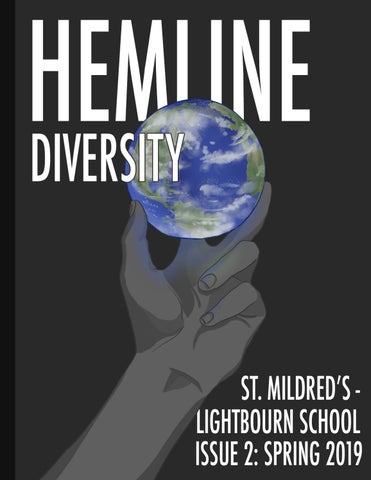
CELEBRATING DIVERSITY : INTRODUCTORY REMARKS Nicole Sekhon The Hemline team’s second issue, “Celebrating Diversity”, truly lives up to its name in the many wonderful articles, poems, and art that reflect upon political and cultural differences around the world. In this issue, SMLS authors and visual artists look at traditional clothing, social justice issues, cultural celebrations, and inclusion in the creative industries. The pieces showcase diversity in media and in real life in order to give us all opportunities to learn more about the world, each other, and ourselves.
2
SPRING ISSUE Multicultural
Fair
Review
5
Frances Clark Chinese New Year
at
SMLS: A Recap
6
Carolyn Che and Alex Morrison Black
History
Month
7
Laiya Kamanga SS10 3D
Sculpture
7
Jane Dai and Lin Sun Traditional
Clothing
8
Tiany Xie SS12 Media Arts Postcards
9
Savannah Staszkiel, Kate Thomson, Agnes Adesina Preserving the Twenty-four Solar Terms of Ancient Overview of Chinese Astrology
China:
An
10
Alivia Huang Cultural
Identity
in the
World of Fiction
12
Ella Kirton The
Necessity
of the
Humorist
14
Haillie McKinney SS12 Digital
Painting
16
Olivia Galang, Jorja Heiner Oscars
International
Movie
Review
17
Jodie Barron-Sluga The
Right
to
Protest
the
National
Anthem by
Professional Athletes
18
Aicha Diaby
3
An Ode to
Women
21
Olivia Wyszomirski SS12 Personal Art
Piece
21
Agnes Adesina Neuroatypicalities
22
Emily Adam Relying on the
Senses
23
Alex Morrison Diversity
in the
Provincial Parliament
24
Frances Clark Reflection on 2018
November Block
26
Alivila Huang SS12 Visual
Arts Personal Piece
29
Ariana Wong Diversity
Acrostic
Poem
30
Clara-May King Self Portrait
30
Tiany Xie
4
A REVIEW OF THE SMLS DIVERSITY COMMITTEE’S MULTICULTURAL FAIR Frances Clark SMLS has a diverse student body, with students from all over the world. On March 6th, 2019, they had the opportunity to share their cultures. The Diversity Committee had been preparing for this much anticipated day for months, and had been working long and hard to make it happen. Each student chose a country, some choosing their homelands, and prepared that country’s most popular dishes, as well as a poster displaying interesting facts and information about the country they were representing. On the day, there were tables displaying colourful signs and flags, and dishes were arranged showing the various cultural foods. From fairy bread to falafels to french fries, the student lounge smelled of a mixture of sugars and spices. Once classes were over, students began to trickle through, and began talking eagerly with the students at the stalls about the foods and the countries they represented. Music started to play from the speakers, and people sat on the steps to enjoy the tastes of the different cultures. It was interesting to see the variety of dishes that were on display. It showed the hard work and thought that went into the preparation of this event, and there were desserts, hot and cold dishes, and cultural drinks. Not only were the dishes a hit, but the performances showed the talents of the SMLS community: Sarah Durland performed a ballet dance, and Kathleen Kovac’s performed an opera. There was also a stall for girls to get decorative henna tattoos. It’s important to celebrate the many backgrounds of the SMLS girls, and what better way than enjoying an afternoon with friends and food?
5
CHINESE NEW YEAR AT SMLS: A RECAP Carolyn Che And Alex Morrison On Monday, February 4th, the SMLS Chinese New Year Chapel Committee gave a delightful presentation to the whole school about the importance of the Chinese New Year. The committee presented a number of fascinating details about the Spring Festival which many SMLS students celebrate. The presentation included a professional lion dance team, which gave an amazing performance of one of the most historic traditions of the celebration. The Chinese New Year Chapel at SMLS was a thriving success. In case you missed it or would like a refresher, here is a rundown of what happened: Chinese New Year lasts 15 days, with our school presentation falling right on the day of New Year’s Eve. According to the Chinese Zodiac, 2019 is the year of the pig. Traditional colours of this celebration are red and gold, and there is an abundance of decorations used, such as red lanterns, upside-down Fu characters, and door couplets. Some particular foods that are eaten include spring rolls, dumplings, steamed fish, Nian Gao (a rice flour cake), hot pot, turnip cake, and longevity noodles. Chinese New Year has many familial customs for the purpose of bringing good luck to the coming year. Elders give red envelopes to children to wish them good luck, and a family will set off colourful fireworks the night before New Year’s day. Families may clean their houses, enjoy a large feast on New Year’s Eve, watch “Chun Wan”, and visit other family members or friends. In addition to learning of traditions, SMLS students and faculty got to practise how to say “happy new year” in Chinese: 新 年快乐 (xīn nián kuài lè)! Students were particularly excited when it was time for the lion dance. With the help of the SMLS Parents’ Association, the Chinese New Year Chapel Committee was able to invite a professional lion dance team for an interactive lion dance. We heard about all of the steps someone has to take to “summon” a lion on Chinese New Year, along with its symbolism. The dance was stunning, fun, and exciting. The lion performed a number of tricks, and was an integral part of the chapel in displaying Chinese tradition. The Chinese New Year Chapel at SMLS was a great way to celebrate a tradition that many people in our student body share, and get everyone in the school community involved.
6
BLACK HISTORY MONTH 2019 AT SMLS Laiya Kamanga This year for Black History Month, Laiya, Nadiyah, Titi, and Ariana led the Senior and Middle School girls in the first ever chapel talk. These talks, implemented by Ms. Richards, were started in order to spark discussions on topics which should better integrated into our conversations. The girls discussed why BHM is relevant today and shared important black role models and movements, including Colin Kaepernick and Black Lives Matter. The girls also discussed macroaggressions and the eect it has on the people who receive them. SMLS was also able to listen to Melicia Sutherland talk to the Senior School girls about body image, how black women are perceived, and her experiences as a woman of colour. The girls thoroughly enjoyed this speaker and left having a deeper appreciation of their diverse peers.
SS10 VISUAL ARTS 3D DESIGN Jane Dai And Lin Sun
Over the past few months, students in the AVI 3M class worked to create sculptures using only cardboard.
Mask, By Lin Sun
7
TRADITIONAL CLOTHING AROUND THE WORLD Tiffany Xie India --- Sari A sari is a four to nine yard unstitched garment draped in different styles and worn on an upper stitched garment called a choli/blouse. The colour, texture, and material of saris are diverse. Depending on ethnicity and cultural, different dresses and colours are worn to different occasions. Also, different p a r t s o f In d i a h a v e different type of traditional dresses. For example, in Punjab, the traditional dress is a Salwar Kameez, and in Rajasthan, it is a Gagra Choli, also known as a Lehenga. Mexico --- Chiapas The typical Chiapas dress originates from the town of Chiapa de Corzo and describes the floral varieties of the region. The blouse is made from satin (with a silk feeling) with a circular off-theshoulder blouse, and a flounce embroidered with flowers. The skirt is also made out of satin and composed of a series of flounces with em broider ed colourful flowers. People usually wear Chiapas to festivals, birthdays, weddings, and other special events.
Germany --- Dirndl A dirndl consists of a bodice and a skirt or a pinafore dress, a lowcut blouse with short puffed sleeves, a full skirt, and an apron. The winter style dirndl is usually rich in dark colours, made from thick cotton, linen, velvet, or wool. The summer style is usually lighter in colour, and made with lightweight cotton. There is an urban legend claiming that the placement of the knot on the apron is an indicator of a woman's marital status. A knot tied on the right means the woman is married, and on the left, means that she is single. China --- Quju Quju is a formal outfit worn for important ceremonies. Fo r different events, people wear different colours of Quju, and there are rules restricting the choice of colours for different occasions and people. Fo r example, historically, only the Emperor could wear yellow, and only the bride and the bridegroom could wear red at a wedding.
8
Russia --- Sarafan A sarafan is a long, simple dress that usually consists of thin shoulder straps and a bell-shaped gown. Sarafans were usuall y accompanied by a kokoshnik, a traditional headdress patterned to match the dress. Kokoshniks came in a variety of shapes and s i z e s , b u t we r e m o s t recognizable a s haloshaped and spanning earto-ear over the crown of t h e h e a d . No w a d a y s , people usually wear Sarafans when they are performing folk songs, dances, and on folk and religious holidays.
Works Cited Dirndl, en.wikipedia.org/wiki/Dirndl. Accessed 4 Apr. 2019. Hanfu, en.wikipedia.org/wiki/Hanfu. Accessed 4 Apr. 2019. "Mexican Chiapas Dress." Mexican Chiapas Dress, www.mexican-clothing-co.com/ chiapas-dress.html. Accessed 4 Apr. 2019. sarafan, en.wikipedia.org/wiki/Sarafan. Accessed 4 Apr. 2019. Sharma, Shalu. "What do Indians wear?" Indian clothes, what women and men of India wear? Shalu Sharma, www.shalusharma.com/ what-do-indians-wear/. Accessed 4 Apr. 2019.
MEDIA ARTS POSTCARDS Savannah Staszkiel, Kate Thomson, Agnes Adesina
Arizona, by Savannah Staszkiel SS12
Caribbean, by Kate Thomson SS12
Japan, by Agnes Adesina SS12
9
PRESERVING THE TWENTY-FOUR SOLAR TERMS OF ANCIENT CHINA: AN OVERVIEW OF CHINESE ASTROLOGY Alivila Huang The ancient history of China is a massive and mystifying one. Many meaningful traditions that our ancestors developed and applied have been f o r g o t te n i n C h i n a ’s l o n g histor y. The few that have s u r v i v e d t h e “c h a l l e n g e s ” history embarked upon them should be better preserved in today’s day and age. It is also essential for them to be more widely known, not just by Chinese people, but by people of other nationalities as well. However, these traditions may be very difficult to understand even for Chinese people, which is one of the reasons they are disappearing. The twenty-four solar terms are a part of one of the ancient calendars of China and a portion of the mysterious, yet intriguing Chinese Astrology. The 24 solar terms refer to the 24 dates that indicate the seasonal change of weather in the lunar calendar. In ancient times, they were initially determined by the direction of where Mizar and Alkaid, the “handle stars” in the Big Dipper, are pointing. The solar terms are also relevant to the pattern of the Earth’s position on the ecliptic. Each solar term corresponds to a 15degree movement of the Earth
on the ecliptic. When the Earth orbits a full circle around the Sun, it acts as a reincarnation for the 24 terms. With two solar terms in each month, they summarize the different positions of the sun located on the ecliptic in each season, the exact time of winter a n d s u m m e r, a n d t h e occurrence of natural phenomena such as rainfall and snowfall. The people of ancient China determine the starting and ending of the four seasons and the solar terms by obser ving the pattern of
climate changes and celestial movements. A full 360-degree trajectory of the Sun is divided into twenty-four equal sections. Each section is a solar term, which is why there are 24 of t h e m . T h e 2 4 s o l a r te r m s represent the 24 different locations that the Earth will cross while moving on its orbit. It takes the Earth 365 days to orbit all the way around the Sun. Therefore, there is a solar term every fifteen days. Every solar terms consists of the changes of climate, phenology, and time.
10
Because of its unique t i m i n g w i t h t h e E a r t h’s position, the 24 solar terms were used as a calendar in a n c i e n t t i m e s . T h e y we r e included in the “Dry Calendar”, or the “Chinese Sun Calendar”, and ser ve as an important portion of maintaining the accuracy of the calendar. The solar terms began appearing in the second dynasty of China, the Shang Dynasty. At the time, there were only four terms that indicated the starting of spring, summer, autumn, and winter. All twenty-four were not c o m p l e t e d u n t i l t h e Ha n Dynasty, the first dynasty that culture prospered. The earliest recording of the intact 24 solar t e r m s w a s t h e As t r o n o m y Training, by Huainanzi. In 104 B.C., the first year of Emperor Wu of the Han Dynasty, the Taichu Calendar - the first official calendar of the 24 solar terms – was established. The 24 solar terms acted as a compass for farmers in ancient times. They advised the farmers on the appropriate time to plant seeds, to water, to
get rid of pests, to harvest, and to prepare for the next year. They also predicted drought and flood seasons. The 24 solar terms are an important part of the history and culture of China and embody the essence of Chinese civilization, its histor y, and its culture. Although the terms were created thousands of years ago, they still have the ability to guide the production of agriculture in modern times. The climate is much different than what it was, but the solar te r m s a r e s t i l l c a p a b l e o f guiding agriculture and offering support to farmers and doctors. Even citizens living in the city can rely on these terms for some advice. Certain experts say that with the acceleration of urbanization and the development of modern a g r i c u l t u r e te c h n o l o g y i n China, the guidance function of the 24 solar terms have gradually weakened. However, they maintain their significance in the daily lives of the citizens of modern Chinese society.
The twenty-four solar terms contain excellent themes, including the importance of emulating nature, adapting to nature, the wisdom of harmony between humans and nature, a n d t h e C h i n e s e p e o p l e ’s unique understanding of the universe and nature. In order to better preserve this tradition, serious research and discussion must be conducted. These actions are beneficial to today's society, as they explore the modern elements within “old” customs and blend them into today’s day and age. This way, the 24 solar terms will be able to resonate with the times, guide and inspire the general public, and play a more beautiful and exciting movement for modern times, just as it did for those Chinese ancestors two thousand years ago.
Work Cited Ke, Fusu. “⼆⼗四节⽓.” Baidu百科, Baidu, 20 July 2017, 15:05,baike.baidu.com/item/ %E4%BA%8C%E5%8D%81%E5%9B%9B%E8%8A% 82%E6%B0%94/191597. Image Derived From: https://www.chinahighlights.com/festivals/
11
CULTURAL IDENTITY IN THE WORLD OF FICTION Ella Kirton Multicultural influences are important to diversify Western literature, but when non-Western writers are forced to tell stories based on their backgrounds alone, the stories they tell become disingenuous. “The Politics of Fiction,” by Elif Shafak, “The Danger of a Single Story,” by Chimamanda Ngozi Adichie, and “Telling stories from Africa,” by Chris Ab a n i a r e T E D Ta l k s t h a t explore this issue. Each of these talks takes a unique stance on the place of cultural identity in fiction, and enforces the power of storytelling on a worldwide scale. In h e r t a l k , “ T h e Politics of Fiction,” Elif Shafak explores the idea that fiction has the ability to transcend cultural barriers and renounce unnecessary identity politics. As a Turkish woman, Shafak is expected to exclusively write the stories of Turkish women. When her writing is promoted in America, it is categorized as “multicultural fiction” rather than by its genre or content. Shafak warns that pressuring n o n -We s t e r n w r i t e r s t o represent their culture in their stor ytelling is extremely damaging to creativity and the possibility of a more compa ssionate world. She opposes the lesson to “write what you know”, and urges viewers to write from a place of compassion--to write what you
feel. Rather than labelling writers as spokespeople for their countries, she suggests expecting them to write about the people they have never met and the places they have never seen. In doing this, Shafak argues that fiction will be able to fulfill its tr ue purposeconnecting people globally with no barrier. She states that “[i]dentity politics divides us. Fi c t i o n c o n n e c t s . O n e i s interested in sweeping generalizations. The other, in nuances. One draws boundaries. The other recognizes no frontiers. Identity politics is made of solid bricks. Fiction is flowing water” (Shafak 14:18). Assuming the way a person sees the world based on their background is a generalization that serves only to divide us, Shafak urges viewers to realize that compassionate fiction is the only remedy for a world too harshly divided by labels. To Shafak, storytelling’s power lies i n i t s u n i v e r s a l a b i l i t y to connect people through humanity, regardless of your cultural identity. In “The danger of a Single Story,”by Chimamanda Ngozi Adichie, she explains how reducing people to a “single stor y”- a onedimensional representation of who they are based on their cultural background- holds us back from a more tolerant
world. Adichie notes that before coming to America, she did not consciously identify as African, but soon realized that her race and culture were the first, and sometimes only things people saw when they looked at her. She reflects on her college roommate, who would ask to listen to her “tribal music” and question how she could speak E n g l i s h . He r r o o m m a t e , Adichie explains, had a single story of Africa, one of poverty and war. In this single story, there was no possibility for similarity or a connection, only pity. Adichie admits that she too had been guilty of resorting to the single story, highlighting a trip to Mexico she made in the midst of debates about immigration. She felt slight surprise to see Mexicans going about their business normally and peacefully. She shamefully realized that this feeling stemmed from her acceptance of the single story that made every Mexican out to be the “abject immigrant” portrayed in the media. This, Adichie says, is how single stories are created, showing people as one thing over and over again. She explains that, “the single story creates stereotypes, and the problem with stereotypes is not that they are untrue, but that they are incomplete. They make one story become the only story” (Adichie 17:36). This is what Adichie means when 12
she describes the danger of a s i n g l e s t o r y. M i n i m i z i n g people’s cultural realities to stereotypes, or a single story, leaves the public uninformedand puts the world in danger of becoming less tolerant. C h r i s Ab a n i ’s t a l k , “Telling Stories from Africa”, explores how cultural identity is connected to fiction only to a certain point, and how the power of stor ytelling goes beyond a person’s background. Abani recalls growing up at the b e g i n n i n g o f t h e B i af r a n Nigerian Civil War, a time when the federal government did not allow the teaching of the war’s origins and history. In light of this restriction, his teacher, who still wanted to teach about the consequences of war, taught the history of the Je w i s h Ho l o c a u s t . Ab a n i connects this to his earl y understanding of the power of storytelling when he says, “…I learned the melancholic history of my people through the
melancholic history of another people. I mean, picture this -really picture this. A Pakistani Mu s l i m t e a c h i n g Je w i s h Holocaust history to young Ig b o c h i l d r e n . S t o r y i s powerful. Story is fluid and it belongs to nobody” (Abani 8:15). As Abani goes on to explain, this simple experience of transcending culture went on to inform his entire career as an author and activist. When he says story is fluid, he means that no one culture holds the sole stake on their history or s t o r i e s . Ab a n i s t r i v e s f o r honesty in a world in which everyone passionately defends their cultural identities. If people can admit that they do not know the whole stories of their cultures, more interesting conversations can be had that are not based around cultural preconceptions. These TEDtalks- all given by non-Western writerscomment on cultural identity in fiction, discuss the power
stories hold over us, and what difference cultural identity m a ke s i n t h e w o r l d o f literature. Beyond writing, stories are being told in some form everywhere, and these talks suggest ways to make those stories more diverse, more interesting, and more honest. Elif Shafak, Chimamanda Ngozi Adichie, and Chris Abani prove that cultural identity and fiction will always be intertwined, but storytellers hold the power over how to use them. Works Cited Abani, Chris. “Telling Stories from Africa." TEDGlobal. June. 2007. Lecture. Adichie, Chimamanda Ngozi. “The D a n g e r o f a S i n g l e S t o r y. " TEDGlobal. July. 2009. Lecture. Shafak, Elif. "The Politics of Fiction." TEDGlobal. July. 2010. Lecture.
13
THE NECESSITY OF THE HUMORIST Hallie Mckinney In his 2004 book, Status Anxiety, Alain de Botton argues that the chief aim of humorists is not merely to entertain but “to convey with impunity message that might be dangerous or impossible to state directly.” Because society allows humorists to say things that other people cannot or will not say, de Botton sees humorists as serving a vital function in society. Hu m o r i s t s are prominent figures in every type of media people consume. Whether one is watching TV or reading the newspaper, it is impossible to avoid this content. Humorists’ political and social commentaries, no matter the medium, are presented in a manner that is easily consumable due to their indirectness. Society needs humorists because people have less difficulty discussing co n t r o v e r s i a l o r s e n s i t i v e subjects when they are treated informally. Laughter has a way of bringing people together when nothing else will, and in making it possible for others to laugh at their flaws and mistakes. Humorists are able to create safe environments for people to reflect on what being human means. Humans find it easier to talk about difficult topics when the topics are being discussed in an informal manner. When people are uncomfortable, it is a deeply ingrained instinct to lighten the mood. Obviously, it is not enjoyable to dwell on morbid, unsettling, or depressing subjects. However, problems, especially ones that belong to that of a community,
nation, or planet, need thorough analysis, and average members of the workforce often feel like they have no right to express their opinions. Issues like the lack of clean water, poverty, education for girls, racial and gender inequality have recently been increasingly discussed as humorists call attention to these problems. The average person feels empowered when the ability to talk about problems affecting him or her and the people around him or her is accessible to everyone. As of right now, sexual harassment, assault, and violence in our society is a topic of great importance. “Saturday Night Live”, a wellestablished late-night comedy show that features humorous sketches and satirical news, shows a satirical song titled “ We l c o m e t o He l l ” t h a t featured SNL comedians Kate McKinnon, Aidy Bryant, Leslie Jones, and guest star Saoirse Ronan. It mimicked the style of bubblegum pop music videos, with bright colours and exa g geratedly feminine costumes. In it, the women sing in ironically cheerful tones with high-pitched voices, delivering lines like “Ain’t it so cuckoo,
playing this guess who” and sensually cooing lines like, “Oh, and this ain’t just a girl group. We travel like this for safety”. Mid-video, Jones is introduced and points out how these issues tend to be even more serious for women of colour. The mock music video was released in December 2017, when the #MeToo movement was really beginning to take hold. Despite its serious and troubling subject m a t t e r, t h e v i d e o w a s humorously received and shared by feminist presences on websites such as Twitter and Tu m b l r, w h o p r a i s e d i t s reliability while still being accurate and true to the nature of our social problems. Satire and comedy enable people to talk about subjects they otherwise wouldn’t, and this is just one example out of many. Humorists are needed because laughter brings people together. Smiles transcend boundaries, and though laughter cannot resolve fundamental differences, it reminds people of the humanity of those whose opinions oppose theirs. Disagreements grow tense and opposing sides often forget the other side consists of humans as well, reducing groups of 14
people to faceless opinions and negative characteristics. When this happens, debate no longer becomes about exchanging thoughts, understanding the other side, or educating each other; instead, it becomes a ritual where the parties involved all do the best to smear each other. A YouTube channel called Jubilee has a video series called Middle Ground in which opposing groups are brought together to find just that, a middle ground. Some of their most popular instalments include ‘Can Trump Supporters And Immigrants See Eye To Eye?’, ‘Pro-Choice and Pro-Life Supporters Search For Common Ground’, and ‘Can LGBTQ+ and Christians S e e E y e To E y e ? ’ It ’s a n interesting type of video to make f rom a channel that primarily produces content like ‘Backpack Kid Shows Us Life After Breaking the Internet’ and ‘Strangers Play Monopoly with Real Money’. It is the perfect example of humorists using their social platforms to create unity and harmony. Not only do the people featured in the videos get to have healthy and productive discussion, but one only needs to look in the comment sections below to find thousands of commenters extending and self-moderating their own talks. Hu m o r i s t s h a v e t h e ability to create an atmosphere in which people feel comfortable reflecting on what being human means. A lot of cartoons and comedy skits involve some self-deprecation,
exa g gerated depictions of awkward interactions most people have had, and little pokes at the humorist’s own flaws. When people see these reflections of our own faults or shortcomings and are able to laugh at them, it removes some of the shame that surrounds them and allows people to think about them, to realize they are not alone and that most people do that thing or feel that way. In people’s minds t h e y b e co m e c l a s s i f i e d a s h u m a n e x p e r i e n c e s . Jo h n Mulaney is a comedian who has enjoyed great success recently. In his show, The Comeback Kid, he makes little jabs at himself that elicit laughter from the audience— “I don’t look like someone who used to do anything. I look like I was just sitting in a room with a chair eating saltines for 28 years and then walked right out here”, for one, and “When I’m walking down the street I don’t think anybody goes ‘Hey, look at that man’. They’re just like ‘Woah! That tall child looks terrible!”. Mulaney has appeared on The Tonight Show Starring Jimmy Fallon, starred in YouTube videos with Nick Kroll, and had his show The Comeback Kid uploaded on Netflix (to high critical acclaim). People find this type of humour so comedic because everyone can relate to it. Who hasn’t felt socially awkward before? Mulaney’s humour often focuses on exaggerating his social awkwardness, the fact that despite being born in 1982, he seems to have stepped right out
of the 30s, and how he has a certain femininity about him (despite being a straight man!) Everyone has awkward traits of their own, and a large part of Mulaney’s appeal is his embrace of them and his unique ability to allow others to see that not only are they not alone, their unique awkward traits can be comedic in a positive way too, and that is the meaning of being human. Despite all this, one could certainl y argue that humorists, though entertaining, are not vital in society, and that their roles are not integral to various social and political climates. However, if humorists really had no vital function in society, why would the annual White House Correspondents’ Association dinner typically feature a comedian? Could anyone else except a comedian stand in front of the president of the United States, generally considered the most powerful person in the world, and not only critique and make fun of their policies but their character as well? Humorists are, without a doubt, able to make statements and question things that other people cannot and will not. People who are inclined towards the political right often praise humorists for their willingness to include “controversial” or “offensive” matter in their humour, and those who are aligned with the left applaud them for including social justice issues in their work. Divorcing humorists’ established role in politics and social reform would be bizarre, 15
and dismissing their importance even more so. With nobody to help foster these dialogues, spread acceptance, and challenge the definition of humanity, society would be faring a great deal more poorly. Without a doubt, humorists ser ve a vital function. A world without humorists is a bleak world i n d e e d . Wi t h o u t s a t i r i c a l writers, comedians, or television program hosts to present news and discuss social issues in interesting and humorous ways, being politically and socially active would become so incredibly taxing on the psyche that people would be likely to draw back from it. The constant
solemness that political and social reform would lead people to melancholic, disinterested, and muted surrounding the topic of social justice. Social change would stagnate. The happiness and health and human beings are improved when they are able to reflect on and laugh at their fl a w s a n d m i s t a ke s , a n d humorists provide safe environments for this to happen. This laughter also has the ability to bring together groups divided by disagreements. Plus, it is easier on the human mind to discuss sensitive and controversial subject matter when humour is in the equation. Due to the oblique manner with which
humorists tend to address political and social issues that are often controversial, their work is present in all types of media. They are an essential part of society and humankind would be socially destitute without them. Works Cited John Mulaney: The Comeback Kid. Directed by Rhys Thomas, performances by John Mulaney, Amanda Walsh. 13 Nov. 2015. Netflix, https://www.netflix.com/title/ 80058424. “Welcome To Hell - SNL.” YouTube, uploaded by Saturday Night Live, 3 Dec 2017, https:// www.youtube.com/watch? v=1l26UFQ06eQ.
SS12 DIGITAL PAINTINGS Olivia Galang And Jorja Heiner SS12 students in both visual arts and media arts have been using SketchBook create digital paintings.
Korean Arcade, by Olivia Galang
Fortune Not Found, by Jorja Heiner
16
DIVERSITY AT THE OSCARS Jodie Barron-Sluga
https://oscar.go.com/news/winners/oscar-winners-2019-live-updates-to-come
The 2019 Academy Awards ceremony proved to be an evening full of historic milestones. Just years after #oscarssowhite dominated the awards season conversation, the Oscar nominees and winners are becoming noticeably more diverse. As well, the gender gap at the Oscars appears to be getting smaller. These are huge steps in the film industry that will hopefully lead to a more inclusive Hollywood in the future. Women dominated the awards ceremony this year. Not only were films like The Favourite being recognized (a movie which happens to barely pass the reverse Bechdel test), but the night also featured many female winners. This included when Rayka Zehtabchi and Melissa Berton won Best Documentary Short for their film Period: End of Sentence, a movie that tackles the topic of menstruation and gender equality in India. Many of the night’s female winners also ended up being people of colour, another huge milestone considering that a few years ago you would have been hard pressed to find a single nominee who was a woman of colour. The diversity at the Academy Awards this year was also outstanding. There were many films nominated for Best Picture that prominently featured people of colour, including Black Panther, BlacKkKlansman, and Green Book. Furthermore, three out of the four acting awards went to people of colour, with Regina King, Mahershala Ali, and Rami Malek all taking home a statue. Alfonso Cuarón won Best Director for his Spanish language film, Roma. The biggest award of the night, Best Picture, went to Green Book, a story that highlights racial differences in the deep South during the time of Segregation. However, there are still many strides to be made, and the night wasn’t without controversy. Namely, many protested Green Book’s Best Picture win, stating that it was a white saviour story that wasn’t accurate to the time period. As well, no women were nominated for Best Director this year, a category that historically has very few female nominees. Yet, if this year’s awards ceremony is an indicator of the change that is to come in the future, then it will hopefully not be long before we see an Oscars ceremony that accurately reflects the world around us. 17
THE RIGHT TO PROTEST THE NATIONAL ANTHEM BY PROFESSIONAL ATHLETES Aicha Diaby On August 26th, 2016, Colin Kaepernick, National Fo o t b a l l L e a g u e ( N F L ) quarterback, was photographed sitting during the American national anthem before a presea son game (Guerrero 2018). This simple act of polite protest led to one of the most notable controversies talked about today. Proceeding from sitting to kneeling, Kaepernick’s protest inspired many to follow in his controversial footsteps. More t h a n t w o y e a r s l a t e r, Kaepernick, who was once known as a star NFLquarterback, still stands as an unsigned free-agent as a result of his actions. In 2018, the Na t i o n a l Fo o t b a l l L e a g u e attempted to implement a new national anthem policy, which would require players to stand if they are present on the field during the national anthem. The NFL halted the policy after immediate objection from fans around the world as well as the National Football League Players Association. Although many argue that athletes should not protest the national anthem because it disrespects the country’s flag and military, including veterans, athletes should reser ve the right to peacefully protest during the national anthem because it is a legal and safe form of protest that generates discussion of
Source: http://theundefeated.com/features/a-timeline-of-events-since-colin-kaepernicksnational-anthem-protest/
issues such as prejudice and discrimination in the country on a large platform. Peacefully protesting the national anthem, often done by raising a fist in the air, sitting, or kneeling, is a legal act. The first amendment in the United States is: “Congress shall make no law respecting an establishment of religion, or prohibiting the free exercise thereof; or abridging the freedom of speech, or of the press; or the right of the people peaceably to assemble, and to petition the Government for a redress of grievances” (Cornell 2018). When Francis Scott Key w r o t e t h e S t a r- S p a n g l e d Banner, it was not with the intention to have it sung before professional sports contests.
Key wrote the Star-Spangled Banner in the form of a poem after seeing the American flag fly over an embattled war site during the war of 1812. The singing of a national anthem before professional sports events only became a tradition after players and fans started singing it before games during the first World War. The song, which only officially became the national anthem in until 1931, has grown to symbolize patriotism and nationalism in the United States (Issitt 2018). A s a r e s u l t , a t h l e te s w h o oppose the message of the national anthem choose to display their beliefs by protesting it. These protests did not just start now. There are older examples of athletes 18
protesting the national anthem. has led to the closing of the especially when done by For example, “[a]t the 1968 Eiffel Tower and other notable professional athletes, generate Olympics, African Americans landmarks, and hundreds have discussion and spreads r u n n e r s Jo h n C a r l o s a n d been injured during these awareness about occurring Tommie Smith raised their fists protests (Lee and Robinson injustice and other issues. in a Black Power salute after 2018). Individuals protest in Professional athletes have big winning gold and bronze order to express their beliefs platforms to make an impact medals, respectively” (Issitt and to have their concerns be and influence others. When a 2018). When asked by reporters heard when they are not being professional athlete does a about the motive for his listened to, acknowledged, or brave and controversial act controversial act, Kaepernick respected. In regards to the such as kneeling during the stated, “[i]t is to protest the abundance of controversial national anthem of an NFL injustices that are happening in events occurring in the United game, they know that millions America, the oppression that is States of America, everyone has of people are going to see the happening in a right to feel a certain way. action and millions of people America,” (Guerrero 2018). Arguably, some groups feel as are going to think about the Thus, regardless of one’s though their voices are not action. More impor tantl y, position on the millions of people protest of the will think about the national anthem, it message. When is a legal act that is someone with the practised to freely magnitude of express an opinion influence as a and should not be professional athlete penalized. does something to Of the many spark a ways to protest conversation, they injustice happening will be noticed. This in a country, sitting is a great way to or taking a knee is a start conversations peaceful way to and to m a ke s h o w o p p o s i t i o n Source: https://www.cnbc.com/2018/04/25/nfl-owners-feared-trump-wrath-over- i n d i v i d u a l s t a l k w i t h o c c u r r i n g national-anthem-protests-report.html a b o u t issues in a country. uncomfortable Concerning the injustice heard. The national anthem topics no one wants to talk occurring in the United States, protests are used as a way to about.When someone with there are many ways in which receive attention and to have power opens up a door for individuals could unpleasantly thoughts and feelings heard. others to express their r e a c t . Fo r i n s t a n ce , m a n y Thus, peacefully protesting the thoughts and opinions, many countries in similar situations national anthem is a safe way to who were once afraid to share create ‘rebellious’ militar y protest when compared to their opinions take advantage. groups that rebel against a other methods. Athletes should This is how a powerful country’s authorities. This can have complete freedom to movement is created, and that lead to out-of-control situations c a l m l y p r o te s t d u r i n g t h e is what creates change. Thus, such as wars. A current example national anthem without peaceful protests by is the protests occurring in suffering consequences. professional athletes during the France. Citizens are violently The peaceful protests national anthem help start protesting tax increases. This during the national anthem, conversations that can create 19
change. Ma n y a r g u e t h a t protesting the national anthem disrespects the American flag as well as the millions of heroes w h o s a c r i f i ce d t h e i r l i v e s ‘fighting for the flag.’ However, the intent of these protests is not to discredit the hard work, dedication, and success of individuals who risked and lost their lives to fight for the independence of their country. The protests occur to remind the country that everything these individuals fight for has not been achieved. As Colin Kaepernick once said “I realize that men and women of the military go out and sacrifice their lives and put themselves in harm's way for my freedom of speech and my freedoms in this country, and my freedom to take a seat or take a knee, so I have the utmost respect for them,” (Berenson 2016). Soldiers fight not only for the fla g but for independence, safety and long-term happiness
of the country. The reality is that there are people in the countr y who are not independent, are not safe, and cannot be happy. These are the individuals that are protesting so that the country can become what those soldiers fought for it to be. Thus, protesting the national anthem does not disrespect the fla g or the m i l i t a r y, but rather complements what the flag represents. Therefore, professional athletes reserve the right to peacefully protest during the national anthem because it is a legal and safe form of protest that generates discussion of issues in the country on a big platform. At the end of the day, it is easy to forget that professional athletes are people fi r s t . T h e y h a v e f e e l i n g s , opinions, and they are impacted by events just as much as ever yone else. Considering the opinion of the opposing side, however, is
important. A recommended compromise is to prohibit players from protesting the national anthem at specific, important times such as Thanksgiving or Christmas. Athletes have a duty to use their platforms to empower and influence others to stand up and fight for what they believe in. Athletes also have the added pressure of being criticized for their every move. Although it takes a lot of courage to put one’s lifelong dream and career in jeopardy, in the words of Colin Kaepernick himself, “Believe in something, even if it means sacrificing everything,” (Burns 2018).
Works Cited
Berenson, Tessa. “Colin Kaepernick: ‘I Love America," Will Donate $1 Million.” TIME, TIME, 2 Sept. 2016, time.com/4477383/colin-kaepernick-says-he-is-not-ant-american-and-respects-the-military/.
Burns, Will. “With New Kaepernick Ad, What Does Nike Believe In?” Forbes, Forbes Media LLC., 4 Sept. 2018, www.forbes.com/sites/willburns/2018/09/04/with-new-kaepernick-ad-what-does-nike-believe-in/ #64bd38181081. Cornell. “First Amendment.” LII / Legal Information Institute, Legal Information Institute, 10 Oct. 2017, www.law.cornell.edu/constitution/first_amendment. Guerrero, Juan Carlos. “Timeline of Kaepernick's Push for Social Justice.” ABC7 San Francisco, ABC Inc., 5 Sept. 2018, abc7news.com/sports/timeline-of-kaepernicks-push-for-social-justice/4147237/.
Issitt, Micah. “National Anthem Protests.” Explora, EBSCO Apr. 2018, national anthem protest. VOA News. “French Arrest Hundreds in Paris 'Yellow Vest' Protests.” VOA News, VOA, 8 Dec. 2018, www.voanews.com/a/france-braces-for-4th-week-of-violent-protests/4692114.html.
20
AN ODE TO WOMEN Olivia Wyszomirski
SS12 VISUAL ARTS: PERSONAL PIECE Agnes Adesina
Strong, driven, ambitious, trailblazing women. Every single different one.
Comfort Women Comfort women are women and girls who were forced into sexual slavery during the Imperial Japanese Army in territories prior to and during World War II. Most women were from occupied countries, which included Korea, China, and the Philippines. Many of these women and girls were tricked or defrauded into military “comfort stations�.
Curly hair, straight hair, light skin, dark skin, tall and short,
forty-six chromosomes, or forty-seven; We are all equally powerful
Working together, setting new records, being marvellous and outstanding
is what we do best. Comfort Women, by Agnes Adesina
21
NEUROATYPICALITIES Emily Adam In a time when politics divide people into categories, the ability to listen and find compassion is something that needs to be retaught. “The Human Library” project focuses on that need by sharing people’s stories for others to discover. In this space, the “readers” are encouraged to challenge what they know of the “books”, and how the readers would think to judge them. The Human Library benefits its readers by how it challenges stereotypes. In this space, the discussion on topics considered taboo are encouraged, for that is how one grows new viewpoints and perspectives. This is why being a reader is so fantastic. One is given the opportunity to be inspired, shocked, or touched by things not known previously about a taboo topic. Similarly, the best part of the project is how personal the experience is for the readers. While the focus of the library is on the “book” and the individual’s story, the experience is all about the people listening and what one could they take from it. The only disadvantage about the project is the potential risks of being a “book”. The possibility of being harassed would be the largest concern, but the project takes care of this. They prepare all of their “books” for what they might face and how they can respond to protect their own safety. The project also emphasizes to readers that it’s not about changing the answers of the “books” to be how one wants them to be, but rather discovering the answers that they provide. At the Human Library Project, every reader is impacted by conversing with books and changing their perspectives. As our society continues to expand events such as this, we shift to become more aware and intimate. If I had the opportunity to participate in The Human Library Project, I would want to speak with a person who has a neuroatypicality on the autism spectrum. I want to understand the difference between TV/movie stereotypes of autism versus the real experience and what it’s like living in such a sometimes less compassionate society. I would ask the following questions:
1.
What have you noticed is significantly different about yourself compared to neurotypical people?
2.
How are stereotypes of individuals with neuroatypicalities in the media often inaccurate?
3.
What was it like to grow up on the autism spectrum?
4.
What is it like, in general, trying to “fit in” with society?
5.
What are your experiences with people who have not been understanding with the atypicality?
6.
What efforts do you think other people could make to help your daily experiences?
7.
What are your positive experiences as someone on the autism spectrum?
8.
What are your dreams and aspirations?
Work Cited Human Library. The Human Library, http:// h u m a n l i b r a r y. o r g / . Ac ce s s e d 1 3 No v. 2018overheating brains. I can only stand and stare back.
22
RELYING ON THE SENSES Alex Morrison The Human Library Project is successful in challenging stereotypes by creating an empathetic, communicative environment between victims of assumptions and assumers themselves. Its concept of spending time with a person to interview, with that person’s full consent, whether they be refugees or victims of sexual abuse, is both original and brilliant. The project combats the adverse assumptions people jump to make of others who have been put in stigmatized situations. The increasinglydigital world has made news articles and opinion pieces more accessible than ever, potentially harming vulnerable groups with disproportionate reporting. With The Human Library Project, “readers” can form their own, unbiased opinions after having a one-on-one conversation with the experienced storytellers. In turn, they are given the chance to make peace with themselves by having someone hopefully understand where they are coming from. The Human Library Project effectively combats the judgement of misunderstood identities, but with only 75 “books” available, there are limited representatives of groups. A reader might unintentionally assume that a single person’s story is the whole story, and while their assumption may be significantly more positive if it weren’t for the library, the fact that it is not all-encompassing should be emphasized in order to prevent ignorance. Still, The Human Library Project is extremely relevant as it is able to create human connections between people who may have not thought it possible.
If I were participate in The Human Library Project, I would interview a person who is visually and hearing impaired. The questions I might ask are: 1.
Is it possible for you to picture hearing and seeing anything?
2.
Have you always had a visual and hearing impairment, or were you born with one condition and gradually lost the other sense?
3.
What are you passionate about? What do you enjoy doing in your spare time?
4.
What were your experiences in school? (how were you educated, and what subjects did you enjoy?)
5.
Do you have any extra welldeveloped abilities as a result of relying on certain senses more (eg. being able to sense when a particular person is in the room)?
6.
Are you satisfied with how you live? What makes you happy?
7.
What is the biggest challenge you face (what form of discrimination do you find the worst)?
8.
Who do you love most, and why?
9.
If you could have one sense back, sight or hearing, which would you choose and why?
10. What do you dream about, and what do your dreams look like? 23
DIVERSITY IN THE PROVINCIAL PARLIAMENT Frances Clark A few weeks ago, I was fortunate enough to travel to Queen’s Park and listen to our Provincial Parliament Question Period. Sitting up high in the Gallery, I was given strict instructions to not whisper, clap, or “make any noise whatsoever”. Fortunately for me, if I had made any noise, it wouldn’t have been audible over the loud drumming of desks and jeers of the political parties below. Despite this amusing form of entertainment, I mean, this serious form of political discussion, I had the opportunity to witness how far our provincial parliament has come in being a diverse and inclusive body of people. Scanning across the Chamber, I was pleased to see, although not equal, a larger number of women representing their ridings, and also different personalities and cultures. In fact, we have a record number of female MPPs, at almost 40% of parliament. Diversity in a political body such as the Provincial Parliament is crucial. Of course, individuals must be suitable candidates for their position. Making a political party diverse for the sake of diversity is futile if those elected aren’t good politicians. However, having individuals from different backgrounds not only gives a better representation of Ontario’s diverse population, but allows for those with different experiences and from all walks of life to better help Ontario and bring insight that otherwise would not have been shared. Sarah Singh NDP’s Sara Singh, MPP of Brampton Centre, talked to a group of us about the importance of diversity in our parliament. She stressed the importance of including those who have different experiences, because everyone has lived in different circumstances. However, we’re all Canadian, and our voices should, therefore, be heard.
Stephen Crawford I spoke with Oakville’s elected PC MPP, Stephen Crawford about the importance of diversity. Having daughters, and in general a huge supporter of equal rights, he felt it is imperative that we “utilize our whole population and their insight”. He is also a vocal supporter of Plan Canada’s “Because I am a Girl” campaign, which focuses on empowering young girls' rights to education and global health care.
24
Stan Cho PC MPP Stan Cho of Willowdale, came to talk to a group of us while at Queen’s Park, and he spoke of his childhood. He talked about how hard his parents worked to create a stable life in Canada. Stan is a Korean-Canadian, and is proud of his heritage and the diversity of his riding. He voted against his party’s resolutions to the recognition of gender identity, and stated in his speech: “[m]y community of Willowdale is among the most diverse ridings in Ontario. We know that our diversity is our strength. All people, regardless of gender identity, cultural background, religious beliefs or sexual orientation should be respected by all - they are our family, friends, and neighbours. Gender identity is not up for debate and I will do everything in my power to ensure our party, our government, and our province protects the rights of all people and fights intolerance wherever it is found” (Cho, S. 2018). Laura Mae Lindo Another NDP MPP, Laura Mae Lindo, of Kitchener Centre, said that she never would have run if she hadn’t seen how many women were running this time round. She states, “[m]y hope is that more people will start running because they actually see that … not just that I’m a woman, but I’m a woman of colour” (Rushowy K.,2018).
Despite only having seven MPPs in their party, the Liberals should be proud to have four of them who are women. Not only this, but Michael Coteau is half Grenadian, and Mitzie Hunter immigrated to Canada from Jamaica when she was young. The diversity seen in Ontario’s Provincial Parliament can be seen as a great achievement for our province. Although we have still a way to go, we should be proud of our parliament and the various cultures and backgrounds that are helping to make Ontario the best it can be. Mitzie Hunter
Micheal Coteau
Sources Cho, S. (2018, November 19). Proud to Stand Against Resolution 4. Retrieved March 20, 2019, from www.stancho.ca Rushowy, K. (2018, June 17). Ontario makes history with record number of female MPPs. Retrieved March 20, 2019, from www.thestar.com 25
REFLECTION ON THE 2018 NOVEMBER BLOCK EXPERIENCES Alivila Huang
The SMLS SS10 students went on their block trips to Bahamas, Peru, or stayed local during November of 2018. They shared their experience and the knowledge and skills that they gained on their trips during Senior Chapel. Service Eight girls chose to participate in the Community Engagement Block. Their experience was based in Oakville, with all of them doing service in the community the first week. In the second week, three girls went to Ottawa for Encounters with Canada, and the rest of the girls either continued with service or took a standard first aid certification and a safeTALK course. Their experiences were largely personalized with all of them doing different tasks based on their interests, but they all took part in separate ways to engage within this community. Round Square ideas were also thoroughly embedded into the entire block. One of the girls’ most memorable experiences was doing service at Ten Thousand Villages. Ten Thousand Villages is a non-profit organization, and 70% of the profits will be donated to developing countries to help children with education, food, or clothing. Most of the products in this store are handcrafted. Eileen Hu stated that “there are a lot of talented artisans in d e v e l o p i n g co u n t r i e s i n t h e w o r l d . T h i s organization provides a platform for the artisans
to present their talent and by selling their arts to ten thousand villages, they earn their own money to be able to keep themselves alive. We learned a lot about the origins of the products in ten thousand villages. Our boss Esther was a really nice lady, and every day she told us different stories about different kinds of products.” In the second week, the girls attended different activities. Sophia Hill describes her experience: “Amy and I were at Wyndham Manor from November 5-8. There, we helped the residents get to their activities and participated as well. We got to talk to the residents, and I also enjoyed making cookies with them. Another thing that we did was prepare the materials for their Montessori-style stations in their Trafalgar House, and had a lot of fun with the laminator, which included jams. We also participated in their Diwali celebrations, helping the residents get food and to socialize, and I got henna! This service experience helped us with the Round Square discoveries of the ability to solve problems, since we sometimes had instances where the residents needed something
q u i c k l y, a n d w e h a d t o h e l p t h e m a n d communicate properly.” Peru The group that traveled to Peru consisted of the largest number of participants. They visited many 26
historical places, such as the Sacred Valley and Moray and Salinas de Maras. They also learned much about ancient Peru history and tradition and the Inca civilization from local schools, markets, and textiles. The history of the Inca civilization was extremely attractive to the girls. Nicole Molinaro remarked during her speech in Chapel how “the Inca civilization was an empire in South America dating back to the 1400 hundreds. Its main city was Cusco, Peru a place we got to visit. As Incan people started building communities and structures especially around Cusco the Spanish came to South America and conquered what once was the Incan empire. Buildings from those times are still standing but many of them were either not finished or taken apart by the Spanish. Even after such a long time the Incas history is still appreciated and shared among people in Peru. We got to learn a lot about Inca culture, how they lived, what they ate, and what they believed in. We were able to learn a bit about the most common Incas language Quechua. Going into this trip I barely knew anything about this native culture and I didn’t know how much of Peruvian life now is inspired by Incas history.”
away from alpaca shops, for you will buy
everything on the shelves. We were curious how these items were made, so we visited two textile producers. They showed us the process of how they make these clothing articles. First, they shave the alpaca fur, clean it and then weave the fur into thread. Normally when you buy clothing here, you don’t think about the backstory because there usually isn’t one. However, in Peru they have backstories about the way they do things. Not only did we buy a million alpacas and bracelets, but we engaged and interacted with the locals there. Our first market was in Cusco city and it was a new and slightly scary experience for some of us. However, minutes within entering the markets and talking to the shopkeepers, we felt more comfortable and confident. Each time we got to spend in the markets, we were given a challenge to ask the locals about a certain souvenir and learn its story. Bargaining and talking in another language was quite a challenge for
Apart from directly learning about the Peruvian history and customs, the students also gained information through their own explorations. They explained how they “visited more than 4 markets over the course of the trip. The markets had so much to offer, like weavings, jewelry, ponchos, hats, Andean instruments, ceramics and lots of alpaca products. A tip to next year's group, stay 27
some of the non-Spanish speakers. However, by
the end of our trip at the last market, no one could tell we were tourists.” Bahamas Eleven girls went to the Bahamas for their block. Their main focus of the trip was marine life. They learned about sea turtles, sharks, lionfishes, coral reefs, and many other aspects of sea life. One of the highlights of the trip was that the girls got to participate in a real life, in-thefield research. Lin Sun relayed how “the seagrass research we participated in made a big change in our development. Personally, this was my first time ever contributing to research, it gave all of us a feel of what it is like to be a real-life researcher in the field.” However, besides studying about marine animals, they found themselves shifting
m o r e a t t e n t i o n to e n v i r o n m e n t a l i s s u e s surrounding the ocean. Maia Mah-Madjar commented on their discovery of how harmful plastic is to the ocean. She said, “during the Bahamas trip, we learned and experienced a lot about sustainability and plastics. I think that the most memorable part of our trip considering plastics was at the last beach we camped at. In the morning before we packed up and left, we took time to clean and pick up as many plastics as we could. A lot of plastics were too large and heavy to fit in the bag but that doesn't mean we didn't pick up a lot. We filled three large garbage bags worth of plastics and microplastics if we actually spotted them because microplastics are plastic fragments or particles that are already 5.0 mm in size or less before entering the environment. After this activity, we sat down and talked about how plastics never go away once they are made, they only get smaller and smaller but never disappear. There are also a lot of single-use plastics like straws and water bottles. Many people don’t know about how some leftover food in a container can contaminate an entire recycling bin, but it is shocking facts like these that we learned on our trip that has educated us and inspired many of us to change our daily routines and think twice before doing something that may make an impact on the environment.” Conclusion Whether they stayed in Canada or went abroad, and whether high on mountains or below the sea surface, every SS10 student returned to class full of rewarding experiences. They had learned much during the two weeks, and their presentations to the Senior School students were excellent. The November Block is a wonderful opportunity for students to engage with knowledge and experience in a different way than studying in traditional school classrooms. We can’t wait to hear from next year’s November block participants about their adventures!
28
SS12 VISUAL ARTS PERSONAL PIECE Ariana Wong
29
ACROSTIC POEM
SELF-PORTRAIT
Clara-May King
Tiffany Xie
DIFFERENT INSPIRATIONAL VARIANCE EXCEPTIONAL RESPECT SPECIAL INCLUSION TRADITIONS YOU 30
31
32