Join the Associates Legacy Society In the 1830s, a gift from a single benefactor led to the birth of the Smithsonian. Today, you can share the same visionary spirit and generosity embodied by James Smithson by becoming a founding member of the Associates Legacy Society. Smithson saw the new institution as a place uniquely dedicated to learning. And from its founding 60 years ago, Smithsonian Associates has been committed to the same goal: creating opportunities for learning for people of all ages. Your own legacy gift—of any size—will ensure that we are able to continue that vital work for current and future generations. And at the same time, you’ll be able to take advantage of income and tax benefits for yourself and your heirs.
“
The Benefits of Planned Giving
After attending my first lecture at
By joining the Associates Legacy Society you can:
Smithsonian Associates, I was
• Specifically designate your gift to support Smithsonian Associates. • Retain control of your assets during your lifetime. • Change your beneficiaries at any time. • Provide for the people in your life. • Make a gift in honor or memory of a loved one.
“
hooked. I'm proud to help ensure
Associates can thrive for decades
to come in a way that makes sense for my family and finances as a Legacy Society member.
Members also receive invitations to special programs and Smithsonian Associates learning experiences. TOP IMAGE: STATUE OF JOSEPH HENRY, THE FIRST SECRETARY OF THE SMITHSONIAN INSTITUTION/ ISTOCK BOTTOM IMAGE: SMITHSONIAN INSTITUTION BUILDING, 1864 / LIBRARY OF CONGRESS
Begin the Conversation We invite you to connect with us and learn more about how planned giving through the Associates Legacy Society can play a significant role in your future—and ours.
Please contact Elizabeth Moloney, Director of Advancement, at (202) 633-8697 or DonorServices@si.edu.
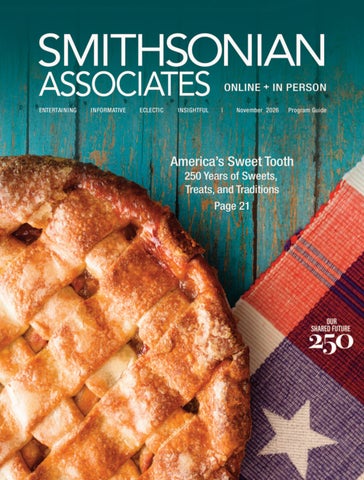
Dear Friends and Members, The classic American saying “from soup to nuts” originated at the restaurant dining table, but it perfectly captures the menu of programs throughout these pages. The pie featured on the cover may tempt thoughts of dessert, but really it symbolizes the origins of our collective sweet tooth. A food historian discusses dessert from the pies and cakes brought by early English settlers to today’s social media-driven taste trends (p. 21). Celebrations of food and cooking are among the first courses; November offers a rich buffet for lifelong learners, serving up something to satisfy every taste. An architectural historian hosts a virtual tour of New York City’s most historic restaurants. From fine-dining establishments to beloved neighborhood eateries and from traditional cuisines to avant-garde fusion, explore the storied culinary history of the Big Apple through some of its oldest and most famous dining destinations (p. 7). Cookbooks have inspired and taught America’s home cooks for centuries, defining the nation’s changing culinary identity. Investigate some of the most influential volumes (p. 21). Take a delicious look at how cookie baking has evolved over three decades as the executive editorial director of America’s Test Kitchen joins in conversation with the curator of food and wine history at the Smithsonian’s National Museum of American History (p. 27). And Associates’ overnight study tours for 2027 bring opportunities to sample a wide array of regional cuisines (pp. 56-57).
November 2026 History . . . . . . . . . . . . . . . . . . . . . . . . . . . . . 4 Culture . . . . . . . . . . . . . . . . . . . . . . . . . . . . 21 Science . . . . . . . . . . . . . . . . . . . . . . . . . . . 33 Art . . . . . . . . . . . . . . . . . . . . . . . . . . . . . . . 37 Studio Arts . . . . . . . . . . . . . . . . . . . . . . . . 49 Tours . . . . . . . . . . . . . . . . . . . . . . . . . . . . . 55 Helpful Information . . . . . . . . . . . . . . . . . 62
But the feast doesn’t end with food. Programs on art, music, history, science, and culture abound, each offering its own distinctive flavor. We hope you'll sample widely, discover a new favorite, and return for seconds.
Programs with this icon showcase the Smithsonian’s Our Shared Future: 250 initiative that celebrates 250 years of American independence in 2026
facebook.com/smithsonianassociates instagram.com/smithsonianassociates issuu.com/smithsonianassociatesprograms
Frederica R. Adelman, Director adelmanf@si.edu
Programs with this icon showcase the Smithsonian’s world of knowledge and long-term initiatives
Smithsonian Associates (USPS 043-210) Vol. 55, No. 3, November 2026. Published monthly by Smithsonian Associates, Smithsonian Institution, 1100 Jefferson Drive, S.W., Washington, D.C. 20560. Periodicals postage paid at Washington, DC. and at additional mailing offices. Robert A. Sacheli, Editor; Ric Garcia, Visual Specialist. Copyright 2026 by the Smithsonian Associates. POSTMASTER: Send address changes to the Smithsonian Associates, P.O. Box 23293, Washington, D.C. 20026-3293. Printed in the U.S.A. on recyclable paper.
NOVEMBER 2026 SMITHSONIAN ASSOCIATES
1
Connections& Collaborations Perspectives on America at 250 As the United States celebrates its semiquincentennial year, Smithsonian Associates offers two special program series and a host of commemorative programs as part of Smithsonian’s Our Shared Future: 250. Marking 250 years of the nation’s experiment in self-government, these programs explore the people, ideas, conflicts, and aspirations that have shaped America—and how the past informs the challenges and possibilities ahead.
The Enduring Power of International Exchange
Faith in Harmony: Soundscapes of American Spirituality
Hosted in partnership with the Smithsonian’s Office of
Rooted in the nation's commitment to freedom of belief,
Global Affairs and with embassies that have built strong,
this five-part series explores the rich and evolving landscape
lasting relationships with the United States, this series
of religion and spirituality in America—including Jewish,
honors the vital role diplomacy, cultural exchange, and
Islamic, Christian, Buddhist, Hindu, and Native American
mutual respect have played in shaping our nation and
spiritual practices, among others—through celebrations of
its place in the world. From the earliest days surrounding the signing of the Declaration of Independence to contemporary collaborations in science, art, and global affairs, people-to-people and global cultural exchange have helped advance dialogue and deepen understanding. In this milestone year, these programs underscore how international
sound. Programs, offered free to the public, feature performances and conversations that reveal the human connections that emerge when sounds resonate in harmony. From the sounding of the horn to the strike of the daf, from the healing of the jingle dress to a cantor’s call to prayer,
friendships—nurtured through history, culture, and
these soundscapes reflect the tones, textures, and
creativity—continue to strengthen the American story.
connections of American spirituality across the nation.
Each program is free, requires registration, and includes a light reception. The Faith in Harmony: Soundscapes of American Spirituality series received funding from the Smithsonian’s Our Shared Future: 250, a Smithsonian-wide initiative supported by private philanthropy and created to commemorate the nation’s 250th anniversary and advance the Smithsonian vision for the next 250 years The Enduring Power of International Exchange is organized by Smithsonian Associates as part of the Smithsonian’s Our Shared Future: 250.
Visit SmithsonianAssociates.org/250 for additional program details and registration information.
2
SmithsonianAssociates.org
In Person
HANNELE LAHTI / SMITHSONIAN GARDENS
The Enduring Power of International Exchange | Series
Orchid Diplomacy
How Singapore’s Blooms Connect Cultures Marking 60 years of diplomatic relations between the United States and Singapore in 2026, this special program highlights Singapore’s practice of orchid diplomacy and the Smithsonian’s leadership in orchid research, conservation, and cultivation. Hear from a panel of experts including Smithsonian Gardens Lead Horticulturist Justin Kondrat, who manages the Smithsonian’s Orchid Collection, and Mark Choo, assistant curator at the National Orchid Garden in the Singapore Botanic Gardens. Find out how the naming of orchid hybrids has been used to strengthen relationships between nations, commemorate significant milestones, and honor world leaders. Fri., Nov. 13, 6 p.m.; Embassy of the Republic of Singapore; CODE 1JDIPLO6; free, registration required Presented in partnership with the Embassy of the Republic of Singapore, Smithsonian Gardens, and the Singapore Botanic Gardens
Rhyncattleanthe Smithsonian Sunburst 175th
Faith in Harmony: Soundscapes of American Spirituality | Series
In Person
Voice
The most human of instruments, the voice, is foundational to so many spiritual experiences—in its presence and in its absence. This program explores the role of human voices in uplifting scripture, song, and calls to prayer in Judaism, Christianity, and Islam, illuminating a shared dimension of Americans’ faith in harmony. Tues., Nov. 17, 6:30 p.m.; Warner Bros. Theater, National Museum of American History; CODE 1W0995; free; registration required
Together in Spirit Sound is integral to Americans’ faith traditions, from voices raised in song to heralds of bells and horns to the beats that echo in our hearts. This final program in the series reflects back on the sounds of spirituality in the United States and fills out the rich symphony of our experiences with the divine, concluding our celebration of Americans’ faith in harmony. Tues., Dec. 15, 6:30 p.m.; CODE 1W0-994; free; registration required; this program is presented on Zoom
Visit SmithsonianAssociates.org/250 for additional program details and registration information.
Life can be busy. Registered for an online Smithsonian Associates program but missed it because of a conflict in your schedule? Wish you could take another look at a presentation you particularly enjoyed? Your programs... your time
Associates Encores offers the answers.
Many, but not all, Zoom programs are recorded. As a bonus for registrants, recordings are made available within 24 hours after the program has taken place. They can be viewed for up to 72 hours after they become accessible—so you can enjoy the program on your own time, as an audience of one.
Visit SmithsonianAssociates.org/encores for more information.
NOVEMBER 2026 SMITHSONIAN ASSOCIATES
3
HISTORY HISTORY
CULTURE
SCIENCE
UNESCO World Heritage Sites
ART
STUDIO ARTS
TOURS
There are 1,273 UNESCO World Heritage Sites, each one offering a glimpse into the evolution of complex civilizations, empires, and religions. In this monthly series, historian Justin M. Jacobs gives an in-depth overview of both well-known and lesser-known locations.
Virunga National Park The mist-enshrouded peaks of the Virunga Mountains are part of one of Africa’s earliest protected natural areas. Known for an active chain of volcanoes, Virunga National Park is home to the endangered mountain gorilla and more than 300 other faunal and floral species. Jacobs shows how together with the adjacent lands of Volcanoes National Park, made famous by the fieldwork of zoologist Dian Fossey, Virunga provides a tense yet majestic backdrop for the competing demands of economic development and ecological preservation.
Virunga National Park
Wed., Nov. 4, 6:45 p.m.; CODE 1J0-585; Members $25; Nonmembers $35
The Forbidden City For just over 500 years, from 1420 to 1924, the emperors of the Ming and Qing dynasties regarded the vermilion walls, gray cobblestones, and golden tiles of the Forbidden City in Beijing as their home. Jacobs charts a path through the vast courtyards, narrow passageways, and imposing gates of the Forbidden City, treating its art, architecture, and residents as windows into the history and culture of late imperial China. Wed., Dec. 9, 6:45 p.m.; CODE 1J0-594; Members $25; Nonmembers $35 Forbidden City, Beijing
Philippine Rice Terraces of Ifugao The photogenic rice terraces of Ifugao appear to rise endlessly into the clouds of the northern Philippine highlands and defy the laws of gravity. Yet their painstaking construction in a very short time speaks to the creative industry of hardy immigrants responding to new, unexpected pressures. Jacobs examines when and how the terraces were built, the social networks that guided their maintenance, and common misperceptions about their origins. Wed., Jan. 6, 6:45 p.m.; CODE 1J0-599; Members $25; Nonmembers $35 Rice terraces of Ifugao
Jamestown: The First 100 Years While the early days of Jamestown were marred with struggle, conflict, and tragedy, the settlement would survive as the first permanent English colony in North America. Unearth the tumultuous first century of Jamestown in this four-part series with Mark Summers, the public historian for the Jamestown Rediscovery archaeological project. 4-session series: Mon., Nov. 2–23, 12 p.m.; detailed program information on website; CODE 1CV-JTN; Members $100; Nonmembers $125
4
SmithsonianAssociates.org
HISTORY HISTORY
CULTURE
SCIENCE
ART
STUDIO ARTS
TOURS
Unless noted, all programs are presented on Zoom; listed times are Eastern Time. Online registration is required.
The Statue of Liberty: A Transatlantic Story When Frédéric Auguste Bartholdi, one of France’s most famous sculptors, first traveled to the United States to propose the construction of a giant tribute to liberty, Americans either rejected the idea or were baffled by it. Nevertheless completed in 1886, the Statue of Liberty stands today as one of the best-known symbols of the United States and a beacon of freedom in New York Harbor. It was ultimately a gift from the French people to the American people, as private citizens, not the two governments, financed it from torch to toe. Historian Edward Berenson illuminates the origins of Lady Liberty, delves into the complex construction process, and traces its shifting meaning. Mon., Nov. 2, 6:30 p.m.; CODE 1W0-037; Members $30; Nonmembers $45
Franklin D. Roosevelt and the Rise of Fascism
Magna Graecia
Historian William I. Hitchcock argues that Americans were not simply indifferent to fascism before World War II. From Mussolini’s rise in 1922 to America’s entry into the war in 1941, the nation debated the threat—and, for some, the appeal—of authoritarian rule. Initially, Franklin D. Roosevelt focused on the New Deal and avoided foreign entanglements. Over time, journalists, activists, diplomats, and advisers convinced him that fascism threatened democracy worldwide. Hitchcock contends that Roosevelt’s changing views reflected a broader national awakening as many Americans grappled with defending democracy, opposing fascism, and promoting freedom abroad. Hitchcock’s book A Shadow Over the World: Franklin D. Roosevelt, the Rise of Fascism, and the Making of America’s World War II (Simon and Schuster) is available for purchase.
Why did Julius Caesar speak his last words in Greek? Why are the world’s best-preserved Greek temples in Sicily and the South of Italy? Why did Plato visit Italy? Author Ross King explores how in Plato’s time the South of Italy was known as “Greater Greece,” the beautiful land settled in the centuries after 800 B.C.E. by colonists from the Greek mainland. King examines how these settlers brought trade and prosperity as well as their religion, customs, alphabet, and language. They also nurtured on Italian soil the political, philosophical, and artistic foundations that would profoundly influence and support the world of the Ancient Romans and, much later, that of the Italian Renaissance.
Early Greek Culture in Italy
BRUNO RIJSMAN / CC BY-SA 2.0
Tues., Nov. 3, 6:30 p.m.; CODE 1H0-929; Members $25; Nonmembers $35
Mon., Nov. 2, 6:45 p.m.; CODE 1K0-759; Members $20; Nonmembers $30
The Paestum Temples, Campania
Read more about programs in this guide on our website. Search by code or date. Expanded program descriptions, presenters’ information, and more at SmithsonianAssociates.org.
All Smithsonian Associates online programs are closed captioned
NOVEMBER 2026 SMITHSONIAN ASSOCIATES
5
CULTURE
SCIENCE
ART
STUDIO ARTS
A History of Gibraltar
By Illegitimate Means
In classical antiquity, Gibraltar inspired the original idea that the Earth was divided into distinct continents. Sailors, poets, and geographers saw Gibraltar as a natural marker separating the Mediterranean from the Atlantic and Europe from Africa. This idea had lasting global ramifications, and the geography of the Strait of Gibraltar helped create the pattern of European imperialism and the trajectory of the slave trade. Historian Geoffrey Plank relates Gibraltar’s story from its connections across the Mediterranean to its role as a symbolic boundary between continents, cultures, and religions. Plank’s new book, The Last Place in Europe: A History of Gibraltar (Oxford University Press), is available for purchase.
How Birth Decides Dynasties
Wed., Nov. 4, 12:30 p.m.; CODE 1T0-096; Members $20; Nonmembers $30
TOURS
In medieval and early modern England, legitimacy was never a private matter. Birthright could reorder kingdoms, ignite wars, and reshape history. Historian Cheryl White traces how disputed births, Vintage etching of William contested heirs, and the fragile politics the Conqueror, 19th century of bloodline altered dynasties. She begins with William the Conqueror—mocked as “the Bastard” yet able to seize a throne— and moves to the succession crises after Edward III that helped set the stage for the Wars of the Roses. She concludes with Henry VII, whose tenuous claim, strengthened by conquest and marriage, launched the Tudor dynasty. Marked by intrigue, rebellion, and political mythmaking, White’s illustrated program reveals how legitimacy functioned less as law than as a weapon—and how the fate of a kingdom could hinge on who was born to rule.
San Francisco: Then and Now Rephotography and the Changing City
COURTESY OF CLIFFHOUSEPROJECT.COM /JOHN A. MARTINI
Wed., Nov. 4, 6:30 p.m.; CODE 1M2-484; Members $25; Nonmembers $35
Regional historian and master storyteller John Martini brings San Francisco’s past into sharp focus through the art of rephotography—locating the exact vantage points of historic photographs and capturing those scenes today. Pairing rare archival images with contemporary views, Martini reveals how landmarks such as Alcatraz Island, Fort Point, and Sutro Baths have changed over more than a century. Through dozens of striking “then-and-now” comparisons, he traces the city’s transformation from a frontier settlement to a Cliff House circa 1900 (left), current day view (right), San Francisco world-renowned urban center. Along the way, he shares the detective work behind finding original camera locations, uncovers stories hidden in the images, and demonstrates how rephotography has aided his research for the National Park Service and California State Parks. Wed., Nov. 4, 7 p.m.; CODE 1NV-217; Members $25; Nonmembers $35
Keep Connected with Smithsonian eAlerts! Subscribe now to topic-based eAlerts to match your interests. You can look forward to receiving timely information about new programs, special Smithsonian offers, a monthly curated Digital Digest newsletter, and much more to spark your imagination and inspire learning. Explore a whole world of subjects—from art and architecture to history, culinary arts to science, travel to literature, and so much more! Simply sign up at SmithsonianAssociates.org/eAlerts and you’re set. Privacy Policy: We do not rent or sell our e-mail addresses.
6
SmithsonianAssociates.org
JOHN A. MARTINI
HISTORY HISTORY
HISTORY HISTORY
CULTURE
SCIENCE
ART
STUDIO ARTS
TOURS
Joseph Smith
The Art of Historic Preservation
The Rise and Fall of an American Prophet
Historic preservation is often thought of as the stewardship of grand landmarks associated with great figures like Thomas Jefferson, as well as places of worship, courthouses, and monuments. But the modest houses, working landscapes, and overlooked spaces that hold our personal and collective memories also matter. Public historian Ken Turino traces the history of the preservation movement in America, including the foundational work of William Sumner Appleton and the often-overlooked role of women. He explores how the field has evolved to have a more inclusive vision of what deserves protection, including diners, workers’ housing, and Main Street storefronts. Turino also delves into why we save some places and let others go, as well as how much change a historic building can endure while remaining itself.
Joseph Smith Jr. emerged as one of 19th-century America’s most influential and controversial religious leaders, publishing The Book of Mormon and founding the Church of Jesus Christ of Latter-day Saints. He built temples, created a city-state in Illinois, ran for president, and practiced plural marriage, inspiring followers while testing their loyalty. Historian John G. Turner portrays Smith as a dynamic but flawed religious entrepreneur whose doctrines drew believers and provoked fierce opposition from outsiders who saw them as threats to republican ideals. Drawing from his 2025 book Joseph Smith: The Rise and Fall of an American Prophet, Turner traces Smith’s rise from impoverished farmhand to his death at the hands of a mob, revealing how he forged a religious tradition that still resonates widely.
Mon., Nov. 9, 6:30 p.m.; CODE 1W0-038; Members $20; Nonmembers $30
Thurs., Nov. 5, 6:45 p.m.; CODE 1K0-746; Members $25; Nonmembers $35 The 71-year-old Ted’s Frostop diner in New Orleans was saved from demolition and redevelopment by community preservationists
Historic New York Restaurants
Tues., Nov. 10, 7 p.m.; CODE 1NV-214; Members $25; Nonmembers $35
SARAH PAGE / CC BY-SA 2.0
Take your seat as architectural historian David V. Griffin leads a virtual tour of New York City’s most historic restaurants. From fine dining landmarks to beloved neighborhood spots, and from traditional cuisines to avant-garde fusion, he traces the city’s rich culinary past through its Katz's Delicatessen oldest and most legendary dining destinations. Along the way, discover the first New York restaurant to serve a cappuccino; visit one of the city’s oldest and most celebrated pizzerias; and step inside eateries including the famed Rose Room at the Algonquin Hotel and the landmarked Modernist interior of the former Four Seasons. Whether you crave a quick bite with history or a memorable four-course experience, this visually delicious presentation blends culinary history, architecture, and New York storytelling—served with inspiration for your next visit.
CLINT DURRETT / PRESERVATION RESOURCE CENTER OF NEW ORLEANS
Shtürmer, Rasputin, and the Russian Revolution From Within In 1917, the Bolsheviks seized power after more than a year of political turmoil, social unrest, and Russia’s disastrous involvement in World War I. In 1916, Prime Minister Boris Shtürmer had raised the prospect of a separate peace with Germany to support his aspirations to power, but to make it work, he also needed to inflame public dissatisfaction. Looking to the uprising of 1905 as a model, he contrived with the influential and controversial Rasputin to stir up a crisis he could control. Boris Shtürmer Historian and documentarian Indy Neidell explores the evidence, myths, and intrigue surrounding these alleged schemes. Events soon spun beyond control: Rasputin was murdered, Shtürmer fell from power and was imprisoned, and by early 1917 Russia descended into the revolutionary chaos that ultimately swept away the old order. Tues., Nov. 10, 12 p.m.; CODE 1W0-039; Members $25; Nonmembers $35
Grigori Rasputin
NOVEMBER 2026 SMITHSONIAN ASSOCIATES
7
HISTORY HISTORY
CULTURE
SCIENCE
Visions of a Brighter Tomorrow New York World’s Fair, 1939 From Chicago to Paris to New York, the World’s Fairs of the 1930s offered visions of a world in flux, attempting to chart a future at a moment when nothing felt stable. As the Great Depression reshaped daily life and global tensions mounted, these fairs became spectacular stages where nations expressed optimism, power, and unease through architecture, technology, and performance. New York World's Fair, Art historian Jennie Hirsh 1939 examines the 1939 New York World’s Fair, where more than 40 million visitors were welcomed under the slogan “Dawn of a New Day” and encountered a dazzling array of innovations and cultural spectacles. Among the fair’s most memorable attractions were the debut of black and white television, the introduction of fluorescent lighting, Salvador Dalí’s surreal Dream of Venus pavilion, and the celebrated Futurama exhibit. Thurs., Nov. 12, 6:45 p.m.; CODE 1D0-177C; Members $30; Nonmembers $40
The Forgotten World’s Fair
ART
STUDIO ARTS
TOURS
The Rise and Fall of Excommunication in Medieval England Excommunication was originally intended by early Church fathers as a severe, rarely used punishment that excluded offenders from social life, Excommunication sacraments, and certain legal rights. ceremony, from Omne Over time, however, it became a routine Bonum, English, 1370 administrative tool often used for political, legal, and personal purposes. Even prominent church leaders such as Thomas Becket employed it to pressure opponents. Medieval legal historian Charlotte Whatley argues that English bishops increasingly used excommunication to resist royal attempts to restrict ecclesiastical jurisdiction. This growing reliance led to conflict with King Edward III, who encouraged challenges to excommunications in common-law courts and tested their legal effect through litigation. The Crown ultimately prevailed, weakening excommunication’s authority and strengthening the supremacy of English common law. Tues., Nov. 10, 6:30 p.m.; CODE 1W0-040; Members $20; Nonmembers $30
The 1894 Exposition in Golden Gate Park
Threads of the Viking World: Women’s Lives in Cloth and Craft
Few people know that San Francisco’s Golden Gate Park once hosted a World’s Fair, the nearly forgotten California Midwinter International Exposition of 1894. Designed to publicize the state’s mild midwinter weather, the fair occupied the site of the present-day Music Concourse and was a pared-down version of the famous 1893 Chicago World Columbian Exposition. In an illustrated program, regional historian John Martini highlights the exotic but short-lived fair that occupied the heart of Golden Gate Park, including scattered surviving remnants of the exposition from 132 years ago.
A lost mitten. Names carved into spindle whorls. A carefully mended dress laid to rest in a grave. These small, evocative traces— preserved in permafrost, glaciers, and burial mounds—open a window into the everyday lives of Viking Age women and reveal stories that seldom appear in written sources. Historian and broadcaster Eleanor Barraclough draws on A gown from Ikigaat, archaeological discoveries to Greenland, ca. 1380-1530 explore how cloth and craft shaped PETER DANSTROM / NATIONAL MUSEUM OF DENMARK women’s work, creativity, and social worlds during the Viking age. By following these threads of daily life, Barraclough reveals the skills, relationships, and identities of women who helped shape the Viking world.
California Midwinter International Exposition
Wed., Feb. 3, 7 p.m.; CODE 1NV-228; Members $25; Nonmembers $35
Fri., Nov. 13, 12 p.m.; CODE 1T0-098; Members $20; Nonmembers $30
All Smithsonian Associates online programs are closed captioned
8
SmithsonianAssociates.org
HISTORY HISTORY
CULTURE
SCIENCE
ART
STUDIO ARTS
TOURS
The Last Invasion of England
When and How Leaders Matter
1688 and the Dutch Armada
With Jared Diamond
Popular accounts of the Glorious Revolution depict the Catholic King James II being peacefully replaced in 1688 by his Protestant daughter Mary and her husband, William of Orange. Historian Arthur der Weduwen argues the reality was far more forceful. He presents the arrival of the Dutch Armada, exactly a century after the historic defeat of the Spanish Armada, as the last invasion of England. William arrived not merely as a claimant to the throne but with 16,000 armed Dutch troops. According to der Weduwen, Britain’s political revolution depended on Dutch military power, resources, and determination. He also explains why the Dutch Republic risked a bold preemptive strike against its larger, more powerful neighbor. Der Weduwen’s new book, The Last Invasion of England: 1688 and the Dutch Armada (Princeton University Press), is available for purchase.
Pulitzer Prize–winning author Jared Diamond explores what it takes for a leader to leave a lasting mark, beginning with a striking question: What might have happened if a near-fatal car accident in 1930 had killed Adolf Hitler before he rose to power? Guided by a moderator and drawing on examples from politics, business, sports, and religion, Diamond reveals how leaders’ success depends on a complex interplay of personality, timing, and circumstance. By delving into both triumphs and missed opportunities, he illuminates how leaders transform the world and how people’s choices, beliefs, and values influence them in return. Diamond’s new book, Profits, Prophets, Coaches, and Kings: (When) Do Leaders Matter? (HarperCollins), is available for purchase. Mon., Nov. 16, 6:30 p.m.; CODE 1T0-099; Members $20; Nonmembers $30
Treasures of Warsaw Warsaw stands at the crossroads of Central and Eastern Europe, a dynamic center of business, politics, and culture. Its landscape blends the remnants of the historic city that narrowly survived World War II, the monumental architecture of the communist era that rose from the postwar ruins, and a striking modern skyline that reflects its rapid transformation. Guide Christopher Skutela leads you through the places and stories that bring the city to life. From the Royal Castle and the Old Town to the site of the former largest Jewish ghetto in Royal castle and the Old Town Europe and the prisons of the communist regime, he reveals the layers of Warsaw’s past. The journey continues from storied landmarks to hidden corners, lesser-known historical moments, and memorable personalities.
RHODODENDRITES / CC BY-SA 4.0
Mon., Nov. 16, 12 p.m.; CODE 1W0042; Members $20; Nonmembers $30
Wed., Nov. 18, 12 p.m.; CODE 1J0-588; Members $20; Nonmembers $30
The American Revolution ARCHITECT OF THE CAPITOL
The Newburgh Conspiracy: Civil–Military Tensions in the Early Republic
Surrender of General Burgoyne by John Trumbull, 1822
Historian Christopher Hamner continues his series on the American War of Independence, examining the pivotal decisions and turning points that shaped the nation's founding. Drawing on primary sources, he explores the turbulent period following the British surrender at Yorktown in 1781. Although major fighting had ended, the war continued until the Treaty of Paris in 1783, while the Continental Army remained encamped at Newburgh, New York, watching British forces in New York City. Hamner examines the resulting Newburgh Crisis and George Washington's dramatic intervention in March 1783, which defused the threat of mutiny, reinforced civilian control of the military, and profoundly influenced American attitudes toward standing armies and republican government. Thurs., Nov. 19, 6:45 p.m.; CODE 1D0-172D; Members $30; Nonmembers $40
NOVEMBER 2026 SMITHSONIAN ASSOCIATES
9
HISTORY HISTORY
CULTURE
SCIENCE
ART
STUDIO ARTS
TOURS
Masada: The Untold Story
Power, Politics, and Ambition
Masada, a steep, diamond-shaped plateau overlooking the Dead Sea and Judean Desert, became the scene of Jewish rebels’ final resistance to Rome in the year 74. According to the only Ruins of the Fortress of Masada surviving historical account, written by the Jewish rebel-turned-Roman collaborator Josephus, the defenders chose mass death rather than surrender to the Roman army. Historians have long questioned whether events unfolded exactly as he described. Drawing on decades of archaeological and historical research, including important recent discoveries, historian Barry Strauss reexamines the evidence and the people involved. Scholars can now reconstruct the lives of the opposing commanders: the Roman general Flavius Silva and the Jewish leader Eleazar ben Yair, whose backgrounds and personalities sharply contrasted. Their stories, and those of the thousands caught up in the siege, help modern historians come closer to understanding what occurred.
Historian Ralph Nurnberger argues that the Panama Canal can be viewed either as a bold diplomatic achievement that established the United States as a global power or as an example of American arrogance and political manipulation. In either interpretation, the canal perfectly reflected President Theodore Roosevelt’s energetic leadership and his vision of expanding U.S. influence. The project became a symbol of America’s rise on the world stage, but it remained controversial throughout the 20th century. Debate over U.S. control of the canal eventually led to a fierce national argument about transferring it to Panama. Drawing on his experience with the Senate committee that oversaw the Panama Canal treaties, Nurnberger explores the canal’s entire history, including why the United States believed it had the right to build a canal in another country and why Panama became the chosen location. Mon., Nov. 30, 6:45 p.m.; CODE 1D0-185; Members $20; Nonmembers $30
President Theodore Roosevelt at the Panama Canal, 1906
ESTER INBAR / WIKIMEDIA
The Panama Canal
Mon., Nov. 30, 6:30 p.m.; CODE 1H0-931; Members $20; Nonmembers $30
The Roots of Religious Freedom: Jefferson’s Revolutionary Vision For more than two centuries, Thomas Jefferson and his Statute for Establishing Religious Freedom have shaped Americans’ understanding of religious liberty and the First Amendment. Jefferson argued that both religious freedom and political freedom depend on keeping church and state separate, a view long embraced by the Supreme Court and historians. But in 1985, Justice William Rehnquist challenged the historical accuracy of relying on Jefferson and his colleague James Madison to understand the First Amendment. Since then, critics have used Rehnquist’s argument to support greater government involvement in religion. Historian John Ragosta defends Jefferson’s vision, tracing it to his religious beliefs and reexamining the origins of the First Amendment. Ragosta argues that the amendment was intended to impose a strict limit on federal involvement in religion. Wed., Dec. 2, 12 p.m.; CODE 1J0-590; Members $20; Nonmembers $30
Religious Identities in Early America Was the United States founded as a Christian nation, or was it more of a melting pot of religious denominations? Rosemarie Zagarri, a professor of history at George Mason University, explores the role of religion in the North American British colonies. She discusses the diverse motives for the colonies’ founding, the varying relationships between church and state, and the extent to which individuals were allowed to practice their religious faiths. She also examines how the coming of the American Revolution unsettled these relationships, creating a new understanding of religious liberty in the new nation. Thurs., Jan. 21, 6:30 p.m.; CODE 1H0-934; Members $20; Nonmembers $30
10
SmithsonianAssociates.org
Trinity Church, 1747, Boston
HISTORY HISTORY
CULTURE
SCIENCE
ART
STUDIO ARTS
TOURS
The Cuban Missile Crisis Re-examining a Moment of Extreme Danger NATIONAL ARCHIVES
Most Americans know the basic story of the Cuban Missile Crisis: In 1962, the Soviet Union secretly placed nuclear missiles in Cuba, the United States discovered them, and after a tense 13-day standoff, the Soviets backed down. The episode is often cited as a model of effective crisis management. However, historian Allen Pietrobon argues that the crisis was less a triumph of leadership than a near-disaster averted largely by luck and fear. Pietrobon revisits the crisis through the actions of John F. Kennedy, Fidel Castro, and Nikita Khrushchev and explores how they brought their nations to the brink of catastrophe, who bears responsibility, and whether the United States truly won. Tues., Dec. 1, 6:45 p.m.; CODE 1J0-589; Members $20; Nonmembers $30 President John F. Kennedy and Chairman Nikita Khrushchev
Justice on Trial The Dreyfus Affair and the Making of Modern France Few events shaped modern French political culture as profoundly as the Dreyfus Affair. Historian and author Alexander Mikaberidze examines the case that divided France at the turn of the 20th century and resonated around the world. Beginning with the wrongful conviction of Jewish army officer Alfred Dreyfus in 1894, he traces how the affair exposed deep conflicts between justice and authority, republican ideals and nationalism, secularism and religion, and inclusion and exclusion. Mikaberidze highlights the central role of antisemitism, the rise of intellectuals as public advocates through figures such as Émile Zola, and the political struggles that reshaped the French Republic. He also explores the affair’s lasting influence on civil rights, the rule of law, press freedom, democratic accountability, and the moral and political development of the modern world.
Front page of the newspaper L’Aurore with the letter written by Émile Zola, Jan. 13, 1898
Thurs., Dec. 3, 6:30 p.m.; CODE 1M2-489; Members $25; Nonmembers $35
“Keep Calm and Carry On”
The Seven Wonders of Rome
England’s Home Front in World War II
The Seven Wonders of the Ancient World have long captured the world’s imagination. Within that tradition of extraordinary human achievement, archaeologist and historian Darius Arya turns a Roman lens on the innovations that transformed an empire and continue to influence the modern world. Through original on-location footage filmed at sites across the former empire, Arya explores the ingenuity that made Rome one of history’s greatest builders. Guided by the principles of the architect Vitruvius, he examines how Roman ideas about design and construction enabled extraordinary feats—and why so many of these structures have endured for nearly two thousand years. From the Pantheon in Rome to the Alcántara Bridge in Spain, Arya reveals the evolution of Roman engineering and the impact of ancient solutions that still shape Roman Forum the world.
British government propaganda dubbed World War II “The People’s War.” In it, there would be no distinction between a soldier and civilian, as air raids targeted populations once considered off limits: women, children, and the elderly. Historian Julie Taddeo looks at the many ways in which civilians British Board of Trade poster, participated in the war effort, ca. 1943 from the Home Guard volunteers of “Dad’s Army” to housewives who were reminded to “Make Do and Mend” to cinema audiences inspired by patriotic films like Mrs. Miniver. She also discusses how memories of the period live on in British TV shows and films—so much that Queen Elizabeth II invoked the wartime spirit as a rallying call for unity during the Covid-19 pandemic, with Britons and Americans proudly growing Victory Gardens in 2020. Thurs., Dec. 3, 6:45 p.m.; CODE 1K0-761; Members $25; Nonmembers $35
Mon., Dec. 7, 12 p.m., CODE 1D0-190; Members $20; Nonmembers $30
NOVEMBER 2026 SMITHSONIAN ASSOCIATES
11
TATE GALLERY
HISTORY HISTORY
CULTURE
SCIENCE
ART
STUDIO ARTS
TOURS
Slavery and the American Revolution
The Death of Major Peirson, 6 January 1781 (detail) by John Singleton Copley, 1783
Historian Richard Bell explores the American Revolution through the experiences of enslaved and free African Americans, revealing a story of upheaval, opportunity, and the limits of freedom. The Revolution was a transformative moment in African American history, second only to the Civil War. On the eve of conflict, more than half a million African Americans lived in slavery across the colonies, from South Carolina’s rice fields and Virginia’s plantations to the port cities of Philadelphia, New York, and Boston. When war erupted in 1775, thousands pursued freedom amid the turmoil. British promises of emancipation encouraged many to leave rebel enslavers, making the conflict a struggle over both independence and slavery. At war’s end, fortunes diverged sharply. Most remained enslaved, but more than 6,000 escaped on British ships.
JACKDAWSON1970 / GEORGFOTOART / CC BY-SA 3.0
Mon., Dec. 7, 6:30 p.m.; CODE 1M2-490; Members $25; Nonmembers $35
Nazis in South America Notorious War Criminals Who Escaped Justice Journalist and lecturer Adam Tanner explores how many of Nazi Germany’s most-wanted war criminals avoided justice after World War II. Disguised as refugees and sometimes assisted by sympathetic priests and Catholic Church officials, thousands obtained false identities and travel documents, enabling them to escape to Argentina, Brazil, and other Latin American countries. Among the fugitives were perpetrators of some of the war’s worst atrocities. Adolf Eichmann, a principal organizer of the Holocaust, worked for Mercedes-Benz in Argentina. Franz Stangl, commandant of the Treblinka and Sobibor death camps, was employed by Volkswagen in Brazil under his real name. Josef Mengele, the infamous Auschwitz doctor, also traveled openly for years. While many escaped detection for decades, dedicated Nazi hunters eventually tracked down and prosecuted some of these criminals, though many were never brought to justice.
Passport used by Josef Mengele, 1949
Tues., Dec. 8, 12 p.m.; CODE 1NV-219; Members $25; Nonmembers $35
A Tudor Christmas
The B-29 Superfortress
Feasts, Festivities, and Fantastic Entertainment
The development of the B-29 Superfortress transformed World War II and reshaped the future of military aviation. Drawing from his new book Bird Men: The Rise of American Airpower and the Machine That Ended World War II, historian A.J. Baime chronicles America’s dramatic transformation from a nation with a modest air force into the world’s dominant air power. Baime reveals how innovation, industrial might, and strategic leadership produced the B-29—an aircraft so advanced that its development rivaled the Manhattan Project in cost and scale. The result was a machine that helped bring World War II to a close and ushered in a new era of American power. Copies of Bird Men (Harper Collins) are available for purchase.
The Tudors made the most of each of the Twelve Days of Christmas. Step into that world with historian Carol Ann LloydStanger and discover how Tudor monarchs, courtiers, and ordinary people celebrated the festive season. Explore a court filled with disguises, extravagant clothing, and the antics of the Lord of Misrule, who oversaw holiday revelry. Learn about New Year’s giftgiving ceremonies, where offerings ranged from baked goods to gold and jewels. Lloyd-Stanger examines the religious and social traditions that shaped Christmastide, from church services and open houses to lavish feasts featuring the elaborate Tudor Christmas pie. She also reveals court intrigue involving Henry VIII and Elizabeth I, uncovering how holiday celebrations became opportunities for diplomacy, romance, politics, and display during one of the most vibrant seasons of the Tudor year. Hampton Court Palace is one of only two surviving palaces owned by King Henry VIII
Wed., Dec. 9, 12 p.m.; CODE 1M2-492; Members $25; Nonmembers $35
12
SmithsonianAssociates.org
The Airplane That Changed World History
Thurs., Dec. 10, 7 p.m.; CODE 1NV-222; Members $25; Nonmembers $35
HISTORY HISTORY
CULTURE
SCIENCE
The Persian Wars and the Birth of Classical Greece Popular accounts portray the Persian Wars as a simple struggle between East and West, with freedom-loving Greeks defeating barbaric Persian despots. Historian Jeremy McInerney argues that this familiar narrative is misleading. Although Athenians celebrated their democratic triumph over Persia, they often imposed harsh control on other Greek communities. Rather than an inevitable clash of civilizations, McInerney presents the wars as the result of misjudgments, political rivalries, logistical difficulties, and mutual misunderstandings. By examining both sides with greater balance and nuance, he reveals a more complex story than the traditional tale of heroic Greeks resisting Eastern tyranny. McInerney's book By Land and by Sea: The Persian Wars and the Birth of Classical Greece (Oxford University Press) is available for purchase. Mon., Dec. 14, 6:45 p.m.; CODE 1K0-764; Members $20; Nonmembers $30
The Olmsted in All of Us The Legacy of America’s Greatest Landscape Architect From New York’s Central Park to the U.S. Capitol and the White House grounds, the influence of Frederick Law Olmsted and his successor firms is woven into the American landscape. Yet Portrait of Frederick few realize there were three generations Law Olmsted (detail) of Olmsteds, whose work helped define by John Singer Sargent, 1895 landscape architecture and transform the way Americans think about parks, public spaces, and cities. Landscape historian Charles A. Birnbaum, founder and CEO of the Cultural Landscape Foundation, follows the evolution of the Olmsted practice from 1857 to 1979. He introduces the visionary designers and collaborators who shaped communities nationwide and explores pioneering ideas including parkways, park systems, and landscape as essential infrastructure. Birnbaum also highlights Olmsted’s understanding of ecology, water, soil, and planning and concludes by examining the relevance of this legacy, ongoing preservation efforts, and its application to 21st-century challenges.
ART
STUDIO ARTS
TOURS
History for the Holidays The Spirit of Celebrations Past The holiday season in America is a rich tapestry woven from diverse cultural threads, yet many of the customs cherished today are surprisingly recent inventions. Public historian Ken Turino traces how Christmas evolved from a rowdy, outlawed celebration into today’s family-centered holiday and explores the broader winter traditions that shape American life. Drawing on examples from regions across America shaped by Spanish, French, Dutch, and other immigrant influences, Turino reveals how Christmas trees, holiday decorations, and even Santa Claus came to be. He also weaves in the stories of Hanukkah, Kwanzaa, and Three Kings Day, showing how these celebrations reflect cultural and social history. This illustrated lecture offers a fresh look at how winter holidays connect us to the complexities of the past—and to each other. Mon., Dec. 14, 6:30 p.m.; CODE 1W0-044; Members $20; Nonmembers $30
A Preservationist’s Palette Architecture in Color Historic homes require special attention to many architectural elements during the preservation process, including paint color. Elizabeth Paliga, senior preservation services manager at Historic New The Painted Ladies in San Francisco are an example of historical house England, a nonprofit historic colors preservation organization, explores how color captures or complements a building’s character. Paliga offers a framework for understanding which of thousands of color options are historically appropriate to enhance and preserve a building’s style. She delves into changes in paint technology that drove color trends in various periods, illustrating how color choices relate to architectural styles in the Colonial, Federal, Greek Revival, Victorian, Colonial Revival, and modern eras. Thurs., Dec. 17, 6:30 p.m.; CODE 1W0-046; Members $20; Nonmembers $30
Wed., Dec. 16, 7 p.m.; CODE 1NV-223; Members $25; Nonmembers $35
NOVEMBER 2026 SMITHSONIAN ASSOCIATES
13
HISTORY HISTORY
CULTURE
SCIENCE
ART
STUDIO ARTS
TOURS
The New United States in the Age of Sail
Early America Captured in 3 Chronicles
In the wake of the American Revolution, American merchants were eager to re-establish themselves on the global stage but The U.S.S. Constitution were thwarted by the loss of protection from the Royal Navy. Historian Carl Herzog of the USS Constitution Museum examines the problems mariners faced in this new era, including the threat to American merchants from Barbary corsairs who captured ships and imprisoned American sailors in the Mediterranean. At home, Americans grappled with the cost and implications of funding a standing Navy to protect their merchants in the Mediterranean and beyond. Congressional approval was highly contentious, and initially came with severe limitations, but the creation of the Navy opened the door to American mariners sailing and trading more securely across the world for the first half of the 19th century.
Long before the establishment of the United States, Indigenous peoples, European explorers, colonists, traders, and empire builders shaped a continent "A Very True Account of the Destruction of the Indian undergoing profound Regions by Certain transformation. In this threeSpaniards," title page, 1598 part series, historian Peter C. Mancall revisits pivotal moments in the history of North America through the lens of the people who experienced them. Drawing on the latest scholarship and rich historical evidence, Mancall explores the ambitions, uncertainties, conflicts, and cultural encounters that defined the centuries before the American Revolution. Each lecture investigates core texts that reveal central issues of the early colonial era.
Wed., Dec. 16, 6:30 p.m.; CODE 1W0-045; Members $20; Nonmembers $30
3-session series: Tues., Jan. 5–19, 6:30 p.m.; detailed program information on website; CODE 1T0-105; Members $75; Nonmembers $95
The Hindenburg Disaster Prelude to World War II On the evening of May 6, 1937, the German zeppelin Hindenburg approached Lakehurst, New Jersey, before erupting into flames and crashing in a disaster that unfolded in just 34 seconds. Historian Catherine Grace Katz reconstructs the tragedy through the accounts of passengers, crew members, journalists, and other witnesses, revealing how an engineering achievement became one of history’s most unforgettable catastrophes. Katz also situates the Hindenburg within the broader context of the 1930s, when technological innovation coexisted with rising political tensions. Once a symbol of progress and modernity, the airship was ultimately used by the Nazi regime as a propaganda tool, reflecting a world on the verge of dramatic change. Her newest book, Shadow Before the Flame: The Hindenburg Disaster and the Prelude to War (Viking), is available for purchase. Thurs., Jan. 7, 6:45 p.m.; CODE 1D0-193; Members $20; Nonmembers $30
Reconsidering Claudius Ancient Rome’s Unexpected Emperor According to the standards of Roman elites, Claudius should never have become emperor, asserts historian Colin Elliott. Ridiculed for his physical disabilities, excluded from serious politics, remembered by hostile writers as a fool, it was a shock that he became emperor after his nephew Caligula’s assassination. Yet this supposedly absurd emperor governed for 13 years and left behind impressive accomplishments: aqueducts, harbor works, better conditions for slaves, an improved grain supply, and the conquest of Britain. Claudius was eccentric, insecure and often surrounded by dangerous courtiers, but his reign ultimately improved material conditions for many Romans. Did this emperor, despite being mocked as unworthy of the purple by Rome’s aristocrats, in fact understand the empire's practical needs better than they did? Thurs., Jan. 7, 6:45 p.m.; CODE 1K0-763; Members $25; Nonmembers $35
14
SmithsonianAssociates.org
Claudius as Jupiter by Michelangelo Simonetti, Vatican Museum
HISTORY HISTORY
CULTURE
SCIENCE
ART
STUDIO ARTS
TOURS
The Canterbury Pilgrimages
Operation Dragoon
Faith, History, and the Cult of Thomas Becket
Operation Dragoon, launched on Aug. 15, 1944, was the second-largest amphibious assault in the European Theater. Allied airborne, armor, infantry, and commando units struck a 45-mile stretch of the French coast, opening a southern front, securing Marseille and Toulon, and forcing a German retreat. The "Merlinettes" during Originally planned as Operation Dragoon, Provence, 1944 Operation Anvil alongside Normandy, it provoked a fierce dispute between Prime Minister Winston Churchill, who opposed diverting resources from Italy, and Gen. Dwight D. Eisenhower, who insisted the operation was essential. Their clash strained the Allied coalition until Churchill reluctantly agreed, later saying he had been “Dragooned” into acceptance. Military historian Mitchell Yockelson recounts the campaign and its impact on the war’s outcome.
Pilgrimage has long been central to major religions and developed as a devotional and penitential practice in the medieval West. From the 11th century onward—especially after the launch of the Crusades—pilgrimage became a significant part of ordinary Christian life. Alongside Jerusalem and Rome, new centers emerged along routes linking northern and southern Europe, including Canterbury in southern England. Medieval historian Barbara Bombi traces the history of the routes leading to Canterbury Cathedral, home to the shrine of Thomas Becket, the archbishop murdered after a conflict with Henry II. The immense popularity of Becket’s cult spurred the Canterbury Cathedral, interior cathedral’s Gothic reconstruction and inspired both devotion and later satire, most famously in Chaucer’s Canterbury Tales. Today, thousands of pilgrims continue to walk the Canterbury paths each year. Fri., Jan. 8, 12 p.m.; CODE 1W0-048; Members $20; Nonmembers $30
Mon., Jan. 11, 6:30 p.m.; CODE 1H0-939; Members $20; Nonmembers $30
The Merchants of Venice Business and Commerce in the Middle Ages and Renaissance Venice is known for the magnificent palaces that line its canals and the dazzling paintings that adorn its churches. But where did the money come from to create and purchase this beauty? Historian Dennis Romano, author of Venice: The Remarkable History of the Lagoon City, explores the commercial and business history of the Most Serene Republic. He uncovers the multiple keys to Venetian business greatness in the Middle Ages and Renaissance and examines the panoply of skills it took to be a successful merchant of Venice. View of the Grand Canal: Santa Maria della Romano concludes by considering the impact of commerce on the city’s life and culture and the Salute and the Dogana from Campo Santa lingering influence of Venetian trade. Maria Zobenigo by Bernardo Bellotto, 1743 Tues., Jan. 12, 12 p.m.; CODE 1D0-195; Members $20; Nonmembers $30
1980s Britain Revisited What Television’s Rivals Reveals About the Thatcher Era On the surface, the British comedy drama Rivals—a 2024 UK hit now drawing a fast-growing American audience—delivers a show that many media outlets call “delightfully naughty.” With its 1980s soundtrack, padded shoulders, and Laura Ashley frocks, the series revels in cutthroat ambition, boozy lunches, and tangled affairs, echoing Dynasty and Dallas. Based on Jilly Cooper’s Rutshire Chronicles, it updates the novels’ erotic edge while widening the President Ronald Reagan and Prime lens on Thatcher-era politics and society. Historian Julie Taddeo uses the show to explore Minister Margaret Thatcher, 1988 Conservative policies, the Cold War, the Irish Troubles, class hierarchies, workplace misogyny, tabloid royal obsession, homophobic responses to AIDS, and the rise of MTV and New Wave music. She also considers why the 1980s remain such a compelling subject for reexamination, one that the show reimagines as far more glamorous, exciting, and fun than many may remember. Tues., Jan. 12, 6:45 p.m.; CODE 1K0-769; Members $25; Nonmembers $35 NOVEMBER 2026 SMITHSONIAN ASSOCIATES
15
HISTORY HISTORY
CULTURE
SCIENCE
ART
STUDIO ARTS
TOURS
Wonderful Nice The Legacy of the Pennsylvania Dutch The Pennsylvania Dutch have made a significant impact on the nation’s development, yet many Americans remain unaware of the unique history of these communities and their language. In 1950, more than half a million people spoke Pennsylvania Dutch. In a lively exploration, public historian Bradley Smith, a native of Lebanon County, examines the origins of the Pennsylvania Dutch, their traditions, and the importance of their legacy. Discover how these communities shaped American agriculture, craftsmanship, cuisine, and folk traditions while preserving a distinctive language and cultural identity across generations. Wed., Jan. 13, 7 p.m.; CODE 1NV-225; Members $25; Nonmembers $35
The First Barbary War The First Barbary War (1801–1805) was the United States’ first overseas military conflict and a defining moment in the development of American foreign policy. Naval historian Abby Mullen provides a look at this often-forgotten war in which the country sought to protect its merchant ships from the Barbary corsairs operating along the North African coast. American leaders faced difficult choices about diplomacy, naval power, and the price of peace. Mullen explains how the Navy A Sea Fight with Barbary Corsair and diplomats worked together by Laureys a Castro, 1681 to solve one of the young nation’s first major foreign relations crises, as she considers how the threat of Barbary corsairs arose, how the Americans approached the threat, and how successful they were. Thurs., Jan. 14, 7 p.m.; CODE 1CV-099; Members $20; Nonmembers $30
Molasses: From the Triangle Trade to the Great Flood of 1919 In the 18th century, the New England rum industry’s integral role in the Triangle Trade, which was based on the transatlantic trading of The Great Molasses Flood, 1919 enslaved people, meant molasses was a key part of Boston’s place in the world economy. Centuries later, on Jan. 15, 1919, a storage tank in Boston’s North End burst, sending 2.3 million gallons of molasses flooding into the streets at speeds up to 35 m.p.h. The disaster, which killed 21 people, injured 150, and took weeks to clean up, changed not only the city’s relationship with its longtime economic staple but also construction codes across the country. Historian Anthony Sammarco focuses on the history of molasses from the 18th century to the Great Molasses Flood of 1919. Tues., Jan. 19, 6:30 p.m.; CODE 1W0-051; Members $20; Nonmembers $30
Runes in the Viking Age and Beyond
Early medieval pin head with runic inscription
16
The angular characters of the runic alphabet are closely associated with Viking and Germanic cultures and often appear in video games, books, films, souvenirs, tattoos, and political symbolism. Historically, runes formed an alphabetic writing system developed by the second century and used through Late Antiquity and the Middle Ages to record Germanic languages including Old Norse and Old English. The largest collections survive from the Viking Age and medieval Scandinavia and early medieval England, carved on weapons, tools, ornaments, and memorial stones and recorded in manuscripts. Scholar and cultural historian Lilla Kopár of Catholic University traces the development of runic writing from its Mediterranean origins to its diversification across the Germanic world. She highlights famous objects like the Franks Casket and Jelling runestones, along with later antiquarian and modern interest in runes. Tues., Jan. 19, 6:30 p.m.; CODE 1H0-936; Members $20; Nonmembers $30
SmithsonianAssociates.org
HISTORY HISTORY
CULTURE
SCIENCE
DAVID MCNICOLL
The Hessians Are Coming German Soldiers and the American Revolution Thomas Jefferson condemned King George III for hiring German troops to fight the colonists, a grievance he Illustration of Hessian included in the Declaration of soldiers, ca. 18th century Independence. About 20,000 Hessian soldiers were sent to America, alarming colonists who had been primed by reports portraying them as brutal invaders. Their arrival helped transform the colonial uprising into a full-scale war for independence. Historian Richard Bell examines the Hessians’ role in the British war effort, from driving Washington’s army from New York to their capture at Trenton, which reshaped American perceptions. Once feared as violent mercenaries, many came to be seen as victims of tyranny. Patriots urged them to desert or switch sides—and thousands did. When the war ended, nearly 6,000 German veterans chose to remain, embracing life in the new United States.
TOURS
Gaeldom: A History of the Highlands The Scottish Highlands are a place of dramatic mountains, ruined castles, ancient traditions, and timeless legends. Historian David McNicoll shares an engaging exploration of the Highlands’ distinctive story, from their geological origins and Celtic Glenfinnan, Scottish Highlands roots to Viking raids, clan rivalries, and the rise and decline of Gaelic culture. Discover how history, myth, and folklore shaped the Highland identity and how this rugged region became one of Scotland’s most powerful symbols. Along the way, enjoy vivid stories of kings, warriors, and lost causes, with perhaps a wee drop of Scotch whisky in spirit, if not in hand.
The Gallipoli Campaign 19th-Century Planning Meets 20th-Century Weapons
SOROVAS / CC BY-SA 3.0
The Trans-Siberian Railway
Trans-Siberian Railway Fri., Jan. 22, 12 p.m.; CODE 1CV-100; Members $20; Nonmembers $30
STUDIO ARTS
Thurs., Jan. 21, 6:30 p.m.; CODE 1T0-107; Members $25; Nonmembers $35
Wed., Jan. 20, 6:30 p.m.; CODE 1M2-493; Members $25; Nonmembers $35
The Trans-Siberian Railway is the longest railway in the world, stretching nearly 6,000 miles east from Moscow to Vladivostok on Russia’s Pacific coast. Conceived under Czar Alexander III as one of the 19th century’s most ambitious engineering projects, it transformed the geography, economy, and history of Russia. Blending engineering, politics, and human drama, railway historian Christian Wolmar tells the story of the Trans-Siberian’s planning, construction, and expansion, including the Baikal-Amur Mainline—one of the most expensive railway projects ever undertaken. He also explores the larger-than-life personalities behind its creation and examines the pivotal role the railway played in the Russian Civil War.
ART
When the Ottoman Empire entered World War I in 1914, the Mediterranean closed to Russia, cutting off vital Allied supply routes. A British plan to force a passage through the Dardanelles Strait in early 1915 devolved into a land invasion of the Gallipoli Peninsula, leading to months of brutal fighting and a costly Australian Infantry, 1st Brigade, 1915 stalemate. The battle remains central to national memory in Turkey, Australia, and New Zealand, and its outcome had far-reaching consequences for the wider war. Historian and documentarian Indy Neidell examines Gallipoli’s place in the global conflict, exploring the flawed assumptions behind the campaign, the valor of the forces involved, and the mismanagement that prolonged the struggle. He also considers how Gallipoli’s conduct and conclusion shaped the war’s expansion and strategic direction. Mon., Jan. 25, 12 p.m.; CODE 1W0-052; Members $25; Nonmembers $35
All Smithsonian Associates online programs are closed captioned
NOVEMBER 2026 SMITHSONIAN ASSOCIATES
17
HISTORY HISTORY
CULTURE
SCIENCE
ART
STUDIO ARTS
TOURS
More than Marley: A Journey into Rastafari
The Indispensable Benjamin Franklin
For many people, Rastafari is synonymous with Bob Marley, reggae music, dreadlocks, and the message of “One Love.” But Rastafari is far more: It is a dynamic religious, social, and political movement with roots in Jamaica, Ethiopia, and the global African diaspora. Jake Homiak, anthropologist emeritus at the Smithsonian’s National Museum of Natural History, takes an illuminating look at the origins and development of Rastafari from the 1930s to today. Drawing on more than 45 years of fieldwork and personal relationships with some of the movement’s earliest leaders, Homiak explores Rastafari’s ideological foundations, diverse beliefs and practices, and its spread around the world.
Benjamin Franklin is often celebrated as America’s Leonardo da Vinci. A polymath with an insatiable curiosity and mastery of many fields and professions, Franklin was the embodiment of the Enlightenment. But he was so much more: The famous scientist and inventor made numerous vital contributions to the founding of the nation, both in Philadelphia and as a Benjamin Franklin by diplomat in Europe. Joseph Siffred Duplessis, 1785 Master storyteller Robert Watson examines Franklin’s early struggles, complicated and fascinating character, his efforts on behalf of the Declaration and Constitution, and his formidable and timeless legacy. Watson is distinguished professor of American history at Lynn University.
Thurs., Jan. 28, 6:30 p.m.; CODE 1T0-106; Members $20; Nonmembers $30
The Great Monarchies of Northern Europe Why Scandinavia Stayed Royal The nations of Denmark, Sweden, and Norway are deeply influenced by their shared Viking history and a strong bond with the natural environment. Norway’s fjords, Sweden’s forests, and Denmark’s coastal landscapes have historically shaped lifestyles, from navigation to modern outdoor recreation. Global luminaries like ABBA, design movements such as Scandinavian minimalism, and distinctive Nordic noir TV series highlight their cultural exports. Scandinavian culture is also characterized by robust egalitarianism and democracy—yet even as crowns toppled across 20th-century Europe, Denmark, Sweden, and Norway maintained their status as kingdoms. Historian Siobhan Clarke introduces a trio of Scandinavian royal houses and explains their transformation into constitutional monarchies and symbols of national identity and how geography, power, and survival shaped Scandinavia into modern nations bound by history. 3-session series: Tues., Feb. 2–16, Great Coat of Arms of Sweden 12 p.m.; detailed program information on website; CODE 1M2-496; Members $75; Nonmembers $95
18
SmithsonianAssociates.org
Mon., Feb. 1, 6:45 p.m.; CODE 1K0-772; Members $25; Nonmembers $35
The Kennicott Bible An Illuminated Masterpiece The Kennicott Bible is the crown jewel of all medieval Hebrew manuscripts, expertly written by a skillful scribe and beautifully illuminated by an ingenious artist. What makes the manuscript even more remarkable The Kennicott Bible, 1476 is the fact that it was produced in 1476, just 16 years prior to the expulsion of the Jews from Spain in 1492 in the wake of the Alhambra Decree of Ferdinand and Isabella. In addition, printing with movable type had just been invented, with a Hebrew font created a few years earlier—between 1470 and 1475 in northern Italy—though such technology had not yet reached Spain. Historian and biblical scholar Gary A. Rendsburg presents a background of Hebrew Bible manuscripts prior to the age of printing and focuses on the Kennicott Bible, its layout, format, biblical text, and stunningly beautiful illuminations. Wed., Feb. 3, 6:30 p.m.; CODE 1M2-497; Members $25; Nonmembers $35
HISTORY HISTORY
CULTURE
SCIENCE
STUDIO ARTS
TOURS
The Queens Who Ruled Britain
America’s Anti-Slavery Movement and the History of Human Rights
For centuries, the English monarchy was male. But several women shattered that royal glass ceiling, serving as the head of the British military, acting as supreme head of the Church of England, and ensuring the survival of the monarchy. Historian Carol Ann Lloyd-Stanger leads an assumption-challenging survey of female reigns, from the first crowned queen of England, Mary I, to the record-breaking longevity of Elizabeth II. She examines how each monarch faced challenges such as war, rebellions, changing relationships with Parliament, and ongoing social and Queen Elizabeth I political upheavals. Lloyd-Stanger covers the strengths and weaknesses of these reigning queens and sees how each redefined the role of the ruler and the nature of the monarchy.
Human rights are understood to be a universal concept, but where did the idea originate? Scholars tend to disagree, with some tracing the history of human rights back to the Enlightenment while others locate the idea’s origins in the aftermath of the Second World War. Historian Bennett Parten discusses this history and explores how America’s anti-slavery movement offered its own William Lloyd Garrison significant contribution to the history of human rights. Parten details how well-known abolitionists like William Lloyd Garrison and Frederick Douglass incorporated the language of human rights into their anti-slavery activism, making abolition and human rights synonymous. The result was a new, more modern understanding of rights that proved pivotal in the fight against slavery.
5-session series: Thurs., Feb. 4–March 4, 6:30 p.m.; detailed program information on website; CODE 1M2498; Members $110; Nonmembers $135
Mon., Feb. 8, 6:45 p.m.; CODE 1K0-781; Members $25; Nonmembers $35
Elbert Hubbard and the Roycrofters America’s Arts and Crafts Movement Fusing the ideals of the British Arts and Crafts movement with his keen business sense, salesman Elbert Hubbard established Roycroft, an artistic and philosophical community in East Aurora, New York, in 1897. The bustling campus of artisans produced handcrafted furniture, copperwork, stained glass, books, and other decorative arts. Although Roycroft closed in 1938 following Hubbard’s death and the onset of the Great Depression, efforts to restore the campus began a few decades later. Today, it is home to a Roycroft print shop museum, inn, restaurant, and shops. Alan Nowicki, program director at Roycroft, recounts the history of the American Arts and Crafts movement through the story of Hubbard’s influential community.
COURTESY OF THE ROYCROFT CAMPUS
Long May She Reign
ART
Wed., Feb. 10, 6:30 p.m.; CODE 1CV-102; Members $20; Nonmembers $30
Abraham Lincoln and the Problem of Reconstruction President Lincoln called Reconstruction “the greatest question ever presented to practical statesmanship.” For him, Reconstruction did not begin once the war was over. From the start of the conflict, he had in mind the restoration of the Union and viewed the measures that he took as both a means to bringing the war to a close and an end in itself. He issued his Proclamation of Amnesty and Reconstruction in December 1863 and battled with radical Republicans over rival plans. On April 11, 1865, in what turned out to be his final speech, he addressed the question of the nation’s future. Marking the 218th anniversary of his birth, Lincoln scholar and author Louis P. Masur discusses Lincoln’s ideas about Reconstruction and speculates about how events might have turned out differently had Lincoln lived. Fri., Feb. 12, 12 p.m.; CODE 1K0-780; Members $25; Nonmembers $35
NOVEMBER 2026 SMITHSONIAN ASSOCIATES
19
CULTURE
SCIENCE
Recantations: Survivors of the Inquisition The medieval Inquisition is often remembered as a Catholic institution created to suppress heresy, yet modern scholarship views it as a legal system with Meister Eckhart varied procedures and outcomes. Some individuals survived its investigations through recantation, negotiation, or powerful allies, raising questions about how they rebuilt their lives and, in some cases, shaped history. Historian Cheryl White draws on trial records, correspondence, and contemporary accounts to explore philosophers, mystics, and scientists whose encounters with ecclesiastical authorities did not end in execution or imprisonment. She highlights figures such as Galileo Galilei and theologian Meister Eckhart, whose cases opened unexpected new chapters. White examines the wide range of outcomes for the accused: Some returned to quiet lives, yet a few continued to spread the very ideas that had originally drawn scrutiny. Tues., Feb. 16, 6:30 p.m.; CODE 1M2-499; Members $25; Nonmembers $35
ART
STUDIO ARTS
TOURS
Ireland and Britain More Than 800 Years of Conflict SIMON DAWSON / NO 10 DOWNING STREET
WIKIPEDIA / CC BY-SA 4.0
HISTORY HISTORY
Ireland and Britain share a troubled past. Since England first invaded the country more than eight centuries ago, British Prime Minister Keir Starmer meets Irish Ireland has Taoiseach Simon Harris, 2024 suffered from war, religious conflict, and political division, and the encounter between the English and the Irish has also left a profound impact on Irish culture and even on the landscape itself. The peace process in Northern Ireland and Brexit started a new chapter in the history of this complicated relationship. In a daylong seminar, historian Jennifer Paxton, a scholar of Irish and British history, untangles the complicated threads in the story of the Irish and British peoples and analyzes how a heritage of conflict is being transformed by a new spirit of reconciliation. Sat., Feb. 20, 10 a.m.–4 p.m.; detailed program information on website; CODE 1M2-501; Members $100; Nonmembers $125
Presidential Style From George Washington’s formal velvet suits to John F. Kennedy’s youthful Ivy League style, presidents of the United States have used clothing to express personality, establish authority, and connect with the public. In this illustrated lecture, fashion historian Summer Anne Lee explores the distinctive styles of presidents from the 18th through the 20th centuries, examining the clothing that made them memorable and the praise, criticism, and cultural commentary it inspired. Drawing on her forthcoming book, Presidential Fashion: An Illustrated History, Lee recounts how presidential dress has changed alongside American ideas about masculinity, respectability, fashion, and leadership. Sun., Feb. 21, 3 p.m.; CODE 1CV-103; Members $20; Nonmembers $30 President Kennedy aboard the U.S. Coast Guard yacht Manitou, 1962
The Oyster Wars of Chesapeake Bay From raw bars to trendy restaurants, oysters are more beloved than ever. But the affair with these briny bivalves is hardly new. In the 19th century, Chesapeake Bay oysters were big business—and worth fighting for. As demand exploded, the Bay became the scene of a decades-long struggle over who had the right to harvest its seemingly limitless oyster reefs, with watermen, pirates, police, and politicians battling in a world of armed conflict, midnight raids, and contested waters. Chesapeake historian and author Kate Livie shares the colorful characters and remarkable stories of the Oyster Wars and uncovers how the humble shellfish helped build communities and fortunes around the Chesapeake. Tues., Feb. 23, 7 p.m.; CODE 1NV-233; Members $25; Nonmembers $35
20
SmithsonianAssociates.org
Oyster Wars, Maryland, 1888
HISTORY
CULTURE CULTURE
SCIENCE
ART
STUDIO ARTS
TOURS
Unless noted, all programs are presented on Zoom; listed times are Eastern Time. Online registration is required.
The American Table 10 Cookbooks That Shaped a Nation Cookbooks have been part of American life since the nation’s earliest days. Among the thousands published over the past 250 years, a select few have transformed the way Americans cook, eat, and think about food. Cultural historian Leslie Goddard explores 10 landmark cookbooks that helped shape the nation’s culinary identity. From the groundbreaking guidance of Fannie Farmer and Irma Rombauer to the sophisticated influence of Julia Child and Craig Claiborne, these best-selling volumes introduced new techniques, flavors, and ideas to generations of home cooks. Along the way, they reflected changing tastes, social customs, and cultural aspirations. Goddard journeys through the pages of some of America’s most influential cookbooks and uncovers what they reveal about the evolution of American food culture. The Rumford Cook Book by Fannie Farmer, 1910
Wed., Nov. 4, 7 p.m.; CODE 1CV-097; Members $20; Nonmembers $30
Great Composer-Pianists Mendelssohn, Liszt, Prokofiev, and Rachmaninoff Popular speaker and concert pianist Rachel Franklin provides a unique look at the monumental keyboard talents of four great composer-pianists and how their performing virtuosity influenced the piano works audiences enjoy today. Sergei Prokofiev Sergei Rachmaninoff With a legacy of printed compositions but almost no recordings, Felix Mendelssohn Franz Liszt how can we get closer to the white-hot moments of creation and performance when these artists poured out their genius for fortunate and astonished listeners? Franklin offers a fascinating exploration into the creative minds—and hands—of a quartet of piano pioneers celebrated for their prowess as composers and performers. She concludes each lecture by performing a work by the spotlighted composer. 4-session series: Mon., Nov. 9–30, 6:45 p.m.; detailed program information on website; CODE 1K0-747; Members $100; Nonmembers $125
America’s Sweet Tooth 250 Years of Sweets, Treats, and Traditions What can a slice of pie, a candy bar, or a chocolate chip cookie reveal about American history? As Thanksgiving approaches, food historian Francine Segan explores the origins of America’s favorite desserts, from the pies and cakes brought by early English settlers to today’s social media-driven trends. She shows how invention, accident, and necessity shaped the nation’s sweets: kerosene lamp byproducts inspired candies such as jelly beans and candy corn, Prohibition boosted commercial candy sales, and Depression-era shortages led to resourceful recipes like water pie. Segan also uncovers truths behind familiar names and myths—from German chocolate cake (not German) to Betty Crocker (not a real person) and the debated origins of Baby Ruth bars—alongside classics like chocolate chip cookies. Registrants receive a companion handout with recipes spanning American dessert history. Tues., Nov. 17, 6:45 p.m.; CODE 1D0-184; Members $20; Nonmembers $30
Read more about programs in this guide on our website. Search by code or date. Expanded program descriptions, presenters’ information, and more at SmithsonianAssociates.org.
NOVEMBER 2026 SMITHSONIAN ASSOCIATES
21
CULTURE CULTURE
HISTORY
SCIENCE
ART
STUDIO ARTS
TOURS
JACLYN NASH
In Person
Smithsonian Jazz Masterworks Orchestra 2026–2027 season Under the artistic direction of maestro Charlie Young, the Smithsonian Jazz Masterworks Orchestra (SJMO) has celebrated some of the greatest jazz music as one of the crown jewels of the Smithsonian’s National Museum of American History. The orchestra’s 2026–2027 concerts add to that tradition.
Charlie Young
Sat., Nov. 7 | 100 Years of Jazz Giants
Fri., Feb. 26 | The Legacy of Anita O’Day: The Hip Chick
A centennial celebration spotlights the jazz legends who left an indelible mark on the musical landscape. While 1926 was already roaring with groundbreaking recordings from Louis Armstrong and Jelly Roll Morton, it was also the birth year of a generation that would permanently change the course of jazz history. The Smithsonian Jazz Masterworks Orchestra honors the groundbreaking musical artists who make up “the class of 1926.” Selections include “Gravy Waltz” by Ray Brown, “The Gypsy” by Melba Liston, and “Hi Fly” by Randy Weston.
Anita O’Day shattered the traditional “girl singer” mold with her brilliant rhythmic drive, innovative vocal styling, and streetwise attitude. Celebrate this vocal pioneer—who skyrocketed to fame with the legendary Gene Krupa Orchestra—as the Smithsonian Jazz Masterworks Orchestra presents a tribute to this 1997 National Endowment for the Arts' Jazz Master recipient. Featured arrangements include Buddy Bregman’s “I’ll See You In My Dreams” and Billy May’s “Ten Cents a Dance” and “Love For Sale.”
Sat., Dec. 5 | A Pan American Nutcracker and Holiday Favorites
Experience a vibrant holiday tradition as the Smithsonian Jazz Masterworks Orchestra presents The Pan American Nutcracker Suite. This spectacular arrangement by Joe McCarthy and Vince Norman reimagines Tchaikovsky’s classic ballet music through the lens of Latin and Afro-Caribbean jazz. The festive program also features big band and vocal arrangements of quintessential holiday favorites including “Sleigh Ride” and “Christmas Time Is Here.” This 2 p.m. concert is held at Coulter Performance Plaza, National Museum of American History and is free. Check for updates regarding reservations at americanhistory.si.edu.
Sat., April 3 | Blue Ridge to Blue Note: Jazz Masters from Appalachia | Jazz Appreciation Month
Appalachia's role in fueling America and its industries through coal and petroleum is well established, as is its status as the birthplace of bluegrass music. Far less appreciated is the region's contribution to jazz through the noted artists it produced. The SJMO highlights Appalachian-born jazz artists in a concert that includes “Father Steps In” by Earl Hines, “I’m Getting Sentimental Over You” by Tommy Dorsey, and “Chant of the Weed” by Don Redman. Fri., June 11 | Jazz and the U.S. Armed Services
JACLYN NASH
Congressionally funded U.S. military bands date to 1798 with the establishment of "The President's Own" United States Marine Band. In the 1910s, First Lieutenant James Reese Europe infused elements of jazz into military music, and today most branches of the military have an official jazz ensemble. In June, the Smithsonian Jazz Masterworks Orchestra salutes these military jazz bands and the vital role they play inspiring troops, fostering patriotic spirit, and projecting American cultural power at home and abroad. Selections include “Memphis Blues” by W.C. Handy in a modern arrangement by Carl Wolfe, “American Patrol” in the classic versions associated with F.W. Meacham and Glenn Miller, and the rousing “Armed Forces Medley.” Smithsonian Jazz Masterworks Orchestra in concert
Individual concerts: Sat., Nov. 7 (CODE 1P0-932); Fri., Feb. 26 (CODE 1P0-933); Sat., April 3 (CODE 1P0-934); Fri., June 11 (1P0935); 7 p.m.; Members $30; Nonmembers $40 Unless noted, all concerts feature the full orchestra and take place at 7 p.m. in the Warner Bros. Theater, National Museum of American History, Constitution Ave. between 12th and 14th St., NW (Metro: Federal Triangle, Blue, Orange, and Silver lines). Program content is subject to change.
22
SmithsonianAssociates.org
HISTORY
CULTURE CULTURE
SCIENCE
ART
STUDIO ARTS
TOURS
From Hell to Texas
AI and the Humanities
The Psychological Westerns of the 1950s
The words “Artificial Intelligence” are now invoked thousands of times per day. AI has implications for the world’s economy, the future of jobs, war, medicine, national security, and much more. Clay Jenkinson, a public humanities scholar who studied English literature at Oxford University, examines some of the questions that have risen around the humanities and AI: Will AI reinvigorate the humanities and the reading of great books or kill them off? How will K–12 schools and higher education learn to accommodate the AI revolution while also harnessing it to deepen the experience of reading and writing? Using several classics—Hamlet, The Odyssey, and Crime and Punishment—Jenkinson explores how AI, properly employed, can enrich students’ engagement with the humanities.
During the Truman-Eisenhower era, Westerns moved beyond simple tales of heroes and villains. Stars including Robert Mitchum, Randolph Scott, James Stewart, Burt Lancaster, Richard Widmark, and Robert Ryan often played troubled drifters burdened by war, guilt, or trauma, becoming frontier versions of noir antiheroes. Rather than presenting clear-cut morality, creators of 1950s Westerns explored greed, prejudice, violence, and psychological conflict. Directors including Fred Zinnemann, John Ford, and William Wyler created classics, while Robert Aldrich, Nicholas Ray, Samuel Fuller, and others used the genre to examine human and social issues. Together, they transformed the Western into a richer, more mature storytelling form. Saddle up as film historian Max Alvarez leads a multimedia cattle drive through hostile territories of beleaguered sheriffs, gunslingers, bank robbers, ruthless land barons, and jaded saloon gals.
Thurs., Nov. 19, 6:30 p.m.; CODE 1K0-760; Members $30; Nonmembers $45
Wed., Nov. 18, 6:30 p.m.; CODE 1K0-753; Members $30; Nonmembers $45
“What Fools These Mortals Be” A Closer Look at Shakespeare’s Comedies Shakespeare’s comedies invite audiences into a world of mistaken identity, romantic entanglements, disguise and deception, and exploration of complex issues of relationships and identity. Featuring pirates, bumbling constables, mismatched couples, separated-at-birth twins, a boisterous weaver who believes he’s a stage star, and a dog—the comedies offer a view of the world that seems like a simple romp but also explores human nature. In a daylong seminar, historian and Shakespeare scholar Carol Ann Lloyd-Stanger explores how in works from The Comedy of Errors to The Tempest, Shakespeare uses fools, confusion, and magic to upend The Dromio twins, The Comedy expectations about society. She traces how the playwright shifts his focus over his career, from early plays of Errors that rely on slapstick humor to later works that offer hope of reconciliation and reunion. Sat., Nov. 21, 10 a.m.–3 p.m.; detailed program information on website; CODE 1M2-486; Members $80; Nonmembers $100
As You Like It As You Like It (ca. 1599–1600) stands among Shakespeare’s most enchanting comedies, celebrated for its pastoral setting, sparkling wit, and unforgettable characters, including the resourceful Rosalind, the melancholy Jaques, and the charming Orlando. Joseph Luzzi, professor of literature at Bard College, offers an in-depth exploration of Shakespeare’s lyrical language, dramatic artistry, and representations of love, identity, nature, and self-discovery, among other central themes. Luzzi examines how As You Like It fits into the trajectory of Shakespeare’s career and highlights the defining qualities and theatrical innovations that have made the play a perennial favorite. Rosalind, As You Like It
Fri., Dec. 4, 12 p.m.; CODE 1J0-592; Members $25; Nonmembers $35
NOVEMBER 2026 SMITHSONIAN ASSOCIATES
23
HISTORY
CULTURE CULTURE
SCIENCE
ART
STUDIO ARTS
TOURS
Smithsonian Chamber Music Society
In Person
2026–2027 Season Featuring musical masterpieces from the first decade of the 17th century to the early 21st, the Smithsonian Chamber Music Society (SCMS) celebrates its 50th season with performances on some of the world’s most highly prized musical instruments. The season’s repertoire ranges from acclaimed masterpieces to undeservedly obscure gems by frequently overlooked composers. Veteran musicians of the society, some returning to the series after many years, are joined by emerging artists on several programs. Kenneth Slowik, SCMS artistic director and recipient of the Smithsonian Distinguished Scholar Award and Early Music America’s Howard Mayer Brown Lifetime Achievement Award, curates a series of pre-concert talks one hour before most programs, shedding light on the glorious music and the lives and times of the featured composers. Most concerts take place in the intimate Nicholas and Eugenia Taubman Hall of Music in the National Museum of American History.
For a full season overview visit SmithsonianAssociates.org/scms
Smithsonian Chamber Music Society audiences have the unparalleled experience of being able to hear two magnificent quartets of instruments—one made by Antonio Stradivari, the other by his teacher Nicolò Amati—in this popular four-concert series. The Axelrod Quartet continues to honor Joseph Haydn, “The Father of the String Quartet,” by including one of his 68 inventive masterpieces of the genre in each program.
JACLYN NASH
The Axelrod String Quartet: Stradivarius and Amati
Upcoming concert: Quartets by Haydn, Schumann, and Beethoven; Sat., Dec. 12, Counterclockwise: Kenneth Slowik, Joan DerHovsepian, Marc Destrubé, and Mark Fewer
JACLYN NASH
3:30 p.m.
Masterworks of Five Centuries In late November, countertenor Drew Minter and Slowik explore Schubert’s chilling monodrama on texts by Wilhelm Müller, which the composer called “a cycle of terrifying songs” that “have affected me more than have any other of my Lieder.” In late February, another masterful song cycle, Gustav Mahler’s autumnal Das Lied von der Erde (“The Song of the Earth”), brings back members of the Smithsonian Academy Orchestra in a chamber arrangement completed by the Dutch composer Reinbert de Leeuw shortly before his death six years ago. In early April, the strings of the Smithsonian Academy Orchestra give a Wednesday evening performance of Mahler’s rarely heard “expansion” of Schubert’s haunting “Death and the Maiden” quartet. In mid-April, Naoko Takao joins Slowik in a 4-hands Schubertiade. The season concludes with an evening of Naoko Takao and Kenneth Slowik music Haydn composed for the Esterházy court’s baryton-loving prince. Leopold Mozart called the baryton “one of the most charming of instruments” whose sound resembles that of “the soft humming of bees.”
Upcoming concert: Schubert: Winterreise, D 911 (1827) Sun., Nov. 22, 6:30 p.m.
All programs and artists are subject to change. For complete concert schedules, repertoire, subscriptions and individual concert tickets, and bonus offerings for subscribers visit SmithsonianAssociates.org/scms
24
SmithsonianAssociates.org
HISTORY
CULTURE CULTURE
SCIENCE
The Grateful Dead and the Quest for Transcendence The Grateful Dead has more than music to share: The band offers lessons on impermanence, interconnection, and the search for meaning, which author Casey Rae explores. Tracing the Grateful Dead’s connections to the Beat generation, psychedelia, and Eastern philosophy, Rae examines how the band’s music, community, and improvisational ethos reflect deeper questions about transcendence, identity, and human connection. He also offers insights into the Grateful Dead’s influence and timeless appeal. His new book, Dead Dharma: The Grateful Dead and the American Quest for Transcendence (Oxford University Press), is available for purchase.
ART
STUDIO ARTS
TOURS
How to Listen to Jazz Listening to jazz is a skill that can be learned through active practice. Educator and jazz musician Alan Sherwin compares hearing jazz without understanding it to watching a game without knowing the rules—events seem random and confusing. Contrary to the myth that jazz musicians simply play whatever they feel, most performances follow a structured harmonic framework that guides improvisation. Learning to recognize this underlying structure can transform jazz from sounding chaotic into something organized, expressive, and exciting. In an engaging introduction, Sherwin demonstrates active listening techniques through familiar songs performed by notable jazz artists. He explains the concept of song form, highlights how jazz musicians interact within an ensemble, and offers listeners practical tools for gaining a deeper appreciation of the music and its artistry. Wed., Dec. 2, 6:45 p.m.; CODE 1K0-755; Members $25; Nonmembers $35
Tues., Dec. 1, 6:30 p.m.; CODE 1T0-108; Members $20; Nonmembers $30
Fall Wine Adventure
The Fairies of Winter
Spend a fascinating Friday evening expanding your knowledge of the world of wine as you sip along with sommelier Erik Segelbaum. This immersive program includes a curated personal tasting kit to enhance the experience.
From Nisser to Huldufolk
NATIONAL LIBRARY OF NORWAY / CC BY 2.0
If you ask most people what a fairy is, they would describe a small, sweet, human-shaped being with butterfly wings who occasionally sparkles and grants wishes. If you ask folklorists, however, they’ll tell you that the tiny, sparkling version of fairies is a relatively new idea, and that, in fact, the fairies of older traditions are something much stranger and wilder. Among the most compelling are the fairies of the dark, cold winter. Folklorists Sara Cleto and Brittany Warman explore winter fairies from different cultures, including the horse- and home-tending Scandinavian nisser, who love a good bowl of porridge; Cailleach Bheur from Scotland, who may be a personification of winter; and Yuki Onna of Japan, who will suck your breath away if she catches you alone on a mountain during a snowstorm.
Detail from a Norwegian holiday card depicting a nisse, 1885
Thurs., Dec. 3, 6:45 p.m.; CODE 1J0-591; Members $25; Nonmembers $35
Global Sips | A Top Sommelier’s Guide
Brewed Brilliance: A Sake Deep Dive Sake is made via an intricate and singular brewing process: Rice, water, yeast, and koji mold all work together in an unusual dance known as simultaneous parallel fermentation. Discover how rice species, rice polishing ratios, water sources, terroir, and the brewer’s art define each bottle’s unique character. Explore sake terms and styles, demystify bottle label nomenclature, and learn ways to pair sake with virtually any type of cuisine. Fri., Dec. 4, 6 p.m.; CODE 1T0-095; Members $70; Nonmembers $85 Wine-tasting kit information: The cost includes a curated personal tasting kit with enough wine for one person to sample the full lineup of wines. Additional participants must register individually to receive their own tasting kit, which is an essential component of the workshop. Update: Kits are available during two scheduled pick-up times the day before the program and the day of the program at Cowbell Seafood & Oyster (Union Market, 1309 5th St. NE, Washington, D.C.; Metro: NoMa–Gallaudet U station, Red line.) NOTE: Patrons will receive additional wine tasting kit pick-up information by email prior to the program. Due to state and federal laws, Smithsonian Associates cannot ship wine kits. However, SOMLYAY may be able to provide kits to participants outside the Washington, D.C., area (who must cover shipping costs). Please contact erik@thesomlyay.com for more information.
NOVEMBER 2026 SMITHSONIAN ASSOCIATES
25
HISTORY
CULTURE CULTURE
SCIENCE
ART
STUDIO ARTS
TOURS
The Grapes of Wrath
Paul Simon’s “Graceland”
A Philosophical Journey Through Steinbeck’s American Epic DOROTHEA LANGE / FARM SECURITY ADMINISTRATION/1935
Days of Miracle and Wonder In 1984, Paul Simon’s new marriage was failing and his career was in danger of stalling. That summer, a bootleg cassette of township jive—the street music of South Africa—became his personal soundtrack. Although South Africa was run under a racist apartheid system, with economic and cultural boycotts in place, Simon grew determined to create a collaboration that included township jive musicians. The result was “Graceland,” which won two Grammys and sold 16 million records. Grammy Award–winning music historian Ashley Kahn unfolds the album’s history and impact, revealing Simon’s creative process, the controversies the music raised, and the forces that helped the album achieve mainstream popularity. Kahn’s new book, Days of Miracle and Wonder: Paul Simon and the Trials and Triumphs of Graceland (Atria), is available for purchase.
Published in 1939, John Steinbeck’s The Grapes of Wrath remains one of the most powerful examinations of injustice, displacement, and human resilience in American literature. Philosopher Samir Chopra leads an exploration of this literary masterpiece through close reading and philosophical analysis, examining how Steinbeck weaves questions of dignity, community, morality, and social responsibility into a compelling narrative of the Great Depression. Sat., Dec. 5, 10 a.m.–3 p.m.; detailed program information on website; CODE 1CV-098; Members $80; Nonmembers $100
Fri., Dec. 4, 12 p.m.; CODE 1W0-043; Members $20; Nonmembers $30
Nathaniel Hawthorne
Dickens Without the Humbug
Unpublished Fragments, Uncensored Imagination
“Please, sir, I want some more.” BRITISH LIBRARY
With his gripping plots, vivid characters, and penetrating social commentary, Charles Dickens always left his readers wanting more. The prolific author of David Copperfield, Great Expectations, A Tale of Two Cities, and A Christmas Illustration by John Leech of Ebenezer Scrooge being Carol enjoyed immense popularity during his lifetime and remains one visited by a ghost, 1843 of the world’s most beloved storytellers. From his early hardships in a shoe-blacking factory through his wildly popular performances of his own works, Dickens lived a life of stunning triumphs and tragic reversals almost as adventurous and dramatic as one of his own novels. Follow the life and career of Charles Dickens through the best of times and the worst of times with author Daniel Stashower. He explores Dickens’ life and legacy as actor Scott Sedar reads from a selection of the writer’s most celebrated works. Mon., Dec. 7, 6:45 p.m.; CODE 1D0-187; Members $20; Nonmembers $30
26
SmithsonianAssociates.org
Novelist Nathaniel Hawthorne is celebrated for his psychologically complex explorations of guilt, sin, Nathaniel Hawthorne morality, and the darker aspects of human nature in masterworks such as The Scarlet Letter and The House of the Seven Gables published in the early 1850s. Scholar Robert S. Levine draws from his most recent book, Nathaniel Hawthorne: Parables, Fantasies, Fragments, to discuss the little-known fragments that Hawthorne wrote during the 1830s and 1840s. During that time, he kept a series of never-published notebooks in which he allowed his imagination to wander freely without having to worry about being called unconventional, radical, depressive, or even mad. Levine addresses Hawthorne’s early writing career, the later publication history of his notebooks, and the fragments themselves to reveal a new, unfamiliar Hawthorne: a literary experimenter and proto-modernist for the contemporary moment. Tues., Dec. 8, 6:45 p.m.; CODE 1K0-756; Members $25; Nonmembers $35
HISTORY
CULTURE CULTURE
SCIENCE
ART
STUDIO ARTS
TOURS
This Is Rob Reiner
The History of the Game Show
From Small Screen to Big Screen
In 1923, the Brooklyn Daily Eagle launched radio’s “Brooklyn Eagle Quiz on Current Events,” the earliest known mass-media game show. Over the next century, game shows evolved from radio to television, cable, and streaming platforms, surviving scandals, investigations, and repeated The set of the TV game show Family predictions of decline while awarding millions in prizes. TV transformed the genre Feud, 1976 in the late 1940s, and by the 1950s high-stakes quiz shows made ordinary contestants national celebrities. The quiz show scandals soon exposed widespread manipulation, leading to public outrage and lasting industry reforms. Despite these challenges, game shows thrived, with more than 1,000 formats entertaining audiences worldwide. Drawing on nearly 50 years of experience, producer Bob Boden explores the genre’s evolution through archival footage and behind-the-scenes stories, revealing why shows like Jeopardy! and Wheel of Fortune remain enduring cultural favorites.
The late Rob Reiner was one of Hollywood’s most versatile talents. As a director, he moved effortlessly among genres, creating such films as This Is Rob Reiner Spinal Tap, The Princess Bride, Stand by Me, When Harry Met Sally, Misery, A Few Good Men, and The American President. They attracted major stars and earned both critical and popular success. Before filmmaking, Reiner became famous as Mike Stivic on the landmark sitcom All in the Family. The son of actor-director Carl Reiner, he also wrote for television, appeared in numerous TV series, and later continued acting in films by leading Hollywood directors. Beyond entertainment, he was an active political advocate. Film historian Max Alvarez explores the life, career, and legacy of the not-easily-classifiable Rob Reiner. Wed., Dec. 9, 6:30 p.m.; CODE 1K0-757; Members $30; Nonmembers $45
Wed., Dec. 9, 12 p.m.; CODE 1NV-221; Members $25; Nonmembers $35
Two Holiday Masterworks Handel’s Messiah and Tchaikovsky’s Nutcracker As winter draws near and the holiday season begins, Handel’s Messiah and Tchaikovsky’s The Nutcracker remain among the most powerful expressions of celebration and wonder. Behind each composer’s triumphant achievement lies a history filled with complex personal struggles, bereavement, social and political change, and religious controversy. In a two-part series, speaker and concert pianist Rachel Franklin takes a close look into the factors that shaped the creativity of both Handel and Tchaikovsky and why Messiah, an instant success when it premiered at Easter in 1742, and The Nutcracker, whose poorly received 1892 debut evolved into international adoration, continue to inspire. 2-session series: Thurs., Dec. 10 and 17, 12 p.m.; detailed program information on website; CODE 1K0-762; Members $50; Nonmembers $70
The Evolution of the American Cookie
PHOTO COURTESY OF AMERICA'S TEST KITCHEN
30 Years of Innovation at America’s Test Kitchen Join Julia Collin Davison, executive editorial director of America’s Test Kitchen, for a delicious look into how cookie baking has evolved over the past 30 years. Drawing on the show’s new book, The New Cookie: Creative Takes on the Classics You Love, Davison reveals the science behind irresistible cookies, including the flavor-enhancing power of browned butter and malted milk powder, plus secrets to achieving a perfect chewy, crispy, or crunchy texture. In conversation with Megan J. Elias, who is the Winiarski Curator of Food and Wine History at the National Museum of American History, Davison considers how cookies have reflected America’s changing tastes, traditions, and home-baking culture across generations. Signed copies of The New Cookie (Penguin Random House) are available for purchase.
Julia Collin Davison
Tues., Dec. 15, 6:30 p.m.; CODE 1T0-100; Members $20; Nonmembers $30
NOVEMBER 2026 SMITHSONIAN ASSOCIATES
27
HISTORY
CULTURE CULTURE
SCIENCE
ART
STUDIO ARTS
TOURS
Lucille Ball The Fabulous First Lady of Funny Come for the laughs (the chocolate factory, the nightclub act with Desi, and a spoonful of “Vitameatavegamin”) and stay for the story of the groundbreaking, television-changing, brilliant comedian who the whole world called Lucy. She left her flagging movie career for the brand-new world of television and stood up to executives who didn’t want her husband Desi to play her husband on-screen. She perfected the screwball comedy, broke taboos about women, and altered the viewing habits of Americans and the direction of television. Who doesn’t love Lucy? Serious about her craft, she is unsurpassed as a comedian and was the first woman to run a large, influential Hollywood studio. In a night full of hilarity and admiration, filmmaker Sara Lukinson celebrates one of the greatest and most gifted entertainment legends.
Lucille Ball from I Love Lucy, 1957
Wed., Dec. 16, 6:45 p.m.; CODE 1K0-765; Members $25; Nonmembers $35
Dylan Thomas, Poet and Broadcaster
Dylan Thomas, 1938
Dylan Thomas, who remains one of the most popular Modernist poets of the 20th century, asked his readers to “Love the words.” From his early life in Wales to his untimely death, he honed his craft through varied forms of writing, including work for the BBC. Nerys Williams, poet and associate professor at University College Dublin, highlights Thomas’s early life in Wales, his adventures in London, and travels in the United States. His extensive experience as a feature writer and reader at the BBC prepared Thomas for four arduous reading tours of America. Through a close reading of key poems, prose extracts, and excerpts from his radio features, Williams considers Thomas’s evolution as a writer as well as his achievements. Thurs., Dec. 17, 6:30 p.m.; CODE 1H0-933; Members $20; Nonmembers $30
It’s a Wonderful Legacy: Frank Capra’s Life, Films, and America
UFOs: How Would Humanity Respond?
Frank Capra, the director behind It Happened One Night, Mr. Smith Goes to Washington, and It’s a Wonderful Life, created some of the most storied films in American cinema. His stories of hope, perseverance, and courage continue to resonate with audiences today. Author Sam Wasson discusses his new biography of Capra, which draws on archival research and previously unpublished personal writings, with journalist Eric Deggans. Together they examine Capra’s lasting influence on American culture, the complexities and contradictions of his life, and the appeal of the films that made him one of Hollywood’s most celebrated storytellers. The conversation concludes with an audience Q&A. Wasson’s new book, Frank Capra: A Life (HarperCollins), is available for purchase.
In 2021, the Pentagon acknowledged that Unidentified Anomalous Phenomena (UAP) are real and could pose national security concerns, though it offered no evidence that they are extraterrestrial. International relations scholar Alexander Wendt argues that if governments concluded and publicly revealed that UAP were controlled by extraterrestrials, the greatest danger would stem not from aliens but from humanity’s response. While many assume such a discovery would unite the world, Wendt contends it could instead destabilize the international system. Knowing that states are powerless against a vastly superior intelligence could trigger uncertainty, political instability, social disruption, and conflict on a worldwide scale. Wendt’s book The Last Humans: UFOs, Global Security, and the Threat to State Sovereignty (Oxford University Press) is available for purchase.
Thurs., Dec. 17, 6:30 p.m.; CODE 1T0-102; Members $25; Nonmembers $35
28
SmithsonianAssociates.org
Tues., Jan. 5, 6:45 p.m.; CODE 1K0-768; Members $20; Nonmembers $30
HISTORY
CULTURE CULTURE
SCIENCE
ART
STUDIO ARTS
Moviegoing in America
Beethoven’s Concertos
Nickelodeons to Movie Palaces to IMAX to Streaming
A Bicentennial Celebration
Ever since the movie industry was born in the 1890s, audiences have been thrilled to watch stories come to life on the big screen. At first, this screen wasn’t very big. But by the 1920s, extravagant movie palaces were constructed in downtowns all over the country and moviegoing was transformed The Fox Theater in Atlanta into a luxury experience. This ended in the 1950s with the explosion of drive-in theaters, followed by multiplexes in shopping malls. Today, going to the movies at 7-story IMAX theaters can be overwhelming. Media historian Brian Rose looks at the history of movie theaters as he examines how the experience of moviegoing has changed over the decades and whether movie theaters will survive in the age of streaming services. Tues., Jan. 5, 12 p.m.; CODE 1J0-598; Members $25; Nonmembers $35
TOURS
Nearly 200 years after his death during a violent thunderstorm, Beethoven remains one of the most influential figures in Western culture. Speaker and concert pianist Rachel Franklin explores his remarkable collection of concertos, from the five piano concertos and the Choral Fantasy to the delightful Triple Concerto and Ludwig van Beethoven by radiant Violin Concerto. Written as showcases for soloist and Joseph Karl Stieler, 1820 orchestra, these works reveal Beethoven’s brilliance as a pianist and his revolutionary expansion of the concerto form. Their unprecedented drama, scale, and emotional depth transformed the concert experience. When advancing deafness ended his performing career, his concerto output ceased. Yet the masterpieces he left behind reshaped public performance and helped define the style of the Romantic era. 4-session series: Thurs., Jan. 7–28, 12 p.m.; detailed program information on website; CODE 1K0-767; Members $100; Nonmembers $125
Sherlock Holmes at 140
The Life of Aristotle
The Game’s Afoot
Aristotle stands among history’s most brilliant and influential figures, the inventor of nearly every subject studied in universities today, from biology and political science to literary criticism and logic. Yet his life has long remained elusive. Classics scholar Philip Freeman offers a vivid portrait of Aristotle, tracing his path from orphaned childhood to his years as Plato’s student in Athens and his role as tutor to Alexander the Great in Macedonia. Drawing on ancient sources and modern scholarship, Freeman follows Aristotle through political upheaval and intellectual revolution, revealing him as philosopher, scientist, critic, and seeker of happiness—a man who dissected sea creatures, mapped the stars, and invented logic to understand life’s complexities. Freeman’s latest book, Aristotle: The First Teacher (Yale University Press), is available for purchase.
There’s no mystery why the fame of Sherlock Holmes perseveres. The era of gaslight and hansom cabs is long past, but Holmes remains as popular as ever—in movies, on television, and in print. The year 2027 marks the centennial of Sir Arthur Conan Doyle’s final original Holmes story and collection, yet the lure of Baker Street is as strong as ever. Celebrate 140 years of Sherlock Holmes on Jan. 6, the fictional birthday of the detective, as writer Daniel Stashower, author of Teller of Tales: The Life of Arthur Conan Doyle, turns a magnifying glass on the legendary sleuth of Baker Street and his creator. He’s joined by actor Scott Sedar, who brings selections from Conan Doyle’s classic Holmes stories to life.
Mon., Jan. 11, 6:45 p.m.; CODE 1K0-782; Members $20; Nonmembers $30
Wed., Jan. 6, 6:45 p.m.; CODE 1D0-196; Members $20; Nonmembers $30
NOVEMBER 2026 SMITHSONIAN ASSOCIATES
29
CULTURE CULTURE
SCIENCE
ART
STUDIO ARTS
TOURS
Thinking Ethically
Willa Cather: Life and Literature
Truth, Debate, and Moral Decision-Making
Willa Cather’s fiction offers vivid glimpses into pivotal moments in the nation’s past, from the close of the settlement era and World War I to the legacies of enslavement and Reconstruction. Her lasting achievement lies not only in narrating history but in adding depth and complexity to ordinary lives, relationships, and experiences. Shaped by her early years in Virginia’s Shenandoah Valley and the Great Plains of Nebraska, Cather worked in Pittsburgh and New York City as a journalist, teacher, and magazine editor before emerging as one of America’s most celebrated novelists, a career that would later earn her the Pulitzer Prize. Ashley Olson, executive director of the National Willa Cather Center, illuminates how she found her voice as a writer and how her writing helps to shape an understanding of the American experience.
Ethical questions shape our everyday lives, from personal choices to public debates, yet productive conversations about morality often seem difficult. In a three-part series, philosopher Steven Gimbel offers an introduction to moral reasoning, exploring what makes ethical claims meaningful, how different philosophical traditions approach questions of right and wrong, and how these ideas can help in navigating challenging moral dilemmas. Drawing on centuries of philosophical thought and contemporary examples, Gimbel provides practical tools for thinking more clearly, discussing more thoughtfully, and engaging more constructively with the ethical issues that matter most. 3-session series: Wed., Jan. 13–27, 7 p.m.; detailed program information on website; CODE 1CV-ETH; Members $75; Nonmembers $95
The Well-Rounded Life Rethinking What it Means to Live Well What makes for a good life? It’s often imagined as a matter of focus— mastering a skill, pursuing a passion, or dedicating ourselves to a single goal. Philosopher Amy Berg argues instead for the well-rounded life. Drawing on work in well-being and insights from social science, history, art, and pop culture, she explores how varied pursuits can foster happiness, resilience, and social connection. Berg challenges familiar ideas about achievement, explaining why there’s value in being bad at things we care about and why trying to “live a great story” can mislead. She also examines the tradeoffs involved in balancing multiple interests, inviting a reconsideration of what it truly means to live well. Berg’s book The Well-Rounded Life (Princeton University Press) is available for purchase. Thurs., Jan. 21, 6:45 p.m.; CODE 1D0-198; Members $20; Nonmembers $30
IMAGE COURTESY OF NATIONAL WILLA CATHER CENTER
HISTORY
Wed., Jan. 20, 7 p.m.; CODE 1NV-226; Members $25; Nonmembers $35 Willa Cather by George Marsden, 1921
Love, Drugs, and War: Obsessions of the Modern Era’s Greatest Composers In a five-part series, music historian Stephen Schultz examines how some of the modern era’s greatest composers channeled their obsessions into music that illuminates the impact of these elements on the human condition Like all humans, composers are affected by their experiences: Some are inspired by love, others by drugs, and still more by war—always a part of human existence but reaching a monumental scale in the 20th century.
Hector Berlioz and the Symphonie Fantastique In 1830, French composer Hector Berlioz transformed music history with his Symphonie Fantastique, which offers an intense journey through a mind beset by the suffering of unrequited love and the ravages of opium. Schultz examines the musical artistry, autobiographical echoes, and cultural moment of Berlioz’s pioneering work.
Symphonie Fantastique (detail) by Harvey Dunn, 1918
Mon., Jan. 25, 6:30 p.m.; CODE 1W0-053; Members $25; Nonmembers $35
30
SmithsonianAssociates.org
HISTORY
CULTURE CULTURE
SCIENCE
Buddhist Ethics for Everyday Living Steven M. Emmanuel, chair of the philosophy department at Virginia Wesleyan University, outlines how Buddhist teachings might shape the way to handle stress, conflict, work, family responsibilities, consumption, and difficult conversations. Buddha Shakyamuni, The goal is not to persuade Pala dynasty, ca. 1000 individuals toward Buddhism but rather to consider what may be thoughtfully and usefully drawn from Buddhist ways of understanding and responding to meet the challenges of contemporary life. Mon., Jan. 25, 6:30 p.m.; CODE 1K0-724; Members $30; Nonmembers $45
Metropolis: Fritz Lang’s Masterpiece at 100 The silent movie masterpiece Metropolis premiered in Berlin on Jan. 10, 1927. Scripted by Thea von Harbou and directed by Fritz Lang, the sci-fi film was listed on the 2001 UNESCO Memory of the World Register and appears on countless best-of lists. Sara Hall, scholar of German cinema, discusses how the film’s treatment of themes such as technological peril and modern social Metropolis, directed by Fritz Lang, 1927 dynamics continues to resonate today. Hall explores the film’s place in von Harbou and Lang’s filmography, the ways its innovative special effects technology pushed boundaries, and how understanding the history of different iterations of the film might matter as much as the quest to achieve a complete restoration. Wed., Jan. 27, 6:30 p.m.; CODE 1W0-054; Members $25; Nonmembers $35
ART
STUDIO ARTS
TOURS
The Beatles’ Touring Era Dive into the songwriting, musicianship, and production behind some of the most influential popular music ever created with Beatles scholars Scott Freiman and Kenneth Womack. Assessing the band’s artistic development from 1962 to 1966, they reveal new insights into the Fab Four’s work—how songs originated and were written, transformed in the studio, and shaped by instrumental choices. Drawing on their new book, the first of a planned two-volume guide to the group’s compositions, they explore the lyrical and musical elements that define the Beatles’ magic, along with the studio methods pioneered by producer George Martin and his engineering team. Freiman and Womack’s book, The Beatles’ Touring Era: Inside the Fab Four’s Musical Artistry, Song by Song, 1962–1966 (Bloomsbury Academic), is available for purchase. Tues., Jan. 26, 6:45 p.m.; CODE 1K0771; Members $30; Nonmembers $45
Québec, All Ways From Montréal’s Streets to the Laurentians’ Peaks Québec blends vibrant cities, centuries-old history, stunning wilderness, and distinctive French-Canadian culture. Emmy Award–winning host Darley Newman guides you across the province, from Montréal and Québec City to the Eastern Townships region, Mont Tremblant, the Laurentians, the Mauricie and Outaouais regions, Chelsea, and national parks. Explore historic neighborhoods, discover Indigenous traditions woven into Québec’s cuisine and culture, and sample everything from Montréal’s famous bagels to French and Indigenous culinary specialties. Soar over fall foliage by seaplane, wander Darley Newman, right Québec City’s UNESCO-listed cobblestone streets, ski and snowshoe through winter landscapes, unwind at Nordic spas, and sleep in the world’s largest log cabin. Thurs., Jan. 28, 6:45 p.m.; CODE 1J0-603; Members $20; Nonmembers $30
Read more about programs in this guide on our website. Search by code or date. Expanded program descriptions, presenters’ information, and more at SmithsonianAssociates.org.
NOVEMBER 2026 SMITHSONIAN ASSOCIATES
31
HISTORY
CULTURE CULTURE
SCIENCE
ART
STUDIO ARTS
TOURS
How Disney Conquered the Entertainment Universe For more than a century, the Walt Disney Company has played a huge role in transforming every facet of the entertainment business. It pioneered the creation of feature-length cartoons with Snow White, Bambi, and Pinocchio. “The Wonderful World of Disney” and “The Mickey Mouse Club” captured huge television viewerships. Broadway musicals based on Disney films and theme parks pack in crowds. Disney is the owner of the largest collection of franchise movies under the control of a single studio in Hollywood history. And now the Disney+ streaming service is challenging Netflix and other established providers. Media historian Brian Rose examines how the Walt Disney Company evolved from a small cartoon studio in 1923 to one of the most powerful forces in entertainment today. Mon., Feb. 1, 6:30 p.m.; CODE 1J0-604; Members $25; Nonmembers $35
Stravinsky in Motion Reinventing Ballet in the 20th Century No composer made ballet more central to his creative evolution than Igor Stravinsky. From the sensational Ballets Russes productions of the 1910s to his later collaborations with George Balanchine, ballet became the laboratory in which he continually reinvented himself. Unlike most major composers, who approached dance only occasionally, Stravinsky returned to the stage throughout a remarkable six-decade career. Forced by revolution and war to rebuild his life across Russia, Western Europe, and the United States, he transformed each new beginning into a fresh musical chapter, using ballet to explore an ever-changing language that embraced folklore, Modernism, Neoclassicism, jazz, and serialism. Concert pianist Rachel Franklin traces his extraordinary trajectory through the ballets that defined every stage of his artistic journey.
Falco Kapuste in Stravinsky’s Apollo
4-session series: Thurs., Feb. 4–25, 12 p.m.; detailed program information on website; CODE 1K0-779; Members $100; Nonmembers $125
Broadway’s Ruins Nestled among the 41 theaters in the Times Square neighborhood are remnants of Broadway history and, in some cases, entire playhouses hiding in plain sight. Broadway Up Close owner Tim Dolan uncovers these forgotten landmarks, revealing the stories behind the buildings that once defined New York’s theatrical landscape. From lost entertainment palaces to theaters that have found surprising new lives, discover traces of a vanished Broadway that most passersby never notice. Dolan’s journey into the past includes Hammerstein’s Olympia, the Hippodrome, Liberty Theatre, Empire Theatre, Times Square Theatre, and Mark Hellinger Theatre. Wed., Feb. 17, 7 p.m.; CODE 1NV-229; Members $25; Nonmembers $35
Hammerstein’s Victoria Theatre, 1900
What time does the program end? Unless noted, Smithsonian Associates programs run 1 hour 15 min.–2 hours, including Q&A
32
SmithsonianAssociates.org
HISTORY
CULTURE
SCIENCE SCIENCE
ART
STUDIO ARTS
TOURS
Unless noted, all programs are presented on Zoom; listed times are Eastern Time. Online registration is required.
COURTESY OF AOS/ AWARD PHOTO
Orchids: Rooted in History Orchids aren’t just beautiful— they’re ancient survivors, with a lineage stretching back more than 120 million years. Over time, they’ve adapted to nearly every environment, evolving extraordinary forms. Emperors, explorers, artists, and collectors have all been drawn to them. Barb Schmidt, the vice president of the American Orchid Society, leads a journey through deep time, from orchids that grew alongside dinosaurs to the dazzling varieties of today. Schmidt explores their evolution and cultural meanings, plus stories of daring orchid hunters. Mon., Nov. 2, 6:30 p.m.; CODE 1T0-097; Members $20; Nonmembers $30
The Sierra Nevada California’s Grand Range of Light Journey through California’s spectacular Sierra Nevada with naturalist Keith Tomlinson, virtually traveling from the dramatic Eastern Sierra to the landscapes of Yosemite and Sequoia National Parks. Dawn light strikes Beginning in Southern California, head into a Mount Whitney rugged region dominated by Mount Whitney, the highest peak in the contiguous United States, while exploring the geology that shaped this striking terrain. East of the crest, encounter a remote alpine desert, home to some of the world’s oldest living trees. Continue north to Mono Lake, known for its tufa formations and unusual ecosystem. Crossing Tioga Pass into Yosemite’s high country, examine the Cathedral Range and Tuolumne Meadows before descending into Yosemite Valley. Conclude in Sequoia National Park, amid the world’s largest trees and one of the Sierra’s most awe-inspiring environments. Tues., Nov. 17, 7 p.m.; CODE 1NV-215; Members $25; Nonmembers $35
In the Company of Pandas Giant pandas have fascinated people for centuries. Panda expert Brandie Smith, John and Adrienne Mars director of the Smithsonian’s National Zoo and Conservation Biology Institute, offers a firsthand look at these bamboo-eating carnivores, exploring their personalities, behaviors, and daily care. Smith shares stories that reveal their individual quirks while dispelling common myths about panda biology and evolution. She also examines the conservation challenges pandas face. Their unusual reproductive strategy makes them vulnerable to habitat loss and climate change and complicates breeding efforts in zoos. Smith discusses the complexities of raising panda cubs and highlights the ongoing work to protect giant pandas and ensure their survival. Her new book, In the Company of Pandas: My Life with the World’s Favorite Bear (Atria), is available for purchase. Wed., Dec. 2, 12 p.m.; CODE 1W0-047; Members $20; Nonmembers $30
The Rise and Fall of the Dinosaurs For more than 150 million years, dinosaurs ruled the Earth, evolving from humble beginnings into an astonishing diversity of species before a catastrophic extinction. Drawing on the latest discoveries and his own expedition experience, paleontologist Steve Brusatte follows the dinosaurs’ journey from their origins in the Triassic period through their dominance of the Jurassic and Cretaceous worlds to the asteroid impact that brought their reign to an end. He shares fascinating new findings, from feathered predators and giant carnivores to the evolutionary link between dinosaurs and modern birds. Mon., Dec. 7, 12 p.m.; CODE 1T0-101; Members $20; Nonmembers $30
These programs are part of Smithsonian Associates
Fossil specimen of a Zhenyuanlong, early Cretaceous
INSIDE SCIENCE NOVEMBER 2026 SMITHSONIAN ASSOCIATES
33
HISTORY
CULTURE
SCIENCE SCIENCE
ART
STUDIO ARTS
TOURS
Evidence, Theories, and Mystery
Preserving the Legacy of Women Astronomical “Computers”
The Grand Canyon is one of Earth’s most iconic landscapes, yet a fundamental question remains: How—and when—did it form? Despite nearly 170 years of investigation, geologists continue to debate the canyon’s origins. Geologist and author Wayne Ranney has spent more than five decades studying the Grand Canyon and following the theories behind its creation. From pioneering geological work in the 19th century to innovative research today, scientists have Grand Canyon searched for clues preserved in the canyon’s rocks and landforms. New discoveries have challenged long-held assumptions and offered fresh perspectives on this mystery. Ranney explores competing theories of the Grand Canyon’s formation and explains why this natural wonder continues to fascinate both scientists and visitors.
The Harvard Plate Stacks Astronomical Photographic Glass Plate Collection comprises over 500,000 glass plate negatives with astronomical annotations made by pioneering women who assisted the director of the Harvard Observatory in the late 19th and early 20th centuries. At a time when women were discouraged from working outside the home, these socalled astronomical computers made An early astronomical major discoveries, created vital photograph of a 1918 solar reference catalogs, set foundational eclipse during multispectral best practices, and served as careful imaging with light of different wavelengths stewards of Harvard’s one-of-a-kind astronomical glass plate collection. Thom Burns, curator of the collection, and advanced imaging pioneer Michael Toth discuss the collection’s history and how they use advanced technical imaging to preserve and share the work of these women. The collection is at the Center for Astrophysics | Harvard & Smithsonian.
R.B. TOTH ASSOCIATES
Carving the Grand Canyon
Tues., Dec. 8, 7 p.m.; CODE 1NV-220; Members $25; Nonmembers $35
What Mantises Reveal About Insect Evolution Praying mantises are some of the most captivating predators in the insect world, with their raptorial forelegs, uncanny stillness, and swiveling heads that seem almost alert to a human observer. But mantises are just one branch of a larger family tree called Dictyoptera, which also includes termites and cockroaches, giving scientists a unique window into how such different lifestyles, from ambush hunting to cooperative colony living, could have arisen from shared ancestry. Entomologist Jessica Ware explores the evolutionary history of mantises, examining their hunting behavior, physiology, and relationships to their Dictyoptera relatives to reveal how this striking group came to be. Fri., Dec. 11, 12 p.m.; CODE 1J0-596; Members $20; Nonmembers $30
These programs are part of Smithsonian Associates
34
SmithsonianAssociates.org
Thurs., Dec. 10, 6:45 p.m.; CODE 1J0-595; Members $20; Nonmembers $30
The Stars of Harry Potter In the blockbuster book series Harry Potter, author J. K. Rowling gave wizard Sirius Black (Harry’s godfather) the name of the brightest star in the nighttime sky. And who can forget the nefarious Draco Malfoy, Harry’s Hogwarts nemesis? Fittingly, the constellation Draco is a serpent-like dragon that wraps around Polaris, the North Star. Follow Sky & Telescope’s J. Kelly Beatty in a bit of whimsy as he explores the true nature of the celestial objects made famous by their literary namesakes. Mon., Dec. 14, 6:45 p.m.; CODE 1J0-597; Members $20; Nonmembers $30
INSIDE SCIENCE
HISTORY
CULTURE
SCIENCE SCIENCE
ART
STUDIO ARTS
TOURS
Tropical Gardens of Florida
In the late 19th century, two brilliant, stubborn Austrian physicists—Ernst Mach and Ludwig Boltzmann—clashed over whether energy or discrete matter was fundamental to the universe. Mach saw atoms as useful fictions; Boltzmann insisted they were real. Despite their opposition, both men shaped young Albert Einstein’s path toward relativity and quantum theory. Drawing on his new book, The Great Atom Debate, physicist Paul Halpern connects this historic clash to today’s debates over what is fundamental, illuminating not just physics’ past but the unseen entities playing roles in theories about its future. The Great Atom Debate (Basic Books) is available for purchase.
South Florida’s tropical climate nurtures an extraordinary diversity of plants from around the world. Join Kris Bonner, a master gardener and speaker, on a visually rich virtual exploration of some of the region’s most beautiful gardens and natural landscapes. Blending travel, Naples Botanical Garden horticulture, and history, Bonner visits Fairchild Tropical Botanic Garden, the Kampong, and the stunning gardens of Vizcaya Museum and Gardens. Along the way, discover the story of famed botanist, plant hunter, and spy David Fairchild, whose introduction of more than 20,000 exotic plants and crop varieties helped transform American agriculture. The journey continues to Naples Botanical Garden, Corkscrew Swamp Sanctuary, and Everglades National Park, showcasing spectacular flowering plants, majestic palms, rare tropical specimens, and the rich natural heritage that makes South Florida a paradise for gardeners and nature lovers alike.
Thurs., Jan. 7, 6:45 p.m.; CODE 1J0-600; Members $20; Nonmembers $30
Tues., Jan. 12, 7 p.m.; CODE 1NV-224; Members $25; Nonmembers $35
Inside the Nest
The Chelsea Flower Show
The Wild Lives of Bald Eagles
A Gardener’s Memories
Few birds capture the American spirit and imagination like the bald eagle. The species’ comeback from near-extinction in the mid-20th century to healthy populations Big Bear Valley bald eagle Jackie with two eaglets, 2018 today stands as a conservation triumph, and in recent years, “nestcams” have turned some of these birds into online celebrities. The American Eagle Foundation’s wild eagle expert Crystal Slusher and educator Heather Middlebrooks illuminate how bald eagles build and maintain nests, raise young, adapt to seasonal changes, and navigate the challenges of life in the wild. They offer a behind-the-scenes perspective on how rehabilitation and conservation intersect to keep bald eagles thriving, looking beyond individual birds to the larger story playing out in wild nests across the country.
The Royal Horticultural Society’s Chelsea Flower Show has long stood at the pinnacle of world-class floral exhibitions, captivating audiences in London each May since 1913. Experience its wonders through the expert perspective of Karl Gercens, conservatory manager at Longwood Gardens, whose grand displays in Longwood’s historic glasshouses are likely the closest match found in North America to Chelsea’s scale and beauty. By chronicling several of his journeys to the Chelsea Flower Show, Gercens spotlights some of the most intricate garden designs, showcases rare plant varieties, and shares inspiring ideas Topiary elephants at the Chelsea Flower from the internationally Show 2014 acclaimed designers who bring this spectacular celebration to life.
NATIONAL PARK SERVICE
The Great Atom Debate
Thurs., Jan. 21, 12 p.m.; CODE 1NV-227; Members $25; Nonmembers $35;
Tues., Jan. 19, 12 p.m.; CODE 1W0-050; Members $20; Nonmembers $30
These programs are part of Smithsonian Associates
INSIDE SCIENCE NOVEMBER 2026 SMITHSONIAN ASSOCIATES
35
CULTURE
SCIENCE SCIENCE
Darwin and the Dawn of Conservation Charles Darwin is best known for his groundbreaking theory of evolution, but his contributions to conservation science are less widely recognized. Darwin was Charles Darwin, 1874 among the first to connect the study of evolution with the science of conservation. His writings on both the emergence and the extinction of species revealed a fundamental connection between biology and conservation, and his insights into biology and geology inspired generations of conservationists. Wildlife conservation biologist Fred Bercovitch explores how Darwin’s ideas helped lay the intellectual foundation for modern conservation and how evolution and extinction remain dynamic processes shaped by the continual changes taking place on our planet. Tues., Feb. 2, 7 p.m.; CODE 1CV-101; Members $20; Nonmembers $30
ART
STUDIO ARTS
TOURS
Botanical Gardens Winter Series Escape the winter chill with a colorful series of virtual visits to some of the world’s most remarkable botanical gardens. Horticultural expert Keith Tomlinson leads programs exploring South Africa, Morocco, and Turkey, while Kris Bonner, a master gardener and speaker, steps inside London’s renowned Kew Gardens. Through vibrant visuals and engaging stories, discover how these extraordinary gardens celebrate plant diversity, history, conservation, design, and the unique environments in which they flourish. FEB 7 Kirstenbosch National Botanical Garden, South Africa FEB 21 Royal Botanic Gardens, Kew, London FEB 28 Majorelle Garden, Morocco and Nezahat Gökyiğit Botanical Garden, Turkey 3-session series: Sun., Feb. 7, 21, and 28, 4 p.m.; CODE 1NV-BOT; Members $65; Nonmembers $90 Individual sessions: Sun., Feb. 7 (CODE 1NV-230); Sun., Feb. 21 (CODE 1NV-231); Sun., Feb. 28 (CODE 1NV-232); 4 p.m.; Members $25; Nonmembers $35
Kirstenbosch National Botanical Garden
JASON QUINN / CC BY-SA 3.0
HISTORY
Brilliant Blunders From Darwin to Einstein Everyone makes mistakes. But were the signature theories of some of the greatest scientists—luminaries such as Charles Darwin, Lord Kelvin, Linus Pauling, Fred Hoyle, and Albert Einstein—free of blunders? Surprisingly, they were not. In a fascinating intellectual journey, astrophysicist Mario Livio demonstrates that mistakes are part and parcel of the process through which science advances. He examines serious oversights in the scientific work of these visionary trailblazers and attempts to identify the objective and psychological origins of these errors. Livio explains why these blunders were still “brilliant” and how they played an essential role in the theories of the evolution of life on Earth, the evolution of the Earth itself, and the evolution of the universe as a whole.
Mario Livio
Wed., Feb. 17, 6:30 p.m.; CODE 1M2-500; Members $25; Nonmembers $35 These programs are part of Smithsonian Associates
INSIDE SCIENCE
You love art. Now go deeper. Art is all around us. It excites us, enriches our lives, and enlivens our imaginations. To truly appreciate any work of art, we need to understand the context and culture in which it was created. That’s why Smithsonian Associates offers a World Art History Certificate Program. The wide-ranging offerings are designed to provide a global perspective on art and architecture and draw on the Smithsonian’s world-class collections, the rich resources of other Washington institutions, and museums from around the world. Look for World Art History Certificate throughout the program guide to see current listings. Get started today and complete the certificate requirements at your own pace. Registration is ongoing; Credits are counted from day of registration and are not given retroactively.
SmithsonianAssociates.org/artcertificate 36
SmithsonianAssociates.org
HISTORY
CULTURE
SCIENCE
ART ART
STUDIO ARTS
TOURS
Unless noted, all programs are presented on Zoom; listed times are Eastern Time. Online registration is required.
World Art History Certificate core course: Earn 1 credit
Chinese Art: From the Bronze Age to the People’s Republic With a dynamic, far-reaching history that spans the Neolithic period to the modern age, Chinese civilization has given rise to some of the world’s most remarkable artistic creations. Robert DeCaroli, a professor in the department of history and art history at George Mason University, explores that complex legacy by examining how shifts in China’s social, religious, and political life have influenced transformations in its material culture.
CHRISTIAN SCHD / CC BY-SA 3.0
4-session series: Tues., Nov. 3–24, 12 p.m.; detailed program information on website; CODE 1J0-584; Members $115; Nonmembers $140
A jian bronze mirror from the Warring States period, 475–221 B.C.E.
In Person World Art History Certificate elective: Earn ½ credit
Gaudí’s Vision Heritage, Innovation, and the Future of Design As the world commemorates the 100th anniversary of Antoni Gaudí’s death, explore the lasting influence of this visionary architect. Most of Gaudi’s Modernist designs are in or near Barcelona, Spain, and seven of them have been named UNESCO World Heritage Sites. Through the lenses of architecture, cultural heritage, and contemporary design, Amilcar Vargas, head of heritage at Casa Batlló—a Gaudi masterpiece and UNESCO World Heritage Site—examines how the architect’s work continues to inspire conversations about creativity, sustainability, craftsmanship, and the relationship between nature and the built environment. Vargas shares insights into preserving and interpreting Gaudí’s legacy for modern audiences. He also discusses the challenges and opportunities of heritage stewardship in the 21st century Casa Batlló, by Antoni Gaudí, Barcelona, Spain and the global resonance of Gaudí’s ideas. Wed., Nov. 4, 6:45 p.m.; Ripley Center; CODE 1T0-103; Members $35; Nonmembers $50
World Art History Certificate elective: Earn ½ credit
J.M.W. Turner and John Constable Rivals in the Romantic Era The years 2025 and 2026 mark the 250th birthdays of J.M.W. Turner and John Constable, two founding giants of English landscape painting. Born a year apart, Turner rose from humble origins, while Constable came from a prosperous Suffolk family. As contemporaries in London’s Royal Academy, they developed contrasting artistic aims and exhibition practices, yet both viewed nature as a source of imagination and creative power. Turner drew inspiration from Dutch landscape traditions and often traveled in Europe, with Constable following the lineage of Thomas Gainsborough, focusing on the scenery of his native East Anglia. Art historian Bonita Billman examines their lives, influences, patrons, and painting methods, revealing how each artist forged a distinct vision that shaped the course of British art.
The Fighting Temeraire by J.M.W. Turner, 1839
Thurs., Nov. 5, 6:30 p.m.; CODE 1M2-485; Members $25; Nonmembers $35
NOVEMBER 2026 SMITHSONIAN ASSOCIATES
37
HISTORY
CULTURE
SCIENCE
ART ART
STUDIO ARTS
TOURS
Creative Writing Workshops
Write Into Art Creative Writing Inspired by Visual Art Discover how visual art can inspire creative writing and how writing can offer a powerful way to experience art. Join Mary Hall Surface, the founding instructor of the National Gallery of Art’s popular Writing Salon, for a range of online workshops that explore essential elements of writing and styles through close looking, word-sketching, and imaginative response to prompts. The sessions spotlight a diverse range of visual art chosen to inspire writers of all levels to deepen their process and practice. Each course has a limited enrollment to maximize interaction among the instructor and students.
Self-portrait at the Clavichord with a Servant by Lavinia Fontana, 1577
NOV 3 Imagine Character NOV 10 Discover Story
3-session series: Tues., Nov. 3, 10, and 17, 10 a.m.; CODE 1K0-738; Members $120; Nonmembers $140
NOV 17 Capture Sensation
Individual sessions: Tues, Nov. 3 (CODE 1K0-739); Tues, Nov. 10 (CODE 1K0-740); Tues, Nov. 17 (CODE 1K0-741); 10 a.m.; Members $45; Nonmembers $55
FEB 2 Develop the Details
4-session series: Tues., Feb. 2–23, 10 a.m.; CODE 1K0-773; Members $160; Nonmembers $180
FEB 9 Play with Possibilities FEB 16 Capture the Heart FEB 23 Embody Memory
Individual sessions: Tues., Feb. 2 (CODE 1K0-774); Tues., Feb. 9 (CODE 1K0-775); Tues Feb. 16 (CODE 1K0-776); Tues. Feb. 23 (CODE 1K0-777); 10 a.m.; Members $45; Nonmembers $55
Reflective Writing Workshops
Winter’s Wisdom A Reflective Writing Workshop
The Magpie by Claude Monet, 1869
Inspired by Claude Monet’s The Magpie and poetry by Mary Oliver, explore the lessons that this season offers when we slow down, look closely and reflect.
Tues., Dec. 1, 10 a.m.; CODE 1K0-754; Members $45; Nonmembers $55
Designed for writers of all levels, and for the curious, these reflective writing workshos led by Mary Hall Surface invite you to look outwardly at art and look inwardly through writing. These reflections can become creative fertile ground for memoir, poetry, and more.
Looking Out, Looking In A Reflective Writing Workshop Step into the Expressionist paintings of the fascinating early 20th-century German artist Gabriele Münter. Slow down, look closely, and reflect as you explore the window as a metaphor for shifting perspectives in our lives.
Mary Hall Surface
Tues., Jan. 19, 10 a.m.; CODE 1K0-770; Members $45; Nonmembers $55
What people are saying…
“Thank you Smithsonian Associates for the opportunity to view so many outstanding programs.”
38
SmithsonianAssociates.org
HISTORY
CULTURE
SCIENCE
ART ART
STUDIO ARTS
TOURS
World Art History Certificate elective: Earn ½ credit ANDREW PARLETTE /CC BY 4.0
Art and Beauty in Siena Siena’s beautiful townscape encapsulates everything visitors love about Tuscany— charming towns among rolling hills, rich history, and artistic treasures from its medieval heyday—rivaled only by its Tuscan neighbors, Florence and Pisa. Art historian and author Laura Morelli leads an immersive virtual tour of Siena’s artistic treasures, including the city’s best-known landmarks: the Gothic cathedral, Siena’s city hall, the Palazzo Pubblico, and the unusually shaped town square, the Piazza del Campo. She examines masterpieces by Siena’s most famous artists: Duccio, Simone Martini, and the Lorenzetti brothers. The historic city offers the best of medieval art and architecture to those who travel there by plane or armchair. Piazza del Campo
Fri., Nov. 6, 12 p.m.; CODE 1H0-930; Members $25; Nonmembers $35
World Art History Certificate elective: Earn ½ credit
Take a Seat! Chairs of the 20th Century You may not always think about it, but chairs play a central role in everyday life. Many of the chairs still in use today were designed in the 20th century and have stood the test of time for their comfort, function, and striking visual presence. Art historian Jennie Hirsh explores the history of iconic modern chairs from around the world, tracing how designers reimagined seating for a rapidly Barcelona chair changing century. Key examples range from Eileen Gray’s Transat to Mies van der Rohe’s Barcelona chair, Eero Saarinen’s Womb chair to Charles and Ray Eames’ Lounge Chair and Ottoman. Hirsh examines how these chairs became far more than functional objects, transforming everyday furniture into works of modern design that continue to influence how we live, work, and gather.
Eames Lounge Chair and Ottoman
Mon., Nov. 9, 12 p.m.; CODE 1D0-183; Members $20; Nonmembers $30
World Art History Certificate elective: Earn ½ credit
Step into the World of M.C. Escher Maurits Cornelis Escher (1898–1972), popularly referred to as M.C. Escher, is known for what he called his “mental images,” which connect to mathematics and various branches of science. During his 50-year career, Escher’s works evolved from realistic observations of the world to inventions of his imagination that explored multidimensional alternate realities. A meticulous printmaker, Relief after M.C. Escher on a municipal building in The Hague Escher printed all his woodcuts by hand—with a spoon. Dena M. Woodall, curator of prints and drawings at the Museum of Fine Arts, Houston, explores how Escher’s imagery transformed over time, examining his lesser-known early period in Italy and his later, more famous tessellations, metamorphoses, impossible buildings, and space that somehow was bent. Thurs., Nov. 12, 12 p.m.; CODE 1W0-041; Members $25; Nonmembers $35
Read more about programs in this guide on our website. Search by code or date. Expanded program descriptions, presenters’ information, and more at SmithsonianAssociates.org.
NOVEMBER 2026 SMITHSONIAN ASSOCIATES
39
HISTORY
CULTURE
ART ART
SCIENCE
Thurs., Nov. 12, 7 p.m.; CODE 1NV-218; Members $25; Nonmembers $35
TOURS
World Art History Certificate elective: Earn 1 credit LIBRARY OF CONGRESS
Becoming Frank Lloyd Wright Historian and architecture lecturer Bill Keene presents an illustrationrich exploration of the life and career of Frank Lloyd Wright, one of America’s most celebrated architects. He examines Wright’s Welsh roots, unsettled family life, and early love of nature shaped by rural Wisconsin. The presentation follows the highs and lows of Wright’s personal and professional journey from the 1890s Frank Lloyd Wright by Al through the 1950s, including Ravenna, 1954 marriages, affairs, scandals, murders, and tragedies that influenced his outlook and work. Keene also discusses the intellectual and artistic forces that shaped Wright’s vision, from Emerson and Whitman to Louis Sullivan, European architects, and Japanese art and architecture. He concludes by tracing Wright’s growing fame, the strategies he used to cultivate it, and the evolution of his practice into a major business enterprise during the later decades of his remarkable and influential career.
STUDIO ARTS
The Artists of Renaissance Venice At the crossroads of the Adriatic, Renaissance Venice was a city shaped by commerce, diplomacy, and cultural exchange. Influences from Byzantium, the Ottoman Empire, and Northern Europe helped foster a distinctly Venetian artistic style, celebrated for its luminous color, sensual beauty, and decorative splendor. In this day-long seminar, art historian Aneta Georgievska-Shine revisits the works of some of the greatest artists who made Bacchus and Ariadne by Titian, 1525 Venice one of the most fascinating cultural centers of the Renaissance. Fri., Nov. 13, 10 a.m.–4 p.m.; detailed program information on website; CODE 1K0-750; Members $100; Nonmembers $125
World Art History Certificate elective: Earn ½ credit
The Art of Chagall 250 Years of American Silversmithing Silversmithing—the art of turning silver into beautiful jewelry and objects that are both useful and attractive—has evolved over the past 250 years of American history. Philadelphia Museum of Art curator David Barquist Teapot made by Peter Bentzon, ca. provides an overview of the 1817-1829 production of silver goods in SMITHSONIAN’S NATIONAL MUSEUM OF AFRICAN AMERICAN HISTORY AND CULTURE the United States. In the late 18th century, American silversmiths were still grounded in stylistic and workshop traditions inherited from Europe. The industrial revolution then shifted silver manufacturing from small workshops to factories, which grew larger in the 19th century. By the end of the century, the Arts and Crafts movement led a reaction against industrial production. The 20th century saw handicraft and industry on parallel paths, and in the 21st century, craft artists have continued to keep traditional techniques alive while developing innovative processes. Mon., Nov. 16, 12 p.m.; CODE 1J0-586; Members $20; Nonmembers $30
40
SmithsonianAssociates.org
Marc Chagall’s whimsical, colorful art, inspired by the stories and imagery of his native Russian culture, blends dreamlike emotion with poetic imagination that transcends logic. From his beginnings in the Jewish shtetl of Vitebsk to his artistic maturity in France, he remained deeply connected to his Jewish identity and heritage. Chagall worked across many media, including painting, drawing, book illustration, stained glass, stage I and the Village (detail) by and costume design, ceramics, Marc Chagall, 1911 tapestries, and prints. Art historian Joseph Paul Cassar examines Chagall’s life and work, focusing on his upbringing, artistic training, first visit to Paris, and the influence of his wife Bella. He also discusses Chagall’s autobiography My Life, his designation as a “degenerate artist,” and his years in America, while highlighting major works, the Chagall Museum in Nice, celebrated stainedglass windows, and significant international commissions. Tues., Nov. 17, 6:30 p.m.; CODE 1K0-752; Members $30; Nonmembers $45
HISTORY
CULTURE
SCIENCE
ART ART
STUDIO ARTS
TOURS
Art-full Fridays | Live from Italy, with Elaine Ruffolo World Art History Certificate elective: Earn ½ credit for each Elaine Ruffolo, a Florence-based Renaissance art historian, examines the rich heritage of Italian art and architecture
Michelangelo's Painted World While Michelangelo Buonarroti is best known for his masterful sculptures such as “David” and the “Pietà,” his paintings reveal another dimension of his artistic genius. In the 551st anniversary year of his birth, Ruffolo explores Michelangelo’s monumental painted works, including the Sistine Chapel ceiling and the dramatic The Last Judgment, where he transforms the human form with extraordinary emotional intensity and scale. She considers his distinctive techniques and the cultural forces that shaped his vision, revealing why these painted masterpieces stand among the defining achievements of the High Renaissance and remain some of the most renowned images in Western art. Fri., Nov. 20, 12 p.m.; CODE 1D0-186; Members $25; Nonmembers $35
The Last Judgment (detail) by Michelangelo, 16th century
Sacred Images The Christmas Story in Renaissance Art The Christmas story has inspired some of the most affectionate, gentle, and intimate images in the history of Western art. They bring to life the account of Christ’s birth, first told in the New Testament gospels of Saint Matthew and Saint Luke. Equally beautiful are the paintings that depict the events leading up to and following Christ’s miraculous birth. How the biblical narrative was portrayed in Renaissance art dramatically evolved over time, mirroring Adoration of the Shepherds changes in society and shifts in religious attitude. Its depiction moved from a narrow, sacred vision of mother by Domenico Ghirlandaio and child to a full-blown cast of humans and animals extending into modern times. Ruffolo offers a lavishly illustrated exploration of the Christmas story as told through the period’s paintings. Fri., Dec. 18, 12 p.m.; CODE 1D0-191; Members $25; Nonmembers $35
Daily Life in Renaissance Florence The streets and public spaces of Renaissance Florence were lively settings for social encounters, business dealings, political debate, and everyday activity. Crowds moved through the bustle of commerce, healthcare, fashion, and festivals that united neighborhoods. Ruffolo leads a virtual stroll through the city’s streets, piazzas, and medieval alleyways, using paintings and other works of art to reveal how ordinary Florentines lived, worked, shopped, and celebrated. She explores the challenges they faced and the roles of marriage, food, piety, and patronage in shaping daily experience, drawing connections between life more than 500 years ago and today.
Woodcut of Florence (detail), 1493
Fri., Jan. 29, 12 p.m.; CODE 1D0-199; Members $25; Nonmembers $35
Advantages to providing your email to customer service: • Receive a digital version of the member program guide so you can read it anywhere • Receive important notices regarding your registrations along with other useful information
NOVEMBER 2026 SMITHSONIAN ASSOCIATES
41
HISTORY
CULTURE
SCIENCE
ART ART
STUDIO ARTS
TOURS
World Art History Certificate elective: Earn ½ credit
The Mosaics of Ravenna A Glittering Vision in Glass and Gold Once the capital of the Western Roman Empire, the Ostrogothic Kingdom, and the Byzantine Exarchate, Ravenna is renowned for its magnificent 5th- and 6th-century mosaics. Composed of glass, stone, and gold-leaf tesserae, these dazzling works reflect imperial ambitions, theological ideas, and exceptional craftsmanship. The city’s several UNESCO World Heritage monuments make Ravenna a key site for understanding early Christian art and the development of mosaic decoration. Procession of the Virgin Martyrs (detail), Basilica of In a richly illustrated lecture, Columbia University art historian Sophia Sant'Apollinare Nuovo D’Addio explores Ravenna’s artistic legacy, examining how its mosaics draw on earlier traditions while introducing innovative imagery and visual motifs. She also highlights the skilled artisans who created them and the powerful patrons whose commissions shaped this artistic achievement. Tues., Dec. 1, 6:30 p.m.; CODE 1M2-487; Members $30; Nonmembers $45
World Art History Certificate elective: Earn ½ credit
The Irrepressible Rosa Bonheur “The 19th Century’s Most Famous Woman Artist” An international celebrity in her lifetime, French animal painter Rosa Bonheur (1822–1899) became less familiar as modern art shifted toward abstraction, but her work is now being rediscovered. The first woman awarded France’s Legion of Honor, Bonheur created realistic, anatomically precise images of animals that conveyed vitality and individuality. Dedicated to close observation, she studied animals in farms, zoos, Ploughing in Nevers by Rosa Bonheur, 1849 and even Buffalo Bill Cody’s Wild West Show. Bonheur also challenged social conventions by wearing trousers, cutting her hair short, and smoking in public. Art historian Nancy G. Heller explores Bonheur’s life, artistic achievements, relationships to French and English animal painters, and the significance of her fiercely independent character and impact. Wed., Dec. 2, 6:30 p.m.; CODE 1M2-488; Members $25; Nonmembers $35
World Art History Certificate elective: Earn ½ credit
The Visual Language of Islamic Art Islamic art encompasses a variety of artistic traditions that have flourished across a vast geographic region from southern Spain and North Africa to the islands of Southeast Asia. Museum consultant Sabiha Al Khemir provides an overview of Islamic art across a range of media, including calligraphy, painting, ceramics, metalwork, and textiles. Her survey explores the artistic principles and visual language of Islamic art within the cultural contexts in which it was produced, connecting the various aspects that are present throughout different media and highlighting artistic styles and their cultural significance. The program is illustrated with examples of work from public and private collections around the world. Roundel, 11th-century Iran
Tues., Dec. 1, 12 p.m.; CODE 1D0-188V; Members $20; Nonmembers $30
What time does the program end? Unless noted, Smithsonian Associates programs run 1 hour 15 min.–2 hours, including Q&A
42
SmithsonianAssociates.org
HISTORY
CULTURE
SCIENCE
Lesser-Known Museums and Churches of Italy
ART ART
STUDIO ARTS
TOURS
In this ongoing series, Renaissance art expert Rocky Ruggiero spotlights the significant collections of sometimes-overlooked museums and churches throughout Italy.
Palazzo Barberini
Palatine Chapel
Today part of the Gallerie Nazionali d’Arte Antica, the Palazzo Barberini in Rome offers a journey through the development of Italian art from the Renaissance through the Baroque period. Among its treasures are masterpieces by Raphael, Caravaggio, Hans Holbein the Younger, and Filippo Lippi. Ruggiero Portrait of Maffeo Barberini (detail) by Caravaggio, 1598 discusses the significance of this collection, the ambitions of the powerful Barberini family, and the artistic innovations that transformed Rome into the cultural capital of the Baroque world.
In the heart of Palermo, within the historic complex of the Palazzo dei Normanni, the Palatine Chapel stands as one of the most extraordinary monuments of medieval Europe. Commissioned in the 12th century by Roger II of Sicily, it represents a unique fusion of Norman, Byzantine, Islamic, and Mosaic in the Palatine Chapel Latin artistic traditions. Ruggiero highlights the chapel’s interior, where shimmering Byzantine mosaics depicting scenes from the Old and New Testaments cover the upper walls, set against richly carved wooden ceilings executed in the intricate muqarnas style of Islamic art.
Mon., Nov. 16, 6:30 p.m.; CODE 1J0-587; Members $30; Nonmembers $45
JOSÉ LUIZ BERNARDES RIBEIRO / CC BY-SA 4.0
World Art History Certificate elective: Earn ½ credit for each
Mon., Dec. 7, 6:30 p.m.; CODE 1J0-593; Members $30; Nonmembers $45
Basilica of San Francesco of Assisi Built in Umbria during the 13th century, the Basilica of San Francesco of Assisi serves as both St. Francis of Assisi’s burial shrine and a landmark in the evolution of Western painting. The basilica comprises two churches, the Upper and Lower Churches, and houses fresco cycles that mark a pivotal shift from the flat, symbolic style of medieval art toward the naturalism and emotional depth that would define the Renaissance. Ruggiero explores the Upper Church’s nave, where frescoes attributed to Giotto depict the life of St. Francis with striking spatial depth and human emotion. Nave of the upper basilica
Mon., Jan. 11, 6:30 p.m.; CODE 1J0-601; Members $30; Nonmembers $45
What people are saying… “Keep these lectures coming. I've signed up for several more and am always impressed by the quality.”
All Smithsonian Associates online programs are closed captioned
NOVEMBER 2026 SMITHSONIAN ASSOCIATES
43
HISTORY
CULTURE
SCIENCE
ART ART
STUDIO ARTS
TOURS
BROOKLYN MUSEUM
World Art History Certificate elective: Earn ½ credit
Mark Rothko’s Philosophy, Life, and Career “Silence is so accurate” Mark Rothko (1903–1970) is one of the most celebrated and misunderstood artists of the modern era. At age 10, he immigrated to America from Russia with little more than the Buster Brown suit he wore, an experience that deepened his sense of being an outsider. That feeling shaped both his life and his art. From the late 1940s onward, Rothko created luminous Abstract Expressionist paintings and carefully conceived environments that he believed could help viewers confront “basic human emotions.” Yet Rothko grew frustrated that many people admired his paintings mainly for their decorative beauty rather than the profound emotional experience he hoped they would inspire. Art historian Matthew Palczynski explores Rothko’s life and vision.
Mark Rothko, Yorktown Heights, ca. 1949 by Consuelo Kanaga
ARCHIVES OF AMERICAN ART / SMITHSONIAN INSTITUTION
Thurs., Dec. 3, 12 p.m.; CODE 1H0-932; Members $25; Nonmembers $35
World Art History Certificate elective: Earn ½ credit
Lee Krasner and Jackson Pollock Art and Life in Abstract Expressionism
Jackson Pollock and Lee Krasner in Pollock's studio by Rudy Burckhardt, 1950
Jackson Pollock’s name is synonymous with Abstract Expressionism, but, as art historian Jennie Hirsh notes, the movement’s story cannot be told without Lee Krasner, an accomplished artist whose creative achievements were long overshadowed by her relationship with Pollock. Hirsh follows their lives and work from their first meeting in New York through the years in which their personal and artistic paths intertwined. Drawing on the Metropolitan Museum of Art’s current exhibition “Krasner and Pollock: Past Continuous,” she examines how their art developed in dialogue, highlights Krasner’s significant career, and considers other women artists in the movement. Hirsh offers a full picture of the vibrant postwar New York art world and the figures who helped define American Modernism. Fri., Jan. 8, 12 p.m.; CODE 1D0-197; Members $20; Nonmembers $30
World Art History Certificate elective: Earn ½ credit
Venice’s Artistic Revolution Around 1500, when many feared the world would end, Venice reached the height of its economic and cultural power, surpassing Florence as the wealthiest city in the West. Its unique position on water made it healthier and more secure than other European cities, while its humid atmosphere, distinctive light, and access to prized Eastern pigments fostered a revolution in painting. At the center stood the Bellini family, especially Giovanni Bellini, whose innovations in oil-based color transformed Venetian art. His influence shaped Giorgione and the seven-decade career of Titian, whose expressive brushwork helped establish oil painting as Europe’s dominant medium. Yet the city’s peak concealed decline, as trade and artistic leadership shifted north to Antwerp and Amsterdam. In a richly illustrated program, art historian Nigel McGilchrist explores the rise and fall of Venice’s artistic revolution. Tues., Dec. 8, 12 p.m.; CODE 1M2-491; Members $30; Nonmembers $45
44
SmithsonianAssociates.org
The Miracle of the Cross at the Bridge of San Lorenzo by Gentile Bellini, 1500
HISTORY
CULTURE
ART ART
SCIENCE
STUDIO ARTS
TOURS RONALD BUCK / CC BY-SA 4.0
World Art History Certificate elective: Earn ½ credit per session
Contemporary Architecture: Global Vision Zaha Hadid, Renzo Piano, and Tadao Ando Around the world, pioneering architects are transforming skylines and reimagining the spaces we inhabit. In an era of rapid technological advancement and evolving cities, contemporary architecture has challenged traditional ideas about what buildings can be and how they shape lives. In a three-session series, art historian Jennie Hirsh explores the groundbreaking work of architects with distinctly different visions who have expanded the possibilities of design and reshaped the way the built environment is experienced. DEC 10 Zaha Hadid JAN 14 Renzo Piano FEB 11 Tadao Ando
Messner Mountain Museum of Kronplatz by Zaha Hadid
3-session series: Thurs., Dec. 10, Jan. 14, and Feb. 11, 6:45 p.m.; detailed program information on website; CODE 1D0-194; Members $75; Nonmembers $95 Individual sessions: Thurs., Dec. 10 (CODE 1D0-194A); Thurs., Jan. 14 (CODE 1D0-194B); Thurs., Feb. 11 (CODE 1D0-194C); 6:45 p.m.; Members $30; Nonmembers $40
World Art History Certificate elective: Earn ½ credit
World Art History Certificate core course: Earn 1 credit
Rembrandt and the Dutch Golden Age Rembrandt Harmenszoon van Rijn is one of the most important masters of the Dutch Golden Age. Art historian Joseph Paul Cassar presents a chronological framework for studying Rembrandt’s vast The Night Watch, detail by Rembrandt, 1642 output: his time as a young, ambitious prodigy in his hometown; his early success as a portraitist; the height of his societal and financial peak, culminating in his famous work The Night Watch; his years of hardship and more introspective work; and his poignant final years. Special attention is given to masterpieces such as The Anatomy Lesson of Dr. Nicolaes Tulp, Danaë, and The Night Watch in addition to the artist’s series of commissioned portraits. Cassar discusses Rembrandt’s works within the historical context of the time, outlining his legacy in painting, drawing, and etching. Fri., Dec. 11, 12 p.m.; CODE 1K0-758; Members $30; Nonmembers $45
How Western Art Developed From Antiquity Through the Middle Ages Banquet scene in a fresco from Herculaneum, Italy
From prehistoric cave paintings and the monuments of the ancient world to the churches and cathedrals of medieval Europe, artists created works that reflected the beliefs, values, and societies of their time while establishing traditions that continue to shape art today. Art historian Janetta Rebold Benton offers a broad overview of the major works of architecture, sculpture, and painting created in the Western tradition before the Renaissance, from prehistoric art and the ancient world through early Christian, Byzantine, and medieval traditions, exploring how historical, social, and religious forces shaped these masterpieces. This survey of artistic developments continues with The History of Western Art: Renaissance to the Present in spring 2027. 2-session series: Sat., Dec. 12 and 19, 1 p.m.; detailed program information on website; CODE 1D0-192; Members $100; Nonmembers $125
World Art History Certificate elective: Earn ½ credit
Scandinavian Design Clean, minimal, and warm, Scandinavian design has become synonymous with timeless modern living. Emerging across the Nordic countries during the first half of the 20th century, the movement championed simplicity, craftsmanship, and the belief that good design should enhance everyday life. With its close connection to nature, respect for craftsmanship, and the Danish concept of hygge—or coziness—Scandinavian design embraces warmth, Arne Jacobsen, 1968 comfort, and thoughtful composition. Art historian Jennie Hirsh examines the cultural forces behind its rise and explores the pioneering work of designers such as Alvar Aalto, Arne Jacobsen, Hans Wegner, Finn Juhl, Verner Panton, and Poul Henningsen, revealing how their innovative approaches helped establish Scandinavian design as a global phenomenon whose influence remains as strong today as ever. Wed., Dec. 16, 12 p.m.; CODE 1D0-189; Members $20; Nonmembers $30 NOVEMBER 2026 SMITHSONIAN ASSOCIATES
45
HISTORY
CULTURE
SCIENCE
World Art History Certificate elective: Earn 1 credit
Understanding Greek Art and Civilization Why is Greek art and civilization still studied today and why do they Greek coin depicting retain a profound impact on the Athena, after 449 B.C.E. contemporary world? Art historian CLASSICAL NUMISMATIC GROUP, INC. CNGCOINS.COM Joseph Paul Cassar answers these questions by providing a comprehensive look at Greek civilization through its paintings, marble and bronze statuary, architecture, pottery, and coins. In a four-session course, Cassar closely examines some of the greatest marvels of Greek art to provide a deeper understanding of its importance from antiquity to today. 4-session series: Wed., Jan. 6–27, 10:30 a.m.; detailed program information on website; CODE 1K0-766; Members $100; Nonmembers $125
ART ART
STUDIO ARTS
TOURS
World Art History Certificate elective: Earn ½ credit
Art of the Trojan War One of the most famous epic narratives from classical mythology is that of the Trojan War, a battle waged for the possession of the most beautiful woman in the world, Helen. Pitting Greeks against Trojans, the war features countless heroes, like Achilles and Odysseus. In two sessions, art historian Renee Gondek recounts the story of the Trojan War, highlighting imagery and texts associated with its origins, the legendary event itself, and its aftermath. Gondek explores vases and sculpture from ancient Greece, such as the Sarpedon krater (detail), 515 B.C.E. famous Sarpedon krater by Euphronios, along with more modern representations of the Trojan War, like Nicolas Poussin’s Achilles on Skyros. 2-session series: Thurs., Jan. 14 and 28, 12 p.m.; CODE 1T0104; Members $60; Nonmembers $80
TILL NIERMANN / CC BY-SA 3.0
World Art History Certificate elective: Earn 1/2 credit
Breaking the Mold: Auguste Rodin Auguste Rodin was a Janus-like figure, simultaneously looking backward and forward in time. His work links disparate figures like Michelangelo and Brancusi, bridging the gap between academic and avant-garde. As he famously quipped: “I invent nothing, I rediscover.” Art historian Matthew Palczynski examines what makes Rodin’s The Gates of Hell so legendary. He worked for 37 years on this monumental bronze sculptural relief, and his work contributed to the Modernist sculptural developments in the School of Paris during the first decade of the 20th century. Despite seldom using a chisel himself, Rodin became one of the most celebrated sculptors in the canon. Fri., Jan. 15, 12 p.m.; CODE 1H0-937; Members $25; Nonmembers $35 The Gates of Hell by Auguste Rodin, 1917
World Art History Certificate elective: Earn 1 credit
Threads of Empire: The Art of Ottoman Textiles Ottoman Turkish textile art reflects the wealth, abundance, and influence of an empire that spanned seven centuries. Curator Sumru Belger Krody of the George Washington University Museum and the Textile Museum traces the stylistic evolution of Ottoman textile arts from when they took shape in the 15th century through their consolidation in the 19th century. Krody examines Turkish silk textiles, embroideries, and rugs, discussing the creative tension between tradition and innovation and explaining how the distinctive styles were created and extended beyond the courtly sphere into the village and nomadic weaving traditions of Anatolia.
Carpet fragment, Ottoman Empire, 17th century GEORGE WASHINGTON UNIVERSITY MUSEUM AND THE TEXTILE MUSEUM
2-session series: Fri., Jan. 15 and 22, 2 p.m.; CODE 1W0-049; Members $60; Nonmembers $80
All Smithsonian Associates online programs are closed captioned
46
SmithsonianAssociates.org
HISTORY
CULTURE
SCIENCE
Fin-de-Siècle Vienna: Tilting the World Toward the New In a three-part series, art historian David Gariff presents a portrait of a creatively vibrant city in its golden age, focusing on pivotal visual artists whose work reflected rapid cultural change. As the Austro-Hungarian Empire neared its end, fin-de-siècle Vienna experienced a cultural upheaval as artists broke from tradition to explore interpretations of music, art, and psychology.
World Art History Certificate elective: Earn ½ credit
Gustav Klimt and the Vienna Secession Painter Gustav Klimt, leader of the Vienna Secession, is celebrated for his ornate and sensual style. Gariff explores Klimt’s accomplishments in the context of Vienna’s cultural ferment that included the works of Gustav Mahler, Sigmund Freud, Oskar Kokoschka, and Klimt’s protégé Egon Schiele, revealing a moment of extraordinary innovation. Gustav Klimt, 1914
ART ART
STUDIO ARTS
TOURS
World Art History Certificate elective: Earn ½ credit
Seek and You Shall Find Leonardo’s Lost Battle of Anghiari In 1503, Leonardo da Vinci received a monumental commission for Florence’s Palazzo Vecchio: a mural depicting the city’s victory at the Battle of Anghiari. He chose its explosive climax—a tangle of horses and soldiers fighting for a standard—hailed by viewers. But Leonardo experimented with oil on a wax and resin ground, and the upper sections refused to dry. The paint ran, and he abandoned the project in 1506. Decades later, Giorgio Vasari covered Leonardo’s work with a fresco bearing the cryptic inscription cerca trova—seek and you will find. Art historian Laura Morelli traces the mural’s mystery from celebrated copies like Rubens’ drawing to scientific investigations and new research suggesting Leonardo may never have completed the painting at all. Fri., Jan. 22, 12 p.m.; CODE 1H0-926; Members $20; Nonmembers $30
Rubens' 1603 drawing, after Leonardo da Vinci's lost mural Battle of Anghiari
Sun., Jan. 17, 3 p.m.; CODE 1H0-938; Members $25; Nonmembers $35
World Art History Certificate core course: Earn 1 credit
World Art History Certificate elective: Earn ½ credit
From Rococo to Realism
Hendrick Avercamp’s Winter Wonderlands
Masters and Masterpieces of 18th- and 19th-Century European Painting The 18th and 19th centuries were complex and contradictory times, characterized by political revolution, industrialization, and social change throughout the Western world. These upheavals are reflected in the diverse approaches that contemporary visual artists took toward their work and the codification of—and rebellion The Swing (detail) by against—rules laid down by various Jean-Honoré Fragonard, 1767 royal academies of the fine arts. In a four-part series, art historian Nancy G. Heller focuses on the principal European cultural movements of the 1700s and early 1800s—Rococo, Neoclassicism, Romanticism, and Realism—as demonstrated in paintings by masters of the period. She also touches on parallel developments in European sculpture, architecture, literature, and music. 4-session series: Mon., Jan. 25–Thurs., Jan. 28, 6:30 p.m.; detailed program information on website; CODE 1M2-494; Members $100; Nonmembers $125
Hendrick Avercamp is one of the most distinctive painters of the Dutch Golden Age, known for his lively, detailed depictions of winter life in 17th-century Holland. Working during the Little Ice Age, when canals and rivers frequently froze, he transformed the cold season into scenes of energy, humor, and social interaction. His paintings are filled with skaters, sledders, market stalls, and playful winter activities, bringing together people of all ages and social backgrounds. Art historian Mariska Beekenkamp-Wladimiroff explores Avercamp’s winter scenes within the wider development of European landscape painting, the rise of the A Winter Scene with genre in the Low Countries, and Skaters near a Castle (detail) by Hendrick the cultural context of the Dutch Avercamp, 1608 Golden Age. Tues., Jan. 26, 12 p.m.; CODE 1J0-602; Members $20; Nonmembers $30
NOVEMBER 2026 SMITHSONIAN ASSOCIATES
47
HISTORY
CULTURE
SCIENCE
ART ART
STUDIO ARTS
TOURS
World Art History Certificate elective: Earn 1 credit
American Watercolorists of the Gilded Age For centuries, watercolor was treated as a medium for quick sketches and studies, not as an equal in aesthetic value to oil painting. By the mid-19th century, watercolor was beginning to gain respect as a form worthy of exhibition, awards, and collecting. In America’s post-Civil War period, watercolor and its practitioners were likewise gaining ground. In 1866 the American Watercolor Society was founded to advance and promote its merits, and in the Gilded Age, the country produced many outstanding watercolorists. In a daylong program, art historian Bonita Billman offers a historical overview of the medium and examines the work of Gilded Age artists Winslow Homer, Childe Hassam, Maurice Prendergast, and John Singer Sargent. A Sick Chicken (detail) by Winslow Homer, 1874
Sat., Jan. 30, 10 a.m.–3 p.m.; detailed program information on website; CODE 1M2-495; Members $80; Nonmembers $100
World Art History Certificate elective: Earn 1 credit
World Art History Certificate elective: Earn 1 credit
Women Artists of Latin America
Understanding Sculpture
Cubism, Surrealism, and Abstraction Reimagined
In a 4-session course, art historian Joseph Paul Cassar provides a closer look at the art of sculpture. He begins with a definition of the art form and provides an analysis of varying techniques, including the contrasts between modeling and carving. He turns to a historical outline of sculpture, examining the kouros and the kore and other early representations of the nude human figure before moving forward to Michelangelo Buonarotti, Gian Lorenzo Bernini, Antonio Canova, and Rodin. He The Pietà (detail) by Michelangelo also discusses modern sculptors including Sir Jacob Epstein, Constantin Brancusi, Alexander Calder, and David Smith.
Women artists were major contributors to the development of Latin American Modernism, creating their own innovative styles and often painting subjects that were distinct from those of their male counterparts. Art historian Michele Greet explores the lives, travels, and creative output of women artists working in Bolivia, Brazil, Cuba, Ecuador, Mexico, and Frida Kahlo, 1932 Peru. She reveals how these women participated in and reimagined the most experimental 20th-century art movements, including Cubism, Surrealism, and Abstraction. 4-session series: Tues., Feb. 2–23, 12 p.m.; detailed program information on website; CODE 1J0-605; Members $100; Nonmembers $125
4-session series: Wed., Feb. 3–24, 10:30 a.m.; CODE 1K0778; detailed information on website; Members $100; Nonmembers $125
World Art History Certificate elective: Earn ½ credit
Amedeo Modigliani A Distinctive and Captivating Style Arriving in Paris in 1912, Italian artist Amedeo Modigliani was part of a circle of young trailblazing artists including Pablo Picasso, Georges Braque, and Henri Matisse, each of whom made his own very modern art. Modigliani’s distinctive work, however, was unlike that of his fellow artists. Woman with a Fan His flat and elongated figures were misunderstood and excoriated. His lifestyle encouraged his compatriots to call (detail) by Amedeo him “le maudit”—the cursed one—since he was ill and poverty-stricken throughout his short life. Nevertheless, Modigliani, 1919 Modigliani left an important body of work, both paintings and sculpture. Art historian Bonita Billman examines the arc of Modigliani’s brief career and his role in the Paris avant-garde and discusses his figural subjects. Wed., Feb. 24, 6:30 p.m.; CODE 1M2-502; Members $25; Nonmembers $35
48
SmithsonianAssociates.org
HISTORY
CULTURE
SCIENCE
STUDIO ARTS STUDIO ARTS
ART
TOURS
Fall Classes Last Chance to Register for these Classes Where’s My Muse?
Color Theory and Chroma-psychology
INSTRUCTOR: Sharon Robinson ONLINE: Tues., Nov. 10 and 17, 6:30 p.m.; CODE 1E0-ARD; Members $105; Nonmembers $130
INSTRUCTOR: Lori VanKirk Schue ONLINE: Thurs., Dec. 3, 1 p.m.; CODE 1E0-APW; Members $55; Nonmembers $70
FIBER ARTS
LORI VANKIRK SCHUE
ART THEORY AND PRACTICE
Advanced Embroidery Stitches INSTRUCTOR: Heather Kerley ONLINE: Wed., Nov. 4–Dec. 16, 12 p.m., no class Nov. 11 and Nov. 25; CODE 1E0-APB; Members $165; Nonmembers $200
NEW | Wirework Intensive: Explorations in Fiber Jewelry Discover the intersection of fiber art and jewelry to create soft, tactile, textural pieces of wearable sculpture, including a pair of embroidered earrings. Working with recycled fabrics and creating bead embroidery and 3D forms are explored. INSTRUCTOR: Mïa Vollkommer ONLINE: Sat., Nov. 7– 21, 12 p.m.; CODE 1E0AQE; Members $150; Nonmembers $175
Mosaic Jewelry
Embroidery on Paper and Photographs
DRAWING World Art History Certificate elective: Earn ½ credit Expressive Techniques in Drawing for Self-Taught Artists INSTRUCTOR: Nick Cruz Velleman ONLINE: Wed., Nov. 4, 10 a.m.; CODE 1E0-AQL; Members $65; Nonmembers $80
Graphite: The Versatile Medium INSTRUCTOR: Lori VanKirk Schue ONLINE: Thurs., Nov. 12 and 19, 1 p.m.; CODE 1E0-APV; Members $105; Nonmembers $130
MIXED MEDIA A Walk on the Wild Side with Photomontage INSTRUCTOR: Sharon Robinson IN PERSON: Sat., Nov. 7 and 14, 1 p.m.; Ripley Center; CODE 1E0-ARF; Members $115; Nonmembers $140
Holiday Keepsake Ornaments INSTRUCTOR: Sharon Robinson IN PERSON: Sun., Dec. 6, 11 a.m.; Ripley Center; CODE 1E0-ARH; Members $80; Nonmembers $95
Mixed Media Art Warmups INSTRUCTOR: Marcie Wolf-Hubbard ONLINE: Mon., Nov. 9 and 16, 1 p.m.; CODE 1E0-AQB; Members $105; Nonmembers $130
By Patricia Howard
When Good Patterns Go Bad Avoiding and Fixing Knitting Mistakes INSTRUCTOR: Ann Richards ONLINE: Tues., Nov. 18, 6:30 p.m.; CODE 1E0ANL; Members $45; Nonmembers $60
OTHER MEDIA NEW | Introduction to Bookbinding The Sewn Book Explore the art and structure of the handmade book, including sewn binding techniques. You also are introduced to the history of bookbinding, basic terminology, tools, and materials. INSTRUCTOR: Amaal Younes ONLINE: Thurs., Nov. 12 and 19, 1:30 p.m.; CODE 1E0-AND; Members $170; Nonmembers $195 AMAAL YOUNES
Van Gogh’s Toolbox
INSTRUCTOR: Patricia Howard ONLINE: Sat., Nov. 14 and 21, 10 a.m.; CODE 1E0-AQP; Members $110; Nonmembers $135
INSTRUCTOR: Bonnie Fitzgerald ONLINE: Sat., Dec. 5, 10 a.m.; CODE 1E0-ANP; Members $75; Nonmembers $90 By Bonnie Fitzgerald
Takuga Botanical Prints in Sumi Ink and Watercolor INSTRUCTOR: Sue Fierston ONLINE: Sat., Dec. 5, 10 a.m.; CODE 1E0-ARL; Members $80; Nonmembers $95
Upcycled Aluminum Holiday Ornament INSTRUCTOR: Mïa Vollkommer ONLINE: Sat., Dec. 5, 12 p.m.; CODE 1E0-AQF; Members $70; Nonmembers $85
Jazz It Up Holiday Cards Using Pointed-Pen Calligraphy INSTRUCTOR: Sharmila Karamchandani ONLINE: Sat., Dec. 5 and 12, 1:30 p.m.; CODE 1E0-ARA; Members $105; Nonmembers $130
PHOTOGRAPHY Night Photography in Washington, D.C. INSTRUCTOR: Joe Yablonsky ONLINE: Mon., Nov. 2 and 9, 6:30 p.m.; CODE 1E0-APF; Members $90; Nonmembers $115 (Note: The first session of this class is conducted on Zoom, and the second session is in person in Washington, D.C.)
NOVEMBER 2026 SMITHSONIAN ASSOCIATES
49
HISTORY
CULTURE
SCIENCE
ART
STUDIO ARTS STUDIO ARTS
TOURS
WINTER ART THEORY AND PRACTICE
nnnn
PERSON ININ PERSON
Art Journaling for Self-Expression INSTRUCTOR: Carter Umhau IN PERSON: Wed., Jan. 20–Feb. 24, 10:30 a.m.; Ripley Center; CODE 1E0-ASD; Members $190; Nonmembers $225
Artful Mind, Tranquil Mind
Developing Your Sketchbook
INSTRUCTOR: Sushmita Mazumdar ONLINE: Mon., Jan. 25–March 1, 12 p.m., no class Feb. 15; CODE 1E0-AUG; Members $160; Nonmembers $195
INSTRUCTOR: Lori VanKirk Schue ONLINE: Thurs., Feb. 18, 1 p.m.; CODE 1E0-ATC; Members $55; Nonmembers $70
Color Theory and Practice INSTRUCTOR: Theresa Otteson ONLINE: Tues., Jan. 26–Feb. 16, 6:30 p.m.; CODE 1E0-AUK; Members $165; Nonmembers $190
ONLINE ONLINE
Poetry and Art Club INSTRUCTOR: Kate Lewis ONLINE: Tues., Jan. 19, Feb. 9, and March 2, 10:30 a.m.; CODE 1E0-ASY; Members $160; Nonmembers $185
Painting in the Key of Color A Streamlined Approach to Color in Painting INSTRUCTOR: Nick Cruz Velleman ONLINE: Sun., Feb. 28, 10 a.m.; CODE 1E0-ATP; Members $60; Nonmembers $75
Studio Arts classes are taught by professional artists and teachers. View detailed classdescriptions and supply lists at SmithsonianAssociates.org/studio
DRAWING
nnnn
PERSON ININ PERSON
Beginning Drawing INSTRUCTOR: George Tkabladze TWO IN-PERSON OPTIONS: Tues., Jan. 12– March 2, 10:30 a.m. (CODE 1E0-ASL); Tues., Jan. 12–March 2, 2 p.m. (CODE 1E0-ASM); Ripley Center; Members $275; Nonmembers $310
Observation and Perception: Unlocking the Skill of Drawing INSTRUCTOR: Shahin Talishkhan TWO IN-PERSON OPTIONS: Wed., Jan. 13– March 3, 6 p.m. (CODE 1E0-ATT); Sun., Jan. 17–March 7, 2:30 p.m. (CODE 1E0-ATX); Ripley Center; Members $265; Nonmembers $300
Figure Drawing INSTRUCTOR: Shahin Talishkhan IN PERSON: Sat., Jan. 16–March 6, 2:30 p.m.; Ripley Center; CODE 1E0-ATV; Members $280; Nonmembers $315
Beginning Drawing INSTRUCTOR: Josh Highter ONLINE: Tues., Jan. 12–March 2, 6:45 p.m.; CODE 1E0ASV; Members $260; Nonmembers $295
World Art History Certificate elective: Earn ½ credit
Shadows First An Alternative Approach to Drawing Portraits INSTRUCTOR: Nick Cruz Velleman ONLINE: Wed., Jan. 13–Feb. 3, 10 a.m.; CODE 1E0ATM; Members $165; Nonmembers $190
NEW CLASSES
Drawing Heads and Hands Learn to draw and paint two of the most expressive elements of human anatomy: the head and the hands. Students acquire and practice skills in the use of graphite, ink, and black water media. INSTRUCTOR: Amy Dapice ONLINE: Tues., Jan. 12–Feb. 16, 7 p.m.; CODE 1E0-AUM; Members $180; Nonmembers $215 By Amy Dapice
Creating Value and Texture with Pen Learn to make your drawings stand out by creating values with pen. Explore different types of tools and marks to create a huge range of light, dark, and everything in between. INSTRUCTOR: Desarae Lee ONLINE: Wed., Feb. 10 and 17, 7:15 p.m.; CODE 1E0-ASH; Members $90; Nonmembers $120
ONLINE ONLINE
World Art History Certificate elective: Earn 1/2 credit
Drawing Light and How the Masters Did It INSTRUCTOR: Nick Cruz Velleman ONLINE: Tues., Jan. 12–Feb. 9, 10 a.m.; CODE 1E0-ATL; Members $185; Nonmembers $220
By Desarae Lee
See videos, class photos, and meet students on
50
SmithsonianAssociates.org
facebook.com/smithsonianstudioarts
HISTORY
CULTURE
SCIENCE
STUDIO ARTS STUDIO ARTS
ART
TOURS
WINTER LORI VANKIRK SCHUE
NEW CLASS
World Art History Certificate elective: Earn ½ credit
Masters and Mediums: Illuminated Manuscripts
The Mark of van Gogh
Delve into the world of illuminated manuscripts as you learn about their traditional creators and the processes they used. Explore how to carry on this artform with modern materials and techniques. INSTRUCTOR: Lori VanKirk Schue ONLINE: Thurs., Feb. 4, 1 p.m.; CODE 1E0-ATB; Members $55; Nonmembers $70
INSTRUCTOR: Nick Cruz Velleman ONLINE: Thurs., Jan. 14–Feb. 4, 10 a.m.; CODE 1E0-ATN; Members $165; Nonmembers $190
Creating with Chalk Pastels INSTRUCTOR: Lori VanKirk Schue ONLINE: Thurs., Jan. 14 and 21, 1 p.m.; CODE 1E0-ATA; Members $105; Nonmembers $130
The Simplified Figure
Drawing Techniques
INSTRUCTOR: Amy Dapice ONLINE: Wed., Jan. 13–Feb. 17, 7 p.m.; CODE 1E0-AUN; Members $175; Nonmembers $210
Perspective INSTRUCTOR: Desarae Lee ONLINE: Thurs., Feb. 25 and March 4, 7:15 p.m.; CODE 1E0-ASJ; Members $95; Nonmembers $120 By Amy Dapice
PAINTING
nnnn
ININPERSON PERSON
Jump into Acrylics
World Art History Certificate elective: Earn ½ credit
INSTRUCTOR: Carolyn Marshall Wright IN PERSON: Sat., Jan. 23, 10:30 a.m.; Ripley Center; CODE 1E0-ASB; Members $135; Nonmembers $150
From Impressionism to Abstraction A Survey of Techniques and Ideas INSTRUCTOR: Shahin Talishkhan IN PERSON: Wed., Jan. 13–March 3, 2 p.m.; Ripley Center; CODE 1E0-ATS; Members $285; Nonmembers $320
Intermediate Oil Painting INSTRUCTOR: Shahin Talishkhan IN PERSON: Sat., Jan. 16–March 6, 10:15 a.m.; Ripley Center; CODE 1E0-ATU; Members $295; Nonmembers $330
An Introduction to Watercolor: Loose and Beautiful INSRUCTOR: Lubna Zahid IN PERSON: Sat., Feb. 6, 10:15 a.m.; Ripley Center; CODE 1E0-AUL; Members $140; Nonmembers $165
NEW CLASS
Expand Your Skills in Acrylic Painting This one-day workshop is designed to increase proficiency and confidence in working with acrylics. Expand your skills as you focus on studying and painting a still life. INSTRUCTOR: Carolyn Marshall Wright IN PERSON: Sat., Feb. 27, 10:30 a.m.; Ripley Center; CODE 1E0-ASC; Members $135; Nonmembers $150
By Carolyn Marshall Wright
Beginning Oil Painting INSTRUCTOR: Shahin Talishkhan IN PERSON: Sun., Jan. 17–March 7, 10:15 a.m.; Ripley Center; CODE 1E0-ATW; Members $285; Nonmembers $320
ONLINE ONLINE
Painting Water in Landscapes and Seascapes
Still Life in Oil
INSTRUCTOR: Lubna Zahid ONLINE: Tues., Jan. 12–March 2, 10 a.m.; CODE 1E0-ATD; Members $280; Nonmembers $315
INSTRUCTOR: Michelle Cobb ONLINE: Tues., Jan. 12–Feb. 9, 1 p.m.; CODE 1E0-ATK; Members $195; Nonmembers $220
Exploring Color Through Observation
By Shahin Talishkhan
Studio Arts classes are taught by professional artists and teachers. View detailed classdescriptions and supply lists at SmithsonianAssociates.org/studio
NOVEMBER 2026 SMITHSONIAN ASSOCIATES
51
HISTORY
CULTURE
SCIENCE
ART
STUDIO ARTS STUDIO ARTS
TOURS
WINTER Paint Nature’s Little Creatures in Watercolor INSTRUCTOR: Lubna Zahid ONLINE: Tues., Jan. 12–March 2, 5 p.m.; CODE 1E0-ATE; Members $280; Nonmembers $315
Landscape Painting from Photos INSTRUCTOR: Eric Westbrook ONLINE: Wed., Jan. 13–Feb. 17, 7 p.m.; CODE 1E0-ASK; Members $225; Nonmembers $260
Simply Start Painting Watercolors Introduction to Watercolor INSTRUCTOR: Josh Highter TWO ONLINE OPTIONS: Wed., Jan. 13–March 3, 10:30 a.m. (CODE 1E0-ASW); Sun., Jan. 17– March 7, 10:30 a.m. (CODE 1E0-ASX); Members $270; Nonmembers $305
INSTRUCTOR: Cindy Briggs ONLINE: Tues., Jan. 19–Feb. 2, 6 p.m.; CODE 1E0-ASE; Members $190; Nonmembers $215
World Art History Certificate elective: Earn ½ credit
Principles of Abstraction INSTRUCTOR: Shahin Talishkhan ONLINE: Thurs., Jan. 21–Feb. 25, 6 p.m.; CODE 1E0-ATY; Members $240; Nonmembers $275
Beginning Oil Painting INSTRUCTOR: Theresa Otteson ONLINE: Mon., Jan. 25–Feb. 22, 6:30 p.m., no class Feb. 15; CODE 1E0-AUJ; Members $165; Nonmembers $190
NEW CLASSES
Scotland’s Woven Watercolor Landscapes The Highlands, Loch Lomond, and cozy cottages await your paintbrush in this class. Experience how to create a tapestry of Scotland's colors on your watercolor paper by using an interplay of warm and cool colors. INSTRUCTOR: Cindy Briggs ONLINE: Thurs., Feb. 18 and 25, 6 p.m.; CODE 1E0-ASF; Members $135; Nonmembers $150
By Theresa Otteson
nnnn By Cindy Briggs
MIXED MEDIA
IN PERSON
IN PERSON
Watercolor Quick-Sketch for a Day in Provence
Paper, Paint, and Scissors
Spend the day discovering how to capture your travels with flowing lines and painterly colors. You paint landscapes and village scenery from Provence while learning about a wide range of techniques. INSTRUCTOR: Cindy Briggs ONLINE: Sat., Feb. 27, 10 a.m.; CODE 1E0-ASG; Members $140; Nonmembers $165
INSTRUCTOR: Sharon Robinson IN PERSON: Sat., Jan. 16–Feb. 6, 1 p.m.; Ripley Center; CODE 1E0-AUC; Members $145; Nonmembers $170
Romare Bearden and the Language of Collage Memory, Visual Storytelling, and Mixed Media
By Cindy Briggs
INSTRUCTOR: Sandra Gobar IN PERSON: Sun., Jan. 31–Feb. 21, 11 a.m.; Ripley Center; CODE 1E0-ATR; Members $155; Nonmembers $180
An Introduction to Limited Palettes Less is more in this watercolor workshop centered on how constraint can sharpen perception. Through practice exercises using monochromatic and two-color palettes, address common challenges in observation and color use. INSTRUCTOR: Nick Cruz Velleman ONLINE: Sun., March 7, 10 a.m.; CODE 1E0-ATQ; Members $60; Nonmembers $75
Exploring Alcohol Inks
By Nick Cruz Velleman
INSTRUCTOR: Sharon Robinson IN PERSON: Sun., Feb. 7–21, 1 p.m.; Ripley Center; CODE 1E0-AUD; Members $130; Nonmembers $155
Gel Plate Journey Read more about programs in this guide on our website. Search by code or date. Expanded program descriptions, presenters’ information, and more at SmithsonianAssociates.org.
INSTRUCTOR: Sharon Robinson IN PERSON: Tues., Feb. 9–March 2, 6:30 p.m.; Ripley Center; CODE 1E0-AUB; Members $150; Nonmembers $175
Studio Arts classes are taught by professional artists and teachers. View detailed classdescriptions and supply lists at SmithsonianAssociates.org/studio
52
SmithsonianAssociates.org
HISTORY
CULTURE
SCIENCE
ART
STUDIO ARTS STUDIO ARTS
TOURS
WINTER ONLINE ONLINE
nnnn
Image Transfers and Altered Photos
FIBER ARTS ONLINE ONLINE
IN PERSON
IN PERSON
INSTRUCTOR: Sharon Robinson ONLINE: Tues., Jan. 12–26, 6:30 p.m.; CODE 1E0-AUE; Members $130; Nonmembers $155
Landscapes in Collage and Mixed Media INSTRUCTOR: Marcie Wolf-Hubbard ONLINE: Wed., Jan. 27–March 3, 1:30 p.m.; CODE 1E0-ATF; Members $175; Nonmembers $210
Quiltmaking for the Non-perfectionist
Beginning Tapestry Weaving INSTRUCTOR: Tea Okropiridze IN PERSON: Tues., Jan. 19–March 2, 6 p.m.; Ripley Center; CODE 1E0-AUH; Members $190; Nonmembers $225
INSTRUCTOR: Lauren Kingsland ONLINE: Wed., Jan. 20– Feb. 10, 3 p.m.; CODE 1E0ASZ; Members $130; Nonmembers $155
Knitting for Beginners By Lauren Kingsland
INSTRUCTOR: Ann Richards IN PERSON: Wed., Jan. 27–March 3, 6:30 p.m.; Ripley Center; CODE 1E0-ARW; Members $165; Nonmembers $200
Fair Isle Knitting INSTRUCTOR: Ann Richards ONLINE: Sat., Jan. 23–Feb. 13, 1 p.m.; CODE 1E0ARX; Members $120; Nonmembers $145
Altered Books INSTRUCTOR: Marcie Wolf-Hubbard ONLINE: Wed., Jan. 27–March 3, 6:30 p.m.; CODE 1E0-ATG;Members $175; Nonmembers $210
OTHER MEDIA
nnnn
IN PERSON NEW CLASSES
Pocket Mosaics Transform a small hinged tin into a one-of-a-kind keepsake using colorful smalti, stained glass, millefiori, filati, and tiny pebbles. INSTRUCTOR: Bonnie Fitzgerald IN PERSON: Sat., Feb. 27, 10:15 a.m.; Ripley Center; CODE 1E0-ARZ; Members $110; Nonmembers $125
Introduction to Jewelry Making Workshop
By Bonnie Fitzgerald
ONLINE
Introduction to White-Line Woodblock Printing INSTRUCTOR: Sue Fierston ONLINE: Sat., Jan. 16, 10 a.m.; CODE 1E0-AUF; Members $65; Nonmembers $80
The Art of Floral Design INSTRUCTOR: Arrin Sutliff ONLINE: Wed., Jan. 20–Feb. 24, 7:30 p.m.; CODE 1E0-ARY; Members $160; Nonmembers $195
This 3-hour introductory workshop begins with an overview of essential jewelry-making tools and techniques, including wire wrapping and bead assembly. You then create a pair of earrings and your choice of a necklace or bracelet. INSTRUCTOR: Ana Tkabladze IN PERSON: Wed., March 3, 6 p.m.; Ripley Center; CODE 1E0-AUQ; Members $105; Nonmembers $120
NEW CLASS
Love Notes Handcrafted Cards for Valentine’s Day For Valentine's Day, express your love by gifting a handcrafted mixed-media card that is one of a kind. You learn a few basic paper-engineering and collaging techniques to create your card. INSTRUCTOR: Sharmila Karamchandani ONLINE: Sat., Jan. 23 and 30, 1:30 p.m.; CODE 1E0-ATZ; Members $105; Nonmembers $130
Carve and Create Wirework Intensive: Rings INSTRUCTOR: Mïa Vollkommer ONLINE: Sun., Jan. 24–Feb. 7, 12:30 p.m.; CODE 1E0-ATH; Members $195; Nonmembers $220
By Ana Tkabladze
Learning to Love Linocuts INSTRUCTOR: Kathy Beachler ONLINE: Thurs., Jan. 28–Feb. 25, 6 p.m., no class Feb. 11; CODE 1E0-AUP; Members $150; Nonmembers $175
By Sharmila Karamchandani
Studio Arts classes are taught by professional artists and teachers. View detailed class descriptions and supply lists at SmithsonianAssociates.org/studio
NOVEMBER 2026 SMITHSONIAN ASSOCIATES
53
HISTORY
CULTURE
SCIENCE
ART
STUDIO ARTS STUDIO ARTS
TOURS
WINTER
Introduction to Italic Hand Calligraphy INSTRUCTOR: Sharmila Karamchandani ONLINE: Sat., Feb. 6–27, 1:30 p.m.; CODE 1E0AUA; Members $145; Nonmembers $170
AMAAL YOUNES
Read more about programs in this guide on our website. Search by code or date. Expanded program descriptions, presenters’ information, and more at SmithsonianAssociates.org.
Bead Weaving: On and Off the Loom INSTRUCTOR: Mïa Vollkommer ONLINE: Sun., Feb. 21–March 7, 12:30 p.m.; CODE 1E0-ATJ; Members $195; Nonmembers $220
Jeweled-Glass-and-Bead Mosaic Mirror
Introduction to Bookbinding
INSTRUCTOR: Bonnie Fitzgerald ONLINE: Tues., Feb. 16–March 2, 6:30 p.m.; CODE 1E0-ASA; Members $135; Nonmembers $160
INSTRUCTOR: Amaal Younes ONLINE: Thurs., Feb. 18 and 25, 1:30 p.m.; CODE 1E0-AUS; Members $110; Nonmembers $135
The Sewn Book
By Mïa Vollkommer
PHOTOGRAPHY
nnnn
ININ PERSON PERSON
ONLINE
Photo 101
Introduction to Photography
Indoor Macro Photography
INSTRUCTOR: Joe Yablonsky ONLINE: Thurs., Feb. 11–March 4, 6:30 p.m.; CODE 1E0-ASU; Members $160; Nonmembers $185
INSTRUCTOR: Andargé Asfaw TWO IN-PERSON OPTIONS: Tues., Jan. 12– March 2, 3 p.m. (CODE 1E0-ARU); Tues., Jan. 12–March 2, 6:30 p.m. (CODE 1E0-ARV); Ripley Center; Members $255; Nonmembers $290
On-Location Photography INSTRUCTOR: Joe Yablonsky IN PERSON: Sun., Jan. 24–March 7, no class Feb. 7, 1:45 p.m.; Ripley Center; CODE 1E0ASP; Members $205; Nonmembers $240
ONLINE
INSTRUCTOR: Joe Yablonsky ONLINE: Thurs., Jan. 14 and 21, 6:30 p.m.; CODE 1E0-AUR; Members $90; Nonmembers $115
Night Photography in Washington, D.C.
Capturing Winter Scenes INSTRUCTOR: Joe Yablonsky ONLINE: Thurs., Jan. 28 and Feb. 4, 6:30 p.m.; CODE 1E0-AST; Members $90; Nonmembers $115
INSTRUCTOR: Joe Yablonsky ONLINE: Mon., Feb. 22 and March 1, 6:30 p.m.; CODE 1E0-ASR; Members $90; Nonmembers $115 (Note: The first session of this class is conducted on Zoom, and the second session is in person in Washington, D.C.)
Black-and-White Analogue Photography INSTRUCTOR: Joe Yablonsky ONLINE: Mon., Feb. 1 and 8, 6:30 p.m.; CODE 1E0-ASQ; Members $90; Nonmembers $115
By Joe Yablonsky By Joe Yablonsky
nnnn
ININ PERSON PERSON
Figure Sculpture INSTRUCTOR: George Tkabladze IN PERSON: Tues., Jan. 12–March 2, 6 p.m.; Ripley Center; CODE 1E0-ASN; Members $325; Nonmembers $360
54
SmithsonianAssociates.org
LINDA RUBENSTEIN
SCULPTURE
Studio Arts classes are taught by professional artists and teachers. View detailed class descriptions and supply lists at SmithsonianAssociates.org/studio
HISTORY HISTORY
CULTURE CULTURE
SCIENCE SCIENCE
ART ART
STUDIO STUDIO ARTS ARTS
TOURS TOURS TOURS
Smithsonian Associates expert-led Study Tours offer one-of-a-kind in-person experiences. They’re the perfect way to learn more about the places and topics that fascinate you, and you’re sure to discover plenty of new favorites along the way.
Walking Tour
A Fall Walk on Theodore Roosevelt Island
Enjoy a fall morning walk on a natural oasis in the Potomac River with Melanie Choukas-Bradley, the author of Finding Solace at Theodore Roosevelt Island. The nearly 2-mile path follows Theodore Roosevelt Island’s shore and moves deep into the swamp and tidal inlet along the boardwalk where willows, bald cypresses, and cattails frame views of Washington, D.C. Choukas-Bradley shares an overview of the landscape’s UT DO fascinating mix of trees, wildflowers,S birds, other OLand wildlife and highlights the island’s history and the legacy of the naturalist and conservationist president it memorializes. The morning also includes pauses for moments of guided forest bathing to quietly soak up the beauty of this wild island near the capital city. TWO OPTIONS: Tues., Nov. 10 (CODE 1CW-A13); Wed., Nov. 11 (CODE 1CW-B13); 8:30–11:30 a.m.; detailed tour information on website; Members $60; Nonmembers $75
CONNIE RAGSDALE
Bus Tour
Theodore Roosevelt Memorial
Stone steps and bridge at Theodore Roosevelt Island
Holiday Charms in Fairmount Park
In the late 18th century, Philadelphia was a thriving center of commerce and culture, and many of its wealthiest citizens built elegant country retreats along the banks of the Schuylkill River to escape the bustle of city life. Six mansions known as the “Charms” are among the few remaining from the dozens of villas that once lined what is now Fairmount Park. Each December, these beautifully preserved homes are transformed with period-inspired holiday decorations that evoke the warmth of Christmases past. They offer a glimpse into the city’s architectural, social, and cultural history while showcasing different styles of American design, from the balanced proportions of Palladian architecture to the refined elegance of the Federal style and the influence of Neoclassicism. Experience the enchantment of three “Charms” on this tour. Begin at Strawberry Mansion, one of the finest examples of Federal architecture in the Holidays at Strawberry Mansion region. Richly furnished with an outstanding collection of American decorative arts, the mansion’s period rooms are decked with festive greenery and seasonal displays that highlight 19th-century holiday traditions. Continue to Woodford Mansion, a National Historic Landmark celebrated for its elegant interiors and one of the country’s premier collections of colonial furnishings and decorative arts. Holiday decorations complement the home’s craftsmanship and provide a welcoming backdrop for exploring the lives of the family who once lived there. At Laurel Hill Mansion, a graceful Georgian-style estate overlooking the Schuylkill River, discover beautifully restored rooms decorated with greenery, ribbons, and ornaments inspired by historic celebrations. Learn about the development of Fairmount Park as one of America’s great urban landscapes. The day concludes with a visit to the Fairmount Water Works, a pioneering 19th-century engineering marvel that supplied clean water to a growing city. Local historian Tom Keels serves as the tour leader. Fri., Dec. 11, 7:30 a.m.–10 p.m.; by bus; detailed tour information on website; CODE 1CD-023; Members $239; Nonmembers $300
Read more about programs in this guide on our website. Search by code or date. Expanded program descriptions, presenters’ information, and more at SmithsonianAssociates.org.
NOVEMBER 2026 SMITHSONIAN ASSOCIATES
55
Overnight Tours 2027
Associates’ study tours are created for travelers who want more than a simple getaway: They offer one‑of‑a‑kind experiences enriched by opportunities to deepen your understanding of the subjects that fascinate you. Whether your passions include history, art, nature, or architecture—or you simply love discovering new places—these expert‑led excursions promise a year filled with tempting travels. New adventures range from historic Virginia sites to gardens where sculptures bloom among the flowers; an exceptional Ivy League campus; and a Midwestern landscape that
A Year of Enriching Journeys Note: All tour dates and content are subject to change.
inspired a celebrated novelist. By popular demand, several favorite destinations return, including the Corning Museum of Glass, Frank Lloyd Wright’s Buffalo, and young Theodore Roosevelt’s Dakota Territory. And you can look ahead to a warm winter exploration of Florida through the lenses of architecture, history, and design in the 2028 return of a sellout tour. Most tours depart from Washington, D.C. Several meet on site, with participants arranging their own travel—making it easy to join from anywhere.
NEW The Best of Brooklyn
Calder Gardens and Grounds for Sculpture
Sun., Jan. 24–Mon., Jan. 25 (on sale, see p. 58)
Sun., April 4–Mon., April 5 (on sale Dec. 1)
Thurs., May 20–Fri., May 21 (on sale Jan. 1)
Immerse yourself in the bold ideas, revolutionary artists, and groundbreaking movements that transformed modern and contemporary art at the Whitney Museum of American Art, the Museum of Modern Art, and the Metropolitan Museum of Art. Leader: Nancy Hirshbein
Brooklyn offers plenty of delights for lovers of art, music, nature, and food. An arts journalist and former Brooklynite introduces several of its top attractions. Leader: Richard Selden
From Alexander Calder’s whimsical mobiles to monumental sculptures nestled among gardens, art comes to life in two remarkable settings. Visit Philadelphia’s Calder Gardens, where art, nature, and architecture converge, then take in New Jersey’s Grounds for Sculpture, where sculpture and landscape meet in surprising ways. Leader: Ursula Wolfman SALLY WILSON / CC BY-SA 2.0
A Trio of Modern Museum Gems
NEW Virginia’s Historic Triangle: Jamestown, Williamsburg, and Yorktown Sun., March 14–Tues., March 16 (on sale, see p. 60) Journey through Jamestown, Williamsburg, and Yorktown to experience pivotal chapters in America’s early history. Explore notable sites and rarely seen collections while uncovering the people, ideas, and conflicts that shaped a nation. Leader: Denver Brunsman
56
SmithsonianAssociates.org
Chincoteague and Assateague: The Beauty of Nature Sun., April 25–Mon., April 26 (on sale Dec. 1) Chincoteague and Assateague are home to more than just wild horses— the islands are rich with history and unique flora and fauna ready for exploration. Leader: Liana Vitali
The Corning Museum of Glass Wed., July 14–Sat., July 17 (on sale Jan. 1) This glass-lover’s dream tour offers an insider’s experience at the renowned museum, including many curator-conducted sessions. Leader: Joe Toole
NEW
FDR and Hyde Park
A Berkshires Summer Sampler
Willa Cather’s Red Cloud
Fall 2027
Late July (on sale Feb. 1)
Thurs., Sept. 9–Sun., Sept. 12
The scenic and historic Berkshire hills of western Massachusetts are alive with music, art, and theater. A five-day tour offers a splendid sampling of cultural attractions in the region. Leader: Richard Selden
(on sale April 1)
Explore the life and legacy of Franklin D. Roosevelt at his Hyde Park, New York home, presidential library, and museum, where the story of his presidency comes vividly to life. The journey also includes a special visit to the Culinary Institute of America, adding a taste of the Hudson Valley’s rich culinary tradition. Leader: Bill Keene
Follow in Willa Cather’s footsteps through Red Cloud, Nebraska, the small-town landscape that inspired her celebrated fiction. Explore her childhood home, literary landmarks, and the Great Plains that shaped some of America’s most enduring literature. (Meets on site) Leader: Garrett Peck
NEW NEW
New York City Libraries August 2027 (on sale May 1) A two-day tour to explore some of New York City’s most remarkable libraries, from the grandeur of the Morgan Library & Museum and New York Public Library to the intimate Grolier Club and Poets House. Discover extraordinary architecture, fascinating collections, and literary treasures within these institutions. Leader: Richard Selden
Wonders by Wright: Buffalo and Beyond Wed., Aug. 18–Sun., Aug. 22 (on sale Feb. 1) In the early 20th century, Frank Lloyd Wright and his contemporaries turned Buffalo into a showcase for some of the most dazzling and innovative public and private architecture. A five-day tour surveys this rich heritage. (Meets on site) Leader: Bill Keene
Treasures of Yale Theodore Roosevelt’s North Dakota Wed., Oct. 6–Mon., Oct. 11 (on sale March 1) Fly west and experience the wild beauty of the Dakota Territory that shaped young Theodore Roosevelt’s course as a conservationist and naturalist. (Meets on site) Leader: Melanie Choukas-Bradley
Fall 2027 Discover Yale University's historic campus, remarkable architecture, and world-class collections. Visit the Yale University Art Gallery, Beinecke Rare Book and Manuscript Library, Yale Peabody Museum, and Musical Instrument Collection for a behind-thescenes look at the treasures that make Yale so exceptional. (Meets on site) Leader: Richard Selden
NEW Fall Splendor by Rail
Florida: History, Design, and Architecture
Sun., Oct. 17–Mon., Oct. 18 (on sale July 1)
Jan. 2028 (on sale Aug. 2027)
Climb aboard the Potomac Eagle and Western Maryland Scenic Railroad for a two-day journey through the scenic mountains of West Virginia and Maryland, where brilliant autumn colors provide the backdrop for two unforgettable train rides. Leader: James Reaves
Explore Florida’s remarkable history and architecture on a five-day journey from Tampa to Miami. Discover historic neighborhoods, Frank Lloyd Wright’s largest collection of buildings at a single site, and Miami’s extraordinary Art Deco landmarks. (Meets on site) Leader: Bill Keene
NOVEMBER 2026 SMITHSONIAN ASSOCIATES
57
HISTORY
CULTURE
SCIENCE
ART
STUDIO ARTS
TOURS TOURS
World Art History Certificate elective: Earn 1 credit
2-Day Tour
A Trio of Modern Museum Gems
Explore the evolution of modern and contemporary art on a weekend in New York City led by modern art historian Nancy Hirshbein. From groundbreaking American artists to the international masters who transformed the visual language of the 20th century, discover how modern art challenged tradition and reimagined the way we see the world. Begin at the Whitney Museum of American Art, home to one of the world’s foremost collections of 20th- and 21st-century American art. Whitney Museum of Housed in Renzo Piano’s striking building overlooking the High Line, the American Art Metropolitan Museum of Art Whitney follows the development of American Modernism through works by Edward Hopper, Georgia O’Keeffe, Alexander Calder, Jacob Lawrence, Jean-Michel Basquiat, and many others. The visit also includes a guided tour of the special exhibition featuring the work of Roy Lichtenstein. Monday morning is all about the Metropolitan Museum of Art with a guided look at “Krasner and Pollock: Past Continuous.” The first major New York exhibition devoted to Lee Krasner or Jackson Pollock in more than two decades, it brings together more than 120 works to examine the artists’ intertwined lives and careers while celebrating their distinct creative achievements. The exhibition offers a fresh perspective on the emergence of Abstract Expressionism and the enduring influence of two of the movement’s most Museum of Modern Art important figures. Conclude the day at MoMA (Museum of Modern Art). A guided highlights tour explores the museum’s collection, which spans painting, sculpture, photography, design, film, architecture, and new media. Encounter masterpieces by pioneering artists including Picasso, Matisse, Dalí, Monet, van Gogh, Warhol, Pollock, Kahlo, and O’Keeffe while examining how their innovations challenged convention and redefined artistic expression. Tour participants stay at The Iroquois New York in the heart of Manhattan. An early three-course supper is included before you set off on Monday. Sun., Jan. 24, 8 a.m.–Mon., Jan. 25, 10:30 p.m.; by bus; detailed tour information on website; CODE 1CN-MOD; Members $723; Nonmembers $965
Read more about programs in this guide on our website. Search by code or date. Expanded program descriptions, presenters’ information, and more at SmithsonianAssociates.org.
On-Site Tour
Behind the Scenes at Smithsonian Exhibits
Chris Hollshwander, exhibits specialist, installs a threedimensional element on an exhibit panel in “American Aspirations” inside the Smithsonian Castle
Jeff Rosshirt, exhibits specialist, demonstrates the effect of a lighting prototype for production of the exhibit “Afrofuturism: A History of Black Futures”
IMAGES COURTESY OF BETSY ROBINSON, SMITHSONIAN EXHIBITS HEAD OF EXHIBIT PLANNING
58
SmithsonianAssociates.org
It takes more than curators to put together the exhibitions of art, artifacts, and specimens that fill the Smithsonian’s museums. There are also designers, editors, fabricators, model makers, and graphic specialists whose talents and skills play a key role in translating an exhibit’s concept into a physical reality. Meet some of these unseen but essential professionals when you pay a visit to a place where even the most avid museumgoer never sets foot: the headquarters of Smithsonian Exhibits in Landover, Maryland. Staff members talk about their work and welcome you to areas devoted to 3D scanning and printing technologies; graphics; fabrication; and object storage. See projects in progress, including ones destined for upcoming exhibitions at Smithsonian museums. You can’t get any more behind-the-scenes at the Smithsonian than this, and after the visit you’re guaranteed to view your next museum exhibition with a brand-new perspective. TWO OPTIONS: Fri., Feb. 19, 10 a.m.–12 p.m. (CODE 1CS-A01); Fri., Feb. 19, 1–3 p.m. (CODE 1CS-B01); detailed tour information on website; Members $50; Nonmembers $70
HISTORY
CULTURE
SCIENCE
ART
TOURS TOURS
STUDIO ARTS
World Art History Certificate elective: Earn ½ credit
Bus Tour
The Art of America
“A Nation of Artists” in Philadelphia
COURTESY OF THE PENNSYLVANIA ACADEMY OF THE FINE ARTS. PHOTOGRAPH BY ZOE SMITH.
PHILADELPHIA MUSEUM OF ART/MIDDLETON FAMILY COLLECTION
Escape the blues of winter with a day surrounded by the color, beauty, and imagination of American art. Stand before John Singer Sargent’s Group with Parasols (A Siesta) and imagine yourself basking in the warmth of a summer afternoon on an Alpine hillside, then lose yourself in the radiant hues of Mark Rothko’s Orange, Red, Yellow. From luminous landscapes to bold abstractions, the landmark collaboration “A Nation of Philadelphia Museum of Art Artists” between the Philadelphia Museum of Art and the Pennsylvania Academy of the Fine Arts brings together more than 1,000 works to offer fresh perspectives on the evolution of American creativity. Art historian Bonita Billman leads the tour. At the Philadelphia Museum of Art, the exhibition traces the story of American art from 1700 to 1960 through paintings, sculpture, furniture, and decorative arts. On your private expert-led tour, encounter familiar masters alongside creators whose contributions have too often been overlooked, including Indigenous and African American artists. From the crisp realism of Charles Willson Peale and the luminous Impressionism of Mary Cassatt to the powerful vision of Horace Pippin and the immersive color of Mark Rothko, the exhibition reveals an American artistic Group With Parasols (A Siesta) by John Singer tradition that is anything but static. Sargent, 1904-05 After free time to explore the remainder of the museum’s collection on your own, step inside the Pennsylvania Academy of the Fine Arts’ magnificent Historic Landmark Building. Aptly displayed in the first U.S. building created specifically for both exhibiting and teaching art, “A Nation of Artists” takes a thematic approach Pennsylvania Academy of the Fine Arts here, placing contemporary artists in lively conversation with creators of the 18th, 19th, and 20th centuries. A guided tour explores works by Benjamin West, Winslow Homer, Georgia O’Keeffe, and others, revealing unexpected connections across time and artistic tradition. Pennsylvania Academy of the Fine Arts, exhibition A lunch voucher for the Philadelphia Museum of Art is included. gallery view
Sat., Feb. 20, 7 a.m.–7:30 p.m.; by bus; detailed tour information on website; CODE 1CD-024; Members $260; Nonmembers $320
The Gift of Color
August Breakfast/Maine by Carolyn Brady (detail) Retail: $1200
Members: $800*
Limited-edition prints from the Smithsonian Associates Art Collectors Program make great gifts for all occasions.
Children with Flowers by Elizabeth Catlett (detail)
Red Geranium by Robert Kushner (detail)
Flowers For a Country by Mindy Weisel (detail)
Retail: $1300 Members: $1075*
Retail: $1500 Members: $1200*
Retail: $1200 Members: $1000*
For details, visit ArtCollectorsProgram.org *Member pricing applies to Promoter level and above | For membership levels visit SmithsonianAssociates.org/levels
NOVEMBER 2026 SMITHSONIAN ASSOCIATES
59
HISTORY
3-Day Tour
CULTURE
SCIENCE
ART
STUDIO ARTS
TOURS TOURS
Virginia’s Historic Triangle
Jamestown, Williamsburg, and Yorktown
Hedge maze behind the Governor’s Palace in Colonial Williamsburg, Virginia PI3.124 / CC BY-SA 3.0
Trace the dramatic story of Virginia’s colonial past and the birth of a nation on this immersive three-day journey through Jamestown, Williamsburg, and Yorktown with historian and professor Denver Brunsman of George Washington University. From the first permanent English settlement to the revolutionary victory that helped secure American independence, explore the people, places, ideas, and conflicts that shaped America’s early history. At Jamestown Settlement, a special welcome and guided tour bring the colony’s beginnings to life. Explore the museum and outdoor-history areas before visiting Historic Jamestowne, where archaeology continues to reveal new stories about the settlement founded in 1607. Go behind the scenes to view the archaeological work conducted by Preservation Virginia, and visit the Jamestown Glasshouse, where the colony’s early attempts at glassmaking are still being explored. Continue to Williamsburg, the colonial capital that became a center of political power and revolutionary thought. During a guided walking tour of Colonial Williamsburg, explore the Capitol, Governor’s Palace, and working trade shops while learning how this remarkable historic district was conceived, preserved, and brought to life. Take advantage of special access to the DeWitt Wallace Collections and Conservation Building to view furniture and other objects not normally on public view and meet conservators who care for Colonial Williamsburg’s extraordinary collections. Free time allows you to explore the historic area, Colin G. and Nancy N. Campbell Archaeology Center, or the Art Museums of Colonial Williamsburg at your own pace. The tour culminates in Yorktown, where the Revolutionary War reached its decisive moment in 1781. At the American Revolution Museum at Yorktown, a historian introduces the events and personalities of the Revolution before you explore the museum independently. Then visit Yorktown Battlefield to understand the strategy, circumstances, and human drama behind the American victory. Overnight accommodation is at the Williamsburg Lodge.
Outdoor living history area of James Fort at Jamestown Settlement
Sun., March 14, 7 a.m.–Tues., March 16, 6 p.m.; by bus; detailed tour information on website; CODE 1NN-VHT; Members $1,231; Nonmembers $1,600 Yorktown Battlefield
Support Smithsonian Associates’ lifelong learning programs For six decades, education has been at the heart of our work at Smithsonian Associates: opening the Smithsonian’s vast resources to people of all ages. Unlike the museums, Smithsonian Associates is not federally funded and relies entirely on donations and essential membership support to bridge the gap between program expenses and registration revenue. If the joy of learning enriches your life, please consider a charitable gift in support of the rich educational experiences that bring the Smithsonian's world of knowledge to a vibrant learning community across the country.
Demonstrate your support today at SmithsonianAssociates.org/donate 60
SmithsonianAssociates.org
DIRECTOR’S CIRCLE– $10,000
BENEFACTOR–$5,000
PARTNER–$3,000
SPONSOR–$1,200
PATRON–$600
CONTRIBUTOR–$300
CIRCLE OF SUPPORT ADVOCATE–$200
PROMOTER–$140
EXPLORER–$60
Smithsonian Associates Membership Levels and Benefits
CHAMPION–$100
INTRODUCTORY LEVELS
Members-only priority program registration before programs go on sale to the public (some exclusions apply)
Ability to purchase one registration per program at the discounted member price Subscription to the monthly Smithsonian Associates program guide Subscription to the monthly Smithsonian Associates digital program guide Access to members-only in-person and online programs Access to free Associates in-person and online programs as available (notification sent via email) 3-day viewing access to Associates Encores recordings of online programs (some exclusions apply) Subscription to the Smithsonian Associates Digital Digest Ability to purchase up to four registrations per program at the discounted member price Smithsonian magazine delivered to your home Ability to purchase up to six registrations per program at the discounted member price Member discounts on Art Collectors Program fine-art prints Advance digital copy of the monthly Smithsonian Associates program guide Two complimentary registrations for an online program, in-person lecture, or performance (value equal to $35 per registration or less)
Priority consideration for wait-listed programs (some exclusions apply) Advance registration for high-demand programs (notification sent via email) Ability to participate in Smithsonian Summer Camp registration lottery Two complimentary registrations for a Smithsonian Insider event No $3 phone order processing fees for program registrations conducted over the phone Monthly donor preview digital communications for select upcoming programs NEW: Registration access to complimentary Associates Insider Tours in Washington, D.C. (notification sent via email)
Copy of the Smithsonian’s annual report Recognition on the Smithsonian Associates website, in the program guide’s annual donor list, and on the annual plaque at our headquarters in Washington, D.C. One gift membership at the Explorer level to give to a family member or friend (restrictions apply)
Reserved seating at most Smithsonian Associates in-person programs Invitations to backstage meet-and-greets at select Smithsonian Associates in-person programs Dedicated concierge phone line for inquiries and program registration Invitation for two to the prestigious annual Smithsonian Weekend Recognition in the Smithsonian’s annual report Four complimentary registrations for an online program or in-person lecture (value equal to $35 per registration)
Additional 20% discount on member prices for Art Collectors Program fine-art prints Two gift memberships at the Explorer level to give to family members or friends (restrictions apply)
Special event invitations as available Quarterly Director’s Roundtable digital communications (opportunities to gather in person when applicable)
Invitation to a private event with members of Associates’ leadership Effective April 1, 2025
To become a member visit SmithsonianAssociates.org/join or call 202-633-3030 (M–F, 10 a.m.–3 p.m. ET) NOVEMBER 2026 SMITHSONIAN ASSOCIATES
61
HELPFUL INFORMATION Program Planner (New listings in red); (In-person programs •) Courses, Performances, and Lectures—Multi-Session Thurs., Jan. 7–28
Mon., Nov. 2–23 Jamestown: The First 100 Years .............................................................................4
Beethoven’s Concertos: A Bicentennial Celebration ...................................29 Wed., Jan. 13–27
Tues., Nov. 3–24 Chinese Art: From the Bronze Age to the People’s Republic .......................37
Thinking Ethically: Truth, Debate, and Moral Decision-Making ...............30 Thurs., Jan. 14 and 28
Tues., Nov. 3, 10, and 17 Write Into Art: Creative Writing Inspired by Visual Art ..................................38 Sat., Nov. 7; Sat., Dec. 5; Fri., Feb. 26; Sat., April 3; Fri., June 11 Smithsonian Jazz Masterworks Orchestra
• ....................................................22
Art of the Trojan War ..........................................................................................46 Fri., Jan. 15 and 22 Threads of Empire: The Art of Ottoman Textiles ..........................................46 Mon., Jan. 25–Thurs., Jan. 28
Mon., Nov. 9–30 Great Composer-Pianists ........................................................................................21
From Rococo to Realism ......................................................................................47 Tues., Feb. 2–16
Sun., Nov. 22
•
Masterworks of Five Centuries ..........................................................................22
The Great Monarchies of Northern Europe.....................................................18 Tues., Feb. 2–23
Thurs., Dec. 10 and 17 Two Holiday Masterworks: Messiah and The Nutcracker ..............................27
Write Into Art: Creative Writing Inspired by Visual Art .............................38 Women Artists of Latin America .......................................................................48
Thurs., Dec. 10, Jan. 14, and Feb. 11 Contemporary Architecture: Global Vision ........................................................45
Wed., Feb. 3–24 Understanding Sculpture ...................................................................................48
Sat., Dec. 12 The Axelrod String Quartet
• .................................................................................24
Thurs., Feb. 4–25 Stravinsky in Motion ............................................................................................32
Sat., Dec. 12 and 19 How Western Art Developed: Antiquity Through the Middle Ages .............45
Thurs., Feb. 4–March 4 Long May She Reign ..............................................................................................19
Tues., Jan. 5–19 Early America Captured in 3 Chronicles .............................................................14
Sun., Feb. 7, 21, and 28 Botanical Gardens Winter Series ....................................................................36
Wed., Jan. 6–27 Understanding Greek Art and Civilization ......................................................46
Lectures and Seminars—Single Session Mon., Nov. 2
The Statue of Liberty: A Transatlantic Story ......................5
Tues., Nov. 10
Franklin D. Roosevelt and the Rise of Fascism ..................5
The Russian Revolution From Within ....................................7
Orchids: Rooted in History ....................................................33 Tues., Nov. 3
Magna Graecia: Early Greek Culture in Italy ......................5
Wed., Nov. 4
Virunga National Park ..............................................................4
Excommunication in Medieval England................................8 Thurs., Nov. 12
Becoming Frank Lloyd Wright ............................................40 Fri., Nov. 13
San Francisco: Then and Now ................................................6
•
Thurs., Nov. 5
Orchid Diplomacy
• ..................................................................3
Threads of the Viking World ....................................................8
The American Table..................................................................21 . Gaudí's Enduring Vision ......................................................37
Visions of a Brighter Tomorrow..............................................8 Step into the World of M.C. Escher ....................................39
By Illegitimate Means................................................................6 A History of Gibraltar ................................................................6
Historic New York Restaurants ..............................................7
The Artists of Renaissance Venice ....................................40 Mon., Nov. 16
The Last Invasion of England..................................................9
Joseph Smith ..............................................................................7
When and How Leaders Matter ..............................................9
J.M.W. Turner and John Constable......................................37
250 Years of American Silversmithing ..............................40
Fri., Nov. 6
Art and Beauty in Siena ........................................................39
Palazzo Barberini ....................................................................43
Mon., Nov. 9
The Art of Historic Preservation ............................................7 Take a Seat! ..............................................................................39
Tues., Nov. 17
Voice
• ........................................................................................3
America’s Sweet Tooth ............................................................21 The Sierra Nevada ..................................................................33 The Art of Chagall....................................................................40
62
smithsonianassociates.org
HELPFUL INFORMATION Program Planner (New listings in red); (In-person programs •) Wed., Nov. 18
Thurs., Nov. 19
Treasures of Warsaw ................................................................9
Tues., Dec. 8
Nazis in South America ..........................................................12
From Hell to Texas ..................................................................23
Nathaniel Hawthorne ..............................................................26
The American Revolution ........................................................9
Carving the Grand Canyon ....................................................34
AI and the Humanities ............................................................23
Venice’s Artistic Revolution ..................................................44
Fri., Nov. 20
Michelangelo's Painted World ..............................................41
Sat., Nov. 21
“What Fools These Mortals Be”............................................23
A Tudor Christmas....................................................................12
Mon., Nov. 30
Masada: The Untold Story......................................................10
The History of the Game Show ............................................27
The Panama Canal ..................................................................10
This Is Rob Reiner ....................................................................27
Tues., Dec. 1
The Cuban Missile Crisis ........................................................11
Wed., Dec. 9
Thurs., Dec. 10
The Grateful Dead ..................................................................25 . Winter’s Wisdom: A Reflective Writing Workshop ..........38
The Visual Language of Islamic Art ....................................42
Fri., Dec. 11
Mon., Dec. 14
The Stars of Harry Potter ......................................................34 Tues., Dec. 15
Wed., Dec. 16
The Olmsted in All of Us ........................................................13
“Keep Calm and Carry On" ....................................................11
The New United States in the Age of Sail ........................14
The Fairies of Winter ..............................................................25
Lucille Ball: The Fabulous First Lady of Funny ................28 Scandinavian Design ..............................................................45
Mark Rothko ..............................................................................44 Fri., Dec. 4
Together in Spirit ......................................................................3 The Evolution of the American Cookie ..............................27
The Irrepressible Rosa Bonheur ..........................................42 Justice on Trial: The Dreyfus Affair ....................................11
History for the Holidays..........................................................13 The Persian Wars ....................................................................13
How to Listen to Jazz..............................................................25
Thurs., Dec. 3
What Mantises Reveal About Insect Evolution ................34 Rembrandt and the Dutch Golden Age ............................45
The Roots of Religious Freedom ..........................................10
In the Company of Pandas ....................................................33
The B-29 Superfortress ..........................................................12 The Legacy of Women Astronomical "Computers" ........34
The Mosaics of Ravenna ........................................................42
Wed., Dec. 2
The Forbidden City ..................................................................4
As You Like It ............................................................................23
Thurs., Dec. 17
Frank Capra's Life, Films, and America ............................28
Brewed Brilliance......................................................................25
Dylan Thomas, Poet and Broadcaster ................................28
Paul Simon’s “Graceland” ......................................................26 Sat., Dec. 5
The Grapes of Wrath ..............................................................26
Mon., Dec. 7
The Seven Wonders of Rome ................................................11 Slavery and the American Revolution ................................12 Dickens Without the Humbug ............................................26
A Preservationist’s Palette: Architecture in Color ..........13
Fri., Dec. 18
Sacred Images ..........................................................................41
Tues., Jan. 5
UFOs: How Would Humanity Respond? ............................28 Moviegoing in America ..........................................................29
Wed., Jan. 6
Philippine Rice Terraces of Ifugao ........................................4 Sherlock Holmes at 140: The Game’s Afoot......................29
The Rise and Fall of the Dinosaurs ....................................33 Palatine Chapel ........................................................................43
Statement of Ownership Statement of ownership, management, and circulation (required by 39 USC 3685) of the Smithsonian Associate for the year ending September 30, 2026. The Smithsonian Associate is owned and published by The Smithsonian Associates, Smithsonian Institution, 1100 Jefferson Drive, S.W., Washington, D.C. 20560-0701, under publication number 043210. The annual subscription price is $14. Robert A. Sacheli is the Editor. All offices of the Publisher, including those of the editors and the business office, are located at 1100 Jefferson Drive, S.W., Washington, D.C. 20560-0701. The Smithsonian Associates is a nonprofit organization, and the purpose, function, and nonprofit status of the organization and the exempt status for federal income tax purposes have not changed during the preceding 12 months. There are no known bondholders, mortgages, or other security holders owning or holding one percent or more of the total amount of bonds, mortgages, or other securities. The average numbers of copies of each issue during the preceding 12 months are: (A) Total number of copies printed: 18,051; (B) Paid circulation: (1) Sales through dealers and carriers, street vendors, and counter sales: None; (2) Mail subscriptions: 17,611; (C) Total paid circulation: 17,611; (D) Free distribution by mail (samples, complimentary): None; (E) Free distribution outside the mail: 440; (F) Total free distribution: 440; (G) Total distribution: 18,051; (H) Copies not distributed: (1) Office use, leftovers, spoiled: 0; (2) Returns from new agents: None; (I) Total: 18,051. The actual number of copies of the single issue published nearest to filing date is: (A) Total number of copies printed: 16,915; (B) Paid circulation: (1) Sales through dealers and carriers, vendors, and counter sales: None; (2) Paid or requested mail subscriptions: 16,545; (C) Total paid or requested subscriptions: 16,545; (D) Free distribution by mail: None; (E) Free distribution outside the mail: 370; (F) Total free distribution: 370; (G) Total distribution: 16,915; (H) Copies not distributed: (1) Office use, leftovers, spoiled: 0; (2) Returns from new agents: None; (I) Total: 16,915. I certify that the statements made by me above are correct and complete. Patricia J. Dwyer, Associate Director of Finance and Administration, The Smithsonian Associates
NOVEMBER 2026 SMITHSONIAN ASSOCIATES
63
HELPFUL INFORMATION Program Planner (New listings in red); (In-person programs •) Thurs., Jan. 7
Reconsidering Claudius ..........................................................14
Fri., Jan. 22
The Hindenburg Disaster........................................................14 The Great Atom Debate..........................................................35 Fri., Jan. 8
Seek and You Shall Find ........................................................47 Mon., Jan. 25
The Canterbury Pilgrimages..................................................15
Operation Dragoon ..................................................................15
Buddhist Ethics ........................................................................31 Tues., Jan. 26
The Life of Aristotle ................................................................29
Tues., Jan. 12
The Gallipoli Campaign ..........................................................17 Hector Berlioz and the Symphonie Fantastique ............30
Lee Krasner and Jackson Pollock ........................................44 Mon., Jan. 11
The Trans-Siberian Railway ..................................................17
The Beatles’ Touring Era ........................................................31 Hendrick Avercamp’s Winter Wonderlands ......................47
Basilica of San Francesco of Assisi ....................................43
Wed., Jan. 27
Metropolis: Fritz Lang’s Masterpiece at 100 ....................31
1980s Britain Revisited ..........................................................15
Thurs., Jan. 28
More than Marley: A Journey into Rastafari ....................18
The Merchants of Venice........................................................15
Québec, All Ways ......................................................................31
Tropical Gardens of Florida ..................................................35
Fri., Jan. 29
Daily Life in Renaissance Florence ......................................41
Wed., Jan. 13
Wonderful Nice: The Pennsylvania Dutch ..........................16
Sat., Jan. 30
American Watercolorists of the Gilded Age ....................48
Thurs., Jan. 14
The First Barbary War ............................................................16
Mon., Feb. 1
The Indispensable Benjamin Franklin ................................18
Fri., Jan. 15
Breaking the Mold: Auguste Rodin......................................46
Sun., Jan. 17
Gustav Klimt and the Vienna Secession ............................47
Tues., Feb. 2
Darwin and the Dawn of Conservation ............................36
Tues., Jan. 19
The Great Molasses Flood......................................................16
Wed., Feb. 3
The Forgotten World’s Fair ......................................................8
How Disney Conquered the Entertainment Universe ....32
Runes in the Viking Age and Beyond ..................................16
Wed., Jan. 20
Thurs., Jan. 21
The Kennicott Bible: An Illuminated Masterpiece ..........18
Inside the Nest: The Wild Lives of Bald Eagles ..............35
Mon., Feb. 8
Anti-Slavery Movement and Human Rights......................19
Looking Out, Looking In..........................................................38
Wed., Feb. 10
Elbert Hubbard and the Roycrofters ..................................19
The Hessians Are Coming ......................................................17
Fri., Feb. 12
Abraham Lincoln and the Problem of Reconstruction ..19
Willa Cather: Life and Literature..........................................30
Tues., Feb. 16
Recantations: Survivors of the Inquisition ........................20
Religious Identities in Early America ..................................10
Wed., Feb. 17
Broadway’s Ruins ....................................................................32
Gaeldom: A History of the Highlands..................................17
Brilliant Blunders: From Darwin to Einstein ....................36
The Well-Rounded Life ..........................................................30
Sat., Feb. 20
Ireland and Britain: More than 800 Years of Conflict ....20
The Chelsea Flower Show......................................................35
Sun., Feb. 21
Presidential Style ....................................................................20
Tues., Feb. 23
The Oyster Wars of Chesapeake Bay ................................20
Wed., Feb. 24
Amedeo Modigliani ..................................................................48
Tours—Single and Multi-Session• Tues., Nov. 10
A Fall Walk on Theodore Roosevelt Island .........................55
Fri., Feb. 19
Behind the Scenes at Smithsonian Exhibits ...................58
Wed., Nov. 11
A Fall Walk on Theodore Roosevelt Island .........................55
Sat., Feb. 20
The Art of America ................................................................59
Fri., Dec. 11
Holiday Charms in Fairmount Park ......................................55
Sun., March 14
Virginia’s Historic Triangle ...................................................60
Sun., Jan. 24
A Trio of Modern Museum Gems ..........................................58
Studio Arts Art Theory and Practice, Painting, Drawing, Mixed Media, Fiber Arts, Other Media, and Photography . . . . . . . . . . . . . . . . . . . . . . . . . . . . . . . . . . . . . . . . . . . . . . . .49-54
Read more about programs in this guide on our website. Search by code or date. Expanded program descriptions, presenters’ information, and more at SmithsonianAssociates.org.
64
smithsonianassociates.org
SMITHSONIAN ASSOCIATES GENERAL INFORMATION AND POLICIES Please visit SmithsonianAssociates.org for more details MEMBERSHIP
CONTACT US
Depending on your level of support, you will receive special benefits, including significant savings on most Smithsonian Associates program registrations and a monthly Smithsonian Associates program guide, and much more. Visit SmithsonianAssociates.org/join for more information. Become a member today!
Email: CustomerService@SmithsonianAssociates.org
REGISTRATION FOR PROGRAMS
Confirmed registrants receive an email from no-reply@zoom.us at least 24 hours prior to the program date that provides a link to join your session on Zoom.
Mail: Smithsonian Associates, P.O. Box 23293, Washington, D.C. 20026-3293 Phone: 202-633-3030, from 10 a.m. to 3 p.m. ET, Mon.- Fri.
ZOOM PROGRAM LINKS
Online: SmithsonianAssociates.org Phone: 202-633-3030, from 10 a.m. to 3 p.m. ET, Monday through Friday. Phone registration orders are subject to a $3 handling fee.
PROCESSING FEES All program registrations are subject to a 10% processing fee to defray administrative costs. Registrants will see this fee applied during the checkout process. Exclusions are transactions for Discovery Theater, Smithsonian Summer Camp, Smithsonian Sleepovers, Studio Arts, and Study Tours.
CREDIT TO YOUR SMITHSONIAN ASSOCIATES ACCOUNT Credit for cancellations or exchanges are only available for orders that cost more than $40. If in compliance with the specific guidelines below, credit is issued to your Smithsonian Associates account, not your credit card. Credits are non-transferable. Important note: Cancelling your program in the Zoom personal link that you received does not initiate the Smithsonian Associates credit or refund process. Please contact Customer Service via email at least two weeks in advance to request a change to your registration. For all Smithsonian Associates online programs, study tours, and Studio Arts classes: If you wish to cancel or exchange an order costing more than $40, please contact Customer Service via email at least two weeks before the program date to request a credit. Please note that there is a $10 cancellation fee, as well as a cost adjustment when there is a price difference if you are applying your credit to another program.
Courses: To receive credit to your Smithsonian Associates account for a course, (excluding Studio Arts classes), please contact Customer Service via email at least two weeks before the first session. Credit will also be issued within two weekdays after the first session, provided that Customer Service is contacted within that period. Credit will be prorated to reflect the cost of the first session. No credit will be given after the second session.
Overnight Study Tours: All cancellations must be sent via email to our customer service team at least 60 days before the tour date. At that point, there is a $25 administrative fee. If your request is received between 60-31 days before your tour, the cancellation fee is $150 per person. No refunds for cancellations within 30 days of the tour; no exceptions. Trip insurance is strongly recommended for all overnight study tours. REFUNDS are only issued when a program is cancelled or if it sells out before we receive your order. Registrants who have paid by check receive an online credit, however an electronic transfer can be issued if bank information is provided.
CHANGES IN PUBLISHED SCHEDULES Smithsonian Associates reserves the right to cancel, substitute speakers and session topics within a course, and reschedule any program, if needed. Occasionally, a time or date of a program must change after it has been announced or registrations have been reserved. In that event, every effort will be made to notify participants. Check SmithsonianAssociates.org for latest updates. MOVING? If you are receiving our print publications, please email or write us with your new information and allow 6 weeks for the change of address to take effect.
PHOTOGRAPHY AND VIDEO Smithsonian Associates reserves the right to take photographs or videos (or audio) during programs for the educational and promotional purposes of the Smithsonian Institution or authorized third parties. By attending a program, the participant agrees to allow their likeness to be used by Smithsonian Associates or Smithsonian-authorized third parties without compensation to the participant. Participants who prefer that their voice and/or image not be used must notify us in writing prior to the beginning of the program.
Smithsonian Institution Washington, D.C. 20560-0701
MEMBER NUMBER
Your Digital Program Guide Is Just a Click Away! Join Smithsonian Associates’ community of lifelong learners. Smithsonian Associates members receive the digital program guide via email before the print guide arrives in the mail. Smithsonian Associates members also receive early email announcements of new programs, free events, and special offerings—ahead of the general public. Visit SmithsonianAssociates.org to join or renew your support; register for programs; sign up for eAlerts tailored to your program interests; and access the popular Digital Digest e-newsletter.
PERIODICALS POSTAGE Paid at WASHINGTON, D.C. and additional mailing offices