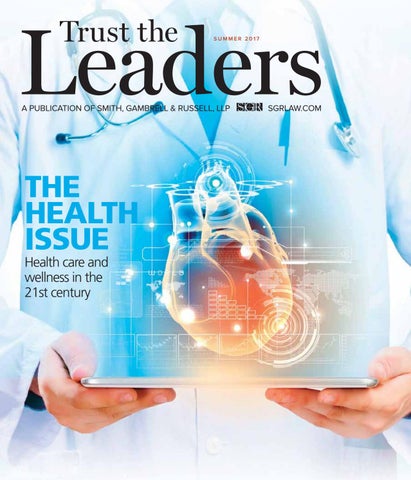
Leaders Trust the
SUMMER 2017
A PUBLICATION OF SMITH, GAMBRELL & RUSSELL, LLP
THE HEALTH ISSUE Health care and wellness in the 21st century
SGRLAW.COM
Trust the Summer 2017
3 Editor’s Letter 4 Legal Briefs
News and views from the offices of Smith, Gambrell & Russell.
10 Perspectives on Health Care
Laura Andrew shares her thoughts on health care in the United States today.
14 Medical Devices and the 510(k) A 510(k) may accelerate the process of bringing a new medical device to market, but manufacturers need to be wary when filing.
18 Digital Health
How the digital collection, monitoring and analysis of personal data presents serious concerns about security.
24 Client Profile: GuideWell Innovation We introduce you to GuideWell Innovation, an affiliate of Florida Blue health insurance company with a pioneering approach to delivering corporate wellness solutions.
26 Finish Line
A guide to the Firm’s expanding network of international offices and practices.
Smith,Gambrell
&Russell, llp Attorneys at Law
1230 Peachtree Street, N.E. Promenade, Suite 3100 Atlanta, GA 30309-3592 editor@sgrlaw.com editor-in-chief
Dana Richens editorial advisory board
Peter Goodman Joyce Klemmer Brett Lockwood Jim Monacell Jim Porter
sgr marketing team
Lee Watts Kathleen Rast Jaleesa Smith Elizabeth Thomas Mollie Werner
Trust the Leaders is published on behalf of Smith, Gambrell & Russell, LLP by Fourth Element Creative. The information contained herein has been obtained from sources believed to be reliable. The content and information in this publication do not constitute legal advice, do not in all cases reflect the opinions of SGR or its attorneys and are not in all cases complete or current as of the publication date. This publication is not intended to and does not create an attorneyclient relationship or provide legal advice or legal opinion. Legal advice should be obtained from one’s legal counsel. Permission is granted to use and reproduce this publication in whole or in part for internal and personal reference, provided that proper attribution of authorship is given. Except for material in the public domain, this publication may not be further copied, modified, used or distributed, in whole or in part, in any form or by any means without the written permission of Smith, Gambrell & Russell, LLP. All other rights expressly reserved. © 2017 Smith, Gambrell & Russell, LLP. Leaders
used with permission of Leaders Magazine, Inc.
02
TRUST THE LEADERS | Summer 2017 | SGRLAW.com
Editor’s Letter
Editor’s Letter
IN THIS ISSUE
Welcome to the Summer 2017 issue of Trust the Leaders, the magazine of Smith, Gambrell & Russell, LLP. This issue is devoted to our health care practice. Efforts to repeal and replace the Affordable Care Act, and questions as to what might take its place, have dominated the news since President Trump took office in January. Health insurance in the United States faces an uncertain future. What is not uncertain, however, is that other issues will continue to play an important role in how health care is delivered in this country. Data privacy – how can we continue to keep personal information private while expecting it to be readily available at providers’ fingertips? Innovation – what revolutionary advances can we expect to see in health care in the coming decades? Wellness – what is it, and what does it mean for businesses and consumers? And what are the legal implications of developments in each of these areas? You’ll find timely and useful information on all of these topics in this issue.
Laura Andrew p.10
Laura reflects on the past, present and future of the complex and, at times, controversial, world of health care.
Stephanie Scruggs p.14
Stephanie reveals the advantages and disadvantages faced by manufacturers when using a 510(k) filing to streamline and accelerate the process of bringing a new medical device to market.
Also, be sure to take a look at our “Where in the World is SGR?” infographic at pp. 26-27. Our new offices in Munich and London/Southampton, coupled with the addition of 10 attorneys with vibrant international practices, have expanded the SGR global footprint and will enable us to provide even more services to our valued clients around the world. Have a great summer, and enjoy the issue!
Brett Lockwood p.18
Brett highlights the many concerns over privacy, security and confidentiality in the digital and cloud-based storage of personal health data and medical records.
Dana Richens Editor-In-Chief editor@sgrlaw.com
Kate Rowe p.24
Kate penned the profile of SGR client GuideWell Innovation – a pioneering firm in the field of corporate wellness.
FOLLOW
ONLINE
BLOGS: sgrlaw.com/blog TWITTER: twitter.com/sgrlaw LINKEDIN: linkedin.com/companies/27889
03
LEGAL BRIEFS
THE LATEST NEWS AND UPDATES FROM THE SGR OFFICES
ATTORNEYS IN THE NEWS Laura Wartner, a partner in
Scott Cahalan, a partner in
Private Wealth Services with a
SGR’s Construction Practice,
concentration in trust and estate
is presenting webinars for
planning, has been appointed to
Lorman Education Services
the Board of the International Association
entitled “Beyond the Four Corners:
of Attorneys for Family Held Enterprises
Implied Obligations in Design and
(afhe). The organization is an independent,
Construction Contracts.” Scott was also
nonprofit association of corporate,
a guest lecturer at Georgia Tech’s School
litigation, tax and trust and estate attorneys
of Civil and Environmental Engineering
who provide multidisciplinary legal counsel
for a presentation entitled “Construction
and advice to publicly and privately held
Contracts and Legal Structure.”
enterprises, their owner-managers and family members.
Before law school, Mr. Cahalan was an engineer at Green Construction, Inc.
SGR partner Justice Leah Ward Sears is featured on the cover of the Georgia 2017 Super Lawyers magazine, recognizing the top attorneys in the state. The magazine includes an article chronicling the experiences of Justice Sears and six other African-American attorneys in Atlanta who overcame formidable obstacles to become leaders of the legal profession. Joyce Klemmer, a partner
government to ensure Georgia’s legislation
Joe Mandarino continues his
in SGR’s Intellectual Property
is supportive of international arbitration.
robust schedule of seminars on
Practice, has joined the Board
AtlAS also educates judges, lawyers and law
tax issues through CPA Academy,
of Directors of the Atlanta
students on the substantive law, practice
International Arbitration Society (AtlAS),
and culture of international arbitration, and
seminars, and authored an article, “Recent
a nonprofit organization that seeks to
civic and business leaders on the benefits
Court Guidance on the Federal Treatment
enhance Atlanta’s stature and position as
of having a vibrant international arbitration
of Tax Credits,” for the Journal of Real Estate
a venue for the resolution of international
center in Atlanta. SGR is one of the
(December 2016).
disputes. AtlAS works with leaders in
founding members of AtlAS.
Strafford and private SGR client
04
TRUST THE LEADERS | Summer 2017 | SGRLAW.com
RECENT REPRESENTATIONS
New pedestrian bridge lights up the City of Macon The City of Macon, Georgia
first floor together with a deck for 400 cars.
leasing office. There is also an expansive
recently celebrated the opening
Following the creation of the condominium,
outdoor courtyard with outdoor seating, gas
of a 150-foot pedestrian bridge,
Sierra Development sold the office unit to
grills and fire pits. Another unique feature of
a first of its kind for Macon,
Mercer for use by the University.
the project is the 8,000-square-foot terrace
connecting the Mercer University
While typical commercial condominiums are
located on the roof overlooking Mercer University Drive and the stadium.
campus to the Lofts at Mercer
built on land owned by the developer,
Landing – a new, mixed-used
this condominium was built on land under
The pedestrian bridge, which lights up
project located just south of
a long-term ground lease from Mercer. As a
at night, is located over the right-of-way of
Mercer’s Five Star Stadium. SGR attorneys
result, at the end of the term of the ground
Mercer University Drive and is accessed via
John Bailey and Eugene Bryant handled
lease, Mercer will become the owner of the
stairs on the Mercer campus, and stairs and
the legal documentation for the developer,
entire student housing portion of the project
an elevator in the mixed-use project.
Sierra Development Group, which included
as well as the University offices on the first
the bridge agreements among Macon-Bibb
floor, the associated parking deck and other
Development and Macon-Bibb County, the
County, Mercer and Sierra Development, and
common facilities.
bridge is a success story for public-private
the creation of a leasehold condominium for a mixed-use project at the bridge’s south end.
The student housing includes 97 suites for
As a joint effort of Mercer, Sierra
partnerships. Developer Jim Daws calls the
313 students together with a 900-square-
bridge the “crowning jewel” of his projects
foot Sky Room that overlooks the stadium, a
on the Mercer campus, which have included
of 176,000 square feet of student housing
clubroom, fitness center, yoga room, movie
major business and loft developments
and 14,000 square feet of office space on the
and game rooms, and a 10,000-square-foot
throughout the College Hill Corridor.
The five-story, mixed-use project consists
TRUST THE LEADERS | Summer 2017 | SGRLAW.com
05
LEGAL BRIEFS THE LATEST NEWS FROM THE SGR OFFICES
ATTORNEYS IN THE NEWS Kristen Lewis, Chairman of the
this event, recognizing award-winning
Board of Georgia Community
persons with disabilities. Pictured with
Support & Solutions, welcomed
Kristen (below left) and Mrs. Deal (center)
Georgia First Lady Sandra Deal
is Emma Barry, a new associate in SGR’s
to the annual GCSS “Golden Goals Awards”
Special Needs Planning Practice. Kristen
held at the Emory University Conference
continues to speak nationally on special
Center. Mrs. Deal was the keynote speaker for
needs planning and elder financial abuse.
LITIGATION SUCCESSES
Advertising adjudication SGR recently received two favorable decisions for its client Bayer HealthCare from the Advertising
Self- Regulatory Council
(ASRC). The ASRC is a forum
used by national advertisers from all industries who
choose to have advertising
disputes adjudicated outside a judicial forum pursuant to
ASRC procedures.
In the first case, Bayer, maker of
Coppertone® sunscreens, challenged Johnson & Johnson’s advertising for
its Neutrogena® sunscreen products.
The ASRC determined that J&J’s sensory
testing did not support its “superior feel” claim and that its sun protection testing did not support its product line claim. J&J was required to discontinue the
unsubstantiated claims in TV and print
advertising. The matter was handled by Chris FitzPatrick and Carrie Anderer in New York.
In the second case, Bayer, maker of
RID® brand head lice treatment,
challenged comparative superiority and
other claims made by Prestige Brands, Inc. on its packaging and advertisements Jim Bikoff, a partner in SGR’s
SGR Managing Partner Steve Forte
Washington, D.C. Intellectual
has been selected to serve on
Property Practice, serves on the
the Best Lawyers Advisory Board.
2017 Intellectual Property Editorial
The Board is comprised of
®
Advisory Board for Law360, a legal news service
distinguished legal professionals from around
operated by Portfolio Media, a subsidiary of
the world. Almost 400 organizations are
LexisNexis. As part of his role, Jim provides
currently represented on the Board, including
feedback on the publication’s coverage and
the world’s leading law firms and Fortune 500
insight on topics for future coverage.
and Global 500 companies.
06
TRUST THE LEADERS | Summer 2017 | SGRLAW.com
for its Nix® Ultra lice treatment product. Prestige Brands was subsequently
directed to discontinue its claim that
its product can kill lice and lice eggs in the hair as well as unsupported
comparative claims against RID.
The matter was handled by Chris
FitzPatrick and Bryan Wolin from
SGR’s New York office.
RECENT REPRESENTATIONS
LITIGATION SUCCESSES Patent ruling
Stephanie Scruggs, Jessica Zurlo, Tom Wiseman and
Michael Schwartz secured a victory on behalf of
SGR client Yang when the U.S. Court of Appeals for
the Federal Circuit ruled in
its favor in an appeal brought by a competitor related to a patent interference
proceeding. Such a proceeding results in a final judgment
declaring one party entitled
to priority of invention, with
the losing party deemed not
entitled to the patent claims at issue. The technology at issue relates to
a compound extracted from the husk
and fruit stem of Xanthoceras sorbifolia, its extracting method, and its uses to
Tax and relocation incentives
Perry McGuire, Florian Stamm,
and Ben Brooks assisted a Japanese
treat cancer and brain disease, among
Real estate transformation
other diseases.
SGR partners Sean Altschul and
Prisoner lawsuit dismissal
Victor Metsch recently assisted a
Working on a pro bono basis,
client seeking to expand its U.S.
commercial real estate client in the
headquarters achieve $1.2 million
transformation of a fully sublet,
in tax and other incentives. “Many
600,000-square-foot, triple net-
companies with existing offices do
leased building in Nassau County,
not realize that there are substantial
New York. The process included early
opportunities in the incentive market,
termination of the existing lease,
SGR recently obtained an
order and opinion from the U.S. Court of Appeals for
the trial court’s dismissal of an indigent prisoner’s
even if they want to stay where they
the relocation of subtenants into new space
are,” Perry notes. “There is a high
under long-term direct leases and a new 20-year
return in these cases for the client’s
lease for more than 300,000 square feet and
investment in legal support.” The
providing for major façade work at the building.
same team will assist the company in locating a
SGR also helped obtain benefits for the project
manufacturing plant in the Southeast.
from the local industrial development agency.
the Eleventh Circuit reversing
lawsuit and denial of his
motion to waive court costs.
Justice Leah Ward Sears,
Colin Delaney and Ben Reed
briefed issues relating to
the “imminent danger” exception to the
“frequent filer” prohibition on proceeding
Tom Wiseman, counsel in SGR’s
provides pro bono assistance to solo inventors
Washington, D.C. Intellectual
and small businesses by pairing them with
Property Practice, has been named
volunteer patent attorneys and patent agents to
“Attorney of the Year” by Georgia
help them prepare and file patent applications.
Lawyers for the Arts, which operates the
Tom received the honor for his extensive pro
Georgia PATENTS program. Georgia PATENTS
bono legal work through the program.
in forma pauperis.
The Eleventh Circuit instructed the
district court to grant leave for the
client to proceed without paying the
upfront court costs. Barber v. Krepp, 2017 WL 694489 (11th Cir. Feb. 22, 2017).
TRUST THE LEADERS | Summer 2017 | SGRLAW.com
07
LEGAL BRIEFS THE LATEST NEWS FROM THE SGR OFFICES
RECENT REPRESENTATIONS Georges Vongerichten, FarmOn! offers consumers the opportunity to purchase a 10-week subscription to receive same-day harvested seasonal organic produce, fruit, greens, eggs, cheese and locally grown grass-fed meats and poultry options that are delivered to New York City direct from Hudson Valley family farms and the studentrun Ag-Academy at Empire Farm. Adding to its popularity, this successful program, now in its fifth year, includes tips and recipes from Chef Jean-Georges and his ABC team, as well as reservation access to his successful restaurants and FarmOn! events.
Inspiring youth for a future in sustainable farming
● FarmOn! Milk Money. This program provides financial and technical assistance
Steve O’Connell, Anne Pitter,
● The organization has partnered with
to schools interested in procuring local
Peter Goodman and Nicole
professional athletes of the National
milk for their lunchrooms. The program is
Chong of SGR’s New York office
Basketball Association for FarmOn! SLAM
instrumental in getting local milk to school
provide pro bono representation
DUNK YOUR VEGGIES, a program to get K-12
lunchrooms, “cow-to-kid,” in 36 hours. In a
to FarmOn! Foundation, a
students from underserved areas to plant
win-win, kids eat more healthily and the local
charitable organization located
“victory gardens” in their neighborhoods
dairy farms benefit economically.
at the Empire Farm in Copake,
and incorporate the produce into their school
New York, in the Hudson Valley.
lunches and classroom curriculum, providing
SGR has acted as outside general counsel
FarmOn! Foundation is dedicated
the students with a hands-on understanding
to FarmOn!, drafting corporate governance
to inspiring, educating and
of where their food comes from, and sending
documents, reviewing agreements and
preparing youth for the world
fresh organic produce home.
consulting on taxation and other issues. “It gives me great pride to help such a
of sustainable farming as a longterm and profitable career.
● FarmOn! at Empire Farm hosts an Ag-
worthwhile organization as FarmOn!,”
FarmOn! Foundation is the
Academy for students in partnership with
notes Steve O’Connell. “Sustainable
brainchild of Tessa Edick, a food
State University of New York and Cornell
food production and the promotion of
entrepreneur and author who also
University, focusing on viable livelihoods in
healthy eating is vital to present and future
founded CulinaryPartnership.com and the
agriculture. Students live in residence, custom
generations.”
Friends of the Farmer Festival. The generosity
growing produce for their “clients” – some of
of Christy and John Mack and their family at
New York City’s best-known chefs and their
gratifying to work with a charity that is so
Empire Farm allowed Tessa’s FarmOn! idea
restaurants – while also learning cooking,
passionate about saving local farms, making
to become a reality. To further its mission
accounting and other business and life skills.
farms sustainable and connecting young
Adds Anne Pitter, “It is both inspiring and
people and adults to their food. I have a
of revitalizing local and family farming, the organization has created a number of
● ABCSA Farm Share. In partnership
whole new appreciation of what ‘farm to
innovative educational programs:
with ABC Kitchen and renowned chef Jean
table’ means and should be.”
08
TRUST THE LEADERS | Summer 2017 | SGRLAW.com
Contact: Laura Miller Andrew | Partner 904-598-6135 landrew@sgrlaw.com
At Smith, Gambrell & Russell, LLP, our health care attorneys keep pace with and anticipate changes. We provide both transactional and regulatory representation to health care industry clients, partnering with them to keep them both competitive and compliant.
Our Health Care Practice includes the following services:
Corporate Health Care Technology & Cybersecurity Life Sciences Biotechnology
Health Care Regulatory Health Care Benefits Food & Drug/FDA Pharmaceutical
TRUST THE LEADERS | Winter 2014 | SGRLAW.com
Atlanta | Austin | Jacksonville | London | Munich | New York | Southampton | Washington, D.C.
PERSPECTIVES ON HEALTH CARE
FROM LAURA ANDREW
“While the U.S. will spend one trillion dollars on health care this year, these resources do not always translate to better access to care, affordability and coordination”
L
aura Andrew is the head of SGR’s Health Care Practice. Her practice
or cost sharing for primary care; the French system exempts low-income
encompasses a wide array of health care-related matters, including
adults and those with chronic illnesses from cost sharing; and in
health care reform legislation, compliance with HIPAA, self-referral
Germany, out of-pocket spending is capped at one percent of income
(“Stark”), anti-kickback, and fraud and abuse state and federal regulations
for the chronically ill.
impacting health care organizations, and health care issues affecting medical device and life sciences organizations. TTL asked Laura for her
TTL: Does universal coverage make sense for the U.S.?
views on various issues relating to health care in the United States today.
LA: One criticism of universal coverage is the rationing of medical services, as seen in New Zealand, Australia, France, Canada, the United
TTL: Health insurance is an issue that has challenged the United
Kingdom and Taiwan. They ration health care services through methods
States for years. Do other countries have the same issues we do?
such as budgeting, controlled distribution, service restriction and price
LA: Health care coverage is a complicated topic. Few people agree on a
setting. Higher taxes, long waits for nonemergency health conditions,
single “best” type of system. The U.S. has a combination of a privatized
elective surgeries and a shortage of doctors are some of the other
system (insurance companies) and a public system (Medicare and Medicaid).
problems of these systems.
Other countries, such as Canada, Japan and most European countries,
Unfortunately, there is no “magic formula” for health care in the U.S.
have universal health care, which means that all citizens receive a basic
While the U.S. will spend one trillion dollars on health care this year – more
level of coverage, though the governments of those countries run the
than any other country – these significant resources do not always translate
programs in a variety of different ways. For example, the health care systems
to better access to care, affordability and coordination. Many believe the
in Canada, the Netherlands and the United Kingdom have no deductibles
current U.S. system is more likely to spark research and create new advances
10
TRUST THE LEADERS | Summer 2017 | SGRLAW.com
U.S. Health Care
TRUST THE LEADERS | Summer 2017 | SGRLAW.com
11
U.S. Health Care
for the benefit of all. There’s a worry that research won’t progress as quickly if there aren’t the financial advantages inherent in the U.S. system. TTL: How has your own practice changed the most in recent years? LA: Prior to the passage of the Patient Protection and Affordable Care Act
We will continue to see the digitization of health care records, with more of each individual’s information held electronically.
of 2010 (ACA), employers, who often had their own self-insured group
Services, potential electronic security risks of HIPAA-protected information,
health plans, were free to design their plans to provide the health coverage
and the too-frequent breaches of HIPAA information. In addition to the
that was cost effective for that employer and its employees. Employers were
compliance issues discussed above, other of our health care clients, such as
not required to offer health coverage prior to the ACA. While employer
physicians, hospitals, nursing homes and emergency services providers, also
coverage was subject to the Internal Revenue Code and the Employee
have to comply with the often-byzantine rules and regulations of Medicaid
Retirement Income Security Act (ERISA), the employer was generally able to
and Medicare, and prepare for possible audits and inquiries from regulators
set the rules about eligibility and benefits. Once the ACA became effective,
regarding federal and state fraud and abuse laws, including the False Claims
employers had to redesign all of their group health plans and comply with
Act, the Anti-Kickback Statute, and the physician self-referral, or “Stark,”
the myriad requirements of the ACA, including the employer mandate to
law, as well as comparable state laws.
provide affordable health insurance. I now spend a lot of time working with employers on compliance with the ACA, and preparing for compliance with
TTL: We hear a lot about “wellness” these days. What is “wellness,”
the “next step” – the possible impact of the Trump administration’s promise
and what are the business and legal implications of this concept for
to “repeal and replace the ACA.” Those changes will be covered in our
our clients?
newsletters and health care blog – www.sgrlaw.com/category/health-care.
LA: “Wellness” is an umbrella term that refers to any program or process that encourages healthy behavior in order to prevent disease. Wellness takes
TTL: Which health care issues create the most problems for clients?
many forms, from simple health fairs and free personal tracking devices,
LA: In addition to the requirements of the Internal Revenue Code and
to complex wellness systems that provide rewards for participating in
ERISA, the ACA has added another layer of compliance burden, with
screenings, and, sometimes, in attaining certain goals. While studies on
mandates and reporting requirements. The Health Insurance Portability and
the long-term impact of wellness plans on the bottom line vary, most
Accountability Act (HIPAA) has also caused a lot of concern for our clients,
studies agree that wellness plans offered to employees improve morale.
including increased audits by the U.S. Department of Health and Human
12
TRUST THE LEADERS | Summer 2017 | SGRLAW.com
Wellness plans are governed by the Internal Revenue Code, ERISA,
A brief history of health insurance in the US How we got to where we are now Late 1800s
Company clinics and infirmaries
Employer-based health insurance has roots in our industrial past. In the decades after the Civil War, those who worked in the most dangerous jobs – mining, steel, railroads, lumber – had access to company doctors, usually in clinics or infirmaries. As insurers grew more sophisticated, they began selling “accident” policies that included disability, death and burial benefits to employers.
Early 20th century
The first multi-employee policy
HIPAA and the Americans With Disabilities Act, and have to be designed to comply with these laws, including complex rules about access, communications, rewards and alternatives. We help our clients navigate these rules. TTL: Many of the articles in this issue touch on “innovation” in health care. What do we have to look forward to in the next 20 years or so that will dramatically impact the way health care is delivered? What legal challenges will that create? LA: Looking forward, we will continue to see the digitization of health care records, with more of each individual’s information being held and accessed electronically. We will also continue to see the advancement of solutions that are tailored specifically to an individual. For example, treatments based on a person’s individual DNA will become more commonplace. However, the ability to predict what diseases a person may have based on his or her DNA will also increase privacy and ethical concerns for all parties. While the push to modernize and streamline the health care system will continue to occur, the system struggles to provide all with basic care as well as the complex treatment regimens that have been developed. The debate over what is the best health care model for the U.S. will also continue. Whether the U.S. will continue with its current private/public health care system, convert to a single-payer system, or develop some new system, will keep us and our clients busy for the foreseeable future. ■ Laura Andrew is a partner in SGR’s Executive Compensation and Employee Benefits and Health Care practices. landrew@sgrlaw.com.
Modern group insurance began in 1910, when mail-order retailer Montgomery Ward implemented what is believed to be the nation’s first multi-employee health insurance policy through a plan issued by the London Guarantee and Accident Co. of New York. It paid benefits of up to $28.85 per week to ill or injured employees.
Pre-World War II
Health care as a worker benefit
Following passage of the Revenue Act of 1939, which established employee tax exclusion of injuries and sickness under health insurance, and the 1942 Stabilization Act, which stabilized wage increases during wartime, employers who needed to recruit workers began offering more generous health benefits to fill their workforces. These laws also created a major advantage for employer group health coverage: health insurance premiums deducted by employers no longer counted as income and, as a result, workers did not have to pay income or payroll taxes on those benefits. In 1940, less than 10 percent (12 million people) of the U.S. population had any kind of health coverage. By 1950, about half of America was covered.
Post-World War II
Multi-faceted insurance policies
Insurers then began adding new types of coverage – “major medical” evolved in the 1950s, vision care in 1957 and dental benefits in 1959. Health insurance coverages continued to evolve in this haphazard manner, resulting in the system we currently have, where health coverage is provided by employers, individuals, the federal government (Medicare) and states (Medicaid).
TRUST THE LEADERS | Summer 2017 | SGRLAW.com
13
14
TRUST THE LEADERS | Summer 2017 | SGRLAW.com
Medical Devices
MEDICAL DEVICES
BY STEPHANIE SCRUGGS
AND 510(K)
A streamlined route to FDA approval or a trap for the unwary?
A
dvances by medical technology companies
of new devices while promoting the technological
provide more efficient patient care and allow
development of the devices. The classifications are
affected patients to live longer, more productive
assigned by the risk the medical device presents to
lives. Chronic medical conditions that may have resulted
the patient and the level of regulatory control the
in death decades ago are now treatable with devices
FDA determines is needed to market the device:
such as pacemakers and heart valves. Artificial knees and hearing aids improve quality of life for those
● Class I devices – low risk
affected. However, the interplay between the regulatory
Class I devices, such as arm slings, elastic bandages
framework intended to keep patients safe and the
and bedpans, generally pose low risk because of their
patent system intended to provide innovators with
noninvasive nature.
market exclusivity may present unforeseen risks to a
● Class II devices – moderate risk
manufacturer seeking to market a new medical device
Class II devices, such as x-ray systems, surgical drapes,
that is substantially equivalent to an existing device.
catheters, inflatable blood pressure cuffs and hearing aids, involve moderate safety and efficacy risks.
The FDA Regulatory Framework and Classes of Medical Devices
● Class III devices – higher risk
Medical devices are subject to review by the Food and
implants, are intended for use in supporting or
Drug Administration (FDA) before they can be marketed
sustaining human life or present a high risk of illness
and sold. The Federal Food, Drug, and Cosmetic Act
or injury.
Class III devices, such as heart valves and breast
(FDCA) defines a medical device such that the FDA regulates a broad range of devices, such as heart valves,
In other words, as the risk to the patient increases, so
tongue depressors and sutures, before and after the
do the classification levels and FDA pre-market scrutiny.
devices reach the marketplace.
For example, before a Class III device may be marketed,
The three-tier regulatory framework employed by the FDA for medical devices is intended to ensure the safety
it must undergo Pre-Market Approval (PMA) by the FDA and, typically, clinical trials to demonstrate its safety
TRUST THE LEADERS | Summer 2017 | SGRLAW.com
15
Could a 510(k) present obstacles to patenting a new device?
and efficacy. The PMA process is costly and time
In order to obtain patent protection on a new device, the patent claims must be new, useful and nonobvious. In other words, the Patent Examiner must find that the claims covering the new device are nonequivalent to the prior art. Yet, the claim of substantial equivalence in a 510(k) arguably admits the existence of prior art – the predicate device – that has at least some, if not all, of the elements of a patent claim related to the new device. As such, the 510(k) should be submitted to the Patent Office during prosecution of a patent application pursuant to the statutory duty of disclosure because it includes information on prior art that is relevant to patentability.
for substantial equivalence to legally marketed
consuming, particularly when added to the time and expense required for clinical trials. In comparison, since Class II devices are considered a moderate risk, the FDA reviews these devices products that have clearance for the same intended use, referred to as “predicate” devices. The applicant must show substantial equivalence to a predicate device by way of a premarket notification, known as a “510(k),” at least 90 days before bringing the new device to market. A 510(k) must also be submitted for certain Class I devices; however, most Class I devices are exempt from the premarket clearance requirements. The majority of medical devices enter the market via a 510(k).
The Examiner may not rely on the 510(k) itself to reject the claims on the new device because it is a comparison between two commercial embodiments, not a comparison of the prior art to the patent claims. But the documents submitted with the 510(k), e.g., package inserts or marketing materials on the predicate device, may be the very publications the Examiner uses to reject the claims on the new device. In this context, the 510(k) at least indirectly presents obstacles to patenting the new device if there are no distinguishable features to argue or add to the claims.
Understanding the 510(k) process
In addition, while U.S. patent law allows for a one-year grace period to file a patent application once an invention has been publicly disclosed, a 510(k) disclosing all of the elements of a patent claim starts the clock ticking on domestic patent rights. Moreover, most other countries apply an absolute novelty standard and will not issue a patent on an invention that has been publicly disclosed anywhere before the filing of a patent application. Thus, a patent application on the new device should be filed in advance of the 510(k) filing, or at least in advance of the publication of the 510(k).
is at least as safe and effective as the predicate
through FDA publication and/or a Freedom
devices. To make this showing, a 510(k) includes
of Information Act (FOIA) request. The FDA
information on the similarities and/or differences
lists the name, manufacturer and the 510(k)
between the new device and the predicate
summary of all approved devices on its website
devices, at least in terms of safety and efficacy.
within a month of approval. The statement of
Medical device companies need to be aware of how the information in a 510(k) may play into obtaining a patent on the new device. Clear and effective communication between FDA counsel and patent counsel is essential to avoid compromising domestic and foreign patent rights through the filing of a 510(k).
the FDA to find substantial equivalence lacking
There are several considerations in the 510(k) submission process.
1
The identification of predicate devices The 510(k) submission for a new Class II
device requires identification of one or more predicate devices to which equivalence is claimed and a substantial equivalence statement. The substantial equivalence statement in a 510(k) is intended to show the FDA that the new device
After the 510(k) submission, the FDA has
predicate device is also accessible by competitors,
equivalence. Substantial equivalence is generally
including the manufacturer of the very predicate
found if the new device has the same intended
device to which the new device is claimed to be
use and the same technological characteristics
substantially similar.
of the predicate device. Indeed, different technological characteristics would likely lead
3
Potential overlap between 510(k) substantial equivalence and patent
unless these differences can be shown not to
infringement
raise new questions of safety and efficacy.
The manufacturer of a predicate device is
2
unlikely to allow a substantially equivalent new The public nature of a 510(k)
device to enter the market without exploring
Once an applicant submits a 510(k), the
available barriers to entry, one of which includes
documentation generally is publicly accessible
16
similarities between the new device and the
90 days to make an evaluation of substantial
TRUST THE LEADERS | Summer 2017 | SGRLAW.com
enforcement of a patent that covers the
Medical Devices
device and the predicate device. In fact, a seemingly thorough 510(k) may very well outline how the new device performs substantially the same function in substantially the same way to obtain the same result as the predicate device. In such a situation, the substantial equivalence statement submitted in the 510(k) is almost identical to the language used to determine infringement under the Doctrine of Equivalents with one exception: the substantial equivalence in a 510(k) submission to the FDA compares the new device to the predicate device in terms of safety and efficacy whereas substantial equivalence in patent infringement compares the new device to the claims of a patent. While the courts have indicated that a 510(k) cannot be used by an adversary as an admission of liability of patent infringement, the law is less settled with regard to the role of a 510(k) as supporting material to the claims at issue, such as when an allegation of infringement under the Doctrine of Equivalents is in play. An adversary may try to introduce the 510(k) during litigation to establish a presumption of equivalency between the new device and any patent claim covering the predicate device. This
Approval by way of a 510(k) may take a costly detour when the predicate device is covered by a patent.
possibility necessitates carefully chosen As a threshold matter, a third party may
during litigation to the detriment of the
using, selling or importing any device that has
alleged infringer. ■
each and every element required by a claim of a patent. There is a likelihood that the new device can be differentiated from at least one of the features of the patent claim to avoid literal
predicate device. As such, the streamlined path
infringement. However, if a device performs
to approval of a Class II device by way of a
substantially the same function in substantially
510(k) may take a costly detour when the
the same way to obtain the same result as the
predicate device is covered by at least one
patent claim, infringement may be found under
claim of an existing patent.
patent law’s Doctrine of Equivalents.
At a minimum, the statements made in a
wording in the 510(k) so it cannot be used
literally infringe a patent claim when making,
Why is this distinction important? Recall that
510(k) are available to the predicate device
FDA market approval for Class II devices via
manufacturer to use as a roadmap to allege
a 510(k) is more likely when the new device
infringement of a patent claim covering
has the same intended use and technological
the predicate device. The predicate device
characteristics of the predicate device. As such,
manufacturer may also try to use the 510(k) in a
it benefits a 510(k) applicant to detail the strong
more detrimental manner during litigation.
similarities between the features of the new
Stephanie Scruggs is the head of SGR’s Washington, D.C. Intellectual Property Practice. She is an experienced IP attorney and represents clients across a wide range of industries in the enforcement and defense of IP rights and disputes. sscruggs@sgrlaw.com.
The Takeaway
Device manufacturers and their counsel should be keenly aware of the interplay between the FDA regulatory system and the patent system to maximize the benefit of a 510(k) while minimizing the risk associated with a patent infringement suit by the predicate device manufacturer.
TRUST THE LEADERS | Summer 2017 | SGRLAW.com
17
DIGITAL HEALTH & PRIVACY Cybersecurity compliance amid the promise of telemedicine
18
TRUST THE LEADERS | Summer 2017 | SGRLAW.com
BY BRETT LOCKWOOD
Digital Health
D
igital health is the application of digital and computing technologies and the harnessing of an immense
array of related personal and other data to deliver enhanced and, in many cases, individualized, health care information and services. Innovations in digital health promise vastly improved health care as well as significant quality-of-life and financial benefits for consumers of health care services. While advancements in health care delivery
of digital health in the U.S. was propelled
DEVICES, MOBILE APPLICATIONS… AND PRIVACY CONCERNS
significantly forward after the 2009 passage of
We now have countless mobile applications that allow the collection and
the Health Information Technology for Economic
monitoring of all types of personal data to optimize exercise and health-
and Clinical Health (HITECH) Act, which offered
related activities, administer and regulate medications, track our diets,
financial incentives for health care providers and
manage and treat chronic conditions, and notify us of abnormalities
technology companies to develop and implement
that occur within our bodies, to name only a few uses. Wearable and
interoperable electronic health records (EHR)
implantable devices work in combination with such applications to extend
systems.
these health care capabilities even further. The homebound can now
have paralleled those in technology throughout the modern era of medical science, the field
The EHR was conceived as a comprehensive
interact remotely with health care providers in virtual house calls by sharing
repository for an individual’s health information
images and other data and receive real-time diagnoses, treatments and
and health treatment history that would make
prescriptions. Artificial intelligence is being applied within “smart” prosthetic
it easier for patients to receive more effective
devices that enable amputees to engage in activities with performance that
treatments from providers equipped with greater
rivals or even exceeds that of natural limbs. The ability to collect and analyze
patient information. EHRs could also serve as a
individual genomic information opens up the possibility for personalized and
central database for related payment information,
predictive assessments and care regimens to help prevent diseases before
thereby improving health care payment flows.
symptoms appear. And the list of possibilities goes on.
To top it off, a personal health history might be
A common thread that connects almost all of these wonderful, life-
carried around by each individual on a smart card
enhancing innovations is that they are made possible by the collection,
or otherwise be universally accessible through
analysis and subsequent application of extensive health information and
linked networks by every care provider that an
other personal data and data sets. Because personal health information and
individual might need.
related financial information are among the most sensitive types of personal
The implementation of EHR systems still has a long way to go before meeting their potential. Yet, much like the technology that spun off from
information, the manner in which such data are gathered, handled and stored requires careful attention. Thus, the immense promise of digital health, resting on a foundation
the moonshot efforts of the 1960s, the incentives
of extensive personal data, also carries with it significant concern over
that spurred the initial and ongoing development
expectations of personal privacy and the security of personal data.
of EHR systems also served as a major catalyst for
Predictably and understandably, these concerns are the source of extensive
numerous other digital health innovations.
legal regulation.
TRUST THE LEADERS | Summer 2017 | SGRLAW.com
19
HIPAA AND HITECH PROTECTIONS In the United States, Title II of the Health Insurance Portability and Accountability Act (HIPAA) and Subtitle D of the HITECH Act and the accompanying Department of Health & Human Services (HHS) are the most significant sources of safeguards for protected health information (PHI). Collectively, these laws and regulations seek to protect PHI by imposing a comprehensive framework of privacy and security obligations concerning PHI on “covered entities,” i.e., health care providers, health plans and health care clearinghouses, and their “business associates,” i.e., vendors and others that supply and support health care providers and other covered entities. Specifically, PHI means individually identifiable health information created or received by a covered entity that relates to (i) the physical or mental health or condition of an individual, (ii) the provision of health care services or (iii) the payment for health care, and that identifies an individual or from which there is a reasonable basis to believe that the information can be used to identify an individual. Thus, a great deal of the information collected from digital health activities is PHI if collected by a covered entity or a business associate. The data privacy and security obligations of HIPAA and the HITECH Act are best understood by considering three broad sets of regulations issued by HHS commonly referred to as the Privacy Rule, the Security Rule and the Breach Notification Rule. These regulations are in turn subject to the related regulations comprising the Enforcement Rule,
Data breaches occur even with covered entities and business associates that fully comply with their obligations under the Privacy and Security rules.
which authorizes HHS’s Office of Civil Rights (OCR) to enforce these rules and impose substantial penalties for their violation. Each of these
The Security Rule
rules and their enforcement are addressed below.
Generally, covered entities and business associates must satisfy the following security objectives: ensure the confidentiality and integrity of
The Privacy Rule
electronic PHI handled by them, protect against reasonably anticipated
The Privacy Rule is intended to ensure PHI is treated with due respect
threats to the security or integrity of such PHI and reasonably anticipated
for each individual’s privacy, and underpins the HIPAA and HITECH
unauthorized uses and disclosures of such PHI, and train their staff on
regulatory scheme for the protection of PHI. In this sense, the other
related compliance matters.
rules are meant to reinforce the expectations of privacy and protections established by the Privacy Rule. Under HIPAA, use of PHI is restricted
technical safeguards and organizational processes must be implemented,
to only certain authorized uses connected with treatment, and then
and once implemented must be periodically evaluated to ensure that
only information that is the minimum reasonably necessary for the
these safeguards and processes continue to fulfill the overall objectives
permitted purpose, or those uses as to which an individual has given
noted above.
consent, such as for marketing. A notice of permissible privacy practices
20
To accomplish the foregoing, appropriate administrative, physical and
The Security Rule sets forth a wide array of mandatory as well as
must be provided before services are provided. Individuals are allowed
“addressable,” or optional, practices for covered entities and business
to access and review PHI records and request an accounting for most
associates to consider if warranted by the applicable circumstances.
nontreatment- and nonpayment-related disclosures of the individual’s
Of particular note is that while encryption of PHI is not required under
PHI made by a covered entity and its business associates.
the security regulations, if PHI is encrypted at an appropriate level of
TRUST THE LEADERS | Summer 2017 | SGRLAW.com
Digital Health
discovery of the breach, actual or constructive notice of key details is provided to affected individuals, to HHS and, in some cases, to relevant news media. A breach is broadly defined as the acquisition, access, use or disclosure of PHI in a manner not permitted under the Privacy Rule and that compromises the security or privacy of the PHI. An unauthorized acquisition, access, use or disclosure of PHI is presumed to be a breach unless the covered entity or business associate is able to demonstrate, after conducting and documenting a thorough risk assessment, that a low probability exists that PHI has been compromised. However, breach notifications are required only if the PHI was “unsecured,” meaning it was not rendered unusable, unreadable or indecipherable to unauthorized persons through use of approved technologies, such as with specified levels of strong encryption, as noted earlier.
Enforcement by OCR As with so many other sectors of our society where personal data is involved, the occurrence of data breaches involving health care providers and their business partners has not gone without notice by the OCR strength, a breach that involves such data is not subject to required
division of HHS, which is the principal investigatory and enforcement
disclosure under the Breach Notification Rule. As a result, in addition
agency within HHS for health care data privacy and security concerns.
to being a best practice for data protection, the decision to encrypt
Most typically, an OCR investigation is triggered by a complaint being
electronic PHI is often driven by a covered health care entity being able
filed by an affected individual or a covered entity or a business associate
to avoid potentially embarrassing disclosures if a breach occurs.
filing a required data breach notification report. Requests by the OCR for follow-up information are routine and responses to such requests
The Breach Notification Rule
frequently reveal lapses by the reporting entity in one or more areas for
The unfortunate reality is that data breaches occur even with covered
which compliance is mandated.
entities and business associates that are diligent and fully comply with
Violations are subject to civil money penalties up to $50,000 per
their obligations under the Privacy and Security rules. When a breach
violation, with an annual cap of $1.5 million. The absence of willfulness,
occurs, the Breach Notification Rule is triggered and, absent
prompt corrective action or other mitigating circumstances are all taken
an applicable exception, requires that, no later than 60 days after
into account in how penalties are assessed. Criminal penalties and fines are also possible for intentional violations. Historically, the OCR has been restrained in imposing civil money penalties. However, over the past few years as more attention has been given to privacy and security matters, the OCR has significantly stepped up its audit and enforcement activities for suspected noncompliance with the Privacy and Security rules. The result is that the number of actions brought for which civil money penalties have been imposed has more than doubled from prior years and the average size of penalties per case has increased markedly, to over $1 million. In addition, last year, the OCR also imposed its first-ever penalty on a business associate and, earlier this year, its first-ever penalty for a failure to provide timely data breach notices (see Selected OCR Enforcement Actions box, p.23).
TRUST THE LEADERS | Summer 2017 | SGRLAW.com
21
TELEMEDICINE The holy grail of digital health care
company Qualcomm to provide wearable fitness trackers to employees free of charge and to use the data collected to offer discounts on premiums. But as with any new technology, legal compliance
Although there is no universally
is never as simple as it might seem.
agreed-upon definition of what constitutes telemedicine,
Licensure and Regulation
generally speaking it is the
Navigating the regulatory issues and licensing
use of telecommunications
requirements related to providing telemedicine –
when telemedicine is practiced across state
devices by physicians and
whether as a provider, a health plan or a
lines. In many cases, a physician in one state
health care providers to
technology company – can be challenging. In
who treats a patient by telemedicine in another
remotely diagnose and treat
Florida and Texas, a physician-patient relationship
state must have a medical license in both states.
patients. Telemedicine is also utilized by insurance
may be established by telemedicine. In Georgia,
Telemedicine also raises significant patient privacy
companies and employer-sponsored health
an in-person consultation is generally required
issues under the Health Insurance Portability
plans. UnitedHealthcare recently expanded a
before a physician may treat a patient by
and Accountability Act (HIPAA). While providers
pilot wellness program with telecommunications
telemedicine. Extra compliance challenges arise
are required to keep their patients’ health
BY QUINN BAKER
OTHER FEDERAL PRIVACY AND CYBERSECURITY OVERSIGHT AFFECTING DIGITAL HEALTH
recommend that mitigation of reasonably anticipated cybersecurity risks be taken into account in the design of medical devices and health-related mobile apps, these Guidances are advisory in nature. Even for Class II and Class III devices, which require more scrutiny due to heightened sensitivity for safety and effectiveness, because the FDA
Although covered entities and their business associates have significant
is focused principally on a concern for physical harm to medical device
involvement with digital health initiatives, other entities in the digital
users, the agency only indirectly requires that cybersecurity controls be
health realm are neither traditional health care providers nor their
addressed in such devices as a recommended best practice and not as a
vendors or contractors. For these entities, the scope of regulated privacy
requirement, absent a genuine health safety risk.
and cybersecurity protections is notably less encompassing than that
The FTC fills part of the legal void for nonregulated entities and
addressed by HIPAA or the HITECH Act. Chief among these other
devices. It relies on its long-standing authority under the Federal Trade
entities are medical device manufacturers, developers of mobile software
Commission Act to address unfair and deceptive trade practices.
applications that have health-related uses, and providers of health
Consequently, the FTC has asserted itself aggressively in matters of data
records. For these entities, the Food and Drug Administration (FDA)
privacy and security on the basis of holding marketplace participants
and the Federal Trade Commission (FTC) are the two federal agencies
accountable for the privacy and security promises made to customers,
with regulatory authority for digital health privacy and cybersecurity
with the failure to honor such commitments being treated as a
matters, but the approach taken to such matters is considerably less
prosecutable deceptive trade practice.
comprehensive than the attention paid by HHS to these concerns. The FDA regulates medical devices for safety and effectiveness
Connected devices and the “Internet of Things” have received special attention from the FTC. So, it’s likely that
concerns through its pre-market notification, review and approval
the FTC will insert itself more pointedly in cybersecurity
authority under the Food, Drug and Cosmetic Act. Because many
matters arising out of digital health efforts by non-health
medical devices and health-related mobile apps are deemed not to pose
care providers. The FTC has also specifically staked out
a significant risk of harm to user safety, they are categorized as Class I
monitoring the data privacy and security practices of
devices for which a pre-market review or approval is not required by the
businesses that are providers of health records that are
FDA, even though many of these devices collect and process personal
not otherwise covered entities under HIPAA.
data and thereby implicate privacy and security concerns. However, although the FDA has issued a series of official Guidances on cybersecurity matters to manufacturers and developers, which
22
TRUST THE LEADERS | Summer 2017 | SGRLAW.com
Brett Lockwood is a partner in SGR’s Corporate Practice and chairs the Technology Law Practice. blockwood@sgrlaw.com.
Digital Health
surprisingly, different payors have different rules.
how, to reimburse providers for telemedicine to
players into the mix. The company providing the
Under very limited circumstances, Medicare
the individual states. Likewise, whether private
telecommunications services will have access to
Part B (i.e., the portion of Medicare that covers
insurance reimburses telemedicine is also up to
patients’ health information, but under HIPAA, the
outpatient services like doctor visits) covers some
the individual states and insurance companies.
provider, or, in the case of telemedicine services
telemedicine services. Medicare will reimburse
As technologies continue to advance, state
offered through employer health plans, the health
office visits and consultations that are provided
and federal laws and guidelines on telemedicine
plan itself, has the legal responsibility to ensure
(1) to a patient living in certain rural areas (2) by
will likely continue to liberalize, creating
the information is kept secure. Providers and
a doctor or certain other health care provider (3)
a more favorable telemedicine landscape.
health plans should have strong privacy-protection
who is not at the patient’s location (4) using an
Providers, health plans or companies desiring
agreements with the telemedicine companies
interactive two-way telecommunications system.
to utilize telemedicine are wise to contact legal
providing the services.
However, the patient must be in a doctor’s
professionals to ensure they are complying with
office, hospital, rural health clinic, skilled nursing
the myriad requirements. The promise of innovation
Payment for Telemedicine
facility or other health facility. In contrast, some
in telemedicine is currently tangled in regulation.
Even if licensure and regulatory hurdles are
Medicare Advantage plans reimburse telemedicine
cleared, providers are not likely to practice
on more generous terms than Medicare Part B.
telemedicine if they cannot get paid for it. Not
Medicaid leaves the question of whether, and
information secure, telemedicine inserts additional
Quinn Baker is an associate in SGR’s Health Care Practice. qbaker@sgrlaw.com.
SELECTED HHS OFFICE OF CIVIL RIGHTS ENFORCEMENT ACTIONS
The FTC fills part of the legal void for nonregulated entities and devices.
Year
Entity
Nature of violation
Result
2017
Children’s Medical Center of Dallas
Theft of unencrypted laptop and Blackberry phone, each with several thousand patient records
$3,200,000 penalty and corrective action plan
2017
MAPFRE Life Insurance Company of Puerto Rico
Misplaced USB storage device stolen from IT department with over 2,000 patient records
$2,200,000 penalty and corrective action plan
2017
Memorial Healthcare System of South Florida
Unauthorized employee access and disclosure of records of over 100,000 patients
$5,500,000 penalty and corrective action plan
2017
Presence St. Joseph Medical Center (Illinois)
Operating room schedules on over 800 individuals misplaced and hospital delayed required notifications for longer than 60 days
$475,000 penalty (first-ever penalty for late breach notices) and corrective action plan
2016
Advocate Health Network (Illinois)
Several computers stolen resulting in exposure of over 4,000,000 patient records
$5,550,000 penalty and corrective action plan
2016
Catholic Health Employee’s stolen iPhone contained Services -- Archdiocese unencrypted PHI on over 400 of Philadelphia individuals
$650,000 penalty and corrective action plan
The Takeaway
Advances in digital health innovations hold great promise for amazing health care benefits for everyone. To realize those benefits, personal health data is subject to some level of risk in the hands of providers of digital health products and services. The legal protections in this area are already extensive but notable gaps exist, and as further innovations arise from digital health efforts, greater attention will need to be paid to existing and expanded privacy and cybersecurity compliance obligations.
TRUST THE LEADERS | Summer 2017 | SGRLAW.com
23
mission is to scout out innovation on the fringe and foster it. Unbound by the constraints on change that are typical of large institutions, she looks for entrepreneurs who are moving quickly to respond to critical issues in the marketplace, working on outside-the-box solutions and accelerating change in the health industry. GuideWell Innovation invests in these entrepreneurs and brings their knowledge to bear to improve institutional operations. Entrepreneurs and innovators are making huge advances in artificial intelligence, for example. GuideWell Innovation is bringing those advances back to helping Florida Blue customer representatives parse among various benefit options and more efficiently help consumers choose the best health insurance. The company has also been researching and evaluating emerging trends, such as in precision medicine (the use of DNA to create targeted medical treatments) and bringing that information back to the GuideWell enterprise companies. BY KATE ROWE
SGR CLIENT PROFILE
RENEE FINLEY AND GUIDEWELL INNOVATION: SYNCHRONIZED DEEP DIVING
R
GuideWell Innovation is also partnering with GE, Johnson & Johnson, Tavistock and Cisco to support The Intelligent Home, a project of the Lake Nona Institute. This is a prototype home in which new technologies, such as measuring human movement, can be tested and demonstrated, correlating them to specific human activities in a home and identifying variations that can warrant intervention or encouragement with respect to the individual’s health. The Lake Nona Institute also is home to The Life Project, a 10- to 15-year study, led by Johnson
enee Finley is a spunky spark of a
Well-being and Human Performance; Next
& Johnson and supported by GuideWell Innovation,
leader. She has to be. As head of
Generation Consumer Engagement; Digital
assessing the impact of community health and
GuideWell Innovation, she fans the
Health & Remote Management; Computational
community programs on consumers and their
fires of innovation in an industry once slow
Health; Care Delivery; Healthcare Financing;
own active engagement on issues of allergies,
to change its ways.
and Health Policy.
sleep and depression.
GuideWell Innovation is part of the GuideWell Mutual Holding Company (GMHC) enterprise.
Shaking Up Health Care
Guidewell Innovation Center
Several years ago, Florida Blue reorganized
Renee brings her GuideWell Innovation team to
Virtual collaboration is one thing, but GuideWell
and, under GMHC, moved its diverse group
work with the GMHC enterprise of companies
Innovation believes that bringing innovators and
of companies and maintained in Florida Blue
to identify and improve upon issues anchored
institutions together in one physical location to
a focus on health care insurance. GuideWell
around institutional health care, involving provider
focus on ways of improving human health will bear
Innovation, a subsidiary of GMHC, focuses
practices, hospital systems and insurance coverage.
more fruit. Indeed, while GuideWell Innovation
on driving innovation in seven core areas:
24
TRUST THE LEADERS | Summer 2017 | SGRLAW.com
But Renee also has a shake-it-up role. Part of her
is headquartered in Jacksonville, Florida, it built a
Client Profile: GuideWell Innovation
separate center further south in Florida, in Lake
address them – those with the right technological
care, with the aim of brainstorming and even
Nona, to encourage this collaboration and provide
and infrastructure resources to bring the solution
beginning to implement solutions. The 2016 event,
a space in which it could flourish.
to market. The resources may range from industrial
“Greater Than Cancer: The Other Side,” focused
engineering support and video production
on the challenges for cancer patients after their
the community was developed by Tavistock in a
capabilities to design methodologies, 3-D printers
initial diagnosis. This year’s forthcoming program,
thoughtful way centered on healthy lifestyles and
and physical plotters.
“Emerging Minds, Illuminating the Path to Mental
GuideWell Innovation picked Lake Nona because
healthy living and has an eco-system that was
Wellness,” focuses on behavioral health.
Last August, CoRE™ hosted the first of its
After such an immersion program, which
perfect for fostering innovation. The Life Project
annual immersion events – events that bring
and The Intelligent Home are just two examples.
selected thought leaders to “dive deep” together
typically lasts about three days, GuideWell
By coupling the various nearby elements of
on one critical, complex problem facing health
Innovation studies the results of the collaboration
research institutions, hospital systems that can
and creates a platform issuing a call for solutions
pilot new programs, commercial partners that can
and encouraging open innovation on a national
take a capability to market and the entrepreneurial
scale. It is an online tool with an application process
accelerator run by GuideWell Innovation, the
through which new and overlooked ideas can be
area provides an environment for extraordinary
submitted to help address a problem. The ideas
innovative synergy.
are evaluated by a committee and there is an award for the winner. GuideWell Innovation and
Lake Nona did not have a convening venue – a physical place where all of the various groups
its supporting partners, such as Johnson & Johnson
in the area and those from outside could meet
and the American Cancer Society, may advance
and collaborate. The GuideWell Innovation
one or more of those solutions and bring them
Center was built to provide this venue, and
to market. The platform for the cancer challenge
GuideWell Innovation made sure to incorporate healthy living and architectural innovation in its
launched on February 15, 2017 (see reimagine.
design. The center even hosts three “living walls”
guidewellinnovation.com) and over 600
of plants. There are incubator spaces, co-work
participants engaged in the ideation process.
spaces, wet labs for bench science and spaces
Over 43 ideas were submitted on the topic of
throughout the facility that are specially
helping cancer patients navigate their treatment
designed for meaningful conversation replete
and recovery process. Mobile Chemotherapy
with supporting technology and collaboration
Check-up was the new idea award winner, which
resources.
will normalize the lives of 650,000 cancer patients who receive chemo each year.
There are lots of curved walls, open areas
Transformation is often resisted and
and hallways that come together to lead you on an innovation journey. As you walk through
collaboration is difficult. Innovation can be hard
the physical layout, you follow the process for
to recognize and its acceptance begrudging. For
nurturing new solutions – locations reflect where
GuideWell Innovation’s success, Renee and her
ideas are formed, fine-tuned and fostered, realized,
team must navigate the complex worlds of health
and then launched into commercialized solutions.
care, health insurance and human wellness, identify
Indeed, the entire plan of the facility is to accelerate
key problems, gather informed and committed
the collision of people, ideas and resources and
partners, nurture productive collaboration,
bring the ideas to fruition.
recognize solutions, synthesize results, and shepherd innovations towards fruition.
CoRETM immersion events
It is a vast challenge, and GuideWell Innovation has dived right in. ■
GuideWell Innovation is jumpstarting conversations on certain specific topics and pushing for solutions. Through its Collaborative Resource Ecosystem, or “CoRE™,” Program, GuideWell Innovation tackles topics and brings specific players to the table to
Photos: upper left: Guidewell Innovation Center at Lake Nona, Florida; above (from top): Renee Finley; a “living wall” at the Center; Guidewell Innovation Theater.
Kate Rowe is a partner in SGR’s Intellectual Property Practice and is located in the Firm’s Jacksonville office. krowe@sgrlaw.com.
TRUST THE LEADERS | Summer 2017 | SGRLAW.com
25
WHERE IN THE WORLD IS SGR?
United Kingdom SGR opened UK offices this year in London and Southampton. Our primary practices in these offices are Aviation and Air Transport. The UK has the second-largest national aerospace industry in the world and the largest in Europe. Mark Turnbull, Benjamin Graham-Evans and Gareth Hawes have added a wealth of experience in the aviation industry to the Firm, allowing us to better serve our clients and establish new relationships around the world.
A guide to the Firm’s services for international clients Smith, Gambrell & Russell’s International Practice provides our clients around the world with a myriad of legal services. As we strategically look at trends in business and legal services, we have chosen markets and regions in which to grow where we can provide the greatest value to our clients. Here is a glimpse of regions where we have most recently expanded, including the addition of the featured attorneys. To read a full description of our International Practice and attorneys, and regions where we are growing, visit www.sgrlaw.com/international. Come and grow with us!
Atlanta Austin
NY
Washington, D.C. Jacksonville
Latin America SGR has a vibrant practice in Latin America. Several of our International Practice attorneys work with our clients there in banking and private finance matters, and mergers & acquisitions. The Firm recently expanded its practice in this region with the addition of Roger Juan Maldonado in our New York office. Roger is a litigator who uses his fluency in Spanish to represent the interests of various Hispanic and American businesses, government entities and individuals, and to represent companies investigating allegations of corporate wrongdoing and discriminatory employment practices.
26
TRUST THE LEADERS | Summer 2017 | SGRLAW.com
Germany SGR opened an office in Munich this year. The Firm welcomed Markus Bahmann to our International Practice. Munich is known as a hub for high tech, life sciences and IP. Munich also serves as the headquarters of many German companies. This office complements the Firm’s rich tradition of representing German and other European clients in inbound U.S. work.
Finish Line
Israel Italy The Italian Practice at SGR is led by Danila Duo in our New York office. This practice works closely with our industry-specific practices, assisting Italian companies with mergers & acquisitions, site selection, IP, employment, litigation, real estate, immigration and various corporate matters. Danila, a native Italian speaker, brings with her a wealth of knowledge of both the Italian culture and the types of legal issues that Italian companies face when they seek to enter, expand or maintain their presence in the U.S.
SGR provides legal services for many Israeli companies and organizations in both Israel and the U.S. The Firm is also an active sponsor of several initiatives in Israel, including DRIVE, a new innovation center in Tel Aviv. As we grow this practice, the Firm recently added Yoram Keinan to our New York office. Yoram’s practice centers on tax law in the U.S. and Israel, focusing on U.S. and international taxation of financial products and institutions. Yoram represents multinational entities, banks, hedge funds, private equity funds and REITs.
Korea The Korean Practice at SGR is important to the growth of the Firm. Susie Kim, an immigration partner in our New York office, works closely with many of our Korean clients. Among other clients, we represent some of the largest Korean brand names in the automotive industry. Our legal services for our Korean clients include economic incentives, site selection, corporate, immigration, bond transactions/financing, construction, environmental, commercial contracting, labor & employment, federal (and international) tax, litigation, IP, and antitrust and trade regulation.
Japan SGR welcomed Kiyo Kojima to the Firm as a new partner. He is joined by an associate, Akiyo Hewett. Kiyo heads our Japan Practice, which advises Japanese or Japan-related companies in the U.S. and elsewhere, and U.S. enterprises on various matters in Japan.
TRUST THE LEADERS | Summer 2017 | SGRLAW.com
27
Trust the Leaders is printed on recycled paper