InDepth SMITH COLLEGE SCHOOL FOR SO CIAL WORK
FALL 2026
Re c o g n i z i n g L e ad e rs h i p & I n n ovati o n
Caption
Learning in action: Julie Fournier, A.B. ’12, M.S.W. ’26, in collaborative dialogue during Assistant Professor Shveta Kumaria’s class, Bridging Psychodynamic and CBT Theory and Practice.
InDepth is published by the Smith College School for Social Work. Its goal is to connect our School community, celebrate recent accomplishments, and capture the research and scholarship at the School for Social Work.
SSW AWARDS 2026
EDITORIAL TEAM
Simone Stemper Laura Noel
See winners on page 18
DESIGN
Lilly Pereira Aldeia.design CONTRIBUTORS
S MITH CO L L EGE SCHO O L FO R SO CI AL WO R K
Kira Goldenberg Katie Potocnik Medina Faye S. Wolfe Megan Rubiner Zinn PRINCIPAL PHOTOGRAPHY
Shana Sureck
FALL 2026
LETTERS TO THE EDITOR AND ALUMNI UPDATES CAN BE SENT TO:
InDepth Managing Editor Smith College School for Social Work Lilly Hall Northampton, MA 01063 413-585-7950 indepth@smith.edu
ssw.smith.edu ©2026
FO LLOW US O N:
Facebook facebook.com/ smithcollegessw Instagram instagram.com/ smithcollegessw YouTube bit.ly/SSWYouTube
F EAT U RE S
10
Conversations Across Time
Turning years of shared scholarship into a book on integrative theory for the next generation of clinical social workers
14
Paying it Forward
An alum’s planned gift reflects a lifelong belief in Smith and its enduring impact
18
SSW Alumni Awards 2026
Recognizing leadership and innovation
DE PA RT M E NTS
02 From the Dean A note from Peggy O’Neill
03 SSWorks
School News + Updates
25 Alumni News
Alumni Desk Commencement Alumni Lives
36 Post Script An End Note
O N T H E COV E R
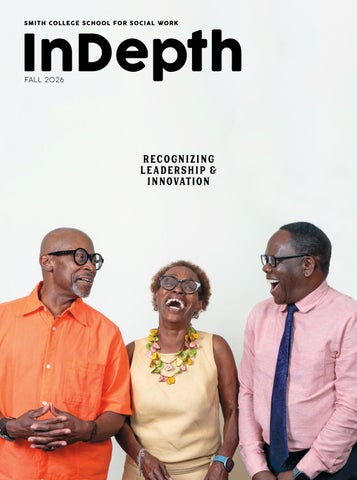
(Left to right) Gary Bailey, M.S.W., ACSW, Johnnie HamiltonMason, M.S.W., Ph.D. ‘01, recent Day-Garrett awardee, and Professor Hugo Kamya, M.Div., M.S.W., Ph.D., share a moment of joy during the lively 2026 SSW Alumni Awards celebration.
/ SSWorks /
IN T E RIM D EAN PEGGY O’ N EILL, PH .D ., LICSW, LCSW
Cultivating Hope and Justice The School for Social Work is a complex interconnected forest of students, alumni, faculty, staff, and administrators with welldeveloped capacity to weather seismic changes.
/ 02 /
I am so honored to serve in the role of Interim Dean of our School. My summer was filled with warm welcomes, deep conversations, and opportunities to connect and celebrate alongside students, graduates, and alumni. The School for Social Work is a complex interconnected forest of students, alumni, faculty, staff, and administrators with well-developed capacity to weather seismic changes. For more than 100 years our School has provided the highest level of teaching alongside innovative and meaningful scholarship, all with the goal of creating a more just world through clinical practice with individuals and communities. There are many ways that we as social workers create a more just world. Here at the School we practice our Core Principles: to continually learn and deepen our collective capacities; to draw on the knowledge, strength and beauty of communities that have been marginalized in our society and in higher education; to remain open to and engage with change; and to support our collective responsiveness to the needs of our learning community. As social workers we are also bound by the NASW Code of Ethics which asks us to help people in need, to address social problems, to challenge injustice, to respect the inherent dignity and worth of the person, to recognize the importance of human relationships, to behave in a trustworthy manner, and to practice within our areas of competence and enhance our professional expertise.
S M I T H COL L E G E SCHO O L FO R SO CIAL WO RK
In both cases, as at Smith College, we are called to use our knowledge to create incalculable good. I am very excited to connect with our amazing Smith College School for Social Work community and to join in leadership with the resolute and mission-based leaders of Smith College. As I begin my work as dean in earnest, I am deeply inspired by public interest attorney and social justice advocate Bryan Stevenson and the Equal Justice Initiative (EJI) which is “committed to ending mass incarceration and excessive punishment in the United States, to challenging racial and economic injustice, and to protecting basic human rights for the most vulnerable people in American society.” I commit and encourage us all to be steadfast in cultivating hope “because hopelessness is the enemy of justice” (EJI); to engage our collective courage, to stretch our capacities, to be honest and accountable with ourselves first in order to offer our authentic presence as we accompany others who are experiencing pain in finding hope. I commit to leading SSW to be persistent in our efforts to address entrenched wrongs and systems, because nothing changes quickly. I believe that we can make a difference each day in small and at times large ways, making the world a more just place. I look forward to walking alongside each of you as we continue to uphold the mission of our School and of social work. ◆
/ SSWorks /
SSWorks News from Lilly Hall
Matt Segall, M.S.W. ’28 making connections at SSW Opening Ceremony 2026.
FA LL 2 02 6
/ 03 /
/ SSWorks /
B Y ME G A N RU B IN E R Z IN N
Inspiring Others to Show Up and Keep Up The Indelible Legacy of Joan Berzoff
Joan Berzoff walked quickly, and she walked everywhere. “Office hours were often speed-walking sessions with her,” recalled David S. Byers, M.S.W., Ph.D. ’16, associate professor of social work at Bryn Mawr College Graduate School of Social Work and Social Research. “I was in my 20s, and I’d be totally out of breath from 30 minutes of trying to keep up with her, both her walking and her thinking.” Professor Emerita Berzoff, M.S.W. ’74, Ed.D., approached her career in the same way. “She worked incredibly hard, and quickly, and wanted everyone to keep up,” Byers said. Coupled with her physical and intellectual vitality was warmth, kindness and a healthy sense of humor. “She was so present in every moment,” said Nina Heller, M.S.W.,
/ 04 /
Ph.D. ’90, University of Connecticut School of Social Work dean emerita. “She filled up the space of the world in pretty wonderful ways.” Berzoff died on April 8, 2026, but even as her health failed, she kept moving forward, writing a memoir as well as picture books for each of her six grandchildren. With her passing, Berzoff leaves a formidable legacy. She taught and mentored generations of students, published four books, including the influential Inside Out and Outside In, created the first certificate program in end-of-life care for social workers, which she led for 15 years, and maintained a private practice. Berzoff lived her life with that same energy and with a dedication to social justice. At ten she was marching against apartheid, and as a teenager
S M I T H COL L E G E SCHO O L FO R SO CIAL WO RK
she participated in voter registration efforts in Mississippi. She and her husband, Lew Cohen, a professor of psychiatry, had a true partnership and they raised two sons equally committed to social justice. After earning her M.S.W. at Smith College SSW in 1974, Berzoff worked in community mental health at Tufts New England Medical Center and served as a SSW clinical supervisor and practicum adviser while pursuing an Ed.D. in human development at Boston University. She returned to Smith SSW in 1980 to teach part time and became a full-time faculty member in 1985. Over the course of her Smith SSW career, Berzoff had a profound impact on the School, as an instructor, as chair of the human behavior in the social environment sequence, as co-chair of the doctoral program for thirteen years, and as director of the end-of-life certificate program. In the words of Dean Emerita Marianne Yoshioka, M.S.W., MBA, Ph.D., LCSW, “Few scholars have shaped the identity, knowledge and clinical practice of SSW alumni as profoundly as Dr. Joan Berzoff.” Berzoff had a “deep commitment to collaborative teaching,” observed Professor Emerita Kathryn Basham, M.S.W., Ph.D. ’90, which was one of the reasons she was beloved by her students. “She was good at engaging the audience—the student audience, or any audience—engaging people into the discussion or the lecture,” said Professor Emerita Joyce Everett, M.S.W., Ph.D. They also loved (and sometimes feared) Berzoff because
/ SSWorks /
“Students would claim who they believed she liked best by how many melted chocolate and cream cheese streaks were left on their graded papers as a sign of appreciation of their work.” —Professor Emerita Kathryn Basham
she held them accountable. “She expected students to demonstrate complex learning and effective writing skills,” Basham said. Her students agreed with this assessment. “Joan was the kind of instructor who had very strong connections with all of us. In class, she was having conversations with each of us individually simultaneously,” said Byers. “She also pushed me personally to take risks, to jump at every opportunity, to work hard. She wanted me, and I think all of her doctoral students, to be ambitious.” The same qualities that made Berzoff a gifted instructor made her an effective leader. Everett, her doctoral program co-director, recalled that she was particularly collaborative—always willing to listen to your perspective and consider revising her opinion on an issue. Berzoff could demand excellence and ambition in her students because
she demonstrated it in her own work. Basham particularly admired “her creativity, her persistence, her extraordinary confidence of being able to just do it. Just this determination that ‘I want to get this idea across.’” Throughout her career, Berzoff maintained a passion for integrating social justice work and psychodynamic theory. In her scholarly work and teaching, Berzoff shared this enthusiasm with her students, and through them, the wider social work field. “She was unambivalent in her commitment to depth-oriented, critically- and socially-engaged clinical social work, and she believed that this started with us,” said Byers. Berzoff is best known for the textbook she co-wrote with Laura Melano Flanagan and Patricia Hertz, Inside Out and Outside In: Psychodynamic Clinical Theory and Psychopathology in Contemporary Multicultural Contexts, now in its fifth edition. The
text was born of necessity: “There was no book written about psychodynamic theory and practice with vulnerable, multicultural, at-risk clients, so we created it,” Berzoff said. She also edited or co-edited three other key texts—Falling Through the Cracks: Psychodynamic Practice with Vulnerable and Oppressed Populations, Living with Dying: A Handbook for End-of-Life Healthcare Practitioners and Dissociative Identity Disorder: Theoretical and Treatment Controversies—and dozens of articles. Once Berzoff retired from SSW, she joined the faculty of Chicago’s Institute for Clinical Social Work. At the end of her tenure, the ICSW created the Dr. Joan Berzoff Social Service Scholarship, supporting students with strong commitments to clinical practice and to serving vulnerable and underserved populations. One of Heller’s strongest memories of Berzoff is their first meeting: Berzoff was wearing a very large macaroni necklace made by one of her sons. “That really sticks out to me as who Joan was. It wasn’t a big deal to her.” Wearing such a piece of jewelry in a professional setting was emblematic of the woman Berzoff was—someone who could, in Heller’s words, “seamlessly integrate her multiple roles.” She was a mentor, scholar, teacher, leader, clinician, mother, partner, and friend, and she led with her eccentricities, wit, intelligence, and passion. ◆
FA LL 2 02 6
/ 05 /
/ SSWorks /
Laura Rauscher Award 2025 Associate Professor Kenta Asakura, M.S.W. ’04, Ph.D., LICSW, received the third annual Laura Rauscher Memorial Teaching Award in 2025, given in honor of the late director of the Accessibility Resource Center, adjunct professor, teacher and friend to SSW, and influential disability justice advocate. Awarded to faculty who center universal access in the classroom, collaboration, and social justice, Asakura was chosen by students because he “fosters a classroom atmosphere of mutual respect, empathy, and safety,” and builds an inclusive learning experience where he makes sure each student is able to access and engage with the curriculum and resources. One nominator said, “Through compassion, competence, inclusivity, and self-disclosure mixed with professionalism, Kenta creates a classroom environment where difficult and sensitive topics can be discussed respectfully and honestly.” Asakura is known for asking students to consider the impacts and ethical implications of their work across communities, and to engage in social change through being active citizens and social workers. His focus on improving learning outcomes through accessibility and cultivating an inclusive classroom has greatly impacted the curriculum and culture of SSW.
SPOKEN WORD
“ Always remember and know deep in your heart and your soul
that you cannot be erased. We cannot be erased because we’re here; I mean we literally are here, so the whole idea of us being erased is not possible. That can’t happen. What can happen is that people will try to move us to the side. People will try to move us away from the center. And I think what we have to do in those moments is to find other places to be together, to find our sisters, to find our people, to find our tribe, and to make those spaces where we can be together.” —PEARL CLEAGE, SSW JUNETEENTH CELEBRATION SPEAKER
/ 06 /
S M I T H COL L E G E SCHO O L FO R SO CIAL WO RK
/ SSWorks /
More than 150 clinicians flocked to campus on July 31, 2026 for the annual Deepening Clinical Practice Conference. Following the conference, alumni gathered to network and connect with final summer students and each other.
FA LL 2 02 6
/ 07 /
/ SSWorks /
B Y LA UR A N O E L
To Help Repair the World The Lasting Gift of Martha Lewenberg Seegal
Legacy takes many forms: bold ideas, breakthrough innovations, and actions that change the world. Class of 1930 graduate Martha Lewenberg Seegal’s legacy will live on at Smith College School for Social Work through the creation of a new scholarship for SSW students. As was expected of women of her era, Martha Lewenberg married and rode in the sidecar of her successful husband’s life. But Martha wasn’t content to only ride alongside a powerful spouse, and her marriage did not blunt her hunger for knowledge, her high standards, her determination, or her independence. Martha was imbued with independence from an early age. After one particularly rebellious childhood scene, Martha’s father was heard to remark, “Maybe we shouldn’t try to curb her determination. Maybe that’s going to get her somewhere, some day.” That determination brought her more places than he might have imagined. Dissatisfied with the education she was receiving at her local public school in Brookline, Massachusetts, Martha took matters into her own hands. Without fanfare (and without permission!) she enrolled herself in Boston’s Girls’ Latin School, attending classes happily while her family remained entirely unaware. The ruse unraveled only when her mother received the term bill sent to non-Boston pupils. Martha’s independence was further established when, at the age of 14, her father, Solomon Lewenberg, unexpectedly died of pneumonia. As the eldest daughter, Martha helped her mother Rachel Lewenberg to raise her young brothers and sisters:
/ 08 /
S M I T H COL L E G E SCHO O L FO R SO CIAL WO RK
/ SSWorks /
Opposite page: Martha Lewenberg Seegal, M.S.S. ’30 as a young woman. Lower right: Martha Lewenberg Seegal marches in her 70th college reunion at Radcliffe College (now part of Harvard College).
Theodore, Stanley, Sylvia, Dorothy, and Franklin. Not to be hindered by these challenges, Martha secured herself a seat at Radcliffe College (now part of Harvard College) and soon after, she pursued a graduate degree from Smith College School for Social Work to further her understanding of the human psyche. Her thesis, “Marital Disharmony as a Factor in the Etiology of Maternal OverProtection” was published in the spring 1932 edition of Smith College Studies in Social Work. Even in her early career, Martha’s determination shone through. Shortly after graduation, Martha took a job in Cleveland, much to her mother’s dismay. Eventually, not to be separated from Martha, her mother organized an interview for her at the Judge Baker Guidance Center in Boston, Massachusetts. It was here that Martha established herself as a young clinical social worker. Early on she interviewed a woman who spoke mostly Yiddish. Martha spoke little Yiddish so she mostly listened. When the woman returned, she told the supervisor she only wanted to see “Miss Lewenberg.” Martha had cemented a reputation as a quiet, caring woman who had great empathy, an enormous capacity to listen, and an ability to read people. Martha practiced social work until she became a mother, but even in motherhood she never lost her interest in clinical work. In the 1950s, while her children were still young, she consulted with Dr. Grete Bibring at Beth Israel Hospital on a study about the impact of first pregnancies on mothers. Her three children: Paula, Joan (M.S.W. class of 1962), and John, were privy to
Recipients of the scholarship will be students who have demonstrated empathy, integrity, kindness, and self-discipline, and have expressed a determination to live by those values to help repair the world.
dinner conversations about her work on this study. From the very beginning Martha fostered a deep admiration and respect for education and learning among her children. What she had to say and what she shared inspired them to follow in her footsteps: in addition to her daughter Joan following her to SSW, her children received a total of four degrees from Radcliffe and Harvard. Martha kept her sensibilities until the very end. She valued thinking above everything else and, though she might not have called herself such, she was an early feminist, once remarking “What makes you think
* translation of the Hebrew phrase “tikkun olam”
the Harvard discussions were better than the Radcliffe?” In her memory, the Martha Lewenberg Seegal Scholarship will continue this legacy. Annual income from this fund shall be used to provide financial assistance for one or more School for Social Work students, consistent with the financial aid policies of the college. Like Martha, recipients of the scholarship will be students who have demonstrated empathy, integrity, kindness, and self-discipline, and have expressed a determination to live by those values to help repair the world.* ◆
FA LL 2 02 6
/ 09 /
CON VER SATIONS ACROSS TIME How Terry Northcut and Shveta Kumaria turned years of shared scholarship into a book on integrative theory for the next generation of clinical social workers STORY BY SIMONE STEMPER ILLUSTRATION BY DANIEL LIÉVANO
FA LL 2 02 6
/ 11 /
Clinical social work asks practitioners to use evidence-based interventions, and to balance them with understanding the client within their subjective and contextual realities. This balance is essential to providing appropriate and effective treatment, but it is not easy to accomplish. Terry Northcut, Ph.D. ’91, LCSW, and Assistant Professor Shveta Kumaria, Ph.D., LICSW, co-authored a book on integrative psychotherapy that reflects far more than a shared academic interest. It is the culmination of a longstanding professional partnership between them—across institutions— built from a shared grounding in psychodynamic theory, and commitment to the purposeful integration of psychodynamic and cognitive behavioral therapy (CBT). It’s also the latest in a years-long collaboration that has shaped their deeply-relational scholarship and pedagogy. In their many combined years of teaching and supervising, Northcut and Kumaria found that students and early-career social workers struggle to integrate theory, practice, and research in a meaningful way. They wanted to address this gap and show how these threads can all come together in the context of the client, and illustrate how to practice integration carefully in a way that is client- and therapeutic relationship-centered. Psychodynamic and Cognitive Behavioral Therapy and Practice: Talking Across the Divide was published in 2025, but its origins began years ago in a collaboration with another Smith SSW alum, Nina Heller, Ph.D. ’90. Northcut and Heller were
/ 12 /
teaching at the University of Southern California and the University of Connecticut respectively, and found that their students in practicum placements who were working with high-risk clients were seeking concrete tools for client empowerment in short-term psychotherapy. Northcut used those ideas to develop a course at Loyola University Chicago School of Social Work where she is currently a chaired professor. This course became an important step in refining the ideas that would later inform her collaborative work with Kumaria. The partnership between Northcut and Kumaria began when they were introduced by David Orlinsky, Ph.D., professor emeritus at the University of Chicago and the co-founder of the Society for Psychotherapy Research. They recognized that they had common interests, particularly in psychotherapy research and in the integration of a relational framework with evidence-based modalities. This led Kumaria to pursue her Ph.D. under Northcut at Loyola University Chicago, and their connection evolved into a collaboration grounded in integrating theories and techniques that emphasize responsiveness to the client. On Northcut’s recommendation, Kumaria brought the syllabus to Smith SSW in 2013 as an adjunct faculty member, tailoring it to her pedagogical style. Students really enjoyed the course and found it helpful, and she taught it again in 2014 and 2015. Kumaria became a resident faculty member at SSW in 2021,
S M I T H COL L E G E SCHO O L FO R SO CIAL WO RK
and is currently using their book in the course that she developed from Northcut’s original class. (Latasha Smith, Ph.D. ’20, an assistant professor at Loyola University Chicago, is offering the same course there as well, using their book). Northcut explains how their integrative approach is core to clinical practice and the book’s effectiveness. Historically, social work has framed clinical practice as beginning where the client is, and understanding the context for that client with a commitment to social justice. “Social work’s strength has always been the person in the environment, which has provided both of us a framework to make these points of integration. What we’ve tried to do is marry the best of both theoretical frameworks, psychodynamic and CBT, with results of clinical and neurobiological research,” says Kumaria. “We’ve written it for students as well as practitioners, to integrate theory, practice and research and to show how it all comes together in the context of the client.” Illustrating integrative psychotherapy from an intentional and therapeutic relationship-centered perspective is foundational to their work. They emphasize that the relationship itself should inform the clinician’s rationale for when and how to incorporate different approaches. The interventions chosen have implications for the treatment process, as well as the experiences of the client and the therapist, explains Northcut. Both of the authors are integrative in their clinical work and have found it very effective with their clients. Northcut says it “helps them feel empowered and not feel so helpless with their own feelings. It helps them feel like they have some agency in their lives.” Along with respecting the agency of clients, “It’s important to not fit the therapy to the diagnosis, but fit therapy to the client,” says Kumaria. Integration is a useful framework for finding the most appropriate treatment for that client at that moment, rather than the practitioner using the framework they may be most comfortable with, or is typically prescribed. In particular, she emphasizes the
importance of being attentive to the impact on clients of shifts in theoretically-informed interventions. However, the integrative approach is not always clear to people, says Kumaria, with eclectic approaches being confused with integrative. “We hope we can take the stigma away from being integrative to show that it’s a pragmatic choice, it’s a client-centered choice we are making here,” Northcut says. Integrative is not a hodgepodge of techniques, both writers stress, but a purposeful choice that the therapist makes in the service of the client, grounded in the therapeutic relationship. Their work has also responded to some of the major changes in clinical social work since Northcut graduated from Smith SSW, including the rise of CBT, which she says was not taught in the early 1990s at Smith. CBT is now the predominant theoretical framework that is taught in most schools of social work, which affects students’ ability to understand the context of their clients. “It’s harder and harder to find schools that help students gain the depth of understanding needed to grasp the clients’ subjective experience of their symptoms and the treatment being offered. Research may show a particular type of therapy is good with depression for example, but how do you learn and understand what the client’s experience of that treatment is, and whether it is appropriate at this point in time?” Kumaria explained that evidence-based practices taught in schools often end up being CBT-based, because of research and publication bias. “And yet, we know of the efficacy of psychodynamic methods and the Smith legacy of psychoanalytic training. There’s a great deal of new research being published on the efficacy of psychodynamic work. So we wanted to take this opportunity to bring that to light along with the results of interpersonal neurobiology.” Northcut had originally invited Kumaria to partner with her in writing the book because of their shared focus on integration and fundamental agreement on the importance of a psychodynamic foundation. She found that Kumaria’s strength in identifying,
synthesizing and translating the latest research made her a fantastic writing partner. “We have a very similar like-mindedness about the need for integration. Quite frankly, Shveta is better at reading and understanding the implications of the research … I trust her completely around—have we got the most recent, most important findings of psychotherapy research? I felt like Shveta was an ideal person to collaborate with.” Kumaria shared similar sentiments about their work together. She noted that she particularly enjoyed writing the clinical vignettes and illustrating how integration works in practice, even as the research sections required additional effort to organize and synthesize a large and complex body of literature. Northcut agreed that they made a strong team, explaining that the partnership worked well because they brought complementary strengths, and their distinct but overlapping skill sets ultimately strengthened the collaboration. “I prefer writing the theoretical sections and we both loved working on the clinical illustrations throughout the book and especially in the last two chapters”. Both Northcut and Kumaria emphasize how clinical work impacts their teaching, and the importance of reflecting on their methods in real time. Being open about their failures and missteps as clinicians helps students see that humility, reflection, and ongoing learning are essential in becoming a responsive practitioner. “I think students respond best when they know clinical faculty make therapeutic mistakes—perfection is not the goal. In fact, some of the most healing aspects of clinical work together are the reparative
efforts such as acknowledging to clients when you do miss the boat, and apologizing to the client,” says Northcut. Years after meeting, Northcut and Kumaria’s conversation continues in the classroom, supporting and encouraging the next generation of social workers with a clear, accessible approach to intentional integration. In their courses Bridging Psychodynamic and CBT Theory and Practice at Smith SSW and at Loyola, they are hoping students find the book useful and are looking forward to hearing what they think. With the significant expertise and thought that Northcut and Kumaria put into writing their book, students, clinicians, and their clients will undoubtedly experience the benefits of their collaborative scholarship for many years to come. ◆
“We’ve written [the book] for students as well as practitioners, to integrate theory, practice and research and to show how it all comes together in the context of the client.” —Shveta Kumaria
FA LL 2 02 6
/ 13 /
Paying it STORY BY KIRA GOLDENBERG PHOTOS BY HEATHER EIDSON
Forward
An alum’s planned gift reflects a lifelong belief in Smith and its enduring impact.
FA LL 2 02 6
/ 15 /
W
hen Simon Weismantel, A.B. ’99, M.S.W. ’14, was considering a career shift from progressive communications to clinical social work, he thought about attending a school near his home in the Chicago area. But as he researched his options, he soon realized that the Smith School for Social Work was where he belonged. Inspired by his own experiences as a client, he was looking for a psychodynamic focus—exactly what Smith had to offer. Indeed, “I had the dean of one of the [Chicago] programs say, ‘I really think you should go to Smith,’” Weismantel said. It wasn’t a hard sell: Weismantel, who is trans, had earned his undergraduate degree at Smith. In the late 1990s, he was a trailblazer and leader in early trans organizing on campus. He served as the first transgender chair of the Lesbian, Bisexual, Trans, and Ally Alliance, and even met with President Ruth Simmons to discuss the similarities between gender and racial oppression. “Smith really gave me my life, twice,” he said. “I was a firstgeneration college student and came from a blue-collar background—not a lot of education in my family system. Being able to attend Smith as an undergrad hugely expanded the possibilities for my life.” He added that his initial career post-undergrad in strategic communications for social justice campaigns, “wouldn’t have
/ 16 /
It really made sense to leave our money to an institution that we could feel confident was going to use it to pay it forward—to make more top-tier clinicians.
been open to a person of my class background had Smith College not opened the door.” He plans to pay it forward for all that Smith gave him: Weismantel recently decided to bequeath his estate to the School. “I felt like I could trust, wherever Smith School for Social Work is when I pass, I know the money will be used to promote good social work values with an eye toward anti-oppression work,” he said. Weismantel was focused on antioppression work even before becoming a social worker. He spent 13 years in progressive, LGBTQIA+-focused
S M I T H COL L E G E SCHO O L FO R SO CIAL WO RK
communications work. Highlights included helping to found the Transgender Law Center, co-leading public relations when then-San Francisco Mayor Gavin Newsom legalized marriage equality, and leading the plaintiff press team in the 2005 U.S. Supreme Court case Gonzales v. Raich regarding states’ rights to medical cannabis. Over time, however, he felt the need to help people on an individual— rather than macro—level. His growing belief that mental wellbeing is the foundation of larger systemic change caused Weismantel to switch his focus from communications to clinical
Simon Weismantel, A.B. ’99, M.S.W. ’14 in the office of SINGLEPOINT, his private practice in Evanston, IL. He has since closed it in preparation for relocating to Ireland.
work. He did not waver in his resolve even when he was offered a presidential appointment in communications by the Obama White House. “I told them no thank you; I’m going to Smith to be a social worker,” he said, because his belief in mental health as foundational to social change was firm. “It was a good choice. Absolutely, I would do it again.” Just as his Smith undergraduate degree opened doors for him, SSW was transformative for Weismantel. “There’s just so much you learn at Smith,” he said. “Knowing that people split under stress, understanding the impact of how one was parented, and
learning about the intergenerational transmission of trauma .” He said, “I still use information, handouts, and books from my M.S.W. program to inform my work today.” After internships in two different sections of Jewish Child & Family Services followed by several postgrad years working at the Juniper Center, which has offices throughout the Chicago area, Weismantel used his education and experience to run his private practice, SINGLEPOINT psychotherapy, in Evanston from 2019 until mid-2026. He has returned to Smith SSW since then as an adjunct faculty member, most recently
teaching Theories for Clinical Social Work Practice. In spring 2026, his life underwent another change. Weismantel stepped back from his teaching and started to wind down his practice. In September, he and his wife, a recently retired cultural anthropologist, moved to Ireland to escape from the U.S. political environment, which increasingly criminalizes transness. In fall 2025, to name just one prejudicial shift, the country stopped issuing passports reflective of affirmed gender identity, reverting instead to documentation based on sex assigned at birth. “It’s not going to be safe for me as a transgender person to return to the U.S.,” said Weismantel.” The couple organized their affairs while preparing for the relocation, which included deciding where to bequeath their assets upon passing. “It was an easy decision,” Weismantel said. “When you give to the School for Social Work, it’s not going to be funds that live in a dusty institution or lost in a less durable organization that may be defunct by the time I die,” he said. “It really made sense to leave our money to an institution that we could feel confident was going to use it to pay it forward—to make more top-tier clinicians,” he added. “We don’t have heirs. And it seemed like of all the times, this would be a good time to have more clinical social workers.” ◆
FA LL 2 02 6
/ 17 /
Re c o g n i z i n g L e ad e rs h i p & I n n ovati o n STORY BY FAYE S. WOLFE
I LLU STR AT I O N BY M A R U SYA W RO B E L
SSW AWARDS 2026
/ 18 /
S M I T H COL L E G E SCHO O L FO R SO CIAL WO RK
Social workers bring heart, discipline, and compassion to their work every day, but quantifying the care they bring to their careers over the years is impossible. Looking at the lasting impacts to the profession made by these notable alumni gives a tiny glimpse into the deep dedication, integrity and skill they bring to transforming social work practice and making measurable differences at the macro and micro levels. The Social Work Leadership Award honors a mid-career alum who has demonstrated exceptional leadership in the social work profession.
Jen Erbe Leggett, M.S.W. ’99
Playing the Long Game Advocating for Sustainable Care
Starting out as a social worker, Jen Erbe Leggett, M.S.W. ’99, was deeply concerned about families in crisis having access to therapy, something her own family had needed when she was a teen. She knew that for many, behavioral health services were not always in reach, despite their being among the least expensive and most effective interventions around. Yet, she recalls, “My elders told me never to bring up the subject of money.” Social workers, the conventional wisdom held, should be above such concerns. Fortunately, both for those who provide mental health care and those who need it, Erbe Leggett has questioned such thinking throughout her career. In her home state of Massachusetts, she has emerged as a leader in the fight for a more equitable system of care. This work is part of what earned her the Social Work Leadership Award which recognizes a mid-career alum whose exceptional leadership inspires others.
In 2014, she founded The Leggett Group, a private group practice that now has 24 clinicians and serves 600 clients a week, with offices in Roslindale and Framingham, Massachusetts. Among the challenges she has faced as its CEO has been ensuring that, she said, “As much as possible, insurance issues aren’t a barrier to great client care.” Erbe Leggett has used what she has learned and observed in that role to shine a light on a broken system. “When you see the patterns in a larger way, it’s not possible to ignore the problems,” she said. “I have wound up focusing a great deal of time and energy on the impact of insurance-based care within the medical model, and how that affects the care social workers want to give, that people desperately need. You clearly can’t ignore the system of care you work in.” Her interest in systems of care goes back to her days as an M.S.W. student at SSW. “Researching my thesis, ‘How Managed Care Has Changed the Practice of Family Therapy,’ I heard from numerous therapists who felt managed care, with its external influences, was ruining the practice of therapy,’’ she said. “I grew to see the situation differently: Managed care was here to stay, and efforts to change that weren’t promising. I came to believe that, as therapists, we have to move beyond anger and figure out how to do our magic within the system’s confines.” Erbe Leggett has made a regular practice of testifying on city, state, and federal platforms on behalf of raising the rates that clinical social workers are paid, amongst other needed reforms. Her active participation in the Massachusetts chapter of the National Association of Social Workers (NASW-MA) has expanded her understanding of the system—and been a vehicle for her advocacy to improve it. She volunteered with and later co-chaired one of its private practice shared interest groups, where members meet to discuss practical matters, such as insurance company policies, as well as their effects on clinical work.
FA LL 2 02 6
/ 19 /
SSW ALUMNI AWARDS 2026
social work leadership AWARD
start where the person is at, find out what motivates them, their ways of thinking.” Erbe Leggett’s grandmother, Frances Potter von Wimmersperg, was a social worker before she went to Vienna and trained with Freud to become a psychoanalyst and psychiatrist. “I am proud to carry on my family’s legacy,’” she said, “of helping the world.” ◆ The Change Agent Award celebrates an alum who embodies the spirit of transformation in the profession.
J. Camille Hall, M.S.W., Ph.D. ’04
Leading with Empathy Over time, she has assumed various leadership roles within NASW-MA, including serving as chair of its HMO/ Managed Care Commission, where clinicians and representatives of insurers operating in the Bay State work together to improve mental health care delivery. Through its efforts, one of the state’s largest insurers removed authorizations for outpatient psychotherapy, and other policies and practices have been amended. This past year, Erbe Leggett said, “I convened a panel of queer and trans providers to talk about their fears and the risks they face in today’s environment. The insurers’ representatives really listened; it was perhaps the most engaged discussion to date.” And since Illinois passed legislation last December establishing
/ 20 /
minimum reimbursement rates for in-network behavioral health services, Erbe Leggett has been strategizing to get a similar law on the books in Massachusetts. “I’m in the process of convening a NASW-MA working group to look into passing legislation in the next year.” Erbe Leggett has sought out and found allies within the insurance industry who, as she put it, “want to do the right thing”—within companies that aren’t doing the right thing. “In my interactions,” she said, “I learned that change tends to happen slowly, so I play the long game. I watch for opportunities to connect and ways we can work together, by finding common ground or from a compassionate space. And I operate on the same principle as social workers do with a client: You
S M I T H COL L E G E SCHO O L FO R SO CIAL WO RK
Building Belonging in Social Work Education At a time when DEI seems an endangered species, it’s especially meaningful that this year’s Change Agent Award recipient has fought hard and successfully for greater diversity, equity and inclusivity in the classroom, the workplace, and in clinical practice. More broadly, J. Camille Hall, Ph.D. ’04, an educator, scholar, and high-ranking academic administrator, “embodies the spirit of transformation in the profession,” in the words of the award citation, “driving positive change through groundbreaking approaches.”
SSW ALUMNI AWARDS 2026
Hall joined the University of Tennessee Knoxville (UTK) College of Social Work faculty in 2004; in 2019, she was the first Black woman to become a full professor in the college. Reflecting on that milestone, this self-described “reluctant leader” talks not about how it affected her but its greater significance. “It made so many of my social work colleagues—most of them women—so happy. They told me, ‘We know that now, when you step into the room as a full professor, it makes a difference.’” In 2020, Hall gained another distinction: She was appointed the college’s inaugural associate dean for equity and inclusion. Two years later, she joined the University of Missouri Kansas City as vice chancellor for diversity and inclusion. Currently she’s director of the School of Mental Health and Behavioral Sciences at McQueary College of Health and Human Services, in Springfield, Missouri. “Whatever power I have had I have tried to use to empower other folks, to create a fair, equitable workplace, to be aware of the impact a decision can have, to ask for feedback,” Hall said about her positions in academia’s upper echelons. “I work for change behind the scenes. If the job gets done, I don’t need the accolades.” In a 2023 “Letter from the Dean,” Marianne R.M. Yoshioka, now dean emerita, described Hall’s work more unreservedly, as an exemplary SSW alum “breaking down barriers for faculty and students to thrive on their campus by shaping a vision and strategies around diversity and inclusion.” Hall is proud of the anti-racism curriculum she helped develop at UTK, and in particular, of a DEI course she designed emphasizing cultural responsiveness and competence. “Some students approached the course apprehensively,” she recalled, “But afterward, they said, ‘I was never forced to accept information but instead asked to look at the evidence.’ You don’t force people to change their mind; you guide their understanding with research and meaningful interactions.”
Change Agent AWARD
At Smith SSW, Hall did her own important research and had plenty of meaningful interactions. The many powerful, educated women on campus, including Dean Emerita Carolyn Jacobs, Professor Emerita Joyce Everett and the late Professor Emerita Joan Berzoff, inspired her, and the School’s anti-racism commitment deepened her awareness, as she put it, of “all the variables someone needs to thrive.” SSW has helped her to thrive long term: “The community supported me as a student, then as a professional. For years, whenever I’d go back to Smith, I’d get a hug, and that hug sustained me from one year to the next.” For her doctorate, Hall investigated risk and resilience among African Americans. Since then, she has authored and co-authored dozens of
research papers, including some with Johnnie Hamilton-Mason, Ph.D. ’01, a 2026 Day-Garrett Award recipient. Hall’s is an impressive body of scholarship, on a wide range of topics: stressors Black women experience; colorism; kinship ties; diversity training; cross-cultural supervision dynamics; hip-hop therapy; and more. “When I came to Smith,” she said, “I had a basic question: Why do people suffer?” Hall has looked for answers to that question ever since, and for ways to alleviate suffering. But Hall also seeks out joy, with her family, with her Alpha Kappa Alpha sorority sisters, and from traveling. “I’ve been to Egypt, Honduras, Senegal, Dubai, Italy, Greece, South Africa—and that’s just within the past five years.”
FA LL 2 02 6
/ 21 /
SSW ALUMNI AWARDS 2026
In her career and in her life, Hall has gone far. Did she always know she would? She tells a wonderful story about the power of believing. “I was raised in rural Arkansas, one of four children. When I was six or seven, I was walking down the street with my mother, and I saw an odd man talking to himself. I asked my mother why, and she said that he was heartbroken. I told her, ‘When I grow up, I want to help people like that.’ There I was, this little girl with one braid down my back, and I thought I’d be a doctor some day. You’d really be laughing to see me! And my mother said, ‘Camille, if anyone can do it, you can.’” ◆
daygarrett AWARD
The Day-Garrett Award, established in 1978 and named for Florence Day and Annette Garrett, pays tribute to a distinguished alum whose lifelong dedication and accomplishments have left an indelible mark on the profession of social work.
Johnnie Hamilton-Mason, M.S.W., Ph.D. ’01
The People Will Prevail Teaching Courage, Bearing Witness Throughout her career, Johnnie Hamilton-Mason, M.S.W., Ph.D. ’01, has immersed herself in the study of social crises lesser souls might find it hard even to read headlines about. For instance, just three months after Katrina devastated New Orleans’ Black
/ 22 /
“ I’ve seen so many different movements that have brought about positive change. We cycle back, that’s part of how change happens. But as long as I live, I’m going to work for the undoing of racism.”
Johnnie Hamilton-Mason
neighborhoods, Hamilton-Mason joined a University of Texas at Austin research team collecting data on NOLA evacuees in the Lone Star State. It was no abstract exercise, analyzing transcripts of interviews with hundreds who had lost their jobs, homes, loved ones. Speaking of the findings 21 years later, Hamilton-Mason vividly describes a nightmare for the victims that didn’t always end after
S M I T H COL L E G E SCHO O L FO R SO CIAL WO RK
relocation. She continued to research Katrina’s effect, particularly on African American women, for five years. In the mid-1980s, Hamilton-Mason was an adviser in a community health program run by Harvard’s School of Public Health. A medical student she was advising was an intern at Fenway Community Health Center, an organization that became a leader in treating AIDS during that time. “That was
SSW ALUMNI AWARDS 2026
my entrée into understanding AIDS among gay men.” “As a consultant, I supervised health navigators who weren’t trained in social work. My challenge was, how to advise people who weren’t clinicians but were doing amazing work helping people to get services?” Later, in South Africa, researching the impact of the AIDS epidemic on poor young women there, she observed nurses doing social work without formal training. “I learned plenty from them. My experience contributed a lot to my commitment to remedy social challenges, to address the plight of the individual.” It’s not surprising that the prestigious Day-Garrett Award went to Hamilton-Mason, whose nationally-recognized career in advancing racial equity has left deep impacts across the profession. A key research topic of HamiltonMason’s has been systems of racism and the related area of the mental health of Black women, the unique stressors and pressures they experience and their coping strategies. She is the co-author of Systemic Racism in the United States: Scaffolding as Social Construction, published in 2018, and has written numerous articles on these subjects. “I’m a Black woman born in the segregated South. I have lived experience with racism. My father and mother were challenging and resisting those systems long before the Civil Rights Movement. Then it was a matter of how do you live, how do you live freely?” Drawn by its unique anti-racism commitment, she came to Smith in 1997 as a Ph.D. candidate. “My doctoral dissertation was about how students learn in courses about racism,” she said. “During my career, I’ve done a lot of research into how to educate people about systems of racism. I’d say it’s one of the pillars of my scholarship. It’s not just teaching students but also training faculty—and not just faculty of color. How do you do it without turning people off? How do you help them learn and grow? It’s a tightrope.”
As a member of the faculty of the Simmons University School of Social Work since 1991, Hamilton-Mason has been deeply engaged in finding answers to such questions and, more broadly, in her words, “preparing future social workers for collaborative, multidisciplinary and global practice contexts.” Currently a professor and associate dean of faculty development in the school, she has achieved several firsts there: first African American woman to become a full professor, first to serve as its director, and first to direct its Ph.D. program. Online reviews of her as a professor describe her as “hilarious and passionate,” “smart, experienced, and wise.” Her passion and humor come across when she says, “I tell my students, ‘We welcomed resistance. We had opinions about everything, we argued about everything, we protested everything. You can do it too.’ It’s always the community, the collective that solves the problems.” While she urges her students to step up, Hamilton-Mason appreciates the complexity of building collectives and the obstacles to undoing racism. Given recent major setbacks to that cause, she acknowledges hope can be hard to come by, but she takes the long view, a view supported in part by a current project. Since 2022, she’s been writing Between Two Struggles: Black Women, Safe Space, and the League for Community Service, the official history of one of the oldest Black women’s clubs in the country. “The growth of these clubs was a huge movement, during the nadir of African American history. I’ve seen what these Black women faced and what they achieved. There’s a lot to be said for believing the people will prevail.” Her longtime partnerships with Boston anti-racist organizations also sustain her. “I’ve seen so many different movements that have brought about positive change. We cycle back, that’s part of how change happens. But as long as I live, I’m going to work for the undoing of racism.” ◆
Judith Belle Brown, M.S.W. ’78, Ph.D. ’90
Seeing the Whole Person A Life of Listening What do a book and a questionnairehave in common? First, both PatientCentered Medicine: Transforming the Clinical Method and the Women Abuse Screening Tool (WAST) have had a global impact on patient care. Second, Judith Belle Brown, M.S.W. ’78, Ph.D. ’90, recipient of the lifetime achievement Day-Garrett award, played a key role in the creation of them both through her long-term involvement in the field of family medicine. In less documented, but equally important ways, Brown has been influential as a professor, editor, and clinician. Published in 1995, Patient-Centered Medicine proved to be truly transformative, changing how health care professionals around the world approach patient care. Now in its fourth edition, the book delineates a practical, evidence-based, clinical method; its publication was the culmination of a years-long interdisciplinary collaboration to which Brown contributed her social work perspective and background. It’s not hard to draw a connection between fundamental social work precepts and key concepts of this groundbreaking method, which urges doctors to treat each patient as a whole person, explore patients’ experience of their illness, and find common ground with them. Of the relationship between social work and family medicine, Brown said, “It’s a very natural union. The
FA LL 2 02 6
/ 23 /
SSW ALUMNI AWARDS 2026
daygarrett AWARD
two share values and beliefs, there’s a synergy between them.” She also said she believes that “Social work is not a contract, it’s a covenant, between you and your client. It’s about bearing witness, being present.” An apt description, too, of what constitutes an ideal patient-doctor relationship. Still, someone starting out as a social worker might not conceive of a career within family medicine. Brown came to hers after earning her M.S.W. at Smith when she returned to her hometown of London, Ontario, and began teaching medical students and residents in Western University’s Department of Family Medicine. Nearly 40 years later, she is chair of the master of clinical science and Ph.D. program in that department, and a professor in its Centre for Studies in Family Medicine
/ 24 /
(CSFM), part of Western’s Schulich School of Medicine & Dentistry. With Amanda Terry, Ph.D., director of CSFM, Brown leads TUTOR-PHC, a primary health care research training program at Western offering mentorship, networking, and interdisciplinary team experience. Brown talks about her career as having three prongs: research, teaching, and clinical work (she maintained a clinical practice until just a few years ago). Her first dive into intensive research was at SSW, for her doctoral thesis on the well-being of women doctors. Back at Western with her Ph.D., she went deeper. She has authored and co-authored hundreds of articles, edited a book series, and co-edited Challenges and Solutions: Narratives of Patient-Centered Care and Challenges
S M I T H COL L E G E SCHO O L FO R SO CIAL WO RK
and Solutions in Patient-Centered Care: A Case Book. “I love writing,’” she said, “especially the story-telling aspect of it.” Brown has a compelling story to tell about how the WAST came to be. Sometime in the 1990s, a doctor asked if statistics indicated one in eight women experiences domestic abuse, why he wasn’t seeing it in his consultations: “What am I doing wrong?” he asked her. Brown recalled that time, saying, “We were a small group, with a small budget. We organized focus groups, and it became clear that a screening tool was needed. Ten years later, we thought of this program of research as ‘done.’ But I kept getting emails asking for permission to use it, to translate it. During the pandemic, there was a spike in requests. When we put together a spreadsheet, we realized the tool had crossed disciplinary boundaries, was being used in 25 countries, and was widely cited. I’m thrilled that it has been so useful.” Just eight questions, simply stated, easy to understand, the WAST is an elegant solution to a tough problem, and it all started with a modest query. Curiosity is a vital trait for any researcher, Brown believes—and for teachers, students, doctors, and social workers. “The screening tool’s creation speaks to the importance of asking questions every day. The best questions may come from uncertainty. It’s important to stay humble, inquisitive, introspective, creative, patient—to pay attention and take time to learn.” As a teacher and mentor, Brown is always encouraging the next generation to be all those things. “It’s a privilege to mentor social work students, medical students, junior colleagues. They inspire me, challenge me. It’s stimulating and rewarding to see them grow, become more confident. To see that spark of passion emerge—it’s awesome,” said Brown. She added, “I encourage my students to go from being consumers of knowledge to being creators of knowledge. If they understand that, I will have done my job well.” ◆
Alumni News
Pure joy! Agnes Umutesi, M.S.W. ’26 celebrating at commencement—a major milestone marking the beginning of her new journey as a professional social worker.
FA LL 2 02 6
/ 25 /
/ Alumni Desk /
KATIE POTOCNIK MEDINA, M.S.W., L.M.S.W. Director of Alumni Engagement
The Power of Connection beyond the Classroom Across the country and around the world, alumni continue to shape clinical practice, leadership, and social work education in ways that keep us closely connected to what is unfolding in real time.
/ 26 /
One of the most meaningful aspects of the Smith College School for Social Work is the way the community continues to stay in relationship well beyond graduation. The connection between alumni and the School, and among alumni themselves, is active and ongoing, showing up in collaboration, shared ideas, and the work happening in the profession. Across the country and around the world, alumni continue to shape clinical practice, leadership, and social work education in ways that keep us closely connected to what is unfolding in real time. Recently, I spoke with two alumni who hosted a gathering for both alumni and current students. After the event, they reached out to reflect on what went well and what could be improved, but most importantly, to explore how they can better support students and create more opportunities for local alumni connections. Conversations like this are especially meaningful: They reflect a genuine commitment to community and to strengthening the bridge between alumni and students. If you have ideas, always feel free to reach out! Creating opportunities for alumni to stay connected to the School continues to be a priority. This year, we launched the Alumni Author Series to highlight the voices and work of alumni writers. We were excited to kick things off with Amy Bloom, M.S.W. ’78, and her book In Love: A Memoir of Love and Loss. Being in conversation with her and seeing the depth of engagement from alumni who joined felt like such a clear example of what makes this community special, thoughtful, curious, and deeply present. We hope you can join one of our upcoming alumni author events. Peggy O’Neill, Ph.D., LCSW, stepped into her role as interim dean this past July. She brings thoughtful leadership at an important moment, and I look forward to seeing how alumni will continue to stay connected and engaged during this next chapter. Lastly, I want to take a moment to recognize this year’s Alumni Award recipients, whom we celebrated during the 2026 Alumni Award Dinner. We were proud to honor two Day-Garrett awardees: Judith Belle Brown, M.S.W. ’78, Ph.D. ’90, our first Canadian recipient of the award, and Johnnie HamiltonMason, Ph.D. ’01, who was named a 2025 NASW Social Work Pioneer. We also celebrated J. Camille Hall, Ph.D. ’04, recipient of the Change Agent Award, and Jennifer Erbe Leggett, M.S.W. ’99, recipient of the Social Work Leadership Award. In addition, we are thrilled to share that James Herbert Williams, M.S.W. ’75, was also recognized as a 2025 NASW Social Work Pioneer. He joined us as the 2026 Commencement keynote speaker and shared powerful reflections with the graduating class. As we celebrated our alumni award winners this past July, we were reminded that the accomplishments of our alumni deserve recognition every day. Your passion, leadership, and impact continue to inspire us and make us incredibly proud to call you members of the alumni community. Thank you for all that you do! ◆
S M I T H COL L E G E SCHO O L FO R SO CIAL WO RK
’26
COMMENCEMENT
The 2026 Commencement Ceremony brought together 104 M.S.W. graduates and four doctoral graduates—two whose degrees were conferred in December 2025 and two in August 2026—along with their families to celebrate in John M. Greene Hall. The ceremony featured two student speakers: Gabby Samaripa, M.S.W. ’26 and Cheryl Aguilar, Ph.D. ’25, along with keynote speaker James Herbert Williams, M.S.W. ’75. Tiff Garcia, M.S.W. ’26 received the NASW Student of the Year Award.
FA LL 2 02 6
/ 27 /
/ Alumni News /
Returning to My Clinical Home BY M IR IAM D ESGAZON , M.S.W. ’20
Miriam Desgazon, M.S.W. ’20 in Independence Square in Ghana
/ 28 /
S M I T H COL L E G E SCHO O L FO R SO CIAL WO RK
I did not arrive at Smith College School for Social Work fully prepared, but I arrived with determination. When I began as a student, psychodynamic theory was like a foreign language. Freud, Melanie Klein, Erik Erikson, these names held little meaning for me then, though they now shape the way I think, listen, and practice as a psychotherapist. I came not with familiarity, but with curiosity and a willingness to learn. I immigrated to the United States at the age of thirteen, and much of my early education was shaped by survival. I had to learn English, adapt to new sociocultural systems, and find ways to belong. Academic language, particularly the language of theory and critical analysis came later. While many of my peers arrived at Smith familiar with psychological language, I was encountering it for the first time. I was still learning to find my voice in an academic environment. As a student, I often felt like an outsider. There was an unspoken gap, not of ability, but of exposure and access. What sustained me, however, were the moments in which I felt genuinely seen and supported by family, mentors, and professors. Professors offered not only intellectual guidance, but also met me with patience, care,
/ Alumni News /
and a deep capacity to recognize both my struggles and my potential. I have a vivid memory from early in my training. I was in class, hesitating to speak because I was convinced I was the only one who didn’t fully grasp the concepts being presented. I found myself torn between self-doubt, the desire to engage, and to be seen. In moments like this, what made the difference was not correcting my understanding but connection in the form of attunement, gentleness, consistency, and human care. The soul of social work. Here, I found the strength and courage to grow and thrive. Smith was an aspiration. I applied once as an undergraduate and was waitlisted. But I returned with persistence to SSW. I had not anticipated the intensity of the experience there. The curriculum demanded academic and personal rigor. Courses moved at a very tough pace, and the approach felt as if I was reaching far beyond intellectual understanding into the intimate realm of my childhood trauma. These reflections helped to surface the complexities of my intersecting identities, which I continue to process. Smith provided the space where I could grow into myself. In the classroom, theory and lived experience were often inseparable. Conversations about identity, racism, belonging, and language were not abstract, they were embodied. Learning did not happen at a distance; it required engagement with one’s internal world which often was disorienting. These conversations became the foundation of my clinical work. I returned to Smith SSW in 2026 as an adjunct professor and practicum faculty advisor. While doubt has shaped parts of my journey, it has also strengthened my sense of purpose. I remain deeply aware of what it felt like to sit in those classrooms. I know what it means to question whether you belong, to feel behind, or to navigate systems that were not designed with my starting point in mind. My
intention is to offer my students what was so meaningful to me: patience, kindness, and attunement. Not as abstract values, but as daily practice. The clinical training I received at Smith continues to inform my work. For the past six years, I have practiced in settings where psychodynamic thinking was not well regarded. Despite these challenges, it has remained my anchor, guiding how I understand human behavior and emotional life. In my work with individuals and families navigating substance use, mental health challenges, and intergenerational trauma, I have come to see symptoms not as isolated problems, but as meaningful expressions. For example, substance use can reflect an attachment to unmet needs; emotional distress can carry the voice of experiences that were never acknowledged. While I have trained in and drawn from additional modalities including EMDR, somatic therapies, CBT, and DBT, my grounding in psychodynamic theory continues to shape how I work with people. I encourage curiosity about one’s inner world, openness to free association, and space to grieve what was lost, particularly in childhood. This moment of return coincides with another transition. In spring of 2026 I started a full-time role at the Austen Riggs Center, an institution historically known as a private-pay residential treatment center serving a more privileged population, as well as for its commitment to psychodynamic
Miriam Desgazon, M.S.W. ’20 did not get a traditional commencement celebration due to COVID-19 lockdown, but marked the milestone by meeting up with a friend on campus to take photos.
and psychoanalytic treatment. As Riggs expands its reach by offering more accessible services through virtual outpatient care, providing high-quality treatment to patients with MassHealth, and offering scholarships to those in need, it reflects a broader shift, one that aligns with my deep commitment to community mental health and to my desire to serve a diverse community Returning to Smith is more than just coming back to an institution. It is returning to the place where my clinical voice took shape, a return to an intellectual and relational home. ◆
“ Returning to Smith is more than just
coming back to an institution. It is returning to the place where my clinical voice took shape, a return to an intellectual and relational home.”
FA LL 2 02 6
/ 29 /
/ Alumni Lives /
IN MEMORIAM This listing includes alumni who passed away between January 1 and December 31, 2025 and were confirmed deceased by the records department. To report the death of an alum, please email smithierecords@smith.edu Class of 1951 Juanita (Dawkins) Dalton-Robinson Class of 1953 Joan Smith Class of 1954 Julie (Colety) Maisch
WE WANT TO HEAR FROM YOU! Submit a Note Do you have news to share with your classmates? A new job or a new publication? A baby or grandchild? Perhaps you’ve connected with other SSW alumni recently? We want to know! Submit online at:
Class of 1959 Mimi Wannamaker Jane Westin Class of 1957 Marie (Coles) Baker Ruth (Cameron) Uchtman Class of 1960 Dorcas (Davis) Bowles Class of 1964 Molly (Parnin) Donahue Mary Ann (Du Mond) Kerr Class of 1966 Laura Jane (Thomas) Stevenson Judith (Zetzel) Nathanson
Class of 1976 Gertrude Carter Class of 1977 George Trusz Class of 1980 Barbara Nicholson Class of 1984 Katherine Budai Betsey Edwards Class of 1985 Elizabeth Morris Class of 1986 William Grohmann Mariby Johns Class of 1987 Mary Kenefick Class of 1988 Virginia Hopkins Class of 1991 Stephanie Costello Dorothy Doucette Joan Mason
Class of 1967 Donald Bardill Eda Harris-Hastick
Class of 2009 Andrea Torres
Class of 1969 Mary Ritchie
Class of 2021 Laura Bruco
Class of 1971 Leslie Meyer Class of 1973 Patricia Ryan
or email any submissions to sswcommunications@smith.edu
*Note: We are no longer able to accept obituaries for printing in the magazine.
FA LL 2 02 6
/ 35 /
/ Postscript /
We’re Holding Space Most people watched the Artemis mission and saw the future of space exploration. Here at SSW we realized it perfectly matched the vibe of this tote created by Alice Malone, M.S.W. ’18.
/ 36 /
S M I T H COL L E G E SCHO O L FO R SO CIAL WO RK
The world needs clinical social workers.
WE CAN HELP YOU BECOME ONE. Offering low-residency, 27-month M.S.W. and Ph.D.* programs with intensive clinical placements that will leave you better prepared than any other program. *For doctoral candidates a postresidency period follows.
ssw.smith.edu
NON-PROFIT ORG. US POSTAGE PAID PERMIT #5860 SPRINGFIELD MA
Lilly Hall Northampton, MA 01063 ssw.smith.edu
save the date
CHANGE SERVICE REQUESTED
July 30, 2027 An annual conference of practitioners and scholars sharing knowledge and research about current issues in clinical practice. Smith College Campus 8:30 a.m.-4:30 p.m. Up to 5.5 CEs available
ssw.smith.edu/conference