A POTLUCK, A PURPOSE, AND AN INVITATION
SAM ALITO AND MY FRIEND MICKEY
HOMOSEXUALITY ISN’T
A SIN: HOMOPHOBIA IS
MOTHER MARSHA: FRIEND OF JESUS



A POTLUCK, A PURPOSE, AND AN INVITATION
SAM ALITO AND MY FRIEND MICKEY
HOMOSEXUALITY ISN’T
A SIN: HOMOPHOBIA IS
MOTHER MARSHA: FRIEND OF JESUS
Could a shared meal be the beginning of something bigger in your community?

It started with a simple request.
Just before the April JustLove Collective (JLC) Summit at La Sierra University, Daniel Xisto and Yi-Shen Ma reached out to JLC co-leaders with an idea: What if we created a small, consistent gathering built around a shared meal where justice-oriented people in the region could find each other?
Daniel put it plainly in his note: “The heart of the idea is simply to create a consistent space where like-minded folks in the area can gather, build community, share resources, and dream together about meaningful action ”
On May 23, that dream became a reality. About two dozen people gathered at Azure Hills Seventh-day Adventist Church in Grand Terrace, California Summit alumni and newcomers alike, an intergenerational, intercultural cross-section of people who wanted to connect with each other and with the needs of those experiencing marginalization and harm in their communities. The food was wonderful The conversation more so
The conveners asked an honest question: Who is being unseen and unheard and what can we do about it? What emerged was a room full of people who are, in Paul Tillich’s phrase, ultimately concerned and ready to act. Several areas of need rose to the surface:
The crisis facing undocumented people amid cuts to healthcare
Systemic racism and the everyday harm of microaggressions
Loss of meaning and moral injury in an exhausting cultural moment
These are not abstract issues They are the lives of people in our neighborhoods.
The
JustLove Potluck isn’t a program — it’s a model.
JLC has been curating resources across its platforms to help communities like yours understand these needs and respond faithfully From JustLove Notes and Pulse to The JustCoz Podcast and #ResistanceCall gatherings, there is a growing library of content theological reflection, justice education, and practical action ready to resource your community.
You don’t have to start from scratch
The JustLove Potluck isn’t a program it’s a model. Gather people. Share food. Ask honest questions. Build the kind of trust that makes action possible
JLC has developed a Chapter Charter and Host Network to support communities who want to do exactly this As an official JustLove Potluck Chapter, you’ll receive:
Seasonal Content Packets a podcast discussion guide, justice brief, and action menu before each gathering cycle
A private host network connection with other hosts across regions
Annual Host Huddles with JLC leadership
Access to JLC’s speaker and scholar network
Priority access to Book Circles, the JustLove Summit, and #ResistanceCall gatherings
Your chapter listed on the JLC website so people in your area can find you
The Azure Hills gathering will meet quarterly to start a hub for connection, encouragement, and organizing If you’re in Southern California and want to get connected, email events@justlovecollective.org.
And if you’re somewhere else entirely? Start a table Reach out at events@justlovecollective.org and let’s talk about what a JustLove Potluck could look like in your community
Small is good. A room of twelve people who are truly present and moved to action is a profound thing Historical precedent is here


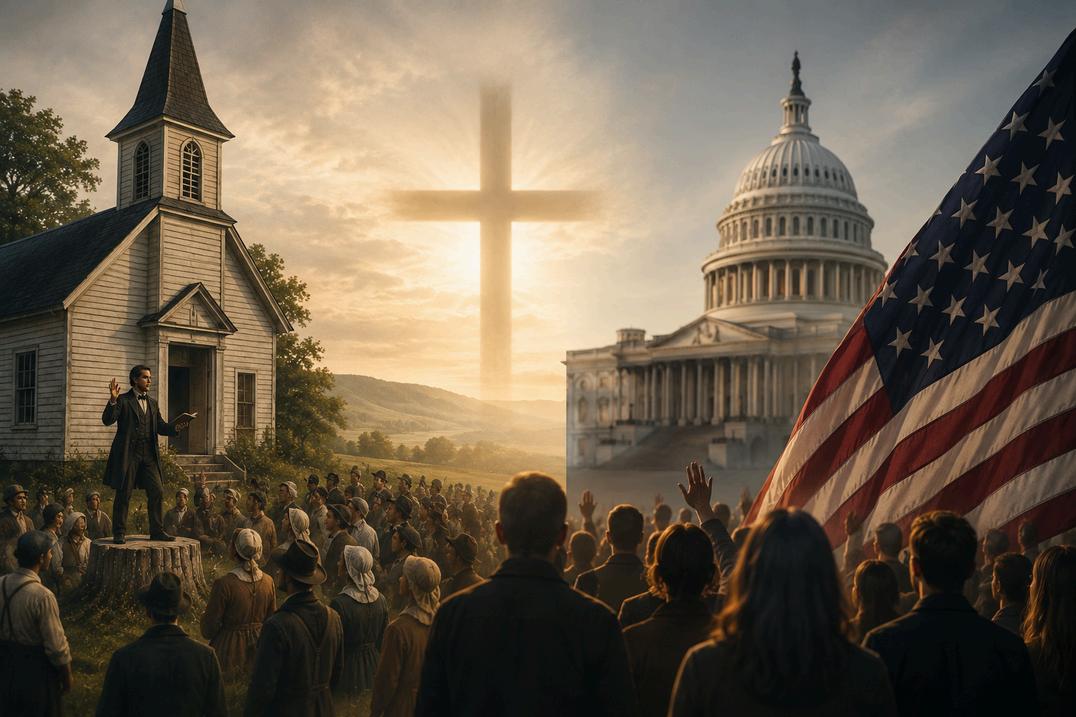
Jeremiah Moore was an irritant to the Crown Colonial authorities in Virginia apprehended him repeatedly for being, as one magistrate put it in 1773, a “preacher of the Gospel of Jesus Christ ” This was a true statement, but incomplete. Moore was a Baptist evangelist, admired for his knowledge of the Scriptures and for his satirical edge from the pulpit Brook Wilensky-Lanford, author of A God-Shaped Nation: Five Hundred Years of Religion in America (Atlantic Monthly Press), describes Moore as “large and gregarious, and always spoiling for a fight.” He ranged all over Fairfax County and, at one point, pastored in a place called Difficult, between Falls Church and Leesburg His alleged crime was preaching without the authorization of the Church of England, the colony’s official church An exasperated judge told him, “You shall lay in jail until you rot.” Yet Moore, imprisoned in Alexandria, remained full of zeal, preaching through latticed windows to crowds outside Moore played an early role in the making of American Christianity. At the time of the country’s founding, the church was experiencing an ebb tide, as the rejection of organized religion became more commonplace. Nevertheless, Christianity was enmeshed in public life. Most of the new states mandated that officeholders be Protestant; many still had officially recognized churches, sanctioned by the government. Moore and his fellow-Baptists were religious dissenters In the fall of 1776, a petition complaining of the
“Burden of an ecclesiastical Establishment,” signed by ten thousand men, arrived at the newly constituted Virginia House of Delegates. Moore later said that he’d presented the petition directly to Thomas Jefferson, who at the time represented Albemarle County. Around this period, Jefferson was closely studying the political philosopher John Locke’s arguments for religious freedom. He drafted a pioneering bill that barred the punishment of individuals for their religious beliefs, but failed to get it through the legislature. In 1786, Jefferson’s protégé, James Madison, successfully passed a slightly modified version of the measure, enshrining a watershed idea in America: the withdrawal of state control of religion.
Madison went on to become one of the principal architects of the Constitution and, later, the primary drafter of the Bill of Rights. His proposal for the First Amendment was sweeping, and included barring the abridgment of civil rights “on account of religious belief or worship,” prohibiting “any national religion,” and guaranteeing “equal rights of conscience ” The final language approved by Congress, however, was more ambiguous, a product of conflicting desires to protect religious freedom and to curb the influence of the irreligious: “Congress shall make no law respecting an establishment of religion, or prohibiting the free exercise thereof.” Jefferson later argued, in a letter to a Baptist group in Connecticut, that the amendment
“a wall of separation between Church & State ”
Reality turned out to be more complicated. The First Amendment insured that faith in the United States would be voluntary It would be up to the people to decide “how much religion they wanted in their government, institutions, and communities,” historian Matthew Avery Sutton writes in his book Chosen Land: How Christianity Made America and Americans Remade Christianity (Basic) Many clergy feared what this would mean for their congregations, but the outcome upended all expectations. The great deregulation of religion led to a thriving marketplace, forcing churches to innovate and to compete for customers. The question, then as now, was how the winners would seek to imprint their values and beliefs on the nation
The harvest field is a metaphor in the Bible that speaks to people’s openness to the gospel. In the years after the American Revolution, many clergy believed that the harvest field had become barren. Then, in the spring of 1800, remote regions of Kentucky became the setting for strange, otherworldly scenes At a Communion service near the Red River, attendees “were thrown into wonderful and strange contortions of features, body and limbs,” one observer said Soon after, during a gathering at Gasper River, the “prostrate bodies of penitents” covered the floor of a meeting house and had to be carried outside and laid out on the grass. The following year, in Logan County, in the southern part of the state, a Presbyterian minister named Barton Stone attended a revival meeting on the edge of a prairie He saw people fall down and lie still for hours before suddenly rising and shouting words of deliverance “It baffled description,” he later said
The gatherings culminated in early August, 1801, in Cane Ridge, a tiny settlement whose name came from the dense bamboo that covered the region. A log meeting house, about fifty feet long and thirty feet wide, served as Cane Ridge’s Presbyterian church, where Stone had been serving as pastor It was his task to
administer the summer Communion, typically several days of fasting, prayer, and sermonizing Thousands of people arrived on foot, on horseback, and by wagon. Preachers mounted tree stumps and worked different parts of the encampment Multitudes fell down and lay motionless “The falling exercise was very common among all classes, the saints and sinners of every age and of every grade, from the philosopher to the clown,” Stone later wrote Some attendees shrieked and jerked; others laughed uncontrollably, or emitted grunts that resembled barking One participant likened the cacophony to “the roar of Niagara.”
In 1803, . . . religious entrepreneurs gained access to a vast new market.
The Cane Ridge Revival would become an epochal moment in American religious history, one of the most visible manifestations of what historians would later refer to as the Second Great Awakening. (The first began in the early eighteenth century.) In 1803, after the Louisiana Purchase effectively doubled the size of the country, religious entrepreneurs gained access to a vast new market. Settlers streamed into the American frontier Revivalist preachers followed them For the most part, these were not ministers with formal theological training. They were farmers, shopkeepers, and artisans who forded streams, ascended valleys, and endured rain, wind, and snow in order to bring the Gospel to people eking out livelihoods in the wilderness. Francis Asbury, a young Methodist missionary, raised up an army of “circuit riders,” preachers who travelled constantly; many of them died young Asbury himself would traverse some 250,000 miles and preach more than 16,000 sermons in the course of 45 years.
The historic European Protestant traditions that were the forebears of the American church placed great emphasis on learning
and on doctrine, but the result was a faith that tended to be aristocratic and élitist Revivalism democratized Christianity It elevated a new class of spiritual leaders people who could hold a crowd in their thrall. They preached that salvation was open to all and exhorted congregants to forge their own moral destinies Sutton argues that the effect of this movement was a distinctly American faith, one in which “the ideals of political democracy and religious democracy went hand in hand.”
Over time, some preachers sought to systematize these tactics for winning converts Charles Grandison Finney, who became renowned for his wildly popular revival meetings, honed his “new measures,” which included addressing listeners in forthright, accessible language and incorporating an “anxious seat” for the spiritually undecided. He encouraged preachers to think of themselves as marketers, insisting that a revival was “not a miracle, nor dependent on a miracle,” but a “right use of the constituted means ”
Mark Noll, a historian of religion, argues that revivalism in America brought vitality to the church but left it intellectually impoverished a “scandal of the evangelical mind ” Nevertheless, revivalists got their results. Religious adherence surged in the nineteenth century; by the twentieth, most Americans belonged to a church
In Chosen Land, Sutton identifies four streams of Christian belief that emerged as the nation matured: conservative, revivalist, liberal, and liberationist. Christians who drew from the conservative stream emphasized tradition and historic creeds; revivalists prioritized the conversion of souls and the transformation of individual lives; liberals sought to adapt Christian theology to the latest intellectual currents; and liberationists saw faith as a vehicle for social justice. The streams occasionally flowed together in a single, mighty river At other times, they split and moved in opposite directions
In the 1920s, the topology of faith was dramatically shifting. Acceptance of Charles
Darwin’s theory of evolution, along with loosened sexual mores and technological progress, threatened to dislodge the church’s primacy in American life. The journalist Walter Lippmann noted the “dissolution of the old modes of thought” and the way the “circumstances of life” had conspired with “the intellectual habits of the time to render any fixed and authoritative belief incredible to large masses of men ” The needs of religious consumers were changing, and church leaders scrambled to adapt.
On Sunday, May 21, 1922, the First Presbyterian Church in Manhattan became the site of a fork in the river. The church’s parklike campus took up an entire block on Fifth Avenue, and its high pulpit was occupied by Harry Emerson Fosdick, a bespectacled liberal Baptist minister. Fosdick had acquired renown as the author of a series of devotional books on prayer, faith, and service. At First Presbyterian, his irenic, empathetic sermons became public spectacles On Sunday mornings, lines extended outside the sanctuary doors, and ushers seated worshippers in every nook of the church, even on cushions on the altar stairs



Fosdick’s sermon on that fateful spring day had been advertised in the city’s newspapers: “Shall the Fundamentalists Win?” From the pulpit, he argued that “new knowledge and the old faith had to be blended in a new combination.” He castigated fundamentalism as “illiberal and intolerant ” He suggested that there was room for a spectrum of theological views in the church “Opinions may be mistaken,” he said “Love never is ” Fosdick later insisted that he had intended his message as a “plea for good will.” He instead succeeded in starting a war.
into establishing their own Bible schools, independent churches, and mission organizations They experimented with new forms of media, founding radio programs that combined upbeat hymns and accessible messages They made a point of minimizing denominational differences, lowering barriers to entry for newcomers. Even in exile, the dynamism of the fundamentalist movement enabled it to grow
Many of the most prominent entrepreneurs in the American church today straddle the spiritual and the political.
A group of conservative Presbyterians, including William Jennings Bryan, the populist firebrand and thrice-failed Democratic Presidential candidate, tried to force Fosdick from the pulpit. The fracas played out in heated sermons, editorials, and denominational meetings In 1924, Fosdick finally resigned The following year, however, the fundamentalist advance stalled in Dayton, Tennessee, when Bryan took the stand as a “Bible expert” during the trial of John Thomas Scopes, a teacher who had been arrested for violating a state law that prohibited the teaching of evolution Bryan’s stumbling responses, under questioning from the legendary defense lawyer Clarence Darrow, left him humiliated The fundamentalist movement became a national laughingstock Lippmann later wrote that fundamentalism’s ideas no longer appealed to “the best brains and the good sense of a modern community ”
The market had seemingly chosen. Fundamentalists found themselves excluded from the nation’s major denominations, but they were hardly defeated They threw themselves
In the fall of 1949, Billy Graham, a thirtyyear-old evangelist with a square jaw and swept-back hair, began preaching under a giant tent in downtown Los Angeles, dubbed the “canvas cathedral.” Graham was a product of fundamentalism’s wilderness period He’d graduated from Wheaton College, in Illinois, the preëminent fundamentalist institution of higher learning, and honed his skills as a revivalist travelling the country for Youth for Christ, an evangelistic ministry for teen-agers. In Los Angeles, Graham catapulted to national prominence, preaching for eight consecutive weeks to some three hundred and fifty thousand people.
Graham went on to hold mass meetings, or crusades, as he called them, in dozens of American cities. He became the avatar of a burgeoning “new evangelical” movement whose adherents were deeply influenced by fundamentalism, even as they eschewed the label. As Wilensky-Lanford explains, the new evangelicals hoped to build a more inclusive faith that engaged the broader culture and demonstrated how “Christians could be both modern and conservative.” In Graham, they found an ideal ambassador His media savvy and relentless focus on an unadorned Gospel message helped him build a diverse coalition that crossed denominational lines
In the turbulence of the sixties and early seventies, when racial, gender, and sexual norms were upended anew, American churches underwent a “great re-sorting,” as Sutton puts it White evangelical churches revivalists,under Sutton’s classification system experienced
remarkable growth, while liberal mainline Protestant churches withered. Sutton points to, among other factors, a gap between the progressive stances adopted by mainline clergy and the more conservative views of the average mainline churchgoer Sensing an opportunity, many evangelicals particularly those with what the historian George Marsden has called “fundamentalistic” attitudes began shifting their attention to the political realm “They positioned race, gender, and sexuality at the center of their resurrected and refashioned crusade to once again remake the United States as God’s chosen land,” Sutton writes The result was the rise of the modern religious right. By the end of the twentieth century, this fundamentalism-inflected evangelicalism, with its muscular politics, was the unequivocal winner in America’s religious economy.
Many of the most prominent entrepreneurs in the American church today straddle the spiritual and the political. In the late nineteeneighties, David Barton, a former youth pastor and math and science teacher, founded WallBuilders, an organization in Aledo, Texas, “dedicated to teaching America’s forgotten history and heroes, emphasizing the moral, Christian, and constitutional foundation on which our nation was built.” Barton was not a trained historian his degree, from Oral Roberts University, was in religious education but he had developed a hobbyist’s interest in the Founding Fathers. In 1989, he published his first book, The Myth of Separation, which promised to reveal to readers “what the Founders and early Courts really said” about the separation of church and state. He went on to write more than 20 books, becoming the leading salesman for a cottage industry of historical misinformation that reached deep into the world of evangelical churches, home schools, and advocacy organizations Barton’s work has been eviscerated by scholars, but this has hardly dented his popularity. In One State Under God: A History of Religion in Texas (University of Texas Press), historian Joseph L. Locke notes that readers of Barton’s books weren’t looking for rigorous research “Instead, they wanted a weapon,” Locke writes “And Barton was handing
them one.”
The fusion of Christianity and nationalism that Barton promotes is not new, though it has taken different forms in the course of American history. The First Amendment’s ambiguity means that, as Sutton points out, “Americans have never really separated church from state ” Activists of all kinds, from Frederick Douglass to Jerry Falwell, have wielded the Bible and sought political power It’s inarguable, however, that Donald Trump’s ascendance has nourished a darker, more volatile version of the phenomenon Tapping into the lineage of white evangelicalism, with its charismatic leaders, anti-intellectualism, and political militancy, the MAGA movement has placed a nostalgia for a Christian past at the center of a grievancebased politics.
Barton’s pseudo-scholarship furnished Christian nationalists with valuable ammunition, but the movement needed foot soldiers. In 2012, an eighteen-year-old named Charlie Kirk founded Turning Point USA, a nonprofit organization meant to promote fiscal conservatism among young people. Kirk had been a Christian since childhood, but he was initially circumspect about his faith, arguing that religious conservatives had erred by imposing their beliefs “through government policy.” In 2019, however, Kirk met Rob McCoy, a pastor who challenged Kirk to more aggressively bring his Christian world view into the public arena. The following year, at the Conservative Political Action Conference, Kirk lauded President Trump for understanding “the seven mountains of cultural influence” an evangelical vision, dating to the nineteen-seventies, that calls on believers to influence the realms of family, religion, education, media, entertainment, business, and government Kirk embraced the idea himself, building a media empire and organizing a grassroots army to turn out Trump voters during the 2024 election Last year, after a gunman shot and killed Kirk at a campus event in Utah, his wife, Erika, a former Miss Arizona who started her own ministry organization and a faith-based clothing company, vowed to carry on her husband’s legacy, “fighting the
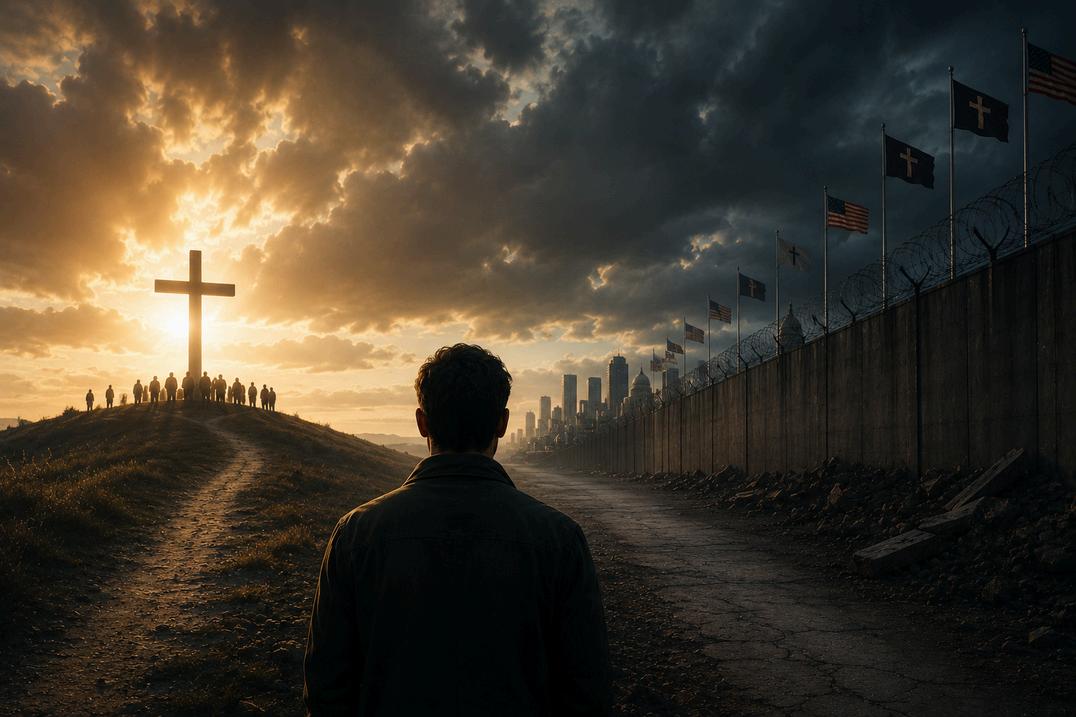
A small ocean of ink has been spilled in the last few years on Christian nationalism, the increasingly successful project by what used to be the fringes of the far-right to prevent the United States from ever becoming a secular liberal democracy and instead to cement it as a confessional Christian state But there’s a flip side to this idea that deserves as much attention. As they work to limit belonging to (White) Christians, Christian nationalists are also hard at work carving up Christian belonging into discrete national types. According to this view of things, one is never simply a Christian but is instead an American Christian, a Palestinian Christian, or a Mexican Christian and those national differences outrank whatever unity we might have in Christ This is the flip side to Christian nationalism Call it national Christianity
The moral hollowness of national Christianity was on display in July [2025] when the Israeli military shelled Holy Family Church, the only Roman Catholic church in Gaza City, killing three people and injuring the parish priest. Joel Berry, managing editor of the conservative evangelical humor site The Babylon Bee, posted on X that there are “only” 200 professed Catholics in Gaza, and “they all support Hamas.” By virtue of their small number, their foreignness, and their government, the dead and injured Catholics of Gaza were beneath Berry’s concern. Conservative Christian writer Tony Badran, agreeing with Berry, wrote that US Protestants
need not concern themselves with “ancient communities” in the Middle East and that such concern is “garbage” and “anti-American.”
Tablet, the Jewish magazine where Badran is news editor, published a defense of Berry that summed up what I’m calling national Christianity All of the apparent outrage over the church bombing was designed “to encourage American Christians to identify with Middle Eastern Christians as being fundamentally like themselves, when they are not, and to allow this identification to supersede both their own values and the interests of the political community to which they belong, i e , the United States of America ”
Christian nationalists are also hard at work carving up Christian belonging into discrete national types.
This is the essence of national Christianity
One might expect Christian nationalists to insist that the values of the nation be subordinated to Christian values, but what they really want is for Christian values to be subordinated to the nation. Christians from different national communities are fundamentally unlike each other, the argument goes, so one’s values and
interests as a Christian must be subordinated to the particular values and interests of the nation In national Christianity, nationality is like a mold into which Christianity is poured. Being an American Christian means having my Christianness conditioned by a more fundamental Americanness
Of course, “nation” here should be understood in a racial sense Would those who see Palestinian Christians as “fundamentally unlike” American Christians be so quick to complain about a similar identification with British or Canadian Christians?
The idea that the moral demands of Christian faith should be subordinated to the demands of our ethno-national community is laid out explicitly in one of the more influential texts of today’s Christian nationalist movement, Stephen Wolfe’s ponderous The Case for Christian Nationalism. The book argues that the United States should be a “Christian nation” in the strongest sense, in which a “Christian prince” shepherds the nation toward its “earthly and heavenly good” by suppressing “false religion” and compelling people to attend church But not just anyone can belong to Wolfe’s Christian nation. “Nation,” Wolfe says, is a synonym for “ethnicity ” In one section of the book, he defends the idea that a Christian nation can exclude Christians from another nation (read: ethnicity). “Unity in Christ,” he writes, “does not entail or provide unity in earthly particulars ” National and ethnic differences are not overcome but in fact “strengthened” by Christian revelation
And when push comes to shove, for Wolfe, ethnicity comes first. Reflecting on whether Christians from different nations can be part of the same church community, Wolfe declares that “spiritual unity is inadequate for ecclesial unity,” and “civil fellowship is what makes strong church fellowship possible ” It is not only that Christian faith strengthens one’s ethnicities, but in fact, strong ethnic ties are what make Christian community possible in the first place
More than an argument for a Christian (White) nationalism, Wolfe’s book is an argument for a (White) nationalist Christianity, in which whatever moral claims faith might make are mediated through and subordinated to a prior ethnic identity At the very end of the book, Wolfe longingly describes a Christian of the future who has discarded the “universalizing concept of man” for a truer “ethno-centric frame ” For such a Christian, “one ethnicity to another would be as dogs are to cats.”
This is blasphemy and must be torn out root and branch
The categories of nation, race, and gender that we use to dominate and exclude are contingent; these lines have been drawn differently (or not at all) in the past, and they can be drawn differently (or not at all) today. God does not respect whatever petty justifications we give for the narrowness of our hearts. To be baptized into the death and resurrection of Jesus is to be liberated from the imprisoning fiction that another person is fundamentally unlike me and hence lies outside my sphere of concern. The resurrected Jesus is the one who arrives unexpectedly, whose face is glimpsed in the face of a stranger, who vanishes as soon as we think we know who and where he is, who blasts open our sphere of concern and holds it uncomfortably open It is exactly in the one whom we think is farthest from us, in the one whose suffering and death we think we are allowed to dismiss the drowned refugee, the child discarded as “collateral damage,” the “unassimilated” immigrant that we must strain to glimpse the One nearest to us and who is our highest concern
Today’s national Christians want us to keep our moral responsibilities well within the borders of the kingdoms of this world We should remember who the prince of this world is.
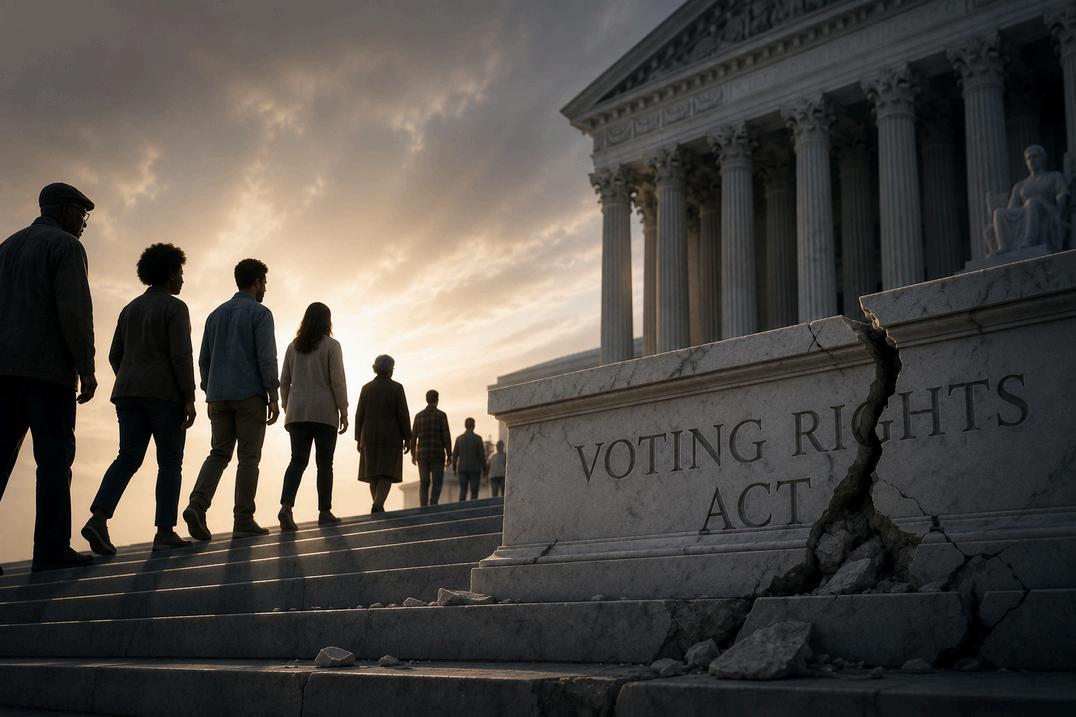
When I learned what Samuel Alito and the other Republican appointees to the Supreme Court did to the Voting Rights Act recently, I thought of Mickey
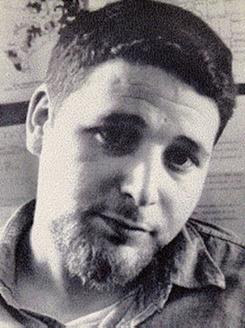
I met Mickey the summer after third grade. His family had rented one of the summer cabins in the Adirondack Mountains where my grandmother also had a tiny summer cabin I was eight, and Mickey was a teenager. We were not friends, yet I came to love him.
Mickey was kind and gentle, with a ready smile. I don’t recall asking him to protect me. He wasn’t the kind of hulking kid I usually chose as protector from bullies who’d torment and ridicule me Mickey was on the short side and thin. He wore a sailor’s cap and seemed forever cheerful I don’t remember him fighting to defend me or even quieting the kids who made fun of me, but I do remember his warmth and reassuring presence. His calm good nature seemed to cast a positive spell over kids who might otherwise turn to teasing or bullying
Years went by and I grew into a teenager who no longer needed older boys to protect me from bullies, and I lost track of Mickey
It wasn’t until September 1964, the start of my freshman year at Dartmouth College, that I heard what had happened to him
Early that summer, Mickey whose full name was Michael Schwerner had traveled to
Mississippi The Civil Rights Movement was gaining strength. Martin Luther King, Jr. had given his famous “I Have a Dream” speech at the August 1963 March on Washington, where 250,000 people had gathered at the Lincoln Memorial to hear him.
“Freedom Summer” of 1964 had brought college students, both Black and white, Mickey among them, from northern schools together with Black people from Mississippi to educate and register Black voters, under the aegis of the Student Nonviolent Coordinating Committee (SNCC).
Mississippi was chosen because only 7 percent of the state’s eligible Black voters were registered, in a state that was about 40 percent Black Most had been frozen out of the polls with poll taxes, subjective literacy tests, and brutality. It had been that way since 1877. The system was enforced by white supremacists who could commit crimes with impunity because the entire region had become a oneparty state run by white supremacists.
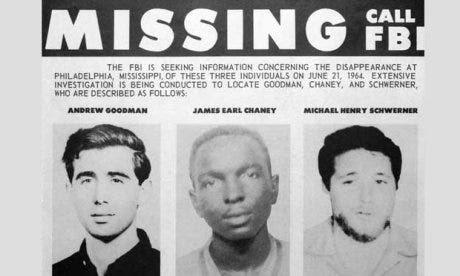
Mickey was among the first wave of volunteers to arrive in Mississippi for Freedom Summer. On the afternoon of June 21, he and two other student volunteers Andrew Goodman, also white, and James Chaney, a young Black man were driving near the town of Philadelphia when Neshoba County Deputy Sheriff Cecil Ray Price stopped them for allegedly speeding Price locked them up in the
local jail. That night, after they paid their speeding ticket and left the jail, Price followed them in his police car, stopped them again, ordered them into his car, and took them down a deserted road where he turned them over to a group of his fellow Ku Klux Klan members They beat Mickey, Goodman, and Chaney with chains Then they killed them and buried their bodies in an earthen dam under construction
For weeks, no one knew what had happened to the three volunteers Lyndon Johnson used concern over their disappearance to pressure the House to pass the Civil Rights Act of 1964 into law on July 2
On July 16, a little more than three weeks after Chaney, Goodman, and Schwerner disappeared, and two weeks after Johnson signed the Civil Rights Act, Senator Barry Goldwater accepted the Republican nomination for president at the Cow Palace in Daly City, California Goldwater told Republican delegates that “extremism in the defense of liberty is no vice. And . . . moderation in the pursuit of justice is no virtue ”
Mickey’s body and those of Chaney and Goodman were found August 4. They were illustrations of extremism in the defense of what white supremacists defined as liberty
The state of Mississippi refused to bring murder charges against any of the killers, but eventually Price and Neshoba County Sheriff Laurence Rainey, also a Klan member, and sixteen others, including Samuel Bowers, the Imperial Wizard of Mississippi’s White Knights of the Ku Klux Klan, were arraigned for the federal crime of conspiracy to violate the civil rights of the murdered young men. An all-white jury found seven of them guilty, including Price and Bowers After several unsuccessful appeals, each
received a sentence of between three and 10 years None would spend more than six years behind bars
When the news reached me that Mickey had been beaten and murdered by white supremacists by adult bullies who would stop at nothing to prevent Black people from exercising their right to vote something snapped inside me It was as if I had gotten a new pair of eyes and began to see everything differently. Before then, I understood bullying as a few kids picking on me for being short, making me feel bad about myself After I learned what happened to Mickey, I began to see bullying on a larger scale, all around me: Black people bullied by whites; workers bullied by employers; girls and women bullied by men; the disabled or gay or poor or sick or immigrant bullied by politicians, insurance companies, landlords, and bigots I saw the powerful and the powerless, the exploiters and the exploited.
It seemed as if the world had changed, when in fact it was I who had changed I had a different understanding of the meaning of injustice. It became as personal to me as were the bullies who had called me names and threatened me in the boys’ room and on the playground but larger, more encompassing, more urgent.
After that, the stranglehold of the white supremacists on the one-party South began to loosen At the center of the law’s success was Section 5, commonly referred to as the “coverage formula,” which determined those states that had to receive clearance from the Justice Department before changing their election rules, based on their histories of racebased voter discrimination
Another critical part of the law was Section 2, which prohibits states and political subdivisions from imposing voting qualifications, standards, or practices that discriminate on the basis of race, color, or membership in a language minority group. It forbids any election rule that results in a denial or abridgment of the right to vote, aimed at
preventing vote dilution, such as discriminatory redistricting.
In the 20 years following the law’s passage, the disparity in registration rates between white and Black people dropped from nearly 30 percent in the early 1960s to 8 percent Based on its continuing success, the Voting Rights Act was repeatedly reauthorized by Congress. But the forces of racism and violence did not disappear
On August 3, 1980, Ronald Reagan launched his presidential campaign with a rally at the Neshoba County Fair, only a few miles from where Cecil Ray Price had stopped Schwerner, Chaney, and Goodman on that fateful night 16 years earlier In defending “states’ rights” that day, Reagan, the cheerful “morning in America” candidate, was sending a dark dog-whistle to racist bullies, telling them he was on their side.
Thirty-three years later, on June 25, 2013, the Supreme Court struck down the coverage formula in the Voting Rights Act, in the case Shelby County v Holder The court’s five conservatives decided that the formula was out of date, despite Congress’s repeated reauthorizations, effectively ending preclearance The court’s opinion was written by Chief Justice John Roberts and joined by Samuel Alito, Antonin Scalia, Anthony Kennedy, and Clarence Thomas Reagan had put Scalia and Kennedy on the court
“Our country has changed,” Roberts wrote. The Voting Rights Act was “strong medicine,” but in 1965 it was the right response to “entrenched racial discrimination.” When first enacted, he wrote, the rate of voter registration among Black people in Mississippi was 6 4 percent, and the gap between Black and white rates of registration was more than 60 percentage points But now, Roberts said, pre-clearance was no longer needed
Yet within 24 hours of the ruling, states of the old Confederacy were already proving Roberts wrong Texas announced it would implement a strict photo ID law. Mississippi and Alabama began to enforce the same photo ID laws that federal pre-clearance had previously barred Other Southern states began to purge voters
from their rolls, curtail early voting, eliminate same-day registration, and prevent county boards of elections from opening polls for an additional hour.
In 2021 and 2022, in response to record voter turnout in the 2020 election, 19 states passed more than 30 laws making it harder to vote. The United States Senate, although nominally under Democratic control, did not have the votes needed to overcome a Republican filibuster and restore Section 5.
After [1965], the stranglehold of white supremacists on the one-party South began to loosen.
Recently the six Republican appointees on the court decided to gut Section 2 In Louisiana v Callais, Alito in a remarkably dishonest opinion, even for him said he was only bringing Section 2 up to date “Vast social change has occurred throughout the country,” Alito wrote, “particularly in the South.” As a result of the Voting Rights Act, he claimed, Black Americans, once barred from the polls, now vote at similar rates as the rest of the electorate
Rubbish. According to a recent study in which researchers analyzed nearly a billion votes cast in federal general elections between 2008 and 2022, “significant and robust evidence” shows that the racial turnout gap widened in parts of the country that had been covered by the Voting Rights Act after Shelby gutted Section 5.
The Republican appointees on the court have now invited Republican state legislatures to draw new congressional maps that will likely create a solid red south, creating the largest reduction in Black political representation since the death of Reconstruction. It could result in a loss of as many as 19 seats in the U.S. House and nearly 200 state legislative seats nationwide and dramatically remake the balance of
power in favor of Republicans. The Roberts-Alito court has ensured that Dred Scott and the Confederacy are reborn
Immediately after the ruling, the Florida legislature passed a new congressional map drafted by Gov Ron DeSantis’s office, aiming to flip up to four Democratic-leaning seats
Louisiana is postponing primaries to allow for a special session to redraw maps Officials in Alabama are seeking to lift a lower court injunction to change their map. Mississippi is also actively exploring new white Republican districts
It is hard for me to think back on the deaths of Mickey Schwerner, Andrew Goodman, and James Chaney, along with that of Martin Luther King Jr. and other martyrs to civil and voting rights, and not fear that because of the dishonest and regressive opinions of Roberts, Alito, Thomas, and other Republican appointees to the Supreme Court they died in vain.

Pope Leo XIV’s first landmark teaching document, . . . explore[d] a theme he has emphasized since beginning his papacy: social disruption in the digital age, in particular the dangers that A.I. poses for human flourishing. Titled “Magnifica Humanitas,” or “Magnificent Humanity,” the document is inspired by the teachings of Leo’s eponymous predecessor, Leo XIII, whose 1891 encyclical “Rerum Novarum” responded to the plight of exploited workers in the Industrial Revolution It is considered the modern foundation of Catholic social teaching.
“In our own day,” Leo told the College of Cardinals two days after his election, “the church offers to everyone the treasury of her social teaching in response to another industrial revolution and to developments in the field of artificial intelligence that pose new challenges for the defense of human dignity, justice and labor.”
Most popes since Leo XIII have published encyclicals about social teaching But the subject has remained overshadowed by the absolute moral law regarding sins of the flesh
Dedicating his first encyclical to social justice show[s] how much Leo, like his predecessor Pope Francis, is trying to shift Catholicism away from the near fixation on “pelvic theology,” or sexual morality, that has come to define Catholicism, especially in Leo’s home country, the United States The concern is that decades of focusing on “sins below the waist,”
as Pope Francis memorably put it, has fueled the church’s culture war agenda and driven many people away from the central teachings of the Gospels It has also left workers and the marginalized with a weakened moral voice against the predations of powerful financial interests
Leo, of course, defends teachings like the church’s stance against abortion, but he embeds it in a wider context, such as when he defended the decision of the Archdiocese of Chicago to give Senator Dick Durbin of Illinois, an abortion-rights Catholic, an award for his long work on behalf of immigrants Conservative Catholics were incensed, but Leo told reporters that it’s important to look at the entirety of a person’s views
Leo was more explicit. When a reporter on the papal plane returning from a trip to Africa asked him about a controversy over the blessing of gay couples by priests, Leo said: “We tend to think that when the church is talking about morality, that the only issue of morality is sexual In reality, I believe there are much greater, more important issues, such as justice, equality, freedom of men and women, freedom of religion, that would all take priority before that particular issue.”
His response dismayed and even infuriated many social conservatives, both Catholic and
Protestant. But Leo was not forging some new doctrine. On the contrary, he was articulating an older tradition of placing justice above personal chastity. “This statement would have seemed perfectly banal to a theologian of the late 16th century,” Jean-Pascal Gay, a professor of Christian history at the Catholic University of Louvain, wrote in the Catholic newspaper La Croix “In 2026, it has become almost subversive ”
The church’s emphasis on sexuality began in earnest in the 16th century as moral theologians started to codify various aspects of Catholic practice, including producing manuals for clerics to use in assessing the gravity of sins in the confessional Various sexual sins, from adultery to masturbation, were favorites because they were easy to judge you either had sex or you didn’t. Figuring out when a person has been greedy or insufficiently charitable is harder As a result, sexual sins became the gravest sins, a category unto themselves that assumed an outsize place in the venerable hierarchy of truths that ordered beliefs
from the Southern Hemisphere. Francis immediately made it clear that he had no interest in advancing America’s culture wars “Who am I to judge?” he responded when asked a few months after his election about the status of gay priests in the church He elaborated on that comment in a lengthy interview in which he said the church should not talk only about abortion and gay marriage and contraception but needed to find a “new balance” by elevating other key teachings. Otherwise, he said, “the moral edifice of the church is likely to fall like a house of cards ”
Leo’s similar approach does not mean that he is about to loosen the church’s sexual mores. During the news conference on his flight from Africa, he prefaced his response about gay blessings by saying that “the unity or division of the church should not revolve around sexual matters ” He wants to welcome everyone, and has made a point of meeting with gay Catholics, for example. But he does not want to alienate those who may disagree Leo wants a sexual devolution, if you will
Decades of focusing on “sins below the waist” . . . have
fueled the church’s culture war agenda.
The legalistic approach to sex and sin became commonplace. The sexual revolutio the 1960s and the loosening of restrictions o abortion in the 1970s turbocharged the push focus on sexual ethics and sideline social jus The 1978 election of John Paul II added to th momentum The Polish pope, while a strong proponent of Catholic social teaching, was a especially forceful moralist on sexual ethics. Catholic conservatives in America made tha moralism a priority, forging common cause w the rising religious right.
Then in 2013 Pope Francis was elected, becoming the first Jesuit pontiff and the firs
This approach, and this new encyclical, is arriving at a propitious moment The disruptions of the post-liberal world and the threats posed by A.I. have led many cultural conservatives to make economic justice a priority. The Trump administration’s crusade against immigrants and foreign aid have united the U S hierarchy in opposition.
The Dobbs decision largely defused abortion as a culture war issue in the United States, and gay marriage continues to recede as a concern Bishop Robert Barron of Minnesota, the American prelate most closely identified with Donald Trump, has said he would not push to change laws on gay marriage and compared the church’s “harping” on sexual ethics to the disastrous attempt by the Allied forces in World War I to take Gallipoli “A good cause, but the wrong strategy,” Bishop Barron has said.
Leo, on the other hand, is not beating a tactical retreat from any issue but instead is expanding the scope of the church’s teachings, much as Francis did with his encyclical on the environment, “Laudato sí ” Like climate change, A I is a scientific topic But the Catholic approach is theological and social.
A.I. can do remarkable things, but it can also sow disinformation and division Leo stresses wisdom and relationships His holistic view of mankind is reflected in the very title of this new encyclical. Our shared humanity, the pope is saying, is a sacred reality, and that carries a social responsibility
I have been a stranger in a strange land.
Exodus 2:22
LAZY?
For a start, people who traveled for so many miles through such horrific conditions in order to find work cannot accurately be portrayed as lazy benefitscroungers.
Patrick Kingsley
Do not neglect to show hospitality to strangers.
Hebrews 13:2
I was hungry and you gave me food, I was thirsty and you gave me drink, I was a stranger and you welcomed me.
Jesus, in Matthew 25:35
The alien who resides with you shall be to you as the citizen among you; you shall love the alien as yourself, for you were aliens in the land of Egypt: I am the LORD your God Leviticus 19:34
I hoped that in the years to come, more people would be able to recognize refugees for who they really were: simply the most vulnerable people on earth
Helen Thorpe
I still feel like an outsider, but now I know that everyone else does, too, so that makes us all insiders
Firoozeh Dumas
It is strange, how you can go from being a person who is away from home to a person with no home at all The place that is supposed to want you has pushed you out. No other place takes you in You are unwanted, by everyone You are a refugee Clementine Wamariya
Over the years and I’ve been at this for many, many years I’ve had the chance to answer many, many questions about Jesus, the Bible and LGBTQ people And since it turned out I was actually answering many of the same questions again and again… and again, this FAQ list evolved
It has become a staple handout at Pride Festival tables for members of the LGBTQ community who have been wounded by the church in the past looking for a sign that there is place for them at the table. It has also become a resource for allies who are looking for words to respond to those who have hijacked the Good News of God’s inclusive love and deployed it as a weapon of mass discrimination against the LGBTQ community
Since we live and move and have our being in a moment when that particular manifestation of toxic theology is on steroids, I can think of no better way to launch Pride Month than by dusting it off and running it up the Substack flagpole for anyone looking for resources to offer a rebuttal to the rabid rhetoric of the religious right
So let’s start at the beginning:
1. Is being gay a sin?
No. Sins are acts that separate us from God and keep us from loving our neighbors as ourselves Being gay is not a sin Bullying is a sin Being hateful to other people is a sin Putting
yourself in the place of God to judge others is a sin. Being gay is not.
2. What did Jesus say about gay people?
Jesus said the same thing about gay people that he said about all people: God loves you beyond your wildest imagining and calls you to walk in love with God and with each other He also said a whole lot about welcoming the stranger, embracing the outcast, ministering to the marginalized and loving not judging your neighbor
3. Does the Bible really condemn homosexuality?
The short answer is no, it does not The handful of passages in the Old and New Testaments that talk about God condemning specific sexual acts have nothing whatsoever to do with sexual orientation and everything to do with contexts such as cultic prostitution or gang rape. To put it another way, using the Bible as a handbook on human sexuality makes as much sense in the 21st century as using it as a handbook on astronomy did in the 16th. The church got it wrong when it misused the Bible to condemn Galileo and it gets it wrong when it misuses the Bible to condemn LGBTQ+ people.
4. How do I respond when people say “God hates f**s?
First of all, God’s nature is to love, not to hate We believe that what God cares about is not our sexual orientation but our theological orientation and that the question that matters is not “who do you love” but “do you love”? Recognizing that homophobia causes some to project onto God their own fears, prejudices, and biases against LGBTQ+ people, sometimes the best response is simply no response It can be a challenge, but getting triggered by hate-mongers prevents us from being the change we want to see
5. What do I tell people when they say being gay is a sin and a choice?
Tell them that Jesus said absolutely nothing about being gay, but he said a lot of things about judging other people. Then tell them that while there is no consensus among scientists about the exact reasons that individuals develop a heterosexual, bisexual, gay, or lesbian orientation, there is consensus that sexuality is a continuum So the “choice” is not to be gay, straight, or somewhere in between; the “choice” is to build our own healthy relationships and give other people the grace to build theirs
6. How about transgender people? Where do they fit in?
The same place all Gods’ beloved children fit in: smack dab in the center of God’s care, love, and desire for health and wholeness for every single human being
7. What do you say to someone who bases their anti-trans theology on the assertion that “God doesn’t make mistakes”?
God doesn’t make mistakes but we do. And we make a mistake when we project our own narrow, binary understanding of gender onto the complex, beautifully diverse continuum of humanity God created and we are still learning to understand It’s the same mistake we make whenever we project our own finite knowledge onto God’s infinite creativity and capacity to
love. It’s the first mistake human beings made in the Garden of Eden by presuming that they could be like God by eating the fruit of the tree of knowledge. And it’s a mistake God responded to in one of our most ancient scriptural texts: “Who is this that obscures my plans with words without knowledge?” (Job 38:2) God doesn’t make mistakes we do. So let’s not make the mistake of failing to fully embrace our transgender/nonbinary siblings wherever they fall on the continuum of gender identity.
Jesus said absolutely nothing about being gay; but he said a lot about judging others.
8. How do I respond when politicians condemn my sexuality, citing their belief in the Bible?
Remind them that the First Amendment protects them in believing whatever they want about what God does or does not bless. But it also prohibits them from using those beliefs to decide who the Constitution protects or doesn’t protect. Tell them to stop confusing their theology with our democracy Then campaign for and donate to their opponent in the next election cycle.
9. What about those who say they need “religious freedom laws” to protect their right to discriminate against LGBTQ+ people because of their religion?
They are wrong. The Constitution already protects their right to exercise their religion It does not protect their right to impose their religion. Just as using the Bible to justify racial segregation was wrong in the 1960’s, using it to justify LGBTQ+ discrimination is wrong today
10. Does The Episcopal Church support marriage equality?
Yes We believe what matters in a marriage is the love between two people, not their gender In 2015 the Episcopal Church changed our canons (church laws) to provide equal access to sacramental marriage for both same and opposite sex couples.
11. Should I try to “pray the gay away”?
No If you need to pray away something, pray away homophobia Homosexuality doesn’t need healing. Homophobia does.




“Jesus was a Capricorn, he ate organic foods He believed in love and peace and never wore no shoes
Long hair, beard and sandals and a funky bunch of friends
Reckon they'd just nail Him up, if He come down again”
I turned into the back entrance of the university campus while John Prine continued to preach from my car radio
“'Cause everybody's gotta have somebody to look down on
Prove they can feel better than at any time they please
Someone doin' somethin' dirty, decent folks can frown on
If you can't find nobody else, then help yourself to me”
Jesus made a regular habit of hanging out with his funky bunch of friends that made the religious enforcers of the status quo squirm To put it in today’s terms, His best friends were not exactly on speaking terms with the General Conference
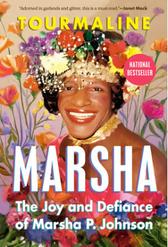
It is through the lens of Jesus’ funky bunch of friends that I read Marsha: The Joy and Defiance of Marsha P Johnson by Tourmaline
Her name a homophone to mine, in Marsha P Johnson I find a beacon of stubborn optimism and admirable joy. She is often regarded as the Godmother of Pride, having been there at the eruption of the Stonewall riot, but she is so much more than a thrown shot glass and declaration of rights.
She prayed for them, fed them, and always had their backs.
Marsha knew from a young age that she was she and she lived a life in which her basic needs of food, clothing, and shelter were never guaranteed. The bigotry of her time meant that jobs were limited and she became a victim to the world’s oldest profession and substance abuse.
I wish Tourmaline had given a harsher critique to parents who turned their children into homeless people for the supposed crime of being something other than heterosexual; however, this theme is presented as a fact of
life that rings true too often today. I had to take several long breaks during these parts of Marsha’s story to decompress Imagine loving your child, conditionally.
As Marsha matured, she mothered other young trans women and gave them what she could, to keep those in her care away from sex work and addiction. She prayed for them, fed them, and always had their backs She made it her mission to secure housing for LGBTQA+ folks at STAR House in the East Village of New York City. It was a dump, but they made it a home for as long as they could
Finding her voice as a performer, Marsha performed with the Hot Peaches and Angels of Light, and was never a stranger on stage at a drag show She captured the attention of Andy Warhol (his portrait of Marsha hangs on my office door), and appeared on an Earth, Wind and Fire album cover
Performing came to a swift halt with the AIDS pandemic. Marsha poured herself into caring for her loved ones She regularly visited those fortunate enough to die in a hospital, and actively cared for others in their homes. She continued to touch the untouchable and love people whom the mainstream deemed disposable.
When Marsha’s body was pulled from the Hudson River in July 1992, local police quickly declared her death a suicide without much investigation. Just as we see way too often today, a Black Trans life is not afforded the time and attention to determine why a life was lost Marsha’s community demanded justice and got justifiably rowdy enough to have her cause of death changed to “unknown cause ”
I had to take several long breaks during parts of Marsha’s story to decompress.
Tourmaline paints a wild portrait of Marsha’s flamboyance, kindness, and devotion. In reading about Marsha’s life, I see someone who sits next to Jesus as He preaches His Sermon on the Mount, fanning herself with an oversized leaf, hungrily taking in every word I see a joyful follower of Jesus, perfectly imperfect, ready to anoint His feet. I see the Pharisees scowling at Jesus hanging out with her, a “known sinner,” as Jesus and Marsha share a high-five after a long day of helping the sick and feeding the hungry. Jesus has a funky bunch of friends, and one of them is Marsha P Johnson
For further listening: Jesus Was a Capricorn (Owed to John Prine)

Dear Elon:

You don't know me. I’m a pastor in Louisville, Kentucky, with a Substack newsletter and a pesky habit of writing letters to people who probably won’t read them. So we’re already on familiar ground.
I'm writing to you because on Friday [June12, 2026], SpaceX went public on the Nasdaq, and your net worth crossed one trillion dollars, making you the first human being in the recorded history of the world to achieve that particular distinction.
One. trillion. dollars.
I'll give you this: You built things Real things Rockets that actually go to space and an electric car company that forced an entire industry to take seriously what it had spent decades dismissing Whatever else is true about you, you ' re not a man who coasted. The ambition is real, as is the engineering. The sleepless, manic, occasionally unhinged drive to make things that didn't exist before is real
I’m not going to pretend it isn’t.
So, credit where credit’s due
But here’s the thing I can't get past, Elon
On Friday, when your net worth crossed a trillion dollars, Oxfam released a calculation. They ran the World Bank data and figured out that 10 percent of your fortune, $100 billion, would be enough to end extreme global poverty for an entire year All of it Every person on earth currently living on less than $3 00 a day, lifted
above the line, for one full year, for a tenth of what you ' re worth.
You could do that and still have $900 billion left
You are now, by one measure, wealthier than the combined net personal wealth of the poorest 46 percent of humanity combined That's 3 8 billion people You have more than all of them put together.
A million dollars a minute for you. A dead child every 40 seconds for everybody else.
Your wealth grew by more than a million dollars a minute over the past year.
And while your wealth was exploding, you’d recently led DOGE, pushing to cut $700 billion from Social Security, Medicaid, food stamps, and unemployment insurance Your team canceled a billion dollars in funding that helped schools and food banks buy fresh produce from local farms. The Health and Human Services agency that coordinates aging and disability services, including programs that Meals on Wheels relies on, was gutted by layoffs. Oxfam says that the dismantling of USAID, which you helped engineer, means a child under five could
die every 40 seconds by 2030.
A million dollars a minute for you A dead child every 40 seconds for everybody else I keep trying to find a way to say that without it sounding hysterical, but you know what? Screw it As we’d say in the mountains, “That’s sorry and trashy, is what that is ”
Look, I get that I'm a pastor in a country that produced this outcome I drive a car I have a retirement account and a house I benefit every single day from an economic order that generated Elon Musk's trillion-dollar fortune and the systems that made it possible The same systems, not coincidentally, that have kept 3.8 billion people poor enough to add up to less than one man ' s portfolio
No, I’m not Elon Musk, but I'm not the impoverished Lazarus either, lying covered in sores by the gate. I'm somewhere in the middle, if I'm honest I'm close enough to the feast to smell it, but far enough from the gate to be able to forget about the person lying outside it.
So here's the thing: Hebrew prophets didn't spend their careers denouncing foreign empires Amos didn't take a road trip to Assyria to lecture them about their fiscal policy The prophets generally spoke from inside the community's failure, using the first person plural: we have gone astray, we have trampled the poor, we have sold the righteous for silver and the needy for a pair of sandals Not because Israel's failures were the worst in the world, but because repentance has to start somewhere close to home
So, I'm not letting myself off the hook here just because I'm mad at you. I am furious. But that doesn't make me innocent.
A Case Study
Jesus tells a story in Luke 16 about a rich man and a beggar named Lazarus.
The rich man feasts in luxury every day Outside his gate, Lazarus lies in the dirt, hungry, covered in sores, and hoping for scraps. Both men die Lazarus ends up in Abraham's embrace The rich man ends up in torment, looking across a chasm he can no longer cross.
What jumps out at me isn't the reversal of fortunes, as satisfying as that is What I love about this parable is the detail about the rich
man. A detail Jesus slips in almost casually.
The rich man has no name In the Latin tradition, he's called Dives, which isn't actually a name. It just means "rich man. " In other words, his identity has collapsed entirely into his wealth That's all he is a bank balance So, that's all that's left of his life: a swipe badge that says, "Rich Guy."
But Lazarus has a name El-azar in Hebrew "God has helped "
The rich man walked past Lazarus every single day. Every day. Never bothered to learn his name
I’d like to suggest that that's the sin the text is actually naming. Not some abstract theological crime Only this: A man so cushioned by his own abundance that the person suffering at the end of his driveway never became real to him. Never became a person whose name was worth knowing
I'm going to go out on a limb and guess that you don't know their names either, do you? The children who'll go hungry because the food bank funding dried up The seniors who'll lose Meals on Wheels. The five-year-olds in Sub-Saharan Africa who'll die because USAID is gone
Correct me if I’m wrong, but I’m pretty sure the numbers on your net worth tracker dashboard don’t show any chyron with those children’s names
But that's not a character flaw unique to you It's what extreme wealth does to anybody’s moral vision It builds a gate, tells everybody which side of it they belong on, then convinces them that's the natural order of things.
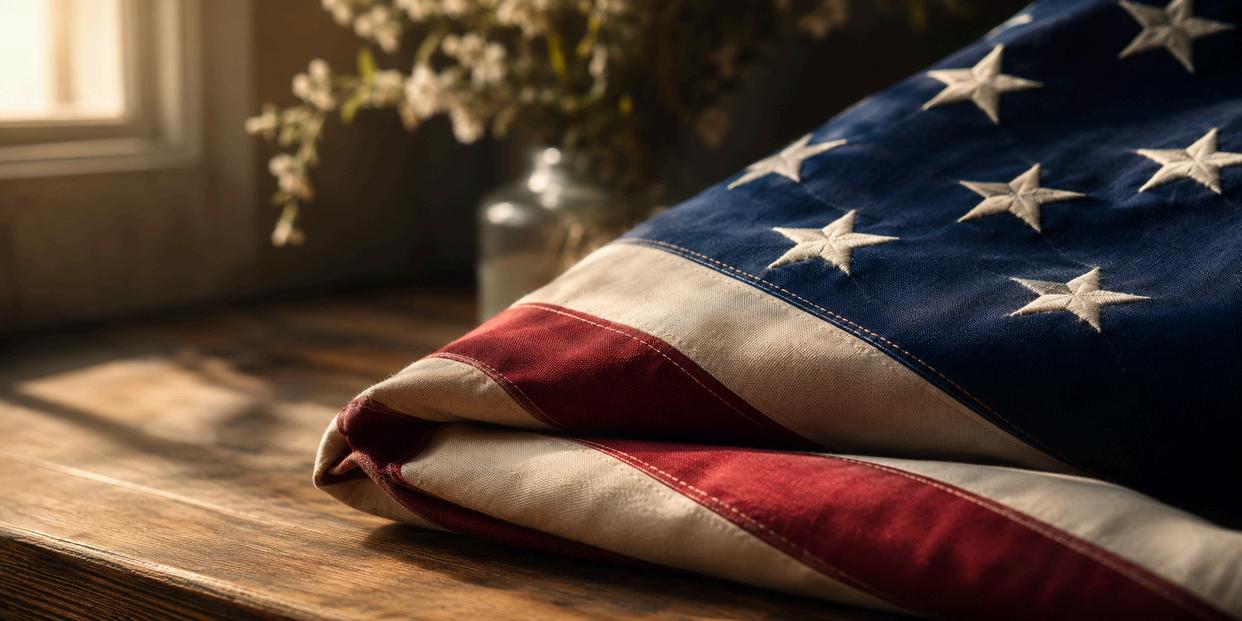
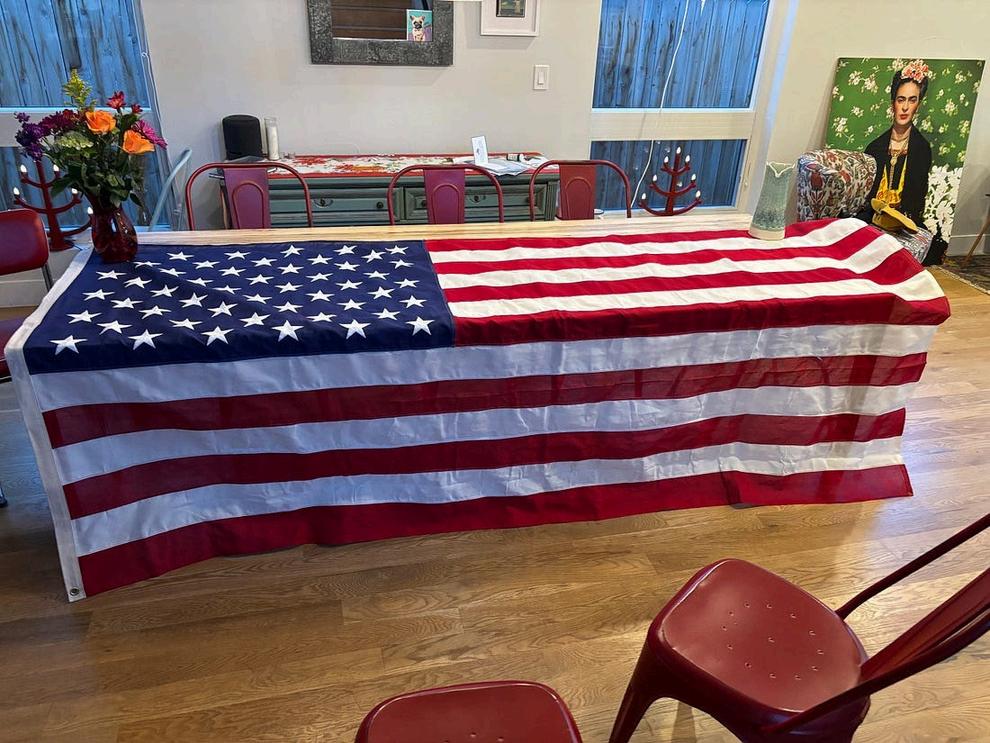
Yesterday I spent a good hour and a half steaming the creases out of an American flag.
I slowly moved our cheap $24 steamer over each inch of the 5x9 5 cotton, removing its creases and thinking of my father and the 23 years he left for work each morning in his crisp blue uniform While proud of his military career, and maintaining great affection for a childhood spent on Air Force bases, I’m not normally an American-flag kind of girl. So yesterday I was surprised by how very beautiful I found it as a physical object in my hands and on our dining table. The sturdy fabric. The rich, saturated crimson and blue The perfect embroidered stars Beautiful.
But if I see a pick-up truck with American flags flying behind its cab while belching diesel fumes into the street, I do not think that person has a commitment to liberty and justice for all. I think, There are so many people in my life who would not feel safe around that person
Because the distance between what I think this flag should represent a continually unfurling commitment to the dignity of all, protection from tyranny for both our citizens and our allies, and a government of the people, by the people and what it is so often used to hide behind the anxious and delusional so-called supremacy of a single race and a single religion, the contraction of rights, a cultish tyranny pawned off as patriotism makes it difficult to claim this
symbol as my own
But I do love my country, dammit. I love that we set aside the most beautiful parts of this place to belong to all of us in our state and national parks. I love how many languages we speak. How many places we come from. How many ways we pray I love that there are truths in the U S Constitution that even those who penned it could not possibly have understood the full power of.
I want to take back my country’s flag.
I think of these things when I see the stars and stripes. I think of Sojourner Truth and Betty Soskin, Jimmy Carter and Dolly Parton, Amelia Earhart and Chita Rivera I’m exhausted by seeing Old Glory and thinking instead of those who celebrate removing any mention of the Tuskegee Airmen from the Smithsonian’s website.
I want to take back my country’s flag.
And the term patriot, while we’re at it
It’s Not Just the Flag, It’s What It Means
Why can it not be considered a form of patriotism to believe so deeply in what the United States of America has always said it is
about that we refuse to settle for less? That we refuse to abandon this country to those who support policies based in little more than smallmindedness and self-interest?
Maybe this is why I keep thinking about interpretation About who gets to say what a symbol means About who benefits from calling their reading the only faithful one.
I’m not a terribly sophisticated political thinker, and I do not make a practice of writing about that part of life. Others are far more skilled and informed than I am. Not to mention I am prone to a wee bit of blinding rage, which is no good for anybody, especially me. So I try to stay in my lane. But my lane and this conversation overlap in this way: “constitutional originalism” the belief that the most faithful way to interpret the Constitution is to try to discern what the framers intended it to mean feels eerily similar to the belief that the most faithful way to interpret the Bible is to say GOD wrote it, so we should take every contradictory word of it literally through a so-called “plain reading ” I’m equally cynical about both, since the loudest proponents of these views have always been those who just so happen to benefit most from those particular interpretations
Both approaches present themselves as simply “taking the text seriously.” But in practice, both can smuggle ideology in through the back door by pretending interpretation is not interpretation.
They get to hide behind these texts and say, Don’t be mad at me this is what THE FRAMERS or GOD says Then, as anyone who has studied history can attest, atrocities easily ensue.
But texts do not act by themselves. People interpret them And when interpreters privilege the authority of dead men over the dignity of living people, the result is often that the vulnerable pay the price while the powerful call it faithfulness
Not to mention that once a reading is labeled “plain” or “original,” dissent can be framed not just as disagreement, but as rebellion against God, law, order, or reality itself. That rhetorical move gives enormous cover to existing power
But I DO dissent
The biblical text, when treated as a Living Word and not simply a dead policy manual, allows meaning, comfort, and wisdom to unfold in both old and new ways for each community that studies it. It allows the Bible to surprise us, live in us, even interpret us
Some may be tempted to walk away from the Bible altogether, and I understand why. I do. But I beg you to reconsider Because as I’ve said before, scripture and theology are too potent to be left in the hands of those who only use them to justify their dominance over other people. We cannot cede our scriptures to them
And perhaps the same can be said of the symbols and founding documents of this country The cost of rejecting them feels too when reimagining, redefining, and iming are still available to us.
ast December, for his 83rd birthday, I gave ather a leather-bound copy of the U S titution and other foundational documents ugural addresses, Federalist Papers, ches by Frederick Douglass and Sojourner , and, for some reason, the constitution of ew York Knickerbockers basketball club. ot a little teary, held it to his chest, and said k you
aybe he understood something I am only trying to say out loud: that love of country t the same thing as uncritical loyalty etimes it looks more like grief Sometimes
more like argument. Sometimes more like refusing to let a beautiful thing be used to bless our worst instincts
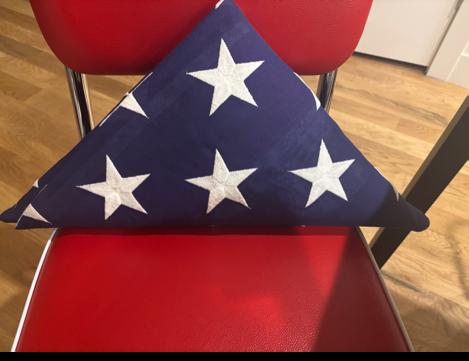
So yesterday I patiently steamed the creases from an American flag and folded it into a perfect blue triangle on my dining room table, allowing myself to be affected by the beauty of this object before it is handed to my mother at my father’s memorial service
So here I am it’s 4 o’clock in the morning feeling unexpectedly tender toward a piece of folded cotton on my table, and still unwilling to surrender what it could mean. Maybe that, too, is a form of patriotism AND Christian faith: to hold something gently, grieve what has been done in its name, and still refuse to give up on what it could yet mean.
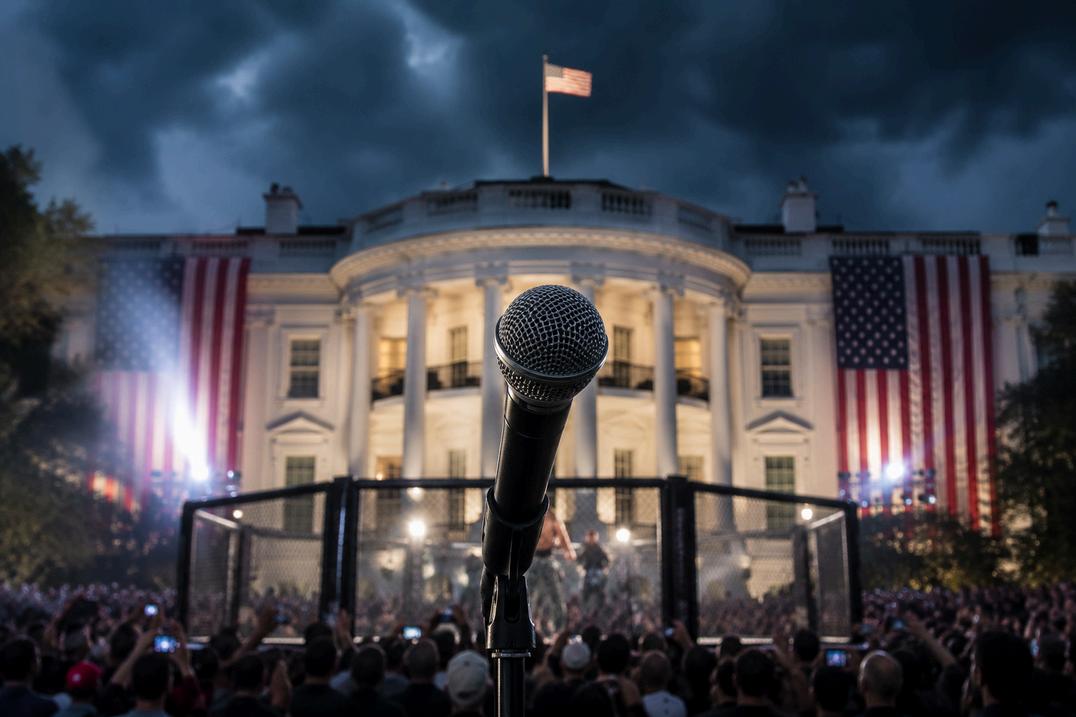
As if this White House UFC circus had not already thoroughly embarrassed the presidency, the institution, and the country, it somehow managed to descend even further into the gutter.
Fresh off his fight, Josh Hokit grabbed a microphone at an event being staged on the grounds of the White House and shouted, '"Michelle Obama is a man!"
That was it. That was the contribution. Not a thought about America Not a reflection on the nation’s 250th anniversary. Not a word about service, sacrifice, citizenship, or unity. Just a juvenile insult aimed at a former First Lady in front of a cheering crowd that has increasingly confused cruelty with courage and ignorance with authenticity
Let’s be clear about what happened here A man was handed a microphone at the White House, the White House, and chose to use it to hurl a playground taunt at a former First Lady If you had written this scene into a political satire 10 years ago, an editor would have rejected it for being too absurd and too on-the-nose
This is the same White House where presidents have hosted world leaders, negotiated peace agreements, comforted grieving families, honored military heroes, welcomed civil rights icons, and attempted to project the best version of America to the rest of the world On this particular evening, however, it served as the backdrop for a multimillion-dollar
spectacle where one of the featured attractions was a fighter shouting insults about Michelle Obama.
And perhaps the most predictable part of all was what came immediately before it. Hokit thanked Jesus.
Of course he did
For years, defenders of Trump have insisted that critics were overreacting.
Nothing captures the contradiction at the heart of modern performative outrage culture quite like invoking faith and humility moments before publicly humiliating someone for applause. Somewhere between the Beatitudes and the microphone, the message appears to have gotten lost
What makes the entire episode so revealing is that it strips away all the patriotic wrapping paper surrounding this event. The giant flags. The military flyovers. The endless speeches about America The declarations of strength The choreographed displays of toughness. Beneath all of it lies something much smaller, much pettier, and much more juvenile Strip away the fireworks and sponsorship logos and
what remains is often little more than grievance, mockery, and the desperate need to own perceived enemies
Michelle Obama has spent years encouraging education, public service, healthy living, and civic engagement Whether one agrees with her politics is irrelevant She conducted herself as First Lady with a level of discipline, composure, and dignity that stands in stark contrast to the carnival atmosphere that unfolded on the South Lawn. The fact that a former First Lady became the target of a cheap insult at an event supposedly celebrating America tells you everything you need to know about the priorities of the people involved.
The entire evening increasingly felt like a metaphor for the age we are living through A giant steel structure towering over the White House. Billionaires congratulating billionaires. Corporate sponsorship plastered everywhere Politicians, influencers, and celebrities mingling beneath patriotic branding. Fighters emerging through rooms historically reserved for diplomacy And now, apparently, insults directed at former First Ladies serving as entertainment.
This wasn’t strength. It wasn’t patriotism. It wasn’t even rebellion
It was trashy White Trashy
Not because of the sport. Not because of the athletes. Not because Americans enjoy competition It was trashy because a building that is supposed to symbolize the highest aspirations of a democratic republic was treated like the set of a reality television food fight
For years, defenders of Trump have insisted that critics were overreacting. That every new outrage was being exaggerated That every breach of decorum was insignificant. Yet nights like this reveal the cumulative effect. Standards matter Institutions matter Symbols matter Once you stop caring about them, eventually you find yourself applauding insults where statesmanship once lived.
And that is precisely what happened at the White House. And Trump fell asleep. Again.


This month’s issue of Pulse is sponsored by Dick Paul (Thank you ) Designed by Jeffers Media.
Unless indicated otherwise all Bible references are from the New Revised Standard Version.
Is an ordained Seventh-day Adventist minister, now retired after serving in pastoral and publishing ministries Pulse is the digital magazine of JustLove Collective
Is a circulation/reference associate at Union Adventist University's library in Lincoln, Nebraska She is happily married to Jeremy Their two children are encouraged to read banned books.
Is professor emeritus at Union Adventist University where he taught English and communication courses, including Conflict and Peacemaking and Critiquing Film He has also served as academy teacher, editor of Insight magazine, author of many books and articles, and pastor of two small churches.
Federal employees are suing Agriculture Secretary Brooke Rollins and the U.S. Department of Agriculture, arguing that her use of Christian messaging in the workplace is “unconstitutionally coercive.”
The lawsuit, filed in the U.S. District Court for the Northern District of California, said Rollins “has adopted a practice of sending increasingly proselytizing communications to the entire USDA workforce, promoting her own preferred brand of Christian beliefs and theology to the captive audience of employees that report to her.”
The complaint was filed by the advocacy groups Americans United for Separation of Church and State and Democracy Forward Foundation and the California-based firm Bryan Schwartz Law on behalf of the National Federation of Federal Employees and seven named plaintiffs of a variety of faiths and no faith including Jewish, Buddhist, pagan, and atheist employees of the USDA, according to the lawsuit
The union of more than 110,000 federal workers including more than 19,000 USDA staffers and the individuals charge that Rollins’ actions do not reflect the secular mission of the department.
“The Secretary’s practice reached a crescendo,” their complaint said, with an Easter (April 5) email that described the holiday as marking “the greatest story ever told, the foundation of our faith, and the abiding hope of all mankind ” It went on to declare “Jesus has
been raised from the dead And God has granted each of us victory and new life.” Her entire Easter message to “Team USDA” is attached to the complaint and features an illustration of a tomb with a stone rolled away and the words “Christ is Risen.”
Asked to comment on the suit, a USDA spokesperson said: “While we do not comment on pending litigation, we will keep the plaintiffs in our prayers during this process.”
Asked to comment, a USDA spokesperson said: “While we do not comment on pending litigation, we will keep the plaintiffs in our prayers during this process ”
The suing parties said Rollins’ Easter message “communicates that there is a preferred religious ‘in-group’ at USDA,” a sentiment not permitted by the establishment clause of the U.S. Constitution, which states “Congress shall make no law respecting an establishment of religion.” They also said her messaging violates a USDA policy adopted in November 2025 that requires department officials not to “use official authority to pressure
subordinates” about their religious beliefs.
The union and individuals also allege that Rollins has not sent messages about holidays for other religions.
The complaint says it seeks to protect the rights of USDA employees from proselytizing and religious coercion, including those who may feel intimidated, fear retaliation for objecting to Rollins’ messages or feel compelled to hide their beliefs if they don’t share those of their department head.
“The Trump administration is waging a relentless and increasingly brazen crusade against church-state separation and the religious freedom of federal workers,” said Rachel Laser, president and CEO of Americans United, in a statement “Trump is not Jesus, federal agencies are not churches, and cabinet secretaries are not government preachers.”
NFFE President Randy Erwin said employees of other government departments also have expressed concerns about the state of the federal workplace
“Every agency feels like it’s the epicenter for a new outbreak of Christian Nationalism,” Erwin said in a statement “We just want to do our jobs without having to fend off proselytizing and preaching.”
The suit goes on to describe “an escalating pattern of subjecting all USDA employees to proselytizing Christian messaging promulgated from (Rollins’) position of authority.” According to the suit, her July 4 message last year said, “May God continue to protect the United States of America and may His favor shine over all her land” and her Thanksgiving message expressed “gratitude towards a loving God ” In a Christmas video message addressed to department staff, she said, “The spirit of generosity flows from the very first Christmas when God gave us the greatest gift possible, the gift of his Son and our Savior Jesus Christ, who came to free us from our sins and open the door to eternal life This is the reason for the season ”
The suing parties also state that they feel compelled to read Rollins’ email messages because they often include nonreligious information that may affect their job duties
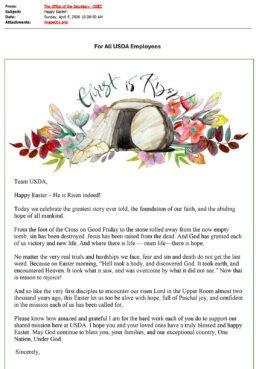
“And historically, even holiday emails from USDA leadership have included specific jobrelated announcements, such as, for example, notifications regarding administrative leave,” the plaintiffs said in the suit.


In a world crying out for both justice and love, the JustCoz Podcast explores what happens when these powerful forces combine with faith to create meaningful change.
Rooted in the Adventist tradition and guided by the prophetic call of Micah 6:8, this podcast takes listeners on a journey through compelling stories of faith-based activism, biblical justice, and Christcentered community building. Each episode features honest conversations with movement leaders, grassroots activists, theologians, artists, and everyday change-makers who are living out their commitment to “do justice, love mercy, and walk humbly with God.”
From the historical justice work of Adventist pioneers to contemporary movements addressing today’s most pressing challenges, we explore how faith communities can be powerful agents of transformation. You’ll hear stories of courage, creativity, and hope that will inspire your own journey toward meaningful action
The JustCoz Podcast isn’t just about ideas— it’s about building a community of practice.
Each episode concludes with practical steps and resources to help you connect with others and begin making a difference right where you are.
Join us as we discover together how justice plus love can transform not only our communities but also our own hearts and lives Because when justice and love meet, something truly divine happens
Find JustCoz wherever you listen to podcasts.



A House on Fire: This Adventist Peace Fellowship podcast series is based on the excellent book on race and racism
Red Letter Christian Podcast: Christian commentary on the way of Jesus in the world today
Adventist Voices: Weekly podcast and companion to Spectrum designed to foster community through conversation
Adventist Pilgrimage: A lively monthly podcast focusing on the academic side of Adventist history
The Social Jesus Podcast talks about the intersection of Jesus, faith, and social justice today
Just Liberty: A fresh, balanced take on religious liberty where justice and liberty meet

We are particularly grateful for every contribution to JustLove Collective. Donations are tax-deductible. Though we are a global movement of volunteers, we do need to pay for expenses related to this magazine and to the Summit For more information, please see our website at justlovecollective org