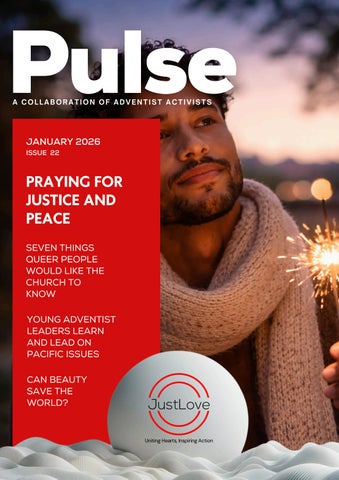
Pulse A COLLABORATION OF ADVENTIST ACTIVISTS
JANUARY 2026 ISSUE 22
PRAYING FOR JUSTICE AND PEACE SEVEN THINGS QUEER PEOPLE WOULD LIKE THE CHURCH TO KNOW YOUNG ADVENTIST LEADERS LEARN AND LEAD ON PACIFIC ISSUES CAN BEAUTY SAVE THE WORLD?
Uniting Hearts, Inspiring Action
CONTENTS 2
PRAYERS FOR THE NEW YEAR
12
WHO WE ARE
4
INSPIRE
13
IN WHICH I TRY VALIANTLY TO CHEER YOU UP
5
PRAYING FOR JUSTICE AND PEACE
15
NEWS: FRESHMAN’S CREATIVE WORK PUBLISHED IN NEW YORK TIMES
8
REVIEW: YAY! SPORTS!
18
CAN BEAUTY SAVE THE WORLD?
10
SEVEN THINGS QUEER PEOPLE WOULD LIKE THE CHURCH TO KNOW
23
NEWS: YOUNG ADVENTIST LEADERS LEARN AND LEAD ON PACIFIC ISSUES
Pulse / JustLove Collective / January 2026 / Issue 22
2
PRAYERS FOR THE NEW YEAR Borrow a prayer as we begin 2026—or use these for inspiration to write your own.
As we say goodbye (maybe even good riddance) to 2025, I’m reminded just how much prayer has served as an essential balm, refuge, and strong tower in the midst of such a trying and tumultuous year. Whatever 2026 has in store, I’m confident that we will need to flex our prayer muscles. Prayer centers us in God’s presence. Prayer prepares and equips us for courageous action. Prayer empowers us when we feel weak and encourages us when we feel demoralized. May these prayers we've collected from the Sojourners staff guide and embolden us to advance God’s reign of justice, peace, and steadfast love with greater urgency and courage.
“Lord, teach us to be still in your presence, filled with your love and compassion, and zealous with your joy for justice. May we find reservoirs of rest and double portions of holy discernment. Bind us together with cords that cannot be broken.” —Mitchell Atencio, senior associate news editor
“God of beauty, help us to see you when all looks ugly. God of hope, help us believe that good things are being done in and through our lives. Guide our steps to walk faithfully in joy, peace, and love, even when our feet are heavy and the way seems unclear.” —Josina Guess, associate editor
Prayer empowers us when we feel weak and encourages us when we feel demoralized.
“Faithful God, thank you for your profound love shared with us through the joys and sorrows of the past year. Help us grieve what was lost while holding fast to hope and to your peace as we begin a new year. Grant us strength and courage to meet the challenges ahead, protect the most vulnerable among us, and help us to love one another deeply and to serve you with gladness and singleness of heart.” —Rick Chamiec-Case, director of donor engagement and human resources manager
Pulse / JustLove Collective / December 2025 / Issue 21
3
“Lord, shatter the chains of fear which tighten around your people, especially those who work to protect your holy image, found through all things. Help us discern how your will can pierce our grief and paranoia during times of doubt. Let the weight of your spirit, and the fire of your light, gravitate all creation closer to the divine.”
“God of new years and new beginnings, make us people who choose hope before cynicism and service before spectacle. Teach us to value proving our empathy over proving that we’re right. Make our hands be steadier than our fears and our love stubborn enough to outlast the news cycles.”
—Joseph Barry, donor services assistant
“God, in your infinite mercy, spread your hope, peace, joy, and love during this season and beyond. We pray that hearts will be softened and minds changed through our shared humanity, which can only happen through your power. Protect and encourage those who live in fear, and those whose lives hang in the balance. Show up in the light and shadows of our lives. In Jesus’ name, amen.”
—Tyler Huckabee, managing editor, sojo.net
“God our companion, as we journey this year toward wholeness, set our feet on paths of justice. Expand our hearts to bear uncertainty and give our minds the capacity for complexity. May we witness you repairing what has ruptured, healing what divides us, and when our vision fails, may we trust you all the more.” —Judah R. Lopez, intern
—Rev. Moya Harris, senior director of programs
“Light of the World, come lift the darkness out of our eyes. As we ponder what to make of these tumultuous times, keep our hearts closely attuned to what moves yours. Let us seek you in silence, crave you in chaos, and find you in loss. May your everlasting love meet us in the margins.”
“God, invigorate us with a vision for your peace where wolf lives with lamb, leopard lies with goat, and infants play near the cobra’s den. As we experience conflict, overwhelm, and brokenness, remind us that your love grows from a stump, seemingly dead, seemingly barren. There is hope.” —Matt Murphy, chief operating officer
—Marjorie Rose T. Lim, social media and communications assistant
“God, during these dark days we seek your light and your mercy. Give us strength to be your hands and feet in this turbulent world. Comfort us as we face injustice and the despair of so many. Help us to remember each and every person is made in your divine image.”
“Creative God, set before us the unadulterated vision of your kingdom on earth. Bring to the surface the prophetic imagination hidden deep within us. And ignite within us the joy and courage to live it out faithfully every day.” —Cortnie Brooks, digital education and outreach specialist
—Cynthia Martens, senior director of circulation
“God, revive our cold and weary hearts in a world that makes cynicism so appealing. Give us courage to look deeply at all that is broken; show us how to grieve instead of just doomscroll. Be with us in the midst of this mess, and enliven us to the surprising ways you are already at work making all things new.” —Betsy Shirley, editor in chief
—Adam Russell Taylor is president of Sojourners and author of A More Perfect Union: A New Vision for Building the Beloved Community. Follow him on Bluesky @revadamtaylor. bit.ly/4q9duJv
Pulse / JustLove Collective / January 2026 / Issue 22
4
InSpire What men call the process, God calls the end. —Oswald Chambers
Human souls cannot be collateral damage in the quest for commodities. —Kendra Haloviak Valentine
What you have inherited
We first crush people to the
from your fathers, you must
earth, and then claim the right
earn over again for
of trampling upon them
yourselves, or it will not be
because they are prostrate.
yours.
—Lydia Marie Child
—Johann Von Goethe
Hold on to things your reason once accepted, in spite of your changing moods. —C. S. Lewis
We must turn away from a thousand topics that invite attention. There are matters that consume time and May you live all the days of your life. —Jonathan Swift
You truly opened my mind with that political rant forwarded on Facebook. I will be forever grateful. —Nobody
arouse inquiry, but end in nothing. —Ellen White
--Compiled by Chris Blake
Pulse / JustLove Collective / January 2026 / Issue 22
5
PRAYING FOR JUSTICE AND PEACE Prayer is complicated. I do not know how it works, but I do try to pray. I have had experiences in my life that I consider answers to prayer; I have had experiences in my life in which prayer seemed to go unanswered; and I have had times in which prayer has been a significant part of getting through disappointment and grief. So, I don’t know how it works—but I believe prayer matters and often makes a difference. A quick survey of world religions will show that most of them teach and practise some form of prayer. It might be one of the most obvious qualifiers of a philosophy or worldview as a religion. While taking many different forms, practices of prayer are not restricted to the leaders, the ordained or the mystics. Although there are elaborate rituals attached to some forms of prayer, most praying is accessible to and practised by even the most fringe adherents. In many cases, the habits of prayer or blessing are the last vestiges of a waning faith, even if only as a kind of superstition. Given the breadth and variety of its practise, it is tempting to suggest that prayer is more a human thing than solely a religious undertaking. In contrast with many of our first thoughts about prayer as primarily seeking divine intervention or blessing for ourselves, in many of these traditions, prayer is more about reaching out to, connecting with and even aligning ourselves with some kind of Higher Energy, Power or Personality. In this way, prayer should
be one of the key spiritual practices for shifting our focus away from ourselves. We recognise that we are not situated at the centre of the story or the heart of the universe. But we suspect and begin to trust that the Heart of the universe is somehow interested in us or available to us.
We might sometimes pray in desperation and lament, but our prayers are not about resignation.
In the stories and teachings of Jesus, prayer is specific. Jesus taught His disciples—His first students and followers—to pray. It would be part of their lives of faith and a key to growing their relationship with God, who Jesus addressed as Father and taught His disciples to do the same. Jesus modelled taking time away from necessary work, even seemingly urgent and important work, to spend time praying. But the content of prayer was also specific. Jesus taught His disciples what has come to be regarded as a model prayer, including these lines that connect with some of our earlier reflections of God’s intention for our world and our lives: “May your Kingdom come soon. May
Pulse / JustLove Collective / January 2026 / Issue 22
your will be done on earth, as it is in heaven” (Matthew 6:10). We might sometimes pray in desperation and lament, but our prayers are not about resignation. Rather, they are an expression of our joining with God in His project of restoring relationships, bringing justice and healing, and ultimately making all things new. Prayer is the work. In prayer, we submit ourselves and the things we care about to God. But prayer is also the springboard for our working in harmony with the intentions and promises of God.
One of the key starting points that led to the fall of the Berlin Wall was a prayer meeting that for five or six years was small, largely unnoticed and always under threat.
Prayer is also often a practice of patience and perseverance. With practise, whether individually or shared with fellow pray-ers, prayer shapes us increasingly in relationship with God, which transforms all our other relationships in time, in both small and large ways. One of the most remarkable revolutions of the 20th century began with a prayer meeting. In 1982, the Nikolaikirche—or St Nicholas Church—in the centre of the East German city of Leipzig began hosting “Prayers for Peace” every Monday evening: “Intercessions were offered both for a peaceful end to the Cold War and universal respect for human rights.”1 Attendance was small for the first few years—usually no more than 10 or 12—and those who attended were monitored and occasionally harassed by the Stasi, the infamous East German secret police. Those who prayed were part of a movement of small activist groups across East Germany committed to peace, justice, human rights and environmental causes. By 1989, there were about 200 such groups active across East Germany,
6
and although many of them were small—only 10 to 20 members—they were connected to many inactive and silent supporters. Against the backdrop of reforms in the Soviet Union and growing democracy movements in Poland and Hungary, the regular attendance at St Nicholas’ Monday night prayer meetings “suddenly” grew to hundreds in early 1989. By September that year, numbers at the Monday evening prayer meeting were more than 1200. Despite police crackdowns and arrests, similar gatherings began in other churches around the city, after which attendees began to spill out into the city streets and march by candlelight. Growing protest events also took place in other cities, including Dresden, East Berlin and Magdeburg, and grew exponentially week by week. On October 9, the protests centred around the “Prayers for Peace” at St Nicholas Church grew to 70,000 people. Thousands of police and troops were ordered into Leipzig to confront the protests. However, three community and church leaders met with three local Communist party leaders and negotiated a tense peace, even as the people took to the streets. The protests continued to grow in Leipzig and beyond.
Pulse / JustLove Collective / January 2026 / Issue 22
The Leipzig prayer meeting protest grew to 150,000 on October 16, and an estimated 300,000 the following two Monday nights. A crowd of half a million people marched in East Berlin on November 4, the East German government resigned on November 8 and the notorious Berlin Wall came down the next night, after check points into West Berlin were opened. Amid the momentous political shifts of the fall of Communism in eastern Europe, one of the key starting points that led to the fall of the Berlin Wall was a prayer meeting that for five or six years was small, largely unnoticed and always under threat of crackdown from the Communist authorities. After the events of 1989, then-pastor Christian Führer continued to lead “Prayers for Peace” at St Nicholas Church in Leipzig each Monday evening until his retirement in 2009. The crowds of activists and protesters had come and gone, history had been made and remade. The church had become the site of anniversaries and memorials of the events of the “Candlelight Revolution,” but the presence and work of prayer was not yet finished.
7
Not only were these faithful and patient prayers answered in the revolution sparked by their gathering, but that this was the outgrowth of a prayer meeting shaped the nature of the revolution that eventually came. The pray-ers became people of courage, nonviolence and justice, the kind of people who would both pray and act for peace and freedom.
—Nathan Brown. Adapted from Practising Justice: https://amzn.to/3LiGiAm
1
Alexander Faludy, “We had planned for everything . . . But not for candles and prayers,” Church Times, November 8, 2019, bit.ly/PulsePrayforJustice
Pulse / JustLove Collective / January 2026 / Issue 22
8
ReView
YAY! SPORTS! Let Us Play: Winning the Battle for Gender Diverse Athletes by Harrison Browne and Rachel Browne 2025, Beacon Press
I have a small wardrobe of sweaters that I keep semi-exclusively for my son’s basketball games. The pink hoodie with his team name (Go Heat!) is a classic go-to, especially when we’re on the road and spectator unity is a must. I have my lucky cardigan, found at the local Goodwill. It’s beautiful Scottish cashmere, soft robin egg blue, and way out of my price range had I purchased it new. It’s very lucky. But the ultimate wardrobe essential, closet bling, hanger candy, textile of choice is my candy-apple red hoodie that proclaims in big block letters, “Yay! Sports!” If that thing is clean and there’s a sporting event I must attend, it is on this mortal body. Whether we’re seeing the Huskers, going to a YMCA game, or our kiddo’s Supreme League game (Go Heat!), my Yay! Sports! hoodie just feels right. Unlike everyone with whom I have ever shared a home, sports fandom does not come naturally to me. Being a big anxious ball of sarcasm makes it perfect for me because while I love to watch my son play (Go Heat!), there are so many things I’d rather be doing than watching sports. I just… don’t get it and probably never will. When I visited my favorite branch of our public library system in search of a book to review for this issue of Pulse and saw Let Us Play:
Winning the Battle for Gender Diverse Athletes by Harrison Browne and Rachel Browne, I thought, Wow, there’s two things I know nothing about. Let’s go! Reading this book has been a journey of enlightenment. As a faux sports fan (Go Heat!), I will probably never understand how a person’s role as an athlete becomes a part of their identity. Yes it is something that some people enjoy, I guess, but identity? I have not experienced a hobby that has weaseled its way into my soul like that, unless raising children is considered a hobby. Reading through Let Us Play, I learn that there’s a conflict between the identity of an athlete and gender identity; gender-diverse athletes have to choose one or the other but are unable to fully live both parts of themselves. The authors debunk common misconceptions that have resulted in arbitrary regulations in the sports world. Discrimination amongst genderdiverse athletes is still maddeningly here, even in the worlds of competitive chess and darts. The regulations profoundly affect women’s sports, as athletes’ bodies and hormone levels are policed for anything that might be seen as a biological advantage over feminine-presenting cisgender peers. Are they trans? Are they
Pulse / JustLove Collective / December 2025 / Issue 21
9
intersex? Is their voice suspiciously low or is their jaw handsomely square? Are they too strong or unfairly talented? Too androgynous? Gotta check their hormone levels STAT! While we're at it, get their feet up in the stirrups because their genitals are also the world's business. Unlike male-categorized athletes, athletes competing in the women's category are always up for extra scrutiny. (Not that anybody wondered if Michael Jordan or Michael Phelps were endowed with any biological advantages or unlawfully high levels of testosterone, but whatever.)
The big bad fear is that cisgender men will become trans and join a women’s sports league to dominate…because of all of the fame and fortune in women’s sports…? I just…don’t get it and probably never will.
——Marcia Nordmeyer
In the photo: Marcia with her ride-or-die, Taryn. Go Heat!
Pulse / JustLove Collective / January 2026 / Issue 22
10
SEVEN THINGS QUEER PEOPLE WOULD LIKE THE CHURCH TO KNOW A list of seven things queer people would like the church to know, which came from a survey with more than 300 responses, was disseminated and discussed during the National Queer Presbyterian Gathering in November 2025. Melonee Tubb, who staffs three advocacy committees in the Interim Unified Agency for the Presbyterian Church (U.S.A.), told the gathering that 271 of the 305 respondents identified as queer. Twenty respondents identified as straight people, most of them allies, Tubb said. Twentythree percent of respondents were transgender or nonbinary, 30 percent were cis men and 45 percent were cis women. Of the transgender and nonbinary respondents, more than 6 in 10 hold some form of leadership role, Tubb said, adding, “In a small group, that’s an incredible number of leaders.” Tubb described the seven main themes revealed in the survey as “not a single narrative but a tapestry of lived faith, calling the church to equity in body, spirit and system.”
Inclusion is more than acceptance; it’s belonging. Across responses, queer Presbyterians describe a clear distinction between being allowed in the room and feeling at home there. True belonging, they say, comes when their identities are celebrated as integral to the life, leadership, and witness of the church and not
tolerated as differences to be managed. “Congregations are doing the bare minimum and calling it a day,” said one respondent, “but queer people want and deserve more.”
“Congregations are doing the bare minimum and calling it a day,” said one respondent.
Our safety depends on your courage. Respondents made it clear that quiet sympathy or private affirmation does not create safety. Visibility is what builds trust, they emphasized. Many said they never know whether a congregation will be safe or not. Some described scanning church websites and social media for clues before walking through the door. “Queer folks are feeling trampled on by government, by corporations, and particularly vulnerable,” said one respondent. “The church can (and should) stand in the gap.”
Pulse / JustLove Collective / January 2026 / Issue 22
We long for connection and community across regions and generations. Queer Presbyterians are hungry for connection—real, ongoing, embodied community that extends beyond individual congregations. Many described feeling scattered and isolated, even within an affirming denomination. The longing isn’t only for social connection but for spiritual kinship: places to share faith, grief, and joy with others who understand both queerness and Presbyterian identity. “Resourcing for small conservative communities is unaddressed,” said one respondent. “Help us find each other.”
Policy is not the same as practice. Respondents consistently voiced that policy alone is not enough; the heart of the church must change too. They see a gap between progressive decisions made at the denominational level and the theology still preached, taught, or quietly assumed in many congregations. They long for a theological foundation that affirms LGBTQIA+ people not as exceptions to the faith but as expressions of God’s image within it. Trans and nonbinary Presbyterians in particular called for liturgies that bless transitions and celebrate embodiment in all its forms. “We need a denomination-wide teaching blitz on issues of both sexuality and gender expression,” one respondent said.
Queer leadership is already here: support and amplify it. Across the responses there is a confident and hopeful recognition that queer leadership in the church is not something to be developed later but something that already exists and flourishes in many places. Queer pastors, ruling elders, musicians, educators, and lay leaders are faithfully guiding congregations, teaching Scripture and building community. They’re doing this while often carrying the added work of helping others understand what true inclusion looks like. The invitation is not to make space for queer leaders but to notice and honor the space they already hold. “I have created a creative
11
service that’s specifically for people who haven’t felt like church is for them,” said one respondent. “I wish more congregations tried something like that.”
A faithful church speaks aloud. For queer Presbyterians, public witness is both testimony and protection. It’s how the church makes its love visible in a world where silence often signals abandonment. What matters to many respondents is vocal, visible solidarity in public spaces such as Pride events, statements, advocacy, and the presence of national leaders who speak clearly when harm is being done. “Clear messaging and obvious support of the LGTBQIA+ community at the national level is essential, along with awareness of the intersectionality of the challenges facing the community in these divisive and damaging political times,” said one respondent.
Joy, resilience and faith are thriving; nurture them. Even in a climate of fear and exclusion, queer people of faith are creating life-giving communities, joyful worship and deep spiritual resilience. Through storytelling, creative liturgy and shared celebration, queer Presbyterians are cultivating joy as resistance and faith as endurance. Many trans and BIPOC respondents described joy as sacred defiance, the celebration of life in a world that has often denied it. The invitation to the wider church is to nurture what already exists: the Spirit’s presence among queer Presbyterians is vibrant and creative. What it needs is recognition, investment, and room to grow. “For LGBTQ people, faith is often more emotional and expressive than in the PC(USA) generally,” said one respondent. “We want a tradition in which identity is accepted but also where diverse worship styles are accepted.”
—Mike Ferguson, Presbyterian News Service. This article appeared November 20, 2025 at bit.ly/3Z71r3v
Pulse / JustLove Collective / January 2026 / Issue 22
Belonging is sacred, love is real, and your story matters here.
sdakinship.org
Pulse / JustLove Collective / January 2026 / Issue 22
WHO WE ARE Pulse is the monthly digital magazine of JustLove Collective. The sponsors of this issue of Pulse wish to remain anonymous. (Thank you.) Designed by Jeffers Media.
PULSE CORRESPONDENTS
Unless indicated otherwise all Bible references are from the New Revised Standard Version.
CHRIS BLAKE Is professor emeritus at Union Adventist University where he taught English and communication courses, including Conflict and Peacemaking and Critiquing Film. He has also served as academy teacher, editor of Insight magazine, author of many books and articles, and pastor of two small churches.
NATHAN BROWN Is book editor at Signs Publishing, based near Melbourne, Australia. He is author of 21 books, including Thinking Faith and Do Not Be Afraid (the devotional book for 2025), published by Pacific Press in North America.
JOANNA DARBY Is an artist, curator and teacher, based in Newcastle, Australia. She is co-editor of Do Justice: Our Call to Faithful Living and Manifest: Our Call to Faithful Creativity.
MARCIA NORDMEYER Is a circulation/reference associate at Union Adventist University's library in Lincoln, Nebraska. She is happily married to Jeremy. Their two children are encouraged to read banned books.
12
Pulse / JustLove Collective / January 2026 / Issue 22
13
IN WHICH I TRY VALIANTLY TO CHEER YOU UP This is the season when I customarily argue that the year just ended has been the best in human history. So I dutifully sat at my laptop and tried to write something along the lines of: Sure, democracy is eroding, politics are toxic, wars are raging, America is losing allies, the planet is burning, and young people will never afford homes. But other than that . . . I’ve done these “best year ever” columns annually, irritating Eeyores. But now I just can’t. The year 2025 was a setback for humanity—and unfortunately, the United States is a reason for the retreat. Maybe the worst calamity to strike an adult is to lose a child. That has become increasingly rare, but in 2025, for the first time in this century, the number of children worldwide dying before the age of 5 is believed to have risen, by about 200,000, according to the Gates Foundation. “That means more than 5,000 classrooms of children, gone before they ever learn to write their name or tie their shoes,” Bill Gates noted. Children are dying in increasing numbers in part because the Trump administration slashed humanitarian aid. I’ve been reporting around the world on the impact of the aid cuts, and I’ve seen too many children dying to write a “best year ever” column about 2025. Yet perhaps because I’ve seen so many children suffering unnecessarily, I feel a need to read something reassuring—and it seems the
only way I’ll read such a piece is if I write it. So here goes. A starting point is to gain perspective and acknowledge that in the arc of human history, we’re still in good shape. While 2025 wasn’t the best year in human history, measured by child mortality, it was one of the five best years ever. Fewer than half as many children died in 2025 as in 2000.
A starting point is to gain perspective and acknowledge that in the arc of human history, we’re still in good shape.
It also seems likely that the positive trajectories will resume after slippage in 2025 and 2026. The Gates Foundation forecasts that while the trend of declining child deaths will be slowed, deaths will at least drop in the coming years. Similarly, the share of children stunted by malnutrition will most likely be lower in 2030 than it is now, the foundation suggests, but perhaps not as low as if aid funding had been sustained. Until around 1970, a majority of adults had always been illiterate. Now we’re at 88 percent adult literacy, in part because of increasing
Pulse / JustLove Collective / December 2025 / Issue 21
14
numbers of girls going to school—and those educated women transform families, economies and societies. Despite the mess in the political world, some important trends are encouraging. Drug abuse has been one of the great scourges of modern times, with more than half a million Americans dying of overdoses since 2020—but the worst may be over. While drug deaths are still far too high and not nearly enough is being done about them, incomplete statistics suggest that roughly 30 percent fewer Americans will have died of overdoses in 2025 than in 2023. Scientific breakthroughs also offer hope. A drug called lenacapavir is emerging as a more potent weapon to prevent H.I.V./AIDS; it can be taken by injection once every six months and virtually eliminates the risk of getting H.I.V.
human history — something akin to the moment a few hundred years ago when we learned to burn coal and gas and oil, triggering the Industrial Revolution and hence modernity.” It took 68 years from the invention of the solar cell in 1954 to install the first terawatt of solar power on the planet, in 2022. It took two years to get the second. This is because solar is increasingly cheap and simple—balcony solar systems are common in parts of Europe—and because batteries are making immense strides. Remember the line in “The Graduate” about the bright future to be found in “one word,” “plastics”? Today that one word might be “batteries.” Will the United States have the savvy to embrace these technologies and help avert a climate disaster? I don’t know. But a decade ago it was hard to see how we wouldn’t cook our planet, while now there’s a ray of hope. So there you have it. This wasn’t the best year in human history. So much went wrong; so many lives lost needlessly, from Gaza to Sudan to Ukraine; so much betrayal of our own values here in America. But still, measured by child mortality, education, nutrition or women’s rights, we humans are probably in the best decade in millennia—plus we can glimpse a path forward that would leave Earth worth bequeathing to babies born today. We all need a bit of reassurance. So take a nanosecond to commemorate our good fortune in living together in one of the best times ever to be a human being. Now, onward, so we can try to do better in 2026.
A decade ago it was hard to see how we wouldn’t cook our planet, while now there’s a ray of hope.
Then there’s the gene editing tool CRISPR, which is revolutionizing care for sickle cell anemia and other diseases. Scientists are studying how salamanders regenerate lost limbs and are making progress. They might eventually be able to grow you a new arm. Another area that inspires me with its progress is clean energy. Climate change is still an enormous challenge, but energy economics have turned upside down and now offer a path forward—if we are willing to take it. My old college buddy Bill McKibben, who perhaps has done more than anyone else to raise alarms about climate change and who often as a result sounded rather bleak, is now surprisingly upbeat. In his terrific new book, “Here Comes the Sun,” about the revolution of solar energy, Bill acknowledges all the challenges, but adds, “We’re also potentially on the edge of one of those rare and enormous transformations in
—Nicholas Kristof, author and columnist, adapted from the New York Times, December 27, 2025: bit.ly/3Lj7FdC
Pulse / JustLove Collective / January 2026 / Issue 22
15
News
FRESHMAN’S CREATIVE WORK PUBLISHED IN NEW YORK TIMES Getting published in the New York Times is a dream for many writers. For freshman creative writing major Kayde Knorr, it’s an amazing feat achieved in just the first semester at SUNY (State University of New York) Oswego. Knorr’s piece, “Dating Straight Boys,” ran in the New York Times Tiny Love Stories series on November 19, even providing the title to the roundup of micro essays published that day. “I thought, ‘wow, I did it,’” Knorr said of receiving the surprising news from the paper via email. “I was really grateful for the opportunity.” “Can you imagine being published in the NYT during your first semester of college?” Laura Donnelly, chair of the English and Creative Writing Department, noted in first sharing the news. “Kayde rocks, as does Sari.” Knorr takes Sari Fordham’s “Introduction to Nonfiction” class, which includes Tiny Love Stories (TLS) and Five Minute Lit assignments “to consider the difference between Show and Tell in creative nonfiction,” Fordham explained. “Successful TLS include more vivid Tell, whereas successful Five Minute Lit pieces include more vivid Show,” Fordham said. “Both publications want short pieces, though Five Minute Lit pieces must be exactly 100 words. The students write both, get feedback on both, and then submit one for a grade.” “Her class is my favorite,” Knorr said. “I really admire her teaching style. She provides encouragement and motivation, and had
confidence in me when I didn’t have confidence in myself. Without her I would not have done it.” Published under the name Kayde Kirkner— Kayde’s stepfather’s last name, currently in the process of becoming an official name—“Dating Straight Boys” came from a kind of joke but became a serious exploration of gender identity, exploration, and the quest for attraction. “I had talked to my boyfriend featured in the article,” Knorr said. “He joked, ‘you should talk about me.’” But trying to tell a story in less than 100 words is not easy and requires revision and writing in a concise manner, especially in relaying the journey of finding oneself and somebody else who provides comfort in one's own identity and affection. “I took a lot of revising, looking inward at my relationship,” Knorr recalled. Fordham advises students to avoid cliches and instead find an interesting way to tell a story, which led to Knorr's successful submission. The two categories of New York Times both allow free submissions, so Fordham offers it as an extra credit opportunity. “I don't require submission in an Intro class because the students are just starting out, but after two rounds of feedback, I feel good about the pieces students might send out to editors,” Fordham said. “If a piece is really strong—like Kayde's—I nudge them in their feedback to send it out.”
Pulse / JustLove Collective / January 2026 / Issue 22
16
And while around five to six students per class follow through with submitting in Fordham’s class, Knorr’s success was unprecedented—and impressive for a writer on any level.
“Dating Straight Boys” came together over multiple days, using the time-honored tradition of rewriting, revisiting and revising. “My writing process is I write a whole first draft, do some checks and then put it away for a day or two, then look at it again with fresh eyes and do some editing,” Knorr said. “I write in a lot of short bursts.” While describing it as a “positive experience,” Knorr acknowledges it changes expectations going forward. “It definitely helps my confidence and raised the bar,” Knorr said. “It puts a bit of pressure on me that wasn’t there before but it’s a good kind of pressure that makes me do what I like to do, which is write.”
Oswego’s Opportunities Knorr came to the only university in New York on the shores of Lake Ontario from Clermont, Florida, but had family members who attended SUNY Oswego. “I heard great things about the creative writing program,” Knorr said. “I heard about all the opportunities, the network, and the connections.” Getting work in a prestigious publication so soon was not expected, but it confirms the opportunities SUNY Oswego makes available. “I think it’s a good experience and it wouldn’t have happened without Professor Fordham,” Knorr said.
—This article appeared December 3, 2025 at bit.ly/4jv4lsd
Pulse / JustLove Collective / January 2026 / Issue 22
17
TINY LOVE STORIES: ‘DATING STRAIGHT BOYS’ Modern Love in miniature, featuring readersubmitted stories of no more than 100 words.
Most Importantly I always struggled with my gender. Growing up near Orlando, Florida, I was constantly surrounded by boys. I wanted them to like me, but I also wanted to be like them. I spent my secondary education dating straight boys, leaving little room to confront the idea that I might not be a girl. If I was “other,” I would lose the male validation I so craved. Then, in the summer of 2024, I met Azriel. He’s transgender, into men, and, most importantly, into me. He gave me the courage to explore my gender, and now he proudly calls me his boyfriend. —Kayde Kirkner bit.ly/4bnbPeW
Pictured: Azriel (left) and me at Six Flags this summer!
Pulse / JustLove Collective / January 2026 / Issue 22
18
CAN BEAUTY SAVE THE WORLD? I had not planned to visit the Getty Museum in Los Angeles, but when a spare day appeared between conferences and homeward flights, it was an opportunity too good to miss. After attending The Justice Conference the previous two days, listening to some of the world’s leading theologians, musicians, poets, activists and preachers share their passion for justice, I didn’t expect a painting—albeit a famous painting—to have such a profound effect on me. Staring at the modest-sized “Irises,”1 I found myself overwhelmed—and teary eyed—as I imagined van Gogh in the process of painting the work during his stay at an asylum in Saint-Rémy, France, in 1889. At a time in the artist’s life filled with darkness, despair, torment and tragedy, van Gogh first focused on and found hope and inspiration in a cluster of purple flowers in the asylum gardens. In fact, of more than 130 paintings produced during van Gogh’s stay, this work was among the first, painted during his first week there. On the wall beside the painting, the small card described the theme of the work as “the regenerative power of the earth.”2 More than 120 years after its creation, van Gogh’s painting reminded me that, despite the pain and anguish in the world today, a Spring will come. That it is in beauty that we find hope—the promise of things made new, the possibility of change, the joy of restoration, the wonder of re-birth. While it is not unusual for me to be moved by
a painting (if I’m honest, I find myself choking up in art galleries quite regularly), this experience stands out. Despite having listened to great presentations that urged me to- ward doing justice and highlighted our responsibility to be re-creators in this world, here I was seeing it. To me, everything I had been listening to, pondering and contemplating was summed up in this painting.
In many ways, beauty seems weak in comparison to calamity and disaster.
Sure, it’s just a bunch of purple flowers. But in that moment, it spoke deeply to me. I was prompted to look around me to see the incredible strength and power of beauty, the constant promise of regeneration—already, even alongside the ugliness.
A philosophy of beauty We use the term beauty to describe nature, people and art. We recognise beauty in sounds and words, and even ideas. We see beauty in the layout of a home, the detail of a flower or a well-presented meal. While humans have struggled for centuries to define beauty, we
Pulse / JustLove Collective / January 2026 / Issue 22
somehow know enough about what it isn’t that we are deeply disturbed by its absence. Somehow, beauty is essential. Science and philosophers agree that human beings suffer without beauty and thrive when engaged with it. Augustine describes beauty as a plank amid the waves. Proust also talks about lifesaving beauty. Aristotle, Plato, Aquinas, Plotinus, Pseudo-Dionysius, Dante and countless poets throughout history all agree: beauty quickens. It adrenalises. It makes the heart beat faster. It makes life more vivid, elevated, and lifts our utilitarian thinking to something—or Someone— higher. Regardless of the differing beliefs and worldviews of each of these great minds, their common theme points toward a significant purpose for beauty, perhaps even a spiritual one.
Perhaps beauty is one of the tools God has created and uses to shape us into the hopeful, helpful, humble, positive and just people He designed and desires us to be.
However, in the face of tragedy and pain, real violence and oppression, speaking of beauty can seem too idealistic. In many ways, beauty seems weak in comparison to calamity and disaster. And focusing on beauty when there is so much practical work to be done in righting the world could appear superfluous and indulgent. Grand statements such as Dostoevsky’s character’s assertion that “beauty will save the world”3 might be considered utopian—even offensive—to someone enduring great injustice. Except that, maybe, beauty can save the world.
Beauty transforms While beauty may have been perceived as the principal purpose of art throughout much of history, the philosophy of art has undergone a
19
significant shift in the past few decades. Contemporary art has all but rejected the notion of beauty and Barnett Newman even states that “the impulse of modern art is the desire to destroy beauty.”5 Following the Dadaists and the introduction of conceptual art in the 20th century, the idea and language of beauty in art largely disappeared—or, at least, was ignored—to the point that mention of the word beauty in art criticism distinguished one as naïve. In place of beauty, the art world became increasingly focused on global issues, social concerns and political statements in order to accuse and criticise, as a form of protest.6 Such an impulse is legitimate. This is what likens the artist to the prophet—the responsibility to see and tell the truth, ask the hard questions and tell the stories of the oppressed.7 But the role of an artist-prophet is not only to point out the hard and ugly truth, but also to point to a light and bring hope. With something of this realisation, there appears to be a resurgence of discussion around beauty and its value. Some art philosophers are now asking whether art that merely points out a lack of justice has worked to promote justice or whether using beauty to promote justice might have greater effect.8 Although a universal definition of beauty and its purpose remains elusive—and possibly useless—beauty is now widely understood as occurring in three different forms: artistic beauty (that which is created); natural beauty (that which occurs naturally in the environment); and moral beauty (human actions and sentiments of moral goodness). But, whatever it might be and wherever it might be found, something beautiful elicits a transformative reaction. Defining the “aesthetic experience” is almost as difficult as defining beauty, but it is generally understood that an aesthetic experience is some- thing that is able to engross and transform and, therefore, has great power and value. According to Hegel, the beautiful is “an object of necessary delight that has no meaning without effect.”9
Pulse / JustLove Collective / January 2026 / Issue 22
Beauty motivates One contemporary philosopher, Scarry, explores the idea that beauty has the potential to de-centre individuals, removing focus from self and allowing one to see, understand and feel outside of oneself, creating a desire to rectify imbalances and injustices around us.10 Applying her theories, several positive psychologists have begun focusing on the trans- formative power of moral beauty and the experience of “elevation,” an emotional and physiological response to beauty.11 Not only does an experience of beauty result in swelling of the chest, changes in breathing and other forms of physiological uplift, it seems there is a marked motivation toward moral goodness. Conducted in Western countries, as well as India and Japan, a series of small studies asked participants to either recall moments in which they witnessed moral beauty or they were shown video clips depicting instances of moral beauty. Haidt records that participants consistently experienced a motivation to help others.12 In 2006, a short quasi-experimental study was conducted with a group of college students who actively engaged with natural, moral and artistic beauty over a semester and exhibited an increase in characteristic hope.13 Keeping a “beauty log” and discussing beauty resulted in a more hopeful disposition. Observing beauty changed them. Perhaps beauty is one of the tools God has created and uses to shape us into the hopeful, helpful, humble, positive and just people He designed and desires us to be.
Witnesses of beauty There are several biblical examples in which individuals were transformed by experiences of beauty or awe. We might recall Isaiah’s view of the heavenly throne room (see Isaiah 6), Paul’s vision of light (see Acts 9) and John’s observation of the Son of Man (see Revelation 1). Of course, not all awe-experiences are quite this supernatural. David describes a diminished-self—much like Scarry’s description of the decentering phenomena—induced simply by observing
20
nature: “When I look at the night sky and see the work of your fingers—the moon and the stars you set in place—what are people that you should think about them, mere mortals that you should care for them” (Psalm 8:3, 4). In many conversations with Christians, I hear familiar stories of conversion, conviction, renewal and revival occurring on mountain-tops, under starry skies and at the foot of waterfalls. Throughout scripture, we see God portrayed as an artisan who formed the wonders of creation with His breath and man with His own hands. We see God give specific and detailed instructions for ornate furnishings and embellishments in the tabernacle, and impart His Spirit to individuals to create works of art, as well as to compose music and poetry. Beyond that, we witness an overall design for the harmony and flourishing of humanity and the earth. His is a plan for justice, seeking the right and restored relationships of all things. This is beauty making, of which we are called to be witnesses and agents.
Beauty broadens our perspective and causes us to seek more beauty, moving us beyond ourselves.
While different forms of beauty—natural, artistic, moral—affect us in different ways, it seems that, in most cases, beauty broadens our perspective and causes us to seek more beauty, moving us beyond ourselves. Thus, in beholding, we become changed (see 2 Corinthians 3:18). And so beauty motivates us to add to the beauty: “He has surrounded you with beauty to teach you that you are not placed on earth merely to delve for self, to dig and build, to toil and spin, but to make life bright and joyous and beautiful with the love of Christ—like the flowers, to gladden other lives by the ministry of love.”14 Experiencing, witnessing and observing peace, harmony and beauty stirs a desire to see,
Pulse / JustLove Collective / January 2026 / Issue 22
peace, harmony and beauty everywhere. In simplest terms, beauty invites, prompts and motivates us to love better.
Looking back to beauty This realisation changes everything! How I view and value art, how I observe nature, how I experience God in the world and how I endeavour to represent God to those around me. When we consider beauty in this way— with a transforming power to which we are witnesses —we have a hope-filled and positive focus for the pursuit of justice. Perhaps those who heed the call to do justice need also to spend more time in nature, more time being inspired by gardens and sunsets, experiencing spectacular music, observing and discussing art, sharing delicious meals together, and even dedicating more time to creating beautiful things. And perhaps in our endeavours to create more just societies, to raise moral children, to change attitudes, raise awareness and find long-term solutions, we need to give more thought to the potential and possibilities for beauty to make those differences. While we do not close our eyes to poverty, oppression, discrimination and all the ugliness in the world, and while we gather together to mourn, to tell the stories and to stare evil in the face, we must at the same time recognise, acknowledge and embrace the beauty that
1.
21
does still exist around us. As Niequist urges us, we should not ignore the Bible’s call to and examples of celebration: Let’s act, read, protest, protect, picket, learn, advocate for, fight against, but let’s be careful that in the midst of all that accomplishing and organising, we don’t bulldoze over a world that’s teeming with beauty and hope and redemption all around us and in the meantime. Before the wars are over, before the cures are found, before the wrongs are righted.15 We must continue to seek beauty. We must continue to believe that beauty can save the world, and is always on its way and near at hand. After all, it is Jesus—He who is ultimate Light, Love, Joy and Beauty—who saves us and our world. May we open up the discussion of the value of beauty once again, and re-discover the possibility of using artistic, natural and moral beauty to shine a light rather than simply crying out in the darkness. Let us sing songs in the night (see Job 35:10)—and keep on singing—until the chains break loose and all the captives are set free.
—Joanna Darby. Adapted from Do Justice: Our Call to Faithful Living: https://adventistbookcenter.com/do-justice.html
Vincent van Gogh, “Irises,” 1889, Saint-Rémy France. Oil on Canvas, 71 x 93 centimetres (28 x 36 5/8 inches). Collection of the J Paul Getty Center, Los Angeles.
2.
The information card beside “Irises” at the Getty Museum reads “Irises exemplifies van Gogh’s practice of working directly from life. Its energy and theme— the regenerative power of the earth—express the artist’s deeply personal belief in the divinity of art and nature.” 3. Fyodor Dostoevsky, The Idiot (translated by Richard Pevear and Larissa Volokhonsky), Vintage Classics, 2003, page 382. 4.
See E Scarry, On Beauty and Being Just, Princeton University Press, 1999; and A C Danto, The Abuse of Beauty: Aesthetics and the concept of art, Open Court Publishing, 2003. 5.
As cited in N Benezra and O M Viso, Regarding Beauty, Hirshhorn Museum and Sculpture Garden, Smithsonian Institution, 1999, page 17. ibid, page 35. See also R Scruton, Beauty: A very short introduction, Oxford University Press, 2011, pages 149–161. 7. See my chapter “Carried on His Breath: Creativity and Calling” in Manifest: Our Call to Creativity, Signs Publishing, 2013. 6.
8. 9.
A C Danto, “Beauty for ashes,” in Benezra and Viso, op cit, page 184. G W F Hegel (1886), Introductory Lectures on Aesthetics (translated by Bernard Bosanquet, edited by Michael Inwood), Penguin, 1993, page 65.
10.
Scarry, op cit, page 111. D Keltner and J Haidt, “Approaching awe, a moral, spiritual, and aesthetic emotion,” Cognition and Emotion, Vol 17 No 2, 2003, pages 297–314. 12. J Haidt, “Elevation and the positive psychology of morality,” in C L M Keyes and J Haidt (editors), Flourishing: Positive psychology and the life well-lived, 11.
American Psychological Association, 2003, pages 275–289. 13. R Diessner, T Rust, R C Salom, N Frost and L Parsons, “Beauty and hope: a moral intervention,” Journal of Moral Education, 35(3), 2006, pages 301–17. 14. Ellen White, Thoughts from the Mount of Blessings, page 97. 15.
Shauna Niequist, Cold Tangerines, Zondervan, 2007, pages 9–10.
“THIS IS THE BOOK FOR OUR TIME . . .” “Not merely a theological theory—a practical roadmap for living in faithful solidarity with those around us.” —Dilys Brooks, campus chaplain at Loma Linda University
“Blake continues to sprint in his lifetime marathon to call Adventists to embrace fully the radical way of Jesus.” —Carmen Lau, Adventist Forum Board Chair
“This is THE book for our time, to make tangible how our faith becomes lifegiving in the real world.” —Karah Thompson, Co-Executive Director of Adventist Peace Fellowship
“Chris Blake not only walks the talk, he writes about it in sui generis style.” —Alexander Carpenter, Executive Director and Editor-in-Chief, SPECTRUM
“This book is a movement toward restoring the world God envisions.” —Moe Stiles, pastor/chaplain, Crosswalk Melbourne
Using ten “piercing and profound strands,” Imagine Life presents openings for going beyond the commonplace to live today as New Earth people. Buckle up for the journey. All profits from this book go toward JustLove Collective.
Imagine Life is available by ordering the book directly from Spectrum.
Pulse / JustLove Collective / January 2026 / Issue 22
23
News
YOUNG ADVENTIST LEADERS LEARN AND LEAD ON PACIFIC ISSUES Representatives of the Adventist Development and Relief Agency (ADRA) joined other young people from across Australia and Pacific nations to begin exploring key challenges confronting Pacific communities and advocating for greater Australian government leadership and support in the region. Hosted in Canberra from November 21 to 28, the Pacific Australian Emerging Leaders’ Summit (PAELS) was coordinated by Micah Australia, a coalition of Christian justice and development agencies, of which ADRA Australia is a part. Both from Melbourne, Sarah Nicholas and Sonniah Waiyo were sponsored by ADRA Australia and ADRA Victoria in their PAELS participation. They were joined by Mal Naseli, an Adventist church member from Adelaide, who represented a Samoan community organisation, and Adventist pastor Moe Stiles, pastor of Crosswalk Melbourne, who served as a mentor to the group. “It was a privilege to witness young First Nations and Pacific Island leaders stand in solidarity with each other, courageously advocating on issues affecting our region,” said Pastor Stiles. According to Pastor Stiles, the briefings, consultation and advocacy focused on three key areas of Pacific issues—social challenges, climate crises, and ongoing questions of colonisation
and sovereignty. Participants met with ministers and shadow ministers for foreign affairs, Pacific issues and international development, as well as their elected representatives, the Governor General and High Commissioners from a number of Pacific nations. “This summit has been running for the past four years, and I have been involved since its inception,” explained Mr Naseli. “Speaking to members of parliament can be such a daunting task, but I love the opportunity to speak out for my brothers and sisters of the Pacific. It is quite empowering representing our people.” “Conversations with ministers across the summit took place in a way that was open, respectful and with genuine interest in the lived realities of First Nations and Pacific families,” added Ms Nicholas. “This experience reminded me that leadership is service. My conviction to keep advocating for safer homes, safer communities and a safer future has expanded tenfold.” Working in conjunction with the Pacific Council of Churches, PAELS seeks to build greater connection between Pacific, Pasifika diaspora and First Nations communities. “I think it is important for people living in Australia to actively seek and listen to the stories of our people in the Pacific and here in Australia,” explained Mr Naseli. “When we listen and
Pulse / JustLove Collective / January 2026 / Issue 22
understand others, we can see the needs of our people and advocate for change.” Ms Nicholas met her local member of parliament and intends to keep working with him to address issues in her community. “Our families are dealing with real challenges,” she said, “so our advocacy doesn’t finish when the summit ends.” According to Mr Naseli, his PAELS experience has helped him embrace his cultural identity as a Samoan Australian, as well as grow in his understanding and practise of faith. “God calls us to serve in the spaces He puts us in and I am grateful that PAELS is part of mine,” he said.
24
“Throughout the summit, it was powerful to see young leaders embrace and celebrate culture as the launchpad for their leadership and advocacy, grounding their calls for change in identity, connection, and hope for the future,” reflected Pastor Stiles.
—Nathan Brown
Pictured: PAELS Adventists GG at a reception at Government House, (left to right) Pastor Moe Stiles with Australia’s Governor General, Sam Mostyn, and ADRA representatives Sarah Nicholas and Sonniah Waiyo.
Pictured: PAELS Adventist at Parliament House, (left to right) Sonniah Waiyo, Mal Naseli and Sarah Nicholas.
12
Pulse / JustLove Collective / January 2026 / Issue 22
Stay in the know ISSUE 15
01/24
ISSUE 15
JUSTLOVE NOTES Discover JustLove Notes—a twice-monthly Substack offering illuminating the vibrant intersection of faith, justice, and love. Each issue features curated book recommendations, evocative music, and thought-provoking articles designed to inspire your spirit and empower meaningful change. Join us on this journey of discovery and transformation.
26
Pulse / JustLove Collective / January 2026 / Issue 22
27
INSPIRATION COLLECTIVE Podcasts we just love
A House on Fire: This Adventist Peace Fellowship podcast series is based on the excellent book on race and racism
Red Letter Christian Podcast: Christian commentary on the way of Jesus in the world today
Adventist Voices: Weekly podcast and companion to Spectrum designed to foster community through conversation
Adventist Pilgrimage: A lively monthly podcast focusing on the academic side of Adventist history
The Social Jesus Podcast talks about the intersection of Jesus, faith, and social justice today
Just Liberty: A fresh, balanced take on religious liberty—where justice and liberty meet
Pulse / JustLove Collective / January 2026 / Issue 22
28
Gratitude We are particularly grateful for every contribution to JustLove Collective. Donations are tax-deductible. Though we are a global movement of volunteers, we do need to pay for expenses related to this magazine and to the Summit. For more information, please see our website at justlovecollective.org
SUPPORTER
CONTRIBUTOR
ADVOCATE
PARTNER
$500
$1000
$5000
$10,000
Norma and Richard Osborn
Anonymous
Harry Banks
Something Else Sabbath School
Yolanda and Chris Blake
Eileen and Dave Gemmel
Jill and Greg Hoenes
Heart, Soul & Mind Discipleship Class
Adventist Peace Fellowship Rebekah Wang Cheng and Charles Scriven
Julie and Ty McSorley Elizabeth Rodacker & Ed Borgens SDA Kinship International Adela and Arpad Soo Gillian and Lawrence Geraty Alta Jean & Richard Paul Karah & Tre Thompson Linda & Larry Smith Marit & Steve Case Jackie and Brian Starr
Fountain of Life Foundation Anonymous
ISSUE 15
01/24
SOCIAL MEDIA
ISSUE 15
ONLINE
justlove.collective
justlovecollective.org
justlove.collective
info@justlovecollective.org pulse archive