Until We Run Out of Space: 2026 Senior Thesis Show Catalog
UNTIL WE RUN OUT SPACE OF
KATE CONLON
FACULTY
SEAN GLOVER
VALERIE POLGAR
MICHAEL MACMAHON COORDINATOR
LAURA BETH REESE
COURTNEY STOCK
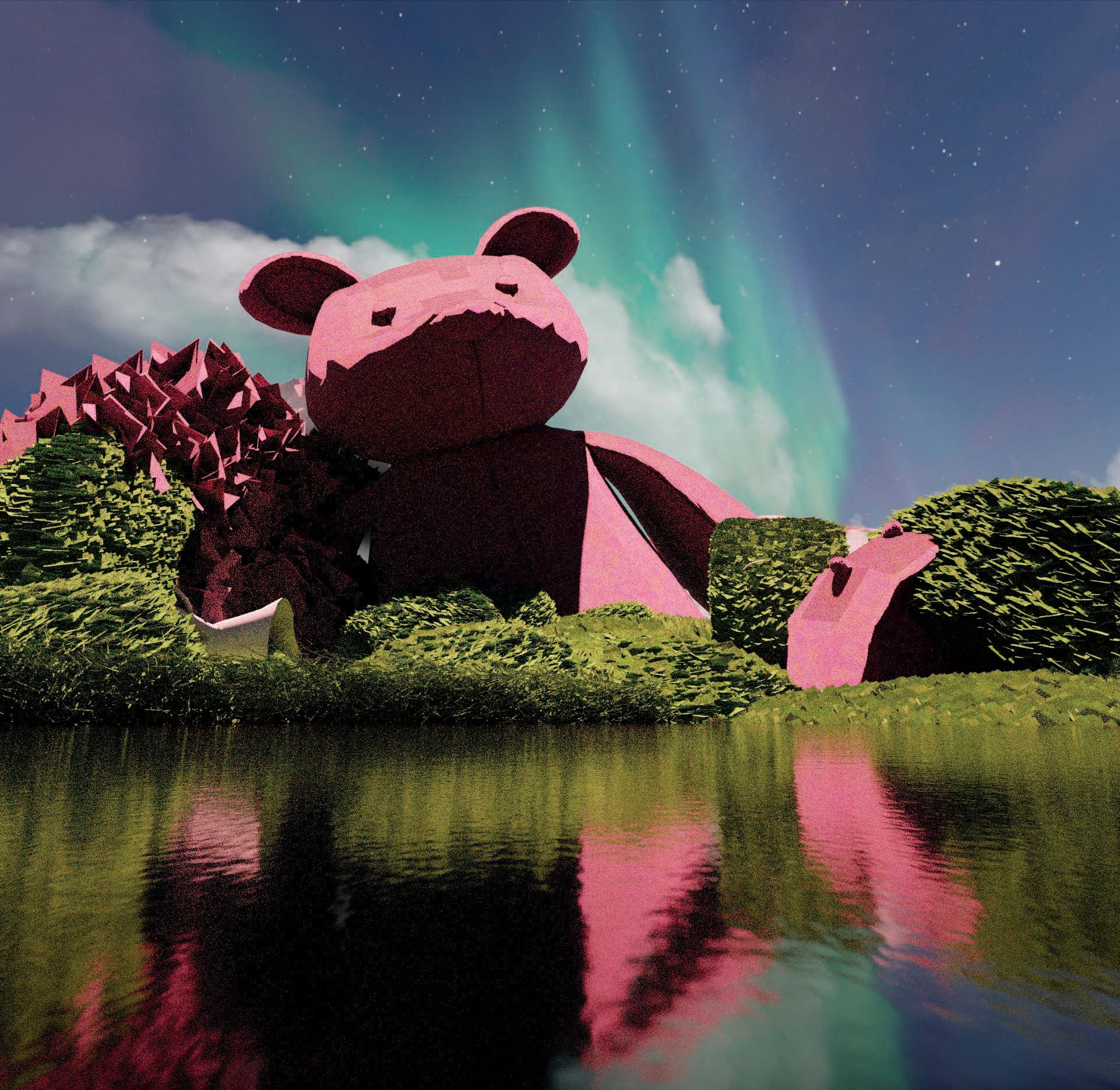
If you unravel your DNA, it can wrap the solar system 10 times over. The wiring of your brain will short circuit the most powerful computer on earth. People do not simply pass through space, they shape it.
I aim to document this transformation.
My work investigates how art and technology can amplify human presence. Through computation and algorithmic processing, I reframe informatic analysis as poetic interpretation, thereby creating visual transformations of data. I am drawn by the data itself. We live in an era where everything is recorded profusely, our choices, behaviour and existence at large. Rather than using technology to duplicate these processes, I want to use it as a tool for gaining perspective, to trace the relationship between presence and information.
My work sits at the intersection of art and technology, exploring what the two together can amplify, rather than diminish, about human presence.
By nature, data driven art engages with commentary on information culture, surveillance and the use of this information. My work will join that conversation from a place of curiosity, seeking not to emphasise technological autonomy or capacity but to find intuitive and resonant patterns within it.
TANVI AMRIT
you can find me with my forearms in the indigo vat
FIBERS, SCULPTURE
Every piece I make is an act of devotion: to my love, to transsexual intimacy, queer domesticity, craft history, old New Englanders, bugs & monsters, and anything else I’ve ever grappled with. I think through objects and materials, through my body and what using my hands to make teaches me. Looking to fiber as a feminine, and wood as masculine, I seek to challenge sexual and social binaries through a material lens. This relationship manifests itself in queered domestic objects, mostly made of fiber and wood, that draw aesthetic and conceptual inspiration from the (gendered) history of regional craft culture.
In doing so, I reference non-human imagery of other abjected beings such as monsters and bugs. Specifically looking to creatures that undergo complete metamorphosis, like butterflies and beetles, my work finds meaning in the metaphors of the natural world. In doing so, I transform traditional craft silhouettes with imagery from New England flora and fauna. By bringing these ideas together, I seek to cultivate space for transsexuals as much as I do old rural craftspeople. Using craft l hope to offer viewers of all experiences a point of connection to the mark of handcraft, the domestic space, and the labor of devotion.
JAIME ATCHINSON
PHOTOGRAPHY
I no longer trust what is shown in a photograph, not that I ever should have anyway. As a student of images, I have become well aware of the means and methods photographs have for distorting or altering “Truth”. Despite this, my photography seeks to document or make truth within a sequence of images of the personal interior, or looking outward into my lived environment to explore the nature of photographic sight. I am a photographer, but I consider my practice to be more akin to that of a photo editor who must go through a vast swath of images to pick the narrative that best suits my needs for any given project.
It was this approach to image making, as a “gatherer”, that has led to my current project on the complications of photography’s assumed indexicality. This is a project in two parts where I return to some of my older diaristic images to find the pictures I deem not print-worthy and must be hole-punched. I then allowed generative AI to fill in these voids, exploring how the technology may manipulate my personhood and life as documented in pictures. In the second portion of this project, I am working from the archive of “killed” negatives from the FSA collection to explore the implications and dangers of the technology in the realm of misinformation. In this project, I prompt and prod the technology to manipulate the truthful evidence of stories within the archive to my own comical and manichal ends.
ANDREW BAILEY
basketball with my buddies
DRAWING, PAINTING, PRINTMAKING, SCULPTURE
My work documents the gap between inherited ideals of masculinity and the lived experience of falling short. Growing up in Mississippi, I absorbed a model of manhood built on physical authority and stoic discipline, scripts that feel inescapable whether I accept them or not.
These older inheritances now collide with contemporary pressures. My work engages looksmaxxing culture and its pursuit of physical self-optimization: online forums, obsessive self-measurement, and the attempt to engineer desirability through bodily transformation. Pornography extends this logic into intimacy, replacing connection with performance. My work holds that contradiction: the body optimized for the gaze but incapable of internal connection. I document the exhaustion of trying to embody ideals that are aspirational yet impossible, tracing the gap between external measurement and lived experience while acknowledging the absurdity inherent in these pressures.
I work primarily in oil painting, printmaking, and occasionally ceramic sculpture, utilizing labor-intensive processes in which construction and erasure are inextricably linked. Figures are simplified, monumental, and weight-bearing, drawing on the solidity and accessibility of Social Realist and Mexican Muralist traditions. Each image is built through cycles of layering and scraping—a palimpsest in which every gesture leaves traces of effort, hesitation, and reconsideration. These residues preserve the material and psychic struggle of representation, allowing unresolved conflict and contradiction to remain legible in the work.
This work comes from living inside these systems and making them legible, asking viewers to reckon with how masculinity is performed, inherited, and negotiated under the weight of cultural and regional expectation.
JOHN BIAL
My recent work combines found materials and traditional fiber processes to investigate themes of home, loss, change, and time. Through quilting, knitting, crochet, and weaving, my work references domestic spaces and the repetitive, meditative practice of introspection and self-reflection. The process of collection and meticulous needlework is essential for the sculptures. To me, the act of making is as important as the final piece. These hybrid sculptures bring craft techniques into conversation with found objects, grounding the work in both personal experience and the surrounding world.
My artistic process is strongly driven by intuition, allowing the forms of found objects and the inherent properties of textile materials to inform the final shape and scale of the piece. I respond carefully to the found objects; my goal is not to render them unrecognizable, but rather to incorporate and transform them in ways that stretch the viewers’ understanding and perceived use of the material. Over time, through slow, hand-built processes, the pieces begin to take form. I spend a lot of time with the work, we form a relationship, and I allow it to influence my decisions.
I am drawn to the works of Martin Puryear and Ruth Asawa and their reimagination of traditional craft processes to create modern sculptures that are removed from the pedestal and respond to light and the body. The use of minimal color palettes draws attention to the form and explores themes of identity and culture through a more ambiguous lens. This type of transformation influences how I think about my own materials.
Ultimately, my work wrestles with what happens internally when something shifts or is lost. They act as a physical representation of feelings I find impossible to articulate. The pieces are stagnant, sometimes a snapshot, and in this case, a representation of the final resting place of big emotions. I hope that viewers will take time to move around and explore my sculpture, and to learn its many sides that I, too, know so well.
GRETA BOGDANSKI
My work explores the human figure through distortion, exaggeration, and physical sensation. Working across sketching, painting, and ceramic sculpture, I create figures that are stretched, warped, and reshaped in unexpected ways while remaining grounded in an understanding of anatomy and proportion. This balance produces an uncanny quality—forms that feel both familiar and deeply strange.
I am interested in evoking specific bodily sensations through visual form. Each figure often begins with a physical feeling in mind: the tension of stretching your back, the discomfort of being overly full, or the subtle strain of holding an awkward position. These sensations are translated into distorted bodies that embody both discomfort and recognition.
My figures are intentionally nongendered and most frequently bald, allowing the focus to remain on the contours and physicality of the body itself. By removing markers of identity or choice, I emphasize the body as something inherent rather than constructed—something experienced rather than designed.
While the work may initially provoke shock or unease, it is also playful and humorous. The figures often appear content, even joyful, within their distorted states. This tension reflects my broader interest in how many aspects of everyday life, when examined closely, are inherently strange or uncomfortable, yet widely accepted as normal.
Ultimately, my work is a response to these moments of quiet absurdity. By exaggerating and embodying them, I aim to reframe discomfort as something familiar, even natural, and to invite viewers to find a sense of recognition within the bizarre.
KAIA BRULANE
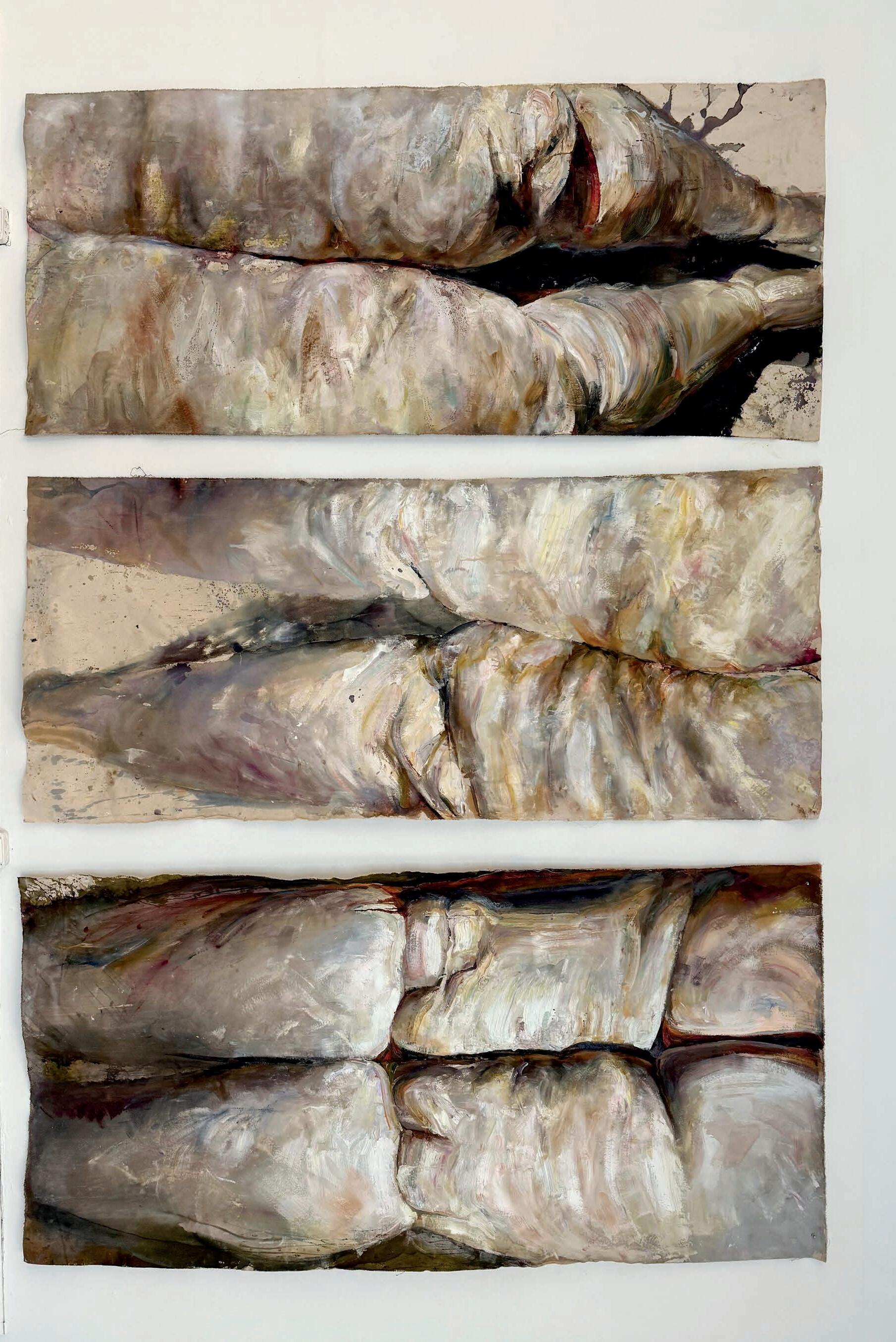
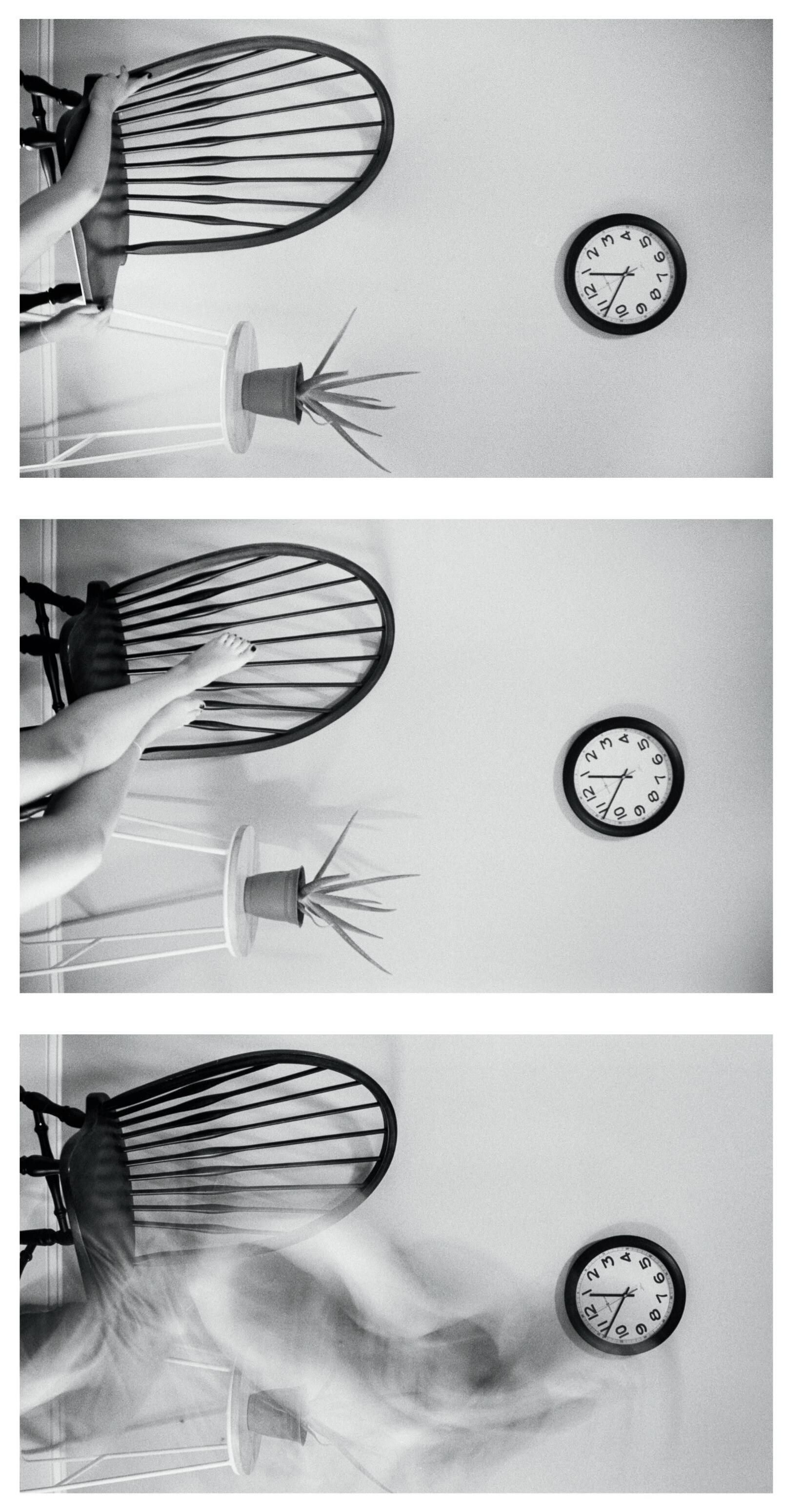
Thigh Gap, 2025
Embodiment is necessarily a kind of isolation: we are always alone in our bodies. My work is an effort to transcend this boundary by implicating the viewer in the experience of my body. This ritualized practice of self-portraiture is an effort to understand a vessel that is constantly in flux through sustained attention to the material self.
My work leverages the unique aesthetic potential of the fat female form. Fat has its own sense of gravity, stretching, shrinking, rolling, and falling, all in the curve of a thigh or the turn of an ankle. This constant transformation demands rigorous attention. The resulting documentation is both a psychological investigation of what it means to embody flesh and a formal investigation of fat on the body.
Every time I paint myself, I encounter my body again for the first time. I use repetitive imagery to simulate the experience of selfperception and, in the process, become even more alienated from my own corporeal reality. This iterative process of rediscovery transforms familiar forms into conduits of obsessive self-voyeurism. Ultimately, my work is an interrogation of the material condition of being human.
MARIA CAZZATO
Fucheng
cooking with friends in our kitchen
DIGITAL FABRICATION, GRAPHIC ARTS, PRINTMAKING
I grew up with a lot of change and absence that left strong marks on my younger self. Moving abroad from China has made it more difficult to stay connected to the practices of grieving I developed at home. I see my relationship with grief and death as both cultural and universal, and a reflection of personal experience can resonate with a greater audience.
My practice centers archiving and processing grief. I’m interested in building a family archive to make memories more tangible - an impulse shaped by a persistent sense of loss and nostalgia tied to my family.
My work exists as printed ephemera and the expanded book form. I often work with found photographs, phone images, and visual references that speak to the collective memory of Chinese children who grew up in the 2000s with an emphasis on Chinese ritual practices such as funeral food traditions and the burning of joss paper money. I transform these images through riso printing, paper weaving, and laser cutting to create objects that can be held and manipulated. My publications are typically bilingual and invite interaction and “play” as part of the experience.
IVY CHANG
eating at a Korean Barbecue Restaurant
I am a multidisciplinary graphic designer working across poster and flyer design, branding, presentations, and digital media. My practice takes personal experience as its primary material - design, for me, is a way of sitting with something difficult long enough to find its shape.
But This Problem Is Cliché begins with a question I kept avoiding: hide or look? For years I chose neither - I simply refused to take my own experience seriously. Convinced that struggling with beauty standards and self-perception was too ordinary to examine, I folded it quietly into the background of my own life. This series is the act of going back and actually looking.
The work uses photos of myself, mirrors, and reflection as its raw material. Faces fragment and multiply, features annotated like items on a checklist rather than parts of a person. Images repeat until they become a pattern, the self worn down by its own repetition. What holds it all together is the push and pull between looking and being looked at - and how easily those two things collapse into each other.
These images do what the experience itself did: they make you look at something you’d rather glance past.
Embedded in the series is a quieter argument - that the word “cliché” is never neutral. To call an experience cliché is to declare it unoriginal, already written, not worth the page. But This Problem Is Cliché pushes back against that. It asks what gets lost when we accept that verdict, and what becomes possible when we don’t.
away in my studio
Plaster starts as stone, is ground into a soft powder, mixed with water, and becomes stone again. Hardening, transformation, and return are the pillars of my artistic exploration. Through sculpture, performance, photography and curation, I seek to understand the landscapes that I come from. My work chases the preciousness of small unnoticed moments that sit within a larger conversation about diaspora and change.
I employ alternative darkroom printing methods as a sculpture making tool in order to imprint memories onto objects and spaces. Photographs shifted into 3D forms are caught in a moment of liquidity, form to solid stone, and eventually fade away with the same exposure to light that birthed them. Realities are captured with objectivity before they are abstracted and fade away.
My exploration of dynamic materials and processes births objects with a life cycle. Rigid chunks of concrete from a preHolocaust German family home become comfortable jelly-like forms that hold the same shapes as the original pieces. A bodyshaped bathtub made out of porous plaster leaks water through its surface as it crumbles. A carton of eggs is re-animated with motors, shaking preciously, unsure whether to hatch or be afraid. Transformation is ultimately what I keep re-expressing.
My exploration of identity within diaspora through material transformation always returns the sculptures to the original circumstances they reference. The processes that make up their lifespan, the ones that have little testimony of existence, are the important ones. The object remembers, and that’s what matters.
ELAN COHEN
the darkroom
I am drawn to forms of making that require patience and a willingness to repeat actions until they become rituals. I use analog photography, darkroom printing techniques, and alternative and historic photographic processes, which allow me to slow down and remain present with the process of making.
Through my work, I investigate themes of ritual, ephemerality, and control. I am especially interested in how images can shift through handling and chance encounters, when the audience is given the opportunity to interact with the work in ways that I cannot control.
In Being Seen, I present a book of silver gelatin prints documenting a private performance. The prints have not been fixed, meaning they are sensitive to light. If the book remains closed, the images remain intact; once opened and viewed, they begin the process of disappearing forever. In Of the Flesh, I invite viewers to destroy photographs of my body through the use of holy water. By inviting this type of interaction, I allow audiences to simultaneously destroy and co-create the form and meaning of the work.
VERONIKA COYLE
PHOTOGRAPHY
The Brothers Karamazov
CERAMICS, SCULPTURE
“For now we see in a mirror dimly, but then face to face. Now I know in part; then I shall know fully, even as I have been fully known.”
1 Corinthians 13:12
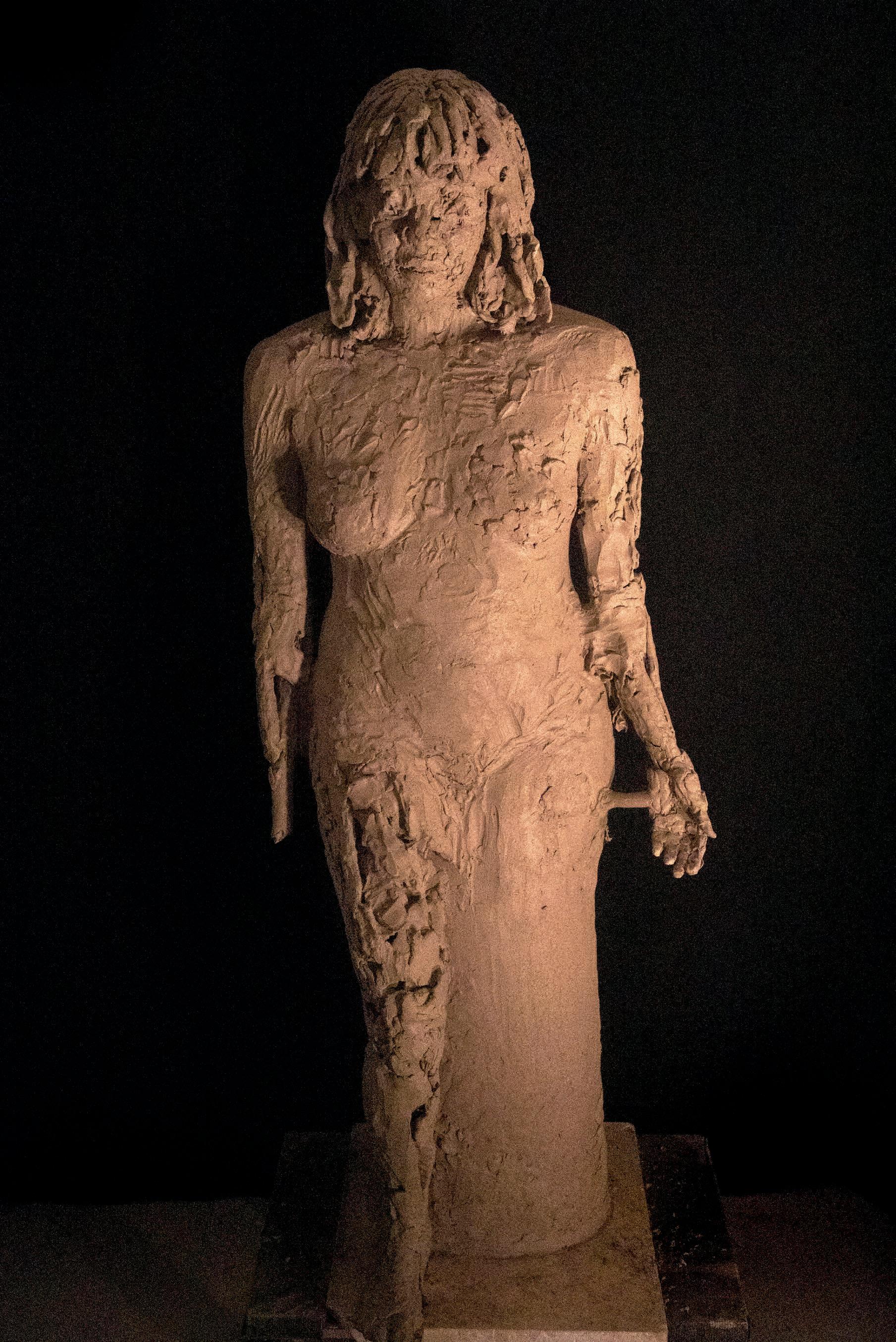
I am a figurative clay sculptor born in Philadelphia, PA, currently pursuing a BFA at the School of the Museum of Fine Arts in Boston. I create life-scale self-portraits in clay, whose rugged, luminous surfaces confess failure, hope, and conflicting desire.
The figures emerge from an intimate, vulnerable process where I enclose myself in a handmade tent with the clay, working from my reflection in the mirror and the undulation of skin beneath my fingers. I am constantly looking and touching, letting technique and expectations be stripped away in pursuit of a truer image. This devotion is mentally and physically arduous, cracking my skin and the foundations I build my identity upon. In so doing, I submit myself to be re-shaped alongside my sculpture, creating in light of my own createdness.
ANNIKA CRAWFORD
reels
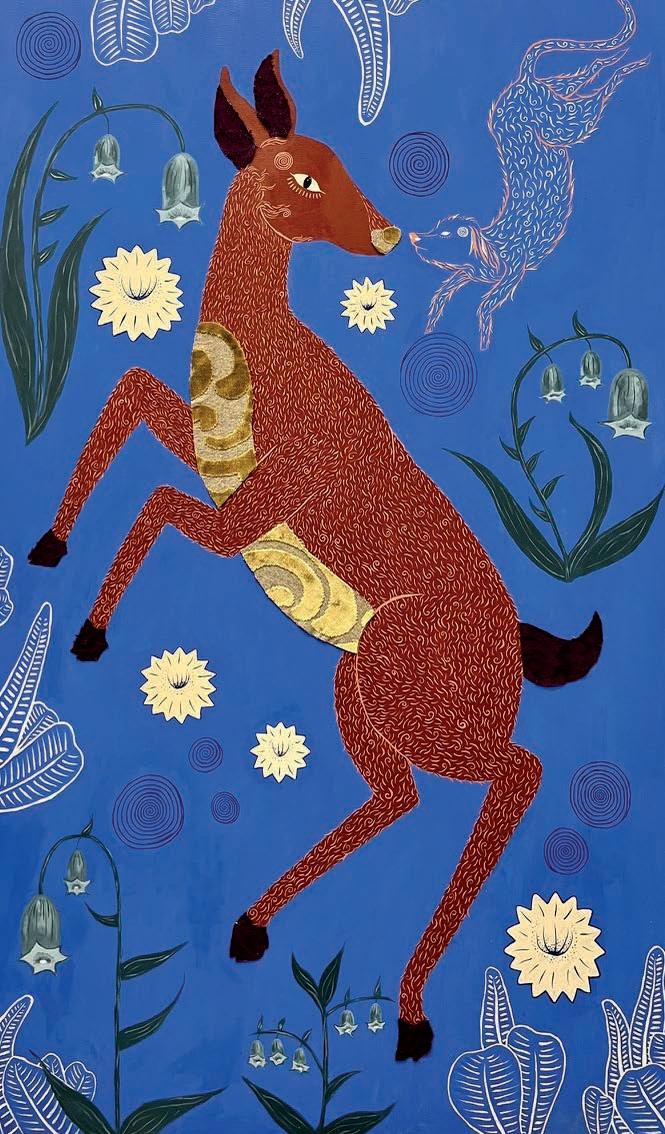
I am an oil painter who centers my practice around animal and beyond-human inhabitants that populate the postcolonial landscape, seeking to investigate where worlds converge and depart from one another through the messengers between them: How do the life and essence of my animals circulate between different worlds, and how does the landscape become embodied as an archive of these life cycles? If life and death is not viewed as a linear path but rather a continuous spiral, how does essence travel between their bodies and the landscape?
In exploring these phenomena, I am drawn to the globalized practice, history, and aesthetics of folk art, as a practice historically detached from capital and rooted strongly in preserving verbal storytelling and community without attachment to the knowledge systems of western academia. In blending painting styles between realism, flat line work, and narrative compositional forms, I hope to animate the land and its inhabitants beyond what is accepted as earthly, and to detach them from a static formation of reality.
In telling these stories, I turn to the animals I’ve formed the deepest connections to throughout my life and research – primarily the deer, the wolf, and the rabbit, studying how their representations fluctuate through Celtic, Japanese, and American mythology as anchors to tell my stories from. I typically paint multi-panel scenes on the smooth and dense surface of the wood panel, hinged together to mimic the tender narratives of the storybooks I read as a child.
The motifs that frequent my work such as the spiral, house, stars, and many animals that circulate them aim to create a sense of familiarity and arrival: That in following the stories told through my landscapes, we can follow the messengers inward, outward, and throughout the painting to wherever their home may be.
AVERY DAVIS
GRAPHIC ARTS, PHOTOGRAPHY
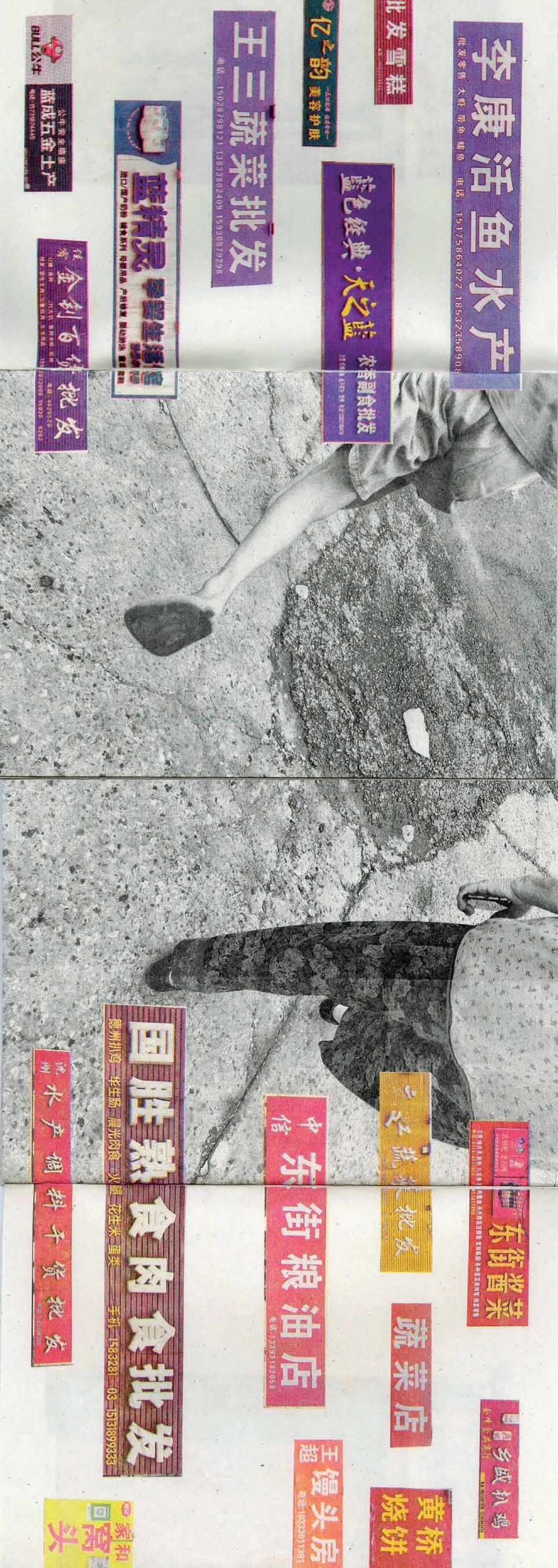
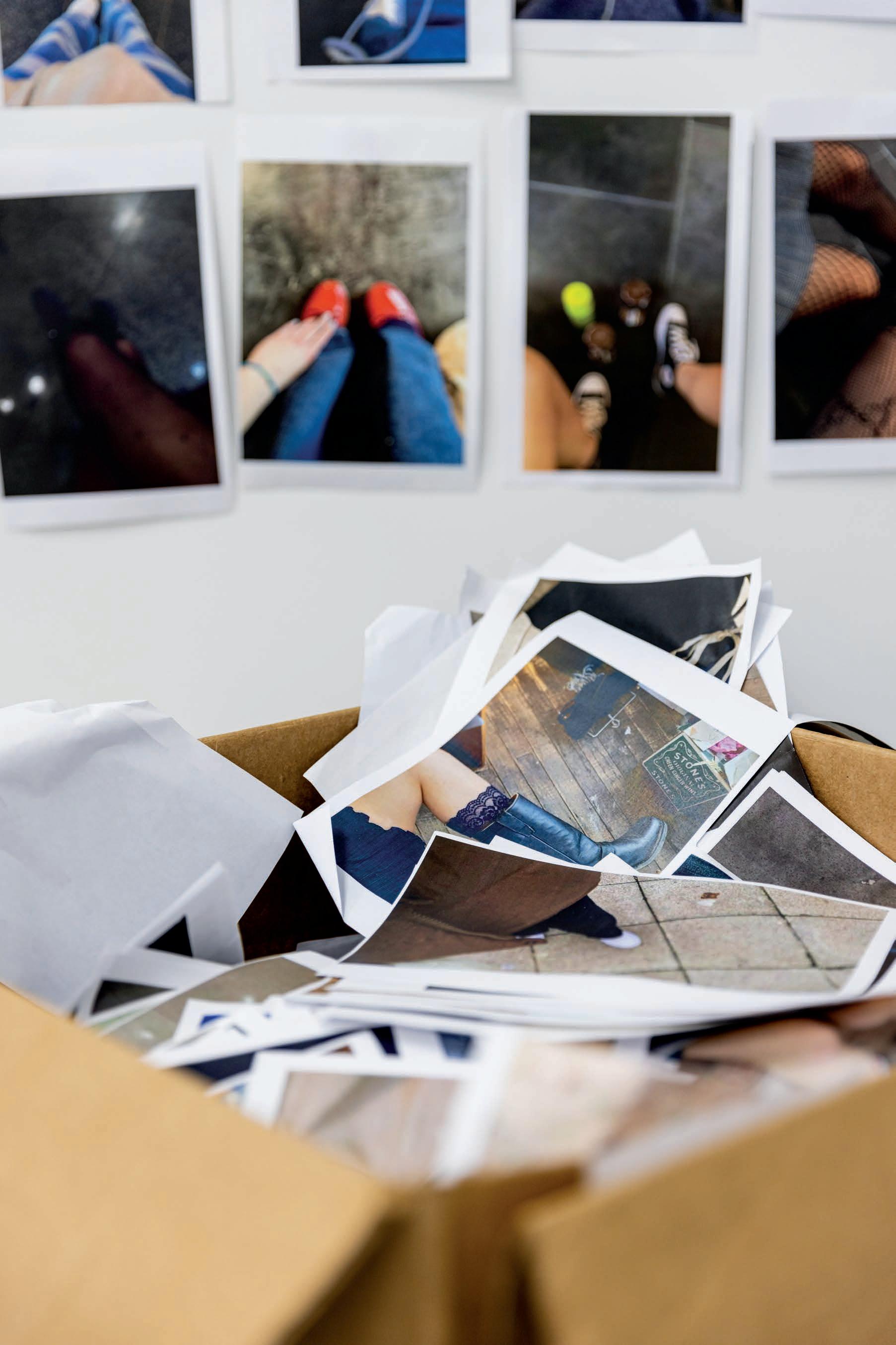
I adopt the role of a filter, working with seemingly infinite subject matter taken primarily from online spaces. My decisions are informed by my position as a user, and by my engagement with algorithmic recommendation systems. I am interested in the structures which appear across user-generated content. In my thesis project LEGS4DAYS, I focus on the “leg selfie” as a form which repeats through thousands of images I’ve downloaded from Pinterest. These repeated structures bring the individual interior self—the point of view—into a collective social identity of similar images.
While my interventions in online spaces are motivated by an interest in the normative behaviors of a given platform, my own moves are absurd in their scale and curatorial sensibility. My framework obscures the line between human subjectivity and mechanization in online curation, mirroring how users’ engagement both informs and is informed by algorithmic systems. My practice is focused on the internet, but it usually takes a decidedly physical form. I bring performative culture from digital spaces into the “real world,” through performances like sorting through thousands of pictures or recording video from inside a cake. I use artist’s books to create alter relationships between texts and images, sequencing with attention to rhythm and narrative. Printing limits the time and space content can take up and literalizes the partiality and incompleteness of any engagement with networked communities whose size prevents them from ever being completely captured.
CLARA DAVIS
after the graveyard shift, 2026
Animation erodes boundaries by nature. When a story is unavoidably fabricated, its suspension of disbelief lightens. Bodies don’t need to conform to the rules of their skeletons, and can twist into shapes that look less real, yet feel more honest. Cameras move unanchored, and so fully surround themselves in a stylized world. It creates a unique mix of sensation and chronoception, able to dissociate and rebuild familiar ideas.
I primarily work in 2D animation, layering digital and handdrawn elements for a wider range of textures and physicality. Although it is a labor-intensive process, I love the more visceral result; the scratchy, off-kilter human touches remind me that my hands are behind the screen no matter how many hours go into only a few seconds of screen time. My focus lies in character animation, first in music videos and now in a more cinematic style that borrows from early thrillers. Both heavily drive the narrative structure, while the internal logic of the stories draws from my background in biology (and love of horror novellas), rooting stranger concepts in deliberate lines of logic.
(Here: Follow fire and light. Slow growth and diffraction.)
I do not want to explain the way that reality goes hollow and flimsy at strange times, nor the disconnect between mirrors/sight/ time/sound, nor the unsteadiness of a body that doesn’t know you anymore. This is exploratory, not a vivisection. I put form to feelings by frames per second and let them go.
I invite the viewer to be unsettled, but not lost. If I am asking you to do anything, it is to step back from a pattern you know, take a breath, and find a new way to play it out before it closes in for good.
JAXON DAYTON
ANIMATION, FILM + VIDEO
Composure, 2026
CERAMICS, PHOTOGRAPHY
When I was young, a dear friend told me that painting is about finding the light. I brushed her off and said, “”Well, isn’t all of life about finding the light?”” I am not a painter, but I believe my life and my work are about exactly that.
I shoot black and white analog photography, usually large format. I make wheel-thrown, functional ceramics. I study pure mathematics. Everything I do is slow, technical, and specific by intention.
I grew up on Nantucket, where the only thing to do was drive around and stare at the ocean. My photographs are made back home and act as evidence of who was once there. They are quiet and eerie, void of people yet full in memory. In the darkroom, I make underexposed, small prints. My prints carry secrets, if only one can look long enough to notice. My ceramics are a practice in giving, as I create each piece to be incorporated into the daily lives of my loved ones.
I come home from class and think, isn’t it incredible that I do things just as people did hundreds of years ago? I turn silver into images, dirt into bowls, lemmas into theorems, green goo into massive silk cyanotypes! In a world that optimizes efficiency, where time is our greatest commodity, I keep asking: how will these practices retain their value? I think the answer is somewhere in finding the light. Art is everywhere: in the stars, in the people we love, in the objects we use every day. And I am still looking.
SONIA DHAR
DRAWING, GRAPHIC ARTS
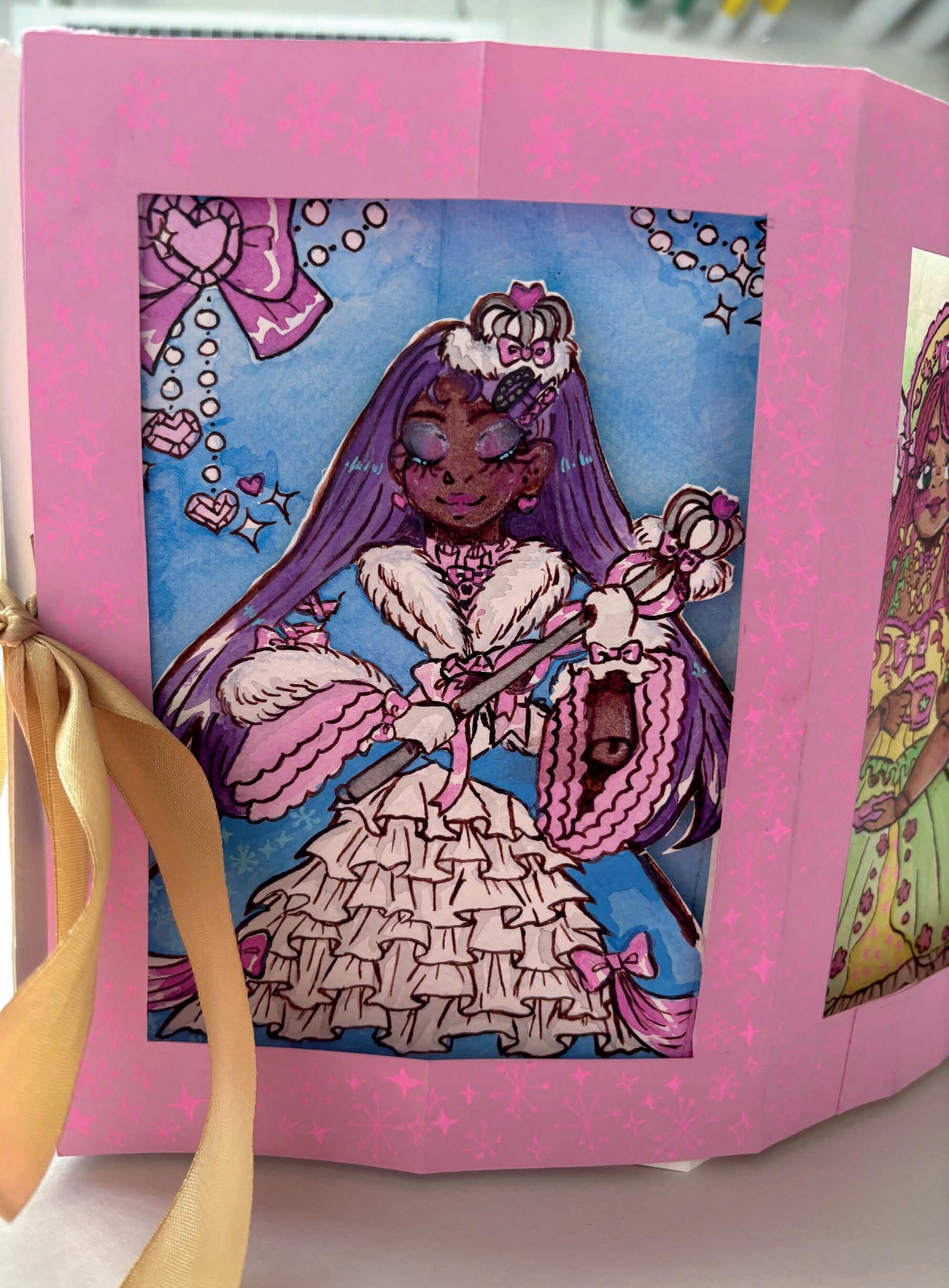
My work centers around the physical production of craft as a conduit for happiness, nostalgia, and escapism. My practice uses drawing, printmaking, collecting, collaging, and bookmaking.
I like to explore kawaii subculture, cute childhood iconography, and maximalist vintage aesthetics. Items such as glitter, ribbons, bows, rhinestones, flowers, desserts, ornate patterns, pastels, toys, lace, and cute shapes are part of my work’s visual language. I’ve always been interested in dolls, customization, tea culture and other forms of self-expression.
I am particularly interested in Elegant Gothic Lolita, a Japanese fashion subculture, as a vehicle for self expression. Born in the neighborhood of Harajuku as a method to challenge the conservative status quo, this subculture features a blend of clothes inspired by historical eras, like the Victorian and Rococo eras, and the western punk movement. These complex clothes adorned in bows, lace and fantastical prints, began to be adorned as battle armor to challenge the role of women in Japanese society and to embrace dressing for the enjoyment of the self. Inspired by the large community that has grown from this subculture, I like to examine joy and cuteness as personal power.
Additionally I want to confront the perception of femininity and cuteness in western society as unable to intersect with Blackness. I want people to engage in my work beyond just looking- I am interested on how to create artwork that prompts interaction and encourages play. Art is my curated safe space where I can create sweet dreams that are gentle, peaceful, and joyful in a world that is not. It is in direct defiance against hopelessness, that there is importance to enjoy life and to live it without giving up. When I make art, my main incentive is to have fun and spread some wonder and happiness everywhere I go!
COUMBA DIALLO
space heater
I want to make an interesting system. What this means to me is an object which is consistent, homogenous, and good to look at. There is so much information in the world, and no one can possibly dream of sorting through even a sliver of it. Most of it we cannot see or understand as information - we simply do not need to. The best that we can do is to use machines (computers, cameras, X-rays) to approximate, and then classify.
Most of my work uses fiber processes including embroidery, quilting, and beading. A fiber is anything that is significantly longer than it is wide, essentially it is a line that has crept quietly into our world. The most obvious way to arrange these lines is by employing a grid - we see this in weaving, knitting, etc; combining small units into a complete whole. I create arrangements that emphasize small differences (shape, size color) in otherwise similar collections, often employing the grid.
My work is also informed by my study of mathematics. Mathematics is composed of objects which we cannot touch, but have strict rules. I try to imagine a person living in one of these rule systems - how would they see, think, breathe, and move. Would it hurt? Could they run a marathon, then another?
Now think of yourself - if you were trapped in a room forever with a single piece of paper and a pencil, how long would it take for the paper to become completely covered? After that, how long would it take for you to rip it into the smallest pieces you could?
CATHERINE DILEO
DRAWING, FIBERS, SCULPTURE
(left), 2025, untitled (right), 2025, Display and Do not touch,
using my Apple Find My app
FIBERS, PAINTING, SCULPTURE
My collection of wearables comprises three looks centered around artisanal craft and family archives. My research began by questioning the politics of gendered clothing: Who gets to wear what? Whose hands make them? How are the materials sourced?
Assigning gender to objects is political. Stripping them of it is also political, but mine is a more inclusive kind of politics. I want to break down this invisible barrier by reminding us of the arbitrary assignments we make to objects.
I pull inspiration from the clothing I saw growing up in Bangladesh, a style constituting woven fabrics, adorned with drapery. In this collection, I honor the craft and artisanship I bore witness to, as well as the skills of the thread passed down from mother to daughter and from my mother to me.
I believe how we dress is an extension of our identities. Our self-expression through dress is a window into our individuality. Some dress to conform, some to rebel, some to celebrate. There is an absurdity in how some languages gender objects. Utilitarian objects are meant to be used, and their meaning is derived from the utility we find in them. This utility may be in the shape of memory, warmth, comfort, or perhaps even as a uniform.
A garment is without gender, wearable for everyone. If it fits you, it is yours to wear.
TOKI EASHIR
My work explores memory, family history, and cultural inheritance through film and sculpture. Rooted in my parents’ stories of Nicaragua and my experience growing up in Miami, I use film to reconstruct what feels distant, fragmented, or inherited. Through moving images, I make visible the stories that shape identity, belonging, and connection to homeland.
I reinterpret Nicaraguan folklore and history through the lens of migration and family memory, connecting stories of colonial resistance to contemporary immigrant experience in the United States. I am interested in how historical narratives can speak to the present, particularly in relation to the ways immigrants are often misunderstood, politicized, and dehumanized. Through my work, I challenge those perceptions and emphasize the humanity, resilience, and complexity of immigrant lives.
I use 16mm film for its grain, texture, and physicality, qualities that mirror the way memory feels: fragile, imperfect, and alive. The handmade nature of the medium allows the work to feel both archival and deeply personal. I often incorporate narration, phone conversations, archival materials, and personal footage rather than traditional interviews, creating a more intimate and emotional form of documentary storytelling.
Sculpture is also an important part of my practice, particularly through handmade props and masks. I create these objects using humble materials such as papier-mâché and cardboard to reflect the resourcefulness, labor, and care present in many Latino homes and traditions. Through both film and sculpture, I am interested in how storytelling can preserve culture, honor ancestry, and reimagine what home can mean.
ALICE ESTRADA
FILM + VIDEO
running around
DIGITAL FABRICATION, METALS, PHOTOGRAPHY
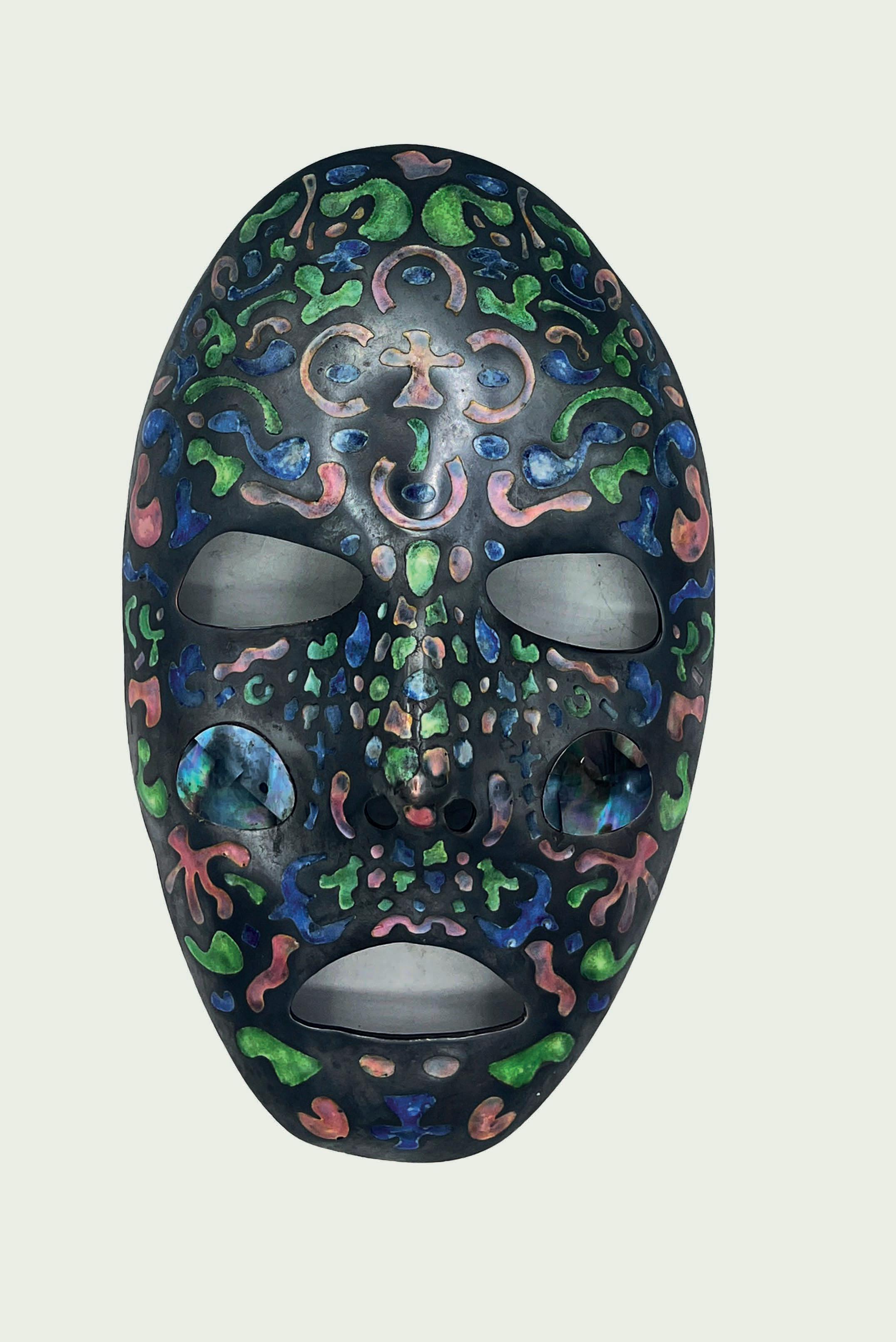
I make metal objects that sit between protection and vanity, comfort and threat. They are often excessive, ornamental, and slightly unsettling. My pieces may seem charming at first glance, but they are striking as well.
My work is driven by memory: what we remember, what we forget, and what we invent in between. I am drawn to the nostalgia of romanticized visions of the past, especially as the present feels increasingly bleak and socially regressive. Growing up for me often meant learning history through fragments, coded symbols, and imagined worlds, creating a longing for a time that never really existed.
On becoming a pearl is an exploration of these fabricated memories, creating a metamorphosis of material, form, and function. The masks explore the construction of the self devoid of time and place, creating future artifacts or evidence of existence. These masks are meant to conceal, reveal, adorn, and protect- intersecting the feelings of nostalgia with fear and disconcernment: a naievetè that embodies the weight of existing.
I combine old and new material techniques, using precise digital fabrication alongside traditional metalsmithing and handwork to create objects that feel both futuristic and antique. I show evidence of my hand amidst the highly precise manufactured aesthetic, situating the work in a time unclear. Through this process, my work becomes seductive, defensive, naïve, and unsettling all at once.
PAUL FAULLER
you can
at the gym or petting a dog, both at the same time if I’m lucky
My piece, Recounting Threads: Stitch, Story, and Structure
Through Matrilineage, highlights the mathematics, technical skill, artistry, and labor embedded in the handicrafts practiced by women in my family who identify neither as artists nor as mathematicians. Rooted in observation, conversation, and shared making traditions, this project considers how knowledge is developed, expressed, and often unrecognized within domestic and intergenerational spaces. By investigating practices such as knitting, crocheting, needlepoint, quilting, weaving, and dressmaking, I explore these women’s relationships to math, art, and craft, as well as the boundaries that separate these categories.
Each selected object is displayed in a hinged shadow box: the exterior presents the handmade piece, while the interior opens to reveal a hand-illustrated, collaged dissection of its pattern logic, including proportional relationships, stitch counts, and geometric sequences. Alongside these diagrams are fragments of each maker’s story, such as how they learned their craft, how they relate to math and art, and how they understand their practice outside of those labels. Through this process, I affirm each object as a work of structure, expression, and history in its own right.
My work makes visible the knowledge embedded in these processes and the ways it is overlooked or undervalued. Drawing on domestic craft traditions, family interviews, and research into the historical exclusion of women and women’s labor from both fine art and mathematics, the installation reframes these objects as both works of art and as sites of rigorous intellectual knowledge grounded in matrilineage.
LIZ FRIEDRICHS
you
facebook marketplace, trying to find secondhand metalsmithing tools for cheap
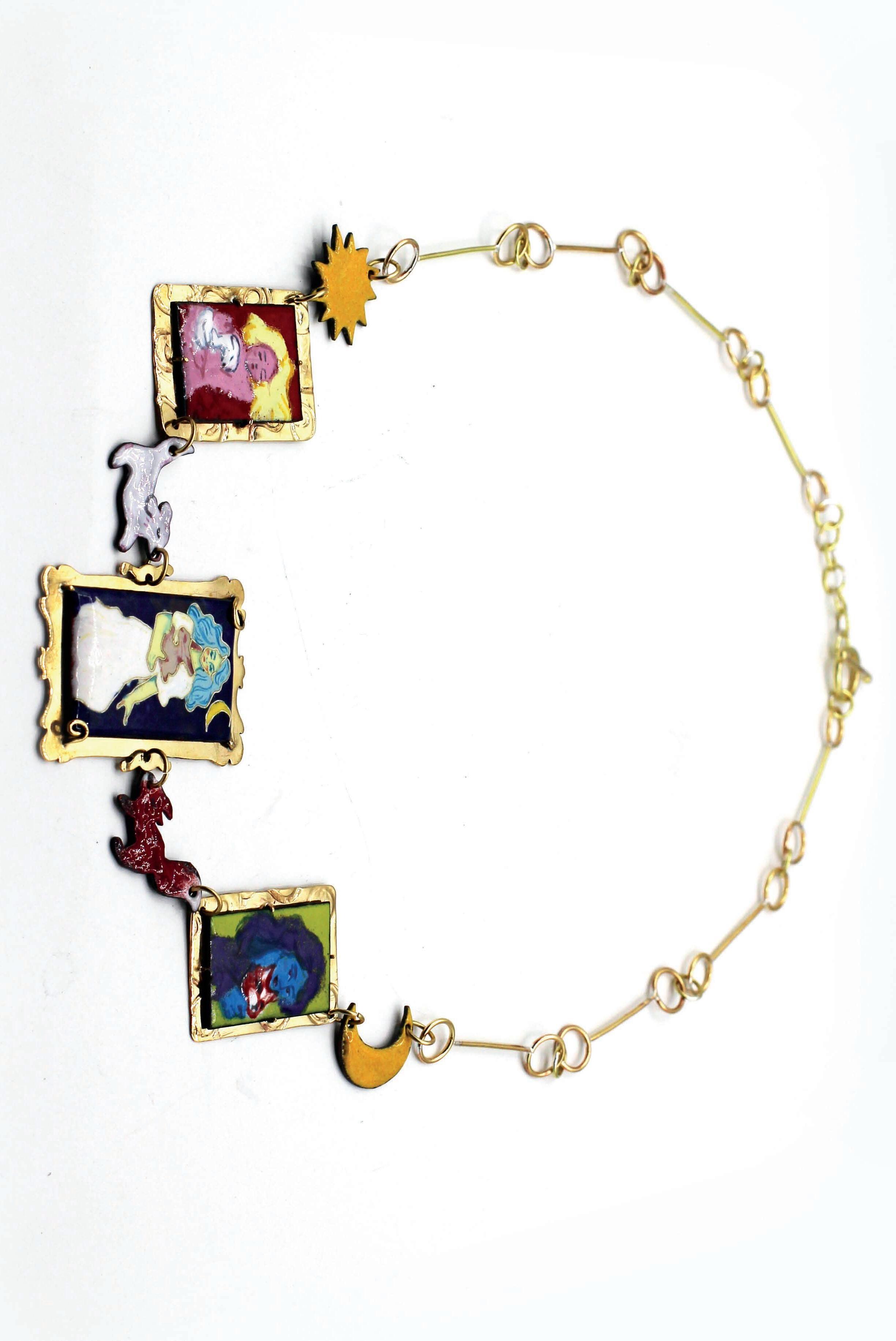
My works are rooted in the exploration of my heritage, family, and the things we don’t often tell each other. Or, the things that simply get lost through generations. They exist in the space between reliquary and heirloom, made with age-old metalsmithing techniques such as enamel, chasing and repoussé, and lost-wax casting. My own worries, meditations, and obsessions become the subjects of my projects, pairing well with the labor-intensive and detail-oriented process which metals as a medium demands. Often, they result in deeply intimate and personal objects.
Primera Comunió (First Communion) explores my urge to honor and commemorate– two things which metalwork and jewelry are often traditionally used for– in dialogue with ideas of religion and devotion. As in much of my work, it is my family for/of whom I’ve created a devotional object. Simultaneously, this piece is my own way of parsing through a disjointed cultural and familial history, and a bargaining for connection across experience, geography, age, and language.
LEDAO GAVALDÀ
The depiction of Black people is deeply complex and manifests in multiple forms. My understanding of this depiction has largely been shaped through an American, Western lens that I both inhabit and interrogate as a Black artist. My paintings function as cathartic snippets of information, exploring the contradictions between material and concept. Through contorted figures, I navigate my own relationship to Blackness, using material as metaphor. What does it mean when a sculpture of a Black person is rendered in white marble? How do the pose and action of these figures disrupt the environments in which they are placed? These questions form the framework through which I examine how Blackness has been historically depicted and materially constructed within the Western lens to which I am subject. I find that thinking in a way where you question the purpose a black figure within its space affects the agency that it invokes.
KALIM LEWIS FERNANDES
DIGITAL FABRICATION, DIGITAL MEDIA, FIBERS
PRINTMAKING, SCULPTURE
My practice sits between art and computation, but it is driven by ideas rather than medium. I start with a concept and then explore different forms until I find the one that can carry it. This approach has led me to work across web-based projects, 3D modeling, game design, animation, print, and textiles, among other things. With a background in computer science, I am drawn to simple rule-based systems, not to solve them, but to follow them closely and see what emerges. I am fascinated by patterns that feel meaningful yet remain ultimately unknowable: a space where structure and uncertainty coexist.
This body of work grew from that fascination. Ulam_00, a double accordion book, presents a series of spirals where numbers begin at the center and expand outward, revealing the diagonal alignments of prime numbers described by the Ulam spiral. The book is risograph printed and bound with red thread, with primes in red on the exterior and composites in blue on the interior, splitting the system into two complementary structures.
Above it, the Tunisian crocheted tapestry Ulam_90 maps prime numbers up to 13,500 in rows of 90. Crocheting is my way of running a machine-like process by hand: repetitive, time-based, and meditative. The front presents a clean, algorithmic surface, while the back exposes knots, threads, and connections, revealing the labor and structure beneath.
Across both works, patterns appear without resolving. I am drawn less to answers than to the act of searching itself: to repetition, accumulation, and the strange beauty of a system that is both legible and mysterious.
GIORGIA GIANNICO
DIGITAL FABRICATION
My work explores tenderness and discomfort, attachment and distance. It comes from my experience of growing up between countries in Latin America. I was always leaving and never settled into belonging and thus, memory doesn’t feel fixed. It shifts and overlaps, losing its credibility as it continuously deforms.
I use digital fabrication technologies and animation to work through that instability. The machine becomes part of the process, with reciprocity between digital and physical, altering what is made in ways that feel partly out of my control. Making becomes a way to process emotions that don’t translate easily into language.
I am also drawn to spectacle, to similar experiences I have had that are excessive, immersive, or overwhelming. Bringing this into my work creates tension. I push internal experiences outward into something visible and heightened, where I can distort or amplify. I want to see what happens when something internal is made outward and visible, when private experiences become destabilized, almost performative. I am interested in that point of contact, where depiction conflicts with gut reaction.
ANASTASIA GLASS
ANIMATION,
Artist’s Portrait, 2026
DIGITAL FABRICATION, DIGITAL MEDIA, DRAWING GRAPHIC ARTS, PHOTOGRAPHY, PAINTING, SCULPTURE
I am an interdisciplinary artist drawn towards the intersection between art and humor, finding clever and unique ways to play with language through graphic arts and illustration. Inspired by the work of lowbrow artists like Ron English and Robert Willliams, I often find himself creating dense worlds brimming with wacky scenarios. I enjoy the simple act of artmaking, seeing it as an outlet for pure imagination and whimsy. High in technical form, my pieces brim with multiple light sources, vibrant color, and contorted characters. If you laugh at my work, I’ve succeeded.
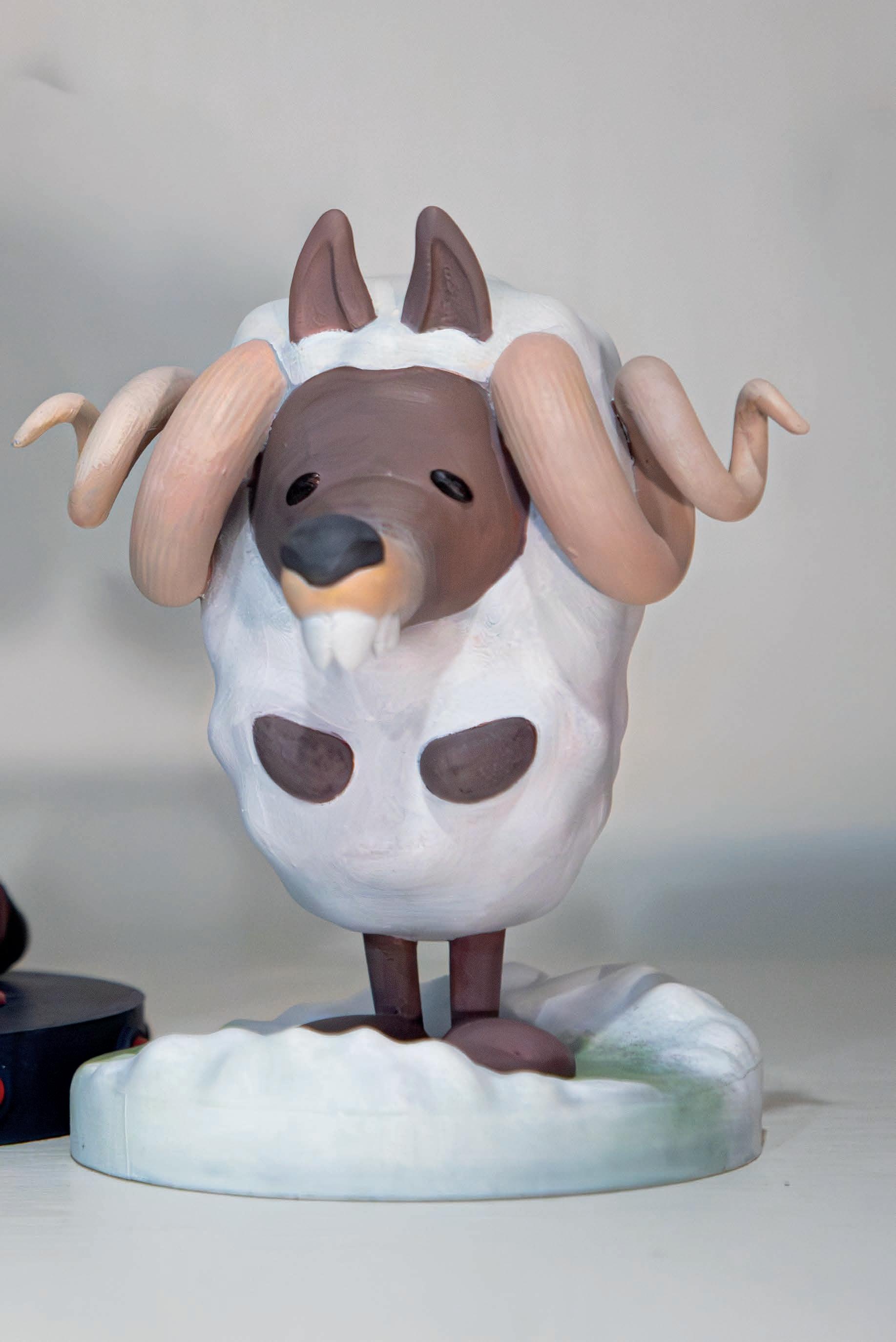
Beyond the world of drawing, I also enjoy designing fonts and laying out expressive packaging with the same vibrancy and chaotic form that he addresses his color pencil work with. Motivated by the bold typography and wacky letterforms of Warren Lehrer and Michael Doret, I often find himself designing letterforms that challenge conventions and relishes in imaginative spirit. Combined with his love for branding, I regularly use my fonts as logos for imagined products, designing brands and ephemera that are quirky and surreal. An Artist’s Portrait, my most recent packaging project showcased in this exhibit, features a series of art toys designed and sculpted to embody each of my college interests. Rami - the sheep - represents a love for furries, Cepho - the brain - anatomy, Bigg Lyps - heavy metal, etc. As a whole, they create one unconventional likeness of mysef, all branded under the lens of marketable figurines.
ZAK GOLDSTEIN
My practice takes the form of painting. On the surface, my pieces manifest as canvases filled with an array of colors and figures, prominently featuring my image and anecdotes of my life. I deliberately use my image, and of those people that closely encircle me, as a thematic thread, hoping to transcend mere representation to become an exploration of autobiographical storytelling. Striving for realism, I endeavor to create the feeling that her work is a snapshot of a moment, a memory, an experience.
In this series, Lejania: When Home is a Memory, I tackle the concept of nostalgia and memory and how they can be fuzzy and intangible, yet hold much weight. I am heavily inspired by ideas of magical realism, wanting to create instances of fantasy that are presented as a natural part of the every day in which my paintings exist. I mainly work with two-dimensional pieces, using oil paint as my primary medium, but have expanded my practice and my definition of ‘painting’ by incorporating fibers and installation.
KAT GUZMAN
Inheritance is an exploration of how memory is shaped, obscured, and recovered through images. This project began as an attempt to understand my family history by returning to the town where my mother was raised, and seeing the working-class landscape that shaped generations before me. Through these visits, I began to see how stories tied to home are neither fixed nor singular. They shift with each retelling, expanding and contracting depending on who remembers, what is preserved, and what has been allowed to fade.
Photography became the way I navigated these shifting ground lines: a tool for translating recollection into something tactile. The materials included here are drawn from a much larger personal archive I began assembling during my first research trip to northern Vermont last summer. Memory is never neutral; it is mediated through objects, shaped by what is saved and what is left out. As I bring together family photographs, public records, textual research, and my own images, I am thinking about the ethics of storytelling and what it means to make visible lives that often remain absent, whether those are rural stories, working-class stories, Catholic stories, stories marked by trauma and resilience.
In that sense, Inheritance is both a personal reckoning and a contribution to larger conversations about how photography constructs and complicates notions of lineage. I am attempting to understand how images can function not only as evidence of what was, but as a means of imagining what has been forgotten, obscured, or never fully told. This project is an effort to hold those complexities with care, and to trace the ways memory travels across generations, shaping the stories we inherit and the ones we choose to rebuild.
JO HAGGARD
PHOTOGRAPHY, PRINTMAKING
Fourth Exposure: Held To The Light,
you can find me working in the Media Stockroom, or snapping pictures of you for the SMFA website
GeriHartMakesArt is an independent filmmaker and photographer developing a visual language for female intergenerational trauma, through still and moving images. Working closely with the women in her life, her work centers on common but unspoken experiences that a vulnerable population of young women endures in isolation. Birth control, hypersexuality, and motherhood are themes given voice through her saturated color palette and glowing portraits. Raised by a single Mother and Grandmother, Geri’s female-centered narratives come to life through short films, digital and medium-format photography. Her thesis is a documentary film about her grandmother’s photo archive, and the camera as a vessel for the Holocaust Survivor narrative of her great-grandparents. Geri’s goal behind the camera is to create connections between young women, release the deep-rooted shame shaped by patriarchal upbringing, and build global support networks for meaningful conversations about womanhood and historical trauma. Her work juxtaposes visual pleasure with abrasive subject matter, highlighting the emotional intensity embedded within content often deemed disgusting. Drawing on body horror conventions, she reveals the beauty within what is typically considered grotesque. Influenced by her studies in psychoanalysis, Geri’s practice often functions as a form of catharsis, decoding dream imagery and subconscious symbols through the cinematic lens. Inspired by surrealist filmmakers like David Lynch, her work inhabits a space between reality and dream, intimacy and discomfort. GeriHartMakesArt for a world where girls feel free to celebrate and assertively claim womanhood, the beautiful and the ugly, one where they do not feel shame because of isolation from one another.
GERI HART
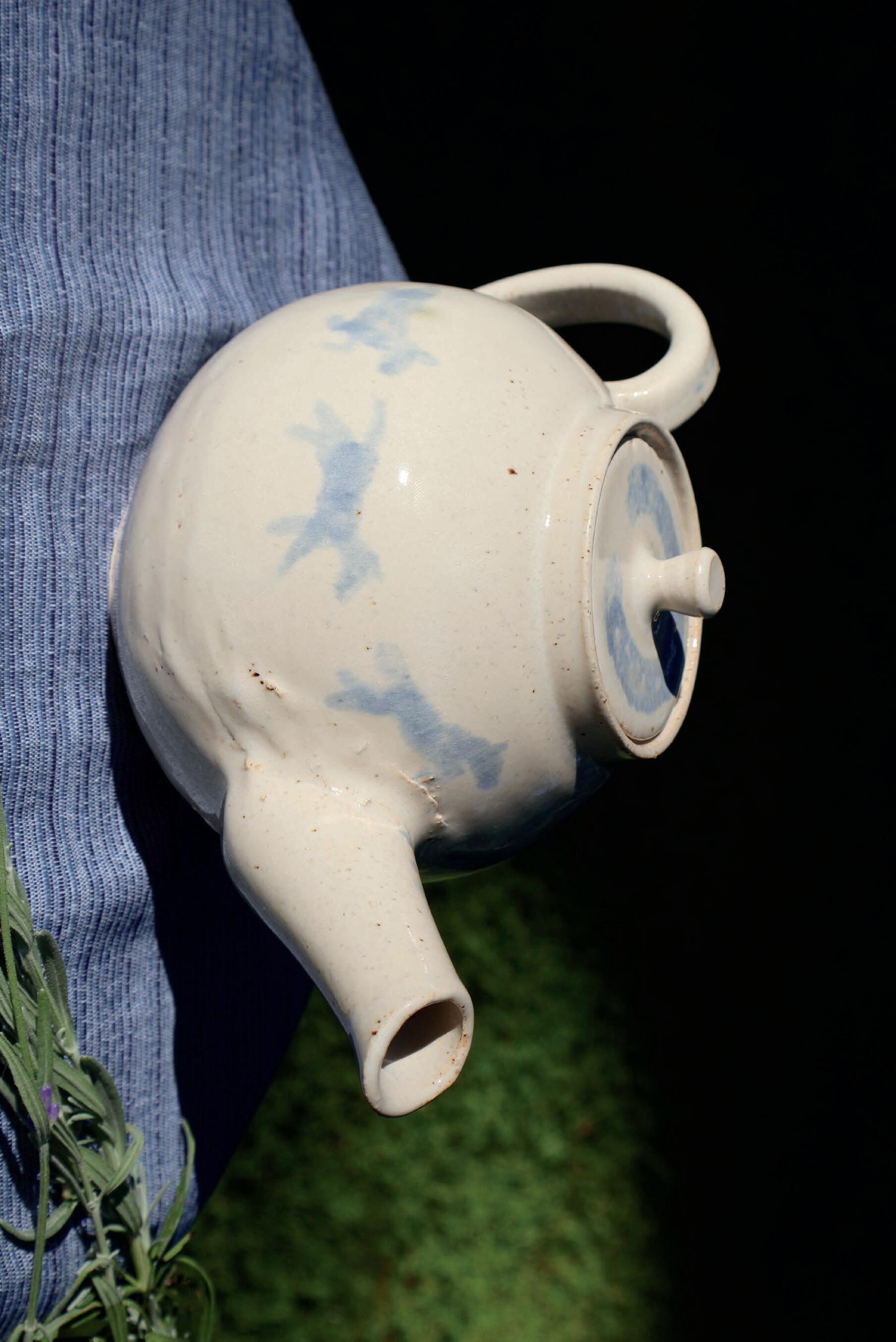
Painted Pony Teapot, 2025
I create ceramic wheel-thrown vessels that honor simplicity of form and humility of nature. I am inspired by ceramic history as it exists in every corner of the world, as a signifier of human hands and purpose. Some say the first human tool was a vessel—a bag, a basket, a vase. When I throw pots, I use the same techniques that humans have used for millenia before me, and I feel as though I can reach through time back to the beginning of humanity itself.
However, another aspect of my practice resides in the study of human-animal relationships and the criticizing and dismantling of anthropocentrism. While I have a fondness for humanity and our affinity for vessels, I find myself unable to accept the entitlement and elitism of our species, including our treatment of animals as a minority to be controlled. I often portray images of horses for their distinct relationship with the development of human society and their use in numerous aspects of human life. However, I rarely depict humans themselves, instead implying their existence through their impacts on the animal.
By combining a distinctly human practice, the beginning of which marked our diversion from the rest of the animal world, with a criticism of the effects of that divide—such as the anthropocentrism that justifies using animals as vehicles, farm equipment, and war machines—I hope to honor the animals of the past while encouraging discussion about the environmental, ethical, and moral ramifications of an anthropocentric society.
HENRY HOOPES
CERAMICS
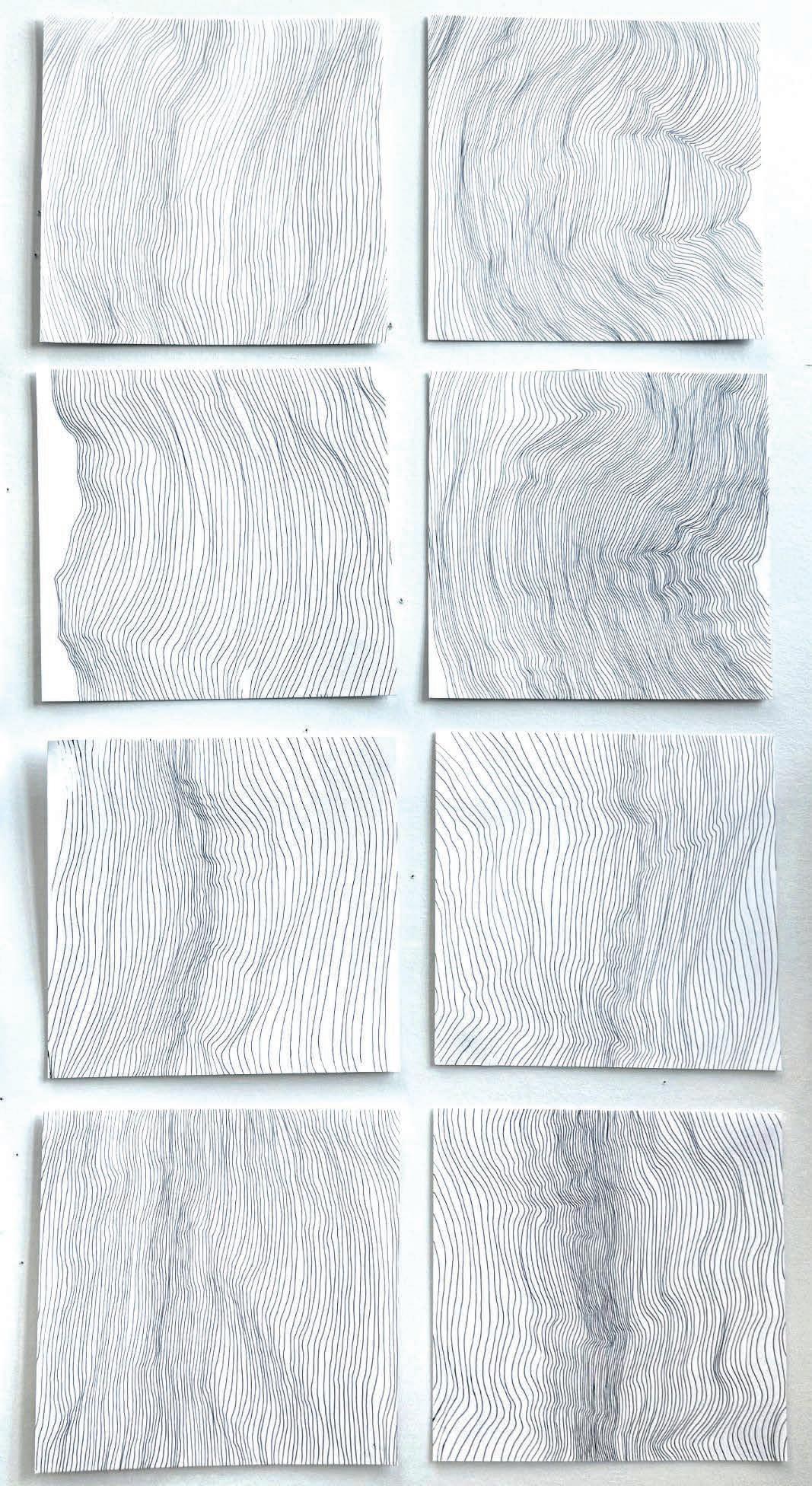
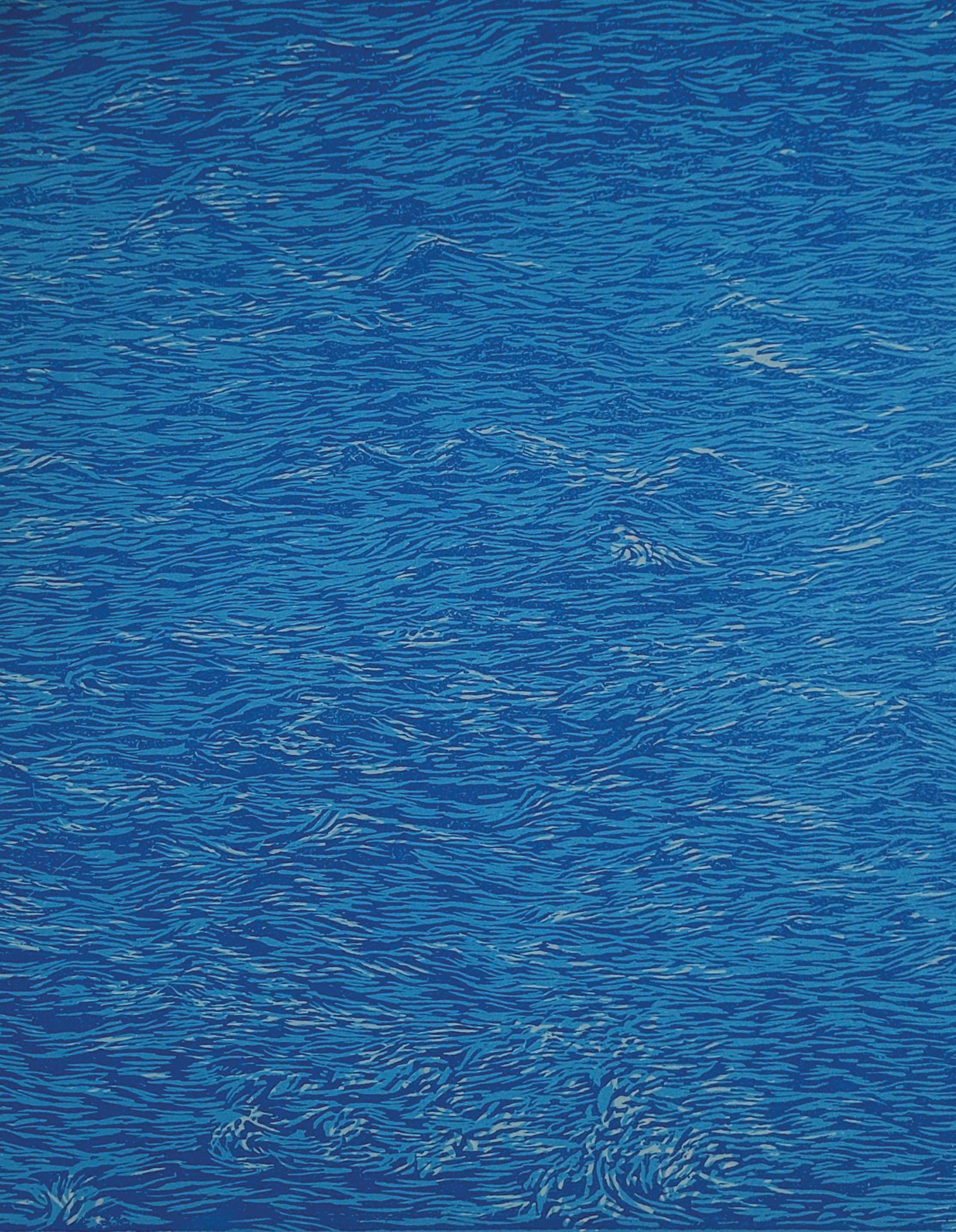
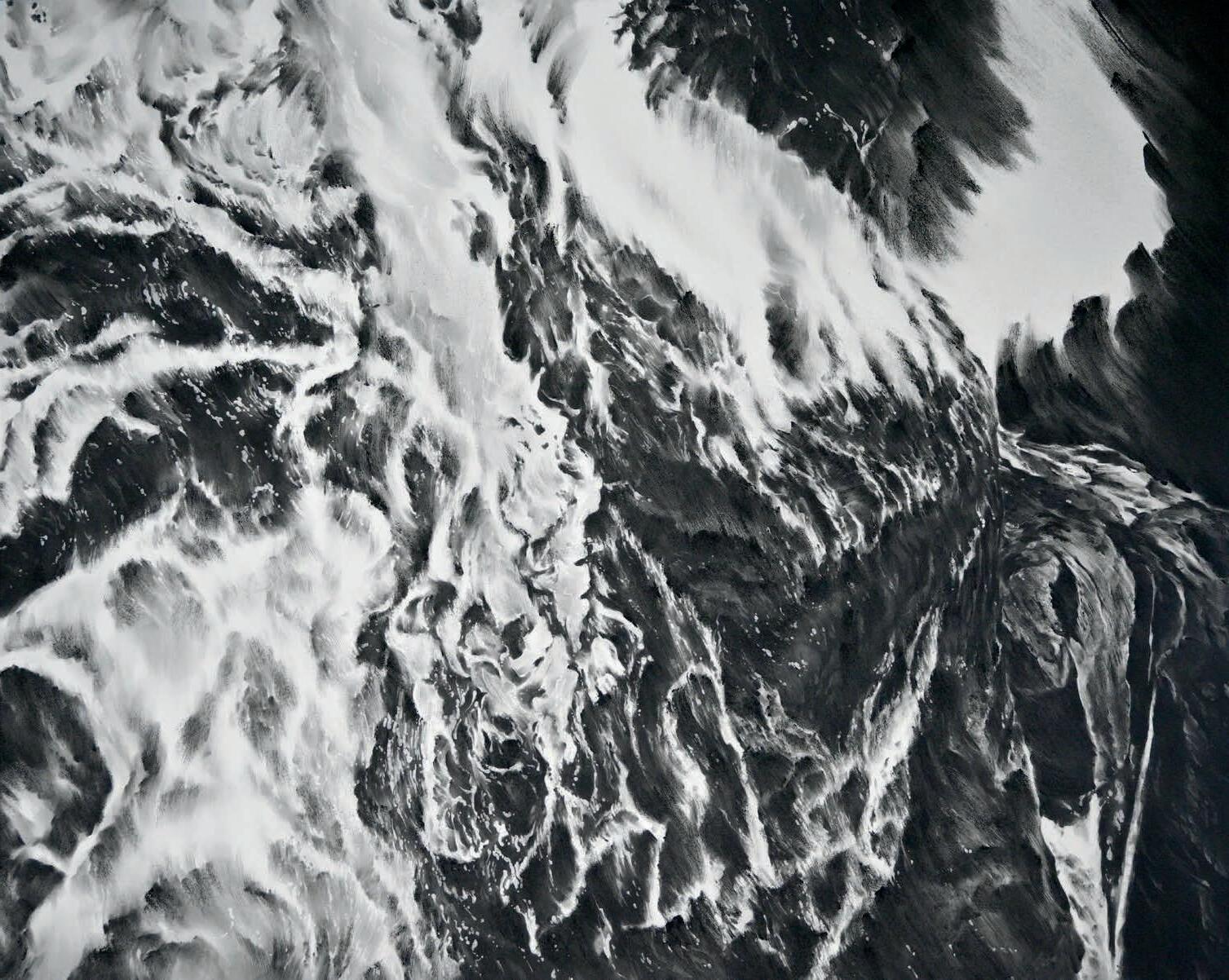
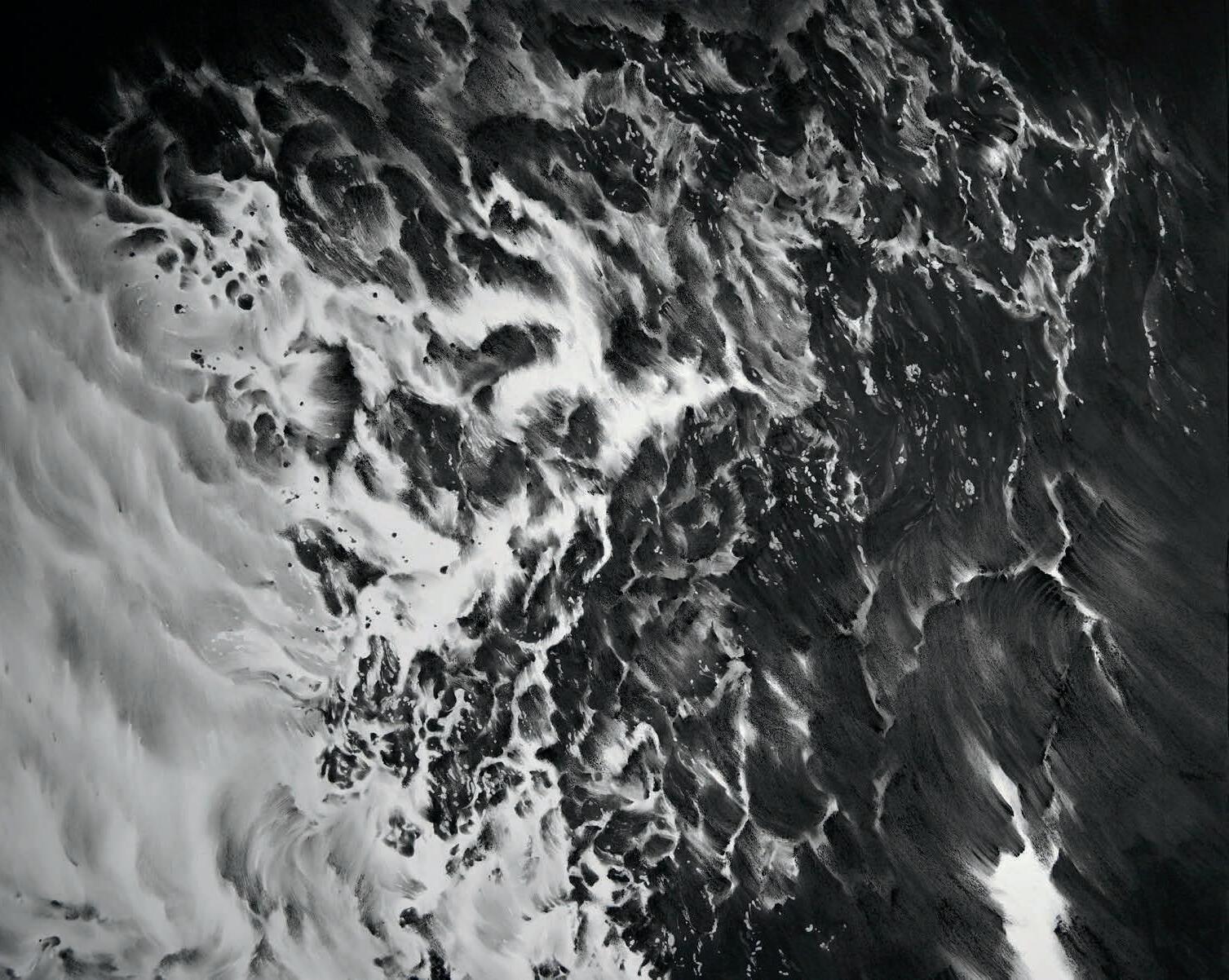
Working at the edge—the place where water meets land, where depth becomes surface, where a line decides what it is.
I am a drawer and painter preoccupied with water and topography, not as atmosphere or mood, but as a structural condition. Water establishes a plane that land either rises above or falls below. The coastline is not a scenic border; it is an edge condition—a transition zone where two states of matter negotiate their terms. Everything I make returns to that threshold.
Line is the primary language of the work. A line is a contour; it describes how a surface rises, falls, and holds. I work almost exclusively in black ink because it resists atmosphere. It does not imply temperature, mood, or illusion; it states only this is the shape of something. Each mark is both a decision and a test, locating a boundary that is never fixed.
My approach borrows from cartographic systems: contour lines, mapping conventions, depth soundings. These methods were developed to describe what cannot be seen: the submerged, the compressed, the translated. I am drawn to that problem of making depth legible on a flat surface. As water deepens, contours expand; as land rises, they compress. The invisible is structured through spacing, weight, and repetition.
Water seeks flatness, a constant level. Land is what exists above that plane; the seafloor is what exists below. I understand them as a continuous form, a single mass interrupted by a shifting waterline, and I try to hold both conditions at once. Line weight becomes a way to move between them: heavier lines assert ground, while lighter lines recede into depth and distance.
Two states organize the work. The first is immersion: being fully within one condition, surrounded by land or water, without a visible edge. The second is equilibrium: the horizon, a shared level where water and sky agree. Between these states is where the work operates: at the rippled surface, the eroding boundary, the place where a river opens into the sea, and where a line, however precise, is always in the process of becoming something else.
ELLA HOPFNER
Self-portrait, 2026
My work is inspired by my experience as an immigrant to latestage capitalist America—a world of $1.50 hotdogs and $150,000 knee surgeries—and the little absurdities I notice here.
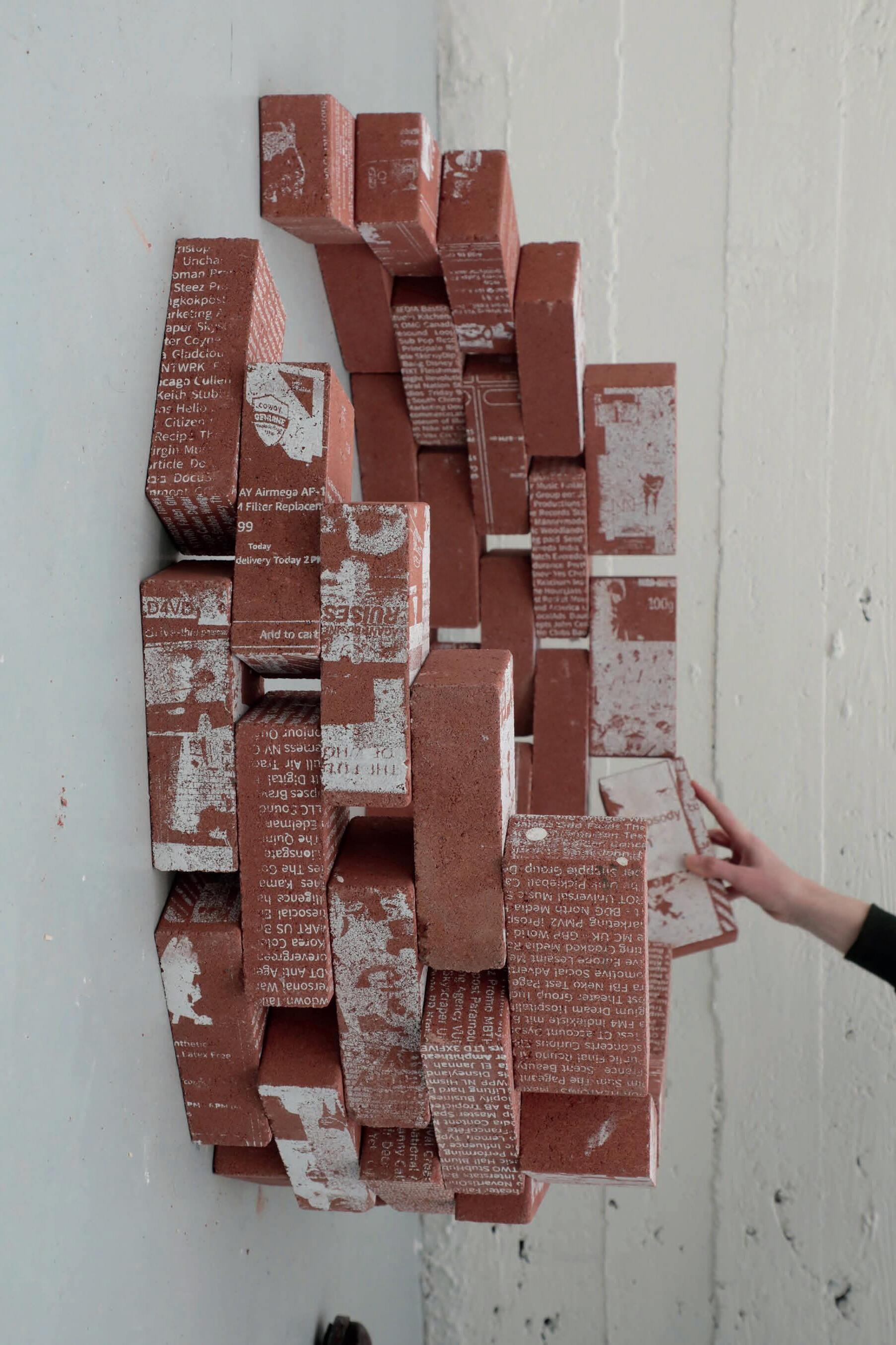
Using capitalism as material, I make playful interventions that result in absurd objects. McDonalds wrappers printed on handmade asian paper, tax returns made out of ground-up evidence of imperialism, or functioning credit cards made out of thousands of pages of paper waste that financial institutions produce just to embellish their numbers. I emphasize the base substrate of my prints—something that is often overlooked — as a crucial storytelling device in my practice.
My recent work, Self-portrait, began during the dozens of hours of doomscrolling that I partake in on a weekly basis. While scrolling, I frequently encountered this comment: “I built this algorithm, brick by brick.”
For this work, I requested a copy of my data records with all the big tech advertising companies.
I have accounts with and printed parts of my identity (according to them) onto bricks. Over the next two weeks, gigabytes upon gigabytes of data trickled in. a 100,000 line text file that includes every step I’ve taken in the year 2017, tens of thousands of different occasions I’ve visited Google on, and where I was when I visited it. No matter if I walked, drove, flew, or took the subway, they not only had every move I was making, but also what I was watching, searching, or consuming in between the transit, all on file.
I print on the bricks excerpts of the data dump I received from these companies: a list of all companies who wanted to target me by my email, every YouTube video I’ve ever watched, even down to what body wash I use. The size and weight of the bricks as a collective serve as a reflection of the gigabytes of the plain text that I received.
Every brick is a reflection of myself, and together, they become a self-portrait.
TEDDY HWANG
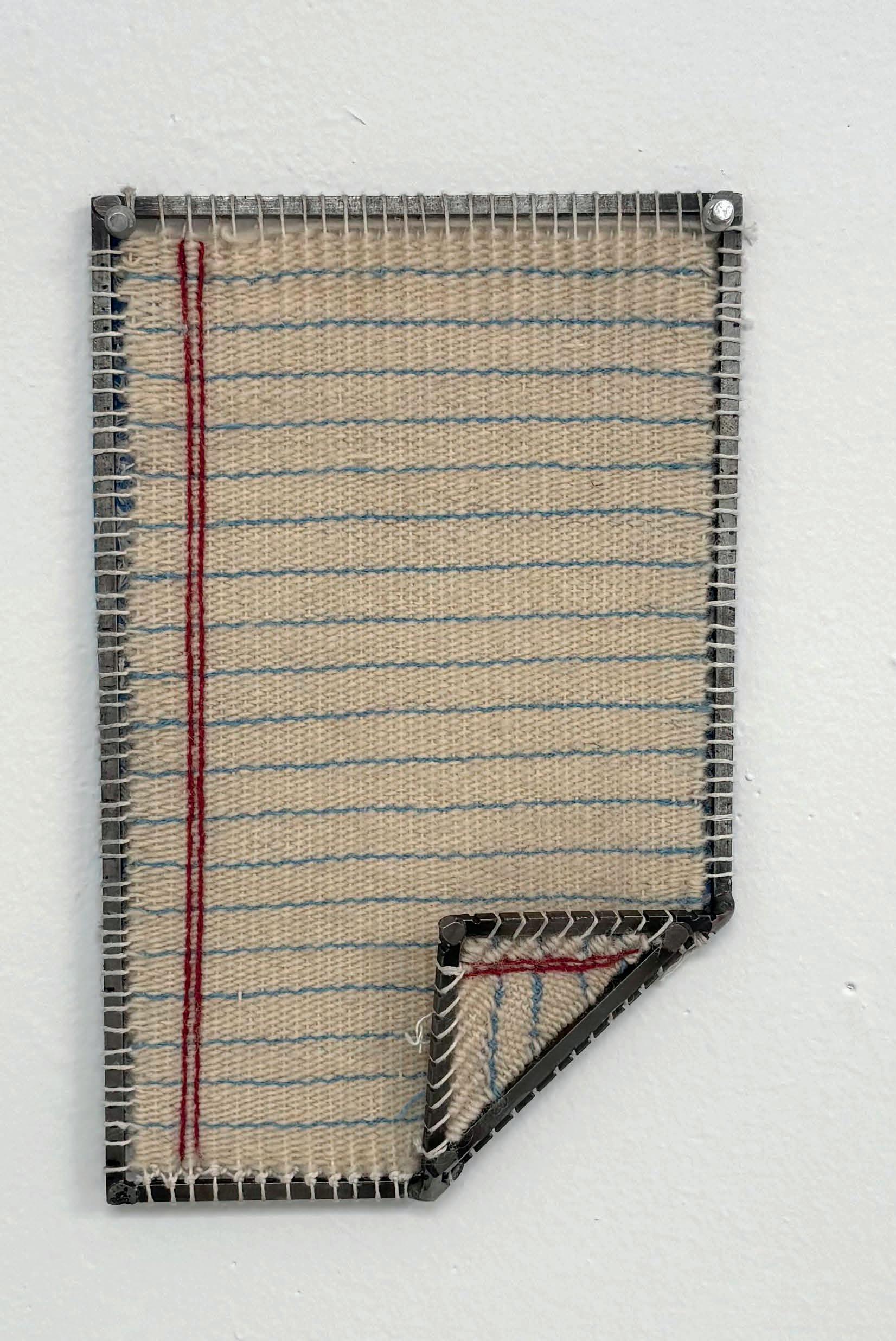
I am a tapestry weaver working on a vertical warp loom with hand-dyed wool. I construct imagery mediated through digital interfaces, including the internet and academic databases. My work is inspired by the abstractive properties of the loom, particularly in how the weaving process introduces a tertiary form of translation into image-making; It challenges me to develop a deeper familiarity with the process as well as a sense of humility in the face of its—and my own—limitations.
I am interested in the virtuosic dimensions of technical craft: the mythic narrative of the “master craftsperson,” set in tension with a more contemporary, democratized notion of ‘hobby craft’. Training within an undergraduate fine-arts institution has shaped my understanding of the loom through the advocacy and perspectives of the many craftspersons working within similar contexts. My work engages the distinct spheres of the art/craft divide and the uneasy ways in which these positions converge in contemporary craft practice. My tapestries respond to the muddle of competing perspectives within this discourse, particularly around questions of historicity, labor, skill, and value. I approach weaving as a broadly multicultural practice with a rich and complicated history, allowing my work to function as a way of situating myself in relation to the many craftspersons who practice it around the world.
RASTISLAV JANARDAN
FIBERS
you can find me with Cassandra Kellner
My name is Griffin Johnstone. I was born in San Francisco, CA in 2004. My practice spans the woodshop, the library, my room, the bus, and my studio. In the woodshop, I construct frames with scrap wood. I paint directly on wood or on paper mounted to wood panels.
I have worked in the SMFA library for the past two years, it is a significant source of inspiration to me. Research, whether in the library or anywhere else, is a central part of my art practice. I am a medieval-studies minor. Religious history and the history of devotional practices in medieval times interest me. I believe this aspect of my scholarship lays a foundation of language and historical context for the dialogue between myself and my arts practice, which is devotional for me in its own way.
Painting is a significant part of my life; I paint to process feelings and work through unresolved ideas. Painting for me is a means of dialogue with my unconscious, however, a lot of my studio time is spent preparing surfaces to paint on. I like figure painting. Lately, the figures in my paintings have been objects- objects which feel to me to possess some degree of personhood.
I enjoy female painters, surrealist works, spiritual exploration, and mixing colors. I’m influenced by the color, form, and symbolism of Hilma af Klint; The subverted familiarity of René Magritte; The colors, paint application, and feeling of Mark Rothko; The scale, thriftiness, and symbols of Forrest Bess; The geometry and color relation of Josef Albers. I hope my art makez u feel happy or scared or confused, we all feel difrent and thatz what makez us amazing.
GRIFFIN JOHNSTONE
CERAMICS, METALS, FIBERS, PRINTMAKING
Working my first job on a farm from ages twelve to seventeen taught me my core values– persistence, grit, patience, and not being afraid of failure. This is the approach I take to craft. My first fascination was textiles. I learned to weave in the third grade, grew up watching my mom sew quilts, and started dressing myself before I could speak. Textiles have a tactility, pattern, structural integrity, and rich history that provide me endless room for play.
My work is a collection of reimagined heirlooms that simultaneously represent my contemporary style and honor traditional craft techniques. As a multidisciplinary artist, I have a porous process that allows one craft tradition or medium to inform another. I apply techniques learned through fine metals to my ceramics and textile traditions to my metalsmithing. The finished objects– a ceramic hinged box, a bowl with a thousand hand painted leopard dots, a ceramic quilt– are a visual representation of the time and care that is hereditary to craft and the possibilities for experimentation across media.
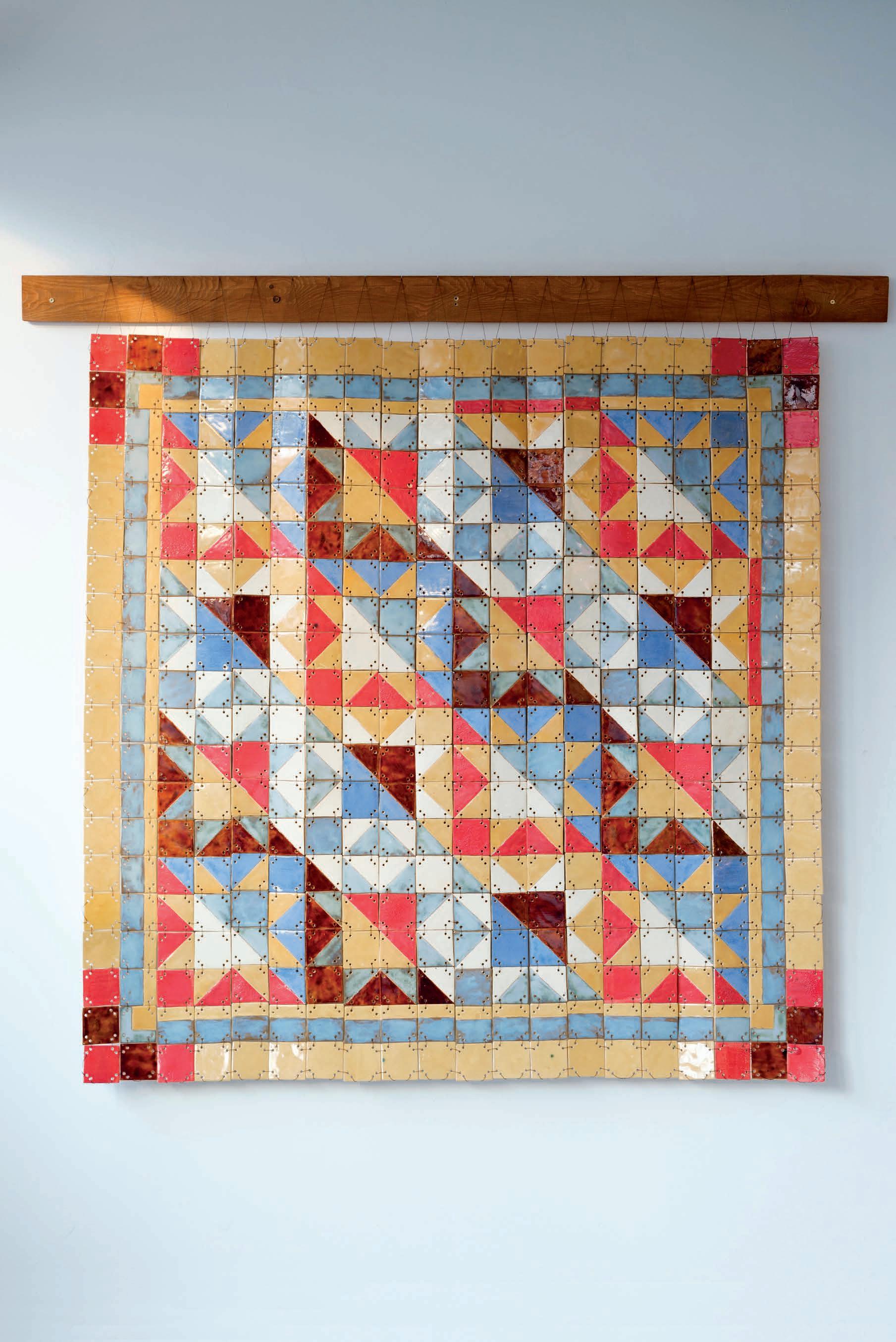
I indulge in the time-consuming processes of traditional decorative and functional craft techniques. In Coleslaw Quilt, I brought the memory of a familial object to life using four hundred handmade, ceramic tiles. I sewed the tiles together and hung the work, weighing nearly 80 pounds, from a piece of lumber my dad milled for me back home in New York. This work spurred my exploration between textiles and ceramics.
CASSANDRA KELLNER
The Fox and the Fray, 2026
What do we use? What do we waste? Is it a waste to wear something down or is it a waste to get something and never reuse it? In a fast-paced world, we consume quicker than we can appreciate, so it is ever so important to slow down and look at what we already have.
My work creates a conversation about this topic through the medium of storytelling and animation. Whether I’m working with small metals, printmaking, or digital art, the process of animating these mediums involves careful construction of many frames. One frame of the animation appears on the screen for a fraction of a second, and many different frames in succession create the illusion of movement. This process of repetition and iteration is a challenge that is rewarded by seeing a character come to life.
I grew up in the woods of Pennsylvania and the forested landscape of my home influences the visual style of my work. The plants and creatures constantly surprised me, and I aim to bring that same curiosity to my work by combining nature and fantasy. To me, the two inspire the same feelings of wonder and joy, so their intersection invites the audience to find the fascination in what already surrounds them.
LEAH KERRY
ANIMATION, DIGITAL MEDIA, FILM + VIDEO, METALS
Leaping between disparate mediums, I investigate the tension between powerful and delicate, animate and inanimate. For this work, I combine handmade paper with acrylic and vinyl, amplifying the medium’s contradictory materiality to create translucent and hauntingly animate forms.. Utilizing incredible natural light and the compelling form of our Library’s windows, I hope to give back to this space as much as it has given me. My aim is to both draw greater attention to the incredible service that light brings us when it fills our spaces.
I am drawn to cycles, flitting between renewal and rebirth, and stagnation and self-sabotage. Epitomising my obsession cycles, the Ouroboros has been an icon in my work. Its likeness appears in disparate cultures around the world, seemingly unconnected. Much like the tree of life, something about a serpent consuming itself has captured human kind. It speaks to our insatiability. This is not to be confused with greed or gluttony, the Ouroboros feeds only on itself. When I think of this insatiability, I think of my own self possessiveness, a drive to explore every thought to the detriment of accomplishment. That ceaseless churning feeling is destructive, yes, but can also be fertile ground for creation. Snakes as a symbol are not chosen purely because of their smooth vasiform bodies, but because of their regenerative abilities. Snakes shed their skins, birthing themselves anew many times throughout their life. Self-consumption has just as much ability to deplete as it does to nourish. With enough passion, the creative spirit can consume itself into perpetual motion.
My placing of these symbols in the library is not arbitrary. It is a space where we can feed endlessly upon the ideas of others, yes, but also push deeper into our interiority. The Ouroboros is a reminder that the hunt for more knowledge and understanding is never over. So we must be ravenous with hubris, giddy with the chase of unattainable mastery.
Do you feel hungry?
ALETA LARKIN
in the glazing room at midnight
CERAMICS, PAINTING, SCULPTURE
My work combines playful mixed-media processes with sculptural installation to explore the tension between chaos and control through humor. I am interested in how organic forms, repetition, and material experimentation reflect emotional complexity.
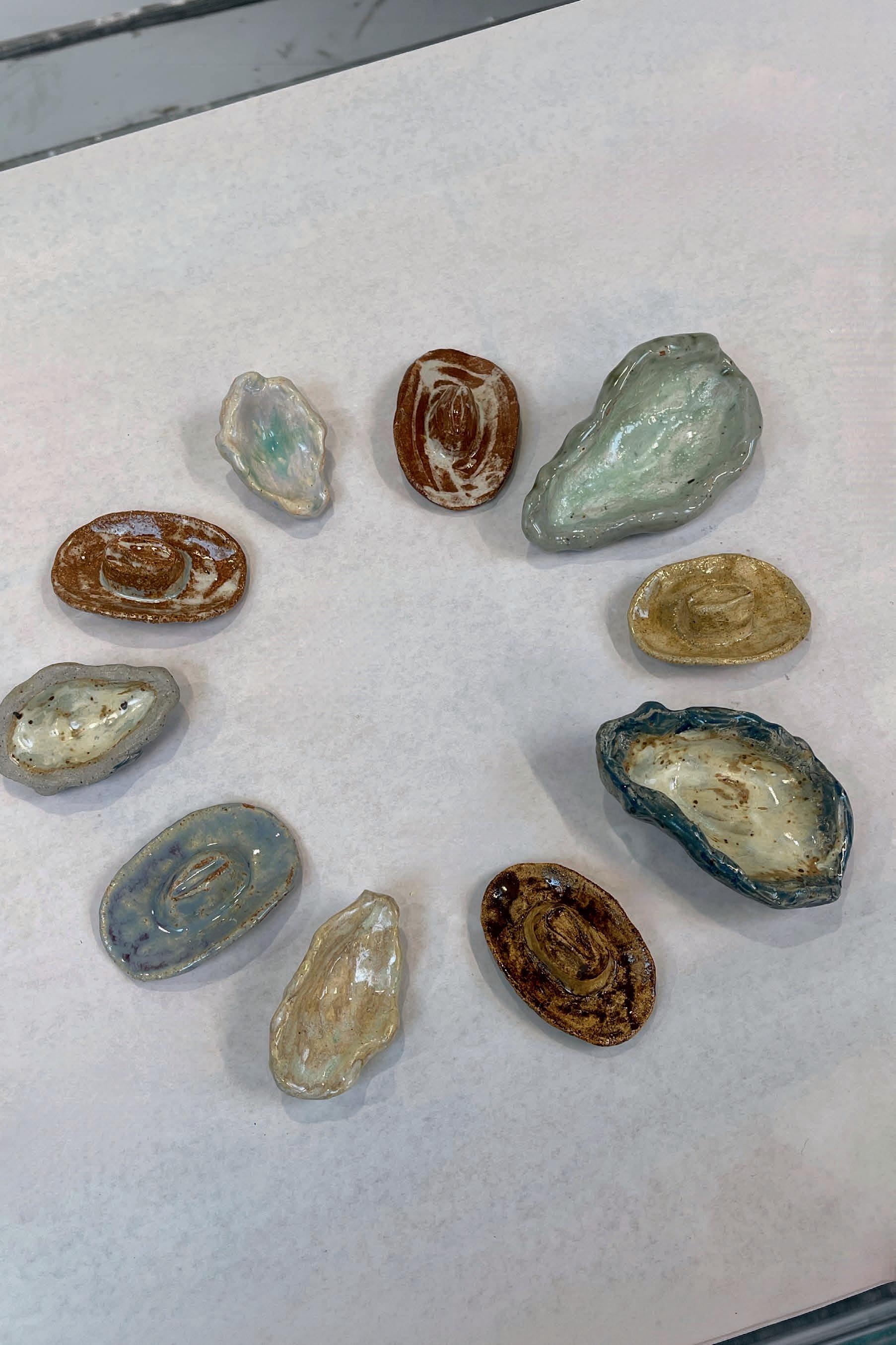
I work across ceramics, painting, and wood, allowing tactile materials and intuitive making to guide my process. I am especially drawn to forms that feel imperfect and alive, where texture, repetition, and variation carry meaning. I take inspiration from artists like Yayoi Kusama, whose works also demonstrate playfulness and psychological depth through excess and repetition. In my thesis, Oyster Rodeo, I use ceramic oysters as a central form. The oysters are made intuitively through the pinch-pot technique, embracing irregularity and texture. In contrast, the cowboy hats are constructed through a much more deliberate process. I roll out slabs, cut precise shapes, and carefully assemble each component. This contrast in process mirrors the conceptual tension within the work: organic forms existing within a staged, performative, and structured environment.
Through this balance, I create a space that feels chaotic yet intentional, humorous yet emotionally layered. I want viewers to first encounter the work with curiosity or amusement and then recognize the underlying contradictions it holds. As I continue developing this body of work, I am expanding the scale and installation of Oyster Rodeo, exploring accumulation, spatial arrangement, and how these forms can transform an environment into something immersive, excessive, and alive.
GRACE LEE
neighborhood cats
DIGITAL FABRICATION, DRAWING, GRAPHIC ARTS PHOTOGRAPHY, PRINTMAKING, SCULPTURE
My work frequently considers in-betweenness– how history and myth are imbued into memory, the windy tug of a page turn, water connecting our bodies.
Conceptualizing, making, and documenting are my attempts to physicalize and learn from the subconscious. By enacting distortive processes like printmaking, drawing, image manipulation, and digital fabrication, I attempt to erode right angles containing constructs of real and fake, land, gendered binaries…
I have recently begun examining water as a slippery mental model for the mind, as home, as a sometimes horrifying archive, as a friend who reflects, fragmentizes, and encompasses. It is only natural that such a naked being would embody such seemingly contradictory forms and personalities. In tracing my own fluid inclinations and empathy, I hope to share my salvages– curiosities for the “mundane” and heightened awareness of our collective transcorporealities.
To me, the book is like water. Pages are pushed and pulled, they spill out like anemones. The book remembers, but not forever. It can conform to genres like ice cubes, but the most beautiful ones float in between. I find that I can help my noticings and processes speak to each other when I bind them to each other, combining spur of the moment images I take of my surroundings with intricate, ritualistic mark making. And through working with scale and transparencies, I seek to have these books to facilitate corporeal gestures of looking, of listening, of holding.
RACHEL LIANG
DIGITAL FABRICATION, DRAWING, GRAPHIC ARTS PHOTOGRAPHY, PRINTMAKING, SCULPTURE
I am a hoarder of stories, where the forgotten and forbidden reside, held in my memory and my art. I wish to give voice to the land that raised me and to the knowledge it holds, so that I can honor my cultural heritage and its practices. I believe in art’s role in social engagement, and I wish to speak for those unheard in the face of political injustice.
My practice explores the intimate relationship between the body and objects, using quilted, textured surfaces to evoke a sense of touch. My tactile practice is rooted in traditions passed down through my grandmother—nylon flower making, beadwork, and the one-hundred-family quilt. My work reflects what she taught me to love: the abundance of colour, shapes borrowed from nature, and crafts that take time and patience to nurture.
My narratives often draw from traditional Chinese folklore and my mother’s Tibetan Buddhist practice. Navigating between cultures, feeling both homesick and estranged, I reimagined my identity through symbolism and metaphor— the palm of the White Tara, holding her forgiving eye and a blooming utpala; the swallow, returning home as the first sign of spring; water lilies made of iron and copper, echoing the names of both my mother and grandmother.
In my thesis, I confront guilt, the weight of sacrifice, and dissect the lingering impact of political persecution my family endured that forever reshaped our lives. In The Blood Crown, I drew a parallel between my coming of age in the aftermath of violence and a folk story of a kid witnessing its mother’s death. In My Mother and Her Father, I use the long-duration beadwork to reflect on the prolonged death of my grandfather, questioning what it means to make the “right” choice. Ultimately, I aim to hold the history of my family and our survival, and to navigate loss through love and remembrance.
LEO LIU
eating vertically cut microwaved bagels
FIBERS, PERFORMANCE, SCULPTURE
My work spans across multiple mediums including painting, sculpture, and digital forms to examine the body as a site of projection. I most often combine human forms with other organic elements as a way to think through ideas of fluidity, vulnerability, and transformation. My background in figure painting and biology shape how I understand the body and its internal systems, while my more recent experimentation with fabric, metal, and performance extends my work beyond representation and into a more physical, lived experience.
This piece, Choose, marks a shift in my practice through the introduction of wearable sculpture and performance. The garment-based forms allow me to reference ideas of privacy and protection, while also taking on an internal, bodily quality. The use of translucent, layered, and congealed materials evoke the visceral textures of blood, tissue, and organs. Viewers are then invited to cut, tear, or suture the garments, manipulating the piece through direct actions. These gestures accumulate over time, permanently altering the form. In doing so, the viewer is no longer a passive observer, but rather an active participant whose decisions shape the outcome.
Rather than presenting a fixed narrative, Choose constructs an ambiguous situation in which participants are forced to make decisions upon an unknown, bleeding body. It may suggest an abortion, a birth, a miscarriage, or another medical condition, but its true circumstances are unknown. Can you make a decision without knowing? Can you bear the consequences?
SOLFIA LIU
you can find me eating takis at 2pm, working on another project
PAINTING, PERFORMANCE, INSTALLATION
DIGITAL MEDIA, DIGITAL FABRICATION
I paint the spaces we create when we dissolve together.
My practice exists at the intersection of two ways of knowing: the empirical rigor of neuroscience and the felt truth of human connection. With formal training in clinical neuroscience, I investigate the biological imperatives that drive us toward intimacy. However, evidence-based medicine, for all its necessity, often flattens the complexity of human experience into quantifiable outcomes.
What does it feel like when boundaries blur and “I” becomes “we?” Inspired by visionary artists like Alex Grey and Allyson Grey, my practice documents the anecdotal stories of exploring human consciousness and connection activated through psychedelics. These subjective moments will not appear in clinical trial data but matter profoundly to the people living them.
Through large-scale oil paintings, recorded interviews, and immersive installations, I explore how human consciousness is shaped by relational events. These events require two individuals to use the physical and mental space to reimagine the territory between them. By pairing portraiture with recorded interviews of couples who have shared psychedelic experiences, Between Us argues that connection, and therefore consciousness, is fundamentally relational. Each painting presents a specific moment of shared perception, dissolving boundaries, and collective meaning-making from the recorded interview. The accompanying audio excerpts preserve the couple’s own voices. Together, these elements create a layered installation in which viewers witness both the intimate experience and its interpretation. The pieces explore the quality of being seen by another person: the geometry of entrusted vulnerability, and the emotional weather of a relationship in continual development.
My work shares the stories of how intimacy reveals itself when we become vulnerable with each other, uncompelled. How may we interpret the perceived lessons found in these unique stories?
ARIA MA
Deluge, 2026
darkroom
My work explores memory’s fragility and invites viewers to consider what and who are lost and forgotten in the wake of accelerated climate disaster. I bring the abstract idea of climate catastrophe into intimate focus, connecting large-scale disaster to personal loss. As a young person, the climate crisis feels immediate rather than distant, a looming reality my generation will inherit.
In Deluge I trace the destruction wrought by a flood, using analog film, still photography, projection, and water-soluble paper to create a 3-channel video installation.
Drawing on Chris Marker’s use of still imagery in La Jetée, and Bill Morrison’s exploration of film degradation in Light is Calling to evoke memory, the installation juxtaposes three visual modes. Including, video footage of photographs printed on water-soluble paper slowly dissolving in water, 16mm film capturing the erratic aquatic landscape, and a performance piece of the body post-catastrophe as it’s cleansed by finally calm water.
Still photographs preserve moments that have already passed. I interrupt their illusion of permanence and expose the instability of memory by dissolving and distorting these images. I pair them with analog 16mm and 35mm film, materials that evoke a dystopian atmosphere and point to a future in which digital technology has become obsolete or inaccessible, leaving behind only mechanical processes to record what remains. Film’s tactile nature makes it especially vulnerable to scratching, fading, and gradual physical decay. This fragility allows the medium itself to mirror the process of forgetting, as images erode and slip into abstraction.
In my art viewers witness loss unfolding in real time, connecting to the vast scale of climate collapse with immediacy at a human scale.
LEYLA MANDEL
FILM + VIDEO, PHOTOGRAPHY
My work is an archive of people, memories, and time, centering Latinx presence as a form of resistance against the historical erasure of people of color in the United States of America.
Through painting, printmaking, and independent publishing, I uncover buried histories of Mexican and Chicanx communities to highlight the experiences of Latin American immigrants and the generations they raise in Los Angeles through a Chicanx lens. I use my art as a form of education and connection, aiming to uplift, honor, and celebrate the lives and the impact of my family, friends, and neighbors.
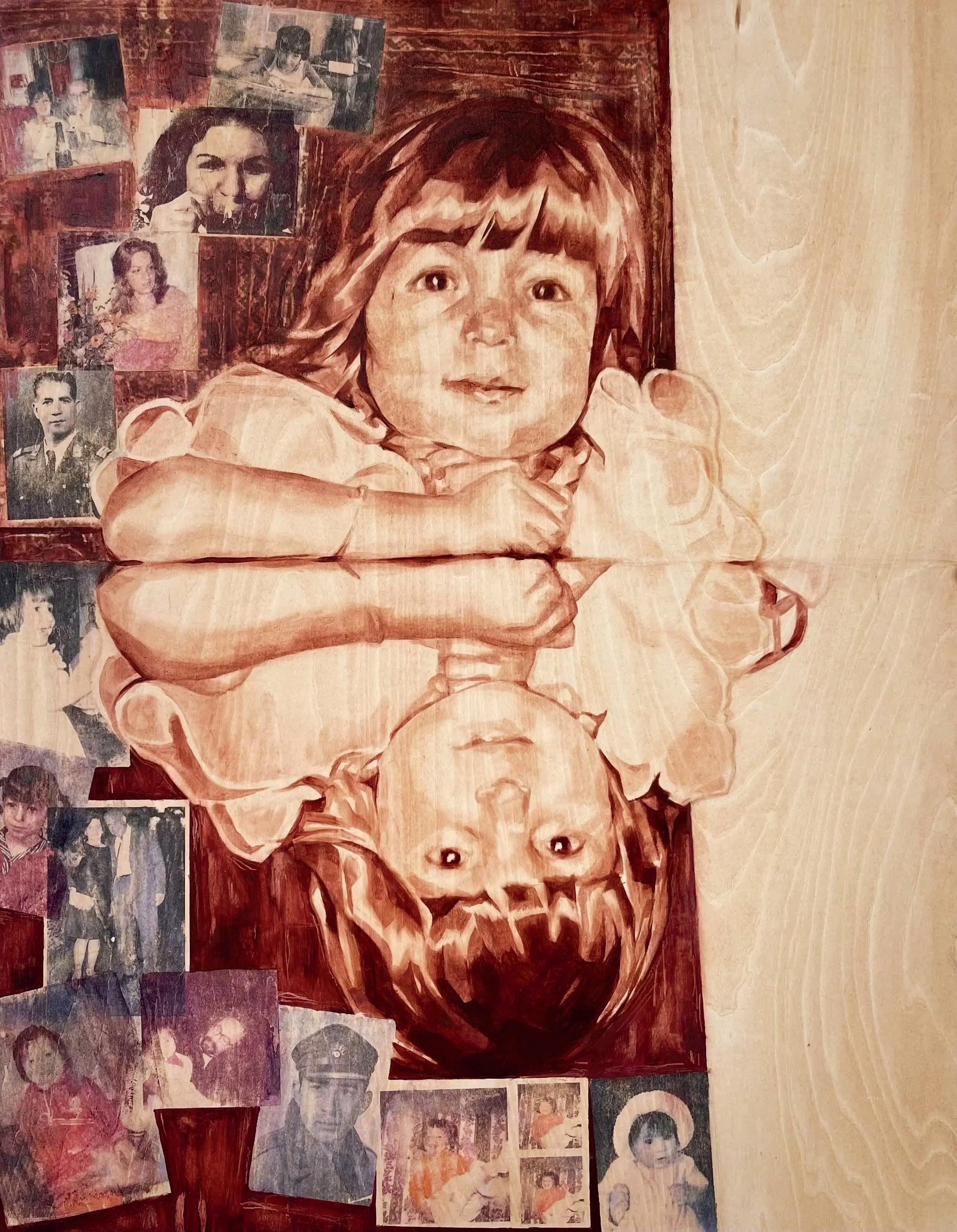
In my recent project, Los Doyers, I document and critique the nuanced relationship between the Latinx community in Los Angeles and the Dodgers baseball team. My focal points include: the removal of the Bishop, Palo Verde, and La Loma communities to build the stadium, Fernando Valenzuela’s cultural impacts on the team’s fanbase, and current events regarding the Dodgers under the trump administration. To create the pieces, I collage found photos from newspapers and family archives, explore layered applications of acrylic through painting and screenprinting, and collaborate with members of the community to provide a deeper understanding of the relationship. This project raises awareness of these historical events while challenging the centralization of white, cisgender, high-class men in the documentation of “American” history.
“They buried us, but they didn’t know we were seeds.”
- Dinos Christianopoulos
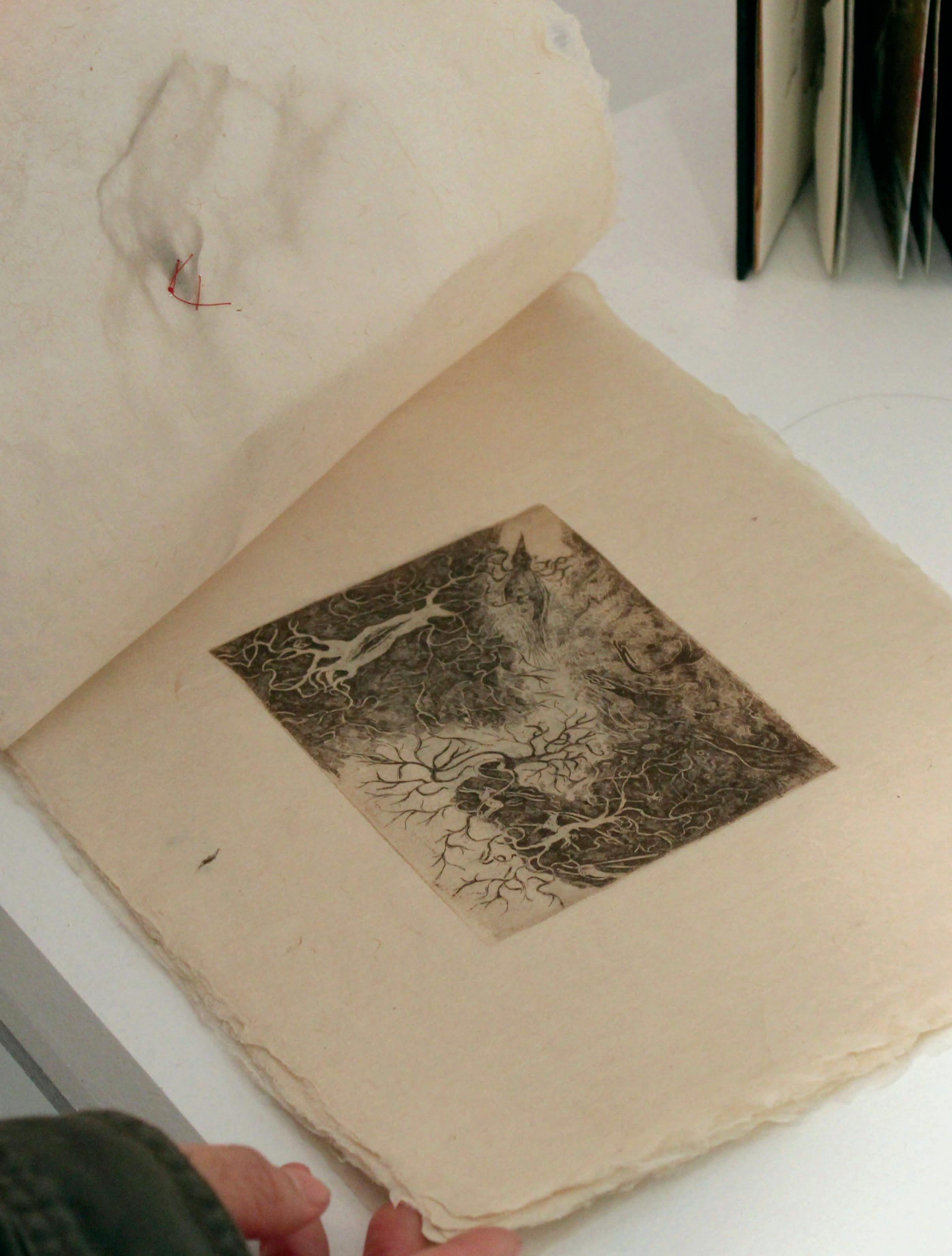
I am a papermaker, printmaker, and book artist working within material and conceptual connections to trees. I work with natural bast fibers like kozo to create delicate, thin sheets of paper. I use light as an illustrative and physical tool in tandem with my papermaking practice. When held up to light, these thin sheets of paper reveal patterns and imagery. The care and attention to tactility during the processing of fiber creates a sense of understanding of the plant. I use the raw abilities of materials with which I create work as an influence on my final product. I use etchings and mezzotints to visually illustrate the experiences that I have amongst trees. This illustrative process is a combination of representing the physical space that I inhabit and the personal feelings I have with the space. I consider this to be a meditative process, allowing the illustration to develop intuitively over time. Binding these prints into a book gives me the ability to create a narrative and encourages human interaction with the object. I am inspired by the way that early manuscripts and letterpress printed books were crafted with slowness and care. Being involved in each step in a book gives the object a handcrafted aura. To be activated, a person must touch and flip through a book. Feeling the tactility of the paper creates a connection between myself and the viewer. Withholding text from the viewer in the book form allows for personal connections to be constructed outside of a set narrative. Organic forms and shapes are influential to the stylistic choices I make in my art. However, organic also refers to the potential for life and growth, which is something I wish to give the subjects of my work.
MCNINCH
liver of
in the stu
My work is primarily craft-based, living somewhere between contemporary design and traditional form. Focusing on metal as material, I explore how its characteristics and historical associations give insight into human behavior. I explore our instinct toward control and self-preservation and how that manifests in everyday beliefs and practices. People have forever turned to metal in search of protection, looking to have a hand in their own fate, whether that be through physical armor, or in less corporeal forms, like art, namely jewelry and body adornments, which serve as symbols of identity, status, religion, and even luck. We rely on these markers and so many others to keep us out of harm’s way, truly believing to some extent in their ability to keep us safe. Through metal jewelry and adornments, I depict common practices people partake in to offer a sense of autonomy over their lives. Utilizing text varying in legibility, I am able to manipulate the ease of consumption, continuing the theme of self-preservation with parcels of pre-approved vulnerability. This work functions as a mirror of our constant grasp for control in countless ways, all of differing levels of absurdity. I do not aim to decipher which methods are effective, but instead emphasize our need to believe in something regardless of the result.
METALS
you can find me
DRAWING, INSTALLATION, METALS, SCULPTURE
I make work to clarify my thinking. Or to discover reason.
Mostly through means of sculpture, though I am open to learn new mediums and fashion my own. I am attracted to materials that have lifespans, or can take on other lives outside of my own. More often than not, I create a form without knowing too much about why it needs to come out. Through procedure, trial and error, play and patience, I can build reasons, border my thinking. My focus comes easier, and my reasons more concise. I am finding play important because I find considering value important. Play as a means to reconsider value, as a means to change the frameworks of time, and a means to conquer my fears.
I find comfort in using fragmentation and abstraction. But I am gaining more confidence with appropriating form and identifying an image. I am eager to find a means to allow more touch to exist within my work. And discover more methods of playing with the audience and much as my medium. But when art no longer has the ability to be activated, what happens to the space it inhabits afterwards? What does the responsibility of art have to do with the artist. What does it mean to take up space and time? These are the spirals that create my fear, yet cause movement towards my making. What is the value of an object? To exist as a thought within, or physically outside the body of the artist. To exist as a vessel of connection between the body of the artist and the audience. Space has not always been a security, and I adapt my work to fit the needs of movement, removal and transferal. I try to make what I have last, but more so in essence rather than physicality. I am comfortable with loss because my memory is alive. The object becomes alive through me, and retains form through thought and memory just the same.
GABRIELA MENDEZ
you can find me looking for trash and other art materials outside, drinking my third tea of the day, still talking about the latest movie
INSTALLATION, SCULPTURE
From sidewalk chalk to the streets of my LA neighborhood, I’m inspired by texturally diverse aesthetics.
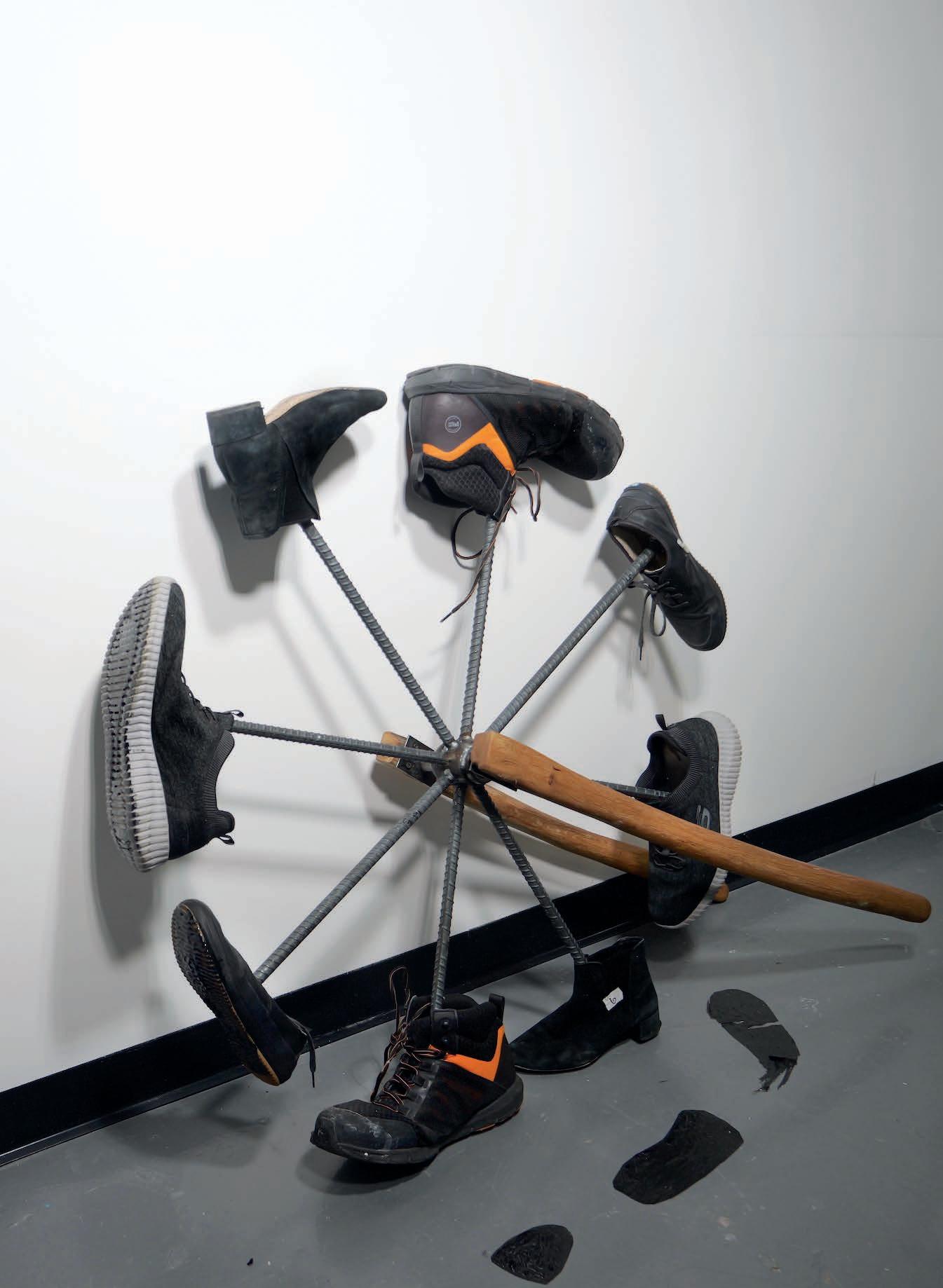
I am a medium-agnostic artist whose work emerges from my deep reverence for history. I am interested in an ethos of transformative materiality—the idea that the materials we choose carry histories of their own, and by reimagining them as pure, we can reframe their stories. There is value in discarded materials that have “outlived” their original purpose yet still hold meaning and potential. I limit myself to found materials - cardboard, found shoes, retired house material, etc. Sourcing materials throughout my everyday life gives me a starting point and base for research.
Art, for me, is not a passive object to be admired but a dynamic force for engagement. For this reason, my work is often activated through performance or presented in uneasy installation. I use forced perspective, gravity, and unusual mounting points to create objects that perform. Everything is precarious or seemingly about to run away. The goal is to replicate the romantic explosion present in the live performances, or the time between a breath in… and out.
ANTONIO MICHAELS
(anyone’s porch)
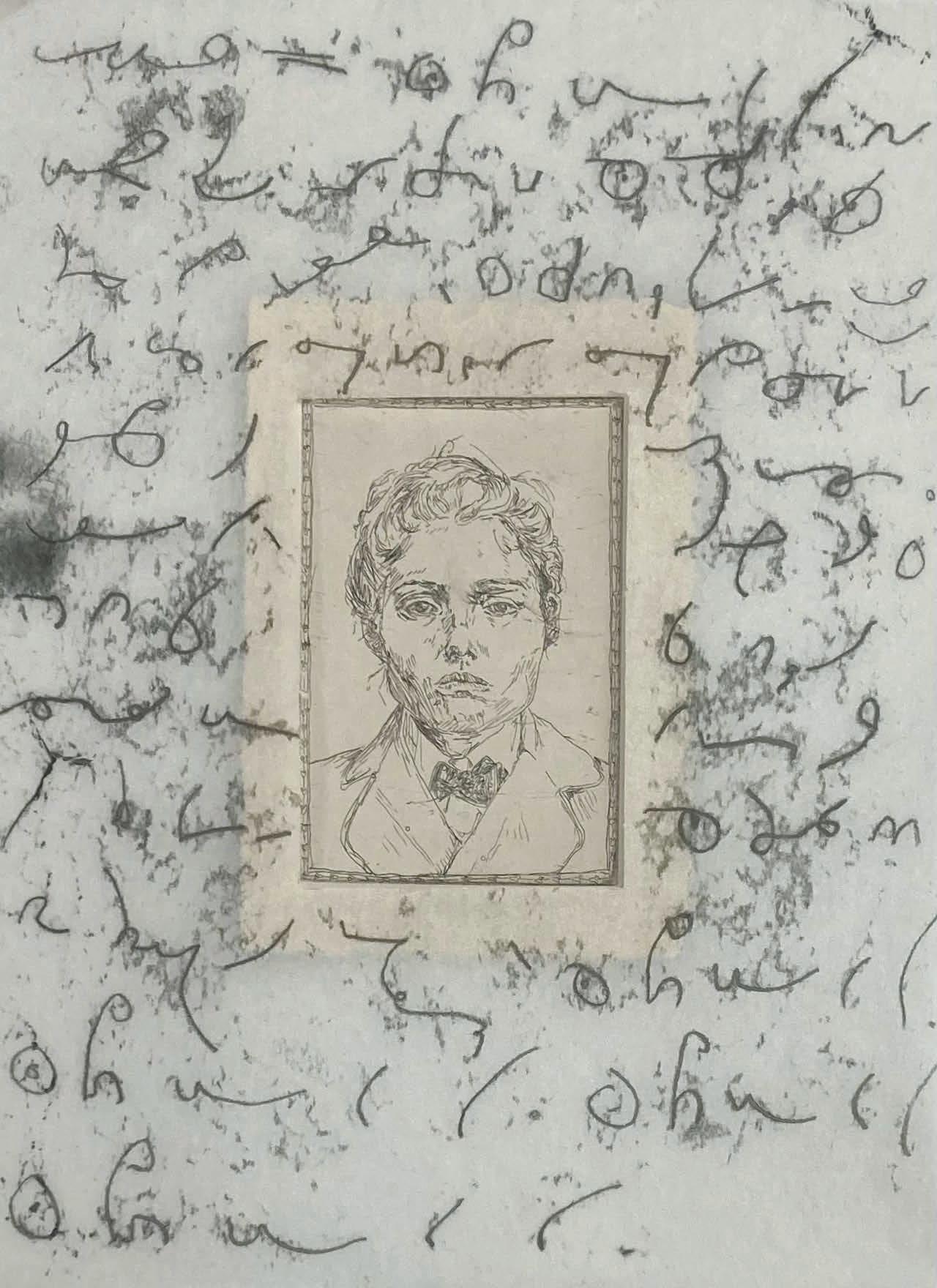
My work is guided by instinctual and lingering obsessions and centers on women acting outside the realms of accepted behavior. I am interested in the archive as a space to explore fantasies, wherein I form intimate connections with characters I create in my mind based on archival images. The close looking, inherent multiplicity, and repetitive mark-making of printmaking have become a way for me to show devotion and care towards women whose identities have been lost to time, yet whose images remain as sites for my own remaking and imagination.
I am from Atlanta, Georgia, and am earning a BA in art history and a BFA in printmaking at Tufts University and the School of the Museum of Fine Arts.
LILA MILLER
DRAWING, FIBERS, PRINTMAKING
In my art, I speak candidly about the complicated relationship I have with OCD and how I navigate the tension between something that is integral to the way I think and process, but has caused so much distress. I explore this balance and make the audience consider my looming thought process (often concealed and masked) explicitly; it is simultaneously unignorable, disconcerting to look at, and clumsily endearing. The accumulation of fabric, thoughts, and ink becomes overwhelming, suffocating. By exaggerating existing forms (often clothing items) to the point of being humorously grotesque, I hope to convey how OCD affects one’s social life. Namely, I want to project the pervasive sense that one is a funny-looking, ill-fitting garment in a room of tailored gowns.
A more personal convention of these processes is repetition: repeated stitching, piecing fabric, printing, knitting, cutting paper, and weaving (and thinking, thinking, thinking). Repetitive media encompass what is most important to me about the process: how these repetitive acts activate a sort of mindfulness. When I work, I become more aware of the thoughts flowing through my head and more able to accept or refute them. I think that my work engages heavily in (and upholds) this repetition not only physically— because the processes involved in these media require repeating the same step over and over—but also conceptually. My thoughts are (by nature) repetitive, and channeling my ideas into a medium that echoes the way my brain digests the world around me helps tangibly manifest the way I function.
Presented as a cave and alebrije-inspired performance suits, this project explores cultural identity, memory, and belonging through an interdisciplinary practice. The work spans installation, fibers, papier-mache, sculpture, and painting. Rooted in my Mexican and Nicaraguan heritage, I draw from these craft traditions as both material and conceptual frameworks. I approach these practices not only as forms of communal making, but also as vessels of intergenerational connection through knowledge and care. “Todos Somos” centers on the idea that home is not fixed, but something carried, remembered, and continually reimagined. I am interested in how both personal and inherited memories shape our understanding of where we come from and how we situate ourselves in the world. Organic forms appear throughout the work as symbols of rootedness, migration, and growth. Through movement and process, I explore these themes of transformation. These elements act as quiet witnesses to histories of ancestral resilience.
Softness operates as both an aesthetic and political strategy within my practice. I ask the question, “What makes a home feel safe?” Through tactile materials, layered forms, and immersive environments, I create spaces that invite intentional emotional presence. I critique the powers that displace and erase through positioning softness as a form of resistance against rigidity. Under these powers, my practice provides spaces for alternative methods of processing.
The work becomes a world for radical, joyful belonging, one that honors hybridity, embraces multiplicity, and fosters community. I create an environment where collective histories coexist, offering viewers an opportunity to reflect on their own relationships to home and identity. It is also a space where the strange and unfamiliar parts of ourselves are not only accepted but held with care. The immigrant experience is both honored and critically examined, asking why difference is so often framed as otherness, or even as monstrous.”
LUZ PALOU GARCIA
At the center of my work, is a practice of constant, daily drawing with pen on paper. These detailed illustrations from imagination are made without a plan, and I allow them to form around my interests in architecture, religion, art history, technology, and the absurd. The ideas I find through this process form the basis for larger works in painting, sculpture, animation and comics. Alongside my visual arts practice, I maintain a writing practice that consists mostly of science fiction short stories, and essays on art creation and instruction.
The themes currently directing my work are narrative as creator of reality, human obsolescence, and diagrammatic understandings of human perception. In looking beyond the human, at the abstract forces which form our universe, I find an endless source of terror, wonder, and humor, that guide my work. I hope to create images and stories that bring existential strangeness into focus.
RUBIN-WISH
DRAWING
As a sculptor, I am constantly thinking about objects: what they are made of, what they hold, where they are kept. So much so, that sometimes it is easier to imagine the thoughts and feelings of everyday life as objects that I can hold. I often wonder if the mechanical processes of drawing, measuring, measuring again, cutting, and assembling can be applied to the sort of feeling that no one can describe but everyone feels. Deeply personal experiences that generate the incredibly general-but no less deep-feelings of love and loss. Those feelings show up for me like slippery glass marbles, always rolling out of my grasp when I try to show them to others. So, I make work that serves as a sort of box for these marbles. By working to create a box that perfectly fits this mysterious gap in language, space for understanding is created.
Describing the negative space around these marbles and the friction they create fulfills my drive to understand and be understood. Translating those slippages into form leads to a reactionary process driven by problem solving. I utilize a wide variety of materials, from handmade paper to 3D printed parts, because each unique material speaks in its own way. In applying those different voices, precision, and craft to a vessel that contextualizes experiences that I find hard to understand, I am able to come to terms with the fact that these marbles cannot be put through the same processes. While there is never a guarantee or expectation that a stranger will see the marble I have packaged, the obvious care and attention in the object hopefully begs the question: what is inside that box?
JANEY RYU
2026
Fairytale,
taking the last green line train of the night
I am an artist working primarily in printmaking. In my work, I explore the Tatar culture that I grew up in. Drawing from memories of Tatar dance, culture, music, and family life, my work represents my conscious effort to keep a connection to the culture I was immersed in as a child. I use color to evoke the emotional texture of these memories: excitement and movement.
Recently I’ve been considering environmental concerns in my material approach. I work with repurposed materials that are the result of daily consumption like receipts, tetrapak containers, and soft plastic food packaging. It comes as exploration and experimentation of how the materials react together. Through printmaking and sewing, these fragments of the mundane are redefined in new context.
Process is central to my work, and I approach making as a way of thinking through feeling, allowing meaning to emerge over time. Despite the modern push for efficiency and speed, I let myself spend as much time as I need when creating. The various layers, marks, and details record this investment of time and energy. I bring attention to the time spent working on the piece and create a space to slow down and pay attention.
ILSIIA SHAKIROVA
My work reflects my cultural experience of interacting with America through strip malls and commerce, while living in Tijuana, Mexico. Sometimes this means I take mall chains like Build-A-BearWorkshop, and I edit their advertisements from the 2000s with personal family pictures, to make an acrylic painting. Other times it means I observe toys, I draw them with pencil on paper, and then paint them digitally, arranging them into a 4-color risograph book. As much as the American shopping mall was its own world, the world wide web was another, and through them my hope was to de-Mexicanize. When I lived in Tijuana, I believed that if I could consume like an American, I would become one. I use pixelation and resolution to reference power. In Mexico, advertisement banners are so low resolution, you can count the pixels; in America, you don’t see them. The internet was a promise: that we could become American, that we could be full resolution. To de-Mexicanize was my hope. In Mexico, the dupes were obvious, cheap, gaudy; but in San Diego they had “”the real thing””. My work is about making the uncanny duplicate. A duplication of a toy, or a movie, or a virtual world, so faithful that it reveals the inherit artifice of the original. My wish is to let you into the world of two Paos, cross-eyed: the past Pao venerating plastic, and cuteness, the cynical Pao whispering that it’s all hideous. Somewhere in between there is a truth I still can’t write down.
PAOLA SILVA LIZARRAGA
Side, 2026
Right
INSTALLATION, SCULPTURE
I am interested in the tension between the inside and the outside of the body and the membranes that separate the two. Skin, clothing, walls, and other barriers both contain our bodies and alienate us from the outside world. I create figurative sculptures to meditate on these dual realities, capturing moments where the body contends with its barriers.
I use my body as a matrix for mold making by casting personal clothing and making direct molds of my top surgery scars. The resulting work is a product of an iterative practice of replicating this stage in my transition. I make incisions in canvases and repair them with a curved needle like that of a surgeon. When the pieces are hung on or embedded in a wall at chest height, I can merge my body with the architecture that surrounds me. Re-enacting this surgery and using altered sculptures to confront space is a process of seeking an outsider representation of a subjective interior experience.
My experience as a trans person has revealed the malleability of my own body and the ways it can adapt and conform to gendered spaces and ideals. In “Drawing as Destination Forever Arriving,” the artist Mei Kazama equates the scars on their chest to the horizon line, both as confirming and as porous. In my work I grapple with this porosity, asking: how can we define ourselves and inhabit space with bodies in constant flux?
MIKEY SIMS
PAINTING, PRINTMAKING
My thesis work centers on five large-scale lotería cards, a format drawn from Mexican popular culture and reimagined as a space for intergenerational portraiture and ancestral reunion. Four of the cards present me, my mother, and my Abuelita. We are held together outside of linear time, dressed in Mayan and Aztec traditional clothing I researched and rendered with care. Each garment corresponds to the title of its lotería card and reflects the hierarchical and ceremonial role its wearer would have held. Time collapses across this series, for example, my grandmother may wear clothing from an era that postdates what I wear, because the work does not move through history linearly. Beneath every figure runs the same grass. Each individual blade was carved deliberately, stroke by stroke. The grass is not just a background literally but metaphorically — it is the connective tissue of the entire series. It is the place everyone comes from and the place everyone goes back to. In this way, the figures across different cards, different generations, and different centuries are revealed as the same people cycling through time. The land does not change. The people are the land.
The fifth card, Pasto de los Muertos, steps outside portraiture entirely and anchors the series in the ceremonial logic of Día de los Muertos; a tradition that treats death not as an ending but as a continuation of relationship, ritual, and presence.
This work was shaped by the ideas in The Aztecs and Urban Form, in which Georges Bataille, Diego Rivera, and José Guadalupe Posada are shown turning toward Aztec culture as a counter-image to modernity. While modern cities organize, sanitize, and conceal death, Aztec cosmology made it public, sacred, and communally held. My project does not mourn what was lost or rehearse its destruction. It looks instead at what can be carried forward; he joy, the pattern, the ceremony, and the image.
LUNA SMITH MEJIA
you can find me
on my second Dr Pepper in the metals stu
CERAMICS, METALS, PAINTING
My practice is grounded in a sense of home, shaped by distance and an ongoing effort to reconnect with memory. As a second-generation Cuban American, I navigate a layered understanding of belonging that feels both rooted and out of reach. Even without material heirlooms, I inherit an attachment to my past and a connection to a distant homeland I will never know. I carry this history like an invisible anchor.
This inheritance is deeply feminine, shaped by the matrilineal threads of my family stories and values passed down through women. Working primarily in small metals, I create narrative objects that function as reverse heirlooms - offerings in honor of my family. I am drawn to vivid color through enamel and porcelain, where luminosity and fragility coexist in a both delicate and enduring material. The ocean and its inhabitants recur as central figures. Acting as both bridge and barrier, a site of connection to my family’s history and a reminder of separation.
My earliest memories are tied to water; collecting shells and coral, shaking seaweed into buckets to glimpse the small creatures within before returning them to their home. I’m interested in how aquatic ecosystems transform over time, and how this flux mirrors the erosion and reshaping of personal and cultural memory.
Through jewelry and memento boxes, I consider how memory is held and ritualized in everyday forms. The permanence of metal gives work weight, elevating the mundane to something precious. Cultural references from Cuban visual and spiritual traditions inform my language, alongside an interest in devotion as both action and offering. Navigating the tension between public and private experience, I consider how personal histories are preserved through quiet acts of care. Ultimately, my work reflects a desire to stay connected to a sense of home, holding both the wonder and melancholy of being bound to something you can never fully return to.
NATALIA SOCARRAS
DIGITAL MEDIA, INSTALLATION
We are always carrying more than we can hold, and we are always losing parts of it.
All That I Have Tried to Keep explores the tension between what was and what is — between the weightless digital archive and the physical anchors of a life in transit. In this installation, I use projection mapping to transform a collection of domestic and personal objects into reflections of an inner world. I treat these objects I have carried with me from Pakistan—the tasbeeh (prayer beads), a childhood journal, my mother’s jewellery and old clothes—not as static relics, but as fragments that attempt to hold the sensory moments of past and present.
Emerging from this is a visceral growth of roots and branches: a living pulse. It weaves through the layered fragments, continuously outgrowing its boundaries. Structures -frames, fences, edges- attempt to contain these elements. But something continues to grow beyond. It represents a radical refusal to be defined.
A central element of my work is the creation of fragile spaces, which I think of as emotional landscapes where moments distort, overlap and bleed into one another, mirroring how memory is experienced rather than remembered. In this space, personal memory and grief shift outwards, becoming something shared. It is a quiet and deliberate act of care, an attempt to hold onto what is always changing.
FATIMA TAHIR
Over the past 5 generations, my family has lived along a stretch of wooded land on the coast of Beverly, MA. My paintings are inspired by the wild adventures of growing up on the North Shore of Massachusetts, which never lose their spark. I have grown up hearing stories of my mom, grandparents, and great-grandparents exploring tidal pools, galavanting through the woods, and spending their days under the sun at the beach. The recent loss of my grandfather has inspired me to depict scenes in which we have lived parallel lives. While we didn’t experience our young adult lives together, I invite my audience to imagine the activities, relationships, and life that flourished within my landscape paintings for generations.
My family’s beach and paths through the woods represent an unwavering capsule of memories, love, and growth. This beautiful haven has nurtured our belonging and connection to one another. I use loose, playful mark-making techniques, coupled with vibrant colors, to capture the full sensory experience of the landscape. Loose splatters of white paint echo the sea spray. The 3D leaves were applied with a palette knife, imitating the feel of a tree’s canopy blocking the suns rays. I built homemade wood frames decorated with found objects from the beach. The shells, rocks, and seaglass ground the piece in the natural landscape depicted.
The process of painting my home, along with the recent loss of my grandfather, has brought up mixed feelings of joy and grief. Over the years, I have watched as older generations pass on, family disperses, and land is sold. I’ve watched as the landscape begins to change, as it’s no longer owned and preserved within our family. As pieces of land are sold and developed, I hope that my oil paintings can hold the legacy of the land and our family that has begun to disappear.
EMMA THOMAS
at the beach, basking in the sun
CERAMICS, PAINTING
My work explores the fragile, often elusive nature of belonging— what it means to create space for oneself in the absence of a place that feels fitting. Drawing from childhood memories, family narratives, and Congolese folklore, I reimagine and reconstruct the idea of home as something fluid. The vast sky and deep sea become both metaphor and material—expanses that simultaneously connect and divide my motherland, Kinshasa, Congo, and the place I was raised, Ipswich, Massachusetts. These immense fields of blue function as thresholds that mark separation, and by dissolving and merging these blues, I attempt to bridge these distant landscapes, forming a sacred, imagined space where these two homes can coexist.
My work explores the intersection of disability studies and social justice through the lens of family origin and remembrance. Working in hand-built ceramics and through glaze chemistry, I have created two fountains, one representing the future and ourselves and the other representing the destruction of one’s past. Across these sculptural pieces, I use the form and function of a fountain to question what protest can look like when traditional modes of resistance are inaccessible. Flowing water becomes both a metaphor for persistence and interruption mirroring the experience of navigating identity through the current climate in the United States.
Influenced by Sick Woman Theory, I consider how people that cannot participate in conventional protest are often excluded from dominant able-bodied ideas of traditional protest. This work responds to Johanna Hedva’s question: How can you throw a brick through the window of a bank if you can’t get out of bed?. In response, I use remembrance as an act of defiance. I invite viewers to add to the piece by writing down a small detail of their family history and adding it to the piece, to pollute the fountain with remembering where we come from and to insist on carrying that history forward to resist erasure in a society that often devalues anything but sanitized American culture.
The two pieces embody both the destruction and reconstruction of identity. Materials and textures suggesting erosion, and fragmentation, while color and form point toward regrowth and transformation. This tension reflects the ongoing process of identity-making shaped by both personal and collective histories.
In this work, protest is quiet but insistent. It lives in the act of continuing and remembering. By putting these ideas within sculpture, I aim to create a space where vulnerability and resistance coexist where decay is not an end, but part of an ongoing cycle of regrowth.
ELLIOTT TURNER
CERAMICS
pretending to know what type of tree that is
In a looping knot we always find joy, something familiar, hair to braid, a photo to send, an unending, un-beginning love that sends telepathy, wavelength, sound file, snail mail, hearth throbbing, outwards. Always.
As a child, I believed that the trees in the forest walked around at night. My work is born from a lasting wonderment and continued conviction that there is something more than the plainly visible. Which is applied to the work by acknowledging the agency of materials and by referencing varied spiritual practices. Through sculpture that utilizes craft mediums, the work is both imbued with the charge of my bodily actions and is approachable to the human body. The body becomes one of the agential mediums alongside wood, metal or stone. These minimally processed materials position the work close to the Earth. These materials are activated through time-based processes; a burning candle, dripping water, the rusting of metal. Engagement with the work is subverted by encouraging viewer interaction, balancing the sculpture between art object and domestic object. Slowness or awareness is often required from the viewer, positioning the work against the scramble of modern life. My process integrates the sourcing of found materials with research on cultural and spiritual ceremony. Reused objects bring their past lives to the work while understanding sociological history informs how my experience can be made universal. Any material, object, action or belief that appears throughout time and place can tell us something about humanity. I am particularly interested in materials with interpretations rooted in both the environment and ritual, such as ash. Ash is not neutral, some might even call it provocative. It is present post-destruction. It is material un-done. Large amounts of ash can be associated with explosions or forest fires or war. All of which are unsettlingly familiar today. However, the nutrient-dense quality of ash makes it life giving. Ash is at once post-destruction and pre-becoming. Aren’t we all?
Through the cultivation of slowness and utilization of minimally processed materials, my work challenges the mainstream; maintaining a quiet strength.
BRODEN WALSH
you can find me finishing my first can of Monster at 10am
I depict landscapes I have not returned to since childhood, where memory and imagination begin to converge. The Yellow River series is an ongoing body of work that investigates place, memory, and identity rooted in the Loess Plateau of northwestern China, the landscape of my earliest memories. The land there is soft and unstable, constantly collapsing under erosion. Hills are carved into ravines; cliffs slip downward year after year; villages quietly disappear. Through layered, textured mark-making and an earthy, weathered palette, I ask what it means to carry the stories of a land that continues to shift, one I can no longer physically touch.
This project is grounded in my relationship with charcoal. Unlike brushes or pens, charcoal resists control; it’s dusty, unstable, and deeply unpredictable. I grind it into powder and apply it with sponges and hand-held tools, where each gesture reacts to pressure, moisture, and the heat of my palm. Through dense blacks against exposed whites, I build surfaces that feel unstable and physically charged, mirroring the vulnerability of the land itself. Over time, I realized I had created my own Plateau: viewers approach the drawings carefully, unsure whether they might disturb the surface by simply being near it, or be stained by the charcoal themselves, often holding their breath as they lean in.
To locate textures reminiscent of the Loess Plateau, I traveled across New England, studying waterways, reservoirs, dams, and riverbeds. Being in these places allowed memory and distance to filter through my lived experience. In Vermont, where ongoing drought has thinned the water, even near waterfalls, exposed riverbeds reveal the changes underneath. Rather than collapse, I felt endurance. In Held in Pressure, I depict layers of erosion, traces of history, and the accumulation of pressure and change. Meanwhile, violent surges pulse through hidden urban sewage channels. Together, these experiences push the work beyond a search for remembered terrain toward broader questions of land transformation, ecological instability, and human intervention.
ALLEN WANG
DRAWING
DRAWING, GRAPHIC ARTS
I’m a very passionate concept artist, illustrator and comic artist. Concept art is made before a piece of media like a television series or movie gets made, so that producers and other artists can collectively understand the visuals of the story. It often entails making digital paintings, sketches and even 3d models. Though I’ve studied analog mediums like painting and drawing for most of my life, I’ve always been taken by digital art. I tend to make transformative and interactive works-video games, animations, and comics-but I have also branched out into craft, web design, and graphic design.
My art is inspired by 2010s webcomics, manga, fanart, medieval Christian artwork and quirky video games. Narrative is the driving force in my process. To me, each detail in a piece, whether it be a character design or a landscape, can communicate something. A locket on a necklace can be a sign of a romantic; a dilapidated home an indicator of a traumatic event.
While many of the stories I tell are not personal, some entail intense tragedies, they are informed by my history with sexuality, fandom, mental illness and identity. Currently, a lot of my work has centered on the genre of Boy’s Love (male-male romances) and the fans of it called fujoshi (“rotten girls”). I want people who have these shared experiences to feel a sense of community because I’ve felt so elated seeing art that spoke to me.
By my own metrics, a successful work is one that tugs on heartstrings, one that even the most reluctant viewer can become invested in. A cure for my zealousness regarding the subjects I love, the digital canvas is the vessel in which I can connect to people in a much more intimate way.
KATH WANG
ANIMATION, DIGITAL MEDIA, DRAWING, FIBERS
My practice seeks to emphasize the intersections of art and science as I have experienced them during my time as a Combined Degree student in Art and Astrophysics at Tufts. As a child, I was fascinated by space and knew I wanted to learn all I could about it, but the complexity of in-depth educational resources made it difficult to pursue that interest until I reached college. Knowing not everyone has that opportunity, I intend to use my work to discuss exciting aspects of science in more accessible ways. From scientific history to present-day discoveries, I want to get the public as excited about science as I am.
I primarily work in illustration, fibers, or a combination of the two. As a child, illustration was the most accessible medium to me, and I wish to show my appreciation for that by continuing to incorporate it into my work. At the same time, I have more recently come to love fibers particularly in the context of science art. In the sciences, I have at times felt the sentiment from the community that in order to succeed I must reject femininity. As a result, it has become special to me to utilize fibers, which have historically been belittled due to an association with femininity, in my artistic discussion of astrophysics. Overall, my art serves to prove not only that art and science are interconnected, but also as a reminder that you do not have to compromise your own identity to succeed.
WARD
I work primarily in oil paint on wood surfaces, as I am drawn to the temporal quality of wood grain. My art explores memory and cultural inheritance: how identity is passed down, accumulated, and worn into the surface of things. To paint something slowly and carefully, for me, is an act of honoring and preserving it.
I use the process of creation to connect with my heritage, and much of my practice stems from explorations of family archives.
My most recent work was inspired by my family’s ties to the New England seafood trade and looks at Menemsha, a small historic fishing village on Martha’s Vineyard. Its fishing shacks are shaped by generational labor; their interiors home to accumulated tools, keepsakes, photographs, and makeshift repairs. With the local industry in slow decline, I am interested in how these places persist through tradition and inherited knowledge.
ELIKA WILSON
PAINTING, PRINTMAKING
Xue Hanfang’s practice explores the shifting relationship between the human body and the constructed spaces that frame contemporary life. Working across painting, printmaking, and spatial experimentation, she considers how architecture, interiors, and everyday environments shape gestures, emotions, and a sense of belonging. Her work attends to the tension between physical presence and the less visible structures that influence how we move and feel. She is also interested in the quiet repetition embedded in daily life, where familiar actions can carry a subdued sense of melancholy. Her paintings often unfold in a muted, grey-leaning palette that softens the boundary between figure and space. Forms emerge gradually, as if suspended within a thin atmosphere, making the image difficult to grasp at first glance. These subject matters remain unsettled and invite the viewer to look more closely and complete what is seen through their own perception.
PRINTMAKING
My work honors the ordinary objects of the home—the easily overlooked things that persist around us in quiet fragments. I am drawn to what is most readily forgotten: domestic items that appear insignificant at first glance, yet carry the texture of memory, routine, and presence. I think of the home as an archive of living, a space where meaning accumulates in modest corners and even the smallest things hold unexpected emotional weight.
These partial glimpses reflect the way memory itself operates —not as a continuous whole, but as scattered details, isolated impressions, fleeting recollections. A single household object can become a vessel for intimacy, absence, habit, or care, suggesting an entire emotional world while remaining materially simple. What interests me is the tension between scale and significance: how something physically small can hold something much larger than itself.
This relationship is echoed in my formal choices. I make my etching plates deliberately small and place them within a generous field of paper. By allowing the image to occupy only a fraction of the page, I emphasize its quiet presence and ask the viewer to lean in, to look more carefully, and to reconsider what might otherwise be dismissed. The surrounding space does not diminish the image; it gives it room to breathe and resonate.
Through this work, I want to honor the subtle power of ordinary things. These objects may be humble and easily forgotten, but they are never empty. They store traces of lived experience and remind us that memory often resides not in monumental moments but in the small things we carry with us and leave behind.
YI
Cassi, 2025
ANIMATION, DIGITAL FABRICATION, DIGITAL MEDIA FILM + VIDEO, INSTALLATION, SCULPTURE
Computation theory has long shown that a machine can self-reproduce, provided its definition acts as both its genetic code and its instruction manual. While modern technology has a demonstrated power to hurt and exploit, I believe that with more imaginative and curious thought, it has the power to discover and heal.
My lineage has always been full of blanks. By blending the power of modern AI with limited familial testimony and laborious craft, I examine the way relationships of power and desire in society drive our relationships with technology. Gender/race-based violence, historical/linguistic erasure, and chronic loneliness are just a few undercurrents revealed by my explorations. Using custom models far from their intended purpose with forced ambiguity allows me to peek into the cultural memory that is residual in the technology. Images of war planes, rolling mountains and flowers generated from my grandparent’s names help to unravel the mystery hidden behind silence and language barriers.
This process is self-critical, and often acknowledges the narcissism, gluttony, and addictive behaviours associated with all of these technologies. Yet through this practice of world-building, I have found a place where absurdity, lack of precedent and rapid transformation bring me comfort and joy in my identity and my lineage. I give technology my own genetic code and instruction manual, and hope that it can help reproduce a version of self that is clearer, more forgiving, and embodying of the complexities of identity.
JULIA YOO
drinking my third large iced americano of the day
DIGITAL MEDIA, GRAPHIC ARTS
My name is Evelyn, a BFA candidate at Tufts University focusing on digital media, animation, and graphic design. My work draws on surrealism and magic realism to build spaces of escapism, environments that feel familiar but stretch quietly beyond the real. This work began with loss. I build looping spaces as a way of holding what can no longer be reached. Rooms that feel familiar, thresholds that open onto somewhere else. The environments are interior and exterior at once, suspended between memory and imagination.
In this piece, I sit beside my dog again. We face a view that stretches past the room and into a world still lit. I didn’t want to reconstruct the moment, only to make a place where it could continue, gently, without end. The animation loops without resolution. Projected into the room, it draws the viewer into the same threshold, where time doesn’t move forward so much as it stays. Elsewhere is not somewhere we return to. It’s somewhere we imagine, and choose to remain in, for a while.
Yozhua, 2026
I use archival footage, graphic design, screen-captured images, generative models, and filmic techniques to examine how images function as documentation and how they shape what can be remembered. Across my filmography, I return to moments that were never recorded—events and interactions that could not be perceived or preserved at the time. These works act as proxies, constructing images where no documentation exists and questioning what it means to record a place, a relationship, or an event after the fact. In doing so, the work shifts attention from images as evidence to images as constructed and interpretive forms.
My iterative process moves between digital and analog systems. Images are first collected and then processed through generative tools to produce sequences that shift or extend the original material. These are combined with archival footage and translated onto 16mm film. As images move across formats, each step alters their meaning, accumulating information while simultaneously losing clarity as documents.
Growing up in the Liangshan Yi Autonomous Prefecture in southwest China, within minority communities where culture is embedded in everyday routines, has shaped my approach to documentation. I aim to draw attention to how systems of recording often reduce lived experience into simplified or legible forms, especially when detached from the conditions in which those experiences occur.
At the core of all my works, whether in installation or theatrical viewing spaces, is a focus on what documentation cannot capture. The work engages with gaps, omissions, and reconstructed moments, asking how images produce knowledge about people and places. Viewers encounter environments that feel familiar but unstable, where images shift, overlap, and resist a single fixed narrative.
JACK ZHU
DIGITAL MEDIA, FILM + VIDEO INSTALLATION, PHOTOGRAPHY
CATALOG DESIGN TEAM
CLARA DAVIS ART DIRECTOR & COVER DESIGN
ELLA HOPFNER COVER CONCEPT
ZAK GOLDSTEIN DESIGN PRODUCTION
ILSIIA SHAKIROVA DESIGN PRODUCTION
ARIA MA COLLATING
VERONIKA COYLE STUDIO HEADSHOTS
LAURA BETH REESE FACULTY ADVISOR & STUDIO HEADSHOTS
VALERIE POLGAR FACULTY ADVISOR FOR DESIGN TEAM
CHANTAL ZAKARI FACULTY ADVISOR & DESIGN PRODUCTION