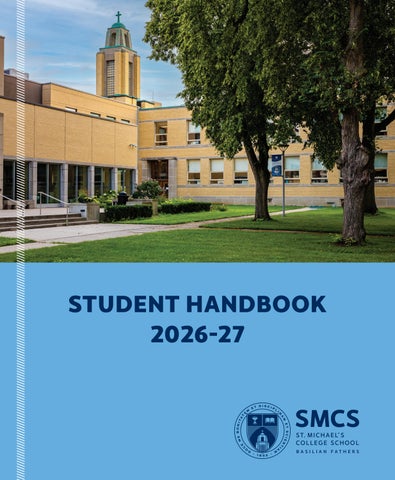
STUDENT HANDBOOK 2026-27
OUR MISSION In the tradition of the Basilian Fathers, we educate young men in Goodness, Discipline, and Knowledge for a life of leadership and service in faithfulness to Jesus Christ.
OUR VISION We graduate young men who will change the world through lives of faith, character, and service.
Teach me Goodness, Discipline, and Knowledge Psalm 118
STUDENT HANDBOOK 2026-27
This handbook belongs to:
Name:
1515 Bathurst Street, Toronto, ON, M5P 3H4 Telephone: 416-653-3180 Fax: 416-653-7704 E-Mail: info@smcsmail.com Web: stmichaelscollegeschool.com
ST. MICHAEL’S COLLEGE SCHOOL 2026-27 STUDENT HANDBOOK TABLE OF CONTENTS WHO WE ARE ………………………………..……………………………………………………………………........................………………..... 4 OUR MISSION ..……………………………………………………………………………………………………….......................……………..... 4 OUR VISION ..………………………………………………………………………………………………………........................………………..... 4 OUR HISTORY .………………………………………………………………………………………………………....................………………..... 4 THE PHILOSOPHY AND GOALS OF THE SCHOOL .….……………………………........................………………..... 5 SPIRITUAL LIFE ………………………………………………………………………………………………….........................………………..... 6 GUIDANCE …………………………………………………………………………………………………………………..…………........................... 7 THE LEARNING ENRICHMENT CENTRE (LEC) …………………………………………..……………………..................... 8 ODETTE LIBRARY LEARNING COMMONS ………………………………………………..………………………..................... 8 STUDENT WELLNESS OFFICE …………………………………………………………………….………………………….......................... 8 BUILDING BRIDGES ……………………………………………………............................................................................... 10 OUTDOOR AND EXPERIENTIAL EDUCATION …………………………………………………............................ 10 A CODE FOR STUDENT BEHAVIOUR …………………………………………………........................................... 11 RATIONALE …………………………………………….......................................................................................... 11 REQUIREMENTS FOR STUDENTS …………………………………………………................................................ 12 SCHOOL POLICIES AND EXPECTATIONS ………………………………………………….................................... 12 ATTENDANCE …………………………………………………................................................................................. 12 Calling in Student Absences ..…………………………………………………………………………………………...................…..……… 12 Early Dismissal for Students .…………………………………………………………………………………………..................……...….... 12 Student Responsibilities When Absent .………………………………………………………………………………..................…….. 12 Procedure for Out-of-Town Parents/Guardians .……………………………………………………………...............………...….. 13 Student Absenteeism for Scheduled Evaluations .………………………………………………………………................……… 13 SCHOOL CLOSURES ……………………………………………………………………………...........................................……..…… 13 HOLIDAYS ……………………………………………………………………………..............................................................……..…… 13 LATES AND LATE POLICY ……………………………………………………………………………...................…...............…..…… 13 Daily Start Time .………………………………………………………………………………………………………………........................………. 13 Consequences for Repeated Lateness ……………………………………………………………………………...................……..….. 13 ANTI-BULLYING EXPECTATIONS …………………………………………………………………………….....................……..….. 14 DRESS, GROOMING, & HYGIENE …………………………………………………………………………….....................……..….. 14 Uniform ……………………………….…………………………………………………………………………………………………............................ 14 General Grooming ……………………………………………………………………………………………………………….......................…….. 15 Casual Dress Days ……………………………………………………………………………………………………………………......................... 15 Consequences …………………………………………………..……………………......................................................................... 15 PLAGIARISM AND CHEATING ………………………………………………….………………………….....................……..…….....15 LATE AND MISSED ASSIGNMENT POLICY ……………………………………………………………………………................ 15 LEAVING THE SCHOOL GROUNDS ……………………………………………………………………………........................…… 16 Permission .…………………………………………………………………………………..................................................................... 16 Behaviour off Grounds .………………………………………………………………………………………………......................…………….. 16 SMOKING/VAPING …………………………………………………………………………….....................……..……......................... 16 GAMBLING ……………………………………………………………………………....................................……..……........................ 16
2
DRUGS ………………………………………………………………………………………………………………………………….........................….. 16 ALCOHOL …………………………………………………………………………………………………………………………........................……… 16 LOCKERS ……………………………………………………………………………….……………………………………………….......................…. 16 VANDALISM AND THEFT ……………………………………………………….………………………………………….......................... 17 DETENTIONS ……………………………………………………………………………………………………………………….......................…… 17 FIRE AND EMERGENCY DRILLS ………………………………………………………………………………………......................… 17 False Alarms ………………………………………………………………………………...................................................................... 17 PARKING ON CAMPUS ………………………………………………………………….……………………………….........................…… 17 Access ……………………………………………………………………………………………………………………………………..........................…. 17 No Access to Vehicles During the School Day …………………………………………………………………………...............…… 17 RESPONSIBLE USE OF TECHNOLOGY …………………..………………………………………………….......................……. 17 Personal Safety ……………………………………………………………………………………………………………………….......................….. 17 Bring Your Own Device / Personal Electronic Devices (PEDs) ……………………………………………………...........…. 17 Disciplinary Consequences ……………………………………………………………………………………………………….....................… 18
MOBILE DEVICE POLICY ……………………………………………………………………………………......……………......................18 CONSEQUENCES FOR UNACCEPTABLE BEHAVIOUR …………………………………………..............................19 GRADE 12 CLASS ……………………………………………………………………………………………………………….........................… 20 CAFETERIA …………………………………………………………………………………………………………………………..........................… 20 SCHOOL STORE - Mporium ………………………………………………………………………………………………....................... 20 STUDENT GOVERNMENT ……………………………………………………………………………………………….........................…. 20 PARENT-TEACHER CONFERENCES …………………………………………………………………………………...................…… 21 EVALUATION PROCEDURE …………………………………………………………………………………………………....................... 21 EXAMINATION POLICY …………………………………………………………………………………………………….........................… 21 ONTARIO STUDENT RECORD (OSR) …………………………………………………………………………….......................... 21 ONTARIO STUDENT TRANSCRIPT (OST) ……………………………………………………………………………...............… 21 ALUMNI ASSOCIATION …………………………………………………………………………………………………........................…... 21 PARENTS’ ASSOCIATION ………………………………………………………………………………………………........................….. 21 ORDER OF ST. MICHAEL ………………………………………………………………………………………………........................….. 22 CO-CURRICULAR PROGRAMME …………………………................................................................................. 22 CLUBS & ACTIVITIES ……………………………................................................................................................... 22 MUSIC & DRAMA …………………………….......................................................................................................... 23 ATHLETICS ……………………………...................................................................................................................... 23 SMCS ACADEMIC STAFF …………………………………………………………………………………………………........................... 24 SCHEDULE VARIATIONS …………………………………………………………………………………………........................………… 25 THE 2026-27 ACADEMIC YEAR …………………………………………………………………………………………...................... 26
3
WHO WE ARE St. Michael’s College School was founded in 1852 by the Basilian Fathers and stands as Ontario’s only independent Catholic school for young men. The school offers students in Grades 7-12 an enriched Catholic Liberal Arts education complemented by several diverse co-curricular programmes. As a community within the Catholic Church, St. Michael’s strives for excellence through a synthesis of culture and faith.
OUR MISSION In the tradition of the Basilian Fathers, we educate young men in Goodness, Discipline, and Knowledge for a life of leadership and service in faithfulness to Jesus Christ.
OUR VISION We graduate young men who will change the world through lives of faith, character, and service.
OUR HISTORY The Congregation of St. Basil (Basilian Fathers) was established as a religious congregation in France in 1822. As a result of the closing of seminaries in France during the French Revolution, two diocesan priests opened a secret school in the mountains of central France. After several years of operation and a change in French laws, ten priests serving there openly bound themselves into a religious community. They reasoned that the school, by then located in the nearby city of Annonay, would have a better chance of continuing if it were conducted by a religious congregation that could accept and train new members to continue its operation after the founding fathers’ retirement. The original members chose St. Basil the Great, a fourth-century teacher, bishop, and doctor of the Church, to be the namesake of the new community. In the middle of the 19th century, the French Basilians came to Canada on an invitation from Bishop de Charbonnel of Toronto. The Bishop clearly saw the need for Catholic schools for the young people of his parishes, especially at the high school level. In his plans to bring Catholic education to more of his people, the Bishop immediately thought of his own education in France. He had been educated at the College of Annonay near Lyon, a school established by the Basilian Fathers. In September of 1852, the Basilians opened St. Michael’s College in Toronto, offering in the French style a combination of what we would call a high school and university education. St. Michael’s College quickly outgrew its original facilities in the basement of the Bishop’s Palace on Church Street, and in 1856, it was moved to Clover Hill, a property donated to the Basilian Fathers by the Honourable John Elmsley. Clover Hill was outside the city at that time, in an area now bounded by Bay, St. Joseph, and St. Mary Streets. In 1881, St. Michael’s was affiliated with St. Michael’s College at the University of Toronto for post-secondary education. The high school section expanded much more rapidly than the College section, so in 1902, a new wing was added to the original building and the high school remained in this building until 1950. During the Great Depression, the Superior of the Basilians, Fr. Henry Bellisle, slashed tuition and established two satellite campuses to preserve enrolment. Both campuses accepted Grade 9 students in September 1932. The East End Campus was on Lee Avenue in the Beaches area, and the West End Campus was on the St. Joan of Arc Church property at Dundas Street West at Bloor Street West. The western school closed after June 1936, and the eastern campus lasted one more year. In the years after the Second World War, it became apparent that the Bay Street buildings were not equal to the challenge of serving a growing student body. At this point, the high school section separated from the College, and in September 1950, St. Michael’s College School opened its doors in a new building at Bathurst Street and St. Clair Avenue West, where it is situated today. 4
In 1967, St. Michael’s College School began an important new phase in its history. A decision was made to enter into a partnership with the Metropolitan Separate School Board of Toronto and to educate the Board’s students in Grades 9 and 10. This decision made St. Michael’s both a public and private school, which lasted for approximately 20 years. In September 1985, the Basilian Fathers decided to refuse provincial aid and return St. Michael’s to its Catholic roots as a fully independent, Catholic high school. In 1995, a major capital expansion programme upgraded the school to include a new east wing complete with modern classrooms, a new library, music and visual arts facilities, a design and technology facility, a new 250-seat lecture hall, and an expanded gymnasium. In September 1998, St. Michael’s College School expanded its academic programme to include a Grade 7-8 programme. The Preparatory School was previously active during the early 1900s. The school’s athletic stadium was retrofitted in September 2004 to include a state-of-the-art athletic field with artificial turf, an electronic scoreboard, stadium lighting, and an air-supported dome that covers a third of the field for use during the winter months. The Centre for the Arts was the fourth and final phase of the St. Michael’s College School revitalization project that commenced in 1995. It is a state-of-the-art facility that provides much-needed space and resources for teaching and learning. The centre features 440 seats presented in an intimate setting that faces the Fr. Thomas F. Mohan, CSB Stage. In 2022, St. Michael’s College School celebrated 170 years of excellence in the tradition of the Basilian Fathers.
THE PHILOSOPHY AND GOALS OF THE SCHOOL We have been redeemed by the life, death, and resurrection of Jesus Christ. The Christian outlook on life and the world is one of joy and hope. We believe that the Holy Spirit inspires us to respond to each other and to the world according to the right reason. The motto of the Basilian Fathers and St. Michael’s College School is “Teach me Goodness, Discipline, and Knowledge” (Psalm 118). It means that being a good person and disciplined individual is as important as the knowledge acquired through education. A Catholic Liberal Arts education encompasses the Humanities, the Arts, and the Sciences. It is broad by design with the goal of teaching us how to be truly and fully human. We discover our humanity by learning how to think freely and independently and understanding that the fullness of our humanity can only be guaranteed by recognizing and upholding the humanity of others. We uphold each other’s humanity, acknowledging our God-given dignity through the principles of justice and equity, guided by an abiding love. The role of a Christian Liberal Arts education will help students discover and accept that our true humanity requires that we live in a true and right relationship with God. Alongside this Christian approach in each discipline, every student at St. Michael’s College School takes a theology course each year. Theology assists the student to grow more familiar with the teachings of Jesus Christ and the Church, to live a fuller Christian life, and to formulate answers to many of the challenging questions posed by our modern world. The tradition of the Basilian Fathers is to encourage all students to become involved in some aspect(s) of the co-curricular programme. Participation in different activities teaches our students responsibility, dedication, and loyalty and nurtures the understanding necessary to interact with peers. Embracing our tradition of Christian Liberal Arts education, our students develop and grow spiritually, intellectually, physically, and socially. We educate and form the whole person so that our students and graduates may play a vital role in establishing community wherever they may be.
5
SPIRITUAL LIFE Faith and spirituality are an integral part of daily school life. The Basilian Fathers invite the entire school community to make prayer and spirituality a central priority. The Office of Spiritual Life ensures the coordination of all activities in this regard. The school’s spiritual life consists of daily all-school morning prayers, daily classroom prayers, all-school end-of-week prayers, regular liturgical celebrations (daily Masses, homeroom Masses, grade-level Masses, all-school Masses, penitential services, and community service celebrations), days of retreat and recollection for staff and students, volunteer community service activity days for staff and students, and ministry to the city’s needy through food drives and other fundraising initiatives. The Basilian Fathers are always available to staff and students for pastoral care, personal and spiritual counselling, and the Sacrament of Reconciliation. The Office of Spiritual Life offers a safe and welcoming environment where students may receive assistance and counselling with personal challenges and difficulties. When necessary, it works with families and makes referrals to outside agencies and professionals. Faith and spirituality flow from consistently practicing goodness, discipline, and knowledge. Through the many opportunities to encounter the Lord Jesus at St. Michael’s, we cultivate in our students the strong Catholic values of faith, character, and service for today’s world. Goodness Spirituality is integral to school life at St. Michael’s College School. Our Catholic, Liberal Arts education and formation help our students to discover that being a human, fully alive, includes being in a good relationship with God and with one’s neighbour. Discipline Students have several opportunities to practice their faith at St. Michael’s, such as morning prayers, daily celebrations of the Eucharist, and other sacramental gatherings. All-school Masses, school retreats, and spirit assemblies further the spiritual growth of our community. There are also opportunities for individual spiritual direction and counselling through our Office of Spiritual Life. Knowledge Each St. Michael’s College School student takes a theology course every year. Theology prepares the student to understand and embrace the teachings of Jesus Christ, to live a complete Christian life, and to grapple meaningfully with many of the questions our modern world poses.
VIRTUES OF THE MONTH Each month, we focus on various virtues to help put our faith into practice. Our daily prayers focus on these important and applicable values. September – Hospitality “Do not neglect to show hospitality to strangers, for by doing that, some have entertained angels without knowing it.” Hebrews 13:2 October – Gratitude “Give thanks in all circumstances; for this is the will of God in Christ Jesus for you.” 1 Thessalonians 5:18 November – Peace “Peace I leave with you; my peace I give to you. I do not give to you as the world gives. Do not let your hearts be troubled, and do not let them be afraid.” John 14:27 December – Hope “May the God of hope fill you with all joy and peace in believing, so that you may abound in hope by the power of the Holy Spirit.” Romans 15:13 January – Respect “Do nothing from selfish ambition or conceit, but in humility regard others as better than yourselves.” Philippians 2:3 6
February – Love “Let love be genuine; hate what is evil, hold fast to what is good; love one another with mutual affection; outdo one another in showing honour.” Romans 12:9-10 March – Forgiveness “Put away from you all bitterness and wrath and anger and wrangling and slander, together with all malice, and be kind to one another, tender-hearted, forgiving one another, as God in Christ has forgiven you.” Ephesians 4:31-32 April – Compassion “Thus says the Lord of hosts: Render true judgments, show kindness and mercy to one another; do not oppress the widow, the orphan, the alien, or the poor; and do not devise evil in your hearts against one another.” Zechariah 7:9-10 May – Joy “I have said these things to you so that my joy may be in you, and that your joy may be complete.” John 15:11 June – Faithfulness “But you, O Lord, are a God merciful and gracious, slow to anger and abounding in steadfast love and faithfulness.” Psalm 86:15 July – Integrity “Better to be poor and walk in integrity than to be crooked in one’s ways even though rich.” Proverbs 28:6 August – Justice “To do righteousness and justice is more acceptable to the Lord than sacrifice.” Proverbs 21:3 Golden Rule “In everything do to others as you would have them do to you; for this is the law and the prophets.” Matthew 7:12 *All biblical translations are from the New Revised Standard Version Catholic Edition (NRSVCE)*
GUIDANCE Students may arrange appointments with their guidance counsellor by sending them a message through Edsby. They are asked to include their homeroom teacher’s name, lunch period, and study period if applicable. Students will be sent a follow-up Edsby message with the date and time of their appointment. Most appointments will be arranged within 48 hours of the original request, peak periods excepted. Students are asked to speak to their assigned counsellor for academic counselling. This may include discussions on time management, study skills, peer tutoring, test and exam preparation, post-secondary planning and admissions, scholarships, summer/night school, and course selection. Students may see any counsellor when dealing with personal matters.
7
LEARNING ENRICHMENT CENTRE (LEC) Students with identified learning needs are supported through Individual Education Plans (IEPs), development and communication with the LEC, classroom teachers, and parents. IEPs are developed for students with psycho-educational assessments or a medical diagnosis identifying them as exceptional learners. LEC Learning Strategists will connect families with community services to support specific learning exceptionalities. Documentation must be provided by a recent educational psychologist or medical professional, describing the identified exceptionality, the necessary support, and required accommodations. Students with extended-time testing and computer accommodations may write some or all of their tests and exams in the LEC. Students who suspect a learning challenge may be impacting their academic progress should make an appointment with a parent to meet with a Learning Strategist in the LEC to discuss the process for investigating the challenge. Since referrals to agencies providing educational assessment services can take some time, initiating this process as early as possible in your academic career is best. The following supports are available to all students through the LEC:
• Learning Skills Workshops • Stress Management • Concussion/Illness Recovery Support ODETTE LIBRARY LEARNING COMMONS odettelibrary.com The Odette Library Learning Commons is a dynamic teaching and learning hub where St. Michael’s College School students come to acquire and create knowledge. The 3,400 square-foot space is designed to accommodate collaboration, active learning, silent reading, and quiet study. The library boasts more than 12,000 circulating print and e-books to complement the expansive collection of databases and digital resources. The library’s website, odettelibrary.com, is a portal to all research resources and the library catalogue. Students and faculty enjoy the natural lighting while taking advantage of the soft seating, study cubicles, tables, and seminar rooms. Access to Wi-Fi, printing, photocopying, and technical support services ensures students can successfully complete any task. The multi-purpose Transformer Room, located in the commons, facilitates various learning opportunities. This space can be used as a large classroom area where two classes may collaborate on an inquiry project, listen to a guest speaker, or complete a formal assessment. Additionally, the room is designed to quickly change into a maker space, a debating forum, or a cooperative learning area where students have room to move. During lunch, the Transformer Room hosts club activities and workshops on many topics, including information literacy. The Odette Library’s team of skilled librarians and educators helps students become future-ready leaders by teaching them how to find, analyze, and apply information. The team works with faculty to nurture a sense of curiosity about the world and help students develop the skills needed to be confident lifelong learners.
STUDENT WELLNESS OFFICE Our Student Wellness Office aims to provide our students and their families with various supportive services to ensure a successful and meaningful school experience. The School Social Worker works alongside educational staff and families in multiple ways by providing various services. Each service supports student learning and helps students develop their full potential. As a trained social worker, our School Social Worker is registered with and regulated by the Ontario College of Social Workers and Social Service Workers and is bound to the code of ethics and legislation as outlined by their governing body. As part of the education support services provided by SMCS, the School Social Worker works in close collaboration with teachers, guidance counsellors, learning strategists, and administrators to support our students. 8
Additionally, from September to April, the School Social Worker supervises a Master of Social Work (MSW) intern from the University of Toronto. As part of their professional training, the intern may meet with students and will carry a supervised caseload. All student meetings with the intern will be overseen by the School Social Worker to ensure appropriate support and guidance. Prior to any student being referred to the intern, consent will be obtained from the student and/or their guardian(s). Please note that the School Social Worker does not provide ongoing clinical counselling or intensive therapy. Located in the school’s main office, the Student Wellness Office is accessible yet ensures confidentiality. To contact our School Social Worker, please email Ms. Benzacar at benzacar@smcsmail.com or connect with her through Edsby. Method of Referral: Referrals to the Student Wellness Office may be made directly by the student, teachers, student affairs, administration, or a parent/guardian. Observation: If the School Social Worker observes behaviour that is of concern, they may meet with a student and inform the parent/guardian(s) as appropriate. The School Social Worker may visit a classroom as part of the fulfillment of their role and may observe student behaviours while in the class. This information may then be shared with the student’s circle of care. If the School Social Worker observes concerning behaviour, they may provide strategies for the teacher to implement in the classroom. They will inform the parent/guardian(s) if necessary. Confidentiality: All information received by the School Social Worker is confidential among the student, their families, and the student’s circle of care. Confidentiality cannot be maintained if the information received causes the School Social Worker to believe that a child’s safety is a concern, or that the child may cause harm to themself or others. In accordance with The Child, Youth and Family Services Act, 2017, S.O. 2017, c. 14, Schedule 1, children over the age of 12 do not require parental consent to obtain services from the School Social Worker. However, the School Social Worker will make every effort to establish a parental partnership, even in cases involving students over 12. If parental consent is not obtained and a student still requests access to services, the request will be fulfilled. The School Social Worker provides a confidential service that supports students’ social, emotional, and mental health and well-being. Information shared with the School Social Worker is kept confidential and is only shared with members of the student’s circle of care when appropriate and in accordance with applicable legislation and professional standards. Students have a right to privacy and to be treated with dignity and respect. There are limits to confidentiality. Confidential information may be shared when required by law, including situations where there are concerns about the safety or well-being of a student or another person, concerns about risk of serious harm to self or others, or where there is a legal duty to report concerns about a child who may be in need of protection. Ontario law recognizes that children and youth may be capable of making decisions about receiving counselling and social work services. Access to social work services is determined based on the student’s ability to understand the nature and purpose of the service and to make an informed decision about participation. There is no single age at which all students can or cannot consent to receive counselling services. The School Social Worker will assess capacity in accordance with provincial legislation and professional standards. The School Social Worker values collaboration with parents and caregivers and will encourage family involvement whenever it is appropriate, beneficial, and consistent with the student’s privacy rights. However, where a student is determined to be capable of consenting to service, the student’s wishes regarding participation and confidentiality will be respected in accordance with applicable law and professional obligations. 9
Suicide Awareness, Prevention, and Help-Seeking: At our school, we believe that talking openly, honestly, and compassionately about mental health and suicide is an important part of keeping our students safe. Research consistently shows that respectful conversations about suicide do not increase risk; rather, they help reduce stigma, encourage help-seeking, and create opportunities for connection and support. Because stigma and traditional expectations around masculinity can sometimes make it difficult for boys and young men to express vulnerability or ask for help, we are committed to fostering a school culture where students know that speaking about emotional pain is a sign of strength, not weakness. Creating safe spaces for these conversations helps ensure that students access support early and receive the care they need. Consistent with Ontario’s commitment to promoting the best interests, protection, well-being, participation, and rights of children and youth, the school encourages students, families, and staff to work together in supporting student mental health and wellness. Students are encouraged to seek help for themselves or for a friend whenever they have concerns about safety, mental health, self-harm, or suicide. Concerns will always be taken seriously and responded to in a manner that prioritizes student safety and well-being. To support suicide prevention efforts, the school has staff members who are trained in safeTALK (Suicide Alertness for Everyone) and ASIST (Applied Suicide Intervention Skills Training). These trained adults are available to recognize signs of distress, engage students in supportive conversations, and connect them with appropriate resources. In addition, the school is committed to ongoing suicide prevention education and will offer learning opportunities for students, parents/caregivers, and staff to strengthen awareness, reduce stigma, and build confidence in supporting those who may be struggling. Together, we can create a caring community where every student knows they are valued, supported, and never alone. Duty to Report: Anyone who suspects that a child is at risk has legal and moral responsibilities. Teachers, principals, guidance counsellors, members of the clergy, and social workers are mandated reporters in Ontario. A concern or ‘reasonable grounds’ made in good faith is all that is required to make a report. It is the duty of child protection workers to investigate, not the school. Once a report is made, the reporter is not informed of the next steps unless deemed necessary by the agency. Referring to Outside Services: When the needs of the student require ongoing support above what the School Social Worker is able to consistently and/or appropriately provide, referrals to outside agencies will be made.
BUILDING BRIDGES Building Bridges is a programme designed to foster meaningful dialogue among students in Grades 7–12, facilitated by a faculty moderator. These grade-level groups engage with relevant topics, such as student wellness, social justice, and other issues shaping their learning and lived experiences. The structure promotes student voice, encourages community-minded thinking, and cultivates leadership through peer mentorship. Active attendance and thoughtful participation are expected of all students.
OUTDOOR AND EXPERIENTIAL EDUCATION St. Michael’s College School’s Outdoor and Experiential Education programme provides students with the opportunity to develop self-awareness, foster connections, and challenge themselves to learn and grow. The programme is founded upon the values of respect and integrity. It provides students with authentic opportunities to develop and apply their leadership skills in authentic ways throughout their time at St. Michael’s. There are four uniquely different outdoor education experiences, which annually include over half of the student body at St. Michael’s College School. Programmes involve students in Grades 7-10 and a Leader-In-Training 10
programme. To ensure that the various programmes are challenging and safe for the students, SMCS partners with ALIVE Outdoors, a specialized outdoor education company. Our students are provided with excellence in safety standards, qualified and specialized staff, camp locations, food selection, programme variety, and a leadership programme. Further to the outdoor education experiences, ongoing leadership development seminars are offered throughout the school year. These seminars support students’ development of their leadership styles and abilities. Students participating in these seminars may also mentor younger students during future outdoor education experiences or community-building opportunities at the school. The programme strives to foster a strong sense of community by providing students with meaningful opportunities to build positive relationships, develop skills, and share memorable experiences. Note that mandatory attendance for scheduled camps for the entire duration is the school’s expectation.
A CODE FOR STUDENT BEHAVIOUR The St. Michael’s College School Code for Student Behaviour was formulated by a Discipline Committee of faculty and administration. This code is also informed by the School’s Progressive Discipline Policy, which emphasizes the following principles:
• Progressive discipline is a non-punitive, whole-school approach that uses a continuum of corrective
•
•
•
and supportive interventions, supports, and consequences to address inappropriate behaviour and to build upon strategies to promote positive student behaviours. Consequences include learning opportunities for reinforcing positive behaviour and assisting students to make good choices. Prevention and early intervention are important for assisting pupils to achieve their potential and to maintain a positive school environment. A positive school environment is established through programmes and activities that focus on building healthy relationships, character development, and civic responsibility, which thereby foster the positive participation of the community in the life of the school.
RATIONALE This Code for Student Behaviour is summed up in its motto: “Teach me Goodness, Discipline, and Knowledge.” A divinely inspired charter for the education of youth, the motto places goodness and discipline ahead of knowledge, a ranking that is not always in fashion. The motto rightly couches its message in the imperative mode: “Teach me...discipline” and thus, the initiative is with the student. He appeals for the help he needs to know Christ so that he can make Christ’s way of life the overriding influence in his behaviour. Student behaviour at St. Michael’s College School is expected to be courteous and respectful at all times. We aim to create an orderly school environment where each student can realize his potential. The regulations which follow are ways of working towards this aim, or at the very least, of ensuring it is not obstructed in any way. It must also be recognized that in the interest of fairness, justice, prudence, and genuine concern for staff and students, the school’s administration reserves the right to decide whether the letter of the law is to be implemented or imposed on any specific situation. At all times, our approach will be oriented toward the total good—physical, intellectual, and spiritual—of the people with whom we work. Of the utmost importance at St. Michael’s College School is the concept of respect, in particular, respect for self, school, and others. Students are reminded that the school is a learning community and that appropriate behaviour towards all community members is always expected.
11
REQUIREMENTS FOR STUDENTS A student shall: (a) be diligent in attempting to master such studies as are part of the programme in which the student is enrolled; (b) exercise self-discipline; (c) accept such discipline as would be exercised by a kind, firm, and judicious parent; (d) attend classes punctually and regularly; (e) be courteous to fellow students and obedient and courteous to teachers; (f) be clean in person and habits; (g) take such tests and examinations as are required by or under the Education Act as may be directed by the Minister of Education; (h) communicate with and respond to teacher and school staff messaging on our Learning Management System (Edsby) in a timely fashion as required, and show respect for school property.
SCHOOL POLICIES AND EXPECTATIONS The following will help you become acquainted with the available procedures and services.
1. ATTENDANCE
Regular attendance is essential for academic success. Any student who accumulates excessive absences in a course will be interviewed by the Administration with respect to the status of the course credit. The definition of a credit by the Ministry of Education includes the number of hours it must encompass. A credit is granted upon completion of a minimum of 110 hours of successful in-class instruction. Parents will be informed by letter and/or telephone regarding the unacceptable accumulation of absences and lates. Furthermore, skipping class is considered a very serious offence and will jeopardize the student’s position at St. Michael’s College School. In light of these requirements and conditions, parents are advised that frequent non-health-related absences are not permitted. Additionally, recent revisions to Growing Success, the Ministry of Education document governing assessment, evaluation, and reporting in Ontario secondary schools, dictate that attendance and participation will form part of the final evaluation structure in secondary courses, with a greater weighting in Grades 9–10 (15% of total grade) than in Grades 11–12 (10% of total grade). The school will clearly communicate to students and families the criteria for evaluating attendance and participation for the 2026-27 academic year. Note: Growing Success clarifies that excused absences due to illness, inclement weather, unavoidable circumstances, or approved absences for cultural or holy days will not negatively affect a student’s mark.
1.1 Calling in student absences
In the case of an absence, a student’s parent or guardian is expected to call the school at 416-653-3180 Ext. 370 (Student Absentees) between 8 and 9 a.m. to inform the Attendance Office or email the Attendance Office at attendance@smcsmail.com from a verified parent/guardian account.
1.2 Early Dismissal for Students
Students who wish to leave school before regular dismissal time must report to the Attendance Office before 8:15 a.m. with a parental note to seek permission or have parents/guardians email attendance@smcsmail.com for early dismissals, late arrivals, or short-term absences during the day. Medical or personal appointments should not be made during school hours. A student who leaves school without signing out is considered to have skipped, and appropriate disciplinary measures will be taken. PARENTS ARE ASKED TO REFRAIN FROM MAKING PLANNED ABSENCES IN EDSBY FOR EARLY DISMISSALS, AS THIS FEATURE IS DESIGNED FOR FULL-DAY ABSENCES ONLY.
1.3 Student responsibilities when absent
It is the student’s responsibility to inform the appropriate teacher(s) and the Attendance Office that an academic evaluation opportunity is being missed due to an appointment or illness. Students who fail to do this will receive a mark of zero on the missed evaluation. 12
1.4 Procedure for out-of-town parents/guardians
Please be advised that SHOULD BOTH PARENTS OR OFFICIAL GUARDIANS BE OUT OF TOWN, THE SCHOOL MUST BE INFORMED IN WRITING AS TO WHO THE GUARDIAN WILL BE IN THEIR ABSENCE. The identified guardian will be contacted due to illness or an emergency at the school. Please email attendance@smcsmail.com with this information prior to your departure.
1.5 Student absenteeism for tests or presentations
A student who is absent for a major test in any one course more than once must have a doctor’s note presented to the teacher to rewrite the test. Without the medical note, a student will not be able to write the test and will receive a mark of zero. Likewise, prolonged exemption from participation in Physical Education requires a medical note. Upon return from an illness, students should expect to write missed tests, turn in assignments, and deliver presentations unless otherwise arranged with the teacher. Also, due to the planning involved and the preparation time allotted, a doctor’s note is required for any missed presentations due to illness. Without a doctor’s note, the student will only receive marks for any written component of the assignment and a zero will be assigned to the presentation component. Students absent for scheduled evaluations due to skipping class(es) will receive a grade of zero on these assessments and may be subject to further progressive disciplinary consequences.
2. SCHOOL CLOSURES
On extremely rare occasions, inclement weather may make it necessary to close the school. Parents and students should check the school website, Edsby, and/or consult local media outlets to confirm closure. If information is not forthcoming, students will assume the school is open for a regular day. Students will be responsible for any missed assignments, tests, presentations, or other modes of evaluation scheduled on that day.
3. HOLIDAYS
Our holiday schedule is generous. St. Michael’s College School does not welcome requests for extensions of holidays. Such absences seriously undermine academic progress and the sense of priorities and discipline we are developing in our students. Parents are advised of the year’s calendar dates in advance and are asked to plan family travel within this framework. Should parents persist in this area, students will be held responsible for all missed opportunities for academic evaluation. Please do not schedule holidays during the school year.
4. LATE ARRIVALS AND LATE POLICY
We endeavour to instill the importance of punctuality in our students. We aim to teach our students responsible behaviour by enforcing the importance of being punctual and on time for all school activities.
4.1 Daily start time
Classes commence daily at 8:30 a.m. Students should be at school no later than 8:20 a.m. Chronic inability or unwillingness to arrive at school or class on time will be considered a serious offence. Students who arrive at school after 8:50 a.m. must report to the Attendance Office before attending any class. Failure to do so will result in an inflated absentee record, and students will be considered to be skipping class, resulting in appropriate disciplinary action. All other lates will be dealt with by the classroom teachers.
4.2 Consequences for repeated lateness
It is important that students arrive at school on time. In the last few years, we have experimented with different sanctions for students who demonstrate an inability or an unwillingness to do so. It is hoped that, with the cooperation of everyone involved, these penalties will rarely be necessary. 5 lates per reporting term – detention for every late thereafter – parents are notified 10-12 lates in a reporting term – community service 13 lates in a reporting term – suspension and parents called in for an interview to explore remedies in detail. Any number beyond this will be considered entirely unacceptable, and the student will be advised to attend a school closer to home. When the weather or the transportation system creates unavoidable problems, the Administration may make appropriate allowances. Students should understand the importance of maintaining a good record to compensate for any emergency that may arise. Students should also realize that communications from home do not and cannot explain excessive attendance situations; parental permission will not justify absences without due cause, and notes and/or calls from home do not excuse casual late arrivals. 13
5. ANTI-BULLYING EXPECTATIONS
The school promotes responsibility, respect, civility, and academic excellence in a safe learning and teaching environment. A positive climate exists when all members of the school community feel safe, included, accepted, and actively promote positive behaviours and interactions. Bullying or hazing in all its forms (including but not limited to physical, verbal, social, electronic, gender-based, racial, sexual, and religious) is unacceptable and will not be tolerated by the school. This applies to all members of the school community, including students, teachers, staff, coaches, and volunteers.
6. DRESS, GROOMING, AND HYGIENE
The overall appearance of the students is an important contributing factor to good order and decorum at St. Michael’s. The school, therefore, reserves the right to inform both the student and his parents or guardians should his uniform or general appearance not meet the following standards.
6.1 Uniform
All items should be in good condition. Students are expected to be dressed in full uniform during the school day. Uniform expectations for co-curricular excursions will be communicated beforehand by event moderators. Students are advised to have two pairs of plain grey pants so that what is worn to school will always be clean and properly maintained. Note that changing into or out of school uniform is only permitted in designated changing areas, and that this policy will be strictly enforced throughout the building. (a) Warm Weather • Navy SMCS golf shirt (short or long-sleeved) *Note: Should students choose to wear an undershirt, it must be plain and the same colour as the golf shirt. • SMCS zippered sweater-jacket (optional) • Creased grey dress pants comprised of a cotton or polyester weave. The school does not permit casual pants (e.g. cotton khakis, athletic stretch, or casual pants with five pockets, back knee seams, and exterior back pockets — such as Under Armour and Lululemon brands). *Note: For consistency of colour, purchase of dress pants through the school store is strongly encouraged. • Plain above-the-ankle black socks • Black dress belt (plain buckle only; designer buckles not permitted) • Black dress shoes that must have a defined heel with black soles and leather uppers (lace-up or slip-on shoes permitted). *Note: Athletic footwear is permitted only during Physical Education class. (b) Standard
• Navy SMCS blazer with crest • White dress shirt
* Note: Should students choose to wear an undershirt, it must be plain white and devoid of any logo or designs • School-issued tie • Creased grey dress pants comprised of a cotton or polyester weave. The school does not permit casual pants (e.g. cotton khakis, athletic stretch, or casual pants with five pockets, back knee seams, and exterior back pockets — such as Under Armour and Lululemon brands). *Note: For consistency of colour, purchase of dress pants through the school store is strongly encouraged. • Plain above-the-ankle black socks • Black dress belt (plain buckle only; designer buckles not permitted) • Black dress shoes that must have a defined heel with black soles and leather uppers (lace-up or slip-on shoes permitted). *Note: Athletic footwear is permitted only during Physical Education class.
14
6.2 General Grooming
• Students are expected to be clean and neat in general appearance. • During the school day, students are expected to be in full uniform.
This includes: o Clean hair, neatly combed or brushed, and appropriate length o Any form of dyed or coloured hair is not permitted o A ponytail is not acceptable at any time at St. Michael’s o Shaved heads or shaved patterning of heads and/or eyebrows are also unacceptable at the school o As a sign of respect, headwear and headbands of any kind are not permitted to be worn inside the school o Students must be clean-shaven o Ear, facial, or oral piercings are not permitted. Bandage-covered piercings will not be allowed o Visible tattoos are not permitted The school reserves the right to determine what is acceptable in this area. If students are unwilling to comply with the dress code, parents will be contacted to discuss what action will be taken by St. Michael’s College School.
6.3 Casual Dress Days
Periodically throughout the school year, students are permitted to wear business casual clothing to school. This is called a ‘Casual Dress Day’, which usually coincides with a charity fundraiser. Designated Casual Dress Days will be communicated to the school community via the P.A. system and Edsby. Shorts, Crocs, slides, sandals, slippers, and pajamas or flannel-style bottoms are not permitted on these days.
6.4 Consequences
During culminating assessments, the same dress code is in effect. Students whose appearance or uniform is inappropriate will be asked to leave and remedy the issue. In these situations, no additional time will be granted for the performance of the culminating assessment.
7. PLAGIARISM AND CHEATING
Plagiarism and cheating are serious academic offences and will be treated as such by the school. It is the responsibility of the faculty to ensure that students are taught the proper use of original and secondary sources in their essay writing and general work, and the responsible use of emerging technologies as a scaffold to support student learning. Plagiarism is defined as submitting another person’s work as your own and/or using the work of others without proper acknowledgement. This includes the unethical use of Artificial Intelligence to produce compositions, projects, or artifacts submitted as authentic student work. Cheating is defined as giving and/or receiving answers during a test or exam. Cheating also includes accessing or bringing materials or information into a test or exam in any format. Students caught cheating or plagiarizing will be assigned a mark of zero on the assessment. Other disciplinary measures may be implemented.
8. LATE AND MISSED ASSIGNMENT POLICY
St. Michael’s College School strives to convey to students the importance of completing assignments on time. Developing efficient work habits and time management skills is important for future success. These expectations will be reviewed at the beginning of each course. To respect the requirements of Growing Success, the following will be implemented:
• Major assignments will be completed in stages to encourage appropriate time management skills. • Teachers will clearly communicate due dates for assignments and expect these to be met. • Should a student fail to turn in an assignment by the due date, one or more of the following will
take place: o a meeting between the student and teacher to clarify the reason for a late submission, which will include an agreement regarding the timely submission of the assignment; o a conversation between the teacher and parent(s) to ensure they are aware of the issue; if the assignment has not been submitted by the agreed-upon dates after these measures, then a deduction of marks will follow as a last resort. 15
• Once an assignment has been marked and returned to the class, the teacher may use their
professional judgment and allocate a mark of zero.
Teachers will strive to ensure that a mark deduction does not unfairly misrepresent the student’s achievement when calculating a final grade.
9. LEAVING THE SCHOOL GROUNDS 9.1 Permission
Grades 7, 8, 9, and 10 students may not leave the school grounds during lunch. All places that serve alcoholic beverages or prohibited substances are out of bounds for all students during the school day. Students wishing to leave the school during the day may only do so with written parental permission and by following the procedure in section 1.2 of this handbook.
9.2 Behaviour off-grounds
While off campus during the school day, students must be in uniform and conduct themselves appropriately. At all times, students are ambassadors of St. Michael’s and will represent the school as gentlemen. Failure to do so will result in disciplinary consequences and loss of permission to leave the grounds. Courtesy and consideration for the public, as well as respect for the property of others, are expected at all times. This includes public transport, local businesses, stadiums, arenas, gyms and auditoriums, and field trip outings.
10. SMOKING/VAPING
The arguments against smoking/vaping are overwhelming, and the school encourages students not to smoke. Students are instructed not to smoke/vape anywhere on the school or adjacent property. Please note that this prohibition includes the school entranceways, arena, stadium, parking lots, and the main school building. THIS POLICY APPLIES TO ALL EXCURSIONS, TRIPS, OUTINGS, AND CO-CURRICULAR EVENTS.
11. GAMBLING
GAMBLING IS PROHIBITED AT ST. MICHAEL’S COLLEGE SCHOOL. WHETHER IT BE IN CONCERT WITH PLAYING CARDS, SPORTING EVENTS, ONLINE GAMBLING SITES, OR SOME OTHER ENTERTAINMENT OPPORTUNITY, THE DANGEROUS RAMIFICATIONS OF GAMBLING ARE WIDELY KNOWN. Hence, St. Michael’s sees this activity as undermining the school’s overall goals. As a result, violating this policy will jeopardize a student’s position here at St. Michael’s. THIS POLICY APPLIES TO ALL EXCURSIONS, TRIPS, OUTINGS, AND CO-CURRICULAR EVENTS.
12. DRUGS
The use, consumption, or sale of controlled and non-prescription drugs (including cannabis products) at or near the school or any school function is strictly prohibited. We are convinced more than ever that the moral, physical, and academic deterioration which occurs to users is very clear, as is their destructive influence on others. Any breach of this regulation will be viewed as most serious. Students will be suspended or expelled from St. Michael’s College School as determined by the Administration. THIS POLICY APPLIES TO ALL EXCURSIONS, TRIPS, OUTINGS, AND CO-CURRICULAR EVENTS.
13. ALCOHOL
The use of alcohol has absolutely no place at school or at any school function. Any student, regardless of age, is not to consume alcohol during the school day or before or during any school event. Alcohol is not permitted on school grounds at any time. Violation of this regulation will be viewed as most serious. THIS POLICY APPLIES TO ALL EXCURSIONS, TRIPS, OUTINGS, AND CO-CURRICULAR EVENTS.
14. LOCKERS
Homeroom teachers will assign lockers during the first week of school. These lockers are the school’s property and are loaned to the students for the year. Please keep lockers neat and clean, and remove all personal items from the floor in front of your locker by the end of the day. Students must use the provided combination lock and keep their lockers and valuables securely locked at all times. Do not pre-set the school-issued lock, nor share the combination with anyone else. The school cannot assume responsibility for lost or stolen articles. LOCKERS ARE EXPECTED TO BE LOCKED AT ALL TIMES DURING THE SCHOOL DAY. Students who tamper with other students’ locks and lockers will be subject to consequences for vandalism/defacement of school property. A $5 replacement fee is in effect for lost or misplaced school-issued locks. For students who require additional locker space for athletics or co-curricular activities, extra-large sports lockers are available for rent at the Attendance Office. 16
The principal, or his designate, may open a locker for inspection at any time.
15. VANDALISM AND THEFT
To protect the rights and property of every member of the school community and to foster an atmosphere conducive to Christian values and education, it must be clearly understood that any student who commits acts of vandalism or theft will be suspended or asked to leave the school. Students are encouraged to leave expensive jewelry and expensive outer garments at home. The school is not responsible for any loss of personal belongings. However, in the event of any difficulty, every effort will be made to assist. It is strongly urged that all personal property, including clothing, be marked with the name of the owner.
16. DETENTIONS
Faculty and administration may occasionally assign detentions for several indiscretions on the part of a student. Detentions are usually assigned for academic negligence, inappropriate conduct on and off school grounds, truancy, and chronic lateness. These school appointments become the first priority for all students involved on that day and will not be rescheduled except for the most urgent reasons. Continued indiscretions may lead to further progressive discipline, including suspension and expulsion.
17. FIRE AND EMERGENCY DRILLS
Upon hearing the alarm bells, all students and personnel must vacate the school as quickly as possible. Fire drill directions are posted in each classroom. Students will remain outdoors until they are notified to return to class.
17.1 False Alarms
Students are reminded that false alarms put the community at risk and can be viewed as a criminal offence. Any student who deliberately sets a false alarm will be dealt with severely and may jeopardize his position at St. Michael’s College School.
18. PARKING ON CAMPUS 18.1 Access
Since St. Michael’s is well served by bus, streetcar, and subway, and on-campus parking space is limited, all students should travel to school by public transit or be dropped off. Due to current parking limitations, student parking passes are currently unavailable.
18.2 No access to vehicles during the school day
Vehicles should be locked and may not be driven during the school day, regardless of parking on or off-site. Occupying vehicles during the school day is strictly prohibited. A 10 km/h speed limit on school grounds is to be respected at all times. Failure to comply with these regulations will result in a withdrawal of parking privileges and further disciplinary consequences as warranted.
19. RESPONSIBLE USE OF TECHNOLOGY
In light of our vision to educate young men for lives of faith, character, and service, it is important that we prepare our students for success in life and work by providing them with electronic access to a wide range of information, opportunities to develop relevant skills, and opportunities to actively participate in the global community. St. Michael’s College School recognizes the impact of information technology on society. We have a responsibility to ensure that all learners develop a respect for the power of information technology and that technology is used ethically to promote values consistent with Catholic teachings and the Catholic Graduate Expectations. The utilization of technology by all users must uphold an equitable culture of caring, inclusion, dialogue, and learning and should always strive to respect the dignity of the human person. As such, students will abide by the following expectations concerning the responsible use of technology within the school community.
19.1 Personal Safety
Students will promptly disclose to a school administrator or educator any electronic communication that is inappropriate or makes them feel uncomfortable.
19.2 Bring Your Own Device / Personal Electronic Devices (PEDs)
Students in Grades 7 and 8 must use school-issued laptops/tablets in the classroom. Students in grades 17
9-12 may use their own approved computer or tablet that meets school BYOD criteria in the classroom for educational purposes and only when directed by the classroom teacher. Students may only use PEDs (other than their approved laptop or tablet) before and after school, and at lunch in the approved designated locations (as per the mobile device policy below). When students inappropriately use such devices, the teacher will confiscate the device and turn it over to an administrator who will securely store the device until the matter is appropriately addressed. The school administration will determine any other situations where the use of a PED is restricted or prohibited based on such use compromising school security, personal safety, individual privacy, academic integrity, or negatively impacting the school environment.
19.3 Disciplinary Consequences
In the event that a student has violated this policy, the student (and parent/guardian when applicable) will be notified of the violation and may meet with a school administrator. The violation will be subject to the school’s Progressive Discipline Policy.
MOBILE DEVICE POLICY St. Michael’s College School strives to prepare young men for their future careers and academic pursuits. It is clear that mobile technology is and will continue to be a crucial part of their world. While acknowledging the many benefits of mobile devices as tools for learning and organization, we also recognize the potential for distraction and misuse. In light of these factors, we strive to educate our students regarding the appropriate use of mobile devices in a school setting that fosters an environment that encourages their responsible and scholarly use.
• Mobile devices (defined as smartphones, smartglasses, wireless headphones and earbuds) cannot
be on a student’s person in common areas (defined below with exceptions) during the scheduled day. Wearable smartwatches must be set to ‘airplane mode’ or ‘do not disturb mode’. At all other times, such devices should be turned off and stored in the student’s backpack or locker. • Using smartphones, smartwatches, or smartglasses during evaluations and examinations is strictly prohibited and will be subject to consequences outlined in the Plagiarism and Cheating handbook section. • Under no circumstances should a student’s use of his mobile device pose a distraction to other students, faculty, or staff. • Mobile devices may only be used at lunch or on spare in the cafeteria, or outside of the school building. • The use of mobile devices is prohibited in all other common areas of the building, including the library, hallways before and after scheduled classes, office areas, and washrooms. Unsanctioned photographing or filming of other students, staff, or faculty is expressly prohibited. Mobile devices will be confiscated during the school day for inappropriate use. Consult the ‘Consequences for Unacceptable Student Behaviour’ chart for applicable progressive consequences as a means of ensuring that we work together to encourage the appropriate and responsible use of technology for educational and organizational purposes.
18
ST. MICHAEL’S COLLEGE SCHOOL CONSEQUENCES FOR UNACCEPTABLE STUDENT BEHAVIOUR
ALL POLICIES APPLY TO ALL EXCURSIONS, TRIPS, OUTINGS, AND CO-CURRICULAR EVENTS. FURTHER CONSEQUENCES MAY BE IMPLEMENTED AT THE DISCRETION OF SCHOOL ADMINISTRATION. 19
GRADE 12 CLASS Grade 12 is a special year for our graduating students. It is important that parents and students review the many highlights of the year, as well as the consequences of misbehaviour. 1. 2.
Early acceptance to university: Students should be aware that acceptance is conditional. Students must maintain the academic integrity of the acceptance or risk losing their place in the programme at that university. Events leading up to graduation: • Mother & Son Mass and Brunch • Grade 12 Retreat: MANDATORY REQUIREMENT • Completion of Christian Service Hours: MANDATORY REQUIREMENT • Grad Formal • Graduation Exercises/Ceremony
The graduation events are intended to celebrate your son’s achievements at St. Michael’s College School. These events are a privilege, not a right. If, during any of these activities, a student violates any of the aforementioned student policies as outlined within points 9.2-13 on page 16, he will risk losing the opportunity to attend the graduation formal and/or graduation ceremony. Please review this important information with your son.
CAFETERIA Hot and cold lunches are served in the cafeteria during the lunch period. Consideration for others dictates that the cafeteria be kept clean. Students are responsible for returning their dishes and placing garbage in the receptacles. Food or beverages are not to be consumed anywhere in the school building except the cafeteria. Cafeteria trays and dishes are not to be taken outside. An inability to clean up after oneself is considered most serious, and an interview with parents and the student will follow. Those who eat outside the building are responsible for placing their garbage in the receptacles provided by the school or the city and local businesses. Students are not to visit the cafeteria or the vending machines between classes. Senior students may use the cafeteria during a study period when requiring an area for group work. Note that mobile food delivery services are not permitted on the school grounds during the day, and that our security team will turn away any mobile orders.
SCHOOL STORE - Mporium School supplies and SMCS apparel are available for purchase in the Mporium. Throughout the school year, the Mporium is open Monday to Thursday from 8 a.m. to 12 p.m. and 2 p.m. to 4 p.m. On Fridays, the store will be open from 8 a.m. to 12 p.m. During the summer months and holidays, store hours are subject to change and will be updated on the store website: shopSMCS.com.
STUDENT GOVERNMENT The Student Government serves as a liaison between the student body and the Administration and assumes responsibility for organizing student activities. It derives its authority from the Administration, and its prime objective, through its organizing of various healthy activities, is to promote school spirit, pride, and unity. The Student Government, in cooperation with the Administration, brings to life a wholesome social dimension to serve the student body’s needs and stimulate their growth in positive interpersonal relationships.
20
PARENT-TEACHER CONFERENCES Parent-Teacher Conferences take place twice during the school year. The first set of conferences takes place in mid-November following the first report card. The second set of conferences occurs in February after the Christmas reports arrive home. Parents are invited to schedule conferences with teachers to discuss their son’s progress and concerns.
EVALUATION PROCEDURE Students are evaluated based on a variety of assessments throughout the year. These assessments include student products such as tests, assignments, and exams, conversations between teachers and students, and teacher observations of students. Four report cards are issued each year—in November, January, March, and June. The final mark in a course is based on 70% term work and 30% culminating tasks, which may include a final examination. A minimum mark of 50% is required to receive a credit. Please see the SMCS course calendar for more information.
EXAMINATION POLICY Final exams in most courses are written in June. These are based on the entire year’s work. Students may also write a mid-year assessment in December. Families are asked not to schedule anything that would conflict with the mid-year assessment or final examination periods. If a student misses an exam due to illness, parents or guardians must contact the school to advise of the absence and provide a certified doctor’s note. Avoid scheduling elective medical appointments or family matters, such as holidays, during these times. A student who cheats will receive a mark of zero on the exam and may lose his credit. It will also jeopardize the student’s position at St. Michael’s College School.
ONTARIO STUDENT RECORD (OSR) & ONTARIO STUDENT TRANSCRIPT (OST) The OSR is the ongoing, confidential record of a student’s educational progress through schools in Ontario. The collection of this information is authorized by the Education Act. Among the contents of the OSR are biographic and demographic data, report cards, the OST, a documentation file, and/or Native as a second language. A summary of successful credits earned by a student in Grades 9 and 10 and of all courses taken in Grades 11 and 12 is recorded on his OST. Note that all Grades 11 and 12 courses are recorded on the OST if they have not been dropped by the fifth instructional day after receiving the Christmas report card. If a course is repeated, both results—the initial mark and the repeated course mark—are recorded on the OST. The student or his parent/guardian may access the OSR file by appointment.
ALUMNI ASSOCIATION The St. Michael’s College School Alumni Association (SMCSAA) consists of more than 18,000 graduates and is committed to fostering the growth of a life-long relationship with the St. Michael’s community while supporting the school’s vision and mission. The Alumni Association works to support the Basilian Fathers’ vocation of educating young men in the Catholic tradition. Each year, new graduates are welcomed into the ranks of alumni and are encouraged to be involved in the various projects and events that alumni undertake in support of the school.
PARENTS’ ASSOCIATION The St. Michael’s College School Parents’ Association (SMCSPA) is an integral part of our community. Parents are encouraged to become involved in school life by supporting the association’s activities. Involvement enables parents to meet other parents, the staff, and the Administration and participate in the educational, social, and liturgical functions sponsored by the school. The involvement of parents is a feature of St. Michael’s College School, which greatly enriches our community.
21
ORDER OF ST. MICHAEL The Order of St. Michael is the highest honour that St. Michael’s College School can bestow on a member of its community. It is awarded to the individuals who embody the Basilian Fathers’ motto, “Teach me Goodness, Discipline, and Knowledge,” through their contribution to the spiritual, academic, or material welfare of the school and the greater community. The members of the Order serve as role models for our students and all of society.
CO-CURRICULAR PROGRAMME All students must remember that academic performance is their most important activity at St. Michael’s College School. It is not valid to use the excuse of games, practices, performances, trips, etc., for missing deadlines, tests, or homework. If a conflict arises, students are expected to proactively discuss it with the teacher involved before it becomes a problem. Students are responsible for catching up on any missed work. St. Michael’s prides itself on offering a wide range of co-curricular activities. Our school day begins at 8:30 a.m. and ends at 2:39 p.m. This schedule allows more students to participate in co-curricular activities. The school understands that what the student gets out of participation in these activities is important in their overall development. Thus, there are several sports at the interschool and intramural levels, as well as clubs and activities in which students can become involved.
CLUBS & ACTIVITIES African Canadian Youth Group AI Innovators Anime Club Asian Association ASL (American Sign Language) Club Aviation Club Blue Angels (Altar Serving) Blue Anglers (Fishing) Blue Beacon (Student Newspaper) Blue Beetles Blue Knights (Chess) Blue Pixels (Video Gaming) Blue Theologians Board Games Club Business Leadership Capital Markets Club Celebrating Differences Challenge Award (Gr. 7 & 8) City Sandwich Patrol Classic Literature Club Comic Book Club Common Earth Debate Club
DECA Diversity, Anti-Racism, and Inclusion Student Committee Duke of Edinburgh Award Dungeons and Dragons FBLC (Future Business Leaders Club) French Club Global Ideas Institute Good Shepherd Refuge Greek Club Guitar Club HOSA (Health Occupations Students of America) Irish Club Italian Club M Squad Magic: The Gathering Mahjong Club Makers Club Milk Bag Mat Club Model United Nations Modern Man Movement Music Production
22
Peer Tutoring Photography Club Politics Club Prefects Reach for the Top Reading Olympics Rock Climbing SMCS Cuisine South Asian Association Spanish Club St. Michael’s Mechanics St. Mike’s Study Buddies Stock Market Club Student Ambassadors Student Government Table Tennis Theatre Stage Crew Tower Media (Live Events) Tower Media (Video Announcements) VEX Robotics Wellness Team Yearbook Club
MUSIC & DRAMA Fall Drama Grade 8 Band Grade 9 Beginner Band Grade 9 Advanced Band Grade 9 and 10 Trip Band Grade 10 Symphonic Band
Jr. Drumline Jr. Jazz Ensemble Liturgical Choir Liturgical Ensemble PEP Band Spring Musical
Sr. Concert Band Sr. Drumline Sr. Jazz Combo Sr. Jazz Ensemble Sr. Wind Ensemble
ATHLETICS FALL SEASON Cross Country - U13 (Grade 7) Cross Country - U14 (Grade 8) Cross Country - Novice (Grade 9) Cross Country - Junior (Grade 10) Cross Country - Senior (Grades 11 & 12) Football - U14 Flag (Grades 7 & 8) Football - Junior (Grades 9 & 10) Football - Senior (Grades 11 & 12) Soccer - U14 (Grades 7 & 8) Soccer - Junior (Grades 9 & 10) Soccer - Senior (Grades 11 & 12) Volleyball - U14 Div. I (Grades 7 & 8) Volleyball - U14 Div. II (Grades 7 & 8) Volleyball - Junior (Grades 9 & 10) Volleyball - Senior (Grades 11 & 12)
SPRING SEASON Badminton - Junior (Grades 9 & 10) Badminton - Senior (Grades 11 & 12) Baseball - Varsity (Grades 9-12) Beach Volleyball - Varsity (Grades 9-12) Golf - U14 (Grades 7 & 8) Golf - Junior (Grades 9 & 10) Golf - Senior (Grades 11 & 12) Lacrosse - U14 (Grades 7 & 8) Lacrosse - Varsity (Grades 9-12) Rugby 7s - Junior (Grades 9 & 10) Rugby 7s - Senior (Grades 11-12) Softball - U14 (Grades 7 & 8) Tennis - Varsity (Grades 9-12) Track & Field - U13 (Grade 7) Track & Field - U14 (Grade 8) Track & Field - Novice (Grade 9) Track & Field - Junior (Grade 10) Track & Field - Senior (Grades 11 & 12) Ultimate - U14 Blue (Grades 7 & 8) Ultimate - U14 White (Grades 7 & 8) Ultimate - Varsity (Grades 9-12)
WINTER SEASON Alpine Skiing - U14 (Grades 7 & 8) Alpine Skiing - Senior (Grades 9-12) Basketball - U14 (Grades 7 & 8) Basketball - Junior Div. I (Grades 9 & 10) Basketball - Junior Div. IB (Grades 9 & 10) Basketball - Senior (Grades 11 & 12) Curling - Varsity Div. I (Grades 9-12) Curling - Varsity Div. II (Grades 9-12) Hockey - U14 Blue (Grades 7 & 8) Hockey - U14 White (Grades 7 & 8) Hockey - U16 Blue (Grades 9 & 10) Hockey – U16 White (Grades 9 & 10) Hockey - Senior (Grades 11 & 12) Snowboarding - U14 (Grades 7 & 8) Snowboarding - Senior (Grades 9-12) Swimming - U14 (Grades 7 & 8) Swimming - Senior (Grades 9-12)
Please note: For more information on co-curricular athletics, please see the Athletics Department. 23
ST. MICHAEL’S COLLEGE SCHOOL ACADEMIC STAFF 2026-27 EXT. Mr. Emile John ............................................. 156 Mr. Andrew Kiel ...........................................229 Mr. Andrew Kos ............................................. 311 Mr. Brian Lachcik ..........................................139 Mr. Cory Lance ............................................. 134 Mr. Jacob Lang ..............................................217 Mr. David Lee ................................................179 Mrs. Jennifer Lee .......................................... 258 Fr. Andrew Leung, CSB ................................ 180 Ms. Lisa Lipetz .............................................320 Ms. Alessandra Lombardi ............................ 261 Dr. Daniel Lumsden ...................................... 151 Mr. Nicholas Maiese .....................................288 Fr. William May, CSB ..................................... 171 Mrs. Samantha McDonald ............................ 131 Dr. John Mandawe ....................................... 235 Mr. Peterjohn Miller .....................................254 Mr. Edward Mourra ...................................... 152 Ms. Elisa Noce ..............................................204 Ms. Allison Ogle ........................................... 219 Mrs. Kristy Onyeaju ..................................... 232 Mr. Matthew Pagano ................................... 251 Mr. Christopher Plock .................................. 195 Mr. Louie Polyzois .........................................163 Mr. Miko Romano ......................................... 257 Mr. Michael Ross .......................................... 278 Mr. Paul Ruta ................................................228 Mr. Stefan Samuel ....................................... 262 Mr. Kevin Shaughnessy ............................... 353 Ms. Christina Shin ........................................ 276 Ms. Ivanka Slywynska ..................................249 Mr. Adrian Spagnolo .....................................155 Mr. Kevin Toste ............................................. 212 Mr. Giuseppe Tropea ....................................173 Mr. John Vella ............................................... 196 Mr. Mark Viola .............................................. 281 Mr. Phil Wilson ..............................................231 Mr. Peter Zavodny ....................................... 160
EXT. Mr. Stephen Antolin..................................... 236 Mr. Alain Arseneau ...................................... 237 Ms. Annelise Beaton Smith ..........................137 Mr. Francesco Bellissimo ............................. 166 Ms. Liat Benzacar ..........................................197 Mr. Christopher Bergin .................................138 Mr. Peter Bissonnette .................................. 170 Mr. Daniel Blaik ............................................ 265 Mr. Calvin Cahatol .........................................112 Mr. Enzo Carcasole ...................................... 198 Mr. Kirt Charter ............................................282 Mr. Joseph Coccimiglio ................................ 144 Mr. John Connelly .........................................114 Mr. Nunzio Corrente .................................... 162 Mr. Mark De La Cruz .................................... 218 Mr. Chris DePiero ........................................ 400 Mr. David Diat ..............................................260 Mr. Angus Dineley ........................................181 Mr. Noel DiTosto .......................................... 142 Dr. Matthew Doyle ...................................... 188 Mr. Gustavo Escobedo ................................. 238 Dr. Robert Fantilli ......................................... 115 Mr. Patrick Feghali ....................................... 128 Mr. Kyle Ferguson ........................................ 226 Ms. Irma Fiacco ............................................ 256 Mr. David Fischer .........................................300 Mr. Paul Fitzpatrick .......................................132 Mr. Marco Frattarelli .................................... 184 Mr. Alex Frescura ........................................ 444 Ms. Hawi Fulas ..............................................135 Mr. Patrick Gallagher ...................................206 Ms. Georgina Garcia Garcia ........................208 Mr. Darryl Giancola ...................................... 279 Mr. Michael Goncalves ................................344 Mrs. Norah Higgins Burnham ..................... 149 Mr. Tyler Hill ..................................................116 Ms. Erin Hogan ............................................ 343 Ms. Vanessa Iaboni ......................................202 24
SCHEDULE VARIATIONS Schedule A Regular Schedule 70-minute periods
Schedule B Staff Meeting 60-minute Periods
P.1
8:30
9:50
P.1
9:30
10:38
P.2
9:53
11:03
P.2
10:41
11:39
P.3a
11:06
12:16
P.3a
11:42
12:40
P.3b
12:16
1:26
P.3b
12:40
1:38
P.4
1:29
2:39
P.4
1:41
2:39
Schedule C Early Dismissal 46-minute periods
Schedule D School Event Early Dismissal 60-minute periods
P.1
8:30
9:26
P1
8:30
9:40
P.2
9:29
10:15
P2
9:43
10:43
P.3a
10:18
11:04
P3a
10:46
11:46
P.3b
11:04
11:50
P3b
11:46
12:46
P.4
11:53
12:39
P4
12:49
1:49
Schedule E Mass Schedule 55-minute periods P.1 P.2 Mass P.3a P.3b P.4
8:30 9:38 9:38 11:51 12:46 1:44
Schedule F Penitential Service 68-minute periods
9:35 11:48 10:53 12:46 1:41 2:39
P.1 P.2 Penitential P.3a P.3b P.4
Schedule G Building Bridges 60-minute periods P.1 P2 BB P.3a P.3b P.4
8:30 9:45 10:50 11:38 12:38 1:41
9:40 10:45 11:35 12:38 1:38 2:41 25
8:30 9:46 10:51 11:24 12:29 1:37
9:43 10:51 11:21 12:29 1:34 2:42
THE ACADEMIC YEAR 2026-27 September 3 New Gr. 8, 10, 11, and 12 Orientation Day 7 Labour Day 8 Full Day of Classes - Schedule B 8 to 11 Gr. 7 & 9 Camp 10 Gr. 8 Farm Day 14 to 18 Schedule B all week 15 Schedule B 17 New Family Wine and Cheese 22 Schedule B 22 Gr. 7 & 8 Vaccination Clinic 24 Curriculum Night 29 Feast of St. Michael Mass 29 Schedule B 30 National Day for Truth & Reconciliation
October 1 3 6 9 12 13 13 13 13 14 15 20 20 26 27
SMCS Annual Golf Tournament Homecoming Schedule B P.D. Day - No Classes Thanksgiving Day - No Classes Schedule B Gr. 7 Blazer Ceremony Standard Uniform Begins School Photo Day School Photo Day Open House Open House Schedule B Shadow Day Schedule B
November 3 4 9 10 11 11 12 12 & 13 13 13 16 to 20
Schedule B Shadow Day Shadow Day Schedule B Remembrance Day Assembly SMCS Admissions Test Schedule C Parent/Teacher Conferences No Classes SMCSPA Gala Bullying Awareness & Prevention Week
26
17 19 21 23 24 24 26 27 27 28 30
Schedule B Shadow Day Basilian Fathers Founding Day Advent Reconciliation Schedule B Gr. 11 & 12 Christmas Concert Gr. 9 & 10 Christmas Concert Shadow Day Alumni Turkey Roll & Reunion SMCS Admissions Test Advent Begins
December 1 1 3 3 8 to 18 9 12 Dec. 21 to Jan. 3
Schedule B Gr. 8 Christmas Concert Advent Mass Advent in the Courtyard Mid-Year Assessments SMCS Admissions Test SMCS Admissions Test Christmas Holidays
January 4 4 to 7 5 12 15 19 22 26 26 26 to 29 31
Classes Resume Gr. 8 Camp Schedule B Schedule B Shadow Day Schedule B Prospective Family Breakfast Gr. 11 Career Day Schedule B Gr. 12 Grad Photos Gr. 7 to 11 Mother & Son Mass and Brunch
February 2 4 4&5 5 9 10 12 15 16 18 23 24
Schedule B Schedule C Parent/Teacher Conferences No Classes Schedule B Ash Wednesday Mid-Winter Break - No Classes Family Day Schedule B Lenten Reconciliation Schedule B Pink Shirt Day
27
March 2 5 8 to 12 9 15 to 29 26 28 29 30 30
Schedule B Club BlueNote Disconnect Week Schedule B March Break Good Friday Easter Sunday Easter Monday Classes Resume Schedule B
April
6 8 to 10 11 13 15 to 17 20 21 to 25 27
Schedule B Spring Musical Gr. 12 Mother & Son Mass and Brunch Schedule B Spring Musical Schedule B Gr. 9 and 10 Music Trip Schedule B
May
1 2 to 4 3 to 7 4 6&7 11 11 13 18 18 20 24 25 25 27 31
Father & Son BBQ Leadership Camp Mental Health Awareness Week Schedule B Gr. 12 Retreat Schedule B Gr. 9 & 10 Spring Concert Gr. 11 & 12 Spring Concert Schedule B Gr. 8 Spring Concert Athletic Banquet Victoria Day – No Classes Blessing & Commissioning Mass Schedule B Gr. 12 Final Assessments Begin Gr. 7 to 11 Final Assessments Begin
June
May 31 to June 11 11 14 15 17 24
Gr. 7 to 12 Final Assessments Grad Formal Gr. 7 & 8 Welcome Day Gr. 9 to 12 Welcome Day Grade 8 Graduation Grade 12 Graduation
28
NOTES
BE THE GOOD