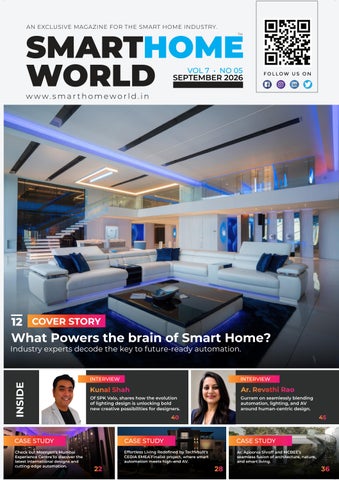
AN EXCLUSIVE MAGAZINE FOR THE SMART HOME INDUSTRY.
SMARTHOME WORLD TM
VOL 7 • NO 05 SEPTEMBER 2026
www.smar thomeworld.in
12 COVER STORY
What Powers the brain of Smart Home?
INSIDE
Industry experts decode the key to future-ready automation.
INTERVIEW
INTERVIEW
Kunal Shah
Ar. Revathi Rao
Of SPK Valo, shares how the evolution of lighting design is unlocking bold new creative possibilities for designers.
Gurram on seamlessly blending automation, lighting, and AV around human-centric design.
40
45
CASE STUDY
CASE STUDY
CASE STUDY
Check out Moorgen’s Mumbai Experience Centre to discover the latest international designs and cutting-edge automation.
Effortless Living Redefined by TechVault’s CEDIA EMEA Finalist project, where smart automation meets high-end AV.
Ar. Apoorva Shroff and MCBEE’s seamless fusion of architecture, nature, and smart living.
22
28
36
13•14•15 MAY 2027
INDIA’S LARGEST SMART HOME TECHNOLOGY TRADE SHOW
For Bookings Contact: Monika Agnihotri M: +91 9321024581 E: monika@smarthomeexpo.in Bankim Laher M: +91 8591277084 E: bankim.laher@india.messefrankfurt.com
WORLD MEDIA & EXPO
www.smarthomeexpo.in
FIRE RATED UP TO 120 MIN.
CONTENTS
12 Cover Story
This cover story, The Brain of the Smart Home: Choosing the Right Automation Platform, explores what truly makes a smart home intelligent. Smart Home World brings together insights from leading industry experts on what it takes to build a smarter, more connected and future-ready home.
22 CASE STUDIES
Revathi Rao Gurram shares her perspective on integrating automation, lighting, AV and controls into thoughtfully designed spaces, while keeping people and their everyday experiences at the heart of the design.
50
Step inside Moorgen’s Mumbai Experience Centre, where technology moves beyond functionality to become an integral part of the living experience. The space offers a closer look at how intuitive automation, thoughtful design and intelligent control are shaping the future of luxury homes. Check out TechVault’s CEDIA Awards EMEA Finalist 2026 project, where advanced ABB KNX automation, immersive AV and intelligent controls come together to create a sophisticated home designed for effortless living.
40
Kunal Shah, Principal Lighting Designer & Founder, SPK Valo, shares insights into the evolution of lighting design, the growing role of smart controls, and how tunable light, digital interfaces and intelligent fixtures are opening new creative possibilities for designers.
04 | SMART HOME WORLD | SEPTEMBER 2026
Yale’s Linus® Smart Lock L2 and L2 Lite bring Matter compatibility to smart access, offering greater flexibility across connected home ecosystems while simplifying everyday entry, control and security. At 115 inches, Sony’s BRAVIA 9 II True RGB brings cinematic scale, advanced colour and immersive sound together for a large-format home cinema experience.
56
Explore Where the Olive Tree Rests, a contemporary Lutyens’ Delhi residence by Ar. Apoorva Shroff, with system integration by Sawan Nichani of MCBEE, where sculptural architecture, nature and intelligent automation converge to create a home that is as considered in its technology as it is in its design.
Interviews
Product Preview
Special Reports
CEDIA Expo 2026 brought together the latest thinking, technologies and solutions shaping the custom smarthome industry. Across the show floor, innovation was evident in everything from AI and networking to lighting, immersive AV, shading and security. IFA 2026 wrapped up in Berlin on a high note, bringing together a record international audience, leading technology brands and a broad showcase of innovations spanning consumer tech, home appliances and emerging technologies.
65
News
From breakthrough technologies and new product launches to strategic partnerships and industry moves, read the latest updates shaping the smart home industry.
FROM THE EDITOR
Welcome to our latest edition of Smart Home World. When exploring modern smart spaces, it is easy to focus on hardware specs, but true intelligence is about effortlessness, technology blending so seamlessly into architecture that it simply elevates everyday living.
S WAT I B A L G I
In our Cover Story, The Brain of the Smart Home: Choosing the Right Automation Platform, leading industry experts explore the core systems that make connected homes truly future-ready. This human-centric approach carries into our featured interviews with lighting designer Kunal Shah (SPK Valo), who discusses the creative possibilities of tunable light and smart controls, and Revathi Rao Gurram, who shares her perspective on keeping human experience at the heart of integrated AV, lighting, and automation design. Our case studies showcase this philosophy in practice, from the intuitive luxury of Moorgen’s Mumbai Experience Centre to the architectural convergence of nature and technology in Ar. Apoorva Shroff and Sawan Nichani’s (MCBEE) Lutyens’ Delhi project, Where the Olive Tree Rests, as well as TechVault’s CEDIA Awards EMEA Finalist project, you will see the innovation and applications of smart home technologies. Rounding out this issue, we examine key industry shifts, including Special Reports from CEDIA Expo 2026 and IFA Berlin highlighting AI, networking, and home appliances. We also cover emerging digital access trends like Ultra-Wideband (UWB) adoption by Apple, Google, Samsung, and STMicroelectronics, alongside exciting product previews featuring Yale’s Matter-compatible Linus® Smart Lock L2 series and Sony’s massive 115inch BRAVIA 9 II True RGB display. We hope this issue inspires you and keeps you updated.
TM
Chief Editor: Swati Balgi swati@smarthomeworld.in
Marketing Head: Sandeep Singh sandeep@smarthomeworld.in
Assistant Manager - Sales: Monika Agnihotri monika@smarthomeexpo.in
Tech Journalist: Sunny Sawant sunny@smarthomeworld.in For More Information Contact Us: +91 81690 58048
Published by: WORLD MEDIA & EXPO LLP.
WORLD MEDIA & EXPO LLP
Ecostar, 603, Vishveshwar Nagar Road, Churi Wadi, Goregaon (East) Mumbai, Maharashtra 400063
Smart Home World thanks the various companies that have submitted information. For any editorial submissions, please contact Ms. Swati Balgi, Chief Editor: swati@smarthomeworld.in. The information published in News, Ongoing Trends and Product Gallery is as per the details furnished by the respective manufacturer/distributor. It does not reflect the views of Smart Home World or of the management of WORLD MEDIA & EXPO LLP.
06 | SMART HOME WORLD | SEPTEMBER 2026
Bring the Sound Episode® 800 Commercial Series Pendant Speaker Perfect for background music and ® Pendant Speakers feature a wide dispersion vely projects sound from tall, open ceilings. Featuring top-grade components and durable grade products provide quality audio designed specifi cally for commercial
Engineered for Performance Equipped with a smart two-way design, these speakers feature premium components, outstanding driver voicing, and a 1st order crossover that together provide improved low-frequency response and sound clarity beyond expecta ons.
Built Strong A dur that these speakers hang securely from the cables for a clean look.
Designed Smarter All-cardboard packaging makes these speakers an environmentally friendly choice, plus they are UL 1480 listed, meaning they’ve passed the
Hit the Low Notes These speakers pair well with our 800 Commercial-Series In-Ceiling Subwoofer for rich, thumping bass and detailed sound.
250 Commercial Series In-Ceiling 6.5 in. 25/70-Volt Two-Way Speaker) 250 Commercial Series In-Ceiling 6.5 in. 25/70-Volt Two-Way Speaker) 250 250 Commercial Series In-Ceiling 6.5 in. 25/70-Volt Two-Way Speaker) 250 Commercial Series In-Ceiling 6.5 in. 25/70-Volt Two-Way Speaker) 250 Commercial Series In-Ceiling 6.5 in. 25/70-Volt Two-Way Speaker) 250Commercial CommercialSeries SeriesIn-Ceiling In-Ceiling6.5 6.5in. in.25/70-Volt 25/70-VoltTwo-Way Two-WaySpeaker) Speaker)
ECS-250-IC-6
Engineered for Performance The speakers’ dispersion angle of 110 degrees effectively
Specifications Woofer:
6½” Treated Paper Cone, Nomex Spider & High Temp Voice Coil
provides greater flexibility in speaker spacing, because
Tweeter:
1/2” Fabric Dome, Neodymium Motor, Ferrofluid Cooled
fewer speakers are required to cover the same amount of
Power Handling:
50 Watts RMS, 125 Watt Peak
Dispersion Angle:
110 degrees
Transformer Tap Settings:
0.5W, 1W, 2W, 4W
Frequency Response (-6dB):
58Hz - 20KHz
Sensitivity -2.83 V / 1 Meter:
87
Adjustments:
N/A
spiders and high-temp voice coils ensure longevity, and
Color:
White
a fluid-cooled neodymium tweeter delivers smooth, high-
Crossover Frequency:
4.3 kHz
Connector Type:
Flying Leads
Weight:
2.1 lbs. each
Grill Type:
Aluminum Micro-Perf Mesh
Cutout Dimensions:
7.7” diameter
A paintable grille and baffle allows custom color
Mounting Depth:
3.4”
matching for any commercial application.
Finished Dimensions:
8.5” diameter, 3” D
reduces hot spotting for a more uniform distribution. This
square footage.
Built for Sound A two-way design delivers high sound quality, while Nomex
frequency performance.
Designed for Versatilityy
Lifetime Limited Warranty Lifetime Limited Warranty All Episode Speakers have a Lifetime Limited Warranty. This warranty includes parts and labor repairs on all components found to be defective in material or workmanship under normal conditions of use. This warranty shall not apply to products which have been abused, modified or disassembled. Products to be repaired under this warranty must be returned to SnapAV or a designated service center with prior notification and an assigned return authorization number (RA).
INDIA DISTRIBUTOR FOR ADI-SNAPONE INDIA INDIA DISTRIBUTOR FOR ADI-SNAPONE INDIADISTRIBUTOR DISTRIBUTORFOR FORADI-SNAPONE ADI-SNAPONE
Mahkam Poorviaum Ventures Pvt Ltd #11, Global Mahkam Mahkam Poorviaum Ventures Pvt Ltd #11, Global MahkamPoorviaum PoorviaumVentures VenturesPvt PvtLtd Ltd#11, #11,Global Global Heights, 8th Cross, Vijaya Bank Colony Banaswadi, Heights, 8th Cross, Vijaya Bank Colony Banaswadi, Heights, 8th Cross, Vijaya Bank Colony Banaswadi, Heights, 8th Cross, Vijaya Bank Colony Banaswadi, Bangalore – 560043, Karnataka, India Bangalore Bangalore 560043, Karnataka, India Bangalore–––560043, 560043,Karnataka, Karnataka,India India
CONTACT OUR TEAM: CONTACT CONTACT OUR TEAM: CONTACTOUR OURTEAM: TEAM:
Emails: Emails: order@m2msmarthome.com Emails: order@m2msmarthome.com Emails:order@m2msmarthome.com order@m2msmarthome.com +91 95780 +91 72459 +91 95780 72459 +9195780 9578072459 72459
REACH ARCHITECTS, INTEGRATORS, DESIGNERS & TECHNOLOGY PROFESSIONALS. HOME AUTOMATION • SMART LIGHTING • AV SOLUTIONS • SECURITY SOLUTIONS
BOOK YOUR ADVERTISEMENT SPACE NOW Contact: Sunny Sawant +91 9082805062 | sunny@smarthomeworld.in
www.smarthomeworld.in
QLA - SERIES PRECISE. POWERFUL. PURE.
ONBOARD PROCESSING
AMPLIFICATION
GLL SIMULATION
The performance you expect. Seamless integration, incredible detail, for venues that demand the best.
NLABSINDIA
WWW.N-LABS.IN
NLABS2023
COVER STORY
The Brain of The Smart Home: Choosing the Right Automation Platform
What makes an automation platform the true “brain” of a smart home? Smart Home World explores the key factors that define a robust platform, from integration and reliability to user experience, security, scalability and AI, with insights from leading industry experts. A smart home can have the best lighting, sophisticated AV, advanced security, intelligent climate control and an impressive array of connected devices, and still fall short of being truly intelligent. The difference lies in what happens between them: how these systems communicate, respond and work together as a cohesive whole. As residential automation becomes more sophisticated, choosing a platform is no longer simply about comparing features, processing power or the number of devices it can control. 12 | SMART HOME WORLD | SEPTEMBER 2026
The real challenge is finding an architecture that can bring different systems together, respond intuitively to the homeowner’s needs, remain reliable as the project evolves and protect the data running quietly behind the scenes. That makes the “brain” of the home one of the most important decisions in any automation project. But what exactly qualifies as the brain? Is it the processor, the software, the interface or the
smart home, from platform selection and interoperability to scalability, AI, cloud connectivity, privacy and the increasingly important role of the professional system integrator. IT’S NOT JUST THE PROCESSOR The first misconception the panel challenged was that the “brain” of a smart home can be reduced to a single piece of hardware. In reality, the intelligence of an automation system comes from the way its hardware, software, programming, communication protocols and user interfaces work together. Lighting, HVAC, motorised shades, security, AV, access control and other systems may operate on different architectures, but the homeowner should experience them as one connected environment. Dhanraj Sheth, CEO, Uniser SmartSpaces, put the emphasis firmly on the experience rather than the hardware. “The brain of the home or the brain of the automation system is something that can seamlessly communicate across multiple brands, multiple devices and multiple protocols.”
larger architecture connecting everything? And how should homeowners, designers and system integrators determine which platform is right for a particular project? These questions took centre stage at the panel discussion “Brains of the Home: Choosing the Right Automation Platform” at Smart Home Expo 2026. Moderated by Ganesh Vudutha, Co-Founder & CEO, Edomotics Smart Systems, the discussion brought together Dhanraj Sheth, CEO, Uniser SmartSpaces; Ashish Tijare, Director & CEO, Intelligible Tech Solutions Pvt. Ltd.; and Jayaprakash Chinnamuthu, Director of Residential & Strategic Initiatives, Crestron Electronics India. Rather than focusing only on processors and control interfaces, the panel examined the larger architecture behind a successful
For him, the automation system should ultimately be ju dged by the experience it delivers rather than by the individual piece of hardware sitting at its core. Jayaprakash Chinnamuthu, Director of Residential & Strategic Initiatives, Crestron Electronics India, offered a similar analogy, describing “the brain as the central controller that communicates with the different parts of the home—much like the human brain coordinates the body’s limbs, eyes and ears. The implication is important: the brain is less about what the device is and more about what the overall architecture enables it to do.” He further adds, “A platform may control hundreds of devices, but if those devices operate as isolated islands, the home is not necessarily intelligent. True automation comes from creating meaningful relationships between systems—so that lighting can respond to occupancy, shades can work with daylight conditions, climate control can respond to routines and entertainment can SMART HOME WORLD | SEPTEMBER 2026 | 13
become part of a larger scene rather than a standalone function.” START WITH THE HOMEOWNER, NOT THE BRAND If the brain is responsible for bringing the home together, the next question is how to choose it. The panel’s answer was clear: begin with the requirement, not the product. Homeowners often approach automation projects with a predetermined list of brands or products; one for lighting, another for shades, another for AV and another for climate control. But choosing individual products first can make integration considerably more complicated. Instead, the starting point should be the desired experience. “In fact, whenever we are getting a space done, the first thing we need to do is get a professional system integrator on board
64 | SMART HOME WORLD | SEPTEMBER 2026
who can help understand what the user’s experience wants to be, and then peg it to what system would best be able to support that,” said Chinnamuthu. This approach shifts the conversation from a shopping list of devices to a discussion about how the home should actually function. Does the homeowner want centralised control? Seamless scenes? Voice interaction? Greater energy management? Sophisticated entertainment? Enhanced security? Or simply a home that quietly responds to everyday routines? The answers can influence everything from the platform and communication protocols to the network architecture and user interface. Ashish Tijare added another perspective, highlighting the importance of support and technical resources for integrators. “All systems and manufacturers are good, but it all depends upon which segment you are addressing. For system integrators, however, there are additional considerations.
One is the level of support available from the manufacturer. A good automation platform should allow integrators to educate themselves, troubleshoot problems and resolve issues without being completely dependent on the manufacturer.” Online courses, comprehensive documentation, technical resources and training programmes therefore become important criteria. “If you go to Crestron or Savant’s website, you have documentation to guide you through. If you are stuck at the site, you should be able to troubleshoot yourself. You should be able to resolve the problem yourself. Only then, in my opinion, is a good system to be taken forward to your project.”
scalability and security. Reliability is perhaps the least visible but most important. Automation becomes infrastructure once it is embedded into everyday life. Lighting scenes, climate control, access, security and entertainment are expected to work consistently without requiring constant intervention. A smart home that occasionally fails to respond can quickly undermine the very convenience it was designed to provide. Reliability therefore extends beyond individual devices to the network, software, programming and communication between systems.
THREE THINGS THAT MATTER MOST
Then comes scalability. A home rarely remains static. New rooms, devices, lighting loads, security systems or AV zones may be added over time. A platform that works for today’s requirements but becomes restrictive tomorrow can quickly become a limitation.
For homeowners, the panel distilled platform selection into three fundamentals: reliability,
“The brain should Chinnamuthu.
For a professional installation, the strength of the ecosystem around a platform can therefore be just as important as its headline specifications.
be
scalable,”
said
SMART HOME WORLD | SEPTEMBER 2026 | 15
A homeowner may start with a relatively small installation and gradually add more systems and devices. In larger residences, this scalability can even extend to a second home, office or another property. The third pillar is security and this is increasingly moving higher up the homeowner’s priority list. As the number of connected systems grows, so does the importance of securing the network, devices and data that connect them. Security can no longer be treated as a separate layer added towards the end of a project. It needs to be considered as part of the platform architecture from the beginning. THE CLOUD QUESTION As connected homes become more dependent 16 | SMART HOME WORLD | SEPTEMBER 2026
on networks and online services, security is no longer simply about protecting a Wi-Fi network. Homeowners are increasingly asking where their data resides, how it is processed and how dependent the home is on the cloud. “Today we are seeing a huge alertness towards internet and network security coming from customers,” Chinnamuthu noted. He further adds, “Particularly in the ultra-luxury segment, the first question that comes is: how much is the home dependent on the cloud?” It is a question that becomes more significant as automation systems begin to understand occupancy, routines, preferences and behavioural patterns. For the integrator, platform selection therefore increasingly involves assessing not just functionality but also network architecture,
But the panel cautioned against treating Matter as an instant answer to every integration challenge. The distinction between consumer electronics and professional installation products remains significant. Consumer products can adopt common standards relatively easily, while professional automation platforms often involve sophisticated ecosystems, proprietary development roadmaps and specialised features designed for complex residential installations. “There is a clear divide between the consumer products and the installation products,” says Ashish Tijare. The result is an industry that is likely to remain hybrid for some time by combining open standards with proprietary ecosystems, with system integrators continuing to bridge the gaps between them. For homeowners, that makes the role of the integrator even more important. Interoperability on paper does not necessarily translate into a well-designed, reliable installation. A device may technically support a standard and still have limitations when integrated into a larger, professionally programmed system. security practices, data handling and resilience. The question is also practical: what happens when the internet goes down? Which functions continue to operate locally, and which depend on an external service? Understanding this distinction can be critical when automation controls essential elements of a home. MATTER: PROMISE & LIMITATIONS Interoperability has long been one of the biggest ambitions of the connected-home industry, and standards such as Matter have given that conversation fresh momentum. For homeowners, the promise is compelling: greater compatibility between products and ecosystems, potentially making it easier to bring devices from different manufacturers into a connected environment.
WHEN AI ENTERS THE HOME The conversation inevitably moved towards AI. For years, one of the challenges of automation adoption has been usability. Sophisticated systems can deliver extensive functionality, but homeowners do not necessarily want to learn the logic behind every scene, command or interface. AI could change that relationship. Instead of the homeowner learning how to operate the system, the system could increasingly learn the homeowner— recognising routines, understanding patterns and making automation more contextual. For a busy household, this could mean fewer explicit commands and a more responsive environment. Lighting, climate, shades and SMART HOME WORLD | SEPTEMBER 2026 | 17
entertainment could increasingly adapt to patterns of use rather than waiting for individual instructions. “If it becomes simpler, it will be a big plus,” said one panelist. “AI is the way forward.” The opportunity is particularly significant for wider residential adoption. If AI can make automation feel less complicated and more intuitive, it could help address one of the longstanding barriers to connected-home adoption. But making the home smarter also raises a difficult question: how much should the home know?
more it potentially knows about the people living inside it. That makes privacy an essential part of the AI conversation. During the discussion, the panel highlighted the risks of connecting AI-enabled systems to functions that have direct security implications. A smart speaker, for example, may make it convenient to control a smart lock through voice. But that same convenience can create a vulnerability if an unauthorised person is able to issue a command.
HOW MUCH SHOULD THE HOME KNOW?
The issue is not whether a particular integration is technically possible. It is whether that integration makes sense from a security standpoint.
The more an automation system learns, the
“Integration today has to be really thought
64 | SMART HOME WORLD | SEPTEMBER 2026
through by partners, particularly with AI,” one panellist cautioned. For professional automation, this distinction will become increasingly important. AI should not simply be added because it can be. Its role needs to be considered within the larger security and user-experience architecture. The most useful AI may ultimately be the kind that operates quietly in the background— reducing friction without compromising control or privacy. LOCAL OR CLOUD? THE ANSWER MAY BE BOTH The AI conversation also brings the question of processing closer to the surface. Local processing offers advantages in terms
of privacy, resilience and control, while sophisticated AI capabilities can demand computational resources that are often easier to provide through cloud infrastructure. One panelist summed up the direction succinctly: “Cloud is the way forward.” Yet the discussion also acknowledged the privacy concerns that come with clouddependent automation. This points towards a more nuanced future rather than a simple local-versus-cloud debate. Critical automation functions could remain local, while selected AI capabilities make use of secure cloud infrastructure. For system integrators, understanding where intelligence resides—and what happens when connectivity is lost—could become just as important as specifying the hardware itself. The architecture of tomorrow’s smart home may therefore involve a combination of local control, edge processing and cloudbased intelligence, with each layer assigned functions based on performance, security, privacy and reliability requirements. THE INTEGRATOR IS THE ARCHITECT OF THE EXPERIENCE Perhaps the strongest message from the panel was the importance of involving a professional system integrator early in the project. The integrator’s role has evolved significantly. It is no longer simply about installing equipment and programming scenes. The integrator has to understand the homeowner, interpret the brief, assess the architecture and determine how multiple technologies should work together. “Just as you hand over design to a designer and architecture to an architect, you need to hand over your smart requirements, your intelligent-home requirements and your automation requirements to a professional system integrator,” said Chinnamuthu. This is particularly relevant as homeowners have greater access to consumer smart-home products and online information. A product may perform exactly as advertised on its SMART HOME WORLD | SEPTEMBER 2026 | 19
own, but that does not guarantee that it will work effectively within a larger automation ecosystem.
and what has actually been specified and programmed as one of the recurring reasons projects can fall short.
The integrator’s value lies in connecting those individual choices into a coherent system.
The solution begins with a clear brief.
This also makes collaboration with architects and interior designers increasingly important. Automation decisions can influence electrical planning, network infrastructure, joinery, lighting design, AV spaces and even the visual language of the interiors. Bringing the integrator into the conversation early can help ensure that technology is considered as part of the architecture rather than added after the design is complete. THE EXPECTATION GAP Technology is only one part of a successful automation project. Expectations are another. The panel identified a gap between what homeowners imagine automation will do 20 | SMART HOME WORLD | SEPTEMBER 2026
What should happen when the homeowner wakes up? What should the home do when the family leaves? Which systems should respond to occupancy? Which functions need to work without internet connectivity? What should happen automatically, and what should remain under manual control? These may sound like simple questions, but answering them early can fundamentally shape the system architecture. A clear brief also helps manage expectations around what automation can and cannot do. Rather than accumulating features, the project can focus on functions that genuinely improve the way the household uses its spaces. The panel also encouraged homeowners
Technology will continue to evolve. New standards will emerge, AI capabilities will expand, interfaces will change and connected devices will become increasingly sophisticated. A platform therefore needs enough flexibility to accommodate change without forcing homeowners to rethink the entire system every time a new technology arrives.
to visit experience centres and actually use automation systems before making a decision. Experiencing different interfaces and scenarios can help separate genuinely useful functionality from features that simply sound impressive on paper. BUILD FOR THE NEXT 20 YEARS A smart home is not just another collection of connected devices. Once integrated into the architecture, automation can become part of the home’s infrastructure for a decade or more. That changes the way the platform should be evaluated. The most powerful system today is not necessarily the right choice for a project. The more relevant question is whether the platform can remain reliable, scalable, secure and adaptable as the home—and the homeowner—changes.
The panel’s final advice returned to these fundamentals: involve a professional system integrator, communicate expectations clearly, experience the technology before committing and choose a platform that can support the home over the long term. Ultimately, the “brain” of the smart home is not the processor with the highest specification or the platform with the longest feature list. It is the technology architecture that brings different systems together, adapts to changing requirements, protects the homeowner and makes the complexity of automation disappear from everyday life. That may be the real measure of intelligence: not how much technology the home has, but how little the homeowner has to think about it. The perspectives and quotes featured in this Cover Story are drawn from insights shared during the panel discussion, “The Brain of the Smart Home: Choosing the Right Automation Platform,” at Smart Home Expo 2026. SMART HOME WORLD | SEPTEMBER 2026 | 21
CASE STUDY
Automation in a New Light Inside the Moorgen Experience Designed as a journey through light, interaction and orchestration, Moorgen’s Mumbai Experience Centre offers a glimpse into a new generation of luxury automation where technology responds intuitively to the way we live. Stepping into Moorgen India’s Mumbai Flagship Experience Centre, the first impression is that this is not a conventional automation showroom. Located at Naman Midtown in Mumbai, this experience centre has been designed to demonstrate a simple yet powerful idea: technology should belong to the interior, not be added to it. Designed by ZEDO Group of Architects & Designers, headed by architect Nimit Kamdar, the space brings together Moorgen intelligent automation, Focus Lighting and Vitrum window systems 22 | SMART HOME WORLD | SEPTEMBER 2026
in an environment where visitors can see, touch and experience technology as part of a finished interior. The journey begins with light. The Dark Room Experience allows visitors to see architectural lighting in its intended environment, rather than simply viewing fixtures on a display. Focused illumination, accent lighting, beam characteristics, glare control, dimming and layered lighting compositions can be experienced in real conditions. As lighting
layers are dimmed and transformed through Moorgen scenes, the room demonstrates how lighting control can shape the mood and character of architecture. From light, the experience moves to interaction at the Interface Alley. Here, the controls themselves become design objects. Architectural keypads, smart panels, rotary and tactile controls and remote controls are presented live, allowing visitors to compare their proportions, materials, finishes, illumination and tactile response.
Milan Series
Finland Series
The designer series are aesthetically displayed at the showroom: Zaha Hadid Design’s Landmark Series translates fluid geometry and parametric forms into micro-architectural wall interfaces; Kengo Kuma’s Branch and Shadow Series infuses warm wood textures and dappled light effects to seamlessly merge
tech with nature; Philippe Starck’s Rock’N Fire Series applies bold, elemental forms and rawstone aesthetics to bring playful, emotional resonance to everyday interaction; Yabu Pushelberg’s Modo Series delivers tailored, understated modern luxury tailored for highend hospitality and residence interiors; Chi Wing Lo’s Minimalism & Wall-Jewel Series embeds pure Asian poetic restraint into flush-mounted, gemstone-like controls; and Neri&Hu’s Tile Series introduces tactile memory and artisanal depth to surface design. Beyond their breathtaking visual appeal, these exclusive designer series do not just provide an aesthetic edge; they are technologically advanced masterpieces driven by state-ofthe-art home automation engineering. Adding his insight, Tushar Shah, Owner/ Director, Alvis Homes says, “The product experience extends beyond switches and keypads. Visitors can explore smart panels, dimming interfaces, hospitality controls, automation modules and the underlying SMART HOME WORLD | SEPTEMBER 2026 | 23
Mr. Steve Leung
Ar. Zaha Hadid
Neri & Hu
Mr. Chi Wing Lo
Mr. Philippe Starck
Philippe Starck Rock’N Fire Series
Kengo Kuma
Branch and Shadow Series Smart Panel
through a screen or specification sheet, visitors can activate a scene and watch the room respond. Lights transition, curtains move, climate adjusts and music changes the atmosphere, demonstrating how multiple technologies can behave as one environment.”
system architecture. Among the highlights is Moorgen’s 12.3-inch AI-powered smart panel, featuring functions such as Magic Ball scene creation, an intelligent homepage, native voice interaction and integrated audio. The centre also demonstrates Moorgen’s Indiaspecific 866.5 MHz RF remote controls, offering portable interaction without making the core automation experience dependent on the home’s Wi-Fi network.” The journey then moves from individual controls to orchestration. Explaining the concept, Tushar Shah further adds, “In the Conference & Experience Room, lighting, motorised curtains, music, air-conditioning and other compatible functions come together. Rather than explaining integration 26 | SMART HOME WORLD | SEPTEMBER 2026
This is where Moorgen’s approach to smart living becomes most apparent. The system is built around moments rather than devices: scenes/settings are created like arriving home, entertaining, watching a film or going to sleep. A Welcome, Entertain, Cinema or Good Night scene can coordinate lighting, curtains, climate, entertainment and other compatible functions through a single interaction. The same experience can be triggered through a keypad, dial, smart panel, remote, app or voice, while sensors and schedules can automate selected responses. The Moorgen App adds another layer of convenience, bringing compatible lighting, curtains, climate, devices, favourites and scenes into one digital interface, while also enabling remote access. Yet the philosophy remains firmly centred on the home rather than the smartphone. A keypad may be more natural at the entrance, a dial beside the bed, a remote from the sofa and an automated response when no interaction is needed.
Behind this effortless experience lies a heavily engineered ecosystem. Supported by Moorgen’s robust, reliable, and enterprisegrade backend infrastructure, Moorgen provides a complete, turnkey package that unifies lighting, DALI and all dimming protocols, automated curtain controls, HVAC climate systems, AV setups, security, access control, motion sensors, and privacy management into a single, cohesive interface. Its wired core leverages the proprietary Moorgen-Bus protocol while offering native integration with global standards like KNX, seamlessly adapting to any project’s technical requirements. Rather than simply connecting individual smart devices, Moorgen orchestrates them into a responsive, intelligent environment—delivering absolute harmony, rock-solid reliability, and effortless luxury living. By the time the walkthrough ends, the purpose of the centre becomes clear. It is simultaneously a showroom, an immersive demonstration space and a live specification environment for architects, interior designers, consultants, integrators and homeowners. Visitors first see how technology can belong to an interior, then experience how it should feel to interact with it, and finally witness an entire environment respond as one.
At the heart of the experience are Moorgen’s three defining pillars: Design, Intelligence and Engineering, bringing together design that belongs, intelligence that understands, and engineering that endures. Together, they shape a smart living experience that feels intuitive, refined and built for the long term.
For More Details: Unit No. 1202, A Wing, Naman Midtown, Senapati Bapat Marg, Elphinstone West, Dadar West, Mumbai, Maharashtra 400013; Tel: 7360073200) SMART HOME WORLD | SEPTEMBER 2026 | 27
CASE STUDY
Intelligence Without Complexity TechVault, a CEDIA Awards EMEA Finalist 2026, has transformed this luxury residence by seamlessly integrating ABB KNX automation, TruAudio, Denon and BenQ, creating a connected experience that is sophisticated yet remarkably simple to live with. TechVault, a CEDIA Awards EMEA Finalist 2026, has engineered a sophisticated connected ecosystem for this 78,500 sq ft luxury residence. The three floors, residence comprises five bedrooms, a dedicated home theatre, two terraces, a garden, a pool area and an outhouse. Yet this is more than a private luxury home. Designed to also function as a demonstration property for a prominent real estate developer, the project demanded a technology infrastructure that could showcase advanced capabilities while remaining visually discreet, intuitive and effortless to operate. With a substantial footprint and relatively few permanent occupants, TechVault’s approach was to make the technology powerful enough to manage every aspect of the property, yet simple enough to disappear into everyday life. The result is a connected environment where automation, AV and essential home systems work seamlessly together, delivering a refined experience for residents while remaining 28 | SMART HOME WORLD | SEPTEMBER 2026
ready to demonstrate its capabilities at any moment. At the core of the residence is an ABB KNXbased automation platform with a Basalt processor, selected for its open-protocol architecture, reliability at scale and long-term upgradeability. The automation backbone
brings together multiple building and entertainment subsystems, including AV, DALI lighting, climate control, motorised blinds and curtains, security, CCTV, smart locks, video intercom, gate and garage control, as well as indoor and outdoor audio. Rather than operating these systems independently, they are unified within a single application, enabling the entire property to be managed through one interface. Alexa voice control is layered onto the system to provide an additional mode of interaction. The property’s networking infrastructure has been designed to support this extensive connected ecosystem. A heat-mapped mesh Wi-Fi network provides stable coverage across indoor and outdoor zones, while dedicated private and guest networks separate users and connected devices to maintain security and performance. This network architecture provides the underlying connectivity required for the home’s automation, AV, security and control systems to operate reliably across the large footprint. The automation design was supported by detailed planning at the infrastructure stage. All technical design work was executed on AutoCAD, with low-voltage and electrical SMART HOME WORLD | SEPTEMBER 2026 | 61
layouts merged into a unified drawing set. This approach enabled potential conflicts between services to be identified and resolved before reaching site, helping streamline installation while maintaining coordination between the technology infrastructure and the architectural design. Particular attention was given to the positioning of every touchscreen, keypad, speaker and sensor, ensuring that the technology integrated with the architecture rather than visually competing with it. Audio infrastructure was similarly planned during the early construction phase. The entire property was pre-wired for audio, creating the infrastructure required for future expansion without additional civil work. This approach subsequently enabled the integration of full multi-zone audio across the residence without introducing delays or disrupting finished spaces. The same principle of infrastructure-first planning proved valuable when the client requested additional outdoor speakers after the landscaping had been completed. Instead of undertaking excavation and risking damage to the finished grounds, the team engineered a discreet daisy-chain wiring solution, allowing the additional speakers to be integrated without civil intervention.
64 | SMART HOME WORLD | SEPTEMBER 2026
The home’s lighting strategy extends beyond conventional automated switching and dimming. DALI lighting control is integrated into the wider KNX automation architecture, allowing lighting to become part of programmed scenes and daily routines. Timebased facade and planter lighting scenes provide automated control of the exterior environment, while customised Good Morning and Good Night moods bring together multiple systems to create predefined experiences. These coordinated scenes contribute to a hotel-grade experience while keeping interaction simple for occupants and visitors. For the dedicated home theatre, the system incorporates TruAudio Elite and Ghost HT series speakers for high-performance concealed architectural installation. The TruAudio ELITE26 serves as a high-end in-wall LCR solution, offering 200 W power handling and dual 6.5-inch carbon-fibre woofers for high-output performance. The TruAudio GHT66P, specified for in-wall LCR applications, provides 125 W power handling, while the TruAudio GHT-55P, designed for in-wall LCR and surround applications, offers 100 W power handling in a compact high-performance format. SMART HOME WORLD | SEPTEMBER 2026 | 61
Distributed audio across the residence is handled through a combination of TruAudio architectural and outdoor speakers. The TruAudio G72 is deployed for premium inceiling applications, including Dolby Atmos, with 125 W power handling. The TruAudio PP-6, rated at 90 W, provides distributed background audio across multiple zones, while the TruAudio SP-6, also rated at 90 W, is used in multi-zone and larger-room applications where enhanced low-frequency performance is required. The audio system extends into the property’s outdoor environments through TruAudio OL5BK on-wall/outdoor speakers, which offer 80 W power handling and IP66 weather protection, making them suitable for patios, terraces and other outdoor areas. TruAudio Rock Speakers provide a more discreet landscape audio solution for gardens, lawns and pool areas. These speakers offer power handling of up to 150 W, depending on the selected rock-speaker model, along with IP66 weather protection. Centralised audio processing and amplification are provided by Denon AV receivers, supporting 64 | SMART HOME WORLD | SEPTEMBER 2026
Dolby Atmos, DTS:X, 8K video connectivity and HEOS multi-room audio. The Denon AVRX6700H serves the premium home theatre application as an 11.2-channel AV receiver with 140 W/channel. For secondary theatre and multi-zone applications, the Denon AVRX2800H provides 7.2-channel amplification with 95 W/channel, along with Dolby Atmos/ DTS:X, 8K video support and HEOS multi-room audio. Together, these components provide the processing and distribution infrastructure required to manage the property’s varied entertainment zones. Projection technology is equally integrated into the residential entertainment environment. The main home theatre employs the BenQ W4000i, a 4K UHD projector rated at 3,200 ANSI lumens, delivering the high-resolution projection required for the dedicated cinema environment. A second entertainment application is provided through the BenQ V5010i, a 4K UHD ultra-short-throw projector rated at 2,500 ANSI lumens, bringing a large-format cinematic experience into the living room without requiring the projection configuration of a dedicated theatre.
SMART HOME WORLD | SEPTEMBER 2026 | 61
The ABB KNX automation architecture provides the control layer for lighting, HVAC, curtains, scenes and AV equipment throughout the residence. At the room level, the ABB Peonia Series provides front-end control for lighting and dimming, curtain and blind control, HVAC and temperature management, scene selection and AV control. The ABB RoomTouch 4” touchscreen provides a dedicated roomlevel interface, featuring a 4-inch touchscreen with 480 × 480 resolution for lighting, HVAC and scene control. At the centralised-control level, the ABB SmartTouch 10” provides a larger interface with 1280 × 800 resolution, enabling advanced home automation control. Environmental automation is supported through ABB Presence Sensors, deployed in washrooms, dressing rooms and utility areas. These sensors enable presence detection and automatic lighting control while supporting energy-saving strategies and integration with HVAC and exhaust systems. Outdoor areas are equipped with ABB Busch-Watchdog sensors
for motion detection and outdoor lighting control. The weather-resistant sensors support automatic ON/OFF operation, extending intelligent control into the property’s exterior zones. The result is an automation and AV ecosystem engineered around the scale and complexity of a large luxury residence, while deliberately concealing that complexity from the end user. From the KNX automation backbone and DALI lighting infrastructure to distributed audio, multi-zone AV, climate control, security, networking and environmental sensing, the systems operate as a coordinated technology platform. For a property that doubles as a demonstration environment, this balance between sophisticated engineering and effortless interaction is particularly important. The technology is extensive, but its presence is intentionally understated, allowing the architecture and experience of the residence to remain at the forefront.
TECH INSIGHTS Automation & Control
ABB KNX + Basalt processor | DALI | HVAC | AV | Security | CCTV | Smart locks | Video intercom | Gate & garage | Motorised blinds & curtains | Alexa
Home Theatre
TruAudio ELITE26 | GHT-66P | GHT-55P | Denon AVR-X6700H | BenQ W4000i 4K UHD
Multi-Zone Audio
TruAudio G72 | PP-6 | SP-6 | OL-5BK | Rock Speakers | Denon AVR-X2800H | HEOS
Lighting & Environment
DALI + KNX | Automated scenes | Presence Sensors | Busch-Watchdog | HVAC integration
Control Interfaces
ABB Peonia Series | RoomTouch 4” | SmartTouch 10”
Connectivity
Heat-mapped mesh Wi-Fi | Dedicated private & guest networks SMART HOME WORLD | SEPTEMBER 2026 | 35
CASE STUDY
A Home That Blends Smart Living with Soulful Design
Designed by Ar. Apoorva Shroff, Where the Olive Tree Rests is a contemporary residence where sculptural architecture, nature and intelligent technology unfold in quiet harmony. System integration by Sawan Nichani of MCBEE brings intelligence into the home with a discreet touch, allowing technology to enhance the experience without taking centre stage. In the heart of Lutyens’ Delhi, where heritage architecture and tree-lined avenues shape the city’s character, Where the Olive Tree Rests unfolds as a deeply emotive and spatially intelligent home. Designed by Apoorva Shroff, Founder and Principal Designer, Lyth Design, with system integration by Sawan Nichani, Founder and CEO, MCBEE, the residence goes beyond renovation to reimagine family living through memory, light and nature.
the emotional and architectural anchor of the home, around which every space gently unfolds. Its textured trunk and silvery foliage introduce a calming presence that softens the architecture while establishing a constant visual dialogue between indoors and outdoors,” explains Apoorva Shroff, Founder and Principal Designer, Lyth Design.
“At the very centre of the residence stands its defining feature, a majestic olive tree. More than a landscape element, the tree becomes
Despite its relatively compact 4,000 sq ft footprint, the residence feels remarkably expansive. The design cleverly transforms
36 | SMART HOME WORLD | SEPTEMBER 2026
Reimagining Space Within Constraints
spatial limitations into opportunities through highly efficient planning and multifunctional interventions. The brief itself was rooted in the need for more space, a larger kitchen, additional bedrooms, increased storage, and greater flexibility for a growing family. Rather than expanding outward indiscriminately, the project reimagines the existing structure with precision and restraint. Every corner of the home has been designed to perform multiple roles, integrating hidden storage and adaptable elements that maximise usability without compromising aesthetics. From concealed bar units to moving embroidered screens that create temporary transitions between spaces, the home demonstrates an intelligent approach to contemporary living. A Material Palette Defined by Warmth The arrival experience sets the tone for the home’s tactile richness. A warm timber-
lined lobby envelopes visitors in a cocoon of natural textures, where wood-clad walls, ceilings, and columns create an immersive sensory atmosphere. This material warmth is balanced by elegant grey-and-white inlay marble flooring that lends visual lightness to the entrance threshold. Spatial organisation is carefully choreographed. Private spaces extend discreetly to one side, while the common areas unfold on the other, both visually connected through the central garden court. The interiors evolve through layered materiality and crafted detailing, lime-finished ceilings, black-knobbed dining walls, brass and marble accents, and continuous wooden skirting that ties the spaces together with understated sophistication. In contrast, the private quarters adopt a softer and more intimate character with warm wooden textures, playful art interventions, and abundant natural light. The Sculptural Staircase as a Centrepiece SMART HOME WORLD | SEPTEMBER 2026 | 37
air-conditioned environments with integrated mosquito mesh screens. The result is a fluid indoor-outdoor experience that responds dynamically to weather, comfort, and lifestyle needs. Technology Integrated with Everyday Living While the home feels warm and deeply tactile, it also integrates a sophisticated smart automation ecosystem designed to remain visually unobtrusive and intuitive to use. The residence is built on a KNX-based automation architecture that combines intelligent backend control with seamless user interaction. Premium touch keypads from Ekinex serve as the primary interface, while Theben handles switching, dimming, and logic operations. Climate management is integrated through CoolAutomation’s CoolMaster platform, enabling centralised HVAC control throughout the residence. At the core of the system is the Crestron CP4-R processor, which allows unified app-based management of lighting, climate, and scenes across the home. One of the home’s most striking architectural gestures is the sculptural staircase that spirals gracefully around the olive tree. Connecting the lawn to the rooftop, the staircase transforms circulation into an experiential moment while introducing additional usable space above. Its delicate railing appears almost frozen in motion, lending the structure a poetic quality that contrasts beautifully with the organic stillness of the tree itself. Above, the rooftop evolves into a serene retreat, an elevated extension of the home that offers new perspectives of the site and surrounding greenery. This vertical connection between landscape, architecture, and sky becomes one of the project’s defining experiences. The project also introduces adaptable outdoor spaces through retractable pergolas from RENSON, installed as extensions to both the living room and master bedroom. These pergolas can fully retract to open the spaces to the sky or transform into enclosed, 38 | SMART HOME WORLD | SEPTEMBER 2026
The addition of 1Home enables Apple HomeKit compatibility, creating a more intuitive and familiar user experience for the homeowners. A Future-Ready Infrastructure Supporting the entire automation ecosystem is a high-performance network backbone powered by Peplink. Designed for reliable wired and wireless communication between processors, gateways, access points, and user devices, the infrastructure also remains Starlink-ready for future satellite internet integration and uninterrupted connectivity. A Home That Tells a Story Ultimately, Where the Olive Tree Rests is more than a residence. It is a living narrative shaped by architecture, emotion, and adaptability. Rooted deeply within the historic fabric of Delhi yet undeniably contemporary in spirit, the home reflects a rare balance between technological sophistication and soulful design. It is a sanctuary where nature, memory, and modern living coexist with quiet elegance. Photography: Avesh Gaur
TECH INSIGHTS • • • • • •
Ekinex 20Venti Series Keypads Theben KNX Actuators and Control Modules CoolMaster HVAC Gateway Peplink AP One AX Lite Wireless Access Point Crestron CP4-R Processor 1Home Integration Interface SMART HOME WORLD | SEPTEMBER 2026 | 39
INTERVIEW
“We Don’t Just Illuminate Spaces; We Choreograph Them.” Kunal Shah
Principal Lighting Designer & Founder, SPK Valo Kunal Shah, Principal Lighting Designer & Founder, SPK Valo, shares insights into the evolution of lighting design, the growing role of smart controls, and how tunable light, digital interfaces and intelligent fixtures are opening new creative possibilities for designers.
Could you take our readers through your journey as a lighting designer and the evolution of your practice? My journey began with a deep curiosity about how light shapes space, emotion, and human behaviour. Studying Architectural Lighting Design at KTH Royal Institute of Technology in Stockholm instilled in me a European sensibility for minimalism, glare control, and natural light integration. When we established SPK Valo in Hyderabad, the guiding ethos became “Think Global, Act Local”. Early in my practice, architectural lighting was predominantly static, focused on luminaire selection, wattage calculations, and fixed fixture layouts. Over time, our studio evolved from treating light as a static finish to approaching it as a living, breathing spatial sculpting tool. Today, we don’t just illuminate 40 | SMART HOME WORLD | SEPTEMBER 2026
structures; we choreograph spatial sequences, balancing shadow with light to evoke distinct emotional responses across residential, hospitality, and commercial landscapes. How has Smart Lighting & Control changed your approach to lighting design compared with conventional systems? Conventional lighting relied on fixed circuits, manual wall switches, and static dimmers. If you wanted to re-zone a room or alter an atmosphere, it required physical rewiring or adding fixtures. Smart lighting and digital control have completely liberated our design approach: • Dynamic Storytelling: Spaces are no longer tied to a single identity. A high-end restaurant can feel bright and airy during breakfast, transition to warm, tactile tones
•
•
at dusk, and morph into a moody, intimate sanctuary by night. Layered Composition: Instead of adjusting individual switches, controls allow us to program curated “scenes” where multiple layers of light—cove reveals, accent spots, floor grazers—adjust simultaneously to exact percentages. Energy Discipline: Intelligent controls ensure light is delivered only when and where needed, maximising efficiency without compromising visual comfort.
What makes a lighting fixture truly “smart”? How do tunable white, RGB/RGBW and digitally controllable fixtures expand design possibilities? A fixture isn’t “smart” merely because it connects to an app or has an integrated chip. A truly smart fixture seamlessly balances photometric quality, digital intelligence, and physical integration: 1. High Optical Integrity: Ultra-smooth dimming down to 0.1%, high colour consistency, and high colour fidelity. 2. Digital Addressability: Individual control of output, spectrum, and beam parameters over standard digital protocols. 3. Thermal & Sensor Intelligence: Integrated onboard sensors that report temperature,
operating hours, and energy consumption back to a central network. Expanding Creative Boundaries •
•
Tunable White: Essential for circadian lighting and material authenticity. Warm dimming mirrors traditional halogen warmth, while dynamic white brings daylight cycles indoors, highlighting natural materials like wood, stone, and woven textiles at their true colour rendition. RGB/ RGBW: Moves beyond gimmicky saturated colours to subtly shift colour temperatures, saturate specific interior accents, or introduce soft dynamic washes for experiential and hospitality venues.
How do you select switches, dimmers, keypads, touch panels and other lighting interfaces for a project while ensuring they complement the interior design? Can you name the brands you often use in your projects? •
The user interface, like switches, keypads, and touch panels, is the primary physical touchpoint between the user and the lighting design. If the switch feels cheap or confusing, the integrity of the design drops. SMART HOME WORLD | SEPTEMBER 2026 | 41
• •
•
• •
Selection Criteria Material Tactility: Keypads must match or enhance the interior material palette (anodised aluminium, brushed brass, matte metal, or custom timber faceplates). Intuitive Ergonomics: We avoid overly complex wall-mounted touchscreens with dozens of sub-menus. Instead, we favour clean, engraved 2-to-4 button keypads labelled by scene (e.g., Bright, Relax, Entertain, Off). Brands We Often Specify Depending on the project tier and regional requirements, we frequently collaborate with:
• •
Lutron (Palladiom, SeeTouch, and HomeWorks systems for high-end residential and luxury hospitality) Basalte and Ekinex (KNX-based tactile keypads with bespoke metal finishes)
Which lighting control protocols do you commonly work with—such as DALI, Casambi or DMX- and how do you decide which is right for a project? Choosing the right protocol depends on the scale, wiring infrastructure, dynamic requirements, and operational complexity of the project:
Protocol
Primary Use Case
Key Strengths
Selection Rationale
DALI / DALI-2
Commercial, Luxury Hospitality, Large Residential
Bi-directional communication, precise addressability, standardised open protocol.
Ideal for structured, hardwired installations requiring individual fixture addressing, fault feedback, and energy reporting.
Casambi (Bluetooth Low Energy)
Retrofits, Heritage Sites, HighEnd Residential & Retail
Wireless mesh network, no control wiring, high granularity, intuitive app commissioning.
Chosen when pulling control wiring is impossible, or where maximum flexibility and rapid scene tuning are needed on-site.
DMX512 / RDM
Facades, Experiential Venues, RGBW Dynamic Feature Walls
Ultra-fast refresh rates, smooth dynamic colour transitions, theatrical control.
Essential for complex dynamic scenes, facade mapping, and fast-response entertainment spaces.
42 | SMART HOME WORLD | SEPTEMBER 2026
Where does Casambi offer an advantage, particularly for wireless control, flexibility and retrofit applications? Casambi has disrupted architectural lighting by eliminating the barrier between complex digital control and physical wiring constraints: • Elimination of Control Cabling: It operates over a decentralised Bluetooth Low Energy (BLE) mesh network, removing the need for DALI control buses or dedicated control panels. • Retrofit & Heritage Friendly: In existing spaces or sensitive architectural structures where chasing walls for cabling isn’t an option, Casambi modules can be tucked behind standard switches, ceiling coves, or inside luminaire housings. • On-Site Spatial Commissioning: Designers can walk through a finished space with a tablet, visually grouping fixtures and fine-tuning dimming curves and color temperatures in real time based on actual material reflections. How do you integrate smart lighting with HVAC, motorised shading, security, AV and
home automation to create a connected experience? •
•
•
•
•
Smart lighting should never operate in a silo; it must act as a coordinated layer within a unified building management ecosystem. Daylight Harvesting & Motorised Shading: Motorised shades (via Lutron Sivoia or KNX shade controllers) work in tandem with photosensors and exterior solar tracking. As natural daylight enters, shades adjust to control glare, while interior ambient light coves smoothly dim down to maintain target lux levels. HVAC & Occupancy Coupling: Motion and presence sensors used for lighting trigger HVAC temperature setbacks when rooms are unoccupied, reducing overall energy demand. AV & Cinema Modes: Tying keypads to AV systems enables one-touch scenes— tapping “Movie” lowers motorised drapes, dims architectural coves to $5\%$, turns off task lights, and powers up the projection display. Security & Emergency Events: Integration SMART HOME WORLD | SEPTEMBER 2026 | 43
with security systems allows lights to flash during alarms or illuminate exit pathways automatically during emergency triggers.
and lumen depreciation, alerting facility managers to replace a component before a failure occurs.
How do you see IoT, sensors and AI changing the future of Smart Lighting & Control and the way people interact with light?
What Smart Lighting & Control trends or technologies are you most excited about for your upcoming projects?
The next phase of lighting design moves from reactive automation to predictive ambient intelligence: • Occupant-Centric AI: AI models will learn occupants’ daily habits, sleep schedules, and work patterns, automatically adjusting colour temperature, lux levels, and beam distributions throughout the day without requiring manual keypad input. • Dense IoT Sensor Grids: Luminaires will increasingly serve as the digital backbone of a building, housing micro-sensors for indoor air quality, occupancy density, asset tracking, and thermal mapping. • Predictive Maintenance: AI-driven analytics will monitor LED driver thermals
1.
44 | SMART HOME WORLD | SEPTEMBER 2026
Integrated Micro-Optics with Digital Beam Shaping: The ability to electronically alter a luminaire’s beam angle (from a $10^\circ$ spot to a $40^\circ$ flood) via software without changing physical lenses. 2. Full-Spectrum & True Circadian Light Engines: Fixtures that replicate the natural solar spectrum, including violet and cyan wavelengths, to support biological health and realistic colour rendering. 3. Sustainable, Modular Hardware: Moving toward circular lighting design, fixtures designed with easily swappable smart drivers, upgradeable wireless modules, and bio-based luminaire materials to eliminate e-waste.
INTERVIEW
“Technology Should Become Part of the Experience, Not Another Layer of Equipment.” Revathi Rao Gurram
Founder & Design Principal, Stories Design Studio Revathi Rao Gurram shares her perspective on integrating automation, lighting, AV and controls into thoughtfully designed spaces, while keeping people and their everyday experiences at the heart of the design. Revathi discusses the importance of introducing technology early in the design process, coordinating closely with technology specialists, and balancing functionality with aesthetics. From discreetly integrating devices and AV to creating intuitive lighting and control experiences, Revathi believes technology should enhance a home without overwhelming its character.
Could you tell us about your design practice, its philosophy, and the kind of residential, hospitality or commercial projects you specialise in? Stories Design Studio is a Bengaluru-based interior design and architectural design practice built around a simple philosophy: “Your Space, Your Story.” We believe a space should reflect the people who use it rather than follow a fixed design formula. That means understanding how people live, work, interact and experience a space before deciding how it should look. Our work has covered a diverse range of residential, commercial, hospitality, retail and other experiential spaces. We have worked on homes as compact as 400 sq. ft. and residences extending to around 18,000 sq. ft. The scale may change, but our approach remains centred
on personalisation, functionality, material exploration and thoughtful execution. For us, luxury is not about adding more elements to a space. It comes from making considered choices and creating an environment that feels distinctive to the people it has been designed for. How has smart technology influenced your approach to architectural and interior design projects? Technology has added another layer to how we think about the experience of a home. Lighting, climate control, security, entertainment and other systems can now respond much more closely to the way people use different spaces. From a designer’s perspective, however, technology should not become the starting point. We still begin with the people who will live in the home, their routines, preferences SMART HOME WORLD | SEPTEMBER 2026 | 45
and expectations. We then consider where technology can make that experience more comfortable or intuitive. The best integration is often the least noticeable. A resident should not have to think constantly about the technology around them. When lighting, climate, security and entertainment systems work naturally with the interiors, technology becomes part of the experience rather than another layer of equipment. A smart home should still feel like a home first and a technology platform second. At what stage of a project do you usually start considering technology integration, and how early do you involve system integrators or technology consultants? Technology requirements should ideally be discussed during the early design and planning stages, particularly when the project involves integrated automation. Waiting until 46 | SMART HOME WORLD | SEPTEMBER 2026
the interiors are nearly complete can create unnecessary compromises. Lighting controls, automated curtains and blinds, climate systems, security, networking, AV and home entertainment can influence electrical planning, ceiling details, wall provisions, furniture layouts and even the locations of certain pieces of equipment. These requirements therefore need to be understood before the civil and electrical work progresses too far. Where specialist integration is required, coordination with the relevant technology professionals should begin early enough for their requirements to become part of the overall design. As designers, our role is not to replace these specialists. It is to make sure the technology plan and the interior plan speak to each other from the beginning. What’s the biggest challenge in balancing aesthetics with technology, especially when
it comes to concealing devices, speakers, displays, switches and other technology to avoid visual clutter? The challenge is not simply to hide technology. It is to decide what should disappear, what should remain accessible and what can become a deliberate part of the design. Speakers, sensors, displays, keypads, routers and other equipment all have functional requirements. Concealing something without considering access, ventilation, acoustics or usability can create another problem later. At the same time, placing every device visibly can interrupt an otherwise carefully composed interior. This is where early coordination becomes important. Joinery, ceiling design, wall finishes and furniture planning can often accommodate technology far more naturally when its requirements are known in advance. Some interfaces can also be selected to complement the material palette rather than being hidden. Good integration, to me, means the resident experiences the benefit of the technology without the room feeling dominated by it. Which brands have you used in the projects you have worked on? Please share specific brand names for home automation, smart lighting, switches and controls, security, AV and home theatre. The choice of technology depends on the requirements of each project, the level of integration expected, compatibility with other systems, aesthetics and ease of use. Across our projects, we have worked with brands such as Scoop, Legrand, Lutron and Somfy for home automation; Philips, Wipro and Scoop for smart lighting; and Legrand for switches and controls. For security requirements, we have worked with Qubo and Häfele, while our AV and audio selections have included Denon, Sony and Yamaha. For home theatre requirements, we have also worked with Focal and Sony. We do not approach brand selection as a fixed
specification that applies to every residence. The technology has to suit the homeowner, the space and the wider design intent. Reliability, functionality, compatibility and support are important considerations alongside how naturally the product can be integrated into the interiors. AV and home entertainment are increasingly becoming part of the overall interior design. How do you approach integrating home theatres, speakers and displays into your projects? Which AV or home theatre brands do you commonly specify or recommend? AV needs to be considered as part of the room rather than equipment that is introduced after the room has been designed. A dedicated home theatre has very different requirements from a television and audio system integrated into a living room, bedroom or entertainment area. We consider the placement of displays and speakers alongside seating, furniture, lighting, ceiling design and the overall visual composition. The objective is to achieve the required experience without allowing the equipment to overwhelm the character of the space. Specialist AV requirements are coordinated with the relevant consultants or integrators. In shared living spaces especially, residents increasingly want technology to remain visually discreet when it is not being used. That makes coordination between design and technology particularly important. Depending on the requirements of the project, brands we have worked with in AV and home entertainment include Denon, Sony, Yamaha and Focal. Smart lighting can significantly influence the mood and functionality of a space. How are you using automated lighting, scenes and controls in your projects, and which lighting brands or solutions do you find particularly effective? Lighting has always influenced how an interior is experienced, and smart controls give us greater flexibility in how the same space can respond to different situations. SMART HOME WORLD | SEPTEMBER 2026 | 47
A living and dining area, for instance, may need brighter functional lighting at one point and a softer setting when the family is entertaining or relaxing. Instead of treating each fixture independently, lighting scenes can allow different layers to work together. The important part is to keep the controls intuitive. Technology loses its value if performing a simple task becomes complicated. We also look at smart lighting in relation to natural light, materials, decorative fixtures and the purpose of each space. Automation should support the lighting design rather than become the lighting design itself. Philips, Wipro and Scoop are among the brands we have worked with for smart lighting solutions across projects. How important are switches, keypads, touch panels and other control interfaces from a 48 | SMART HOME WORLD | SEPTEMBER 2026
design perspective? Which brands offer the right combination of aesthetics, functionality and technology for your projects? They are more important than they may initially appear because they are among the few pieces of technology that residents physically see and interact with every day. In a carefully detailed interior, the proportions, finish, placement and visual language of a switch or keypad can make a difference. At the same time, appearance cannot come at the expense of usability. A beautiful interface that requires several steps for a basic function will quickly become frustrating. We therefore look for controls that feel intuitive while also sitting comfortably within the material and colour palette of the space. The right solution also varies by project. A highly
integrated residence may require different interfaces from a home where the client prefers familiar physical controls. Legrand is one of the brands we have worked with for switches and controls, while the final selection is always made according to the design and functional requirements of the project. As homes continue to get smarter, how do you see the role of architects and designers evolving, from designing physical spaces to shaping the overall technology and user experience? I think designers will increasingly have to consider the digital experience of a home alongside its physical experience. That does not mean architects and interior designers need to become technology specialists. It means we need to understand technology
well enough to ask the right questions, plan for it early and collaborate effectively with the people responsible for delivering it. The challenge will be to prevent smarter homes from becoming unnecessarily complicated homes. Technology should adapt to people, not force people to adapt their lives around technology. For designers, that makes understanding the resident even more important. We need to think about what they want to automate, what they prefer to control manually, how visible they want technology to be and how those preferences may evolve. The future is not simply about putting more technology into homes. It is about integrating the right technology in a way that supports the people living there. SMART HOME WORLD | SEPTEMBER 2026 | 49
PRODUCT PREVIEW
Matter-Powered Security Linus® L2 & L2 Lite
with
Yale
Yale’s Linus® Smart Lock L2 and L2 Lite bring Matter compatibility to smart access, offering greater flexibility across connected home ecosystems while simplifying everyday entry, control and security. The smart home ecosystem has witnessed remarkable growth over the last decade, bringing together everything from lighting and thermostats to security cameras and door locks. Yet one challenge has consistently remained: device compatibility. Consumers often find themselves limited by the ecosystem they choose, wondering whether a new device will work with their existing setup. This is where Matter, the new universal smart home standard, is transforming the industry, and Yale’s Linus® Smart Lock L2 and Linus® Smart Lock L2 Lite are leading the way by embracing this innovation. Matter enables seamless and secure communication between compatible smart devices, helping homeowners create a truly connected home experience without worrying about platform restrictions. What is Matter and Why Does It Matter? Matter is an industry-supported connectivity standard designed to make smart home
devices work together effortlessly, regardless of brand or ecosystem. Instead of being locked into a single platform, users can connect and manage their devices through the smart home system of their choice. For consumers, this means greater flexibility, simplified setup, and confidence that devices bearing the Matter logo can communicate reliably with each other. The result is a smarter, more intuitive home experience that removes many of the barriers traditionally associated with smart home adoption. Yale Linus® Smart Lock L2 and L2 Lite: Built for the Modern Smart Home The Yale Linus® Smart Lock series has been designed to deliver convenience, security, and control through keyless access technology. By adding Matter compatibility, Yale is taking the user experience to a new level. Both the Linus® Smart Lock L2 and Linus® Smart Lock L2 Lite can seamlessly integrate with major smart home ecosystems, enabling
homeowners to manage access through their preferred platform. Whether users are already invested in a specific ecosystem or are planning to expand their smart home setup in the future, Matter compatibility ensures greater freedom and interoperability. One Lock, Multiple Ecosystems Historically, smart home users often had to choose devices based on compatibility with a specific platform. Matter changes this equation by creating a common language for smart devices. With Yale Linus® Smart Lock L2 and L2 Lite, homeowners can enjoy the flexibility of connecting their smart lock to leading smart home ecosystems without requiring additional accessories or complex integrations. This allows users to maintain a consistent experience across multiple connected devices while benefiting from Yale’s trusted security expertise. Simpler Installation, Smarter Living Ease of use is a critical factor in smart home adoption. Matter has been designed with simplicity in mind, offering standardized onboarding and installation processes that make device setup faster and more intuitive. For Yale customers, this means getting their Linus® Smart Lock up and running with minimal effort. Once installed, users gain access to a range of convenient features, including remote access management, keyless entry, smart notifications, and integration with broader home automation routines. Future-Proofing Home Security As smart homes continue to evolve, interoperability will become increasingly important. Consumers want the confidence that the products they invest in today will continue to work alongside the technologies of tomorrow. By supporting Matter, Yale demonstrates its commitment to future-proofing smart access solutions and delivering an open, connected
ecosystem that adapts to changing consumer needs. The Yale Linus® Smart Lock L2 and L2 Lite are not just smart locks; they are part of a broader vision for a more connected, secure, and user-friendly home environment. The Yale Advantage For over 180 years, Yale has been synonymous with trusted security. Combining this heritage with cutting-edge smart home innovation, the Matter-compatible Linus® Smart Lock L2 and L2 Lite offer homeowners the perfect balance of convenience, security, and flexibility. As the smart home landscape continues to expand, Yale remains committed to helping consumers unlock a future where technology works together seamlessly, making everyday living smarter, safer, and simpler.
TO LEARN MORE, PLEASE VISIT Website: yalehome.com Email us at: nfo.saarc@assaabloy.com Contact us at: +91 63874 09260 SMART HOME WORLD | SEPTEMBER 2026 | 51
PRODUCT PREVIEW
Sony BRAVIA 9 II True RGB 115”: The New Scale of Home Cinema
There are screens designed for everyday viewing, and then there are screens that change the way a room is experienced. At 115 inches, the Sony BRAVIA 9 II True RGB belongs firmly in the latter category. Sony’s biggest BRAVIA television ever launched in India is less an addition to the living room than a transformation of it—an expansive canvas designed for those who believe that entertainment at home should leave little room for compromise. Its sheer scale is the first thing that makes an impression. What follows is what that scale reveals. The real proposition of the BRAVIA 9 II 115” is not simply having a television this large. It is the combination of cutting-edge imaging, precision colour, cinematic sound and monumental scale within a single screen. Together, these elements create an experience that brings the character of a dedicated cinema into the home. WHEN 115 INCHES BECOMES AN EXPERIENCE 52 | SMART HOME WORLD | SEPTEMBER 2026
At 115 inches, the BRAVIA 9 II creates a presence normally associated with a dedicated cinema. A blockbuster feels larger than life, while sport takes on an almost physical intensity. A beautifully shot film can reveal nuances that smaller screens simply cannot communicate with the same impact. Even familiar content takes on a more immersive quality when presented across such an expansive canvas. Yet the television’s imposing dimensions are balanced by a distinctly sophisticated design. Its minimalist aesthetic allows the screen to command attention without overwhelming the architecture around it. It is scale with restraint—an object designed for interiors where technology is expected to complement, rather than compete with, refined surroundings. TRUE RGB. A NEW DIMENSION OF PICTURE But size alone does not make a great cinema. The BRAVIA 9 II 115” introduces True RGB, bringing an advanced RGB LED backlight
architecture to the television. Rather than treating colour simply as an output of a conventional white backlight, True RGB gives the display greater control over the individual red, green and blue components of light. The result is an image with extraordinary colour expression, richer tonal depth and a sense of vibrancy that remains remarkably natural. At the heart of this experience is RGB Backlight Master Drive Pro, which precisely controls the RGB LEDs to deliver intense brightness alongside sophisticated contrast and colour reproduction. Paired with Luminance Booster Pro and XR Triluminos Pro, the BRAVIA 9 II can reproduce an expansive palette of colours while retaining the subtle gradations that make an image feel authentic. From the deep blue of a night sky to the warmth of skin tones, and from brilliant highlights to shadow detail, the screen is engineered to preserve the character of the original image. This is not simply a bigger picture. It is a more expressive one. THE CINEMA, REIMAGINED FOR HOME The most compelling home cinema experiences are not created by picture alone. The BRAVIA 9 II 115” combines its extraordinary display with Acoustic Multi-Audio+ and Beam Tweeters, creating a soundstage designed to work in harmony with the enormous screen. Dialogue feels more precisely positioned, while sound appears to emerge from the action rather than simply from below it. Explosions, orchestral scores and atmospheric effects gain greater scale and presence.
With support for Dolby Vision and Dolby Atmos, the experience moves closer to the sensory richness of a dedicated cinema— without requiring the audience to leave home. And that is perhaps the greatest luxury of all. There is no journey to the cinema. No waiting for the lights to dim. No compromise on the seat, the sound or the screen. The cinema becomes part of the home. 115 INCHES. ONE EXTRAORDINARY CANVAS For the Indian luxury home, the BRAVIA 9 II 115” represents an intriguing shift in the idea of the home theatre. Traditionally, creating a private cinema meant dedicating an entire room to projection, controlling ambient light and designing the space around the equipment. The 115” BRAVIA offers another possibility. A grand living room, entertainment lounge or dedicated media space can become an immersive cinema environment while retaining the sophistication expected of a contemporary luxury interior. And unlike a conventional cinema experience reserved for movie nights, an extraordinary SMART HOME WORLD | SEPTEMBER 2026 | 53
screen of this scale becomes part of everyday life.
It is about the anticipation of pressing play. The lights lowering.
A Formula 1 race. A major sporting final. A concert. Gaming with friends. A visually spectacular series. A family movie on a Sunday evening. Everything becomes more involving when the canvas is 115 inches.
The first frame appearing across an enormous expanse of screen. The room falling away. And suddenly, home feels remarkably close to cinema.
FOR THOSE WHO REFUSE ORDINARY There is an undeniable psychology behind owning something of this scale. A 115-inch television is not purchased because a smaller television cannot show a movie. It is chosen because ordinary is no longer enough. It speaks to a certain philosophy of living—one where craftsmanship matters, technology is expected to perform at its highest level, and entertainment deserves the same attention to detail as every other element of a luxury home. The BRAVIA 9 II 115” is therefore as much about aspiration as it is about engineering. 54 | SMART HOME WORLD | SEPTEMBER 2026
THE BIGGEST BRAVIA. AN EXPERIENCE WITHOUT LIMITS The arrival of the Sony BRAVIA 9 II True RGB 115” in India signals something larger than the introduction of an exceptionally large television. It represents the pursuit of an uncompromised entertainment experience, bringing together 115 inches of scale, True RGB precision, cinematic sound, sophisticated design and immersive performance. For those who believe a home cinema should not merely reproduce the cinema experience but redefine what cinema at home can be, the BRAVIA 9 II 115” makes a compelling statement: when passion demands 115 inches, nothing less will do.
PRODUCT SPECIFICATIONS Product
Sony BRAVIA 9 II True RGB 115”
Screen Size
115 inches
Display Technology
True RGB
Backlight Technology
RGB Backlight Master Drive Pro
Picture Technologies
Luminance Booster Pro, XR Triluminos Pro
Audio Technologies
Acoustic Multi-Audio+, Beam Tweeters
HDR / Audio Support
Dolby Vision, Dolby Atmos
Positioning
Sony’s biggest BRAVIA television ever launched in India
Ideal For
Home cinema, living rooms, entertainment lounges and dedicated media spaces SMART HOME WORLD | SEPTEMBER 2026 | 55
SPECIAL REPORT
CEDIA Expo 2026: From Smart Devices to Intelligent Spaces
CEDIA Expo 2026 brought together the latest thinking, technologies and solutions shaping the custom smart-home industry. Across the show floor, innovation was evident in everything from AI and networking to lighting, immersive AV, shading and security. From AI-powered control and spatial sensing to architectural lighting, immersive home cinema, advanced networking, intelligent shading and outdoor entertainment, CEDIA Expo 2026 offered a glimpse into the next generation of smart living. CEDIA Expo 2026, held from September 1–4 at the Colorado Convention Center in Denver, brought together more than 300 brands and thousands of smart-home, AV, design and technology professionals. With nearly 200 new products featured in the official new-product directory, the scale of innovation on display reflected how rapidly the connected-home industry is evolving. Yet the most interesting aspect of this year’s 56 | SMART HOME WORLD | SEPTEMBER 2026
show was not any single product. It was the direction of the industry. Smart homes are gradually moving away from being collections of connected devices towards becoming intelligent, responsive environments. AI is moving deeper into control and programming, networking is becoming the backbone of the home, lighting and shading are becoming architectural systems, and audio and video are being designed to blend more naturally into interiors. AI Moves From Voice Control to the Core of the Smart Home Artificial Intelligence was one of the strongest themes running through CEDIA Expo 2026. Rather than being limited to voice commands,
AI is beginning to influence how smart homes are designed, programmed and operated. Josh.ai was one of the clearest examples. Its ProStudio platform brings AI into the integrator workflow, with tools including AI Programming Assist, Nimble DevSuite and an AI Help Centre. The objective is to simplify programming and reduce some of the repetitive work involved in deploying sophisticated automation systems. Crestron took a similar approach with Configure Pro, a no-code environment designed to guide integrators through system design, configuration and management. Its visual workflows, third-party driver support and sequence-building tools point towards a future where programming becomes more accessible without necessarily reducing the sophistication of the final installation. The importance of this shift goes beyond convenience. As systems become more complex, the ability to design, configure and maintain them efficiently becomes just as important as the hardware itself. AI and software are therefore becoming part of the infrastructure of the smart-home industry.
64 | SMART HOME WORLD | SEPTEMBER 2026
Aqara added another dimension to this conversation through spatial intelligence. The company showcased its next-generation spatial sensing technologies, including the Spatial Sensor PR430P and Spatial MultiSensor FP400 Pro. These technologies are designed to understand movement, occupancy and activity within a space rather than simply detect whether something is present. Alongside AI, software emerged as one of the less visible but increasingly important developments at CEDIA. D-Tools Cloud demonstrated how project design, sales, inventory and documentation can be brought together into a more unified workflow, while ProjX360 focuses on keeping project information, tasks and business processes organised in one environment. The shift is significant because the modern smarthome project involves far more than installing hardware. There are proposals, drawings, programming, commissioning, service calls, remote monitoring and long-term maintenance to
manage. As a result, software is becoming an essential part of the integrator’s toolkit. Savant is also moving in this direction. At CEDIA Expo 2026, the company highlighted SavantOS 12, Savant AI, GE Proseo lighting and shading, and energy-management solutions. Its strategy brings automation, AI, lighting, shading and energy into a broader platform, demonstrating how the smart home is expanding beyond conventional control. The homeowner may ultimately experience this simply as an easy-to-use app or interface, but behind that experience is an increasingly sophisticated software ecosystem. ADI also used CEDIA to demonstrate its broader Smart Living ecosystem, bringing networking, control and AV products together under a more unified professional-installation proposition. Araknis Networks’ Wi-Fi 7 solutions reinforce the industry’s move towards faster and more capable wireless infrastructure. Lighting Becomes an Experience Lighting continued to move beyond simple 58 | SMART HOME WORLD | SEPTEMBER 2026
on/off and dimming control. At CEDIA 2026, the emphasis was on creating environments that could change with the time of day, activity and mood. Lutron remained a major force in this category, presenting intelligent lighting, automated window treatments, controls, software and partner solutions. Its Ketra technology and newer lighting products demonstrate how colour, intensity and temperature can be manipulated as part of an overall lighting experience. The company’s 2026 CEDIA programme specifically highlighted the integration of lighting, shades and controls. The Ketra D2 Remodeler Downlight, with its compact aperture and colour-tunable capabilities, illustrates how sophisticated lighting can be introduced without compromising the architectural language of a room. Savant’s GE Proseo range takes another route, bringing intelligent lighting and shading into the same ecosystem as home control. ADI’s Vibrant Smart Bulbs and Recessed Trim Lights similarly reflect the growing demand
for lighting that can be controlled as part of a broader connected environment.
and calibration for bass shakers and tactile transducers.
Shading Moves Into the Core of Automation
Theory Audio Design’s P9 Pendant demonstrated how immersive audio can be approached from a more architectural direction. Meanwhile, JVC’s D-ILA projectors continued to demonstrate the role of highresolution projection in dedicated cinema environments.
Lutron’s Palladiom Drapery combines architectural hardware with automation while keeping much of the technology discreetly integrated. Its presence at CEDIA 2026 reinforces the growing role of shading within the luxury smart-home experience. Lutron’s wider platform brings lighting, shades and controls together rather than treating them as independent systems. Somfy expanded the conversation around installation flexibility with its range of wired, WireFree and PoE shading solutions. At CEDIA Expo 2026, the company highlighted technologies including the Sonesse 30 PoE, Glydea ULTRA 50 WireFree Zigbee drapery motor and Top-down Bottom-up 45 WireFree Zigbee motor. The company also demonstrated native integration possibilities with connected-home systems. Home Cinema Remains a Major Attraction Despite the growing emphasis on AI and software, home cinema remained one of CEDIA’s most compelling physical experiences. Procella showcased its refreshed P8 2026 loudspeaker and UNO subwoofer platform, continuing its focus on high-output cinema performance. StormAudio’s EVO One brought advanced processing into the immersive home-theatre environment, while DSPeaker’s ShakEQ addressed the lowfrequency experience by providing processing
Devialet offered perhaps one of the more distinctive approaches to this category. Its Phantom Ultimate CI brings the company’s distinctive speaker architecture into the custom-installation market. The company’s Phantom Ultimate Theater can be configured for stereo, multichannel and Dolby Atmos applications, while Audio over IP connectivity is designed to provide a zero-latency connection. For the high-end homeowner, the attraction is increasingly about creating a cinema that feels like a complete sensory experience rather than simply installing a large screen and a collection of speakers. Barco Residential demonstrated how the boundary between cinema and lifestyle entertainment is changing. At CEDIA 2026, the company presented its Runar HDR in a dedicated theatre environment and Vali NT0.9-I in a contemporary living-room setting. The combination of Barco Residential, Focal and Naim in the same experience also highlighted how premium video and audio are increasingly being designed as complete entertainment environments. Loewe
brought
a
distinctly
design-led
D31 5G is particularly interesting because it brings integrated 5G connectivity to an IP video door station, creating possibilities for remote locations, gates, retrofit projects and installations where conventional network infrastructure may be limited.
perspective. Its stellar OLED range combines OLED display technology with premium materials and a strong emphasis on the television as a piece of furniture. Selected configurations incorporate features such as HDMI 2.1, high refresh rates and smart-home connectivity, including Matter support. Security Becomes Part of the Experience Security is also becoming more integrated into the smart home.
deeply
DoorBird used CEDIA 2026 to present its latest IP access-control technologies, including the D22x series, forthcoming D31x 5G models and its new generation of indoor stations. The 60 | SMART HOME WORLD | SEPTEMBER 2026
At the entertainment end, Barco, Loewe, Devialet, DALI, Bluesound, M&K Sound, Procella and Theory Audio demonstrated different approaches to premium audio and video. Meanwhile, Stealth Acoustics and architectural lighting brands showed that performance does not have to come at the expense of interior design. Beyond the exhibition floor, CEDIA Expo 2026 offered a packed programme of education, networking and hands-on experiences. The show conducted Manufacturer Training Sessions, Industry Panels, live AV demonstrations and the new Skills Challenge, alongside the Technology Designer Day of Discovery, Women in Consumer Technology Luncheon and CEDIA Awards. With guided tours, networking receptions and dedicated sessions for designers, architects and integrators, the event created plenty of opportunities to learn, exchange ideas and connect with the wider smart home community.
SPECIAL REPORT
IFA 2026 Marks Record-Breaking Success for Consumer Tech and Home Appliances
IFA 2026 wrapped up in Berlin on a high note, bringing together a record international audience, leading technology brands and a broad showcase of innovations spanning consumer tech, home appliances and emerging technologies. IFA Berlin, the world’s largest event for consumer electronics, home appliances and future tech, has reported a successful outcome. With 240,000 visitors from 155 countries and more than 2,000 exhibitors, IFA 2026 surpassed the previous year’s figures and further strengthened its position as a global platform for technology, trade, media, culture and politics. Over five days, the Berlin exhibition grounds became a showcase for key technology trends and innovations shaping the industry. “IFA 2026 was bigger and more international than ever before. Even more exhibitors and visitors, a greater presence of media and content creators, a significantly expanded program, and new immersive experience zones demonstrated just how dynamic and
diverse IFA Berlin is. Artificial intelligence and robotics are playing a role in an increasing number of product segments and were present in almost all show areas. At the same time, the expansion of our exhibition areas allowed us to reach many new visitors. IFA brings together an extraordinary variety of people, global brands, the retail and industrial sectors, start-ups and the research community, media, creators, consumers, and policymakers. From smart home appliances and humanoid robots to new solutions in mobility, beauty, and entertainment, IFA showcased the broad scope of modern innovation. IFA is thus far more than just a product showcase; it is a hub for exchange, inspiration, and new ideas and an international stage that reveals how technology will shape the lives of tomorrow,” says Leif Lindner, CEO of IFA Management GmbH. SMART HOME WORLD | SEPTEMBER 2026 | 61
“IFA 2026 has once again demonstrated that it is the premier platform for bringing together industry and the retail sector. It is a place where customer relationships are strengthened, new contacts are forged, and products are not merely showcased but made tangible through direct experience. In an increasingly digital world, personal interaction and the direct product experience are irreplaceable. This is precisely what makes IFA the world’s leading platform for consumer electronics, home appliances, and future tech. It is clear that specialist retailers are at the heart of IFA. That is why we are making targeted investments to further expand our offerings and formats for both domestic and international retailers. At the same time, we have created new formats that strengthen the dialogue between the business community and policymakers. In this way, IFA brings together key players, fosters exchange, and actively shapes the future of the home and consumer industries,” says Carine Chardon, Managing Director, GFU GmbH, the brand owner and shareholder of IFA. IFA 2026 Showed How Technology Will Shape Our Lives in the Future 62 | SMART HOME WORLD | SEPTEMBER 2026
At IFA, technology made the strongest impression where it simplified everyday tasks and reduced complexity. From dishwashers that automatically select the right programme and washing machines that manage detergent dosing to smart systems designed to use energy and water more efficiently, connected technology is increasingly becoming part of everyday living. AI applications, smart appliances, intelligent irrigation systems and connected outdoor kitchens further demonstrated how the smart home is extending beyond the traditional boundaries of the house and into the garden. Alongside established exhibition areas such as Home Appliances, Beauty Tech & Wellbeing, Audio, and Computing & Gaming, themes including AI, mobility and robotics played a defining role at IFA 2026. The exhibition grounds featured more robots than ever before, ranging from autonomous robotic mowers and smart household robots to humanoid robots capable of assisting users in their daily lives. As part of the “Robots on the Runway” feature, humanoid and entertainment robots demonstrated
their capabilities on the Creator Stage while interacting with the audience. IFA also presented a broad range of mobility solutions, from electric cars and connected vehicles to flying car concepts. Together, these innovations reflected the full spectrum of consumer electronics, home appliances and future tech showcased at the event. IFA Strengthened Its Role as an International Business Platform IFA 2026 provided the retail and industrial sectors with extensive opportunities for exchange, alongside formats tailored to specific target groups, including several new initiatives. The IFA Retail Leaders Summit brought together more than 100 high-ranking international decision-makers from retail and industry to discuss subjects including the role of AI in the purchasing process, omnichannel strategies, fulfilment and logistics, and the significance of marketplaces. The newly created Retail Innovation Zone offered visitors a hands-on look at pioneering store concepts, services and business models. Meanwhile, the IFA Global Markets area
64 | SMART HOME WORLD | SEPTEMBER 2026
connected suppliers from more than 20 countries with buyers and product managers, reinforcing its role as an international sourcing platform for consumer electronics, home appliances and future tech. With around 300 exhibitors from 24 countries, IFA Next also strengthened its position as a showcase for start-ups, research and cutting-edge technologies. Its focus spanned humanoid robotics, smart glasses, AI wearables and smart living solutions. New Formats Turned Technology into an Experience IFA 2026 expanded its visitor experience through new activations, including the IFA Podcast Days, the expanded Outdoor & Gardening area, “Robots on the Runway” and the IFA Playbox. The new IFA Podcast Days brought successful podcasts and their hosts live to the IFA stages. Featured podcasts included “Ronzheimer” with Paul Ronzheimer, Pietsmiet, “Fast & Curious” with Lea-Sophie Cramer and Verena Pausder, “Wine Wednesday” with Jani and Alina, “Mord auf Ex” with Leonie Bartsch and Linn Schütze, and the “KI-Update” from heise with Isabel Grünewald and Dr. Sabrina Patsch.
These live podcast sessions brought current debates, entertainment and familiar voices directly to the audience. At the same time, the expanded Outdoor & Gardening area showcased smart solutions for gardens and outdoor spaces. For the first time, the IFA Playbox introduced a dedicated experience zone for families and children. Policymakers and the Tech Industry Discussed Germany’s Digital Future IFA once again brought together the worlds of politics and business. During the opening tour, Dr. Karsten Wildberger, Federal Minister for Digital Affairs and State Modernization; Dr. Silke Launert, Parliamentary State Secretary at the Federal Ministry of Research, Technology and Space; Stefan Evers, Berlin’s Mayor and Senator for Finance, representing the Governing Mayor of Berlin; and Franziska Giffey, Mayor and Berlin Senator for Economics, Energy and Public Enterprises, explored new products and innovations presented by exhibitors. IFA Innovation Awards Honoured Groundbreaking Products and Technologies The second edition of the IFA Innovation 64 | SMART HOME WORLD | SEPTEMBER 2026
Awards recorded a significant increase in entries compared with the previous year, with more than 530 submissions. At the same time, numerous international brands used IFA 2026 to introduce new products, further highlighting the trade fair’s importance as a global stage for emerging technologies. From Product Premieres to a Festival Atmosphere at the IFA Sommergarten The IFA experience extended beyond the exhibition halls, combining technology with culture and entertainment. At the IFA Summer Garden, BUNT. and “Ikkimel & Friends” drew audiences to sold-out open-air concerts, adding a festival atmosphere to the exhibition grounds. With record attendance, a strong international presence and an expanding focus on AI, robotics, smart living and connected technologies, IFA 2026 reinforced its role as more than a technology showcase. It emerged as a global platform where innovation, industry and consumer experience converge, offering a broad view of the technologies shaping everyday life.
NEWS Aqara FP400 Brings Smarter Spatial Awareness to the Home Aqara, a global leader and pioneer in IoT, announced the release of the Spatial MultiSensor FP400. The FP400 is designed to bring precise, spatial intelligence to homes without sacrificing the privacy typically compromised by smart cameras. Rather than simply detecting motion or presence, the FP400 enables homes to better understand occupancy, movement, and context for more granular and personalised automations and insights. The Spatial Multi-Sensor FP400 redefines how smart homes perceive and interact with living spaces by combining high-precision spatial sensing with AI-powered environmental understanding. Powered by a next-generation high-precision 60GHz mmWave radar, the FP400 delivers industry-leading multiperson sensing, precise real-time tracking, and occupant counting for up to 10 people simultaneously. Combined with Aqara’s AI Spatial Learning software, it provides a smarter and more reliable foundation for advanced
spatial intelligence. One FP400 can cover a space up to 10m x 8m or approximately 860 sq ft with a wide 120° field of view. Users can also define up to 8 zones for highly accurate, localised automation. This enables automation to respond not only to whether someone is present, but also to exactly where people are within a space and how they move through it. For example, the ambient lights can turn on and off based on your movement from the couch to the dining room table, all with just one device.
Devialet Phantom Ultimate 98 dB Returns in Signature Deep Blue Devialet has unveiled the latest edition of its Phantom Ultimate 98 dB, bringing a refreshed visual identity to its high-performance wireless speaker. The new Pulse Blue version features streamlined side panels finished in a reactive gloss, replacing the previous matte treatment with a mirror-like surface inspired by precision bodywork and the visual language of Formula 1®. At the heart of the speaker is Devialet’s nextgeneration ADH® (Analog Digital Hybrid) technology, which combines analogue amplification with digital processing to deliver high-resolution sound while reducing power consumption. The system supports frequencies up to 25 kHz. For consistent performance across different listening levels, Adaptive Volume Level (AVL) uses real-time dynamic equalisation to maintain a balanced sound profile, preserving
detail across everything from high-impact action sequences to quieter dialogue. The Phantom Ultimate 98 dB also incorporates SAM® (Speaker Active Matching), Devialet’s signal-processing technology that continuously adapts to transient and steadystate signals. This is designed to improve phase and amplitude accuracy during playback. SMART HOME WORLD | SEPTEMBER 2026 | 65
TP-Link Announces Tapo Doorbell Pro D260, 4K Video Doorbell TP-Link Systems Inc., a United States-based global leader in networking and smart home solutions, has announced the expansion of its award-winning Tapo smart home portfolio with the launch of the Tapo Doorbell Pro, starting with the Tapo D260 4K video doorbell. The Tapo D260 combines 4K video resolution, an ultra-wide field of view, radar-based motion detection, subscription-free AI, and flexible installation options, delivering outstanding clarity and insights at a compelling price point. 4K Clarity, Wide-Angle Coverage, Reduced False Alerts The Tapo Doorbell Pro D260 captures the entire doorstep in crystal-clear 4K detail with an expansive 180° diagonal field of view, allowing homeowners to see everything from visitor faces to packages left at the door. Advanced radar technology coupled with traditional PIR sensors work together to significantly reduce false alerts and track motion more accurately. Additionally, integrated 3D motion mapping allows homeowners to see an aerial view of activity around the entryway.
Flexible Power Options & IP66 WeatherResistant Durability IP66 weather-resistance boasts reliable protection year-round and multiple power options allow homeowners to configure the doorbell to best suit their lifestyle. Hardwire connection enables 24/7 recording and PreRoll, a feature that lets users see up to four extra seconds of footage leading up to an event for the full context. Meanwhile, the rechargeable battery lasts an average of 180 days on a single charge.
Dirac Expands Dirac Live Room Correction Availability to Support Three New Marantz Models Swedish digital audio pioneer Dirac announced expanded Dirac Live support for three new Marantz products: the CINEMA 70s Series 2, MCR 60n and MCR 60n DAB. All three products support Dirac Live Room Correction, giving listeners access to advanced room optimisation technology across Marantz’s slimline home theatre and compact network audio offerings. The technology is available as an optional upgrade requiring the purchase of the applicable Dirac Live license. The newly supported models build on Dirac’s longstanding collaboration with Marantz and reflect growing demand for room acoustics technologies that help high-performance audio systems deliver their full potential in real-world listening environments. Dirac Live Room Correction analyses how a
room and speaker setup affect the interaction between sound and space, then applies corrections that improve timing, phase alignment, frequency response, imaging and tonal balance. By calibrating the system to the listening environment, Dirac Live Room Correction helps deliver clearer, more accurate sound across a wider listening area. SMART HOME WORLD | SEPTEMBER 2026 | 65
13•14•15 MAY 2027
INDIA’S LARGEST SMART HOME TECHNOLOGY TRADE SHOW
For Bookings Contact: Monika Agnihotri M: +91 9321024581 E: monika@smarthomeexpo.in Bankim Laher M: +91 8591277084 E: bankim.laher@india.messefrankfurt.com
WORLD MEDIA & EXPO
www.smarthomeexpo.in