AN EXCLUSIVE MAGAZINE FOR THE SMART HOME INDUSTRY.
SMARTHOME WORLD TM
VOL 7 • NO 04 AUGUST 2026
www.smar thomeworld.in
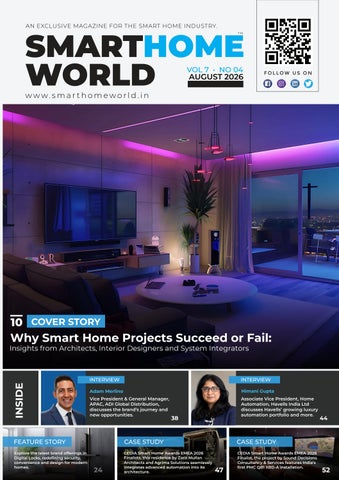
10 COVER STORY
Why Smart Home Projects Succeed or Fail:
INSIDE
Insights from Architects, Interior Designers and System Integrators
INTERVIEW
INTERVIEW
Adam Merlino
Himani Gupta
Vice President & General Manager, APAC, ADI Global Distribution, discusses the brand’s journey and new opportunities.
Associate Vice President, Home Automation, Havells India Ltd discusses Havells’ growing luxury automation portfolio and more.
38
FEATURE STORY
CASE STUDY
CASE STUDY
Explore the latest brand offerings in Digital Locks, redefining security, convenience and design for modern homes.
CEDIA Smart Home Awards EMEA 2026 Finalists, this residence by Zarir Mullan Architects and Agrima Solutions seamlessly integrates advanced automation into its architecture.
CEDIA Smart Home Awards EMEA 2026 Finalist, the project by Sound Decisions Consultancy & Services features India’s first PMC QB1 XBD-A installation.
24
47
44
52
13•14•15 MAY 2027
INDIA’S LARGEST SMART HOME TECHNOLOGY TRADE SHOW
For Bookings Contact: Monika Agnihotri M: +91 9321024581 E: monika@smarthomeexpo.in Bankim Laher M: +91 8591277084 E: bankim.laher@india.messefrankfurt.com
WORLD MEDIA & EXPO
www.smarthomeexpo.in
CONTENTS 10
10 Cover Story
In our Cover Story titled ‘Why Smart Home Projects Succeed or Fail: Lessons from Architects, Designers & System Integrators. Smart Home World brings together industry experts to explore the common challenges, best practices and lessons that shape successful smart home projects.
24 Feature Story
We explore how leading brands are redefining security, convenience and design through the latest innovations in Digital Locks.
38 Interviews
Adam Merlino, Vice President & General Manager, APAC, ADI Global Distribution, discusses ADI’s evolving connected-home strategy, from the Control4 X4 platform and Control4 Connect to Araknis Wi-Fi 7, Triad and OvrC. He shares his perspective on simplifying installation, enhancing the ownership experience and creating new opportunities for smart home integrators. Himani Gupta, Associate Vice President, Home Automation, Havells India Ltd discusses Havells’ growing luxury automation portfolio, spanning BUSPro, KNX, designer control panels and smart switch ranges. She shares how the brand is combining advanced functionality with design-led solutions.
47
CASE STUDIES
Designed by Zarir Mullan Architect & Interior Designer and System Integration by Agrima Solutions, this luxury
04 | SMART HOME WORLD | AUGUST 2026
residence demonstrates how advanced automation can be seamlessly embedded into the architecture. Designed and delivered by Sound Decisions Consultancy & Services, this reference-grade private cinema combines PMC’s flagship loudspeakers, precision projection and seamless automation. Recognised as a CEDIA Smart Home Awards EMEA 2026 Finalists, the project marks India’s first installation of the PMC QB1 XBD-A. Designed by Prodigy Designs with System Integration by Raylogic Control Systems, the Terra House Farmhouse Lounge combines warm, contemporary aesthetics with intelligent automation.
60 Product Preview
The Yale YDL325 brings smart access, enhanced privacy and dependable security to the modern home, combining sleek design with effortless everyday convenience.
62 EXPERT VIEW
Prathamesh Sawant, Founder, Aretex, explores the challenges of integrating diverse smart home ecosystems and shares his perspective on third-party driver development, interoperability and the future of multi-platform automation.
66 News
The latest launches, technology updates and industry developments from the world of smart home automation, AV, lighting, security and connected living.
W5800 | W5850
FROM THE EDITOR
Smart technology is no longer just about filling a room with clever devices; it’s about making a space feel effortless to live in. When done right, home automation blends so naturally into the interiors, making a space feel effortless to live in. But getting there isn’t simple. In our Cover Story, on `Why Smart Home Projects Succeed or Fail: Lessons from Architects, Designers & System Integrators,’ we sit down with leading Architects, Interior Designers, and System Integrators to strip away the hype and take a realistic look at what actually makes or breaks a smart home project. S WAT I B A L G I
Our Feature Story is on the evolution and advancements of digital locks, exploring how modern access control is trading clunky hardware for subtle design and top-tier security. We also bring you candid conversations with key industry figures: Adam Merlino of ADI sharing his insights on how platforms like Control4 X4 and Araknis Wi-Fi 7 are simplifying work for integrators. At the same time, Himani Gupta of Havells India explains how KNX and BUSPro systems are meeting the demands of luxury homeowners and about their new launches. In our Expert View Section, addressing one of the industry’s biggest challenges, Prathamesh Sawant of Aretex shares his take on third-party driver development and solving real-world interoperability challenges. This time, our Case Study section takes you inside three very different spaces where technology works quietly in the background. Two of the projects are CEDIA Smart Home Awards EMEA 2026 Finalists, Sound Decisions Consultancy has designed a private cinema featuring India’s first installation of the PMC QB1 XBD-A, while Zarir Mullan Architect and Agrima Solutions have seamlessly integrated lighting, climate control and multi-zone audio into a luxury home, keeping the technology almost completely out of sight. We also explore the Terra House Farmhouse Lounge, where Prodigy Designs and Raylogic Control Systems Private Limited, use smart lighting and customised scenes to effortlessly transform the space from a productive daytime workspace into a relaxed evening retreat. We hope this issue inspires your next project, offering the clarity and insight needed to design spaces where technology and living truly coexist.
TM
Chief Editor: Swati Balgi swati@smarthomeworld.in
Marketing Head: Sandeep Singh sandeep@smarthomeworld.in
Assistant Manager - Sales: Monika Agnihotri monika@smarthomeexpo.in
Tech Journalist: Sunny Sawant sunny@smarthomeworld.in For More Information Contact Us: +91 81690 58048
Published by: WORLD MEDIA & EXPO LLP.
WORLD MEDIA & EXPO LLP
Ecostar, 603, Vishveshwar Nagar Road, Churi Wadi, Goregaon (East) Mumbai, Maharashtra 400063
Smart Home World thanks the various companies that have submitted information. For any editorial submissions, please contact Ms. Swati Balgi, Chief Editor: swati@smarthomeworld.in. The information published in News, Ongoing Trends and Product Gallery is as per the details furnished by the respective manufacturer/distributor. It does not reflect the views of Smart Home World or of the management of WORLD MEDIA & EXPO LLP.
06 | SMART HOME WORLD | AUGUST 2026
Araknis Networks ® 520-Series Multi-Gigabit VPN Router AN-520-RT
Power Meets Precision: Araknis 520-Series Multi-Gigabit VPN Router Built for the most demanding networks, the Araknis AN-520-RT Router delivers robust processing power and high-speed multi-Gigabit WAN-LAN support up to 2.5G. Dual WAN capabilities ensure seamless load balancing and reliable link failover to keep high-bandwidth ISPs running without interruption.
KEY FEATURES
INDIA DISTRIBUTOR FOR ADI-SNAPONE
Mahkam Poorviaum Ventures Pvt Ltd #11, Global Heights, 8th Cross, Vijaya Bank Colony Banaswadi, Bangalore – 560043 Karnataka, India Contact our team:
Emails: order@m2msmarthome.com +91 95780 72459
•
High-Speed Connectivity: Multi-Gigabit WAN-LAN interfaces with speeds up to 2.5G.
•
Dual WAN: Smart load balancing and failover redundancy.
•
Robust Security: Stateful Packet Inspection (SPI) firewall, DoS prevention, and WAN Request Blocking.
•
Secure Site-to-Site VPN: Fast, reliable IPSec site-to-site connectivity up to 2.5G for multi-location networking.
•
Built-in OvrC Integration: Remote configuration, management, monitoring, and troubleshooting via OvrC, enhanced system health with OvrC Pro, and convenient customer network controls through OvrC Connect.
Upgrade your network infrastructure with maximum throughput and ultimate remote control. Learn more at your authorized Araknis distributor.
REACH ARCHITECTS, INTEGRATORS, DESIGNERS & TECHNOLOGY PROFESSIONALS. HOME AUTOMATION • SMART LIGHTING • AV SOLUTIONS • SECURITY SOLUTIONS
BOOK YOUR ADVERTISEMENT SPACE NOW Contact: Sunny Sawant +91 9082805062 | sunny@smarthomeworld.in
www.smarthomeworld.in
AMPLIFIERS • LOUDSPEAKERS • LIVE SOUND
ENGINEERED TO RULE THE VENUES !!
COVER STORY
Why Smart Home Projects Succeed or Fail: Lessons from Architects, Interior Designers & System Integrators.
What makes a smart home project truly successful? Architects, Interior Designers and System Integrators share their experiences, challenges and insights on choosing the right technology, ensuring seamless integration and creating smarter, more intuitive homes. Smart home automation has come a long way, but the journey has not always been smooth. Over the years, the industry has seen projects where technology failed to perform as promised, systems became unnecessarily complicated, integrations did not work seamlessly, or homeowners were left struggling to understand what they had invested in. Experiences like these have, 10 | SMART HOME WORLD | AUGUST 2026
understandably, affected confidence in home automation among homeowners and, at times, even among architects and interior designers. Today, the scenario is changing. Technology has matured, systems have become more reliable and robust; interoperability has improved, and professional integration has become far more
structured. Yet, there remains a small but significant section of the design community that is still hesitant; though they are interested in creating smarter homes, but unsure about where to begin, which technologies to specify and whether the final experience will genuinely meet their expectations. For clarity, it is important to distinguish between control and automation platforms and the protocols or standards that enable devices and systems to communicate. Platforms such as RTI, Crestron, Control4, Savant and ELAN serve as control and automation layers, bringing multiple subsystems together through unified interfaces and programmed logic. In comparison, KNX, DALI-2, Casambi, BACnet, Modbus, Zigbee, Z-Wave, Thread and Matter represent different protocols, standards or technology ecosystems used for
communication and device connectivity. Understanding this distinction is essential when designing a smart home, as the choice of both the underlying communication technologies and the control platform determines how effectively different systems can be integrated, managed and scaled. It also influences system reliability, flexibility, interoperability and future upgradeability, helping homeowners avoid compatibility issues and ensuring that the technology can evolve alongside changing needs and emerging standards. A well-planned approach also allows designers and integrators to balance performance, user experience and long-term maintainability while creating a cohesive technology ecosystem. SMART HOME WORLD | AUGUST 2026 | 11
Smart Home World connects with Architects, Interior Designers and System Integrators who have navigated this learning curve and successfully delivered numerous smart home projects over the years. Their experiences reveal what has changed, what still needs attention and, most importantly, what professionals entering the space today can learn from those who have already been there. settling for less than what was planned. It is rarely anyone’s individual fault; it is more that the industry has not fully caught up to treating automation as something that needs to be at the table from day one, same as plumbing or electrical. How does early collaboration between architects, interior designers, and system integrators influence the outcome of a smart home project? Can you share an example?
Ar. Ashish Batra
Principal Designer and Founding Partner, Uniifyy
From your perspective, what is the biggest difference between a smart home project that succeeds and one that struggles? I think it comes down to when the tech conversation starts, and honestly that is not always in the architect’s hands. A lot of the time, the client has not even decided they want a fully automated home until interiors are already underway, or the integrator only gets finalised much later because that is just how the trade is usually sequenced here: structural first, interiors next, tech somewhere near the end. As an architect, I am usually the one pushing to get the integrator involved early, but it depends on the client being open to that conversation on day one, and not every client is thinking that far ahead when they first hire us. When it does come together early, things move fine; there is give and take, but it works. When it comes in late, that is when things get tricky. I have walked into sites where the automation vendor only shows up after the false ceiling is already closed and now everyone is figuring out where a sensor goes or how to hide a wire that should have been sorted months earlier. In farmhouses and villas, this is worse just because of scale: more surface area, more rooms, so any retrofitting means either damaging finished work or 12 | SMART HOME WORLD | AUGUST 2026
When it happens, it changes a lot, more than people expect, actually. If the integrator understands what we are trying to do with a space early on, they stop just hunting for empty spots to put equipment and start thinking about how to make it blend in properly. But getting to that point usually takes some convincing, both the client and sometimes the integrator’s own team, because everyone is used to working in a certain order and asking them to jump in earlier than usual means more upfront coordination for them too, not just for us. There was a farmhouse we did outside Delhi where it actually worked the way it is supposed to; the client did not want to see any of it- no speaker grilles poking out, no switch panels breaking up a stone wall. We got the integrator in while we were still working through the layout, before the slab was even poured, and to be fair, that only happened because the client was willing to bring them in that early and the integrator’s team was responsive about it too. So we had time to route conduits properly, plan ceiling depths, and the house ended up fully automated without really looking like it. When that early buy-in does not happen, and honestly it is usually because of scheduling and budget approvals dragging on rather than anyone refusing to cooperate, you end up cutting into finished structure later, which is a different kind of headache for everyone on site, not just the architect.
At what stage do technology decisions have the greatest impact on architecture and interiors, and what challenges arise when these decisions are made too late? Somewhere around design development, after the concept is approved but before drawings are frozen, that is usually the window that matters most. The tricky part is this stage often overlaps with the client still finalising their budget, or still shopping around for which automation company to go with, so it is not always something the architect can force forward on their own timeline. Once decisions slip past that window, things start getting messy for everyone involved. Ceilings drop lower than anyone wanted to hide cabling, walls with expensive cladding already on them need to be opened up again, keypads end up wherever there is leftover space instead of where they would actually make sense. I have seen this on hospitality projects too; a guest room looking a bit cluttered with visible hardware when it could have been tucked away if the vendor had been locked in a couple months earlier. Nobody is really being careless in these situations; it is more that decision-making across multiple partiesclient, integrator, sometimes even the interior design team- does not always line up with the sequence construction actually needs. What are the most common misconceptions homeowners have about smart home technology, and how do you manage those expectations during the design process? A lot of clients think of it almost like buying an appliance, something you order near the end and just plug in once the house is basically done. It is not really their fault; that is often how it is marketed to them, and it is on us as architects and designers to correct that early rather than assume they already know. Another thing that comes up a lot: people assume smart automatically means more, more screens on the wall, more visible panels, something to show off when guests come over. For the kind of homes we design, that is
actually backwards; what you want is for none of it to be visible, just working quietly in the background. What has helped is getting the integrator into that very first client meeting, so from day one everyone is on the same page about what is realistic, what the timeline looks like, why we might need access to a wall before it is finished. It is a bit more coordination upfront for all of us, architect, integrator, client, but it saves a lot of friction later. If you could change one aspect of the way residential smart home projects are planned and executed today, what would it be, and why? I would want integrators treated the same way we treat a structural engineer or an MEP consultant, brought into the design team from the very start as a matter of process, not something that depends on whether a particular client happens to think of it early or a particular architect happens to push for it. Right now it does depend a lot on individual initiative, which client we are working with, how proactive the integrator’s team is, and whether budgets get approved in time. If it were built into how projects are typically structured in this country, contractually, procedurally, from day one, I think we would see a lot less rework on site and fewer moments where someone, architect, integrator, or client, ends up feeling like they are the one who dropped the ball, when really it is just that the process itself has not been set up to support that kind of early coordination yet. SMART HOME WORLD | AUGUST 2026 | 13
the homework has to be done when you start the project. These decisions should not be left for later.
Karan Sethi
Founder and Principal Designer, Qube Designs Studio
From your perspective, what is the biggest difference between a smart home project that succeeds and one that struggles? A smart home that succeeds is always one that is designed perfectly in the initial stages, when you are starting with the basic electrical work. Even if you are not a very big fan of using smart home automation, you should make sure that your lighting is 100% dimming-capable and can be controlled through a wired solution, which is much more foolproof. I think lighting is the number one thing where we tend to start planning later, because it comes in towards the later part of the project, once the ceiling has already been designed. Most people wait until the end for the automation and then decide whether they want to go with a wireless solution or something else. I am not very convinced with that approach. I have always preferred a wired solution, and it should be planned right from the stage when we start the first electrical work. How does early collaboration between architects, interior designers, and system integrators influence the outcome of a smart home project? Can you share an example? Early collaboration between architects, designers and system integrators is extremely important because the initial electrical work has to be planned around the wiring requirements. For speakers, curtains, lighting, all the different automations, AV systems and everything else, 14 | SMART HOME WORLD | AUGUST 2026
Whenever we start a new project, if we are taking up automation and making the home a smart home, we make sure it is planned right from the initial MEP stage. This ensures that all the wiring and conduits are planned properly and integrated into the overall design rather than becoming an afterthought. At what stage do technology decisions have the greatest impact on architecture and interiors, and what challenges arise when these decisions are made too late? It has to be done immediately when we start the project. Whenever we start space planning, the first step after that is MEP — Mechanical, Electrical and Plumbing. Once the civil work has been done, electrical planning becomes very important. If we don’t plan the electrical work and automation together at the same time, you face challenges later. The conduits may not be done properly, the wiring may not have been laid correctly, and you are then forced to look for solutions such as wireless automation. So, this planning has to happen at the MEP stage itself. That is when technology decisions can be properly integrated into the architecture and interiors without compromising the design later.
What are the most common misconceptions homeowners have about smart home technology, and how do you manage those expectations during the design process? The most common misconception homeowners have is that smart home technology is very difficult to operate. They wonder, “Who’s going to operate it? Will I have to use an app? Will I have to operate everything through a screen?” But once you get used to it, it becomes extremely comfortable. A basic small touch panel next to your bedside that opens the windows or sliders, opens the curtains, turns on the lights and sets the mood you want can be very convenient. It is just a habit that we haven’t fully accepted yet, but I believe it is a need of the hour. When you are designing something for the future, if you don’t have these wires and innovations built into your home today, then five years down the line, when every home has
this kind of automation, we will probably be too conventional for those times. If you could change one aspect of the way residential smart home projects are planned and executed today, what would it be, and why? If I could change something, I am too fascinated by AI, so I would love for my home to understand my requirements and actually learn the way I live. For example, if my home could know when I am coming back, or integrate with the reminders and schedule I have on my phone, or simply understand my regular routine, that would be really interesting. Even if on Sundays I wake up late, the lights could turn on later, and the home could understand and adapt to my way of living. If it could incorporate these habits into the smart system and behave accordingly, that would be really cool and very innovative for me. SMART HOME WORLD | AUGUST 2026 | 15
overwhelm the customer with technical jargon. Instead, we guide them through the process.
Bhavesh Doshi
Founder and CEO, Entelechy Systems
Having worked on numerous residential projects, what are the most common reasons smart home installations succeed—or fail? Over the last 25 years of working in system integration, I have seen the industry evolve tremendously, yet the foundational principles of project management and stakeholder collaboration remain the key differentiators between a good project and an exceptional one. The core reason a smart home succeeds is a strict alignment between the design promises made at the start and the final outcome, paired with a focus on the user rather than the technology. We make it a rule never to
34 | SMART HOME WORLD | AUGUST 2026
In the Indian context, success also means designing for the realities of joint families and multi-user environments. A system must follow international best practices while being highly intuitive for everyone—from children to grandparents. Installations typically fail when integrators lose sight of these human habits and focus solely on technical capabilities, resulting in a system that is too complex for daily life. In your experience, what are the biggest coordination challenges between system integrators, architects, interior designers, and other project stakeholders, and how can they be overcome? The biggest challenge is usually ensuring that technology prerequisites are embedded early in the structural and interior design phases. We overcome this by working very closely with architects and MEP consultants from day one. We actively guide them in incorporating control system requirements directly into the preliminary electrical drawings. If a specific system or protocol is new to their design
team, we hold short, targeted workshops to familiarise them with the requirements. This proactive stakeholder interaction eliminates friction and prevents costly redesigns later. Many smart home projects encounter issues only during commissioning. What are the most common technical or infrastructure oversights that could have been avoided through better planning? Commissioning issues almost always stem from poorly planned infrastructure and failing to clearly differentiate the prerequisites for wired versus wireless systems. A common oversight is not establishing the correct cabling topology for robust wired networks or ignoring the physical RF barriers for wireless nodes. Anticipating the changes and correcting them throughout the whole life cycle of the project is very important, and due to our vast experience, we can realise or anticipate these issues at the early stages of changes. As integrators, a key mistake we avoid is making assumptions about third-party equipment. Through stringent project management, we establish exact hardware specifications early—such as complex HVAC controls or standardising keypads and AV equipment. Ensuring that the structured backend wiring perfectly matches the chosen protocol (like
KNX or Casambi or Crestron, etc) well before the wall or ceiling closes up is what guarantees a smooth, issue-free commissioning process. We follow CEDIA and KNX guidelines for installation and commissioning. We ensure due diligence at key stages of wiring and system installation. • Planning and design • First Fix (Rough-In Wiring) • Rough-In Inspection • Second Fix (Wire Pulling and Termination) • Programming and Integration • Final Commissioning and Handover As AI, Matter, and advanced networking become more prevalent, how is the definition of a ‘successful’ smart home project evolving? With the Matter standard enabling seamless interoperability across different brands and AI shifting home automation from reactive rules to predictive, context-aware actions, success is no longer just about getting devices to talk to each other. While the backend relies on highly advanced networking and powerful systems, the user interface must remain profoundly simple. A successful modern smart home project hides the complexity of its integration and instead presents an environment that intuitively adapts to the family’s lifestyle, anticipating their needs without demanding their attention. SMART HOME WORLD | AUGUST 2026 | 17
one is looking at it from a different perspective. An architect focuses on planning and aesthetics, the interior designer focuses on finishes and detailing, the electrical consultant focuses on power and load, the HVAC consultant focuses on climate systems, while the system integrator has to connect all of these systems into one coordinated technology platform.
R.Narayana Murthy
Director, USK Group of Companies
Having worked on numerous residential projects, what are the most common reasons smart home installations succeed—or fail? From the USK perspective, a smart home succeeds when technology planning starts along with the architecture and interior design, not after the house is almost complete. The most successful projects generally have three things in common: a clearly defined client expectation, detailed engineering before execution, and strong coordination between AV, automation, electrical, HVAC, networking, lighting, security, and interiors. Failures usually happen when automation is treated as a collection of products rather than a complete ecosystem. Poor cable planning, insufficient DB or rack space, inadequate network design, late changes in interiors, lack of documentation, or products from different platforms being selected without considering interoperability can create major problems later. At USK, we always try to design the experience first and then select the technology. The objective is not simply to control lights, curtains, AC, music, or security—it is to make the home simple, reliable, intuitive, and easy for the entire family to use. What are the biggest coordination challenges between integrators, architects, interior designers, and other stakeholders? The biggest challenge is that every consultant is working toward the same project, but each 18 | SMART HOME WORLD | AUGUST 2026
Problems usually arise around keypad locations, speaker positions, access points, cameras, motorised curtains, touch panels, TV recesses, projector locations, equipment racks, conduits, power points, ventilation, and service accessibility. Our approach at USK is to become involved as early as possible and issue coordinated drawings covering device locations, cable routes, rack design, power requirements, network infrastructure, automation points, lighting interfaces, AV layouts, and equipment clearances. Regular coordination meetings and drawing approvals before civil or interior closure can prevent a large percentage of site issues. What technical or infrastructure oversights commonly appear only during commissioning? Many commissioning problems actually begin months earlier. Some of the most common issues we see are insufficient conduiting, cables being damaged or incorrectly terminated, missing neutral or control wiring, inadequate rack ventilation, insufficient power outlets, poor earthing, unstable electrical supply, weak Wi-Fi coverage, unmanaged network architecture, incorrect VLAN configuration, insufficient IP addresses, wrong HDMI or fibre infrastructure, and devices being installed in locations where maintenance becomes difficult. Another major issue is not allowing enough spare infrastructure. Technology changes very quickly, so we always recommend spare conduits, additional data cables, rack capacity, extra network ports, and provision for future upgrades.
For USK, commissioning should ideally be the stage where we fine-tune the experience, not the stage where we discover basic infrastructure problems. How is the definition of a successful smart home evolving with AI, Matter, and advanced networking? Earlier, a successful smart home was often judged by how many devices could be controlled from a touchscreen or mobile app. Today, the expectation is much higher. A successful smart home should understand context, simplify routines, connect multiple systems reliably, protect the client’s privacy, and remain scalable for future technology. AI will increasingly make automation more predictive and personalised. Matter will improve interoperability across certain categories of devices, while enterprise-grade networking is becoming the backbone of the entire home. At USK, we believe the network is now as important as electrical infrastructure. Lighting control, AV distribution, security cameras, access control, intercom, streaming, automation processors, voice platforms, HVAC interfaces, and IoT devices are increasingly dependent on IP. So the future of smart homes is not just automation. It is a combination of automation + AV + networking + AI + cybersecurity +
interoperability working as one coordinated platform. What lessons have had the biggest impact on the way USK approaches smart home projects today? One of our biggest lessons is that simplicity requires more engineering, not less. A client should not need to understand what is happening behind the scenes. They should simply press “Movie,” “Good Night,” “Away,” or “Welcome,” and the required systems should respond correctly. We have also learned the importance of documentation and handover. A project is not complete when the equipment starts working. It is complete when the system is properly calibrated, programmed, labelled, documented, demonstrated, and the client is comfortable using it. We therefore place strong emphasis on design documentation, rack engineering, cable management, system programming, testing, calibration, client orientation, and future serviceability. Our philosophy at USK Luxury AV Lounge is simple: A truly intelligent home should hide the complexity of technology and give the homeowner a simple, reliable and luxurious experience. SMART HOME WORLD | AUGUST 2026 | 19
one level between the system integrators, architects, interior designers, and other project stakeholders, the whole end-user experience and outcome dips. Each one has to take joint collective responsibility of the project and not pass the buck to one another. Beyond Alliance uses extensive project management tools built on AI tools to manage projects end to end.
Maulik Unadkat Founder, Beyond Alliance
Having worked on numerous residential projects, what are the most common reasons smart home installations succeed—or fail? Believe me or not, it’s not the brand that dictates it; the automation experience is only as good as the system integrator. If I’ve to be more specific, only as good as the programming and the management team of the system integrator. How skilled and how large the team of the system integrators is dictates the success or failure of a residential project. Beyond Alliance is blessed to have 125 certified professionals on board, with most of them having been with us for more than a decade; that experience brings a lot to the table. The shelf life of any residential project is 2 to 3 decades minimum. So the longevity of the existence of the brands used dictates how stable the product is going to behave for this entire life cycle of a home. Choice of brands, skill level of the tech team integrating the system, project management processes and the commitment of the integrator to serve this industry for decades to come dictate the success or failure of a project. In your experience, what are the biggest coordination challenges between system integrators, architects, interior designers, and other project stakeholders, and how can they be overcome? Interdependencies need to be solved as a team. Blame games are the biggest enemy of a project. There is no me and you; it’s an us. How much ever philosophical this may sound, this is the make it or break it of the project. If the project management goes weak at any 20 | SMART HOME WORLD | AUGUST 2026
Many smart home projects encounter issues only during commissioning. What are the most common technical or infrastructure oversights that could have been avoided through better planning? Structured SOPs that are clearly defined, documented and shared with all stakeholders avoid such mishaps. To err is human, isn’t it? With so many nuts and bolts in a project, detailed documentation is the key. And most important is clear and crisp communication. This is where the biggest gap is. Information transfer cannot have Chinese whispers. And last but not least, there needs to be a MakerChecker system. Even the best programmer
will have some bugs in the program. The same needs to be checked and corrected.
talking to a voice cloud; you are actually talking to artificial intelligence.
As AI, Matter, and advanced networking become more prevalent, how is the definition of a ‘successful’ smart home project evolving?
Looking back at projects you’ve delivered, what lessons have had the biggest impact on the way you approach smart home design, integration, and client handover today?
ChatGPT is already a part of what Beyond Alliance offers. The automation system thinks for you as AI is embedded into it. Language barriers are removed as you can speak in your mother tongue with your system. You are not
Relationship management is extremely important for us at Beyond Alliance. The dream that was shown to the user in their first visit at any of our 7 experience studios must be a reality when the users move into their dream project. There can never be any expectation gap. What’s promised must be delivered. And we understand that while this may be the 2000th project for us, for the homeowner, it may be his first and last such big an investment, a lifetime of savings and a priceless dream. This trust that is bestowed on us must be lived up to by each of our team members. The highest amount of accountability is demanded when someone trusts you to integrate technology that is worth a few lakhs of rupees. This is one fundamental principle that we have learnt very early in our professional life. SMART HOME WORLD | AUGUST 2026 | 21
and functionality, the MEP consultant on services, and the system integrator on the infrastructure and technology. Problems arise when these decisions are not coordinated early enough.
Rutin Panchal
Director, Light Smith Lighting Projects Pvt. Ltd
Having worked on numerous residential projects, what are the most common reasons smart home installations succeed—or fail? In my experience, the success of a smart home installation depends far more on planning, coordination and usability than on the technology itself. The most successful projects are those where the client’s lifestyle and expectations are understood early, and the automation system is designed around how they actually live. Projects often fail when automation is treated as an add-on after the electrical and interior design decisions have already been made. By then, provisions for wiring, panel locations, sensors, networking and equipment may already be compromised. Another common issue is overcomplicating the system. A successful smart home should feel intuitive— the client need not understand the technology behind it to operate their home comfortably. Ultimately, good technology combined with proper design, robust infrastructure and a simple user experience is what makes a smart home successful. In your experience, what are the biggest coordination challenges between system integrators, architects, interior designers, and other project stakeholders, and how can they be overcome? The biggest challenge is that every stakeholder is working on a different part of the project, often with decisions being made independently. The architect focuses on spatial planning, the interior designer on aesthetics 22 | SMART HOME WORLD | AUGUST 2026
For example, a beautiful interior design may leave no accessible location for equipment, a false ceiling may be completed before sensor positions are finalized, or electrical wiring may be installed without considering future automation requirements. The solution is early involvement and a clearly defined coordination process. The system integrator should be involved during the design stage, with coordinated drawings covering lighting controls, keypads, sensors, AV, networking, equipment locations and wiring requirements. Regular coordination meetings and a clear responsibility matrix also help prevent assumptions between stakeholders. In our experience, early collaboration saves significant time, cost and frustration later in the project. Many smart home projects encounter issues only during commissioning. What are the most common technical or infrastructure oversights that could have been avoided through better planning? One of the biggest oversights is inadequate planning of the electrical and communication infrastructure. This includes insufficient conduits, incorrect cable routing, lack of spare provisions and poor accessibility to panels and equipment. Networking is another major area. Today’s smart homes rely heavily on a strong and well-designed network, yet it is often treated as something that can be addressed at the end of the project. Proper locations for Wi-Fi access points, network switches, racks and structured cabling should be planned from the beginning. Other common issues include incorrect sensor locations, insufficient space in electrical panels, lack of access for future maintenance, inadequate cooling or ventilation for
equipment racks, and changes in lighting layouts after automation programming has already been designed. Most commissioning issues are not really commissioning problems—they are planning problems discovered during commissioning. As AI, Matter, and advanced networking become more prevalent, how is the definition of a ‘successful’ smart home project evolving? Earlier, a successful smart home was often defined by the number of functions it could automate. Today, I believe the definition is shifting towards interoperability, reliability, intelligence and simplicity. With technologies such as AI and Matter, clients increasingly expect different devices and systems to work together seamlessly. However, adding more technology does not automatically create a better experience. The real value lies in making the technology more intuitive and reducing the need for manual intervention. AI will allow homes to become more adaptive— learning user preferences and responding to occupancy, time, environmental conditions and behavioural patterns. At the same time, advanced networking is becoming the backbone of the entire home, as more systems depend on reliable connectivity. For me, a successful smart home of the future will not necessarily be the one with the most automation. It will be the one where technology works reliably in the background, different systems integrate seamlessly, and the home becomes easier and more comfortable to live in. Looking back at projects you’ve delivered, what lessons have had the biggest impact on the way you approach smart home design, integration, and client handover today? The biggest lesson has been that decisions made at the beginning of a project have the
greatest impact on its final success. We have learned the importance of getting involved early and spending more time understanding the client’s lifestyle, requirements and expectations before selecting or designing the technology solution. Another important lesson is to design for simplicity. What appears impressive during a demonstration may not necessarily be useful to the client every day. We now focus more on creating intuitive controls, logical automation and reliable fallback options. We have also learned that commissioning and handover should not be treated as the final step alone. The client’s experience after handover is equally important. Proper documentation, training, clear explanations and ongoing support play a major role in how the client ultimately perceives the success of the project. Every project teaches us that technology is only one part of smart home integration. The real success comes from combining good design, strong infrastructure, careful coordination and a user experience that feels effortless.
The insights shared by our experts make one thing clear: home automation is no longer simply about technology; it is about creating intelligent, intuitive and meaningful living experiences. With the right planning, expertise and technology partners, the challenges can be addressed and the possibilities are far greater than the pitfalls. We hope this collective perspective gives our readers greater clarity—and the confidence to approach their next smart home project with a more informed and assured vision. SMART HOME WORLD | AUGUST 2026 | 23
FEATURE STORY
Digital Locks & The Future of Intelligent Access From biometric precision to unified Matter integration, modern smart locks are evolving from mechanical barriers into design-forward, context-aware command nodes for the connected home. Find out what’s next for intelligent access from the Brands. Advances in authentication, hardware design, and connectivity are rapidly turning residential locking systems into sophisticated digital access platforms. Fingerprint sensors, facial recognition, mobile app control, and remote access are now expected standard features rather than high-end differentiators. The real evolution, however, is happening behind the interface, where cloud-based credential management, encrypted key sharing, and realtime activity logs are transforming digital locks 24 | SMART HOME WORLD | AUGUST 2026
into essential connected access points within the wider smart home automation ecosystem. This shift gives homeowners far greater control over who can enter their spaces, precisely when they can enter, and for how long. Temporary digital keys can be issued instantly to guests or service staff, access permissions can be revoked remotely at a moment’s notice, and detailed activity records provide a clear, timestamped history of every
entry and exit. When paired with geofencing and scene automation, access control syncs fluidly with lighting, climate, and security systems—allowing the arrival and departure experience to become completely seamless, responsive, and tailored to daily routines. To capture market share, manufacturers are aggressively competing across four core technical fronts: Security Architecture: End-to-end encryption, rolling codes, tamper detection, and multifactor authentication are becoming baseline necessities as locks move onto local networks and inherit broader digital attack surfaces. Interface & Firmware UX: Low-latency biometric matching, effortless BLE/Wi-Fi
pairing, and resilient firmware supporting smooth OTA updates separate instant, refined hardware from buggy, frustrating devices. Interoperability: With Matter adoption accelerating, locks are built to operate across diverse ecosystems like voice assistants, video doorbells, and central hubs—rather than functioning as siloed, single-app hardware. Comprehensive protocol support (Z-Wave, Zigbee, Thread, Matter) is now a decisive spec line. Industrial Design: Component miniaturization, premium finishes, and enhanced battery efficiency enable sleek, unobtrusive form factors, letting locks meet high residential aesthetic standards without compromising on mechanical motor torque or sensor precision. SMART HOME WORLD | AUGUST 2026 | 25
Smart Home World speaks with leading brand heads and industry experts to explore their flagship solutions, latest technological innovations and vision for the future of intelligent and keyless access. YDL325 provide an easy entry point into digital access control while still delivering Yale’s trusted security and reliability.
Sharad Kapoor
Director & Head of Yale Retail SAARC
Could you tell us about your brand’s digital lock offerings? What key technologies, features, and innovations differentiate your products and are driving growth in this category? At Yale, we offer one of the industry’s widest smart lock portfolios, designed to meet a wide range of customer needs, from homeowners taking their first step into smart living to those seeking premium, fully connected access solutions. Our range spans products such as the YDL325 and ByYou Pro at the accessible end of the spectrum, through to advanced smart locks like the Luna Elite Plus and Zuri, which bring together sophisticated design, multiple access technologies, and deeper smart home integration. Across the portfolio, Yale focuses on delivering convenience without compromising security. Depending on the model, users can access their homes through fingerprint recognition, PIN codes, RFID cards, mechanical keys, facial recognition technologies, mobile credentials, and app-based remote access. Products such as Luna Elite Plus and Zuri are designed for consumers who want a truly smart home experience, offering multiple authentication methods, remote management through the Yale Home ecosystem, visitor access management, and enhanced connectivity. Meanwhile, models such as ByYou Pro and 26 | SMART HOME WORLD | AUGUST 2026
What differentiates Yale is not only the breadth of our range, but also the ecosystem that supports it. Our digital locks are designed to integrate seamlessly into connected lifestyles, allowing users to manage access, monitor activity, and connect with other smart home devices through a unified platform. This combination of trusted security heritage, innovative access methods, and ecosystem connectivity continues to drive growth in the category and reflects how consumer expectations are evolving beyond traditional locking solutions. How is your brand addressing consumer concerns around cybersecurity, data privacy, and the reliability of smart locking systems? As homes become increasingly connected, cybersecurity and privacy are as important as physical security. At Yale, security is built into our connected products from the ground up. Our Yale Home application is GDPR compliant with strong encryption, secure
communication protocols, authenticated user access and robust cloud security measures to help protect user credentials, access information and device communications. The Yale Home application runs exclusively on Yale Home ecosystem products without requiring any third-party intervention, making it safer and even more secure. Consumers want the convenience of remote access and mobile control, but they also want assurance that these features are secure. Our connected ecosystem is therefore designed around layered security principles, including encrypted data transmission, secure cloud architecture, user authentication, access management controls, and regular firmware updates. This ensures that convenience features such as guest code sharing, remote unlocking, audit trails and activity monitoring can be enjoyed with confidence. Physical reliability is equally important. Yale products undergo extensive testing and validation processes, including durability and cycle testing, to ensure consistent performance in real-world conditions. Most Yale products remain operational across a wide temperature range without any issue. In addition, our longstanding heritage in security products gives consumers confidence that their smart lock is backed by proven expertise in both mechanical and digital security.
How do you see digital access control evolving in residential and smart living environments over the next few years? What trends do you believe will shape the future of this category? We believe the future of digital access control lies within the broader evolution of the connected home ecosystem. Over the next few years, smart locks will increasingly move from being standalone devices to becoming central components of intelligent living environments, where locks, cameras, alarms, sensors, lighting, and other connected devices work together seamlessly. Integration with voice assistants and smart home platforms will play a significant role in this evolution. Homeowners will increasingly expect personalised experiences where different family members can interact with the home in ways tailored to their preferences. For example, unlocking a door could automatically trigger customised routines such as adjusting lighting, activating security settings, controlling climate systems, or notifying family members of arrival. The smart home will become more intuitive, responsive, and personalised based on individual user profiles. Artificial intelligence and automation will further enhance these experiences by enabling smarter decision-making, alerts and context-aware security. Rather than simply granting access, future access control systems will understand patterns, identify unusual activity, and provide more meaningful insights to homeowners. At Yale, we see digital locks becoming the gateway to a fully integrated smart home experience, one that combines security, convenience, personalisation, and peace of mind for every member of the household. SMART HOME WORLD | AUGUST 2026 | 27
that combine advanced technology, robust security, and premium design.
Saurabh Bansal
Joint Managing Director of Dorset Industries
Could you tell us about your brand’s digital lock offerings? What key technologies, features, and innovations differentiate your products and are driving growth in this category? The role of a digital lock has evolved significantly—it is no longer just about securing a door but enabling a smarter, more connected lifestyle. At Dorset, we are focused on developing intelligent access solutions
Our portfolio offers multiple access options, including face, finger and palm vein recognition, PIN, RFID, Bluetooth, Wi-Fi, mobile app control, and mechanical key override. Features such as remote access, visitor management, one-time passwords, anti-peep password protection, and autolocking are designed to make security more intuitive and convenient. What sets Dorset apart is our focus on meaningful innovation. Products like our F-Lux series and our Digital solution range reflect how smart locks are evolving into integrated home access solutions rather than standalone devices. As smart home adoption continues to rise, consumers are looking for products that deliver security, convenience, and aesthetics in equal measure, and that is where we see significant growth for the category. How is your brand addressing consumer concerns around cybersecurity, data privacy, and the reliability of smart locking systems? As connected devices become part of everyday living, trust has become as important as innovation. Consumers want assurance that their digital locks are not only feature-rich but also secure, reliable, and built for long-term performance. At Dorset, cybersecurity and reliability are integral to our product development. Our digital locks incorporate secure authentication protocols, encrypted communication, and multiple layers of access verification to protect user credentials. Where cloud connectivity is enabled, we leverage secure cloud infrastructure with robust security controls to help safeguard user data and prevent unauthorised access. Equally important are practical safeguards such as mechanical key override, emergency power backup, and rigorous quality testing to ensure consistent performance in real-world conditions. Beyond the product itself, our nationwide service network and technical support provide customers with confidence throughout the
34 | SMART HOME WORLD | AUGUST 2026
trends do you believe will shape the future of this category? Digital access control is becoming a fundamental part of the smart home ecosystem rather than a standalone security solution. Over the next few years, we expect deeper integration with home automation platforms, security systems, and connected devices, creating a more seamless living experience.
ownership journey. We believe the future of smart security depends on earning consumer trust through responsible technology, dependable engineering, and a strong commitment to quality. How do you see digital access control evolving in residential and smart living environments over the next few years? What
Advanced biometrics, AI-enabled access management, mobile credentials, and remote monitoring will continue to gain traction as consumers seek greater convenience without compromising security. At the same time, digital locks are increasingly becoming a standard offering in new residential developments, reflecting changing consumer expectations. The future of this category will be shaped by solutions that combine intelligent technology with simplicity, reliability, and thoughtful design. At Dorset, our focus is on developing innovations that not only enhance security but also make everyday access more intuitive, connected, and effortless. SMART HOME WORLD | AUGUST 2026 | 29
IoT9 platform that digital locks seamlessly integrate with Video Door Phones, 4G and Wi-Fi-enabled cameras and other connected devices, creating a unified home security and automation experience.
Pushkar Gokhale
Business Head of the Security Solutions Business of Godrej Enterprises Group.
Could you tell us about your brand’s digital lock offerings? What key technologies, features, and innovations differentiate your products and are driving growth in this category? Home security is no longer just about locking a door; it is about enabling a smarter, more connected living experience. Consumers increasingly want solutions that combine security, convenience, aesthetics and seamless connectivity, making digital locks the gateway to the smart home. At Godrej, we offer a comprehensive digital locks portfolio that caters to everyone, right from the first-time users upgrading from mechanical locks, to homeowners who intend to build a fully connected home. Our solutions support multiple access modes, including password or fingerprint authentication, RFID cards, Bluetooth or WiFi, even controls through a mobile app and OTP based remote access, voice assistant compatibility and mechanical override, providing flexibility without compromising security. What truly differentiates us is our ecosystem approach. It is through our Advantis 30 | SMART HOME WORLD | AUGUST 2026
Innovation remains at the heart of our strategy. Most recently, we introduced the Neo range of smart locks, designed with advanced safety features, contemporary aesthetics and seamless compatibility with our connected security ecosystem. Beyond locks, we are also expanding intelligent security through innovations such as 4G and Wi-Fi-enabled smart camera surveillance solutions, nextgeneration Video Door Phones and a facial recognition-enabled home locker, the NX Pro Ncrypt. This growing consumer shift towards connected security has translated into strong business momentum, with digital locks registering 45% Year-on-Year growth. As smart homes become increasingly mainstream, we remain focused on building intelligent access solutions that are secure, intuitive and futureready.
How is your brand addressing consumer concerns around cybersecurity, data privacy, and the reliability of smart locking systems? As homes become more connected, security must extend beyond physical protection to digital trust. At Godrej, cybersecurity, data privacy, and reliability are built into the design of our connected security solutions. Our digital locks incorporate encrypted communication protocols, secure authentication mechanisms, and multiple access credentials such as (add Wi-Fi), fingerprint, PIN, mobile access, and mechanical override to ensure secure and dependable performance. We also follow a privacy-first approach. Our connected solutions are designed and developed in India, with customer data hosted within the country. Data exposure is minimised through encrypted storage and communication systems. For example, the NX Pro Ncrypt home locker stores encrypted biometric templates instead of facial images, strengthening privacy while ensuring seamless access. By integrating digital locks with Video Door Phones, 4G and Wi-Fi-enabled cameras, and connected home lockers, we deliver layered, ecosystem-led protection. Backed by over a century of expertise in security, our focus is on ensuring convenience and connectivity without compromising trust. How do you see digital access control evolving in residential and smart living environments over the next few years? What trends will shape the future of this category? Digital access control is rapidly evolving from a standalone convenience feature into the foundation of the connected home. The exponential growth of Wi-Fi in Indian homes is transforming the digital landscape, leading to an increase in demand as well as adoption of connected and integrated ecosystems. Here,
digital locks can now work seamlessly with Video Door Phones, 4G and Wi-Fi-enabled cameras, sensors, lighting, climate control, and other smart devices through a unified platform accessed through a Mobile app. We also expect wider adoption of advanced authentication technologies such as fingerprint and facial recognition, mobile credentials, and touchless access, supported by AI-driven capabilities like predictive alerts and intelligent automation. As more and more consumers seek premium, cutting-edge tech-enabled solutions that blend into the modern home, Research and Design is becoming increasingly important. Another notable trend is the growing acceptance of smart security solutions across Tier II towns, driven by rising awareness of home automation and premium home improvement. At Godrej, we believe in user insight-based innovation, which enables us to understand the real challenges faced by our customers and develop solutions to address these challenges. The future lies in intelligent security ecosystems and smart monitoringand-tracking solutions, and we are creating safer, smarter, and more intuitive homes for the future. SMART HOME WORLD | AUGUST 2026 | 31
Remote Guest Management: Homeowners and Airbnb hosts can instantly generate and revoke temporary QR codes or PINs from anywhere. Practical Utilities: Built-in electronic doorbells, auto-locking upon close, and Type-C emergency charging ports.
Bipin Gupta
Product Head- EZVIZ, Prama Hikvision India Private Limited
Could you tell us about your brand’s digital lock offerings? What key technologies, features, and innovations differentiate your products and are driving growth in this category? EZVIZ’s digital lock portfolio integrates advanced biometrics with 24/7 video security. Driven by AIoT technology and robust hardware, key innovations such as built-in dual cameras and AI face recognition enable users to securely monitor and control frontdoor access remotely. Key Technologies & Innovations AI-Powered Biometrics: Devices like the flagship DL50FVS Plus feature 3D Face ID and palm vein recognition, ensuring spoof-proof, contactless entry. Integrated Video Security: Many models feature built-in 2K cameras, indoor screens, and 166° ultra-wide lenses that act as complete video doorbells, allowing two-way talk directly from the EZVIZ App. Flexible Access: Models like the DL05 offer up to 7 unlocking methods—including fingerprint, smartphone (Wi-Fi/Bluetooth), temporary PINs, and mechanical keys. Interconnected Ecosystem: Locks seamlessly pair with EZVIZ indoor/outdoor cameras, automatically triggering video recording when specific users enter. Growth-Driving Features Anti-Theft Protection: Real-time mobile alerts, anti-peeping passcodes, and loud tamper alarms deter forced entry and unauthorised access. 32 | SMART HOME WORLD | AUGUST 2026
DIY Retrofitting: The DL01S easily mounts over existing deadbolts in under 10 minutes without drilling, opening the market to renters How is your brand addressing consumer concerns around cybersecurity, data privacy, and the reliability of smart locking systems? EZVIZ addresses consumer concerns through “Privacy by Design” and enterprise-grade security protocols across all smart locking systems. Their approach integrates hardware defences, localised data processing, and military-grade encryption to protect against cyber threats and ensure high physical and digital reliability. Cybersecurity & Data Privacy End-to-End Encryption: EZVIZ utilises banklevel TLS and AES 128-bit encryption to protect data transmission across all devices, the EZVIZ cloud, and the EZVIZ App. Local Biometric Processing: Advanced models (such as the DL50 series, featuring 3D facial and palm-vein recognition) process all facial modelling and biometric data locally on the device’s AI chip. No actual photos of human faces are stored or shared in any way. Strict Privacy Controls: Users maintain total control over their data lifecycle, with features such as “Sleep Mode,” a physical “Privacy Shutter,” and the ability to set specific “Privacy Zones” to prevent unauthorised filming or data access. Cloud Security Standards: EZVIZ operates distributed cloud servers in partnership with a key global service provider. Smart Lock Reliability & Physical Security Tamper and Intrusion Alarms: Locks like the EZVIZ DL05 Smart Fingerprint Lock and DL04 Pro are equipped with anti-tamper sirens and break-in detection that trigger loud alarms
and push mobile alerts during forced-entry attempts. Multi-Method Authentication: To ensure access remains reliable even if Wi-Fi drops or a battery dies, locks retain multiple offline unlocking methods, including fingerprints, passcodes, access cards, and emergency mechanical keys. Fail-Safe Battery Systems: Powered by standard AA batteries, locks offer up to 365 days of standby time and provide localised low-battery alerts. All models feature a Type-C port for emergency power bank charging. Integrated Ecosystems: To increase frontdoor reliability, EZVIZ smart locks can be integrated with indoor EZVIZ Smart Cameras to automatically record who enters and verify exact timestamps in the EZVIZ App. How do you see digital access control evolving in residential and smart living environments over the next few years? What trends do you believe will shape the future of this category? Digital access control in smart living environments is evolving into multi-modal, AI-driven ecosystems. Brands like EZVIZ are expanding beyond basic keyless entry into unified 3-in-1 devices that combine video doorbells, 2K/4K cameras, and biometrics. The focus is shifting from simple locking mechanisms to proactive, automated frontdoor security. The following key trends will shape the future of residential access control: Multi-Modal Biometrics & AI-Powered Entry: Moving beyond basic fingerprints, the industry is adopting 3D facial recognition and palm-vein scanning. For example, the flagship EZVIZ CS-DL50FVS Plus uses structured light technology and a 12nm AI chip for sub-second, anti-spoofing unlocks. Unified Security Ecosystems: Locks will no longer operate as standalone devices. Devices will interlink with indoor/outdoor cameras, alarms, and sensors. For instance, a locked door can automatically trigger an armed security mode or prompt an interconnected EZVIZ Indoor Camera to record visitors.
Proactive Video Analytics: Embedded edge AI enables digital door locks to identify family members versus strangers, detect loiterers, and distinguish humans, pets, and vehicles from vehicles to reduce false alarms. Interoperability and Cross-Brand Harmony: With the universal adoption of protocols like Matter, compatibility issues will vanish, allowing consumers to seamlessly blend components from different smart home ecosystems. Remote & Contextual Management: Homeowners can track access logs with photos, issue temporary credentials to guests, and monitor child-safety locks directly from their smart devices. SMART HOME WORLD | AUGUST 2026 | 33
alongside every traditional unlocking method a user would expect, including keypad entry, an emergency mechanical key, and remote unlock via app. It also integrates a built-in video doorbell, so the lock doubles as a first line of visual security.
Aravind Shekar
General Manager - Solutions, Modo
Tell us about your brand’s digital lock offerings. What key technologies, features, and innovations differentiate your products and are driving growth in this category? We see the smart lock as the true gateway to the smart home. It is typically the first product a household buys when it starts down the smartliving path, and once someone experiences the convenience of going keyless, it becomes very difficult to go back. That first purchase sets the tone for everything else a family adds to their home ecosystem afterwards. Among the brands we carry, Lockin stands out, and our philosophy with Lockin is that a smart lock must deliver on both function and form. A lock that looks like an afterthought, or that compromises daily convenience for the sake of security, will never earn a permanent place at the front door. The Lockin V7 Max, which we carry exclusively in India, was built to solve the single biggest objection to smart locks: what happens when the battery dies? No one wants to risk being stranded outside their own home waiting for a charge or scrambling for a backup key. The V7 Max resolves this with Optical Wireless Charging, a technology that keeps the lock continuously powered, virtually eliminating the risk of ever being locked out due to a dead battery. Beyond power, the V7 Max is the most complete access solution on the market today. It supports 3D facial recognition, palm vein recognition, and finger vein recognition, 34 | SMART HOME WORLD | AUGUST 2026
On top of all of this, the V7 Max layers in AIbased security intelligence that monitors and reports on activity at your front door even while you are away, giving homeowners real peace of mind rather than just a notification feed. And because it is built on the Matter standard, it fits seamlessly into whichever smart home ecosystem a customer has already invested in, rather than locking them into a single walled garden. We believe the V7 Max is not just an incremental upgrade. It represents the direction the entire smart lock category is heading: multi-modal biometric access, guaranteed uptime, and true interoperability, all in a single device. How is your brand addressing consumer concerns around cybersecurity, data privacy, and the reliability of smart locking systems? Cybersecurity and data ownership sit at the core of everything we offer. Our position is simple: your data belongs to you, and only you. Every lock we carry stores biometric and access data locally on the device itself. Nothing is transmitted to or stored on a cloud server, which removes the single largest attack surface that has made consumers wary of connected locks in the first place. All of that locally stored data is also encrypted, so even physical access to the device does not expose a customer’s biometric information. On reliability, every lock undergoes rigorous testing across a wide range of environmental conditions, including extended rain exposure, direct sunlight, and temperature extremes, to minimise the chance of failure in real-world use. No connected hardware can ever be guaranteed to be completely failure-proof, and we are upfront about that. What we do guarantee is that we work relentlessly to reduce that risk to a minimum, and that when
an issue does arise, our service teams are available to assist and resolve it at that moment, not days later. How do you see digital access control evolving in residential and smart living environments over the next few years? What trends do you believe will shape the future of this category? We believe digital access control is the future of how people enter and secure their homes. In a recent study we conducted, nearly 60% of respondents said they would be open to, or were actively considering, switching to a smart lock within the next six months. That is a striking number, and it reflects a broader shift: people are tired of carrying keys and cards, and they are actively looking for the peace of mind that comes with a system that just works, without a second thought. This shift is being reinforced from multiple directions. The introduction of Apple Home Key and similar credential standards from other major platforms is normalising keyless entry at a mainstream level, not just among early adopters. We expect a few key forces to define how this category matures: • Reliability as the deciding factor: adoption will accelerate once consumers stop having to second-guess whether a smart lock will work when they need it to, which means uptime, backup access methods, and fail-safes become table stakes rather than differentiators. • Design and biometric variety: the winning products will pair genuine utility with strong industrial design, and will offer multiple biometric and credential options so users are never dependent on a single point of failure. • Ecosystem interoperability: standards like Matter will keep pushing brands away from closed ecosystems and toward locks
that work across whichever smart home platform a household has already chosen. • Data privacy as a purchase driver: as awareness grows, consumers will increasingly favor brands that keep biometric and access data local rather than cloud-dependent. Taken together, we expect these forces to make the smart lock the new normal for residential entry within the next few years, much the way smartphones displaced feature phones once the reliability and ecosystem pieces fell into place. SMART HOME WORLD | AUGUST 2026 | 35
How is your range addressing consumer concerns around cybersecurity, data privacy, and the reliability of smart locking systems?
Alok Parmar
Director, Marketing & Sales, Discreet Solutions Pvt. Ltd. (Onetouch)
Can you tell us about your digital lock offerings? What key technologies, features, and innovations differentiate your products and are driving growth in this category? When we think of digital door locks, we don’t just see them as security hardware; we look at them as the very first step toward a seamless smart living experience. Our philosophy is to offer a complete, connected ecosystem that caters to everyone, whether you are looking for a reliable entry-level standalone lock for a single apartment or an advanced locking system Integrated with smart home setup. This is why our portfolio spans across carefully curated lines, from our accessible Lite Series to our premium Pro Series. What truly sets us apart in the Digital Door Lock Industry is the sheer breadth of our technological capabilities and our deep focus on ecosystem integration. We offer everything from advanced biometric face recognition and cutting-edge palm vein technology to models with embedded intercom systems. Our big differentiator is how our locks talk to the rest of the home. They are designed to be completely integrated with our Video Door Phones (VDPs) and can easily interconnect with leading home automation brands. More importantly, we design with Indian infrastructure and safety norms at the core. For instance, we are incredibly proud to offer a fire-rated digital lock fully compliant with NBC norms (BS 476-20:1987), backed by our longstanding BIS certification. 36 | SMART HOME WORLD | AUGUST 2026
It is completely natural for homeowners to worry about cybersecurity when transitioning from a traditional mechanical key to a digital one. If a lock is directly exposed to the wild internet, it introduces vulnerability. We address this concern at an architectural level by prioritising a “local first” security approach. Instead of routing your lock’s everyday commands through a direct internet connection, our priority is always locks that connect via a secure transmitter-receiver module. This module talks directly to your local home automation network or your local video door phone network. By keeping the core access control inside the local network, we drastically cut down external cyber risks. For any cloud-based features or remote logs, we back our infrastructure with highly secure, industry-standard AWS (Amazon Web Services) cloud environments. We also pack our locks with smart offline safety features like scrambled passwords and auto-freeze mechanisms to prevent tampering right at the doorstep. This focus on uncompromised reliability is exactly why the digital door lock category is witnessing massive growth. How do you see digital access control evolving in residential and smart living environments over the next few years? What trends do you believe will shape the future of this category? The future of digital access control comes down to two very human words: affordability and reliability. Post-COVID, we have seen a massive shift in how people view their living spaces. There has been a tremendous rise not just in the mid-segment housing market, but also an unprecedented boom in the luxury and uberluxury real estate sectors. This has naturally created an incredible demand for high-end, sophisticated locks. In fact, this category’s
wants the ease of a modern gadget, but they want it to be bulletproof.
CAGR (Compound Annual Growth Rate) is currently outpacing even that of video door phones. We see this category scaling exponentially because it perfectly caters to two massive market segments: greenfield projects (brandnew premium developments looking for that elite, modern edge) and brownfield homes (older, traditional homes looking to upgrade their old keys for modern peace of mind). Let’s be honest—physical keys are a hassle. We lose them, we forget them, and managing duplicates for a busy household is a constant pain point. While security is always the foundation, convenience is what is truly shaping the future of this category. Because smart living has gone mainstream, everyone
If you look at the demographics in India, the vast majority of our population lives in multigenerational family setups rather than isolated nuclear households. You have kids coming back from school, grandparents staying at home, domestic staff requiring timed entry, and working professionals managing busy schedules. Because of this, the demand for secure remote access and touchless entry has skyrocketed. Whether it’s a standalone lock working beautifully for a mid-segment family or a fully integrated enterprise-grade lock for an elite villa, the trend is moving toward invisible technology that makes handling a home effortless for every family member. The future is clear—very soon, a digital lock will no longer be a luxury; it will be a standard feature in every single Indian home. In conclusion, we would say that, after reading the insights shared by the brand experts, it is clear that the future of intelligent access is moving towards smarter, more secure and seamlessly connected solutions. As technology continues to evolve, we will keep you updated with the latest developments, innovations and trends shaping the future of smart access. SMART HOME WORLD | AUGUST 2026 | 37
INTERVIEW “The Future of The Industry Will Be Shaped Not Simply by Products, But by Trusted Professionals Who Can Design, Install and Support Sophisticated Solutions.” Adam Merlino
Vice President and General Manager, APAC, ADI Global Distribution. Adam Merlino, offers insights into the company’s evolving strategy and its vision for the future of connected living. From the latest Control4 X4 platform and subscription-based Control4 Connect to the Araknis 830 Wi-Fi 7 Access Point, expanded Triad portfolio and OvrC remote management, ADI is strengthening its integrated ecosystem for homeowners and professionals alike. In this interview, Adam discusses how these innovations are simplifying installation, enhancing the ownership experience, creating new recurring revenue opportunities for integrators and supporting the rapid growth of India’s premium smart home market.
ADI Global Distribution has introduced several major solutions this year, from Control4 X4 and Connect to the Araknis 830 and the expanded Triad portfolio. What’s the strategy behind these launches, and how will they benefit homeowners, integrators, and the Indian market? At ADI Global Distribution, our strategy is centred on helping professional integrators deliver connected experiences that are easier to deploy, manage, support and scale. The latest innovations across Control4, Araknis, Triad and OvrC represent a significant step forward in delivering a more unified ecosystem that combines automation, networking, entertainment and remote management. For homeowners, these solutions provide a more reliable, intuitive and personalised smart living experience. For integrators, they simplify 38 | SMART HOME WORLD | AUGUST 2026
deployment, reduce operational complexity and create new service opportunities beyond the initial installation. In India, where demand for premium smart homes continues to accelerate, these innovations provide dealers and system integrators with access to technologies that meet the expectations of increasingly sophisticated homeowners while supporting profitable business growth. Control4 X4 is one of the platform’s biggest updates in recent years. What were the key objectives behind its redesign, and what improvements will homeowners and integrators notice in their day-to-day experience? Control4 X4 was designed around a simple objective: making the smart home experience
more modern, more intuitive and more accessible for everyone who interacts with it.
dealers and integrators working with your regional distributor network in India?
Homeowners will immediately notice a refreshed user experience, improved navigation, faster access to favourite devices and a more personalised interface that better reflects how people use their homes today.
Control4 Connect strengthens the relationship between the homeowner and their smart home system long after installation is complete.
For integrators, X4 provides a platform that is easier to demonstrate, easier to deploy and better aligned with contemporary homeowner expectations. The result is an experience that improves customer satisfaction while helping integrators differentiate themselves in a competitive market. Control4 Connect introduces a service-based model. How does it enhance the ownership experience for homeowners while creating new recurring revenue opportunities for
For homeowners, it delivers ongoing access to cloud-enabled services, remote connectivity and enhanced system capabilities that help keep their smart home connected and up to date. For dealers and integrators, Connect creates opportunities to build recurring service offerings around monitoring, system support, optimisation and customer care. This allows integrators to move beyond purely projectbased revenue models and establish longerterm customer relationships that generate SMART HOME WORLD | AUGUST 2026 | 39
predictable recurring income while delivering greater value to clients.
efficiency, lower latency and enhanced device handling capabilities.
As the market matures, recurring services will become an increasingly important component of successful integration businesses, and Control4 Connect provides a foundation for that evolution.
Combined with OvrC remote management, integrators gain greater visibility into network performance and can often identify and resolve issues remotely before they impact the homeowner’s experience.
As connected devices continue to grow, how does the Araknis 830 Wi-Fi 7 Access Point improve network performance, reliability and remote management? How will these benefits translate into a better smart home experience for Indian customers?
For Indian homeowners, this translates into more reliable connectivity, faster performance and a smoother experience across every smart device in the home.
The network has become the foundation of every successful smart home. As households continue to adopt more connected devices, video streaming, gaming, automation and security solutions, performance and reliability become increasingly important. The Araknis 830 Wi-Fi 7 Access Point is designed to support these growing demands through higher throughput, improved
34 | SMART HOME WORLD | AUGUST 2026
Triad has expanded its portfolio with over 120 new products. How does this broader range help integrators design more customised, high-performance audio solutions, and what opportunities does it unlock in India’s premium home entertainment market? Today’s luxury homeowners expect entertainment systems that deliver exceptional performance while complementing the design of the home.
The expansion of the Triad portfolio provides integrators with greater flexibility to tailor solutions to a wider variety of applications, room types and performance requirements. Whether designing dedicated cinema rooms, multi-room audio systems or highperformance living spaces, integrators now have significantly more options available. India’s premium residential market continues to embrace immersive entertainment experiences, and this expanded range enables integrators to create highly customised solutions that combine performance, aesthetics and scalability. The new T5 In-Wall Touchscreen introduces several design and installation enhancements. What are its biggest advantages for installers, and how does it elevate the everyday smart home experience for homeowners? The T5 In-Wall Touchscreen has been designed to deliver a cleaner installation experience while providing homeowners with a modern and responsive method of interacting with their smart home.
For installers, simplified mounting options and installation efficiencies help reduce deployment time while maintaining a premium finish. For homeowners, the T5 provides immediate access to lighting, entertainment, climate control, security and other smart home functions through an elegant interface that blends naturally into the living environment. It delivers the convenience of dedicated control while maintaining the simplicity consumers increasingly expect from modern technology. Control4 sits at the heart of ADI Global Distribution’s integrated ecosystem. How does its interoperability simplify installation for integrators while delivering a more seamless and intuitive experience for homeowners? One of Control4’s greatest strengths is its ability to bring together a wide range of technologies into a single user experience. Rather than managing multiple applications SMART HOME WORLD | AUGUST 2026 | 41
and disconnected systems, homeowners can control lighting, entertainment, climate, security and other connected technologies through a unified platform. For integrators, this interoperability reduces integration complexity, streamlines deployment and simplifies ongoing support. The ability to manage multiple systems through a single ecosystem enhances reliability while creating a more intuitive experience for end users. Ultimately, the value of a smart home is determined by how simple it is to use, and interoperability remains a critical component of achieving that goal. OvrC has transformed remote system management. How is it helping integrators reduce service visits, improve customer support and deliver a more reliable ownership experience? What role will AI play in its future evolution? OvrC has become one of the most valuable 42 | SMART HOME WORLD | AUGUST 2026
operational tools for professional integrators because it allows them to remotely monitor, manage and maintain customer systems. By reducing the need for truck rolls and onsite diagnostics, integrators can respond to customer issues more quickly while lowering operational costs. This improves customer satisfaction and allows technical teams to
support a greater number of projects more efficiently. Looking forward, AI will play an increasingly important role in predictive monitoring, automated diagnostics and proactive service delivery. We see significant potential for AIassisted tools to help integrators identify issues earlier, optimise system performance and provide more intelligent support to homeowners. The combination of remote management and AI will continue to reshape the way smart home systems are supported. India is widely seen as one of the fastestgrowing smart home markets. How do you see ADI Global Distribution contributing to that growth given your distributor-partner model there, and what opportunities do you see for Indian homeowners, dealers and system integrators in the years ahead? India represents one of the most exciting smart home growth opportunities globally.
As consumers become increasingly connected and expectations around convenience, entertainment, security and energy management continue to evolve, demand for professionally designed smart living experiences will grow significantly. ADI Global Distribution’s approach is centred on supporting our distributor and integration partners with access to leading technologies, training, enablement and business development resources that help them succeed. We believe the future of the industry will be shaped not simply by products, but by trusted professionals who can design, install and support sophisticated solutions that deliver meaningful outcomes for homeowners. The opportunity for Indian dealers and system integrators is substantial. Those who invest in expertise, customer experience and longterm service models will be exceptionally well positioned to benefit from the next phase of growth in the connected living market. SMART HOME WORLD | AUGUST 2026 | 43
INTERVIEW “Luxury Residential Spaces Today Are Defined By Minimalism, Subtle Detailing, And A Strong Cultural Mix” Himani Gupta
Associate Vice President, Home Automation, Havells India Ltd Himani Gupta, outlines how Havells is strengthening its luxury automation portfolio with solutions that bring together advanced functionality and design-led control. From its BUSPro wired automation platform and KNX Collection to a growing range of designer control panels and smart switches, Havells is creating versatile solutions for sophisticated residential spaces.
Luxury automation is increasingly moving beyond basic control towards fully integrated, personalised experiences. How is Havells positioning its wired automation portfolio for the luxury residential market? The design language in luxury residential spaces today is defined by minimalism, subtle detailing, and a strong cultural mix. At Havells, we understand the evolving expectations of
44 | SMART HOME WORLD | AUGUST 2026
luxury automation and have therefore focused on bringing more designer control panels into our automation portfolio. This caters to the growing demand for aesthetics alongside functionality. Our offering ranges from our proprietary BUSPro system to KNX-based solutions, with numerous keypad options such as Xelent, Tile, Eave, Fanora, DLP, Enviro, Source, Granite, and iTouch.
Havells BUSPro wired automation platform is a key part of its offering. What are its core capabilities, and what types of residential applications and automation functions can it support? Having experienced the automation industry across two parts of the world and contributed to the industry for over two decades, I can confidently say that our BUSPro offering is extremely robust. As a techno-commercial businesswoman, it makes me particularly proud to see the wide range of products and solutions we offer. As automation projects become increasingly sophisticated, the role of the system integrator is critical in delivering a seamless experience. Our KNX offering complements the existing BUSPro platform, expanding the range of solutions available while ensuring compatibility with global automation standards. Together, they provide a comprehensive automation ecosystem, making Havells a one-stop destination for modern residential automation projects.
BUSPro covers a wide range of applications, from gateways and DIN-rail-mounted dimming technologies to dry-contact closure, VRV controllers, and numerous IRcontrol solutions. We also offer a wide range of thermostats in the Tile and Eave series, along with multiple touch-panel options. This enables us to support lighting control, shading control, air-conditioning control, and voice control, with seamless integration with AV and security systems. The KNX Collection expands Havells offering for sophisticated automation projects. What does the collection comprise, and how does it complement the brand’s wider wired automation portfolio? The KNX Collection further strengthens Havells’ wired automation portfolio by offering greater flexibility and choice for both homeowners and system integrators. It enables customers to select control panels and interfaces that best align with their design preferences and functional requirements.
Control panels are an important interface between technology and interior design. What types of control panels does Havells offer, and what configuration, functionality and customisation options are available to designers and homeowners? The backend of an automation system is the brain, but the control panel is where the heart of the system comes alive. The control panel is the visible, tactile part of automation—the point where technology meets design—and therefore plays a crucial role as an interface between the two. Under our BUSPro offering, Havells provides screen-based panels such as the Source and Granite series, as well as the Enviro series. We also offer tactile options including Xelent, Eave, Tile, Fanora, and DLP, along with touchbased options such as I Touch. Under our KNX offering, we have curated a more limited selection of keypads to ensure that the available options meet the specific requirements of sophisticated automation projects. SMART HOME WORLD | AUGUST 2026 | 45
The Apogee and Signia switch ranges bring a strong design dimension to the portfolio. What are their key applications, and how do their features and design options cater to different residential spaces? It is incredibly exciting to showcase the breadth of automation solutions we have developed at Havells. Our Apogee and Signia Smart ranges are proudly designed and manufactured in India by the Centre of Research & Innovation
customised scene creation, all through a seamless and intuitive experience. Can you tell us about Fanora, which brings wired automation into a design-led wallpanel format? What are its key features, and what automation functions can homeowners control through the system? I cannot stop smiling when I see Fanora as a control panel because it breaks all the conventions of standard design language. The design language of Fanora is bold and expressive. Functionally, it performs the same role as an eight-button panel, offering everything from scene control and shade control to the ability to control different aspects of a space as per the homeowner’s requirements. What truly sets Fanora apart is its ability to stand out as an art piece rather than simply a control panel. It reflects the diverse design tastes and preferences that exist across India. Looking ahead, what are Havells priorities for its luxury automation portfolio, and what can customers expect from the brand? We are building and positioning ourselves for tomorrow, with a clear vision of becoming one of the top three brands in luxury residential automation in India. Today, we have a strong automation team across all major cities in India, working with the QRG philosophy of trust, transparency, and simplicity. Our intent is to establish a strong network of system-integrator partners across India who trust us, with whom we maintain transparency, and with whom we work in partnership and simplicity.
(CRI), Havells’ R&D division, comprising over 900 professionals across Noida and Bengaluru. Targeted at the premium and luxury segments, these solutions are designed to work with conventional wiring, making home automation more accessible and installationfriendly. Homeowners can enjoy features such as app and voice control, lighting and fan automation, curtain and AC control, and 46 | SMART HOME WORLD | AUGUST 2026
Over time, we aim to strengthen this ecosystem and generate greater demand among architects, interior designers, consultants, and other specifiers. Havells is already a giant in India, with strong sales and support teams across Business Development, Home Solutions, Projects, and Enterprise Business. All these teams are working together to drive growth under the One Havells Vision.
CASE STUDY
Mastering Complexity Through Intelligent Design This palatial Luxury home is a study in refined design and intelligent living. Designed by Zarir Mullan Architect & Interior Designer, and System Integration by Agrima Solutions have seamlessly integrated advanced technology into the architecture, creating an elevated experience where sophistication meets effortless control. In expansive luxury homes, automation is no longer an add-on but an essential layer of the design and living experience. The right technology infrastructure ensures that multiple systems work seamlessly together, regardless of the scale of the residence. It is this combination of scale, complexity and the need for seamless integration that makes the expertise of a specialised automation partner critical. Agrima Solutions, a finalist at the CEDIA Smart Home Awards EMEA 2026 Finalists, was involved from the earliest architectural and design stages for this 85,000-square-foot, four-level residence, working to establish a robust technology
backbone that could support the home’s extensive automation requirements without compromising its design intent. Agrima Solutions was brought on board during the initial architectural and design stages given the scale and complexity of the technology planned for the estate; early involvement was essential to developing a robust automation infrastructure that could seamlessly integrate with the architectural and interior design vision. Although this was Agrima Solutions’ first project with the end user, the company was selected for its specialised engineering SMART HOME WORLD | AUGUST 2026 | 47
expertise. Having experienced persistent latency and costly, frequent reprogramming with the automation system in their previous home, the clients were looking for a more reliable, responsive and future-ready solution. Throughout the project, Agrima Solutions worked closely with the Principal Architects of Zarir Mullan Architect & Interior Designer. Regular coordination meetings enabled both teams to translate design intent into technically sound solutions while ensuring that the technology remained discreetly integrated within the interiors. The design team defined key lifestyle scenes, including ‘Entertain’ and ‘Relax’, which Agrima Solutions translated into the underlying system architecture. The central objective was to combine enterprise-grade performance with an effortless user experience. The automation infrastructure was engineered to manage more than 650 lighting loads, 76 climate zones and 39 audio zones, while delivering a fast, fluid and intuitive Crestron Home experience through app-based control.
Designed for a multi-generational family, the system brings together a vast network of technologies while keeping the complexity virtually invisible to the user. Every element— from the extensive infrastructure to the everyday control experience—was carefully engineered to remain powerful behind the scenes and entirely subservient to the residence’s opulent interiors. Solution Integrated For a project of this colossal magnitude, Agrima Solutions recognised that Crestron was the only ecosystem capable of bridging commercial-grade scalability with a refined, agile residential user experience. To serve as the unified brain of the property, Agrima Solutions deployed a distributed processor topology powered by seven interconnected Crestron CP4-R 4-Series Control Systems running Crestron Home OS. To handle the complex architectural lighting design, we engineered a centralised DIN-rail topology utilising Crestron DIN-DALI-2/DIN-DLI modules alongside traditional DIN-1DIM4 phase-cut dimmers and
high-voltage switches, centralising all 650+ loads. For high-resolution audio distribution, Agrima Solutions selected the Crestron DM NAX Audio-over-IP platform (DM-NAX-8ZSA and DM-NAX-4ZSP) to flawlessly route audio across 39 distinct zones without the physical limitations or bottlenecks of traditional matrix switchers. The final technical solution delivered by Agrima Solutions provides an environment that feels magical rather than mechanical. A single button press on a beautifully engraved Horizon keypad (HZ2-KPCN) or a premium TSW-1070/TSW-770 touchscreen instantly orchestrates lighting, drops the networked climate control to a comfortable temperature, and routes streaming audio to the appropriate zones. The biggest benefit for the end user is the absolute elimination of everyday system friction, allowing the multi-generational family to manage their entire environment from their digital devices with zero latency. Advantages of Integration In the context of the Ultimate Smart Home category, this project stands out as a masterclass in Agrima Solutions’ ability to execute extreme scale without compromising on interface simplicity or architectural beauty. What makes this project unique from past 50 | SMART HOME WORLD | AUGUST 2026
Agrima Solutions installations is the sheer volume of integrated endpoints combined with the implementation of our “Architectural Thinking at Scale” methodology. Managing 650+ lighting circuits and 76 HVAC zones usually forces integrators into highly complex, brittle custom environments. By leveraging the modern Crestron Home OS platform, Agrima Solutions achieved enterprise-level stability while maintaining a fluid, consumer-friendly app experience. The most “wow-worthy” element of the estate engineered by Agrima Solutions is undeniably the bespoke Live Performance integration utilising the Crestron DM NAX backbone. By installing hidden Audio-over-IP network injection points in the high-traffic public areas, the homeowner can plug in live musicians and instantly broadcast their performance across the property’s 39 discrete audio zones in perfectly synchronised, high-fidelity sound. Another standout element is the flawless aesthetic preservation; by centralising all climate interfaces and utilising dual-channel DALI control, Agrima Solutions ensured that the pristine wall finishes curated by the interior designer are interrupted only by the elegant, colour-matched Crestron Horizon keypads and TSW touchscreens.
TECH INSIGHTS: Architect/Interior Designer: Zarir Mullan Architect & Interior Designer. System Integration: Agrima Solutions Crestron CP4-R (Crestron Home Series Processor) Crestron DIN-CENCN-2-POE (Ethernet to Cresnet Network Bridge) Crestron DIN-DALI-2 / DIN-DLI (DALI Network) Crestron DIN-8SW8-I (Switching Modules) Crestron HZ2-KPCN (Horizon2 Keypads) Crestron TSW-1070 and TSW-770 (10” and 7” Touch Screens) Crestron DM-NAX-8ZSA / DM-NAX-AUD-IO / DM-NAX-2XLRI-1G / DM-NAX-XSP (High-end Audio Zoning Distribution) Bang & Olufsen Celestial Speakers (Background Music) 1Sound – Pro Audio (DJ Music) Netgear AV-Over-IP Network Switches SMART HOME WORLD | AUGUST 2026 | 51
CASE STUDY
Inside a Reference-Grade Home Cinema A reference-grade private cinema designed by Sound Decisions Consultancy & Services, recognised as a CEDIA Smart Home Awards EMEA 2026 Finalists, brings together high-performance audio, precision projection and seamless automation, and marks India’s first installation of the PMC QB1 XBD-A. For a luxury homeowner, a private cinema is more than a room with a large screen and powerful speakers. It is an exercise in precision—where acoustics, imaging, system integration and automation must work together seamlessly to recreate the scale and emotion of a commercial cinema, while offering the comfort and simplicity of a private home. Designed and delivered by Sound Decisions Consultancy & Services, this dedicated private home theatre was created to deliver a true reference-quality cinematic experience within a luxury residence. Every aspect of the project, including system design, acoustic engineering, integration, calibration, and automation, was carefully planned to achieve 52 | SMART HOME WORLD | AUGUST 2026
exceptional performance while remaining simple to operate. “The client wanted a private cinema capable of reproducing the scale, dynamics, and immersion of a commercial theatre while maintaining the comfort and ease of use expected in a modern home. The objective was to combine reference-quality audio, large format projection, intuitive control, discreet integration, and long-term reliability.” Mehernosh Pervez, Founder, Sound Decisions Consultancy & Services. Design and Technology A custom front baffle wall houses three flagship PMC QB1 XBD-A loudspeakers
behind a Screen Research acoustically transparent screen, ensuring that dialogue remains perfectly aligned with the on-screen image. The immersive audio system is driven by a StormAudio ISP Core 16 processor and Powersoft Ottocanali DSP amplifiers, while multiple PMC Power 2400 subwoofers provide controlled and consistent low-frequency performance throughout the room. The video system features a Barco Freya projector together with a madVR video processor for accurate HDR tone mapping, outstanding image quality, and automatic aspect ratio management. All equipment is installed within a dedicated equipment room to improve cooling, simplify servicing, and eliminate equipment noise from the theatre. Calibration and Performance Following installation, the complete system underwent comprehensive audio and video calibration. Video performance was optimised for brightness, contrast, colour accuracy, focus, and image geometry. Audio measurements were carried out using Smaart Audio Analyser
to verify frequency response, phase alignment, timing, and level matching across every channel, ensuring a seamless and immersive listening experience. User Experience The theatre is controlled through the Savant automation platform, providing intuitive access to content sources, lighting scenes, volume control, and screen aspect ratios from a simple interface. The system has been designed so that anyone can operate it confidently while still offering advanced functionality when required. The completed theatre delivers a truly immersive cinema experience through the combination of premium engineering, meticulous calibration, and thoughtful integration. Selected as CEDIA Smart Home Awards EMEA 2026 Finalists, the project reflects Sound Decisions Consultancy & Services’ commitment to technical excellence, innovation, and userfocused design.
TECH INSIGHTS: Speakers
PMC QB1 XBD-A
Processor
StormAudio ISP Core 16
Amplifiers
Powersoft Ottocanali DSP
Subwoofers
PMC Power 2400
Projector
Barco Freya
Video Processor
madVR
Automation
Savant
Calibration
Smaart Audio Analyzer
Screen
Screen Research Acoustically Transparent Screen
CASE STUDY
Intelligent Living, Rooted in Nature
Designed by Prodigy Designs and System Integration by Raylogic Control Systems, the Terra House (Farmhouse Lounge) uses smart lighting, motorised curtains and scene-based automation to effortlessly transition from a productive daytime workspace to an intimate evening retreat. Located within a serene farmhouse setting in AKG Farms, Chattarpur, the Terra House (Farmhouse Lounge) redefines modern luxury by striking a delicate balance between warmth, human-centric aesthetics, and highperformance smart automation. Designed by Priyanka Gupta, Principal Designer, Prodigy Designs, with system integration by Raylogic Control Systems, this 1,200-square-foot project was conceived as a luxurious smart home that effortlessly adapts to its users. The core brief centred on a philosophy of seamless living, where the space dynamically adjusts to its occupants rather than forcing them to adapt to their surroundings. To achieve this, the lounge fulfils a highly customised client brief: creating a space that serves as a lightfilled, focus-driven work environment during the day, before effortlessly transforming into 56 | SMART HOME WORLD | AUGUST 2026
a warm, intimate setting for social gatherings, parties, and movie nights by evening. The spatial layout is fluidly divided into three distinct functional zones: a formal seating area, an informal lounge, and a dedicated bar space. To ground the high-tech infrastructure in its natural farmhouse context, the material palette leans heavily into soft neutrals, warm timber tones, and rich, layered wall textures that catch both natural daylight and ambient illumination. Central to this transformation is the custom smart architectural lighting provided by Claro Lights (Sandhya Lights) and driven by DALI Automation protocols. The system seamlessly blends dimmable ambient, accent, and task illumination, while decorative light fixtures inject distinct mood and spatial character. Through full automation engineered
by Raylogic Control Systems, custom scenebased settings—including Day Mode, Night Mode, and Movie Mode—reconfigure the spatial hierarchy at a single touch. This lighting ecosystem works in tandem with motorised curtains, which are scheduled to open and close dynamically with natural sun cycles, while restrooms feature motion sensor lights for touchless, energy-efficient control. Beyond ambient lighting and climate transitions, the lounge incorporates a stateof-the-art, multi-zone entertainment and security network that operates quietly in the background. Rather than isolating the audiovisual experience within a traditional dark room, the home theater concept was designed as an immersive emotional experience where technology, acoustics, comfort, and aesthetics work in harmony. The audio setup relies on a Bose Lifestyle 650 system with dedicated Bose amplification and distributed speakers, paired with flexible AV rack planning established during the early design stages to eliminate visual cable clutter. Security and access control are discreetly embedded using high-definition CP Plus (CP-E25A) surveillance cameras
alongside Häfele fingerprint biometric locks for secure storage. To control these integrated technologies, complex menus were eschewed in favour of intuitive wall-mounted touch panels across all key areas and a unified, single-app ecosystem delivered by Raylogic Control Systems A key cornerstone of the execution strategy was ensuring long-term scalability, treating the project as a living technological ecosystem capable of evolving over the next 10 to 15 years without major demolition or rewiring. Pre-planned structured CAT-6 cabling and strategically placed networking points were established during initial construction, creating a robust foundation. By prioritising user experience over feature quantity, the infrastructure was designed in layers rather than a single dependency—leaving ample extra distribution board (DB) capacity, spare networking ports, and reserved AV rack space, while selecting cross-platform systems for maximum adaptability. By layering smart technology underneath thoughtful interior choices and fluid spatial zoning, The Terra House Farmhouse Lounge demonstrates that true intelligence in design operates discreetly in the background—enhancing convenience, security, and lifestyle without ever competing with the beauty of the space. 34 | SMART HOME WORLD | AUGUST 2026
TECH INSIGHTS: Architect/Interior Designer
Priyanka Gupta
Automation System
Raylogic Control Systems
Smart Lighting
Claro by Sandhya Lights – DALI Automation Protocol.
Security Cameras
CP Plus – CP-E25A
Digital Locks
Häfele fingerprint locks
Home Theatre
Bose Lifestyle 650
Networking
CAT 6 wired infrastructure, with networking points planned during the initial design stage
SMART HOME WORLD | AUGUST 2026 | 59
PRODUCT PREVIEW
Yale YDL325 Range: Smart Access for Modern Interiors Designed for modern interiors, the Yale YDL325 combines smart access, enhanced privacy and reliable security. It’s a simple upgrade that makes everyday access more seamless and convenient. In the world of smart technology, how we live and work has changed. Interior spaces need to and are expected to evolve, since they cater to the people living in the spaces. Traditional locks and keys can feel outdated, inconvenient and limited, especially when flexibility, control and seamless access are becoming essential expectations. The need for smarter interior security is growing, whether it’s to manage privacy at home or streamline access in shared environments. The Yale YDL325 range addresses this shift by introducing a modern, intelligent locking solution designed to bring digital convenience and reliable security to everyday interior doors. Why Go Digital with YDL325? •
Flexibility & Privacy- A defining feature of the YDL325 range is its ability to transform standard interior doors into digital access points. Instead of relying solely on
traditional locks and keys, users can enjoy a smarter, more flexible way to manage entry. This makes it particularly useful for interior spaces such as bedrooms, home offices, conference rooms, or shared living areas where controlled access is important. By digitizing interior doors, the YDL325 enhances both convenience and privacy, enabling a modern, keyless lifestyle without needing complex installation or infrastructure changes. • Built-in Bluetooth- The builtin Bluetooth Low Energy (BLE) capability is another key strength of the YDL325 range. This feature allows the lock to connect seamlessly with smartphones, enabling users to control access directly from their mobile devices. BLE ensures a fast, reliable, and energy-efficient connection, making day-to-day interactions smooth and responsive. Users can unlock doors within proximity,
•
•
share digital access with others, and monitor usage- all through an intuitive Yale Home app interface. This wireless connectivity not only adds convenience but also introduces a new layer of flexibility in how access is managed. Emergency Access- To ensure dependable performance even in unexpected situations, the YDL325 range includes both a USB emergency power port and a mechanical key override. The USB port allows users to temporarily power the lock using an external device, such as a power bank, in case the internal battery runs out. This ensures that access is never compromised due to power issues. Additionally, the mechanical key provides a traditional backup option, offering peace of mind and guaranteeing entry in any circumstance. Together, these features create a robust fail-safe system that balances digital innovation with practical reliability. Versatility- The versatility of the YDL325 range makes it suitable for a wide variety of use cases. In residential settings, it can secure private rooms, children’s spaces, or home offices, offering easy access control for family members. In shared living environments such as rentals or
co-living spaces, it allows for convenient management of multiple users without the need for physical keys. In office settings, it helps regulate access to meeting rooms, storage areas, or executive spaces. This adaptability makes the YDL325 a valuable solution across both personal and professional environments. Digitising interior doors is an important step toward creating more security and privacy across spaces. The Yale YDL325 range delivers exactly that. By combining intuitive digital access, built-in BLE connectivity and essential backup solutions like a USB emergency port and mechanical key override, it ensures both convenience and reliability. As the demand for connected living and working environments continues to grow, YDL325 comes up as a practical and futureready choice for upgrading interior doors.
TO LEARN MORE, PLEASE VISIT Website: yalehome.com Email us at: nfo.saarc@assaabloy.com Contact us at: +91 63874 09260
SMART HOME WORLD | JULY 2026 | 61
EXPERT VIEW
Aretex® launches third-party integration drivers for Control4 & Crestron
Prathamesh Sawant Founder
Prathamesh Sawant, Founder, Aretex, writes about his perspective on the evolution of smart home automation, the challenges of integrating diverse systems, and Aretex’s journey into multi-platform driver development.
Being part of the growing Smart Home Automation industry for over a decade has been an immense privilege. It has been exciting to witness the industry’s evolution and explore its possibilities further. The industry broadly comprises two different segments, based on the multiple brands active in the market: professional (conventional) wired automation systems and retrofit wireless systems. There are also brands offering both for hybrid solutions. Wired and wireless systems are based on either open-standard technologies or proprietary protocols. Open standards offer more flexibility in their offerings compared to proprietary-based ones. However, proprietarybased systems offer greater stability in their operations compared to open-standard ones. Some users find retrofit wireless systems interesting when experiencing automation for the first time. Here, the convenience of standard electrical cabling, ease of commissioning and economical costs become the driving 62 | SMART HOME WORLD | AUGUST 2026
factors for such wireless retrofit systems. On the other hand, some users find that wired automation systems provide a true and
knowledge along with IT coding competencies. Being in a good position to support system integrators and avoid conflict of interest with them led us to establish a driver development vertical across multiple platforms. complete automation experience. However, these require skilled technical resources right from the design to the execution stage. Both are viable for different and valid customer requirements. Hence, it is always best to choose a system based on the requirement rather than whether it is wired or wireless, or open-standard or proprietary-based. This not only helps achieve the design intent but also avoids major slip-ups in deliverables. On the whole, these segments have been mindful of their potential, target audiences and solution offerings. With the market expanding like never before, especially post-COVID-19, these segments have been achieving growth at a YoY pace. Various global and domestic brands are entering the smart home automation market with huge expectations and a promising future. Most new brands have a fairly definite approach, leveraging their niche expertise and delivering a specialised solution based on technological advancements. Most of these systems operate in silos, which means that they are standalone in operation. Sometimes, such isolation is actually preferred in cases of valid requirements. However, for a more unified experience and complete automation functionality, third-party integration becomes crucial. There has been limited availability of smart home/building automation domain
Aretex launched its Driver Development Services Vertical for OEMs/Distributors along with Platform Owners at Smart Home Expo 2025 (6th edition). We are India’s only multiplatform driver development service provider. Aretex has primarily been a maintenance service provider for smart home and building automation system users. We partner with system integrators by providing periodic care plans with flexible durations for prolonged safety, comfort and convenience. We are in the process of launching a scalable version of maintenance services, which was launched at Smart Home Expo 2026 (7th edition). For more information on this, follow us on LinkedIn (aretex-in). Since the launch, we have completed developing five drivers on either the Control4 or Crestron platform. Details of the same are available on our website. All available drivers can be downloaded and used for two hours on a trial basis. Once satisfied with the performance, the drivers can be perpetually used with the help of a purchased license key. To generate the same, a few details, such as MAC addresses, need to be provided. The license key shall be a part of the driver inputs along with the rest. Once the correct license key is validated, one can use the integration driver for its lifetime. Intesis Universal IR AC Interface with Crestron Home Our journey started with Intesis by HMS SMART HOME WORLD | AUGUST 2026 | 63
Networks’ Universal IR AC Interface integration with Crestron Home. Generally, this device is used with split/cassette units having factory IR remote elements. One of the distinguishing features is two-way feedback in IR technology. With the Crestron Home Integration Driver, one can control and monitor the power, setpoint temperature, room temperature, mode, fan speeds and vertical/horizontal vanes. Any operation from the factory IR remote is reflected onto the Crestron Home system and, eventually, on its app, allowing users to know the true status of the AC unit. Based on the project requirement, for single or multiple Intesis units, one can purchase either the device or project license type, respectively, for its usage. We recently launched a huge update with better UI features and functionalities. A dedicated Advanced Settings page allows the user to configure the available modes and vertical/horizontal vanes. This update and future ones are free for existing users; hence, there are no upgrade costs. Casambi Integration with Control4 Then, we launched Casambi integration with Control4 via Lithernet Gateway. Casambi is a superbly well-developed BLE-based wireless lighting control system working on a mesh network topology. Integration with Control4 helps a lot of AV Rooms, Home Theatres, Entertainment Rooms, Demo/Experience Centres, Meeting/ Conference/Board Rooms, etc., have a unified experience, especially for retrofit solutioning. Lithernet Gateway provides multiple options
for controlling and monitoring scenes and groups, wherein groups can be 1-ch dimming, 2-ch tunable white (CCT) or 3-ch RGB. Scene activation and deactivation are also available through this integration driver. Based on the project requirement, for single or multiple Intesis units, one can purchase either the device or project license type, respectively, for its usage. Keylines Integration with Control4 One of our close allies, Keylines, has beautifully designed and functional biometric scanner devices for access controls. Generally, with a scanner, a controller is provided to trigger locks. However, if a lock is to be triggered or controlled by another system, an integration driver needs to be developed. While discussing this, we explored other possibilities to support system integrators from the commissioning perspective. Our next driver is for Keylines integration with Control4. We developed a functionality where, when a user scans her finger, it raises an event in the Control4 system, and then, based on the respective fingers, the system integrator can trigger other elements in the Control4 system. These elements could be as simple as locks, a customised user-specific scene, notification, and anything or everything in the Control4 system. This integration driver also supports the configuration of Keylines scanner devices and registration of finger IDs. Multiple options, including random finger ID, user-defined finger ID and mass deletion of finger IDs, are
64 | SMART HOME WORLD | AUGUST 2026
possible as part of the Actions tab in Composer Pro, with the help of a master card ID (part of the Keylines scanner package). The next update will include logging of successful scan events in a file, which can be mailed on a weekly basis for further storage. Casambi Integration with Crestron Custom Since we had developed a Casambi integration driver for Control4, which is majorly used in residential segments, and we are aware of Crestron Custom systems being one of the forefronts in commercial AV projects, we developed our next integration driver from a commercial system integrator’s perspective. We developed Crestron Simpl modules for Casambi integration with Crestron Custom processors. Casambi’s BLE-based wireless lighting control system, working on a mesh network topology via Lithernet Gateway, integrates with Crestron Custom. This enables a lot of AV Rooms, Home Theatres, Entertainment Rooms, Demo/Experience Centres, Meeting/Conference/Board Rooms, etc., to have a unified experience, especially for retrofit solutioning. Lithernet Gateway provides multiple options for controlling and monitoring scenes and groups, wherein groups can be 1-ch dimming, 2-ch tunable white (CCT) or 3-ch RGB. Scene activation and deactivation are also available through this integration driver. Based on the project requirement, for single or multiple Intesis units, one can purchase either the device or project license type, respectively, for its usage.
Intesis MIU Gateway 700 Series with Crestron Home Intesis MIU (Multi Indoor Unit) Gateway 700 series integration driver for Crestron Home is the next in the IoT lot of integration drivers. This gateway is brand-agnostic and connected to multiple indoor units. The maximum number of indoor units depends on the product code, with options of 4, 16 or 64. Each indoor unit can be controlled and monitored individually via the Crestron Home app. Functionalities available are power on/ off, set-point temperature, room temperature, modes, fan speeds and vertical/horizontal vanes for control and monitoring. Each indoor unit can be configured separately on the Advanced Settings page for its available modes and vertical/horizontal vanes. This driver consists of a single license type. One can visit www.aretex.in/#integrationdrivers to download trial versions (full version runs for two hours) and purchase license keys for perpetual usage of drivers. Attractive bundle offers are available too for all integration drivers on the website. We are in the process of developing a few drivers on the RTI platform, which should be launched in the last quarter of 2026. We are also planning to provide driver development services for a much-promising and humongous platform well known in the automation industry, which will be revealed soon. We welcome OEMs/Distributors and Platform Owners for any driver development requirements. Please feel free to drop an email at connect@aretex.in for more information. SMART HOME WORLD | AUGUST 2026 | 65
NEWS KEF Launches LS LUXE Luxury Wireless Speaker KEF has expanded its premium audio portfolio with the launch of the LS LUXE, a luxury wireless speaker designed in collaboration with acclaimed designer Ross Lovegrove. Combining sculptural aesthetics with advanced acoustic engineering, the new speaker introduces the company’s latest innovations while supporting high-resolution wireless audio. The LS LUXE is built around KEF’s 12thgeneration 6.5-inch Uni-Q driver with Metamaterial Absorption Technology (MAT) and marks the debut of the company’s patentpending Velocity Control Technology (VCT). Together, these technologies deliver a wider listening sweet spot with minimal distortion, while absorbing 99% of unwanted rear sound for greater clarity. Designed with an organic, low-diffraction enclosure and a flexible decoupling chassis, the LS LUXE is engineered to optimise acoustic
performance. Each speaker is powered by a 100W Class AB and 280W Class D currentdrive amplifier, enabling high-output, highfidelity sound. Built on KEF’s W2 Wireless Platform, the speaker supports lossless audio up to 24-bit/384kHz and multi-room streaming. Users can access services including Tidal and Amazon Music, or stream directly using Spotify Connect, Tidal Connect, QPlay, AirPlay, and Google Cast.
Klipsch Unveils New Reference Premiere III Speaker Series Klipsch, celebrating 80 years of legendary American Sound, unveils the latest evolution of its acclaimed Reference Premiere loudspeakers and announces the global debut of the new Reference Premiere III Series at Audio Advice Live 2026 in Raleigh, NC. The RP III Series features advanced acoustics and refined design in its focused nine-model lineup, meeting the needs of today’s consumers and offering premium listening solutions for everything from high-performance twochannel music systems to immersive home theatres. The two-way design of the Reference Premiere III series features a new high-density axial Tractrix® horn tweeter with upgraded BMC material to reduce resonance, flush-mounted to the cabinet to minimise wave breakup and measurably improve off-axis response for a wider sweet spot. Klipsch’s signature copper Cerametallic™ woofers deliver powerful, controlled bass. Together they create the dynamic, detailed sound that has made 66 | SMART HOME WORLD | JULY 2026
the Klipsch a worldwide favourite among music lovers and home theatre enthusiasts alike. New metal outrigging feet help isolate the cabinet from the floor, further reducing cabinet resonance and tightening response. The series supports immersive Dolby Atmos home theater configurations, with the flagship RP-8263FA floorstanding speaker featuring integrated upfiring height drivers. Alternatively, the versatile RP-5103SA can be used as a Dolby Atmos elevation speaker positioned atop floorstanding or bookshelf models, or mounted to the wall.
13•14•15 MAY 2027
INDIA’S LARGEST SMART HOME TECHNOLOGY TRADE SHOW
For Bookings Contact: Monika Agnihotri M: +91 9321024581 E: monika@smarthomeexpo.in Bankim Laher M: +91 8591277084 E: bankim.laher@india.messefrankfurt.com
WORLD MEDIA & EXPO
www.smarthomeexpo.in