A SMART+STRONG PUBLICATION DECEMBER 2026 POZ.COM $3.99
H E A L T H ,
L I F E
&
H I V
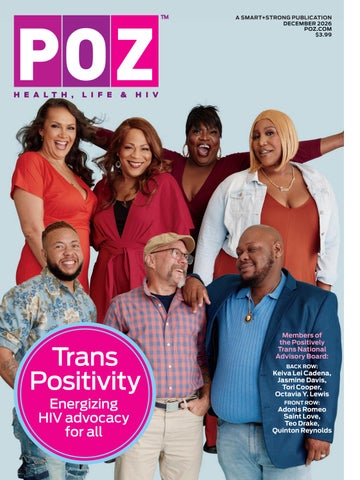
Trans Positivity Energizing HIV advocacy for all
Members of the Positively Trans National Advisory Board: BACK ROW:
Keiva Lei Cadena, Jasmine Davis, Tori Cooper, Octavia Y. Lewis FRONT ROW:
Adonis Romeo Saint Love, Teo Drake, Quinton Reynolds
BACK ROW:
A.J. Scruggs, Liaam Winslet, Achim Jeremiah Howard FRONT ROW:
Ms. Billie Cooper, Kodee Stephens, Katie Adsila Willingham, Adonis Gutierrez, Kineen Mafa NOT PICTURED:
Cecilia Chung, Evonne Kaho, Yasmyne Hunter, Tatyana Moaton-Santiago
CONTENTS
EXCLUSIVELY ON
POZ.COM #ADVOCACY Fighting against HIV and AIDS has always been a struggle. Much work remains to end the epidemic. POZ encourages you to get involved in advocacy. Go to poz.com/advocacy to find the latest news and learn how you can make a difference in the fight.
D
When people living with and affected by HIV share their stories, it can break down the shame, silence and stigma surrounding the virus. These stories can inspire, educate and empower others. To read POZ Stories or to share your own, visit poz.com/stories.
Behind the scenes at this issue’s cover shoot
D
#UNDETECTABLE The science is clear: People who have an undetectable viral load don’t transmit HIV sexually. In addition to keeping people healthy, effective HIV treatment also means HIV prevention. Go to poz.com/undetectable for more.
D
POZ DIGITAL Scan the QR code (left) with your smartphone camera or go to poz.com/digital to view the current and past issues online.
18 THE 2026 POZ ICONS Honoring those who pioneered HIV advocacy BY JENNIFER MORTON 22 TRANSFORMATIVE HIV ADVOCACY Meet the Positively Trans National Advisory Board. BY TIM MURPHY 3 FROM THE EDITOR
14 CARE & TREATMENT
I Want to Break Free
NIH faces threats to science funding • many people with HIV have unmet needs • FDA approves Bixlenvo • doxyPEP benefits in the real world
4 POZ PLANET Three new art projects explore national narratives of HIV and culture • HIV advocates are among the new Harvard fellows • Grindr pays $35 million in U.K. HIV lawsuit • immigration policies increased HIV incidence • a single-payer universal healthcare system could save $1 trillion and 114,000 lives • POZ Stories: Harold Scott used a billboard and social media to get a new kidney • Everyday: honoring those lost to the HIV epidemic
10 VOICES Longtime HIV advocate Anselmo Fonseca reflects on why being here matters.
16 BASICS Quitting smoking
17 RESEARCH NOTES
Pregnancy PrEP • switching to a long-acting regimen • functional cure strategies • cancer is a growing risk for people aging with HIV
32 HEROES Von Biggs helped protect pharmaceutical benefits for roughly 22,000 lower-income Floridians who access their medications via the AIDS Drug Assistance Program.
12 SPOTLIGHT
33 SURVEY
2026 U.S. Conference on HIV/AIDS
Healthy living
COVER: (POSITIVELY TRANS BOARD MEMBERS) ARI MICHELSON; STYLISTS: BRIAN CHRISTOPHER, ANGEL FAULK, WES MATA AND ANTHONY WILEY. THIS PAGE: (BEHIND THE SCENES) JENNIFER MORTON; (GAVEL/BOOKS AND MAGNIFYING GLASS) ISTOCK; (LAPTOP) GETTY IMAGES/VLADWEL
#POZ STORIES
POZ (ISSN 1075-5705) is published monthly except for the January/February, April/May, July/August and October/November issues ($19.97 for an 8-issue subscription) by Smart + Strong, 157 Columbus Avenue, Suite 525, New York, NY 10023. Periodicals postage paid at New York, NY, and additional mailing offices. Issue No. 296 POSTMASTER: Send address changes to POZ/Smart + Strong, 157 Columbus Avenue, Suite 525, New York, NY 10023. Copyright © 2026 CDM Publishing, LLC. All rights reserved. No part of this publication may be reproduced, stored in any retrieval system or transmitted, in any form by any means, electronic, mechanical, photocopying, recording or otherwise without the written permission of the publisher. Smart + Strong® and POZ® are registered trademarks of CDM Publishing, LLC.
P12-26p02_TOC.indd 2
ɐ30 POZ31267_P12-26p02_TOC.pgs 10.13.2026 04:48
FROM THE EDITOR
I Want to Break Free
EDITOR-IN-CHIEF
ORIOL R. GUTIERREZ JR. MANAGING EDITOR
JENNIFER MORTON
I
DEPUTY EDITOR
TRENT STRAUBE SCIENCE EDITOR
LIZ HIGHLEYMAN COPY CHIEF
JOE MEJÍA ASSISTANT EDITOR
EVA LORENZ ART DIRECTOR
DORIOT KIM ART PRODUCTION MANAGER
MICHAEL HALLIDAY CONTRIBUTING WRITERS
SHAWN DECKER, OLIVIA G. FORD, ALICIA GREEN, THEODORE KERR, MARK S. KING, JAY LASSITER, TIM MURPHY, MATHEW RODRIGUEZ, CHARLES SANCHEZ CONTRIBUTING ARTISTS
JOAN LOBIS BROWN, LIZ DEFRAIN, ARI MICHELSON, JONATHAN TIMMES, BILL WADMAN FOUNDER
SEAN STRUB LEGACY ADVISER
MEGAN STRUB ADVISORY BOARD
GUILLERMO CHACÓN, SABINA HIRSHFIELD, PHD, TIM HORN, JESSE MILAN JR., MITCHELL WARREN PRESS REQUESTS
NEWS@POZ.COM SUBSCRIPTIONS
HTTP://ORDER.POZ.COM UNITED STATES: 212-242-2163 SUBSCRIPTION@POZ.COM FEEDBACK
EMAIL WEBSITE@POZ.COM OR EDITOR-IN-CHIEF@POZ.COM
SMART + STRONG PRESIDENT AND COO
IAN E. ANDERSON EDITORIAL DIRECTOR
ORIOL R. GUTIERREZ JR. (GUTIERREZ) WASIO FACES; (LANDSCAPE) GETTY IMAGES/RUDZHAN NAGIEV
CHIEF TECHNOLOGY OFFICER
CHRISTIAN EVANS VICE PRESIDENT, INTEGRATED SALES
DIANE ANDERSON INTEGRATED ADVERTISING MANAGER
JONATHAN GASKELL INTEGRATED ADVERTISING COORDINATOR
SARAH PURSELL SALES OFFICE
212-938-2051; SALES@POZ.COM
CDM PUBLISHING, LLC CEO
JEREMY GRAYZEL CONTROLLER
JOEL KAPLAN
POZ.COM/FACEBOOK
POZ.COM/X
POZ.COM/INSTAGRAM
AM CURRENTLY MARKING the 30th anniversary of two major turning points in my life. In 1996, I was fortunate to receive an honorable discharge from the United States Marine Corps Reserve. I also became the associate editor of the AKC Gazette, the official magazine of the American Kennel Club. Three decades ago, I broke free from the military, which in 1992 had informed me that I tested HIV positive. I also became a journalist, which put to rest my doubts about what I wanted to do professionally for the rest of my life. Those events are not as unrelated as they may seem. In fact, one led to the other. In 1992, I thought that I would be dead by the year 2000, when I would turn 30. By 1996, however, I was beginning to believe that might not happen. So I started to prepare for the future. Being free of the military gave me clarity to turn my attention to journalism. Deciding not just to survive but instead to thrive with HIV merits a celebration. Those of us who have had the opportunity to do so can attest to the importance of making that decision. It is through this lens that I salute the subjects of our cover story highlighting the Positively Trans National Advisory Board. We were able to photograph all but four of the board members. The photo shoot took place during this year’s U.S. Conference on HIV/AIDS (USCHA), which was held in Anaheim, California. Thanks to those who were photographed and to all who participated in the article. Positively Trans is doing essential advocacy work, which includes collecting data, organizing its members and promoting visibility for transgender people, especially those living with HIV. Go to page 22 to learn more about the group and the prominent contributions of its current leadership. This special issue of POZ focusing on HIV advocacy also honors the POZ Icons, our annual commemoration of some of the pioneers of our movement. This year’s list
celebrates Mary Fisher, Sir Elton John, Bill T. Jones, Kiyoshi Kuromiya and Peter Staley. Go to page 18 to read about their work. “United and Unbreakable: The HIV Movement at 45” was USCHA’s theme this year. It’s a reference to the years that have passed since 1981, when the Centers for Disease Control and Prevention published its first report on what would come to be known as AIDS. Organized by NMAC, the event gathered providers, policymakers, representatives from the healthcare industry and community advocates. Go to page 12 for a roundup of photos. This issue spotlights two additional advocates: Anselmo Fonseca and Von Biggs. In advance of this year’s USCHA and National HIV/AIDS and Aging Awareness Day, Anselmo wrote an opinion piece for POZ.com on why being a long-term survivor matters. Go to page 10 to read an edited excerpt. Getting older with the virus is also a concern for Von. Recently, he was named chairman of the National HIV & Aging Advocacy Network. He also published a book based on his conversations with college students and what they reveal about sex education in 2026. Go to page 32 to learn more about his activism. Living well with HIV involves more than just managing the virus. Tell us what helps you by taking our survey in the back of this issue.
ORIOL R. GUTIERREZ JR. EDITOR-IN-CHIEF editor-in-chief@poz.com
poz.com DECEMBER 2026 POZ 3
P12-26p03_EdLetter.indd 3
ɐ$0 POZ31267_P12-26p03_EdLetter.pgs 10.15.2026 01:08
POZ PLANET UPDATES ON HIV & AIDS
LOCAL GRIEF, GLOBAL REACH within a community of artists drove Still “HIV/AIDS IS SOMETHING THAT IS With Us. At the heart of the book is “Memory geographically located,” states Michele Garden,” a section honoring more than 70 Bertolino, who curated a first-of-its-kind people in the Canadian dance community exhibition about AIDS in Italy, VIVONO— who died of AIDS-related illness, includArts and Feelings: HIV-AIDS in Italy, 1982– ing beloved dancer René Highway. The 1996, at the Centro Pecci in Prato, Italy. book also includes stories of long-term Before entering an exhibition of survivors and dancers born after the crisis artworks and archival objects, visitors began and how they navigate a field were met with the sound of Italian poetry shaped by HIV and its stigma. by writers who lived with HIV, including Intermingled within the stories was an Dario Bellezza and Pier Vittorio Tondelli. editorial question House faced: what to The poetry was the soundtrack for a do about the United States, which—as commissioned film that made it clear the Bertolino and Stołpiec know well—so often exhibition was about AIDS in Italy. dominates the stories told about HIV. Covered in national and international To illuminate the intimate cross-border press, VIVONO, which translates to “they connections dancers share while keeping live,” is one of several recent projects that the story of HIV in Canada from getting situate AIDS in the art and culture of a lost, House included material like a local context, part of a broader movepowerful poem by dancer Brian Webb, ment of curators and editors turning to in which Webb makes clear how local histories to broaden the stories indivisible HIV, dance, the United States told about the crisis. Other projects and Canada are from one another. include Tiger Blood, an exhibition in He describes a funeral on a farm Poland curated by Martyna Stołpiec, straddling the Canadian-U.S. border. and the book Still With Us: Stories of The meaning is clear: Neither people nor viruses nor death are easily HIV/AIDS and Dance in Canada, edited managed or contained. by Christopher House. Still With Us marks the first time These projects share what’s at the someone has taken stock of HIV’s heart of Bertolino’s comment: HIV and impact on the Canadian dance comAIDS are not a single, unified story. munity. So House has found himself Through exhibition and publication, part of a small yet growing group of they surface ways of knowing HIV that curators, editors and organizers thinking are tied to specific geographies. about HIV within their local Tiger Blood is, like VIVONO, one contexts. In addition to Bertolino of the first exhibitions about HIV and Stołpiec, this includes Ricardo in its country. The show included Henrique Ayres Alves and João a photograph of a trash can by Eduardo Peçanha de Freitas, who artist Paweł Żukowski that many curated the exhibition Continuous people living with HIV in Warsaw Dialogues: Temporalities of HIV/ would recognize. In Poland, HIV AIDS, a similarly pioneering medications are picked up at a project in Brazil, as well as Nikolaos clinic inside a hospital. The trash Papadogiannis, the principal can, often overflowing with investigator for a project titled medication packaging, sits just “AIDS Campaigning Between the outside the clinic, a space of Global South and Western Europe relative safety before folks step Since the 1980s” that is researching back out into the broader world. localized, often overlooked Hence, Żukowski dubbed it: AIDS narratives and seeks to create “Monument to the Stigma of more inclusive and relatable Living with HIV in Poland.” HIV campaigns. Stołpiec learned the story From top: Canadian dancer René Highway; When asked how to account for behind this and many of the other Untitled (Bin on Wolska), part of a show the simultaneity of these cultural artworks she curated by listening in Poland; Italian works from VIVONO projects inaugurating national to artists living with and affected visions of HIV, Papadogiannis suggested the answer begins by HIV, including the show’s other artists, Szymon Adamczak, with the growing precarity of marginalized people around the Martyna Baranowicz, Antoni Grabowski, Viktor Witkowski world. Such projects must also include the desire within and Przemysław Piniak, who died at 39 during the exhibition’s these communities, often affected by HIV, to imagine a better, run. Piniak’s death, Stołpiec wrote in the catalog, was painful fairer world together. He suggests that although the organizers, precisely because the show was about living with HIV now: curators and members of these communities are not necessarily “We do not want to trivialize it—his death underlines the imporin contact with one another, a solidarity rooted in specificity tance of talking, solidarity and working together.” is emerging through struggle. —Theodore Kerr For choreographer Christopher House, the impact of death
(HIGHWAY) ANDREW OXENHAM, DANCE IN CANADA PHOTO COLLECTION/COURTESY OF DANCE COLLECTION DANSE; (BIN ON WOLSKA) NORBERT PIWOWARCZYK, COURTESY OF FOKSAL GALLERY; (VIVONO ITALIAN WORKS) ANDREA ROSSETTI
Three projects explore national narratives of HIV and culture.
4 POZ DECEMBER 2026 poz.com
P12-26p04-05_Planet.indd 4
ɐ30 POZ31267_P12-26p04-05_Planet_4.pgs 10.13.2026 04:48
New Harvard Fellows Include HIV Advocates Renderings of Echoes, a proposed redesign of the Toronto AIDS Memorial
(HARVARD) GETTY IMAGES/LEONID ANDRONOV; (HAND/PHONE) GETTY IMAGES/TON PORNPRASIT PANADA; (GAVEL) GETTY IMAGES/BILL OXFORD
Rachel Levine and Francisco Ruiz are among them. The Harvard Kennedy School’s Carr-Ryan Center for Human Rights welcomed its 2026–27 cohort of fellows in August. Boasting vast experience addressing issues such as democratic governance, Harvard racial justice, migration, LGBTQ University rights, digital rights, public health, foreign policy and more, the fellows include some faces familiar to POZ readers. Among the 43 awardees are HIV and LGBTQ advocates Rachel Levine, Francisco Ruiz and Jessica Stern. “Bringing together scholars, practitioners, advocates and leaders from around the world, this year’s fellows represent a diverse range of expertise and perspectives across the human rights field,” shared the Harvard Kennedy School in an Instagram post. “Throughout the academic year, they will conduct innovative research, engage with the Harvard Kennedy School community, and collaborate across disciplines to address some of today’s most pressing human rights challenges.” Carr-Ryan Center fellows will help advance LGBTQ human rights by strengthening global policy and advocacy. Rachel Levine, MD, was the U.S. assistant secretary for health under President Joe Biden. As Pennsylvania’s secretary of health during the COVID-19 pandemic, Levine made history as the first transgender person to serve in a state cabinet position. Francisco Ruiz, PhD, is a public health equity leader who served as the director of the White House Office of AIDS Policy under President Biden. In 2022, while pursuing his PhD at Harvard University’s T.H. Chan School of Public Health, he disclosed he was living with HIV. Other LGBTQ activists honored as fellows include Jessica Stern, who served as the U.S. special envoy to advance LGBTQ human rights; Kimberly Zieselman, JD, an intersex woman who served as senior adviser to special envoy Jessica Stern; human rights scholar Harleen Kaur; and Rémy Bonny, executive director of Forbidden Colours. —Eva Lorenz
GRINDR PAYS $35M IN U.K. HIV LAWSUIT The company denies selling sensitive data to third-party advertisers. The popular gay dating and hookup app Grindr agreed to pay £26 million (about $35 million) to settle a lawsuit over allegations that it shared users’ personal information, including their ethnicity, sexual orientation and, in some cases, HIV status, with third parties, reports The Guardian. The settlement ends the class-action lawsuit filed in the High Court of England and Wales in 2024, though Grindr continues to deny liability. “The settlement includes no findings or admission of liability. While Grindr disputes the allegations, it recognizes and acknowledges the distress and loss of trust expressed by some of its U.K. users regarding that pre-2020 period,” the company said in its filing. Launched in 2009 and based in Los Angeles, Grindr bills itself as “the largest social networking app for gay, bi, trans and queer people. We have millions of daily users who use our location-based technology in almost every country in every corner of the planet.” Grindr users have the option to disclose their age, gender and sexual preferences in their profiles; they may also share their HIV status as a way to promote sexual transparency and reduce stigma. In 2018, the Swedish public broadcaster SVT commissioned the Norwegian nonprofit SINTEF to investigate Grindr privacy leaks. The report revealed that Grindr was sharing sensitive information—including HIV status and “last tested date”—with the data analytic services Apptimize and Localytics, which help optimize apps. The HIV information was sent along with GPS data, phone numbers and email addresses, making it easy to identify HIV data on specific users. “The HIV status is linked to all the other information. That’s the main issue,” SINTEF researcher Antoine Pultier told BuzzFeed News. “I think this is the incompetence of some developers that just send everything, including HIV status.” In April 2024, the U.K. law firm Austen Hays sued Grindr on behalf of thousands of U.K. users, claiming the app violated the country’s privacy laws by sharing sensitive information with third-party vendors and advertising companies prior to 2020. (Prior to 2020, Grindr was owned and controlled by the Chinese gaming company Beijing Kunlun Tech.) Apptimize and Localytics were two of the third-party entities with which Grindr was allegedly sharing personal information. Nearly 15 million people worldwide use Grindr. Although there is no way to know exactly how many individuals were affected, Austen Hays represented 12,000 people who would receive an average compensation of £2,167 ($2,935) each, if the money is equally distributed. “Since 2020, Grindr has overhauled its privacy program with a keen focus on the unique needs of its community,” Grindr stated in the filing. “Grindr is and remains a safe space for users, committed to transparency, user control and responsible data practices.” —Eva Lorenz
poz.com DECEMBER 2026 POZ 5
P12-26p04-05_Planet.indd 5
ɐ$0 POZ31267_P12-26p_05_Planet.pgs 10.15.2026 01:08
POZ PLANET UPDATES ON HIV & AIDS
Immigration Policies Increased HIV Incidence Anti-sanctuary counties are seeing higher rates of the virus among Latinos. AIDSVu.org data shows that new diagnoses among Latinos rose since 2008 but appear to have stabilized. In 2024, over a quarter (27%) of the nearly 1.2 million U.S. residents living with diagnosed HIV were Latino. Although about five out of six Latinos living with HIV have been tested and know their status, less than half of all Latinos in the United States have ever been tested for HIV. Researchers from the Boston University School of Public Health and the University of South Carolina compared county-level HIV incidence by race before and after Trump’s 2018 ruling prohibiting immigrant use of Medicaid and other public benefit programs. Counties were categorized according to their political environment and support of Immigration Customs and Enforcement (ICE). Areas with limited support for ICE were considered sanctuary counties; areas with formal ICE contracts to enhance policy enforcement were anti-sanctuary counties; areas that generally supported common ICE practices were baseline counties. Anti-sanctuary counties showed a 16.8% increase in HIV incidence among Latino populations compared with baseline counties. “The HIV incidence rates among Hispanic populations may have increased because of fear and the chilling effects of the changes in immigration policy,” wrote the study’s authors. “The implications extend beyond HIV, indicating that anti-immigrant policies could lead to deterioration in a wide range of health outcomes.” HIV incidence did not increase among other races, indicating that the 2018 policy uniquely affected Latino populations. “Immigration policy is health policy,” said Rodriguez-Diaz. “When laws and rhetoric push people into the shadows, they do not make communities safer and undermine the health of us all.” —Eva Lorenz
Saving $1 Trillion & 114,000 Lives Yale study supports universal coverage. A single-payer universal healthcare system could cover every American, save more than 100,000 lives a year and still cost $1 trillion less than the system it would replace, according to a new study led by researchers at the Yale School of Public Health. For the study, which has not yet been peer reviewed, the researchers modeled what would happen if the United States adopted a national public insurance program like the one proposed in the Medicare for All Act. Using 2024 spending, insurance coverage and mortality data, they estimate that the universal coverage would reduce annual health expenditures by $1.04 trillion, or nearly 20%—even after accounting for the additional care that uninsured and underinsured people would receive. The model identified five major sources of savings: lower pharmaceutical prices, Medicare-level payments to providers, reduced administrative overhead, less fraudulent billing and fewer avoidable emergency department visits and hospitalizations. The researchers argue that the United States already spends enough to provide universal coverage. The problem, they conclude, is how that money is allocated. “A system that covers everyone, costs $1 trillion less and averts more than 100,000 deaths annually requires no new discovery to implement, only enactment,” they wrote. —Yale School of Public Health
(POLICE) GETTY IMAGES/CHARLES-MCCLINTOCK WILSON; (PIGGY BANK) GETTY IMAGES/ALTAYB
President Donald Trump has been cracking down on immigration since his first term. In 2018, he announced changes to the public charge rule, permitting officials to deny green cards to noncitizens based on their usage of public benefit programs, such as Medicaid, the Supplemental Nutrition Assistance Program and housing assistance. A study published in The Milbank Quarterly found that the new policy contributed to an increase in HIV transmission among Latinos across the United States. “Fear and the chilling effects of anti-immigrant policies can deter people from seeking healthcare, testing, prevention and treatment,” said senior study author Carlos Rodriguez-Diaz, chair and professor of community health sciences at the Boston University School of Public Health, in a press release. “These findings underscore a critical reality: Efforts to end the HIV epidemic cannot succeed when immigration policies make communities afraid to access essential services.” Latinos make up about 20% of the U.S. population but accounted for roughly 34% (13,201 cases) of the nearly 39,000 new HIV diagnoses nationwide in 2024, according to the latest data from the Centers for Disease Control and Prevention. Only Black Americans, who make up 14% of the population, had a higher rate of new HIV diagnoses (39%, or 15,128 cases).
6 POZ DECEMBER 2026 poz.com
P12-26p06_Planet.indd 6
ɐ$0 POZ31267_P12-26p06_Planet.pgs 10.15.2026 01:09
(SCOTT) COURTESY OF HAROLD SCOTT; (GLOBE) GETTY IMAGES/NATALIA HOFFMANN; (MEGAPHONE) GETTY IMAGES/MUSTAFAU; (GLASER) YOUTUBE/ELIZABETH GLASER PEDIATRIC AIDS FOUNDATION; (SYLVESTER, ROBINSON, ALDERSON; RITTS AND CALLEN) WIKIPEDIA
A BILLBOARD AND THE HOPE ACT HELPED ME FIND A NEW KIDNEY Harold Scott received a kidney from a donor with HIV and became Vanderbilt Health’s first HIV-to-HIV kidney transplant recipient. I live in Lebanon, Tennessee, about 30 miles east of Nashville. I am a 64-year-old gay man who has lived with HIV since October 1989. I first shared my story with POZ in 2013. For more than 10 years, I lived with chronic kidney disease, and about four years ago, I was diagnosed with endstage renal failure. Shortly thereafter, a tumor was found in my right kidney, at which time the kidney was removed. I began a journey toward dialysis and transplantation. I was placed on the kidney transplant list through Vanderbilt Health’s Transplant Center on May 16, 2023, and began dialysis. During this journey, I was given the option of receiving a kidney from a donor living with HIV and was provided with information regarding
EVERYDAY December
1
Harold the HOPE Act. [The Scott’s HIV Organ Policy Equity billboard (HOPE) Act allows scientists to research organ donations between people with HIV. Since the law was enacted in 2013, more than 500 HOPE Act transplants have been performed with no patient
safety issues reported. Federal regulatory changes enacted in 2024 aim to expand access for transplant candidates living with HIV while continuing to ensure patient safety.] To get the word out about my need for a kidney transplant, I used social media and a billboard and placed flyers around town and signs in my yard along the busy street on which I live. I also did TV and radio interviews. On July 5, 2026, I was offered a kidney from a deceased donor with HIV from Chicago and became Vanderbilt Health’s first HIV-to-HIV kidney transplant recipient. Today, I am thriving! Read other POZ Stories or share your own at poz.com/stories.
These dates honor those we’ve lost to the HIV epidemic. Visit poz.com/aidsiseveryday to learn more about the history of HIV and AIDS. BY JENNIFER MORTON
WORLD AIDS DAY
2
AIDS activist KATRINA HASLIP dies at age 33. Her advocacy helped to expand the CDC’s definition of HIV and AIDS to include more illnesses affecting women with the virus. (1992)
MAX ROBINSON, the first Black man to anchor the news on a national network, dies of AIDS-related causes at age 49. (1988)
20
ORTEZ ALDERSON dies of AIDS-related causes at age 38. A founding member of ACT UP, he helped organize the People of Color and AIDS Conference. (1990)
21
3
ELIZABETH GLASER, activist and cofounder of the Elizabeth Glaser Pediatric AIDS Foundation, dies of AIDS-related complications at age 47. (1994)
Singer SYLVESTER (“You Make Me Feel Mighty Real”) dies of AIDS-related complications at age 42. (1988)
16
26
Photographer HERB RITTS dies of AIDS-related complications at age 50. (2002)
Singer, songwriter, composer, author and activist MICHAEL CALLEN dies of AIDS-related causes at age 38. (1993)
27
poz.com DECEMBER 2026 POZ 7
P12-26p07_Planet.indd 7
ɐ30 POZ31267_P12-26p07_Planet.pgs 10.13.2026 04:45
VOICES BLOGS AND OPINIONS FROM POZ.COM
AGING WITH DIGNITY
I
REMEMBER A TIME WHEN AN HIV diagnosis was often spoken about as a death sentence. I remember the fear, the stigma, the silence, the discrimination and the anger of watching people living with HIV being treated as if their lives were somehow less valuable. I also remember when people living with HIV and their families had to become advocates because too many systems were unwilling to listen. My own journey in HIV advocacy in Puerto Rico grew out of that reality. Beginning around 1999, in the aftermath of the crisis surrounding the San Juan AIDS Institute, I became part of a movement demanding something that should never have required a fight: accountability, transparency, dignity and a meaningful voice for people living with HIV. Through Pacientes de SIDA pro Política Sana [AIDS Patients for Sound Policy], my partner, José Fernando Colón, and I as well as others who refused to remain silent challenged the idea that decisions about our lives could be made without us. We fought for patients to have a voice. We fought for access to treatment. We fought for our rights. We fought against stigma. We fought for prevention and education. And we fought for the simple principle that people living with HIV must be partners in the decisions that affect our lives—
not merely recipients of services. Along the way, I witnessed extraordinary courage. I also witnessed tremendous loss. There are people whose names, voices, laughter and struggles remain with me. Some never lived long enough to see the transformation that HIV treatment eventually made possible. They never got the opportunity to grow old. I did. And that realization carries enormous weight. Growing older with HIV is therefore not something I take for granted. It is a privilege, a responsibility and, at times, an emotional reckoning. Every year that I am here reminds me of those who were not given that opportunity. It reminds me that the medications we have today came after years of activism, scientific research, community pressure and the insistence of people who were told to be quiet. It reminds me that rights we sometimes take for granted had to be demanded. And it reminds me that the work is not finished. Today, people living with HIV are living longer, but longevity alone is not enough. We deserve to age with dignity. We deserve continuous access to HIV treatment and the medications needed for the other conditions that accompany aging. We deserve healthcare providers who understand that HIV is only one part of a person’s life. We deserve housing, financial security, mental and emotional support, meaningful relation-
ships, community and freedom from discrimination. We deserve to be seen not as an aging population to be managed but as human beings who have contributed decades of experience, knowledge and leadership. And we must remember the long-term survivors who continue to carry the invisible wounds of the epidemic: the grief, the memories, the survivor’s guilt, the loss of friends and loved ones and the years spent fighting simply to stay alive. For me, aging with HIV is also about legacy. I think about those who walked beside me. I think about the people who challenged the system before there were comfortable words for what we were doing. I think about the activists, patients, families, healthcare workers and allies who refused to accept that discrimination was inevitable. I think about the work that helped establish a stronger voice for people living with HIV in Puerto Rico, including the struggle for recognition of our rights and the creation of protections such as the legislation Carta de Derechos de las Personas Portadoras del VIH [Bill of Rights of People With HIV]. And I think about the responsibility that comes with having survived. I don’t want my story to be simply that I lived with HIV for many years. I want my story to be that I used those years to make it easier for someone else to live. Q
GETTY IMAGES/LAYLABIRD
In an opinion piece titled “What National HIV/AIDS and Aging Awareness Day Means to Me This Year,” longtime HIV advocate Anselmo Fonseca reflects on why being here matters. Below is an edited excerpt.
10 POZ DECEMBER 2026 poz.com
P12-26p10_Voices.indd 10
ɐ30 POZ31267_P12-26p10_Voices.pgs 10.13.2026 04:45
POZ.COM • A daily resource for people living with and affected by HIV and AIDS • Clear, comprehensive prevention and treatment information • News, personal stories, blogs, HIV-specific resources and more • Sign up for free email newsletters
Follow us on:
A SMART + STRONG PUBLICATION Award-winning consumer health care information
POZ_House_Ad_Full-Dec-2024_KODI.indd 25
11/25/24 1:42 PM POZ26281-00_HouseAd.pgs 11.25.2024 13:43
SPOTLIGHT BY JOE MEJÍA
This year’s U.S. Conference on HIV/AIDS (USCHA) was held in Anaheim, California, from September 17 through 20. Organized by NMAC (formerly the National Minority AIDS Council) and sponsored by Gilead Sciences, Merck Pharmaceuticals and ViiV Healthcare, the 30th annual event gathered thousands of frontline service providers, policymakers, representatives from the healthcare industry and, above all, community advocates to share updates and challenges regarding the fight against HIV, rededicate themselves to the fight against the virus and strategize ways to end the epidemic. The event’s theme was “United and Unbreakable: The HIV Movement at 45,” a reference to the number of years passed since 1981, when the Centers for Disease Control and Prevention published its first report on the virus that causes AIDS. In the words of NMAC’s CEO, Harold Phillips, the theme “is more than a reflection on our past. It is our commitment to the future. At a time when HIV programs, public health infrastructure and the communities we serve face unprecedented challenges, we are choosing hope over fear, action over complacency and unity over division.” Major topics covered via workshops and iPoster presentations included “Whole Person Health: Prevention and Care Without Silos,” “Turning Evidence into Impact Through Science and Policy” and “Advancing HIV Care: Clinical Updates.” Meanwhile, three-hour sessions, or “institutes,” centering current HIV issues and special populations—e.g., “Ensuring Long-Acting HIV Prevention Reaches Black Gay and Trans Communities” and “Unbreakable Advocates: Combating Attrition and FIghting for Health Equity in a Hostile Environment”—afforded attendees more intimate settings for learning and exploration. Throughout the conference’s four days, however, the emphasis was on community and support, how showing up for one another in the face of adversity—stigma, transphobia, racism, budget cuts, ignorance—can not only help the HIV community heal but also inspire us to grow stronger. 1. NMAC CEO Harold Phillips addressed USCHA attendees gathered at the Hilton Anaheim during one of the conference’s plenaries. 2. During a plenary luncheon sponsored by Merck, Black Public Health Academy founder and CEO Leisha McKinley-Beach, producer Debbie Allen and actress Jasmine Guy discussed the groundbreaking HIV awareness episode of Allen’s sitcom A Different World, in which Guy costarred. 3. Representatives of OraSure Technologies were on hand in the Exhibition Hall to promote the manufacturer’s rapid tests for HIV, hepatitis C virus and syphilis and teach attendees how such tests can enhance their prevention and treatment efforts. 4. In a presentation titled “Analytical Treatment Interruption (ATI) Studies: Guiding Preventive Vaccine Development and Cures,” Gail Broder, the senior community engagement project manager for the HIV Vaccine Trials Network, shared how people living with HIV are contributing to science through their participation in ATI studies, which further scientists’ understanding of the immune response.
1
2
3
4
(1, 6, 9) JENNIFER MORTON; (2) FACEBOOK/CHRISTIAN D. GREEN; (3) FACEBOOK/ORASURE TECHNOLOGIES, INC.; (4) INSTAGRAM/@HELPENDHIV; (5) FACEBOOK/LARRY BRYANT JR.; (7) INSTAGRAM/@VIIVHEALTHCAREUS; (8) FACEBOOK/A. TONI YOUNG
USCHA 2026: “UNITED AND UNBREAKABLE”
12 POZ DECEMBER 2026 poz.com
P12-26p12-13_Spotlight.indd 12
ɐ30 POZ31267_P12-26p12-13_Spotlight_12.pgs 10.13.2026 04:46
5
6
7
5. The Reunion Project’s director of community engagement, Waheedah Shabazz-El, a founding member of the Positive Women’s Network—USA, greeted folks at the Reunion Project booth. Shabazz-El also presented the workshop “United and Unbreakable: Advancing Inclusive HIV Criminalization Reform Across the African Diaspora.” 6. As part of the Save HIV Funding Campaign’s action “Celebration of Life,” Kamaria Laffrey, co–executive director of The Sero Project, read her pre-obituary, a response to threats to slash funding for Florida’s AIDS Drug Assistance Program. 7. Victor Jackson and mom Tijuana Jackson, who are featured in ViiV Healthcare’s Mother to Son initiative, attended the conference. The campaign focuses on the special relationship between a mother and son and highlights how maternal support can keep Black and Latino queer and trans men engaged in HIV prevention, treatment and care. 8. A. Toni Young, executive director of the West Virginia–based Community Education Group (in navy blue blazer), posed with fellow advocates from Appalachia and the rural South, many of whom attended USCHA thanks to scholarships from Gilead Sciences. Despite being disproportionately affected by HIV due to the opioid crisis, the regions are sometimes excluded from broader conversations about the epidemic. 9. At the POZ booth, managing editor Jennifer Morton, editorin-chief Oriol Gutierrez and community support coordinator Sarah Pursell shared issues of the magazine as well as recent health information posters and the latest HIV drug chart. POZ was the conference’s media sponsor.
8
9
Send your event photos to POZ at website@poz.com or tag us on Facebook, Instagram or X. For a list of community events, visit poz.com/calendar.
P12-26p12-13_Spotlight.indd 13
ɐ30 POZ31267_P12-26p12-13_Spotlight_13.pgs 10.13.2026 04:46
CARE & TREATMENT BY LIZ HIGHLEYMAN
NIH FACES THREATS TO SCIENCE FUNDING In the early days of the second Trump administration, the Centers for Disease Control and Prevention and foreign aid were among the first targets, but now the National Institutes of Health (NIH) is under fire. As the world’s largest public funder of biomedical research, the NIH has historically supported the science that laid the groundwork for HIV prevention and treatment as well as ongoing efforts to find a cure. But funding cuts and policy changes threaten to undermine that legacy. In recent months, the administration has delayed grant awards to HIV clinical trials networks, sought to transfer NIH resources to the Department of Defense, floated a reorganization of the National Institute of Allergy and Infectious Diseases and the Office of AIDS Research (OAR) and threatened to give arch-conservative Office of Management and Budget director Russell Vought veto power over NIH research grants to ensure that they align with the president’s political agenda. A new
OAR strategic plan mentions men who have sex with men and Black and Latino people only once and completely omits other key populations at higher risk for HIV, including transgender women and people who use drugs. At the U.S. Conference on HIV/AIDS in September, advocates with the Save HIV Funding Campaign protested these efforts to derail HIV research. “We mobilized because research must reach the communities still being left behind,” said campaign cofounder and PrEP4All executive director Jeremiah Johnson. “We cannot let the administration dismantle research infrastructure that is developing the innovations that keep people alive.” In recent decades, HIV research has received a disproportionately large share of the NIH budget relative to the number of affected people in the U.S. population. Thanks to past support, highly effective pre-exposure
Advocates prophylaxis and protest threats antiretroviral to the NIH at the treatment are now U.S. Conference available, but they on HIV/AIDS. are not reaching everyone who needs them. NIH director Jay Bhattacharya, MD, PhD, has argued that the agency should focus more on deploying these existing tools rather than basic science, but successful implementation requires directing resources to the communities most likely to be living with or at risk for HIV.
Many People With HIV Have Unmet Needs New findings from the Centers for Disease Control and Prevention’s Medical Monitoring Project, an annual national survey of people with diagnosed HIV, show that they continue to face barriers to care. The latest report, released in September, covers June 2024 through May 2025. It includes data from nearly 4,000 people collected by 17 state/ territorial and six city health departments. Most respondents (77%) were men, more than half (55%) were ages 50 and older, 39% were Black, 28% were white and 26% were Latino. The good news is that 96% of adults diagnosed with HIV during the past year said they received HIV care, though just 71% were retained in care. Most (80%) were prescribed antiretroviral therapy. Among those who stopped treatment, 42% cited financial or insurance problems, 31% didn’t think they needed treatment and 25% were concerned about side effects. Among those currently on treatment, just 63% said they took every dose as prescribed during the past month. Less than two thirds (62%) had a viral load below 200 according to their most recent test, and only 59% had sustained viral suppression for the full year. “Structural and other factors continue to negatively impact people with HIV in the United States,” according to the report. Participants cited several barriers to optimal health, including poverty (37%), hunger or food insecurity (22%), unstable housing or homelessness (20%), unemployment (15%), incarceration (4%) and intimate partner violence (4%). Most had some form of health insurance or medication coverage, but 7% were uninsured. Many said they had unmet needs beyond HIV treatment, including dental care (24%), food services (15%), housing services (15%) and mental health care (10%). Based on these findings, access to services and care outcomes did not change much during the first year of the second Trump administration, but the full effects of funding cuts and policy changes are not yet reflected in the latest data.
14 POZ DECEMBER 2026 poz.com
P12-26p14-15_Care_Treatment.indd 14
ɐ30 POZ31267_P12-26p14-15_Care_Treatment_14.pgs 10.13.2026 04:46
FDA Approves New Daily HIV Combo Pill
(PROTEST) JENNIFER MORTON; (MAN) GETTY IMAGES/KLEBERCORDEIRO (MODEL USED FOR ILLUSTRATIVE PURPOSES ONLY); (BIXLENVO) COURTESY OF GILEAD SCIENCES; (FEET IN BED) GETTY IMAGES/RAWPIXEL
On August 27, the Food and Drug Administration approved Bixlenvo, a new single-tablet regimen from Gilead Sciences, as a switch option for people with viral suppression. The once-daily coformulation, which contains the integrase inhibitor bictegravir (best known as a component of the Biktarvy combination pill) and the capsid inhibitor lenacapavir, could offer a simpler alternative for people who are currently using more complex antiretroviral regimens. While most people living with HIV can take a single daily combination pill, some treatment-experienced individuals have developed drug resistance or are managing side effects and potential interactions with medications they use for other conditions. Bixlenvo may therefore be a welcome option for older people with HIV. Two late-stage clinical trials tested Bixlenvo as a switch option for people taking more complex regimens—for example, two or more pills per day or more than
once-daily dosing (ARTISTRY-1)—or Biktarvy (ARTISTRY-2). Most of the ARTISTRY-1 participants were 55 or older, and they had been on antiretroviral treatment for a median of 28 years. ARTISTRY-2 participants were generally younger and healthier, but comorbidities were still common. In both studies, people who switched to Bixlenvo and those who stayed on their current regimen were about equally likely to maintain viral suppression, with more than 90% having an undetectable viral load at 48 weeks. Bixlenvo was safe and generally well tolerated. ARTISTRY-1 participants who switched from a complex regimen said they were more satisfied with the single daily pill. “Bixlenvo offers a new once-daily single-tablet regimen designed for the evolving needs of people with HIV,” says trial lead Chloe Orkin, MD, of Queen Mary University of London. “It expands tailored, simplified dosing to people whose needs were not fully met by existing singletablet therapies.”
DOXYPEP BENEFITS IN THE REAL WORLD DoxyPEP—a single dose of the antibiotic doxycycline taken within 72 hours after sex—lowers the risk of chlamydia and syphilis, but results are mixed for gonorrhea, according to two studies presented at this year’s International AIDS Conference in Rio de Janeiro. As doxyPEP use expands, researchers are assessing its impact in the real world. A study conducted at the Duke HIV clinic in North Carolina found that taking doxycycline after sex lowered the incidence of all three sexually transmitted infections (STIs). Overall incidence, which had been rising, fell by 67% after doxyPEP rollout. Chlamydia diagnoses decreased by 81%, and syphilis declined from 10 to two cases per 100 person-years. The decline was less dramatic for gonorrhea, but even there, cases were cut in half. A nationwide study in Australia, however, found that doxyPEP had little impact on gonorrhea. In 2023, Australia was among the first countries to issue doxyPEP guidance. Syphilis declined by 55% after the guidance was released, while chlamydia fell by 36%. In contrast, gonorrhea rose by 11%, though the increase was not significant. In the North Carolina study, almost two thirds of participants did not have an STI during the past year and therefore would not have been eligible for doxyPEP according to most guidelines. But similar reductions in incidence were seen regardless of recent STI history. “This finding suggests that doxyPEP may provide benefit across a broader range of risk profiles than those represented in the original clinical trials, perhaps especially in high-incidence areas like the southeast United States,” said presenter Emily Niehaus, MD, PhD, of Duke University.
poz.com DECEMBER 2026 POZ 15
P12-26p14-15_Care_Treatment.indd 15
ɐ30 POZ31267_P12-26p14-15_Care_Treatment_15.pgs 10.13.2026 04:46
BASICS BY LIZ HIGHLEYMAN
TIME TO QUIT Smoking cessation can improve your health and prolong life expectancy.
Think about the benefits. The benefits of smoking cessation go beyond improved health. Once your lungs and heart heal, exercise and everyday physical activity become easier. Your senses of taste and smell may become sharper. Plus, you’ll save money—nearly $4,000 per year for a pack-a-day smoker. Get help. Call 800-QUIT-NOW or 855-DÉJELO-YA toll-free to reach your state’s smoking quitline. The federal government’s Smokefree.gov website offers smoking cessation advice and helpful tools. Tell family, friends and colleagues that you’re going to stop smoking and ask for their assistance. Beware of triggers. Identify your triggers—those times when you usually smoke. These may include watching TV, talking on the phone, exiting the subway, taking a break at work, drinking coffee or alcohol or relaxing after a meal or sex. Try nicotine replacement therapy or medications. Quitting smoking can lead to withdrawal symptoms, including
irritability and insomnia. Nicotine replacement products, such as gum, patches and nasal sprays, deliver a low dose to diminish craving. Two prescription medications, bupropion (Zyban or Wellbutrin) and varenicline (Chantix), are approved to reduce the urge to smoke Eat healthy and exercise. Weight gain is common after quitting cigarettes, but it’s not inevitable. If you find yourself eating more once you quit smoking, focus on healthy foods that are low in calories and high in nutritional value. Exercise can curb cravings, reduce stress, prevent weight gain and help your body heal after quitting. If you falter, try again. Lastly—and perhaps most importantly—don’t be too distressed if you slip up and smoke. While some people can stop smoking cold turkey on their first attempt, most smokers try quitting multiple times before they succeed. Set a new quit date and get back on track! Q
GETTY IMAGES/KENISHIROTIE
S
MOKING IS AN unhealthy habit for anyone, as it increases the risk of heart disease, lung disease and cancer. Over 480,000 deaths each year in the United States—more than one in five—are attributable to cigarette smoking and exposure to secondhand smoke, according to the Centers for Disease Control and Prevention. People living with HIV are more likely to smoke than the population at large, and they may be at even greater risk because they are more prone to health problems. Tobacco smoke contains thousands of toxic compounds. Nicotine itself is a stimulant that triggers the release of dopamine and other neurotransmitters, and it is highly addictive. Burning tobacco releases carbon monoxide and carcinogenic by-products and leaves a sticky tar residue in the lungs. Cigarette smoking increases heart rate and blood pressure and damages blood vessels, raising the risk for heart attacks and strokes. It also harms lung tissue and can lead to chronic obstructive pulmonary disease and emphysema. Smoking is well known as the main risk factor for lung cancer, but it is also linked to more than a dozen other malignancies. What’s more, it raises the risk of diabetes, weakens bones and can impair fertility and lead to pregnancy complications. Alternative nicotine delivery methods, such as e-cigarettes, vaping devices, pouches and chewing tobacco, avoid the hazards of burning tobacco. However, they still contribute to cardiovascular risk, and oral forms increase the likelihood of mouth and throat cancer. Vapes—especially flavored varieties— may contain toxic chemicals. Cannabis smoke contains many of the same harmful compounds as tobacco smoke. But let’s face it—quitting is hard! Relapse is common due to both physical and psychological withdrawal. The following tips and tools can help:
16 POZ DECEMBER 2026 poz.com
P12-26p16_Basics.indd 16
ɐ30 POZ31267_P12-26p16_Basics.pgs 10.13.2026 04:46
RESEARCH NOTES
(PREGNANT WOMAN) GETTY IMAGES/COURTNEY HALE (MODEL USED FOR ILLUSTRATIVE PURPOSES ONLY); (VIAL/SYRINGE) GETTY IMAGES/INNA DODOR; (HIV VIRUS) GETTY IMAGES/QUANTIC69; (CHEMOTHERAPY CHAIR) GETTY IMAGES/AEGEANBLUE
BY LIZ HIGHLEYMAN
PREVENTION
TREATMENT
CURE
CONCERNS
Pregnancy PrEP
Switching Treatment
Anktiva
Cancer Risk
Pregnant and breastfeeding women can safely use twiceyearly lenacapavir (Yeztugo) for HIV pre-exposure prophylaxis (PrEP), according to an analysis from the PURPOSE 1 trial. This Phase III trial enrolled more than 5,300 young women in Africa. They were randomly assigned to lenacapavir injections every six months or daily TAF/FTC (Descovy) or TDF/FTC (Truvada) PrEP pills. While the trial did not enroll pregnant or lactating women, participants were not required to use contraception, and they were not removed from the study if they became pregnant or started breastfeeding. There were 509 total pregnancies during the study. A majority resulted in live births (66% among women on lenacapavir, 54% among those on TAF/FTC and 57% among those on TDF/FTC). Pregnancy loss— abortion, fetal death or stillbirth—was statistically similar across groups. Lenacapavir was present in breast milk, but drug levels in infant plasma samples were minimal. No pregnant women on lenacapavir acquired HIV, and there were no cases of mother-to-child transmission during the study.
More than two thirds of people currently taking daily pills for HIV treatment would be willing to switch to a long-acting regimen, according to a recent systematic review and meta-analysis. Today, the longest-acting complete treatment regimen is injectable cabotegravir plus rilpivirine (Cabenuva), administered monthly or every other month. Injectable lenacapavir (Sunlenca) is given just twice a year, but it currently has no equally durable partners to build a complete regimen. Researchers identified 22 studies— mostly conducted in highincome countries—that assessed willingness to switch to long-acting injectables or other potential formulations that are not yet available, such as implants. Overall, 70% of study participants said they would be willing to switch to any long-acting regimen. Focusing on every-other-month intramuscular injections, like Cabenuva, 60% of participants were willing to switch, but willingness varied widely across studies, from 24% to 83%. There weren’t enough relevant studies to do separate analyses of twice-yearly injections or other modalities.
Anktiva (N-803) could potentially be part of a functional cure strategy for HIV. The immune-modulating drug appears to shrink the latent viral reservoir and help the immune system control HIV, though study results have been mixed. Anktiva, approved for bladder cancer treatment, is an interleukin-15 receptor superagonist that activates natural killer cells and enhances the activity of CD4 and CD8 T cells. In the Phase I ACTG A5386 trial, most people who used Anktiva with or without broadly neutralizing antibodies experienced typical viral rebound after stopping antiretroviral treatment, but 11% had a viral load below 200 at eight weeks after discontinuation, and 14% remained off treatment for 20 weeks or more. The intact HIV DNA reservoir transiently declined by 37% after five Anktiva doses. By 10 weeks post-intervention, viral transcription increased—a sign of latency reversal. What’s more, use of Anktiva was associated with a modest shift toward a “stemlike” CD8 T-cell phenotype with greater proliferation in response to HIV peptides and less evidence of exhaustion.
Cancer is a growing concern as the HIV population ages. An analysis from the large REPRIEVE cardiovascular trial included 7,507 HIV-positive participants with no history of cancer. They were currently on antiretroviral treatment with viral suppression, but nearly half had previously had AIDS. Over a median followup period of about six years, 219 people were newly diagnosed with cancer. The overall incidence rate was 5.6 cases per 1,000 personyears, confirming that people with HIV are at higher risk than the population at large (around 2.0 cases). AIDS-defining cancers, such as Kaposi sarcoma, were uncommon. Among nonAIDS-defining cancers, malignancies not linked to infections occurred about twice as often as infectionrelated cancers. The leading malignancies included prostate, breast and lung cancer, which are also the most common cancers in the general population. But anal cancer, which is rare overall, was the third most common. Older age and smoking were independent cancer risk factors, but obesity and HIV-related factors, such as CD4 count, were not.
poz.com DECEMBER 2026 POZ 17
P12-26p17_Research_Notes.indd 17
ɐ30 POZ31267_P12-26p17_Research_Notes.pgs 10.13.2026 04:46
HONORING THOSE WHO PIONEERED HIV ADVOCACY BY JENNIFER MORTON
T
HIS YEAR MARKS 45 YEARS SINCE THE FIRST OFFICIAL report of the virus we now know as HIV. The historic progress we’ve made in this period of time is a testament to the powerful combination of scientific research and HIV advocacy.
The 2026 POZ Icons—Mary Fisher, Sir Elton John, Bill T. Jones, Kiyoshi Kuromiya and Peter Staley—courageously helped shape the history of that advocacy through creativity and action. They challenged misinformation and stigma, shifted conversations about the epidemic and demanded better care and treatment for people living with HIV. As we reflect on the history of the epidemic, we honor these advocates for their staunch commitment to advancing HIV research, treatment and care. Mary Fisher took the stage at the 1992 Republican National Convention and called for compassion with a powerful, stigma-busting speech. Sir Elton John leveraged his fame and fortune to raise funds for HIV research and efforts to support underserved communities. Bill T. Jones
utilized his body as a platform for political and social commentary and pushed the dance world to confront the AIDS crisis. Kiyoshi Kuromiya founded Critical Path, one of the first HIV treatment newsletters, and created one of the world’s first websites sharing the latest information about HIV. Peter Staley fearlessly took to the streets as part of ACT UP, the AIDS Coalition to Unleash Power, to demand lower drug prices and worked with the Treatment Action Group to expand the role of people living with HIV in research. The history of HIV advocacy can help us understand how to respond more effectively to current and future health challenges and inspire us to make a difference in our own communities. We honor the POZ Icons by recognizing their legacies and carrying their work forward.
18 POZ DECEMBER 2026 poz.com
P12-26p18-21_Feature_Icons.indd 18
ɐ30 POZ31267_P12-26p18-21_Feature_Icons_18.pgs 10.13.2026 04:48
Mary Fisher in 2025
Mary Fisher
(BACKGROUND) GETTY IMAGES/-STRIZH-; (FISHER) ARI MICHELSON
PROMOTING COMPASSION AND COURAGE A long-term survivor of HIV and breast cancer, Fisher first captured the world’s attention in 1992 when she took the stage at the Republican National Convention in Houston and delivered her landmark speech, “A Whisper of AIDS.” Speaking as a woman living with HIV and a mother of two young boys, Fisher challenged Americans to look beyond fear and stigma and toward compassion, understanding and sound public policy. Her words resonated far beyond the convention hall and became a defining moment in the history of HIV advocacy. Her speech has been recognized as one of the top 100 American speeches of the 20th century. Fisher went on to become an international advocate for people living with HIV, speaking against discrimination and urging leaders and communities to respond to AIDS with science, compassion and justice. A former aide to President Gerald Ford and member of a prominent political family, she brought both political experience and personal conviction to her work. Her advocacy took her around the globe, including as a special representative of the United Nations, a role in which she focused on justice and healing for communities most affected by global neglect and HIV. Art and writing have been important to Fisher’s work. An accomplished visual artist, jewelry designer and author, she has created sculptures, quilts, textiles and jewelry that connect beauty with social purpose. Her 100 Good Deeds bracelet was designed not only to inspire acts of kindness but also to give vulnerable women around the world a way to earn money by producing them. She’s written seven books, including Uneasy Silence (2025), which challenged readers to confront injustice and find the courage to speak. Fisher currently serves on the board of Project Angel Food and has helped raise awareness and support for its mission of providing medically tailored meals to critically ill people in Los Angeles County. Fisher transformed survival into service. Whether onstage in Houston or on the ground in communities around the world, she has used her voice and art to challenge stigma, foster compassion and rally action. Fisher’s life is a testament to what can happen when one person refuses to remain silent and uses her voice to help others.
poz.com DECEMBER 2026 POZ 19
P12-26p18-21_Feature_Icons.indd 19
ɐ30 POZ31267_P12-26p18-21_Feature_Icons_19.pgs 10.13.2026 04:48
Bill T. Jones
Sir Elton John in 2019
Sir Elton John TURNING LOSS INTO ACTION Sir Elton John uses his extraordinary global platform to fight HIV stigma, expand access to care and keep the HIV epidemic in the public consciousness. After losing friends and loved ones—including HIV activist Ryan White and fellow musician Freddie Mercury—he founded the Elton John AIDS Foundation (EJAF) in 1992. EJAF has since raised more than $660 million and supported over 3,236 projects in 108 countries. Its grants have helped expand access to HIV prevention, testing and treatment as well as confront LGBTQ stigma and discrimination and defend the rights of communities disproportionately affected by HIV. Before EJAF, John helped raise money for AIDS research with the 1985 charity single “That’s What Friends Are For,” which featured him, Dionne Warwick, Gladys Knight and Stevie Wonder. In 1990, he traveled to Indianapolis for the funeral of Ryan White, the teenager with hemophilia whom he had befriended. He not only served as one of the pallbearers but also performed at White’s funeral and later dedicated performances to his memory. In 1993, John launched his annual Academy Awards viewing party, transforming one of Hollywood’s most prominent nights into a major fundraiser. He has spoken at international AIDS conferences, traveled to communities affected by HIV and advocated worldwide for evidence-based prevention and treatment. John’s 2012 book, Love Is the Cure, chronicles his experiences during the height of the AIDS crisis and the evolution of his activism. EJAF established a $1 million emergency fund specifically for people living with HIV during the COVID-19 pandemic. In 2023, John announced the launch of The Rocket Fund, a $125 million initiative to accelerate the foundation’s work. In 2025, EJAF partnered with Brandi Carlile’s Looking Out Foundation to launch “Who Believes In Angels?” a campaign to address the global humanitarian crisis caused by recent cuts to HIV funding by the United States. John has won an Emmy, six Grammys, two Oscars and a Tony and has received numerous other prestigious honors, reflecting a legacy that reaches far beyond music. Thanks to decades of fundraising and advocacy, the Rocket Man will also be remembered as a powerful force for HIV justice, compassion and care.
Bill T. Jones has used dance to explore race, sexuality, identity, power, censorship and the human cost of the AIDS epidemic. A choreographer, dancer, director and author, Jones has built his career while living openly as a Black gay man with HIV. He currently serves as the artistic director of New York Live Arts, which serves as home base for the Bill T. Jones/Arnie Zane Company. Jones and his longtime partner and artistic collaborator Zane began performing together in the 1970s, touring internationally and performing provocative duets that challenged conventional ideas about bodies, sexuality and performance. In 1982, they formed their dance company, bringing together a diverse group of performers of all shapes, sizes and colors. Their work reflected Jones’s belief that the stage should be a place to ask difficult questions rather than avoid them. The AIDS epidemic profoundly shaped Jones’s work. After Zane died of AIDSrelated lymphoma in 1988, Jones created the dance
Bill T. Jones in 2019
Absence as a way to express his grief. In 1989, Jones choreographed D-Man in the Waters as a tribute to his friend and company member Demian Acquavella, who also died of AIDS-related causes. The work evokes both the devastating losses of the epidemic and the possibility of collective strength. Jones continued to confront the epidemic in works such as Still/Here, which premiered in New York in 1994 and incorporated the experiences of people living with life-threatening illnesses. The mixed-media piece challenged audiences to consider how society treats people whose bodies, identities or experiences fall outside accepted norms. Over the years, Jones has produced dances for major companies, including Alvin Ailey American Dance Theater and the Boston Ballet. On Broadway, he choreographed the 2006 musical Spring Awakening, for which he received a Tony Award. He received a second Tony Award for Fela! in 2010. In 1994, Jones received a MacArthur “genius” grant. He was named “An Irreplaceable Dance Treasure” in 2000 by the Dance Heritage Coalition and became a Kennedy Center Honoree in 2013. For Jones, art and activism have never been separate pursuits. His life and work have made visible experiences that are often marginalized or silenced, while his openness about living with HIV has made survival itself part of his artistic and cultural legacy.
(JOHN) SHUTTERSTOCK.COM/FEATUREFLASH PHOTO AGENCY; (JONES) ALAMY/BEOWULF SHEEHAN/ZUMA WIRE; (KUROMIYA) KEN PROBST; (STALEY) BILL WADMAN
MOVING BEYOND BOUNDARIES
20 POZ DECEMBER 2026 poz.com
P12-26p18-21_Feature_Icons.indd 20
ɐ$0 POZ31267_P12-26p18-21_Feature_Icons_20.pgs 10.15.2026 01:09
Peter Staley ACTING UP AND FIGHTING BACK
Kiyoshi Kuromiya in 1996
Kiyoshi Kuromiya SHARING KNOWLEDGE AND POWER For Kiyoshi Kuromiya, activism was a way of caring for himself and others. He was born in 1943 at the Heart Mountain Relocation Center in Wyoming, one of the internment camps the U.S. government used to forcibly incarcerate Japanese Americans during World War II. He grew up to become a civil rights, antiwar, gay liberation and HIV activist whose work challenged systems of discrimination and helped people attain information to manage their own health. As a young man, Kuromiya became a close friend to Martin Luther King Jr. and emerged as a prominent opponent of the Vietnam War. In Philadelphia, he cofounded a chapter of the Gay Liberation Front, bringing the lessons of earlier movements into the struggle for LGBTQ rights. When the AIDS epidemic emerged in the 1980s, he brought that same knowledge to the fight against HIV. Kuromiya became involved with ACT UP and founded the group’s Philadelphia chapter. After he was diagnosed with AIDS in 1989, he immersed himself in HIV science and treatment research and was invited to participate in National Institutes of Health panels on alternative therapies. Kuromiya served as the editor for ACT UP’s Standard of Care, the first comprehensive care guide for people living with HIV created by people living with HIV. He understood that medical knowledge could be a tool for liberation. In 1989, Kuromiya launched the Critical Path Newsletter, an HIV treatment resource that reached thousands of people around the world. The newsletter evolved into the Critical Path AIDS Project, which encompassed one of the earliest websites devoted to HIV information and a 24-hour hotline. Today, the Critical Path Learning Center, a multi-resource space operated by Philadelphia FIGHT, carries on his legacy. Kuromiya also took his activism to the courts, challenging restrictions on the circulation of sexually explicit information about AIDS online and advocating for the legalization of medical marijuana for people with AIDS. He died in 2000, at age 57, of complications from cancer. Kuromiya knew that information could save lives, and he put that knowledge into the hands of people with HIV.
P12-26p18-21_Feature_Icons.indd 21
Peter Staley has spent decades turning anger into action and action into change. He helped transform a personal fight against HIV into a community-based movement of people with HIV demanding a seat at the table. A former bond trader, he joined ACT UP in 1987. The following year Staley joined hundreds of activists in a demonstration on Wall Street on the group’s first anniversary. In 1989, he and fellow activists staged a protest at the pharmaceutical company Burroughs Wellcome’s headquarters in North Carolina over the high price of the early AIDS drug AZT. Later that year, Staley and other ACT UP activists chained themselves to the balcony of the New York Stock Exchange and unfurled a banner protesting the drug’s cost. Within days, Burroughs Wellcome reduced the price of AZT by 20%. Staley was among the disrupters of the Fifth International AIDS Conference in Montreal who demanded faster access to experimental treatments and greater involvement of people with AIDS in research decisions. Peter Staley in 2022
The following year, he was an opening plenary speaker at the Sixth International AIDS Conference in San Francisco. In 1992, Staley cofounded the Treatment Action Group to focus on accelerating AIDS research and advocate for increased funding. In 1994, his expertise and persistence earned him a spot on President Bill Clinton’s National Task Force on AIDS Drug Development to help speed the search for new HIV drugs. From 1991 to 2004, Staley served on the board of amfAR, the Foundation for AIDS Research. Staley understood that access to information about HIV and AIDS was itself a form of activism. In 1999, he founded AIDSmeds.com, creating an online resource to help people living with HIV make informed treatment decisions. The site later merged with POZ.com. In 2018, Staley cofounded PrEP4All, a national organization advocating for broad access to pre-exposure prophylaxis (PrEP) as a powerful tool for HIV prevention. His memoir, Never Silent: ACT UP and My Life in Activism, was published in 2021. Staley was featured in the 2012 Oscar-nominated documentary How to Surive a Plague. His legacy endures in the expanded role of people living with HIV in treatment policy, research and public health. His brave work continues to help millions survive a plague. Q
ɐ$0 POZ31267_P12-26p18-21_Feature_Icons_21.pgs 10.15.2026 01:09
Transformative HIV Advocacy MEET THE NATIONAL ADVISORY BOARD OF POSITIVELY TRANS. BY TIM MURPHY
community’s needs. Based on a survey of primarily Black and Latina trans women living with HIV in Detroit, New Orleans and South Florida, the report highlighted what many trans women of color already knew from firsthand experience. Their challenge points included high rates of extreme poverty and unemployment (despite, in some instances, high levels of education), discrimination in healthcare settings that led many respondents to delay or avoid seeking care, housing instability or being turned away from shelters, and interactions with police and the criminal justice system, often related to the sex work that many engage in to survive. The report, now one of several that T+ has published, urged that institutions, such as health providers and law enforcement, provide sensitivity training to avoid discrimination and violence; that trans folks with HIV have access to mental health services with gender-affi rming, trauma-informed providers; that trans folks have more gender-affirming care options, including insurance coverage; and that trans folks have more leadership training and advocacy opportunities. Davis has also helped many of T+’s members attend major HIV conferences so that the population of trans women and men within the larger HIV population can be fully seen and heard by their peers, care providers and policymakers. (T+ is run by an advisory board that selects new members.) Davis says being part of T+ has given her “a sense of belonging and of family—the feeling of knowing that you can be your authentic self in a space and not be judged.” SEEING A NEED Chung, 61, who was diagnosed with HIV in 1992, is still employed at TLC, which remains the home of T+. “TLC had never had an HIV-specific project,” Chung says. A former chair of the U.S. People Living with HIV Caucus, she had long been a part of broader HIV advocacy. But, she says, as trans folks living with HIV, “we’re a minority within a minority, and sometimes when we’re in larger HIV networks, our specific issues—such as access to bathrooms,
(BACKGROUND) GETTY IMAGES/SAICLE
J
ASMINE DAVIS WAS ALREADY A PROMINENT organizer of transgender people in her home state of Louisiana when Cecilia Chung reached out to her in 2018 to ask her to be a part of Positively Trans, a group for trans folks living with HIV. Davis, 49, tested positive for the virus in 2012 while in an addiction rehabilitation facility, where she was the only Black trans woman. “It’s sad that I contracted HIV,” she says, but the courtmandated rehab where she received her diagnosis “saved my life in a way, because I was relapsing often.” After rehab, Davis formed a support group for trans people in and around Lafayette, Louisiana. “That not only helped my recovery but helped me find my passion, which is creating safe spaces for people who are not of the status quo,” she says. Then, at the 2018 U.S. Conference on HIV/AIDS, she met Chung, the prominent San Francisco–based activist, who is both HIV positive and trans. Chung told Davis about Positively Trans, or T+, a group she had started within the Transgender Law Center (TLC) to conduct research on and organize and advocate for the needs of trans people with HIV. Indeed, the Centers for Disease Control and Prevention found that during 2019–20, up to 42% of trans women in seven U.S. cities were living with HIV, and rates were as high as 62% among Black trans women and 35% among trans Latinas. By contrast, HIV rates are 0.15% among cisgender women and about 12% to 13% among men who have sex with men. About a year after the conference, Chung reached out to Davis and asked her whether she would like to take on some part-time work organizing T+’s meetings. Davis said yes. She was also featured in one of a series of moving videos in which T+ members shared their personal stories. T+ produced the videos for use in presentations to medical workers, lawmakers and potential funders. In her video, Davis says, “We need housing, employment, mental health services, recovery support...opportunities to celebrate our whole selves...to have the support of our community and families...the list goes on.” Davis also helped put together a 2019 report outlining the
22 POZ DECEMBER 2026 poz.com
P12-26p22-30_Feature_Cover_Profiles.indd 22
ɐ30 POZ31267_P12-26p22-30_Feature_Cover_Profiles_22.pgs 10.13.2026 04:47
using our preferred pronouns and having culturally sensitive health providers—might not be heard.” Once an initial membership base was assembled, the group focused on the need for more trans-specific HIV data and on trans folks with HIV telling their own stories (hence the video series) and developing their advocacy skills. The group’s initial reports were instrumental in convincing certain funders, such as the Elton John AIDS Foundation and drugmaker Gilead Sciences, to give to organizations specifically serving trans folks with HIV, such as Arianna’s Center in South Florida and Puerto Rico, which was started by trans Latina activist Arianna Lint, who is living with HIV. “I’m proud of the things we’ve done, including more visibility for trans folks with HIV at national and international conferences,” says Chung, who has stepped back from the daily work of T+ to give younger members a pathway toward leadership in the group. Another T+ member, Keiva Lei Cadena, 51, of Hawaii, calls herself an “auntie,” or elder, of the group. An independent consultant for groups that work with trans folks, people with HIV and those in recovery, Cadena was diagnosed with HIV in 2004. She says she first learned about T+ in 2016 at AIDSWatch, AIDS United’s annual HIV advocacy gathering in Washington, DC, of people with HIV. “Positively Trans members stormed the stage during the lunch plenary,” she recalls, to protest the fact that, at the time, trans women were being lumped in with men who have sex with men in HIV data. “Bré Rivera, Jada Cardona, Kiara St. James and others all got up there to talk about how trans people needed to be seen and counted. I was really moved and motivated to get involved with the group—especially because there were no Native people in the group at the time,” says Cadena, who is of Indigenous Hawaiian descent. Cadena says she’s proud of how T+ has been present at every biennial International AIDS Conference since the group launched. “Even though we feel we’re far behind with meeting trans needs in the United States,” she says, “it’s way worse in many other countries, where trans people are not given the space to be leaders in HIV care. Some of our most important work was being that voice [at the conferences]. I’ve had people from all parts of the world reach out to me.” She adds, “One of the biggest reasons I wanted to be a part of T+ is because it was the first time I saw trans people speaking openly about HIV so fearlessly and unapologetically. I never thought I’d talk about my own HIV status so publicly,” she says, until she joined the group.
many are reluctant to be open about the virus or being trans. That was the case with Teo Drake, 59, of Massachusetts, who tested HIV positive in 1995—five years before his transition. He says it was actually contracting HIV, and his subsequent AIDS diagnosis (resulting, he says, from his inability to tolerate the treatment options available back then), that prompted him to transition. “I wanted to know what it felt like to be authentically me before I died,” Drake says. He was grateful to find an endocrinologist who gave him his first shot of testosterone. “I didn’t see a future for myself as an old woman, but I saw one as an old man,” he says. The sudden possibility of such a future gave him “the will to deal with some of the really hard stuff, like finding an HIV regimen that stabilized me.” He finally did and got his CD4 cells back up to over 400 by 2004. About a decade later, when Chung asked him to join T+, Drake initially hesitated. “I’ve always been open about my HIV status, but I wasn’t thrilled about coming out as a trans man,” he says. He had come to like the fact that he was now convincingly presenting as “a small cisgender guy.” He adds, “There’s a huge advantage to keeping your head down.” But Drake finally agreed to join. “I was white, older and on disability, so I couldn’t lose my job” due to anti-trans discrimination, he reasoned. Coming out as trans, he determined, “wouldn’t cost me anything other than a hassle.” Drake attended his first in-person T+ meeting in Chicago in 2015. “I was the only white person and only guy in that room,” he recalls, but “those women were incredibly welcoming, kind and curious.” Fast-forward to the event at which T+ members watched one another’s videos. After Drake’s was shown, “there was this moment of silence,” he recalls. “Then the women turned to me and said, ‘You’re not that different from us. We know you’re white and a guy, but you need to be in this room.’” Since then, he says, “I’ve let myself be seen and be vulnerable and be a part of their lives rather than be cautious because I’m a white man.” And in return, he says, “I feel incredibly protective of all the folks in T+.” Drake is helping T+ develop—in partnership with UCLA School of Law’s The Williams Institute—the group’s first needs assessment for trans men. “We want to find out where people are struggling to access care and how this current political environment is impacting our healthcare,” he says. Some of the questions are the same that T+ has asked on its surveys for trans women. But Drake notes that trans men have their unique issues, such as often being pooh-poohed by health providers when they ask for pre-exposure prophylaxis (PrEP) or any sexual or reproductive health services that pertain to people with a vagina, such as cervical cancer screenings, pregnancy, birth control and abortion. They also might be passed over for anal cancer screening because providers don’t
“WE’RE A MINORITY WITHIN A MINORITY.”
UPLIFTING TRANS MEN In recent years, T+ has spotlighted trans men living with HIV. The T+ National Advisory Board has about six trans men out of a total 19 members. That’s an accomplishment, given that HIV rates among trans men appear low—partly because
poz.com DECEMBER 2026 POZ 23
P12-26p22-30_Feature_Cover_Profiles.indd 23
ɐ30 POZ31267_P12-26p22-30_Feature_Cover_Profiles_23.pgs 10.13.2026 04:47
consider that they might have anal sex. Drake recalls the story of an HIV-negative trans man, Robert Eads, who died of ovarian cancer in 1999 because no provider “would even look at him because he was trans,” says Drake. “And we know we’re going to see trans men with HIV who have certain cancers.” Drake says that the report, which he hopes will be out in a year, will increase awareness among providers about that and other issues that often go unexplored or get minimized by providers. Even amid, in Drake’s words, “this current political environment.” STEPPING UP DESPITE HOSTILITY The last two years have been brutal for trans people living with and without HIV thanks to an unrelenting barrage of attacks from President Donald Trump’s second administration. While campaigning in 2024, Trump clearly decided to use trans people as a political scapegoat to an even greater extent than he had during his first administration. Since occupying the White House in early 2025, Trump 2.0 has yanked back or threatened federal funding for programs and research efforts that provide gender-affirming care (largely hormone therapy and surgery) for trans people. Trump and his aides have referred to such care for trans minors in particular as “mutilation.” Additionally, the administration has made life for trans folks difficult in nonmedical ways, such as demanding that their passports be marked with the sex they were assigned at birth, even if their appearance doesn’t match. And the administration generally supports the roughly half of states that have passed bathroom, sports or medical bans against trans people. It’s quite a reversal for the members of T+ considering the policy and funding advancements trans people experienced under the Obama and Biden administrations. “It’s like you’re walking on eggshells,” is how T+ member Adonis Gutierrez, 30, a trans man living with
HIV in McAllen, Texas, describes the current political climate. Particularly unnerving, he says, is hearing rightor right-leaning pundits describe his identity and his life, usually in skeptical terms. “There’s a lot of talk about what a trans person is these days,” he says. “People think they know more about who I am than I do.” Gutierrez describes visiting a Texas Republican elected official in the past two years who, when asked why he was voting for anti-trans measures, said, according to Gutierrez, “It’s a numbers game with my constituents, so if I vote in a way that hurts your feelings...” Says Gutierrez, “Basically, he was saying, ‘Sorry I have to throw you under the bus.’” Cadena echoes Gutierrez. For many people in power right now, from elected officials to researchers to funders, “it seems like it’s easier to survive this political time by just ignoring the needs of trans people,” she says. But Cadena says that for the folks of T+ “in this moment, more than ever, it’s about being fearless and visible, planting our roots and holding strong so that we can navigate this really complicated time. There’s a lot of fatigue in the trans community because of all the steps back we’ve had to take the past two years.” Hence, she says, the familial aspect of T+ is crucial. “It’s important that trans people know there’s a political home and safe space for them.” She says that when members of T+ visit unfriendly elected officials on Capitol Hill during AIDSWatch, “they give us a blank stare.” But rather than retreat in the face of indifference or hostility, she says, “This is the most important time to show up. It’s easy to show up when everything is going well and we get to celebrate. But when they discriminate right to your face, you still need to show up. That’s the true courage we need in this moment.” Q Here are the current members of the Positively Trans National Advisory Board:
KEIVA LEI CADENA PĀHOA, HAWAII Keiva Lei Cadena has spent the past 15 years advancing advocacy, social services and community empowerment, especially for grassroots groups in Hawaii and beyond. As an independent consultant, she designs culturally relevant, sustainable services and programs that meet realworld needs. She focuses on HIV prevention, care and education with an emphasis on Native Hawaiians, LGBTQ+ youth and transgender women impacted by the justice system. Since 2012, Keiva Lei has provided HIV and gender-diversity education to students at the University of Hawaii and San Francisco State University. She previously was the co–executive director of Positive Women’s Network—USA (PWN-USA). Her work emphasizes collaboration, mentorship and health equity for LGBTQ+ communities.
24 POZ DECEMBER 2026 poz.com
P12-26p22-30_Feature_Cover_Profiles.indd 24
ɐ30 POZ31267_P12-26p22-30_Feature_Cover_Profiles_24.pgs 10.13.2026 04:47
CECILIA CHUNG SAN FRANCISCO, CALIFORNIA Cecilia Chung is a pioneering civil rights leader and a vocal advocate for transgender women and people living with HIV. She is currently the senior director of strategic initiatives and evaluation at the Transgender Law Center, where in 2015 she launched Positively Trans. Cecilia was the first transgender woman and first Asian person to lead the board of the San Francisco LGBT Pride Celebration and the first transgender woman and first person living openly with HIV to chair the San Francisco Human Rights Commission. She was a founding organizer of the San Francisco Trans March (one of the world’s largest annual transgender events) and served on the Presidential Advisory Council on HIV/ AIDS (PACHA) as well as the board of the Asian & Pacific Islander Wellness Center (now the San Francisco Community Health Center), where she consults on an innovative mobile HIV testing project for transgender youth.
(CHUNG) COURTESY OF CECILIA CHUNG; ALL OTHERS: ARI MICHELSON
TORI COOPER ATLANTA, GEORGIA Tori Cooper, MPH, is the director of strategic outreach and training at the Human Rights Campaign and the founder and executive director of Advocates for Better Care Atlanta, which is dedicated to empowering the trans community and people living with HIV. A renowned public speaker and published author, Tori has more than 35 years of experience in HIV advocacy and education, including volunteering and capacity building; she’s also a
MS. BILLIE COOPER SAN FRANCISCO, CALIFORNIA A loud, proud voice for the voiceless, Ms. Billie Cooper has been living with HIV since 1985 and has spent decades advocating for trans and other marginalized communities, including the disabled. Following her diagnosis, Billie became a client of the San Francisco AIDS Foundation (SFAF), where she fought for equal treatment for Black people with HIV. In 2015, she founded TransLife, a multiracial support group at SFAF for trans, nonbinary, genderqueer, gender-fluid and gender-nonconforming people. She has also worked with the Shanti Project, the Black Coalition on AIDS and AIDS Project East Bay and served on the Castro Cultural Community Advisory Board. In 2019, Billie was the community grand marshal for the San Francisco Pride celebration.
certified national trainer and master facilitator. She coauthored the Centers for Disease Control and Prevention’s first and only intervention for trans women, TWIST, and has worked as a consultant for the National Institutes of Health (NIH), Gilead Sciences, ViiV Healthcare and Merck Pharmaceuticals. Tori is dedicated to expanding access to HIV treatment for all and believes that with greater visibility comes greater responsibility. In 2021, Tori became the first Black trans woman appointed to PACHA. poz.com DECEMBER 2026 POZ 25
P12-26p22-30_Feature_Cover_Profiles.indd 25
ɐ30 POZ31267_P12-26p22-30_Feature_Cover_Profiles_25.pgs 10.16.2026 03:16
TEO DRAKE JASMINE DAVIS NEW ORLEANS, LOUISIANA An HIV advocate, clinical researcher, community leader and multidisciplinary artist who performs as Jazmin White, Jasmine Davis has transformed her experience living with HIV into a career of service, advocacy and storytelling. She has worked in HIV prevention since 2016 and has held positions at CrescentCare and Ochsner Health, including clinical research coordinator and peer navigator. She was co-investigator of T’Cher, Take Charge Louisiana, an NIH-funded study examining healthcare empowerment and social determinants affecting trans women in the South and their access to PrEP. At the 2026 International AIDS Conference, Jasmine presented data on the impact of anti-trans policies on HIV prevention among trans women in the South. She’s also the codirector of Last Call, a New Orleans–based Black queer and trans creative collective. Through her work, Jasmine celebrates Black trans voices, challenges stigma and creates spaces for people with HIV.
GREENFIELD, MASSACHUSETTS A queer and trans long-term HIV and AIDS survivor, Teo Drake is a coleader of the Transforming Hearts Collective, which aims to help queer and trans people (particularly people of color, disabled people, people living with HIV and other folks with multiple marginalized identities) survive and thrive through faith-rooted transformation. He’s a founding member of the Positively Trans National Advisory Board and also serves on the steering committee of the U.S. People Living with HIV Caucus. Teo’s advocacy and trauma healing work exists at the intersections of gender, sexuality, race, class, disability and spirituality. He’s a community organizer, teacher and artisan who believes if we seek a just world, we must work to create a merciful one.
ADONIS GUTIERREZ MISSION, TEXAS Adonis Gutierrez is a Latino transgender advocate and community organizer living with HIV who works to expand access to peer support, gender-affirming resources and community-led services for the trans community in South Texas. He is cofounder of Under the Umbrella RGV, a nonprofit serving trans and gender-nonconforming individuals in the Rio Grande Valley. As a leader living with HIV, he advocates for health equity, trans justice and community empowerment. While speaking at the closing plenary at the 2024 U.S. Conference on HIV/AIDS, he declared, “We deserve to be seen, heard, lead and have a seat—not at one table, all the tables, because representation is important to reach equality.” His work is grounded in lived experience and a commitment to helping underserved communities thrive.
26 POZ DECEMBER 2026 poz.com
P12-26p22-30_Feature_Cover_Profiles.indd 26
ɐ30 POZ31267_P12-26p22-30_Feature_Cover_Profiles_26.pgs 10.16.2026 03:16
ACHIM JEREMIAH HOWARD NEW ORLEANS, LOUISIANA
(KAHO AND HUNTER) COURTESY OF SUBJECTS; ALL OTHERS: ARI MICHELSON
Achim Jeremiah Howard is a leader, elder, minister, mentor, father figure, advocate, activist, artist, construction worker and humanitarian. He’s also the volunteer coordinator of the LGBT Community Center of New Orleans. He’s served on the board of Whitman Walker Health and as an ambassador for the Prevention Access Campaign. After learning he was living with HIV, Achim founded Transmen Rising to create a safe space for trans men to come together to discuss education, self-care, empowerment and HIV awareness and prevention. By bravely sharing his personal story, Achim has paved the way for others and helped advance instrumental changes in policies concerning the trans community. Of his work, he has said, “We all hold the key to our own destiny. It is up to us to turn the key, push the door open, grab hold of what is yours and keep the door open for others to follow.... Never forget where you came from.”
EVONNE KAHO JACKSON, MISSISSIPPI Evonne Kaho, DBA, is a spiritual activist, educator, domestic violence survivor and founder and CEO of Love Me Without Limit 4 Life, the first nonprofit in Mississippi to provide resources, education, counseling and support for the Black transgender community. A respected faith leader and advocate for transgender rights, she is known for breaking barriers, inspiring others and promoting justice throughout her community. She holds a bachelor’s degree from Alcorn State University, a master’s in business administration, technology and management from the University of Phoenix and a doctorate in business administration from North Central University School of Business. Affectionately known as “Mother Blessed” and the “Queen Mother of the South,” Evonne embodies resilience, compassion and visionary leadership for a stronger Mississippi.
YASMYNE HUNTER ATLANTA, GEORGIA Yasmyne Hunter has more than 25 years of experience in management and capacity building. She is the director of the Lewis Project, which aims to heal and empower the LGBTQIA+ community. She is also a sexually transmitted infection tester for Georgia HIV Behavioral Surveillance, part of the CDC’s National HIV Behavioral Surveillance project, and a graduate of Georgia Equality’s TransActionGA Leadership Academy. Yasmyne serves as an ambassador for the National Trans March and advocates for the repeal of laws criminalizing HIV. As a consultant for the Southern AIDS Coalition, she helped rewrite the standards for provider care for trans women of color. She’s a member of PWNUSA and is a former community ambassador for the CDC’s “Let’s Stop HIV Together” campaign. poz.com DECEMBER 2026 POZ 27
P12-26p22-30_Feature_Cover_Profiles.indd 27
ɐ30 POZ31267_P12-26p22-30_Feature_Cover_Profiles_27.pgs 10.13.2026 04:47
OCTAVIA Y. LEWIS
ADONIS ROMEO SAINT LOVE
ELLENWOOD, GEORGIA
ATLANTA, GEORGIA
Octavia Y. Lewis, MPA, is an activist, advocate, humanitarian, mother and scholar. She currently serves as the interim program manager at the Transgender Law Center, where she supports her fellow board members of the Positively Trans National Advisory Board. She’s also a board member for the Center of Transgender Excellence at the University of California San Francisco. Octavia deeply understands the complexities and intersectionality of our society and is committed to promoting the interests of the LGBTQIA+ community. She previously served as a member of the Manhattan chapter of the National Coalition of 100 Black Women and as a PWN-USA board member. Her dedication to the community is evident in all that she does, and she takes to heart the lesson imparted by her mentor, Avery Wyatt, MPH: “People do not care how much you know until they know how much you care.”
They say you can’t have it all, but Adonis Romeo Saint Love has never been one to accept limits. His life is a daily master class in balancing ambition with deep, unwavering passion. He learned the true meaning of discipline, resilience and service early in life while serving in the U.S. Army, and the mission-first mindset he honed in the military informs all that he does. His greatest legacy is his family. He’s a devoted husband and a deeply proud, hands-on father to four children. He strives to show his kids that you can be a fierce protector of your country, a leader in the community, an artist of the spoken word and a present, loving father. He’s proof that when you lead with love and relentless drive, there are no boundaries to what you can achieve.
KINEEN MAFA BRONX, NEW YORK Born and raised in Louisiana, self-taught multidisciplinary artist Kineen Mafa explores the intersection of Blackness, queerness and femininity while navigating life with HIV. Her practice positions art as a vital spiritual technology, using creative expression to transmute both time and space. Kineen is the author of Becoming Purple–My Personal Bible of Recollecting Reflections and founder of LelimLeLur Artivism Faith Finance & Features, which creates safe spaces to document the stories of the overlooked and the underserved—particularly Black queer folk—via media advocacy and the arts. Ultimately, her creative output aims to elevate awareness and shift stigmas and energetic frequencies in the world.
28 POZ DECEMBER 2026 poz.com
P12-26p22-30_Feature_Cover_Profiles.indd 28
ɐ30 POZ31267_P12-26p22-30_Feature_Cover_Profiles_28.pgs 10.13.2026 04:47
TATYANA MOATONSANTIAGO
(MOATON-SANTIAGO) COURTESY OF TATYANA MOATON-SANTIAGO; ALL OTHERS: ARI MICHELSON
DOUGLASVILLE, GEORGIA Tatyana MoatonSantiago, PhD, is the chief strategy and workforce officer at the San Francisco Community Health Center, where she leads policy advocacy, workforce transformation and strategic planning initiatives that center the health and well-being of LGBTQ+ communities and communities of color. As a U.S. Army veteran, she served as a human intelligence officer, and she brings militarygrade precision to her work in systems change and organizational development. She cochairs the Transgender Health Care Advisory Group, serves as a senior consultant with NMAC (formerly the National Minority AIDS Council) and has founded multiple organizations, including Chanel Cares Charitable Foundation, TransLink Support Network, The Queer Oratory Institute and Affirmation Health Educator Academy. She holds a doctorate in management science and is a sought-after speaker on inclusive leadership, health equity and the intersection of strategic innovation and community empowerment.
QUINTON REYNOLDS ATLANTA, GEORGIA Quinton Reynolds is the founder and executive director of Game Changing Men, a national nonprofit seeking health equity for Black transgender men and transmasculine communities. He holds a bachelor of science degree in health management and is pursuing a master’s degree in public health. Quinton’s work centers on HIV prevention, leadership development and advocacy across the South. He serves as chief of staff for the 2026 National Trans Visibility March and Policy Summit and is a voting member of the Metropolitan Atlanta HIV Health Services Planning Council. He supports communityinformed research and participated in the groundbreaking Gilead PURPOSE 2 clinical trial for injectable lenacapavir for twice-yearly PrEP. Through collaboration with community and public health partners, he is committed to expanding access to care and improving health outcomes for transgender and gender-diverse communities.
A.J. SCRUGGS PHILADELPHIA, PENNSYLVANIA A.J. Scruggs is a nationally recognized advocate, educator and policy leader based in Philadelphia. As founder and executive director of Visible T 365, A.J. centers Black trans communities in HIV education, leadership development and advocacy. He focuses on ending HIV criminalization by connecting communities to accurate science, policy education and opportunities for legislative action. Through initiatives such as Guys Like Us and the Truth & Love Policy Tour, A.J. trains people to challenge stigma, influence policy and lead change. He also shares his lived experience and policy expertise through national HIV leadership spaces, including the U.S. People Living with HIV Caucus. poz.com DECEMBER 2026 POZ 29
P12-26p22-30_Feature_Cover_Profiles.indd 29
ɐ30 POZ31267_P12-26p22-30_Feature_Cover_Profiles_29.pgs 10.13.2026 04:48
TOPEKA, KANSAS Kodee Stephens is a Southern transmasculine queer person living in America’s Heartland who for the past decade has been involved in peer support and civil rights groups and currently works for the Kansas Department of Health and Environment. Their work has included helping transgender people find support for legal issues, housing and sobriety. Since 2021, Kodee has been involved in HIV legal advocacy, helping people living with HIV find community and resources after being diagnosed. After seeking out a community network for themselves, they wanted to help develop a network for other newly diagnosed people as well as break down the stigma and misconceptions regarding HIV.
LIAAM WINSLET QUEENS, NEW YORK Liaam Winslet is a Latina transgender activist, community leader and executive director of Colectivo Intercultural TRANSgrediendo (CITG), one of the first community centers in Queens led by Latina transgender immigrant women. She became CITG’s executive director after her mentor, legendary Mexican American transgender activist Lorena Borjas, died of COVID in 2020. Since then, Liaam has worked to carry Borjas’s legacy forward through continued advocacy, leadership and organizing within the trans Latine community. In 2022, she founded a community kitchen to serve migrant communities in Queens. Today, the initiative distributes more than 200 prepared meals each week. As a person living with HIV and former migrant and sex worker, she works to advance health equity, dignity and access to services for transgender people, immigrants, sex workers and people living with HIV. Through CITG, Liaam leads programs focused on HIV prevention and care, food security, mental health, workforce development and community empowerment.
KATIE ADSILA WILLINGHAM MUSCLE SHOALS, ALABAMA Katie Adsila Willingham was diagnosed with HIV in 2000, began transitioning in 2014 and became an advocate in 2016. “Transitioning set my heart free to finally worry about more than myself, so I became an advocate,” she says. She’s now cochair of the Alabama chapter of PWN-USA, where she connects the HIV community in her state to the national office. She’s also a blogger with The Well Project and a freelance blogger for WebMD. Katie uses social media to educate and raise awareness concerning HIV and transgender issues, including the Facebook groups Alabama Poz Life and Alabama Transgender Coalition. She enjoys drawing, writing, learning to play drums and the native flute and hanging out with her Shih Tzus. ALL IMAGES: ARI MICHELSON
KODEE STEPHENS
30 POZ DECEMBER 2026 poz.com
P12-26p22-30_Feature_Cover_Profiles.indd 30
ɐ30 POZ31267_P12-26p22-30_Feature_Cover_Profiles_30.pgs 10.13.2026 04:48
$YHUDJH QR FRSLHV each issue during preceding 12 months
Actual no. copies of single issue published nearest to filing date
2XWVLGH &RXQW\ 3DLG 5HTXHVWHG 0DLO Subscriptions Stated on PS Form 3541
,Q &RXQW\ 3DLG 5HTXHVWHG 0DLO Subscriptions state on PS Form 3541
0
0
6DOHV WKURXJK 'HDOHUV DQG &DUULHUV 6WUHHW 9HQGRUV &RXQWHU 6DOHV DQG 2WKHU 3DLG RU 5HTXHVWHG 'LVWULEXWLRQ 2XWVLGH 8636
0
0
5HTXHVWHG &RSLHV 'LVWULEXWHG E\ 2WKHU 0DLO &ODVVHV 7KURXJK WKH 8636
0
0
F 7RWDO 3DLG DQG RU UHTXHVWHG &LUFXODWLRQ 6XP RI E
125
120
0 0 0
0 0 0
H 7RWDO 1RQUHTXHVWHG 'LVWULEXWLRQ VXP RI G
0 125
0 120
I 7RWDO 'LVWULEXWLRQ 6XP RI F DQG H
6WDWHPHQW RI 2ZQHUVKLS 0DQDJHPHQW DQG &LUFXODWLRQ
([WHQW DQG 1DWXUH RI &LUFXODWLRQ
1. Publication Title
32=
D 7RWDO 1XPEHU RI &RSLHV 1HW SUHVV UXQ
2. Publication Number
014-618
E /HJLWLPDWH 3DLG DQG RU 5HTXHVWHG 'LVWULEXWLRQ
3. Filing Date
September 22nd
4. Issue Frequency
0RQWKO\ H[FHSW -DQ )HE $SU 0D\ -XO\ $XJ 2FW 1RY
5. Numbers of Issues Published Annually
8
6. Annual Subscription Price
$19.97 &'0 3XEOLVKLQJ //& &ROXPEXV $YH 6XLWH 1HZ <RUN 1< Ian Anderson 212.938.2051 &'0 3XEOLVKLQJ //& &ROXPEXV $YH 6XLWH 1HZ <RUN 1< 7KH 3XEOLVKHU LV ,DQ $QGHUVRQ WKH (GLWRU in Chief is Oriol Gutierrez; the Managing (GLWRU LV -HQQLIHU 0RUWRQ 7KHLU DGGUHVV LV &ROXPEXV $YH 6XLWH 1HZ <RUN 1<
7. Complete Mailing Address of Known 2I¿FH RI 3XEOLFDWLRQ 1RW SULQWHU 6WUHHW FLW\ VWDWH DQG =LS &RQWDFW SHUVRQ WHOHSKRQH 8. Complete mailing Address of headquarters or general Business 2I¿FH RI 3XEOLVKHU QRW SULQWHU 9. Full names and complete mailing DGGUHVVHV RI 3XEOLVKHU (GLWRU DQG 0DQDJLQJ (GLWRU
10. Owner
32= LV 2ZQHG E\ &'0 3XEOLVKLQJ //& DQG -HUHP\ *UD\]HO &'0 3XEOLVKLQJ //& &ROXPEXV $YH 6XLWH 1HZ <RUN 1<
d. Nonrequested Distribution 1. Outside County Nonrequested Copies Stated on Form 3541 2. In-County Nonrequested Copies 3. Nonrequested Copies Distributed 7KURXJK WKH 8636 E\ 2WKHU &ODVVHV RI 0DLO 4. Nonrequested Copies Distributed Outside Mail
g. Copies not Distributed
775
525
K 7RWDO VXP RI I DQG J
100%
100%
.QRZQ ERQGKROGHUV 0RUWJDJHHV and Other Security Holders Owning or Holding 1 percent or more of the Total DPRXQW RI %RQGV 0RUWJDJHV RU 2WKHU Securities.
None
7D[ 6WDWXV QRQSUR¿WV
1 $
6LJQDWXUH DQG 7LWOH RI (GLWRU 3XEOLVKHU %XVLQHVV 0DQDJHU RU RZQHU
3XEOLFDWLRQ 7LWOH
32= 2FWREHU 1RYHPEHU
I certify that all information furnished on this form is true and complete. I understand that anyone who furnishes false or misleading information on this form or who omits material or information requested on the form may be subject to criminal sanctions LQFOXGLQJ ILQHV DQG LPSULVRQPHQW DQG RU FLYLO VDQFWLRQV LQFOXGLQJ FLYLO SHQDOWLHV ,DQ $QGHUVRQ 3UHVLGHQW 6HSWHPEHU QG 2026
14. Issue Date for Circulation Data
P12-25_Ad_Statement_Owner.indd 47
L 3HUFHQW 3DLG DQG RU UHTXHVWHG FLUFXODWLRQ F I [ 16. Publication of Statement of Ownership
Publication required. Will be printed with the December 2026 issue of this publication
ɐ30 POZ31267_POZ_December 2026_0C5_Ad_Statement_Owner.pgs 10.13.2026 17:43
HEROES BY JAY LASSITER
Von Biggs, who has long fought for older people living with HIV, recently helped lead the charge to protect pharmaceutical benefits for roughly 22,000 lowerincome Floridians who access their medications via the AIDS Drug Assistance Program (ADAP). “Those benefits were preserved because the activists screamed loudly enough,” says Biggs, who has been living with HIV for nearly 10 years. Biggs spends his workweek as community engagement director at the Fort Lauderdale–based hospital system Holy Cross Health, for which he designed and implemented large-scale HIV and STI (sexually transmitted infection) prevention initiatives, including self-testing kit distribution, linkage-to-care pathways and PrEP (pre-exposure prophylaxis) education. Biggs was recently named chairman of the National HIV & Aging Advocacy Network. He also spent several years on the planning council for the Ryan White Part A program in Broward County, where he lives. In that capacity, Biggs helped determined how Ryan White federal funds for HIV treatment and prevention were distributed in South Florida. Biggs recalls attending one of the council sessions about aging with HIV and realizing he didn’t know the relevant statistics. So he got educated—and motivated. Of the nearly 1.2 million people living with HIV in 2024, more than half were ages 50 and older. “I’m part of that number,” says Biggs, who is 62. “When I started hearing about all the comorbidity issues, I started looking at what all the other health disparities and issues that people living long term with HIV could have.” He cites the fact that people living with HIV long term are twice as likely to develop heart disease. Fortunately, the National Institutes of Health’s REPRIEVE study showed that daily statin use lowered the risk of major cardiovascular events among people with HIV by 35%. In addition to elevating issues concerning aging with HIV, Biggs has counseled younger folks on HIV. His book Why Do Students Still Think You Can Get HIV From a Toilet Seat? focuses on what his conversations with college students reveal about sex education in 2026. Still, Biggs remains laser-focused on the growing cohort of people living with HIV. “We’ve got older people in the Ryan White program who need to go see specialists as they age,” he says, adding that navigating an increasingly tech-driven medical system can be a challenge for older people. “We have doctors’ offices now that say, ‘Oh, just open up the app,’” Biggs says. “And I can speak for my mother, who’s 85, that when they said that to her, she pulled out her flip phone. These health systems they expect people in their 60s, 70s and 80s to understand how to navigate” the same new tech that’s often a barrier to care. Biggs notes that while plenty of older adults have no problem using apps and electronic medical records, such as MyChart, technology shuts out many others. “You have to have people advocating for others who can’t do it for themselves,” Biggs adds. “It’s OK to have somebody to do it for you. That’s who I am here to help.” Q
Von Biggs is an HIV advocate aging with the virus.
ERIC AT ERIC CAMPBELL PHOTOGRAPHY
HIV and Aging Advocacy
32 POZ DECEMBER 2026 poz.com
P12-26p32_Heroes.indd 32
ɐ30 POZ31267_P12-26p32_Heroes.pgs 10.13.2026 04:50
SURVEY
9
Do you have people in your life who support you when you need help, encouragement or someone to talk to?
T Yes 10
Do you seek out learning opportunities and find new ways to challenge yourself?
T Yes 11
HEALTHY LIVING Living well with HIV involves more than managing the virus—it also means caring for your physical, mental, emotional and sexual health. Take the following survey and let POZ know which healthy living habits help you feel your best.
1
How long have you been living with HIV?
T 30 years or more T 20–29 years T 10–19 years
12
4
14
What is your gender?
T Less than 10 years T I’m not living with HIV.
T Male T Female
5
How often do you exercise, which can help reduce fatigue and improve mood?
T Yes
GETTY IMAGES/BIG_AND_SERIOUS
6
7
Are your sexual needs and desires being met to your satisfaction?
T No
Are you open about your needs and feelings with your healthcare providers?
T Yes
P12-26pCOV3_Survey.indd 33
What is your ethnicity? (Check all that apply.)
What is your current level of education?
T Some high school T Some college T High school graduate T Bachelor’s degree or higher 18
What is your annual income?
T Less than $15,000 T $15,000–$34,999 T $35,000–$49,999
How often do you get a good night’s sleep?
T Yes 8
17
T No
T Every night T Some nights T Most nights T Rarely or never
T Bisexual T Other
T American Indian or Alaska Native T Arab or Middle Eastern T Asian T Black or African American T Hispanic or Latino T Native Hawaiian or other Pacific Islander T White T Other (Please specify.): ___________________
T Fair T Poor
Do you maintain a healthy diet to support your overall health and energy levels?
T Transgender T Other
What is your sexual orientation?
T Straight T Gay/lesbian
T Fair T Poor
T Daily T Several times a week T Once a week or less T I don’t exercise.
T No
What year were you born?__ __ __ __
How would you rate your mental health?
T Excellent T Good
Do you spend time in nature, which can enhance mood and promote relaxation?
13
16 3
How often do you make time for hobbies and activities that you enjoy?
T Yes
How would you rate your overall quality of life?
T Excellent T Good
T No
T Frequently T Rarely T Sometimes T Never
15 2
T No
19
T $50,000–$74,999 T $75,000–$99,999 T $100,000 or more
What is your ZIP code? __ __ __ __ __
Scan this QR code with your smartphone to take this survey at poz.com/survey. Or email a photo of your completed survey to website@poz.com.
T No
ɐ30 POZ31267_P12-26pCOV3_Survey.pgs 10.13.2026 04:50
WORKFORCE
April 28-30, 2027 Renaissance Orlando at SeaWorld®
INNOVATION
Orlando, FL
FUTURE
FORWARD:
THE NEXT ERA OF HIV PREVENTION
YOUTH PZA31267_POZ_December 2026_0C6_NMAC_Summit_2027.pgs 10.13.2026 16:34
ESA