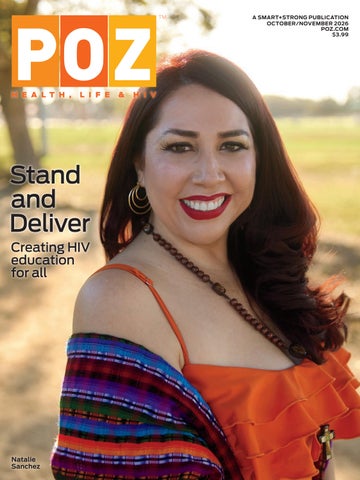
A SMART+STRONG PUBLICATION OCTOBER/NOVEMBER 2026 POZ.COM $3.99
H E A L T H ,
L I F E
&
H I V
Stand and Deliver Creating HIV education for all
Natalie Sanchez
P10-26pfc_COVER.indd 1
ɐ$0 POZ31091_P10-26pfc_COVER.pgs 08.16.2026 23:58
CONTENTS
EXCLUSIVELY ON
Charles Sanchez re˜ ects on Merce.
POZ.COM #ADVOCACY
Fighting against HIV and AIDS has always been a struggle. Much work remains to end the epidemic. POZ encourages you to get involved in advocacy. Go to poz.com/advocacy to ÿnd the latest news and learn how you can make a di° erence in the ÿght.
D
#POZ STORIES
When people living with and a° ected by HIV share their stories, it can break down the shame, silence and stigma surrounding the virus. These stories can inspire, educate and empower others. To read POZ Stories or to share your own, visit poz.com/stories.
D
The science is clear: People who have an undetectable viral load don’t transmit HIV sexually. In addition to keeping people healthy, e° ective HIV treatment also means HIV prevention. Go to poz.com/undetectable for more.
D
POZ DIGITAL
Scan the QR code (le˛) with your smartphone camera or go to poz.com/digital to view the current and past issues online.
22 FROM TELENOVELAS TO PrEP HIV advocate Natalie Sanchez is transforming education about the virus and its prevention. BY CHARLES SANCHEZ 28 MERCE, REVISITED What a musical comedy web series taught an HIV advocate about success, failure and hope. BY CHARLES SANCHEZ 3 FROM THE EDITOR
17 BASICS
No More Drama
Latinos with HIV
4 POZ Q&A
18 CARE & TREATMENT
José M. Zuniga’s new book looks at threats to public health and the HIV response.
International AIDS conference faces a new reality • even lean people can have fatty liver disease • two new cases bring stem cell cure count to 13 • nearly half of Latinos have not been tested for HIV
6 POZ PLANET Self-testing is finally getting its moment • embracing a healthy-aging approach • POZ Stories: Eric Novak • Everyday: milestones in the HIV epidemic
12 VOICES
Preserving HIV history digitally • one year at the helm of AIDS United
14 SPOTLIGHT The 26th International AIDS Conference
16 NUTRITION & FITNESS
Mexican cabbage salad • lack of energy
20 RESEARCH NOTES
Twice-yearly PrEP • one-weekly combo pills • HIV clearance • shingles risk
32 HEROES Alexa Rodriguez has been living with HIV for 16 years. In that time, she has learned how to bridge gaps in the system for herself and others living with the virus.
33 DRUG CHART IN SPANISH Opciones para el tratamiento del VIH
COVER: (SANCHEZ) ARI MICHELSON; THIS PAGE: (SANCHEZ) BILL WADMAN; (GAVEL/BOOKS AND MAGNIFIER) ISTOCK; (LAPTOP) GETTY IMAGES/VLADWEL
#UNDETECTABLE
POZ (ISSN 1075-5705) is published monthly except for the January/February, April/May, July/August and October/November issues ($19.97 for an 8-issue subscription) by Smart + Strong, 157 Columbus Avenue, Suite 525, New York, NY 10023. Periodicals postage paid at New York, NY, and additional mailing offices. Issue No. 295 POSTMASTER: Send address changes to POZ/Smart + Strong, 157 Columbus Avenue, Suite 525, New York, NY 10023. Copyright © 2026 CDM Publishing, LLC. All rights reserved. No part of this publication may be reproduced, stored in any retrieval system or transmitted, in any form by any means, electronic, mechanical, photocopying, recording or otherwise without the written permission of the publisher. Smart + Strong® and POZ® are registered trademarks of CDM Publishing, LLC.
P10-26p02_TOC.indd 2
ɐ$0 POZ31091_P10-26p02_TOC.pgs 08.31.2026 23:25
FROM THE EDITOR
No More Drama
EDITOR-IN-CHIEF
ORIOL R. GUTIERREZ JR. MANAGING EDITOR
JENNIFER MORTON
I
DEPUTY EDITOR
TRENT STRAUBE SCIENCE EDITOR
LIZ HIGHLEYMAN COPY CHIEF
JOE MEJÍA EDITORIAL ASSISTANT
EVA LORENZ ART DIRECTOR
DORIOT KIM ART PRODUCTION MANAGER
MICHAEL HALLIDAY CONTRIBUTING WRITERS
SHAWN DECKER, OLIVIA G. FORD, ALICIA GREEN, THEODORE KERR, MARK S. KING, JAY LASSITER, TIM MURPHY, MATHEW RODRIGUEZ, CHARLES SANCHEZ CONTRIBUTING ARTISTS
JOAN LOBIS BROWN, LIZ DEFRAIN, ARI MICHELSON, JONATHAN TIMMES, BILL WADMAN FOUNDER
SEAN STRUB LEGACY ADVISER
MEGAN STRUB ADVISORY BOARD
GUILLERMO CHACÓN, SABINA HIRSHFIELD, PHD, TIM HORN, JESSE MILAN JR., MITCHELL WARREN PRESS REQUESTS
NEWS@POZ.COM SUBSCRIPTIONS
HTTP://ORDER.POZ.COM UNITED STATES: 212-242-2163 SUBSCRIPTION@POZ.COM FEEDBACK
EMAIL WEBSITE@POZ.COM OR EDITOR-IN-CHIEF@POZ.COM
(GUTIERREZ) JOAN LOBIS BROWN; (ILLUSTRATION) GETTY IMAGES/КРИСТИНА ЧИСТЯКОВА
SMART + STRONG PRESIDENT AND COO
IAN E. ANDERSON EDITORIAL DIRECTOR
ORIOL R. GUTIERREZ JR. CHIEF TECHNOLOGY OFFICER
CHRISTIAN EVANS VICE PRESIDENT, INTEGRATED SALES
DIANE ANDERSON INTEGRATED ADVERTISING MANAGER
JONATHAN GASKELL INTEGRATED ADVERTISING COORDINATOR
SARAH PURSELL SALES OFFICE
212-938-2051; SALES@POZ.COM
CDM PUBLISHING, LLC CEO
JEREMY GRAYZEL CONTROLLER
JOEL KAPLAN
POZ.COM/FACEBOOK
POZ.COM/X POZ.COM/X
POZ.COM/INSTAGRAM POZ.COM/INSTAGRAM
GREW UP SPEAKING BOTH Spanish and English. However, I don’t know which I understood first. My heart tells me Spanish, since there were Spanish speakers all around me. But I was also surrounded by English, since my family was actively learning it at the time. Either way, I’m grateful to be bilingual. As a first-generation Cuban American, I suppose it was inevitable for English to become my primary language. As Latinos deepen their U.S. roots and acculturate, it’s often the case that the ability to speak Spanish gets lost. Regardless, pride in being Latino persists across the generations. Case in point: Natalie Sanchez. The California native is a third-generation American. Her great-grandparents immigrated from Mexico, while most of her grandparents were born in the United States. The 46-year-old has spent more than 25 years educating at the intersection of HIV, public health, culture and storytelling. Please go to page 22 to read more about her advocacy. Being Latino in the United States doesn’t require you to speak Spanish. For example, Natalie identifies as a “no sabo kid,” a term once used derogatorily to refer to Latinos who don’t speak Spanish fluently that is now owned by many. She understands, nonetheless, that its loss has a cultural impact. “It’s part of the reason I advocate so much for doing things in the Spanish language,” she says, “so that we can retain it.” In this special Latino-themed issue of POZ, we’re pleased to highlight Natalie along with other Latino advocates, including José Zuniga, Alexa Rodriguez and Charles Sanchez (no relation to Natalie). José is president and CEO of IAPAC, the International Association of Providers of AIDS Care, which represents over 30,000 HIV health professionals worldwide. His latest book, Aftershocks: Trump 2.0, Public Health, and Our Better Angels, looks at new threats to the HIV response and how we can counter them. Go to page 4 for more.
Alexa is a transgender Latina who has been living with HIV for 16 years. Born in El Salvador, she is devoted to helping others with the virus, especially her foreign-born trans colleagues. “My dream is to become an immigration lawyer,” she tells POZ. Go to page 32 to learn how she bridges gaps in the system. Charles is a man of many talents. He can act, he can sing and he can make people laugh. So, of course, he made a musical comedy web series starring himself. Merce launched in 2015 with Charles as the title character. Both are HIV positive. Charles produced two seasons, but the series stalled. Go to page 28 to learn what Merce taught him about success, failure and hope. Another of his talents is writing. Charles is a contributing writer for POZ and writes for other outlets. For this issue, he wrote the profile of Natalie as well as the Merce essay. As far as we can tell, this seems to be the first time one writer penned all the features in an issue of POZ, so many thanks and props to Charles. We’ve been fortunate the last few years to have POZ en Español as a pullout insert in our annual Latino-themed issue of POZ. This year, we spotlight HIV advocate Marco Benjamin on the cover of our Spanish-language edition. Go to the center of this issue to read it. And go to the back of this issue to see our yearly quick-reference drug chart in Spanish.
ORIOL R. GUTIERREZ JR.
EDITOR-IN-CHIEF editor-in-chief@poz.com
poz.com OCTOBER/NOVEMBER 2026 POZ 3
P10-26p03_EdLetter.indd 3
ɐ$0 POZ31091_P10-26p03_EdLetter.pgs 08.31.2026 23:25
POZ Q&A BY LIZ HIGHLEYMAN
Left: José M. Zuniga (holding microphone) speaks at the World Urban Forum in Baku, Azerbaijan, in May 2026; above: Aftershocks book cover
OUR BETTER ANGELS
J
OSÉ M. ZUNIGA, PHD, MPH, IS PRESIDENT AND CEO OF IAPAC, THE International Association of Providers of AIDS Care, which represents over 30,000 HIV health professionals worldwide. He also heads up the Fast-Track Cities initiative, which supports more than 600 cities in their efforts to end their HIV, tuberculosis and viral hepatitis epidemics. Zuniga’s new book, Aftershocks: Trump 2.0, Public Health, and Our Better Angels, offers a comprehensive overview of how the second Trump administration’s policy changes and funding cuts threaten public health and, in particular, the domestic and global HIV response. On the book’s release date in June, Zuniga sat down with POZ science editor Liz Highleyman at IAPAC’s annual Continuum conference to discuss its key themes. Below is a continuation of that conversation. So much has happened during the first two years of the second Trump administration—and it’s not letting up. Why did you write the book now?
I felt a responsibility to bear witness. The speed and breadth of the attacks on public health were extraordinary. Federal agencies were being hollowed out, experienced people were being dismissed, scientific programs were being terminated, data were disappearing from government websites and entire communities were being erased from the language of public policy. I wanted to document the cumulative effect when one destructive decision collides with another. Waiting would have created a false impression that we have the luxury of historical distance. We do not. Some harms are already measurable, while others may take years for the full consequences to emerge. A terminated research grant does not immediately reveal the discovery that will never be made. A shuttered prevention program may lead to increased infections months or years later. By the time all the data confirm the damage, the human cost has already been paid. Writing early meant accepting that the book could not be the final history of Trump 2.0. It’s a marker laid down while the ground is still moving, with the hope that it can help us act before the damage becomes irreversible. But the book is also personal. I have worked in the HIV response and public health
for almost four decades. I have seen what’s possible when science, political leadership, community engagement and human compassion align. But I have also watched how quickly progress can stall or reverse when any one of those elements is withdrawn. The history of HIV teaches us that silence is never neutral. When institutions retreat, when evidence is suppressed or when people are rendered politically expendable, preventable illness and death follow. In that sense, silence still equals death. You are candid about the fact that the public health system before 2025 was already imperfect. Why is it important to acknowledge that baseline?
We cannot credibly defend public health by romanticizing what existed before. The baseline was not equitable, adequately funded or consistently personcentered. It was a system capable of remarkable scientific achievements but often unable or unwilling to deliver their benefits fairly. It tolerated enormous disparities by race, geography, income, gender identity, immigration status and sexual orientation. It remained fragmented across diseases, agencies, fund-
(WORLD URBAN FORUM) UN-HABITAT; (BOOK COVER) COURTESY OF JOSÉ ZUNIGA
José M. Zuniga’s new book looks at threats to public health and the HIV response domestically and globally—and how we can counter those obstacles.
4 POZ OCTOBER/NOVEMBER 2026 poz.com
P10-26p04-05_QA.Revise.Indd 4
ɐ$0 POZ31091_P10-26p04-05_QA.Revise_4.pgs 08.31.2026 23:02
ing streams and levels of government. The HIV response offers a powerful example. We have antiretroviral therapy that enables people with HIV to live a near-normal lifespan and prevents sexual transmission when viral suppression is sustained. We have highly effective pre-exposure prophylaxis, including long-acting options. Yet access remains profoundly unequal. Scientific innovation without equitable implementation is “innovation apartheid.”
(ZUNIGA) COURTESY OF JOSÉ ZUNIGA
You sug ge s t p e o ple did n ot p ay enough attention to Project 2025— t h e c o n s e r v at i v e blueprint for restructuring the federal gove r n m e n t— a n d reacted too slowly at the start of Trump 2.0. Why do you think this happened?
Project 2025 was not just about random José M. Zuniga bureaucratic adjustments. It reflects an ideological project to weaken government, subordinate science to politics and redefine whose lives and health are considered worthy of protection. My critique is not meant to diminish the dedication of people who were working under extraordinary pressure to protect programs, preserve services and reassure frightened communities. Many were also confronting threats to their own jobs and institutions. But Project 2025 was publicly available long before the 2024 election. It described the administrative machinery that would be used to dismantle parts of the federal government and undermine public health and science through an ideological agenda. We cannot say we were not warned. But the HIV and public health communities initially appeared paralyzed, perhaps unable to believe what was happening before our very eyes. Fear of jeopardizing funding contributed to a cautious response. By March or April of 2025, that caution had become costly. We needed to have a strategy before President Trump returned to office.
The book concludes with your idea for Horizons 2028. What do you hope that will accomplish?
Project 2025 demonstrated the power of planning. Its architects at the Heritage Foundation did not wait for an election result before deciding what they would do with power. They developed personnel pipelines, policy blueprints, legal theories, administrative mechanisms and a governing philosophy. It was all there in black and white. Horizons 2028 is my call for a forwardlooking public health blueprint that serves as an antidote to Project 2025. It
unfold. Litigation, oversight, journalism, professional resistance and community advocacy are all indispensable. But resilience alone cannot become our long-term strategy. The offensive dimension means advancing our own affirmative vision of public health—one that is integrated, locally grounded, technologically capable, adequately financed and unapologetically committed to equity. It also requires moving beyond institutional silos. HIV does not exist apart from mental health, housing, food security, substance use, aging or the effects of climate change. Communities experience these realities simultaneously even when our government funds and manages them separately.
“I am asking readers to reject despair at the magnitude of the harm done to date.” should define what must be protected now, what must be repaired after Trump 2.0 and what must be reimagined altogether. Its horizon is not limited to reversing executive orders, rehiring personnel or reversing DOGE budget cuts. It must address structural weaknesses like chronic underfunding, fragmented delivery systems, inequitable access to innovation, workforce precarity and the widening gap between scientific possibility and everyday reality. And it must consider all possible 2028 election outcomes. You argue that the response to Trump 2.0 must be both defensive and offensive. What does that mean in practical terms? How do we put things back together again?
The defensive work is unavoidable. We must protect essential programs, defend scientific integrity, preserve public data, challenge unlawful actions, support displaced workers and shield communities being targeted because of who they are. We must also ensure continuity of care for people whose health and lives cannot be placed on hold while these battles
You wrote about “refusal to accept that the current trajectory is inevitable.” What do you hope readers will take away from Aftershocks, and what do you want them to do next?
I’m asking readers to reject despair at the magnitude of the harm done to date. We cannot surrender to the belief that the damage is irreversible. Our task is to defend people in immediate danger and construct a public health future worthy of their trust. We must move beyond outrage and identify where our own expertise, influence or lived experience can contribute, because a collective but coordinated effort is critical. Each of us has a role to play in transforming resistance from a defensive posture into an affirmative movement for change. Most importantly, I want readers to understand that we must act now, because the future of public health is already being shaped by those who are organized and prepared. The book is an invitation to begin that work together as we face the 2028 election and prepare to translate its outcome into a mandate for rebuilding public health. The work of developing that mandate cannot wait until the votes are counted. It must start now with the ideas, coalitions and strategies that will be needed to govern effectively from day 1 of the next presidential administration. Q
poz.com OCTOBER/NOVEMBER 2026 POZ 5
P10-26p04-05_QA.Revise.Indd 5
ɐ$0 POZ31091_P10-26p04-05_QA.Revise_5.pgs 08.31.2026 23:02
POZ PLANET UPDATES ON HIV & AIDS
Self-Testing Is Finally Getting Its Moment IMAGINE WALKING DOWN THE STREET behind someone wearing a white T-shirt with a pink triangle across the back and the message: “Knowing is what is most important. Get tested.” What might you do? Diego Petit, an undergraduate at The New School in New York City who designed the shirt, hopes it will pique people’s interest and that their curiosity will lead them to scan the QR code embedded in the pink triangle and learn more about HIV self-testing. The T-shirt is one of many new initiatives aimed at educating people about HIV self-testing. In 2012, the U.S. government approved the OraQuick HIV Self-Test, the first overthe-counter HIV self-test that allowed people to learn their status in 20 minutes. In late 2025, the INSTI HIV Self-Test Kit was approved; it delivers results in one minute. Petit knows he isn’t promoting a new technology. He’s trying to build awareness of one that remains surprisingly unfamiliar. More than a decade after the first overthe-counter HIV self-tests became available, the challenge remains making sure people know they’re an option. A 2023 survey found that only about 35% of people receiving in-person HIV tests knew self-testing was available. That lack of awareness is striking given how dramatically HIV testing has evolved over the past four decades. In the early years of the epidemic, people had no way of knowing their HIV status. Over time, testing became faster, more accurate and more widely available. Rapid testing moved beyond clinics and into spaces like bathhouses, dance floors and mobile vans. Today, HIV self-tests allow individuals to test where and when they feel most comfortable. Unfamiliarity was an early obstacle. Unless you had used an at-home pregnancy test before, administering a medical test without a clinician present felt strange. The COVID-19 pandemic dramatically changed that. Hundreds of millions of Americans used rapid COVID tests at home, making the practice part of everyday life. Programs like TakeMeHome have since built on those shifting norms. The national initiative allows people to order free HIV self-tests online through a partnership between Building Healthy Online Communities, Emory University, public health leaders and state and local health departments.
From top: HIV testing T-shirt, HIV selftesting kit and condoms condoms
In most cases, local health departments partner with regional sexual health organizations to establish an online portal where people can order up to two HIV self-test kits every three months. The tests arrive in the mail in discreet packaging with instructions and information about follow-up care, regardless of the result. The expansion of self-testing comes as many HIV organizations face financial uncertainty following reported Trump administration funding cuts. At the same time, recent research suggests HIV self-testing is a relatively cost-effective intervention, rendering it an attractive option for programs forced to do more with fewer resources. Self-testing efforts may also encourage more people to get tested. In Shelby County, Tennessee, which has seen an increase in new HIV cases in recent years, the health department recently launched a billboard campaign titled “901 HIV Testing” (901 is the local area code). Featuring a couple embracing, the billboards invite people to “have a free HIV test sent to your home.” Self-tests offer a level of empowerment that has long been crucial to the HIV response but had not yet been incorporated into testing. In fact, officials in Tennessee see the campaign as addressing a major barrier: stigma. “We know that there are some people in the community who will never ever walk through the doors because they are worried that someone will see them and want to know what they are getting tested for,” Michelle Taylor, MD, DrPH, director of the Shelby County Health Department, told WREG News. Even a condom initiative can serve to promote self-testing. Texas Wears Condoms, for example, offers free HIV self-tests alongside condoms and lubricant. Petit sees his T-shirt as part of this broader ecosystem of creativity and public health. Inspired by street fashion’s capacity “to confront social issues and contribute to meaningful social development,” he believes everyday social interactions can make a difference. The promise of HIV self-testing has never depended solely on the test itself. It also depends on whether people know the option exists and feel empowered to use it. For Petit, that’s where design enters public health. A T-shirt won’t diagnose HIV, but it might inspire someone to order a test and learn their status. —Theodore Kerr
(T-SHIRT) TED KERR; (HIV SELF-TESTING KIT) TEXASWEARSCONDOMS.COM; (CONDOMS) GETTY IMAGES/PHOTKA
New T-shirts urge people to learn their HIV status.
6 POZ OCTOBER/NOVEMBER 2026 poz.com
P10-26p06-07_Planet.Revise.indd 6
ɐ$0 POZ31091_P10-26p06-07_Planet.Revise_6.pgs 08.31.2026 23:02
NEARLY $2 MILLION FOR NEW HIV CURE STUDIES The funding from amfAR supports four research teams. FUNDING FROM AMFAR, The Foundation for AIDS Research, will launch four new studies testing innovative strategies to cure HIV. The landscape for funding HIV research and programs has become progressively unstable, but amfAR’s commitment to a safe, accessible and scalable cure for HIV remains as strong as ever. Each of the four grants is worth $480,000 over a period of two years, a total commitment of $1.92 million. Two grants will focus on unique approaches to eradicate the HIV reservoir, the main barrier to an HIV
cure. While current medications successfully control active virus, latent virus manages to hide within a person’s cells and can spread if treatment is interrupted. A study by Michael Betts, PhD, of the University of Pennsylvania, will expand on the success of the mRNA lipid nanoparticle technology used in COVID-19 vaccines. In this study, he will engineer lipid nanoparticles to deliver signals that both “wake up” latent virus hidden within lymph nodes and program HIV-fighting immune cells to enter lymph nodes and destroy infected cells. This
EVERYDAY October (MONEY) GETTY IMAGES/KATIV; (CAMP HOLLY WOOD, RUSSO AND JOHNSON) WIKIPEDIA
15
22
U.S. Surgeon General C. Everett Koop issues the SURGEON GENERAL’S REPORT ON ACQUIRED IMMUNE DEFICIENCY SYNDROME, the federal government’s first major statement on how to stop the transmission of HIV. (1986)
The film BOHEMIAN RHAPSODY,, a a biopic biopic about about Queen’s Queen’s lead lead singer, Mercury, who who died died singer, Freddie Freddie Mercury, of of AIDS-related AIDS-related complications, complications, opens at Wembley Arena in London. (2018)
P10-26p06-07_Planet.Revise.indd 7
Colby Maldini, PhD, of The Wistar Institute in Philadelphia, will leverage lessons from cancer breakthroughs to develop an HIV cure. While CAR-T therapy has revolutionized cancer treatment, it has been less successful in the treatment of HIV. And Stylianos Bournazos, PhD, of The Rockefeller University in New York, will look to boost the strength of broadly neutralizing antibody immunotherapy, helping it to sustain longterm control of HIV without daily treatment. —amfAR
These dates represent milestones in the HIV epidemic. Visit poz.com/aidsiseveryday to learn more about the history of HIV and AIDS. BY JENNIFER MORTON
NATIONAL LATINX AIDS AWARENESS DAY
23
approach combines two cure goals—exposing the hidden HIV reservoir and helping the immune system destroy it—into a single intervention. And with her grant, Carine Van Lint, PhD, of the University of Brussels, will seek to better understand how the body’s CD8+ T cells help to hide the HIV reservoir from other immune cells. Using genome-wide CRISPR screening, she will identify the mechanisms CD8+ T cells use to contribute to HIV latency. With additional support from the Foundation for AIDS and Immune Research she will then test whether blocking these pathways, with an mRNA-based latencyreversing immunotherapy, can more effectively reactivate the HIV reservoir, making it vulnerable to exposure and destruction.
November Activist, film historian and author VITO RUSSO dies dies of of AIDS-related AIDS-related complications complications at at age 44. 44. He He cofounded cofounded the the Gay Gay and age and Lesbian Alliance Against Defamation (GLAAD) and wrote The Celluloid Closet, which examines the history of depictions of homosexuality in film. (1990)
7
The Woolsey Fire in California razes CAMP HOLLYWOOD HEART, a long-running summer camp in Malibu for HIV-positive teens. (2018)
11
EARVIN “MAGIC” JOHNSON announces the the formation formation of of the the announces Magic Johnson Magic Johnson AIDS AIDS Foundation Foundation to support support AIDS and awareness awareness to AIDS education education and programs, fund fund research research and and assist assist in in caring caring programs, for those living with the disease. (1991)
25
ɐ$0 POZ31091_P10-26p06-07_Planet.Revise_7.pgs 08.31.2026 23:02
POZ PLANET UPDATES ON HIV & AIDS
EMBRACING A HEALTHY-AGING APPROACH A NEW REPORT BY A GROUP OF HIV RESEARCHERS IN THE journal Lancet HIV recommends that health systems caring for older individuals with HIV should move beyond the standard antiretroviral therapy to a more comprehensive healthy-aging approach. The report was led by researchers at the Johns Hopkins Bloomberg School of Public Health and Yale School of Medicine as well as colleagues at more than 40 institutions and nine people living with HIV. While most new HIV cases are among young people, the number of individuals living with HIV worldwide is increasing and getting older: Nearly a third of people with HIV were over 50 in 2025, and half will be over 50 by the year 2040. In their report, commissioned by the editors of the journal Lancet HIV, the authors recommend a broad set of health-system changes to manage the distinct challenges involved in HIV prevention and screening, treatment and long-term care in this older population. Recommendations include monitoring physiological age and functional declines, minimizing the multi-pharmaceutical use common among older adults and promoting mental health and a healthy lifestyle—all while maintaining adherence to antiretroviral therapy. The report, published online July 27 in Lancet HIV, was delivered in a presentation on July 28 at the AIDS 2026 conference in Rio de Janeiro. “People older than 50 living with HIV tend to have a physiologic age that is greater than their chronological age due to their chronic infection,” says study joint first author Keri Althoff, PhD, MPH, a professor in the Bloomberg School’s Department of Epidemiology. “The increase in this population is a big challenge for healthcare systems around the world and will continue to grow. We need to act now.” The study’s other joint first author is Amy Justice, MD, PhD, Peter N. Herbert professor of internal medicine and professor of public health at Yale School of Medicine. About 40 million people around the world were living with HIV as of late 2024, according to the World Health Organization. Standard care for these individuals centers on antiretroviral drug therapy (ART). ART prevents progression to AIDS by suppressing viral replication in the body. However, ART must be taken indefinitely. The availability of ART in recent decades has meant that people with HIV can live a nearnormal lifespan. Older people with HIV face added challenges—including stigma that can complicate medical care for existing cases
“AS PEOPLE WITH HIV AGE, THEY BECOME MEDICALLY COMPLEX; THEY HAVE A HIGHER RISK OF MANY AGE-RELATED COMORBIDITIES.”
and screening for new HIV cases. For those who have been living with HIV for a long time, the cumulative adverse effects of older ART treatments plus chronic immune activation due to HIV infection typically have accelerated the aging process, effectively bringing forward the chronic ailments seen in older patients. “As people with HIV age, they become medically complex; they have a higher risk of many age-related comorbidities,” Althoff says. “It’s not just about trying to control the HIV viral load—it’s about how to keep the viral load suppressed while maintaining mental and physical health as a person’s medical complexity increases with age.” The report also recommends HIV prevention and screening services that are more targeted to older adults, tailored to reduce stigma and ageism and meet this population’s special needs and vulnerabilities, including casual partners and changes in income. Looking ahead, the report warns that contemporary health systems are poorly equipped to handle the burden of a large and growing population of older adults with HIV. “Even integrated health networks often consist of multiple vertical services, each with separate forms, schedules and out-of-pocket expenses,” Althoff says. “To provide appropriate care and support for healthy aging with HIV, we must change the care structure and link persons with HIV to community organizations and digital tools outside of the clinic walls.” Better integration of existing HIV care programs into broader chronic disease management and innovations in HIV care programs that include broader geriatric care could help solve this looming problem. The report concludes by emphasizing the importance of linking patients to community-based organizations and digital tools to ensure care is a partnership among patients, providers and the community. —Johns Hopkins Bloomberg School of Public Health
GETTY IMAGES/AEROGONDO (MODEL USED FOR ILLUSTRATIVE PURPOSES ONLY)
New report recommends a paradigm shift in care for older adults with HIV.
8 POZ OCTOBER/NOVEMBER 2026 poz.com
P10-26p08_Planet.indd 8
ɐ30 POZ31091_P10-26p08_Planet.pgs 08.31.2026 06:25
For more information email: tjross@condomdispenser.org or visit online: condomdispenser.org
PZA554949.indd 1 PZA554949.indd 1
2/24/25 2/24/25 3:03 3:03 PM PM PZA554949.pgs 02.24.2025 15:03 ESA
POZ PLANET UPDATES ON HIV & AIDS
Eric Novak recounts how his partner’s illness led to his own HIV diagnosis. In February 1987, I was 31 years old and living in Cincinnati with my partner of 12 years. His name was Kenn. Our world was quiet, shaped by our routines and a life that felt settled. AIDS was something we read about in The Advocate and Time magazine. It was frightening, but it was happening somewhere else. Then Kenn got sick. The exhaustion came first. Not ordinary tiredness, but something deeper, as though his body had begun to struggle against an invisible weight. It quickly worsened. He was admitted to the ICU with pneumonia. He needed a ventilator to breathe. After his parents arrived, the hospital’s attention shifted in ways that were difficult to ignore. In 1987, I had no legal standing, no formal place in the decisions being made. Kenn had given permission for his medical status to be shared with me. His doctor explained that Kenn was HIV positive and had developed AIDS. He told me I needed to be tested as soon as possible. I went to the health department alone. The waiting area felt functional, impersonal, designed for process rather than comfort. The seats were hard and unforgiving. The room was almost empty. Beneath the fluorescent lights, the terrazzo floor carried the dull shine of countless layers of wax, polished over time into a surface that reflected light without warmth. The air was stale, carrying the faint chemical scent of the mop water as janitors began their evening rounds in the hallway. I found myself looking at that floor more than anything else, as if focusing on something solid might steady the moment. The exam room felt cold. Not only in atmosphere but in temperature—the kind of February chill that lingers inside an old building where heat never quite reaches the walls. Two chairs stood against the wall. A narrow metal table. There was nothing on the walls. No window. Nothing to look toward except the moment that had brought me there. A man entered and asked me to roll up my sleeve. I turned my head slightly away. He worked with quiet efficiency— needle, vial, gauze, the sharp scent of alcohol. The motions were practiced and unhurried, the routine of someone who had done this countless times. I felt the quick stick of the needle, sharp but brief. Then it was over.
When the blood draw was finished, he reminded me that I would need the number I had been given in order to receive the results. I tucked it carefully into my wallet, aware that it mattered, not yet understanding how much. I didn’t realize I would have to wait two weeks to return for the answer. I tried not to dwell on the test. Life continued in the narrow space between not knowing and what might soon be known. Kenn was no longer in intensive care, but his hospital room was marked with a biohazard warning. Each visit required a gown, gloves and a mask—a small ritual that made the illness feel both clinical and unreal. I kept going to work during the day and returned to the hospital in the
watching television. I said hello and didn’t linger. I went into my room quietly, closing the door behind me. I lay awake with my thoughts. I was not afraid—at least not in any immediate way. There was no space yet to consider what my own diagnosis might mean. Kenn was still in the hospital, and whatever future waited for me felt secondary to whether he would survive. I returned to the hospital. I was standing beside his bed when he asked the question that opened the door I had not known how to enter. I told him I was HIV positive. He received the news with a calm acceptance. There was no anger, no blame, no visible collapse into fear. Illness had already carried us too far for those reactions to matter. Silence settled between us, carrying more weight than anything we might have said. I remember only the look of sorrow on his face—an expression that seemed to hold regret, understanding and a future neither of us could yet see. Nothing about the uncertainty had changed. But from that moment on, we faced it together.
“I DIDN’T REALIZE I WOULD HAVE TO WAIT TWO WEEKS FOR THE ANSWER. I TRIED NOT TO DWELL ON THE TEST.” evenings. The rhythm formed almost without thought. Work, then visit, then home, then morning again. The future waited in two places at once: in the hospital room, where Kenn lay, and in a laboratory somewhere, where a small vial of my blood contained an answer I could not yet face. I returned to the health department alone. I had begun to accept that the outcome would most likely be positive. Acceptance did not quiet the anxiety. It only made the waiting more precise. The man who entered the room that evening wasn’t the same one who had drawn my blood. I remember that he began by saying he was sorry. Then he told me I was HIV positive. I cannot recall with clarity anything that followed. Part of me was listening, but another part had already begun to drift somewhere quieter, farther away from the room. I walked outside, the air sharp against my face after the sealed warmth of the building, carrying a truth that had no visible form. I thought briefly about going somewhere for a drink—somewhere loud enough to interrupt my thoughts. Instead, I went home. Kenn’s parents were in the den
What three adjectives describe you? Resilient, courageous, engaged.
What person in the HIV community do you most admire? Dr. Anthony Fauci. If you could change one thing about living with HIV, what would it be? The stigma. What is the best advice you ever received? Never give in and never give up. Eric Novak is an advocate with the AIDS Clinical Trials Group Community Advisory Board and the author of the memoir A Life Never Promised: A Long-Term Survivor’s Story of HIV and Resilience. Read other POZ Stories or share your own at poz.com/stories.
COURTESY OF ERIC NOVAK
FACING IT TOGETHER
Eric Novak
10 POZ OCTOBER/NOVEMBER 2026 poz.com
P10-26p10_Planet_POZ_Story.indd 10
ɐ$0 POZ31091_P10-26p10_Planet_POZ_Story.pgs 08.31.2026 23:31
POZ31091_AIDS is over redux_POZ_2.pgs 08.31.2026 11:22
ESA
VOICES BLOGS AND OPINIONS FROM POZ.COM
PANIC AND POLITICS
HERE WAS A QUOTE GOING around on social media by cult filmmaker John Waters, the legendary “Pope of Trash” (Hairspray, Pink Flamingos, Cry-Baby, etc.), from an episode of the docuseries Finding Fire Island. Talking about the early days of the AIDS epidemic in the 1980s and early ’90s, Waters said young people will never truly understand what it was like: “If you’re older, you remember that, and you can never convey what that was like to young people.” It’s true that living through the early AIDS years was a traumatic experience, one that no one who didn’t live through it would ever truly understand. The fear of the mysterious, deadly virus mixed up with rampant homophobia and other bigotry—both hidden and blatant—and the daily, sometimes hourly shock of finding out another friend was suddenly gravely ill or had died. I wouldn’t wish that gruesome experience on anyone. Though challenging and retraumatizing, it’s terribly important, vital even, for those of us Waters calls “old-school gays” to relate the stories of that time. It’s especially essential for LGBTQIA+ youth to know about those difficult days so they realize not only the history but also the power of our queer community. Because the story is also about how we stood up and fought for ourselves, our
T
friends and chosen families. They also need to see and hear the beauty of our compassion and care for one another at a time when society, government at every level and even most media kept their heads in the sand when it came to HIV and those affected by it. I was contacted last year by Stephen Petrus, director of public history programs at the LaGuardia & Wagner Archives at LaGuardia Community College in Queens, about being a part of the digital exhibit Panic, Politics, and Policy: New York City During the AIDS Crisis, 1981–1996. My personal archives chronicling my entire career, first as an activist and organizer and later in the New York City Council and New York state Senate, have been with LaGuardia & Wagner for some time. Stephen said it was the processing of my personal archives that had inspired this exhibit. This user-friendly exhibit, which launched online on June 11 and is available indefinitely, is divided into six themes: panic, fear and confusion; stigma and discrimination; community caretaking; diverse face of the epidemic; the politics of public health; and biomedical breakthroughs but limited access. Each topic is explored through oral histories by people who were there and lived through it, including GMHC cofounder Lawrence Mass, Housing
Works cofounder and CEO Charles King, myself and many others. This is a fantastic resource not only for the community but also for colleges, universities, even high schools to make the history alive and bring issues of life and death to people who didn’t experience it for themselves. It’s also a great reminder for the rest of us of how bigotry and hatred took a medical diagnosis and turned it into a punishment for communities already underserved and demonized. We’ve come a long way from those difficult days, and we can’t ever go back. The current administration’s cuts to the President’s Emergency Plan for AIDS Relief and the proposals to cut Medicare, Medicaid and funding for HIV research, education, prevention and care for people here in the United States will no doubt cause an AIDS crisis revival. Those of us who are old enough to remember how it was the first time need to make sure the young members of the queer community have access to all the information about the dawn of AIDS. Remember the famous line by George Santayana (sometimes attributed to Winston Churchill): “Those who cannot remember the past are condemned to repeat it.” Q Go to LaGuardia.edu to explore the LaGuardia & Wagner Archives exhibit.
GETTY IMAGES/RAWPIXEL
In a blog post titled “John Waters Is Right About the AIDS Crisis. But We Can’t Stop Telling Its Story,” long-term survivor and former New York state Senator Tom Duane urges us to preserve HIV history. Below is an edited excerpt.
12 POZ OCTOBER/NOVEMBER 2026 poz.com
P10-26p12_Voices1.indd 12
ɐ$0 POZ31091_P10-26p12_Voices1.pgs 08.31.2026 23:31
WHAT COMES NEXT
In a blog post titled “One Year In as President and CEO of AIDS United,” Carl Baloney Jr. reflects on the opportunities ahead of him as he leads the organization in challenging times. Below is an edited excerpt. HEN I STEPPED INTO the role of president and CEO of AIDS United, I knew I would be leading an organization with a powerful legacy. AIDS United has never been just one organization in one city or one voice in one policy fight. It is a national organization with a local heartbeat— rooted in the people, providers, advocates, organizers, grantees and community leaders who have carried the HIV movement forward for decades. One year later, I feel the weight— and the privilege—of that responsibility more deeply than ever. This first year has been a year of honoring those who built this movement before us, of asking what AIDS United must become for the fights ahead, of remembering how far we have come and refusing to ignore how quickly progress can be threatened. It has been a year of urgency, of deep gratitude, renewed purpose and cleareyed concern. And more than anything, it has reminded me that the HIV movement has always been strongest when we move together. One of the defining lessons of my first year: AIDS United’s role is not only to advocate. It is to amplify. It is to connect. It is to create platforms where
GETTY IMAGES/THOMASVOGEL
W
the people closest to the impact are closest to the decision-making. Our job is to make sure policymakers, funders, media and the broader public understand what our communities already know: HIV did not go away. Neither did we. As I look toward the future of AIDS United, I am thinking a great deal about our collective power—how we protect it, how we build it and how we share it. My vision for AIDS United is to become the country’s most connected HIV organization, one that actively works to end the epidemic by addressing the underlying weaknesses in our society and public health response. We will achieve this by centering our approach through innovation, updated messaging and power building at the local level. We are entering a period of significant transition. Many of the congressional champions who have stood with the HIV movement for years are retiring or preparing to leave public office after the next election. Their departure means we cannot assume that the next Congress will carry the same institutional memory or the same relationships. That is not a reason to retreat. It is a call to organize. We must capitalize on the opportunity to educate a new generation of policymakers, build relationships with them and make sure HIV is not treated
as a niche issue but as a central question of health equity, racial justice, LGBTQ+ justice, economic security and human rights. We must reach people who have not yet seen themselves as part of this fight and invite them into this movement. My first year leading AIDS United has confirmed what I have always believed: Our movement is resilient, but resilience alone is not enough. Communities should not have to survive on resilience. They deserve resources. They deserve sound policy. They deserve quality care. They deserve safety. They deserve leaders who listen to them. They deserve a public that refuses to look away. I am proud of what AIDS United has done this year. But I am even more focused on what comes next. The next year will require courage and discipline. It will require new partnerships, new resources, new messengers and new strategies. It will require us to honor the legacy of this movement not by standing still but by moving forward with urgency and purpose. AIDS United’s legacy is not measured only by what previous generations built. It will be measured by what we choose to build next. Together, we will carry that legacy forward. Q
poz.com OCTOBER/NOVEMBER 2026 POZ 13
P10-26p13_Voices2.indd 13
ɐ$0 POZ31091_P10-26p13_Voices2.pgs 08.31.2026 23:31
SPOTLIGHT BY JOE MEJÍA
The theme of the International AIDS Society’s 26th International AIDS Conference (AIDS 2026) held in Rio de Janeiro July 26 through 31 was: “Rethink. Rebuild. Rise.” The theme reflected the urgency global HIV leaders believe is needed to respond to HIV funding cuts and their impact on people’s lives. As Winnie Byanyima, executive director of UNAIDS, bluntly put it at the opening press conference: “The HIV pandemic is not over. Without urgent action, it could resurge.” Indeed, amfAR, The Foundation for AIDS Research, presented findings from a survey of recipients of PEPFAR (the U.S. President’s Emergency Plan for AIDS Relief) funding that revealed that a 30% cut to the program’s $4.7 billion budget last year by President Trump has resulted in the shutdown of 1,714 clinics, drop-in centers and other providers worldwide; what’s more, community-based organizations and prevention programs for high-risk groups were hardest hit. But AIDS 2026 wasn’t all doom and gloom. Despite challenges, HIV science continues to advance. More than 150 sessions and 2,400 poster presentations showcased new science and strategies to fight HIV. Lenacapavir, a revolutionary twice-yearly injection for HIV prevention that is nearly 100% effective, was a major focus as was long-acting cabotegravir plus rilpivirine as monthly or bimonthly treatment for the virus. Plus, additional evidence of sustained HIV remission in the Kansas City Patient, the youngest person to be cured of HIV after undergoing a stem cell transplant, offered more information about the biological markers of a cure. 1. Representing 93 countries, more than 700 researchers, healthcare professionals, advocates and community leaders were awarded AIDS 2026 scholarships to attend. The scholarships ensure that the conference reflects the diversity of the global HIV response and includes the voices essential to advancing it. 2. New International AIDS Society (IAS) president Kenneth Ngure, MPH, MD, of Kenya, and Andriy Klepikov, executive director of the Alliance for Public Health (APH) in Ukraine, who will serve as IAS president from 2028 to 2030, give a hopeful thumbs-up. APH featured in the news in July following a Russian strike on a warehouse in Kyiv that destroyed 62 million HIV prevention items that the group manages. If the items—syringes, condoms, etc.—are not replaced by November, Ukraine may see at least 16,000 new cases of HIV. 3. The Fight AIDS Coalition, Doctors Without Borders and Health Gap were some of the groups that protested the high prices and global supply limits of lenacapavir at the conference. Demand for the drug outpaces supply, especially in high-burden countries in sub-Saharan Africa.
1
2
3
(1, 2) FACEBOOK/INTERNATIONAL AIDS CONFERENCE; (3) INSTAGRAM/@AIDS_CONFERENCE AND @IASOCIETY; (4) INSTAGRAM/@TRANJANJAN AND @AIDS_CONFERENCE; (5) FACEBOOK/LATINO COMMISSION ON AIDS; (6) INSTAGRAM/@ FOLASHADEBAMIGBOYE AND @AIDS_CONFERENCE AND @IASOCIETY; (7) INSTAGRAM/@STELLAHEART_FOUNDATION AND @AIDS_CONFERENCE; (8) FACEBOOK/INTERNATIONAL AIDS CONFERENCE
AIDS 2026
14 POZ OCTOBER/NOVEMBER 2026 poz.com
P10-26p14-15_Spotlight.indd 14
ɐ$0 POZ31091_P10-26p14-15_Spotlight_14.pgs 08.31.2026 23:32
4
5
6
8
7
4. Trajche Janushev (left), executive director of the international Sex Workers’ Rights Advocacy Network, and a fellow advocate were among the attendees in the Sex Worker Networking Zone in the Global Village who demanded the full decriminalization of sex work. The criminalization of sex work fuels stigma and vulnerability to HIV. 5. Guillermo Chacon, president of the Latino Commission on AIDS in the U.S., emphasized the importance of sharing innovative strategies and learning from diverse perspectives around the world in the fight against HIV. 6. AIDS 2026 scholars Patience Ekioba and Folashade Bamigboye, of Nigeria, presented a poster about navigating the HIV funding cliff. “Reliance on external aid alone is a vulnerability. We must pivot toward local resource mobilization and domestic partnerships to protect vulnerable families,” they concluded. 7. The Nigeria-based Stellaheart of Passion Foundation, which advances equity and inclusion for women and girls in HIV programs, hosted The Voices Wall, a space dedicated to the lived experiences of women and girls with disabilities navigating HIV prevention, care and support. 8. Duda Salabert Rosa, a Brazilian congresswoman and advocate for human and transgender rights, received the Barbara Lee Politicial Leadership Award in recognition of her leadership in the fight for universal access to lenacapavir for PrEP (pre-exposure prophylaxis) in Brazil.
Send your event photos to POZ at website@poz.com or tag us on Facebook, Instagram or X. For a list of community events, visit poz.com/calendar.
poz.com OCTOBER/NOVEMBER 2026 POZ 15
P10-26p14-15_Spotlight.indd 15
ɐ$0 POZ31091_P10-26p14-15_Spotlight_15.pgs 08.31.2026 23:32
NUTRITION & FITNESS ADVICE ON DIET AND EXERCISE
LACK OF ENERGY AND MOTIVATION Lack of energy and motivation, among other barriers, may keep you from being physically active. Learn to overcome these and make physical activity part of your day.
• Schedule physical activity for a day or time when you feel energetic. Mark it on your calendar.
MEXICAN CABBAGE SALAD This mix adds crunch and brightness to your tacos. RICH IN INGREDIENTS with phytonutrients and anti-inflammatory properties, this salad keeps in the fridge for over a week thanks to a mix of hardy, inexpensive vegetables. SERVINGS: 4 / INGREDIENTS: 5 / PREP: 15 MINUTES 1 4
teaspoon salt cups thinly sliced green cabbage
DIRECTIONS 1. To make the dressing, whisk lime juice, oregano and salt in a small bowl until salt is dissolved. 2. In a large bowl, combine cabbage and carrot. Add dressing, combine with vegetables and let sit for 15 minutes. (The longer the vegetables sit in the lime dressing, the tastier the salad will turn out.)
1
carrot, shaved with a vegetable peeler
3. Taste and adjust for seasoning, then use as a condiment for tacos or roast meats or to add crunch to leafy green salads. Salad will keep in an airtight container for up to two weeks.
• Invite a friend to exercise with you on a regular basis.
CHEF’S TIP For a creamier “slaw,” add a little plain Greek yogurt. Taste for seasoning.
NUTRITION FACTS (per serving) Calories: 45; fat: 0 g; saturated fat: 0 g; polyunsaturated fat: 0 g; monounsaturated fat: 0 g; carbohydrates: 12 g; sugar: 5 g; fiber: 4 g; protein: 2 g; sodium: 360 mg k )UHG +XWFKLQVRQ &DQFHU 5HVHDUFK &HQWHU D F QRQSURƓW RUJDQL]DWLRQ 8VHG E\ SHUPLVVLRQ
• Join an exercise group or class. Adapted from: Physical Activity Basics, CDC.gov
(CABBAGE SALAD) GETTY IMAGES/VAASEENAA
INGREDIENTS 3 limes, juiced ½ tablespoon dried oregano
• Start slow and build to longer duration or higher intensity.
16 POZ OCTOBER/NOVEMBER 2026 poz.com
P10-26p16_Nutrition.indd 16
ɐ30 POZ31091_P10-26p16_Nutrition.pgs 08.31.2026 06:26
BASICS BY LIZ HIGHLEYMAN
LATINOS AND HIV
Latino communities in the United States are disproportionately affected by HIV.
GETTY IMAGES/RENATA ANGERAMI (MODELS USED FOR ILLUSTRATIVE PURPOSES ONLY)
L
ATINOS IN THE UNITED States are a diverse population that includes people of Cuban, Mexican, Puerto Rican, Central American and South American origin. Collectively, Latino communities have been hit hard by the HIV epidemic. While they make up about 20% of the U.S. population, Latinos accounted for 34% of the roughly 39,000 new HIV cases diagnosed in 2024, according to the Centers for Disease Control and Prevention (CDC). Only African Americans have a higher share of new diagnoses, at 39%. Just over a quarter of the nearly 1.2 million U.S. residents living with HIV are Latino. Men who have sex with men account for the largest proportion of new HIV diagnoses. In 2024, Latinos made up the biggest share of new cases among gay and bisexual men ages 25 and older (40%), though Black men predominated among those ages 13 to 24 (47%). New HIV cases among Latino men who have sex with men are highest in the South and West. Among the nearly 8,000 women diagnosed with HIV in 2024, 22% were Latina, and 30% of diagnosed children were Latino. Although new HIV cases among Latino people have risen over the past half decade, they appear to have stabilized. Despite having a higher rate of HIV acquisition, Latino people are less likely than their non-Hispanic white peers to use pre-exposure prophylaxis (PrEP). Along with using condoms and not sharing drug injection equipment, PrEP is a highly e˜ ective tool for preventing HIV. There are two approved PrEP pills, Truvada (tenofovir disoproxil fumarate/ emtricitabine) and Descovy (tenofovir alafenamide/emtricitabine). Both are usually taken once daily, though Truvada can also be used “on demand” before and a° er sex. There are also two longacting injectable PrEP options, Apretude (cabotegravir), administered by a health care provider every two months, and Yeztugo (lenacapavir), administered
once every six months. An estimated ÿ ve out of six Latinos living with HIV have been tested and know their status. HIV testing is important because people who know they are positive can start antiretroviral treatment, which both halts disease progression and prevents HIV transmission because people with an undetectable viral load do not transmit the virus through sex. According to the CDC, 86% of Latinos diagnosed with HIV in 2024 were linked to care within one month, and 75% achieved viral suppression within six months—higher than most other racial and ethnic groups. However, among all Latino people living with diagnosed HIV (not just those newly diagnosed), the viral suppression rate falls to 68%. Antiretroviral treatment is equally e˜ ective for Latino people, but they are less likely than non-Hispanic white people to receive adequate health care. Reasons include lower average income and education levels, lack of health
insurance, discrimination, stigma and distrust of the healthcare system. In addition, Latinos are more likely to have other health conditions that can complicate care, such as obesity, diabetes and fatty liver disease. Latinos are a diverse population, and HIV care indicators di˜ er based on whether they were born in the United States, whether their preferred language is English or Spanish and whether or not they are legal residents. Given the Trump administration’s ongoing crackdown on immigration, undocumented people are less likely to seek medical care and other services. Many AIDS organizations o˜ er services speciÿ cally for Latino people at risk for or living with HIV. In addition, many clinics and hospitals have Spanish-speaking sta˜ o r can provide translators to help patients communicate. Don’t hesitate to ask for this kind of help if you need it. Q
poz.com OCTOBER/NOVEMBER 2026 POZ 17
P10-26p17_Basics.indd 17
ɐ30 POZ31091_P10-26p17_Basics.pgs 08.31.2026 06:25
CARE & TREATMENT BY LIZ HIGHLEYMAN
AIDS Conference Faces a New Reality The 26th International AIDS Conference took place in Rio de Janeiro in late July as global health leaders, advocates and people living with HIV took stock of a new reality. The Trump administration’s steep cuts to global AIDS funding, in particular, are putting decades of progress at risk. A set of reports released at the meeting outline the grim reality. According to a special report from UNAIDS, 1.2 million people acquired HIV and 570,000 people died of AIDS-related causes in 2025. Around 9 million of the 41 million people living with HIV worldwide—and nearly half of the children— were not on antiretroviral treatment last year. A joint report from KFF and UNAIDS found that donor government funding to combat HIV fell by 25%, from $8.3 billion in 2024 to $6.2 billion in 2025, mainly driven by the decline in U.S. support. While domestic HIV financing by individual countries has increased, it is not enough to fill the gap. “Never has donor funding fallen so far, so fast, and those most vulnerable
are already paying the price,” said outgoing International AIDS Society president and conference cochair Beatriz Grinsztejn, MD, PhD.
Another report, from amfAR, The Foundation for AIDS Research, shows that cuts to PEPFAR, the President’s Emergency Plan for AIDS Relief, have led to severe disruptions in HIV services in countries that bear the brunt of the epidemic. More than half of implementing partners had at least one funding award terminated, leading to the closure of more than 1,700 service sites and the loss of over 16,000 staff members; even more restricted their work to maintain funding. Prevention took the biggest hit, with a 51% decline in spending, and services for key populations—including gay and bisexual men, transgender people, sex workers, people who use drugs and people in prison—were most heavily impacted. The cuts come as an end to the epidemic is in sight thanks to advances in HIV drugs, such as twice-yearly lenacapavir pre-exposure prophylaxis. “[P]rogress is not the same as victory,” said UNAIDS executive director Winnie Byanyima. “Science has done its job. Now politics must do its job.”
People with normal weight according to body mass index (BMI) may still develop steatotic liver disease (SLD) and its complications—and those living with HIV may be at higher risk. SLD is the new name for fat accumulation in the liver, which includes metabolic dysfunction-associated steatotic liver disease (MASLD). Over time, the buildup of fat in the liver can lead to fibrosis, cirrhosis and liver cancer. Fatty liver disease is often—but not always— associated with obesity. Florence Bascombe, RN, of University College London, and colleagues compared clinical characteristics of HIV-positive people with SLD by BMI category. Among 391 people with HIV and fatty liver disease, 15% had a BMI below 25 and were classified as having lean SLD. This group generally had more favorable cardiometabolic profiles, but lean and non-lean people with SLD had similar markers of liver disease severity, including fibrosis scores. Lean SLD was most strongly associated with a history of lipodystrophy, or abnormal body fat distribution. While 11% of people with lean SLD had ever had lipodystrophy, this fell to just 2% among those with overweight or obesity, suggesting that fatty liver disease in lean people with HIV may arise through different pathways. People with lean SLD were also more than twice as likely to have hepatitis B. These findings suggest that focusing on BMI alone can underestimate the prevalence of fatty liver disease and that assessment should also include body composition measures, such as waist circumference, waist-to-height ratio and body roundness index. “Normal BMI does not exclude clinically relevant liver disease in HIV,” Bascombe says. “Reliance on body size alone may miss people at risk, highlighting the need for better phenotyping and more nuanced metabolic assessment in HIV care.”
(GLOBE/RIBBON) GETTY IMAGES/ALBUQUERQUE; (LIVER) GETTY IMAGES/ALEXANDRAGL1
EVEN LEAN PEOPLE CAN HAVE FATTY LIVER DISEASE
18 POZ OCTOBER/NOVEMBER 2026 poz.com
P10-26p18-19_Care_Treatment.indd 18
ɐ30 POZ31091_P10-26p18-19_Care_Treatment_18.pgs 08.31.2026 06:26
TWO NEW CASES BRING STEM CELL CURE COUNT TO 13 Two more people appear to be free of HIV after stem cell transplants for cancer treatment, researchers reported at this summer’s International AIDS Conference. If they remain in remission, they will be the 12th and 13th cases of a cure after the procedure. The Kansas City Patient tested positive for HIV in 2018 with a CD4 count of just 23. In June 2020, he was diagnosed with acute myeloid leukemia at age 21, making him the youngest person to be cured. In October 2020, he received a transplant from a donor with two copies of a mutation known as CCR5-delta32 that disables a receptor most HIV uses to enter cells, followed by a stem cell boost four months later. He experienced several complications, including multiple infections and graft-versushost disease. In February 2025, he stopped antiretroviral therapy in an analytical treatment interruption. At 17 months after antiretroviral discontinuation, HIV plasma viral load, intact proviral DNA and replication-competent virus remained undetectable.
Kansas City
The Essen Patient, from Germany, was diagnosed with HIV and AIDS in 2003. Seven years later, at age 51, he was diagnosed with chronic lymphocytic leukemia. In 2020, he received a stem cell transplant from a donor with the double CCR5-delta32 mutation. This man has mixed-tropic HIV, however, meaning he has some virus that uses a different receptor, CXCR4. He is also the first reported stem cell cure case with hepatitis B
virus (HBV) coinfection. After his transplant, the man achieved complete remission of leukemia. At about two years posttransplant, traces of HIV DNA could still be detected in peripheral blood cells, but researchers could find no replication-competent virus. At 51 months after the transplant, he stopped antiretroviral therapy, which included a drug with dual activity against HIV and HBV. He still had undetectable HIV 14 months later. He did, however, have hepatitis B reactivation and started an antiviral with activity against HBV but not HIV. He experienced HBeAg seroconversion— a sign of remission—and has HBV-fighting T cells, suggesting his new immune system might enable a functional cure of hepatitis B as well as HIV. “These transplants are high-risk procedures for life-threatening cancers— not scalable cures for HIV,” says outgoing International AIDS Society president Beatriz Grinsztejn, MD, PhD. “However, these cases do provide important insights that help advance broader HIV cure research.”
(KANSAS CITY) GETTY IMAGES/DEE LIU; (HIV TEST) GETTY IMAGES/NATATRAVEL
Many Latino People Are Not Getting Tested for HIV Many Latino and Hispanic people in the United States are not getting tested for HIV as recommended, according to a recent study. While they make up about 20% of the U.S. population, Latinos accounted for 34% of the roughly 39,000 new HIV cases diagnosed in 2024, according to the Centers for Disease Control and Prevention (CDC). Jonathan Ross, MD, of Albert Einstein College of Medicine, and colleagues analyzed responses from more than 8,000 participants in the Hispanic Community Health Study/ Study of Latinos who answered questions about HIV testing and test positivity during 2020–2024. They lived in four municipalities with large Latino populations and high HIV prevalence: the Bronx, Chicago, Miami and San Diego. Overall, 54% said they had ever been tested for HIV, which the CDC recommends at least once for everyone ages 13 to 64 as part of routine healthcare. The likelihood of having been tested was highest among those born on the U.S. mainland (66%), followed by those born in Puerto Rico (57%) and those born outside the United States (50%). Sexual minority men were substantially more likely to have ever been tested, at 82%. Other factors associated with higher testing rates included English versus Spanish as a preferred language, living in the Bronx, higher acculturation scores, higher income and receiving healthcare during the past year. A total of 83 participants reported testing HIV positive, corresponding to 2% prevalence among people who had ever been tested and 1% among the study population as a whole—three times higher than the overall U.S. prevalence rate. “Efforts to increase testing may require focused communication strategies to reach less assimilated Hispanic or Latino groups,” the study authors wrote. “Ending the HIV epidemic for U.S. Hispanic or Latino adults requires tailored interventions to close gaps in HIV testing and subsequent clinical outcomes along the prevention and treatment cascades.”
P10-26p18-19_Care_Treatment.indd 19
ɐ30 POZ31091_P10-26p18-19_Care_Treatment_19.pgs 08.31.2026 06:26
RESEARCH NOTES BY LIZ HIGHLEYMAN
PREVENTION
TREATMENT
CURE
Lenacapavir PrEP
Weekly Pills
HIV Clearance
Shingles Risk
Twice-yearly lenacapavir pre-exposure prophylaxis (PrEP) continues to provide e°e ctive protection against HIV a˜ er an additional year of follow-up. Injectable lenacapavir PrEP, sold as Yeztugo, was approved in June 2025 based on two Phase III trials. PURPOSE 1, which enrolled more than 5,300 young cisgender women in Africa, showed that twice-yearly lenacapavir was 100% e° ective. PURPOSE 2, which enrolled over 3,200 gay and bisexual men and gender-diverse people in seven countries, showed that injections every six months reduced the risk of HIV acquisition by 96%. A˜ er the randomized, double-blind portion of the trials was completed, participants could opt to stay on or switch to lenacapavir in an open-label extension; 95% did so. During the ÿrst 52 weeks of the extension, there were no new cases of HIV acquisition in PURPOSE 1 and only a single case in PURPOSE 2. No new safety or tolerability concerns were identiÿ ed. As the evidence for the e° ectiveness of longacting PrEP grows, so, too, do calls for broader access.
Two Phase III studies evaluated a weekly single-tablet regimen containing islatravir and lenacapavir as a switch option for people with viral suppression on daily pills. The randomized ISLEND-1 trial enrolled 607 participants on Biktarvy, while the openlabel ISLEND-2 trial enrolled 626 people on various standard-of-care oral regimens. In both trials, the islatravir/lenacapavir pill was noninferior to staying on current treatment, with more than 90% maintaining viral suppression at 48 weeks. The combination pill was well tolerated, and participants did not experience white blood cell decreases like those seen with higher doses of islatravir. Adherence was good, and most people said they preferred the weekly treatment. Further back in the pipeline, a weekly regimen of islatravir plus ulonivirine also looks good. A Phase II trial showed that the two drugs taken as separate pills maintained viral suppression at 24 weeks in people who switched from daily Biktarvy, setting the stage for Phase III trials of an islatravir/ulonivirine singletablet regimen.
A three-prong strategy combining antiretrovirals, broadly neutralizing antibodies (bnAbs) and the CCR5-blocking antibody leronlimab may limit the size of the HIV reservoir in infants. Researchers tested the three interventions alone and in various combinations in 55 infant macaque monkeys orally infected with an HIV-like virus. A single dose of two bnAbs (PGT121 and VRC07-523LS) given 72 hours a˜ er exposure, with or without an antiretroviral cocktail, did not prevent reservoir establishment and viral rebound. Likewise, leronlimab with or without antiretrovirals failed to prevent viral rebound, though it did reduce virus seeding in peripheral blood cells, lymph nodes and gut tissue. But treatment with the triple combination was a di° erent story. None of the eight monkeys that received all three interventions at 72 hours post-exposure had evidence of replicating or latent virus a year a˜ er treatment discontinuation. Ample safety data for each component is already available, so the combo could rapidly move into human clinical trials.
People with HIV are more likely than their HIV-negative peers to develop herpes zoster—better known as shingles—but vaccination can close the gap. A˜ er recovery from chickenpox, varicella-zoster virus establishes latent infection in nerves and can reactivate later in life to cause shingles, characterized by a painful rash and possible permanent nerve damage. Researchers compared herpes zoster incidence and risk factors among more than 9,000 HIV-positive adults in British Columbia and an equal number of HIVnegative people. Overall, initial herpes zoster outbreaks and shingles recurrence were about twice as common among people living with HIV. Even people on antiretroviral treatment with an undetectable viral load and an adequate CD4 count were still at higher risk than those without HIV. Among people who had received a shingles vaccine, however, herpes zoster incidence was very low in both groups. These ÿ ndings support U.S. guidelines recommending that all HIV-positive adults should receive the Shingrix vaccine.
(VIAL/NEEDLE) GETTY IMAGES/GAM1983; (CALENDAR) GETTY IMAGES/PICSFIVE; (ANTIBODIES) GETTY IMAGES/SVISIO; (VACCINATED SENIOR) GETTY IMAGES/JANNHUIZENGA
CONCERNS
20 POZ OCTOBER/NOVEMBER 2026 poz.com
P10-26p20_Research_Notes.indd 20
ɐ30 POZ31091_P10-26p20_Research_Notes.pgs 08.31.2026 06:26
POZ.COM • A daily resource for people living with and affected by HIV and AIDS • Clear, comprehensive prevention and treatment information • News, personal stories, blogs, HIV-specific resources and more • Sign up for free email newsletters
Follow us on:
A SMART + STRONG PUBLICATION Award-winning consumer health care information
POZ_House_Ad_Full-Dec-2024_KODI.indd 25
11/25/24 1:42 PM POZ26281-00_HouseAd.pgs 11.25.2024 13:43
HIV ADVOCATE NATALIE SANCHEZ IS TRANSFORMING EDUCATION ABOUT THE VIRUS AND ITS PREVENTION. BY CHARLES SANCHEZ
WHEN NATALIE SANCHEZ WAS in sixth grade at Pacoima Middle School in Los Angeles, a teacher showed her class the film Stand and Deliver. Based on the true story of a teacher at an East Los Angeles high school who inspires his underestimated students to succeed, the movie sparked something in her. 22 POZ OCTOBER/NOVEMBER 2026 poz.com
22 P10-26p22-27_Feature_Natalie_Sanchez.indd 22 P10-26p22-27_Feature_Natalie_Sanchez.indd
8/31/26 4:34 PM POZ31091_P10-26p22-27_Feature_Natalie_Sanchez_22.pgs 08.31.2026 06:27
Kyle Clifford was diagnosed with AIDS in 2012.
23 P10-26p22-27_Feature_Natalie_Sanchez.indd 23 P10-26p22-27_Feature_Natalie_Sanchez.indd
8/31/26 4:35 PM POZ31091_P10-26p22-27_Feature_Natalie_Sanchez_23.pgs 08.31.2026 06:27
household, who I feel are like my brother and sister.” Sanchez did not initially plan to work in healthcare. In high school, she was placed in a math, science and technology magnet program because her mother wanted to provide her with a path toward college. “Not that I was any good at math, science or technology!” she says. At UCLA, she considered majoring in psychology before settling on sociology with minors in Chicano studies and gender studies. Her goal was to become a social worker. In 2003, she took an entry-level administrative job in HIV at a community health organization near her home. She learned grant writing, programming and contracts; helped with HIV reporting; and read patients’ medical charts. Sanchez, who is HIV negative, began to see the humanity in the difference between HIV as a medical diagnosis and HIV as a lived experience. “For me, it was really understanding that story of why some patients were doing well and others were not doing well,” she says. One person she knew who worked at the local HIV clinic helping other people living with HIV refused treatment after his own diagnosis. Sanchez watched his health deteriorate, and he eventually died. A 19-year-old patient also refused medication; their health similarly deteriorated. “Those early cases of seeing people who were continuing to deteriorate and then die from HIV just really stayed with me,” she says. “It just tells you how strong stigma is,” Sanchez says. “Stigma can kill you.” She started to see that HIV was not just a medical issue. Poverty, language barriers, cultural challenges, family, sexuality and internalized stigma can all determine whether someone enters care, stays in care or feels able to protect their health. “It’s more of a roller coaster for many of our other patients,” she says. “People are in care, out of care, virally suppressed, not virally suppressed.” Their health follows the ups and downs of whatever else is happening in their lives. Sanchez later moved into program management and prevention, eventually helping develop culturally responsive campaigns and educational media. But she noticed a problem with the traditional messaging: It was heavy on expertise and statistics but light on humanity and community. The standard approach, she says, was to have the expert speak directly to the audience. It might work in a healthcare setting, she thought, but not so for clients. “We wanted to do a telenovela,” Sanchez recalls. “We want to do an educational video but for patients. If we want Sanchez has been to reach clients, we need to do a promoting HIV format; we need to do narrative education for and stories.” decades.
PREVIOUS PAGES AND THIS PAGE: (SANCHEZ) ARI MICHELSON
“It was the essence of filmmaking,” Sanchez says. “If you can see yourself in film, it really resonates.” This realization has guided her career over the years and helped make her one of the most vital creators in HIV education and prevention, especially when it comes to the Latino community. The 46-year-old Sanchez has spent more than 25 years working at the intersection of HIV, public health, culture and storytelling. A two-time graduate of the University of California, Los Angeles (she holds a bachelor’s degree in sociology and an executive master of public health), she has built a career around a simple premise: Health information messaging works better when people recognize themselves in it. Her output has included HIV education campaigns, bilingual media, film, social marketing, podcasts and community-based programming. Among her notable projects are Sin Vergüenza (“No Shame”), a groundbreaking bilingual telenovela-style series about HIV stigma in Latino communities ¡Listo! (“Ready!”), a nationally recognized initiative about pre-exposure prophylaxis (PrEP); and the podcast Confessions: HIV Postive Women, a storytelling platform that has grown from its original focus on women living with HIV into a broader series featuring people on PrEP, transgender people and communities across borders. Her newest work, the Spanish-language telenovela El Chakal de Mi Corazón (“The Jackal of My Heart”), pushes her philosophy further, using comedy, sexuality and recognizable characters to address PrEP and sexual health. For Sanchez, none of this is simply about making public health messaging more entertaining. It is about making it believable. Sanchez, a third-generation American, grew up in Arleta and Pacoima, California. Her great-grandparents immigrated from Mexico, while most of her grandparents were born in the United States. But her grandparents’ generation grew up amid segregation and discrimination, including “colored only” water fountains and bans on speaking Spanish. “And because of that,” Sanchez says, “that’s part of the reason I feel like our generation, my generation, lost language.” She identifies as a “no sabo kid,” a term once used derogatorily to refer to Latinos who don’t speak Spanish fluently that is now owned by many. “It’s part of the reason I advocate so much for doing things in the Spanish language,” she says, “so that we can retain it.” After her parents divorced when she was young, Sanchez, her mother and her siblings moved into her grandparents’ four-bedroom house. Her aunt and cousins lived there too. “It was really nice because it was that extended family I grew up with,” she recalls. “My cousins in the same
24 POZ OCTOBER/NOVEMBER 2026 poz.com
P10-26p22-27_Feature_Natalie_Sanchez.indd 24
ɐ30 POZ31091_P10-26p22-27_Feature_Natalie_Sanchez_24.pgs 08.31.2026 06:27
25 P10-26p22-27_Feature_Natalie_Sanchez.indd 25 P10-26p22-27_Feature_Natalie_Sanchez.indd
8/31/26 4:35 PM POZ31091_P10-26p22-27_Feature_Natalie_Sanchez_25.pgs 08.31.2026 06:27
ALL IMAGES: YOUTUBE.COM/@ELCHAKALDEMICORAZON
That idea became the telenovela-style Sin Vergüenza. The bilingual series centered on women receiving HIV diagnoses, including women in marriages and long-term relationships who did not see themselves as being at risk. Sanchez and Hilda Sandoval, PhD, LFMT, worked for nine months with a broader team of creators to develop the story. “People who, like myself and all the creators and writers of the project, are from the Latino community,” Sanchez says. “So it resonates so well with the community to this day.” Launched in 2012, the project ran for 13 episodes over three seasons. At the National Latinx Conference on HIV, HCV and SUD in South Padre Island, Texas, Sanchez watched Latino audiences react to a screening of the show with love. (The annual meeting, also known as NaLa, addresses HIV, hepatitis C virus and substance use disorders.) “And just to see that it resonated with the community,” she says, “that was really where I realized that it’s doing its job.” At UCLA, Sanchez became director of the Los Angeles Family AIDS Network, a provider network serving women, infants, children and youth affected by HIV. Again, she recognized a need: Women living with HIV were often talked about in public health but not always afforded the opportunity to speak for themselves. That inspired her to develop a podcast. But the conventional podcast model did not appeal to Sanchez. She did not want a celebrity host. “If I did that,” she says, “the celebrity is going to be the star. For me, I want the women to own their episode, to be the star of their episode. The highlight is them.” The result is Confessions: HIV Positive Women, a podcast in which the interviewer’s questions are edited out, leaving only a person telling their own story. The podcast has expanded well beyond the original concept. The series has featured women from Texas and California as well as Spanish-language participants from El Salvador, Venezuela, Peru, Mexico and Guatemala. It has also expanded to include transgender people and people on PrEP. “I want a woman—if they’re living with HIV—to Stills from be able to Google or look El Chakal de Mi Corazón something up online,” she (“The says, “and what comes up, Jackal of instead of just the facts about My Heart”)
26 POZ OCTOBER/NOVEMBER 2026 poz.com
P10-26p22-27_Feature_Natalie_Sanchez.indd 26
ɐ30 POZ31091_P10-26p22-27_Feature_Natalie_Sanchez_26.pgs 08.31.2026 06:27
HIV in women, is the stories of other women.” “When women say that they’ve heard the stories from the podcast, and that there’s a lot of similarities or things really resonated with them, and that they feel like, ‘Oh, I thought I was alone, and I realize I’m not alone,’ I think for me, that’s a success.” Women, particularly cisgender women in relationships, have frequently been left out of HIV prevention conversations because public health messaging has too narrowly defined who is vulnerable. Sanchez remembers hearing professionals describe the women at risk for HIV primarily as sex workers. Oh my God, she recalls thinking. “That’s the most incorrect information. Anyone who’s sexually active is at risk for HIV,” she says. “If you’re sexually active, PrEP is for you. If you’re sexually active, you should get HIV tests, tests for STIs [sexually transmitted infections].” The message is not about assigning identities or behaviors. It is about making prevention universal enough to reach people who have been overlooked. That philosophy drives the Spanish-language El Chakal de Mi Corazón, her comedic series about PrEP. The characters include a young woman who is informed and proactive about her sexual health; an LGBTQ+ character on PrEP; and a man who doesn’t think he needs PrEP because he is in a relationship. “You let down your guard and you stop protecting yourself because you think it’s someone else’s responsibility to protect you,” she says. “But in reality, it’s an individual’s responsibility to protect themselves.” Just as important, Sanchez wants women to see themselves not as passive recipients of health information but as people with agency. “We wanted to make the younger woman empowered, educated, informed and more proactive in her sexual health,” she says of the female character, “kind of modeling what we would like to see in the younger generation.” In addition to her media work, Sanchez has served on the Presidential Advisory Council on HIV/AIDS as well as on California HIV planning bodies, taking the experiences of Latino communities, and women specifically, into spaces where they have not always been represented. At the national level, she saw persistent disparities among Latino communities even when overall HIV cases were declining. Access alone is not enough. Even in her home state of California, which expanded Medicaid and provides comparatively broad access to insurance, a disproportionate number of Latinos are out of care,
diagnosed in late stages of HIV and uninsured. Sanchez has also pushed against the idea that all demographics are the same. She wants cisgender and transgender women represented. She wants Latino communities represented. She wants people who have historically been excluded from policy processes to have a seat at the table. That is part of why the National Latinx Conference on HIV, HCV & SUD, or NaLa, has become so meaningful to her. “In another life I was probably a talent scout,” she jokes. At conferences and meetings, Sanchez seeks out Latinos doing excellent work to invite them to submit an abstract, present at NaLa or take the main stage. “I think the work that we’ve done at NaLa highlighting Latino excellence is part of what makes the conference special,” she says. One of the best aspects of NaLa, she continues, is the opportunity to build and be in the Latino community. Sanchez joined drugmaker Gilead Sciences in 2025, bringing her community and public health expertise into the biopharmaceutical sector. Her work continues to bridge HIV science, clinical practice and the communities those systems are supposed to serve. Sanchez is also a mother. Her daughter, now 26, is an artist. Sanchez became a mom at 19, and that experience has shaped her ambitions beyond professional achievement. “I want to pave a path for her,” she says. “But I also want to show her that her mom is trying to work hard to make her proud.” That may be the clearest thread running through Sanchez’s career. Her work is about health, but it is also about family, community and history. She grew up in a family that learned, for understandable reasons, to suppress Spanish, so she creates work that insists that Spanish matters. At a time when stigma can still keep people from lifesaving treatment, she builds campaigns designed to make people feel less alone. When women are often overlooked as not being at risk for HIV, she puts their stories front and center. But Sanchez has never confused cultural relevance with simply translating English into Spanish. “It’s not just translating like Google,” she says. The language has to carry culture. The story has to feel authentic. The people in the stories have to feel recognizable, a lesson she learned as a girl in Pacoima watching Stand and Deliver. For Sanchez, that’s where public health education becomes most powerful: when people not only hear the message but finally see themselves in it. Q
“AND JUST TO SEE THAT IT RESONATED WITH THE COMMUNITY— THAT WAS REALLY WHERE I REALIZED THAT IT’S DOING ITS JOB.”
poz.com OCTOBER/NOVEMBER 2026 POZ 27
P10-26p22-27_Feature_Natalie_Sanchez.indd 27
ɐ30 POZ31091_P10-26p22-27_Feature_Natalie_Sanchez_27.pgs 08.31.2026 06:27
Charles Sanchez
28 P10-26p28-31_Feature_Merce.indd 28 P10-26p28-31_Feature_Merce.indd
8/31/26 4:40 PM POZ31091_P10-26p28-31_Feature_Merce_28.pgs 08.31.2026 06:26
WHAT A MUSICAL COMEDY TAUGHT AN HIV ADVOCATE ABOUT SUCCESS, FAILURE AND HOPE BY CHARLES SANCHEZ
BILL WADMAN
“O
H MY GOD!” HE SAID TO ME, incredulously, “you thought you’d get a boyfriend out of it, didn’t you?” And then, he laughed—cackled, actually—with the sassy venom only a dear friend could get away with. The “he” in this anecdote is America’s HIV Sweetheart, the beloved award-winning writer and blogger Mark S. King. The conversation took place a few years ago. Mark and I were talking on the phone, and I was boo-hooing over some disappointing outcomes regarding my defunct web series, Merce, and what didn’t come to pass after two seasons of the HIV musical comedy. “Well, a boyfriend wasn’t the main hope,” I responded with quiet dignity, “but I did think it was in the realm of possibility.” I mean, I wrote, starred and coproduced the show, which debuted over 11 years ago, and was incredibly proud of the work. I didn’t think it was outlandish to believe that a wonderful man might see the show, be dazzled by my talents and want to date. I had also hoped that the show would garner thousands and thousands of views and become popular enough for some entity to step in to finance a third, a fourth, even a fifth season! I had hoped that the two queer cable channels that had picked up the show (OUTtv and Revry) would deliver a new audience and that the show would become a source of income.
And maybe, if Merce were to become really successful, it would beget more creative work that could lift me out of abject poverty. Alas, no, no and no. Mark again cackled when I bemoaned, “I’m getting really tired of always having to ‘redefine success.’” “Seinfeld with HIV.” —Shawn Decker, POZ.com In 2011, my dear friend and creative colleague Tyne Firmin began making some little videos—silly, campy comedic shorts that I wrote about a gay guy in New York City named Merce. Neither Tyne nor I had any film education (we had met decades before as actors and cater waiters). The videos were simply creative folly. Tyne filmed the episodes on a flip camera and an iPad and edited them in his Washington Heights apartment. My award-winning composer-lyricist friend Joel B. New contributed original songs. We had no lighting or sound or crew, no real costumes or makeup. Our budget only covered coffee and apple fritters for Tyne and me on filming days. I titled the show Manhattan Man-Travels, and we created two seasons. When it came time for a third season, I started to imagine what the show could be if we had a budget and if the production weren’t limited by our lack of skills. Tyne was game, so we hired a producing consultant, who taught us everything we didn’t know about producing. We learned how to create a production budget, what crew we needed to make the
poz.com OCTOBER/NOVEMBER 2026 POZ 29
P10-26p28-31_Feature_Merce.indd 29
ɐ30 POZ31091_P10-26p28-31_Feature_Merce_29.pgs 08.31.2026 06:26
show happen and how to go about hiring a team for this independent web series. I went back to the drawing (well, writing) board. I took the stories from MMT and expanded them, adding characters and dialogue. I pushed the envelope comedy-wise, making the show bawdier and bolder. Joel had other projects on his plate, so we enlisted composer and lyricist Kenny Kruper to write new songs. But the main change was that Merce’s HIV-positive status was now at the forefront of the show. I’d been bothered for quite a while by the lack of HIV storylines in modern media. Most HIV plots in movies or television shows featured a sad violin or a tragic ending or were history lessons about the AIDS crisis in the 1980s and ’90s. Important stories, sure, but as a person living with HIV in the post-antiretroviral world, I didn’t relate to those scenarios. One thing about most AIDS stories is that not only are the characters living with HIV usually portrayed as tragic, but they also seem riddled with guilt because of their HIV. I wanted Merce to have none of that. I wanted to see a story about someone like me, living with HIV and doing well, and someone who, like me, didn’t have HIV as the center of his life. Someone with friends and family and a life beyond his diagnosis. I wanted the show to be so fun that the audience could forget that Merce was living with HIV. Manhattan Man-Travels was rechristened, simply, Merce. And so the adventure began. “Merce is a perfectly perky and modern take on living positive. This colorful musical comedy is like an Unbreakable Kimmy Shmidt for anyone who is gay and poz.” —Katie Peoples, HIVPlusMag.com Tyne and I began the Sisyphean task of raising our modest budget of $15,000. We spent a month begging, pleading with friends, family and strangers to help us create this first-of-itskind series. We raised the budget, hired an amazing creative team and cast and filmed the show over two and a half weeks.
We produced eight 10-minute episodes, Stills from each with a fully staged musical number. It the web was crazy. series Merce Honestly, my memory of that production time is blurry; it was such a whirlwind. I remember being exhausted the entire time because the jerk who wrote the scripts put Merce in every scene! But it was a happy exhaustion. The cast and crew couldn’t have been more game, imaginative and joyful. We had one rule for the production: More is more. If a trip is funny, a fall is funnier. And that went for everything. Funny was the goal. I did face one major setback, though: In the middle of filming, my boyfriend at the time decided it would be a good time to dump me. And as if that weren’t harsh enough, he did it via email. Like, who am I, Carrie Bradshaw? But I’m proud that I was able to get myself together enough to show up on set that day and deliver a performance. (If you watch the song “To the Limit” from season 1, that was the day.) Also, no matter how good the plan, some things will go wrong. When things went awry and we needed extra money to cover something, that money came directly from Tyne’s and my budgeted fee. One day, for example, our director of photography had his car broken into. The thieves stole cameras and other equipment as well as costumes for the shoot. The camera equipment was insured, but the replacement costumes came right out of the fee budgeted for me and Tyne. There were so many such instances that neither of us ended up making a dime. “Flamboyant, funny, outrageous, bawdy.... Merce captures, ever so candidly, and also fearlessly, the reality of living with HIV/AIDS in today’s society.” —Alina Oswald, A&U magazine After weeks of filming and months of postproduction, Tyne
30 POZ OCTOBER/NOVEMBER 2026 poz.com
P10-26p28-31_Feature_Merce.indd 30
ɐ30 POZ31091_P10-26p28-31_Feature_Merce_30.pgs 08.31.2026 06:26
BOTH IMAGES: COURTESY OF MERCETHESERIES.COM
and I hosted a fabulous premiere screening at the LGBT Community Center in Manhattan in 2015. It was a terrific event marked by a lot of laughter and enthusiasm for the show. I remember someone coming up to me and saying, “Charles, you wrote a musical! It has a beginning, a middle and an end, and it plays like one whole show!” I couldn’t have asked for a better review. Right after the premiere, people started asking me about a second season. Geez! We just finished the first! And people also started criticizing the show. Merce was too stereotypically gay. Mama should have been played by a trans woman. There wasn’t enough HIV messaging. It was disheartening. However, Merce screened at many web series and film festivals around the country and the world. Merce was named Best HIV Content at America’s Rainbow Film Festival and an Audience Favorite at the Kaleidoscope Film Festival, and I was named Best Actor in a Webisode at the Official Latino Short Film Festival (the first acting award I received since my senior year at Cortez High), just to name a few. But season 1 of Merce struggled to get views, to really find an audience. The people loved Merce, loved it wholeheartedly, but many didn’t watch more than the first episode. My baby wasn’t the cool kid. “Merce is funny, endearing and has the low-budget appeal of an early John Waters romp.” —Mark S. King, MyFabulousDisease.com But we had enough gumption, mixed with some pie-in-thesky dreams, to produce a second season. I decided to add more social issues to the storyline, so we talked about pre-exposure prophylaxis (PrEP), secondary medical conditions, slut shaming, gay marriage, religion. Tyne and I also decided to boost the production values for the second season. The budget for season 2 was $25,000, enough to make the show look a little snazzier. I thought that the audience might like some eye candy, so I added a few hot guys in each episode to doff their shirts for no reason (that casting day was especially fun!). Most of the season 1 cast and crew returned for season 2. Composer Kenny Kruper decided to move on, so songs for the second season were written by Rob Hartmann and Adam J. Rineer. In the middle of creating season 2, I had lunch with a friend who brought up the topic of an HIV cure. It struck me, because I’d never thought about what a cure for HIV would look like. Since the treatments for HIV are so effective, who needs a cure? Besides, we as a community are so busy fighting to get education, prevention and care to communities that a
cure is a parenthetical thought. So I decided to include the idea of a cure and had a character sing about how until there’s a cure for HIV, “love will be your cure.” I’ll never forget this: I was in the lobby of my doctor’s office waiting for a checkup when darling Adam Rineer sent me the demo of the song “Your Cure” from season 2. I listened through my earbuds, and I cried. The song is so pretty and the sentiment so pure that I had the entire cast record a version for the finale: a love letter to our HIV community. Merce, Season 2 premiered at the LGBT Community Center in January 2020. The event was packed with HIV luminaries, and the screening was a big hit. We had very high hopes that the second season would far surpass the success of the first. Screening events were planned through a major HIV organization, and if the first few went well, more would be scheduled, possibly around the country. We had every reason to be excited for the future of Merce! Then COVID-19 hit, taking the wind out of our sails. Events were canceled. The world stopped. No one seemed interested in Merce, Season 2 anymore. “Who’s Merce? He’s a flamboyant and funny middle-aged New Yorker and the star of his own outrageously gay musical web series.” —Trent Straube, POZ But—and it’s a big, juicy but—if I stop bellyaching about what didn’t happen or what I didn’t get and step back, I can see that, while Merce didn’t get picked up by a major network, a lot of great things happened for me because of that series. I was on the cover of four magazines: POZ, Positively Aware, A&U and People en Español Salud. How many people can say that? Not to mention that I was featured in many articles for other publications. I also started getting writing assignments thanks to Merce—this, here, is proof of that. I’ve also written for WebMD and them.us and was a contributing editor for TheBody.com for five years. But the best thing that happened due to Merce is that I’ve met so many amazing members of our HIV and LGBTQ+ communities. I’ve had the opportunity to write articles and interview many cool people, including individuals working on the grassroots level at service organizations and clinics around the country, and celebrities like Greg Louganis, André De Shields (twice!), Javier Muñoz and even Miss Universe 2020, Andrea Meza. Maybe what Merce really taught me is that not every dream arrives wearing the sparkly Bob Mackie gown you imagined. Sometimes it shows up as a community, a career path you never expected to find or an unexpected friendship. Merce may not have become the breakout hit I once envisioned, but it became something just as meaningful: proof that joy, laughter and honest storytelling about living with HIV belong in the world. And if anyone wants to step in as a financing producer, I have a fantastic idea for Merce, The Movie. P.S. Still single. Q Seasons 1 and 2 of Merce can be viewed on MerceTheSeries.com.
poz.com OCTOBER/NOVEMBER 2026 POZ 31
P10-26p28-31_Feature_Merce.indd 31
ɐ30 POZ31091_P10-26p28-31_Feature_Merce_31.pgs 08.31.2026 06:27
HEROES
BY JAY LASSITER
Whenever Alexa Rodriguez sees a gap in the system, she fills it. When her transgender friends and colleagues encountered bureaucratic barriers while trying to update their names and gender markers on their official IDs, Rodriguez became a notary to expedite the process for others. After watching dozens of foreign-born friends and colleagues navigate the immigration system, Rodriguez got certified as a paralegal. “I saw a gap when this administration started again,” Rodriguez says. “Immigrants were afraid for not having U.S. citizenship. They have a green card, but they were still afraid. So I was like, How do I support my people? And so I paid for a course to become a paralegal to fill out forms for USCIS [U.S. Citizen and Immigration Services].” All the while, the Maryland-based Rodriguez, who was born in El Salvador, remains devoted to helping others living with HIV in and around Baltimore and Washington, DC. “My dream is to become an immigration lawyer,” she tells POZ. In the meantime, Rodriguez works as a healthcare navigator at the Whitman Walker Health Center, a venerable AIDS service organization that provides primary healthcare for the LGBTQ community in the greater DC area. Rodriguez also serves on the board of the national TransLatin@ Coalition, a grassroots, trans-led organization that empowers trans people. As a trans Latina who has been living with HIV for 16 years, she is uniquely suited to address the needs of her foreign-born clients who are HIV positive. “I connect people with private and public insurance to have gender-affirming healthcare,” she says. “My activism started when I came to the United States in 2009. I was looking for services—not only genderaffirming services but also HIV medication—for myself. It was hard because I didn’t know where to go.” She describes a balancing act that many LGBTQ Latinos face when their Latinness is affirmed but their queerness isn’t—or vice versa. “Finally, I found a Latino clinic where I felt comfortable because it was in my own language,” Rodriguez says. “But then I faced discrimination and transphobia for being who I am, stigma for being trans.” Rodriguez endured slurs and mistreatment from clinicians who suspected she might be a sex worker. “I wish they used that phrase ‘sex worker,’ but instead, they used other [derogatory] names to describe sex work,” Rodriguez recalls. “And so facing those barriers made me think about other people like me, recently arriving to the United States, looking for HIV medication and gender-affirming care. And so with my experience, I help a lot of people connect with community health clinics like La Clinica del Pueblo and Whitman Walker for HIV services like HIV tests and referrals.” Rodriguez says she’s fighting for pro-trans policies across the board but particularly as they concern HIV, which disproportionately affects the trans community. “I’m filling the gaps where people need services,” Rodriguez says. “It’s difficult, and I get tired sometimes, but there’s a lot of need in this community, so if I can help, I will do it.” Q
Alexa Rodriguez has been living with HIV for 16 years.
LIZ ROLL
Bridging Gaps
32 POZ OCTOBER/NOVEMBER 2026 poz.com
P10-26p32_Heroes.indd 32
ɐ30 POZ31091_P10-26p32_Heroes.pgs 08.31.2026 06:26
Got Ink? An estimated 2 million Americans are living with hepatitis C. Most don’t know it. Get tested today.
THINKSTOCK (MOEL USED FOR ILLUSTRATIVE PURPOSES ONLY)
Find out how at hepmag.com.
TABLA DE MEDICAMENTOS PARA EL VIH 2026 Esta tabla de consulta rápida compara opciones de antirretrovirales (ARVs) para el tratamiento del VIH, incluyendo las dosis para adultos y las restricciones alimenticias. Para más información, visita poz.com/drugchart/espanol. * La versión genérica está disponible en los EE.UU.
CIMDUO
ATRIPLA *
KALETRA *
tenofovir disoproxil fumarate + lamivudine
efavirenz + tenofovir disoproxil fumarate + emtricitabine
lopinavir + ritonavir
Una tableta una vez por día. Cada tableta contiene 300 mg tenofovir disoproxil fumarate + 300 mg lamivudine. Tomar con o sin alimentos.
Una tableta una vez por día. Cada tableta contiene 600 mg efavirenz + 300 mg tenofovir disoproxil fumarate + 200 mg emtricitabine. Tomar con el estómago vacío. La dosis debe tomarse al acostarse para minimizar los mareos, somnolencia y pérdida de concentración.
(Las píldoras no se muestran en tamaño real.)
Dos tabletas dos veces por día, o cuatro tabletas una vez por día, dependiendo de la resistencia a los medicamentos para el VIH. Cada tableta contiene 200 mg lopinavir + 50 mg ritonavir. Tomar con o sin alimentos.
DESCOVY
Una tableta una vez por día. Cada tableta contiene 25 mg tenofovir alafenamide + 200 mg emtricitabine. Tomar con o sin alimentos.
BIKTARVY
CABENUVA
Un régimen inyectable de larga duración administrado como dos inyecciones intramusculares cada cuatro semanas u ocho semanas. Un mes de preparación con Vocabria (cabotegravir) + Edurant (rilpivirine) es opcional. Tomar con alimentos.
COMPLERA
rilpivirine + tenofovir disoproxil fumarate + emtricitabine Una tableta una vez por día. Cada tableta contiene 25 mg rilpivirine + 300 mg tenofovir disoproxil fumarate + 200 mg emtricitabine. Tomar con una comida.
DELSTRIGO
doravirine + tenofovir disoproxil fumarate + lamivudine
Una tableta una vez por día. Cada tableta contiene 100 mg doravirine + 300 mg tenofovir disoproxil fumarate + 300 mg lamivudine. Tomar con o sin alimentos.
emtricitabine (también conocida como FTC)
Una cápsula de 200 mg una vez por día. Tomar con o sin alimentos.
EPIVIR *
Una tableta de 300 mg una vez por día, o una tableta de 150 mg dos veces por día. Tomar con o sin alimentos. También aprobado para el tratamiento del virus de la hepatitis B pero es una dosis más baja. Las personas que viven con ambos virus deben usar la dosis para el VIH.
Una tableta una vez por día. Cada tableta contiene 50 mg dolutegravir + 300 mg lamivudine. Tomar con o sin alimentos.
elvitegravir + cobicistat + tenofovir alafenamide + emtricitabine
Una tableta una vez por día. Cada tableta contiene 150 mg elvitegravir + 150 mg cobicistat + 10 mg tenofovir alafenamide + 200 mg emtricitabine. Tomar con alimentos.
Una tableta una vez por día. Cada tableta contiene 800 mg de darunavir + 150 mg cobicistat. Tomar con alimentos.
PREZISTA darunavir
atazanavir
Dos cápsulas de 200 mg una vez por día, o una cápsula de 300 mg más una tableta de 100 mg de Norvir una vez por día. Tomar con alimentos.
abacavir + lamivudine
Una tableta una vez por día. Cada tableta contiene 600 mg abacavir + 300 mg lamivudine. Tomar con o sin alimentos. Debe ser usado sólo por individuos que sean HLA-B*5701.
TEMIXYS
tenofovir disoproxil fumarate + lamivudine
ISENTRESS
Una tableta una vez por día. Cada tableta contiene 300 mg tenofovir disoproxil fumarate + 300 mg lamivudine. Tomar con o sin alimentos.
TRUVADA *
tenofovir disoproxil fumarate + emtricitabine Una tableta una vez por día. Cada tableta contiene 300 mg tenofovir disoproxil fumarate + 200 mg emtricitabine. Tomar con o sin alimentos.
VIREAD *
raltegravir
tenofovir disoproxil fumarate
Una tableta de 300 mg una vez por día. Tomar con o sin alimentos.
GENVOYA
darunavir + cobicistat
REYATAZ * EPZICOM *
DOVATO
dolutegravir + lamivudine
PREZCOBIX
Una tableta de 800 mg o dos tabletas de 400 mg más una tableta de 100 mg de Norvir una vez por día, o una tableta de 600 mg más una tableta de 100 mg de Norvir dos veces por día, dependiendo de la resistencia a los medicamentos. Tomar con alimentos.
lamivudine (también conocida como 3TC)
Dos tabletas de 600 mg de Isentress HD (ver imagen) una vez por día para aquellos que nunca tomaron tratamiento o cuyo virus fue suprimido en un régimen inicial de Isentress. Una tableta de 400 mg de Isentress dos veces por día para las personas con experiencia en el tratamiento del VIH. Tomar con o sin alimentos.
TIVICAY
dolutegravir
Una tableta de 50 mg una vez por día para aquellos que comienzan la terapia ARV por primera vez o que no hayan usado un inhibidor de la integrasa en el pasado. Una tableta de 50 mg dos veces por día para las personas con experiencia en tratamiento que tengan VIH resistente a otros inhibidores de la integrasa y cuando sean tomados con ciertos ARVs. Tomar con o sin alimentos.
VOCABRIA
ZIAGEN *
cabotegravir
abacavir
Una tableta de 30 mg tomada una vez por día con Edurant de una toma diaria durante un mes como opción de régimen preparatorio antes de cambiar a las inyecciones de Cabenuva o para un tratamiento corto. Tomar con alimentos.
Una tableta de 300 mg dos veces por día, o dos tabletas de 300 mg una vez por día. Tomar con o sin alimentos. Debe ser usado sólo por individuos que sean HLA-B*5701 negativos.
K
Regímenes completos
cabotegravir + rilpivirine
EMTRIVA * Inhibidores nucleósidos/nucleótidos de la transcriptasa reversa (INTR o nukes)
Una tableta una vez por día. Cada tableta contiene 50 mg bictegravir + 25 mg tenofovir alafenamide + 200 mg emtricitabine. Tomar con o sin alimentos.
Inhibidores de la integrasa
bictegravir + tenofovir alafenamide + emtricitabine
Inhibidores de la proteasa (IP)
tenofovir alafenamide + emtricitabine
DOVATO
dolutegravir + lamivudine
VIREAD *
Una tableta una vez por día. Cada tableta contiene 50 mg dolutegravir + 300 mg lamivudine. Tomar con o sin alimentos.
Inhibidores
TIVICAY
tenofovir disoproxil fumarate
Una tableta de 300 mg una vez por día. Tomar con o sin alimentos.
GENVOYA
ODEFSEY
Una tableta una vez por día. Cada tableta contiene 25 mg rilpivirine + 25 mg tenofovir alafenamide + 200 mg emtricitabine. Tomar con una comida.
STRIBILD
elvitegravir + cobicistat + tenofovir disoproxil fumarate + emtricitabine Una tableta una vez por día. Cada tableta contiene 150 mg elvitegravir + 150 mg cobicistat + 300 mg tenofovir disoproxil fumarate + 200 mg emtricitabine. Tomar con alimentos.
Una tableta de 25 mg una vez por día. Tomar con alimentos.
INTELENCE etravirine
Una tableta de 200 mg dos veces por día. Tomar con alimentos.
PIFELTRO doravirine
NORVIR * ritonavir
Norvir generalmente se toma para potenciar los niveles de otros ARVs en la sangre. Tomar con alimentos.
SUNLENCA lenacapavir
Las tabletas de Sunlenca se toman como dosis de carga, con inyecciones cada seis meses desde ese momento en adelante. Tomar con o sin alimentos.
Una tableta de 100 mg una vez por día. Tomar con o sin alimentos.
Estos medicamentos antirretrovirales raramente se recetan y ya no se recomiendan: SUSTIVA * efavirenz
Una tableta de 600 mg (ver imagen) una vez por día, o tres cápsulas de 200 mg una vez por día. Tomar con el estómago vacío o con un snack bajo en grasa. La dosis debe tomarse al acostarse para minimizar los mareos, somnolencia y pérdida de concentración.
SYMFI AND SYMFI LO
efavirenz + tenofovir disoproxil fumarate + lamivudine
APTIVUS tipranavir
COMBIVIR * zidovudine + lamivudine
CRIXIVAN indinavir
Una tableta de Symfi o Symfi Lo una vez por día. Cada tableta de Symfi contiene 600 mg efavirenz + 300 mg tenofovir disoproxil fumarate + 300 mg lamivudine. Cada tableta de Symfi Lo (ver imagen) contiene 400 mg efavirenz + 300 mg tenofovir disoproxil fumarate + 300 mg lamivudine. Tomar con el estómago vacío. La dosis debe ser tomada al acostarse para minimizar los mareos, somnolencia y pérdida de concentración.
FUZEON
RUKOBIA
enfuvirtide
Una tableta de 600 mg dos veces por día para personas con experiencia en el tratamiento del VIH. Tomar con o sin alimentos.
INVIRASE
fostemsavir
saquinavir
SYMTUZA
darunavir + cobicistat + tenofovir alafenamide + emtricitabine Una tableta una vez por día. Cada tableta contiene 800 mg darunavir + 150 mg cobicistat + 10 mg tenofovir alafenamide + 200 mg emtricitabine. Tomar con alimentos.
Inhibidores de la entrada
Regímenes completos
rilpivirine + tenofovir alafenamide + emtricitabine
rilpivirine
Potenciadores de PK
Una tableta una vez por día. Cada tableta contiene 50 mg dolutegravir + 25 mg rilpivirine. Tomar con una comida.
EDURANT
Inhibidores cápsidos
dolutegravir + rilpivirine
Una tableta de 30 mg tomada una vez por día con Edurant de una toma diaria durante un mes como opción de régimen preparatorio antes de cambiar a las inyecciones de Cabenuva o para un tratamiento corto. Tomar con alimentos.
Una tableta de 300 mg dos veces por día, o dos tabletas de 300 mg una vez por día. Tomar con o sin alimentos. Debe ser usado sólo por individuos que sean HLA-B*5701 negativos.
Inhibidores no-nucleósidos de la transcriptasa reversa (INNTR o no-nukes)
JULUCA
cabotegravir
abacavir
Una tableta una vez por día. Cada tableta contiene 150 mg elvitegravir + 150 mg cobicistat + 10 mg tenofovir alafenamide + 200 mg emtricitabine. Tomar con alimentos.
Una tableta de 50 mg una vez por día para aquellos que comienzan la terapia ARV por primera vez o que no hayan usado un inhibidor de la integrasa en el pasado. Una tableta de 50 mg dos veces por día para las personas con experiencia en tratamiento que tengan VIH resistente a otros inhibidores de la integrasa y cuando sean tomados con ciertos ARVs. Tomar con o sin alimentos.
VOCABRIA
ZIAGEN *
elvitegravir + cobicistat + tenofovir alafenamide + emtricitabine
dolutegravir
LEXIVA
SELZENTRY maraviroc
Una tableta de 150 mg, 300 mg (ver imagen) o 600 mg dos veces por día, dependiendo de los otros medicamentos utilizados, para personas con experiencia en el tratamiento del VIH. Tomar con o sin alimentos.
fosamprenavir
RETROVIR *
zidovudine (AZT)
TRIZIVIR
abacavir + zidovudine + lamivudine
VIRACEPT nelÿ navir
TRIUMEQ
TROGARZO
Una tableta una vez por día. Cada tableta contiene 50 mg dolutegravir + 600 mg abacavir + 300 mg lamivudine. Tomar con o sin alimentos. Debe ser usado sólo por individuos que sean HLA-B*5701 negativos.
Un inyectable de larga duración de administración intravenosa como dosis única de 2,000 mg seguido de una dosis de mantenimiento de 800 mg cada dos semanas para personas con experiencia en el tratamiento del VIH.
dolutegravir + abacavir + lamivudine
ibalizumab
VIRAMUNE nevirapine
ZERIT
stavudine