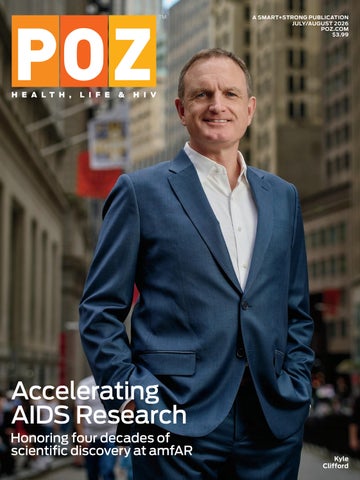
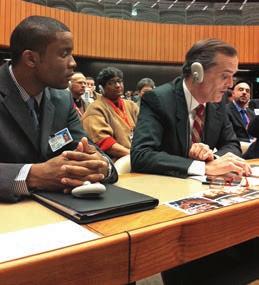
Honoring four decades of scientific discovery at amfAR
Kyle Clifford
ON POZ.COM
#ADVOCACY
Fighting against HIV and AIDS has always been a struggle. Much work remains to end the epidemic.
POZ encourages you to get involved in advocacy. Go to poz.com/advocacy to nd the latest news and learn how you can make a di erence in the ght.
D #POZ STORIES
When people living with and a ected by HIV share their stories, it can break down the shame, silence and stigma surrounding the virus. These stories can inspire, educate and empower others. To read POZ Stories or to share your own, visit poz.com/stories
D #UNDETECTABLE
The science is clear: People who have an undetectable viral load don’t transmit HIV sexually. In addition to keeping people healthy, e ective HIV treatment also means HIV prevention. Go to poz.com/undetectable for more.
D
POZ DIGITAL
Scan the QR code (le ) with your smartphone camera or go to poz.com/digital to view the current and past issues online.
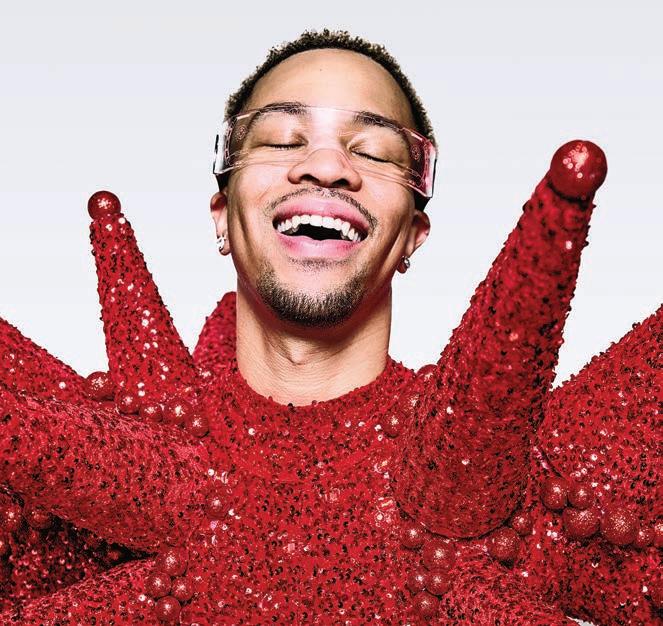
Princess Jauan Durbin promotes HIV awareness in the ballroom community.
20 BUILDING ON A LEGACY OF ACTION Kyle Cli ord, amfAR’s rst openly HIV-positive CEO, urges people living with HIV to stay committed to the ght. BY EVA LORENZ
26 35 YEARS OF DINING OUT FOR LIFE The nationwide fundraiser continues to provide a place at the table for people living with HIV. BY TIM MURPHY
16 BASICS
Switching HIV treatment
4 POZ Q&A
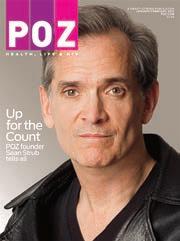
Long-term survivor and POZ founder Sean Strub reflects on his time as mayor of Milford, Pennsylvania, and his HIV activism.
6 POZ PLANET
A roundup of recent nonfiction books on HIV and AIDS • investing in HIV fuels the U.S. economy • a new national coalition aims to increase PrEP access • Everyday: moments in the epidemic
10 VOICES
How advocates can reach the “hard to reach” • remembering Amanda Cary, an HIV nurse who set a high standard of care
14
17 RESEARCH NOTES
33 HIV DRUG CHART Antiretroviral options to treat HIV 3
Eight-year study finds on-demand PrEP matches daily pills • benefit of starting antiretrovirals immediately after birth • CAR-T therapy for HIV• addressing obesity in children living with HIV
18 CARE & TREATMENT
FDA approves HIV combo pill Idvynso • new CDC data on HIV cases and care • Toronto man cured of HIV after stem cell transplant • HIV treatment slows aging
32 HEROES
Princess Jauan Durbin leads a grassroots HIV prevention program for the kiki scene.
AIDS Walk New York 2026
EDITOR-IN-CHIEF
ORIOL R. GUTIERREZ JR.
MANAGING EDITOR
JENNIFER MORTON
DEPUTY EDITOR
TRENT STRAUBE
SCIENCE EDITOR
LIZ HIGHLEYMAN
COPY CHIEF
JOE MEJÍA
EDITORIAL ASSISTANT
EVA LORENZ
ART DIRECTOR
DORIOT KIM
ART PRODUCTION MANAGER
MICHAEL HALLIDAY
CONTRIBUTING WRITERS
SHAWN DECKER, OLIVIA G. FORD, ALICIA GREEN, MARK S. KING, TIM MURPHY, MATHEW RODRIGUEZ, CHARLES SANCHEZ
CONTRIBUTING ARTISTS
JOAN LOBIS BROWN, LIZ DEFRAIN, ARI MICHELSON, JONATHAN TIMMES, BILL WADMAN
FOUNDER
SEAN STRUB
LEGACY ADVISER
MEGAN STRUB
ADVISORY BOARD GUILLERMO CHACÓN, SABINA HIRSHFIELD, PHD, KATHIE HIERS, TIM HORN, PAUL KAWATA, NAINA
KHANNA, JESSE MILAN JR., DANIEL TIETZ, MITCHELL WARREN
PRESS REQUESTS NEWS@POZ.COM
SUBSCRIPTIONS
HTTP://ORDER.POZ.COM
UNITED STATES: 212-242-2163
SUBSCRIPTION@POZ.COM
FEEDBACK
EMAIL WEBSITE@POZ.COM OR EDITOR-IN-CHIEF@POZ.COM
SMART + STRONG
PRESIDENT AND COO
IAN E. ANDERSON
EDITORIAL DIRECTOR
ORIOL R. GUTIERREZ JR.
CHIEF TECHNOLOGY OFFICER
CHRISTIAN EVANS
VICE PRESIDENT, INTEGRATED SALES
DIANE ANDERSON
INTEGRATED ADVERTISING MANAGER
JONATHAN GASKELL
INTEGRATED ADVERTISING COORDINATOR
SARAH PURSELL
SALES OFFICE
212-938-2051; SALES@POZ.COM
CDM PUBLISHING, LLC
CEO
JEREMY GRAYZEL
CONTROLLER
JOEL KAPLAN
Don’t Give Up I
REMEMBER AS IF IT WERE yesterday when Timothy Ray Brown (aka the Berlin Patient) was featured on the cover of POZ in 2011. Back then, I was deputy editor of POZ, and Timothy was the first person to have been cured of HIV. The world has moved on.
I’ve been blessed to be editor-in-chief since 2012. We lost Timothy in 2020 to a recurrence of the leukemia he was treated for with stem cell transplants that resulted in his HIV cure. Scientists have since successfully reproduced the procedure in several people. Go to page 19 to read about the 11th person (aka the Toronto Patient) to benefit from this rare cure.
It’s difficult to convey the mixed feelings that Timothy’s story brings up in me and perhaps in others. As someone who tested HIV positive in 1992, before effective treatment, I internalized early on a fear of never living a long life, let alone witnessing an actual cure for the virus. Yet I have to juggle my joy about potential cures with the realities about the widespread implementation of a practical cure for HIV.
Thankfully, we have legions of scientists, researchers and advocates worldwide who remain focused on curing HIV. A steadfast player in that symphony is amfAR, The Foundation for AIDS Research. The nonprofit organization has marked four decades of scientific discovery, which includes major support of HIV cure research. Go to page 20 to read more about amfAR’s latest contributions and for a profile on Kyle Clifford, the group’s first openly HIVpositive CEO.
When Kyle found out he was living with HIV in 2012, the news was compounded by also receiving an AIDS diagnosis. That dual result persists as an all-too-common occurrence for people around the world and here at home, which only underscores the continuing need to increase HIV prevention and testing. And as always bears repeating, effective HIV treatment is prevention, so
getting more folks living with the virus on medications to suppress their viral load to an undetectable level is also a key goal.
In addition to amfAR’s efforts, this special issue of POZ dedicated to HIV science and treatment checks in on related news. Go to page 18 to read about a new combination pill for HIV treatment. Then go to page 19 to learn how antiretrovirals slow accelerated biological aging in people with HIV.
The evidence is clearer every day that early treatment yields better outcomes for people living with HIV. As a result, folks who test positive for the virus must not only deal with the emotional stress of the moment but also increasingly make quick decisions on treatment. The introduction of new medications only makes the choice all the more consequential. Go to page 33 for the 2026 HIV Drug Chart to see the most current options.
Having additional choices of medications can also be a lifesaver for people who are already on HIV treatment but considering other options. Go to page 16 to read the latest updates on switching HIV treatment.
The financial costs of the virus are ever present. Dining Out For Life has met the challenge for 35 years. Go to page 26 to read how the nationwide fundraiser continues to provide a place at the table for people living with HIV.
ORIOL R. GUTIERREZ JR. EDITOR-IN-CHIEF editor-in-chief@poz.com
THE WIZARD OF POZ
Long-term survivor Sean Strub reflects on his time as mayor of Milford, Pennsylvania, and his HIV activism.
POZ FOUNDER SEAN STRUB AND FELLOW LONGTIME LGBTQ AND HIV activist Cleve Jones recently organized Seven Days in June, a series of nationwide rallies and other events that drew attention to the degradation of health policy and funding under the Trump administration—and charted a better vision for the future.
For Strub, 68, it was the latest in a lifetime of activist and entrepreneurial ventures, ranging from the launch of this magazine in 1994—a time when AIDS seemed perilously close to ending his own life—to his becoming not only a hotel owner in small-town Milford, Pennsylvania, but also the town’s mayor from 2016 to 2024.
In April, Strub, now living a slightly quieter life in Milford, talked with longtime POZ contributing writer Tim Murphy about his past, present and future for Murphy’s Caftan Chronicles interview series with notable older gay men. Here is an edited excerpt.
Sean, how’s your life going?
This is a reasonably decent time. I’m doing interesting things. I sold the Hotel Fauchère [in Milford], stepped
down as mayor and am no longer running the Sero Project, the group I cofounded in 2012 with Robert Suttle to fight discriminatory HIV criminalization laws in the United States and abroad. I bought a house in Mérida, Mexico, with Javier Morales, my partner of 34 years.
Tell us a little bit about Javier, or Javy, as you call him.
We met at a Chelsea gay bar in 1992—I forget which one!—when I felt like I was marking time until HIV made me sick. He had the most wonderful glowing almond skin, tight curly hair, beautiful brown eyes and a gorgeous smile. I took him home that night. The next day, when I put him in a cab, I knew we were going to be together for a long time. And with the exception of four years apart many years ago, we have been.
Clockwise from left: Sean Strub (center) at an ACT UP protest; the cover of Strub’s 2014 memoir; Strub with fellow HIV activist Robert Suttle (left) testifying against HIV criminalization. Below: Strub on the January/February 2014 cover of POZ.
I love his humility and his absolutely rock-solid soul and character. He’s also just unbelievably sexy.
Tell us about Seven Days in June. When Trump last year said the administration wasn’t going to recognize World AIDS Day, Cleve called me, dispirited. We talked about how we’d spent our whole lives building something we were watching getting dismantled right in front of us. So we decided we needed to do something. Then we talked to others. It led to SevenDaysInJune.org, a series of actions in local communities, including town hall meetings, candidate forums and rallies. Then, nationwide on June 5 at sunset, there were candlelight vigils for those who’ve died of AIDS as well as those who’ve already died from these Trump cuts, including globally, and who will continue to die if we don’t get this reversed.
It was all to bring awareness and media attention to the $1 trillion in healthcare cuts, including Medicaid, that were passed last year, that people won’t feel the pain of until next year. The second objective was that June kicked off the midterms primary season. Our only hope for this democracy is taking back Congress this November.
You went through the 1980s AIDS epidemic under Reagan and Bush—not exactly allies to queer folks or those with HIV. How would you compare them to the Trump 2.0 era?
In the ’80s, yes, you felt the Moral Majority, and you knew they hated us, but it wasn’t the dominant, defining thing. And even as the presidential administration was fine with letting us die, you had an incredibly vibrant grassroots community. The epidemic was bringing tens of thousands of new activists and donors into the existing LGBTQ community.
Also, Reagan’s administration had some evil outcomes, but Reagan didn’t seem personally to be evil—maybe clueless on certain things but basically a decent human being. And I don’t think that’s the case with Trump.
Also, in the Reagan years, the possibility of extinction via climate change was not present, nor was the threat to
democracy. Now, our democracy is hanging on by its fingernails.
You started POZ in 1994 with money you got from selling your life insurance in a viatical settlement because you thought you were going to die. You were very ill at that time. What was your vision for POZ at such a fraught time? That it would be people with HIV speaking to other people with HIV. For a long time, we had a rule that any article had to quote someone living openly with HIV first—before researchers or anyone else. We had another rule where we didn’t use the term “quack doctors.” If a treatment was risky, expensive or maybe a scam, we’d say that. But we
Democratic party has never delivered for years on its promises. So there’s a desire to punish the Democrats.
As for me, I’m a lefty gay guy with AIDS, but Milford voted for me in spite of that. They thought of me as a neighbor involved in community things. Democrats win at a local level in red and purple areas when they keep their campaign focused on local issues.
One thing I was proud of as mayor was that we got so many new people involved in government, on boards and commissions. As soon as someone moved to town, we tried to get them involved in something. We also had the Milford Enhancement Committee, where we raised money to improve the
“I am more relaxed these days. I’m feeling a peace and a sense of being settled.”
wouldn’t say “quack doctors” or “quack cures” because it was a way of shutting down information about anything outside the mainstream wisdom.
You sold POZ in 2004. Do you still have a relationship to it?
I don’t sit down and read every issue, but I look at it. Thankfully, the new owner believed that it would not continue to work if the readers stopped trusting it. It covers things in a different way now, but it still has that trust. I still run into people all the time who tell me it’s important to them.
Until 2024, you were mayor of Milford for eight years, a small town in a very red part of northeastern Pennsylvania. You’ve always been very liberal/left/ progressive, but suddenly, you were leading a town with lots of Republicans in it. Can you explain their viewpoint? I think it’s a sense of alienation against perceived elites and resentment that the
streetscapes. When I was pouring cement and putting in nice streetlights, a whole gang of civic stewards appreciated that. So I think people got to know me as a person rather than a label.
Can you take stock of your life?
I’m happy with how my life’s turned out. I am more relaxed these days. I’m feeling a peace and a sense of being settled. And I attribute it to the fact that none of the stuff I’m working on now is urgent. If I put something off until tomorrow, nobody’s going to die or suffer. There aren’t people depending on me.
But in terms of the variety in my life—I probably bore easily. It also has to do with not finishing college. So I was never programmed into one discipline. It was always random and about where I felt like I could be of service. What if I’d stayed in direct marketing or running political campaigns? I’m not sure anything would’ve brought me more happiness than the path I’ve had. Q
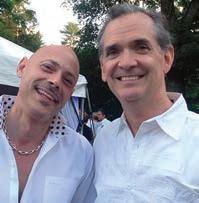
Sean Strub (right) with Javier Morales
Informed and Inspired Summer Reading
Here’s a roundup of recent nonfiction
books on HIV and AIDS.
By Theodore Kerr
IN APRIL, IN ADVANCE OF THE 2026 SUMMER READING season, The New York Times published “The 5 AIDS-Era American Novels to Read First” by respected critic Mark Harris. According to him, to read these books, published between 1988 and 1993, “is not only to learn about an era and culture that may now feel distant but to understand the necessity of creating art amid crisis.”
Despite his worthy picks—Second Son (1988) by Robert Ferro, Eighty-Sixed (1989) by David B. Feinberg, A Home at
Black Women’s Health in the Age of Hip Hop & HIV/AIDS by Nghana tamu Lewis When it comes to women, music and HIV, Gen Xers and music fans alike may be familiar with TLC’s 1995 chart-topper “Waterfalls,” Salt-N-Pepa’s 1991 hit “Let’s Talk About Sex” and their 1992 follow-up, “Let’s Talk About AIDS”—all classics to get a rooftop dance party going. Less known are
rapper Sister Souljah’s novel
The Coldest Winter Ever, the groundbreaking AIDS episodes of the sitcom Girlfriends and the offBroadway drama In the Continuum by Nikkole Salter and Danai Gurira. These landmark yet underappreciated works are key examples of what Lewis calls “hip hop feminist states of mind.” With HIV and AIDS long disproportionately impacting Black women, these works
Cruising Diaries by the King of Sex by Daniel Sanchez-Torres
Toss this book, some sunscreen and your bikini bottoms into a tote, because Cruising Diaries is the beach read of the season. In this compact volume, writer and curator Daniel Sanchez-Torres takes readers on a sexy and moving journey of self-discovery as he explores the limits and possibilities of his King of Sex persona. We meet the men he is intimate with
the End of the World (1990) by Michael Cunningham, Was (1992) by Geoff Ryman and Martin and John (1993) by Dale Peck—readers might quibble about what is missing, such as classics like Invisible Life (1991) by E. Lynn Harris and People in Trouble (1990) by Sarah Schulman. Nonetheless, the point is that reading books about HIV and AIDS is as necessary as ever. To complement his novels, I offer five recent nonfiction books on HIV and AIDS. Together, these books make for inspiring and informative summer reading.
use hip-hop as a method of community storytelling and popular education, sharing lifesaving information and bearing witness to Black women woefully underserved by the medical establishment and mainstream media. The book expands what many readers know about the cultural response to HIV and AIDS and deepens appreciation of hip-hop as a community health resource.
and the one or two who broke his heart while also getting snapshots of his life inseparable from his sex life: being let go from a job after his boss’s inappropriate behavior, moving back into his parents’ house around the start of the COVID-19 lockdown and understanding his life as a person living with HIV alongside the cultural phenomenon of AIDS. Had Cruising Diaries been merely a fun romp, it still would have made the list
for its punchy writing and interwoven playlist. What makes it so compelling, though, is its moving mix of erotics and frivolity—an important combination in the pursuit of pleasure. Sanchez-Torres has crafted a book that bridges Harris’s list—consisting primarily of memoirs of young men facing premature death— with contemporary writers like Brontez Purnell, Mattilda Bernstein Sycamore and Steven Reigns.
Machineries of Similarity and Difference: AIDS from Its Research Infrastructures by
David Ribes
A somewhat surprising summer tradition has emerged. For the last few years, every July 3, my timeline fills with people reposting the now-infamous 1981 New York Times headline: “Rare Cancer Seen in 41 Homosexuals.” Many people, as I have learned, first read that headline at or on their way to the beach and count the moment as their introduction to what would come to be known as HIV and AIDS. In his book, sociologist Ribes shares a parallel story. While the media and the public were slowly learning about the unfolding crisis, researchers were launching the Multicenter AIDS Cohort Study (MACS, pronounced “max”), an epidemiological study of gay and bisexual men. MACS, which ran from 1983 to 2019, predates the term “HIV” and inspired the Women’s Interagency HIV Study (WIHS, pronounced “wise”), which debuted a decade later. Both studies— along with an additional one focused on scientists— are Ribes’s focus. Through examining these research projects, an understanding emerges not only of how information about HIV and AIDS has been gathered across time but also of the role that objects of study play in shaping an epidemic and our understanding of it. It is not the lightest reading you will do this summer, but it will be among the most engrossing.
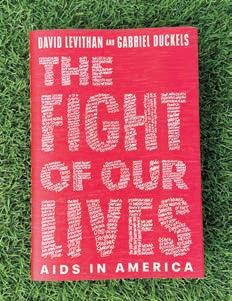
The Fight of Our Lives: AIDS in America
by David Levithan and Gabriel Duckels
As a celebrated and prolific writer, David Levithan knows the power of young adult fiction. Here, Levithan and writer and scholar Gabriel Duckels, PhD, have produced a refreshing history of HIV and AIDS. At its core, The Fight of Our Lives consists primarily of portraits of young people who have lived—and in many cases died—with HIV. Throughout, there are timelines, illustrations and transcripts. It is a readable mosaic that, in the best way, mirrors the unfolding and ongoing crisis: a powerful assemblage of facts, feelings, loss and inspiration. Stories of wellknown figures like Ryan White and poems by celebrated author Danez Smith appear alongside stories that deserve more attention, such as that of Derinthia Williams, one of the more than 10,000 people in the United States who have lived with HIV since birth. Key to the book’s success is how unburdened it is by refutation. Unlike academic or mainstream trade titles that wrestle with the AIDS narratives that came before, The Fight of Our Lives makes good use of recent research and recalibration of AIDS history—evident in an early chapter focusing on Robert Rayford, the 16-year-old who is the earliest confirmed person with HIV in the United States. This book ensures that the memory of those with HIV will remain.
The Wonderful World That Almost Was: A Life of Peter Hujar and Paul Thek by Andrew Durbin
There is an act of care at the heart of this multifaceted memoir that anyone who has spent time in the archives will appreciate. So often, one wonders about the posthumous well-being of a long-dead figure whose life can seem more vivid than one’s own—a ghostly, sometimes ghastly parasocial connection in which one may fear the dead are lonely. Thanks to Durbin, such concerns are easy to set aside. He pairs photographer Peter Hujar, a growing subject of archival affection, with the somewhat lesser-known yet equally deserving artist Paul Thek—both of whom died with HIV less than a year apart. Billed as a dual biography, the book feels to me more like a single biography of a complex relationship between two people. At its core is the connection between Hujar and Thek: peers, friends, intimates and more enmeshed in an emerging art world of their making and a dying world in which they were early casualties. At gatherings in parks and at backyard BBQs, this well-written, often unexpectedly romantic and in-depth yet breezy page-turner will have people talking all summer.
SPECIAL MENTION: Going somewhere fun this summer? Need something to read while you travel? From Vice to Nice: Midwestern Politics and the Gentrification of AIDS by Rene Esparza and AIDS in the Heartland: How Unlikely Coalitions Created a Blueprint for LGBTQ Politics by Katie Batza are two recent academic books tackling lesser-known yet vital stories about how HIV and AIDS helped shape Middle America. Read the review by Scott Stern covering both in The New Republic: “How the Heartland Responded to AIDS and Shaped Queer Politics.”
The crisis is ongoing and so is the literature. There has never been a better time to read about HIV and AIDS. Want more suggestions? Check out the often-updated, nonexhaustive list curated by WWHIVDD (What Would an HIV Doula Do?): “Since 2020: Over 100 Books About AIDS.”
INVESTING IN HIV TREATMENTS FUELS THE U.S. ECONOMY
Scientific breakthroughs against the virus extended lifespans and generated trillions of dollars.
INVESTING IN MEDICAL RESEARCH IS WORTHWHILE— it not only saves lives but also makes a ton of money. That’s the bottom line according to a new report from the United States Chamber of Commerce for which University of Chicago researchers evaluated the societal and economic impact of medical innovation in four major disease areas: HIV, heart disease, breast cancer and obesity.
Their analysis found that a $0.6 trillion increase in healthcare spending generated $167.5 trillion in value over three decades, averaging $5.6 trillion annually and representing a 27-to-1 return on investment.
“This study illuminates the profound human impact of medical innovation— transforming once fatal diagnoses into manageable conditions and giving patients decades of life they wouldn’t have had otherwise,” says Neil Bradley, executive vice president and chief policy officer at the U.S. Chamber of Commerce. “These breakthroughs represent hope for millions of families and have fueled economic growth by keeping Americans healthier.”
The study estimated the dollar value of health improvements due to medical innovation at an individual and population level. Health gains were measured in terms of life expectancy based on mortality data from the Centers for Disease Control and Prevention, and financial gains were measured using the Value of a Statistical Life Year, or the value of extending an average person’s life by one year based on various U.S. government data.
Innovations in HIV testing, treatment and prevention generated $22 trillion in health gains in 30 years and an additional 40 years of life expectancy. In 1996, highly active antiretroviral therapy combinations changed the HIV epidemic, allowing people with the virus to enjoy increasingly longer lives.
According to the HIV.gov timeline, 1996 was also the first year since the start of the epidemic that AIDS was not the leading cause of death for all Americans ages 25 to 45. HIV is now a treatable chronic condition, and antiretroviral therapies help people living with HIV achieve viral suppression. People with HIV who achieve and maintain viral suppression experience slower disease progression,
enjoy better overall health and are less likely to develop opportunistic illnesses. What’s more, people with an undetectable viral load don’t transmit HIV to others through sex. This is known as treatment as prevention, or Undetectable Equals Untransmittable (U=U).
Breast cancer is the most common cancer diagnosed among women in the United States, according to the American Cancer Society, and the chance of an American woman dying of breast cancer has fallen by about 44% since 1989. Like HIV innovations, breakthroughs in breast cancer treatment changed the prognosis for many people with the malignancy and generated financial gains for the country. Chamber of Commerce analyses showed that breast cancer treatment generated $25 trillion in health gains over the last 30 years— roughly equal to the entire annual output of the U.S. economy.
Obesity affects 42% of adult Americans, but obesity treatments, including GLP-1 receptor agonists, such as Ozempic and Wegovy, are projected to increase lifespans and improve quality of life. These treatments are also expected to generate $94.4 trillion in health value. Heart disease treatments generated $13.7 trillion in health value by preventing heart attacks and extending survival.
Medical innovation not only confers benefits to individuals in the form of healthier, longer lives, but it also benefits the public, building larger and more productive workforces. Medical advancements in HIV, breast cancer and heart disease treatments fueled work productivity gains worth $1.94, $1.21 and $1.11 trillion, respectively. Obesity advancements are expected to lead to $6.48 trillion in gains.
Overall, the benefits of innovations concerning these four disease areas represent a 27-fold return on investment.
“Even accounting for the $878 billion net increase in healthcare spending these innovations required over 30 years (driven primarily by HIV and breast cancer treatments, while heart disease and obesity innovations actually saved money), the return is extraordinary,” wrote the report’s authors.
“For every dollar we’ve invested in treating these conditions, we’ve generated dollars in health value, productivity and tax revenue that will compound for decades to come.” —Eva Lorenz
Rx for Change to Boost PrEP Access
A new national coalition launches a pilot program in two states.
PUBLIC HEALTH LEADERS FROM Emory University’s Rollins School of Public Health, AIDS United, the Black Public Health Academy and the National Pharmaceutical Association launched a new initiative to help community pharmacies expand HIV prevention services in areas that are disproportionately affected by HIV.
Rx for Change is a communitycentered and -led strategy that through a comprehensive training and partnership model will engage pharmacies and community-based organizations to increase access to pre-exposure prophylaxis (PrEP) and other HIV prevention services. The initiative will begin with a pilot in Georgia and Louisiana, two states experiencing high rates of new HIV diagnoses.
The Rx for Change launch coincided with Georgia Senate Bill 195, which was signed into law on May 5. The new law
EVERYDAY
July
authorizes pharmacists in Georgia to prescribe the HIV prevention medications (PrEP and post-exposure prophylaxis, or PEP). It also helps expand the role of pharmacists as frontline healthcare providers and increases access to prevention services in communities with limited healthcare infrastructure. By allowing pharmacists to prescribe PrEP, it provides a new pathway for individuals to access HIV prevention services quickly, conveniently and confidentially. Louisiana enacted a similar law in 2024. Research shows community pharmacies are uniquely positioned to expand HIV prevention services because they offer a convenient and cost-effective way to connect individuals to prevention services, particularly in communities where access to traditional healthcare settings is limited.
Natalie Crawford, PhD, an associate professor at Rollins, says expanding
pharmacy-based HIV prevention services could increase PrEP access points by as much as 80-fold in the southeastern United States, since nearly 90% of Americans live within five miles of a pharmacy.
Rx for Change will help close persistent gaps in HIV prevention by integrating HIV testing and prevention services into routine pharmacy care, providing enhanced workforce training and strengthening partnerships between pharmacies and community-based organizations.
Rx for Change—which is supported in part by the Elton John AIDS Foundation and Merck—will provide specialized training. Community-based organizations will get training focused on outreach, education and referral strategies. Email RxforChange@emory.edu to learn how to participate. —AIDS United
These dates represent milestones in the HIV epidemic. Visit poz.com/aidsiseveryday to learn more about the history of HIV and AIDS. BY JENNIFER MORTON
THE BAY AREA REPORTER, San Francisco’s weekly LGBTQ newspaper, publishes its first mention of “gay men’s pneumonia.” The short item encourages gay men experiencing progressive shortness of breath to see their physicians. (1982)
2 17
FIRE IN THE BELLY: THE LIFE AND TIMES OF DAVID WOJNAROWICZ is published. (2012)
President Bill Clinton launches the LEADERSHIP AND INVESTMENT IN FIGHTING AN EPIDEMIC (LIFE) initiative to address the global AIDS epidemic, which leads to increased funding. (1999)
5
MARK SIGERS, a gay man living with AIDS, is removed from a Delta Airlines flight after a flight attendant questions whether he can fly without oxygen and a travel companion. Following protests by AIDS activists, Delta apologizes and pledges to educate its employees about HIV and AIDS. Sigers dies later that month on August 29 at age 31. (1986)
TOM DUANE, an openly gay candidate in the race for a New York City Council seat, reveals he has HIV. In November, he becomes the first candidate living with HIV in the country to win public office. (1991)
20 19 21
DAY
August 8 30
SOUTHERN HIV/AIDS AWARENESS DAY NATIONAL FAITH HIV/ AIDS AWARENESS DAY
HARD TO REACH?
Below is an edited excerpt of an AIDS United blog post titled “In the HIV Field, We Call Them ‘Hard to Reach.’ Maybe the Issue Is Us.” Written by HIV advocate Avery McDougle, the post urges advocates to reach further.
I’VE WATCHED THE SAME PEOPLE we call “hard to reach” show up, engage and respond. Just not to us.
That’s what made me start questioning the way we talk about this work, because the issue isn’t always access or awareness. Sometimes, it’s whether what we’re putting out feels relevant when it shows up.
We spend a lot of time asking why things aren’t connecting, why people aren’t getting tested, why they’re not staying in care, why the numbers aren’t moving. I’ve been in those rooms where we try to answer those questions. Strategy meetings, campaign planning sessions where everything looks right on paper. The messaging is clear, the visuals are strong, the budget is approved and the timeline is set. Everyone leaves feeling like the work is solid. Then, the campaign launches, and the response is quiet. Not backlash, not confusion. Just silence. I remember one campaign where we had done everything right. The messaging had been reviewed, approved and re ned. But when it reached the community, nothing moved. That kind of silence tells you something if you’re paying attention. It tells you the message didn’t miss by accident. It tells you it never really belonged there in the rst place.
In this eld, we use the phrase “hard to reach” a lot. I’ve used it too. But over time, working across campaigns and
communities, I started to question it. Because the same people labeled “hard to reach” were engaged in other spaces. They were talking, sharing, showing up. Just not for us. That forced me to shi the question. Not how do we reach them, but where are we missing each other, and why doesn’t this feel relevant when it shows up?
Some of the most important lessons I’ve learned didn’t come from reports or dashboards. They came from conversations. From people who told us, directly or indirectly, that the message felt o . That it sounded like it came from the outside. That it asked for trust without showing any real understanding. Those moments don’t always make it into campaign summaries, but they should, because that’s where the real insight is.
There’s another layer to this that doesn’t get talked about enough. The longer we’ve been in this work, the easier it is to believe we already know what people need to hear. Clinicians, public health professionals, campaign leads. I’ve been in those rooms too. Experience matters, but it can also create blind spots if we’re not careful. What worked ve years ago or even last year does not always land the same way today. And when we rely too heavily on what we think we know, we stop noticing when the message no longer connects.
When we adjusted, things started to
change. We slowed down, brought people into the process earlier and tested ideas in real conversations instead of keeping everything internal. It wasn’t perfect, and it wasn’t immediate, but it was di erent. Engagement wasn’t something we had to force. It started to happen, because the message felt familiar, relevant and real.
We don’t need more awareness campaigns. We need work that moves behavior. That takes more than better wording or bigger budgets. It takes a shi in how the work is built from the start. There are real pressures in this eld, including funding timelines, reporting expectations and the constant push to move quickly. I understand that. But we’ve also built systems that prioritize speed and output over connection and understanding, and then, we act surprised when the work doesn’t land.
The future of HIV outreach will not be de ned by louder messaging. It will be de ned by alignment between what we say and what people experience, between intention and execution, between strategy and reality. I’m still learning that in my own work, still adjusting and re ning.
This is not about getting it perfect. It’s about getting closer to the people we’re trying to serve. Be married to the goal, but date the process. If the process is o , the outcome will be too. Q
•A daily resource for people living with and a ected by HIV and AIDS
• Clear, comprehensive prevention and treatment information
•News, personal stories, blogs, HIV-speci c resources and more
•Sign up for free email newsletters
THE PROVIDERS WE’RE LOSING
In an opinion piece titled “The Providers We’re Losing: Remembering Amanda Cary,” HIV advocate Jirair Ratevosian, DrPH, eulogizes his friend as an HIV nurse who set a high standard of care. Below is an edited excerpt.
THE HIV COMMUNITY LOST one of its own with the death of our beloved Amanda Cary on April 8, 2026. She was 42. Amanda was a nurse, an HIV provider and a clinician who set a standard for care that many aspire to and too few are supported to sustain. Her loss is profound—felt by those who loved her and across the patient and provider communities she served.
Amanda believed in showing up. And that she did.
She built her career around that idea long before she ever held a clinical title. She studied international health at Simmons College and traveled to South Africa, where she rst saw how structural inequality shapes health outcomes. That experience stayed with her. It pushed her toward human rights work at Physicians for Human Rights and later policy advocacy at American Jewish World Service, where she focused on women, girls and LGBTQ communities a ected by HIV.
Eventually, she did what great providers o en do—she moved closer to the patient.
She was educated as a nurse practitioner, specializing in HIV care and community health. She worked on inpatient HIV units, then at WhitmanWalker Health in Washington, DC, and later as a clinical leader at CallenLorde Community Health Center in New York City.
At Whitman-Walker, Amanda helped lead one of the most important transformations in its clinical services in recent years, evolving the sexual health clinic from a volunteer-run model into a full-time accessible program that could serve more patients, accept insurance and remain grounded in its commitment to equity and inclusion.
During the COVID-19 pandemic, Amanda helped rework how sexual health services were delivered, almost overnight. With in-person visits sharply limited, she stood up new approaches —like at-home HIV and STI [sexually
transmitted infection] testing—to keep patients connected to care. At a time when many systems stalled, she made sure this one didn’t. When mpox [also known as monkeypox] hit DC, she stepped in as one of the city’s central clinical leaders, caring for patients at scale during a period of uncertainty and fear.
Amanda didn’t see patients as cases or visits. She saw people navigating systems that o en failed them. She spent time. She followed up. She brought people back into care when they dropped out. She worked across HIV, sexual health, substance use and gender-a rming care because she understood that real life doesn’t t into clinical categories or executive orders. She was a dedicated advocate who stepped forward again and again to lead the way in providing nonjudgmental, high-quality care for all.
And the impact showed up in people’s lives. Patients stayed in care because of her. People trusted the system because she was in it. Colleagues relied on her judgment, her steadiness and her refusal to accept anything less than dignity for the people she served.
Amanda Cary specialized in HIV care and community health.
Amanda managed a level of responsibility that most systems quietly depend on but rarely acknowledge.
She understood what it means to hold complexity—to care for others while managing your own struggles at the same time. And like many providers, especially nurses, she also carried the emotional weight of the work itself. HIV care asks providers to sit with stigma, loss and uncertainty and to do it consistently over time.
The system relies on that kind of presence. But it doesn’t always support it—and rarely builds structures that sustain it.
We don’t talk enough about the HIV provider pipeline or how underappreci-
ated nurses are within it. Fewer clinicians are choosing this eld. Training programs are shrinking. Incentives push people elsewhere. On paper, HIV is manageable. In practice, it still depends on providers who are willing to stay engaged over years and build real relationships with patients. If we are serious about ending HIV as a public health threat, we need to be serious about supporting the provider workforce. That means investing in education, supporting nursing pathways, xing reimbursement and valuing the time it takes to actually care for someone—and treating mental health as fundamental to care for everyone, not an a erthought. Q
Register Today
2026 U.S. Conference on HIV/AIDS
September 17–20, 2026 • Anaheim, CA nmac.org/uscha/registration • #2026USCHA
TRACKS
Track 1
Whole Person Health: Prevention and Care Without Silos
Track 2
Unbreakable Bridges: Closing the Gap in Healthcare
Track 3
The Power of Us: Storytelling and Community Engagement
Turning Evidence into Impact through Science and Policy
Track 6
Crosscutting Track: The Future of the Movement, Innovation, Urgency & What’s Next
Track 7
Advancing HIV Care: Clinical Updates Pathway
45 years of the HIV Movement 1981 - 2026
AIDS WALK NY 2026
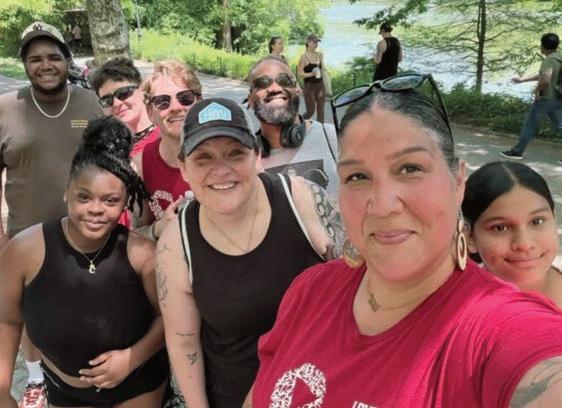
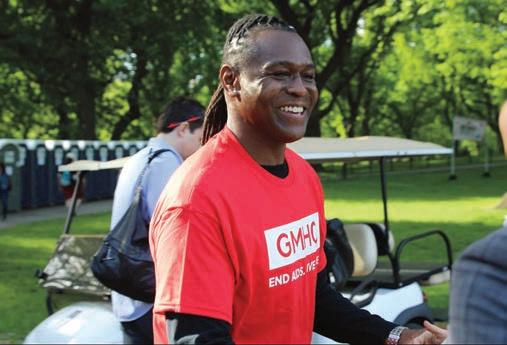
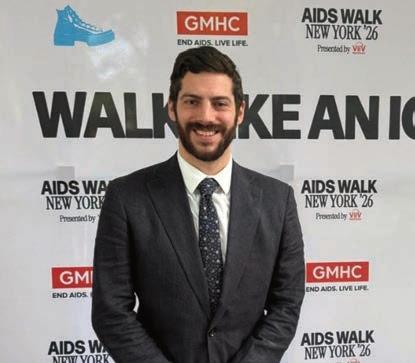
On Sunday, May 17, GMHC hosted the 41st annual AIDS Walk New York in Central Park. Billed as “the world’s largest and most visible HIV and AIDS fundraising event,” the walk drew 10,000 participants, who braved the day’s unseasonable heat to walk four miles to raise money to support the world’s first HIV and AIDS service organization. The event was led by actress and activist and native New Yorker Rosie Perez, who served as grand marshal. This year’s theme was “Walk Like an Icon,” a nod to the HIV community’s resilience and fierceness. The walk’s one-day haul was $1,714,522, though folks who couldn’t participate were encouraged to donate online through June 12.
Although effective antiretroviral therapy to treat HIV and pre-exposure prophylaxis (PrEP) to prevent acquiring the virus have changed the HIV and AIDS landscape, New York City nonetheless counts 132,000 people living with HIV among its residents. What’s more, 1,791 people—a 5.4% increase from 2023—were newly diagnosed with HIV in New York City in 2024, and 42% of these individuals lived in high- or very high-poverty ZIP codes when diagnosed. It’s these folks that organizations like GMHC are dedicated to serving, especially when dependable sources of aid and avenues to treatment for people living with HIV, such as the Ryan White HIV/AIDS Program and Medicaid, face devastating budget cuts.
As GMHC’s co-CEO and CFO Michael Hester said at the event, “Forty-five years ago, there was no road map. No playbook. What was there was a community—our community—who stood up and resisted silence.” On May 17, the AIDS Walk showed just how long and strong that same community will continue to fight for those who continue to be affected by HIV and AIDS.
1. The event’s grand total is displayed under Central Park’s Naumburg Bandshell. To date, AIDS Walk NY has raised more than $170 million.
2. Grand Marshal Rosie Perez kick-started the event, urging, “We have to remember the spirit of GMHC. We have to be fierce and fearless in our fight.”
3. In her opening remarks, performer Peppermint declared, “We gather today honoring those that we’ve lost to AIDS and HIV..... And we recommit ourselves to those who are still here, still fighting.” 4. Francine Goldstein (center) has raised more than $1 million for GMHC, making her the top individual fundraiser record holder. She is flanked by NYC politicians, including City Council Speaker Julie Menin (second from left).
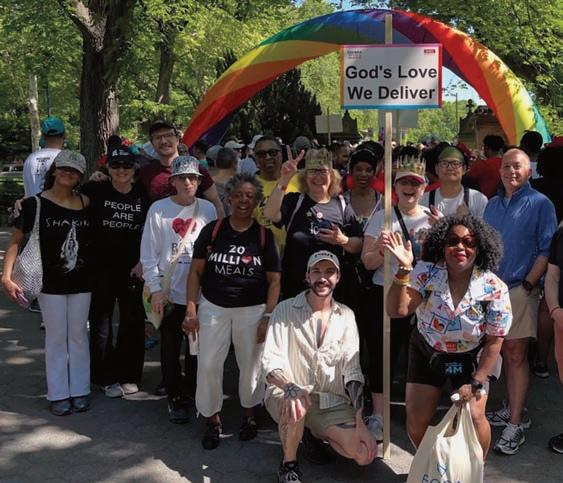
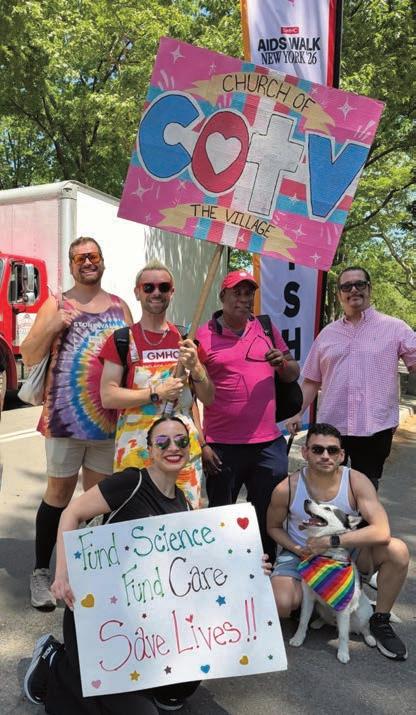
5. God’s Love We Deliver, a beneficiary of GMHC’s Community Partnership Program, delivers meals to people who are homebound due to illness, including HIV and AIDS. 6. The Church of the Village, located in Greenwich Village, an AIDS epicenter at the height of the epidemic, has for decades supported those impacted by HIV. 7. New York State Assemblymember Alex Bores advocates for the full restoration of federal HIV funding and a National PrEP Program. 8. The Hetrick-Martin Institute for LGBTQIA+ Youth, another GMHC community partner, serves queer youth, including those experiencing homelessness, via drop-in centers, health services, free meals and more. 9. At the walk, GMHC’s Michael Hester announced that in 2027, GMHC will open a clinic for primary and dental care, saying, “This is what comprehensive care looks like: seeing the whole person and meeting every need.”
SWITCHING HIV TREATMENT
Newer antiretroviral regimens are more effective, better tolerated and easier to use.
MANY PEOPLE LIVING WITH HIV, especially those who start treatment promptly using modern antiretrovirals, can stay on their rst regimen for a long time. But others may have trouble taking their meds consistently, struggle with side e ects, are unable to keep their viral load suppressed or may simply want a new regimen that is more convenient.
The good news is that treatment options have improved in recent years. Compared with older antiretrovirals, modern HIV meds are more potent, better tolerated, less prone to drug resistance and easier to take. Most people starting or switching treatment can use single-tablet regimens—single pills containing two or more drugs that are taken just once a day. Although heavily treatment-experienced people have fewer switch options, most can still nd a regimen that maintains viral suppression.
There are several reasons for switching medications, including lack of viral suppression (virological failure), inadequate CD4 T-cell recovery (immunological failure), di culty taking medications consistently, too many pills or too frequent dosing, side effects, drug interactions, pregnancy and medication cost or insurance issues.
Treatment failure means that some of the drugs in a regimen are not doing their job. The best way to tell whether your medications are working is to regularly measure viral load (the amount of HIV in the blood) and CD4 T-cell count.
Virus levels usually begin to decline soon a er starting e ective antiretrovirals. If your viral load does not fall to an undetectable level—or if it does not stay down—you are at risk for disease progression and could transmit the virus to others. However, it is important to look at trends over time. A single detectable viral load, or “blip,” is usually nothing to worry about, but if two consecutive tests show a rising virus level, it might be time to adjust your regimen.
One of the most common reasons for treatment failure is drug resistance, meaning the virus has developed mutations, or changes at the genetic level, that make it less susceptible to one or more antiretrovirals. This o en happens
due to poor adherence, or not taking medications as directed all the time, which allows HIV to resume replication. Factors that can interfere with good adherence include side e ects, inconvenient dosing, forgetfulness, a hectic or unpredictable schedule, unstable housing and interrupted access to treatment due to cost. Poor absorption and drug interactions can also contribute to treatment failure.
Which new regimen to use depends on your treatment history and why you are switching. People who already have an undetectable viral load and wish to switch for other reasons will likely have more options. Some people still take older antiretrovirals and more complex regimens— guring “if it’s not broke, don’t x it”—but switching to newer combinations can make treatment easier.
Maintenance therapy—simpli ed regimens that aim to maintain viral suppression—is a switch option for many people who have already achieved an undetectable viral load. Traditionally, standard HIV regimens have included two nucleoside/nucleotide reverse transcriptase inhibitors plus a nonnucleoside reverse transcriptase inhibitor, protease inhibitor or integrase inhibitor. But people with viral suppression who have no history of treatment failure and no known
resistance mutations may be able to switch to a two-drug regimen.
HIV treatment is moving in the direction of longer-acting regimens that are taken less o en. Currently, the longest-acting complete regimen is Cabenuva (cabotegravir and rilpivirine), which is administered by injection once monthly or every other month. Onceweekly and once-monthly oral regimens and injectables that can be taken just twice a year are now in the pipeline.
When switching due to virological failure, it’s important to have a discussion with your doctor about adherence, side e ects and other factors that could prevent your meds from working as they should. Resistance tests can show which drugs in your regimen are not active due to viral mutations and which alternative antiretrovirals are likely to work best.
Switching treatment is more challenging for people who have already used many drugs and have developed resistance to multiple medications, known as multidrug-resistant HIV. But with a better understanding of resistance and the development of new antiretrovirals that work in di erent ways, even people who have been living with HIV for years and have taken many prior regimens can usually nd a treatment approach that keeps the virus in check. Q
BY LIZ
On-Demand PrEP PREVENTION
On-demand pre-exposure prophylaxis (PrEP) using tenofovir disoproxil fumarate/ emtricitabine (Truvada or generics) before and a er sex remained as e ective as once-daily pills over eight years of follow-up if taken as directed. The PREVENIR trial compared once-daily and intermittent PrEP in more than 3,000 HIV-negative gay and bisexual men and transgender women in Paris. In 2022, the researchers reported that HIV incidence was low and comparable in both groups; follow-up continued through May 2025. HIV incidence remained low overall, at 0.99 cases per 1,000 person-years. There were three cases among participants who used daily PrEP, seven among those who used on-demand PrEP and three among those who switched between the two regimens. These participants were not taking PrEP at the time of HIV acquisition or showed evidence of poor adherence. HIV incidence declined by 33% among gay and bisexual men born in France during the follow-up period but rose by 73% among those born elsewhere, underscoring the need for improved access to PrEP.
TREATMENT
Early Treatment
Children who start antiretroviral therapy immediately after birth have a smaller viral reservoir and a higher likelihood of controlling the virus a er stopping treatment, and they may be ideal candidates for a functional cure, or long-term remission. The South African Azaphile trial enrolled 330 pairs of mothers and children with HIV. The children started treatment with one or two antiretrovirals at birth and a three-drug regimen within 21 days. Those with an undetectable viral load for at least two years, undetectable or very low HIV DNA in peripheral blood cells and an adequate CD4 count were eligible for a carefully monitored analytical treatment interruption. Nineteen children discontinued treatment at a median age of about 5 years. Thirteen experienced viral rebound as expected within several weeks, but six children (32%) maintained viral suppression beyond three months. Of these, three eventually rebounded at 5, 18 and 24 months. The other three were still o treatment at the time of the analysis, maintaining an undetectable viral load for 10, 30 and 52 months.
CAR-T for HIV CURE
A one-time infusion of CAR-T therapy led to delayed HIV rebound or sustained viral suppression a er stopping antiretrovirals in a small study. Best known as a treatment for cancer, chimeric antigen receptor T-cell therapy was initially developed for HIV. A rst-in-humans Phase I/II trial evaluated the safety and preliminary e cacy of a duoCAR technology developed by Caring Cross. The treatment involves collecting a sample of T cells and modifying them using a lentivirus vector that encodes receptors targeting HIV’s envelope protein; the “living drug” is then reinfused back into the body. Of the six participants who received mild conditioning chemotherapy to make room for the modi ed T cells, one has maintained an undetectable or very low HIV viral load for nearly two years a er antiretroviral treatment interruption, a second has been in remission for almost a year and a third showed transient viral control for about three months. All three started antiretrovirals soon a er infection, adding to the evidence that very early treatment improves prospects for a functional cure.
CONCERNS
Obesity in Kids
Children living with HIV are surviving—and increasingly thriving—thanks to advances in antiretroviral treatment, but those who have lived their whole lives with the virus face some unanticipated health consequences. These include obesity, which has been rising among adults and children with or without HIV worldwide but is o en overlooked in this population. In countries such as South Africa, where both HIV and obesity are common, this dual burden is emerging as a serious threat to children’s health. An international research team conducted a systematic review of more than 1,000 studies over two decades and found that not a single one addressed how to manage obesity in children receiving HIV care in clinical settings, according to a news release from Texas A&M University. To address this gap, the researchers recommended a threepronged approach that includes developing and testing tailored interventions for children with HIV, integrating weight management into existing healthcare systems and prioritizing policy and funding to support such e orts.
FDA Approves Idvynso Combination Pill
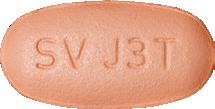
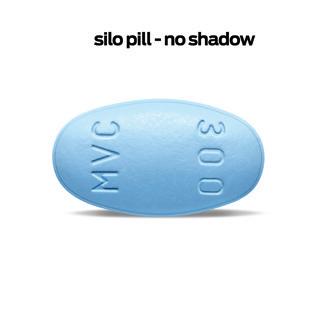
On April 21, the Food and Drug Administration approved Idvynso—Merck’s once-daily single-tablet regimen containing doravirine and islatravir—as a switch option for people currently on HIV treatment with an undetectable viral load. Doravirine (sold alone as Pifeltro) is a next-generation nonnucleoside reverse transcriptase inhibitor with a high barrier to resistance, while islatravir is a rst-in-class nucleoside reverse transcriptase translocation inhibitor. The combination pill is the rst two-drug antiretroviral regimen without an integrase inhibitor or tenofovir.
Idvynso is approved for adults on stable antiretroviral therapy with a viral load below 50 who have no history of virological treatment failure and no known doravirine resistance mutations. The recommended dose is one tablet once daily with or without food.
Late-stage clinical trials showed that Idvynso maintains viral suppression when people switch from a standard daily oral antiretroviral regimen. As reported at the Conference on
Retroviruses and Opportunistic Infections in February, people with undetectable virus who switched to Idvynso from either Biktarvy (bictegravir/tenofovir alafenamide/emtricitabine) or various other two- or three-drug oral regimens were as likely to maintain an undetectable viral load as those who stayed on their existing combination. Idvynso also shows promise as a rst-line treatment option.
Idvynso was safe and generally well tolerated. Study participants did not experience decreases in their white blood cell counts, which were seen in prior studies testing higher doses of islatravir. Unlike tenofovir, neither doravirine nor islatravir is active against hepatitis B virus.
“People aging with HIV face additional health challenges, including managing multiple chronic conditions and medications at the same time,” says Carl Baloney Jr., president and CEO of AIDS United. “It is essential that management of HIV considers these factors in addition to virologic suppression when choosing an HIV treatment regimen.”
NEW CDC DATA ON HIV CASES AND CARE INDICATORS
New HIV diagnoses and care and treatment outcomes generally remained stable in 2024, according to recent data from the Centers for Disease Control and Prevention (CDC). The updated numbers show that the United States is not on track to meet national goals for ending the HIV epidemic.
According to one CDC report, 38,793 people ages 13 and older were newly diagnosed with HIV in
2024, a small decrease from the 39,201 diagnoses in 2023. A total of 1,158,701 people were living with diagnosed HIV at the end of the year. Men accounted for 80% of all new diagnoses, and 65% were attributed to sex between men. Black people made up 39% of new diagnoses, followed by Latino people (34%) and white people (21%). Just over half lived in the South.
A second report looked at the state of HIV care. More than one in ve people diagnosed with HIV in 2024 had already progressed to AIDS, showing that many are getting tested too late.
Among newly diagnosed people, 83% were linked to care within one month.
Of the more than 1 million people living with diag-
nosed HIV at the end of the year, 77% had received some care, but only 56% were retained in care. The viral suppression rate increased slightly to 69% in 2024, compared with 67% the previous year.
The latest numbers are a snapshot of the status quo before the start of President Donald Trump’s second term in January 2025, and they do not yet re ect the e ects of his administration’s policy changes and cuts to funding for the CDC, the Ryan White HIV/AIDS Program and Medicaid.
“While we have many of the tools to end HIV, including e ective antiretroviral treatment and PrEP that prevents HIV, we need HIV programs and policies, along with su cient funding, to ensure they are delivered to the people who need them,” says Carl Schmid, executive director of the HIV+Hepatitis Policy Institute.
TORONTO MAN CURED OF HIV AFTER STEM CELL TRANSPLANT
Another man appears to be free of HIV a er a stem cell transplant for cancer treatment, according to a report at the Canadian Association of HIV Research Conference in April. If he remains in remission, the Toronto Patient will be the 11th person cured a er the procedure.
The anonymous 62-year-old man was diagnosed with Burkitt lymphoma and AIDS in 1999. Strong chemotherapy put his cancer into remission, and he achieved viral suppression in 2000 a er starting combination antiretroviral therapy. Two decades later, he developed acute myelogenous leukemia and underwent a hematopoietic stem cell transplant in 2021. Like the rst person cured of HIV—Timothy Ray Brown, the Berlin Patient—his donor had two copies of a mutation known as CCR5-delta32 that prevents HIV from entering cells.
The man stopped antiretroviral treatment in July 2025, but he still has an undetectable viral load more than 10 months later using the most sensitive tests. Researchers have been unable
to isolate viable virus, and HIV DNA levels in his blood cells continue to decline, indicating a shrinking viral reservoir. What’s more, he has undetectable HIV-speci c T-cell responses, suggesting there may be no remaining virus to trigger his immune system.
Scientists are still trying to gure out why 11 people have been cured of HIV with stem cell transplants, while other similar attempts have failed, and there does not seem to be a decisive common factor. The transplant procedure is too risky for people without life-threatening cancer, but each new case o ers clues that could lead to a safer and more widely accessible functional cure.
“The small but growing number of these cases prove an HIV cure is possible,” says Sharon Walmsley, MD, director of the HIV clinic at the University of Toronto’s University Health Net work and the man’s longtime doctor. “Cases such as these provide important information for researchers to nd ways to eradicate HIV from the body.”
HIV Treatment Slows Accelerated Aging
Antiretroviral treatment may slow accelerated biological aging by nearly four years in people with HIV, according to a study presented at the Congress of the European Society of Clinical Microbiology and Infectious Diseases in April.
People living with HIV are prone to developing comorbidities, such as cardiovascular disease, earlier than their HIVnegative peers. Despite antiretroviral treatment, the virus remains in the body and can cause chronic in ammation that leads to a host of health problems.
Based on patterns of hundreds of proteins in the blood, Barry Ryan, PhD, of the Swiss technical university EPFL, and colleagues developed a proteomic aging clock that captures changes in in ammatory biomarkers and drug metabolomic pathways. The model was applied to participants in the Swiss HIV Cohort Study. It was rst trained on 941 plasma samples from HIV-positive people on e ective antiretroviral therapy (ART) and then evaluated using a separate group of 80 people who contributed nearly 300 samples, spanning from before treatment initiation to viral suppression.
Prior to treatment, the clock estimated that participants’ biological age was accelerated by a median of 10 years. But a er about two years on antiretrovirals, the researchers saw an average reduction of 3.7 years in proteomic age. The longer treatment continued, the more
proteomic age moved closer to chronological age, suggesting ongoing biological recovery. The e ect was not due to CD4 T-cell recovery alone, suggesting that HIV-related in ammation and immune activation may not be fully captured by traditional clinical markers, such as CD4 count.
“With this group, we have measured the e ect of untreated HIV infection and successful ART on telomere shortening, epigenetic aging and now proteomic aging. In each case we have shown that uncontrolled HIV infection is linked to faster aging and that ART signi cantly slows this,” Ryan says.
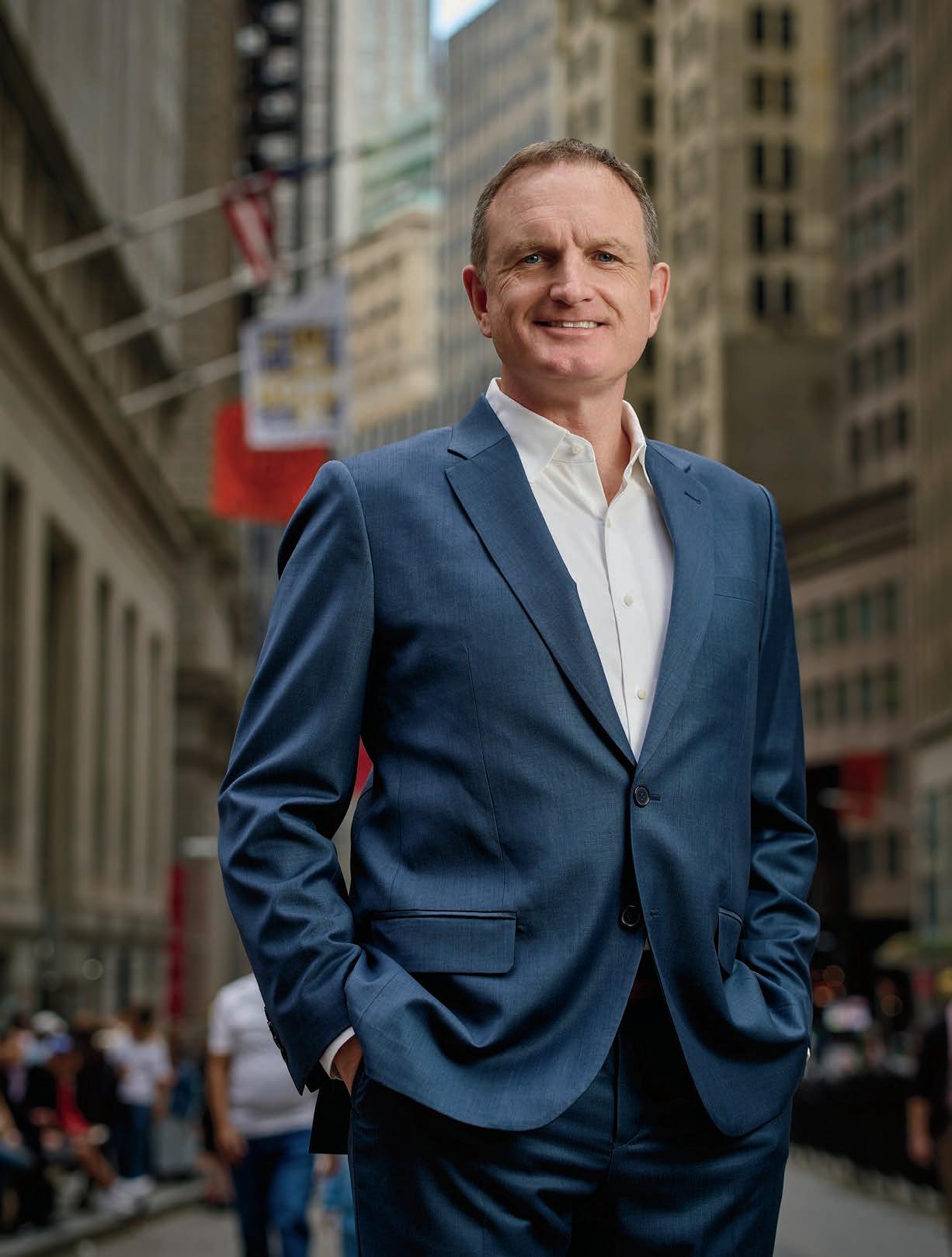
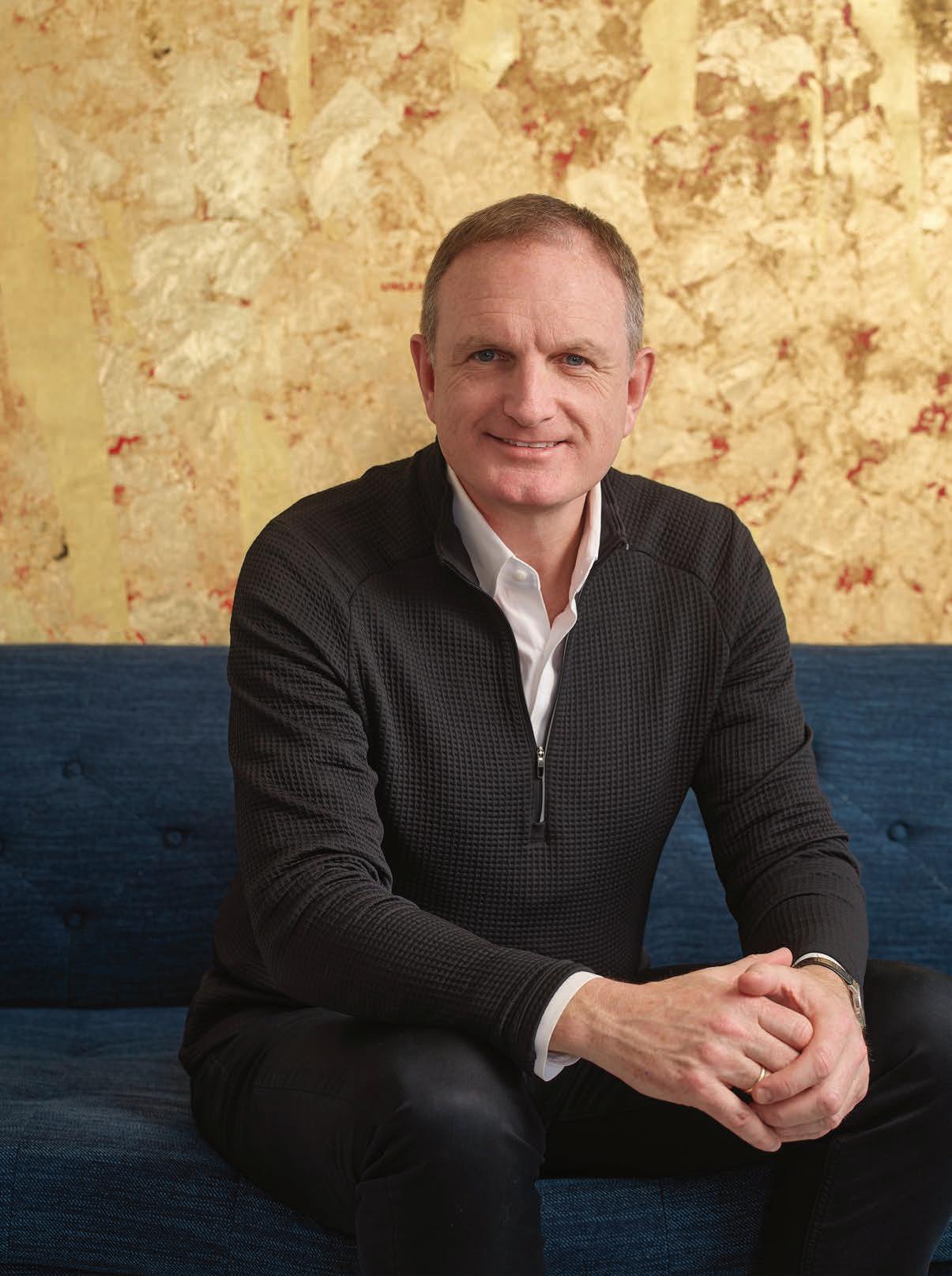
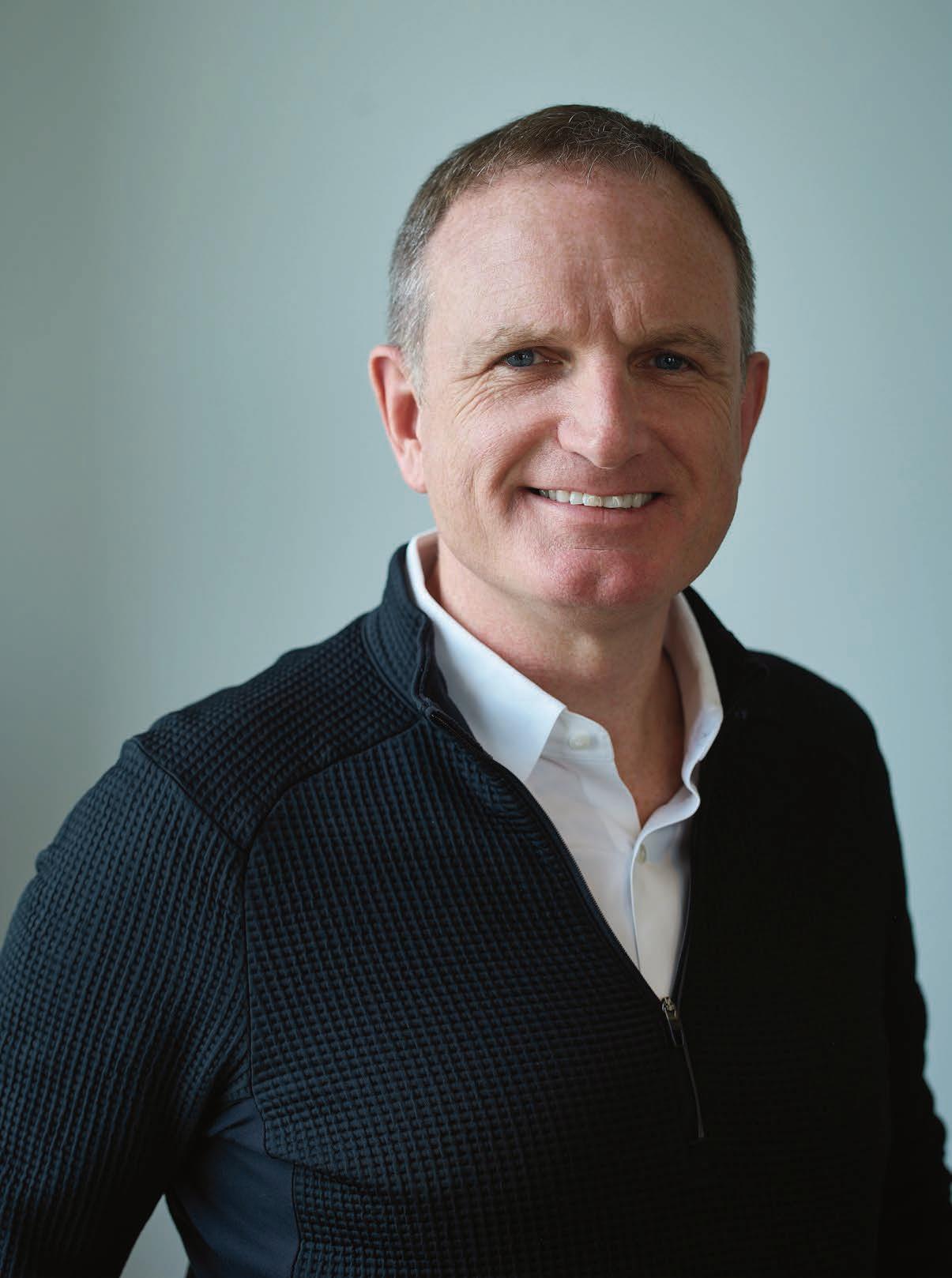
Kyle Clifford was diagnosed with AIDS in 2012.
KYLE CLIFFORD, THE NONPROFIT’S FIRST OPENLY HIV-POSITIVE CEO, URGES PEOPLE LIVING WITH THE VIRUS TO STAY COMMITTED TO THE FIGHT.
BY EVA LORENZ | PHOTOGRAPHY BY BILL WADMAN
IN 2026, KYLE CLIFFORD BECAME THE FIRST openly HIV-positive chief executive officer of amfAR, The Foundation for AIDS Research. Since the early days of the epidemic, amfAR has championed public policies and funded scientific breakthroughs that have improved and saved countless lives worldwide. As amfAR’s new CEO, Clifford will not only continue to build upon the organization’s legacy of action on behalf of and in support of people living with HIV, but he will also lead amfAR in the next leg of the marathon that is finding a cure for HIV.
“Now is not the time for us to slow down or pull out of the race,” says Clifford. “It is time for us to gather the resources we have and truly come together in these challenging times, continue to stand shoulder to shoulder together as a community and finally finish the job.”
amfAR was born of conversations between friends Mathilde Krim, PhD, and Joseph Sonnabend, MD, about a mysterious disease affecting young gay men in the United States that emerged in 1981. In 1982, a Centers for Disease Control and Prevention (CDC) report named the disease acquired immune deficiency syndrome, or AIDS, but at the time, government officials barely addressed the disease’s growing death toll.
In 1983, Krim, a researcher at New York’s Memorial Sloan-Kettering Cancer Center, and Sonnabend, an immunologist and physician, along with AIDS activist Michael Callen and others, founded the AIDS Medical Foundation (AMF) in New York. It was the first private organization in the world dedicated to raising funds to support scientific and medical research on AIDS. Two years later, AMF merged with the National AIDS Research Foundation, which had been incorporated in California in August 1985, to form the American Foundation for AIDS Research. Krim and Michael Gottlieb, MD, an author of the CDC’s first report on AIDS, became amfAR’s founding chairs; actress-turned-activist Elizabeth Taylor joined them as founding national chairman.
Krim and Taylor were among the first people to visit Capitol Hill and advocate for people living with HIV and AIDS. As a result, amfAR was instrumental in establishing early HIV legislation, such as the HOPE Act (the first comprehensive AIDS legislation), as well as AIDS-related legislation like the Ryan White CARE Act and the Americans with Disabilities Act in 1990.
As the first person living with HIV to helm amfAR, Clifford represents the progress that has been made regarding the virus.
Born and raised in Ireland, Clifford, who came out as gay at age 19 in the early 1990s, grew up amid the HIV epidemic and experienced firsthand the devastation, loss and fear that AIDS wrought in his own community.
Clifford was diagnosed with AIDS on Christmas Eve, 2012, by the family doctor in his hometown. The news came as a shock, as he had not felt at all sick. He heeded his doctor’s advice and got on medications, accepted support from his community and found comfort in established HIV resources, like POZ. Over time, he became obsessed with the search for a cure; one organization that kept coming up in his research was amfAR.
“I am an HIV-positive man who is lucky to be alive because of organizations and the activist community that were fighting to find the solutions and treatments that were provided to me when I got my diagnosis,” says Clifford.
Years later, while living and working in New York City, where only his doctor and his husband knew he was HIV positive, a headhunter reached out to Clifford about a role at an organization funding research for people with compromised immune systems. His interest piqued, Clifford had
some follow-up conversations that confirmed his hope: the immune-compromised people in question were HIV positive, and the organization was amfAR.
“I knew amfAR for funding very unique research,” says Clifford. “I identified way back then with amfAR as an organization playing a role in trying to find solutions for a person like me who was newly diagnosed.”
In 2020, Clifford—after having worked at the Ireland Funds, a global philanthropic network that raised over $650 million to benefit more than 3,200 organizations in Ireland and beyond—became amfAR’s chief development officer, a position he maintained for five and a half years. After former CEO Kevin Robert Frost retired, in March 2025, the board of trustees named Clifford as his successor.
On World AIDS Day 2025, Clifford came out in an even bigger way, sharing his HIV status in a heartfelt video where he expressed how advances in research thanks to organizations like amfAR had transformed his life.
“I wanted it to be known to the HIV-positive community, but also to the people, activists and researchers who played a role in fighting the epidemic, that the next leader of amfAR was committed to the fight and would wake up every day with one goal: to finish this job and make AIDS history,” he says. “For me, this is deeply personal and deeply gratifying. It is a responsibility I take very seriously.”
The search for a cure has come with tremendous challenges, such as the millions of lives lost to HIV, policy shifts and funding cuts.
In 2025, the U.S. government terminated or froze over 7,800 biomedical and behavioral research grants funded by the National Institutes of Health and the National Science Foundation. Indeed, the Trump administration’s proposed 2026 budget cut their funding by $32 billion.
As a nonpartisan biomedical research organization funded entirely by private philanthropy, amfAR is able to continue to fund novel HIV research. Following the lapse in federal funding, the organization issued a call to action to reengage existing contributors and invite new donors to fund groundbreaking science through amfAR. The support base has been overwhelmingly responsive.
The Trump administration also cut international HIV aid by dismantling the U.S. Agency for International Development (USAID) and the U.S. President’s Emergency Plan for AIDS Relief (PEPFAR), both of which provided HIV treatment and prevention services to developing countries. The CDC and the Department of Health and Human Services also face budget cuts that may harm people living with HIV who rely on federally funded services domestically and internationally.
Since it operates independently of state and federal funding, amfAR has earned a reputation in Washington, DC, for providing high-quality data on the impact of budget cuts and policy changes in the form of reports that show decision-makers the direct impacts of changes to public policies.
Clifford is an experienced fundraiser.
“NOW IS NOT THE TIME FOR US TO SLOW DOWN
OR PULL
OUT OF THE RACE.
”
“Whether it is with this administration or future administrations, we allow data to be our voice,” Clifford says. amfAR is unique among research organizations in that researchers can share their innovative ideas directly with the organization and get their projects funded in three to four months. The idea is that amfAR can launch projects that may then secure larger institutional funding.
“For us, it is about ensuring that a rigorously reviewed, smart idea with the right researcher gets funded,” says Clifford.
Since its creation, amfAR’s primary purpose has been to find a cure for HIV.
In 1986, amfAR awarded $1.5 million in grants for experimental HIV research. With its first international research grant in 1987, it funded a landmark study in Kenya showing that HIV can be transmitted from women to men. The organization’s early funding laid the foundation for our understanding of HIV and AIDS today. By 1990, amfAR had established a nationwide community-based clinical trial network with 16 sites across the country, including HIV hubs in New York City and San Francisco.
Among various other scientific breakthroughs, amfAR contributed funding to research that led to the development of four of the six major classes of antiretroviral drugs that revolutionized HIV treatment, helping people achieve viral suppression and reducing AIDS-related deaths. These drugs also help prevent HIV transmission from mother to child, a mode of transmission that has been nearly eliminated in many parts of the world.
Over time, as the needs of people living with HIV have evolved, so has amfAR. Today, amfAR funds cutting-edge research projects that focus on other conditions, including cancer, hepatitis, kidney disease and more. In fact, amfAR-funded research by longtime grantee Drew Weissman, MD, PhD, led to the development of mRNA COVID-19 vaccines. The organization has other exciting projects in the pipeline, including one focusing on aging with HIV as well as an Alzheimer’s research project and a cancer research initiative.
“The work we do impacts every household here in the United States,” says Clifford.
Over 41 years, amfAR has raised $950 million and funded more than 3,800 research grants worldwide. Clifford is hopeful that in his lifetime, a range of easyto-access and easy-to-administer cures will become available to a global population.
amfAR’s naming its first openly HIV-positive CEO is a testament to the work of the advocates, scientists and healthcare providers that have led the organization for the last four decades. Under Clifford’s leadership, amfAR will continue to fund the science that can transform lives.
To those facing a new HIV diagnosis Clifford says, “Have comfort in knowing you are not alone. There is a tremendous amount of support out there for when you are ready to lean into that. The support is there, and everything is going to be OK.” Q
2026 AMFAR FUNDRAISING, RESEARCH AND POLICY INITIATIVES
The nonpro t organization continues to advance scienti c discovery.
EVERY YEAR, AMFAR, THE FOUNDATION for AIDS Research, holds ve major fundraising galas across the globe to bring together science and culture, generate funding for biomedical research and remind people of the need to stay focused on nding a cure for HIV. In March 2026, amfAR held its h annual fundraising gala in Palm Beach. Hosted by actress Christie Brinkley at the home of philanthropists Anne and Chris Flowers, the gala featured presentations to honorees, a live art auction and performances from Grammy Award winners John Legend and Gloria Gaynor. This year, the event raised $3.4 million, bringing the event’s grand total raised since its launch in 2022 to nearly $20 million. Kyle Cli ord, amfAR’s CEO, addressed attendees.
“When I was diagnosed [with HIV], I was fortunate to walk out of that doctor’s o ce with treatment options. But I also walked out with something just as important, something I would argue is of equal or greater value: hope. Hope that researchers, somewhere, were working to nd a cure. That is what amfAR provides,” says Cli ord.
Thanks to decades of groundbreaking research on antiretroviral therapies, people with HIV are living longer than ever, and amfAR continues to fund scientists’ research concerning how HIV interacts with the biology of aging. In March,
amfAR’s vice president of research, immunologist Andrea Gramatica, PhD, sat down with neuroscientist Kelsey Hopland, PhD, amfAR’s program o cer, to discuss the current understanding and future research of HIV and neurodegenerative conditions, like Alzheimer’s disease.
The duo called for the development of a coordinated initiative focused on HIV and neurodegeneration to understand how cognitive and biological changes evolve. Using modern computational approaches, like machine learning, in groups of people living with HIV and Alzheimer’s, Gramatica says researchers can identify patterns over time to answer fundamental questions about aging and cognitive decline. This exciting scienti c area sits at the intersection of research on immunology, virology, neuroscience and aging.
amfAR continues to react to the ever-changing global landscape. In September 2025, the United States government released the America First Global Health Strategy, which outlined plans to decrease foreign aid to the President’s Emergency Plan for AIDS Relief (PEP-
FAR) and announced bilateral health cooperation agreements known as memorandums of understanding (MOUs) with Ethiopia, Kenya, Liberia, Mozambique, Nigeria, Rwanda and Uganda to increase their domestic health spending. In April, amfAR responded with a report titled Unmeasurable and Unaccountable that outlined problems with the MOUs, including awed metrics and a lack of transparency in data.
“PEPFAR is our country’s most successful global health program because of its transparency, targetsetting and organizational structure. Gutting what made the program impactful will squander millions of U.S. taxpayer dollars and may place just as many lives at risk,” says Greg Millett, vice president and director of policy at amfAR.
Later in April, amfAR launched a $2 million AIenabled study to map the small proportion of latently infected cells, known as the HIV reservoir, that persist despite treatment and enable the virus to rebound when a person stops antiretrovirals. The HIV reservoir can contribute to chronic in ammation, cardiovas-
cular disease, cancer and neurodegeneration. The HIV Immune Atlas Study will use AI to sequence and analyze cells and tissues that make up the viral reservoir, like those in the gut, lymph nodes and brain.
amfAR has a history of supporting early-career scientists. Most recently, it announced a new class of recipients of the highly competitive Mathilde Krim Fellowship in Biomedical Research. The fellowship provides scienti c investigators $180,000 in funding for unique research on HIV prevention, treatment and cure strategies over the course of two years with the possibility of $50,000 in additional future support.
This year’s recipients include Delphine Depierreux, PhD, of Fred Hutchinson Cancer Center in Seattle; Ebony Gary, PhD, of The Wistar Institute in Philadelphia; and Shalini Singh, PhD, of Northwestern University in Chicago. Previous Krim Fellows have cited the award as critical to jump-starting independent careers in HIV research. —Eva Lorenz
THE NATIONWIDE FUNDRAISER CONTINUES TO PROVIDE A PLACE AT THE TABLE FOR PEOPLE LIVING WITH HIV.
BY TIM MURPHY
Back in the 1980s and ’90s, Cuban-born Jo Gonzalez- Hastings was a Miami-based flight attendant who was close to many gay male colleagues—but none more than J.C., a fellow Cuban who was bald and “had the cutest smile with a little space in between his two front teeth,” she recalls. “Every time he smiled, you wanted to pinch his cheek.” The two were brutally honest with each other in the way only besties can be: “He’d tell me, ‘You look kind of rough today,’ and I’d tell him that he looked like a penguin with his black-and-white shoes.”
Then, J.C. became one of many of Gonzalez-Hastings’s flight-attendant friends to become sick with AIDS. She visited him shortly before he died. “He was in diapers,” she recalls. “He’d broken some of his teeth from a seizure. He was like a skeleton with skin on him.” He thanked her profusely for coming to see him, but she found the visit so traumatic that she was never able to visit a friend sick with AIDS again. “I’d call them, but I couldn’t say goodbye in person anymore,” she says.
Fast-forward to 1997, when, with her husband, she opened the Habana Café, a highceilinged, airy spot serving Cuban classics in coastal Gulfport, Florida, adjacent to St. Petersburg. Soon after, her husband heard about a program called Dining Out For Life (DOFL), in which restaurants and bars across the country pledge to donate a percentage of their take for one day or night to at least one of their local HIV service organizations.
When he asked her whether she wanted to participate, “I said absolutely,” she says. “I’d lost so many friends to the disease. But we also have a strong gay community here.”
They’ve now participated every year— except during the COVID-19 pandemic— publicizing the event and giving 25% of the evening’s take to the local Empath Health, formed in 2021 from the merger of two hospices, Suncoast and Tidwell, both of which had cared for people dying of AIDS. Most recently, on April 23, Habana Café raised $550 for Empath from the restaurant’s 25% take plus another $1,000 in direct donations from table envelopes.
The evening featured lip-synching drag queens as well as real singing by a hunky Cuban straight man named Victor, a regular performer at the café who makes male and female patrons alike swoon. Among the drag queens, the highlight may have been Chatty Patty (real name Christopher Munette), a longtime friend of Gonzalez-Hastings. Patty
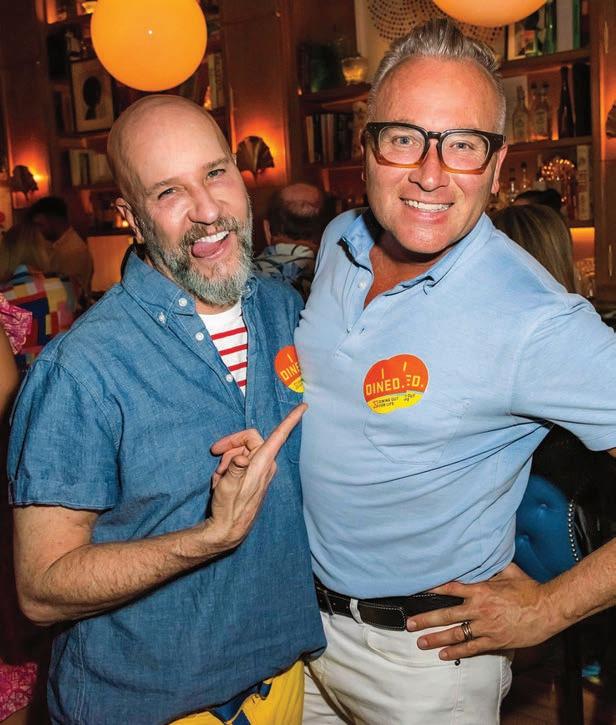
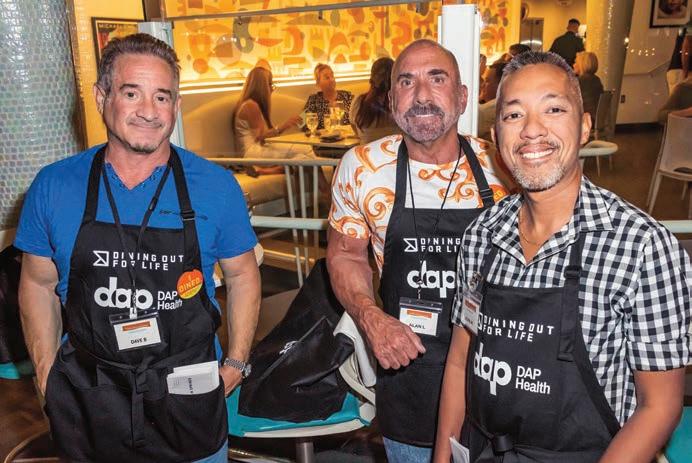
DOFL events for DAP Health
wowed the crowd with her black-wigged, black-pantsuitclad rendition of Liza Minnelli’s classic song “Liza with a Z.”
As at other DOFL events nationwide, diners are invited— usually by “ambassadors,” volunteers who explain the DOFL cause to patrons willing to listen—to donate to the evening’s designated service organization in addition to what the restaurant is giving. At the April event, says Gonzalez-Hastings, “this gentleman came up to me with a $5 bill and said it was all he could afford. I told him that it made all the difference”—just as DOFL has been making a huge difference for 35 years now.
DOFL CAME TO LIFE IN 1991 IN PHILADELPHIA AT a service provider called Action AIDS, which in 2016 became Action Wellness. The development director at the
time, Larry Biddle, had a lot of friends working in hospitality who were getting sick and dying. He and a volunteer, Julie Drizin, “wanted to raise money to make sure people with AIDS had access to services,” remembers Kevin Burns, then an Action AIDS case manager who went on to helm the organization until 2023.
And so, the third Thursday in February 1991, the first DOFL took place in Philly, with a small number of mostly gay-owned restaurants (including the defunct Astral Plane, a legendary eatery) giving 33% of that night’s profits to Action AIDS, totaling a couple thousand dollars. “It was a way for them to fill up the restaurants at a slow time of year, and it was a very easy way for people to come out and support the agency,” says Burns, whose staffers, along with Action AIDS clients, would volunteer as DOFL ambassadors at the restaurants.
In the ensuing years, says Burns, DOFL in Philly grew to more than 150 participating restaurants per year, with Astral Plane raising a total nearing $250,000. His agency used the money to pay for expenses the Ryan White CARE Act didn’t cover, such as the salaries of two full-time staffers who ran its program, through which more than 200 volunteers became “buddies” to homebound unwell folks, helping them with errands, groceries and chores and keeping them company.
DOFL events for the LGBT Life Center (top) and for DAP Health
The money was also used to help clients avoid eviction and pay utility bills, support the agency’s program for pregnant women living with HIV and employ addiction specialists.
But once the program resumed after COVID, Burns says, the yearly take dropped to about $60,000 to $70,000—likely due to significant rises in restaurant expenses after the pandemic that squeezed the wallets of both proprietors and their diners.
Nonetheless, Burns says that during his years as head of DOFL, “what really moved me was how many of our clients volunteered to be ambassadors at restaurants, being open to diners about the fact that they received services from us, because they were so grateful to the agency.”
A few years after Action AIDS kick-started DOFL, it went national—the Philly agency sold its trademark on the event for $1, says Burns. Now run by a volunteer board, DOFL is still held annually in almost 50 cities across the United States. The program involves 2,400 restaurants and 300,000 diners and raises about $4.5 million annually, according to C.J. Tobe, board president for Amplify Network, which oversees DOFL. Amplify also hosts an annual trade and best-practices conference for HIV service organizations, with this year’s, the second annual, to take place in Indianapolis from July 20 to 22.
Pre-COVID, as many as 65 cities nationwide had restaurants participating in DOFL, says Tobe, who also works for DAP Health (formerly Desert AIDS Project), the sprawling, multisite nonprofit that is the beneficiary of DOFL in heavily LGBTQ Palm Springs, California, which has had a DOFL night since 2004.
Tobe says that DOFL has special meaning for him because after he was diagnosed with HIV in Ohio in his early 20s, AIDS Resource Center Ohio (now Equitas Health), the nonprofit that cared for him, used DOFL money to fund his transportation to and from health and other key appointments for three years.
DOFL events for the LGBT Life Center (top) and for Empath Health
In Palm Springs, he says, DOFL usually raises about $200,000 a year for DAP—money that benefits the agency’s sexual health clinics as well as frontline services, including food, rental assistance, transportation and wellness services, such as acupuncture, massage and support groups.
Noting both the Trump administration’s hostility to healthcare and services spending (especially for LGBTQ folks and communities of color) and the increasing squeeze on states as the Ryan White HIV/AIDS Program is flat-funded despite the rising costs of medications and health plan premiums, he says, “the importance of agencies having unrestricted funds for any and all uses is so significant.”
He adds, “DOFL is a form of organized resistance—a way of people being able to say ‘Screw you’ to the federal government right now and give directly to causes they believe in.”
PART OF THE POWER OF DOFL IS THAT IT LOOKS A little different in every city, not to mention every venue, that hosts it. Cities don’t even hold the event on the same night; DOFL names an annual date every year—this year, it was April 23; next year, it’ll be April 29—but about half of venues choose a date that works better for them.
For instance, in Palm Springs, which this year participated on April 23, more than 60 venues became involved—including Townie Bagels, which donated 100% of revenues that day to DOFL and kicked in another 10% on top of that.
“I’ve had a lot of friends who’ve passed [from AIDS],” says Bill Sanderson, who, with his longtime husband, Andy Wysocki, owns the bagel shop. (They developed the gay hookup sites BigMuscle and BigMuscleBear years ago in San Francisco, where, says Sanderson, they raised almost
$1 million over 26 years for the AIDS Emergency Fund, now known as PRC, formerly the Positive Resource Center.)
Sanderson says this year, the shop’s DOFL day take—its latest since it started participating in 2016—plus the extra 10% raised $6,300 for DAP.
“We’ve been lucky,” he says of himself and Wysocki, “and we want to give back while we can. As humans, we can do three things—write a check, volunteer your time to a charity or hold someone’s hand. So this is how we try to do those things.”
DAP Health DOFL event
In Tacoma, Washington, the gay bar The Mix has been participating in the city’s DOFL, giving 75% of its take for one day, almost every year since the bar opened in 2008. That’s according to one of its owners, Brock Leach, a college math professor who opened the bar with a fellow teacher. “It’s just a normal night at the bar,” he says of DOFL, “with many people picking up a DOFL dining option earlier and then coming to the bar after.”
Leach says he hosts the night in honor of an older generation of gay people in Tacoma who suffered the worst of the AIDS epidemic. “I know that seeing their friends disappear week after week profoundly affected them, and we want to do everything to make sure their voices are heard. I’m so grateful that nobody living with HIV that I know today is dying.”
Proceeds from The Mix and other Tacoma DOFL venues benefit the nonprofit AHAT Homecare (formerly Afford Housing and Treatment), which provides various forms of housing for low-income people with HIV, including formerly incarcerated and homeless individuals. Chace Hunter, its executive director, says the agency received about $15,000 last year from DOFL. That money, he says, goes mainly to transportation and nutritional services for which the agency otherwise receives no public funds.
“It pays for the proteins, like chicken and beef, that food pantries don’t provide,” he says. “It also gives us a lot of freedom to provide for our clients with few restrictions,” of the sort that are often tied to public money.
And in Chester, New Jersey, the restaurant Fresco Mexican, owned by Carlos Cervantes and Marco Rojas, gives 33% of its take on DOFL night— amounting to between $500 and $600—to EDGE New Jersey, which since the ’90s has provided housing (under many prior names) to people living with HIV and currently provides a wide range of treatment, care and prevention services.
Says Cervantes, “I lived through the AIDS crisis on Key West”—the island off Florida with a large gay population—“and it devastated us there. I lost a lot of friends.” For him, DOFL is “my way of giving back as a gay man.”
Cervantes says that, like at many venues nationwide, DOFL night at Fresco Mexican is a low-key affair. “It’s not a drag spectacular,” he says. “Just a lovely evening of community.”
BACK AT HABANA CAFÉ, IN GULFPORT, DOFL IS indeed a drag spectacular—which seems to suit the patrons there just fine. This year, in addition to Chatty Patty’s impeccable Liza stylings, DOFL night featured the esteemed local queens Blaise Atrayl, Bitsy St. Claire, Honey Biscuit and Aphelia Dairy-Air.
“She created her own royal court,” says Chatty Patty of Aphelia, “so she’s the Duchess of Gulfport, and I’m the Duchess of Chatterton, because of my chatty mouth.”
But Chatty Patty has a serious side. She was diagnosed with HIV in 1993 and in 1996, thanks to a transplant of her own stem cells, survived non-Hodgkin lymphoma, a formerly common cancer associated with poorly controlled HIV. In the rough years that followed, she says, Empath Health, with funding from Ryan White but also, importantly, from DOFL, was a lifesaver.
“If it wasn’t for Empath and DOFL back when I had no money and was on disability and fighting for my life…..” She breaks off, crying, then, “I watched so many people die.”
But then, just like Liza, she rallies. “I’ll be hosting DOFL at Habana Café until I no longer can!” she declares.
And that’s not the only thing she shows up for at her special friend Jo Gonzalez-Hastings’s all-are-welcome café. “I’m having back surgery in June, but I’m hoping I can get back on my heels by the end of the July—I have drag bingo then!” Q
Visit diningoutforlife.com to learn more.
HEROES
BY JAY LASSITER
Centering Lived Experience
At only 27 years old, Princess Jauan Durbin already has a decade of advocacy experience under their belt. The HIV activist is vice president of community health and partnerships at the Southern Legal Center for Youth, where they head its leadership programs.
“The Southern Kiki Leaders Collective is my HIV prevention grassroots program for the kiki scene,” Durbin tells POZ. “It includes HIV awareness and prevention initiatives and programming, including linkage-to-care services directly to the ballroom community.”
Kiki is a youth-centered o shoot of ballroom culture, the mostly Black and Latino LGBTQ underground community best known today for vogueing and its portrayal in the 1990 documentary Paris Is Burning as well as the ctional TV series Pose (2018–2021). AIDS gured in both the movie and the TV show. According to Durbin, HIV-related healthcare disparities continue to disproportionately harm Black and Latino communities.
“I bring resources, community empowerment and sexual health navigation services into the ballroom space in a way that is accessible and digestible,” Durbin explains. “This outreach brings those resources directly into community and gives young people, speci cally between ages 18 and 30, direct access to resources and opportunities to protect their sexual health.”
Thanks to those e orts, Durbin’s in uence extends well beyond their home base in suburban Washington, DC.
“Although I live in Prince George’s County, Maryland, my programs are in Atlanta; Charlotte, North Carolina; and Orlando, Miami and Tampa in Florida.”
A 2020 graduate of Morehouse College, Durbin recently completed their master’s degree, a milestone they hope will propel the next phase of their career.
“I knew that I wanted a master’s degree, and I came across the master of science in health equity program at Meharry School of Global Health,” Durbin says. “That was honestly the best program to equip me with healthcare policy education, speci cally epidemiology. Graduate school just exposed me to the kind of technical research and theory side of this work that I could use as I actually do community-based research and programming.”
Durbin’s recent partnerships include a collaboration with pharmaceutical company ViiV Healthcare, for which they serve as a youth ambassador. Durbin also chairs the Health Action Alliance’s HIV Leadership Advisory Council for U.S. Business Action to End HIV.
“I’m proud of the work that I’m doing with ViiV because I have my own digital series called #Princess in Community that’s created, produced and written by me,” Durbin explains. “The series allows me to go beyond prevention and allows me to center joy and lived experience, conversations that go deeper than ‘get on PrEP [pre-exposure prophylaxis for HIV prevention].’”
A common thread throughout Durbin’s advocacy is their insistence that stakeholders put their money where their mouth is when it comes to young people.
Caption to go here and is a long-term survivor and advocate.
“I’m tired of hearing ‘young people are doing such great HIV work’ but without funding our work,” Durbin says. “I’ve been upli ed beautifully in this space, but I have not been resourced enough to have the impact that I know I can have in eradicating this disease.” Q
One tablet once a day. Each tablet contains 600 mg efavirenz + 300 mg tenofovir disoproxil fumarate + 200 mg emtricitabine. Take on an empty stomach. Dose should be taken at bedtime to minimize dizziness, drowsiness and impaired concentration.
One tablet once a day. Each tablet contains 150 mg elvitegravir + 150 mg cobicistat + 10 mg tenofovir alafenamide + 200 mg emtricitabine. Take with food.
This quick-reference chart compares antiretroviral (ARV) options for the treatment of HIV, including adult dosing and dietary restrictions. Visit poz.com/drugchart for more info.
One tablet once a day. Each tablet contains 300 mg tenofovir disoproxil fumarate + 300 mg lamivudine. Take with or without food.
DESCOVY
tenofovir alafenamide + emtricitabine
One tablet once a day. Each tablet contains 25 mg tenofovir alafenamide + 200 mg emtricitabine. Take with or without food.
EMTRIVA *
emtricitabine (also known as FTC)
One 200 mg capsule once a day. Take with or without food.
EPIVIR *
lamivudine (also known as 3TC)
One 300 mg tablet once a day, or one 150 mg tablet twice a day. Take with or without food. Also approved for the treatment of hepatitis B virus but at a lower dose. People living with both viruses should use the HIV dose.
EPZICOM *
abacavir + lamivudine
One tablet once a day. Each tablet contains 600 mg abacavir + 300 mg lamivudine. Take with or without food. Should be used only by individuals who are HLA-B*5701 negative.
TEMIXYS
tenofovir disoproxil fumarate + lamivudine
One tablet once a day. Each tablet contains 300 mg tenofovir disoproxil fumarate + 300 mg lamivudine. Take with or without food.
TRUVADA *
tenofovir disoproxil fumarate + emtricitabine
One tablet once a day. Each tablet contains 300 mg tenofovir disoproxil fumarate + 200 mg emtricitabine. Take with or without food.
VIREAD *
tenofovir disoproxil fumarate
One 300 mg tablet once a day. Take with or without food.
ZIAGEN *
abacavir
One 300 mg tablet twice a day, or two 300 mg tablets once a day. Take with or without food. Should be used only by individuals who are HLA-B*5701 negative.
Protease Inhibitors (PIs)
EVOTAZ
atazanavir + cobicistat
One tablet once a day. Each tablet contains 300 mg atazanavir + 150 mg cobicistat. Take with food.
KALETRA * lopinavir + ritonavir
Two tablets twice a day, or four tablets once a day, depending on HIV drug resistance. Each tablet contains 200 mg lopinavir + 50 mg ritonavir. Take with or without food.
PREZCOBIX
darunavir + cobicistat
One tablet once a day. Each tablet contains 800 mg darunavir + 150 mg cobicistat. Take with food.
PREZISTA
darunavir
One 800 mg tablet, or two 400 mg tablets plus one 100 mg Norvir tablet once a day, or one 600 mg tablet plus one 100 mg Norvir tablet twice a day, depending on drug resistance. Take with food.
REYATAZ * atazanavir
Two 200 mg capsules once a day, or one 300 mg capsule plus one 100 mg Norvir tablet once a day. Take with food.
ISENTRESS
raltegravir
Two 600 mg Isentress HD tablets (shown) once a day for those who are treatment naive or whose virus has been suppressed on an initial regimen of Isentress. One 400 mg Isentress tablet twice daily for people with HIV treatment experience. Take with or without food.
TIVICAY
dolutegravir
One 50 mg tablet once a day for those first starting ARV therapy or for those who have not used an integrase inhibitor in the past. One 50 mg tablet twice a day for people with treatment experience who have HIV that is resistant to other integrase inhibitors and when taken with certain ARVs. Take with or without food.
VOCABRIA cabotegravir
One 30 mg tablet taken once a day with once-daily Edurant for a month as an optional lead-in regimen before switching to Cabenuva injections or for short-term treatment. Take with food.
NORVIR * ritonavir
Norvir is usually taken to boost the levels of other ARVs in the blood. Take with food.
Inhibitors
without food.
DOVATO
dolutegravir + lamivudine
One tablet once a day. Each tablet contains 50 mg dolutegravir + 300 mg lamivudine. Take with or without food.
One tablet once a day. Each tablet contains 150 mg elvitegravir + 150 mg cobicistat + 10 mg tenofovir alafenamide + 200 mg emtricitabine. Take with food.
IDVYNSO
doravirine + islatravir
One tablet once a day. Each tablet contains 100 mg doravirine and 0.25 mg islatravir. Take with or without food.
JULUCA
dolutegravir + rilpivirine
One tablet once a day. Each tablet contains 50 mg dolutegravir + 25 mg rilpivirine. Take with a meal.
One tablet once a day. Each tablet contains 150 mg elvitegravir + 150 mg cobicistat + 300 mg tenofovir disoproxil fumarate + 200 mg emtricitabine. Take with food.
One tablet of either Symfi or Symfi Lo once a day. Each tablet of Symfi contains 600 mg efavirenz + 300 mg tenofovir disoproxil fumarate + 300 mg lamivudine. Each tablet of Symfi Lo (shown) contains 400 mg efavirenz + 300 mg tenofovir disoproxil fumarate + 300 mg lamivudine. Take on an empty stomach. Dose should be taken at bedtime to minimize dizziness, drowsiness and impaired concentration.
One tablet once a day. Each tablet contains 800 mg darunavir + 150 mg cobicistat + 10 mg tenofovir alafenamide + 200 mg emtricitabine. Take with food.
TRIUMEQ
dolutegravir + abacavir + lamivudine
One tablet once a day. Each tablet contains 50 mg dolutegravir + 600 mg abacavir + 300 mg lamivudine. Take with or without food. Should be used only by individuals who are HLA-B*5701 negative.
Inhibitors
Entry
TIVICAY
dolutegravir
VIREAD * tenofovir disoproxil fumarate
One 300 mg tablet once a day. Take with or without food.
ZIAGEN * abacavir
One 300 mg tablet twice a day, or two 300 mg tablets once a day. Take with or without food. Should be used only by individuals who are HLA-B*5701 negative.
EDURANT
rilpivirine
One 25 mg tablet once a day. Take with food.
INTELENCE
etravirine
One 200 mg tablet twice a day. Take with food.
PIFELTRO
doravirine
One 100 mg tablet once a day. Take with or without food.
SUSTIVA *
efavirenz
One 600 mg tablet (shown) once a day, or three 200 mg capsules once a day. Take on an empty stomach or with a low-fat snack. Dose should be taken at bedtime to minimize dizziness, drowsiness and impaired concentration.
RUKOBIA fostemsavir
One 50 mg tablet once a day for those first starting ARV therapy or for those who have not used an integrase inhibitor in the past. One 50 mg tablet twice a day for people with treatment experience who have HIV that is resistant to other integrase inhibitors and when taken with certain ARVs. Take with or without food.
VOCABRIA cabotegravir
One 30 mg tablet taken once a day with once-daily Edurant for a month as an optional lead-in regimen before switching to Cabenuva injections or for short-term treatment. Take with food.
NORVIR *
ritonavir
Norvir is usually taken to boost the levels of other ARVs in the blood. Take with food.
TYBOST
cobicistat
One 150 mg tablet once a day in combination with ARVs that require boosting. Used only to boost other drugs. Take with food.
SUNLENCA lenacapavir
Sunlenca tablets are taken as a loading dose, with injections once every six months thereafter. Take with or without food.
These antiretroviral medications are rarely prescribed and no longer recommended:
APTIVUS tipranavir
COMBIVIR * zidovudine + lamivudine
CRIXIVAN indinavir
One 600 mg tablet twice a day for people with HIV treatment experience. Take with or without food.
SELZENTRY
maraviroc
One 150 mg, 300 mg (shown) or 600 mg tablet twice a day, depending on other meds used, for people with HIV treatment experience. Take with or without food.
TROGARZO ibalizumab
A long-acting injectable administered intravenously as a single loading dose of 2,000 mg followed by a maintenance dose of 800 mg every two weeks for people with HIV treatment experience.
Visit poz.com/drugchart-prevention for a list of ARV options to prevent HIV.