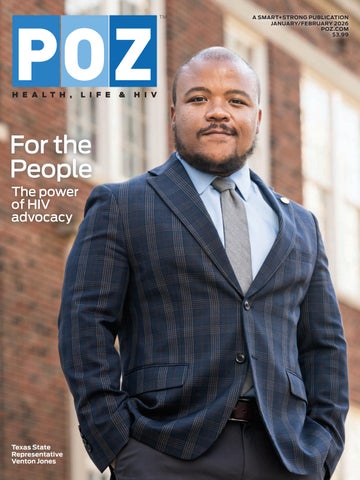
A SMART+STRONG PUBLICATION JANUARY/FEBRUARY 2026 POZ.COM $3.99
H E A L T H ,
L I F E
&
H I V
For the People The power of HIV advocacy
Texas State Representative Venton Jones
P01-26pfc_COVER.indd 1
11/25/25 16:01
POZ30632-00_POZ_JANFEB26_OC1.pgs 11.25.2025 15:05
CONTENTS
EXCLUSIVELY ON
POZ.COM
Venton Jones
#ADVOCACY Fighting against HIV and AIDS has always been a struggle. Much work remains to end the epidemic. POZ encourages you to get involved in advocacy. Go to poz.com/ advocacy to find the latest news and learn how you can make a difference in the fight.
D
#CRIMINALIZATION Advocates around the world are working to change laws that criminalize HIV, which harm people living with the virus. For more information and to learn how to get involved in reform efforts to make such laws reflect current science, go to poz.com/criminalization.
D
The science is clear: People who have an undetectable viral load don’t transmit HIV sexually. In addition to keeping people healthy, effective HIV treatment also means HIV prevention. Go to poz.com/undetectable for more.
D
POZ DIGITAL Scan the QR code (left) with your smartphone camera or go to poz.com/digital to view the current and past issues online.
20 A VOICE FOR THE PEOPLE Venton Jones, a Texas state representative, shares his journey living with HIV and being an elected official. BY ALICIA GREEN 26 THE ART OF HEALING Reverend Joyce McDonald’s sculptures are testimonies to resilience. BY KYLE CROFT 3 FROM THE EDITOR
14 BASICS
Everyday People
African Americans and HIV
4 POZ Q&A
15 RESEARCH NOTES
Joe Westmoreland, a former POZ columnist and author of Tramps Like Us, a lightly novelized memoir published in 2001, talks about why the book was reissued in 2025.
Which PrEP injections are more tolerable? • HIV drug resistance is declining over time • more clues to a cure • new mpox alert
16 CARE & TREATMENT 6 POZ PLANET Snoop Dogg joins Mississippi HIV advocates • amfAR awards new HIV cure grants • expanding PrEP access • Hyacinth celebrates 40 years • retreat from health ideas • POZ Stories: Derrick “Strawberry” Cox • Everyday: milestones in the HIV epidemic
HIV service disruptions and provider shortages • lenacapavir for HIV treatment • HIV research has led to other advances • semaglutide improves liver and heart health
18 NUTRITION & FITNESS
Mock sangria • performing daily activities
10 VOICES
32 HEROES
Black transgender advocate Mallery Jenna Robinson discusses sharing our HIV stories, and advocates Kelly Robinson, Octavia Lewis and the Reverend Claude Bowen urge Atlanta to keep up the fight against HIV.
Shameka Parrish-Wright has spent her entire career caring for people with HIV.
33 POSTER 2026 HIV awareness days
COVER AND THIS PAGE: (JONES) DAVID LOI; (GAVEL/BOOKS, BARBED WIRE AND MAGNIFIER) ISTOCK
#UNDETECTABLE
POZ (ISSN 1075-5705) is published monthly except for the January/February, April/May, July/August and October/November issues ($19.97 for an 8-issue subscription) by Smart + Strong, 157 Columbus Avenue, Suite 525, New York, NY 10023. Periodicals postage paid at New York, NY, and additional mailing offices. Issue No. 289 POSTMASTER: Send address changes to POZ/Smart + Strong, 157 Columbus Avenue, Suite 525, New York, NY 10023. Copyright © 2026 CDM Publishing, LLC. All rights reserved. No part of this publication may be reproduced, stored in any retrieval system or transmitted, in any form by any means, electronic, mechanical, photocopying, recording or otherwise without the written permission of the publisher. Smart + Strong® and POZ® are registered trademarks of CDM Publishing, LLC.
P01-26p02_TOC.indd 2
11/25/25 08:34
POZ30632-00_POZ_JANFEB26_002.pgs 11.25.2025 07:40
FROM THE EDITOR
Everyday People
EDITOR-IN-CHIEF
ORIOL R. GUTIERREZ JR. MANAGING EDITOR
JENNIFER MORTON
I
DEPUTY EDITOR
TRENT STRAUBE SCIENCE EDITOR
LIZ HIGHLEYMAN COPY CHIEF
JOE MEJÍA EDITORIAL ASSISTANT
LAURA SCHMIDT ART DIRECTOR
DORIOT KIM ART PRODUCTION MANAGER
MICHAEL HALLIDAY CONTRIBUTING WRITERS
SHAWN DECKER, OLIVIA G. FORD, ALICIA GREEN, MARK S. KING, TIM MURPHY, MATHEW RODRIGUEZ, CHARLES SANCHEZ CONTRIBUTING ARTISTS
JOAN LOBIS BROWN, LIZ DEFRAIN, ARI MICHELSON, JONATHAN TIMMES, BILL WADMAN FOUNDER
SEAN STRUB LEGACY ADVISER
MEGAN STRUB ADVISORY BOARD
GUILLERMO CHACÓN, SABINA HIRSHFIELD, PHD, KATHIE HIERS, TIM HORN, PAUL KAWATA, NAINA KHANNA, JESSE MILAN JR., DANIEL TIETZ, MITCHELL WARREN PRESS REQUESTS
NEWS@POZ.COM SUBSCRIPTIONS
HTTP://ORDER.POZ.COM UNITED STATES: 212-242-2163 SUBSCRIPTION@POZ.COM FEEDBACK
EMAIL WEBSITE@POZ.COM OR EDITOR-IN-CHIEF@POZ.COM
SMART + STRONG PRESIDENT AND COO (GUTIERREZ) JOAN LOBIS BROWN; (ILLUSTRATION) GETTY IMAGES/SANTIMA.STUDIO
IAN E. ANDERSON EDITORIAL DIRECTOR
ORIOL R. GUTIERREZ JR. CHIEF TECHNOLOGY OFFICER
CHRISTIAN EVANS VICE PRESIDENT, INTEGRATED SALES
DIANE ANDERSON INTEGRATED ADVERTISING MANAGER
JONATHAN GASKELL INTEGRATED ADVERTISING COORDINATOR
SARAH PURSELL SALES OFFICE
212-938-2051; SALES@POZ.COM
CDM PUBLISHING, LLC CEO
JEREMY GRAYZEL CONTROLLER
JOEL KAPLAN
POZ.COM/FACEBOOK
POZ.COM/X
POZ.COM/INSTAGRAM
HAVE ALWAYS BEEN amazed at how HIV advocates are so often molded into leaders as a result of their testing positive for the virus or, if they are HIV negative, by having some personal connection to the epidemic. Other diseases inspire folks who care about them to be advocates, of course. However, it’s the doggedness of HIV advocates that I admire most. People would be much better off if they never underestimated the determination of HIV advocates. Case in point: Venton Jones. Our cover subject has been involved in HIV advocacy since testing positive for the virus in 2007. He has served in many capacities, especially helping Black gay men. But there is more to the story. His interest in community health in general precedes his diagnosis. And now, his passion for doing even more for his fellow citizens has taken center stage. Venton was elected to the Texas Legislature in 2022. He became one of the first Black LGBTQ people in the Texas State House and the first Black lawmaker openly living with HIV in the country. To underscore his success, he was reelected in 2024. In 2025, Venton and dozens of other Texas House Democrats fled the state. Their goal was to block the passage of a redistricting map that would create five new Republican seats in the U.S. House of Representatives. Go to page 20 to read how that saga ended and what he has planned for the future. In addition to Venton, we spotlight other Black advocates from across the country in this special issue focusing on African Americans. They include the Reverend Joyce McDonald and Shameka Parrish-Wright. Joyce is a long-term survivor and an artist. She became passionate about being a sculptor when she participated in an art therapy program after she tested HIV positive in 1995. Go to page 26 to learn more about her decades-long journey living with the virus and to view her sculptures.
Shameka has spent her entire career caring for people living with the virus. Currently, she is the executive director of Vocal-KY, a grassroots group based in Louisville, Kentucky, devoted to “ending AIDS, the drug war, mass incarceration and homelessness.” She is HIV negative but has many personal connections to the epidemic. Go to page 32 for more. Black people, especially in the South, are disproportionately affected by HIV. Although African Americans make up just 12% of the U.S. population, they accounted for 38% of all new HIV diagnoses in 2023, with more than 14,700 new cases, according to the Centers for Disease Control and Prevention. For the latest statistics and other facts, go to page 14. In 2025, Snoop Dogg treated students in Mississippi to a rap session about HIV. He was there to launch Generation Z & HIV, an educational tour by the LGBTQ media advocacy group GLAAD. Go to page 6 for more. Please go to the back of the issue for our 2026 HIV and AIDS Awareness Days poster.
ORIOL R. GUTIERREZ JR. EDITOR-IN-CHIEF editor-in-chief@poz.com
poz.com JANUARY/FEBRUARY 2026 POZ 3
P01-26p03_EdLetter.indd 3
11/25/25 10:31
POZ30632-00_POZ_JANFEB26_003.pgs 11.25.2025 09:34
POZ Q&A BY TIM MURPHY
Left: Westmoreland (right) at home with Charles Atlas, his partner, and Vivian, their cat; right: the cover of the 2025 reissue of Tramps Like Us
QUEER BOHEMIA AND AIDS
I
N 2001, POZ COLUMNIST AND AIDS SURVIVOR JOE WESTMORELAND, then 45, published the moving and vivid Tramps Like Us, a lightly novelized memoir of gay Midwestern kids in the 1970s who flee abusive homes, first to New Orleans, then San Francisco, where they dance all night to disco and punk rock, do every drug and have every kind of sex imaginable, discover who they are and knit together a family that descends from joy into caretaking and grief as AIDS engulfs them. The book’s original publication was overshadowed by 9/11, but it was reissued in 2025. In July, Tim Murphy talked with Westmoreland, now 69 and a decadeslong New Yorker, about the book and its revival for Murphy’s Caftan Chronicles Substack, which features long-form interviews with notable older gay men. Below is a brief excerpt.
What was it like going from the 1970s into the AIDS era?
Joe, congrats on the reissue of your book. How did this reboot happen?
What was a typical day like for you at that time?
My friend Eileen Myles, the poet, had been after me for a while to get the book out again, but I have a lot of health issues and didn’t have the energy to start shopping it around. So right after COVID lockdown, Eileen took the book to their agent and to the young gay editor Jackson Howard at Farrar, Straus and Giroux. They both emailed me and said they loved it and wanted to work with me. What did Jackson say about the book?
That he thought people his age could relate to it because even though it was a different time, the core issues—moving to big gay cities from the Midwest and making friends—were the same. He said that a lot of young people don’t know a lot about what AIDS was like.
We started hearing about this new disease in the early 1980s, but we felt we didn’t do whatever gave it to you, like poppers or going to bathhouses. But by 1983 or 1984, a lot started happening fast, and we didn’t have time to think. We just had to deal with what was going on. Doctors would tell us that they knew about as much as we did, which was nothing.
I went to work every day [as a word processor]. My coworkers knew my friends were sick and would hear me on these intense phone calls. Also, my friends and I started doing drugs a lot more. That’s how we dealt with it. We’d go from hanging out and getting high to sitting by the hospital beds of our friends. There was a lot of confusion and emotions.
(WESTMORELAND AND ATLAS) COURTESY OF JOE WESTMORELAND/JOHANNA CONSTANTINE; (BOOK COVER) COURTESY OF JOE WESTMORELAND
A former POZ columnist remembers having a blast, then facing crushing loss.
4 POZ JANUARY/FEBRUARY 2026 poz.com
P01-26p04-05_QA.indd 4
11/25/25 16:16
POZ30632-00_POZ_JANFEB26_004.pgs 11.25.2025 15:20
The book is so detailed. Did you keep a diary all those years?
No. Some of it is fictionalized. In the years it takes place, I kept a sporadic journal. Even today, songs that remind me of that time and place can trigger a PTSD memory. That’s why I put all the songs we were listening to back then into the book. How long did it take to write?
Close to 10 years. When I worked as a word processor, I’d get home around midnight and write for an hour or two. Then, after I moved from San Francisco to New York City, my CD4s dropped low enough for me to have an AIDS diagnosis, so I went on disability and joined The Writers Room, which is where I wrote most of it.
Have you been clean and sober since?
I basically haven’t had a drink since 1987. I used to go to 12-step meetings all the time. I recently started going again to one meeting that I like. I’ve been so sick the past decade that sitting in a meeting was often hard to do. I had liver cancer, and the tumor burst, and I was in a hospital for three weeks. Thankfully, I didn’t need chemo, but prior to that, in 2007, I had colon cancer with both surgery and chemo. So my immune system is pretty run down. In 2019, I had a heart attack. The liver cancer also came back, and they had to cut out part of my liver. Then I caught norovirus, which really almost did me in.
What was the writing experience like?
Like there was this story in me that had to come out. I would write in my journal for 20 or 30 minutes, fall asleep for about 10 minutes, then wake up and start writing, then edit. A couple times at The Writers Room, I cried all night, time traveling back to what I was writing about.
Joe Westmoreland
COURTESY OF JOE WESTMORELAND/LORI E. SEID
We were actually using clean needles and supplies before AIDS hit. Still, we knew about AIDS but didn’t believe it would happen to us. People were still going to the baths and not using condoms. People didn’t change their behavior immediately. Often, we asked, “Should we be doing this?” Then we’d say, “Fuck it. I want to get high, and we probably have [AIDS] already.” What do you think when you look back on nights like that?
Looking back, maybe we didn’t need to do all those drugs to have that intimacy. But we were trying to dull the pain. Where the book ends, I go to Los Angeles, get pulled over for drunk driving, wind up in Alcoholics Anonymous and stop drinking and doing drugs.
No! I wanted to go to college, but my dad wouldn’t sign a loan for me to go anywhere else. So well, fine, let me take off then, I thought. But there were times standing on the side of the road hitchhiking where I thought, Other kids my age are in college right now—I wonder what that’s like. How many of the real people you based characters on died?
About half. Ali and Felipe both died in 1986, and James died in 2000. But a few of the girls in the book I’m still in touch with.
“There was this story in me that had to come out.”
How are you feeling now? The drug-use scenes are by turns euphoric, comradely, surreal and upsetting. When you all are shooting up heroin together, it’s so cozy and intimate and yet so sad.
road. Did you have a strong sense then of living this amazing bohemian life?
Better than in a long time. But I have a lot of fatigue. And I’m on a dozen pills. With sickness, you have to put your mind aside and let your body do what it has to do.
You’re in a long-term relationship with the artist Charles Atlas.
I met him a week after I moved to New York City, but we didn’t start seeing each other until a couple years later. And we’ve lived together now since 1990 on West 14th Street.
Do you want to still be writing?
I’m doing a little bit. Last summer, I wrote the afterword for the new edition because they wanted to know what happened between when the book came out in 2001 and today. So I wrote every day for a few hours.
What do you want to prioritize with the rest of your life?
I love your relationship in the book with your Midwest childhood friend, Ali, and how you are simultaneously best friends, brothers and lovers until he dies of AIDS.
What is a daily source of happiness for you?
His real name, which he gave himself, was Qalbee. We would have sex. We weren’t boyfriends but were so close that other people thought we were. You were so young when you hit the
I would love to finish book No. 2. It’s a big mess right now. It’s about my hospital experiences but also life in New York City and reasons why I keep going.
My cat, Vivian. Charles will be working on his video stuff, and I’ll be listening to music, and Vivian is sleeping in her box, and everything’s quiet and OK, and that’s what I love. And the book has made me think about that—it’s about looking for my home. And now I’m here, I’m in it and I don’t want this to change. Q
poz.com JANUARY/FEBRUARY 2026 POZ 5
P01-26p04-05_QA.indd 5
12/2/25 09:59
POZ30632-00_POZ_JANFEB26_005.pgs 12.02.2025 09:03
POZ PLANET UPDATES ON HIV & AIDS
SNOOP DOGG JOINS GLAAD ADVOCATES TO LAUNCH “GENERATION Z & HIV” Music superstar Snoop Dogg treated students at Jackson State University to an unexpected rap session about HIV. The “Drop It Like It’s Hot” hitmaker was a surprise guest at the Mississippi school for the launch of Generation Z & HIV, an educational tour by LGBTQ media advocacy group GLAAD that will be making stops at historically Black colleges and universities (HBCUs) to raise HIV awareness. Snoop, whose family hails from Mississippi and has ties to the university, joined several local HIV experts October 28 to speak with students about HIV education and history and share his insights about the LGBTQ community. Mobile HIV testing units courtesy of Jackson Hinds Comprehensive Health Center and Open Arms Healthcare Center provided services before and after the program. Generation Z & HIV: Human Issue, Southern Solution: an HBCU Tour is spearheaded by Darian Aaron, GLAAD’s director of local news for the U.S. South and founder of the annual GLAAD Down South media event. “Generation Z is the most out LGBTQ generation in history— 22% are LGBTQ—yet the least knowlClockwise from edgeable about HIV,” noted GLAAD in a above left: press write-up about the HBCU tour. “Only Scene from 37% of Gen Z, ages 18 to 26, said they Doggyland; the feel knowledgeable about HIV, according Generation to GLAAD research published in the 2024 Z & HIV tour State of HIV Stigma Study. And, with fewer pieces of film and television media portraying characters living or dealing with HIV, Gen Z is not receiving the HIV information they deserve, including scientific developments such as PrEP [pre-exposure prophylaxis, the highly effective HIV prevention medication available as daily pills or long-acting injections to people at risk of contracting the virus].” This wasn’t Snoop’s first time making headlines regarding LGBTQ stories. Last summer, the rapper was blasted for criticizing Disney’s 2022 movie Lightyear for including a samesex couple. (Snoop said his grandson was confused by the same-sex kiss and asked how two women could have a baby, a question he didn’t know how to answer.) Snoop soon changed his tune. “I had no understanding of a situation that was brought before me while I was with my grandson,” the rapper recalled to the Jackson State students. “But through time and experience and love, you learn to live and you get information, you find out how to understand things better. I have friends that are same-sex parents that reached out to me and gave me information on what they say to their kids when things of that nature pop up and how they speak [to their children].” Snoop then teamed with GLAAD for its anti-bullying Spirit Day initiative, October 16, which urges folks to wear purple as a show of support for queer youth. He also penned the new song “Love Is Love” for an episode of his animated children’s series, Doggyland, on YouTube and tapped The Voice contestant
Jeremy Beloate, who is queer, to be a guest on the episode— an ode to the love of same-sex parents. “Our parents are different. No two are the same, but the one thing that’s for certain is the love won’t change,” sang the animated pups. Snoop also shared his experiences as a Gen X rapper in the 1980s and ’90s, the first decades of the epidemic. His industry lost Easy-E in 1995 and Craig Mack in 2018 to HIV-related illnesses, GLAAD noted. Snoop recounted that back in the day, critical lifesaving information about the virus was lacking in the hip-hop community. He also had a special message to straight Black men who feel they’re not likely to contract HIV. “A disease shows no prejudice,” Snoop said. “The best thing you can do is get protected; find more information.” GLAAD’s Aaron expanded on the sentiment: “HIV in Black communities is far from over, and Black people in the South, regardless of sexual orientation, gender identity, socioeconomic status or number of total partners, remain at disproportionate risk,” Aaron said. “The HBCU tour is one way GLAAD is arming those most at risk with the information necessary to safeguard their health.” Other Mississippi HIV experts involved in the tour launch include Linda Dixon, Cedric Sturdevant, Valencia Robinson, Evonne Kaho, David Malebranche, MD, and Alecia Reed-Owens. According to GLAAD, the Generation Z & HIV tour will run through 2026 with stops at Alabama State University in Montgomery, Alabama, and Morehouse College in Atlanta. —Trent Straube
(DOGGYLAND) DOGGYLANDKIDS/YOUTUBE: (GENERATION Z & HIV TOUR) COURTESY OF JACKSON STATE UNIVERSITY/ARON SMITH
He spoke of love in LGBTQ families and HIV in Black culture.
6 POZ JANUARY/FEBRUARY 2026 poz.com
P01-26p06-07_Planet.indd 6
12/2/25 10:42
POZ30632-00_POZ_JANFEB26_006.pgs 12.02.2025 09:45
amfAR Awards New HIV Cure Grants There was fierce competition for the research funding. To support innovative research projects aimed at curing HIV, amfAR, The Foundation for AIDS Research, has awarded new Target Grants funding five of them in a single round for the very first time. This brings total funding for new grants and fellowships in recent months to more than $3.1 million. In an indication of the fierce competition among scientists for research support, especially in the wake of substantial cuts to federal funding of HIV research, amfAR received the highest number of grant submissions since 2005. “All five of these outstanding research teams proposed innovative, wellsupported and carefully crafted studies that received high marks from our
grant reviewers,” amfAR’s incoming CEO Kyle Clifford said. “We are deeply grateful to the generous donors who make these grants—and the potential breakthroughs they could lead to— possible.” The only successful HIV cure strategy to date has involved high-risk stem cell transplantation in 10 people living with both HIV and certain blood cancers and cannot be replicated on a global scale. An effective cure strategy needs to be scalable, accessible and applicable to the largest number of people possible. The new amfAR grantees are working on a range of approaches to eradicating HIV or controlling the virus in the absence of antiretroviral therapy
while striving to fulfill these criteria. Each project is awarded $480,000 over two years. The awardees are: Francesco Simonetti, MD, PhD, of Johns Hopkins University in Baltimore; Rachel Rutishauser, MD, PhD, of University of California San Francisco, and Brad Jones, PhD, of Weill Cornell Medicine in New York; Mirko Paiardini, PhD, of Emory University in Atlanta; Sharon Lewin, PhD, of University of Melbourne in Australia, and Thumbi Ndung’u, PhD, of Africa Health Research Institute, South Africa; and Nadia Roan, PhD, of Gladstone Institutes in San Francisco, and Possu Huang, PhD, of Stanford University. —amfAR
Expanding Access to PrEP
(AWARD) GETTY IMAGES/DOOMU; (RXEACH) RXEACH.ORG
The RxEACH Initiative focuses on community pharmacies. Pharmacists’ knowledge and accessibility in nearly every urban and rural community should be leveraged as a core component of comprehensive HIV prevention and care strategies to expand access to services and improve population health. As trusted health care professionals who develop a strong rapport with patients, pharmacists can address disparities in pre-exposure prophylaxis (PrEP) prescribing patterns and act as essential liaisons between patients and other members of the multidisciplinary care team. The expansion of biomedical PrEP options increases the ability to match prevention methods to individual life circumstances. A broader menu of PrEP products enables personalized prevention plans that account for housing stability, work schedules, caregiving responsibilities and other
social determinants of health. Pharmacists can counsel patients on comparative benefits, side effects, adherence needs and logistics to support informed choice and sustained use. RxEACH NMAC’s Initiative partnership tool kit with the RxEACH Initiative focuses on expanding access to HIV prevention and linkage to care services through community pharmacies. This kind of partnership demonstrates how national organizations and community pharmacy networks can scale pharmacy-based prevention, integrate referral and case management pathways and provide training and quality assurance for pharmacists delivering HIV services.
Recommendations for Policy and Practice • Authorize pharmacists to provide PrEP in jurisdictions lacking access to primary care or specialist providers. • Scale pharmacybased rapid testing with clear protocols for same-day linkage to prevention and treatment. • Fund training and technical assistance for pharmacists on PrEP options, cultural humility and care coordination. • Incentivize pharmacy services in medically underserved and rural areas through reimbursement models that cover counseling, testing and initiation visits. • Integrate pharmacies into public health data and referral systems to track outcomes, identify
gaps and ensure continuity of care. • Center equity in outreach to ensure pharmacybased services intentionally reach communities most affected by HIV. The National HIV/AIDS Strategy notes that community pharmacies and pharmacists represent an underused but powerful resource for expanding HIV prevention and care. Leveraging their accessibility, trust and clinical skills to prescribe PrEP, provide rapid testing and coordinate care will reduce disparities, strengthen retention and adherence and improve population health outcomes. NMAC’s collaboration with the RxEACH Initiative provides a practical blueprint for scaling these services through sustained partnerships and policy change. Go to rxeach.org to view the RxEACH playbook and tool kit. —Harold Phillips, NMAC
poz.com JANUARY/FEBRUARY 2026 POZ 7
P01-26p06-07_Planet.indd 7
11/25/25 12:53
POZ30632-00_POZ_JANFEB26_007.pgs 11.25.2025 12:02
POZ PLANET UPDATES ON HIV & AIDS
Retreat From Big Ideas on Health Care
Hyacinth Celebrates a 40-Year Milestone New Jersey’s first HIV service provider held a gala fundraiser. Hyacinth AIDS Foundation first opened its doors in New Jersey in 1985. In 2025, the HIV service provider marked that milestone with a 40th anniversary blowout celebration and silent auction in Short Hills, New Jersey. The Hyacinth gala also issued a call to action and resilience. “We will not relive the 1980s,” declared executive director Kathy Ahearn O’Brien onstage. “We will fight to keep our doors open for another 40 years.” Her message earned a standing ovation. Over 200 guests, including celebrities, lawmakers, advocates, board members from across the country and other community members, showed support for Hyacinth’s services as well as the dedicated folks who provide them and those who rely on them. The gala included an auction and fundraiser. The gala also shined a spotlight on advocates and supporters who represent the organization’s courage and commitment to justice: • Dominique Jackson received the Riki Jacobs Social Justice Award. Known for playing Elektra Abundance Evangelista on the TV series Pose, Jackson is also an author, ballroom icon and outspoken
advocate for the Guests transgender and at the immigrant commuHyacinth nities. At the gala, gala she delivered a passionate reflection on visibility and the ongoing struggle for equality. • New Jersey State Assemblywoman Shanique Speight received a Hyacinth Award. Her leadership in securing substantial state funding was instrumental in strengthening Hyacinth’s programs. Speight spoke about the importance of investing in communities that too often go unseen and unheard. • Public health leader Ketlen Baptiste Alsbrook, MPA, received a Hyacinth Award. She is the director of Newark’s Department of Health and Community Wellness and executive director of the Mary Eliza Mahoney Health Center. Hyacinth recognized Baptiste Alsbrook for her transformative leadership in public health and her tireless pursuit of equity for Newark’s most vulnerable residents. • Peter Jewell received the Deloris Dockrey Community Advocate Award. Hyacinth honored his lifelong commitment to advocacy for both the LGBTQ community and people living with HIV. —Trent Straube
In the run-up to the 2020 election, all 20 Democratic presidential candidates promised voters that they would pursue bold changes to health care, such as a government-run insurance plan or Medicare for all Americans. Fast-forward to the congressional stalemate that closed the federal government for more than a month. Democrats, entrenched on one side of the legislative battle, staked their political future on merely preserving parts of the Affordable Care Act (ACA, or Obamacare)—a far cry from the systemic health policy changes that party members once described. Democrats succeeded in focusing national attention on rising health insurance costs, attempting to hold up funding for the federal government until a deal could be made to extend the subsidies that have cut premiums for Obamacare plans. Their doggedness could help them win votes in midterm elections. But health care prices are rocketing, costly high-deductible plans are proliferating and four in 10 adults have some form of health care debt. As health costs reach a crisis point, a yawning gulf exists between voters’ desire for more aggressive action and the political urgency in Washington for sweeping change. “There isn’t a lot of eagerness among politicians,” said Jonathan Gruber, an economist who played a key role in drafting the ACA. “Why aren’t they being more bold? Probably scars from the ACA fights. But health care is a winning issue. The truth is we need universal coverage and price regulation.” Voters rank lowering health care costs as a top priority, above housing, jobs, immigration and crime, according to a September poll by Hart Research Associates for Families USA, a consumer health advocacy group. And costs are climbing. Premiums for job-based health insurance rose 6% in 2025 to an average of $26,993 a year for family coverage, according to an annual survey of employers released October 22 by KFF, a health information nonprofit that includes KFF Health News. For all the attention given to grocery, gas and energy prices, health premiums and deductibles in recent years have risen faster than overall inflation and wages. —KFF Health News
(HYACINTH) COURTESY OF DMDC PHOTOGRAPHY; (CHAMPAGNE GLASSES) GETTY IMAGES/KARANDAEV; (ARROW, HEALTH CARE ITEMS) GETTY IMAGES/WILDPIXEL
The recent federal shutdown highlighted increasing costs.
8 POZ JANUARY/FEBRUARY 2026 poz.com
P01-26p08-09_Planet.indd 8
11/25/25 13:11
POZ30632-00_POZ_JANFEB26_008.pgs 11.25.2025 12:20
YOU ARE BEAUTIFUL
(COX) COURTESY OF STRAWBERRY COX; (MCDONALD) @VISUAL_AIDS/INSTAGRAM; (LOS ANGELES) GETTY IMAGES/SIMONKR; (FAIRYLAND POSTER) WIKIPEDIA; (TRUMP) WIKIPEDIA/GAGE SKIDMORE; (ONGINA) WIKIPEDIA/DVSROSS
Derrick “Strawberry” Cox reminds us that we are valuable and worthy of love. My name is Derrick Cox, but I go by Strawberry. I am from southeast Washington, DC. I have red hair, green eyes, light skin. I’m a man, and I’m feminine. Growing up was not easy because of how different I was, how I looked and how I acted. Being different from everyone around you was, well, let’s just say that kids really do know how to be mean, and the adults do too. I had to learn how to fully love and accept myself for being who I am as a feminine male who enjoys the company of other males. Sadly, this came only after a failed suicide attempt around age 13. It was after years of being rejected, unloved, unappreciated and just made fun of for simply existing.
EVERYDAY January
When I was young, I was promiscuous, and I had many lovers. I was polyamorous, without knowing what it was. Then when I was 21 years old, I found love with one person. I trusted that person with everything, including my body. He believed that every pretty gay man was HIV positive. He assumed that I was positive as well. I didn’t know his status or the fact that he hadn’t been taking his meds. You can imagine the hurt, pain, confusion and disappointment once I found out the news. I found out that I was HIV positive in late September 2010, but I didn’t believe it. I ended up shutting down emotionally for a long time, without letting anyone know. It wasn’t until I found a doctor who I felt safe and comfortable with at Whitman-Walker [Medical Clinic] in early 2011 that I revisited my diagnosis. Due to my lack of care for my body, my CD4 numbers were low, and my viral load was very high. HIV was not something that I wanted to die from—or continue to be afraid of—so I decided to work with my doctor and take actions to take back control of my life, my mental health and my sexual experiences with others. I started my meds to get my health
Read other POZ Stories or share your own at poz.com/stories.
These dates represent milestones in the HIV epidemic. Visit poz.com/aidsiseveryday to learn more about the history of HIV and AIDS. BY JENNIFER MORTON
13
Artist JOYCE MCDONALD is diagnosed with HIV. (1995)
14
AIDS PROJECT LOS ANGELES elects its first board of directors. (1983)
20
February
5
During his State of the Union address, PRESIDENT DONALD J. TRUMP announces the new federal initiative Ending the Epidemic: A Plan for America. (2019)
7
NATIONAL BLACK HIV/AIDS AWARENESS DAY
FAIRYLAND, a coming-of-age drama based on Alysia Abbott’s memoir, Fairyland: A Memoir of My Father, premieres at the Sundance Film Festival. (2023)
28
back to where it needed to be. And since then, I have remained undetectable. I started with two to three pills a Strawberry Cox day and then ended up doing one pill a day, and now, I’m doing injectables. I’ve never been as happy as I am living in my truth, sharing my story and helping guide those who are just as lost and confused as I was. I want to let everyone know that regardless of your status you are still beautiful. You are still able to love, and you are still worthy of being loved. And nothing can stop that, as long as you do what you need to do to take care of you. Today, I am 37 years old and still remain undetectable and am as healthy as ever. My sex life is very open, and I don’t hide my status from anyone. There’s no shame, judgment or stigma that can keep me from continuing to fully live in my truth without any guilt or regrets. No matter your status, you are still valuable!
During his State of the Union address, PRESIDENT GEORGE W. BUSH announces the establishment of PEPFAR to address AIDS across the globe, specifically in Africa. (2003)
23
After winning the MAC Viva Glam Challenge on season 1 of RuPaul’s Drag Race, contestant ONGINA reveals she is living with HIV. (2009)
28
HIV IS NOT A CRIME AWARENESS DAY
poz.com JANUARY/FEBRUARY 2026 POZ 9
P01-26p08-09_Planet.indd 9
12/2/25 12:04
VOICES BLOGS AND OPINIONS FROM POZ.COM
BUILDING OUR FUTURES
I
OFTEN SAY THAT MY LIFE’S WORK has been shaped at the intersection of identity, survival and community. As a Black transgender woman with Afro-Caribbean roots, I know firsthand what it means to navigate a world where HIV stigma, transphobia and systemic racism collide. These experiences have not only influenced my journey, but they have also become the very reason I step into spaces of advocacy, leadership and storytelling. My entry into HIV and AIDS work came through community. Growing up, I heard stories of friends, elders and chosen family who had been lost to the epidemic and others who were surviving against the odds. Their resilience left an imprint on me. By the time I began serving on advisory boards and engaging in outreach programs, I understood that this work was about more than medical care; it was about dignity, justice and the possibility of joy. Over the past 13 years, I’ve had the privilege of serving on multiple boards, including the West Hollywood Transgender Advisory Board, the Long Beach Transwellness board and the Being Alive HIV board, among others. Each role has taught me something different, but together they have reinforced a central truth: Our communities carry
deep wisdom, and that wisdom must guide the future of HIV care and advocacy. Too often, policies and programs are built without the voices of those most impacted. We cannot afford that silence any longer. My Afro-Caribbean heritage has also shaped how I view this work. From my Haitian ancestors, I inherited not only resilience but also a tradition of resistance and community care. These values guide how I show up in the HIV sector. When I advocate for leadership opportunities for Black, Latinx and trans communities, I am carrying forward that ancestral call to liberation. For me, equity is not just a policy demand—it is a spiritual obligation. The future of HIV care must extend beyond the clinic. Yes, access to treatment and prevention is critical. But care also means addressing housing insecurity, mental health needs and systemic discrimination. It means creating spaces where people living with HIV can thrive, not just survive. I envision a future where care is holistic, where providers, advocates and policymakers listen to community voices and respond with compassion and resources, not judgment or red tape. Storytelling has been one of the most powerful tools in my work.
Through projects like the A Hateful Homicide podcast and my transgender empathy trainings, I’ve seen how sharing lived experiences can open hearts and shift perspectives. In recent conversations within the community, I’ve noticed a recurring theme: the need to reclaim joy. For too long, HIV has been framed solely in terms of tragedy, loss or crisis. While it is true that we have endured immense grief, it is equally true that we have cultivated resilience, love and creativity that defy the odds. Joy is not a luxury; it is a form of resistance. By celebrating survival, by dancing, by loving openly, we affirm our humanity. Looking forward, my hope is that the sector continues to evolve with equity, sustainability and community leadership at its core. This means shifting from short-term projects to long-term investments in grassroots organizations. As a community leader, I carry both memory and vision. I carry the memory of those lost to the epidemic, the mentors who taught me how to fight. And I carry the vision of a future where people living with HIV are not just surviving but thriving; where equity is a lived reality, not just a buzzword; and where joy is recognized as central to our collective liberation. Q
GETTY IMAGES/MYCOLA
Writing for AIDS United, Black transgender advocate Mallery Jenna Robinson shared her thoughts in a blog post titled “Voices of Community: Carrying Our HIV Stories, Building Our Futures.” Below is an edited excerpt.
10 POZ JANUARY/FEBRUARY 2026 poz.com
P01-26p10_Voices1.indd 10
11/25/25 13:25
POZ30632-00_POZ_JANFEB26_010.pgs 11.25.2025 12:30
LET’S STOP HIV TOGETHER
I’m empowered when I take care of myself. “Taking care of myself means taking my HIV meds, going to the gym, and going to see my doctor. This helps me stay on my HIV treatment and know my self-worth.” — NICK FROM NASHVILLE, TENNESSEE
BE EMPOWERED. GET IN CARE, STAY IN CARE, AND LIVE WELL WITH HIV.
cdc.gov/HIVTreatmentWorks
PZA60379.indd 1
ɐ$0 PZA60379.pgs 11.20.2025 08:11 ESA
VOICES BLOGS AND OPINIONS FROM POZ.COM
Downtown Atlanta
HEARTBEAT AND HISTORY
A
TLANTA HAS ALWAYS BEEN both the mirror and the moral compass of America’s HIV epidemic. It is the home of the Centers for Disease Control and Prevention, the epicenter of HIV research at Emory University and the lifeline of Grady Hospital—all symbols of progress and promise. Yet behind that reputation lies a more complicated truth: Atlanta is still fighting to meet the needs of the very communities that made this movement possible. For decades, Atlantans have led the way—from the early days of community care at the Atlanta Gay Center to the founding of the city’s Department for HIV Elimination. Every major victory here has been driven not by bureaucracy but by community. People living with HIV, Black and Brown queer and trans leaders and neighborhood organizers have carried this movement forward. They are the heart of Atlanta’s response and the heartbeat of its future. But the heart of this city is tired. While Atlanta is often praised as a forerunner of HIV innovation, many community agencies are stretched beyond capacity. Chronic underfunding has limited outreach and weakened our linkage-to-care systems. Too many Atlantans go untested, untreated or
unconnected because the local workforce simply cannot keep pace with the need. These agencies are the backbone of Atlanta’s HIV response—but a backbone cannot bear the weight alone. The result is a system that looks strong from afar but strains under inequity up close. Black gay and bisexual men, Black transgender women and Black cisgender women remain the most affected, with infection rates that reflect not a failure of science but a failure of justice. Prevention tools like PrEP [pre-exposure prophylaxis] and treatment options are available, but access is uneven. For too many, the promise of ending the epidemic still feels like someone else’s dream. To change this, Atlanta must move beyond innovation alone and embrace cultural humility as a public health strategy. It’s not enough to deliver care; we must deliver it with understanding, compassion and respect. HIV work cannot be siloed from mental health care, trauma recovery or housing security. The affordable housing crisis, untreated mental health needs and stigma remain direct barriers to viral suppression. Ending the epidemic requires a system that sees the whole person. Atlanta’s history shows that change is possible when we face hard truths.
The 2015 Fulton County HIV program audit forced a reckoning that led to stronger oversight and coordination. The 2019 legalization of syringe services reflected a bold commitment to harm reduction and saving lives. The use of molecular cluster analysis has helped identify transmission networks in real time, bringing precision to prevention. But even with these advancements, inequities rooted in racism, poverty and stigma continue to shape outcomes. What stands in the way is not only a lack of resources but also a lack of shared power. Expertise is too often measured by connections rather than lived experience. Those most affected by HIV are invited to the table but rarely given the microphone. That must end. True leadership in this moment requires humility—the willingness to listen, to share power and to be held accountable. We cannot build an equitable HIV response on the same hierarchies that helped create inequity. Decision-makers at every level, from government agencies to philanthropic funders, must intentionally center the leadership of people living with HIV and the organizations closest to the community. Atlanta’s heart has always led this fight. Let’s make sure it finishes it. Q
GETTY IMAGES/PGIAM
In an opinion piece titled “Atlanta: The Heartbeat and History of an Epidemic Still Fighting to Be Won,” advocates Kelley Robinson, Octavia Lewis and the Reverend Claude Bowen urge for more. Below is an edited excerpt.
12 POZ JANUARY/FEBRUARY 2026 poz.com
P01-26p12_Voices2.indd 12
11/25/25 14:11
POZ30632-00_POZ_JANFEB26_012.pgs 11.25.2025 13:15
For more information email: tjross@condomdispenser.org or visit online: condomdispenser.org
PZA554949.indd 1 PZA554949.indd 1
2/24/25 2/24/25 3:03 3:03 PM PM PZA554949.pgs 02.24.2025 15:03 ESA
BASICS BY LIZ HIGHLEYMAN
AFRICAN AMERICANS AND HIV Black people, especially in the South, are disproportionately affected by HIV.
in people of different racial/ethnic groups, and treatment guidelines are the same. But access is key, and Black people are less likely than white people to receive HIV care and treatment. In 2022, an estimated 88% of African Americans living with HIV had been tested and knew their status—about the same as the HIV population overall, according to the CDC. HIV testing is important because people who know their status can start treatment, which halts disease progression and prevents HIV transmission via sex if viral load is suppressed. Among those diagnosed, 74% of Black people received some HIV care, 52% were retained in care and 61% achieved viral suppression—the lowest of any racial/ethnic group.
Beyond HIV, African Americans are at greater risk for other health conditions that can complicate HIV care, including high blood pressure, heart disease, kidney disease, type 2 diabetes, hepatitis C and sexually transmitted infections. Higher rates of poverty, homelessness and incarceration, lower health insurance coverage and limited access to highquality health care, especially in rural areas, all contribute to the disproportionate burden of HIV in Black communities. Racism, homophobia, stigma and distrust of the health care system can leave African Americans less likely to seek out HIV prevention, testing and care, but many AIDS organizations offer services specifically tailored to the needs of Black people at risk for or living with HIV. Q
GETTY IMAGES/DRAZEN ZIGIC (MODELS USED FOR ILLUSTRATIVE PURPOSES ONLY)
T
HROUGHOUT THE UNITED States, Black people bear the greatest burden of HIV. While African Americans make up just 12% of the U.S. population, they accounted for 38% of all new HIV diagnoses in 2023, with more than 14,700 new cases, according to the Centers for Disease Control and Prevention (CDC). This proportion has remained roughly stable over the past five years. Compared with white people, Black people are about eight times more likely to be diagnosed with HIV. Of the estimated 1.2 million Americans living with HIV, around 40% are Black. Black men accounted for 47% of new HIV diagnoses among young gay, bisexual and other men who have sex with men (ages 13 to 24), though Latinos accounted for a higher proportion among those older than 24. The highest number of new cases is among Black gay men in the South. Black women make up half of all new HIV diagnoses among women— 11 times higher than the diagnosis rate for white women. Although data for transgender people are limited, Black trans women have disproportionately high HIV prevalence. Only 57 children were diagnosed with HIV in 2023, but 60% of them were Black. Just over a quarter of cases among Black men and women are attributable to injection drug use. Despite having a higher rate of HIV acquisition, Black people in the United States are substantially less likely than their white peers to use pre-exposure prophylaxis (PrEP), which reduces the risk of acquiring the virus by around 99%. Along with using condoms and not sharing drug injection equipment, PrEP is a highly effective tool for preventing HIV. Experts are hopeful that the approval of twice-yearly injectable PrEP (lenacapavir, or Yeztugo) in June 2025 will help close the gap. Advances in antiretroviral therapy have benefited all people living with HIV. Since the advent of effective treatment, HIV-related mortality has declined dramatically—and it is no longer among the top 10 leading causes of death for Black men or women—but African Americans still account for around 40% of HIV-related deaths. Antiretrovirals do not work differently
14 POZ JANUARY/FEBRUARY 2026 poz.com
P01-26p14_Basics.indd 14
11/25/25 14:19
POZ30632-00_POZ_JANFEB26_014.pgs 11.25.2025 13:22
RESEARCH NOTES
(NEEDLE AND SYRINGE) GETTY IMAGES/AMORNRAT PHUCHOM; (BLOOD) GETTY IMAGES/101DALMATIANS; (BERLIN) GETTY IMAGES/ANDREY DANILOVICH; (MONKEYPOX VIALS) DREAMSTIME.COM/MERA BOKA
BY LIZ HIGHLEYMAN
PREVENTION
TREATMENT
CURE
CONCERNS
PrEP Injections
Drug Resistance
Clues to a Cure
DoxyPEP Drawbacks
Apretude (cabotegravir) may cause fewer injectionrelated side effects than Yeztugo (lenacapavir) for pre-exposure prophylaxis (PrEP), but it needs to be taken more often. Apretude, from ViiV Healthcare, is administered as a single intramuscular injection every other month, while Yeztugo, from Gilead Sciences, is administered as two subcutaneous injections every six months. Yeztugo forms a depot under the skin that can sometimes be felt as a hard nodule. In the Phase I CLARITY trial, sponsored by ViiV, 63 people were randomized to receive a single dose of Apretude or Yeztugo, followed by the other 15 days later. About 80% reported pain after both injections, but other reactions were more common with Yeztugo. Most were mild or moderate. After receiving one dose of both, 69% found Apretude injections very or totally acceptable, compared with 48% for Yeztugo. Most (90%) said they preferred Apretude, while 10% preferred Yeztugo. These findings suggest that PrEP users may face a trade-off between more tolerable injections and less frequent dosing.
HIV drug resistance has declined by nearly 17% over the past decade, according to an analysis of more than 90,000 blood samples collected by Quest Diagnostics. Resistance mutations in HIV RNA, which reflects current viral replication, fell from about 30% in 2018 to about 25% in 2024. Resistance mutations in HIV DNA, which reflects “archived” inactive virus in CD4 cells, had a similar decline. Mutations conferring resistance to newer meds were generally less common thanks to increased use of modern regimens that are more potent, tolerable and convenient. Combined nucleoside/ nucleotide reverse-transcriptase inhibitor (NRTI) and non-nucleoside reversetranscriptase inhibitor (NNRTI) resistance fell to 4% in HIV RNA and 8% in HIV DNA, while combined NRTI and integrase inhibitor resistance fell to 5% and 9%. But dual-class and triple-class resistance were more common among older people, who may have used multiple drugs. Triple-class resistance was below 0.5% in HIV RNA from younger adults but rose to 4% in HIV DNA from older people.
It’s not yet clear how the 10 people cured of HIV after stem cell transplants have managed to eliminate the virus, but in one case, unusually efficient natural killer (NK) cells may play a role. In 2024, researchers presented the “Next Berlin Patient,” a German man who has now been free of HIV for seven years after stopping antiretrovirals. Unlike Timothy Ray Brown—the original Berlin Patient—and six other people, he received stem cells from a donor with only one copy of a rare genetic mutation called CCR5-delta32 that blocks HIV from entering CD4 cells. A detailed analysis showed that he had a higher frequency of a specific subset of NK cells (NKG2A+/ CD57+) and high HIV-specific antibody-dependent cellular cytotoxicity, exceeding that of natural elite controllers. He produced powerful antibodies—more potent than broadly neutralizing antibodies—that efficiently targeted his strain of HIV. These findings suggest that therapies that promote NK cell activation might help achieve a functional cure in people with HIV who are not eligible for risky stem cell transplants.
Three apparently unrelated cases of Clade I mpox (also known as monkeypox) have been identified in Southern California, state health officials announced in October. All were hospitalized and recovered at home. Several outbreaks of Clade I mpox are ongoing in Central and East Africa. The first case of Clade I mpox in the United States was reported in November 2024, but that individual had recently traveled from East Africa. None of the three new cases in California had recently traveled outside the U.S., suggesting local person-toperson spread. The European Centre for Disease Prevention and Control recently reported the first cases of locally acquired Clade I mpox in Spain, the Netherlands, Italy and Portugal. Clade I mpox has historically had a higher fatality rate than the Clade II type responsible for the large U.S. outbreak in 2022. Health officials say the risk of Clade I mpox remains low for the general U.S. population, but they are urging people at higher risk—including gay men and gender-diverse people—to get two doses of the Jynneos mpox vaccine if they are not already immune.
poz.com JANUARY/FEBRUARY 2026 POZ 15
P01-26p15_Research_Notes.indd 15
11/25/25 14:26
POZ30632-00_POZ_JANFEB26_015.pgs 11.25.2025 13:35
CARE & TREATMENT BY LIZ HIGHLEYMAN
HIV SERVICE DISRUPTIONS AND PROVIDER SHORTAGES Federal budget cuts and restrictions have led to disruptions of services nationwide, imperiling the health and well-being of people living with HIV. According to an October survey by the Emergency HIV Clinical Response Task Force, 70% of HIV providers reported service disruptions. What’s more, 72% anticipate moderate to severe disruptions over the next six to 12 months. The most heavily impacted service areas include gender-affirming care, housing, access to pre-exposure and post-exposure prophylaxis (PrEP and PEP), mental health care, case management, transportation, HIV testing and treatment, and routine monitoring and care. Services in the Midwest and South have been hit the hardest. A shortage of HIV specialists is also a growing concern. A recent analysis found that the United States will need more than 1,500 additional experienced providers to meet UNAIDS targets for HIV testing and treatment. Shortages are most acute in the South, home to just over half of all people newly diagnosed with HIV in 2023. Of the approximately 21,000 HIV specialists identified, 98% practice in urban areas, leaving rural areas underserved. Only 4% practice in predominantly Black neighborhoods and 8% in mainly Latino neighborhoods, despite the fact that these communities have a higher HIV burden. “Disruptions to testing, prevention, care and treatment services jeopardize the foundation of our efforts to end the U.S. HIV epidemic,” says José Zuniga, PhD, MPH, of the International Association of Providers of AIDS Care. “Every delayed test, every missed prevention or treatment opportunity risks lives.”
Lenacapavir, which was approved for HIV preexposure prophylaxis (PrEP) under the brand name Yeztugo in June 2025, has received much acclaim as a highly effective twiceyearly prevention option, but recent studies also demonstrate its promise for HIV treatment. Lenacapavir for treatment, under the brand name Sunlenca, was first approved in 2022 for heavily treatment-experienced people with multidrug-resistant HIV. The Phase II CALIBRATE trial showed that it is also effective for first-line treatment. In 2023, researchers reported that up to 90% of previously untreated people randomized to receive lenacapavir injections every six months plus daily oral antiretrovirals had an undetectable viral load at 54 weeks. Final results published in October showed that nearly 100% of those who stayed on the treatment maintained viral suppression at 132 weeks. There are currently no other equally durable antiretrovirals to build a complete twice-yearly treatment regimen, but broadly neutralizing antibodies (bnAbs) might fill this gap. Results from a Phase II trial, presented at the European AIDS Conference in October, showed that 89% of participants who switched from a standard daily oral regimen to lenacapavir injections plus IV infusions of two bnAbs, teropavimab and zinlirvimab, every six months maintained viral suppression for a year. What’s more, 76% of people
who switched to the twice-yearly regimen said they preferred it to daily pills. Lenacapavir also comes in an oral formulation. In November, Gilead Sciences announced top-line Phase III results from the ARTISTRY-1 trial, which is testing a new daily single-tablet regimen containing lenacapavir and the integrase inhibitor bictegravir (best known as a component of Biktarvy). The study enrolled more than 500 heavily treatment-experienced people on complex regimens containing up to 11 pills a day. Switching to the new combination pill was statistically noninferior to staying on a multi-tablet regimen, the company said. Finally, oral lenacapavir lasts long enough that it doesn’t have to be taken every day. A Phase II trial is evaluating a once-weekly regimen of lenacapavir pills plus islatravir, an oral nucleoside reverse transcriptase translocation inhibitor from Merck. Last year, researchers reported that 94% of participants who switched from daily Biktarvy to lenacapavir plus islatravir had an undetectable viral load at 48 weeks. New results presented at the European AIDS Conference showed that 100% of those who stayed on the weekly regimen maintained viral suppression at 96 weeks. Gilead and Merck are now testing a lenacapavir/islatravir combination pill that could become the longest-acting regimen that doesn’t require injections.
(DOCTOR AND PATIENT) GETTY IMAGES/RENATA ANGERAMI (MODELS USED FOR ILLUSTRATIVE PURPOSES ONLY); (HIV) GETTY IMAGES/QUANTIC69
Lenacapavir Shines for HIV Treatment
16 POZ JANUARY/FEBRUARY 2026 poz.com
P01-26p16-17_Care_Treatment.indd 16
12/2/25 12:16
POZ30632-00_POZ_JANFEB26_016.pgs 12.02.2025 11:24
(MICROSCOPE) GETTY IMAGES/ZOONAR RF; (LIVER) GETTY IMAGES/ARTROSESTUDIO; (HEART) GETTY IMAGES/JITTAWIT.21
HIV Research Has Led to Advances for Multiple Diseases At a time when federally funded HIV research is under threat, a group of leading experts has highlighted how HIV science over the past 40 years has not only produced dramatic advances in prevention and treatment of the virus but has also led to innovations for many other conditions. “Thanks to broad U.S. investment, HIV research has opened the door to breakthroughs and treatments for diseases far beyond HIV/AIDS,” says Larry Corey, MD, of the Fred Hutch Cancer Center in Seattle, one of the coauthors of the commentary in Nature Medicine. U.S.-funded HIV research has saved millions of lives worldwide and made the nation a leader in global health. “No other condition has required the kind of global solidarity and innovation in implementation science that the HIV/AIDS pandemic demanded,” says Chris Beyrer, MD, MPH, director of the Duke University Global Health Institute. HIV prevention, treatment and cure research has contributed to advances in immunology, vaccinology, oncology, cardiovascular and neurodegenerative diseases and aging. For example, CAR-T therapy, which was initially studied as a potential treatment for HIV, is now used to train immune cells to attack cancer. Antiviral treatments for hepatitis B and C largely originated in the HIV field. Insights gained from studying accelerated aging in people with HIV are shaping emerging strategies in geriatrics for the population at large. And although there is still no effective vaccine for HIV, lessons from HIV vaccine research informed the rapid development of COVID-19 vaccines. “A well-resourced deep dive into the understanding of just one infection turned out to be a great way to learn about human biology,” says Steven Deeks, MD, of the University of California San Francisco.
Semaglutide Improves Liver and Heart Health The GLP-1 receptor agonist semaglutide (Ozempic or Wegovy) not only reduces liver fat but also improves biomarkers of cardiovascular risk in people with HIV and metabolic dysfunction-associated steatotic liver disease (MASLD), according to the latest results from the Phase II SLIM LIVER study presented at the AASLD Liver Meeting in November. MASLD and its more severe form, metabolic dysfunctionassociated steatohepatitis (MASH), are responsible for a growing proportion of advanced liver disease worldwide. Around a
third of people in the United States have fatty liver disease, and it’s even more common among people with HIV. Over time, the buildup of fat in the liver can lead to cirrhosis and liver cancer. SLIM LIVER (ACTG A5371) enrolled HIV-positive people on suppressive antiretroviral therapy who had MASLD plus cardiovascular risk factors, such as obesity, a large waist circumference, insulin resistance or prediabetes. They self-administered semaglutide injections once weekly for six months. (Wegovy was approved as a treatment for MASH in August 2025.) In 2024, Jordan Lake, MD, of UTHealth Houston, reported that liver fat decreased by 31%, and more than a quarter of participants experienced complete resolution
of MASLD at six months. What’s more, they saw significant improvements in weight, waist circumference, insulin resistance and glucose and triglyceride levels. At the Liver Meeting, Lake reported that semaglutide led to favorable changes in a variety of lipoproteins, glycoproteins and inflammation biomarkers linked to cardiovascular disease. These improvements did not correlate with changes in weight, suggesting an independent mechanism. “MASLD is increasingly recognized as a major contributor to illness and death among people living with HIV, so identifying treatments that can attenuate its impact is an important priority in HIV research,” Lake says.
poz.com JANUARY/FEBRUARY 2026 POZ 17
P01-26p16-17_Care_Treatment.indd 17
11/25/25 14:39
POZ30632-00_POZ_JANFEB26_017.pgs 11.25.2025 13:45
NUTRITION & FITNESS ADVICE ON DIET AND EXERCISE
MOCK SANGRIA This nonalcoholic drink is filled with vitamins. DID YOU EVER THINK a sangria recipe would qualify as health content? At first, it may seem shocking, but this recipe is packed with fruits and fruit juices, making for a vitamin- and oxidant-rich beverage. SERVINGS: 4 / INGREDIENTS: 9 / PREP: 15 MINUTES INGREDIENTS 1 cup grape juice ¾ cup sparkling apple cider ½ cup orange juice 1 cup sparkling water 2 tablespoons agave nectar 1 orange, sliced 1 lemon, sliced 1 lime, sliced 1 pomegranate, seeds and juice
DIRECTIONS 1. In a large pitcher, combine the grape juice, sparkling apple cider, orange juice, sparkling water and agave. 2. Add the orange, lemon, lime and pomegranate juice and seeds to the mixture. Let the fruit sit in the juice for at least one hour. 3. Serve over ice and garnish with the fruit.
NUTRITION FACTS (per serving) Calories: 184; fat: 1 g; carbohydrates: 46 g; sugar: 37 g; fiber: 5 g; protein: 2 g; sodium: 18 mg
k )UHG +XWFKLQVRQ &DQFHU 5HVHDUFK &HQWHU D F QRQSURƓW RUJDQL]DWLRQ 8VHG E\ SHUPLVVLRQ
Everyday activities include climbing stairs, grocery shopping and housecleaning. Being unable to perform everyday activities is called functional limitation. Physically active middle-aged or older adults have a lower risk for functional limitations than those who are inactive. For older adults, doing a variety of physical activities improves physical function and decreases the risk for falls or injuries from falls. Older adults need to include aerobic, muscle strengthening and balance activities in their physical activity routines. Such multicomponent physical activity can be performed at home or in a community setting as part of a structured program. Hip fracture is a serious injury that can result from a fall. Breaking a hip can have life-changing negative effects, especially among older adults. Physically active people have a lower risk for hip fracture than inactive people. Adapted from: Physical Activity Basics, CDC.gov
(SANGRIA) GETTY IMAGES/ETORRES69; (FRUIT SLICES) GETTY IMAGES/XAMTIW; (POMEGRANATE SEEDS) GETTY IMAGES/HAJRUDIN AGIC
PERFORM DAILY ACTIVITIES AND PREVENT FALLS
18 POZ JANUARY/FEBRUARY 2026 poz.com
P01-26p18_Nutrition.indd 18
11/25/25 09:48
POZ30632-00_POZ_JANFEB26_018.pgs 11.25.2025 08:52
POZ.COM • A daily resource for people living with and affected by HIV and AIDS • Clear, comprehensive prevention and treatment information • News, personal stories, blogs, HIV-specific resources and more • Sign up for free email newsletters
Follow us on:
A SMART + STRONG PUBLICATION Award-winning consumer health care information
POZ_House_Ad_Full-Dec-2024_KODI.indd 25
11/25/24 1:42 PM POZ26281-00_HouseAd.pgs 11.25.2024 13:43
A VOICE FOR THE PEOPLE TEXAS STATE REPRESENTATIVE VENTON JONES SHARES HIS JOURNEY LIVING WITH HIV AND BEING AN ELECTED OFFICIAL. BY ALICIA GREEN
20 POZ JANUARY/FEBRUARY 2026 poz.com
20 P01-26p20-25_Feature_Jones.indd 20 P01-26p20-25_Feature_Jones.indd
14:55 11/25/25 14:55 11/25/25 POZ30632-00_POZ_JANFEB26_020.pgs 11.25.2025 14:04
DAVID LOI
Venton Jones tested HIV positive in 2007.
P01-26p20-25_Feature_Jones.indd 21
11/25/25 14:55
POZ30632-00_POZ_JANFEB26_021.pgs 11.25.2025 14:04
P
OZ READERS WERE FIRST INTRODUCED TO TEXAS State Representative Venton Jones (D–Dallas) in January 2015 as the subject of the magazine’s Heroes page. Back then, he was a 31-year-old HIV advocate working in Washington, DC, seeking to make a difference for Black gay men through public policy. Eleven years later, a lot has changed for Jones. But one thing remains the same: He never forgets where he came from as he looks ahead to where he’s going. “I want people to know that I’m also a person too,” Jones says. “It’s sometimes easy to see what you see now. But that came from years and years of struggle and finding myself.” Jones’s story of resilience, courage and triumph has inspired many people nationwide.
PUBLIC SERVICE WORK ALWAYS FELT right to Jones, whose family boasts numerous career nurses. That’s why, as a student at Texas A&M University, he set his sights on community health. “A lot of my interest came in helping people be well versus helping them not be ill,” says Jones, now 41, who grew up in Dallas and graduated from college in 2006. As a Black gay man living in the South, Jones felt called to HIV work. He recalls a professor once asking students to choose a health disparity to address for a project. “People were working on hypertension, heart disease and cancer,” Jones says. “But from a professional standpoint, no one was really talking about the HIV epidemic. That was problematic Jones was a POZ Hero to me.” in 2015. It spurred Jones to take action to save his life as well as the lives of other Black gay men. But getting a job in health care post-9/11 wasn’t easy, so Jones thought he’d join the military and become a nurse in the U.S. Army. In 2007, Jones enlisted. While preparing for basic training, he received a letter stating that he needed to speak with the Army medical team. Jones went for an HIV test first. The test came back positive. “At that point, I knew I couldn’t go to the Army,” he says. JONES DIDN’T BEAT HIMSELF UP ABOUT HIS DIAGNOSIS for too long.
“I had to forgive myself,” he says. “I was a young Black gay man not doing anything different from what others like me would be doing at that age. I had a virus that was deeply impacting a community.” His diagnosis only further propelled him to help people living with and at risk for HIV. To that end, he earned a master’s degree in health care administration from the University of Texas at Arlington in 2009. Using his health background and personal experience, Jones pursued work that centered on engaging young Black gay and bisexual men through targeted programs and HIV messaging that would reach them. “I was also navigating my own positive status,” Jones says. “That set my HIV work into a higher gear because I really understood HIV not only from the medical testing standpoint but also from the need for support.” IN 2010, JONES RELOCATED TO DC TO LEARN MORE about how policy drives health care services. He started out as the communications and education manager at the National Black Gay Men’s Advocacy Coalition, where he was responsible for managing strategic operations and day-to-day communications for the coalition of over 50 organizations. “I was also able to start the Young Black Gay Men’s Leadership Initiative, which helped to mobilize and engage
22 POZ JANUARY/FEBRUARY 2026 poz.com
P01-26p20-25_Feature_Jones.indd 22
11/25/25 14:55
POZ30632-00_POZ_JANFEB26_022.pgs 11.25.2025 14:04
(JONES AT THE U.S. CAPITOL) JENNIFER MORTON; (CONFERENCE) @SBPAN_US/INSTAGRAM; (PROPOSAL) @VENTONJONESTX/INSTAGRAM
young Black gay voices to take action in policy spaces and advocate,” he says. By late 2013, Jones had moved on to the National Black Justice Coalition (NBJC), a civil rights organization dedicated to empowering LGBTQ people. “I started one of their first health and wellness initiatives that centered addressing HIV in the Black family and raised the resources to put HIV back into the social justice conversation,” Jones says. NBJC worked in such policy spaces as the White House, the Department of Health and Human Services and the Centers for Disease Control and Prevention. “It was great to be a part of that work and helping to navigate the needed conversations and raising the visibility of addressing the HIV epidemic through multiple lenses,” Jones says. In 2017, Jones left NBJC to join AIDS United. His tenure at the national group was short because he had greater ambitions: He wanted to start his own organization. IN JULY 2018, JONES FORMED THE SOUTHERN Black Policy and Advocacy Network (SBPAN), which was born of his desire to help improve health, social and economic conditions for Black communities in the South. At the time, Jones was still living in DC and working as an Uber driver starting at 4 a.m. every day. He would set up office hours for himself to create the Clockwise organization’s business plan. from top: But Jones always planned to Jones at the U.S. Capitol; return to Dallas. “I knew that Jones at a DC wasn’t my endpoint,” he conference; says. “Being able to return Jones (kneeling) back home and bring that work proposes to his back home was what I always partner at the Texas Capitol. wanted to do.” Before his move back to Texas in 2019, SBPAN received its first grant. Jones used the money to create a video project that highlighted HIV and policies needed in the South to help marginalized communities. SBPAN has worked to engage and empower Southern Black leaders and communities via training, education and mobilization with the goal of improving public health policy. At its peak, SBPAN
poz.com JANUARY/FEBRUARY 2026 POZ 23
P01-26p20-25_Feature_Jones.indd 23
11/25/25 14:55
POZ30632-00_POZ_JANFEB26_023.pgs 11.25.2025 14:04
had five full-time staffers and additional part-time staff. But last January, the organization lost almost $1 million in funding as a result of federal budget cuts, leading SBPAN to greatly reduce staff and programming. “We lost projects,” Jones says. “We’re back in a place of having to do aggressive fundraising and getting back to a place where we could operate.” THE DALLAS JONES HAD known and loved was different from the city he remembered when he’d last lived there. “You saw a city that had a lot of changes and growth,” he says. “But in areas like mine, they were not getting the needed services. Health disparities were increasing, and economic opportunities were decreasing.” So Jones decided to get involved in local politics. First, he became a precinct chair (a local representative of the Democratic Party and its candidates in a voting precinct). He was also an election judge, or polling site overseer. In 2021, Jones decided to run for the Texas House of Representatives. He wanted to represent the constituents of House District 100, which serves parts of the Dallas area where Jones grew up. In November 2022, Jones won, becoming one of the first Black LGBTQ people in the Texas State House. Jones also made history as the first Black state lawmaker in the country openly living with HIV. “Even though I’d never been an Jones is elected offiproud of cial, and I being just became reelected.
24 POZ JANUARY/FEBRUARY 2026 poz.com
P01-26p20-25_Feature_Jones.indd 24
11/25/25 14:55
POZ30632-00_POZ_JANFEB26_024.pgs 11.25.2025 14:04
a state representative, there were so many lessons that the HIV movement taught me around the importance of visibility, raising your voice and so many other things,” Jones says. He is proud that his success has inspired others to become involved in politics in their own communities and beyond. “It’s important that we own that power of our ability to make change,” he says. “Sometimes it’s easy or comfortable to wait for somebody to come and save us. But nobody’s coming to save us, especially right now.” JONES IS CURRENTLY IN HIS SECOND TERM AS STATE representative after winning reelection in 2024. He hasn’t forgotten what got him where he is today—his commitment to addressing and ending the HIV and AIDS epidemic. “I’ve been a part of legislation that is really changing how HIV is funded and how services are provided in the state of Texas,” he says. The Texas Legislature convenes for 140 days every other year. Within that time, the legislative body must review bills, calculate the state budget and address other concerns. On occasion, the governor will reconvene members for a special session. Jones has fought through two legislative sessions for passage of a bill that would help increase routine HIV testing, but the bill never made it off the House floor. “No bill just kind of comes in, and you’re going to get it through, especially when you’re working in the minority,” Jones explains. Democrats hold only 62 out of 150 seats in the Texas House of Representatives. Jones adds, “I’m learning how to navigate and move this legislation while also creating the important conversations that need to be had, because I get to be a voice of people living with HIV in that body.” But Jones and his colleagues managed to score one notable success during the 2025 legislative session: They secured $600,000 in funding to add long-acting injectables to the Texas HIV Medication Program’s drug formulary for the first time.
break quorum and not allow the president and the governor to steal congressional seats from Black and brown members in this state and try to steal even more power,” Jones says. The Texas Democrats returned to the state two weeks later, following calls for their arrest by the governor. They also received death threats, including a bomb threat at their hotel in Illinois. “That must’ve been the first time I’ve been genuinely scared to travel the country,” Jones says. Fearing that they’d flee again, the governor and Republican lawmakers required that the Democratic lawmakers be surveilled by police. Three escorts would sit in front of Jones’s house and go wherever he did. So Jones and a colleague led the escorts to a local gay bar for a meeting. “If they wanted to follow me that bad, they were going to follow me into community and spend money,” he says. “But when I got out of that car to go into that meeting, they chose to stay in their vehicles. I guess that was their limit.”
DAVID LOI
“I’M FORTUNATE TO LIVE A LIFE THAT I FEEL HONORS MY ANCESTORS, WHO COULD NOT DO THIS.”
IN AUGUST 2025, JONES AND DOZENS OF TEXAS House Democrats fled the state. Their goal was to block the passage of a new redistricting map that would create five new Republican seats in the U.S. House of Representatives. “I had to leave the state with my Democratic colleagues to
JONES WANTS people to remember that there is a real person behind this work. He is a son, brother, grandson and loving fiancé. He works a fulltime job to earn a living. After health insurance and everything else, Jones takes home only about $400
a month as a state representative. But, Jones says, “I’m fortunate to be able to live a life that I feel honors my ancestors, who could not do this.” In January 2025, after being sworn in for his second term, Jones proposed to his longtime partner on the House floor in the Texas Capitol. He knew he wanted to start his legislative session with a bright moment he’d always remember. “I love having a partner that I can share life with—not just my elected official seat,” Jones says. “That’s one of the most valuable and rewarding things that I got going right now.” Jones says he knew he had to bring every aspect of his identity to the table and hopes his story can serve as an example to other people living with HIV about the power of representation and raising one’s voice. “I want the person navigating day one of their HIV diagnosis to see there’s a Venton Jones who exists that people love and support and was elected,” he says. “Not because I’m living with HIV but because I was living authentically, and HIV was part of that story.” He adds, “I didn’t run for office to be the first anything,” Jones says. “I ran to serve my people and my community.” Q
poz.com JANUARY/FEBRUARY 2026 POZ 25
P01-26p20-25_Feature_Jones.indd 25
11/25/25 14:55
POZ30632-00_POZ_JANFEB26_025.pgs 11.25.2025 14:05
P01-26p26-31_Feature_McDonald.indd 26
Andrés N. Ordorica
COURTESY OF ANDRÉS N. ORDORICA
Mother’s Prayers, 1999, acrylic, Mod Podge and paper towel on air-dry clay
ɐ$0 POZ30632-00_26R1.pgs 12.04.2025 09:51
COURTESY OF RYAN PAGE, GORDON ROBICHAUX, NEW YORK, AND MAUREEN PALEY, LONDON
LONG-TERM SURVIVOR REVEREND JOYCE MCDONALD’S SCULPTURES ARE MOVING TESTIMONIES TO RESILIENCE, FAITH AND THE POWER OF CREATIVE TRANSFORMATION. BY KYLE CROFT
Reverend Joyce McDonald set forth on her path to becoming a sculptor via an art therapy program she participated in after her HIV diagnosis in 1995. Although she grew up surrounded by creativity, her early life was marked by abuse, addiction and loss. After years of struggle, McDonald discovered clay as a medium for healing. The following excerpt is from Kyle Croft’s essay “Crossing the Threshold: Reverend Joyce McDonald’s Art Worlds,” which was included in Ministry: Reverend Joyce McDonald, the catalog for McDonald’s recent exhibition at the Bronx Museum. poz.com JANUARY/FEBRUARY 2026 POZ 27
P01-26p26-31_Feature_McDonald.indd 27
11/25/25 15:39
POZ30632-00_POZ_JANFEB26_027.pgs 11.25.2025 14:46
B
The next year, McDonald was diagnosed with HIV and eventually referred to a day treatment program run by the Jewish Board of Family Services. This was one of several such programs in New York City during this era that endeavored to offer comprehensive and integrated services in a communitybased, noninstitutional setting for people living with HIV. Located in a basement on Jay Street, near downtown Brooklyn, the program she attended predominantly served clients of color from the nearby neighborhoods of Fort Greene, Crown Heights, and Bedford-Stuyvesant. When McDonald joined Rooted in Strength, c. 2000, acrylic and glass beads on air-dry clay
the program around 1997, she met Robert Morrissey, the resident art therapist. Morrissey had been hired to set up an art therapy program a few years prior, eventually establishing a sprawling studio that took over one side of the basement. With ample funding from the Elton John AIDS Foundation and the Ryan White CARE Act, Morrissey “was able to treat everyone in there who was interested as an artist, to provide a place and materials for them to do work every day.” He invited participants to engage freely without an expectation of self-reflection through artistic expression. Sometimes a recurring image would provide a prompt for deeper therapeutic dialogue
COURTESY OF GREG CARIDEO, GORDON ROBICHAUX, NEW YORK, AND MAUREEN PALEY, LONDON
ORN IN 1951, MCDONALD GREW UP IN BROOKLYN’S Farragut Houses at a time when the housing projects represented an image of Black middle-class life. Creativity ran in the family: her father was an accomplished photographer, her mother designed clothes and furnishings, her sister was a celebrated novelist, and as a teenager, McDonald sang at the Apollo Theater in a band called the Primettes. She attended the High School of the Fashion Industries in the late 1960s, but eventually dropped out, moved in with a boyfriend who became abusive, and began to experiment with drugs. She cites her father’s death in 1977 as the point at which she became addicted to heroin. The years that followed were marked by sexual violence and a cycle of abusive relationships, as well as the birth of two daughters. Throughout the 1980s she designed hats and clothes, selling them on street corners in Manhattan to make a living. McDonald’s mother helped her raise her daughters during this period, and she credits her family’s support as essential to her recovery from heroin in 1994.
28 POZ JANUARY/FEBRUARY 2026 poz.com
P01-26p26-31_Feature_McDonald.indd 28
11/25/25 15:39
POZ30632-00_POZ_JANFEB26_028.pgs 11.25.2025 14:46
with a client. More important for Morrissey was the way that artistic practice could facilitate a form of sublimation—a psychoanalytic concept that refers to the transformation of raw, instinctual, or transgressive impulses into culturally valued pursuits. McDonald was one of about two dozen participants in the art therapy program. It was her first introduction to working with clay. Morrissey recalls: I put a lump of clay in her hand, as I would do for most folks, and l’d say, “Okay, just squeeze it, move it, shape it, see what it has to tell you, see what emerges.” Clay is very forgiving, you can change it and shape it and reshape it. It also has very visceral properties—it’s squishy, it’s wet, it’s like shit, it’s like body fluids. It has a very deep connection in that way.... Joyce would take the clay and begin to shape and squeeze it...before you knew it, she had impressed upon this rather inert material her story, her family, her struggles, collective struggles. The clay took on a life of its own with her. McDonald remembers working nonstop, producing dozens of sculptures in her first year in the program. Motifs began to emerge: portraits of women; mothers holding children; families embracing; figures prone and prostrate, in prayer or in pain. This prolific artmaking coincided with—and catalyzed—a period of profound transformation and healing for McDonald. Many of the clients Morrissey worked with in the late 1990s were dealing with what he called “Lazarus syndrome”—referencing the
From Bondage to Freedom, 2008, air-dry clay
biblical figure’s miraculous return to life after being dead for four days. Mortality rates for people living with HIV began dropping steeply after highly effective treatments were approved in 1996; thousands preparing for their impending deaths suddenly found themselves with longer life expectancies. The emotional whiplash of this resurrection was profound—futures once abandoned urgently needed to be reimagined. Salvation and redemption became themes that Morrissey observed across much of the artwork produced at the day program. For McDonald, a series of explicitly autobiographical pieces stand out from this period, including a group portrait of her family at her father’s funeral, a depiction of a clandestine abortion, and Queen Detox (1998), a self-portrait in a hospital gown illustrating one of her stays in a methadone clinic. Perhaps the most haunting piece in this series is a small sculpture of a fetus titled My Son (1999). Unlike other work from this period, it is roughly formed—the corporeality of clay on full display—and adorned only with a few strokes of gold paint and small indentations to mark his developing eyes. McDonald called Morrissey after creating that sculpture, crying, “I don’t know what this is, this baby fetus.” Their conversation helped McDonald come to terms with a traumatic period of domestic violence she experienced in her early
poz.com JANUARY/FEBRUARY 2026 POZ 29
P01-26p26-31_Feature_McDonald.indd 29
11/25/25 15:39
POZ30632-00_POZ_JANFEB26_029.pgs 11.25.2025 14:46
COURTESY OF RYAN PAGE, GORDON ROBICHAUX, NEW YORK, AND MAUREEN PALEY, LONDON
twenties. “My word came up in clay,” she explains in an interview in this catalog, “that’s how I started seeing it and remembering it and facing it.” Viewed alongside her many depictions of mothers and children, My Son lays bare the emotional weight of this subject matter for McDonald. As she shares in the same interview, her family has been a source of boundless love and acceptance. Yet intimacy and motherhood have also been fraught with loss, shame, and tragedy. Much of McDonald’s work turns on the ambiguous depths of emotion—figures look at once peaceful and pained, both bound and freed. Several works across McDonald’s oeuvre illustrate this affective duality through figures with two faces—one looking forward and the other looking back. The 2008 bust From Bondage to Freedom exemplifies this. Viewed from one perspective, it depicts a woman in graceful repose, head tilted to one side and angled slightly upward, eyes closed, eyebrows raised in relief, lips relaxed in a calm smile. The figure on the other side conveys a contrasting affect: her head bowed and lips slightly pursed, she leans forward as if her body is unable to support the burden it carries. Both subjects are clothed, but where the first figure’s dress is neatly draped, the second figure seems confined by the garment, Queen which could Detox, also be read as 1998, thick cords of acrylic and rope envelopfabric ing her body. on airThe sculpdry clay
30 POZ JANUARY/FEBRUARY 2026 poz.com
P01-26p26-31_Feature_McDonald.indd 30
11/25/25 15:39
POZ30632-00_POZ_JANFEB26_030.pgs 11.25.2025 14:46
Top: My Son, 1999, air-dry clay and found objects; bottom: Sweet Peace, 2007, acrylic, Mod Podge and fabric on air-dry clay
ture’s Janus-faced composition suggests the interrelation of these two expressions. McDonald has spoken about the emotional contradictions that kept her silent for so long— how, in an effort to shield both her abusers and her family, she refrained from seeking help. Her response to violence was marked by empathy and a protective instinct. From this perspective, the weight and burden conveyed on one side of the sculpture becomes the cost of the peace and freedom embodied by the other. From Bondage to Freedom also exemplifies how, for McDonald, clay is both an avenue to express what is latent—those past experiences that are difficult to face or put into words—and a way to manifest a different relationship to the body, to project, perhaps, an image of grace. In other words, her material offers access to a sense of agency that had long been denied her. Q
Kyle Croft is the executive director of Visual AIDS, where he works to preserve the legacies of artists lost to AIDS and to support a global community of artists living with HIV. He is the curator of Ministry: Reverend Joyce McDonald, on view at the Bronx Museum through January 11, 2026. ©2025. Reprinted with permission from Visual AIDS. All rights reserved. Visit VisualAIDS.org to learn more about the group’s work and McDonald’s art or to purchase a copy of Ministry: Reverend Joyce McDonald.
poz.com JANUARY/FEBRUARY 2026 POZ 31
P01-26p26-31_Feature_McDonald.indd 31
11/25/25 15:39
POZ30632-00_POZ_JANFEB26_031.pgs 11.25.2025 14:46
HEROES BY JAY LASSITER
Hope and Healing
Shameka ParrishWright has spent decades fighting HIV and AIDS.
TAMMY HOWELL
Shameka Parrish-Wright has spent her entire career caring for people living with HIV and AIDS. She’s currently the executive director of Vocal-KY, a grassroots group based In Louisville, Kentucky, devoted to “ending AIDS, the drug war, mass incarceration and homelessness.” Before that, Parrish-Wright held several leadership posts at The Bail Project, a nonprofit organization that combats mass incarceration by paying bail for people who can’t afford it. In 2023, after 25 years of fighting for those on the margins, Parrish-Wright ran for a seat on the Louisville City Council and won. “I came into office with the activist/organizer hat, so now we’re trying to work on policies that save and improve lives,” says Parrish-Wright. “I have never tested positive for HIV, but I lost a lot to this disease. This has been a lifelong cause that I’ve been a part of because loved ones were dying from AIDS in the ’80s. I remember going to the hospital and not understanding how the opioid crisis that plagued my family—and then crack cocaine—bled over into HIV and AIDS. All these issues overlap.” Many of Parrish-Wright’s clients and constituents are more vulnerable than ever as a result of President Donald Trump’s budget priorities. “Every day, it weighs heavy,” she explains. “I wake up sad about people losing benefits. I just got back from Washington, DC, trying to convince our elected officials, using every hat I wear, that if we don’t do something to protect vulnerable people living with HIV, people will die. So I pray, I write, I sing, I dance. And sometimes I just sit in my car, and I cry.” Parrish-Wright mentioned burnout several times during her interview with POZ. She says warding off burnout is essential for anyone in the HIV activist space. “I need to make sure I’m being real with what I can accomplish,” she says. “But we’ve seen what it means when people get the resources and the medical attention they need. That’s what motivates me. I heal watching that.” Trump’s hostility toward social justice activism won’t deter Parrish-Wright. She remains committed to fighting for those living with or at risk for HIV, including poor people languishing in jail because they can’t post bail. “Sometimes people sit in jail two, three, four years waiting to go to court,” she explains. “When they’re acquitted, there’s no help for them. They’ve lost their home; their health has suffered. And then to take this work we do with Vocal-KY and to show up at the [Kentucky State] Capitol and advocate for people who are still incarcerated, for the restoration of their voting rights, that is why I show up. You have to know your why.” For Parrish-Wright, showing up also means endeavoring to decriminalize sex work in Kentucky. “At the core of our work is the ACT UP movement,” she says. “That’s where Vocal-KY drew inspiration over 25 years ago, and it morphed into all the other social justice issues. But it really started out of the AIDS movement. And it would dishonor that legacy if I didn’t let Vocal-KY lead the ongoing HIV policy and advocacy work in Kentucky.” Q
32 POZ JANUARY/FEBRUARY 2026 poz.com
P01-26p32_Heroes.indd 32
11/25/25 09:59
POZ30632-00_POZ_JANFEB26_032.pgs 11.25.2025 09:02
Got Ink? An estimated 2 million Americans are living with hepatitis C. Most don’t know it. Get tested today.
THINKSTOCK (MOEL USED FOR ILLUSTRATIVE PURPOSES ONLY)
Find out how at hepmag.com.
2026 HIV AND AIDS AWARENESS DAYS
Awareness days help educate the general public and specific communities about HIV and AIDS. Display this poster as a reminder of upcoming awareness days, and use the hashtags provided to spread the message on social media.
MARCH
FEBRUARY 7 National Black HIV/AIDS Awareness Day #NBHAAD While African Americans make up just 12% of the population, they accounted for 38% of new HIV diagnoses in 2023. NBHAAD aims to increase HIV education, testing, community involvement and treatment among Black communities.
APRIL 10
10
20
National Women and Girls HIV/AIDS Awareness Day
National Native HIV/AIDS Awareness Day
#NWGHAAD Women are often overlooked in discussions about HIV, even though they accounted for 19% of new HIV diagnoses in 2023. This awareness day highlights the need to boost HIV prevention efforts targeting women and girls while advancing equity in care and treatment.
#NNHAAD Observed on the first day of spring, this day raises awareness of HIV’s impact on American Indian, Alaska Native and Native Hawaiian communities. It aims to reduce stigma and promote HIV testing, prevention and education while honoring the strength and resilience of Native cultures.
MAY
National Transgender HIV Testing Day
HIV Vaccine Awareness Day
HIV Is Not a Crime Awareness Day
#HIVisNotaCrime Launched in 2022, this awareness day aims to raise awareness of HIV criminalization laws across the country—and around the world—and amplify the work of those trying to reform them.
#NYHAAD In 2023, people ages 13 to 24 accounted for 18% of new HIV diagnoses. This awareness day emphasizes empowering youth with knowledge, resources and stigma-free care to protect their health and future.
18
18 28
National Youth HIV & AIDS Awareness Day
#HVAD This awareness day highlights the progress made in the search for a safe and effective HIV vaccine. It also provides an opportunity to educate communities about the importance of vaccine research.
19 National Asian & Pacific Islander HIV/AIDS Awareness Day
#NAPIHAAD This awareness day presents an opportunity to highlight how HIV uniquely affects Asians and Pacific Islanders. The goal is to promote HIV testing and treatment and encourage conversations about HIV in these communities.
#NTHTD HIV disproportionately affects the transgender community. NTHTD recognizes the importance of routine testing and a continued focus on HIV prevention and treatment among people who are transgender, gender-nonconforming and nonbinary.
AUGUST
JUNE 5
20
30
HIV Long-Term Survivors Awareness Day
Southern HIV/AIDS Awareness Day
National Faith HIV/AIDS Awareness Day
#HLTSAD First observed in 2014, this awareness day honors long-term survivors of HIV,
#SHAAD This day highlights the disproportionate impact of HIV in the U.S. South and promotes testing, prevention and treatment. It also calls for reducing stigma and
#NFHAAD HIV affects people of all faiths. Observed on the last Sunday in August,
work of those trying to reform them.
Awareness Day
and nonbinary.
#NAPIHAAD This awareness day presents an opportunity to highlight how HIV uniquely affects Asians and Pacific Islanders. The goal is to promote HIV testing and treatment and encourage conversations about HIV in these communities.
AUGUST
JUNE 5
20
30
HIV Long-Term Survivors Awareness Day
Southern HIV/AIDS Awareness Day
National Faith HIV/AIDS Awareness Day
#HLTSAD First observed in 2014, this awareness day honors long-term survivors of HIV, highlights the challenges they face and provides an opportunity to advocate for the resources to meet their particular needs.
#SHAAD This day highlights the disproportionate impact of HIV in the U.S. South and promotes testing, prevention and treatment. It also calls for reducing stigma and health inequities to improve outcomes for communities most affected by HIV in the region.
#NFHAAD HIV affects people of all faiths. Observed on the last Sunday in August, NFHAAD unites people of all religions to raise awareness, promote compassion and work together in the fight against HIV.
SEPTEMBER
27
9
18
27
National HIV Testing Day
National African Immigrants and Refugee HIV/AIDS and Hepatitis Awareness Day
National HIV/AIDS and Aging Awareness Day
National Gay Men’s HIV/AIDS Awareness Day
#HIVTestingDay Approximately 13% of people living with HIV don’t know they have the virus. National HIV Testing Day reminds people of all ages to learn the facts about HIV and get tested.
JULY 21
#NAIRHHADay This awareness day addresses the unique challenges African immigrants in the U.S. face. It empowers individuals to eliminate stigma regarding HIV and hepatitis via awareness, education and resources. It also encourages them to take charge of their health by promoting screening, treatment and hepatitis B vaccination within their communities.
#HIVandAging More than half of people living with HIV in the United States are ages 50 and older. This awareness day promotes HIV prevention, testing and treatment It also highlights healthy aging with the virus and advocates for ageappropriate care and support.
#NGMHAAD Men who have sex with men accounted for an estimated 66% of new HIV diagnoses in 2023. NGMHAAD raises awareness of HIV and promotes testing, prevention and treatment among gay and bisexual men, who often face racism, homophobia, discrimination and stigma— all of which may increase their risk for HIV.
Zero HIV Stigma Day
#ZeroHIVStigmaDay This awareness day spearheads a movement that highlights the detrimental impacts of HIV-related stigma around the world and promotes ways to take action against it.
OCTOBER 15 National Latinx AIDS Awareness Day
#NLAAD Latinos accounted for over one third of new HIV infections in 2023. NLAAD raises awareness about the impact of HIV on Hispanic/Latinx communities. It promotes HIV testing, prevention and treatment and encourages open conversations to reduce stigma while highlighting the importance of equitable access to health care and culturally responsive HIV services.
DECEMBER 1 World AIDS Day
#WorldAIDSDay According to UNAIDS, over 40 million people worldwide were living with HIV in 2024. World AIDS Day raises global awareness, honors those affected or lost to the disease and advocates for reducing stigma, discrimination and inequities to accelerate progress toward ending the HIV epidemic.