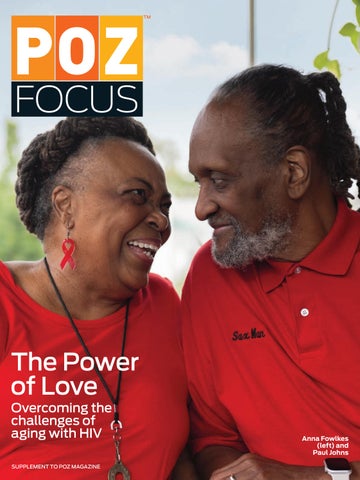
The Power of Love Overcoming the challenges of aging with HIV
1 PF_Over50_cover.indd 1 PF_Over50_cover.indd
Anna Fowlkes (left) and Paul Johns
7/9/26 11:37 AM POZ31006_PF_Over50_cover.pgs 07.09.2026 01:27
CONTENTS
EXCLUSIVELY ON
POZ.COM
Paul Johns (le˜ ) and Anna Fowlkes are aging together.
POZ BLOGS
Our roster of bloggers spans the diversity of the HIV community. Go to poz.com/blogs to read varying points of view from people living with the virus as well as from HIV-negative advocates. Join the conversation in the comments section. Visit the blogs to find hope and inspiration from others.
D
POZ OPINIONS
Advocates, researchers, politicians, thought leaders and folks just like you all have ideas worth sharing. Go to poz.com/ opinions to read about topics such as living with HIV, improving care and treatment, increasing prevention efforts and fighting for social justice.
#UNDETECTABLE
POZ DIGITAL
Scan the QR code (left) with your smartphone camera or go to poz.com/digital to view the current issue and read past issues online.
3 NEWS A Day to Honor HIV Long-Term Survivors: The commemoration was established in 2014. • Facing Barriers to Aging With HIV: A national survey identifies issues across five domains. • Significant Reform of HIV Exposure Law: Years of advocacy pave the way in Louisiana. 6 CARE & TREATMENT The Evolution of HIV Editor-in-Chief: Oriol R. Gutierrez Jr. Managing Editor: Jennifer Morton Deputy Editor: Trent Straube Science Editor: Liz Highleyman Copy Chief: Joe Mejía Art Director: Doriot Kim Production Manager: Michael Halliday
Prevention, Treatment and Cure: After 45 years, lifesaving scientific advances have been remarkable.
8 FEATURE The Wisdom of HIV Elders: People living with the virus for decades—such as Anna Fowlkes, Dee Calmett, Claude Bowen and James Patrick Kelly —are aging gracefully on their own terms.
COVER AND THIS PAGE: (FOWLKES AND JOHNS) NICOLE MUNCHEL; (MEGAPHONE SPEECH BUBBLES AND MAGNIFIER) ISTOCK
The science is clear: People who have an undetectable viral load don’t transmit HIV sexually. In addition to keeping people healthy, effective HIV treatment also means HIV prevention. Go to poz.com/undetectable for more.
SMART + STRONG President & COO: Ian E. Anderson VP, Integrated Sales: Diane Anderson Integrated Advertising Manager: Jonathan Gaskell Integrated Advertising Coordinator: Sarah Pursell
POZ Focus is independently produced by Smart + Strong.
Published by Smart + Strong. Copyright © 2026 CDM Publishing LLC. All rights reserved. No part of this publication may be reproduced, stored in any retrieval system or transmitted, in any form by any means, electronic, mechanical, photocopying, recording or otherwise, without the prior written permission of the publisher. Smart + Strong® and POZ® are trademarks of CDM Publishing, LLC.
PF_Over50_p02_TOC.indd 2
ɐ$0 POZ31006_PF_Over50_p02_TOC.pgs 07.09.2026 23:49
NEWS
A Day to Honor HIV Long-Term Survivors
(ANDERSON, RAY-HINTON AND CRISOSTOMO) YOUTUBE/NATIONAL AIDS MEMORIAL; (JONES) ANGELA DECENZO; (STRUB) BILL WADMAN
The commemoration was established in 2014. Friday, June 5, marked HIV Long-Term Survivors Awareness Day (HLTSAD) 2026. The date coincides with a historical milestone in the history of the AIDS epidemic. On June 5, 1981—45 years ago—the Morbidity and Mortality Weekly Report (MMWR), a publication of the Centers for Disease Control and Prevention, first reported on cases of a mysterious illness affecting young gay men; the disease soon became known as AIDS, which is caused by untreated HIV. HIV Long-Term Survivors Awareness Day was established in 2014 by Let’s Kick ASS— AIDS Survivor Syndrome. As its organizers write on HLTSAD.org: #HLTSAD honors and uplifts the resilience of those who have lived with HIV since before 1996—before effective treatments existed. It shines a light on their enduring strength, lived experience and vital role in shaping the ongoing fight for justice, care, and dignity.… It’s a day to honor long-term survivors of HIV and raise awareness about their needs, issues, and journeys.… We make up about 25% of all people living with HIV and AIDS. 1.2 million people are living with HIV in the U.S. That makes about 330,000 long-term survivors, defined as individuals who acquired HIV before 1996 and the introduction of [highly effective HIV treatment]. Often overlooked, HLTS includes people born with HIV or who acquired the virus as babies and are now in their 30s and 40s. HLTS are also those living with HIV and AIDS for over 25 years. It’s up to us to set our action plan addressing the present-day and future needs, issues, and challenges facing people living longest with HIV/AIDS. HLTSAD is not a time to look back at our
traumatic pasts. (That’s Top, le˜ for World AIDS Day.) to right: Our goal over the coming Anderson, months is for YOU to set Ray-Hinton and our agenda and priorities Crisostomo; for moving forward center, from and take action to make top: campaign changes. logo, Jones People living with and Strub HIV/AIDS deserve to age with dignity. In the past year, the National AIDS Memorial highlighted the experiences of long-term survivors as part of its ongoing Surviving Voices series. (You can watch the video on the National AIDS Memorial’s YouTube channel.) The series also includes mini documentaries with several long-term survivors, who share their insights into decades of navigating the physical, social and emotional challenges of living with HIV. A few examples include Tez Anderson, who founded Let’s Kick ASS, Vince Crisostomo, the director of aging services at San Francisco AIDS Foundation, and Paula Ray-Hinton. In related news, to coincide with the June 5, 1981, debut report on AIDS, two long-term survivors—Cleve Jones and POZ founder Sean Strub—launched the nationwide call to action Seven Days in June: Health Is Primary. Seven Days in June: Health Is Primary was a decentralized, grassroots campaign laser-focused on the issues of affordability and healthcare, dual issues that have galvanized special elections and primaries during the last year and served as linchpins for successful campaigns across the political spectrum. —Trent Straube
OVER 50 2026 POZ FOCUS 3
PF_Over50_p03-05_News.indd 3
ɐ$0 POZ31006_PF_Over50_p03-05_News_3.pgs 07.09.2026 01:28
NEWS
Facing Barriers to Aging With HIV A national survey identifies issues across five domains. PEOPLE AGING WITH HIV FACE SIGNIFICANT BARRIERS and critical disruptions in care and treatment that undermine their clinical progress and social support, according to a report on the findings of HealthHIV’s State of Aging with HIV Fifth Annual National Survey. The survey revealed the daunting reality of aging with HIV, including managing multimorbidity and frailty risk, mental health challenges and the structural barriers they face regularly. Adults ages 50 and older already represent more than half of all people living with HIV in the United States and are projected to account for 70% by 2030. They face significant barriers and critical disruptions at every step in care and treatment that undermine their clinical progress and social support. The survey report describes the findings and implications of these and other issues and how the next phase of HIV care has to pivot toward
HIV AND GERIATRIC CARE FINDING: Viral suppression of 98% is the highest rate since HealthHIV started collecting data in 2020, yet aging with HIV is not being managed at the same level. This is especially true for lowincome and sexual and gender minorities, whose connection to care declines more quickly under stress, as we saw during COVID-19. IMPLICATION: Bolster infrastructure that supports this suppression rate to integrate frailty and geriatric screening into Ryan White HIV/AIDS Program (RWHAP)– funded clinical visits.
COMORBIDITIES FINDING: Most consumers carry chronic non-HIVmedication burden, and a high-needs unmanaged group is invisible to every system except HIV antiretroviral therapy (ART). Respondents cited suboptimal management of comorbidities. IMPLICATION: Fund clinical pharmacist consultations as a reimbursable RWHAP service category; reauthorize and align the Older Americans Act with earlier-onset agingrelated needs so that supports are not limited by chronological aging. Better clinically address comorbidities, including frailty risk, cardiovascular disease and mental health burden.
the needs of people aging with HIV across five connected domains—HIV and geriatric care, comorbidities, behavioral health, access and payment, and workforce. Over the past five surveys, consumers reported high rates of viral suppression. “These results reflect often hard-won clinical gains that can quickly erode when continuity of care is disrupted,” says Circe Gray Le Compte, MS, ScD, senior director of research and evaluation at HealthHIV. “During COVID-19, suppression rates among people aging with HIV dipped sharply as consumers were cut off from care. Low-income, women and transgender/ gender-nonconforming persons aging with HIV experienced even sharper declines.” Survey findings and implications include:
ART access no longer assumed to be stable. IMPLICATION: Support treatment access by treating transportation as essential medical infrastructure, making Medicare telehealth permanent for HIV care and stabilizing the AIDS Drug Assistance Program (ADAP) rebate base.
BEHAVIORAL HEALTH FINDING: Stress is widespread, while social connection is the strongest protective factor in the data; outwardly good quality of life can mask serious mental health burden. IMPLICATION: Make mental and behavioral health screening a default in HIV primary care, and treat antidiscrimination training as a clinical intervention.
ACCESS AND PAYMENT FINDING: Medication coverage is doing what it was designed to do, but the surrounding infrastructure, including payment and transportation, is fragile, with
WORKFORCE FINDING: Most providers recognize that aging with HIV is a clinical priority, but few organizations have the staffing, training or workflows to act on that recognition. Workforce turnover is eroding the practical knowledge needed to deliver aginginformed care. IMPLICATION: Nonprofits and govern-
4 POZ FOCUS OVER 50 2026
PF_Over50_p03-05_News.indd 4
ɐ$0 POZ31006_PF_Over50_p03-05_News_4.pgs 07.09.2026 01:28
SIGNIFICANT REFORM OF HIV EXPOSURE LAW Years of advocacy paved the way in Louisiana.
(HANDCUFFS) GETTY IMAGES/CLAYLIB
ment agencies need to provide more education and training for the workforce addressing HIV and geriatric care. Supporting the geriatric needs of people aging with HIV has outpaced operational capacity. Less than one fifth of consumers completing the survey reported receiving frailty screening in the past year, while many described dealing with often unaddressed mental health concerns and limited social support. “People aging with HIV are navigating far more than the virus itself, even as viral suppression and sustained care remain unevenly supported across fragmented systems,” states HealthHIV director of advocacy and Pozitively Aging program lead Scott Bertani. “This survey reflects growing strain across care and prevention access, financial stability, mental health and the ability of providers and systems to keep pace with increasingly complex health needs and lived social realities.” When asked to describe aging with HIV in a single word, both consumers and providers most often chose challenging, difficult and complicated—a pattern consistent with findings from the previous two surveys. One notable difference emerged around loneliness: Providers identified it more frequently than consumers, suggesting that social isolation may be recognized by others before individuals acknowledge it themselves. A report on findings and implications from HealthHIV’s State of Aging with HIV Fifth Annual National Survey is available to view and download at HealthHIV .org/stateof/agingwithhiv. —HealthHIV
Louisiana took a significant step toward ending HIV criminalization after Governor Jeff Landry signed House Bill 808 (HB808) into law on May 15, 2026. The legislation narrows the state’s HIV exposure law by limiting prosecutions to conduct that poses a substantial likelihood of transmission and creates new protections for people living with HIV (PLHIV). HB808 amends Louisiana’s exposure law (La.R.S. 14:43.5). Introduced by Representative Wayne McMahen on February 27, 2026, the bill passed both chambers unanimously before being signed into law—a first for an HIV criminalization reform measure in the South. It went into effect on August 1, 2026. The law limits prosecutions to conduct involving a “substantial likelihood of transmission,” defined as contact involving blood, semen or vaginal fluid that presents a significant probability of HIV transmission. It also excludes conduct posing only a negligible, theoretical or medically unrecognized risk of HIV transmission. HB808 further establishes an additional affirmative defense for PLHIV who disclose their status and maintain an undetectable viral load. “These reforms represent an important step toward eliminating the threat of HIV criminalization, but decriminalization efforts in Louisiana will continue,” said Sean McCormick, staff attorney at Center for HIV Law and Policy (CHLP). “CHLP will remain a steadfast partner in implementing these reforms and pushing for additional changes to punitive laws targeting PLHIV in Louisiana.” Prior to HB808, Louisiana’s HIV exposure law—enacted in the early years of the HIV epidemic—was among the harshest in the country and did not account for actual transmission risk. As a result, PLHIV could face prosecution for conduct such as biting or spitting, despite posing a nonexistent or negligible risk of transmission. By
incorporating current scientific understanding of HIV transmission, the new law better aligns state policy with medical evidence and helps prevent prosecutions based on conduct that poses little to no risk of transmission. The passage of HB808 represents years of grassroots advocacy and collaboration. CHLP’s Positive Justice Project (PJP) has a longstanding relationship with the Louisiana Coalition on Criminalization and Health (LCCH), the group leading the state’s decriminalization work. For nearly a decade, LCCH has worked to restrict the exposure law’s reach through policy change and minimize its negative impact by educating decision-makers and community members. Recent advocacy efforts included a 2023 study resolution (HR130) directing lawmakers to examine the public health impacts of HIV criminalization. That process produced both a 2024 task force report and a communityled study documenting the need for reform. In 2025, LCCH and other advocates successfully defeated HB76, a proposal that would have added criminal penalties for people living with other sexually transmitted infections. That campaign resulted in a house resolution and helped lay the groundwork for the reforms enacted through HB808. Throughout this work, PJP provided legal and policy technical assistance to LCCH, including educational sessions for PLHIV on ways to reduce their likelihood of prosecution and training modules on effective decriminalization advocacy. Consistent with prior legislative sessions, in 2026, PJP drafted bill language, crafted summaries and talking points and strategized on emergent developments. While HB808 significantly narrows the law’s reach, HIV exposure remains criminalized in Louisiana. Advocates view the legislation as an important step toward full repeal and will continue working to eliminate laws that single out PLHIV for criminal penalties. —CHLP
OVER 50 2026 POZ FOCUS 5
PF_Over50_p03-05_News.indd 5
ɐ$0 POZ31006_PF_Over50_p03-05_News_5.pgs 07.09.2026 01:28
CARE & TREATMENT
The Evolution of HIV Prevention, Treatment and Cure After 45 years, lifesaving scientific advances have been remarkable. THE FIRST MEDICAL REPORT OF AIDS was published by the Centers for Disease Control and Prevention (CDC) in its Morbidity and Mortality Weekly Report 45 years ago, on June 5, 1981. The first antiretroviral drug, AZT, was approved in 1987, but it took nearly a decade longer to develop effective combination therapy that kept the virus in check and another 16 years until the approval of daily pills to prevent HIV. The evolution of HIV prevention and treatment is among the most remarkable stories in medical history. From handfuls of pills taken multiple times a day to injections administered just twice a year, antiretroviral therapy has come a long way. But while HIV treatment and pre-exposure prophylaxis (PrEP) have steadily improved, an HIV vaccine and a functional cure remain elusive. “Without question, current treatment and PrEP options work great. They are effective and safe, and they are getting better and better every year,” Steven Deeks, MD, of the University of California San Francisco told POZ. “But they require an individual to remain engaged in the healthcare system for life and to adhere to lifelong therapy. This is just not feasible for many. To end the epidemic, we will need a oneand-done approach for treatment or prevention. In other words, we will likely need a scalable cure or a vaccine, preferably both.” HIV TREATMENT Modern HIV treatment is highly effective and generally well tolerated, and most people can take a single-tablet regimen that combines two or three drugs in one daily pill. The newest, Merck’s Idvynso (doravirine/islatravir), was approved in April. Researchers are now testing islatravir in combination with Merck’s NNRTI ulonivirine and with Gilead Sciences’ HIV capsid inhibitor lenacapavir as potential once-weekly oral options. But some people have difficulty maintaining good adherence to daily oral treatment because they sometimes forget to take their pills, don’t want to think about having HIV every
day or are living in situations where their medications could be lost or stolen. This will likely still be the case with weekly pills, so longer-acting injectables are the wave of the future. Today, the longest-acting complete regimen is ViiV Healthcare’s Cabenuva (injectable cabotegravir and rilpivirine), which is administered once monthly or every other month. An injectable formulation of lenacapavir (branded as Sunlenca) is given just twice a year, but it currently has no equally durable partners to build a complete treatment regimen. That’s likely to change in the coming years. At this year’s Conference on Retroviruses and Opportunistic Infections, researchers reported promising early data on experimental antiretrovirals from ViiV (VH184 and VH499) and Gilead (GS-3242) that could potentially be given every six months. Both companies are also working on broadly neutralizing antibodies, which target hidden parts of the virus, as partners for long-acting injectable antiretrovirals. HIV PREVENTION Turning to prevention, the daily PrEP pills Truvada (tenofovir disoproxil fumarate/emtricitabine) and Descovy (tenofovir alafenamide/emtricitabine) reduce the risk of HIV acquisition by around 99% if used consistently. Yet only about a third of the estimated 1.2 million people who could benefit from PrEP are using it, according to the CDC. Clinicians and advocates hope longer-acting options can help close the gap. Last year’s big news was the approval of injectable lenacapavir (branded as Yeztugo) for twice-yearly PrEP. In two large studies, lenacapavir PrEP dramatically reduced HIV acquisition among young cisgender women in Africa and gay and bisexual men and gender-diverse people in the United States and six other countries. Early studies suggest that the interval could potentially be extended to once yearly. But lenacapavir’s high price and lack of clarity about insurance coverage have slowed its rollout in the United
States, and federal funding cuts have limited its distribution in lowincome countries. “We’ve made tremendous strides in both HIV prevention and treatment over the last few decades. Now, a person who may be exposed to HIV can prevent infection with a single shot every two months, a double shot every six months, daily pills or pills just around the time of sex,” said Susan Buchbinder, MD, director of Bridge HIV at the San Francisco Department of Public Health. “There are new products in development—shots maybe as infrequently as once a year and a monthly pill, both of which could be further major breakthroughs in HIV prevention. However, we still need HIV prevention and treatment research to make regimens easier to take, to address individual’s needs for products, to study how to scale up prevention and treatment and hopefully to get us to an effective HIV vaccine and HIV cure.” A twice-yearly shot may seem vaccine-like, but lenacapavir is an antiretroviral drug that stops HIV
6 POZ FOCUS OVER 50 2026
PF_Over50_p06-07_Care_Treatment.indd 6
ɐ$0 POZ31006_PF_Over50_p06-07_Care_Treatment_6.pgs 07.09.2026 01:59
GETTY IMAGES/JITTAWIT.21
replication, not a vaccine that trains the immune system to fight the virus. Like Deeks, many experts think that only a vaccine—in particular, one that offers durable protection—can end the epidemic. Despite decades of effort and billions of dollars, HIV vaccine research has yielded a string of disappointments. One after another, traditional vaccine approaches have failed to provide protection in clinical trials. The last large trial, PrEPVacc, was halted in 2023 after data showed that there was little or no chance that the tested vaccines would demonstrate efficacy. But scientists have not given up, turning to more sophisticated strategies. Some studies have tested broadly neutralizing antibodies for prevention, but again, results have been disappointing. Currently, the most promising avenue is germline targeting, which uses a series of primer and booster vaccines to train the immune system to produce its own broadly neutralizing antibodies. If this approach requires multiple
vaccines given over time, however, it might be no more practical than long-acting PrEP. “A vaccine generally mimics the body’s natural immune reaction to a virus, which usually results in it being cleared,” former National Institute of Allergy and Infectious Diseases director Anthony Fauci, MD, once explained. “But with HIV, it doesn’t. So a vaccine has to elicit an immune response that’s better than nature, and that’s hard to do.” CURE RESEARCH The ultimate goal of the HIV field is a cure, but here, too, research has proceeded slowly—with many setbacks. While antiretrovirals can suppress viral replication indefinitely, HIV inserts its genetic blueprints into the DNA of human cells and establishes a long-lasting viral reservoir that is unreachable by antiretrovirals and usually invisible to the immune system, making a true cure nearly impossible. Even with treatment, HIV causes persistent immune activation and chronic inflammation that can lead
to a host of health problems and accelerated aging. Only 11 people are known to have been cured after stem cell transplants for cancer treatment, most recently the Toronto Patient, whose case was presented at the Canadian Association of HIV Research Conference in April. The procedure is too risky for people without life-threatening cancer, but each new case offers clues that could help scientists develop a more accessible functional cure, or longterm remission without antiretrovirals. Many functional cure approaches have been studied, such as locking HIV in an inactive state so it can never replicate, flushing the virus out of resting cells so it becomes susceptible to antiretrovirals, and boosting the immune system to better recognize and attack the virus. Deeks recently presented findings from a small study of CAR-T therapy for HIV at the American Society of Cell and Gene Therapy annual meeting in May. Best known as a treatment for cancer, CAR-T involves removing a sample of a patient’s T cells, inserting artificial receptors and reinfusing the “living drug” back into the body. Of the nine participants who received T cells reprogrammed to target HIV, one has maintained an undetectable or very low viral load for nearly two years after stopping antiretroviral treatment, a second has been in remission for almost a year and a third showed transient viral control for about three months. All three started antiretrovirals soon after infection, adding to the evidence that very early treatment improves the prospects for a functional cure. Many experts think that achieving a functional cure will require a combination approach. Current strategies are complex and expensive, however, so they are unlikely to be accessible to the millions of people living with HIV worldwide, largely in resource-limited countries. On the other hand, this is just the population that stands to benefit most from a one-and-done cure because they have limited or sporadic access to lifelong antiretroviral treatment, especially given cuts to international aid. While an HIV vaccine and a functional cure remain on the distant horizon, people living with HIV can look forward to better prevention and treatment options in the near and medium-term future. But continued progress requires steady funding of medical research, which is jeopardized under the Trump administration. —Liz Highleyman
OVER 50 2026 POZ FOCUS 7
PF_Over50_p06-07_Care_Treatment.indd 7
ɐ$0 POZ31006_PF_Over50_p06-07_Care_Treatment_7.pgs 07.09.2026 01:59
Paul Johns (left) and Anna Fowlkes have been a couple for more than a decade.
8 PF_Over50_p08-13_Feature.indd 8 PF_Over50_p08-13_Feature.indd
7/9/26 12:45 PM POZ31006_PF_Over50_p08-13_Feature_8.pgs 07.09.2026 02:14
PEOPLE LIVING WITH THE VIRUS ARE AGING ON THEIR OWN TERMS. BY TIM MURPHY
I NICOLE MUNCHEL
N THE 1980S, MOST PEOPLE LIVING WITH HIV DIDN’T THINK they would live another decade, let alone into their 70s and 80s. In the 1990s came effective treatment, which has only improved since then. Now, it’s not unusual for folks with the virus to be facing both the sweetness and the challenges of old age, just like anyone else. In fact, in recent years, people ages 50 and older made up more than half of the roughly 1.2 million Americans living with HIV.
It’s not uncommon to see people living with HIV on treatment aging into their 80s. Author and activist Larry Kramer, activist Jane Fowler and author Edmund White, all of whom were HIV positive, lived until their mid-80s. While research shows that folks with HIV are at somewhat higher risk for earlier onset of some conditions, including cardiovascular, bone and organ disease, as well as certain cancers and depression,
research also shows that folks with treatmentsuppressed virus and CD4 counts of 500 or higher are generally projected to live as long as their HIV-negative counterparts—until their late 70s or early 80s. Here, POZ profiles four very different older Americans living with HIV approaching their 80s. What are their challenges? What are their sources of continued contentment and joy? OVER 50 2026 POZ FOCUS 9
PF_Over50_p08-13_Feature.indd 9
ɐ30 POZ31006_PF_Over50_p08-13_Feature_9.pgs 07.09.2026 02:14
Anna Fowlkes, 79 Baltimore, Maryland Diagnosed with HIV in 2006 In 2017, the cover of the September issue of POZ featured Fowlkes, then 70, and her boyfriend of two years, HIVnegative musician Paul Johns, then 72. They first met at a music festival, then again at a church HIV awareness event, where Fowlkes publicly disclosed her status to let older folks know they weren’t immune to HIV. Fowlkes contracted HIV in her late 50s from a boyfriend. Once they were dating, Fowlkes, a former home health aide, wound up looking after Johns after doctors found a growth on his pituitary gland. “She didn’t need me,” laughed Johns at the time, “but there was quite a while when I needed her.” Nine years later, the couple are still together, and Johns needs Fowlkes more than ever. About five years ago, says Fowlkes, Johns started repeatedly asking her questions like “What is today?” and “How old am I?” Says Fowlkes, “I knew the signs of Alzheimer’s and dementia because I’d worked in home healthcare.” She took him to a specialist who said he was exhibiting signs of cognitive decline. But it was only after he was tested for amyloid plaques—a key marker of Alzheimer’s—via a blood test the Food and Drug Administration authorized last year that Johns’s diagnosis was confirmed. “I wasn’t shocked or surprised,” says Fowlkes. Since then, she says, Johns continues to decline, but he’s far from needing to be watched every second, and, unlike some Alzheimer’s patients, he’s not aggressive or hostile. “He still has a great sense of humor and makes me laugh every day. He’ll say, ‘Hmm, I think I’m getting on your nerves.’ How can you be mad at someone when you’re laughing? I’ve learned to cope. Sometimes, I just shut down and say nothing, and he’ll say, ‘You’re not answering me.’ And I’ll say, ‘Well, I’ve answered that question so many times!’” Thankfully, Fowlkes knows that she needs to take time out for herself. With the long-term care policy that Johns bought years ago, she’s able to pay friends and family with whom Johns feels comfortable to come over and watch him when she goes out to lunch with old friends once every month or so or to get her nails done. She even vacationed in California for a week while a friend stayed with him. “I knew he was safe and in good hands,” she says. “My friend spoiled him!” And thankfully, says Fowlkes, her own health is solid, except for arthritis. “My body is getting old, so if I don’t have housework or laundry to do, I’ll relax. And if I don’t get up, Paul won’t get up. But he likes to know where I am. If I go to the market, he’ll come with me because he likes the ride and waits in the car.” The couple also likes to go hear live music together— Johns was once music director for the soul legend Wilson Pickett. “I’ll play Smokey Robinson’s Sirius XM station in
Fowlkes (left) and Johns on the cover of POZ in 2017
the car because it makes Paul happy,” she says. Fowlkes still drives from Baltimore to Washington, DC, every other week to be a paid facilitator for two different HIV support groups. “Every time I go, I feel good,” she says. She insists she feels no bitterness that Johns developed early Alzheimer’s less than a decade after they met. Rather, she’s philosophical about it. “Years ago,” she says, “I read an article where an 85-yearold woman with cancer said to her doctor, ‘Listen, I’m old enough to die.’ You reach a certain age where you’ve got fewer years ahead of you than behind you. So now, we just go with the flow. Growing up in a very religious family, I was taught to accept whatever comes my way. I never say, ‘Why me?’ I say, ‘Why not me?’” Fowlkes says she’s got a son and grandchildren to help her when it gets to the point where she, as well as Johns, needs taking care of. Until then, she has this advice for herself and others aging with HIV: “Don’t think about what might happen—just enjoy the fact that you’re alive and well.” And she says caring for Johns is no burden: “If you love someone, the things that happen aren’t necessarily challenging. If you have to clean them up, you just do it. That’s the for-better-or-for-worse part of loving someone.”
10 POZ FOCUS OVER 50 2026
PF_Over50_p08-13_Feature.indd 10
ɐ30 POZ31006_PF_Over50_p08-13_Feature_10.pgs 07.09.2026 02:14
COURTESY OF DEE CALMETT
Calmett has lived with HIV for over four decades.
The Rev. Dr. Dee Calmett, 76 Palm Springs, California Diagnosed with HIV in 1983 About 20 years ago, recalls Dee Calmett, “I said to someone, ‘When I get older, I’m going to live as a woman.’” At that point, Calmett was living as a gay man, one who’d left behind his life as an evangelical pastor in his 30s, no less.
“I’d always felt like a two-spirit, like there was a man and a woman living inside my body,” Calmett says. “There was such a battle going on inside me that I decided suicide was the only way out.” Happily, she didn’t take that route. Instead, about seven years ago, she met some other transgender and nonbinary people who encouraged her to pursue her true identity. She found a doctor who confided that he, too, felt he was a two-spirit, and he started her on hormone therapy. She changed her name from Damien to Dee. (She says the “Rev.” in her name for reverend is because she’s an ordained minister, and the “Dr.” indicates her doctorate degree in spiritual science.) Asked what word summarizes her journey the past several years, she answers: “Growth. It’s not really about transitioning, because this is what I’ve always been—I just didn’t know it.” And she proudly contributes to her newfound community, organizing talent- or fashion-show fundraisers for Palm Springs’s Transgender Health and Wellness Center. That’s in addition to her full-time job as a patient navigator and volunteer coordinator for DAP Health, Palm Springs’ sprawling LGBTQ health services nonprofit. There, she also oversees Miss Dee’s Boutique, which gives free used clothing to people in the area experiencing homelessness. “We’ve since given clothes to almost 900 people,” she says. As if all that weren’t enough, she also hosts Miss Dee’s 5th Sunday Transdenominational Sing, an ongoing choral event that raises money for regional charities. Diagnosed in 1983 with what was then called AIDSrelated complex, she followed up her stint as an evangelical pastor with one as a female impersonator—one named Ivana Tramp by no less a drag ally than Joan Rivers, for whom Calmett opened years ago. But her performance years were also marked by heavy drinking and drug use (she once drank a whole bottle of Grand Marnier before getting onstage). A period spent using meth, during which she approached what she thought were two hot men but turned out to be a pair of palm trees, was her wake-up call. In 2000, she cleaned up her act, relying on SMART Recovery, an alternative to 12-step programs that treats recovery as a set of learnable skills and draws on cognitive behavioral therapy. That paved the way for her gender journey. Does she regret not transitioning earlier in life? “A part of me does, because the hormones kick in a lot better” younger in life, she says. “But overall, my whole life experience—related to HIV, to being transgender, to being in the ministry and even drug addiction—has helped me to meet people exactly where they are.” She admits she never thought she’d live as long as she has. “I feel like I’m alive with purpose,” she says. “To always be coming from a place of kindness is my superpower, even if I have to speak a harsh reality, like taking the car keys away from a friend who’s been drinking or doing drugs.” She finds joy in taking Minnie, her 12-year-old Maltipoo dog, out on walks or drives. And she says she’s driven by
OVER 50 2026 POZ FOCUS 11
PF_Over50_p08-13_Feature.indd 11
ɐ30 POZ31006_PF_Over50_p08-13_Feature_11.pgs 07.11.2026 05:23
The Rev. Elder Claude Bowen, 79 Atlanta, Georgia Diagnosed with HIV in 1996 The Rev. Elder Claude Bowen finally realized he wasn’t going to die anytime soon when he made it past the twoyear anniversary of his 1996 HIV diagnosis without getting sick. When diagnosed, he says, “I was told that I wouldn’t live to 45.” So to have proved that wrong “is a personal joy.” And Bowen has used the extra time well. A former postal worker who moved from Los Angeles to Atlanta in 2006, in part to be closer to his grandkids, he’s heavily involved with Atlanta’s THRIVE SS group for gay, bisexual and samegender-loving Black men living with HIV. With a half dozen of his buddies from the group, he attends happy hours, potluck dinners and house-music dance parties, goes on regional road trips and more. Bowen He’s the group’s oldest; the youngest is 59. (top center) “We’ve bonded through being HIV positive,” with friends
he says. They also have keys to one another’s houses and promise to check in on one another if someone on the group text thread doesn’t answer within two days. “We’re a real brotherhood,” he says. A former ordained deacon with the Black LGBTQ Unity Fellowship Church, Bowen is no longer involved with the church but still makes spirituality a big part of his life, meditating and listening to jazz in bed for hours each morning, before getting up and having a cigar and coffee before breakfast. He also likes meditative writing. “I’ll reflect on what I’ve been through, but I’ll only read it a month later,” he says. “Then I’ll think, Oh, you came through that and you’re all right.” Bowen says he derives joy from telling younger people what it was like living with HIV in the “bad old days” before effective and easy-to-take medication. “I tell them that we had to have friends’ memorials services or funerals at clubs because the churches wouldn’t allow it and that we hid our status for fear that our families would abandon us. So when I see the younger ones who are living with the virus get into HIV care, that’s a reward for me.” Coming up on 80 feels great, he says, even though he has neuropathy in his legs and feet from the chemotherapy he underwent to beat prostate cancer. He admits he has survivor’s guilt when he thinks of his many friends who’ve died. “Why are they gone and I’m still here? But then I accept that if I’m still here there’s a plan for me. So I embrace that.” James Patrick Kelly, 79 Los Angeles, California Diagnosed with AIDS in 1981 As we age, it helps to have a passion, and James Patrick Kelly’s passion is definitely Renaissance faires (RFs). The retired media ad salesman has been attending them since 1969, even before he moved to Los Angeles. “I was young and cute,” says Kelly of his early RFs. Since then, the RFs he goes to throughout California have come to represent community to him. “About 90% of my friends in my life now are in some way connected with them. It’s a creative community full of performers and artists—like summer camp for hippies without any adult supervision.” At a recent RF, he says proudly, “I was the 13th King of Fools.” Kelly also revels in community right at home. He lives with two longtime friends and fellow RF-goers,
COURTESY OF CLAUDE BOWEN
hope. She stocks her fridge with water bottles she labels “Joy,” “Peace”, “Happiness” and “Abundance.” “Every morning,” she says, “I reach in and grab one. And whatever it’s labeled, that’s what I envision filling every cell of my body as I drink it.”
12 POZ FOCUS OVER 50 2026
PF_Over50_p08-13_Feature.indd 12
ɐ30 POZ31006_PF_Over50_p08-13_Feature_12.pgs 07.09.2026 02:14
“YOU REACH A CERTAIN AGE WHERE YOU’VE GOT FEWER YEARS AHEAD OF YOU. SO NOW, WE JUST GO WITH THE FLOW.”
COURTESY OF JAMES PATRICK KELLY
—ANNA FOWLKES
Richard and Jerry, in the Echo Park home he Kelly (above bought in 1992 and has since renovated. That left) with arrangement started when he invited Richard friends to come live with him while Richard recovered from bladder cancer. The trio live with their two poodles, Horgos and Kento, named after late friends. “We live here and garden, enjoy one another and take the dogs and a Frisbee to Griffith Park,” says Kelly. They also support one another through their health issues, which for Kelly includes a rare, severe autoimmune disorder called VEXAS syndrome that causes enlarged red blood cells. “I have low hemoglobin and am weary all the time,” he says. “Even walking is difficult.” He’s about to have his second blood transfusion for the disorder, after which, he says, “I’ll feel fine.” Kelly is also a longtime HIV survivor, having been
diagnosed in 1981 with the emerging syndrome in gay men that a year later would come to be called AIDS. He lost a man he calls his “beloved honey” to the disease in 1998. He credits Los Angeles HIV treatment pioneer Michael Gottlieb, MD, with keeping him alive all these years. “Once, I had only nine T cells,” he says, “but at this point, HIV really doesn’t affect my life much at all.” And speaking of his life, he says: “I’ve had a wonderful one. I live with people who love me and take care of me. I love my family and get along with my siblings. I own my house. I have enough money to live. And I have creative friends that I have a good time with.” Does he think he’s lived this long with HIV for a reason? “I think I’m here to take care of my friends, to lead a creative life and to be happy,” he says simply. “And I’ve succeeded at that in spite of illness and death.” Q
OVER 50 2026 POZ FOCUS 13
PF_Over50_p08-13_Feature.indd 13
ɐ30 POZ31006_PF_Over50_p08-13_Feature_13.pgs 07.09.2026 02:14
$ QRQ SURƓW RUJDQL]DWLRQ IRXQGHG LQ 7KH :HOO 3URMHFW XQDSRORJHWLFDOO\ IRFXVHV RQ WKH XQLTXH LQWHUVHFWLRQDO QHHGV RI ZRPHQ OLYLQJ ZLWK DQG YXOQHUDEOH WR +,9 DFURVV WKH JHQGHU VSHFWUXP
CHANGING THE COURSE of the HIV epidemic…
one woman at a time Access our resources at www.thewellproject.org
EDUCATION & INFORMATION
COMMUNITY SUPPORT
Learn More! thewellprojecthiv
PZA_FullPage_Template.indd 1
thewellprojecthiv
ADVOCACY & LEADERSHIP
COLLABORATIVE ENGAGEMENT
e
WOMEN-FOCUSED HIV RESEARCH
Stay Connected! thewellproject
thewellprojecthiv
thewellprojecthiv
PZA556116.pgs 07.02.2025 7/2/25 11:5112:51 ESA