A SMART+STRONG PUBLICATION SUMMER 2019 HEPMAG.COM
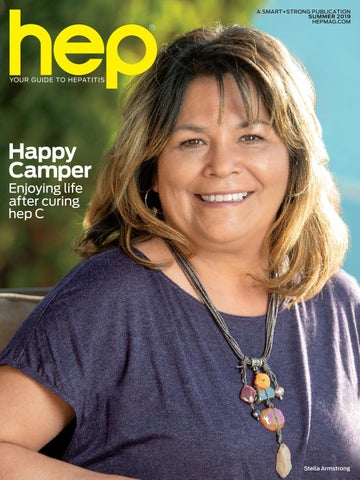
Happy Camper Enjoying life after curing hep C
Stella Armstrong
Got Ink? An estimated 3–5 million Americans are living with hepatitis C. Most don’t know it. Get tested today.
THINKSTOCK (MOEL USED FOR ILLUSTRATIVE PURPOSES ONLY)
Find out how at hepmag.com.
FROM THE EDITOR
Sunshine on My Shoulders EDITOR-IN-CHIEF
S
ORIOL R. GUTIERREZ JR. MANAGING EDITOR
JENNIFER MORTON DEPUTY EDITOR
TRENT STRAUBE CONTRIBUTING EDITOR
LUCINDA PORTER SCIENCE EDITOR
LIZ HIGHLEYMAN EDITOR-AT-LARGE
BENJAMIN RYAN COPY CHIEF
JOE MEJÍA
ASSISTANT EDITOR
ALICIA GREEN ART DIRECTOR
MARK ROBINSON ART PRODUCTION MANAGER
MICHAEL HALLIDAY ADVISORY BOARD
ALAN FRANCISCUS, ROBERT GISH, MD, ANDREW MUIR, MD, ANDREW REYNOLDS, DIANA SYLVESTRE, MD, CHRIS TAYLOR FEEDBACK
HEP, 212 WEST 35TH STREET, 8TH FLOOR, NEW YORK, NY 10001, OR EMAIL INFO@HEPMAG.COM
SMART + STRONG PRESIDENT AND COO
IAN E. ANDERSON
EDITORIAL DIRECTOR
ORIOL R. GUTIERREZ JR. EXECUTIVE EDITOR (COVER) JACOB KEPLER; (STREAM) ISTOCK; (GUTIERREZ) JOAN LOBIS BROWN
BOB BARNETT
CHIEF TECHNOLOGY OFFICER
CHRISTIAN EVANS
VICE PRESIDENT, INTEGRATED SALES
DIANE ANDERSON
INTEGRATED ADVERTISING MANAGER
JONATHAN GASKELL
INTEGRATED ADVERTISING COORDINATOR
CAROLINE RABIECKI SALES OFFICE
212-938-2051, SALES@HEPMAG.COM BULK SUBSCRIPTIONS
ORDER.HEPMAG.COM, SUBS@HEPMAG.COM
CDM PUBLISHING LLC CHIEF EXECUTIVE OFFICER
JEREMY GRAYZEL CONTROLLER
JOEL KAPLAN Published by Smart + Strong. Copyright © 2019 CDM Publishing LLC. All rights reserved. No part of this publication may be reproduced, stored in any retrieval system or transmitted, in any form by any means, electronic, mechanical, photocopying, recording or otherwise, without the prior written permission of the publisher. Smart + Strong® and Hep® are trademarks of CDM Publishing, LLC.
CONTENTS 3 FROM THE EDITOR Living your best life after curing hep C
tella Armstrong is very much a happy camper these days. Now cured of hepatitis C virus (HCV), she spends summer weekends with her husband and two dogs enjoying the outdoors. For a long time, such simple pleasures weren’t on her agenda. When she was HCV positive, Armstrong endured joykilling fatigue and pain related to living with the virus. Thankfully, all that went away after she started treatment in 2016. Her journey to a healthier life wasn’t easy. A self-described “military brat,” Armstrong grew up traveling from place to place. For a short time, she injected drugs. She attributes testing HCV positive in 2000 to that period in her life. Armstrong tested positive for the virus while at court-mandated rehab for her alcohol use. Later, she accepted the court’s offer to live in a sober residence. After a few tries, she eventually stayed sober. Her life has improved ever since then. Now 56, Armstrong works as a bookkeeper in Las Vegas. She has also become a hep C treatment advocate working local events for the American Liver Foundation. She even plans to go to Washington, DC, to lobby for hep C funding. Go to page 8 to read more about her story. Asking the federal government to take more action against hep C is certainly high on the priority list for advocates. The nationwide opioid crisis has only made such action more urgent. Injection drug use is fueling the hep C epidemic, so prevention efforts are sorely needed. Needle exchange programs have been shown to help reduce new HCV cases. Taking that idea a step further is the concept of safe injection sites. These
are spaces where people can use drugs, clean needles are provided and the staff is trained to respond to overdoses. Safe injection sites have been started in many countries but not in the United States. Several U.S. locales have proposed opening such sites, but none has yet succeeded in its efforts. Alex Azar, the secretary of the U.S. Department of Health and Human Services, has publicly expressed support for needle exchanges but also noted that the Trump administration does not support safe injection sites. Go to page 5 for more. The adverse effects of hep C include an increased risk for liver cancer. Treating the virus can mitigate this risk, which is yet another reason to advocate for access to HCV drugs. For those who do develop liver cancer, more options are now available. The Food and Drug Administration has approved three new liver cancer treatments. Go to page 7 to read more.
ORIOL R. GUTIERREZ JR. EDITOR-IN-CHIEF
Want more info? Visit hepmag.com • facebook.com/hepmag • twitter.com/hepatitismag
4 NEWS Eliminating hep C among U.S. veterans • Stopping hep B and hep C globally by 2030 • Needle exchanges as HCV prevention • Alexa transmits and receives patient information
6 CARE & TREATMENT Hep C treatments boast major benefits • Intercept’s NASH drug • New liver cancer treatments • Modern HIV treatment mitigates liver risks
8 PROFILE Las Vegas resident Stella Armstrong cured her hep C and the joy-killing fatigue and pain that came with it.
hepmag.com SUMMER 2019 HEP 3
NEWS
Eliminating Hep C Among U.S. Veterans The Department of Veterans Affairs (VA) health system, the largest single provider of hepatitis C virus (HCV) care in the United States, appears to be on track to soon cure hep C in more than 100,000 former U.S. service members. Compared with the overall population, veterans have a higher prevalence of HCV—as high as 5%, or about triple the general population rate. The rate is especially high among baby boomers (those born between 1945 and 1965), which includes Vietnam War veterans. Despite the availability of effective treatment, many people with hep C in the general population have not been cured because of barriers such as a lack of awareness, inadequate screening, a shortage of providers and the high cost of the drugs. But the VA—which provides consistent free or affordable care for veterans and maintains extensive electronic health records—offers the opportunity to overcome these barriers. The first direct-acting antiviral (DAA) drug, Sovaldi (sofosbuvir), was approved in December 2013. Before 2014,
only 12,000 of the approximately 180,000 veterans with chronic HCV under the care of the VA had been treated and cured using interferon-based therapy, which was often poorly tolerated and much less effective than DAAs. As of the beginning of March, nearly 116,000 veterans currently under VA care had started DAAs. Of these, 96,654 (83%) have already completed treatment and been cured. The remainder of those now on treatment will most likely finish by the summer, and the vast majority of them will be cured. By October, the VA expects to have treated more than 125,000 people.
Scientists at the Task Force for Global Health presented a new assessment of global progress toward the World Health Organization (WHO) goal of eliminating hepatitis C virus (HCV) and hepatitis B virus (HBV) worldwide by 2030. Their conclusion? It’s definitely possible, but it will take a lot of work and money. The report zeroed in on how likely global health efforts are to meet WHO’s goal of achieving a 90% reduction in new chronic hep cases and a 65% reduction in related deaths. There has been progress. For example, the three-dose series of the HBV vaccine has
4 HEP SUMMER 2019 hepmag.com
been more than 95% effective in preventing infections and protecting against chronic infection for over 30 years. However, in 2015, only 39% of newborns globally received the vaccine. The report also cites data showing that people who inject drugs reduce their
risk of HCV transmission by 74% with adequate access to opioid substitution therapy. However, 89% of them cannot currently obtain this kind of treatment for their addiction, and harm reduction services are generally in short supply around the world. Screening and treatment programs are also lagging, the study says. Today, only an estimated 9% of people living with hep B around the world have been diagnosed, and only 8% of those diagnosed have received treatment. The report also cited an estimate that of the 71 million people living with hep C, only 14 million, or 20%, have been diagnosed, and just 7% have received treatment.
ALL IMAGES: ISTOCK
Stopping Hep B and Hep C Globally by 2030
Needle Exchanges as HCV Prevention
Alex Azar, the secretary of the Department of Health and Human Services, has expressed public support for needle exchange programs as a way to prevent the spread of HIV among people who inject drugs. Such programs also reduce the risk of hepatitis C virus (HCV). “Syringe services programs aren’t necessarily the first thing that come to mind when you think about a Republican health secretary, but we’re in a battle between sickness and health, between life and death,” Azar said in Washington, DC, during a national HIV prevention conference. “The public health evidence for targeted interventions here is strong, and supporting communities when they need to use these tools means fewer infections and healthier lives for our fellow Americans.” Azar said that although he supports needle exchanges, the Trump administration opposes safe injection sites. These are spaces where people can use drugs, clean needles are provided and the staff is trained to respond to overdoses. Last year, California’s governor vetoed a bill that would have authorized the nation’s first safe injection site, in San Francisco. Perhaps Republican health leaders support needle exchanges because they have learned from the HIV and hep C outbreaks that occurred among injection drug users in rural Indiana in 2015 under then-Governor Mike Pence, who initially opposed needle exchanges. His delayed response resulted in more than 200 people contracting HIV. Injection drug use, fueled by the opioid crisis, is an increasingly common route of HIV transmission. Health officials have reported HIV clusters among injection drug users in Seattle and West Virginia.
Alexa Transmits and Receives Patient Information The e-commerce and technology giant Amazon has introduced software that allows developers to create new health tools for its voice assistant, Alexa. The Alexa Skills Kit software helps developers build voice programs, or tools, that enable Amazon to securely transmit a patient’s private information in compliance with the health privacy law known as the Health Insurance Portability and Accountability Act of 1996 (HIPAA). Amazon invited six health care providers to build voice programs using the kit to create new tools meant to enhance consumers’ experience:
Scripts created a • Express new tool that enables members to check the status of home delivery prescriptions and receive Alexa notifications when shipped. developed Cigna • Cigna Health Today, which allows eligible employees with one of the company’s large national accounts to manage their health improvement goals and increase opportunities for earning personalized wellness incentives. Children’s Hospital • Boston created Children’s Enhanced Recovery After Surgery (ERAS), through which parents and caregivers of children in the ERAS program can provide updates on their children’s recovery progress to their care teams and receive information regarding post-op appointments. St. Joseph • Providence Health developed Swedish Health Connect, a tool that allows customers to find a nearby urgent care center and schedule same-day appointments. Health’s customers in • Atrium North and South Carolina can now use a tool to find a nearby urgent care center and schedule a same-day appointment. a consumer digital • Livongo, health company, created a tool that permits members to query their last blood sugar reading and blood sugar measurement trends and receive insights and personalized health nudges.
hepmag.com SUMMER 2019 HEP 5
CARE & TREATMENT BY BENJAMIN RYAN
Hep C Treatments Boast Major Benefits For the first time, researchers have observed powerful evidence that treating hepatitis C virus (HCV) with direct-acting antiviral (DAAs) is associated with a reduced risk of liver cancer and death. French investigators observed a cohort of nearly 10,000 people living with HCV, about three quarters of whom were treated with DAAs during follow-up. The study excluded those with a history of decompensated cirrhosis, the advanced form of the severe liver disease. About 3,000 of the participants had cirrhosis while 6,850 did not have cirrhosis or had unclassified fibrosis (liver scarring); cirrhosis is the most severe stage of fibrosis. Those who received treatment began DAAs a median of four months after their entry into the cohort and were followed for a median of 33 months after starting the medications. The untreated cohort members were followed for a median of 31 months. The study authors adjusted the data to account for differences between cohort members according to a host of variables that might have influenced their health outcomes. Compared with those not receiving the medications, receiving DAAs was associated with a 52% lower risk of death from any cause, including a 41% reduced risk of liver-related death and a 34% reduction in the risk of liver cancer. “There is mounting and persuasive evidence for the long-term clinical benefit of HCV cure, both with regard to liver and overall health outcomes,” Raymond T. Chung, MD, a liver specialist at Massachusetts General Hospital in Boston, wrote in a commentary that accompanied the study’s publication. “In light of these benefits, there is now little excuse for failing to identify all infected persons and to treat and cure each of them once identified.”
6 HEP SUMMER 2019 hepmag.com
A late-stage trial of Intercept Pharmaceuticals’ experimental non-alcoholic steatohepatitis (NASH) treatment found it was effective enough to warrant submission for Food and Drug Administration (FDA) approval. The randomized, placebo-controlled trial is evaluating the safety and efficacy of Ocaliva (obeticholic acid) among 931 people with Stage F2 or F3 liver fibrosis (scarring) due to NASH, a condition in which fat buildup drives liver inflammation. The participants were randomized into three even groups to receive a placebo, 10 milligrams of Ocaliva or 25 mg of the drug once daily. They received biopsies to determine their fibrosis severity at the study’s outset and after 18 months of treatment. In the placebo, 10 mg and 25 mg groups, 12%, 18% and 23% of participants, respectively, experienced at least a one-stage improvement in fibrosis with no worsening of NASH. The difference in success rates between Ocaliva and the placebo was statistically significant, meaning it is unlikely to have occurred by chance. This improvement met a requirement the FDA established to consider the treatment successful. Treatment was well tolerated, and any adverse health events experienced by the participants were generally mild to moderate. The study’s lead author, Zobair M. Younossi, MD, PhD, a liver specialist at Inova Fairfax Medical Campus in Falls Church, Virginia, said these findings show that Ocaliva “also improves other important measures of liver health, including the key underlying drivers of NASH.”
ALL IMAGES: ISTOCK (MODEL USED FOR ILLUSTRATIVE PURPOSES ONLY)
Intercept’s NASH Drug
New Liver Cancer Treatments The Food and Drug Administration (FDA) has approved three new liver cancer treatments in quick succession. This is promising news for those diagnosed with hepatocellular carcinoma (HCC, the most common form of liver cancer), which responds poorly to chemotherapy. Hepatitis B and C viruses (HBV and HCV) raise the risk of liver cancer. Treating the viruses can mitigate this risk. In 2007, Nexavar (sorafenib) became the first treatment approved to specifically target liver cancer. A decade later, the FDA green-lit a second targeted therapy, Stivarga (regorafenib), as well as the first immunebased treatment for the malignancy, Opdivo (nivolumab).
Between August 2018 and January 2019, the FDA doubled the number of liver cancer treatments with the approval of Lenvima (lenvatinib), Cabometyx (cabozantinib) and Keytruda (pembrolizumab). Like Nexavar and Stivarga, Lenvima and Cabometyx are kinase inhibitors. These drugs inhibit enzymes that play a role in the growth of cancer cells and the development of blood vessels that feed tumors. Keytruda and Opdivo are PD-1 checkpoint inhibitors that help immune cells fight cancer. These new medications have not proved effective for all those with liver cancer. Furthermore, cancer can develop resistance to the drugs. Nevertheless, the
recent FDA approvals provide clinicians with more options for selecting sequences of therapies that can better control the malignancy. “These new drugs provide incremental advances that are likely to lead to improved survival in patients with advanced HCC,” says Daniel S. Fierer, MD, an infectious disease specialist at the Icahn School of Medicine at Mt. Sinai in New York City. “Pembrolizumab, with a very different mechanism than sorafenib and lenvatinib, provides the opportunity for combination therapy for advanced HCC.”
Modern HIV Treatment Mitigates Liver Risks Among people with hepatitis C virus (HCV), being coinfected with HIV is no longer associated—as past research had found—with an increased risk of liver cancer or decompensated cirrhosis, also known as end-stage liver disease. Researchers believe that improved antiretroviral treatment for HIV—as well as higher rates of people on treatment in recent years—has mitigated these excess risks. In this new study, investigators analyzed long-term data on people with cirrhosis (severe liver scarring), including 175 people with HIV/HCV coinfection and 1,253 people with only HCV (known as monoinfection). Of those in the coinfected group, 17% had been cured of HCV at the study’s outset, as had 20% of the monoinfected
cohort. Of those with HIV, 92% were on antiretrovirals, and 80% had an undetectable viral load at the start of the study. During about five years of follow-up, there were no statistically significant differences— meaning any apparent differences could have been driven by chance—in numerous outcomes between people with or without HIV, including the liver cancer diagnosis rate, the proportion who experienced at least one episode of decompensation (a sign of increasing liver disease severity), time to first decompensation and death rate. “This study provides evidence of the effectiveness of current antiretrovirals in improving liver disease outcomes for people with HIV,” said
the study’s lead author, Oluwaseun Falade-Nwulia, MBBS, MPH, an infectious disease specialist at Johns Hopkins University School of Medicine in Baltimore. “Given how tolerable and effective current oral HCV treatments are regardless of HIV status, it is crucial that all HIV/HCV-infected individuals get cured of HCV to further reduce rates of adverse liver disease outcomes.”
hepmag.com SUMMER 2019 HEP 7
PROFILE
Stella Armstrong at home with her two dogs
Happy Camper Las Vegas resident Stella Armstrong cured her hep C and the joy-killing fatigue and pain that came with it. By Tim Murphy Photography by Jacob Kepler
O
n Friday evenings during the summer, Stella
Armstrong and her husband, Rob, pack up their two dogs, Chewy and Penny, and drive nearly four hours from their Las Vegas home to stunning Bryce Canyon National Park in southern Utah.
8 HEP SUMMER 2019 hepmag.com
There, in their rented RV, they spend the entire weekend surrounded by the park’s massive, psychedelic rock formations and eye-popping red hues, drinking in its glorious sunrises and sunsets. It’s sheer bliss—and Armstrong, 56, a construction-company bookkeeper, knows it.
“I’m very blessed, grateful and humble,” she says about her life today. But it wasn’t always this way. For many years, Armstrong lived with untreated hepatitis C virus (HCV), which stealthily advanced in her system and dragged down her quality of life until something had to be done. The saga starts way back in the late 1970s, when Armstrong—a self-described “military brat” who grew up just about everywhere, from Texas to California to the Philippines—dropped out of high school in San Diego and started hanging out with a fast crowd. For a short time, she injected drugs. When she became pregnant, she put down the needle, but she continued drinking and using even as she was raising two kids. “I accept responsibility for my choices,” she says. “And I made some bad ones.” That part of her life lasted all the way until 2000. That’s
when she finally went to court-mandated rehab, where she tested positive for HCV, which she assumes she contracted during her brief needle-using period. With no money or job, Armstrong accepted the court’s offer to live in a sober residence. “That’s how I stayed clean,” she says. Which isn’t to say she did it perfectly. “The hardest thing was staying away from friends who were still using, including my ex-boyfriend.” A few times, she tested positive for drugs and once ended up having to spend a week in jail. “I had to retrain my brain,” she says. “And it eventually worked.” The support of her family, including her kids, whom, she says, she “put through some trauma,” helped her stay off drugs, as did finally acquiring a job, which she credits with giving her great opportunities and making her feel stable. Also now stable was her liver—for a while. But even after she had kicked drugs, Armstrong continued to drink, which is a concern for people with chronic hepatitis or other liver diseases. In 2015, labs showed that, after years of relative health, her liver fibrosis, or scarring, had progressed from Stage F1 (relatively little) to Stage F2 and F3 and finally to Stage F4 (cirrhosis, or severe scarring). Moreover, she was having the classic symptoms of advanced hep C. “I felt like I had the flu every day,” she says. “It took a big effort to get dressed for work. I couldn’t concentrate and was forgetting things. They told me I had to stop drinking then and there.” And she did. “I’d only drink when we went out, but when we did, I’d drink to excess. So I just made myself stay home. That’s what it took.”
no side effects—a leap forward from the decades of meds that came with horrible side effects and uncertain results. Consequently, in April 2016, under the care of Kaiser Permanente in San Diego, where she had lived since young adulthood, Armstrong started hep C treatment with Sovaldi (sofosbuvir) plus the older drug ribavirin. Her treatment wasn’t entirely without side effects. “I had a little bit of nausea and headaches and a rash and anemia from the ribavirin,” she says. Today, ribavirin is usually no longer needed for hep C treatment. Two days after she started treatment, her liver labs came back normal. At the 30-day mark, her hep C viral load had reached undetectable. In all, she was on treatment for 12 weeks. Although her side effects lasted a few more months, posttreatment testing out to a year showed she had remained HCV undetectable. She was cleared. A FibroScan showed improvement in her liver health. Better yet, just a few weeks after starting treatment, she was already feeling better. “My joints weren’t aching, and I had more energy,” she says. Since then, she has become a hep C treatment advocate, working the tables at local events for the American Liver Foundation and planning to go to Washington, DC, with the group to urge legislators to maintain funding for awareness campaigns about testing and treatment for all who need it as soon after diagnosis as possible. “Sometimes plans won’t cover you until your disease advances because the treatment is so expensive,” she says. That’s why she also advocates for hep C drugmakers to lower prices, which have been criticized as being among the highest in U.S. health care.
“Treat your hep C, and get on with your life!”
By late 2013, the Food and Drug Administration had
approved the first new direct-acting antiviral drug that had been proved to clear HCV at high rates with minimal to
These days, despite no longer having liver issues,
Armstrong limits herself to a glass of wine on a few holidays. “It’s just not that big a deal to me anymore,” she says. “I go to bed at 8 p.m., and I feel good!” That means all the more energy for those beloved trips to Bryce Canyon with her husband, whom she met in 2002 and also has been cured of hep C. She urges everyone, regardless of their history, to get tested for hep C. “So many people still don’t know they have it.” She also urges those who test HCV positive to get on treatment as soon as possible. “I was taking almost 10 pills a day when I got treated for hep C,” she says. “Now you can take one pill a day for as little as eight weeks. Your symptoms are just going to get worse if it’s not treated. So treat your hep C, and get on with your life!” As for her own life these days? She’s truly amazed. “My kids, who are everything to me, tell me I need to write a memoir,” she says. “I should probably do it before I start forgetting everything!” ■
hepmag.com SUMMER 2019 HEP 9