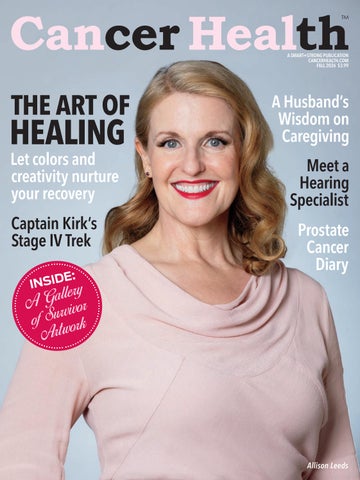
A SMART+STRONG PUBLICATION CANCERHEALTH.COM FALL 2026 $3.99
HEALING
A Husband’s Wisdom on Caregiving
Let colors and creativity nurture your recovery
Meet a Hearing Specialist
Captain Kirk’s Stage IV Trek
Prostate Cancer Diary
THE ART OF
Allison Leeds
CHFa-26_Cover.indd 1
ɐ30 CAN31069_CHFa-26_Cover.pgs 08.13.2026 06:31
Got Ink? An estimated 2 million Americans are living with hepatitis C. Most don’t know it. Get tested today.
THINKSTOCK (MOEL USED FOR ILLUSTRATIVE PURPOSES ONLY)
Find out how at hepmag.com.
CONTENTS
E xclusively on
Cancer Health.com Cancer Health Stories 5HDG WKH ƓUVW person stories of people who are living with cancer, including personal diaries and honest, moving essays. cancerhealth.com/stories
Basics Whether you’re newly diagnosed or a long-term survivor, check out our Basics section on cancer treatment, how to manage side effects and more. cancerhealth.com/basics
Science News
COVER AND THIS PAGE: (LEEDS) ANGELA DECENZO; (SPEECH BUBBLE AND T CELLS/TUMORS): ISTOCK
Learn about the latest treatment and prevention advances, cure research and conference news. cancerhealth.com/science-news
Cancer Health Digital Scan the QR code (left) with your smartphone to check out the digital issue of Cancer Health online, or go to cancerhealth.com/digital to read past issues and the entire Smart + Strong digital library.
Colors can soothe, says artist Allison Leeds.
14 THE HEALING POWER OF ART Allison Leeds used her design background, AI research and tech skills to more fully recover from breast cancer. BY JENNIFER COOK 18 CREATIVITY, HOPE & HEALING What else can emerge from cancer? Take a look at works from the Art for Recovery program. BY THEODORE KERR
4 From the Editor Art for Recovery
12 A Prostate Cancer Diary Ted Healy leans on support groups.
6 News Captain Kirk, X-Men and more | young-adult cases | civic duties and screenings | contagious cancer in FDWƓVK | diagnosis delivery systems
24 Can Heal Wisdom and sparkly whimsy from Jacquie Angell and her husband
8 Care & Treatment Cancer vax for penguins, dogs and people | GLP-1s slow cancer | new treatments for breast cancer | does immunotherapy timing matter?
28 Resources Websites for colorectal cancer 30 Solutions Care for the caregivers 31 Your Team Hearing specialist Karen Belgard
10 Voices Sherri Lewis is not afraid to get her colonoscopies and checkups.
32 Good Stuff Recover in style with these items.
11 Basics Breast cancer 101
33 Reader Survey Have you tried art therapy?
cancerhealth.com
CHFa-26p03_TOC.indd 3
FALL 2026
CancerHealth 3
ɐ30 CAN31069_CHFa-26p03_TOC.pgs 08.13.2026 06:32
FROM THE EDITOR
TM
IMAGINE BEING GREETED AT YOUR clinic with the message “I see you. I’m here. I love you.” That was a welcome reality for patients, caregivers and staff at Mission Bay Hospital in San Francisco. Last year, after undergoing surgery, breast cancer survivor Allison Leeds, the founder of Love & Light Art, painted a Above: watercolor of calming I See You green-blue hues featurby Allison ing that exact phrase. Leeds The painting, I See You, was displayed at the hospital as part of an exhibit of artwork by participants of Art for Recovery at the University of California San Francisco. Turn to page 14 to learn how Leeds uses art, AI and color theory to heal herself and help soothe the journeys of others with cancer. Art for Recovery offers creativity and community for people with cancer through visual art, literature and music. Several works of art by participants of the program were also highlighted recently at the San Francisco Museum of Modern Art. Meet several of the artists and check out a gallery of their inspiring work on page 18. Creativity, including glitter and
EDITOR-IN-CHIEF Trent Straube MANAGING EDITOR Jennifer Morton SCIENCE EDITOR Liz Highleyman EDITOR-AT-LARGE Bob Barnett NEWS WRITERS Sukanya Charuchandra; Eva Lorenz COPY CHIEF Joe Mejía ART DIRECTOR Doriot Kim ART PRODUCTION MANAGER Michael Halliday ADVISORY BOARD Dena Battle; Jamie Ennis Boyd; Catherine Guthrie; Timothy Henrich, MD; Carl June, MD; Leigh Leibel, MSc; Yung Lie, PhD; Gilberto Lopes, MD; Jennifer L. McQuade, MD; Amelie Ramirez, DPH; Hope Rugo, MD; Kelly Shanahan, MD; Carla Tardif FEEDBACK Email: info@cancerhealth.com SMART + STRONG PRESIDENT AND COO Ian E. Anderson EDITORIAL DIRECTOR Oriol R. Gutierrez Jr. CHIEF TECHNOLOGY OFFICER Christian Evans VICE PRESIDENT, INTEGRATED SALES Diane Anderson INTEGRATED ADVERTISING MANAGER Jonathan Gaskell INTEGRATED ADVERTISING COORDINATOR Sarah Pursell SALES OFFICE 212-938-2051 sales@cancerhealth.com BULK SUBSCRIPTIONS order.cancerhealth.com or subs@cancerhealth.com CDM PUBLISHING, LLC CHIEF EXECUTIVE OFFICER Jeremy Grayzel CONTROLLER Joel Kaplan Cancer Health (ISSN 2688-6200) Issue No. 35. Copyright © 2026 CDM Publishing, LLC. All rights reserved. No part of this publication may be reproduced, stored in any retrieval system or transmitted, in any form by any means, electronic, mechanical, photocopying, recording or otherwise without the written permission of the publisher. Smart + Strong® and Cancer Health™ are registered trademarks of CDM Publishing, LLC.
Cancer Health is AAM audited.
TRENT STRAUBE Editor-in-Chief trents@cancerhealth.com TrentStraube.com
(STRAUBE) JOHNNIE CUELLAR; (I SEE YOU) ALLISON LEEDS, LOVEANDLIGHTART.COM
Art for Recovery
goofiness, have uplifted Jacquie Angell through her 40 years with lymphoma and breast cancer. Enjoy her wisdom and whimsical artwork— along with advice for caregivers from her husband, Marc—in our Can Heal column on page 24. “Difficult circumstances don’t have to define your life,” Jacquie says. “A creative outlet or a passion project can remind you that you’re still you.” Stage IV prostate cancer survivor Ted Healy’s passion became advocating for other men facing the malignancy. During his recovery, he also focused on yoga and scuba diving. For more, read his Cancer Diary on page 12. In addition, our fall 2026 issue of Cancer Health rounds up the latest headlines in Care & Treatment on page 8, including new breast cancer therapies and good news about weight-loss drugs. And we profile hearing specialist Karen Belgard for our Your Team interview on page 31. Finally, please take our survey on page 33 and tell us about your experiences with art therapy. We see you and would love to hear from you.
4 CancerHealth FALL 2026 cancerhealth.com
CHFa-26p04_Ed_Letter.indd 4
ɐ30 CAN31069_CHFa-26p04_Ed_Letter.pgs 08.13.2026 06:32
Medication or Food? No one should have to choose. Have health insurance but still need help with out-of-pocket medication costs? HealthWell Foundation may be able to help. Learn more at www.HealthWellFoundation.org or call (844) 729-4437.
CAN31069_CHFa-26_005_AD_CancerHealth Fall 2026 Print Ad.pgs 08.07.2026 17:43
ESA
NEWS
BY TRENT STRAUBE
CAPTAIN KIRK’S STAGE IV TREK Plus: Even X-Men and Michael Myers get breast cancer.
CHFa-26p06-07_News.indd 6
Like a true warrior, he’s tackling it head-on. As he explained on Instagram: “My first reaction was to keep it secret. I mean it’s kind of embarrassing. But then I found out that men are more likely to be diagnosed in advance stages BECAUSE it’s not talked about and not looked for. In fact, my doctors all dismissed it and it was only because my wife pushed me to get the lump removed that I got in early.” • The entire world knew when pop princess Kylie Minogue was successfully treated for breast cancer in 2005. But the Aussie icon kept a second diagnosis in 2021 out of the media—until she discussed it in Kylie, her threepart Netflix documentary. “I got through it, again, and all is well,” the “Can’t Get You Out of My Head” singer said. “Who knows what’s around the corner, but pop music Clockwise from bottom nurtures me.... left: Polizzi, My passion for Gretsch, music is greater Shatner, Mane and Minogue than ever.”
The Rise of Cancer in Young Adults Cancer is often thought of as an older person’s disease. This is mostly correct. Only about 80,000 cases each year, or 8% of all cancers, are diagnosed among people ages 20 to 39. But as KFF Health News reports, more than a dozen cancers are on the rise in adults younger than 50, notably colorectal and breast cancer. Experts encourage folks to get screened and know their personal risk factors and family history. Researchers also noticed disparities in early onset cancers (as they’re referred to in younger people). American Cancer Society scientists found that only one in five young adults with advanced cancers received palliative care. And a review by the Columbia University School of Nursing discovered that fertility preservation is often overlooked in this population.
(STUDENTS EMBRACING) GETTY IMAGES/PIXDELUXE (MODELS USED FOR ILLUSTRATIVE PURPOSES ONLY) ; (MANE, MINOGUE, SHATNER AND POLIZZI) WIKIPEDIA; (GRETSCH) YOUTUBE/NO TIME BUT NOW OFFICIAL
TV legend William Shatner (Star Trek’s original Captain Kirk) boldly goes where few men have gone before. The 95-year-old actor and his daughter Melanie Shatner Gretsch, 61, both had Stage IV cancer at the same time. As Gretsch was being treated for breast cancer in 2023, Shatner was diagnosed with melanoma (a skin cancer) that had spread to his lungs and brain. Today, they’re cancer-free and sharing their stories in People—and via the podcast No Time but Now in which they interview health experts and survivors. Other celebrities making cancer headlines: • Early this year, reality TV star Nicole “Snooki” Polizzi, 38, shared that she had Stage I cervical cancer. In August, she posted a tearful video from a hospital: She had a hysterectomy that removed her uterus, cervix and “some parts” of her vagina. “It’s a scary thing, and a lot of us women deal with it, and no one really talks about it,” the Jersey Shore alum said. “I’m here to give that platform for all of us ladies.” • Actor and retired wrestler Tyler Mane played Michael Myers in Rob Zombie’s Halloween films, Sabretooth in the original X-Men and the Greek hero Ajax in Troy. But he’s facing a new kind of battle: breast cancer.
ɐ30 CAN31069_CHFa-26p06-07_News_6.pgs 08.13.2026 06:33
(LAKE MEMPHREMAGOG) WIKIPEDIA; (FISH ILLUSTRATION) GETTY IMAGES/THEPALMER; (VOTE BUTTONS) GETTY IMAGES/ADVENTTR; (MAN WITH PHONE) GETTY IMAGES/RIDVAN_CELIK (MODEL USED FOR ILLUSTRATIVE PURPOSES ONLY)
DO YOUR CIVIC DUTY! Whether it’s serving on a jury, voting in elections or volunteering, engaging in civic responsibilities comes with many benefits (such as a functioning democracy!). Research published in Cancer finds that civically engaged women are more likely to get screened for breast cancer. “The connection isn’t surprising, as being civically engaged could increase someone’s motivation to stay healthy by strengthening their sense of life purpose and role in their community,” said Jordan Baeker Bispo, PhD, MPH, a cancer disparity researcher at the American Cancer Society and the study’s lead author. “Also, civic engagement could foster relationships and social networks, which can facilitate access to material, informational and social resources for screening.”
CATFISHING? A contagious cancer is spreading among freshwater catfish in Lake Memphremagog near Vermont and Quebec. Transmissible tumors are rare and have been found in only a few species, including dogs, clams and Tasmanian devils;
in most cases, the cancer was spread via sex or bloody fighting, according to The New York Times. But University of Vermont researchers led by Julie Dragon, PhD, think the melanoma they’ve observed in the brown bullhead
Bullhead catfish and Lake Memphremagog
catfish marks the first contagious cancer seen in freshwater fish. “Is this really as rare as we think it is,” Dragon noted in the Times, “or are we just not looking?”
Tell It to My Face Who wants to learn they have cancer via an electronic portal? Speedy access to health records and test results, such as through online portals, can be useful—and it’s required by law—but a survey found that most people (75%) would prefer to receive a cancer diagnosis from a doctor, either in person or via telemedicine. Researchers at University of Texas Southwestern Medical College published their findings in JAMA Network Open. As lead author Sheena Bhalla, MD, noted: “Learning about a cancer diagnosis without the ability to immediately ask questions or discuss next steps with a trusted clinician can add to the significant stress, uncertainty and fear.”
Get more cancer news: cancerhealth.com/news cancerhealth.com
CHFa-26p06-07_News.indd 7
FALL 2026
CancerHealth 7
ɐ30 CAN31069_CHFa-26p06-07_News_7.pgs 08.13.2026 06:33
CARE & TREATMENT
BY LIZ HIGHLEYMAN
CANCER VAX FOR PENGUINS, DOGS, PEOPLE The San Francisco Zoo is treating a 28-year-old penguin with a melanoma vaccine, the San Francisco Chronicle reported in July. This news came a few months after an Australian tech entrepreneur made headlines for using artificial intelligence to create a customized vaccine for his dog. Therapeutic cancer vaccines aim to train the immune system to fight malignant cells. Customized cancer vaccines are made using antigens from an individual patient’s tumors, while off-the-shelf vaccines use shared cancer antigens. After surgery to remove a large tumor, Sophia the penguin received an off-the-shelf melanoma vaccine called Oncocept that’s approved for dogs. The entrepreneur, Paul Conyngham, took the customized route. He had his dog Rosie’s tumor DNA sequenced and used the results to develop a bespoke mRNA vaccine. So far, it appears to be working. It’s too soon to tell whether the vaccine is helping Sophia, but growing
evidence shows that cancer vaccines can benefit human patients. At the recent ASCO Annual Meeting, researchers reported that people with advanced melanoma who received Moderna’s personalized mRNA vaccine, dubbed intismeran autogen, plus the checkpoint inhibitor Keytruda (pembrolizumab) after surgery saw a 49% reduction in disease recurrence or death at five years compared with Keytruda alone. Further back in the pipeline, scientists are testing autogene cevumeran, a customized mRNA vaccine from BioNTech and Genentech, for pancreatic cancer. Half of the 16 patients in a Phase I trial who received the vaccine plus the checkpoint inhibitor Tecentriq (atezolizumab) and chemotherapy had strong T-cell responses. At this year’s AACR Annual Meeting, the researchers reported that seven of the eight responders were still alive four to six years after surgery— much higher than the average survival rate for this deadly cancer.
GLP-1 agonists and related drugs, widely used to treat type 2 diabetes and obesity, may also lower the risk of cancer progression and death, according to recent studies. These medications, including semaglutide (Ozempic or Wegovy) and tirzepatide (Mounjaro or Zepbound), curb appetite, regulate blood sugar and slow digestion; they also have other benefits that are not yet fully understood. Mark David Orland, MD, of the Cleveland Clinic, and colleagues looked at links between two types of diabetes medication— GLP-1 agonists and DPP-4 inhibitors—and progression of seven
obesity-related cancers. Reviewing medical records from more than 12,000 patients, they found that people with breast, colorectal, liver and lung cancer who used GLP-1 meds were up to 50% less likely to progress to Stage IV disease. High tumor GLP-1 receptor expression on tumors was linked to a 33% lower risk of death, suggesting the drugs have a direct protective effect beyond weight loss. A second study by Bernard Fuemmeler, PhD, MPH, of Virginia Commonwealth University, and colleagues looked at the effects of GLP-1 meds on breast cancer. Using retrospective data from
nearly 8,000 patients, they found that women with obesity who used GLP-1 agonists had a 65% lower risk of death from any cause and a 56% lower likelihood of cancer recurrence. Women with diabetes who used the drugs saw an even greater risk reduction compared with those who used insulin or metformin. “GLP-1 receptor agonists have never been just glucoselowering drugs. Their anti-inflammatory and immune-modulatory properties have long suggested broader effects,” says Marcin Chwistek, MD, of Fox Chase Cancer Center.
(PENGUIN) GETTY IMAGES/DGWILDLIFE; (SEMAGLUTIDE) GETTY IMAGES/SCHARVIK
GLP-1 Meds Slow Cancer Progression
8 CancerHealth FALL 2026 cancerhealth.com
CHFa-26p08-09_CareTreatment.indd 8
ɐ30 CAN31069_CHFa-26p08-09_CareTreatment_8.pgs 08.13.2026 06:39
New Treatments for Breast Cancer In May, the Food and Drug Administration (FDA) approved Datroway (datopotamab deruxtecan) as a new option for previously untreated patients with inoperable or metastatic triple-negative breast cancer (TNBC) who are not candidates for checkpoint inhibitor immunotherapy. Datroway is an antibody-drug conjugate (ADC) that uses a monoclonal antibody targeting TROP-2—a protein on tumors that spurs cell growth—to deliver potent chemotherapy directly to cancer cells. In June, the federal agency gave the nod to another TROP-2 ADC, Trodelvy (sacituzumab govitecan), as an initial treatment option for people with advanced TNBC. Trodelvy was approved as a solo drug for patients who are not eligible for PD-1 or PD-L1 checkpoint inhibitors and in combination with Keytruda (pembrolizumab) for people whose tumors express PD-L1. “For patients with metastatic TNBC, a new first-line treatment option offers optimism to a community with historically few choices,” says Ricki Fairley, cofounder and CEO of
TOUCH, the Black Breast Cancer Alliance. Turning to HER2-positive breast cancer, the FDA approved Ibrance (palbociclib) as maintenance therapy for people with advanced double-positive (hormone receptor and HER2-positive) breast cancer. Ibrance is a CDK4/6 inhibitor that blocks proteins that promote malignant cell growth. The agency also approved two new indications for Enhertu (trastuzumab deruxtecan), an ADC that uses HER2-targeted monoclonal antibody to deliver chemotherapy to cancerous cells. It is now approved for use before surgery (neoadjuvant therapy) and after surgery (adjuvant therapy) for patients with potentially curable cancer. Finally, in July, the FDA approved a brand-new drug, Revtorpyk (gedatolisib), for previously treated hormone receptor-positive/HER2-negative locally advanced or metastatic breast cancer without a PIK3CA gene mutation. Revtorpyk is a pan-PI3K/mTOR inhibitor that interferes with a signaling pathway that promotes cancer cell growth. It is also being studied for first-line treatment.
(PINK RIBBON) GETTY IMAGES/T_KIMURA; (CLOCK) GETTY IMAGES/NICOLAE POPESCU
DOES IMMUNOTHERAPY TIMING MATTER? In February, researchers published data suggesting that cancer patients treated with immunotherapy earlier in the day lived longer. But further analysis cast doubt on these findings. Timing of treatment is gaining interest in the oncology field. The idea is to take advantage of circadian rhythms, or natural variations in biological processes throughout the day. The LungTIME-C01 trial was a prospective randomized trial comparing outcomes among lung cancer patients who received immune checkpoint inhibitors before or after 3 p.m. As reported in
Nature Medicine, progressionfree and overall survival doubled in the early treatment group. But a few weeks later, the journal’s editors said they were looking into concerns about the study’s protocol and findings. After a four-month investigation, they retracted the report. Some experts suggested the study findings were “too good to be true.” But if they were true, they wouldn’t be good, as scheduling most patients for treatment early in the day would be logistically difficult. “In institutions where treatment flows are tightly choreographed for efficiency,
redistributing resources to ensure a consistent morning window for immunotherapy may require reengineering schedules, additional staffing or extended pharmacy hours,” says Gilberto Lopes, MD, of the Sylvester Comprehensive Cancer Center. What’s more, this would also raise concerns about equity, as people with inflexible work schedules, transportation limitations or childcare needs might not be able to schedule their treatment in the morning.
For more care and treatment news: cancerhealth.com/science-news cancerhealth.com
CHFa-26p08-09_CareTreatment.indd 9
FALL 2026
CancerHealth 9
ɐ30 CAN31069_CHFa-26p08-09_CareTreatment_9.pgs 08.13.2026 06:39
BY SHERRI LEWIS
Face Your Fears Don’t put off the lifesaving potential of colonoscopies and checkups, advises long-term survivor Sherri Lewis. AS A TEENAGER IN THE LATE 1970s, I LEARNED I HAD WHAT’S
now called hepatitis C decades before cures for the liver disease. In 1987, I was handed a death sentence when I was told over the phone that I had HIV and there would be no treatment in my lifetime. I tested positive for COVID-19 before the vaccines. Then there’s the time my doctor said, “You’ve got cancer.” Yes, I’ve heard quite a few frightening words in my 71 years. But that has never scared me from getting tested, and that’s a big part of why I’m still here! In 2004, I turned 50, the age recommended at that time to get a colonoscopy. Katie Couric’s husband died of colon cancer in 1998 at 42. To encourage screenings, she broadcast her own colonoscopy on Today , ZDV LQVSLUHG 0\ ƓUVW FRORQRVFRS\ was negative. What a relief. No need to return for 10 years! Fast-forward to 2022. I was 68 and felt sluggish and bloated and had abdominal cramps. I thought it was something related to my ovaries (at 16, I had surgery to remove a benign ovarian cyst, leaving only part of my left ovary), but doctors suspected my birth control pills were the culprit. I stopped taking them. A blood test showed I was slightly anemic. That’s when I had my second colonoscopy (yes, I was overdue). I woke up to the doctor leaning over to quietly tell me, “You KDYH FDQFHU Ő 6WLOO XQGHU WKH LQŴXHQFH , ZDV FDOP WKH QRQchalant, sarcastic voice in my head said, “What else is new?” 7KH\ IRXQG ƓYH WXPRUV 2QH ZDV FDQFHURXV $ IULHQG UHFRmended a surgeon, and I was able to book the procedure in a few days—I wanted this cancer out as soon as possible. My friend
Stephanie brought me to the hospital. The surgeon UHPRYHG DOO ƓYH WXPRUV ZLWK the robotic assistance of the da Vinci Surgical System. Thankfully, Stephanie remained with me all day until we got the results. I had Stage II cancer, meaning it had not spread. However, I got an infection in the hospital and remained there for three weeks. Turns out, removing the cancer was the easy part! The oncologist said I didn’t need chemo or radiation, just an annual colonoscopy for the next couple of years. All those have been negative. Now, I get one every two years. I was surprised I had cancer, given my healthy lifestyle. Then I learned colon cancer is often hereditary. One of my cousins had colon cancer a few years ago, so I reached out, and she told me it’s in our family. I never knew. My advice? Gather information so you can make educated choices about your health. Learn good nutrition. And because early detection is key to surviving the horsemen of the apocalypse, get all your screenings! Q Sherri Lewis is an HIV, hepatitis and cancer advocate— and a singer known as Sherri Beachfront, whose band, Get Wet, had an international pop hit, “Just So Lonely,” in 1981. She was discovered by Lou Reed at Max’s Kansas City in NYC.
(ILLUSTRATION) GETTY IMAGES/YOGINTA; (LEWIS) ARI MICHELSON
VOICES
10 CancerHealth FALL 2026 cancerhealth.com
CHFa-26p10_Voices.indd 10
ɐ30 CAN31069_CHFa-26p10_Voices.pgs 08.13.2026 06:34
BY LIZ HIGHLEYMAN
BASICS
Breast Cancer 101
GETTY IMAGES/IZUSEK (MODELS USED FOR ILLUSTRATIVE PURPOSES ONLY)
Different types of breast cancer call for different types of treatment. BREAST CANCER IS THE MOST common non-skin malignancy among women, with more than 300,000 new cases diagnosed annually in the United States. But breast cancer is not a single disease, and oncology is moving away from one-size-fits-all treatment. Understanding the different types of breast cancer can help guide decisions about the most appropriate therapy. Breast cancer usually arises in the milk ducts or glands called lobules that produce breast milk. Ductal carcinoma in situ (DCIS) refers to abnormal cells that have not spread beyond the milk ducts. Many experts consider DCIS— sometimes called Stage 0—a precancerous condition, but it can progress to invasive cancer. Breast cancer is classified by the type of receptors on tumors. Around 75% carry estrogen or progesterone receptors. These are known as HR-positive, or more specifically, ER-positive. Around 20% of breast tumors have high expression of HER2, a protein that spurs cell growth. However, a majority of tumors historically classified as HER2-negative actually have some HER2 expression; with more precise testing, they are now classified as HER2-low or HER2-ultralow. Triple-negative breast cancer doesn’t express any of these receptors. HR-positive and ER-positive breast cancer are treatable with hormone, or endocrine, therapy
that lowers production or blocks the action of estrogen, which encourages cancer proliferation. Medications include aromatase inhibitors, selective estrogen receptor modulators and selective estrogen receptor degraders. HR-positive breast cancer may also be treated with targeted therapies, such as CDK4/6 inhibitors, that block enzymes that drive cancer growth. HER2-positive breast cancer is typically treated with targeted therapies that block the HER2 receptor. These include the monoclonal antibody Herceptin (trastuzumab) and antibody-drug conjugates (ADCs), such as Enhertu (trastuzumab deruxtecan), that deliver potent chemotherapy drugs directly to tumors. Triple-negative breast cancer (TNBC) is more difficult to treat, but these tumors may respond to targeted therapies that interfere with proteins involved in cancer growth and spread, such as the Trop-2-directed ADCs Trodelvy (sacituzumab govitecan) and Datroway (datopotamab deruxtecan). In some cases, TNBC can be treated with checkpoint inhibitor immunotherapy. PARP inhibitors, such as Lynparza (olaparib) and Talzenna (talazoparib), may be an option for people with BRCA gene mutations that prevent cells from repairing damaged DNA—a group at high risk for aggressive breast cancer. Precision medicine increasingly
enables treatment to be matched to an individual’s cancer. This highlights the importance of genomic testing to determine whether tumors are susceptible to medications. The breast cancer field is moving away from immediate surgery, radiation and chemotherapy toward frequent monitoring and tailored treatment. This less-is-more approach can often reduce side effects and improve quality of life. This trend is especially apparent for DCIS, as more experts favor active surveillance. Several new therapies for breast cancer have been approved in recent years. Treatment is continually evolving, and it’s often possible to move on to new medications if current ones stop working. Options remain limited, however, for TNBC and metastatic (Stage IV) breast cancer. Many clinical trials of novel therapies are underway— ask your care team about studies that might be right for you. Q
Learn more cancer basics: cancerhealth.com/basics cancerhealth.com
CHFa-26p11_Basics.indd 11
FALL 2026
CancerHealth 11
ɐ30 CAN31069_CHFa-26p11_Basics.pgs 08.13.2026 05:16
DIARY
AS TOLD TO BOB BARNETT
A Prostate Cancer Diary Ted Healy, 69, lives in Portland, Oregon, with his wife. He was diagnosed with metastatic prostate cancer seven years ago.
June 2018 I had been urinating more than usual. My primary care doctor did a PSA [prostate-specific antigen] test. It was 4.93, which was high, but he said, “Let’s wait awhile and do another.” January 2019 My second PSA came back as 5.78. My primary provider said I needed to go to a urologist, who told me that since my dad had prostate cancer, my chances of getting it were 70% higher than normal. He ordered an ultrasound-guided biopsy, and they discovered cancer. My Gleason score was 4 + 3 = 7. I had to decide between surgery and radiation. February–April 2019 One of the smartest things I did was to join a support group. I knew the benefits from being in recovery. I wound up joining three support groups. I got a second opinion, talked to a surgeon, a radiation oncologist, another urologist. I read books. I decided to go with the surgery. May 2019 I had a radical prostatectomy. Before and after surgery, Mary handled the things no one talks
about—cleaning my catheter to prevent infection, managing the mess and Ted Healy can humiliation of incontinence, scuba dive doing it all without making again, and he me feel ashamed. works with The pathology after my surgery ZERO Prostate Cancer. showed a “tertiary five” pattern [a small but very aggressive form of prostate cancer]. That pushed my Gleason score up to 8 or 9. They had missed it on the first biopsy, but if I had had a biopsy that combined ultrasound imaging with an MRI, it probably would have shown up. July 2019 My PSA remained persistently high. A PET scan showed the cancer had metastasized to my bladder. I was staring down Stage IV cancer. Mary steadied me. Based on advice, I decided to go after this very aggressively—36 zappings with IMRT [intensitymodulated radiation therapy] and hormone therapy that suppresses testosterone, which feeds the cancer. It’s chemical castration. There was no way I could do all that and still work, so I quit my job and retired. I was worried about going bankrupt. Through a support group, I learned about ZERO Prostate Cancer and their ZERO 360 program, which provides case management to help navigate insurance claims, find financial assistance and secure access to care. Their case worker found out I qualified for financial aid. This was a turning point for my wife and me. August–November 2019 I had every side effect possible. The hormone therapy gave me hot flashes, like menopause. I gained 30 pounds, but my muscles were atrophying. My memory suffered, not to mention libido. It
(PAPER) ISTOCK; (HEALY) COURTESY OF TED HEALY
I’ve been athletic my whole life. I got certified in scuba diving at 16. I was a long-distance runner and played rugby. I was in the ad game in New York City for 18 years. I’ve been in recovery from alcohol for 25 years; I’m very open about that. I got divorced and have a son and daughter from that marriage. In 2000, I moved to Key West, Florida, where I met my current wife, Mary, an amazing fused-glass artist. We’ve been married 24 years. In 2010, after the BP oil spill, we packed up our four cats in a Volkswagen Beetle and drove to Portland, Oregon, where I got a job working as a business consultant for Apple.
12 CancerHealth FALL 2026 cancerhealth.com
CHFa-26p12-13_Diary.indd 12
ɐ30 CAN31069_CHFa-26p12-13_Diary_12.pgs 08.13.2026 06:41
almost pushed me into prediabetes and my cholesterol went up. I was depressed. The radiation gave me skin burns and ED [erectile dysfunction]. I had bowel movement issues, on top of urinary incontinence issues. It’s gotten better, although I do still wear diapers, especially when I’m traveling. I got great care. A social worker referred me to a psychologist who deals with cancer patients. And Mary has been an incredible rock. She showed up to every major appointment. When all I could hear was Charlie Brown teacher noise, she listened, tracked details and took notes. December 2019 My PSA was undetectable. The treatment worked. My financial aid package covered everything. It was such a relief. I was so fortunate to have my dog, Sprite. She got me out of the house and onto nature trails, where I saw tremendous beauty I never would have found if it weren’t for her. Those walks saved my mind. August 2020 I had an incisional hernia as a result of my prostatectomy, which needed surgery. It was during COVID. The next month, my testosterone levels returned to normal (my hormone therapy had ended). November 2021 Because I was Stage IV, Oregon Health and Science University offered a free genetic test. I have what’s called an HOXB13 variant, a rare inherited gene change that increases the risk of prostate cancer. December 2021 I enrolled in a clinical trial to study a physical fitness program to help people with side effects. It was a random assignment of tai chi, yoga or weight training. They put me in yoga. It was on Zoom, three times a week for six months. It changed my life.
The group of guys bonded. A couple of weeks in and I felt mentally good. I was getting in and out of chairs faster, waking better, losing weight. I’ve continued with the yoga to this day. March 2021 ZERO Prostate Cancer approached me to work on the Prostate Cancer Research Program to review Department of War grants as a consumer advocate. We have the same scoring weight as researchers and scientists. It’s an incredible program. I am doing whatever I can to help men not go through what I went through. 2022 I started to mentor men who are newly diagnosed. I advocate in Washington, DC, talking to representatives to support prostate cancer research. I became race director for prostate cancer run/ walks in the Portland area. 2025 My muscles came back to the point where I could consider diving again. It had been 25 years, so I took a refresher course. In April, I went to Hawaii. I was able to come out of the water with all my gear, pulling 300 pounds out of the water. 2026 Today, I’m fine. Sure, there are moments, like, Yeah, this sucks. I’ll never be the same physically or mentally. But I’ve been able to reclaim my body from the ravages of all that. Cancer has been a gift. It’s opened doors. It’s been a gift getting texts from these guys who say, “You changed my life; you gave me hope.” My advice to men out there? Don’t be like me. Get your PSA tested. Don’t wait. And if you need a biopsy, get an MRI-guided one—that would have changed my whole course of treatment. Even if you have metastatic prostate cancer, there’s hope. Advocate for yourself. Pay attention to financial toxicity. There are resources out there. In September, it’ll be six years that I’ll be NED [no evidence of disease]. You just have to find your way. It’s not easy. There’s no template, but there are opportunities. It’s like learning a new language.
For more first-person essays, go to: cancerhealth.com/stories cancerhealth.com
CHFa-26p12-13_Diary.indd 13
FALL 2026
CancerHealth 13
ɐ30 CAN31069_CHFa-26p12-13_Diary_13.pgs 08.13.2026 06:41
Allison Leeds, founder of Lov Ligh Art i he studio
14 CHFa-26p14-17_Feature_Leeds.indd 14 CHFa-26p14-17_Feature_Leeds.indd
8/13/26 4:27 PM CAN31069_CHFa-26p14-17_Feature_Leeds_14.pgs 08.13.2026 05:54
Allison Leeds used her design background, tech skills and AI research to more fully recover from breast cancer.
I
ANGELA DECENZO
N 2013, WHEN ALLISON LEEDS TURNED 40, THE MILESTONE MARKED a life of fulfilling, high-octane success. She was commuting daily from California’s Marin County, where she lived with her husband and 7-year-old daughter, to her job as senior director of user experience (UX) at a tech start-up in San Francisco. There, she was in the throes of launching a new brand. In addition, as a board member of the American Institute of Graphic Arts, she was volunteering to help plan events for the San Francisco design community. And to unwind, she would go swing dancing, reveling in the Lindy Hop. “My whole career had been in tech design her family had ever had breast cancer. She was BY leadership,” Leeds says. “It was a really fastJENNIFER driving when she got the phone call informing paced, exciting, demanding life.” her that the test had come back positive for a COOK That September, she felt a pain in her breast BRCA2 gene mutation. “I immediately pulled and consulted her doctor—not just once but three times over and just burst into tears,” she recalls. because the pain persisted. She was scheduled for a mamGetting tested had been a significant decision for her. mogram. “Cancer doesn’t usually present as pain, so no one “Once you get the results, you can’t unsee them,” she says. expected that my first mammogram was going to find “And you have to live your life differently if you have a anything,” she says. “But it found breast cancer.” positive result. Given Leeds’s age, her doctors recommended genetic “But the thing is, you actually get to live your life,” Leeds testing, “even though they thought there was a small continues. “My mom, my grandmother, my aunt, they all chance they would find a mutation,” she says. No one in died at age 59, two of them from other cancers. And I’ve
cancerhealth.com
CHFa-26p14-17_Feature_Leeds.indd 15
FALL 2026
CancerHealth 15
ɐ30 CAN31069_CHFa-26p14-17_Feature_Leeds_15.pgs 08.13.2026 05:56
“STUFFING” HER FEELINGS A woman who inherits the BRCA2 gene mutation has a higher risk of not just breast cancer but also ovarian and fallopian tube cancers and pancreatic cancer. There’s also a smaller elevated risk of melanoma and possibly endometrial cancer. To excise the existing cancer and lower her risk of some of these other cancers, Leeds underwent an 11-hour surgery in January 2014 to remove her breasts, ovaries and fallopian tubes. “It sent The Healing me into sudden menopause,” she says. Spectrum, “It was very overwhelming.” She optwatercolor and ed to get breast reconstruction, which pen on paper involved two additional surgeries. “I was so busy with life and work and family that I just followed my doctor’s orders and got that cancer out of me as quickly as possible,” Leeds says. She also joined BAYS—Bay Area Young Survivors—a support group for people diagnosed with breast cancer at age 45 or younger. “That was very helpful—to be able to speak with other women in my stage of life who were also navigating so many changes.” Leeds told her manager at work about her diagnosis but no one else. As a boss herself, she didn’t want members of her team to know, so after six-plus weeks of recovery, when her doctor said her body was ready, she plunged back into work. Although her body and stamina were different, “my expectations of myself had not changed,” she says. “It was easy to solve demanding business problems, but how do I stop treating my tender, recovering body like a productivity problem? I didn’t make space for any of the emotional part of it. I mean, the whole world was waiting—my daughter, my partner, my life.” Even reducing her schedule to 30 hours a week was a hard ask considering her responsibilities. Leeds wrote a poem titled “She Stuffs It Down” for a BAYS anthology that reflects her feelings of disorientation and disconnection from her new “disfigured” body (“Am I even a woman anymore?”) and the pressure she experi-
enced to get back to her life before cancer. (Read the poem and view more of her artwork on CancerHealth.com.) AN OPPORTUNITY FOR HEALING Over the next decade, “I just lived my life,” Leeds says. She worked, got divorced and raised her daughter, who’s now 20 and thriving in college. “I met the love of my life. We’ve been together seven and a half years,” she adds. “I’ve done tons of dancing. And I got screened for cancer a lot—like every couple of months.” Then, in 2024, Leeds had pain in her breasts, again. This time, cancer wasn’t the cause. She was having complications from the original 2014 surgery to remove her breasts. But when she walked into the hospital for her doctor’s appointment, all the loss and anguish flooded back, and she burst into tears. “I was like, What’s going on?” she says. “I guess my heart remembered.” When she learned she would need more surgery, “I wanted to give myself permission to feel everything so I could give my heart that tender acknowledgement and acceptance instead of just rejecting what it was saying like I did the first time,” she says. She knew her surgeon couldn’t really help her: “They focus on the body, and they’re really good at that.” But she felt there was no map for the territory she was entering, so she set out to create one for herself. Leeds realized that her work in tech had provided her with the perfect tool: artificial intelligence. Using AI, she researched and synthesized data on 11,000 patients’ public web posts concerning what they were experiencing after breast cancer surgery. “They were talking about fear and grief and frustration and loneliness and disconnection and vigilance,” she says. “All these things that I had experienced but hadn’t put names to appearing again and again.” Next, she used AI to examine color theory and color science research linking certain hues to specific feelings, like fear, love and hope. And then she mapped the color science onto the patient experiences, organizing everything according to what might happen each week, progressively, after surgery—from week 1 through week 6.
(THE HEALING SPECTRUM) ALLISON LEEDS, LOVEANDLIGHTART.COM
taken every possible measure not only to get rid of the cancer but to prevent future cancers.”
16 CancerHealth FALL 2026 cancerhealth.com
CHFa-26p14-17_Feature_Leeds.indd 16
ɐ30 CAN31069_CHFa-26p14-17_Feature_Leeds_16.pgs 08.13.2026 05:54
To create a physical reminder for herself, Leeds painted cards with watercolors, one for each week in the appropriate colors, and wrote a mantra beside each painting. On the back, she wrote compassionate words and a few journal prompts to help her process the feelings she would have that week. As an example, Leeds says, in the first week post-surgery, someone might find it challenging to receive help, especially if they are very self-sufficient. Soft blue tones can help quiet the nervous system, making them feel safe and more receptive. “I knew I had to do this before surgery because I wouldn’t have the capacity to do it afterward,” she says. “I wanted care waiting for me on the other side.” She printed her cards and mailed them to herself on the date she set for each one, once a week for six weeks. “I just put them on my bedside table, and it helped me move through those emotions.” “Five of the six cards I sent myself were immensely helpful, but one of them actually made me kind of angry,” she adds. “It was suggesting that things were getting better, and that was not even remotely how I felt. That was like my own design research on myself, and I was fixing it.” The March 2025 surgery was harder than the first one had been—17 hours long, with an extended recovery afterward. But when Leeds felt stronger, she sent her cards to members of her support group undergoing surgery, either as physical cards or via email. “It was just so meaningful to them, and I just kept feeling really fulfilled by that,” she says. “It helped show them they weren’t alone.”
gathered from her AI research, was selected for an Art for Recovery exhibition at the San Francisco Museum of Modern Art. Leeds created another piece after her 2025 surgery, when her doctor told her she had to massage cream into her scars twice a day. “I was like, “What?!” she says. “I had to touch these scars. I had to look at them. I had never done that. When I finally touched them, I cried. It was so hard! Eventually, I started saying to my scars, ‘I see you. I’m here. I love you.’ And trying to be really present with them.” Leeds made a painting of sinewy green-blue bands of watercolor and put those words on top of it. As part of an Art for Recovery exhibit, the university hung the piece, titled I See You, next to the registration desk at Mission Bay Hospital, where everyone passing by could see it. One visitor, who was a nurse, caregiver and patient, wrote to the hospital asking staff to tell Leeds how deeply the piece had touched her. “It showed me how powerful healing art can be in a hospital. And it really touched my heart,” Leeds says. Eventually, she wants to launch her cards into the world so that people can share them with loved ones recovering from surgery. But for now, the cards have to wait: “My life is asking me to listen to my body. I can’t build a company about honoring the body’s pace if I don’t honor my own. “I would love to get back to UX design consulting and creating artwork for women going through transitions,” she says. “I feel like the two are very connected—it’s bringing my design experience and art practice and survivorship experience all together. My whole career has been studying customers and looking for unmet human needs and designing systems around those unmet needs. I guess that’s why me seeing this unmet need in the cancer journey is important. I feel like this is a missing piece of our care. “I have a dream of sitting beside a million women so they can feel their authentic feelings and heal from color instead of the hard work of everything else that is asked of us as we heal,” she continues. “Just looking at a painting. A painting doesn’t ask anything of you. It just sits beside you and helps you. I want to do my part to help. That was the last square in The Healing Spectrum piece: purpose. ‘We carry light so no one walks alone.’” Q
I WAS JUST TRYING TO PAINT MY FEELINGS.
MAKING SPACE FOR ART AND ITS MAGIC More complications arose, for which Leeds had to have another surgery in January 2026. She is still recovering, getting physical therapy and resting a lot. And she continues to create healing artwork, spending more time in the Art for Recovery program at the University of California San Francisco (see “Creativity, Hope & Healing,” page 18). “It really was a beautiful place for me to go and have those difficult feelings after recovery, just to give them space and tender attention and paint them,” Leeds says. “I wasn’t trying to make pretty paintings. I was just trying to paint my feelings, and that helped them soften big time.” One artwork, titled The Healing Spectrum, which combines color science, poetry, her own feelings and those she
cancerhealth.com
CHFa-26p14-17_Feature_Leeds.indd 17
FALL 2026
CancerHealth 17
ɐ30 CAN31069_CHFa-26p14-17_Feature_Leeds_17.pgs 08.13.2026 05:55
What else can emerge from cancer: the work of Art for Recovery
OVER THE COURSE OF A WEEK, artist Sylvia Parisotto watched as a caterpillar outside her Oakland, California, home transitioned into a butterfly. As it flew away, Parisotto collected the chrysalis and preserved it to use in one of her artworks. I’m Still Here, acrylic on MRI film, by Sylvia Parisotto, who has glioblastoma brain cancer
COURTESY OF SYLVIA PARISOTTO
BY THEODORE KERR
18 CancerHealth FALL 2026 cancerhealth.com
CHFa-26p18-23_Feature_Art.indd 18
ɐ30 CAN31069_CHFa-26p18-23_Feature_Art_18.pgs 08.13.2026 04:08
19 CHFa-26p18-23_Feature_Art.indd 19 CHFa-26p18-23_Feature_Art.indd
8/13/26 1:29 PM CAN31069_CHFa-26p18-23_Feature_Art_19.pgs 08.13.2026 04:08
In her art, butterflies and nature are a recurring theme—a commentary on how change often happens slowly and the value of being present as transitions unfold. Parisotto, who is in her mid-50s, has lived more than 20 years with glioblastoma, a type of brain cancer, now Stage IV. She is one of over 1,000 members of Art for Recovery, a creative therapy program founded in 1988 for people who are living with cancer or other lifethreatening illnesses, such as AIDS. A part of the University of California San Francisco’s Helen Diller Family Comprehensive Cancer Center, the program offers creativity and community through the visual arts, literature and music for people with cancer wherever they may be in their journey. Parisotto and her husband had just moved to the San Francisco Bay Area when she was diagnosed. Facing a terminal illness and navigating an uncertain future with fewer friends around, Parisotto knew she needed to start thinking about what was next. Parisotto learned about the program as she was facing these disruptive changes. A diagnosis tells someone what is happening inside their body. It can also begin reshaping the rest of their life. Within that upheaval, her creative practice and community became a way for her to keep up with the butterfly effect of change in her life. For the nearly 20 million people in the United States living with cancer—including survivors—treatment can take many forms: targeted drug therapy, surgery, radiation, chemotherapy and more. For many, additional support alongside medical intervention makes all the difference. This is true for writer Mark Lowenstein. He knew soon after his cancer diagnosis that medical treatment alone would not be enough. He is the 12th among his immediate blood relatives to be diagnosed with cancer; his mother, sister and father all died of cancer before age 65. At 73, diagnosed with both prostate cancer and breast cancer in 2022, Lowenstein is committed to a different
I HAD TO TREAT ALL FACETS OF MY LIFE: MY MIND, MY BODY, MY SPIRIT. outcome. As he explains, “I had to treat all facets of my life: my mind, my body, my spirit.” For him, this means listening to his medical providers, practicing walking meditation, eating well, living in Hawaii and participating online in the Art for Recovery Men’s Workshop.
20 CancerHealth FALL 2026 cancerhealth.com
CHFa-26p18-23_Feature_Art.indd 20
ɐ30 CAN31069_CHFa-26p18-23_Feature_Art_20.pgs 08.13.2026 04:08
ALL IMAGES: COURTESY OF SAN FRANCISCO MUSEUM OF MODERN ART/ UCSF ART FOR RECOVERY
It’s in that virtual space that Lowenstein and other participants move beyond the constricted ways that, as he points out, many men have been taught to deal with tough situations, like cancer. He credits writer Ned Buskirk, who facilitates the group, with the opportunity to share more openly. The group is a space to play music and write; it’s also a space where culture sparks conversation and introspection. Buskirk begins each session with a prompt in the form of a poem, lyric or quote, which, Lowenstein says, encourages the men to reflect and then talk about their own experiences, beyond the surface-level details that might otherwise be their default.
Opposite page: Half Full, Half Empty, photograph, by Jeff Gillman (acute myeloid leukemia); this page, from left: At the Bottom of the Sink, watercolor, by Barbara Sloan (breast cancer); and Lost Hair, human hair, faux fur, cloth and plastic, by Susana Gershuny (breast cancer)
Since his double diagnosis, Lowenstein has become an avid chronicler of his experience. Before cancer, he never kept a diary. He has since written over 150 entries in an ongoing journaling practice he calls Cancer, Cancer, Cancer, Can’t We Talk About Something Else. In an entry titled “Ringing the Bell,” he mourns his family while recognizing his own journey and commitment to life: “Today was my last treatment. When I finished, there was a bell by the nurse’s station that I rang, bringing completion to a long, arduous, full year of unknowns, anxiety and hope. And yes, I shed a few tears for my family.” Writing the entry was important, but so,
cancerhealth.com
CHFa-26p18-23_Feature_Art.indd 21
FALL 2026
CancerHealth 21
ɐ30 CAN31069_CHFa-26p18-23_Feature_Art_21.pgs 08.13.2026 04:09
From left: First too, was sharing it. Lowenstein comes from a describes these sessions as a “beautiful mix of Sign, multimedia family of writers. Unlike Parisotto, who identiconversation holding the darkest things and the on canvas, by fied as an artist before her diagnosis, Lowenstein, lightest things in the same place,” where people David Guerra despite his prolific output, hesitates to call himself weave in and out of talk about their cancer, (bladder cancer); Flower 9869, a writer. Nonetheless, he recognizes that the their treatments and any number of other topics, acrylic and acrylic group has provided him with community and a like pets or favorite colors. ink on canvas, creative practice he did not have before. They’re also a place where people lean into by Ben Pax (brain cancer); and Along with the men’s group, Art for Recovery parts of themselves that they might have preFinding Safety in also offers a music program; exhibition opportuviously neglected. Endless Darkness nities, such as a recent show at the San Francisco Retired nurse David Guerra, who prefers Is a Radical Act, paper collage, Museum of Modern Art; and the Firefly Project, female pronouns and is in her mid-60s, had a patient-led mentorship program whereby by Manisha Dayal always been an artist. But she’d been busy with (colon cancer) adults with cancer and other illnesses exchange her work, raising her daughter and caring for letters with medical students hoping to develop her husband after he got sick with cancer. She hadn’t been comfortable calling herself an artist— a good bedside manner. that is, until she received a cancer diagnosis and Among the most popular resources are the became a member of Art for Recovery. open art studios, each session of which starts Soon after her husband died, Guerra learned in 2024 with a prompt and some music before the conversation and art-making begin. At the end, folks share art they’ve made that she had an invasive form of bladder cancer and would need her bladder removed. After the surgery, to get her and, if they wish, some aspect of their cancer story. Art for Recovery executive director Amy Van Cleve body moving, she walked laps around the fifth floor at
22 CancerHealth FALL 2026 cancerhealth.com
CHFa-26p18-23_Feature_Art.indd 22
ɐ30 CAN31069_CHFa-26p18-23_Feature_Art_22.pgs 08.13.2026 04:09
ALL IMAGES: COURTESY OF SAN FRANCISCO MUSEUM OF MODERN ART/ UCSF ART FOR RECOVERY
the UCSF Helen Diller Family Comprehensive Cancer Center in Mission Bay, where she was recovering. Along the way, in the doorway of room A-5477, where Art for Recovery groups meet, she noticed the words hope and healing painted on tiles. She remembers thinking, Well, that would be really nice, because right now, I’m feeling hopeful, and I hope I stay hopeful. The tiles led Guerra to Art for Recovery, where she worked to remain hopeful and began expressing a creativity that she’d repressed in previous decades. The diagnosis and recovery were the start of a journey that was as much about cancer as it was about figuring out the next phase of her life. Among her first projects was a lesson about and an expression of what matters to her. At the time, she was wearing cooling gloves to prevent peripheral neuropathy from chemotherapy, which meant she couldn’t paint, the suggested activity that day. But she could collage. In response to the group prompt “What’s in your nest?” Guerra glued together yarn, beads and other objects into a nest housing little chicks, representing her daughter and her daughter’s partner, who had moved in with
Guerra as a new chapter of their lives began. For participant Parisotto, butterflies became a recurring motif in her artwork. Once, while she stood outside, a monarch butterfly landed on her finger and stayed a while. “I was surprised by its grip on me,” she recalls. In a self-portrait Parisotto exhibited last year, butterflies appear again, hovering over the artist. Words painted across her torso read: “Hey! Guess what? I’m still here!” The I in question could refer to the butterflies, the artist or cancer itself. Regardless, the painting presents an opportunity to consider endurance and persistence. Parisotto, Lowenstein and Guerra understand from experience that although it’s upsetting to grapple with something from within one’s own body wreaking havoc on one’s life, it is also powerful to learn what else can emerge from within: creativity. That is why all three share one common piece of advice for people with cancer: Get involved in groups. Programs such as Art for Recovery, like the butterfly on Parisotto’s finger, find a way of sticking, providing the community and resources people need to endure and persist. Q
cancerhealth.com
CHFa-26p18-23_Feature_Art.indd 23
FALL 2026
CancerHealth 23
ɐ30 CAN31069_CHFa-26p18-23_Feature_Art_23.pgs 08.13.2026 04:09
BY TRENT STRAUBE
Cancer survivor Jacquie Angell creates uplifting art that sparkles.
Wisdom & Whimsy Practical advice on wigs, attitudes and art by Jacquie “the Duck Lady” Angell, who has been navigating the effects of three cancer diagnoses for over 40 years. WHEN SHE WAS 15, JACQUIE ANGELL WAS DIAGNOSED with non-Hodgkin lymphoma, a type of blood cancer. In 2013, she developed HER2-positive breast cancer in her left breast. After a mastectomy, her body rejected the breast implant reconstruction, so she had flap reconstruction surgery while continuing treatment. But in 2020, just a month after she celebrated becoming cancerfree, she found a lump in her right breast. This time, it was triplenegative breast cancer. She underwent a lumpectomy, chemo, radiation and immunotherapy. Eventually, it advanced to Stage IV, spreading to her liver and lungs. She also has a pacemaker-defibrillator due to heart damage. She’s currently undergoing chemotherapy. That’s a lot of experience with cancer, yet illness hasn’t held her back. As an international speaker and corporate trainer, Angell traveled the globe. Now 59, she lives in Thousand Oaks, California, with her husband, Marc, 68. They have two adult children, Alexandria and Anthony, and “two very opinionated cats,” Mr. Boots and Trixie. “Cancer has changed many things about my life, but it hasn’t changed who I am,” she says. “I’m still the same optimistic, determined
person. I’ve simply had to learn to navigate life a little differently. Sometimes life’s biggest detours lead to the most meaningful destinations.” For example, as a way to focus on something other than scans, appointments and health updates, Angell and her 83-year-old mother began creating whimsical hand-embellished art. Soon, the fun pastime developed into the family business Sparkles & Splatters. We spoke with Angell for the latest installment of our Can Heal column—that empowering phrase is right there in our title, Cancer Health. The column discusses the myriad nonmedical strategies and insights that help many folks with cancer. Our interview has been edited for length and clarity. How has your attitude toward cancer changed over these past four decades? Sometimes, I joke that I’ve become a professional cancer patient. When I was diagnosed with non-Hodgkin lymphoma, my prognosis was poor, and for a long time, I assumed I wouldn’t have the opportunity to grow up, build a career or have a family. But after college, I realized I didn’t have an expiration date. Instead of living under the shadow of cancer, I decided to truly live. People often ask how I keep going. The truth is, I don’t spend much time wondering, Why me? I simply ask, What’s next? I’ve learned that living with metastatic cancer isn’t about pretending life is easy. It’s
COURTESY OF JACQUIE AND MARC ANGELL
CAN HEAL
24 CancerHealth FALL 2026 cancerhealth.com
CHFa-26p24-26_Can_Heal.indd 24
ɐ30 CAN31069_CHFa-26p24-26_Can_Heal_24.pgs 08.13.2026 06:41
about adapting, to live fully despite the uncertainty. And I love being able to change my hair color and style on a daily basis—it keeps life exciting. One lesson I am passionate about sharing is the importance of knowing your own body. I discovered both of my breast cancers myself. One was found just weeks after a normal mammogram, likely because I have extremely dense breast tissue. Those experiences made me a strong advocate for self-awareness and breast self-exams. Never ignore something that doesn’t feel right simply because a test came back normal. What has helped you deal with and accept the three diagnoses? Without question, the greatest source of strength and support has been my husband, Marc. Although he jokingly refers to himself as my caregiver, I prefer to call him my husband. To me, that’s much less cringey. And “caregiver” just doesn’t sound very romantic. My parents have also been an incredible source of love and support. And I have also been incredibly fortunate to have an oncology team that feels like family, especially my nurses. There was a time when I dreaded going in for treatment. I knew I needed to change my mindset, so I came up with a little mission. I started hiding tiny resin ducks throughout the oncology center.
At first, no one knew where they were coming from, and I certainly wasn’t telling. Then Marc got involved, which made the mystery even more entertaining because ducks kept appearing while I was in treatment. Eventually, they figured out who “the Duck Lady” was, but that didn’t stop the fun. Those little ducks changed something for me. Instead of walking into treatment focused on chemotherapy, I walked in excited to make
FIND THE PATH THAT FITS YOUR LIFE. someone smile. It reminded me that even in the middle of cancer, there’s always room for laughter and a whole lot of silliness. In fact, there’s no better time. Similarly, what has helped you stay healthy (not counting meds and treatment)? What has helped me the most is, I discovered that if cancer is the only thing you talk about, before long it’s the only thing you think about. My mom used to call or text every afternoon to check on me. It always came from a place of love, but the conversation was usually the same: “How’s your headache? Your stomach? Your nausea?” Before long, I was dreading those calls. Around that same time, I started
painting late at night when I couldn’t sleep. Watercolors became my escape. I would send my artwork to my mom, and she immediately fell in love with it. Before long, she started hand-embellishing each piece with diamond dust, glitter and sometimes Swarovski crystals to make them sparkle even more. Without realizing it, everything changed. Instead of talking about chemotherapy, we were talking about colors. Instead of discussing side effects, we were debating picture frames, glitter and new ideas. We didn’t stop fighting cancer. We simply stopped allowing it to be the center of every conversation. Difficult circumstances don’t have to define your life. A creative outlet or a passion project can remind you that you’re still you. What advice would you offer a newly diagnosed person? My first piece of advice would be: Don’t ask everyone for advice. (I say that a little tongue in cheek.) The moment people hear you have cancer, everyone has an opinion. It can become overwhelming very quickly. Cancer is not a cookie-cutter disease. Find the path that fits your life, your values and your body, not someone else’s. That’s really what the slogan “Just be you” means. My second piece of advice is to be careful where you get your information. Find reputable sources and lean on your medical team. While online support groups can
cancerhealth.com
CHFa-26p24-26_Can_Heal.indd 25
FALL 2026
CancerHealth 25
ɐ30 CAN31069_CHFa-26p24-26_Can_Heal_25.pgs 08.13.2026 06:41
SIDE BY SIDE
Marc and Jacquie be wonderful, they can also be Angell at an frightening because people American Cancer naturally share their most difSociety gala ficult experiences. Be informed; be prepared; but don’t assume the worst. Finally, ignore statistics. Statistics don’t measure our faith, our resilience, our determination, our support systems or our will to keep living. Several years ago, I was told I had 90 days to live. Ever since then, I’ve decided statistics are just numbers. They don’t get to tell my story. I do.
Any additional advice for those navigating Stage IV cancer like you? First, if you’re going to wear a wig, and it’s within your budget, I recommend human hair. You can curl it, straighten it, style it and make it feel a little more like you. When so much feels out of your control, keeping a little bit of your own style can make a big difference. And if your wig makes your scalp itchy, ask your medical team whether a numbing cream, like the kind often prescribed before accessing a port, is appropriate for you. A little on your scalp before putting your wig on can make it much more comfortable. Beyond that, the biggest lesson I’ve learned is to keep living while you’re living. Q
26 CancerHealth FALL 2026 cancerhealth.com
CHFa-26p24-26_Can_Heal.indd 26
The best way to help someone with cancer is to be positive, be present, be dependable and be strong when they need strength but, above all, be a good listener. I cannot emphasize it enough. Do not assume that you always need to provide answers, advice or encouragement. Sometimes the most meaningful thing you can do is simply listen. Remain steady in front of the patient, but understand that being strong does not mean pretending you are never frightened, exhausted or overwhelmed—you save those feelings for others in your circle. Do not make promises you cannot guarantee. Instead of saying, “Everything is going to be OK,” say: “We got this!” “We are in this together!” You may also need to become a buffer between your loved one and the outside world. Discuss this with them and develop a communication plan based on their wishes. Your job is to protect their emotional energy and honor their preferences. Decide who should receive updates and how much information should be shared. Much of the caregiver’s work happens behind the scenes and outside the patient’s earshot. You may spend hours researching the diagnosis, insurance coverage and treatment options and then coordinating all the appointments and tests. Keep written records. Maintain a calendar. Take notes during appointments. Track medications, test results, symptoms, questions, insurance approvals and the names of everyone you speak with. When your loved one is tired, frightened, medicated or overwhelmed, you may be the person who remembers what was said and what needs to happen next. Most importantly, continue to treat your loved one as the person they have always been, not merely as a cancer patient. You do not have to be perfect. You simply have to remain present, informed, compassionate and committed. And remind them through both your words and your actions: We are in this together. This is Our Journey.
COURTESY OF JACQUIE AND MARC ANGELL
Marc Angell, a caregiving husband, shares his advice for those whose loved ones have cancer:
For more inspiring profiles, go to: cancerhealth.com/stories
ɐ30 CAN31069_CHFa-26p24-26_Can_Heal_26.pgs 08.13.2026 06:41
FIND US AT
CancerHealth.com TM
• A daily resource for people living with and affected by cancer • Clear, comprehensive prevention and treatment information Ř 1HZV SHUVRQDO VWRULHV EORJV FDQFHU VSHFLƓ F UHVRXUFHV DQG PRUH • Sign up online to receive free treatment and lifestyle email newsletters Follow us on:
A SMART + STRONG PUBLICATION Award-winning consumer health care information
CancerHealth_House_Ad_2026_HY.indd 25
ɐ30 CAN31069_CHFa-26_027_AD_Cancer Health Fall_House ad.pgs 08.07.2026 18:47 ESA
RESOURCES
BY EVA LORENZ
Colorectal Cancer Resources COLORECTAL CANCER DEVELOPS WHEN CELLS in the colon or rectum—sections of the large intestine— grow out of control. Cancer may also arise elsewhere and metastasize, or spread, to the intestines, but such tumors are not considered colon cancer. According to the World Health Organization, colorectal cancer is the third most common cancer, accounting for about 10% of cancer cases worldwide, and is the second leading cause of cancer-related deaths. Of note, new diagnoses are increasing among people under 50—a trend highlighted by the recent death of actor James Van Der Beek. The following organizations are great resources for this cancer.
Col˘ˇ Cˆ ˇ˙ ° ˛ C˘ ˆ l˝t˝˘ˇ The Colon Cancer Coalition educates communities, patients and caregivers on colorectal cancer and empowers people to advocate for their own health. Its website has information on colorectal cancer, screening and prevention. Col˘ˇ t˘ wˇ Colontown is an educational resource and online community
consisting of “neighborhoods” for colorectal cancer patients, survivors and caregivers. Its website features learning centers, or courses, on colorectal cancer as well as access to over 100 colorectal cancer support groups. C˘ l˘ ˛ °˙ tˆ l Cˆ ˇ ˙ ° ˛ A lliˆ ˇ ˙ ° Colorectal Cancer Alliance is a nonprofit committed to ending colorectal cancer by raising awareness, funding lifesaving research and advocating for policies that facilitate treatment, screening and prevention efforts. Its website includes resources on education, screening, prevention, financial support and research grants. C˘ l˘ ˛ °˙ tˆ l Cˆ ˇ ˙ ° ˛ E qu˝ty F˘ uˇ dˆ t˝˘ˇ To promote health equity among Black men and other marginalized groups, the team at CRC Equity conducts community events,
awareness campaigns, screening opportunities and more. F˝ght C˘ l˘ ˛ °˙ tˆ l Cˆ ˇ ˙ ° ˛ Fight Colorectal Cancer provides accurate information, supports research and advocates for policies that give rise to systemic health care changes. Its website has educational pages and information on programs that connect colorectal patients and caregivers to research-driven resources. Globˆ l Col˘ˇ Cˆ ˇ˙ ° ˛ A ˘ ˙ ˝ˆ t˝˘ˇ The Global Colon Cancer Association advocates for patient access to colorectal cancer testing, treatment and care. Along with resources on colorectal cancer treatment and screening basics, its website lists various patient programs, including advocacy mentorship, clinical trial awareness, policy transformation and more.
GETTY IMAGES/BARKS_JAPAN
A˜°˛ ˝˙ ˆ ˇ Cˆ ˇ ˙ °˛ S˘ ˙ ˝° ty Nˆ t˝˘ˇ ˆ l Col˘˛ ° ˙ tˆ l Cˆ ˇ˙ ° ˛ R˘ undtˆ bl° Founded in 1997 by ACS and the Centers for Disease Control and Prevention, the ACS NCCRT operates as a coalition of over 230 organizations to offer coordinated leadership, planning and advocacy to fight colorectal cancer. Its site offers a clinicians hub and a resource center with webinars, screening guides and much more.
Discover more resources: cancerhealth.com/resources 28 CancerHealth FALL 2026 cancerhealth.com
CHFa-26p28_Resources.indd 28
ɐ30 CAN31069_CHFa-26p28_Resources.pgs 08.13.2026 04:07
DƝĤĤΈ|ŬšŊŬĤ ŶŬĽĤƝĤŬĖĤ
qŶǕĤŪĕĤƝΈ̄Έ&Έ̅
YÈ¡yge yµceÈĜºÈgĩ ºµfeÈeµceÌ
qùǕŊľùƱŊŬľΈeŊĽĤΈ ĤǜŶŬĝΈ%ŊùľŬŶƥŊƥ̺ Ěeḁ˗ ː˧̥e ab˧utՓ ¤ealth & Wʇ̓abʇlʇtΖ È˗̓u̥a˗ce
ĭa΄ʇgatʇ˗g Fʇ˗a˗ce̓ bː̛l˧Ζːe˗t ƀʇght̓ Ÿla˗˗ʇ˗g head
CAN31069_Triage Cancer Full Page_V3.pgs 08.11.2026 15:45
ESA
BY KATE FERGUSON
Care for Caregivers Five tips to help cancer caregivers sustain their own health and avoid the pitfalls of burnout. “YOU CAN’T POUR FROM AN EMPTY CUP.” THIS COMMON saying among nurses and professional caregivers serves as a gentle reminder that you can’t help others if your own health is depleted. In the cancer world, millions of spouses, family members and friends unexpectedly find themselves in the role of caregiver, trying to keep everything together. But help is out there. For example, CancerCare provides free support, counseling and resources to folks affected by cancer, including caregivers. Below are simple, proactive steps to help caregivers protect their own well-being so they can better care for their loved ones. • Ask for help early and often. It’s easy to become overwhelmed. But you don’t have to do this alone. First, divide tasks into those only you can do and those family or friends can handle; then delegate. Lean on community and contact local volunteer organizations for respite care or meal deliveries. Check whether your loved one’s health insurance covers home healthcare benefits. If working, check your rights under the Family and Medical Leave Act for up to 12 weeks of job-protected, unpaid leave with continued health benefits. This may also be a great time to join a cancer caregiver support group to share experiences and get feedback. • Get educated about your loved one’s diagnosis, treatment and side effects. Being informed can help you better understand what to expect during treatment. Get formal permission from your loved one to speak directly with their medical team. Keep a running list of questions for the doctors and nurses managing their care. • Cultivate daily mindfulness. Staying present in the moment calms your nervous system and helps you process heavy emotions.
Take a few minutes each day to sit still and focus entirely on your breathing. Tech can help. Check out meditation apps, such as Headspace, Happier and Calm—listed among the best for 2026—to help you tap into this stress-relieving practice. • Protect your financial well-being. Caregiving often requires significant out-of-pocket expenses, but you can minimize the money drain. Plan ahead, if possible, and discuss long-term care insurance with your loved one. Ask about IRS caregiver relief, like claiming a parent as a dependent or deducting some of their medical expenses on your taxes. Under certain Veteran Affairs (VA) guidelines, veterans may be eligible for the VA’s Aid and Attendance benefit, which they can use to compensate their caregivers. If you’re considering transferring a loved one’s assets to yourself to ease financial strain, consult a healthcare attorney first because you may need to put formal contracts in place to avoid penalties. For legal resources and experts, visit TriageCancer.com. • Ruthlessly practice self-care. Learn to say no. Decline extra obligations when you need time to recuperate physically or emotionally from stress. Prioritize tasks and decide what must be done today and what can wait. Keep your own medical and dental appointments. Take mini breaks: Go out for a 10-minute walk or watch a favorite show to reset and refresh your mind, body and spirit. Q
GETTY IMAGES/DUMITRU OCHIEVSCHI
SOLUTIONS
30 CancerHealth FALL 2026 cancerhealth.com
CHFa-26p30_Solutions.indd 30
ɐ30 CAN31069_CHFa-26p30_Solutions.pgs 08.13.2026 04:07
BY ABBY SAJID
YOUR TEAM
Meet a Hearing Specialist Many cancer patients experience hearing loss. But help is available, says Karen Belgard, an audiologist with Froedtert & the Medical College of Wisconsin.
COURTESY OF FROEDTERT & THE MEDICAL COLLEGE OF WISCONSIN
Why is audiology part of the cancer care journey? There’s a 50% to 80% chance that patients who are receiving platinumbased chemotherapy, such as cisplatin, oxaliplatin and carboplatin, will sustain some degree of hearing loss. We see a lot of patients with head and neck cancers as well as lung, gynecological and urogenital cancers. The degree of hearing loss will depend on the exact drug and other factors, like the age of the patient, other medications they’re receiving and their kidney and liver function. We let patients know that there’s a possibility they will have some hearing loss but that we’re on that journey with them. When do patients see you? We see patients for baseline hearing testing and counseling before they start treatment and at regular intervals during and after treatment. We inform the patient and referring oncologist if there have been any changes in hearing or other ear-related symptoms, such as tinnitus (ringing or buzzing noises in the ears), fullness in the ears or balance impairment. It’s the oncologist’s and the patient’s decision what happens next. Sometimes the oncologist will make changes to
the treatment to preserve hearing, whether it’s changing the drug or the treatment schedule.
Cancer treatments often affect hearing, says Belgard.
How do audiologists help cancer patients who experience hearing loss? We focus on the patient’s quality of life. It is rarely a complete loss of hearing; however, it can be impactful and usually permanent. Most of the time, hearing aids are an essential part of the treatment plan, but for more severe losses, cochlear implants and other assistive devices are recommended. Are specialists like you available across the country? Audiologists are very available.
We’re in all major metropolitan areas. But a monitoring program like ours can be a little more challenging to find. We start with basic hearing testing, but we also perform additional tests that are sensitive to earlier changes in hearing, such as ultra-high frequency testing and otoacoustic emission testing [hair cell function in the inner ear]. If we can catch changes on these extra tests before they are significantly noticed by the patient, we have a better chance of having the oncologist make some decisions with the patient that might help to preserve their hearing. But that said, any testing would be better than nothing. If they have the equipment, these are tests that all audiologists know how to perform. And most audiologists probably have the ability to fit and service hearing aids. What’s your advice for patients receiving chemotherapy? Not every cancer patient is alerted that certain medications can cause changes to their hearing. I would suggest that patients raise their hand when they’re discussing medications and say, “Could this have any impact on my hearing?” It’s all very well documented which medications would do that, so that should be a very easy question for their oncologist to answer. Q
Who’s on your team? cancerhealth.com/team cancerhealth.com
CHFa-26p31_YourTeam.indd 31
FALL 2026
CancerHealth 31
ɐ30 CAN31069_CHFa-26p31_YourTeam.pgs 08.13.2026 05:16
GOOD STUFF
BY EVA LORENZ
RECOVER IN STYLE Make treatment more comfortable with skin care, compression socks, mastectomy bras and more.
Heal while you snooze with Sleep Again pillows. Following four surgeries for breast cancer and ovary removal, Rachel Baumel assembled a bunch of pillows to create “a comfy and cozy cocoon” to aid in her recovery; soon, her improvised solution evolved into Sleep Again, the company she cofounded with cancer advocate Kate Devlin. In addition to a pillow system designed to support people healing from a mastectomy, Sleep Again now offers pillows for folks seeking comfort after general, orthopedic and cosmetic surgeries.
Cancer treatment can damage or require removal of lymph nodes, increasing the risk of lymphedema, a swelling of body tissue—usually in the legs and arms—caused by a buildup of fluid in the lymphatic system. Treat your lymphedema without compromising your personal style with compression sleeves, gauntlets, gloves and socks from LympheDIVAS. Launched by Rachel Levin Troxell and Robin Miller, two young breast cancer survivors who refused to settle for bandage-like compression sleeves, LympheDIVAS is celebrating 20 years of stylish, comfortable, medical-grade compression products.
If you’re experiencing hair loss, Headcovers Unlimited can help restore your confidence. When Carol Galland went into remission after treatment for Stage II breast cancer, she and her daughter Danielle Galland-Yates launched a line of hair and head accessories that are practical, flattering and affordable. Headcovers Unlimited carries wigs, headscarves, hats and hairpieces for anyone experiencing hair loss due to medical conditions and treatments. Founded in 1994, the line continues to expand to meet the needs of its customers and now offers eyelash and eyebrow products, bras and cosmetics.
Skin changes, including rashes and dry or itchy skin, are some of the most common side effects of cancer treatments, especially chemotherapy and radiation. Soothe your skin and scalp with Alra Skincare. Recommended by 200 leading cancer treatment hospitals nationwide, these gentle, fragrance-free products can be used during and after treatment. Founded in 1987, Alra is guided by science, so its formulas—for products including soap, deodorant, shampoo and conditioner—are safe for medically sensitive skin.
When fashion designer Dana Donofree had breast surgery and couldn’t find a bra that fit, she got to work and crafted one. And just like that, AnaOno was born. AnaOno carries breast forms, prosthetics and bras for every chest type and cancer treatment; loungewear, including robes and drain belts, to help ease the discomfort of post-surgery recovery; and more.
Find more products to make life easier: cancerhealth.com/good-stuff 32 CancerHealth FALL 2026 cancerhealth.com
CHFa-26p32_GoodStuff.indd 32
ɐ30 CAN31069_CHFa-26p32_GoodStuff.pgs 08.13.2026 04:07
SURVEY
What potential benefits of art therapy would be valuable to you? (Select all that apply.) T Anxiety relief T Emotional expression T Improved mood T Pain management or relief T Social connection T Stress reduction T Other _______________ Where would you prefer to participate in art therapy? (Select one.) T At home T Cancer center T Community center T Online T Other _______________
ART THERAPY Art therapy uses creative activities to help people cope with the emotional, psychological and physical challenges of cancer. Please take our survey and let Cancer Health know about your experience with art therapy.
Are you interested in learning more about art therapy? T Yes T No
Have you ever used art or a creative activity to help cope with cancer (your own diagnosis or that of a loved one)? T Yes T No
What is your gender? T Male T Female Transgender T T Other
What types of creative activities have you participated in? (Check all that apply.) T Coloring T Collage/mixed media T Dance/movement T Drawing/painting T Music T Photography Pottery/sculpture T T Textile art T Theater/drama T Writing/journaling T Other _______________
GETTY IMAGES/OLLI TURHO
If you have participated in art therapy, how helpful was it? T Very helpful T Somewhat helpful T Not very helpful T Not at all helpful If you haven’t participated in art therapy, why not? (Check all that apply.) T Cost T Lack of time T Lack of transportation T Not aware it was available T Physical limitations T Not interested T Other _______________
CHFa-26pcv3_Survey.indd 13
What year were you born? _ _ _ _
What is your current level of education? T Some high school T High school graduate T Some college T Bachelor’s degree or higher What is your annual household income? T Less than $15,000 T $15,000–$34,999 T $35,000–$49,999 T $50,000–$74,999 T $75,000–$99,999 T $100,000 or more What is your ethnicity? (Check all that apply.) T American Indian/Alaska Native T Arab/Middle Eastern T Asian T Black/African American T Hispanic/Latino T Native Hawaiian/Pacific Islander T White T Other ___________________________ What is your ZIP code? _ _ _ _ _
Scan this QR code with your smartphone to take this survey at cancerhealth.com/surveys. Or email a photo of your completed survey to website@cancerhealth.com.
ɐ30 CAN31069_CHFa-26pcv3_Survey.pgs 08.13.2026 04:07
THE PROBLEM WITH CANCER RESEARCH THAT FOLLOWS CONVENTIONAL WISDOM IS THAT THERE’S NOTHING CONVENTIONAL ABOUT CANCER. At the Damon Runyon Cancer Research Foundation, our research focus is singular: High-risk, high-reward. We believe that only by pursuing and investing in the most audacious and ambitious ideas, and the young scientists who have those ideas, will we achieve real and lasting victory over humankind’s deadliest enemy. To learn more, visit damonrunyon.org
Sakiko Suzuki, MD Physician-Scientist +PƃCOOCVKQP and Cell Death
CAN528335.indd 1 CAN528335.indd 1
2/23/21 2/23/21 3:29 3:29 PM PM CAN554825.pgs 12:24 ESA CAN528335.pdf 02.13.2025 02.23.2021 15:30