4000 COPIES DISTRIBUTED WEEKLY IN THE SOUTHERN DOWNS REGIONAL COUNCIL AREA + DAILY JOURNAL & STANTHORPE RECORD
CountryJournal Week commencing June 21th 2021
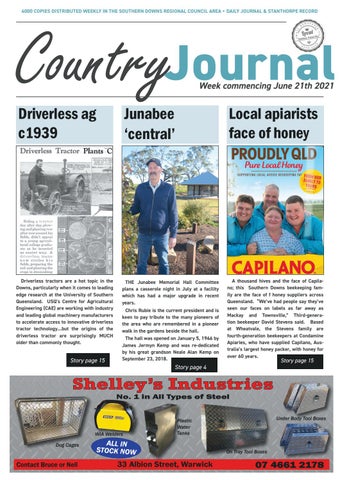
Driverless ag c1939
Junabee ‘central’
Driverless tractors are a hot topic in the Downs, particularly when it comes to leading edge research at the University of Southern Queensland. USQ’s Centre for Agricultural Engineering (CAE) are working with industry and leading global machinery manufacturers to accelerate access to innovative driverless tractor technology...but the origins of the driverless tractor are surprisingly MUCH older than commonly thought.
Story page 15
THE Junabee Memorial Hall Committee plans a casserole night in July at a facility which has had a major upgrade in recent years. Chris Rubie is the current president and is keen to pay tribute to the many pioneers of the area who are remembered in a pioneer walk in the gardens beside the hall. The hall was opened on January 5, 1946 by James Jermyn Kemp and was re-dedicated by his great grandson Neale Alan Kemp on September 23, 2018.
Local apiarists face of honey
A thousand hives and the face of Capilano; this Southern Downs beekeeping family are the face of f honey suppliers across Queensland. “We’ve had people say they’ve seen our faces on labels as far away as Mackay and Townsville,” Third-generation beekeeper David Stevens said. Based at Wheatvale, the Stevens family are fourth-generation beekeepers at Condamine Apiaries, who have supplied Capilano, Australia’s largest honey packer, with honey for over 60 years.
Story page 15
Story page 4
Shelley’s Industries No. 1 in All Types Steel Anyone walking to the front doorof of the hall
can’t miss the memorial which states “in memory of those from Junabee and Jingarry who served and made the ultimate sacrifice Plastic for our country in all conflicts”. Water Tanksto the serviceWIA Welders There was a welcome home Dog Cages
Contact Bruce or Neil
ALL IN STOCK NOW
33 Albion Street, Warwick
Under Body Tool Boxes
On Tray Tool Boxes
07 4661 2178
2
COUNTRYJOURNAL
Stanthorpe Store and Weaner Sale this Thursday Further bookings are invited for the Stanthorpe Store and Weaner Sale that starts midday this Thursday. The yardings including a large amount of Angus and Angus cross weaners and steeers, includinga special line of 100 Angus steers and heifers from CLunie Range BLoodlines from the account of Mt Manning Pastoral COmpany. There will be a 7 pm curfew on Wednesday night to enable NLIS scaning prior to sale.
China’s numbers belies corn hunger Latest Chinese figures of corn carry-out (which equates to ‘on hand’) stocks for the coming year are dubious, to say the least, according to the US Department
of Agriculture. China is claiming 198 mmt of corn on hand, a big figure considering the global ‘carry out’ figure is 289 MMT... And yes, the USDA noted recently, China is aggressively buying up not just corn but almost any grain product they can, despite strong prices. US agriculture website, Successful Farming notes that with global supplies tight for all row crops, any tweak to global weather paterns could see the price of corn and beans rise sharply, followed in close pursuit by the wheat price.
is this central point: if you have profit, you have a tax problem.
Tax time tips for agriculturalists
3. Accelerated Depreciation Write-off – also known as temporary full expensing. According to Mr Pearson, all businesses turning over less than $5 billion “can deduct the full amount of an eligible depreciating asset, such as farm machinery, hail netting” and the like.
An expert orchardist tax manager has released the peak body six tips on harvesting the benefits of tax time. Anthony Pearson, of the MB+M Group, published his approach to tax time with APAL earlier this month. Amongst his tips (which, it goes without saying, are for informational purposes only and do not replace independent professional advice),
He provides six tips and reminders for growers for this special tax-time of the year blues: 1. Farm Management Deposits (FMDs), which is a tax deferral option specific to farmers. Find it on the Farm Management Deposits on the ATO website 2. Maximising superannuation contributions – while not specific to farmers, it can still reduce tax liability for farmers.
4. Pre-paying expenses – IF you have the funds now, prepay now and bring forward next year’s expenses 5. Government funding and tax – growers need to re-
member that if they received any government funding or assistance this year it very likely will be counted as taxable income 6. Have an accountant – this one doesn’t need any explanation. You need an expert.
Workers compo rates going nowhere
5
Workers’ compensation average premium rates are set to go nowhere for another year. Queensland Industrial Relations Minister Grace Grace has announced that WorkCover’s average premium rate will stay stable at $1.20 per $100 of wages for the eighth consecutive year. “WorkCover will also maintain the 5 per cent discount for early payment, as well as the apprentice incentive, where apprentice wages are excluded from premium calculations,” she announced.
BUDGET 2020/2021
THE HON SECURING OUR RECOVERY DAVID MP LITTLEPROUD BUILDING FOR OUR FUTURE FEDERAL MEMBER FOR MARANOA MORE JOBS AND LOWER TAXES BUDGET 2021
BUILDING FOR OUR FUTURE
• Rewarding hard work with further tax relief – up to $1,080 for singles and up to $2,160 for couples.
• $400 million Inland Freight Route (Mungindi to Charters Towers)
• Expanded instant asset write off to encourage investment and create jobs.
• Additional $1 billion to the Local Roads Community Infrastructure Program
• 50% wage subsidies for 170,000 new apprentices, plus 450,000 training places in the JobTrainer Fund.
BETTER HEALTH AND AGED CARE • $17.7 billion in new aged care funding, including 80,000 additional home care packages. • $2.3 billion in mental health funding, for new headspace centres and a new Head to Health network. • Boosting rural health with more than $114 million to extend Telehealth until the end of the year and $65 million to boost bulk billing rebates in rural and remote areas.
• $250 million for Round 6 of the Building Better Regions Fund
BACKING AGRICULTURE • $400.1 million to strengthen biosecurity • $328.4 million to bust congestion for agricultural exporters • $32.1 million for agriculture biodiversity stewardship • $87.7 million to improve trade and market access
Authorised by The Hon David Littleproud MP, Liberal National Party, Dalby Qld
Getting Maranoa’s fair share | PO Box 188 Warwick Q 4370 | david.littleproud.mp@aph.gov.au | www.davidlittleproud.com.au
COUNTRYJOURNAL
Local apiarists are literally the face of honey A thousand hives and the face of Capilano; this Southern Downs beekeeping family are the face of f honey suppliers across Queensland. “We’ve had people say they’ve seen our faces on labels as far away as Mackay and Townsville,” Third-generation beekeeper David Stevens said. Based at Wheatvale, the Stevens family are fourth-generation beekeepers at Condamine Apiaries, who have supplied Capilano, Australia’s largest honey packer, with honey for over 60 years.
Over the past year, the Stevens family have featured as the Queensland face of Capilano’s Proudly Local range. The Capilano Proudly Local range introduces a state-by-state product that proudly features a local beekeeping family, shares a little of their beekeeping story and promises the honey in each pack is produced solely from beekeepers in that region. If consumers scan the QR code on the product or visit the Capilano website, they can view a video that shares the story of the featured family. The patriarch of the Stevens family, third-generation beekeeper David Stevens told The Journal he hoped consumers felt connected to the family story.
3
want to connect with where the product comes from,” David said. “It’s a bit of an achievement to be on a product on a supermarket shelf and represent the company we supply. We’ve had family and friends all over the state see it. Hopefully some fair dinkum consumers have seen it too.”
Fourth-generation beekeeper Jacob Stevens, who was recently elected as President of the Queensland Beekeeper’s Association, said beekeeping is in the blood of the family.
“In the early years, they would come up from the coast and work country in the local area that grandfather had shown them, places we still take bees to this day.”
“My great-grandfather Charlie Stevens Senior, started off keeping to a few bees and we’ve built it up to be a commercial beekeeping operation,” Jacob said. “Mainly we focus on honey production, with a little bit of diversification in really tough, dry years into pollination, we do a little bit of avocado pollination in the Burnett region.
The operation was handed down through the generations, onto third-generation David and Rosie, who are at the head of Condamine Apiaries today.
“We as a business have had a very long-standing relationship with Capilano buying our honey, they’ve been very good to us. Charlie Stevens Snr had a relationship with Tim and Bert Smith, the founders of Capilano.
David and Rosie involved their sons Jacob and Connor in the family business from a very young age. Condamine Apiaries is now a well-regarded commercial beekeeping operation, managing over a thousand hives. The operation shifted from Warwick to Wheatvale in the early 2000s. Iwan Jones, Country Journal
James Lister MP MEMBER FOR SOUTHERN DOWNS
“We are hopeful consumers
Ph: (07) 4524 7700 03MH024Tue_CJ_Fon
e: southern.downs@parliament.qld.gov.au • 9 Victoria St, Stanthorpe • 56 King St, Warwick
(Mon-Fri) (Mon-Tue)
________________
_________________________
4
COUNTRYJOURNAL
BREATHING NEW LIFE INTO A WWII FIXTURE
AROUND THE HALLS WITH GERARD WALSH THE Junabee Memorial Hall Committee plans a casserole night in July at a facility which has had a major upgrade in recent years. Chris Rubie is the current president and is keen to pay tribute to the many pioneers of the area who are remembered in a pioneer walk in the gardens beside the hall. The hall was opened on January 5, 1946 by James Jermyn Kemp and was re-dedicated by his great grandson Neale Alan Kemp on September 23, 2018. The land for the hall was donated by the Staff family in 1945. Anyone walking to the front door of the hall can’t miss the memorial which states “in memory of those
p
from Junabee Junabee Memorial Hall Committee president Chris Rubie on the and Jingarry who pioneer walk adjacent to the Junabee Hall. Photo Gerard Walsh served and made the ultimate sacrifice for our country in all of both the former Junabee and For the future, the committee conflicts”. Jingarry schools in the playshed. has discussed inviting guest There was a welcome home to There are 57 plaques in the pio- speakers to functions to talk about the servicemen from the Second neer walk and some extras on the the latest farming techniques and World War at the hall in June, other areas of interest. waiting list. 1946. Chris is also keen for the hall to It is a 70-metre walk through the The playshed, which is a replica be used for corporate training and gardens. of the playshed at the now closed Chris said Neale Kemp funded functions. Jingarry State School, has a lot of “We are doing a Bunnings Barthe major upgrading of the hall. written history. becue as a fundraiser every two “Neale’s father Walter was very After the hall was constructed months and have secured some sick and he made a promise bein the mid 1940s, dances, euchre funding from the Southern Downs nights and art unions were held fore his father died that he would Regional Council and gaming mado something for the Junabee to raise funds to help pay down chine benefit funds. the building loan. There is history Hall,” Chris said. The committee has funding to “He lives in Canada and once Neale started funding the upgrade, build an area at the back of the he kept adding facilities and spent hall for the barbecue. In recent years, the hall has been a six-figure sum on the hall.” While the upgrading was funded hired for weddings, birthday parby Neale, the committee is now ties and family reunions. “We have an arbour for wedding fund-raising to maintain the hall. ceremonies with the background Insurance is more than $3000 a year and is one of the biggest ex- the magnificent views of the Junabee Valley and Great Dividing penses. The hall committee meets 10 Range. Chris Rubie is joined on the comtimes a year and organises funcmittee by secretary Desley Mauch, tions to keep the hall operational. There are family nights for the treasurer Joyce Johnson and local community with bar and bar- vice-president Bruce Mauch. The hall is available for hire by becue operating. The next function is a casserole calling 0450 882 008. night on July 9 and then a seafood night is held each September.
COUNTRYJOURNAL
Clubs in the crosshairs, as regulations require legal time machine
5
Elizabeth Voneiff Editor
editor@thedailyjournal.ink
This would have been a case simplified by a flux capacitor and a De Lorean time machine... but for one of the oldest sporting clubs in the country, they had to do it the hard way. The Pratten Rifle Club recently won a fight to extend its lease of land from the Queensland Government to the tune of $40,000 in legal costs...but only after finding a way to prove something not just about the past...but about the future. The Pratten Rifle Range sits on about 56 hectares of land which was leased to the Commonwealth Government by the State of Queensland for the purposes of a rifle range in 1910. Today it has around 50 members, half of whom come out to shoot on most weekends. Recently, with the renewal of the lease, the club had to take a legal ‘shot in the dark’. “It was part of the Defence Act,” Peter Doig, CEO of the Queensland Rifle Association told The Country Journal.
and barrister,” said Mr Doig.
The Pratten Rifle Club is an affiliate of the Queensland Rifle Club, which was formed in 1861. The Pratten Rifle Club has been on the same piece of land for more than 110 years.
“It was surprising that even though there wasn’t a claim it still had to go through the courts; I’m not sure what the value is” Michael Dickenson, Pratten club captain, told The Daily Country.
In 1999, the Queensland Department of Natural Resources granted the Pratten Branch of the Queensland Rifle Association Inc a 20 year lease over the area for “sporting and recreation purposes, being a target shooting range” according to the background fact associated with the case.
The Queensland Rifle Association chose to come to the aid of the Pratten Club on principle.
In August, 2018, the club applied to renew the lease and were told that the offer was partly conditioned on the applicant filing “a non-claimant application” in the Federal Court to prove that “native title does not exist over the determination area prior to the lease being renewed.” It wasn’t a simple matter of just determining whether any native title activity was current on the property, which would have been straightforward, but whether there was any potential for native title action, which is “not impossible” according to Mr Doig, but extremely difficult. “It’s a very complex process and you can’t do it without a solicitor
“It’s been operating all that time,” said Peter, “and we have an active club. We thought it was important.” Michael adds that if the QRA hadn’t helped they would have had to close. Papers were duly filed in accordance with current requirements and in November the National Native Title Tribunal publicly notified a “non claimant application” in the Koori Mail and the Toowoomba Chronicle. In November 2019, the Queensland South Native Title Services filed a notice of intention to become a party to the application but in March last year stated that “it wished to cease to be party to the application” according to court records. According to records, “no other person
has sought” to assert native title claim over the Pratten property and the QSNTS “is not aware of any potential native title” claims. In December, therefore, the State filed a notice saying that it did not oppose the renewal of the club’s lease. The frustration by the QRA, however, is that they had to blow an enormous hole in a very small budget in order to meet the requirements of renewing the lease. The system could work better, Mr Doig said “given that everyone else in the system is funded by the government”.
“That’s money we can’t spend on Junior Development.” The Pratten Rifle Club’s value to the region is high. Mr Dickenson spoke to us during a break in competition in Brisbane yesterday. He described the Pratten club as one of the smaller ones in the State but said the area is a great “talent pool” for the sport. The Queensland Rifle team will be competing next weekend and either three or four of the 10-person team are from the Darling or Southern Downs area. Photo, Pratten Rifle Club.
KEEP WARM THIS WINTER Call In and See Our Wide Range of Winter Warmers
Sale On Now Throughout zz Jumpers & Ja
ROSE CITY WOOL & SKINS
Shop A/111 Palmerin St, Warwick - Ph 0438 615 321
6
COUNTRYJOURNAL
Drought approach good, budget otherwise draws lukewarm response from farm groups The Queensland budget, like recent rains, has been patchy down on the land, with the Queensland Farmers’ Federation and Agforce cautious in their support of a surprisingly upbeat 2021-2022 offering. The QFF claimed the budget was more ‘style’ than ‘substance’ missing out on opportunities to address productivity and growth opportunities that had emerged as a result of the pandemic. “QFF commends the state government for investing $71.4 million over four years in the Queensland Drought Assistance and Reform Package to support farmers experiencing the impacts of drought on their properties and ensuring this assistance is more equitable across the state’s various agricultural commodities,” The QFF’s Dr Georgina Davis said, and her view was echoed by Agforce’s president Georgie Somerset, who also singled out the drought programs for a tick. Other highlights for the QFF were the continued funding of workforce and skilling programs (but not, notably the QFF-led Rural Jobs and Skills Alliance), the $500 million for the Carbon Reduction Investment Fund and continued heavy investment in biosecurity. For the Southern Downs region, probably the biggest ‘new’ funding announced was t $1.8m to be spent in 2021-2022 on “redevelopment of Bald Rock Creek and Castle Rock camping areas at Girraween National Park near Stanthorpe. The budget was heavy on ‘carried over’ projects for the region, mostly rebranding of previously announced budget funding. The ‘carried over’ projects also include $8.1m for ‘preparatory’ work on the
Toowoomba to Warwick pipeline, tenders for the design of which are due to be called for next week – preparatory works are also likely to include investigations into potential property resumptions and engineering pre-studies $7.6m for new bores and water infrastructure upgrades for Warwick – no details released as yet (but the council will conduct test drilling for new bore sites west of Warwick for future emergency town water supply next week) $252,000 for further studies into design of a new hall for Warwick State High School $5.8m allocated over the next several years but no specific timeframe for construction $344,000 for restoration work on the original building at Warwick East State School $500,000 to “progress the upgrade” of the Warwick Police station – again no specific timeframe $15m to continue construction of a new overpass as the Eight Mile intersection north of Warwick – the project commenced in February of this year $995,999 for new recycled water reservoir at the Warwick sewage treatment plant – announced earlier in 2021 $145m for the governmentowned CleanCo wind farm at Karara – part of the Acciona MacIntyre Wind Farm ‘precinct’ – announced in 2020 There was also funding for the new police station for Warwick and a new multi-purpose hall for Warwick State High School, both of which were announced in the last budget in 2020.
ANGUS FERRIER
WHAT’S THEIR END GAME?
Elizabeth Voneiff Editor Reports of wage theft and human rights abuses by growers is hotly disputed by local farmers in the Southern Downs. Unions New South Wales in conjunction with the Migrant Workers Centre have jointly released the details of a damning survey on the conditions of workers in the horticulture industry, one which local growers reject outright. The key findings of the report, released to the media this week, found that 78% of those surveyed reported being underpaid “at some point.” Around 80% report being underpaid on piece rates and some piece-rate workers reported earning less than $1 an hour. “The lowest daily wages were reported by piece rate workers employed on grape and zucchini farms, earning an average of $9 per day, followed by blueberry farm worker who averaged $10 per day.” Angus Ferrier, president of the Granite Belt Growers Association denied the findings had any correlation with reality and accused unions of pernicious activities to undermine the industry. “This sort of comment is entirely predictable and part of a long-running campaign to undermine the integrity of Australian farmers,” he told The Country Journal. “It bears no relation to what is experienced.” While the report recommended that the Fair Work Commission should amend the Horticulture Award to guarantee workers are paid “at least the applicable minimum wage,” Mr Ferrier says most farmers already do. “The vast majority of farmers do a good job and pay award rates,” he said with clear frustration in his voice. Australian growers are currently only just able to supply the market with good quality produce at a reasonable cost and horticulture is a “well paid industry” for what is “mostly low-skilled work”. “It’s a misinformation campaign that is perplexing at times.” Angus says that thousand of Australians are employed in agriculture and the narrative coming from union media releases such as this one are “that we don’t want to employ Australians, that we want to employ foreign workers for the explicit intent of exploiting them.” “It’s lazy crap.” Currently, the horticulture sector is not unionised and Mr Ferrier believes that the end game is to drive up membership in this area and “unionise a new industry” which would “run a fair few farmers out of business.” “What is their end game?” he asked.
7
Taking New Patients Now!
Women & Men 18 and under
Co-located within Priceline Pharmacy Rose City Shopping World, Warwick
Ph (07) 4574 4810 Visit our website - www.rosecitymedical.com.au
8
COUNTRYJOURNAL
Dave Kemp at B and K Motors which has already celebrated its 40th anniversary. Photo Gerard Walsh DAVE Kemp has worked on the cars of some clients for more than 40 years and has no plans to put his tools away. He attended Yangan State School and then Warwick State High School before starting a mechanical apprenticeship at Bob Jackson’s Panel Works. Dave then worked for Ian Batham, of Batham Motors, for 12 months before joining with Ian’s brother Bevan to set up B and K Motors in 1979. “We started with a tool box, ute and we each had $1500 bank loans. They operated on the western side of Albion St for two years before paying $6500 for the current business site at 12 Albion St. “We spent $38,000 on our first shed and each worked 16 to 18hour days for a long time,” he said. The partnership gradually increased staff and now have seven employees. “Bevan was keen to retire from the business in 1993 and I bought his share and put on an office manager,” Dave said. In the past 28 years, the business has only had four office managers. Russ Cowell was the first and then Therese Devine. Denis O’Leary and Carol Mills were the office managers for 15 years. When Denis retired a year ago, Phil Ingram joined the team in the business. B and K Motors was one of many businesses i n Warwick which became members of the Capricorn Co-op. Members were involved in motor insurance, travel, auto electrical work, panel beating and general mechanical work. Six and a half years ago, he was approached to run for the position of Queensland director and was successful in the ballot. Now he heads to Perth for six board meetings a year. The co-op has 22,000 members and 2000 suppliers.
Question and Answer Gerard Walsh: What was the
“WE STARTED WITH A TOOL BOX”
FACE TO FACE with gerard walsh
Photo shows a man in his natural evnironment: David Kemp on site at B&K Motors. main reason you became involved in Capricorn Co-op? Dave Kemp: It is a buying group, if a spark plug costs 60 cents, we could buy it for 40 cents with the buying power of Capricorn. GW: What has been the biggest change in the industry? DK: It was around 1986 when the industry moved to electronic ignition and fuel injection, computerised vehicles and central locking. GW: What has kept B and K Motors going so long? DK: Customer service and trust, we want people to trust what we are doing is right for their vehicle. We have had good staff down the years. I especially thank those customers who have allowed us to work on their cars for 40 years. GW: What has been the toughest time? DK: It was getting three floods in two years. We rebuilt the workshop twice in two weeks. GW: Have you ever considered moving to a flood-free site? DK: There is an old saying about location, location. Our customers wanted us to stay at 12 Albion St... GW: What will be the take up of electric cars? DK: I have been in a car in Perth
without a driver. It is scary how the cars are driven by technology. I don’t think electric cars will be a major seller in Australia due to travel distances. GW: How long do you plan to keep the business? DK: I plan to stay to the age of 70 which is seven more years. The day I am driving to work and don’t want to pull up at the business will be the day I retire. I love the banter with the business. GW: You joined the Warwick Rotary Sunrise club which was formed in 2000, why did you join up at that time? DK: The kids had finished school and I wanted to give something back to the community and had the time to be involved. GW: What were the main projects during your year as president in 2017? DK: We bought a food van that year as well as three big marquees, a PA system and electronic till. GW: What has been the biggest Warwick Rotary Sunrise involvement in the past two decades? DK: Our biggest role was in distributing water and drought assistance, I recall driving around many districts to give rural residents hampers for Christmas and
also to have a chat. We had pop up barbecues at Freestone, Swanfels, Tannymorel, Junabee, Wildash, Maryvale and Leyburn. GW: What about water distribution? DK: We gave away bottled water at the Warwick Showgrounds. GW: What are some of the other activities the club has been involved in. DK: We have catered for 450 riders in the Cunningham Classic and helped with Jumpers and Jazz, the rodeo and catered for weddings and car rallies. GW: You were quoted in the Daily Journal last week for the Warwick and District Road Safety Advocacy Committee, what issues are you pushing? DK: People do stupid things in cars and while walking. There are many people in the Warwick CBD who don’t know what to do at the pedestrian crossings like across King and Fitzroy streets. I was in Toowoomba the other day and took a photo of a sign with the words “pedestrians must give way to vehicles”. continued next page, first column
COUNTRYJOURNAL
INTERVIEW WITH DAVID KEMP continued from previous page. GW: What about the pedestrian bridge Coombes Bridge next to the Queens Park Weir? DK: We pushed for the crossing as there was no barrier between traffic and the concrete pedestrian crossing as part of the bridge. It was simply not safe for parents to push a pram across the existing bridge. GW: What about future issues? DK: We have pushed for safety improvements at the Eight Mile. It is not safe for pedestrians to walk across the McCahon Bridge or push a pram. GW: What about some of your other charity work? DK: I was president of Bikers for a Brighter Future which raised money to help people suffering from cancer and grant then their wishes or arrange for them to receive their favourite footy jersey. The Warwick Motorcycle Club was established in 1915 and I am the current president. We go for day rides. Riders have also raised funds for the Safe House for women in Warwick. I was also founder of the inaugural Billy Kart Races in William St, Warwick, and Morgan Park. GW: What about your family? DK: I have three boys and three girls and they all live locally and have done well in their own businesses. I also have nine grandchildren.
Farmers to plant record winter crop area By: Matt Coughlan Winter crop production is tipped to be 46.8 million tonnes in 2021/22, below last year’s near record high production but 13 per cent above the 10-year average. Australian farmers are on track to plant the biggest winter crop in the nation’s history with strong rainfall and high global prices outweighing a mouse plague. The federal government’s agriculture forecaster is predicting the total area of crops planted to soar beyond 23 million with good prospects in many high-production regions. ABARES’ latest crop report expects overall crop production to be 46.8 million tonnes, 15 per cent below last year’s record winter harvest but 13 per cent above the 10year average. The agency’s acting executive director Jared Greenville said mixed yields due to tougher conditions in some areas would likely reduce production despite the area sown reaching a record high. “Yield prospects in most cropping regions in New South Wales, Western Australia and much of Queensland are very favourable, given the favourable conditions at the beginning of the winter crop season and the outlook for winter rainfall,” he said on Tuesday.
Drier weather in most of Victoria and South Australia has painted a less rosy picture with most farmers relying on winter rainfall to finish planting. The mouse plague in NSW and Queensland is expected to increase production costs as farmers use bait to control the damaging pests. But ABARES does not predict a major hit to national production with mice numbers expected to have peaked and winter setting
9
in to slow breeding rates. Farm management has minimised winter crop damage but warmer weather in spring could spell a rodent resurgence. BOM’s forecast predicts above-average rainfall in most eastern states and SA. WA, where the season is off to a flyer, is expecting below-average rain, but most cropping regions are likely to receive higher-than-usual falls for the rest of winter.
GP39 SERIES
• The GP39 series with its 22” shank were developed specifically as an economical & versatile plow, ideal for general use with small or low horsepower tractors • The two beams - 39” over all, spreads the shanks and eliminates “slabbing” which can occur between adjacent shanks when 22” is movable for subsoiling in some varying the different undeveloped soil spacings. The 16” Assembly types. The frames are Coulter based on a standard was specially made 13” spacing. Like all for the GP39 Model. Yeomans Shanks the • The 22” Shank has a
1/2” Shear Pin which ensures a tip break force between 3 - 3.5 Tonnes. This guarantees the GP39 will rip through the toughest of soils.
Ray Bunch Machinery 12 LYONS STREET, WARWICK
P. (07) 4661 2751 • (07) 4661 2765 • Ray: 0427 912 751 • Lindsay: 0427 318 784
10
COUNTRYJOURNAL
Goats continue to be surprisingly good going Elizabeth Voneiff, editor editor@thedailyjournal.ink
If you have good fencing, consider goats. Declining levels of production and increasing demand have delivered high saleyard prices for growers. Meat and Livestock Australia (MLA) released recent ABS data which highlighted goat slaughter and production for last quarter which underlines the declining level of goatmeat on the market since 2016. Goatmeat production reach 4,632 tonnes
cwt for the quarter, a 5% raise on the first quarter of 2020, but a whopping 37% below the 10-year quarter average.
production, and that an abattoir in Tamworth is preparing goat meat for export.
Dennis Bourke, agent for McDougall and Sons, confirms goat meat is an area where money can be made. “I don’t doubt that for a second,” he told The Journal. There are dozens
WARWICK SALEYARDS VENDOR DESCRIPTION - Cents/KG - WEIGHT - $TOTAL BULLS Strathane P/L, Ellangowan, Angus Bull 303.2/1035/3,138 N & M Harvey, Liston, Angus Bull, 303.2/985/2,986 COWS Noralla Pastoral Co, Gladfield, Santa Cows, 312.2/772/2,409 Gows Produce, Stanthorpe, Brangus/Hereford Cows, 310.0/675/2,092 Alumy Creek, Tenterfield, Angus Cow, 308.0/705/2,171 N & M Harvey, Liston, Angus Cows, 308.0/667/2,054 BULLOCKS Kim Bonner, Liston, Santa x Bullocks, (4t), 375.2/690/2,588 G & D Hurtz, Liston, Angus x Bullocks (0-2t), 375.0/590/2,212 NT & AM Crisp, Liston, Angus/Droughtmaster x Bullocks, (0-2t), 374.2/604/2,259 A Bonner Eukey, Angus Bullocks, (2t), 365.0/668, 2/436 EXPORT HEIFERS Gows Produce, Stanthorpe, Angus Heifer, (0t), 360.2/680/2,449 N & M Harvey, Liston, Angus Heifers, (6t), 335.0/682/2,286 HEAVY FEEDER STEERS P Bonthrone, Clifton, Santa Steers, 463.2/394/1,823 JP Karey Holdings Legume, Angus Steers, 443.2/436/1,931 C& D Johnston, Maryvale, Charolais/Red Angus x Steers 441.2/428/1,888 M Flint The Summit, Angus Steer, 440.0/470/2,068 DOMESTIC FEEDER STEERS Headwaters Pastoral Co., Killarney, Angus Steers, 526.2/360/1,894 GT & LM Fletcher, Killarney, Angus Steers, 526.2, 351,1,847 D Vaughan, Danderoo, Angus Steers, 516.2/327/1,686 FEEDER HEIFERS M Flint, The Summit, Murray Grey x Heifers, 460.2/353/1,622 GT & LM Fletcher, Killarney, Angus x Heifers, 450.2/330/1,485 YEARLINGS RD & CE Hughes, Freestone, Angus Heifers, 477.2/361/1,723 W Bennett, Maryland, Angus Heifers, 460.0/393/1,805 WEANER STEERS Headwaters Pastoral Co., Killarney, Angus Steers, 714.2/182/1,300 HF & SJ Bolzan, Allora, Limousin x Steers, 598.2/232/1,386 P Bonthrone, Clifton, Santa Steers, 574.2/268/1,540 WEANER HEIFERS HF & SJ Bolzan, Allora, Limousin x Heifers, 494.2/258/1,272 Ironbark Family Trust, Mt Molar, Angus x Heifers, 493.2/325/1,603 Gows Produce, Stanthorpe, Angus Heifers, 486.2/303/1,470
of goat growers in the Southern Downs, he says, and they’re getting the highest prices per kilo of all the livestock going to auction currently. “We can get $10.60,” he said, “it’s very sought after.” While McDougall’s may only yard 75 to 100 goats a week, Mr Bourke said there are big areas of goat
MLA reports that goatmeat production traditionally rises in the March quarter as conditions are typically drier, enticing producers to offload. Kid slaughter has also declined since the previous March quarter, down 36% at 107 tonnes cwt. This could be reflective of potential rebuilding activity, as producers see upside in keeping young goats to grow out and breed as seasonal conditions improve across key regions such as northern NSW, southern Queensland and WA. Mr Bourke pointed out that while goat production might be an excellent revenue source, extremely secure fencing is required. “They’re hard to hold in; getting out is a concern.”
LIVESTOCK OVERVIEW Livestock numbers rose this week for most species with cattle numbers up to 642, with sheep and lamb numbers hitting 860 head, pigs were down to 47 head along with 32 goats and the poultry numbers combining for a reasonably busy week across the saleyards. Cattle were still very strong,even with the absence of one major exporter rates across the park were very upbeat for producers. Vealer steers averaged 568.2c/kg to a top of 714.2c/kg or $1355.04 to $2142.23 Vealer heifers averaged 488.8c/kg to a top of 568.2c/kg or $1208.84 to $1541.15 Feeder steers averaged 458.9c/kg to a top of 530c/kg or $1860.02 to $2398 Feeder heifers averaged 482.1c/kg to a top of 548.2c/kg or $1894.76 to $2220.21 Yearling steers averaged 469.7c/kg to a top of 566.2c/kg or $1577.58 to $2017.24 Yearling heifers averaged 449.7c/kg to a top of 539.2c/kg or $1498.16 to $1995 Steers averaged 372.2c/kg to a top of 458.2c/kg or $2136.14 to $2588.88 Heifers averaged 326.6c/kg to a top of416.2c/kg or $1841.60 to $2449.36 Manufacturing steers sold for 330c/kg to return $2318.25 Cows averaged 292.4c/kg to a top of 320.2c/kg or $1733.68 to $2409.14 Bulls averaged 336.9c/kg to a top of 502.2c/kg or $1877.40 to $3138.12 Sows sold to a top of $350 Boars to a top of $130 Pork sold from $178 to $206 Stores sold from $105 to $159 Roosters sold to $20 Hens to $5.50 Goats sold from $110 to a top of $250/head
11
COUNTRYJOURNAL
The ‘super’ you have when you don’t have super SOME families take out superannuation, insurance or a with Gerard Walsh bit of both for their children, we gave our Angus/Hereford cross and the boys Arnel and Ariel four cows sire a straight Angus bull named about six years ago. One of the Buster. The grandmother of the four died but we just went and Black calf is Lilly. With Milly havtook another cow from the mob for the boys.
The Long Paddock
With the cows missing a calving or two due to the drought, the boys didn’t have four calves each year. We always say the money is for the boys’ savings.
Last year, she gave birth to a steer calf called Billy. This year, Lilly has had another calf Hilly and then Milly gave birth to her first calf named Gilly. Milly was on the way to market twice but jumped out of the race she was so desperate to stay at Greymare. Four of the herd have white faces and the last one Gilly is all black due to the mother being
It will be interesting to see what happens with numbers at the end of the financial year. I suspect a fair few primary producers have held a few cattle to lessen their tax burden in the 2020-2021. If cattle are on oats or in a feedlot and are ready for market, it isn’t easy to hold them for the next financial year. So it will be interesting to see what the prices are like in early July.
The ‘grazier’ image We may have a farm but I always talk about our role as primary producers. The old terminology was farmer and grazier.
ing a calf, she is likely to stay on the farm as a long-term breeder. We now have a new steel race so next time Milly is on the way to market, there will be no turning back.
We haven’t planted any crops this year so I suspect we are more graziers than farmers. Personally, I like to use the term primary producer although you can get away with saying graingrower if your family grows grain. In the north, farmers are cane growers or fruit and vege growers on the Granite Belt. I have a friend up north on a cane farm and we talk regularly on everything from politics to family and passing news from old friends.
Photos IN 29 years at the Daily News writing on sport, I was always fussy about the background to photos. I once took a photo of Pat King Jnr at the family Dragon St farm. He was on a horse but once I saw the photo, it looked like he had a windmill on the top of his head. In the photo with the boys’ cattle, you can see a piece or two of timber falling off the woolshed. Time to do a bit of repair work.
EA SY
If you planted crops, you are a farmer especially if you had a dairy herd. Those who ran cattle or sheep and drove big Fairlanes or Statesmen were usually graziers. The image of a grazier meant you had a
tweed coat and a water bag on the bull bar at the front of the car. You just sat at home and watched the beef, lamb or wool grow.
IENDLY BAN FR
NG KI
This year, the sale of calves and two of the cows gave a tidy little sum to the boys. One of their cows was picked out by Ariel as he liked the white eyes around the head a few years ago. That cow didn’t get a name, I have just named her Lilly but she gave birth to a heifer, Milly, with similar markings two years ago.
Corner, the Warwick Saleyards.
WARWICK CREDIT UNION
We sell the boys calves at the same time as their parents calves. Just as well we didn’t take off the costs of drought feed as we might have had to send the boys a bill as whatever we sold in the drought didn’t set any records at Sale
Warwick Credit Union Supporting locals
Warwick Credit Union Ltd ABN 98 087 651 116. Trading as Warwick Credit Union, Gympie Credit Union and Dalby Credit Union, AFSL and Australian credit licence 240556.
12
COUNTRYJOURNAL
ELIZABETH’S KITCHEN
THE OCCASIONAL PICADILLO...
1.4 billion people...but still short of labour in the wool processing/textile industry Labour shortages continue to confound the processing fraternity across China. It seems hard to imagine with a population of 1.4 billion that mills would be struggling to find workers, but the whole sector seems to be unable to rise about 70% of full production capacity due to a shortage of textile workers. This is leading to production delays, and coupled with slow shipment times, much frustration for customers around the globe.
Elizabeth Voneiff, editor editor@thedailyjournal.ink I never heard of savoury mince before I moved to Australia. Mince went into stuff like spag bol or tacos but was never a stand alone item. So, I resisted it for years until I finally tried the savoury mince at Abode Café in the leafy suburb of Indooroopilly. It was really nice and then I thought, oh, savoury mince is actually Picadillo. Picadillo is the Cuban version of savoury mince and is extremely popular in Southern states, particularly Florida which has a high Cuban population. I know the sultanas sound weird, but don’t leave them out; they’re the making of the dish. Picadillo (pick-ah-dee-yo) 2 good sized onions chopped 2 large cloves of garlic, minced 1 large green capsicum, chopped smallish Fresh chili to taste, minced ¾ cup vegetable oil 1 can of diced tomatoes (or whole) 500 grams of mince, not completely lean. Three-star is fine.
1/3 cup stuffed olives, sliced or chopped ½ cup sultanas 2 tablespoons capers 1 tablespoon red wine or balsamic vinegar Salt and pepper to taste Saute the onions (my 1940s cookbook says “fry” the onions), capsicum, chili and garlic in the oil over low heat until soft. Add the tomatoes and meat and stir briskly with a fork to break up the meat into tiny pieces so that it doesn’t cook in lumps. Add the olives, sultanas, capers and vinegar, and then salt and pepper to taste. Continue cooking until the meat is tender and the sauce has boiled down and thickened somewhat. Cubans serve Picadillo with rice and fried green bananas (what they call ‘plantains’). It is also nice on toast with green peas alongside. Enjoy! “Twenty years from now you will be more disappointed by the things you didn’t do than by the ones you did do. So, throw off the bowlines. Sail away from the safe harbor. Catch the trade winds in your sails. Explore. Dream. Discover.” Mark Twain
European processors are busy compared to last year’s write off, but still not going flat out given the slow process of opening up the post-covid world. Having experienced the recent shipping delays from China to any other part of the world, many European processors are now asking firstly about delivery time, and then price. All of the major European spinners and knitters are busy at present, and some of the weaving fraternity are dusting off the looms which have been idle for some time. Some of the product is being exported back to Asia, including China from whence the tops or yarn came, or to Australia, the source of the greasy wool. This is not to say that the European textile industry has fully recovered, but it has certainly improved from this time last year. How the future pans out will be determined by the consumer activity levels in the coming selling season, which for the majority of these woollen garments will begin in September.
Solutions page 15
COUNTRYJOURNAL
13
Frantic buying and FOMO in wool market
Auction prices were fairly frantic at the Australian Industry’s raw material sales last week as the degree of optimism spread throughout the trade and FOMO (fear of missing out) took over. Plenty of indent orders seemed to be present in the market with buyers instructed to ‘not come back without the required quantity’, so prices rose strongly on Tuesday and continued again on Wednesday. With only Melbourne and Sydney selling, the available quantity was restricted to 36,000 bales and seemed to be the goldilocks amount of wool for the market. Some WA growers, and a few from the East did take advantage of the WoolQ selling platform and offered, and
sold their clips on the electronic platform on Tuesday afternoon. Despite the already stretched premiums for superfine merino, the basis continued to widen with price gains of up to 100 cents achieved for 16 and 17-micron types. Fine and medium merino types rose by a lesser, but still hefty 75 cents as buyers clamoured to fill orders. Even crossbred wool got caught up in the melee and rose by 30 cents or 7% as buyers began to speculate. Carding wools rose by a similar amount, with a solid 30 cent increase as knitwear continues to dominate the fashion scene. The reaction at the end of the week from
customers overseas varied, with some now wanting to sit and watch whilst others are determined to
push forward and secure more raw material all the way through into 2022. Source, Elders.
Got Rocks?
ROCK PICKING CONTRACTING Phone now
0407 025 799 for availability
Weather focus It’s been a surprisingly wet winter week with unusual early morning thunderstorms bringing rainfall to the region of up to around an inch by the old measure. Summaries for May show that much of our region had above average rainfall in May as well (the blue patch in the map below This week’s weather focus looks at the El Niño–Southern Oscillation (ENSO). ENSO is considered one of the most important single climate variables or phenomena on the planet, mainly because the way ENSO swings is a good predictor of changes to global atmospheric circulation, which in turn, can nudge temperature and rainfall across the globe. WHen it swings one way, we get El NIno, and when it swings the other, La NIna. So with that preamble, the ‘dashboard’ shows ENSO remaining neutral, with all oceanic and atmospheric indicators hovering within the neutral range and likely to stay in neutral until at least spring. The Indian Ocean Dipole (IOD) is also currently neutral, although the index has been below the negative IOD threshold for three consecutive weeks. Large parts of the eastern Indian Ocean
are warmer than average, with some cooler than average water near the Horn of Africa. The consensus of international climate model outlooks suggest the IOD is most likely to remain neutral during the first part of winter, although three of the five models suggest negative IOD conditions could develop over winter or spring. The accuracy of IOD forecasts is still low in early June but will increase significantly by the end of the month. A negative IOD increases the chances of above average winter–spring rainfall for parts of southern Australia. While a negative IOD event is not declared until the index remains below the threshold for at least 8 weeks, the current pattern can still influence Australian rainfall as the event evolves. The Madden–Julian Oscillation (MJO) is currently weak or indis-
cernible. It is forecast to re-appear over the African region during the next fortnight. Its effect on Australia for this period is expected to be weak. At this time of the year, the MJO influence is primarily in the northern hemisphere, and it therefore has less influence on northern Australia. The Southern Annular Mode (SAM) has been neutral for the past week. It is expected to be positive for the coming fortnight. Positive SAM typically acts to decrease rainfall over south-west and south-east Australia and increase rainfall over parts of eastern Australia. Climate change continues to influence Australian and global climate. Australia’s climate has warmed by 1.44 ± 0.24 °C over 1910–2019, while southern Australia has seen a reduction of 10–20% in cool season (April–October) rainfall in recent decades.
14
COUNTRYJOURNAL
COUNTRYJOURNAL
15
Pivots with a difference Driverless tractors are a hot topic in the Downs, particularly when it comes to leading edge research at the University of Southern Queensland. USQ’s Centre for Agricultural Engineering (CAE) are working with industry and leading global machinery manufacturers to accelerate access to innovative driverless tractor technology... but the origins of the driverless tractor are surprisingly MUCH older than commonly thought. Back in the late 30s in Palmyra Illinois, a graduate of an agricultural college not dissimilar to USQ once was, looked at his future spending hours behind a hot steeltired tractor, ploughing soil for soy bean crops, and decided there had to be a better way. Frank W. Andrew never became famous for his invention, but he invented a working model using a principle as old as Greek civilisation: the pivot. He tied a wire to
the front of his tractor, secured it in a powerful pivot in the centre of his fields at strategic positions, and then let the tractor spin around the pivot in ever-decreasing circles. It’s hard to work out what happened when the tractor wound itself close to the circle, but the pivot tractor apparently stopped “automatically”. THe largest field that Andrew ploughed was around two-and-a-half S hectares, tiny by today’s P standards...with the tractor travelling around thirteen A kilometres on its concentric circular journey. R
Pencilhead solutions
T Y A L I F E E
B O O H S A H E A L T H
I E N L E G E N D S L A
Z A L G H W S H T I O N
U T N O V A O Y N U C D
W K R I V N L F W L A H
A M E I O E L W O R L D
S W F L B U D S N R S E
Bruddah Iz Wordfind: Hidden Phrase: “Iz was a champion for his Hawaiian culture and heritage.” Spot The 5 Differences:
S P U I E U V I D E O S
F L O N S L T L E S U R
U L C T E I E E R P R I
A E A L B U M N F E V T
D T R G S I N T U C O F
E R A I N B O W L T I A
C I N M U S I C C L C G
H G P U B L I C M T E E
1. Extra trunk ring at top 2. Dot missing from eye 3. Triangle under eye smaller 4. Missing tooth 5. Pattern under chin reversed Copyright: Auspac Media.
16
COUNTRYJOURNAL
Locals go back to Emu Vale Hundreds of people attended the ‘Back to Emu Vale,’ celebration at the Emu Vale Hall last month, thanks to the commitment of a number of residents determined to make it happen. The town takes its name from the Emu Vale railway station on the Killarney railway line, which is believed to be named after an early pastoral run. According to Gwen Labuschewski, the Memorial Hall has been used for many functions since it was built in 1954 including boxing tournaments, regular dances, wedding receptions, fancy dress balls, Christmas parties, Anzac Day commemorations, school plays. CWA meetings and much more. The original hall built on the same site was moved to Warwick prior to the current Hall being built. Records show the first hotel
was erected in 1900, Thomas Logan was the licensee and it was called Neereeadah Hotel. Later the Commercial Hotel was built on the same site and this building was destroyed by fire in 1959 and not replaced. Emu Vale also boasted a general store and post office, Presbyterian and Catholic Churches, butcher shop, bakery, saddler, blacksmith, a lolly shop, school, market gardens, fuel depot and sawmill. A second sawmill operated further up the valley at Upper Emu Creek where a school was built to accommodate the children of the mill workers. The timber industry was the main source of employment, as well as the dairy industry, grain growing and farming in general. The Upper Emu Creek School closed in 1960 and the Emu Vale School closed in 2003. All other businesses have long gone, and sadly only the Hall remains. People who either live or grew up in Emu Vale attended
the hall to celebrate the area’s rich history, as well as to rejoice in friendships and family connections spanning generations. Attendees enjoyed a barbecue, tea and dancing and a special cake cut by two of the Vale’s oldest residents. The celebration was organised by the caretakers of the community-owned Emu Vale Memorial Hall. Member
for Southern Downs James Lister was on hand for the celebrations. “It was terrific to be at the Back to Emu Vale celebration,” Mr Lister said. “Thanks very much to hall president Les Kable and his committee for putting on a wonderful day.”
All Aspects of On-Farm Weed Control • Small Crews Available • A1 Tordoning & Regrowth Specialist
CALL PAUL
0473 387 435
WIRAC'S Holiday Program is BACK! From Ninja courses to Badminton we have your kids covered these school holidays!!
Warwick Indoor Recreation & Aquatic Centre 29 Palmerin Street, Warwick QLD 4370 07 4661 7955 | wirac@ymcabrisbane.org www..facebook.com/wirac.ymca
11MH025Tue_CJ_PAU
BY: IWAN JONES iwanjones@thedailyjournal.ink