GrandRounds Spring 2014 Saint Louis University School of Medicine
Stimulating The Brain: Neurosurgeon earns award for pioneering navigational tool. Schizophrenia’s assault on cognitive function
New chair keeps drug discovery in house
Match Day 2014
From the Dean When our new University president, Fred Pestello, Ph.D., joins Saint Louis University on July 1, the transition will mark the beginning of a new era. Many exciting plans will get underway, and there will be a lot of work to do. I’ve had the opportunity to speak with Dr. Pestello and am convinced that the School of Medicine will have his support in continuing its major role in the future of the University. Dr. Pestello is not SLU’s only new arrival. In this issue of Grand Rounds, you’ll find a story about Tom Burris, Ph.D., the new William Beaumont Professor and chair of pharmacological and physiological science. He joined SLU last July from the Scripps Institute in Florida. This issue also features a story about Henry Nasrallah, M.D., new chair of the combined department of neurology and psychiatry, who joined SLU last October from University of Cincinnati. There also is an article in the Vital Signs section of this magazine about our most recent chair arrival, Wolf Stapelfeldt, M.D. Dr. Stapelfeldt joined SLU in January from the Cleveland Clinic, where he led the general anesthesiology program. These new leaders will bring their years of success at other strong institutions to bear on the Pestello era at SLU. As they arrive, however, one longtime and highly successful SLU medical leader has announced his retirement. Raul Artal, M.D., has been chair of the department of obstetrics and gynecology and women’s health for the past 16 years. His excellent leadership has helped the department grow from a faculty of just six to more than 35 today. Dr. Artal will be missed, but his departure is simply another of the inevitable transitions that occur from time to time. Good people depart, and other good people arrive to take their place. Welcome to Dr. Pestello, those above and others who will join us in continuing and enhancing SLU’s tradition of excellence in patient care, medical education and research.
Philip O. Alderson, M.D. Dean | Saint Louis University School of Medicine Vice President | Medical Affairs
Grand Rounds is published biannually by Saint Louis University Medical Center Development and Alumni Relations. Grand Rounds is mailed to alumni and friends of the Saint Louis University School of Medicine. Philip O. Alderson, M.D. Dean|Saint Louis University School of Medicine Vice President|Medical Affairs Schwitalla Hall M268 1402 S. Grand Blvd. St. Louis, MO 63104-1028 Grand Rounds Editorial Board
Philip O. Alderson, M.D. Edward J. O’Brien Jr., M.D. ’67 Cheryl Byrd magazine Contributors
Coordinator and Writer|Marie Dilg|SW ’94 Writer|Mike Plotnick Designer|Dana Hinterleitner Laura Geiser|A&S ’90|Grad ’92 Nancy Solomon Carrie Bebermeyer|Grad ’06 Riya V. Anandwala Photo and illustration Credits
Steve Dolan|Cover, 1, 10, 13, 20 and Back J.B. Forbes|19 Kevin Lowder|6, 8-9 and 16 Michelle Marie Peltier|21 Jim Visser|14-15
School of Medicine Executive Alumni Board
President| Edward J. O’Brien Jr., M.D. ’67| St. Louis
Emil DiFilippo, M.D. ’66| Saint Charles, Mo. James A. Junker, M.D. ’79| St. Louis Thomas Lieb, M.D. ’82| St. Louis
Marsha McBride, M.D. ’95| St. Louis Gloria Merenda, M.D. ’82| St. Louis
Ellen Nicastro, M.D. ’04| Chesterfield, Mo. Joseph Ojile, M.D. ’84| St. Louis
Leroy Ortmeyer, M.D. ’55| St. Louis
Christopher R. Spencer, M.D. ’10| St. Louis © 2014, Saint Louis University All rights reserved
GrandRounds Saint Louis University School of Medicine
Vol. 12
Tearing Down the Walls
No.1
New chair of neurology and psychiatry focuses on cross fertilization of brain-related disciplines|page 6
A Fitting Tribute
New museum honors the roots and achievements of Edward A. Doisy, Ph.D.|page 8
Guiding the Way
Richard Bucholz, M.D., is named a Fellow of the National Academy of Inventors for the StealthStation navigational device he developed |page 10
Spring 2014
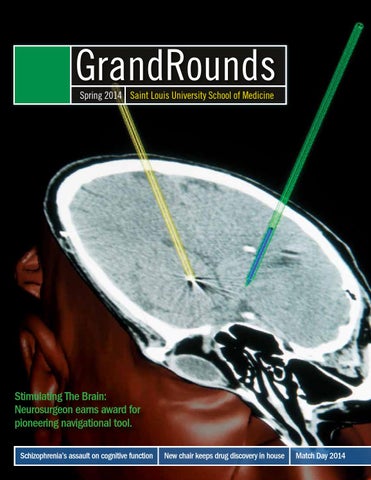
On the cover Computer graphic created by a StealthStation surgical navigational system depicting the trajectories of two subthalamic electrodes and their interactions with white matter pathways as detected with diffusion tensor imaging. |page 10
Match Day 2014
Students open white envelopes and the doors to their futures|page 14 SLU President-Elect Fred Pestello, Ph.D. with Alderson
For more information about the magazine or to submit story suggestions, please contact 314 | 977-8335 or grandrounds@slu.edu.
Drug Discovery Expertise
A distinguished researcher leads the department of pharmacological and physiological sciences|page 16
Vital Signs
page 2
Alumni Pulse
page 19
A team of investigators led by a SLU researcher has discovered a link between chronic use of pain-relieving medication and an increase in the risk of developing major depression. Their findings, published in the Journal of General Internal Medicine, analyzed the medical record data of about 50,000 veterans who had no history of opioid use or depression, and were subsequently prescribed opioid pain killers. According to the findings, patients who started and remained on opioids for 180 days or longer were at a 53 percent increased risk of
Scherrer
developing a new episode of depression, and those using opioids for 90-180 days were at a 25 percent increased risk compared to patients who never took opioids for longer than 1-89 days. “These findings suggest that the longer one is exposed to opioid analgesics, the greater is their risk of
developing depression,” said Jeffrey Scherrer, Ph.D., associate professor of family and community medicine and principal investigator of the study. “Opioids have long been known to allay pain and suffering, but reports of adverse effects are abundant and continue to emerge.” Scherrer said even though there is no clear evidence about the mechanisms by which opioids may contribute to the development of depression in a patient, there could be several factors that lead to it. Some of these include opioid-induced resetting of the brain’s ‘reward pathway’ to a higher level, which means the chronic use of narcotic pain killers can elevate the threshold for a person’s ability to experience pleasure from natural rewards such as a food or sexual activity. Other factors may include body aches months and years after the use of opioids has stopped, side effects such as adrenal, testosterone and vitamin D deficiencies, and glucose dysregulation. The study also suggests that the higher the dose of opioid analgesics, the greater the risk of depression. “Preliminary evidence suggests that if you can keep your daily dose low, you may be at lower risk for depression,” he said. Scherrer notes that even though a minority of patients takes these pain killers chronically, they are at risk of developing depression that can affect their quality of life and ability to cope with chronic pain.
Possible Relief for Sickle Cell Pain
SLU researchers are studying whether ReoPro® (abciximab), a drug given to heart patients undergoing angioplasties to open blocked arteries, also could help children and young adults who have severe pain from sickle cell disease. “Sickle cell crises, which are acute episodes that can land patients in the hospital, can be excruciatingly painful,” said William Ferguson, M.D., director of the division of pediatric hematology and oncology and a SLUCare pediatrician at SSM Cardinal Glennon Children’s Medical Center. “The typical vaso-occlusive crisis puts patients in the hospital for three to five days on intravenous medications,” he said. “All we can do is give supportive care, such as pain killers, and wait for the crisis to run its course. Our research will tell us if using a medicine like ReoPro® could be a valuable strategy in treating a sickle cell crisis.” Ferguson, who is the study chair, said the research examines whether ReoPro® could reduce the length of time sickle cell patients spend in the hospital.
Ferguson
Scientists from SLU’s Center for World Health and Medicine reviewed medical literature that identified the mechanism of action used by ReoPro® as potentially promising in treating sickle cell crises because it attacks blockages in blood flow on two fronts. They then approached Ferguson about conducting the research, said Peter Ruminski, executive director of the center. “ReoPro® hits both of the proteins that affect the stickiness of platelets and the flow of red blood cells through the walls of the blood vessels. Our research will help us discover whether medications that have similar properties can be effective against sickle cell disease,” Ruminski said. “Sickle cell disease is a neglected disease that dramatically affects members of the St. Louis community who are African American. It is devastating for those who have it in terms of diminished quality of life and shortened lifespan.” SLU’s Center for World Health and Medicine brokered the research project, which is the first clinical trial to come out of its work.
In a study published in Clinical Gastroenterology and Hepatology, researchers have found a link between acute pancreatitis and pancreatic cancer, a finding that may eventually lead to some pancreatic cancers being detected earlier. Principle investigator Banke Agarwal, M.D., associate professor of gastroenterology and hepatology, said the study builds on earlier research suggesting a connection between the two illnesses. “Our study demonstrates that there is a much higher risk of pancreatic cancer in patients with acute pancreatitis than commonly believed,” Agarwal said. Pancreatic cancer, the fourth most common cause of cancer death in the U.S., is usually diagnosed at an advanced stage because it has few early warning signs and no established screening method. Only four percent of those who have pancreatic cancer survive five or more years after diagnosis. This low survival rate is in large part due to the advanced stage when most pancreatic cancer is diagnosed. Surgical removal is the only chance to cure pancreatic cancer, but surgery is not an option in cases where the cancer has spread. At diagnosis, fewer than 20 percent of cases of pancreatic cancer are still localized enough to be removed surgically. Prior to this study there was some evidence of a higher incidence of pancreatic cancer in patients who are diagnosed with acute pancreatitis. What was unknown, however, was the rate that acute pancreatitis
3
In light of the late stage when pancreatic cancer is typically diagnosed and the significant rate of people diagnosed with acute pancreatitis that are subsequently diagnosed with pancreatic cancer, the study’s authors suggest that patients over the age of 40 with acute pancreatitis should be
evaluated for pancreatic cancer with esophageal ultrasound. “As a point of reference, it’s useful to consider that the relative number of patients with acute pancreatitis who are subsequently diagnosed with pancreatic cancer is greater than that of cancer discovered during colonoscopy screening,” said Agarwal.
Pain Researcher Named Fellow of Academy of Science Daniela Salvemini, Ph.D., professor of pharmacological and physiological sciences, has been honored by the Academy of Science of St. Louis. The Fellows Award, which recognizes a distinguished individual for outstanding achievement in science, was given to Salvemini for her contributions to understanding pain. In announcing the award, the academy released this statement: “Dr. Salvemini has contributed more to the eventual control of pain and opioid-induced tolerance than anyone else currently working in the field.”
Salvemini
Salvemini’s career includes studying with a Nobel Laureate, discovering peroxynitrite, a key molecule in the development of pain and inflammation, and uncovering some of the reasons why certain chemotherapy drugs can cause patients extreme and lasting pain. 50
PAIN RELIEF
Long-Term Use of Opioids Increases Risk of Depression
precedes a diagnosis of pancreatic cancer and the time between these two diagnoses. Using the electronic health records of patients from the Veterans Health Administration between 1998 and 2007, researchers were able to determine the likelihood that a diagnosis of pancreatic cancer follows a diagnosis of acute pancreatitis, how often pancreatic cancer is preceded by acute pancreatitis, and the time between an initial episode of acute pancreatitis and diagnosis of pancreatic cancer. In addition, researchers identified patient characteristics most associated with a greater pancreatic cancer risk. The study shows that in patients older than 40 with an episode of acute pancreatitis, 1.5 percent were eventually diagnosed with pancreatic cancer compared to 0.13 percent of patients without a prior episode of acute pancreatitis. In addition, 12.1 percent of patients with pancreatic cancer had an episode of acute pancreatitis prior to the diagnosis of their cancer. Age also was found to significantly impact the risk of pancreatic cancer, with patients older than 70 having almost four times the risk of being diagnosed with pancreatic cancer compared to patients between the ages of 41 and 50. In addition, of all the cases of pancreatic cancer diagnosed after an episode of acute pancreatitis, 55 percent were diagnosed three to 24 months after the episode of pancreatitis. This result indicates that many cases of pancreatic cancer potentially could have been diagnosed earlier had patients with acute pancreatitis been evaluated for pancreatic cancer.
WITHDRAWAL THRESHOLD (g)
VitalSigns
Screening Patients with Acute Pancreatitis May Catch Cancer Earlier
He said recent studies indicate that the use of prescription opioid analgesics has quintupled recently and that more than 200 million prescriptions were issued to patients in 2009 in the United States.
45
40
Veh Chemotherapeutic Chemo + 0.3 mg/kg/d MnTE-2-PyP5+ Chemo + 1 mg/kg/d MnTE-2-PyP5+ Chemo + 3 mg/kg/d MnTE-2-PyP5+ D0
D11
D17
D25
DAYS AFTER CHEMOTHERAPEUTIC
Her work is supported by a $600,000 grant from the Leukemia & Lymphoma Society and $1.5 million grant from the NIH, which Salvemini is using to capitalize on her recent breakthrough, identifying a molecular pathway by which pain occurs with certain anti-cancer drugs. Her findings were published recently in Pain. Chemotherapy-induced peripheral neuropathy (CIPN) is a debilitating side effect of many anti-cancer drugs. In addition, CIPN is often a limiting factor when it comes to treatment. Salvemini’s research opens the door to finding ways to block CIPN, which could save more lives by permitting the administration of larger, potentially more effective doses of chemo drugs to cancer patients.
Grand Rounds Saint Louis University School of Medicine
Elbabaa Invested As Reinert Endowed Chair
Associate Dean to Lead National Effort to Advance Women in Medicine Angela Sharkey, M.D., associate dean for faculty affairs and development, has been elected to a position with the Association of American Medical Colleges (AAMC) that sets the direction for the coming year in advancing women in academic medicine. Sharkey is chairing the steering committee of the Group on Women in Medicine for the AAMC, which represents all accredited medical schools in North America. “In order for women faculty to achieve leadership positions, they, like their male colleagues, need to continue to demonstrate academic success,” said Sharkey, who also is a professor of pediatrics at SLU.
While women have comprised more than 40 percent of incoming medical school classes since 1991, they hold only 14 of 120 dean positions and 8 percent and 19 percent of clinical and basic science departmental chair positions, according to the 2011-2012 AAMC Women in Academic Medicine Benchmarking report. Sharkey said more progress is needed. She previously had served as one of 10 members of the Group on Women in Medicine and Science’s steering committee, which advances the participation of women faculty, post-doctoral fellows, residents and students within academic medicine.
In a separate honor, Heartworks St. Louis presented Sharkey with the agency’s 2014 Hero with a Heart award. Heartworks raises funds to support awareness and medical education programs for people with Marfan syndrome and related disorders. Sharkey was honored for her “tremendous clinical care” of patients. She received the award from Alan Braverman, M.D., professor of internal medicine at Washington University School of Medicine, who hosted the Heartworks gala. Braverman’s father died from Marfan syndrome. His brother and nephew also have the disease.
PERCENTAGE OF FACULTY WHO ARE WOMEN
A 10-year Comparison of Women’s Representation Among Full-time U.S. Medical School Faculty by Rank 60%
2002 2012
50%
54% 47% 36%
30%
32%
20% 10% 0%
49% 49%
43%
40%
20%
24%
13%
Full Professor
Associate Professor Assistant Professor FACULTY RANK
©2012 Assoicationof American Medical Colleges. All rights reserved. Reproduced with permission.
Instructor
Other
Samer K. Elbabaa, M.D., associate professor of neurological surgery, has been named the Reinert Endowed Chair in Pediatric Neurosurgery. Elbabaa is the director of pediatric neurosurgery at SSM Cardinal Glennon Children’s Medical Center and an attending neurosurgeon at Saint Louis University Hospital. His clinical practice focuses on all aspects of Stuart Slavin, M.D., M.Ed., general and sub-specialized associate dean for curriculum pediatric neurosurgery, and a pioneer in reforming with particular interest in medical school education, microsurgery for pediatric received one of the brain and spinal cord tumors, Association of American minimally invasive endoscopic Medical Colleges’ highest treatment of hydrocephalus, teaching awards for 2013. pediatric craniofacial surgery, Slavin is one of four skull-base surgery, and fetal educators to receive the Alpha repair of myelomeningocele Omega Alpha Robert J. Glaser and cranio-cervical junction Distinguished Teaching Award anomalies. for significant contributions The Reinert Endowed to medical education made by Chair has been fully funded gifted teachers. by an anonymous donor A professor of pediatrics, and SSM Cardinal Glennon Slavin has demonstrated a Children’s Medical Center, passion for medical education enabling the hospital and and curricular design Saint Louis University School throughout his 26 years in of Medicine academic medicine. He also is to enhance a national leader in curricular the care of innovations that allow medical hundreds of students to both decrease their Midwestern stress levels and enhance their children Pictured are ophthalmology Tonya scholarlyresidents performance. each year Albarelli, M.D. and David Dodds, M.D. who, Elbabaa this year, have taken the reins of the eyeglass by funding matching program, ReSpectacle, at SLU. They are the scholarly work of pictured an next to former SLU neuro-ophthalmology fellow Aaron Grant, M.D. and residentAnusha outstanding neurosurgeon. Vasamsetti, M.D. who, respectively, have been Elbabaa came to SLU in in creating and running the innovative involved A team of scientists that program that helps those who cannot afford July 2011 to lead the pediatric includes Saint Louis University glasses. neurosurgery program, which researchers has identified a has continued to grow under new way to intervene in the his leadership. Since his molecular and cellular cascade arrival, he has collaborated that causes fibrosis — a with maternal-fetal medicine condition where the body’s and pediatric surgery teams natural process of forming on advancing and promoting scars for wound healing goes into overdrive and causes diseases.
Curriculum Reform Architect Captures a National Award
Photo: Timothy D. Joyce/The Marfan Foundation
“During the upcoming year, our group will focus on scholarship — enhancing our tool kit on mentoring, sponsorship and academic writing. We also will continue to focus our efforts to advance women to leadership roles in academic medicine.”
a pioneering fetal in-utero microneurosurgery for fetuses with myelomeningocele (spina bifida). Elbabaa received the 2013 Cardinal Glennon St. Luke’s Faithful Healer Award and the 2013 Research Support Award from the American Association of Neurological Surgeons/Congress of Neurological Surgeons Section on Pediatric Neurosurgery.
VitalSigns
Disrupting the Fibrosis Trigger
The findings, published in Nature Medicine, demonstrate a potential novel therapeutic approach to treat fibrotic diseases such as idiopathic pulmonary fibrosis and liver fibrosis. The research targets a pathway that turns off the trigger for the major molecular mediator of fibrosis, a protein called Transforming Growth Factor (TGF) beta. This protein normally is present in the body in an inactive state and must be turned on to cause fibrosis. Once activated, TGF beta protein stimulates cells called myofibroblasts to produce excess collagen, which is a principle component of scars. The researchers showed that removing a gene in the myofibroblasts that makes a specific subset of proteins called alpha v integrins blocks the ability of these cells to trigger activation of TGF beta. Furthermore, they were able to replicate the effect of the gene deletion by treatment with a small molecule compound, thus opening the door to a potential new therapy for patients. “This is the first foray into targeting not just a single integrin, but rather several integrins that appear to be working in concert to promote fibrosis,” said David Griggs, Ph.D., director of biology at SLU’s Center for World Health and Medicine and an author of the paper. “We have developed small molecular compounds that selectively inhibit these integrins, which suppress TGF beta protein, and these have been effective in animal models of lung and liver fibrosis.” The small molecule was not only able to prevent fibrosis; it made fibrosis less severe even when the treatment was started after
Beyond VitalSigns For details on these stories and more go to slu.edu/alumni
“ The inflammatory response and the resulting damage from the prolonged inflammation are caused by the body’s own immune response to harmless microbiota.” — Rajeev Aurora, Ph.D., professor of molecular microbiology and immunology, on findings published in JAMA Otolaryngology - Head & Neck Surgery, that innocuous members of microbiome spark an immune response in people with chronic rhinosinusitis. “ I’m honored to be receiving an award in Corinne Walentik’s name. She was a dear colleague and an admirable person.” — William Keenan, M.D., professor of pediatrics, on receiving the Dr. Corinne Walentik Provider Champion Award.
“ Our research suggests these extracts made from herbs might have beneficial effects on altering the course of age-associated cognitive decline.” — Susan Farr, Ph.D., research professor in geriatrics on a study that found spearmint and rosemary may stave off Alzheimer’s disease.
fibrosis had begun, Griggs added. “It’s really a platform technology that could be applied to a number of fibrotic conditions,” he said.
New Chair of Anesthesiology Brings Experience From Major Clinics
Wolf H. Stapelfeldt, M.D., took the helm as chairman of the department of anesthesiology on Jan. 1, 2014. Prior to joining SLU, Stapelfeldt was chairman of general anesthesiology and vice chairman of surgical operations at the Cleveland Clinic. He also was vice chairman for information systems and technologies at its Anesthesiology Institute. In addition, Stapelfeldt served in many roles at the Mayo Clinic during the course of his career, most
5
notably as chairman of transplant anesthesiology at its Jacksonville, Fla., location, which at the time was one of the largest liver transplant programs in the country. He was vice chairman for education in the Mayo Clinic’s department of anesthesiology in Florida as well as an assistant professor of anesthesiology and physiology in Rochester, Minn. Stapelfeldt held other previous appointments as professor and chairman of the department of anesthesiology at the University of Florida College of Medicine, director of liver transplant anesthesiology and director of research for the anesthesia service at the VA Stapelfeldt Medical Center
in Pittsburgh, and assistant professor of anesthesiology at the University of Pittsburgh. He is a founder and chief medical officer of Talis Clinical, LLC, an information management company that was spun off from the Cleveland Clinic last year. Talis Clinical’s software distills and analyzes the most important data sources in a real time to guide physicians in making decisions in the high stress operation room environment. Stapelfeldt’s research interests are liver transplantation and developing electronic systems and predictive models to help physicians make decisions about patient care. He is the author of more than 85 academic research contributions and holds two patents related to clinical decision support.
Grand Rounds Saint Louis University School of Medicine
Henry A. Nasrallah, M.D., wasn’t looking to leave his position at the University of Cincinnati College of Medicine. The professor of psychiatry and neuroscience, and director of the Schizophrenia Research Program, also wasn’t looking to chair another department after having served 12 years in a leadership position. But when he learned that Saint Louis University’s School of Medicine was searching for someone to chair its department of neurology and psychiatry, Nasrallah seized the opportunity. SLU is one of only three medical schools in the country with a combined department of neurology and psychiatry.
“I’ve spent half of my 30 years in academic medicine trying to convince my colleagues that psychiatry and neurology should be merged,” said Nasrallah, who was appointed the Sydney W. Souers Endowed Chair and professor and chairman of the Department of Neurology and Psychiatry in October 2013. “Both specialties focus on the same divine organ – the human brain. The separation between the two is artificial. “Neurologists tend to focus on the brain’s hardware, such as tissue damage, seizures, grey or white matter degeneration, or sensory/motor deficits following a stroke. Psychiatrists focus on disorders of the software of the brain — manifesting in aberrations of mood, emotions, thought, impulses, cognition and behavior. A department that integrates neurology and psychiatry provides optimal care for persons afflicted with any brain disorder because both the hardware and software always are involved. To ignore one or the other would be a disservice to our patients. It’s like trying to put together a puzzle without looking at all the pieces.”
Tearing Down the Walls
Covering Both Hemispheres
New chair focuses on cross fertilization of brain-related disciplines
Nasrallah said the specialties had been in the same department for 100 years but drifted apart in the mid 1950s when neurologists became uncomfortable with the intense psychoanalytic (Freudian) focus of psychiatry that was not evidence based.
6 Grand Rounds
Neurologists slowly pulled away and established their own departments, journals and societies. The only bridge that remained between the two specialties was the American Board of Psychiatry and Neurology, which provides board certification. The walls between the two specialties thickened over time, and they rarely interacted. Since that separation, however, Nasrallah said the neuroscience revolution that began with the discovery of medications to treat psychosis, depression and mania has exploded with new scientific knowledge that elucidated the neurologic basis of mental disorders and the psychiatric consequences of neurologic lesions. The neuroscience revolution has accelerated with the discovery of neuroimaging technology, as well as astonishing progress in neurobiological and molecular research, including genetics. He said research, training and clinical practice of neurology and psychiatry are destined to move toward integration, despite the persistence of the departmental silo model in most medical schools. In this regard, Saint Louis University is a national leader in integration. The School of Medicine became one of the first medical schools in the country to recognize the value in reintegration when it combined its departments of psychiatry and neurology in 2007. The two departments originally were combined from 1892 to 1962 but were split for more than 40 years before the reunification. “The unification of diseases of the brain and mind will lead to a higher quality of care and will diminish the unjustified stigma of mental illness,” Nasrallah said. He also noted that the neurobiology of psychiatric disorders has become an intensely active and promising research area, evidenced by the fact that the funding for psychiatry and neuroscience research is among the highest at the National Institutes of Health (NIH) over the past decade.
Step Into My Office
Nasrallah’s interest in psychiatry began at an early age. The son of a conservative minister, Nasrallah’s family did not have a TV because it was deemed too distracting. Instead, he spent most of his time reading. Fascinated by what makes
people tick, Nasrallah checked out nearly every psychology book he could find in the school library. He became so well versed in psychological theory in high school that his friends sought him out for counseling and advice. “I thought I knew much more than I actually did,” he said. “But I also knew I wanted to learn more. Unlike many psychiatrists who didn’t realize they were interested in the field until rotations in medical school, I entered medical school so I could become a psychiatrist.” Nasrallah received his bachelor’s and medical degrees at the American University of Beirut. Following his psychiatric residency at the University of Rochester and post-residency neuroscience research fellowship at the NIH, he served as a faculty member at the University of California at San Diego and the University of Iowa before assuming the chair of the Ohio State University department of psychiatry for 12 years. In 2003, following a research sabbatical, he joined the University of Cincinnati College of Medicine as associate dean for faculty development and professor of psychiatry and neuroscience. Nasrallah is editor in chief of two well-known peer-reviewed journals: Schizophrenia Research and Current Psychiatry. He has received numerous awards including The Ohio State University’s highest research honor. He also has received the Exemplary Psychiatrist Award from Ohio’s chapter of the National Alliance on Mental Illness, the Presidential Commendation from the American Psychiatric Association, President’s Award from the Ohio Psychiatric Physicians Association and the Golden Apple Teaching Excellence Award from residents at four different universities where he served as faculty.
Brain Drain
Throughout his career, Nasrallah said he has felt a hunger to learn the most about the sickest patients, those with schizophrenia. His main research focus is the neurobiology and psychopharmacology of schizophrenia and related psychoses. He is the author of 12 books, including the five-volume reference text The Neurology of Schizophrenia (Handbook of Schizophrenia).
Nasrallah is interested specifically in abnormal neuroplasticity in the brains of patients with schizophrenia. In healthy adults, the brain is able to reorganize itself by forming new neural connections throughout life, but in patients with schizophrenia, neurogenesis is compromised. Nasrallah said that with acute psychotic episodes, brain cells are destroyed, and the brain shows regional and global atrophy. “If you’re looking at an MRI brain scan of a 24-year-old male with schizophrenia, it would be similar to the brain of a 70-year-old man,” he said. This diminished brain capacity means that patients with schizophrenia cannot remember things, cannot plan ahead or formulate decisions. They become apathetic, neglect their own health, develop poor eating habits, smoke heavily and often become noncompliant with medication, thus experiencing further psychotic episodes. “It breaks my heart when a young patient comes back to my office or hospital three months later sicker than he was before and no longer responds to the medication that previously helped him. Preventing these treatment relapses to improve functional outcomes in young adults with schizophrenia is one of my life’s missions.”
The Big Picture As chair of the department at SLU, Nasrallah said his goal is to see that all patients get a full 360-degree evaluation of their brains and minds. He also wants psychiatry and neurology residents to do more cross training. “My dream is to make our model work so well that other medical schools will adopt it and reintegrate those two brain specialties,” he said. “Actually, I hope one day members of the AAMC (American Association of Medical Colleges) get together and decide to dissolve the departmental model and reconfigure all specialties into ‘disciplines’ to enhance scientific discovery, training of physicians and ultimately, the medical care of patients.”
3 7
Some of the items on display include: 1
Mission style chair from Doisy’s home office
Doisy’s honorary degree academic hoods from Yale University, Washington University in St. Louis, the University of Chicago, the University of Illinois, Saint Louis University, Gustavus Aldolphus College and Paris Universities
2
5 2
1
4
A Fitting Tribute
6
The new E d wa r d A . D o i s y M u s e u m in Schwitalla Hall celebrates the professor’s life and achievements.
12
11 9 10
10 8
8 Grand Rounds
The Edward A. Doisy Research Center stands as a 10-story shimmering monument to the generosity of the Doisy family and the Nobel Laureate’s legacy of excellence in research. A more personal tribute to the scientist who spent five decades teaching at Saint Louis University can be found on the second floor of the School of Medicine. Just down the hall from the dean’s gallery is the new Edward A. Doisy Museum. The museum is filled with artifacts from Doisy’s lab and personal items donated by family members. The idea for the museum came to Enrico Di Cera, M.D., the Alice A. Doisy Professor and chairman of the Edward A. Doisy department of biochemistry and molecular biology, as a result of his contacts with the Doisy family. “Dr. Doisy is a scientific icon and a great benefactor,” said Di Cera, whose research with thrombin builds on Doisy’s discoveries. “He deserves our utmost and continued attention. To have these personal artifacts in one place for all to see means a great deal to me, the University and to Dr. Doisy’s family.”
3
Doisy’s fume hood relocated from the research lab on the first floor of Schwitalla Hall where Doisy discovered the chemical nature of vitamin K
4 Gold-topped cane presented to Doisy’s great grandfather, Adelbert Jacques Doisy. Born in Paris, France, he fought under Napoleon, taught at the Royal Belfast Academy and moved his wife and seven children to the United States in 1846. He spoke four languages, became the vice-consul for Italy and was awarded the Chevalier of the Crown of Italy 5
Doisy’s roll-top desk from his home office 6 7
Persian rug from Doisy’s home
Doisy’s World War I service medal 8
9
Doisy family silver tea service
Portrait of Doisy and his wife, Alice, taken at the White House in 1962 at a dinner hosted by President John F. and Jacqueline Kennedy honoring 49 Nobel Laureates 10 11
Doisy’s balance
Telegram Doisy received upon being awarded the Nobel Prize in Medicine. Scrapbooks in the museum are filled with congratulatory telegrams from throughout the world Civil War commemorative sword that belonged to Doisy’s grandfather, Edward Adelbert Doisy. Doisy’s grandfather was born in Belfast in 1837 and came to the United States with his father in 1846. He was an officer with the Ohio Volunteers during the Civil War
12 13
13 Advertisement card from the Patrick Henry, the three-masted sailing ship that brought Doisy’s great grandfather, Adelbert Jacques Doisy (also pictured) to the United States from Ireland in 1846
Bucholz placing a deep brain stimulator electrode using the StealthStation (upper right) within a portable CT scanner, with image transfer and fusion performed by Lee McDurmont (mid right side of image, behind Stealth LCD panel).
In the 20 years since Richard Bucholz, M.D., FACS, FAANS, pioneered a navigational device to guide the hands of neurosurgeons in real time and three dimensions, the StealthStation has become a global standard of care. Often described as a GPS system for the brain, the platform has decreased the invasiveness of intracranial surgery while improving operational efficacy. And the StealthStation continues to expand into new areas of care, with a majority of hospital operating rooms relying on the device to treat brain tumors, hydrocephalus, Parkinson’s disease through deep brain stimulation, as well as for spinal and pelvic trauma and for ENT surgery.
Guiding the Way Richard Bucholz, M.D., is named a Fellow of the National Academy of Inventors for the StealthStation navigational device he developed.
10 Grand Rounds
In recognition of the positive impact of StealthStation on medicine and society, Bucholz recently earned recognition as a Fellow of the National Academy of Inventors. The honor acknowledges his role in helping to usher in new and improved treatments for a growing range of diseases and conditions. “It’s an enabling technology that others build upon to develop new applications,” said Bucholz, professor and vice chairman in the Department of Neurosurgery and K.R. Smith Endowed Chair in Neurosurgery. “It’s not isolated to a specific disease entity or area. It is an infrastructure, like the telephone, that allows others to hone their techniques and go to the next level.” Emerging applications for StealthStation include the new frontier of medicine that involves addressing the debilitation that occurs as human beings age. “As we get older, our memories fade, our muscles fade, our joints fail, and there’s tremendous interest in how we can address — and even reverse — this deterioration,” Bucholz said. Treatment of these issues through neuromodulation involves delivering electrical or pharmaceutical agents directly to a target area to restore or enhance function. “If you’re going to alter the function of the brain, you have to navigate an electrode through an extremely delicate structure to a small target deep in the brain that subserves that function,” Bucholz said. “This has been shown to be transformative for many Parkinson’s disease patients who suffer great disability because of the tremors and rigidity as-
sociated with the disease. You can actually eliminate some of the symptoms in many patients.” The StealthStation also stands at the threshold of more effective psychosurgical treatments for a range of psychiatric disorders, such as obsessive-compulsive disorder, schizophrenia and depression. Mapping the Connections Key to the discovery of more effective treatments is a more complete understanding of the complex neural and vascular connections within the brain. “The brain is undoubtedly the most complex structure in the universe that we know of,” Bucholz said. “What we don’t know about the brain dwarfs what we do know about it.” To help facilitate greater knowledge of the brain’s connections, SLU is participating in the Human Connectome Project, a five-year, $37 million research consortium funded by the National Institutes of Health. The project is a comprehensive effort to map the billions of neural links that make the mind work. It will yield fundamental information about how individual brain circuitry is related to behavioral, environmental and genetic factors. This data will pave the way for future studies that reveal how brain circuitry changes during development and aging and how it differs in neurological and psychiatric disorders. “The frontier of this technology is just beginning to open up,” Bucholz said. “If we have better maps of connectivity, then we can use them right in the operating room with our navigational systems and intervene based on abnormalities detected on these maps.”
Three right angle views of human brain atlas superimposed upon a patient’s images during the planning process for a deep brain stimulator placement. The fourth, lower right hand image is a “probe’s eye” view showing the structures entered during lead placement.
Bucholz said the broader goal is to integrate the nervous system with a person’s surroundings to provide optimal responsiveness and mobility within that environment — particularly when faced with an advancing disease or age. “The premise with all of this is that we, as neurosurgeons, can navigate to any part of the brain with great precision and place a stimulating electrode, recording electrode, virus, drug or any other effector accurately and safely at a specific location. This ability is the basis for potentially integrating the brain with the external environment, bypassing neural structures that may have become dysfunctional because of age or disease.” Another new horizon for imageguided neurosurgery involves geographic expansion of the technology into India, China and Africa, where large segments of the population are moving into the middle class and demanding more sophisticated medical treatments. “This navigational technology is a hallmark of an improved medical system,” Bucholz said. Given the progress of computation technology, procedures can now be performed using a navigational system
running on a tablet computer, bringing the benefits of the invention to more cost-sensitive markets. Less sophisticated hospitals, however, may lack the neurosurgical experience or expertise to use these systems to perform detailed procedures. By connecting these systems to worldwide networks, remote consultants can share their expertise virtually. Using a high-speed Internet connection, teleconferencing and videoconferencing, an experienced neurosurgeon can review the imaging and guide the hands of the inexperienced surgeon in the field, all while tracking the progress of surgery in real time. “Connecting an inexperienced neurosurgeon to a remote consultant closes the loop and brings experience where it is needed,” Bucholz said. Discovering Neurosurgery A self-proclaimed computer geek, Bucholz followed a nontraditional path to neurosurgery. Although his dad was a physician, Bucholz found himself more drawn to basic science. As a kid, he learned how to build an analog computer using wire, screws and paper clips. In high school, he had access to a shared computer terminal at nearby Dartmouth College, a rare opportunity for a student in the late 1960s. “I used it all the time to perform the mathematics required for the analyses of my science experiments,” he said. Bucholz entered Yale College in 1970 as a physics major, but soon opted to pursue a degree in molecular biophysics and biochemistry instead. He discovered the field of neurophysiology after consulting the Yale course catalog in search of the most interesting option for a biology curriculum requirement. “I thought, ‘nerves have electrical impulses, and in a way, they function as computers, and I’m interested in computers,’” he said. “So a course in neurophysiology seemed to be the optimal way of completing a degree requirement.” During the class laboratory, Bucholz used a microscope to conduct delicate, time-consuming experiments such as recording the hind ganglion of a cockroach or performing a frontal lobotomy on a snail.
“I found this area of applied science to be quite compelling, and I also discovered that I had the manual dexterity to easily perform the required preparations,” Bucholz said. “For the first time in my life, I started thinking about neurosurgery as a career.” But first he decided to share his newfound enthusiasm with a young woman who caught his eye during a trip with the university glee club. “For four hours, we sat next to each other on a bus, and I decided to take that opportunity to describe to her in great detail how to do a frontal lobotomy on a snail,” he said. “She could have either decided that I was clearly deranged or that I was, at the very least, passionate about my quest to find a role for my life.” Richard and Kathleen Bucholz have been married for more than 40 years. “So one undergraduate course brought me both my life’s companion and my vocation,” he said. The Journey To Better Navigation While completing both medical school and his residency at Yale, Bucholz first became acquainted with computed tomography (CT), which delivered a virtual three-dimensional image of the brain. “It became very apparent to me that these three-dimensional pictures could serve as surrogates for the patient themselves,” he said. “We could plan the path before we even got into the operating room to minimize the trauma and maximize the efficacy of a procedure.” At the time, stereotactic frames were the most advanced technology available to guide surgeons, but they were outdated and cumbersome to use. “Stereotactic frames looked like something out of the 19th century,” Bucholz said. “Only about 2 to 3 percent of neurosurgeons used them because you had to be somewhat of a computer geek to understand all of the calculations and formulas to make them work.” And although the devices could effectively restrict a surgeon’s path within the brain, they did not provide real-time guidance throughout the procedure. When Bucholz joined the SLU faculty in 1983, he was committed to finding a simpler and better way to track a surgeon’s instruments — in real time and in three dimensions.
12 Grand Rounds
With the enthusiastic support of Kenneth R. Smith Jr., M.D., then director of the division of neurosurgery at the School of Medicine, Bucholz began tinkering in his home workshop. He worked closely with Lee McDurmont, currently IT manager for the SLU department of surgery, who has been actively involved in the clinical research, engineering, technical development, refinement and commercialization of StealthStation since 1990. They collaborated with Smith’s nephew, Kurt Smith, D.Sc., an electrical engineer at Southern Illinois University Edwardsville, and his graduate students to develop an improved navigational system. But the path to success wasn’t an easy one. The team encountered a healthy dose of skepticism from both the medical and business communities. “Many key opinion leaders in neurosurgery would say, ‘I don’t need your instrument to tell me where I am,’” Bucholz said. “There was tremendous skepticism.” Potential investors also questioned the viability of the innovation as a successful commercial product. “It’s one thing to think of an idea; it’s another thing to get others to think that the idea is worthwhile and, particularly, for others to finance the idea,” Bucholz said. “Getting businesspeople to invest within the medical marketplace is incredibly complex and difficult.”
Bucholz
“ I never got to the point of wanting to throw in the towel because I always had such faith that the concept had applicability.”
But he soldiered on. “I never got to the point of wanting to throw in the towel because I always had such faith that the concept had applicability,” he said. Fabricating the first prototype of a navigational system in the late ’80s, Bucholz and his team successfully completed the first six procedures using the system in 1991 to demonstrate proof of concept. The next hurdle — securing FDA certification — came in 1996, after placing 16 units in hospitals worldwide. An entire wall of Bucholz’s office is devoted to the 28 gold plaques that represent the patents StealthStation has earned over the years from the U.S. Patent and Trademark Office. The device even entered the world of pop culture in 2001 when the television drama ER depicted the technology during the brain surgery of Dr. Mark Greene, played by actor Anthony Edwards. Bucholz served as an adviser to the show’s producers to ensure an accurate portrayal. The StealthStation is currently manufactured and distributed by Medtronic Navigation, earning $120 million in annual revenue. “One of the most gratifying things is when I go to a neurosurgical meeting where people present their surgical experience, and all of them say they use navigation in their procedures,” Bucholz said. “The same key opinion leaders who were very skeptical 20 years ago now feel that it is the foundation of neurosurgical procedures, just like an operative microscope or sterile technique. It has become the standard.” He attributes its success, in large part, to being in the right place at the right time. “I think SLU has been an ideal place to bring this concept to fruition because it doesn’t have the barriers of other institutions, yet it has the resources that smaller colleges don’t have,” he said. “I was fortunate to be placed into a situation that would nurture my ideas, provide financial and engineering support, and offer the networks that allowed us to build the initial systems and get them out into the world.” Bucholz’s interest in computers continues to be evident both at work and in his personal life, where he and his family live in a house that integrates an advanced technology and telecommunications infrastructure. “I’m extremely lucky that I was able to combine my hobby with my vocation,” he said. “That is perhaps the best thing that anyone can do, to take the forces in your life and combine them seamlessly in such a way that makes
every day an exercise in discovery.”
Left Computer produced image of the paths of two deep brain simulator electrodes travelling through the brain as shown during surgical planning for a procedure. Left bottom Three right angle views of a single electrode’s target deep within the brain during the planning process, with the fourth image consisting of a 3D view with the brain “cut away” to show the structures surrounding the target.
One hundred and sixty students successfully matched with a broad spectrum of high quality programs through the country during Match Day 2014. The celebration was held at the Redbird Club in downtown St. Louis.
Anesthesiology
David Bissing
Loyola University Medical Center (Ill.)
Victor Kang
Saint Louis University School of Medicine
John Le
UCLA Medical Center (Calif.)
David Lee
University of Southern California
Ronald Nguyen
University of Southern California
Ellen Phamduong
University of Southern California
Joseph Rutledge
Saint Louis University School of Medicine
Kristina Sycamore
University of New Mexico School of Medicine
Eric Wevers
Hershey Medical Center/Penn State (Pa.)
Scott Medical Center -Scott Air Force Case (Ohio)
Queena Dai
University of California Davis Medical Center
Medical College of Wisconsin Affiliated Hospitals Dermatology
Jennifer Albus
Saint Louis University School of Medicine
Theresa Mattingly
Southern Illinois University School of Medicine & Affiliated Hospitals
Elizabeth Soucy
Indiana University School of Medicine Emergency Medicine
James Carr
Texas A&M-Scott & White Healthcare
Dwayne Corcoran
Harbor-UCLA Medical Center (Calif.)
Katie Doering
Stanford University Programs (Calif.)
Jonathan Kneib
Stony Brook Teaching Hospitals (N.Y.)
Kathryn Majors-Foley
Denver Health Medical Center (Colo.)
Richard Paul
St. John Hospital (Mich.)
Jacob Sanning
Saint Louis University School of Medicine
Michelle Turley
Chelsea Davis
Timothy Schmidt
Anne Wheeler
University of Washington Affiliated Hospitals
Jacob Wright-Piekarski
Indiana University School of Medicine Saint Louis University School of Medicine
Barnes-Jewish Hospital
University of Illinois College of Medicine-Chicago
Aradhna Seth
Baylor College of Medicine-Houston
Baylor College of Medicine-Houston Loma Linda University (Calif.) Lankenau Hospital (Pa.)
Michael Magill-Collins
Joana Kang
Jessica Sturgess
University of Oklahoma -Oklahoma City
Charles Viet Tran
Michael Merkley
Daniel Wu
Devin West
Harbor-UCLA Medical Center (Calif.)
University of Tennessee-Memphis
Internal Medicine/Pediatrics
Orthopaedic Surgery
Joshua Martak
Methodist Health System Dallas
Alexander Mazzaferro
Mercy Hospital St. Louis
Tiffany Mitchell
Montana Family Medicine
Stefanie Rademacher
University of Kansas School of Medicine-Wichita
Mallorie Rhymer
Mercy Hospital St. Louis Group Health Cooperative (Wash.) Saint Louis University School of Medicine
Sida Yan
University of Texas Health Science Center-San Antonio Internal Medicine
Tarek Adam
Dartmouth-Hitchcock Medical Center (N.H.)
Adiba Azad
Icahn School of Medicine at Mount Sinai (N.Y.)
Megan Chan
Case Western/University Hospitals Case Medical Center (Ohio)
Kristal Choi
Mayo School of Graduate Medical Education (Ariz.)
Minsung Kim
St. Mary Medical Center-Long Beach (Calif.)
Austin Knott
University of Arkansas-Little Rock
Anthony Kruse
Saint Louis University School of Medicine
Priyadarsini Lakireddy
Boston University Medical Center
Jason Law
New York Presbyterian Hospital-Weill Cornell Medical Center
Cerena Leung
Saint Louis University School of Medicine
Andrea Ma
University of Colorado School of Medicine-Denver
Michael Millard
University of Virginia
Ryan Miller
Washington Hospital Center (D.C.)
Christina Molumby
University of Oklahoma College of Medicine-Tulsa
Owais Nadeem
Henry Ford Health Sciences Center (Mich.)
Mercy Hospital St. Louis Rush University Medical Center (Ill.) Mercy Hospital St. Louis
Hieu Duc Do
Loma Linda University (Calif.)
Andrew Melson
SAUSHEC-Fort Sam Houston (Texas)
Elyse Brinkmann
Loyola University Medical Center (Ill.)
Jeremy Snyder
Anthony Egger
Keith Wickenhauser
Amanda Goldin
Johns Hopkins Hospital (Md.)
Cleveland Clinic Foundation (Ohio)
University of Louisville School of Medicine (Ky.)
University of California San Diego Medical Center
Internal Medicine/Psychiatry
University of Washington Affiliated Hospitals
Olivia Knowles
Mary Grady
University of Iowa Hospitals and Clinics
Syed Hussaini
Neurological Surgery
Brock Johnson
Sujit Bhimireddy
University of Illinois-St. Francis Medical Center
Rohit Kesarwani
University of Alberta Edmonton, Alberta, Canada Neurology
Deborah Kerrigan
Cleveland Clinic Foundation (Ohio)
Tyler O’Flahrity
Obstetrics and Gynecology
Dana Pan
University of Wisconsin Hospital and Clinics
University of California Davis Medical Center
Charles Gonzales
University of Colorado School of Medicine-Denver
Peter Rothstein
Mayo School of Graduate Medical Education (Minn.)
Pediatrics
Physical Medicine and Rehabilitation
Michael Carl
Justin Starke
Exempla St. Joseph Hospital (Colo.)
Icahn School of Medicine at Mount Sinai (N.Y.)
Indiana University School of Medicine
Mary Reagan
UCLA Medical Center (Calif.)
Saint Louis University School of Medicine
Halifax Medical Center (Fla.)
Xiaoxi Ouyang
Brianna Brei
David Gill
Kamran Hussaini
Annika Meyer
Pediatrics/Psychiatry/Child Psychiatry
Northwestern McGaw/RIC (Ill.)
Jacqueline Lou
Bonnie Ronish
Robert Hilton
Mayo School of Graduate Medical Education (Minn.)
Loyola University Medical Center (Ill.)
Nathan Robertson
Wright State University Boonshoft School of Medicine (Ohio)
Bali Gill
Divya Gumber
Katherine Lees
University of Colorado School of Medicine-Denver
Sarah Becht
Boston University Medical Center
Santa Clara Valley Medical Center (Calif.)
University of Utah Affiliated Hospitals
Karun Amar
Barnes-Jewish Hospital
Barnes-Jewish Hospital
Cedars-Sinai Medical Center (Calif.) Loyola University Medical Center (Ill.)
Surgery-General
Taron Davis
Gregory Adamson
Jason Keister
Kanika Turner
Northwestern McGaw/Northwestern Memorial Hospital/VA (Ill.)
Barnes-Jewish Hospital
Ophthalmology
Brandon Barth
Charles Caffrey
Loyola University Medical Center (Ill.)
Saint Louis University School of Medicine
Zachary Kaufman
Meghan Tierney
Texas A&M-Scott & White Healthcare
Kimberly Lincenberg
Rutgers-R.W. Johnson Medical School (N.J.)
Jenny Bao
Resurrection Medical Center (Ill.)
Jalpan Ringwala
Cleveland Clinic Foundation (Ohio)
St. Mary’s Hospital (Colo.)
Amber Zdanovec
Lauren Counts
SAUSHEC-Fort Sam Houston (Texas)
Andrew Hellenga
Mark Willingham
Rutgers-R.W. Johnson Medical School (N.J.)
Sarah Jarrett
St. Francis Hospital Center (Ind.)
Wesley Carr
Medical College of Wisconsin Affiliated Hospitals
Cybill Esguerra
Jennifer Ray
Francis Dailey
Nathan Billington
Syed Rahman
Jared Cohen
Family Medicine
Saint Louis University School of Medicine
Barnes-Jewish Hospital
University of California Davis Medical Center
Saint Louis University School of Medicine
Manasa Tripuraneni
University of Utah Affiliated Hospitals
Shelley Choi
Pediatrics/PM&R
Collin Chen
Hayley Barnes
Wake Forest Baptist Medical Center (N.C.) Marshall University School of Medicine (W.Va.)
Michael Mahan
Henry Ford Health Sciences Center (Mich.)
University of California San Francisco St. Louis Children’s Hospital Rush University Medical Center (Ill.) St. Louis Children’s Hospital
Andrew Ellis Rachel Han Jessie Hu
Rush University Medical Center (Ill.)
Jennifer Johnson
University of Arkansas-Little Rock
Russell Kesman
Baylor College of Medicine-Houston
Aamer Khan
Case Western/University Hospitals Case Medical Center (Ohio)
Charlene Lai
Jefferson Medical College/DuPont Hospital for Children (Pa.)
Amy Lindley
Saint Louis University School of Medicine
Stephanie Chang
University of Washington Affiliated Hospitals
Ryan Chen
University of Louisville School of Medicine (Ky.)
Austen Hufton
Charleston Area Medical Center/West Virginia University
Amy Hurt
University of Vermont/Fletcher Allen Health Care
Andrew Jung
University of Cincinnati Medical Center
Bianca Kenyon
Loyola University Medical Center (Ill.)
Melissa Millar
Rush University Medical Center (Ill.)
Sarah Ghebrendrias
Caroline Neff
Jessica Whitfield
Brian Nguyen
University of San Francisco-Fresno Brown University Psychiatric Residency (R.I.)
University of Kentucky Medical Center University of Southern California
Scott Schwiesow
Radiation Oncology
Keesler Medical Center-Keesler Air Force Base (Miss.)
Michael Cardenas
Michael Totten
Duke University Medical Center (N.C.)
Jeevin Shahi
University of Kentucky Medical Center
McMaster University (Ontario, Canada)
Urology
Radiology-Diagnostic
Loyola University Medical Center (Ill.)
Michael Beal
Barnes-Jewish Hospital
Lauren Davies
Northwestern McGaw/Northwestern Memorial Hospital/VA (Ill.)
Ryan Dornbier
Vascular Surgery
Melanie Sabbagh
Louisiana State University School of Medicine-New Orleans
Vivek Pandey
Advocate Illinois Masonic Medical Center
John Vu
Vijay Manne
Loyola University Medical Center (Ill.)
Children’s Hospital-Oakland (Calif.)
Lisansha Zahirsha
Video of Match Day can be found at slu.edu/x92273.xml
Baystate Medical Center (Mass.)
Shreya Nannepaga
University of California Irvine Medical Center
Patrick Ogurick
Children’s National Medical Center (D.C.)
Ruchi Punatar
Children’s Hospital-Oakland (Calif.)
Nicholas Wilson
Rusha Shah
Ting Zhang
Elyse Shaw
University of Wisconsin Hospital and Clinics
Psychiatry
Michelle Louie
Margaret Rozier
Mount Carmel Health System (Ohio)
Sonal Oza
Barnes-Jewish Hospital
Jay Patel
Saint Louis University School of Medicine
Jane Hwang
Western Michigan University School of Medicine
Above Micheal Beal celebrates his match in radiology-diagnostic at BarnesJewish Hospital with his parents, Eugene Beal Jr., M.D. (Res. ’86), and his mother, Catherine Beal, M.D. (’82).
Day DAY
2 0 1 4
Otolaryngology
Saint Louis University School of Medicine St. Louis Children’s Hospital Indiana University School of Medicine
Molly Weisert
Children’s Hospital-Los Angeles
Putting Out the Welcome Match Beginning a residency program in a new city at an unfamiliar institution generates both excitement and anxiety. You can help our recent graduates make the transition through the SLU Medical Alumni Mentor program. The alumni office will match recent graduates with alumni in the community where they will be undertaking their residency programs. Whenever possible, students will be matched with alumni in the same health care institution or in the same field of interest. To become a SLU Medical Alumni Mentor, email the alumni office at mdalumni@slu.edu.
Cedars-Sinai Medical Center (Calif.)
Grand Rounds 15
Thomas P. Burris, Ph.D., joined the School of Medicine in July as the William Beaumont Professor and Chairman of the Department of Pharmacological and Physiological Sciences. He said he was drawn to Saint Louis University by the opportunity to take on a larger role in the leadership of a department and to develop a vision. Burris moved to St. Louis from Jupiter, Fla., where he was a professor in the Department of Molecular Therapeutics and the Department of Metabolism and Aging at the Scripps Research Institute. He also directed the Scripps Center for Diabetes and Metabolic Diseases. He shares his vision in this article.
drug discovery expertise
Scripps is what you’d describe as a softmoney institution. Everything is supported through grants, including your salary and operating budget. I’ve been fairly successful in securing grants — I currently have three NIH grants that total more than a million dollars annually — but with NIH funds decreasing year after year, it’s not enough to be good anymore. You have to be good and lucky. A decade ago, an ROI was being funded at the 25th percentile. Now it’s below the 10th percentile. A lot of great science is not getting funded, so I was looking for a place where I could continue to pursue grants at the level I normally would pursue but where there would be an institutional commitment to maintaining a department and supporting great science. I feel that commitment at SLU.
One of my visions is to bring chemical biology expertise to the department.
The department has a lot of expertise in pharmacology, but one component of pharmacology that often is ignored in academic medicine is drug discovery. Usually drugs are discovered outside academia, but there has been a recent trend toward innovative drug design in academia. I’d like to design these drugs in house and explore drug targets that people haven’t been successful with in the past or have been generally ignored as “too difficult.” That requires having both biology pharmacologists and chemists working together. While this hasn’t been done in our department before, SLU brought together this expertise and put an academic drug-discovery machine in place when it created the Center for World Health and Medicine. One of the major reasons I took this position was because the University agrees that drug discovery is an important focus for an academic institution. A lot of institutions haven’t
made this step yet. The advantage of keeping drug discovery in house is that a lot of our trainees will go into the drug-discovery industry. To be able to offer drug discovery here during their training is highly valuable. The other advantage is financial. Over the last decade, pharmaceutical companies have changed the way they do business. They used to invest a lot of money in conducting basic research to discover where the next classes of drugs would be. Due to changes in the economy, however, they’re
focused more on developing compounds at a later stage. They’re looking to biotech firms, small pharmaceutical companies and academic institutions to make those innovations and then they buy them. If we’re making the discoveries and big pharma buys in, this could generate revenue through the intellectual property rights that SLU would own and allow the University to expand research programs and infrastructure.
The department is in a growth stage. I’ve already recruited a few chemists and will recruit more faculty members next year when some current faculty members reach retirement. I’m looking for people who can collaborate, have an entrepreneurial spirit and have the ability to teach. I’m also looking to develop themes as I recruit. Certainly this department has strengths in the neurosciences, and I want to maintain that. In addition, I want to develop our expertise in metabolism; metabolic diseases, such as diabetes and obesity; and potentially research in the area of cancer metabolism.
I’ve spent many years in industry. Teaching wasn’t the primary focus in my labs, but I always looked for opportunities to teach wherever I went. I became an adjunct professor at nearby medical schools (Indiana University, Louisiana State University, Rutgers State University of New Jersey, Florida State University), and I’ve had several students complete their graduate degrees in my labs. I enjoy teaching.
A distinguished researcher with a focus on drug discovery joins SLU to lead the Department of Pharmacological and Physiological Sciences.
Grand Rounds 17
AlumniPulse A snapshot of the ligand binding pocket of the nuclear receptor REV-ERB generated by X-ray crystallography. The left panel illustrates binding to cobalt protoporphyrin, the middle panel illustrates binding to heme, and the right panel illustrates an empty binding pocket.
Another reason I wanted to join SLU was the opportunity to interact with clinicians.
While we may develop the drugs, researchers don’t have the clinical expertise to identify critical unmet needs. We can read about it, but when you’re in a clinical setting you can see where the gaps are. This is important in the early stages of drug development, and it’s almost essential to have clinicians involved when you’re applying for grants. We’ve had the NIH come back and say, “It’s very nice you’re developing this new anxiolytic agent, but you don’t have a psychiatrist involved in the project.” When I was at Scripps we had to recruit a psychiatrist from the University of Miami two hours away to collaborate with us, which isn’t ideal. Here at SLU, the opportunities to interact with clinicians are much greater. My research focuses on nuclear receptors. The most common receptors are steroid, estrogen, progesterone and androgen, but these represent only a small sub-family of this class of receptors. There are 48 receptors in humans, and we don’t know the signaling molecules for about half of those. Because they’re in the same family and have the same domain structure as other receptors in their class, however, we suspect they have small molecules that will bind to them. From a scientific standpoint, we’d like to identify those, but from the drug-discovery side we don’t necessary need to know about the natural molecules because we may be able to design something synthetically that will bind to a receptor and modulate its activities.
Education B.A. Chemistry, magna cum laude, Southern Illinois University 1989 Ph.D. Molecular Biophysics, Florida State University 1993 Postdoctoral Fellowship Baylor College of Medicine 1993-1994 Postdoctoral Fellowship UCLA School of Medicine 1994-1995 Experience The Scripps Research Institute 2008-2013 Pennington Biomedical Research Center at Louisiana State University 2006-2008 Lilly Research Laboratories 1999-2006 R.W. Johnson Pharmaceutical Research Institute, Johnson & Johnson Research and Development 1996-1999
When I was younger I wanted to be a pilot. I thought about joining the military. Then in high school I took a chemistry class and everything started to click. I took a lot of biology
in college, and the interaction between chemistry and biology fascinated me. I considered medical school but liked the research component better. During my post-doctoral fellowship, I chose to work for one of the leaders in nuclear receptors because I saw these receptors as great drug targets.
I’m not a micromanager. As a leader, I want to facilitate success. I want to remove barriers so faculty can be successful. I’ve always run my lab this way, and my lab has been loyal. With the exception of one person, my entire lab moved with me from southern Florida to St. Louis. With the terrible winter weather we had, I’m surprised they’re not throwing things at me.
Author of more than 120 manuscripts, holder of four patents and a fellow of the American Association for the Advancement of Science
We’ve had some success with REV-ERB (a nuclear receptor known to partially control circadian rhythms and metabolism in animal models). We’ve found that heme, a natural hormone, can bind to and modulate REV-ERB, which gives us a possible drug target for diseases associated with aberrant circadian rhythms. For example, we started testing the REV-ERB drug
in disease models of obesity and diabetes and found that it can
decrease obesity by increasing muscle metabolism. Our findings were published in the journal Nature and featured in the New York Times. We also noticed some unique effects we weren’t expecting, which happens when you test a drug that’s never been tried before. We found that the animals were easier to catch, so we started putting the drug into animal models of anxiety and depression and discovered that it relieved anxiety and improved wakefulness. This is significant because if you think about the widely used anti-anxiety medications — Valium and Xanax — they’re benzodiazepines that cause sleepiness. Here’s a drug candidate that reduces anxiety and increases wakefulness. The potential is huge.
18
I wanted to go somewhere that I could be comfortable living for a long period of time. I grew up here, my wife is from here, most of my family is here, so they were happy to see me come back after 25 years.
Living the Mission Shaped by Service Returning home from his first medical mission trip to Milot, Haiti, in 2001, Howard Place, M.D. (’83), and his 16-year-old son experienced the thin line between poverty and prosperity. As they ran to catch a connecting flight at Miami International Airport, both came face to face with a group of college students arriving in southern Florida to celebrate their spring break. “There were all these kids being picked up by BMWs and Mercedes,” said Place, professor and vice chair of the department of orthopaedic surgery at Saint Louis University School of Medicine. “We had just been in a different world, and it was only
a 90-minute plane ride away. We were totally struck and overwhelmed by the contrast between what we have in the United States and what we had just left.” During the week-long service project, Place had worked 18-hour days to treat a range of medical issues: spinal deformities, clubfoot, fractures and infections. To say that the experience inspired Place and his eldest son would be an understatement. “It had a profound impact on both of us,” he said. “I had never done anything like that, and to share the experience with Howie was great.” Eager to repeat the experience, Place returned to Milot
Left Place examines a young boy who fell out of a mango tree and suffered a paralyzing spine fracture. Below Place assesses the gait of a young girl.
the following year, this time accompanied by his 16-yearold daughter. He made several annual pilgrimages to Haiti before broadening his outreach to other countries in Central America and Africa. Four of his five children have shared a service experience with him, as has his wife. He’s completed a dozen trips so far. “It rejuvenates me every time,” he said. “It’s kind of like a mini retreat. We work long and hard hours, but there’s a shot of energy that comes with the experience.” In 2010, Place traveled to Port-au-Prince to help deliver emergency medical care in the wake of the earthquake that devastated southern Haiti. One of his patients was a little boy named Woodler who was afflicted with a crooked spine brought on by active tuberculosis. Unable to correct his spine before treating the TB, Place started the boy on medication and wrote a lengthy note detailing his treatment recommendations. Two weeks later, Place received a call from a fellow SLU colleague, Gary Albers, M.D., who recognized Place’s name when treating the same boy during a medical mission assignment Albers was completing in northern Haiti. Albers connected Woodler with the Healing the Children organization, which helped secure a sponsor so he could travel to the United States and receive surgical treatment and follow-up care from Place. The boy, age 8, now calls Columbia, Mo., home. “Woodler has been adopted by the family who cared for him, and he’s doing great,” Place said.
Saint Louis University School of Medicine Grand Rounds
While it’s rare for Place to witness the fruits of his service work so directly, he has observed its impact within the SLU medical community. “This year we sent our first resident to Malawi, Africa, for a month, and that is going to become a more consistent part of our residency,” he said. In recognition of his contributions, Place received the SLU School of Medicine 2013 Alumni Association Community Service Award. Place
“ We work long and hard hours, but there’s a shot of energy that comes with the experience.”
19
Robert Stanley, M.D. (’63) Receives 2013 Alumni Merit Award
Scenes from Reunion 2013
Stanley got his start in academic radiology at the Mallinckrodt Institute of Radiology (MIR) at Washington University in St. Louis in 1970. Within a year, Stanley was named chief of MIR’s abdominal radiology section. In 1975, he was given the opportunity, along with one of his colleagues, to lead the newly created body CT facility. He then spent the next seven years at the MIR, focused on abdominal CT. Just prior to leaving the MIR, Stanley and two colleagues completed the first edition of a CT textbook, the fourth edition of which is now in print. In addition, he is the author of more than 180 scientific publications and has lectured worldwide. Stanley was appointed chair of radiology at the University of Alabama at Birmingham in 1982, where he served for 20 years. He stepped down as chair in 2002 for a sabbatical to learn about the world of electronic publishing. He was named the editor-in-chief of the American Journal of Roentgenology, one of the most widely read and respected radiology journals in North America in March 2003. Stanley has served in a leadership role in numerous radiology organizations, including as president of the Society of Uroradiology and the Society of Computed Body Tomography and MR. He has been a member of the board of chancellors of the American College of Radiology and committee chairman and officer of the American Roentgen Ray Society. He is a past president of the Alabama chapter of the American College of Radiology and recently received the Silver Medal of this organization for 20 years of service to the state chapter.
Med Reunion 2014 October 23 - 25
Celebrating the classes of 2009, 2004, 1999, 1994, 1989, 1984, 1979, 1974, 1969, 1964, 1959, 1954 and earlier. Each month, the School of Medicine sends an e-mail to alumni with updates about reunion weekend. If you are not currently receiving email updates about reunion weekend from the School of Medicine, please email: mdalumni@slu.edu and share your name, class year and email address. Learn more about reunion weekend at medschool.slu.edu/alumni.
In Memoriam Rodney M. Coe, Ph.D. 1933-2014
Rodney M. Coe, Ph.D., retired chairman of the department of family and community medicine, died in March at the age of 80 following a prolonged illness. Dr. Coe was a member of the School of Medicine faculty for nearly 30 years. In 1989, he became chair of the department of family and community medicine, where he was instrumental in developing residencies in family medicine, occupational Coe medicine and public health. Dr. Coe was committed to help students understand the communities in which they would serve. The school honored his
efforts with establishment of the annual Rodney M. Coe Physician with Distinction in Community Service Award. Dr. Coe authored, coauthored or edited 22 books including Sociology of Medicine and Community Medicine: Some New Perspectives. Much of his writing focused on medical care for older people, including Endocrine Function and Aging; and Cardiovascular Disease in Older People. Friedrich G. Schuening, M.D. 1942-2014
Friedrich G. Schuening, M.D., professor of internal medicine and international expert in bone marrow transplantation, died in March. Dr. Schuening, who dedicated his life to treating those with blood cancers, was himself diagnosed with acute myeloid leukemia in 2012.
School of Medicine Alumni Events
ABOVE Members of the class of 1993 For ALUMNI information:
Right Members and friends of the class of 1953 celebrating their 60-year reunion
Edward J. O’Brien Jr., M.D. (’67) O’Brien
This is an exciting time of year for our medical school. Fourth-year students have been matched with their future training locations, and their graduation is right around the corner. Your Medical Alumni Association welcomes our newest members. Their success is paramount in promoting our school and our profession. You can contribute to their success by volunteering to mentor graduates who may be matched with your institution. What a tremendous way to help
them get a sense of place and stay connected. Turn to page 14 for details. Your alumni association aspires to foster the crucial link between students of today and yesterday. With this in mind, the Executive Advisory Board reached out to members of the Class of 2014 with a firsttime presentation by a board member who is recent graduate. The presentation included tips on navigating the difficult transition from medical school to post-graduate education; organizing academic, clinical and personal responsibilities; and keeping connected to our medical school.
Deceased alumni Charles Cain, M.D. (’30) Clyde Von Der Ahe, M.D. (’43) William Mitro, M.D. (’44) John Kellett, M.D. (’47) William Schierman, M.D. (’49) William Bruck, M.D. (’50) John McNamara, M.D. (’51) Robert O’Neill, M.D. (’52) Robert Glein, M.D. (’53) Otto Carabba, M.D. (’55) Donald St. John, M.D. (’55) Courtney Clower, M.D. (’57) Richard Merriman, M.D. (‘59) Nicholas Criares, M.D. (’60) Manfred Soiderer, M.D. (’60) Larry Alves, M.D. (’69) Robert Meyer, M.D. (’76) David Hoelzer, M.D. (’79) Dennistoun Brown, M.D. (‘83) Kevin Took, M.D. (’85) Jeffrey Ager, M.D. (’87) Joseph Liddle, M.D. (’97)
MARK YOUR CALENDAR
Top Left From left: Tom Dalsaso Sr., M.D. (’63); Tom Dalsaso Jr., M.D. (’93); William Kauffman, SLU’s interim president; and Bill Coman, M.D.
From Your Alumni Association President
Prior to his diagnosis, Dr. Schuening served as director of the division of hematology and oncology at SLU, as well as director of the outpatient bone marrow transplant program at Saint Louis University Hospital. During his more than 30Schuening year career, Dr. Schuening conducted extensive research on bone marrow transplant, gene therapy and regenerative medicine. He served as principal investigator of several large preclinical and clinical studies and authored numerous scholarly articles. Dr. Schuening was a member of the American Society of Clinical Oncology, the American Society of Hematology and the American Society for Blood and Marrow Transplantation.
314-977-8335 medschool.slu.edu/alumni/
Our graduates build on the School of Medicine’s tradition of success and excellence. The school pays homage to this tradition with the new Edward A. Doisy Museum (page 8). This unique collection of Doisy’s personal possessions serves as a permanent reminder of his extraordinary accomplishments as a scientist and educator whose legacy continues to inspire to the present day. You are invited to visit the museum on the second floor in Schwitalla Hall. We continue to be encouraged by the increasing number of medical alumni who read the monthly email updates
20 Grand Rounds Saint Louis University School of Medicine
and respond to the quarterly editions of “Dialogue with the Dean.” Please let us know if there is anything we can do to communicate with alumni more effectively. And remember, members of classes ending in 4 and 9 celebrate their reunions in October. Watch for invitations and schedules. Keep current with your classmates and the medical school by becoming a class volunteer or social chairperson. For all alumni, reunion year or otherwise, please keep us updated with your contact information and whereabouts. See you in October.
May 1
John H. Gladney, M.D., Diversity Award Reception
May 16
School of Medicine Precommencement
Aug. 3
White Coat Ceremony
Oct. 23-25
Reunion Weekend Continuing Medical Education Programs
May 2-3
July 25-27
Aug. 9
Aug. 12-14
ER Skills
Aug. 21-23
The 21st Advanced Techniques in Cervical Spine Decompression and Stabilization
Techniques in Foot and Ankle Reconstructive Surgery Cosmetic Blepharoplasty and Fundamentals of Face Lift Resident Update in Rhinology
Sept. 4-6 2nd Annual SLU Department of Neurosurgery Combined Ventricular and Skull Base Endoscopy Course for Neurosurgeons Sept. 24-27
Microsurgery of Aneurysms: Recent Advances
Oct. 2-4 Innovative and Advanced Surgery of the Degenerative and Deformed Lumbar Spine
Oct. 10-11 Contemporary Techniques in Facial Rejuvenation: Fillers, Fat Transfers and Neck Lifting
Oct. 23-26
Hair Transplant
Oct. 30-Nov. 1 Impact of Fiber Dissection for Intrinsic Brain Tumor Surgery For CME information:
314-977-7401 medschool.slu.edu/cme/
Nov. 20-23
Endoscopic Ear Surgery and Advanced Otology Workshop
Non-Profit Org. U.S. Postage
PAID
St. Louis, MO Permit No. 134
1 N. Grand Blvd., Salus 609 St. Louis, MO 63103 Address Service Requested
We invite you to join the
“The White Coat Society represents an investment in the future success of the School of Medicine, in the students who will pass through these halls as we once did, and in the future physicians they will become, carrying on the legacy of our University.” Dr. Jerry Dw yer ’85 Cardiologist
“Robust partnerships between the School of Medicine and its alumni and supporters encourage both the engagement and financial support that bolster our tradition of academic excellence. The White Coat Society celebrates these partnerships and creates unique opportunities for friends and alumni to contribute to the advancement of quality medical education. I invite you to explore the avenues that most engage you.”
Philip O. Alderson, M.D. Dean, School of Medicine Vice President for Medical Affairs
Please visit giving.slu.edu/WhiteCoat for more information about the newly reintroduced annual giving society developed specifically for our medical school supporters.