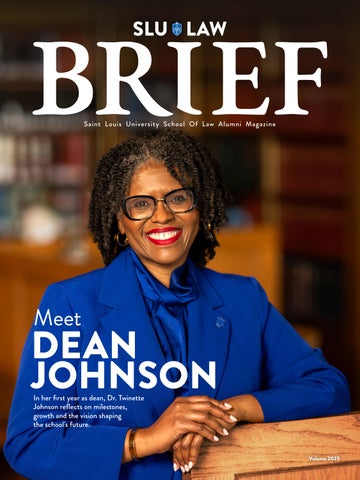
SLU LAW
Saint Louis University School Of Law Alumni Magazine
Meet
DEAN JOHNSON In her first year as dean, Dr. Twinette Johnson reflects on milestones, growth and the vision shaping the school's future.
Volume 2025
A Message from the Dean
ON THE COVER In her first year as dean, Dr. Twinette Johnson reflects on milestones, growth and the vision shaping the school’s future. DEAN Twinette Johnson, J.D., Ph.D. SENIOR DIRECTOR OF COMMUNICATIONS AND STRATEGY Jessica Ciccone PUBLISHING PARTNER Tulip Media Group GRAPHIC DESIGNER Jessica Embree Brittney Roseburrow PHOTOGRAPHY Aaron Banks (’14) Sarah Conroy Julie Dietz Steve Dolan
Ángel Garcia Brittney Roseburrow Adrian Tatum
SPECIAL THANKS Monique Abby (’03) Kearney Liuzza Abigail Allred Dana Malkus (’04) Kathryn Banks Michael McCuskey (’75) Lauren Bartlett Susan McGraugh Quinn Berry Jeffrey Mielcarz Erin Brooks (’10) Deborah O’Malley Joan Burger (’75) Jackie Pollvogt (’88) Alicia Campbell (’06) Tori Pollvogt (’19) Lauren Choate Josh Schmidt Prudence Kramer (’75) Ira Trako (’11) Jennifer Crompton (’04) Untress Quinn (’05) Brianna Cummings Matt Vigil (’11) Lucy Diaz (’17) Kim Vogt Danielle Pelfrey Duryea Letitia Wiggins (’13) Marsha Griggs Molly Wilson Rachel Harris (’14) Charles Wright (’75) Jeremiah Ho Twinette Johnson VOLUME 25 • COPYRIGHT © 2025 SAINT LOUIS UNIVERSITY SCHOOL OF LAW. ALL RIGHTS RESERVED. Office of Communications Scott Hall Suite 872 100 N. Tucker Blvd., St. Louis, MO 63101-1930 EMAIL: BRIEF@LAW.SLU.EDU
M
y first year as dean of Saint Louis University School of Law has been nothing short of a triumph. I take tremendous pride in my work as an academic leader and am equally proud to have the remarkable opportunity to lead this institution - a Jesuit institution with deep roots, rich traditions, and a strong and committed network of passionate, dedicated alumni. As you’ll see in the pages that follow, from meeting alumni, just down the street, to reconnecting with friends up the river in Chicago, to representing our school across the country in our nation’s capital and across the world at our Madrid campus, I’ve witnessed the extraordinary reach and reputation of this community. These travels have also given me time to reflect on what lies ahead for this great institution. I’ve been asked often what my vision is for the future of SLU LAW. My answer is simple: I don’t seek to reinvent who we are. We already stand on a foundation of excellence. My goal is to build upon that strength—to sustain our greatness and to prepare us for the challenges and opportunities ahead. I see this future shaped by three pillars: continuing excellence—by preserving and amplifying what makes our culture distinct; growth forward—by expanding our capabilities and embracing innovation; and sustainable success—by investing in the long-term health and resilience of our institution. You’ll see these pillars reflected throughout this publication: in the scholarship of our faculty, whose research continues to energize the field; in our students, whose intellect, drive, and compassion remind us daily why we do this work; and in you, our alumni, whose leadership, advocacy, and generosity continue to illuminate the best of who we are and what we strive to become. I hope you enjoy this publication. We took great care in redesigning it into a yearly publication that celebrates the excellence that is SLU LAW. I hope that you are as inspired as I am by all who work to make our community and profession the very best. Sincerely, Twinette Johnson, J.D., Ph.D. Dean and Professor
C ontents 2 LETTER FROM THE DEAN
22 SPOTLIGHT: JEREMIAH HO
4 IN BRIEF
24 SPOTLIGHT: PROFESSOR PELFREY DURYEA
7 SLU LAW AIMS FOR AI MASTERY
26 SPOTLIGHT: PROFESSOR MARSHA GRIGGS
8 / Student Organization Spotlight
28 FACULTY PUBLICATIONS
30 / SLU LAW Clinics
10 FEATURE: MEET DEAN JOHNSON
33 CLASS OF 1975
13 SPOTLIGHT: LUCY DIAZ
34 AROUND THE CENTERS
14 RAISING THE BAR
36 STUDENT SPOTLIGHT: BRIANNA CUMMINGS
16 / Redefining Justice: Alicia Campbell
38 / Hooding Ceremony 40 CLASS NOTES
17 RACHEL HARRIS: AI IN PRACTICE
44 IN REMEMBRANCE
18 BEYOND THE METRO: ERIN BROOKS
45 IN MEMORIAM
19 BEYOND THE METRO: LETITA WIGGINS
49 GIVING BACK
20 VALUE OF TEACHING: DEBORAH O’MALLEY
50 DONOR ROLLS SLU.EDU/LAW | 3
IN BRIEF NEWS & NOTES
Professor Sidney Watson Recognized For Excellence In Mentorship Professor Sidney Watson was selected as the inaugural recipient of the American Association of Law School Section on Scholarship’s Award for Excellence in Mentorship and Supporting Legal Scholarship. Professor Watson’s nomination was supported by more than a dozen members of the Section who described her steadfast commitment to fostering the scholarly growth of new and aspiring academics, her mentorship and support of colleagues’ scholarship, and her contribution to the broader legal academic community. She was recognized at the Section on Scholarship’s Award Ceremony on January 10, 2025.
Dean Johnson Gives Keynote At Old Courthouse Reopening Dean Twinette Johnson was invited by the Gateway Arch Park Foundation to participate in reopening of the Old Courthouse in downtown St. Louis on May 3, 2025. She gave the keynote speech for the ribbon-cutting ceremony as part of the community “Journey to Justice Festival.” The Old Courthouse reopened after an extensive five-year renovation project. The renovation included structural improvements, modernized HVAC systems, new accessibility features—like the building’s first elevator—and all-new museum exhibit galleries detailing the history of the courthouse and its pivotal role in the freedom suits, particularly the Dred and Harriet Scott case.
Jean Pierre (JP) Bonnet-Laboy Elected To NALSP Board JP Bonnet-Laboy (’18) was elected as a Midwest Regional Representative on the board for the National Association of Law Student Affairs Professionals (NALSP). NALSP is the professional home for student affairs professionals who work in the law school environment. The organization supports its members by advocating on behalf of the profession, providing professional development opportunities, offering resources on best practices, and fostering a community that enhances the personal and professional success of its members. In his role, Bonnet-Laboy will serve on the NALSP Finance Committee.
Jon Baris Receives A President’s Award From BAMSL Dean of Students Jon Baris received a President’s Outstanding Service Award from the Bar Association of Metropolitan St. Louis (BAMSL) during the 2025 Law Day event. Baris was recognized for his steadfast commitment to the legal community and his extensive involvement with BAMSL, which includes serving as President, Chairperson of the Young Lawyers Division, and member of the Board of Governors for 11 years. The President’s Award honors lawyers who have provided invaluable support and assistance to the President during their term of office. Recipients of this honor are recognized for their dedication, collaboration, and exemplary service, which have significantly contributed to the achievement of the President’s objectives and the advancement of BAMSL’s mission. Katie Doherty (’17) of Armstrong Teasdale was also a recipient of the 2025 President’s Outstanding Service Award.
4 | SLU LAW Brief
Kathryn Banks Honored At The Women’s Justice Awards Professor Kathryn Banks, Director of the Children’s Permanency Clinic and Dean of Experiential Learning, was honored at the 2025 Women’s Justice Awards for her work in public service. Katherine Gunderson (’25) was also honored as one of the Leaders of Tomorrow. The Women’s Justice Awards is an annual event held by Missouri Lawyers Media that recognizes women across Missouri who have demonstrated leadership, integrity, service, sacrifice, and accomplishment in improving the quality of justice and exemplifying the highest ideals of the legal profession.
Danielle Pelfrey Duryea Joins The Faculty Danielle Pelfrey Duryea, joins the School of Law faculty and the Center for Health Law Studies serving as the Medical Legal Partnership (MLP) Clinic’s inaugural director. Pelfrey Duryea joined the faculty in January from Boston University School of Law where she directed two innovative experiential clinics: the Health Justice Practicum and the Compliance Policy Clinic. She has been involved in the MLP field since 2008, including co-founding Ropes & Gray LLP’s nationally recognized pro bono MLP program and launching three other MLPs partnering with law school clinics. She has published papers on housing policy, health care inequities, mindfulness and law, and health justice clinic design, among other topics. Before teaching, she practiced in the government enforcement practice group at Ropes & Gray LLC. For more about Professor Danielle Pelfrey Duryea and the Medical Legal Partnership Clinic at SLU LAW, visit page 24. Alex Miller Joins The William C. Wefel Center For Employment Law Alex Miller joins the School of Law faculty as the Assistant Director of the William C. Wefel Center for Employment Law. With a broad background as a government attorney and roles in corporate business, including in compliance at Wells Fargo, Miller has served in a variety of roles during his legal career that make him uniquely qualified to serve the Center. He holds a JD from Syracuse University College of Law and a master’s in political science and government from the Syracuse University Maxwell School of Citizenship and Public Affairs. He obtained his bachelor’s degree from Illinois Wesleyan University.
STUDENT NEWS Student Wins American College Of Legal Medicine’s Orr Post-Doctoral Writing Competition Student Clayton Larue won first place in the Orr PostDoctoral Writing Competition for his article, “Nutritional Fortification of Food: A Commonsense Approach to Help Combat Malnutrition Enhanced with Modern Plant Biotechnology.” The Orr Writing Competition is an annual competition sponsored by the American College of Legal Medicine (ACLM) that provides an opportunity for any post-doctoral attorney or health professional to present their research on topics related to legal medicine. USPTO Patent Application Contents Students Matt Carr, Connor Pepper, Hansoo Song, and Trevion McGhaw competed in the 2025 United States Patent and Trademark Office Patent Application Contest. The team achieved third place in the regional competition. The regional competition started with nine teams, with the top three teams advancing to the afternoon session. Elon BEF Moot Court Competition 42 teams from 25 law schools across the country competed in this competition. The team of Isabella Gonzalez and Faith Whatley Blaine placed 9th in the competition. Grace Wallis won for best preliminary oralist.
Phillip Jessup International Moot Court The 2025 Philip C. Jessup International Law Moot Court team brought back a winning plaque to SLU LAW. The team of third-year student Emily Seidl and second-year students Charles Zimmerman, Rui Song, and Francine Butler made it to the octo-final rounds. BLSA Judicial Team Advances To Quarterfinals The Black Law Student Association’s Mock Trial team put in a great performance at the Midwest BLSA regional competition. The team—comprised of students Martell Turner, Alexandra Jones, Kaci Miller, and Kennedy Sams—advanced to the quarterfinals. The team was coached by Sheree Davis (’16).
SLU.EDU/LAW | 5
EVENTS SLU LAW Community Rallies To Help Tornado Victims Led by Associate Dean Kathryn Banks and the School of Law Legal Clinics, the law school community hosted donation drives following the May 16 tornado that devastated the north side of St. Louis City. Together, they were able to collect and distribute 499 rolls of toilet paper, 14 tarps, 500 bottles of water, fresh food, 1,348 diapers, 73 packages of baby wipes, 168 pounds of pet food, and 4 tents. The items were delivered to numerous local organizations including the Urban League of St. Louis, Action St. Louis/The People’s Response, 4theVille, and the Red Cross shelter at 12th and Pine. Additionally, the Legal Clinics hosted a Know Your Rights Housing Information Session at the Pilgrim Congregational United Church of Christ on Union Boulevard.
37th Annual Health Law Symposium Hosted By The Center For Health Law Studies The symposium, titled “Skrmetti and the Future of Gender Affirming Care: Law, Policy, and Public Health Perils,” explored the status of state laws that target civil rights that target the civil rights and access to health care for transgender, nonbinary, and other gender diverse people in the United States and their increase. It featured keynote speaker author Erin Reed, a transgender woman who tracks anti-LGBTQ+ legislation around the world and helps people become better advocates for their queer family, friends, colleagues, and community. The symposium provided a broad examination of the impacts of these laws, particularly as it relates to health.
The Center For International And Comparative Law And The Saint Louis University Law Journal Hosted A Symposium On International Humanitarian Law The symposium was titled “Contemporary Challenges in International Humanitarian Law: Is There Hope for International Order?” and featured Mary Ellen O’Connell, the Robert & Marion Professor of Law and Professor of International Peace Studies at the Kroc Institute at the University of Notre Dame. The event, drawing 17 worldrenowned academics from around the globe, explored ongoing armed conflicts have raised important and critical concerns about how war is being conducted.
6 | SLU LAW Brief
Dean William Johnson Portrait Unveiled At Scott Hall As part of the longstanding SLU LAW tradition, to celebrate the tenure of an outgoing dean, the School of Law faculty commissions a portrait. Each portrait hangs in the John K. Pruellage Courtroom in Scott Hall. Given his passion for racial and social justice, Dean William Johnson requested his portrait be created by St. Louis artist, Cbabi Bayoc. Bayoc is a visual artist whose work is known around the community for being vibrant portrayals of positive images of Black life, family, and community. His work is often both personal and impactful, with a mission to battle ignorance through his art.
SLU LAW AIMS FOR
AI Mastery W ith a series of programs, Saint Louis University School of Law initiated a comprehensive introduction to both the technical foundations and practical applications of artificial intelligence, positioning SLU LAW at the forefront of the critical conversations about the future of law and technology.
SLU LAW Dean Twinette Johnson launched the first two-part series with “Decoding AI: LLMs and the Future of Tech,” a presentation by Dr. Abby Stylianou, associate professor in the SLU School of Science and Engineering and a fellow of the Taylor Geospatial Institute. Dr. Stylianou offered attendees a foundational understanding of large language models (LLMs), how they are trained, and the broader implications of AI technologies across industries. She also addressed common misconceptions about how AI “thinks” and provided guidance on how professionals, including those in the legal field, can approach these tools with a critical and informed perspective. The second event in the series, "Generative AI in Law Practice," focused on the utilization of generative AI in legal practice. The panel featured attorneys from both public and private sectors, including representatives from large firms and solo practices. The discussion centered on how generative AI is currently being leveraged in the legal field for practical purposes such as scheduling, setting reminders, and streamlining legal training. Panelists emphasized the potential of generative AI to make legal work more efficient, particularly by speeding up time-consuming tasks like summarizing lengthy documents such as medical records. However, they also raised important ethical and professional considerations. Concerns included the risk of law students using AI to complete assignments without proper understanding, and young attorneys inadvertently compromising client confidentiality by inputting sensitive information into AI platforms. With the start of the new school year, SLU LAW continued to explore the evolving role of artificial intelligence—particularly generative AI—in both technology and legal practice. On November 15, Lawyering in the Age of AI addressed the opportunities, risks, and ethics for the practice of law. This half-day CLE event, designed for practicing attorneys, included insights from judges, tech-savvy practitioners, law firm partners, corporation general counsel and legal ethics experts.
SCHOLARSHIP IN AI As is true with respect to other areas of legal education, practice, and policy, faculty at Saint Louis University School of Law are engaged with cutting-edge work in artificial intelligence. Afonso Seixas-Nunes, SJ Father Seixas-Nunes, a Jesuit priest on the School of Law faculty, is a scholar of international law of war, including the use of autonomous drones in warfare. As of late, his scholarship has expanded to the challenges of AI for the international audience. He has presented on the topic for a variety of international audiences including; the Portuguese Court of Appeals on AI and Public Administration; Ethical, Social and Individual Freedom Aspects in the AI Era for Conferência Nacional de Apostolado dos Leigos, or the National Conference of the Apostolate of the Laity; and a presentation at the Instituto de Defensa Legal (Legal Defense Institute), a human rights organization in Peru, on AI and the new challenges to the western values. Danielle Pelfrey Duryea Professor Danielle Pelfrey Duryea, who is heading up the new medicallegal partnership (see page 24), is also exploring how AI is shaping students’ learning, particularly with respect to clinical training. Pelfrey Duryea offers a cautionary note in her recent project exploring how reliance on AI might interfere with the intensive, interactive learning that characterizes clinical education. Pelfrey Duryea is brainstorming methods for preparing fledgling lawyers to use AI in ways that still maintain professional rigor and client-centered empathy. Deborah O’Malley In addition to planning the bulk of the School of Law AI programming, Professor Deborah O’Malley has been exploring how AI is reshaping legal research, analysis, and instruction, particularly in the first-year legal writing classroom. She has presented at national conferences on the broader implications of AI for legal research, analysis, law practice, and the skills future lawyers will need. (For more on Professor O’Malley, see page 20). Molly Wilson Professor Wilson applies a behavioral science framework to examine how artificial intelligence may distort human knowledge and preferences. Behavioral research shows that the presentation of information shapes public choice, and as reliance on AI grows, its influence over public discourse will only deepen—amplifying the biases and hallucinations endemic to large language models. The result is that policy preferences, jury verdicts, contract negotiations, consumer decisions, employment practices, voting behavior, management strategies, and even social movements may increasingly reflect distortions introduced by AI. This raises urgent concerns not only about inadvertent bias but also about the deliberate manipulation of beliefs, attitudes, and behaviors by actors leveraging AI to launch large-scale misinformation campaigns. Professor Wilson’s work draws on behavioral research to develop strategies for minimizing these risks, with the goal of equipping lawyers and other professionals with the ability to curb AI’sSLU.EDU/LAW faulty outputs while | 7 maximizing the benefits of emerging search technologies.
Student
ORGANIZATION
SPOTLIGHT
Fresh On The Menu: Friday Sandwich Review Many student organizations at Saint Louis University School of Law are founded based on shared legal interests or identities. But it was more than a shared legal interest that brought one of the law school’s newest groups together. The Friday Sandwich Review organization was founded on a shared love of sandwiches. The second year law students Daniel Mahn, Nick Shelton, Landry Buck, and Jimmy Mullen started Friday Sandwich Review as they were already getting lunch together regularly as friends. This evolved into spending Fridays at local sandwich restaurants with local lawyers and law students to help make connections in a nonformal setting outside of school. “We also found that while other clubs were focused on a specific legal career path, we were able to bring in attorneys from diverse backgrounds,” said Nick Shelton. Jimmy Mullen shared his favorite part of the organization: “Being able to support local businesses and bring law students and local lawyers together has been the most rewarding aspect of Friday Sandwich Review. It’s not just about the sandwiches; it’s about fostering a sense of community and providing networking opportunities in a relaxed environment.” Friday Sandwich Review hosts regular lunches with local lawyers. There are usually several lunches going on simultaneously at different sandwich shops, and students can choose which lunch they want to attend. When asked what community means to him at SLU LAW and how Friday Sandwich Review has shaped that view of community, Landry Buck explained, “At SLU LAW, community means a supportive network where students, faculty, and staff come together to learn, grow, and support each other. Friday Sandwich
8 | SLU LAW Brief
Friday Sandwich Club members having sandwiches at the Missouri Supreme Court.
Review has shaped our view of community by providing a platform for informal networking, where students can connect with legal professionals in a relaxed setting. This club embodies the Jesuit tradition of academic excellence, freedom of inquiry, and respect for individual differences, fostering an inclusive environment where differences are valued.” In November 2025, the group went on the road to Jefferson City where they ate sandwiches at the Missouri Supreme Court. Black Law Students Association Celebrates 50 Years The SLU LAW Black Law Students Association (BLSA) has been an active part of the student community for over 50 years. Their programs have become marquee events enjoyed by the entire law school. The annual Casino Night brings together young alumni and the student body for a night of celebration benefiting the Kujichagulia Scholarship Fund. And each year the BLSA Judicial Reception honors members of the judiciary, attorneys, and organizations for their leadership in ensuring access to justice and service to the community as reflected in the BLSA mission. The 2025 reception honored Judge Lynne Perkins, Circuit Judge in the 22nd Judicial Court of St. Louis. St. Louis, who received the Honorable Theodore McMillian Award for his commitment to justice, deep compassion for the people of St. Louis by protecting vulnerable families during the pandemic to championing institutional change within the court.
BLSA graduates at Scott Hall.
Attorney Sheree Davis (’16) was honored with the Ronda Williams Service Award for her dedication to justice, tireless mentorship of aspiring Black lawyers, and selfless commitment to uplifting the community, particularly in East St. Louis and within the BLSA community. Finally, the Kujichagulia Diversity Impact Award was given to Lewis Rice LLC in recognition of its dedication to fostering a diverse and inclusive legal community. Beyond these events, BLSA has made strides in supporting women in the community co-hosting the second annual Black Women in the Law Brunch with the Women's Law Student Association. The event included networking and panel discussions of SLU LAW faculty members and alumnae practicing in the St. Louis area, including Twinette Johnson, dean of SLU LAW. The SLU LAW chapter of BLSA has been recognized nationally for its dedication and growth. At the annual Midwest BLSA Convention in Chicago, SLU BLSA won the Chapter Size-Large Award for their dedication to growth and impact. And the BLSA Mock Trial Team made it to the quarterfinals of Constance Baker Motley Mock Trial Competition. New To SLU Now in its second year at SLU is the Women of Color Collective. This organization aspires to create a space for education, support, and allyship around issues and topics that affect women of color. The organization was created to bridge the gap between the legal profession and women of color, and to encourage women of color to continue to persevere, uplift each other, and pave the way for other women of color in the legal space.
SLU.EDU/LAW | 9
COVER FEATURE
In her first year as dean, Dr. Twinette Johnson reflects on milestones, growth and the vision shaping the school’s future.
Meet
DEAN JOHNSON 10 | SLU LAW Brief
D
ean Twinette Johnson doesn’t rush her words. She speaks with a certainty that makes you lean in. It’s the kind of presence that feels equal part conversation and equal part calling. This is the warmth of someone genuinely interested in you, paired with the clarity of a leader who knows exactly why she’s here. At Saint Louis University School of Law, her story is one of persistence, vision, and balance. She entered the role with a scholar’s heart and a teacher’s instinct, carrying with her the deep empathy that comes from being a first-generation law student. That perspective has never left her. It informs her leadership and the way she sees her students, faculty, and the broader community. In her words, leadership at this level means “fueling while you fly,” and that phrase sets the stage for her approach to a deanship that demands constant motion, adaptability, and courage.
Dean Johnson’s Vision Pillars for SLU LAW Leadership
Continued Excellence _
Growth Forward _
Sustainable Success
Raised with the example of hard work and determination, Johnson always carried her identity as a firstgeneration law student with her. That said, her path to becoming dean of Saint Louis University School of Law is anything but a straight line.
lawyers, but also how to believe in themselves as lawyers.” For Johnson, that commitment isn’t abstract. It’s rooted in her own journey through Saint Louis University. This is the place where her mom first dropped her off as a student, trusting the school to take care of her; where she began building the foundation for her career; and where she would later stand at the front of a classroom for the first time. “I don’t think my heart has ever left St. Louis,” she says. Maybe that’s why, after years leading and teaching in other corners of the country, she felt drawn back, not to relive the past but to keep the momentum going while charting a higher course ahead. Coming back to SLU in 2024 as a law dean was, in Johnson’s words, “a homecoming of sorts.” And yet, it’s also a new chapter, one that she approaches with a clear sense of purpose. “Transforming lives,” she says, without hesitation, when asked to describe the role of higher education in society. “That’s what we’re doing. We’re transforming lives.”
She smiles when she talks about those early years. “I’ve taught and advised at every stage,” she says, from the very first semester of law school all the way to the anxious weeks before the bar exam. For Johnson, those weren’t just jobs; they were training grounds for a lifetime in legal education.
Johnson is quick to connect that transformation to the law school’s downtown location, something she sees as more than geographic convenience. “Being here means we are part of the city’s daily life,” she explains. Basically, students here can see firsthand how law interacts with community, policy, business—all of it. “The clinics just finished celebrating 50 years of service,” she says, “[and] the students have the opportunity under the tutelage of a professor attorney to represent clients. And so, they get that real-world experience. And I think for a lot of students, it’s what they come to law school for, right?” It’s no accident that she emphasizes clinics. Johnson’s career has been shaped by hands-on legal education, by the belief that students learn best when they’re engaged in the real work of law.
“I was really passionate about making sure students had the tools they needed to be successful in law school and beyond,” she recalls. “That meant teaching them how to think like
Johnson believes SLU LAW is inseparable from the city it calls home. With courthouses, firms, nonprofits, and the city government all within reach of campus, students gain an
Her career began not in administration but in the classroom, where she thrived on the back-and-forth of teaching and mentoring. “I loved teaching,” she reflects, describing the energy of working with students as they discover the law’s complexity and power.
SLU.EDU/LAW | 11
COVER FEATURE CONT.
"
For Johnson, legacy isn’t about personal credit. It’s about the community she serves. unparalleled opportunity to put theory into practice. This is a school where you don’t have to wait until graduation to see how the law affects people’s lives. That accessibility echoes SLU’s Jesuit tradition of service, which has long shaped the school’s efforts. For Johnson, those values are not window dressing; they’re the foundation for how students grow into attorneys who see the profession as both a career and a calling. And they’re the same values that guide her approach as a leader. Her style, she says, is grounded in listening and collaboration. She is very clear about the fact that she doesn’t have all the answers. She emphasizes listening—really listening—to the voices around her: faculty with decades of experience, staff who know the institution’s daily rhythm, and students whose perspectives keep the school future-facing. She wants to hear from students, faculty, alumni, and staff. Her job is to lead, but it is also to bring out the best in everyone around her. Dean Johnson is also deeply aware of the larger context in which she’s leading—the legal profession’s diversity challenges, the political climate, and the societal debates over access to justice. As one of a relative few Black women serving as law school deans nationwide, she sees representation as essential. “It’s important for students, especially students of color, especially women, to see themselves in leadership roles,” she says. “It changes what they believe is possible.” She’s brought that DNA here, a place she describes as missiondriven at its core, not just because of its Jesuit, Catholic identity but because of the way that faith-based commitment is lived out in service, community, and care for the whole person. For Johnson, returning wasn’t just a career move; it was a calling. She came back to lead a community she believes can make a difference—in the courtroom, in the city, and in the lives of every student who walks through its doors.
12 | SLU LAW Brief
When asked about how the legal field is shifting, Johnson didn’t hesitate to acknowledge the pace of change. “We’re preparing students for a profession that may look very different in years to come,” she said. For her, the challenge is both exciting and sobering, building a curriculum that reflects today’s realities while also anticipating tomorrow’s unknowns. She sees alumni as a vital part of this evolution. She wants them to view themselves not just as observers but as active partners—mentors, donors, advocates, champions. “Our alumni are some of our most important partners,” she says. “They know what it takes to get through this program and succeed in the profession. They can inspire our students beyond the classroom.” And while she’s quick to talk about the needs of the law school community, she’s equally passionate about its potential. She spoke about the school’s momentum and the opportunity to build on its strengths, from supporting students and faculty to strengthening alumni connections. For her, the work ahead is about weaving those threads together in a way that makes the community stronger and more impactful. Johnson doesn’t pretend the challenges ahead are small. The cost of legal education, the pressures of the profession, the pace of change in the law itself—these are real hurdles. But she also believes SLU LAW is uniquely positioned to meet them. Johnson has often emphasized that this is a place where community matters and where students are encouraged to think about how they will use their degree to help others. That commitment to service and reflection on values resonates deeply with the school’s Catholic tradition, which asks students and faculty alike to consider not only what kind of lawyers they want to be but what kind of impact they want to have on the world. For Johnson, legacy isn’t about personal credit. It’s about the community she serves. She highlighted the strength of the students, the readiness they carry into their careers, and the lift the school provides to help them take flight. That ongoing story of graduates prepared to soar is what she hopes will endure. Hers is a story about the power of empathy, the importance of community, and the courage it takes to guide an institution through change. And woven through it all is the reminder that leadership isn’t about waiting for the perfect conditions. It’s about moving forward with vision and resolve, even mid-flight. Johnson concludes, “We are the ones who are helping our communities, leading in these communities. We are the ones who are supporting and uplifting the rule of law. We are the ones who are champions of justice. They come from this school. They come from Saint Louis University School of Law.”
ALUMNI SPOTLIGHT
UP AND COMING ALUM:
Lucy Diaz C
(’17)
hicago-born, Lucy Diaz (’17) first came to St. Louis for a year of service with Casa De Salud as a Spanish interpreter and patient navigator. The experience sharpened her perspective on access, advocacy, and systemic change, and it led her to pursue a career in law that would enable her to make a positive impact.
and leveraging her bilingual background to help her community navigate complex systems.
She went on to earn her degree at Saint Louis University School of Law, completing a concentration in Health Law while remaining open to various legal practice areas.
Appellate Lane: Craft, Reputation, And Return Diaz has spent most of her career as a judicial law clerk with the Missouri Court of Appeals, Eastern District, researching complex issues and drafting memoranda for judges. The work sharpened her instincts and affirmed her fit. “You’re being asked to contribute to a legal piece that’s going to go out in the world,” she said. Specific responsibilities, such as researching issues of first impression and mentoring interns, were validating. After four years of clerking, she stepped into civil litigation for a year.
Today, Diaz is a judicial law clerk with the Missouri Court of Appeals, Eastern District, a role that plays to her strengths: legal research and writing. Recently honored with the University’s SLU Pioneer Award, she is recognized as an “up-and-coming” leader. The SLU Pioneer Award recognizes graduates whose innovative spirit and unwavering commitment to Jesuit values have made a lasting impact. Awarded annually, it honors alumni who have distinguished themselves professionally, forged new paths in their fields, and paved the way for others. Nominees exemplify SLU’s mission through their dedication to service, social justice, and excellence, living out the pioneering spirit that has shaped the University since its founding. Receiving the SLU Pioneer Award left Diaz feeling “very appreciative [and] very grateful” to the judges, her colleagues, and the SLU staff who nominated her and have supported her professional growth. The recognition, she said, affirmed the collective investment in young lawyers and was a reminder “to be the best lawyer you can be.” Early Compass: Service, Bilingual Roots, And A Path To Law Diaz didn’t arrive at law school with a fixed blueprint. Growing up in Chicago, she frequently stepped into advocacy roles by mediating disagreements, connecting people with resources,
A year of service in St. Louis reinforced what she was already sensing: “There’s a need,” she recalled, especially for advocates who can open doors for others. Law, for Diaz, became a way to turn that principle into action.
Diaz then returned to the Court of Appeals when a newly appointed judge sought an experienced clerk. The invitation to return underscored something she’d come to believe: reputation is built on work product and work ethic. Looking Ahead Diaz intends to continue working as a judicial law clerk but is interested in the academic side of the profession. Teaching and mentoring come naturally to her, whether supervising interns at the court or supporting students through alumni channels. Her goal is simple yet expansive: she wants to continue inspiring the next person considering a career in law and help them see the many ways they can contribute. From a service year to a clerkship path, Diaz has shaped a career where writing is a form of leadership. In an era of rapid change, she returns again and again to the fundamentals—adaptability, work ethic, precision, mentorship, and the conviction that well-crafted work can move the law and the people within it forward. SLU.EDU/LAW | 13
ALUMNI LEADERS
Jen Crompton (left), Untress Quinn, and Monique Abby together at the Old Courthouse in St. Louis.
RAISING THE BAR
Alumni Leaders Driving The Profession Forward
I
t is estimated that more than half of the attorneys practicing in the St. Louis region are graduates of Saint Louis University School of Law. That’s an extraordinary footprint of influence in the legal profession and in the civic life of our community. Grounded in a mission of service to others and the promotion of justice, SLU LAW alumni have long been called to leadership—not just in courtrooms and classrooms but also in the organizations that shape the profession itself. From bar associations to advocacy groups, our graduates are at the forefront of ensuring the law serves both justice and the public good. The three alumni featured here are just a few of the many who have chosen to lead with conviction, purpose, and vision.
Untress “Trez” Quinn - The Inspired Leader
Untress “Trez” Quinn (’05) began his tenure as president of the Bar Association of Metropolitan St. Louis (BAMSL) in May 2025, stepping into a role steeped in tradition. He follows in the footsteps of a long line of SLU LAW alumni leaders, including immediate past president Kevin Gunn (’96). “The mission [of BAMSL] is to protect the rule of law and the integrity of the justice system,” says Quinn. “Oftentimes, when we speak of the rule of law, we speak in lofty terms. But most people
14 | SLU LAW Brief
don’t experience the rule of law in these grand moments; they experience it every day.” A seasoned trial lawyer at Armstrong Teasdale, Quinn focuses on commercial and tort litigation across multiple industries. But before entering law, he spent more than a decade as a registered nurse. His career path reflects a deep care for people that still shapes his work today. “That’s the thing I want to do here is restore trust in the justice system and the things we do,” Quinn continues. He sees the practice of law as a profound responsibility. “Being a lawyer is being entrusted with the power to shape lives, communities, and the very fabric of society,” Quinn says. “It’s not a small thing. Don’t take it for granted.” Equally important to Quinn is protecting the well-being of his colleagues. “This is a hard profession, and we want to foster a culture where mental health is a shared concern and not a stigma,” Quinn says. “Where lawyers are recognized and acknowledged and not just managed.”
Jennifer Crompton - The Quintessential Leader
Jennifer Crompton (’04) describes herself as “ever curious” with a “dorky nature”—traits that have propelled her into leadership from her earliest days in the profession. Now the president-elect of the Missouri Bar, her trajectory can be traced back to SLU LAW, where she served on the Student Bar Association executive board. “I thought, this will be a great way to get to meet other people beyond the criminal law bubble,” said Crompton of her early decision to get involved. After launching her career at the St. Louis Circuit Attorney’s Office, Crompton was elected to the Missouri Bar’s Young Lawyers Section Council. Over the years, she has built a reputation as a tenacious trial lawyer, having tried more than 40 jury cases. Today, she serves as chief operating officer and trial lawyer at Crompton Pancoast in St. Louis, bringing both courtroom experience and business leadership to her practice. Beyond professional accolades, Crompton's north star has always been service. “I have always felt that giving back, whether it is legal or otherwise, is very important and doesn’t always have to be because you are receiving a monetary payment for it.” she says. That philosophy shapes her vision for the Missouri Bar, whose mission is to improve the lives of Missourians by providing for, promoting, and protecting justice for all. For Crompton, one strategic goal stands out: ensuring public confidence in the role of judges and lawyers. “A lot of us went to law school because we have this innate desire to help others, and to make the world a better place,” she says. “It is inherent upon us as attorneys to help, to use our brains, to help people, to help society, to make things better, and to question, because the way things currently are isn’t always the right way or the best way. That philosophy is ingrained in me as an individual.”
Monique Abby - The Uplifting Leader
“When one of us is experiencing something in the legal realm, it’s not just legal,” said Abby. “It also affects [people] in a human way, and it is important for us to be there for each other in a human way.” Abby will soon begin her term as president of the Women Lawyers’ Association of St. Louis (WLA), an organization committed to promoting women into positions of influence within the profession and the community. For Abby, this mission is urgent and personal. “But I want us all to remember that we are our sister’s keeper,” she says. “When one of us is affected, we are all affected. So we need to look out for each other and make sure we are protecting each other.” “This is a bigger purpose,” she says. “It’s bigger than me.”
Together, Quinn, Crompton, and Abby represent the breadth of SLU LAW’s alumni leadership. Their stories reflect not only professional excellence but also a shared commitment to justice, service, and the betterment of the legal community. They are just three of the many alumni carrying forward the law school’s mission of leading with purpose, compassion, and vision for the future.
Other Alumni in Bar Leadership* Jennifer Woulfe (’11) - President, The Lawyers Association of St. Louis, Missouri Lauren Surdyke (’15) - President, St. Louis County Bar Association Moshen Pasha (’14) - President, Federal Bar Association of St. Louis Chapter Jittaun Dill (’09) - President, Mound City Bar Association
Raised among strong women, Monique Abby always felt called to leadership. A first-generation college graduate and attorney, she charted her path with clarity and determination, earning her degree in political science from Howard University before returning home to St. Louis to attend SLU LAW.
Christopher Lee (’10) - President, Missouri Asian American Bar Association
Abby’s career began in juvenile defense as a public defender and later continued in the child-support unit of the St. Louis Circuit Attorney’s Office, where she now prosecutes non-support cases. These roles gave her a window into the intersection of law and human experience.
*This is not meant to be an exhaustive list but rather an opportunity to provide a glimpse at the alumni who are currently called to serve.
Sara Salger (’08) - President, Illinois Trial Lawyers Association
SLU.EDU/LAW | 15
ALUMNI SPOTLIGHT
REDEFINING JUSTICE:
Alicia Campbell AND THE RISE OF TRIAL SCIENCE
A
licia Campbell (’06) is at the forefront of a revolution that’s changing trial law. As one of her field’s early champions, she calls her work trial science, an empirical, data-driven approach that asks not just what lawyers think matters in a courtroom but what the jurors actually do. “We call ourselves trial scientists because we are studying the way that jurors respond to cases, and the way that we do that is by statistical analysis,” Campbell explains. “There is an art to lawyering ... but what we’ve figured out is there is also a science to lawyering, right? Not all of our instincts as trial attorneys are necessarily in line with what jurors think.”
The Power Of Big Data Rather than relying on small focus groups, traditionally consisting of a dozen or fewer participants, Campbell and her team harness the power of numbers. The sample sizes that they use are very large, so instead of having focus groups of 12, they can have focus groups of 300 people. They have also run focus groups with 700 jurors. “We’re really relying on that statistical power to help [provide] information and guide lawyers in their choices throughout their cases,” says Campbell. The effort has been transformative. “What’s probably most tremendous out of that experience,” says Campbell, “besides litigating [the cases] and seeing the jurors in action—because you always had that sense, [that] Atticus Finch sense of, ‘Hey, we need to go in to court and stand up for what’s right’—but studying cases, the one thing I can tell you is that jurors work very hard to do good jobs and they want to do what’s right, even in the online studies.” Campbell said one of the best parts about doing this every day is getting the chance to merge the two fields of law she has worked in into one: “Having tried cases and understanding that the jurors are trying to do a good job, and then having the trial science and knowing [that they are], because I’ve seen them do a really good job.” From Mortgage Fraud To Method Campbell’s journey toward trial science began after founding Campbell Law in 2009. She worked on mortgage fraud cases and really enjoyed them. Around the same time, her husband, John (’06), received a job offer to be a law professor at the University of Denver in 2012. “What we figured out is maybe Campbell Law can live a little bit on the edge,” Campbell recalls. Relocating to Denver opened a new realm of collaboration, especially with academic researchers studying jurors. “[John] started dealing with academics who are regularly studying jurors, and he had this revelation of, ‘Wait a minute, these academics are making up scenarios to [...] get juror feedback,’” but he knew many lawyers who had real scenarios. Campbell saw the power of bringing big data to bear on trial preparation, discovering not only what jurors felt but also
16 | SLU LAW Brief
RACHEL HARRIS (’14):
which facts truly mattered to them. This allowed her to make smarter decisions about settlement and trial strategy. Today, Campbell lives in Madrid, where she continues to lead the transformation of trial law through her innovative approach to trial science. Tools, Books, And A Community For Change Campbell’s work helped launch a new ecosystem. The Big Data Revolution is Here: Jury Ball, a book and conference series co-developed by her husband, John, and Nevada attorney Sean Claggett, demonstrates how lawyers can effectively apply trial science. “[Jury Ball] explains our processes. It explains a lot of the results that we’ve seen, because obviously, over 1,000 cases, we have a lot of trends and patterns that we notice over certain types of cases,” said Campbell. Initially, it evolved into the Jury Ball method and conferences. Advice And The Value Of Justice Asked what advice she offers new lawyers, Campbell is direct: “Don’t be afraid to hang up your own shingle if that is something that excites you. It’s terrifying! I know there [were] many sleepless nights when I opened up Campbell Law. But now with the work that I put in and the help of many people in law, I’m very excited about where Campbell Law is, and I’m really grateful that I took the leap.” She encourages students and alumni to stay open to new ways of practicing and never lose sight of personal values. “The way that people practice law is very varied ... Each person’s [style is] their own, so don’t forget that.” For Campbell, trial science isn’t just about data but about trust—in the legal system, in jurors, and in each other. “Jury trials are very important, and no matter what anybody says, [jurors] are capable of doing the job and want to do a good job and they’re up to the task ... For me, that’s probably the most tremendous thing out of all of it is that it is accurate. Jurors do good jobs and lawyers do good jobs, and what results is justice more often than not.”
ARTIFICIAL INTELLIGENCE IN PRACTICE
I
Can You Describe Your Current Role At Suzy? ’m General Counsel and AI Governance Officer at Suzy, Inc., a Series D venture-backed technology company in the market research space. Suzy is headquartered in New York but operates with a fully distributed workforce, which gives me a front-row seat to how modern companies balance innovation with compliance in a global environment. My role is a mix of strategist, problem-solver, and safeguard. On any given day, I might be counseling our product teams on how to responsibly build AI, shaping intellectual property strategy, negotiating commercial deals, or advising our board through governance matters. I also lead our privacy, cybersecurity, GRC, and audit readiness functions—areas that are increasingly critical as enterprise customers demand both speed and trust. Why Do You Think It Is Important For Attorneys To Embrace AI? I don’t think attorneys need to love AI or must use it every day, but I do think they need to learn it. Historically, when new technologies like cloud computing or cybersecurity emerged, too many lawyers punted the hard questions to engineers or other tech folks. The result was a disconnect: contracts and policies said one thing, but the technology worked another way. We can’t afford to make that mistake again with AI. Learning AI means stepping way outside our comfort zones: reading technical material, taking tutorials meant for engineers, and listening directly to the people building these systems. CLEs and legal conferences are helpful, but they’re often echo chambers where lawyers talk only to each other. If you really want to understand AI, go to developer or security conferences, hear from ethicists and data scientists, and see how judges, regulators, and technologists are approaching it. I believe our profession has a responsibility here. If we wait until “the bad cases” come along to sort AI out in the courts, society may have already paid the price. But if lawyers take the initiative to truly learn how AI works—beyond just the legal theory—we can help companies, clients, and society navigate this technology ethically. What Do You Think The Future Holds For AI And The Law? The biggest impact from AI may not be on the tasks themselves but on the skills lawyers will be expected to have to deliver real value. AI is redefining what makes a great in-house lawyer. It’s not enough to be strong in the law while relying only on Word, Excel, DocuSign, and other traditional tools. Companies now need counsel who are builders, problem-solvers, and self-teachers. If your first instinct is to punt a process question to IT or wait for someone else to fix it, you’ll fall behind. The lawyers who thrive will be the ones willing to experiment (ethically) with AI, design their own workflows, and approach problems with both an operational and strategic mindset.
SLU.EDU/LAW | 17
BEYOND THE METRO
FROM THE ARCH TO THE LAKEFRONT
Erin Brooks,
K
JD (’10)
ansas City native Erin Brooks, (’10), still remembers the March day in 2023 when she and her husband packed up their car, cat in tow, and drove north from their home in Saint Louis to Chicago. The move was more than a change of scenery; it was the next step in a career defined by resilience and connection.
the Honorable Kathianne Knaup Crane (’71) at the Missouri Court of Appeals. That year, she said, gave her “a good perspective for what it meant to be a lawyer and what your responsibilities are to the court and to judges.” When she joined then-Bryan Cave as an attorney, she began cultivating the national environmental law practice she leads today.
Just a year later, she was named office managing partner of Bryan Cave Leighton Paisner’s Chicago office. Her office currently comprises about 80 colleagues, with approximately 40 of them being attorneys, reflecting both the scale and collaborative spirit of the team. Today, more than two years into the Chicago chapter of her career, Brooks continues to draw on her Saint Louis roots as she builds bridges between colleagues, clients, and fellow alumni across the Midwest.
Leading In Chicago Brooks lived in Saint Louis from 2007 until 2023 when she relocated to Chicago. The move, she said, allowed her to stay true to her Midwestern roots while expanding into a dynamic new market. “The Chicago legal community has been so warm and welcoming, and it’s a place where folks are looking to create community and connections,” she said.
Charting A Legal Path A first-generation lawyer, Brooks knew early on that a career in law was likely in her future. “Law school was always something that I thought about pursuing. Ever since I was a young child, my parents can attest to [my dream to become a lawyer],” she recalled. At SLU LAW, she pursued opportunities that laid the foundation for her career. She spent a summer with the US Attorney’s Office in its Civil Actions unit before joining BCLP (formerly known as Bryan Cave) as a summer associate in 2009. After graduation, she clerked for
“Having been with the firm for well over a decade gave me a rich experience observing lots of our leaders in action,” she explained. Her leadership philosophy centers on creating an office where colleagues feel valued and supported. “When our colleagues feel supported, they engage—and they proactively seek to create,” Erin says, reflecting on current initiatives led by her colleagues. Strengthening The Alumni Thread Though her office is now in Chicago, Brooks remains proud of BCLP’s Saint Louis heritage. Founded in the city more than 150 years ago, the firm’s legacy mirrors her own trajectory: firmly grounded in the Midwest, yet national in scope. The same is true of her connection to SLU LAW. “An alumni base is really incredible because it is the tether through time that connects generations of students,” she said. From her years as a managing editor on the Saint Louis University Law Journal to alumni events today, those bonds have grown into enduring relationships with classmates who are now partners, clients, and friends. In Chicago, Brooks sees herself as part of a “moderate force but mighty” alumni base. She hopes to strengthen the pipeline between SLU LAW graduates and opportunities in the Chicago market. She also sees that opportunity for recent graduates as well. Her advice to young alumni is simple: put yourself out there. “There is no substitute for building your network by rolling up your sleeves,” she said. Looking Ahead “I feel very motivated to stay a meaningful part of the Chicago alumni community and to continue to look back and create a pipeline to create additional [opportunities] for SLU LAW alumni,” she said. And while her professional life centers on leading an office and advising clients on high-stakes environmental issues, Brooks finds balance in simpler joys, such as long walks along Chicago’s lakefront with her husband or reconnecting with old classmates at alumni gatherings. As she put it, bridging communities is both her professional calling and her personal delight.
18 | SLU LAW Brief
Coming Home
BEYOND THE METRO
How Letitia Wiggins Built A Family Law Practice Rooted In Community
W
hether it’s trading case briefs, running practice arguments, or even prepping for the bar exam, every law school student knows how important it is to be able to lean on their classmates through the challenges of law school. But for Saint Louis University School of Law Alumna Letitia Wiggins ('13), her relationship with her classmates didn’t end after graduation. “I still have a group chat with three of my best friends from law school. We talk every day,” she said with a smile. Wiggins opened her own family practice in 2019, and even though her law school classmates don’t practice the same type of law, they rely on one another for guidance, support, and everything in between. Cultivating A Network Never Ends As a first-generation lawyer with no family practice to take over, Wiggins wasn’t sure how she’d be able to practice law in her hometown of McLeansboro, Illinois. “My husband’s from here. Both of our families are here, and I had always wanted to return home. I just didn’t know how I could get there,” she said. At SLU LAW, Wiggins was taught to cultivate and maintain a network she could trust. Her ability to build a community of professionals around her has helped her advance in her career in ways she never could have imagined. After working as an assistant state’s attorney and then as a lawyer in private practice, Wiggins decided to take a chance on herself and start her own practice in 2019, just six years after graduating. The first of many challenges in stepping into her role as a solo practitioner was finding an office space in her hometown. She stopped by the office of a lawyer she had interned with in high school to inquire about available space, and something even better began to take shape. “He invited me to come share his office space,” she shared. Over the years, he’s been a wonderful mentor to her. As Wiggins works
to open her own office space and transition into a new building, the generosity and mentorship she received during the first years of owning her own firm will stick with her forever. At her firm, she practices family law, which is a blend of divorce, parentage, guardianship, guardian ad litem work, and mediation. Lawyers Are Community Members First Perhaps it’s the nature of her practice or simply her nature as a human, but Wiggins is careful not to underestimate her role in the community. To many lawyers, winning a case in a courtroom is separate from their personal lives, but in family law in a small town, the line is blurrier. “When I do a custody case or a family case, that child may go to my child’s school. Their parents may be at ball games with my children,” explained Wiggins. “So, I always want to be very respectful not only to my client but the opposing party.” Especially in her line of work, Wiggins is careful to consider her impact in the community at large. If a situation can be resolved quickly, that will result in less trauma for the children, meaning less trauma is put into the community and less collective healing will need to be done. Wiggins knows that a degree of separation is required to be able to do the job professionally, but she isn’t willing to throw empathy out the window. Dear Future Lawyers: It’s About People For Wiggins, being a successful lawyer isn’t about legal strategy; it’s about people. The classmates who still answer her texts every day, the mentors who opened their office space to her, and the assistants who help keep her practice running. But most of all, it’s about the families who walk into her office looking for support from their community attorney. Her professional journey back home to McLeansboro is proof that foundations built at SLU LAW extend far beyond the classroom. For today’s students, Wiggins is a reminder to invest in your network, move with empathy, and never underestimate the importance of community. SLU.EDU/LAW | 19
FACULTY SPOTLIGHT
THE VALUE OF TEACHING:
SLU LAW PROFESSOR
Deborah O’Malley’s ENDURING IMPACT
20 | SLU LAW Brief
D
eborah O’Malley’s journey into law began in Iowa, where she was raised by a mother who taught English and instilled in her a love of writing. “I always had a proclivity for writing,” says O’Malley, “I think [...] because [my mother] was an English teacher.” Combined with her hours spent on debate teams and a deep desire to help others, O’Malley’s skill set naturally pointed her toward the legal field. This path would eventually merge her love for communication, advocacy, and mentorship. A Calling Shaped By Service After completing her undergraduate studies at Iowa State, where she worked as a resident assistant and discovered her passion for working with students, O’Malley took a break before deciding to attend law school. Her passion for supporting student life led her to Saint Louis University, where she spent two years working full-time in residence life. “Residence life and working with students were a huge part of my identity in my undergraduate education,” she explains. Even in those formative years, the value she found in serving students laid the groundwork for a lifelong calling. It was a full-circle moment when, years later, after launching a legal career, O’Malley returned to SLU LAW as a professor. It was her passion for advocacy that led her to American University Washington College of Law, where she planned to “propel women’s rights and women’s equality forward.” After beginning her law career in private practice, specializing in corporate and real estate law, O’Malley transitioned into academia five years later at Syracuse University College of Law, a move she describes as a return to her true calling: “Structure, teaching— it’s all in my DNA in some ways, so it was a good fit,” maintains O’Malley. “And since then, I just love working with students.” This shift enabled her to hold multiple academic and administrative roles at Syracuse, including Legal Writing Professor, Director of Student Affairs, Director of LL.M. Student Support, and Director of Professional Development. In 2022, she brought this wealth of experience and dedication to SLU LAW, where she continues to make student growth and mentorship the heart of her professional journey as part of the Legal Analysis, Research, and Communications (LARC) faculty. Mentoring And Empathy Are Her Approach To Students Ask O’Malley what she enjoys most about being a faculty member at SLU LAW and her answer is immediate: “Students—100%.” For her, the greatest privilege is mentoring and helping others figure out their time in law school, which is deeply rewarding. She also finds inspiration in colleagues dedicated to making legal education “better for our students.” Collaboration and shared purpose with colleagues, she says, “has been a really great part of working at SLU LAW too, not just directly with students but indirectly with folks committed to trying to make things better.”
“For O’Malley, the true measure of success is found in her students’ growth.” Championing AI Innovation In Legal Education Building on her longstanding dedication to student development and effective teaching, Professor O’Malley has become a national leader in research exploring the impact of generative AI on legal education and the practice of law. Her current scholarship investigates how this technology is transforming legal research, analysis, and classroom instruction, especially in the first-year legal writing curriculum. As part of her innovative approach, O’Malley has presented at national conferences, sharing practical strategies for introducing AI tools to international law students and discussing broader implications of AI for legal practice and the skills future lawyers will need. In addition to her scholarship and presentations, she is an active member of the national Legal Writing Institute’s Generative AI Committee. As part of her leadership, O’Malley designed and circulated a nationwide survey among legal writing faculty, gathering essential insights on how AI is integrated into workflows, teaching, and assessments across law schools. The results of her study will help shape best practices for 1L instruction nationwide, with publications and presentations planned for the upcoming year. This new focus area closely reflects her commitment to student development and her efforts to influence the national discussion on how legal education is evolving in response to technological advancements. Seeing Students Succeed For O’Malley, the true measure of success is found in her students’ growth. She cherishes the moments when “I have a student send me an email or stop by my office ... where they say, ‘I really appreciate the thing you taught me,’” she said. “Seems like every year, I get at least a couple who say those words, and I’m just like, ‘You know what? That’s why I do this job.’” Her purpose is evident from the start. On the first day, she explains that her goal is to prepare them for success. If they do their work well, they’ll distinguish themselves in their first summer job. Full Circle Professor Deborah O’Malley’s story exemplifies a career defined by compassion and purpose. Her devotion to the well-being and development of students stands as a beacon at SLU LAW—a reminder that the most incredible value educators provide is not measured in accolades or credentials but in the lives they touch each day.
SLU.EDU/LAW | 21
FACULTY SPOTLIGHT
JEREMIAH HO
THE INTERSECTIONALITY OF SCHOLARSHIP
S
aint Louis University School of Law Professor Jeremiah Ho remembers the Campbell’s soup commercial he first saw in 2015 well. The spot featured two dads goofing around with their son, making Star Wars references between spoonfuls of chicken noodle soup. Ho remembers that his first reaction was that the ad was refreshing, depicting same-sex parents and their son as a normal soup-eating family. But then it struck him that there was something off about it—it felt too staged. The commercial featured two men who looked, in every way, mainstream, except that they were gay. The experience raised questions for him about not just what kinds of couples were represented in prime-time television spots but also how these couples perpetuated normativity in other ways. Though the couple in the soup commercial were gay, the otherwise heteronormative depiction might effectively narrow ideas of what kinds of “other” was acceptable. Ho’s research is at the intersection of sexuality and race. “Certainly, there has been progress,” Ho says, “but progress is attenuated if you have one kind of image as the image—the only image, the only representation. That idea led me to writing about cases that reflect that kind of gesturing, that kind of staging, and how the law does the same thing.” The ad aired around the time of U.S. v. Windsor and Obergefell vs. Hodges, both landmark Supreme Court cases addressing marriage equality. These developments led Ho to reflect not only on the LGBTQIA+ community’s lack of full legal equality but also on the unequal status some members face within the community itself. According to Ho, depictions that present only a narrow vision of what it looks like to be LGBTQIA+ can lead to further discrimination. Ho gets ideas for his scholarship from a wide range of sources, including pop culture and classical music. He believes that it’s important to keep an open mind, noting that inspiration can come from a most unlikely source. While researching his recent article, “Colonizing Queerness,” for example, he was struggling with the structure of the piece. His breakthrough came while sitting in the
22 | SLU LAW Brief
audience for a performance of Mahler’s Fifth Symphony by the New York Philharmonic. In his article, Ho’s examination of the fallout from Colorado Cakeshop is, at its heart, a matter of freedom-of-contract. This case examines the question of when a business owner can refuse to enter into a transaction with a customer based solely on the business owner’s view of same-sex marriage. Ho applies contemporary settlercolonial theories to American contract law to argue that the holding undermines those of U.S. v. Windsor and Obergefell vs. Hodges. Of the settler colonialist framework, Ho says “it helped me see that we are still working within a kind of patriarchy that has never really gone away, despite all of this litigation. And that patriarchy is not only going to espouse misogyny toward women but [is] also going to use trans and gay folks as an example of how to reify itself.” This innovative pairing of ideas—applying norms from settler colonialist theory to law—is not unlike Ho’s commitment to bridging scholarship and art. And it has paved the way for him to think about how social expectations and patterns, including inequality and assimilatory forces, have manifested themselves in legal training and scholarship, and how they reify themselves in our own institutions. Ho says, “Just as much as the law animates us, it needs us. Otherwise, it doesn’t exist.” He wishes law students got this message more often in orientation and throughout their legal education. Students, as future lawyers, are the agents of change that the law needs. “Law doesn’t exist in a vacuum,” he says. “It requires norms to change in order for the law to be buttressed in its changes. Students need to see that. It’s the norms underneath that have to shift.” Professor Ho’s work in both his scholarship and teaching has received notable recognition. His "Colonizing Queerness" article earned Ho a SLU Senior Faculty Scholarly Works Award. The annual awards celebrate research excellence and recognize success in publications. His scholarship in law and sexuality has earned him a Dukeminier Award, specifically the Ezekiel Webber Prize from the Williams Institute at the UCLA School of Law—an award that recognizes the best in LGBTQIA+ scholarship published in law reviews each year.
"
Over the years, Ho has found music, museum pieces, TV ads, animated conversations with colleagues, and cultural theory have all helped him unlock his scholarship.
SLU.EDU/LAW | 23
FACULTY SPOTLIGHT
Rx For Justice SLU LAW’s New Academic Medical-Legal Partnership Works From Patients To Policy
P
rofessor Danielle Pelfrey Duryea has lofty goals. Since coming to Saint Louis University School of Law to lead the newly formed academic medical-legal partnership (MLP), dubbed “Rx for Justice,” she has been busy meeting with partners in the School of Medicine and SSM Health Cardinal Glennon Children’s Hospital to discover the best ways to integrate legal work into pediatric and family health care in the St. Louis area. And her goal? Well, “change the world,” she laughs. Pelfrey Duryea joined the SLU LAW faculty in January of 2025 from Boston University to lead the first academic MLP in the area. Announced just before her arrival, the MLP is the brainchild of Center of Health Law Studies Professor Sidney Watson and Dr. Fred Rottnek, who holds an appointment in the Center for Health Law Studies and is the program director of SSM Health/SLU Addiction Medicine Fellowship, and a professor in SLU’s School of Medicine. Rottnek and Watson joined together with leaders at SSM Health Cardinal Glennon Hospital with the aim to train the next generation of professionals to address social determinants of health and structural inequities. As part of the multi-disciplinary care teams, law studentattorneys, pediatric resident physicians, SLU LAW and Medicine faculty, and other health professional team members will learn about, from, and with each other in both clinical and classroom settings to identify and address health-harming legal needs at the individual, institutional, and government levels.
24 | SLU LAW Brief
“With its top-ranked health law program, justice-oriented student body, and service mission, SLU is the perfect setting for an academic MLP,” said Pelfrey Duryea. Within the School of Law, Pelfrey Duryea and the MLP clinic are part of both the Center for Health Law Studies and the SLU LAW Legal Clinics. “With its top-ranked health law program, justice-oriented student body, and service mission, SLU is the perfect setting for an academic MLP,” said Pelfrey Duryea. “Direct client work, training and teaching, and systemic policy work are all part of the plan. Sidney, Fred, and the leadership team at SSM Cardinal Glennon Children’s Hospital really laid the best foundation for this project, and working with them has been a joy.” Pelfrey Duryea has been hard at work setting the stage to launch the MLP into the world. Through much discernment, the group chose SSM Health Cardinal Glennon Pediatrics’ Danis Pediatric Center as the home of the academic MLP. The Danis Center, named after pioneering pediatrician and a founder of the hospital, Dr. Peter Danis, is known as an innovative pediatrics practice that provides evidence-based care and services for children in all aspects of pediatrics (physical, mental, and emotional health) from infancy through adolescence. According to Pelfrey Duryea, MLP clinic student-attorneys will coordinate especially closely with the Danis Connection and Resource Equity Services (CARES) program. The CARES program, known for providing wraparound services beyond healthcare, helps qualifying families by providing helpful resources as well as having family navigators, or social workers, follow up with supportive care and guidance to community resources. As the Danis clinic has a very high Medicaid population and a large number of low-income families, the CARES program helps with things like food insecurity, utilities and rent assistance, childcare, and medical insurance. With the Rx for Justice MLP, these services will be expanded to include legal assistance dedicated to Danis families. Pelfrey Duryea expects she and the students will see benefits appeals, eviction matters, educational rights matters, family law matters, and housing conditions issues that arise with older homes, like lead paint, mold, etc. Nationally, it is estimated that the average low-income household faces at least two unmet legal needs at any given time. “They have been screening for and responding to ‘social needs’ at Danis for a long time,” she said. “We’re working to integrate Rx for Justice seamlessly to amplify Danis’ capacity to support patientfamilies.” The direct client services will inform an advocacy agenda
to address laws, rules, and regulations that perpetuate health harm legal needs. This advocacy agenda, along with research and program evaluation, puts the “academic” in academic medical-legal partnership. Pelfrey Duryea has a long history with medical-legal partnerships. She first got involved as an associate at Ropes & Gray in Boston where she co-founded the firm’s nationally recognized MLP pro bono program. After she began teaching, Pelfrey Duryea started an MLP clinic at the University at Buffalo School of Law. And finally, she returned to Boston where she started an MLP focused on policy change at Boston University School of Law. Needless to say, she is a firm believer in the power of the partnership between medical and legal education and service. “When I first learned about the model, I thought: this makes so much sense—take the services to where people are,” Pelfrey Duryea says. “And the MLP model recognizes that individual legal services are not an end-all-be-all solution by working inter-professionally on ‘upstream,’ systems-level solutions designed to help people avoid emergency legal situations.” Pelfrey Duryea says they are continuing to move forward with a full-scale launch in January when the MLP Clinic will start taking families for representation. The hope is for up to eight law students to participate, which supports a national best practice for clinic enrollment. “MLP is a really powerful setting for student learning in the clinic in addition to the wonderful clinics we already have here providing critical services in so many other areas,” said Pelfrey Duryea. “The health law students seem hungry for this type of experience. This is an incredible opportunity to do health-supporting system-level work, building on the incredible work already being done in our region. The ability to be integrated into the community in a really meaningful way as an institution, to be a part of the community in a way that will support and expand health equity. Every kid has a right to be healthy and a right to thrive. An MLP is not the only tool but it is a very useful tool in a quest to make that true in the world.” Pelfrey Duryea says that a referral network will be critical to the number of families that Rx for Justice will be able to serve. If alumni are interested in being a part of the MLP, please visit slu.edu/law/ experiential-learning/ or email dpelfreyduryea@slu.edu.
SLU.EDU/LAW | 25
FACULTY SPOTLIGHT
Professor MARSHA GRIGGS CHAMPIONING STUDENTS, REFORMING THE BAR, AND STAYING ACCOUNTABLE
26 | SLU LAW Brief
F
or Professor Marsha Griggs, the classroom is more than a place to lecture about case law. It is a testing ground for accessibility, accountability, and advocacy—the same values that have shaped her own journey from law student to practicing attorney to nationally recognized leader in bar reform.
Griggs joined the Saint Louis University School of Law faculty with a mission: to make the profession more transparent and equitable, particularly regarding its most daunting gatekeeper: the bar exam. Her scholarship and advocacy have earned her a reputation as one of the nation’s foremost experts on bar readiness, reform, and licensure. But her work always comes back to one thing: her students. “I try to be everything I didn’t get in law school,” she said. “I want students to know they can ask questions without fear.”
GRIGGS’ ADVICE FOR CURRENT STUDENTS IS PRACTICAL AND CONSISTENT: PRACTICE EARLY, APPLY KNOWLEDGE AS YOU GO, AND DON’T WAIT UNTIL FINALS TO TEST YOURSELF. Griggs’s route into law was almost accidental. “I was peer-pressured into taking the LSAT,” she laughed. “My friends were all studying, and I’ve always liked standardized tests, so I joined in.” Once enrolled at the University of Notre Dame Law School, she thrived academically but felt unsupported in preparing for the bar. “There were no bar prep programs at my law school,” she explained. As one of just four graduates from her law school to take the Texas bar exam that year, she remembers thinking, “We all have to pass, because if one of us fails, I don’t want anyone thinking it was me,” since the school published anonymized results by state. That determination pushed her to share study charts, break down complex material, and support her peers. “What started as selfish motives became a labor of love,” she said. “I realized I was good at making the material stick. And I loved seeing other people succeed.” At SLU LAW, Griggs teaches courses including Property, Legal Profession, and Evidence. She is known for weaving into her lectures bar-tested material and real-world context, turning even the most dreaded courses into approachable—and sometimes even enjoyable—experiences. “Property is the class that makes lawyers grimace,” she admitted. “So I focus on rules, cement them into students’ minds, and then put them into client scenarios. Instead of just memorizing doctrine, students imagine representing a tenant facing eviction or a landlord navigating repairs.”
or drawn a picture on the board, I would have understood so much faster. That’s what I try to give my students.” Beyond her classroom, Griggs is a scholar and advocate whose work has reached courts, policymakers, and bar examiners across the country. Her research highlights inequities in bar admission, from access for students with disabilities to the impact of COVID-19 on test administration. “The bar exam is changing in 2026, but even now, students haven’t seen a full-length prototype,” she said. “How can they prepare? Licensure decisions keep adding padlocks to the gate[s] of our profession. Students are too busy studying—or too intimidated—to challenge it. That’s where I come in.” Her voice has been instrumental in pushing jurisdictions to reconsider long-standing practices. In recent years, states like Oregon and Washington have created supervised practice pathways to licensure, recognizing that a single high-stakes test is not the only measure of competency. “My goal has never been to abolish the bar exam,” Griggs said. “It’s to make it fair, to make it equitable, and to make sure it actually tests the skills lawyers need.” Professor Griggs’ influence is already evident at SLU LAW. She is shaping not just future attorneys but future advocates who will carry her message forward, into classrooms, courtrooms, and policy debates. For her, success is not only measured by students passing the bar but by the changes they will make once they enter the profession. “Every student I teach is going to be somebody’s advocate,” she said. “My job is to make sure they have the tools, the voice, and the accountability to succeed, not just on the exam but in life.”
This piece was written by Josh Schmidt, second-year law student and professional extrovert.
Griggs uses humor and accessibility to break down barriers. Even in class sizes of 80 or more, she learns students' names and stays after class to answer questions. Sometimes she opens discussions with “wrong answers only,” encouraging students to participate without fear. “I want students to feel safe speaking up,” she said. “Because when you’re someone’s attorney, you can’t stay silent just because you’re unsure.” Her students, many of whom are first-generation law students like herself, often find her approach refreshing. “I think back to my own experience,” she said. “If my professors had just explained things differently,
SLU.EDU/LAW | 27
FACULTY SPOTLIGHT
FACULTY PUBLICATIONS LAUREN BARTLETT
KELLY GILLESPIE
An Indecent Exposure of the Rules of Legal Ethics, 36.2 YALE J. L. FEMINISM (forthcoming 2025).
Commentary on Ethical Dilemmas in School Nursing, ___NARRAT. INQ. BIOETH.___ (forthcoming 2026).
ISAAK DORE
Key Roles of Epistemic Humility in OB/GYN Care of Patients in Acute Non-Labor and Delivery Pain Care, 27 AMER. MED. ASS’N J. ETHICS 117 (2025).
MICHAEL DUFF
Bar Examination: A Noun, Not a Verb, 77 WASH. U. J.L. & POL’Y. 6 (2025).
Reverberations Of Magna Carta: Of Work Injuries, Inkblots, And Restitution, 17 Northeastern U. L. Rev. (Forthcoming 2025).
Infinite Queerness and American Settler Colonialism, 31 WM. & MARY J. RACE, GENDER, & SOC. JUST. 33 (2025).
A Materialist Theory Of Justice: A Methodological, Philosophical And Moral Justification (Palgrave Macmillan 2025).
Advanced Introduction To Workers’ Compensation (Forthcoming 2026).
The Value Of A Statistical Life: From Skin In The Game To Vision Zero, 69 St. Louis U. L.j. (2025).
CHAD FLANDERS
What is the Mission of a Traffic Stop?, __BAYLOR L. REV. __(forthcoming 2025). Grand Punishment Theory, __FLA. ST. L. REV. __ (forthcoming 2025). Get Rid of Pardons, 77 FL. L. REV. F. 41(2025).
MARSHA GRIGGS
JEREMIAH HO
YVETTE JOY LIEBESMAN
WHAT IS CLAIMED: A PATENT COLORING BOOK (2025).
MARCIA MCCORMICK
Comstock Preemption Against Abortion Protections in Blue States: A Litigation-Strategy Case Study, 103 DENVER U. L. REV. (forthcoming 2026) (with Sachin S. Pandya).
The Impact of United States v. Erlinger on State Recidivist Sentencing Laws, 82 WASH. & LEE L. REV. ONLINE 456 (2025).
Judicial Jujitsu in the “New Originalism”, 69 ST. LOUIS U. L.J. 759 (2025).
Is Wisconsin v. Yoder Limited to Its Facts?, 16 CON. L. NOW 23 (2025).
Foreword: Revisiting Religion in the Struggle for Workplace Justice, 69 ST. LOUIS U. L.J. 253 (2025).
Book Review, Justice Abandoned: How the Supreme Court Ignored the Constitution and Enabled Mass Incarceration, by Rachel Barkow, __CRIM. L. & CRIM. JUST. ___(forthcoming 2025).
Cases and Materials on Equality in the Workplace (11th ed. 2025) (with Roberto Corrada, Nicole Buonocore Porter, and Michael Selmi).
ROBERT GATTER
Public Health Emergency Management, Good Governance, and State Law, in Backlash: The War on Public Health (Amy Fairchild, et al., eds., Oxford Univ. Press, forthcoming 2026).
KAREN PETROSKI
The Time of History and Tradition, 36 YALE J.L. & HUMANITIES (forthcoming 2025).
CHRISTINE ROLLINS
Integration of Mediation Skills as Required by the NEXTGEN Bar Exam, 69 ST. LOUIS U. L. J. 473 (2025).
28 | SLU LAW Brief
KERRY RYAN
THEODOSIA STAVROULAKI
Mothers in Jail: A Taxing Issue, __PITT. TAX. REV. __ (forthcoming 2026).
Feminist Health Antitrust, __IOWA L. REV. __ (forthcoming 2026).
Checking in on QTIP, __TAX NOTES __(forthcoming Oct. 2025).
The Healing Power of Antitrust, 119 Nw. U. L. Rev. 943 (2025).
AFONSO SEIXAS-NUNES
Guerra Justa, DICIONÁRIO POLITICO XXI (Jan. 2025), https://idl.pt/dicionario/. Challenges of Emerging Technologies in Law of Armed Conflict Manuals: A Portuguese Perspective, in CHALLENGES OF EMERGING TECHNOLOGIES IN LAW OF ARMED CONFLICT MANUALS (José Alberto Azeredo Lopes & Herminio Teodoro Maio, eds., 2025).
MICHAEL SINHA
The Weight of Stigma, 32 CARDOZO J. EQUAL RTS. & SOC. JUST. __(forthcoming 2026) (with Rebekah A. King). Unpatenting Product Hops, 15 U. C. IRVINE L. REV. __ (forthcoming 2025). Pharmaceutical-Telehealth Confederacies, 12 EMORY CORP. GOVERNANCE & ACCOUNTABILITY REV. __(forthcoming 2025)(with Michelle Onder). Vaccines for Pandemics: Lessons from COVID-19 for H5N1, __2025 U. CHICAGO LEGAL FORUM __(forthcoming 2025)(with Alison McCarthy). Dirty Water, 15 WM. & MARY ENVTL L. & POL’Y REV. 677 (2025) (with Breanna Booker). FDA Inspections: Searching for Contamination (and Solutions) in a Haystack, 21 J. FOOD L. & POL’Y 30 (2025)(with Abigail Schneider and Benjamin Kelly). Physician Decision-Making Under Uncertainty in a Post-Dobbs America, 67 ARIZ. L. REV. 193 (2025) (with Molly J. Walker Wilson). Meat, the Future: The Role of Regulators in the Lab-Grown Revolution, 51 AM. J. L. & MED. 69 (2025) (with Joseph B. DaVault). AI Renaissance: Pharmaceuticals and Diagnostic Medicine, 1 GEO. WASH. J. L. & TECH. 69 (2025) (with Ty J. Feeney). Whether and How Surgeons Take Action Against Workplace Microaggressions: A Survey of the American College of Surgeons Members, J. AM. COLL. SURGEONS (forthcoming 2025) (with Christine A. Heisler, Amy L. Godecker, Deborah Verran, Jerome Byam, and Pringl Miller). Addressing the Long COVID Quandary, HEALTH AFFAIRS FOREFRONT, Apr. 22, 2025. (with Monica Verduzco-Gutierrez). Gilead’s short-term win threatens the future of pharmaceutical public-private partnerships, STAT NEWS FIRST OPINION, Feb.12, 2025. (with other professors of law, medicine, and public health). Identifying and Eradicating Gender Discrimination and Sexual Harassment of Women Physicians in the United States, in SEXUAL HARASSMENT BETWEEN DOCTORS: HEALING MEDICAL CULTURES AROUND THE WORLD (Louise Stone, et al., eds., forthcoming 2025) (with Melissa Blaker, Christine Heisler, Pringl Miller, Elizabeth Stephens, Sarah M. Temkin, and Kate Walsh).
Response: Can Antitrust Law Cure the Pharmacy Desert Problem in America? 104 B.U. L. Rev. 1658 (2024).
STEPHEN THAMAN
TRANSATLANTISCHE VERTEIDIGUNG. ANWALTLICHE BERATUNG IN DEUTSCHAMERIKANISCHEN STRAFVERFAHREN. (C.F.Müller eds., 2025)(with Annette Rosskopf, Lea Babucke, Bernhard Docke, Rechtsanwalt, Carsten Momsen, and Kai Peters). CRIMINAL PROCEDURE. A COMPARATIVE APPROACH (Aspen Case Book Series 2026).
CONSTANCE WAGNER
International Human Rights, Year in Review, 58 THE INT’L LAW. 453 (2025)(co-author, editor).
ANDERS WALKER
Chemerinsky’s Lament: Insurrection, Secession, and the End of Democracy, 69 ST. LOUIS U. L. J. 799 (2025).
HEATHER WALTER-MCCABE
Associations of Sexual Orientation and Sexual Orientation-Related State Policy Environments with Smoking and Lung Cancer Screening Outcomes Among U.S. Adults. __NICOTINE & TOBACCO RSCH. __(forthcoming 2025)(with Luisa Kcomt, John Jardine, Rebecca J. Evans-Polce, Sean Esteban McCabe, Jennifer Clift, Curtis Engstrom, and Philip Veliz).
MOLLY J. WALKER WILSON
Personhood and Protectionism: The Evolution of Contemporary Anti-abortion Rhetoric, __ NYU JLPP__ (forthcoming, 2026) (with Rachael Stringfellow).
Predicting The Future Past: Human Cognitive Limits and Proximate Cause Determinations in Civil Actions, 56 NM L. REV. __(forthcoming, 2025) (with Helen Webster). Physician Decision-Making in a Post-Dobbs America, 67 ARIZ. L. REV. 193 (2025) (with Michael Sinha).
SLU.EDU/LAW | 29
SLU LAW CLINICS
SLU LAW Clinics
Where Legal Education Meets Real Lives
30 | SLU LAW Brief
Clinic professors Lauren Bartlett, Kathryn Banks, Brendan Roediger, and Susan McGraugh pose together in the Pruellage Courtroom. (Not pictured; Professors Dana Malkus,Danielle Pelfrey Duryea as well as clinic staff Matt Vigil and Lauren Choate)
F
or half a century, Saint Louis University School of Law’s legal clinics have given students a front-row seat to the law in action—five decades of shaping lawyers through hands-on service to the community. What began in the 1970s as a bold step toward experiential learning has grown into a nationally recognized program that provides more than 33,000 hours of pro bono legal services each year, valued at $4.3 million annually. It’s a legacy built on the Jesuit tradition of service and advocacy, and one that continues to evolve to meet the needs of the most vulnerable. For decades, SLU’s legal clinics have brought students face-toface with the realities of the law—not as an abstract system but as something that shapes lives, neighborhoods, and futures. It’s a defining part of the school’s Jesuit mission: learning through service, confronting inequities, and using legal skills to meet people where they are. Across six distinct clinics—Civil Advocacy, Human Rights at Home, Entrepreneurship and Community Development, Children’s Permanency, Medical Legal Partnership and Criminal Defense—students work alongside faculty and staff to tackle some of the most pressing issues in St. Louis. They step out of the classroom to serve real clients, draft legal documents, meet people in their communities, and hear stories that reshape their understanding of what it means to practice law. Each clinic takes a different approach, but together they form a single, powerful idea: the law belongs to everyone, and lawyers have a responsibility to make that real. Challenging Systems, One Case At A Time For Staff Attorney Matt Vigil (’11), the Civil Advocacy Clinic guided by Professor Brendan Roediger is where students first learn what it means to use the law as a tool for accountability. As an alum he knows how formative that experience can be. Students in the clinic don’t just handle individual cases; they take on systems. Working on class actions, civil rights suits, and municipal court reform, they’ve helped expose and dismantle predatory policing practices and pushed for structural change in local governments. As Vigil explains, “We are often working in places where the law has historically failed people. That can be intimidating for students, but it’s also incredibly motivating.” It’s demanding work that requires both skill and heart. He recalls one student preparing for a bond hearing: “The student really . . . was so emotionally invested in it. And they couldn’t sleep the night before.” That sense of responsibility, he says, is part of the learning curve. “The goal is to make [St. Louis] a better place to live in,” Vigil adds. For many students, the clinic is their first glimpse of law as a public trust—something larger than themselves. Fighting For Human Rights Close To Home The Human Rights at Home Clinic, led by Professor Lauren Bartlett, focuses on legal issues that often sit at the intersection of human rights and everyday life: juvenile life-without-parole cases,
prison conditions, housing instability, and immigration status. Students don’t have to travel far to see how these issues play out— their clients live in the neighborhoods around them. “We are usually a last resort,” Bartlett says. The clinic’s work has led to tangible change. Since 2021, it has represented individuals sentenced as juveniles to life without parole who are now eligible for release under changes in state and federal law. “We’ve done ten of those cases, and nine are either already out or will be getting out,” she notes. “They’ve been very successful. One had a baby and got married. Seeing the redemption there . . . that’s been very cool.” For students, the clinic is an immersion into the power—and limits—of the law. They learn not just how to advocate but how to carry their clients’ stories forward into their careers. Building Communities Through Law While some clinics focus on litigation, the Entrepreneurship and Community Development (ECD) Clinic operates in a different kind of courtroom: neighborhood associations, nonprofits, and small businesses sit at its center. Led by Clinical Professor Dana Malkus (’04), the clinic trains students in transactional law such as contracts, governance, and regulatory work—the nuts and bolts that keep communities moving forward. Malkus, both an alum and a longtime faculty member, sees this as an extension of SLU’s Jesuit mission. She urges students to look beyond the page in front of them and consider the people across the table. “That’s part of what I want students to take away—to be reflective, to think about yourself as your whole person,” she says. One recent example involved helping a neighborhood group in the Mark Twain neighborhood form a neighborhood association. “An active neighborhood association provides foundational infrastructure that residents can use to come together to solve problems, access resources, and advance their vision for their neighborhood,” Malkus explains. The legal work gave students experience in client counseling, drafting, and project management, while also deepening their understanding of their own city. For many students, it’s a revelation. Lawyers don’t only fight in court; they help communities build their future. Fighting For Stability And Dignity If the ECD Clinic focuses on building communities, the Children’s Permanency Clinic focuses on holding them together. Professor Kathryn Banks leads this clinic with a clear mission: ensuring that children in foster care or adoption proceedings find safe, stable, permanent homes. “Ultimately what the courts are looking [at] is . . . what’s the safe, appropriate place? What’s in the child’s best interest?” says Banks. For her students, it’s a lesson in both legal procedure and human stakes. Permanency, she emphasizes, isn’t just a legal concept; it’s about giving kids a foundation to grow.
SLU.EDU/LAW | 31
SLU LAW CLINICS The work is often behind the scenes and emotionally intense, but its impact ripples through families and communities for generations.
takes a holistic approach, integrating legal advocacy with social work to address the broader factors that shape clients’ lives.
Defending Clients As Whole People While the Children’s Permanency Clinic focuses on giving young people the stable foundations they need to thrive, another clinic meets clients further along the legal continuum—often at moments of intense personal crisis. The Criminal Defense Clinic steps into that space, standing beside people whose lives have been shaped by trauma, poverty, and systemic inequities. Though the legal issues differ, the underlying mission remains the same: to treat every client with dignity, to understand their stories fully, and to equip students to be both skilled advocates and compassionate listeners.
Students come away not just with courtroom experience but with a deeper understanding of what it means to stand beside someone when the system feels overwhelming.
In the Criminal Defense Clinic, students step into courtrooms where the stakes are immediate and human. Guided by Professor Susan McGraugh and social worker Lauren Choate, they represent clients who are often navigating criminal charges alongside histories of trauma, poverty, and mental health struggles. Choate explains, “We work with clients who are suffering— whether it’s from mental health issues, substance use, poverty, or other challenges—and all of that comes into play when you’re trying to represent them effectively.” McGraugh sees this direct exposure as essential to a student’s growth. “It hits differently when the client is depending on you to get them out of a really terrible situation,” she says. The clinic
A Shared Mission Each of SLU’s clinics looks different—different clients, different legal questions, different tools. But they share a common thread: law as service. Students are immersed in communities, asked to listen deeply, and challenged to use their skills to bring about change. For Professor Vigil, it’s about confronting systemic inequities. For Bartlett, it’s giving voice to those left behind. For Malkus, it’s capacity-building. For Banks, it’s stability. For McGraugh and Choate, it’s human dignity in the face of hardship. Together, these experiences shape students into lawyers who carry SLU’s Jesuit mission with them long after graduation. Looking Ahead: Rx for Justice As the clinics look ahead to their next 50 years, that spirit of innovation and service remains at their core. With the planned launch of the Medical-Legal Partnership Clinic with Professor Danielle Pelfrey Duryea this spring (see page 24) and a renewed commitment to community engagement, SLU LAW’s clinical program is poised to keep shaping lawyers—and changing lives— for generations to come.
Fall 2025 clinics students are sworn in by Judge David A. Roither (’99)
32 | SLU LAW Brief
CLASS REUNION
50 YEARS:
T
CLASS OF
he Class of 1975 celebrated its 50th reunion this year. Members of the class were invited to an evening reception hosted at the home of classmates Marc and Prudence Kramer.
With more women admitted than in previous classes, the Class of 1975 was historic in nature. Also, it was the members of the class of 1975 who pioneered the School of Law hooding ceremony. According to Judge Charles Smith, he and his fellow classmates were looking for a way to celebrate their accomplishment in a personal ceremony in addition to the University commencement. Backed by the dean of students at the time, Rudy Hasl, they suggested a unique ceremony where they would receive their academic hood, creating the hooding ceremony that law students cherish and look forward to 50 years later. Reflections On The Faculty From The Class Of 1975: Joan Burger “In 1971, I took the LSAT in July and was accepted into the night school in August. It turned out I couldn’t attend the night school because of a closure, so I thought my chances of getting a law degree were over. But, Dean Salsich helped. Under the leadership of Dean Richard Childress, Saint Louis University School of Law had a goal to increase the number of women and minorities in the legal profession, so they made an exception and allowed me to start part-time in the day school. I finished in 3½ years with honors.” Judge Mike McCuskey “Over 50 years ago, my fellow classmates and I heard we would be getting a new professor for one of our criminal law classes. We had no idea who that would be. While we waited, some of us noted a new young face in the classroom. We thought it was just another young student. To everyone’s surprise, the young face came to the podium and announced he was Jesse
1975 Goldner from Harvard Law. Fifty years later, he still has that young face and has always been a friend to everyone one, including me.” Class Of 2000 The class of 2000 celebrated its 25-year reunion with a brunch at Turn, a restaurant in midtown St. Louis. The event was hosted by classmates Beth Conran and Matthew Radefeld. The alumni were also joined by Dean Twinette Johnson. Dean Johnson offers a toast to the Class of 1975 at the house of Marc and Prudence Kramer
About Reunions Each year, the School of Law celebrates class reunions during the University’s Homecoming and Family Weekend, held the last full weekend in September. We especially encourage classes marking milestone reunions to reconnect and celebrate together. These celebrations wouldn’t be possible without our dedicated alumni. Each reunion depends on alums in each class to help plan the event and bring classmates together with support from SLU’s Alumni Engagement team every step of the way. If you’re interested in leading the effort for your class, please contact us at alumni@law.slu.edu.
SLU.EDU/LAW | 33
Around The Centers SCHOOL SPOTLIGHT
UPDATES FROM THE SAINT LOUIS UNIVERSITY SCHOOL OF LAW CENTERS OF EXCELLENCE
#1
Center For Health Law Studies
HEALTH CARE LAW PROGRAM
The Center for Health Law Studies continues to advance scholarship, education, and policy leadership at the intersection of law and health. Thanks to the dedication of the Center’s faculty, who have been active across the field, SLU was once again named the number one health law program in the country by U.S. News & World Report. This is due in part to the strong scholarship contributions like that of Professor Michael Sinha.He coauthored a timely new piece in Health Affairs Forefront with Dr. Monica VerduzcoGutierrez, “Addressing The Long COVID Quandary,” which raises concern about the lack of a coordinated national response to long COVID, particularly as questions grow around the new administration’s public health priorities. Professors Sidney Watson and Liz Chiarello were recognized 34 | SLU LAW Brief
as contributing authors to the St. Louis City Reparations Commission Report, released in April 2025. Their public health chapter outlines concrete recommendations for addressing systemic disparities and advancing health equity in the region. And finally, in her response essay in the Boston University Law Review, "Can Antitrust Law Cure the Pharmacy Desert Problem in America?" Professor Theodosia Stavroulaki highlights how pharmacy closures disproportionately affect Black, Hispanic/Latino, and low-income communities and further exacerbate health disparities.
Professor Theodosia Stavroulaki
Center For International and Comparative Law The 2024-25 school year was marked with thoughtful and contemporary Center for International and Comparative Law (CICL) scholarship, engaging distinguished speaker series, study abroad opportunities, international internship placements, and a symposium.
Notable Scholarship Professor Henry Ordower presented internationally in September 2024 with his paper "The Taxpayer Choice Dilemma: Benefit to Affluent, Barrier to Uniform Taxation" at the Society of Legal Scholars Conference in Bristol, England, and "Toward an Independent Global Tax: Coercing Convergence or Contextualizing Need" at the Tax Research Network Conference in Cardiff, Wales. Additionally, Ordower published several articles in international and national publications relating to cryptocurrency public key reporting, social security tax, and tax hybridity. Professor Lauren Bartlett, who also serves as the director of the Human Rights at Home Litigation Clinic, published in the University of Francisco Law Review on the need to abolish immigration detention of children in the United States. In July 2024, both Bartlett and Professor Carol Needham presented their papers at the International Legal Ethics Conference (ILEC) at the University of Amsterdam. Professor Needham presented "Regulatory Responses to the Use of Artificial Intelligence in the Delivery of Legal Services: the European Union, the United States, Canada, and the United Kingdom" and Professor Bartlett presented "The Ethics of Lawyering When the Client Commits Sexual Violence Against His Attorney." Summer Law Program in Madrid Thanks to the generosity of a SLU LAW alum, CICL was proud to offer travel stipends to SLU LAW students participating in the 2025 Summer Law Program in Madrid. Eighteen law students
Summer Law Program in Madrid
studied abroad in the 2025 Summer Law Program in Madrid, where they took CICL courses and immersed themselves in Spanish life and legal culture with guided court and law firm visits. Additionally, CICL arranged for nine students to intern in leading global law firms such as Winston & Strawn in Paris, FPS Law in Hamburg, Germany, ECIJA in Santo Domingo, Dominican Republic and Grandway Law in Shanghai after the Summer Law Program, providing students the opportunity to improve their intercultural competency skills and gain meaningful international legal practice experience.
William C. Wefel Center For Employment Law
The Wefel Center for Employment Law has had an exciting year. In addition to bringing distinguished speakers to the School of Law, the Center is preparing for its biennial symposium, which will be held on March 6, 2026. The Symposium is titled “Shifting Workplace Law in an Era of Federal Vacuums: Business as Usual or Polycrisis?” In addition to these on-campus events, Center faculty have produced remarkable scholarship. Center Director and Professor Michael Duff has two forthcoming articles titled Invisible Cost Shifts: Worker Injury and Death in the Gig Economy and Reverberations of Magna Carta: Of Work Injuries, Inkblots, and Restitution as well as a full access treatise titled Advanced Introduction to Workers’ Compensation Law. Furthermore, in 2025, Professor Marcia McCormick published Foreword: Revisiting Religion in the Struggle for Workplace Justice in the St. Louis University Law Journal and co-authored the 11th edition of Cases and Materials on Equality in the Workplace.
SLU.EDU/LAW | 35
STUDENT SPOTLIGHT “Law can shape health outcomes in so many ways, whether it’s access to healthcare, protections in schools, or the ability to live authentically.”
BRIANNA CUMMINGS Student Athlete Bridges The Gap Between Law And Public Health Through Advocacy
36 | SLU LAW Brief
W
hen third-year law student Brianna Cummings published her article, “As Pride Month Ends, We Must Keep Pushing for Safe and Affirming Environments for LGBTQ+ Youth,” with the National Center for Youth Law (NCYL), she hoped it would spark both reflection and action. “It felt really good to be able to write something that combined my legal education with something I’m passionate about,” she said. “It was nice to be able to share it more broadly and be part of that conversation.” The article highlights the challenges LGBTQ+ youth continue to face, including depression and suicidal thoughts even in supportive home environments. Drawing from both data and lived realities, Cummings made the case that affirming spaces must extend beyond the household. “It’s not just about family,” she explained. “It’s about the broader social and political climate. Youth are still exposed to things that are damaging, even when they have supportive families.” Cummings is pursuing a dual JD and Master’s Degree in Public Health at Saint Louis University, a path that reflects her commitment to public interest law and systems-level change. “I think law and public health are deeply connected,” she said. “Law can shape health outcomes in so many ways, whether it’s access to healthcare, protections in schools, or the ability to live authentically.” Her time at NCYL underscored the importance of that intersection. She noted that advocacy for LGBTQ+ youth is not only about individual support but also about addressing the structural inequities that create barriers to belonging. “It’s not enough to just say, ‘You have a safe home,’” she said. “If laws and policies are hostile, it affects how young people see themselves and their futures.” In addition to her coursework, Cummings serves as Vice President of the Student Bar Association, a position that requires her to juggle planning, meetings, and representing her classmates on top of an already demanding academic schedule. “It’s been a great experience,” she said. “I’ve been able to connect with students across different classes and work on projects that matter to the student body.” At the same time, she is splitting her time between law and public health courses. The workload, she admits, can be heavy, but she sees it as essential to preparing for the kind of career she envisions. On top of her dual degree and leadership role, Cummings continues to train and compete in track and field. She ran in college and continues to run competitively. Cummings used her last year of eligibility during her first year of law school, balancing the rigorous work of 1L year with the demanding schedule of a collegiate athlete. Athletics, she explained, is not something she has put aside while in law
school but rather, it is a discipline that complements it. What seems impossibly demanding for most is a source of balance and identity for Cummings. “Track is something that’s really important to me,” she said. “It keeps me grounded. It helps me manage stress and brings balance to my life.” However, even with her collegiate eligibility gone, running is not just a pastime for Cummings.
SHE CONTINUES TO FUEL HER PASSION BY TRAINING WITH A COACH AND HAS THE GOAL OF RUNNING IN THE 2027 OLYMPIC MARATHON TRIALS, HOPING TO COMPETE IN THE 2028 OLYMPICS. Balancing three demanding identities—student leader, dual-degree candidate, and athlete—has not been easy, but Cummings views the combination as central to her growth. Each role, she explained, informs the others: track teaches discipline, leadership fosters community, and her academic work ties it all together in service of advocacy. While this juggling act seems impossible, Cummings continues to not just manage her life but excel in everything she does. As graduation approaches, Cummings is beginning to envision her career. In the short term, she hopes to pursue litigation. “I want to be in the courtroom and get that experience,” she said. But her long-term goals are policy-driven, particularly in health law. “Eventually, I’d like to work on Medicaid reform,” she said. “There are so many inequities that play out in Medicaid—access to care, mental health services, protections for vulnerable populations. That’s where I see myself making the biggest impact.” She also sees writing as an ongoing part of her advocacy. “I’d like to keep doing it,” she said. “Writing is a way to connect law and policy with real people’s experiences.” Through her studies, leadership, athletics, and advocacy, Brianna Cummings is shaping a career that blends law and public health with a deep commitment to equity. Her Pride Month article was one example of how she hopes to use her training to make a difference, but she sees it as just the beginning. “Every young person deserves to feel safe and affirmed,” she said. “That’s not just a personal issue; it’s a legal issue, a health issue, and a societal issue. That’s the work I want to be part of.”
This article was written by Josh Schmidt, second-year law student and professional extrovert.
SLU.EDU/LAW | 37
Hooding
38 | SLU LAW Brief
SLU.EDU/LAW | 39
CLASS NOTES Class Notes are a collection of career updates provided to the School of Law between April 2024 to August 2025.
1967
David J. Hensler, senior counsel at Hogan Lovells in Washington, DC, was named to the 2024 Irish Legal 100. He specializes in complex commercial litigation including securities fraud, investigations, insurance disputes, and ERISA cases. He holds both an AB and a JD from Saint Louis University and has family roots in County Cork, Ireland.
1968
Michael Gunn was inducted into the Saint Louis University School of Law Order of the Fleur de Lis Hall of Fame in 2025. The Order of the Fleur de Lis is the highest honor bestowed by the School of Law. James Holloran was inducted into the Saint Louis University School of Law Order of the Fleur de Lis Hall of Fame in 2025. The Order of the Fleur de Lis is the highest honor bestowed by the School of Law.
1974
William P. Levins was inducted into the US Army Corps of Engineers Gallery of Distinguished Civilian Employees. He served as District Counsel for the St. Louis District for 21 years before retiring in 2001. Robert F. Spohrer was honored at the Florida Bar Recognition Luncheon on June 21, 2024, marking 50 years of distinguished legal practice. Spohrer is a managing partner at Spohrer Dodd in Jacksonville, is Board Certified in Civil Trial and Aviation Law.
1975
Michael McCuskey was inducted into the Saint Louis University School of Law Order of the Fleur de Lis Hall of Fame in 2025. The Order of the Fleur de Lis is the highest honor bestowed by the School of Law.
1976
Lawrence J. Altman has been elected by the Missouri Bar Foundation to receive the 2025 W. Oliver Rasch Award for his article in the Journal of the Missouri Bar, “U.S. Supreme Court’s June 2023 ruling concludes Indian Child Welfare Act of 1978 is constitutional.”
40 | SLU LAW Brief
He was presented with the award during the Missouri Bar Annual Meeting on September 17, 2025. He also co-authored “What to Do After a Crisis,” which was published in winter 2025 in Rethinking Behavior, a magazine by the Midwest Symposium for Leadership in Behavior Disorders. The Hon. Phyllis Weber received the 2024 Women of Achievement Award for Lifetime Service, recognizing decades of extraordinary volunteer leadership in the St. Louis community.
1978
Mary Ann Hatch joined Hinckley Allen as a Partner and leading its new St. Louis Metro/Madison County office. She is part of an 11-member litigation team that was brought on to expand Hinckley Allen’s litigation capacity.
1979
Rex Burlison was inducted into the Saint Louis University School of Law Order of the Fleur de Lis Hall of Fame in 2025. The Order of the Fleur de Lis is the highest honor bestowed by the School of Law.
1983
Jay Krupin was inducted into the Saint Louis University School of Law Order of the Fleur de Lis Hall of Fame in 2025. The Order of the Fleur de Lis is the highest honor bestowed by the School of Law. Ann-Marie Ahern and Charles Nemer have been named Co-Managing Principals of McCarthy, Lebit, Crystal & Liffman in Cleveland as the firm continues its growth. They succeed Rob Glickman, who now becomes Co-Chairman of the Board while remaining head of the litigation practice and serving on the Executive Committee.
1984
Richard P. Dorsey III received the Good Scout Award from the Greater St. Louis Area Council, Scouting USA, in recognition of his 56 years of service in Scouting and his extensive contributions
to the boards of numerous nonprofit and community organizations throughout St. Louis. Paul L. Mangieri has been named Chief Executive Officer and Managing Partner of Barash & Everett, LLC, following the departure of Justin Raver, who was appointed Assistant US Attorney for the Central District of Illinois. Mangieri’s career includes service in the US Navy JAG Corps, private practice, election as Knox County State’s Attorney, and appointment as a circuit court judge for Illinois. Following his judicial retirement in 2019, Mangieri joined Barash & Everett, which has offices serving West Central Illinois in Galesburg, Galva, and Kewanee.
1987
Stephen J. Murphy III, former US Attorney for the Eastern District of Michigan, became chief judge for the Eastern District of Michigan on July 28, 2025, succeeding Judge Sean F. Cox. Murphy has served on the district’s bench since 2008. Todd Siwak, a Missouri native, has been appointed Board Chair of the Jewish Federation of St. Louis, effective January 2025. Siwak is an experienced entrepreneur and philanthropist, bringing leadership from roles including founding partner of The Encore Group, president and chief business officer of Ferrero North America, and CEO of Ferrara Candy Co.
1988
Margaret Donnelly has been selected for the 2025 Saint Louis University Alumni Merit Award. Dana C. McWay, Clerk of Court for the US Bankruptcy Court for the Eastern District of Missouri, received the 2024 Director’s Award for Excellence in Judiciary Services. She was recognized for her national leadership in improving the process for returning unclaimed bankruptcy funds, standardizing resources, enhancing communication throughout the Judiciary and with the public, and developing tools to detect fraudulent claims.
Thomas Wheeland, of Forvis Mazars, won the Illinois Administrators’ Association Speaker/Educator of the year award for 2024.
1989
David Bruns was named Vice President and Executive Director of The Foundation for Barnes-Jewish Hospital in May 2025, following a national search. He previously served as Assistant Vice Chancellor for Advancement at the University of Illinois Urbana-Champaign.
1990
Peter Barkofske, Associate General Counsel at Graybar Electric, was honored as a recipient of the 2025 St. Louis Business Journal Corporate Counsel Award.
commercial, fidelity and surety, insurance coverage and bad faith, and personal injury defense. Bryan Skelton co-founded the new St. Louis-based civil litigation defense firm Skelton Moore Powell Lindsey & Pour in February 2025.
1994
Nannette Baker was inducted into the Saint Louis University School of Law Order of the Fleur de Lis Hall of Fame in 2025. The Order of the Fleur de Lis is the highest honor bestowed by the School of Law. Jeffery McPherson, partner at Armstrong Teasdale LLP, was appointed Circuit Judge in the 21st Judicial Circuit by Governor Kehoe.
Rodney Massman has been named Acting General Counsel at the Missouri Public Service Commission, following a 33-year state government career, including nine years as Assistant General Counsel.
Matthew Rossiter joined Lathrop GPM as a partner in the Private Client Services Practice Group and Trust & Estate Litigation team in St. Louis.
Karen McCarthy was honored by Legal Services of Eastern Missouri at the 2024 For The Common Good event, receiving the Robert Walston Chubb Award for seven years’ service as Board Treasurer and sixteen years’ membership on the board.
Michael Albrecht was appointed to the Pasadena City Council Planning Commission, where he oversees major city development projects and supervises his real estate company, which focuses on residential construction and school consulting.
1991
Ellen W. Dunne was appointed Circuit Judge for Missouri’s 21st Judicial Circuit by Governor Kehoe in March 2025. Dr. Jay E. Harker published What Could Go Rwong?: The Definitive Guide to Choosing the Right Trustees to Drive Your Estate-Planning Bus, and How Things Can Go Horribly Wrong If You Don’t in 2024, capturing his insights from over forty years in the trust business in St. Louis.
1996
Jennifer Davis, partner and leader of trusts and estates at UB Greensfelder, was named to the board of Nine PBS. Dennis Donahue joined Carmody MacDonald as a partner in 2024, enhancing the firm’s intellectual property services. Michael Hargis at Stites & Harbison, PLLC, was named to the 2025 “IP Stars” list by Managing Intellectual Property magazine, recognizing his achievements in intellectual property law.
Francis Murphy III was named to the 2024 Irish Legal 100. He is the executive partner and chief compliance officer at Cordell & Cordell, a national family law firm focused on men’s divorce.
Connie Johnson was appointed Executive Director of the SLATE Missouri Job Center by Mayor Cara Spencer in May 2025.
1992
1997
Dr. Ellen Harshman was inducted into the Saint Louis University Law School Hall of Fame in 2025. The Order of the Fleur de Lis is the highest honor bestowed by the School of Law. Douglas Rothermich was hired as a partner and wealth strategist at Fidelis Capital, a boutique firm serving ultra-high-net-worth clients. Rothermich brings three decades of experience, most recently as vice president of wealth planning strategies at TIAA.
1993
Paul Devine has joined Baker Sterchi Cowden & Rice as Of Counsel in St. Louis. He brings 30 years of litigation experience, focusing on appellate,
Jeffrey Jensen, former US Attorney and FBI agent, joined Torridon Law PLLC in 2024, specializing in white-collar crime and complex litigation. Mary Lopinot was appointed United States Bankruptcy Judge for the Southern District of Illinois. She began her 14-year term in East St. Louis in October 2024.
1999
Kimberly Chapman, Partner at Thompson Coburn, received the 2025 St. Louis Business Journal Corporate Counsel Award. David Roither was elevated to Circuit Judge in St. Louis by the governor in April 2024, after serving as Associate Circuit Court Judge for the 22nd Judicial Circuit. Stacy Wipfler, a shareholder at Capes Sokol, launged the firms Retail Law Collective.
2000
Andrew Corkery of Pitzer Snodgrass, PC, in Chicago, received the 2024 IDC Volunteer of the Year Award in recognition of his leadership of the Civil Practice Committee, co-authoring a Monograph, and speaking at the 2023 Civil Practice Seminar. M. Graham Dobbs served as Treasurer on the Board of Governors for the Bar Association of Metropolitan St. Louis in 2024. Dobbs is a Principal at Gray, Ritter & Graham, PC. Katherine Fowler serves on the Board of Governors for the Bar Association of Metropolitan St. Louis in 2024. Angela Quinn, a C-suite executive at Husch Blackwell in Clayton, was named Chief Operating Officer in 2025. Quinn is a 25-year firm veteran who previously held senior leadership roles. Matthew Radefeld launched Radefeld Law Group in Clayton, Missouri, specializing in criminal defense and crime victim advocacy.
Dawn Lewallen was promoted to senior underwriter at Stewart Title Guaranty Company, recognized for her expertise in title insurance and for service as state counsel in Georgia.
Darin Sorrell served on the Board of Governors for the Bar Association of Metropolitan St. Louis in 2024.
Melissa Smith began serving as the St. Louis County Prosecuting Attorney in 2024, after supervising the Sexual Assault and Child Abuse Team and previously serving as Assistant Prosecuting Attorney.
Cardina Johnson was named a 2024 St. Louis Business Journal Corporate Counsel Award honoree. She serves as deputy general counsel for the Illinois Education Association.
1998
James Arnold joined Norton Rose Fulbright in September 2024, practicing cybersecurity and privacy law. Previously, he worked in corporate law and business formations for Williams Venker & Sanders.
2002
Joshua Jones was appointed associate judge in the Eighth Judicial Circuit at the Adams County Courthouse after serving as lead trial attorney in the Adams County State’s Attorney office since 2016.
SLU.EDU/LAW | 41
CLASS NOTES CONT. Michael Varrone joined Sidley’s Washington, DC, office as counsel in 2024.
Court Districts. He is the Chief Legal Officer for Diamond Pet Foods in Jefferson City, MO.
Daniel Hotard joined Université Paris Panthéon Assas as a tenured Assistant Professor of American Studies.
James Zych joined Carmody MacDonald as a litigation attorney.
Untress Quinn, partner at Armstrong Teasdale, was sworn in as president of the Bar Association of Metropolitan St. Louis (BAMSL). Quinn previously served as Board Secretary (2021–2022) and is the second Armstrong Teasdale partner to hold the role.
Amanda Powell was honored at the 2024 St. Louis Business Journal Corporate Counsel Awards. As assistant general counsel at Alberici Constructors Inc., she oversaw the acquisition of J.R. Filanc Construction Company.
2003
Tracy Beckham Phipps joined Hinckley Allen as part of an 11-member regional litigation team. Jacqueline Redmond joined Hinckley Allen as a partner and leads the new office along with Mary Ann Hatch and Tracy Beckham Phipps, expanding the firm’s litigation capacity.
2004
Casey Cira was elevated to partner at Simmons Hanly Conroy LLP, effective January 1, 2025.
Ryann Mantovani was promoted to shareholder at Carmody MacDonald PC, leading the firm’s expansion of equity partners in 2024. Todd Sivia and Heartland Title & Escrow expanded their services to Centralia, Illinois, opening a new location to serve additional communities.
Amanda Richert was hired as a partner by Gilson Daub LLP, which specializes in workers’ compensation defense, subrogation, and civil litigation. Martin Walsh was welcomed as a new partner at Snell & Wilmer LLP’s Denver office.
Lashonda Lambert-Howze received the St. Louis Business Journal Corporate Counsel Award for 2025. Sara M. Salger, managing partner and president of The Gori Law Firm, was installed as the 71st president of the Illinois Trial Lawyers Association on June 7, 2024. She is the third, and youngest, woman to hold this position.
2009
Katherine Ashcroft was appointed chief of staff to the incoming lieutenant governor of Missouri. Michael Kibbe, a shareholder at Littler, was appointed co-leader of Littler’s Veterans Initiative, enhancing opportunities for veterans and individuals with disabilities throughout the legal profession.
2005
Keisa Johnson Monroe received a 2024 St. Louis Business Journal Corporate Counsel Award. As associate general counsel for Elevance Health, she leads compliance for provider-related issues. Melissa Schopfer, partner at Simmons Hanly Conroy, won the 2025 Women of Plaintiffs Asbestos Litigation Seminar (PALS) Award, recognizing her leadership on gender equity and advocacy for women in the field.
Luke Maher was named to the 2024 Irish Legal 100. Karen Rippelmeyer joined Stinson LLP as a partner in July 2024, focusing on real estate, tax credit, and impact finance. Megan Williams was elevated to partner at Simmons Hanly Conroy, a national leader in representing mesothelioma patients and their families, effective January 1, 2025.
Lauren Wood was promoted to partner at UB Greensfelder LLP in 2024, part of the firm’s first partner class since its merger.
2006
Aarnarian Carey was named to the Champions for Diversity and Inclusion Awards 2024 class. Carey is a commercial real estate specialist at Sandberg Phoenix & von Gontard. Donald McBride joined Armstrong Teasdale LLP as a partner. Richard Price was nominated to head the Western District in Kansas City, one of two Missouri Federal
42 | SLU LAW Brief
Thomas Wiese was named a 2024 St. Louis Business Journal Corporate Counsel Award honoree for his work as chief legal officer at MTM Inc., contributing to the company’s growth through major acquisitions in healthcare transportation management.
2012
2008
Daniel Wright was sworn in as Associate Judge for the Seventh Judicial Circuit, Sangamon County, Illinois, in November 2023, after previously serving as State’s Attorney and partner at Brown, Hay & Stephens, LLP.
2011
2010
Timothy Cronin of The Simon Law Firm led a team that secured a $535 million judgment in 2024 for a sexual assault victim, including $475 million in punitive damages and $60 million in compensatory damages. Sheena Hamilton rejoined Dowd Bennett LLP as a partner in May 2025, after serving as St. Louis City Counselor.
Denise L. Childress joined the bench in St. Charles as associate judge, succeeding Judge Dwayne Johnson. Childress owns and manages Childress Law LLC. Daria Parisi became CEO of The Association of Prosecuting Attorneys in 2024, following legal practice in criminal, business, and real estate law. Bryan J. Schrempf was elected principal at Danna McKitrick, PC, in St. Louis, effective January 22, 2025, advancing his leadership in the firm. Katherine Thompson, legal and regulatory counsel for City Utilities of Springfield, has been named to the 2025 “40 Under 40” list by the Springfield Business Journal. Samantha Wagner was appointed as Circuit Court Judge for Brown County, Wisconsin, by Governor Tony Evers, filling the vacancy after Judge Kendall Kelley’s resignation. Lauren Wagner was named partner at Armanino LLP in Creve Coeur, joining the firm’s 2025 class in accounting and advisory services across national locations.
2013
Lindsay Wuller Aggarwal was named to the 2024 “40 Under 40” Awards by the St. Louis Business Journal.
2014
Meghan Ball received the St. Louis Business Journal Corporate Counsel Award for 2025. Jacqueline Duvall joined Ogletree Deakins’ Kansas City office as Of Counsel. Matthew Jessee became Director of Government Affairs at Missouri American Water. He previously served as a policy advisor for Bryan Cave. John Willard was appointed debt finance chair at Spencer Fane LLP.
Daniel Zdrodowski founded Shenandoah Law Firm, LLC, working primarily in personal injury and family law.
2015
James “Brandon” Bickerton was promoted to shareholder at Polsinelli PC, joining the 2025 shareholder class recognized for exceptional client service in the St. Louis office.
Allison Scime Ringwald was named Senior Corporate Counsel at ICL Group in 2022 after practicing at Lashly & Baer, PC, from 2016 to 2022. She was recognized as a 2025 St. Louis Business Journal Corporate Counsel Award honoree.
2017
Lucina Diaz was selected as the recipient of the 2025 Saint Louis University Pioneer Award.
Ryan Chafe was promoted to shareholder at Polsinelli PC in St. Louis, part of the firm’s 27-member 2025 shareholder class. John Moore was hired by Spencer Fane LLP, joining the firm’s Business Transaction Practice Group in the Clayton office. Maxwell Murtaugh joined Lathrop GPM as counsel in the Trust & Estate Litigation Team as part of the firm’s expansion of its private client services in St. Louis. Lauren Surdyke was promoted to partner at UB Greensfelder LLP following the merger of Greensfelder, Hemker & Gale and Ulmer & Berne, joining the firm’s first new partner class post-merger. Timothy Tevlin was named shareholder at Sandberg Phoenix & von Gontard PC in 2025, joining newly promoted colleagues in the downtown St. Louis office.
2016
Sheree Davis was recognized by McKendree University as an outstanding alumna during the 2024 homecoming awards and was named among the National Black Lawyers’ “Top 40 Under 40” in Illinois for 2022–2024. Lauren Gamel McNeely was promoted to partner at Carmody MacDonald, joining a new class of equity and non-equity partners in 2024. Kathryn Jenner was elected partner at Husch Blackwell LLP’s Clayton office effective January 2025, joining the class of 30 new partners recognized firm-wide this year. April Kirkley was promoted to partner at Thompson Coburn in 2025, joining three others elected across St. Louis, Chicago, and New York. Sara Robertson was promoted to shareholder at Polsinelli PC’s Clayton office in November 2025. Lauren Rodriguez was appointed President and CEO of RDOOR Housing Corporation upon the retirement of Bruce R. Baird in July 2024. Alec Rosenblum co-founded Rosenblum Robbins LLC, a law firm focusing on criminal defense, business law, and consulting for regulated industries such as cannabis.
Taylor J. Essner was promoted to member at Lewis Rice in St. Louis, where he practices in the firm’s Litigation Department. Alexa Hillery joined Casey Devoti & Brockland as an associate, representing plaintiffs in litigation involving personal injury, wrongful death, and medical negligence. Robert Mahon joined Spencer Fane LLP as part of the Business Transaction Practice Group in the firm’s Clayton office. Torrey Peterson was promoted to partner at Shook in March 2025 as part of a class of fifteen new partners. Kevin Staed joined Carmody MacDonald as an attorney in the firm’s business/transaction group, focusing on intellectual property and general corporate law.
2018
Danielle Durban was promoted to counsel at Capes Sokol in December 2024. Kwamane Liddell won the 2024 American Nursing Association Innovation Award for his company ThriveLink, which uses voice-activated AI to connect people with social and clinical programs. He also received the MIT SOLVE Health Equity Innovation Award to support ThriveLink’s national expansion. Alexander Lindley was named to the 2024 “40 Under 40 Awards” by the St. Louis Business Journal. Matthew Nelke was promoted to partner at SWMW Law. He focuses his practice on helping individuals and families affected by mesothelioma and other asbestos-related diseases. Holly Rogers was promoted to partner at Hawkins, Parnell & Young LLC.
2019
Brandon Niepoetter anchored Sivia Law and Heartland Title & Escrow’s new Centralia, Illinois office, marking the seventh Sivia Law location and second Heartland Title & Escrow location in the region.
Joshua Watts joined Norton Rose Fulbright LLP in the Clayton office.
2021
Chioma Chukwu-Smith joined Carmody MacDonald as litigation attorney. She was also appointed to the board of FAM STL, an organization focusing on closing the racial gap for home ownership. She also serves on the board for the Federal Bar Association and was recently named a creative partner and blogger for STL Moms. Benjamin Davisson joined Carmody MacDonald as an attorney. Olivia Mitchell has joined Stange Law Firm in Clayton, Missouri, as a Senior Associate Attorney, representing clients in family law matters throughout St. Louis County.
2023
Christopher Brown has joined the St. Louis office of Lewis Rice as a new associate in the Litigation Department. Dakota Reckamp joined Tucker Ellis LLP as a Mass Tort & Product Liability Associate in the firm’s St. Louis office. Claire Sanford joined the Clayton office of Norton Rose Fulbright LLP. Lisa Verity joined Baker Sterchi Cowden & Rice in St. Louis as an associate attorney.
2024
Manni Jandernoa Watson joined Baker Sterchi Cowden & Rice in St. Louis as an associate attorney. Mitchell Gordon joined Lewis Rice as a new associate in St. Louis. Christine Hall-Schweiss joined Lewis Rice in St. Louis as a new associate after spending two summers as a summer associate with the firm. Miranda Nolan joined Lewis Rice in St. Louis as a new associate. Clare Nowogrocki joined Lewis Rice in St. Louis as a new associate. Connor Wallace joined Hall Render in Indianapolis as an associate attorney in 2024. Nicholas Weaver began serving as an associate at Gilmore & Bell PC in 2024.
SLU.EDU/LAW | 43
IN REMEMBRANCE
Professor Emeritus Josef Rohlik
Longtime law professor and international scholar, Josef Rohlik passed away on December 6, 2024. Born in Brno, Czechoslovakia in 1940, Professor Rohlik moved to Prague to study at the Law Faculty of Charles University in the late 1950s and early 1960s, where he began teaching soon after graduation.
Professor Matthew Braun
Matthew Braun, professor and director of the Vincent C. Immel Law Library, passed away on May 28, 2025, after a short and courageous battle with cholangiocarcinoma. He was 48 years old. Professor Braun joined the School of Law in 2023. As director, he was responsible for the overall operation, management, and strategic planning of the Vincent C. Immel Law Library. He also taught in the Advanced Legal Research curriculum at the School of Law. “Professor Braun was an exceptional librarian and director and a devoted member of our academic community,” said Twinette Johnson, dean of the School of Law. “His commitment to excellence in legal scholarship and research support touched students, faculty, and staff throughout his tenure.” Dean Johnson noted that Professor Braun had a rare combination of intellectual rigor and genuine warmth, and she referred to him as an invaluable professional resource and trusted colleague. Before joining SLU, Professor Braun was the senior associate director for administration at the University of Illinois’ Albert E. Jenner, Jr. Memorial Law Library. “Professor Braun’s optimism and collaborative spirit left me— and all who worked with him—feeling confident that our library’s future was secure under his guidance,” said Johnson. “He was a wonderful thought partner for me, and I will miss him greatly.” He leaves behind his wife, Bernadette Marie Braun (nee Smith); his parents, Michael and Ann Braun; his siblings, Stephen (Ali) Braun, Julie (Jared) Smolin, and Kelly (Caleb) Murray, among 44 | SLU LAW Brief many other friends, colleagues, and family members.
An internationally recognized scholar, he earned a diploma in 1965 from The Hague Academy of International Law. Shortly thereafter, while studying at Columbia University in New York, Professor Rohlik found himself a political refugee and asylum seeker following the Soviet invasion of Czechoslovakia. He became a US citizen in 1976. He was a commercial tribunal administrator with the American Arbitration Association in New York City before joining Saint Louis University law faculty in 1971 where he stayed until his retirement. He was a member of both the Center for International and Comparative Law and the William C. Wefel Center for Employment Law.
Professor Emeritus John C. O’Brien
Longtime professor and early director of the legal clinics, John Clark O’Brien, passed away at home in early August of 2024. He started as an assistant professor of law in 1975 and remained a faculty member until his retirement in 2012. During his tenure he taught administrative law, civil practice, client counseling, evidence and torts. With time teaching civil clinic, O’Brien served as the director of the School of Law Legal Clinics for two years in 1980. “He had the unique ability to be both exacting in his analysis and expectations all while making his students feel supported and valued as a professional colleagues,” said Professor Thomas Stewart, ('86), a colleague and former student of O’Brien. “John was a very special person, a diligent teacher, fine lawyer, and wonderful colleague. He and I started at SLU LAW together in 1975,” said Michael Wolff, longtime colleague and dean emeritus of SLU LAW.
I n Memoriam
We remember the School of Law alumni who's obituaries were published between April 2024 to August 2025.
Charles Abele (1965)
Born on “The Hill,” in St. Louis, Missouri, Charles (“Charley”) Abele was the only child of Harold and Dorothy Ann Abele. Always an excellent student, Charley graduated as valedictorian of his Cleveland High School class. After graduation, he accepted a scholarship to Washington University for his undergraduate degree and completed his Juris Doctor from Saint Louis University School of Law. He began his law career in the public sector with the Public Defenders’ office in St. Louis. He then moved on to work for Gene McNary in the St. Louis County Prosecutors Office, rising to First Assistant Prosecutor. Moving into private practice, he worked for several firms, finally settling into practice for himself where he focused primarily on Railroad Injury Law.
Michael Barbone (1985)
Michael Joseph Barbone entered into eternal rest on February 15, 2025. He was born on October 16, 1960, in Toledo, Ohio, and was raised in St. Louis, Missouri, having attended Parkway North High School (class of 1979). He was an Eagle Scout with six palms. Mike earned his Bachelor of Arts degree from the University of Alabama, his Master of Business Administration from Regis University, and his Juris Doctor from Saint Louis University School of Law. Mike practiced law in Tampa for a number of years and took pride in serving his clients. He was chief legal counsel of Double Z Enterprises, a broadcast corporation. He then was a Telesales Supervisor and Business Sales Manager for Verizon Wireless.
Eric Barnhart (1999)
On Friday, May 10, 2024, Eric V. Barnhart, a loving son and dedicated lawyer, passed away at the age of 52. Eric was born on August 31, 1971, in St. Louis, Missouri. He received his law degree from Saint Louis University School of Law in 1999. With a career spanning over two decades, Eric dedicated his life to defending the rights of the accused and ensuring that every individual received fair representation under the law. As a respected member of the legal community, he approached each case with unparalleled diligence, earning the admiration and respect of colleagues and adversaries alike. Eric’s legacy transcends his professional accomplishments.
Tyler Bateman (1979)
Tyler Johnston Bateman entered eternal rest on Saturday, November 2, 2024, at the age of 78. For Tyler’s first six years of life, he lived in Austin, Texas, and then relocated to Evansville, Indiana, where he graduated from Reitz High School in 1964. After high school, Tyler attended Tulane University in New Orleans, Louisiana. He then went on to serve four years in the United States Navy. After the Navy, Tyler went to law school at Saint Louis University School of Law where he graduated magna cum laude. In high school, Tyler was a star debater. When he entered Tulane, he also tutored debates which foreshadowed his future passion as an attorney and following in his grandfather’s legacy. Tyler had a great passion for public defending. He practiced for 40 years in Madison County, Illinois.
Herman Bodewes (1964)
Herman G. Bodewes, 87, of Springfield, Missouri, died on Wednesday, August 21, 2024, at his home. He was born on July 25, 1937, in Lemay, Missouri. Herman married Carolyn Sue Brown on August 3, 1963, in Farmersville, Illinois. Herman attended St. Libory Elementary School and graduated from the Cathedral High School in Belleville with the class of 1955. He went on to earn his Juris Doctor from Saint Louis University School of Law in 1964. Herman was a partner at the law firm of Giffin, Winning, Cohen & Bodewes for 58 years.
Elizabeth Chopin (1975)
Elizabeth Ann (“Betty”) Chopin, 81, died on Sunday morning, January 5, 2025. Betty grew up in St. Louis in the St. Roch Parish and is a graduate of Villa Duchesne High School and Maryville University, where she served as president of the student council and valedictorian. After graduation from Saint Louis University School of Law, Betty was an attorney in private practice in St. Louis where she worked as a professional colleague with her beloved father who was also a lawyer, thus fulfilling a lifelong dream. In the second half of the 1980s, Betty relocated to Vienna, Austria. From 1988 to 1999, she served as the director of Webster University in Vienna, becoming the first woman to lead a university in Austria, which marked a significant milestone in the country’s academic history.
Joan Cohen (1983)
Joan Cohen (nee Zimmerman), 83, died February 24, 2025, from the effects of Alzheimer’s. Joan grew up in Clayton, Missouri, and graduated in 1959 from Clayton High School. She received her bachelor’s degree from Sarah Lawrence College in 1963. Joan went on to graduate magna cum laude and second in her class from Saint Louis University School of Law in 1983. Joan was then awarded prestigious federal clerkships on the United States Court of Appeals for the Eighth Circuit, serving as a clerk for Judges Myron Bright and Richard Arnold. Upon completing her clerkships, she joined the law firm Armstrong Teasdale, quickly rising to become a partner at a time when doing so was far less common for women. She specialized in Human Relations and Employment Law, representing, among other clients, the St. Louis Cardinals, Anheuser-Busch, and Southeast Missouri State University.
Thomas Connelly (1973)
Thomas Connelly was born on September 22, 1942, and passed away peacefully on July 21, 2024. Tom attended St. Gabriel the Archangel, Bishop DuBourg, University Notre Dame (Bach. of Arch., MBA), and Saint Louis University School of Law. He served as the 8th Ward Alderman and St. Louis City Counselor. Tom achieved the rank of Captain in the US Army, serving as a Huey helicopter pilot in Vietnam. In the course of those duties, Tom was awarded the Silver Star, Bronze Star, three Distinguished Flying Crosses, and two Purple Hearts, among others.
Earl Davis (1965)
On Wednesday, October 30, 2024, Earl L. Davis passed away peacefully. Earl was born on January 21, 1936, in Maynard, Arkansas, where he learned the value of hard work cutting trees by hand for a local sawmill. Earl attended Arkansas State before earning his degree from Michigan State and served as a Captain in the Army Reserve after an ROTC scholarship. Graduating from Saint Louis University School of Law in 1965, he went on to serve as mayor of Bridgeton, Missouri, from 1967 to 1971.
Thomas Fitzgibbons (1968)
Thomas Earl Fitzgibbons, 86, died suddenly on July 12, 2025. Tom was born on February 10, 1939, in St. Louis, Missouri. Tom graduated from Washington University in 1960 where he earned his Bachelor of Science in Business Administration and worked tirelessly as a claims adjuster with American Family Insurance for several years. Tom went on to graduate from Saint Louis University School of Law with a law degree in 1968 and soon after became a successful and highly respected practicing attorney until his retirement.
Margaret Fox (1974)
Margaret was a pioneer. She was the second president of the Women’s Lawyer Association of St. Louis before following her myriad passions to reinvent herself as many times as she wanted. Margaret spent her final years in Salisbury, Vermont, where she relocated in 2017, tending to her gardens, pond, beloved animals, and pottery. She died at Barnes Jewish Hospital surrounded by family.
Steven Frank (1973)
Steve passed away peacefully surrounded by family on Sunday, September 8, 2024 in St. Louis, Missouri, after a long, brave battle with Alzheimer’s disease. Steve was born in 1948 in St. Louis, Missouri, and grew up in the Carondelet area of South St. Louis City. A proud product of a Jesuit education, Steve was a man for others. Graduating from Bishop DuBourg High School in 1966, Steve enrolled in Saint Louis University as a first-generation university student on an athletic scholarship for soccer. Steve credited soccer for the opportunities of education and travel and the lifelong fellowship it provided with dear friends. His name was submitted by SLU’s athletic director for a NCAA sport’s postgraduate scholarship, granting him financial support to attend SLU’s Law School and providing the foundation for Steve’s 25 years of private practice (Peper, Martin, Jensen, Maichel & Hetledge, then Shiffrin & Treimann) and corporate counsel (Ralston Purina and McDonnell Douglas). Steve participated in the merger of McDonnell Douglas with Boeing in 1997, co-founded ZeaVision, and then worked at Plancorp where—as partner for 23 years—he helped the company grow from just 7 employees to over 80 employees.
James Gomric (1967)
James J. Gomric, 81, was born on September 26, 1942, in East St. Louis, Illinois, and died on Thursday, May 23, 2024, in Belleville, Illinois. He attended St. Henry’s Preparatory Seminary from 1954 to 1959 and was later a graduate of St. Benedict’s College in Atchison, Kansas. He received his Juris Doctor from Saint Louis University School of Law. After a lengthy legal career, he retired in 1996.
Ben Goodin (1968)
Ben Alexander Goodin passed away peacefully on Saturday, October 5, 2024. He was born on June 16, 1941. After graduating from Lawrenceville High School, he attended Johns Hopkins and went on to teach English literature at the University of North Carolina Chapel Hill. Ben soon developed an interest in law and went on to Westminster College and Saint Louis University School of Law. After graduating law school and passing the bar exam, he practiced law for many law firms in Chicago before ending in Aurora, Illinois, where he remained until his retirement from law in 2016.
Diane Gray (1997)
Daine Gray passed away on Thursday, December 19, 2024. Diane was a graduate of the University of Illinois College of Pharmacy and worked as a pharmacist for many years before attending and graduating from Saint Louis University School of Law, which began her second career as an attorney. She was a passionate equestrian and enjoyed gardening, hiking, and biking.
SLU.EDU/LAW | 45
IN MEMORIAM Carl Hendrickson (1965)
Carl H. Hendrickson died peacefully in St. Louis on April 19, 2025, at the age of 88, surrounded in his final hours by his beloved wife, children, their spouses, and all of his grandchildren. Carl was born on January 1, 1937—the first baby born in Evanston, Illinois that year. After serving in the United States Army, Carl attended Arizona State College (now Northern Arizona University), graduating in 1962. He went on to earn his law degree from Saint Louis University School of Law in 1965, attending on scholarship. Carl spent nearly three decades as an attorney for Union Electric Company (now AmerenUE). In 1994, Carl was elected to the Missouri House of Representatives, where he served four terms (eight years). After his legislative service, he continued his commitment to community engagement by writing columns for PrimeLife Circuit and later the St. Louis Call as the “Healthy Living” columnist.
James Hesse (1966)
Saint Louis University School of Law, he met his love, Anne (nee Johnston) Kelly of St. Louis. In 2014, Ryan and longtime friend and fellow SLU LAW ’06 alum, Justin Stephens, started their own personal injury law firm, Stephens Kelly Law. As the focus of their combined talents and dedication, Stephens Kelly Law flourished.
James Keefe, Sr. (1980)
Born on December 12, 1955, Jim dedicated his life to his family, friends, and profession. He passed away at home on September 9, 2024, surrounded by the love of his family. Jim attended St. Stephen and Our Lady of the Assumption grade schools before graduating from Assumption Catholic High School in East St. Louis, Illinois. He graduated from Quincy College and Saint Louis University School of Law. Jim practiced law for 44 years before the Illinois Workers’ Compensation Commission. Within a short time of starting to practice, he took over Keefe & DePauli, PC for his father, later practicing with two brothers and two sons.
James Alvin Hesse, 83, of Creve Coeur, Missouri, passed away on June 1, 2025. Born on August 31, 1941, in Saint Louis, Missouri, he graduated from University City High School in 1959 and went on to study at Washington University before earning his undergraduate degree from Westminster College. James continued his education at Saint Louis University School of Law, where he earned his Juris Doctor. James enjoyed a distinguished career, starting as an attorney and then general counsel for the Missouri Pacific Railroad. After the merger of Missouri Pacific and Union Pacific, he served as general counsel for Union Pacific. He later joined the Alton and Southern Railroad as general counsel, where he worked until his retirement.
Stephanie Kreis (1983)
Patrick Hitpas (1972)
Robert Joseph Landry, 80, of Bradenton, Florida, passed away peacefully on May 24, 2025. He was born on March 21, 1945, in Chicago, Illinois. Bob lived a full and vibrant life in Florida for decades. Growing up on the southside of Chicago, Bob graduated from Loyola University Chicago in 1963, which perhaps not coincidentally coincided with the Loyola Ramblers winning the men’s basketball national championship. Upon graduating from Saint Louis University School of Law, Bob went on to have a distinguished 35-year career as an attorney for the state of Florida. Bob was well-liked and well-respected. He argued at every level of state and federal courts, arguing cases before both the Supreme Court of the United States and the Florida State Supreme Court.
Patrick J. Hitpas, 77, of Breese, Illinois, died peacefully surrounded by his family on Monday, May 19, 2025. He was born on November 4, 1947, in Saint Louis, Missouri. Pat earned his Bachelor of Science degree from St. Joseph’s College and later graduated with a Juris Doctor from Saint Louis University School of Law. Pat was elected State’s Attorney; founded a general law practice; was elected to the Fourth Circuit of Illinois as a Circuit Court Judge; and finished his career as a private mediator.
James Holloran (1968)
Longtime St. Louis attorney and founder of Soulard’s John D. McGurk’s pub, James “Jim” Holloran died February 25, 2025. He was 81. Holloran grew up in St. Louis’s Tower Grove Park with nine siblings. He obtained both an engineering degree in 1964 and a law degree in 1968 from Saint Louis University School of Law. Holloran went on to try over 200 cases to jury verdict in the state and federal courts. He handled hundreds of medical negligence, vehicular, and product liability cases. Holloran appeared before the Missouri Court of Appeals, the Missouri Supreme Court, and the US Court of Appeals Eighth Circuit. He spent most of his career with Holloran, Schwartz & Gaertner before retiring in 2018. Prior to his death, he was honored at the Saint Louis University School of Law Order of Fleur de Lis Hall of Fame ceremony and was inducted into the 2025 Hall of Fame class.
Richard Hughes (1975)
Richard George Hughes was born on January 27, 1946, in St. Louis, Missouri. He attended Lutheran Central High School, where his football career stamped him with the nickname “Red Dog.” He went on to attend the University of Missouri-St. Louis where he received his Bachelor of Science in Psychology in 1967. He then received his Juris Doctor from Saint Louis University School of Law in 1976. Soon after, Richard began his almost 50-year career as an attorney. He began his own practice, Harvey & Hughes, in 1986, and later formed the renowned law firm, Caldwell Hughes and Singleton in 1990. Richard would retire from his own firm, Richard G. Hughes and Associates LLC in 2023. Richard departed this life on October 6, 2024, surrounded by his loving children.
Jack Itzkowitz (1979)
Jack R. Itzkowitz passed away on July 24, 2025. Jack graduated from Tulane University and Saint Louis University School of Law. Jack practiced law for over 35 years. He met his future wife Nancy in 1974, they wed in 1979, and they were happily married for 46 years. He loved his family, friends, sports, music, and enjoying the sunshine. Jack was a friend to everyone and loved by all.
Peter Jarosewycz (1976)
Peter R Jarosewycz, 75, passed away of natural causes on Thursday, January 4, 2024, at his home in Kansas City, Missouri. He was born in Schleswig, Germany, on August 5, 1948. His family came to the United States when Peter was a toddler and settled in Alton, Illinois. Peter graduated from Alton High School; studied at the University of Chicago, Southern Illinois University Edwardsville; and earned a law degree at Saint Louis University School of Law. He was an administrative law judge for the Missouri Department of Employment.
Rebecca Kaley (1979)
Rebecca Ann Allen was born on October 1, 1934, in Sherman, Texas. Becky attended Robinson Community Unit #2 schools and graduated Robinson High School in 1952. Following high school, Becky attended the University of Michigan, and Eastern Illinois University where she graduated with a Bachelor of Arts in Education and Medical Technology. She began two of her many careers in Chicago teaching elementary school by day and working at a hospital in the phlebotomy lab at night. She then enrolled in Saint Louis University School of Law, graduating with a Juris Doctor. She began a Family Law Practice and was licensed in both Missouri and Illinois.
James Kelly (2006)
James Ryan (“Ryan”) Kelly, 43, of St. Louis, passed peacefully from this life on June 7, 2024, at home with his wife by his side. Ryan was born on February 15, 1981, in Springfield, Missouri. He graduated from Springfield’s Glendale High School in 1999. Ryan majored in finance at the University of Missouri-Columbia, graduating magna cum laude in 2003. In law school at
46 | SLU LAW Brief
Stephanie Kreis, 82, passed away on July 21, 2024. Stephanie was born on September 4, 1941, in Baltimore, Maryland. She was a graduate of Saint Louis University School of Law. Stephanie was employed at the Department of Defense Information Systems Agency, Office of General Counsel until 2015. In retirement, she volunteered at Powell Gardens, her local church, and Bel-Nor Community.
Robert Landry (1970)
Thomas Lang (1971)
Tom passed away on September 13, 2024, at his home surrounded by his family. He was born on June 26, 1946. He graduated from Vianney High School in 1964; St. Mary’s University in San Antonio, Texas, in 1968; and Saint Louis University School of Law with his law degree in 1971. He practiced law with honor and distinction for over fifty years.
Susan Laughlin (1996)
Susan D. Laughlin, loving daughter, mother, grandmother, sister, and aunt passed away Tuesday, February 18, 2025, in St. Louis, Missouri, at the age of 76. Sue’s academic and career achievements are extensive. Over the course of her lifetime, she was a schoolteacher, pediatric orthopedic nurse, and, in mid-life, changed careers again using her healthcare background as a staff attorney for the United States Court of Appeals Eighth Circuit. She received numerous awards and accolades in each of her careers.
Bryan Lemons (1992)
Bryan Russell Lemons, 56, of St. Mary’s, Georgia, passed away in his home on July 6, 2024. Born on September 20, 1967, in Cherry Point, North Carolina, Bryan grew up in St. Charles, Missouri, where he attended St. Charles West High School. Following high school, he received his Bachelor of Arts degree from Central Methodist University in 1989 and his Juris Doctor from the Saint Louis University School of Law in 1992. He also received a Master of Public Administration degree from Valdosta State University in 2011. Prior to his most recent role as the Chief Counsel of the Federal Law Enforcement Training Centers, Bryan served as the Assistant Director, Mission and Readiness Support Directorate. While working at FLETC, Bryan also served as an adjunct professor for the College of Coastal Georgia. Former students described him as being one of the best professors on campus. They shared that his classroom was always filled with laughter and joy.
Robert Lewis (1983)
Lt. Col. Robert Charles Lewis, USAF (Ret.), 76, was baptized into the hope of Christ’s resurrection on Friday, November 15, 2024. He was born on August 4, 1948, in Upper Darby, Pennsylvania, son of Frank Burt and Grace Laura (nee Gillis) Lewis. Robert was raised in Tucson, Arizona, where he met his future wife of 52 years. He graduated Phi Beta Kappa from the University of Arizona and obtained his Juris Doctor from Saint Louis University School of Law. Robert served active duty in the US Air Force, Missouri Air National Guard, and Air Force Reserve. A commercial pilot for 33 years, the highlight of his career was flying 747-400s internationally for United Airlines.
E.D. Lofftus (1972)
E.D. Lofftus, 83, of Fenton died on October 24, 2024. Mr. Lofftus graduated with a Bachelor of Science degree in Civil Engineering from the School of Mines and Metallurgy in 1964 and he worked as a professional engineer until 1969. He graduated from the Saint Louis University School of Law with a Juris Doctor in 1972 and then he worked as an attorney. He was a member of the Bar Association of Jefferson County and the Missouri Bar Association.
John Madigan (1965)
John P. (“Jack”) Madigan, Jr., 83, passed away peacefully on April 15, 2024, surrounded by loved ones. He was born on February 23, 1941. Jack is a graduate of St. Louis University High School, Saint Louis University, and Saint Louis University School of Law. Jack served as an attorney for over 40 years, with one of his cases being reviewed and upheld by the Supreme Court of the United States. He was appointed Chairman to the Labor and Industrial Relations Commission for the State of Missouri and taught incoming consultants for Accenture.
Chester McLaughlin IV (1983)
Chester Bond McLaughlin IV died peacefully surrounded by family at his home in Prescott, Arizona, on March 30, 2024. Affectionately known as “Chip,” he was 67 years old. Chip grew up in the Northeast where he developed a life-long love for the outdoors from an early age. He was born in Bronxville, New York, on June 21, 1956. Chip attended Colorado College in 1975, where he earned a bachelor’s degree in psychology. Upon graduating from Colorado College, Chip chose to pursue a legal career, driven by a desire to help those who didn’t have the voice or means to help themselves. His career in elder law flourished, beginning with positions with the Arizona State Hospital, the Samaritan Foundation, and the Law Offices of Charles Arnold, before he ultimately opened his own practice in Phoenix in 1995.
Mary McWilliams (1986)
Mary Clare McWilliams, 69, of Laurie, Missouri, passed away on Wednesday, September 20, 2023, in Eminence, Missouri. She was born on August 14, 1954, in St. Louis, Missouri. Mary was raised in the Catholic faith. She had a law practice in Laurie, Missouri, for many years where she was very active in the community.
John Meyer, Jr. (1980)
John D. Meyer, Jr., aged 69, passed away in the arms of Jesus at his home on October 26, 2024. Born on December 17, 1954, John was a proud alumnus of Augustinian Academy and Saint Louis University, where he earned a BA, MBA, and JD. His professional life was dedicated to The Muny, the legendary outdoor musical theater, where he recently retired as the Director of Human Resources after a distinguished 53-year career.
Jean Moore (1980)
Jean was born in St. Louis on October 26, 1955, and she grew up in South St. Louis. A passionate life-long St. Louis Cardinals fan, Jean remained proud of her St. Louis roots wherever life took her. She attended St. Mary Magdalen grade school and Cor Jesu Academy high school. Jean attended Rockhurst University in Kansas City. She attended Saint Louis University School of Law and started her legal career at Union Electric. Later in life, she supported the Sisters of the Apostles of the Sacred Heart's immigration clinic.
James Dennis O’Leary, Sr. (1968)
James Dennis (“Denny”) O’Leary, Sr. passed away on May 30, 2025, surrounded by his beloved family and close friends. Denny leaves behind his high school sweetheart and wife of 56 years, Susan, and their six children. He grew up in University City, graduated from St. Louis University High School, attended Saint Louis University for undergraduate studies as well as his law degree. Admired for his sharp intellect and wit, Denny was a gifted attorney and respected leader in construction and surety litigation. At the age of 48, he was diagnosed with Parkinson’s disease, which eventually led to him stepping away from litigation.
Emil Poertner (1952)
Emil L. Poertner, an attorney, judge, World War II veteran, and philanthropist, passed away on June 12, 2025, in Union, Missouri. He was 105 years old. He was born on June 20, 1919, in Allenton, Missouri, to Emil G. and Alvina Alt Poertner, and graduated from Eureka High School as valedictorian in 1937. In 1941, he enlisted in the US Army Air Corps, where he served as a radio operator. Based in the China-Burma-India Theater, Emil “flew the Hump” more than 100 times. After Emil was discharged in September 1945, he returned to Missouri and attended Saint Louis University on the GI Bill, where he earned B.S. and J.D. degrees. He subsequently practiced law in St. Louis and Franklin County, Missouri. In April 1969, he met Neola Yoest, and they married in November 1970. That same year, Emil was elected Franklin County Probate Judge, where he served for 16 years. Upon retiring, he returned to private practice, continuing to work into his 80s.
Lawrence Ray (1984)
Lawrence Earl Ray, 70, of Rolla, formerly of Vienna, was born on November 25, 1953, passed from this life on Monday, April 1, 2024. Lawrence graduated with a law degree from Saint Louis University School of Law, and he went on to practice law—even after his stroke—until his health no longer permitted him to do so. He had a passion for music, and prior to attending St. Louis University, he was accepted to New York University to play the clarinet. Many of his grandchildren have shared in his love of music.
John Redmond (1962)
Michael Henry Musich, 69, peacefully passed away on January 23, 2025. Born on March 2, 1955, in Ely, Minnesota, Mike was a proud “west-ender,” growing up in the family home on West Chapman Street in the shadow of the historic Lincoln Elementary School. A 1973 Ely Memorial High School alumnus, Mike graduated from St. John’s University in Collegeville, Minnesota, in 1977, and from the Saint Louis University School of Law in 1980. After serving in the St. Louis Public Defender’s Office for several years, he joined a law firm specializing in corporate litigation with offices in St. Louis, Kansas City, and Los Angeles.
John Edward Redmond, 86, of Kansas City, Missouri, passed away peacefully with family close by on Wednesday, December 18, 2024. He was born on December 11, 1938, and was raised in Kansas City. John attended St. Elizabeth’s Catholic Grade School, Rockhurst High School (1955), Rockhurst College (1959), and graduated from the Saint Louis University School of Law in 1962. John was a distinguished Trial Attorney with a focus on Personal Injury and Workers’ Compensation cases. He was a dedicated defender of the underdog or first-time offender for any traffic offenses as he helped so many high school and college kids earn a second chance. He was also involved in politics, serving as a Jackson County Legislator and running for Magistrate Judge. John possessed one of the highest moral characters and practiced law until he was 84.
James Murphy (1958)
Robert Reinhold (1968)
Michael Musich (1980)
James Murphy died peacefully on February 16, 2025, at the age of 92, in Longboat Key, Florida, surrounded by his family. As an attorney, Jim worked in both public service and private practice in a career that spanned 67 years. Jim was born on November 4, 1932, in Springfield, Illinois. He attended Saint Joseph’s College in Indiana, then transferred to Saint Louis University, where he would earn a B.S. in 1955 and his LL.B. in 1958. After graduating, Jim worked as a prosecutor for newly elected St. Louis Circuit Attorney Thomas Eagleton, and then followed him to the Missouri Attorney General’s office, where he spent four years trying cases all over the state. Jim served as a trial attorney for the Civil Rights Division of the US Justice Department, a role which took him to Mississippi and Louisiana, where he helped enforce compliance with the Voting Rights Act, Brown v. Board of Education, and the 1st Amendment rights of protestors and leaders of the Civil Rights Movement, including Dr. Martin Luther King, Jr. He eventually went into private practice with White Fine and Verville, and in 1998, he joined the Washington office of Bryan Cave Leighton Paisner, LLP as Partner, where he specialized in employment law, including federal ethics laws and hiring procedures, and later worked in Arbitration & Mediation.
Gerard Nieters (1987)
Gerard (“Jerry”) Anthony Nieters passed away peacefully on May 30, 2024, surrounded by his loving family. Born on March 23, 1961, Jerry dedicated his life to his faith, his family, and the causes he believed in. Jerry was devoted to his Catholic faith. A lifelong parishioner, he served in various capacities with the church, and he was dedicated to regular Eucharistic Adoration. His faith was the cornerstone of his life, guiding him in his daily actions. Championing litigation to protect the unborn, he tirelessly worked on cases that upheld the rights of the most vulnerable. Jerry’s work with Missouri Right to Life played a crucial role in advancing pro-life legislation.
John Patrick O’Hare (1952)
John was born on June 2, 1925, to Dr. A. P. O’Hare and Katherine Duggan in St. Louis, Missouri. He was the oldest of five children. He entered Christian Brothers High School when it opened as a Military School and graduated in 1943, entering the US Army in the same year. He landed at Omaha Beach when the Allied penetration into Normandy did not exceed the range of the big guns of the battleships supporting the invasion. John joined Co. E, 117th Infantry, 30th Infantry Division as a replacement at St. Lo and took part in “The Breakout” from Normandy, the Hedgerow fighting, and the six-day Battle of Mortain. John was cited for Gallantry in Action at the Battle of Magdeburg Germany and awarded the Silver Star Medal and several other Bronze Star Medals. His European Campaign Medal included Stars for five campaigns. After WWII, he returned to Saint Louis University where he majored in Philosophy and graduated with his JD in 1952. In 1954, John moved to Houston and passed the Texas State Bar Exam.
Robert (“Bob”) Reinhold, 81, died after an illness of one year, leaving his wife Suzanne of almost 41 years. Bob and Suzanne, law practice partners, each saw the other as the love of their life. A 1968 graduate of Saint Louis University School of Law, Bob practiced in Missouri, Kansas, and US courts for 56 years. He was an aggressive union attorney in early practice and later represented Percy Green, St. Louis civil rights activist. He represented peace activists who blocked Scott A.F. Base in protest of the US war on Iraq. They essentially won when the Assistant US Attorney dismissed trespassing charges after Bob argued that the war on Iraq violated International Law. He was an anti-US draft counselor during the Vietnam War.
John Roedel (1969)
John K. Roedel passed away on Monday, July 8, 2024, following a lengthy illness. He was born in Denver, Colorado, on August 5, 1937, and his family moved to Edwardsville, Illinois, during his childhood. He attended Chaminade College Prep Class of 1955, where he was a boarder student, played clarinet, participated in the debate club, was captain of the basketball team, and was valedictorian. John attended the University of Notre Dame, where he earned a BS in Chemical Engineering, graduating third in the class of 1959. He was a student member of the American Institute of Chemical Engineers and Tau Beta Pi engineering honor society. He worked for Monsanto at the W.G. Krummrich Plant in Sauget, Illinois from 1959–1969 while taking law classes at St. Louis University School of Law at night. He graduated from Saint Louis University School of Law in 1968 where he was a member of the Woolsack and Alpha Sigma Nu honor societies. After law school, he joined the firm Koenig, Senniger, Powers and Leavitt in 1969, becoming a partner in 1974. He also taught the patent law class at Saint Louis University School of Law and retired in 2018, at the age of 81.
David Anthony Roth (1974)
Dave Roth was a born-and-bred St. Louisan who graduated Our Lady of Lourdes grade school, St. Louis University High School (class of 1955), and Saint Louis University with an undergraduate degree in Liberal Arts in 1959. He obtained a master’s degree in City Planning from Columbia University in 1963 and a law degree from Saint Louis University School of Law in 1974. He had a 50-year career as a real estate appraiser, was a professor of urban planning at various local colleges, and was a published author.
Bernard Ruthmeyer (1962)
Bernard A. Ruthmeyer, 86, of Chesterfield, Missouri, left for his heavenly reward on July 8, 2024, when he passed after a long, brave fight with Parkinson’s disease. Bern was born on December 3, 1937, in St. Louis. He met Martha (nee Ferree) at Saint Louis University, and he has been a devoted husband to Martha for the past 62 years. As a lifelong resident of the St. Louis area, Bern attended St.Paul the Apostle Grade School, De Andreis High School, followed by one year at Kendrick Seminary, and then Saint Louis University where he received a Bachelor of Arts degree in Psychology and his JD degree. While in the army reserves, he began his 50-year legal career. He was a partner in a private law firm working in the areas of small business, estate planning, and workers’ compensation; he was managing partner for many of these years.
IN MEMORIAM Peter Jerome Salm (1974)
Peter Salm, Pete to his friends, passed away peacefully on April 7, 2025, at home in Lakewood Ranch, Florida. After graduation from Indiana University, Pete accepted a commission as a Lieutenant in the United States Army. Because he had minored in German, the US Army assigned him to Ft. Holabird in Baltimore, Maryland, for training at the US Army Intelligence School. In 1968, Pete enrolled as a night student at Saint Louis University School of Law while picking up where he left off from his Army days by working during the day as an agent for the Naval Investigative Service, the predecessor to NCIS. Eventually, Pete transferred to the National Labor Relations Board (“NLRB”) and was promoted to Trial Attorney upon his graduation from law school. The NLRB promoted Pete to Supervising Trial Attorney, and in 1979, he transferred to the NLRB’s Tampa, Florida, office. During his more than 25 years at the NLRB, Pete appeared in court many times, representing the United States government and enforcing the labor laws of the United States.
Robert Schneider (1952)
Robert Schneider passed away on Friday, January 31, 2025, surrounded by family. He was 96 years old. Bob, was born on March 16, 1928, in New York, New York. He grew up in St. Louis and attended St. Roch Grade School, CBC High School, and Saint Louis University where he graduated with accounting and law degrees. Bob served in active duty in the United States Air Force during the Korean War between 1952 and 1954. He was stationed with the Judge Advocate General’s Department at Langley Air Force Base in Hampton, Virginia. He received his honorable discharge as a Captain. Once back in St. Louis, he worked doing accounting and legal work for a few companies until working for Wetterau Inc., a large food wholesaler for 24 years. There, he was General Counsel and Head of the Legal Department, Secretary, and First Vice President. He retired in 1986 at 58 years old.
Eleanor P. Simpson (1983)
Eleanor P. Simpson, JD, of Creve Coeur, Missouri, died at the age of 79 on April 17, 2024. A native of New York City, Eleanor graduated early from high school, graduated from the University of Chicago, and earned her Master’s Degree in Sociology from the University of WisconsinMadison. She capped off her formal education with a law degree from Saint Louis University School of Law while raising three active boys. Eleanor loved music and was a long-time educator.
George Smith (1971)
George Farnsworth Smith, born on November 30, 1945, in St. Louis, Missouri, passed away on March 24, 2025, in St. Louis, Missouri. George was a beloved husband, father, grandfather, brother, uncle, brother-in-law, and cousin. George graduated from Saint Louis Priory School, University of Notre Dame, and Saint Louis University Law School. He was a dedicated member of St. Gerard Majella for 39 years and served as a long-time Eucharistic Minister. During the Vietnam era, he served as a medic in the US Army Reserves. Professionally, George had a distinguished career as an attorney. He worked for St. Louis County, was a partner at Lashly & Baer, and spent 26 years at Unigroup.
Gary Soule (1974)
Gary Soule, 76, passed away on April 16, 2024 after a 17-month valiant fight against Acute Myeloid Leukemia (AML). Gary was born in St. Louis and he graduated from University City High School in 1965. He earned a bachelor’s degree from the University of Missouri-Columbia in 1970 and his law degree from St. Louis University School of Law in 1974. He practiced law in St. Louis until 2023 and served on the Clayton Board of Adjustment for many years, serving as its Chair from 2000–2023. During his distinguished legal career, he also served as an Assistant Prosecuting Attorney in St. Louis County, as a founding member and past president of Collaborative Family Law Association of St. Louis, and represented clients in family, estate planning, probate, and small business matters.
John Springborn (1982)
John Springborn passed away on March 13, 2025, at the age of 71. He was born in Texas, lived in England and New Orleans, and earned a BS in Agronomy from Texas A&M in 1976. After working for the USDA in soil research, he attended Saint Louis University School of Law, where he earned his JD in 1982. He was admitted to the Missouri and Illinois bars and served as an Assistant Public Defender, in-house counsel for National Super Markets and Investors Title Company, and in private practice in St. Louis County. He is survived by his loving wife, Beyhan.
Robert Bruce Tepper (1976)
Robert Bruce Tepper died at home in Los Angeles, California, from cancer on September 17, 2024, after what he called a “charmed life.” Born in New Jersey in 1949, Bruce made his way from Washington, DC, to Nashville, Tennessee, to Dartmouth College in New Hampshire. There, he studied history, learned to ski, built lifelong friendships, and met his wife of 53 years, Belinda Wilkins. In 1978, after Bruce earned his Juris Doctor and Master’s (Urban Affairs) degrees, he and Belinda moved from St. Louis to Los Angeles. In his adopted hometown, Bruce built a professional reputation as a fierce litigator, specializing in land use and water rights appeals.
John Tumbarello (1969)
John Ross Tumbarello passed away on August 25, 2024. John graduated from Saint Louis University School of Law in 1969. By the time he was 29, he had five children under the age of six while working his way up to Managing Tax Partner at Deloitte, formerly Touche Ross. He eventually left Deloitte and started his own accounting firm, Citerman & Tumbarello, PC. From there, he sold his company to Larsen Allen where he closed out his career and began retirement.
Lawrence Vastola (1965)
Lawrence Carmine Vastola, 83, of Palm Coast, Florida, passed away on December 24, 2024,
48 | SLU LAW Brief
after a brave battle with cancer. He was born on June 14, 1941, in Jersey City, New Jersey. In 1961, he graduated from Assumption College, and in 1965, from the Saint Louis University School of Law. He was a member of the New Jersey Bar Association where he practiced law for 55 years. Lawrence was the managing member of the Gerald and Elizabeth Geiger Charitable Foundation Inc., and an honorary member of the Green Village Fire Department. He previously resided in Harding Township, New Jersey, for more than 30 years, and was for 15 years an attorney for the Bridgewater Planning Board.
C. David Vogel (1967)
C. David Vogel, 85, beloved family man and attorney, passed away on Friday, September 20, 2024, at his home in Marion, Ohio. Born on January 5, 1939, in O’Fallon, Illinois, David graduated from Southern Illinois University with an English degree in 1961. David taught high school English and coached baseball while studying law at Saint Louis University. Upon receiving his Juris Doctor in 1967, David began his law career in East Saint Louis, Illinois. In 1970, David moved his family to Pontiac, Illinois, where he practiced law and served as the elected State’s Attorney in Livingston County from 1976 to 1982. David moved to La Feria, Texas, in 1995 where he practiced law until 2021 when he moved back to Ohio to “retire.”
Leo Webb (1965)
Leo Anthony Webb, 85, of Clinton, Iowa, passed away peacefully at The Alverno, on April 17, 2024. Leo was born on October 9, 1938, in San Pedro, California. He attended the Villanova Naval Academy for one year. Leo preferred the Army, so he enlisted in 1958. After being discharged from the US Army in August 1962, he attended Saint Louis University School of Law in St. Louis, Missouri. He graduated with his law degree in June 1965 and moved to Washington, DC. There, he worked during the day and studied at Georgetown University for his Master of Law (LL.M.) degree at night. He was awarded the LL.M. degree in 1968. Leo then spent thirty-five years working in US government service, including for the Central Intelligence Agency and the United States Senate. In the US Senate, Leo served as Sargent at Arms. He worked from 1977 until his retirement in 2001, at the International Trade Commission, where he researched the legal and economic impacts of international trade bills. In retirement, he consulted on international space law for NASA.
William C. Wefel (1968)
The namesake of the School of Law’s Wiliam C. Wefel Center for Employment Law, William Carten (“Bill”) Wefel passed away peacefully on March 20, 2025, after a short battle with cancer. He was born on May 12, 1944, in St. Louis. Bill’s education began at St. Monica’s. He needed to be challenged more academically and started Chaminade College Preparatory in 5th grade. He was the valedictorian of both his grade school class of 1958 and high school class of 1962. Bill played trumpet in Chaminade’s band and was on the golf team. He also played baseball with the Creve Coeur Khourey League. Bill really appreciated the education he received at Chaminade. He valued Brother Ralph as an outstanding teacher and kept in touch with him over the years. He also maintained close friendships with many of his classmates until his death. Bill earned his undergraduate and law school degrees at Saint Louis University on scholarships. He graduated with honors. Bill was proud to have Saint Louis University’s William C. Wefel Center for Employment Law named after him. It was founded in 1987 and is recognized as one of the top programs of its kind in the country. He was a grateful alumnus of both Chaminade and SLU and made generous donations to them over the years. Bill was a successful attorney before he changed gears and bought a motorcycle business from one of his clients, Bob Schultz Motors. When he first bought the business, it was just a small shop on the Rock Road in St. Louis County. He opened a second larger location in St. Charles, buying the land and building it from the ground up. He was the first major motorcycle dealer in the area. He worked hard at the shop, typically six days a week. On Sundays, he enjoyed mowing the lawn on his John Deere tractor and drinking a Budweiser. Bill had a great sense of humor and was a generous contributor to various Catholic educational organizations. He was a modest, self-made man and will be missed by family and friends.
Timothy Wright (2005)
Timothy Lee Wright passed away peacefully at his home in Cathedral City, California, on November 3, 2024, at the age of 78, with his wife (Jereldinne) and son (Dan - SLU LAW ‘04) by his side. Born on January 3, 1946, in Blair, Nebraska, Tim graduated from Dana College. After earning a Master’s Degree in Education from the University of Missouri, St. Louis, he taught middle school in Ferguson, Missouri, through the National Teacher Corp program designed to improve education for disadvantaged youth. In 2005, he earned his JD from Saint Louis University School of Law. Tim received the Academic Excellence Award for Trial Advocacy while at SLU and studied law in Greece, England, and Hawaii. He took Secured Transactions with his son, Dan, and had a good sense of humor when reminded that Dan received a better grade than him on the final exam. Both were grateful to share the law school experience together. After law school, Tim volunteered as a Court-Appointed Special Advocate for abused and neglected children. Tim retired from the Boeing Corporation after a long career in the aerospace industry.
Harold Zahner (1967)
Harold Edward Zahner passed away on January 31, 2024, in San Pedro, California. Harold’s wife of 54 years, Mary Ann (nee Jeldum), preceded him in death on January 27, 2024. Harold was born in October, 1941, in St. Louis and was raised in Perryville. He attended St. Vincent’s High School, graduated from Southeast Missouri State College in 1962, and earned his law degree from Saint Louis University School of Law in 1967. He was appointed to the US Department of Justice Honors Program. He served in the US Army from 1967–1969 in the Criminal Investigation Division. Harold and Mary Ann met in Germany and were married in 1970. After spending a few years in St. Louis, they moved to San Pedro. Mary Ann worked as a Special Education Teacher and Harold joined Unocal Oil, serving as Deputy General Counsel for 24 years before entering private practice.
GIVING BACK
Giving Back I FOCUS ON
n an effort to ease the burden for Saint Louis University School of Law alumni taking the bar examination in Missouri, alumni in leadership at Drury Hotels, a local family-owned hotel chain, recognized a need and provided a block of free and discounted rooms to eligible bar takers. In the question and answer, Tori Pollvogt (’19), who has served as Corporate Counsel for six years, and Rachel Wencewicz (’12), who served in the legal department for eight years before recently moving to the real estate side of the business in her role as Real Estate and Development Manager, discuss their decision to provide support through in-kind giving. 1. What Inspired You To Assist Alumni Taking The Bar Exam Through Support From The Drury Hotels? When I took the bar exam in 2019 I was so grateful to have somewhere to stay in walking distance from the exam center that wasn’t in the same location and surrounded by the chaos of where the exam was held. Having somewhere close by to stay where I could give my mind a break and not worry about sleeping accommodations or breakfast before the exam was a true lifesaver. We wanted to provide this same “safe zone” for other SLU students to help them be the best version of themselves on test day.
2. Why Was It Important To You To Give Back In This Way, Rather Than Through A Traditional Gift? The hospitality industry is ingrained in our blood, the way in which we act and work; it has truly become a way of life for our family and giving back in this way allows us to share with SLU students the amazing team members that Drury employs and the product that we are so proud to keep producing. 3. What Role Has SLU LAW Played In Your Lives And How Did That Influence Your Decision To Give? SLU LAW has opened so many doors for us. Not only are we still in contact with many classmates, but the community of SLU LAW graduates in St. Louis is top tier. There is always a SLU alumnus working at the firm, on the interviewing team, or a close friend to another attorney you encounter in this profession. SLU grads in St. Louis are widespread and easy to find. 4. What Would You Say To Other Alumni Or Community Members Who Are Considering Making An In-Kind Gift? Giving back is a fantastic way to stay involved and watch SLU thrive; it is also a way to say thank you for all that SLU has given us and our families.
SLU.EDU/LAW | 49
Donor Rolls THANK YOU!
The Immel Society recognizes donors who give a cumulative gift of $1,000 or more annually to any Saint Louis University School of Law fund. The following list represents donors from July 1, 2024 to June 30, 2025.
Patricia (Law ‘78) & Howard (Law ‘77) Adelman
Emily (Law ‘10) & Robert (Law ‘96) Cantwell
Christelle Adelman-Adler (A&S ‘69, Law ‘72) & Terry+ Adelman (Law
T. Jack (Law ‘72) & Victoria Challis
‘70)
Melissa Chapman-Rheinecker (Law ‘83) & Phillip Rheinecker
John (Law ‘84) & Elizabeth Ammann
Charles H Tweed International
Anonymous
Richard (Law ‘74) & Mary Cimino
John Apenbrink
Dean (Law ‘86) & Margaret Cobble
Arizona Dental Association
Connecticut State Dental Association
Catherine (Med ‘15) & Tyler (Law ‘19) Ash
Kathianne (Law ‘71) & David (Law ‘78) Crane
Association of Corporate Counsel
Judy Cromwell (Law ‘74) & Jesse Goldner
William Balestri (Law ‘76)
Lanny (Law ‘90) & Gigi Darr
Susan Baltz
Steven (Law ‘74) & Barbara Davis
Melissa & Jon Baris
Dentons US LLP
Julie (Grad Ed ‘86) & Kevin Beattie
Doreen Dodson (Law ‘74) & Dana Spitzer
Amy Berg (Law ‘15)
Dennis (Law ‘85) & Maritza Dolan
Suzanne (Law ‘73) & Michael (Grad Ed ‘75) Bocchini
Margaret Donnelly (SW ‘75, Grad SW ‘77, Law ‘88) & David
Robert (Law ‘81) & Carolyn Bonjean
Riedel
Botti Law Firm, P.C.
David Dowd
Grant Boyd (A&S ‘11, Law ‘14) & Samantha Wiley-Boyd
James (A&S ‘86) & Angeles Dowd
John (A&S ‘60, Law ‘62) & Joan Bray
Dowd Bennett LLP
Erin Brooks (Law ‘10)
Mary (VSN ‘75) & Frederick (Law ‘75) Drakesmith
Garrett (Law ‘13) & Alicia Broshuis
Jacqueline Drury Pollvogt (A&S ‘85, Law ‘88)
Brown and James PC
Robert Duffy (A&S ‘71, Law ‘76) & Marcia Foshee-Duffy
Ann Buckley (A&S ‘75, Law ‘78)
Frank (Law ‘73) & Nancy Dunne
Katherine (Law ‘87) & David Butler
Anita (Law ‘78) & Stephen Esslinger
Ann Callis (A&S ‘87, Law ‘90) & James Holloran+ (IT ‘65, Law ‘68)
Lars Etzkorn (Law ‘90) & Gregory Hoss
50 | SLU LAW Brief
Barbara (A&S ‘71) & Thomas (Law ‘79) Feiner
Jennifer (Grad CSB ‘16) & Aaron (Law ‘02) Pawlitz
Fischer-Bauer-Knirps Foundation
Roger (CSB ‘89, Grad CSB ‘93, Law ‘93) & Dianne Pecha
Susan FitzGibbon (Law ‘84)
Pecha Family Foundation
Chad Flanders
Countess Price (Law ‘93)
Patrick Flynn (CSB ‘66, Law ‘69)
John (Law ‘67) & Olivia (A&S ‘67) Rasp
Anna Forder (A&S ‘61, Law ‘74)
Heidi St. Peter (Med ‘99) & Winthrop Reed (Law ‘94)
Janice (Law ‘79, Grad PH ‘79) & William Forsyth
Maureen (Med ‘82) & John (CSB ‘78, Law ‘82) Riffle
Mary (Law ‘79) & Raymond (Law ‘79) Fournie
Christine (Law ‘96) & Chad Rollins
Mark (Law ‘01) & Kimberly Gaertner
Fred Rottnek (Med ‘95)
Mary Suzanne (A&S ‘73) & Joseph (Law ‘73) Gross
Saint Louis Bar Foundation
James (Law ‘72) & Dudley Grove
Cary (Law ‘76) & Christina Sandman
Mark (Law ‘76) & Janet Hassakis
John (Law ‘82) & Natalie Schaefer
David (A&S ‘65, Law ‘67) & Margaret Hensler
Stanley Schechter+ (Law ‘61) & Elizabeth Van Uum
Joanne (A&S ‘59) & Raymond (Law ‘59) Hirsch
Christopher Schmidt (Law ‘02) & Silvia Ledesma-Ortiz (A&S ‘14)
Jay (Law ‘86) & Laurie Hoffman
Terry (Law ‘80) & Sally Schnuck
Eric (Law ‘91) & Amy Holland
Patricia (A&S ‘71, Law ‘74) & Stephen (A&S ‘68, Law ‘74) Schoenbeck
Holland Law Firm LLC
Karen Schreier (A&S ‘78, Law ‘81) & Timothy Dougherty
Richard (Law ‘60) & Patricia+ Hughes
Mark Schulte (A&S ‘75, Law ‘78) & Mary Holcomb
Sandra (A&S ‘73) & Robert (A&S ‘73) Johnson
Randolph Schum (Law ‘73)
Twinette Johnson (A&S ‘96, Grad A&S ‘19)
William (Law ‘73) & Evelyn Schuwerk
Samuel Jordan
Robert (PC ‘64, Law ‘68) & Donna Scoular
John (A&S ‘67, Law ‘71) & Susan Kilo
Miriam Rogers Singer (Law ‘80) & Stephen Singer
Erika (A&S ‘97, Law ‘00) & Kristofer (Grad CSB ‘04) Knapstein
Vernon (A&S ‘82, Law ‘85) & Sue Singer
Prudence (Law ‘75) & Marc (A&S ‘71, Law ‘75) Kramer
Jonathan (Law ‘09) & Allison Slabaugh
Jay (Law ‘78) & Connie Krupin
Thomas (Law ‘83) & Kelly Slaymaker
Stephen Lambright (Law ‘68, Grad CSB ‘78)
Charles (Law ‘75) & Michele Smith
Thomas (Law ‘87) & Ann Lewis
Society of Jesus
Lewis Rice LLC
Stinson LLP
Joyce (Law ‘77) & Theodore (Law ‘77) MacDonald
James (Law ‘77) & Sherri (Law ‘81) Sullivan
James Malong (Law ‘73) & Kathleen Quinn Malone
Rita (CSB ‘81) & Erwin (A&S ‘78, Law ‘81) Switzer
Douglass (Grad PH ‘80, Law ‘82) & Carol Marshall
Bruce (A&S ‘70, Law ‘73) and Jane Robert
Joseph (Law ‘82) & Patricia Martineau
Thompson Coburn LLP
Raymond Massey
Cynthia (Grad SW ‘76) & Joseph (Law ‘77) Thornton
Edward (Law ‘66) & Joan McCarthy
Katrin (A&S ‘74, Grad SW ‘76) & Daniel (Law ‘74) Tobben
Christine (Law ‘94) & Michael McCoy
Ronald (Law ‘75) & Mary Toczylowski
Stacey McCullough (Law ‘12) & Patrick Down (Law ‘12)
Richard (A&S ‘71, Law ‘74) & Gail Tognarelli
Michael (Law ‘75) & Brenda McCuskey
Mary (Law ‘81) & Simon Tonkin
Mary McInnis (Ed ‘82, SW ‘82, Law ‘87)
UB Greensfelder LLP
McLaughlin Family Foundation
USDC Eastern District of Missouri
Dana (Doisy ‘82, Law ‘88) & Patrick McWay
Lisa Van Amburg (Law ‘75)
Conception (A&S ‘61) & James (Law ‘65) Michel
Nicholas Vogelzang (Law ‘99)
Monaghan Foundation
Sidney Watson
Dennis (Law ‘78, Grad CSB ‘78) & Nancy Monroe
Robert (A&S ‘70, Law ‘73) & Maxine Weis
Mary (Law ‘84) & James Moog
Dorothy White-Coleman (Law ‘81)
Mound City Bar Foundation
Donald (Law ‘93) & Donna Wilkerson
Sean Murphy (Law ‘08)
Harry (Law ‘74) & Ann Wilson
Deirdre (A&S ‘80) & Timothy (Law ‘78) Noelker
Lisa (A&S ‘84, Law ‘89) & James Williams
Jennifer (Law ‘94) & Daniel (A&S ‘92, Law ‘96) O’Keefe
David (CSB ‘60, Law ‘62) & Carolyn Zwart
Terrence (A&S ‘70, Law ‘73) & Jan O’Leary John (Law ‘74) & Pamela O’Neil Ilene & Henry Ordower Oregon Dental Association Mary Beth Ortbals (A&S ‘64, Law ‘68)
Learn more about the Vincent C. Immel Society + indicated deceased member of the SLU LAW community
SLU.EDU/LAW | 51
NON-PROFIT ORG. U.S. POSTAGE PAID St. LOUIS, MO PERMIT NO . 134 100 N. TUCKER BLVD., ST. LOUIS, MO 63101-1930
FOLLOW SLU LAW SLU LAW
@SLULAW #SLULAW SLULAW
SAVE THE DATE 2026 Order of the Fleur de Lis Hall of Fame February 7, 2026 • Scott Hall // 100 N. Tucker Blvd.
For more information and to register please visit slu.edu/law/alumni To be inducted into the SLU LAW Order of the Fleur de Lis Hall of Fame is the highest honor from Saint Louis University School of Law. As a Catholic, Jesuit university, Saint Louis University’s mission is the pursuit of truth for the greater glory of God and for the service of humanity.
Congratulations to the 2025 Honorees:
The Honorable Rex M. Burlison, 1980
Dr. Ellen F. Harshman, 1992
Jay P. Krupin, 1978
The Honorable Nannette A. Baker, 1994
Michael P. Gunn, 1968
James P. Holloran, 1968
The Honorable Michael P. McCuskey, 1975