

Table of ConTenTs
Front Cover: The Violinist, pen, ink, and watercolor by Klaus Jöstlein
Inside Front Cover: Bike, photograph by Peter McGroarty
Masthead Photograph: Mountain Goat on the Bierstadt Summit Trail, by Patrick Zarrick
Inside Back Cover: Barr Camp Trail towards summit of Pike’s Peak, photograph by Patrick Zarrick
2
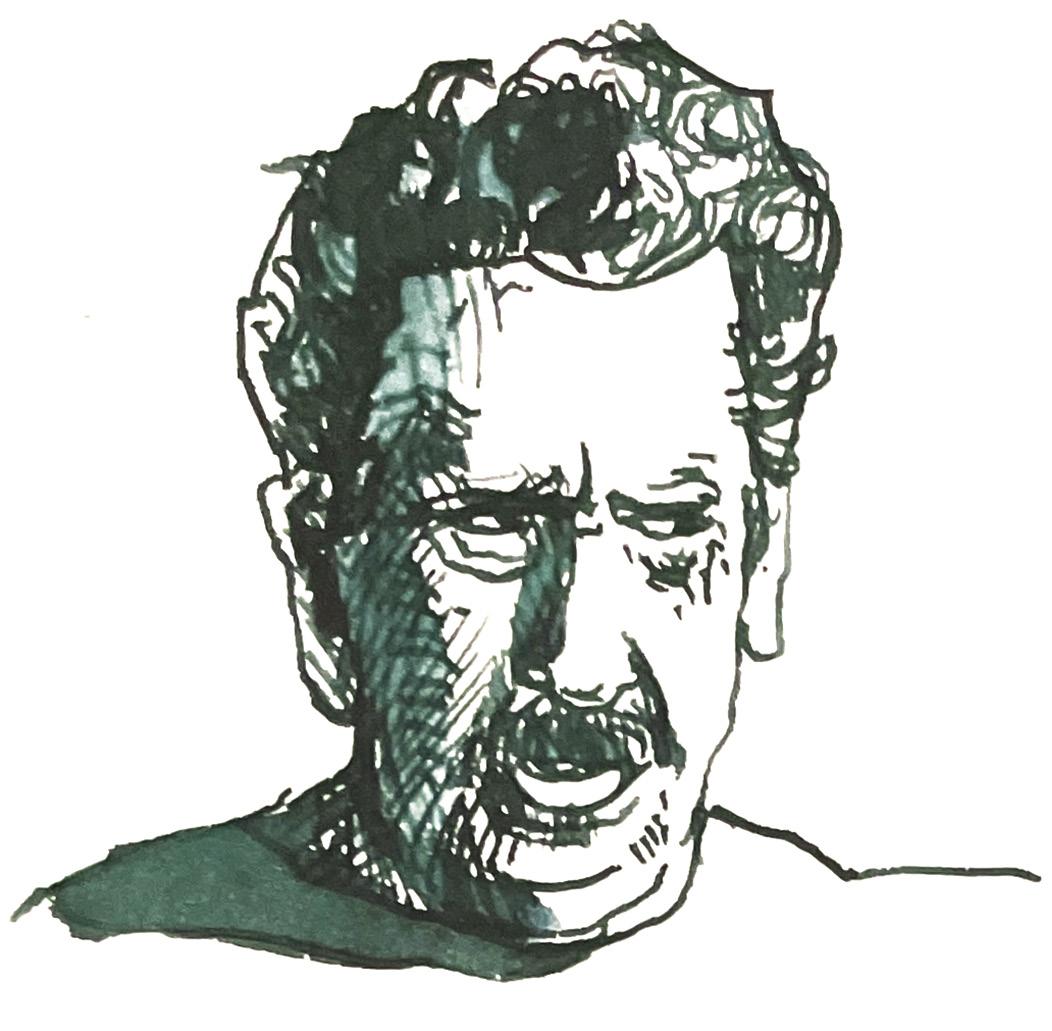
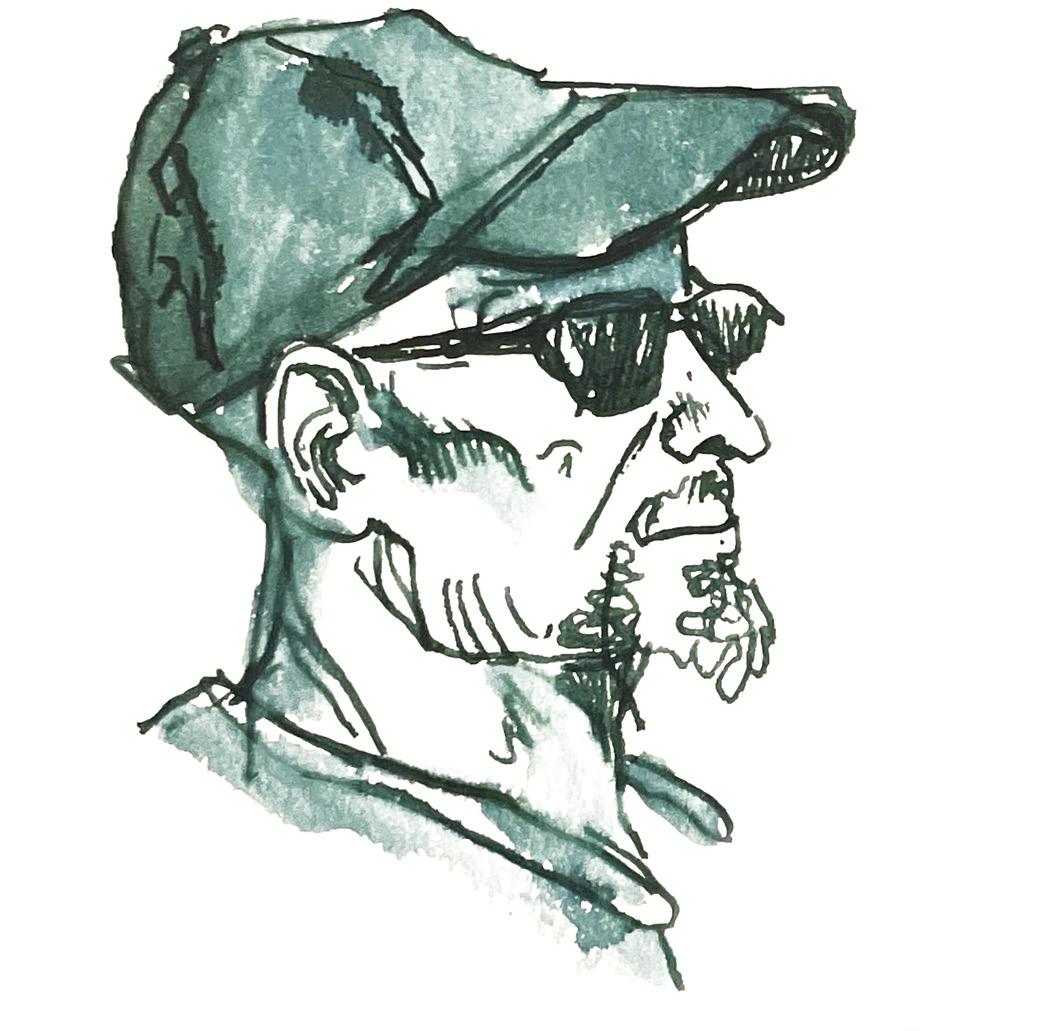
Back Cover: Silent Film Actress 1, pen and ink by Leo Hahn
3 Sunrise, poetry by Edmund Reske
3 Reflected Peaks, photograph by Andrew Hammond
4 Golden Hour, photograph by Andrew Hammond
5 Before the Sun Fell, fiction by Joseph Nowak
7 Malaise, painting by Kevin M. Wilson
9 Three Birds, photograph by Brendan Hunt
11 The Desert’s Sculpture, photograph by Andrew Hammond
12 Flounder House, mixed media on grocery bag by Dina Fachin
13 Dollhouses, poetry by Klaus Jöstlein
14 Where are your eyes?, poetry by Jay Carroll
16 Not Yours to Say, prose by Peter McGroarty
16-20 images from State Fair, pen and ink by Leo Hahn
21 Motion, photograph by Jack Auer
22 The Poet at Eight, poetry by Colton Eikemann
23 Garden Gnome, painting by Leo Hahn
24 Maybe it is, poetry by Ryan Strohschein
25 Column, photograph by Brendan Hunt
26 En la ciudad de Nogales, poetry by Fernando Alvear
27 Powerline, photograph by Everett Duffy
28 Rhinebones, poetry by Warnicke Beatty, Jr.
29 Henry VIII by Hans Holbein the Younger (in KidPix), digital by Leo Hahn
30 Glory Be, fiction by Gideon Taylor
32 Windows, photograph by Jack Auer
33 Variation on a Theme by John Murillo, poetry by Wilson Scher
34 Don Quixote, oil pastel by Leo Hahn
35 15, going on to 16, poetry by Peter Knapp
36 Sketches of Spring, pen and ink, watercolor by Klaus Jöstlein
37 One with Nature, poetry by Steven HlawnCeu
38 A Half-Dead Twin—or an Allegory on the Transgender Experience, poetry by S. E. Fisher
39 Reflecting Rusty Blackbird, photograph by Kevin M. Wilson
40-41 Standing Before Infinity, photograph by Andrew Hammond
42 Claire, poetry by Tommy Guntli
43 The Rendition of the Pearl, pencil by Dignan Jost
44 The Harrowing of Hell, poetry by Mike Lally
46 Cyclone, acrylic by Leo Hahn
47 Luther, fiction by Luke Seamands
49 Vines, photograph by Jack Auer
51 Fragments of Montecassino, photograph by J.P. Wildermuth
53 Boxer’s Self Portrait, pencil, pen, and ink by Uriah Binder
54 Comp Comp, pencil, pen, and ink by Owen Van Deven
55 The Wild, poetry by Colton Eikermann
56 Chasing Catamarans at 40 MPH, poetry by Frank Corley
57 Fluidity, photograph by Jack Auer
58 Feeling Deflated, chalk pastel by Leo Hahn
59 Cynic, poetry by Peter Knapp
60 Meanderings of the Middle, poetry by Peter McGroarty
60 A Night Beneath the Stars, photograph by Andrew Hammond
61 Clouds, poetry by Ryan Kindschuh
61 Lantana, photograph by Brendan Cierpiot
62 Roxoyhroa, poetry by Warnicke Beatty, Jr.
63 Pattern, mixed media by Andrew Yoffie
64 I Used to Drive, lyrics by Frank Kovarik
65 Outsider, pen and ink by Klaus Jöstlein
66 Purple Irises, oil pastel by William Overberg
67 The Whale, prose by Uriah Binder
69 Valentine’s Day, pencil, pen, and ink by Uriah Binder
70 For Myrtle Vona Johnston Lester, poetry by Chuck Hussung
71 The Greatest of These is Love, photograph by Jack Auer
72 A Night in Desaru, prose by Colin Dunn
73 The Consumer, watercolor by Kevin Wilson
74 Crow Hopper, acrylic by Leo Hahn
76 Lawnmower, photograph by Jack Auer
77 Garden of Eden, digital by Guhan Anbukumar
78 The Bee, poetry by Warnicke Beatty, Jr.
79 Daydreaming, pencil by Gabe Khazen
80 El Dorado, poetry by Joe Talleur
SunriSe
Edmund Reske
Have you ever looked west during sunrise? And seen the pale remnants of night? While gold striped with pink may dazzle our eyes We forget the deep violet, the calm.
When you see the morn herald each day With its bright beams breaking the dark. Remember to look the other way And see the beauty that’s missed.
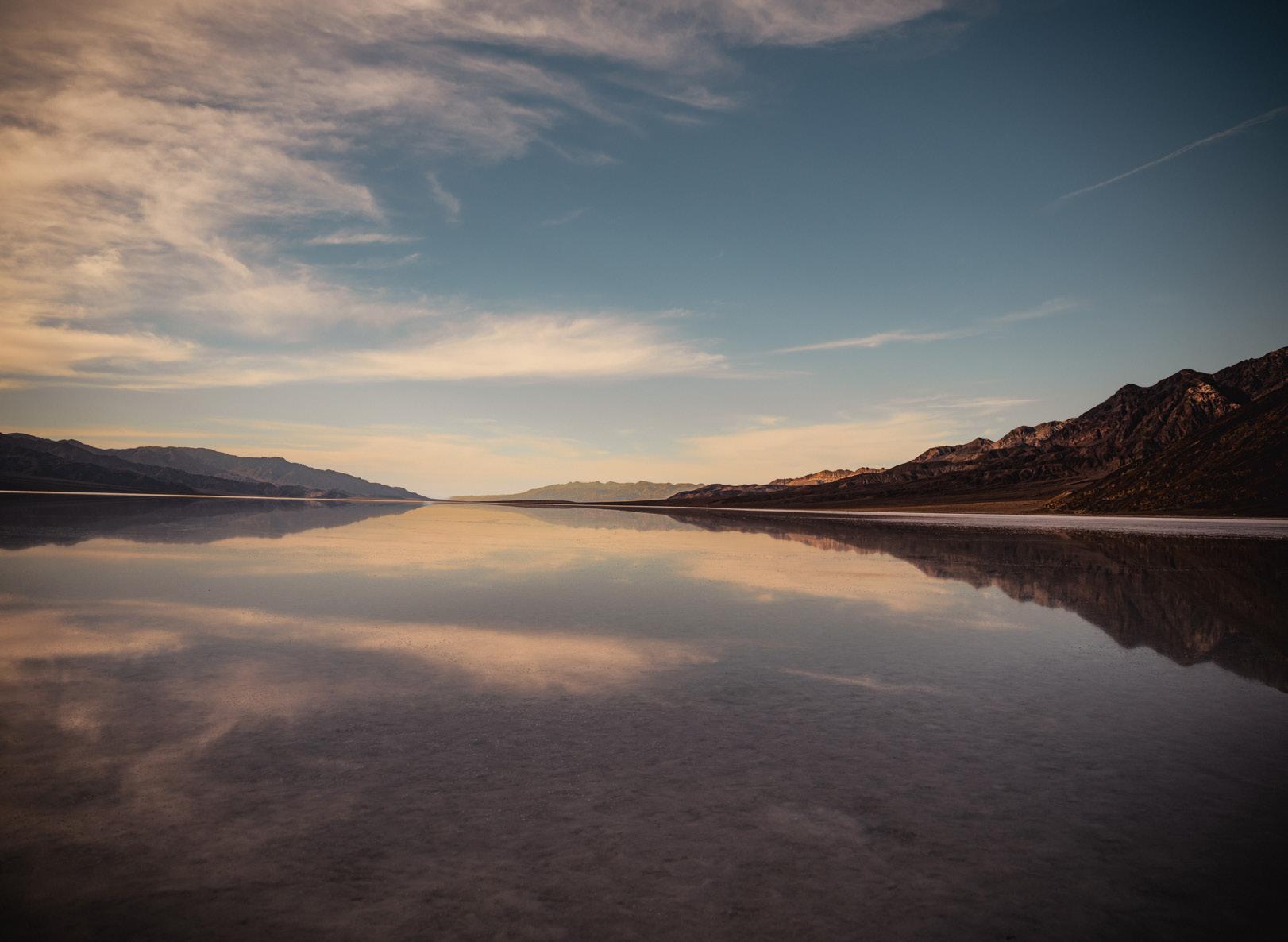
Photograph
Andrew Hammond reflected PeakS
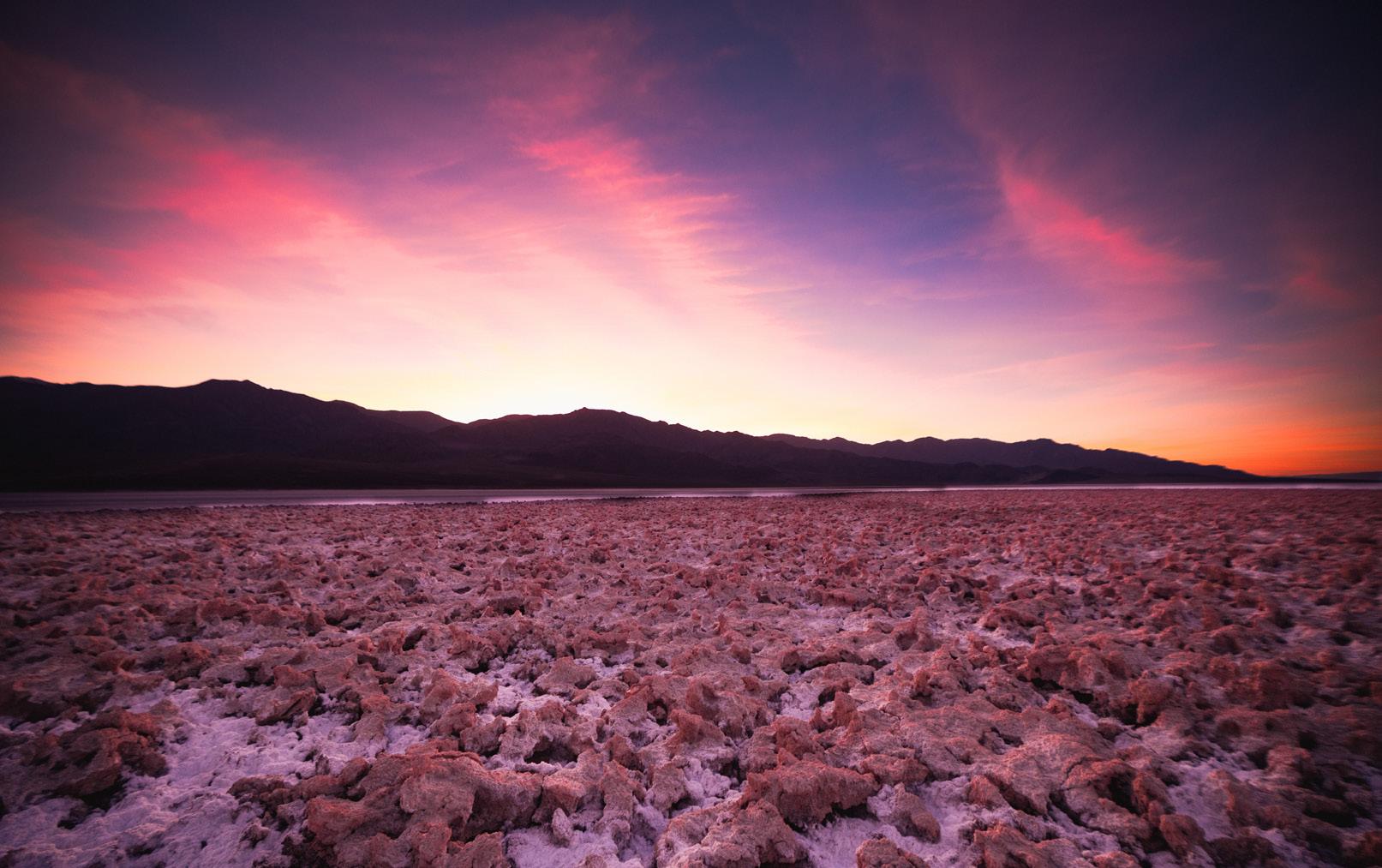
Photograph
Andrew Hammond Golden Hour
Before tHe Sun fell
Joseph
The world was burning. Smoke choked the air and clouded the sky, filling Noboru’s lungs and nose, coating his tongue, and stinging his eyes. The crackling and roaring of the blaze intermingled with the screeches of air raid sirens and the cries of the dying. Noboru snatched Atsuko’s tiny arm, clasping it tightly as he pulled her along, sprinting away from the matchbox they used to call home, away from the crematorium that was Okayama, away from the planes spewing fire and death. As he fled, Noboru caught glimpses of his friends between buildings, their faces contorting in unnatural grimaces, their bodies consumed by the flames surrounding them. When he had finally reached the hill with the old maple tree, the safe place where his mom told him to go if he ever got lost, Noboru turned and looked at his sister. Atsuko seemed to smile her sad little smile, her eyes showing a deep sadness that never seemed to reach her upturned mouth. But when Noboru let go of her arm, the smile disappeared, replaced by the same grimace that was on their friends’ faces as they burned alive—with one difference: Atsuko’s eyes remained open, staring up at Noboru as blisters spread across her arms and face, swelling like overfed ticks, before her pale skin turned black and she collapsed into a twitching mess of burnt muscle and bones. Terrified, Noboru turned, a choking cry stuck in the back of his throat, only to find the maple tree engulfed in flames. Noboru’s eyes snapped open, the strangled cry from his nightmare still stuck in his throat and sweat beading his forehead. He no longer felt any burning on his arms and legs, just the ever-present hunger gnawing at his stomach. Still shaken from his horrible
Nowak
dream, he remembered his Aunt Fumi’s advice: “If you ever feel scared or lost, remember who and where you are in your present surroundings.”
Who? I am Noboru Adachi, son of Kenji Adachi and subject of Emperor Hirohito. I am 14 years old. Where? I live, used to live, in Okayama. I live in Hiroshima now. I am in the Empire of Japan, the Land of the Rising Sun. It is (he cracked open one of his eyes to look at the calendar on the wall) August 6th, two months since Atsuko died and I lost Mom. I am with Aunt Fumi. I am safe. Hiroshima hasn’t and won’t get bombed. I am safe.
Noboru lay on his bed, repeating that last phrase over and over again until his heart stopped pounding and his breath steadied. By the time he had done that, the sun was already peeking through the window curtains. Noboru got up, looking around the room that he currently shared with his aunt. It was a plain room, most of its decorations having been sold to buy more food, and not particularly large. It had two doorways, closed by translucent sliding doors, and a window overlooking the small backyard garden that his aunt maintained.
The last wall was the only one that was still adorned, having a dresser with a mirror and a small shrine on top of it. The shrine had three small incense burners, each with pictures of people behind them. Noboru went to the leftmost burner, bowing and holding a stick that his aunt had lit earlier (he hated lighting his own), once again examining the unfamiliar faces portrayed in the picture behind the bowl. Aunt Fumi had said they were his grandparents, but that they had died when he was little. He didn’t even know why he bowed to them since he had no
memories of them to honor, except that it felt wrong to exclude them.
He then went to the next burner, the one for those who had died recently. Before he bowed, he looked at the familiar faces behind the bowl: Little Atsuko, with her bright smile that she had before Dad left, Uncle Taka at his wedding, unaware of the war that he would die in, and Mom—wait, Mom?
Noboru quickly stopped himself, shoving the stick into the bowl in the sand and grabbing his mother’s picture from the stand. She doesn’t belong with the dead: she’s still out there! She belongs next to Dad and Uncle Kumo, who are still alive. She’s not dead! He hurriedly finished the ceremony, his mood tainted with anger at Aunt Fumi for putting his mom with the dead. He had told her that his mom wasn’t dead, but Aunt Fumi had moved her picture anyway, seemingly denying the truth that she was alive.
Having completed the ritual, Noboru tidied himself up by brushing his teeth, combing his hair, and getting dressed in the government-issued uniforms. After he rolled up his mattress and put it into the closet next to his aunt’s, Noboru looked at himself in the mirror. For perhaps the hundredth time, the face that stared back at him was unfamiliar. Its cheeks were sunken and scars dotted its face, but what kept the face from being his were the eyes. They were the eyes of a haunted man, one who has seen too much bad and too little good. Even when he grinned, the eyes didn’t change. Instead of a joyful expression, it was more like that of a cornered beast baring its fangs or the grimace of a man burning alive.
Noboru left the room and the mirror behind him, sliding the door shut. When he turned around, he saw a small bowl with a pair of chopsticks and a note on top of it. In neat calligraphy was a short message: “I’m going to work. Meet up with the school and help them make some firebreaks.” Noboru
read the message quickly before scarfing down the contents of the bowl. It was plain rice, without any soup or meat to go with it, but he was so hungry he didn’t care. What he did care about was how small the serving was. Since the foreigners had attacked, burning the fields and bombing the roads, food had become scarce. The small bowl of rice was going to be the last meal he had that day, but he was grateful for it. Some days there wasn’t even this.
As he left the house, Noboru looked around the neighborhood. He remembered how lively the city had seemed when he visited his aunt as a child; now it seemed to be dying. Where there had been homes and businesses, there were now piles of rubble, broken down by the Japanese people to help protect themselves in case the Americans burned Hiroshima. It wasn’t just the buildings that caused the dying atmosphere. While most people had been purpose-filled and energetic before the war, now the majority seemed to be gaunt and drained, starving and hopeless. Many of them had the same eyes as those of the face in the mirror.
Seeing how much the Americans had taken from them, Noboru felt a rising hatred at their unfairness and brutality. We hit one port of theirs, not even near their mainland. In return for that, they turned around and conquered our outer islands and burned hundreds of cities on our mainland. They separated me from Mom, they killed Uncle Taka, they killed Atsuko, and they killed thousands more. I wish I was old enough to strike back against them. I wish that one of them was here so I could hurt them like they hurt us. I wish—suddenly, as if the Americans had heard his wishes, air raid sirens started to release their wail.
The all-too-familiar sound shocked Noboru out of his thoughts and reminded him just how powerless he was. Panic rose in his chest as he realized that his nightmare would be repeating itself again.
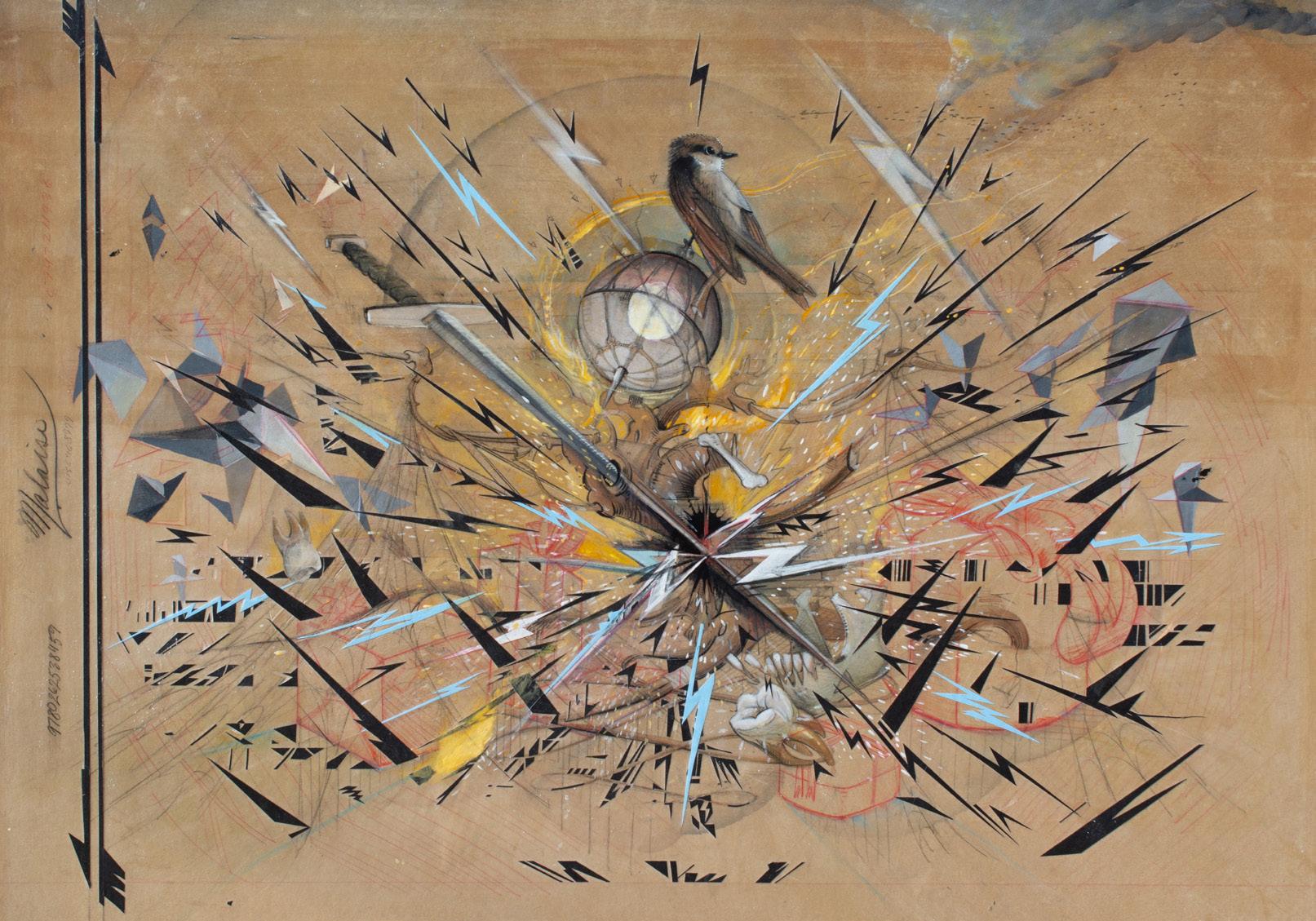
Painting
Kevin M. Wilson
MalaiSe
I am Noboru Adachi, son of Kenji Adachi and subject of Emperor Hirohito. I am 14 years old and live in Hiroshima. I am not burning.
He sprinted for the nearest underground bunker, a small dirt and concrete structure with a few metal beams holding up the ceiling, already half filled by people just as terrified as Noboru. More people came streaming in, pushing Noboru further towards the back wall. They started to crush each other, rushing to escape the incoming fire.
Someone’s elbow caught his chin. I am Noboru Adachi, son of Kenji Adachi. I am 14 and live in Hiroshima. I am safest here. Someone stepped on his foot. I am Noboru Adachi. I am 14 and live in Hiroshima. I am safer here. A woman fell backwards, pinning him to one of the beams, squeezing the breath out of him. I am Noboru. I am in Hiroshima. I am safe here. The crowded bunker started heating up. I am Noboru. I am in Hiroshima. I am here. He pushed the woman and she moved forward a little, allowing him to squeeze out from behind her. I am Noboru. I am in Hiroshima. When things started to calm down, someone used a lighter, maybe to light a final cigarette, maybe to burn everyone alive. Noboru didn’t know, couldn’t see the difference. The heat, the siren’s wailing, and the crushing atmosphere all reminded him of that horrible night, but the small flame ignited his memories and brought them to life. I am in Okayama! I am in danger! I am on fire! I must run! I must Run! I MUST RUN!
He shoved and clawed his way through the crowd towards the exit, towards safety, with the strength only desperation can grant. He didn’t hear the complaints of the woman he ran into. He didn’t feel his shoes fall off or his bare feet hit the ground. He didn’t hear the voices calling for him to stay in the bunker. He didn’t see the sunshine above him. But he did hear the sirens. I MUST RUN! He noticed dozens of planes. He felt the heat of the flames surrounding him. He heard the screams calling for him to help
them, to save them. He saw the smoke above him. I MUST RUN!
And so he ran. He ran away from the planes, away from the flames, away from the screams. He ran until he felt the pain in his foot, six kilometers away from where he started. He ran until he remembered who and where he was. When he stopped, so did the screams. The sirens continued, but the fire had disappeared and there was no evidence of its ever happening. Up above, only three American planes were flying, not the dozens that had destroyed Okayama. Noboru hobbled over to a bench, where he examined his foot. It wasn’t bleeding and didn’t look bruised, but it ached badly even when it wasn’t supporting any weight. The pain in his foot, however, was less than the pain of what he’d done. When he was in the same situation as that horrible night, he made the same choice to run away: the choice that had gotten Atsuko killed and separated him from his mom. If only I had stayed with Mom. If only I hadn’t grabbed Atsuko and run. It’s my fault that Atsuko’s dead, my fault that Mom’s gone, my fault that— Gone.
Not missing, not lost, not separated. Gone. Less than a second after he thought it, he knew it was true. He had searched for four days, traveled for a week, and waited with Aunt Fumi for over a month, but she wasn’t here; she wouldn’t be here. Gone.
With this realization, the dam that Noboru had built to hold back his emotions cracked. A deep sadness welled up in him, the hunger in his stomach replaced by a much deeper pain. His chest throbbed with pain without physical cause. The choking feeling in the back of his throat returned, accompanied by tears that blurred his vision. I can’t cry here. People will see me. Gone.
Noboru tried to stop the tears by tak-
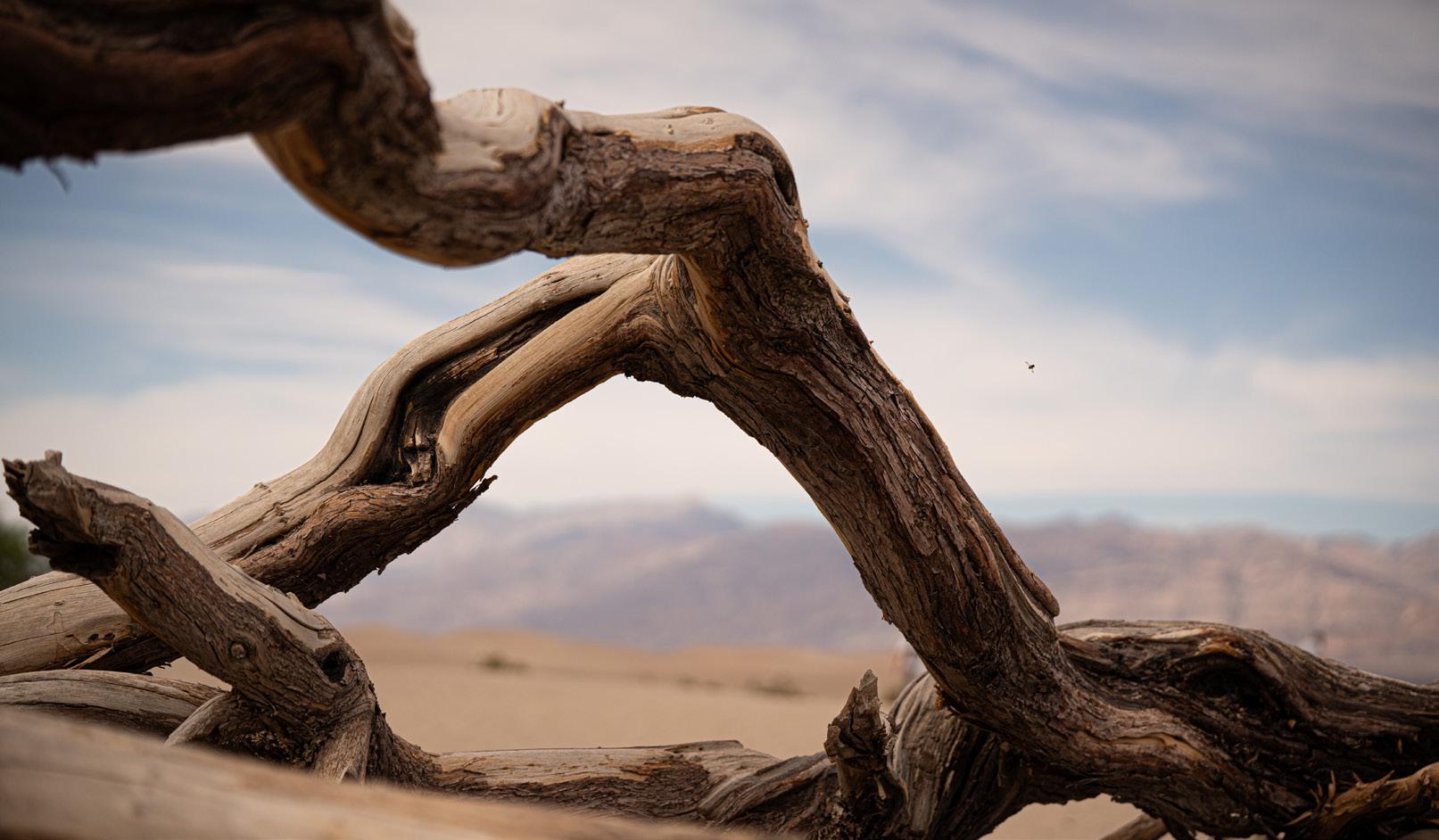
Photograph
Andrew Hammond
tHe deSert’S SculPture
ing in deep breaths, but they quickly turned into rapid shallow breaths, often catching on the choking sensation in his throat to create a small cry. He got up, determined to get somewhere private but knowing he couldn’t get far. The sirens had stopped. No bombs had been dropped. People would soon return to their lives and see him. He couldn’t allow that to happen. Through his tears, he saw a large red maple, alone on a hill. He walked towards it, towards the safe place where Mom had said to meet. Gone!
When he got to the tree’s trunk, to the solid foundation he could depend on, the dam broke. All the emotions he had repressed for months flooded over him. Giant sobs racked his body, robbing the air from his lungs as he sank to the base of the tree. Tears flooded his eyes uncontrollably, but Noboru didn’t even try to wipe them away. Gone.
That word repeated itself in his head, over and over again as he realized what it meant. Mom wasn’t coming back. Ever. His
life could never return to what it was like before that night, before the fires. gone
So he wept. He wept for Atsuko, for his mom, for his friends, for the nameless faces who had called for help. He wept for the pain in his foot, for the hunger in his stomach, for the scars on his face. He wept for his sleepless nights, for his fear of fire, for his night that would never end. He wept for his home, for his city, for his country. And he wept.
While Noboru mourned under the maple tree, the city resumed its activities as if the threat of a fiery death was a routine interruption, a part of life, and as oblivious to the broken boy as he was to them. He didn’t see them pointing as one of the planes dropped a single bomb. He didn’t see the bomb explode, high up in the sky, releasing a wall of fire large and bright enough that it looked like the sun had fallen. He didn’t see it rush towards him. He felt the burning pain for a moment. Then he felt his mother’s arms wrapped around him.
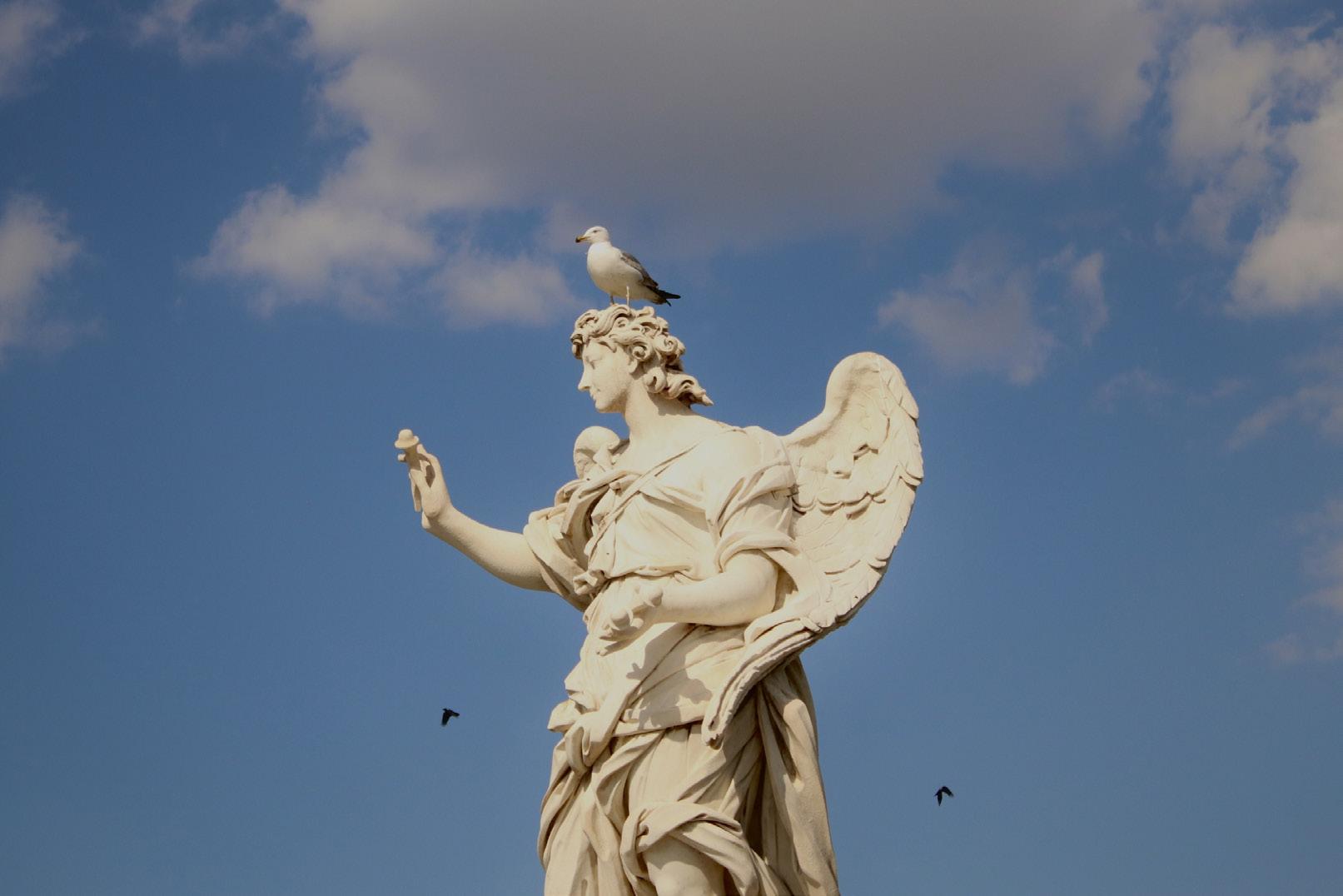
Photograph
Brendan Hunt
tHree BirdS
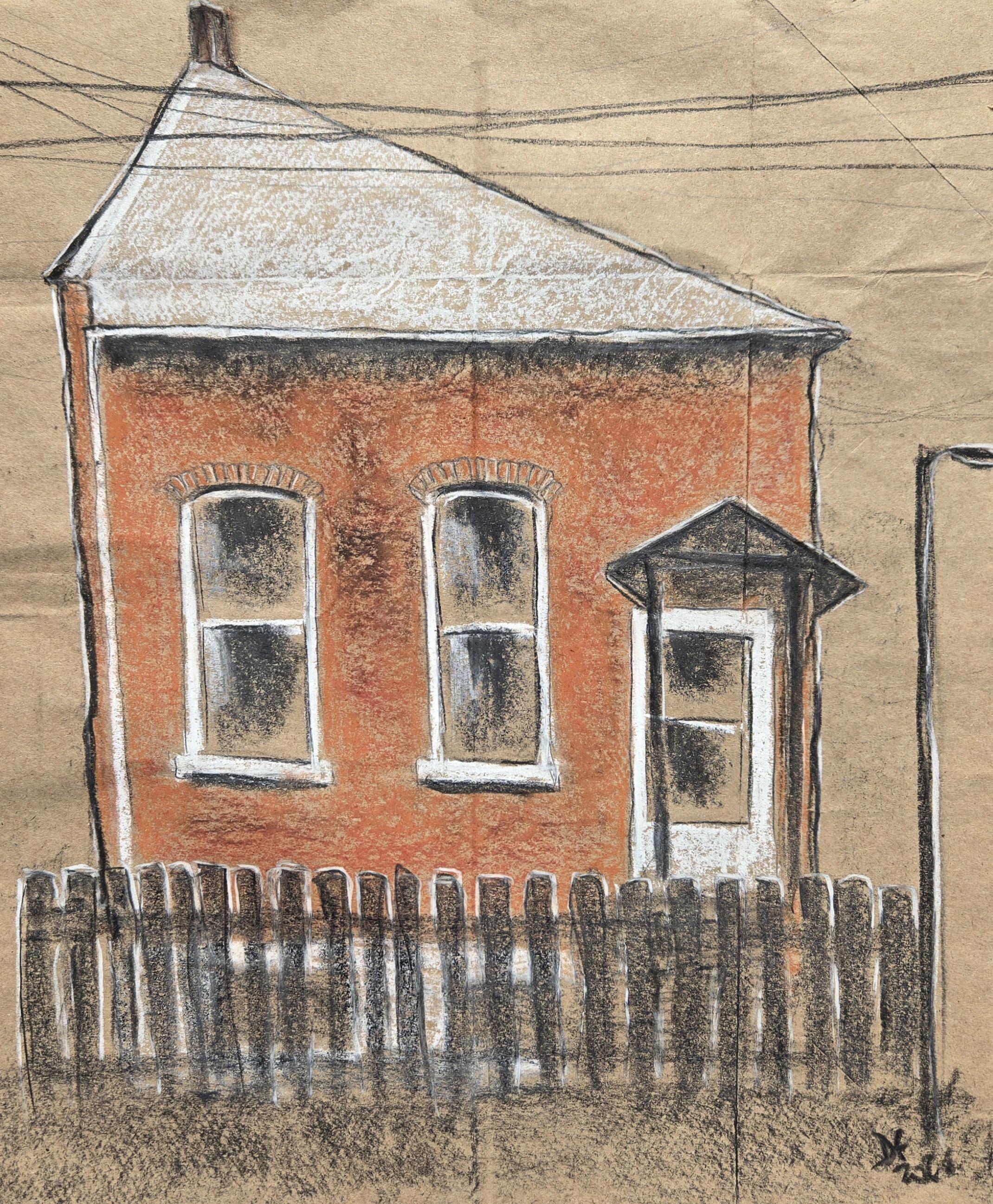
Pencil, Charcoal, and Soft Pastels on Grocery Bag
Dina Fachin flounder HouSe
dollHouSeS
Klaus Jöstlein
The houses once stood Triple thick with brick, Corners pressed with care.
Now they look like toy forts After years of love— Walls missing, roofs peeled back.
Inside, a bedroom hangs open, Wallpaper peels like old skin, A staircase leads to the sky.
These houses are evidence of A city that thrived, Segregated, yet, vibrant, alive—
Reduced to piles of stolen brick, Empty lots all over St. Louis, Vines swallowing three story dreams.
Not till the last brick is stolen, Will anyone notice The weight of what’s gone.
The rooms remain open, Like dollhouses Left out on the lawn.
WHere are your eyeS? (or, WHen i queStion My eyeS and realize SHit ain’t aS it SeeMS)
Jay Carroll
apples, oranges, bananas, and melons where do you rest your retinas in the fruit basket of this world as seconds turn to minutes turn to hours turn to days turn to weeks?
apples, an all-time classic a common tool to keep the medical professionals away but you can’t put your two front teeth into these perhaps they’re latched on black mirrors which get reinforced by addicting algorithms but how good is a house that has only one mirror? give me two or three or four, and a mini one for my wrist too then scan my clothes for judgment and do some mental calculation the shoes + the pants + the belt + the shirt + the hoodie + the beanie since it’s never been an issue to dress to impress but what about the hands that made those items and when impressions leave, what is left there?
oranges, imprecisely layered and skin that seems tough so the layers peel back on themselves and past superficial inspection the skin is weak as hell while mouths open and eyes widen self-fulfilling prophecies get engrained into an agenda oh but that agenda is exclusive and consistently changing and dangerously destructive and ragingly repressive then the idea becomes if you aren’t a part of the club you just ain’t cool enough i know it’s a little confusing now, cause you thought i was talking about oranges and to that, i am not finished yet: has shame slipped through the cracks of our severed society? and as Socrates said we must examine authority and if the cost is drinking poison then so be it why does leadership leap into the laps of lying losers? how could clinging onto a cultish collection of costumes be cool? that’s why oranges are indeed correct, confusion consumes me while the membrane seemingly never ends
bananas, indubitably enjoyable in most instances but don’t let fog and generality snatch your clarity focusing only on objects that can objectively orchestrate orgasms creating an ultimate end from temporary pleasure then follows a downward spiral and commitment to impurity after hundreds of thoughts of honest mishandling not to suggest we’d all turn down bananas in any given moment but rather the emphasized energy is how one’s sense of self is maintained, especially around the vulnerable and unaware because not all bananas need attention some too ripe, some not ripe at all, some hoping to be turned into banana bread melons, round and globular like gargantuan grenades or for that matter like the bombs that soar through the sky to flatten cities and crush dreams and then once the ruins become the town and the people become forgotten scraps of humanity rebuild it all, for profit, then giggle, chuckle, and bathe in that dirty money as children are robbed of hope adults are robbed of connections societies are stripped of society and humans are stripped of life while remembering more bombs are being dropped and the artillery that just left the arsenal was barely a drop in the ocean
final words, be certain they are literal so i don’t mean to be cynical but when did caring for others become political?
not yourS to Say
Peter McGroarty
Every day of 6th grade, my classmates and I would daydream while pretending to pay attention to our droning religion lesson—everyone except Franny. The rest of us had been raised with the idea that religion must be respected, and anyone that said “God darn it” was to be smited immediately, but Franny had come to St. Roch only recently and was thus deemed a barbaric public school kid by the rest of us. Franny sat at the back of the class, gossiping, doodling, or vandalizing by writing song lyrics on the desk or ground. Once in a while she would make a loud noise by rubbing the legs of her desk against the floor. The squeaking and screeching of the legs rasped through the classroom as the rest of us turned to her, waiting for her to say something. Franny didn’t. Instead she just smirked, knowing she was the center of attention.
A medieval peasant seeing Franny would probably faint from the sheer impossibility of how one human could sport so… much.
Franny was the type of person to have a new hair color every week, from radioactivewaste green to neon orange highlights. We joked that the highlights made her look like a traffic cone. Her face and head were dotted with piercings: eyes, nose, lips, etc. The dress code stated that earrings needed to be entirely fixed to a girl’s skin, but Franny didn’t care. Her hoop earrings stretched down to the middle of her neck. We were all subject to a very specific dress code: white or green polo, then a skirt for girls and pants or shorts for boys. To Franny’s credit, she wore this, but with an impressive lack of care. Every day she would stumble into class with some new tattoo or stains on her white shirt and plaid skirt. Paint, grease, marker; it didn’t matter, but Franny always made sure that her uniform was at least a little bit different than everyone else’s. Her accessories were covered in stickers, from Pokémon, Demon Slayer, Owl House, Attack on Titan, Your Name, Gravity Falls, “or anything else animated and a little gay,” as Franny joked. She carried the accessories in a green linen messenger bag. She brought change to the classroom, and everyone dealt with that in different ways. The girls flocked to her: every recess, they formed a closed circle around her, laughing and talking and listening to Franny. One of the boys, Nick, once told me that this was all to act polite.
We certainly didn’t.
The boys either avoided Franny entirely or started screaming in place of talking. My twin sister Gertie and I would make overunders on freak-outs per week. I think our average was two or three. One day I had to miss school because I had the flu. I came the next day to find out that Ryan had been sus -
pended for arguing with Franny about where he put his pencil. He couldn’t find it, so the natural scapegoat was Franny. Every couple of weeks, someone would be shipped down to our school counselor, Ms. Holly, after arguing with Franny. I went one time, after yelling at one of the boys in the class for unrelated business (he was being an asshole over kickball), but before leaving, I asked Nick what to say when I got there. He had previously gotten sent down for yelling at Franny.
“Oh… um… don’t worry about it. Just say some bullshit about how you’re super sorry and that you usually wouldn’t do that, but being in front of everyone made you freak out.”
“That…. Would it be a lie?”
He looked at me, his chin tilted sideways and his brow pushed down in an expression of confusion. By the time the first quarter ended, half the class was making routine trips to the counselor’s office.
In the second quarter, we found out that Franny identified as a lesbian. In the following weeks, commentary about her shifted away from how she was or wasn’t “annoying” and started to focus on how she wasn’t a person in the same way we were. We joked that she was a machine, because every day she ate seaweed and Hot Cheetos for lunch, as if the
items were fuel. “The machine” was built to hurt us, at least in our eyes. Around this time Franny became almost antagonistic to us. My friend Clark still recalls the time Franny strangled him in order to convince him to become a cheerleader. Whenever this or some other transgression occurred, the girls justified it with “Franny’s just joking” or “Well, you can take the hit can’t you?” During lunch we would huddle in small groups and gossip about Franny. We would whine and complain and wait for Christmas break, which was just around the corner. Soon we would all be free, at least for two weeks.
When we returned to school to start quarter three, we heard news of the greatest Christmas present that could’ve been offered to us—that Franny would be leaving St. Roch before the start of the next school year. At this point we didn’t necessarily care about how open we were with our dislike of Franny because “she’d be leaving in a few months anyways.” In our little gossip circles we started to hypothesize on why she’d be leaving. One unfounded theory surmised that Franny was leaving because her parents were getting divorced and that during the weekends Franny would lie to them about being at the other parent’s house and would walk around the loop, smoking cigarettes and spray-painting graffiti. Another suggested that she might’ve just been a social experiment to test the patience of a group of bright middle schoolers. Maybe she was there to test whether having a queer kid in the classroom would “infect” the other students. This theory was proposed by Nick and confirmed by the fact that it seemed like every week another girl would come out of the closet. In response, the boys started joking about how eating a banana or listening to Taylor Swift were “gay.” One time I was forbidden from drinking from a straw because apparently I looked “fruity” when doing it. I could no longer talk with
my friends about my favorite shows because they were “too zesty.” Slowly these comments built overtime, until the fourth quarter when I heard the f-slur used frequently, usually towards Franny.
The fourth quarter became a war zone between the girls and the boys. I was torn. Gertie was with the girls, and I had to be among the boys, so I acted quieter towards my sister, especially when she was with her friends. I didn’t like those words, but I didn’t stop them either. Instead I just buried my head and waited for summertime, when Franny would be gone and I wouldn’t have to struggle anymore.
One day, during that summer, I found out that Gertie had invited all of the girls over to our house in order to have a farewell party for Franny. The news was a little worrying, but I thought I would be okay. Regardless of what they were doing I could always hide in the basement. And so I hid, and I was convinced that I was safe, until my mom came marching down the stairs.
“What are you doing?”
“Oh, I was just… I just like, um…”
“Get up there and go greet your guests!”
A pursed lip pointed downwards and her hands firmly planted on her hips convinced me to begin the sad shuffle upstairs. Crossing the floors as slowly as possible, I eventually entered my kitchen and looked outside the window. I saw all of the girls playing in my family’s above-ground pool.
All the girls, plus Franny.
I threw on my swimsuit and walked towards the group. The pavement was baking in the sun, and I felt the heat on my bare feet as I marched. I tried not to make too much noise. They were playing in the pool and not paying attention to me, and I didn’t want to interrupt for fear I might be awkward.
As I made it to the top of the ladder the girls and Franny turned towards me.
Quiet. Dead quiet for only a moment, as my breath began to speed up in rhythm.
“H-hi,” I said.
“Oh what up!” Ava replied. “You wanna play volleyball?”
I had a vague fear of betraying “the boys,” but I knew I was just being silly, and I knew I was enjoying the pool. We spent the rest of the day playing in the pool. I showed them how a group of people could make a whirlpool by just walking around the pool repeatedly, beat them in volleyball, and regrettably lost a handstand competition. Eventually the day pushed into dusk and then night, and the girls started to leave. Eventually the only ones left were me, Kadence, Riley, and Franny. I walked inside to grab some soda, but when I came back out only Franny remained. She was sitting on the other side of my porch, hunched over the blue light of her phone and around a cold steel lattice table. I stared at her in silence for a little bit. She had on a damp towel wrapped around her body. I held up the Dr. Pepper in my hand.
“Do you want one?”
“Oh, I’m good, but thank you,” she replied.
I walked closer. We had lights set up
around our yard, some running along the perimeter, others strung directly from the porch to the great oak tree in the center. Both reflected off the steel table and Franny’s skin. I sat down. I could hear the little voice on my shoulder screaming to get up and go, a feeling I desperately wanted to follow as minutes of awkward silence eventually ensued. The silence was too piercing not to be broken.
“So why are you leaving St. Roch?” I asked.
She looked up from her phone for a moment before saying, “Oh… I dunno.”
Further minutes of silence followed. I took slow sips from the Dr. Pepper in my hand as a way to dispel the awkwardness I felt just waiting for her to say something. Eventually she put down her phone.
“Oh yeah!” she said. “Gertie told me that you watched Owl House.”
“I did.”
“Oh! What’d you think about it?”
“Pretty good, maybe a bit too magic school-y but overall solid.”
“Alright, what’d you think about Luz and Amity?”
In the show, the main characters, Luz and Amity, are dating, but they are both women, and this kept me from discussing the show with my friends for fear that it would be deemed “too gay.”
“I think they’re a cute couple,” I replied. I could see from across the table the corners of her mouth move into a smirk as her eyes widened with excitement.
“Oh my god, yes,” she replied. “Not gonna lie, you had me worried for a minute.”
I chuckled. I thought for a second, and then replied with another show.
“Have you seen Avatar: The Last Airbender?”
She pondered for a minute, before replying with, “No, but have you seen Saiki K?”
“Nah, have you seen Liv and Maddie?”
“No, have you seen One Punch Man?”
“Not really, have you watched Gravity Falls?”
“No.”
“Then what have you watched?”
The conversation drifted from TV shows and towards just… talking. I hadn’t imagined this was possible from “The Machine,” but it was. I hadn’t really talked to her before that moment purely because of the social taboo, but upon speaking to her I realized something: she wasn’t a machine, she was Franny, and in the middle of my revelation, she interrupted me.
“Oh yeah, tell Clark I’m sorry for pushing him. I probably shouldn’t have.”
“Oh, uh… he’s fine. Don’t worry about it.”
“Are you surprised that ‘the machine’ was able to apologize?” said Franny.
I sat there for a little while, stunned by her, before replying. “.... Kinda.”
“I… I don’t blame you.”
“No no no, you’re good. We probably weren’t the best towards you.”
“Towards me? The most I can remember is the constant snickering behind me, or the shouts past me,” she chuckled. “Who cares…
I’ll be gone in a few months anyways.”
“Well… maybe we needed somebody like you.”
“Like what, a f*****?” She registered the shock on my face. “Oh c’mon. I can say it.”
“Fair enough.”
“I know,” she smirked. Her phone rang. “Okay, before I go, why do you think St. Roch needed someone like me?”
“Oh… um… I dunno, you’re just different from the rest of the girls, and I think that’s something we needed.”
“Oh, give me a break,” she said. “You only think I’m different cause I don’t back down.”
“What do you mean?”
“Ryan screamed at me over a goddamn pencil.”
“So what are we supposed to do when you leave?” I said. “Some of the people in our class are assholes.”
“Assholes?”
“I, I don’t know man, I just—” I said.
“Figure it out, dude,” she chuckled. “Your class now, so how about you try to solve it. You don’t need to be friends with assholes.”
Before the start of the next school year, I kept on thinking about where Franny was. It hadn’t occurred to me earlier that she could have her own life, but now that she was separate from St. Roch, I truly had no idea who or where she was. When the school year started, I was talking with a couple friends about Franny.
“Oh, Franny?” said Riley, one of her best friends. “They’re doing fine.”
“Why’d you say they instead of she?” I asked.
“Oh, they’re nonbinary,” replied Riley. Ryan and Nick pulled me aside later, during lunch.
“Dude. I am so happy that Franny left,” said Nick.
“I know… She was such a fucking fag -
got,” said Ryan. I honestly didn’t believe that he said it. I mean…I had heard him say it before but after my conversation with Franny this felt like the first time I listened to it. When I heard it, my breath rushed out of my body in a little expression of panic. I looked around and saw no one else paying attention, except Ryan and Nick—staring at me.
“Y-yeah,” I replied.
“I bet that she’s just sitting at home right now, typing away at Reddit or some shit,” Ryan said.
“Bro I bet she’s—”
“They,” I interrupted. I stood up and grabbed my lunch box.
“Hmm?” Ryan replied.
“They. They’re nonbinary, remember?” I said, turning away.
“Why do you care?” said Nick.
“I dunno,” I said. “I guess I just don’t think it’s up to us to decide.”
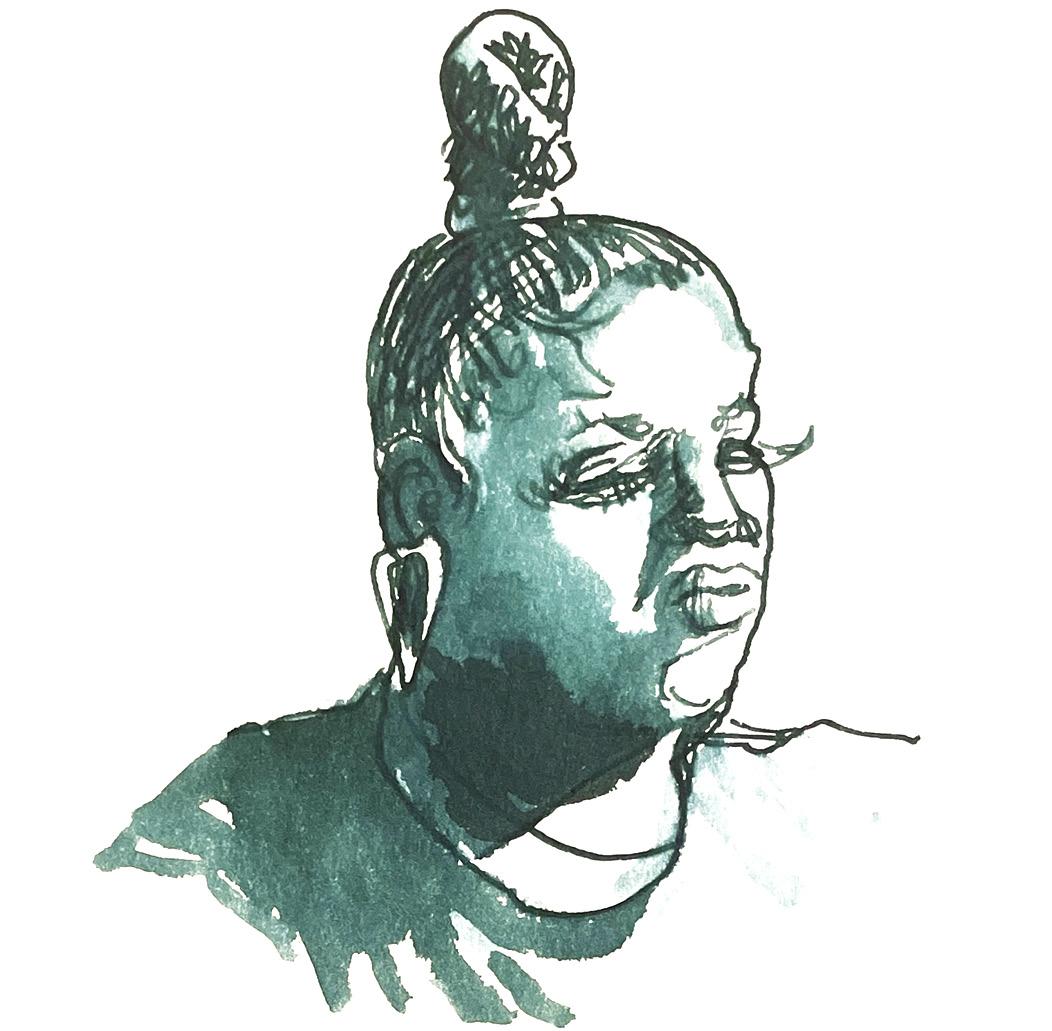
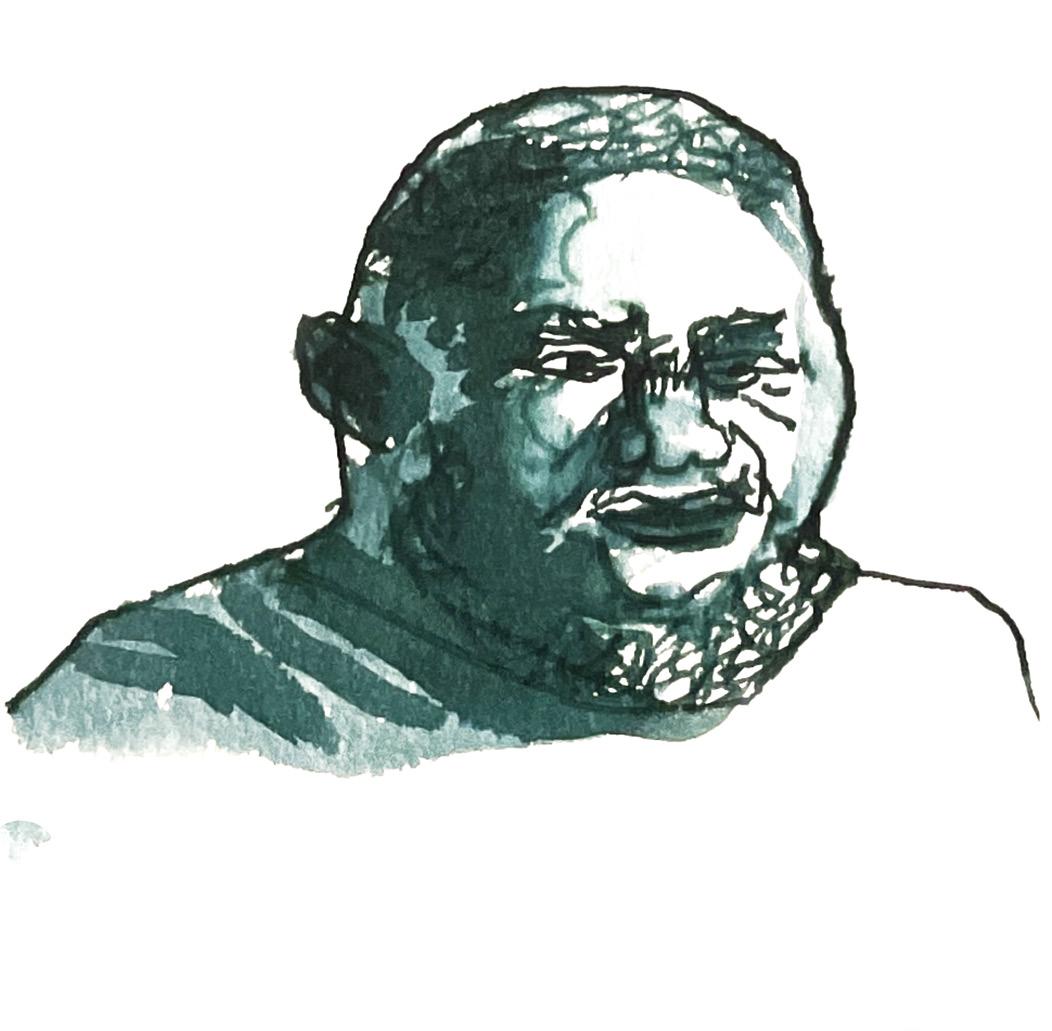
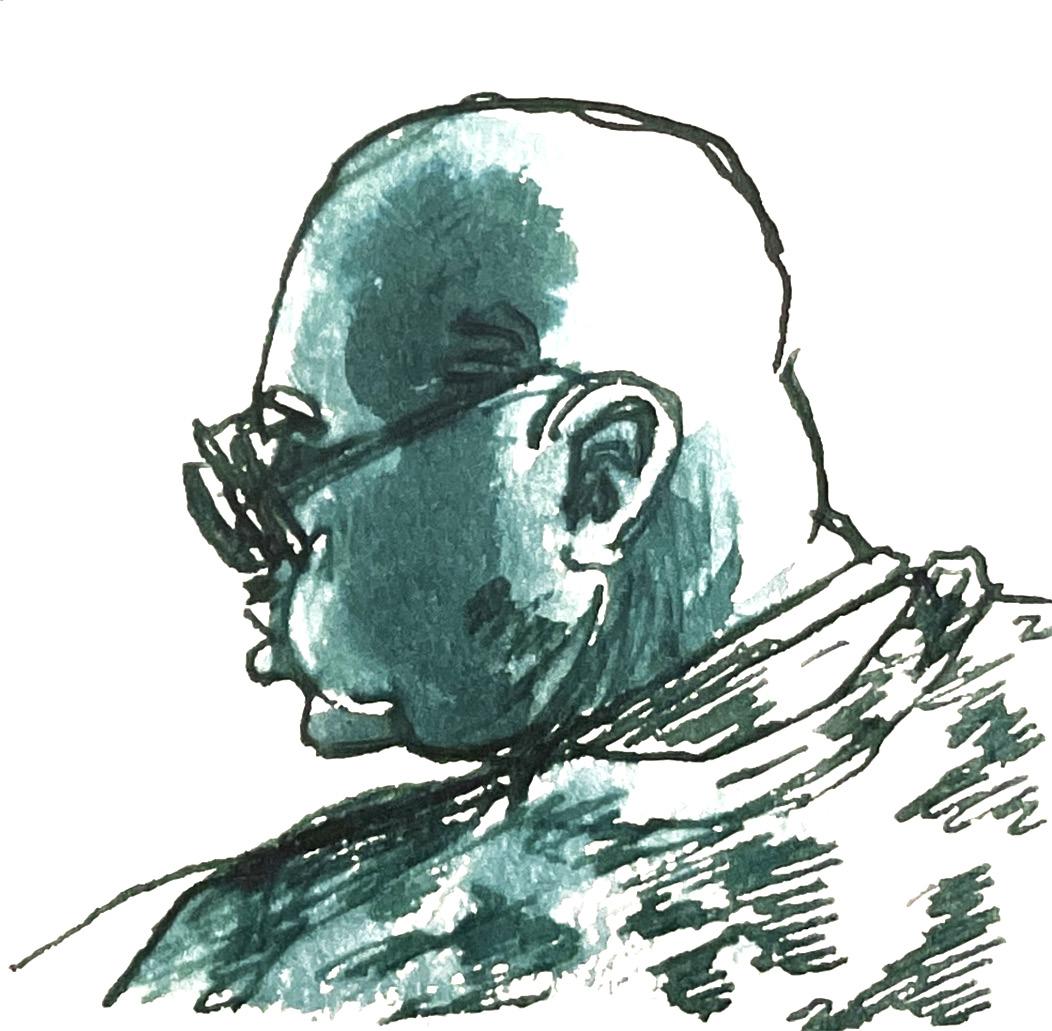
Leo Hahn
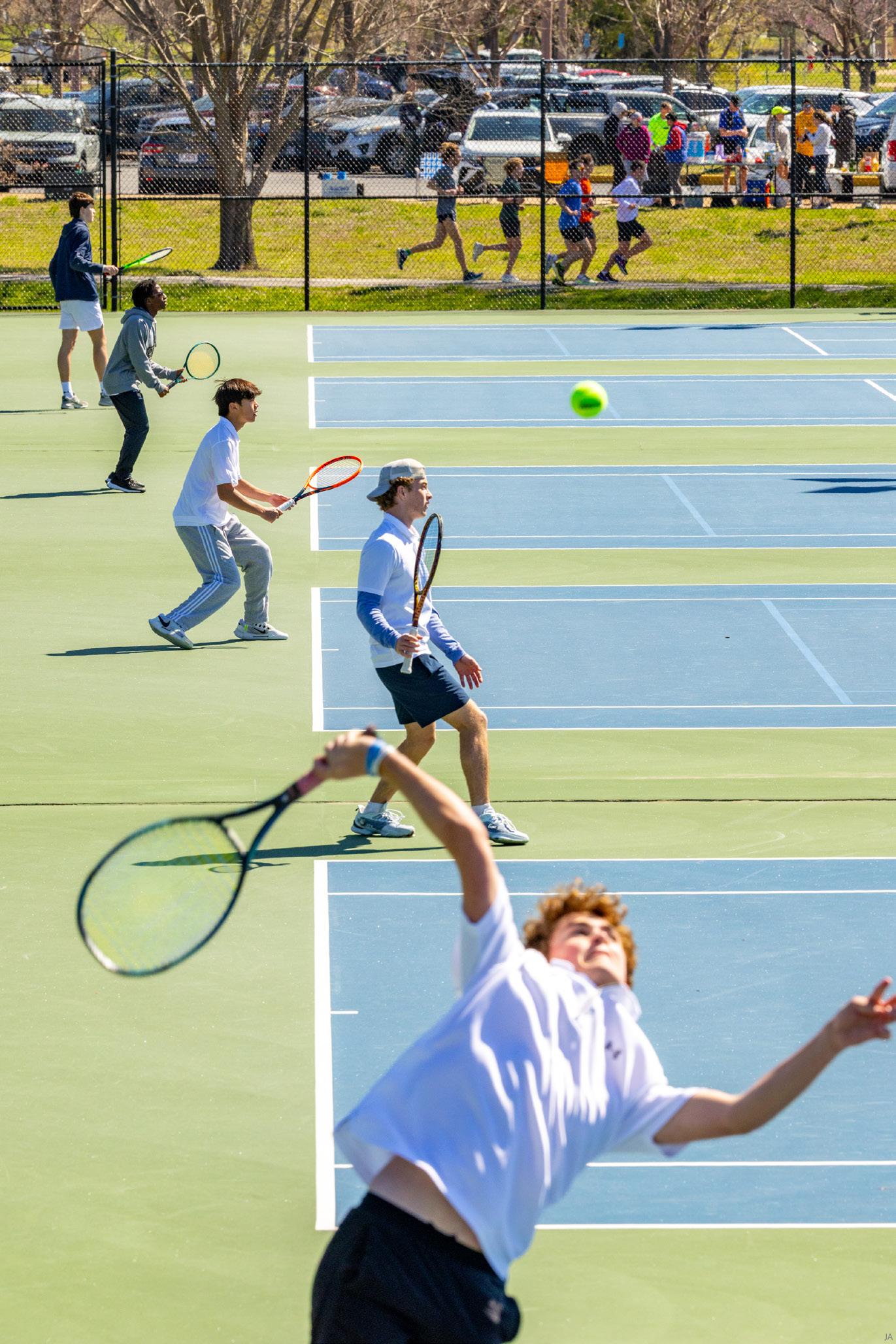
Photograph Jack Auer Motion
tHe Poet at eiGHt
Colton Eikermann
My youth? I hear it mostly in the shimmering bellows
Of the croaking frogs
At their summertime speakeasy
Chattering on speckled summer nights till sun rose
Nestled in green velvet fields
That my mom weekly waged war with on baby blue days
Brandishing the blades of that old knight—
John Deere
Our neighbors hunted deer
And killed them good too. The trees creaked
With their suspended carcasses, ever falling.
Doe eyes, dead prize
The morning grass’s tears
My fathers sweat,
Carrying brick hods up
Building a house, sleeping till sunup
Time was the color of the sky
—Cotton candy with clouds. Barbeques in July Autumns slipping in
Touching my shoulder like an old friend
S’mores, glowsticks, dig in!
Ghost stories by firelight
Frozen glass dressing the yellow grass
Stacking firewood, flame’s lurid haze
Grandma coming over
Woods adventures and donut craze
At night she prays
Holding us close
Spring child yawns
Doe eyes munch on the greening grass
How long has it been,
But a few colors of the sky?
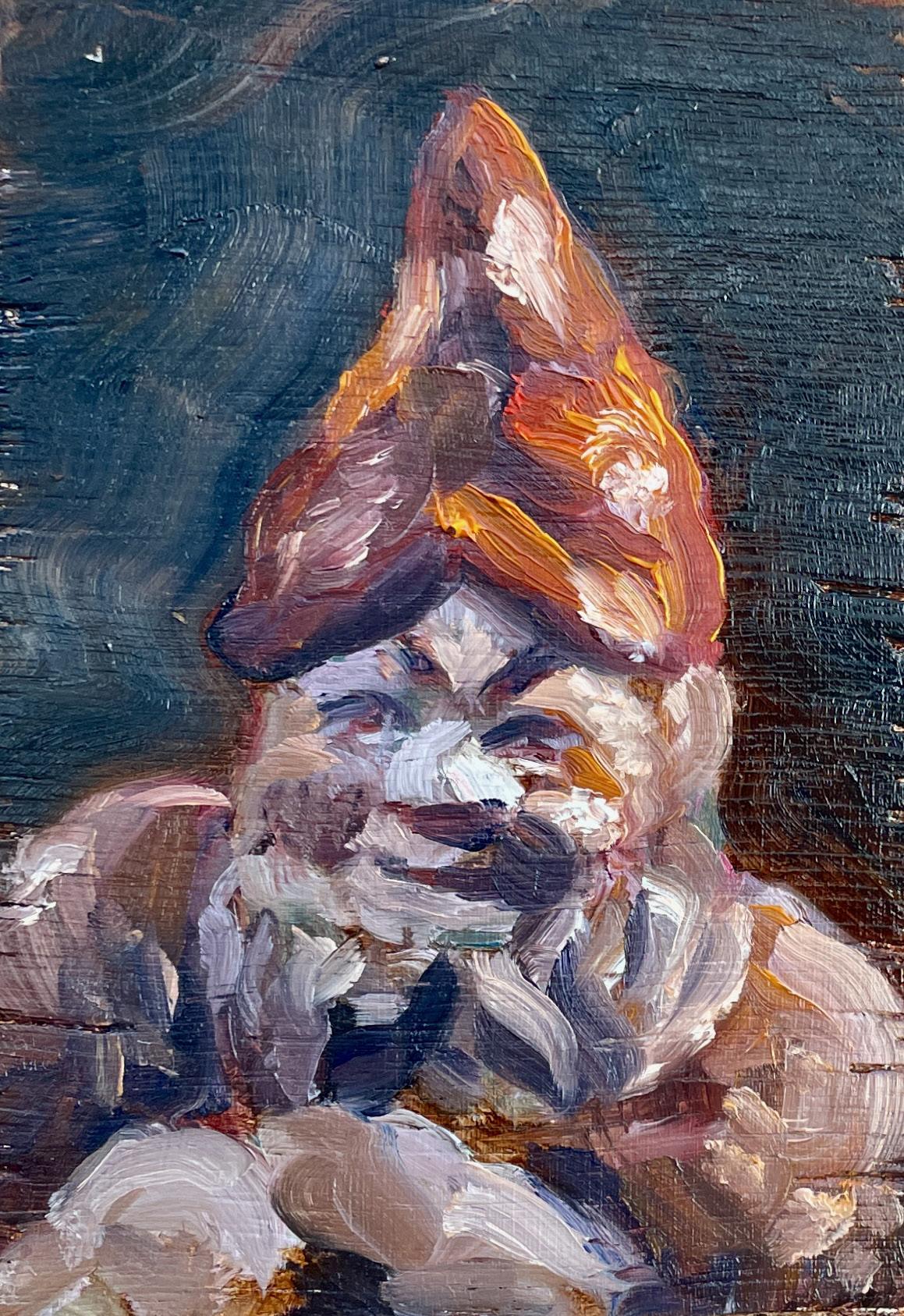
Leo Hahn Garden GnoMe
MayBe it iS Ryan Strohschein
Maybe it is the way that He found me weeping in a sullen corner. How He knelt beside the dust of my grief and gathered my tears; the small, fallen pearls, delivering me from injury on the side of the road, robbed of all I own.
Maybe it is the way He saves the lost, calling through the fog of a desolate field, leaving the other 99 to find the one lost sheep. How the saints carry His mercy from age to age, a lineage as tired as we are, learning that to be “broken and shared” is the only way to be finally whole. Maybe it is His blessing in the Eucharist, that the Infinite would hide under the appearance of bread just to stay within reach of His children.
Maybe it is the way He calls us home, not as a verdict on our doubts or an end to our equivocation, but as a rest that was always waiting. Maybe it is how He is the anchor in the middle of life’s heavy storms, commanding the wind and rain with a single rebuke.
Maybe it is the way that He loves, and that He does not discriminate between the sinner or the believer— for we are all His children dust breathing borrowed light.
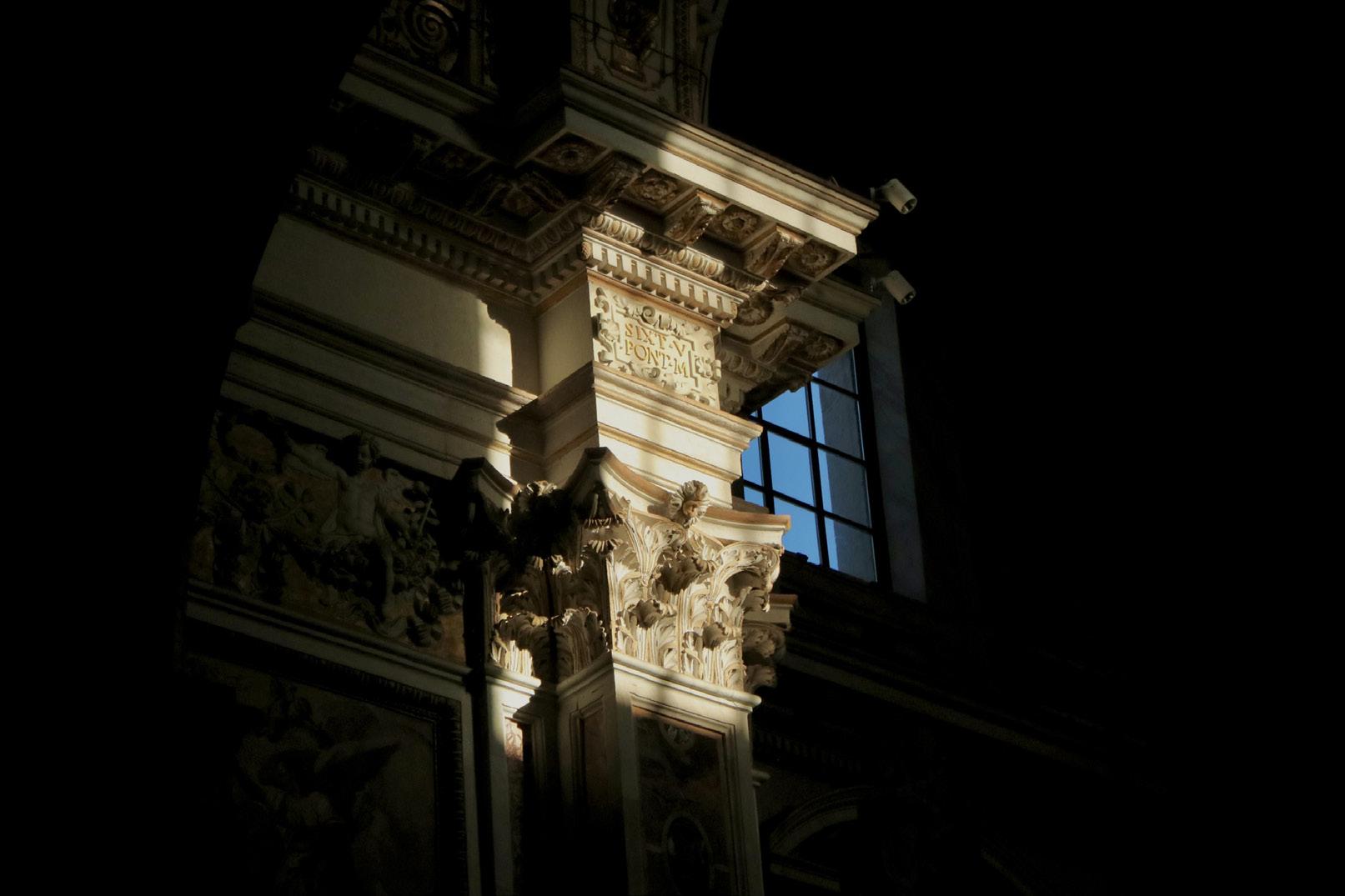
Photograph Brendan Hunt coluMn
en la ciudad de noGaleS
Fernando Alvear
Una línea de tinta sobre el papel se volvió muro de hierro, imponente y letal, insolente, arrogante.
Una ciudad entre montes y hierbas ásperas yace partida por la frontera, como dos mitades de una misma fruta, que nunca volverán a ser una.
Desde lejanos lugares, desde el país del norte, llegan deportados los sueños inconclusos: desorientados, traumatizados, a una tierra que sólo es hogar en el papel.
Volver al norte está prohibido.
“Entraste ilegal”, te dijeron, “y por eso te deportamos.”
Tú llegaste de niño, de la mano de tu madre que sólo buscaba paz.
Sin papeles hiciste familia, hijos, comunidad. Pero no importan las décadas cuando son vividas en tierra ajena.
¿Pero por qué no volver?
¿Por qué no trepar ese muro ciego y cruzar el desierto sembrado de calaveras?
¿Por qué no volver, caminar hacia el verdadero hogar, donde tus hijos pronuncian tu nombre al encomendarte a Dios?
Porque al desierto lo han vuelto infiel y perverso. Los narcos dominan sus caminos secretos, extorsionan al pobre, lo despojan de lo poco que tiene. Las patrullas fronterizas acechan al que se atreve, cazándolo hasta vaciarlo de aliento.
Los que sobreviven los visten de naranja y grilletes para comparecer ante las cortes de justicia simulada.
A line of ink upon the page became a wall of iron, imposing and lethal, insolent, arrogant.
A city among hills and rough grasses lies split by the border, like two halves of the same fruit that will never again be one.
From distant places, from the country of the north, unfinished dreams arrive, deported: disoriented, traumatized, to a land that is home only on paper.
Return to the north is forbidden.
“You came here illegal,” they told you, “and that is why we deport you.”
You arrived as a child, your hand in your mother’s, who only sought peace.
Without papers you built family, children, community. But the decades do not matter when they are lived in a foreign land.
But why not return?
Why not climb that blind wall and cross the desert sown with skulls?
Why not return, walk toward the true home, where your children speak your name as they entrust you to God?
Because they have made the desert treacherous and corrupt. The cartels rule its hidden paths, they extort the poor, stripping them of what little they have. The border patrols stalk whoever dares, hunting them down until the last breath is drained.
Those who survive are dressed in orange and shackles to stand before the courts of simulated justice.
Fiscales, abogados y jueces negocian la sentencia según una aritmética legal de dudosa moralidad.
Los sueños inconclusos se secan en la aridez del silencio.
Y sin embargo, en la ciudad de Nogales, en esta tierra nueva y vieja el inmigrante habrá de empezar otra vez, porque la vida tiene muchos comienzos.
Prosecutors, lawyers, and judges negotiate the sentence according to a legal arithmetic of doubtful morality.
Unfinished dreams wither in the aridity of silence.
And yet, in the city of Nogales, in this land both new and old, the immigrant must begin again, because life has many beginnings.
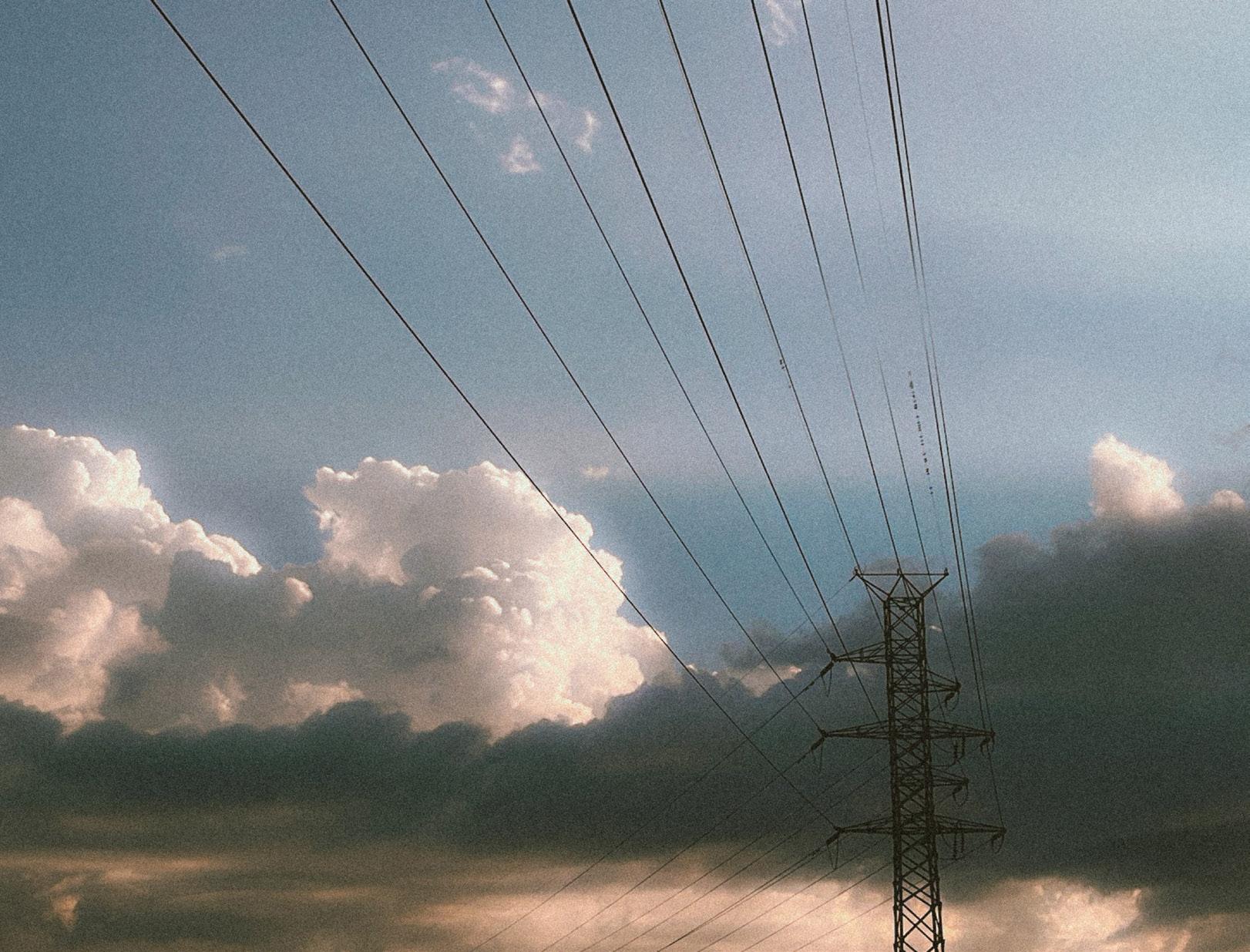
Photograph Everett Duffy PoWerline
rHineBoneS
Warnicke Beatty, Jr.
i just wanna cover myself in rhinestones so i can be pretty inside and out each stone on my contorted bones bones stretched to standout
each stone covers imperfections shines on an insecure body dissections on projections glue and glitter are so gaudy
so cover me in rhinestones bedazzle me, bejewel me sparkling hormones are gemstones glue the banshee in me
so like a rhinestone, shiny and free fill me with glee to be me

Digital
Leo Hahn
Henry Viii By HanS HolBein tHe younGer (in kidPix)
Glory Be
Gideon Taylor
Jonas sat cross-legged on the floor of the shop, surrounded by curls of pale wood shavings. The rhythmic rasp of Baba’s knife whittling away at a block of wood filled the space. His calloused hands gingerly held the oiled handles of his tools. Countless nicks and scars covered Baba’s fingers and thick forearms. His eyes squinted in focus at the block, crow’s feet marking the sides of his face. Pieces of sawdust had found their way into his beard. Jonas followed the dust motes drifting across the sunlit window as the block slowly took shape.
“Can you tell what I’m making, Jonas?” Baba’s voice was low and calm. He smoothened a rough edge with his thumb, then held out the carved piece. Jonas looked at it for a moment.
“A cross?”
“Mhm.” Baba blew the dust off the wooden cross. It was still slightly uneven. He reached out to ruffle Jonas’s hair, smiling. “I made it out of some spare cedar for you. Keep it.”
Jonas clutched it, tracing the grains of the wood.
“Thank you, Baba, I love it.”
Baba leaned in and looked Jonas in the eye. “There’s a prayer I want you to remember when you hold this cross. It goes like this: ‘Glory be to the Father,’” he touched the top of the cross, “‘and to the Son,’” he traced his finger to the bottom, “‘and to the Holy Spirit,’” moving from side to side with each word, “‘as it was in the beginning, is now, and ever shall be. World without end.’”
A commotion outside grew louder. Baba turned to peer out the window, and Jonas craned his head over the workbench. Baba glanced to the corner of the shop, where a
sword hung: dusty, unused, and half buried behind lumber. Anxiety ate at Jonas’s gut. He remembered what Baba told him. There were evil men coming. Baba had said they came from the west, that they wanted to take their land back and reconquer Constantinople. He called them barbarians and killers, rampaging through on their crusade: princes and kings, seeking the glory that was God’s. Baba had told him not to worry. The evil men wouldn’t make it to the city. “If they do,” he had told Jonas, “they’ll be so tired from traveling that you could fight them all by yourself, huh?” Jonas had smiled as Baba patted his shoulder.
After a long silence, staring out the window, he turned back to Jonas.
“Son, you know I won’t let anything hurt you. I’m going to go see what that ruckus is about. It will just be a minute.” He held Jonas’s face. “No matter what, I need you to stay strong. For your sister, Rachel; for your mother. I pray that God will keep you safe.” He listened to the growing noise in the street for another minute.
“Go home now, Jonas,” he said quietly.
“Okay, Baba. I will.”
Jonas dawdled back home through the street, muttering the words of the prayer under his breath. After a while, everyone buzzed around him. A chair toppled over in a nearby house. It landed with a clatter, adding to the din. Nobody bothered to right it. Disoriented, Jonas pushed through the street as the sea of people jostled him. A woman grabbed his arm, pulling him through a door. She set her hands on his shoulders, slowly. They trembled for a moment, then steadied as she breathed. His mother’s eyes gazed deep into his face,
shining a rich amber in the light from the doorway.
“Where’s Baba going? What happened?” the boy said. His mother’s hands quivered again, and she held him tighter.
“We have to go away, Jonas, we will see him once he comes back.” She looked over his shoulder, out over the city’s thatch and clay roofs. Urgency crept into her voice. “Go call your sister, okay?”
Sarah’s hands released their tight grip, and she turned quickly, her face disappearing behind her headcloth. Jonas stood there for a moment, staring at the cloud of dust and smoke rising off the horizon. Armed soldiers, bearing the standard of Constantine, hastened toward the edge of the city. Ordinary men rallied behind, carrying makeshift weapons. He recognized some of them. They were smiths, masons, carpenters—men like Baba. Jonas tore his eyes away from the door and the bustle outside and ran back to the shop. It was empty, tools left on the desk. The sword that rested in the corner was gone.
Now with set, fearful eyes, Sarah ushered Jonas and Rachel through the city. The boy’s sandals slapped the cobbles as he stared back at the open doorway of the house. The high city walls loomed over the rooftops ahead. Each step brought them closer to the gate: away from home, away from Constantinople, away from Baba.
They ran along the shoreline, his mother’s cloak fluttering in the breeze off the sea. On Jonas’s left sprawled the endless water, with an inland ridge that stretched into the distance on his right. Three mounted men rode along the ridge’s crest towards the city. Their helmets glinted in the evening sun, their posture stiff and upright. As they passed, the soldier in front snapped his right hand up, and the three horses trotted to a halt. They turned, descending the slope towards the rocky shore. Hooves clattered, and
the soldiers’ armor rattled. A blood-red crucifix covered the front of their chests. Sarah spoke, her voice panicked, tense.
“Children, stay quiet and get behind me. Come on, come on.”
Rachel nodded. Her cheeks were wet and her eyes were puffy.
“Mama, are those the evil men?”
“Hush, child. Be still.”
Jonas pressed close behind his mother, his hands folded. He would not let himself cry. He had to be strong. He embraced his sister, held her hands, and started to recite the prayer that Baba had taught him, clutching the wooden cross.
“Glory be to the Father, to the Son, and to the Holy Spirit…”
The horses nickered and neighed as the men pulled them to a stop. They dismounted, shoes crunching against the pebbled ground. The commander sauntered towards them, pulling off his helm and letting it fall. His face was smooth, clean shaven save for a simple moustache. The corners of his mouth turned upwards in an amused smirk.
“…as it was in the beginning, is now, and ever shall be…”
He caught Sarah’s wrist with a gloved hand and pulled her towards him. She yanked her arm back, ripping it from his grip. The man, his eyes glimmering and focused, started to speak softly, in a tongue Jonas did not know. Sarah drew back and spat in his face. She stared him down, posture tight and dignified. She pushed Jonas further behind her, whispered to him to take his sister and run. The man grinned, his white teeth showing as his thin lips parted.
“…world without end.”
Jonas pulled Rachel’s hand and started to clamber across the beach. He ran hard, half dragging his sister behind him. The two other men paid them no attention, standing by as the moustached soldier seized his mother’s shoulders. Jonas glanced back, still
yanking his sister’s arm. Cuts covered her ankles from the sharp, uneven stones. She panted and tired, so Jonas slowed his strides. He recited his prayer once more, turning Rachel’s back to the men. He embraced her again. If only Baba could be here, he would stop the men.
The soldier threw his mother to the ground.
“Glory be to the Father, and to the Son, and to the Holy Spirit…”
The man reached to his left hip for the handle of the sword fastened to his belt. It rang as it scraped against the metal-rimmed sheath—a shrill, metallic screech. He hoisted it over his head, brandishing the blade. The arm came down, quick, eager. The steel followed, tracing a wicked arc through the air. No scream came, no mortal gasp of breath. The soldier raised his sword to his face, examining the crimson blood that stained it. He remained there, eyebrows furrowed.
Then, as if in dismay that he found no difference between the woman’s blood and his own, he bent over the corpse and stabbed his weapon into it again and again, till his face was spattered with red.
“…as it was in the beginning, is now, and ever shall be. World without end.”
Chest heaving, the man turned his head toward the sky. His arms fell to rest at his sides. Jonas collapsed, his knees scraping on the ground. The two companions silently mounted their horses and cantered back to the foot of the ridge. Their leader didn’t follow or respond. After some time, his right arm slowly raised itself, pointing the sword’s tip towards heaven. With the setting sun at his back, he reveled in the glory of righteous victory. Alone, light shimmering across the chain rings of his hauberk, he basked in the blood of the damned. Jonas’s lips quivered. He squeezed his cross. The wood snapped in his fist.
“Amen.”

Photograph
Jack Auer WindoWS
Variation on a tHeMe
By JoHn Murillo
Wilson Scher
Start with crying. It’s how we come into the world after all. Weeping, wailing. Cry up a storm. There are these amazing people to comfort you. Cry about everything. Your stubbed two-year-old toe, the gross toppings on your pizza, the fact that those really big people that live with you won’t let you get a dog. Cry for the last time for years. Because men don’t cry. Crying is weak. Crying is bad. Forget how to cry. People around you have. Lots of time will pass. Someone very important will die. Funny how it takes death to remember how to cry. Someone’s life had to end to remind you of how your own began. Just a few tears at the eulogy, but tears nonetheless. Uncover the ability to cry again. Become an archeologist of sorts, digging for it. Cry at music. Get on stage and cry at the cadences, the pre-show rituals, the bows. Cry the most you’ve cried your whole life in a single month. The firsts of so many lasts doesn’t help of course. But curtains call, chords stop, and people suck. Eggshells cover your home’s once-fuzzy carpet because things feel so tense. Thinking about hugging her feels more like a duty than a comfort. So you cry. Maybe because crying makes things feel a bit better, maybe because it’s all there is left to do. And crying doesn’t change the fact that you feel like a problem—and it certainly doesn’t make problems go away—but it helps. At least for an hour or two.
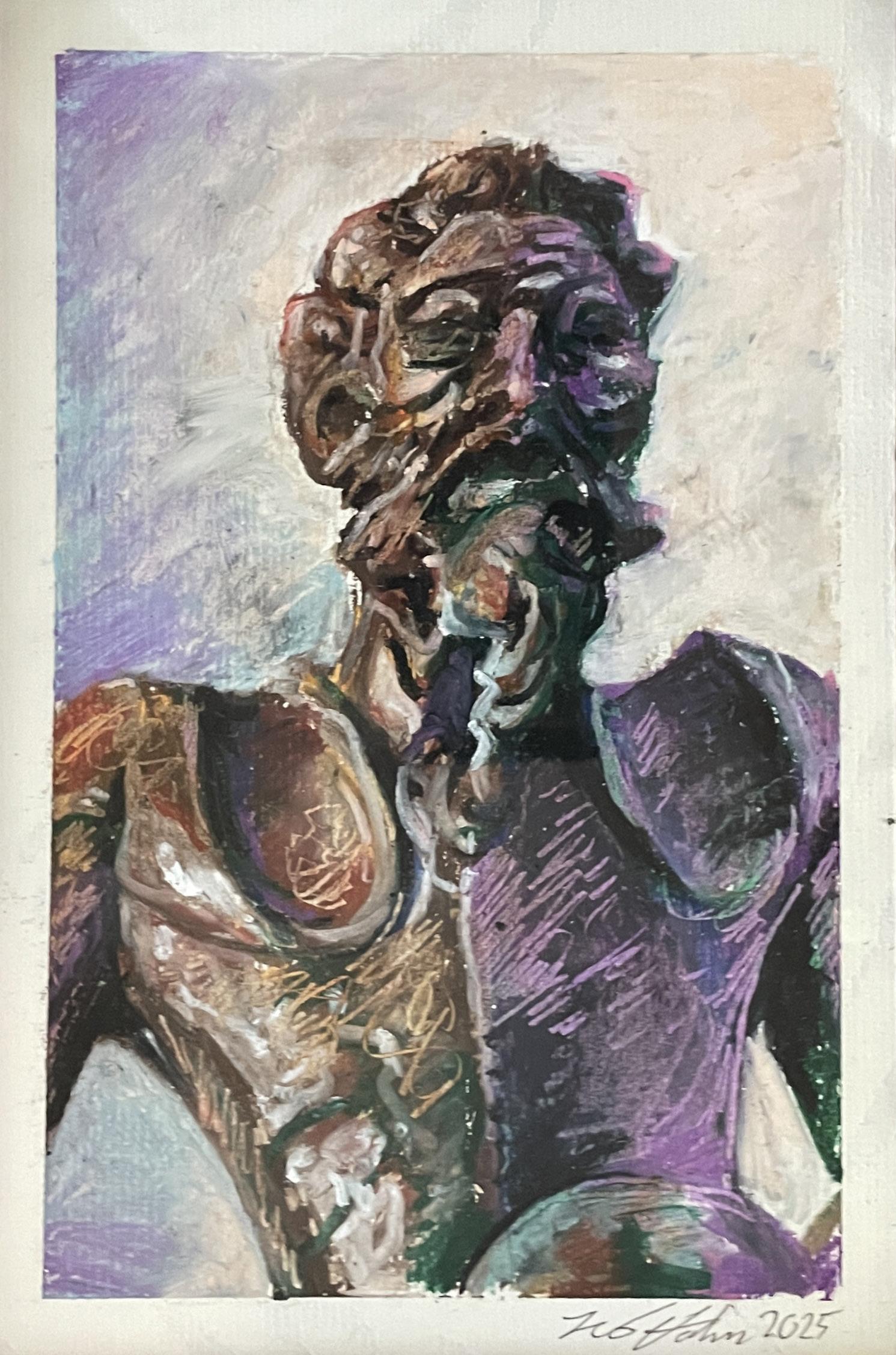
Leo Hahn don quixote
Oil Pastel
15, GoinG on to 16
Peter Knapp
They say sixteen is a big milestone but I don’t feel very big and Missouri thinks if i’ve learned how to drive (i haven’t) now is the age I can be deemed safe on the roads And looking back, did I spend age fifteen as I should have? did I waste my time? was the time I wasted well wasted time spent with family and friends (and maybe teachers) or was it the kind where I was in a dark corner of my room wishing I wasn’t watching youtube shorts yet glued as a night bug is to a streetlamp to the dopamine-inducing luminescent light? And when I’m seventeen… will I look back and feel like I wisely spent my sixteenth year of life? did I respect my teachers did I give 100% in all that I did did I always help my friends of course not…
they say this is the age to worry about girls whether a job would be a good use of my time oh shoot, I forgot about those volunteer hours all the repetitive, grueling sports drills the age where course and college selections overwhelm me
Everyone’s got their life figured out at the pace of the unforgiving world, pulsing like a nervous heart. Must. Drown. All. Sounds. So much time… Past. Present. Prophecy.
When the next milestone is too much to think about, Maybe all I need is the present. At the end, I’m God’s child, And maybe, That’s just where I need to be.
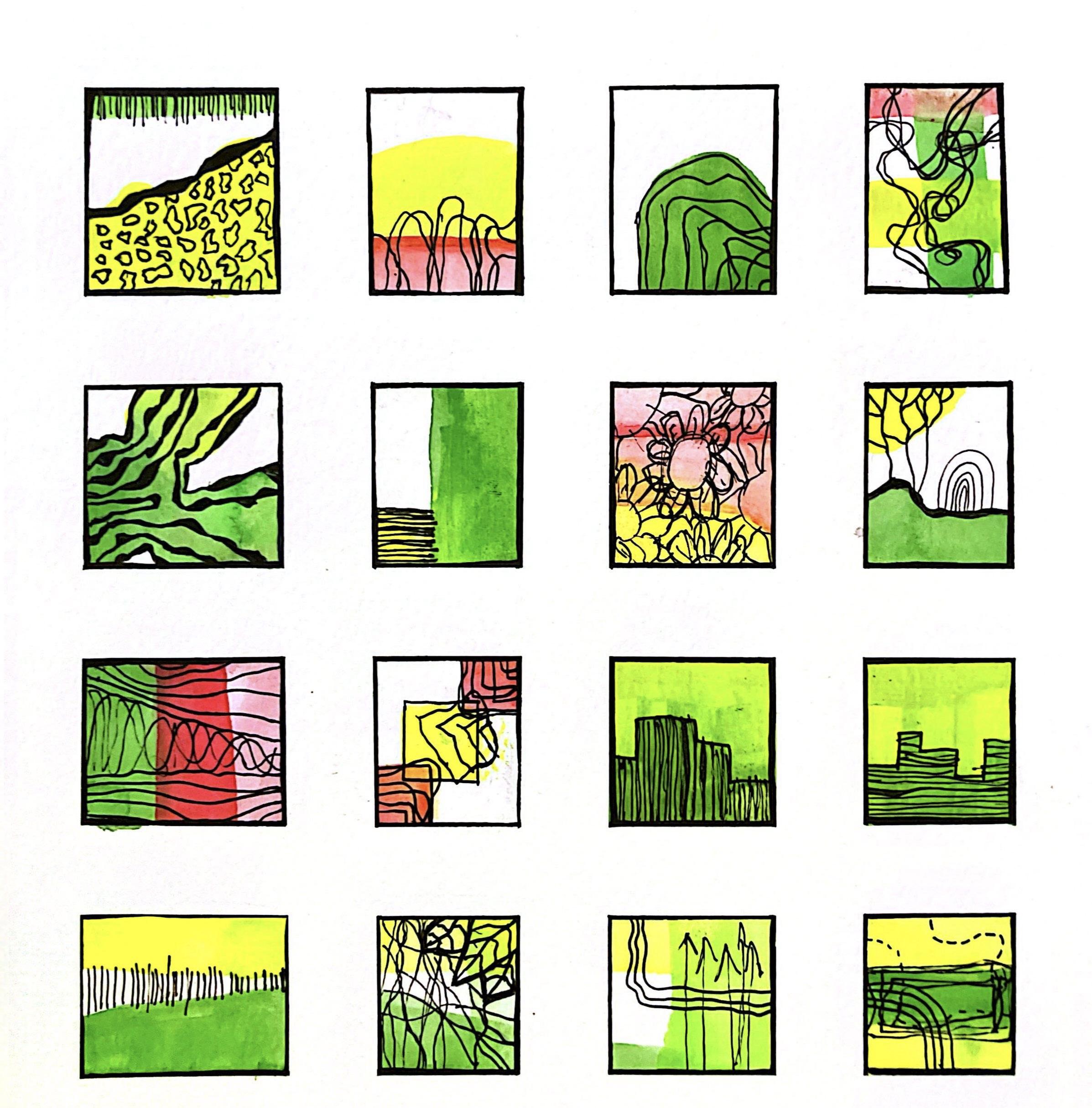
Pen and Ink, Watercolor
Klaus Jöstlein SketcHeS of SPrinG
one WitH nature
Steven Hlawn Ceu
When the light disappears from the eyes, Is it death or emptiness?
Honeydew smell, and the blue above. Ladybugs flutter in the green, and the sun pierces at his eyes. The whiffs of white jasmines travel with the wind, that tugs at his clothes.
The rays covered every inch of my body. From head to toe I was wrapped in warmth yet unnoticed by every breathing being that saw me.
Entwined with the grass that poked me, I could not feel my own breathing but only the ground that bedded me. My heart and lungs remained still, my chest froze flat.
I stayed there embracing nature that surrounded me. It was the only attention I wanted. Every hair on me glistened in the sun, yet not a trace of sweat or warmth came from me.
Folded into the grass, lives that still burned passed him. He could only remain and be surrounded by all that didn’t exist for him. He wanted embracement, love, warmth.
Yet the flaps of the ladybugs were noiseless, and the bees on the jasmines were silenced. The fallen pollens rustled but were unscented. I couldn’t embrace the nature: the smell, the taste, the sight, the noise.
I envied the plants: when they received light they were given life. Yet they could not smell, taste, see, or hear.
What difference was I?
Why couldn’t nature feed me or take me? Blades poking on me mocked me yet signaled me to move.
The difference was, the blades need the light, but he didn’t… Nature can only shine when there is light. Nature could only touch…he thought. He could be like
nature. As the light of spring covered my entirety, my eyes didn’t shine. They remained fixed while being one with nature.
a Half-dead tWin or an alleGory on tHe tranSGender exPerience
S. E. Fisher
At school, I have a twin sister. Her name is Sophie, which means wisdom, and she was born in summer Theology 3, a philosophy class, a word whose Greek roots are Philo—love, and Sophia—again, wisdom. But my twin sister wasn’t born then, after all she is my twin, and as Lady Gaga so aptly put it: “Baby, I was born this way.” But often it doesn’t feel like I was born this way, but rather that there was an exchange.
Because, you see, at home I have a twin brother— a dead one. His name is Matthew, which means gift of God, and he was born on May 22, 2008 and he officially died on May 22, 2022. But really he was never even born—you know how sometimes one twin can eat the other in the womb. And after all I was born this way and he wasn’t. And I hate when people call me by his name, because it reminds me of his existence. Reminds that I’ll never be without my dead twin brother, one who doesn’t even exist and never has and whose ghost follows me forever.
At school I am a walking ghost, and at home I am and forever will be a half-dead twin.
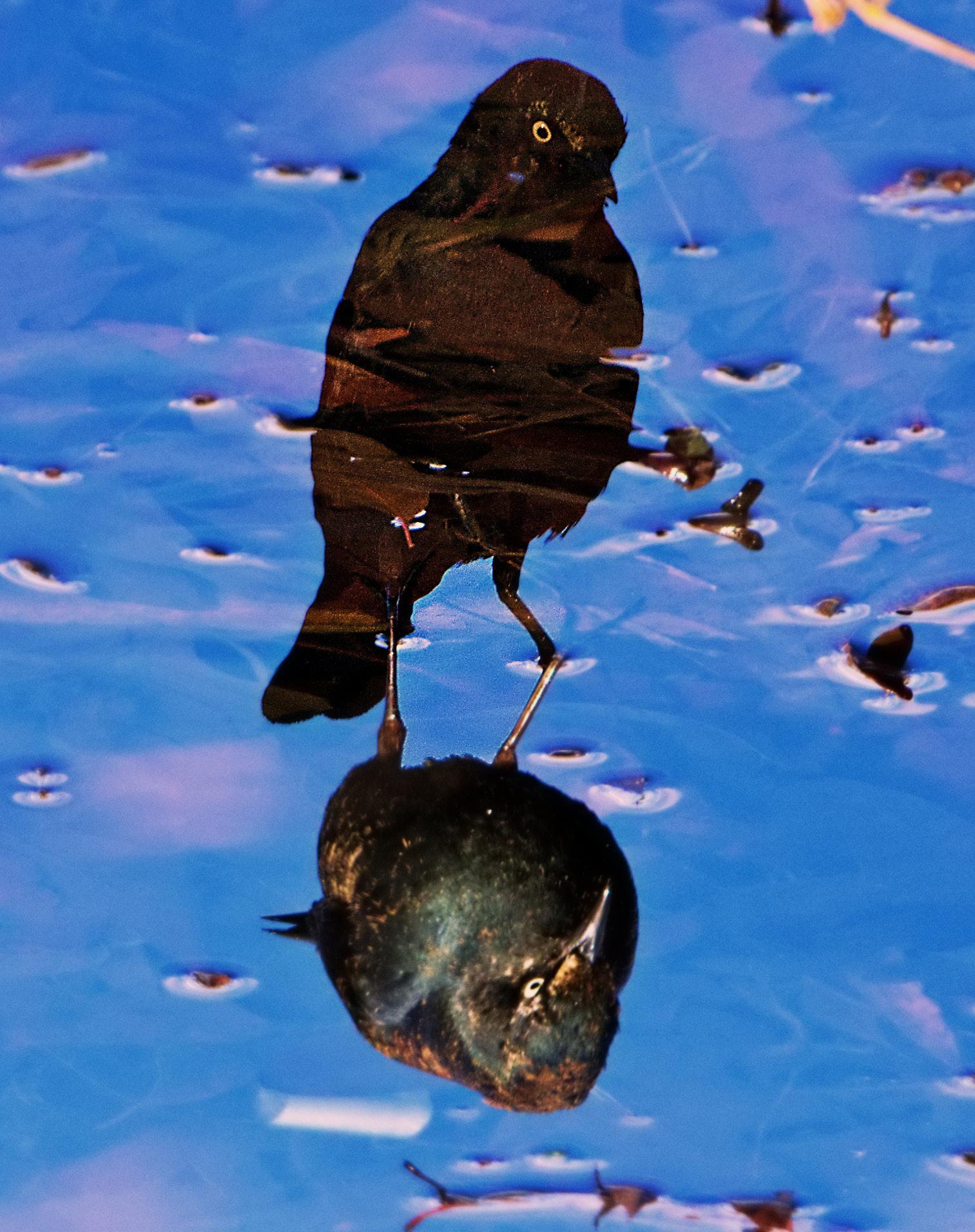
Photograph
Kevin M. Wilson
reflectinG ruSty BlackBird
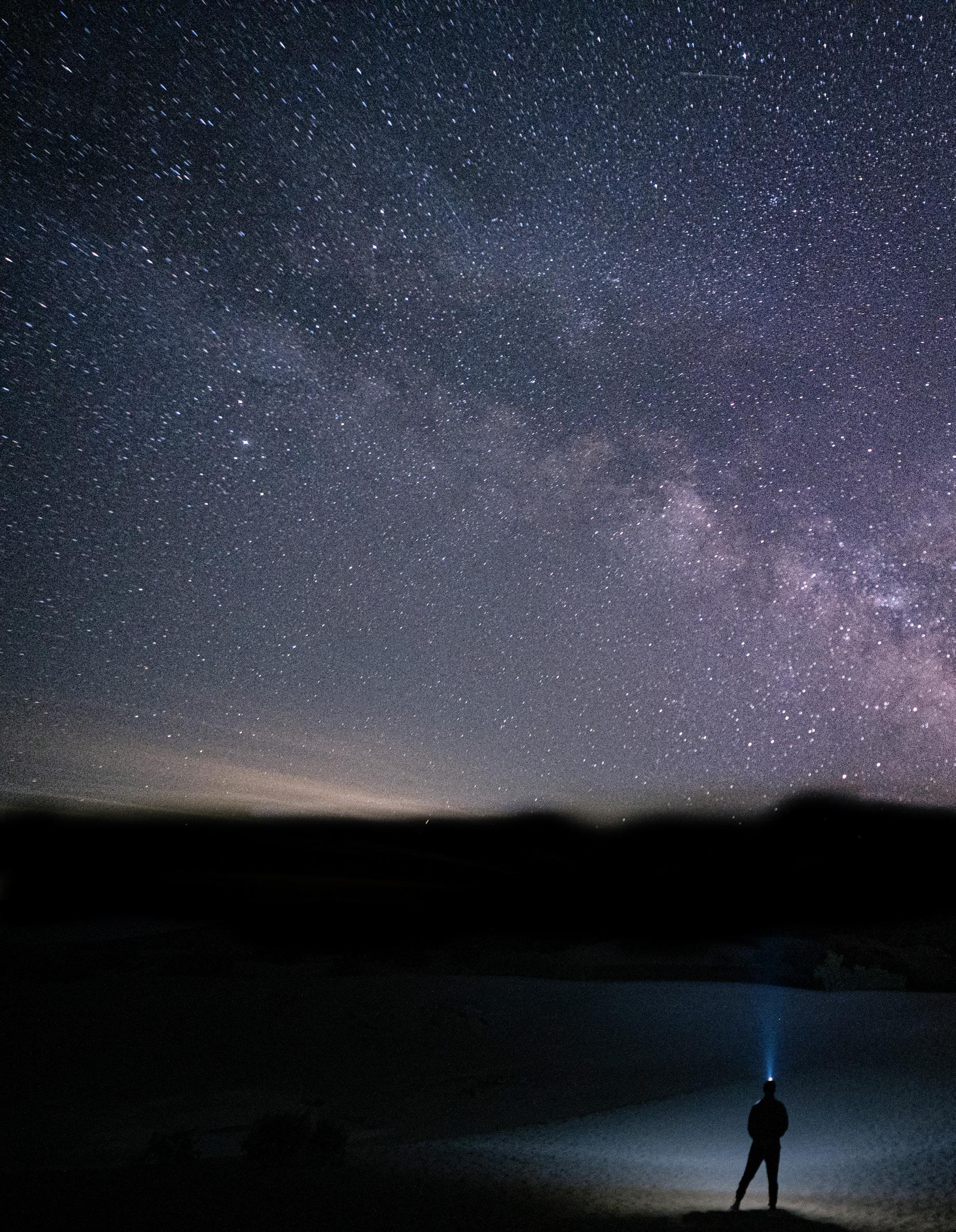
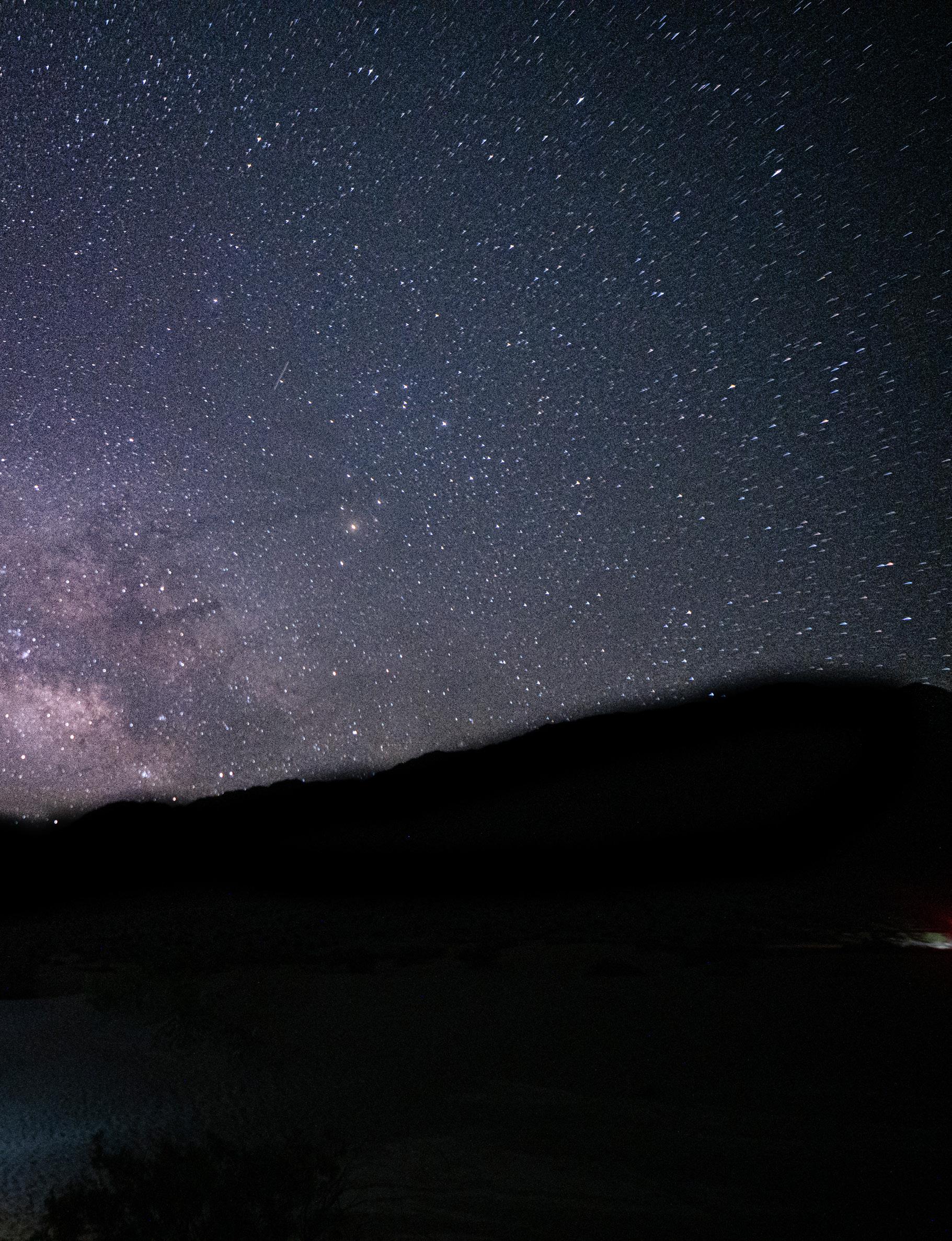
claire
Tommy Guntli
June 29, 2010
when she came into this world i cried. because of her? no. not being able to see my parents. yes. tears ran down my chubby, rosy red face sitting at the bedside of my mother who had just given birth, the room—now filled with each and every person who swears they remembered when the same thing happened at my birth.
young baby-faced Tom, cradling the sweet newborn Claire wrapped in a winnie the pooh onesie like a mummy in his tomb—was she being nice? no. not at all. grabbing scratching touching my face with her twoweek old hands like an explorer discovering the seas. “Claire has to be more nice,” i said in a three-yearold lisp to my mother. “she’s trying,” mom reassured me.
2 years later, eating lunch on a steaming summer day:
i smiled, looking down, seeing my chicken nuggets mirroring my face—smiling back, sitting in my bright blue plastic thomas the tank engine booster seat, as a king on his throne. mom had just read me the new story of red riding hood. i laughed as i told Claire “i will puff, and i will huff and i will blow your house down.” we both giggled like two first-grade boys watching the lifeguard scene from the sandlot.
time passed, we separated, not as close as we once were, and drifting further. stuck in a current i couldn’t outswim, couldn’t escape, it was inevitable.
were my sister and i close before? yes. of course. like a young st. louis kid to todd gurley II.
chasing……chasing……chasing
defenders as gurley II breaks towards the edge? no. me to the close friendship i used to have with my sister? yes.
late-night practices, high school, and life have drawn between us. long-distance relationship in the same home— laughs at the dinner table faded to asking each other for help on schoolwork.
no personality. no knowledge. no idea what is going on in her life.
the dark imposing door just to the left of the top of the 14-wooden-stair staircase that creaks every single time you walk up it where you can see the light peering through the bottom of the doorway, separating what once was a beautiful connection from what now feels like nothing.
now.
the door has begun to creak open. whether it is the small exchange we give sitting across each other at the dinner table when our parents try to use new slang in their own lives, or whether that is her, helping me make a valentine’s gift, lounging, gossiping on our bed criss cross applesauce like children ready for story time.
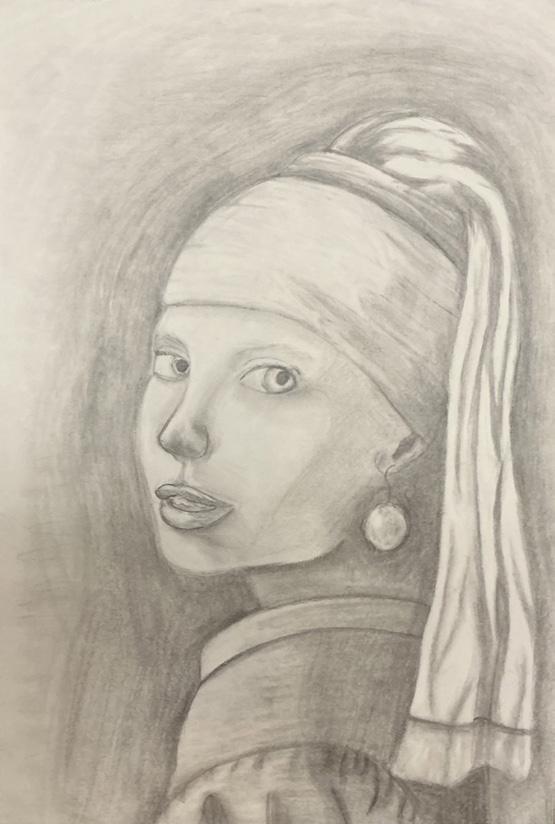
Pencil
Dignan Jost
tHe rendition of tHe Pearl
tHe HarroWinG of Hell
Mike Lally
A children’s cancer ward is hell, if anything must be said of it. For if hell is the absence of God, why, oh God, have you abandoned them? And not just them, but the parents who would gladly lie down in the bed instead, take the poison in their veins, kill health along with sickness, just for their child to rise, and to eat, as Jarius’s daughter did.
Yet, we are told, Christ descended into hell, A line so frightening we opt for “dead,” For we know not what to do with a Christ in hell.
But those who touch death know That death and hell are one. To speak of heaven too quickly, even this side of the rolled stone, to cast our minds to clouds of blissful fluff, is to attempt a sad misdirection, like a tired magician with rags up his sleeve, a fake coin in his pocket, hired to visit terminally sick children.
And we are all terminally sick.
So Christ went to hell, forsaken by God, by his own admittance. But if God descends into the absence of God, then what has happened to hell?
A thimble of water cannot quench the Sun.
No, the Psalmist tells us, “If I make my bed in hell, you are there.” So too, Christ lies in the cancer ward. He sinks in the mud at the Somme, He waits in line at Birkenau, He strains against chains below deck, mid-Atlantic. For in ten thousand hells that draw the soul into the darkest of night we would be surprised to find in the absolute vacuum a single candle that illuminates the face of a young man from Galilee
who has a rustic accent, brownish-green eyes, and wounds on his head.
“Darkness is not dark to you, light and dark are but one.” Dante knew that hell had no floor; that the depths instead are the gateway to the stars.
So too in Birkenau, a man, with a soiled fingernail, slowly scratches the image of the Galilean into his cell wall, ensuring that the loving heart of the God who dies is emblazoned on His stony chest. Here too, this hell has been overthrown.
But, the cancer ward. And the children. We must not forget the children.
Christ, taking a child in his arms, said, “Unless you become like little children, You will not enter the Kingdom.”
For if Heaven is union with God, the child who runs through the green grass and streaming rays of a summer afternoon, unaware of burden, surely is There.
A child does not worry, which must be what her Creator meant, when he held her that day, sweaty though he was. And the loving embrace of a parent on that summer afternoon, has returned There too, if only for a moment.
And no hell will be able to quench the eternal embrace of Father and Son, echoed in every earthly embrace, that first lit the suns aflame, the darkest shadow produced only by blinding light.
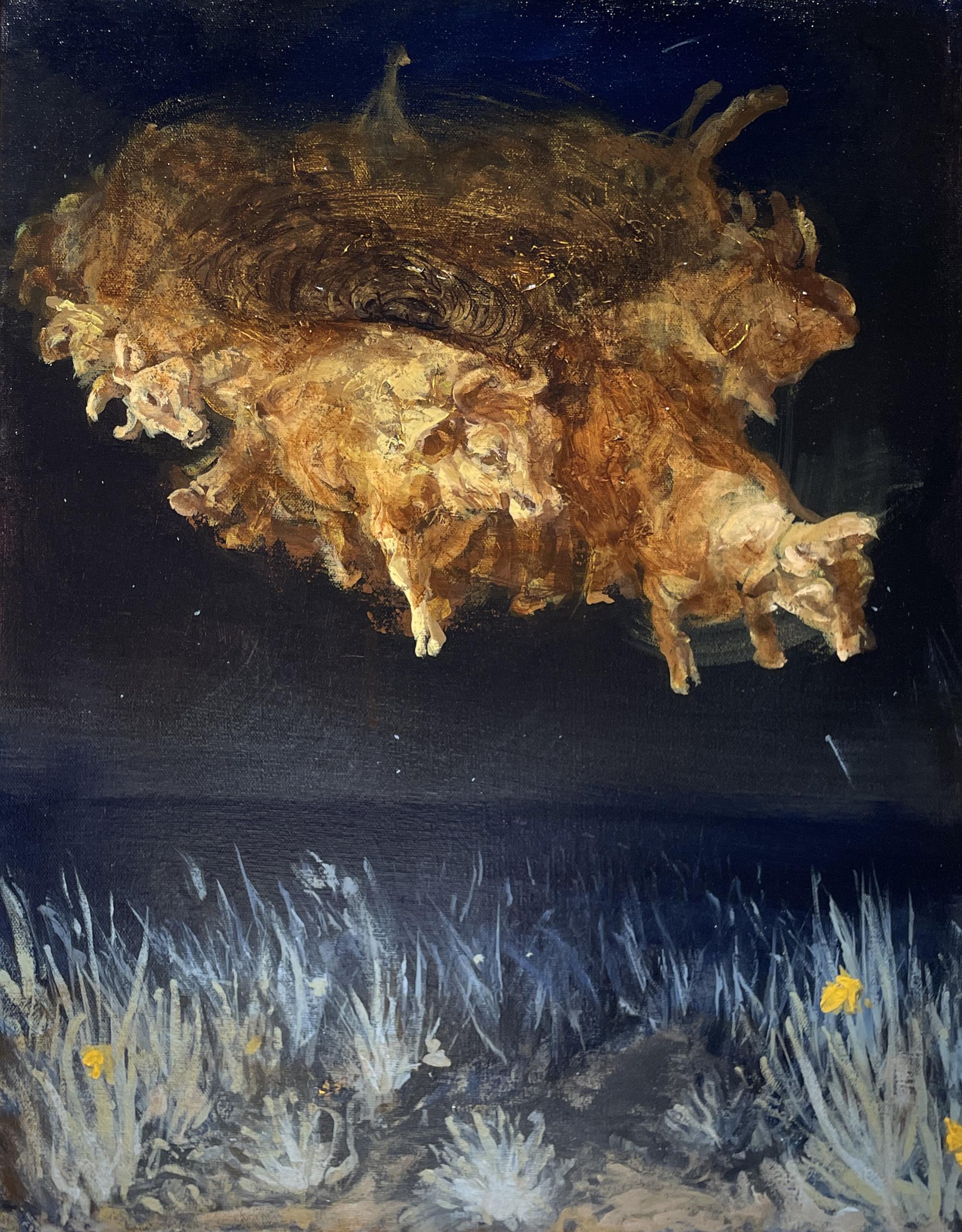
Acrylic
Leo Hahn cyclone
lutHer
Luke Seamands
For the first time in his life, Luther felt bad about killing someone. It was hard to escape the reminders over the next few weeks. When he woke up and felt the familiar hardness of the pistol under his pillow, memories of that night came flooding in again. On Tuesdays, he had to cross the street on his way to the grocery store to avoid the alley. The yellow tape was long gone, and the concrete had been scrubbed clean of blood, but Luther couldn’t get himself to look over as he walked by.
The dreams began on Friday, a week after the killing. At first they were just blurry images, but by the fifth night he was reliving the ordeal in vivid detail—the fear in the old man’s eyes, the sound the bullet made when it hit him, the sight of his blood spilling from his chest, the words that came in a whisper from his dying lips. Luther always woke up with a start, springing to his feet with his gun already in hand. He was constantly on edge.
Luther couldn’t make sense of why, after all these years, the death of this man in particular had given him so much grief. He’d been killing for a number of years already. He couldn’t remember exactly why he had started. Maybe he wanted the infamy, to be one of those iconic serial killers that people make Netflix shows about. Maybe he was tired of being pushed around all his life and finally decided he would do the pushing for a change. Maybe he was a sicko who liked watching people die. Whatever the reason, it didn’t matter to him anymore. Killing was just what he did, same as breathing.
Yet something had changed. He felt the weight that had been placed on him that night grow heavier with every day, every dream, every recollection of the man’s final
words. That had shaken him the most, Luther was sure. He didn’t know why. By the third Sunday, Luther had had enough. After another nightmare interrupted his lazy afternoon, he holstered his gun, popped the collar of his long trench coat, and stepped out into the evening chill. He knew of a couple of drugstores that sold dream-stopping pills, but he needed a prescription, and he hadn’t seen a licensed doctor in years. He would’ve been found out a long time ago—not all of his victims went easy, and some of the bashings he’d taken would raise a lot of questions. But he knew a guy who could get him what he needed without the risk.
Luther made his way down the street, staying in the shadows cast by the setting sun. Nobody in his right mind would be in this neighborhood at this hour. Local papers rarely ran reports of bodies found here: they were so common. That was good news for him. Who was going to notice another missing homeless guy? If anything, Luther thought, he was doing residents here a service, like a trash collector. He cleaned the filth up off the street. Had been for years.
That thought didn’t sit right with him. He felt a sudden pang in his gut. Such a statement wouldn’t have bothered him all that long ago, but now…was he really so cruel?
Luther stumbled over the uneven sidewalk, bringing him back to reality. He shook his head and trudged on, ignoring the gnawing feeling in his stomach. He needed those damn pills.
It was fully dark when he arrived at the empty storefront. Peering inside the cracked glass, he could see a fire burning in-
side, illuminating a small man hunched over the flames. Frank.
Luther opened the door loudly to let him know someone was there. Frank always had a gun on him. He turned around, hand already in his pocket, but grinned when he saw Luther. “Come in!”
Luther made his way to the fire. He noticed Frank’s bald head was wrapped in a bandage. “I thought you were through fighting.”
“I am!” Frank said. “But I guess my last opponent didn’t appreciate the rock I hit him with in the second round. Dumb bastard caught up with me on my way back and gave me a real bruiser.” He rubbed the back of his head, wincing a little. “Didn’t have the sense in him to finish the job, though. Just grabbed the cash and ran. Bad idea.”
Frank took out his weapon of choice—a snub-nosed revolver—and spun the cylinder, which was full except for one chamber. “He won’t be on a title card anytime soon, that’s for sure!”
He sat down on a box behind him and laughed, a nasty noise that Luther had never liked. It reminded him of a hyena.
Luther waited for Frank to regain his composure before speaking. “You got any sleeping pills back here? Something that gets rid of dreams?”
Frank looked a little puzzled. “I never took you for the dreaming type. Yeah, I do.”
“Your usual rate?” Luther reached for his wallet.
Frank’s eyes brightened. “Not this time. I need you to do me a favor.”
“What kind of favor?”
“The kind you’re good at.”
Luther’s breath caught in his throat. His chest suddenly felt very heavy. “Who is it?”
“A priest over at St. Paul’s. Fr. Blake. He’s been on my case recently. I don’t know how he found me, but he’s approached me a few times, asked me to stop selling. Says I’m hurting a lot of good people, says he can help
me, the usual BS. I told him where he could stick it, said if I get paid and those fools get a product then I don’t see an issue. It’s not up to me to tell them how to use it! Anyway, I think he’s gonna turn me in real soon. You need to stop that from happening.”
Luther sighed. “I don’t know, Frank.”
Frank scoffed. “Like hell you don’t know. You’re doing this.”
Luther flared his nostrils. “Oh, is that right? And what if I say no? I’ll find my pills somewhere else.”
Frank leapt up and got as close to Luther’s face as a man of his stature could. “If you say no, I go to the cops and tell them I have a suspect for the case of that murder on 5th Street a while back.”
Luther tried desperately to hide his surprise. Judging by Frank’s expression, it didn’t work.
“Yeah, that’s right,” Frank laughed. “You really think I’m some kind of idiot, don’t you? Do you realize how many homeless junkies make up my clientele? They know somebody’s been coming after ’em, and that it’s not other junkies. Word gets around, and you were pretty sloppy that night. They know your face.”
Luther didn’t say anything, just stood with his fists clenched. He thought about killing Frank, right there, but decided against it. That would hurt more than it helped.
“I’m impressed, really,” Frank continued. He sat back down. “When I first heard the rumors, about five years ago, I thought it was ridiculous. I mean, my product has definitely been getting stronger. But the newspapers ran with it for a little while, then stopped the stories, said there was ‘inconclusive evidence.’ Guess they didn’t think a couple extra dead bums were worth the effort. Do you remember what they called you?”
“All right, all right!” Luther interrupted. “I’ll kill your damn priest. You just keep your mouth shut.”
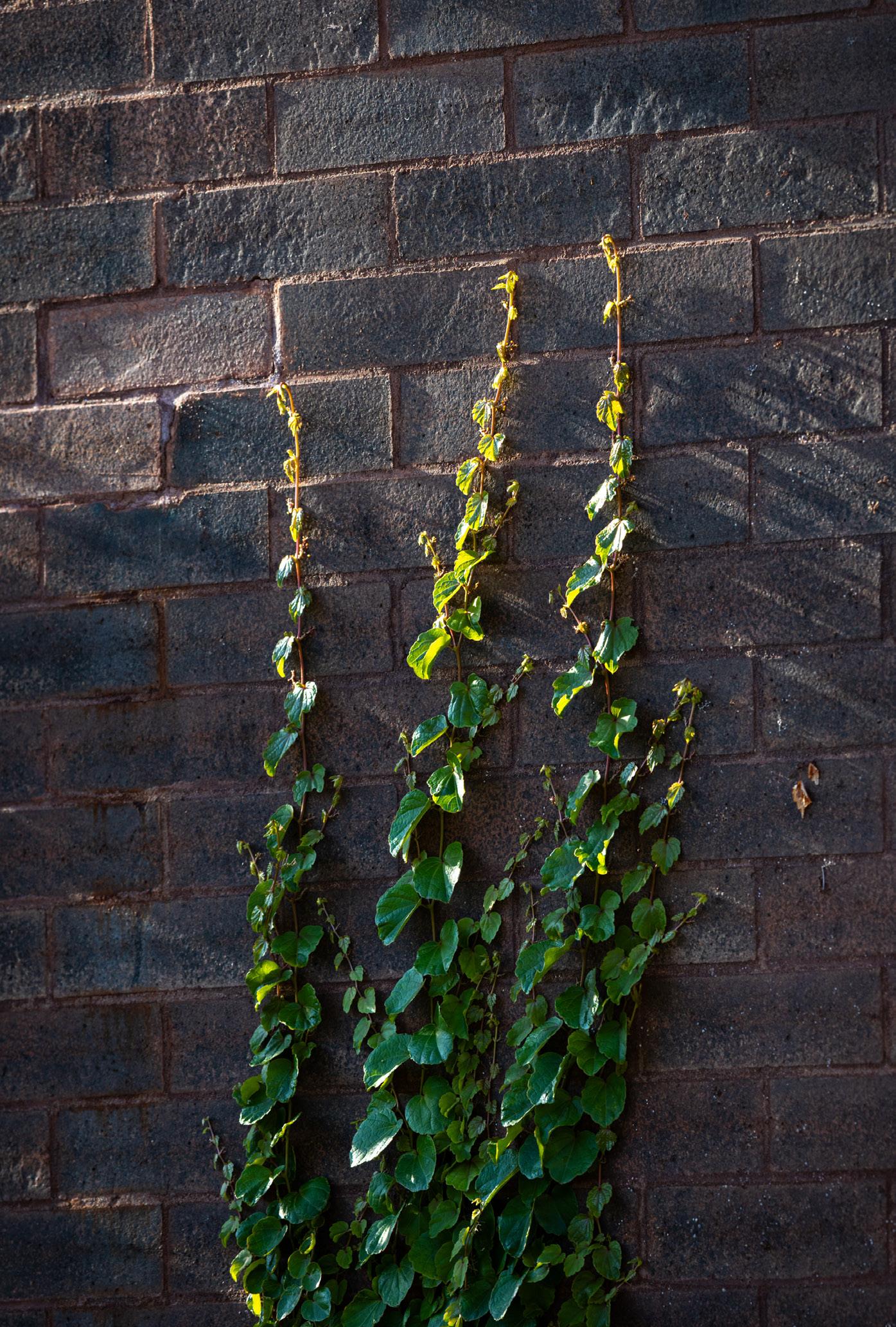
Photograph Jack Auer VineS
Frank grinned, displaying his broken, yellowed teeth. “There’s the killer I know! Here, take this. It’ll be quieter.”
He reached into his pocket and handed Luther a small kitchen knife. “I’ll be here when you get back. Make it quick.”
Thechurch was empty and entirely dark except for a few candles near the Tabernacle, but Luther knew Fr. Blake would be there. The sign outside had read SUNDAY CONFESSIONS 5-6:30. He almost turned around and walked home—he was raised Catholic but hadn’t been in a church in years, and murder was the worst reason he could think of to come back—but he kept going.
The pounding in his ears was so loud that he could barely hear his footsteps on the tile floor. Luther knew he should be worried about what Frank had said. He should be planning his escape, buying a bus ticket and leaving the city to lie low, maybe even killing Frank when he saw him again. But all he could think about was the man who was about to die. That he was about to kill.
Luther stopped walking as a thought occurred to him. This was the first time he had known, with absolute certainty, that he did not want to kill someone. His entire body ached from the guilt he had carried for weeks. He wanted to turn around and go home and wait for the cops to find him.
But he had no choice. Luther had always been a survivor. He took a deep breath and forced himself to move.
The words of the dead man rang in his ears. With every step, they were getting louder.
The confessional was open, and Luther walked towards it. He realized he didn’t have a plan. He decided he would sit face to face with the priest. It would be quicker and easier that way. For both of them.
It was completely quiet inside the small room. As Luther sat down, Fr. Blake gave
him a wide smile. He was an older man, maybe mid-sixties, with grayed hair and a shorttrimmed beard. Luther couldn’t help but notice he looked a lot like the man he killed in the alley.
“In the name of the Father, and of the Son, and of the Holy Spirit, Amen.” Fr. Blake looked at Luther expectantly. “Are you here to kill me?”
He nodded towards Luther’s hand, and with horror he realized the knife was clenched tightly in his fist. He hadn’t remembered taking it out of his pocket.
Blake didn’t look surprised. “This is about that dealer, isn’t it? Very well. Do what you must.”
Luther willed himself to get up, to strike the man, to do something, anything, but he couldn’t. He was shaking now. He looked down and studied his hand, wrapped so tightly around the knife that his fingernails were digging into his palm.
“You can’t, can you?”
Luther snapped his head up and met Blake’s gaze. His blue eyes saw straight through to his soul. He had a knowing look about him, and Luther suddenly realized why.
“I knew that man who died a few weeks ago,” Blake continued. “He was my brother. He was a troubled man, and I deeply regret not helping him more when I could. But he’s in a better place now.” He leaned in towards Luther. “What did he say? What did he tell you before he died?”
Luther could feel the tears on his cheeks. His hand released the knife, and it clattered to the floor. He spoke the words he had been hiding from for weeks, words he had tried to erase from his mind in all of his waking moments, words he longed to forget more and more with each passing day: “He told me he forgave me.”
Blake picked up the knife and studied it. “He was a good man, Alan. He didn’t always act like it or look like it, but he was, deep
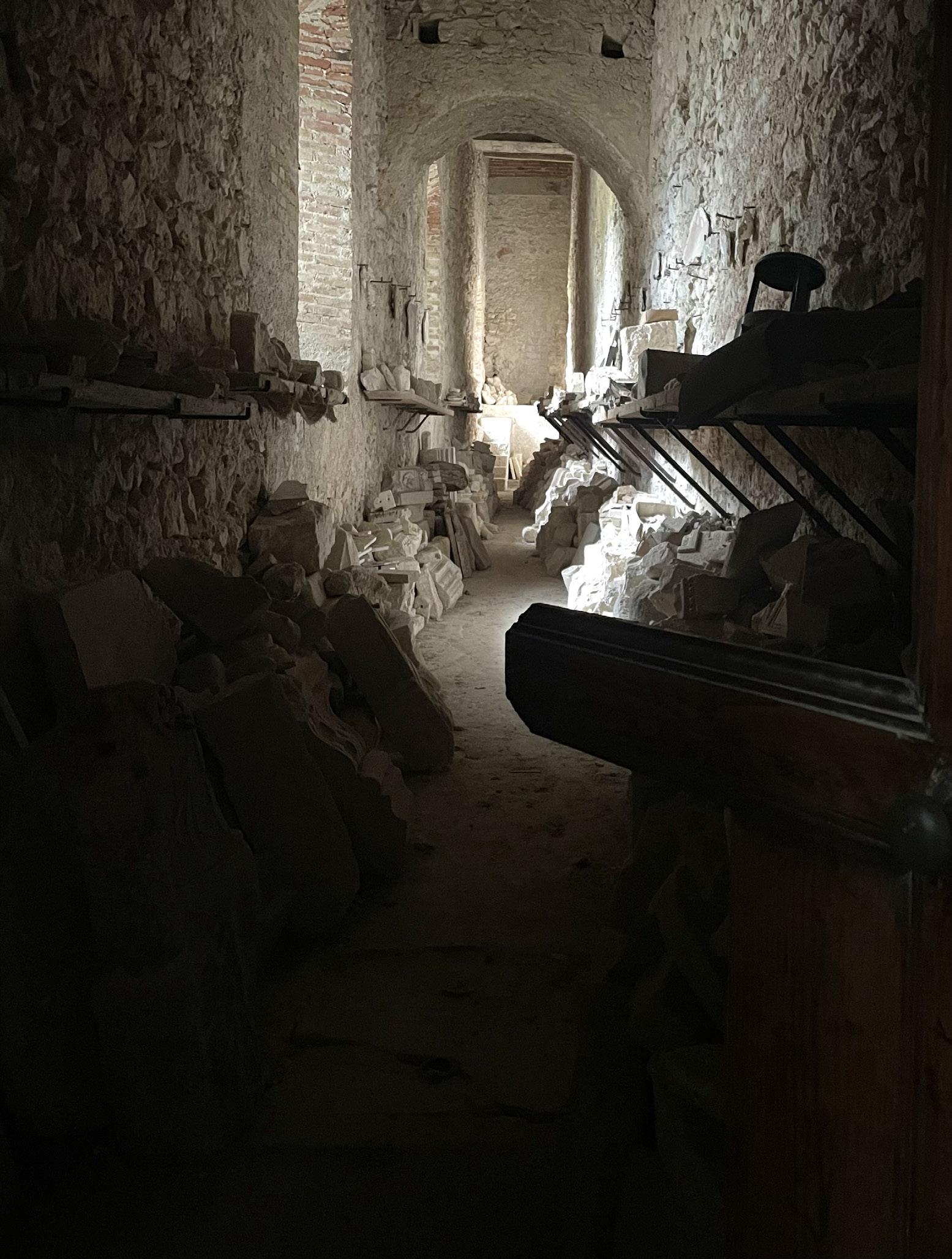
Photograph
J.P. Wildermuth
down.” Blake stared at Luther. “And I think you’re the same way. Stop hiding from yourself and come home.”
Luther was sobbing now. All at once, the remorse swept over him like a tidal wave, and he let it happen. He recalled the faces of his victims, all of them dirty and scared, and despaired at what he had done to them. Luther saw them for who they truly were: men. Not just flesh and blood, but something more.
Luther just barely got out what he wanted to say to Alan, seeing him lying in a pool of his own blood, what he wished he had said to each and every one of his victims back to the very first as they breathed their last: “I’m sorry. I’m so, so sorry. I’m done running.”
Father Blake gave Luther a sad smile and bowed his head. “Your sins are forgiven. Go in peace.”
Luther walked out of the confessional in a daze. In his youth, he had heard stories of the healing power of Confession, how people would leave that little room with joy in their hearts and a bounce in their step after being absolved of their darkest deeds. Luther just felt drained, and his thoughts were too jumbled to think clearly. His feet carried him as best they could to a pew, and he sat down, wiping away the tears drying on his cheeks.
After a while, when he regained his bearings, he was surprised to find himself at the very front of the church. Before him lay the altar, dressed in a brilliant white cloth and flanked by two burning candles. They must’ve been lit during his stupor, but Luther could see no one else around him.
Behind the altar was a large marble depiction of the Crucifixion. He hadn’t noticed it before, but now the light from the candles
was just enough to illuminate the cross in the darkness. It was an ordinary scene. There was Jesus, his body hanging limply from the wood, his head slumped, his face full of sorrow and agony.
Luther’s breath caught in his throat. No. He was mistaken. Jesus’ face wasn’t twisted in pain, as he had expected. His eyes were closed, and his lips were turned up in a faint smile. Despite the suffering he was experiencing, Jesus was at peace.
It was the same contented look Alan had as he died.
Luther realized that the heaviness in his chest was gone. New tears flowed as he sat and marveled at this peaceful Jesus. His worries—Frank, the pills, Father Blake—seemed so far away. He didn’t care about them anymore. They were the past. All that mattered was his future.
Luther was ripped from his thoughts by sirens outside St. Paul’s. He leapt to his feet. He looked around, searching for an escape as red and blue light poured in through the stained glass windows. He had seen a side exit near the back of the church. He started walking. Maybe he could cut into the alley if they hadn’t locked down the street yet.
Then Luther stopped. He looked back at Jesus.
”Police! Come out with your hands up!”
Father Blake was right. It was time to come home.
Luther turned and began walking again, each step echoing off the stone floor, ringing with new purpose. He marched right past the side exit and arrived at the large oak doors. He collected himself, then swung open the door and stepped into the night with his arms outstretched. He couldn’t help but smile.
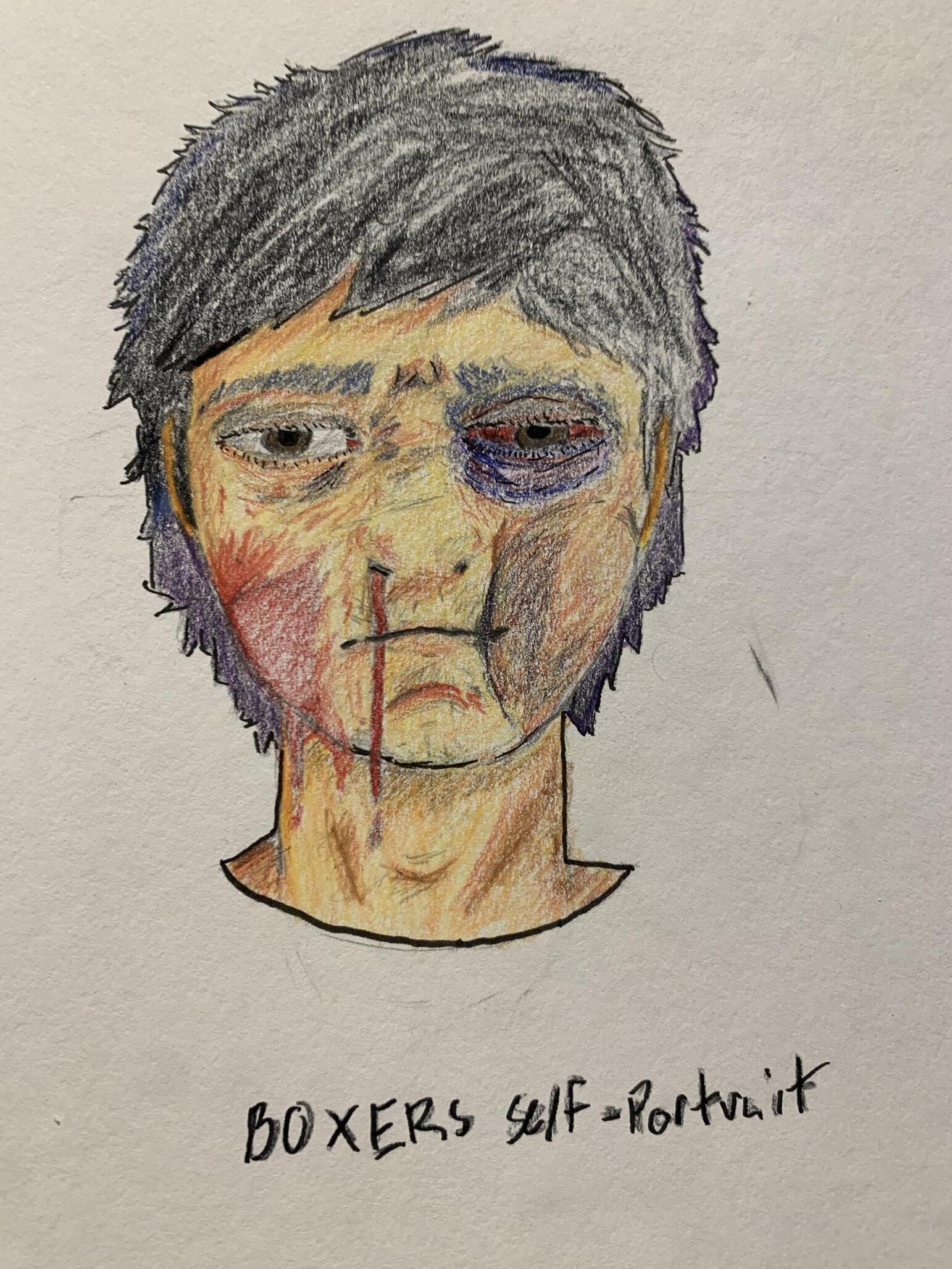
Pencil, Pen, and Ink
Uriah Binder
Boxer’S Self Portrait
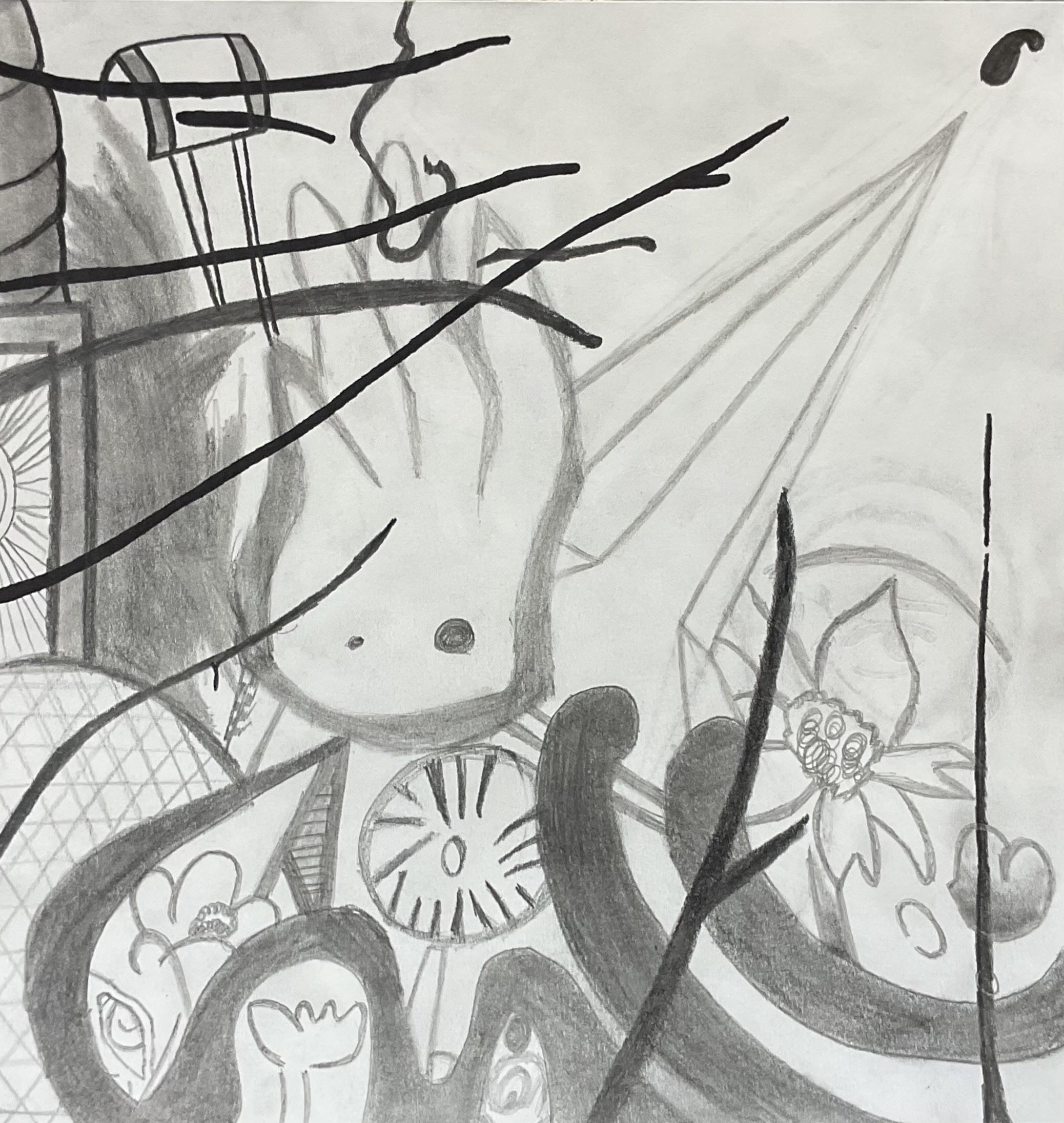
Pencil, Pen, and Ink
Owen Van Deven coMP coMP
tHe Wild
Colton Eikermann
Trains, when it rains, Thunder, Whistling trees, crying seas— I wonder
Why some sounds sing Better at night Why some sounds ring Rounder in little light
Caught in Night’s arms, Train hoots and hollers I clutch the blanket, Thankful to remember I sleep In a nice warm home
Rain clanging
Running wild, without reigns The banging Of a world untamed At my door
The night’s secrets
The sounds it wore The thunder wild Breaking down my door.
cHaSinG cataMaranS at 40 MPH
Frank Corley
The cat cuts the water, tilting One hull out of the water, Mast at nearly forty-five degrees. The two on board work the lines With a calm that masks their fury.
I race across the sand out onto the water. The boat slows as it tips, with the keel Cantilevered out, as if it could fall off And into the harbor. You think You actually have a chance to catch up.
So you speed up, pushing hard Across the water, now out where the waves are Breaking. But the second hull settles Into the water, and the vessel gains speed. It must be going close to forty mph, but
I can’t quit. Can’t quit running. So I Gulp in more air, pump my arms, and run Harder. Once the cat has settled, Bernoulli’s Principle Takes over, the mainsail fills and Lift impels the boat forward.
As the sails fill with air, my lungs start to Burn in pain. I’m running faster than I ever have, But the farther I get out on the water, The faster the boat is going. The sailors are moving Back and forth, dodging the boom.
And, just for a moment, the boat is still. The captain is Coming about! They had to tack, so they are Changing directions, but I keep running Straight ahead. And all at once, I feel as though I have a chance: I might catch up
And so I run harder, my spirit raised by The possibility of success. Now my feet barely Touch the water, and as they dry I run faster. The boat is in the middle of its turn into the wind And I know I will have it. I can see the defeat in their eyes.

Photograph
Jack Auer fluidity
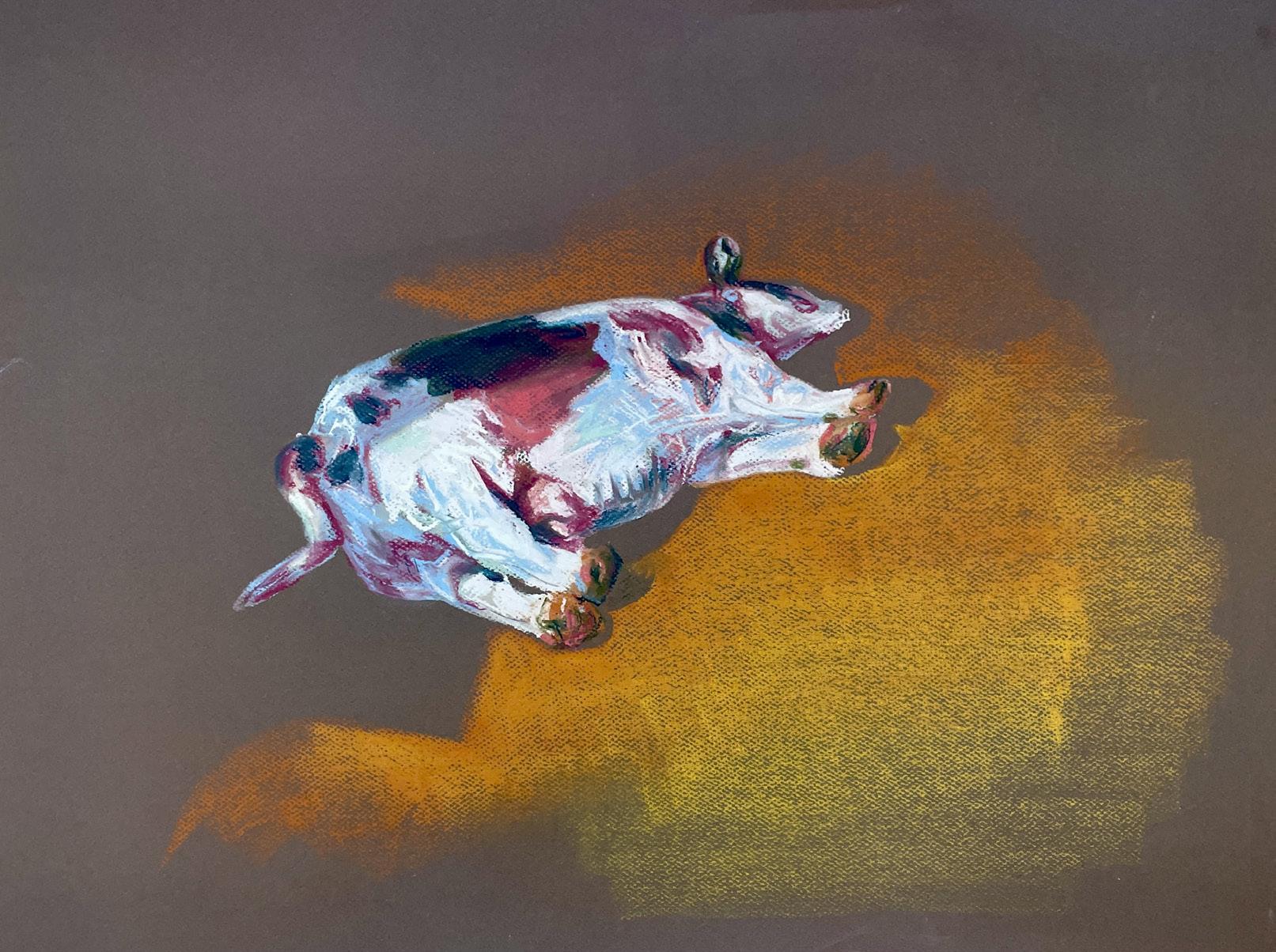
Chalk Pastel
Leo Hahn
feelinG deflated
cynic
Peter Knapp
And these days I don’t see anyone talking to anyone else face-to-face they say the internet was a big leap forward but now everyone feels like a coward ha! only for ai’s make-belief and what we see as social relief an exit from the everyday chitter chatter only to add to our existing mental clutter and there’s the fake community of snapchatters can’t lose your 83-day streak (it matters) why do we feel anxious about lookin’? (for a kind word, witty phrase, or snarky sentence) farther than just a look at their faces, our empty hearts like broken vases and here I am sitting at my window… I don’t see neighbors chattin’ just my amazon order shippin’ maybe I’ll go ask the name of the guy who’s always walking his two dogs Because these days I don’t see anyone talking to anyone else face-to-face
MeanderinGS of tHe Middle
Peter McGroarty
I used to see the sky only during sunset. When its harsh rays diffused into warm hues and I felt my dad beneath my arms, holding me up. When I heard the waves wash behind me and felt the cold strokes of the lake. When I could still make a meaning of everything. When the endings were still graceful.
I used to hold my hand against the sun. Wincing and walking through the day. Bored by the meanderings of the middle, such that I would rather lie down in desolation and sleep through the meaningless days.
But sometimes I have to get up. When I need to see the sun. When the rays still hurt. When I know I’m still trying and I realize that sometimes, the sun just sets.
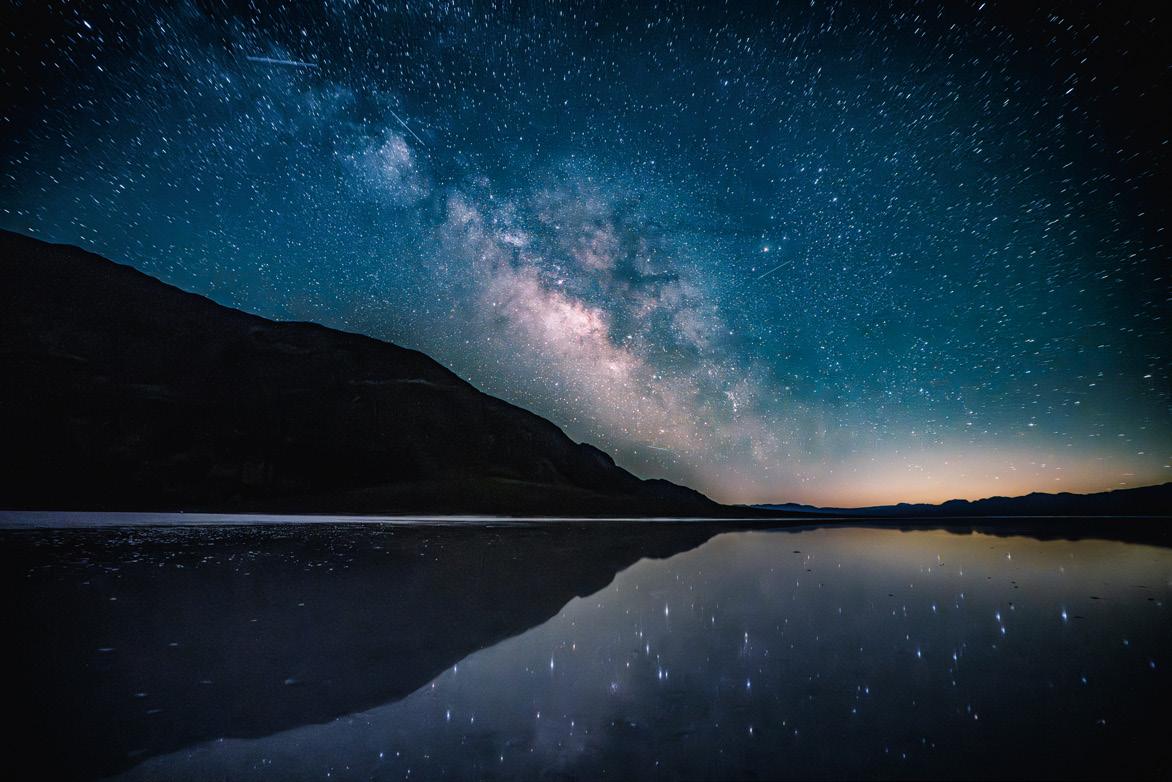
Photograph
Andrew Hammond
cloudS
Ryan Kindschuh
When seasons shift
The clouds as well float by.
Some days, like a seed, clouds plant images in my mind
Ones of bunnies and castles and the sea
Giving momentary joy
But then blown apart and gone forever.
Other days, the clouds are like a sprouted flower
Having bloomed into a beautiful bud
Bringing light to the world, as humble as could be Staying for a second, remembered for a lifetime.
Yet some clouds always come back
Those which, like a field of seed-studded strawberries, Shimmer and draw the eye
Planted once, seen evermore.
And now when I look out the window next to seat 38A I see fields of heart-shaped berries among the clouds Waiting to be picked and spread across the world.
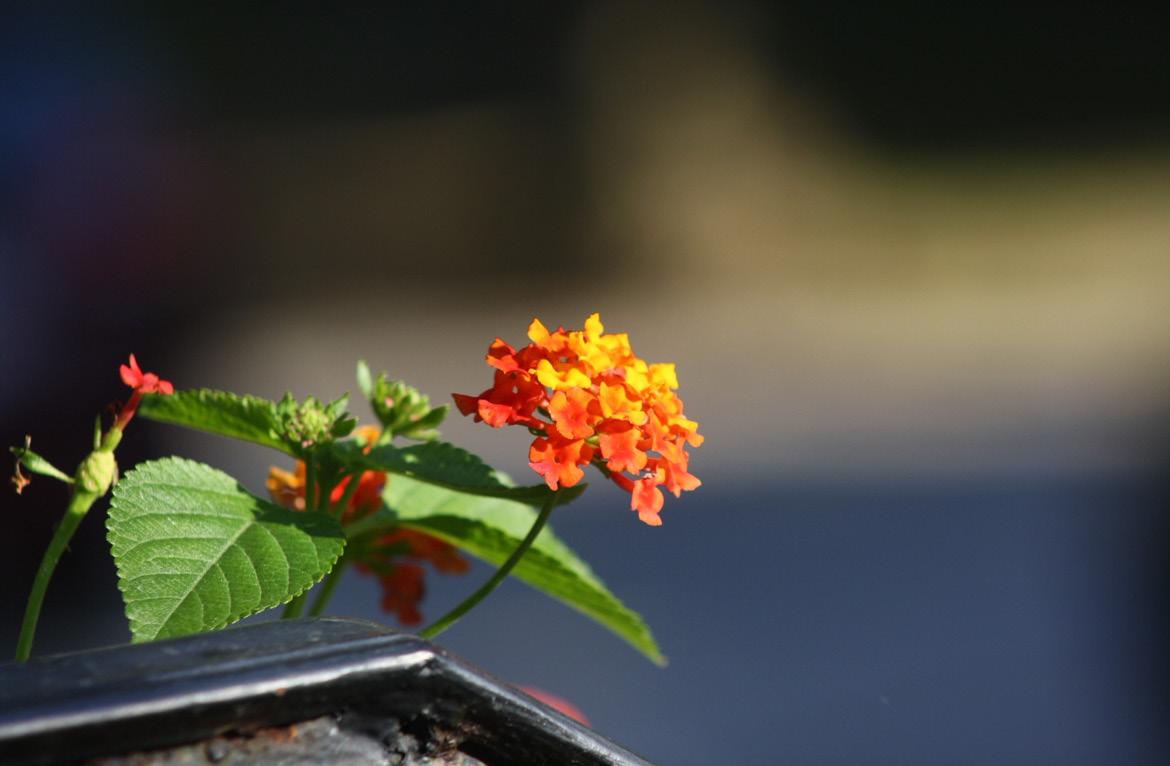
Photograph
Brendan Cierpiot
lantana
roxoyHroa Warnicke Beatty, Jr.
Would you like a ride?
a quivering “yes” slips from my mouth
Harmonic hums of bioluminescence carry me off into a dream not far from a life i once knew purple clouds carry violet winds whirl indigo stars gleam as i sit on my magic carpet
my carpet is my baby blanket but different— lilac, now floating me away among the clouds
my locs unravel from my head to reveal kinky— coily hair
kissed by the synth
my clothes re-hem into something new— a mulberry hue a little different from what i thought i knew the synth lifts me off the blanket while it twirls sparkles transforms all around me becoming ultraviolet fairy wings
then i fall onto the lavender grass as my wings pulse with blood
i rise up as someone a little shorter a little stranger but entirely myself
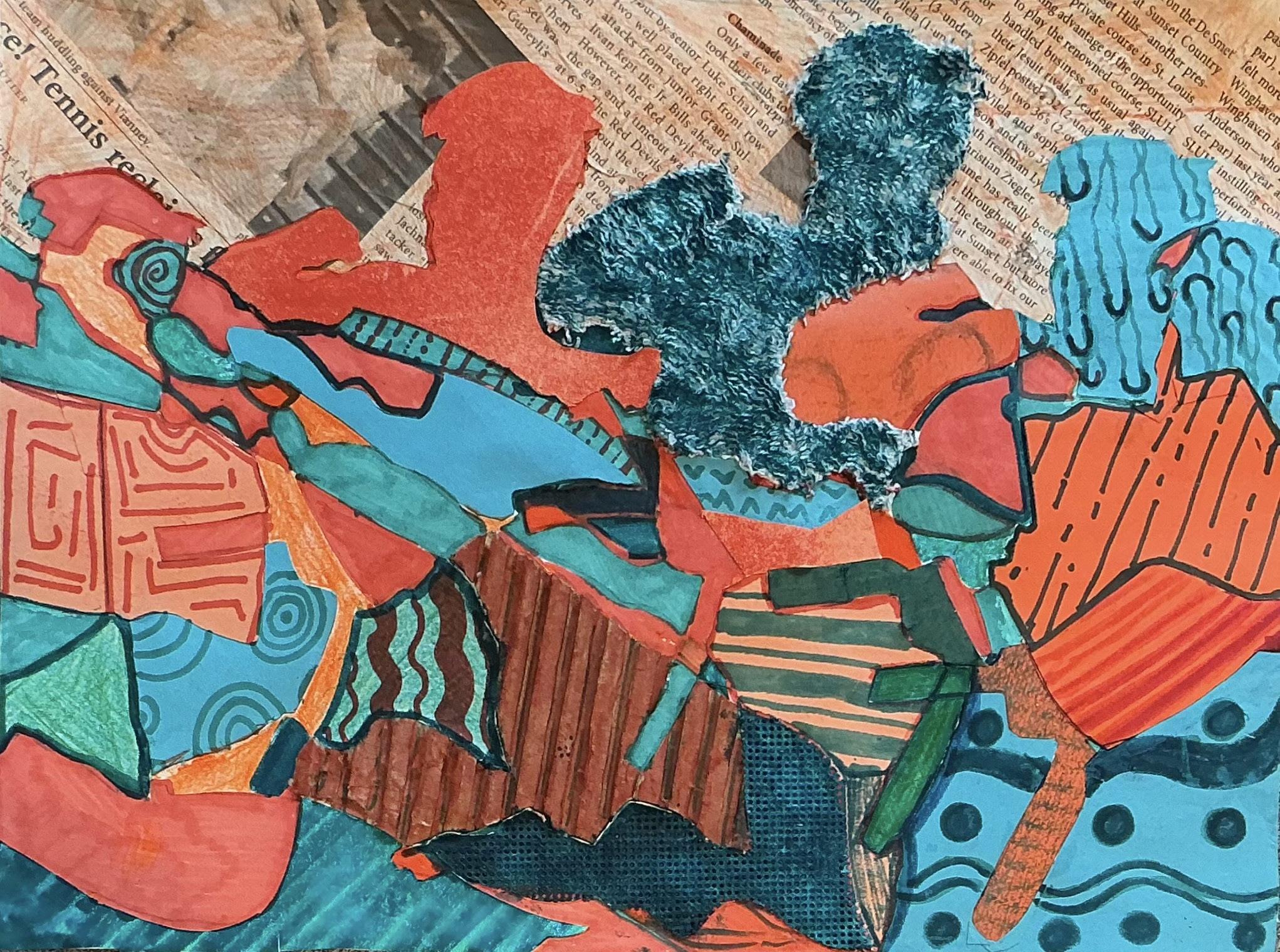
Yoffie Pattern
Cutout Materials, Marker, Color Pencils, and Crayons
Andrew
i uSed to driVe
Frank Kovarik
I used to drive when I was drunk, When I was deep inside a funk. Shift into a different gear, Go somewhere instead of here: I used to drive when I was drunk.
I used to drive when I was stoned, Listening to music all alone. On the back streets late at night I would start to feel all right. I used to drive when I was stoned.
I used to drive my friends away. I gave them reasons not to stay. I didn’t mind when they would leave. I know it seems hard to believe. I used to drive my friends away.
I thought I was in control; That was how I used to roll. No one could tell me anything; I found it threatening. I thought I was in control.
I used to drive you half insane. I used to cause you lots of pain. With all the things I used to do The one I hurt the most was you. I used to drive you half insane.
After they took my keys away— That’s when I made this PSA. You might think it’s kind of trite; I don’t know, you might be right. That doesn’t change the fact They took my keys away.
I don’t go driving anymore. I know that’s not what driving’s for. I hitch a ride or ride my bike, Go for a run or take a hike. When my heart is feeling sore, I don’t go driving anymore.
I used to drive when I was drunk, When I was deep inside a funk. Shift into a different gear, Go somewhere instead of here: I used to drive when I was drunk.
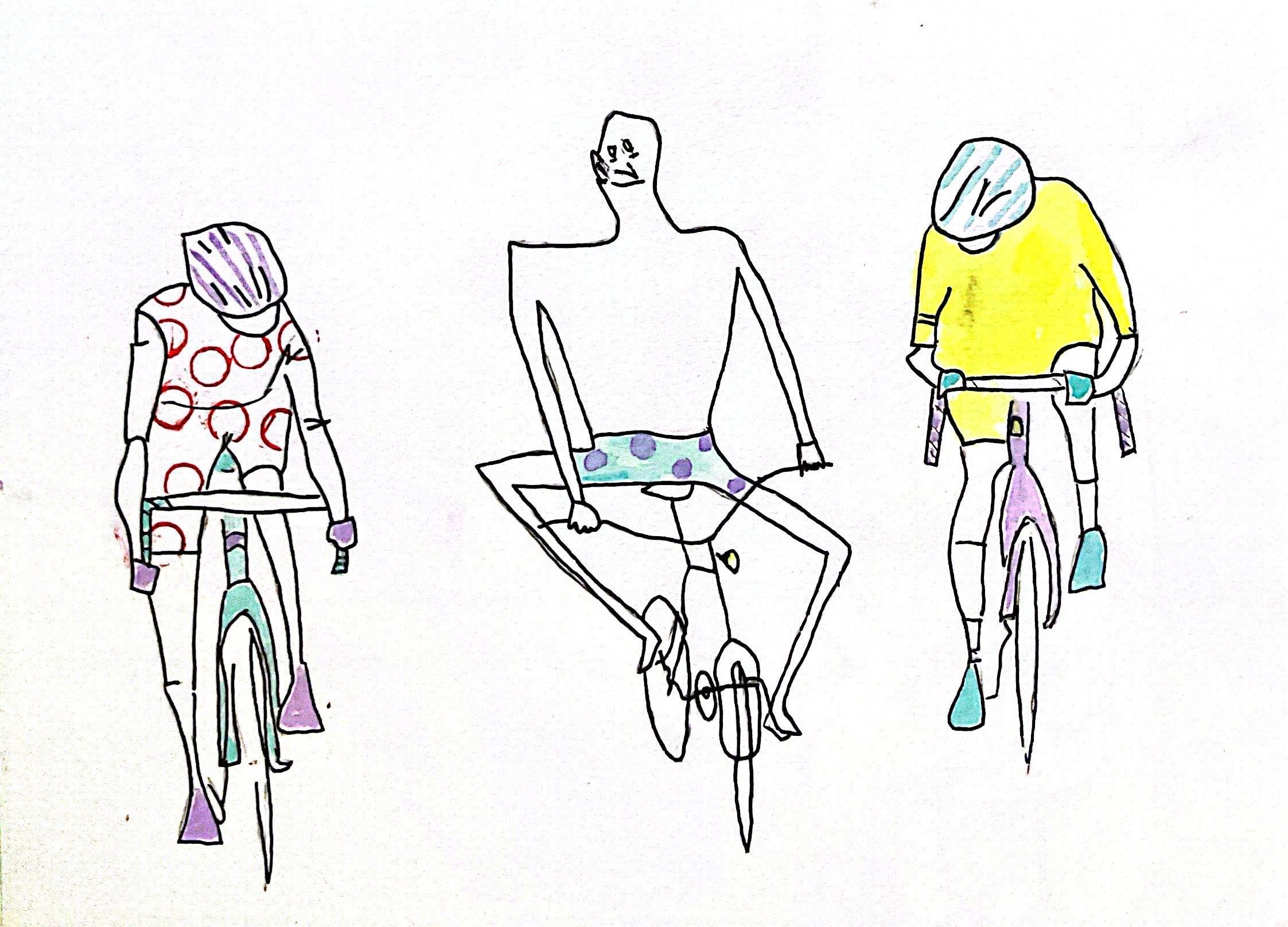
outSider
Pen and Ink
Klaus Jöstlein
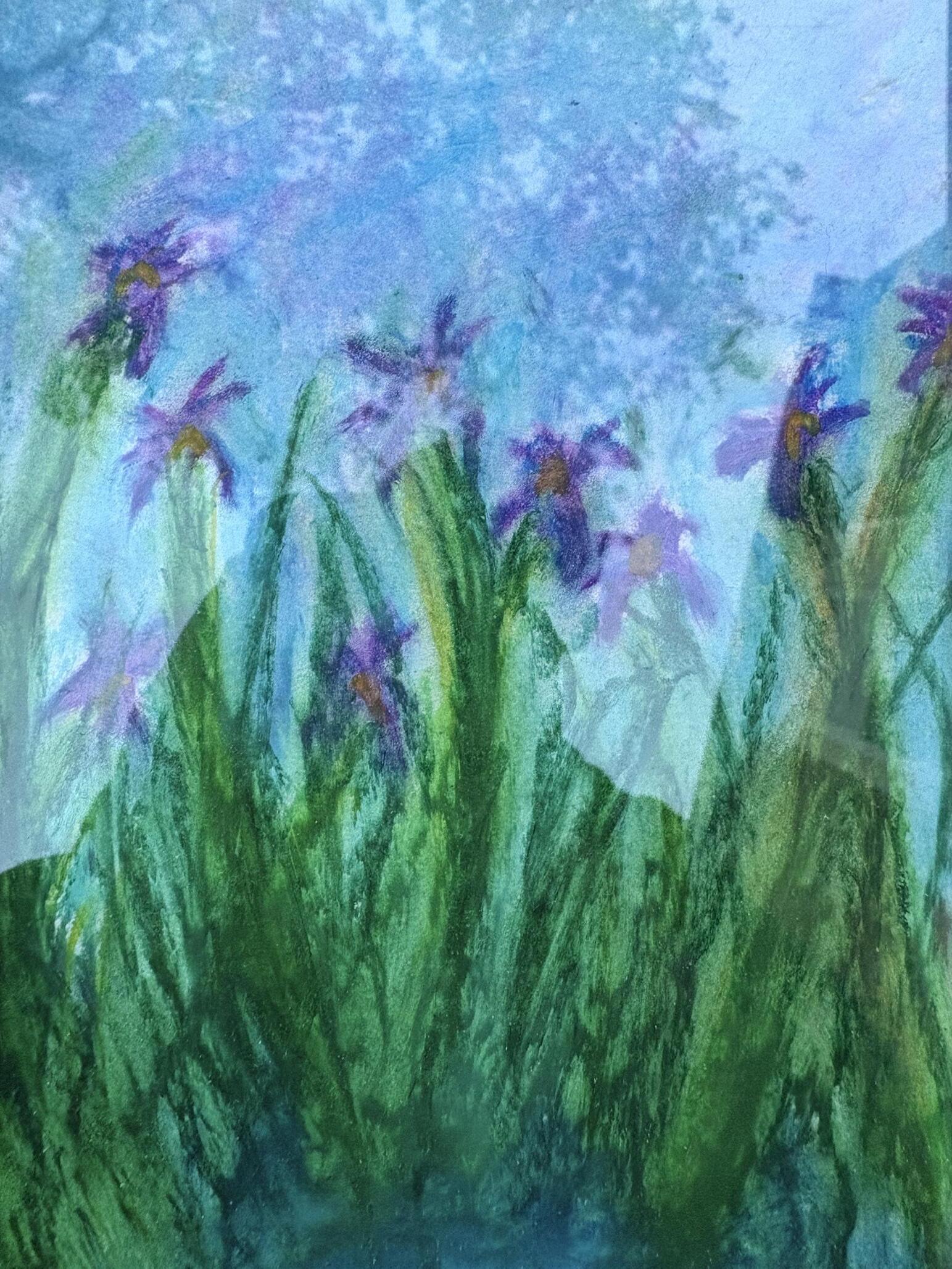
Oil Pastel
William Overberg
tHe WHale
Uriah Binder
For seventeen years I’ve struggled to do what every human is supposedly built to do. No matter how hard I try, I’ve failed to socialize, to have genuine human interaction, to truly be seen. Yes, I have friends and family. My friends and I don’t hang out as frequently because of school and work. And to be quite honest, I sometimes can’t stand being around my family. Relationships come hard to me. It’s as if I am standing in a glass box inside a room full of people I know. They all chat with one another as the crowd surrounds my box so much that I can’t see far. Sometimes someone unfamiliar weaves out of the crowd, passing me. I cry out, but everyone keeps the conversations going. There is only one of each and every single person on this planet. No person is an exact copy of another. If you were to clone someone, that clone would still be different once it realizes it’s a clone because realizing one is a clone creates an instinctual desire for autonomy. However, every single person can relate to others. Whether it’s about personal things, hobbies, philosophy, religion, or politics, most people can relate or agree wholly with someone else. But I have not yet met anyone who sees the things I see, who hears the things I hear, who speaks the words I speak. Sometimes I feel as if I am painted onto a canvas sitting in an art exhibit for people to stare at. And sometimes I feel like that canvas has been stashed into a back room to be forgotten. I am Uriah; an ethnically Jewish American who practices Messianic Judaism and Christianity. I am Generation Z. I grew up going to Catholic schools my whole life, which isolated me. I live in a nation whose values have been a lie, a nation that has turned on its people. I am seen as
connected with a country I’ve never even stepped foot in. And because of that, many hate me.
My generation’s understanding of love almost makes it feel as if real, actual love is impossible to achieve. This creates a constant separation between people. It’s not hard to see people online always having fun, partying, in love. And it’s not hard to find yourself burrowing further into your sheets as the luminescent blue glow highlights your face. It’s like the waves of sheets never end. Drowning in blue light and artificial dopamine, I begin to feel resentment. I feel hot, sweaty, as if I can’t breathe, so I push and kick. I resurface as the fan next to my bed blows air into my face. And still, I feel as if I’m drowning.
There exists a whale known as the “loneliest whale.” Its call is at the frequency of 52 hertz, too high for whales to hear, leading it to a life of unchosen blue solitude. I imagine the large dark blue skin as it moves through the depths, calling out constantly, just wishing it could find someone, anyone, who could hear it. Do whales feel the pain of loneliness as we do? Do they understand what it’s like to feel completely and utterly alone, hopeless to ever be heard? The deep blue void it swims through forever encapsulates it in nothing but acoustical darkness. Does it watch other fish swim together, have families, call out to each other and be heard? So here I am floating within the void, my voice at a frequency too different to be heard by those around me. I must watch as the world moves on without me.
I come from a generation my parents don’t understand, one my teachers only think they understand. I fall for people who don’t know my face, my name, my voice. I care for
people who see me merely as a means to an end. Sometimes I don’t even completely understand myself. I am a whale, big and blue, swimming through the darkness, calling out over and over, getting no response.
Too often I find myself waiting hours just for a simple answer to a text. And God, is it agonizing waiting and waiting and waiting.When I finally receive a response after what felt like an eternity, my heart picks up, a smile runs across my face. Oh good, this is what they call love. Yet again that answer is worth it all. This is the daily routine of a helpless fool who runs into the same brick wall over and over again expecting it to hurt a little bit less because it’s been painted a new color. As I smack the wall again, my eyes open to see what I had begged God to not be true. There she is with someone else’s arms wrapped around her.
Last summer my family often used the pool at my sister-in-law’s mother’s house. It stretches down to just about nine feet in depth and is quite small in both length and width. I strap on a fat pair of green goggles with a pink visor and a nose piece almost like a snorkel mask. I glide down into the water moving further and deeper down the pool. I keep my feet close to the bottom pulling myself under the water. I sit down at the bottom of the pool staring up at the topless legs floating and kicking around in the water above me. Suddenly the pool feels deeper and much darker than before. Schools of fish zip by me. Glittering scales like bright headlights zooming down the highway. Again I look up and see a single pair of legs kicking above me. I push off the floor floating up through the water towards the legs. As I get closer, I see the legs in better detail. Smooth soft tan skin
stretches down them. Even looking at them I can feel the soft brush of the skin against mine. Light bends, reflecting and refracting down onto the legs, brandishing a beautiful watery pattern against them as they shine. The thighs just meet the edge of the water. I can’t tell what these thighs are wearing. A bikini, a swimsuit, or swim shorts? It feels like forever as I kick my way towards the surface and my mind begins to wander. Is it someone new? Maybe things will change for once. I resurface to greet my new life. And as I gasp for air the water rushes off my goggles to reveal that no one was there at all. I look down beneath me, nine feet. I am alone again. I’m surrounded. Everywhere I look there is a leg, an arm, or a face poking out. I rest my head against the passenger side window. It’s cool against my temple as the window vibrates and trembles against my skin. Fireworks frozen in the sky blanket the sleeping city of Saint Louis. And as I hold tight onto a box of ice cream, a sound begins to drown my thoughts. It is beautiful and it is ugly. The radio turns up, and I can hear a familiar song come from the speakers. “Unwritten” blasts out filling the car with more noise. Those surrounding me seem familiar, but new. Faces I now call my friends sing along gladly and loudly. Unfiltered and unmoved. My hairs stand up on my legs, my arms, then my neck. I feel cold all over, but then again I feel so warm inside. I join in the singing as we head home. As we sing, the window comes back into my view. And for just a moment I glimpse the glowing eye of a whale staring back at me. Its call is heard within the car echoing against the windows. And then it becomes just another street lamp. Now, I am not alone.
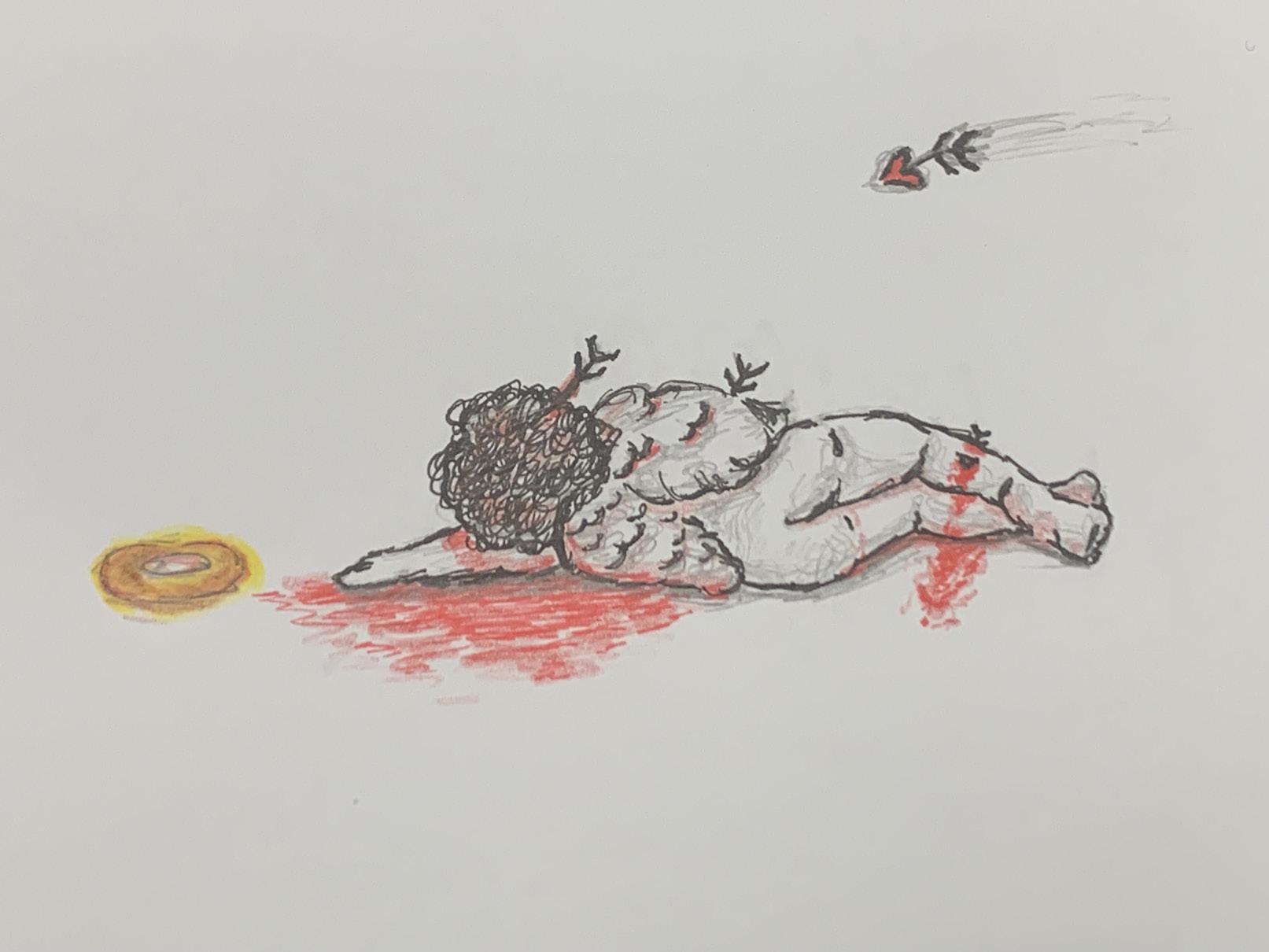
Pencil, Pen, and Ink
Uriah Binder
Valentine’S day
for Myrtle Vona JoHnSton leSter Chuck Hussung
“Z, Y, X,” she would begin, my grandmother who could say the alphabet in reverse. Even yet, even after all the years since third grade, she could still say it, all in one breath. I cannot say it so fast, but I still sometimes say to myself “Z, Y, X, W, V, U, T” With delight for a time that taught its children to revel in reversal.
“Of course, she was born on Valentine’s Day,” my cousin said, And we who loved her nodded in our varied memories of her unvarnished love. Under the shadow of her love, We thrived, we thrive— Still we thrive in her love, Which still sounds and resounds, forward and backward through the years.
Quietly she must have prayed, walking between the fields of tobacco and corn, Or, finished with soup beans and peach pie, finally sitting with her Bible open on her lap, Crying, “Be merciful unto me, O Lord: for I cry unto thee daily,” Naming her sorrows and joys and hopes, naming her husband and their nine children, And naming us, her many other children— God only knows how many she loved.
Love.
When and how did she learn to love?
Kentucky, home to Lesters and Johnstons. Jesus.
JesusJesusJesus, save me.
In her heart, often broken but always breaking open, she must have met (What we found in her then and still find in her heart still alive) Grace of all kinds, Faith, battered and brilliant, Eternity itself, at least once or twice, Doubt no doubt, The Cross, in its many meanings, Baffled believing, Anguish and adoration.
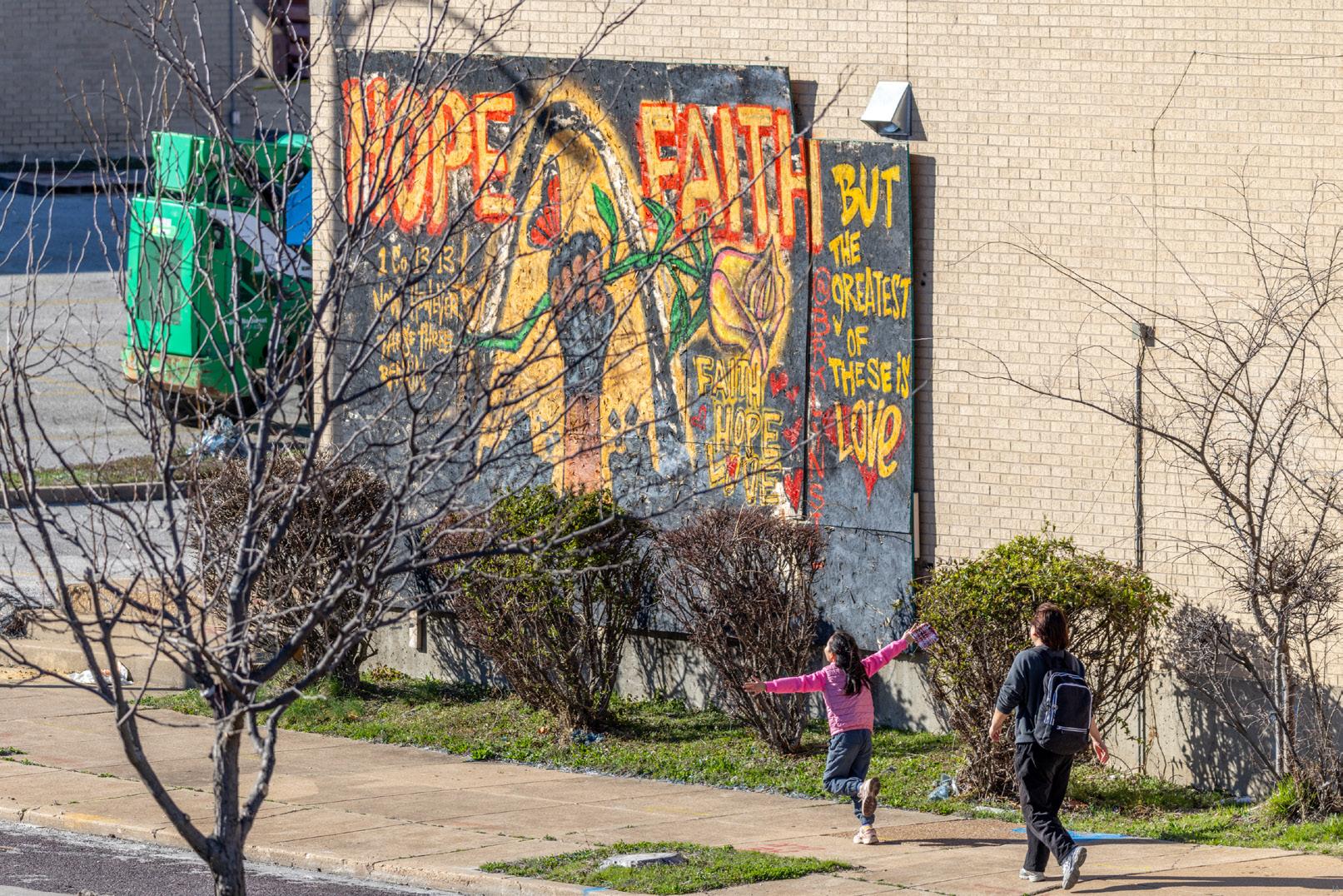
Photograph
Jack Auer
tHe GreateSt of tHeSe iS loVe
a niGHt in deSaru
Colin Dunn
Thehumid air hit Brian’s face the second he stepped out of the airport. It smelled of exhaust and hot pavement. Traffic moved quickly, taxis and double-decker buses flew by. Pieces of English and Mandarin murmured throughout the street, cut off by the rapid honks of the cars. Eventually, a taxi finally arrived and Brian started his way to his hotel after his 32-hour flight to Singapore.
It was 1983, and Brian was 23 years old. He stood at a little over 5’7, and he carried himself with confidence and seriousness unfit for his age. Brian had just graduated college, earning his finance degree from the same university his father went to.
Shortly after graduating, he got a job at the same company his dad worked for, Western Electric. He held a relatively high position there, especially given his age. He wore a suit and a neatly tied tie everyday, along with shoes he kept freshly shined. The job had moved him across the country to Pennsylvania, where he knew no one. Brian didn’t have much of a social life, or really any friends close by. However, each morning when he woke in his quiet apartment, he felt a sense of accomplishment. He was young, already making more money than most of his classmates. The apartment was clean, his face was well shaven, his days were filled with work. Brian was sure this was what success looked like.
It is hard for me to imagine my dad, Brian, being lonely: the man I know, who has always been surrounded by friends, family, laughter, and the warm noise of a full house, alone in his apartment in a city new to him. It is hard to picture my Dad valuing work ahead of everything else in his life after watching him make sacrifices to always be there for me
and my family. However, I am proud of him for doing this, I am proud that he endured this loneliness in his life. I am proud of his determination to get through the hard times, to try his best to make something of himself. I wonder if he ever lay awake at night, seeking the comfort of company, only to assure himself that eventually it would all work out.
A couple months into his new job, Brian was asked to stay in Singapore for a few weeks to help the company with signing contracts to develop a factory there. He sat on the offer for a few nights, debating whether it was a good idea to go somewhere where he literally didn’t know a soul. But after deciding that, after all, his days wouldn’t be much different there than they were working in Pennsylvania, he accepted. Brian packed his bags and boarded the plane set for Singapore. The taxi’s door slammed shut behind him, leaving a brief pocket of silence as Brian looked over the city he would be staying in for the next few weeks. It was well past midnight, but the city’s neon glow illuminated the scene of crowded restaurants and hotels along the busy street. Brian stood, suitcase in hand, watching the taillights of his taxi slowly fade into the distance. He was surprised by the height of the buildings, the vastness of the city. Suddenly a wave of insignificance overcame him. He turned and walked through the revolving door of his hotel.
Brian’s days in Singapore proved to go by more slowly than they had in Pennsylvania. Everyday was similar, his work less meaningful than it had been since starting his job. He had been there for just over six weeks, and he had stopped shaving about halfway through, leaving a thin beard across his youthful face. When he woke at the night, he found him-
self staring into the city through his hotel window, amazed at the flashing lights and the incredible variety of life of those walking below.
I can’t imagine being alone in a foreign country. I know that I would not have taken the offer to go to Singapore if I were my dad. I think his lonely experience in Singapore was what he was expecting when he decided to go, which makes it seem even more unbelievable to me that he would say yes. The unfamiliar streets and language must have driven my dad deeper into the isolation he had already been feeling. However, I imagine the biggest challenge my dad faced in his time in Singapore was the fact that he was fresh out of college, in the prime of his life, wasting his time in a city across the world from everything and everyone he cared about.
After Brian had spent more time overseas than expected, a coworker of his from
Pennsylvania was flown out to assist Brian. The man’s name was Mark Innelsmen, one of the higher-ups at the office. Mark had always been a mysterious figure. He looked about forty years old in the face, but his combedover light blond hair made him look ten years younger. He was tall and always friendly at work. Brian had seen the Cadillac Mark drove to work, along with the expensive suits he wore, though Brian had never really spoken to him prior to seeing him in Singapore.
Mark added some joy to Brian’s life in Singapore, giving him someone to talk to. The two went out almost every night. One day, they decided to take off and rent a car to drive to Malaysia and play golf.
The next day they drove a couple hours to a golf course just outside of Desaru. After the round, the two drove up to a hotel in the city, and they walked up to the front desk to check into their rooms.
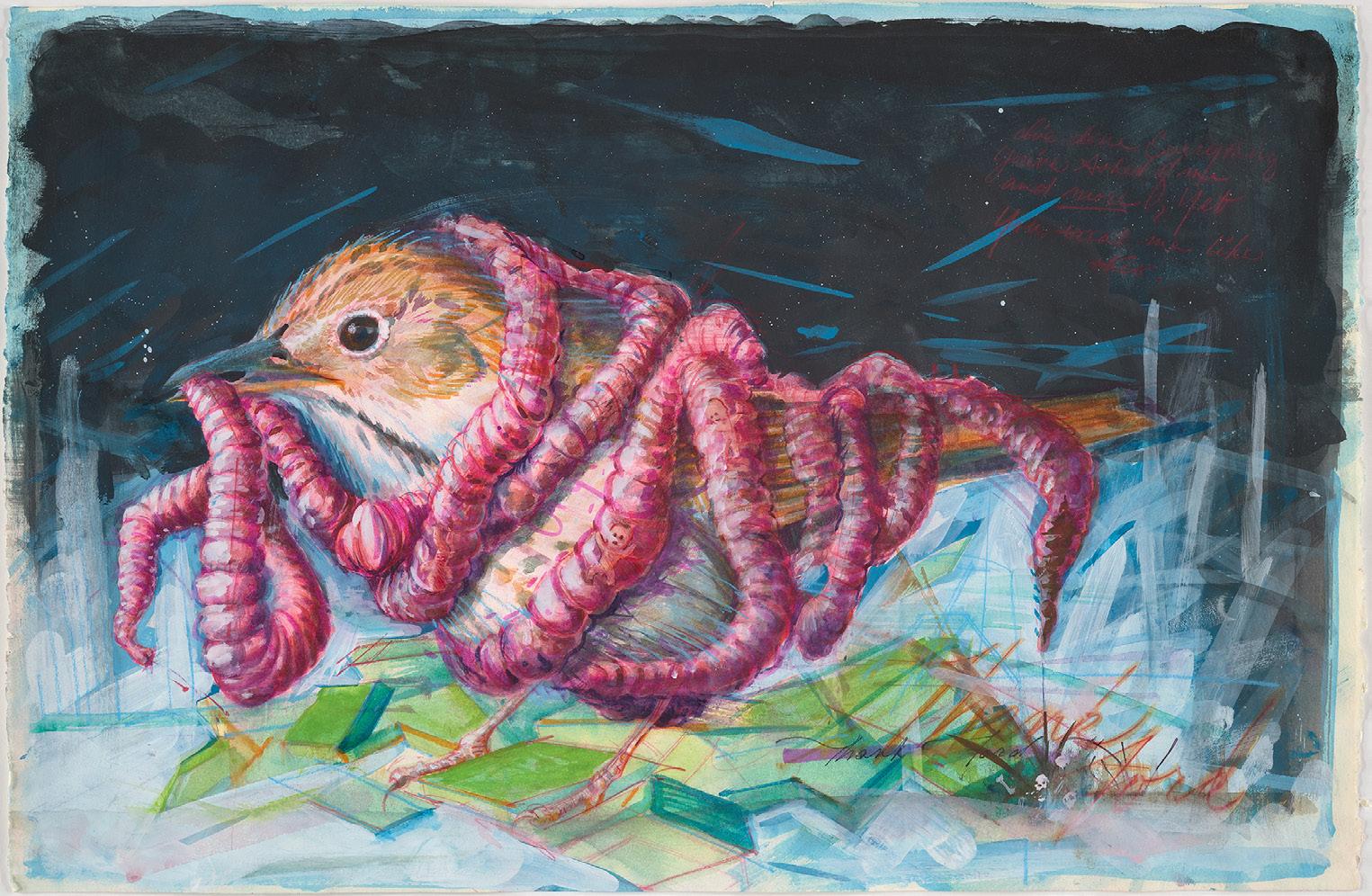
tHe conSuMer
Kevin Wilson
Watercolor
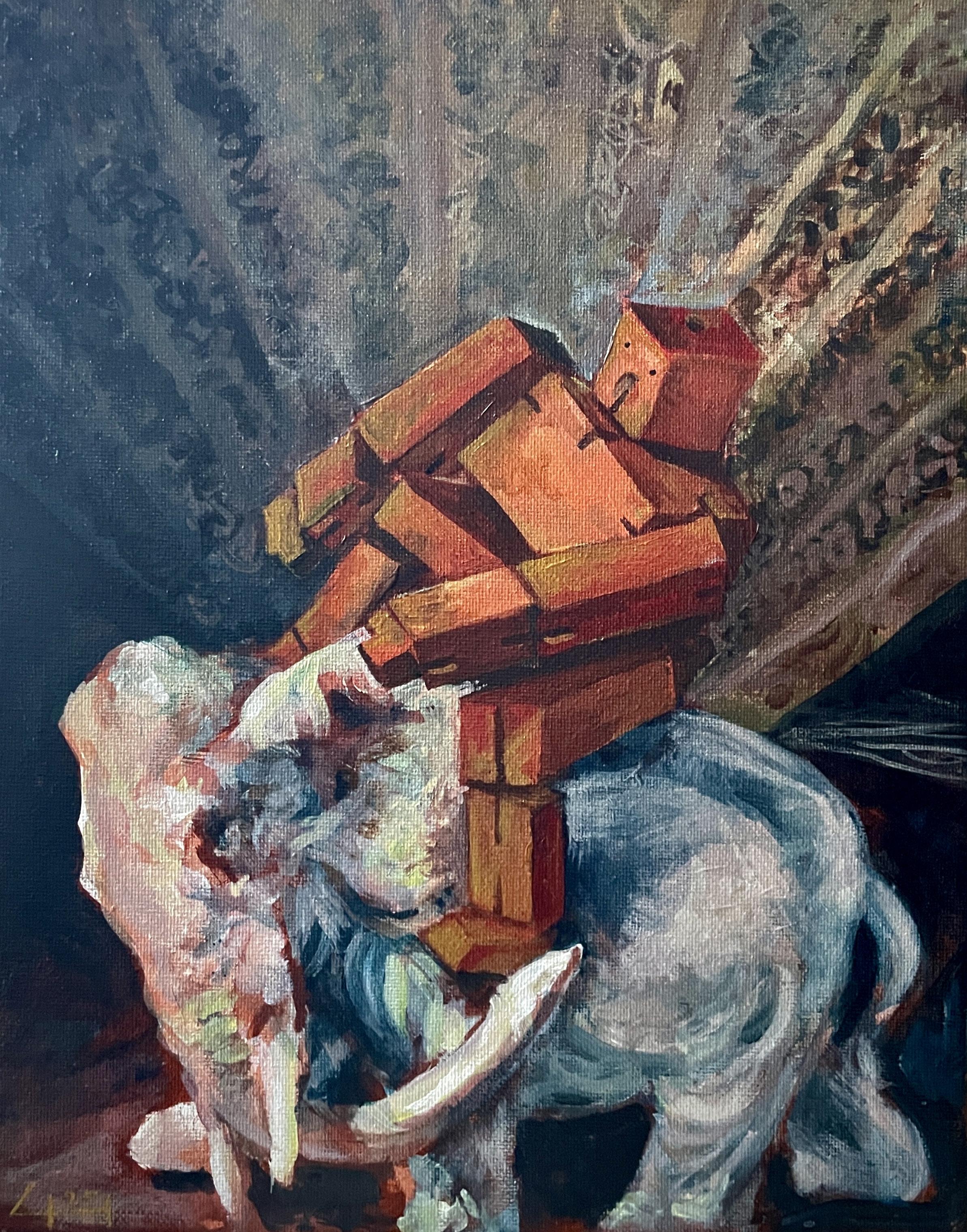
Acrylic
Leo Hahn
croW HoPPer
“Hello, we have a reservation for Innelsman for the night,” Mark said.
“I’m sorry; we aren’t seeing any reservations under that name. We are also fully booked for the night,” said the woman behind the desk.
“Honey,” Mark said, “do you think the president of AT&T would drive all the way up from Singapore to stay here without a reservation?”
“Let me check what we can do.”
Brian and Mark laughed over the lie on the way up the elevator and also at the hotel bar. There, they sat and drank and swapped college stories. As the two soaked in more booze, the conversation carried more weight, heavier and heavier while the two discussed matters deeply personal to them. The night stretched long, long enough for the hotel bartender to eventually cut the drunken Americans off. Mark and Brian decided the night still had more life in it, so they stumbled out of the hotel and into the street..
I have never seen my dad drunk. I wonder what a sight it would have been, two young Americans, drunk off their heels, stumbling through the night trying to find some place to test their limits. I think this night was well overdue for my dad. He was in a dark time in his life, and I think that the sense of joy that comes with being young and filled with alcohol might have helped him more than he realized at the time. As my dad told me this story, his face lit up as he remembered the laughs he and Mark shared after the night. I think that Mark really helped my dad at a time when my dad was desperate for someone to go through life with. Mark’s place in the story shows how much a friend being there for someone can make such an impact in a person’s life.
It took a while for the two to find an open bar; it was already past closing time for most. They did find one eventually. In a city filled with neon lights, there were no neon
signs above the spot the two tumbled into. It was a small brick building a mile from their hotel. When they opened the door, a cloud of smoke escaped into the night, a smell of cigarettes and spilled beer followed.
Inside, the tables were filled with locals playing cards and drinking whiskey. Most of the crowd had tattoos and shaggy beards. Mark and Brian exchanged a look and then took their seats next to the door. The crowd was intrigued; they got up and pushed some tables closer to the Americans. Soon Brian found himself laughing and clinking drinks together with this group of locals. The bar grew rowdy and the drunken merriment echoed throughout the neighborhood.
Standing apart from the group in the corner of the room, a tall man with tattoos running down both of his arms and a scar piercing across his eyebrow kept staring at the two foreigners. Before long, he approached Mark and Brian’s table.
“Why are you here?” he asked. “Work?”
His good English accent surprised Brian.
“Yeah,” Mark said. “We just drove in from Singapore for the night.”
“You Americans, you always travel here far from home, all for work. Work is all you people know. You think your job cares about you?”
The two didn’t reply, now knowing how to respond.
“My cousin worked himself sick in a factory.” Eyebrow continued. “When he died, they replaced him the next week.”
“Listen, we don’t want any trouble,” Brian said.
“No disrespect,” Eyebrow said, lifting his hands. “People give their whole lives to their job. What are you giving yours to? To end up in this bar away from your family?”
Eyebrow was looking at Brian now, waiting for a response, but Brian didn’t know what to say. Staring into the eyes of the man standing above him, Brian felt as if the man
had watched Brian’s whole life on tape before Brian had stumbled in.
“He was right,” my dad said. “I know it now, and I knew it sitting in that chair looking at him.”
“I think it’s time we leave,” Brian said to Mark.
The two got up and made their way out. The walk home was silent. Brian had always been aware that his job was dictating his life, but he had just now been confronted about it, forced to think about the seriousness of it. When he got up to his hotel room, he stared up at the ceiling from his bed and thought about the path his life had taken to get to the moment. In a smoky basement full of strangers in Malaysia, he had come to the realization that it was time to make a change.
“I caught a flight home later that week,” my dad said. “Not to Pennsylvania but St. Louis, where I felt my home really was.”
My dad got a job at Stifel here in St. Lou-
is a little after he got back. He would then go on to meet my mom and start our family. I think that night really opened my dad’s eyes to what was important to him and where he wanted to go. The story makes me think about to what extent I want to value my career as opposed to my joy in life.
I am proud of my father’s decisiveness, to quit what most would think was a great job and a future great career in order to chase real happiness in life. He had spent the beginning of his twenties thinking happiness is something that is earned through hard work, only to find out from a man with a scar in his eyebrow that work can be a dangerous thing if it dictates your life as it was dictating my dad’s. My dad left that bar in Malaysia with a new belief, one that I will carry with me throughout my life: success is not determined by the achievements in a career but by the moments spent with the people that give life meaning.
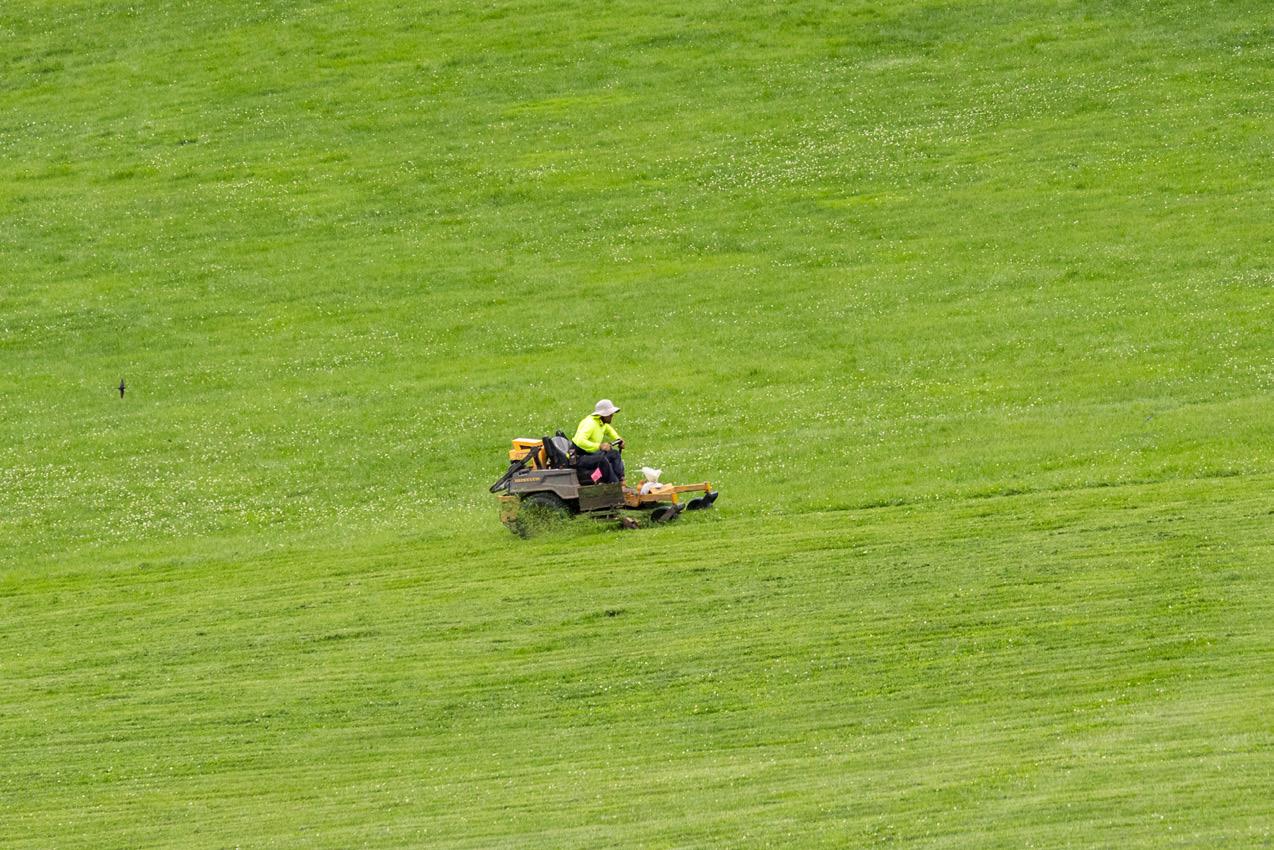
Jack Auer laWnMoWer
Photograph
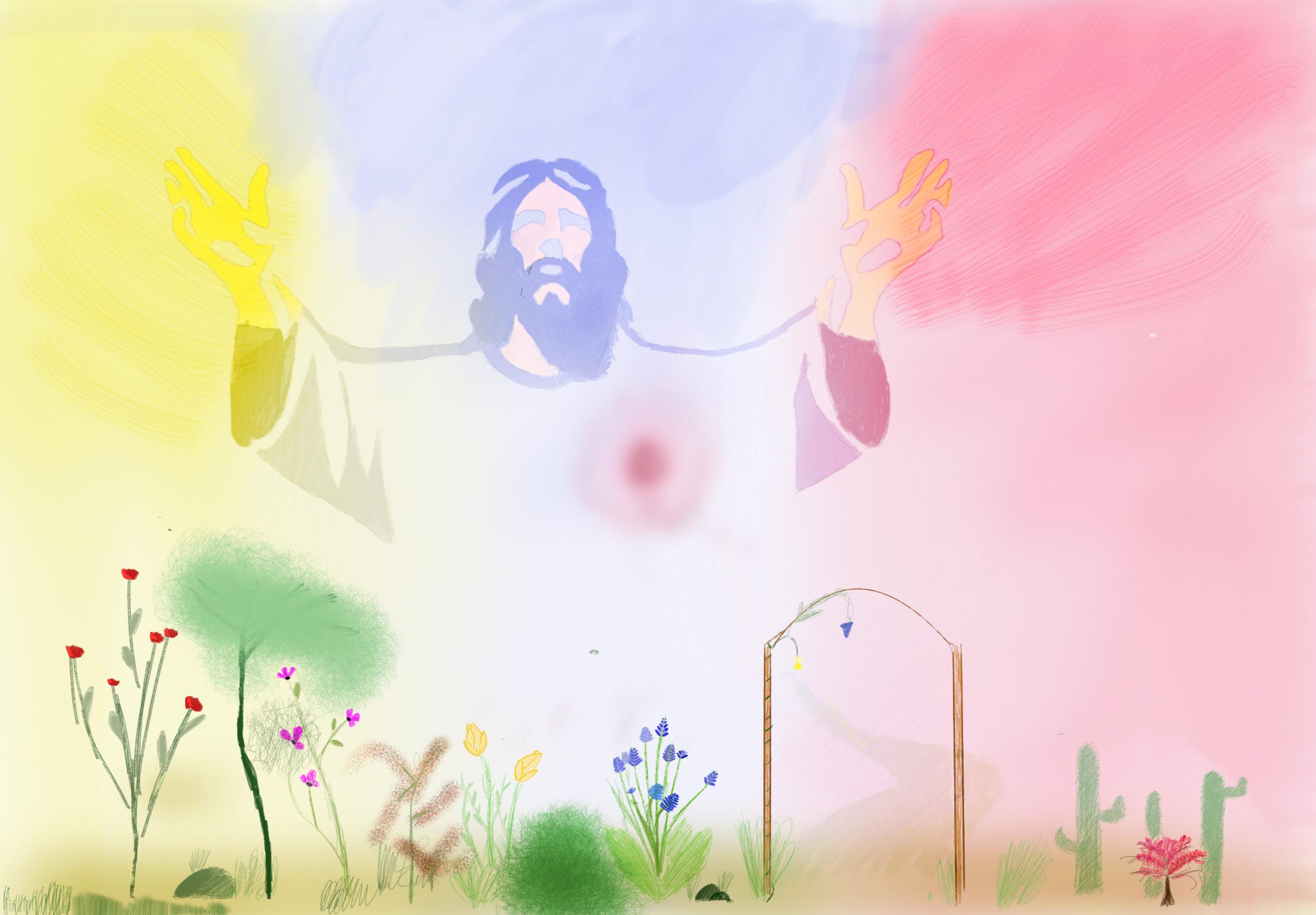
Digital
Guhan Anbukumar
Garden of eden
tHe Bee
Warnicke Beatty, Jr.
take off and fly like a bee
hustling to make honey for its hive before winter hustling to get to every flower every daffodil tulip lily
orchid
before the frigid winter dawns upon us while the fall breeze still remains while we can still get it right
“for the queen!” so we thought we do it for her our mother
queen Aphrodite the epitome of buzzing beauty
“for the hive!” for your brothers sisters you can’t let them down you can’t fail everything is riding on you the hive needs the honey or the hive will fall to the frost
flying endlessly unwavering commitment to the queen honey for the queen honey for the hive honey to survive honey honey honehon hoh-
the bee dies of tuberculosis
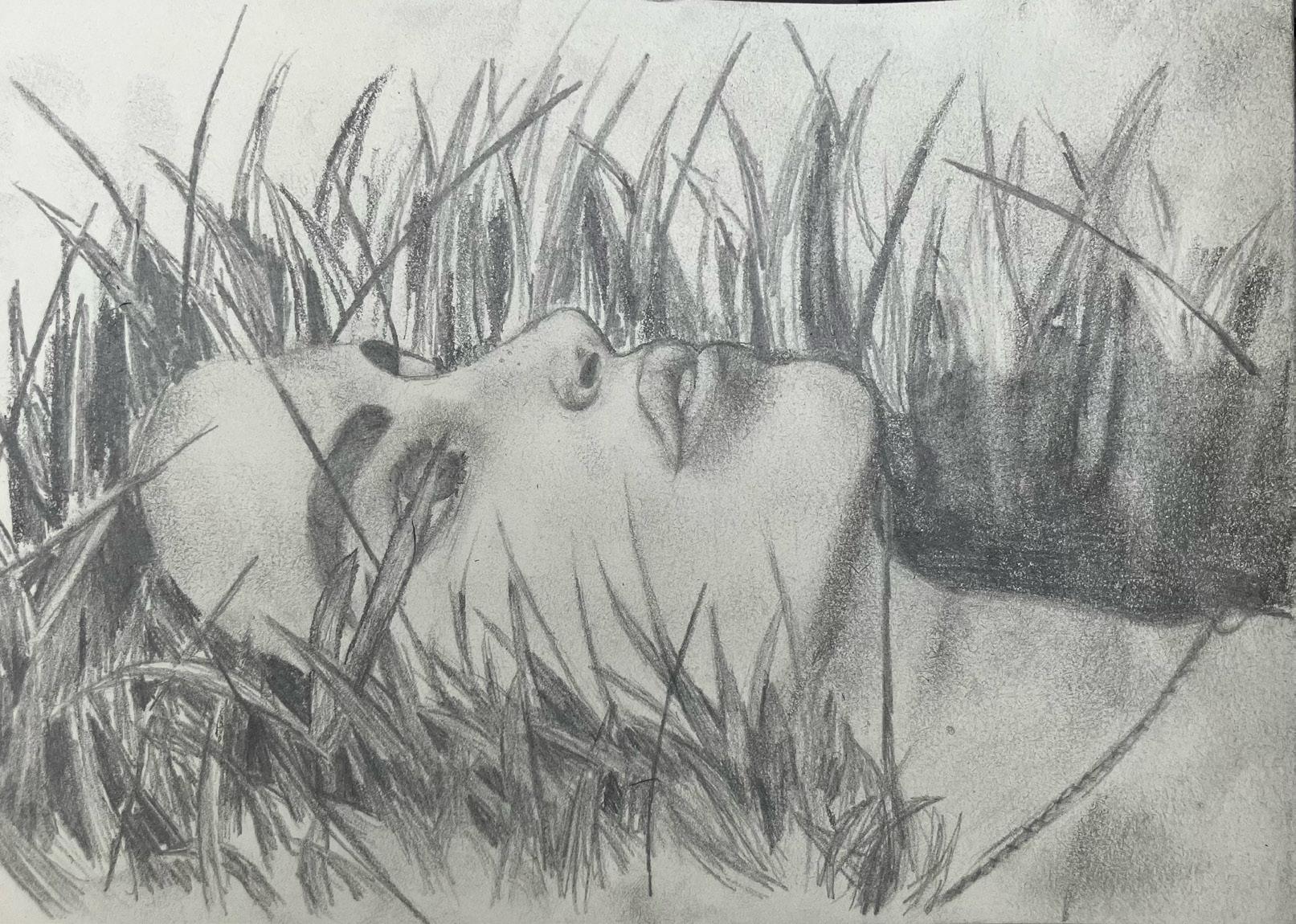
Pencil
Gabe Khazen
el dorado
Joe Talleur
The truth is black and white, I think. Some things float and some things sink, Some things are wrong; some things are right, But the line’s never clear, so we fight.
Why do I feel I must pretend? In speaking my mind, will I lose a friend? Timid, hiding, reclusive, in fear. This is how I disappear.
The day is young, the night is old as fools aim shots at each fool’s gold. I sit and I watch and I look for what’s sound, My eyes drift skyward—wait, I’ve found…