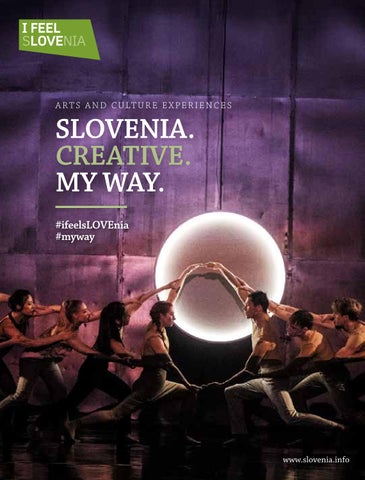
A R T S A N D C U LT U R E E X P E R I E N C E S
SLOVENIA. CREATIVE. MY WAY. #ifeelsLOVEnia #myway
www.slovenia.info
The face of culture is an expression of human creativity. There are cities, places and spaces in Slovenia that cater for people. This is why we feel at home everywhere. 2
ARTS AND CULTURE EXPERIENCES
Cultural Quarter in Kranj
3
6 Feel Good Towns
ultur
8 Architect Jože Plečnik Borderless inspirations across 12 three capitals 16 Vision of twin cities live modernism. To live 18 To well!
transcends the 20 Excellence boundaries of its time
22 Transformative power of art and printmaker Zoran 24 Painter Mušič 26 Face to face with works of art 28 Following global trends 30 Sound and movement 32 Street-born inspiration 33 Venues of inspiration 34 Stages of theatrical life 36 Creativity shaped by community 38 The heartbeat of festivals 40 Film-making Slovenia
42 Time travel
on 44 Cosmopolitanism the doorstep in Alma's foot46 Following steps around Slovenia
48 Historical Towns of Slovenia of castles, diversity 56 Mightiness of experiences 58 Days and nights of culture 60 Heritage for the future turning of time and wheels 64 The – from here to the stars collections and exhibition 68 Museum spaces 72 Interactive and creative
74 Your triangle of happiness 78 80 Fascinating facts 82 Map of Slovenia
Follow us on
Any time is a good time
4
FeelSlovenia
FeelSlovenia
Slovenia
FeelSlovenia
6
Feel Good Towns
Discover the unique architecture of Jože Plečnik and the vibrancy of cities in the east, west and heart of Slovenia. Experience the visions of a cross-border conurbation and the human character of Slovenian modernism.
Feel.slovenia FeelSlovenia
Tourism_slo
SloveniaInfo
Slovenian Tourist Board
22
Transformative power of art
Visual art invites you to galleries, concerts and performances on stages and at festivals, and creative workshops in artists' studios and their community spaces.
42
Time travel
Discover the diversity of Slovenia's regions. Take time to explore Slovenia's historical towns and experience its cultural celebrations.
74
Your triangle of happiness
In just one day you can experience at least three different faces of culturally vibrant, sustainable and ever-active Slovenia. Draw your triangle of happiness!
5
Feel Good Towns The past is alive – and shaping today. Cities combine medieval architecture achievements with the masterful architecture of 20thcentury greats of modernism, as well as original sustainable approaches that create spaces tailored to people. You can see for yourself how comfortable it is to live in the cities beneath the Alps, across Pannonian Slovenia, on the Karst and along the Mediterranean coast, and in the heart of Central Slovenia.
6
FEEL GOOD TOWNS
In Slovenian cities, distances are measured in short strolls. Wherever you go, you feel a refined culture of living. Nowhere is this more evident than in Plečnik’s Ljubljana – inscribed on the UNESCO World Heritage List. The city was designed by architect Jože Plečnik, one of the great masters of European modernism.
Ljubljana
ARTS AND CULTURE EXPERIENCES
More info
7
Architect Jože Plečnik
1872-1957. Architect. Vienna. Prague. Ljubljana. Teacher of modernism. Designer. Lecturer in architecture at the Faculty of Technology in Ljubljana. Prague: Prague Castle, Hradčany, presidential residence. The urban planner of Ljubljana. Member of the Slovenian Academy of Sciences and Arts. A honorary doctor of the Technical College of Vienna and Ljubljana. Plečnik’s Ljubljana: listed as a UNESCO World Heritage Site since 2021. A comic presentation of Plečnik's creative work, with illustrations from the comic-book Plečnik (Full Stop) by authors Dr. Blaž Vurnik and Zoran Smiljani, published by the Museum and Galleries of Ljubljana and Forum Ljubljana 8
FEEL GOOD TOWNS
Dialogue Ana Porok curator at Plečnik House
known among architects and designers, many of whom often visit Ljubljana for the sole purpose of seeing his buildings. His architecture is characterised by his distinctive language of the architecture of eternity, which is a fusion of ancient influences and traditional elements drawn from local architecture and pottery. The best starting point for discovering his works in “For me, it is the building of the National and University Ljubljana is the Plečnik House. He forged his most important Library. He designed it as a carefully considered whole, paying creations on walks and reflections on the route from his special attention to details such as the door handles, chanhouse to the city centre. Even today, the best way to explore deliers, desks and chairs. He was very careful about how the Ljubljana is on foot. Plečnik adapted the city for pedestrians building would integrate into the city. For example, he incorpo- with his designs, often incorporating greenery and park rated the archaeological remains of previous construction arrangements.” work on the site into the façade, showing his respect for the historical value of the construction site. He gave careful conWhat was his lifestyle like? What sideration to the arrangement of the surroundings with green would he offer us if we met him spaces and ensured the accessibility of public spaces. As was for tea? typical of him, he took a holistic approach to the project.” “Plečnik refused to accept payment for his projects in Ljubljana and other Slovenian cities by saying that his How recognisable are Plečnik's works professorial salary sufficed for his needs. His clients often on the international stage? What is expressed their gratitude with various gifts: home-made the attitude of foreigners towards his brandy, wine, culinary delicacies and, during the time of greatness? And where is the best place in Ljubljana to begin exploring his legacy? shortages after World War II, also with firewood and potatoes. He was known for his healthy lifestyle. He did not “Plečnik left his greatest mark in Vienna, Prague and Ljusweeten his tea. He offered guests and friends honey from bljana; although, his works can also be found elsewhere in his beehive behind the house as a sweetener.” Slovenia, as well as in Zagreb and Belgrade. His oeuvre is well
ARTS AND CULTURE EXPERIENCES
“What a person dreams within their soul, what burns inside it, is beautiful. Completed works are nothing compared to this,” Jože Plečnik wrote. And yet: which of the great architect’s completed works most inspires connoisseurs such as yourself?
9
Around Plečnik’s Ljubljana
Meet the master where his spirit still lives. Begin at the Plečnik House with his round study and garden of inspiration. The Slovenia Unique Experience will guide you through fascinating details of his remarkably creative oeuvre. See Ljubljana with new eyes. Step into unrealised visions of Jože Plečnik by means of augmented reality.
10
1. 2. 3. 4. 5.
FEEL GOOD TOWNS
Triple Bridge Plečnik’s Ljubljana is a unique and comprehensive 20th-century work of art. The Triple Bridge and its balustraded railings rising above the Ljubljanica River give the city centre a distinctive appearance.
National and University Library This is a building with a special character with windows looking like waves or open books. Its interior is a temple of knowledge that leads visitors up a dark ancient Propylaea-styled staircase to a light reading room.
Central Market Plečnik gave the people of Ljubljana a masterfully designed riverside marketplace. The outdoor area with its arcades is evocative of ancient forums, while spiral staircases lead into the interior spaces.
Križanke The former monastery is now an event venue that was rebuilt by Plečnik with a string of courtyards for the Ljubljana Festival, one of the oldest European summer festivals.
Žale Central Cemetery Plečnik focused heavily on the sacred and spiritual. The Žale Central Cemetery is known for its memorial complex, monumental entrance, and many chapels of various designs.
The Church of St Michael, Ljubljana Marshes
Parish Church of our Lord's Ascension - Plečnik's Church, Bogojina
Plečnik's Ljubljana is distinguished by the famous architect’s selected works, which are inscribed on the UNESCO World Heritage List due to their uniqueness. The Triple Bridge, an architectural icon, is one of the key works of architect Jože Plečnik in Ljubljana.
Plečnik's Staircase, Fountain and Arcades, Kranj
You can explore the unique heritage of the renowned architect in numerous places throughout Slovenia.
ARTS AND CULTURE EXPERIENCES
Plečnik's creations throughout Slovenia
More info
11
Borderless inspirations across three capitals MB
With its lively rhythm, rich cultural institutions, LJ diverse venues and a GO central location, Ljubljana – Slovenia’s capital – is the perfect starting point for discovering the country’s cultural heartbeat. To the east, Maribor invites you to explore its character as Slovenia’s second-largest city and the first Slovenian city to hold the title of European Capital of Culture in 2012. To the west lies Nova Gorica, which, together with its neighbouring Italian twin city Gorizia, forms the first cross-border European Capital of Culture, captivating visitors with bold cultural and artistic projects and vibrant events.
12
FEEL GOOD TOWNS
Cultural transversal of Slovenia
Ljubljana
• Capital of Slovenia • UNESCO World Heritage Site • UNESCO City of Literature • 50 museums and galleries • More than 11,000 events annually
Maribor
Dragon Bridge, Ljubljana
• 2012 European Capital of Culture • City with the oldest vine in the world • European Best Green Capital 2025 • University and festival city
Lent, Maribor
• 2025 European Capital of Culture • Youngest Slovenian city • A place of culture that transcends borders
Festival events, Nova Gorica
ARTS AND CULTURE EXPERIENCES
Nova Gorica
and connects cultures on Europe Square
13
different
Visiting all three cities reveals a diversity of urban design and architecture. In Plečnik’s Ljubljana, you’ll encounter a unique vision of human-centred design. In Nova Gorica, Slovenia’s youngest city, the modern energy of Ravnikar’s post-war urbanism comes to life. And in Maribor, set at the foot of the Pohorje Hills, you’ll discover a city shaped by its distinctive modernist neighbourhoods and open urban spaces.
You can easily spot striking details in all three cities. On your urban strolls in Nova Gorica, stop by the bronze model that depicts the city as envisioned by architect Edvard Ravnikar. In Maribor, visit Trafika (Kiosk), which, at 7.5 m2, is the smallest museum in Slovenia. Among the things that will catch your attention in Ljubljana are unique pieces by Slovenian designers of the Zoofa cooperative. Rusjan Square, Monument to Edvard Rusjan, Nova Gorica
Maribor and Ljubljana are well-established European festival cities. Festivals of various artistic genres and more than eleven thousand events take place in Ljubljana each year. Maribor is famous for the Lent summer festival, the Old Vine festival and other cultural, entertainment and ethnographic events. In Nova Gorica, the 2025 European Capital of Culture, the R.o.R. intermedia art festival also has special significance.
Ana Desetnica Street Theatre, Ljubljana 14
FEEL GOOD TOWNS
lively
Ljubljana Ljubljana is the epicentre of Slovenian cultural and artistic production. Get to know the creativity of contemporary artists and artisans in their studios. Experience various events at outdoor venues, major cultural institutions and contemporary centres of creativity and art, such as Center Rog and Cukrarna. Maribor also ranks among the top European destinations due to internationally renowned artistic performances at the Slovenian National Theatre Maribor, its galleries, the Minoriti and Židovska cultural quarters, the idyllic City Park and the Lent waterfront on the Drava, where the oldest vine in the world grows. In Maribor, the whole city is a stage! Nova Gorica is a vibrant urban centre that, as the European Capital of Culture, connects the entire western Slovenia region. The cultural flows from the Soča Valley, the Brda region, the Vipava Valley and the Karst also pour into the city. The cultural venues in this modernist city, designed as a city in a park, include the famous Europe Square, which connects the twin cities of two nations.
Lent Festival, Main Square, Maribor
In the capital of Slovenia, the guided tours will lead you to the marketplace and a culinary time machine, to the era of Roman Emona or secession, to the architect Plečnik and to the studios of various masters. Tours of Maribor will take you over bridges and into wine cellars, revealing why the city is a metropolis of theatre, art and local characters. In Nova Gorica, you can learn how goods were smuggled across the border during the era of the former Yugoslavia, admire the native orchards between apartment buildings and in the countryside of the Vipava Valley, or experience the Soča River, either in the Doblar Museum of the power producer Soške Elektrarne or by rafting in the kingdom of the Julian Alps, where it has its source.
More info
ARTS AND CULTURE EXPERIENCES
Strolling through the streets and squares of these three cities is always a delight, with charming sights and welcoming places to meet. The experience becomes even better when shared with the locals and with guides who know every story of their streets. Discover each city’s character through guided walks and unique boutique experiences.
15
Vision of twin cities
Nova Gorica, the youngest Slovenian city, which emerged from nothing on the wings of modernism after World War II, and Italian Gorizia, a city with a tradition of more than a thousand years, form the first borderless European Capital of Culture. This concept connects creativity from both sides of the countries. The vision of a unified conurbation came to life through the vibrant programme of ECoC GO! 2025.
16
FEEL GOOD TOWNS
Discover the connection between the two cities and their wider regions. Experience culture, cutting-edge art, unstoppable creativity and a unique cultural heritage. Take a stroll between Nova Gorica and Italy’s Gorizia across the shared Europe Square. Visit the exhibitions and venues of the European Platform for the Interpretation of the 20th Century (EPIC), which offers an insight into the past century’s complex history. Explore the new joint urban district, the ECoC District, a technological urban quarter with sustainable solutions, the Atlas of Forgotten Orchards and tree-lined platforms. The ECoC paid special tribute to artists who, during their lifetime, made a mark on the cultural history of the 20th century around the world. These include architect Edvard Ravnikar, painter Zoran Mušič and psychiatrist Franco Basaglia. You can visit each of them in the places where they left a lasting mark: Ravnikar on the unfinished main road (magistrala) of Nova Gorica, Mušič in his hometown of Bukovica, and Basaglia in Basaglia Park in Gorizia.
“In times of new wars, the lessons of peaceful but creatively turbulent coexistence are exceptionally important. How do you sew two cities together? With shared green spaces, circular public transport and cycling trails, and first and foremost with the collaboration of creators and the building of audiences. This is why the linguistic dimension, which is also called ‘passive multilingualism’, is so important: we strive to create situations in which we would understand each other, even if everyone spoke their own language.” dr. Stojan Pelko, Programme Manager of the GO!2025 project
Two cities, countless borderless stories of culture, art, creativity and visionary thinking.
Moments from the Events of the European Capital of Culture GO! 2025 Nova Gorica–Gorizia.
ARTS AND CULTURE EXPERIENCES
More info
17
To live modernism. To live well! What would Slovenian cities be without the legacy of modernism? It is hard to picture Ljubljana without Republic Square and Cankarjev Dom, Velenje without Tito Square and the Cultural Centre, or Kranj without its Town Hall building and the former shopping centrethat has evolved into a library. Could Nova Gorica exist without its grand thoroughfare and numerous parks? Modernism –and the principles it introduced – continues to shape the character of Slovenia’s cities, making life in them not just functional, but truly beautiful. How to recognise the modernist style and why is it so important for the quality of life? “Modernism was not actually a style, but a movement that sought to establish a new classless society through architecture and design. For this reason, one of its key principles was also that good design of everything that surrounds individuals should be accessible. Various Slovenian companies, such as Iskra (Davorin Savnik's famous ETA 80 telephone), Meblo (kitchens and living room sets), Stol Kamnik (Niko Kralj's Rex chair), Steklarna Hrastnik, as well as the Dekorativna textile company, employed designers who developed cutting-edge solutions and well-designed and accessible products.”
Beautifully designed products only enhanced the quality of life provided by new residential neighbourhoods in the post-World War II era, right? The first strokes of modernism appeared in Slovenian cities as early as the 1930s, but these were generally limited to small city districts, such as the villa quarter in Vrtača or Slovenska Road with the Nebotičnik skyscraper in Ljubljana. The exception is Murska Sobota, which has developed from a rural settlement into a modern urban environment with modern new buildings and parks. The greatest expansion of modernism occurred after
18
FEEL GOOD TOWNS
World War II, when socialist Yugoslavia built new cities such as Velenje and Nova Gorica and, especially, large residential developments. These have greatly improved living conditions in cities. The principle of building as much as possible as quickly as possible greatly increased the accessibility of housing in many Slovenian towns. The apartments were carefully planned, sunlit, with a well-designed floor plan and often already at least partially furnished. They were located in neighbourhoods with lots of green spaces and all the necessary infrastructure, from schools, kindergartens, sports courts and playgrounds, shops and post offices to community health centres.
MAO, which is one of the oldest museums of architecture and design in Europe, houses the most extensive collection of the architectural and design heritage of Slovenian creators from the era of modernism. How resonant are their works today? “The products and architectural solutions of the so-called golden age of Slovenian design and architecture (the 1950s, 1960s and 1970s) are still considered the pinnacles of good design. They are distinguished by careful design, exceptional craftsmanship and experimentation. Thus, they remain not only a role model, but a kind of compass that shows what can be done in design and architecture at a given moment and under certain circumstances.”
Dialogue
Exhibition The Structure of Modernity: Edvard Ravnikar’s Explorations, MAO, 2023.
ARTS AND CULTURE EXPERIENCES
Dr. Martina Malešič curator in the Museum of Architecture and Design (MAO)
19
Glass. Being different. In the mid-20th century, the culture of living was significantly influenced by the design of items for the modern home, made of ceramics and glass. Among the important designers of this era was Janja Lap. After exploring various glassmaking techniques, she also created a water glass called gubanka (indented beaker glass). The gubanka glass is on display at the National Museum in the permanent exhibition of the Gala Banquet collection.
Fish. Childhood. The concrete statue of a fish, erected in Ljubljana’s Tivoli Park in 1958, and its 60 years younger replica in the centre of the capital, is a work of art by Plečnik's student Vladimira Bratož Furlan as well as a part of a children’s playground. This fish, which delights at night with its tiny dots of light, awaits you on the Gallus Embankment in Ljubljana. The original fish can be found in Tivoli Park next to the playground by the Tivoli swimming pool.
Telephone. Sonority. This famous telephone, designed by Davorin Savnik and manufactured by the electronics giant Iskra, won prestigious international awards for its design and originality. Enabling the choice of a random ringtone, it was also the official telephone of the 1980 Olympic Games. The Iskra telephone is part of the collection of the Technical Museum of Slovenia and the Museum of Architecture and Design (MAO).
Red K67 kiosk. Flexibility. In the second half of the 20th century, the urban centres of Slovenia and Europe were embellished by kiosks with a smooth plastic shell and a multifunctional structure with the option of infinite expansion in countless compositions and configurations. Saša J. Mächtig designed the kiosk, which can serve many different functions, in the spirit of the 1960s and the first Moon landing. The Museum of Modern Art in New York included the kiosk in its 20th-century design collection. Two units of the famous kiosk stand at the entrance to the Museum of Architecture and Design (MAO) and on the platform in front of the office building of the Delo media house in Ljubljana. Refurbished kiosks occasionally accompany various events taking place in Slovenia. 20
FEEL GOOD TOWNS
Excellence transcends the boundaries of its time Many objects designed in accordance with the principles and during the time of modernism have become legendary both in Slovenia and internationally.
Rex. Flawlessness. This ergonomically designed chair by Niko Kralj is a cult modernist achievement, included in the collections of the world's most prestigious museums. More than two million of this chair, which awed with its foldability and airy appearance when it was designed, have been produced so far. You can sit on the Rex chair in the café of the Museum of Modern Art and in the café of the Museum of Architecture and Design (MAO) in Ljubljana. Also housed in MAO is a collection of photo collages by Niko Kralj, including presentation material for the Rex chair.
Transformative power of art What will be is being created now. It is being born of the relationship between creation and observation. A show needs viewers. Music needs listeners. All art venues in Slovenia are permeated by the closeness between creators and viewers. Festivals foster the co-existence of different people. We view iconic works in galleries in intimate moments, when no one is breathing down our necks. The energy of new centres of creativity further enhances the power of art. It is a constant interplay of light and shadow, as the famous Slovenian painter and printmaker Zoran Mušič was able to portray in a unique way.
22
TRANSFORMATIVE POWER OF ART
ARTS AND CULTURE EXPERIENCES
The Biennial of Textile Art BIEN showcases textile art and industrial design across the Gorenjska and Goriška regions every two years, presenting exhibitions and projects that delve into heritage, preservation and sustainability.
23
Painter and printmaker Zoran Mušič 1909 – 2005. Academic painter and printmaker. One of the most prominent European painters of the 20th century. The first modernist Slovenian artist to establish himself on a European and global scale. He graduated from the Academy of Fine Arts in Zagreb in 1934. The cycles Konj (Horse), Izžgana zemlja (Scorched Earth), Cortinski liki (Cortina Characters), Nismo poslednji (We Are Not the Last), Kamnite pokrajine (Rocky Landscapes), etc. Exhibitions in Paris, the Venice Biennale, Documenta in Kassel, Vienna, Rome and elsewhere.
Unique artistic language
Recipient of numerous awards, including the Chevalier of the Order of Arts and Letters (Chevalier de l'Ordre des Arts et des Lettres) of the French government in 1970, and an external corresponding member of the Slovenian Academy of Sciences and Arts since 1981.
24
“Zoran Mušič was distinguished by his percipience, persuasiveness, power of expression, content and unique artistic language, straddling figurative and abstract artistic expression. His love for the landscape and the figure gradually led to a unique choice of brown as the underlying colour, touching colour transitions and gradients, a recognisable combination of compositions and sovereign lines, which emphasised the intertwining of figure and landscape into the body of the landscape and the landscape of the body.” Nelida Nemec, art historian and co-curator of the permanent collection of Mušič's prints in Dobrovo Castle in Brda
TRANSFORMATIVE POWER OF ART
Tribute to Slovenia
Mušič was a cosmopolitan and the only Slovenian painter in the second half of the last century to make his way into the elite artistic circles of Italy and France, especially Paris, where he lived and created for most of his adult life. He painted landscapes, still lifes, portraits, Dalmatian donkeys and horses, self-portraits, trees, scenes of horror from the Dachau concentration camp, motifs from Dalmatia, Venice, Paris, the Dolomites, the forest of Fontainebleau near Paris, church interiors, double portraits with his wife Ida, and old age self-portraits.
Zoran Mušič's paintings, prints and drawings are kept in the most distinguished museums and galleries in Europe, such as the Tate Modern and the Louvre. If you want to quietly immerse yourself in his world and truly experience Mušič's artistic expression, visit the National Gallery and the Museum of Modern Art in Ljubljana, the Maribor Art Gallery, the Kambič Gallery in Metlika, and the Zoran Mušič Gallery in Dobrovo Castle in the heart of the Goriška Brda region, where 134 prints that Mušič donated to his homeland are exhibited.
Zoran Mušič, Konjički (Cavallini), (1949), National Gallery, Ljubljana – Donation of Ljuban, Milada and Vanda Muši to the National Gallery.
ARTS AND CULTURE EXPERIENCES
Cosmopolitan
25
Face to face with works of art Enter the galleries and visit internationally renowned biennial and triennial exhibitions. You will notice that many Slovenian galleries open their doors wide to contemporary art, which subtly holds up a mirror to society. Contemporary art galleries actively promote contemporary artistic practices and cocreate an inspiring environment for new generations of creators. Interesting works of art also await you in galleries in several Slovenian historical towns.
Cukrarna in Ljubljana is a new hub for the articulation of thought, production and presentation of contemporary art projects. Among other things, it attracts visitors with an internationally renowned exhibition featuring the joint work and lives of Ulay and Marina Abramović. MG+MSUM, the Museum of Modern Art in Ljubljana is, together with the Museum of Contemporary Art Metelkova, the epicentre of Slovenian contemporary art. The permanent collection takes you from the entry of fine art modernism into the Slovenian art scene, the avant-garde of the 1920s, and Partisan art to the retro-avant-garde of the 1980s. 26
TRANSFORMATIVE POWER OF ART
Kofetarica, (Woman Drinking Coffee), a work by Ivana Kobilca, one of the most successful Slovenian female artists, on display at the National Gallery of Slovenia.
The National Gallery houses the most extensive collection of works of art in Slovenia. Standing out among its treasures are the works of painter Ivana Kobilca and the permanent exhibition of works by Zoran Mušič, an internationally renowned modernist artist. There is also a room for gallery mindfulness, where a different work of art is displayed every three months, enabling visitors to experience it in an intimate way.
galleries Internationally renowned
For more than half a century, the International Biennial of Industrial Design, one of the oldest in the world, has been one of the most compelling reasons for a visit to Slovenia involving a touch of creativity. Initially focused on industrial design, it is now evolving into an interdisciplinary platform that connects design with art, science and social issues. Also attracting the attention of the international art community is the Ljubljana Biennial of Graphic Arts, which celebrates its 70th anniversary in 2025, and the EKO Triennial in Maribor, which is dedicated to the connections between art and the environment. Also worth seeing is the exhibition set up to mark the 70th anniversary of the Maribor Art Gallery collection.
With exhibitions by contemporary artists from all over the world, the Maribor Art Gallery creates a dialogue between the past and the future, and between the local and the global. Painting, sculpture and printmaking are joined by photography, video, multimedia installations and interactive projects.
The Božidar Jakac Gallery – Museum of Modern and Contemporary Art features exhibitions by contemporary artists in the former Cistercian monastery in Kostanjevica na Krki, while the surroundings of the gallery are embellished by more than a hundred sculptures created by artists from all over the world.
The Piran Coastal Galleries consist of a regional museum of contemporary fine art and a documentation, research and education centre with a representative collection of contemporary Slovenian art after 1976. Among others, it houses works by the international art movement Fluxus.
The Koroška Gallery of Fine Arts in Slovenj Gradec is a museum of modern and contemporary art that has been building an important international socially engaged collection since the major exhibitions under the auspices of the United Nations (1966, 1975, 1979 and 1985).
Ulay and Marina Abramović in the performance Relation in Time; this performance by the world-renowned “grandmother” of performance art and a pioneer of body art, performance and Polaroid photography is part of the ART VITAL exhibition at Cukrarna in Ljubljana. This exhibition in one of the newer hubs of cultural events in Ljubljana and Slovenia is attracting the attention of the international art community.
ARTS AND CULTURE EXPERIENCES
More info
27
Following global trends Slovenia surprises the world with the astonishing diversity, boldness and potential of its artists, who have earned a place on the global stage with their visions and works. With a spark of profound humanism, they transform individuals, communities and society. They help us look wider, further, beyond the visible.
Internationally recognised Slovenian contemporary art The visual, performative and intermedia practices of Slovenian artists are presented in distinguished galleries, at international biennials and festivals. Get to know some of the world-renowned artists from Slovenia. Contemporary visual and intermedia arts are represented by internationally recognised artists such as Jasmina Cibic, who explores the construction of national cultures through performance, installations and film, and Maja Smrekar and Marko Peljhan, who explore the relationships between an individual, society and nature through the intertwining of art, science, technology and ethics. Working on the level of monumental installations that challenge the relationships of space and architecture is sculptor and video artist Tobias Putrih. His works are exhibited in prestigious museums and galleries, including MoMA in New York. Multiple award-winning animator Špela Čadež uses handmade puppets to take viewers into the world of animated stories that touch on human hardships and longings. Her creations resonate at major festivals around the world. Shining bright among filmmakers with intimate stories and masterful direction is Olmo Omerzu, who has won many awards from European festivals. With their own unique expression, his films subtly explore the complexity of interpersonal relationships. A special chapter within the performing arts is being written by choreographers such as Edward Clug and Valentina Turcu, and theatre directors such as Tomi Janežič, Mateja Koležnik and Livija Pandur. Drawing attention is Pandur Theatres, an international theatre organisation that has excited audiences from Mexico to China, from Russia to Greece, from Spain to Germany, ever since it was established by the late Tomaž Pandur. 28
TRANSFORMATIVE POWER OF ART
With their innovativeness, Slovenian creators impact the design of products of world-renowned brands. Their solutions help create trends in fashion, technology, design and many other areas.
Numerous architectural firms are setting new standards for the design of the urban fabric with their imaginative projects. Designer Lara Bohinc has made it to the very top of global luxury with her unique jewellery and furniture. Nataša Čagalj, who has collaborated with world-renowned brands such as Cerruti, Lanvin and Stella McCartney as a designer, consultant and creative director, is a testament to the exceptional flexibility of Slovenian talent.
“Every cherry in the world has been blessed with a shape that is both simple and mysterious. With a simple design but a luxurious final effect, cherry lamps allow for many combinations that follow from a very primal movement and contain a touch of poetically coded freedom.” Nika Zupanc an internationally recognised Slovenian designer Black Cherry Lamp by world-renowned industrial designer Nika Zupanc
ARTS AND CULTURE EXPERIENCES
Designer Nika Zupanc, who is a regular guest at the world's largest design fairs with her sensual and playfully minimalist products, successfully proves that the innovation and spiritual breadth of Slovenian art knows no boundaries. Zupanc collaborates with many distinguished brands. With poetic sophistication and almost theatrical drama, her creations are often the focus of attention among both art collectors and influential magazines.
29
Music and dance in Slovenia surprise with a dynamic intertwining of tradition and innovation. They explore new forms of expression and encourage experimentation. Their artistic stories appeal to audiences with their depth and freshness. Many artists from Slovenia attract the attention of the international public.
Gibanica, a biennial of contemporary dance art held in Slovenia
Sound and movement
30
TRANSFORMATIVE POWER OF ART
DJ Umek has long kept the world's attention with techno beats, and Gramatik with a unique blend of hip hop, funk and soul. The cult band Laibach, the pioneers of industrial music, excite with their uncompromising and provocative artistic stance, while the duo Silence captivates with their melancholic atmosphere and sophisticated arrangements. Pianist Kaja Draksler is conquering jazz stages, while the band Joker Out, who describe their music as “shagadelic rock'n'roll”, introduce Europe to popular music trends from Slovenia.
Appeal of contemporary dance The contemporary dance scene in Slovenia is famous for internationally renowned artists such as Edward Clug, choreographer and artistic director of the ballet company of the Slovenian National Theatre Maribor. Also proving that dance is borderless is the first permanent cross-border dance ensemble, which actively realises the idea of borderlessness on the border between Slovenia’s Nova Gorica and Italy's Gorizia as part of the European Capital of Culture. Slovenia is also the home of the permanent international contemporary dance ensemble EnKnap Group (EKG), which has participated in major dance festivals with its original contemporary dance performances for almost two decades.
Gibanica, a biennial of Slovenian contemporary dance art, also draws attention to contemporary dance creativity. The biennial has presented a curated selection of the most prominent contemporary dance performances since 2003.
ARTS AND CULTURE EXPERIENCES
t
Modernity of music
31
Street-born Inspiration
The image of some Slovenian cities is embellished by graffiti, murals, lighting interventions and other forms of street art. In some places, special areas of public space are dedicated to this type of creativity in Slovenia, which is celebrated at dedicated events and festivals.
The art of street interventions In Ljubljana, street art is most noticeable at Metelkova, which has been well-known as an alternative cultural centre for many years. Graffiti, murals and art installations make it a sort of living open-air gallery. Urban creativity can also be easily spotted in other parts of the city, where you can take a tour with a guide who will show you the most interesting street art venues. There is an outdoor mural exhibition area next to Magdalena Park in Maribor. In Kranj, the centre of the action is Layer House and the nearby city streets embellished by graffiti and murals. You can also see large murals in Koper in Cankarjeva Street. Reading the streets with creators Since 2019, the Ljubljana Street Art Festival, the first festival of contemporary street art in Slovenia, has been encouraging people to take a different view of the streets, and pointing out that graffiti, murals and other interventions in space are one of the most important contemporary art movements of the 21st century. The Lighting Guerilla Festival, which brings urban spaces in Ljubljana to life with installations, and the R.o.R international festival of contemporary, intermedia and performative art practices in Nova Gorica create different images of public spaces. Every July, the streets of Ljubljana and other Slovenian cities come alive with genre-diverse performances and artistic interventions by domestic and foreign street artists participating in the Ana Desetnica Festival.
Graffiti and murals are a form of street art that has transformative power. By leaving messages in public spaces and revitalising individual areas, they affect the aesthetics of urban space. Their accessibility encourages interaction between residents. 32
TRANSFORMATIVE POWER OF ART
Street Art Fest – Street Art Festival Grad Snežnik Koper, mural by Tine Dekorti
is the successor to one of the oldest musical institutions in Europe, the Academia Philharmonicorum in Ljubljana, founded in 1701. Its symphony orchestra and choir collaborate with renowned conductors and soloists from around the world.
is a multifunctional cultural centre in Ljubljana, built in accordance with the plans of architect Edvard Ravnikar. Since 1982, it has been the central venue for numerous cultural, artistic and educational events and congresses in the country.
Križanke Outdoor Theatre in Ljubljana has been a popular venue for summer concerts, opera, theatre and other performances since 1952. Built in accordance with the plans by architect Jože Plečnik, it was conceived as an outdoor theatre.
The Slovenian National Theatre Maribor (SNG Maribor) has operated in a theatre building since 1852. It is one of the few institutions that hosts theatre, opera and ballet companies under one roof. Opera experienced a boom when the theatre was professionalised after World War I. In recent decades, the ballet company has established itself as one of the leading companies in the region.
The Slovenian National Theatre, Opera and Ballet Ljubljana is the central opera and ballet house in Slovenia, housed in one of the most important neo-Renaissance buildings in Ljubljana, built in 1892. It stages both classical opera and ballet works as well as contemporary and innovative productions.
The Little Prince, Slovenian National Theatre, Opera and Ballet Ljubljana
ARTS AND CULTURE EXPERIENCES
The Slovenian Philharmonic
Cankarjev Dom
Venues of inspiration
A performance in a prestigious opera house or beneath the walls of a fairy-tale castle? A concert on the grand stage of the Slovenian Philharmonic or deep inside a karst cave? An art installation in a gallery or in the forest? In Slovenia, the stage is everywhere. The country surprises with its various venues and the appeal of national cultural spaces.
33
Stages of theatrical life 34
Carmina Burana, choreographer Edward Clug, Slovenian National Theatre Opera and Ballet Maribor
TRANSFORMATIVE POWER OF ART
Exceptional theatrical production in Slovenia is provided by SNG Drama Ljubljana, SNG Opera and Ballet Ljubljana, SNG Maribor and SNG Nova Gorica, as well as city theatres operating in all major towns in Slovenia. Also worth seeing are performances in the Ljubljana Puppet Theatre and the Maribor Puppet Theatre. Theatres in Slovenia started emerging as early as in the 18th century. Some city theatres were founded at that time, and in 1721, the Škofja Loka Passion Play, which is considered to be the oldest preserved director's book in Europe, was written. The oldest continuously operating theatre is the Ptuj City Theatre, while the Idrija Film Theatre is one of the oldest theatre buildings in Slovenia to have retained its purpose and appearance to this day. The youngest professional theatre in Slovenia is the Anton Podbevšek Theatre in Novo mesto, which focuses on contemporary and experimental production.
Tomaž Pandur, who placed contemporary Slovenian theatre production on the global theatrical map, was convinced that “theatre is the ultimate form of art”. The most recognisable Slovenian theatre director also influenced the creative expression of contemporary ballet at the Slovenian National Theatre Maribor, showcased by the globally recognised Maribor-based directors and choreographers Edward Clug and Valentina Turcu.
ARTS AND CULTURE EXPERIENCES
Since 1966, the best of what Slovenian theatre production has to offer has been presented at the Borštnik Meeting in Maribor, a central theatre festival with an international focus. Selected performances have also been presented at the Slovenian Drama Week at the Prešeren Theatre in Kranj for more than half a century. A unique professional theatre festival is the Days of Comedy, organised by the SLG Celje theatre since 1992.
35
Creativity shaped by community Cultural-minded travellers and creativity enthusiasts enjoy discovering the parts of cities where artistic blends naturally with everyday community life. These streets and city districts connect residents, creators and visitors in their own unique ways. They offer opportunities for socialising, discovering local stories and visiting original exhibitions, events and workshops. Many of the most vibrant cultural quarters are also home to remarkable buildings and other urban landmarks worth visiting.
More info
Creativity of city districts Popular spots in Maribor are the Minoriti cultural quarter, which features various events and exhibitions, the Židovska quarter with its exhibition spaces and the GT22 creative centre, and Pekarna Magdalenske Mreže, which promotes independent culture. In nearby Ptuj, there is always something interesting to see in the renovated Stara Steklarska centre. The U4 art district in Celje has been home to the studios of various artists for two decades. An interesting creative quarter in Kamnik is Barutana in the area of the former gunpowder magazine, which combines opportunities for cultural and social events. Operating in Nova Gorica is the new ECoC District, a cultural quarter that connects the city with neighbouring Gorizia in Italy.
The capital’s different creativity In Ljubljana, the Šiška cultural quarter is centred around the Kino Šiška urban culture centre, and the Moste quarter around the Španski Borci cultural centre. The Tabor quarter is a vibrant intersection of museums, contemporary art spaces and a sports centre. The Križevniška quarter surprises with the cultural bustle of one of the most photogenic streets in the centre of Ljubljana. The Soteska cultural quarter combines galleries, design studios, an art hotel and cafés. Featuring creative laboratories, the Rog Creative Centre is truly a city within a city where you can support your creativity by learning about various technologies. Under the guidance of experienced mentors, you can make your own chair or clothes, jewellery or vase. Developing their projects at the centre are both Slovenian and foreign artists.
36
TRANSFORMATIVE POWER OF ART
Križevniška cultural quarter, Ljubljana
Metelkova autonomous cultural centre, Ljubljana
Stara Steklarska, Ptuj
U4 art district, Celje
ARTS AND CULTURE EXPERIENCES
Kino Šiška centre of urban culture, Ljubljana
Metelkova Mesto is one of Ljubljana's most famous landmarks – this centre of alternative culture that emerged from a squat in a former barracks combines a variety of creative practices and events.
37
The heartbeat of festivals Slovenia hosts summer festivals that lead you to riverbanks and even deep into the forests, while niche, theme-driven festivals add their own special charm. What sets both modern and traditional events apart is their deep connection to nature, the perfection of the content, impeccable organisation and a strong commitment to sustainaibility.
Lent Festival, the largest multicultural and multi-genre summer festival in this part of Europe, Maribor 38
TRANSFORMATIVE POWER OF ART
Every summer, the Ljubljana Festival brings world-renowned orchestras, opera and ballet performances and recitals by top soloists to the capital. The Lent Festival in Maribor, the largest intercultural open-air festival in Slovenia, is somewhat different, as it features an eclectic programme combining various genres of contemporary music, theatre and performance arts on several stages. Exciting jazz improvisation enthusiasts since 1990 is the Jazz Festival Ljubljana, the oldest ongoing jazz festival in Europe, where legends of the genre and innovators of the new generation meet on intimate stages. Jazz Cerkno combines jazz with other genres and experimental sounds. Inviting you to new electronic landscapes is Ment Ljubljana, where future trends on the independent music scene are set and discourse on artistic creation in the digital age is created. The Druga Godba Festival excites with its global musical traditions and innovative combinations.
More info
Festival holidays with a difference In addition to numerous summer, city and niche festivals, festivals held at the confluence of the emerald-green rivers Tolminka and Soča attract visitors from all over the world. The town of Tolmin has become the epicentre of unconventional festivals, such as Punk Rock Holiday with its blend of raw punk-rock energy from world-famous acts and a relaxed camping atmosphere, Butik with its curated selection of alternative electronic music, Tolminator for fans of heavy metal sounds, and the interdisciplinary music and art festival Sajeta. In the region of Notranjska, the Floating Castle festival at Snežnik Castle provides a fresh approach, which includes unique venues in a natural environment incorporating spatial and performative installations.
With an interdisciplinary approach to relevant social topics, the City of Women international festival has been contributing to the development of a progressive artistic language for three decades. The LGBT Film Festival in Ljubljana is considered the oldest festival of its kind in Europe.
Ment Festival, a platform where musicians, various experts and music enthusiasts meet every year, Ljubljana
ARTS AND CULTURE EXPERIENCES
Festival highlights
39
Film production. Event venues. Stunning nature. Settings for historical and fantasy scenes. Medieval and modern architecture. Rivers. Sea. Lakes. Mountains. Forests. Plains. Underground world. How do you combine all this diversity within such short distances? Simply choose Slovenia.
Film-making Slovenia
The Slovenian Film Centre, which represents Slovenia as a film destination, oversees promotion and support in the filming of domestic and foreign projects. In addition to scenic diversity, Slovenia is distinguished by being exceptionally understanding of the needs of film crews. Financial incentives for film production, appropriate logistics and experienced audiovisual experts are additional reasons to choose Slovenia as a film destination. International teams of film producers, such as those from Netflix and Amazon, have already experienced this. Slovenia has also been chosen for its luxurious scenery by producers from Bollywood, the largest film industry in the world.
40
TRANSFORMATIVE POWER OF ART
5 x YES for Slovenia as a film destination 25% refund of production costs incurred in Slovenia. Accessible from all major European cities. Short travel distances between diverse regions and cities. Skilled, experienced local film crews for top-quality productiond and post-production services. Permissions for filming in public areas.
A fantasy film with magical scenes from the Soča Valley, mystical scenes from Alpine lakes and Planica in a fantasy series, a thriller with scenes from Ljubljana, scenes from a romantic-musical film shot in Bled, or a Hollywood action film set in Piran testify to various possibilities. Attractive advertisements for car and other reputable international brands have also been filmed in the capital of Slovenia, on the roads of the Julian Alps and in the Karst. Slovenia is not only a backdrop for projects by foreign production companies, but also boasts a rich film production culture of its own. The Slovenian Film Centre supports the production of around ten feature films annually. Several film festivals are held in Slovenia. With its programme and awards from the international jury, the Ljubljana International Film Festival (LIFFE) ranks among the most recognisable film festivals in the region. Inviting you to Ljutomer is the Grossmann Fantastic Film and Wine Festival, dedicated to horror and science fiction films. It is named after Karol Grossman, who made the first Slovenian film in 1905. Every year, Izola hosts the international Kino Otok – Isola Cinema festival, which showcases independent production films and films from less prominent film environments.
More info
Piran, a picturesque seaside town whose charm is attracting an increasing number of filmmakers from all over the world, including Hollywood.
ARTS AND CULTURE EXPERIENCES
Information about Slovenian film production is available in the Slovenian Film Database (BSF), a national online platform showcasing the entire Slovenian filmography. It also includes an overview of almost four thousand awards that Slovenian filmmakers have earned to date.
41
Time travel What once was, remains in stories and great works. It invites you to explore diversity. Slovenia, the crossroads of the diverse geographical features of Europe, connects the characteristics of different eras, from prehistory to the third millennium. Explore the heritage inscribed on the UNESCO lists of natural, cultural and intangible heritage of humanity, and discover the historical towns of Slovenia that connect the creativity of past and present. The experiences of great travellers, such as those of Alma M. Karlin during the interwar period, can also serve as inspiration for new discoveries.
42
TIME TRAVEL
ARTS AND CULTURE EXPERIENCES
Romanesque Rotunda, Selo in the Goričko region
43
Cosmopolitanism on the doorstep Alma Maksimilijana Karlin was neither a tourist nor a tour guide. She was an analogue nomad. From late 1919 to the end of 1927, she travelled the entire world, supporting herself along the way with her own work. She travelled alone and spoke ten languages. When she returned to her hometown of Celje, the famous traveller was visited by guests from all over the world. She invited most of them on long hikes around various parts of her homeland. Many gave up. Only the most persistent followed her. Where do her trails lead you? All over the world and all over Slovenia! This master of travel literature explored the world through the eyes of an independent woman and journalist, writer and poet, amateur painter, ethnologist and anthropologist. As a cultural influencer of her time, she excited many readers from all over the world with her travelogues. Some were even convinced that she deserved the Nobel Prize for her courage and indomitable will, as well as for her unique writing. Her story remains an inspiration for many hikers and travellers to this day. 44
TIME TRAVEL
More info
Who was Alma M. Karlin?
Alma M. Karlin, writer, researcher and world traveller, and her quote from the leaflet of the Celje Regional Museum for the exhibition Alma M. Karlin: Paths.
Number of countries she travelled to: 61; Number of towns in Slovenia she travelled to: 255; Knowledge of foreign languages: own dictionary of 10 languages, diplomas in 8 foreign languages Number of items collected from all over the world: 840 items and 510 postcards; Number of published books: 27 books, dozens of manuscripts from the National and University Library and the Berlin State Library are still awaiting publication; Number of poems: more than 300; Number of newspapers she wrote for: more than 30, including Cillier Zeitung, Österreichische Frauenzeitung, Echo der Woche, Asahi Shimbun, Far Eastern Times; Number of regular correspondents from all over the world: more than 500; Number of reviews of Alma's works in newspapers around the world: more than 200; The most valuable item from Alma’s ethnological and artistic global collection: the mysterious figurine of Li Tieguai, held by the Celje Regional Museum. The figurine is also the central character of Alma’s novel, Der Götze (The Idol).
ARTS AND CULTURE EXPERIENCES
“I’m neither particularly wide nor particularly tall, and there's nothing remarkable about my appearance. This probably also applies to my inner self, but because every person is inclined to see themselves in a positive light, and because ‘knowing yourself’ is one of the most difficult arts of existence, I imagine that I know how to write. One must have at least one illusion! And this illusion is also the reason for my journey around the world.”
45
Following in Alma's footsteps around Slovenia In the world of high mountains Be like Alma: discover the special features of the land below Mt Triglav! In Alpine Slovenia, a region of the highest mountains, wildest waters and most famous lakes, the landscape is dotted with houses made of durable natural materials. A notable feature is hayracks, open structures for drying grain and grass. You can find modern Alpine architecture in many places.
“…because the mountains here are higher than a thousand metres and the road climbs quite a bit in certain places, there is a wonderful view of the entire valley and the most famous mountains all around, all the way to the snow-capped peaks around Mt Triglav. There, a small church appeared halfway up the mountains, and a sprawling settlement, clinging to the greyness like a group of tree mushrooms.” With views to the sea In addition to the salt making tradition and special features of three Mediterranean towns, awaiting you in Mediterranean and Karst Slovenia are the wonders produced by the underground creativity of waters. On the surface, the soil is protected by dry walls constructed from stones, without the use of mortar.
Alma M. Karlin travelled around the world, and after returning home, she often travelled around Slovenia. Her discoveries also inspire Alma, the modern-day virtual traveller and advisor on the official national tourism portal, who recommends visiting individual destinations and experiences in accordance with your interests, desires and travel time. 46
TIME TRAVEL
Sečovlje Saltpans – traditional salt extraction at the northernmost saltpans in the Mediterranean.
Alpine shelter below Mt Skuta – functional modern architecture of the high mountains.
Alpine Slovenia
Ljubljana & Central Slovenia
Mediterranean & Karst Slovenia
More info
Virtual traveller Alma
In places of friendly toasts Thermal Pannonian Slovenia is a land of friendly villages and magnificent castles. In the spring, the winter is chased away by the kurenti and the klopotci rattles sound off in the vineyards in the summer to protect the grapes for the excellent wines that mature in the famous cellars. Healthy living has been associated with health resorts and thermal mineral water springs for centuries.
Orange wine – a symbol of contemporary winemaking that unites tradition and innovation.
Thermal Pannonian Slovenia
“You can tell that my grandfather had a vineyard, because I really prefer wine to water, or to plain tea that they make in our country, but even the teacher from Austria rolled his eyes in excitement and, when we were alone, asked very appropriately about the opportunity. Could he have another glass of this divine drink. And he had it! The unforgettable Silvaner was like liquid gold and had a calming effect.”
Between the city and the countryside Central Slovenia with Ljubljana, the country's capital, stretches from the pastoral mountains to forests that are home to bears, from the marshes with a pile-dwelling heritage to treasures associated with a mercury mine, from the mysterious springs of the Ljubljanica River to the Kolpa, the warmest Slovenian river. This region surprises with its numerous monuments of natural and cultural heritage. Source of quotes: Peš po domačih krajih, 1934–1936 travelogues, Alma M. Karlin, translated by Jerneja Jezernik, Celjska Mohorjeva družba, 2023.
“Below us, deep in the gorge, flowed the Sava River, and around us, scattered farms lay on a high plateau. There, part of the forest was bordered by cornfields and buckwheat fields, and a meadow stood in all the glitter of countless flowers, and the picture was always changing, once a hill flashed by, and another time a small church appeared on the other side.”
ARTS AND CULTURE EXPERIENCES
Trnič – a characteristic decorated cheese, a symbol of the dairy farming of the Velika planina plateau.
47
Historical Towns of Slovenia Entering a historical town is not like entering a museum. On the contrary! With their vibrancy, the old city centres prove that history is a living inspiration for the present and that heritage gets along well with new creativity. More than 20 towns, connected within the Association of Slovenian Historical Towns, protect their historical centres by using thoughtful management to intertwine their cultural significance with the life of local communities and interesting experiences for visitors. When you visit a town that is proud of its membership in the association, you can be sure you’ll have a good cultural experience.
More info
48
A town a day
A visit to the historical towns of Slovenia can also be a visit to the longest festival in the country. Selected events, shows, exhibitions, concerts and outdoor performances take turns in these towns.
A stroll through the most beautiful spots is an excellent introduction to learning about the town’s stories. You can discover the most important sights and feel the character of the town in just over an hour. The experience is even better with a local guide.
Diversity of local cuisine
Wandering between towns
Each historical town is proud of at least one characteristic dish and the blend of traditional flavours that it preserves with the help of the nearby countryside.
Some towns are proud of their defensive walls, and others of their craft heritage. Some invite you with spiritual places, while others invite you to cellars brimming with famous wines. Explore the diversity!
A town that lives with its history is a place of friendly encounters with the locals and their way of life. Brežice, the recipient of the Slovenia Green Platinum label
ARTS AND CULTURE EXPERIENCES
Fest Mest with selected events
49
Curiosity for all the ages
Treasures of historical towns
50
TIME TRAVEL
In Novo Mesto, the highest number of Iron Age situlae in Europe has been discovered, and the bronze figurally decorated examples are today kept in the Dolenjski muzej Novo mesto.
The Žiče manuscripts from the Carthusian monastery near Slovenske Konjice are held by the National Museum of Slovenia.
Is it possible that the Iron Age impacted life in the present?
Why were monasteries so important in the past?
Discover Hallstatt culture in Novo mesto.
Visit the Carthusian monastery near Slovenske Konjice and the Cistercian monastery in Kostanjevica na Krki.
Prehistory
Antiquity
What was life like in the present-day Slovenian territory during the Roman Empire?
Step back in time to antiquity in Ljubljana, Ptuj and Kranj.
Middle Ages
How powerful were the Counts of Celje, a noble dynasty important on a European scale?
Find the answer in their princely town of Celje and numerous castles in Slovenia.
The mystery religion of Mithraism was a major religion in the ancient Poetovio (present-day Ptuj). A statue of Mithras carrying a bull on his shoulders is on display in Mithras Shrine I in Ptuj. The Counts of Celje, who were elevated to princes in 1436, were the most influential noble family from the territory of present-day Slovenia.
The stories of towns intertwine all ages, from prehistory and archaeological finds, through antiquity and the Middle Ages, the Renaissance and Baroque to the modern era. The past of towns is reflected in their present values.
Steel sculptures have been created at international sculpture symposia in Ravne na Koroškem since 1964.
The Beekeeping Museum in Radovljica also presents painted beehive panels and original Slovenian kranjič hives, including a kranjič hive with an original 1934 painting depicting Anton Janša.
How much knowledge has been fostered by worldfamous mines, ironworks and steelworks?
What does the 18th and 19th century culture have to do with passion processions, bees, handicrafts, cheesemaking, shoemaking, firefighting, milling or underground storage facilities?
Explore them in Idrija, Žužemberk, Ravne na Koroškem and Jesenice.
Visit Škofja Loka, Radovljica, Ribnica, Kamnik, Tržič, Metlika, Črnomelj, Semič and Brežice.
18th and 19th centuries
Modernity
What was left here from the times of the Republic of Venice?
Who is especially proud of the famous southern railway and why a town in the Koroška region is a messenger of peace?
Pay a visit to Koper and Piran.
Listen to the stories in Šentjur and Slovenj Gradec.
Above Piran, the most beautiful town on the Slovenian coast, the rotating Archangel Michael has been showing the direction of the wind for centuries.
In Slovenj Gradec, a town that boasts the honorary title of a UN Peace Messenger City, the values of peace and prosperity are embodied by the Venetian Horse.
ARTS AND CULTURE EXPERIENCES
Renaissance
51
Explore the network of urban stories Due to the short distances, the historical towns of Slovenia form one of the most compact networks of cultural monuments in Europe. It takes less than 40 minutes to travel from one to the other. Alpine Slovenia 20
24 23 4
19 17
22 21
18 5
15 16 14
3 7
Mediterranean & Karst Slovenia
6
Piran, the walled town of salt workers
TIME TRAVEL
12
11 10
8
1
52
13
9 2
1
Thermal Pannonian Slovenia
2
Koper, the city of a hundred suns and Venetian architecture
Ljubljana & Central Slovenia
3
Idrija, the town of UNESCO mercury and bobbin lace heritage
8
Škofja Loka with a UNESCO-listed passion play
5
Kamnik, the medieval town under the Velika planina plateau
6
Ribnica with handicraft traditions
Črnomelj with stories of the black miller
7
Žužemberk with medieval festival
9
Semič, the heart of Bela krajina
Metlika 10 among the meadows and birch forests of Bela krajina
The towns are small enough to easily find your way around them. Museums, cafés and sights are just a few steps away. They come into contact with nature, which reaches into town centres.
ARTS AND CULTURE EXPERIENCES
4
53
From town to town all across Slovenia 54
TIME TRAVEL
The Association of Slovenian Historical Towns oversees cultural authenticity, spatial integrity and the intertwining of local heritage with modernity.
11 Novo Mesto
with situlae from the Iron Age
Brežice, 13 with a castle of baroque
paintings
12 Kostanjevica na Krki,
the only island town in Slovenia
Krško, 14 the city of the Slovenian Reformation
17 Ptuj,
the oldest Slovenian town
Šentjur, 16 with memories of the southern railway
15 Celje,
the city of the mighty Counts of Celje
18 Slovenske Konjice
embraced by vineyards
19 Slovenj Gradec,
a UN Peace Messenger City
20 Ravne na Koroškem
with a steelmaking heart and sculptures
21 Kranj,
the cultural heart of the Alps
24 Jesenice
the ironmaking town embraced by mountains
23 Radovljica
with beekeeping traditions
As much as a third of Slovenian towns are protected as historical monuments. You can explore them 365 days a year. Visit each one individually or choose a thematic route to discover the rich diversity of Slovenia.
ARTS AND CULTURE EXPERIENCES
Tržič, 22 the dragon city of shoemakers
55
Mightiness of castles, diversity of experiences Where to meet princes and counts, chambermaids and ladies, knights and vassals? Enter their former homes. Discover the secrets behind the walls and experience the stories of the Middle Ages. Slovenia is a country of castles and manors. The castle with the oldest written mention is in Bled, where it has been flirting with the church on the island from a cliff above the lake since at least 1011. The largest medieval castle is Celje Castle, home to the dynasty of the Counts of Celje. Near the famous Postojna Cave, Predjama Castle, the largest cave castle in the world, has reigned supreme in a 123-metre high rock face for 800 years.
Past
There are remains of old forts, castles and manors in many towns and their surroundings. You can see museum exhibitions in many preserved castles (for example, in Ptuj, Brežice, Škofja Loka and Idrija). Drawing attention to the medieval magnificence in many towns are the preserved parts of defensive walls (for example, in Piran, Škofja Loka, Kranj, Celje and Ptuj). The castle courtyards, halls and chambers are the venues for interesting cultural events and craft and other creative workshops. Let the power of the past surprise you on themed trails. Slovenian castles are also an excellent choice for weddings and important private events.
In many places, castles surprise with events such as entertaining shows, culinary experiences and overnight accommodation options. Visit, for example, the castles of Posavje. Seven majestic structures have been part of the cultural landscape between the Mirna, Sava, Krka and Sotla rivers for centuries.
56
TIME TRAVEL
Sevnica Castle, one of the castles of Posavje, which mark the landscape between the Mirna, Sava, Krka and Sotla rivers.
Combine castle exploration with medieval days and knightly games. Descend into castle dungeons and climb up to panoramic towers. Become the hero of virtual castle experiences.
Ptuj – the oldest Slovenian town, which was declared the Best European Cultural Heritage Destination 2026 by European Best Destinations. Overlooking the town is Ptuj Castle, home to the exceptional collections of the Ptuj–Ormož Regional Museum.
More info
Otočec Castle on the Krka River, the only water castle in Slovenia.
ARTS AND CULTURE EXPERIENCES
Predjama Castle, the largest cave castle in the world, Postojna Cave Park
57
Everyday life
Days and nights of culture A day off only for culture? Of course! Culture is also about how we live, how we speak, how we meet, what we tell each other. Slovenia is the only country in Europe that dedicates a workfree day to culture.
58
TIME TRAVEL
Slovenia is the only country in Europe that dedicates a work-free day to culture. On 8 February, Prešeren Day, the Slovenian cultural holiday associated with the poet France Prešeren, the doors of numerous cultural institutions, museums and galleries are open free of charge, and the Prešeren Fund presents the highest awards and recognitions for achievements in the field of culture at a national ceremony. In addition to visiting exhibitions and events, the workfree day also promotes a culture of meeting people and organising ad hoc recitals.
France Prešeren (1800–1849) is considered a great poet of Europe. Part of his poem Zdravljica, which emphasises the importance of coexistence between nations, is the text of the national anthem of the Republic of Slovenia. A statue of France Prešeren in front of the Prešeren Theatre in Kranj.
Slovenians are proud of the special features of their language. Slovenian is one of the few languages that, in addition to the singular and plural, also knows and uses the dual. It is not the same if “we” or only “you and I” do something.
UGM | Maribor Art Gallery, exhibition Spectrum, new temporary exhibition of the Maribor Art Gallery collection on the occasion of the Gallery's 70th anniversary.
Summer in Slovenia begins with Museum Night. Museums, galleries and other cultural institutions are open until midnight on one of the days close to the summer equinox. There are many guided tours of exhibitions, experiential workshops, presentations, talks, concerts, film screenings and other events available.
Slovenia has many internationally recognised authors and a vibrant book market. This is why Book Night is celebrated in April. Each year, the holiday focuses on a different theme, which is also accompanied by an open-air book fair in Ljubljana. Readings in schools and kindergartens, presentations and discussions in libraries, literary and musical evenings, night reading clubs and other reading-promotion events are held throughout Slovenia. Božidar Jakac Gallery – Museum of Modern and Contemporary Art, Kostanjevica na Krki.
ARTS AND CULTURE EXPERIENCES
The main cultural holiday is marked only once a year, but there are more and more different culture-related days. Every year on 3 December, the birthday of the poet France Prešeren, This Merry Day of Culture is marked by cultural institutions throughout Slovenia inviting people to events in the fields of art, architecture, history, technology and crafts. Spring is heralded by LUV, the Festival of Love, Art and Wandering, which kickstarts action in the capital from 8 February, the Slovenian cultural holiday, to 12 March, St Gregory’s Day, when birds are joined in wedlock.
59
Heritage for the future Recognised by UNESCO, Slovenia preserves globally important cultural and natural heritage and the intangible heritage of humanity. Not only so that the world can learn about the special features of its past, such as the mercury mine, pile dwellings, or a unique approach to urban planning, but also because the cultural creativity and masterful skills it has preserved so far will influence the future of the world.
More info
Lipica Stud Farm, the cradle of the white Lipizzaner horses, the largest Lipizzaner stud farm in the world and the oldest European stud farm, is celebrating 445 years of continuous operation. 60
TIME TRAVEL
No matter how much construction materials and techniques change, a sense of humanity and nature will still be important in creating conditions for quality living in the future. Humanism and sustainability are values that are embedded in Plečnik’s Ljubljana. The site connects seven selected works by architect Jože Plečnik, inscribed on the UNESCO World Heritage List.
What will drive the passion for research and technology of future generations? More than 500 years ago, this passion was fuelled by the mercury mine in Idrija. Scientists and researchers from a wide variety of disciplines came to see it. Anthony’s Shaft from 1500 is arranged for public display, while the technical heritage of mining is presented in the museum in Gewerkenegg Castle. Mining also impacted the development of lacemaking and the excellent knowledge of geological features, which you can learn about in the Idrija UNESCO Global Geopark.
How will the wheels turn in a changing natural environment? In the marshy area near present-day Ljubljana, pile dwellers knew how to make a wooden wheel with an axle more than 5,200 years ago. The oldest wheel of this kind in the world is just one of many finds from the pile dwellings in the Ljubljana Marsh Nature Park. Nine pile dwellings from this area are part of the world heritage of prehistoric pile dwellings around the Alps, which have exceptional testimonial value due to the numerous finds.
Nature protection is part of Slovenian culture. UNESCO World Heritage Sites include the Škocjan Caves and the ancient and primeval beech forests of the Snežnik – Ždrocle Reserve and the Krokar Primaeval Forest. The cultural landscape is preserved by UNESCO global geoparks, such as the Idrija Geopark and the Karawanken-Karavanke Global Geopark, as well as the Julian Alps, Karst, Mura, and Kozjansko and Obsotelje biosphere reserves. Nature has always inspired the creativity of Slovenians, in which literature holds a special place due to the preservation of the language. Ljubljana is a city of literature, committed to creating good conditions for the work of authors. It is included in the UNESCO Creative Cities Network.
ARTS AND CULTURE EXPERIENCES
UNESCO World Heritage Sites
What will forever define excellent architecture and urban planning?
61
UNESCO Intangible Cultural Heritage of Humanity Intercessions for the well-being of the planet connect people Just as the Škofja Loka Passion Play, the largest street theatrical show in Slovenia, has connected them for centuries. More than 900 people participate in it! This extraordinary historical spectacle is held every six years. Climate change revives the importance of seasons Door-to-door rounds of the kurenti in Ptuj draw attention to the spiritual dimensions of the changing seasons. These Shrovetide characters associated with Slavic mythology are the heralds of spring and the central actors of the Kurentovanje carnival in one of the oldest towns in Slovenia.
Future
We all play an important role in preserving the cultural landscape Nature and culture are also co-shaped by bees. The heritage of beekeeping in Slovenia, which has influenced the way beekeeping is practised throughout Europe, also extends to art, gastronomy and healthy living. The environment cares how we dress The art of weaving tiny threads into unique works of art can encourage a new attitude towards fashion. The knowledge of bobbin lace making in Slovenia is preserved by more than 120 associations and the Lace School in Idrija, which has been operating for 140 years. Great traditions transcend national borders The tradition of breeding Lipizzaner horses has been cherished in Lipica, the oldest continuously operating stud farm in Europe, since 1580. This intangible heritage of Slovenia, inscribed on the UNESCO list together with seven other countries, shapes the cultural landscape of the Karst. Stone on stone – a palace This Slovenian proverb will still be true when palaces are smaller and the fences between people are lower. Dry stone construction, the art of stacking stones without mortar that is typical of the Karst and Istria, is under UNESCO protection in eight countries. Caring for new members of the community From the moment we take our first breath, midwives care for us with their specialised health knowledge. The first midwifery school in Slovenia was established in 1753. Midwifery is on the UNESCO list as a heritage of eight countries.
62
TIME TRAVEL
The dance performance Čipke, created by Tjaša Bucik, at the Idrija Lace Festival, Idrija
ARTS AND CULTURE EXPERIENCE
Lacemaking skills and other special features recognised as important intangible heritage of humanity often inspire new creativity and original blends of different cultural genres.
63
The turning of time and wheels – from here to the stars There is no beginning and no end. Some of the oldest artefacts, such as the 60,000-year-old Neanderthal flute from the Divje Babe archaeological site or the 5,200-year-old wooden wheel from a pile dwelling in the Ljubljana Marshes, are changing our perception of space and time. There are no borders, either of countries or planets. The millennia of the past are a dance of inspiration for future generations. In Slovenia, creativity is being placed right in the space between galaxies! This is the task of the Noordung Centre – Herman Potočnik Noordung Centre of Space Technologies, which was established as a cultural centre for European space technologies. In Slovenia, what is museum-like and historical intertwines with what is both vital and futuristic today.
Noordung Centre, Herman Potočnik Noordung Centre of Space Technologies, Vitanje 64
TIME TRAVEL
Dialogue
Dragan Živadinov theatre director and co-creator of the Noordung Centre in Vitanje
You are a post-gravity artist and one of the key creators of the Noordung Centre. How did the idea of culturing space arise in Slovenia? “We studied Potočnik and his influence on world scientists and engineers, artists and the general public. We came to realise that human engagement with space is a cultural phenomenon that can be explored anthropologically, culturally and artistically. We have named the need to systematically address such issues the culturalisation of space.”
How important is Potočnik's legacy on an international scale? “Potočnik was the first engineer to design habitable architecture for vacuum and weightlessness conditions. This places him alongside the greatest inventors and engineers in this field. He presented his technological concepts to the public in 1928 in the book The Problem of Space Travel, published in Berlin. He died the very next year at the age of 37. Let me note that at the end of the book he warned humanity about the danger of the militarisation of space. Potočnik's impact on space culture is also significant. With his iconic and detailed visual depiction of space architecture, he influenced entire generations of cultural production - from the cult film 2001: A Space Odyssey by Stanley Kubrick to the film Road to the Stars by Pavel Klushantsev.”
ARTS AND CULTURE EXPERIENCES
“KSEVT (Cultural Centre of European Space Technologies) was designed as a public area dedicated to space. Its architecture is based on Potočnik’s orbiting space station. It is a technological concept of a habitable wheel in space that produces artificial gravity by rotating in weightless conditions using centrifugal force at its outer edges. Such a station would enable multi-generational travel into the depths of space.”
Life of a public area dedicated to space
The Noordung Centre impresses with its architecture. Why can it be said that the building itself is a tribute to Potočnik?
65
From the marshes into orbit 66
TIME TRAVEL
More than five millennia ago, a dweller of the Ljubljana Marshes came to realise how a wooden wheel with an axle could change his life. A century ago, a Slovenian pioneer of space science imagined a space station with artificial gravity in geostationary orbit. He called it a habitat wheel.
A sketch of the residential wheel (the central part of a geostationary space station), designed by Slovenian engineer Herman Potočnik Noordung in his book The Problem of Space Travel – The Rocket Motor (1929).
Wheel from the Ljubljana Marshes, the oldest wooden wheel with an axle in the world, exhibited at the Ljubljana City Museum.
ARTS AND CULTURE EXPERIENCES
At the Ljubljana City Museum, you can see the oldest wooden wheel with an axle in the world, found in the pile dwellings of the Ljubljana Marshes. At the Noordung Centre in Vitanje, you can learn about the work of Slovenian space visionary Herman Potočnik Noordung. At six exhibitions, you can discover how the understanding of space has changed over time, what the achievements of Slovenian companies in space science and technology are, and enter the stories of the culturalisation of space.
67
Museum collections and exhibition spaces
National museums
In Ljubljana, you can travel on foot or by bike from one nationally significant museum to another, from the oldest flute in the world to a presentation of Slovenia's efforts to gain independence from Yugoslavia, from learning about old folk customs to contemporary design items.
68
TIME TRAVEL
In addition to a 60,000-year-old Neanderthal flute, the National Museum of Slovenia houses finds from prehistoric times and historical and art collections of artefacts of importance to Slovenia. At the Slovenian Ethnographic Museum, you can see how people spent their working, leisure and holiday times, folk customs and traditions, and more than 3,000 exhibits from the treasury of Slovenian and non-European heritage. The National Museum of Contemporary History of Slovenia takes you back to the century of both world wars, to the time of Slovenia's independence efforts, and up to the present. The Museum of Architecture and Design, which is also an accelerator of the Slovenian creative sector and a platform for promising talents, protects Slovenia's architectural and design heritage.
The reconstruction of an almost 5,000-year-old ceramic figurative vase in the shape of a human body, decorated with an ancient symbol of light, the sun and life – known as the Idol of the Ljubljana Marshes – inspires with the stories of the pile-dwelling people. The reconstruction was created by Meta Šmaljcelj, while the original is on display at the National Museum of Slovenia.
The City Museum of Ljubljana cares for the heritage of the pile dwellers of the Ljubljana Marshes, the Roman city of Emona, and the architect Plečnik. The Gorenjska Museum boasts a collection of valuable artefacts from late antiquity and invites you to visit several interesting museum houses. In addition to traditional Shrovetide masks (with an emphasis on the kurenti) and the history of Ptuj Castle, the Ptuj - Ormož Regional Museum features collections of feudal housing culture, weapons and musical instruments. The Maribor Regional Museum, which includes the Museum of the Oldest Vine in the World, presents the bourgeoisie and the art of pharmacy. The Celje Regional Museum brings you closer to the Roman city of Celeia and the Counts of Celje in the Princely Palace, and to the globetrotter Alma Karlin, among others, in the Old Count’s Mansion. The archaeological heritage from the Novo mesto area is preserved by the Dolenjska Museum. At the Regional Museum in Piran, you can discover the past on the shores of the Adriatic Sea. It is also worth visiting other museums that house various exhibitions, such as the Pomurje Museum in Murska Sobota, the Koroška Regional Museum in Ravne na Koroškem, the Posavje Museum Brežice, the Regional Museum Kočevje, the Bela krajina Museum Metlika, the Škofja Loka Museum and many others.
Muzej Lah in Bled will, from the summer of 2026 onwards, invite visitors to view more than 800 artworks and to gather in the research centre, library, restaurant and sculpture garden. The architecture of the new cultural centre is the work of the renowned firm David Chipperfield Architects and follows the landscape of Bled.
ARTS AND CULTURE EXPERIENCES
Regional and city museums and, in some cases, small local museums showcase local features and stories through their interesting collections and exhibitions.
Museums of remarkable regions
The Neanderthal flute from Divje Babe – the oldest musical instrument in the world (60,000 years) – is on display at the National Museum of Slovenia.
69
Themed museum experiences
Museums throughout Slovenia offer insights into the heritage of various skills and crafts, and into the technical, mining, warfare and military features of different historical eras. Interactive exhibitions and workshops for all generations bring unforgettable experiences.
70
TIME TRAVEL
Among other things, the Technical Museum of Slovenia in Bistra near Vrhnika houses a prestigious collection of limousines owned by Josip Broz Tito, the president of the former Yugoslavia. The Mercury Heritage Management Centre in Idrija invites you to the Anthony’s Shaft – the shaft of the second largest mercury mine in the world, and to the Hg Smelting Plant with an interactive exhibition about this unusual metallic element. Also visit the Idrija Municipal Museum. At the Coal Mining Museum of Slovenia in Velenje, you descend as far as 160 metres deep and, in addition to the mine, experience the deepest dining room in Europe. Combine a visit to the Mežica Mine Museum in the Karavanke Global Geopark with cycling and rowing adventures through the mine tunnels of the underground of Mt Peca. In the valley of the Soča River, discover the Isonzo Front of World War I at the Kobarid Museum and the open-air museums that are part of the Walk of Peace from the Alps to the Adriatic. The Park of Military History Pivka is the largest museum complex in Slovenia, where you can enter a submarine and try your hand at a flight simulator. The Slovenian Alpine Museum in Mojstrana, which houses the heritage of mountaineering in Slovenia, features a gamified experience of mountain climbing and the Escape to the Bivouac game. Especially attractive among the Radovljica Municipality Museums are the Museum of Apiculture in Radovljica, which showcases the native Carniolan honey bee, and the Iron Forging Museum in Kropa, which displays iron processing from ore to nails. The Upper Sava Museum manages the Slovenian Ironmaking Museum, which includes the entire ironworker settlement of Stara Sava in Jesenice. Taking you to the Museum of Puppetry in Ljubljana Castle, which features a multi-sensory exhibition, is the Puppet Trail with mechanically controlled puppet installations. Also worth visiting are numerous museum homesteads that present ethnological heritage. Rogatec, the largest open-air museum, located near Rogaška Slatina, is an important ethnographic museum.
Some thematic museums and other centres enrich their exhibitions with virtual experiences and interactive explorations of history, culture and nature. With a VR headset, you can descent from Mt Triglav, trace the centuries-long story of the world’s oldest vine or fly among the clouds.
A family experience at the exhibition Ljubljana. History. City., City Museum of Ljubljana.
ARTS AND CULTURE EXPERIENCES
More info
71
Interactive and creative In museums and centres of creativity, in studios and at meetings with artisans, you can easily become creative. Find opportunities to unleash your creativity and take home not only memories but also the products of your hands. Let your inner world take wings at workshops with local masters.
Slovenia is a country of people who love to shape their own culture. Out of just over two million inhabitants, more than 110,000 take part in amateur cultural associations. Their creativity fills the country with music, theatre, folklore, art, literature, dance and film at as many as 25,000 events a year!
72
TIME TRAVEL
Artisans around Slovenia still know how to make useful and decorative objects connected to the traditions of individual regions. In addition to interactive workshops hosted by numerous Slovenian museums, meetings with artisans of traditional crafts await you in all corners of Slovenia. In Idrija, you can learn how to make Idrija bobbin lace and prepare delicious Idrijski žlikrofi dumplings. In Radovljica, the town of beekeeping, honey and other sweet delights, you can make a honeybread heart or try your hand at making chocolate. In Kamnik, you can learn how to make beeswax candles. In Ribnica, which is famous for its woodenware, you can learn to weave a wicker basket or make some other useful wooden objects. In Maribor, you can unleash your creativity with wood in a carpentry studio and work with clay in a pottery centre. Pottery and ceramic painting also invite you to Prekmurje. In Bela krajina, you can discover flax and wool and paint your own traditional Bela krajina Easter egg. In Škofja Loka, you can choose from various handicrafts related to wool, glass, wood and other materials. In Ljubljana, you can meet the most prominent creators, fix your umbrella, or make a ring. Getting to know local collective brands and handicraft products bearing the Art&Craft Slovenia certificate will also make you want to master old skills yourself. Territorial collective brands, which are promoted by individual tourist destinations through strict evaluations, involve us in the stories of individual areas, while the handicraft certificate shows that a product is both useful and connected to cultural heritage. These unique and small-scale products, which also respect sustainable principles, are mostly made from local materials. Many artisans like to pass on their knowledge to new generations.
Slovenian Ethnographic Museum, SEM Pottery Studio, Ljubljana
ARTS AND CULTURE EXPERIENCES
More info
73
Your triangle of happiness How to discover the culture of an unknown country? By truly living in it! In this green boutique destination for responsible people, you can fill your day with at least three completely different experiences. In one of the safest countries in the world, and a shining example of sustainable tourism development, you can start your day with a coffee in the city, then go on a stroll in green nature, and end it with a cultural experience at an original venue. In one day, you can combine urban scenes, solitude in nature and a cultural and artistic experience.
74
YOUR TRIANGLE OF HAPPINESS
What may seem incompatible at first glance, goes together incredibly well in Slovenia! Here, every day shows time and again why a cycling jersey, hiking boots and an evening gown are a must in your luggage. Slovenia continues to invite you to new triangles of happiness.
A view of the Alpine gem – Lake Bled with the idyllic island and a magnificent castle in the background.
ARTS AND CULTURE EXPERIENCES
More info
75
Hiša Denk, a Michelin-starred restaurant, Zgornja Kungota
Gastronomy is at the heart of local culture When you taste the masterpieces of one of the Michelin-starred chefs in Slovenia, you can be sure you are also tasting the character of the environment in which they create. Slovenian chefs swear by seasonal local ingredients, and inspiration arising from traditional local dishes is incorporated in many gastronomic creations. You can discover the culture of food in prestigious award-winning restaurants as well as in typical Slovenian inns, at culinary stands in cities and in hospitable countryside farms.
More info
More info
Culture of health and wellness For centuries, Slovenia has been renowned for its natural health resorts, spas and thermal wellness centres, which are today complemented by world-class health centres. In addition to water adventures in numerous pools, you can expect an excellent selection of saunas, massages and other wellness services. Hosting eminent events and being connected to nearby towns, many health resorts serve as meeting points of cosmopolitan and local culture. Due to the short distances, health resorts are also starting points for exploring all the special features of Slovenia.
Terme Olimia spa, Podčetrtek 76
YOUR TRIANGLE OF HAPPINESS
Trnulja Estate, a Slovenia Green provider, Ljubljana
More info
Sustainable and unique One of the most important cultural imperatives of the present and future is promoting sustainable practices and preserving the authenticity of local environments. Slovenia is considered an example of sustainable tourism in Europe. Destinations, accommodation providers, nature parks, travel agencies, sights, beaches and restaurants included in the Green Scheme of Slovenian Tourism are recognised by the Slovenia Green label.
Vintage Gourmet Tour, Slovenian Istria
Experiences like no other in the world Slovenia is a land of genuine and boutique experiences designed for small groups and individuals. Experiences with the Slovenia Unique Experiences certificate are distinctly local and authentic, always experiential and boutique, and compliant with sustainability principles. Many of them include experiences of local handicraft and other cultural traditions. Their quality is guaranteed by the Slovenian Tourist Board.
More info
More info
Mt Mangart, Julian Alps
Impressions from urban strolls, gallery visits and events that make coming to Slovenia worthwhile are formed and become connected into unforgettable memories when you take them with you into the natural environment which invites you outdoors 365 days a year. You can complement your cultural break with hiking and cycling, with adventures on snow in winter sports centres and small ski resorts in winter, and with activities along rivers, and by lakes and the sea in summer.
ARTS AND CULTURE EXPERIENCES
Nature activates a culture of movement
77
Any time is a good time Anyone who lives with nature knows the transformative power of the seasons. Interesting events are associated with ceremonies and rituals that have always marked the transitions from winter to spring, summer to autumn, and winter to a new age of light. In Slovenia, you can feel how tradition inspires modern life almost every day of the year.
Summoning spring Kurentovanje in Ptuj is one of Europe’s oldest and most vibrant Shrovetide festivals. The door-to-door rounds of the kurenti are an intangible cultural heritage protected by UNESCO, and the days when the kurenti chase away winter with their masks, bells and dance unite the community in a unique way. The Carnival in Cerknica brings to life the mythological characters and legends of Slovenian tradition while commenting on current social reality in a satirical manner. Every six years, during the run-up to Easter, the Škofja Loka Passion Play, the largest street play based on the oldest Slovenian dramatic text, is staged in Škofja Loka. The play, which is inscribed on the UNESCO Intangible Cultural Heritage List, will be performed again in 2026.
The beauty of summer
Kurent or korant, the most famous and widespread Slovenian traditional Shrovetide character, who drives away evil and brings happiness and satisfaction, Ptuj.
78
YOUR TRIANGLE OF HAPPINESS
Jurjevanje in Bela krajina attracts groups from all over the world to the oldest folklore festival in Slovenia. The reviving of Green George, who brings blessings for a good harvest, is associated in Črnomelj with musical performances, art exhibitions, handicraft fairs and cuisine. Also drawing attention to the unique beauty of old skills at the beginning of summer is the Idrija Lace Festival in Idrija, a UNESCO world heritage site. In September, as summer slowly draws to a close, the Days of National Costumes and Clothing Heritage in Kamnik reveal a world of traditional clothing culture and textile crafts. When shepherds return home from the high-Alpine pastures with their livestock, they are welcomed by events such as the Cows' Ball in Bohinj.
Wine-producing regions celebrate their festivals in autumn, when the must turns into wine. Around 11 November, on St Martin's Day, celebrations of this feast day, called martinovanje, are held all around Slovenia. The largest public martinovanje is held in Maribor, the city of the oldest vine in the world, which also has a festival of its own. Wine and food, musical performances and the traditional baptism of the must are accompanied by events related to wine and cultural heritage and an attractive selection of traditional St Martin's Day’s dishes. Also popular in autumn are festivals and celebrations of other crops and delicacies, such as the prosciutto and teran festival, chestnut days, pumpkin festival, and the festival of persimmon or golden apple.
More info
Winter festivities When the days are at their shortest, Slovenian towns, squares and villages are festooned with festive lights. In larger cities, the atmosphere of Advent is created by fairs, concerts and other events, while in smaller towns, revivals of various customs and nativity scene displays extend an open invitation to visitors. The staging of living nativity scenes has been captivating visitors to the Postojna Cave since 1989. The international jury of the Christmas Cities Network, which is supported by the European Parliament, has declared Celje, which also captivates the youngest with its Fairytale Land, as the European Christmas City 2025. Every Christmas, the Legend of the Sunken Bell is performed at the main beach of Lake Bled. Traditional blessings of horses are held in many places across Slovenia on St Stephen's Day (26 December). At the beginning of each year, dives, swims and dips in the cold lakes and rivers and the sea are also enjoyed.
The accordion accompanies almost all traditional events in Slovenia, in all seasons. Na Golici, composed by the Avsenik Brothers Ensemble in 1955, is one of the most recognisable instrumentals in the world, having been covered more than 600 times all over the globe. The famous ensemble, which helped the development of popular folk music in the broader Alpine region, performed over 10,000 times around the world. Days of National Costumes and Clothing Heritage, the largest ethnological festival in Slovenia, Kamnik.
ARTS AND CULTURE EXPERIENCES
Goodies of autumn
79
Fascinating facts 2.084
million inhabitants
1/3 of Slovenian towns are classified as cultural monuments or protected areas of immovable cultural heritage
European Union,
12 UNESCO
Schengen Area,
20,273 km2 in area
10,000 km of forests = third most forested country in Europe 2
member since 2004
natural, cultural and intangible heritage sites
member since 2007
Slovenian
euro €
official language (also Hungarian and Italian in ethnically mixed areas)
currency
46.6 km
GMT + 1
of sea coast
Central European Time
27,000 km of watercourses
m 0k 50
Ljubljana capital city
Prague Munich
2,864 m
highest peak Mt Triglav more than
13,000
Vienna
Bratislava Budapest
Zürich
karst caves
556.8 m average elevation
0 km 25
Venice Milan
Zagreb
Belgrade
Sarajevo
Rome
Climate and temperature Alpine in the mountains Kredarica • 2,514 m July: 7.4°C / 44.6 F January: -7.7°C / 19.4 F 80
YOUR TRIANGLE OF HAPPINESS
Alpine in the valleys Rateče • 846 m July: 17.7°C / 62.6 F January: -3.7°C / 26.6 F
Continental in the interior Novo mesto • 220 m July: 21.6°C / 69.8 F January: 0.4°C / 32 F
Mediterranean at the coast Portorož • 2 m July: 23.8°C / 73.4 F January: 4.6°C / 39.2 F
ARTS AND CULTURE EXPERIENCES
A five-metre-high stalagmite of gleaming white colour, called the Brilliant, the symbol of Postojna Cave, Postojna Cave Park.
81
82
LEGEND motorway
side road
expressway
railway line
regional road
International airport
Information for a relaxed and hassle-free stay during the holidays.
Sources: Cartographic baseosnova and thematic data,podatki Kartografija d.o.o. State border, Viri: Kartografska in tematski Kartografija d.o.o. Surveying and Mapping of the Republic Slovenia, February 2018 Državna mejaAuthority Geodetska uprava RS, of februar 2018
ARTS AND CULTURE EXPERIENCES
PLAN YOUR TRIP
83
Slovenian Tourist Board Dimičeva ulica 13, SI-1000 Ljubljana t +386 (0)1 589 85 50 e info@slovenia.info www.slovenia.info
Issued by: Slovenian Tourist Board Editor: Miha Renko Conceptual design: Nea Culpa d.o.o., Kreativna baza d.o.o., and the Slovenian Tourist Board based on the Guidelines supporting the marketing of the Art & Culture tourism product Creative design: kf – grafično oblikovanje • DTP: Terminal Studio d.o.o. Text: Ines Drame, Maja Čander, Uršula Menih Dokl, Neja Petek • Translation: IOLAR d.o.o. Cover photo: Performance Ikarus, MN Dance Company Archive in cooperation with the Slovenian National Theatre Nova Gorica: Aljoša Kravanja Photos: Archives of the Slovenian Tourist Board: Ciril Jazbec; Jacob Riglin; Barbara Jakše; Stane Jeršič; Miran Kambič; Jošt Gantar; Andrej Tarfila; Urška Mori; Marko Delbello Ocepek; Anže Krže; Jaka Ivančič; Dražen Štader; Mitja Kobal; Simon Srečkovič; Barbara Kožar; Miha Skrt; Jose Voglar; Vid Rotar; Janez Kotar; Jaka Ceglar; Vid Rojc; Albin Bezjak; Vid Ponikvar; Tomo Jeseničnik; Marko Arandjelović; Stanko Kozel; Iztok Medja – Postojnska jama d.d.; Riccardo Lavezzo and Fiorenzo Calosso – Terme Krka d.d.; Aleš Krivec; Tomaž Maček; Luka Karlin. Archives: ZTKK: Mankica Kranjec, Nea Culpa d.o.o.; TIC Moravske Toplice: Funkitmarketing; Textile Art Biennial BIEN: Maša Pirc; Museum and Galleries of Ljubljana and Forum Ljubljana: Dr. Blaž Vurnik and Zoran Smiljanić; Institute for Tourism and Culture Kranj; Maribor Tourist Board: Toni Konrad, Marko Pigac ; BridA: Matej Vidmar; Public Institute GO! 2025: Mateja Pelikan, Jernej Humar, Luka Carlevaris, Katarina Brešan; Narodni dom Maribor: Marko Pigac; Museum of Architecture and Design: Klemen Ilovar, Janez Klišnik, Domen Pal; Research Centre of the Slovenian Academy of Sciences and Arts: Andrej Furlan; National Gallery, Ljubljana; Ulay / Marina Abramović Relation in Time, 17-hour performance, Studio G7, Bologna, Italy, 1977 © Ulay / Marina Abramović, courtesy of the Marina Abramović Archives; Nika Zupan; Contemporary Dance Association of Slovenia: Matija Lukić; Institute for Youth, Culture and Tourism Koper: Tine Dekorti; SNG Opera and Ballet Ljubljana: Darja Štravs Tisu; Slovenian National Theatre Maribor: Tiberiu Marta; Visit Ljubljana: Andrej Tarfila; Public Institute for Youth, Sport and Tourism Ptuj: Stanko Kozel; Institute for Cultural Events and Tourism Celje – Celeia Celje: Lea Remic Valenti;; MENT Festival: Edin Suljić; NUK – Digital Library of Slovenia; Dolenjska Museum Novo mesto: Dr. Borut Križ; Regional Museum Ptuj–Ormož: Boris Farič; Tourism Destination Rogla–Pohorje: Foto Nareks – Izidor Kotnik; Archives of the Republic of Slovenia: SI AS 1063/4585, Seal of Catherine of Gorizia, 1353; ZKŠTM Ravne na Koroškem: Tomo Jeseničnik; Portorož Tourist Board: Zorko Bajc; MRO – Beekeeping Museum: Miran Kambič; Oskar Kogoj Gallery; Public Institute Ribnica Handicraft Centre: Žiga Lovšin; Cultural Centre Semič: Uroš Novina; Institute for Tourism, Culture, Sport and Youth Metlika: Uroš Raztresen; CPT Krško: Jošt Gantar; Kozjansko Development Agency: Amadeja Knez; Municipality of Tržič: Jošt Gantar; Tourism Radovljica: Boris Pretnar; TIC Jesenice: Aleš Košir; Maribor Art Gallery: Janez Klenovšek; Lipica Stud Farm: Vid Rotar; Idrija Tourist Board: Nejc Puš; Museum and Galleries of Ljubljana: Matevž Paternoster, Andrej Peunik; Center Noordung; National Museum of Slovenia: Blaž Gutman; Kamnik Tourism and Sport Institute: Boštjan Tacol; Postojna Cave: Iztok Medja. Map: Kartografija d.o.o. • Print: Tiskarna Vek Koper d.o.o. • Number of copies: 5.000 • 1st Edition • December 2025
FeelSlovenia
FeelSlovenia FeelSlovenia
Feel.slovenia FeelSlovenia
Tourism_slo
SloveniaInfo
Slovenian Tourist Board
Slovenia