Classic
CA51a
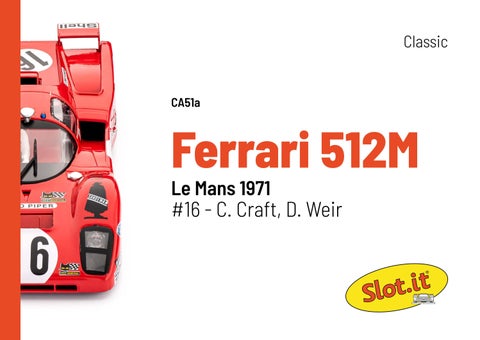
Ferrari 512M Le Mans 1971
#16 - C. Craft, D. Weir
Ferrari 512M
The Ferrari 512S had failed to beat the Porsche 917s in the 1970 World Sportscar Championship. Despite their higher weight and greater consumption, the car had shown winning potential, but the rushed-in construction had left reliability issues unresolved. An unusual bad luck struck at Le Mans, where an accident eliminated four of the five 512S in one stroke. For the ending part of the season Ferrari decided to create a lighter and aerodynamically advanced version: thus the 512M (Modified). The new ‘M’ model proved immediately faster than the ‘S’ version, but took its first steps only three weeks before the last Championship race at Österreichring (now Red Bull Ring), where Jacky Ickx led the race until he had to retire due to an alternator failure. The first victory of the new Ferrari took place in South Africa on 7 November 1970, in a race outside the World Championship, in the hands of Ickx / Giunti who reached the finish line three laps ahead in the Porsche 917K driven by Siffert / Ahrens. In 1971, however, despite the excellent end of the 1970 season for the 512M, Ferrari decided to concentrate the company’s efforts on a car in line with the 1972 regulations, leaving the 512M to private teams: the 512M, therefore, despite its outstanding performance, could never prove its true value. It remains, however, one of the most beautiful and iconic Sports Prototypes in the history of motorsport. The CA51a model represents the car of Team David Piper which, driven by Chris Craft and David Weir at the Le Mans 24 Hours in 1971. Starting 13th from the grid, the car dropped to 44th place in the 2nd hour of the race but climbed back to an excellent 4th place overall.
La Ferrari 512S non era riuscita nell’impresa di battere le Porsche 917 nel Campionato Mondiale Sportprototipi 1970. Il ritardo nella costruzione non aveva permesso di rendere affidabili le vetture, che nonostante un peso e un consumo maggiore avevano dimostrato di poter essere comunque competitive. A questo si aggiunse anche un certa dose di sfortuna a Le Mans, in cui un incidente eliminò in un colpo solo quattro delle cinque 512S in gara. Per la fine della stagione 1970 Ferrari decise di realizzare una versione alleggerita ed aerodinamicamente evoluta: così nacque la 512M (Modificata). Il nuovo modello ‘M’ si dimostrò immediatamente più veloce della versione ‘S’, ma mosse i primi passi solo tre settimane prima dell’ultima gara di Campionato all’Österreichring (oggi Red Bull Ring), dove Jacky Ickx condusse la gara fino a quando non si dovette ritirare per un guasto all’alternatore. La prima vittoria della nuova Ferrari avvenne in Sud Africa il 7 novembre 1970, in una gara non valida per il Campionato del Mondo, nelle mani di ICKX/Giunti che giunsero al traguardo con tre giri di vantaggio sulla Porsche 917K di Siffert/ Ahrens. Nel 1971 però, nonostante le ottime premesse, Ferrari decise di concentrare gli sforzi su una vettura in linea con il regolamento 1972, lasciando la 512M ai team privati. La 512M, quindi, nonostante prestazioni di assoluto rilievo, non poté mai dimostrare il suo vero valore. Rimane comunque una delle Sport Prototipo più belle e iconiche della storia del motorsport. Il modello CA51a rappresenta la vettura del Team David Piper che guidata da Chris Craft e David Weir ottenne un ottimo 4° posto alla 24 Ore di Le Mans nel 1971, risalendo dalla 44a posizione in cui era caduta durante la 2a ora di gara.
CA51a
Ferrari 512M Le Mans 1971
#16 - C. Craft, D. Weir
138,5 mm 32 mm 93,5 mm 61,5 mm 66,4 g
slot.it
SIDEWINDER MOTOR:
V12/4 23K
PINION/ GEAR:
11/32
FRONT RIMS/ TYRES:
15.8x8.2x1.5 1121C1
REAR RIMS/ TYRES:
15.8x8.2x1.5 1120C1