The Society of Light and Lighting
LIGHT LINES
VOLUME 19 ISSUE 5 SEPTEMBER/OCTOBER 2026
FULL STEM AHEAD A new SLL kit for schools
THE GLASS IS GREENER More than a pretty facade
Editorial
September/October 2026
FROM THE EDITOR SECRETARY Brendan Keely FSLL bkeely@cibse.org SENIOR MEMBERSHIP EXECUTIVE Fiona Fanning ffanning@cibse.org EDITOR Jill Entwistle jillentwistle@yahoo.com COMMUNICATIONS COMMITTEE: Andrew Bissell FSLL James Buck Iain Carlile FSLL Jill Entwistle Fiona Fanning Debbie-Sue Farrell Chris Fordham MSLL Rebecca Hodge Stewart Langdown FSLL Luke Locke-Wheaton Rory Marples MSLL Linda Salamoun MSLL All contributions are the responsibility of the author, and do not necessarily reflect the views of the society. All contributions are personal, except where attributed to an organisation represented by the author.
COPY DATE FOR LL6 2026 IS 14 SEPTEMBER PUBLISHED BY The Society of Light and Lighting 91-94 Saffron Hill London EC1N 8QP www.sll.org.uk ISSN 2632-2838 © 2026 THE SOCIETY OF LIGHT AND LIGHTING The Society of Light and Lighting is part of the Chartered Institution of Building Services Engineers, 91-94 Saffron Hill, London EC1N 8QP. Charity registration no 278104 Designed and printed in the UK Darkhorse Design Ltd T (0)20 7323 1931 darkhorsedesign.co.uk studio@darkhorsedesign.co.uk
2
It has often been pointed out that the lighting profession has been fond of talking to itself when more outreach might have been useful in promoting the message of good lighting. But it was arguably reasonable. In a relatively new discipline, practitioners, especially having been drawn to lighting from such diverse areas, first had to understand themselves. A process of cohesion and definition was necessary if everyone was going to sing, broadly speaking, from the same song sheet. And if not quite there yet, there is considerably more awareness than some 30 years ago. As well as closing the communication gap with other design professionals and government, a fundamental next step is to get lighting recognised as a viable career. Immediate past president Kristina Allison used her role to instigate the Get Curious programme, beginning with more than 26 companies
offering work experience for students. The SLL’s school outreach event, Pockets of Light, will again take place in Leeds this October. Organiser David Battersby has now developed an excellent new lighting kit that can be taken into schools to inspire and educate schoolchildren (Plug and Playground, p5) as part of the STEM initiative. And beyond. After putting it into practice at the recent Light Matters event, Allison was impressed. ‘It has the key ingredients to introduce not only young people but everyone to the principles of light and lighting.’
JILL ENTWISTLE JILLENTWISTLE @YAHOO.COM
CURRENT SLL LIGHTING GUIDES SLL Lighting Guide 0: Introduction to Light and Lighting (2017) SLL Lighting Guide 1: The Industrial Environment (2018) SLL Lighting Guide 2: Lighting for Healthcare Premises (2019) SLL Lighting Guide 4: Sports Lighting (2023) SLL Lighting Guide 5: Lighting for Education (2011) SLL Lighting Guide 6: The Exterior Environment (2016) SLL Lighting Guide 7: Office Lighting (2023) SLL Lighting Guide 8: Lighting for Museums and Galleries (2021) SLL Lighting Guide 9: Lighting for Communal Residential Buildings (2022) SLL Lighting Guide 10: Daylighting – a guide for designers (2014) SLL Lighting Guide 11: Surface Reflectance and Colour (2001) SLL Lighting Guide 12: Emergency Lighting (2022) SLL Lighting Guide 13: Places of Worship (2018) SLL Lighting Guide 14: Control of Electric Lighting (2023) SLL Lighting Guide 15: Transport Buildings (2017) SLL Lighting Guide 16: Lighting for Stairs (2017) SLL Lighting Guide 17: Lighting for Retail Premises (2018) SLL Lighting Guide 18: Lighting for Licensed Premises (2018) SLL Lighting Guide 19: Lighting for Extreme Conditions (2019) SLL Lighting Guide 20: Lighting and Facilities Management (2020) SLL Lighting Guide 21: Protecting the Night-time Environment (2021) SLL Lighting Guide 22: Lighting for Control Rooms (2022) SLL Lighting Guide LG23: Design, Creativity and Compliance (2026) Guide to Limiting Obtrusive Light (2012) Code for Lighting (2022) Commissioning Code L (2018) SLL Lighting Handbook (2018) CIBSE TM66: Creating a Circular Economy in the Lighting Industry (2021) CIBSE TM65.2: Embodied Carbon in Building Services – Lighting (2023)
sll.org.uk
Secretary’s column/Contents
September/October 2026
FROM THE SECRETARY
X: @sll100
again looking forward to Circular Lighting Live, organised by Recolight. The conference and exhibition will take place on 8 October at The Minster Building, London. One of the SLL’s flagship events, Ready Steady Light, returns in association with Rose Bruford College and the IALD on Thursday 15 October. (See box if you want to register a team but be quick, this event sells out very fast.) We hope you can join the SLL at LiGHT26 on 18–19 November at the Business Design Centre. The SLL will deliver a panel discussion on light and art on the afternoon of the 18th. This will be the last LiGHT Expo as we know it following the announcement that LiGHT Expo has been acquired by Messe Frankfurt (see p4).
2
EDITORIAL
3
SECRETARY'S COLUMN
4
NEWS
5
PLUG AND PLAYGROUND
8
ALGAE RHYTHM
David Battersby on the new SLL lighting kit which will be key to the schools STEM programme – and potentially beyond the classroom
How the life cycle of microalgae and sunlight are turning the facade of a Melbourne building green
10 COOL, CALM
AND REFLECTED
A new break-out space uses light and acoustics to conjure an immersive and relaxing ambience
12 TRICK OF THE LIGHT BRENDAN KEELY BKEELY @CIBSE.ORG
An exhibition at Tate Modern reveals a master of mesmerising and engaging art
14 ALL BEING WELL
Iain Carlile singles out two recent LR&T papers looking at different aspects of a building occupant’s wellbeing
15 ART AND SOUL More details of the DarkSky Conference: https://darksky.uk/conference/ Register for the ICEL conference here: thelia.org.uk/ems-event-calendar/ events/icel-emergency-lightingconference.html More information and registration for Neuroplaces: neuro-places.com/ Further details and registration for Sustainability Unfiltered conferences: cibse.org/sll-whats-happening Registration and details for Circular Lighting Live: https://circularlighting.live/ Team registration for Ready Steady Light: cibse.org/events/search-events/ ready-steady-light-2026/
Top 5: Jeff Shaw on diverse ways light influences our interactions with the world
16 EVENTS
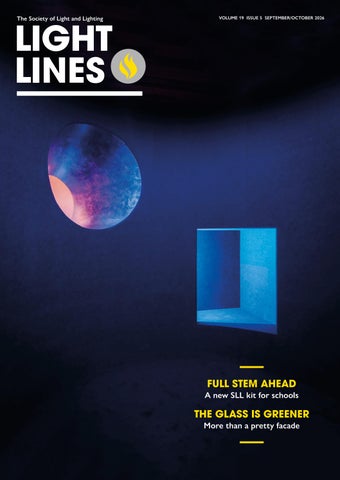
COVER: A window on the world of break-out zones: the Relax Room at IPG Mediabrands in Madrid, designed by Ramos Alderete Studio (see p10)
Alberto Amores, Ramos Alderete Studio
It’s September, and the beginning of the event and conference season. If you had a break in the summer, I hope you enjoyed it. We have been busy preparing for SLL-organised events and additional events the society is supporting. The first of those is the DarkSky Conference, Good Lighting: from Pollution to Solution, on 8 September at Newcastle University. This will be an excellent event and the SLL is delighted to be involved. The conference will appeal to anyone wanting to understand more about dark skies and how to design lighting installations that have the minimum undesirable impact on the night-time environment. We are also looking forward to again supporting the ICEL Emergency Lighting conference, which takes place on 10 September at the Cavendish Conference Centre. For the first time, SLL will support Neuroplaces. This is the UK's first B2B exhibition and conference for neuroinclusive and accessible design solutions as part of London Design Festival's largest official district. SLL members will be involved in one of the panel discussions, and the exhibition and conference will take place as part of Shoreditch Design Week, from 15-17 September at Protein Studios. The SLL and the LIA have been working together to prepare a series of conferences focusing on lighting and sustainability. Sustainability Unfiltered: A Sustainable Specification Series will discuss all aspects of the subject relating to the lighting industry. The expert line-up of speakers includes Kristina Allison (immediate past president of the SLL and associate, sector lead for environmental and sustainable lighting at WSP), Paul Beale (founder of 18 Degrees Circular and 18 Degrees lighting consultants), Kael Gillam (senior associate at Hoare Lea) and Ali Kay (sustainability manager, LIA). Our thanks to Lisa Sutherland (chair of the SLL events committee and marketing manager at Stoane Lighting) and Ali for creating, developing and organising the conferences. The series of events will start on 24 September at the People’s History Museum, Manchester, then 3 November at CIBSE, London, and finally 3 December at Edinburgh Napier University's Craiglockhart campus. On the sustainability theme, we are
Contents
3
News
September/October 2026
THE LATEST NEWS AND STORIES
MESSE FRANKFURT BUYS LIGHT EXPO
MAJOR STEPS DOWN FROM SMLA AFTER FOUR DECADES Mark Major, a leading figure in lighting design in the UK and internationally, is stepping down as senior partner at Speirs Major Light Architecture (SMLA). Major co-founded Speirs and Major with the late Jonathan Speirs in 1996 and has been in continuous practice for 40 years. He will remain a consultant to SMLA. In 2010 he formed a partnership with Keith Bradshaw, who will continue to guide the studio, supported by partners Clementine Fletcher-Smith and Carrie Donahue Bremner. A passionate advocate for the sensitive use of light and darkness, Major has created lighting schemes for some of the world’s most significant buildings and public spaces. In London alone they include the Millennium Dome, Royal Festival Hall, Terminal 5 Heathrow, 30 St Mary Axe and Battersea Power Station. He was also responsible for the relighting of the interiors of both St Paul’s Cathedral and Westminster Abbey. His influence on urban development includes masterplans for King’s Cross and the Broadgate Estate, as well as pioneering lighting planning guidance for the City of London. He was the lighting design advisor to the Olympic Delivery Authority for the Queen Elizabeth Olympic Park for London 2012. As a practitioner, lecturer, writer and mentor, he has significantly advanced the development and recognition of the lighting design profession, a commitment he will continue to pursue. ‘I am immensely grateful to have had such a rich and rewarding time over the past four decades, fuelled by my enduring passion for light and architecture, and the pleasure of working with so many truly great people,’ he said. Mark Major will be reflecting on his career, and the lighting design profession past, present and future, in the November/December issue of Light Lines
We love a celebrity endorsement. ‘I go to every location with a bag full of lightbulbs,’ said actor Anna Friel in a recent Guardian interview. ‘Lighting really affects how one thinks… Light affects the brain – we’re meant to have natural light.’ The first thing she ever spent money on was a luminaire, apparently, and she will happily walk into someone’s house and tell them they need a dimmer or another light. She collects lighting, along with furniture, from the arts and crafts period. ‘…
4
when they had Vaseline glass, with uranium, which was the closest ambience to candlelight when electricity was introduced,’ she told The Guardian. ‘And it doesn’t have to cost a lot of money. You’ll never find me with a suitcase without a fairy light.’
Messe Frankfurt has acquired LiGHT Expo London from [d]arc media. The event will now be run out of its London subsidiary, though [d]arc media will remain closely involved, providing promotional activity and the curation of its content programme. Launched in 2022, LiGHT has established itself as one of the UK’s leading events for the lighting specification community. The acquisition adds the exhibition to the German company’s burgeoning international Light + Building portfolio, which as well as Frankfurt includes events in Istanbul, Buenos Aires, Dubai, Guangzhou, Las Vegas, New Delhi, Shanghai and Tashkent. ‘We are committed to investing in the event for the long term and ensuring it continues to deliver exceptional value for exhibitors, visitors and the wider lighting industry,’ said Simon Albert, CEO of Messe Frankfurt UK. ‘We have long admired what the [d]arc media team has built and the passionate community that has grown around the event.’
NEXT STAGE SUSTAINABILITY The SLL and the LIA have joined forces to create a series of three events called Sustainability Unfiltered: A Sustainable Specification Series. It aims to take the subject of sustainable lighting to the next stage. ‘We want to move beyond sustainability statements and into meaningful action,’ said chair of the SLL events committee Lisa Sutherland. ‘The events will cut through the buzzwords to explore the realities and opportunities shaping sustainable lighting today.’ They will be held in Manchester, London and Edinburgh in September, November and December respectively. Speakers will include Kael Gillam, senior associate at Hoare Lea, Paul Beale of 18 Degrees Circular and Gary Thornton, director at lighting design practice Nulty. More details at: cibse.org/sll-whatshappening
sll.org.uk
STEM programme
September/October 2026
PLUG AND PLAYGROUND
David Battersby outlines the development of a new SLL lighting kit which has been designed to play a fundamental role in the schools STEM programme – and potentially beyond the classroom
p The simple equipment allows the demonstration of several key properties of light: additive colour mixing, subtractive colour mixing, colour temperature and colour rendering
W
hen the Pockets of Light scheme was first developed for the Illuminating York festival in 2016, the team needed a demonstration kit to help show the fundamentals of light to students. A kit was quickly assembled using torches salvaged from the 2015 Night of Heritage Light, textured MDF panels, a linkable set of linear fittings with different colour temperatures, colour paddles and a set of borrowed red, green and blue spotlights. The kit was used successfully on several occasions before being stored away. It remained largely untouched until Pockets
X: @sll100
of Light was revived in 2023 for Light Night Leeds in memory of the late Liz Peck. By this point, the limitations of the original equipment had become clear. The number of functioning torches had gradually reduced, the RGB fittings still needed to be borrowed and all the mains-powered equipment required PAT (portable appliance testing). It was evident that a replacement STEM kit was needed, one that would be easier to transport, simpler to demonstrate, and which would give the students greater interaction and opportunities to experiment with light, colour and textures. Having used the kit during both the 2016
and 2023 Pockets of Light events, as well as in other school sessions, I was tasked with bringing it up to date, taking advantage of new technology while creating a kit that was portable, self-contained and free from the need for an annual PAT. My previous experience with the original kit provided a clear understanding of what worked well and what improvements were needed. Following extensive research, I found that most of the required equipment could be sourced relatively easily. Becoming a CIBSE STEM ambassador in 2025 also provided an excellent opportunity to test the developing kit in real educational
5
E
STEM programme
September/October 2026
p The new kit features rechargeable battery-powered RGB fittings, a custom-built LED bar, torches, texture panels and colour paddles
E
environments and gather valuable feedback from students and teachers. The new kit now consists of rechargeable battery-powered RGB fittings, a custombuilt LED bar, torches, texture panels and colour paddles. This allows the demonstration of several key properties of light, additive colour mixing, subtractive colour mixing, colour temperature and colour rendering One of the most effective elements of the kit is the set of RGB fittings. While sourcing suitable rechargeable units took some time, they have proved extremely effective for demonstrating additive colour mixing and showing how different colours of light affect the appearance of objects. Classrooms are typically filled with brightly coloured materials, making it easy to find examples of primary colours and demonstrate how their appearance changes under different coloured lighting. Finding a suitable way to demonstrate colour temperature presented a greater challenge. The solution needed to be easy to demonstrate, portable
6
and battery-powered. It quickly became apparent that a bespoke solution would be required. The result was a custom-made LED bar capable of switching between 2700K, 3000K, 4000K and 5000K colour temperatures. It can also display a continuous gradient from 2700K to 4000K along its length, allowing students to see the progression between warm and cool white light. To demonstrate that white light is made up of multiple colours, the LED bar can also be switched from white to red, green and blue. It also has a rainbow sequence which flows along the length of the bar and illustrates different colour combinations. This
feature has proven particularly engaging with students. The LED bar houses a compact controller (a small form factor micro-controller) and a length of RGB pixel strip. The controller runs the free WLED software, with modified firmware for the quantity of push buttons. All configuration and programming files are stored in the cloud, meaning that if a unit fails, it can be easily re-flashed through the controller's onboard web server. The accuracy of the white-light settings was verified using a Lighting Passport. It was found to be remarkably accurate with all colours being well within 100K of the selected temperature. Although the colour rendering performance is not the best, the educational value is undeniable. Students are fascinated when the apparently white light transforms into its individual colours. The colour paddles are used alongside handheld torches to demonstrate subtractive colour mixing and, along with the textured panels, form the base of the interactive practical activity for the students. Working in small
‘Becoming a CIBSE STEM ambassador provided an excellent opportunity to test the developing kit in real educational environments’
sll.org.uk
September/October 2026
groups, the students explore how light interacts with textures and how different colours of light give different colour shadows when lighting a textured surface. Further developments are still planned. The current torches are powered by three AA batteries, making them relatively heavy and less environmentally friendly than other solutions. Alternative rechargeable options are being evaluated to improve both sustainability and usability. The completed kit received a full trial at Nields Academy near Huddersfield in March, where it was used with a group of 20 Year 6 pupils during their final lesson of the day. The session proved highly successful, maintaining the students' attention throughout. One particular highlight came when the white LED bar transformed into the colours, prompting an audible 'wow' from the class. Following this successful trial, the kit was finalised and distributed to society representatives. It has since been used to engage with just over 150 students at Trinity Academy Leeds and for a presentation at Gipton Old Fire Station community centre to pupils of Wykebeck Primary school. Both are taking part in this year's Pockets of Light at Light Night Leeds, helping inspire the next generation of engineers and lighting professionals through hands-on exploration of the science of light. Immediate past president Kristina Allison used the kit at the Light Matters event in London in July, organised by CIE-UK, UCL and the Daylight Academy. She found it a really valuable resource, she says. ‘The children who used them at the event seemed intrigued with their journey of discovery, which was a delight to witness. It’s easy to transport and has the key ingredients to introduce not only young
‘It has the key ingredients to introduce not only young people but everyone to the principles of light and lighting’
STEM programme
p The completed kit had a full trial at Nields Academy near Huddersfield with a group of Year 6 pupils: ‘When the white LED bar transformed into the colours, it prompted an audible "wow" from the class’
people but everyone to the principles of light and lighting. The translucent colour paddles and torches were particularly good for showing colour mixing which can be used in combination with textured surfaces.’ As the kit is designed for all ages, she added, ‘it’s also ideal to support any presentations given as part of the SLL’s Get Curious campaign.’
Pockets of Light will again form part of Light Night Leeds which takes place on 28-29 October. The PoL event involves local schoolchildren who design lighting schemes for city landmarks which are then brought to life by professionals. This year the winning designs will be taken from student entries from both Trinity Academy and Wykebeck Primary School, the first to use the newly completed STEM kit. The venue will be the Central Station Wagon Hoist in Wellington Place, near the city centre. The single survivor of two original structures either side of the river and canal viaduct, the Grade II-listed lifting tower used steam power to raise and lower wagons between the viaduct and the goods yard below at Leeds Central Station from the 1850s to the 1950s. t A custom-made LED bar can switch between a range of colour temperatures and includes a rainbow sequence to illustrate different colour combinations
X: @sll100
7
Bio-facades
September/October 2026
ALGAE RHYTHM How the life cycle of microalgae and sunlight are turning the facade of a Melbourne building green in more ways than one
D
eveloped by Italian firm Uau Studio for an office building in Melbourne, the Algae Tower features a photo-bio-facade integrated into the building envelope. The responsive environmental system, based on the use of microalgae, is inspired by the behaviour of tree canopies. The facade provides shading, absorbs carbon dioxide and generates renewable energy through microalgae cultivated within integrated photo-bio-reactors.
‘Using microalgae and sunlight, it produces biomass for bio-fuel while adapting to seasonal solar changes,’ says the studio, led by Gianluca Santosuosso, who studied building engineering in Turin, and gained a masters in self-sufficient building at the Institute for Advanced Architecture of Catalonia. ‘In summer, it maximises energy production and shading, while in winter, it allows sunlight to warm the building. ‘Trees are not stand-alone elements but part of an ecosystem,’ continues Uau. ‘As
such they depend on surroundings and natural resources like the sunlight, the quality of air and the composition of soil that they grow in. The facade system acts as a large-scale photobio-reactor transforming a classic facade shading system in an "artificial-leaves-canopy". [This] protects the building from direct solar radiation, generates energy and absorbs CO2.’ The studio’s research into the solution involved the study of various kinds of microorganism used in the production of biomass and energy. Its particular focus
p Facade elements can be adjusted to the optimal sun angle not only to maximise production of bio-mass but also to achieve the best shading
8
sll.org.uk
Bio-facades
September/October 2026
q The responsive environmental system is inspired by the behaviour of tree canopies
Microalgae (together with cyanobacteria) are phytoplankton, found in fresh water and marine environments. Invisible to the naked eye, they are unicellular, existing both individually, or in chains or groups. Depending on the species, their sizes can range from a few micrometers (μm) to a few hundred micrometers. Like terrestrial plants they contain chlorophyll, and also need sunlight in order to grow and live, using photosynthesis to convert light energy, normally from the sun, into chemical energy that can be later released to fuel the organisms' activities. This chemical energy is stored in carbohydrate molecules, such as sugars, which are synthesised from carbon dioxide and water. In most cases oxygen is released as a waste product. Through photosynthesis they produce around half of the atmospheric oxygen on Earth. – based on Wikipedia
was photo-bio-reactor technology, where a mix of water, nutrients (such as CO2), and microalgae are exposed, inside clear containers, to solar radiation that, through photosynthesis, triggers and promotes the production of organic material. ‘Several experimental plants are demonstrating that this way of generating biomass has enormous potential as an alternative to the production of bio-fuel.’ Microalgae need large quantities of carbon dioxide for their reproduction. It’s therefore useful to make the system a closed cycle where all the CO2 produced can be reintegrated into the reactor. ‘In this experimental design process the biggest challenge is how to integrate the photo-bio-reactor technology with the architecture of the building,’ says Uau.
X: @sll100
‘Density, size and positioning of the bio-reactor elements on the facade are key aspects in achieving the best [energy] performances of the structure. In order to achieve an optimal result we started understanding the solar radiation hitting the facade of the tower and its relation with different shapes and curvatures.’ The Algae Tower responds to environmental conditions rather than functioning as a static enclosure. The facade elements can be adjusted to the optimal sun angle to maximise the production of bio-mass but also to achieve the best performance in terms of shading. Seasonal changes help improve performance in various ways, allowing the system to also address the increasing impact of more frequent and more intense heat waves on the built environment, especially given the solar heat gain due to the high degree of glazing used on facades. In the summer the production of microalgae will be at its maximum and the facade will turn an intense green: this will result both in a higher production of bio-fuel and at the same time improved shading, with a consequent reduction in the use of air conditioning. During the colder seasons the facade will inevitably produce less biomass because of the decreased intensity of the sun and the lower temperatures. The resulting increased transparency will allow the sunlight to filter through the glass facade and to heat the interiors.
The world’s first bio-reactive facade was the SolarLeaf system, co-developed by Arup's German office. Winner of Zumtobel’s Applied Innovations Award 2014, the system resulted from Arup’s collaboration with German biotechnology and microalgae company SSC Strategic Science Consult, and Colt International, a specialist in integrated climate control, ventilation and solar shading systems. The fully integrated system was installed in a four-storey residential building, the BIQ (Bio Intelligent Quotient House), designed by Austrian architect Splitterwerk for the 2013 International Building Exhibition (IBA) in Wilhelmsberg, near Hamburg.
9
Workplace
September/October 2026
COOL, CALM AND REFLECTED A newly created multi-purpose break-out space uses light and acoustics to conjure up an immersive and relaxing ambience
W
hile not all staff meeting and break-out facilities boast the kindergarten chic of big tech companies, the treatment of many corporate communal spaces has become increasingly playful and creative. The Relax Room, designed by Ramos Alderete Studio, is a case in point. A dedicated space in the offices of IPG Mediabrands in Madrid involved the merger of two existing meeting rooms into an area ‘for pause, contemplation and informal interaction’. Lighting and acoustics are
central to the ambience of the space. The project reworks the constrained tubular layout into an enclosed, immersive environment defined by its curves, controlled illumination and acoustic qualities. ‘The linear geometry is reshaped into a continuous curved envelope, generating new visual perspectives and a more fluid spatial experience,’ says Ramos Alderete. ‘Different spatial zones are defined through scale and light.’ The original narrow and elongated space was interrupted by a structural
column and a conventional window. The column was retained, but concealed, and helps demarcate the space, while the window was transformed into a calibrated light source. Walls and ceilings are clad in acoustic materials, creating a controlled and tactile interior. Lighting plays a central role in defining the spatial experience, and is organised through three primary elements: the oculus, positioned above and finished with a reflective surface, diffuses light and introduces an indirect, ambient glow.
‘The oculus, positioned above and with a reflective surface, diffuses light and gives an indirect, ambient glow’
p An integrated RGB lighting system allows changes in ambience according to what the space is being used for
10
sll.org.uk
Workplace
September/October 2026
p Lighting is organised through three primary elements: the oculus, the niche and the reinterpreted window, which maintains a visual connection with the surrounding work environment
X: @sll100
meetings, presentations, rest and informal gatherings without the need for furniture. ‘A recessed niche provides a smaller, more focused setting for individual use or small conversations, while the main area supports collective occupation. The design balances shared and individual conditions within a single continuous volume,’ says Ramos Alderete. ‘It introduces an alternative spatial typology within the corporate setting, shifting from productivity-driven layouts toward a more adaptable environment.’
Alberto Amores, courtesy Ramos Alderete Studio
The niche, illuminated with indirect light, establishes a more intimate and contained space. The reinterpreted window, oriented towards the office, maintains a visual connection with the surrounding work environment. An integrated RGB lighting system allows changes in ambience according to what the space is being used for. The enclosure, combined with an airtight entry, creates a clear threshold between the workspace and the interior environment, altering sound, light and spatial perception on entry. ‘The combination of geometry and materiality reduces external stimuli and supports a focused, quieter spatial condition within the office context.’ Despite its limited footprint, the room has multiple uses with a combination of open floor area and integrated stepped seating. The configuration allows the space to be used for
‘Different spatial zones are defined through scale and light’ 11
Light art
September/October 2026
p Screen with Reflected Blades encourages viewers to move between an acrylic painting and a row of reflective stainless-steel strips, fragmenting their reflection, making them part of the artwork itself
TRICK OF THE LIGHT An exhibition at Tate Modern reveals a master of mesmerising and engaging art
A
current exhibition at London’s Tate Modern features the work of Argentinian artist Julio Le Parc, best known for his pioneering kinetic sculptures, which use light, movement and mirrored surfaces ‘to surprise and draw in the viewer’. Le Parc, who died in May this year, was also known for his trailblazing installation art, as well as canvases and works on paper experimenting with colour combinations and dynamic optical effects. Some 60 works produced over seven decades will be on show. His innovative luminokinetic artworks initially emerged in 1959 as the Light Boxes series, sculptures containing sheets of transparent acrylic plastic and light sources to create mesmerising sequences. These installations quickly evolved into Le Parc’s key body of work, the Continual Light Mobiles, beginning
12
p Vibrating Light: light sources, motors and translucent strips reflect and fragment light, creating visual vibrations on the walls and in the space.
sll.org.uk
Light art
in 1960. Spotlights in combination with reflective or transparent moving elements create dynamic kaleidoscopic visuals which transform in front of the spectator. Continuous Light Mobile 1963 features suspended elements which move in response to the air flows generated by the viewers’ movements, further emphasising the importance of the audience in Le Parc’s practice. Light distortion effects are also explored in Unique Continual Light Cylinder 1962 as well as the room-sized installation Vibrating Light – Tulles 1968. This aspect of Le Parc’s work – a new large-scale Continual Light Mobile 2026 – is also on view in the entrance hall of the Tate’s Blavatnik Building for the duration of the show. Other works invite deeper physical participation. 64 Reflective Blades 2017 encourages viewers to move between a painting and a screen with a row of reflective stainless-steel strips, fragmenting and distorting their reflection while making them part of the artwork itself. The striking Blue Sphere 2001-22, acquired by Tate in 2024, demonstrates how Le Parc's recent sculptural work revisited and expanded his earlier mobiles and kaleidoscopic light installations. ‘He works miracles in light, creating impossible spatial illusions,’ said Jonathan Jones in The Guardian. ‘Of course they are not miracles. In Continual Light with Four Forms in Contortion you can see clearly, as he intends, how bendy, reflective metal strips move in a wave-like undulation between two lamps to warp light in expanding and narrowing patterns, mystifying yet materialist. Le Parc was a pioneer of the kind of spectacle it’s all too easy to create today with a much wider arsenal of mind-blowing technologies.’
‘You must touch the artwork. These works of light and movement incite a will for change, for transformation. Without you my art doesn’t exist’ – Julio Le Parc
All images courtesy Tate Photography (Kathleen Arundell)
September/October 2026
Julio Le Parc’s works are on show in the George Economou Gallery at Tate Modern until 3 May 2027
Continual Light Cylinder, an early example of Le Parc’s kinetic art, explores light distortion effects
X: @sll100
u
13
LR&T essentials
September/October 2026
ALL BEING WELL Iain Carlile singles out two recent papers published by Lighting Research and Technology looking at different aspects of a building occupant’s wellbeing
p Evaluation of facade systems (Wienold et al on daylighting and glare)
N
oting that daylight is a critically important aspect of the built environment, for both energy conservation and occupant wellbeing, Wienold et al examine the recommendations from the recent International Commission on Illumination’s (CIE) position statement on proper light at the proper time (CIE PS 001:2024). This recommends a melanopic equivalent daylight illuminance of 250 lux at eye level during the daytime, acknowledging daylight glare as a major source of dissatisfaction among building occupants, and thereby managing the balance between healthy lighting and daylight-induced glare. Through theoretical analysis and the results of a user study from six different locations (Argentina, Denmark, Germany, Israel, Japan and the USA), the authors found a difference factor of roughly 10 between recommended illuminance levels for healthy living and vertical illuminance levels where glare becomes an issue. This therefore allows specifiers flexibility in selecting appropriate shading solutions. The authors also note that vertical illuminance levels from daylight between 250 lux and 1000 lux typically reduced perceived glare from facades. A simulation study for a sample office in three different European climates (Central/
14
Frankfurt, Northern/Stockholm, Southern/ Rome) confirmed the study’s findings for positions up to 2m from the facade. However, for deep-room positions in multiuser spaces solutions were more complex, and here higher diffuse transmittance shading is beneficial. The authors comment that the results demonstrated that healthy natural lighting experienced from daylight does not inherently increase glare risk. Turning to a different aspect of building interiors, Rea and Pedler have carried out a study of lighting controls, noting their importance in the operation of all buildings and the wellbeing of their occupants. They observe that controls often don’t consider why or how a user may wish to make operational changes to the lighting system, potentially leading to wasted electrical energy as well as a reduction in occupant productivity. The authors have taken a sequential narrative previously developed by Nordman et al – describing the process users follow when interacting with lighting controls: ‘approach, interpret, interact, feedback’ – and extended it with an initial step, ‘purpose’, and final step, ‘caution’. This six-phase Extended Sequential Narrative (ESN) sequence – ‘purpose, approach, interpret, interact, feedback, caution’ – is aimed at helping manufacturers,
specifiers and installers develop a more empathetic understanding of how a user interacts with lighting system control points. It provides a starting point in the design of lighting controls with the aim of reducing lighting energy consumption and supporting more productive building occupants. Iain Carlile, FSLL, is a past president of the SLL and managing senior associate at dpa lighting consultants
Lighting Research and Technology: OnlineFirst In advance of being published in the print version of Lighting Research and Technology (LR&T), all papers accepted for publishing are available online. SLL members can access these papers on the SLL website (www.sll.org.uk) Do CIE-recommendations for proper light at the proper time conflict with glare? J Wienold, M Sabeti and VRM Lo Verso Specifying and selecting building lighting controls with occupants in mind MS Rea and D Pedler
sll.org.uk
Top five
September/October 2026
ART AND SOUL Jeff Shaw on the diverse and powerful ways that light influences our interactions with the world
Film: Metropolis, Fritz Lang, 1927 Countless lighting designers cite film as an influence – myself included. Film is a medium composed of light, used powerfully to tell a story and portray emotion. One of the first great examples is Fritz Lang’s expressionist 1927 science-fiction silent movie, where lighting is a social tool contrasting the bright upper world with the dark underground. Set far in the future, in 2026, the story portrays a megacity struggling with extreme social inequality and growing anxiety over automation. Perhaps light can predict the future?
X: @sll100
4
Matts Gallery, London, 2007. Photo Edward Woodman
2
Art: Richard Wilson, 20:50, 1987 Artists approach their works with openminded creativity – not focused on function, rather on aesthetics, form and meaning. I have chosen a piece not directly composed of light – it is composed of sump oil. But it is fundamentally an experience of light. A highly experiential immersive piece – the surface of the oil mirrors the space, with the viewer at the centre of an optical illusion. I remember it vividly from when I first saw it and it shows the power of light to manipulate our perception of space.
Live events: London 2012 Olympics, Fencing An odd choice perhaps amid the countless live shows, theatre and sporting events I could choose, but I wanted an example of how light can transform the spectating experience of a sport that few people know and that can be difficult to follow. Tron-like lighting (movies again) created an exciting atmosphere, and that light was used during the event to help spectators immediately see who had scored a hit – light as information, and the right lighting choices to create a strong and accessible experience.
Pexels.com
3
Nature: Rainbow at Nine Inch Nails concert, Eden Project No light has a more fundamental effect on us than light in nature – daylight, sunlight, moonlight and starlight shape mood and emotions. It sets the scene and forms the basis of memorable experiences. I could share a stunning sunset or a starry sky but decided on a serendipitous intervention. Nine Inch Nails frontman Trent Reznor stopped mid-song at a rainy gig in Cornwall to declare ‘there’s a [expletive deleted] rainbow!’ – nature added to the collective mood and made the experience truly unforgettable.
Jeff Shaw
Former SLL president, Jeff Shaw is an associate director in the lighting team at Arup
1
Jeff Shaw
L
ight has always fascinated me – from long before I ever knew that I could make a career out of it. Light intrinsically shapes our world and enhances our experience of our environment in ways we often do not even consider. In selecting my Top 5, I therefore wanted to express light’s influence on how we interact with the world. Looking at how light has the power to influence our experiences helps us as lighting designers to understand how we can create better spaces for the people who are at the heart of our schemes. This is not limited to observing architecture and the built environment. We can and should gain inspiration from everything – art, entertainment, nature and beyond.
5
Architecture: Church of the Light, Ibaraki, Japan, Tadao Ando, 1989 Which brings me to architecture, and the literal way that light does shape the world we inhabit. There is no better expression of how light and architecture are interconnected than in Tadao Ando’s sublime Church of the Light. Deliberately capturing morning sun with the south-east orientation, he uses nature to manipulate our perception of the space in an unexpected and memorable way. It influences emotion and creates a focus, making us part of the scene and strongly expressing the purpose of the space through light, telling its story.
15
Events 2026
For details of all upcoming webinars, go to: www.cibse.org/society-oflight-and-lighting-sll/sll-events/upcoming-webinars-and-online-content For previously recorded CPD webinars (including regional webinars), go to: https://www.cibse.org/get-involved/societies/society-of-light-andlighting-sll/sll-events/on-demand-webinars-past-presentations
EVENTS DARK SKY CONFERENCE 2026 (supported by the SLL) Date: 8 September Venue: Daysh Building, Newcastle University https://darksky.uk/conference/ ICEL EMERGENCY LIGHTING CONFERENCE Date: 10 September Venue: Cavendish Conference Centre, London W1 thelia.org.uk/ems-event-calendar/icel-emergency-lightingconference-2026.html NEUROPLACES (supported by the SLL, part of Shoreditch Design Week) Date: 15-17 September Venue: Protein Studios, Shoreditch, London https://www.neuro-places.com/ SUSTAINABILITY UNFILTERED: A SUSTAINABLE SPECIFICATION SERIES (three-city event organised by the SLL and the LIA) Dates: 24 September: People’s History Museum, Manchester 2 November: CIBSE, London 3 December: Napier University, Edinburgh cibse.org/sll-whats-happening CIRCULAR LIGHTING LIVE 2026 Date: 8 October Venue: The Minster Building, London EC3 https://circularlighting.live/ READY STEADY LIGHT Date: 15 October Venue: Rose Bruford College, Sidcup, Kent sll.org.uk LiGHT26 Date: 18-19 November Venue: Business Design Centre, Islington, London https://www.lightexpo.london/
LET DIPLOMA IN LIGHTING DESIGN For details and registration: lightingeducationtrust.org
16