The Society of Light and Lighting
LIGHT LINES
VOLUME 19 ISSUE 6 NOVEMBER/DECEMBER 2026
A MISSION IN LIGHT Mark Major reflects
FAIR OUTLOOK The future post-takeover
Editorial
November/December 2026
FROM THE EDITOR SECRETARY Brendan Keely FSLL bkeely@cibse.org SENIOR MEMBERSHIP EXECUTIVE Fiona Fanning ffanning@cibse.org EDITOR Jill Entwistle jillentwistle@yahoo.com COMMUNICATIONS COMMITTEE: Andrew Bissell FSLL James Buck Iain Carlile FSLL Jill Entwistle Fiona Fanning Debbie-Sue Farrell Chris Fordham MSLL Rebecca Hodge Stewart Langdown FSLL Luke Locke-Wheaton Rory Marples MSLL Linda Salamoun MSLL All contributions are the responsibility of the author, and do not necessarily reflect the views of the society. All contributions are personal, except where attributed to an organisation represented by the author.
COPY DATE FOR LL1 2027 IS 9 NOVEMBER PUBLISHED BY The Society of Light and Lighting 91-94 Saffron Hill London EC1N 8QP www.sll.org.uk ISSN 2632-2838 © 2026 THE SOCIETY OF LIGHT AND LIGHTING The Society of Light and Lighting is part of the Chartered Institution of Building Services Engineers, 91-94 Saffron Hill, London EC1N 8QP. Charity registration no 278104 Designed and printed in the UK Darkhorse Design Ltd T (0)20 7323 1931 darkhorsedesign.co.uk studio@darkhorsedesign.co.uk
2
One of many reasons that decided Mark Major to exchange a career in architecture for lighting design was the opportunity ‘to be part of a new profession in the UK which I found to be at ground zero’ (On Reflection, p7). I recall those days in the early 1990s when people who could aptly be described as the lighting glitterati – including Derek Phillips, Jonathan Speirs, Nick Hoggett, Maurice Brill and, of course, Mark Major – would meet then as members of the IALD in the basement of Concord’s Holborn showroom. Discussions often centred on the frustrations of convincing other design and building professionals that their expertise should be an essential part of the creative process. Arguably that continues today but the case for professional expertise is even more compelling. In those early days it was simply about the importance of a quality lit environment. Still the overriding concern, of course. But after
four decades the definition now encompasses energy use, the human circadian system, the degree of daylight ingress, the emerging significance of infrared…. As I step down myself as editor of Light Lines, I can only look back and wonder at how extraordinarily rich, mercurial and fascinating lighting turned out to be. My huge thanks to Brendan, who has been such a pleasure to work with, to the very supportive publications committee – and to SLL members who tirelessly contribute excellent content.
JILL ENTWISTLE JILLENTWISTLE @YAHOO.COM
CURRENT SLL LIGHTING GUIDES SLL Lighting Guide 0: Introduction to Light and Lighting (2017) SLL Lighting Guide 1: The Industrial Environment (2018) SLL Lighting Guide 2: Lighting for Healthcare Premises (2019) SLL Lighting Guide 4: Sports Lighting (2023) SLL Lighting Guide 5: Lighting for Education (2011) SLL Lighting Guide 6: The Exterior Environment (2016) SLL Lighting Guide 7: Office Lighting (2023) SLL Lighting Guide 8: Lighting for Museums and Galleries (2021) SLL Lighting Guide 9: Lighting for Communal Residential Buildings (2022) SLL Lighting Guide 10: Daylighting – a guide for designers (2014) SLL Lighting Guide 11: Surface Reflectance and Colour (2001) SLL Lighting Guide 12: Emergency Lighting (2022) SLL Lighting Guide 13: Places of Worship (2018) SLL Lighting Guide 14: Control of Electric Lighting (2023) SLL Lighting Guide 15: Transport Buildings (2017) SLL Lighting Guide 16: Lighting for Stairs (2017) SLL Lighting Guide 17: Lighting for Retail Premises (2018) SLL Lighting Guide 18: Lighting for Licensed Premises (2018) SLL Lighting Guide 19: Lighting for Extreme Conditions (2019) SLL Lighting Guide 20: Lighting and Facilities Management (2020) SLL Lighting Guide 21: Protecting the Night-time Environment (2021) SLL Lighting Guide 22: Lighting for Control Rooms (2022) SLL Lighting Guide LG23: Design, Creativity and Compliance (2026) Guide to Limiting Obtrusive Light (2012) Code for Lighting (2022) Commissioning Code L (2018) SLL Lighting Handbook (2018) CIBSE TM66: Creating a Circular Economy in the Lighting Industry (2021) CIBSE TM65.2: Embodied Carbon in Building Services – Lighting (2023)
sll.org.uk
Secretary’s column/Contents
November/December 2026
The SLL had a great start to the conference season. The DarkSky UK conference in September in Newcastle was excellent, as was the ICEL conference in London. This year the society also supported NeuroPlaces, which was part of the Shoreditch Design Week. Our thanks go to SLL VP Dr Jemima Unwin Teji who represented us in a panel discussion, speaking on the theme of ‘Creating neuroinclusive spaces: designing for comfort, choice and wellbeing’. Circular Lighting Live in October was another of the events supported by the SLL and was once again an excellent and informative conference. Shortly afterwards the SLL joined other CIBSE societies and Special Interest Groups at IHEEM (Healthcare Estates). A big thank you to Malcolm Atherton and the Society of Public Health Engineers (SoPHE) for doing so much to ensure our effective presence at both the conference and exhibition. The wonderful SLL Ready Steady Light, in association with Rose Bruford College and IALD, yet again highlighted the creativity and ingenuity of both students and experienced lighting professionals. Well done to all taking part, especially the winners of the trophies. A review of the event will be on the SLL website news and features section soon and included in the Jan/Feb issue of SLL Light Lines. The SLL Young Lighter 2026 final was held at the end of October. Congratulations to our four finalists. A competition update will be included in the next issue of Light Lines. The SLL once more took part in Light Night Leeds at the end of October. A huge thanks to David Battersby who led the project. David initially delivered lighting workshops at Wykebeck Primary School and Trinity Academy Leeds, and with the help of the SLL volunteers, lit the Wagon Lifting Hoist in Wellington Place. A big thank you also to the sponsors who donated their equipment, and to all the volunteers, whose efforts and contributions we really appreciate. The SLL Sustainability Unfiltered: A Sustainable Specification Series kicked off in Manchester. The conference was excellent, as were the discussions with the delegates. We look forward to the London session on 3 November and Edinburgh on 3 December. The speakers – Kristina Allison, Kael Killam,
X: @sll100
Ali Kay, Paul Beale and Gary Thornton – will tell you everything you need to know about sustainable specifications. We hope that you can join us in London or Edinburgh. And also come and join the SLL at LiGHT 26 from 18-19 November at the Business Design Centre in Islington. The SLL will deliver a panel discussion – Light: The Science of Awe, looking at immersive light experiences – on Wednesday 18 November from 2pm in the Associations Lounge. We look forward to returning to Light+Intelligent Building Middle East from 12-14 January at the World Trade Centre Dubai. SLL president Carolina Florian will be speaking, as well as Giovanni Zambri, chair of SLL MENA, and SLL regional lighting representatives. We hope to see many of you there. Also in the new year, the SLL will be supporting the Workspace Design Show, from 24-25 February, at the Business Design Centre. Finally, it is sad to confirm that SLL Light Lines editor Jill Entwistle is stepping down from the role, this being Jill’s last issue. Neither of us are sure how long she has been the editor of the magazine but she has delivered so many amazing issues of Light Lines, liaised with so many incredible lighting professionals and created so many thought-provoking and informative articles. On behalf of the SLL membership I wish Jill all the best and hope she enjoys her next adventure.
BRENDAN KEELY BKEELY @CIBSE.ORG
Further details and registration for Sustainability Unfiltered conferences: cibse.org/sll-whats-happening For more information on LiGHT26: cibse.org/events/search-events/ light-26/ Full details of Workspace Design Show: https://workspaceshow.co.uk/
Contents 5
WHOLE IN ONE
7
ON REFLECTION
Dr Cosmin Ticleanu explains the SLL’s updated position on integrative lighting
Stepping down as senior partner of one of the world’s foremost lighting practices, Mark Major on the lessons of a 40-year career
11 SHOW PROMISE
Following the recent takeover of the LiGHT exhibition by Messe Frankfurt, new event director Penny Moyses discusses ambitions, challenges and future strategy
13 THE COVER PURPLE
Researchers from Zhengzhou University and Adelaide University make a cool breakthrough in fabrics
14 FACE VALUES
Road lighting and virtual reality lighting simulation feature in Iain Carlile’s selection of the latest LR&T papers
15 MOVING EXPERIENCE
Top 5: Lucie Koháková selects five illuminated routes designed around the perceptions of pedestrians and cyclists
16 EVENTS
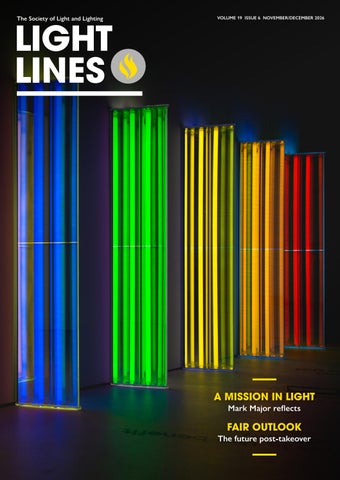
COVER: Spectral Vision by Liz West, first shown in 2016 at the Colour and Vision exhibition at the Natural History Museum, and currently featured in a new exhibition of light art at The Light, Durham (p4) The Society of Light and Lighting
LIGHT LINES
VOLUME 19 ISSUE 6 NOVEMBER/DECEMBER 2026
A MISSION IN LIGHT Mark Major reflects
FAIR OUTLOOK The future post-takeover
Hannah Devereux
FROM THE SECRETARY
3
News
November/December 2026
THE LATEST NEWS AND STORIES
SPACE MIRROR APPROVED
NEW DURHAM VENUE SHOWCASES MAJOR LIGHT ARTISTS Following the recent closure of Durham’s Lumiere festival, an exhibition of light art has opened at the city’s new arts venue, The Light. Artists featured in Victory Over the Sun: Encounters with Light include Dan Flavin, Olafur Eliasson, Tracey Emin, Steve McQueen, David Shrigley and Liz West (pictured is her Spectral Vision, 2016, Colour and Vision exhibition at the Natural History Museum). The Light is a £17m redevelopment of the Durham Light Infantry Museum and Art Gallery museum that controversially closed 10 years ago. It will devote 500sqm of space to contemporary art. With a cafe, shop and outdoor terrace overlooking the parkland of Aykley Heads, near the historic city centre, The Light aims to bring together art, history, science and innovation in a single cultural venue. Beginning with the invention of the electric light bulb by Joseph Swan, born in Sunderland, County Durham, the exhibition features the work of 25 artists from the 1980s to the present day, examining how artificial light transformed the modern world and inspired generations of creators. The exhibition takes its title from the revolutionary 1913 Futurist opera Victory Over the Sun. Imagining the capture of the sun itself, the opera celebrated the power of technology to reshape the world. ‘Its vision resonates with the invention of electric light, which transformed humanity's relationship with darkness, daylight and the natural world,’ says the gallery. ‘Together, the artworks reveal light not simply as a means of illumination, but as one of the defining materials and ideas of modern life.’ Victory Over the Sun: Encounters with Light runs until 17 January 2027 at The Light, Durham: https://thelightdurham.org.uk/article/35687/Victory-Over-the-SunEncounters-with-Light
Well these are cheerful. The design literate will spot the Memphis influence, others might be put in mind of liquorice allsorts. Created by south-west Wales designer Charlie Firth they are part of a series of 3D-printed table lamps. Notably, the light effect is as important as colourful geometry, and serendipity is part of the process. Initially an accidental effect, a crosshatched pattern of the Memphis is Back lamp (centre) was subsequently
4
made a deliberate element. The reflection and diffusion of light that resulted added to the relationship between structure, material and illumination. Firth describes it as ‘a shot of pure dopamine for your space’. firthbydesign.com/
California start-up company Reflect Orbital has been granted permission from the US federal government to test a controversial satellite with a giant mirror designed to reflect sunlight back to Earth (see LL May/June). Following approval from the Federal Communications Commission (FCC), the company plans to launch its Eärendil-1 demo satellite into low Earth orbit later this year. Once each satellite reaches its 600kmhigh orbit, it will deploy a giant 18m x 18m mirror to redirect sunlight down to targets of around 5km diameter on Earth. With 'sunlight on demand', the company claims the mirror system could extend daylight for solar farms or illuminate streets at brightness levels more than three times that of the full moon. The aim is to launch 50,000-plus satellites by 2035. The FFC described the satellite as a ‘potentially groundbreaking technology’ that ‘advances American leadership in space’. The approval flies in the face of considerable opposition from scientists, and bodies including DarkSky International (DSI) and the Royal Astronomical Society. 'Such illumination would introduce an entirely new source of artificial light at night, with far-reaching consequences, including disruption to wildlife and ecosystems,' said the original statement from DSI.
ALL IN A GOOD CASE Dr Shelley James of Age of Lighting Innovations is looking for case studies for a practical guide to circadian lighting for social care providers. The guide is being produced together with the National Care Forum and the Design in Mental Health Network. ‘I would love to meet lighting designers and anyone involved in supplying circadian lighting solutions who would be willing to introduce me to their clients for a brief conversation about their experience,’ says Dr James. All participants will be credited and invited to any conversations, she added. Anyone who would like to participate should contact Shelley James at shelley@ ageoflightinnovations.com
sll.org.uk
SLL position statement
November/December 2026
WHOLE IN ONE Dr Cosmin Ticleanu explains why the SLL’s updated position on integrative lighting is less about a new lighting fashion and more about applying the right light, at the right time, with care
F
or many years, the lighting industry has used terms such as circadian lighting, human-centric lighting and biodynamic lighting to describe the idea that light affects people in ways that go beyond vision. These phrases have been useful in attracting attention, but they have also encouraged some oversimplification. The updated SLL position statement therefore adopts the terminology used by the International Commission on Illumination (CIE): integrative lighting. In simple terms, this means lighting that brings together visual and non-visual effects to support human physiology, psychology and experience in everyday environments. The practical message behind the science is easy to state: bright days, dark nights. People generally need stronger light exposure during the day, particularly in the morning and earlier part of the day, and much lower light exposure in the evening and during sleep. That may sound obvious, but modern life often produces the opposite pattern. Many of us spend much of the day indoors under relatively modest electric lighting, then continue to receive light from luminaires, displays, street lighting and other sources late into the evening. The biological basis is now increasingly well established. In addition to rods and cones, the retina contains intrinsically photosensitive retinal ganglion cells, or ipRGCs, which contain the photopigment melanopsin. These cells contribute to circadian entrainment, melatonin suppression, pupil responses and other effects of light that are not simply about seeing. Their response depends not only on illuminance, but also on spectrum, timing, duration, direction of view and recent light history. This is why describing a lighting scheme only by task illuminance or by correlated colour temperature is inadequate
X: @sll100
when considering integrative effects. A major advance since the previous SLL statement is the availability of a standardised metric. CIE S 026:2018 defines melanopic equivalent daylight illuminance, or melanopic EDI, as the principal quantity for describing the stimulus to the melanopsin system. It is measured in lux, but it is not the same as conventional photopic illuminance. It should normally be considered at the eye, in the likely direction of gaze, rather than only on the working plane, and should be calculated from the spectral power distribution of the incident light. This distinction matters because two spaces with similar desk illuminance and even correlated colour temperature can deliver very different melanopically stimulating light exposure to the occupant. Consensus recommendations published by Brown and colleagues in 2022, and endorsed in subsequent CIE documents, provide a useful framework for healthy youngto-middle-aged day-active adults. They recommend a daytime melanopic EDI of at
least 250 lux, an evening level of no more than 10 lux during the three hours before intended sleep, and no more than 1 lux during sleep, with darkness as the ideal. These figures are helpful, but they should not be treated mechanically. The daytime value should not be reduced to a short daily dose unless future evidence supports that interpretation. For now, the SLL considers it best understood as a daytime exposure
‘Integrative lighting should not mean adding more light, increasing installed load or selling a product as “circadian’”
p While daylight is the priority, it is not always enough: ‘In many UK offices, particularly in cloudy conditions or at positions away from windows, achieving 250 lux melanopic EDI at the eye from daylight alone can be difficult’
5
E
SLL position statement
A daylight-first strategy is both biologically sensible and environmentally responsible
E
condition to be supported as consistently as reasonably practicable, especially in the morning. This is where daylight becomes central. Daylight can commonly provide far higher melanopic exposure than typical indoor electric lighting, and it does so without additional electrical energy. A daylightfirst strategy is therefore both biologically sensible and environmentally responsible. However, daylight is not automatically sufficient. In many UK offices, particularly in cloudy conditions or at positions away from windows, achieving 250 lux melanopic EDI at the eye from daylight alone can be difficult. Building form, glazing, shading, room depth, surface reflectance, furniture layout and occupant orientation all influence the actual stimulus received. Electric lighting therefore still has an important role, but not as a blunt instrument. Integrative lighting should not mean simply adding more light, increasing installed load or selling a particular product as ‘circadian’. It requires careful consideration of when light is needed, where it reaches the eye, how it supports visual comfort, and how it is controlled over the day. Efficient sources, appropriate spectra, daylight harvesting, dimming and time-based control can all contribute, provided they are integrated with good visual design. The same thinking applies at night. Evening and night-time lighting must remain safe
6
November/December 2026
and usable, particularly for older people, those with reduced vision, shift workers and anyone carrying out essential tasks. But unnecessary night-time light exposure should be avoided. This includes light within buildings and light entering buildings from outside. Street lighting, signage, vehicle lighting and facade lighting all contribute to the night-time environment. Good practice means using the minimum light needed for the task, controlling glare and spill light, directing light only where it is useful, and applying dimming, curfews or adaptive controls where appropriate. Another important theme is individual experience. People differ in age, chronotype, health status, ocular characteristics, sleep patterns and prior light exposure. They also differ in preference. A well-designed lighting scheme should make healthier light exposure easier, but it should not impose stimulation indiscriminately. Evidence-based default settings are valuable, but meaningful occupant control remains important, particularly in local or personal zones. In shared spaces, control strategies need to balance individual preference with the needs of others. The SLL also cautions against overclaiming. Lighting can support sleep, alertness, comfort and wellbeing, but most health and performance outcomes are influenced by many factors, including behaviour, work patterns, stress, noise, physical activity and underlying health. No luminaire is intrinsically integrative. It is the pattern of light exposure created by the design, the controls, the space and the occupant’s behaviour that matters. Claims should therefore be proportionate to the evidence and should distinguish clearly between established principles, emerging research and open questions. There are still important research priorities. We need better evidence on whether intermittent high daytime exposure can substitute for sustained exposure, how to provide sufficient daytime melanopic stimulus without glare or unnecessary energy use, and how to maintain safe evening visibility while limiting melanopic exposure. More work is also needed for children, older adults, shift workers and people with visual or medical conditions, as well as for outdoor lighting and the combined effects of multiple night-time sources. Low-light dimming also
deserves attention, because temporal light modulation can become more problematic at reduced output. For practitioners, however, the core message is already strong enough to inform better design. Start with daylight and views. Consider the light that reaches people’s eyes, not only the light on desks. Support brighter daytime exposure, particularly earlier in the day. Reduce melanopically stimulating light in the evening. Protect darkness during sleep. Use electric lighting intelligently, with efficient sources and effective controls. Provide people with sensible choices. Above all, communicate honestly. Integrative lighting is not a magic product category; it is a careful, evidence-informed way of delivering good lighting quality for people, buildings and the planet. Dr Cosmin Ticleanu, FSLL, is principal lighting consultant at BRE The full SLL Position Statement on Integrative Lighting is available at: cibse.org/get-involved/societies/society-oflight-and-lighting-sll/knowledge-resources/ sll-publications-and-guidance/sll-integrativecircadian-lighting-position-statement/
KEY POINTS ● Integrative lighting considers both visual and non-visual effects of light ● The practical principle is bright days, especially mornings, and dark nights ● Melanopic EDI should be assessed at the eye and based on the actual spectral power distribution, not simply correlated colour temperature ● Daylight should be the starting point, with electric lighting used intelligently where needed ● Avoid unnecessary light exposure in the evening and during sleep ● Individual needs and preferences should not be overlooked ● Integrative lighting complements, rather than replaces, good visual lighting practice ● Claims should be evidence-based and avoid presenting any product as inherently ‘circadian’
sll.org.uk
Viewpoint
Mandy Reynolds
November/December2026
p Millennium Dome
ON REFLECTION Stepping down as senior partner and co-founder of one of the world’s foremost lighting practices, Mark Major ponders the infinite variety, vexations and vindications of a 40-year career in lighting design
A
t the end of August, I stepped back from lighting practice after the best part of four decades. In sounding the retreat, the word ‘retirement’ was replaced with ‘recalibration’ as I came to terms with giving up work as I knew it. Like any good trooper I had always assumed that I would fall at my post, but unfortunately life (Parkinson’s) intervened a decade ago to scotch that plan. While I was lucky to continue to the point I did, I knew when it was time for change. And ever since I announced my departure people have been asking me what am I going to do? As if I will be hitting the off button marked ‘light and architecture’ for good. I guess what they are asking is: is there life after light?
X: @sll100
But before I answer that question, there is time for a little reflection – and let’s face it if a lighting designer can’t reflect who can? Carpe diem… When I first stumbled into the world of independent lighting design back in the mid1980s I did so as a student architect who accidentally found their niche. Wanting to be a fine artist I had been persuaded by my school careers advisor that architecture was a nobler pursuit. That, and it would allow me to eat. A chance meeting with my future partner Jonathan Speirs, and the introduction to an alternative creative future, are a matter of record. But if I think back to why I side-stepped a life designing buildings to focus on
illuminating them, it largely boiled down to the opportunities presented: to spend my life working with a beautiful, elusive, and ephemeral, artistic medium. To create exceptional experiences for people. And to be part of a new profession in the UK which I found to be at ground zero. Most importantly, however, it was to be able to work on an astonishingly wide variety of project types, of all scales and levels of complexity. Had I stayed an architect, at best I might have completed a maximum of 30 built projects in my professional lifetime – and for no more than four or five building types. As a lighting designer I have worked on hundreds of schemes ranging from airports and cathedrals to retail centres and distilleries, from office towers and cancer
7
E
Viewpoint
November/December 2026
E
8
p Queen Elizabeth Olympic Park
Timothy Soar
Some basic advice… Now this is the point where I should relate the story of my career, touching on important issues such as the growth of the lighting profession, the need for better education, our duty to design responsibly for future generations, and the uncertain future being created by AI. All deserve an article. I am choosing, however, to focus on the basics. What advice I might give to someone starting out. About what helps get you out of bed in the morning or what might make you stay and hide under the covers. And if I had my time again, what I might say to the impetuous young me. Firstly, I would confirm that if a life in light is one of observation, self-education, risk and reward, like most creative fields it also consists of failure as well as success. I would then point out that it is the failures that enable you to take the greatest leaps forward, whereas success can breed complacency. Secondly, when compared with architecture, that lighting has made me happier. Rather than becoming a jack of all trades and master of none it has allowed me to dabble in pretty much everything I love while only attempting to master one. I would also manage expectations by underlining the impermanence of lighting. I have already seen projects I was once proud of being upgraded or replaced altogether, thankfully most of them by people I trust. Initially I am perturbed until I realise the technology is often more than two decades old. It goes with the territory. And then there are all those projects that once looked great, diminished by poor maintenance, despite every effort to prevent that. One thing I would say is that I have never needed to look
James Newton
care centres to lighting masterplans and pocket parks. I have lit a Millennium Dome, advised on the public lighting of an Olympics and had the privilege of working on several of this country’s greatest places of worship. Further afield I have done everything from helping repurpose a disused coking plant in Germany to reshaping a substantive part of Sydney’s commercial waterfront after dark. And I don’t say all that to brag. Just to illustrate how lucky I have been.
p St Paul’s Cathedral
further than the universal nature of light for inspiration. Whether emanating from the sun or man-made sources, sharing stories about the medium always bears fruit. I’ve learnt how light touches every aspect of our
‘While you will revel in the projects you won, it is the ones that got away that will haunt you’
existence from vision and perception to health and entertainment. How it plays with your emotions, creates excitement and wonder, and perpetually surprises. And in that light should have a chapter in the history and practice of all the ‘ologys’ – physiology, psychology, sociology, biology, ecology, technology and many more – it demonstrates that there are few areas of our existence where it doesn’t play an important role. And as someone who has always been keen on taxonomy (I love a list) I can say that you
sll.org.uk
Viewpoint
November/December 2026
Practice makes perfect… Moving on to practice, I would underline that a life in light provides a unique chance to collaborate with many gifted people: architects, interior designers, landscape architects, artists and the visionary clients who employ them. And then there are the project managers, engineers, contractors – and even the cost consultants – who can teach you a thing or two. As for the lighting industry there is a wide spectrum you get to meet: colleagues and competitors, manufacturers and journalists, the entire gamut. That you will get the chance to engage with everyone from the great and the good to the mad and the bad, and that some of the former will become lifelong friends – and even a few of the latter. But to avoid any accusation of looking at things through rose-tinted spectacles I must provide balance by reminding the starter – and the future – me of the long hours that await you, the poor work/life balance and the relatively low economic reward. That, and the apparent lack of any understanding by pretty much everyone you know as to precisely what it is you do.
While you will revel in the projects you won, it is the ones that got away that will haunt you. And there will be those that sounded brilliant at the start but turned into nightmares by the end. There are the groundbreaking ideas that you failed to communicate well enough and the crushing disappointment of value engineering those you did. And that’s without the frustration of the constant challenges: like when you find the right fittings have turned up but have been installed in the wrong place or the wrong fittings have been installed in the right place, and you are left confounded as to how either scenario can happen given the quality of the documentation you provided.
E
‘While to some clients you are a novelty, to many contractors you are protozoa’
James Newton
will not only have the chance to explore contrast, surface and colour every day of your life but be guided by more abstract concepts such as movement, function, form, space, boundary, scale, image and magic (any relationship between this list and the chapter headings of ‘Made of Light – the art of light and architecture’ is of course purely coincidental). I would also advise looking to other lighting designers for inspiration and advice: not only your peers but those engaged in art, theatre, entertainment, film, television, product and games design, and many other areas, each with their own specific approach and knowledge base. And let’s not forget the world of science which embraces light at astonishing scales and in mysterious ways: from astrophysics to spectroscopy, optics to photonics. I would also suggest learning from the past as well as looking to the future. I have spent a lot of my spare time researching both only to find that every door you open, whether travelling backwards or forwards through the corridors of time, leads to yet another astounding and exciting area of investigation.
p Battersea Power Station
X: @sll100
9
Viewpoint
E
Then there are those bleak moments where either your client, the architect, or sometimes both, dismiss your masterwork with a grunt, a shrug or a dismissive throwaway comment, usually in the rain, in sub-zero temperatures on a dark November evening. I would say that what can help is remembering where lighting sits in the food chain. While to some clients you
James Newton
‘When it all comes together... those moments of magic that you would never ever admit are a lucky break’
November/December 2026
The answer… So, at the beginning of this brief article I asked, ‘is there life after light?’ And in sharing some basic insights I realise that I have answered my own question. Of course there is. Recounting everything above has made me realise that I am still as much in love with light and architecture as I ever was, despite my decision to step away from day-to-day practice. And while I only have a vague idea where this next chapter is going to take me, I am excited to realise that I have already opened the door to the corridor marked ‘future’ down which I am now beginning to stumble in the dark.
10
James Newton
James Newton
p Heathrow T5
p Lake Crossing, Kew Gardens, designed by John Pawson
are a novelty, to many contractors you are protozoa. After all they are dealing with tricky stuff like thousands of tons of steelwork and cubic kilometres of concrete, while you are apparently fiddling around with some shiny toys right when they are trying to finish the job off. Also, that sometimes you are seen as a luxury. The client must have an architect, a structural engineer, an M&E engineer and a cost consultant – they don’t have to employ a lighting designer. Though of course we would say they should. But then there are those times when you fly high. When it all comes together and looks better than you could have hoped for, and you get those moments of magic that you would never ever admit are a lucky break. Where the client looks happy and the design team tell you it’s fantastic, and when that construction manager who has made your life hell for several years smiles and begrudgingly admits that he was wrong about you and that the lighting is the best thing about the project. It is those moments which surpass the roll call of awards, the nice comments from your contemporaries and the great feeling you get from the fleeting belief that you might actually know what you are doing.
Mark Major is an independent lighting architect and former senior partner of Speirs Major Light Architecture. He stepped down from the practice he cofounded in the mid1990s at the end of August 2026
p 100 Liverpool Street
sll.org.uk
Events
November/December 2026
SHOW PROMISE Following the recent takeover of the LiGHT exhibition by Messe Frankfurt, new event director Penny Moyses discusses ambitions, challenges and future strategy
T
he lighting industry has unarguably lived in interesting times in the past couple of decades, buffeted variously by disruptive technologies, new research developments and what former prime minister Harold MacMillan once described as ‘events’. As with a number of lighting companies, the UK exhibitions that have showcased the industry over the years have also come and gone, though they have invariably proved successul for as long as they lasted. The most recent has been the LiGHT event, launched in 2022, held at London’s Business Design Centre in London. Run by the same organiser, [d]arc media, it built on the legacy of the ARC show which ran at the same venue from 2004 until 2009. Key to its success has been the conference content of the show. Given the rapid changes and new developments in lighting, knowledge gathering has become more critical for specifiers, and as a result conferences and networking opportunities are now increasingly important components in attracting and engaging visitors. They are facets that Moyses views as essential. ‘LiGHT has become a platform for dialogue as much as discovery,’ says Moyses. ‘Our conference programme, expert panels and industry-led discussions are designed to give visitors insight into emerging trends, practical challenges and future opportunities. The products on display are important, but understanding the thinking behind them is equally valuable. ‘Today’s lighting sector faces increasingly complex challenges, from sustainability and wellbeing to digital integration and changing building regulations,’ she continues. ‘The industry needs spaces where these topics can be explored collaboratively.’
X: @sll100
The Messe Frankfurt organisation is something of a behemoth compared to the smaller scale LiGHT event. Owned by the City of Frankfurt (60 per cent) and the State of Hesse (40 per cent), the German group is the world’s largest trade fair, congress and event organiser with its own exhibition grounds. It established what is now Light + Building in Frankfurt in 2000, subsequently spawning iterations in Buenos Aires, Dubai, Guangzhou, Las Vegas, New Delhi, Shanghai and Tashkent among other countries. Is Moyses concerned that the basic qualities which have made LiGHT a key date in the lighting calendar, not least its conviviality, will be compromised? ‘LiGHT has been one of the industry's great success stories, and that's a credit to the team that created it and the community that has supported it from day one,’ says Moyses. ‘One of our priorities is to ensure
we retain the qualities that made the event so successful in the first place: its strong focus on the specification community, its high-quality content programme, and the welcoming atmosphere that people genuinely value.’ Rather she views the international reach and influence of the Messe Frankfurt portfolio as a major strength. ‘Becoming part of the Messe Frankfurt
‘We have the ability to connect the UK market more closely with global trends, expertise and innovation’
p Traditional first-night late-opening: ‘For me, success is ultimately measured by the quality of engagement. We want exhibitors to leave having met the right people, not simply the most people’
11
E
Events
E
family opens up significant opportunities. We have access to a global network of industry contacts, market expertise and world-leading trade fair brands, which allows us to bring new perspectives, international connections as well as long-term investment to the event. ‘Rather than changing what LiGHT is, our ambition is to build on a strong foundation and support its continued growth as an essential meeting place for the lighting and design community.’ Attendance figures are an inescapable metric when it comes to measuring the performance of exhibitions. Moyses acknowledges their importance but maintains they ‘only tell part of the story’. ‘For me, success is ultimately measured by the quality of engagement. We want exhibitors to leave having met the right people, not simply the most people. We want visitors to discover solutions that genuinely influence their projects, and to gain knowledge that supports their professional development. ‘Some of the most rewarding feedback comes when exhibitors tell us new partnerships were established, when designers discover a solution that transforms a project, or when conversations started at LiGHT continue long after the event,’ she continues. ‘Those outcomes have a lasting impact on the industry and are often far more meaningful than headline statistics.’ Looking to the near future, the ambition is to ‘strengthen LiGHT’s position as the UK's leading specification lighting event while expanding its influence internationally,’ says Moyses.
November/December 2026
‘Over the next five years, I see LiGHT becoming an even more important platform for knowledge sharing, innovation and collaboration across the built environment. We want to continue attracting the industry's leading brands and designers while creating opportunities for new voices and emerging talent.' LiGHT 26 will be held at the Business Design Centre in Islington, London, from 18-19 November. For more information and to register go to: lightexpo.london
SPECIAL FEATURES ● In addition to the Architectural and Decorative Zones, the Technical Zone will provide a dedicated area for brands specialising in lighting controls, emergency lighting, OEM components, lamps, gear and connected technologies ● Curated by [d]arc media, the [d]arc thoughts talk programme will explore the latest challenges, opportunities and ideas shaping the future of lighting. There will also be a splinter talks programme in the Associations Lounge, including speakers from the SLL ● The LiGHT 26 art installation, in past years involving Frankie Boyle and Speirs Major among others, will again create a memorable centrepiece for visitors to experience during the exhibition
Market trends ‘One of the advantages of being part of Messe Frankfurt is the visibility we have across multiple international markets and industry sectors. We're seeing strong momentum globally around connected lighting, AI-driven building management, circular product design and embedded sustainability throughout the supply chain. ‘There is also increasing convergence between lighting, smart building technologies and data-driven building performance. Lighting systems are becoming more intelligent, responsive and integrated into wider building ecosystems. ‘What I'm increasingly hearing from the industry is that the innovations gaining the most attention are those that successfully combine performance, sustainability and user experience. From where I sit today, those are the trends most likely to shape the UK and European markets in the years ahead.’ – Penny Moyses, events director, LiGHT
p An art installation, here respectively created by Frankie Boyle (Intra-spectrum 2024) and Speirs Major (Re:Vision 2025), has become a regular exhibition centrepiece
12
sll.org.uk
Research
November/December 2026
THE COVER PURPLE Researchers from Zhengzhou University and Adelaide University make a cool breakthrough in fabrics
C
hinese and Australian researchers have developed an experimental new purple fabric that uses passive radiative cooling to produce more effective temperature reduction than white fabric. In outdoor testing under direct sunlight, the purple fabric was a notable 4.2 degrees C cooler than commercial white cotton and 6.2 degrees C cooler than commercially dyed purple cotton. Most passive cooling fabrics are white because they work by reflecting sunlight away from the body. Darker colours absorb more of the sun’s energy, making them much harder to cool effectively. Purple is particularly challenging because the colour comes from absorbing green light – one of the strongest parts of the solar spectrum. The breakthrough was led by researchers from Zhengzhou University and also involved Adelaide University. The research team
X: @sll100
created the fabric using microscopic fibres containing a purple material called a metalorganic framework (MOF) and zinc oxide nanoparticles which reflect the sun’s energy while releasing heat. Together, the materials give the fabric its distinctive purple colour while helping it perform as a highly effective cooling material. The fabric reflects an average 87.6 per cent of solar radiation, while also emitting 96.4 per cent of mid-infrared radiation – allowing heat from the fabric to escape. Testing also showed that simulated skin covered with the new fabric was up to 8 degrees C cooler than uncovered simulated skin during the day. This compared with a 4.6 degrees C maximum reduction for white cotton and just 2.8 degrees C for conventional purple cotton. Adelaide University co-author Yangzhe Hou, a PhD candidate in the School of Chemical Engineering, said the technology could eventually benefit people who spend long periods outdoors. ‘For outdoor workers, athletes and anyone exposed to hot weather, staying cool is not just about comfort,’ said Hou. ‘We are interested in developing fabrics that can help manage body temperature without consuming additional energy.’ Adelaide University Professor Jun Ma, a materials engineer from the School of Chemical Engineering and a co-author on the
paper, said the researchers wanted to prove that effective cooling did not have to mean giving up colour. ‘We have traditionally had to make a choice between cooling performance and appearance,’ Professor Ma said. ‘Our research shows that we can have both. We can make a fabric that looks purple, but at the same time reflects most of the sun’s energy and releases heat very efficiently.’ Unlike many experimental cooling materials, the new fabric is also lightweight and flexible, say the researchers, and can withstand significant stretching, as well as allowing water vapour – including perspiration – to pass through. It was also found to be highly waterrepellent and retained its cooling performance after 50 washing cycles. The fabric provided strong UV resistance and retained its optical performance after high-intensity UV age testing equivalent to around 108 days outdoors. There is enormous potential to combine colour, comfort and cooling performance in the next generation of textiles, says Hou. The research is published in the journal Small: https://doi.org/10.1002/smll.74745
Passive radiative cooling is the use of surfaces that are highly reflective and have high thermal emissivity to reduce the temperature of a building or other object. The principle has been proposed as a method of reducing temperature increases caused by greenhouse gases by reducing the energy needed for air conditioning, reducing the urban heat island effect and human body temperatures. – Wikipedia
13
LR&T essentials
November/December 2026
FACE VALUES The diverse topics of road lighting and virtual reality lighting simulation feature in Iain Carlile’s selection of papers recently published in Lighting Research and Technology
F
otios looks at the CIE 115:2010 recommendations for the lighting of P Class Roads (pedestrian and low speed areas). He notes that these include additional requirements ‘if facial recognition is necessary’, which involve minimum levels of vertical or semi-cylindrical illuminance. From a review of road lighting research and guidance, Fotios found no robust basis for the recommended levels, nor evidence that semicylindrical illuminance provided any advantage against other metrics. He suggests that facial identity recognition is not suitable, and instead that facial emotion recognition (FER) is used to support the ability of people to distinguish facial expressions of other individuals approaching. Fotios also notes that research using FER does not support the CIE 115:2010 proposal that higher colour rendering supports facial recognition. He also observes that while research using facial emotion recognition makes recommendations on light levels, the literature is currently insufficient to do so robustly, and further research is required to consider range of observer ages, the skin tones of those observed and the impact of light levels on the observed person. For these reasons Fotios suggests that the additional requirements for facial recognition are omitted from the forthcoming revision of CIE 115:2010. Leontopoulos and Knoop note that to be able to successfully use virtual reality (VR) in lighting research, lighting conditions need to be able to be realistically simulated. Game engines could play a role in this, providing stereoscopic visualisation, immersive experiences and real time renderings. Their paper investigates the use of the Unity game engine’s High Definition Render Pipeline (HDPR) Lightmapper for electric lighting conditions. A study is undertaken to evaluate
14
the HDPR Lightmapper against the test cases outlined in CIE 171:2006 ‘Test Cases to Assess the Accuracy of Lighting Computer Programs’. In order to enhance and correct the engine’s simulation, adjustments are provided to light colour, IES profiles and global illumination. To assess the engine’s simulated illuminance in a scene, a novel coordinate-driven measurement toolbox was developed based on the Unity Rendering Debugger. The authors note that without adjustment to the HDPR, Unity is incapable of performing a valid lighting simulation, with high error rates observed. With the adjustments set out in the paper applied, however, the illuminance point assessments for all experimental test cases were within the global error limits. ‘Unity’s HDRP is suitable to create light scenes for VR experiments with emissive materials, directional lights and IES profiles applied on point light sources,’ the authors conclude. ‘The application could be validated for scenes with simple geometry, in which diffuse surfaces are primarily responsible for the scattering of the light.’
Iain Carlile, FSLL, is a past president of the SLL and managing senior associate at dpa lighting consultants Lighting Research and Technology: OnlineFirst In advance of being published in the print version of Lighting Research and Technology (LR&T), all papers accepted for publishing are available online. SLL members can access these papers on the SLL website (www.sll.org.uk) Can road lighting design guidance for ensuring facial recognition be justified S Fotios Validation of lighting simulation in the game engine Unity S Leontopoulos and M Knoop
OTHER RECENT PAPERS Age-related melanopic equivalent illuminance: Impacts of age, illuminance and correlated colour temperature on non-visual effects for indoor lighting design HJ Tian, ZQ Pan Daylit sky categorization using image processing: Mapping camera-based descriptors to CIE standard families Y Cho, AL Poletto, DH Kim, M Andersen
p Illuminance on a 3D object of a chair assessed with the Color Picker in Unity’s Rendering Debugger (debug mode Lux Meter). The outline of the object is orange and illuminated surfaces are white (S Leontopoulos and M Knoop)
Assessment of the influence of simulated low-vision conditions on colour discrimination performance under monochromatic LEDs S Vernet, P Colantoni, E Dinet, A Trémeau
sll.org.uk
Top five
November/December 2026
MOVING EXPERIENCE Lucie Koháková selects five illuminated routes designed around the perceptions of pedestrians and cyclists
Cuyperspass, Amsterdam, the Netherlands A continuous line of LEDs defines the boundary between the pedestrian walkway and cycle route beneath Amsterdam Centraal. The 110m tunnel gives cyclists and pedestrians a direct connection between the historic centre and the IJ waterfront. Its design separates the two modes clearly: cyclists use a lower, fast-flowing route, while pedestrians occupy a raised walkway alongside a handpainted ceramic mural. The lighting reinforces direction, pace and separation, turning potentially anonymous transport infrastructure into a distinctive urban room.
X: @sll100
Benthem Crouwel Architects
4
Alejandro Gutiérrez & 128 arquitectura y diseño urbano
Štvanice Footbridge, Prague, Czech Republic Lighting integrated into the bronze handrail provides a continuous visual guide, preserving the footbridge’s minimalist form. Also known as HolKa, the footbridge connects walking and cycling routes between Holešovice, Štvanice Island and Karlín. The concealed lighting gives an even wash across the surface (no need for lighting columns), preserving the bridge’s clean, white silhouette and limiting light pollution above the Vltava River. For people crossing, the continuous line quietly reinforces the direction of travel. It is a particularly refined example of lighting as an integral part of both movement and architecture.
Parque Lineal Gran Canal, Mexico City, Mexico Lighting activates the former canal after dark, revealing a connected landscape of paths, ramps and social spaces. The Gran Canal, once a sunken piece of drainage infrastructure dividing neighbourhoods, was transformed into a linear park with walking, cycling and running routes, and recreational spaces. Lighting is fundamental to this new identity, extending the park’s use and making it legible after dark. Instead of illuminating a single object, the scheme supports movement through an entire landscape. Light helps convert an inaccessible infrastructural scar into a welcoming and practical public space.
Wikimedia Commons
2 Cykelslangen, Copenhagen, Denmark Integrated lighting traces Cykelslangen’s sweeping curve, guiding cyclists safely above Copenhagen’s harbour. The form of Cykelslangen, or Bicycle Snake, solves a practical circulation problem, allowing cyclists to travel smoothly between two levels while separating them from pedestrians below. After dark, light traces the orange route through the surrounding buildings, making its direction readable from both on and off the bridge. For the cyclist, the gentle illumination complements the continuous curve and elevated views. It shows that functional cycling infrastructure can provide not only safe passage, but also delight, and a powerful urban identity.
Studio Roosegaarde
1
Lucie Koháková, SLL Young Lighter 2025, is a product designer at Light Tree Ventures
3
Alex Shoots Buildings
W
e often judge lighting from a static viewpoint, yet much of our experience of cities happens in motion. Walking or cycling, we read light as a sequence rather than a composition: a rhythm of brighter and darker areas, changing perspectives, landmarks and glimpses of what lies ahead. Good lighting for movement does more than make a route visible. It can clarify the relationship between pedestrians and cyclists, communicate changes in direction or level, and turn an otherwise intimidating piece of infrastructure into an inviting part of the city. It can also make the journey itself memorable. Each of these five projects responds differently to movement, but all demonstrate how light can provide continuity, identity and a sense of progression while helping people navigate the city at their own pace.
5
Roosegaarde Cycle Path, Nuenen, the Netherlands Inspired by Van Gogh’s The Starry Night, light-emitting stones turn the cycle route into an artwork experienced through movement, transforming an everyday journey. Thousands of luminous stones form swirling patterns, a composition of stars that unfolds beneath the cyclist’s wheels. Supplementary lighting maintains visibility, while the softly glowing surface introduces atmosphere and narrative. The work cannot be understood fully from a fixed viewpoint: movement activates the sequence. Light is not only a practical aid to navigation, but also a reason to make the journey.
15
Events 2026
For details of all upcoming webinars, go to: www.cibse.org/society-oflight-and-lighting-sll/sll-events/upcoming-webinars-and-online-content For previously recorded CPD webinars (including regional webinars), go to: https://www.cibse.org/get-involved/societies/society-of-light-andlighting-sll/sll-events/on-demand-webinars-past-presentations
EVENTS SUSTAINABILITY UNFILTERED: A SUSTAINABLE SPECIFICATION SERIES (Organised by the SLL and the LIA) Dates: 2 November: CIBSE, London 3 December: Napier University, Edinburgh cibse.org/sll-whats-happening LIGHTING: DEFINE GOOD (SLL HCNW event) Date: 11 November Time: 6.30-9.30pm Venue: Samsung Experience Centre, Coal Drops Yard, King’s Cross cibse.org/sll-whats-happening LiGHT26 Date: 18-19 November Venue: Business Design Centre, Islington, London https://www.lightexpo.london/ IEEE SUSTAINABLE SMART LIGHTING WORLD CONFERENCE (LS2026) Date: 2-4 December Venue: War Museum of Athens, Greece https://ls2026.ece.ntua.gr/ LYON CREATIVE LIGHTING FORUM (Organised by LUCI and City of Lyon) Date: 7-8 December Venue: Various luciassociation.org/events/clf/
2027 LIGHT+INTELLIGENT BUILDING MIDDLE EAST Date: 12-14 January Venue: World Trade Centre Dubai https://light-middle-east.ae.messefrankfurt.com/dubai/en.html WORKSPACE DESIGN SHOW Date: 24-25 February Venue: Business Design Centre, London https://workspaceshow.co.uk/
LET DIPLOMA IN LIGHTING DESIGN For details and registration: lightingeducationtrust.org
16