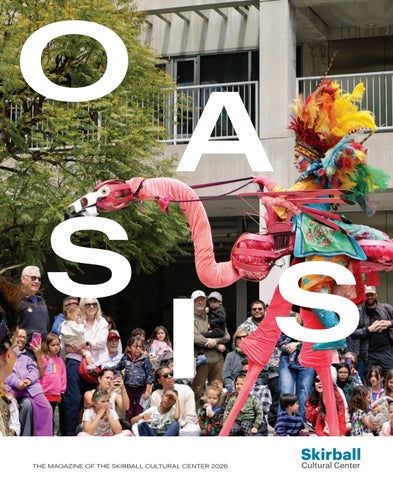
O S
A S I
THE MAGAZINE OF THE SKIRBALL CULTURAL CENTER 2026
IN THIS
ISSUE
8 OUR OASIS Through Fire and Flame: The Enamel Murals of Vera Ronnen The Restaurateur LA Needs Right Now
7
14
PRESIDENT’S MESSAGE
GATHER A Source of Entertainment
20
44
SHOWCASE
ILLUMINATE
Superman: A Model for American Jews
Making Our Garden Grow Unlocking the Power of Our Minds
Art Is Where the Home Is
34 ENGAGE
Editor: David Halperin Design: Vesna De3ign Printing: Colornet Press Cover photo: Keats Elliott
Tuning Out the Noise
Back cover photo: Timothy Norris
The Beautiful Mosaic of Our Nation
Special thanks to Isabel Rosenthal and Shaula Stevenson.
Against the Rules: Jewish Counterculture in America
Oasis © 2026, Skirball Cultural Center
OUR
MISSION THE SKIRBALL CULTURAL CENTER is a place of
meeting guided by the Jewish tradition of welcoming the stranger and inspired by the American democratic ideals of freedom and equality. We welcome people of all communities and generations to participate in cultural experiences that celebrate discovery and hope, foster human connections, and call upon us to help build a more just society.
4
Our Mission
SKIRBALL CULTURAL CENTER BOARD OF TRUSTEES Phil de Toledo, chair Jessie Kornberg, president and ceo Art Bilger, vice chair and secretary Jonathan A. Victor, treasurer Jay S. Wintrob, vice chair
Howard M. Bernstein Daniel Blatteis Melvin Gagerman Marc H. Gamsin Ethan Goldstine Dana Guerin Michael Halpern Mitchell A. Kamin Felicia Knaul Robert C. Kopple Jeffrey Millman Sharon Nazarian Ruth Suzman Peter M. Weil
Uri D. Herscher, founding trustee Marlene Louchheim, founding trustee Orin Neiman, founding trustee John Ziffren, honorary trustee
5
6
President’s Message
PRESIDENT’S
MESSAGE Thirty years ago, when the first visitors streamed through the lobby doors into the newly opened Skirball Cultural Center, they inaugurated a living metaphor. Our lobby is a sukkah–that shelter Jews around the world have built each fall to mark the season. It follows certain rules of construction: open to all who wish to enter, evergreen branches across the roof, sited under an open sky, and built to share the harvest. So too our lobby: in this case, built to share the bounty of Jewish culture and American democratic ideals. This year’s harvest is indeed a cornucopia. Record-breaking attendance to six new Skirball-originated Museum exhibitions. A delicious new learning garden. More than 300 education programs and community events. The Talmud declares that “at 30, one receives strength” (Pirkei Avot, 5:26). At 30, the Skirball receives its strength from the diversity, vivacity, and abundance of visitor connection to Jewish values, history, and art. An exchange between grandparent and grandchild over a ceremonial object. A knowing look between two mothers as children smell the green onions in the pe’ah garden. A quiet moment, as a longtime member walks by the visitation stones in the garden for the first time since her husband died. I saw all these moments and thousands more. Each made me grateful for this place of gentle learning and haimish welcome. This Sukkot, we offer this new issue of our Oasis magazine in the spirit of the holiday and in honor of all who came before us. The pioneers, the builders, the nurturers, and the gatherers. May you all feel the joy of this holiday and this moment in Skirball history. Onward!
Jessie Kornberg, President and CEO, Skirball Cultural Center
7
OUR
OASIS The series of interconnected pavilions, courtyards, and gardens that comprise the Skirball’s 15-acre campus is more than glass, stainless steel, white concrete, pink granite, and tree-lined pathways. It is an oasis in the heart of bustling Los Angeles, a refuge from the chaos of the world, and a place of welcome for people of all backgrounds to engage with Jewish heritage and American democratic ideals. Stunning architecture and picturesque landscapes designed by world-renowned architect Moshe Safdie echo ancient traditions and Southern California environs to create an unforgettable backdrop for educational, cultural, civic, and lifecycle experiences, ranging from exhibitions, performances, school programs, and adult education to seminars, conferences, weddings, and birthday celebrations that advance the Skirball’s mission of fostering community, learning, and justice.
8
Our Oasis
Campus Milestones 1983 The Skirball purchases the land on which it’s situated.
1984 The Skirball contracts Moshe Safdie as its architect.
February 1986 The Skirball holds its groundbreaking ceremony.
1990 Construction commences on Phase I.
October 21, 1995 The Skirball Cultural Center is inaugurated.
April 21, 1996 The Skirball Cultural Center opens to the public.
April 21–22, 2001 Ahmanson Hall dedicated.
September 12, 2004 Winnick Hall dedicated.
May 2007 Noah’s Ark at the Skirball dedicated.
June 24, 2007 Noah’s Ark opens to the public.
October 19, 2013 Herscher Hall and Guerin Pavilion dedicated.
December 3, 2025 A replenished Noah’s Ark reopens to the public.
OA S I S 2 0 2 6
9
The blue and yellow panels on the exterior of Herscher Hall tell an intergenerational story of resilience and artistic mastery. Photo: Courtesy the Vera Ronnen Archive
10
Our Oasis
Through Fire and Flame: The Enamel Murals of Vera Ronnen From 2008 to 2013, artist Carmelle Safdie had the opportunity to collaborate with her grandmother, Vera Ronnen, on the four blue and yellow murals installed at the entrance of Herscher Hall. She recounts the crosscontinental journey these panels took to beautify the Skirball campus. Having just opened my first solo show of paintings in New York, this project took place at the onset of my artistic career, and turned out to be the final commission in Vera’s five decades making vitreous enamel in architecture. This was Vera’s third commission for the Skirball, starting with the two-tiered centerpiece in Founder’s Courtyard in 1995, and the green and red panels flanking the stairway to the lilypond in Taper Courtyard, added in 2001. Vera first studied traditional enameling arts as a teenage refugee in 1940s Geneva, Switzerland, following her escape from Bergen-Belsen on Kasztner’s train rescue operation. What’s unique about her practice is that she hand-sifted jewelry enamels, usually applied to small objects like earrings or decorative bowls, onto large-scale industrial panels. Fused with these supports at high temperatures in a furnace, the powdery colors emerge as deep and rich abstract compositions that are both visually ethereal yet extremely durable—making them suitable for incorporation into both interior and exterior architecture. Vera’s projects around the world include murals and elevator doors, and she always worked with architects on new construction projects. Her artworks are part of the overall design concept of each building, and she valued developing ideas, from sketch to fabrication, in conversation with architects. What adds a layer of complexity at the Skirball is that the campus was designed by Vera’s son-in-law, my father, Moshe Safdie. Moshe and Vera first shared a client in Dick Scheuer, the chairman of Hebrew Union College. Dick was a great admirer of Vera’s work and personally funded eight
concave murals installed throughout the Jerusalem campus. At the time, my father was also working with Uri D. Herscher, rabbi and founding director of the Skirball Cultural Center, on the first phase of the Los Angeles campus. Impressed with Vera’s work at Hebrew Union College, Uri proposed an enamel project for the Skirball, and added commissions to every design phase that followed. At Hebrew Union College, the campus and artwork respond to the vernacular and historic architecture of their surroundings. The school is built on a traditional Mediterranean network of courtyards, and the enamels echo the Ottoman gates of Jerusalem’s Old City. Likewise, at the Skirball, the design accounts for its geographic positioning at the foothills of the Santa Monica Mountains, where buildings and gardens hug the steep topography. This connection is underscored by the artwork: the Founders Courtyard enamel reads like a waterfall cascading from above, and the mossy greens and concentrated red-oranges in the Taper Courtyard seem to grow out of the water lilies below. In 2008, Vera laid out her plans for Skirball’s soonto-be-built Herscher Hall. I would assist in the fabrication of this latest commission, mastering her enameling techniques while taking up residence at an industrial facility in England. At the time, Vera lived in Israel, but we kept in close touch. She liked the color palette of the paintings I’d just exhibited and asked me to develop sketches for the murals. I coated paper with oil paint, cut and collaged into various rhythms, and sent the studies to her studio. We mailed the materials back and forth, obtaining more precise elevations, refining the compositions to work with the proportions and pacing of the façade, and considered feedback from my father Moshe, until we landed on our design. Vera made enamel tests and developed scale-models in her studio, but many of the factories she relied on for fabrication had closed or were no longer hospitable to artists. Luckily, we found A.J. Wells & Sons on the Isle of Wight in
OA S I S 2 0 2 6
11
England, making signage for the London Underground. Not only did they have the facilities and equipment we needed, but they were also accustomed to accommodating artists with public art commissions. Since the 1960s, Vera worked on pre-enameled steel covered in a black ground. She sifted opaque and transparent colors, freely and through stencils, built up through multiple firings. Her colors are complex and opulent, as light penetrates and reflects back through layers of powdered glass. Vera celebrated her medium and liked working on black to maintain a visual connection to the steel below. But at A.J. Wells, Vera was attracted to the silkscreen graphics used by the sign makers and wanted to adopt these materials and techniques. With the help of our project manager, David Knight, we made tests and refined our plans to incorporate hand-rolled sign colors over a prepared white ground. This undercoating would serve the yellows, which could go muddy over black, particularly well, and contribute to the overall vibrance of the finished artwork. In 2009, Vera shipped kilos of her colors to A.J. Wells, and we worked for about a month on sixteen steel panels. Even with access to large furnaces, we had to break each mural into four more manageable parts. We worked on special tables, designed to hold the panels flush with each other while we sifted colors, then moved them from our makeshift studio to the furnace room below. In this way, we were able to work continuously across adjoining panels, then fire them individually, taking great care to regulate the temperature so that the murals fit seamlessly back together, and the colors appear consistent across the artwork. The panels were packed and shipped to the US and stored until Herscher Hall was near completion. Vitreous enamel is an excellent material for public artworks because once fired the colors don’t fade, and the glass coating makes the steel impermeable to rust. But Vera was concerned that some corners had chipped in transit, which would compromise the artwork over time. In 2013, I traveled to Los Angeles to inspect and treat the panels prior to installation. I worked on site in a makeshift warehouse, and with the help of Belinda Valenti at Safdie Architects, we considered the finishing touches like hardware and rubber gaskets that secure the artworks into the wall. In recent years, I have incorporated materials left over from this project, and Vera’s studio, into my own artwork. And as my attention turns to preservation through the Vera Ronnen Archive, I learn that the durability and archival nature of the work doesn’t always secure its fate. But at the Skirball,
12
Our Oasis
Vera’s work lives on—as the backdrop to daily visits, family gatherings, ceremony, and celebration.
Carmelle Safdie is a New York City based artist, professor, and director of the Vera Ronnen Archive. Vera Ronnen (1930–2015) was a Hungarian-born artist and professor who lived and worked in Israel, London, and Basel, Switzerland.
All images on this spread: Vera Ronnen, Carmelle Safdie, and David Knight fabricating four enamel murals for Skirball’s Herscher Hall at A.J. Wells & Sons, Isle of Wight, UK, 2009. Photos: Carmelle Safdie, via the Vera Ronnen Archive
OA S I S 2 0 2 6
13
The Restaurateur LA Needs Right Now At Zeidler’s Café, the only thing spread more than cream cheese is kindness. It provides a taste of fun with nods to LA’s ever-evolving food scene, featuring unique items like matzo ball ramen and kosher dill pickle fries. Rob Eshman recounts the personal stories which made namesake and Skirball Founding Trustee Marvin Zeidler a true “knish in shining armor.”
Marv Zeidler. Photo: Courtesy of Zeidler family.
14
Our Oasis
One afternoon several years ago I pulled up to our home after work to find a spotless Porsche Panamera in our driveway, its trunk wide open. I got out of my car and looked in the trunk, where there was a large cardboard box—full of goat manure. “Marv?” I called out. “Marv?” A moment later, Marvin Zeidler came out from our side gate, holding a shovel. Marv was then in his eighties. He was bald, with a signature bushy gray handlebar mustache and sparkly blue eyes. Beside his garden shovel he held another bag of goat manure. “Hey Rob,” he said. “I took you up on your offer.” Marv and his wife Judy lived in a beautiful Brentwood home. Modern art sculptures studded the yard, along with a full manicured bocce ball court and a lush vegetable garden, where Marv tended to a crop of fava beans. Back then, Naomi and I kept two pygmy goats in our Venice backyard, Goldie Horn and Ollie, and I had told Marv that their manure acted like plant steroids, especially for favas. He said he’d swing by sometime and pick some up, but I assumed he meant it like when someone says, “I put in a pool” or “I built a deck” or “Let’s have lunch.” Marv could have had a team of landscapers tend to his garden’s every need. He could have sent his guys to do his dirty work. But here he was, at the end of the workday, backing up his $120,000 Porsche to fill with goat manure. This week, when I heard from his daughter Susie that Marv died May 7, at the age of 98, that driveway moment came immediately to mind. But there are other reasons to miss Marv Zeidler.
A server at Zeidler’s Café makes recommendations for a hungry customer. Photo: Mercie Ghimire.
‘The perfect restaurant’ Before I met Marv, Naomi and I regularly ate at the Broadway Deli, which Marv opened in 1990. Born in Boyle Heights, Marv started in the men’s fashion business, then turned to restaurants. In 1985, he opened his first restaurant, Citrus, on Melrose, with his friend Michel Richard. He went on to open Capo, Cora’s Café, Brass Cap, Brentwood, Brentwood Café, and the Broadway Deli, which, to me, epitomized Marv’s taste: hospitality. Broadway Deli’s huge space, which anchored Santa Monica’s then-newly refurbished Third Street Promenade, had tables spaced around an island bar, a long counter facing an open kitchen, a deli and grocery section, and comfortable booths. Long before anyone was talking about the importance of a third space, where people can gather outside of work and home, Broadway Deli epitomized one. The food was both deli and un-deli. You could get an endive, arugula and goat cheese salad, or a bowl of chicken soup. Blintzes or penne pomodoro. French onion soup or a malted—or a Manhattan.
As I write this, I realize it sounds like the Cheesecake Factory, but there was nothing basic or bland about the food. “Suppose somebody took all the good qualities of a deli,” wrote Ruth Reichl when Broadway Deli opened in 1990, “and then gave them a California twist? Suppose the menu was big, but the food was light? Suppose the room was big, but the ambience was airy? Suppose the waiters were actually nice? What if the take-out had an upscale attitude? You’d have the perfect restaurant for the ‘90s. You’d have the Broadway Deli.” Reichl was wrong about one thing. The Broadway Deli, which was forced to close when the landlord jacked the lease in 2010, would be the perfect restaurant now as well. And that’s because it reflected the essence of the man who created it. Warm, welcoming, delicious Marv was joyful, welcoming, and loved good food. I didn’t know him as a businessman, but as an enthusiast and host.
OA S I S 2 0 2 6
15
He and Judy, a cookbook author and, from what I could tell, the absolute love of his life, lavished their friends with good food and good times. Many years ago, at a dinner party at their home, Marv rushed back and forth from the kitchen to the dining room, serving a risotto he had just made, obsessing that no guest receive even a slightly cooled plate. Another evening, they hosted their friend Dario Cecchini, the now-famous Tuscan butcher, who considered Marv and Judy his dad and mom. When I told Cecchini I was friends with Marv and Judy, he threw his arms around me and hugged me. “Then we are family!” he said. Too many restaurants these days are impersonal, with cookie-cutter menus. Marv’s restaurants reflected Marv. They were warm, welcoming, and obsessed with serving very good food. No wonder he succeeded in a notoriously tough business.
and I sat in his kitchen, sipped from his wine—Marv was a renowned wine judge—and caught up. The loss of Judy and their son Marc hurt deeply, but he had a large, loving family— five great-grandchildren—great friends, great memories. Mostly, he wanted to know what was up with us, where we had traveled, and what amazing things we had eaten. At the end, I poured us some artichoke digestif I had made. “That’s just great!” he said. “What is that?” The excitement and enthusiasm for the next good thing returned—he was Marv, holding a shovel and a bag of goat manure in my driveway. “How simple and frugal a thing is happiness,” said Zorba the Greek in Nikos Kazantzakis’s novel. With his mustache, twinkly eyes, and appetite, Marv always struck me as a nice Jewish Zorba. A glass of wine, some good food—and the joy one gets from sharing it all with others.
The next good thing After Judy died in 2022, I called Marv to see if I could swing by with lunch. I made sourdough bread, gazpacho, tuna and white bean salad, and homemade biscotti. Marv, Naomi,
Rob Eshman is senior columnist for The Forward and the director of the Karsh Journalism Fellowship. This story originally appeared in his Substack, Foodaism and has been edited for content.
The Zeidler’s Café menu is rich in both flavor and selection. Photo: Sarah Golonka Photography
16
Our Oasis
Westside tuna and white bean salad. Photo: Foodaism
WESTSIDE WHITE BEAN AND TUNA SALAD This is the lunch dish I brought over to Marv’s house on our last visit. Take the traditional Tuscan white bean and tuna salad (beans, tuna, onion, olive oil) and add more vegetables, including avocado. (But don’t sweat the details, improvise with whatever vegetables are handy.) If you keep canned tuna and those boxes of cooked cannellini beans in the cupboard, this salad takes about five minutes to make.
Instructions Serves 4–6. If using dried beans, soak overnight, then drain, place in a large pot, bring to a boil, and simmer about 1 hour until tender. Drain and toss with a little olive oil. For prepared beans, drain boxed or canned beans and quickly rinse.
Ingredients 2 cans of olive oil-packed tuna 1 cup dried cannellini beans or two 13 oz. boxes cooked 1 ripe tomato, cut in eight wedges 1 bunch (about 2 cups) fresh arugula leaves, washed, dried, and sliced 1/4 cup chopped celery and leaves 1/2 avocado, cut in 1/2-inch cubes 1 tablespoon chopped chives or green onions 1/2 sweet pepper, thinly sliced 1/4 cup chopped Italian parsley 1/2 cup extra version olive oil 1 lemon
Set the tomato wedges and avocado aside. In a large bowl, mix all the other ingredients gently together. You want irregular lashings of tuna throughout. Strew the avocado and tomato across the top, drizzle with some more olive oil, and sprinkle with salt and freshly ground pepper. Serve cold or at room temperature.
OA S I S 2 0 2 6
17
GATHER Hospitality is a central value in Jewish tradition. Welcoming guests, honoring milestones, and creating a sense of belonging reflect the Jewish principles of hachnasat orchim (welcoming the stranger), community responsibility, and the sanctity of gathering together. Whether we are hosting a family celebrating a rite of passage or an organization convening for learning and collaboration, the Skirball upholds these values by ensuring every guest feels respected, supported, and seen. Community events at the Skirball are a gateway through which guests experience our mission in a deeply personal and communal way. Events encourage dialogue, civic engagement, and the exchange of ideas—fundamental components of a healthy democracy. By hosting nonprofit organizations, educational institutions, cultural groups, and private celebrations, we help foster environments rooted in openness, mutual understanding, and shared civic values.
18
Gather
2026 Community Event Highlights January 24, 2026–Cayenne Wellness Center 25th Anniversary Gala honoring the incredible partners who have walked alongside us, the courageous warriors who continue to inspire and uplift us, and the shared vision that drives us forward February 7, 2026–Challenged Athletes Foundation Defying Limits Gala standing with athletes who turn challenges into possibility—and helping power a future where every person can move freely February 20, 2026–UNCF Los Angeles Masked Ball powering scholarships, student success, and Historically Black Colleges and Universities (HBCUs). February 26, 2026–Jewish Federation California Gubernatorial Forum sharing views on the issues and speaking directly to the priorities shaping Jewish life in California March 11, 2026–Tina’s Wish: Comedy Fights Cancer fueling their mission for early detection and honoring cancer warriors in our community March 26, 2026–Challah and Soul’s Second Annual Soulful Seder building on the inaugural event’s groundbreaking exploration of shared Black and Jewish histories by bringing together the Latino and Jewish communities to break bread, learn, and create a beautiful haggadah April 8, 2026–Sierra Club Trail Blazers Ball bringing together luminaries and thought leaders to inspire transformative solutions for the planet—while honoring the environmental achievements of artists, activists, politicians, corporations, scientists, and philanthropists April 28, 2026–Los Angeles County Economic Development Corporation Select LA Investment Summit providing an essential platform for decision-makers seeking practical intelligence to explore, start, or expand a business in Los Angeles May 12, 2026–Liberty Hill Foundation Upton Sinclair Dinner: 50th Anniversary Celebration honoring five decades of community power, solidarity, and progress in Los Angeles—and celebrating the people, partnerships, and movements that have helped shape a more just and equitable city over the past fifty years June 9, 2026–Tower of Hope Gala highlighting the collective impact of a community committed to advancing hope, discovery, and support for those affected by cancer June 24, 2026–LA Urban League Whitney M. Young Jr. Awards Celebration raising critical support for programs focused on workforce development, entrepreneurship, education, housing stability, health equity, and economic empowerment
OA S I S 2 0 2 6
19
A Source of Entertainment The story of Hollywood’s Golden Age cannot be told without the experiences of Jewish refugees from Europe in the 1930s. It is a story of immigration, acculturation, and innovation, with deep roots in humanitarianism. The Skirball helps move this story forward through the efforts of nonprofit partners across the industry who champion advancement through diversity and perseverance. MILITARY & VETERAN MEDIA AWARDS We believe stories shape culture. The Military & Veteran Media Awards was created to recognize those who have served our country and continue to serve through storytelling, creativity, and leadership. Our gathering brings together the entertainment industry, military community, and the public to celebrate excellence, build meaningful relationships, and inspire a new generation to see veterans through the lens of possibility rather than limitation. We chose the Skirball Cultural Center because its mission of fostering connection through culture, education, and storytelling closely aligns with our own. The Military & Veteran Media Awards exists to bring people together through the shared language of film, television, music, and media while recognizing the extraordinary contributions of military veterans and those who support them. The Skirball is a place where diverse communities gather to learn from one another and celebrate the human experience. Our event shares that same spirit by using storytelling to build understanding, challenge stereotypes, and highlight the creativity, leadership, and service of veterans in entertainment and media. We couldn’t have imagined a better setting for an evening dedicated to honoring stories that inspire, connect, and make a lasting impact. —Joe Ramirez, Chairman and CEO, National Entertainment Awards Academy for Military & Veterans
20
Gather
Bridging the worlds of service and artistry at the Military and Veteran Media Awards. Photo: Rick Schmitt Photography
SOCIETY OF COMPOSERS & LYRICISTS (SCL) AWARDS The Society of Composers & Lyricists (SCL) Awards® honor excellence in music for film, television, and video games, bringing together the creative community to recognize the composers and songwriters whose work shapes storytelling on screen. Voted on exclusively by professional composers and songwriters working in visual media, the awards represent one of the industry’s highest forms of peer recognition. The annual ceremony features live performances by renowned composers and songwriters, accompanied by many of Los Angeles’ finest musicians and vocalists, showcasing the artistry and collaboration at the heart of screen music. The Skirball Cultural Center’s commitment to bringing people together through art, culture, and shared experiences makes it an ideal home for the SCL Awards®. Both organizations share a commitment to fostering creativity, building community, and championing the artists whose work enriches our world. —Ashley Irwin, President, Society of Composers & Lyricists
DEG: The Digital Entertainment Group ENTECH FEST DEG’s EnTech Fest, held at the Skirball Cultural Center every year since 2022, invites executives from all sectors of the digital entertainment industry to experience the innovations transforming how digital entertainment content is created, distributed, and experienced through a daylong conference program, on-site technology demonstrations, exhibits, and a networking reception. DEG’s sixth annual full-day EnTech Fest is scheduled for March 17, 2027 in Skirball’s Herscher Hall and Ahmanson Pavilion. The primary focus of DEG events is providing education for members on emerging trends to prepare for future industry growth and doing that in community. We’re grateful to have a partner in the Skirball that places the same value on knowledge sharing and provides a nurturing space where we can come to strengthen industry collaboration. —Marcy Magiera, Executive Director, DEG NATIONAL FOUNDATION OF VOICE ACTORS (NAVA) FOUNDATION BENEFIT GALA The NAVA Foundation Benefit Gala is an annual gala to support voice actors and the voiceover industry. The funds raised from the gala help voice actors with scholarships to industry events, legal aid services, contracts, educational resources, emergency funds, and more. The Gala includes a live auction, silent auction, industry awards, dinner, and dancing. In December 2026, we plan to host 500+ voice actors and voiceover industry professionals at the Skirball Cultural Center. The Skirball is a cultural gathering place for Los Angeles focused on creativity, support, and celebrating the arts. For these reasons and more, the Skirball has been the perfect place for our annual gala. NAVA champions human creativity and authenticity in the age of AI. This aligns well with the Skirball’s mission to support human connection. We could not imagine a better place to hold our event. —Carin Gilfry, Vice-President, National Association of Voice Actors
Top: Oscar-winning composer Bill Conti presents the award for Outstanding Original Score for a Studio Film to Oscar winner Ludwig Göransson for Sinners. Photo: Teal Moss Middle: 2026 EnTech Fest attendees try out XREAL AR Glasses in the Herscher Hall exhibit area. Photo: Courtesy of DEG: The Digital Entertainment Group Bottom: Voice actress Lori Alan (SpongeBob SquarePants, Toy Story) hosts the NAVA Gala. Photo: Rodin Eckenroth
OA S I S 2 0 2 6
21
SHOW
CASE The Skirball’s Museum presents exhibitions that tell Jewish and American stories—whether focused on fine art, popular culture, or cultural history—that advance the Center’s mission. It also stewards one of the world’s largest Jewish museum collections: over 30,000 objects that reflect Jewish experiences throughout history and across the diaspora. Through spotlighting objects in our collection and on loan, harnessing the power of media, and providing opportunities for visitors to share their own stories, the Skirball’s temporary exhibitions and core galleries offer a diverse array of narratives that emphasize both the vibrancy and the complexity of Jewish life and culture within the context of American society. From Fall 2025–Spring 2026, the Skirball welcomed 75,000 visitors to the Museum. Six of the seven exhibitions presented during this time were Skirball originals. Recent survey numbers show visitors rated their average visit to the Skirball at 4.6 out of 5, with additional rankings of 9.3 out of 10 likely to return to the Skirball and 9.4 out of 10 likely to recommend the Skirball to a friend or colleague.
22
Showcase
Fall 2025–Spring 2026 Featured Exhibitions Draw Them In, Paint Them Out: Trenton Doyle Hancock Confronts Philip Guston Artists Guston and Hancock remind us that racism, antisemitism, and white supremacy still threaten our communities today. The show challenges us to stay present, think deeply, take responsibility, and find connection in our shared struggles. Glass Sukkah: This Home Is Not a House Black American artist Therman Statom’s works speak to Sukkot’s key messages: the temporary nature of shelter, the value of welcome and belonging, and the preciousness of the natural world. Statom reinterpreted the sukkah using his own visual language and materials. Jack Kirby: Heroes and Humanity Jack Kirby’s life is rooted in Jewish identity and many of the characters he created are inspired by the American democratic ideals of freedom and equality. One prime—and courageous—example of this is the cover of Captain America #1, depicting Captain America punching Adolf Hitler. Inventing America: The Comic Book Revolution Many comic book creators were immigrants and outsiders who brought the perspectives of marginalized communities, including Jewish Americans, into the medium. Drawing on their experiences, they helped construct a vision of America defined by struggle, aspiration, and reinvention. Outsiders, Outcasts, Rebels + Weirdos: Punk Culture 1976–86 This exhibition surfaces the outsider identities of many early punks, including Jews, and explores what punk looked like and felt like, how it spread, the values it embraces and the ones it fought, how audiences participated in it, and how it changed across its first decade. Robert Russell and Lisa Edelstein: A Palace in Time The Los Angeles artists—and married couple—offer visitors a window into the richness of Jewish traditions involving the family in a way that feels relatable to people of different cultural and religious backgrounds. It celebrates the process of collaboration and dialogue, deeply valued in Jewish tradition. TORN Project by Susan Lerner Thirty-six of 251 collages—each representing a hostage taken on October 7, 2023, produced from scraps of ruined “Kidnapped from Israel” posters and displayed in the Skirball’s core exhibition— captured one Jewish American artist’s emotional response to a terrorist horror. ONGOING EXHIBITIONS: Common Ground Noah’s Ark at the Skirball Visions and Values: Jewish Life from Antiquity to America
OA S I S 2 0 2 6
23
Superman: A Model for American Jews The exhibition Inventing America: The Comic Book Revolution highlights how comics reflected—and at times anticipated—an increasingly complex and inclusive society. When Rabbi Nolan Lebovitz encountered Superman among the numerous iconic figures featured, it signified a reminder of the daunting challenges facing American Jews and the crucial role Jews can play 250 years into this incredible American experiment. As darkness began to fill the world in 1938, a Jewish boy from Ohio wrote a story about a baby whose parents fear imminent death. The parents place the baby boy into a pod as the hope for our humanity, as a cosmic sign of goodness. He must live as an outsider in the new place and bear a secret identity. In the story, the pod’s monumental Earth landing occurs in the place we think most boring and least deserving: Kansas. The writer’s name was Jerry Siegel, the publication was Action Comics #1, and we commonly refer to this character by his heroic title of Superman. Many have pointed to the connections between Superman and the Jewish texts of our past, yet I would argue that this iconic superhero narrative remains a model for American Jews today. For those who don’t yet appreciate the parallels between Superman and our textual tradition, let’s briefly examine the narrative of Moses. In the opening chapters of the Book of Exodus, Moses is set into a pod (basket) and placed in the Nile. He brings a new hope to a society overcome by slavery and brutality. There is a story from the Babylonian Talmud, Sotah 12a that teaches us that Moses’ mother was uncertain if she’d ever see her son again. So, she crafted the cloth of his future wedding canopy for him and placed it inside the basket. She wanted the child to feel her presence on his wedding day. So, the baby arrives in
24
Showcase
this basket wrapped in an identifying cloth that we know as a huppah. So touching and profound is the Talmudic idea of the canopy cloth that baby Superman arrives in Kansas wrapped in the blanket of his family from Krypton, and that special fabric is sewn by his new farmer mother into the cloth of his super suit, revealing the iconic “S” on his chest. I have to believe that someplace deep within Jerry Siegel’s soul was the yearning to inspire a sense of strength for American Jews to help the world struggle to realize goodness and justice for all. We bear the responsibility of a tradition that has brought so much wisdom and progress to the world, including our contributions to the United States of America. The Superman story is not solely connected to our sacred texts; it is connected to how we live our lives as Jews in modern America. Like so many American Jews, Superman grows up with an English name of Clark Kent and a special Krypton name of Kal-El, which means “voice of God” or “ease of God” in Hebrew. Like so many American Jews in the 1930s–60s, he struggled to fit into society and felt forced to hide the gifts of his identity. Like all Jewish figures, there is no claim of perfection within the Superman stories. He maintains a moral compass and strives to battle evil and bring a sense of goodness and justice to the world wherever he travels. From the infancy of this country, Jews stood firm in their patriotism. Unlike so many enlightened European national movements at the same time that publicly debated Jewish ability to be loyal citizens, we enjoyed equal status here from the birth of this country. We contributed to American society as true stakeholders. We believed in the promise of the American dream. Hebrew Bible quotations and our traditional symbolism adorn our most cherished
Top: Guests watch a classic Superman cartoon on loop in the exhibition. Bottom: Superman #1, 1939 Art: Joe Shuster © &™ DC Photos: John Dlugolicki
OA S I S 2 0 2 6
25
26
Showcase
civic landmarks, from the halls of Congress to the Liberty Bell. If one understands the integral role of the Jewish story within the American narrative, then it should not be surprising that the quintessential American superhero bears Jewish underpinning. No matter what we wear on the outside, just as Superman wore the “S”, we bear the responsibility of the “J” on our chest as Jews. Some might want us to think of the “J” as a burden. I view it as an incredible opportunity and responsibility for our people that requires us to help this country realize the best version of itself. Superman is a model for modern American Jews as we proudly help others and navigate our own path forward through new challenges. We always live according to our most important texts—from Moses through Superman—to draw wisdom, inspiration, and remind ourselves of our purpose. Like Superman, we ought to fight for truth, justice, and the American way. Like him, there is much work for us to do. Just as the world looked to the skies for his arrival, I believe that the world waits for us to show up as proud American Jews.
Rabbi Nolan Lebovitz, PhD, is the senior rabbi of Valley Beth Shalom in Encino, CA, and the author of the recently published bestseller The Case for Dual Loyalty: Healing the Divided Soul of American Jews. He currently sits on the Board of Directors of the Institute for Black Solidarity with Israel and on the Advisory Board of the Zionist Rabbinic Coalition.
Left: A vintage typewriter invites guests to write the first lines of their superhero stories, asking, “What superpowers would you have?” Top right: The story of comic books is the story of a country in constant reinvention. Bottom right: Inventing America is a window into the values and struggles that define us. Photos: John Dlugolicki
OA S I S 2 0 2 6
27
Art Is Where the Home Is Married Los Angeles-based artists, Robert Russell and Lisa Edelstein share an intimate orbit, but they are not an artist duo; instead, their works share the room in much the same way as they do themselves—as two distinct personalities coming close, moving apart, and always engrossed in conversation across a table laid with candles, food, grief, memory, humor, and grace. When Rabbi Abraham Joshua Heschel described the Sabbath as a “palace in time,” he spoke of a sanctuary built not out of brick and mortar, but out of care and attention—a sacred clearing carved out and set aside from the rush
28
Showcase
“As Baudelaire says, ‘the beautiful is always strange,’ by which he means, of course, that it is always strangely familiar and vaguely surprising.” —Dave Hickey, The Invisible Dragon
of daily life. Artists Robert Russell and Lisa Edelstein have taken that poetically literal idea and chronicled its atmospheres, accoutrements, and more secular artifacts and observances in a thoughtful pairing of their stylistically differing but spiritually aligned creative practices in the Skirball exhibition A Palace in Time. Edelstein’s paintings proceed from a place of exuberant, quirky humanity. Working exclusively from extended-family photo albums to maintain a personal connection to her subjects, she paints scenes, portraits, and vignettes capturing multi-generational gatherings overflowing with floral arrangements, wine glasses, silver
pitchers, and the familiar, overlapping chorus of a family talking all at once. Her lavish sense of color and pattern amplifies the social energy of her scenes, even as her empathetic portraits create moments of stillness within them. Faithful to the awkward cropping of her vernacular sources, the vibrant profusion of her style is guided by a sharp, intuitive editorial eye and a deeply ingrained sense of passionate authenticity perhaps earned in her lauded career as an actor and director. She invites viewers to join the dinners, weddings, and family vacations of strangers, only for us to instantly feel at home. As Edelstein notes, the process is about, “opening a door into another person’s family while not losing the mirror that holds up to your own.” Russell for his part claims himself to be, “essentially a conceptual painter,” as shaped by the rigorous (and ironically, famously antagonistic toward narrative/ symbolist painting) methodological framework of his CalArts education. But conceptualism has rarely had such a classically technique-driven, Renaissance-inflected champion—not one as obsessed with the shadow work of collective truth and accountability. As Russell takes allegedly ordinary domestic and ritual objects—Kiddush cups, yahrzeit candles, porcelain creamers—and strips them of immediate functionality, he highlights the collision of holiness and household, and the way in which diasporic populations invest their whole selves in the smallest objects, consecrating them as physical containers that carry the literal residue of ancestral touch and in their continued existence speak to the endurance of their peoples. In fact, Russell speaks with deep personal affection of the plurality of history-coded domestic heirlooms, such as the three individual brass candlesticks sitting on his own Shabbat table at home—split generations ago by a great-great-grandmother who handed down singles instead of pairs to her three daughters. His canvases make such synecdochal objects saved from fire, carried across borders, and stashed away in drawers into heroes—but as Russell reflects, “I sometimes think of those objects like stand-ins for the viewers of Lisa’s work in a funny way. They’re like witnesses to this chaos. The containers. They hold that,” and sometimes echo the objects inside her paintings as well. As part of preparing for the exhibition, the two perused Skirball’s archives and holdings. Tucked away in the collection, she discovered a tiny, damaged black-andwhite photograph of a Skirball board member from the 1950s. That small, rescued fragment became Alfred and the Red Shoe, a painting that quietly bridges the distance
Opposite page: Artists Robert Russell and Lisa Edelstein lead an artists talk of their Skirball exhibition. Above: Skirball curator Vicki Phung Smith provides insight into the artists’ works. Bottom: Lisa Edelstein stands beside her original watercolor on canvas, Wedding Table, 2025. Photos: Keats Elliott
OA S I S 2 0 2 6
29
between institutional history, archival preservation, and living bloodlines. In this process, both artists noted that the museum’s historical holdings were predominantly weighted toward Ashkenazic history—but also noted Skirball’s broad institutional efforts to expand and deepen its representation of Sephardic and Mizrahi Jewish cultures. This contextual thread surfaces around specific cultural artifacts and imagery examined during the project—such as a Hamsa symbol (with its shared Sephardic and Arab origins) and Robert’s incorporation of a figurative Yemenite Passover scene—tying the visual work back into a diverse tapestry of traditions beyond an Ashkenormative baseline. In a cultural moment where presenting the texture of Jewish life can feel fraught, both painters choose to lean into the radical, affirmative power of beauty and presence. Russell’s conceptual background taught him that beauty can function as a profound invitation to a safe place for challenging conversations. By drawing viewers in through a hyper-seductive, luminous painting style, he encourages them to linger—and the longer you stand before what appears to be a quiet study of a cream pitcher or a candle, the more the work opens up, revealing its deeper significance and illuminating lesser-known histories. Edelstein takes a similar tack, reeling viewers in with the infectious joy of her scenes, only to land on a place of inclusive, resonant self-awareness—in the drawer full of embroidered linens no one needs but everyone feels compelled to guard, and the stubborn, poignant human impulse to gather around a table, pour a drink, and light a candle against the dark.
Shana Nys Dambrot is an art critic, curator, and author based in Downtown Los Angeles. She is the editor and co-founder of 13ThingsLA on Substack, and a contributor to LA Times, Alta Journal, Artbound/PBS SoCal, Music Connection, New Art Examiner, and other culture publications, and was the longtime Arts Editor at LA Weekly. She is the recipient of the Rabkin Art Writers Prize and the LA Press Club Critic of the Year award.
Artists Robert Russell and Lisa Edelstein (left) and Skirball curator Vicki Phung Smith (right) address visitors touring the gallery.
30
Showcase
OA S I S 2 0 2 6
31
ENGAGE The Skirball presents live performances across artistic disciplines that center narratives rooted in the Jewish American experience. Music, theater, dance, film, and literature offer new invitations to evergreen discourses on immigration and assimilation, civil rights and activism, pluralism, and American life. This range of public offerings is designed to foster inclusion and community, bring museum exhibitions to life, highlight cultural heritage, offer lifelong learning, and invite our community to actively participate in civic opportunities, offering hope and discovery. In an era of increasing isolation, the Skirball is building connection and community. In the last year, over 12,000 people attended 32 performances and screenings, and more than 900 people subscribed to classes, book groups, and lifelong learning courses.
32
Engage
Fall 2025–Spring 2026 Program Highlights Common Ground Dinner: A Taste of Sigd—An Ethiopian Jewish Holiday Using tableware from the Common Ground installation, fellow diners took part in an interactive culinary journey celebrating the ancient Ethiopian Jewish holiday of Sigd. Sabor Judío: The Jewish Mexican Cookbook This special book talk demonstrated how cooking and eating connect Jewish Mexicans across places and generations. Jews, Comics, and the American Dream: The Origins of the Superhero Renowned comics scholars and cartoonists came together for a conversation exploring how Jewish artists like Jack Kirby helped shape the American imagination through the birth of the modern superhero. Masters of Subversion: Confronting Cigar This multidisciplinary public arts program used music, dance, spoken word, scholarship, and data to examine questions around trauma, persona, and a loss of identity. From Iran to Los Angeles: Honoring Persian Jewish Culture and Community Visitors gathered at the Skirball for an exploration of Persian Jewish culture through our growing collection of Persian Jewish artifacts. Dis-order Volta dance company and Freak Nature Puppets presented an immersive reimagining of the Passover Seder through performance art, communal ritual, and family drama. Puppet Festival This year’s annual fan-favorite event coincided with the awe and wonder of Noah’s Ark, with imaginations running wild as visitors soared and stomped alongside colorful animals and eclectic creatures. Long Story Short: Michael Eisner in Conversation with the Cast and Creator The creative forces behind Netflix’s groundbreaking animated series Long Story Short came together for a special screening and conversation. Outdoor Movies at the Skirball: The Punk Singer (2013) A star-lit Taper Courtyard set the stage for a special screening of the acclaimed 2013 documentary which chronicles the life and influence of Bikini Kill frontwoman Kathleen Hanna, a central figure in the “riot grrrl” movement. Sunset Concerts Our popular summertime music series returned for season 29 with a celebration of America250, honoring the uniquely American musical invention of jazz with eight eclectic artists and bands.
OA S I S 2 0 2 6
33
Tuning Out the Noise Over the last several election cycles, activist and past President of the League of Women Voters of Los Angeles, Mona Field has led bipartisan discussions on ballot initiatives by simplifying language for voters to better understand the issues. In preparation for the 2026 midterms, she stresses why a healthy democracy needs us all, and why we must maintain the ability to listen and hear each other and share our views with both candor and compassion. I choose to associate myself with organizations which strive to promote and support democratic values, thoughtful dialogue, and respectful discussions. As a Jewish American, I understand in a deep sense the importance of dialogue. That value and skill is built into our traditions. From the ancient scholars to today’s diverse communities, to our children learning Jewish values, we have always believed in the deepest possible exploration of ideas, challenges, and even conflicts. In the programs at the Skirball that I continue to lead—sharing presentations about the ballot measures, offering an impartial, non-partisan pro and con conversation—audiences are given the best possible information, and all with a variety of viewpoints are welcome. The Skirball discussions are part of a larger effort through the League of Women Voters of Greater Los Angeles, presenting election information to thousands of Southern Californians. Our dialogues are met with great appreciation, helping voters cut through the junk in the mail and on the air waves and develop the information to understand the real meaning of the propositions. This fall, the usual mélange of controversial, confusing, and very costly propositions appears on our state ballot. “Costly” because, as usual, elections are costly to all the special interest groups that spend hundreds of millions of dollars blasting us with propaganda, either pro or con. While many Californians have already heard about the more publicized measures, such as the billionaire
34
Engage
Top left: LA mayoral candidates Spencer Pratt (left), Mayor Karen Bass (center), and Nithya Raman (right) debate the issues at the Skirball on May 6, 2026. Photo: NBC4 and Telemundo 52. Photo: John Rou, LMU Bottom left: La Banda Elástica magazine founder Emilio Morales (left) and Chicanx-Latinx Studies professor Martha Gonzalez (right) discuss how music brings America together at Zona Libre. Photo: Farah Sosa (FARAHSTOP) Above right: Volunteers from HeadCount, a nonprofit organization that works with musicians to promote American democracy, registering concert goers to vote. Photo: Halline Overby.
OA S I S 2 0 2 6
35
36
Engage
Opposite page: On February 26, 2026, Jewish leaders, Jewish community members, and civic partners from across the state gathered for the Jewish California 2026 Governor Candidate Forum at the Skirball. Top right: Gubernatorial candidates participate in the forum. Photos: Kathy DeNinno Photography
tax, there are so many more that will potentially affect our taxes, the way the recall process works, potential public financing of elections, healthcare costs, and much more. We learn in our discussions that these ballot measures create odd couples of special interest groups, coming together for one and opposing each other on another. Our latest Skirball discussion on Sunday, October 18 covers all fourteen measures, including the two that relate to housing affordability, six regarding taxation and budget issues, two on healthcare, three on governance, and one with impact on the environment. Some of the propositions were developed and put on the ballot to nullify others. It is truly the Wild West when Californians vote on their ballot measures. While our values may differ, and our voting decisions also may diverge, we should all at least start from a point of accurate information. Having that is the beginning of determining what we want to support and oppose on our ballot. I always urge the audience to please ignore the junk mail and the ads, because they are often misleading and even fallacious. While it is time consuming to attend a program like this, it actually saves a great deal of aggravation as voters look at that lengthy list of propositions and wonder how they should vote. Having some essential accurate
facts helps tremendously in people making their voting decisions. We will discuss the basic information about each proposition, the pro and con viewpoints, and look carefully at the money behind the scenes. Special interest spending—greater each year—will result in your mailbox, both snail mail and email, being bombarded. Also, television ads, radio ads, and every form of social media advertising will attempt to seduce your vote. Attending these presentations makes you feel empowered about voting rather than disgusted and concerned that you cannot make heads or tails of these many complex propositions. I hope you will join us Sunday, October 18 for our thoughtful and respectful conversation about these many controversial measures.
Mona Field is a lifelong Angelino and activist. She is Professor Emerita of Glendale Community College with a specialty in California state and local politics and served four terms as an elected official on the board of trustees of the Los Angeles Community College District. She has been active in the League of Women Voters of Greater Los Angeles and is widely sought as a speaker every election season.
OA S I S 2 0 2 6
37
The Beautiful Mosaic Of Our Nation To celebrate America250, the Skirball welcomed more than three thousand visitors to music, storytelling, and theatre programs. L’Chaim America! The Braid’s original work featured true stories of gratitude and possibility in American Jewish life. These included a Black Jewish storyteller recounting how Ashkenazi activists helped elect LA’s first Black mayor, the complex questions through a writer’s Native American and Jewish heritages, an Iranian refugee family’s Thanksgiving, Jews in Wyoming’s windswept “cowboy country,” and a Salvadoran immigrant reclaiming his Judaism and living the American dream. Tank and the Bangas The chart-topping and critical favorite New Orleans band headlined a special Independence Day concert, which celebrated both the nation’s past and the imaginative, expressive future being written by artists across the country with a vision of American creativity that is expansive, inclusive, and deeply rooted in community. Their music reflects the multiplicity of American identity—its rhythms, its contradictions, its humor, and its heart. Sunset Concerts The twenty-ninth season of Sunset Concerts honored the uniquely American musical invention of jazz. Inventing America: The Comic Book Revolution Music, performance, and dramatization were set against the backdrop of the Skirball’s original retrospective exhibition Inventing America: The Comic Book Revolution—on view now through February 2027—examining how comic books became a popular cultural medium, shaping national identity in twentieth-century America. Audiences of all ages and generations spent spring and summer celebrating America’s 250th anniversary. Photos: Page 38 top—Timothy Norris. Page 38 middle—David Chiu. Page 38 bottom—Farah Sosa (FARAHSTOP). Page 39 top—Halline Overby. Page 39 bottom left—Timothy Norris. Page 39 bottom right—Sarah Golonka.
38
Engage
OA S I S 2 0 2 6
39
Against the Rules: Jewish Counterculture in America Established in memory of the Skirball’s founding chairman, Howard I. Friedman, the annual Friedman Prize invites graduate students from across the US and beyond to submit essays offering perspectives on the American Jewish experience to encourage scholarship and dialogue in these areas. In anticipation of the Skirball’s original exhibition Outsiders, Outcasts, Rebels + Weirdos: Punk Culture 1976–86, this year’s prompt invited scholarship on the role of counterculture in shaping the American Jewish experience. Each year, the presentation of the Friedman Prize offers a chance to celebrate a remarkable essay—and to reflect on the ideas that make the Skirball, and the man it honors, so vital. This year, those ideas came with a little more volume. Applicants reflected on movements, communities, and creative expressions that challenged mainstream norms—whether in music, literature, activism, art, religion, culture, or alternative social spaces—and considered how these countercultural moments intersect with Jewish values and identity. Ultimately, the 2025–2026 Friedman Prize went to Andrew Sperling, PhD, historian at the American Jewish Historical Society in New York City, for his essay “Exorcising the Dybbuk.” His winning essay revealed the deeply Jewish roots of American countercultural rebellion—from the Free Speech Movement to the Chicago Seven—and showed that outsider identity, dissent, and the refusal to be forgotten are central to the Jewish story. The concurrent, original exhibition Outsiders, Outcasts, Rebels + Weirdos: Punk Culture 1976–86 asked, “what happens when people refuse the world as it’s handed to them?” At the award presentation, we asked a sharper version of that question: What happens when Jews stop playing by the rules? The honest answer is... Jewish history. Long before there was a downtown club or a three-chord anthem, there was Abraham—who, the midrash tells us, walked into his father’s shop and smashed the idols. The first iconoclast. The prophets who stood outside the palace gates and told kings exactly what they didn’t want to hear. A tradition that begins with argument, that canonizes dissent, that names its people Israel—“the one who wrestles.” We did not learn rebellion from punk. Punk, in no small measure, learned it from us. And in the 1960s and 70s, when American counterculture erupted—on the steps of Sproul Hall, in the streets of Chicago—Jews were not on the sidelines. They were disproportionately, conspicuously, sometimes scandalously at the center of it.
40
Engage
“The showdown between students, police, and administrators remains essential in narratives of Sixties rebellion, but the centrality of Jewish actors is often overlooked. Those involved recognized how their Jewish heritage dovetailed with their contemporary concerns.” —Andrew Sperling, “Exorcising the Dybbuk”
Howard Friedman might seem like an unlikely figure to invoke in that company. No leather jacket, no safety pins. He wore a suit, and he wore it well. But don’t let the tailoring fool you—Howard understood dissent in his bones. As a young student at the University of Oklahoma, he led campus protests when Ada Lois Sipuel was denied admission to law school because of the color of her skin. “Those who say we can have equality under separate schools are blind,” he said—decades before that view was safe or popular. Howard spent his life inside institutions—the law, the American Jewish Committee, the Skirball—but he never confused belonging with conformity. He built institutions precisely so they could carry the voice of the outsider forward. That, too, is a kind of rebellion: the long, patient, stubborn kind. Howard believed in the power of ideas. He believed in the Jewish people. He believed in a world where difference is not merely tolerated but celebrated. And he believed in the Skirball as a place that tells the story of the Jewish-American experience—including its loudest, most unruly chapters. We are proud to carry that story forward.
Beaumont Shapiro is Rabbi-in-Residence at the Skirball Cultural Center, where he serves on the senior leadership team and helps advance the institution’s mission through public programming, staff learning, strategic partnerships, and exhibition development. He contributes to the reenvisioning of the Skirball’s permanent exhibition and collaborates across departments to translate Jewish history, ethics, and culture into meaningful public engagement. Previously, he served for more than two decades in senior leadership at Wilshire Boulevard Temple and founded the Karsh Family Social Service Center, an innovative nonprofit serving more than 10,000 families annually through cross-sector collaboration.
Friedman Prize winner Dr. Andrew Sperling poses with his award in the Skirball lobby. Photo: Lindsey Best
Scan the QR code to read Dr. Sperling’s winning essay in its entirety.
OA S I S 2 0 2 6
41
ILLU
MINATE The Roslyn and Abner Goldstine School Programs always begin with welcome and storytelling. These stories are an invitation for our youngest visitors to learn more about Jewish culture and identity and make connections to their own cultures and identities through discovery, wonder, and interactive hands-on learning via music, movement, and artmaking. For those with the appetite for more, ongoing classes in applied arts, book discussion groups, lecture series, and other deeper engagement opportunities fill the calendar. Long after their participation in educator-led tours of our exhibitions, multiweek residencies at schools, teacher professional development workshops, free online lessons and videos, and of course intergenerational family experiences aboard the award-winning Noah’s Ark exhibition—including the Art Studio and new Bloom Garden—and Archaeology Dig, visitors recall the magic of their experience and discover we are part of something larger than ourselves. But the work is more than just fun. In a time of rising antisemitism, the Skirball gives the youngest members of our community (and their grown-ups) a positive experience in a Jewish place. Jewish kids and families can feel safe and comfortable. Visitors from all walks of life can find points of connection and understanding. This is serious work done joyfully, with intention, compassion, and care to foster human connections.
42
Illuminate
2025–2026 Roslyn and Abner Goldstine Education Impact Report Highlights
10,242 students, educators, families, and community members reached through in-person education programs
185 school programs, tours, performances, and residencies offered
132 school partners across 16 public school districts, plus private and homeschool communities
62% of school groups received both admission scholarships and bus scholarships
66% of participating students came from Title I schools
84% of participating students came from public schools
102 teachers trained through professional development workshops
16 interns gained hands-on experience through Skirball education programs
OA S I S 2 0 2 6
43
Skirball’s Getty Garden Fellow Nik Berne (far right) showing off the many species of plants found in the pe’ah garden. Photo: Lindsey Best
44
Illuminate
Making Our Garden Grow The Skirball’s Getty Garden Fellow, Nik Berne brings together her background in education, visual art, and her work as a Certified Watershed Wise Landscape Professional to inspire hands-on, nature-based experiences. We asked her to share about her work in the Noah’s Ark learning garden creating experiences that foster a deeper connection with the natural world. How is gardening connected to Jewish culture? NIK BERNE: When we physically dig in the soil, pick flowers, or plant seeds, we forge a relationship with nature instead of simply looking at it. These experiences naturally spark questions, and I love that because asking questions is at the heart of Jewish learning. But rather than giving participants all the answers, we invite them to explore, wonder, and discover through hands-on experiences in the garden. Mindfulness gives us permission to slow down and notice what we might otherwise overlook. Taking a moment to listen to birds singing or watch a bee visit a flower reminds us to approach the world with gratitude and intention. Those quiet moments reflect the Jewish value of kavanah (bringing intention to what we do) and invite us into a deeper connection with the world around us. Play is where those discoveries become joyful. Through games, storytelling, art, and exploration, participants build relationships with one another while developing a sense of belonging. They aren’t just learning about community; they are experiencing it. Sustainability becomes a natural extension of that relationship. When we compost or plant for pollinators, we understand that our actions have consequences. Those everyday choices reflect Jewish values like bal tashchit (do not waste) and remind us that caring for the earth isn’t a single act but an ongoing endeavor. What is the lesson you hope visitors to the garden take home with them? NB: I hope visitors leave the Noah’s Ark learning garden with a sense of curiosity, wonder, and a stronger connection to the world around them. There is something uniquely powerful about touching the soil, smelling herbs, harvesting plants, and observing living ecosystems. Learning becomes personal. Those experiences create memories that stay long after a visit. One of my favorite moments to share with visitors is harvesting chamomile flowers. Together, we pick the flowers, talk about how they can be stepped for tea, and then they take them home. Later, when they brew that tea, they can remember the plant they harvested and the garden where it grew. That simple memory can spark a new way of thinking. Because they now have a relationship with that plant, instead of throwing the used tea leaves into the trash, they can compost them, allowing those nutrients to return to the soil and help grow the next generation of plants. In that moment, they become part of the same natural cycle they experienced in the garden. It is a tangible example of bal tashchit and a reminder that even small actions can help care for the earth.
OA S I S 2 0 2 6
45
I want visitors to leave seeing that nature is not separate from their daily lives, but something they participate in every day through the choices they make. Jewish tradition teaches that we are both beneficiaries of the natural world and responsible for its care. If the garden experience can help someone notice the connections between the food they eat, the waste they create, and the living systems that sustain us, then we have done more than teach a fact. We have invited them into a relationship with the earth that honors the world we have inherited and helps ensure it thrives for future generations. You have been hosting workshops with community partners in the garden. What have you learned from these partnerships? NB: That no one has all the answers. Each collaborator brings a different lens, and together we’ve created experiences that are richer than any one of us could have designed on our own. One workshop that stands out was partnering with graffiti artist Siyo-win Peters. Watching guests observe the colors and textures in the garden before transforming those observations into vibrant works of art reminded me that nature isn’t simply the backdrop for creativity; it’s an inspiration. Working with Shemesh Farms reinforced something similar. Whether participants were painting with watercolors or decorating pots before planting marigold seeds, the activity itself wasn’t what made the experience meaningful. It was the conversations, shared discoveries, and moments of joy that unfolded along the way. That spirit of collaboration has become one of the defining qualities of the Skirball’s Art and Nature Workshops. Can you describe the teaching methodology that begins inside and now continues outside Noah’s Ark? NB: The garden is a natural extension of the learning that begins inside Noah’s Ark. Both spaces invite children to learn through curiosity, play, observation, and experimentation rather than by simply being told information. As families move from Noah’s Ark into the garden, the learning continues seamlessly, just with the added richness of being surrounded by the natural world. Every space in the garden is intentionally designed to encourage open-ended exploration while connecting visitors to Jewish values through lived experience. In the Herb Pe’ah Garden, where Shemesh Farms grows herbs for their spice blends, children might feed the worms in the
46
Illuminate
Skirball Teen Advisory Committee members get an up close look at the variety of newly planted flowers. Photo: Lindsey Best
vermicompost, spread the finished compost around the herb beds, and then “harvest” herbs to share at the nearby farm stand. Through play, they experience a complete food cycle and begin to understand bal tashchit not as an abstract idea, but as something in which they can participate. As they play, children naturally begin asking questions like, “What happens if I feed the worms?” or “How does compost help a plant?” They aren’t memorizing a lesson about composting; they’re discovering cause and effect for themselves. What may look like simple pretend play also becomes an opportunity to practice community, generosity, and hospitality. For example, in the living willow hut, children gather natural materials to prepare imaginative meals for friends and family around the stump tables. Throughout the garden, learners are invited to slow down, notice details, ask questions, and care for the living world around them. Those experiences cultivate not only sensory exploration, but also a sense of stewardship, reminding visitors that we all have a role in caring for creation and for one another. My hope is that children leave not with a single lesson, but with the confidence that they can continue exploring, asking questions, and making discoveries wherever they encounter nature.
Nik Berne (left) with members of the Skirball Teen Advisory Committee in the garden. Photo: Lindsey Best
OA S I S 2 0 2 6
47
Unlocking The Power Of Our Minds Jewish tradition asks us not to deny the rigors of aging, but rather meet them with compassion, grace, and respect. The Skirball’s adult education program never forecloses on the possibility of the capacity for growth and renewal. Jewish culture places extraordinary value on lifelong learning and the pursuit of knowledge. Participants in our program create social connections, learn from educators who teach us how to make a difference in our world, and discover our individual and collective sense of purpose. Learning in community leads to positive action, inspires compassion and justice, and provides opportunities for meaningful dialogue through discussion, reflection, and exploration. Questions are celebrated and curiosity is welcomed in all our offerings, whether you are participating in a Nazarian Applied Arts class, Creative Writing workshop, Skirball Book Group, Current Events class, at the Mah Jongg table, and so much more. Since 1997, our diverse class offerings have been inspired by our museum exhibitions, both permanent and temporary. Our programs encourage participants to make connections between the stories on display and their own lives. Every exhibition raises new questions, and every class becomes an invitation to keep asking, keep exploring, and keep growing. Ronni Rice (aka, the Marvelous Mrs. Mahj) loves nothing more than sharing her passion for the complex, yet very fun and addictive game of American Mah Jongg. “Teaching at Skirball has been a joyous, collaborative experience for me,” she says. “I have enjoyed meeting so many new, enthusiastic students, and am genuinely deeply appreciative of the support I have received from the team in the Adult Education department.” Rice hopes to be able to continue this partnership for a long time to come, and to help the Skirball create and initiate a social play Mah Jongg experience for the community. “It would be a win-win for all, as community is such a vital part of both the Skirball and the game of Mah Jongg. May the Jokers be with you!” For pottery instructor Allison Goodman, teaching in the Adult Education program at the Skirball was a new adventure for her. She explains that, “I had experienced the positivity of the institution through my work with Audrey’s Museum Store but did not know how that spirit
48
Illuminate
Hollander Library is transformed into an art studio for Acrylic Painting classes. Photo: Lindsey Best
OA S I S 2 0 2 6
49
would translate to the classroom. What I found was a vibrant group with a collective sense of humor, excited to try new things, and willing to trust and experiment with their own creativity. Each session was busy, personally satisfying, and even taught me new things about my own clay practice.” Stacey Bieber continues to lead sold-out Book Groups every fall and spring season. “Moderating at the Skirball has been one of the most meaningful experiences of my professional life,” she enthusiastically describes. “The readers are insightful and deeply engaged, but what makes the book groups truly extraordinary is the sense of community they have built together. Some members have shared years of conversation and friendship, and those bonds have sustained them through so much— gathering online during COVID, supporting one another through painful losses, and showing up for each other in ways both large and small.” Those friendships have also extended far beyond the book groups themselves, leading to lunches, lasting relationships, and even trips together. But the closeness of long-time members has never made the group feel closed. “New members are welcomed with genuine warmth and quickly made to feel at home. I felt that same generosity from the start when I joined as a new book group moderator three years ago. There is something profoundly special about the Skirball book groups—not just in the conversations they foster, but in the human connection they make possible.”
50
Illuminate
STUDENT TESTIMONIALS “It has been such a joy to be part of a community of like-minded souls, and the quality of the discussions and the ease of the teachers have made these classes incredibly meaningful to me.” —Maria Cristina Jimenez
“I have attended the Skirball Book Group for over fifteen years and there’s no doubt that my love of reading has been enhanced by our sessions. The fact that the books are thematically aligned with the current exhibitions often introduces us to books we would never have chosen ourselves.” —Suzie Laskin
“I loved the opportunity to experiment with different materials and techniques, be fully present, and reconnect with the joy of making by hand. Being part of such a welcoming community of fellow students made the experience even more meaningful, and having all of the materials thoughtfully provided made it easy to simply show up and immerse myself in the creative process.” —Leila Khodadad
Opposite page left: Writers of all levels are invited to hone their craft in Creative Writing classes and workshops. Top: Adult Ed classes continue long friendships and create new ones.
“I continue to choose this program because, like my other experiences at the Skirball, the classes are warm, welcoming, and enriching. There is a sense of community, and I feel at home. The tranquil beauty of the Skirball environment inspires inspires me to create beauty of my own.” —Ellen Moss
Bottom: Preparing for a Skirball Book Group discussion. Photo credits: Lindsey Best
OA S I S 2 0 2 6
51
NON-PROFIT ORG. U.S. POSTAGE
2701 N. Sepulveda Blvd. Los Angeles, CA 90049 (310) 440-4500 skirball.org
stay connected @skirball_la
PAID LOS ANGELES, CA PERMIT 2112