S H O W C A S I N G
S K I D M O R E
C O L L E G E
P E O P L E
A N D
P R O G R A M S
Then and now, a great American college town
Rediscovering culinary pioneer Helen Corbitt ’1928 Alumni profiles Class Notes, and more!
|
F A L L
2 O 2 6
A trip down memory lane Then and now, Broadway has been central to every Skidmore student’s experience of Saratoga Springs. With its bustling sidewalks, unique eateries, and quaint shops, Broadway is where prospective students and their families often fall in love with the city during a campus visit and where friends connect during the semester and, later, reunions. Superimposing past and present, these combined photographs capture a street that each generation makes its own. The storefronts change, but Broadway remains a place to make memories, return to them, and make new ones again. I M A G E : B O L S T E R C O L L E C T I O N A N D M I K E S Y LV I A
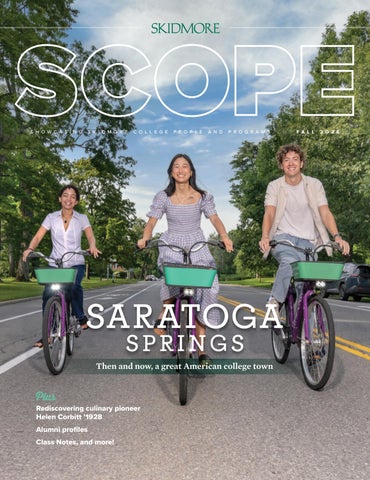
On the cover: Still making no small plans An image of three regalia-clad seniors riding bicycles along Union Avenue near Skidmore's downtown campus — Ann O'Brien Redmond ’45, Ellen Domin Reutershan ’45, and Carolyn Mason Seaman ’45 — captured the spirit of hope near the end of World War II and were featured on the cover of the late Mary C. Lynn’s Make No Small Plans: A History of Skidmore College (2000). They now ride e-bikes, and the downtown campus relocated long ago, but (from left) Skidmore seniors Samantha Majiedt ’27, Sharon Xu ’27, and Aidan Darling ’27 are pedaling forward on North Broadway with similar optimism for the future. P H OTO BY S H AW N L AC H A P E L L E
SKIDMORE COLLEGE | 1
FROM THE PRESIDENT
hen people ask me, "Why is Skidmore College having such success in these challenging times?" I tell them that a big reason is the great city in which we are located. Saratoga Springs may well be the greatest college town in America, partly because it is so much more. With the culture and artistic offerings of Saratoga Performing Arts Center (SPAC); the dynamism and excitement of Saratoga Race Course; and the community commitment of institutions such as the Adirondack Trust Company and Stewart’s Shops, the special quality of our city can be seen everywhere. Every block and building carries a sense of history and heritage, ranging from the Frederick Allen Lodge to the folk and jazz music of Caffé Lena to the remarkable creative space of Yaddo — a renowned retreat for artists, writers, and musicians, including James Baldwin, Aaron Copland, Alice Walker, and Ta-Nehisi Coates. I often reflect on the good fortune that brought Barb and me to Skidmore and Saratoga in 2020. Neither of us knew what to expect. We both grew up in Washington state and spent 24 years in rural southwest Virginia. Like many non-New Yorkers, I knew a bit about Manhattan, and I knew that there was something vaguely to the north and west of New York City ... I had no idea that we had come to a place so rich in beauty, diversity, history, and opportunity, from the dynamic state capital of Albany to the wild beauty of the Adirondacks. We are so thankful to have come to such a wonderful place. I get to walk out the back door of our home, Scribner House, and within minutes I’m strolling on Skidmore’s tree-lined campus with our chocolate lab, Molly. A short stroll in the other direction and I’m in the heart of Saratoga’s bustling yet quaint downtown. The bounty of restaurants, taverns, and shops is remarkable. To have a favorite Saratoga Springs restaurant is sort of like having a favorite child — you love them all equally, of course! But a few have become personal go-tos for us. Karavalli Indian restaurant at the bottom of Caroline Street always makes me feel so welcome. The food is tremendous, and when our three sons, all in their 20s, come to visit, it’s one of their favorite places. And 15 Church is where we often go for special occasion dinners: family birthdays, when my mom visits from Tacoma, or our anniversary. It embodies the personal connection and sense of sincere welcome that is Saratoga Springs at its best. (And for true charm and great food, The Wishing Well never disappoints!) Saratoga Springs is where I work, and it is vital to the success of that work. It’s also where we exercise and play. The YMCA, on whose board Barb sits, is as good as any in the country. And where we worship, St. Peter’s Catholic Church, is one of the most welcoming Catholic communities I’ve ever experienced. I’m so grateful for the boundless internships and experiential learning opportunities Saratoga Springs provides for our students, as well as culture and community for all its residents.
2 | SCOPE FALL 2026
Alumni frequently tell me how Saratoga Springs draws them back — for Reunion in late spring, a summer excursion to the city that was once their home, autumn foliage, or a winter ski trip. Every time of the year is a wonderful time for a visit. Continuing to cultivate the positive relationship between Saratoga Springs and Skidmore — and grow opportunities for our students — is a priority for me and Barb. We’re proud of all that Skidmore does to welcome our neighbors onto our campus and encourage them to participate in the intellectual, artistic, and cultural life of Skidmore, from the concerts in Zankel Music Center to the art that flourishes at the Tang Teaching Museum to our exciting sporting events and the lectures and programs that we offer. I often say, there’s something special happening at Skidmore these days, and our city of Saratoga Springs is a huge part of that.
Marc C. Conner, President
Contents
FALL 2026 Scope is published by Skidmore College’s Office of Communications and Marketing.
Vice President for Communications & Marketing Elizabeth Stauderman
13
Senior Director of External Relations and Strategic Communications Sara Miga ’08 FEATURE STORY
Saratoga Springs, One of America’s Great College Towns:
Saratoga Springs is an important part of the Skidmore College experience, and Skidmore is a big part of what makes the city so extraordinary.
Director of Creative Services Mike Sylvia Managing Editor James Helicke
2
President’s Message
31
4
Community Review Geo Trees; A New Collyer Vice President; Big League Dreams; Reunion Notes; Moon Rocks; A Thoroughbred for Life; Humanistic Inquiry Symposium; China from the Outside In; faculty and staff highlights
34 Making History Skidmore’s Land Acknowledgement
Class Notes Editor Katie Rocque
35 A Tale of Two Trees Professors Siobhan Hart and Adam Tinkle, Elder-in-Residence Kay Olan (Ionataie:was), and Callahan Mainzer ’26
Contributors Jodi Frank Valerie Burkhardt Tamis Marier ’64
13
Saratoga Springs, One of America’s Great College Towns Jack Hay ’76, Steve “Sully” Sullivan ’78, Jill Fishon-Kovachick ’81, Charlene Wood ’84, Teddy Foster ’95, Alexis Herzog ’09, Maggie Harding ’11, Reese Fulmer ’18, Alex Yarinsky ’23, Shoshi Cohen ’26
22 The Secret Ingredient was Skidmore Helen Corbitt ’1928 and Valerie Burkhardt Tamis Marier ’64 26 Performing on a Different Stage Christina Ryba ’98 28 Revolutionary Perspectives Professors Natalie Taylor and Tillman Nechtman
Capital-izing on Connections Pat Wildes ’12 and Cassidy Goda ’28 with Professor Bob Turner
38 Telling the Stories of Urban Renewal's Impact Julie Thompson Lewis ’95 P’26 and Geri Lagotta ’97 42 Making an ImPRession Susan Magrino ’83
Editor Angela Valden
Photography Sarah Condon-Meyers Shawn LaChapelle Graphic Design Sarah Gagnon Sidekick Creative
44 A Skidmore Tale of Robin Hood Thomas Rivera-Patterson ’13 46 Class Notes 67 Alumni Authors 68 In Memoriam
From the editor: What comes to mind when you think of Saratoga Springs? A study session at Uncommon Grounds, a favorite concert at Saratoga Performing Arts Center, or an unforgettable evening on Caroline Street? Or perhaps you’re daydreaming about spending your college years at one of the greatest liberal arts institutions — in one of the greatest college towns — in the country. Every generation finds a new Saratoga, but for most alumni, memories of college and city are inseparable. In this issue of Scope, we meet a few of the alumni whose restaurants, galleries, shops, and cultural institutions enrich the city they call home and learn how their Skidmore experiences continue to inform their work. We also join students and faculty in reconsidering our history and exploring career opportunities across the region. Other stories broaden our view, from examining moon rocks to rediscovering that a great American culinary legend happens to be a fellow alum. Together, these stories reveal how much there is to learn here and how far a Skidmore education can take us. Consider this issue an invitation to explore Skidmore and Saratoga Springs anew. Come revisit your favorite spots and a place you can always call home.
815 North Broadway Saratoga Springs, NY 12866 518-580-5000 skidmore.edu
— James Helicke | scope@skidmore.edu SKIDMORE COLLEGE | 3
COMMUNITY REVIEW Director of Sustainability and Environmental Initiatives Tarah Rowse unveils the first of five Geo Tree sculptures slated for placement above Skidmore's geothermal borefields.
‘A BIG, BORE-ING SUCCESS’ More than 100 student, staff, and faculty volunteers lined up outside the Skidmore Community Garden — first to pick up their tan Geo Trees T-shirt, then to decide whether they’d rather wear an orange or a blue bandana, to portray either heating or cooling. It’s not every day you get to be a “human bore” — representing one of the 700 geothermal bores beneath campus that account for 47% of Skidmore’s heating and cooling. The system is just one example of Skidmore’s commitment to sustainability.
by Angela Valden, human bore The four forthcoming Geo Tree sculptures will mark the locations of geothermal systems at Murray-Aikins Dining Hall, the Billie Tisch Center for Integrated Sciences, Zankel Music Center, and the Arts Quad. Each will be a little bit different, with varying metals, sizes, finishes, and bore (“leaf”) styles.
The creativity of it all was as much a motivation to be there on the sunny but brisk spring afternoon during Earth Week as the desire to support Skidmore Sustainability through this live, community art exhibition. Skidmore’s Sustainability Office is partnering with Associate Professor of Art John Galt and the College’s sculpture studio to create five metal Geo Tree sculptures that identify the underground locations of geothermal borefields across campus. After the first Geo Tree was unveiled, the human bores took their places on numbered spaces inside the garden and across Wiecking Green. Then, Skidmore’s Office of Communications and Marketing flew a drone overhead to capture images of the human borefield — representing the actual geothermal bores buried beneath the ground. The event “was a lovely day and a big, bore-ing success,” Director of Sustainability and Environmental Initiatives Tarah Rowse wrote in a thank-you email to all those who participated. “Our dream — well, certainly mine, at least — to create a human borefield became a reality.” 4 | SCOPE FALL 2026
Student, staff, and faculty volunteers gathered as “human bores” across the Wiecking Green as part of Earth Day celebrations at the College.
Rowse explains, “The Geo Trees project combines science, art, and communication to increase the visibility and awareness of Skidmore’s geothermal systems, support our sustainability literacy goals, and provide a project-based learning opportunity for students by using the campus as a living lab.”
MEET SKIDMORE’S NEW COLLYER VICE PRESIDENT FOR ADVANCEMENT For Melissa Komora, the transformative power of a liberal arts education is personal. A first-generation college graduate, she attended a small liberal arts institution. The interdisciplinary degree she pursued in music and business set her on a trajectory that allowed her to follow her own dreams in life. She still keeps the local newspaper clipping announcing her scholarship award. An internship before graduation proved equally formative, leading Komora to a position at Glimmerglass Opera and introducing her to New York’s Capital Region. It also allowed her to apply the creative thinking and strategic skills she developed during her undergraduate years. “An internship or experiential learning opportunity can kick-start a career,” says Komora, who also earned an MBA from Russell Sage College. Her own experience now guides Komora’s work as Skidmore’s Collyer Vice President for Advancement, a role she assumed in June. She sees philanthropy as a way to expand opportunities for generations of Skidmore students.
“I have this great job that allows me to help create joyful pathways for thousands of others,” she remarks enthusiastically. Komora was impressed by one of those many Skidmore students during her first campus tour; her guide was pursuing scientific research, playing polo, taking art classes, and developing close relationships with faculty, who challenged and supported her. “Skidmore gives students the freedom to explore where their interests overlap and discover possibilities they may not have considered,” she says. “The world continues to change, but the impact of the liberal arts endures. The skills students develop here continue to evolve with them and remain essential throughout their lives.” Komora, who previously oversaw the largest campaign in Susquehanna University’s history, is eager to build on Skidmore’s momentum and broaden participation among alumni, families, and friends. Among her top priorities are strengthening academic excellence, enhancing experiences for students, and ensuring that a Skidmore education remains accessible to all, regardless of financial circumstances.
“We are all shareholders in Skidmore’s future,” she says. “Every gift counts, and every form of engagement matters. “When you stay involved in a way that is meaningful to you — whether through volunteering, mentoring, or giving — you can see what you helped make possible and take great pride in it.” Komora and her husband, actor Ron Komora, are also enjoying Saratoga Springs, from ballet performances at SPAC to its independent shops and restaurants. “There is a creative, entrepreneurial spirit throughout the city that feels deeply connected to what Skidmore is all about,” she says. “Skidmore has an amazing reputation. The chance to become part of this community and help shape its future is incredibly meaningful.”
BIG LEAGUE DREAMS President Marc C. Conner threw out the ceremonial first pitch during a Skidmore community night with the Tri-City ValleyCats, the Capital District’s Frontier League team. Donning a Thoroughbreds uniform, the Seattle Mariners devotee was joined on the field by recent graduate Quinn Hocom ’26, who recently signed with the ValleyCats after graduating as Skidmore’s career strikeout leader. Alumni, faculty, staff, and their families cheered on the ValleyCats as they hosted the Trois-Rivières (Québec) Aigles (Eagles) in Troy. Organized by Skidmore’s Office of Alumni Engagement, the July 7 event took place at Joseph L. Bruno Stadium, named for the late Skidmore alumnus and former New York State Senate Majority Leader Joseph L. Bruno ’52.
SKIDMORE COLLEGE | 5
COMMUNITY REVIEW
A HARMONIOUS REUNION The Sonneteers struck just the right chord as Skidmore welcomed alumni back to campus May 29-31 and helped make it a memorable, musical Reunion Weekend. In addition to reuniting classmates from classes spanning 1951 to 2021, the weekend also celebrated the 75th anniversary of Skidmore's first a cappella group. Sonneteers from across generations reminisced and performed together. Throughout the weekend, alumni reconnected over shared memories, cherished traditions, and favorite tunes while raising more than $16.5 million to support opportunities for Skidmore students.
‘LIKE HOME’ “Somehow I found myself at my 10-year Skidmore College Reunion. I've been back to campus a handful of times over the years for different events, but this was the first time in a decade that I ate in the dining hall, walked back and forth across campus multiple times, and sat on Case Green with nowhere in particular I needed to be next. I know reunions are supposed to be about coming together and, well, reuniting. But if I'm being honest, I found myself spending a lot of time thinking about everything that's happened in the last 10 years. Stepping onto campus with a wedding ring on my finger. Noticing the anxious thoughts that sometimes keep me from being fully present (something Roslyn 10 years ago never would have imagined). Seeing the campus through different eyes and appreciating not only how beautiful it is, but how lucky I am to have a place in my life that will always feel a little like home. And, of course, I ended the trip the way I almost always do: with one last visit to Zankel Music Center, where I spent so much of my time during those four years. 6 | SCOPE FALL 2026
The building that felt most like home. The place where I felt invincible, where days somehow disappeared in an instant, and where some of my favorite memories were made. I guess I'm here to say that I really enjoyed my reunion — not just the reconnecting, but the reflection, the nostalgia, and all the unexpected feelings that came with it. Ten years later, I can appreciate where I came from, and the person I've become along the way.” — Roslyn Wertheimer ’16
SAVE THE DATE!
Reunion for Skidmore classes ending in 7 and 2 will take place June 4-6, 2027. Registration opens in March. www.skidmore.edu/reunion
AN OUT-OF-THIS-WORLD EXPERIENCE After spending the semester studying Earth’s rocks and minerals, students in a geosciences course capped their studies by examining rare NASA lunar samples from the Apollo missions. For most of the semester, students in Visiting Assistant Professor Duncan Keller’s Earth Materials course focused on the rocks and minerals that make up the planet beneath their feet. Then, at the very end of class, they turned their attention 238,855 miles away. Students examined lunar samples on loan from NASA from its Apollo missions — a rare opportunity that coincides with renewed interest in lunar exploration through NASA’s Artemis program. Keller says studying the moon helps students better understand Earth by comparing how similar rocks formed under dramatically different conditions. “We know Earth is a special planet. It has water. It has life. The moon is our closest neighboring planetary body and it’s so obviously different from Earth. It’s cold. It’s dry,” Keller says. “Luckily, many of the kinds of rocks on the moon are the same kinds of rocks as on Earth. We can look at these sibling rocks and how they form similarly and differently, and that tells us a great deal about how these planetary bodies work.” For Samantha Lorenc ’28, a geosciences major, the experience was unforgettable. As she peered through a microscope, she snapped photos of one sample with her phone. “I found this really cool mineral. I’m pretty sure it’s a CPX — a clinopyroxene,” she said. These minerals are also found abundantly in volcanic rocks and the mantle of the Earth. “We’ve been looking at rocks from Earth all semester, so it’s really cool to compare what we’re seeing from the moon and figure out how those rocks formed, too.” Beyond the science, Lorenc says there was something awe-inspiring about the experience. “It’s just wild to be looking at a rock from the moon. You see the moon every night, and it’s really cool to be looking at it under a microscope.”
A THOROUGHBRED FOR LIFE After 21 years of devoted service to Skidmore, Gail Cummings-Danson retired in August as assistant vice president for student affairs and director of athletics. But her connection to the College is far from ending: In recognition of her extraordinary leadership and enduring impact, the Alumni Association Board welcomed her as an honorary alumna. Since arriving in 2005, Cummings-Danson helped shape generations of Thoroughbreds. She strengthened athletic and recreational programs, championed the academic success and well-being of student-athletes, and guided transformative projects including the McCaffery-Wagman Tennis and Wellness Center and Ferrari Field. During her tenure, Skidmore teams earned four national championships and 41 conference titles and produced more than 130 All-Americans. Her legacy, however, reaches beyond victories and facilities. A trusted mentor, colleague, and campus leader, she brought care, integrity, and a deep belief in the power of athletics to help students grow as competitors, scholars, and citizens. “I’m honored to receive this recognition as a meaningful affirmation of the shared purpose, community, and spirit that define Skidmore,” Cummings-Danson said. Now, as an honorary alumna, she will always have a place in the alumni community she helped inspire. Cummings-Danson is succeeded by Katie Benoit, who joined Skidmore in August after serving as deputy athletic director and senior woman administrator at American University. SKIDMORE COLLEGE | 7
COMMUNITY REVIEW
WHAT IT MEANS TO BE HUMAN For astrophysicist Mary Crone Odekon, participating in a humanities symposium was exciting in itself. “Anything we study — all of our pursuits — we have to be asking the questions: Why are we talking about these things? How are we talking about these things?” the Skidmore physics professor said before delivering her talk, “Our Place in (Outer) Space,” at this year’s Humanistic Inquiry Symposium. “These are fundamentally humanities questions. So it really comes back to the humanities.” Those questions — why, how, and what it means — animated conversations that ranged from outer space to poetry, music, dance, religion, literature, and politics. Organizers Barbara Black, Tisch Chair in Arts and Letters, and Jason Ohlberg, associate professor of dance, described the symposium as both an affirmation of Skidmore’s continuing strength in the humanities and a celebration of the intellectual and artistic work of its faculty. This year’s symposium was organized around the theme “Space/Place.” Keynote speaker Jennifer L. Roberts, a Harvard University art historian, helped set the tone with the story of a paint-by-numbers pastel that gave impatient NASA scientists a first glimpse of Mars during Mariner 4’s 1965 flyby. Her talk also raised questions about the artificial boundaries between the arts and sciences.
Professor of Physics Mary Crone Odekon with a model of the celestial sphere during her talk at the Humanistic Inquiry Symposium.
8 | SCOPE FALL 2026
Photos, clockwise from top left: Keynote speaker Jennifer Roberts of Harvard University draws connections between images from the James Webb Space Telescope and 19th-century landscape paintings of the U.S. Southwest. Assistant Professor of Dance Brian Lawson performs original choreography to a piece of music composed by Director of Academic Advising Ryan Homsey. Humanistic Inquiry Symposium organizer Barbara Black, right, speaks with Gray Birchby ’28, left, and Merritt Baldwin ’26 during a tour of the exhibition Kathy Butterly: Assume Yes at the Tang Teaching Museum and Art Gallery.
“I’m thrilled with the idea of having this humanistic symposium — bringing everyone from around the College together to think about the humanities, what they are, and what they can do,” she told an audience of faculty, students, alumni, and community members. “This is something we actually don’t do at Harvard.”
“All too often, our political leaders speak to us in their own fairy tale dialect, which conceals darker realities beneath that innocent-looking surface,” Glotzbach said. “We need to identify, interrogate, and replace such narratives with the language of responsibility and accountability.”
Together, the talks and performances offered new ways of seeing and understanding the world.
Suddenly, a familiar story became a means of asking urgent questions of the present. That is part of the enduring power of the humanities: They teach us to look again, question the stories we inherit and are told, and consider our responsibilities to one another.
Marc C. Conner, who emphasizes the importance of democratic citizenship, free speech, and civic engagement as president of the College, participated as a professor of English. Through Ralph Ellison’s Invisible Man, he explored how memory and place become bound up with identity — personal, cultural, and national — and with what it means to be American. President Emeritus Philip A. Glotzbach, a philosopher, turned to “Hansel and Gretel” to illuminate the present. By asking what responsibility the father bears for abandoning his children, Glotzbach transformed a familiar fairy tale into a reflection on political responsibility.
It was only fitting that the Humanistic Inquiry Symposium unfolded in the Frances Young Tang Teaching Museum and Art Gallery, where the invitation to look again is embedded in its mission: “to awaken the community to the richness and diversity of the human experience” through art. The symposium was supported by Barbara Kahn Moller ’78 P’11 ’13 and Katherine Gross P’16, who have both served on Skidmore’s Board of Trustees. SKIDMORE COLLEGE | 9
COMMUNITY REVIEW
Q&A WITH PROFESSOR DAY How would you describe your research? My research is about offering new conceptual understandings of China, seeing it as a dynamic and integral component of global history, rather than as a closed, static entity. I study diplomacy, travel, international law, and cross-border imagination and legal disputes. My work is transimperial, transcultural, and transborder in different ways. Both of my books examine China’s engagement with the world, showing that its legal, diplomatic, and intellectual engagement with the world has deep historical roots.
CHINA FROM THE OUTSIDE IN Professor of History Jenny Huangfu Day talks about the liberal arts and her latest book, Transborder Fugitives: Extradition and Political Crimes in Modern China (Cambridge University Press). By James Helicke When Jenny Huangfu Day first came to the United States as an undergraduate, she planned to study physics. But an assignment for an undergraduate English course that asked her to write about herself sent her in an unexpected direction. “I thought, ‘I know everything about China. I’m from China,’” Day recalls. “So I went to the library, and I was shocked to see the kinds of coverage of China that you would never see in China.” As she encountered unfamiliar accounts of China’s past, she also began asking new questions, including about her own family’s history. “That got me intrigued about the nature of history — what it is, what makes it possible (and impossible) to ask certain kinds of questions, and why it sometimes feels like you can study a country’s history better when you’re outside the country. “But, of course, when you’re outside a country, you also realize there are established discourses about your country that are shaped by the perspective of another country. “So I became interested in the transnational aspect of this: How do you interpret and demystify China from the United States, and how do you do it the other way around?” Those questions have guided Day ever since, shaping both her research and the courses she teaches at Skidmore, which include East Asian Civilization, China in War and Revolution, and China’s Last Empire: The Glorious Qing (1644-1911), among many others.
10 | SCOPE FALL 2026
What are some ideas that readers should take away from your latest book? My latest book explores how ideas about sovereignty and political crimes have evolved in China from the Qing dynasty to the present day. It follows fugitives who crossed international borders and examines how governments sought to extend jurisdiction on citizens abroad, revealing tensions between national sovereignty and international law. After the First Opium War (1839-42), multiple legal systems — Chinese, colonial, and extraterritorial — operated side by side. One of the most important things I hope readers will take away is that understanding China deeply means breaking down the façade of China as a single, monolithic entity where the state exercised absolute control over society.
What’s your approach to teaching? History combines the rigor of archival research with interdisciplinary perspectives. I emphasize multimedia skills, and many of my classes make use of resources offered by Skidmore’s Schupf Family IdeaLab and LEDS (Learning Experience Design and Digital Scholarship Support).
FACULTY AND STAFF HIGHLIGHTS China in War and Revolution is a really fun course. It is a role-playing class in which students adopt imaginary families living in China beginning in the 19th century. Over the course of the class, they invent five generations of family history rooted in different localities. I designed the class because I realized that many of the stories we tell about China are top-down stories. But once you look inside China, there are many ethnic, linguistic, and cultural differences. It is not a single place. Students also create projects inspired by aspects of modern China. Projects include paintings inspired by Republican-era artists and woodblock prints influenced by Lu Xun and the history of mass protest. Students are role-playing as historical actors, then they are making objects and participating in that history.
Why should a prospective student from China study at a liberal arts college like Skidmore? In an age of AI, you really need the kind of human touch and personal experience that a school like Skidmore offers to develop well-rounded individuals. Going forward, regardless of the leadership of the United States or China, we need more engagement, cooperation, and collaboration. We need to know each other better. I think it’s really in the liberal arts that students gain the expertise and crosscultural understanding to do this. I also think a liberal arts education resonates with classical education in ancient China. Confucius said, “The gentleman is not a vessel,” which means people should not be defined by a single specialization. That’s exactly what our mission at Skidmore is about: It’s not about creating individuals who simply fulfill certain roles. It’s about building their humanity and their empathy.
K. Aurelia Ball, associate professor of chemistry, has been awarded a research fellowship from the Alexander von Humboldt Foundation for a 12-month sabbatical at the Max Planck Institute for Multidisciplinary Sciences in Göttingen, Germany. Adrian Bautista, dean of students and vice president for student affairs; Carly Connors, executive director of alumni engagement; Ben Harwood, lead instructional technologist; Katie Hauser, Charlotte Lamson Clarke ’53 Chair in Art History; Xiaoshuo Hou, professor of sociology; Rachel Mann Rosan, teaching professor and field placement coordinator of psychology; and Shannon Rodriguez, executive director of the Career Development Center, participated in the American Association of Colleges and Universities (AAC&U) Institute on Connecting the Undergraduate Experience. Yelena Biberman-Ocakli, associate professor of political science, published “Deterrence in the Age of Weaponizable Biotechnology” in the Georgetown Journal of International Affairs and was named a fellow of the Andrew W. Marshall Foundation for 2026 to 2028. Joerg Bibow, professor and chair of economics, appeared as an expert witness before the Finance Committee of the German Parliament, where he discussed his research on money and payment systems. John Cosgrove, resource management, outreach, and humanities librarian, and the late Jeff Segrave, professor emeritus of health and human physiological sciences, published "Sport in Bill Amend’s FoxTrot: Family, Fantasy, and Failure" in the International Journal of Comic Art. Sarah DiPasquale, associate professor and associate chair of dance, published a children’s book, We Can All Dance (Nightingale Books) with photos by Jesse O’Connell, assistant director of MDOCS. Heather Hurst ’97, professor of anthropology and Courtney and Steven Ross Chair in Interdisciplinary Studies, co-directed and produced The Murals of San Bartolo, a documentary with Riley Mallory ’22. The film was screened at The Archaeology Channel International Film Festival and the Antigua International Film Festival. Hajar Hussaini, assistant teaching professor of English, received a Whiting Award in Poetry, recognizing emerging writers for the promise of their work. The award has drawn national media attention, including coverage by NPR, The New York Times, and Publishers Weekly. Elzbieta Lepkowska-White, professor of management and business, David Cohen, associate dean of the faculty and associate professor of management and business, and Ting Li, associate professor of management and business, published “Meanings of food: The case of the U.S., China, and India” in the Journal of International Food & Agribusiness Marketing. Michael Swellander, assistant teaching professor of world languages and literatures, co-edited the volume Cultural Journalism in Germany, 1815-1848: A Critical Anthology (Boydell & Brewer). Emilio Vavarella, assistant professor of media and film studies, was featured in Forbes for his company, Lifeweave, which transforms personal DNA into bespoke woven tapestries that merge science and art. Murat C. Yildiz, associate professor of history, published The Ottoman World of Sports: Refashioning Bodies, Men, and Communities in Late Imperial Istanbul (University of Texas Press).
SKIDMORE COLLEGE | 11
‘YOU BELONG HERE.’ Ever tried woodworking? Wanna try polo or learn to juggle? Skidmore welcomed new and returning students to the 2026-27 academic year with Club Fair, a carnival-like showcase of student clubs ranging from the Asian Cultural Association and badminton team to the Skidmore Bird Alliance and People Who Sing. There were selfies, dancing, bubbles, puppies, tap dancing, and chances to win Smiski figurines, try something new, and — most of all — find community at Skidmore. “This could be you,” read a sign from the Wombats, Skidmore’s Ultimate Frisbee team. “I’m not even any good,” joked another. Earlier, Skidmore extended a more formal welcome to 711 members of the Class of 2030 and 24 transfer students at New Student Convocation. Student Government Association President Dylan Kostbar ’28 acknowledged stage fright while encouraging new students to take on new challenges. “You’ve all gotten the advice to step outside your comfort zone,” Kostbar told the students. “But I did not get on this stage by stepping; I’ve been backflipping, cartwheeling, and superhero landing.” At Club Fair, Kostbar stood in front of a hand-painted sign that summed up the invitation to all students: “You belong here.”
12 | SCOPE FALL 2026
One of America’s great college towns By James Helicke alk down Broadway in Saratoga Springs and you’ll quickly notice Skidmore banners welcoming visitors to “one of the best college towns in America.” Saratoga Springs has repeatedly earned national recognition in recent years as a top college town, arts destination, and place to spend a summer. But reviews only go so far in explaining the relationship between a college and the place it calls home. Ask Skidmore alumni about Saratoga Springs, and the answers are usually more sentimental. Returning recently for Reunion, Anna Marie Fama ’21 thinks of “Uncommon Grounds and Spa State Park, warmth, kindness, lasting friendship, and egg-smelling fountain water” — a reference to the mineral springs, each with its own distinctive taste and smell, that give Saratoga Springs its name. Laura Young ’63 remembers singing “We Shall Overcome” at Caffè Lena during the Civil Rights Movement. Louise Diracles ’68 remembers an ice storm that made the trees in Congress Park look as though they were made of crystal. For many alumni, summoning the Saratoga of their college years is as simple as naming the places: D’Andrea’s. Tin & Lint. Pope’s. Desperate Annie’s. Wasabi. Every generation has its own Saratoga. And for generations of Skidmore students, the city and region’s rich cultural offerings and experiential learning opportunities have formed an integral part of their education. “The city is a teacher of our students along with our faculty,” says Skidmore President Marc C. Conner. The lessons aren’t necessarily found in a syllabus. They come from venturing downtown, finding a favorite coffee
shop, pursuing an internship, volunteering with a community organization, and discovering that the world beyond campus has a lot to teach you, too. Saratoga Springs is integral to the Skidmore experience and distinguishes Skidmore from many other liberal arts colleges. Skidmore offers the intimacy of a residential campus, but students don’t remain inside a college bubble. Walk south along North Broadway and within minutes you’re in the heart of downtown. Broadway and side streets are lined with restaurants, boutiques, galleries, coffeehouses, and bookstores. Northshire Bookstore invites a long browse. Uncommon Grounds has become so closely associated with student life that, for some younger alumni, a bagel and coffee there seem nearly as much a part of the Skidmore experience as a campus classroom. A little farther south, Congress Park offers another Saratoga altogether. The mineral springs that first drew visitors here bubble up around the city, dispensing distinctive water that can be startling to the uninitiated. The historic Canfield Casino recalls the city’s Gilded Age history of gambling, wealth, and tourism. Today, it houses the Saratoga Springs History Museum, where Shoshi Cohen ’26 recently transformed a Skidmore art history project into an exhibition examining some of the scandals behind that glamorous past. Other lessons are learned after classes and on weekends. On Phila Street, Caffè Lena has been bringing musicians and audiences together since 1960. Skidmore students were among its earliest volunteers and patrons, and the connection continues today. Performers Carolyn Shapiro ’15, Reese Fulmer ’18, and Paul Machabee ’21 are among those to launch careers at the venue. Fulmer likes to say SKIDMORE COLLEGE | 13
that though his undergraduate degree in management and business came from Skidmore, Caffè Lena has given him “an informal master’s degree in music.”
“The relationship between Skidmore College and Saratoga Springs is intimate,” Conner says. “It’s like a really good marriage.”
Saratoga teaches through encounters like these — with music and art, history and commerce, work and community. Students find internships and jobs with local businesses, nonprofits, political campaigns, arts organizations, and cultural institutions.
Perhaps the most telling evidence of that intimacy is what happens after graduation.
The relationship between city and campus has never been static. For much of its early history, Skidmore was physically woven into Saratoga Springs, occupying buildings scattered throughout a downtown filled with Victorian homes before beginning its move to the “new campus” up stately North Broadway in the 1960s and 1970s. The move coincided with another transformative moment: In 1971, the formerly all-women’s college became coeducational. Saratoga, too, has undergone profound transformations over the decades, but the relationship between “town and gown” has endured.
Some alumni leave Saratoga and spend decades finding their way back. Susan Magrino ’83 (Page 42) headed straight to New York City after graduation and built an illustrious career in public relations. Yet she returns to Saratoga with classmates as often as she can — for favorite restaurants and shops, the baths, and Saratoga Race Course, which she calls “one of America’s real treasures.” Others decide not to leave.
And there is much more to Saratoga than Broadway.
Susan Law Dake ’71 came to Skidmore and stayed in Saratoga, marrying Bill Dake — a “townie,” as her class correspondent Susan Flanders Davidson ’71 put it — whose family owns Stewart’s Shops. They made their life in Saratoga, where Dake now lives a block or so from campus. Over the years, Dake has led Stewart’s Shops’ philanthropy and supported local nonprofits, while both she and her husband have served on Skidmore’s Board of Trustees.
A few miles away, Saratoga Spa State Park brings together the springs that gave the city its name, miles of paths and green space, historic architecture, and the renowned Saratoga Performing Arts Center. Summer brings the New York City Ballet, Philadelphia Orchestra, Saratoga Jazz Festival, and major touring musicians to SPAC — as well as the particular energy of racing season at Saratoga Race Course.
Skidmore graduates have become artists and shopkeepers, restaurateurs and musicians, philanthropists, nonprofit leaders, preservationists, and neighbors. Their names turn up throughout the city, sometimes in obvious places and sometimes where you least expect them. Teddy Foster ’95 and other Skidmore community members helped lead the effort to transform a crumbling church into a major cultural venue.
At Yaddo, generations of writers, artists, and composers have come to Saratoga to work. The surrounding region opens quickly toward Saratoga Lake, Lake George, and the Adirondacks. A student can spend a morning in class, an afternoon downtown, hear a world-class performance that evening, and be on a mountain trail the next morning.
Other alumni have opened galleries and restaurants, preserved historic homes, supported local organizations, and created places that have, in turn, become part of the Saratoga experience for new generations of students.
Skidmore contributes to that cultural landscape as well. Saratoga residents come to campus for exhibitions at the Tang Teaching Museum and Art Gallery, concerts at Arthur Zankel Music Center, lectures, athletics, and other programs. Students head into the city, and the city comes to Skidmore.
The Saratoga of yesterday may not look exactly like the Saratoga of today, but the city continues to teach each new generation, becoming part of their education and their lives long afterward.
14 | SCOPE FALL 2026
There is a kind of cycle to it, as new students rediscover the city for the first time and make it their own.
And sometimes, those students become part of Saratoga, too. >
Caffè Lena, REESE FULMER ’18 There is something hallowed and magical — almost supernatural — about Caffè Lena, as Reese Fulmer ’18 describes it. “The listening room itself has its own energy and its own identity. When people walk in, they can recognize the value of that room and what it has meant to music history.” Founded in 1960 by Lena Spencer, the Phila Street venue — widely recognized as the longest continuously operating folk music venue in the U.S. — has enchanted locals and folk legends alike, famously helping to launch the careers of early greats including Arlo Guthrie, Don McClean, and Bob Dylan and modern songwriters like Anais Mitchell and Allison Russell. Caffè Lena’s close ties with Skidmore go all the way back to the venue’s beginnings, and many of Spencer’s early volunteers and audiences were Skidmore students. Fulmer was introduced to Caffè Lena in his final year at Skidmore, first pitching in as a volunteer and then joining its staff. Also a touring musician, he founded Reese Fulmer & The Carriage House Band in 2021 and has performed sold-out shows at Caffè Lena for the past few years. “Lena’s changed who I am as a person and my direction in life,” Fulmer says. “Everything I do now, the career that I want for myself, and the people I surround myself with all come back to Caffè Lena.” As a member of its staff, he created and manages the nonprofit venue’s livestream platform, Caffè Lena TV. He has also been running the community outreach program Caffè Lena on the Road since 2019, bringing touring artists to human services organizations throughout the region and making live music accessible to as many audiences as possible. The list of meaningful ways in which Caffè Lena engages with the Saratoga and Skidmore communities is long and growing, from its thriving, collaboration-based School of Music to its annual True Songs concert in partnership with other local nonprofits. Its doors are always open to Skidmore student volunteers and open mic performers, faculty and their classes, and anyone interested in listening to good folk in the company of good folk.
Silverado Jewelry Gallery, MAGGIE HARDING ’11 Step inside Silverado Jewelry Gallery on Broadway, with its maple floors and exposed century-old brick walls, and perhaps the first display you will see will be jewelry by Maggie Harding ’11 — pieces shaped by hand and inspired by the natural world. She fell in love with metalwork while studying with Professor of Art David Peterson and stayed in Saratoga because she fell in love with the city, too. “I love it here — to have so much jam-packed in one place,” she says. “I love the music, the shops, the good food — everything about Saratoga Springs — and to be so close to the Adirondacks.” That proximity to nature also feeds her art. An avid sailor and hiker, Harding draws inspiration from bodies of water and mountains, forming metal and stones by hand into jewelry that reflects her connection to the natural world. Her work recently returned to where that artistic journey began: She recently came back to Skidmore for Reunion, where her art was featured in the Alumni Art Exhibition at the Tang Teaching Museum and Art Gallery.
SKIDMORE COLLEGE | 15
Universal Preservation Hall, TEDDY FOSTER ’95 Saratoga Springs’ newest cultural venue may also be its oldest. Originally constructed in 1871 as a Methodist church, the building that is now Universal Preservation Hall was slated for demolition when residents saved it in 2000. But it took Skidmore alumna Teddy Foster ’95 to help bring an ambitious vision for its future to completion. Foster joined the effort in 2006. When she lost her job at GE Financial during the recession in 2009, “I got stuck with this building,” she quips. What began as a $4.3 million fundraising campaign eventually grew to a $15 million-dollar fundraising success story. “We’re always remembered for how we leave something, not for how we start it, and I didn’t want to be remembered as the person who failed this project,” Foster says. UPH finally opened in early 2020 — only to be shuttered almost immediately during the pandemic. Today, as part of Proctors Collaborative, the restored hall brings concerts, performances, and other programming to the heart of Saratoga. 16 | SCOPE FALL 2026
“What differentiates us is that we’re in the heart of downtown, within walking distance to everything,” Foster says. The programming it offers fills the downtown with energy year-round “for the College, for the visitors, for the residents, for everybody.” Skidmore has been part of the story throughout. Professor of English Emeritus Tom Lewis first chaired the project, and Foster has collaborated with faculty like David Howson, Arthur Zankel Executive Director of the Arts Administration Program, and Colleen Burke, teaching professor and executive in residence in the Management and Business Department, to involve students. Foster credits Skidmore’s former University Without Walls program — and mentors including the late business professor Betty Balevic — with giving her the confidence and skills to succeed. “Only good things happen in this building,” says Foster. “It’s a very positive place, and I wouldn’t be here if I weren’t a student at Skidmore — I believe that wholeheartedly.”
Saratoga Springs History Museum SHOSHI COHEN ’26 Step back into the Gilded Age at the Saratoga Springs History Museum — and then look beyond the glamour to discover the scandals that once shook Saratoga society. The Scandals of Saratoga: The Downfall of Gilded Age Glories is a new exhibition curated by recent alumna Shoshi Cohen ’26 in collaboration with the museum. Created as a senior art history project at Skidmore, the exhibition explores several infamous local scandals involving murder, illegal gambling, and social exclusion at one of the city’s grandest hotels. Together, they reveal how power, privilege, reputation, and social status shaped Saratoga Springs during an era remembered for luxury and high society. The setting is part of the story. The museum is housed in the historic Canfield Casino in Congress Park, built by John Morrissey and opened as a gambling casino in 1870. For Cohen, who graduated from Skidmore in spring 2026, the project offered an opportunity to study Saratoga’s past beyond campus and help interpret it for visitors today. It’s also an example of the city as an extension of the Skidmore classroom. Downtown museums — which also include the National Museum of Racing and Hall of Fame and New York State Military Museum and Veterans Research Center — offer students opportunities to engage directly with the history of Saratoga Springs.
Shirley’s Diner, ALEX YARINSKY ’23 For more than six decades, Shirley’s Diner has been a West Side staple for diner classics and favorites like Montreal-style poutine. But Alex Yarinsky ’23 has elevated the Saratoga Springs institution since taking it over in 2023 — just two weeks before graduating from Skidmore — and infused it with creativity à la Skidmore. The walls feature art by Yarinsky and Skidmore art students, inspired in part by the Tang Teaching Museum’s Roommate art-lending program. The menu includes additions like challah French toast with Nutella and house-smoked, mile-high pastrami on rye, drawing on quality ingredients from local suppliers. Shirley’s is more popular than ever among locals and the Skidmore community, including students and members of the French Department, whom Yarinsky credits with meaningful courses and good appetites. He also tries to hire Skidmore students whenever possible. A trained and experienced chef who grew up in Saratoga Springs, not far from Skidmore, Yarinsky didn’t follow a typical academic path. He joined Skidmore Dining Services as a short-order cook and began coursework at age 29. The management and business major took the liberal arts curriculum to heart: For Yarinsky, Creative Thought Matters has meant having the courage to run his own business while spreading a little creativity and kindness in the Saratoga Springs community.
SKIDMORE COLLEGE | 17
Silverwood Home and Galleries CHARLENE WOOD ’84 Step inside Silverwood Home and Galleries on Broadway and you’ll find the kind of distinctive shop that helps make downtown Saratoga Springs worth exploring. A unique lifestyle boutique with an ever-changing mix of home décor, art and antiques, jewelry, women’s wear, and gifts, Silverwood is co-owned by Charlene Wood ’84 and her daughter, Chelsea.
Photo courtesy of The Content Agency
Wood studied business administration, fell in love with Saratoga — and never left. She has since watched the city “blossom,” with Broadway becoming a year-round destination for restaurants and one-of-a-kind shops like her own.
Alpine Sport Shop, JACK HAY ’76
The Alpine Shop following construction in 1969.
18 | SCOPE FALL 2026
She has helped shape Saratoga beyond Silverwood, too. A real estate broker with a passion for historic preservation, Wood has been involved in restoring dozens of older homes. Today, she lives in a restored historic carriage house just blocks from her alma mater. Skidmore, she says, remains a great neighbor, with cultural resources like the Tang Teaching Museum “right around the block.” Wood’s community involvement extends throughout the region. She chairs the Charles R. Wood Foundation, which has supported scores of community organizations since 1978, and is particularly proud of her work with Double H Ranch in nearby Lake Luzerne, co-founded by Charles R. Wood and Paul Newman to support children and families living with serious and chronic illnesses. For Wood, caring for Saratoga is “a responsibility and a duty." And that commitment is now multigenerational: All four of her grandchildren are growing up here, too.
The Black Dot Tattoo, ALEXIS HERZOG ’09 There’s something magnetic about Saratoga Springs, according to Alexis Herzog ’09. “To be totally honest, I picked Skidmore because of Saratoga,” says the Long Island native. “As much as Skidmore spoke to me, the area of Saratoga was what was magnetic. I feel like this area is magical.” Today, Herzog lives downtown, walks to work, and owns The Black Dot Tattoo, a private studio just off Broadway where she specializes in intricate, precise blackwork — from flowing botanical imagery to geometric patterns and other detailed linework. An art major at Skidmore, Herzog immersed herself in drawing and painting and pursued an independent study in bookmaking with Kate Levitt, who helped her explore an artistic interest outside the established curriculum. She also remembers professors who encouraged her to continue making art after graduation. Tattooing became a way for Herzog to do just that. Her studio is filled with her art, including a piece that was part of her portfolio for Skidmore. She has also created a studio experience that is intentionally relaxed and personal, offering an alternative to the sometimes-intimidating atmosphere of a traditional tattoo shop. And Saratoga remains part of the attraction. Herzog values its walkability, downtown life, and, especially, its sense of community. Locals, she says, “have your back” in a way that feels genuine. “Even people who aren’t your friends are your friends.” She is sometimes asked whether she would consider living and working elsewhere — including places where tattooing might be more lucrative. Her answer is simple: “But then I wouldn’t be here.”
Walk through Skidmore’s North Woods, cross Clinton Street, and you’ll find Alpine Sport Shop, a Saratoga Springs institution that has been outfitting skiers for 85 years. Its location across from campus is no accident: Alpine followed Skidmore there. Founded in 1941, Alpine originally stood on Spring Street near Skidmore’s former downtown campus, where students shopped for ski gear — and wool skirts, loafers, and sweaters. When Cathy Hay’s parents, Thurlow and Dorothy Woodcock, bought the business in 1966, Skidmore was preparing to move. The Woodcocks followed, opening Alpine’s distinctive chalet across from the new campus in 1969. It was an unlikely spot for a ski shop, with little surrounding development or drive-by traffic, but Thurlow saw opportunity in being close to Skidmore. Jack Hay entered the story soon afterward. A lifelong skier, he met Cathy on the Saratoga High School ski team and began working at her family’s shop in 1970. The next year, he transferred from RPI to Skidmore as a member of the College’s first incoming class to include men — and married Cathy during his first weeks on campus. He worked part time at Alpine while pursuing a government major. Hay envisioned law school rather than retail, but after graduating and briefly working in the Saratoga County district attorney’s office, he realized it wasn’t for him and returned to Alpine. Today, Jack and Cathy co-own the business in the chalet her father built. Generations of Skidmore students have worked and shopped there — some becoming lifelong friends — while customers now travel from across the region, including as far away as Lake Placid, to seek out the shop.
The Alpine Sport Shop today.
After 85 years, Alpine and Skidmore are still neighbors. And Jack and Cathy are still sharing the sport that first brought them together. “We’re passionate about what we do and we love it,” Cathy says. “Basically, what we’re selling is fun.”
SKIDMORE COLLEGE | 19
Vessel by Saratoga Clay Arts Center, JILL FISHON-KOVACHICK ’81 On Henry Street in the heart of downtown Saratoga Springs, Vessel by Saratoga Clay Arts Center offers a celebration of clay — from a one-of-a-kind mug meant for morning coffee to sculptural and collectible works by artists from Saratoga and across the country. For clay artist Jill Fishon-Kovachick ’81, Vessel brings a decadeslong artistic journey full circle. She founded Saratoga Clay Arts Center in 2011, building a 13,000-square-foot creative community just outside Saratoga where artists and beginners alike can learn, work, exhibit, and explore ceramics. With Vessel, she wanted to bring that community directly downtown. The roots of that community reach back to Skidmore. Fishon-Kovachick, who studied art education, met the late ceramics professor Regis Brodie during her first visit to campus. “The first thing that I knew when I met Regis was I’m coming to Skidmore,” she recalls. Brodie became her professor, mentor, colleague, and close friend. Fishon-Kovachick later returned to Skidmore to teach ceramics for many years. 20 | SCOPE FALL 2026
Today, she continues that tradition of mentorship by welcoming Skidmore graduates to Saratoga Clay Arts as interns and artists-in-residence. “If I can give them something that I learned through myself being at Skidmore,” she says, “it was definitely what I wanted to do.” Among dozens of artists featured is Ava Tesoriero ’25, who first came to Saratoga Clay Arts through Skidmore’s SEE-Beyond program. And Saratoga is home: Fishon-Kovachick lives downtown, raised two children here, and now has a grandchild growing up here. She calls it “a phenomenal town,” pointing to its restaurants, boutiques, arts, racing, and Skidmore. Vessel adds another destination to that mix — fittingly, just steps from Kindred, a wine bar, and Henry Street Taproom, both owned by fellow alumna Sonja Neilson McFadden ’03 and her husband, Ryan.
Olde Bryan Inn,
STEVE “SULLY” SULLIVAN ’78 Built in 1825, the Olde Bryan Inn — with its thick stone walls, exposed beams, crackling fireplaces, and cozy dining rooms — is Saratoga Springs’ oldest standing structure. Just blocks from campus, it has been a favorite gathering place for generations of Skidmore alumni and families. For Steve “Sully” Sullivan ’78, the inn has been an anchor in a Saratoga life that began in 1974, when a kid from Boston arrived at Skidmore and grew into a lifelong commitment to the community he has made home. A geology and psychology double major, Sullivan got an education both on campus and around town. He worked the dish deck in Skidmore Dining Services under longtime director Jean Aikins, “a wonderful person to learn by,” and spent marathon weekend shifts at former downtown disco Harold J’s and later Lillian’s restaurant, where, he says, he “really learned the business.” “I just fell in love with the town,” Sullivan says. After graduation, Sullivan stayed in Saratoga and became a partner in the Olde Bryan Inn in 1981. He was also involved in other longtime businesses, including Longfellows Restaurant, Hotel, and Conference Center, another beloved Saratoga gathering place during its quarter-century run, and, earlier, Olde Homestead restaurant in nearby Burnt Hills. But Sullivan’s idea of hospitality has always extended beyond the dining room. Since the mid-1980s, he and his businesses have focused on serving the community, feeding neighbors in need through local soup kitchens and organizations including Shelters of Saratoga, Code Blue, and Community Hospice. In 2025 alone, Sullivan and his team helped prepare 1,300 Thanksgiving meals. He has championed affordable housing, supported Saratoga Hospital’s Community Health Center, and served as chair of the Saratoga County Chamber of Commerce. He has extended that same generosity to Skidmore, previously serving on the College’s Board of Trustees and Alumni Association Board of Directors, helping chair the Palamountain Benefit with Jill Fishon-Kovachick ’81, and participating in the Freirich Entrepreneurship Competition. President Emeritus Philip A. Glotzbach credits Sullivan
with helping launch Friends of Skidmore Athletics, whose fundraising allowed the College to retain the men’s hockey program when it was slated for elimination. “Skidmore College changed my life because it brought me to Saratoga,” Sullivan says. Today, he calls Saratoga “a little city” with much of what he grew up with in Boston — “theater, entertainment, education. You name it.” More than four decades after Sullivan put down roots at the Olde Bryan Inn, his measure of success remains remarkably simple. “It’s about the people. It’s about the people who come here,” he says, noting employees who have worked for him for two decades or more. “It’s about the people who live here and work here. As the community is successful, our business is successful. We’re only as successful as where we live, work, and play.”
SKIDMORE COLLEGE | 21
poppy seed dressing
A recipe mix-up led a Maine food writer to legendary culinary pioneer and fellow alumna Helen Corbitt, Class of 1928, reminding us that Skidmore connections can “start something” special that spans generations. by Valerie Burkhardt Tamis Marier ’64
22 | SCOPE FALL 2026
Y
ears before Ina Garten made headlines dousing truffle oil on her mac and cheese, and decades before Martha Stewart floated a ParmigianoReggiano rind in minestrone soup, 1928 Skidmore graduate Helen Corbitt was hailed as “the Balenciaga of Food” by Neiman Marcus CEO Stanley Marcus. Her contributions to the cuisine of Texas have proved enormous. In a 2026 article, Southern Living described “How Helen Corbitt Changed Texas Food Forever,” noting, “Before Martha Stewart, there was Helen Corbitt.” Texas Monthly has called her “the tastemaker of the century.” At the crest of her culinary heyday, the Skidmore home economics major served on the board of the esteemed Culinary Institute of America. Her time as a Skidmore College trustee overlapped with my first two years in college. In 1968, she pocketed a gold plaque from the très exclusif Escoffier Confrérie de la Chaîne des Rôtisseurs, an international gastronomic society RSVP-ed by “personal invitation only.” She turned down a plea from Lyndon Johnson to chef at the White House. In 1972, Helen was named among Skidmore’s distinguished alumni during the College’s celebration of its first half-century anniversary.
I had never heard of her. The fact is, when I first strode along Union Avenue to my second-floor room in Moore Hall in September 1960, the only Skidmore alumna I knew was my mother, Lucille Hogan Burkhardt ’36. Today, after immersing in Helen Corbitt recipes, I wouldn’t consider serving a summer salad with anything other than her delectable poppy seed dressing. I’m a fan of this remarkable woman who graduated 36 years before I did. We “met” in a convoluted way. A lifelong journalist, I write articles for a southern Maine newspaper called Tourist & Town. One of my biweekly columns is “Kitchen Talk,” which showcases recipes, local restaurants, and everything foodie. Please know, I’m no Erin French or Alice Waters; I simply enjoy cooking. One day last summer, while searching the web for new ways to grill salmon, I came upon a bunch of “famous people’s recipes,” including Jackie Kennedy’s “favorite noodle casserole,” which she served to her sister, Princess Lee Radziwill, at the White House. Then I discovered Stanley Tucci’s Pasta alla Nerano and the Neiman Marcus chocolate chip cookie recipe. These name-dropping gems were perfect for “Kitchen Talk.” One day after the paper hit the newsstands, I received an email from a summer resident here in the Kennebunks who introduced himself as Kevin Garvin, former executive chef at Neiman Marcus for 30 years. “Where’s this going?” I wondered.
“
Before Martha Stewart, there was Helen Corbitt.” — Southern Living Magazine, 2026
Kevin gently wrote that the cookie recipe I posted was a “total and complete scam.” He explained that, in the late 1990s, when the internet was in its infancy, an ersatz recipe for Neiman Marcus cookies had gone viral. The truth was, this grand Texas emporium didn’t even have a recipe for chocolate chip cookies. Kevin added, “The majority of our recipes for our nationwide chain of restaurants were concocted by Helen Corbitt, who preceded me as executive chef.” He also mentioned she was a Skidmore graduate. In a heartbeat, I replied, “When can we talk?”
SKIDMORE COLLEGE | 23
“
...the tastemaker of the century.” — Texas Monthly
Kevin and I met the next day, and he told me the history of this celebrated culinary pioneer. He became the “gatekeeper” of all her recipes and greatly admired her cooking, even though he admitted that many “were a little on the sweet side.” Kevin even shared a zinger about Helen from Julia Child: “I was having lunch with Julia, and she kept asking about Helen Corbitt. ‘Even though,’ Julia said, ‘she starts every recipe with a marshmallow.’” (For the gastronomic record, Julia Child hadn’t even started punching dough on The French Chef TV show in the 1960s when our Skidmore alumna became the first woman to receive the Golden Plate Award, the summit of accolades in the food industry.) The more Kevin told me, the greater my heart filled with joy and pride for Skidmore and this young woman from New York’s Adirondack Mountains. When she arrived in Saratoga Springs, the former Young Women’s Industrial Club and later Skidmore School of Arts had just gained collegiate status as Skidmore College. Helen joined the first-year class in the College’s third official year. I felt other connections, too. During Helen’s first months at Skidmore, she had to wear a white oil cloth bib featuring her name and address, a requirement for all freshmen; I had to do the same. In her sophomore year, Henry T. Moore became the new president of Skidmore; 36 years later, I lived in Moore Hall, aka the Pink Palace. Helen undoubtedly resided in one of the gracious Victorian mansions hemming Union Avenue that served as dormitories; I lived in Van Deusen Hall my junior year. But a description of Helen in her senior yearbook as “a culinary expert” on campus delineated our differences. I was a government major; she received a Bachelor of Science in home economics, a popular major in the 1920s. 24 | SCOPE FALL 2026
Austin,Texas
Dear Helen: I can't understand how in the world you can admonish me about my weight and at the same time tempt me with crab bisque and seven layer cake. That's almost as bad as expecting to see you at dinner and instead finding you're off across the country visiting someone else. Lady Bird joins me in affectionate regards. Sincerely,
Miss Helen Corbitt 4430 University Boulevard Dallas, Texas 75205 April 30, 1971
Among the fans of Helen Corbitt’s cooking were Lady Bird and Lyndon B. Johnson, who in letters playfully admonished Helen for the U.S. president’s growing waistline.
After graduation, Helen moved to Newark, New Jersey, and became a therapeutic dietician at Presbyterian Hospital, followed a few years later by a stint at Cornell Medical Center in New York City. Even then, when women were just entering the workforce, Helen never hesitated to speak her mind, persistently reminding doctors that “sick people might respond more favorably to food if it was properly seasoned and attractively served.” By the mid-1930s and admittedly bored with the hospital food service industry, Helen sought new horizons. When the University of Texas in Austin invited her to run the University Tea Room (a food laboratory and practice restaurant), she asked a friend, “Who the hell wants to go to Texas?” and packed her suitcase reluctantly. Two weeks after arriving in Austin, she was assigned to prepare dinner for a hotel convention using only local products. Corbitt creatively mixed black-eyed peas with oil, vinegar, garlic, and onion and dubbed it “Texas Caviar.” It was the hit of the party and helped launch Corbitt’s fame. During those early years in Texas, Corbitt donned a toque at the Houston Country Club and later Austin’s Driskill Hotel, where Lyndon and Lady Bird invariably ordered her “flowerpot cake,” a sinful concoction of cake, ice cream, and meringue served in a ceramic pot and topped with a fresh posy. It was also during this time that Helen began receiving lush bouquets and personal notes from Stanley Marcus, president of the luxury department store and a gentleman acclaimed as “the Southwest’s No. 1 businessman.” Mr. Stanley, as he was called, was eager to name Helen Corbitt as Neiman’s first director of food services. He sensed that if his department store offered a restaurant worthy of its loyal customers, they would undoubtedly shop, eat, then shop more. It took nearly three years of roses and heartfelt appeals until Corbitt finally agreed to open and run the Zodiac Room, which she ultimately elevated, along with 20 others, to countrywide renown and respect.
Helen C Poppy orbitt’s Seed Dress ing
Between 1955 and 1969, Helen made it her mission to convince Texans there were culinary delights beyond chicken-fried steak and barbecue. She introduced countless gourmet dishes, using artichokes, fresh herbs, mangoes, and raspberries. She sliced steamed asparagus on the diagonal, which had a few male diners swearing, “These are the best damn green beans I’ve ever eaten.” Locals and celebrities like Bob Hope, Princess Margaret, and Zsa Zsa Gabor thronged the Zodiac Room to sample Helen’s angel food cake with coffee buttercream frosting (the most talked about cake at Neiman Marcus); the Duke of Windsor sandwich (chicken breast, mango chutney, and cheddar); Mandarin orange soufflé salad with poppy seed dressing (only 1,500 calories!) plus petite cups of chicken consommé with light-as-air popovers that overflowed the plate. Helen ran her kitchen like a benign dictator. A sign near the entrance read: “This is the kitchen of Helen Corbitt. I am the boss! If you don’t believe it — start something.” Opera star Maria Callas learned that when she arrived late for her reservation in the Zodiac Room, accompanied by a retinue of 30. Helen told the tardy diva and her crew to return to the end of the line. Helen also let it be known that she didn’t appreciate Mr. Stanley “roaming around MY kitchen unannounced.” But what a legacy! She wrote five cookbooks, including Helen Corbitt’s Cookbook, published in 1957, which sold more than 300,000 copies with 27 printings. She gave numerous lectures and taught cooking classes, including one that put more than $150,000 in the Dallas Symphony’s coffers. Throughout it all, she never forgot her alma mater. In October 1958, Helen returned to Saratoga Springs as a guest of honor to speak about nutrition and household management for the College’s Home Economics Club. She also served as a Skidmore College trustee.
Helen Corbitt, one of the most celebrated culinary voices of her era, offers a televised cooking demonstration. University of Dallas/ Squire Haskins Photo
INGRE DIENT S: 1 cup Sugar 2 tsp . Dri ed Mu stard 2 tsp Powde . Sal r t 3/4 c up Wh ite W ine V 3 tbs inega p. Gr r ated (w/ j Onion uice relea sed b 2 cup y gra s Can ting) ola o r Saf 3 tbs flowe p. Po r Oil ppy S eeds DIREC TIONS : Combi ne Su gar, Vineg Se ar, a nd On asonings, ions. Gradu al in sl ly beat in ow st Oil ream. When thick ened, add P oppy Seeds .
In 1977, Helen Corbitt was awarded an honorary Doctor of Letters from Skidmore. Because she was suffering from cancer and undergoing chemotherapy, she was unable to travel to Saratoga Springs. President Joseph and Anne Palamountain flew to Texas. Helen wrote to one of her classmates, “Dr. Palamountain brought his robe and one for me — I couldn’t keep the cap on as I had to wear a wig. No hair, so I held the cap. (Texas Instruments co-founder and Skidmore Trustee) Erik Jonsson presented me with the degree and Dr. Palamountain did the honors. I responded with a short talk and appreciation for all who helped make Skidmore great.” In that letter’s final paragraph, she added, “I certainly hope to make my 50th reunion and am planning on it. It will all depend on whether God is willing or not for me to be there.” Alas, Helen Corbitt died Jan. 25, 1978, five months before her golden reunion, at the age of 71. Acclaimed American chef James Beard offered this description of Helen Corbitt: “She has furthered the cause of good food in Texas over a period of years and understands American food as few people do. She is a genius at preparing things that will enchant the eye and the palate at the same time.” Personally, as I got to “know” Helen Corbitt, I admired her daring and drive. She honed her culinary skills during the Depression and World War II when food was scant and rationed. She cooked with flair and wowed those Texans, always paying strict attention to how her food tasted, not necessarily how it looked. Above all, I agree with her guiding principle: Do everything with love. Throughout her life, she showed love to our Skidmore community, giving both time and treasure — endowing a scholarship fund that provided opportunities for subsequent generations of Skidmore students to “start something” of their own. My encounter with Helen Corbitt reminds me that Skidmore connections don’t end at graduation. My mother, Lucille Hogan Burkhardt ’36, adored Skidmore. When she celebrated her 50th reunion in 1986, my father surprised her by establishing the Lucille Hogan Burkhardt Scholarship. Thirty years after her death, my siblings and I continue to support that fund each year. Letters we receive from scholarship recipients remind us that one gift — like one recipe — can keep nourishing others for generations.
In addition to my dear mom, Lucille Hogan Burkhardt ’36, and my wonderful daughter, Alex Tamis MacCannell ’92, Helen Corbitt holds a special spot in my pantheon of beloved Skidmore alumnae.
SKIDMORE COLLEGE | 25
Performing on a different stage Christina Ryba ’98 has transformed a lifelong love of music and performance into a trailblazing career in one of New York’s highest courts. By Jodi Frank
I
nside the chambers of the Hon. Christina Ryba ’98, on the wall behind her desk, hangs a large portrait of Billie Holiday singing into a microphone against a vibrant yellow backdrop. The painting was a gift from her husband to celebrate her appointment in 2025 as administrative judge of the Third Judicial District, overseeing the courts in Albany and six other counties. The portrait is a fitting tribute to Ryba’s trailblazing career. Like Holiday, she forged a path in a profession where opportunities for Black women were limited. The painting is also a visual reminder of how creativity and a love for performance have continued to infuse her career even as it has carried her to one of New York’s highest judicial appointments. “I always needed that artistic piece in my life,” Ryba says. “That’s one of the reasons I chose Skidmore.”
26 | SCOPE FALL 2026
Setting the scene Law was not Ryba’s first ambition. Growing up in Loudonville, a suburb of Albany, Ryba sang Billie Holiday tunes while playing piano alongside her older brother — when she wasn’t singing in church. She envisioned herself as a singer, a musician, and, eventually, an actor. Her mother steered her toward a profession that she considered more practical.
Her path to this historic first began a year earlier, when she heard a claim she felt compelled to challenge. At the time, Ryba was serving as special projects counsel to the presiding justice of the Appellate Division, Third Department. A local party member said the reason there were no Black candidates for a Supreme Court opening that year was that no one of color was qualified.
That encouragement led Ryba to economics, a discipline that appealed to her analytical mind. It also led her to Skidmore, where she wouldn’t have to choose between intellectual rigor and artistic expression. She had been offered a larger scholarship to a nearby research university. But accepting it would have meant leaving behind something she wasn’t willing to sacrifice — music.
“I had to correct that narrative,” says Ryba, who interviewed for the candidacy.
Ryba has played viola and piano since childhood, performing in talent shows and other musical settings. At Skidmore, she was able to pursue both, taking private piano lessons and performing viola in the orchestra. She also studied acting. “What I liked about Skidmore was that I could choose a degree that would prepare me for law school but could also stand on its own if I decided to pursue finance or business. At the same time, I could still have that artistic piece,” she says. “Music was what kept me together. That was my sanity.”
Although she was not chosen, she impressed the interview panel with her presentation and background. When another Supreme Court position opened shortly after, Ryba interviewed again. This time, she was selected. For Ryba, breaking barriers is about embracing opportunities when they present themselves until you are in the right place at the right time. “It’s not about waiting my turn,” she says. “Because you don’t get a turn in life. You embrace opportunities.” In 2025, Ryba also became the first woman and first person of color to serve as administrative judge of the Third Judicial District, overseeing the courts in Albany and six other nearby counties. Her January 2026 appointment by Gov. Kathy Hochul as a justice of the state Supreme Court’s Appellate Division marked the next chapter in her judicial career. As an appellate justice, she now reviews trial-court decisions and helps shape New York law.
Her Skidmore experience was shaped in large part by Professor of Economics “I always needed that artistic piece Mehmet Odekon, now retired, who became both her mentor and advisor. in my life,” Ryba says. “That’s one of Early on, Ryba questioned whether Skidmore was the right fit. A proponent the reasons I chose Skidmore.” Courtroom theatrics of the liberal arts, Odekon encouraged Despite the demands of a distinguished her to stay, hired her as his student judicial career, Ryba continues to find opportunities to reconnect assistant, and urged her to study abroad to broaden her world with her artistic side. view and help her find where she belonged. Her junior year in London became a defining moment of her Skidmore experience. She immersed herself in opera, theater, museums, concerts, and the city’s vibrant cultural life. She even auditioned for a play while she was there. The experience reinforced the value of a Skidmore education that encouraged both intellectual curiosity and creative exploration. “I had the best year of my life,” she says. At Albany Law School, Ryba still considered an acting career. But as she became more committed to a legal profession and participated in the National Trial Competition, a mock trial competition for law students, she discovered that advocacy relies on many of the same skills that had drawn her to acting. “We had to audition, and I found that I enjoyed presenting a persuasive story to a jury or judge,” she says. Stepping into the spotlight In 2015, Ryba became the first Black person elected to the New York State Supreme Court in the 28 counties that comprise the Third Judicial Department. The state’s Supreme Court is its principal trial court, where judges preside over major civil and criminal cases.
This spring, she participated in a public reenactment of the landmark 1735 trial of printer and newspaper publisher John Peter Zenger, who was charged with seditious libel after criticizing New York’s colonial governor. Wearing an 18th-century powdered wig and costume, Ryba portrayed Philadelphia attorney Andrew Hamilton, whose successful defense became a defining moment in the history of a free press in America. The reenactment was staged inside Albany’s James T. Foley U.S. Courthouse. “I presented the closing argument in front of a packed courtroom,” she says. “I’m dressed in this period costume, and I’m not only reading the words, but in that moment, I felt as if I was advocating to a real jury.” The experience brought back memories of a dream she once imagined pursuing professionally. “It did remind me of how fun it is to take on other roles and really dive into a script,” she says. For Ryba, it was an example of how Creative Thought Matters — equally on the stage and in the courtroom.
SKIDMORE COLLEGE | 27
Revolutionary PERSPECTIVES With the Saratoga battlefield just miles from campus, Skidmore students step into the lives of 18th-century figures to explore the ideas, contradictions, and global consequences of the American Revolution. By James Helicke
raham Beers ’26 knew almost nothing about Charles James Fox when he volunteered to spend a semester being the 18th-century British politician. Early in the semester, Professor of History Tillman Nechtman presented historical figures whom students could study as part of the course The History and Political Thought of the American Revolution, co-taught with Natalie Taylor, associate professor of political science and interim dean of the faculty and vice president for academic affairs. “Who wants a scoundrel?” Beers recalls Nechtman asking the class wryly. Benedict Arnold was already taken, so Beers raised his hand. Fox turned out to be an illuminating choice. The British politician supported the American Revolution and championed
Martin Heidebrecht ’28 grappled with the views and contradictions of Benedict Arnold, whose pivotal role in the American victory at Saratoga preceded his later abandonment of the American cause.
28 | SCOPE FALL 2026
liberty while grounding his ideas in the traditional rights of Englishmen. He later opposed the slave trade but did not reject Britain’s empire in India, instead arguing that it should be better governed. Beers described Fox as a colorful character who liked to have a good time and frequented racetracks. “I’m sure he would have a great time in Saratoga,” Beers joked. As Americans observe the nation’s semiquincentennial, the course — jointly taught by a historian of the British Empire and a political theorist — offers Skidmore students a unique window through which to reconsider the American Revolution in a place close to some of its most dramatic moments. Saratoga National Historical Park, site of battles that helped turn the course of the Revolution, is a short drive from Skidmore’s campus.
Mariama Dabo ’28 explored the Revolution through John Dickinson, one of the historical figures students researched as they learned to see the conflict from multiple angles.
ears ago, Nechtman and Taylor inherited the course from an earlier generation of faculty, including Erwin Levine, the late professor emeritus of government, and Tad Kuroda, the late professor emeritus of history. It is a remnant of a time when history and political science, formerly government, were part of the same Skidmore academic program. But Nechtman and Taylor have also made the course their own, integrating their distinctive scholarly perspectives and an imaginative approach that asks students to inhabit the worldviews of historical figures. The course, Nechtman says, “grew up in the soil of Skidmore.” Early in the semester, each student is assigned an individual touched by the revolutionary struggle. Some are Americans, others British; some Patriots, others Loyalists. Many deliberately defy simple categories. Students spend the semester researching their person, eventually producing a substantial biographical paper examining the Revolution from that historical figure’s perspective. Along the way, Taylor and Nechtman encourage students to consider how that person might respond to the documents, ideas, and events under discussion. As their research deepens, students increasingly see the Revolution through multiple perspectives. They sometimes find themselves speaking as their figures,
Graham Beers ’26 was Charles James Fox, a British politician who championed liberty for the Americans but took a more complicated view of British imperialism in India.
challenging one another by making arguments their 18th-century counterparts might have made. The professors intentionally ask students to explore figures whose roles in the American Revolution may not be as well known. This year, Martin Heidebrecht ’28 researched Benedict Arnold; Olivia Kagan ’26 studied Samuel Johnson; Simon Stephenson ’26 studied Phillis Wheatley; and Mariama Dabo ’28 took on John Dickinson. “We try to stay away from the really big names,” Taylor explained. Lesser-known or complicated figures allow different questions and perspectives to emerge. Wheatley, who was enslaved and brought to North America, offers a way to consider the tension between slavery and the principles of the Declaration of Independence. Arnold, a hero of the Battle of Saratoga best remembered for later abandoning the American cause, presents another challenge: He made one choice at one moment and another later. Students must consider political ideas alongside ambition, relationships, careerism, and changing circumstances. That complexity is the point. “We want the students to understand all the angles people approached the conflict from,” Nechtman said. Rather than pushing students toward one side or another, he wants them to understand why people disagreed strongly enough about political
ideas to end up “behind different fences shooting at each other.” “That’s where the history and the political theory really meet,” he added. For Taylor, the Revolution raises enduring questions about human nature, freedom, equality, and government. Ultimately, she wants students to understand that ideas matter in politics. “The debate over what it means to be free is the reason that the war was fought,” she said. While Skidmore’s proximity to the Saratoga battlefield and other historic sites can help make the Revolution tangible, Nechtman situates the war within the much larger British imperial world. Britain was trying to govern not only its North American colonies but an empire that stretched to India. Even the tea dumped into Boston Harbor came from India through the East India Company. “I happen to be the British historian who teaches closest to the battlefield at Saratoga,” he explained, adding that Skidmore’s location allows the course to put the British Empire “in everyone’s backyard.” Nechtman regularly assigns a student to research Warren Hastings, governor-general of India. He wants students to imagine someone in Calcutta following events across the Atlantic and wondering why Britain was losing control in Boston or New York while British power was expanding elsewhere.
Olivia Kagan ’26 studied Samuel Johnson, bringing his 18th-century perspective to the class’s discussions of revolution, liberty, and empire.
SKIDMORE COLLEGE | 29
Associate Professor of Political Science and Interim Dean of the Faculty and Vice President for Academic Affairs Natalie Taylor and Professor of History Tillman Nechtman at Saratoga National Historical Park, about 12 miles from the Skidmore College campus in Saratoga Springs.
he result is a Revolution that looks considerably larger, with consequences extending far beyond the emerging United States. Asking students to inhabit unfamiliar perspectives also encourages intellectual humility — a quality with relevance beyond an 18th-century battlefield. As contemporary American politics has grown more polarized, Taylor says, the professors have devoted greater attention to helping students recognize that “there are always two sides to the story, and two things can be true.” The British and American colonists who ultimately went to war, she noted, shared a great deal even as their political differences became irreconcilable. The comparison allows students to approach contemporary political disagreement indirectly — and perhaps with less certainty about their own assumptions. Two hundred and fifty years after independence, that may be one of the Revolution’s most enduring lessons. For Beers, spending a semester with Fox complicated his understanding of the past. He came to see a privileged, roguish British politician who could nevertheless take seriously the claims of people fighting for liberty. “He had this complicated relationship with fighting for what you believe in,” Beers said. “There’s something completely not admirable about that, but he still got there.”
The Saratoga community is marking the 250th anniversary of the Battles of Saratoga, the pivotal 1777 American victory that helped turn the course of the Revolutionary War, with programs that explore the people, places, and events that shaped the battles and their far-reaching consequences. Commemorations continue through fall 2027 and will culminate with a flurry of events around Surrender Day, Oct. 17, 2027 — 250 years after British Gen. John Burgoyne surrendered his army to American Gen. Horatio Gates, ending the 1777 campaign with an extraordinary American victory. “When it comes to tracing the footsteps of history, few places rival Saratoga County,” says Lauren Roberts ’04, a Skidmore alumna and Saratoga County historian who chairs the Saratoga 250 Commission. A journey through the region’s Revolutionary past, she says, reveals “why the Battles of Saratoga are known as the turning point of the American Revolution.” Learn more at saratoga250.com.
30 | SCOPE FALL 2026
The Summer Legal Fellowship at the Government Law Center at Albany Law School is one of the many notable internship opportunities available to Skidmore students right here in the Capital Region. By Angela Valden
Above: Cassidy Goda ’28 in front of the New York State Capitol Building in Albany, located just 45 minutes south of Skidmore's campus.
n the heels of her sophomore year at Skidmore, Cassidy Goda ’28 was feeling quite certain she wanted to go to law school — just not what it would be like or how best to prepare.
a student representative on the Saratoga Springs Democratic Committee and president of the Skidmore Democrats, Goda has jumped at every opportunity to explore a potential future in politics.
The political science and Spanish double major brims with excitement as she describes the classes and extracurriculars she’s experienced so far at Skidmore. Taking Comparative Politics and International Relations with Associate Professor of Political Science Yelena Biberman-Ocakli was pivotal for her, she says, “to the point where homework didn’t even feel like homework anymore. It was exciting. I’d wonder, ‘What am I going to learn next?’”
This background, in Associate Professor and Chair of Political Science Bob Turner’s eyes, made her an ideal candidate for the law center fellowship — supported by a grant from Skidmore’s Summer Experience Fund (SEF), part of the Zankel Experience Network.
She found the same to be true during her eye-opening eight-week Summer Legal Fellowship at the Government Law Center (GLC) at Albany Law School — consistently ranked one of the nation’s top government law programs, located just 45 minutes south of Skidmore’s campus. As a research assistant for Biberman-Ocakli and an assistant for the Skidmore Political Science Department at large, as well as
The prestigious fellowship — which functions as a practical pre-law program — has been around for decades but has only recently been made available to Skidmore students. Through a connection between Turner and Government Law Center Director Patrick Wildes ’12, a Skidmore alum and 2016 Albany Law School graduate, the internship was offered last year to Annabelle Winston ’26 and this year to Goda. It’s one example of the many stellar career prep opportunities available to Skidmore students right on the College’s doorstep.
SKIDMORE COLLEGE | 31
oda’s eight weeks in the Summer Legal Fellowship included legal research, memo writing, database training, visits to state and city courts and government agencies, meetings with Albany Law School’s dean and president and admissions team, and more — significantly advancing her understanding of law school and career pathways. “It was basically a pre-law program in and of itself, and we got to go places and meet people and build up so many connections,” Goda says. “My LinkedIn has exploded.” The interns toured the state’s highest court, the New York State Court of Appeals, with retired Judge Leslie Stein — a former GLC director — and received an in-depth lesson about what the court does. They also met with five justices in the state Supreme Court, Third Appellate Division, including Skidmore alumna Christina Ryba ’98. (See Page 26.) “It was very personable. Justice Ryba came up to me afterward and said, ‘I went to Skidmore too,’ and we talked for like 10 minutes. Everyone wants to know what questions we have and how they can help us through our law journey.” MAKING CONNECTIONS: Associate Professor Bob Turner formed a lasting relationship with Pat Wildes ’12, now director of the Government Law Center (GLC) at Albany Law School. Wildes was instrumental in placing Annabelle Winston ’26 and, with support from Associate Professor Yelena Biberman-Ocakli, Cassidy Goda ’28 in the GLC Summer Legal Fellowship. Goda connected with Judge Christina Ryba ’98 and Assemblywoman Gabriella Romero during her fellowship. 32 | SCOPE FALL 2026
A highlight of the fellowship, she says, was meeting Assemblywoman Gabriella Romero, an Albany Law alum and one of the youngest current members of the state Assembly. “I really want to go into politics and into office. Meeting with Assemblywoman Romero and seeing politics in process, seeing the person who I want to be like sitting right in front of me, was inspirational,” she says.
When the interns attended the Judicial Institute Summer Series with more than 400 state judges, they got to listen in on discussions ranging from the 250th anniversary of the Declaration of Independence to what a free press looks like in today’s climate. On one of the final days of the fellowship, the interns sat in on live housing and eviction cases in Troy City Court — an experience that also deeply affected Goda. “Seeing underrepresented people in communities who need assistance, but there’s no one there to help them because there’s some law that’s preventing it or they don’t have the financial means, allowed me to think about why I want to go to law school,” Goda says. “It’s a driving force for me.” overnment Law Center Director Pat Wildes ’12 majored in government (now political science) at Skidmore and concluded his undergraduate career with some lingering doubts about whether law school was for him. He instead spent a year serving with AmeriCorps, advancing public relations efforts to connect people to healthcare around the time of the Obamacare rollout. The experience, he says, confirmed that public service was the right path for him — and that becoming an attorney would allow him to make the biggest impact. “I applied to Albany Law School, largely because it was in the state capital and one of the most important state capitals in the country,” Wildes says.
After law school, he worked for a state agency — the Justice Center for the Protection of People with Special Needs — through a program called the Excelsior Service Fellowship. From there, he went to work for the Governor’s Office around the time of the pandemic and ultimately led many of Gov. Kathy Hochul’s mental health and addiction policy efforts for three years.
“The culture at Skidmore, the way people treat each other, the way faculty engage with students, the sense of community there — it supports people who would be well suited for public service." —Patrick Wildes ’12
“A through line for my career has been focusing on marginalized and underserved populations,” Wildes observes. In January 2025, he stepped into his current role at the Government Law Center, where he is preparing the next generation of public servants, lawyers, and leaders. He has continued to stay in touch with his former professor Bob Turner. Between state politics and soccer, they have plenty to talk about. Wildes was a member of the Skidmore men’s soccer team, and Turner is a big fan. “Bob supported me on the soccer field as well as in the classroom,” Wildes notes. Turner has invited the GLC director to speak to his classes, and when he saw an opportunity last year to connect a talented Skidmore student, Annabelle Winston ’26, with the center’s fellowship, he again reached out to his former mentee. Going forward, Wildes intends to continue offering the summer fellowship opportunity to high-achieving Skidmore students. Of Winston and Goda, he offers glowing praise. “They’re bright. They’re energetic. They’re very goal-oriented and mission-driven and definitely want to impact the world in a really positive way,” he says. As a smaller campus, Wildes believes Skidmore excels at providing leadership opportunities to its students and creating an environment for building relationships. “The culture at Skidmore, the way people treat each other, the way faculty engage with students, the sense of community there — it supports people who would be well suited for public service. I think so much of law and politics and policy is developing healthy relationships with people and knowing how to connect with them.”
Cassidy Goda ’28 and Pat Wildes ’12
RENOWNED OPPORTUNITIES CLOSE TO CAMPUS
Skidmore students have access to internships at many well-known and respected Capital Region institutions. Here are some others: • Regeneron • Ayco • General Electric • Saratoga Performing Arts Center • GlobalFoundries
• The Hyde Collection • LifeWorks Community Action • Adirondack Trust Company • Double H Ranch • Saratoga County Historian’s Office
SKIDMORE COLLEGE | 33
Will Bryce ’26 reads Skidmore’s ongoing and future commitments to honoring Indigenous history and culture during the College’s 115th Commencement Exercises at Saratoga Performing Arts Center.
Making history At its 115th Commencement Exercises in May, Skidmore College publicly unveiled its new Land Acknowledgement, honoring the Indigenous peoples connected to the lands and waters now known as Saratoga Springs and affirming the College’s commitments to education, partnership, and repair. “It is my deep honor to make some history and share with our beloved community the Skidmore College Land Acknowledgement,” said Vice President for Strategic Planning and Institutional Diversity Joshua C. Woodfork before reading the statement. Skidmore’s Board of Trustees unanimously approved the land acknowledgement on May 15. In alignment with the College’s commitment to “interconnectedness to our past and present,” as prioritized in its new strategic plan, the statement reflects the work of many Skidmore community members, including the Indigenization and Decolonization Collective, the Committee on Intercultural and Global Understanding, the Native American Cultural Club, and members of Cabinet. As part of the fall 2025 In It series, Mohawk educator, storyteller, and 2025-26 34 | SCOPE FALL 2026
Indigenous Elder-in-Residence Kay Olan (Ionataie:was) spoke with Professor of Anthropology Siobhan Hart about crafting land acknowledgements that carry genuine weight and meaning. “There has to be truth in the statement — you have to accurately come to terms with what happened historically,” Olan said. “We don’t want to dwell, but we want to learn from what happened. We want to restore, or instill, friendly relations.” After the official land acknowledgement was read aloud at Commencement, Will Bryce ’26, an enrolled citizen of the Sault Ste. Marie Tribe of Chippewa Indians and outgoing president of the Native American Cultural Club, shared the College’s ongoing and future commitments. They include continued support for the existing Indigenous Elder-in-Residence program; repatriation work; service-learning opportunities with partners such as the Kanatsiohareke Mohawk Community, the Ndakinna Education Center, and the Six Nations Iroquois Cultural Center; maintaining the campus Tree of Peace; and welcoming Indigenous leaders to campus. Bryce, a history and international affairs major, called his engagement with Indigenous topics among his most impactful Skidmore experiences and expressed gratitude for the College’s commitments.
At the May 16 ceremony, Skidmore conferred 695 degrees: 479 Bachelor of Arts and 216 Bachelor of Science degrees. Olan, an honorary degree recipient and Commencement speaker, encouraged graduates to remember their shared home: Mother Earth.
Skidmore College Land Acknowledgement With gratitude, we honor the Indigenous stewards of the lands and waters now known as Saratoga Springs. This area continues to hold deep significance for Mohican, Kanien’kehá:ka (Mohawk), and Abenaki communities, from whom it was seized. Skidmore College commits to educating our campus community about Indigenous histories and legacies. We further commit to truth, transformation, and repair through partnership with local Indigenous Nations and communities, and through a collective responsibility to steward the lands and waters as a place for peace for all future generations.
A tale of two trees How a summer collaborative MDOCS project created new life around a forgotten history By Angela Valden
ohawk Chief Jake Swamp led the planting of a Tree of Peace — a Haudenosaunee (Iroquois) symbol of unification and nonviolence — on Skidmore’s campus in September 1990, and what happened to it remains a mystery. One planted in Saratoga Springs’ High Rock Park years later remained, but with no marker. As Professor of Anthropology Siobhan Hart and Mohawk storyteller Kay Olan (Ionataie:was) explain in the documentary Two Trees — created by Callahan Mainzer ’26 and Associate Professor and Director of the John B. Moore Documentary Studies Collaborative (MDOCS) Adam Tinkle — the history between Skidmore and the Indigenous peoples of Saratoga Springs is layered and still unfolding. Skidmore College was founded in the early 20th century almost across the street from a seasonal encampment at Congress Park, where Indigenous families would return to Saratoga Springs, Hart recounts. Around the encampment, there were daily interactions between Indigenous and non-Indigenous peoples. By the middle of the 20th century, however, that frequent contact had diminished. Skidmore students and faculty were researching and writing about Indigenous peoples, but most were no longer having regular interaction with them, Hart explains. Then, “in the second half of the 20th century, there was a significant shift,” she says, with the Civil Rights and Red Power
movements of the ’60s and ’70s inspiring activism from within Indigenous communities. These movements became part of the larger sociopolitical discourse in the country, especially on college campuses. In September 1990, in a renewed effort to acknowledge and increase awareness around Indigenous cultures, Skidmore organized a weeklong symposium. Native American Week was documented in a Scope article, which described events ranging from an evening with noted local author Joseph Bruchac, where “the communal atmosphere within Falstaff’s coincided with the communal aspect in each story,” to an “informal game of lacrosse — a sport the Iroquois invented — which pitted members of the Iroquois Nationals team against Skidmore players on a golden Friday afternoon.” The week also included the campus tree planting led by Chief Swamp, who established the Tree of Peace Society in 1984 at the Mohawk community of Akwesasne to reestablish relationships between Mohawk and settler communities. In the Peacemaker tradition, he led the ceremonial plantings of eastern white pines — associated with the laying down of weapons at the creation of the Haudenosaunee Confederacy, which united the Mohawk, Oneida, Onondaga, Cayuga, and Seneca nations 800 years ago — and endeavored to spread a message of peace and ecological awareness. >
SKIDMORE COLLEGE | 35
Background photo: The High Rock Tree of Peace and dedication plaque in downtown Saratoga Springs. Inset photo: Mohawk Chief Jake Swamp, in red, leads a Tree of Peace planting ceremony on the Skidmore campus in September 1990 during the College’s Native American Week. The fate of the tree remains a mystery.
“Based on the photographic evidence, I think the Tree of Peace was located somewhere around here,” Hart says in the film, standing between Scribner Library and Case Green. “Nobody seems to remember or know what happened to it — whether it was removed, whether it was relocated, whether the tree died and was taken down.” Olan, Skidmore’s 2025-26 Indigenous Elder-in-Residence, is a member of the Wolf Clan of the Mohawk Nation at Akwesasne. She taught elementary school for over 33 years, lived at and served as director of the Mohawk community of Kanatsiohareke (40 miles from Skidmore) for three years, and has shared Haudenosaunee stories for over 35 years. She grew up off the Akwesasne reservation — located where Ontario province, Quebec province, and New York state meet — but returned to it every summer. When she moved to Saratoga, she began learning more about the history of the Mohawk people in this region, who associated it with its healing waters. “Over time, the city has tried to educate people as to our presence here in the past — and hopefully in the present as well — because there are all these plaques and informational panels here that talk about our connection,” Olan says in the documentary, pointing to a plaque in High Rock Park about the history between her Mohawk people and Sir William Johnson of the British Army in 1767. “So that makes me hopeful that that kind of exchange of information will continue, and that it’s respected by the people here in this area.” She then puts out a gentle call to action as she stands beside the High Rock Tree of Peace. “I would love to see another plaque placed here near the tree that talks about who planted this tree and why, what does it mean, and how can it inspire us to work to make a better world for the future generations.” Some early viewers of Two Trees heard Olan’s request and took it upon themselves to help make it happen. 36 | SCOPE FALL 2026
In an event planned and produced by Olan, Saratoga Springs resident Tom Chretien, and Assistant Professor of Religious Studies Alexandra Prince, a plaque dedication was held at the Tree of Peace in High Rock Park in November 2025. The celebration continued on Skidmore’s campus, where a new Tree of Peace was planted and an accompanying plaque will ensure its protection for years to come.
“There is — in our community — interest, concern, and action on the part of community members to bring about a shift and a change in not just saying the thing, not just being performative about the thing, not just signaling a particular set of ethics or interests, but in making some real institutional changes that demonstrate a commitment with resources.” — Professor of Anthropology Siobhan Hart
Both events included remarks by Tom Sakokwenionkwas Porter, founder and spiritual leader of the Kanatsiohareke Mohawk Community, as well as performances by Theresa Bear Fox and the Akwesasne Women Singers.
Timeline:
An ongoing commitment to Indigenous history and partnership
Two Trees emerged from broader efforts by Skidmore and the MDOCS Co-Creation Initiative to engage with Indigenous history and strengthen relationships with Indigenous partners.
2020: Skidmore receives funding from the Andrew W. Mellon Foundation to launch the Co-Creation Initiative (CCI) in MDOCS, with the aim of connecting the College with local and regional partners.
2021: Through a connection with Ndakinna Education Center, faculty and students begin work with storyteller and educator Kay Olan to digitize materials by and about the region’s Indigenous peoples, particularly the Mohawk community of Kanatsiohareke, who become an official CCI partner. MDOCS Assistant Director Jesse O’Connell’s Documentary Editing class creates four short archival films with the extended Kanatsiohareke community.
2022: Faculty, staff, and students form the Indigenization and Decolonization Collective (IDC), with a mission to “initiate a transformation in the College’s relationship with its history, with the land the College is built on and from, and with Indigenous communities.” Two Trees co-creator Callahan Mainzer ’26.
Raienkonnis Edwards begins a two-year appointment as Kanatsiohareke Artist-in-Residence. The Aunties Dandelion, a Mohawk media collective, becomes a Co-Creation Initiative partner.
Filmmaker Mainzer, a religious studies major and media and film studies minor, says he was honored to play a role in such a meaningful community effort. The project was made possible through MDOCS’ Co-Creation Initiative. “Getting to do the film was such a great blend of all my passions,” he says. “Uncovering this history with other people and actually having something come to fruition was really empowering and exciting. I was really happy to be a part of it.” is fellow filmmaker, MDOCS Director H Tinkle, agrees. “It is hard to express the immense gratitude we feel toward Olan for gifting us with her time, stories, knowledge, and spirit — all of which will have long-lasting impacts on our campus and beyond.”
2023: Kanatsiohareke celebrates its 30th
anniversary at Zankel Music Center. Coordinated by MDOCS documentarian Angela Beallor, the IDC, the Kanatsiohareke board, and many faculty and staff, the event includes an address by elder Tom Porter, storytelling with Kay Olan, performances by The Haudenosaunee Singers and Dancers, and film screenings.
2024: Kahstoserakwathe Paulette Moore is named Skidmore’s inaugural Indigenous Elder-in-Residence for 2024-25, teaching a course in MDOCS and presenting a suite of regional events co-sponsored by Environmental Studies and Sciences, co-organized with the national Humanities Action Lab, and sponsored by the National Endowment for the Humanities. Moore and Beallor co-facilitate “The Haudenosaunee Thanksgiving Address as Transformative Worldview and Pedagogy,” a Mellon-supported Racial Justice Learning Community for faculty and staff. Assistant Professor of Religious Studies Alexandra Prince and Associate Professor of Music Charlotte D’Evelyn lead four summer collaborative research students through more Kanatsiohareke digitization and transcription following two years of work by students in Prince’s Religious Indigenous Freedom course. The effort culminates with the group documenting two days of performances and activities at the 2024 Kanatsiohareke Strawberry Festival.
Watch the documentary Two Trees by Callahan Mainzer ’26 and Associate Professor and MDOCS Director Adam Tinkle, which documents parts of the complex history between Skidmore and the Indigenous peoples of Saratoga Springs.
2025: MDOCS begins developing an official Mukurtu digital archive showcasing materials from the Kanatsiohareke collection, building on the work of Lou Spadoni ’24.
Kay Olan is named Skidmore’s 2025-26 Indigenous Elder-in-Residence, contributing to classes, public programs, and the development of a K-12 curriculum around Haudenosaunee traditions and stories in collaboration with local educators, Associate Professor of Education Studies Laurie Rabinowitz, and research assistant Sydney Brown ’26. SKIDMORE COLLEGE | 37
Telling the stories of urban renewal’s impact
Julie Thompson Lewis ’95 P’26, co-founder of the C.R.E.A.T.E. Community Studios nonprofit arts organization, has been working with Skidmore faculty, staff, and students and many local community partners to bring a lesser-known history to light. By Angela Valden
As an American studies major at Skidmore, Julie Thompson Lewis ’95 P’26 learned about urban renewal projects that had taken place all over the U.S. beginning in the 1960s, including one right here in Saratoga Springs. The stated goal of these federally funded programs, including one led by the Saratoga Springs Urban Renewal Agency from 1961 to 1987, was to “revitalize struggling neighborhoods” through redevelopment. What were then thriving neighborhoods of mostly Black, brown, and Jewish immigrant community members on the city’s historic West Side were targeted, and its residents were displaced and unfairly compensated for their losses. The Colorado native, who went on to earn her master’s degree in education, raise a family in Saratoga, teach in Skidmore’s Education Studies Department and Early Childhood Center, and co-found the nonprofit arts organization C.R.E.A.T.E. Community Studios a decade ago, says this knowledge stayed with her throughout the years, leaving her with a feeling of unease. “It seemed like there weren’t many people who knew this history,” Lewis says. In 2021, influenced by the George Floyd protests and the local Black Lives Matter movement, Lewis began engaging the community through art at local gatherings. Community member Joy King expressed a particular interest in shedding light on the city’s lost history, leading to community conversations at the Frederick Allen Elks Lodge on Beekman Street — the city’s oldest Black institution and a frequent collaborator with Skidmore — featuring storytelling, memorabilia, and art.
Above, artist Marcus Kwame Anderson's work, Erasing Spaces and Faces: The Legacy of Urban Renewal, created for the project in 2023.
38 | SCOPE FALL 2026
King was a child when she felt the city changing. “Project Area One” of Saratoga Springs’ urban renewal focused on the portion of the city between Congress and West Circular streets, which was then home to Hattie’s Restaurant, the Golden Grill, Jack’s Harlem Club, Fallick’s Bakery, and other flourishing businesses and prospering neighborhoods.
“When Congress Street disappeared, I felt a loss of identity. They were putting people in pockets all over Saratoga, and a lot of Blacks left Saratoga because they didn’t have a sense of community anymore.” —Joy King
H G F
A D
E
B
C
1963 aerial photo of "Project Area One" in Saratoga Springs. Current landmarks include Congress Street (A), Broadway (B), Congress Park (C), Saratoga Spa Catholic High School (D), and the Adelphi Hotel (E). Business locations razed during urban renewal include Hattie's Restaurant (F), Fallick's Bakery (G), and Jack's Harlem Club (H). (Photos courtesy of the Bolster Collection)
SKIDMORE COLLEGE | 39
“When Congress Street disappeared, I felt a loss of identity,” King says. “They were putting people in pockets all over Saratoga, and a lot of Blacks left Saratoga because they didn’t have a sense of community anymore.” “Erasing Spaces and Faces: The Legacy of Urban Renewal in Saratoga Springs” was launched in 2021 with a New York State Council on the Arts grant and grew with a Humanities New York grant and a crucial partnership with the John B. Moore Documentary Studies (MDOCS) Co-Creation Initiative at Skidmore. The multifaceted effort’s core mission is to present the city’s history through the voices of those with lived experiences, integrate the history into educational curricula, and promote long-term community healing. Other community partners include Saratoga Arts, MLK Saratoga, Saratoga Springs Public Library, and Habitat for Humanity of Northern Saratoga, Warren, and Washington Counties. And the work of another Skidmore alumna, University Without Walls graduate Geri Lagotta ’97, has made much of the project possible.
Above, Julie Lewis ’95 P’26 stands along Congress Street at the site of one of the "Project Area One" neighborhoods displaced by urban renewal in the late 1960s. Below, artist Jennifer Wojtowicz creates miniature models of businesses that were displaced by urban renewal, including Hattie's Restaurant, which continues to serve its famous chicken on Phila Street.
40 | SCOPE FALL 2026
“Geri made her own project in American studies around urban renewal and wrote an incredible paper,” says Lewis, who coincidentally attended Skidmore at the same time as Lagotta, but they never crossed paths. “She interviewed Hattie Mosley and the owners of the Golden Grill and the Jewish deli, Fallick’s. She pretty much interviewed every business owner who had a business on Congress Street in the ’50s and ’60s.” “Erasing Spaces and Faces” has so far produced an oral history collection, archival research — with critical support from former city historian MaryAnn Fitzgerald — public art by Capital Region creators, and a documentary film created by Lewis and former fellow project manager Erin Leary that is currently being re-edited by New York City filmmaker Careina Yard, who spent her formative years in Saratoga Springs and has family who were affected by urban renewal. Fundraising is still ongoing for the film, with an anticipated release sometime next year.
Led by MDOCS Assistant Director Jesse O’Connell and Visiting Assistant Professor Angela Beallor, many Skidmore students have contributed over the years, from documenting oral histories offered by Saratoga Springs residents to — in the case of Maitreya Ravenstar ’25 and Renée Fritschel ’25 with the guidance of MDOCS faculty member Angus McCullough — designing a booklet filled with artwork and historical context, interviews, and documents. Assistant Professor of International Affairs Rachel Cantave’s anthropology class, Excavating Culture, has helped to transcribe and digitize the oral narratives that Lagotta collected and write interpretive materials. Students in Beallor’s class, Parade, Procession, Protest, have explored Saratoga Springs’ parade history within the context of urban renewal, through community members’ stories about the rich parade tradition of the Frederick Allen Lodge. American studies students have contributed as well. A five-year Mellon Foundation grant that funded the Co-Creation Initiative collaboration has ended, but Lewis continues to seek partnerships with Skidmore faculty and students that further the project and their learning goals. She is currently exploring the possibility of partnering with Skidmore’s Theater Department to create performances based on the archives for local schools. “A big push for the next couple of years is finding ways for this project to make its way into more classrooms and into different curriculums,” Lewis says, “so people who live here know more about this history and can make their own informed decisions.” Lewis, who was a studio art minor with an interest in documentary studies at Skidmore, says she has been grateful to combine her passions for art and local history while leveraging deep ties to the Skidmore community to make a difference in the city she calls home.
“We’ve been a Skidmore family for 35-plus years. My son (Eli Lewis ’26) just graduated from Skidmore, so the legacy lives on. Having the connection between the community and my past here has really supported the work that I do.” —Julie Thompson Lewis ’95
Above, Julie Lewis ’95 P’26, right, works with Skidmore students as they capture oral histories at the Frederick Allen Elks Lodge on Beekman Street.
“We’ve been a Skidmore family for 35-plus years. My son (Eli Lewis ’26) just graduated from Skidmore, so the legacy lives on,” she says. “Having the connection between the community and my past here has really supported the work that I do.”
SKIDMORE COLLEGE | 41
Susan Magrino ’83
Susan Magrino ’83 has built a career representing some of the most iconic brands in the world by combining curiosity, strong relationships, and the broad perspective of a liberal arts education. By Sara Miga ’08 Nobu. Martha Stewart’s lawyer. Editors at dozens of top publications. Susan Magrino’s Rolodexes (two of them, each rivaling the size of a New York City taxicab rim) are as much time capsules of enviable industry contacts as they are manifestations of her boundless network and commitment to building relationships. “That’s how it’s done — you don’t get that sitting at home,” Magrino remarks from the polished office of her award-winning lifestyle marketing and public relations agency, Magrino Public Relations, which she founded in 1992 following a nine-year career at Crown Publishing. Named among Forbes’ “America’s Best PR Agencies,” the Magrino agency employs nearly 70 individuals and serves more than 100 active clients. Under Magrino’s leadership, the firm has represented some of the world’s most recognizable brands, including Whispering Angel, Kohler, Bosch, Fortnum & Mason, California Closets, Sur La Table, Harper’s Bazaar, illy, The New York Public Library, Ritz Carlton, St. Regis and Marriott Bonvoy hospitality brands, and Martha Stewart, with whom she began working in 1983 shortly after graduating from Skidmore.
42 | SCOPE FALL 2026
with him,” she recalls. Even today, while traveling around the globe to visit clients, she makes time to visit museums and galleries. “It’s still a game I play: Can I identify that painting, that piece of art?”
hough Magrino has transitioned to digital contact management, I got the distinct sense that her mind remains the true Rolodex. During our conversation, she effortlessly recalled the names of many Skidmore professors who shaped her thinking and the lessons she carried forth from their classes, along with fond memories of Skidmore and Saratoga Springs.
After more than three decades spent running her own business, Magrino continues to draw on the breadth of her Skidmore education in unexpected ways.
“I loved that Skidmore was liberal arts. I loved that it had history and the town. I thought the curriculum was great,” she told me. “I’d go back tomorrow.” An English major and art minor, Magrino devoted much of her time outside of the classroom to a range of extracurricular endeavors. As editor-in-chief of Skidmore’s student-run literary magazine Folio, she met short story writer and poet Raymond Carver and even picked up Allen Ginsberg at the airport when he flew in to give a reading. “To be majoring in English and wanting to be a writer — it just doesn’t get better than that,” Magrino mused. When she wasn’t editing manuscripts or studying at Scribner Library (a favorite spot of hers on campus), she could be found exploring Saratoga Springs with her camera or DJing with her roommate at WSPN. “We would put on a long record like the Grateful Dead and try to run down to Price Chopper and back to Jonsson Tower before it ended,” she reminisces, laughing.
“I feel that if I am successful, I am successful because I went to Skidmore, so I think I have Skidmore to thank. I will advocate for liberal arts education for my entire life.”
Magrino offers this advice to students and recent graduates seeking success: “At the beginning of your career, you want to be doing everything. You have to be extremely willing to work hard. You have to show up.” And show up she has. Her Rolodexes, accolades, and legions of loyal clients offer ample evidence, but her commitment — and impact — extends well beyond her career. She has established an endowed scholarship at Skidmore and has a space named in her honor in the library where she once studied. While there was “no question” for Magrino that she would head straight to New York City upon graduation, she has been pleasantly surprised by how she is drawn back to Skidmore and Saratoga Springs. “Saratoga deserves respect. It’s such an important city in America, and it’s wonderful to see how it’s really come back.”
“I also remember going into the Adelphi Hotel when it was a wreck. It was condemned then, but I walked in there with my camera,” she says. “I would never have thought of myself as an artist, but at that point I really loved photography. It’s amazing to go back now and see how much (the city) has changed and thrived.”
Magrino returns with classmates to visit the famed Saratoga Race Course as often as she can. “That whole scene is so fabulous. It’s one of America’s real treasures,” she says. Her favorite spots in Saratoga Springs include Encounter, Hatsational, Saratoga Olive Oil, The Pink Paddock, and Solevo.
Magrino says the freedom to explore so much at and around Skidmore helped her establish the “roots” that would eventually anchor her career in marketing, branding, and public relations.
“I also love the baths,” she shares, referring to The Roosevelt Baths & Spa nestled in the picturesque Saratoga Spa State Park, just a couple miles from campus. “This town was built upon a lifestyle of taking in the waters and relaxation and going to the racetrack.”
She is resolute about the value of a liberal arts education, which she says teaches students to communicate, to be curious, and to evaluate information critically. It’s not just knowledge, but a way of approaching life and business that teaches, at its core, “how to think and how to operate” in the world. A course outside her major with the late Professor of Art History Harry Gaugh was among several that proved transformational for Magrino. The seemingly endless rotation of slides he showed was about much more than memorization. “I learned how to see
“You know a little bit about art, or you know about other countries, or you know about language. There was something the other day that I knew from Skidmore that gave me an edge in a meeting.”
Beyond Saratoga’s traditions or the chance to reminisce with friends on the “beautiful and modern” campus, there is something even deeper that keeps her connected to her alma mater. Photos: Magrino visiting the library office space she helped support (top) and joining Christine Juneau ’82 P’18, CFO of Magrino Public Relations, for a day at the races in 2024 (bottom).
“I feel that if I am successful, I am successful because I went to Skidmore, so I think I have Skidmore to thank. I will advocate for liberal arts education for my entire life.”
SKIDMORE COLLEGE | 43
A SKIDMORE TALE OF ROBIN HOOD Thomas Rivera-Patterson ’13 knows what it’s like to arrive at college wondering where you belong. Today, he’s helping first-generation Skidmore students find the mentors, community, and connections that transformed his own journey. By Jodi Frank Before Thomas Rivera-Patterson ’13 was forging philanthropic partnerships for one of New York City’s largest anti-poverty organizations, he was a first-generation college student from the South Bronx stepping into an unfamiliar world. Today, the Skidmore College alum serves as an individual giving and engagement leader at Robin Hood Foundation, where he builds partnerships that expand economic opportunity for New Yorkers. He is also helping current first-generation Skidmore students build the relationships, networks, and sense of community that helped him find his own footing. “People talk about low-income communities mostly in terms of what they lack,” says Rivera-Patterson, who attended All Hallows High School, where he found structure, mentorship, and a balance of academic discipline and service to others. “But I remember community. I remember sharing. I remember helping your neighbors and learning how to be a good person.” What he did lack, however, were resources — both educational and financial. He would not fully recognize that disparity until he arrived as an Opportunity Program student at Skidmore, where scholarship support and access to a nationally recognized liberal arts college opened doors. 44 | SCOPE FALL 2026
The power of mentorship At Skidmore, Rivera-Patterson majored in management and business and quickly emerged as a student leader. By sophomore year, he was the Student Government Association’s vice president for academic affairs. At times, he found himself navigating spaces where representation among students and faculty felt limited. “I didn’t always feel like I belonged,” he acknowledges. At the same time, Rivera-Patterson credits Skidmore with profoundly shaping his worldview and expanding his sense of possibility. Two relationships, in particular, left a lasting impression. Through his work with student government, he met Susan Kress, then vice president for academic affairs, who challenged students thoughtfully while making them feel heard and supported. “Susan was like a second mom to me on campus,” Rivera-Patterson says. “You find your people. Susan was one of mine.” Kress says meeting Rivera-Patterson was a highlight of her time as a vice president. “I admired his leadership, his inclusive vision, his ability to see the big picture, his generosity, and his honesty,” Kress says. “A good mentoring relationship is always about shared learning, and I certainly learned a lot from him.” Meg Jacobs ’63, whose scholarship support helped make Skidmore financially possible, also became both a mentor and friend. The two met at a campus scholarship dinner, and they still catch up in person in New York City. “It wasn’t just about writing a check. It was mentorship. It was consistency. It was showing up,” Rivera-Patterson says of Jacobs. Jacobs says Rivera-Patterson has inspired her as well. “Watching Thomas come full circle has been incredibly meaningful,” Jacobs says. “I’m proud of his perseverance, the choices he’s made, and the way he’s using his experience to help other students find opportunity and confidence in themselves.”
“There’s a throughline of Skidmore throughout my life. When I think about the relationships, mentorship, and opportunities that shaped my path, so many of them trace back to my time there.” Thomas Rivera-Patterson ’13
Believing in belonging Rivera-Patterson worked in corporate partnerships before dedicating his career to the nonprofit sector. He first returned to All Hallows as its director of development and alumni relations. The position allowed him to combine relationship building, fundraising, and community engagement in the service of the school that had shaped him. He went on to serve as a major gift officer at New York University and later as executive director of Thrive Scholars, which supports high-achieving students from underserved communities through college. Today, he works with donors and partners at Robin Hood Foundation to support programs that expand opportunity and economic mobility for New Yorkers. “There’s a throughline of Skidmore throughout my life,” Rivera-Patterson says. “When I think about the relationships, mentorship, and opportunities that shaped my path, so many of them trace back to my time there.” His renewed involvement with Skidmore grew out of a desire to help students navigate the kinds of questions he once faced himself. Looking back, he is encouraged to see that Skidmore has continued to evolve with a stronger focus on helping students feel welcomed, supported, and valued. A turning point came when he returned to campus for a Black Excellence Career Panel organized by the Career Development Center, the student club Ujima, the Office of Alumni Engagement, and other campus partners. Afterward, several students approached him to say they connected with his story and perspective. A short while later, he began organizing weekend mentorship sessions, focusing on networking, internships, postgraduate opportunities, further education, and confidence building.
Photo: Thomas Rivera-Patterson ’13 (left) with students at a First to Fortune event at Robin Hood.
“Thomas had already been where many of us were,” says Prince Shyllon ’26. “He understood the challenges of being a first-generation student at Skidmore, and he showed us that building relationships and learning from people with different experiences could open doors we didn’t even know existed.” Shyllon was among the students who connected with Rivera-Patterson after the panel and later joined the mentorship sessions.
He also attended two First to Future events that Rivera-Patterson hosted at Robin Hood. The events brought together first-generation students and alumni to build relationships, exchange advice, and expand professional networks. “Being a first-generation student, you don’t know what you don’t know,” says Shyllon, who graduated in 2026 and is now an investment banking analyst at M&T Bank in Maryland. “Thomas had already been through that journey at Skidmore, so having someone who understood those experiences — and could show us how relationships and mentorship open doors — made all the difference.” At a First to Future gathering earlier this year, Rivera-Patterson emphasized that authentic relationships are one of the most powerful forms of social capital. Connections rooted in mentorship, trust, and mutual support, he said, can create opportunities throughout a lifetime. “Before anything else, you have to believe that you belong,” Rivera-Patterson says. “If you intentionally build relationships with people who are kind and willing to share knowledge, you can become unstoppable.” It’s a lesson that helped him navigate an unfamiliar world and one he is now passing on to a new generation of students. Issa Siby ’27, a management and business major whose family immigrated from Mali to the Bronx, first met Rivera-Patterson at the Black Excellence Career Panel. He stayed connected through mentoring sessions and programs Rivera-Patterson organized in New York City. The relationships and networking skills Rivera-Patterson encouraged helped Siby build professional connections and secure an internship with Harlem Children’s Zone, another nonprofit dedicated to fighting intergenerational poverty. But Siby says Rivera-Patterson’s greatest impact was the confidence he inspired. “He gave me the confidence to believe I belonged in rooms that I once thought were out of reach,” Siby says of Rivera-Patterson. “His mentorship has shaped not only my career aspirations but also the kind of leader I want to become. One day, I hope to mentor students from backgrounds like mine just as he has mentored me.”
SKIDMORE COLLEGE | 45
CLASS NOTES
CLASS
NOTES
To submit a class note, email the class correspondent listed with your class year or visit www.skidmore.edu/class-notes.
’40
Jeannette Meads Hoyt ’40 celebrated her 108th birthday earlier this year. She shares, “When selecting a college, I knew I wanted to major in art but did not want to attend just an art school. Skidmore was the only one that offered art along with a liberal arts education. I received a Bachelor of Science degree and appreciate that along with history, science, and English, I was able to do art classes.”
’47
Ruth Kroon ’47 celebrated her 100th birthday this year and continues to stay intellectually engaged and curious. Ruth reads The Wall Street Journal and The New York Times each day and enjoys lively conversations with retired Harvard and Massachusetts Institute of Technology professors at her retirement home in Cambridge, Mass. Her daily habits reflect a lifelong commitment to learning, connection, and thoughtful exchange.
’49
Emilia Jane Ballin Hughes ’49 died peacefully on Feb. 16, in Perrineville, N.J. She was 98. Known as Emzie or Jane, she was a fine arts major at Skidmore and began her career at McCall’s in NYC before raising her family in New Jersey. Jane later lived in the United Kingdom and retired to Kilmarnock, Va., where she led the Kilmarnock Garden Club and became a National Garden Club Master Flower Show judge. A lifelong artist and gardener, she was honored to exhibit at the Virginia Museum of Fine Arts. She is survived by her four children, 11 grandchildren, and three great-grandchildren.
’50
Irene Marcus Senter Senter2@charter.net
Nancy Lang ’50 died on June 16, 2024. Her niece, Marjie Nesenoff, shared, “Nancy was a remarkable person who accomplished great things for women’s rights, free speech, religious freedom, equality, and advancement of education for all.”
Jeannette Meads Hoyt celebrates her 108th birthday.
46 | SCOPE FALL 2026
Ruth Kroon celebrates her 100th birthday.
Class Correspondent Irene Marcus Senter ’50 recently celebrated her 96th birthday. Irene gathered at her daughter Caren’s Greenville home with 25 family members, including her two children, five grandchildren, and seven great-grandchildren, who range in age from 2 to a college freshman, along with their spouses. She lives independently at Woodland, a retirement community, where she stays active with the Greenville Symphony, a book group, and daily puzzles like The New York Times Crossword, Wordle, and Connections. Irene also enjoys reading on her patio. “Life is good at 96!”
’53
The artwork of Bascha Grubman Mon ’53 will be shown at the Felix Art Fair in Los Angeles and is connected with Tappeto Violante Gallery in Brooklyn, New York.
’56
Jean Landby Peffers ’56 moved to Raleigh, N.C., after 42 years in San Antonio to be closer to her three daughters and six grandchildren; her son died in 2020. Jean has lived for 10 years at Brookdale, an independent retirement community. In her 92 years, she counts traveling around the world in 80 days among her most memorable experiences; she has visited 42 countries. Married for 67 years, she shares that her husband, Bob, died on Dec. 15. Jean stays in touch with Carol Stock Mahoney ’56 and Nancy Krom Nicholas ’56.
’57
Dotty Wakeman Mattoon mattoondotty35@gmail.com
Harriet Kaye Sobol ’57 continues to lead book groups for the Scarsdale Adult School and says she loves the work. Harriet focuses on fiction from other countries and cultures, bringing a global perspective to her discussions. She also spends much of her time following world events and talking about them with friends, staying engaged through reading and conversation. Tina Tonon Burnham ’57 is a resident at the Overlook in Charlton, Mass., a retirement community with multiple levels of care, her son Lyndy reports. Tina moved from memory care to skilled nursing in April 2025, just before her 90th birthday. Lyndy shares that she is “happy and healthy” and known by staff as “the mayor” for greeting everyone
who visits. She enjoys group activities, karaoke, sing-alongs, and crafts. Tina remains mobile with assistance and recognizes her son, though dementia is gradually affecting her memory of others. Debra Hymovich ’57 recently moved to Naperville, Ill., after 25 years in Florida, to be closer to family. Debra was looking forward to experiencing her first spring in many years. Joan Benninger Nixon ’57 writes that “there’s a lot of water over the dam” since her last update: Her house was flooded by Hurricane Milton in October 2024, and she now lives at the Glenridge, a retirement center in Sarasota, Fla. She was pleased to reconnect with classmates Rosemarie “Chick” Corcini Cadwell ’57, who also lives there, and Alice Vassallo Scott ’57, who lives nearby. The three recently gathered for lunch and hope to make it a regular tradition. Ada Vapnek Ciniglio ’57 was delighted to hear from her Skidmore roommate, Joan Benninger Nixon ’57. After owning a Sag Harbor house since 1987, Ada shares that she sold it last fall and has settled into solo living with “the best bernedoodle in the dogisphere,” Brisket. She is actively involved in a peer learning program at the City University of New York and is even trying her hand at art classes. Ada also hears regularly from Betty Hewitt ’57 and says she is “still vital and energetic despite ancient knees.” In July 2025, Linda Gorham Harvey ’57 and her Gorham family (more than 80 relatives) gathered for a grand reunion at their homes on Cape Cod, where she notes she was “of course … the matriarch!” Linda was also happy to return to her condo on Sanibel Island, Fla., for the winter months. She recently heard from Sue Gordon Mize ’57, who, with her husband, is planning a trip back to New England this summer, and they hope to see each other.
finding it hard to believe! Joanna “Joy” Hamann Shaw ’57 shares, “Big news first. I have my first great-grandbaby! No question about it, she is adorable and has an incredible laugh. Where does that laugh come from, she’s only 6 months old?” Joy says her husband is in the memory unit at Newbury Court in Concord, Mass. She misses having him with her, though “he doesn’t complain,” and his sister, fellow Skidmore alumna Sylvia Shaw Brandhorst ’53, is there as well. Joy says her children and grandchildren are doing “incredible things,” and she is staying active. “I’m doing okay and they have lots of activities here to keep us busy and out of trouble. I send good wishes to all!” Carol Joseph Bagan ’57 writes that her husband, Merwyn Bagan, died of Alzheimer’s disease on Feb. 27. Carol shares that “the story of where we’ve been all these years is in his online obit” and encourages others to look it up — adding that she hopes to fill in more when life settles. Their years together included time in Kathmandu, Nepal, where Merwyn, a neurosurgeon, did volunteer work at Tribhuvan University Teaching Hospital, and being honored by the late King Birendra. Carol sends “all good wishes.” Julie Gaines Phalen ’57 reports that Linda Gorham Harvey ’57 recently visited her and her husband. Linda lives two hours from where she lives just off Longboat Key, Fla. “All of us are walking and talking — maybe not as swiftly as in days of old — but we are making it.”
Mary Gund Farr ’57 is back in Naples, Fla., at Moorings Park at Grey Oaks, which she calls a “wonderful” retirement community. Mary adds, “I have my college one-man date bureau with me. I thank all classmates who I fixed him up with for leaving him for me!” She travels to Ohio and Michigan for six months each year to see old friends and family. “Life has been pretty good for us at this age … we are truly happy.” Joan Firmery ’57 doesn’t have much “new” news after rereading her update from the last issue of Scope, though she enjoyed catching up on classmates’ news again. Joan adds that she may be one of the “younger” members of the class, as she turns 90 this year — and is
Linda Gorham Harvey and Julie Gaines Phalen during a visit in Florida.
SKIDMORE COLLEGE | 47
CLASS NOTES
Stephanie “Steffie” Merber Lench ’57 was long awaiting spring in New Jersey to get back out on the golf course — a bit easier, she notes, since she lives on one. Steffie and Mike love visits from their three families, including six grandchildren and four great-grandchildren. She is still cooking meals nearly every day and enjoys experimenting with new recipes, including a favorite fish ramen soup with seaweed. “I hope everyone from our 1957 class is well.”
through golf, daily exercise, painting, and participation in the Osher Lifelong Learning Institute at the University of Miami. She recalls meeting her husband during her first weeks at Skidmore, when friends dubbed them the “MarBob Club” because “we were playmates.” They kept the nickname throughout their 65-year marriage.
Frances “Toby” Rowe Hohenstein ’57 says, “There are many wonderful memories of our years at Skidmore, but one stands out. After a large snowstorm, the sun came out, and as I looked out the window in our dorm, Hildreth, there were two beautiful horses pulling a bright red sleigh down Union Avenue. Fantastic! But the best part of being at Skidmore was all the wonderful friends we made. We are doing fine and enjoying these golden years.”
Ironically, I am reading Making the Best of What’s Left by Judith Viorst and asking myself, am I really in the fifth phase of my life? A good time to share some thoughts — you’ll just know.
Class Correspondent Dotty Wakeman Mattoon ’57 and her husband, Jim Kniffen, are enjoying their golden years together and will celebrate their 10th anniversary on April 30. Dotty also offers thanks to “all the above 11 class members who responded to my several pleas for class news (is that some kind of record?)” and sends along her well wishes: “Happiness to everyone and stay well!”
’60
Marcia “Marty” Miller Spencer spencer.mam@gmail.com
Patricia Mulligan Sullivan ’60 and her husband, Jack, moved three years ago to a retirement community in Ponte Vedra Beach, Fla., where she lives independently. Jack moved to nursing care last May after a fall that broke his hip and will turn 100 in December. Married for 61 years, they have two daughters, Suzanne and Stacy, and four grandchildren. Patricia is a two-time survivor of pancreatic cancer; after her second diagnosis, her pancreas was removed, and she is now insulin dependent. “I feel well and lucky to be alive. Thank you, Mayo Clinic Jacksonville!” Marlene Danto Josefsberg ’60 reflects on a full and active life centered on family, education, and community. Marlene earned degrees from the University of Michigan and Southern Connecticut State College and went on to teach in Michigan and Connecticut. She raised four children and now enjoys time with her 12 grandchildren and a great-grandchild. Marlene remains active 48 | SCOPE FALL 2026
Eleanor Bowden ’60: Sixty-six years later!
After my husband died in 2020 following 56 years of happiness, I faced many challenges. With help from my three children, I now live at St. Andrews Village in Boothbay Harbor, Maine. I brought favorite antiques, silver, and things I thought I couldn’t live without — yet still wonder how and why “that” got in the drawer. Best addition: my shelter cat. I chose to meet people by dining out, joined programs, took trips, and helped in the library. Then I added more: bridge lessons (what is a two-club opener?), a singing group — no tryouts, just sing strong, even if wrong — and time for myself. I read, write haiku, send notes to friends, and make sugar pecans to share. Am I happy — yes. Do I miss my old life — yes. My three children, seven grandchildren, and sister bring me joy. At our family cottage on Capitol Island, now 107 years in the family, we gather whenever we can. When we overlap, I win — they cook. I loved my years at Skidmore and so wish some of my closest friends were still here to enjoy what we are able to do. May the rest of us stay healthy, happy, and loved. P.S. Wishing for peace — and better grammar on TV! Sarah “Sally” Snow Olson ’60 is doing great and recovering from a recent hip replacement and is glad to be cleared to drive again. Sally remains an active volunteer with Canine Companions and shares her love of animals through her work with a black Labrador retriever she trained as part of a certified therapy dog team. Together, they visit two assisted living communities each week. “I think we get as much enjoyment out of our visits as the residents do!” she says. Sally continues to enjoy traveling. Suzanne Denby Pelton ’60 is now living at Sunrise Newton, an assisted care community, after breaking her hip. She is currently using a wheelchair but is working toward walking
again and adds, “I welcome visitors. The meals are great!” Elizabeth Perles Gillman ’60 has reached 87 and will have turned 88 on June 12. Elizabeth serves as vice president for New Rochelle Opera. Rather than focus on family updates, she reflects on aging, calling it “daunting and difficult to accept,” and finds that music helps her stay focused on the positive. She also stays engaged through Zoom conversations with friends in England on philosophy, religion, and politics, as well as a group called the Death Café, where discussions center on end-of-life topics. Elaine Perlman Cohen ’60 and her husband, Aaron, celebrated their 65th wedding anniversary at the end of July. They are snowbirds, recently returning to their home in Westchester, N.Y., from their apartment on the east coast of southern Florida, though whether they will head south again this December is “up in the air.” Looking back, she reflects, “I’ve had an interesting life — wife, mother, grandmother, businesswoman, writer, author, speaker — and I suppose many of our classmates have had equally interesting lives.” Sue Elsesser ’60 writes, “Sure is hard to believe it’s 65 years since we left Saratoga Springs.” Recent highlights for Sue include lunch with Barbara Block Zwick ’60, a visit to her son Tom in Colorado, and a cruise along the coast of Norway. Looking ahead, she is excited for the upcoming weddings of two of her granddaughters. She asks, “Anyone have a clue what to wear as grandmother of the bride?” Lois Gudeon Sloan ’60 has lived in New York City for many years and is “happily single.” Lois enjoys the city’s offerings — theater, museums, adult courses, and watercolor painting — and stays active with her local Indivisible group. Recently, some health challenges slowed her down, including being struck by a pickup truck while crossing the street, resulting in a fractured pelvis and a hospital stay followed by rehab. She has healed and is now managing “the aches and pains of being 88.” Her children are well, and she is proud of her six grandchildren, including two who are recently engaged. Judith Johnson Fernandez ’60 is living on the island of Kauai, Hawaii, and is married to Judge William Fernandez. Mary Winters Cooper ’60 and her husband, Jim, have dinner with Carol Covello ’60 every couple of months, as they live less than five miles apart, and are all doing well. “Jim and I are on walkers these days; Carol
isn’t!” she adds. Mary also keeps in touch with Elaine Cohen ’60 and shares that her younger sister, Eileen Mann ’63, died a year ago; both were members of Sonneteers. Mary is “still beading” and writes four profiles each month about residents and staff at her retirement center for the campus newsletter. She also serves as secretary of a Food and Wine Group of Junior League ladies in southwest Florida and says she is “staying busy all the time.” Sandy Shultz ’60 has just completed her 28th year in Honduras with her nonprofit, SandyInHonduras.org. Susan Laird Robinson ’60 is glad to be traveling, with recent highlights including Antarctica and music festivals in Germany. Susan stays busy caring for her Wheaten terrier, managing her home, and enjoying the cultural offerings in Sarasota, Fla. She adds that staying active includes working with trainers and says she is “determined to enjoy each day.” Pam Faulkner ’60 enjoyed two trips to Florida this winter, first traveling with a group of women to Boca Grande and North Captiva, where, despite the chill, “there were many hours of good conversation and storytelling — not to be shared outside the walls of our condominium.” A second trip in March to Longboat Key with family brought warmer weather and, she notes, “not quite as much wine.” Pam reflects on attending more celebrations of life, finding them both difficult and inspiring, and appreciates reconnecting with friends and family. She adds that a recent reunion over Zoom was “so special” and she hopes to do another. Sue Smith ’60 and her husband, Bill Wilkes, are living at Arbor Terrace, an assisted living community in Basking Ridge, N.J., and have enjoyed being there for more than a year. Sue’s fondest memory of Saratoga Springs is sending three of her children to Skidmore. Judy Harmon ’60 connects on Zoom every other Friday with Kathey Coombs ’60, Barbara Block ’60, and Mary Lindner ’60. Kathey and Mary are settled into senior living communities, with Mary deeply involved in committees and Kathey “an active bocce player” despite using a walker. Barbara continues her work as a therapist in Fairfield, Conn., and travels with her husband, Lou. Judy stays busy with a weekly Zoom book group that reads 19th-century authors, a play-reading group at her senior center, and a 12-week winter sketching class on Zoom, which she describes as “like college without required courses.”
Sue Denby Pelton ’60 is adjusting to life in an assisted living community in Newton, Mass., after recently breaking her hip. Sue is cheerful and upbeat about her recovery and is working toward walking again. Ellie Davies Bowden ’60 is living happily at St. Andrews Village in Boothbay Harbor, Maine. Ellie shares that she brought “many antique furniture favorites, enough silver and things I thought I could never live without,” yet still wonders how and why “that” ended up in a drawer. She adds that accepting it as her “final stop” was a major adjustment and notes, “I sure wish Barby, Lydia, Bonnie, Lee, and others were here.” Marty Spencer ’60, class correspondent, shares that after 27 years in Vermont, she downsized in 2019 and moved to Loomis Village in South Hadley, Mass. Marty notes the timing was fortuitous, as she settled in and made friends just before the pandemic. She now enjoys an active life with leadership roles, gardening, and learning to work with clay and glazes. She has taken up playing pool with guidance from a fellow resident. Recently, Marty enjoyed lunch and bridge with Becky Watson ’60 at the home of her sister, Dorothy Martin ’65, adding that Becky “appears ageless and looks great.”
remains active, volunteering with first-graders and helping to improve literacy. She enjoys living near her daughter Lisa, son Matthew, and three grandsons. Class Correspondent Charlotte “Gig” Read ’61 shares news from Alexandria, Va., of a trip to Scotland last September, where she visited castles, churches, and the island of Iona while following in the footsteps of John Knox. Gig also had reverse shoulder surgery in December and, after physical therapy, has gained more mobility. She adds that following a recent auto accident, she made the decision to give up her driver’s license. Now part of Mt. Vernon at Home, she has access to rides, social activities, and a supportive community of friends.
’61
Charlotte “Gig” Smiley Read gig4smile@aol.com
Judy Mutti Grinell ’61, Sam Schutrum Coughlin ’61, and Hulda Hardman Jowett ’61 are all living in the northwest corner of Massachusetts and gather when they can to share stories and reminisce about Skidmore days. She and Bruce are in good health, enjoy traveling, sometimes with grandchildren, and are “doing whatever they can to preserve our democracy!” Margaret “Skeet” Howe-Soper ’61 left Skidmore after two years and holds fond memories of Saratoga Springs and her time on campus. Skeet went on to earn a bachelor’s degree in history from the University of Colorado Boulder, an MLS from Simmons College, and an MPA from Northern Illinois University. She and her husband, a Boston native, raised two children, and she now lives in Charlotte, N.C., enjoying retirement and time with their two granddaughters. She stays busy with volunteer work, including the League of Women Voters, choir, a book club, and serving as a Reading Buddy. Judy Brown Tulchin ’61 lives in an assisted living community in Chapel Hill, N.C. She
Charlotte "Gig" Smiley Read climbing steps in Scotland, September 2025.
Barb Berrien Ewen ’61 joined Lorrie Hill Cady ’61 last October for her granddaughter’s outdoor wedding in Virginia. Lorrie now lives in a community near her two daughters. Barb continues living in her condo in Daytona Beach Shores, Fla. Her husband Bob is now wheelchair-bound and lives nearby with a full-time caregiver. They spend time together throughout the week and feel “blessed to have a wonderful caregiver for Bob.” Paula Rosen Janis ’61 announces that a fan-funded proof of concept for The New Magic Garden, an animated reimagining of the television classic, is underway. The project, supported entirely by fans, reimagines Paula and Carole as little girls who meet in their magical garden to sing, play, and share adventures with friends, Sherlock and Flapper. She adds that “the first seeds have been planted,” with hopes of bringing this new chapter to life for a new generation.
SKIDMORE COLLEGE | 49
CLASS NOTES
Jan Alling ’61 had a third solo exhibition at Seven Sisters Gallery in Houston, Texas, through May 2026. Jan felt “in overdrive” last year but is now learning to slow down. She spends time each day tending to her indoor garden of more than 100 potted plants, which serve as models for her paintings. Edna Salvarez ’61 continues to curate and host her monthly First Friday Ideas Salon, bringing together a different expert facilitator each month for small-group online discussions on issues shaping the 21st century. Edna also leads The Glorious Age of Aging for those 80 and older, a series of peerdriven conversations focused on staying engaged and purposeful. She enjoys visits from her “20-something” granddaughters from around the globe and finds joy in music from the Los Angeles Philharmonic. “I feel joyous to have the opportunity to enjoy each new day!”
’62
Susan Sambrook Berry
lcdrssberryret@yahoo.com
Lynne Garrett Meyer ’62 writes, “Greetings from California!” and shares that she and George enjoyed a November visit with Nancy Parker ’62 and her husband Bill at their home in Redwood City. Lynne notes they had a meal together and “good catch-up time.” While their travels are “lessening a bit,” she adds that they are heading to Japan in March for George’s medical teaching, along with family time and visits with longtime friends. Nancy Smith Bushnel ’62 is recovering from back surgeries around Thanksgiving 2024 and has found it to be “a slow process,” adding she had hoped to be “up and running” sooner. Nancy has been in touch with Susan Wells ’62, and they are aiming to meet again soon. She is enjoying life at Bay Village, a retirement community where she settled about a year and a half ago, and sends along “cheers to all.” Twila Wolfe ’62 has been traveling widely, including a cruise to Malta and Sicily with her daughter, a trip to Santa Fe for opera, and a week in NYC. This winter, Twila went skiing in Alpe d’Huez, France, spent time in Maui, and enjoyed her Scottsdale, Ariz., condo before returning to Missoula, Mont., in May. She stays active with golf, bicycling, pickleball, tennis, and hiking. Diane Macht Solomon ’62 moved to Mease Life in Dunedin, Fla., following the bankruptcy of the continuing care retirement community (CCRC) where she had lived for 10 years.
50 | SCOPE FALL 2026
Diane has been involved in forming a chapter of FLICRA, an organization that advocates in Tallahassee for improvements to the Florida statutes governing CCRCs. Class Correspondent Susan Sambrook Berry ’62 and her husband, Ben, moved a year ago from their home in Wentworth to a senior living community in Durham, N.H. Their three children all live within an hour and a half. Ben’s health is “on par for his age — just slower,” while Susan has faced several diagnoses in recent years, leading her to use a walker and stop driving. She adds, “Life goes on,” and enjoys time with her grandchildren and summers at their cottage on Lake George, though traveling and cruises are now behind them.
’63
Susan Blum Loukedis
littperson@optonline.net
Carol Brush Nicholson ’63 and Judy Cohen Lutz ’62 are traveling together again, with a trip to Costa Rica planned for August. “Age may be slowing us down, but we’re still in the game!” Laura Young ’63 remembers Lena’s Caffé, a coffeehouse where she and others sang “We Shall Overcome” during the Civil Rights Movement. Laura recently read a biography of John Lewis by David Greenberg and reflects that he “will always be remembered for nonviolent protests against white oppression.” Alexandra Wilbert Fleischman ’63 and Tom moved to Southgate, a senior living community in Shrewsbury, Mass., and are “still transitioning and finding our way.” Tom is amazing at 95 but requires much of her time and attention. She has not yet sold her home of 56 years but plans to put it on the market this spring. Alexandra’s two daughters, three granddaughters, and great-granddaughter are all doing well. Every day she sees examples of “love, devotion, and kindness” as she adjusts to this stage of life. Jeanne Goldberg ’63 died Dec. 13, 2025, at age 83, surrounded by her family after a brief illness. Born in Penn Yan, N.Y., Jeanne earned her RN and bachelor’s degree in nursing from Skidmore and worked at NYU Hospital while completing a master’s degree in nursing education. She married Kenneth Goldberg in 1977, and they settled in Saugerties, where they raised three children. Jeanne was passionate about local history and was recognized for her service and leadership. She is survived by her husband, Kenneth;
children, Timothy, Rebecca, and Andrew; and her brother, Russell Smith.
’64
Janice BozBeckian Touloukian jantouloukian@gmail.com
Judy Eissner ’64 recently enjoyed several visits with classmates, beginning with a January 2025 trip to see Marily Bugg Cooper ’64 in Lakewood Ranch, Fla. In March, Judy traveled to Costa Rica with her granddaughter to visit Sophie Pinkerton Dena ’64 and her husband, Carl. She has also spent time with Linda Hamm Adams ’64 in New York City and had planned a May trip to Ireland with Anne Milnor O’Connor ’64 and Hollie Hicks Clay ’64 — longtime travel companions for more than 50 years. Carol Krentzman Ginsburg ’64 is happily a part-time resident of Saratoga Springs, purchasing a home in 2024 for her whole family to enjoy. After years in the Berkshires, she says it had become “too rural for this old lady!” Carol shares that her granddaughter, Charley Paone ’28, is a Skidmore student and that she has reconnected with MaryAnn Holohean ’64 and Louise Golub ’64. She enjoys annual visits to London, calling it a treat for theater, restaurants, and shopping. Lindsay Knowlton ’64 was recently diagnosed with Parkinson’s and is taking classes to help, including boxing. Lindsay also enjoyed a cruise down the coast of Florida to Key West. After “a few bumpy years with COVID,” Tina Matkovic Spiro ’64 is “chugging along again” in Jamaica and recently inaugurated a new studio at her property, Hummingbird Hill, in St. Ann Parish. Tina shares that her memoir, Good Morning Star Child, is now available as an ebook on Amazon and includes a chapter on her formative years at Skidmore. She would love to hear your feedback. Linda Smith Thurston ’64 and her husband, Dave, traveled to Colombia this year and celebrated their 60th wedding anniversary on a Caribbean cruise. They live in southwest Florida and are “thankfully staying active” with golf and daily walks. Jane Gerrish ’64 and Richard Sevigny have been married for a year, after 14 years as a widow. They were planning an around-theworld trip with Road Scholar from January to May, with lectures and land excursions in 20 countries, noting that it “takes a lot of planning.” Reflecting on Saratoga Springs, she recalls old homes, Yaddo, and a bar
where she first played pool — a pastime she still enjoys today. After losing her dear husband, Charlie, in 2025, Peggy Mitchell Bliss ’64 has been adjusting to being a widow and living alone. She remains active with the West Hartford Garden Club, the Connecticut Herb Society, Friends of the Farmington Library Board, the DAR, and the Watch Hill Yacht Club, and finds great joy in her church community and friendships. She also traveled to Arizona and Sanibel Island before returning to winter in New England. Her grandchildren’s pursuits range from medicine and finance to government and school. Sue Wilkinson Hunter ’64 had her right hip replaced in April after a long and painful period and is now hoping for a steady recovery. She had been looking forward to a June vacation with her children in North Carolina. Attending Reunion this year with fellow Sonneteers, Holly Clifton Gaul ’64 reminisced about living in former mansions. “I lived in Salisbury House and North Hall. Our favorite Saratoga visit was the No Name Bar south of downtown on Route 9, where our dates would treat us to beer and dancing.” An education major, Holly taught middle school for 35 years. In 1992, she earned a master’s in social work from Rutgers. “After retiring from teaching in 1998, I created a thriving therapy practice focusing on energy psychology as a mode for treating trauma. Janice BozBeckian Touloukian ’64, class correspondent, looked forward to attending her oldest grandson’s graduation from Davidson College in North Carolina in May. She is pleased to continue in her role and appreciates the many notes, conversations, and emails from classmates. Though a retired clergy member, she remains active at times in Woodbridge and Newtown, Conn., where she has served.
’66
Lynn Hoskins Brown ’66 passed away on Nov. 29, 2025, after serving for more than 50 years in ministry partnership with her husband Barry.
’67
Lorraine Rorke Bader
lorraine.bader@gmail.com
Barbara Marder ’67 has given up teaching this past year and is focused on her own work in watercolor and glass enamel. Barbara
Front row, left to right: Joan Oppenheimer Cohen, Mimi Barker, Fran Novack, Carol Ciccone Gardner. Back row: Lorraine Rorke Bader, Liz Bernstein Fishman, Sandy Colony, Susan Gottlieb Beckerman, and Chris Wilsey Goodwin.
has been conducting workshops at Artisans Asylum in the Brighton/Allston neighborhood of Boston, where she oversees the glass enamel studio. She has received several recognitions, including acceptance as an artist member of the Copley Society of Art, with three pieces currently on display. Barbara and Steve celebrated their 61st anniversary in November and have six grandchildren. Joan Wilking ’67 spent the winter in Ojai, Calif., working on her second book, A Sign of the Times, to be published this fall. This marks her 11th year avoiding winters in the Northeast. Her prize-winning novella, Mycology, is back in print, and she has been creating “quirky ceramics,” for which she has become known. She is grateful to be “so active and in such good health at this stage in life.” Bev Harrison Miller ’67 and her family have been in Montpelier, Vt., for nearly four years and have “grown quite fond of it.” Living less than a mile from Noah, Heather, and Luca — who will be 10 by publication — has been especially meaningful. She was looking forward to celebrating her 60th reunion. Barbara Feuchter ’67 wrote a comedy sketch called “Shop at Your Own Risk” with a hilarious yet loving message. Christine Filbin Hoffman ’67 is doing well and continues to enjoy and celebrate aging while creating and growing alongside her husband, Frank. Christine works in her studio in Windsor, Vt., creating pastel paintings. She sings with the Cantabile choral group in Norwich and stays active with outdoor exercise, the gym, and meditation. She enjoys time with family and friends, including Bev Harrison Miller ’67 and her husband, Wayne. Her son, Nicholas, is thriving in Colorado. “At age 80, who could ask for more?”
Lorraine Rorke Bader ’67, class correspondent, continues to live in San Francisco, where she rents her garden suite on Airbnb. Lorraine traveled to New York in April to visit her son, Tony, and daughter-in-law, Britt, and enjoyed gathering with classmates at the home of Susan Gottlieb Beckerman ’67. Attendees included Sandy Colony ’67, Chris Wilsey Goodwin ’67, Carol Ciccone Gardner ’67, Liz Bernstein Fishman ’67, Mimi Barker ’67, Fran Novack ’67, and Joan Oppenheimer Cohen ’67. Lorraine also spends time with her grandsons, Rorke and Charlie, and recently visited the Monet in Venice exhibition at the de Young Museum with Marsha Sussman Connell. Lorraine created a photography exhibition and hosted two receptions, sharing work from her Time-Life days. “For the next issue of Scope, share how you are celebrating turning 80.”
’68
Nicoline “Niki” Holbrook Sabbath nhs46ff@gmail.com
Milly Robinson Lyon ’68 and Stefanie Newton Matteson ’68 took a river cruise down the Danube last October. Milly notes it was fun traveling together, while also missing many Skidmore friends along the way. Although Cheryl Smith Major ’68 retired from neonatal nursing in 2016, she continues working with public health and nonprofit organizations focused on reducing maternal and infant morbidity and mortality. Cheryl reflects on 42 years at Vanderbilt Children’s Hospital in Nashville and credits Skidmore’s nursing program for preparing her so well. She and her husband, Harvey, will celebrate 58 years of marriage this year and enjoy time with their three children and seven grandchildren.
SKIDMORE COLLEGE | 51
CLASS NOTES
Susan Hirsch Schwartz ’68 shares that with their 80th birthdays approaching, she and several classmates gathered for a “My Friends Picnic” in Palm Beach, Fla. Susan, Janice Brophy Billingsley ’68, Marsha Peterson Kenny ’68, Ann Stewart Reder ’68, Kathy Cole-Kelly ‘68, Susan Campbell Scott ’68, Muffin Rosenquest Adamiak ’68, and Letty Derman Thall ’68 discovered they can “still party like the 1960s — as long as we take naps.” They missed Eliza Cocroft Bailey ’68, who was unable to attend due to hip surgery.
Debby Jones ’68 and her husband, Bart, made a major cross-country move, leaving their Connecticut home — with three barns and a garden — for a low-maintenance condo on Bainbridge Island, Wash., to be closer to family. Debby notes it was “a big deal” to leave, but they are enjoying hiking and warmer hands. She continues painting in winter and gardening in warmer months and hopes to return to that rhythm. A highlight: a trip to Saratoga Springs last summer, where she wore a fascinator and felt “like I was 6 years old and playing dress-up.”
Debby Mayer ’68 notes that life is quiet now, but she remembers the seedy bars on the side streets of Saratoga Springs. Ellen Sherman ’68 has launched a podcast, Binge or Bomb, reviewing international streaming series “the rest of the world knows about, but most Americans have never heard of.” She recently traveled to North Vietnam, Thailand, and Japan and has completed her second book, a comic murder-mystery set in a New York City private school. Her first book, Chelsea Manor Street, was slated for publication this spring or summer. Ellen also stays in touch with Michaele Cohen Drayer ’68 in Palm Springs. Judith Yogman ’68 is looking forward to taking her granddaughter to Paris on a Road Scholar trip, “Teenagers in Paris.” Niki Holbrook Sabbath ’68, class correspondent, enjoyed a trip last year to her ancestral home in Jølster, Norway, where her family farm has been in operation for more than 200 years. She and her husband, Larry, have planned a cruise to Iceland and the Faroe Islands this summer. A highlight of her routine is a monthly Zoom with Katy Kramer ’68.
Back row: Marsha Peterson Kenny, Ann Stewart Reder, Kathy Cole-Kelly, Susan Campbell Scott, Muffin Rosenquest Adamiak, Letty Derman Thall. Front row: Janice Brophy Billingsley, Susie Hirsch Schwartz.
Louise Diracles ’68 shares that her “universe revolves” around her 4 1/2-year-old granddaughter. She also recalls a Saratoga Springs memory when an ice storm transformed Congress Park into a scene where “all the trees looked like they were made of crystal.” Joan Low Hammond ’68 spent her 80th birthday in Santiago de Atitlan with her son, Bryant. Carol Freyn King ’68, UWW ’99, retired in 2023 after nearly 50 years in the mortgage industry. She has found her next passion volunteering at the Library of Congress, calling it “a great place to work” with endless opportunities to learn. Terrin Haley ’68 is retired but continues volunteering as an ESL tutor in Ukraine via Zoom. Terrin and her husband split their time between Berkeley, Calif., and a small pueblo in Mexico, and she spends a couple of months each fall visiting her son in Chamonix. After a lifetime of backpacking and thru-hiking all over the world, her swan song will be walking the Camino next September. Having just turned the unimaginable age of 80, she concentrates on tomorrow.
52 | SCOPE FALL 2026
Elizabeth Lewenberg ’68 and her husband, Steve, took a trip to New Zealand sponsored by several universities, including Cornell, where Steve and his daughter studied and their grandson is now enrolled. The trip focused on ecology and New Zealand’s efforts to create predator-free zones. Highlights included coastal cruising with lectures by Ivy League professors, rainforest hikes with naturalists, and visits with Indigenous communities. Joan Blackwell Murray ’68 and her husband, Bob, moved from downtown Boston to Falmouth, Maine, to be near their daughter and her family — what began as temporary became permanent. Joan says “life is good in Maine” with two grandchildren nearby. She retired from ministry work with unhoused people, while Bob is winding down his work as an investment manager. They are grateful for their church community and recently traveled to Antarctica, which she calls “quite an adventure.” Joan stays connected with classmates Beatrice Kingston ’68, Pam Hunter Emory ’68, Helen Tandler ’68, and Susan Thomas Albrecht ’68.
’69
Carol Bogardus
mscarolab@gmail.com
Lillian Hurlburt Thompson ’69 moved to a wonderful retirement community, Aberdeen Heights, in Kirkwood, Mo. Sadly, her brother, Harley Hurlburt, a Union College alumnus, passed away in December 2025. Sue Okie ’69 remains in the home she built in 1980 in Darien, Conn., where she continues to sell real estate and serve on the Commission on Aging and the board of At Home in Darien. Sue still does much of her own gardening with help from her friend Dave Bristle. She shares updates on her children: Ted sailed to New Zealand, Seeley is an elementary school principal in Concord, Mass., Cameron works in municipal water from Rhode Island, and Suzanna Okie ’11 is a sustainability consultant based in Portland, Maine. Ann Kleinkauf Gunnin ’69 shares that as registrar of the Sequoyah Chapter of the Daughters of the American Revolution in Jasper, Ga., she received two honors from the Georgia State Society, NSDAR: Excellence in Genealogy Presentations, and first place in the American Heritage Contest (fiber arts-knitting) for The Alliance Cockade: A Symbol of Rebellion. Her entry also placed
second nationally. She was looking ahead to America250 events and celebrations in 2026. Judy Roberts Kunisch ’69 published a book, The Center of the Star: Understanding and Changing the US Healthcare System, released in June 2025. Judy, a nursing student at Skidmore, spent many years in the nursing field. Jacqueline “Jacky” Ross Ankeles ’69 died on Aug. 8, 2025, of high-grade spindle cell sarcoma, a rare form of bone cancer. Born in Lynn, Mass., Jacky married David L. Ankeles on June 14, 1969, and they made their home in Peabody, where they were active members of the community. Martha Raleigh Winsten ’69 shares that Saratoga Arts awarded her a 2025 grant to republish her children’s book, Awesome Elijah, the true story of a calf saved by a teenage girl and later trained to be ridden. Remarkably, she rides him in a Horse Expo at Saratoga Race Course, probably the only steer to be ridden this way at the historic track. Martha adds that the book includes three of her original songs, accessible by QR code, which she recorded with Arpey Sound Studio in Saratoga Springs. The book is available on Amazon. Mary Ann Giddings Eldred ’69 shares that the Van Deusen Zoom group — led by Leslie Gardner McGovern ’69 and including Barbie Herbert Von der Groben ’69, Mary Hardman LaPorte ’69, and Kay Giles Arthur ’69 — is still going strong. Mary Ann slipped on black ice this winter and broke her left wrist, requiring surgery, but she is now able to shower and drive again and was starting physical therapy. “I really cannot complain, as I did not hit my head or break a hip!” Joyce Parks Pitchlynn ’69, Donna Hembling Fogle ’69, Bailey Evans Fine ’69, Ann Duggan Trainor ’69, Sandy Smith Dovberg ’69, and Sheila Barry Lockwood ’69 meet monthly on Zoom. “Stories from Skidmore days, laughs, political rants, and sharing current challenges all bind us together,” she says. The group is grateful for their mini reunions, fondly remembers their 50th, and looks forward to their 55th. Christine Schulte (Marie-Christine Noel) ’69 lives in Florida and has been widowed since 2015. She spent two weeks in Houston last December visiting her son, Peter, and enjoyed the view of holiday lights from her hotel. Christine reflects fondly on her three years at Skidmore, noting she was “lucky to get the degree” in that time.
Barbara “Barbie” Herbert von der Groeben ’69 recalls that when she thinks of Saratoga Springs, she thinks of D’Andrea’s, where “so many Skiddies met their spouses.” She adds with humor, “I should have been in the library instead of on the hockey field or in the pool.”
’70
Janet Sangenito Fagal jfagal@gmail.com
Barbara Crossman Bell ’70 and her partner, David, along with their two dogs, will be moving to France! After 30 years, Barbara has sold her home in central New York and notes that “all of our life is dramatically changing.” They will begin their new chapter in Reims, where they plan to stay temporarily before settling more permanently. Barbara Lydecker Crane ’70 shares that Kelsay Books recently published her fifth poetry collection, Art & Soul. Liz Miller Grasty ’70 and her sister recently returned from a trip to Culebra, Puerto Rico, where they enjoyed snorkeling at a different beach each day in “clear water of multi-blues.” Five days after returning home, she had a basement fire that was quickly extinguished by the Southampton Fire Department. She notes that “only smoke damage is a misnomer,” as the impact has been extensive. Linda Ann Susan Timko ’70 died on Aug. 10, 2025. Her husband, Emilio Gonzalez Jr., shared that she leaves behind “an elegantly appointed home and me, a distressed husband of (almost) 52 years. She was the girl I loved for a half-century.”
’71
Susan Flanders Davidson
suzart@davidsonautonet.com
Barbara Burgess Maier ’71 was asked at our 20th Reunion to run for class president. She said yes, and the rest is history. Barbara, an Endicott College professor emerita, continues to lead while also taking on the role of caregiver. She recently mounted a solo exhibition at the Bromfield Gallery in Boston, where many former students attended the opening. She shares that staying engaged in her creative work helps her navigate “these tumultuous times.” Katharine Kreisher ’71, a studio art major, was looking forward to Reunion. Katharine is a professor of art at Hartwick College, where
she has taught photography and printmaking since 1982. This fall, she exhibited two painted photographs in Learning Curve at the Carl Cherry Center in Carmel, Calif., an exhibition exploring relationships between mentors and mentees. Her work, Playing on the Girls’ Team, celebrates “female power, ability, and imagination.” Julie Johnston ’71 and Linda Zieper ’71 continue taking online art classes with a group formed through the Worcester Art Museum during COVID. Preparing for Reunion, Linda reached out to the class’s seven history majors, while Julie embraced “Swedish Death Cleaning,” sending handwritten Reunion reminders to more than 40 art, art history, and art education classmates. Julie jokes, “Who were all these people? And they will say ‘Who is Julie Johnston?’ when they open their mailboxes!” Martha Seem Banghart ’71 and her husband, Ray, have been married 52 years and continue to travel widely. Marty founded the Deer Creek Chorale in 2007, growing it into a 130-member, five-choir organization now approaching its 20th anniversary, with upcoming performances at Carnegie Hall and in Paris. She remains active in music, tennis, pickleball, and hiking and takes pride in following her students’ successes. Marty and Ray divide their time among homes in Maryland, Sanibel Island, and Ontario, Canada, and she reflects that Skidmore helped instill her lifelong commitment to the arts and community. Charlon McMath Hibbard ’71 remains active with the National Ski Patrol, often driving four hours north on weekends for bigger hills and more snow. Charlon recently enjoyed a ski weekend with both sons and a grandson. She shares that her husband, Jim, is not skiing this year due to health issues but hopes to return next season. Charlon continues her work as a Mary Kay sales director, connecting with a team of more than 100 nationwide, and enjoys camping around the country with Jim. Sherry Sugg MacNicoll ’71 and her husband have led the nonprofit The Opera Project since 2008. This year’s season finale conflicted with Reunion, but she shares how much she treasures her Skidmore memories and classmates. Her son, Alex MacNicoll, continues his work as a film actor, and recent procedures for persistent AFib have been quite successful. She is now enjoying the “new Good Old Days.” Gabrielle Disario ’71 visited Barbara Boshea Simon ’71 and Marjorie Gilman Baker ’71 last summer en route to the Arctic Circle,
SKIDMORE COLLEGE | 53
CLASS NOTES
Norway, and Copenhagen, noting it was wonderful to see Marjorie’s quick-witted, funny spirit unchanged. Gabrielle was looking forward to seeing everyone at Reunion and afterwards planned to travel to Porto, Portugal, to walk a coastal camino to Santiago de Compostela with a friend — their third, but only a third the length at 175 miles and “not nearly as challenging terrain. Thank goodness! They just are not 65 anymore.” Back home, she continues volunteering with the Sebastopol Center for the Arts. When Lynn Marks ’71 thinks of Skidmore, she thinks of the start of lifelong friendships. Lynn, Lise Bang-Jensen ’71, and Joan Kohout ’71 have stayed closely connected over the years with regular Zoom calls and an annual weekend together, and they looked forward to gathering with more classmates at Reunion. She also remains inspired by her close friend Gail Straub ’71. All were government majors and are still political “junkies” after all these years.
Joan Kohout, Lise Bang-Jensen, Lynn Marks
Nicole Visconsi Mawby ’71 reflects that Saratoga Springs marked a “rite of passage” from a shy teenager to early independence, where she first made her own decisions — “most of them were good!” Nicole formed close friendships in Ross House, including with MB McDonald, whom she remembers fondly. After leaving Skidmore in 1969, she continued her artistic path and today enjoys watercolor painting, ballroom dancing, and gardening. Nicole has never stopped doing some type of art and hopes to visit Saratoga Springs again to see how it has changed over the past 55 years. Serena Roth Bateman ’71 shares that after living in Pacific Palisades, Calif., since 1976, she and her family evacuated during the January 2025 fires, leaving for a planned trip to Costa Rica and Panama. While away, she learned their street had burned and later discovered their home was the only one on their side to survive. Serena recalls hiking in the rainforest and sailing through the canal before returning home to begin cleanup.
54 | SCOPE FALL 2026
She hopes to move back in September and is staying in touch with classmates, including Barbara Boshea Simon ’71 and Marjorie Gilman Baker ’71. Dana Warner Fisher ’71 contributed a recording of “Shenandoah” to a one-man play, Kenrex, written and performed by Jack Holden, as part of a choral sound design. Dana notes the production went on to great success, moving from Sheffield to London and now to NYC. She adds that Holden recently won an Olivier Award for best actor, and the production also won for sound design — “I’m proud to have played my small part in it.” Martha Resnik Reiss ’71 retired after 53 years in nursing, specializing in emergency care. She began her career immediately after graduation and never lacked opportunities, reflecting that she feels fortunate to have chosen a path she never regretted. Sybil Waterman Haley ’71 shared memories of favorite haunts in Saratoga Springs, including the “original Golden Grill, which students were encouraged to avoid (I was there my first Saturday night on campus, of course!), D’Andrea’s Sour Hour (I didn’t even drink), Tin and Lint, Mother Goldsmith’s, and Congress Pond, where a certain friend tossed her purloined (from the biology lab) fetal pig after taking it back to her dorm to study for the pig practical. Her name shall remain confidential — for now. And, of course, the entire old campus! And the track!” Susan Flanders Davidson ’71, class correspondent, wonders how 55 years have passed so quickly, noting, “Time marches on, and so much has transpired in our personal and professional lives since graduation!” She appreciated the time and energy everyone put into celebrating the past 55 years since graduating from Skidmore.
’72
Roberta “Bobbsie” Hertz Rifkin bobbsiehr@aol.com
Trish Passmore Alley ’72 was recently named to the steering committee for Leading Together: Strengthening Youth Voice in Vermont’s Democracy, a collective impact initiative. The project grew out of a December 2025 Grafton Conference for women nonprofit executive directors, which Trish co-sponsored with the Windham Foundation. Sue Groesbeck ’72 shares that it was a privilege to serve as interim director at the University of Chicago Laboratory Schools this
past year, marking her ninth interim headship at independent schools around the world. Sue spoke at the California Association of Independent Schools conference in San Francisco and the national conference in Seattle on “Leadership on Loan,” and was invited to visit her former school, Stratford Hall, in Vancouver. Mary “Maggie” O’Bryan Seidman ’72 received the 2025 Champion of Aftercare Award from New York breeders at the National Museum of Racing and Hall of Fame in Saratoga Springs. Maggie owns and breeds thoroughbreds and is deeply involved in aftercare, advocating for responsible retirement for racehorses and serving on the boards of several aftercare organizations. Her retired horses live at the McMahon farm in Saratoga Springs. Betty Sandbeck ’72 drove from her home in Largo, Fla., to visit Bobbsie Rifkin ’72 in Tampa, Fla., where they enjoyed lunch and a lively game of “catch-up.” Kebbie Kennedy ’72 serves as co-team captain for the “Gift for Life/NY NOW Team,” supporting the 2026 AIDS Walk in New York.
’73
Joanne Rubin
jrubin610@aol.com
Elizabeth “Betsy” Blades ’73 continues to travel internationally, presenting workshops at professional conferences, most recently at the International Congress of Voice Teachers in Toronto. This past summer included the National Association of Teachers of Singing conference in San Antonio, followed by the Eurovox Conference in Lucerne, Switzerland, where she planned to lead two workshops. Betsy then plans to travel through Italy — Milan, Venice, Florence, Rome, Capri, and Pompeii — a “bucket-list” stop for the former volcanologist. At home, she teaches in person and online across four time zones. “Life is good!” Linda Filon ’73 has been working through her bucket list with recent trips to Egypt, Morocco, and India — each “fascinating.” Linda recalls being caught in a sandstorm in Egypt and having her phone stolen in the New Delhi airport, but she says the people, sites, and history were “beyond spectacular” and made the journeys well worth it. Bailey Johnson ’73 enjoys summers in the Ellsworth, Maine, area and winters in Zephyrhills, Fla., where she spends time playing shuffleboard and cards with friends.
Catherine Offinger ’73 participated in the christening of the U.S. Navy ship Robert Ballard on Feb. 28 in Pascagoula, Miss. The state-of-the-art exploration vessel honors Robert Ballard, discoverer of deep-sea hydrothermal vents and historic wrecks including the Titanic. Catherine has worked with Ballard since 1975, most recently on a 2025 expedition to the Solomon Islands exploring World War II sites. She was named matron of honor for the ceremony. Dorsey Moore ’73 has a new novel, Wondrous Strange, a story of friendship, the pursuit of truth, and emotional healing, available through Amazon and independent bookstores. Joan Halpert ’73 and her husband, Peter Hanson, celebrated their 50th anniversary on July 6, with a surprise party hosted by their children. Joan shares that their son, Eric Hanson ’03, and Janina Guerra Leon announced their engagement in December 2025, and that Rabbi Simcha Halpert-Hanson was a featured speaker for Transgender Day of Visibility Shabbat in March. Joan and Peter have spent the past three years restoring their 1895 home, keeping them close to home. Timi Carter ’73 continues to enjoy time with her five grandchildren, including two who live just 15 minutes away. Timi has been active with her local food pantry, supporting food-insecure Mainers and advocating for their safety from ICE. She remains involved with the Olympia Snowe Women’s Leadership Institute and is impressed by its impact on young women. Timi was looking forward to the 55th Reunion and all the memories it would bring. Cheryl Bonini Ellis ’73 believes she may be one of the few still working and serves as senior faculty with the Leadership Development Institute at Eckerd College in St. Petersburg, Fla., where she has lived for nine years. Cheryl facilitates about one intensive, weeklong class each month, helping leaders become more self-aware and effective, and selectively takes on executive coaching clients — often women in C-suite roles. She and her husband continue their annual trip to the Saratoga track and are planning travel to the south of France. Zoe Voss Morsette ’73 shares that the year began slowly but picked up in March with work on props for the Broadway production of Proof, including hand-printing about 250 pages of notes and mathematical proofs into composition books. Zoe recalls seeing the show 25 years ago when it won both the Tony Award and Pulitzer Prize. The current
production stars Don Cheadle and Ayo Edebiri. She also notes she has joined Planet Fitness using her SilverSneakers membership for $0. “Getting older has its perks!” Barbara Good ’73 and her husband, Howie, welcomed a new family member in 2025, Skipper, a Cavapoo, who joins Dewey, their 17-year-old poodle mix. Barbara shares that a winter on Cape Cod brought rough weather, including a fall in March that resulted in a broken arm, though a full recovery is expected. Howie has stepped in as cook, caregiver, dog walker, and chauffeur. They also traveled in February to Amsterdam and New York City, enjoying museums, concerts, and performances at Lincoln Center, along with an unexpected blizzard. Louise Velletri ’73 retired in 2020 and spent a year expanding and renovating a home on the Rappahannock River in Virginia. After a period of adjustment, Louise became more involved in her church, where she serves on the vestry, and is chaplain for her local DAR chapter, supporting outreach efforts leading up to America 250. She also notes the passing of Professor Patricia Ann Lee in January 2026, remembering her as a valued Skidmore history professor. “I hope we are all making plans for the next ‘big’ Reunion.”
’74
Debbie Silberstein ’74 and her husband, Fred Cantor, recently moved to Laguna Woods, Calif., after a lifetime on the East Coast. Debbie looks forward to connecting with Cheryl Kempinsky Stich ’74 and her husband, Michael. Helen Susan Edelman ’74 writes from their winter escape in Naples, Fla., though she and her husband, Bill Walker, call Saratoga Springs home. Helen met Bill at Skidmore in 1978, when he was head of communications and hired her as a writer. They remained close friends and, much to their surprise, married three years ago. “Life is good!”
’75
Noreen P. Reilly
noreen.reilly@verizon.net
Frann Addison ’75 recently visited her college roommate and “Skidmore bestie,” Sarah Paquin Merritt ’75, in Burlington, Vt., where they enjoyed memories and laughs looking through a Skidmore scrapbook. They also attended a “No Kings” demonstration together. She welcomed her first grandchild this summer, a daughter born to her son, Josh Gogan ’09, whom she calls “absolute perfection.”
Regina “Reggie” Carbon rcarbon14@gmail.com
Frann Addison and Sarah Paquin Merritt
Emily Startz in front of the Matterhorn.
Emily Startz ’74 shares that after the unexpected death of her husband, John, she has filled her calendar with travel to destinations including Australia, Italy, New Zealand, Switzerland, and the Maldives. Emily notes that her trips have been solo, often with painting or organized groups, and she is planning a trip to the Far East next.
Marianne Boswell ’75 shares updates from Wellfleet, Mass., where she remains active in her community and closely attuned to the rhythms of coastal life. In 2025, she celebrated her son’s wedding in California, and she continues to spend time with family and friends. Boswell volunteers with local initiatives, including the Lexington Refugee Assistance Program, and recently launched OuterCape Voices, a storytelling and music series designed to bring people together. “I find myself following the wind and the tides,” she writes of her days on Cape Cod. She has also been renovating a small cottage on her property and, more recently, selling handmade glow-in-the-dark “magic wands” in a local shop, each accompanied by a message of hope. SKIDMORE COLLEGE | 55
CLASS NOTES
Catherine Moore Pomeroy ’75 commented about Saratoga Springs, “Who could not remember all the beautiful days and walks on campus?” Catherine retired from teaching and now serves on the board of Florence Crittenton Services in Denver and the Scientific and Cultural Facilities District, where she reviews grant requests for arts and science programs.
’76
Ingeborg Hegemann Clark iehegemann@gmail.com
While attending a performance by saxophonist Joshua Redman at Universal Preservation Hall in Saratoga Springs, Dawn Penk Marar ’76 reconnected with former Skidmore faculty Don and Judy McCormack. Dawn recalls Don’s role in the 1972 Academic Opportunity Consortium program and in bringing Redman to Skidmore early in his career. Her latest poems appear online with Poets Against Racism & Hate USA. Reflecting at Reunion, Elizabeth Cerritelli Spurlock ’76 says her initial landing at Skidmore was a bit rough, but all that changed her sophomore year: “Shout out to fifth-floor Moore 1973!” where she “became not only a part of Skidmore but also part of the community of Saratoga Springs. Despite the changes and growth in both, I still recognize favorite landmarks and feel at home. So glad to be back!” Elizabeth has lived in Atlanta for the past three decades, since her late husband, Bill, was transferred there to handle food service for the Olympics. She has two children, Ian (35) and Kevin (30). Elizabeth has “held a range of jobs, from newspaper layout and advertising design to corporate librarian for a nuclear waste disposal company to editor and production manager for a major craft publisher. I am still involved in the craft industry, designing needlework for several publishers and catalogs and running my own Etsy shop. Creative Thought — and flexibility — matters!” Elizabeth “Liz” Greenberg Friedland ’76 spent more than 35 years planning corporate events in the financial sector, traveling globally from bases in New York City and Cambridge, Mass. Liz recently returned to Albany, New York, her hometown, trading a Harvard Square condo for her childhood home filled with memories and music. She enjoys reconnecting with lifelong friends and family, attending Skidmore concerts, and traveling to New York City and Cambridge to visit her daughter.
56 | SCOPE FALL 2026
Also attending Reunion, Terry Fulmer ’76, said Saratoga means “warmth and happy times XO.” At Reunion, Jean Strathearn-Daniello ’76 recalled when Skidmore was spread across two campuses. She remembers riding her orange Raleigh 10-speed bike between the old, downtown campus and the new one. Fortunately, there was a shuttle when the weather wasn’t accommodating. Peter Guild ’76 shares that “everything is hunky dory,” though he is currently facing some health challenges and using a wheelchair. Peter is sad to have missed the 50th Reunion.
later an MFA in sculpture from the University of Pennsylvania. Joel retired in 2021 as a full professor and remains active in creating sculptures. He shares that he and his wife are “still very much in love” after 56 years. They were married in Saratoga Springs. Karen Schwarz Schlansky ’76 has spent the past few years exhibiting mixed-media work, with recent shows at the Mayor’s Gallery in Stamford and venues in Westport, Conn. Jerry Katz ’76 is volunteering as a mentor with Y Reads through the YMCA, tutoring second- and third-grade students in reading and comprehension, many of whom are ESL learners. Jerry also shares that his daughter, Rochelle Katz Segal ’12, is busy with her 2-year-old son, Turner Joseph.
’77
Leza (formerly Lisa) Danly ’77, a theater major and member of the Sonneteers, recently returned to the stage with her one-woman show, Soul Breadcrumbs. The show premiered at the Bainbridge Performing Arts Center and is now available for free streaming. “Realizing this dream was my 70th birthday gift to myself.”
Leza Danly delivers the opening monologue of Soul Breadcrumbs at the Bainbridge Performing Arts Center.
Signe M. Kastberg ’76 has published her third book, Meeting of the Minds: A Guide for New Mental Health Professionals. The book draws on the perspectives of experienced psychotherapists, clients, and research to offer guidance and confidence to new clinicians entering the field. Meg Steele Wingerath ’76 and her husband, Fred, recently downsized to a townhouse in historic Sudbury, Mass. They remain close to Boston and attended President Marc C. Conner’s reception last November, where they reconnected with Eileen Crowley Sullivan ’76 and Susan Piligian ’76 and began celebrating “the Spirit of ’76.” Joel Keener ’76 reflects as he approaches his 80th birthday and 50th Reunion on how Skidmore College shaped his life. Accepted on probation after his service in Vietnam, he went on to earn a degree in studio art and
Peter Weisman ’77 is a partner at NLA Capital Partners, focusing on NNN lease industrial and preferred equity investments, and works alongside his sons. Peter will also appear in the upcoming martial arts western Black Creek II with Cynthia Rothrock. He lives in the Palm Beach, Fla., area and enjoys playing pickleball.
’78
Emily Walker Bracchitta ebracchitta@gmail.com
Skidmore apologizes to Louise Stark ’78, whose name erroneously appeared in the In Memoriam section of the last issue of this magazine. Louise continues to live in Phoenix, where she has resided since 1981. After law school, she worked at a prosecuting agency and then in private practice before spending 27 years as a public defender. “I’ve kept in touch with a handful of classmates, mostly from that wonderful freshman year in Keyes Hall,” Louise reports.
’79
Deborah J. Monosson djm200@live.com
Anthony “Tony” Morano ’79 began teaching in July 2024 at Tradewinds, part of Upstate Caring Partners in Rome, New York, working with six nonverbal high school students with significant behavioral challenges. Tony notes the classroom had high turnover before his arrival, and he is proud to still be there nearly two years later, with “incredible gains” made by his students. He calls it the hardest job he has had — and one of the most rewarding. Bill Slusky ’79 retired last June after 20 years of teaching in New Haven, Conn. Since then, he has traveled to Portugal and the Bahamas and made several trips to North Carolina. Bill lives in Milford, Conn., and enjoys time with his three grandchildren. He and his wife have also returned to Saratoga Springs in recent years for the Travers Stakes with Sharon Liveten ’80. Carter Jones Meyer ’79, professor emerita of history at Ramapo College of New Jersey, retired to Midcoast Maine after a long academic career. She serves as a docent at the Farnsworth Art Museum, lectures on Native art and history, and teaches courses on Maine art for the University of Maine at Augusta Senior College. Carter has also taken up glassblowing and recently presented her first exhibition, Evolution of a Glassblower, in Rockport, Maine, featuring work inspired by Maine’s landscapes, rivers, and indigenous poetry. Jill Porvancher ’79 has launched an Instagram page, @sassyandthecity, with a friend that features short, lighthearted reels designed to make people laugh. She hopes you will follow her. Michaele Herman ’79 is the author of the novel Save the Village, published in 2022 by Regal House, an independent, womanowned press. The book was a finalist for the Eric Hoffer Prize. Sue Stoffel ’79 continues to marvel at the Frances Young Tang Teaching Museum and Art Gallery and remains active in helping clients develop potential donations. Based in New York City, she recently purchased a new co-op and continues managing art collections — buying, selling, loaning, and placing works — a role she says she loves. Sue reconnected with classmates at a president’s dinner in New York and notes that her three daughters are thriving: one in Boston is a venture capital partner at Cooley Perkins; one in Los Angeles is a senior director at a major
gallery; and one in Bern, Switzerland, works for Merck. She is also looking forward to welcoming her fifth grandchild this summer. Carol Goldstein Nussbaum ’79 presented Florals for Spring, a digital art exhibition in March at Pleiades Gallery in New York City. The show featured mandala-inspired works created from her original floral photography, printed on acrylic glass to highlight bold color and symmetry. Drawing on a long career in graphic design and advertising, Carol explores themes of unity and balance. William Fournier ’79 remembers embracing the Skidmore community during his four years. William enjoyed involvement with local church groups, playing in the Saratoga Community Orchestra, and lifeguarding and teaching youth swimming at the YMCA. He also volunteered as a teacher aide in several elementary schools and valued the people and culture of Saratoga Springs, which enriched his college experience. Beth Cannon ’79 says that when she thinks of Saratoga Springs, it’s “for sure Tin & Lint!” She recalls many fun — and sometimes “crazy” — times there with friends, along with visits to Lillian’s for “the best white Russians.” Molly Arp Newell ’79 recalls Congress Park, Broadway, Caroline Street, Maple Avenue, her “fabulous geology professors,” and, of course, SPAC. Elaine Pantages Conti ’79 says that when she thinks of Saratoga, she remembers “fun, freedom, and the kind of nights that felt like they’d never end” — late hours in the studio, Caroline Street, laughter spilling onto the sidewalks, and dancing with friends under the moonlight. “It was a time of joy that still makes me smile.” Deborah Monosson ’79, class correspondent, adds to the Saratoga memories with The Rafters, Mabu, Jacks, Harold J’s, and late-night breakfasts at Four Sons with Alan Weiss at the griddle. She recalls Skidmore Hall, the OC, yellow buses to the new campus, the Spa City Diner, white Russians at Lillian’s, and sledding in Congress Park. Deborah reflects that Saratoga Springs “had a realness to it” and was the center of their social lives.
’81
Joshua A. Boyce ’81 became the inaugural chief of the Division of Allergy and Clinical Immunology at Mass General Brigham, uniting programs across two Harvard Medical School-affiliated hospitals. He also renewed
his Asthma and Allergic Disease Cooperative Centers grant from the National Institute of Allergy and Infectious Diseases. Joshua has been named a trustee fellow at Skidmore and will rejoin the Board of Trustees for his second four-year term this fall. Nelson Ritschel ’81 published his eighth book, The 1920s London-Irish Theatre: A History, in November 2025. The book received an early review in The Irish Times by Ben Barnes, former artistic director of Dublin’s Abbey Theatre, who praised it as an “excellent contribution” to the Routledge Studies in Irish Literature series and highlighted its insight into Irish drama’s presence in 1920s London. Lee Carlson ’81 has published a new memoir, A Single Excellent Night: A Man, a Mentor, and a Moment in Time, tracing formative experiences from his early years apprenticing with author and Zen teacher Peter Matthiessen. The book explores relationships, healing, and the search for presence and purpose, and it includes a brief appearance by Joel Smith, Carlson’s philosophy and religious studies professor at Skidmore College.
’82
Margaret “Peggy” Frew-Nehms ’82 died on Wednesday, Feb. 11, 2026. After 25 years of living in Mill Valley, Calif., Lisa Tesar Capretta ’82 and her husband, Ric, relocated to Crystal Bay, Nev. They are enjoying life on Lake Tahoe and all the year-round activities the area offers. David Schaffer ’82 and Earl Zeligman ’82 met for brunch in Northampton, Mass., this summer, midway between their homes in Natick, Mass., and Clifton Park, N.Y. They reminisced about The Ramones playing Spring Fling in 1982 and a “wild and crazy” Wilmarth dormitory reunion in 2014. Elizabeth Dowling ’82 hosted a Skidmore gathering on Block Island last summer with Catherine McKinnon ’83, Dawn Beaver ’82, and Ivy Becker ’82.
’83
Lillian Jaray Ostrove DanJasRy@yahoo.com
Vinny Catalano ’83 launched the CLEARly Beneficial Podcast, focused on healthcare and health insurance issues. The podcast is available on major platforms and has featured guests including Lisa Conrad Larkin ’84 and Judith Kunisch ’69. SKIDMORE COLLEGE | 57
CLASS NOTES
Wendy Pollack ’83, writing as Zelly Ruskin, is the award-winning author of Not Yours to Keep, a domestic suspense novel released in October 2024. The book explores what it means to be a family through the intertwined lives of an adoption specialist, a secretive husband, and a woman seeking a second chance. Her second novel, One of Us Must Die, is scheduled for release in fall 2026. Tracy Stanier McCarty ’83 has long dabbled in art. As a nursing major, she studied in the hallways outside the art studios just to absorb the creative atmosphere. Tracy has shifted her career to focus on her watercolor business, painting the movement and energy of water. Get the vibe and learn more at tracymccartyart.com. Ainsley Crawford Venner ’83 recently purchased a Cruise Planners franchise and now works as a full-service travel advisor, helping clients plan and book personalized vacations. After careers in banking and health and wellness, she brings attention to detail and a passion for service to her work. With her husband retired, they are enjoying the opportunity to see the world while helping others do the same. At home in South Florida, Ainsley plays pickleball and golf and still teaches a fitness class or two each week.
’84
Craig Poler
cwpoler@gmail.com
Diane Hutchinson Reilly ’84 reports of a sunset soirée and Skidmore fun in Florida with classmates Cathy Heine Kellstrom ’84, Kim Wilson Murphy ’84, Tammy Chittick Langalis ’84, Sara Taylor Bramah ’84, and Melissa Thodos Johnston ’84.
Danae Fasano Dehne ’84 shares that after 36 years in San Diego, she and her husband have relocated to the Adirondacks, where they are remodeling a historic farmhouse across from Lake Champlain. Danae, who shifted from biology to ceramics, recently held her second local exhibition, Wabi-Sabi Imperfect Beauty. She has enjoyed visits to Saratoga Springs and reconnecting with classmates, including Georgia “Gigi” Guyott Bruggemann ’84, Georgia Diehl Van Ryzin ’84, and Abbie Sanders King ’88, and notes a serendipitous connection with neighbor Kathryn Vought Reinhardt ’74. Drake Patten ’84 continues farming fiber in Rhode Island at Hurricane Hill, her historic conservation farm, where she develops yarns and designs apparel from her rare-breed flock. She is expanding her work in natural dyeing, including indigo and seasonal plants grown on the farm. Drake collaborates with Skidmore friend Kathie Newsome Popadin ’84 on “Venskab” knit kits — combining Drake’s yarn with Kathie’s patterns (“venskab” means friendship in Drake’s maternal mother tongue). She also recently stepped into an interim director role at a former nonprofit, helping guide it back to stability.
’85
Stephen Nettler ’85 has retired after 40 years in the workforce and is looking forward to traveling, including visiting all 50 states with his wife, Gayle. He plans to stay active with cycling, time with friends, and new hobbies, while continuing his involvement with the National Multiple Sclerosis Society. Steve lives in Westfield, N.J., and has two adult daughters living in Washington, D.C., and Charlotte, N.C.
Barney Straus ’85 is co-author of an upcoming book, Group Psychotherapy with Addicted Populations: An Experiential Manual, which includes links to demonstration group excerpts. He is also directing a three-day group relations conference in Chicago. Visit Mindbodygrc.com for more information. On campus for Reunion, Eden Clipsham Weber ’85 remembers “how deserted (Saratoga Springs) was in the winter — just Skiddies, townies, and empty streets. Bars open until 4 a.m., Buck Buck beer, the Executive, Pink Panther, DJing, the Metro, and Madame Jumel’s.”
’86
Zack Salino
skidmore86notes@gmail.com
Brad Zola ’86 enjoyed celebrating the 40th Reunion and reconnecting with classmates including Robert Spellman ’86 and Herb Edit ’86. Brad shares that after the loss of his wife, Christina Angelides ’87, “life has been tricky,” but he has remarried and now lives in London with a blended family. He notes that his children continue to honor Christina through their art business, 3thirtyonecollection.com. Brad also recently celebrated the 91st birthday of his mother, Ingrid Zola ’57. “Go Thoroughbreds!” Brian Singer ’86 shares that after 50 years of playing guitar, he now focuses on teaching rock and blues guitar full time. Brian works with about 50 students of all ages and skill levels and especially enjoys helping players develop soloing, phrasing, and fretboard skills. Leslie Rose ’86 and her partner, Britton, were planning to marry in 2026 after 15 years together, with a simple ceremony and a celebration when the weather turns warmer. Many of our classmates enjoyed a wonderful Reunion. Michelle Wedderburn ’86 writes: “It’s great to be back at Skidmore, even for a short while.” Mike Quincy ’86 has fond memories of Tin and Lint, The Parting Glass, and Lou’s Luncheonette. “Skidmore was great; all the writing classes added up to a career in publishing!”
Cathy Heine Kellstrom, Kim Wilson Murphy, Tammy Chittick Langalis, Diane Hutchinson Reilly, Sara Taylor Bramah, and Melissa Thodos Johnston in South Florida.
58 | SCOPE FALL 2026
Thinking back about Saratoga Springs and Skidmore, Carolyn Nunley Cairns ’86 recalls dancing at the Metro and “throwing pots in the art studio at night after studying.”
Wendy Lois ’86 fondly remembers Congress Park for “the 20s Flapper Spring Fling Dance and, of course, feeding ducks over the decades during visits with our little family. I also think of a gorgeous town with something for everyone, and a reminder of classic times old and new.” Zack Salino ’86, class correspondent, shares, “Hi classmates! By the time this issue comes out, we will have had a well-attended Reunion up in ’Toga. Let’s use this forum next year to tell some stories! Special thanks to all who made it and to all who had us in their thoughts.”
’87
Melissa R. Weintraub gaudior@icloud.com
Matt Santangelo ’87 and Bernadette Uy Santangelo ’88 share that they are now grandparents to Thomas “Tommy” Salvador Santangelo, born in August 2024.
’88
’91
uwantcr@yahoo.com
heather@heatherdenkmire.net
Clara C. Rabassa
Josh Dorman ’88 had a solo exhibition of his paintings in January at Billis Williams Gallery in Los Angeles. He continues to create new work and is preparing to send his twin daughters off to college this fall. Andrew Morse ’88 recently completed a semester of Spanish study at UNAM (the National Autonomous University of Mexico) in Mexico City, where he enjoyed the coursework, diverse student community, and the city itself. He plans to continue his studies online this spring.
Amy Bennett Kaser ’89 shares that her daughter, Laura, will head to Saratoga Springs this fall to swim for Skidmore College, becoming the third generation of Skidmore women in their family.
Michael Stein ’89 shares the arrival of his first grandson, Eduardo Pinheiro-Stein Moura.
Bob Myhal ’87 lives in Kennebunkport, Maine, and serves as chief marketing officer at an award-winning agency. Bob has become a leading voice on the impact of artificial intelligence in marketing, regularly writing and speaking about how it is reshaping consumer behavior and brand strategy. He enjoys time with his family in New England and stays busy with his three sons, Dylan, Beckett, and Blake. He remains grateful for the education and foundation he received at Skidmore, which helped launch a career focused on innovation, leadership, and lifelong learning.
Courtney Pulitzer Joubeaud ’91 shares that after a lively NYC career during the dot-com era, she traded “Cocktails with Courtney” for life in Paris, where she spent eight years, got married, and welcomed a son. Now in Tucson, Ariz., Courtney works in public relations and is returning to her theater roots, stepping back on stage — with her Skidmore decal still proudly on her car in the desert.
’89
Eric C. Rath ’89 has published Kanpai: The History of Sake (Reaktion Books, 2025), the first English-language history of Japan’s traditional alcoholic beverage and his fourth book on Japanese food culture.
Matt and Bernadette Uy Santangelo visiting with their grandson, Tommy.
Heather Santmire Denkmire
Cynthia Seiden ’89 was named principal of the Syosset campus at Variety Child Learning Center. A resident of West Hempstead, N.Y., she brings more than 25 years of experience in special education and most recently served as principal and education director at Birch Family Services’ Soundview Early Childhood Center in the Bronx.
’90
Dana R. Metes
danametes@yahoo.com
Michal Klau-Stevens ’90 opened a private psychotherapy practice in West Hartford, Conn., specializing in trauma treatment using Accelerated Resolution Therapy and ketamine-assisted therapy. Drawing on decades of advocacy work focused on birth outcomes, she also supports women during pregnancy and early parenting, as well as individuals in substance use recovery. Michal is a master Accelerated Resolution Therapy practitioner and certified trainer, and a certified psychedelic-assisted therapy provider.
Courtney Pulitzer Joubeaud proudly displays her Skidmore alumni decal in the Old West.
Jennifer Spungin Kehoe ’91 teaches English and college-level courses in a high-needs urban school district. She earned her Ph.D. in English literature and has been married for seven years. Jennifer recently reconnected with Wendy Siegal ’90, and they plan to spend time together this summer. She adds that life with her three cats and two dogs keeps things lively and that “life is good.”
’92
Jamie E. Nimmons
jamie.nimmons@gmail.com
UWW grad Mary Bilderback, RSM ’92 is the subject of a recently released book that brings together her writing and artwork, published following her death on May 3, 2025. Mary’s path beyond Skidmore included work as a medical researcher, biology professor, and environmental advocate. A Sister of Mercy since 1989, she lived in a small convent community that supported her creative work. The book reflects a life shaped by intellectual curiosity and artistic practice, and it notes her lasting connection with classmates, including Hansell Patterson ’70.
SKIDMORE COLLEGE | 59
CLASS NOTES
Scott Simon ’92 recently delivered a keynote at SXSW and is co-authoring The Book of Courageous Questions with Gregory Stock, creator of the original The Book of Questions. The new book, set for publication later this year, reimagines the concept for 2026 with a focus on courage. Scott brings his background in positive psychology and his Scare Your Soul movement to the project.
Cicy Po ’94 and Frederik Schuele ’93 hosted a Year of the Horse party in Brunswick, Maine, bringing together Skidmore alumni, including Tara Connor ’92 and Rich McCoy ’93. Julie Finigan ’94 teaches fourth grade in Arlington, Va., and heads north in the winter to work as a ski instructor at Whitetail Mountain in Pennsylvania. She looks forward each year to time with Abby Charbeneau ’94, Amy Chick ’94, and Aliki Samios Finklestein ’93, and hopes to reconnect this summer with Alisa Feinstein Raymond ’93, Josh Raymond ’93, and Alicia Lightfoot Campbell ’93 — preferably with no baseball debates. “Go Sox!”
’95
John M. Johnston
johnjohnston35@gmail.com
Scott Simon at SXSW.
’93
Jenny Herdman Lando jennylando@gmail.com
Thomas Caruso ’93 co-directed A Christmas Carol, adapted by Jack Thorne (Harry Potter and the Cursed Child), at the Perelman Performing Arts Center in New York City. The production starred two-time Tony Award winner Michael Cerveris and was part of the center’s high-profile seasonal programming. Thomas was also featured on NBC’s Today show in a segment with Sheinelle Jones.
Len Prazych ’95 earned both his bachelor's and master’s degrees from Skidmore and has published his first book, My Fathers: Letters of Healing on a Quest for the Truth. Drawing on his thesis work in the psychology of narrative, the book explores themes of identity, truth, and healing.
’96
Darren Lilien ’96 turned a lifelong passion for cars into Stray Dog Classics, a boutique business specializing in sourcing, restoring, and backdating vintage Range Rover Classics. After years in the eyewear industry, Darren now oversees builds designed in Brooklyn that blend old-school character with modern reliability, each fully refurbished and customized for daily driving. Stray Dog has delivered vehicles to clients around the world. Darren lives in Brooklyn with his wife, Rebecca Caban ’96, and still drives one of his own builds — “proof that the best vintage cars are the ones actually being driven.” Dawn Foti Levinson ’96 shares that after more than 20 years in maternal and child health and behavioral health policy at the U.S. Department of Health and Human Services, she returned to direct-practice social work following federal layoffs. Dawn earned her LMSW and now works as a psychotherapist at Kaiser Permanente.
’97
Quin Robertson ’97 had a memorable offshore trip out of Rye, N.H., landing a 750-pound tuna with fellow Skidmore friends Jaime Savage ’97, RJ Stutzmann ’96, Adrian Heney ’96, and Noah Shanok ’97 aboard Out of Line.
Sandra Kochman ’96 shares that her son, Luca Innocenzi ’30, will follow in her footsteps and attend Skidmore this fall.
’94
John Beckman ’94 has returned to the Alumni Association Board as vice president of strategic communications, helping to build awareness of the board’s work and events. His role brings him to campus regularly, along with visits to see his partner Faith’s daughter, Penelope York ’28, a member of the equestrian team, and his continued service on the Tang Museum’s National Advisory Committee. John lives in Chicago, where he is senior vice president of design and development at Bridgewater Studio, a firm focused on cultural heritage, retail, and immersive experiences.
60 | SCOPE FALL 2026
Quin Robertson, Jaime Savage, RJ Stutzmann, Adrian Heney, and Noah Shanok aboard Out of Line.
Sandra Kochman and her son Luca at Accepted Students Day.
Jean Stone ’97 has published her 26th novel, The Little Bookshop by the Harbor (Kensington Books), set on Martha’s Vineyard. The book is the second in her island series, blending mystery, drama, and romance.
Jean’s first novel, Sins of Innocence, was released in 1994, and she now lives in Amherst, Mass., after spending time on the Vineyard.
’98
Michele D. Rothstein
mdrothstein@gmail.com
Angel B. Pérez ’98 has been recognized as a member of The Wall Street Journal CEO Council and is featured in this month’s Roll Call of members, joining a collective community of the world’s most influential decision makers. As a council member, Pérez advocates for the critical work of college admission counseling professionals and the pivotal role of higher education in shaping our nation’s future.
’00
Andrew Glaze ’00 has released his debut memoir, Smile, or You’re Doing It Wrong, a candid account of rebuilding a life through endurance. Drawing on experiences in the fire service and ultrarunning, Andrew explores resilience, mental health, and persistence.
’01
Janine Geller Jones jrgeller@hotmail.com
Polly Parkinson ’01 completed a Ph.D. in cultural studies at Utah State University, focusing on the use of aesthetic texts in an interdisciplinary, mixed-methods approach to curriculum design. Their research explores how democratic engagement and empathy can lead to meaningful action within communities. William M. Love ’01 opened an art gallery and studio in the heart of Akron, Ohio, called Forever Changes that has hosted more than 90 exhibitions and generated more than $400,000 to support Northeast Ohio and Asheville, N.C., artists since last May.
’03
Bridget Cummings Dorman bcdorman09@gmail.com
Sarah Ostrower ’03 has launched SMO & CO, a corporate meetings and events consultancy. After more than 20 years with The Estée Lauder Companies and LVMH,
she now partners with organizations to design and execute leadership meetings, sales conferences, and team experiences that foster connection and engagement. If your organization is planning an upcoming meeting or event, she would love to connect at smoandco.com. Danielle Decker-Croce ’03 shares that in October 2025, she and her husband traveled to Vietnam to adopt their 4-year-old son. Danielle notes how quickly he is learning English and that he experienced snow for the first time this winter. “Stepping on Legos has never made us happier.” Lucy Rosenburgh ’03 launched Caira Art Editions in 2025 after a career in the art world. Based in Cambridge, Mass., the venture publishes fine art prints with Boston-area artists and master printers. Lucy has exhibited at the Arrival Art Fair in North Adams and the Brooklyn Fine Art Print Fair. Her first project featured etchings with monotype by Crystalle Lacouture ’99, marking a return to her roots in printmaking, including her earlier work as a prints specialist at Sotheby’s in New York and London. Alan Fong ’03 serves as assistant executive director of clinical services at Astor Services, where he leads the expansion of behavioral health programs for youth, teens, and adults. Recent initiatives include a Youth Assertive Community Treatment program in Poughkeepsie, N.Y., along with expanded trauma recovery services and a new adolescent partial hospitalization program in the South Bronx. Bill Calfee ’03 is focused on strengthening local economies and supporting independent businesses through his work with Myti. The platform helps people direct spending to local retailers with tools including a browser extension, a shared online marketplace, and a hyperlocal delivery network that connects community members. Bill notes that his approach is informed in part by his studies at Skidmore, where he explored avian migration and developed an interest in how complex systems work together.
’04
Jacqueline Andrea Vernarelli jvernarelli@gmail.com
Ben Petok ’04 has started a new role as head of corporate communications and external affairs at argenx, a global biotech company focused on antibody-based therapies for rare autoimmune diseases.
Jessie Simon ’04 was recently promoted to full professor of psychology at St. Olaf College, and their daughter, Lucy, celebrated her bat mitzvah in April. Cara Benson ’04 has published An Armsfull of Birds: A Personal Field Guide to Love, Loss, and Commitment (HCI Books, May 2026). In this deeply personal memoir, Cara reflects on addiction, recovery, and the loss of her partner to suicide, and shares how turning to birding helped her stay connected to his memory and to the natural world they both valued. Now living in Montreal with her husband, Drew, and a 3-year-old son, Kathryn Stewart ’04 returned to campus for the Sonneteers’ Reunion. Her favorite places in Saratoga were “Four Seasons and Ravenous (RIP).”
’05
Robert J. Caiazzo Jr.
robert.j.caiazzo.jr@gmail.com
Scott Moraes ’05 recently launched TidyTiger, an AI-powered Gmail tool that helps users delete old emails and reduce storage costs. The product has earned Google’s highest level of data security verification and a 5.0 rating on the Chrome Web Store. Scott also teaches MBA students about creative finance and building with AI. He lives in the Berkshires with his wife, Emily Littman Moraes ’07, and their two sons.
’06
Alexandra Ravener Feigman afeigman@gmail.com
Josh Gerritsen ’06 and his wife, Laura, welcomed their second son, Simon, on March 26. Born at home with big brother Will nearby, Simon’s arrival was a special family moment. Josh is also campaigning for a seat in Maine’s State House of Representatives, focusing on support for working families. Follow his campaign at “Josh for Maine!” on Facebook. Ian Connole ’06 founded WinTwice Consulting after a turning point during parental leave following the birth of his second daughter. Despite a successful career as a senior athletics executive, Ian found himself out of alignment, an experience that now shapes his work helping leaders pursue high performance without burnout. He works with executives and organizations that believe results and well-being can reinforce one another and was planning to relocate to the Washington, D.C., area this summer.
SKIDMORE COLLEGE | 61
CLASS NOTES
C. Jerome Mopsik ’06 continues to support veterinarians nationwide in improving and transitioning their hospitals and is opening a fifth mental health practice location this spring. He is happily living in Saratoga Springs with Emily Mopsik ’07 and their 6-year-old daughter, Lillian, and looks forward to welcoming classmates back for Reunion and racing season. Tiphony Dames ’06 has pursued music full time since Skidmore and is preparing to release a ninth studio album with her band. She has performed at festivals alongside major blues artists and was inducted into the Inland Empire Blues Society Hall of Fame as best female blues vocalist and performer. Tiphony performs with the Coyote Kings and can be heard on streaming platforms or live in the Pacific Northwest. Lia Strasser ’06 is a cartoonist for The New Yorker and contributes visual essays to the magazine’s Culture Desk. After a decade as an art director in media and entertainment, she now works independently across editorial illustration, graphic design, and art direction.
The wedding of Hilary Sayia ’08, from left: Suzanne Sayia Schmitz ’71, Stephanie Sayia Walsh ’99, Nancy Gilday Spark ’72, Hawthorne Hart McGrath ’08, Hilary Sayia ’08, groom Manuel Checchin, C. Jerome Mopsik ’06, Emily Mopsik ’07, Suzanne Corbet Thomas ’62, and Suzanne Cahill Sayia ’71.
’07
Autumn Q. Bush
autumnbush@gmail.com
Jessica Horowitz ’07 has launched JH Nonprofit Solutions, a fundraising consulting practice based in Irvine, Calif. After a career in the museum and nonprofit sector, she is now helping organizations raise money, grow their donor base, and strengthen their operations. Her services include fundraising strategy, interim management, membership development, donor services, and operations support with an honest approach.
A cartoon by Lia Strasser for The New Yorker.
Oscar Everts ’06 shares that after retiring in 2024, he spent a year building Five Ravens Enterprises LLC in Schuylerville, N.Y., a long-planned creative venture. The business includes Five Ravens Artisanal Gallery and a woodworking studio, both located in the historic Bullard Block Building. Inspired by a poem he wrote in 2008 and shaped by mentorship from noted poets, Oscar’s work reflects a deep commitment to art and craftsmanship.
62 | SCOPE FALL 2026
Autumn Bush ’07 shares that Zak Anolic ’07 was selected to present at the NASW New York conference at Hunter College in NYC. The presentation, “Reimagining Social Workers as First Responders,” examined B-HEARD (Behavioral Health Emergency Assistance Response Division), an alternative approach to 911 mental health calls, highlighting lessons learned and models for integrating clinical and system-level response.
’08
After five years of installing wallpaper through her business, The Trusted Brush, Sara Eddison Wyatt ’08 launched her own wallpaper line. Sara’s designs draw from her original printmaking work, bringing her personal art into homes in a new way. She adds that the experience reflects what she valued most at Skidmore — seeing how art connects with others.
Catherine “Casey” Loomis ’08 premiered in her first evening-length solo performance, Pegasus, on Aug. 1 in Santa Fe, N.M. The work draws on her personal history, including 10 years as a professional dancer, and reflects a milestone moment as she enters her 40th year. Hilary Sayia ’08 shares that she married Manuel Checchin on Sept. 13, 2025, at the Bay Head Yacht Club. The couple met in New York in 2023 and spent their honeymoon in Japan. They now live in NYC. Hilary’s sister, Stephanie Sayia Walsh ’95, served as maid of honor, and many Skidmore alumni were in attendance. Joseph Kaifala ’08 has been named a 2026 Yale Peace Fellow, recognizing his work in conflict prevention, peacebuilding, and post-conflict reconciliation. A Sierra Leonean writer, poet, and historian, Joseph is the founder of the Center for Memory and Reparations and the Jeneba Project, which supports educational opportunities for girls. He also serves as chairman of Sierra Leone’s Monuments and Relics Commission.
’09
Sarah Saviskas ’09 and Andrew Bloom welcomed their daughter, Bailey Wyatt Saviskas Bloom, in May 2025. Jill Rafferty-Weinisch MALS ’09 has been appointed executive director of Congregation Beth Emeth in Albany, N.Y.
’10
Claire Solomon Nisen
claire.a.solomon@gmail.com
Kathryn Alexander ’10 joined the Greater Boston Food Bank as VP of external affairs. In this role, she will oversee GBFB’s public affairs and public relations teams, raising awareness about food insecurity and advancing GBFB’s mission to end hunger across eastern Massachusetts.
’11
Tanner D. Kaufman
Tanner.Kaufman@gmail.com
Greg Morales ’11 and Emma Case ’11 reflected on how much their Skidmore community has meant to them as they attended their 15th Reunion. At their Fifth Reunion, they expected chicken fingers and time with friends, but the weekend changed their lives when they connected there. In 2023, they were married, surrounded by many of the friends they first met in Saratoga Springs. Reunion has remained more than a weekend for them. It continues to affirm the friendships and sense of possibility that began at Skidmore and still shape their lives.
The wedding of Greg Morales and Emma Case. Anton Drummond photo.
Kristiana M. Hubley ’11, who returned for Reunion, remembers Saratoga Performing Arts Center (SPAC), which hosted the acclaimed Lar Lubovitch Dance Company while she was a student. Recalling fun times as a student in Saratoga Springs, Tristan Schaffer-Goldman ’11 remembers “grabbing a sandwich from Roma’s and a case of beer from Price Chopper and going with a full car of friends to the rope swing on the Hudson.”
’12
The wedding of Jordan Lilly and Ciera Battleson, from left: Adam Perez ’10, Jared Rapoport ’13, Wilson Gibbons ’14, Jesse Adler ’13, Professor Reg Lilly, Jordan Lilly ’13, Kelsey Nichols ’13, Rachel Kim ’13, Camille Netter ’13, and Luke Randall ’14. Photo by One Eleven Collective.
Ross A. Lovern
in Yiddish) story of survival in concentration camps. A highlight was presenting to her faculty colleagues at Barnard College.
John Maher ’12 joined The New York Times Book Review as news editor on Oct. 6, working alongside features editor Scott Heller and the Book Review’s reporters on much of its non-review coverage.
’13
rosslovern@gmail.com
Logan Brenner ’12 is a volunteer with 3GNY and 3GNJ, organizations dedicated to preserving the memory and legacy of Holocaust survivors through the third generation — grandchildren of survivors. She spoke this year to multiple middle and high school classrooms about her Zayde’s (grandfather
Sarah C. Risley ’13 earned a Ph.D. in ecology and environmental sciences from the University of Maine in April 2026 after defending her dissertation, "Re-emerging Oysters, Transforming Systems: Ecology, Values, and Coastal Futures in Maine." Her research examined how warming waters, aquaculture, and community values are shaping the return of wild oysters in the Gulf of Maine.
Jordan Lilly ’13 shares that he married Ciera Battleson, now Ciera Lilly, in September 2025 at the Mansion of Saratoga. The celebration brought together many Skidmore alumni and several professors, including Jordan’s father, and became a reunion of sorts for friends returning to Saratoga Springs for the first time since graduation. “It was a wonderful weekend!” Kelsey Cioffi Dolgenos ’13 and Jake Dolgenos ’14 welcomed a baby girl, Maisy Josephine Dolgenos, on April 12, 2025. Alexa Banculli Landau ’13 and Daniel Landau ’14 welcomed a son, Lucas, in March. They hope to bring him to visit campus soon! SKIDMORE COLLEGE | 63
CLASS NOTES
’14
Jessica Strasser
jessicabstrasser@gmail.com
Jake Rose ’14 published his debut poetry collection, JOAN (University of Chicago Press), in March. The book won the Phoenix Emerging Poets Prize. Jake currently teaches at the University of California, Davis. Maya Gittelman ’14 received the 2025 Ignyte Critics Award for their reviews and analysis in the field of speculative literature. The Ignyte Awards celebrate the vibrancy and diversity of the current and future landscapes of science fiction, fantasy, and horror. Maya has previously been a finalist for Ignyte awards in Outstanding Creative Nonfiction and Outstanding Anthology/Collected Works, and her short stories have been published in numerous adult and young adult anthologies.
’15
Jessica Dunning
jldunning11@gmail.com
Hector Biaggi ’15 is turning Washington, D.C., into a real-life treasure map, tracking down long-lost panda statues from the city’s 2004 PandaMania project. What began as a chance geocaching discovery has grown into a meticulous search blending research,
Hector Biaggi stands with a panda statue from the PandaMania project.
transit treks, and outreach. Hector has confirmed about 40 of the original 150 statues, uncovering pieces of public art scattered across neighborhoods and private spaces. Featured in The Washington Post, his effort revives a forgotten cultural moment, transforming faded civic art into a living archive. In a city known for monuments, Hector’s hunt proves even playful pandas can leave a lasting imprint. Follow his journey on Instagram, @findthepandasdc Lauren and Josh Saunders ’15 welcomed their daughter Amelia into the world on Nov. 19, 2025. Mom and baby are doing well, and they are settling in as a family of three. Marcella Jewell ’15 finished medical school and began a family medicine residency in Greenfield, Mass., with her husband, Rasif, and their 2-year-old son, Azlan, by her side.
’16
Stella C. Langat
stellaclangat@gmail.com
Roslyn Wertheimer ’16 relects on her Reunion experience this year. “Well, somehow I found myself at my 10-year Skidmore College Reunion. I’ve been back to campus a handful of times over the years for different events, but this
was the first time in a decade that I ate in the dining hall, walked back and forth across campus multiple times, and sat on Case Green with nowhere in particular I needed to be next. I know reunions are supposed to be about coming together and, well, reuniting. But if I’m being honest, I found myself spending a lot of time thinking about everything that’s happened in the last 10 years. Stepping onto campus with a wedding ring on my finger. Noticing the anxious thoughts that sometimes keep me from being fully present (something Roslyn 10 years ago never would have imagined). Seeing the campus through different eyes and appreciating not only its beauty, but how lucky I am to have a place in my life that will always feel a little like home. And, of course, I ended the trip the way I almost always do: with one last visit to Zankel Music Center, where I spent so much of my time during those four years. The building that felt most like home. The place where I felt invincible, where days somehow disappeared in an instant, and where some of my favorite memories were made. I guess I’m saying that I really enjoyed my Reunion — not just the reconnecting, but the reflection, the nostalgia, and the unexpected feelings that came with it. Ten years later, I can appreciate where I came from, and the person I’ve become along the way.”
’17
Blair S. Warren
blairshields13@gmail.com
Laura McCullagh ’17 is graduating with an M.A. in history from the University of Massachusetts Amherst, where she has focused on public history and the Irish language. She planned to return to Ireland this summer to continue her language studies. Laura also shares that after years of worsening headaches, a 2024 scan revealed a brain tumor. Following two surgeries, radiation, and chemotherapy, she says she is doing well and getting her life back on track. She encourages others experiencing persistent headaches to seek medical attention early and supports the work of the National Brain Tumor Society. During a visit to campus for Reunion, Matthew Lueckheide ’17 said he thinks of the famed Saratoga Race Course in the summer when he thinks of Saratoga Springs.
64 | SCOPE FALL 2026
’18
Christina Sanzari ’18 and Jack Morrow ’18 were married on Saturday, Sept. 20, 2025, at the Hall of Springs in Saratoga Springs. The couple met during their senior year, where Christina played on the women’s soccer team and Jack was a member of the men’s basketball team. Jeff Dingler ’18 recently published his first book, Images of America: Arabia Mountain National Heritage Area. A writer whose work has appeared in New York Magazine, The Washington Post, Newsweek, WIRED, Slate, and The New York Times’ Tiny Love Stories, Jeff filled the book with more than 200 images, including a rare photograph of President John F. Kennedy. He also recently sold his debut novel, Mother of Exiles, slated for release in spring 2027, which he began while living in Saratoga Springs. Seeley Fancher Reenstierna ’18 and Christian Reenstierna ’19 were married on Oct. 4, 2025, in Rowayton, Conn., surrounded by their Skidmore friends. Seeley was a member of the Skidmore field hockey team, and Christian was a member of the Skidmore baseball team. Many of their teammates and other college friends were in attendance.
Skidmore alumni in attendance at the wedding of Christina Sanzari ’18 and Jack Morrow ’18 included Alyssa Rollins ’18, Julia Leslie ’18, Courtney Shaw ’19, Emma Basso ’19, Brianna Cochran ’18, Emily Mendes ’19, Shelby Hanlon ’16, Sydney Gellerman ’19, Brianna Worobel ’19, Tessa Minardi-Louchheim ’18, Benny Louchheim ’18, Edvinas Rupkus ’19, Jack Byrne ’19, Charlie Williams ’19, Tyler Victoria ’17, Pat Gallager ’20, Joey Crowley ’20, Tyler Lamport ’21, Royce Paris ’17, Aldin Medunjanin ’17, and Erik Sanders ’16.
Emily Schlicht Melligon ’18 shares that 11 years after meeting at Skidmore, she and Chris Melligon ’18 returned to Saratoga Springs to marry. Their wedding marked the second Skidmore marriage in Chris’ family, following his parents, John and Kathy Melligon ’81. Nearly 20 fellow Skidmore alumni joined the celebration. The wedding of Seeley Fancher Reenstierna and Christian Reenstierna.
’19
Delaney and Hayden Vegh ’19 welcomed their daughter, Zenny Jane Vegh, to the world on Jan. 8.
Emie Nathan ’19 performed the National Anthem at the Los Angeles Rams and Jacksonville Jaguars NFL game in London, which the NFL shared across its social media platforms.
Zac Transport ’19 shares that after four and a half years as a DJ at WSPN, he has now worked for iHeartMedia for more than a year and a half, reporting traffic across Boston, Worcester, Providence, and New Hampshire on stations including WBZ NewsRadio 1030, WZLX, Kiss 108, and others. Zac also hosts a music show on WKKL on Cape Cod and credits WSPN with inspiring his career in radio. He adds that with determination and hard work, Skidmore students involved with WSPN can build careers in broadcasting, too. Emily Schlicht Melligon and Chris Melligon.
Emie Nathan performing the National Anthem.
SKIDMORE COLLEGE | 65
CLASS NOTES
’20
Jasper Ballot ’20 earned a Ph.D. in chemistry from Johns Hopkins University. His doctoral dissertation was titled “Interactions Between Nonheme Metal Centers and Reactive Sulfur Species: A Synthetic Approach.” Esteban Acosta ’20 and Kayla Lugo ’21 were married on Jan. 24. Jordan Alvarez ’20 shares that Skidmore sparked a lifelong love of travel, beginning with the London First-Year Experience and later study abroad programs in India, South Africa, and Brazil. Recently, Jordan reached a sixth continent with a trip to Antarctica — Skidmore sweatshirt included! “I hope Skidmore inspired you to think bigger and explore more, because I know it did for me!”
The wedding of Catherine Quintana and Edvinas Rupkus included, from left: Victoria Burke, Joseph Burke, Aldin Medunjanin ’17, Nate Ayotte, Edvinas Rupkus and Catherine Rupkus, Jack Byrne ’19, Quincy Lucin ’21, Tessa Minardi-Louchheim ’18, and Benny Louchheim ’18.
Catherine Quintana ’21 and Edvinas Rupkus ’19 were married on Aug. 23, 2025, at Chateau Lill in Woodinville, Wash. Catherine, a psychology major and member of the women’s soccer team, and Edvinas, a management and business administration and economics major and member of the men’s basketball team, celebrated with many fellow Thoroughbreds. The couple became engaged at Lake George and now live in Portland, Ore., where Catherine works as a clinical behavioral health coordinator at Samaritan Health Services and Edvinas is a product manager for The Block.
Jordan Alvarez in Antarctica.
Katie Maffett ’20 and Jonah Brenner ’20 met during their first year at Skidmore, thanks to fellow classmate Nitin Natrajan ’20. After dating throughout all four years at Skidmore, the couple married in Saratoga Springs in August 2025. They shared that they “couldn’t imagine getting married anywhere else.”
’21
On campus for Reunion, Rhiannon Eve Richards ’21 spoke fondly of the “lovely, cute shops” in Saratoga Springs and how it’s “so walkable.” Her classmate, Sarah White ’21, says when she thinks of Saratoga, she thinks of “lifelong memories with friends, laughter,” and unsuccessfully “trying to pet the police horses.” 66 | SCOPE FALL 2026
’23
Becca Johnson ’23 and Rachel Karp ’18 collaborated on The Lesbian Bar Chronicles: The Living History and Hopeful Future of America’s Dyke Dives and Sapphic Spaces. Becca, an assistant editor at Beacon Press in Boston, edited the book, and Rachel, a fellow Skidmore alum and co-creator of the podcast Cruising, is the author. Their partnership reflects a shared commitment to storytelling and community and highlights the impact of Skidmore connections beyond campus. Sten Lenaisser ’23 answered an email from a Saratoga Springs resident during his final week at Skidmore, expecting to help set up a simple blog. Instead, the exchange grew into a friendship that has lasted more than three years. The two also discovered a shared Baltic connection: Her family immigrated from Latvia during World War II, and Sten is from Estonia. They have stayed in touch through regular emails and video calls. Most recently,
Sten helped fulfill her wish to preserve her mother’s writings from the two world wars by self-publishing them through Amazon. As she prepares to celebrate her 91st birthday, she will soon receive her first author’s copy of My Mother’s Memories: A Memoir. Sten says this unexpected friendship and the opportunity to help preserve a family’s history have been especially meaningful to him.
’24
Gillian Zitrin ’24 and Rachel Alliker ’24 presented their senior thesis at the 2025 American Psychological Association Conference in Denver. Their research, “Gratitude and Kindness: Effectiveness of Two Positive Psychology Interventions for Children,” examined programs for fourth graders in two Saratoga Springs elementary schools and found increased positive affect among students participating in the gratitude program. Gillian and Rachel shared that the experience gave them valuable opportunities to present their work, connect with researchers, and deepen their interests in psychology. They also expressed gratitude to Professor Mark Rye for his guidance and support.
’25
Sophie Tschanz ’25 graduated in May 2026 from the Harvard Graduate School of Education with a master’s in human development and education and planned to move to NYC to begin work as an associate teacher at The Chapin School.
ALUMNI AUTHORS
Lee Carlson ’81 A Single Excellent Night: A Man, a Mentor, and a Moment in Time
Tina Matkovic Spiro ’64 Good Morning Star Child: An Artist’s Memoir
Wendy Pollack ’83 (Zelly Ruskin) One of Us Must Die
Judith Roberts Kunisch ’69 The Center of the Star: Understanding and Changing the US Healthcare System
Barney Straus ’85 Group Psychotherapy with Addicted Populations: An Experiential Manual
Barbara Lydecker Crane ’70 Art & Soul
Eric C. Rath ’89 Kanpai: The History of Sake
Dorsey Moore ’73 Wondrous Strange
Mary Bilderback, RSM ’92 A Common Wealth of Light
Signe M. Kastberg ’76 Meeting of the Minds: A Guide for New Mental Health Professionals
Len Prazych ’95 My Fathers: Letters of Healing on a Quest for the Truth
Nelson Ritschel ’81 The 1920s London-Irish Theatre: A History
Jean Stone ’97 The Little Bookshop by the Harbor
Andrew Glaze ’00 Smile, or You’re Doing It Wrong Cara Benson ’04 An Armsfull of Birds: A Personal Field Guide to Love, Loss, and Commitment Jake Rose ’14 JOAN Jeff Dingler ’18 Images of America: Arabia Mountain National Heritage Area Rachel Karp ’18 Becca Johnson ’23, editor The Lesbian Bar Chronicles: The Living History and Hopeful Future of America’s Dyke Dives and Sapphic Spaces
SKIDMORE COLLEGE | 67
CLASS NOTES
IN MEMORIAM
Remembering the alumni and community members we have lost.*
Phyllis Hansen Edgcomb ’44 Mary Mecklin Jenkins ’44 Selma Aiello McCausland ’45 Viola Woodruff Opdahl ’45 Ernestine Schultz Newton ’46 Virginia Miller Lyon ’47 Florence Jenney Hume ’47 Anna Faber Weyant ’47 Ruth Lurie-Perlmutter ’48 Leila Goldstein Garlock ’48 Jean Stewart Brandt ’48 Mary Jane Baker Macartney ’48 Grayce Smethurst Elgar ’48 Wilma “Billie” Stein Tisch ’48 Beatrice Goldenthal Alderman ’49 Janice Whetstone Troxler ’49 Emilia Jane Ballin Hughes ’49 Nancy Lang ’50 Barbara Heizer Williams ’50 Mary Dickinson Furth ’50 Carol Eaton McMillan ’50 Joan Stephenson Grimm ’51 Janet Ainsworth MacDonald ’51 Jewel Bode Suchecki ’52 Barbara Underhill Collyer ’52 Louise Berke Wulff ’53 Elizabeth Howe Shannon ’53 Constance Amato Gallo ’53 Helen H. Briwa ’53 Edythe Kopman Tomkinson ’54 Evelyn Smith ’54 Adele Schmidt Donati ’54 Marion Woolsey Glaser ’54 Barbara McBride Sterling ’55 Carol Stewart Schneidewind ’55 Ora DeAmicis MacFarlane ’55 Edith Zukosky Wald ’55 Elizabeth Stone Root ’56 Lynne Raymond Ryan ’56 Marjorie Liss Hollinger ’56 Esther Meltzer Silbey ’56 Helen Schroth Ferguson ’56 Margaret Steele von Biel ’56 Harriet J. Toadvine ’56 Barbara Frankel Brown ’57 Margaret O’Meara Storrs ’57 Louise Libby Clearfield ’57 Suzanne Flood Fricke ’57 JoAnne Klenen Loughran ’57 Phebe Grauer Appleton ’57 Joan Gaston Ioannidis ’57
68 | SCOPE FALL 2026
Sandra Eisenberg Weinstein ’58 Nancy Hoagland Steidl ’58 Carol S. Ankerson ’58 Margaret Cooper Remsnyder ’58 Annarae Tong Hunter ’58 Barbara Osborne Vulkoff ’58 Joan Narcus Greenberger ’59 Emily Cross Farnsworth ’59 Pamela Bartholomew Armstrong ’59 Anna Dodson Trunnell ’59 Grace Anderson Watt ’59 Carol Johanson Lundin ’59 Ellen Draper Carey ’59 Constance Koch Hiller ’59 Virginia Snelson Duffy ’59 Evalyn Zoda Shippee ’59 Peggy Silverman Sarno ’60 Betsey Dawes Dale ’60 Lynne Flatow Johnston ’60 Heather Brodhead ’61 Carole Lusignan Buttner ’61 Margaret MacCarthy Reagan ’61 Linda Brafman Berke ’61 Minette Albrecht Mazur ’61 Jane Nicholas Huston ’61 Emily Wallace Bright ’61 Seena Schnall Levy ’61 Sally Bondy Herndon ’62 Patricia Graham Stotler ’62 Susanne Markley Isbill ’62 Linda Blanquart Smith ’62 Marilyn Kirsch Bruschi ’62 Carol Mongillo Dorbuck ’62 Christine Hankins Martindale ’63 Mary Edwards Terpening ’63 Jane P. Meehan ’63 Eileen Winters Mann ’63 Sharon Dennis Rosen ’64 Phebe Turner Brown ’64 Barbara Drayer Neuberger ’64 Linda Wolff Hofbauer ’65 Jeanne Smith Goldberg ’65 Elaine Caruso Hooks ’65 Jane Gronostalski Zapka ’66 Lynn Hoskins Brown ’66 Gail Spatz Krischer ’66 Sybil Grindlinger Reid ’66 Sharon Young Moritz ’66 Gail Stern Keller ’66 Flory Davidoff Cardinale ’67 Kathleen Hamilton DeVore ’67
Joanne Todt Michaels ’67 Diane Gianelli Roehm ’69 Linda Timko Gonzalez ’70 Carol Machcinski Santora ’71 Marjorie Gilman Baker ’71 Margaret Downie Banks ’72 Melissa Fowler Hanno ’72 Elizabeth A. Hurley ’74 Lauren LeClaire Wallace ’74 Patricia Park Connell ’74 Marsha Soden Scheible ’75 Verne Phillips ’75 Sarah Coe Hafensteiner ’75 Joanne Mann Halpin ’75 Adrian T. Platt ’75 Larry R. Shetler ’75 Anna C. Winslow ’76 Nance Monaghan ’76 Marilyn Arison ’76 Jill Rosenheim Hurwitz ’76 Pamela Brown Schoen ’76 Kay McGhee Leary ’77 Parke Miller Johnson ’77 Barbara M. Kotacka ’77 Helen Janes Patti ’77 Kelly L. Curtis ’78 Susan Dunn Routek ’79 Tracey M. Tetro ’79 John Mahoney ’79 Peri L. Snyderman ’80 Susan Schapiro Pinto ’80 Cynthia Reid Megnin ’80 David M. Schlachman ’81 Jacqueline Broady-Blackett ’82 Margaret Frew-Nehms ’82 Julia Murray Berberian ’83 Frank L. Lippo ’84 Sara Strait Egan ’88 John A. Onderdonk ’89 Lynn Waller Camara ’90 Dena B. Silberstein ’90 Thomas A. Gennarelli ’92 Candace White Godfrey ’92 Blake A. Krapf ’92 Karen G. Hess ’93 Geoffrey C. Kneisel ’96 Frederick E. Johnson ’00 Linda L. Blakeley ’01 Doolun Anyam ’16 * As reported since the last issue of Scope.
Philip Boshoff
Associate Professor of English Emeritus Philip Boshoff P’09, for whom Skidmore’s Writing Center is named, died on April 14. Boshoff, 76, served Skidmore from 1980 until his retirement in 2018 as a faculty member, director of expository writing, and director of the Writing Center.
Roy Ginsberg
Billie Tisch ’48 “Outstanding for her leadership and efficiency ... bright, practical, and able.” That’s how Eromdiks, Skidmore’s yearbook, described Wilma “Billie” Stein Tisch when she graduated in 1948. The words proved remarkably prescient. Throughout her life, Billie distinguished herself through civic leadership, philanthropy, and an unwavering commitment to Skidmore College. Arriving at Skidmore during the final year of World War II, Billie emerged as a campus leader. As a sophomore, she was one of two students designated to welcome new students to campus as the College sought to end first-year hazing. She later served as treasurer and first vice president of the College Government Association. Shortly after graduating with a degree in economics in 1948, Billie married Laurence Tisch, who would build Loews Corporation with his brother. Over the decades, Billie and her family became known for their support of numerous educational, cultural, and civic institutions. A visionary trustee and one of Skidmore’s most generous benefactors, Billie served on the Board of Trustees from 1994 to 2014. Among her most visible legacies is the Billie Tisch Center for Integrated Sciences, the largest academic construction project in College history. Over the years, Billie and her family spearheaded many other initiatives, including the Tisch Family Scholarship Endowment, the Tisch Chair in Arts and Letters, the Tisch Family Distinguished Professorship, the Tisch Learning Center, and, with her classmates, the Class of 1948 Chair for Excellence in Teaching. Billie, 98, died June 7. She is survived by her sons, Andrew, Daniel, James, and Thomas Tisch, and their families.
Professor Emeritus of Government Roy H. Ginsberg, a leading expert on the European Union and driving force in the establishment of the international affairs major, died on June 20. Ginsberg, 71, joined Skidmore in 1986 and served until his retirement in 2015. He endowed the annual Jerome Solomon Ginsberg Award for international affairs majors in memory of his father.
Jane Denker Graves
Jane Denker Graves, who helped shape Scribner Library’s visual resources collections and arts holdings, died on April 4. Graves, 85, served Skidmore from 1969 until her retirement in 2005. She helped develop and digitize the library’s visual resources collections, twice served as acting college librarian, and shared her interest in ornithology through teaching and environmental studies projects.
Cathy Hill
Catherine Hill, a devoted member of Skidmore’s management and business faculty and champion of innovative entrepreneurship programs, died Feb. 1. Hill, 64, joined Skidmore in 2012 as the F. William Harder Chair of Business and grew initiatives including the Kenneth A. Freirich Entrepreneurship Competition, StartUp Skidmore, and the College’s entrepreneurship minor.
Patricia-Ann Lee
Professor of History Emerita Patricia-Ann Lee, a distinguished scholar and former chair of the History Department, died on Jan. 21. Lee, 94, served Skidmore from 1967 until her retirement in 2002. Known for her innovative use of film, novels, and case studies in the classroom, her legacy continues through the Lee Prize in History, awarded annually to an outstanding history student.
Bill LeFurgy
Professor of Psychology Emeritus William G. LeFurgy P’78, who helped expand the psychology major and organized the Center for Child Study (now the Early Childhood Center), died on July 24, 2025. LeFurgy, 94, served Skidmore from 1970 until his retirement in 1992 as professor and chair of the Psychology Department.
Dick Lindemann
Associate Professor Emeritus of Geosciences Richard H. Lindemann died on Aug. 5, 2025. Lindemann, 74, served Skidmore from 1976 until his retirement in 2016, including two terms as chair of the department.
David Miller
Professor Emeritus of Art David J. Miller, a distinguished painter whose work and influence shaped generations of students and alumni, died June 20. Miller, 83, joined the Skidmore faculty in 1975 and served the College until his retirement in 2008.
Lary Opitz
Professor Emeritus of Theater Lawrence M. Opitz, a teacher, designer, director, and actor who fostered a love of Shakespeare among students and audiences, died June 22. Opitz, 77, joined the faculty in 1974 and retired after 49 years of service in 2023.
Rajagopal Parthasarathy
Professor Emeritus of English Rajagopal Parthasarathy, an internationally recognized poet and translator who expanded the study of Indian and world literature at Skidmore and grew the Asian studies major, died on March 7. Parthasarathy, 91, served Skidmore from 1986 until his retirement in 2008.
Jeff Segrave
Professor of Health and Human Physiological Sciences Emeritus Jeffrey Segrave, a beloved teacher-scholar, tennis coach, athletics director, department chair, and dean of special programs, died Sept. 3. Segrave, 78, joined Skidmore in 1978 and retired in 2025. Over the years, his wide-ranging service shaped nearly every aspect of Skidmore.
SKIDMORE COLLEGE | 69
SCOPE
Skidmore College 815 North Broadway Saratoga Springs, NY 12866-1632
Nonprofit Organization U.S. Postage
PAID
Skidmore College
Hands-on Learning Summer research, faculty-student collaborations, and experiential learning reflect our foundational philosophy that a daring education rooted in creativity can best prepare students to meet the challenges of the future. Help students pursue these opportunities and discover their passions while fueling every part of campus with a gift through the Skidmore Fund. Visit skidmore.edu/give today.
Katie Cromie ’28 researching green crabs along the Rhode Island coast.