A
1
2
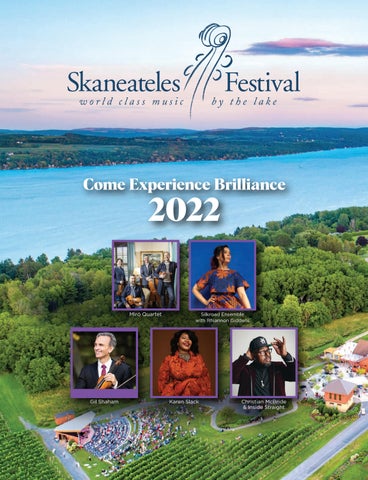
From the Artistic Directors The Skaneateles Festival is BACK! After two seasons of pandemic adjustments, this season marks a full return to the joy of live performance. We cannot wait for the vibrant Skaneateles Festival community of music lovers to come alive, eager to welcome those joining for the first time. Yet as we all grow and change, we look toward a Festival that is brighter and more musically vibrant than ever before. There is so much music to discover this season, from classics to jazz to world music. Pick a performance you know you will like, but also take a chance on music that is new to you. Highlights include: The Miró Quartet & David Shifrin – These four players are at the top of their game as one of the great quartets of our time, joined by clarinetist David Shifrin, the former artistic director of Chamber Music Society at Lincoln Center, for music by Mozart and Benny Goodman. (July 28) Rhiannon Giddens & Silkroad Ensemble – A brand-new, cutting-edge collaboration between singer and multi-instrumentalist Rhiannon Giddens, “the 21st century’s revelator” (NPR), and the boundary-defying Silkroad Ensemble, which brings together star musicians from across cultures (including Chinese pipa virtuoso, Wu Man). (July 30) The Knights & Gil Shaham – The Brooklyn-based orchestra has made a name for itself through its versatility and creative programming, on offer here in a program of works by film composers (August 11), and, at the Pavilion, in folk-inspired works and arrangements alongside Beethoven’s Violin Concerto with Grammy-winning star violinist, Gil Shaham (August 13). The Catalyst Quartet & Karen Slack – The Grammy-winning Catalyst Quartet joins Metropolitan Opera soprano Karen Slack for an all-American program of music by Gershwin, Florence Price, and African American spirituals. (August 18) Christian McBride & Inside Straight – Jazz giant and 7-time Grammy winner Christian McBride performs with Inside Straight, his quintet of astonishing jazz virtuosos, on saxophone, vibraphone, piano, drums, and bass. It will be unforgettable! (August 20) Whether you hear the classics or the cutting edge, you are an essential part of the program - because the experience of being together is absolutely central to live performance. The magic only happens with you in the audience. Meet a musician or befriend a fellow listener! Together, we follow the music.
Aaron Wunsch & Julia Bruskin Artistic Directors 3
Skaneateles Festival Board of Directors
Advisory Council
Barb Connor, President
Sidnie D’Amelio
Judy Robertson
Jean Shook, Vice President
Kim Driscoll
Alison Rutter
Edward Conan, Treasurer
Alison Ferretti
Steve Scheinman
Katie Peck, Recording Officer
Leanna Fischer
Carrie Scholz
Kathleen Haddock
Jay Stith
Dave Birchenough
Brendan McGinn
Stephen Thomas
Danielle Mensing
Joshua Wells
Jessica Millman
Paige Williams
Dwight Perry
Bridget Wynne
Colin Carroll Heather Carroll Somak Chattopadhyay
Thomas Bersani Judith Bryant Joan Christy Mary Cotter William Davis Michael P. Falcone Lindsay Groves
Claire Howard Andrea Latchem Sharon Magee Andrew Ramsgard Doug Sutherland Doug Whitehouse
Administration Susan Mark, Executive Director Julia Bruskin & Aaron Wunsch, Artistic Directors Ellen Sorber, Marketing & Digital Communications Manager Reese Nesbitt, Assistant Project Manager Porter Holt, Owen Towns, Shakira Santos, Office Interns Steve Frackenpohl, Co-Operations Manager
Jon Mosbo, Co-Operations Manager Corey Riley, Technical Manager Ryan Heffernan, Assistant Technical Manager Sarah Moth, Backstage Manager / Musician Liaison Sarah Midgley-Scuderi, Crew Supervisor Paige Williams, Crew Supervisor Marianne Sherman, Volunteer Coordinator
Katie Combs, Kosta Georgiadis, Emma Hill, Georgia Kreidler, Marilisa Kroon, Liz Louer, Ellie McSwain, Andrew Mosbo, Jack Patterson, Patrick Scott, Amelia Yengo, Caitlyn Yengo, Crew Betsy Carter, Bookkeeping Doug Whitehouse, Creative Director Nancy Boyce, Graphic Designer
A special thank you to our 2021 volunteers Diane and Mark Aberi Miki and Dan Bangs Debbie Bearg Henry and Helga Beck Dave Birchenough and Carrie Lazarus Barbara Bolton-Smith Mark Bostick Nancy Boyce Judy Bryant Heather Carroll Bruce Keplinger and Maryellen Casey Joan Christy and Tom Bersani Kip Coerper
Ed and Paula Conan Barb Connor and Doug Wood Jane Cummings Dee DeRosa Kim and Charley Driscoll Fran and Ham Fish Paul and Erika Fiutak Steve and Sandi Frackenpohl Koko Fuller Judy Gelston Sarah and Kevin Goode Dave Graham Dana and Susan Hall
Scott Heinekamp Tom Higgins Yvonne Hooker Don Hughes Bill Eberhardt, Sherwood Inn Mary Knepper Kay Kraatz Elsa Marshall Jill & Todd Marshall Caroline McSwain Ellie McSwain Danielle Mensing Madonna and Jeff Meyer
Jim and Patti Nocek, Anyela’s Vineyards Katie Peck First Presbyterian Church Greg Ripich and Kelly Springer Marianne Sherman Jean Shook Peter and Elsa Soderberg Anita Sterns Don and Chacea Sundman Peggy Surdam Doug Sutherland and Nancy Kramer
Margaret Thomsen Dave Tobin Gail Van Der Linde Connie Walters and Mark Bostick Jerri Washington Josh Wells Donna Marie White-Davis Doug and Peg Whitehouse Paige Williams Bill Witter Sheryl and Rory Woodmansee Gary and Diane Zdan
Acknowledgements Artist Pianos and Trinity Concert Series – Steinway Pianos
Koko Fuller - Ticket Sales
Bruce Keplinger and Maryellen Casey, Joan Christy, Koko Fuller, Brendan McGinn & Rebecca Cohen, Amy & Chris Neumann, Greg & Debbie Quick, Bridget & Daniel Wynne – Musician Dinners
Skaneateles High School – Music Stands & Percussion
First Presbyterian Church, Anyela’s Vineyards, and Hartlot Happening – Concert Locations 4
Programs and artists subject to change. © The Skaneateles Festival 2022
Arthur Nick Smith – Piano Tuning Many thanks to the generous Skaneateles residents who open their homes to the Festival’s visiting musicians.
5
Thank you to all the Skaneateles Festival Donors – 2022 Gifts received as of July 15, 2022
Platinum Guarantor The Falcone Family
New York State Council on the Arts
Doug Sutherland and Nancy Kramer
Peter and Elsa Soderberg
Sieglinde Wikstrom
Bill Allyn
Joan Christy and Tom Bersani
New Music USA
Artist Pianos
Grossman St. Amour CPAs PLLC
David and Jan Panasci
Sarah and Kevin Goode Bob and Sally Neumann
Gold Guarantor
Somak Chattopadhyay and Pia Sawhney
Peter and Betsy McKinnell
Andy and Natalia Russo
Juliette Klein Sharpe Fund, Central New York Community Foundation Donald and Chacea Sundman
Guarantor The Gladys Krieble Delmas Foundation
Holly Gregg and Patience Brewster
Dan and Linda Roche
Dan Fisher and Lori Ruhlman
Dana and Susan Hall
Fletcher Foundation
Joyce and Robin Jowaisas
Sutton Real Estate Co, LLC
Patricia A. Lynn-Ford & Steven J. Ford
Andrea Latchem
Syracuse Sounds of Music Association
Franklin Lofts, LLC
Fred and Ginny Marty
Joshua and Allison Wells
Koko Fuller
Onondaga County and CNYArts
Doug and Peg Whitehouse
David Graham
Judy Robertson
Gwen Birchenough
Michael and Fouad Dietz Kim and Charles Driscoll
Susan Mark and Mary Knepper
Dan and Linda Scaia
Donald Blair and Nancy Dock Colin and Corrie Carroll
Guy and Nancy Easter
Erica and Stephen Thomas
Maryellen Casey and Bruce Keplinger
Randy and Meg Green
Brendan McGinn and Rebecca Cohen
Ivan and Mimi Ace George S. Bain Henry and Helga Beck Dave Birchenough and Carrie Lazarus The Bonadio Group Sam and Debby Bruskin Ed and Paula Conan Mary Cotter
Steven and Kelly Scheinman
Benefactor
Jessica and Toby Millman
Elizabeth and Jamie Sutphen Salli and James Tuozzolo Judy Varney
Lynn Cleary and David Duggan
John MacAllister and Laurel Moranz
Columbian Foundation
Marshall and Sharon Magee
Barb Connor and Doug Wood
John and Peggy Manring
Greg Ripich and Kelly Springer
Miki and Dan Bangs
Karen Elkins and Jerry P. Weir
David and Norma McCarthy
Dr. Ron Butchart and Ms. Amy Rolleri, in honor of Doug Whitehouse for all the years of service to the Festival
Elizabeth Etoll
Steve and Jackie Miron
Alison and Brendan Ferretti
Eileen Murphy
Firefly Fund
NBT Bank
Jean Shook and Chris Johnson
Hamilton and Fran Fish
Jo Werner
Frank and Frances Revoir Foundation
Dr. and Mrs. R. William Nichols Jr.
Charles and Nancy Williams
Sean and Laura O’Keefe
Mrs. Carolyn C. Winkelman
John V. Frank
Katie and Mark Peck
Karen Wolhandler
Craig and Barbara Froelich
David Pida
Scott Heinekamp
Al and Vicky Sabin
Daniel and Bridget Buckley Wynne
Jane and Robert Morse Dwight and Alexandra Perry
Robert and Jenifer Weisenthal
Gold Patron
Patti Carey Nancy and Joe Clayton Susan T. Dailey Bob and Terry Dewitt, Lakeview Auto & Marine Abigail Duggan and Christopher Short
6
Thank you to our
Tom and Gretchen Jeffers
campaign donors
Sieglinde Schwinge, in memory of Horst Schwinge Marilyn and James Seago
Thank you to all the Skaneateles Festival Donors – 2021 Gifts received as of July 15, 2022
Patron Anonymous
Steven and Sandi Frackenpohl
Eric Allyn and Meg O’Connell
Wanda Fremont and Nan Dowling
Ed and Sharon Barno Irv Beimler Mary Bradly Elet and John Callahan Kate Callery and Michael Nazar Heather and Timothy Carroll Edward P Castilano Carol and William Stokes-Cawley Katherine Compagni Robert and Jane Corcoran Tim and Margie Creamer Alan and Linda Dolmatch
Jeffrey Kirshner and Lorraine Rapp
Patrick and Kuni Riccardi
Wendy and John Kopley
Nancy Rice and Mary Lee Miller
Naomi Frost
Judy Krieger
Nick and Linda Rossi
Dane and Debbie Gist
Roger and Anna Krieger
Kelly and Tony Scalzo
Melvin and Dorothee Goldman
Carol Krumhansl and Jeffrey Roberts
Carrie and Chris Scholz
William and Ann Griffith
Daniel and Grace Labeille
Judith Stoikov and Richard Miller
Lindsay Groves
David and Stacia Landsberg
Dan and Peggy Surdam
Kathleen and Marcus Haddock
Elizabeth Liddy
Pamela Tolbert
David Harvey
Edward and Carol Lipson
Paul and Mary Torrisi
Anne Lynn
Jaime Tuozzolo
James MacKillop
John and Jean Vincent
Bill and Miki Mahood
Richard and Ann Wasiewicz
Bobbi and Cliff Malzman
Stephanie Whitehouse and Corey Rotunno
William and Karen Havens Joe and Mary Ellen Hennigan Sally Holben Martin and Deborah Hubbard
Eggleston and Krenzer Architects, PC
Dorothy and Don Hughes
Barbara Egtvedt
Jackie Keady
Ed and Brenda Evans
Ted and Kinder
Bob and Kay Fagliarone
Robin Kinnel
Dr. and Mrs. Peter Huntington
Paul and Erika Fiutak
John and Candace Marsellus Susan Martineau Modern Kitchens of Syracuse Victoria Meyer Bruce and Margaret Osborne Greg and Debbie Quick
Dr. and Mrs. Geoffrey Wickwire Eleanor Williams Joseph and Maureen Wilson Ann and Duane Wunsch Jeff and Kate Youle
Contributor Carol Osborne-Ackles
Jane and Bill Cummings
Smiles of Skaneateles
Anne Roth
William and Alice Allen
Jim and Cecilia Curley
Nancy and James Marquardt
Bernard and Lilian Asher
Jeff and Cate Davis
Fran and Kevin McCormack
Alison Rutter and David Mayhew
Matteo and Rose Bartolotta
Joel and Chris Delmonico
Edward and Charlene McGraw
Max and Laura Berube
Kate DiDonato
Diane McRae
Jane and Donald Blake
Thomas Eldred
Mary and Eckart Meisterfeld
Lynne Boles and John Priest
Frederick and Janet Fagal
David and Janet Muir
Hal and Peggy Brown
Leanna and Brian Fischer
Richard Naughton
Brian Brundage and Pamela Foresman
Mary Giroux
Martin Nodzo
Carol Bryant
Ruth Hancock
Paul Oakley
Judith and Bryce Hand
Mary O’Neill
Jim and Patty Hertz
John and Sharon Paddock
Richard and Deborah Hole
Susan and David Palen
Clark and Mary Horan
Cathy Palm
Linda Isaac
Judy and Arnie Poltenson
Alfred Kelly and Sharon Burke
Susan Poniatowski
David and Sherrill Ketchum
Dick and Kim Poppa
Bernard and Peggy King
Howard and Ann Port
Stephen and Theresa Kline
Joel Potash and Sandra Hurd
Paul and Elizabeth Koenig
Nelson Price
Peggy Liuzzi and David Michel
Donnaline Richman
Andrea Calarco Andres Cardenes Deborah Carr Elaine and Greg Ceresko Jim and Sharon Cirincione Martha Cole Judith Conroy Bill Coppard Lynn K. Cornachio Paul and Gail Cowley Heidi and Don Cross
Susan Scheuerman Douglas and Ann Scott Mary Sennett Gary and Ginny Shanley Susan and Steven Shaw Sharon Slater George and Helene Starr Ross and Janet Stefano Martha Sutter and David Ross Peter and Florence Swartz Eugene and Joan Tarolli David and Patricia Urban Stephen and Ellen Wikstrom Don and Mary Anne Winfield Susan Wolstenholme Olwen Wright Joyce Zadzilka Alan Ziegler and Emily Neece 7
8
Educational Initiative
SkanFest U is sponsored by:
First Presbyterian Church
The Julie Sharpe Fund
97 E Genesee St, Skaneateles
How Folk Becomes Classic(al) This year’s educational course explores how composers adopt and adapt the sounds and rhythms of folk music into their works. Hear and discuss authentic folk music from Austria, India, Eastern Europe, and America, and discover the pathways from these cultures into today’s concert music. Prepare to hear folk-inspired music at the Festival by Haydn, Schubert, Reena Esmail, and Dvořák, and enjoy exclusive, live performances by Festival artists. Four weekly sessions are led by Artistic Director Aaron Wunsch, who teaches at The Juilliard School. Weekly Sessions Tuesday, July 26, August 2, 9, and 16 3 - 4:00 PM The Skaneateles Festival’s educational sessions are open to all. Registration is required. The fee is $40 for all 4 classes (free for Season Pass holders). For more information: 315-685-7418 or www.skanfest.org Aaron Wunsch is sponsored by The Skaneateles Consortium: George Bain, Sam & Debby Bruskin, Dana & Susan Hall, and Judy Robertson
“ This fund will serve as a vehicle that reflects my deep appreciation for what the people of this area have meant in my life.” – Juliette Klein Sharpe Longtime Skaneateles resident Julie Sharpe felt blessed by her friends and community and enriched by several local nonprofits. Before her passing in 2014, Julie designated a provision in her will to establish a fund at the Central New York Community Foundation. The Skaneateles Festival will benefit in perpetuity from Julie’s thoughtful legacy of generosity. SkanFest U is performed in grateful memory of Julie and all that she did as a Festival volunteer and supporter.
Photo provided by the Central New York Community Foundation
9
2022 T-shirt artwork Winner We are excited to announce the winner of our inaugural graphic artwork contest for the 2022 SkanFest T-shirt:
S. Quinn of Sixth Station Studio
10
KidsFest with Time for Three at the Mandana Barn.
Fun at the Festival For all ages Kids FREE Adults $5 at the door
kidsfest is presented in memory of
Faye Panasci
with additional support from
The Fletcher Foundation
The Brass Project: A Musical Adventure Sam Nester, trumpet
Cort Roberts, horn
Sam George, trombone
Zachary Silberschlag, trumpet
Oliver Barrett, trombone
Jake Fewx, tuba
Wednesday, August 3 • 11:00 AM Hartlot Happening, 639 Hartlot Rd, Elbridge, NY 13060 The Brass Project invites kids of all ages to explore the question: Can music transport us somewhere else? And is it possible to imagine detailed images and places just by listening to the music? The Brass Project dives into music from the time of J. S. Bach to recent fanfares from places far and wide. Bring your imagination, and let the music carry you away! At the end, kids have the opportunity to see and touch the shiniest of all instruments.
The Knights: Morning at the Movies Agnes Marchione, clarinet
Alex Fortes, violin
Caitlin Sullivan, cello
Ariana Kim, violin
Celia Hatton, viola
Aaron Wunsch, piano
Friday, August 12 • 11:00 AM First Presbyterian Church, 97 E Genesee St, Skaneateles, NY 13152 Join members of Brooklyn’s famed ensemble, The Knights, for an interactive program that features cinematic music by John Williams and Leonard Bernstein, as well as famous movie themes like “Somewhere Over the Rainbow.” Kids will use their imaginations to create their own musical stories, and get to know the sounds of several orchestra instruments along the way. This program will be led by Knights cellist Caitlin Sullivan
ARTIST SPONSORSHIP The Brass Project is sponsored by Mary Cotter The Knights are sponsored by Doug Sutherland and Nancy Kramer Aaron Wunsch is sponsored by The Skaneateles Consortium: George Bain, Sam & Debby Bruskin, Dana & Susan Hall, and Judy Robertson
The Skaneateles Festival is made possible by the New York State Council on the Arts with the support of Governor Kathy Hochul and the New York State Legislature.
11
Week 1 Thursday, July 28 7:00 PM Backstage Pass
Tonight’s concert is sponsored by:
Ed and Paula Conan
(for ticket holders only)
8:00 PM First Presbyterian Church
97 E Genesee St, Skaneateles
Backstage Pass:
Season Preview with members of the Miró Quartet and Artistic Directors Aaron Wunsch and Julia Bruskin
Opening Night with the Miró Quartet and David Shifrin BEETHOVEN
String Quartet in G Major, Op. 18, No. 2 Allegro Adagio cantabile Scherzo: allegro Allegro molto: quasi presto
ALAN SHULMAN BENNY GOODMAN arr. Schiff
Miró Quartet Daniel Ching, violin William Fedkenheuer, violin John Largess, viola Joshua Gindele, cello
Rendezvous “A Smooth One” “How am I to Know” “Temptation Rag”
Miró Quartet David Shifrin, clarinet
IN TE R M I S S I O N MOZART
Clarinet Quintet in A Major, K. 581 Allegro Larghetto Menuetto Allegretto con variazioni
ARTIST SPONSORSHIPS Miró Quartet is sponsored by The Gladys Krieble Delmas Foundation David Shifrin is sponsored by Doug and Peg Whitehouse
12
Miró Quartet David Shifrin, clarinet
he Skaneateles Festival is made possible T with funds from the General Operating Support program, a regrant program of the County of Onondaga with the support of County Executive, J. Ryan McMahon II, and the Onondaga County Legislature, administered by CNY Arts.
Program Notes
T
he celebrated Miró Quartet (“impressive,” New York Times), and eminent American clarinetist, David Shifrin, offer a tribute to jazz great, Benny Goodman, with swing favorites arranged for clarinet and string quartet, alongside Beethoven’s graceful Quartet in G Major, Alan Schulman’s delightful Rendezvous, and Mozart’s sublime Clarinet Quintet.
String Quartet in G Major, Op. 18, No. 2 (1800) LUDWIG VAN BEETHOVEN (1770-1827) Before Beethoven garnered a capital-R Reputation, he had a lowercase-r reputation. Cue eye rolls for the obstinate firebrand: there he goes again, throwing an egg at the waiter, refusing to perform for a patron on bended knee, composing music marred by an “unbounded striving for originality and oddity” (per the local paper). Luigi Cherubini, the eminent Italian composer, summed Beethoven up as “an un-licked bear cub.” Even today, with his now capital-R Reputation, Beethoven is best known for his most unsettling works: the Fifth Symphony, the “Pathetique” Sonata. Thank God, therefore, for his genial String Quartet in G Major. It refutes every stereotype. Here, Beethoven engages the musical language of Haydn and Mozart on their own turf, rather than starting a new neighborhood. Beethoven, primarily known until now as a pianist, wasn’t sure he belonged in quartet country at all. In 1795, he had turned down a request for quartets from the prominent patron, Count Apponyi (who had commissioned several of Haydn’s quartets), presumably for a generous fee. When the premier patron of music in Vienna, Prince Lobkowitz, finally convinced him, in 1798, Beethoven proceeded cautiously. He carefully copied out two of Mozart’s greatest quartets as a warm-up, and once he started on his own, he took plenty of time to revise them carefully. After three years of hard work, he proudly wrote to his friend Karl Amenda, enclosing an earlier draft for comparison, “I have now learned how to write string quartets.” Of all his quartets, the graceful Op. 18, No. 2, may be most in the shadow of his former teacher, Haydn. If it’s true that Beethoven claimed he “never learned anything from Haydn,” as Beethoven’s pupil Ferdinand Ries recalled, this piece proves he was
just mouthing off. This is not to say the quartet is derivative. If anything, it proves that Beethoven fully grasped the expressive potential of the 18th-century Classical style, even if his temperament often led him outside its bounds. The Quartet begins with some courtly graces (a violin flourish, dotted rhythms). We’re not in the presence of the Emperor, however; there’s far too much humor here for that. It’s more a matter of “you play the Emperor, I’ll be the jester” – a jovial jab follows every seemingly serious statement. The slow movement is a pastoral daydream – a song of love, perhaps, but imagined, not real. Suddenly, a few children frolic past (immediately Allegro). When the daydream resumes, the melodic line is now ornamented with almost childlike fancy. The last two movements are all fun and games. They indulge one of the most enjoyable pastimes in the quartet playbook: passing around the same idea and sending it off in unexpected directions, like a musical bouncy ball. The Scherzo lives up to its Italian name (“joke”), as the four instruments jest continuously with one another. In the middle part of the movement, a portly fellow pirouettes past; the first violinist can’t help but poke fun by dancing circles around him, and the rest of the ensemble joins in. The cello has a charade to get the final movement going, and the quartet plays it every which way, in and out of keys, until they finally collapse in laughter. Beethoven himself was not Mr. Congeniality, but his music can surely be so. It’s time to revise his Reputation.
Rendezvous (1946) ALAN SHULMAN (1915-2002) The “rendezvous” of this work’s title was a literal one, between cellist-composer Alan Shulman’s Stuyvesant String Quartet and the famed clarinetist, Benny Goodman - but it is also a rendezvous between classical music and jazz. Like Gershwin before them and Bernstein after, Shulman and Goodman were from poor, Russian-Jewish immigrant families; as kids, they picked up whatever gigs came along – Goodman, playing popular tunes on booze cruises in the Chicago harbor, Shulman on radio commercials in Baltimore. While Goodman found his path as a bandleader, Shulman, a cellist, joined Arturo Toscanini’s new NBC Symphony Orchestra. Yet Schulman pursued multiple 13
7/28 Program Notes (continued)
musical genres, founding both a symphonic jazz ensemble and the Stuyvesant String Quartet in 1938. In 1946, Goodman, now interested in playing classical music, invited the Quartet to join him on his weekly radio program for Mozart’s Clarinet Quintet. Shulman asked if Goodman would commission a short work for the broadcast, and this Rendezvous was set. The quartet arrives first at the rendezvous, entering in a foursquare late-romantic idiom as they await the clarinet’s arrival. The clarinet walks in with a syncopated “Hey! Let’s go,” and soon all the players are riffing together in a jazz club. The Quartet invites the clarinet into their more lyrical idiom, and the clarinet croons away. The two start a slow dance, but the clarinet coaxes everyone back out on stage for a jazzy conclusion. BENNY GOODMAN (1909-1986), arr. David Schiff (B. 1945)
“A Smooth One” (1944) “How am I to Know” (1952) “Temptation Rag” (1953) Benny Goodman is not a name one sees today on many classical music programs – but he would have been happy to see it there. The world-famous jazz bandleader started out studying clarinet with a member of the Chicago Symphony Orchestra, and much later, frequently performed classical repertoire and commissioned two enduring modern classics, Béla Bartók’s Contrasts and Aaron Copland’s Clarinet Concerto. Of course, it was the King of Swing’s jazz earnings that paid for those commissions, and the swing favorites tonight also deserve their status as “classics.” Goodman recorded “A Smooth One” with his sextet in 1944, and it lives up to its title. Instead of joining in the nonchalant, too-cool-for-school melody, Goodman plays light, florid licks around the tune, sending a shiver down the listener’s spine. His 1952 recording of “How am I to Know?” is in a reflective mood, as the vibraphone, electric guitar, and piano (here, string quartet) provide the smoky atmosphere. The 1953 “Temptation Rag” is a cheeky, up-tempo romp with one foot in the Jewish klezmer style of Goodman’s childhood. One might not think a blend of ragtime, swing, and klezmer advisable, but it will 14
charm your socks right off. The musical polymath, David Schiff, a composer and author of books on both Duke Ellington and Elliott Carter, adds string quartet into the mix in his clever arrangements.
Clarinet Quintet in A Major, K. 581 (1789) WOLFGANG AMADEUS MOZART (1756-1791) Ever since the writer E. T. A. Hoffmann called Mozart’s music “sublime” in the early 19th century, that word has often been applied to his music like a flavor of ice cream: lyrical (chocolate?), spiritual (marshmallows?), and transcendent (almonds?). Yet Mozart’s music approaches sublimity not by following a recipe but by avoiding one. In his Clarinet Quintet, he takes the most “perfect” classical genre, the string quartet, and upends it. Enter the clarinet. Or, perhaps more accurately, enter the clarinetist. Anton Stadler, known for his dulcet tone on this relatively new instrument, befriended Mozart shortly after the composer’s arrival in Vienna. Mozart’s nickname for his fellow masonic brother was Notschibi-nitschibi – poor, bumbling booby – which unfortunately wasn’t too far off the mark; Mozart’s wife later explained
that Stadler stole money from them and frequently lied. Fortunately for us, the composer turned a blind eye; his musical gifts to Stadler include the Clarinet Concerto, the “Kegelstatt” Trio, and what Mozart called “Stadler’s Quintet,” which we hear tonight. The four string players begin serenely, as if this were merely a string quartet, pure and simple. The clarinet, a horse of a different color, trots by with a few arpeggios. The quartet ignores these and plays the opening phrase a second time, as if nothing had happened. However, when the clarinet comes around the second time, the quartet responds with the clarinet’s own arpeggios – and from here, the two start a rich and diverting dialogue. Mozart grants some magical powers to the clarinet, however, as when it suddenly turns the quartet’s genial second theme into a spellbinding minor version. Mozart casts an even deeper spell in the nocturnal second movement, which often leaves audiences totally motionless and rapt in musical reverie. He asks the two violinists to attach a mute to their strings (watch for it), creating a delicate sonic cushion upon
which the clarinet will sit and sing. The players float back down to earth at the end of the movement, where they stay for the rustic third movement, a minuet. The strings lead a pensive interlude, with the clarinet silently listening on; in its own interlude, the clarinet prefers something more whimsical, even folksy. Mozart usually ends his chamber music and concertos with a rondo, a repeating theme with contrasting episodes, but here he opts for variations on a theme. These offer the listener more opportunities to be surprised and delighted, such as when the angst-laden viola unexpectedly takes the spotlight (variation 3), or when the clarinet launches a rocket ship of sixteenth notes (variation 4). The fifth variation almost succeeds in bringing us back into the serene mood of the slow movement, as if the whole quintet might just drift off to sleep. We wouldn’t mind, either, but in marches the theme for one last turn. Like the rest of the work, its conclusion is wondrous, unique, and, yes, sublime.
15
Week 1
Tonight’s concert is sponsored by:
Friday, July 29
Steven and Kelly Scheinman
8:00 PM First Presbyterian Church
97 E Genesee St, Skaneateles
Evocations RAVEL
String Quartet in F Major
Miró Quartet Daniel Ching, violin William Fedkenheuer, violin John Largess, viola Joshua Gindele, cello
Allegro moderato – très doux Assez vif – très rythmé Très lent Vif et agité
KEVIN PUTS
Home
Miró Quartet
IN TE R M I S S I O N
BRAHMS
String Sextet No. 1 in B-flat Major, Op. 18 Allegro ma non troppo Andante, ma moderato Scherzo: allegro molto Rondo: poco allegretto e grazioso
Miró Quartet Kyle Armbrust, viola Julia Bruskin, cello
ARTIST SPONSORSHIPS Miró Quartet is sponsored by The Gladys Krieble Delmas Foundation Julia Bruskin is sponsored by The Skaneateles Consortium: George Bain, Sam & Debby Bruskin, Dana & Susan Hall, and Judy Robertson FEATURED ADVERTISER Parson’s & Associates 16
Tonight’s concert is supported by New Music USA’s New Music Organizational Development Fund.
Program Notes
T
he Miró Quartet returns to perform Ravel’s lush, impressionist String Quartet; eminent American composer Kevin Puts’ newest quartet, Home, a contemplation of what ‘home’ means to all of us in light of recent refugee crises; and Brahms’ soaring Sextet in B-flat Major, with violist Kyle Armbrust and cellist and Festival Artistic Director, Julia Bruskin.
outside-the-box music gradually attracted followers, which did not stop him from famously failing to win the top French composition prize, the Prix de Rome, five years in a row – even after he conceded to write a work in a genre so conservative as the String Quartet, completed in 1903. His quartet did not even make the final round, and his own teacher, Gabriel Fauré, to whom the work was dedicated, declared it “a failure.”
String Quartet in F Major (1903)
Fortunately, pariahs stick together. When Ravel contemplated making some alterations to his Quartet, Claude Debussy, whose own music was vehemently opposed by Saint-Saëns and others, wrote to him: “In the name of all the gods, and mine, please don’t.” The letter must have comforted Ravel, since he knew Debussy had himself composed a quartet a decade earlier, also to mixed reviews. Some believe Ravel based his work on Debussy’s; while it is true that both works unite a German formal model with cyclical themes a la César Franck, their differences are more enlightening than their similarities. The sound world
MAURICE RAVEL (1875-1937) 100+ years later, few listeners are aware that the beloved composer of Bolero was once something of a pariah. Along with fellow provocateur painters, poets, and critics, Ravel was a member of the self-proclaimed “Apaches,” who met to discuss ways their art could assault the conservative artistic establishment. In music, the heart of that establishment was the Paris Conservatoire, which, as its name implies, was dedicated to conserving the past – and from which Ravel was nearly expelled, presumably for his incompetence (or disinterest) in composing fugues. His
More Than Art
barrowgallery.org Thurs - Sun 1-4 pm | 49 E Genesee Street (Entrance on State St) | Available for private tours and small events 17
7/29 Program Notes (continued)
created by Ravel, a self-proclaimed ‘craftsman’ of Vermeer-like exactitude, is entirely his own. Reflective and insinuating, Ravel asks that the first movement be played “very sweetly,” which is not to say innocently. This music is sensuous, yet restrained, and its restraint only enhances its sensuality. No one is quite sure whether the famous all-pizzicato passages of the second movement were designed to evoke Javanese gamelan music (which Ravel heard at the World’s Fair, in 1889), Spanish fandango guitar playing, or a battalion of mandolins heard in the Basque region, where Ravel was born. No matter: they are better off remaining exotic in a general sense, as likely intended. The sultry middle section of this movement offers a contrast, a steamy evening serenade. The third movement unfolds as a wistful meditation on the music of the first movement. There is an unmistakably vocal quality in the rich melodies, which are passed throughout the four instruments, expressive and extremely free. The whirlwind of a last movement has an unstable five beats per bar. A waltz
18
based on the first movement’s theme offers a brief respite from the cyclone that threatens to (and nearly does) carry all four players off the ground. When performed in the new world in 1908, the New York Tribune disdainfully declared about Ravel’s String Quartet, “there is about as much emotional nuance as warms a problem in algebra.” Be careful what you condemn: today it is the most beloved and oft performed of all French string quartets.
Home (2020) KEVIN PUTS (B. 1972) Pulitzer Prize-winning composer and St. Louis native Kevin Puts writes richly hued music in all genres, including orchestral music, chamber music, and opera. The Skaneateles Festival featured a program of his works in 2007, and later this year the Metropolitan Opera will stage his opera, The Hours, staring Renée Fleming, Joyce DiDonato, and Kelli O’Hara. Puts has a long association with the Miró Quartet, which premiered both his How Wild the Sea for quartet and chamber orchestra and his string quartet, Credo. His fourth string quartet, Home, was inspired and
informed by the refugee crisis in Europe. It raises questions of who belongs where and what the idea of ‘home’ means to all of us. About the work, Puts writes: “Performing this fourth quartet of mine requires all four members of the quartet to retune their instruments to the pitches of a C major harmony, as follows: Historically, this act of employing a tuning other than the customary stack of perfect fifths in all instruments has been referred to as scordatura. It allows the quartet to resonate in a unique way when its open strings are played, thereby creating a sonic representation of “home” and one which is abandoned after the idyllic atmosphere of the work’s first several minutes in search of new and unfamiliar harmonic terrain.”
String Sextet No. 1 in B-flat Major, Op. 18 (1860) JOHANNES BRAHMS (1833-1897) Brahms did not complete his “first” essay in chamber music’s most venerable medium, the string quartet, until age 40. This was not for lack of trying. He had composed some 20 quartets but rejected them all, wallpapering his Hamburg room with them. He told his friend, violinist Joseph Joachim, “I have only to lie on my back to admire my sonatas and quartets.” The shadow of Beethoven, master of the string quartet, loomed large for Brahms ever since his teacher – composer of a symphonic work literally called
Beethoven’s Shadow – had offered him the following not-very-helpful advice: “It is but the delusion of misguided originality to seek in one’s own limited universe to achieve a perfection that already exists.” OK, Johannes – so try something else. The B-flat Sextet was Brahms’ first great achievement in chamber music, scored for a fresh combination of instruments (aside from forgotten confections by Boccherini and Spohr). It was an inspired choice. By adding an extra viola and cello to the standard string quartet, Brahms shifts the center of pitch considerably lower, where he exploits his natural gifts for a rich, thick sonority. The sound world, therefore, is entirely his own – a perfection that did not yet exist. The Sextet begins with one of Brahms’ most tuneful melodies, sung quietly and soulfully by the cellos with a murmuring viola accompaniment. This scenario might recall Brahms’s recent walking tour along the Rhine River, a young Romantic’s online bachelor’s degree program, as it were. He instructs the performers to play “poco forte,” an oxymoronic indication peculiar to Brahms (meaning “only a little loudly”), which he would reuse throughout his life. Musicians generally think of it as an internalized forte – intense yet inward. Brahms grants his second theme again to the cello; his protagonist’s veins now pulse with the joy of inspiration, soon overflowing to all the instruments. For the second movement, Brahms turns southeasterly, from the Rhineland to Hungary. When Hungarians emigrated after the failed revolution of 1848, Brahms heard music in the style hongrois, most notably from his performance partner, Hungarian violinist Ede Reményi. But rather than allow his proud, patriotic theme an improvisatory treatment in the gypsy style, he keeps it tightly reined, à la Beethoven, in 8-bar variations. It’s back to German lands for the stately scherzo, where the string ensemble almost embodies an outdoor wind band, playing for a hunting party. The concluding rondo returns us to a refined character closer in spirit to the first movement (and beginning again with two cellos and a viola). The graceful theme gives way to a vigorous two-step, which in turn yields back to the theme. It seems the graceful melody will have the final say, but the two-step makes a late-breaking appearance in the coda. Brahms is in too good a mood to end without a final “Hurrah!” 19
Week 1
Tonight’s concert is made possible with support from the
Saturday, July 30
Noreen & Michael Falcone Fund for Artistic Excellence
8:00 PM Robinson Pavilion at Anyela’s Vineyard
Rain Location: TBA
Phoenix Rising: Silkroad Ensemble with Rhiannon Giddens MAEVE GILCHRIST*
The Call
TRADITIONAL arr. Rhiannon Giddens**
O, Death
TRADITIONAL arr. Colin Jacobsen and Siamak Aghaei** ZHAO JIPING ANTONIN DVOŘÁK arr. Rhiannon Giddens and Mazz Swift** KAORU WATANABE* SANDEEP DAS Lyrics by Rabindranath Tagore*** TRADITIONAL arr. Michael Ward-Bergeman TRADITIONAL arr. member of Silkroad** DAVID BRUCE arr. Edward Pérez**
Ascending Bird Sacred Cloud Music Goin’ Home (from the Grammy Award-winning album, Sing Me Home) Ho-oh Ekla Cholo Re St. James Infirmary Blues New Ritual Cut the Rug: IV. Wake the Dead
Silkroad Ensemble Jeffrey Beecher, bass Sandeep Das, tabla Haruka Fuji, percussion Rhiannon Giddens, banjo, voice Maeve Gilchrist, Celtic harp
Mario Gotoh, viola Joseph Gramley, percussion Wu Man, pipa Karen Ouzounian, cello Mazz Swift, violin, voice
Francesco Turrisi, accordion, frame drums Kojiro Umezaki, shakuhachi Kaoru Watanabe, Japanese flute, percussion Reylon Yount, yangqin
*World Premiere, Commissioned by Silkroad for Phoenix Rising **New Arrangement, Commissioned by Silkroad for Phoenix Rising ***Commissioned by Silkroad for Phoenix Rising Opus 3 Artists are the exclusive representative of the Silkroad Ensemble.
20
ARTIST SPONSORSHIPS
FEATURED ADVERTISER
Rhiannon Giddens is sponsored by The Physicians Consortium: Tom Bersani, Donald Blair, Barb Connor, Randy Green, John Manring, Brendan McGinn, Greg Ripich, Judy Robertson, Stephen Thomas, and Robert Weisenthal
Delmonico Insurance
The Skaneateles Festival extends its appreciation to
Noreen and Michael Falcone
Their love for great music and leadership giving are helping to secure the Festival’s future and allowing us to bring the highest caliber musicians to our lakeside community.
Festival Future The Physicians Consortium We are grateful to the members of the consortium for their support of the Festival, as well as their love of music. Tom Bersani Donald Blair Barb Connor
Randy Green John Manring Brendan McGinn Greg Ripich
Judy Robertson Stephen Thomas Robert Weisenthal
“From the late 14th Century on, each medical student had to complete a course in music theory. Rooted in this centuries-old connection between music and medicine is the striking fact that greater than average numbers of medical doctors have had a special fondness for music and music making down through the ages.” Music & Medicine, by Anton Neumayr Julie Bruskin and Aaron Wunsch welcome the crowd.
21
Week 2
Tonight’s concert is sponsored by:
Thursday, August 4 7:00 PM Prelude Concert
Henry and Helga Beck
(for ticket holders only)
8:00 PM First Presbyterian Church
97 E Genesee St, Skaneateles
Prelude Concert
Featuring the 2022 Robinson Award winner, Kate O’Leary, flute J.S. BACH
Sonata in E Major, BWV 1035
Kate O’Leary, flute Julia Bruskin, cello continuo Aaron Wunsch, piano
Adagio ma non tanto
KATHERINE HOOVER POULENC
Winter Spirits for Solo Flute Flute Sonata, FP 164
Kate O’Leary, flute Aaron Wunsch, piano
Allegro malinconico
Dances and Fanfares HOLBORNE arr. Empire Brass, ed. The Brass Project BASSANO
Almand from Elizabethan Dance Suite
Pavane No. 4
COPERARIO ed. Raymond Mase
Fancy á 6
COPERARIO ed. Raymond Mase
Al Folgorante Sguardo
WARD ed. Raymond Mase
Fancy á 6
ARTIST SPONSORSHIPS The Brass Project is sponsored by Mary Cotter Aaron Wunsch and Julia Bruskin are sponsored by The Skaneateles Consortium: George Bain, Sam & Debby Bruskin, Dana & Susan Hall, and Judy Robertson 22
The Brass Project Sam Nester, trumpet Zachary Silberschlag, trumpet Cort Roberts, horn Oliver Barrett, trombone Sam George, trombone Jake Fewx, tuba
The Skaneateles Festival is made possible by the New York State Council on the Arts with the support of Governor Kathy Hochul and the New York State Legislature.
BACH
Gavotte and Rondeau from Violin Partita in E Major, BWV 1006
BACH
Prelude and Fugue in D Major, BWV 532
BACH
Contrapunctus I and IX from The Art of the Fugue, BWV 1080
WIDOR
Allegro from Organ Symphonie No. 6 in G minor, Op. 42, No. 2
Ayano Ninomiya, violin
David Higgs, organ The Brass Project
David Higgs, organ
IN TE R M I S S I O N PRICE
In Quiet Mood
RHEINBERGER
Elegie from Six Pieces for Violin and Organ, Op. 150
REENA ESMAIL
Tuttarana
GABRIELLA SMITH
Strobe
STEVEN FRANKLIN
Finale from Three Romances
HANDEL/ ALEXANDER GUILMANT arr. Robert A. Hobby
Paraphrase on “See the Conqu’ring Hero Comes” from Judas Maccabeus
Time for Three always brings joy to the Festival!
David Higgs, organ Ayano Ninomiya, violin David Higgs, organ
David Higgs, organ The Brass Project The Brass Project David Higgs, organ
23
The Robinson Award
In 1980, David and Louise Robinson opened their hearts and their home to Festival musicians, their families, and the audiences who came to hear them perform. Their lakeside home, Brook Farm, was a gathering place and rehearsal space for musicians, and the performance venue for the Festival’s outdoor Saturday evening concerts for 36 seasons. Created in 2002, The Robinson Award recognizes a young musician who exemplifies the values cherished and embodied by Festival co-founders, David and Louise. It is presented annually to a young musician whose character, musicianship, and community service reflect the Robinson’s values – enthusiasm and dedication to music of high quality. Applications for the Robinson Award are available January 15 – March 15. Visit skanfest.org for details.
David & Louise Robinson
2022 Robinson Award Winner – Kate O’Leary Kate O’Leary is a flutist, piccoloist, and graduate of Marcellus High School. Kate has performed in ensembles such as All-County and Area All-State festivals, as well as Symphoria Young Artists Orchestra, where she was principal flute. She had the honor of performing Mozart’s Concerto in G Major with SYO after winning their Concerto Competition. Kate performed in multiple bands and choirs throughout high school, including Pit Orchestra and Jazz Ensemble, learning instruments such as saxophone and clarinet. Last year, Kate was invited by the
Society for New Music to perform as a Rising Star at Cazenovia Counterpoint, where she had the honor of premiering Emily Graham’s Will-o’-Wisp. In May, she was featured as Carrie Lazarus’ Extraordinary Talent of the Week. Kate has been awarded music scholarships including the SSMA Sally Whittle Memorial, OCMEA, and CNYAMT Scholarships. She will be attending Syracuse University in the fall, where she will major in Music Education and participate in the Honors Program and Syracuse University Marching Band. Kate currently studies with Dana DiGennaro and has previously studied with Erin Tapia. She is honored and humbled to be receiving the Robinson Award and would like to thank all of her teachers as well as her family for their constant support.
Our thanks to those who have contributed to the Robinson Award Anonymous Brenton and Mary Bradly Barb Connor Fletcher Foundation 24
David and Louise Robinson Skaneateles Area Council for the Arts Frank and Jan Smith
Karl and Peggy Smith Dr. and Mrs. Kenneth Spitzer
If you would like to contribute to the Robinson Award Fund, please call 315-685-7418.
Diane Walsh and Dick Pollak Suzanne Weitz Welch Allyn
Program Notes
T
his sonorous and lively program brings together the “six superb brass players” of The Brass Project (Philadelphia Enquirer) with eminent American organist David Higgs (“outstanding,“ New York Times). J. S. Bach’s music is a common thread in the program, which also features works by Handel, English and Italian Renaissance composers, and short contemporary fanfares by young up-and-coming composers. Elizabethan Dance Suite:
Almand ANTHONY HOLBORNE (1545-1602), arr. Empire Brass, ed. The Brass Project
Pavane No. 4 ANTHONY BASSANO (1511-1574), ed. Raymond Mase
Fancy á 6 GIOVANNI COPERARIO (1575-1626) ed. Raymond Mase
Fancy á 6 Al Folgorante Sguardo JOHN WARD (1571-1638), ed. Raymond Mase Renaissance may mean “Rebirth,” but for brass instruments, it was just plain birth. From the start, these shiny, wondrously resonant instruments carried a divine aura; the first depiction of a trombone is in Filippino Lippi’s fresco The Assumption of the Virgin (1493), where a levitating angel, cheeks puffed out, sends the Virgin Mary to heaven with a buoyant blast. The mere mortals depicted down below appear to be enjoying the music. By the 1580s, churches like St. Mark’s in Venice inspired visitors far and wide with antiphonal brass music; one such visitor may have been John Cooper, of England, who returned home with the more musical name Giovanni Coperario. He composed madrigals for voices in the Italian style, such as Al folgorante sguardo (“At her dazzling gaze”, with text from the Guarini’s popular pentagonal love story, Il pastor fido), but it seems in England amateurs would rather play such music, or dance to it, than sing it. Thus was born the instrumental madrigal, a cross between a love song and music for a dance party. Coperario’s Fancy á 6 (or in Italian, “capriccio”) and John Ward’s Fancy á 6 are instrumental madrigals likely intended for viols, the mellowest family of string instruments that were especially popular in England – but brass instruments bring out this music’s festive
qualities. If the viols were more common in private homes, brass instruments proved more useful at the royal court. Anthony (Antonio) Bassano was a brass player from Venice hired by the monarchy to liven things up. He and Anthony Holborne (a self-declared “servant to her most excellent Majestie”) provided a stream of courtly dances, including Bassano’s stately Pavane No. 4 and Holborne’s lively Almand. Whether for the Virgin Mary ascending to heaven or for Queen Elizabeth I on the dance floor, brass music, once born, has yet to require a renaissance.
Gavotte and Rondeau from Violin Partita in E Major, BWV 1006 (1720) Prelude and Fugue in D Major, BWV 532 (ca. 1710) Contrapunctus I and IX from The Art of Fugue, BWV 1080 (1749) JOHANN SEBASTIAN BACH (1685-1750) Today, many listeners think of Bach as a composer of religious music. He was, and there is no reason to doubt the centrality of his faith to his music; he ended both sacred and some secular pieces with “S. D. G.” (Soli Deo Gloria, To God’s Glory Alone). Yet most of his works featured on concert programs, including those we hear tonight, were intended for pleasure, rather than penitence. If you find yourself bracing for severity, consider that the composer was also caught sneaking his girlfriend up to the organ loft. Many of Bach’s secular works are French courtly dances, including his Gavotte and Rondeau from the Violin Partita in E Major, BWV 1006. Bach knew these dances from his days at the Knight’s Academy in Lüneburg, where noble boys gathered to learn them from a French dancing master (working-class Bach himself was stuck in the back-up band). Here, the unaccompanied instrument has absolute freedom over timing, allowing for the performer’s highly individual sense of how the music should ebb and flow. So dance at your own risk. In this joyful suite, Bach uses the natural resonance of the violin’s open E string to brighten the overall sound. The Gavotte and Rondeau are particularly out-of-this-world, quite literally: these two movements were launched into outer space on the 1977 Voyager Golden Record, 25
8/4 Program Notes (continued)
currently the farthest human object from earth. Who knows what might be listening, along with us? We think of the organ as a church instrument, since it usually resides there – but it was in Bach’s time also the world’s most wondrous machine, capable of overwhelming and impressing the listener. The Duke of Weimar was one such listener, who in 1708 paid Bach a large salary to impress full time as “court organist” and “master of concerts.” The Prelude and Fugue in D Major, BWV 532, composed shortly after his arrival in Weimar, is calculated to shock and awe. If used in church as a prelude or postlude, it might easily outcompete the sermon for attention. The prelude begins by launching a couple of sonic fireworks, proceeding with a festive procession that ends on a series of pungent dissonant chords, which will vibrate the very floor underneath your seat. Like a giant rubber band released, the fugue launches into a flurry of sixteenth notes that doesn’t stop. The organist’s feet are in no way spared, pedaling like a determined peloton rider. Bach adapted the fournote pattern, heard continually, from Vivaldi’s violin
26
concertos, but here it seems if the organist plays four amplified violins at the same time. Organ enthusiasts came from miles away to hear Bach perform works such as this one in Weimar, and it seems to have been worth the trip. By the time Bach composed his The Art of the Fugue, near the end of his life, he had become famous throughout his region for his prowess in this most composerly of all genres. In a fugue, a composer creates a creepy, crawly caterpillar of a theme (or “subject”), thinking ahead to what it will become more than what it now is. Fugues generally sound rather austere when they begin, which is certainly true of Art of Fugue; no one hums this theme in the shower. Contrapunctus I is a so-called simple fugue, meaning there is only one theme, but in Bach’s hands it is not so simple; it has four independent voices, like tendrils each growing in various directions at once. If you concentrate, you may find yourself listening ahead, eagerly anticipating the next entrance of the subject as the overall texture grows in volume and richness. As the Art of Fugue progresses, one realizes Bach’s ambitions are much larger than any single fugue: all movements are unified by a single subject.
In Contrapunctus IX, our familiar caterpillar is the second of two subjects in a so-called double fugue. As contrasting as the subjects are from one another, Bach somehow fits them together, intertwined, as if they were destined to marry. There is a true euphoria to be found here – whether you find it divine, or sensuous, you can’t mistake it for the work of another composer. It is 100% Bach.
Allegro from Organ Symphony No. 6 in G minor, Op. 42, No. 2 (1878) CHARLES-MARIE WIDOR (1844-1937) The organ is, without a doubt, the most symphonic of instruments. The organist-maestro “conducts” its many stops, levers that admit air into pipes of a similar tone quality, which include flutes, clarinets, oboes, bassoons, cellos, and even (believe it or not, on some organs) timpani. French organs designed by Aristide Cavaillé-Coll were especially capable of symphonic richness and blend; organist-composer Charles-Marie Widor praised Cavaillé-Coll’s instruments for “a whole blossoming of wonderful colors – a rich palette of the most diverse shades.” These Widor put to great effect in his aptly titled “organ symphonies.” No. 6 in G
Making weddings beautiful since 2017.
minor begins with a hair-raising series of chords that introduces the primary theme of the Allegro movement, which soon after migrates to the organist’s feet. Widor “orchestrates” the theme in various ways throughout the movement, sustaining the listener’s sense of wonder and awe. For all its orchestral effects, one never wishes to hear this music played by an actual orchestra – it is organ music, through and through. Widor could connect himself through a line of teachers back to J. S. Bach, whose ghost hovers happily over this majestic and imposing work.
In Quiet Mood (1941) FLORENCE B. PRICE (1887-1953) The piano, not the organ, has typically been the instrument of moods, from Beethoven’s “Moonlight” Sonata to Chopin’s Nocturnes. Little Rock native Florence B. Price played both instruments well, but her degree, from the New England Conservatory, was in Organ. Presumably fearing racial discrimination, she enrolled there as Mexican and graduated with honors. She eventually settled in Chicago, where her Symphony No. 1 was performed by the Chicago Symphony Orchestra, the first work by an African American woman to be played by a major American orchestra. Such success was lamentably short lived; to make ends meet, she played the theater organ for silent films. Here, the organ was supposed to be moody. In Quiet Mood is an exquisite short work consisting of a solo melody, a rarely changing bass line (played by the organist’s feet), and constantly shifting chords. The influence of the African American spiritual, often audible in Price’s style, is integrated here into a more individual idiom that is both sophisticated and heartfelt.
Organic Veggies! An Industrial + Modern Event Space 639 Hartlot St Elbridge, NY 13060
Your purchase supports a native plant nursery and ecolandscaping for Skaneateles Lake protection. (240) 626 5209
www.hartlothappening.com hartlothappening@gmail.com
27
8/4 Program Notes (continued)
Elegie from Six Pieces for Violin and Organ, Op. 150 (1887) JOSEF RHEINBERGER (1839-1901) Josef Rheinberger is his country’s most famous composer. If you haven’t heard of him, perhaps you haven’t been to Liechtenstein, either. Son of Liechtenstein’s Treasurer, he was so prodigious on the organ that he took his first post in the Vaduz parish church at age seven. His musical style is like a cross between Bach’s and Brahms’s: it is polyphonic (multiple independent melodies played or sung at the same time) and full of sincere romantic feeling. His music was quite conservative for the time, and since he was quite retiring by nature, the music world quickly passed him by, save organists and choir directors. His Elegy for violin and organ is more consolatory than sorrowful; the organ support for the violin is so rich with countermelodies that the violin never appears lonely. It is grief as we hope to experience it, if it must come: surrounded by our loved ones, who walk with us every step.
Tuttarana (2014) REENA ESMAIL (b. 1983) Indian American composer Reena Esmail is busily building a bridge between Indian and Western Classical music. She studied at Juilliard and then went to study Hindustani music in India, returning to receive a doctorate at Yale, in 2018. Her thesis, “Finding Common Ground: Uniting Practices in Hindustani and Western Art Musicians”, explores the methods and challenges of the collaborative process between Hindustani musicians and Western composers. Choral groups, in particular, have responded strongly to her ecstatic and propulsive works. Tuttarana was written for female choir and arranged for brass instruments; about it, she writes: “The title of this piece is a conglomeration of two words: the Italian word ‘tutti’, means ‘all’ or ‘everyone’, and the term ‘tarana’ designates a specific Hindustani (North Indian) musical form, whose closest Western counterpart is the ‘scat’ in jazz. Made up of rhythmic syllables, a tarana is the singer’s chance to display agility and dexterity. While a Hindustani tarana is a solo form, I wanted to bring the tarana into an ensemble setting.” – Reena Esmail 28
Looking forward to the return of Summer Suite on August 17!
Strobe (2016) GABRIELLA SMITH (b. 1991) Bay Area native and avid backpacker Gabriella Smith has always loved the outdoors. She studied composition at the Curtis Institute, in urban Philadelphia, but became homesick for the west coast, where she eventually returned. “When I left the West Coast,” she explained, “all my music became about nature because I missed it so much.” Since then, her music frequently looks for ways to connect, or reconnect, listeners with the natural world. One of the most promising young composers of her generation, she has been promoted by fellow Bay Area composer John Adams as “the future of American music.” The Aizuri Quartet performed her Carrot Revolution at the Skaneateles Festival in 2019. Strobe was composed for The Brass Project in 2016. It produces aurally the effect of short bursts of light that can occur from a strobe light or in the natural world when, say, sunlight passes through trees as you bike along a forest. Despite its continuous pulsations, the music is meditative and even comforting, as an underlying order gradually emerges through a series of beautiful harmonies.
Finale from Three Romances (2017) STEVEN FRANKLIN (b. 1995) As an accomplished trumpeter, Steven Franklin understands the potential for brass ensembles to create lush, romantic sonorities. The Philadelphia Inquirer writes that his post-romantic style “looks back longingly…to the abiding tonal sensibilities of Richard Strauss.” The last of his Three Romances certainly does this, summoning the richness and vigor of a whole orchestra. This thrilling, symphonic ode indulges the ardent and heroic qualities associated with brass music since the 19th century. Franklin is currently a member of the Kansas City Symphony and has frequently served as a substitute trumpeter not so far from here, in the Rochester Philharmonic.
Paraphrase on “See the Conqu’ring Hero Comes” from Judas Maccabeus (1746) G. F. HANDEL (1685-1759) / ALEXANDRE GUILMANT (1837-1911), arr. Robert A. Hobby Many listeners will know this tune as “Thine is the Glory,” a perennial favorite at weddings and church holidays, to be found in almost every Protestant hymnal. When it comes to singable, festive music,
Handel has no equal. Fortunately for Handel, the people of his adopted homeland, England, loved both singing and festivities, separately and together. Georg Friederich Händel became George Frederick Handel, just as his employer, another Georg, of Hanover, became King George I of England. (In this rare case, the line of succession jumped across the water to continental Europe.) Handel’s specialty had been Italian opera, but when this proved financially risky (as opera always is), he found enormous success in remolding the Italian oratorio genre to English tastes. His popular Judas Maccabeus is typical in that it adopts a Biblical story (Judas Maccabeus’s inspiring leadership of the Jewish people) to British circumstances (the Duke of Cumberland’s victory over the recent Jacobite uprising). The triumphant tune was later taken up by Beethoven for a set of cello variations, and then by numerous others, including the French organist, Alexander Guilmant, and the American organist, Robert A. Hobby. Feel free to join the silent sing-along: See, the conqu’ring hero comes! Sound the trumpets, beat the drums. Sports prepare, the laurel bring, Songs of triumph to him sing!
Folls Flowers SUSTAINABLY GROWN FLOWERS AND HERBS RARE AND HEIRLOOM VARIETIES UNIQUE FLORAL DESIGN & PERSONAL SERVICE
WEDDINGS • CELEBRATIONS • SYMPATHY SEASONAL WEEKLY BOUQUET DELIVERY
Has you covered from A to Z!
COMMERCIAL PRINTING MARKETING SOLUTIONS MAILING SERVICES FULFILLMENT | PRINT-ON-DEMAND
upstateprinting.com
4396 Harter Road, Owasco, New York follsflowers.com
Joelle’s French Bistro OPEN THURSDAY, FRIDAY & SATURDAY SEATING FROM 5:30-8:30 P.M.
FOR RESERVATIONS CALL 315-685-3063 4423 STATE STREET ROAD, SKANEATELES
315.475.6140 | 433 West Onondaga Street Syracuse, NY 13202
29
Week 2
Tonight’s concert is sponsored by:
Friday, August 5
Koko Fuller
8:00 PM First Presbyterian Church
97 E Genesee St, Skaneateles
Folk Dreams RAVEL
Sonata for Violin and Cello
Ayano Ninomiya, violin Julia Bruskin, cello
Allegro Très vif Lent Vif, avec entrain
BALAKIREV
Islamey, Op. 18
CHICK COREA
Selections from Children’s Songs
STRAVINSKY arr. Agosti
The Firebird Suite
No. 4. No. 6. No. 13. No. 16.
Maxim Lando, piano
Infernal Dance of King Kastchei Berceuse Finale
IN TE R M I S S I O N DVOŘÁK
Piano Quartet No. 2 in E-flat Major, Op. 87 Allegro con fuoco Lento Allegro moderato, grazioso Finale. Allegro ma non troppo
Ayano Ninomiya, violin Jessica Thompson, viola Julia Bruskin, cello Aaron Wunsch, piano
Maxim Lando appears by arrangement with Young Concert Artists, Inc. www.yca.org
ARTIST SPONSORSHIPS Maxim Lando is sponsored by Dave Birchenough & Carrie Lazarus, and Gwen Birchenough Aaron Wunsch and Julia Bruskin are sponsored by The Skaneateles Consortium: George Bain, Sam & Debby Bruskin, Dana & Susan Hall, and Judy Robertson
30
Steinway Piano generously donated by Artist Pianos he Skaneateles Festival is made possible with T funds from the General Operating Support program, a regrant program of the County of Onondaga with the support of County Executive, J. Ryan McMahon II, and the Onondaga County Legislature, administered by CNY Arts.
Program Notes
T
his colorful program of imaginative concert works inspired by folk music features performances by violinist, Ayano Ninomiya “deeply communicative and engrossing,” New York Times), and young phenom, pianist Maxim Lando (“fingers of steel…with a deep sense of the music,” San Francisco Classical Voice); the program ends with Dvořák’s festive, joyous Piano Quartet in E-flat Major.
Sonata for Violin and Cello (1922) MAURICE RAVEL (1875-1937) Technically speaking, a violin and a cello together can cover the entire range of notes from low to high. Who needs the viola, anyhow? But that’s a little like saying that a baseball team only needs one person to pitch and another to play outfield. It can be done, yes – but expect to run your tail off. For the same reason, mention of Ravel’s Sonata for Violin and Cello tends to raise eyebrows among musicians; they refer to the work by its original title, “Duo,” which emphasizes the true partnership this work demands. Compared with
A pre-concert picnic at Anyela’s.
his lush and sensuous String Quartet (heard earlier this season by the Miró Quartet), this music is lean and wiry. “I think this sonata marks a turning point in my career,” Ravel explained. “The music is stripped down to the bone. I have rejected the allure of harmony and increasingly returned to an emphasis on melody.” Ravel’s Sonata is a lean work for lean times. Composed in the aftermath of World War I, it is economical and clear-eyed. Gone were the heady days of La Belle Époque; instead of intoxicating the listener with fanciful, dreamlike imagery, Ravel now seeks musical truth. Like so many others, he enlisted in the Great War out of patriotic fervor and quickly came face to face with a dark reality. Hoping to pilot an airplane, he instead found himself a truck driver to the front. It’s a miracle he survived; several of his friends didn’t. Compounding his grief, his mother died in 1917 and his fellow composer, Claude Debussy, in 1918, of cancer. Ravel dedicated the Sonata to the memory of Debussy. Before the war, Ravel gathered
31
8/5 Program Notes (continued)
frequently with his fellow artists; now he moved outside Paris and lived alone with his cats. The violin begins with a lonely, 7-note figure that will return to haunt the entire work. The cello joins in the same high register as the violin, vulnerably. Its plaintive melody seems to gaze out to sea on a gray day. This and the subsequent melodies bear a folklike simplicity but are never sentimental. The second movement begins with a cascade of pizzicatos (a French spécialité). This increasingly raucous dance borders on the grotesque but settles for eccentric humor. The solitary third movement walks with measured steps toward the horizon, as if facing an inevitability. One might think a duo like this would lend itself toward expressing companionship, but the expanse between the instruments’ natural registers (let’s call it the “outfield”) renders them even lonelier; in close proximity, they sound eerie, rather than intimate. The final movement (marked “with enthusiasm”) returns us to a quasi-folk dance, now full of earthy vigor. Here our team violin-cello truly does work its tail off, dancing high and low across
the entire field at top speed, earning themselves the world’s greatest victory pizzicato.
Islamey, Op. 18 (1869, rev. 1902) MILY BALAKIREV (1837-1910) What is the most difficult piece ever written for piano? Pianists will happily argue with you about this, but sure to come up in the discussion is Mily Balakirev’s Islamey, subtitled “Oriental Fantasy.” The Russian composer went on holiday to the Caucasus Mountains in the 1860s and found himself captivated; he recalled, “the grandiose beauty of the luxuriant natural surroundings in that region and the commensurate beauty of its inhabitants, all of this taken together left a deep impression on me.” Balakirev sought out the local Circassian folk music and transcribed a dance tune called “Islamey,” the foundation for what became a Lisztian showpiece for piano. It was important to Balakirev that the work offer something new and innovative. He distrusted the European-style conservatories in Moscow and St. Petersburg (where Tchaikovsky was in the first graduating class) and founded his own Free School of Music in 1862. When the great Russian pianist, Nikolai Rubinstein, visited
Proudly supporting the 2022 Skaneateles Festival with our Steinway D concert grand piano
2022-2023 PIANO SERIES
For detailed information on 2022-2023 classic series and piano series performances, please visit us at trinityconcerts.org trinityconcerts.org..
Chris Hyde-Hall & Kyle Ramey, piano duo
Konrad Paszkudzki, jazz pianist Sunday, October 23, 2022
3 PM
Brian Woods
Sunday, January 15, 2023 32
Sunday, April 16, 2023
Watertown, NY 3 PM
Young-Ah Tak
Sunday, March 26, 2023
3 PM
3 PM
there to give a recital in 1869, Balakirev dedicated Islamey to him and asked him to play it. Rubinstein was taken aback by the difficulty, commenting that “few would be able to master it.” This turned out to be true. Balakirev tried himself but declared it “unplayable.” Many others would try, including Scriabin, who injured his hand in the attempt. Note to pianists: Enter at your own risk. Islamey’s energetic melody requires the pianist to play a string of repeated notes distributed between the two hands. Each variation demands new acrobatic feats from the pianist, until a lyrical love theme (from the Crimean Tatars) offers some respite. After a grandiose statement of this melody, “Islamey” is back with ever more devilish difficulties. Balakirev’s goal here was not so much to showcase the pianist as to show the musical power latent in local folk music – but, to its credit, Islamey does both.
Selections from Children’s Songs (1980) CHICK COREA (1941-2021) By mid-career, most composers settle into a fairly consistent musical style that suits them, like a comfortable pair of worn-in slippers. Who wants a new pair of slippers every day? Beethoven, for one; he was perpetually dissatisfied with almost every aspect of his life and work. Chick Corea, for another. His unrelenting and astonishing creativity had a more joyful impetus, a sense of wonder almost like a child’s. He recognized this, saying “Children remind us of and give us back that spirit of freedom we all so dearly want. We are all basically that free but often need the reminder.” Children don’t wear slippers – they go barefoot.
In his Children’s Songs, Corea took a cue from Béla Bartók’s pedagogical collection of piano pieces for children, Mikrokosmos. Corea’s pieces are similarly built upon modal and pentatonic melodies over ostinatos (repeating patterns), but with a jazz rather than Hungarian flavor. His stated goal was “to convey simplicity as beauty, as represented in the Spirit of a child.” He wrote them out note for note, but, as he said to the audience before a live performance in 1982, “If I forget the notes, I’ll improvise.” After recording them for his 32nd album, in 1984, he encouraged other musicians to “Take a child’s approach and fool around with them. Then write some of your own.”
The Firebird Suite (1910) IGOR STRAVINSKY (1882-1971), arr. Guido Agosti (1901-1989) When composing music about a magic firebird, it pays to have a few musical tricks on hand, and Igor Stravinsky did have a top hat from which to draw a few rabbits: the orchestra. His teacher, Nikolai Rimsky-Korsakov, had literally written the book on orchestration, and Stravinsky had already discovered some ingenious new ways to draw color from the winds and brass, in particular. The opportunity offered him by the Ballets Russes impresario, Sergei Diaghilev, to compose a ballet on the Russian supernatural folk legend led to a smashing success in Paris; one prominent critic there called The Firebird “the most exquisite marvel of equilibrium we have ever imagined between sounds, movements and forms.” Well done, Igor. What if one removes the orchestra from The Firebird entirely? Such was the harebrained idea of Italian pianist, Guido Agosti; without the fire, one risks holding only a bird. But virtuoso pianists long to achieve the impossible, and Agosti’s 1928 transcription manages to retain Stravinsky’s magic by pulling it out of an entirely different top hat: the piano. On the page, the notes look impossible for one person to play; they are laid out across three staves and the entire range of the piano. To do it, the pianist must constantly move the two hands around, like a lobster pretending to be an octopus. Agosti’s suite begins in the middle of the legend. Prince Ivan has captured the firebird, and by sparing its life has secured its magical assistance. Ivan struggles to fend off the minions of the evil King Kastchei, 33
34
8/5 Program Notes (continued)
but the Firebird casts a spell on them and they are forced into an Infernal Dance until collapsing. The Firebird’s trance-like Lullaby lulls them to sleep forever, and the 13 princesses held hostage by Kastchei, are released, including Tsarevna, Prince Ivan’s love. Ivan destroys the magic egg that gives Kastchei his power, and all his captives are released. They celebrate in a glorious Final Hymn.
Piano Quartet No. 2 in E-flat Major, Op. 87 (1889) ANTONÍN DVOŘÁK (1841-1904) One could easily tell the story of 19th century music as a tale of big and bigger. Add a chorus to that symphony, why don’t you! No, six hours is not too long for an opera, Herr Wagner! What your overture really needs is a cannon! Where did all this expansionary exuberance leave chamber music, which is by definition a more intimate genre? In 1848, Liszt had already declared Schumann’s dazzling Piano Quintet merely provincial (“Leipzig music”), hopelessly stuck in the past; he and Wagner ignored the genre entirely. But if you are going to declare chamber music dead, just don’t do it to a violist, like Antonín Dvořák. And if you are going to call his chamber music “provincial,” well, Dvořák would happily thank you for the compliment. By 1889, when Dvořák composed his Piano Quartet No. 2 in E-flat Major, he could have easily given up chamber music for symphony and opera. He was financially secure, celebrated throughout Europe, and fresh off successful tours to England and Russia. Yet his preference was for the local, not the international, and his musical inspiration flowed most freely at his small summer house in the Bohemian countryside
WHITE & WHITE Antiques & Fine Art
Down Sizing or Estate Clearance or Insurance Appraisals We handle all aspects of the above. We also provide properly researched testimony in commercial evaluation disputes, divorce actions and IRS deduction reports. 57 years experience!
where there was not an orchestra for miles. In July, he began his new piano quartet, and by August, it was done: “As I expected, it came easily, and the melodies just surged upon me, thanks be to God!” Although it is in the same key and instrumentation as Mozart’s Piano Quartet in E-flat Major from 100 years earlier, Dvořák’s quartet is by no means conservative; it draws upon all the progressive stylistic developments of the 19th century. It’s opening bars are positively symphonic: the strings play a fanfare together in unison, prompting an exuberant cascade of notes from the piano. His harmonic language draws upon Liszt’s, but he applies it differently; his chords are “chromatic” in the original Greek sense of the word, where “chroma” means color. Here, they seem to paint the local countryside and its people in ever more vivid hues. But Dvořák reserved his greatest imagination for the musical texture – how the four parts are layered atop one another. In one instance, he grants the viola the melody while pizzicatos from the violin and cello dance around it, all beneath a halo of heavenly arpeggios from the piano. After the truly festive first movement ends, Dvořák takes the listener on a solitary walk in the countryside. This individual, represented by the cello, finds her thoughts reflected in Nature by the piano’s glistening rainbows. But a storm soon overtakes us, and anguished thoughts come to the fore. When the storm lifts, we give up our worries and dwell for a brief time in a moment of simplicity, entirely carefree. The third movement returns us to the village for some country dancing. First, grab a partner for the sousedská, a leisurely cousin of the Austrian ländler. Next, put your chin in the air and try the serious, poised mazurka, borrowed from Poland but popular in Bohemia. Finally, let loose for a jumping dance. The players embody a Bohemian band of folk instruments like the cimbalom, a hammered dulcimer imitated here by the piano’s tremolos. The fiery and dramatic finale is proud and nationalistic, with the viola as its hero; Dvořák surely imagined himself playing the protagonist here. Forget the chamber altogether – this is music of an entire people, a declaration of unity. Chamber music is dead. Long live chamber music.
Stephen E. White 18 East Genesee Street, Skaneateles NY 13152 (315) 685-7733 35
Week 2
Tonight’s concert is sponsored by:
Saturday, August 6
David Graham, Fred and Ginny Marty, Pete and Betsy McKinnell
8:00 PM Robinson Pavilion at Anyela’s Vineyard
Rain Location: TBA
Mozart & Shostakovich Under the Stars JESSIE MONTGOMERY SHOSTAKOVICH
Banner Concerto No. 1 for Piano, Trumpet and Strings, Op. 35 Allegro moderato Lento Moderato Allegro con brio
Maxim Lando, piano Zachary Silberschlag, trumpet
I N TE R M I S S I O N MOZART
Symphony No. 41 in C Major, K. 551 (“Jupiter”) Allegro vivace Andante cantabile Menuetto: Allegretto - Trio Molto allegro
Skaneateles Festival Orchestra Stephen Mulligan, conductor VIOLIN 1 Sarah Crocker Vonsattel, concertmaster Jeremy Mastrangelo Sonya Stith Williams Jonathan Hwang Edgar Tumajyan VIOLIN 2 Sara Mastrangelo Susan Spafford Noemi Miloradovic
VIOLA Melissa Matson Grant Rieke Anna Gasanova CELLO Julia Bruskin Lindsay Groves Rosemary Elliott
BASS Edward Castilano
CLARINET Allan Kolsky
FLUTE Anne Harrow Diane Smith
BASSOON Matthew McDonald Lisa Seishab
OBOE Anna Petersen John Lathwell
HORN Tyler Ogilvie Ilze Brink-Button
TRUMPET Paul Shewan Zachary Silberschlag TIMPANI Michael Cirmo PERCUSSION John Allis
Maxim Lando appears by arrangement with Young Concert Artists, Inc. www.yca.org
ARTIST SPONSORSHIPS Maxim Lando is sponsored by Dave Birchenough & Carrie Lazarus and Gwen Birchenough Stephen Mulligan is sponsored by Kim & Charles Driscoll and Sharon & Marshall Magee FEATURED ADVERTISER Mackenzie Hughes 36
Steinway Piano generously donated by Artist Pianos The Skaneateles Festival is made possible by the New York State Council on the Arts with the s upport of Governor Kathy Hochul and the New York State Legislature.
Program Notes
B
rilliant teenage pianist Maxim Lando, who plays with “infectious exuberance” (New York Times), joins The Skaneateles Festival Orchestra for Shostakovich’s thrilling Concerto for piano and trumpet. The program also features Mozart’s masterpiece, the “Jupiter” Symphony, and Jessie Montgomery’s Banner, a reflection on her experience of the national anthem.
Banner (2014) JESSIE MONTGOMERY (B. 1981) Jessie Montgomery is a native of New York City’s Lower East Side, where her parents worked in music and theater. She studied violin at Juilliard and composition and NYU, building a career in both as a founding member of PUBLIQuartet and later the Catalyst Quartet (which appears at the Skaneateles Festival on August 18 and 19). Many of her works feature string instruments and blend elements of classical music, vernacular music, improvisation, and themes of social consciousness. She has long been a leading light of the Sphinx Organization, which supports young
Concert goers filling the lawn for Saturday performance.
African American and Latinx string players. In 2014, The New York Times praised her work Banner for “daringly transform[ing] the [national] anthem, folding it into a teeming score that draws upon American folk and protest songs, and anthems from around the world, including Mexican, Puerto Rican and Cuban, to create a musical melting pot.” About it, she writes: Banner is a tribute to the 200th anniversary of “The Star Spangled Banner.” Banner is a rhapsody on the theme of “The Star Spangled Banner.” Drawing on musical and historical sources from various world anthems and patriotic songs, I’ve made an attempt to answer the question: “What does an anthem for the 21st century sound like in today’s multi-cultural environment?” The structure is loosely based on traditional marching band form, where there are several strains or contrasting sections, preceded by an introduction, and I have drawn on the drum line chorus as a source for the rhythmic underpinning
37
8/6 Program Notes (continued)
in the finale. Within the same tradition, I have attempted to evoke the breathing of a large brass choir as it approaches the climax of the “trio” section. A variety of other cultural anthems and American folk songs and popular idioms interact to form various textures in the finale section, contributing to a multi-layered fanfare. “The Star Spangled Banner ‘’ is an ideal subject for exploration in contradictions. For most Americans, the song represents a paradigm of liberty and solidarity against fierce odds, and for others it implies a contradiction between the ideals of freedom and the realities of injustice and oppression. As a culture, it is my opinion that we Americans are perpetually in search of ways to express and celebrate our ideals of freedom – a way to proclaim, “we’ve made it!” as if the very action of saying it aloud makes it so. And for many of our nation’s people, that was the case: through work songs and spirituals, enslaved Africans promised themselves a way out and built up the nerve to endure the most abominable treatment
for the promise of a free life. Immigrants from Europe, Central America, and the Pacific have sought out a safe haven here and though met with the trials of building a multi-cultured democracy, continue to find rooting in our nation and make significant contributions to our cultural landscape. A tribute to the U.S. National Anthem means acknowledging the contradictions, leaps and bounds, and milestones that allow us to celebrate and maintain the tradition of our ideals. – Jessie Mongomery
Concerto No. 1 for Piano, Trumpet, and Strings, Op. 35 (1933) DMITRI SHOSTAKOVICH (1906-1975) Long before Russian composer Dmitri Shostakovich became the musical chronicler of the Soviet Era’s emotional struggles, he was a master of the absurd. As a teenager, he found work as a pianist in a local silent movie theater, honing his comedic instincts as he responded to whatever antics appeared on screen. By age 21, he had completed a 500-page opera score, The Nose, about a giant nose that runs around St. Petersburg until it is hired as a senior government
ARTIST PIANOS is the proud PIANO SPONSOR for this and many local fine-arts organizations. We invite you to visit us and experience the all new SPIRIO HD player piano by STEINWAY & SONS. With SPIRIO, the worlds finest pianists are ready to play just for you. 5780 CELI DRIVE, EAST SYRACUSE, NY 13057 PH(315) 446-5660.
38
official. (Somehow, this seems less absurd today.) At age 25, he was amidst work on another outlandish opera, Lady Macbeth of Mtsensk (Stalin’s criticism of which would ultimately sink his career as an absurdist) when he penned his Concerto for Trumpet, Piano, and Strings, Op. 35. The concerto was a vehicle for himself and for the Leningrad Philharmonic Orchestra’s trumpeter, Aleksandr Shmidt – vehicle, as in, a very fast car. Buckle up and get ready for a wild ride. The piano starts the engine, and immediately the trumpet honks the horn – a shrill, dissonant note that snaps all heads to attention. What follows is the first of many irreverent quotations from famous pieces, the super-serious theme from Beethoven’s “Appassionata” Sonata, in the wrong key with a homemade accompaniment. Suddenly, this theme takes off, as if it stepped into a Bugs Bunny cartoon. Next, an amorous turn of phrase flutters its eyelids at us before suddenly launching into a manic polka. Shostakovich plays with our emotions, almost as if to show us how easily a listener’s feelings can be manipulated. One can understand why this sort of music hit a little too close to home in propaganda-driven Soviet Russia; the Concerto is a thoroughly modern questioning of assumptions. But my, what fun. The second movement is a waltz of dark thoughts that gradually convinces us to take it seriously. An apocalyptic moment in the middle of the movement dissolves back into melancholy. The muted trumpet takes its turn at the theme before the piano and strings bring the waltz to a halt, lost in thought. In the brief third movement, the pianist searches for a pathway back to a more lighthearted place, as if improvising its way through an alley into the streetlights of a crowded street, where it finds the trumpet. In the final movement, the piano and trumpet have a series of increasingly heated interactions and altercations, until, as if half drunk, the trumpet plays a somewhat pompous tune at the piano’s expense. The piano, irritated, responds by crashing into this tune with a single, dissonant chord. This juvenile behavior sets the stage for the remaining manic antics of the movement, a kind of circus competition for trumpet and piano. The piano exhibits its version of juggling and the flying trapeze, while the trumpet shows off its skills of loud and louder. The Concerto doesn’t so much end as collapse in a heap on the floor.
Music can be absurd, but, as we know all too well, so can life.
Symphony No. 41 in C Major, K. 551 (“Jupiter”) (1788) WOLFGANG AMADEUS MOZART (1756-1791) One naturally has high expectations for a symphony named after the king of the gods. Most listeners know they ought to like it even before they hear it, thanks in part to Mozart’s biographer, Georg Nissen, who in 1828 declared it “truly first among all symphonies…In no work of this kind does the divine spark of genius shine more brightly.” (Sorry, Beethoven.) The English violinist, Johann Peter Salomon, a pioneering organizer of symphony concerts in London, solidified this work’s lofty perch when he nicknamed it the “Jupiter.” Before we raise this symphony to heaven, however, let’s consider how it came to be on earth. For it quite possibly was intended for a performance in the earthliest of all places: a new casino. A month earlier, Viennese audiences had given Mozart’s opera Don Giovanni a tepid reception in the royal court theater, so it appears he now sought, shall we say, a less elevated venue for his music. In the mid-1780s, Mozart had organized a series of successful concerts in his own apartment building (which also housed a casino) featuring himself as concerto soloist; he rented the space, printed tickets, hired the orchestra, wrote the music, invited the guests, and performed. The new Spiegelgasse casino and ballroom seemed to offer another such opportunity – but now Mozart found himself drawn to the symphony genre, rather than to the piano concerto. He wrote one symphony at breakneck speed (No. 39, in E-flat Major), but it seems the concert opportunity either fizzled or was indefinitely postponed. Mozart’s symphonic ideas, however, kept flowing: he finished No. 40 in G minor on July 25, and the “Jupiter” Symphony on August 10, almost exactly 234 years ago. If not intended for the casino, perhaps Mozart wrote the “Jupiter” Symphony because he had it in him, and it needed to come out. Jupiter throws a couple of timpani-laden thunderbolts to start the powerful first movement, but Venus is not impressed; she responds placidly with her violins. Mozart’s ability to balance power and lyricism in the same movement is part of what makes this music so thrilling. But balance is not all a matter of contrast, as 39
40
8/6 Program Notes (continued)
it might seem in the movement’s opening bars. Jupiter and Venus engage each other’s musical material – the thunderbolts become tender, the intimate voice of love becomes a majestic chorus. Through Mozart’s music, we glimpse an Enlightenment ideal that we struggle to attain on earth: to both comprehend and engage each other’s ideas and feelings in order to deepen understanding and attain consensus. The second movement begins with another dynamic contrast, but here tenderness, not power, prevails. Muted violins and violas sing an intimate melody, then adopted by the cellos and basses. Thoughts turn gloomy, however, and a palpitating rhythm in the strings quickens our pulse until this worry can be dispelled. This thought of mortality returns, however, and so there is no choice but to come to terms with it, which turns out to be the true task of this movement. “Death is the true goal of our life,” Mozart had recently written to his father, “so I have made myself so thoroughly acquainted with this good and faithful friend that not only has its image no longer anything
alarming to me, but rather something most peaceful and consolatory.” The playful third movement finds a way to have fun with a musical idiom more commonly associated with lament: a scale descending by half step. Almost everyone in the orchestra plays it, like a clown hat passed around the room for everyone to try on. This participatory sharing of ideas sets the stage for the last movement, one of the most miraculous Mozart ever penned. It begins with a simple 4-note theme known to all composers who have studied Johann Fux’s Gradus ad Parnassum, the world’s leading manual of counterpoint. Suddenly, in jumps the “Jupiter” motif from the first movement. Mozart introduces four other motifs and democratically dishes them throughout the orchestra. Once we have them all in our ears, he starts to combine these motifs, until, after a final breath, he brings together all five at once in total exuberance. Yes, it is a vision of society where all live in harmony. But Mozart’s music also reminds us of our fundamental capacity as human beings both to contemplate complex ideas and to enjoy life, even at the same time. Mozart’s genius is our own – not merely heavenly, it is profoundly human.
41
Week 3 Thursday, August 11 8:00 PM First Presbyterian Church
Tonight’s concert is sponsored by:
Don & Chacea Sundman
97 E Genesee St, Skaneateles
Knights at the Movies BERNSTEIN
Sonata for Clarinet and Piano Grazioso Andantino - Vivace e leggiero
COPLAND KORNGOLD NINO ROTA arr. Dov Scheindlin PROKOFIEV
Lento molto from Two Pieces for String Quartet Romance-Impromptu from Deception Theme from The Godfather Overture on Hebrew Themes, Op. 34 IN TE R M I S S I O N
PHILIP GLASS
String Quartet No. 3 “Mishima” 1957 - Award Montage November 25 - Ichigaya 1934 - Grandmother and Kimitake 1962 - Body Building Blood Oath Mishima / Closing
JOHN WILLIAMS
Air and Simple Gifts
ARLEN arr. Dov Scheindlin
Over the Rainbow
ARTIST SPONSORSHIPS The Knights are sponsored by Doug Sutherland and Nancy Kramer Aaron Wunsch is sponsored by The Skaneateles Consortium: George Bain, Sam & Debby Bruskin, Dana & Susan Hall, and Judy Robertson FEATURED ADVERTISER Stifel Investment Services 42
The Knights Agnes Marchione, clarinet Ariana Kim, violin Alex Fortes, violin Celia Hatton, viola Caitlin Sullivan, cello Aaron Wunsch, piano
The Skaneateles Festival is made possible by the New York State Council on the Arts with the support of Governor Kathy Hochul and the New York State Legislature.
Program Notes
B
rooklyn’s intrepid orchestra, The Knights, returns to the Festival! Join them for an exploration of concert works by film composers, including John Williams, Philip Glass, and Leonard Bernstein – with a couple of favorite film themes along the way. Hear why The Knights’ versatile programs “reflect a fundamental and positive shift in how today’s orchestras view their role in the community.” (New York Times)
Love Theme from The Godfather (1973) NINO ROTA (1911-1979), arr. Dov Scheindlin
String Quartet No. 3 “Mishima” (1985) PHILIP GLASS (B. 1937)
Air and Simple Gifts (2009) JOHN WILLIAMS (B. 1932)
Over the Rainbow (1938) Sonata for Clarinet and Piano (1942)
HAROLD ARLEN (1905-1986), arr. Dov Scheindlin
LEONARD BERNSTEIN (1918-1990)
Long before the invention of moving pictures, music proved its ability to tell and enhance stories. Works like Tchaikovsky’s 1812 Overture, Strauss’s Don Juan, and Mussorgsky’s Pictures at an Exhibition bring vivid scenes to mind, not to mention all the operas with costumed characters before our very eyes. Even “silent film” is a misnomer; music was considered essential, so live performers improvised on-thespot to heighten and enhance the actors’ portrayals. Many composers of concert music, from Dmitri Shostakovich to Florence Price to Leonard Bernstein,
Lento molto from Two Pieces for String Quartet (1928) AARON COPLAND (1900-1990)
Romance-Impromptu from Deception (1946) ERICH KORNGOLD (1897-1957)
Overture on Hebrew Themes, Op. 34 (1919) SERGEI PROKOFIEV (1891-1953)
Sundman Stables
Boarding and Training, Specializing in Dressage and Eventing
FACILITY INCLUDES • 80 by 160 indoor arena with Tru-stride dust free footing • 120 by 220 outdoor arena with Tru-stride dust free footing • Five acre well maintained jump field with water, ditch, and bank complexes • 30 acres of lush pasture with wood fencing • Just 15 minutes from Syracuse
SUNDMAN STABLES Catering to the discriminating rider and owner. 1695 Stump Rd, Marcellus, NY
INSTRUCTION David Ardi, event/dressage/jumper trainer. David has competed throughout Europe, Asia, and the U.S.; competing through 150 cm, Prix St. George, and CC12*.
315-382-2790
sundmanstables.com
Chacea Sundman Owner/Manager David Ardi, Trainer
803-270-3236
43
8/11 Program Notes (continued)
found work playing piano or organ in theaters while pictures danced before them. Later, some directors, like John Ford, even hired musicians on-set to inspire the actors directly. A language of familiar tropes gradually developed: Here comes the villain! (Cue diminished seventh chords.) Our protagonists are in love! (Cue weepy violin melody.) The villain is off to jail and Joe and Jane are getting married! (Cue Wagner’s Bridal March.) As film budgets increased, fully composed and synchronized scores for orchestra gradually became the norm. The big studios recruited well-known composers to try their hand at scoring – preferably those who already composed in the lush, late-romantic, Germanic style of Richard Strauss, like Erich Korngold. Son of Vienna’s leading music critic, Korngold was a prodigy composer who had found moderate success in opera. He was reluctant to enter the commercial film world and very nearly turned down the offer that led to his Academy Award for best score, The Adventures of Robin Hood (1938), telling the producer, “Robin Hood is no picture for me…I am a musician of the heart, of passions and psychology; I am not a musical illustrator for a 90-percent action picture.” His “no” turned to “yes” only when the Jewish composer learned that the Nazis had overtaken Austria. Korngold’s lavish and exuberant scores soon set the standard for Hollywood; John Williams cites him as a primary influence. Korngold’s Romance-Impromptu for cello and piano was intended for the 1946 film Deception, which, fittingly, is about a love triangle between a cellist, a pianist (played by Bette Davis), and a composer. The wistful, romantic miniature was intended for a reunion scene between the cellist and pianist – but alas, it was cut from the final soundtrack, which is always a danger faced by film composers.
44
Meanwhile, across the Pacific, the Soviet film industry boomed as well, and the leading lights of Russian concert music were tapped, including Sergei Prokofiev. He toned down his spiky, modernist style somewhat for historical epics like Alexander Nevsky, directed by the great Sergei Eisenstein in 1938. Dissonance could express conflict, but Russian soldiers required upbeat folk-like melodies, according to the tenets of Soviet socialist realism. Prokofiev’s cinematic sixth sense predates his film scores, however, as one hears in his melodious Overture on Hebrew Themes, penned while
on tour in New York City. The work was requested by the Zimro Ensemble, a sextet of Russian Jews led by the charismatic clarinetist Simeon Bellison (later principal of the New York Philharmonic). Prokofiev skillfully links several klezmer melodies (provided by Bellison) into what one can imagine as vivid scenes of Russian Jewish life, like a prequel to Fiddler on the Roof. It is a tale of perseverance; lyrical secondary themes tell of hardships borne, but the main theme always returns, pressing ever onward. Fittingly, this work was both composed and premiered in New York City, where Russian and Eastern European Ashkenazi Jews arrived every day by the boatload. Can you see them dancing in the streets? Shortly after Korngold received his Academy Award, Aaron Copland proposed a more direct film score style with clearer textures, simpler melodies, and a pulsating and more distinctly American rhythmic style. His scores for Of Mice and Men (1939) and Our Town (1940) foreshadowed the American idioms that would cement his reputation in Rodeo and Appalachian Spring. But the essence of his musical expression had already been formed by the late 1920s, after he returned from studying in Paris. In his Lento molto for String Quartet (1928), Copland ruminates on a simple melodic idea; at first, it is tender and vulnerable, but gains in strength and vitality. The way Copland spins out a single idea – always natural and sincere, rather than calculated – influenced numerous film composers who followed in his footsteps. Copland protégé Leonard Bernstein developed an edgier style for his score to Elia Kazan’s On the Waterfront, starring Marlon Brando. His use of dissonance and jagged rhythms increases the tension and intensity of this violent story of corruption, which won eight Academy Awards in 1954. He employed a similar style to great effect to depict gang violence in the film version of West Side Story. Film music demands flexibility, however, and Bernstein was always something of a sponge, absorbing the musical styles he heard, integrating them into his own compositions. Such was his approach to his first published work, the jazzy Clarinet Sonata, which integrates the idioms of Aaron Copland, and of Paul Hindemith, who had been at Tanglewood with Bernstein the previous summer. The first movement takes its cue from Hindemith’s neo-tonal harmonic ideas, recently promoted in
his treatise The Craft of Musical Composition. Yet the tender, reflective lyricism is typical of the Bernstein we know and love. The Boston Globe review described the second movement as “choc-a-block full of jazzy, rocking rhythms.” Aside from a few blue notes, however, the harmony here is very much Bernstein’s own – as if the jazz rhythms helped him discover his compositional voice. As a whole, the piece exudes the youthful optimism that Bernstein himself always seemed to embody. Italian film music master Nino Rota shared Bernstein’s ability to assimilate various stylistic influences, which Rota adapted to the circumstances of his films. His 16 film scores for Federico Fellini constitute one of the great artistic partnerships between a director and composer. American moviegoers, however, are more familiar with his music for Francis Ford Coppola’s Mafia epic, The Godfather. His melancholy, Italianate melody for the movie’s love theme seemed a sure bet for an Academy Award in 1973, until the Academy discovered that Rota had adapted it from an earlier score for Fellini’s comedic Fortunella and withdrew the nomination. Rota won out the following
year, however, receiving the Oscar for The Godfather, Part II, which included the very same theme. By the late 1970s, orchestral scores had entered a decline, replaced by cheaper electronic and pop-influenced scores targeted toward younger audiences. John Williams managed to buck this trend with his compelling (and now iconic) full orchestra scores for Star Wars (1977), Raiders of the Lost Ark (1981), and E.T. (1982). In film, the circumstances usually precede and inspire the music, which was certainly the case for Williams’ concert piece, Air and Simple Gifts. The circumstance here was very real: the 2009 inauguration of America’s first Black president, Barack Obama. The work is a kind of homage to one of Obama’s favorite composers, Aaron Copland, who had incorporated the Shaker tune “Simple Gifts” in his own Appalachian Spring. The “Air” is Williams’ own invention. Introduced by the violinist Itzhak Perlman (who played Williams’ soundtrack for Schindler’s List) and echoed by Williams’ longtime friend, Yo-Yo Ma, the modal melody has a distinctly cinematic quality, like a lone individual looking across the Grand Canyon. Clarinetist Anthony McGill (heard at the Skaneateles Festival in 2015) introduces “Simple Gifts” (“’Tis a Gift
TheJanaChannel.Com
__________ When You Are Approaching a Crossroads in Life __________
YOUR BRIDGE TO ETERNAL WISDOM
The Jana Channel
Explore your fullest potential as a conscious human being with ease and grace. Connect with loved ones who have passed. 45
46
8/11 Program Notes (continued)
to Be Simple”), and from here the music turns societal, emphasizing vigor, determination, and unity. Film music took an unexpected turn in the ‘80s and ‘90s, influenced by a composer who showed little interest in the medium, Philip Glass. A composer of abstract and meditative music fueled by constant repetition, Glass did not think his own music appropriate for film. After scoring some conceptual art films and the biopic, Mishima, however, directors and producers took note of his music’s potential for sustaining an emotional mood and generating momentum. Mishima (1985) tells the life story of Japanese author and political activist, Yukio Mishima, who ended his life by committing hara-kiri in 1970. Glass scored the black-and-white flashback scenes for the Kronos Quartet, Mishima’s final day for string orchestra, and scenes from his novels for full orchestra. From the start, Glass intended to assemble the quartet portions of the score into a concert piece, which became his String Quartet No. 3 (“Mishima”). He recycled some of this music in his score for The Truman Show (1998), as well as music from his opera Satyagraha in his score for The Hours (2002), solidifying the connection
between his concert and film music. Since the success of these scores, the influence of Glass’s propulsive rhythms, alternately ecstatic and ruminative, are ubiquitous in TV commercials, others’ film scores, and the works of younger composers. Hollywood learned early on that an extra musical asset to a film, beyond its score, can be a single good song. The prototype, which has yet to be improved upon, was Harold Arlen’s Over the Rainbow, composed for The Wizard of Oz (1939). Of course, it also helps if Judy Garland is the one singing it. Arlen was on his way down Sunset Boulevard to a Chinese restaurant when the tune hit him; he pulled over and wrote out the melody, which itself resembles a rainbow, rising upward an entire octave before floating back down. Studio head Louis B. Mayer felt the song slowed down the movie, so it was initially deleted. Fortunately, the director and others lobbied for it to be included and eventually prevailed. Who knows what other inspired music over the years may have actually ended up on the cutting room floor? At least the stories conveyed in tonight’s music are safe with you, in the concert hall.
47
Week 3
Tonight’s concert is generously sponsored by:
Friday, August 12
Sieglinde Wikstrom
8:00 PM First Presbyterian Church
97 E Genesee St, Skaneateles
Concerto Night VIVALDI
Flute Concerto No. 3 in D Major, “Il gardellino” (The Goldfinch)
Alex Sopp, flute
Allegro Cantabile Allegro
DVOŘÁK
Silent Woods for Cello and Orchestra, Op. 68
FINZI
Eclogue for Piano and String Orchestra, Op. 10
J. S. BACH
Concerto in D minor for Two Violins, BWV 1043
SARASATE arr. Dov Scheindlin
Introduction and Tarantella for Violin and Orchestra, Op. 43
Julia Bruskin, cello
Aaron Wunsch, piano
Adele Anthony, violin Emily Daggett Smith, violin Adele Anthony, violin
THE KNIGHTS Colin and Eric Jacobsen, Artistic Directors Conductor, Eric Jacobsen VIOLIN Christina Courtin Emily Daggett Smith Alex Gonzalez Kristi Helberg Laura Lutzke Rachel Shapiro
VIOLA Kyle Armbrust Mario Gotoh CELLO Gabriel Cabezas Karen Ouzounian
BASS Logan Coale
OBOE Gustav Highstein
FLUTE Alex Sopp
CLARINET Alicia Lee BASSOON Erik Höltje
WITH ADDITIONAL SUPPORT FROM Ivan & Mimi Ace ARTIST SPONSORSHIPS Adele Anthony is sponsored by Somak Chattopadhyay & Pia Sawhney The Knights are sponsored by Doug Sutherland and Nancy Kramer Aaron Wunsch and Julia Bruskin are sponsored by The Skaneateles Consortium: George Bain, Sam & Debby Bruskin, Dana & Susan Hall, and Judy Robertson 48
HORN Rachel Drehmann Karl Kramer-Johansen TRUMPET Chris Coletti
PERCUSSION Ian Sullivan HARP Nuiko Wadden
Program Notes
T
he Knights are sure to dazzle with this program of concertos – well-known and little-known. Bach’s beloved Concerto for Two Violins precedes two deeply lyrical works by Antonín Dvořák and Gerald Finzi, featuring the Festival’s Artistic Directors, Julia Bruskin and Aaron Wunsch. The program concludes with Sarasate’s Introduction and Tarentella for violin and orchestra, showcasing the radiant violinist, Adele Anthony.
Flute Concerto No. 3 in D Major, RV 428, “Il gardellino” (The Goldfinch) ANTONIO VIVALDI (1678-1741) One could almost call Antonio Vivaldi the inventor of the concerto. He wasn’t quite, though he might well have been happy to accept the nomination. As a person, the vain, redheaded Vivaldi lived up to the title of his popular set of violin concertos, La stravaganza, Op. 4 (“the extravagance”). He was the first to set the solo instrument opposite the ensemble, drawing upon the Latin word for concerto, concertare
(to debate or dispute) rather than just the Italian, “to agree or get together.” By structuring his music in sections that alternately highlight the soloist and ensemble (ritornello form), he focused attention on the charisma of the soloist, on one hand, versus the sonic power of the ensemble, on the other. The two can work together, but they can also argue – just like actual people. As a composer, Vivaldi was nothing if not prolific. He once boasted that he could compose a concerto faster than it could be copied out into parts, which could not have been too far from the truth. Most composers (Telemann, Mozart) drafted a single flute concerto during their careers, if any. Vivaldi? At least 16, which is a small number compared to his 230+ violin concertos. Perhaps a little bragging is in order. The frequently-made accusation against Vivaldi – that he reused the same musical forms over and over – is also true of most Baroque composers, including J. S. Bach; the criticism obscures the staggering invention
A beautiful evening for the Bill Charlap Trio to make their Festival debut.
49
8/12 Program Notes (continued)
present throughout Vivaldi’s music. In this Flute concerto, titled “Il gardellino” (“the goldfinch”), Vivaldi draws upon music’s ability to depict animals, which he had recently honed to ingenious effect in his famous “Seasons” concertos. Here, the flute plays the role of the goldfinch, a chipper little bird with a red and black face and yellow wings. Because it eats the seeds of the prickly thistle plant, however, Italians see this bird as a harbinger of suffering. In Raphael’s Madonna of the Goldfinch, a cherubic baby Jesus and John the Baptist cradle a goldfinch in their hands, a symbol of the gruesome deaths they will eventually meet. Vivaldi’s goldfinch, however, is happy as can be. It blithely improvises at its own pace, as birds do, and takes little notice of the rhythmic melody played by the strings. Gradually, however, the flute and the ensemble come to agreement; the flute joins in the rhythm, and the strings echo the bird’s calls. A few darker chromatic moments hint at troubles ahead, but for the time being, all is well. The pure, lilting second movement is a birdsong of true love, more of heaven than of earth – for the bird flits perpetually between the two. The final movement, however, is full of earthly vigor; our bird seems to fly down right into one’s hand, as one always hopes such a bird might.
Silent Woods for Cello and Orchestra (1893) ANTONÍN DVOŘÁK (1841-1904)
50
The concerto is a distinctively human, even societal, genre. An individual protagonist alternately leads, follows, and cajoles a large group of players, mirroring the way an individual seeks a meaningful and productive role in society. Antonín Dvořák’s Silent Woods basically throws that whole concept out the window. The title itself removes all humans (save perhaps for one who doesn’t speak) and even many animals from the picture. The original Czech title, “Quiet,” offers the ultimate challenge to musicians: How can one convey silence while making sounds? Well, tread softly. The strings, presumably the murmuring forest animals, play with mutes, and the cellos and bass offer the lightest of pizzicatos. The solo cello treads delicately and carefully, but the overwhelming beauty of the natural world causes a surge of emotion to well up in both the cellist and the orchestra. Every forest also has a darker side, which comes briefly to the fore in the middle section before a retreat back toward stillness. Dvořák drew this movement from among
those in his piano work, From the Bohemian Forest, and arranged it for cello and piano (later orchestra) for concerts with cellist Hanuš Wihan, who would inspire Dvořák’s famous Cello Concerto. The two were on something of a “farewell to Bohemia tour”; Dvořák had recently signed a contract to join the National Conservatory of Music in New York City, where there was – and is – a distinct lack of both silence and woods. Fortunately, the Silent Woods he composed could be packed in a suitcase.
Eclogue for Piano and String Orchestra, Op. 10 (ca. 1928) GERALD FINZI (1901-1956) After Gerald Finzi’s death, his family and friends named this tender movement Eclogue, referring to the genre of pastoral poetry (and later, music) with a carefree tone. Finzi loved poetry and set much of it in his songs, so the title is apt in that sense. But for someone like Finzi, and perhaps anyone whose life was so completely sandwiched between the two World Wars, a pastoral state was far more aspirational than real. Finzi’s father died when he was eight; his three brothers and music teacher followed, killed at the Western front during World War I. Much of his early music is sorrowful in tone, perhaps his way of coming to terms with the world around him. A retiring person by nature, he pursued quietude in the Hampshire countryside, where he cultivated rare apple varieties and composed. One could consider Eclogue an autobiographical work in which a shy protagonist, deeply wounded by life’s tragedies, searches for enduring solace in the countryside. While the idioms of this music are unmistakably English, recalling Elgar and Vaughan Williams, it has a distinctly Bach-like quality of unfolding, in counterpoint, as if one’s innermost thoughts and emotions
www.purecateringevents.com
are taking a walk together. The piano often plays separately from the strings, lost in its own solitude. However, the two eventually join forces, and, gaining courage from each other, agree to traverse life’s traumas. The central part of the work is laced with regret, shame, and sorrow, but the wounded strings and piano console each other and proceed onward, hoping to find the other side of grief. They don’t, but they do find solace, showing us that, in a broken world, solace is not easy to find, but it may be there for those who are truly willing to search.
Concerto in D minor for Two Violins, BWV 1043 (1731) JOHANN SEBASTIAN BACH (1685-1750) For those who suffer from stage fright, entering the stage with a concerto co-soloist by one’s side can be comforting. In Bach’s Concerto, the two violinists are like musical best friends who cross every bridge one after the other, and sometimes together. They resist the temptation to play “whatever you can do, I can do better” and remain a model of ideal friendship. The work’s character fits its likely circumstances. Bach composed it for a group of musical friends, Leipzig’s Collegium Musicum, of which he had recently assumed directorship. This was a kind of extracurricular activity to his regular church job; he organized weekly performances for a motley group of professionals and university students at a local coffee house. Despite the violinists’ hard work, there wasn’t much to gain except local respect, for the performers were unpaid. The players had to be satisfied with “a bone to gnaw on, despite the hours they had spent rehearsing,” complained the poet, Marianne von Ziegler. Many of today’s musicians can relate to that sentiment. While this concerto is probably the most oft-played of all music for two soloists, Bach by no means invented the genre. By the time the concerto was composed, Vivaldi, alone, had already composed 27 concertos for two violins. Bach deliberately absorbed Vivaldi’s style by transcribing several of his concertos for other instruments, such as his version of Vivaldi’s concerto for four violins, rearranged for four solo harpsichords. That hailstorm of 16th notes seemed to go a bit too far, and, shortly after, Bach penned his own concerto for (just) two violins. The first movement launches in Vivaldian vigor with a ritornello (chorus), followed by a soloists’ game of hopping across registers (and strings) from low to high and back again. The real sonic attraction, however,
The terrific crew that makes it happen!
arrives when both soloists play together and Bach’s mastery of counterpoint flowers into exuberance. The second movement, a lilting lullaby of both singing and rocking, is the heart and soul of the concerto. The two violins reach out and slowly wrap their arms around the listener, signaling that, for six minutes, everything will be all right. The fiery and piquant last movement allows the violinists to dig in the harmonic and melodic dirt, replete with rocky dissonances and rhythmic nuggets. It affords us the joy of pretending to be serious without actually being serious – which only works among friends.
Introduction and Tarantella for Violin and Orchestra, Op. 43 (1899) PABLO SARASATE (1844-1908), arr. Dov Scheindlin
Music can be powerful therapy – especially if you’re in Southern Italy and you’ve just been bitten by a tarantula. Arachnophobes can take comfort in the tarantella, a frenzied Italian folk dance that supposedly helps victims metabolize the spider’s venom. Or perhaps the dance merely originated among the wilder residents of Taranto, where the spider got its name. In any case, it is a thrill to dance – or play – even without a spider bite, as discovered by musicians such as Schubert, Mendelssohn, Liszt, and the charismatic Spanish violinist, Pablo Sarasate. His Introduction and Tarantella was a vehicle for his own concerts, and it succinctly showcased the two sides of his playing. The dreamy introduction perfectly fits Sarasate’s milky, smooth tone (captured on nine recordings in 1904). The good-humored tarantella emerges from the introduction; its delicate orchestration affords the violinist a lighter bow stroke and higher range, where Sarasate himself also excelled. One marvels at the violin’s stratospheric speed, but there is no angry tarantula to be found in this thoroughly delightful showpiece. We’re safe for now – but if, in the future, you do sustain a tarantula bite, please go directly to the hospital.
51
Week 3
Tonight’s concert is sponsored by:
Saturday, August 13
Peter and Elsa Soderberg
8:00 PM Robinson Pavilion at Anyela’s Vineyard
Rain Location: TBA
Beethoven’s Orbit: The Knights and Gil Shaham ANNA CLYNE JANÁČEK arr. Atkinson
TARAF DE HAÏDOUKS arr. Ljova
Shorthand String Quartet No. 1, “The Kreutzer Sonata” Adagio con moto Con moto Con moto – Vivace – Andante Con moto (Adagio) – Piu Mosso
Briu (Romanian-Romani folk dance) IN TE R M I S S I O N
BEETHOVEN arr. Atkinson
Violin Concerto, Op. 61
Gil Shaham, violin
Allegro ma non troppo Larghetto Rondo. Allegro
THE KNIGHTS Colin and Eric Jacobsen, Artistic Directors Conductor, Eric Jacobsen VIOLIN Christina Courtin Emily Daggett Smith Alex Gonzalez Kristi Helberg Laura Lutzke Rachel Shapiro
52
VIOLA Kyle Armbrust Mario Gotoh CELLO Gabriel Cabezas Karen Ouzounian
BASS Logan Coale
OBOE Gustav Highstein
FLUTE Alex Sopp
CLARINET Alicia Lee BASSOON Erik Höltje
HORN Rachel Drehmann Karl Kramer-Johansen TRUMPET Chris Coletti
PERCUSSION Ian Sullivan HARP Nuiko Wadden
ARTIST SPONSORSHIPS
FEATURED ADVERTISER
The Knights are sponsored by Doug Sutherland and Nancy Kramer
Bousquet Holstein
Gil Shaham is sponsored by Somak Chattopadhyay & Pia Sawhney
MEDIA SPONSOR – WRVO
Program Notes
T
he Grammy-winning violinist Gil Shaham joins the Brooklyn-based orchestra The Knights (“in every case spirited and vital,” New York Times), for Beethoven’s lyrical and grand Violin Concerto. The first half of the program showcases The Knights’ versatility, in music related to – or inspired by – Beethoven’s “Kreutzer” Sonata.
Shorthand ANNA CLYNE (B. 1980) London-born composer Anna Clyne has made her home in New York City, where she has a rich creative life working with soloists, ensembles, and orchestras. Her recent orchestral work, Within Her Arms, opened the New York Philharmonic’s 2021-2022 season, and she created In the Gale for cello and bird song with Yo-Yo Ma, who performed it. Shorthand was composed for The Knights. About it, she writes: Shorthand takes its title from Leo Tolstoy’s novella, The Kreutzer Sonata, in which he writes, “Music is the shorthand of emotion. Emotions, which let themselves be described in words with such difficulty, are directly conveyed to man in music, and in that is its power and significance. The piece references two themes from Beethoven’s “Kreutzer” Sonata for violin and piano (which inspired Tolstoy’s The Kreutzer Sonata): the opening theme, as well as a second theme that Janáček also incorporated in his own String Quartet No. 1, “Kreutzer Sonata” (also inspired by Tolstoy’s novella). That second Beethoven theme inspires the opening material for Shorthand. Shorthand exists in two forms – for solo cello and string quintet, and for solo cello and string orchestra and these are dedicated to my husband, Jody Elff.
Czech composer Leoš Janáček created this musical metaverse based, to some extent, on his own life experiences, so let’s start there. Five years before he composed his quartet, the 62-year-old composer became infatuated with Kamila Stösslová, the 27-yearold wife of an antiques dealer. Their intense but, until then, platonic relationship, documented in over 700 letters, spurred Janáček to reread Leo Tolstoy’s horror story of gender relations, The Kreutzer Sonata, in which a performance of Beethoven’s famous violin sonata serves as a catalyst either for romantic passion or murderous jealousy, depending on one’s viewpoint. Both sentiments infuse the quartet. Janáček’s quartet may draw upon some of Beethoven’s melodies and Tolstoy’s themes, but the work is musically very much his own. His musical language here and elsewhere is marked by hyperpassionate melodies as well as abrupt changes that can (and should) unsettle the listener. Repeated, speech-like fragments (possibly derived from Czech) are obsessive and intense. The same qualities of passion, discomfort, and obsession mark Tolstoy’s story, in which a husband hears his wife perform Beethoven’s “Kreutzer” Sonata with a male violinist to whom he has introduced her. The passionate performance arouses the husband’s jealousy,
—Anna Clyne
String Quartet No. 1, “The Kreutzer Sonata” (1923) LEOŠ JANÁČEK (1854-1928), arr. Michael Atkinson Leoš Janáček’s String Quartet No. 1 is music about a story about music, played by a chamber orchestra based on a quartet about a violin sonata. Got that?
Skaneateles in August... concert and friends, on the lake.
53
8/13 Program Notes (continued)
and when he later returns home to find the two performers having dinner alone together, he stabs his wife to death. All this is told in first person from the husband’s perspective, so the reader is locked inside an unstable mind – and Janáček’s Quartet has a similar effect. The first movement begins with a passionate cry, played by muted strings, as if from deep within. The cry is answered by an obsessive fragment of dance music. Later, a memory of innocence gives way to an intense frenzy. In the second movement, a halting polka is constantly interrupted by wild thoughts and hallucinations; the strings produce an eerie “ponticello” sound by placing the bow near the wooden bridge. This ghostly effect intensifies in the third movement to become a scratchy and distorted interruption of a shy but songful melody. In the final movement, Janáček instructs the violinist to play “as if in tears.” The first movement’s passionate cry returns, both in total anguish (“desperate”, “fierce”) and, finally, in resignation. In this arrangement for string orchestra, the white-knuckled intensity of the music is amplified to the nth degree. By the end, you will be glad if you are happily married – or single.
out exactly 60 beans per cup of coffee. Beethoven found his former violin teacher, Ignaz Schuppanzigh, well suited to leading his string quartets, but Schuppanzigh (who Beethoven semi-affectionately called “fatso”) could not be entrusted with his “Kreutzer” Sonata. Instead, Beethoven rushed to finish the piece so that the biracial violinist George Bridgetower (who Beethoven affectionately called “gran pazzo” or “super lunatic”) could perform it before leaving town. His Violin Concerto, Op. 61, required yet a third violinist, the young Franz Clement. More than the best one to play it, Clement’s unique way of playing the violin likely inspired Beethoven to compose the work in the first place. Without Clement, there would likely be no Beethoven Violin Concerto. Clement was a 14-year-old prodigy violinist when the 24-year-old Beethoven first heard him, praising his “delightful, splendid playing.” The elder Beethoven encouraged him to “proceed along the path which you have hitherto trodden so splendidly and so gloriously.” Clement took a bit of a detour from that path when he taught himself to play the violin upside down, a trick appreciated by audiences, if not
Briu (Romanian-Romani folk dance) TARAF DE HAÏDOUKS, arr. Ljova If you had been born in the musically fertile Romanian village of Clejani, you might well be part of a taraf, a folk music ensemble with both orchestra instruments (violin, double bass) and Romani folk instruments (cimbalom, accordion). When French-speaking ethnomusicologists promoted a group of them in Western Europe, they became Taraf de Haïdouks, or “band of bandits.” For their 2007 album Maškarada, the band brought Romanian-inspired classical works by Bartók and Khachaturian full circle in “re-arrangements” for folk ensemble. The cross-cultural pollination continues here with Ljova’s transcription of Briu, a rollicking tour-de-force for the fipple flute, played by flautist Alex Sopp on penny whistle.
Violin Concerto, Op. 61 (1806) LUDWIG VAN BEETHOVEN (1770-1827), arr. Michael Atkinson Beethoven was rather particular about violinists. We could expect as much from someone who counted 54
Weekdays from 4 to 7 p.m. 89.9FM and 90.3FM Oswego/Syracuse 91.9FM Utica | 91.7FM Watertown | 89.3FM Clayton | 90.5FM Fenner 90.5FM Cortland | 90.1FM Hamilton 88.9FM Ithaca | 92.3FM Rome | 90.7FM Geneva | 89.9FM Norwich
wrvo.org
composers. When playing the violin right-side up, he was known for his tender, pure tone and elegant phrasing. An 1805 review praised his “wholly individual lightness, which makes it seem as if he merely toys with the most incredible difficulties.” These qualities – and his legendary photographic memory – inspired Beethoven’s conception of his Violin Concerto, dedicated (in the manuscript) “to Clement by Clemenza”; Beethoven’s casting of himself as “one who offers mercy” (which he certainly didn’t) was presumably another in a long line of jokes visited upon violinists. From the start, this concerto itself is upside down. It begins with a timpani solo. This drum set’s usual function is to add power and weight to the orchestra, but here the timpani quietly play five quarter notes, a bare rhythm that will later turn melodic. The orchestral introduction (tutti) gains in grandeur as it develops, but the soloist’s entrance is again the opposite of what one expects; rather than declare its arrival, it steps out before the orchestra has finished, easing into a soaring, angelic melody. Beethoven uses the direction “dolce” (tender) four times during the first solo alone, as if the violin has a supernatural power to
Serving Lunch and Dinner 11:30am – 9:00pm 28 Jordan St. Skaneateles, NY Serving Lunch and Dinner www.moroskitchen.com 315.685.6116 11:30am – 9:00pm
tame hearts, like Orpheus’s lyre. When played by a great violinist, the stratospheric solo part of this movement truly has the power to enchant and enrapture. The beginning of the second movement is like a hymn drifting out from a distant village church across a still forest; the violins are muted, and once again, all are instructed to play dolce (tenderly). The violin offers its commentary on this peaceful scene in ever more ethereal variations, until, finally, there is nowhere to go but back down to earth. By this point, the listener (and, presumably, the soloist) are delighted to hear the jaunty theme of the last movement in the violin’s lowest register. Although the theme floats back up into the clouds (“delicatamente”), the spirit of this final movement remains in the realm of earthly delight. After a cadenza, the coda finally releases the state of suspension that so pervades this concerto, rewarding our extended contemplation with a blast of euphoria. With what can one follow such glorious music? After he finished his premiere performance of the concerto, on December 23, 1806, Franz Clement proceeded to play the violin upside down. The last joke was on Beethoven.
CRAFT BEER MADE RIGHT HERE! Come visit our tasting room and see our brewhouse! Outside seating available. Flights, Pints, Crowlers & Cans to go.
4022 Mill Rd. Skaneateles, NY • 315-975-1 SIP (1747) www.skanbrewery.com • Dogs are welcome
28 Jordan St. Skaneateles, NY www.moroskitchen.com 315.685.6116
T A P R O O T F I E L D S . C O M
We are a smalL group that’s pasSionate about creating high-quality, craft farm products while providing the best value for everyday home use. @TapRootFields
@taprootfields
@taprootfieldsfarmer
@TapRootFields
55
Summer Suite Hosted by
Eric Allyn and Meg O’Connell Wednesday, August 17 • 6:30-8:30 pm
An evening of gourmet food and drink Amazing lakeside views & even better company
Thank you to our generous donors 1911, Beak & Skiff Bluewater Grill Buttonwood Winery Cafe 108 Clover’s Elephant & Dove Doce Lume Farm Folls Flowers 56
Gilda’s Good Eats Gretchen’s Confections Joelle’s Bristro The Kreb’s Last Shot Distillery Mike’s Pizza Mirbeau
Moro’s Kitchen Pure Catering Sherwood Inn Scratch Farmhouse Catering Skan Cake Lady Skaneateles Bakery Skaneateles Brewery Tap Root Fields
A young fan enjoys the concert!
57
Week 4
Tonight’s concert is sponsored by:
Thursday, August 18 8:00 PM First Presbyterian Church
Patience Brewster & Holly Gregg and Lori Ruhlman & Dan Fisher
97 E Genesee St, Skaneateles
My Soul Sings HAYDN
String Quartet, Op. 76, No. 4 (“Sunrise”) Allegro con spirito Adagio Menuetto Finale
Catalyst Quartet Abi Fayette, violin Karla Donehew-Perez, violin Paul Laraia, viola Karlos Rodriguez, cello
Selections from CQ Minute JESSIE MONTGOMERY
Build
KEVIN PUTS
Presidio
ANDY AKIHO
Emerge
CAROLINE SHAW NICK REVEL PAUL MEKALIAN R. STRAUSS
Bittersweet synonym Time Capsule A future in process
Catalyst Quartet
“Zueignung,” Op. 10, No.1 “Schlectes Wetter,” Op. 69, No. 5 “Allerseelen,” Op. 10, No. 8 “Cäcilie,” Op. 27, No. 2 “Morgen!” Op. 27, No. 4
Karen Slack, soprano Aaron Wunsch, piano
IN TE R M I S S I O N RACHMANINOV
Cello Sonata in G minor, Op. 19 Lento. Allegro moderato Allegro scherzando Andante Allegro mosso
ARTIST SPONSORSHIPS Catalyst Quartet is sponsored by Patricia A. Lynn-Ford & Steven J. Ford Karen Slack is sponsored by Andrea Latchem Aaron Wunsch and Julia Bruskin are sponsored by The Skaneateles Consortium: George Bain, Sam & Debby Bruskin, Dana & Susan Hall, and Judy Robertson 58
Julia Bruskin, cello Aaron Wunsch, piano
WITH ADDITIONAL SUPPORT FROM Syracuse Sounds of Music Association
Program Notes
T
he Grammy-winning Catalyst Quartet debuts at the Festival, performing music by Haydn and brand new short works for the quartet by Andy Akiho (heard at the Festival in 2018), Kevin Puts, and Jessie Montgomery, among others. Sharing the program is rising star soprano from the Metropolitan Opera, Karen Slack (“feisty, rich voiced,” New York Times), who offers songs by Richard Strauss. Festival Artistic Directors Julia Bruskin and Aaron Wunsch also perform Rachmaninoff’s passionate Cello Sonata.
String Quartet, Op. 76, No. 4 (“Sunrise”) (1797) FRANZ JOSEPH HAYDN (1732-1809) If musical success were to be measured by how many of a composer’s works garner popular nicknames, Haydn would come out on top. Among them are “The Clock,” “The Surprise,” “The Cuckoo,” “Military,” and, in this case, “Sunrise.” Haydn didn’t christen them himself; the affinity for applying nicknames started with Beethoven (who applied his own, in the case of “Pathétique” and “Pastorale”) and gathered
momentum in the Romantic Era, when programmatic music came into its own. Haydn’s nicknames are a testament to his relentless creativity, which activated the imaginations of whoever supplied the nicknames, as the nicknames do for us today. But before you allow this quartet to paint only a “Sunrise” in your imagination, consider that the popular nickname applies only to the first 30 seconds of music; you’re free to supply your own meaning to the rest. By the time Haydn composed his so-called “Sunrise” Quartet, his musical offspring were running all around Europe; countless reprints of his earlier quartets had been issued in Paris, London, and Vienna. In his long life, Haydn oversaw the emergence of the quartet out of the symphony (his Op. 1 quartets are labeled “Symphonies or Quartets”); its development into a sophisticated, intimate medium, the equivalent of witty Parisian conversation; and finally, its transformation back into a more public idiom, in his quartets specially designed for performance in the concert
Bravo Skaneateles Festival!
Thank You for Another Inspiring Season! Holland Gregg & Patience Brewster 59
8/18 Program Notes (continued)
Selections from CQ Minute (2022):
hall. This Quartet fits best, if not entirely, in the last category.
Build
The opening melody’s association with an everyday occurrence, the break of day, belies the unusual nature of this melody; it unfolds like a violin improvisation over a consonant, motionless harmony. As the sun, once risen, guides us through our entire day, here, the melodic ideas contained within the violin’s quasi-improvisation guide the rest of the movement. In the second movement, the four instruments play as if singing a chorale, a Haydn specialty. Along the way, the violins and cello stop “singing” for a moment or two to offer a little “spoken” commentary, in 16th notes. In the third movement, Haydn is at his most charming, a master of rustic naivete. The charm continues in the amorous final movement as eyebrows raise and eyelashes flutter. After a few pouty moments of mock melodrama, the courtship resumes – but this time heartbeats truly do start to race. Shall we nickname this movement “First date”? At 65 years of age when he composed this quartet, Haydn the composer had lost none of his youthful vitality.
Don’t be the last one in...
JESSIE MONTGOMERY (B. 1981)
Presidio KEVIN PUTS (B. 1972)
Emerge ANDY AKIHO (B. 1979)
Bittersweet synonym CAROLINE SHAW (B. 1982)
Time Capsule NICK REVEL (B. 1986)
A future in process PAUL MEKALIAN (B. 1998) About CQ Minute, the Catalyst Quartet writes: The Catalyst Quartet believes that art can thrive in the digital age and be a continued source of inspiration and innovation. In commemoration of our 10th anniversary, we have commissioned ten composers from diverse backgrounds to write miniature string quartets. These pieces will exist as standalone compositions and be featured as ten individually unique music videos that will
Assisting with Boarding School and College Admissions
Margaret S. Tiedemann, MEd DIRECTOR OF PLACEMENT
phone (315) 685-8511 cell (315) 730-1388
tiedemannec@gmail.com tiedemanneducationalconsultants.com 11 East Genesee Street Skaneateles, NY 13152 60
comprise a Video Album – representing the way many people experience music today. Jessie Montgomery (b. 1981) was a founding violinist of the Catalyst Quartet. Many of her works (including Banner, heard at the Skaneateles Festival on August 6) feature string instruments and blend elements of classical and vernacular music, improvisation, and themes of social consciousness. Andy Akiho’s (b. 1979) music often has a physicality that makes for thrilling performances. Nominated for a Grammy Award in 2022, he also performs on the steel pan, as he did at the Skaneateles Festival in 2017. Pulitzer Prize-winning composer and St. Louis native Kevin Puts (b. 1972) writes richly hued music in all genres, including orchestral music, chamber music, and opera. The Skaneateles Festival featured a program of his works in 2007, and later this year the Metropolitan Opera will stage his opera, The Hours, starring Renée Fleming, Joyce DiDonato, and Kelli O’Hara. Violinist-composer Caroline Shaw (b. 1982) became the youngest winner of the Pulitzer Prize, in 2013, for her Partita for Eight Voices (performed at the Skaneateles Festival in 2015). Her String Quartets count among her most often-played works, including The Evergreen, commissioned by the Skaneateles Festival in 2021 with support from Nancy Kramer and Doug Sutherland. Nick Revel (b. 1986) is violist in the acclaimed PUBLIQuartet, which performs improvised as well as notated music. He is also a composer, educator, audio engineer, and all-around creative person based in New York City. A recent graduate of UCLA, composer Paul Mekalian (b. 1998) is winner of the CQ Minute composition competition for his submission of this work. He was born in San Diego, California, but spent most of his childhood in the United Arab Emirates. The musical influence of this culture, as well as that of Paul’s Armenian heritage, can be heard throughout his music.
“Zueignung,” Op. 10, No.1 (1885) “Schlechtes Wetter,” Op. 69, No. 5 (1918)
“Allerseelen,” Op. 10, No. 8 (1885) “Cäcilie,” Op. 27, No. 2 (1894) “Morgen!” Op. 27, No. 4 (1894) RICHARD STRAUSS (1864-1949) Generally speaking, Richard Strauss’s music does not travel lightly. His Alpine Symphony requires 20 French horns and a wind machine, while his opera, Elektra, demands an orchestra of 110 players including a heckelphone (whatever that is) and castanets. Early in his career, however, he composed for forces more directly at hand – himself, at the piano, and his wife, a famously hot-tempered operatic soprano. In his numerous songs, Strauss honed the lyricism and emotional clarity that would serve him well in 10-ton scores. Later, he would orchestrate some of these songs, but in their original form, they constituted the core repertoire for Richard and Pauline Strauss on their international recital tours together. There’s more than a little subtext when a married couple performs love songs composed by the pianist – which audiences didn’t mind one bit. “Zueignung” (“Devotion”) was Strauss’s first published song, at age 21. In this ardent setting, the lover acknowledges that love comes at a cost (“far from you, I am in torment”), but such suffering is worth it – as the singer repeats three times, “Take my thanks.” The pianist plays thunder and lightning in “Schlechtes Wetter” (“Bad Weather”) while the singer gazes outside into the rain. She sees a lone woman who she fancies might be bringing ingredients for a cake to her daughter. The imagined cake and the imagined daughter with golden curls dispel all thoughts of the weather. Storm? What storm? In the achingly beautiful “Allerseelen”, it is “All Souls Day”, the day to commemorate the dead, and the lover who longs to resurrect a past love affair; the lover addresses the former beloved directly, but the poem keeps ambiguous whether the beloved is alive or long since dead. “Cäcilie” was composed the night before Strauss’s wedding, presented to his bride the following day, so the song must be, to some extent, autobiographical. (Apparently, no poem titled “Pauline” was forthcoming.) Strauss expresses the intense passion felt by the poet in constantly shifting harmonies, never settled; the lover longs for “burning kisses” and an end to “lonely nights.” Soon, Richard.
61
62
8/18 Program Notes (continued)
“Morgen!” (“Tomorrow!”) offers the opposite experience of love, “the silence of happiness.” Here, two lovers rejoin on a slow walk toward the seashore, where they “look silently into each other’s eyes.” There is an air of wisdom, experience, and even eternity about this song. Ironically, Strauss composed it at age 29. Decades later, he maintained that no one ever sang it as beautifully as his wife.
Cello Sonata in G minor, Op. 19 (1901) SERGEI RACHMANINOFF (1873-1943) Rachmaninoff’s Cello Sonata is a feast for cello-tarians. Its plush, romantic melodies enable the cellist to sing like a charismatic operatic tenor, the star of the show, yet the first printed edition clearly gives the piano top billing, calling it “Sonata for Piano and Cello.” Rachmaninoff later became annoyed at a recording of the work that placed the microphones too far from the piano, corroborating his intentions. At this point, dear reader, you may note the implicit bias of this author, who happens to be a pianist. Well, so was Rachmaninoff himself. He asks the pianist and cellist who play this work to engage in something of a sonic struggle. As long as they aren’t married to each other, all should be fine. The Sonata came on the heels of the Second Piano Concerto, Rachmaninoff’s most iconic work. The Sonata shares the Concerto’s primary features: soulful and effusive melodies, rich harmonic support, and knuckle-busting virtuosity. But here the piano plays the role of orchestra, as well as part-time soloist. It fills out the rich texture almost continuously, as the strings do in a concerto. One could say the piano even has a timpani part; the primary rhythmic idea of the first movement consists of three notes that often appear low in the piano, clearly imitating
the drum. All this orchestral effusion conspires to enrich the cello melodies with a golden glow that is Rachmaninoff’s trademark. In other ways, however, Rachmaninoff’s Cello Sonata is the second of its kind. It is clearly modeled on Chopin’s Cello Sonata in G Minor, with which it shares its key and almost every aspect of its four-movement plan. Similar to Chopin’s ballade-like first movement, Rachmaninoff’s is dramatic and expansive, with a slow introduction as well as a coda. It begins with a troubled two-note question, to which the rest of the movement provides a weighty answer. Rachmaninoff is an expert storyteller here; his dark tale has heroism, romance, passion, and tragedy. Triumph will have to wait for the last movement. The second movement bears the indication “scherzando” (jokingly), but it is difficult to see how; perhaps this is why Stravinsky described Rachmaninoff as a “six-and-a-half-foot scowl.” This devilish movement flies past, under the cover of darkness, with occasional jabs and flashes of blinding light. In its middle section, the cellist temporarily breaks the dark spell with an ardent melody. Melody takes full control of the third movement, which might as well bear the title “love music”; here, Rachmaninoff unwittingly provided a prototype for Hollywood films to come. It dwells on the border of sentimentality, and it is the performers’ job to keep it from crossing over. For the most part, the final movement leaves behind the darkness of the first three. After it launches G-Major fireworks, a restless theme surges forward. When it subsides, a second theme sings victory in the noblest terms; to earn the final triumph, however, a few minor-key obstacles have yet to be overcome. Once dispatched, the cello and piano celebrate by bringing back the timpani rhythm from the first movement in an exhilarating and good-humored coda.
Thank you First Presbyterian Church for your hospitality! 63
Week 4
Tonight’s concert is sponsored by:
Friday, August 19 7:00 PM Backstage Pass
Jessica & Toby Millman and Josh & Allison Wells
(for ticket holders only)
8:00 PM First Presbyterian Church
97 E Genesee St, Skaneateles
Backstage Pass:
Deep River: Spirituals and the American Musical Tradition Join members of the Catalyst Quartet and Artistic Directors Aaron Wunsch and Julia Bruskin for a discussion about the African-American spiritual and its influence on composers, including Florence Price and George Gershwin.
Freedom’s Voice arr. Stephen Taylor
Four Spirituals for Soprano and String Quartet “Give Me Jesus” (after Hall Johnson) “Ride up in the Chariot” (after Betty Jackson King) “Deep River” (after Henry T. Burleigh) “He’s Got the Whole World in His Hands” (after Margaret Bonds)
FLORENCE PRICE
Four Negro Folksongs in Counterpoint Go Down Moses Somebody’s knockin’ at yo do’
Karen Slack, soprano Catalyst Quartet Abi Fayette, violin Karla Donehew-Perez, violins Paul Laraia, viola Karlos Rodriguez, cello
Catalyst Quartet Aaron Wunsch, piano
Little David play on yo’ harp Joshua fit de battle ob Jericho
SCOTT GENDEL
Kids Who Die World Premiere, version for soprano and string quartet
Catalyst Quartet Karen Slack, soprano
IN TE R M I S S I O N
ARTIST SPONSORSHIPS Catalyst Quartet is sponsored by Patricia A. Lynn-Ford & Steven J. Ford Karen Slack is sponsored by Andrea Latchem Aaron Wunsch and Julia Bruskin are sponsored by The Skaneateles Consortium: George Bain, Sam & Debby Bruskin, Dana & Susan Hall, and Judy Robertson 64
Tonight’s concert is supported by New Music USA’s New Music Organizational Development Fund.
FLORENCE PRICE
Piano Quintet in E minor
Catalyst Quartet Aaron Wunsch, piano
Allegro moderato Andante Allegretto
GERSHWIN
“The Man I Love” from Lady Be Good! “I Got Rhythm”
arr. Catalyst Quartet
Four American Folk Songs “Where Have All the Flowers Gone”
Karen Slack, soprano Aaron Wunsch, piano
Catalyst Quartet
“Both Sides Now” “We Shall Overcome” “Lemon Tree”
Program Notes
T
he Catalyst Quartet joins soprano Karen Slack, recently featured at the Metropolitan Opera in Gershwin’s Porgy and Bess, for an all-American program that probes the nature of freedom. Hear works by Gershwin, African American spirituals, and Florence B. Price’s intense Piano Quintet in E minor.
Four Spirituals for Soprano and String Quartet (2014) arr. Stephen Andrew Taylor (b. 1965) The African American spiritual tradition remains vibrant today, due not only to the music’s ability to stir its singers and listeners, but also to the many arrangers who have applied their creativity to songs that originated in the oral tradition. The Four Spirituals heard tonight are, in fact, arrangements of arrangements. In his settings for soprano and string quartet, composer Stephen Andrew Taylor pays homage to four great composers who helped spread spirituals far and wide: Henry T. Burleigh (1866-1949), Hall Johnson (1888-1970), Margaret Bonds (1913-1972), and Betty Jackson King (1928-1994). “If there is a single source, or wellspring, of American music, it must be the spirituals,” writes Taylor, Illinois native and composition professor at the University of Illinois, Urbana-Champaign. “They are so deep and powerful, full of history, suffering, and joy. Their profound simplicity terrifies and inspires me.”
The origins of these songs lie at the crossroads of Anglo-American and West African cultures, forcibly drawn together through slavery. West African ring rituals, circle dances with call-and-response chanting, melded with Christian practices and Anglo-American hymnody. Lyrics were understandably drawn from Bible stories that featured themes of perseverance, release from oppression, or the unlikely triumph of an underdog. Songs remained confined to the oral tradition until after the Civil War. In 1892, when Antonín Dvořák was hired by the National Conservatory in New York to instruct young composers on how to write in a national style, he encouraged his students to draw from the spiritual tradition. One of his star students, Henry T. Burleigh, knew many spirituals directly from his grandfather, who had been a slave; Burleigh’s arrangements for voice and piano quickly became standard. His placid, sonorous version of “Deep River” enables the singer to send the soul across the Jordan River to eternal life in “campground.” While most of Burleigh’s arrangements were for solo voice, Hall Johnson brought the spiritual to the primary mode of sacred music: choirs. After studying at the University of Pennsylvania and Juilliard, he founded the Hall Johnson Choir, which performed outside of church and around the country, even appearing in more than 30 Hollywood films. His 65
8/18 Program Notes (continued)
soulful and harmonically rich arrangement of “Give Me Jesus” is especially effective for operatic voices. As president of the National Association of Negro Musicians, Betty Jackson King played an administrative role in supporting young Black performers and composers; she also played piano, sang, conducted, and composed. Her arrangement of “Ride up in the Chariot” expresses hopeful enthusiasm for a musical heaven where “I hope I’ll join the band!” Fellow Chicago native Margaret Bonds brought her formidable talent as a pianist into the piano parts of her spiritual arrangements (transferred here to string quartet). Each verse of “He’s Got the Whole World in His Hands” is increasingly stirring and ever richer in accompaniment. Many spirituals are understandably dark in tone, but this one finds joy in creation and trust in God – in itself a triumph over adversity.
Four Negro Folksongs in Counterpoint (ca. 1947) Quintet in E minor for Piano and Strings (ca. 1945)
which overflows at the end of the first and last movements. “Go down Moses” draws upon the story of Moses, who leads the Israelites out of bondage to the words “Let my people go!” Needless to say, the song was not appreciated by slave owners, who typically outlawed it; Harriet Tubman reportedly used the song as code on the Underground Railroad. The more contemplative “Somebody’s knockin’ at your door” pleads with the listener to open that door – for Jesus. The joyful “Little David, play on yo’ harp” revels in young David’s ability to defeat Goliath; this is one of several such spirituals about underdogs. Another is “Joshua fought the battle of Jericho”, where God helps Joshua defeat the Canaanites with rams’ horns that cause the Jericho city walls to “come a tumbalin’ down.” Near the end, the quartet comes together in the same rhythm, like Joshua’s army, and tremolos depict the walls as they begin to tremble and fall. During her lifetime, Price was best known for her songs and arrangements of spirituals, performed by Marian Anderson and others. Her numerous instrumental works languished, however – quite literally:
FLORENCE B. PRICE (1887-1953) What should American music sound like? This question was posed to Antonín Dvořák when he arrived at New York City’s new National Conservatory of Music in 1892. To the consternation of many white composers at the time, he proposed a wellspring of possibility in the African American spiritual, adopting some of its features in his “New World” Symphony and the “American” String Quartet. While the spiritual soon provided one pathway to jazz (via the blues), few classical composers took up the spiritual. Enter Florence B. Price. In many ways, she fulfilled exactly what Dvořák had proposed. Price found her own ways to resolve the inherent tensions of bringing together American folk songs and European classical forms. That tension can be seen even in the title of Four Folksongs in Counterpoint, words that don’t usually go together. Price treats her popular source material to the most classical of procedures: setting the melody as one among many independent musical lines. The results are both brainy and brawny. As complex as the counterpoint becomes, she retains the spirituals’ soulful strength, 66
New Music USA’s Organizational Development Fund, with support in part from the New York State Council on the Arts, with the support of the Office of the Governor and the New York State Legislature, and supported, in part, by public funds from the New York City Department of Cultural Affairs in partnership with the City Council, with support from The Aaron Copland Fund for Music, Howard Gilman Foundation, and the Geraldine R. Dodge Foundation. Support for the Organization Development Fund is also provided by contributions from the New Music USA endowment.
In 2009, a trove of her unpublished manuscripts was discovered in a run-down summer house near St. Anne, Illinois. They are still appearing for the first time today. One such work is the Quintet in E minor. Price was an accomplished pianist, and if the work was played at all during her lifetime, she probably performed it herself. It is incredibly concise; piano quintets usually run about half an hour in length, but this one is a mere nine minutes. She nevertheless upholds all the pillars of a classical three-movement form, albeit in abbreviation. The vigorous, peripatetic opening movement constantly shifts in character as it harmonically searches from place to place. Stylistically, too, one can hear traces of Dvořák, Strauss, Debussy, and the African American spiritual. The second movement settles into a comfortable and intimate folk-like melody. A cool breeze blows in a minor-key tune for a few moments, but the movement quickly regains its cozy atmosphere. The genial final movement starts with a leisurely dance in three. Surprising twists and turns rile up the music for an ebullient coda.
Kids Who Die (2016) SCOTT GENDEL (B. 1977) Scott Gendel is a composer, vocal coach, pianist, theatrical music director, singer, keyboardist, composition instructor, producer, songwriter, and all-around musical generalist living in the Madison, Wisconsin area. He is particularly admired for his vocal works, including a song for soprano and cello recorded by Camille Zamora and Yo-Yo Ma. About Kids Who Die, newly scored for soprano and string quartet, the composer writes: “In 2014, 12-year-old Tamir Rice was shot and killed by a police officer while playing with a toy gun in a park. After a long investigation, his killer was let free with no consequences. Around the time of the Tamir Rice verdict, Langston Hughes’s poem “Kids Who Die” started being passed around on social media, as a reflection on both Rice’s killing and the world we live in. The poem was written in 1938 in response to the racial politics of the time, but feels shockingly, terrifyingly relevant to today’s issues. Soprano Karen Slack and I were discussing this poem and its lasting power when she said something along the lines of “if you set it, I’ll sing it.” As a big fan of Karen’s singing & Langston Hughes’s poetry, and
Festival board member Danielle Mensing with friends.
also as a human being struggling to find some way to react and respond to so many killings like Tamir’s, I jumped at the chance, and in a few days feverishly wrote this piece. This new arrangement with string quartet and piano was commissioned for the 2022 Skaneateles Music Festival, and allows the emotional intensity of the piece to expand into a deeper, more varied color palette with even more urgency. Kids Who Die is dedicated to Tamir Rice, and too many others.”
“The Man I Love” from Lady Be Good! (1924) “I Got Rhythm” (1930) GEORGE GERSHWIN (1898-1937) George Gershwin was one of music’s great chameleons. Trained neither in jazz nor in classical genres of music, he seemingly mastered both. A songsmith by trade, no one ever doubted that the man could write a good tune. Sadly, no one got to hear Fred Astaire sing “The Man I Love” (originally “The Girl I Love”) in the premiere of Lady Be Good! (1924) because it was cut before the opening. Fortunately, it found a life of its own. Whoever sings this knowingly dreamy song is madly in love with a man, and she knows everything about him – the only glitch is that she hasn’t met him just yet. Maybe Monday, maybe Tuesday. The grammar police may object to “I Got Rhythm,” but the song was a bona fide hit. Although the lyrics were written by his brother, Ira, for their 1930 musical, Girl Crazy, they seem autobiographical on two accounts.
67
68
8/19 Program Notes (continued)
First: “I got rhythm” – yes, George, you certainly do. Second: “Who could ask for anything more?” By 1930, Gershwin had numerous hit songs and concert pieces under his belt, plenty of money in his wallet, and, at age 27, had already appeared on the cover of Time Magazine. This was the son of Moishe Gershowitz, a Russian Jewish immigrant and cutter of leather for women’s shoes. “I Got Rhythm” quickly became a jazz standard, the chords of which are known as “rhythm changes” – the basis for countless improvisations by Charlie Parker, Dizzy Gillespie, and others.
Four American Folk Songs arr. Catalyst Quartet One can compose in the folk style, but no one person determines what becomes a folk song. It is a truly democratic, if mysterious, process. Typically, one is dead and forgotten by the point one’s song inspires many folks – unless you are Pete Seeger. Granted, the man knew a thing or two about folk songs. His father, Charles Seeger, collected them professionally, and young Pete soon found himself working for the Archive of American Folk Song at the Library of
Congress. In 1955, he borrowed a few lines from a Russian novel and adapted a melody from an Irish American song to create “Where Have All the Flowers Gone?” Soon, Peter, Paul and Mary picked up the antiwar song, and hundreds of others followed. Seeger did not compose “We Shall Overcome,” but he certainly helped popularize it. Its origin is credited to Methodist minister, Charles Albert Tindley, the son of a slave. His 1901 song, “I’ll Overcome Someday,” was inspired by the life experiences of many ex-slaves in his congregation and provided the basis for what became one of the great rallying songs of the 1960s Civil Rights movement. During the same era, Joni Mitchell composed “Both Sides Now” on an airplane, where she sang, “I’ve looked at clouds from both sides now.” At love, too. Judy Collins got hold of it first, then Frank Sinatra, and Neil Diamond. In another anthem of innocence vs. experience, Will Holt adapted a Brazilian melody for “Lemon Tree,” a tree that requires a Brazilian climate. Here, the lemon is a metaphor for the sour potential beneath love’s seemingly sweet surface. This song was Peter, Paul and Mary’s first hit; their album sold over 2 million copies, launching “Lemon Tree” toward folk song status.
CLASSIC GUITAR SERIES www.scratchfarmhousecatering.com
Sept 24 KENNETH MEYER 7:30 PM Oct 22 CHARLES MOKOTOFF Nov 12 STEPHEN BREW Dec 17 ANTHONY LaLENA
SKANEATELES LIBRARY Proud supporter and original home of the Skaneateles Festival!
69
Week 4
Tonight’s concert is made possible with support from the
Saturday, August 20
Bob & Sally Neumann Fund for Jazz and Innovative Programming
8:00 PM Robinson Pavilion at Anyela’s Vineyard
Rain Location: TBA
Festival Finale
Christian McBride & Inside Straight Christian McBride, bass Steve Wilson, alto saxophone Warren Wolf, vibraphone Peter Martin, piano Carl Allen, drums Jazz selections to be announced from the stage.
Adapt. Develop. Renew. Wishing the Skaneateles Festival a successful 33 rd season!
Peter Martin is a Steinway Artist.
WITH ADDITIONAL SUPPORT FROM
FEATURED ADVERTISER Alzheimers Association MEDIA SPONSOR – WAER
ARTIST SPONSORSHIPS Christian McBride is sponsored by:management, brokerage and development at its best. Property
REFINED HISTORIC PROPERTIES. 70 spaces in Franklin Square.
Steinway Piano generously donated by Artist Pianos 424.1111 www.suttoncos.com
o u D S P o n S o R o f t h e S k A n e At e l e S f e S t i vA l 221 WP RDivision St, Syracuse, NY 13204
Leasing by Sutton Companies 315.424.1111
Festival Future The Skaneateles Festival extends its appreciation to
Bob and Sally Neumann Their love for great music and leadership giving are helping to secure the Festival’s future and allowing us to bring the highest caliber musicians to our lakeside community.
71
43rd 43rd 43rd
OUR PURPOSE IS TO EXCEED YOUR EXPECTATIONS. With the personal commitment and value you deserve.
Your Bonadio team works with numbers every day, but it’s our commitment to your success that really counts.
Connect with us: 315.476.4004 | bonadio.com | Albany | Batavia | Buffalo | Dallas | East Aurora | NY Metro Area | Rochester | Rutland | Syracuse | Utica
STAY INFORMED WITH YOUR LOCAL PUBLIC RADIO STATION NEWS PODCASTS MUSIC SYRACUSE SPORTS
Download the NPR One app and take us on the go! 88.3 FM WAER.ORG @WAER88.3FM @WAER883
72
Musician Profiles Adele Anthony, violin
Julia Bruskin, cello, co-artistic director 2015 - present
Since her triumph at Denmark’s 1996 Carl Nielsen International Violin Competition, Adele Anthony has enjoyed an acclaimed and expanding international career. Performing as a soloist with orchestra and in recital, as well as being active in chamber music, Ms. Anthony’s career spans the continents of North America, Europe, Australia, India and Asia. Her wide-ranging repertoire extends from the Baroque of Bach and Vivaldi to contemporary works of Ross Edwards, Arvo Pärt and Phillip Glass.
Since her concerto debut with the Boston Symphony Orchestra at age 17, Julia Bruskin has established herself as one of the premiere cellists of her generation. She performed Samuel Barber’s Cello Concerto with conductor Jahja Ling at Avery Fisher Hall, and has soloed with the Nashville, Utah, Virginia, and Pacific symphony orchestras, among others. She won first prize in the Schadt String Competition and was a prizewinner in the International Johannes Brahms Competition in Austria. As a founding member of the critically acclaimed Claremont Trio, Bruskin won first prize in the 2001 Young Concert Artists International Auditions and was awarded the first ever Kalichestein-Laredo-Robinson International Trio Award. Bruskin also gives frequent solo recitals with her husband, Aaron Wunsch, including tours in China. She is also a member of the Metropolitan Opera Orchestra in New York City.
Kyle Armbrust, viola Kyle Armbrust started playing the viola at age three, since then he has created a multi-dimensional career performing and recording a wide range of music. Kyle performs with the Argento Ensemble and the Orchestra of the League of Composers. In addition to his other activities, Kyle is currently the assistant principal viola of the New Jersey Symphony, principal viola of the Westchester Philharmonic, and a founding member of the Knights Chamber Orchestra.
The Brass Project Zachary Silberschlag, trumpet; Sam Nester, trumpet; Cort Roberts, horn; Sam George, trombone; Oliver Barrett, trombone; Jake Fewx, tuba Founded in 2016 at the Curtis Institute of Music, The Brass Project features six of New York’s leading brass musicians. The ensemble is in the vanguard of commissioning new music for brass in the United States, and is committed to performing unique editions of historically significant works. The Brass Project has held residencies at Music from Angel Fire (2016 & 2017), Rockport Music (2019), Bravo! Vail (2019) and more. As part of The Brass Project’s initiative to bring music to diverse and underserved communities, the ensemble has worked with young students in hundreds of educational concerts across Northern New Mexico, Philadelphia, Massachusetts, and Colorado.
Ilze Brink-Button, horn A native of South Africa, Ilze has been a lecturer of Horn at Cornell and horn instructor at Binghamton University and Onondaga Community College. She was a Music Performance Major at the University of the Free State in South Africa and furthered her studies at Ithaca College of Music. Since moving to the United States, she has held positions with the Cayuga Chamber Orchestra, Utica Symphony Orchestra, Catskill Symphony Orchestra and various other regional professional musical organizations. Ilze also performed regularly with the Syracuse Symphony Orchestra, Symphoria, Albany Symphony, Binghamton Philharmonic and the Glimmerglass Opera Orchestra.
Edward Castilano, bass Currently a member of the bass section of the Rochester Philharmonic Orchestra, Edward Castilano was Principal Bass with the Syracuse Symphony Orchestra until 2011, where he also made numerous concerto appearances. He was also Professor of Double Bass at Syracuse University from 1989 to 2018. After graduating in 1976 from the Eastman School of Music, he participated for six seasons in Gian-Carlo Menotti’s Spoleto Festival in Italy and Charleston, SC, and made several appearances with the Lincoln Center Chamber Players. He has participated annually in the Skaneateles Festival beginning with its inception in 1980. Castilano received a Master’s degree from Syracuse University in 2003. He has also played as a substitute with the orchestras of Philadelphia, Detroit, Spokane, Savannah, and Symphoria.
Catalyst Quartet Karla Donehew Perez, violin; Abi Fayette, violin; Paul Laraia, viola; Karlos Rodriguez, cello The Catalyst Quartet, known for “perfect ensemble unity” and “unequaled class of execution” (Lincoln Journal Star) was founded by the internationally acclaimed Sphinx Organization in 2010. The ensemble has toured widely throughout the United States and abroad, including soldout performances at the Kennedy Center in Washington D.C., and Chicago’s Harris Theater. Highlights of upcoming collaborations include Encuentros, featuring a newly commissioned work by innovative Cuban composer Jorge Amado Molina. Catalyst Quartet’s latest project is UNCOVERED, a multi-volume set of albums that celebrates beautifully crafted works by artists who have been overlooked and sidelined in classical music, especially because 73
Musician Profiles of their race or gender. The ensemble believes in the unity that can be achieved through music and imagine their programs and projects with this in mind, redefining and reimagining the classical music experience.
Michael Cirmo, percussion Michael has performed with the Glimmerglass Opera Orchestra, Skaneateles Festival, Merry-Go-Round Playhouse Pit Orchestra, Civic Orchestra of Chicago, Catskill Symphony, Syracuse Symphony Orchestra and Symphoria. He is frequently called upon as a guest conductor for music festivals throughout New York State. He holds a Master of Arts in Instrumental Performance with Honors from Indiana University of Pennsylvania and a Bachelor of Arts in Music Education with Honors and a Performer’s Certificate from Potsdam College, Crane School of Music. In addition, he has taught music at all levels since 1985, most recently as the Director of Bands at Marcellus High School.
Sarah Crocker Vonsattel, concertmaster, violin Elbridge native Sarah Crocker Vonsattel has been a member of the Metropolitan Opera Orchestra in New York City since 2008. She previously held positions in the Detroit Symphony Orchestra and Colorado Symphony and has appeared as concerto soloist with the musicians of
74
the Detroit Symphony Orchestra, the Cleveland Institute of Music Orchestra, and Symphoria, among others. As a founding member of the Verklärte Quartet, Sarah was a Grand Prize Winner of the 2003 Fischoff National Chamber Music Competition. She has appeared as both performer and faculty member at festivals including the Orfeo International Music Festival (Italy), the Wellesley Composers Conference, and the Musical Friends Academy (Tunisia). She holds a Bachelor of Music degree from the Cleveland Institute of Music and a Master of Music degree from The Juilliard School.
Rosemary Elliott, cello A native of London, England, Rosemary Elliott is assistant professor of cello at the Eastman School of Music and principal cellist of the Cayuga Chamber Orchestra. She is artistic director of ‘Morning Chamber Music’ at Eastman and performs regularly on the series. She has been featured in ‘Performance Rochester,’ a program on WXXI celebrating Rochester-based performers. Elliott has also been a member of the National Symphony Orchestra in Dublin, Ireland, and served on the cello staff at the Royal College of Music in London. She has performed with some of the most notable chamber orchestras in England, including the London Mozart Players, the City of London Sinfonia and the
Musician Profiles Orchestra of St. John’s Smith Square. In the summer, Elliott teaches and performs at the Bowdoin International Music Festival in Maine, and the Heifetz Academy in Virginia.
Rhiannon Giddens, banjo, voice Grammy Award-winning musician and vocalist Rhiannon Giddens has pursued a lifelong quest to shine light on under-recognized voices, genres, and musical traditions. A MacArthur “Genius Grant” recipient, Giddens co-founded the Grammy Award-winning Carolina Chocolate Drops, and she has been nominated for six additional Grammys for her work as a soloist and collaborator. As a performer, composer, and cross-cultural connector, she has helped to change the understanding of both American and world music. Giddens has performed with the Silkroad Ensemble numerous times, but her appearances with them this season will be her first since succeeding Yo-Yo Ma as Artistic Director. Along with Silkroad’s artists, Giddens has shaped a program that will serve to connect the ever-evolving organization and its Ensemble.
Lindsay Groves, cello, founder and music director 1980-1990 Lindsay Groves joined the Syracuse Symphony Orchestra/ Symphoria as assistant principal cellist after graduating from Northwestern University in Chicago, where she worked with Chicago Symphony Orchestra Principal Cellists Dudley Powers and Frank Miller. As founder and music director of the Skaneateles Festival, she programmed and often performed in approximately 140 concerts during its first 11 years. She has been a member of the North Carolina Symphony, the JFK Center Opera House Orchestra, and the Hawaii Symphony Orchestra (as principal) and performed with orchestras in Baltimore, Buffalo, Albany, Ft. Myers, Ithaca, Binghamton, Monterey, and Santa Barbara. Her other summer festival participation, as chamber musician, orchestral cellist, and soloist, has taken her to NC, AK, CO, CA, FL, ME, China, Italy, and Switzerland. Some notable collaborators have been Andre-Michel Schub, Ann Williams, Andres Cardenes, Gary Karr, Hilary Hahn, Ian Hobson, Joseph Genualdi, Laurie Smukler, Nicholas Eanet, and Schlomo Mintz.
Anne Harrow, flute Anne Harrow is associate professor of flute and piccolo at the Eastman School of Music, where she was recently honored with the Eisenhart Award for Excellence in Teaching. She has performed and taught in China where she was named visiting professor at Zhengzhou Normal University. Currently, Harrow is solo flute and piccolo of the Lake Placid Sinfonietta, the Orchestra of the Adirondacks.
She has also served as principal flute with the Florida West Coast Symphony and was a founding member of the Florida Wind Quintet. She has performed with the Chautauqua Symphony and is a former member of the Rochester Philharmonic Orchestra and the Savannah Symphony. She has been a member of the artist faculty of the MasterWorks Festival in Spartanburg, SC, since 2014.
David Higgs, organ One of America’s leading concert organists, David Higgs performs, teaches, and adjudicates at festivals and competitions throughout the world. Mr. Higgs held his first position as a church organist at age ten; as a teenager, he performed classical music as well as rock, gospel, and soul music. His performances with numerous ensembles have included the San Francisco Symphony, the Chamber Music Society of Lincoln Center, the Orpheus Ensemble, Chanticleer, and the Empire Brass. David Higgs is also Chair of the Organ Department at the Eastman School of Music.
Jonathan Hwang, violin Jonathan is a tenured member of both the Cayuga Chamber Orchestra and Symphoria; where he was acting Assistant Principal Second Violin. Currently Jonathan is an Associate Violinist for the Columbus Symphony Orchestra, the Dayton Philharmonic in Ohio and is a proud returning member of the violin section at Symphoria. He has participated in many festivals including: Brevard, Round Top, the National Repertory Orchestra, Spoleto, and Aspen. Jonathan holds a Bachelor of Music from the Eastman School of Music and a Master of Music degree from the University of Cincinnati College-Conservatory of Music.
The Knights Eric Jacobsen, conductor; Agnes Marchione, clarinet; Ariana Kim, violin; Alex Fortes, violin; Celia Hatton, viola; Emily Daggett Smith, violin; Alex Gonzalez, violin; Kristi Helberg, violin; Laura Lutzke, violin; Kyle Armbrust, viola; Mario Gotoh, viola; Gabriel Cabezas, cello; Karen Ouzounian, cello; Caitlin Sullivan, cello; Alex Sopp, flute; Gustav Highstein, oboe; Rachel Drehmann, horn; Karl Kramer-Johansen, horn; Chris Coletti, trumpet; Ian Sullivan, percussion Driven by an open-minded spirit of camaraderie and exploration, The Knights are a collective of adventurous musicians dedicated to transforming the orchestral experience and eliminating barriers between audiences and music. The Knights evolved from late-night chamber music reading parties with friends at the home of violinist Colin Jacobsen and cellist Eric Jacobsen. The orchestra has toured and recorded with renowned soloists including 75
Musician Profiles Yo-Yo Ma, Dawn Upshaw, Béla Fleck, and Gil Shaham, and has appeared across the world’s most prestigious stages, including those at Carnegie Hall, Tanglewood, Ravinia, The Kennedy Center, and the Vienna Musikverein. The Knights’ 2021-2022 season features collaborations with virtuoso pianist and composer Aaron Diehl and dancer/choreographer Twyla Tharp; a new residency partnership with storied New York City venue 92Y; and the long-anticipated holiday album, The Knights Before Christmas, released in October 2021.
Allan Kolsky, clarinet Principal clarinet of Symphoria, Allan Kolsky held positions with the Louisiana Philharmonic Orchestra and the Utah Symphony before joining the Syracuse Symphony Orchestra (SSO) as principal clarinet in 2002. He has appeared as soloist with both Symphoria and the SSO in clarinet concertos by Mozart, Nielsen, Finzi and Weber. Kolsky received a Tanglewood Fellowship in 1989, and holds music performance degrees from Temple and DePaul universities. A co-host and performer at the 2001 International ClarinetFest, Kolsky currently teaches clarinet at Hamilton College. He has also performed with the Cincinnati Symphony Orchestra, the North Carolina Symphony, the Buffalo Philharmonic, the Skaneateles Festival, Glimmerglass Opera, and the Colorado Music Festival.
Maxim Lando, piano Nineteen-year-old American pianist Maxim Lando has been described as a “dazzling fire-eater” (ARTS San Francisco), a “pianist who dares to do things not considered by others” (ConcertNet, The Classical Music Network) and as “a total musical being” (The New Criterion). At age 16, Maxim won First Prize at the 2018 Young Concert Artists International Auditions. His sold-out recital debuts at Carnegie Hall’s Zankel Hall and the Kennedy Center’s Terrace Theater included Liszt’s complete Transcendental Etudes and were hailed by the New York Times as a concert “You Won’t Want To Miss!” Maxim was awarded the 2021/22 Vendome Grand Prize, the 2020 Gilmore Young Artist Award, and was named Musical America’s New Artist of the Month. As winner of the Juilliard 2021 Concerto Competition, Maxim made his Alice Tully Hall debut performing with the Juilliard Orchestra led by Xian Zhang. As a solo artist, Maxim has made appearances with the Mariinsky Theatre and Russian National Orchestras, Israel and Moscow Philharmonics, and St. Petersburg Symphony, as well as over 30 additional orchestras across the US and Europe.
76
John Lathwell, oboe John Lathwell is the principal oboist of the Cayuga Chamber Orchestra, the Binghamton Philharmonic and the Tri-Cities Opera. He taught at Binghamton University for nearly thirty years. He has also taught at the Tennessee Governors School for the Arts and Ithaca College. His primary teachers were Joseph Robinson, principal oboe of the New York Philharmonic (retired) and Richard Kilmer, professor of oboe at the Eastman School of Music.
Jeremy Mastrangelo, violin Jeremy has been a member of Ottawa’s National Arts Centre Orchestra since 2013, and was guest principal second there for the final three years of Pinchas Zukerman’s tenure. Previously, he was associate concertmaster of the Syracuse Symphony Orchestra for ten years. He has been a guest concertmaster with the Kalamazoo Symphony Orchestra, the Fort Wayne Philharmonic, the Omaha Symphony, the Oregon Symphony, and the National Ballet of Canada. Prior to his work in Syracuse, Mastrangelo was co-concertmaster of the New World Symphony in Miami. With his wife Sara, who is also a violinist, Jeremy spent seven summers performing in festivals in Colorado, first at the Steamboat Springs Strings Music Festival and then with the Breckenridge Music Festival Orchestra.
Sara Mastrangelo, violin Sara is a first violinist with the Thirteen Strings Chamber Orchestra in Ottawa and performs regularly with the National Arts Centre Orchestra. She was a member of the New World Symphony in Miami before her tenure with the Syracuse Symphony Orchestra from 2001 to 2013. Mastrangelo is an active chamber musician, performing regularly in Ottawa as part of the Music and Beyond Festival, and has performed at the Tanglewood Music Festival, Banff Center for the Arts, Schleswig Holstein Music Festival in Germany, Breckenridge Music Festival, Domaine-Forget Music Festival, and Skaneateles Festival. She has held teaching positions at Hamilton College and Hobart and William Smith Colleges. She now teaches privately and coaches the international touring ensemble, “Stellae Boreales,” of the Ottawa Suzuki Strings school.
Melissa Matson, viola Melissa Matson is principal violist of the Rochester Philharmonic Orchestra. She is a founding member of the Amenda Quartet, whose acclaimed “Project Ludwig” recently presented the complete string quartets of Beethoven in the Rochester area. She is a frequent performer with Chamber Music Rochester and the Skaneateles Festival. She was the founding artistic director
Musician Profiles of First Muse Chamber Music, an annual concert series in Rochester, for its 12-year existence. Before joining the RPO in 1983, Matson performed throughout the U.S. as a founding member of the Chester String Quartet, prize winners at the Munich and Portsmouth (England) international competitions.
Christian McBride and Inside Straight Christian McBride, bass; Steve Wilson, saxophone; Carl Allen, drummer; Peter Martin, piano; Warren Wolf, vibraphone Christian McBride first formed Inside Straight back in 2007 when he recruited drummer Carl Allen, saxophonist Steve Wilson, pianist Peter Martin and vibraphonist Warren Wolf. They were supposed to just play for one week at the Village Vanguard, but their residency was so successful that A&R executive Bruce Lundvall signed McBride to a record deal with Mack Avenue. Two years later, McBride released Kind of Brown with Inside Straight. It was his first album of new material in six years, and the first release in a long relationship with Mack Avenue. Christian McBride is a seven-time Grammy Award-winning bassist, composer, and bandleader. McBride is the Artistic Director of the historic Newport Jazz Festival, New Jersey Performing Arts Center (NJPAC) and the TD James Moody Jazz Festival, and the National Jazz Museum in Harlem. Christian is also a respected educator and advocate as the Artistic Director of Jazz House KiDS, and the Jazz Aspen Snowmass Summer Sessions. In addition to consistent touring, McBride hosts NPR’s “Jazz Night in America” and “The Lowdown: Conversations With Christian” on SiriusXM. Whether behind the bass or away from it, Christian McBride is always of the music. From jazz, to R&B, pop/ rock, hip-hop/neo-soul, to classical, he is a luminary with one hand ever reaching for new heights, and the other
extended in fellowship – and perhaps the hint of a challenge – inviting us to join him.
Noemi Miloradovic, violin Born in Belagrade, Serbia, violinist Noemi Miloradovic is a member of Symphoria. She is a former member of the Kansas City Symphony Orchestra and the Kansas City Chamber Orchestra. She was a featured soloist with the Lawrence Chamber Orchestra, the National Symphony Orchestra of the Dominican Republic, the Kansas University Orchestra and the Endless Mountain Festival Orchestra. Currently she is a member of the Rhode Island Philharmonic Orchestra, the Portland Symphony Orchestra, serves as associate concertmaster of Binghamton Philharmonic and is a violin professor at Binghamton University.
Miró Quartet Daniel Ching, violin; William Fedkenheuer, violin; John Largess, violin; Joshua Gindele, cello For over twenty-five years the Miró Quartet has performed throughout the world on the most prestigious concert stages, earning accolades from critics and audiences alike. Based in Austin, TX, and thriving on the area’s storied music scene, the Miró takes pride in finding new ways to communicate with audiences of all backgrounds while cultivating the longstanding tradition of chamber music. Formed in 1995, the Miró Quartet was awarded first prize at several national and international competitions including the Banff International String Quartet Competition and the Naumburg Chamber Music Competition. Deeply committed to music education, members of the Quartet have given master classes at universities and conservatories throughout the world, and since 2003 the Miró has served as the quartet-in-residence at the University of Texas at Austin Sarah and Ernest Butler School of Music.
315-255-1785 | therevtheatre.com
77
Musician Profiles Stephen Mulligan, conductor
Lisa Ann Seischab, bassoon
American conductor Stephen Mulligan recently concluded his tenure as Associate Conductor of the Atlanta Symphony Orchestra and Music Director of the Atlanta Symphony Youth Orchestra. He served as a Dudamel Conducting Fellow with the Los Angeles Philharmonic in the 2018-19 season, leading the orchestra on the Toyota Symphonies for Youth series and assisting Music Director Gustavo Dudamel. Recent conducting appearances include the National Symphony Orchestra, the symphonies of St. Louis, Phoenix, Virginia, Memphis, Portland, the London Symphonia, and Aspen Philharmonic Orchestra, and the Rochester Philharmonic. A native of Baltimore, Maryland, Stephen Mulligan began his music studies with his father Gregory, former concertmaster of the San Antonio Symphony and current violinist with the Baltimore Symphony Orchestra. He studied conducting at Yale University, the Peabody Institute, and the Aspen Music Festival and School.
Lisa Ann Seischab is a graduate of the Eastman School of Music and former member of the Charlotte Symphony Orchestra. As an arts administrator and fundraising professional, she has held development positions with the Eastman School of Music, Baltimore Symphony Orchestra, and Rochester Philharmonic Orchestra. She is currently the George Eastman Museum’s vice president of development in Rochester and serves on the Advisory Board of the Collaborative Arts Institute of Chicago, an organization dedicated to the study and performance of art song and vocal chamber music repertoire.
Ayano Ninomiya, violin Ayano has performed with orchestras across the U.S., Switzerland, Bulgaria, and most recently in Carnegie Hall. Praised for her “deeply communicative and engrossing” (The New York Times) performances. Ayano was first violinist of the Ying Quartet and was Associate Professor at the Eastman School of Music until 2015 when she joined the violin faculty of the New England Conservatory of Music. As a recipient of the Beebe Fellowship, Ayano studied in Budapest, Hungary, at the Liszt Academy after graduating from Harvard University and The Juilliard School.
Anna Petersen, oboe Anna Petersen joined Canada’s National Arts Centre Orchestra as second oboe and English horn in 2013. She previously held positions as principal oboe of the Syracuse Symphony Orchestra and as B-contract second oboe of the Rochester Philharmonic Orchestra. She has enjoyed guest appearances as principal oboe with the Pittsburgh and Detroit symphony orchestras, the Florida Orchestra, the Lake Placid Sinfonietta, and the Buffalo Philharmonic Orchestra, with whom she made her Carnegie Hall debut in 2013. Petersen performed as a finalist in the 2006 and 2007 Coleman Chamber Music Competitions in Pasadena. She has been a fellow at the Norfolk Chamber Music Festival, a participant at the Master Class Program at the Banff Centre for the Arts, and a performer at the Skaneateles and Bravo! Vail Valley Music festivals. She has coached at the Bennington (VT) Chamber Music Conference. 78
David Shifrin, clarinet David Shifrin has appeared with many of the major orchestras in the United States and abroad, and has served as principal clarinetist with the Cleveland Orchestra, American Symphony Orchestra, Los Angeles Chamber Orchestra, and others. He is currently the artistic director of Chamber Music Northwest in Portland, OR. He is also the Artistic Director of Yale’s Oneppo Chamber Music Series and the Yale in New York concert series. Previously, Shifrin served on the faculties of the Juilliard School, University of Southern California, University of Michigan, Cleveland
1971-72 – 2022-23 st
(51 ) season
SOUNDS OF TODAY & TOMORROW EVOCATIONS Oct. 2, St. Paul’s Episcopal FILM FESTIVAL Oct. 13-16, new music w/ silent film SCI FESTIVAL Nov. 4-6 (4th) VISION OF SOUND (new music w/ dance), Feb. REPAIR WORKS March 26 (Garrop’s Glorious Mahalia,
Anthony R. Green Oh, Freedom) w/ Syracuse Symposium
FRESH INK 52 weeks of new music on WCNY-FM Plus Touring programs, Outreach concerts, Composers in schools, Rising Stars programs, Young Composers Corner
Musician Profiles Institute of Music and the University of Hawaii. A soughtafter chamber musician, he collaborates frequently with distinguished ensembles and artists.
Gil Shaham, violin The Grammy Award-winner, also named Musical America’s “Instrumentalist of the Year,” Gil Shaham is one of the foremost violinists of our time. Gil is sought after throughout the world for concerto appearances with leading orchestras and conductors, and regularly gives recitals and appears with ensembles on the world’s great concert stages and at the most prestigious festivals. Appearances with orchestra regularly include the Berlin Philharmonic, Boston Symphony, Chicago Symphony, Israel Philharmonic, Los Angeles Philharmonic, New York Philharmonic, Orchestre de Paris, and San Francisco Symphony as well as multi-year residencies with the Orchestras of Montreal, Stuttgart and Singapore.
Paul Shewan, trumpet A member of the Rochester Philharmonic Orchestra’s trumpet section since 1998, Paul Shewan is also a frequent guest conductor with the RPO, including its inaugural side-by-side concert with community members in 2014. He holds degrees from Roberts Wesleyan College and the Eastman School of Music. He completed the doctoral degree in conducting from the Eastman School in 2004, where he has returned as a visiting associate professor of conducting and ensembles. Now on the faculty at Roberts Wesleyan College, he conducts the orchestra and wind ensemble, and teaches trumpet and instrumental conducting. Shewan has performed frequently with the Buffalo Philharmonic Orchestra.
Silkroad Ensemble Jeffery Beecher, bass; Sandeep Das, tabla; Haruka Fuji, percussion; Rhiannon Giddens, banjo, voice; Maeve Gilchrist, celtic harp; Mario Gotoh, viola; Joseph Gramley, percussion; Wu Man, pipa; Karen Ouzounian, cello; Francesco Turrisi, accordion, Frame Drums, cello, banjo; Kaoru Watanabe, japanese flute, percussion; Michi Wiancko, violin; Reylon Yount, yangqin Yo-Yo Ma conceived Silkroad in 1998, recognizing the historical Silk Road as a model for radical cultural collaboration – for the exchange of ideas, tradition, and innovation across borders. In an innovative experiment, he brought together musicians from the lands of the Silk Road to co-create a musical language founded in difference, thus creating the foundation of Silkroad: both a touring ensemble comprised of world-class musicians from all over the
Catching up with friends before the concert.
globe and a social-impact organization working to make a positive impact across borders through the arts. Today, under the leadership of Artistic Director Rhiannon Giddens, Silkroad leads social impact initiatives and educational programming alongside the creation of new music by the Grammy Award-winning Silkroad Ensemble. You are invited to get involved and join us in our work to transcend cultural division by using music and the arts to build a more equitable, hopeful, and just world. For more information, please visit Silkroad.org.
Karen Slack, soprano Hailed for possessing a voice of extraordinary beauty, a seamless legato and great dramatic depth, American soprano Karen Slack has appeared with the Metropolitan Opera where she made her debut in the title role of Verdi’s Luisa Miller, Lyric Opera of Chicago, Washington National Opera, and San Francisco Opera. Equally at home on the concert stage, Ms. Slack has performed Beethoven’s 9th Symphony, Mahler’s 2nd Symphony and the Verdi Requiem with various orchestras throughout the US. A graduate of the Adler Fellowship and Merola Opera Program at the San Francisco Opera, the native Philadelphian is also a graduate of the prestigious Curtis Institute of Music. She is a winner of numerous competitions and awards, most notably the Montserrat Caballe International Competition, amongst others. Ms. Slack is an Artistic Advisor for Portland Opera, Co-Director for the 2020-21 Opera Program at the 79
Musician Profiles Banff Centre for the Performing Arts, and Co-Chair of the Women’s Opera Network with Opera America.
Rochester Philharmonic Orchestra member Diane Smith is a founding member of Antara Winds, a woodwind quintet that performs extensively in the Rochester area including on Public Radio’s Live from Hochstein series. She has also performed with Rochester Oratorio Society, Rochester Chamber Orchestra, Rochester Broadway Theatre League, Mercury Opera, Lyric Opera, the Skaneateles Festival, Syracuse Symphony Orchestra, Erie Philharmonic and Erie Ballet. Smith teaches flute and chamber music at The Hochstein School and Roberts Wesleyan College. At Hochstein, she also serves as coordinator of ensembles and co-chairperson of the Woodwinds, Brass and Percussion Department.
Violinist Susan Spafford is a member of the Richmond Symphony, Cayuga Chamber Orchestra, and Lancaster Festival Orchestra in Ohio. She has played regularly with the orchestras in Allentown and Harrisburg, PA, as well as Albany, Binghamton, and the Skaneateles Festival. Solo engagements include the Erie Chamber Orchestra and recitals at Mansfield University, Library of Congress, throughout the U.S. and in South Korea. Spafford has been a Faculty Guest Artist for the String Institute at Ithaca College and presented hundreds of educational workshops throughout the country. She has been featured in the Philadelphia Orchestra’s Family Series and at Music Educators Association conferences. She is an adjudicator for NYSSMA, completed Suzuki teacher training courses, and graduated from the LAO Essentials of Orchestra Management course.
Alex Sopp, flute
Jessica Thompson, viola
Comfortable in many genres, Alex has commissioned, premiered, toured, and recorded with some of the most exciting composers and songwriters of our time. A sought-after soloist, Alex made her Carnegie Hall debut with the New York Youth Symphony, and has appeared as a soloist with the New York Philharmonic under the direction of David Robertson. In addition to playing the flute, Alex is a singer and a visual artist. Most recently, she was a member of Paul Simon’s band for his “Farewell Tour”, providing flute, whistles, and vocal harmonies to the iconic songwriter’s body of work.
Violist Jessica Thompson is a passionate chamber musician who performs regularly throughout the United States and abroad as a member of the Daedalus Quartet. The quartet, Grand Prize winner of the 2001 Banff International String Quartet Competition, is in residence at Columbia University and the University of Pennsylvania. In addition, the quartet received the 2007 Martin Segal Award and the 2007 Guarneri Quartet Award, and was the Chamber Music Society Two quartet-in-residence at Lincoln Center from 2005-2007.
Diane Smith, flute
2433 West Lake Rd. Skaneateles, NY 13152 315.685.3797 anyelasvineyards.com 80
Susan Spafford, violin
Musician Profiles Edgar Tumajyan, violin Edgar Tumajyan is a native of Yerevan, Armenia. He began his violin study at age 8, at the Tchaikovsky Specialized Music School. His Bachelor’s Degree is from the Yerevan State Conservatory; his Master’s Degree from Syracuse University, where he worked with Symphoria Concertmaster Peter Rovit. He attended the Aspen Festival as a festival fellowship awardee. His past symphonic experience has been with the orchestras of Cheyenne, Fort Collins, Tuscaloosa, and Mobile. Mr. Tumajyan has served as Associate Concertmaster of the Armenian National Theater of Opera and Ballet for three years. His solo and chamber music touring ensemble travels have taken him to Russia, Greece, Lebanon, Jordan, and to Bolivia as winner of the University of Wyoming Concerto Competition. He currently is a member of the Allentown Symphony and Symphoria violin sections.
Sonya Williams, volin Sonya Williams is currently the assistant concertmaster of Symphoria. She had played in the Syracuse Symphony for ten years before the formation of Symphoria. She received her B.M. and M.M. from the Eastman School of Music
where she studied with Zvi Zeitlin and Ilya Kaler. Sonya is an active performer in the Syracuse region playing in recital and chamber music series including Civic Morning Musicals, LaVeck Concert Series, Friends of Chamber Music, Society for New Music and various others. She teaches at Le Moyne College and lives in Baldwinsville with her husband and three children.
Aaron Wunsch, piano, co-artistic director 2015 - present Currently co-artistic director of the Skaneateles Festival with his wife, cellist Julia Bruskin, Aaron Wunsch enjoys a multifaceted career as an artist, presenter, and educator. Especially regarded for his chamber music performances, he has appeared at the Norfolk, Bowdoin, Sarasota, Great Lakes, and Yellow Barn chamber music festivals. Wunsch is a full-time faculty member at Juilliard, where he teaches graduate studies, chamber music, music history, and keyboard studies, and directs Juilliard PianoScope, the Piano Department’s performance series. He teaches piano master classes and lectures at conservatories and universities in the U.S., Europe, and Asia. His awards for written work in musicology include the Henry Hart Rice and the Richard F. French prizes. Wunsch is also artistic director of the Music Mondays concert series in New York City.
Include the Festival in your will or estate
Help keep the future bright Ensuring the music of the Festival will continue to enrich our community for years to come is as easy as naming the Skaneateles Festival in your will, or designating it as a beneficiary to your retirement plan, IRA, or other financial account.
An easy way to give...
• There is no minimum amount for the gift. • You can change your plans at any time. • Help keep the world class music by the lake.
How to word it
I give, devise, and bequeath to the Skaneateles Festival, Inc., a 501(c)3 non-profit located in Skaneateles, New York [written amount or percentage of the estate or description of property] for [designate the purpose, if desired, or leave blank for gifts to be used to address the greatest need].
www.SkanFest.org 315-685-7418 81
Support for the Skaneateles Festival Donate for Music Today
Sponsorship for 2023
Donate today and support the 2022 season. Your gift will be recognized in next year’s program.
Sponsor a concert or musician for the 2023 season. Your gift of $1,500 or more can sponsor a musician or an entire concert in 2023. Your gift will be recognized in next year’s program and you will be invited to meet the musicians.
o Platinum Guarantor. . . . . . . . . . . . . . . . . . . $10,000+ o Gold Guarantor. . . . . . . . . . . . . . . . . . . . . . . . . $5,000 o Guarantor. . . . . . . . . . . . . . . . . . . . . . . . . . . . . . $2,000 o Benefactor. . . . . . . . . . . . . . . . . . . . . . . . . . . . . $1,000 o Gold Patron. . . . . . . . . . . . . . . . . . . . . . . . . . . . . . $500 o Patron. . . . . . . . . . . . . . . . . . . . . . . . . . . . . . . . . . . $200 o Contributor . . . . . . . . . . . . . . . . . . . . . . . . . . . . . . $100 o Member. . . . . . . . . . . . . . . . . . . . . . . . . . . . . . . . . . $50
Online www.SkanFest.org
Your gift can provide beautiful music forever… when you donate to the Festival Legacy Fund.
Planned Giving Forever... Your planned gift can demonstrate your love of music and your continued commitment to the community that is the Skaneateles Festival.
Mail Skaneateles Festival, 97 E. Genesee Street Skaneateles, NY 13152
Volunteer
NN
G G R G R G E N N E I I E G E R G E N O O E OI
G
N
The Festival is made possible
G
315-685-7418
GG
Call
Endowment for the Future
by volunteers... like you! We are always looking for help with concerts, food for musician dinners,
Helpus usavoid avoidincreases increasesinin inticket ticketprices prices Help Help us avoid increases ticket prices Help us a musician housing, and Help usmore. avoid increases inand ticket prices andmake make betterfuture futurefor forour ourkids! kids!and mak aaabetter and make better future for our kids! and make a better future for our kids!
Saturdayconcerts concertsatat atAnyela's: Anyela's: Saturday Saturday concerts Anyela's: Sat If you are interested in helping, Carry In, Carry Out Policy Carry In, Carry Out Policy Saturday concerts at Anyela's: Carry In, Carry Out Policy please visit the “Get Involved” Carry In, Carry Out Policy ProgramBooks: Books: Program Program Books: section of our website Pleasereuse reuseyour yourprogram programbook bookoror or Program Books: Please Please reuse your program book Pleas www.SkanFest.org turn it in to us at the end of the concert so turn ititinin totous Please reuse your program book or turn usatatthe theend endofofthe theconcert concertso soturn it in we may reuse it. may reuse it. turn it in to us at the end of the concert sowe we may reuse it. we may reuse it.
Thank you! 82
Thankyou! you! Thank Thank you!
SAVE THE DATE |
Saturday, December 10, 2022
Sponsored and Hosted by
Presented by
The Falcone Family
Skaneateles Festival
A collection of Christmas Stories and Music, along with cocktails and dinner. Reservations start November 1 For more information visit www.SkanFest.org or call 315-685-7418.
Thank you to the 2019 Contributors
The Falcone Family GUARANTORS Don and Chacea Sundman Sherwood Inn PATRONS 1911 Established Joan Christy and Tom Bersani Bill and Donna Davis Bob and Sally Neumann White Birch Vineyards
SUPPORTERS Henry and Helga Beck Somak Chattopadhyay and Pia Sawhney Barb Connor and Doug Wood Dana and Susan Hall Elizabeth Koenig, 1840 Dulles Inn, Auburn, NY Pascale’s Liquor Square Danny and Linda Roche She Rents Vintage The Cake Shop CNY
Hobbit Hollow Farm • 3061 W. Lake Rd, Skanealeles, NY 13152 83
Become a host to musicians Since the beginning of the Skaneateles Festival in 1980, Skaneateles community members have provided their homes as a place to stay for the performing musicians. This unique tradition continues today and many of the families in our community enjoy this experience and have hosted for many years. Each season, we are always looking for new families to share in this experience. We invite you to consider becoming an important part of this season by hosting musicians and sometimes their families. This is a rare opportunity that requires very little! The musicians will need a bedroom, breakfast, and not much else. In return, you and your family will get a special peek into the life of the performer, make a new friend, and if you are very lucky, get to hear their beautiful music in your home while they practice.
Learn more
https://skanfest.org/volunteer/
FAQs Tickets
Festival news & updates
Tickets can be ordered at www.skanfest.org or by calling (315) 685-7418.
Follow the Festival on social media and sign up for email updates.
Concerts Doors open for all concerts 30 minutes prior to concerts. Please note: Anyela’s Vineyards has a NO SMOKING policy and no pets are allowed on the property with the exception of certified service dogs. Anyela’s offers a variety of wines, beers and snacks for purchase; visit www.anyelasvineyards.com to read about their wine selections. Outside alcohol is not permitted. To confirm the use of the Rain Location for Saturday Concert Locations: check skanfest.org or social media after 3:00 pm.
84
Photography and Cell Phones We would love for you to take lots of photos before and after the concerts and tag us on social media! We ask that you be considerate during the concert by silencing your phones. During the concert, cameras and recording equipment may only be used with the permission of the Skaneateles Festival. Eating and Lodging in Skaneateles
Ticket Exchanges
Skaneateles offers many restaurants ranging from fish fry to gourmet French cuisine, and a variety of lodgings for each financial level. Visit skanfest.org/tourism for more information.
Tickets can be exchanged by calling our office up to 24 hours prior to the performance to be used for another day during the current season. Unused tickets can be acknowledged as a contribution to the Skaneateles Festival.
Skaneateles Festival 97 East Genesee Street Skaneateles, NY 13152 (315) 685-7418 www.skanfest.org
Mackenzie Hughes Office Tower, Suite 704 | Syracuse, New York