



VSPisanon-regulatory,incentive-based approachtoprotectingcriticalareason agriculturallands,whilemaintainingagricultural viability.
CriticalProtectionAreas:
•Wetlands
•FrequentlyFloodedAreas
•CriticalAquiferRechargeAreas
•GeologicallyHazardousAreas
•FishandWildlifehabitatconservationareas
HowtoGetInvolved:
•ShareStewardshippracticesimplementedonyourland withtheVSPCoordinator
•Evaluateadditionalconservationopportunitieson yourland
•Implementstewardshippracticesthatfityouroperation
VSPCoordinator:AnnaLael – 509-925-3352ext.7,anna.lael@kccd.net
Workingtogether,farmersandrancherscandemonstratethatcurrentlandstewardshipprovidesbothprotectionand enhancementofcriticalareaswithouttheneedforadditionalregulatorycontrols.ContactKCCDforinformationabout availabletechnicalandfinancialassistance(funding)forstewardshippracticeimplementation.
RegularBoardMeetings
2ndThursdayEveryMonth (7AMApr-Oct;1PMNov-March)
BoardofSupervisors:
•MarkMoore•LynnBrown•JeffBrunson
• Mark Moore • Matt Eslinger • Jeff Brunson
•BillBoyum•MattEslinger
• Bill Boyum • Brian Cortese
AnnaLael–DistrictManager 2211WDolarwayRoadSuite4,Ellensburg,WA98926 509-925-3352Ext7 KittitasCountyConservationDistrict
ToLearnMoreaboutKCCDandourPrograms, VisitUsIn-PersonorOnlinewww.kccd.net
Publisher
Rebecca Poynter
Editor Brian Kelly
Advertising Contact us: Amanda Bequette abequette@kvnews.com Ag Journal
401 N. Main Street Ellensburg, WA 98926 509-925-1414
The Ag Journal is published four times a year by Kittitas County Publishing LLC.
Contents copyrighted 2026 unless otherwise noted. Layout/Design:
BY ANGELA SAMS
Washington State University - College of Agricultural, Human, and Natural Resource Sciences
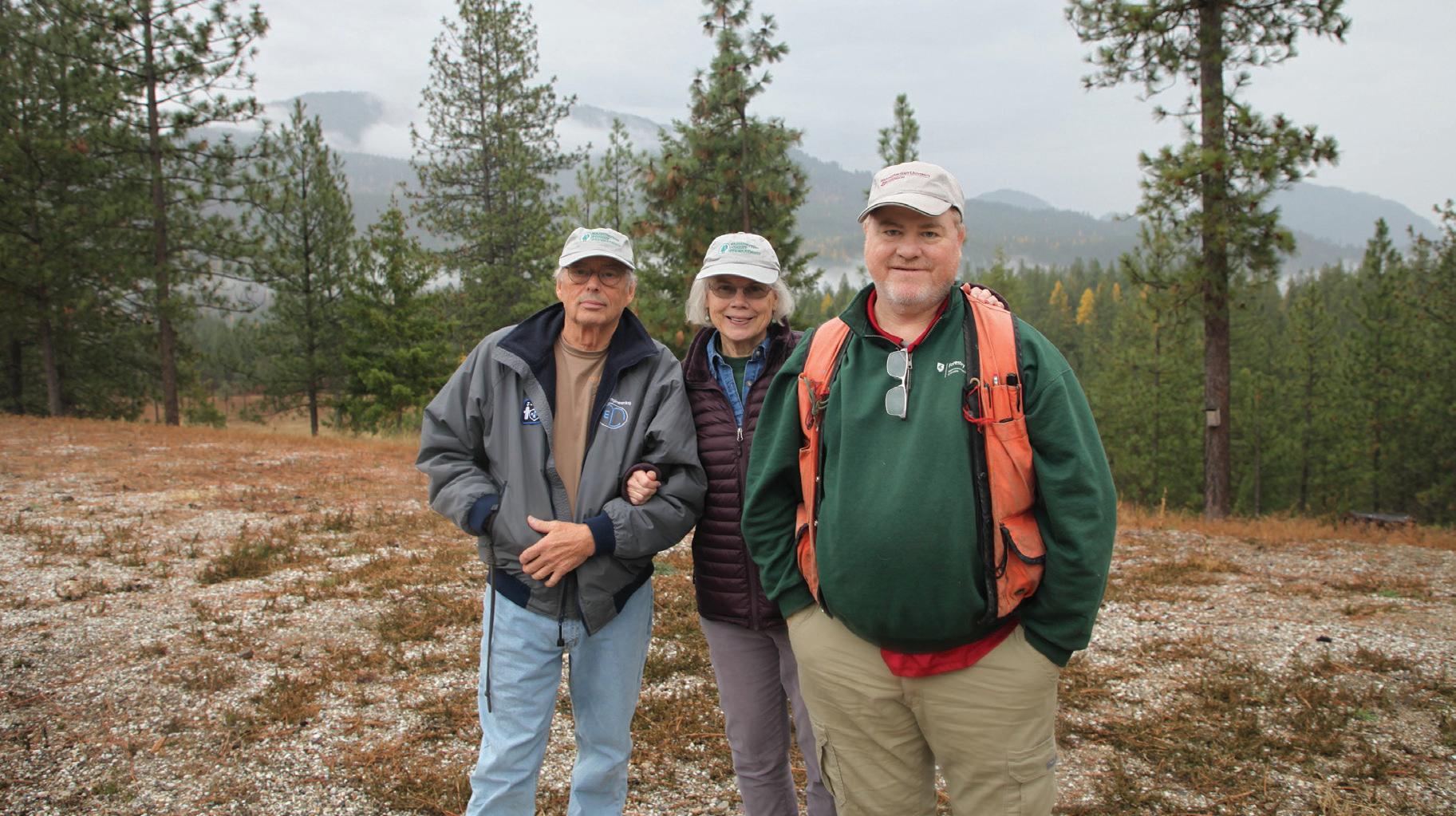
CHEWELAH, Wash. — As Becky and Lynn Miner passed through northeastern Washington on a road trip to Canada in the 1970s, they were struck by the region’s beauty. Determined to someday retire in the area, the young newlyweds from Iowa pinched pennies for the next two decades, purchasing nearly 100 acres
in Chewelah, Washington, in the early 1990s.
“When I first came to the area, I thought it was the most beautiful place in the world,” said Lynn, a U.S. Air Force veteran and retired U.S. Department of Defense research physicist. “In the ensuing 50-plus years, I’ve traveled all over and found no place prettier than this.”
After more than 30 years spent rehabilitating the poorly managed
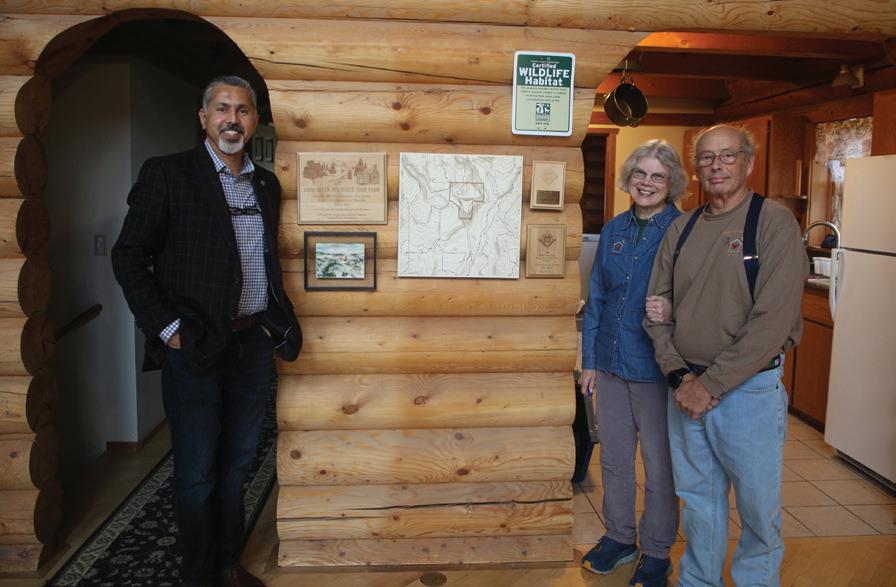
forest into a thriving, healthy wildlife refuge, the Miners have donated their Casa Becca del Norté tree farm to Washington State University Extension Forestry as a “legacy of learning.”
The tree farm’s name, which translates to “Becky’s house of the North,” is a nod to the Miners’ time spent living in the southwest during Lynn’s Air Force career. The property officially changed hands in early November during an on-site
celebration.
“This generous gift will allow us to deliver immersive, hands-on learning experiences, field days, and workshops that will empower family forest owners across the state to become better stewards of their land,” said Raj Khosla, Cashup Davis Family Endowed Dean of WSU’s College of Agricultural, Human, and Natural Resource Sciences. “It was truly inspiring to hear the Miners’ story and commitment to exceptional forest stewardship.
Standing on this land, I could clearly see how it will serve as a living classroom for our students, faculty, landowners, and forestry practitioners for decades to come.”
Representing WSU’s first school forest, the acreage includes a residential log cabin and outbuildings that will support education, training, demonstrations, research, conventions,
and other learning opportunities.
“I’m excited by the endless possibilities,” said WSU Extension Forester Andy Perleberg, who has worked with the couple since 2006. “The Miners have poured their hearts into this place for the last 30 years, and I am honored to be part of their vision for the future.”
The couple has a longstanding connection to WSU Extension. After purchasing the land, they soon realized they had their work cut out for them. With the help of mentors including WSU Extension Forestry faculty, federal and state agencies, and local tree farmers, the Miners learned to successfully manage their forest, which includes ponderosa pine, Douglas fir, western larch, grand fir, grand fir, western red cedar, and aspens.
“They were learners from the start,” Perleberg said. “When they bought their property, they immediately realized they needed to start learning, and WSU was part of that solution.”
Over the decades, the Miners planted more than 11,000 western larch and ponderosa pines, as well as pollinatorfriendly flowers and wildlife shrubs that serve as a food source for animals.
“The forest was in incredibly poor health,” Lynn said. “Of course, we didn’t know that initially because we knew absolutely nothing about trees. We worked to bring it back to where it would have been 200 years ago.”
The couple also created wood piles as wildlife habitats, wildlife migration corridors, and nesting boxes for birds and other animals.
“When we arrived, we expected to hear lots of birds singing because we had so many trees,” said Becky, an avid bird watcher who earned her nursing degree from WSU. “We learned the trees were so dense that there was no room for the birds. They came incrementally, as we made the forest healthier. I’ve now logged more than 70 species.”
The Miners have earned state and regional recognition for their hard work, receiving the West Region Outstanding Tree Farmers of the Year Award from the American Forest Foundation earlier this year and the Washington Tree Farmer of the Year Award from the Washington Tree Farm Program in 2024.
As they learned more about forestry, wildfire mitigation, and wildlife, the
Miners began to share their knowledge, presenting at WSU Extension field days and seminars. They also opened their forest to research, prescribed burn demonstrations, and hands-on learning opportunities for a wide range of learners — from WSU students to elementary school teachers, Boy Scouts, and FFA groups.
While saying goodbye to their beloved property has been bittersweet,

the couple remain focused on the lasting impact the land will have.
“We hope that the tree farm continues to be a place of learning and research,” Lynn said. “Since our high school days, Becky and I have felt it is everyone’s responsibility to leave the Earth better than they found it. With this tree farm, we feel that’s what we’ve done.”
















BY SETH TRUSCOTT
Viral diseases cause multi-billiondollar damages to global food crops annually. Scientists at Washington State University are training the next generation of virologists to fight these diseases with a simple but crucial tool: clean plants.
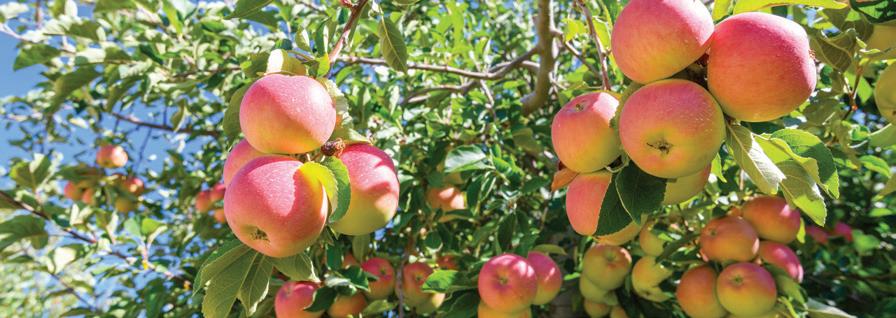
Growing crops from virus-tested seeds, tubers, or cuttings is one of the most effective ways to reduce the damage caused by plant viruses. Currently, six alumni of WSU’s Department of Plant Pathology lead or manage clean-plant certification programs in five U.S. states and Canada, holding the first line of disease defense for apples, berries, sweetpotatoes, ornamentals, and other important crops.
“There is no cure and no option to ‘get rid of a virus’ once a plant is infected,” said Hanu Pappu, WSU professor and plant pathologist. “The best option is to avoid them in the first place. The often-repeated mantra is “start clean, stay clean.”
The four doctoral graduates and two master’s recipients — Christie Almeyda, Dan Villamor, Cristian Olaya, Dipak Poudyal, Segun Akinbade, and Noma Chingandu — are at the forefront of international efforts to protect the food supply.
Now leading a statewide program providing clean planting stock to Washington’s $2.4 billion apple, pear, and cherry industries, master’s graduate Segun Akinbade came to the U.S. from Nigeria, where he developed a deep curiosity about viruses that damage staples like cassava, maize, rice, and plantains.
“The next step in my educational
journey was to attend graduate school and engage in an original research project to try to find answers,” Akinbade said.
Cristian Olaya, a 2019 doctoral graduate, began his career at the International Center for Tropical Agriculture in his home country of Colombia. Like Akinbade, work on a challenging cassava virus motivated him to continue his training.
“Dr. Pappu’s lab was the right place to pursue my dream,” said Olaya, who now coordinates Oregon State University’s berry-focused Oregon Clean Plant Center. “My journey at WSU was a life-changing event.”
For the past 11 years, Dipak Poudyal, a 2012 doctoral graduate from adjunct Professor Xianming Chen’s lab, has led Oregon’s Plant Health Virus Certification Program, overseeing production of certified stocks of fruit trees, blueberries, and grapevines. Oregon is a major supplier of nursery stocks for specialty fruit crops, and in 2020 launched the nation’s first blueberry nursery stock certification.
Poudyal’s work with stakeholders at the state, regional, and national level has been crucial to meeting new challenges and providing reliable sources for growers in the U.S. and many other countries.
“Growing up in Nepal, I witnessed the devastating loss of farm income due to rice blast epidemics,” he said. “This taught me a life lesson that costeffective prevention is fundamental for food security and grower success.”
Poudyal benefited from real-world case studies discussed in Pappu’s graduate plant virology course, which help students understand how virus certification can be highly effective in managing economically significant
viruses.
“The curriculum at WSU is comprehensive and prepared us to adapt to meet grower needs and ever changing demands of our jobs,” Poudyal said.
Dan Villamor, another 2012 PhD graduate, manages operations at the University of Arkansas System Division of Agriculture’s Arkansas Clean Plant Center, a recently established, berryfocused member of the National Clean Plant Network. Originally from the Philippines, where he began his plant pathology career in the banana industry, Villamor joined the Eastwell lab to study viral and virus-like diseases of stone and pome fruit crops.
After graduation, he helped integrate new rapid, computer-based analysis of DNA at WSU Prosser’s Clean Plant Center Northwest and worked on the emerging challenge of Little Cherry Disease. When offered the job at Arkansas, Villamor knew it was a perfect fit thanks to years of experience at WSU and the Prosser center.
A native of Zimbabwe, Noma Chingandu joined Pappu’s lab in 2010 as a proud Fulbright Scholar.
“I had first-hand experience with the impact of diseases on food production and food security,” she said.
Thanks to training and mentorship at WSU, Chingandu quickly gained
a strong grasp on plant diseases, host-pathogen interactions, and diagnostics. Today, she is head of the grapevine program at the Canadian Food Inspection Agency’s Centre for Plant Health, where she coordinates plant certification, contributes to research, and plays a key role in annual nationwide surveys at Canada’s only post-entry quarantine and plant virology lab.
Christie Almeyda, a fellow 2012 doctoral graduate, sought out Pappu’s lab after earning degrees in her home country of Peru as well as at the University of Minnesota. She now directs the North Carolina Clean Plant Center for sweetpotato, berry crops, and muscadine grapes at North Carolina State University. The state is the largest producer of sweet potato in the U.S., supplying over half of the national crop.
More than 50% of North Carolina’s annual sweet potato acreage is planted with stock derived from the Clean Plant Center, where Almeyda provides certified pathogen-tested material and manages production, research, funding, and diagnostics.
“I was given great flexibility and freedom to explore different research questions during my PhD,” she said. “The ability to formulate new hypotheses and questions on your own is central to developing as an independent and productive scientist.”
BY BRIAN KELLY Daily Record
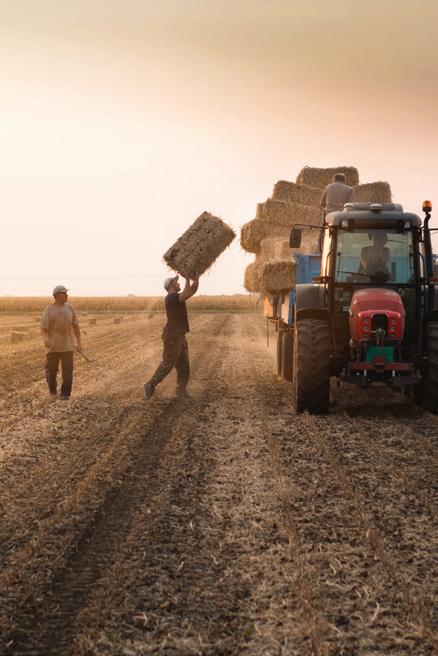
Anderson Hay Enterprise, Inc. of Ellensburg has filed for bankruptcy in the U.S. Bankruptcy Court for the Eastern District of Washington.
The hay exporter reported $50 million to $100 million in liabilities in its bankruptcy filing, and $10 million to $50 million in assets.
The company filed for Chapter 11 protection Nov. 26.
In a message posted to the company’s website, Anderson Hay CEO Mark T. Anderson said the company was not closing down.
“We are not going anywhere,” Anderson said in the letter, addressed to “customers, partners and friends.”
Anderson said the company had been in discussions with AgWest Farm Credit, its lender, to restructure and extend its loan terms.
“AgWest decided to end any constructive discussions and impose unwarranted, unacceptable restrictions on us that would effectively limit our ability to continue operating and serving our customers. That decision left us in a very difficult position and with few options,” Anderson continued.
“Because of that — and only because of that — we have made the choice to file for Chapter 11 reorganization.”
In the letter, Anderson noted farmers and ag businesses across the country were facing “rising costs, tightening margins, unpredictable export markets and global trade instability.”
“These past few years have not been easy for anyone in this industry,” he said.
Anderson stressed the company was seeking bankruptcy protection so it could reorganize its debt.
“I want you to hear this plainly from me: This does not mean Anderson Hay is closing its doors. We are not shutting down. We are not stepping back.
“We are continuing forward.


BY HANNA ABDALLAH
Washington State University - College of Agricultural, Human, and Natural Resource Sciences
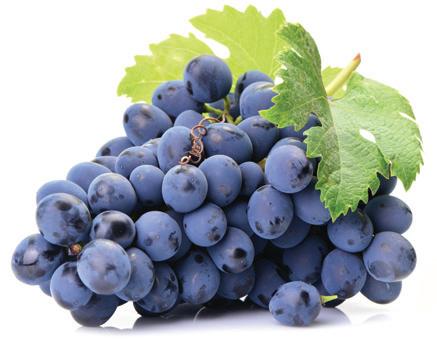
Abacterium that lives on grape plants can break down guaiacol, an unpleasant-tasting substance that ruins wines made from grapes exposed to wildfire smoke, according to new research. The study results were published in the journal PLOS One.
Wildfires are increasing in wineproducing regions of the U.S. West Coast. Wine grapes can absorb substances from wildfire smoke that ultimately make their way into the bottle, resulting in a smoky, ashy-tasting pour. Prior research has shown that one such substance, guaiacol, can be broken down by certain species of bacteria living in soil, raising the possibility that bacterial metabolic processes could be harnessed to help fix the taste of smokeexposed wines.
However, few studies have explored whether the ability to degrade guaiacol is also possessed by bacteria found naturally on grapevines as part of the plants’ microbiome.
“One of the big takeaways is the extent to which smoke exposure affects the microbiome on the plant surface,” said study co-author Tom Collins, an associate professor in Washington State University’s Department of Viticulture and Enology. “More work
From HAY on page 7
Chapter 11 simply gives us the ability to reorganize our debt, stabilize our footing, and protect the long-term health of our company.
“For more than 60 years, my family has dedicated our lives to this work. We have weathered a lot of seasons — good and bad — and we’ve done it by
has been done on reactivity of the soil microbiome to environmental impacts. This is one of the first studies to look at the microbiome on the plant.”
The researchers collected leaves from two varieties of grape plants, chardonnay and cabernet sauvignon, then tested them in a lab for the presence of guaiacol-eating bacteria.
They found that the leaves harbored two strains of the same bacterial species, Gordonia alkanivorans, that can break down guaiacol in the lab. Analysis of their genomes revealed specific genes involved in this metabolic process, including a gene called guaA. When this gene was experimentally deleted in G. alkanivorans cells, the bacterium was unable to break down guaiacol, confirming that guaA is required for guaiacol degradation.
“In this study, we identified two members of the grape microbiome capable of degrading guaiacol, a volatile phenol that contributes to smoke taint of wine,” said study author Claudia Castro of the USDA Agricultural Research Service. “We also identified changes in the grape microbiome caused by simulated wildfire smoke with the goal of providing genetic tools to help combat smoke taint.”
The researchers exposed living merlot plants to smoke produced by a culinary smoker located at WSU’s Irrigated
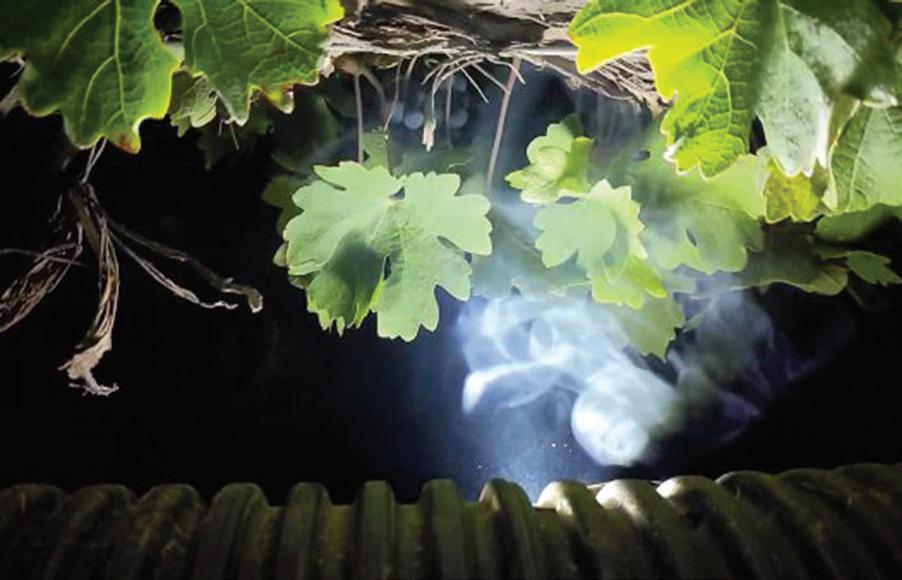
Agriculture Research and Extension Center. The smoker simulates exposure to wildfires, helping the researchers test which bacterial species were present on the plants before and after exposure. They found that the microbiome on both leaves and grapes changed significantly in the days following smoke exposure, with a notable increase of bacteria in the Bacilli class, which are known to survive in extreme environments.
“This work suggests the potential for another route to lessen the impact
of smoke exposure in the vineyard,” Collins said. “There is still work to be done to sort out how to use these organisms to the benefit of the vine, but there are already organisms in the plant microbiome that can metabolize smokerelated compounds.”
Next steps include finding other organisms that could metabolize guaiacol and other smoke-related compounds, as well as learning more about how these organisms degrade guaiacol and other smoke-related compounds, said Collins.
keeping our promises, delivering quality forage, and taking care of the people who depend on us. That commitment does not change because of this moment,” Anderson said.
He also thanked the company’s customers for their trust and support.
“We fully believe we will come out of this stronger, more resilient, and ready for the next chapter. We are not going
anywhere,” Anderson said in the letter.
Anderson Hay exports hay locally and across more than 30 countries around the world,
The family-led business was incorporated in 1960 in the Kittitas Valley by Clarence Anderson and his son, Ron Anderson.
Before 1960, the family operation
was called C.E. Anderson and Sons.
The company went global nearly 50 years ago. Ron Anderson pioneered the opening of the timothy hay market in Japan in the early 1980s by spearheading the development of a fumigation process that allowed hay to be shipped to Japan.
This story was first published in the Daily Record.
BY SCOTT WEYBRIGHT
MOUNT VERNON, Wash. —
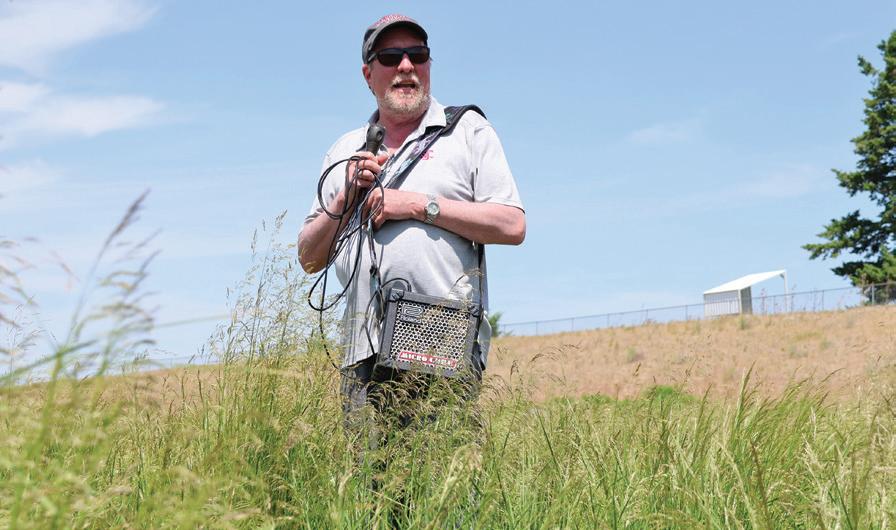
Roughly 80% of Kentucky bluegrass seed is produced in Washington, so it’s logical for the turfgrass seed industry to work closely with the state’s leading scientists. Furthering that relationship, Washington State University recently named Michael Neff as the Washington Turfgrass Seed Commission Professor, a position endowed by the industry.
“Dr. Neff has a passion for turfgrass, which can be seen in the results of his work,” said Travis Meacham, a seed grower, former chairman of the commission, and current chair of the industry-advocating Washington Turfgrass Seed Association. “It’s important to have our land-grant university support growers. The future looks brighter when we have someone on the academic side who can help us.” Industry partnership is vital to Neff’s
research.
“Their support allows my team to work on projects that aren’t ready for federal or other large grants,” said Neff, a professor in WSU’s Department of Crop and Soil Sciences. “We need preliminary data, and this endowment allows us to work on research that is high-risk and high-reward. If the projects work at a small scale, we can apply for additional support to keep advancing.”
Industry backing has led to the Grass Breeding and Ecology Farm on WSU’s Pullman campus, plus a new turfgrass farm at WSU’s Northwestern Washington Research and Extension Center in Mount Vernon, Washington.
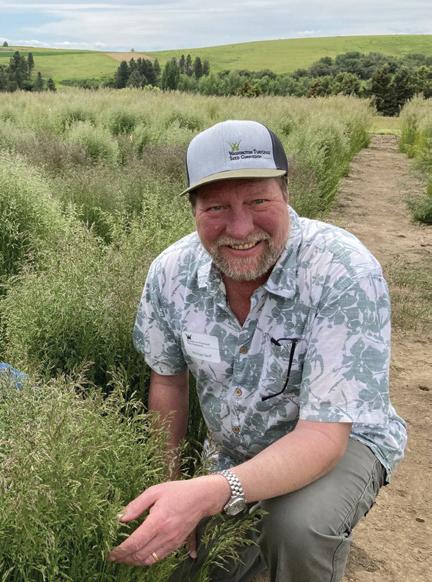
The goal in Mount Vernon is to develop varieties that grow well in western Washington, which has traditionally been a challenge due to climate.
“We’re collecting grasses from around the west side of the state that we think will grow well,” Neff said. “We’re
screening them at the Mount Vernon farm to pick out the best varieties and traits. It’s still early, but we’re hopeful we can improve lawns around the area with grasses that don’t require as many inputs to grow well.”
Inputs for turfgrass include irrigation, fertilizers, and pesticides.
For most of his career, Neff was primarily a molecular geneticist. Becoming WSU’s grass breeder about a decade ago, he has since enjoyed increased applied science opportunities while still relying on his extensive research background on how plants grow.
“Turfgrass has so many uses with wildly different requirements; it is endlessly fascinating,” he said. “You’re going from low-input areas like highway medians to high-maintenance areas like golf putting greens, often using the same species. The varieties must have unique qualities. When we’re breeding, we have to think about who will use each variety and what it will be
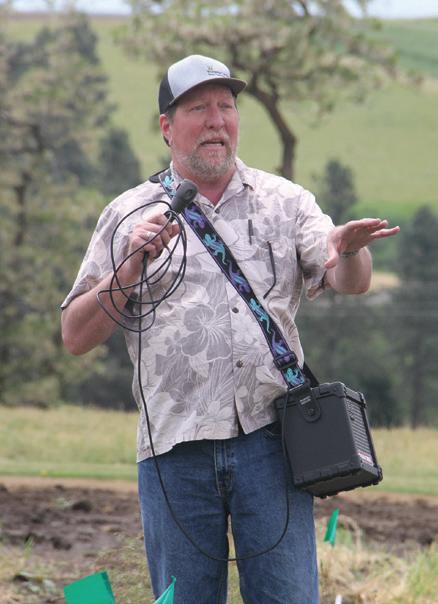
used for.”
Orlin Reinbold, a member of the turfgrass seed industry for more than 40 years, helped Neff establish the research farm in Pullman and has worked closely with him for over a dozen years.
“This endowed position is great for Michael and his program,” said Reinbold, an entrepreneur who has donated to WSU’s turfgrass program for many years. “He’s put together a great team that is helping the university while also benefiting our industry. I’m excited to see what they do in the coming years.”
One of Neff’s biggest projects involves breeding for the impact of a changing climate. Kentucky bluegrass requires freezing temperatures for the plant to produce seed the following spring, a process called vernalization. Warming temperatures have limited the number of days below freezing, meaning reduced seed production.
Neff is working to breed varieties that undergo vernalization at higher temperatures.
“The industry tells us what challenges they’re facing, and we look at ways to address them,” Neff said. “We’re building a foundation of results and infrastructure to make sure we help the industry for years to come.”
December 3, 2025 | Kittitas County | 11/12th Graders


Written by the Kittitas County Chamber of Commerce
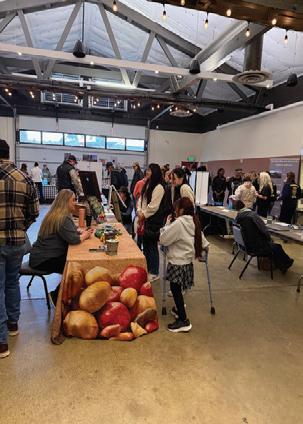
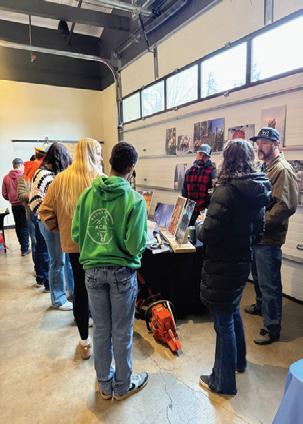
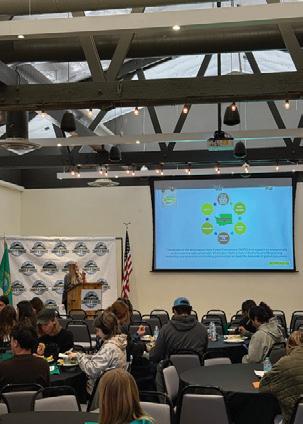
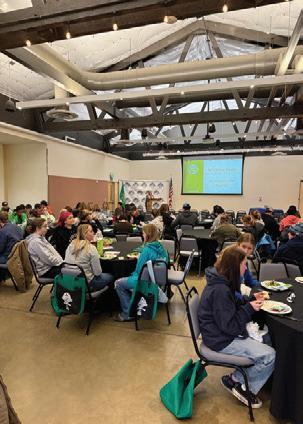
On Wednesday, December 3, 2025, the Kittitas County Agriculture Youth Summit was proudly hosted in Ellensburg, welcoming students from across the county for a day focused on hands-on learning, career exploration, and inspiration within the agriculture industry Students from the Cle Elum-Roslyn, Thorp, Ellensburg, and Kittitas School Districts participated in engaging educational sessions and interactive experiences designed to showcase the breadth of opportunities in agriculture
The day began with a warm welcome from 13th District Representative Tom Dent, setting the stage for meaningful conversations around the future of agriculture. Educational sessions on land conservation and stewardship were led by Damon Roberts of the Washington Department of Ecology and Joe Rotter of Red’s Fly Shop.
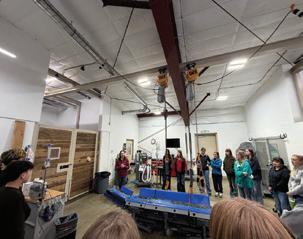
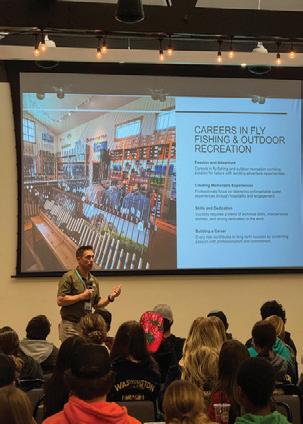
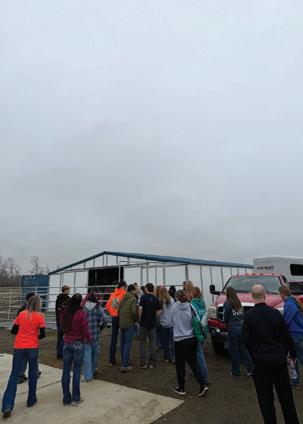
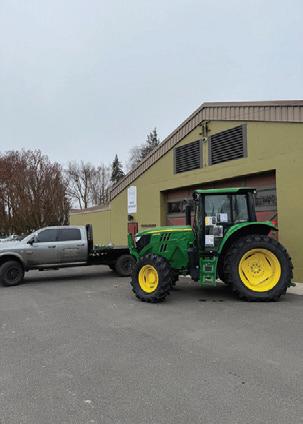
Students also explored career pathways through a Trade Show Expo featuring a wide range of local businesses, agencies, and organizations representing agriculture, education, natural resources, and skilled trades The event was further enhanced by a keynote presentation from the Washington State Potato Commission, a field trip experience hosted by Central Washington Equine Hospital, and catering provided by Cascade Mountain Grilling.
With nearly 80 student participants, the 2025 Agriculture Youth Summit was a strong example of community collaboration and investment in the next generation of agricultural leaders. Thank you to our schools, partners, and supporters for helping strengthen the future workforce of Kittitas County.
Learn more at kittitascountychamber.com.


The first bell pepper harvest season in Ellensburg launched with a target of processing 150,000 pounds of red, green, and yellow bell peppers within a three day production window. To make the project cost feasible, the team utilized existing carrot line equipment with several key modifications to accommodate pepper processing.
Bell peppers were manually cored by team members on the line before being fed into the slicer. While the slicer was rated for 10,000 pounds per hour, it initially operated at approximately 7,000 pounds per hour during production.
After slicing, peppers were blanched in the steam blancher, consistent with other commodities, and then passed through color sorters to remove unwanted defects. From there, the peppers entered the IQF tunnels for freezing, were placed into totes, and transferred to freezer storage.
Throughout the run, team members maintained strong morale while working through troubleshooting and adjustment delays necessary to optimize the process
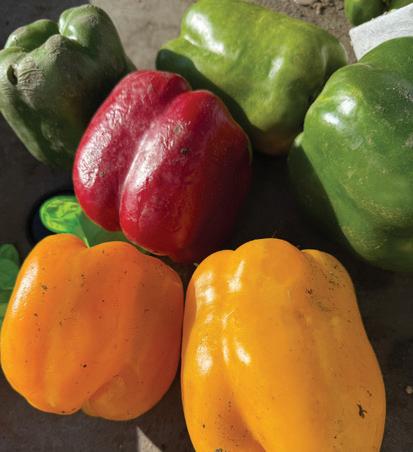
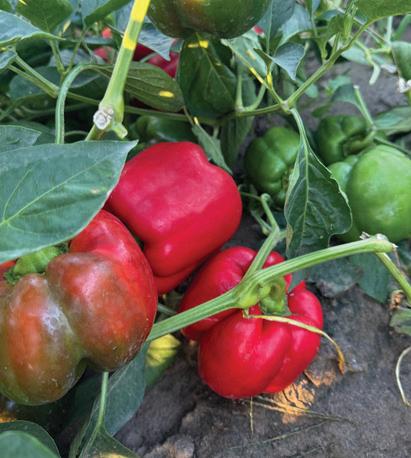

Harvest timing proved critical to product quality and throughput Red peppers were harvested too early and sat for a period, resulting in softness. Green pepper volumes were lighter than expected as many transitioned to red before harvest Yellow peppers delivered the best results, entering the slicer with excellent crispness and producing the highest quality output.
The initial slicer throughput challenges were likely influenced by pepper quality. As quality improved, throughput increased from 3,000 pounds per hour to 7,000 pounds per hour by the end of the run.
By the conclusion of the production window, the Ellensburg team successfully produced 115,000 pounds of sliced bell peppers Strong collaboration across all departments played a key role in the success of this first run. The planning team ensured production milestones stayed on track, while the production team provided valuable feedback and ideas while dialing in the process
Twin City Foods is a family-owned leader in the frozen vegetable industry with more than 80 years of experience. Specializing in peas, corn, carrots, and green beans, the company is committed to harvesting vegetables at peak freshness and preserving quality through innovative quick-freezing processes.
With four facilities and a workforce of approximately 900 people, Twin City Foods partners with growers and customers to deliver consistent quality, customized packaging, and reliable distribution, while maintaining a strong focus on sustainability and responsible farming practices.
BY LESLIE KELLY
Special to the Daily Record
If you ask any member of the Cle Elum Owens clan what’s most important to them, they’ll tell you “Family.” And a close second are their customers.
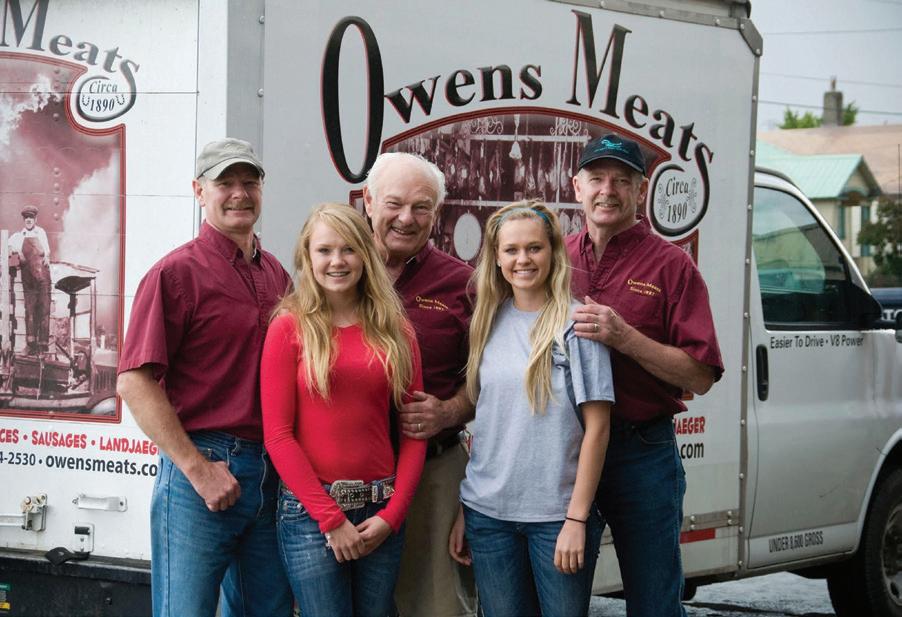
Owens Meats has been in business for 130 years. Five generations of Owens have piloted the meat market, which began in 1887 by Morgan Owens to supply quality meat to local coal miners and their families.
Owens Meats has remained familyowned and operated. Through depressions, labor strikes and changing consumer tastes and trends, the Owens family has continuously evolved to meet new challenges while maintaining their dedication to quality and service.
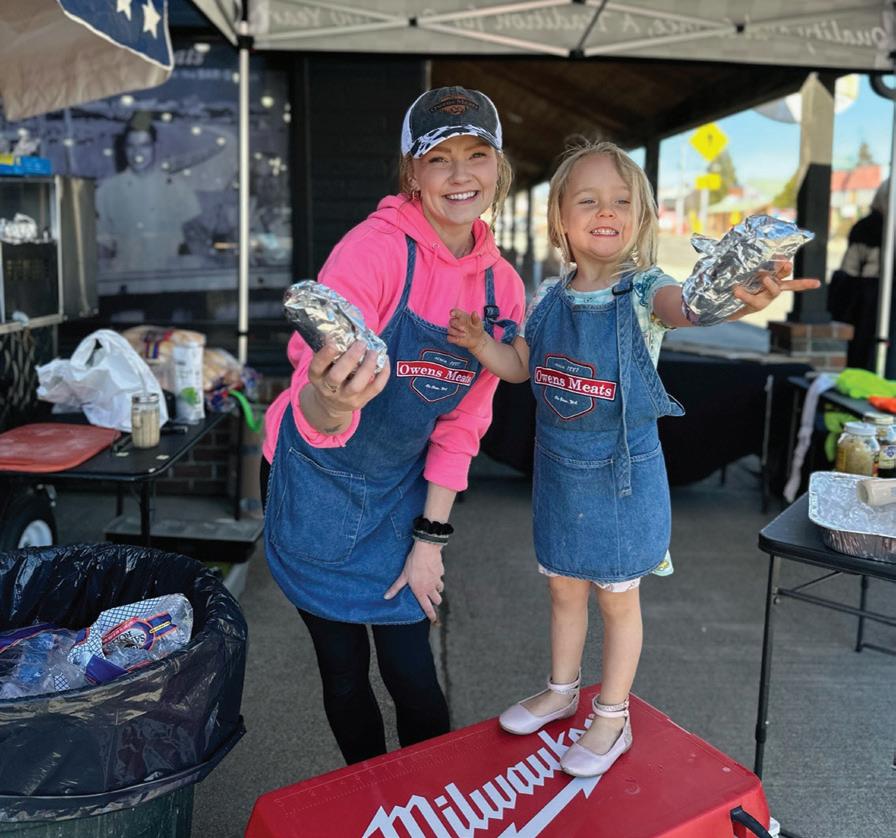
Today, sisters Madysen and Luticia Owens are learning the ropes and are in the process of taking over the business. Their father, Don, and uncle, Doug, are heading toward retirement.
“The exciting part is preparing for growth, and not knowing what the future holds,” said Madysen. “We’ll take
baby steps, and we look forward to the day when we can make updates to the place.”
Owens Meats is located in downtown Cle Elum and has grown throughout the years. It’s been housed in several locations in Roslyn before it came to Cle Elum. The current location was renovated 12 years ago when they raised the ceiling, tore out walls, painted all the walls and moved departments within the business to function better in evolving times.
“We love how it is right now,” said Madysen, “but we want to change some of the appearance and put our creative stamp on it.”
Growth in the company has led to more employees.
“We’ve more than doubled employment and customers in the last 15 or so years,” she said.
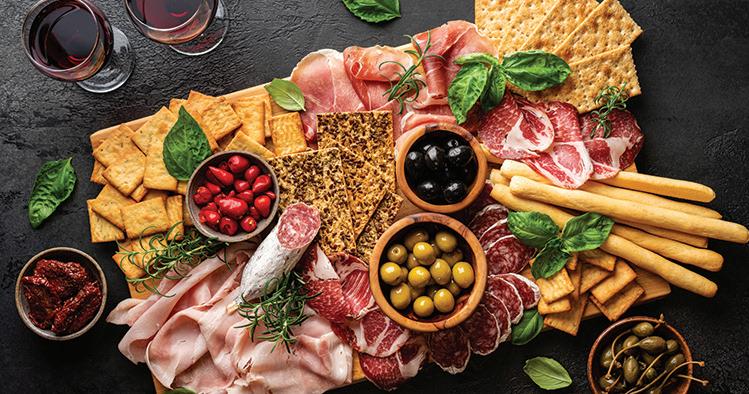
Owens Meats is known as the place to go to buy fresh meats and smoked snacks. Fresh products include ground beef, choice and prime steaks, roasts, and marinated products, too.
Smoked snacks include peppered beef jerky, Polish kielbasa sausage, all beef
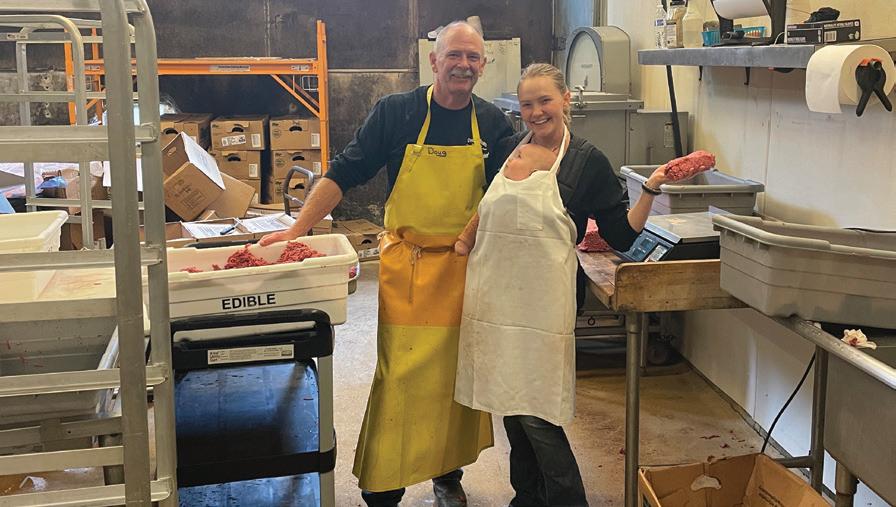
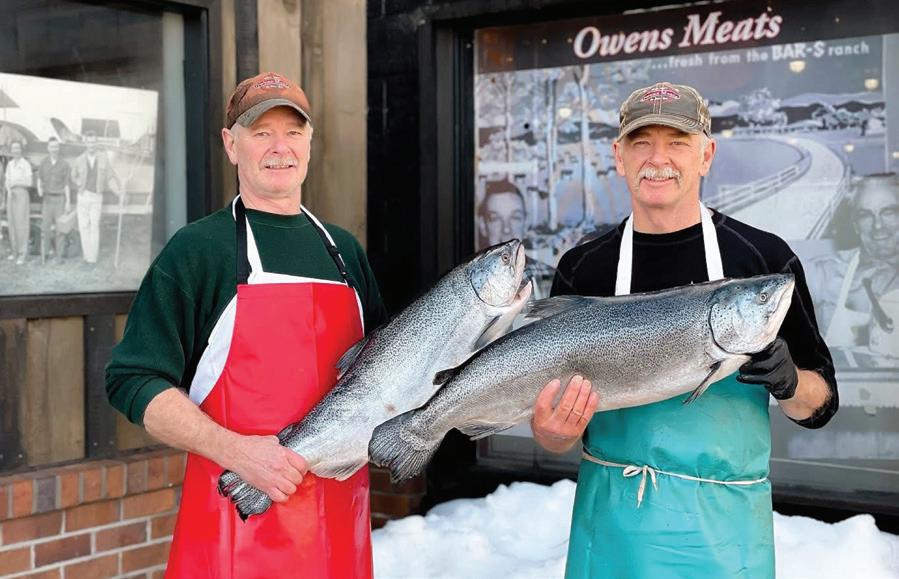
pepperoni (with or without cheese), smoked chicken breast and summer sausage.
They also have a cheese counter where they sell local cheese and delicious imports from around the world, including New York, France and Norway.
The most popular item they sell is the “Good Stuff.”
“It’s a meat and cheese trail mix,” Madysen said. “My mom and I were talking and wanted to create something like a ‘Lunchable.’ What we came up with was a mix of cheeses, beef jerky, and pepperoni.”
Her dad and uncle came up with the name “Good Stuff” she said, because “that’s just what it is.”
Owens Meats made countless upgrades to accommodate the production of the “Good Stuff,” including making more pepperoni.
The cheese in the “Good Stuff” is cheddar and creamy whole milk mozzarella, some of it coming from Darigold.
Second most popular are their smoked pork chops. Madysen describes them as “like a bacon steak.”
“As a matter of fact, we’ve had it for dinner the last two nights,” she said.
Owens Meats has its only retail location in their main Cle Elum building. Madysen said sometimes
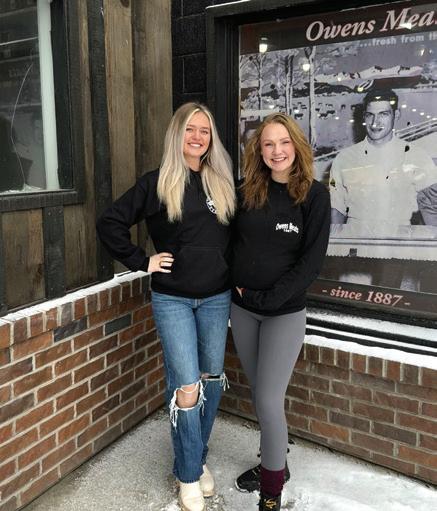
after-hours, as they are cleaning up for the day, a customer will come to the door.
“Of course, we let them in and get them what they needed.”
But that made them wish they could be open “24/7.” That led to the meat machine – a meat-vending machine that her father Don and uncle Doug invented about 10 years ago.
Just like any vending machine, you put in your money and select what item you want.
The meat machine, sometimes
called the “Candy Machine for the Carnivore,” takes cash and cards and currently there are 20 in and about throughout Washington.
It disperses fulled-cooked products such as beef jerky, pepperoni, Landjäger, beef jerky, and variety packs including cheese with those snack items.
“It’s technologically a wonder,” she said. “It has refrigeration, and operates at just the right temperature, and there’s a system that checks and adjusts the temperature if needed minute-to-minute.”
Owens Meats was the first to introduce it. There are now meat machines in Paris and in Australia.
“The couple from Australia who wanted to put one out, actually came here to look at how we operated it,” Madysen said.
The Owens family is focused on health. Eating meat is a large part of it.
“We eat as people have for centuries. We have a strong belief in a primal ancestry diet, which includes meat, and our meats are very healthy. We avoid any additives, artificial flavors or coloring.”
As far as she knows, there are no vegetarians in her family.
“They would be made fun of,” she said. “Meat is just part of the family and most of us hunt, going back to my
great grandmother Frances, who hunted animals and fly fished.”
For Madysen, the future is exciting. She knows she and her sister will be successful.
“The hardest part is living up to the expectations my dad and uncle have,” she said. “They have been so successful, and we don’t want to do anything that would harm the business.”
Both Madysen and Lutisha are moms. Between them there are five young kids to care for. And Lutisha has a photography business on the side, while Madysen paints, and gives acrylic painting classes.
Just how do they do it all?
“Same way as my dad did,” Madysen said. “He raised four children while owning and running a business. And all us kids still learned to ride horses, do snocross racing and other hobbies. The priority must be family and business — and you must make time for both.”
As it has been for decades, the key to keeping the business thriving for generations to come is “good communication and relationships,”
Madysen said.
“When family doesn’t communicate, then all the frayed edges come apart at the seams,” she said. “If you are not communicating with each other, then the business will fail.”




BY LESLIE KELLY Special to the Daily Record
There’s nothing better than getting recognized for your hard work.
And that’s just what happened to Owens Meats.
The business’s enduring impact was recognized statewide when Owens Meats received the “Legacy on Main” award from Washington Main Street, honoring their exceptional longevity, innovation and commitment to community.
The Legacy on Main Award celebrates businesses that have demonstrated lasting contributions to the vitality of their Main Street communities. During the ceremony, Washington Main Street Senior Program Director Breanne Durham highlighted the company’s remarkable journey and deep local roots.
“Who here has enjoyed a pepperoni or cheese stick from a meat vending machine?” Durham asked the crowd. “You can thank Owens for that.”
Founded in 1887 by Morgan Owens to supply quality meat to local coal miners and their families, Owens Meats has remained family-owned and operated for five generations. Through depressions, labor strikes, and changing consumer trends, the Owens family has continuously evolved to meet new challenges while maintaining their dedication to quality and service.
During the Great Depression, the family extended credit to struggling neighbors. In the 1980s, as shopping habits shifted, Owens Meats pivoted from freezer sales to a thriving retail storefront.
“Their business decisions reflect a deep understanding of and commitment to local families, agriculture, and economic resilience,” Durham said. “They’ve spent over 130 years listening and responding to their community.”
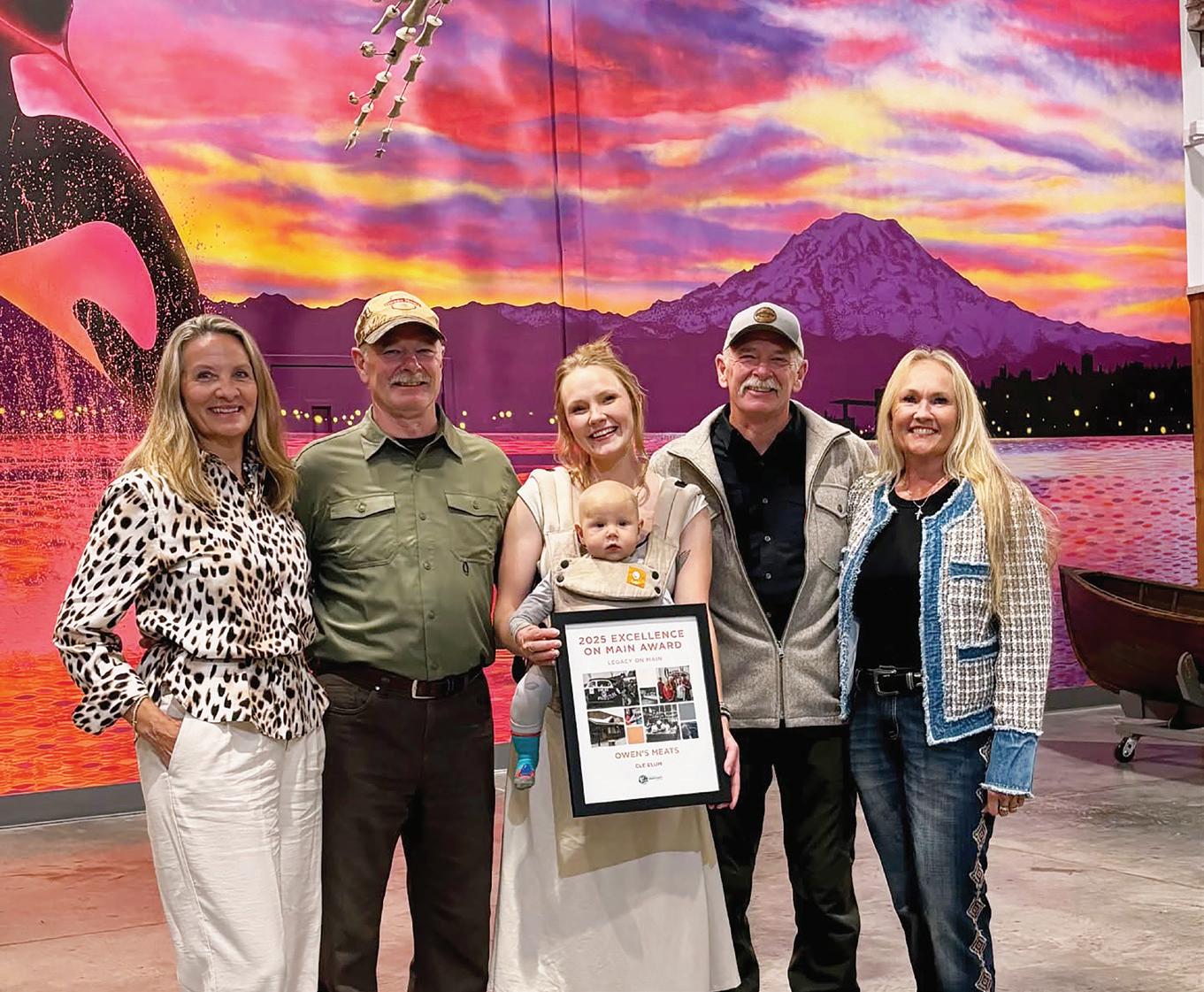
Don and Kristina Owens, Doug and Dana Owens, and Madysen Owens-Hartman (and baby Owens-Hartman) accepting the award for Legacy on Main 2025 from Washington Main Street.
Madysen Owens, who was present to accept the honor, said the award meant everything to the family and was “heartwarming.”
“We like to believe that we are important to the community,” she said.
“The community is very important to us, and it was so nice to be recognized.”
From a frontier butcher shop to a modern retail and production hub, Owens Meats remains a vital part of Cle Elum’s downtown identity.
Don and Kristina Owens, Doug and
Dana Owens, and Madysen OwensHartman (with baby in tow) accepted the award at this year’s ceremony, honoring the legacy of those who came before them and the future of the family business.
Owens Meats’ success extends beyond longevity — it’s a story of innovation rooted in community. The company continues to create local jobs, support regional ranchers, and draw visitors to downtown Cle Elum, reinforcing the values that have guided them since the 19th century.
As Washington Main Street noted, Owens Meats exemplifies “Excellence on Main” — proving that with dedication, adaptability, and strong community ties, small-town businesses can not only survive but thrive for generations.
To view photos from the ceremony and learn more, visit Cle Elum Downtown Association’s Facebook page.
Washington Main Street contributed to this article.
BY ANGELA SAMS
Washington State University - College of Agricultural, Human, and Natural Resource Sciences
RICHLAND, Wash. — When Elle
Jennings set out to craft a pair of wines for her Blended Learning class at Washington State University, she hoped to discover how grapes grown in different types of soil can affect the final product.
“I’d previously only tasted classic Washington Cabernets,” said Jennings, who graduated from WSU in May 2025 with a bachelor’s degree in viticulture and enology. “These wines were completely different from anything I was expecting, but I was pleasantly surprised.”
Jennings partnered with WSU alumnus Kyle Welch of Longship Cellars to create two Cabernet Sauvignon wines — one using grapes grown in sandy soil, the other using grapes grown in basaltic soil. The wines are intended to be purchased together so they can be tasted and evaluated side by side.
“It’s meant to be a sensory learning opportunity for people to bring the bottles into their homes and compare tasting notes with friends and family,” Jennings said.
Jennings’ experiment showed that soil type resulted in a significant difference between the two wines’ aroma and taste.
“The wine made with grapes grown in basalt resembled a classic Cabernet: bigger tannins, more floral on the nose, more structure on the palate, and a little more acidity,” Jennings said. “The wine made from grapes grown in sandy soil was still very good, but completely different than a traditional Cabernet. It hit the palate almost like a Grenache — much lighter with a lot fewer tannins,
but still with a great complexity.”
To ensure the experiment was strictly a soil comparison, the two wines were made with the same grape clone.
The plants were grown at the same elevation in the same vineyard, using identical practices — the grapes were even picked the same day. Later, after harvest, the wines received identical additives and were aged in the same type of barrels. The sole difference was the soil.
Jennings was involved in the winemaking process from start to finish, helping with everything from berry sampling and grape delivery to punch downs during fermentation.
“It was fun showing Elle our style of winemaking — how we process the fruit, the impact of yeast selection, and the importance of fermentation management, from inoculation all the way through bottling,” Welch said.
While the wines aged for a year, Jennings was involved in barrel tasting and chemical analysis. As the project wrapped up, she helped with the bottling process.
“I really did see the wines through from vineyard to bottle, which was an amazing experience,” she said. “I also took sensory analysis classes while working on this project. I connected what I was learning in the classroom to what I was doing in the winery setting, and could bring any questions I had about my project to the classroom.”
Welch said he enjoyed helping Jennings with the project and seeing the results.
“When the fruit was dropped off, the flavors, ripeness, and acids were definitely different, so I knew the wines would end up being different,” Welch said. “It’s cool to see how just one difference in terroir can impact
the same fruit from the same vineyard. Tasting the wines side by side, you may not even think they’re from the same vineyard.”
Welch urges wine science students to seek out similar hands-on experiences that will help jumpstart careers in the industry post-graduation.
“I’m proud to have worked with Elle on this project and to see her name on those labels,” he said.
Though Jennings wrapped up the Blended Learning project earlier this year, it has served as a launch pad for her current research as a graduate student.
“Working on those wines is what
initially drew me to soil science,” said Jennings, who is pursuing a master’s degree in agriculture at WSU. “That has now translated into my master’s program, where I’m focusing on soil science and studying sustainability in the vineyard and how it relates to vineyard soil health.”
Serving the Agricultural Community since 1946 with Integrity,Commitment and Experience
Jerry Grebb, CPA
Marie Riegel, CPA
Jacqueline O’Connor, CPA
Melanie Rosecrans, CPA
Richard Wachsmith, CPA
Felicia Persson, CPA
Kelsey Roseberry, CPA
Madeline deMaintenon, CPA








BY ANGELA SAMS
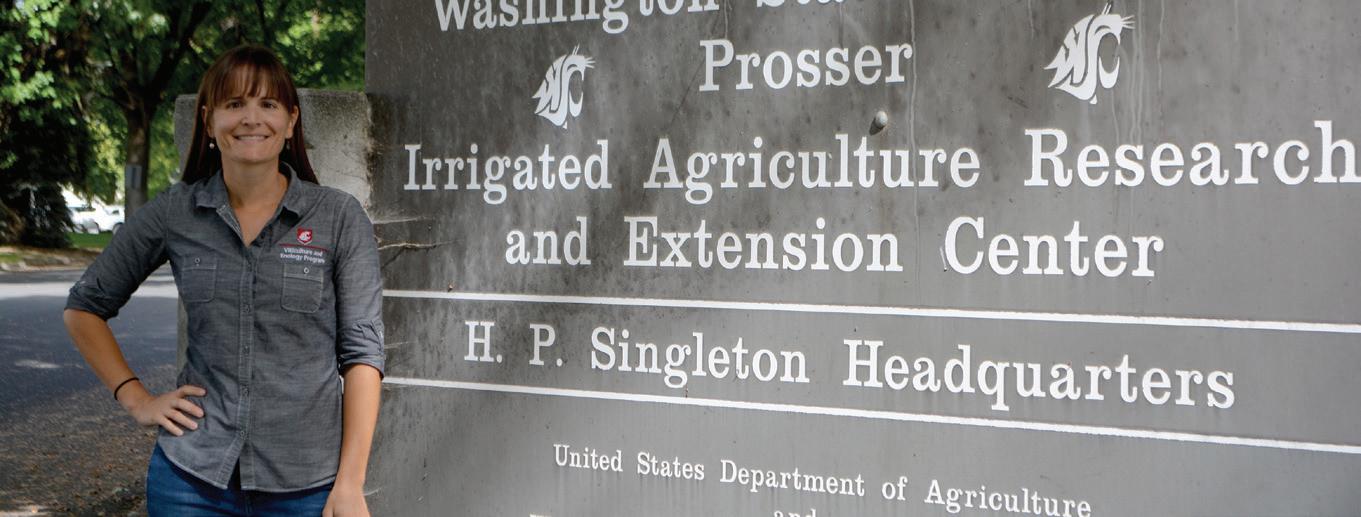
GRANDVIEW, Wash. — When Michelle Moyer unexpectedly bumped into her husband at the annual Washington State Grape Society (WSGS) conference, she suspected a surprise recognition was imminent. Winning the Walter Clore Award confirmed that suspicion.
“Being selected for the award completely caught me off guard, but it was a very nice surprise,” said Moyer, a viticulture professor and Extension specialist at Washington State University. “Past recipients have dedicated their whole careers to grapes. They’ve helped the wine and grape industry through good and challenging times, and it’s exceptionally humbling to now be part of that.”
Open to all Washington grape growers and wine industry members, the award recognizes individuals who are actively involved in WSGS and have consistently provided service to their community and the state’s grape industry.
Moyer, who is based at the WSU Prosser Irrigated Agriculture Research and Extension Center, has served as an elected WSGS board member for more than a decade, helping with meeting planning and other educational opportunities. She also leads viticulture field days, which are run jointly between WSU and WSGS.
“Dr. Moyer has made a lasting impact through her leadership in organizing viticulture field days and shaping the WSGS Annual Meeting program — efforts that have significantly strengthened education and collaboration across the grape
industry,” said WSGS Executive Director Kim Brunson. “Her commitment to the grape industry and service to her community are an embodiment of the Walter Clore Award.”
WSU Viticulture and Enology
Department Chair Jean Dodson
Peterson echoed that sentiment, noting Moyer’s down-to-earth approach and consistent desire to see students and growers succeed.
“Michelle is incredibly deserving of the Walter Clore Award,” she said.
“She has had a profound impact on Washington viticulture through her commitment to applied, industrydriven research and her genuine dedication to growers. Michelle has a rare ability to translate complex science into practical solutions, and she does so with humility, curiosity, and deep respect for the industry. She also cares deeply about mentoring students and early-career professionals, ensuring that the legacy of viticulture in Washington continues well into the future.”
Moyer’s research includes studying ways to sustainably manage powdery mildew disease in the vineyard and investigating how rootstocks might combat soil-borne pests and diseases. Alongside partners at Ste. Michelle Wine Estates, she and other researchers are currently wrapping up a long-term study that looks at how rootstocks influence grapevines’ nutrition uptake and whether rootstocks can help control northern root-knot nematode, a vineyard pest.
Moyer said the award is especially meaningful because it comes from local growers, many of whom she regularly interacts with via WSU Extension.
“It’s such a thoughtful recognition,” she said. “I was a bit overwhelmed and emotional while receiving the award.”
Moyer regularly engages with the grape grower community through her Extension work, running workshops, attending grower meetings, and contributing to publications on a variety of subjects including grape pest management and crop protection. Her
Extension work in the coming year will include workshops and resources on fungicide resistance.
Moyer has served as board member and president of the American Society for Enology and Viticulture. In 2023, she was promoted to full professor and received the CAHNRS Faculty Excellence in Extension Award.
The following year, the American Phytopathological Society honored her with the Excellence in Extension Award.
Like those previous recognitions, Moyer said the latest award encourages her to continue making as much impact as possible through her research and Extension outreach.
“I’ll work even harder because I want to prove that I’m deserving of it,” Moyer said. “This award validates the work we’ve done, especially in Extension, and it helps reinforce that I have been successful. It also lights a fire and inspires me to ensure we continue to be useful to the communities we serve.”
BY ANNA TALLARICO
Special to the Daily Record
For hay growers and cattle operators in Kittitas County, diesel fuel is not optional. And under Washington’s Climate Commitment Act, many say neither are the surcharges they continue to pay despite a promised agricultural exemption.
The Washington Farmers Bureau filed a lawsuit in the Washington State Supreme Court against the Washington State Department of Ecology in October over whether or not Ecology’s rules properly implement the agricultural fuel exemption promised in the state’s Climate Commitment Act (CCA).
The lawsuit argues that Ecology failed to create workable rules for the fuel tax exemption promised to the agricultural, maritime and aviation sectors under the CCA, which was implemented in 2021 to set a limit on overall carbon emissions in the state and require the state’s largest fuel suppliers to obtain allowances equal to their annual greenhouse gas emissions.
As a result, farmers have been unable to consistently purchase fuel without the added costs associated with the state’s cap-and-trade program and may have paid millions in fees they should have been exempt from.
Ecology is tasked with administering the cap-and-invest program. However, certain kinds of emissions are exempt from the act, including those arising from the use of agricultural fuels.
“The Legislature unambiguously exempted agricultural fuel emissions from the Climate Commitment Act to protect farmers,” argued Callie Castillo, attorney representing the bureau. “Ecology’s rulemaking scheme harms farmers and disregards the mandates that the Legislature put in place.”
The Kittitas County Farm Bureau
is an integral part of the Washington Farm Bureau, which itself is a state affiliate of the national American Farm Bureau Federation.
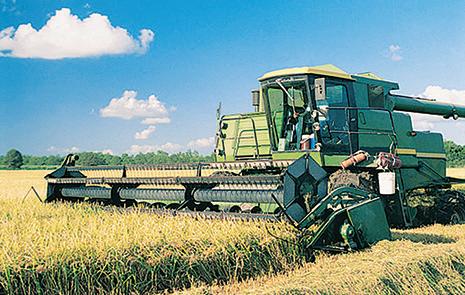
Agriculture plays a critical role in Kittitas County, where more than 165,000 acres are devoted to farming and nearly 50,000 acres are irrigated, according to federal data. The county is a major producer of beef cattle, sheep and Timothy hay. Farms in Kittitas County tend to be large and commercial, averaging more than 200 acres, and rely heavily on diesel fuel for irrigation pumps, equipment and longdistance hauling. That dependence means fuel surcharges tied to the CCA can quickly add up for local producers.
During the October hearing, petitioners said the Legislature clearly and unambiguously exempted agricultural fuel emissions from the CCA to protect farmers from increased fuel costs. The statutory exemption is mandatory and intended to benefit farm fuel users – namely, farmers – not fuel suppliers. The bureau said that Ecology’s rules treat the exemption as optional; only focus on suppliers; and
fail to require the suppliers to accept exemption certificates from farmers. This is leading to many farmers still paying CCA surcharges on fuel that should be exempt.
The bureau asserted that Ecology exceeded its authority by undermining the statute’s true meaning and purpose, and requested that Ecology be required to adopt new rules that make sure farmers actually receive the exemption.
Ecology agreed that the statute aimed to support agriculture, but claimed that it does not require suppliers to accept certificates. It designed a marketdriven system, the respondents said, incentivizing fuel suppliers to claim the exemption and offer surcharge-free fuel. The system is working, Ecology claimed, even if not in the manner the bureau would prefer.
The court still has yet to make a decision either way and has not provided a timeline for its ruling.
In the interim, Ecology once again fell under scrutiny when it the Washington State Department of Commerce incorrectly reported that 7.5 million metric tons of greenhouse
gas emissions would be reduced as a result of eight rebate projects funded by the Climate Commitment Act.
The data error was corrected and now estimates that 78,000 tons of emissions will be reduced over the lifetime of those projects, and a total reduction in emissions of nearly 308,000 tons across all CCA-funded programs.
The data is part of an annual report by Ecology, detailing how more than $1.5 billion in funds raised through the CCA have been appropriated by lawmakers.
Data encompasses more than 3,600 projects by 37 agencies.
Commerce said a corrected report from Ecology is expected in the coming weeks, once a full review of the submitted data is complete.
“Accurate data is essential to guiding our state’s work to reduce carbon pollution,” said Joel Creswell, manager of Ecology’s Climate Pollution Reduction program. “We’re updating our processes to more thoroughly check data reported by agencies so this doesn’t happen again.”


BY DEVANEE LOPEZ
Daily Record
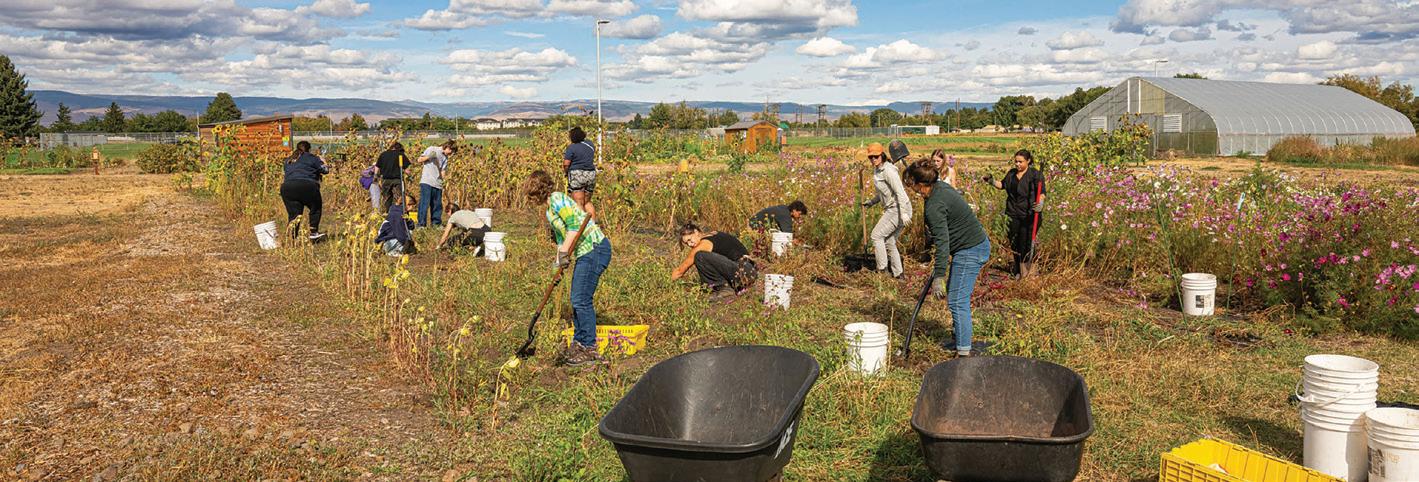
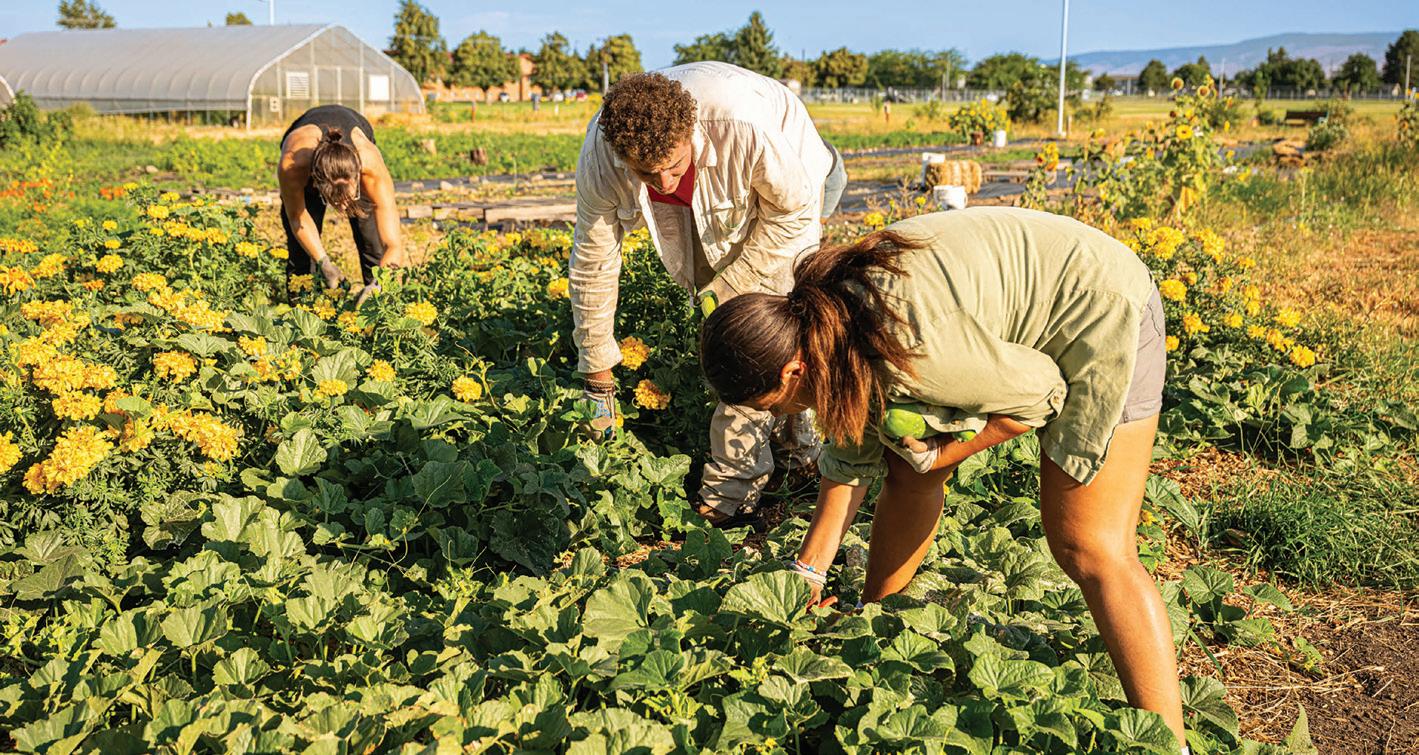
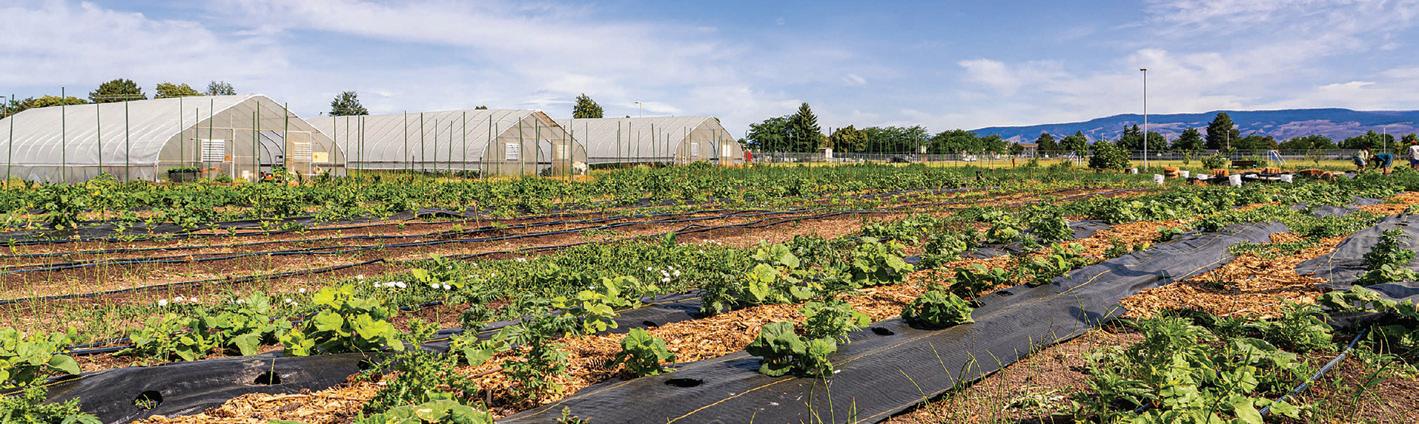
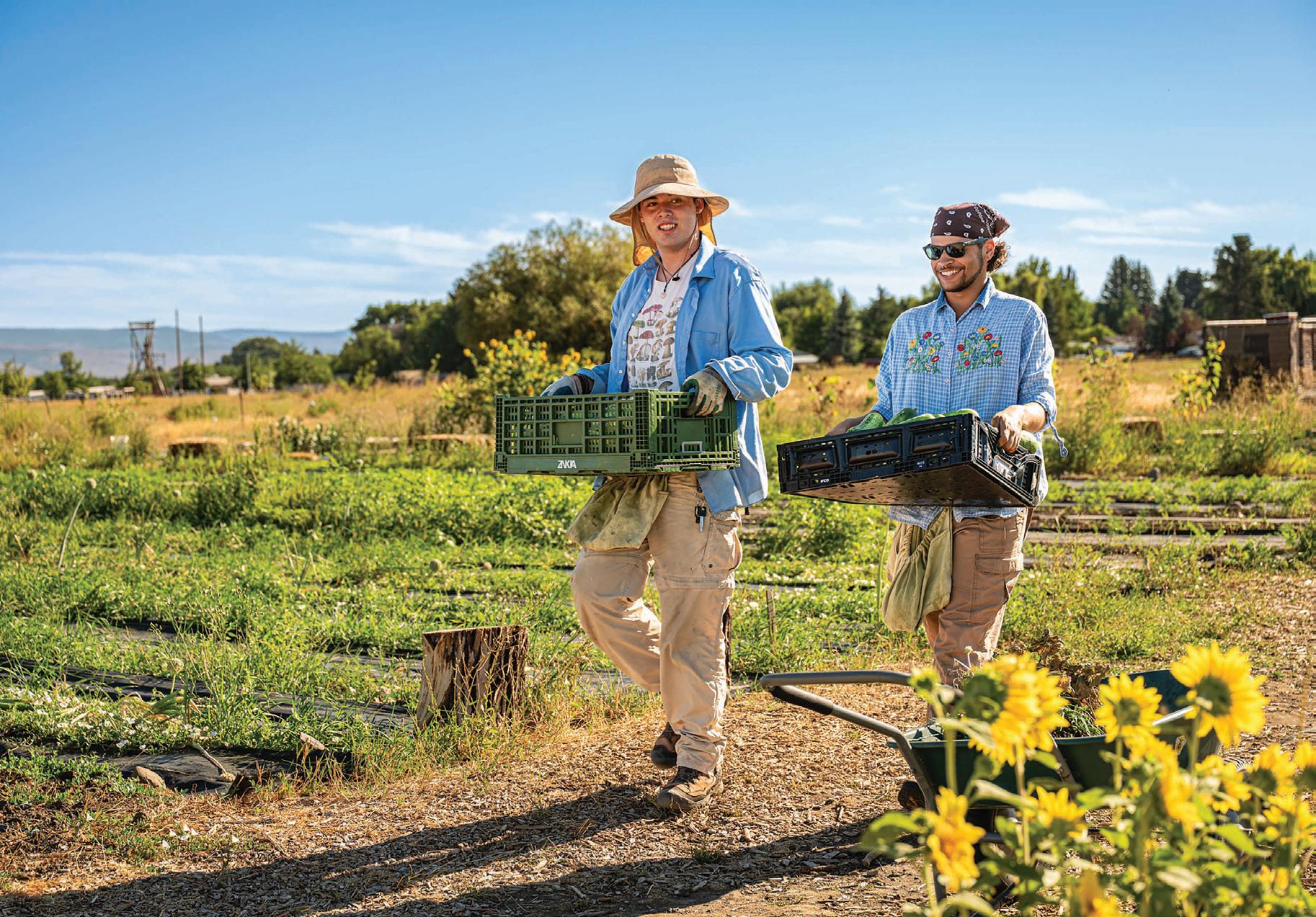
Have you ever wondered where the food from Central Washington University Dining Services comes from? If it’s sourced locally? Turns out, it is. CWU has its very own crop farm: The Wildcat Farm. The enterprise is staffed by only
two administrators and five student workers.
The farm had its first growing season in 2019 and in 2023, Nora Jacobs joined as the farm’s production lead and is now interim farm manager.
“Central gets to have the farmto-campus produce and it promotes students wellness,” Jacobs said.
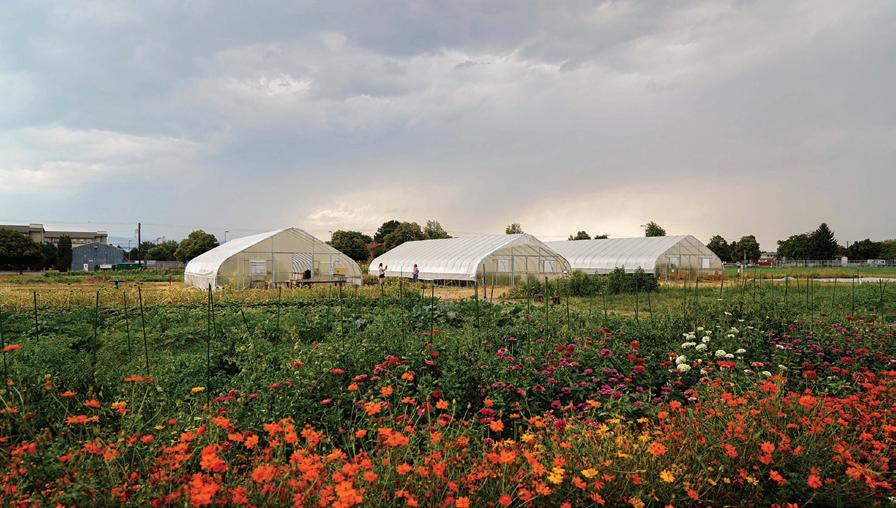
Over the course of the farming season, hundreds of volunteers help out along with the staff members.
No prior agricultural knowledge is required to harvest the crops, and the fun.
“We have students from all background and some with no relevant major to farming,” Jacobs said. “It’s a great way to learn how to grow food and get outside.”
In April, the farm hosts volunteer hours from 9 a.m. to 11 a.m. from Wednesday through Friday.
“The more people that help, the more we can provide,” Jacobs said. “All anyone needs to be to join is have an interest in farming and be hard-working.”
The majority of the produce goes to CWU Dining Services, where they make healthy fresh meals for students.
“It reduces environmental impacts and is a way for students to connect with food,” said Jacobs, who grew up in Ellensburg and worked on organic and goat farms on-and-off.
“We’re doing really cool stuff out here,” Jacobs said.
Central has doubled its yields every year since the farm has started.
“Our tomatoes are probably the best thing we grow. Sometimes we give away so much they [CWU Dining] tells us to stop.”
Along with CWU Dining, the farm also provides foods to local food banks, FISH Community Food Bank and APOYO, where Central donates more than 2,800 pounds of fresh organic foods.
They also distribute food to Community Supported Agriculture members.
Students interested in helping out can find them on Instagram (@cwufarm) or on Facebook (@ WildcatFarm).