
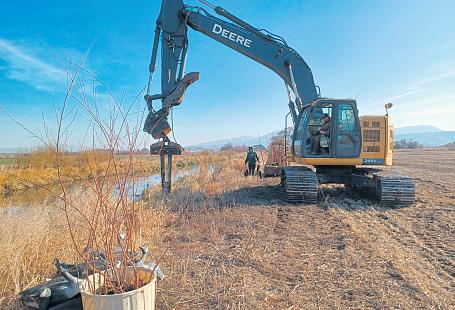
VSPisanon-regulatory,incentive-based approachtoprotectingcriticalareason agriculturallands,whilemaintainingagricultural viability.
CriticalProtectionAreas:
•Wetlands
•FrequentlyFloodedAreas
•CriticalAquiferRechargeAreas
•GeologicallyHazardousAreas
•FishandWildlifehabitatconservationareas
HowtoGetInvolved:
•ShareStewardshippracticesimplementedonyourland withtheVSPCoordinator
•Evaluateadditionalconservationopportunitieson yourland
•Implementstewardshippracticesthatfityouroperation
VSPCoordinator:AnnaLael – 509-925-3352ext.7,anna.lael@kccd.net
Workingtogether,farmersandrancherscandemonstratethatcurrentlandstewardshipprovidesbothprotectionand enhancementofcriticalareaswithouttheneedforadditionalregulatorycontrols.ContactKCCDforinformationabout availabletechnicalandfinancialassistance(funding)forstewardshippracticeimplementation.
RegularBoardMeetings
2ndThursdayEveryMonth (7AMApr-Oct;1PMNov-March)
BoardofSupervisors:
•MarkMoore•LynnBrown•JeffBrunson
•BillBoyum•MattEslinger
ToLearnMoreaboutKCCDandourPrograms, VisitUsIn-PersonorOnlinewww.kccd.net
AnnaLael–DistrictManager 2211WDolarwayRoadSuite4,Ellensburg,WA98926 509-925-3352Ext7
Publisher Rebecca Poynter
Editor Brian Kelly
Advertising Contact us: Amanda Bequette abequette@kvnews.com Ag Journal
401 N. Main Street Ellensburg, WA 98926 509-925-1414
The Ag Journal is published four times a year by Kittitas County Publishing LLC.
Contents
BY KATIE TEACHOUT
DAILY RECORD
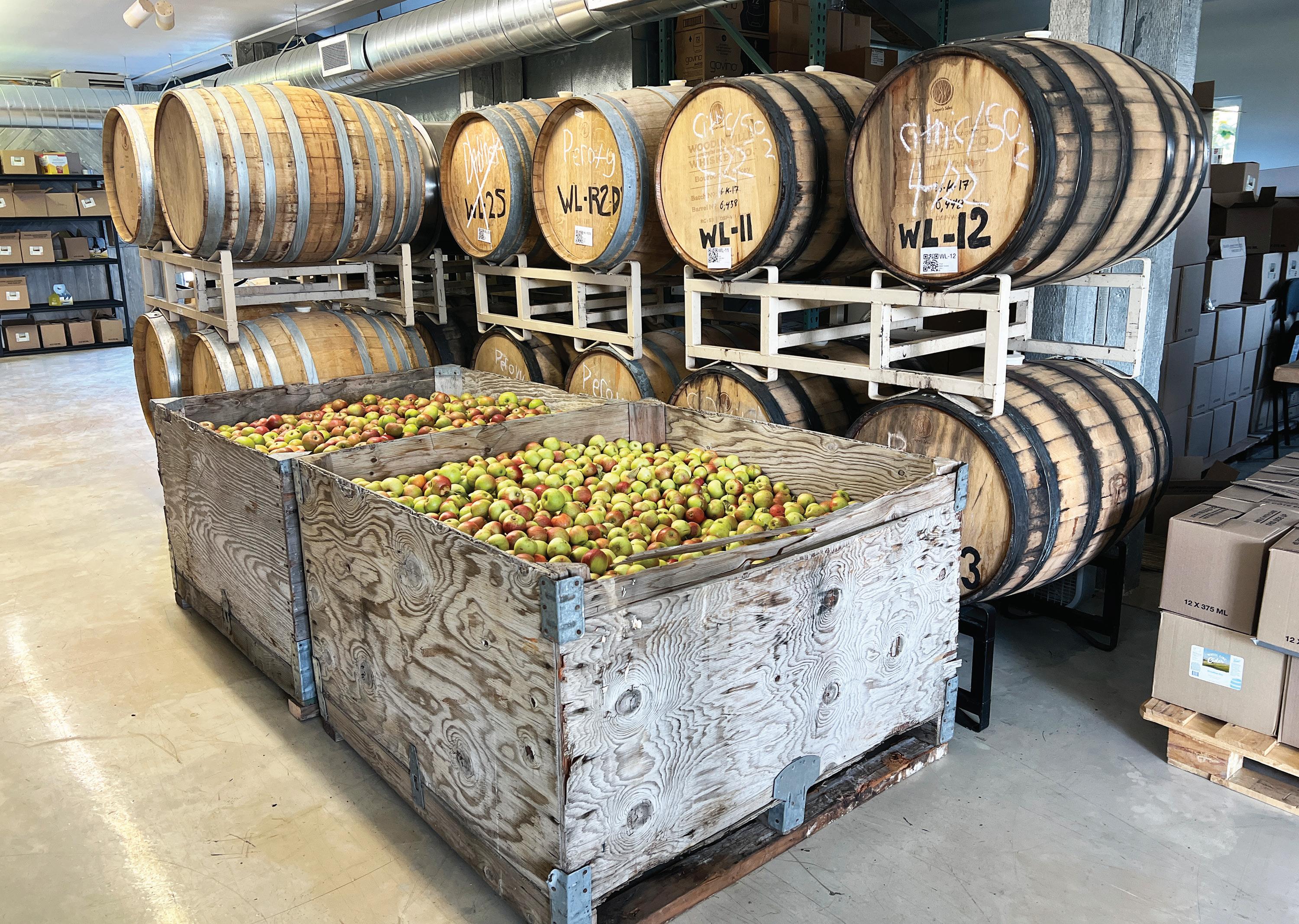
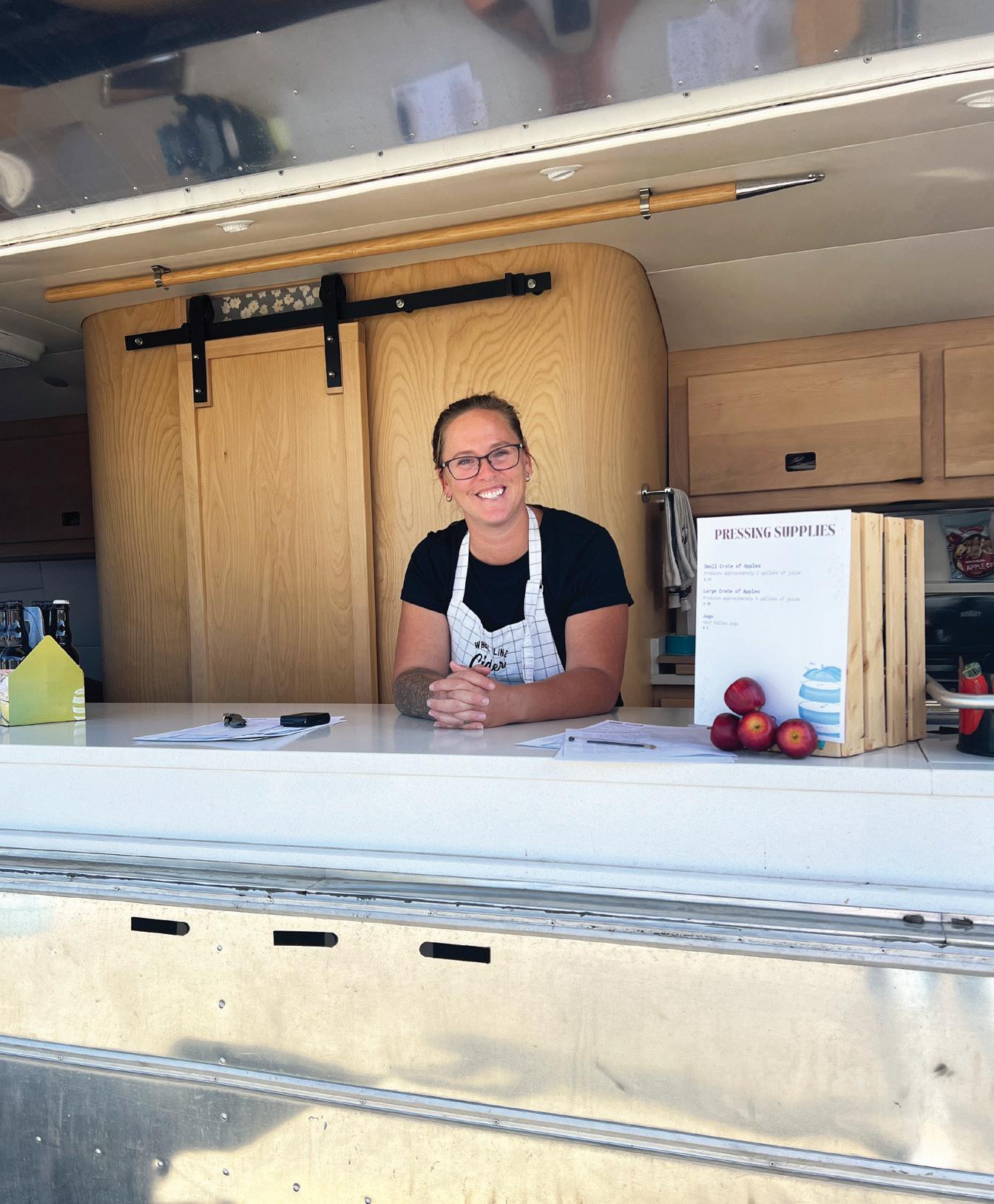
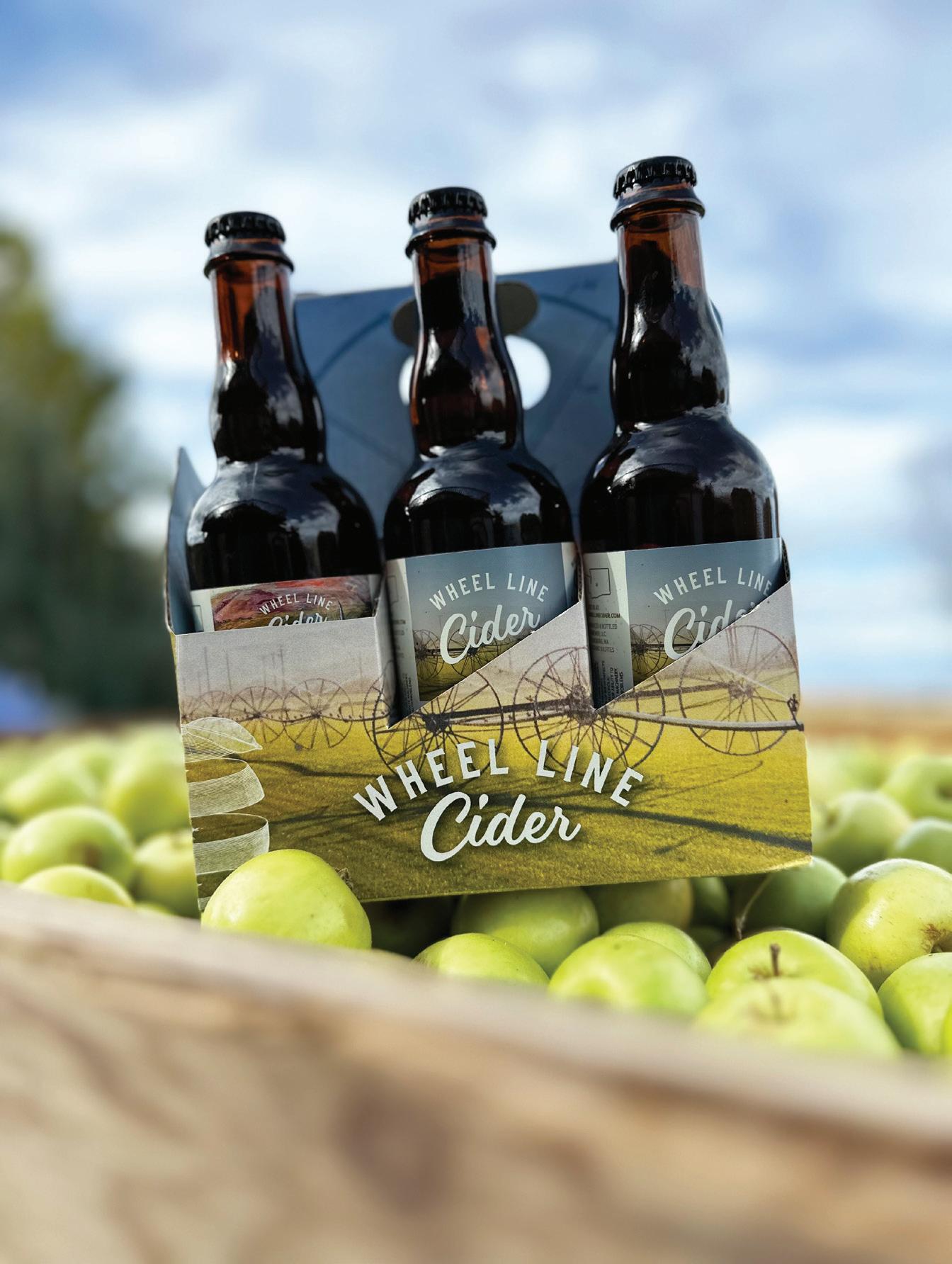
Wheel Line Cider is a small family business located in the rolling hills just outside Ellensburg that combines the craft of producing exceptional ciders with family histories of agriculture and fermenting, highlighting the agricultural heritage of Kittitas County.
Owner Susie Jensen and her daughter Maryanna Bremer have a tree-to-table operation, with all stages performed in-house.
“It’s a labor of love. We grow, harvest, press, bottle and label in-house,” Bremer said.
After picking and pressing the apples, the juice is fermented and then aged in oak barrels before being bottled. All the ciders are crafted using apples grown onsite.
Some of the fruited/botanical ciders include non-apple ingredients that are sourced as locally as possible.
The operation has grown from just Jensen and Bremer, to a small but mighty team which includes head cider maker Nate Lambert, orchard manager
Ruperto Vincente and Cody Barthels, in charge of cellar and sales.
The business is blooming and booming.
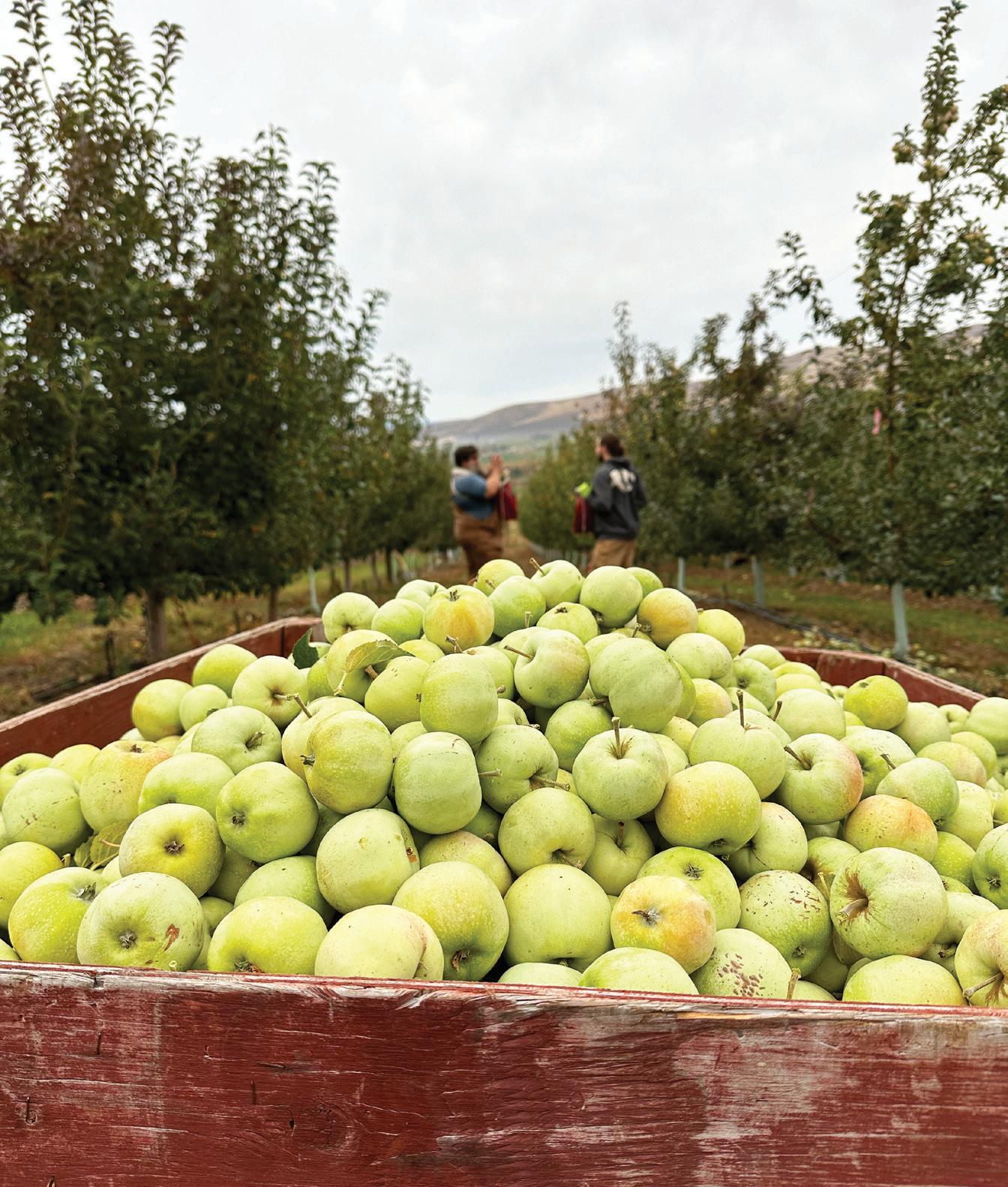
“We picked around 32 bins in the fall of 2023, and we harvested about 86 bins in the fall of 2024,” Bremer said. “That’s around a 54-bin increase from last year.”
Jensen said they expect the business to continue to expand, and recently purchased a state-of-the-art automated press from Austria.
They also bought a large warehouse with 3,000 feet of cold storage in
Yakima to keep the apples chilled so that they can alleviate the need to press everything at once.
“In the beginning we planted 100 trees a year. So we will continue to grow, as only one-third of the orchard is mature right now,” Jensen said.
Jensen planted the first apple trees in 2010, setting aside 7 acres of a 300acre farm for an orchard. The orchard, dedicated to bittersweet and bittersharp heirloom apple varietals, now has more than 3,000 trees of nearly 30 different varietals.
The rest of the farm is dedicated
to growing rotations of alfalfa and Timothy hay.
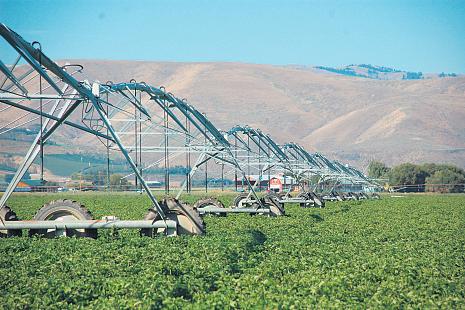
More than half of the hay operation is watered using wheel lines which is where the name Wheel Line Cider comes from. Jensen’s father-inlaw, Arthur E. Jensen, invented the Thunderbird wheel line irrigation system, a pivotal advancement in agriculture. The wheel lines are still used today for irrigation on the farm.
The family brewing legacy comes from Jensen’s great-grandfather, Jacob Schmidt who founded the Jacob Schmidt Brewing Company in 1900.
Eight years after the first trees were planted, the first ciders were launched in 2018 – IPC Hopped Cider and Driveline Dry.
The cidery now offers a myriad of dry
ciders, all produced in small batches.
One non-alcoholic product, called Split Rail Apple Juice, keeps the menu friendly for families and non-drinking friends.
In 2019, the tasting room was opened.
“Cider tasting is rooted in education, and encourages our guests/imbibers to slow down and really enjoy the craft,” Bremer said. “Each apple has unique flavor profiles and adds different elements to each cider.”
The tasting room is actually a barn, so there’s lots of room for private events to be booked, as well as public events held on site including live, local music every weekend during the summer.
“We had a fun event last season. We were able to facilitate an orchard
proposal,” Jensen recalled, adding the fun began when the sister of the bride-to-be called and booked a private tasting.
“The family came and was hiding in the barn, and the photographer hid in the trees. Once she said yes, they all came out,” Bremer said.
They also recently held a Wassail Gathering in mid-January.
Wassailing the apple trees was an ancient British custom of blessing the trees for a good harvest. It took place on the twelfth night after Christmas, with the visit to the orchard including the banging of pots and pans to ward off bad spirits along with singing, dancing and drinking.
The operation has enjoyed success from its start. In 2020, just a year after
opening the tasting room, Wheel Line Cider was awarded the WA State Rural Small Business of the Year.
That recognition snowballed into the cidery exporting its products overseas after Julie Johnson, export outreach specialist for the Washington State Department of Agriculture, called to congratulate Jensen.
“She asked if I had ever considered export. I told her I am a small boutique cidery and had never considered it,” Jensen said. “As the conversation continued, she explained that much of our agriculture export comes from family farms.”
Johnson introduced Jensen to the Western United States Agriculture Trade Association (WUSATA), which promotes export through inbound and
outbound missions and trade shows.
“They work with a network of global associates who work for our state to promote export,” Jensen explained.
Soon doors were opening to wider vistas, and Jensen found herself participating in trade missions to Canada and Mexico, plus a virtual mission to Korea.
“Three years later, with the help of our associate in Korea and his translation, we got a contract and shipped 60 cases for a test market,” Jensen said, adding she used a database through the Department of Agriculture that helped her target what countries have experienced growth in wine sales in Washington.
“That’s why I focused on Korea and Japan,” Jensen said. “In 2023 I attended the FoodEx in Tokyo. I was in the USA pavilion, and WUSATA provided a translator for me who quickly learned all there was to know about my company and cider, and
outdid herself in sales.”
Jensen said that experience led to other growth leads, including International Costco as well as overseas military bases.
“In every foreign country I have met with the Agricultural Trade Officer who works out of the USA Embassy, and that has led to more doors being opened,” Jensen said.
“My international advisor in Moses Lake has been invaluable to me, as exporting was new to me. My small business advisor had been remarkable and has helped me grow,” Jensen continued, adding she was grateful for the support the Department of Agriculture provided her in the way of education, advisors and contacts.
“It started with Julie and has expanded to a vast network of support available,” Jensen said. “I have an amazing team who are on my payroll as well as the state’s, who are willing to wear many different hats. Together we
have built Wheel Line Cider.”
Back at home, Wheel Line has also expanded to become Harvest Hosts. Harvest Hosts is a unique program with a network of more than 5,000 farms, wineries, breweries and distilleries that invite recreational vehicle campers to stay overnight.
“It’s an experience-based camping opportunity, and a wonderful way for us to educate people,” Jensen said. “Instead of paying a camp fee, they purchase our products. We’re out in the country where you can hear the owls at night, so it’s a great experience for full-time RVers. We’ve also had a lot of people who are foreigners come
and see our operation. It’s a wonderful program.”
The business currently has room for two recreational vehicles.
Wheel Line Cider is located at 15730 Upper Badger Pocket Road in Ellensburg.
During the off-season, the tasting room is open every third Saturday of the month, from noon to 4 p.m.
The 2025 Peak Season starts May 3 and runs through August, with Saturday hours of 3 p.m. to 7 p.m. and Sunday hours of noon to 4 p.m.
“We’re also always available for tours and tastings by appointment,” Bremer said.
BY SCOTT WEYBRIGHT WSU CAHNRS
LIND, Wash. — A new study at Washington State University will look at a variety of soil health changes in lands enrolled in the U.S. Department of Agriculture’s Conservation Reserve Program (CRP).
WSU scientists will use a USDA Farm Service Agency grant to track soil health, wheat yields, and soil microbiology for lands used in CRP, a voluntary program that encourages farmers and landowners to convert highly erodible and other environmentally sensitive acreage to vegetative cover. The program pays landowners to take land out of production for the duration of a contract, normally 10 to 15 years, with the option for contract renewal.
The research will look at the best ways to convert CRP lands back into use for crop production while keeping soils healthy, examining the benefits of conservation enrollment for soil. The WSU scientists will then share their findings with farmers to help them make decisions about their own land.
The research team is led by Surendra
Singh and includes plant pathologist Tim Paulitz and soil scientist Shikha Singh. The study is funded for three years at nearly $800,000.
“For this study, we’re using some land that’s been in CRP for 40 years,” said Surendra Singh, agronomist and director of WSU’s Lind Dryland Research Station. “Some of that land we will till, some will be no-till, and we’ll leave some untouched. Then we’ll compare the results to find the best ways to transition to cropland if a farmer wants to do that.”
Much of the acreage to be converted is at the WSU research station. The team will also convert some plots that have been used as cropland for many years into CRP to study and sample the soil changes in that direction.
In addition to WSU-owned research land, the team is working with growers at 16 sites in eastern Washington to test their CRP and crop land.
Three years isn’t quite enough time for a full encapsulation of CRP impact, but the team hopes initial findings will allow for future funding to continue the work for at least five or six crop cycles.
“We’ll look at wheat yields, grain
quality, soil health, carbon dioxide emissions, and other soil microbial measurements,” Shikha Singh said.
Surendra Singh is unaware of any other studies in the dryland Pacific Northwest that look at soil health in CRP land, which is quite different from typical cropland.
“I know a farmer who took land out of CRP last year,” Surendra said. “When I felt the soil, I could feel that the clods were different from that of
croplands. We want to measure what we put back into CRP to learn the rate of change.”
Putting land into CRP may help improve soil health, but it also means that land isn’t producing food, he said. “We want to see if we can make the benefits of conservation last longer when land is taken out of CRP,” Surendra said. “We don’t want to impact food production; we want to complement it.”


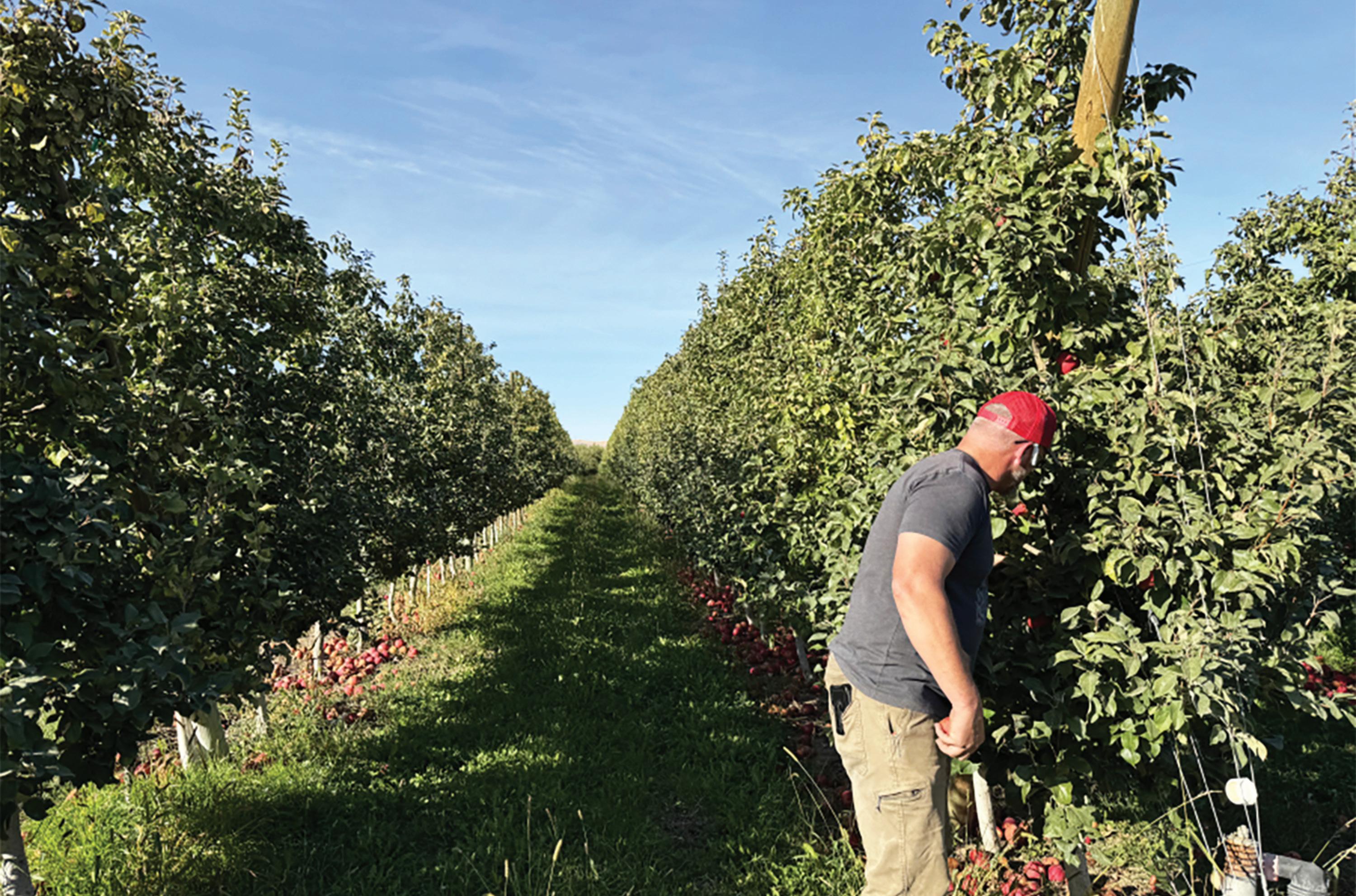
Tim Calhoun inspects an row of apples on his Wapato farm in October shortly after harvest.
BY HENRY BRANNAN
The Columbian
WAPATO — A perfect storm of economic challenges is pushing Washington apple farmers out of business.
Small orchardists say they are unable to sustain losses for years on end amid economic conditions they feel will only continue to worsen. The closures are fueling a wave of private equity-backed farmland consolidation.
The trend is the result of an everconstricting web of factors. They include rising labor costs and stagnant prices paid to farmers, but also dramatic apple oversupply caused by increased farm efficiency and the loss
of major international markets due to then-President Donald Trump’s 2018 tariffs.
Those converging conditions afflict farmers who produce Washington’s most valuable crop, which supplies nearly 7 in 10 apples eaten around the U.S. and is worth about $2 billion a year.
Following in his father and grandfather’s footsteps, Tim Calhoun runs a midsized orchard and fruit distribution company in the Yakima Basin near Wapato.
The area is home to about a third of Washington’s 188,000 acres of apple orchards. Neat rows blur into
the distance, where Mount Rainier’s foothills rise up to meet a sky that’s almost always blue.
Walking through his family’s orchard at the end of the last harvest in October, Calhoun, 41, explained the industry is in the worst spot he has ever seen it.
“Why the larger companies keep getting larger and larger and larger and larger is because the margins in farming are shrinking every year for the last 40 years,” he said.
Since his family started farming the site in 1969, the operation has steadily grown to keep up, increasing from roughly a dozen acres to 170 — which is about the size of 130 football fields.
The operation has also expanded into pears, cherries, peaches and other fruits, as well as the distribution business.
The Calhoun family acquired acreage plot by plot as neighbors left farming. Some were older orchardists who retired but didn’t have kids who wanted to take over. Others sold because they couldn’t ride out the economic slumps the industry has experienced in the last half-century.
“As I’ve grown up doing this, I’ve seen multiple rounds of downturns,” Calhoun said. “Just on my 1-mile road, there used to be, when I was a kid, probably over 20 different family farms. And now, there’s probably only three farms on this whole road — all owned
by different companies.”
Although Calhoun emphasized he respects the success of the remaining large family-run operations, he said the current wave of closures is different exactly because of that consolidation.
The massive scale now required to make a profit is unattainable to all but the biggest operations, he said. Many of those are backed by some of the world’s largest private equity companies to help them survive bad years that small competitors just can’t.
With many of Calhoun’s peers losing money on each bin of apples they sell to distribution warehouses year after year, he said a wave of bankruptcies is looming.
The most recent agricultural census data shows Calhoun’s fear is already reality.
A staggering 187 Washington apple farms closed between 2017 and 2022, with 2,335 remaining. Operations smaller than 50 acres were hit especially hard. Both total apple acreage and the average size of an orchard expanded.
Behind that economic bloodbath is an increasingly tough market for even the biggest producers.
“The price that we’re getting paid is the same or lower than we got paid in the ’90s,” Calhoun said. “So our cost basis for producing that apple has gone up tenfold, but the apple itself is not being sold for tenfold what it was.”
In fact, Washington producers received an average of 34 cents for each pound of apples they produced in the 1990s, inflation adjusted USDA National Agricultural Statistics Service data shows. Apples wholesaled for 27 cents per pound in 2023.
Experts also said the rising cost of producing apples is a key driver of the crisis, but that no one factor was to blame.
“It’s been, especially in the last three or so years, kind of a perfect storm,” said Michael Schadler, president of the Washington Apple Commission. In that time, an oversupply of apples dropped prices, inflation raised how
much it costs to grow and ship them, labor costs jumped, and stagnant demand for Washington’s hallmark crop from the public topped it all off, Schadler said.
“Labor accounts for about 60 percent of all the operational costs,” said Karina Gallardo, an economics professor at Washington State University who focuses on agriculture. “Back in 2009, this percentage was about 45 percent.”
New technologies and mostly reliable water supplies have allowed producers to expand the regions where they grow, contributing to oversupply, said Jon DeVaney, president of the Washington State Tree Fruit Association.
And even the trees themselves are more efficient than ever.
“We went from having low-density planting with 400, 500 trees per acre with big trees with big canopies, to the more sophisticated and more modern tree fruit walls, which can have 1,800, 2,000 trees per acre,” Gallardo said.
That has driven up yields per acre in recent decades, in turn boosting total production, according to USDA data.
Historically, when oversupply threatened to drop prices, the international export market served as a pressure release valve for Washington producers to unload any overabundance, Gallardo said.
But that all came to a crashing halt in 2018 when Trump announced tariffs on India and China.
Tariffs are a tax applied to imports from other countries, intended to encourage domestic production over imports.
And while the move might have left U.S. steel producers in a better spot, the countries fired back with retaliatory tariffs that all but ended apple exports to two of Washington’s biggest markets, Gallardo, DeVaney and Schadler each explained.
“In the end, the big loser is going to be the country or the producers in the country who are not able to allocate their product to the export destination,” said Gallardo, who co-authored an analysis of the tariffs’ impacts.
That’s easy to see in export data.
Between the 2010-11 harvest and the 2017-18 harvest, an average of 33 percent of Washington’s apple crop was exported, Washington Apple Commission data shows.
But the number fell to 27 percent on average from the 2018-19 to the 202324 harvests.
That 6 percent amounted to an extra 310 million pounds of apples on average each year, bloating the U.S. market and tanking prices. Some estimates say more.
In a cruel twist, the resulting small farm closures have fueled a vicious cycle.
That’s because they open the door for regional agricultural giants to buy more and more land with the backing of a near-endless pot of money from global financial goliaths like Goldman Sachs.
And the more land they own, the more efficiently they can operate and the less profit they need per apple. That enables large producers to accept prices lower than a small farmer can, DeVaney said.
The giants also have the advantages of being able to survive years of losses, as well as make costly upgrades, DeVaney said.
While the crisis hitting apple farmers is complicated, its consequences are simple: Dozens of small Washington farmers are losing everything to agribusinesses backed by some of the largest companies to ever exist.
Apple farming, once a way for families east of the Cascades to build economic security, now leaves them drowning in debt.
“Guys can dip into their savings and dip into lines of credit and everything, but at some point if that doesn’t turn around,” Calhoun said, “it’s either sell your farm or go bankrupt, or bulldoze your orchard, or just quit — because you just can’t sustain losses year over year.
“Farming’s always gone in waves and cycles,” he added, “but there’s not a bright light at the end of this cycle to
see where you’re going to come out the other side.”
One family he knows is bulldozing 180 acres of apples to cut costs and enable them to focus on cherries and apricots, which are more profitable crops.
Agriculture has always relied on hope just as much as water, sun, soil and sweat, but Calhoun said people are having to dig increasingly deep to find it.
Even the celebrated arrival of Washington’s Cosmic Crisp apple — which the New York Times dubbed “the most promising and important apple of the future” in 2015 — hasn’t played out like the industry hoped.
“It hasn’t lived up to the hype. The apple itself has, the apple is an incredible apple, but the returns that we thought we were going to get on this apple have been minuscule at best,” Calhoun said.
As he walked along neatly trellised rows of the scarlet apples, he said he spent at least $150,000 planting them only years earlier.
Calhoun was just paid for his 2023 Cosmic Crisp crop: about $6.95 for each 900-pound bin that retailed for roughly $2,691.
But while he isn’t afraid to acknowledge the severity of the crisis, Calhoun can’t seem to dwell on it too long.
“The joke in farming is, ‘Next year will always be better,’ and that’s the lie we tell ourselves every year, whether it’s true or not. It’s a lifestyle, if you didn’t love the lifestyle, you couldn’t do any kind of farming,” he said.
That love of farming and the lifestyle it provides him and his family, maybe even more than hope, seems to keep him going in the face of the industry’s increasingly dependable crisis.
A moment later, Calhoun hustled to his small cold-storage building to load apples into the back of a farmers market operator’s truck before the sun set.
This article was first published by The Columbian through the Murrow News Fellow program, managed by Washington State University.
December 11, 2025 | Kittitas County | 11/12th Graders
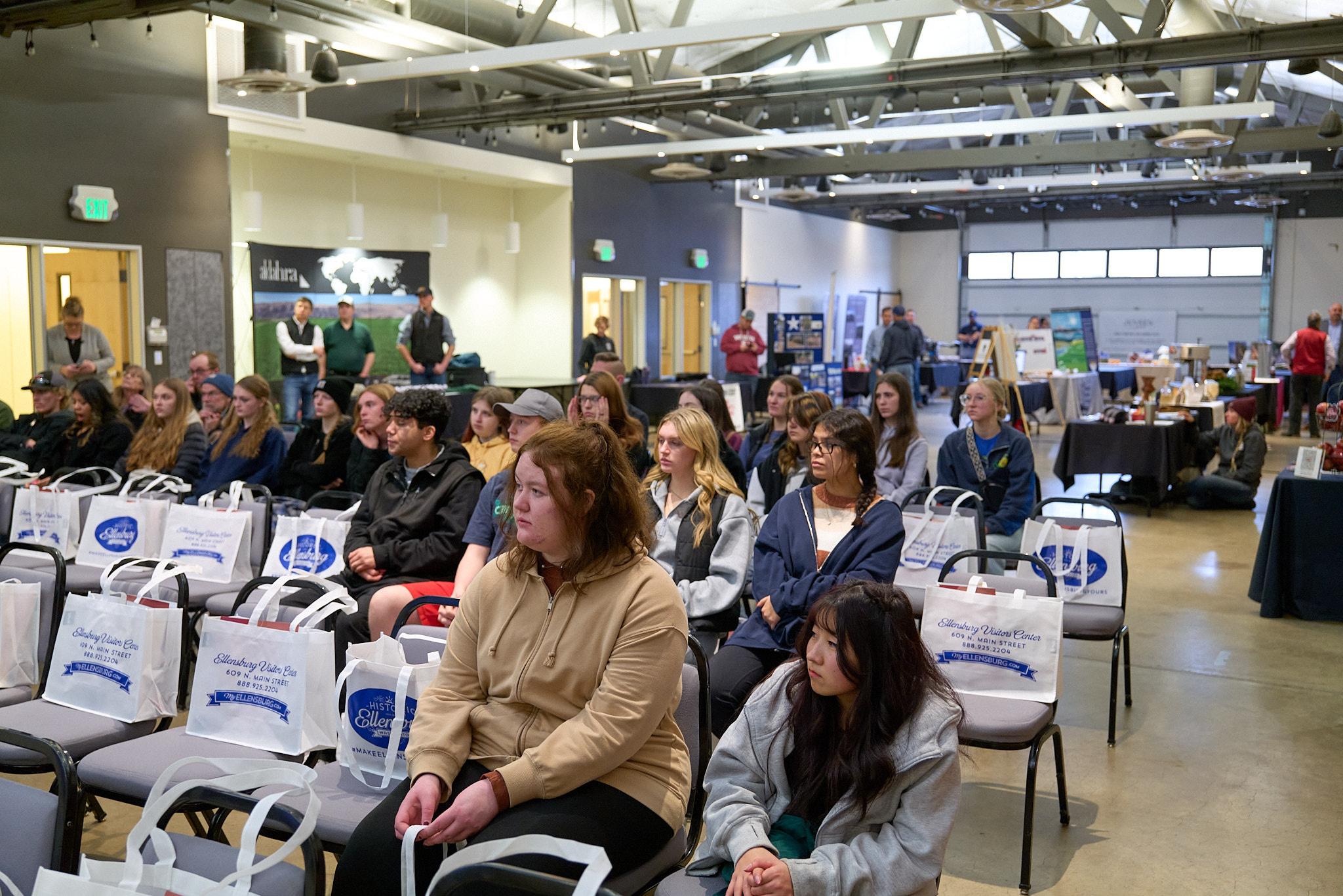
On December 11, 2025 in collaboration with local school districts, Ellensburg Morning Rotary and the Kittitas County Chamber of Commerce, there was an Agriculture Youth Summit for juniors and seniors in high school across the county who participated and learned from local businesses in the industry
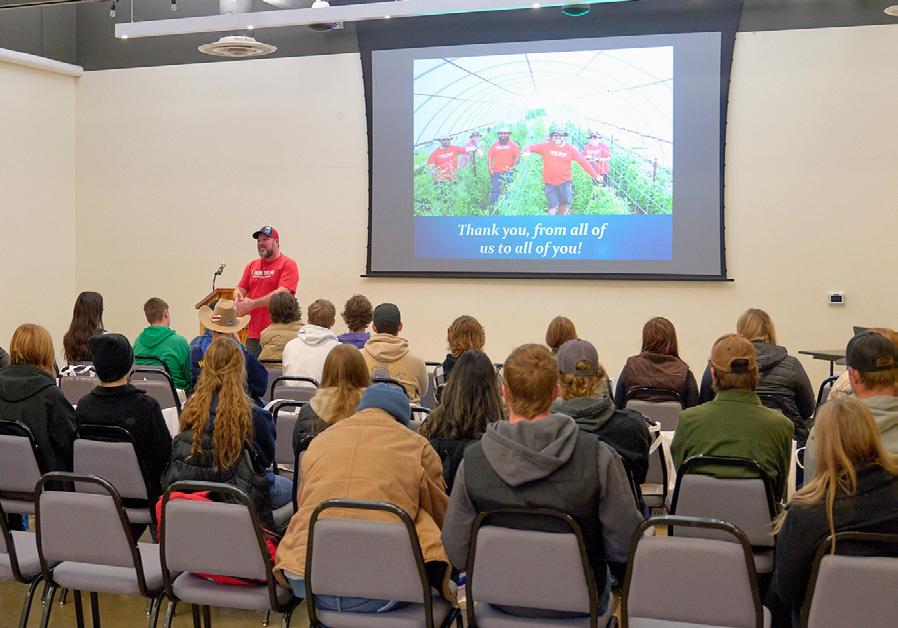
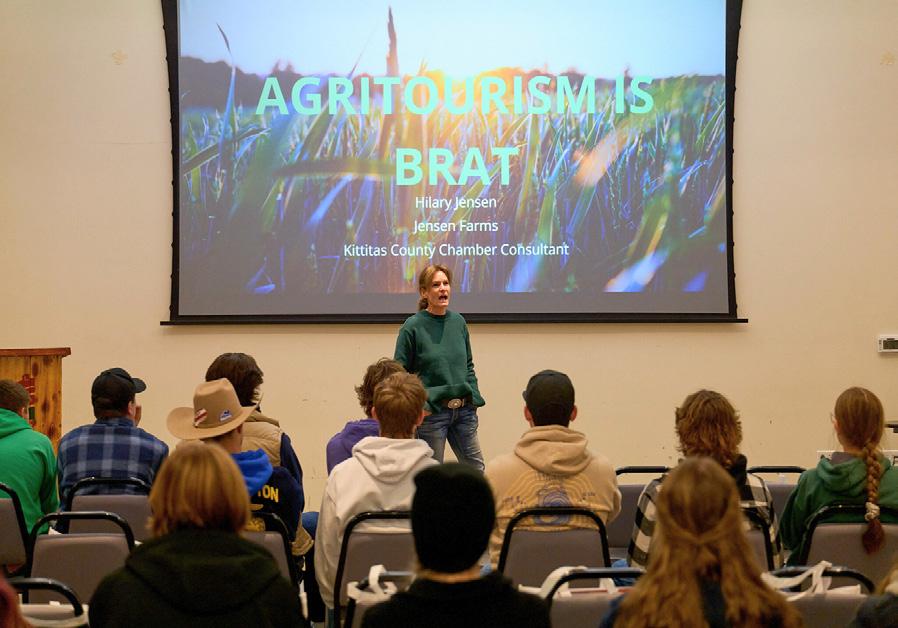
The four hour event started with an Agritourism presentation from local Kittitas County business, Hilary Jensen with Jensen Farms, and Grant Weber with Vets On The Farm These thoughtful and educational presentations talked about how important agritourism is to Central Washington, and steps to take to create a business or intern at one like them
Speakers: Jensen Farms and Vets on the Farm “Agritourism within Kittitas County is defined as a working farm or ranch growing a USDA recognized crop or raising livestock/animals for commercial sale or growing a USDA crop or raising livestock/animals for the commercial sale of the byproduct (i.e. honey, fiber, hands-on animal experiences, etc.). The farm or ranch actively markets their operation to the general public and while visiting the farm or ranch, guests enjoy a historical, cultural, educational or recreational experience including, but not limited to; on-site hospitality services, guided and selfguided tours, petting zoos, farm festivals, corn mazes, harvest-your-own operations, hayrides, barn parties, horseback riding and fishing ”
Resource: Agritourism Advising, Kittitas County Chamber of Commerce

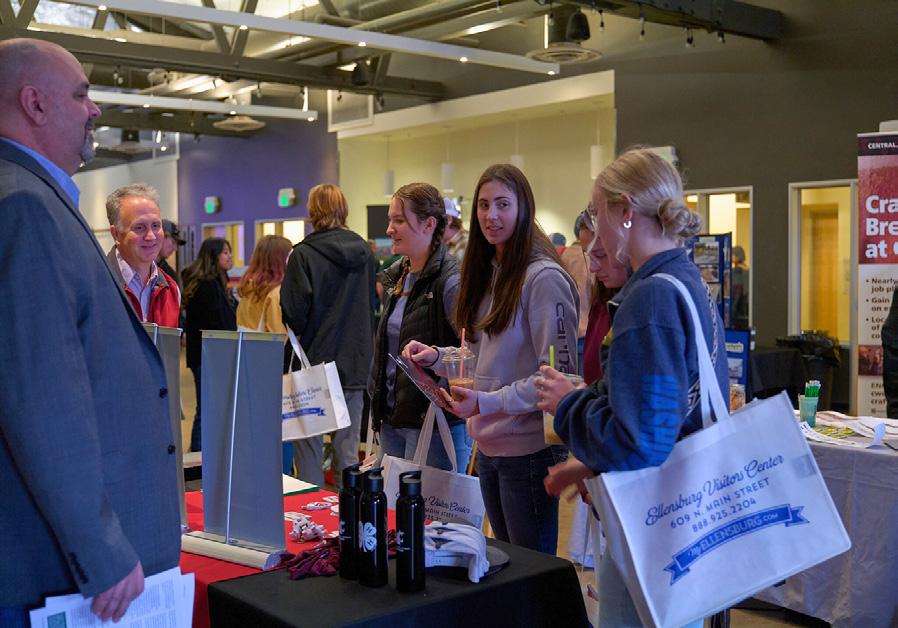
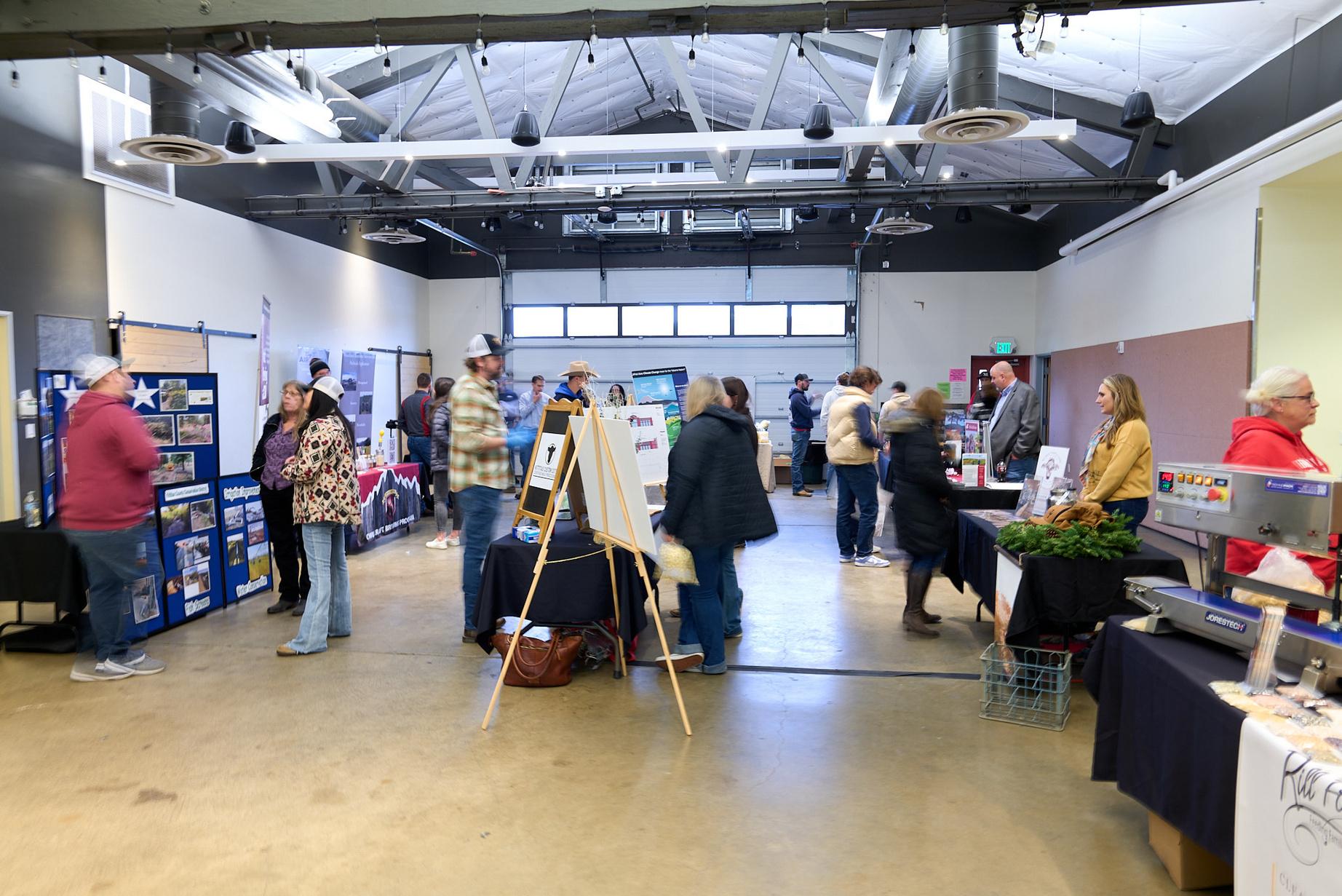
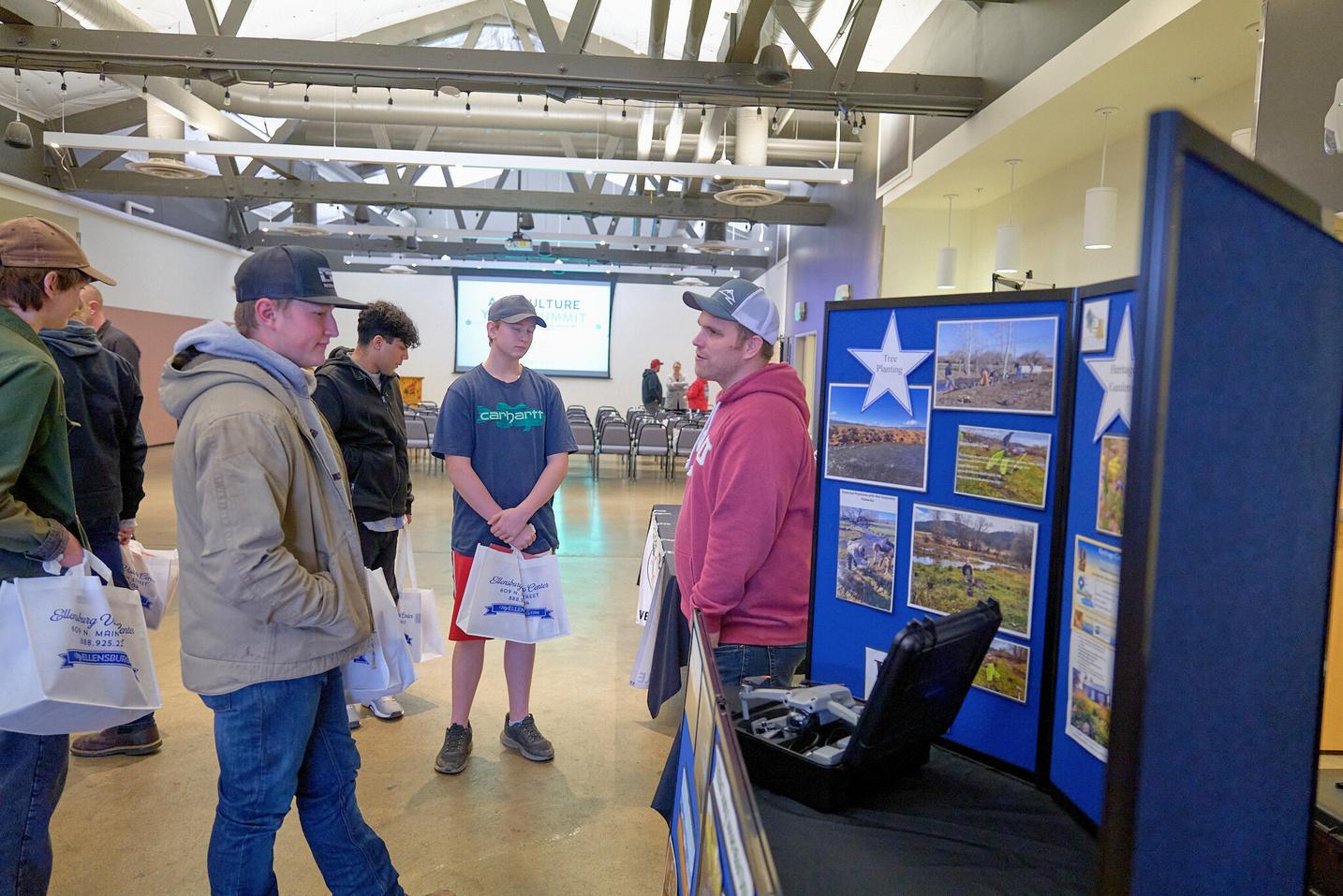
During the Agriculture Youth Summit, students also had the chance to engage with local businesses during the Business Expo. This interactive portion of the event allowed students to meet industry professionals, learn about career opportunities, and explore pathways within the agricultural sector.
Representatives from various businesses shared insights about their work, the skills needed to succeed, and potential internships or mentorship opportunities. This hands-on experience provided valuable networking opportunities and a deeper understanding of the diverse roles available in agriculture and related industries
ACX Aldahra
Airoterra
CWU Agribusiness Department
CWU Craft Brewing
Jensen Farms
Kittitas CDL School
Kittitas County Conservation District
Kittitas Custom Cuts
Luft Trailers
NW Meat Processors
Rill Foods
T&T Electric
Wilderness Ridge Tree Service
Wilmart Farms and Dairy
WSDA
WSU Agriculture Sciences/Natural Resources
Yakama Nation Fish Hatchery
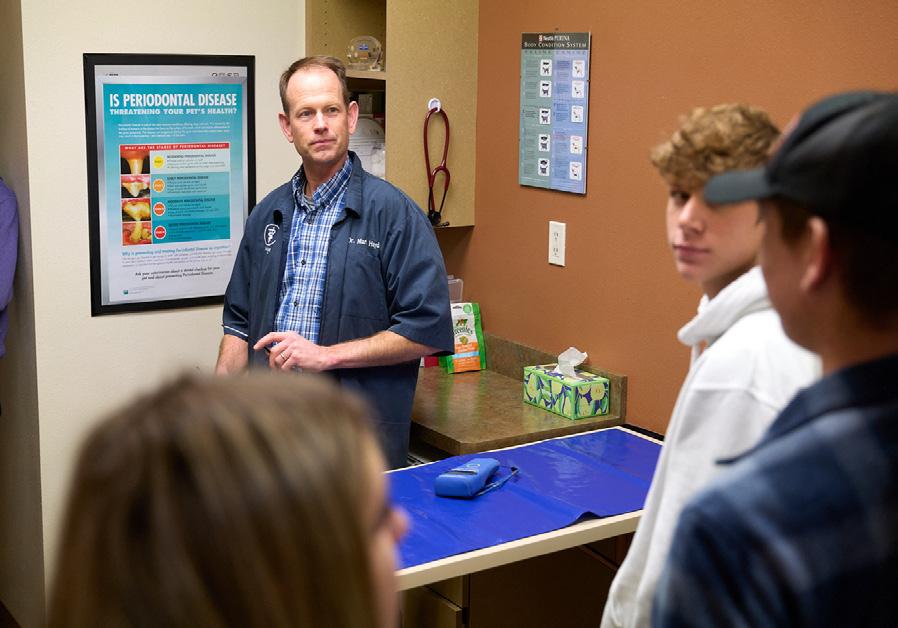
As part of the Agriculture Youth Summit, students toured Valley Veterinary Hospital with Dr. Hayden and his team, gaining an inside look at the daily operations of a veterinary practice. They learned about animal healthcare, diagnostic tools, and common procedures while gaining insights into careers in veterinary medicine The visit inspired curiosity and showcased the dedication needed to care for animals
BY SCOTT WEYBRIGHT WSU CAHNRS
Washington State University will launch a fundraising campaign this fall to create a state-ofthe-art space for tree fruit research: the new Plant Growth Facility at the Wenatchee Tree Fruit Research and Extension Center (TFREC).
Sharing the impact and need for the future facility, tree fruit scientists and college leaders host a campaign kickoff, 3:30 to 5 p.m. Tuesday, Oct. 29, at Wenatchee TFREC. This event is open to the public.
The modern Plant Growth Facility will replace a 70-year-old structure, enhancing WSU scientists’ ability to conduct cutting-edge research vital to Washington’s $10 billion tree fruit industry. A new facility will enable sophisticated environmental stress experiments, year-round disease research, root health tests, and pestfree plant growth, ensuring ongoing innovation serving Washington tree fruit. The modern space will also help attract and retain top scientists and students.
“This facility will make projects possible that we simply can’t do now,” said Lee Kalcsits, Endowed Chair in Environmental Tree Fruit Physiology and Management. “It’s a leveraging opportunity: it opens a whole set of doors for impact on industry.”
With double the existing greenhouse space, modern lighting, and temperature and humidity controls, the Plant Growth Facility will allow for exclusion in experiments demanding isolation of environmental conditions, pests, or pathogens.
For WSU Pome Fruit Breeder Kate Evans, it would support expanded screening of breeding material for diseases including orchard-devastating fire blight, as well as room for broader
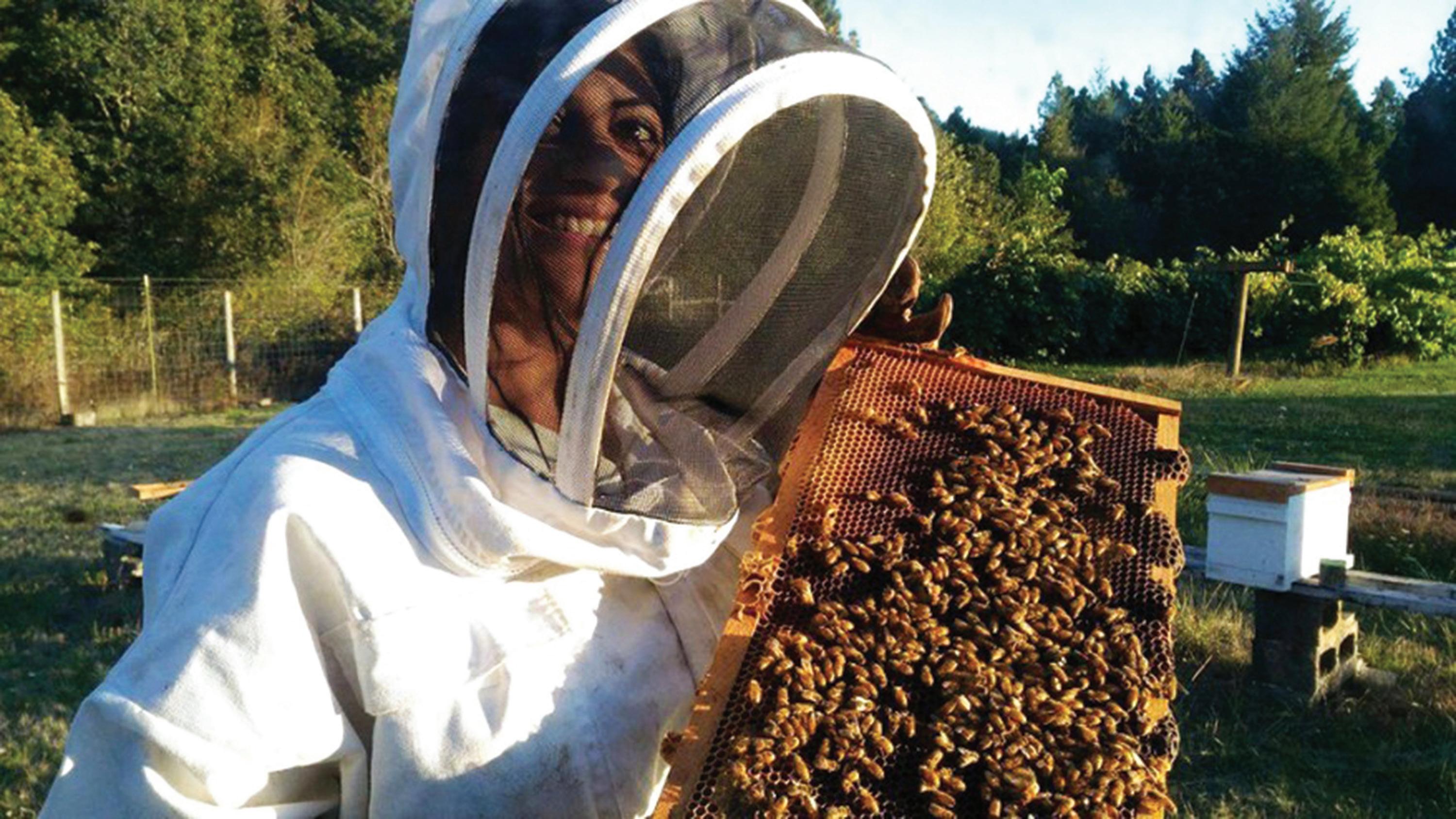
research on new rootstocks.
“We do a good job of maximizing the facilities we have, but there’s a limit,” Evans said. “With the greenhouses, we’re way beyond it. The new growth facility will give our internationally renowned programs a way to expand into areas we’ve simply been stymied from entering.”
To complete the project, the research center team aims to raise $4.2 million in private funds. Contributions will directly support groundbreaking research and innovative solutions tailored to the needs of Northwest tree fruit.
“The vision for the new plant growth facility is a place where the top researchers, teachers, and Extension personnel come together to address the on-the-ground problems of today and the emerging threats of tomorrow,” said Wendy Powers, Cashup Davis Family Endowed Dean of WSU’s College of
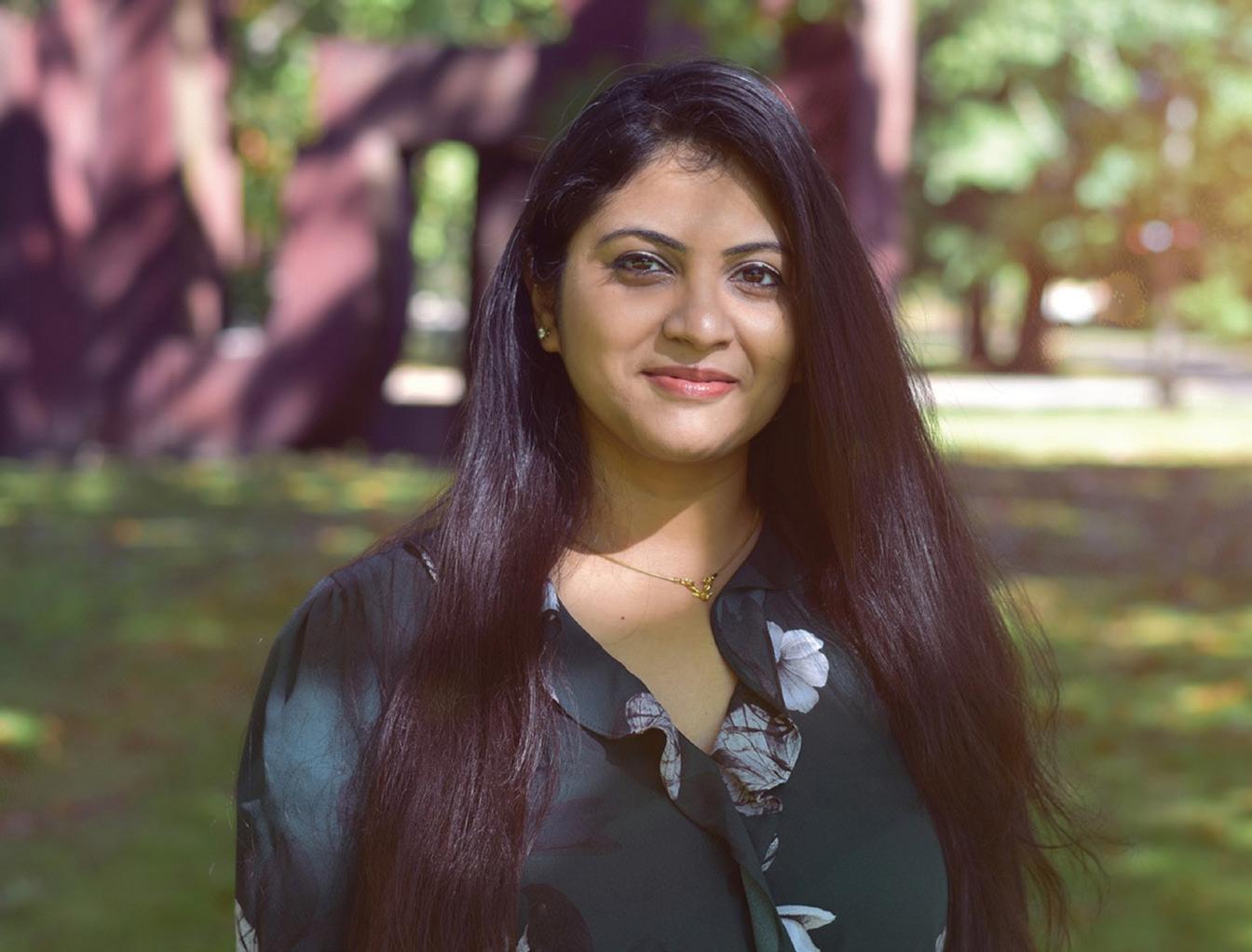
Agricultural, Human, and Natural Resource Sciences. “Located in the heart of tree fruit production for the
world, this facility puts us out in front to ensure safe, abundant, healthy fruit for everyone.”
BY SCOTT WEYBRIGHT
WSU CAHNRS
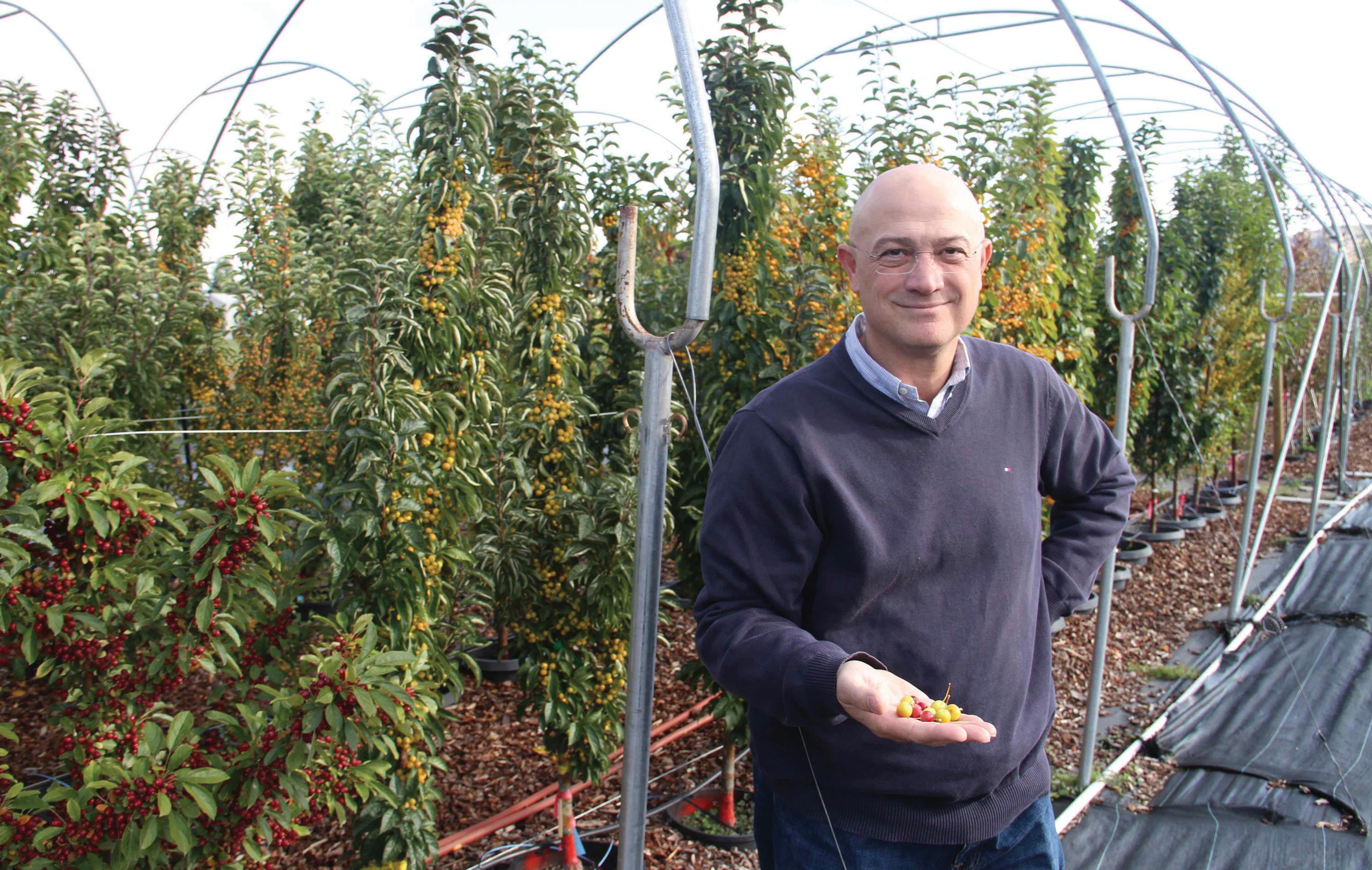
WENATCHEE, Wash. — New research launched this fall at Washington State University will help apple growers better understand how their trees respond to increasingly unpredictable cold snaps that freeze buds and destroy harvests.
Funded by an $850,000 grant from the U.S. Department of Agriculture’s Specialty Crop Multi-State Grant Program, the four-state study led by Stefano Musacchi, WSU Endowed Chair of Tree Fruit Physiology and Management, gathers new data on dormancy in Gala, Honeycrisp, and Fuji varieties.
Over the past decade, climate shifts
have disrupted apple trees’ dormancy cycle, putting them at greater risk of freezes that damage tree health and productivity.
“Our current models and traditional methods for predicting and managing freeze threats are limited and often fall short,” Musacchi said.
Joined by researchers Todd Einhorn at Michigan State University, Sherif Sherif of Virginia Tech, and Tom Kon at North Carolina State University, the team will ultimately develop new predictive models and tools for growers.
Making in-depth studies of apple traits across diverse climate zones in Washington, Michigan, Virginia, and North Carolina, the team will also test plant growth regulators used to promote early cold acclimation.
Updated models could provide temperature thresholds during critical fall and spring periods, capture the interaction between temperature and bud hardiness during dormancy, and cover modern cultivars.
“We’re using cultivars with different harvest times—early (Gala), midseason, (Honeycrisp), and late (Fuji)— which will give us a broad range of variation in the onset of dormancy,” Musacchi stated. “This helps us estimate the frost risk for each variety.”
Scientists will work in orchards during spring and fall, collecting shoots and branches to learn when varieties enter and exit dormancy. The team will also cultivate cuttings in growth chambers to study their physiology.
Through grower meetings, the
team plans to share new models and improved orchard management practices. Titled “Enhancing Low Temperature Resilience of Apple: A Study on Dormancy Dynamics, Phenology, and PGRs,” the project runs through September 2027.
Requiring special equipment like growth and freezing chambers to mimic what happens in an orchard, the study offers an interesting challenge, Musacchi said.
“Dormancy is one of the less investigated and more fascinating areas of tree physiology,” he said.
“Sometimes, people underestimate what happens after harvest, but many physiological activities remain ongoing.”
BY SETH TRUSCOTT WSU CAHNRS
YAKIMA, Wash. – Washington State University’s newest apple, WA 64, has an official brand name: Sunflare.
Announced by WSU apple breeder Kate Evans on Dec. 10, 2024, at the Northwest Horticulture Expo at Yakima, Washington, the new name resulted from a public contest that drew more than 15,000 responses.
“Our breeding program exists to give consumers better apples to eat, and Sunflare™ checks all our boxes,” Evans said.
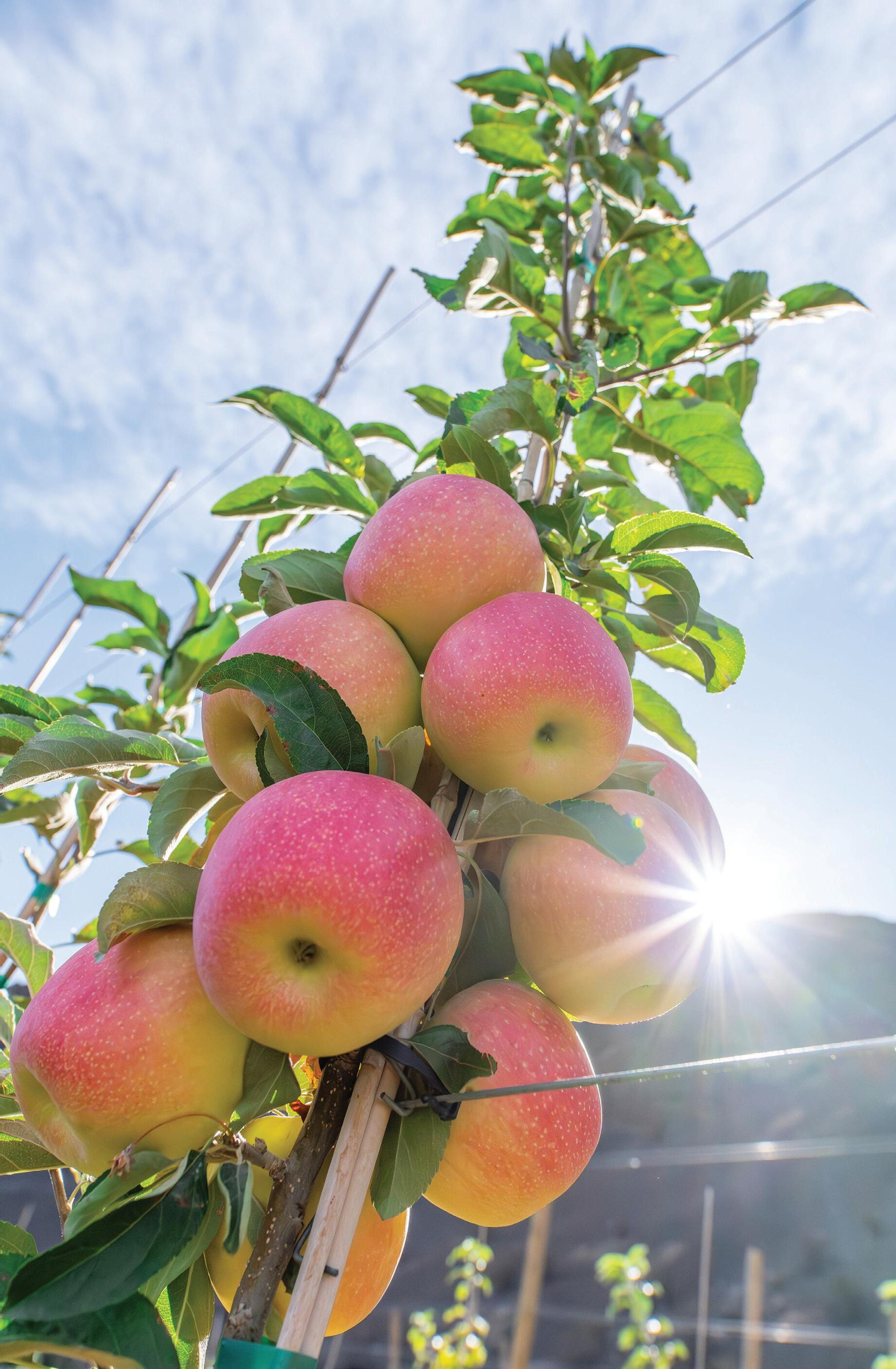
A tart, crunchy, juicy cross of Honeycrisp and Cripps Pink—better known under the trademark name Pink Lady®—Sunflare™ apples will reach grocery stores in 2029.
Thousands of name entries were winnowed down by WSU faculty and staff as well as public focus groups of apple lovers. The university sought a creative, distinctive name that consumers will remember and link positively with the apple. Sunflare™ won in part by best reflecting the apple’s physical qualities.
“This name hits all those marks,” said Jeremy Tamsen, Director of the WSU Office of Commercialization. “These pinks, oranges, and yellows stand out against all the red apples on the shelf.”
Winning contestant Ryan Escarcega, a 49-year-old food service salesperson and chef from Centralia, Washington, was inspired by the variety’s bright hues as well as the powerful solar storms that sparked northern lights visible across North America this spring.
“I looked at the picture of the apple for a long time, fantasizing what it was going
to taste like,” he said. “It was a real eye-catcher. I saw a nice relationship between the colors and the name. And the sun has everything to do with the growth of the product.”
Sunflare™ is the third apple to emerge from the WSU breeding program, which launched Cosmic Crisp® in 2019. Bicolored, with a pink blush over a yellow background when ripe, Sunflare™ is a crunchy, firm, juicy apple with a sweet and tart balance and complex flavor.
Scientists first bred Sunflare™ in 1998 when they hand-pollinated a Honeycrisp flower with pollen from a Cripps Pink tree at WSU’s Columbia View Research Orchard.
“We do what the bees do,” said retired apple breeder Bruce Barritt, who launched the breeding program in 1994. “Sunflare™ resulted from pollination. It’s not engineered or modified in any way.”
There’s an element of chance to every cross combination. Each
pollinated ovule in an apple flower develops into a genetically distinct seed that, when grown, will bear fruit that can vary widely from its parents. Apple breeders like Barritt and Evans test thousands of trees in the search for one outstanding variety. Apple consumers are the focus of the WSU apple breeding program: breeders seek outstanding eating quality and excellent long-term storage. For the Sunflare™ apple, Honeycrisp traits delivered the crispness and juiciness while Cripps Pink traits provided outstanding firmness and flavor in storage.
WSU holds a patent on WA 64 and has filed trademark applications for the Sunflare™ brand name. The university selected International New-Varieties Network LLC to manage sales of licensed WA 64 trees and budwood to growers and has organized an advisory committee of marketing company representatives to license and market the variety to
grocers. This committee will help develop a trademarked logo, color palette, and brand look and feel.
WSU scientists continue to study and share recommendations on the best ways to grow WA 64. Royalties from sales of the trees, budwood, and, eventually, the fruit itself, will help support research and future apple varieties at WSU. Support for WA 64 breeding and development was provided by the Washington Tree Fruit Research Commission, the Washington State Department of Agriculture’s Specialty Crop Block Grant Program, and the Washington Research Foundation, as well as from WSU apple royalties.
Sunflare™ is not Escarcega’s first apple naming experience. As a student at the Seattle Culinary Academy more than a decade ago, he was part of a focus group that helped name the Envy apple. Escarcega recalled the experience recently with school friends, mentioning that he won the
new WSU apple-naming contest.
“Of course, everybody wants to know the name!” he said. “Now, I can finally tell them.”
Escarcega received a box of Sunflare™ apples and will get other WSU-themed prizes, including a can of Cougar Gold cheese, a charcuterie board engraved with the winning name, WSU spice rubs, and a branded coffee cup and water bottle.
A former executive chef and onetime Coug—he attended WSU his first year of college—Escarcega looks forward to eating his prize apples fresh and making apple butter, apple sauce, pie filling, apple chips, or cider with them.
“I am so excited to be part of this, and even happier that the only apple I will ever eat, as of 2029, will be the best tasting apple I have yet had the pleasure of eating,” said Escarcega, who tasted his first Sunflare™ just before the name was announced. “I love it and its culinary possibilities.”



BRIAN KELLY / DAILY RECORD
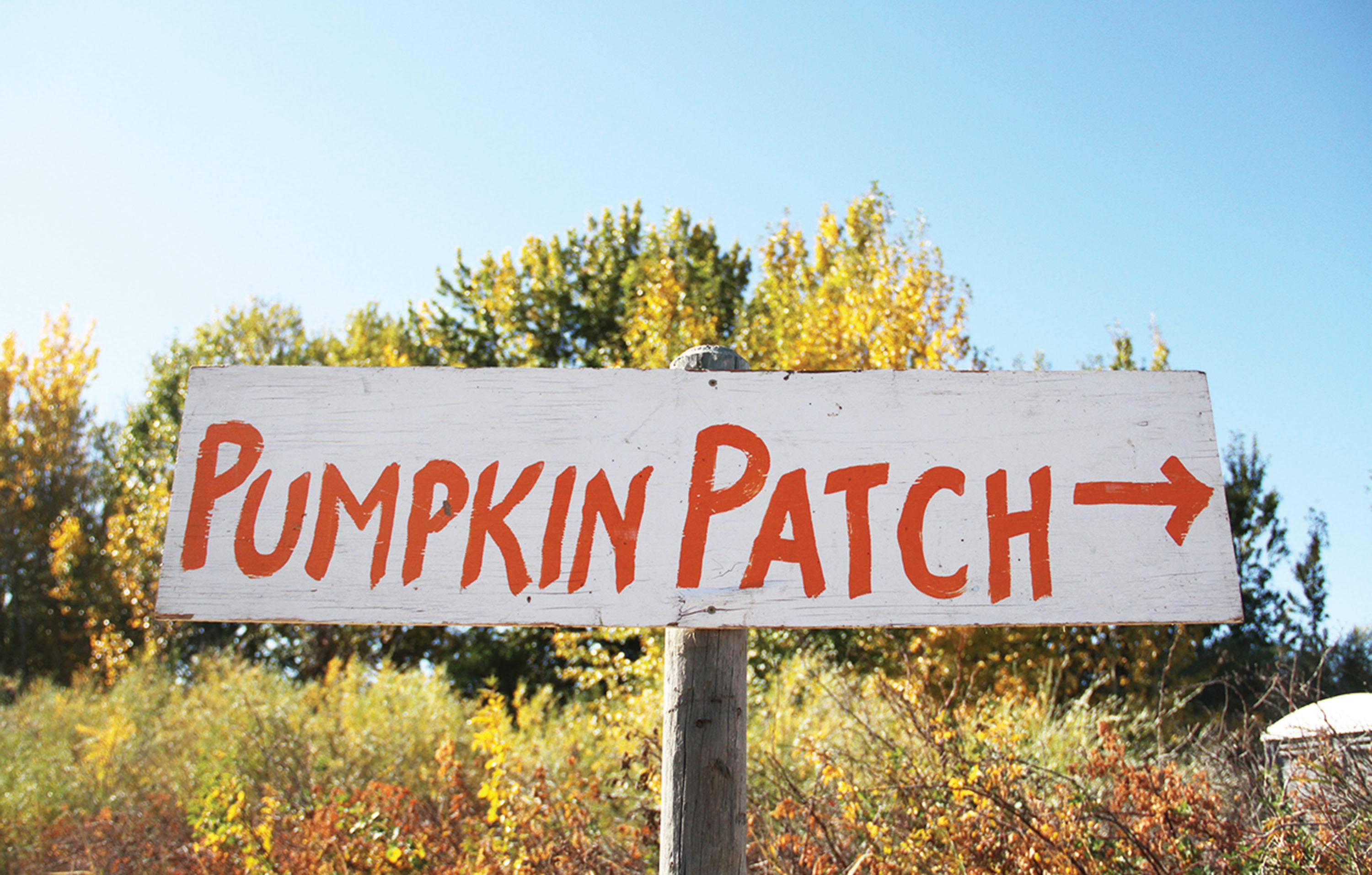
Jensen Farms near Ellensburg hosts a busy you-pick pumpkin patch every season. The farm also has a kids fun zone and other attractions
BY MARY FEUSNER Washington State Journal
Farmers across the state say regulations are getting in the way as they develop products they can sell directly to the public.
From pumpkin patches to u-pick berry farms, the impacts are real, a state panel was told Jan. 16.
“Without the agritourism industry to supplement our income, we wouldn’t be able to make it,” said Robby Rutledge, owner of Rutledge Family Farms in Tumwater.
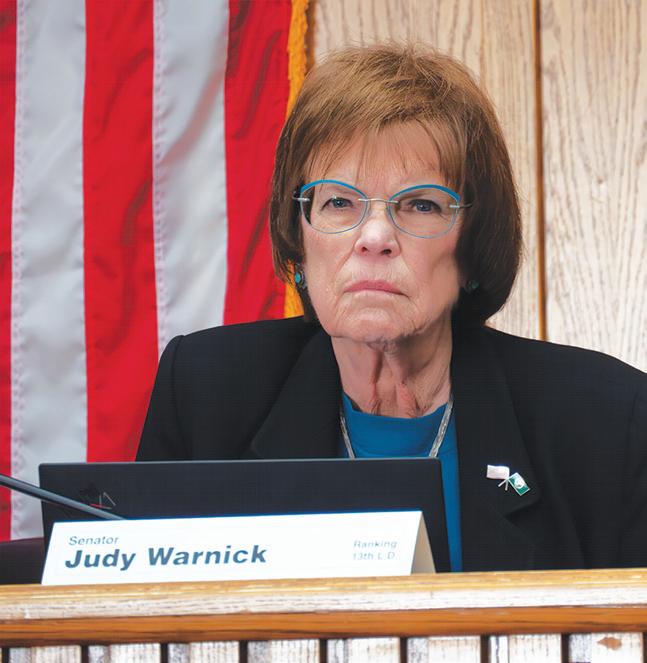
To carve out new rules, Sen. Judy Warnick, R-Moses Lake, introduced Senate Bill 5055.
The bill establishes new zoning laws for all farms, which in turn would
lower property taxes. The bill also allows farmers to repurpose areas of land unsuitable for agricultural use and remove commercial standards now in place for agritourism. It would also allow agritourism venues to receive beer and wine licenses.
Hilary Jensen, president of Jensen Farms in Kittitas County, said the state issued a cease-and-desist order in October 2016 during the height of her pumpkin selling season. The order said the farm was operating illegally because buildings were approved for residential use only. Jensen had to apply for a commercial building permit and retrofit the buildings to sell pumpkins legally.
“It cost $6,000 to do all that at a
time when I was only open eight to 10 days out of the year,” said Jensen.
Keith Stocker, president of Stocker Farms in Snohomish, said this year his family could not have survived off the commercial market price for blueberries. If Stocker had sold to canneries they would have received 68 cents a pound. Instead, with a u-pick operation at the farm, they were able to make $3.25 a pound.
According to the Washington State Department of Commerce, agriculture and food manufacturing operations support more than 171,000 jobs in the state of Washington. The industry is responsible for over $21 billion in revenue each year.
Jensen said she believes the state
is seeking reforms to agritourism regulations.
should be hands-off and less restrictive so counties can decide what they want their agritourism landscape to look like.
The Washington State Journal is a nonprofit news website operated by the WNPA Foundation. To learn more, go to wastatejournal.org.

BY DEE-ANN DURBIN
Associated Press
In the quest to make apple trees more resilient in a warming climate, some Michigan researchers are looking for a late bloomer.
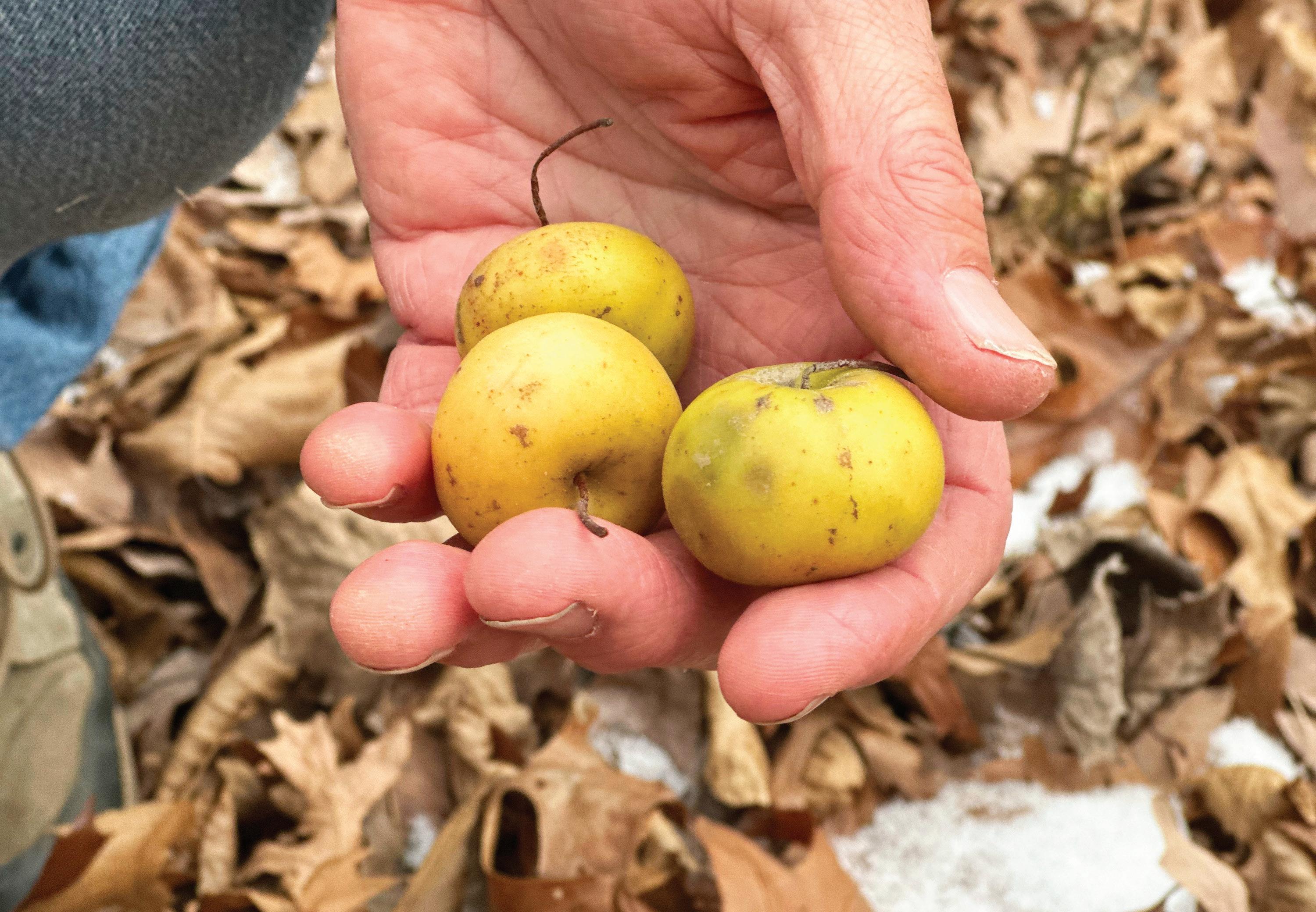
A native Michigan apple tree, the Malus coronaria, learned to fight frost by blooming two or three weeks later than the trees that produce cultivated varieties of apples like Honeycrisp or Red Delicious.
“That doesn’t sound like a lot, but almost always that’s enough for the flowers to escape the killing spring frost,” said Steve van Nocker, a
Michigan State University professor and plant geneticist.
Van Nocker wants to identify the genes responsible for the Malus coronaria’s delayed blooms and use them to develop more frost-resistant apple varieties, a decades-long process. But first, he’s hiking through forests, trying to find the elusive trees.
Van Nocker’s project is one of many ways researchers and growers are trying to make apples more resilient as climate change makes weather less predictable.
In Europe and South Korea, growers are experimenting with solar panels in vineyards and orchards. The panels protect fruit from hail and sun damage
but also let in light and heat when necessary, said Jared Buono, the director of Cornell University’s Hudson Valley Research Lab. Buono’s lab is also adding solar panels to its experimental orchard.
University of Maryland researchers recently announced the development of a more heat-tolerant apple variety.
At Penn State University, a team built an unmanned vehicle with a propanefueled heater that can roll through an orchard and automatically warm trees.
Buono said such efforts can mitigate the impact of unusual weather like a May 18, 2023 frost that damaged trees across New York state and cut apple production by 20%.
“Growers’ jobs are already hard,” Buono said. “The change in climate, the increased unpredictability and variability, makes it that much harder.”
According to a Washington State University study published this month, major apple-growing counties in the top three U.S. apple-producing states — Washington, Michigan and New York — are seeing fewer cold days and more warm fall nights than they used to. Washington also is experiencing more extreme heat.
The study, which examined climate data from 1979 to 2022, said the temperature trends could alter bloom timing, bring trees out of dormancy too
early and increase the risk of sunburn, which hurts the appearance and quality of apples.
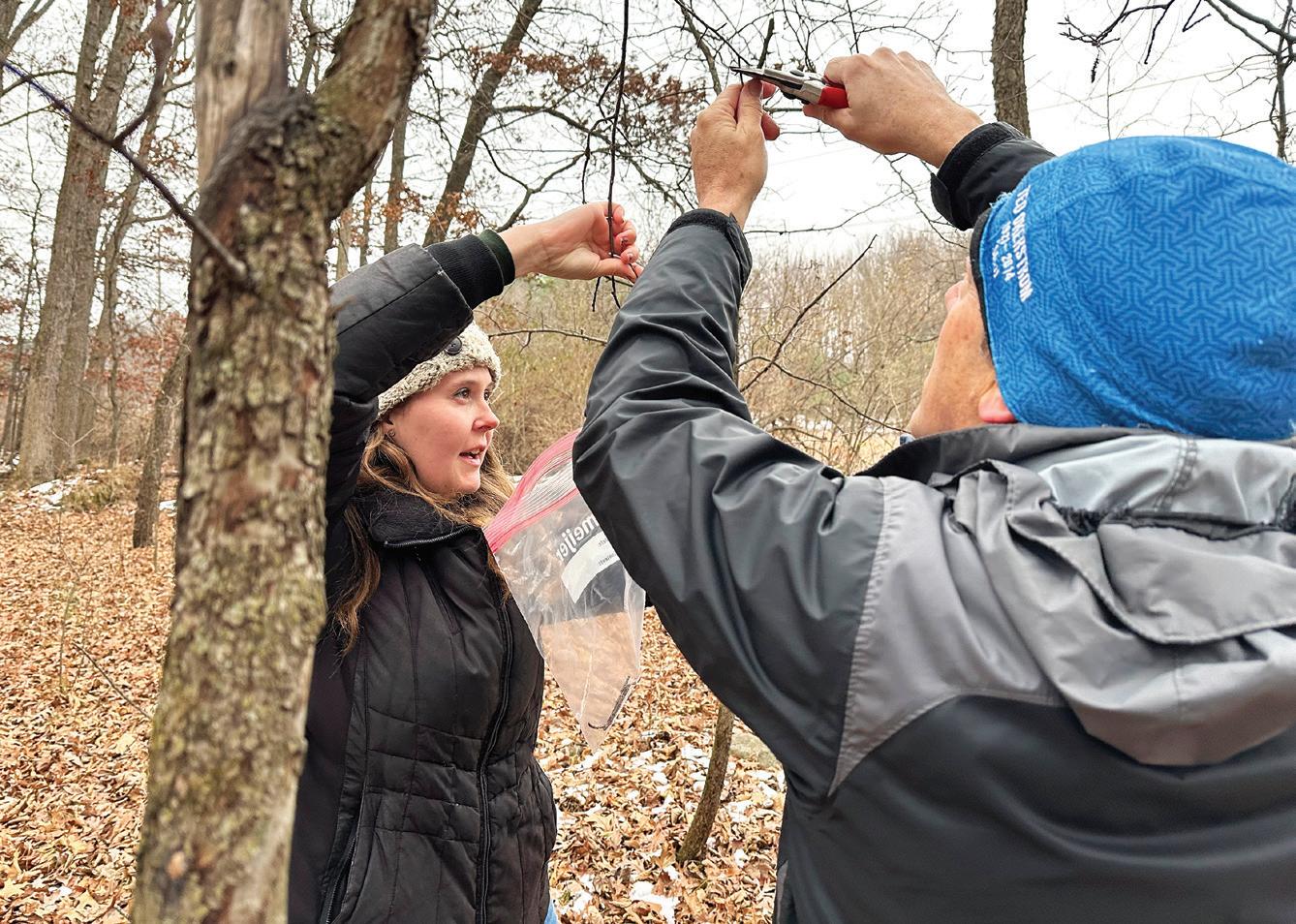
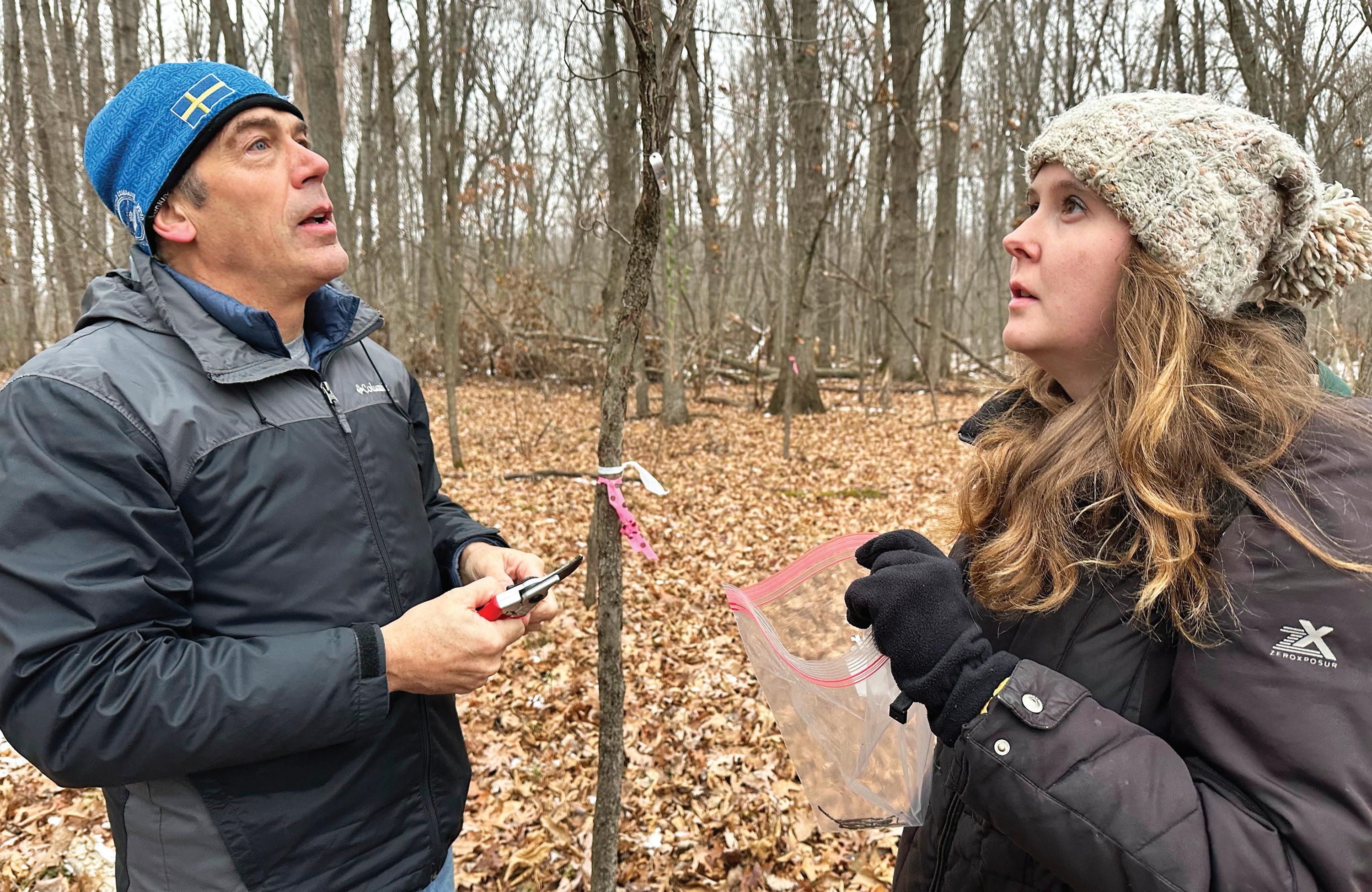
That’s why, on a chilly day in December, van Nocker and graduate assistant Lily “Kaz” Christian hiked through a public park near Michigan State to check on a handful of Malus coronaria trees they had found there.
Malus coronaria — also called sweet crabapple — was once so common in Michigan its blossoms were designated as the state flower in 1897. But the species appears to be in decline, van Nocker said. Parking lots and shopping centers now stand in many of the places where the tree was documented in the past, and the remaining trees often produce little new growth or fruit.
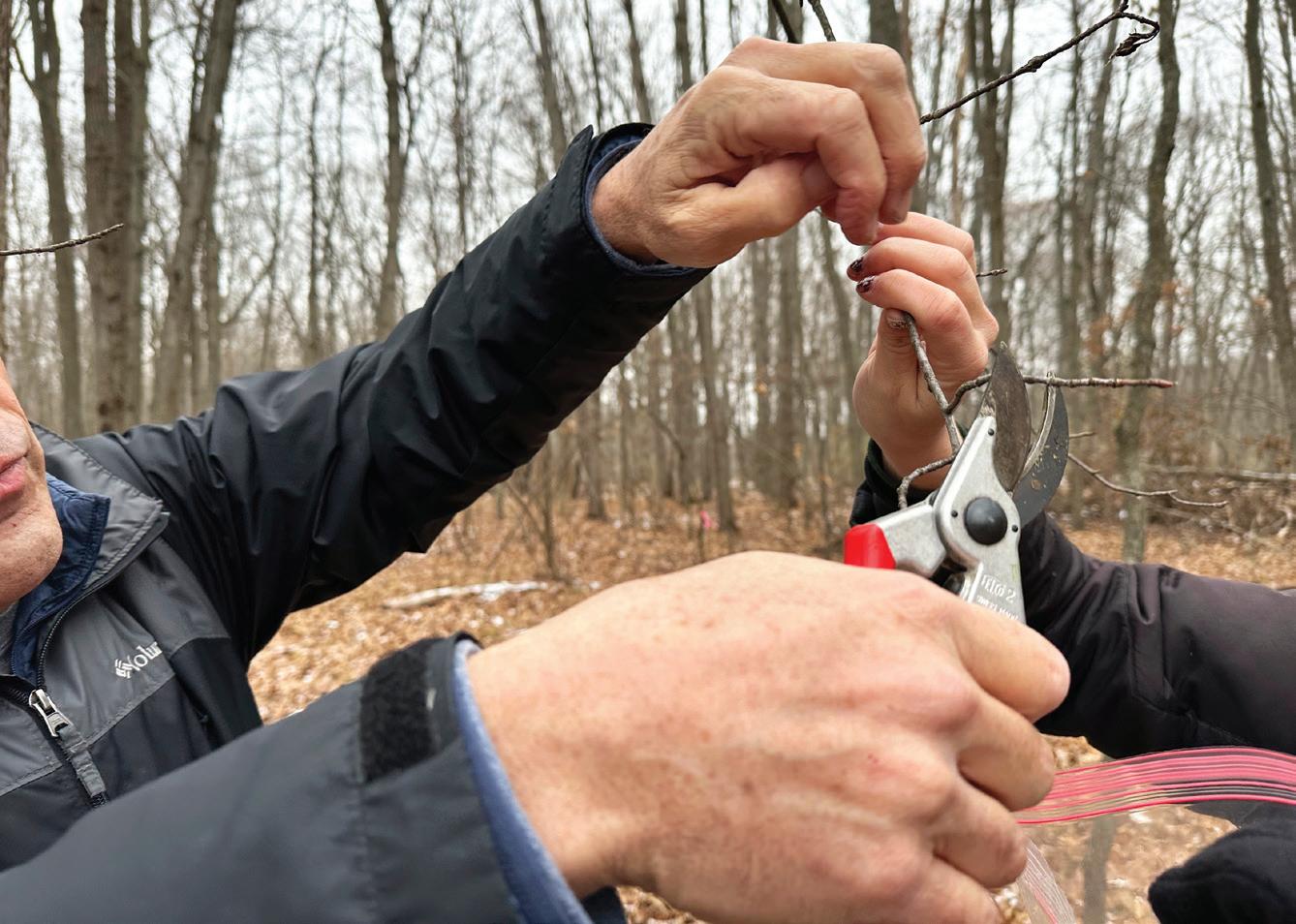
When they reached the trees, van Nocker and Christian cut off small pieces of the stems. The snippets will be tested to ensure they are fully Malus coronaria and not a hybrid. Then, these Malus coronaria cuttings — along with cuttings from previous hunts — will be grafted onto an apple rootstock. That will allow them to grow into trees which are identical to the original.
However, the goal is not to replace popular varieties like Fuji or Honeycrisp with Malus coronaria apples, since the Michigan tree’s fruit is small, green and bitter.
“To me, they don’t taste good at all,” van Nocker said.
Instead, he wants to identify the genes that cause late blooming and create a genetic stock that breeders could use to develop commercial apples. Van Nocker also is sending seeds to the U.S. Department of Agriculture so the genetic stock won’t be lost if the tree continues to decline.
Making a later-blooming commercial apple could take decades. If a Malus coronaria is crossed with a commercial apple tree to make a new hybrid, it would take four or five years for that tree to start producing apples. Crossbreeding would continue until researchers developed an apple with the
desired traits of both varieties.
But van Nocker said it’s critical to try.
“With climate change, it’s quite possible that apples won’t be able to be produced in Michigan in the future,” he said. “That’s why cultivar improvement, especially in terms of frost resistance, is so important.”