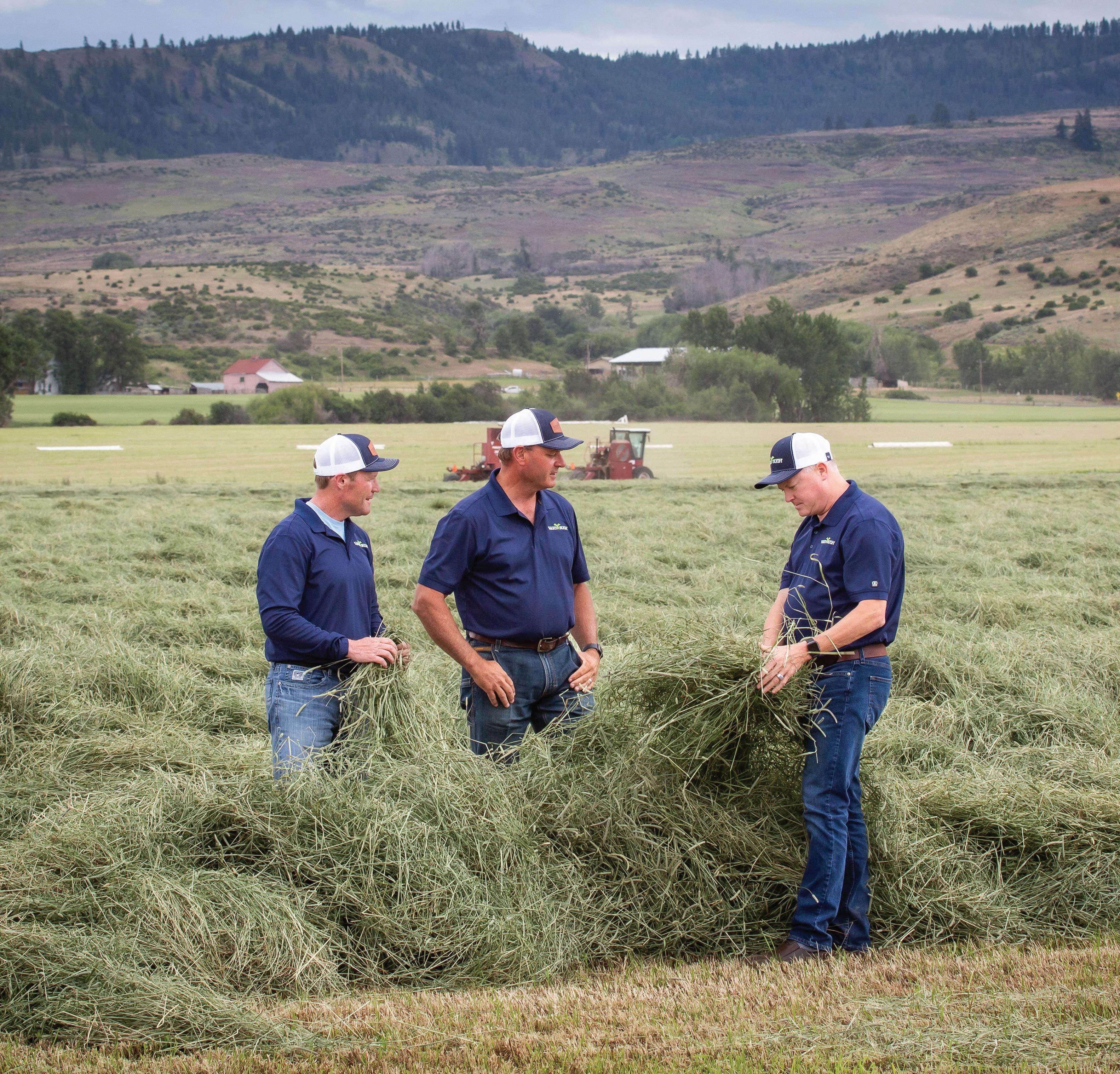




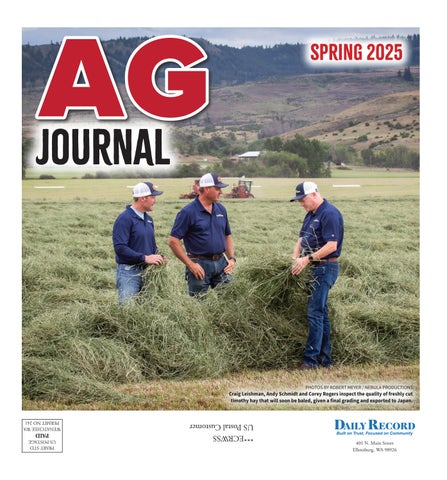


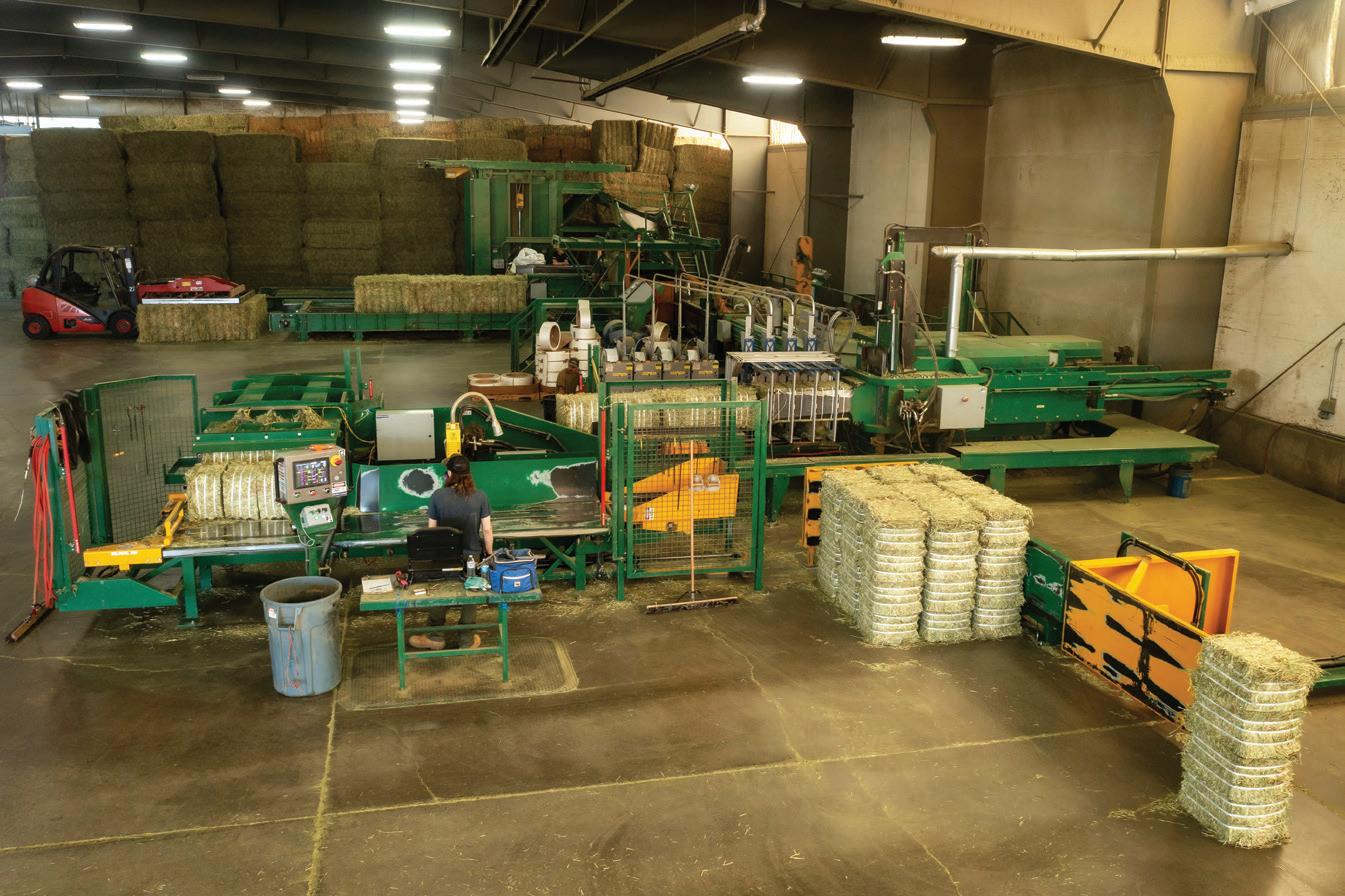
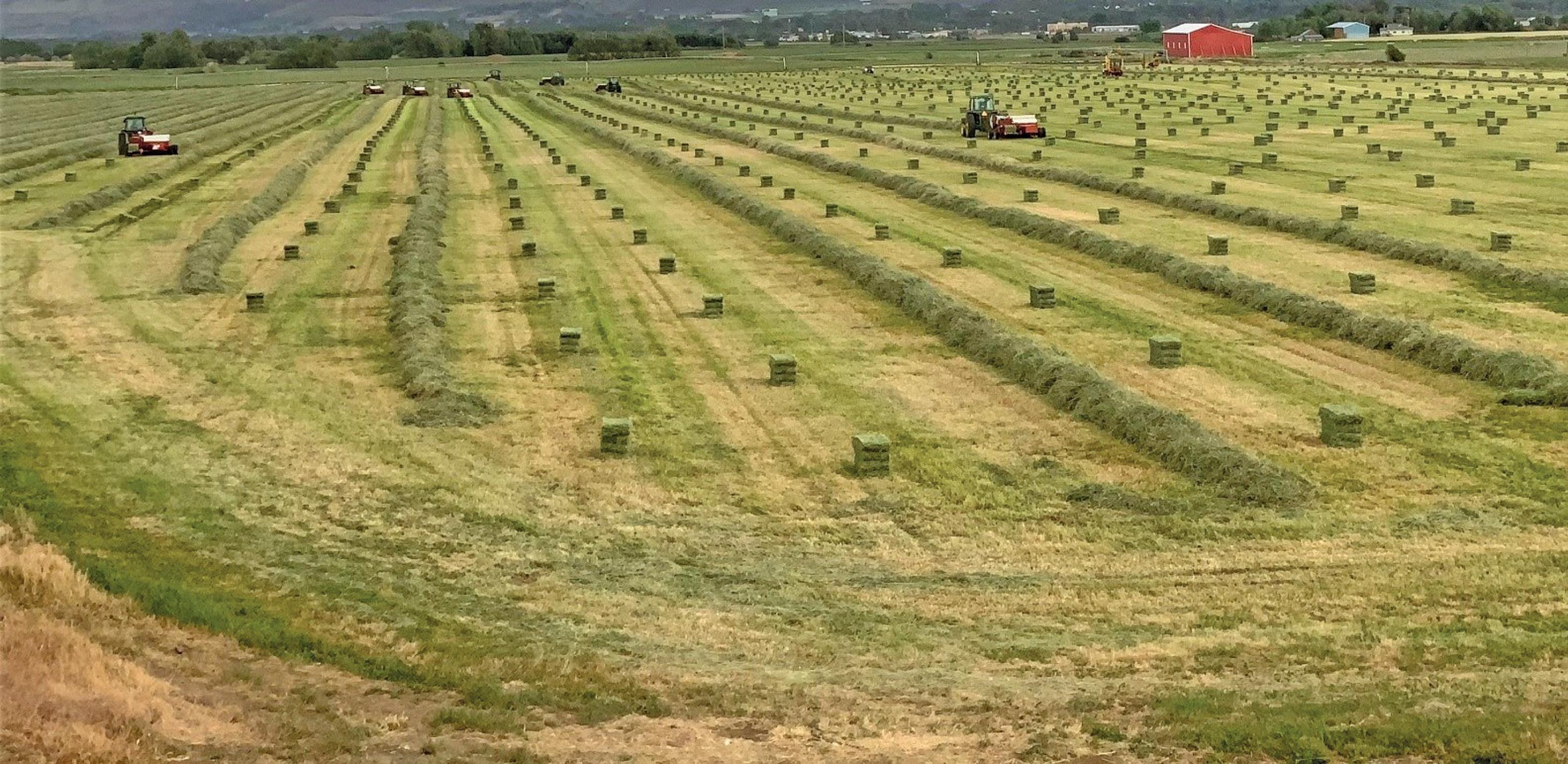
by year because our customers expect consistency. It was a great business model and I’m confident that’s why our customers, on the export side, continue their strong support to Ward Rugh, Inc.,” Rogers said.
“Even though there’s a lot more competition and more companies doing exactly what we do, our message, our business standards and our philosophies have not changed. We work very hard to maintain our reputation for supplying the domestic and export markets with high quality timothy hay. Customers always have a choice so we must continue to separate ourselves from the competition,” he said.
Rogers said another distinction about Ward Rugh, Inc. is their loyalty to both their customers and their farmers.
“We don’t write hay contracts. When we buy hay from a farmer, our word is the contract. A handshake. You don’t see a lot of business done in today’s world that is done on a handshake.”
Rogers said it works the same way with export customers.
The company also exports alfalfa hay, with the bulk of that coming from growers in the Columbia Basin, where the conditions are ideal for growing top quality alfalfa hay.
The primary markets for alfalfa hay
are in Japan, China, Korea, Taiwan and the Middle East.
Sudan grass is another viable crop for this area, with farmers using it as a good rotation crop that cleans up the ground while providing another forage product for the export market.
They also market limited volumes of oat hay, oat straw and orchard grass.
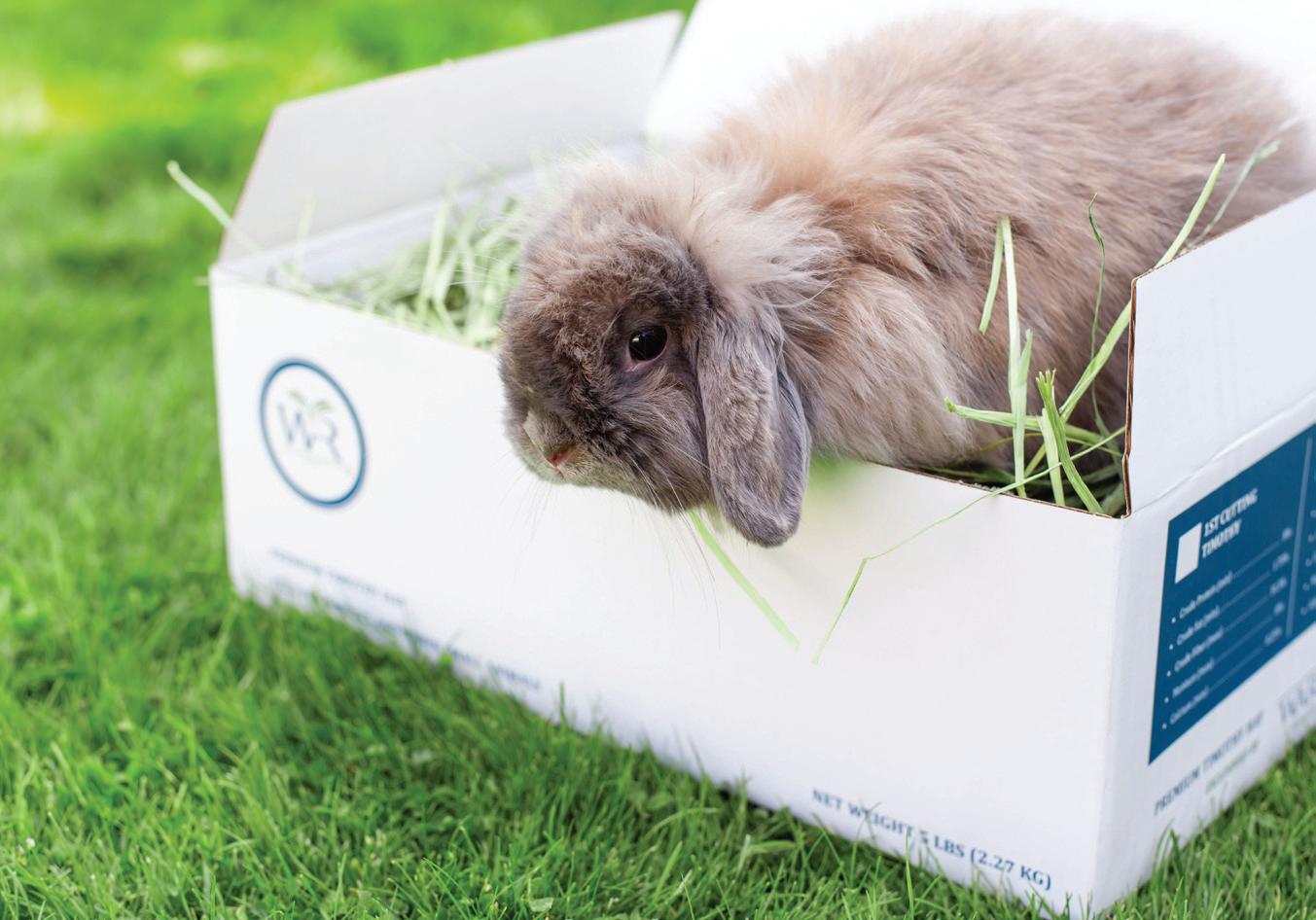
Another market Ward Rugh, Inc. has entered recently is small pet food, offering 5-, 10- or 20-pound boxes of premium first or second cut timothy hay as an excellent source of nutrition for guinea pigs, rabbits and chinchillas.
“As we move on, must continue to look at additional markets to supplement our core business,” Schmidt said.
Just as Ward Rugh himself saw tough times and challenging situations from the mid-1930s to the mid-’90s, challenges will always be a part of the business world. Rogers looks to long-standing traditions with overseas trading partners for some assurances.
“The loyalty to our Japanese customers, that market specifically, is our history. Our Japanese customers helped build Ward Rugh to where it is today,” Rogers said.
“To have the same customers five decades later has put us in a stable
position. Our customers in Japan are loyal, honest, trustworthy and kind. These are the same attributes we have in our company. Treat people with
respect; your word is everything and handshakes will get a deal done. It’s oldschool mentality, but it works and how we still operate today.”


BY ANNA ROSE Daily Record
Washington state’s beef community has never been more committed to uniting against hunger.
At least, that’s what Jackie Madill says.
The Washington State Beef Commission executive director praised their “innovative and industry-leading” Beef Counts program for distributing more than $80,000 in beef across eastern Washington this year.
Johhny Sarreal of Lone Saddle Ranch in Ellensburg is a proud partner.
“We work hard to raise delicious, nutritious beef for our customers. And it’s rewarding to know people love eating it,” he said.
“So, we like that Beef Counts makes our beef accessible to our neighbors in need. To see their appreciation when they
receive beef at a mobile food market event is not just rewarding, it is very humbling.”
What inspired the creation of the Beef Counts program, and what are its main goals?
Madill: Realizing that food banks were in critical need of receiving highlyquality protein, Agri Beef Co, along with their Washington Beef processing plant located in Toppenish, and Washington’s Beef Community recognized that we were in a unique position to be part of the solution. The innovative and industry-leading Beef Counts program was born in 2010 and as a pasture to plate community we made a long-term commitment to help provide highquality beef protein to families in need throughout Washington.
How does the Beef Counts program support both local beef producers and

families in need?
Madill: Since 2010 when our collaboration began with Washington’s beef producing families and Agri Beef Co as well as food security organizations serving all of Washington State, such as Second Harvest, Food Lifeline and Northwest Harvest, we have established a program that makes a difference in our hometowns. We’re most proud of the fact that every dollar donated to Beef Counts goes directly to purchasing beef for food banks. Each year Agri Beef Co and Washington’s Beef Community donate funds to ensure that beef will consistently be more available and accessible to Washington’s hungry families.
How have local partnerships, such as with the Kittitas County Cattlemen’s Association, helped advance the
program’s mission?
Madill: The Washington Cattlemen’s Association, Kittitas County Cattlemen and CattleWomen’s Associations, as well as other County Cattlemen’s groups across the state, and the Washington Cattle Feeders Association have been strong supporters of Beef Counts for 15 years. Through their financial generosity but also through their annual volunteerism, we have seen these local beef producers proudly serve their communities from Spokane to Seattle and many hometowns in between. For Washington’s beef farmers and ranchers, Beef Counts is about helping their neighbors in need.
We invite everyone to join Washington’s Beef Community by donating directly to Beef Counts at Second Harvest at https://www.wabeef. org/beef-counts.

BY ANGELA SAMS
Washington State University, College of Agricultural, Human, and Natural Resource
Sciences
PROSSER, Wash. — A new tool with four furry legs and an ultrasensitive nose may soon offer the tree fruit industry a more reliable way to quickly detect Little Cherry Disease (LCD).
As part of a two-year project, Washington State University researchers are working with a pair of specially trained dogs and their handler to conduct several field trials with infected cherry trees. The study, funded by the Washington Tree Fruit Research Commission (WTFRC) and the Northwest Nursery Improvement Institute, showed that the canines’ exceptional detection skills could offer a promising alternative to the current standard, polymerase chain reaction (PCR) tests.
“We don’t know what the two dogs are detecting in the infected trees, but speed and sensitivity are the main takeaways of our study,” said Scott Harper, associate professor in WSU’s Department of Plant Pathology. “The dogs are excellent at picking up low concentrations of the pathogen, which is hard to do by PCR testing. The dogs are also faster. Dissecting one tree to test it can take an entire day.”
PCR tests are expensive, and the results are far from instantaneous.
“These tests are not commercially viable for many growers,” said Corina Serban, WSU tree fruit Extension educator. “Establishing another way to stay ahead of the disease will be very valuable to the tree fruit industry.”
Caused by one of three pathogens, LCD results in small, unripe, unmarketable cherries. Symptoms are typically only visible on the fruit during the harvest period; the rest of the year,
the tree appears healthy.
“Without visible fruit, growers don’t know if their trees are infected,” Serban said. “Every year an infected tree stays in the ground, it could potentially infect additional trees.”
Because the incurable disease only presents itself in small areas of the tree, especially in the early stages of infection, testing is challenging.
“PCR tests rely on tree tissue samples,” Harper said. “Without symptoms to guide you, it’s hard to tell where in the tree the disease is present. You’re sampling blind and will probably miss it.”
LCD is spread through grafting and planting of infected materials or via insects like mealybugs and leaf hoppers. The only sure antidote is expensive: ripping the tree out and replacing it with a new tree that takes roughly five years to reach full-scale production.
In search of a solution, Harper and
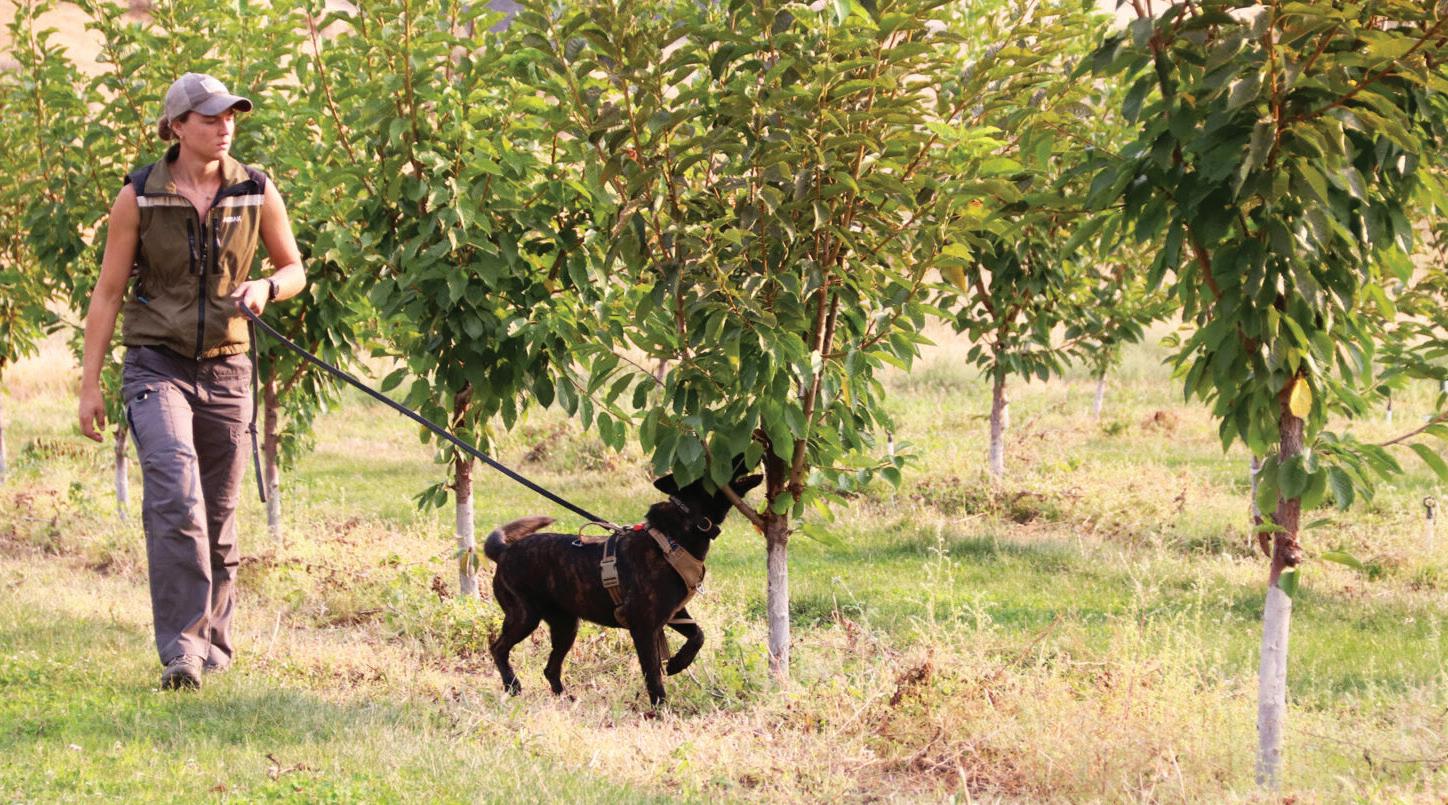
Serban established a partnership in May 2023 with Jessica Kohntopp, an Idaho-based dog trainer who had previously taught canines to sniff out COVID-19 and viruses that infect tomatoes, squash, and citrus. For the WSU study, Kohntopp trained two dogs specially bred for detection work: Humma, a Dutch Shepherd, and Aika, a Belgian Malinois.
“I’m passionate about this work,” Kohntopp said. “I don’t want growers to tear up their entire nursery because of this disease. I knew the dogs could help, and that I could successfully train them.”
Kohntopp used infected and healthy potted cherry plants to teach Aika and Humma how to detect the disease. She trained the dogs to alert by stopping next to only the positive plants, rewarding them with a favorite toy each time they signaled accurately.
“For them, it’s a game, not a job,”
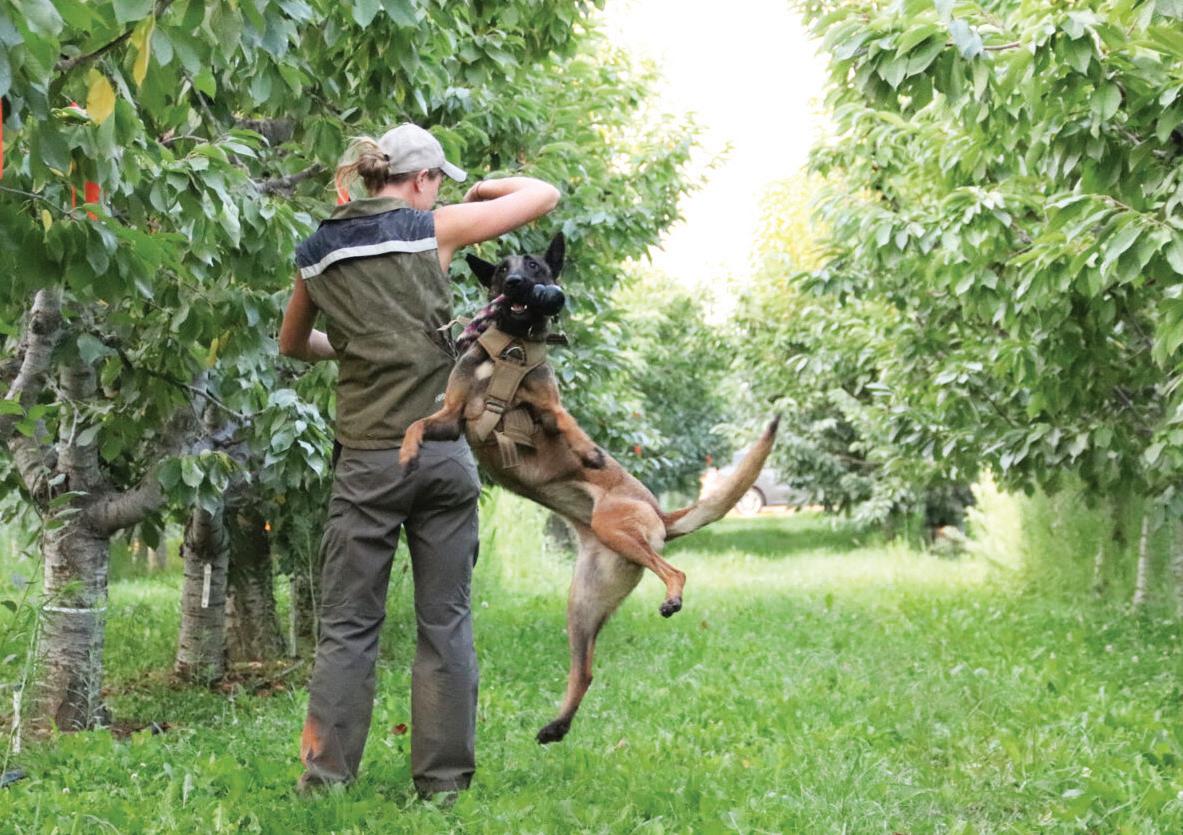
Kohntopp said. “They’re so excited when they find the positive plants.”
Beginning in March 2024, the WSU researchers tested the newly trained dogs’ capabilities with a series of trials. The first took place in a greenhouse at the WSU Prosser Irrigated Agriculture Research and Extension Center. When presented with nearly 200 plants, the dogs successfully found all seven positive trees and alerted on an additional plant, which later tested positive. Several months later, the researchers conducted a blind controlled study in which Kohntopp was unaware of the plants’ infection status.
“We were trying to validate the accuracy, sensitivity, and specificity of the canines,” Serban said. “We also wanted to ensure that Jessica wasn’t unintentionally cueing the dogs to alert at plants she knew were positive.”
In the blind study, each dog sniffed 1,380 plants, 101 of which were positive. Though both dogs missed a handful of infected trees, neither of them false alerted. An additional ministudy showed that the canines had a combined accuracy rate of 99.72%.
One especially promising trial involved five trees from a commercial orchard. The plants had previously tested negative, but Humma and Aika
indicated otherwise. To confirm, the researchers dug up the five trees to PCR test them more rigorously.
“We cut them up, averaging 100 samples per tree,” Harper said. “The dogs were right every time — the trees were all positive.”
The five-tree trial also demonstrated that the dogs can sniff out LCD at very low levels.
“The positive PCR samples all came back as weak positives,” Serban said. “This indicates that the dogs can detect the disease even at low concentrations.”
After the current project wraps up in May, the researchers plan to submit a proposal to extend their WTFRC funding. With additional support, they hope to study whether dogs can sniff out infected bundles of trees at nurseries, potentially stopping LCD before it reaches the orchard. The researchers also want to discover how tree dormancy periods affect the dogs’ detection abilities.
The eventual goal is to make dogs like Aika and Humma widely accessible to commercial growers.
“We want to scale this to help the industry,” Serban said. “The biggest challenge is using science to prove the dogs’ accuracy. Our research is still ongoing, but it’s very promising so far.”

The Kittitas County Chamber of Commerce has been hosting workshops, aimed at supporting small farmers and those looking to start an Agriculture based business.

Our March and April classes focused on starting a farmstand. Attendees learned about:
WSDA cottage law permits Prohibited items
Building a farmstand
Bottling/production
Marketing your farmstand
Zoning/codes Insurance And more...
Follow the Chamber on social media @KittitasCountyChamber or scan the QR code and subscribe to our newsletter to stay up-to-date on future small farms workshops, marketing classes, networking opportunities, available grants and more.
Our next three small farms workshops will focus on insurance, the legal aspects of operating an ag business and point of sale options for seasonal businesses.


BY KATIE TEACHOUT Daily Record
Hundreds of youngsters descend on fairgrounds for Agriculture
Appreciation Day
More than 400 third-grade students from elementary schools all over the county participated in the 22nd annual Elementary Agriculture Appreciation Day at the Kittitas Valley Event Center this week.
Bode Sherley, an Ellensburg Future Farmers of America student, was returning to the event as a volunteer to share what he remembered from the event as a third-grader.
The two days at the fairgrounds, coordinated by the Kittitas Conservation District, brought local farm equipment, live farm animals, displays on crops, irrigation equipment, on-farm conservation demonstrations and much more to the event center.
On Tuesday and Wednesday, the students had a chance to learn what it takes to farm and ranch in Kittitas County.
“It’s been a beautiful day, probably the best weather we’ve had in a long time, so it’s been a great day that way,” said Kittitas County Conservation District’s Mark Crowley, the event’s main planner. “The kids have been enthusiastic about being here, and they’re all enjoying themselves.”
Crowley said parents and teachers also, as usual, were happy to take part.
Having the FFA students there along with the others instructors was greatly appreciated, Crowley said.
Students from the Ellensburg FFA volunteered April 15, with students from the Kittitas and Thorp club members volunteering the next day.
“It’s great having the community support, and the support from the high schools,” Crowley said.
The FFA students, along with other instructors and volunteers,
expressed their own appreciation for the opportunity to volunteer and teach children the importance of agriculture.
Caught during a few moments of “downtime” while eating their lunches, Ellensburg FFA volunteers spoke about their reasons for being there.
“I’m volunteering to help the kids know that agriculture is not only limited to people who live on farms,” Jayleen Rodriguez said.
She was volunteering at the technology station, teaching kids about today’s smart farming that uses advanced technology including drones.
Megan Wageneck, also at the technology station, said she was volunteering “because I love kids and I love FFA and agriculture.”
Volunteering at a station featuring
horses Magic and Jello, as well as Rodeo Queen Katie Blume, were FFA students Faith Rector and Taylor Shaw, who owns the horses.
“I think the most fun part about volunteering for this event is getting to be able to teach the kids in this community about agriculture, and so they kind of have a better understanding about what we do to help our country,” Rector said.
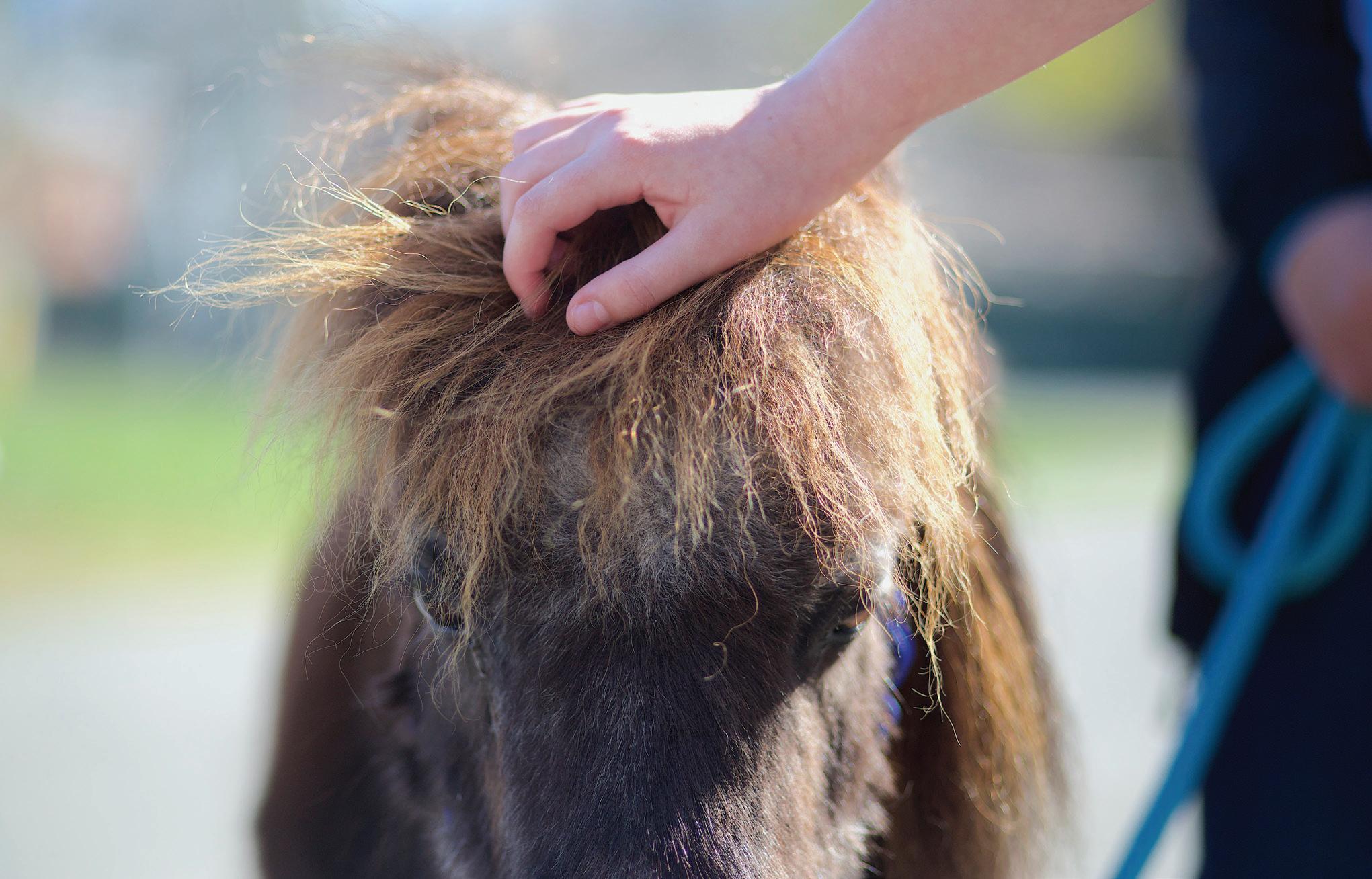
“The most fun thing is just getting to see all the kids have fun with the horses because some of the kids don’t get to experience the horses,” Shaw said. “There’s a lot of fun in getting to see them interact with them and get so excited.”
“It’s been a great day, the kids love seeing the horses and getting to pet on
them and they’ve all said that they’ve learned so much from every station,” Blume added.
“They’ve had a lot of fun just petting the horses and getting to learn a little bit about what horses do and different jobs that they could have with horses in the future. I think a lot of the kids loved learning that they could be a horse veterinarian when they’re older,” she said. “So it’s really good getting to see the youth wanting to be interested in agriculture in our county, and really passionate about learning, and just so involved and very respectful of all the horses.”
At the Kittitas County CattleWomen Association’s station, Linda Henderson and Schatzie Harvey told the kids why and how they brand or tag their cattle.
Standing next to a pen with a mama cow and her calf that was approaching branding age, they demonstrated different tools used to brand or tag cattle, in front of a large cow hide with Kittitas County cattle brands on it as a backdrop.
Henderson took a few moments during lunchtime to speak about how the event was going so far.
“The kids are learning about brands — why we do it, how we do it — and they’re asking some really great questions,” Henderson said. “And the other cool thing is, they’ll be able to go back to their classrooms, and what they learned here about the design of the brand, they can go back and create their own.”
Students were given forms to fill out with their own brand designs.
“All those forms will go back to the teacher, the teacher will submit a packet back to the cattlewomen, and then we get to sit down over coffee and go through the classroom packets and pick out a brand winner from each class,” Henderson said. “It’s just a great opportunity for them to put what they’ve learned into a design and why.”
The students also got other lessons, as well.
“What I think is neat about doing an event like this is, kids that don’t normally have an opportunity to get exposed to agriculture have an opportunity to learn about cows and farming and things like that,” Harvey said. “And kind of where the food comes from.”
Amy Alder with the Washington State University Extension, along with help from Teala Stolen, the 2025 Washington Rodeo Roundup Junior Princess, manned a 4-H station that taught kids about germs.
Students put a non-toxic ultraviolet liquid on their hands before going into a blacklight tent to see the substance on their hands glow, then were instructed to wash their hands thoroughly.
The students then went through the tent again, with exclamations of surprise to see how much of the substance was left behind on their hands, revealing the importance of
being real sticklers for detail when it comes to washing hands.
“I feel it is extremely important to introduce these kids to something that’s super important to our community. We obviously have a really large Ag-based community, and so I feel like this is a great age to introduce them to that,” Alder said.
“For 4-H and WSU, third grade is the first grade they can really do 4-H, so we’re hoping to interact with some of the agriculture in our community and hopefully get them to join 4-H,” Alder added.
Solen said she was attending the event with her rodeo court to help with community service.
“I think it’s important for the kids to learn about germs, and for the kids to learn how to properly wash their hands so they don’t get sick or get animals sick,” Solen said.
Mark Eylar got to talk to the kids about another kind of nasty spread.
“I’ve been doing Ag Appreciation Day for about 20 years with the Noxious Weed Control Board with the county, and it’s a highlight out of the year,” Eylar said.
“I don’t interact with young children too much out of the year with my job — it’s mostly older landowners — and so it’s a nice change sometimes to be able to get kids excited about agriculture and invasive plants and maybe get them thinking about something they don’t usually get to think about,” he said.
Besides nasty goat’s head weeds that can ruin or slow down a kid’s plans with a deflated bike tire, Eylar also warned about noxious weeds that can cause skin diseases or even fatal conditions. He told them how to spot them and how to get rid of them.
Another station with farm animals featured a cow, a sheep, a goat and a pig. Manned by FFA volunteers Maddy Packard, Sadie Barr, Maddie Stansberry, Carmen Preciado and Torrie Mitchell, the station gave students the chance to see the animals up close.
“Look, he’s smiling at me,” exclaimed Jethro Miller from Ann Riley’s classroom at Ida Nason Elementary
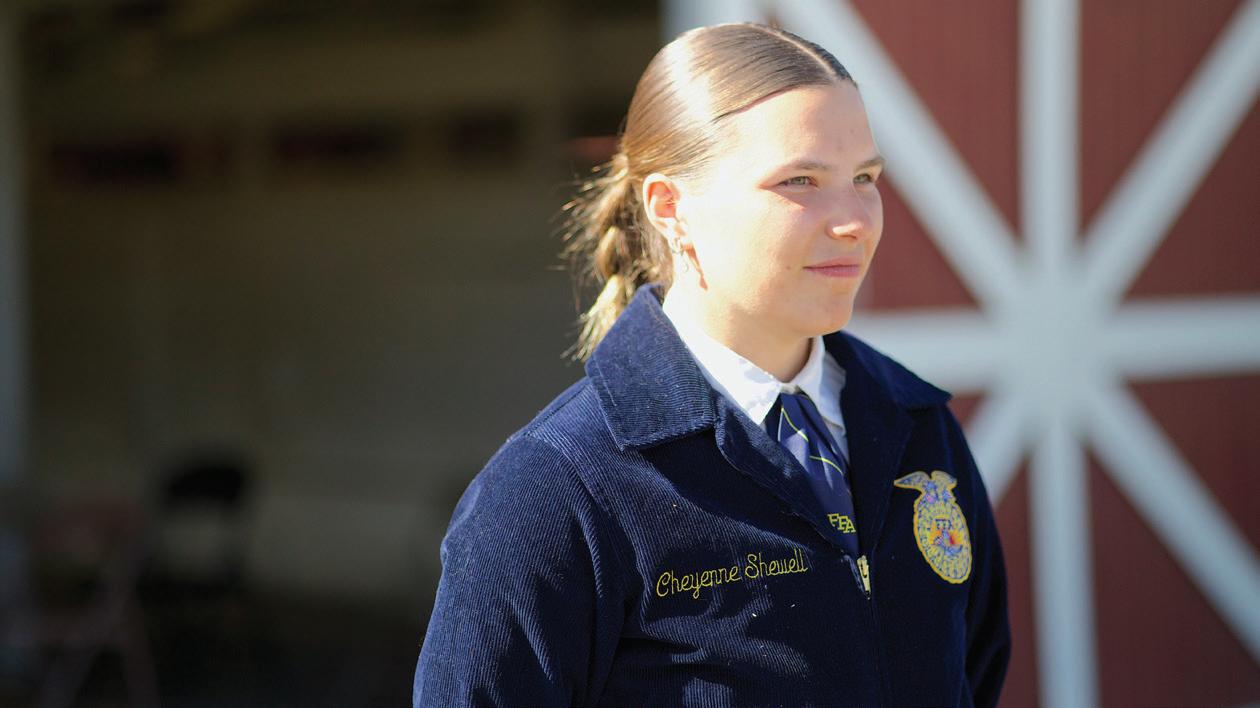
PHOTO BY ANNA ROSE / DAILY RECORD
BY LEE BECK | Daily Record
The Ellensburg chapter of the Future Farmers of America teaches students about agricultural careers and experience needed for them. The club focuses on activities catered to leadership and career development.
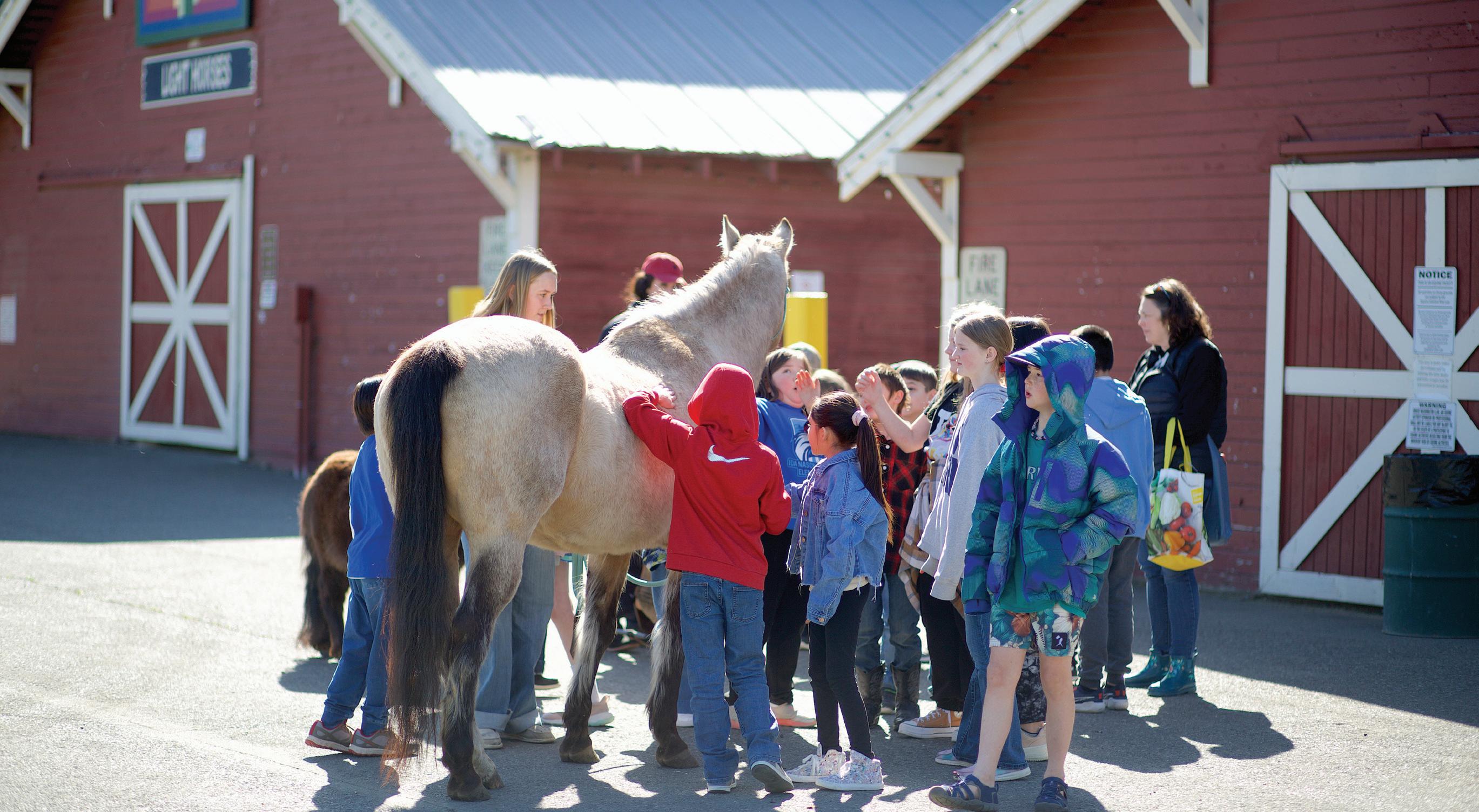
According to Cheyenne Shewell, an Ellensburg High School senior in her fourth year of FFA, the competitions are “not always about what’s happening now.” She added that the program prepares students for their futures and gives them ideas about different career paths.
Shewell started competing in FFA in her freshman year, and she said she’s learned a lot from club, but she specifically singled out public speaking.
“I’m lucky enough to have the opportunity to compete,” Shewell said.
When the Ellensburg FFA competed in this year’s state competition, the team won first place in Agricultural Communications.
Because of their win in the state, the team advanced to the National FFA Convention. There, the Ellensburg FFA team won second in the nation for Agricultural Communications.
Shewell attributed their win to their work ethic.
“We put in our best efforts, day-in and day-out,” she said.
While she stays active in other sports, clubs and activities at her school, she added she still puts strenuous effort into her FFA events.
The events in FFA are divided into two categories, leadership development and career development.
The competitions range from activities such as livestock judging, and meats evaluation and technology (which are more tactile agricultural activities), to the more administrative parts of the farming industry such as marketing and agricultural communications, which includes skills such as social media managing, journalism, website design and magazine design.
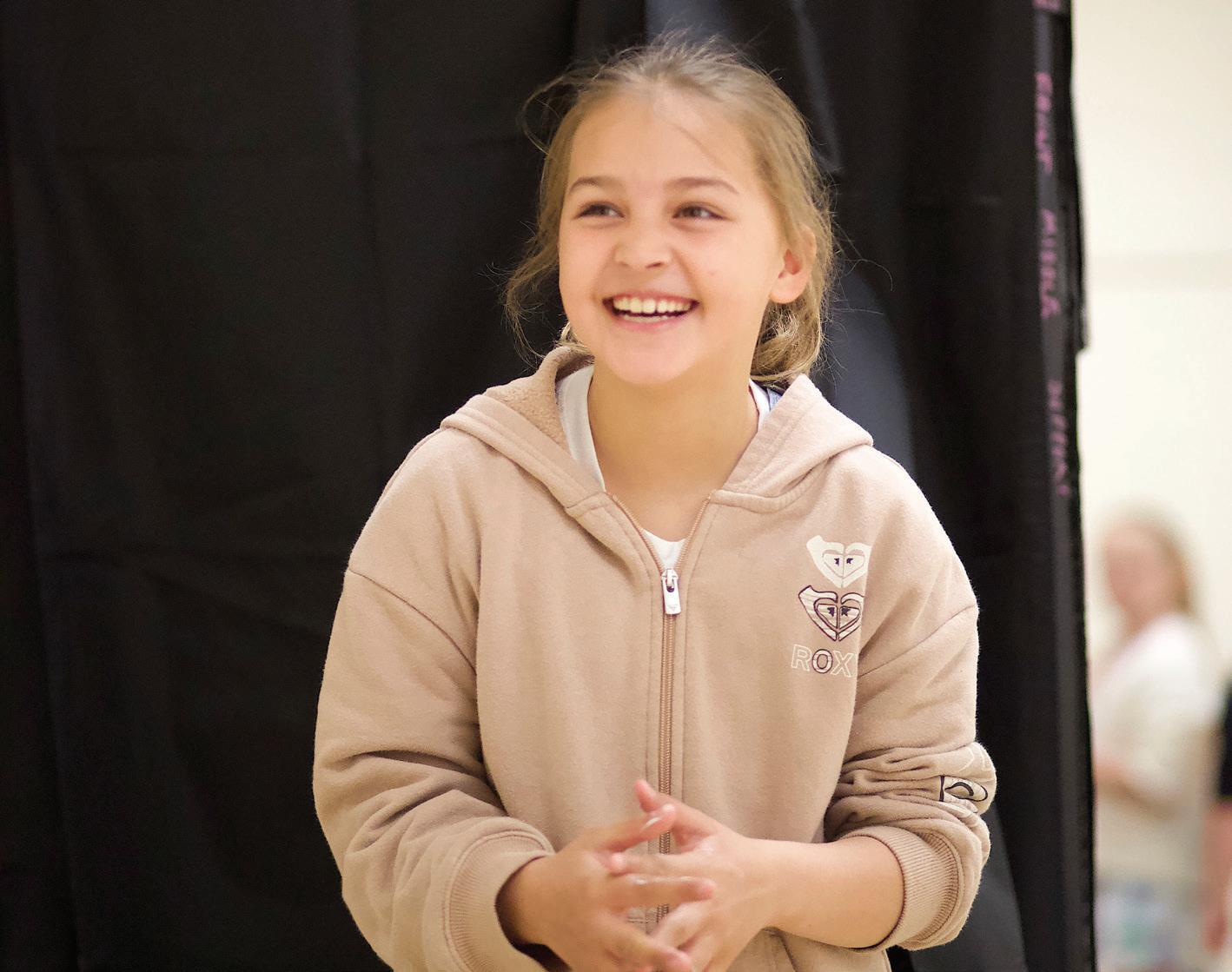
School after interacting with a goat. Miller was grinning from ear to ear after the experience.
Other FFA students got to explain the uses of three large pieces of harvest equipment loaned by Papé Machinery for a display.
“Can we climb up and sit in the seat?” asked one excited youngster, whose face fell when he was told no.
After detailing the uses of a Framen baler towed by a John Deere 6R130 and a JLG telehandler used to stack or load bales of hay, students were asked to guess the cost of a piece of the equipment.
“$800?”
“$2,300?”
“One million thousands?”
The total of the equipment on loan was in the neighborhood of $500,000.
Ellensburg FFA volunteers Nolan
Sherley said he was at the farm equipment station to help educate the children about agriculture, and Jack Case said he volunteered to help better the students’ education on farm equipment.
Over at the hay station, Ellensburg FFA volunteers Hadley Potts, Cami Ford and Kayley Ceja talked about the three kinds of hay grown in Kittitas Valley — timothy, alfalfa and grass — the different ways it can be baled, the kinds of animals that eat hay, and the countries it’s shipped to.
Students were given the opportunity to try to lift the heavy bales.
Helping carry the 60- and 80-pound bales of hay to the event was volunteer Enrique Espinoza.
“I volunteered to help kids and get out of school,” Espinoza admitted.
BY SETH TRUSCOTT
College of Agricultural, Human, and Natural Resource Sciences, Washington State University
Scholars Cesar Reyes Corral and Monica Oropeza can’t wait for the state-of-the-art infrastructure that the new, donor-supported Plant Growth Facility at Washington State University’s Tree Fruit Research and Extension Center will bring.
Reyes Corral, who graduates with his doctorate in entomology this summer, and Oropeza, a Wenatchee Valley College student and research employee at the Center, expect the discoveries that they and fellow scientists and students are making at Wenatchee will make lasting impacts thanks to the much-needed upgrade, a 2025 CougsGive featured fund.
“Imagine how far our research could go if we have facilities that are on par with the work we’re doing?” says Reyes Corral, who is studying innovative uses of native fungi to kill codling moth, a perennial pest of organic fruit orchards.
Powered by public and tree fruit industry donors, the new Plant Growth Facility will replace a 70-year-old structure that is long past its prime. The modern building will enable sophisticated environmental stress experiments, year-round disease research, root health tests, and pestfree plant growth serving the state’s $10 billion tree fruit industry, a key Washington economic powerhouse. To complete the project, researchers seek to raise $4.2 million in 2025.
Milne Fruit Products, a Prosser, Washington-based global fruit juice and puree company challenges all supporters of Washington tree fruit to contribute to the Plant Growth Facility
fund during CougsGive. Milne Fruit is a silver-level sponsor of the new facility.
“At Milne, we see the value in creating a state-of-the-art facility for research and discovery that continues the growth of our industry” said CEO and President Michael Sorenson. “Our company believes in making a bright future for Northwest tree fruit. The Plant Growth Facility is a much-needed resource for continued success, and we’re excited to help make it a reality.”
Reyes Corral’s work at Wenatchee is based on a lucky stroke: the discovery of three types of fungi, including a strain of the “zombie” Cordyceps fungus that inspired the show “The Last of Us,” that parasitize and kill the apple-ruining codling moth larvae. But to grow and study them with the goal of orchard application, he needs chambers where he can reliably control the environment.
“A few degrees Fahrenheit may not seem like much, but for fungi it’s very important,” Reyes Corral said. “Our existing temperature-controlled rooms where we grow the fungi are really temperature-uncontrolled.”
With the new facility, Reyes Corral could more quickly and reliably study the spores’ effectiveness, ultimately developing new tools to sustainably manage pests.
“Curiosity is what keeps me going,” he said. “I love finding ways to solve problems and want to stay in whatever field allows me to do science.”
Excited about graduation and the next steps in his scientific career, Reyes Corral had a positive experience working at TFREC as an international
BY JAMES SMITH
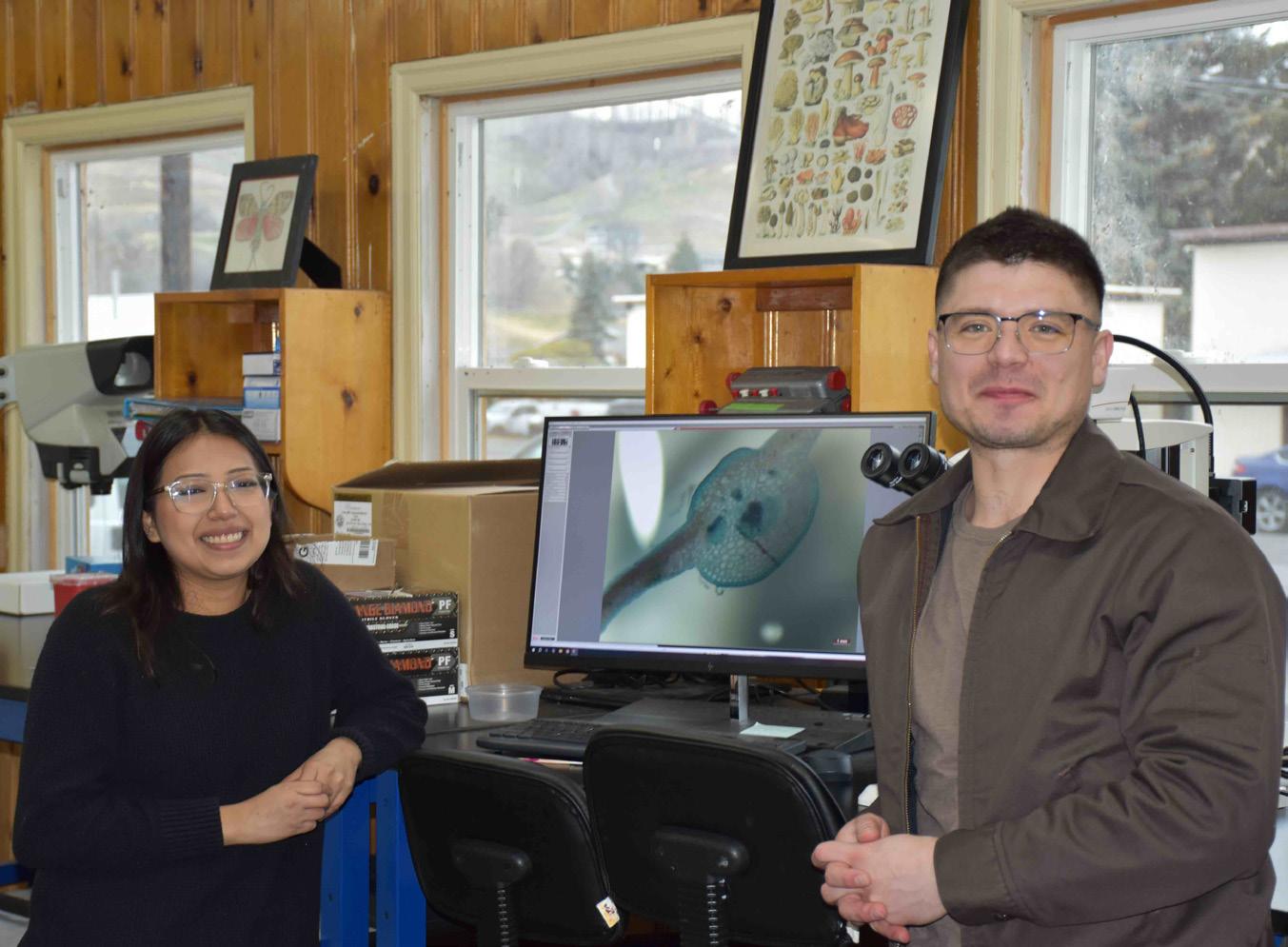
Monica Oropeza, a student employee at WSU’s Wenatchee Tree Fruit Research and Extension Center, and Cesar Reyes Corral, an doctoral student in entomology, study ways to defend tree fruit crops from insect pests at the center’s Northfield Lab. Their projects would benefit from the planned new Plant Growth Facility, a donorsupported 2025 CougsGive priority.
student. Research happening at the Wenatchee center places it among the most sought-after destinations for tree fruit-minded graduate students.
“With the new Plant Growth Facility, it’s going to reach the next level,” Reyes Corral said. “I can only imagine how much more scientifically powerful this experience is going to be for future generations.”
For Monica Oropeza, a former intern, current Wenatchee Valley College student, and research employee at TFREC, a new and better building would not only improve her work but draw other students from the region to the center and to careers in tree fruit science.
She plans to transfer to WSU in 2026 to earn her bachelor’s degree in tree fruit production and horticulture.
“Once I realized how much research is happening here, it pulled me in!” Oropeza said.
She studies leafhoppers, the tiny insect vector of X disease, which
causes small, misshapen, tasteless cherries. Like Reyes Corral, Oropeza struggles with maintaining an effective environment for her insect work due to the aging infrastructure. In fact, the old building’s challenges pose a problem for nearly every team at TFREC, from plant pathologists to crop breeders.
The current facility is simply not adequate for experiments that need tight insect controls, said Tobin Northfield, a WSU entomology professor who works with Reyes Corral and Oropeza.
“The new plant growth facility will help us grow and maintain insect-free plants without being impacted by invading pests, and more effectively raise colonies and study impacts and controls of pests that spread damaging diseases,” Northfield said. “It’s really going to be a game-changer for all of us.”
Oropeza shared her thanks with all donors who help build the new facility.
“Wait and see,” she said. “We will prove to the entire industry how much it will benefit us and how many new answers we can find.”
BY SCOTT WEYBRIGHT
College of Agricultural, Human, and Natural Resource Sciences, Washington State University
PULLMAN, Wash. —
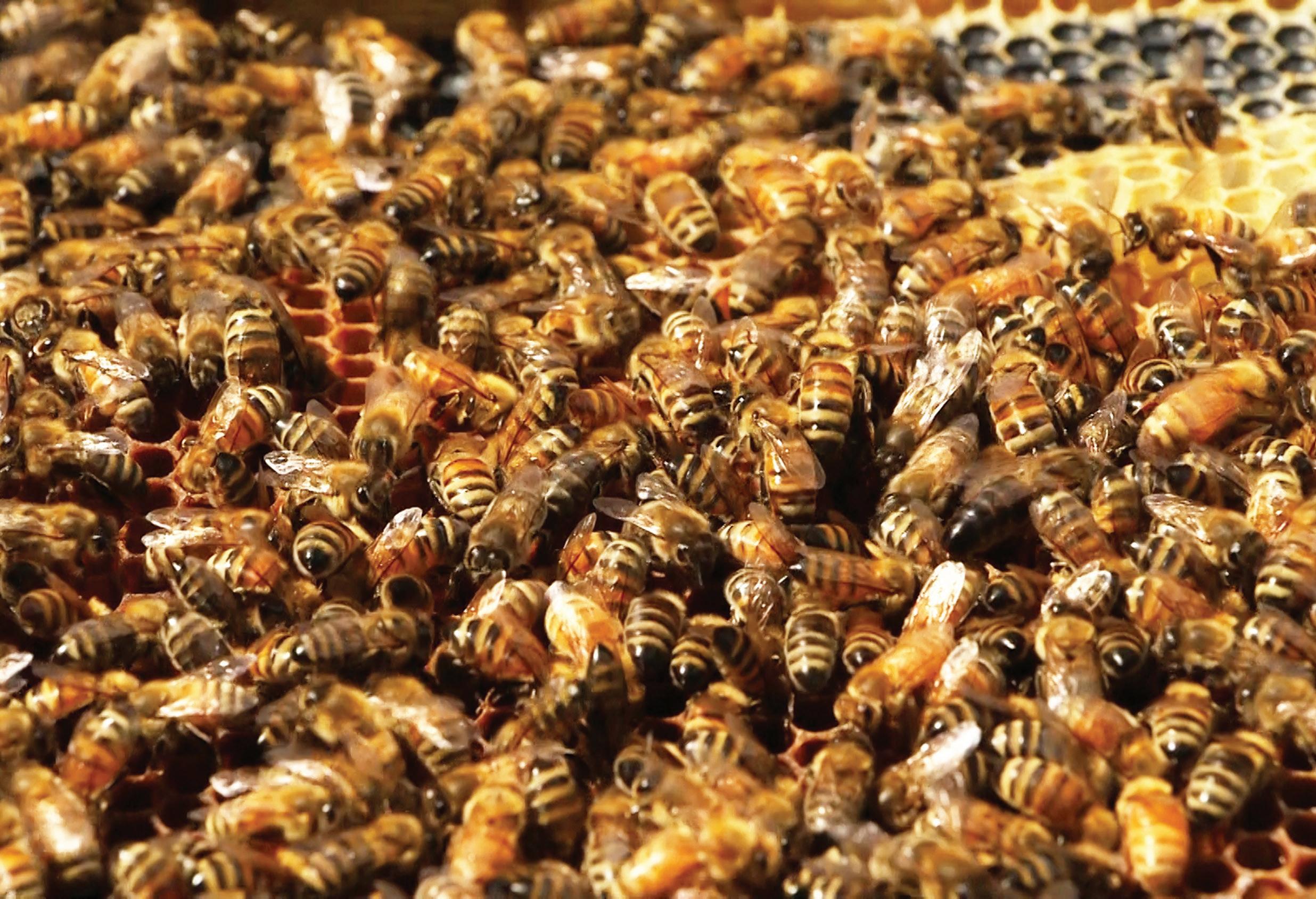
Commercial honey bee colony losses in the U.S. could reach 60% to 70% in 2025, according to entomologists at Washington State University. Over the past decade, annual losses have typically ranged between 40% and 50%.
While it’s too early in the season to know exactly why colony losses are higher this year, Priya Chakrabarti Basu, an assistant professor of pollinator health and apiculture at WSU, suspects a combination
of stressors including nutrition deficiencies, mite infestations, viral diseases, and possible pesticide exposure during the previous pollinating season.
“Losses have been increasing steadily,” Basu said. “Pollination demands haven’t gone down, so beekeepers face tremendous pressure to keep the same number of colonies to meet those needs.”
Basu joined WSU this winter after working at other institutions around the country. She hopes to partner with beekeepers on developing more sustainable practices to help reduce losses and create databases to better understand how bee nutrition works.
She is one of several WSU scientists who are leading or collaborating in programs that help improve the standing of honey bees across the country, both through applied science and new research that may help beekeepers.
For example, Brandon Hopkins, WSU’s P.F. Thurber Endowed Distinguished Professor of Pollinator Ecology, is involved with varroa mite control, commercial management practices, and new research on bee nutrition that he hopes will help beekeepers have better access to healthy food for their colonies.
He explains that varroa destructor
BY
mites feed on pupae in the hive, often killing them and reducing the numbers of future generations. The mites also transmit viral diseases and feed on adult honey bees, weakening them and increasing their susceptibility to diseases.
One upside is that beekeepers likely aren’t surprised by the losses.
“I’ve heard since last August that this was going to be a terrible year,” Hopkins said. “That seems to have come true.”
Fruit growers may be directly impacted, he said. California almonds are the biggest crop for honey bee pollination, which happens in February
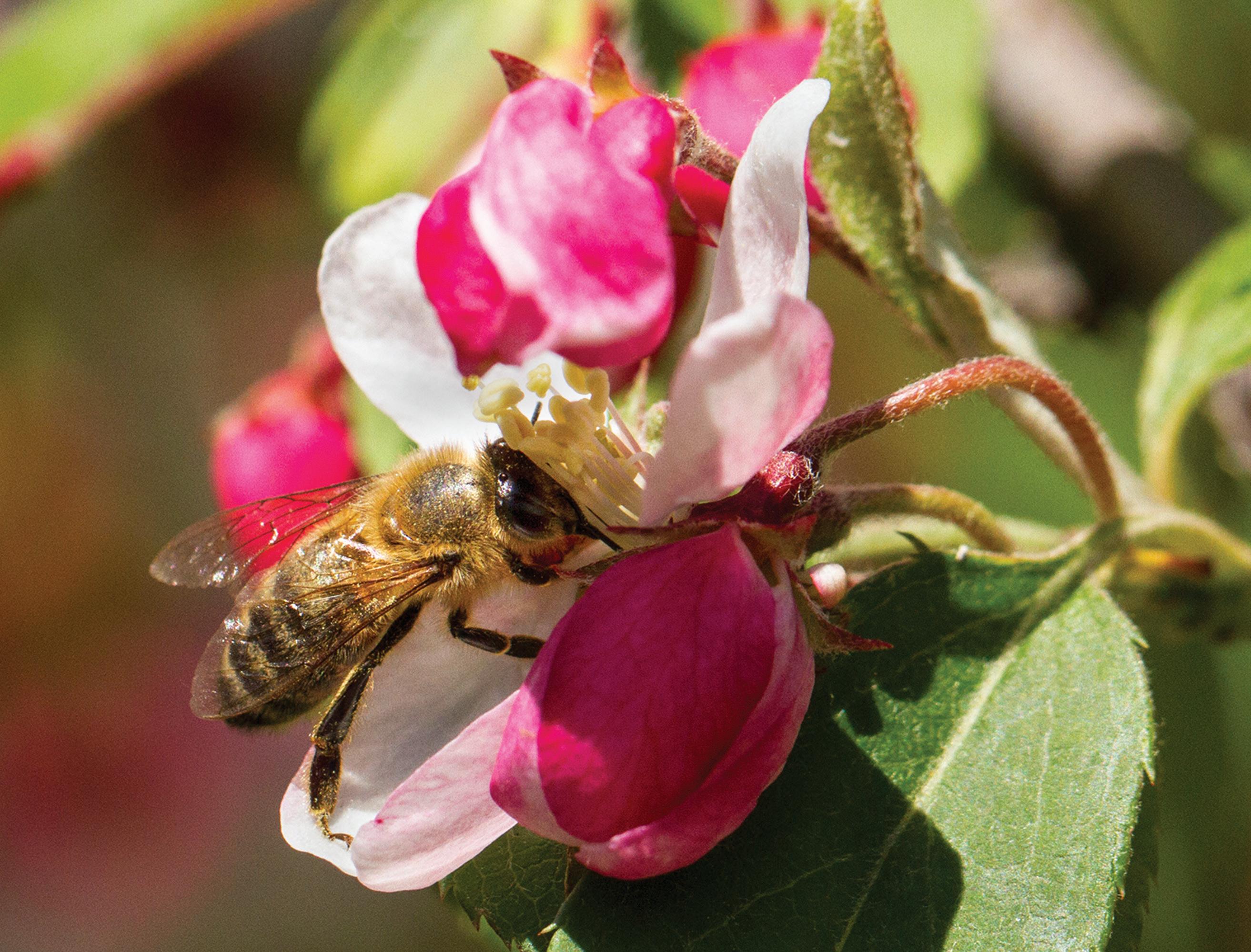
and March. Almonds are the seeds of almond trees and not nuts.
“The almond industry frequently asks for strong colonies,” Hopkins said. “But this year, growers are desperate. Anything with live bees in a box is in demand because the industry is short on supply. I haven’t heard of that since the early days of colony collapse around 2008.”
Finding methods to sustainably keep bees alive will be key, Basu said. About
35% of the world’s food depends on pollinators, according to the USDA National Institute of Food and Agriculture.
“If we see increasing colony losses, we could see a drop-off in honey production and an increase in the rent growers pay beekeepers to bring pollinators in,” Basu said. “We may just see some beekeepers cease operations completely because it’s too expensive to continue as a business.”
Honey bees had a production value of nearly $350 million in 2023, according to the USDA. Fewer bees mean higher costs for farmers who depend on them and increased hassle in making sure growers have bees when they’re needed.
“I don’t want to be a fearmonger, but this level of national loss could mean increased bankruptcies amongst beekeepers,” Hopkins said. “Growers of crops downstream from almonds may need to scramble if the beekeeper
they’ve relied on to pollinate their apple trees, for example, isn’t in business anymore.”
The WSU Bee Program works with beekeepers, stakeholders, industry partners, and collaborating researchers to better understand the impact of stressors on bees and help mitigate them. The bee team invites beekeepers and anyone concerned with pollinator health to learn more, participate in citizen science research, and help support the program.
BY QUESTEN INGRAHM Yakima Herald-Republic
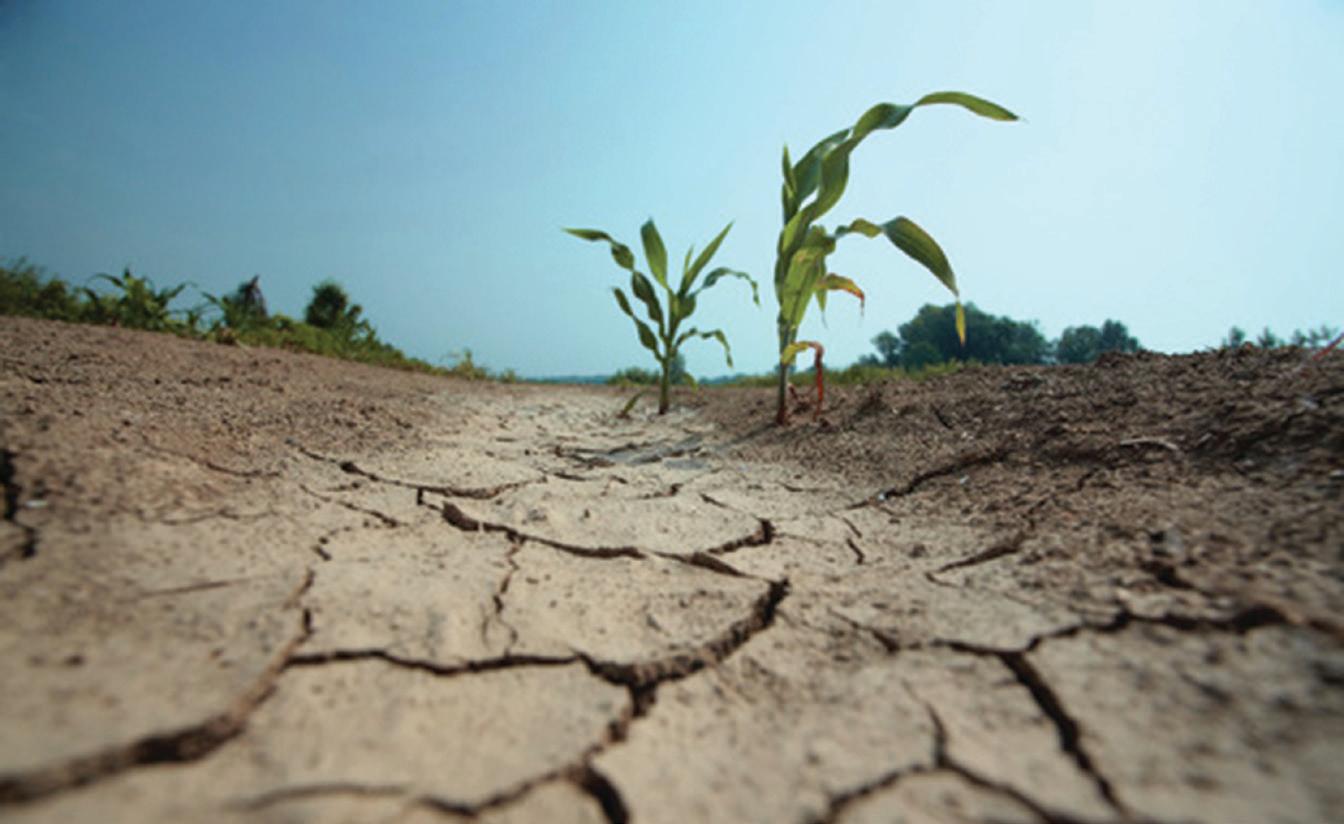
The state has extended a drought emergency for the third year in a row in the Yakima River Basin.
The drought declaration, which began in 2023, covers the Upper Yakima, Lower Yakima and Naches watersheds. Kittitas and Yakima counties and part of Benton County are part of the drought emergency.
Seven other counties are in a drought advisory status, including Okanogan and Chelan counties and Pierce, King, Snohomish, Skagit and Whatcom on the west side of the state, according to the Washington Department of Ecology.
Although snowpack has improved in the Yakima Valley, there won’t be enough spring runoff to replenish reservoirs and soil after two back-to-back years of drought, state officials said.
During a news conference in Seattle on Tuesday, Department of Ecology Director Casey Sixkiller said six of the last 10 years have seen a drought declaration for some part of the state.
“This is the new normal: More rain, less snowpack, earlier springs, hotter, drier summers, and increasing odds that snow droughts will happen 4 out every 10 years,” he said. “This isn’t a future threat; it’s happening right now.”
Sixkiller said the state wants to shift from treating drought as an emergency response “to something we plan for and build around.”
Droughts involve multiple factors, said Karin Bumbaco, deputy state climatologist. It’s not just about lack of rain, but also the timing of the rain, snowpack levels and the timing of snowmelt.
“There are many ways to make a drought,” she said.
This year, a lack of precipitation in the central and northern Cascades
resulted in below-normal snowpack. The Upper Yakima Basin is at 75% median snowpack, and even though the Lower Yakima and Naches watersheds are at near-normal snowpack, it hasn’t been enough to make up for deficits the past two years, she said.
The Upper Yakima Basin has a longterm precipitation deficit of 33 inches, she said. The five reservoirs that feed the Yakima River — Keechelus, Kachess, Cle Elum, Bumping and Rimrock — are at 59% of normal, the fifth-lowest levels since 1971.
Climate change has lowered snowpack levels across the state, Bumbaco said. There has been a 25% decrease in snowpack since the 1950s, and there could be a further 50% decline by the end of the century, she said.
A third year of drought could have enormous consequences for the $4.5 billion agriculture economy in the region, which grows 71% of the nation’s hops, 63% of its apples and 62% of its cherries.
The U.S. Bureau of Reclamation estimates this year’s water supply for junior water rights holders in the Yakima Basin will be 58%, affecting irrigators in the Roza Irrigation District and Kittitas Reclamation District.
A drought that results in 70% of normal water supply could impact up to 6,000 jobs and result in up to $424 million in direct losses, according to the Department of Agriculture.
Drought is declared in Washington when less than 75% of normal water supply is available and there is risk of “undue hardship” to water users or the environment.
The declaration will open up $4.5 million in drought emergency response grants for public utilities like irrigation districts. Caroline Mellor, statewide drought lead for Ecology, said it’s $1.5 million more than usually provided because of leftover one-time funding in
2023.
Mellor said that Ecology can give out $3 million in the grants per fiscal year when there is a drought declared. The regular emergency funding is important, but Ecology still has a need for funding for drought preparedness and resilience, she said.
POTENTIAL
FEDERAL IMPACTS
TO WASHINGTON RESPONSE
Trump administration funding cuts and pauses, and job terminations could impact the state’s ability to respond the drought.
Sixkiller said the state needs “stability and commitment” from its federal partners. Drought response requires partnerships with the National Oceanic and Atmospheric Administration and the Bureau of Reclamation.
Bumbaco said that the state relies on federal government for its data, including on temperature, precipitation, stream flow, soil moisture and snowpack. The data is used for forecasting drought, determining impacts and determining water availability.
“Without accurate data, we can’t reliably forecast supplies,” Sixkiller said. Federal funding is also essential for
projects like water storage, he said.
Sixkiller said Gov. Bob Ferguson is committed to making the state more drought- and climate-resilient.
WILDFIRE RISK
With drought comes increased wildfire risk.
Matt Dehr, wildland and fire meteorologist for the state Department of Natural Resources, said that prescribed burning has been an effective method for reducing fire risk across the state, and the agency wants to increase its use.
“One thing that a little less precipitation in the winter gives us is that opportunity to do more prescribed burns,” Dehr said.
The low reservoir storage levels are indicators that forests could be stressed from lack of water, he said. Forests stressed from drought, disease and overcrowding are more susceptible to fires.
DNR has shored up its aerial support with a fleet of drones that can map heat and start burns in areas unreachable by firefighters, he said.
This article was first published by the Yakima Herald-Republic through the Murrow News Fellow program, managed by Washington State University.

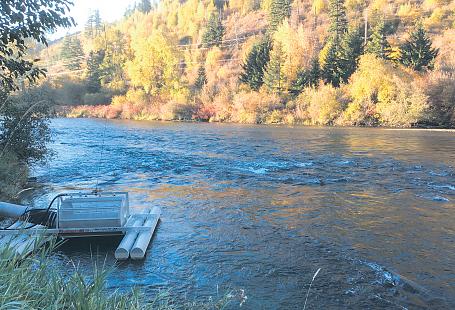
VSPisanon-regulatory,incentive-based approachtoprotectingcriticalareason agriculturallands,whilemaintainingagricultural viability.
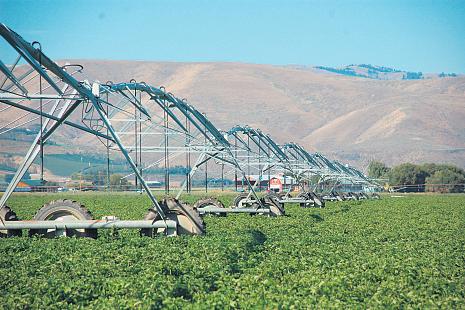
CriticalProtectionAreas:
•Wetlands
•FrequentlyFloodedAreas
•CriticalAquiferRechargeAreas
•GeologicallyHazardousAreas
•FishandWildlifehabitatconservationareas
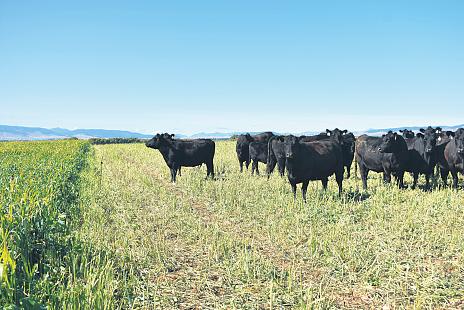
HowtoGetInvolved:
•ShareStewardshippracticesimplementedonyourland withtheVSPCoordinator
•Evaluateadditionalconservationopportunitieson yourland
•Implementstewardshippracticesthatfityouroperation
VSPCoordinator:AnnaLael – 509-925-3352ext.7,anna.lael@kccd.net
Workingtogether,farmersandrancherscandemonstratethatcurrentlandstewardshipprovidesbothprotectionand enhancementofcriticalareaswithouttheneedforadditionalregulatorycontrols.ContactKCCDforinformationabout availabletechnicalandfinancialassistance(funding)forstewardshippracticeimplementation.
RegularBoardMeetings
2ndThursdayEveryMonth (7AMApr-Oct;1PMNov-March)
BoardofSupervisors:
•MarkMoore•LynnBrown•JeffBrunson
•BillBoyum•MattEslinger
ToLearnMoreaboutKCCDandourPrograms, VisitUsIn-PersonorOnlinewww.kccd.net
AnnaLael–DistrictManager 2211WDolarwayRoadSuite4,Ellensburg,WA98926 509-925-3352Ext7