The Role of PPE in Construction Apprenticeship and Workforce Training
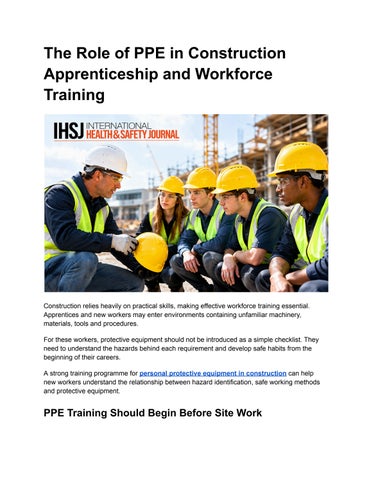
Construction relies heavily on practical skills, making effective workforce training essential. Apprentices and new workers may enter environments containing unfamiliar machinery, materials, tools and procedures. For these workers, protective equipment should not be introduced as a simple checklist. They need to understand the hazards behind each requirement and develop safe habits from the beginning of their careers. A strong training programme for personal protective equipment in construction can help new workers understand the relationship between hazard identification, safe working methods and protective equipment.
PPE Training Should Begin Before Site Work
Workers should receive appropriate safety information before being exposed to construction hazards. An induction can introduce: ● ● ● ● ● ● ● ●
Site rules Emergency arrangements Restricted areas Required PPE Reporting procedures Common hazards Equipment inspection Behavioural expectations
The induction should be followed by task-specific training.
Explain the Reason Behind Each Requirement Simply telling an apprentice to wear safety glasses may not create lasting understanding. Training becomes more effective when workers learn what the glasses protect against and how an injury could occur. For example, cutting materials may generate particles that can enter the eye at considerable speed. Understanding the mechanism of injury helps workers appreciate why eye protection is required.
Demonstrate Correct Use Training should include practical demonstrations. Workers can learn how to: ● ● ● ● ● ● ●
Adjust helmets Fit hearing protection Put on gloves correctly Inspect safety footwear Clean eye protection Store equipment Identify damage
Practical learning is especially important for equipment that depends on correct fit.
Respiratory Protection Requires Additional Attention
Dust is common across many construction activities. Cutting, drilling, grinding and demolition can generate airborne particles. Where respiratory protective equipment is required, workers need appropriate instruction on fitting, limitations and maintenance. Face coverings designed for general hygiene should not automatically be treated as substitutes for properly selected respiratory protective equipment.
Hearing Protection Noise exposure can occur around heavy machinery, power tools and construction vehicles. Workers should understand that hearing damage can develop gradually and may not produce immediate symptoms. Training should explain noise-control measures and the appropriate use of hearing protection. Where possible, employers should prioritise quieter equipment, isolation and engineering controls before relying solely on PPE.
New Workers Need Supervision Training should not end after induction. Apprentices and inexperienced workers may require additional supervision while they learn how to recognise hazards. Supervisors can observe whether PPE is being worn correctly and whether workers understand when requirements change between tasks. Positive intervention is often more effective than waiting for an incident to occur.
Training Should Include PPE Limitations Protective equipment has limitations. Workers need to understand that PPE does not eliminate the underlying hazard. For example, wearing gloves does not make unsafe machinery safe. Safety footwear does not eliminate the risk of falling materials. Eye protection does not remove the need for guarding. This distinction is important because overconfidence in PPE can lead to unsafe decisions.
Encourage Questions New workers may hesitate to challenge instructions or admit that they do not understand equipment requirements. A positive safety culture should make it acceptable to ask questions. Supervisors can encourage workers to raise concerns about equipment fit, discomfort or unclear procedures. The International Health and Safety Journal is a valuable industry resource for professionals interested in workplace safety, risk management and developing stronger safety practices.
Include PPE in Toolbox Talks Short toolbox talks can reinforce important lessons. A supervisor might discuss: ● ● ● ● ● ● ●
Seasonal PPE requirements Equipment inspection Hand protection Dust exposure Hearing protection Eye injuries PPE storage
Regular discussions keep safety visible without relying entirely on annual training sessions.
Assess Competence Organisations should consider whether workers can demonstrate the required skills rather than simply recording that training was completed. A competency check might involve asking a worker to inspect equipment, identify defects and demonstrate correct fitting. This provides stronger evidence that training has been understood.
Learn From Incidents When an incident occurs, PPE should form part of the investigation, but investigators should avoid automatically blaming workers.
Questions should include: ● ● ● ● ● ●
Was the correct equipment provided? Was it suitable for the hazard? Was training adequate? Was the equipment maintained? Were engineering controls available? Were workers under pressure to work unsafely?
This approach can identify system-level improvements.
Refresh Training as Work Changes Construction projects evolve continuously. New workers may move between activities, new machinery may arrive and hazards may change. Training should therefore be refreshed whenever significant changes occur. A mature safety culture treats personal protective equipment in construction as an ongoing competency rather than a one-time induction requirement. When workers understand why equipment is necessary, how to use it and what its limitations are, PPE becomes part of informed decision-making rather than simply another site rule.