Actively investigating and supporting the wide-format print sector
ISSUE 3 • VOLUME 29 • JUNE / JULY 2021
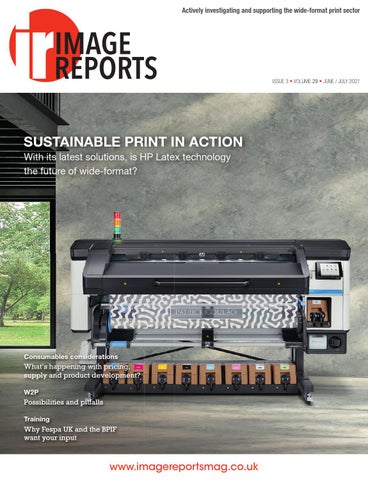
SUSTAINABLE PRINT IN ACTION With its latest solutions, is HP Latex technology the future of wide-format?
Consumables considerations What’s happening with pricing, VXSSO\}DQG SURGXFW}GHYHORSPHQW" W2P 3RVVLELOLWLHV DQG SLWIDOOV Training :K\ )HVSD 8. DQG WKH %3,) ZDQW \RXU LQSXW
www.imagereportsmag.co.uk
Editorial
SO MANY QUESTIONS Editor: Lesley Simpson lesley.simpson@imagereportsmag.co.uk
As online product ordering continues apace, should the largeformat print sector be doing more to embrace W2P? Are you
Production / Design: Alex Gold
going to be able to claw back from your customers what looks
Publisher: Wayne Darroch wayned@sjpbusinessmedia.com
like imminent consumables price hikes? Net zero - what does it mean for this sector? To what extent do we need to educate
Advertising Manager: Carl Archer carl.archer@imagereportsmag.co.uk Tel: 07723 079928
those outside print about careers within it? These are all weighty questions - and ones we pose in this issue. As you may guess, not all are clearly answered, but conversations are being had,
SJP Business Media, 2nd Floor, 123 Cannon Street, London, EC4N 5AU www.imagereportsmag.co.uk
and that’s something in itself. Through lockdown we’ve certainly learned the value of contact. Talking therapy is a useful tool in all sorts of settings, including business, so stimulating debate
For circulation enquiries contact: SJP Business Media Email: subscriptions@imagereportsmag.co.uk
seems a sensible thing to do amid continuing uncertainty.
Image Reports is available free to printers based in the UK. Register at www.imagereportsmag.co.uk/register.
At the time of going to press, the Government’s roadmap to fully easing lockdown restrictions is still on track - by the time you read this that may have changed, but whatever the situation we
To purchase a subscription please visit www.imagereportsmag.co.uk/subscribe – UK £54, overseas £84
QHHG WR PRYH RQ DQG WKDW PHDQV JUDSSOLQJ ZLWK VRPH GLτFXOW issues - as individual companies, and as an industry. Training, for
Printed in Great Britain. No part of this publication may be reproduced, stored in a retrieval system or transmitted by any means without the Publisher’s permission. The editorial content does not necessarily reflect the views of the Publisher. The Publisher accepts no responsibility for any errors contained within the publication.
instance, is one such topic, and in Zeitgeist, Fespa UK director Suzie Wilkinson calls on PSPs to feed into a knowledge-building project for long-term gains. In a special technical feature we look at standardised data exchange and holistic networking across the print industry, and the likelihood of that happening by the end of 2021.
+HUHâV KRSLQJ WKLV LVVXH ðQGV \RX UHDG\ WR JHW RQ ZLWK WKH QLWW\ gritty of doing business in whatever the circumstances.
From Top: Lesley Simpson Alex Gold Wayne Darroch Carl Archer
Editor LESLEY SIMPSON LESLEY.SIMPSON@IMAGEREPORTSMAG.CO.UK TEL: 01932 707173
www.imagereportsmag.co.uk | 3
Contents
CONTENTS JUNE / JULY 2021
REGULARS: p6 News Keeping you abreast of all the latest news in relation to digital wide-format print.
27
p8 Cover Story Advertorial HP: Sustainable print in action
p27 Think Bigger Gallery showing off the creativity and complexity of largeformat inkjet print.
p28 Forum Vital stats to help you run your business; Digging below the surface with Industry Mole; Out and About - events diary; Over to You with Ashley Coker from Coker Expo.
p30 Zeitgeist Why Fespa UK and the BPIF want your training input.
SECTIONS: Business p10 Talking Point … with Kelvin Bell of Vpress on the urgency for PSPs to adopt ecommerce.
Technical p12 What to Watch Consumables: pricing, supply, and product development
p18 What to Watch W2P: possibilities and pitfalls
24
p21 Mission: Control How Zaikio hopes connect the whole printing industry through a new holistic platform by the end of 2021.
Environment NEWS AND VIEWS ONLINE Go to www.imagereportsmag.co.uk for all the wideformat sector’s industry news, updated regularly
p23 Zero ambition Any net zero plans at your end?
online. Image Reports can also send a twice weekly
p24 Educate and activate
enews bulletin straight to your inbox – register at:
Claire White looks at print sector participation in sustainable programmes.
www.imagereportsmag.co.uk/ newsletter
www.imagereportsmag.co.uk | 5
News
YPP partners for new online operation Lincoln-based YPP Group has partnered with global artists collaboration PD Moreno to create a new ecommerce operation. Under the deal, YPP has exclusive rights to manufacture and distribute a range of products within the UK from the new pdmoreno.co.uk website. The new business - which will initially offer travel, homeware and leisure products - is expected to create five to ten jobs for local people. Stuart Maclaren, YPP Group CEO, said: “I am proud to have been able to create jobs in the current climate. Our new partnership with PD Moreno will allow us to recruit both in the office and in our production warehouse.” Peter D, one half of the artist collaboration PD Moreno said: “YPP Group’s expertise and passion have really made me confident about this longterm partnership.” YPP - which includes Your Print Partner, customgifts.co.uk and santasacks.com - has continued to grow despite having a core market that disappeared in 2020, and for the first time revenue has passed £6m.
GO TO WWW.IMAGEREPORTSMAG.CO.UK FOR THE FULL STORY… ] Double-digit price hike for Fuji inks ] Durst introduces P5 Tex iSub ] Precision Proco takes on chief technology officer ] Mitsubishi increases specialty paper prices by up to 10% ] Sign Up Systems targets acoustic decor markets ] Prodigi installs Impala 3 as part of £1m expansion plan ] Printing industry receives approval of Level 2 Print Operative Standard ] Impact Retail makes world first with Onset X1 HS ] PCM sets up UK Signs on back of Jetrix LXi7 investment ] Agfa extends co-operation with Global Graphics ] Northern Flags/FaberExposize UK get public recognition ] Matic launches Cronos 4.0 sewing system ] Global Graphics joins OPC foundation
Canon announces Colorado 1630 Canon has brought out a 64in-wide Colorado UVgel printer. The new, modular, Colorado 1630 has a maximum print speed of 111m2/hr, and in highquality mode has a cruising speed of 29m2/hr. The roll-to-roll printer delivers 1,800dpi print quality and uses Canon’s UVgel 460 inks for odourless and instantly dry prints on almost any media. It can be configured according to needs by adding options such as a second media roll, and easy double-sided printing. An optional FLXfinish module uses a LED curing technique designed to add visual impact to applications such as banners, wall coverings and POS materials without the need to change inks or media. This
technology also supports printing on porous substrates, such as uncoated papers and soft signage materials. There is on-the-fly ink replenishment that, combined with automation features such as nozzle monitoring, printhead maintenance and media feed winding, cuts machine downtime. Also, Canon’s Remote Control app is now available to monitor all Colorado printers. This will allow users to check the printer status remotely. The app sends alerts to users’ mobile devices with printer status updates, warnings and errors. In addition to the 1630, the Colorado product portfolio includes the UVgel Wallpaper Factory as well as the Colorado 1650.
Chroma expands wide-format ops in £3m turnover bid Chroma, a full-service printer located in Theale, near Reading, has moved into flatbed wide-format production with a Yotta Fr2513-R5 printer and Sinajet DK2513 cutter. The move coincides with the company having doubled its floorspace to around 1672m2 via the addition of a second adjacent unit, which now houses an expanding large-format department. Although turnover has slightly reduced during the Covid pandemic, Chroma is expecting to exceed its pre-pandemic turnover with a target of £3m. The Yotta/Sinajet investment comes just three years after Chroma first entered the large-format market with the installation of a Roland roll-fed print-and-cut machine, which was followed by another in 2020. All the kit has been purchased via SOS (Service Offset Supplies). Operations director Justin Earl said: “These machines have been a big success for us. Much of our work has required us to mount vinyl to materials such as graphic boards, foam PVC or aluminium composite - so with an increasing workload it made sense for us to look at direct-to-media printing which would allow us to cut out the mounting stage. We were also increasingly being asked to produce work that could only be done on a flatbed machine and
we were keen to bring this in-house.” The Yotta machine is not well-known in the UK, but Earl believes this is set to change. “It’s a competitively priced entry-level machine, but it seems to be quicker and more capable than the more expensive alternatives in its class.” He added: “We chose the flexible ink option for the machine as we felt this would enable us to offer the broadest range of end products. Another feature we really like is the option to increase capacity in future by adding more printheads. “Although we will mainly be producing rigid signs and point of sale, we are seeing more demand for packaging including high-end, shortrun projects, which is why we also included spot varnish in the spec. One of the really exciting things is that this machine will allow us to print on almost anything - wood, leather, plastic, glass, PVC, MDF, metal and more. We are even planning to print on table tops.” The Sinajet cutter installed alongside the Yotta has also impressed the Chroma team. “We produced all the signage for the cafes at Kew Gardens, direct to board, which we were able to turn around really quickly. We could not have done that without the new machines,” added Earl.
] Kernow Coatings introduces new KernowJet RoadShark ] Registration open for rescheduled Fespa 2021 ] One in four SMEs worried they won’t survive the year ] YPS appoints new management team ] Milestone for swissQprint Nyala ] Spandex adds to its offering ] Virtual factory tours offered to print SMEs ] SAi upgrades EnRoute 7 ] CMYUK selling Epson SC-F Series dye sub printers ] VGL takes Durst Rhotex 325 ] HP offers DesignJet subscription payment plan ] ITC adds to Di-Bond folding tool range ] William Smith extends stockholding ] SDEA launches Design and Display App ] Mondi starts European delivery of new sustainable containerboard
6 | June / July 2021
HP updates the Stitch S1000 HP has updated its 3.2m-wide HP Stitch S1000 dye-sub printer for the soft signage and interior décor markets. The new machine runs at up to 220m2/hr, with the possibility of doubling throughput on substrates of up to 1.6m wide via a dual roll accessory. 10l bulk ink tanks, spreader rollers and the ability to handle rolls up to 300kg improve its unattended printing capabilities. A Smart Nozzle Compensation system and Optical Media Advance Sensor Plus work together to ensure reliable image quality while operating at pace. There is a newly incorporated contact heater said to offer enhanced backlit saturation
performance on direct-to-fabric jobs. There is also an integrated aerosol and vapor extraction system. Combined with the HP PrintOS app, print operations can be controlled anywhere, anytime, whilst also allowing PSPs to make data-driven decisions. If working with a fleet, the HP Configuration Center ensures jobs are distributed efficiently. The updated HP Stitch S1000 uses Eco Passport certified dye-sub inks. The device also benefits from HP’s free printhead recycling scheme, via the HP Planet Partners initiative. Meanwhile, the outer carton of a S1000 ink cartridge is made from cardboard and can be recycled locally.
News
Paragon invites SMEs to apply for training funding Paragon Customer Communications (PCC) is transferring a portion of its annual Apprenticeship Levy funds to support small and medium-sized enterprises (SMEs) across the UK. As part of its Ignite apprenticeship scheme, PCC has made the funds available to provide valuable recruitment opportunities to businesses that otherwise may not have been able to benefit from the Government-backed levy. PCC’s fund will see money distributed to SME’s to pay for apprenticeship training and assessments for new/existing staff. Companies meeting the criteria outlined by the Government can apply to Paragon at: https://www.paragon-cc.com/en-gb/ inspiration/apply-apprenticeship-levy-funds-transfer This latest commitment from PCC comes on the back of its apprenticeship programme, Ignite, which focuses on developing skills in print, digital marketing, warehouse management, print finishing and engineering.
Epson expands its 76in dye-sub printer range Epson has built upon the 76in-wide textile printer range it introduced last year with the SC-F10000H. The newcomer can print at up to 245m2/hr and comes in two configurations - CMYK with fluorescent pink and fluorescent yellow ink, and CMYK with light cyan and light magenta inks. SC-F10000H features include: six PrecisionCore Micro TFPprintheads; Epson Precision Dot Technology; easy media setting (media loading lever front and back); auto-adjustment technology, including an integrated RGB camera; dryer; auto tension control (Ad-ATC); bulk ink system (with 10l or three-litre ink boxes supported by ‘hot-swap’ function); operator-replaceable parts; LCD highly-intuitive touch panel; EMX profile support. The new printer will be available in the UK from July.
ImageData in UK first with Onset X3 HS Dual Flex ImageData has confirmed it has installed the UK’s first Onset X3 HS Dual Flex from Fujifilm, with production director Pete Shaw calling it “a game changer” as it opens up new markets for the company. The East Yorkshire-based PSP cited automation and capacity levels as key reasons for investment in the machine, which was installed in January 2021. ImageData, which has 167 staff across three integrated production sites in the UK and an annual turnover of £20m, already owns two Onset X3 presses. Shaw said: “The Onset X3 presses have been essential to our business, with the exceptionally high quality print and high speeds they offer. Now with
the Onset X3 HS Dual Flex, our production speeds have increased threefold. The ‘High 5’ mode uses dual robots, so it can pick up the substrate, put it on the bed for printing, then pick it up and turn it over, and replace on the bed ready to print the reverse side - no human intervention is required, unlike our other machines where operators are required to flip substrates over.” Commercial director Glen Patrick added: “Another benefit is the Onset’s ability to print white ink. It works really well on clear, rigid substrates such as acrylic - something we have not been able to print onto before - so the new machine will help us to enter new markets.
Mimaki introduces three new LFPs Mimaki has three new wide-format printers the LED-UV JFX600-2513 and JFX550-2513, and the SUJV-160, developed to reproduce prints whilst retaining the look and texture of natural and artificial leather. The SUJV-160 - a solvent UV inkjet printer with a print width of 161cm - uses SU200 thin film solvent UV ink (developed by Fujifilm and exclusively sold by Mimaki), which provides stretch ability and scratch resistance on natural and artificial leather, resulting in the retention of texture and feel of the material after printing - and the ability to boost productivity by instantly switching to postprocessing without any drying time. The leather printer is available from the summer. The new JFX600-2513 and the JFX550-2513 will be available soon after. Building on the JFX500-2131 large-format UV inkjet printer, the JFX600-2513 can reach speeds of more than 300% faster than its
predecessor, while the JFX550-2513 over 150% faster. Available in a 6-colour configuration, they encompass Mimaki’s seventh-generation UV print technology. With a maximum printing area of 2.5m x 1.3m and a thickness of 6cm, both the JFX600-2513 and the JFX550-2513 are compatible with standard size signboard production, and their direct-to-substrate capabilities also allow for printing on resin, wood, glass, and metal. Both printers are also capable of multi-layered printing. The UV inks developed in-house for the JFX600-2513 and JFX550-2513 have been certified as Greenguard Gold. The models support Mimaki’s ‘MDL command’, allowing operators to control machines from external devices resulting in both JFX machines complying with Industry 4.0 requirements, making it possible to integrate them into an automated workflow.
New automation options for Onset X HS range New automation has been added to Fujifilm/ Inca Digital’s Onset X HS large-format series printers to improve productivity. There are now four automation options for the Onset X HS range - a three-quarter semiautomatic system, a fully automatic material loading system, a fully automatic handling system for unconditioned corrugated board, and a fully automatic handling system with integrated flexible loading. The three-quarter automation system allows for single sheet, multiple sheets or doublesided print in registration. The operator loads sheets onto a preload table and the system takes over the rest, stacking it on a pallet
for removal of the printed media. The system allows the operator direct access to the bed and registration points for quick switch between manual and semi-automatic work. The fully automatic material loading system is designed to handle conditioned and dimensionally stable sheets and works in conjunction with the three-quarter handling unit to provide full automation. The loader can be moved away from the machine to allow access to the print bed. The corrugated board solution incorporates a fully automatic handling system, designed to handle difficult materials. There is vacuum-tovacuum transfer from the robotic arm pickup to
placement on the print bed and stacking of the printed board. Dual Flex is the fully automatic solution with integrated flexible loading that enables printers to transition between lay table loading and dual robot automation. This solution provides full capability to load and unload flexible, semi-rigid and rigid sheets with a seamless switch from one operation to the other. In full automation mode, the dual robots also offer an optional ‘flip to print’ mode ‘High 5’ robotics - for front to back, double sided print requirements without manual intervention.
www.imagereportsmag.co.uk | 7
Cover Story
SUSTAINABLE PRINT IN ACTION
;OL /7 9 VɈLYZ WYVK\J[PVUZ ZWLLKZ VM \W [V ZX T OY MVY V\[KVVY HWWSPJH[PVUZ HUK ZX T OY MVY PUKVVY ^VYR
With its latest solutions, is HP Latex technology the future of wide-format? INTRODUCTION Highly durable water-based inks, superior environmental credentials, brilliant white ink print capability, the highest quality output and unprecedented speed. Has HP now won at wide-format? With the launch of its latest Latex printers, HP has cemented its position at the very top of the wide-format league table. With so many important boxes ticked by HP Latex, for many print service providers (PSPs) it is becoming increasingly harder to look beyond HP print solutions. GREEN MACHINES Sustainable production should be a core aim for PSPs of all shapes and sizes as customer demand for more environmentally friendly printed work continues to increase at a rapid rate. This ongoing trend has not gone unnoticed by leading printer manufacturers, which have responded by launching new technologies capable of making a PSP’s production setup significantly more sustainable. This is particularly true of HP, which has been something of a leading innovator in terms of developing environmentally friendly kit, specifically within its HP Latex range. While latex technology has been around for a number of years, the rising demand for greener printed work has seen the uptake in this type of machinery rocket in recent times. GROWING YOUR BUSINESS IN A SUSTAINABLE MANNER Investing in cleaner and greener printing technology can help PSPs win new business. HP Latex printers and water-based HP Latex inks have transformed PSPs around the globe, both in terms of what they can offer to customers and their workspaces. Latex ink is 70% water and makes print rooms a much more pleasant space to work, helping you save on additional costs related to special ventilation such as air filtration systems.
8 | June / July 2021
In terms of specific environmental benefits, HP’s newest Latex inks do not have any hazard labels – unlike UV, UV gel, solvent and eco-solvent ink products – offering huge environmental benefits to all users. HP Latex ink cartridges also contain nearly 40% recycled plastic, while the printheads and ink cartridges on the machines are recyclable via the free HP Planet Partners programme. In addition, the HP Large-Format Media TakeBack programme is offered free-of-charge for substrate recycling. All of these features join together to offer significant environmental benefits to the user, which can then be communicated down to the customer, satisfying their own demand for greener printed work. EVOLVING PORTFOLIO OF EFFECTIVE SOLUTIONS Looking at specific machinery in the HP Latex range, the selection is expansive and far-reaching, with hardware solutions for budgets of all sizes capable of taking on all sorts of applications. Among the latest additions to the range are the HP Latex 700 and 800 Series large-format machines, as well as the HP Latex R Printer Series 2020 Edition solutions. Launched in February this year, the HP Latex 700 and 800 Series 1.6m roll to roll devices offer a suite of features that enable PSPs to be more agile, tackle ambitious projects and, perhaps most importantly, become more sustainable. The range consists of four devices – the HP Latex 700 and 800, and the HP Latex 700W and 800W, which offer white ink capability for the first time in this category. All four printers in the new range use the HP Eco Carton – a cartridge made with cardboard material, reducing the amount of plastic used by 80%. HP’s water-based inks are also kinder to the environment and offer further green benefits to the user. Throw in the fact that all of the HP Latex 700 and 800 Series printers feature printheads possessing 50% more nozzles, an updated architecture and production speeds of up to 36sq m/hr, offering significantly higher
Cover Story
productivity levels compared to previous HP models, and you have a number of extremely efficient options. Turning to the HP Latex R Printer Series 2020 Edition hybrid printers that launched last year and the machines in the latest edition of the series offer improved productivity performance and access to new applications like shortrun special packaging or printed thermoforming. Featuring the HP Latex R1000, HP Latex R1000 Plus 1.6m-wide and HP Latex R2000 Plus 2.5m-wide printer models, the updated range offers endto-end sustainability, with all three of the machines running water-based inks with recyclable HP ink cartridges, offering users a number of simple yet highly effective environmental features. The three devices also have odourless printing capability, allowing users to reach many more indoor spaces – enhancing their sustainable image and opening up their business to more customers as a result. Additionally, the quick-drying latex inks mean there is zero wait time from printing to lamination and installation. The HP Latex R2000 Plus machine can run at speeds of up to 86sq m/ hr in outdoor applications and 43sq m/hr for indoor work, while both the HP Latex R1000 and HP Latex R1000 Plus Series have a maximum speed of 56sq m/hr for outdoor work and 28sq m/hr in indoor mode. SUSTAINABLE PRINT IN ACTION It is clear that HP can certainly talk the sustainable talk, but can it walk the green walk when it comes to putting the technology into action and its customers achieving quality results in their printed work? Step forward Leeds-based wide-format printing and signage company Imageco, which was one of the first businesses in the UK to purchase a new HP Latex 800W Printer, installing the machine earlier this year. As Imageco works across a number of sectors with a wide range of customers, Managing Director Nathan Swinson-Bullough said it was vital that any new printing device was flexible and able to handle various types of work, as well as fit in with the company’s green ethos. “The list of what we can produce on the HP Latex 800W is almost endless; we love to push ourselves and will get as creative as possible with the new machine,” Swinson-Bullough said.
“We pride ourselves on many things at Imageco: our creativity, our level of service and our sustainable edge. The HP Latex 800W ticks all those boxes, it looks great and will be a huge asset for us, fitting perfectly with our plans to be as innovative yet sustainable as possible.” COLLABORATING ONE TREND WITH ANOTHER Investing in environmentally friendly print kit can also help open the doors to new work for your company – something that will be critical for PSPs in 2021 and beyond as the industry continues its recovery from the pandemic. The interior décor market is one area that has seen a huge amount of growth in recent years and continues to do so, despite the impact of Covid-19. However, producing work for this area brings with it a number of environment-related challenges in that only certain types of print can be used for décor in specific environments. The water-based formulation of HP Latex ink has achieved GREENGUARD GOLD certification, awarded to products that emit lower VOCs than standard GREENGUARD products. This certification was first developed as the Greenguard Children and Schools Certification Program, certifying products for day-care environments, schools, and hospitals. The name has since been changed to GREENGUARD GOLD for a broader appeal, as well as better representing the now more diverse range of customers and applications. HP Latex kit is capable of producing a wide range of products from within the interior décor market, from wallcoverings, wall blinds and canvases, to flooring, textiles and synthetic leather, so investing in this sort of kit allows you to take on this work while becoming more sustainable at the same time. Demand for environmentally friendly printed applications shows no signs of slowing down, so investment in kit that can deliver this work would be the smart step for printers to take – opening your business up to a whole host of markets and reducing your own impact on the environment in the process. For more information on HP and its winning wide-format solutions, please visit https://hp.com/possibility-city and the HP Latex Knowledge Centre at https://hplatexknowledgecenter.com.
( WLYMLJ[ \WNYHKL MVY HU` WYPU[ MHJ[VY` [OL /7 9 ZLYPLZ VWLUZ \W H T\S[P[\KL VM UL^ VWWVY[\UP[PLZ
www.imagereportsmag.co.uk | 9
Business | Talking Point
talks to...
Kelvin Bell, Earlier this year Web-to-print specialist Vpress partnered website developer Making Websites Better (MWB) to bring out e-commerce solution CloudToPrint, promising printers a ROI within days. Sounds miraculous - so I asked Vpress sales director Kelvin Bell to elaborate on this, and on the urgency for printers to adopt ecommerce in general.
10 | June / July 2021
E-commerce has become ‘the thing’ during the Covid pandemic as online sales soar, and you have made the bold claim that printers must move their business online within the next two years “or they will cease to be relevant.” How do you respond to those saying this is just typical talk from a solutions provider? Within this industry over the past 12 months, all of us in senior management have at one time or another pondered on what is next for ourselves, our business and our staff. The level of uncertainly has been the driver, making us look at what we do differently, and even work differently - as have the people who used to come us. There is a ‘new normal’, a phrase hugely overused but still with value and meaning for many of us - our customers don’t go to work or events anymore, so we have to find a better way to engage them. Likewise, they have to find new ways to engage with their own customers and supply chain - cue ‘online’ solutions. Even before the pandemic, there were two things customers desperately wanted from print businesses: procurement on demand, as often they don’t work the same hours we do; and the option to get a price for a job they urgently need, and at their convenience not our own. Let’s look at the business-to-consumer (B2C) and business-to-business (B2B) markets. B2C is fickle and price driven, and one that you can always buy cheaper within. However, if you can add value to your engagement of potential customers and make the user experience a convenient, even a fun one, then you can take great products to a huge market. At the start of the pandemic Amazon employed 100,000 extra employees as it saw what was coming. Online purchasing is growing - that’s widely recognised. You have to ask yourself whether you are going to be part of that buying pattern or not. The B2B market is of course very different, one more based on relationships, brand management and contracts. However, this market is more mature in its online procurement than the B2C market as ERP/CRM [enterprise resource planning/customer relationship management] systems like Ariba, SAP, Oracle have been around for over two decades managing what people purchase. Many UK councils use Oracle for instance. There is always a cost to engage with these systems, but the benefits far outweigh them, and these systems are increasing in market dominance not decreasing.
The pandemic has only accelerated this ‘remote’ engagement of customers and suppliers. So, if we have moved so far online in just 12 months, on a journey that we were already upon, how relevant will a print business be if not online? Large-format PSPs have not been ignoring ecommerce - some have thrown a lot of money at W2P/ecommerce systems over the years for little return. Now, CloudtoPrint has been developed as an off-the-shelf ecommerce solution for print SMEs that will start making them money virtually from the off, and many are incredulous. How do you convince them? Forget so much the budget and concentrate on the strategy of taking your business online - where does a business want to go to grow? If you want a ‘quick win’ it is achievable in B2B, but in B2C it takes time to get established and find the right product, at the right price, for the right market. Ecommerce is a journey not a destination, and to start making moves online you must plan ahead but remain flexible if some things don’t work out. If your business has been online for some time and its not working, then I would say you are the problem, not the market, as you make the decisions. CloudtoPrint is a first step to you getting a return on your online investment. It is an affordable way to tie up existing technologies (Vpress-W2P/WordPress-website/ WooCommerce-ecommerce) for a fixed price with a result supported by MWB. But this is just the start of it, as once you are up and running you need to have someone to drive how it works and how it performs for business. If you have taken your business online by dabbling in your website and throwing money at it only when needed, give up and understand you are an awesome printer but let someone manage your ecommerce for you. CloudtoPrint - up and running - will allow people to pick a product, edit it, order it and have it waiting ready to go on press (optimised) for when you get into the factory, with the money already paid into your account. From a technical point of view, what large-format PSPs can/can’t use it? There must be sticking’ points? Naturally, there are limitations on the kind of products you can offer, and some of these limitations can be
Business | Talking Point
sales director, Vpress around file sizing etc. However, if managed correctly for the right products these can be overcome. Production-wise, there are no known limitations, as the solution can submit jobs into any FTP/SFTP and/ or workflow/MIS, reducing production administration significantly. You can even personalise large-format jobs en mass from a spreadsheet, provided the correct products are selected (pop-up banners, posters etc.). If you don’t have an automated workflow, Vpress provide you with Coreproduction, a job management tool to help get you organised and a pre-cursor to a true workflow or MIS. The marketing materials stress that those buying into CloudtoPrint get a handholding service as part of the deal. How bespoke is that to specific users? As we don’t know what the skill level of any particular PSP is going to be we have to offer this. We certainly don’t expect everyone to a professional ecommerce expert from day one, so we offer some guidance and support both from MWB and the management of the website as well as from Vpress and how to manage/configure your workflow. We even offer one day’s training in how to build templates within the system. Being UK-based, Vpress is always here to offer support and partner with PSPs to help them grow their business online. Our motto is ‘partnering customers to success’, something we have been doing for over 20 years. Do you see specific issues in relation to the large-format digital inkjet sector’s operations and requirements - and how are you dealing with those? I see more issues in ignoring online markets for any PSP at all. There are always technical issues depending upon what people what to achieve, so it needs to be qualified further and while some agencies are seeing this as the printer taking control of the client engagement, this short sightedness can be overcome by working with agencies and print managers and providing them with a proven, working solution into print production, tying them in longer-term and with scalability giving them better pricing in partnership. Truly, I think the biggest issue with PSPs adopting ecommerce is not the technology but the mindset of change. I am guilty of this myself, but once you embrace
the concept of change you obtain the transparency of the benefits coming into your business. Do you have any large-format PSPs using CloudtoPrint yet - and what kind of numbers do you expect to get on board, say, by the end of 2022? Very few, but some who are doing very well. The print industry has generally been slow to adopt online ordering despite its advantages, large-format even slower. There are some rock stars out there, but there are more people moaning about how it would never work for their business or their customers (if I had a penny for that one!). The internet is 50yrs or 37yrs old depending upon your school of thought, and online ordering for print is 25yrs old. In 2019 we only estimated 40% of printers trading online using Web2Print. By the end of 2022 we are expecting that number to be around 60-70% a growth rate of 50-75% in just two years. Print is just one product that people order when they need it, but the term procurement covers off everything and it is this that is, or will be, driving how we engage with print - if it is too complex, or more importantly not there on-demand, then there are hard times ahead. But, if print is easily available, and engaging over other media, then it has a long life to yet! Given the rise and rise on online ordering, do you expect to face many challengers in the CloudtoPrint space, and how do you see that impacting your offering - and its users? The key challenges are the ones we are addressing now - the huge growth of mobile (yes ordering large-format from a mobile device) as Gen Z (tomorrow’s print buyers) skips the use of PCs to continue using mobile devices for ecommerce. Job Submission has been another challenge, not only uploading files from anywhere, but making changes to the parameters (finishing/embellishment) of that job as decided by the customer. With ecommerce, as you overcome one challenge more appear - that is the nature of the technology. Vpress does not use anyone else’s software, which gives us a head start to address challenges as they arise. If anyone has any doubt about how any for of print will be in the future, just look back from where we are now and see how far we have come on other areas!
IF YOUR BUSINESS HAS BEEN ONLINE FOR SOME TIME AND IT’S NOT WORKING, THEN I WOULD SAY YOU ARE THE PROBLEM, NOT THE MARKET.
www.imagereportsmag.co.uk | 11
Technology | What to Watch
CONSUMABLES CONSIDERATIONS COST, SUPPLY, PRODUCT DEVELOPMENT - WHAT’S HAPPENING WHERE, AND WHEN? WE TALKED TO KEY MANUFACTURERS AND SUPPLIERS FOR THEIR TAKE ON THE KEY ISSUES IMPACTING INKJET INKS AND LARGE-FORMAT MEDIA.
In the early spring the European Printing Ink Association (EuPIA) warned that “various pressures” were likely to impact the printing inks market. Soon after, The British Coatings Federation (BCF) warned that raw material availability was highly likely to push up printing inks prices. By the end of April we started to see those hikes happening, with Fujifilm announcing that it would be increasing the price of its inks (and various other print consumables) by a double-digit percentage as of 1 May. Since then, a number of other inks and media manufacturers have either announced or signalled price rises, so is it a given that you’re going to have to pay more your supplies - and will it become more difficult to source them? According to Kevin Jenner, European marketing manager, Fujifilm wide-format inkjet systems: “With the economic impact of the pandemic and as industries come back online, supply chain problems and subsequent cost increases are inevitable. Raw material prices and freight and shipping costs have increased dramatically, and this is forecast to continue.”
Dr Stefan Kappaun, Durst: “Early pre-ordering of ink is strongly encouraged.”
Kevin Jenner, Fujifilm: “We will endeavour to manage price increases as smoothly as possible and limit significant hikes wherever we can.”
12 | June / July 2021
He adds: “To ensure quality and consistency of supply, end-user prices will almost certainly need to be reviewed. The details of any required price increases are still being considered, but a safe assumption is that these will be across the board and will need to be monitored on an ongoing basis as the situation develops. We will endeavour to manage price increases as smoothly as possible and limit significant hikes wherever we can, but all inks are likely to be affected.” Dr Stefan Kappaun, executive vice president of inks and fluids at Durst, advocates pre-ordering of ink given the current situation with raw materials supply and costs, and with shipment difficulties. “The elaborated procurement of raw materials (monomers, photo-initiators, pigments, for example) is one of the key activities of professional ink suppliers. Within Durst, supplier management, stock management of raw materials as well as solid raw material forecasting
Technology | What to Watch
are on the same priority level as ink development, and ensuring the utmost quality within ink production itself. To protect Durst customers from ink supply issues, notable raw material safety stocks are established to ‘buffer’ delays in the supply chain. Currently, global supply chains are stretched, in particular because of limited shipment capacities (for example container shipments). Logistics experts expect ongoing pressure on long distance shipments at least for the upcoming months. To avoid price increases for customers resulting from incredibly high shipment costs for short-term deliveries, early preordering of ink is strongly encouraged.” Mark Goodearl, senior product manager, EFI Inks, says that: “Due to the pandemic, some sources of key raw materials used to produce our inks are closed or are not running at full capacity, causing a shortage of dyes/dispersion provisions. Additionally, international travel restrictions and guidelines may interrupt or limit transportation routes and vessels. To date, EFI has worked to absorb the impact of these events and maintain inkjet ink prices by improving manufacturing efficiencies, testing and using alternative materials, leveraging its buying power as one of the largest producers of digital inks in the world, and reducing other costs where possible.” Duncan Jefferies, head of marketing and business development at Hybrid Services - Mimaki’s distributor for the UK and Ireland - is somewhat more direct when it comes to likely inks price hikes, saying: “Unfortunately, with the recent global supply challenges, it’s both inevitable and understandable that price adjustments will be required. Whilst the combination of Brexit and
Peter Davidson, InkTec: “We are currently able to maintain our price levels.”
Paul Willems, Roland DG: “Unless we see a change in the current state of the market, a price increase is inevitable.”
worldwide supply chain issues has affected everyone in the industry, we’re doing everything we can to minimise the impact on our customers. Paul Willems, product management and business development director EMEA, Roland DG, agrees: “We have observed price increases to raw materials and logistical costs. In addition, we have seen global issues in product availability and supply chain challenges. At Roland DG, we are doing everything possible to maintain our current pricing, which to date, we have succeeded in doing. However, we cannot ignore the fact that unless we see a change in the current state of the market, a price increase is inevitable.” He advises: “Where possible, PSPs should look to work closely with their dealer and suppliers to try to reduce the impact this has on them and to ensure the future success of all parties.” At CMYUK, group finance and operations director Jon Price, points out that “almost the entire world is aware of the increase in raw material prices, driven in the main, by increased demand as markets recover and a lack of global capacity to meet that demand. The same capacity issue has affected deep-sea freight costs, with container costs tripling in the last few months. Some of these increases have been mitigated in the UK by the strengthening of Stirling but price increases are inevitable, until a point where capacity meets or exceeds demand. “We have yet to see any increases in ink pricing, probably because the high value constituent components are a small percentage of the overall manufacturing cost. Also, it’s a great deal easier to switch back on ink manufacturing capacity, than many other processes and the freight costs are a great deal less, as a percentage of the value of the product. Price pressure on inks is inevitable but it should be less than the increases we are
www.imagereportsmag.co.uk | 13
Technology | What to Watch
seeing on the substrates that the ink prints onto.” One company at least - InkTec - talks of bucking the ink price rise trend. Peter Davidson, head of IP consumables sales, says of the situation there: “InkTec Europe is not looking to increase prices for the foreseeable future. Throughout the last 12 months we have been working with our research and production operation at our headquarters in South Korea to create better efficiencies and manufacturing systems. Combining this and also seeing higher sales volumes, particularly with dye-sub and increased water-based inks throughout the UK and Europe, means we are currently able to maintain our price levels.” Asked how he sees the situation as a ‘second-hand’ supplier John Draycott, marketing manager at ArtSystems, says: “We see the price increases second in the supply chain so have a slightly earlier view than most. There have been some increases already but these have been fairly small and more to do with logistics costs increases with Brexit rather than manufacturing costs. I’d expect further increases but it’s difficult to forecast what these will be. “For PSPs the best option to look at mitigating these is the increasing number of ink supply contracts that are coming from resellers and manufacturers, like HP Instant Ink and Epson’s Ready PrintGo. These have not usually been available for wide-format print but the move seems to be in this direction. Many resellers have their own offerings as well. The key for the PSP is that they pin ink costs for a defined duration and so ensure stability of their cost model.”
MEDIA MONITORING
Michael Crook, CMYUK: Launching an eco-friendly range backed up by a recycling solution and zero to landfill solution.
There’s been massive focus on ‘greener’ print materials since the pandemic, but the ‘sustainability’ issue is obviously about more than PSPs using recycled/recyclable media. So where are media manufacturers/suppliers focussing their attention when it comes to all things environmental? Well, you can turn to this issue’s ‘Environment’ piece to read the ins and outs of what Antalis is doing - and it’s certainly not only about developing more eco-friendly media, though of course that is a key focus. You have likely heard of the company’s Green Star System, developed to make it easier for people to identify sustainable products and move towards easier-to-recycle and, ultimately, recycled materials. The system considers two key factors - raw materials used, and recyclability at end of SPML HUK H[[YPI\[LZ H YH[PUN MYVT aLYV [V Ä]L Z[HYZ Ä]L ILPUN [OL OPNOLZ[ ¸0[ PZ (U[HSPZ» Z[YH[LN` [V achieve 75% of visual communication products sold to have three-star rating or above by 2030,” says Mike Collins, Antalis visual communication product manager. (Z OL WVPU[Z V\[! ¸<U[PS YLJLU[S` 7=* ^HZ H staple material for visual communications products, but it is poor from a sustainability perspective. That’s why we are focusing on alternative materials such as more recyclable plastics - polypropylene and polyester and biodegradable cellulose products. Just as important as how products are produced is how they are also used. Ink on material and composite products such as self-adhesives mean that the waste management process needs to be tailored. ¸,_HTWSLZ VM ^OLYL (U[HSPZ PZ PTWYV]PUN P[Z VќLYPUN PUJS\KLZ [OL /L`[L_ ,JV[L_ YHUNL VM 7=* IHUULY HUK [L_[PSLZ .YLLU :[HY HUK HUK *VHSH 7HWLY :[PJR .YLLU :[HY H YHUNL VM ZLSM HKOLZP]L backed papers. Coala Magic Cling UV (Green Star PZ H OPNO WLYMVYTHUJL Z[H[PJ JSPUN THKL ^P[O 100% polypropylene and is recyclable. (U[HSPZ PZ L_WHUKPUN P[Z YHUNL VM YLJ`JSLK HUK recyclable materials and is planning to launch products including Coala Airboard, a white centred honeycomb board for 2D displays, and Priplak Recycled. To further help reduce environmental impact, Antalis is looking to introduce lighter weight products that use fewer resources to manufacture and require less fuel to transport. CMYUK has long been charting a course to more sustainable material ranges, and is now well known for supplying materials such as the German-made, YLJ`JSHISL 7VUNZ [L_[PSLZ" <-HIYPR ,JV YHUNL THKL \ZPUN YLJ`JSLK 7,; `HYU MYVT WSHZ[PJ IV[[SLZ" and PVC-free Kavalan banner material. According to consumables division business development director Michael Crook, CMYUK will also soon be launching an eco-friendly range [V JV]LY ]HYPV\Z HWWSPJH[PVUZ HUK VќLY H TVYL
www.imagereportsmag.co.uk | 15
Technology | What to Watch
sustainable choice to clients, backed up by a [YHJLHISL YLJ`JSPUN ZVS\[PVU HUK aLYV [V SHUKÄSS solution. At Canon, production print product manager 1LYVLU 2VVPQ ZH`Z P[ PZ ¸MVJ\ZPUN VU [OL development of eco-friendly media, such as PVCfree, self-adhesive vinyls and other paper-based alternatives, which we have developed to be compatible with Canon’s UV Gel technology.” He points out that Canon was this year awarded with the EcoVadis gold rating for sustainability LќVY[Z MVY [OL ZP_[O `LHY Y\UUPUN HU HJJVSHKL which places it within the top 3% of companies NSVIHSS` ¸6]LY [OL UL_[ ML^ `LHYZ 9 + PU sustainability will only continue to grow as demand from customers for eco-friendly products and services increases,” he stresses. 0UR;LJ»Z 7L[LY +H]PKZVU ZH`Z [OH[ ¸ VM [OL media we produce is now made of polyester and polypropylene materials which can be recycled,” HKKPUN! ¸>OPSL HZ H I\ZPULZZ ^L JVU[PU\L [V be focused on ensuring that the raw materials are as ‘green’ as they can be the challenge is how ‘green’ they become once they are used. The issue really now is how the printing industry creates a circular economy. While here at InkTec Europe we are committed to providing quality products that can be recycled in their raw form, the majority of our industry, from the supplier [V [OL LUK \ZLY OH]L `L[ [V ÄUK HU HJJLW[HISL ÄUHUJPHS HUK WYHJ[PJHS TLHUZ VM OV^ [OL` JHU IL LќLJ[P]LS` YLJ`JSLK ¹ That’s an issue that we come back to time and again. John Draycott at ArtSystems goes as far as [V ZH` [OH[ ¸HSS TLKPH THU\MHJ[\YLYZ HYL TV]PUN to less impactful substrates, though there is still a lot of hard or impossible to recycle media in the sector. But one area that is still weak is the actual safe disposal and recycling of media - the H]HPSHISL JLY[PÄLK KPZWVZHS ZLY]PJLZ MVY ^PKL format are still small and geared for large volume users. There is also confusion over what centres are able to handle. We’re hoping to help some of the national programmes especially those HѝSPH[LK ^P[O )70- I` THRPUN [OLPY L_PZ[LUJL HUK accessibility better known to our channel resellers. Media and printer manufacturers need to bed recycling and disposal into the any new product and market from the start. This is happening with the move to paper-based media in the décor ZLJ[VY MVY L_HTWSL I\[ P[ ULLKZ [V IL TVYL formally structured.” (Z +\YZ[»Z +Y :[LMHU 2HWWH\U ÅHNZ \W! ¸.YLLUPUN \W WYPU[ Z\IZ[YH[LZ OHZ JVTL PU[V [OL spotlight and numerous suppliers are providing print substrates from recycled materials etc. and HYL HSZV Z[HY[PUN [V LUNHNL PU [OL ÄLSK VM WVZ[ print recycling. In the latter case, however, only few, and strongly application/material-dependent, standard procedures are in place to assess the recycling capabilities of printed substrates. It can IL L_WLJ[LK [OH[ T\JO TVYL Z[HUKHYKPZLK [LZ[PUN
Daniele Faoro, Guandong: “Greenlife is a way of doing business - an ethical behaviour.”
WYVJLK\YLZ MVY YLJ`JSPUN ^PSS JVTL \W PU [OL UL_[ years - also with a special focus on inkjet-printed recycled media. Currently, several institutes and universities are focusing on this topic. Daniele Faoro, team principal at Italian-based Guandong, is keen to stress that since its founding, it has pursued a sustainability programme named GreenLife. ¸.\HUKVUN 0[HSPH OHZ ILLU KL]LSVWPUN YLJ`JSHISL polyester-based substrates for some years. Over some time, we have also developed largeformat printing media, starting from recycled and regenerated raw materials. But Greenlife is a way of doing business - an ethical behaviour. This involves observing green aspects not only related to products. We have always used renewable energy sources, we use LED technology for lighting, we have very strict internal processes for the disposal of every consumer product, we drink water from dispensers and we have banned plastic bottles. We also develop packaging from recycled and recyclable materials and we work with transport partners who N\HYHU[LL \Z *6 ILULÄ[Z 0U SPUL ^P[O [OLZL L[OPJHS ILOH]PV\YZ ^L HYL HSZV WHY[ULYZ VM 6JLHU HUK -(0 0[HSPHU ,U]PYVUTLU[ -V\UKH[PVU ¹ Perhaps PSPs need to ask more questions of their suppliers, waste collectors, and liaise more closely with their customers on end-of-life disposal plans, when it comes to making print more sustainable?
www.imagereportsmag.co.uk | 17
Technology | What to Watch
W2P POSSIBILITIES AND PITFALLS AS ONLINE PRODUCT ORDERING CONTINUES APACE, SHOULD THE LARGE-FORMAT PRINT SECTOR BE DOING MORE TO EMBRACE W2P? WHAT ARE THE STUMBLING BLOCKS TO SUCCESSFUL IMPLEMENTATION AND A GOOD ROI? WHAT DO SUPPLIERS OF W2P SOLUTIONS NEED TO DO TO HELP PSPS TRANSITION? HERE’S WHAT PRINT CHIEFS HAVE TO SAY IN IN ANSWER TO THESE BIG QUESTIONS. RICHARD MCCOMBE, MATIC MEDIA SERVICES Online product sales continue to rise, so should largeformat compnies get more involved? Historically we have seen big names in print embrace online trading, using websites to upload artwork, prefight and proof and send into workflow. This has worked successfully for many products because they are fixed size and can be shipped easily around the UK or even Europe. With fixed sized products you can easily standardise your workflow and find software on the marketplace that will ‘plug-in’ to websites, and there has been an uptake in customisation of mugs, T-shirts, pillowcases to reflect the growing personalisation marketplace. As the big guns with the resource in technology take a growing market share by cross-selling to their existing customers, or cross sell to new customers through mergers and acquisitions, they will be able to invest in the technology required to sell a wider range of products. Since the start of the global Covid-19 pandemic we have seen an uptake in selling online of commoditised products which have a fixed shape, size and maybe even artwork I’m talking about floor stickers, clear roller blinds, sneeze guards and even faceshields. These products all can be commoditised and with few variations it is easy to set-up a website, take orders, print, cut, pack and mail out. I believe this is why so many have realised that trading online is important and within the grasp of many. However, software is a big problem. We have been trading online since 2012 with our own back-end development done in-house. We used the experience of selling 400,000 photo canvas through a daily deal site to develop our own trade print service at www. GraphicWarehouse.co.uk. Developing in-house has allowed us to continually improve and not be dependent on a third party. If your site does go down and you don’t have the ability to receive orders then you may lose a customer. This is more important than ever as clients become accustomed to trading through your website - with less interaction, you now do not have that account managed relationship you would have had with your best customers. Saying that, we have found the biggest myth in online trading is that customers will trade without speaking to you. This is not true. We have found that by supporting customers in a traditional way - phone calls, emails and now online chat
18 | June / July 2021
Richard McCombe, Matic Media Services
Simon Cooper, Solopress
- we are building confidence through the relationship with our customer service team. This is a whole subject matter in itself. We do not expect our customers to process their orders without support. Early in the relationship our customer service team will process the order online for the client, this includes quoting, uploading artwork, proofing and editing bleeds all in the exact same way the client could but with our website it is so quick we can do it within 60 seconds! Another barrier for large-format PSPs is size. Since the demise of Citylink, size has become a real headache. ‘Dirty freight’ - anything over 1.6m (or 1m for DPD) - is the pariah of the couriers. They do not want to handle it. So, 8ft x 4ft sheets, 130cm-wide wallpaper, and 3m PVC banners (no one wants these folded) are all a total pain. We have had to devise a module in our system that calculates the package size of goods to calculate the correct carrier. Smaller businesses have little bargaining power with the large couriers and they charge additional fees for goods not packaged to their expectations with no warning. We put dirty freight and smaller goods with different carriers, which the system decides. Our system then notifies the carrier, prints out the label and then notifies the client to allow them to track their order themselves. This is done through portals called API’s, which allow computerised systems to talk to each other. We had to build one from scratch for one of our carriers - which is not small but did not have an API to allow it to integrate with us - as we were becoming inundated with ‘Where is my order?” communications from clients. API’s then - we have toyed with the idea of making our own system available but this leads to the next challenge. Do PSP’s have even the rudimental knowledge of software integration to even start the process of bringing in experts? I’m 48 years old. When I was at school BBC computers were just being integrated. That means that many around my age will have ‘the fear’. You will start to see API’s become available from the larger PSP’s (some are already available) but these are not websites. They are the modules available to integrate into your own website but this takes some skill and not a graphic designer who can build an e-commerce website. W2P ROI is a long burn. No-one creates a website and their customers simply start to buy online. If you do, you will need very deep pockets to drive traffic to your site through PPC advertising, and organic traffic takes a long time to work your way up the search engines to start driving natural sales. SEO (Search Engine Optimisation) is a cost. If you want to get to the top of the search engines it takes time and small mistakes can be catastrophic. So, what do W2P developers/suppliers need to do now to help large-format PSPs transition to W2P? Well, W2P is different things to different people. It could be Web-to-print file (PDF), or it could be Web-to-plate (larger commercial printers may use this to gang-up business cards or leaflets), or it might be web-to-press. We can do the latter. Orders from our website are released directly in to hotfolder which are assigned to printers and stocks and can be released automatically to the printer (e.g. posters). For the customer it is the simplified process of getting a quote and supplying artwork. Our website, GraphicWarehouse.co.uk, allows our customers to get a quote
Technology | What to Watch
in 20 seconds. They can also upload their artwork, pre-flight, proof and release their artwork directly into our workflow in as little as 60 seconds. The customer can then track their goods directly to the point of delivery. Around 90% of our deliveries are white label direct to our clients’ clients. For the PSP it is cutting the time it takes to get the order to the press with as little human interaction as possible. If your demographic and offering is a higher value product with few transactions, you don’t need to W2P. If you have many customers with many transactions or many variations, then this will save time. You will not need every piece of artwork checked manually before sending it to the press. At the end of the day, W2P it is not for everyone and not everyone needs W2P. I firmly believe that where a service is bespoke with few transactios - like a sign maker supplying a house builder - there is little need. However, if you are servicing a range of clients with repeat orders of a similar products it may save you money in the long term. For the foreseeable future there will still be the need for a hand-held service. I am currently encouraging my clients to get out and sell and use an outsourced model to keep their clients buying a wider range of ‘print’ services and outsource to top performing partners and let us take the burden of technology and Capex. I think the biggest large-format printer manufacturers are keen to sell the dream of selling online or capitalise on soft furnishings or soft signage, but when it comes down to it they do not have the experience of what is going on at grass-roots level, so be careful of the dream they sell. SIMON COOPER, SOLOPRESS I think providers that already offer W2P will always embrace the latest developments that facilitate online ordering, and a healthy partnership exists between PSPs and suppliers. The question of whether or not a large-format print company should enter the W2P space in the first instance is more complex. Sometimes it’s automatically assumed that W2P is the best route forward, when actually a lot of consideration should go into what’s to be gained, lost or compromised by taking that step. For one thing, there are a lot of established operators in this space now. With price transparency what it is in our industry, it can be extremely challenging for newcomers to compete. A worst-case scenario for a large-format printer would be to invest a lot of resources in W2P only to find they can’t offer anything better or cheaper than what’s already out there. Another challenge comes from the compromises providers find themselves forced to make in terms of product options and pricing. As they shift over to engaging with an online audience, the trade-off is often a simplified product offering that can be narrower and less attractive. So, there’s a danger that small to medium operators can lose something of what made them special in the first place. The popular adage, ‘get big, get niche or get out’ is relevant here. It could be that there are alternative avenues other than W2P that a print provider can take to add value to their offering or serve more specialised markets. When it comes to the technology side of things, intelligent automation solutions will always be welcome. Developers and suppliers already appreciate how important productivity and efficiency are for print providers. Automation can be a crucial factor in streamlining
processes and stripping out waste, be that wasteful processes or physical waste. In a market where efficiency is key, that’s absolutely critical. JAMES TAY, TAYPRINT Should the large-format print sector be doing more to embrace W2P? Yes. But time is the enemy, because it is a big learning curve and it takes months to implement. We have been setting up for nearly four months so far. As I see it, there needs to be a much slicker approach to the interface between third party software - particularly when it comes to existing accounting packages. We have struggled a bit to be honest, mainly due to this Covid situation and not having assistance on the ground. Remote set-up really does not work too well. We have had a great deal of additional work to do to implement the whole system
James Tay, Tayprint
Gary Peeling, Precision Proco Group
GARY PEELING, PRECISION PROCO GROUP Of course the answer to whether the LFP sector be doing more to embrace W2P is ‘yes’. W2P essentially simplifies the ordering process for factory and customer, that means easier to use which results in more orders that should be easier to manage, with a lower cost of sale. Why would a customer pick up the phone and make an enquiry when other suppliers are providing responses in a few clicks? In terms of stumbling blocks to successful implementation and ROI, first you have to change your mindset. We are in the main bespoke manufacturers, but in practise we are producing broadly the same products day in and day out with minor changes to attributes, size , material and quantity. Secondly, you have to step forward boldly, understanding that those that took the path earlier were not really better equipped or prepared than you. Break the project into bite size minimum viable chunks and get something live as soon as you can rather than spending months and years in the planning and preparation of something too ambitious which is difficult to finish and expensive to execute. Consider the project from back to front - shipping, post press, printing, pre-press and then UX and not the other way round. Make your workflow and factory automated, or at the very least systematic first, then you have the option to connect to other shop fronts and not just your own. In any event, there’s little point in automation for the customer and still being human/job bag led at your end. Be prepared to fail fast and adjust as you go. Make sure to bring the whole business with you, have answers for questions like ‘Why are we doing these cheap small orders?’, and make sure that the whole business understands why you are going this route. Don’t be restricted by your own plant and space. Consider sub-contracting to provide more comprehensive services using trade suppliers to make your range more compelling and take a larger share of the wallet spend. When it comes to what W2P developers/suppliers need to do now to help large-format PSPs transition to W2P, I’d say continue the move to SAAS pay-as-you-go models which reduce risk while getting out of the blocks. Remove the focus from shop-front only and help construct and deliver an end-to-end process which most often will require the collaboration of a number of suppliers and systems.
www.imagereportsmag.co.uk | 19
Technology | Connectivity
MISSION: CONTROL BY THE END OF THIS YEAR A COMPANY CALLED ZAIKIO HOPES CONNECT THE WHOLE PRINTING INDUSTRY THROUGH A NEW HOLISTIC PLATFORM. HERE’S THE VISION… You might know Germany-based Zaikio for the Keyline cloud-based MIS solution. By the end of 2021 it’s hoping the whole print industry will know its name, because its goal is to have Mission Control up and running by then, “enabling standardised data exchange between all participating apps and thus holistic networking in the industry” according to MD Matthias Prinz. With efficiency across the entire value chain the order of the day, standardisation, automation and digitisation have become a priority for large-format printers as we know, so can this holistic approach simplify what has often been a daunting task? Zaikio reiterates that when it comes to topics like workflow and automation, the large-format sector has lagged behind areas like offset. It puts forward Keyline user Longo Germany [which also operates wallpaper platform www.tapeterie.com] to flag up one of the key reasons - as its MD Helfried Prunster says: “Many MIS are so strongly oriented towards offset printing.” So, what’s different with Zaiko’s proposition? Keyline developer Zaikio puts three key aspects at the heart of its philosophy - ease of use, standardisation and complete openness. The application does not pretend to be able to do everything - it acts as a data hub and cooperates with specialised solutions, for example for accounting, PDF workflow in prepress, the familiar production workflows and more. These three key features are also the basis for the next step. The free-of-charge and vendor-open Zaikio platform connects printers, their customers, brand owners, suppliers as well as software and equipment manufacturers together on an open platform. It enables all of them to communicate and exchange data on a level playing field. Zaikio acts as a hub for the apps of its technology partners (as well as apps developed by Zaikio itself such as Zaikio Procurement - more about this later). It enables them to connect their solutions to an open platform and make them available to printers, creating a unified management and production environment for print businesses. With rissc, Calibrate, Ultimate Technographics, Packitoo, Impressed and CloudLab, a number of well-known industry players are already on board. At the end of the year, Zaikio’s Mission Control is expected. Its task will be to store data from apps in a standardised format. This data can then be shared with other apps, without any further integrations. All the apps will be provided in the Zaikio App Store, introduced in April this year. Some apps are free, some will have a price tag. The cost structure for the use and the price of the apps is set by the partners. Any implementation demand of the solutions which might
OUR NEXT GOAL IS THE RELEASE OF MISSION CONTROL. WITH THIS SERVICE, WE WILL ENABLE STANDARDISED DATA EXCHANGE BETWEEN ALL PARTICIPATING APPS AND THUS HOLISTIC NETWORKING
occur at the customer end is also up to the partners. The platform is intended to allow print businesses of any kind and size - to digitise their business without the need for in-depth IT knowledge. The effort required to integrate software and machines, which is often justifiably shied away from in traditional environments, is eliminated. For Nico Rudolf Kessel, vice managing director of the printing house Bastian in Fohren, Germany, and early adopter of Zaikio, a platform for standardisation and integration in the printing industry has been long overdue. “There are many connections that one would have wanted to implement long ago, but the interface problems were a hurdle. With Zaikio, you now have the courage to try something out at a manageable cost,” he enthuses. What’s more, because the solution uses the SaaS model, no huge outlay is necessary - and if the company expands or new business models are implemented, things can be adapted. As mentioned earlier, Zaikio itself also develops apps for the platform. One example is Zaikio Procurement, a ready-to-use consumables procurement application already available in the Zaikio App Store. Zaikio Procurement currently supports seven MIS systems, including Prinect Business Manager, PrintVis, EPMS, as well as Keyline. These can be integrated with Zaikio in just a few clicks (instructions are available on the Zaikio website). A small number of consumables suppliers are initially involved with the system - more are expected to get on board over the coming months. The app accesses the suppliers’ systems live and directly - product details, availability and prices are thus always up-to-date. Users can manage the entire ordering process through Zaikio Procurement. They can use the search function to quickly find the materials they need. Prices take account of individual agreements with suppliers. Suppliers can send status updates on the production and delivery process and thus inform their customers online about the status of the order. They can also store the invoices in Zaikio. As a result, printers have complete transparency of their orders at all times. The platform will also communicate with the machines used - it transfers the information on the product and receives details from the machines on run times, waste, good products and more - helping PSPs achieve greater efficiency and transparency in their processes. Prunster of Longo comments: “The approach of the Zaikio platform is clever and comes at exactly the right time. The digitisation and automation of all processes between all market participants in the printing industry will significantly streamline the workflow and make it more efficient.”
www.imagereportsmag.co.uk | 21
Environment
ZERO AMBITION THE NET IS TIGHTENING WHEN IT COMES TO GREENHOUSE GAS EMISSIONS. SO HAVE YOU GOT A PLAN CUT YOURS? Have you made your Net Zero pledge yet? HP has. So have John Lewis and Tesco and, for that matter, the Church of England. You have probably heard of net zero but let’s be clear about our terms before we go any further. In essence, to restrict global warming to a manageable 1.5C rise in temperature, many companies have promised that the activities within their value chain - in other words, not just in the business itself but within its supply chain - will have zero net impact on the climate through greenhouse gas emissions. This needs to be accomplished by 2050 at the latest, although some groups aim to reach the target earlier (HP, for example, is aiming for 2040). To achieve this goal, companies will need to reduce emissions and balance the impact of any remaining emissions through carbon removal (which could mean anything from using chemicals to capture CO2 from the atmosphere to reforestation). Although the terms ‘net zero’ and ‘carbon neutral’ are often used interchangeably they aren’t. To be carbon neutral, a company only needs to offset its emissions, rather than reducing them. To be net zero, you have to do both. Even in summary, that sounds complicated. It gets even more so when you dig a bit deeper. As Andie Stephens, associate director of the Carbon Trust, points out: “There is no shortage of companies publishing net zero targets but there is as yet no commonly agreed definition of net zero.” That means that companies have a lot of wriggle room when it comes to reporting their emissions. So, for example, a mining company can count the emissions produced by extracting and processing but not the emissions produced by transporting it. There is also significant disagreement over what the correct balance between reducing emissions and removing carbon should be. In Shell’s blueprint to achieve net zero by 2050, it will continue to produce a lot of fossil fuels but offset these by massive
COMPANIES HAVE A LOT OF WRIGGLE ROOM WHEN IT COMES TO REPORTING THEIR EMISSIONS
investments in reforestation and ocean restoration. That may be fine for Shell but it is not going to work for everyone else. Two economists - Oliver Mittenberger and Matthew D. Potts - have done the maths and the sums don’t add up. There are, they estimate, around three trillion trees in the world, with room, at most, for 2.5 trillion more. Yet four programmes - including one by Steve Huffman, CEO of the internet giant Reddit - have already pledged to plant a trillion each, which is at least 1.5 trillion too many. There are similar inconsistencies in the way different jurisdictions approach reducing emissions. The climate agreement signed in Paris in 2016 applies to all greenhouse gas emissions, which is reflected in the European Union’s net zero pledge. China’s net zero plan only includes CO2 emissions and ignores methane or nitrous oxide. (Removing methane, which only lingers for years or decades, would make a difference relatively quickly, but there is, as yet, no sign of a technology that can capture it from the air.) The other challenge with net zero is that many companies have been keener on issuing press releases about their laudable efforts than to spell out how they are going to do it, let alone share any benchmarks against which their progress (or lack of) can be judged. The gold standard of vagueness is probably HSBC’s announcement last year that it would reduce “financed emissions from our portfolio of customers” to achieve net zero but didn’t say when, where or how. The statement, which used the word ‘ambitious’ or ‘ambition’ five times, was likened by one ethical investment group to saying: “I’m going to give up smoking by 2050 but I’m going to smoke a pack a week, or possibly more, in the meantime.” There are some reasons for optimism. Many consumers, investors and regulators are losing patience with such greenwash. Whatever does - or doesn’t - happen at the next UN Climate Change conference in Glasgow this November, the rules are tightening and the risks for businesses that ignore the Environmental, Social and Governance agenda are mounting. Kevin Bourne, an expert in sustainable financing at insight and research company HIS Markit, predicts that within five to seven years, public and private companies in Europe and North America will be required to report their ESG impact. So if you don’t know what your carbon footprint is - or how to measure it - now would be a good time to start.
www.imagereportsmag.co.uk | 23
Environment
EDUCATE AND ACTIVATE CLAIRE WHITE, MEMBER OF THE POPAI SUSTAINABILITY COUNCIL AND SPECIFICATION CONSULTANT FOR ANTALIS, LOOKS AT THE ISSUES THE PRINT SECTOR IS FACING IN TERMS OF SUSTAINABILITY. challenge. As a direct result, Antalis at the start of this year, published a manifesto outlining its commitment, alongside a support framework of products and services, to guide its customers towards a more eco-responsible future. The Antalis Green Star System makes it easy to identify sustainable products by taking into account two key factors - raw materials used, and recyclability at end of life - and attributing products with a rating from zero to five stars. The raw material element of the framework categorises products by their origin into either fossil fuels (hydrocarbons that are not derived from plant sources) at the lower end of the scale, to renewable and bio-sourced materials (plant-based), through to recycled materials at the top end of the framework. The life cycle axis then classifies whether products are unable to be recycled due to their composition, through to products that have high recyclability such as single material polymers like polypropylene. It is Antalis’ strategy to achieve 75% of visual communication products sold to be rated three-stars or above by 2030.
If there’s one thing that’s clear when it comes to tackling climate change, it’s the need for collaboration. In the print industry, that’s beginning to happen, with PSPs, suppliers and various other links in the supply chain working to minimise print’s impact on the environment. But we know there’s more to be done, and that greater understanding of the issues is the cornerstone to building a more sustainable future. Antalis is one supplier working to provide guidance and empower companies across the print industry - and in turn their clients - to transition to more sustainable choices and practices. Claire White, specification consultant for Antalis, points out that with the global production of plastic having tripled in the last 25 years, most countries are driving the reduction of single-use or time-limited plastic objects, and that the visual communications sector - which absorbs 1% of the world’s plastic production - has a responsibility to encourage the use of greener materials. “Part of the historic problem has been that plastic in general was considered a revolutionary product due to its practicality but now we need to reduce the impact it has clearly created across the globe,” she says. What does this mean in practice? We all understand change needs to happen but often it is simply knowing where to start the process that can often be the biggest
24 | June / July 2021
The sustainable framework includes: • Responsible sourcing: engaging in developing responsible end-to-end supply chain management. Antalis’ Antrak online platform was designed to collate, centralise and analyse supplier information relating to regulation, product traceability and CSR commitments. • Green Star System: assists customers to easily identify and support their transition across to ecofriendly product options. • Sustainable products: a wide portfolio of eco-responsible alternatives for most indoor and outdoor visual communication applications. • Carbon offsetting: working alongside leading schemes to ensure that carbon credits purchased fund the best projects in the UK and worldwide. • Waste management support: working with others in waste management services that can audit an organisation’s waste, help reduce it and advise how best to recycle, use or dispose of each material type generated. With the pressure mounting from consumers, substrate manufacturers are also responding with an ever-growing range of materials to meet requirements. For instance, Xanita board (available exclusively in the UK from Antalis) is a lightweight yet strong closed-cell fibreboard manufactured from post-consumer waste. Katz board is also 100% fibre-based, made from natural ground wood pulp and high-quality coated paper liners. Both options are environmentally friendly alternatives to the use of PVC and PUR foamboards and are 100% recyclable.
Environment
The Antalis Green Star System has been designed as an educational reference tool for print/media buyers
White says that “as consumers gain knowledge of what becoming eco responsible truly means, the type of questions we are being asked has shifted. It used to just be about materials and price, but now they also consider things like, ‘does moving across to a more recyclable product reduce the quality of the result?’ and ‘can you help me to offset the carbon of all the materials I use or balance the carbon footprint of my business?’.” CARBON OFFSETTING IN ACTION In April of this year, the UK Government announced ambitious climate change targets to reduce emissions by 78% by 2035 compared to 1990 levels. Of course, with such an ambitious Government target to reach, print specifiers/buyers will naturally want to source sign and display products that are made with sustainable and recycled raw materials, but may have to wait for the manufacturers to respond and adapt the product compositions to offer more options. However, they can take first steps towards the change by carbon offsetting the unavoidable carbon dioxide emissions generated from the products available today. Antalis offers carbon offsetting for all products, including wide-format media. Working alongside two partners - Forest Carbon and The World Land Trust carbon credits purchased help to fund projects in the UK and worldwide. However, one of the biggest challenges occurs at the ‘end of life’. There are so many great substrates across wide-format media but little supporting education provided to the end user, often in the retail or hospitality sectors, who is expected to identify and dispose of materials often without prior training to understand which recycling bin to put it in. RECYCLABILITY AND WASTE MANAGEMENT: Aligned with the waste hierarchy (reduce, reuse, recycle),
AS CONSUMERS GAIN KNOWLEDGE OF WHAT BECOMING ECO-RESPONSIBLE TRULY MEANS, THE TYPE OF QUESTIONS WE ARE BEING ASKED HAS SHIFTED
sign makers and large-format printers naturally want to minimise the amount of waste produced and often the challenge is storing sufficient segregated materials that make it economical for waste management companies to collect for recycling. Recycling companies do have options for recyclable plastics, but they are presently not all commercially viable, mainly driven by low volumes and geography. If companies invest in purchasing easier to recycle materials, making them more mainstream, it will in turn increase volumes and make recycling at the end of life more attractive for waste companies, reducing landfill and incineration. Antalis is keen to support companies interested in improving their waste hierarchy practices. The company works alongside a leading waste management services provider to help businesses understand and work through some of the challenges around recycling volumes and segregation of materials. As we’ve said, collaboration is key to tackling climate change, and White is a member of the POPAI sustainability council which comprises a group of industry professionals all working together to make a positive difference. To determine the current realities versus perceptions, and what the challenges of recycling products currently are, POPAI and Stevelister.com are leading a research project to gather insights across the UK and Ireland. Antalis is one of three headline sponsors, along with HH Global and Linney. The research focuses on the grocery and pharmacy beauty retail sector, specifically looking at in-store point-ofsale marketing, temporary product displays and packaging recycling. Using a combination of desk research, senior level brand and retailer interviews and back of store level investigation, the group aims to establish industry benchmarks and provide recommendations for the industry to improve its recycling performance. By pulling together to provide education, and hopefully solutions to the outstanding issues, print can become an ever more sustainable option.
www.imagereportsmag.co.uk | 25
Think Bigger | Gallery
a. Sweet outcome for MacroArt MacroArt collaborated with Nest Studios to deliver retail space and interior graphics for Creams Café in Cardiff, a project that included window and floor graphics, lightboxes, fabrics, neon lighting, dibond signage and stencils for graffiti work supplied and installed in under a week.
b. Night and day
a.
Imagco delivered this 5m-wide lightbox that uses clever technology to show-off day/night imagery – when not lit the stars and moon vanish. The job, for Zaap in Headingley, was printed on Ocean Tex fabric made of 100% recycled plastic bottles.
c. Eat this up London-based American artist Loreal Prystaj used Phototex self-adhesive fabric as a key component in her new immersive art installation at No.20 Arts in Islington, London. The artwork is a kitchen space into which Prystaj invites the viewer to consume and be consumed by its sights, scents, and sounds. The exhibition, ‘Around the Table’, runs until 26 June.
b. c.
d. Model job Signmob in Victoria, Australia, used Drytac’s Polar Grip for this stunning exterior graphic for a Mary Quant exhibition at the nearby Bendigo Art Gallery. The final print spans 11m x 11m and will stay in-situ until July 2021.
e. All Bristol fashion N3 Display Graphics delivered a series of footprint shaped graphics 2m in length for use in high traffic areas of Bristol city centre to remind shoppers of social distancing measures following the easing of lockdown.
d.
e. www.imagereportsmag.co.uk | 27
Forum
DIGGING BELOW THE SURFACE WITH INDUSTRY MOLE Comments please to industrymole@imagereportsmag.co.uk
have clearly felt the same. Indeed, in our initial conversations about the future, not one employee has said they would like to keep WFH all the time. I can see why. Even though the ancestral seat of the Mole dynasty is reasonably spacious - and Bertie, our labrador, is always up for a walk - I have occasionally felt claustrophobic. God knows how some of the younger staff - especially the two who share flats - have coped. About a month ago, we suffered from an epidemic of Zoom fatigue and it will be nice to have actual meetings again (even if, as I suspect, we’ll still be Zooming much more than we did before the pandemic). We have a reasonably harmonious team at Mole Graphics - even our finance director has a sense of humour - and it has been interesting to watch staff trickle back into the office and remember that they actually like each other. I feel obliged to maintain an attitude of realistic optimism. As the world gets vaccinated, things will get significantly better. And I’ll be able to stop chain-drinking coffee.
FUTUREPRINT TECH FEST
THE PRINT SHOW
FESPA GLOBAL 2021
SIGN AND DIGITAL 2022
When? 29-30 June, 2021
When? 28 - 30 September, 2021
When? 12-15 October, 2021
When? 22-24 March, 2022
Where? Online
Where? NEC, Birmingham
Where? RAI, Amsterdam, Netherlands
Where? NEC, Birmingham
Cost? Free - but preregister
Cost? TBA
Cost? TBA
Cost? Free
Who will be there? At the time of going to press, speakers had not been announced, but organisers promise content on developments in digitisation, digital print and inkjet - including ink chemistry, drive electronics, software, machinery, materials, printhead technology, curing technology, and automation plus case studies.
Who will be there? Given the moves in the trade exhibition space at the minute, it’s hard to call yet. Will need to revisit
Who will be there? Initially scheduled for October 2020 (in Madrid), then moved to March 2021 (to replace the originally scheduled May 2021 event in Munich), this event, for obvious reasons is now due to take place in October (in Amsterdam) this year. Again, it’s a waiting game to see how things pan out.
Who will be there? The SDUK event which was due to take place in May 2021 was scrapped due to the Covid pandemic, and will next take place in 2022. Traditionally, this show brings together those wanting to come and see developments in the sign and digital print market, but we’ll have to see how things evolve.
Should you go? Need to see the speaker list to decide
Should you go? Need to wait and see….
Should you go? This would normally be a resounding ‘yes’, but Covid-19 may make it a more difficult decision this time around.
Should you go? Need to wait until closer to the event to check-out the exhibitor list
EVENTS 28 | June / July 2021
I only work from home two days a week but it has become increasingly clear that this is too much for Mrs Mole. Her principal complaints are that there are too many dishes to be washed, too much milk being consumed and too much garbage being produced. I don’t know why she worries about the rubbish because, under our long-running power-sharing agreement, bin maintenance is the one area where I have complete authority. Even so, in the interests of domestic harmony, my transition to an ‘office-first’ approach to work will have to be accelerated. That might also be good for Mole Graphics. We were better prepared for this lockdown than the last but second time around, I’ve found it harder to maintain a disciplined approach to business. Too often, I have got myself going by chain-drinking coffee (hence the milk consumption). When there is hardly any discernible difference between Tuesday, Friday and Sunday, work seems to fragment. From our weekly e-meets on Google Hangout, some staff
Rating
5/10
Rating
5/10
Rating
10/10
Rating
7/10
Forum
OVER TO YOU...
been for myself. I think that as we come out of a pandemic, everyone is going to be much more aware of the environment. And HP has done the work - they’ve brought us eco-friendly inks - so it not only feels good to be able to use those and tick the environment box, but deliver what our customers are asking for. Also, with the Greenguard accreditation, we’re aware our workers are protected too.
ASHLEY COKER, OWNER AND CEO, COKER EXPO WWW.COKEREXPO.CO.UK
Earlier this year Coker Expo installed a HP Latex R2000 Plus at its site in Hook, Hampshire, as a prequel to launching Huebox, a new, animated lightbox system, designed to help bring static images to life. Bet that’s piqued your interest - it did mine - so I talked with company owner and CEO Ashley Coker about the diversification, and what part the new HP latex printer is likely to play in Coker’s development. In April you told us you’d installed a HP Latex R2000 Plus as a necessary tool for a new project – the imminent launch of Huebox. Before we get down to detail the significance of the printer in this diversification, can you just outline what Huebox is - and how it came about? Huebox is a separate brand from Coker Expo, and is an innovative way of looking at lightboxes. Lightboxes have of course been around for years, but it’s less common to see animated, dynamic lightboxes here in the UK than in, say, Asia. Yet, when you see subtle effects coming through printed fabric - printed on the R2000 of course - it looks phenomenal. So the
aim is to bring static images to life, and we hope, Huebox will inspire retailers as they bounce back from Covid and lockdown. I presume you have an array of large-format print kit, so tell me why the HP Latex R2000 Plus was a crucial purchase in terms of Huebox? Coker’s history goes way back and to the photography industry, where quality was paramount. So having a printer with the widest colour-gamut on the market for instance, was paramount for us. Also, the R2000 compliments our other printers. It’s also very versatile, easy to use, and fits very well into the modern way of working. I know that environmental considerations are a key focus at Coker Expo, and that the ‘green’ credentials of the HP latex technology grabbed your attention. Can you expand upon that for us? This is something that is personally very important for me. I have young children, and I don’t want to leave a world in worse state for them than it’s
LEGAL EAGLE LEGAL EAGLE
PREGANANCY AND MATERNITY IN THE WORKPLACE BY LUKE MENZIES, DIRECTOR, MENZIES LAW
Many of you know that Employment Tribunals are rising but you may not know that claims arising from pregnancy/maternity dismissal and detriment cases represent one of the largest areas of increase. Such claims have been rising over the last three years with all signs (and my experience) suggesting that will continue. Additionally, there has been an enormous increase - 82% to be precise - in multiple tribunal claims. Pregnancy claims often consist of ‘multiple’ claims which tend to include unfair dismissal and discrimination. As such, claims can be costly for an employer. With this in mind, I want to share with you a series of short blogs, of which this is the first. Over the years, Menzies Law has represented both employees claiming pregnancy/maternity discrimination and employers being taken to the Employment Tribunal for such claims. We commonly see complaints of ‘insidious’ unfavourable treatment of a pregnant woman - snide comments, criticisms of their
performance and of any absences from work or changes in their hours. Surveys constantly show mothers believing they’ve lost their jobs because of pregnancy, and it’s estimated 54,000 women a year are pushed out of their jobs due to pregnancy/maternity. Despite it being 2021 when I last looked, 40% of employers say they would not hire a woman of childbearing age. There appears to be a mismatch between the employer and employee experience of pregnancy. This was borne out in a The Equality and Human Rights Commission research (published in May 2018). Four out of five employers reported feeling that it was in the interests of their business to support pregnant women, yet one in three employees reported that they felt unsupported by their employer. Examples given by employees included: - one in seven reported experiencing harassment related to their pregnancy - 98% of employers reported undertaking health and risk assessments, yet one in five pregnant
Do you expect the new latex printer to be 100% devoted to Huebox work - or is there an intention to use it for other applications too? Absolutely, the intention is to use it on other applications too. There’s plenty of scope for other products to come off that printer - we may even end up with a second machine. We have tested a wide array of media now so we think there’s a massive opportunity. Also, I have a software background, and we’re looking at some innovative ways of getting artwork through the printer to the customer with minimal fuss - it’s not just about the product but the customer experience too. What kind of ROI are you hoping for on the HP Latex R2000 Plus, and what is that most dependent upon? Post Covid it’s hard to tell when we’re going to be back running at 100%. We’re not going to see a lot of work coming in yet from exhibitions, but this new printer is a workhorse and offers us some fantastic scope. Covid has given us the luxury of time to really do the R&D, and we know we’ve made the right choice of investment.
women said that they had identified risks not identified by the employer in the risk assessment. - 15% reported feeling that had been given unsuitable work or workloads - 9% reported that they felt so poorly treated that they had to leave their job The HSE guidance on pregnancy risk assessment is now much improved, so worth a look. The Government has recommended extending the time limit for bringing a Tribunal claim relating to pregnancy/maternity discrimination from three months, to six months. It is also considering whether to implement a system whereby pregnant women can only be made redundant in specified circumstances. I suspect it will not do so - though I may be wrong given the now well-publicised impact the Covid pandemic has had on women. The redundancy ‘protection period’ is going to be extended (no news yet on exactly when), from the point that the woman tells her employer she is pregnant until six months from the day that her maternity leave finishes. Of course, the real solution is for employers to know and follow the law, invest in the training and support of their managers, allow employees to express their concerns and then deal with concerns promptly - and all before maternity leave begins. Next time we’ll look at the issue of communication during maternity leave and offer practical tips on getting it right.
www.imagereportsmag.co.uk | 29
Zeitgeist
On a learning curve FESPA UK AND THE BPIF ARE TOGETHER UNDERTAKING A SURVEY TO FIND OUT WHAT THE LARGE-FORMAT SECTOR WANTS IN TERMS OF TRAINING - AND WHAT WE CAN DO TO STIMULATE CAREERS WITHIN PRINT. YOU CAN HELP, AS FESPA UK DIRECTOR SUZI WILKINSON EXPLAINS.
The print industry is a vibrant, diverse, and an exciting place to work. We know it, but few others seem to. That needs to change, and Fespa UK is working with the BPIF - via a new Display and POS sector interest group - on how to better educate people about the vast array of roles available within this industry. Part of this project is to first try and understand what printers find frustrating when it comes to in-house training, such as apprenticeships. What do the current offerings lack? How can they be adapted to make them more relevant to this print sector? What do you feel about the available funding, and the fees involved with current training? Is it worth the time and investment, or is it all just a waste of time and precious resources? The Display and POS sector interest group is undertaking a very short survey, to garner PSP insights and provide the working party with an initial view of what those of you in the UK print community think - what challenges there are, and what you want to see happen in terms of further education within print? We are strongly encouraging any UK-based printers who want to boost the variety of talent coming into the
30 | June / July 2021
PRINT IS EVERYWHERE, YET PRINT IS THE BEST KEPT SECRET WHEN IT COMES TO ANYONE NOT INVOLVED IN THE BUSINESS. IT’S TIME WE LET THE CAT OUT OF THE BAG
industry, to complete the survey, which is made up of 12 questions. It will take no more than five minutes, but will generate invaluable insight. Following the results of the survey, we will then be moving forward to engage with schools, colleges, and other training providers, to work alongside them to develop further educational courses that are tailor-made to suit print. Furthermore, with hundreds of printers paying into the training levy and not using their full entitlement, they can now gift this allowance to smaller non levy paying print businesses, to enable them to upskill their current workforce and to bring on new staff to train in house with apprenticeships. At Fespa UK we truly believe that developing the educational offering is only one side of the story - the most important thing is understanding and communicating with the younger generation on a level that they find what we do interesting. How many people have said they wanted a career as a print finisher when they left school? Or they desperately wanted to work on a 5m-wide print machine? No-one! Print is everywhere, yet print is the best kept secret when it comes to anyone not involved in the business. It’s time we let the cat out of the bag and started shouting about how fantastic and creative and innovative this industry is - and that is what Fespa UK and the BPIF are on a mission to do. The BPIF’s recently created Display and POS sector interest group aims to support, sustain and develop the sector. This group has been specifically formed to bring together like-minded businesses and individuals and to look at issues that are directly affecting them on a day-to-day business. It is an opportunity to knowledge share, celebrate success and pro-actively promote the great work that is done in this sector. This group is currently focusing on sector specific training (as well as other topics) to gain first-hand insight and requirements from companies in the sector, along with support from other initiatives and experts. Fespa UK sees this as a great opportunity to work together with the BPIF to broaden both associations’ knowledge base and resources. Please take a few minutes to fill in the survey and help us support your business. Go to: https://www. surveymonkey.co.uk/r/SectorTrainingNeeds Our long-term vision will require support from the print community, to allow us to visit schools and colleges for career open days, with a view to demonstrating the breadth of opportunities within the industry, opening young people’s eyes to the variety of career paths from estimating, buying, design, print operators, chemists (ink formulation), etc. But for now please complete the survey and help us to make a start to bring new talent into the print community.
Weblook | Inks / Hardware
Josero is specialised in new and used wide format equipment sales and maintenance. We are an authorised Agfa, Mimaki & Ricoh reseller as well as exclusive distributors for Triangle inks, Bubble Free applicators and Comagrav cutters. For expert wide format advice call the team on 01954 232 564 or visit our Cambridge showroom.
www.josero.com
Landor Phototex Self-Adhesive Fabric Peel and Stick Recyclable and Repositionable. Phototex is the no stretch, no tear, no residue, no surface damaging fabric that is easy to apply and reapply again and again and again. See for yourself - contact for a sample. 01252 624411 - info@landorUK.com
www.landoruk.com
<36 VSHFLDOLVH LQ ZLGH IRUPDW SULQWLQJ VROXWLRQV ÀQLVKLQJ equipment and print software. We are authorised resellers for Mimaki, Roland, Epson, Easymount and Flexa. We provide OEM inks and consumables and supply a wide range of digital print media including Drytac and Metamark. Our dedicated service team offer installation, technical support and training, maintenance and extended warranty packages. Call the team on 0191 256 6889 for more info or visit:
www.yourprintspecialists.co.uk
Spandex supplies materials and equipment to the graphics industry. Our portfolio includes Avery Dennison, 3M, ImagePerfect, Arlon, Orafol, HP, Epson, Roland and more. Online store – training – next day delivery
www.spandex.co.uk
Enhance, Protect and extend the life of inkjet Prints with Landor Liquid Lamination Easy to apply by handroller, brush or spray, Landor coatings ensure the longevity and durability of prints. $QWL *UDIÀWL ² 9HKLFOHV ² :DOOFRYHULQJV ² 7UXFN sides – Anti-Microbial 01252 624411 - info@landorUK.com
www.landoruk.com
Airplac® foam board is made in the UK. The lightweight panels come in all formats up to 3050x1524mm. The polystyrene foamboards are rigid, white and extra light. A new 100% recyclable XPS panel Airplac®PRINTFOAM is perfect for environmentally responsible campaigns.
www.airplac.co.uk
Drytac has been a leading international manufacturer of adhesive-coated products, digital SULQW PHGLD DQG SURWHFWLRQ ÀOPV IRU WKH JUDSKLFV and industrial markets for over 40 years.
www.drytac.com