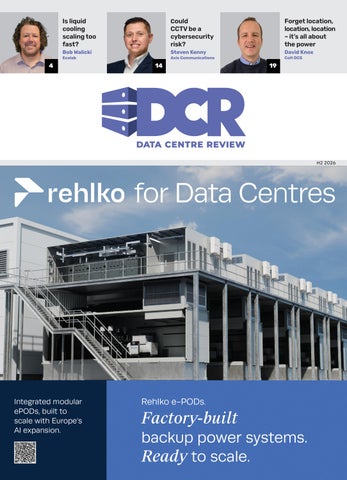
Is liquid cooling scaling too fast?
Could
CCTV be a cybersecurity risk?
Forget location, location, location – it’s all about the power
Ecolab
Axis Communications
Colt DCS
Bob Walicki
4
Steven Kenny
14
David Knox
19
DATA CENTRE REVIEW H2 2026
STANDBY GENERATORS • 8 kVA - 2.5MVA + • Long & Short-Term Hire • Supply & Installation • Open, Canopied & Containerised • Repairs, Remedial Works & Emergency Callout
Reliable power for a sustainable world
Editor’s Comment
Who’s got the power? It’s another issue of Data Centre Review, and once again I’m talking about power as part of the Editor’s Comment – you must be getting the feeling of deja vu. But let’s be honest, if there were ever a reminder that you can’t run a data centre on promises alone, Microsoft delivered it earlier this month. Nscale’s flagship AI facility in Loughton, Essex, was a key part of the company’s partnership with Microsoft, and yet that arrangement has now ended. While Microsoft will be continuing to partner with Nscale on other facilities, it will not be a tenant at Loughton – and that’s a rather large problem to have. What was supposed to be one of the UK’s flagship AI data centres is now without its anchor tenant, and it also lacks the power to bring it online anytime soon. In fact, UK Power Networks has told Nscale that it might not be able to supply the site until the 2030s – and while the company says that it will push on, who is it building the site for now? It’s further proof that just because you have everything else aligned – whether it’s a signed contract with Microsoft or a glitzy announcement during President Trump’s state visit to the UK – ultimately, it all comes down to who’s got the power. That’s because in this industry, if you’ve not got electricity, you might as well take your toys and go home. And this isn’t the first time Britain’s AI ambitions have run into the cost of plugging them in. Back in April, OpenAI paused Stargate UK, another programme involving Nscale, citing high energy costs and regulation. While the company notes it’s ‘on hold’, that hold is indefinite, or at least until the power situation improves in the UK, and let’s just say the wider grid picture isn’t exactly reassuring. Ofgem says demand connection applications jumped from 41 GW to 125 GW in less than a year, with data centres accounting for at least 80 GW. Not all those applications will become real projects, which is why the regulator has proposed commitment fees and tougher milestones. But while speculative applications clog the queue, credible developments face an increasingly awkward question: when can they actually turn on? Of course, planning reform and AI Growth Zones can help. But granting permission doesn’t build a substation, and announcing billions of pounds doesn’t conjure up megawatts. The UK can attract all the AI investment it likes, but if it can’t deliver electricity to the right locations, that investment can just as easily go elsewhere. So, what’s the takeaway? Well, the industry needs to stop treating headline investment figures and optimistic opening dates as proof of progress. Securing customers, planning permission and financing means little if developers can’t demonstrate a credible route to power. The UK has spent plenty of time announcing its AI ambitions. Now it needs to find a way to plug them in. Jordan O’Brien, Managing Editor
Inside 3
EDITOR’S COMMENT
4
COOLING & THERMAL MANAGEMENT
8
DESIGN, CONSTRUCTION & OPERATIONS
Who’s got the power?
How clean is a liquid-cooling loop before a GPU cluster goes live? Ecolab’s Bob Walicki makes the case for more rigorous handover standards.
JB Associates’ Ashley Buckland warns that commissioning cannot be managed from an armchair – resilience must be tested and witnessed on site.
14 DIGITAL INFRASTRUCTURE & SECURITY
The cameras protecting a data centre could also expose it to cyber threats. So who takes responsibility when vulnerabilities emerge?
19 POWER & ENERGY
David Knox from Colt Data Centre Services explains why grid constraints are changing where, when and how new data centre capacity can be built.
22 SUSTAINABILITY & RESOURCES
Air filters and other routine consumables are creating an overlooked waste problem – and Rensa Filtration’s Shawn Gilstorf thinks they deserve greater attention.
DATA CENTRE REVIEW
MANAGING EDITOR Jordan O'Brien jordano@sjpbusinessmedia.com DESIGN & DIGITAL PRODUCTION Rob Castles robc@sjpbusinessmedia.com GROUP COMMERCIAL MANAGER Tom Bell +44 (0) 7741 911302 tomb@sjpbusinessmedia.com MARKETING MANAGER Emily Szweda emilys@sjpbusinessmedia.com PUBLISHER Wayne Darroch Follow us on X
Printing by Micropress Subscription enquiries: Data Centre Review is a controlled circulation magazine available free to selected personnel at the publisher’s discretion. If you wish to apply for regular free copies then please contact: subscriptions@datacentrereview.com Data Centre Review is published by: SJP Business Media, 37 Lombard Street, London, EC3V 9BQ Any article in this journal represents the opinions of the author. This does not necessarily reflect the views of Data Centre Review or its publisher – SJP Business Media ISSN 0013-4384 – All editorial contents © SJP Business Media
Industry-leading b2b technology brands
@DCRmagazine
Join us on LinkedIn
H2 2026 www.datacentrereview.com 3
It’s time to standardise the liquid cooling handover
Bob Walicki, Corporate Scientist at Ecolab, explores why clearer commissioning criteria and better fluid-quality validation are needed as data centres scale increasingly powerful GPU clusters.
4 www.datacentrereview.com H2 2026
The handover from construction to operations has become one of the highest-risk moments in a data centre’s lifecycle, and the industry is finally starting to treat it that way. A GPU cluster built for AI training or inference can represent tens of millions of dollars in compute silicon before a single workload ever runs on it. Increasingly, that equipment is cooled not by air but by liquid moving through cold plates with internal passages measured in microns. The result is extreme capital concentration alongside mechanical tolerances an order of magnitude tighter than those found in a legacy chilled-water loop. The reality is that, for most of the last two years, direct-to-chip (D2C) liquid cooling has scaled faster than the commissioning practices meant to support it. Every operator has been tackling the same question, largely in isolation: how do you know a loop is actually clean, chemically stable and ready to carry heat away from some of the most expensive silicon ever put into production? Acceptance criteria vary by site, by contractor and sometimes by shift. That inconsistency is now getting real scrutiny. Organisations including the Open Compute Project (OCP) and ASHRAE have published pre-commissioning and fluid-quality guidance for liquidcooled IT equipment, and hardware makers are working directly with cooling and fluid-science partners to specify how pipework should be cleaned and qualified before it ever touches a cold plate. There is not yet a universal standard, but the direction is clear: cleanliness and validation
COOLING & THERMAL MANAGEMENT
are moving from varied practices towards documented, auditable criteria that support reliable performance. The reason cleanliness deserves this level of rigour is straightforward once you look inside a cold-plate microchannel. Passages that narrow to a few hundred microns or less don’t tolerate the same debris that a facility water loop shrugs off. Weld slag, thread sealant, construction dust and biofilm from stagnant hydrotest water are all common in newly built pipework, and every one of them is small enough to lodge in a channel and start degrading thermal performance long before it causes an outright failure. According to coolant testing conducted by Ecolab across operating data centre sites globally, roughly 32% of glycol samples fell outside the specification ranges set out in OCP and ASHRAE guidance – an indication of the fluid-quality challenges that can remain in systems that were, on paper, commissioned and running.
A loop that passed acceptance criteria on day one can still drift. Addressing these challenges doesn’t necessarily require new technology. It requires sequencing and documentation that treats the liquid loop the way a mechanical engineer would treat any other critical
process system, rather than as plumbing to be signed off and forgotten. Start with a written pre-commissioning plan, developed before construction finishes, not improvised once the pipework is installed. That plan should specify make-up water quality, cleaning chemistry compatible with the system’s metallurgy and elastomers, and where wastewater will go – a question worth raising with local regulators early, since acceptable discharge routes vary by jurisdiction and can otherwise stall a schedule at the worst possible moment. Flushing itself should be staged, rather than completed in a single pass. Coarse filtration removes the larger debris first; fine filtration, down into the low single-digit micron range, comes only once the bulk contamination is gone. Bringing ultra-fine filters into service too early just clogs them. Flow velocity matters as much as filter rating: most cleaning specifications call for 0.9-1.5 m/s (3–5 ft/s) to keep sediment suspended and moving towards the filter rather than settling back onto the pipe wall. And once a hydrotest is complete, that water needs to start moving again immediately. Stagnant test water is exactly the environment biofilm and sediment need to establish themselves, so the gap between hydrotest and active circulation should be measured in hours, not days. Instrumentation is what turns this from a one-off cleaning exercise into a documented acceptance process. Calibrated flow meters, pressure and differential-pressure gauges, and inline conductivity, pH and turbidity monitoring should all be in place before flushing starts, not added afterwards to tick a box. Capturing that data at baseline – during the initial fill, before the system ever runs a real workload – gives commissioning teams and operators a reference point they can audit against for the life of the system, and gives facilities teams an earlywarning trend line instead of a surprise months later. That baseline should also mark the handover from commissioning to operations, rather than the end of the process. A loop that passed acceptance criteria on day one can still drift: coolant chemistry degrades, particulates accumulate, and seasonal or workload changes shift flow and thermal demand. The same instrumentation installed for commissioning can be extended into continuous, real-time telemetry, tracking chemistry, particulate levels and flow performance over the system’s operating life so that drift shows up as a trend engineers can act on, not a failure they have to diagnose after the fact. For operators, commissioning teams and facilities managers approaching a D2C handover, a few requirements are worth insisting on, regardless of which vendors are involved. Ask for a written, documented commissioning plan rather than verbal assurance that a system was ‘flushed and ready’. Require records of flushing velocity, fluid specifications, filtration stages and cycle duration, not just a final pass/fail result. Confirm cleaning chemistry was matched to the system’s actual materials, with a plan for handling any waste it generates. And make sure the instrumentation used to validate the system at handover stays in place afterwards, feeding the same monitoring programme that will run the loop for years, not just the weeks around start-up. None of this is exotic engineering. It’s the same discipline mechanical and process engineers have long applied to other critical fluid systems, adapted to tolerances that are new to this industry. As GPU cluster densities keep climbing and the standards bodies continue converging on shared guidance, the operators who build this rigour into their handover process now – rather than waiting for a single codified standard to arrive – are the ones best positioned to scale quickly and consistently.
H2 2026 www.datacentrereview.com 5
The risks of armchair commissioning Ashley Buckland, Managing Partner at JB Associates, explores the risks of relying too heavily on documentation and remote oversight when validating mission-critical infrastructure.
In association with
6 www.datacentrereview.com H2 2026
In the race to deliver new data centre capacity, commissioning is often viewed as just a final box to tick before handover. Documentation is completed, test sheets are signed off, and the project moves towards operation. But treating commissioning as an administrative exercise rather than a rigorous technical process presents a significant risk. A data centre can be expertly designed, equipped with high-quality infrastructure and constructed by experienced contractors. Yet until every critical system has been tested, challenged and proven to operate together under real-world conditions, no one can be certain how the facility will perform when it is placed under pressure. The view from the couch That is why commissioning should never be managed solely from behind a desk. We sometimes see what we describe as ‘armchair commissioning’, where there is limited site presence and too much reliance on
DESIGN, CONSTRUCTION & OPERATIONS
documentation provided by others. This creates risk because issues can be missed, tests may not reflect real operating conditions and problems may only become clear once the facility is live. Effective commissioning demands a visible presence on site. It requires engineers who understand mission-critical infrastructure, question results, witness tests first-hand and verify that systems perform exactly as intended. Reviewing reports alone cannot reveal every issue. Being physically present during testing allows commissioning teams to identify anomalies, investigate unexpected behaviour and ensure nothing is overlooked.
Simply proving that one piece of equipment now works does not establish that it works with everything connected to it. The whole picture This is particularly important in data centres, where resilience is the product being delivered. In a mission-critical facility, commissioning is not about demonstrating that individual pieces of equipment work. It is about proving that the facility behaves as designed when components fail, operating conditions change and systems are required to respond together. Power distribution, UPS systems, generators, cooling infrastructure, building controls, fire protection and life safety systems must not simply work in isolation; they must operate seamlessly as a single integrated environment. That is where integrated systems testing (IST) becomes indispensable. Systems cannot be assumed to respond correctly to failures simply because individual components have passed factory or site acceptance tests. The loss of utility power, automatic generator start-up, UPS transition, cooling failures, control system responses and emergency operating sequences all need to be simulated, witnessed and validated under controlled conditions. Any weaknesses must be identified before customers begin installing live IT equipment, not after the facility has entered service. Start earlier Unfortunately, a heavy reliance on documentation, third-party reports and remote oversight can leave assumptions unchallenged and latent defects hidden until the building is carrying critical workloads. At that point, resolving issues becomes significantly more disruptive, costly and potentially damaging to the operator’s reputation. In fact, successful commissioning begins long before equipment is energised. It starts during the design phase through commissionability reviews, the development of a clear commissioning strategy and early involvement from experienced specialists. It continues through factory acceptance testing, site testing, integrated systems testing, operator training and structured handover, ensuring every stage builds confidence
in the next. In simple terms, the most successful commissioning programmes share one common characteristic: they focus on proving operational performance rather than producing paperwork. A recent project We were recently asked to support a client on a data centre project that was approaching handover. The generator had been tested and the individual systems appeared ready, but when we ran the full IST on site, we identified an issue with the integration of the generator controls. It only became apparent when the systems were required to respond together as they would during a real event. Had the client relied on individual test results and paperwork, the issue could have remained hidden until the facility was in operation. Instead, it was identified before handover, giving the team the opportunity to investigate, correct and retest it. This illustrates why a test needs more than a pass-or-fail box. Before it begins, the team should agree on the operating conditions, the fault being introduced, the expected response and the evidence needed to demonstrate it. Everyone involved should know who will initiate the test, who is watching each system and when the test should be stopped if the response is unexpected. This should all be made clear in pre-written test scripts, but the value of being on site is often in what happens between the planned steps. For example, a test sheet may record that a generator started, but those witnessing the sequence can see whether the controls gave the correct command, whether alarms appeared at the right time and whether the rest of the facility responded as intended. These details matter when a genuine fault occurs and the operations team must act quickly. It is important that unexpected results are treated as useful findings, rather than brushed aside to keep the programme moving towards handover. The cause needs to be fully understood and any corrective action retested as part of the complete sequence. Simply proving that one piece of equipment now works does not establish that it works with everything connected to it. The end user or operator should also be involved. Watching these tests helps the people who will run the facility understand how it behaves during a fault, practise their response and challenge anything unclear in the procedures. Good commissioning leaves them with evidence that the facility performs as intended and the confidence to operate it when conditions are far from ideal. Conclusion Ultimately, a data centre is only as resilient as its commissioning process. A facility may appear complete, with every cable connected and every piece of equipment installed, but appearances can be deceptive. Until the building has been thoroughly tested, challenged and validated under realistic operating conditions, it cannot truly be considered ready for operation. In mission-critical environments, confidence is earned through evidence, not documentation alone. Resilience must be witnessed, challenged and proven. And that cannot be done from an armchair.
H2 2026 www.datacentrereview.com 7
Engineering uptime: Why the drivetrain behind data centre cooling matters As AI pushes rack densities and thermal loads to new levels, cooling is becoming one of the most critical systems in the data centre. Innomotics is looking beneath the surface of that infrastructure – at the motors, drives and electrical systems that keep cooling running reliably, efficiently and around the clock.
D
ata centres have always generated heat. What is changing is the scale, concentration and variability of that heat. The rapid growth of AI and highperformance computing is driving more computing power into the same physical footprint. As rack densities increase, so does the amount of heat that must be removed – continuously and predictably. This changes the role of cooling. It is no longer simply a supporting utility operating in the background. In a high-density data centre, cooling performance has a direct impact on how much computing capacity a facility can support, how efficiently it can operate and, ultimately, whether critical IT infrastructure remains available. For Innomotics, this puts another part of the infrastructure into focus: the electrical
8 www.datacentrereview.com H2 2026
drivetrain behind the cooling system. Compressors, chilled- and condenserwater pumps, cooling tower fans and other large mechanical assets depend on motors and drives to keep air and water moving. These components may sit far away from the server rack, but their performance can have consequences all the way into the white space. In high-density cooling, motion quality is not a detail. It is part of uptime. Cooling must follow the load AI workloads do not create a perfectly constant thermal profile. Cooling infrastructure must respond as demand changes while maintaining stable operating conditions. Running equipment continuously at maximum output is neither necessary nor efficient. Variable frequency drives enable pumps, compressors and fans to adjust their
speed to actual cooling demand, allowing the system to respond dynamically rather than operating at a fixed point. But simply varying speed is not enough. The quality of control matters. Precise speed and torque control helps cooling equipment respond smoothly as thermal loads change. This becomes increasingly important as rack densities rise because the margin for temperature variation becomes smaller. For large cooling applications, Innomotics combines high-voltage motors such as the HV C and HV M motors with mediumvoltage drive technology. Its Perfect Harmony medium-voltage drives provide precise control for large compressors and pumps while maintaining ultra-low harmonic distortion. The result is a drivetrain designed not simply to move a pump or compressor, but to
SPONSORED FEATURE
support predictable cooling performance across changing operating conditions. Power quality is part of reliability Cooling performance is also closely connected to the electrical environment in which the equipment operates. Modern data centres contain large numbers of power-electronic devices. Harmonic distortion and other disturbances can increase electrical and thermal stress on equipment, contribute to transformer heating and affect motor efficiency. The challenge extends beyond rotating equipment. Data centres also contain highly sensitive electronic systems that process and move information continuously. Maintaining clean, stable power therefore matters across the facility. This is why power quality should be considered alongside mechanical performance when cooling infrastructure is designed. Innomotics Perfect Harmony drives are engineered for ultra-low harmonic distortion, helping protect the electrical infrastructure while controlling high-power cooling equipment. Motor and drive can also be considered as one coordinated drivetrain rather than as two isolated components. That system-level approach reduces another source of uncertainty: how independently selected components will interact once they are operating continuously under real-world load conditions. Designed for 24/7 operation Few environments place the same expectations on infrastructure as a hyperscale or colocation data centre. Cooling equipment may run continuously for years. Under these conditions, small differences in efficiency, thermal behaviour or component interaction accumulate over thousands of operating hours. Long-term reliability therefore requires more than equipment that performs correctly during commissioning. Motors and drives need to maintain stable performance throughout their service life. Innomotics’ high- and low-voltage motors are engineered for demanding continuous-duty applications, covering applications from large chiller compressors and pumps to CDUs and auxiliary cooling systems. Efficiency matters for the same reason. Cooling represents a significant operating load, and unnecessary energy consumption is multiplied across every hour of operation.
Variable-speed operation allows output to follow actual demand and can deliver substantial energy savings compared with systems that continuously operate at full speed – particularly during partialload conditions. Reliability and efficiency are therefore not separate objectives. In a cooling system designed around actual operating conditions, they reinforce each other. Designing for faults – not only for perfect operation Mission-critical engineering must also consider what happens when something goes wrong. In a conventional drive architecture, the failure of a single component can require the system to shut down until the issue is resolved. In a data centre, where cooling capacity may be critical to maintaining IT load, that dependency represents operational risk. Fault-tolerant architectures can reduce the impact of individual component failures. One example is the cell-bypass technology used in Innomotics Perfect Harmony mediumvoltage drives. If a power cell experiences a fault, the affected cell can be automatically bypassed, enabling the drive to continue operating under defined conditions rather than requiring an immediate shutdown. This does not eliminate the need for maintenance. It changes the way maintenance can be managed. Instead of an individual component issue immediately becoming a process interruption, operators can gain time to assess the situation and plan corrective action while supporting continued operation where system conditions permit. For critical cooling infrastructure, that flexibility can make an important contribution to overall availability. From cooling to facility resilience The same engineering principles extend beyond the cooling loop. Data centre resilience also depends on systems that may operate very differently but are equally critical when required. Backup generators must support continuous power during grid
disturbances or outages. Fire protection systems rely on motors to drive pumps and other safetycritical equipment when activated. Innomotics therefore approaches the data centre as an interconnected infrastructure environment. Its portfolio ranges from high- and lowvoltage motors and medium-voltage drives for cooling applications to generators supporting backup power and motors for fire protection and auxiliary systems. The applications differ, but the engineering priorities remain remarkably consistent: reliable operation, stable electrical performance, high efficiency and equipment capable of performing when demand is highest. Looking at uptime as a system As AI changes the scale of data centre infrastructure, evaluating individual components in isolation becomes increasingly difficult. A highly efficient motor cannot compensate for poor control. A sophisticated cooling architecture cannot deliver its full potential if the drivetrain behind it introduces instability. And an efficient drive offers limited value if electrical disturbances compromise other parts of the system. The relationships between these components matter. This is why Innomotics takes a system-level view of data centre infrastructure – considering motors, drives, power quality, control and availability as parts of the same operational challenge. The objective is not simply to keep equipment turning. It is to create predictable motion, stable electrical conditions and reliable cooling performance across the full operating range. Because as computing densities continue to increase, the infrastructure behind the cooling system will become even more important. For the data centre of the future, uptime will depend not only on how effectively heat can be removed – but on how reliably, precisely and efficiently the systems behind that process can keep moving.
Join us for the Innomotics webinar
Ready to engineer uptime into your data centre? Learn how Innomotics motor, drive and power design improve cooling. Register for our webinar: Oct 29, 2026, 2pm CEST
H2 2026 www.datacentrereview.com 9
Does data centre reliability start before the rack arrives? Stephen Draper-Garcia, data centre expert for the UK and Ireland at Desoutter Tools, explains why manufacturing quality and traceability are becoming critical to supplier assurance in the AI era. Data centre operators understandably design redundancy around what happens after equipment enters the facility. However, integrated AI infrastructure arrives with significant manufacturing and assembly work already completed. Complete rack and server assemblies are increasingly delivered ready to connect and operate, reducing the need to validate every upstream manufacturing operation again on site. With more assembly and integration moving into the supplier’s factory, some of a data centre’s eventual reliability has already been determined before the rack arrives. This raises an important question: where does uptime actually begin? More integration, more risk Several deployment models are used across the data centre ecosystem, including full factory integration, integrator-led deployment and modular pod deployment. Across these approaches, a greater proportion of assembly, validation and integration is completed before equipment reaches site. This approach offers clear advantages. Factory integration can reduce deployment times, improve consistency and support the scale required by AI-driven infrastructure growth. However, it also changes the nature of reliability. When a highly integrated rack arrives at a facility, operators inherit more than the hardware itself. They also inherit the outcome of hundreds, or potentially thousands, of upstream assembly operations completed elsewhere in the supply chain. Historically, some of these activities might have been validated during installation and commissioning. With more work moving upstream, that opportunity becomes more limited. Confidence in reliability therefore becomes linked to confidence in how equipment was manufactured. AI is accelerating supply chains The industry is scaling at extraordinary speed, putting more pressure on manufacturers and suppliers alike to expand capacity without
10 www.datacentrereview.com H2 2026
DESIGN, CONSTRUCTION & OPERATIONS
compromising consistency. AI demand is driving major investment in servers, networking equipment, power systems and supporting infrastructure, while manufacturers throughout the supply chain are being asked to expand capacity rapidly. Unlike mature sectors such as automotive, where high-volume manufacturing processes have evolved over decades, parts of the data centre supply chain are still adapting to this pace of expansion. For a manufacturer, a production stoppage may be an efficiency problem. For a data centre operator, however, such disruption can raise questions about variability in the manufacturing process behind the equipment being purchased. Parts shortages, component substitution, interrupted production schedules, changing operators and rapid expansion are not necessarily quality problems in themselves. The key issue is whether suppliers have sufficiently controlled processes to ensure these changes do not alter the quality of the finished product. For operators, growth is not necessarily the risk. Uncontrolled variability is. A passed product is not the same as a traceable product Traditionally, quality assurance has focused heavily on final testing. An end-of-line test can demonstrate that a product worked when it left the factory. This remains important, but it answers only one question. Another question for operators is: how was this particular unit built? Traceability addresses that question by creating visibility into the manufacturing process itself. A sufficiently detailed manufacturing history could associate a serial number with information such as the production sequence, relevant assembly results, operator or workstation records, timestamps, positional confirmations and any non-conformance or rework events that occurred during production. These are examples of the information a digitally controlled assembly process can make available. Not every supplier will capture every data point, nor should buyers assume that every manufacturer does so. The important point is that end customers can benefit from manufacturing information they can interrogate and understand, rather than simply accepting that records exist somewhere within a supplier’s organisation. In this context, passing a final test and demonstrating a controlled build process become two different things. Traceability enters procurement As AI infrastructure investments increase, manufacturing assurance is moving beyond the factory floor and into procurement conversations. Traditionally, supplier selection has focused heavily on delivery capability, quantity, lead times and commercial terms. Those considerations remain important, but increasing infrastructure complexity is encouraging buyers to look deeper into how products are manufactured. For buyers, relevant questions include whether manufacturing records can be associated with individual units, whether critical operations can be shown to have been completed within specification and how process changes are controlled as production volumes increase. There is also the question of how non-conformance events are managed and whether suppliers can distinguish the manufacturing history of one rack or assembly from another. The key consideration is whether quality is consistently controlled throughout the production process and whether suppliers can
demonstrate that control. The ability to provide that evidence is becoming an important part of supplier evaluation. When something goes wrong When equipment develops an issue in service, operators need enough information to investigate what happened and identify the factors that may have contributed to it. Manufacturing records can provide a route back through the production process, helping investigators establish whether affected equipment was produced during a particular period, associated with a specific component batch or linked to a particular assembly process. They can also show whether other units share a similar manufacturing history and therefore warrant further investigation. This information does not automatically identify the cause of a failure. Instead, it can provide a structured evidence base for fault isolation, supplier management and corrective action.
Uptime does not begin when a rack is switched on. That gives manufacturing data a purpose beyond internal factory quality control. It becomes information that can support decisions throughout the equipment’s operational life. Data centre operators do not need to specify the manufacturing technology their suppliers use. What they need is confidence that critical processes are controlled, results are attributable to individual products and exceptions are visible rather than disappearing into the production line. For suppliers, demonstrating this level of control is becoming more important as infrastructure complexity and production volumes rise. This means being able to demonstrate that the products they deliver were built through controlled, repeatable and transparent processes, with sufficient evidence to support those claims. The boundaries around data centre reliability are widening. Redundancy, commissioning and operational excellence will always remain fundamental to uptime. However, with racks becoming more integrated and deployment becoming faster, operators also need greater confidence in the processes that take place before equipment reaches the facility. This means looking beyond simply asking whether a rack works when it arrives. The way it was manufactured, the consistency of the processes used to build it and the evidence available to verify its production history can all influence the confidence an operator has in the equipment entering the data centre. For operators, knowing that a product has passed its final test is valuable. Knowing that its critical manufacturing processes were controlled, and that sufficient evidence exists to investigate issues if they arise, provides a stronger foundation for reliable deployment at scale. As AI infrastructure grows, supplier assurance therefore has an increasingly important role to play in reliability. Uptime does not begin when a rack is switched on. It starts much earlier, with the processes, controls and evidence behind the equipment that eventually enters the data centre.
H2 2026 www.datacentrereview.com 11
How ABB is keeping data centres cool and online An effective way to manage your production process
D
ata centres are the backbone of the online economy; however, with demand continuing to rise, they remain under constant strain. According to Statista, there are a reported 4,767 data centres in the US alone, with a further 568 in the UK and 533 in Germany.1 Goldman Sachs Research estimates that demand for data centres will grow by around 50% to 92 GW by 2027 from 2023 levels, with a compound annual growth rate of 17% between 2025 and 2028.2 Investment in data centres continues to surge, with the growing use of artificial intelligence driving demand. To keep systems online, however, operators need to balance energy consumption, cooling systems, alongside space and infrastructure constraints. Until 2030, it is estimated that data centres will account for one-tenth of global electricity demand growth.3 Matching this demand requires investment in infrastructure, particularly as data centres require a large and continuous power supply. This may mean scaling up renewable energy infrastructure or building a more efficient and well-connected grid that supports the delivery of energy. Keeping data centres cool Data centres are built from thousands of dense servers that produce intense levels of heat. A Cambridge-led study found that land temperatures around AI data centres rise on average two degrees Celsius, with some recording increases as high as nine degrees.4 When this natural heat from data centres is combined with the record-breaking temperatures that we’ve seen globally, and particularly in Europe, then data 1. https://www.statista.com/statistics/1228433/data-centres-worldwide-by-country/?srsltid=AU7gw4XqRex_ MLz-NoNgzvYan8S5VGPy5LqBvnRUqsxlgdV28JDsefZM 2. https://www.goldmansachs.com/insights/articles/ how-ai-is-transforming-data-centers-and-ramping-uppower-demand 3. https://www.iea.org/reports/energy-and-ai/executive-summary 4. https://arxiv.org/pdf/2603.20897
12 www.datacentrereview.com H2 2026
centre uptime is at risk. When cooling is lost in a chip, it can fail in mere seconds. This can lead to costly downtime and replacement costs. For instance, in 2025, a critical cooling failure at a data centre near Chicago led to a huge outage for CME Group, the world’s leading and most diverse derivatives marketplace. It halted trade on its currency platform and across foreign exchange, commodities, Treasuries, and stocks.5 Another example, in 2023, was at an Equinix data centre in Singapore where a cooling malfunction caused 2.5 million failed payment and ATM transactions disrupting people and huge corporations like Citibank and DBS Bank. Within data centres, cooling systems depend heavily on motors and drives for pumps and fans. In both examples, a failure in the cooling system led to the downtime. This could be the result of not having the right motor-drive package for the needed power, speed and operating conditions. It could also be the result of not having enough visibility into how the equipment is functioning. If operators have a better understanding of when a motor or drive is about to fail, then they can try and resolve the problem before the data centre has an outage. Both the Chicago and Singapore examples show the wide impacts that data centre 5. https://www.reuters.com/business/keeping-cool-heatkey-challenge-data-centers-ai-2025-11-28/
downtime has on businesses and people, and it goes far beyond the data centre itself. So, reducing downtime is of utmost importance. This is where ABB can support. ABB Crealizer ABB’s Crealizer is an open software platform that is seamlessly integrated into ABB drives’ operating system. It is designed to overcome the limitations of programming traditional controller applications and enables operators to create, validate, and deploy customised solutions with microsecond precision. For data centres, it allows operators to identify the correct motor-drive package needed in its operations. This ensures a more bespoke service. Once this solution has been identified, Crealizer can then support with configuration and installation. This structured approach can be applied across data centre facilities and stops operators from relying on manual calculations. Crealizer streamlines the journey from idea to impact through a three-stage workflow: 1. Create: Create or co-create new solutions or benefit from existing ones. The possibilities are endless using high-level language C++ or model-based coding from MATLAB/Simulink 2. Simulate & Validate: Test in virtual environments (Virtual Drive Plus) or HIL setups (DriveLab). Simulate scenarios like load variations or environmental disturbances to refine performance.
SPONSORED FEATURE
through a plug-in distribution system with a touch-safe design for live maintenance, while integrated InSite provides real-time branch-circuit energy monitoring and supports the transition from AC to 800 VDC architectures. • Robotic Inspection Technology (FIDo): Uses robotics, sensors and software to capture thermal, acoustic and visual data from areas that are hard to reach, assisting operators with risks before exposure, and prepare maintenance with confidence. • Synchronous Condenser Package: Combines physical inertia and dynamic reactive power support to maintain stable operation during rapid AI-driven load changes and support reliable data-centre operation. • Modus LTO Battery: Uses lithium-titanate oxide technology to respond in milliseconds to handle frequent high-power charging and discharging, helping data centres manage fluctuating AI power demand. 3. Realise: Deploy your custom solution directly on your drive to enhance performance, improve reliability, and deliver deeper operational insights, such as advanced cooling anomaly detection, with execution times as fast as 125 µs. Ensuring the right motor-drive package is key for keeping data centres online. Not only does it keep cooling systems in check, but it also helps reduce energy consumption, particularly when equipment is operating at variable speeds or below full capacity. By better selecting equipment from the outset and using technical guidance to understand its performance over time, operators can reduce lifecycle costs and avoid unnecessary equipment replacements.
The Infinitus portfolio responds to this challenge with an integrated, source-to-rack DC power architecture spanning medium-voltage powertrains, DC sources and power quality, DC power distribution, DC power protection and cooling optimisation. It is designed to deliver efficiency gains of more than 5% while supporting flexible architecture choices. Five technologies make up the portfolio: • MSN 4.0: Combines AI-driven predictive maintenance, embedded cybersecurity and AC/DC flexibility to help data centres increase capacity while maintaining the flexibility to scale and reconfigure as needs evolve. • SMISSLINE TP HP: Delivers 800A ampacity
Conclusion Data centre operations continue to dominate the spotlight; they are the foundation for the modern economy and day-to-day life for everyone. As a result, it is essential to keep them online and address problems from the outset. ABB’s services are evolving to meet these demands. Crealizer supports the day-today infrastructure within data centres, ensuring systems don’t overheat and that operations continue to be energy efficient and online. Building on this, the Infinitus portfolio offers wide-ranging support for data centres to ensure they keep up with the demand brought from the era of AI.
ABB’s Infinitus Direct Current portfolio Building on this, last month, ABB unveiled its Infinitus Direct Current portfolio. This brings together technology from across ABB in an integrated source-to-rack power architecture for AI data centres. Electricity demand from data centres rose by 17% in 2025, with demand from AI data centres growing even faster.6 ABB estimates that 25-40% of new data centre capacity in 2030 is expected to be DC distribution. 6. https://www.iea.org/news/data-center-electricity-usesurged-in-2025-even-with-tightening-bottlenecks-drivinga-scramble-for-solutions
H2 2026 www.datacentrereview.com 13
Who owns the risk in data centre security? 14 www.datacentrereview.com H2 2026
Axis Communications’ Steven Kenny argues that data centre operators need clear ownership of cybersecurity risk across physical security systems. Imagine a vulnerability is discovered in a camera protecting a data centre. Responsibility immediately crosses several functions: the security team relies on its images, an integrator maintains the installation, and IT controls the network to which it connects. Who decides whether that device can safely remain connected, and who ensures the decision is carried out? Operators should be able to answer that question without first untangling a maintenance contract. Yet unclear responsibility can leave a known vulnerability unresolved while each team waits for another to act. The EU’s Critical Entities Resilience (CER) Directive reflects a wider focus on strengthening the ability of essential service providers to withstand disruption. For data centre operators, that raises a further question: whether the systems installed to protect the facility could become a source of disruption themselves – an issue that should be considered throughout commissioning and deployment.
DIGITAL INFRASTRUCTURE & SECURITY
Ownership must start at design Connected physical security belongs within normal cyber governance, with an accountable owner throughout its operational life. The process of defining responsibility begins early because physical security projects involve several groups with different duties. A designer specifies the system, an integrator configures it and the operator takes it into service. Each may complete their work correctly without establishing who will manage the device’s cybersecurity months and years later. A maintenance agreement can leave that question unanswered if its scope centres only on keeping the equipment functional. Restoring a lost video image and assessing a newly disclosed software vulnerability are very different tasks. Operators need to establish explicitly who monitors security advisories and who has the authority to approve remedial work. There should also be a named person within the operating organisation who remains accountable when work is contracted out. Suppliers and service partners can carry out maintenance, but the operator still needs to understand which risks remain and whether the response is adequate. This is particularly important when a fix cannot be applied immediately. Operational constraints may justify a delay, but someone must accept that exposure knowingly, record the reason and set a review date. Without those steps, a temporary exception can persist long after the circumstances that justified it have changed. Assess what compromise would expose The cybersecurity of physical security equipment deserves attention because of both its network connections and its purpose. A camera is a computer: it runs software, handles data and communicates across the network. Its position on a wall does not make it any less important than equipment in the rack. In some respects, its compromise may be more consequential because of what it can see and what it can reach. It could, for example, reveal the layout of sensitive areas or patterns of activity within the facility. An attacker may gain useful intelligence without interrupting the video service or causing an obvious operational fault. Depending on the network design and permissions, a vulnerable device could also provide a foothold from which to investigate other systems. The risk attached to a device is therefore determined less by its purchase price than by what it can observe, access and reach. For operators, determining this means checking the actual deployment rather than relying on a specification sheet. Security equipment should have only the access needed for its role, within an appropriately segmented network. The review should establish who can administer it and whether its configuration and firmware remain under control. A diagram approved during design cannot establish whether those conditions are in place in practice. Make support part of the buying decision Procurement of a connected device is also a commitment to maintaining its security for as long as it remains in service. The team that will manage a device’s security should have a say in whether the organisation buys it, because the purchase creates a maintenance obligation that can last for years.
A specification establishes whether equipment performs the required function. It does not, by itself, prove how securely the manufacturer develops and maintains its software. Operators also need evidence of vulnerability management, secure update processes and long-term support commitments. Provenance deserves the same attention. Weaknesses introduced during manufacture or through compromised firmware can undermine a device before local configuration has been considered. Procurement teams should ask what evidence supports the supplier’s security assurances and how concerns will be investigated. Support duration must also be weighed against the intended service life. Equipment can continue producing a usable image long after its software support has ended. If replacement decisions are based only on physical reliability, the data centre can inherit a functioning device that has become a cybersecurity liability. Before approval, the operator should understand how that situation will be handled and who will fund replacement. A lower acquisition cost is difficult to defend if the organisation has made no provision for keeping the equipment secure.
If replacement decisions are based only on physical reliability, the data centre can inherit a functioning device that has become a cybersecurity liability. Test the decision before an incident An installation audit only records the state of the system at a particular point in time. Over time, software changes and maintenance arrangements evolve. Operators need evidence that the responsibilities agreed at procurement still work under those changing conditions. A practical starting point is to select a connected security device and walk through a hypothetical vulnerability affecting it. Can the team identify whether the device is affected? Who assesses the exposure, and who authorises a change? If an update requires an interruption to coverage, how will the security team manage that period? This exercise tests whether documented responsibilities translate into an operational response – before that response is needed. It can reveal, for example, that the organisation knows who installs updates but has never assigned responsibility for deciding how urgently they are needed. That kind of omission is far easier to correct during planning than under the pressure of a live incident. The wider focus on essential service continuity gives data centre leaders a reason to examine where unclear ownership could delay a response. They should use these exercises to assign responsibility and deadlines for unresolved risks. Where equipment can no longer be maintained securely, the decision must reach someone authorised to fund replacement or accept continued exposure. A maintenance team without that authority cannot settle the question on the operator’s behalf.
H2 2026 www.datacentrereview.com 15
Testing liquid-cooled infrastructure:
Why the industry needed a new approach AI workloads and rising rack densities are accelerating the adoption of liquid cooling in data centres. As data centre infrastructure evolves, so too does the challenge of testing it. Here, Paul Brickman from Crestchic Loadbanks explores how hybrid testing methodologies are becoming essential as data centres increasingly operate mixed liquid- and air-cooled environments. A proven discipline oad testing has always been central to power resilience. Before a facility goes live, and at regular intervals throughout its operational life, operators use loadbanks to validate generators, UPS systems, CRACs (Computer Room Air Conditioning units), CRAHs (Computer Room Air Handlers) and electrical infrastructure under controlled conditions. That role has not changed. What has changed is the infrastructure they are increasingly being asked to test.
L
16 www.datacentrereview.com H2 2026
Testing liquid-cooled systems As liquid-cooled racks emerged, the industry faced a genuine knowledge gap. Air-cooled loadbanks were the familiar tool, but operators quickly found they were inadequate for the task. Some turned to industrial boilers as a crude substitute. However, a boiler has no meaningful control capability and is designed to bring water to 100°C. Liquid-cooled server infrastructure typically operates with coolant supply and return temperatures in the 25–35°C range. A boiler cannot replicate those conditions reliably or safely. Like boilers, air-cooled loadbanks, by their very nature, cannot test a liquid load. In a liquid-cooled environment, power and cooling are tightly coupled: heat generated by IT equipment is transferred primarily into the coolant loop, with only a small proportion dissipating into the surrounding air. The cooling distribution unit (CDU) carries most of the heat load away, and its performance under load is critical to the stability of everything above it. Using either a boiler or an aircooled loadbank, the Delta-T — one of the most important indicators of cooling system health — is never tested. There is no reliable validation of the cooling circuit’s ability to perform under operational conditions. Given the substantial capital cost of liquid-cooled server infrastructure, and the consequences of a cooling failure once those servers are live, that
is not a sustainable position. For liquid-cooled infrastructure, the thermal load on the cooling circuit must be replicated, not just the electrical load. What a liquid-cooled loadbank makes possible Crestchic’s 600kW liquid-cooled loadbank was developed specifically to address this gap. It connects directly to the facility’s cooling circuit, transferring the heat generated by the electrical load into the coolant loop, replicating the behaviour of real liquid-cooled servers. This makes it possible to validate the parts of the system that a conventional air-cooled loadbank or rudimentary boiler setup cannot reach. Operators can confirm that the cooling distribution unit is delivering the required coolant flow rates, maintaining correct supply temperatures, and managing delta-T within specification. Crucially, the 600kW unit maintains temperature stability to ±0.5°C regardless of flow variation. It monitors and automatically adjusts the temperature to meet the commissioning agent’s requirements, ensuring repeatable, reliable test results. The unit’s integrated flow, pressure, overload/ underload, and thermal-shock protection, alongside leak detection, a 9-bar pressurerelief valve, and quick-release no-drip drydisconnect couplings, ensure that both the loadbank and connected infrastructure are
SPONSORED FEATURE
protected from the point of connection through to the end of the test. The IP55-rated enclosure supports deployment in indoor and outdoor settings, and CE and UL compliance mean it meets the regulatory requirements expected on controlled, high-power sites. For operators building ongoing resilience programmes rather than one-off commissioning tests, the loadbank software enables monitoring of trends across test cycles, tracking Delta-T performance, CDU response, flow rates, and coolant pressure to identify changes in cooling system performance before they become operational problems. What liquid-cooled loadbanks can’t do alone While the liquid-cooled unit is ideal for testing liquid-cooled infrastructure, it doesn’t replace a broader load testing programme. Most data centres are not purely liquid-cooled. They typically run hybrid environments, using liquid-cooled racks alongside air-cooled zones for storage, networking, and lower-
density workloads. Likewise, generator and UPS validation still requires a large-scale electrical load. The liquid-cooled loadbank fills the gap that previously existed in the testing toolkit, but the real strength comes when the tools are combined. Bringing it together: hybrid testing The most complete picture of a data centre’s resilience comes from testing the power and the cooling infrastructure simultaneously, with both air-cooled and liquid-cooled loadbanks working as a single coordinated system. Crestchic’s VCS control software, used with the LC80 controller, makes this possible. The platform supports clusters of up to 240 loadbanks (air-cooled, liquid-cooled, or a combination of both) that operate as a single test from a single control interface. For liquid-cooled loadbanks, the VCS provides full delta-T control to ±0.5°C alongside real-time flow monitoring, coolant quality indication, redundant inlet and outlet
temperature monitoring, and pressure sensing, with full thermal efficiency reporting available via the Crestchic Portal. For air-cooled units running in the same cluster, conventional electrical instrumentation runs in parallel. Both environments are visible in a single comprehensive dashboard, with real-time data updates at 250ms cycles. Automatic load profiles allow operators to create, run, and monitor pre-set load sequences, enabling repeatable tests with less manual intervention during commissioning. When testing is complete, the platform generates automated compliance reports aligned to NEMA MG1, ISO 8528-5, ISO 22514, EN 50160, IEEE 141, ASHRAE G22, and the e-NTU method for thermal efficiency, all delivered via the Crestchic Portal in auditready format. The result is a testing programme that reflects how modern data centres work: hybrid infrastructure, validated as a whole. Attending Data Centres Ireland? Visit the team on stand 427.
LIQUID-COOLED LOADBANK
Engineered for high-density data centre testing
Built for eman in test environments, restchic’s 600kW liqui coole loa anks eliver hi h-capacity heat loa irectly into your coolin system, with precise temperature control an the flexi ility to scale from a sin le rack to a full ata hall.
Rated load capacit
Cluster or scala le testing
Precision te perature control
via the Crestchic portal
THE WORLD’S LEADING LOAD BANK EXPERTS E v e ry s i z e . E v e ry ca p aci ty. E v e ry a pp lica t i . i ce 1983 Sales | e"tal | Service
c e c icl#a a" s.c#!
www. r st
Sales & ental Offices in , orth America, Sin apore, ermany, el ium, rance, Swe en, Australia an A
Scan for more H2 H1 2026 www.datacentrereview.com 17
R U O Y T ET E ME ARK M
RDS, Dublin: 18-19 Nov 2026
Infrastructure • Services • Solutions DataCentres Ireland combines a dedicated exhibition and multi-streamed conference to address every aspect of planning, operating and managing your Data Centre, Server/ Comms room and Digital storage solutions – Whether internally, outsourced or in the Cloud. DataCentres Ireland is the largest and most complete event in the country. It is where you will meet the key decision makers as well as those directly involved in the day to day operations.
Entry to ALL aspects of DataCentres Ireland is FREE • Market Overview • Power Sessions • Regional Developments • Updating Legacy Data Centres • Resilience and Operational Readiness
EVENT HIGHLIGHTS INCLUDE:
• Renewable Energy
Multi Stream Conference
• Standby Generation
25 Hours of Conference Content International & Local Experts 60+ Speakers & Panellists
Invest the time... Benefit from the experience
140+ Exhibitors Networking Reception Ticket & Registration Sponsor
Lanyard Sponsor
Bag Sponsor
For the latest information & to register online visit
www.datacentres-ireland.com
POWER & ENERGY
A power-first approach to data centre strategy David Knox, Global Director of Energy & Sustainability at Colt Data Centre Services, explains why grid constraints are forcing developers to rethink where, when and how new capacity is built. The UK Government revealed that the queue for connections to the UK power grid has grown by 460% in just six months. This rise is linked to a significant increase in speculative applications. Demand from AI is rising faster than the grid can deliver. This is fundamentally changing the approach to data centre design and location selection. Access to power has become a deciding factor, shaping when and where sites can be built, how projects are phased and which models offer long-term value. Success depends on preparing for uncertainty and reflecting this in design, prioritising flexibility while adopting a power-first approach to location and delivery. The new reality of grid access AI workloads are materially reshaping what typical power requests look like. The compute required for AI data centres demands several times the power density of traditional data centres, and the number of operators seeking access to this level of capacity is growing. At the power generation level, most countries have sufficient capacity to support the growth of AI data centres. However, demand often exceeds what local power networks can accommodate. Combined with growing connection queues, these local constraints are becoming a defining challenge, creating delays and adding complexity to the development and operation of AI data centres. Grid access is no longer a straightforward connect-and-expand process. It’s an ongoing negotiation that needs to be managed early because it now affects design assumptions and delivery risks from the outset. Flexibility first Organisations must adapt how they approach grid access for AI data centres and prioritise flexibility amid uncertain timelines and outcomes. One way to achieve this is through practical design and delivery choices, particularly modular power systems and hybrid supply models. Modular power systems support phased construction and energisation, allowing providers to respond more effectively if grid delays occur. Hybrid supply models can also introduce additional power sources, reducing reliance on the grid and improving resilience.
What was once viewed primarily as a failsafe or temporary measure may now have a role as a capacity-bridging tool. Hybrid supply models can help sites operate while grid upgrades catch up, with on-site power providing additional capacity to support growing AI compute requirements. There are, of course, trade-offs to consider when implementing hybrid supply models, including cost, operational complexity and sustainability objectives. However, in a period of constrained grid access and growing power demand, developers should consider these approaches as potential options for supporting AI-led growth. Intentional location selection For AI data centres, where competitiveness depends on the certainty of power delivery and the ability to scale quickly, developers are being forced to rethink location strategy from the ground up. Historically, site selection has followed a familiar pattern, focusing on proximity to users, strong connectivity and suitable land. Power was largely assumed to be available through a standard grid connection process. That assumption no longer holds. In many established data centre hubs, grid capacity is constrained or already fully allocated, and sites that appear ideal on paper can conceal significant delivery risks. These may include long connection delays, complex network constraints or substantial and unexpected reinforcement costs. As a result, the strategic shift is clear. Developers must now balance traditional considerations such as latency, network ecosystem and market access against the availability of reliable power and the ability to scale. In the AI era, the strongest location decisions are those built around speed to power, certainty of delivery and long-term scalability.
Demand from AI is rising faster than the grid can deliver. Preparing for the unknown AI compute demand is growing beyond the capacity that local grids were designed to support. Connection queues are growing rapidly, while local network constraints continue to be a barrier to entry. Power has become a primary determinant of the successful delivery of AI data centres. Developers must therefore lead with a power-first approach to help ensure projects are delivered on time, with stable funding and in line with customer demand. Grid strategy must be at the forefront of the site selection process and concept design, with developers engaging proactively with delivery partners and network operators rather than leaving it until later. To be resilient, power strategy needs to be rooted in flexibility. This can be achieved through modular power systems, hybrid supply models or designs that can adapt to different grid outcomes. Location selection must be integrated with a power-first model, recognising that speed to power, certainty of delivery and scalability are critical. The developers that succeed in the era of AI will be those that understand the grid rather than trying to avoid it. Building programmes and sites that can secure power, adapt to change and scale will be central to that success.
H2 2026 www.datacentrereview.com 19
Resilience:
no time like the present to address hidden dependencies How layered resilient timing can build user confidence and unlock new opportunities for data centres
20 www.datacentrereview.com H2 2026
P
ressures on data centre operators are mounting from all sides. The growth of AI workloads, hybrid cloud environments, edge computing, and automation are creating more demand, while tighter regulations, concerns over power and water consumption and increasingly distributed sites create new challenges for delivery. The designation of data infrastructure as Critical National Infrastructure (CNI) in 2024, following a rise in cyber security concerns and a push to increase investment for the UK’s digital infrastructure, has also upped the stakes.
Any downtime has immediate and quantifiable consequences. Strengthening resilience has never been more important. Efforts to ensure resilience are typically focused on power availability, cooling, network connectivity, cybersecurity and sustainability. But there is a hidden dependency that data centres often overlook: time. Time: a hidden dependency Data centres process millions of transactions every second and rely on accurate timing to maintain synchronisation, operational continuity and resilience across
SPONSORED FEATURE
may cause equipment to reboot and create hotspots is also imperative. The AI revolution has only made timing in data centres more critical. Training large language models creates a relentless flow of traffic between Graphics Processing Units (GPUs) that relies on precise synchronisation, ensuring each unit has a consistent view of when data arrived and left. The same precision also matters downstream. Widely used AI applications draw on timestamped data from many sources at once, and that data must be correctly sequenced the instant it arrives to deliver reliable results.
complex digital ecosystems. Every server, storage array, and switch has its own clock, which, left alone would drift. So, all clocks are continuously checked against a common time reference. That shared sense of ‘now’ – both within and between organisations – is what lets a database perform a transaction in the right order, recover corrupted data backups, and allows thousands of servers to behave as one coherent system. With customer service level agreements (SLAs) often demanding confidence in timing for applications like transaction logging in financial services and compliance and audit considerations, having total trust in timestamping is crucial to securing customer confidence. As data centre environments become increasingly distributed through cloud, edge and AI-driven architectures, resilient timing becomes yet more important: each new site adds more clocks that must remain synchronised with the wider network. And with increased concerns about power and water consumption, avoiding timing disruptions that
Reliance on satellite services To ensure clocks stay accurate and aligned, they are typically synchronised with each other using signals from satellites, such as the Global Positioning System (GPS) and other Global Navigation Satellite Systems (GNSS). This is true for both the internally owned time references used by hyperscalers, and the timing services used by enterprise or colocation customers. Satellite signals are excellent in their ubiquity and accuracy but represent a single point of failure. Jamming, space weather, local interference or equipment failure could remove access to satellite signals. If that external reference is disrupted, internal clocks may drift, and significant differences will accumulate within days or even a few hours. Spoofing – where a signal is tricked into displaying an incorrect time – could do immediate damage. Independent, traceable time Multiple independent timing solutions are required to deliver uninterrupted signals and maintain uptime performance, even if satellite signals are disrupted. The use of more than one timing source can also make detection of spoofing easier – helping to deliver more robust cyber security and greater confidence in the integrity of distributed digital services. The National Timing Centre (NTC) programme, led by the National Physical Laboratory, is developing a distributed timing network that will be available as a source of time for the UK. This will provide a complementary source of timing signals that are independent of satellite services and traceable to the UK’s national time scale,
UTC(NPL), enabling data centre operators to design a layered timing infrastructure with diverse distribution methods to strengthen resilience should there be a GNSS outage. The most demanding sites – trading platforms, hyperscale campuses – can have time delivered straight into their building via dedicated fibre. This service is already being used by Telehouse’s Data Centre in London. Other organisations can access timing services delivered via hard-to-jam MSF radio signals or over the internet. UTC(NPL)traceable signals are also available through some of NPL’s partners. Each method offers different resilience and performance characteristics. For hyperscalers, an external, independent timing reference provides confidence in their internal systems, helping assure the performance and availability of cloud services for customers. For colocation operators, with customers across telecoms, financial services, energy, transport, and internet service provision, there is the opportunity to offer resilient timing as a service, distributed to clients alongside power and connectivity. NPL works with organisations to understand their timing dependencies and assess the possible impact of a loss of timing signals on operations and customer services, supporting them to design a layered timing infrastructure that is resilient and best suited to their needs. Strengthen your resilience As pressures increase and the repercussions of downtime become more significant, resilience is essential to data centre operations. Hidden dependencies such as timing are just as important as power or cooling to maintain continuity and trust. By securing access to independent, traceable time that works with existing systems, data centre operators and their customers can have confidence that their services remain available, reliable and dependable. Contact the NTC team today to learn more about designing a resilient layered timing infrastructure. npl.co.uk/ntc
H2 2026 www.datacentrereview.com 21
Could the next big sustainability gain be hiding in the bin? As data centres pursue ambitious efficiency and ESG targets, Shawn Gilstorf, Vice President Products at Rensa Filtration, explains why reducing operational waste could offer an overlooked opportunity. Ask a data centre operator about sustainability and they’ll tell you about power. PUE, renewable procurement and cooling efficiency have defined much of the industry’s environmental focus for the better part of a decade, and for good reason. Power remains a defining operational and environmental consideration, while the rapid expansion of AI infrastructure is increasing the pressure to improve efficiency. But there is another sustainability story playing out beyond the energy dashboard: the waste generated by the routine materials and consumables required to keep a data centre operating. As AI workloads drive up compute density, cooling requirements and the amount of equipment operating within a facility, the volume of materials required to maintain that infrastructure also deserves greater attention. Material circularity – keeping resources in use and out of landfill – is becoming an increasingly important consideration for operators looking to reduce the environmental impact of their sites. More equipment and more intensive operations can mean more maintenance and more of the everyday consumables that keep a site running. Yet these recurring waste streams can be difficult to see in the same way that energy and water use are measured. Air filters offer a useful example of how a routine maintenance item can become a significant waste stream when multiplied across a large facility. The tonnage hiding in plain sight The first problem is simply seeing what is there. Maintenance waste can be easy to overlook because individual items rarely seem significant. This picture changes when operators track what is purchased, replaced and discarded over the course of a year. A useful step is to identify recurring consumables and group them by volume, frequency of replacement, material composition and current end-of-life route. Depending on the facility and its operations, these materials can include:
22 www.datacentrereview.com H2 2026
SUSTAINABILITY & RESOURCES
• Air filters • HVAC maintenance materials • Packaging and shipping materials • Batteries and electrical components • Cooling system consumables • PPE and general maintenance supplies Air filters are a useful example. A large facility may use hundreds or thousands of filters over time as part of HVAC and cooling maintenance. Because many filters combine different materials, including frames, media and other components, their end-of-life management can be challenging, particularly where local recycling infrastructure is not equipped to process them. Individually, each filter may seem insignificant. Collectively, however, recurring replacements can represent a substantial material stream that may receive little attention in broader sustainability reporting. Why ‘recyclable’ isn’t always straightforward Here’s the catch that trips up a lot of good intentions: something is not necessarily recyclable just because it’s made of recyclable materials. A typical filter combines a frame, synthetic media, adhesives, gaskets and sometimes wire backing into a single unit. Separating these components economically can be challenging, and the contaminants collected during use can make it harder still. For years, much industrial equipment has been designed primarily around how it performs in use. What happens afterwards was often not part of the specification, and procurement teams accordingly optimised for performance and unit price.
Something is not necessarily recyclable just because it’s made of recyclable materials. Make end of life part of procurement Reducing operational waste often starts with procurement. When evaluating recurring consumables, operators can ask suppliers not only how a product performs and what it costs, but also what happens to it at the end of its useful life. What materials does it contain? Can those materials be separated or recovered? Is there a practical recycling route available in the locations where the product will be used? And can the supplier provide evidence of that pathway? Filters that combine multiple materials can present greater challenges for recovery than products designed with fewer material types. That does not mean a particular material or product is automatically the better choice. Performance, availability, total cost and local recycling infrastructure all need to be considered together. The important shift is to make end-of-life management part of the purchasing conversation rather than treating disposal as an issue to address after a product has been selected. Scale can create an advantage The volume of waste generated by large data centres can be a challenge, but it can also create an opportunity. Recurring maintenance materials generated at a single site may provide enough volume and consistency to make collection and recovery more practical than they would be for
smaller facilities. Predictable replacement cycles, established supplier relationships and existing site logistics can also help operators build repeatable processes for collecting and handling materials. This doesn’t make circularity automatic, however. Operators still need to establish whether there is a viable recovery route, how materials will be collected and stored, who will transport them and what the process will cost. But where sufficient volume exists, the scale of a data centre can make it easier to move from an occasional recycling effort to a measurable waste-diversion programme. Creating a practical way in Addressing hidden waste doesn’t require an entirely new sustainability programme. It starts with a repeatable process that can be incorporated into existing maintenance and procurement practices. 1. Audit the waste: Identify recurring maintenance consumables, track how many you replace in a year and estimate how much of each stream is sent to landfill. 2. Prioritise the opportunity: Not every waste stream will justify the same effort. Consider volume, replacement frequency, disposal costs, material composition and the availability of practical recovery options when deciding where to start. 3. Put the question to suppliers: Ask how their products are built and what recovery or recycling options exist – and do it before you buy, not after. 4. Measure the result: Track a few clear KPIs: tonnes diverted from landfill, recycling participation, the share of procurement that supports circularity and year-on-year waste reduction. These metrics can also support ESG disclosures and zero-waste commitments, helping operators understand and report on the impact of their waste-reduction efforts. Account for the operational trade-offs Circularity also has to work within the realities of operating a data centre. Recycling infrastructure varies by region, so a recovery route that works at one site may not be available at another. Collection and storage require space and processes, while transportation can add cost and environmental impact. Procurement teams also need to balance sustainability objectives with performance, availability and total cost of ownership. Maintenance teams may need new procedures for handling and separating materials, while collecting reliable data can require additional effort at the outset. These practical considerations do not eliminate the opportunity, but they do mean that waste-reduction programmes need to be designed around how a facility actually operates. Forging ahead to the next frontier The next chapter of data centre sustainability won’t be written on energy efficiency alone. It will be about how well operators manage materials across the whole lifecycle. As the industry pursues ambitious ESG and zero-waste targets, there may be opportunities to divert waste that sit outside the metrics operators already track. Air filters are only one example of how a routine consumable can be rethought through circular design, recovery that scales and more complete accounting. Handled well, the very growth that makes the AI era so resource-hungry could push the industry somewhere genuinely more circular – one unglamorous waste stream at a time.
H2 2026 www.datacentrereview.com 23
DATA CENTRE REVIEW
LIVE2027 LIVE
LICENCE TO SCALE YO U R N E X T A S S I G M E N T AWA I T S .
Join us in London at DCR Live 2027: Licence to Scale as we uncover the intelligence, technologies and connections needed to scale the next generation of data centres T H U R S D AY 24 J U N E 2 0 2 7
LONDON
www.datacentrereview.com/live ➞
F E AT U R I N G
2027
SUSTAINABILITY & RESOURCES
Why supply chain resilience could decide the future of sustainable AI As demand for AI infrastructure accelerates, Saskia van Gendt, Chief Sustainability Officer at Blue Yonder, explains why developers must build greater resilience into procurement and project planning. The unprecedented investment in AI data centres does not mean new capacity can be delivered quickly. Supply chains are already under enormous pressure: the International Energy Agency (IEA) recently reported that deployment “is increasingly coming up against a range of physical bottlenecks, limiting the rate at which data centres can expand in the near term.” The IEA also notes that availability has tightened for “energy technologies such as gas turbines and transformers, as well as for advanced chips and IT components.” McKinsey adds that lead times in North America can reach 80 weeks for medium-voltage switchgear and 50 weeks for transformers, underscoring how quickly demand is straining industrial suppliers. According to Deloitte, supply chain disruption is right up there among the biggest challenges facing data centre infrastructure build-outs, with 65% of the power and data centre executives it surveyed identifying it as a concern. This acute dependency is compounded by sustainability challenges because the technologies intended to reduce the environmental impact of data centre development rely on many of the same constrained supply chains. For example, shortages of critical raw materials like nickel, silicon and rare earth elements can limit solar and other renewable energy production. The physical bottleneck These market-wide pressures are now appearing at multiple points in the data centre supply chain, from equipment manufacturing to installation and commissioning. Any one bottleneck can create difficulty, but data centre build projects are highly interdependent, so a single delay can quickly affect the wider programme. Any data centre build is dependent on a network of manufacturers, component suppliers, logistics providers and infrastructure operators. Much of the equipment must arrive in a particular order, and a delay in the arrival of a critical component could disrupt the broader construction schedule. At present, demand has grown so quickly that, as McKinsey puts it, “industrial equipment suppliers were not built to respond to today’s volatile data centre demand.” The challenge is not linear. A data centre developer may see a delay at a direct supplier, while the underlying constraint sits several tiers deeper in that supplier’s own network. As a result, data centre developers need a broader view of supply chain risk, not just whether their immediate suppliers can meet an agreed delivery date. The objective should be to identify potential problems early enough to adjust procurement or construction plans before disruption reaches the build. The sustainability bottleneck Much of this work is now taking place amid growing political and public concern about the environmental impact of building more data centres.
26 www.datacentrereview.com H2 2026
Concerns about energy consumption, water use, land use and pressure on local infrastructure are increasingly influencing planning debates and the conditions attached to new developments. While the policy response remains uncertain, the physical systems needed to reduce the environmental impact of AI infrastructure depend on industrial supply chains already under pressure. For instance, any difficulties affecting the availability of grid equipment can delay the connection of cleaner generation. Battery storage and more efficient cooling systems also depend on specialist equipment that may be subject to long lead times. Grid infrastructure is also needed to connect renewable generation and expand electricity networks, creating competition for the same components across the wider energy system. Separate IEA analysis found that procurement can take two to three years for cables and up to four years for large power transformers. Where a project faces a delayed grid connection, developers may also face pressure to use another power source. The timing of supply chain delivery can therefore affect both a project’s completion date and its environmental outcome. Even when organisations have the capital and technical ambition to reduce their footprint, the physical means to do so cannot always be deployed quickly enough in the short to medium term. Resilient by design So what can be done to mitigate the impact of these bottlenecks? The answer starts with building resilience into planning and procurement processes. That means identifying the equipment and supplier dependencies most likely to affect a project’s critical path, then understanding where a delay would have the greatest effect on construction timelines. Supply chain risk insight should be closely linked to the construction plan, so that a change in availability can be assessed against the wider project schedule. This is where scenario planning can be particularly powerful as it can show the potential consequences of a delayed delivery before it disrupts work on site. Developers and suppliers can use that insight to coordinate capacity and procurement decisions earlier. AI itself can help project teams assess how an emerging constraint in a complex supplier network could affect the wider project. However, scenario planning is only effective if teams have also considered their mitigation strategy before a delay materialises. Securing an alternative source or adjusting the construction schedule can take time, so potential constraints should be identified well before they affect the build. Communication is key, and developers need regular, shared updates from suppliers so that plans reflect current conditions rather than the assumptions made at the start of a project. Similarly, capacity and procurement decisions need to be coordinated with the wider plan, particularly where an equipment delay could affect the ability to connect cleaner power or deploy more efficient infrastructure. This is why resilience cannot be added once a delay has emerged. It needs to be built in from the outset, because a project can only be considered resilient when the people managing it can recognise changing conditions and respond accordingly.
Integrated modular ePODs, built to scale with Europe’s AI expansion.
Rehlko e-PODs.
Factory-built backup power systems. Ready to scale.