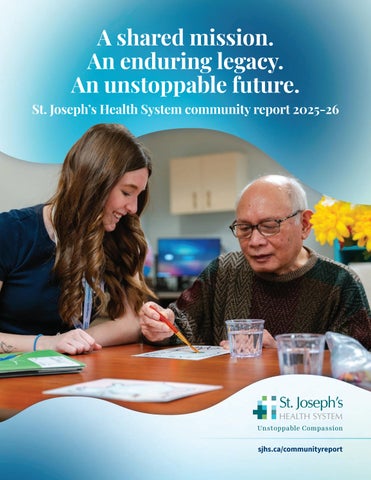
A shared mission. An enduring legacy. An unstoppable future. St. Joseph’s Health System community report 2025-26
sjhs.ca/communityreport
A message from leadership A shared mission. An enduring legacy. An unstoppable future. This community report marks an important milestone for St. Joseph’s Health System. It is our first since coming together as one system under a shared mission, vision and strategy – strengthening our commitment to providing exceptional, compassionate care while shaping the future of healthcare across the communities we serve. Our story began more than 170 years ago when the Sisters of St. Joseph answered a call to care for those who needed them most. Their courage, compassion and unwavering belief in the dignity of every person laid the foundation for a legacy that continues to guide us today. While healthcare has evolved dramatically since those early days, our purpose remains unchanged: to serve with compassion, excellence and hope. Across St. Joseph’s Health System, that mission comes to life every day through the extraordinary people who care for patients, residents, clients and families. From the bedside to the classroom, the laboratory to the community, our staff, physicians, researchers, learners and volunteers demonstrate Unstoppable Compassion through the moments, both large and small, that remind us healing is about more than medicine. It is about human connection, dignity and meeting people where they are. This report celebrates those moments and highlights the remarkable progress we are making together. Across our system, we are advancing innovative models of care, expanding access to specialized services and investing in research and education that will improve health outcomes for generations to come. As an academic health sciences system, we are not only caring for people today – we are discovering new treatments, training the next generation of healthcare professionals and transforming how care is delivered tomorrow. Our impact extends far beyond the walls of our hospitals, long-term care homes, hospices, home care clients and community programs. Every day, we work alongside community partners to improve access to care, address health inequities and respond to the complex needs of the people we serve. Together, we are helping build healthier, more resilient communities where everyone has the opportunity to thrive.
2
None of this would be possible without the dedication of our healthcare workers. In the face of increasing demands and unprecedented challenges, they continue to deliver exceptional, high-quality care with professionalism, compassion and resilience. Their commitment inspires us every day and reflects the legacy of the Sisters of St. Joseph. As we look to the future, we do so with optimism and hope. Guided by our shared mission, strengthened by our people and inspired by the enduring legacy of the Sisters of St. Joseph, we will continue to innovate, educate, discover and care with compassion – ensuring we make an even greater impact for the communities we serve. As one St. Joseph’s Health System, our shared strategic plan is how we bring our mission of Unstoppable Compassion to life. Guided by our strategic directions – advance health, amplify impact and invest in teams – we are working together to improve the health of our communities, strengthen our impact through innovation, research and education, and support the remarkable people who make our mission possible. As we move forward, we will continue to measure our progress, adapt to the evolving needs of our communities, and share our journey openly as we pursue our bold vision for the future of compassionate, mission-driven care. Thank you to our patients, residents, families, donors, volunteers, partners, board members and communities for your trust and support. Together, we are building a healthier future, united by a shared mission of Unstoppable Compassion.
Dr. Michael Heenan,
Shawn Clifford,
President, St. Joseph’s Healthcare Hamilton President and CEO, St. Joseph’s Health System
Chair, St. Joseph’s Health System board of directors
3
Who we are
4
10,000+ staff and physicians
5,000+
220 researchers
Staff, physicians, learners and volunteers across St. Joseph’s Health System
learners
1,120 volunteers
FINANCIAL DATA: 2026/27 budgeted expenditures St. Joseph’s Healthcare Hamilton
St. Joseph’s Health Centre Guelph
million
million
$897.3
$33.3
St. Joseph’s Villa Dundas
St. Joseph’s Lifecare Centre Brantford
million
million
$63.2
$28.1
Margaret’s Place Hospice
Stedman Community Hospice
million
million
St. Joseph’s Home Care
St. Joseph’s Housing Corporation Inc., Guelph
million
million
$2.7
$29.4
$4.8 $3.5
5
High-quality care rooted in compassion Our mission of Unstoppable Compassion is at the heart of everything we do at St. Joseph’s Health System. And we know that compassionate care is grounded in innovation, excellence and quality in order to deliver the care our communities need, when and where they need it. We are proud of our track record on quality. According to the Canadian Institute for Health Information, St. Joseph’s Health System consistently performs better than the provincial average on metrics that matter, including pain in long-term care residents, physician assessment time in our emergency department and satisfaction among home care clients. Our unwavering commitment to high-quality care rooted in compassion is one of the ways we live our mission of Unstoppable Compassion each day.
Commitment to quality in long-term care
16.3%
long-term care residents requiring transfer to emergency department
St. Joe’s residents experiencing pain in long-term care
Ontario benchmark:
Lower than national average of
22% 5.7%
better than the provincial average
6
1.2% 5.5%
Lower than provincial average of
4.6%
Dedication to quality leads to better outcomes for mental health patients
St. Joe’s Hamilton is making care for patients who require admission for a mental health concern faster and more accessible. St. Joe’s implemented new initiatives designed to make admission faster for those patients. As of March 2026, the average wait for an inpatient bed decreased by more than five hours to 9.5 hours. Changes included discharge planning at admission, standardized rounds, predictive planning tools and proactive work in our psychiatric emergency service. These efforts are helping patients access care sooner while improving coordination and flow.
Time to inpatient bed for mental health and addictions (average hours) Time to inpatient bed (hours)
18
16.9
17 16 15 14
15.3
14.8
14.7
QIP Target
13.7
13 12 11 10
9.5
9 8
2021-22
2022-23
2023-24 Fiscal year
2024-25
2025-26
Commitment to quality in acute care
2.5 hours
for emergency department physician initial assessment
St. Joe’s Hamilton is the highest performing teaching hospital in Ontario for emergency wait times 7
New test preventing long-term hospital stays among pregnant patients at risk for pre-eclampsia St. Joseph’s Healthcare Hamilton is one of the first hospitals in Ontario to offer a blood test that can accurately predict a patient’s risk of developing pre-eclampsia during pregnancy, helping clinicians better target monitoring, treatment and decisions about delivery. Pre-eclampsia is a serious condition that most often develops later in pregnancy and can lead to seizures, organ failure and death, as well as risks to the fetus, including preterm birth or stillbirth. Traditionally, care teams have relied on a patient’s medical history, blood pressure and other measures to determine risk. That approach can lead to overtreatment or missed diagnoses. Often, patients considered at risk are admitted to hospital for weeks so care teams can monitor the health of both the patient and baby. The new predictive blood test gives clinicians an accurate picture of who is likely to develop pre-eclampsia and who is not. The result is precise treatment for those who will go on to develop the condition and the chance to remain home during the final weeks of pregnancy for those who won’t develop pre-eclampsia. It also allows for better decision making about timing of delivery. “They are able to avoid a weeks-long hospital stay and be at home with family. It’s really powerful,” said Dr. Peter Kavsak, clinical biochemist at St. Joe’s Hamilton who spearheaded making the blood test available. “I’ve had doctors tell me their patients want to give me a hug – that’s the best thing you could ever hear.” The test is typically offered to high-risk patients, like those with medical conditions that mirror some symptoms of pre-eclampsia, after 26 weeks, and patients exhibiting symptoms closer to their due date. It measures the balance of two proteins in blood samples to help doctors decide whether the pregnant patient should remain in hospital for monitoring or delivery, or return home safely.
8
Our core lab team is part of a collaborative group that created a blood test to detect the risk of pre-eclampsia within hours.
Kavsak and his colleagues, including Dr. Serena Gundy, director of Hamilton Health Sciences’ obstetric medicine program, say this test, available 24/7, will help pregnant patients across the region. The test is available around the clock, seven days a week, given the seriousness of pre-eclampsia. Across Canada, rates of pre-eclampsia and hypertension – another type of high blood pressure disorder – have increased over the last two decades. “The only way to treat severe pre-eclampsia is to deliver the baby,” said Dr. Susan Ellis, chief of obstetrics and gynecology at St. Joe’s Hamilton. “Any test that can help us balance the risks of ongoing pregnancy and delivering the baby is amazing for our patients and their babies.”
“ Nearly all of my patients are high-risk for pre-eclampsia from the get-go because they have pre-existing kidney disease, diabetes or high blood pressure. This test has finally given us a clear way to diagnose pre-eclampsia versus worsening kidney disease.”
1/3
of patients at high-risk kept out of hospital
Dr. Anna Mathew, nephrologist
9
A step toward dignity: Removing barriers for foot care in the Kitchener-Waterloo community Foot health is about a lot more than a good pedicure. Proper foot care plays a critical role in keeping people healthy and mobile. But for many people, including older adults or unhoused individuals, foot-related issues are far too common and can lead to serious health challenges. St. Mary’s Health launched a foot care clinic in December 2025 to bring much-needed help to vulnerable residents of Kitchener-Waterloo. Operating out of the former St. Joseph Church in Kitchener, the clinic offers preventative assessments, diabetic foot checks, toenail trimming and filing and screening for circulation and skin issues. It primarily serves older adults, individuals with diabetes and people who are unhoused. The clinic has helped more than 450 people since opening its doors. Foot health is often overlooked, but untreated issues can lead to infections, mobility challenges and even hospitalization, especially for people with diabetes or circulatory problems. Those already experiencing barriers to care are more likely to experience serious foot complications that pose significant health risks. Helen Leitch, patient, during a visit to our foot care clinic. Image by Jeff Pickel /CTV News
The clinic was created in response to a clear gap in accessible foot care services. “This new clinic is responding to a need for accessible foot care that we’ve seen in the community and from speaking with local healthcare and social service agency partners and organizations,” said Nadia Surani, vice president, post-acute care and executive director at St. Joseph’s Home Care, which includes St. Mary’s Health. For patients like Helen Leitch, 77, the clinic has become an important part of managing long-term health. Living with diabetes, she understands the risks associated with poor foot care and values the support she receives at the clinic. “I like coming here and getting this done. This is great, then I can go home, dance around the kitchen and feel good,” she told CTV Kitchener during a visit to the clinic last March. The clinic reflects St. Mary’s Health’s efforts to meet changing health and social needs while renewing Catholic care in the Kitchener-Waterloo community. Through strategic partnerships with local health and social care organizations, St. Mary’s Health is expanding access to care and better supporting individuals who face barriers to traditional services.
“ I like coming here and getting this done. This is great, then I can go home, dance around the kitchen and feel good.” Helen Leitch, client
More than
450
people have been helped since opening its doors 10
Driving rehabilitation program helps clients maintain independence and navigate the road ahead As there is no pencil and paper test or list of medical conditions that can definitively determine whether someone is safe to drive, occupational therapists bring clinical expertise to assessing a person’s functional abilities. Wylie takes a holistic approach, looking at each client’s circumstances through driving research and professional experience. She considers whether driving errors are ordinary driving habits, or linked to medical impairments that could be addressed through rehabilitation, education or adaptive equipment.
People experiencing medical, cognitive or physical challenges can navigate the driving licensing process to drive safely for as long as possible.
For many clients, the assessment is about much more than driving. Some still have their licence and want to continue driving safely. Others come after months of recovery from a stroke, injury or other significant health event that resulted in their licence being suspended.
A car isn’t just a way to get from point A to point B. For many people, it represents freedom, independence and connection. When someone loses – or is at risk of losing – their licence, they may also lose access to their community, essential services, employment and other opportunities that enable them to live life fully. At St. Joseph’s Health Centre Guelph, the driving rehabilitation program is the only Ontario Ministry of Transportation-approved functional assessment centre in Guelph. Supporting more than 2,500 clients experiencing medical, cognitive or physical challenges, the program helps individuals navigate the licensing process and drive safely for as long as possible.
“ The safe option isn’t to take someone’s licence away just in case. Losing your licence can be very detrimental to a person” Anne Wylie, occupational therapist, St. Joe’s Guelph’s driving rehabilitation program
“It’s a slow process of getting back to their life again,” said Wylie. “Often this one visit for their driving assessment completely opens the world back up. It restores their freedom and independence to access the whole community again.” Because driving is closely tied to independence, conversations about whether a loved one should remain on the road can be emotional. The program encourages family participation throughout assessment, rehabilitation and driving lessons so families understand the team’s observations, rationale and recommendations and can move forward with greater confidence and clarity. “For the clients who aren’t able to keep driving, this can still be an important part of their journey,” said Wylie. “They’re able to see that we truly want the best for them and that they’ve received a fair assessment. That can help them find closure and accept the next chapter.”
At the heart of the program is a commitment to balancing independence with safety.
11
Healing through play: Helping children navigate grief Grief can take many forms. Especially in children, who experience and express grief in unique ways based on age, experiences and exposure. That’s why Stedman Community Hospice uses familiar activities — from board games and soccer balls to Lego — to help children feel safe and express grief while a loved one receives hospice care.
The play therapy program is centred at the hospice, but has grown to provide care to children and grandchildren of patients receiving care at home. By connecting earlier, Adams and her team can help create a sense of safety and comfort for the family before a patient needs hospice care.
“Talking is hard, emotions are big, and the experiences that we walk with people through are incredibly difficult to process,” said Sydney Adams, supportive care practitioner at Stedman. Sydney Adams provides a safe and creative space for children to express grief in unique ways.
12
To foster a safe and supportive space, Stedman’s play therapy program grew out of its existing art therapy program, which helps children process grief and express how they are feeling without talking directly about it. “Art can be a little bit more abstract and requires a bit more baseline creativity, which can be jarring for some people. To see a blank canvas and have no instructions, especially during grief when there’s so much going on, you just don’t know where to start,” Adams explained. “For kids, toys and games are natural. They know what to do. They know how to engage without instruction or prompting, so that inherently creates that comfort and ease when they’re in a space that feels familiar.” The informal structure of play-based activities taps into kids’ strengths and helps them feel comfortable to address anger, anxiety or social skills as coping mechanisms and interventions.
“Talking is hard, emotions are big and the experience that we walk with people through are incredibly difficult to process.” Sydney Adams, supportive care practitioner
“We supported a young mom recently who had an eight-year-old son. This is an eight-year-old boy who, of course, doesn’t want to talk about the fact that his mom is going to die,” said Sydney. “We consciously used play-based techniques when mom was still at home in his own environment to build a relationship and have him comfortable with me at home. That relationship grew as appointments were held at the hospice, because the goal was eventually for her to come here when she was appropriate. “Slowly that comfortability and playful relationship was built. We were able to engage in questions like ‘What are you noticing about mom’s disease?’ with one kick of a soccer ball, ‘What are you scared of?’ with another kick back. Eventually, when mom was admitted to the hospice, the boy was comfortable at the hospice and he was comfortable with me.” For Sydney, the play therapy program is rooted in one simple idea – children deserve support that speaks their language and meets them where they’re at in moments when words are too heavy.
Stedman uses familiar activities like board games, soccer balls and Lego to help children express grief
13
St. Joe’s researchers create new treatment to prevent postpartum anxiety disorders New research from the Women’s Health Concerns Clinic at St. Joseph’s Healthcare Hamilton has found it’s possible to prevent anxiety disorders that can develop during pregnancy and after birth. Perinatal anxiety is a common condition – more common than postpartum depression – but fewer than 15 per cent receive appropriate treatment, often because it isn’t detected quickly enough. The perinatal period includes pregnancy or up to one year postpartum. St. Joe’s Hamilton researchers identified a key trait to help predict whether someone will develop an anxiety disorder in the perinatal period: a person’s ability to tolerate uncertainty. “Most of us can probably say we don’t like uncertainty, but some have a stronger emotional reaction to it than others. They try to avoid it altogether by doing things like seeking constant reassurance or spending hours researching options for every tiny decision,” said clinical psychologist Dr. Melissa Furtado, who conducted this research as part of her doctoral thesis under the leadership of psychiatrist Dr. Benicio Frey and psychologist Dr. Sheryl Green. This research is funded by proceeds from the Shoppers Drug Mart Run for Women. “The problem is you often can’t get rid of uncertainty completely. They feel like something catastrophic will happen when they can’t have 100 per cent certainty.” The research was simple: six weeks of cognitive behavioural therapy (CBT) for pregnant people to work
on building tolerance in uncertainty. The CBT program significantly reduced the risk for anxiety disorders during the postpartum period. In fact, no participant who took part developed an anxiety disorder after giving birth. Delaney Carvalho, a new mom who took part in the CBT program, said early in pregnancy she was “grasping at straws. I was trying to learn anything and everything I could from every source. It was my coping mechanism: just consuming as many resources as possible.” Carvalho met with Dr. Furtado in her third trimester. “It was helpful on two fronts: not only was the frequency of my spirals reduced, but the intensity when they happened was reduced as well,” she said. “And by my third trimester, I was feeling much better. Meeting with [Furtado] helped me to accept that I would never know everything, and that’s okay.” “Many people have only heard about postpartum depression, but anxiety disorders during the perinatal period can also have long-lasting impacts on the mother and baby for years after birth. It is more common than depression in the perinatal period and can be just as distressing and debilitating,” said Frey, who is also the academic lead of St. Joe’s Hamilton’s mood disorders program. As for Carvalho, she had her second child in June. “This time around has been much easier mentally,” she said. “I feel so much more prepared and better supported. I’m so much more confident in myself.”
“ In the past, these conditions have been understudied, and we didn’t know enough about risk factors and effective screening methods.” Dr. Benicio Frey, psychiatrist and academic lead, mood disorders program
14
Delaney Carvalho, a new mom who took part in our CBT program to reduce the anxiety of uncertainty during the perinatal period.
No participants developed an anxety disorder after giving birth
Championing compassion in healthcare Research has consistently shown that compassionate care is linked to improved health outcomes for individuals and supports the mental well-being of healthcare workers. That’s why St. Joseph’s Health System is investing in embedding compassion as a standard of care across Canada. Dr. Shane Sinclair, Canada’s first cross Canada chair in compassionate care funded by the Research Institute based at St. Joseph’s Health System and other partners, will conduct research over the next five years focused on organizational compassion, accounting for the perspectives of senior leaders, healthcare providers and support staff. This is one of the many ways St. Joseph’s Health System continues to put our mission at the forefront of the work we do each day. The intention of this research is to draw from the firsthand experiences of healthcare professionals and leaders to develop tools and resources that embed compassion as a common healthcare practice. “By going to the frontlines and speaking to the people working in healthcare every day, we’re trying to make unstoppable compassion a tangible practice by understanding the very real challenges they face in making this a reality,” said Dr. Sinclair. “For the first time, we are trying to define organizational compassion from the ground up and build measures that support its implementation as a standard of care.” Dr. Sinclair’s research seeks to empower healthcare professionals and leaders to implement compassion as a daily practice in their interactions with patients and across the organization. Compassionate healthcare results in healthier patients with an improved quality of life, increased satisfaction in experiences with the healthcare system and more positive patient engagement with healthcare staff. A recent publication about Dr. Sinclair and the Compassion Research Lab’s evidence-informed, competency-based, accredited compassion training
Dr. Shane Sinclair’s research is helping St. Joe’s put our mission at the forefront of the work we do each day.
program (EnACT) illustrates the positive impact that compassionate care has on healthcare professionals and patients alike. “EnACT was designed to support the integration of compassion into everyday clinical practice,” said Sinclair. “The training program combats the myth that compassion is an innate trait that you either do or do not have. It empowers healthcare professionals to cultivate and strengthen compassion as a learnable skill they can optimize into practice.” This multi-centre trial evaluated the feasibility and impact of EnACT over a nine-month period and included 163 healthcare professionals and their patients. Healthcare professionals who participated in the training reported significant and sustained improvements in compassion confidence and increases in professional fulfillment. Most importantly, the patients cared for by EnACT-trained providers reported significantly higher experiences of compassion and satisfaction with their healthcare experience following the training. Dr. Sinclair’s work demonstrates that compassion plays a critical role in both the healthcare provider and patient experience. Through investments like the cross-Canada chair in compassionate care, St. Joseph’s Health System embeds unstoppable compassion in our day-to-day work and deepens our commitment The Sinclair to person-centred care.
Compassion Questionnaire is considered the global ‘gold standard’ of compassion measures in routine care
15
Harnessing AI to transform neovascular age-related macular degeneration St. Joseph’s Healthcare Hamilton is leading the way in advancing evidence-based, personalized care for patients with neovascular age-related macular degeneration (nAMD) – one of the leading causes of vision loss among older Canadians.
Boosted by a $10 million donation announced in the fall of 2025, the newly named Thomas Kevilll Advanced Vitreoretinal Imaging (AVI) lab, led by St. Joe’s Hamilton’s chief of ophthalmology, Dr. Varun Chaudhary, is changing that narrative.
The disease is treatable with sustained therapy over the course of several years. For clinicians, one of the challenges is knowing in advance which patients will respond well to treatment and which may experience a reccurrence of the disease.
By leveraging artificial intelligence and advancing retinal imaging, they are developing new approaches to improve the prediction, personalization and delivery of nAMD treatment.
Dr. Varun Chaudhary and team utilize AI tools to pair the latest retinal imaging technology with expert knowledge to advance care for one of the leading causes of vision loss among older Canadians.
16
“ At the AVI lab, we’re pairing the latest retinal imaging technology with expert level grading to analyze thousands of scans to understand how best to optimize outcomes for our patients,” Dr. Varun Chaudhary, chief of ophthalmology
The lab is developing a database that links retinal images with clinical findings, treatments, disease activity, treatment history and visual outcomes. They have built AI algorithms that rapidly review images and identify biomarkers to personalize care plans for patients. “The AI tools will help identify patterns in terms of disease progression and response to treatment,” said Chaudhary, “This could help clinicians personalize treatment and ultimately preserve patients’ vision for as long as possible.” As a national leader in the diagnosis and treatment of nAMD, the AVI lab has been awarded a Canadian Institutes of Health Research project grant to develop a pan-Canadian, evidence-based clinical practice guideline for managing the disease.
The Thomas Kevill Regional Eye Institute conducts more than
“Until now, Canada has lacked a dedicated centre focused on assessing emerging evidence in retinal treatments and translating it into clinical practice,” said Chaudhary, “The AVI Lab will build a national hub of expertise to rapidly evaluate emerging evidence and develop evidence-informed clinical practice guidelines that support the timely adoption of new diagnostics and treatments. Our first initiative will focus on neovascular AMD.” As Canada’s first dedicated ophthalmology guidelinedevelopment hub, the lab is tasked with improving the quality and consistency of care for patients with nAMD. Through this work, the team will identify, appraise and review emerging treatments and diagnostic technologies. National experts affiliated with the hub will review the lab’s findings to determine whether new treatments or tools should be integrated into existing care pathways. By bringing advanced imaging, AI diagnostic technologies and national guideline development together, the AVI lab is creating a new model for how retinal research can translate into better care. Its goal is not only to generate new knowledge, but to turn emerging evidence into practical tools that help clinicians make more informed, personalized treatment decisions – positioning St. Joe’s Hamilton at the forefront of age-related macular degeneration care in Canada.
7,000 eye surgeries every year
17
Partnership helps ensure safe, warm overnight support for patients experiencing homelessness During the winter, finding shelter for people experiencing homelessness following their hospital discharge becomes an urgent concern for physicians and hospital staff. For physicians, nurses and hospital staff across Hamilton, that reality is all too familiar. After providing medical care, they are often left searching for a safe place where a patient can spend the night, especially during the harshest winter months. For the past two winters, St. Joseph’s Healthcare Hamilton, Hamilton Health Sciences, Hamilton Health Sciences Foundation, The Hub Hamilton and the Greater Hamilton Health Network have partnered to operate the Hospital Warming Hub, a dedicated overnight drop-in space that offers people experiencing homelessness a warm, safe place to stay after leaving hospital. “The warming centre is a testament to the strength of Hamilton’s community partners, including the First Pilgrim United Church,” said Dr. Mike Heenan, president and CEO of St. Joseph’s Health System. “It is humbling and inspiring to see our community partners work together to fill this important need.” The partnership was a true collaborative effort with the Diocese of Hamilton playing an important role in helping St. Joe’s secure the location. This past winter, the Hospital Warming Hub operated seven days a week from 10 p.m. to 9 a.m., regardless of the temperature. Spaces were dedicated for individuals referred to the centre following their hospital visit, but walk-ins were also welcomed based on space. The Hospital Warming Hub was the only service in Hamilton offering a warm-up spot that includes spaces for couples and those unable to access shelters.
The Hospital Warming Hub was staffed by trained outreach workers and students enrolled in healthcare programs such as nursing and medicine, as well as police-in-training, who helped connect those coming in with primary care, community resources and other supports they may need. This provided a unique opportunity for students to gain essential experience and skills to bring to their future careers. “This overnight winter warming centre is a crucial component of our compassionate discharge planning and a vital resource for our community,” said Brooke Cowell, executive vice president of clinical operations and chief nursing executive at St. Joe’s Hamilton. “We are deeply proud of the partnerships that have made this possible. This warming centre offered a safe and supportive option for those transitioning out of hospital care. It was an invaluable resource for many individuals last winter.” Having the Hospital Warming Hub open overnight helped emergency departments work more efficiently. Staff no longer had to make multiple calls to shelters throughout the city to determine which may have space to take a newly discharged patient. The Hospital Warming Hub reflects what is possible when healthcare providers and community organizations come together to address a critical need. By offering a safe, warm place to stay after hospital discharge, the partnership is helping people experiencing homelessness transition from care with dignity, support and connection to essential services.
“It is humbling and inspiring to see our community partners work together to fill this important need.” Dr. Mike Heenan, president and CEO, St. Joseph’s Health System
Over the last two winters, this model has supported approximately
600
individuals experiencing homelessness 18
The Hospital Warming Hub, located at the First Pilgrim United Church, is a centralized place to support those unable to access shelters.
Innovative model at First Place transitional care bed program helps people avoid hospital stays A team of health professionals at St. Joseph’s Home Care is providing vital support to patients and clients who don’t require the acute care of a hospital but aren’t well enough to go home.
recently joined the team as well. Together they provide care that promotes recovery and independence, prescribe assistive equipment to improve function and safety, and support complex discharge planning.
The transitional care bed program is a short-term, 53-bed unit at First Place, a seniors apartment building in downtown Hamilton. It first opened in 2013 with three beds and has since expanded to become the largest geared-to-income transitional bed program in the city. The program is managed by teams of health professionals from St. Joe’s Home Care who provide wrap-around care for seniors, people with complex conditions and underserved populations who would otherwise struggle to get extra support.
In addition to social support, occupational therapists are also key members of the care team at First Place who assess functional mobility and develop tailored exercises so clients can participate in meaningful activities of daily living.
“Many First Place clients are waiting for a long-term care bed or to transition to a community care setting,” said Nadia Surani, executive director of St. Joe’s Home Care and vice president of post-acute care at St. Joe’s Hamilton. “These moments of transition can be difficult for clients and their loved ones, and every client has a unique story. Our health professionals not only support the physical and medical aspects of care, but also emotional and social wellness.”
“Giving a client more autonomy has a big impact on mood and quality of life. It’s all about supporting clients to see what they’re capable of at that moment,” said Gawain Tang, an occupational therapist at First Place. According to First Place client Manny Costa, it’s the right place for him, and he’s grateful for the compassion shown by the care team that has helped him gain confidence in his journey towards wellness. “I’m happy here – it’s a good place to be.”
The care team at First Place includes social work, occupational therapy, physiotherapy and rehabilitation assistants. A mental health worker
“Giving a client more autonomy has a big impact on mood and quality of life. It’s all about supporting clients to see what they’re capable of at that moment.”
Manny Costa is one of many clients at First Place, the largest geared-to-income transitional bed program in Hamilton.
Gawain Tang, occupational therapist
First Place opened in 2013 with three beds and is now the largest geared-to-income transitional bed program in the city 19
A major accomplishment: St. Joe’s teams perform 10 kidney transplants across five-day span Performing one kidney transplant is a remarkable achievement, requiring precise coordination across teams and exceptional expertise in the operating room. Now imagine performing 10 transplants in a five-day period.
20
That’s exactly what St. Joseph’s Healthcare Hamilton’s renal transplant program accomplished in June, performing a life-changing procedure for 10 patients over the course of five days.
“ Performing one transplant is heroic. Performing 10 transplants in a short period is extraordinary.” Dr. Christine Ribic, medical director, kidney transplant program
“Completing 10 transplants in under a week is a major accomplishment. This required several multidisciplinary teams working together to get every kidney recipient across the finish line,” said Dr. Christine Ribic, medical director of St. Joe’s Hamiltion’s kidney transplant program. St. Joe’s is home to one of the largest kidney programs in Canada, supporting more than 3,000 patients living with kidney disease across the region and performing 145 to 160 kidney transplants per year. Dr. Ribic said performing that many transplants in such a short period required team members to go above and beyond their usual responsibilities, and that she is deeply appreciative of their dedication. “It’s heartwarming to see everyone united by a common goal for their patients. I’m incredibly proud, grateful and just in awe of the team. That’s the culture of St. Joe’s Hamilton – we put the patient first.” Performing 10 kidney transplants in five days required exceptional coordination and dedication from teams across St. Joe’s Hamilton. From organ assessment and preparing recipients for surgery, diagnostic imaging, lab work, the operation itself and post-operative care – specialized staff worked around the clock to ensure each transplant could proceed safely and successfully. While a kidney transplant operation takes three to five hours, the collaboration, time and resources required to make a successful transplant possible are considerable. “It truly takes a village to get someone to a transplant; the surgery is just one part of the journey. Everyone has a role to play when we find out a donor organ is available, and timing is critical at every step,” said Ribic.
St. Joe’s Hamilton’s kidney transplant team performed 10 kidney transplants in five days, from organ assessment to diagnostic imaging to the lab and post-operative care.
The timing of organs becoming available from deceased donors is unpredictable, requiring rapid coordination to notify recipients, perform compatibility testing and prepare the recipient for surgery. These urgent procedures also require close coordination with St. Joe’s Hamilton’s operating room and surgical centre teams to ensure transplants can be accommodated while ensuring other patients continue to receive timely care. For the 10 patients who received their transplants during this remarkable five-day period, the impact is profound. “Receiving a kidney transplant is a truly life-changing event. Few interventions in medicine improve patients’ survival chances and quality of life as St. Joe’s significantly as a transplant for someone with Hamilton performs kidney disease who is undergoing dialysis treatment,” said Dr. Ribic.
145-160 kidney transplants per year
21
Community Access to Long-Term Care: Bridging the gap for seniors and caregivers The Community Access to Long-Term Care (CALTC) pilot program at St. Joseph’s Villa Dundas is helping seniors and caregivers navigate the challenging period between living independently and securing long-term care placement. By bringing together health, wellness and social supports in one accessible location, CALTC is improving quality of life, reducing barriers to care and helping older adults remain safely connected to their communities. Since September 2025, the program has received 164 referrals and provided more than 1,500 service encounters. With 86 clients currently engaged in services and 65 successful discharges, CALTC is helping seniors access the right care at the right time while supporting them to age safely and with dignity in the community. CALTC’s interdisciplinary team provides a broad range of supports tailored to individual needs, including program navigation, nursing care, foot care, social work, physiotherapy consultations, bathing services, therapeutic recreation programming, health promotion and education, spiritual care and access to dietitian and occupational therapy consultations. The program’s most utilized services include foot care, weekend social and recreational programming and the accessible bathing program. For Karen Pearson, the pilot program has provided more than support. It has brought peace of mind. “It has just been lifesaving,” said Pearson, whose husband Edwin participates in the program. “When he comes out of there, he’s smiling and he’s happy. He loves to be social with people.”
In one case, CALTC’s team-based approach supported a father and son living together in challenging circumstances. The pair access multiple services through the program, including bathing, foot care, nursing, physiotherapy and social work supports. During one bathing appointment, staff identified a concerning wound and arranged for assessment by the nurse practitioner. At the same time, the team helped address recurring falls, connected the family with additional community resources and coordinated referrals for in-home support. The bathing program has become an especially valuable point of intervention. During routine appointments, staff can notice changes in mobility, overall functioning or support needs, prompting conversations with caregivers and referrals to additional services to ensure resources are provided to navigate the next stage of care. As demand for senior care services continues to grow, CALTC is helping address a critical gap in the care journey for many older adults and caregivers. Through integrated services, early intervention and personcentred support, the program is enabling seniors to age with dignity while helping caregivers navigate increasingly complex The CALTC team healthcare and longprovides a broad range term care systems. of supports, including program navigation, nursing care, foot care, bathing services and more.
Pearson’s experience reflects the difference CALTC is making for families across the community. Through proactive assessments, coordinated care and personalized support, the program helps identify health concerns early, connect seniors with appropriate services and reduce the Since likelihood of avoidable hospital visits.
September 2025, CALTC received 164 referrals and provided more than
1,500 service encounters
22
Understanding the person behind the behaviour For residents living with dementia, a change in behaviour can be an important way of communicating a need. At St. Joseph’s Lifecare Centre Brantford, care teams are trained to investigate the deeper meaning, listen with empathy and respond with compassion. As residents’ needs become more complex, St. Joe’s Brantford is expanding specialized clinical services and supports for people living with dementia, experiencing responsive behaviours or requiring memory care. It’s an approach rooted in person-centred care and the belief that every resident deserves to feel safe, known and supported. “If you’ve met one person living with dementia, you’ve met one person living with dementia,” said Sandra Mallett, Behavioural Supports Ontario therapeutic advisor at St. Joe’s Brantford. “Every resident we work with is a unique person, and it’s important we understand their unique story so we can provide them the best possible care.” That means looking beyond the behaviour and taking time to understand what may be behind it. Pain, thirst, fear, overstimulation, loneliness or frustration can be expressed through behaviour, especially when words are difficult to find. “There are no quick fixes in responsive expressions because we really need to know who the person is, why they’re responding the way they are, come up with a plan, trial it and have the whole care team involved,” said Mallett. All of St. Joe’s Brantford staff are trained on gentle persuasive approaches, which helps teams to respond with dignity and respect while helping residents maintain as much independence as possible. Clear wayfinding, including toilet signage, supports residents as they move through their day. Additionally, 10 per cent of staff have received specialized training in DementiAbility. DementiaAbility is a person-centred, multidisciplinary “Every resident we work with is a unique person, and it’s important we understand their unique story.”
Sandra Mallett built trust with James, a resident living with dementia, that helped her understand what he enjoyed and how to of St. Joe’s support him. Brantford staff have
10%
been trained in DementiAbility
approach that helps teams look beyond responsive behaviours to understand the person and the unmet need behind the behaviour. For one St. Joe’s Brantford resident, that personcentred approach made a meaningful difference. Through techniques used from specialized training in dementia and the relationship Mallett built with the resident, he began to feel seen, understood and supported in a way that reflected who he was as a person. “We were building this rapport, getting to know [him] and what he liked, when we had none of that background information,” said Mallett. “Sometimes he would talk and sometimes he wouldn’t. But then we learned he could read – and not only could he read, he loved to read. So then I’d read a page, and he’d read a page. Sometimes we would talk about what we were reading.” These individualized practices, like understanding communication through reading with the resident, reflects a simple priority at St. Joe’s Brantford – seeing the person first and keeping their story at the centre of how they care for them.
Sandra Mallett, Behavioural Supports Ontario therapeutic advisor
23
SJHH @ Home: Bringing care beyond hospital walls Recovery doesn’t end when a patient leaves the hospital. Whether someone is managing a mental health challenge or navigating the complexities of aging, the transition home can be one of the most important stages of their care journey.
“We support individuals following their hospital stay with an integrated care plan that enables them to continue their care journey in the community,” said Jane Loncke, clinical program director, post-acute care and community partnerships at St. Joe’s Hamilton.
Through SJHH @ Home, St. Joseph’s Healthcare Hamilton and St. Joseph’s Home Care have built an innovative partnership that helps patients recover safely at home while staying connected to the care and supports they need.
The program’s success is rooted in collaboration between hospital and home care teams within St. Joseph’s Health System. Patients begin working with SJHH @ Home coordinators before leaving hospital, and those coordinators remain involved throughout their recovery.
24
“What makes this program unique is the level of collaboration. Our coordinators refer patients but also stay involved throughout the patient’s journey, creating continuity and connection between hospital and home care teams,” said Mary Beth Carter, nurse manager at St. Joe’s Home Care. This seamless partnership supports two streams: the mental health and addictions (MHA) stream and the frail elderly stream. Since October 2025, the MHA stream has supported people returning home following a hospital stay for mental health and addiction challenges. Through an interdisciplinary team that may include nursing, physiotherapy, occupational therapy, social work, personal support workers and mental health specialists, participants receive personalized care for up to 16 weeks. Since launching, the stream has served 103 patients and provided more than 2,092 home visits. One participant, a 68-year-old woman recovering from a medication overdose and serious medical complications, received coordinated support for her
“What makes this program unique is the level of collaboration.” Mary Beth Carter, nurse manager
physical, emotional and social needs. By discharge, she reported feeling safe, confident and connected to the resources for her continued recovery. The frail elderly stream addresses a different but equally important need. Since November 2024, it’s helped older adults remain safe and independent while reducing the need for hospital readmissions. To date, the stream has supported 592 patients and delivered nearly 9,800 home visits. One 84-year-old patient who arrived at the emergency department with chest pain, was also facing food insecurity, financial strain, caregiver burnout, anxiety and fall risk. Through SJHH @ Home, she was connected to nursing, occupational therapy, social work and community supports, helping her remain safely in her community. By combining the clinical expertise of St. Joe’s Hamilton with the community-based care experience of St. Joe’s Home Care, SJHH @ Home is helping patients recover with dignity, maintain independence and thrive at home.
Home care nurses work alongside coordinators in hospital to ensure the team is involved throughout a patient’s journey from hospital to home.
Since launching, SJHH @ Home has supported
695
patients and provided more than
11,800 home visits
25
Award-winning program helps students with disabilities find confidence, careers and belonging Curtis Wilson wants to open his own food truck. Sophia Devries wants to bake and decorate cakes at the grocery store. Logan Leversage wants to work in music. Ed McKenzie wants to work in the laundry department. In September 2025, these high school students began internships at St. Joseph’s Lifecare Centre Brantford, not knowing that they would gain the skills and the confidence to aspire to these career paths. They are just four of 20 students who have completed internships through Project SEARCH at St. Joe’s Brantford over the past four years and have become a fundamental part of the workplace. Project SEARCH is an immersive, worldwide program that offers students with intellectual and developmental disabilities internships in their last year of school. The local program is run out of Grand Erie District School Board, partnering with Community Living Brant to offer support for job coaching and finding employment, as well as St. Joe’s Brantford. St. Joe’s Brantford provides various internship positions in a compassionate community setting. Job roles include everything from making sandwiches in the kitchenette to playing games with residents through the recreation department. Students learn skills like independence, confidence, teamwork, problem solving and interpersonal communication, which sets them up for success finding a permanent job once they graduate. St. Joe’s Brantford has hired five interns after graduation as permanent staff members. What makes the program succeed, said Katrina Dalton, a teacher at the Grand Erie District School Board and the on-site educator for Project SEARCH interns, is the St. Joe’s Brantford staff’s inclusion and acceptance of the interns, exactly as they are. “The staff are all so eager to have interns in their departments,” Dalton said. “They offer so much support and are so welcoming. And they understand that each intern is unique and learns at a different pace. Just like
20
any staff member, the interns have their own strengths and weaknesses, and the St. Joe’s Brantford team treats them all as individuals.” The program has been so successful that the City of Brantford awarded it an accessibility improvement award for its commitment to providing an inclusive and equitable workplace. This award follows an honour St. Joe’s Brantford was awarded in 2025, when presented with the AdvantAge Ontario community connections award in recognition of its outstanding leadership and impact as the host organization of Project SEARCH Brantford. And the benefits don’t stop the students. St. Joe’s Brantford staff and residents feel enriched by the presence and integration of Project SEARCH interns. While rates of loneliness in seniors increase across the country, residents are able to build relationships with the interns, providing an additional source of connection. Training is provided to staff who will be working with the interns, and as the program has grown, so has staff’s love for it. “Staff have the opportunity to be empowered and in a leadership role,” said Shelley Murray, life enrichment manager at St. Joe’s Brantford and the liaison to Project SEARCH. “We have ‘champions’ who take on a mentorship role and are disappointed when their department doesn’t have an intern placed that semester. I think our staff should be commended for embracing the interns and bringing them into the team.”
Curtis Wilson gains skills and confidence working in the kitchen as part of a program that offers students with intellectual and developmental disabilities internships at St. Joe’s Brantford.
students have completed placements in four years 26
Where care comes together: one man’s journey through compassionate hospice support Philip Brasher was able to receive the right care in the right place and at the right time at our hospices.
Helping a loved one access end-of-life care can be an incredibly difficult process. Alongside the emotional weight of losing a loved one, families often navigate uncertainty – unsure of where to turn, what support is available and how to make the best decisions during an incredibly vulnerable time. Margaret’s Place Hospice and Stedman Community Hospice provide high-quality compassionate care to patients, clients and families during a very difficult time. Margaret’s Place has 11 beds providing hospice care, short-term palliative respite care and additional support for people living with a life-limiting illness. Stedman specializes in end-of-life care and communitybased palliative outreach that supports patients and families in their homes. The hospice has 10 beds available for individuals requiring end-of-life care. For Philip Brasher and his family, access to both hospices provided the care and support they needed as his illness progressed. After being diagnosed with a progressive illness, Brasher remained at home with the support of his wife, Lana Brasher, who became his primary caregiver. As his condition changed and caregiving needs increased, his family began facing difficult decisions about how to best support him through the next stage of his care.
As his needs changed, Brasher’s family hoped to be closer to home. That’s when staff reached out to colleagues at Stedman to see if a space was available. Keeping Brasher’s wishes at the centre of all decisions, he was transferred to Stedman to be closer to his family.
“I highly recommend hospice care for families because I was so burnt out. I was in a very weakened state, and it was such a relief to know that someone was taking care of Philip,” said Brasher. The family’s care journey began at Margaret’s Place, where respite care provided an essential bridge as Philip’s illness progressed. Later, he transitioned to Stedman to access end-of-life care closer to home.
short-term support and comfort for individuals living with serious illness while also giving caregivers time to rest and recharge,” said Jennifer Morritt, director at Margaret’s Place.
Brasher’s journey reflects the benefits of a connected healthcare system. With continuity of care, families find the right care, in the right place and at the right time. “Hospice is the next best thing to home. It was such a relief to know he was well cared for by the medical team, whether nurses or personal support workers, who were attentive, we found peace at Stedman,” said Brasher.
Across different stages of the journey, the hospices within St. Joseph’s Health System support families through a compassionate and responsive continuum of care ensuring families are supported with dignity and respect Margaret’s Place during a difficult journey.
“Margaret’s Place is unique in that a portion of our beds are dedicated to palliative respite, which provides “Hospice is the next best thing to home... we found peace at Stedman.” Lana Brasher, patient’s family member
and Stedman have 21 hospice beds, providing short-term and end-of-life care for those in the region
27
Since Manitou Wiigwam opened in May 2025, the space has hosted more than 150 programs and events, including community gatherings, health and housing programming and traditional healing
First-of-its-kind space by and for Indigenous community opens its doors in Guelph A new chapter in Indigenous community gathering, healing and connection began in Guelph with the official naming of Manitou Wiigwaam, the Indigenous community space at St. Joseph’s Health Centre Guelph. On June 1, 2026, Elders, Indigenous partners, community members, staff and supporters gathered for a naming ceremony led by Elder Myeengun Henry, who gifted the space its name: Manitou Wiigwaam, meaning Spirit Lodge in English. “This space is about creating a place where Indigenous community members feel welcomed, respected and connected – a place where culture, ceremony and community can thrive,” said Katrina Graham, Indigenous health equity consultant who has been collaborating with St. Joe’s Guelph and community partners on the project. “We hope it will deepen relationships, strengthen understanding and ensure Indigenous voices, traditions and leadership are centred and honoured.”
The name, given in Anishinaabemowin, reflects the purpose of the space as a place of healing, belonging, culture, ceremony and community. Manitou Wiigwaam is the first dedicated indoor Indigenous community gathering space of its kind in Guelph. Co-created with Indigenous Elders, partners and community members, the space supports ceremony, circles, meetings, education, cultural activities and reconciliation-focused initiatives for Indigenous peoples first, as well as for St. Joe’s Guelph staff and the broader community. The naming ceremony was a meaningful moment in the journey that Indigenous Elders, community members and partners have been walking together with St. Joe’s Guelph. During the ceremony, Elder Henry shared teaching about the importance of coming together in a good way and building relationships rooted in mutual respect and understanding. “ Our time here together isn’t long, but we walk together for reconciliation.” Elder Myeengun Henry
28
Manitou Wiigwaam (Spirit Lodge) is the Indigenous community space located at St. Joseph’s Health Centre Guelph.
The words reflect the spirit of Manitou Wiigwaam and the collective commitment to creating opportunities for healing, learning and relationship-building. The creation of Manitou Wiigwaam is part of St. Joe’s Guelph’s ongoing commitment to Truth and Reconciliation and meaningful action to the Truth and Reconciliation Commission of Canada’s Calls to Action. “St. Joe’s Guelph has been walking with humility. We have been learning from Indigenous Elders, knowledge keepers, helpers and community members grounded in respect,” said John Woods, integrated president of St. Joe’s Guelph, St. Joseph’s Lifecare Centre Brantford and St. Joseph’s Villa Dundas.
“Having a space where relationships can be mended is important,” said Mike “O’dah ziibing” Ashkewe, accessibility consultant and Indigenous relations specialist. “What is more important and inspirational is that this is a space where new relationships can be forged through conversation and grow into something more through cooperation.” Supported by the Diocese of Hamilton’s Indigenous reconciliation fund, Manitou Wiigwam has hosted more than 150 programs and events, including community gatherings, health and housing programming and traditional healing since opening in May 2025.
29
New living classroom brings hands-on healthcare education and training into long-term care facility As our population ages, the complexity of patient needs and the demands on our healthcare system and skilled team members in long-term care homes continue to grow. To support this challenge, St. Joseph’s Healthcare Hamilton’s department of education and learning, St. Joseph’s Villa Dundas and Mohawk College opened a living classroom — an innovative learning environment that places healthcare education and training directly inside a long-term care facility. “The living classroom immerses students in realworld senior care from day one,” said Dr. Azim Gangji, vice president of education at St. Joe’s Hamilton and vice president of academic at St. Joseph’s Health System. “By learning alongside residents, families and our experienced care teams, students gain handson experience, stronger clinical skills and a deep understanding of compassionate, person-centred care.” Living classrooms allow learners to gain enhanced skills, greater confidence and a deeper understanding of senior care before heading into the workforce. As a result, this integrated model also enhances recruitment and retention in long-term care. “Mohawk College recognized the need for a different approach to training the future of healthcare professionals, one that brings education directly into long-term care facilities and prepares students to confidently support older adults,” explains Paul Armstrong, president of Mohawk College. “The living classroom is an equal benefit for everyone involved. Students experience meaningful, experiential learning, long-term care teams engage in mentorship and continuous improvement and residents contribute to shaping the next generation of caregivers.”
This partnership between St. Joe’s Hamilton, St. Joe’s Villa and Mohawk College provides accessible training for local students, especially those unable to travel outside the community for their education. “This innovative training model will help us enhance recruitment and retention in long-term care, increase the number of healthcare graduates in the region and helps build a sustainable workforce to meet the needs of an aging population,” said Dr. Mike Heenan, president and CEO, St. Joseph’s Health System. “Together with critical partners like Mohawk College, St. Joe’s Villa is building a stronger future for senior care in Hamilton.” The living classroom was made possible through a $1.98 million Models of Care Innovation Fund grant for Centre(s) for Excellence for Specialized Clinical Training from the Ministry of Health. The partnership of St. Joe’s Hamilton and Mohawk College was also awarded a living classroom grant from The Schlegel-UW Research Institute for Aging and the Ontario Association of Adult and Continuing Education School Board Administrators of $75,000 for this project. This funding also supports living classrooms at other locations throughout St. Joseph’s Health System to provide learners with hands-on training designed to accelerate the readiness of graduates, expand capacity and enhance workforce development province wide. St. Joe’s Hamilton and St. Joe’s Villa leaders with Mohawk College partners at the opening of our living classroom.
“The living classroom immerses students in real-world senior care from day one.” Dr. Azim Gangji, vice president of education, St. Joe’s Hamilton and vice president of academic, St. Joseph’s Health System
30
Unlike traditional classroom settings, the living classroom model places healthcare students directly in a long-term care environment
I am a support system: Volunteers bring compassion and connection to people during difficult times There are more than 200 volunteers at St. Joe’s Brantford and Stedman
The transition to long-term or hospice care is rarely easy. Everyone involved – residents, patients and their families – experience a range of emotions as they adjust to a new reality and unexpected changes to longstanding relationships.
“It’s like the aftershocks of an earthquake,” said Rhonda Garnier, who volunteers her time at Stedman Community Hospice helping people through the difficult moments in that transition. “This huge thing has happened to you and now all these parts need to settle back in.” Garnier is one of more than 200 volunteers at St. Joseph’s Lifecare Centre Brantford and Stedman who make a difference in the lives of patients, residents, clients and families by providing compassion, support and attention during difficult moments. The work they do is an important reminder that care is about much more than medication schedules and treatment protocols. It’s also about human connection. This is even more important in long-term care and hospice settings, where care is ongoing and quality of life matters more than a cure. Garnier began volunteering at St. Joe’s Brantford and Stedman in 2022, when she was still working full time as a principal.
Early in her volunteer journey, she was asked to provide companionship to a resident who had no family or regular visitors. Aside from a paid caregiver who came occasionally, the woman was alone, estranged from her family. When Garnier heard the woman’s condition was declining, she came in early – sitting with her, talking with her and paying attention to what mattered most to her. When the final hour came, Garnier was there. Knowing how deeply grounding faith was for the woman, she responded with compassionate care. “I knew the Lord’s Prayer, how to get church music on my phone and I knew how to tell her that Jesus will welcome her, keeping her warm, safe and loved,” Garnier explains. Her presence and affirming words gave the woman a sense of security and peace before she died. Garnier approaches end-of-life conversations with this same attentiveness and compassion. “For example, there’s an assumption that no one wants to be in pain when they die,” said Garnier. “But for some people, being alert is more important than being in pain.” Garnier is an integral member of the team at St. Joe’s Brantford and Stedman and a source of affirmation for patients and residents. “I am a moment in the lives of these people that gives comfort.”
As a lifelong educator and member of the 2SLGBTQ+ community, Garnier’s passion for creating affirming spaces for vulnerable people inspired her to volunteer and become a doula in the community. In this role, she draws on her professional background and lived experience to support patients, residents, families and staff with the same steady presence she brings to every interaction. “I am a moment in the lives of these people that gives comfort.” Rhonda Garnier, volunteer
Rhonda Garnier provides a listening ear, compassion, support and attention to residents and families during difficult moments as they experience hospice care. 31
As one healthcare system, shared moments of Unstoppable Compassion are brought to life through our community report. Guided by a legacy rooted in courage, compassion and service, we are working together to advance health, amplify impact and invest in the remarkable teams who make our mission possible. As we look ahead with optimism and hope, we will continue to measure our progress, adapt to the evolving needs of our communities and share our journey openly as we shape the future of compassionate, mission-driven care. We are deeply grateful to our staff, physicians, learners, volunteers, board members and researchers who serve people with compassion, deliver exceptional, innovative care and relentlessly pursue solutions for a better tomorrow. Together, we are building a healthier future – united by a shared mission, inspired by an enduring legacy and committed to delivering Unstoppable Compassion for every person and community we serve. Thank you.
Learn more about our 2025-2026 moments of Unstoppable Compassion by visiting sjhs.ca/communityreport or scanning this QR code