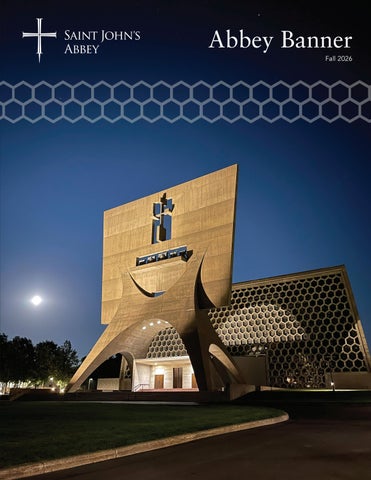
Abbey Banner Fall 2026
“Let the field exult, and everything in it. Then shall all the trees of the forest sing for joy.”
Psalm 96:12
Trailhead to the Stella Maris Chapel Paul Middlestaedt
Title of Article This Issue Abbey Banner
Magazine of Saint John’s Abbey Fall 2026 Volume 26, Number 2 Published three times annually (spring, fall, winter) by the monks of Saint John’s Abbey. Editor: William Skudlarek, O.S.B. Art director: Alan Reed, O.S.B. Desktop publisher: Jason Ziegler Editorial assistants: Gloria Hardy; Aaron Raverty, O.S.B. Lou Griskey Abbey archivist: David Klingeman, O.S.B. University archivists: Eric Pohlman, O.S.B.; Elizabeth Knuth Circulation Manager: Logan Lintvedt Circulation: Ruth Athmann, Tanya Boettcher, Debra Bohlman, Chantel Braegelmann Printed by Palmer Printing Copyright © 2026 by Order of Saint Benedict, Collegeville, Minnesota. ISSN: 2330-6181 (print) ISSN: 2332-2489 (online)
Saint John’s Abbey
2900 Abbey Plaza Box 2015 Collegeville, Minnesota 56321–2015
T
hursday, August 24, 1961, was undoubtedly one of the most memorable days in the history of Saint John’s. That was the day the Marcel Breuer Abbey and University Church was consecrated. Breuer, seated in the first row of the balcony, reportedly remarked that no building he had designed had ever been inaugurated with such solemnity. Five days later, sisters from religious communities throughout Minnesota and neighboring states gathered for a festive Mass. Though the church comfortably seats 2,000, it overflowed beyond its walls. Sisters filled the cloister gardens on either side and even the crypt below. Monks and sisters joined their voices in two great choirs for Mass IX, De jubilo, and the church resounded with an exhilarating, unforgettable outpouring of praise. That was sixty-five years ago. As Abbot Douglas Mullin and Father John Klassen make clear, the Breuer church has served us remarkably well, requiring only modest adaptations in response to the liturgical renewal mandated by the Second Vatican Council. Now, however, structural concerns require attention. We must also consider what additional changes may be needed if the church is to continue serving the spiritual needs of monks, students, guests, and pilgrims in the twenty-first century, while preserving its architectural integrity. The Collegeville Institute, founded sixty years ago, is also looking ahead, seeking ways to respond to the spiritual and social needs of our time. Its new director, the Reverend Aizaiah G. Yong, reflects on these challenges and underscores the importance of the Institute’s relationship with Saint John’s Abbey in addressing them.
saintjohnsabbey.org/abbey-banner Change of address: Ruth Athmann P. O. Box 7222 Collegeville, Minnesota 56321–7222 rathmann@csbsju.edu Phone: 800.635.7303 Subscription requests or questions: abbeybanner@csbsju.edu
Cover photo by Felix Mencias, O.S.B.
4
Abbey Banner
Several other contributors also offer hopeful perspectives on the future. Father Anthony Ruff introduces the revised Liturgy of the Hours that we began praying on August 29. Mr. Tim Ternes, curator, reports on the inclusion of The Saint John’s Bible in the ceremonies for the installation of the new Archbishop of Canterbury and on the decision to bind the original manuscript into seven distinct volumes. Mr. Logan Lintvedt reflects on how his work as Assistant Director of the Benedictine Volunteer Corps prepared him for his current role as Associate Director, Abbey Annual Fund, Marketing, and Communications. Father Timothy Backous comments on the increasingly international character of our community. And Mr. Kevin Vogt celebrates the installation of the first organ built by Abbey Organ Builders as well as new choir stalls crafted by Abbey Woodworking for use by the choir as well as by parishioners who gather to pray the Liturgy of the Hours. Much has been happening at Saint John’s in recent months. Ever grateful for your friendship and support, we are delighted to share these signs of vitality and hope with you. William Skudlarek, O.S.B.
Title of Article The Abbey and University Church at 65
T
his year marks the sixty-fifth anniversary of the dedication of the Abbey and University Church—a milestone that invites more than remembrance. It calls for a renewed awareness of what the church is and what it continues to mean for the monastic community, the university, and all who enter its doors. From the beginning, this church was more than a building project. When Abbot Baldwin and the community entrusted its design to Marcel Breuer, they embraced a bold conviction: that monastic architecture could proclaim the Gospel in a compelling way. The great bell banner signals the primacy of the Word. The vastness of the space evokes humility before the mystery of God. The interplay of concrete and light creates an environment where beauty does not distract from prayer but deepens it.
Paul Middlestaedt
Saint Benedict writes that the oratory should be what it is called—a house of prayer, and nothing else. That vision is realized here with striking clarity. The materials are simple, even austere, yet transformed by light and proportion. The building reflects a distinctly Benedictine sensibility: restraint without emptiness, strength without harshness, and an openness that invites both communal worship and personal contemplation. Yet the holiness of this church rests not only in its design but in what has unfolded within it over the past sixty-five years. The daily rhythm of prayer—psalms, Scripture, silence, and intercession—has shaped generations of monks, students, and visitors. The Eucharist has been celebrated countless times, forming a community in Christ. Lives have been dedicated to God, and the dead have been commended in hope. In the Christian vision, every sacred building points beyond itself. Christ is the true temple, and through him the community becomes a living dwelling place of God. The Abbey and University Church serves that deeper reality by gathering, forming, and sending forth those who pray within it. Anniversaries such as this are occasions not only for gratitude but for recommitment. The dedication of this church marked a beginning—a space set apart for God’s praise so that lives might be shaped in that same spirit. In a world often marked by noise and distraction, the Abbey and University Church remains a place where silence speaks and the search for God is given room to breathe. As we give thanks for sixty-five years, the hope endures: that all who enter may encounter the mystery of Christ and be formed into what this church signifies—a dwelling place for God. +Douglas Mullin, O.S.B.
Fall 2026
5
An Architectural Monument in the Service of God John Klassen, O.S.B.
A
lthough this present proposal concerns the comprehensive plan only, we are most interested in building a church that will truly be an architectural monument in the service of God…. The Benedictine tradition at its best challenges us to think boldly and to cast our ideas in forms that will remain valid for centuries to come, shaping them with all the genius of present-day materials and techniques…. It would be deplorable to build anything less, particularly since our age and our country have thus far produced so little truly significant religious architecture. With these words, taken from a 1953 letter inviting twelve noted architects to submit proposals for a master plan for the Saint John’s campus, Abbot Baldwin Dworshak and his monastic and lay advisors offer us a glimpse of the confidence, desire, and vision that led to the selection of Marcel Breuer as architect for both the campus plan and the Abbey and University Church. From where we stand now, sixty-five years after the church’s dedication in 1961, we can only be in awe of the design and construction skill that brought it into being. Its aesthetic of visual silence draws us into new spiritual territory. The church’s design was in place before Vatican II; yet features such as the centrality of the altar
6
Abbey Banner
Abbey archives
and its relationship to the baptismal font anticipated the renewal of Catholic worship called for by the Second Vatican Council in its 1963 document Sacrosanctum Concilium. At the same time, the strong hierarchical ecclesiology prevalent in the mid-twentieth century is set in concrete. Moreover, concrete and glass are not kind to the spoken word—a limitation that posed less difficulty when the Eucharistic prayer was whispered in Latin. Gregorian chant was the currency of the realm, and it floated freely and beautifully through that huge, forgiving space. With its spaciousness and clear sight lines, its simple yet powerful aesthetic, its connection to the world outside—the monastic community that gathers several times a day for prayer is always aware of light and season—and the centrality of its religious symbols, the church has become holy through the presence and lives of generations of students, faculty, staff, and members of the
monastic community who have prayed there. So, what is the way forward? At sixty-five years of age, the building itself needs attention. The concrete of the iconic bell banner is receiving careful scrutiny to ensure its long-term structural stability. Lighting throughout the building will be replaced with modern LED fixtures and bulbs. Alongside the monastic community’s daily Liturgy of the Hours and Mass, the upper church will continue to host student Masses, weddings, funerals, concerts, convocations, and graduations. Seating and accessibility in the upper church, both in the nave and in the choir stalls, need to become more accommodating for those who use wheelchairs and electric transporters. These improvements arise from our commitment to offering a warm and genuine welcome to all who come to worship in this space. In the years ahead, the monastic community wishes to reflect
Abbey archives
wisely and soberly on its size and the age of its members. An essential element of our vision for the future is finding fresh and creative ways to use the significant spaces of the Breuer church. Our smaller community requires that we designate and create within the church a space appropriately sized for the daily celebration of the Liturgy of the Hours and Eucharist. This space must be readily accessible to guests, students, and co-workers who join us in prayer. Hospitality is a signature mark of our prayer. We are considering the Assumption Chapel in the crypt as a renewed space for ministries of many kinds. We believe it needs a welcoming, easily visible entrance. We imagine spaces for spiritual accompaniment with students and guests, as well as places for private prayer, reflection, and the sacrament of reconciliation. The thirty-four
side chapels, designed for private Masses and containing many fine works of religious art, present a particular challenge as we seek to create an overall ambiance that is both profoundly and warmly Catholic, one that complements, in imagination and expression, the visual silence of the upper church.
Solemn High Mass, 1962
The Saint John’s community is thrilled to be at the point of giving tangible expression to the revitalization of the Abbey and University Church. We will be observing the sixty-fifth anniversary of the Dedication of the Church on Sunday, October 25, and will be inviting friends and supporters to help us launch the campaign for the renewal of the church. Filled with gratitude for what this structure has meant to the entire Saint John’s community over the past six and a half decades, we hope that this work will bring to our campus as much excitement and creative energy as its design and construction did sixty-five years ago, so that in all things God may be glorified. Father John Klassen served as the ninth abbot of Saint John’s Abbey from 2000 to 2022. He is now the abbey’s Director of Development and Reuter Professor of Science and Religion at Saint John’s University and the College of Saint Benedict.
Abbey archives
Fall 2026
7
Renewing Our Common Prayer The Horarium: A Renewed Daily Rhythm The daily schedule, or horarium, has been reconceived. It reflects developments in the wider monastic world by bringing more of the character of the night office—Vigils or Nocturns—into the morning, while restoring Compline at day’s end. The morning office begins earlier and is longer; the evening office is shorter and takes place in the late afternoon; and Compline is prayed after supper. Mass moves to midday, with the psalms of Midday Prayer incorporated at its beginning.
A Revised Liturgy of the Hours Anthony Ruff, O.S.B.
W
hy revise the Liturgy of the Hours at Saint John’s Abbey now? The practical reason is simple: the binders from the last revision, in 1991, are wearing out, and their punched pages are beginning to fall out. The deeper reason is spiritual. This revision is a matter of “reading the signs of the times”—responding to present needs and hopes as we seek to renew and deepen our common prayer. Building on the Work of Our Forebears Historically, Benedictines have prayed a monastic office based on the Rule of Benedict that is distinct from the Roman Office. After the Second Vatican Council (1962-1965), guidelines were issued for each monastic community to revise its Liturgy of the Hours, and the work of Saint John’s Abbey was influential across the Benedictine Order. This is the third version of the monastic office at Saint John’s since Vatican II. The 1971 office marked the transition from Latin to the vernacular. It established the practice of praying the psalms slowly, with each psalm followed by a substantial period of silent reflection. It featured two principal and substantial offices, Morning Prayer and a longer Evening Prayer. The 1991 revision increased the amount of sung psalmody and incorporated
8
Abbey Banner
Psalm 150, Sally Mae Joseph, © 2004 The Saint John’s Bible, Saint John’s University, Collegeville, Minnesota, USA. Used with permission. Scripture quotations are from the New Revised Standard Version of the Bible, Catholic Edition, © 1993, 1989 National Council of the Churches of Christ in the United States of America. Used by permission. All rights reserved.
inclusive language into the translation of the psalms. The present revision builds on the strengths of these earlier versions. It retains the familiar Grail translation of the psalms, while reducing the use of male pronouns for God. It also increases the amount of singing. At the same time, its overall design includes several significant shifts from patterns in place at Saint John’s since 1971.
Formerly, Morning Prayer at Saint John’s consisted of a hymn, four psalms, and one long reading. Now, Lauds begins with a sung invitatory psalm and antiphon, followed by a hymn, three psalms, and a substantial Scripture reading. Two further psalms and a shorter non-scriptural reading follow. This is not the hour-long night office at 4:00 a.m. described in the Rule of Benedict—sixth-century monks did not have the active apostolates that are part of our lives— but it does carry something of the spirit of keeping vigil before the break of day. Previously, Evening Prayer included as many as five psalms before a lengthy Scripture reading, making it a demanding office after supper. Now, Vespers is prayed in the late afternoon, before supper. It includes three psalms and a shorter Scripture
reading. In this respect, too, it more closely reflects the spirit of afternoon Vespers in the Rule of Benedict. This project was not driven by an agenda to become “more Benedictine.” Throughout the process, the central concern was the quality of our experience of the office. We found that the lengthy evening office could be tiring after a full workday, while a lighter, largely sung Vespers in late afternoon was more prayerful and sustainable. We found, too, that the community’s higher energy in the morning invited a longer office; that Mass at midday made for fuller communal participation; and that a short office of Compline was a fitting way to end the day. Only afterward did we recognize that these choices had sometimes brought us closer to the pattern of the Rule. Hospitality to Guests Monks, students, guests, pilgrims, and visitors who have prayed with us previously will immediately notice that the revised books are easier to follow. Apart from hymns, everything needed for an office, from beginning to end, is contained in one binder. There will be no need to consult the hymn board during the service or to juggle several books. Separate binders will be used for the seasons of the church year, with texts and musical settings that highlight the distinctive character of each season.
What’s in a Name? In our new Liturgy of the Hours, the names of the offices have been changed. Morning Prayer becomes Lauds, Evening Prayer becomes Vespers, and night prayer is called Compline. The reason is largely practical: the U.S. Catholic bishops are restoring these traditional terms in the forthcoming revision of the Roman Office. It makes sense for us to use the same terminology that will be widely known throughout the Church. The Work of Many Hands This revision has been many years in the making and has involved extensive consultation throughout the community. Many community members took part in one or another aspect of the project. During the past five years, we conducted three twoweek trial runs, each followed by community feedback and further revision. The final trial, held in Advent 2025, received overwhelming— indeed, nearly unanimous—approval. Abbot Douglas therefore determined that a community vote was not necessary. “How good and how pleasant it is when people live in unity!” (Psalm 133).
The Most Important Renewal Important as revised structures and books may be, the most important renewal is the ongoing spiritual renewal of each one of us as we pray the Liturgy of the Hours. As we worship together, may we—monks and guests alike—give ever greater glory to God and grow in holiness. Father Anthony Ruff teaches liturgy, liturgical music, and Gregorian chant at Saint John’s University School of Theology and Seminary. He is widely published and presents nationally and internationally on liturgy and liturgical music.
Psalm One Frontispiece, Donald Jackson, © 2004 The Saint John’s Bible, Saint John’s University, Collegeville, Minnesota, USA. Used with permission. All rights reserved.
Fall 2026
9
A Conversation with Scripture Scholar Father Dale Launderville, O.S.B. Jessie Bazan
F
ather Dale Launderville’s book Ezekiel 1-24: Introduction and Commentary, published by the Society of Biblical Literature Press, hit bookshelves in June 2026 as part of its Illuminations commentary series. In July I sat down with Father Dale to discuss this cutting-edge feat of scholarship. Let’s start with the basics. What is a biblical commentary? When you read a Scripture text, it can seem to be coming from a different world. The purpose of a commentary is to come to some understanding of what the text is trying to say and provide context for it. The method that’s used has shifted over the centuries. A commentary coming out of the nineteenth century and later is going to be more scientific
in the sense that it wants to recover what the original author intended. What goes into writing a biblical commentary? The first effort is to try to get as close as you can to the original text, which means you need to go through the Hebrew text, Greek Septuagint, Syriac Peshitta, and other translations. You try to go back to the original languages as much as possible. Since we can’t get all the way back to the original text, we get as many variants as possible and then make decisions about what is the best reading of the text. That is where your critical lens comes into focus. Is this the only way to read it? Are there other possibilities? Your commentary is 936 pages. How long did it take you to complete this project?!
I had a sabbatical in 2015, which was when I wrote the first draft. Then I went back and forth with the editors. They would respond with their questions and comments. One of the distinctive features about this particular commentary series, called Illuminations, is its attention to reception history and the text’s impact on art, music, literature, and the broader culture. I needed to find works of art that would illuminate the text. That was totally foreign to my way of working with things and took time. How did you maintain the stamina needed to bring such a big endeavor to completion? I was committed to the project, for one thing. There were discoveries happening along the way that were interesting and drew me along. Stamina is the job description of anyone in academics. If you’re going to do anything substantial, you have to stay with it. I also had the assistance of colleagues from other institutions with expertise in the book of Ezekiel and who attend the meetings of the Catholic Biblical Association and the Society of Biblical Literature. Those meetings were good places to try out ideas. What do you find compelling about the prophet Ezekiel?
Alan Reed
10
Abbey Banner
What is most compelling is the way Ezekiel brings together heart, mind, and emotion in exploring the mystery of God.
How do you integrate all these things? Ezekiel was and is a very controversial figure. When you read certain chapters in which he’s trying to provoke the reader, you may well be ready to put his work aside. But if you’re sympathetic to his project, you realize that he is trying to engage the whole person: emotions as well as intellect. The first 24 chapters on which I’ve written basically tell the story of how Israel proceeded from the time of the exodus in 1300 BCE to the early 500s BCE. The next section of the book — chapters 25 to 32 — deals with foreign nations. Then the final section — chapters 33 to 48— is upbeat. Thus, the narrative of the book of Ezekiel is about the death and resurrection of the nation of Israel. Ezekiel’s challenging theology makes us think bigger about God. You mentioned the next set of chapters. Are you writing the rest of the Ezekiel commentary, too? Yes, I’m now working on the commentary for chapters 25 to 48. What does your commentary add or contribute to the field of biblical studies? One of the unique features of the Illuminations commentaries is a sidebar section called “The History of Consequences.” The editor of this series wanted the commentators to consider the following question: When interpreters over the past 2,000 years picked up the book of Ezekiel, what images did it spur in their
minds and imaginations? These interpreters weren’t trying to find out exactly what Ezekiel thought; instead, they were interested in what this book might tell them about God and the world God governed. Did you learn anything new about yourself in the process of writing this commentary? After going through graduate school and learning a number of dead languages, you get into a certain mode of just bolting yourself to a chair and doing the work—whatever it takes. I have had to realize I can’t do everything needed to explicate the texts—a limitation that I find difficult to navigate at times. Give us your best sales pitch. Why should readers get themselves a copy of Ezekiel 1-24: Introduction and Commentary? There are a few people who are very accomplished in biblical studies and particularly on the book of Ezekiel, who wrote promotional blurbs about the book for the jacket cover. It challenges my Benedictine humility to read them! But I’d say it’s a book you’ll want to have on your shelf. It’s not something you would pick up and read quickly, but rather, something to refer to and explore. The editor insisted that I not put anything overly technical into the opening section of each chapter, which is intended
to provide a clear and engaging commentary on Ezekiel’s prophecy. At the end of each chapter, there’s a retrospect that emphasizes how the chapter connects with things going on in contemporary experience. So, someone doesn’t necessarily need a degree in biblical studies to enjoy your book? Hopefully not. Jessie Bazan, a graduate of Saint John’s School of Theology and Seminary, is Associate Director of the Benedictine Institute at the College of Saint Benedict and Saint John’s University.
Fall 2026
11
A Simple and Radical Invitation: Collegeville Institute’s Calling to the Edge Aizaiah G. Yong
I
n 2027, the Collegeville Institute for Ecumenical and Cultural Research (CI) will celebrate its sixtieth anniversary. As we prepare for this milestone and give thanks for the goodness of God, I find myself reflecting on the radical courage that Father Kilian McDonnell, O.S.B., and other co-conspirators modeled in our founding. From the beginning, our Articles of Incorporation named an audacious purpose: to “dispel religious ignorance and promote better understanding and harmony” by intentionally bringing diverse people together in an encounter sustained by prayer, contemplative listening, and intellectual humility. Sixty years later, in a world marked by ecological degradation, political tension, widespread trauma, and the dizzying rise of artificial intelligence, I hear that founding sentence as a fresh summons. I am led to wonder: Who are we becoming together now? And what kind of future spiritual community are we being invited to pioneer alongside Saint John’s Abbey and University, along with Saint Benedict’s Monastery and the College of Saint Benedict? Collegeville is known globally as a unique, multi-dimensional community whose greatest wealth lies in its people and shared experiences. It seems CI plays a role in this larger Collegeville community by curating and facilitating a “third space” where scholars
12
Abbey Banner
and leaders from across faith traditions can live, work, and study side by side. Over the decades, that vision expanded beyond ecumenical dialogue to include interreligious friendships, leadership fellowships for rural clergy, and multi-year studies on vocation. Most recently, it grew to include individuals who identify as “spiritual but not religious.” The original impulse still matters, perhaps more than ever: to cultivate a trustworthy space where the Spirit can host the table and guide the conversation so that unlikely friendships emerge. I write this as someone new(er) to the community. I come not as a Catholic or a vowed monastic but as a Protestant clergy person shaped by an immigrant household with grandparents who became Pentecostal preachers and leaders. I identify as both contemplative and Pentecostal, what I call contemplacostal. My work and spiritual practice weave together Christian mysticism, collective trauma healing, and a deep commitment to social justice. Based on my lived experiences, I carry questions about the future of spirituality in an age where traditional institutions are fragile and many younger people find God’s presence as much in therapy rooms, protest lines, and TikTok feeds as in pews. I carry grief about ecological unraveling, political violence, and the mental health crises sweeping through our communities and
impacting the most vulnerable. I carry both curiosity and concern about artificial intelligence, which accelerates our capacity to communicate and create, even as it tempts us to bypass slow human formation. In this context, CI’s connection to Saint John’s Abbey and Saint Benedict’s Monastery is not incidental; it is essential. The Benedictine rhythms of prayer, stability, hospitality, and shared life offer a counterweight to the speed and fragmentation of contemporary culture. They create a setting where attention can deepen and unlikely relationships can form over time. Our work is shaped by a profound sense of place, by the abbey church and the Stella Maris chapel, by the lakes and walking paths, by classrooms, studios, and common tables where meals are shared and questions are pondered. We draw from this wider ecology while also extending it, welcoming participants from many traditions into a shared, if temporary, form of life. Moments of encounter often carry this work more clearly than any formal description. At a recent iftar meal during Ramadan, participants from different religious backgrounds gathered. The tone was simple: attentiveness, curiosity, and respect. No one needed to represent a tradition perfectly. The value was in showing up and remaining present to one
another. Such moments are modest, but they point to what CI seeks to cultivate more broadly. At this stage in its life, CI is becoming more intentional about how it understands its purpose. One way to describe it is the pursuit of wisdom, or the integration of heart, body, and mind—increasing capacity to hold complexity with patience and care. This includes working across tensions: between tradition and innovation, rootedness and openness, particular identity and shared belonging. It also includes attending to both personal and structural dimensions of healing. The Benedictine context helps sustain this work. The practices of listening, stability, and hospitality are disciplines that shape how people engage one another over time. These practices also resist the pressure to move too quickly or to measure outcomes too narrowly. In this sense, our work aligns with a slower, more relational understanding of
change. When people are given time and support to engage with what matters most to them in a grounded, communal setting, that engagement can bear fruit in writing, leadership, and institutional life. Looking ahead, CI’s focus is not only on continuity but on adaptation. There is growing interest in convening people working at the edges of religious and cultural life: pastors, scholars, leaders, artists, and others navigating shifting forms of community and belief, including the rising challenges of burnout, polarization, and ecocide. The aim is to offer them space to step back, reflect, and discern, in relational conversation with others and within a Benedictine way of life. The sixtieth anniversary, then, is less a celebration of achievement than an opportunity to take stock. Collegeville Institute exists because of a network of relationships: founders, monastic communities, staff, fellows, and partners. These relationships require
ongoing care. Communities of learning and wisdom do not sustain themselves automatically; they depend on shared commitments and practices. The connection to Saint John’s Abbey remains central to this work. It grounds CI in a living tradition while allowing for engagement with a wider world. That balance—between rootedness and openness—continues to shape its identity. The questions ahead are not simple. What does it mean to foster meaningful encounter in a time of distraction and division? How can communities remain hospitable without losing coherence? What forms of spiritual life are emerging, and how might they be accompanied with care? We do not answer these questions on our own. We endeavor to curate space where they can be explored with uncommon dialogue partners. If the next chapter has promise, it will come not from certainty but from the willingness to continue this shared work patiently, attentively, and in conversation with the Benedictine tradition that sustains it. The Reverend Aizaiah G. Yong, PhD, was appointed Executive Director of the Collegeville Institute for Ecumenical and Cultural Research in 2025. He is a theologian, educator, and ordained Pentecostal minister in the Christian Church (Disciples of Christ).
Sketch of the Collegeville Institute designed by Marcel Breuer
Fall 2026
13
A Monastic Community Growing in Global Diversity Timothy Backous, O.S.B. The Monastic Profession of Brothers Augustine Oh and Jhonatan Olivan
I
n 1856, four of the five monks sent to Minnesota to establish what would become Saint John’s Abbey came from Bavaria. Their superior, Demitrius de Marogna, was born in Italy but moved with his family to Germany at the age of six. Bishop Joseph Cretin of Saint Paul had invited German Benedictines to minister among the growing number of German-speaking Catholics in the Minnesota Territory. For generations, therefore, Saint John’s, like many communities in central Minnesota, carried forward much of the language, faith, and cultural memory of the “old country.” Over time, the Germanic character of the community shifted. Today, alongside monks from eighteen states, the community includes members from Ireland, Canada, Trinidad, Vietnam, Japan, China, Mexico, and South Korea. That widening fellowship was especially evident on July 11, when Brother Augustine Oh of South Korea professed solemn vows and Brother Jhonatan Olivan of Mexico made first vows. Spanish and Korean heard during the service and seen in the worship aid offered a simple, moving sign of a community whose roots remain deep in Minnesota while its members increasingly reflect the cultural
14
Abbey Banner
and linguistic diversity of the Church in the United States. Brother Augustine was born in Seoul, South Korea, in 1976 to Andrew Taegon Se-hoon Oh and Elizabeth Hea-ja Ra. He grew up with a younger brother and completed his undergraduate education in Seoul. His academic journey later took him to Miami, Florida, and eventually to Saint John’s School of Theology and Seminary. While studying here, he regularly attended the Liturgy of the Hours and felt drawn to monastic life. Reflecting on his first impressions of Saint John’s, he highlighted the community’s openness to visitors during prayer. His decision to join the Benedictines began as an academic discernment process, but it truly took root through his growing relationships with the monks. Brother Augustine brings an impressive professional background to the community. From 2000 to 2002, he served as a driver for an infantry division commander in the Republic of Korea Army. In 2007, he passed a special recruitment examination for the general diplomacy track of South Korea’s Ministry of Foreign Affairs. However,
Paul Middlestaedt
following his mother’s death in 2008, he chose to forgo the diplomatic appointment to pursue a legal career instead. “I completed a one-year specialized program in sports diplomacy conducted by the Korean Sport & Olympic Committee, graduating with top honors,” Brother Augustine writes. “I have studied and worked in the legal field related to sports and international trade for over fifteen years, including opening my own consultancy in Florida from 2018 to 2021.” Having previously worked in the guesthouse as a junior monk, he has now been assigned to Abbey Development.
Brother Jhonatan comes to the abbey from Cuautla, Morelos, Mexico. Born in 1984 to Aurelio Olivan and Felicitas Romero, he grew up with a brother and sister. After high school, Jhonatan studied philosophy, theology, and Teresian and Carmelite spirituality with the Order of Discalced Carmelites. He later earned a bachelor of arts degree in psychology and a diploma in Human Formation from the Salesian University of Mexico. From 2012 to 2023, Brother Jhonatan worked as a teacher and counselor at the Benjamin Franklin Catholic School in Mexico City. During this decade, he also taught religious education in Salesian elementary and secondary schools, facilitated retreats for families, offered psychoeducational counseling for adolescents, and managed school administration as a coordinator.
enjoys the ongoing challenge of mastering it. When asked what they love most about monastic life at Saint John’s, Jhonatan shared: “The aspect that has strengthened my vocation the most is discovering that Benedictine hospitality is not merely a tradition but a concrete way of living the Gospel. To welcome every person as Christ transforms the way we relate to others and continually reminds us that the monastery is called to be a place where all people can experience God’s love and mercy.” Augustine added: “What I love most is following in the footsteps
of the monks who came before us—as well as those living here today—in being remarkably creative and discerning the spirit of the age (Zeitgeist) to understand how we can best serve the world today.” The unique wisdom and perspectives of these two confreres make them vital, blessed additions to the community’s ongoing story. As the ritual for welcoming new members states: “We accept them. We welcome them. Thanks be to God!” Father Timothy Backous is Chaplain for SJU alumni and a faculty resident in student housing.
Beyond their professional qualifications, both monks share unique talents with the community. Augustine is a martial arts expert and a gifted vocalist, while Jhonatan’s leadership and tutoring skills have already enhanced the newly organized Hispanic Ministry at the abbey. Though distinct backgrounds brought Brothers Augustine and Jhonatan to Saint John’s Abbey, both are adapting beautifully to life in Stearns County, Minnesota. Augustine arrived with years of English experience; Jhonatan already speaks the language fluently and
Paul Middlestaedt
Formation Director Fr. Efrain Rosado presents Br. Jhonatan and Br. Augustine
Fall 2026
15
Reflecting Back over Sixty Years of Monastic Life them humble—and they return the favor.
Cyprian Weaver, O.S.B.
I
came to Saint John’s in the mid-1960s, full of life and expectation, eager for a new phase of that life. I shared that hope with many young people of the time, who sensed the world was standing on the threshold of extraordinary possibilities—in space, in marine biology, and in the exploration of the oceans. The Peace Corps was welcoming a new generation of volunteers intent on making a difference. Rachel Carson stirred the nation with her environmental landmark, Silent Spring. The Church, too, had opened itself to renewal with the close of Vatican II, and many of us were drawn to religious life, wondering how we might help others find God in our own lives. I chose the monastic path largely under the influence of the Benedictine monks who substituted in our parish during the summer months. We thought they were “neat,” surprisingly engaged for men “from a monastery.” That impression stirred both my curiosity and, perhaps, my vocation. I came from a small Protestant/ Orthodox family of four and possessed what I can only describe as an insatiable curiosity. Born in Kansas to a father who was a geologist and paleontologist, I was introduced early to the breadth and fascination of the world. His work with the Army Corps of Engineers turned our family “vacations” into journeys across the United States and abroad. Perhaps it was that same
16
Abbey Banner
Paul Middlestaedt
curiosity that led me to exchange wide landscapes for the enclosed yet expansive life of the monastery. Looking back over sixty years, I see that my curiosity has never left me; nor have my vows. Both have quietly guided my life and work. This brief retrospect will not attempt a full cast of characters—that would exceed the limits of this space—but will instead recall the larger forces that shaped and directed my life. Before my years of teaching biology and conducting diabetes research at Saint John’s, my graduate studies took me from Berkeley to Colorado and back to Minnesota. When I was teaching at Saint John’s, I had the privilege of training many future physicians who now practice here and elsewhere, carrying with them a healing art attentive to the whole person. When we meet, I try to keep
In the early 1990s, at the request of the Most Reverend Stanislaus Lokuang, Archbishop of Taipei and Chancellor of Fu Jen University, which was conveyed through Abbot Jerome, I went to Taiwan to begin a new chapter of monastic and academic life. There I taught and administered at Fu Jen, joining in the effort to establish a Catholic medical college and to begin plans for a new hospital. Earlier, I had worked in mainland China to help establish a CSB+SJU Study Abroad Program. At Fu Jen, I taught widely, served as Head of the Department of Public Health, and worked as Scientific Editor for the Institute of Biomedical Sciences at Academia Sinica. Former students from both the People’s Republic and Taiwan still write with gratitude, recalling those years and what we shared. I, in turn, learned a lot, including the language, and found in that work a deep sense of fulfillment. After my tenure at Fu Jen and a sabbatical year at the University of Texas Southwestern Medical Center, I returned to the United States in 2007 at the invitation of a former student to join the University of Minnesota’s Department of Medicine and the Lillehei Heart Institute. There I taught medical histology to first-year students, directed the Molecular Histopathology Core, and pursued research in regenerative cardiovascular medicine.
These were years of renewed energy, marked by advances in genomic medicine and experimental work on pig models with humanized cardiac tissue through genomic editing. I often found myself marveling that I was participating in science that, only decades earlier, would have seemed like fiction. Alongside this work, I continued research interests in diabetes, neurobiology, and prostate cancer. My monastic life remained steady and alive. Though I lived alone, I stayed engaged in pastoral ministry at several parishes— Incarnation in Minneapolis, Saint Peter Claver and Saint Pascal Baylon in Saint Paul, and with the Benedictine Sisters of Saint Paul’s Monastery. Those years were sustained by curiosity and, I admit, a good measure of energy. Many other experiences filled the interstices of my life. They took me to the jungles of New Guinea to study Kuru disease; to the copper-deficient soils of Victoria in southeast Australia; to teaching assignments in Hong Kong with the Association for International Teaching, Educational and Curriculum Exchange; to London’s Royal Postgraduate Medical School at Hammersmith Hospital; to Peking Union Medical College in Beijing, founded by the Rockefeller Foundation and once associated with the remains of Peking Man; to the Roslin
Institute in Scotland, home of Dolly, the first cloned mammal; and to the National Institutes of Health in Washington, D.C., working in cancer prevention and early detection. There was even a brief encounter with the Boulder County Coroner’s Office—where “murder was my medium”—which led, however briefly, to the orbit of the Denver FBI. I can say no more: “Leave the gun. Take the cannoli.” Yet wherever I went, my heart remained with the abbey and my thoughts with the community. I was always mindful that I represented not myself but Saint John’s. I hoped to leave each
position not with self-regard, but with a quiet pride in being a monk of the abbey. More than any title or accomplishment, that identity has been the true return on a life invested in the Benedictine way. Father Cyprian, now back at the abbey, devotes his time to house duties, giving retreats, and writing up scientific work. He is also writing articles in the area of monastic scholarship for such journals as Revue Bénédictine, Journal of Early Modern Studies, New Ressourcement, and The Thomist, and hopes to begin a long-conceived book on how Catholic clerics helped lay the foundations of modern science.
Abbey archives
Fall 2026
17
A life of Change, Challenge, and Chance Leading to a Life of Stability Walter Kieffer, O.S.B. After sixty years as a monk at Saint John’s Abbey, I still look upon this life as one led by the Spirit. I could never have written the script for the many and varied things I have done and been given to do. Some I had hoped for; some I could not have imagined; and some I entered into with little understanding, yet always with the quiet conviction that the Spirit was guiding me along the way. Early in my monastic life, I was interviewed for an article on vocations in the old diocesan newspaper, The Visitor. I offered the line, “Be all you can be — join the monastery.” I believed it then, and I still believe it today. For in the monastery, one is called not only to belong, but to become, to become what God in his mercy has intended from the beginning. Right out of the novitiate, I was assigned to work in the plumbing shop with three wise older monks: Brothers Edward, Victor, and Otto. There were other monks and lay employees who became my models and mentors: Brother Hubert in the carpenter shop; Brother Steve, who was gifted in designing and building; Father Gervase, Father Gordon, Warren Jansen, and Chuck Green in the business office; and many other laymen who worked with us. Among them I especially remember Joe Roske, Ed Douvier, Jack Rassier, Dan Weber, and Ed Eiynck in
18
Abbey Banner
the powerhouse, Roman Meyer in the paint shop, Johnny Eiynck the carpenter, and Hal Roske the electrician. They were my teachers in ways I only gradually came to understand. I must also remember Father Paschal Botz, master of the brothers and a fisherman, who was named dean of the Graduate Summer School of Theology and who invited me to take graduate students fishing. Some of them became lifelong friends. Through these brothers and companions, along with many others, I was formed into the monk and person I have become. After final profession, I served as the primary plumbing and heating specialist for the campus and later worked for twenty-seven years in physical plant. I was the first licensed wastewater operator for Saint John’s, chaired the Central Minnesota Wastewater Operators Association for four years, and helped oversee the campus utility system overhaul of 1987–92. I also served as assistant fire chief for eleven years and fire chief for thirteen years, was among the first campus EMTs, and chaired the Saint Cloud Area Fire Aid Association for four years.
Paul Middlestaedt
Later, I became safety officer and insurance liaison, established OSHA training and workplace-safety inspections, represented the College of Saint Benedict in workplace inspections, doing the same for the Monastery of Saint Benedict, and led the Community Area Emergency Response team for two years. During this same time, I served as a Floor Resident (FR) in the student dorms, two years with upperclassmen and twenty years with freshman. When I retired from those fantastic years guiding nearly 1,500 students, I moved into the remodeled Abbey, taking part in our daily life and continuing the role I have had for twenty years of being the last person to care for my confreres who have died. Over the years, I was granted the blessing of travel: to our priories in the Bahamas and Tokyo, where I renewed plumbing systems, shared in community life, and encountered new lands,
cultures, and peoples. I joined my cousin, Sister Martha Kieffer, C.S.J., on a seven-week backpacking journey through central Europe, where we met family in Luxembourg and Germany, visited cousins, stood in awe of the Alps from the top of Jungfrau, visited many churches and cities rich in history and faith. A few years later I was asked to work at Sant’Anselmo, the Benedictine headquarters and university in Rome. I traveled to Alabama for ten days with a sister from Saint Benedict’s Monastery to visit her sister who was working with the Edmundites, ministering to the poor near Selma. I joined the local chapter of Partners Across
Borders on a service-learning trip to El Salvador for nine days, where I was deeply moved by the kindness, faith, and resilience of the people bearing great hardship so soon after their civil war. I especially remember the chapel in San Salvador where Saint Óscar Romero was shot while celebrating Mass—a truly sacred place. I cannot forget the maple syrup operation with which I became involved in 1962 when as a Prep student I helped collect sap. Cooking sap into syrup began twenty years earlier in response to the sugar shortage during WWII. Next year will
mark eighty-five years of the operation, and I will have shared sixty-five of those years. For this, too, I give thanks. My life has been filled with God’s graces, allowing me to do more, live more deeply, and become a fuller person in the service of my brother monks. By the grace of God, I hope to continue to be a companion to each of them in the years to come. It all began in 1960, when as a freshman in the Prep School studying Latin, I learned the meaning of the inscription I.O.G.D. on the elevator/clock tower on the west side of the Quad: “In omnibus glorificetur Deus: That in all things God may be glorified.” May all whom I have had the privilege to meet and greet stand with me at the close of this earthly life, and may we all be gathered once more, giving glory to God forever. I leave you with God’s blessing: “Peace be with you; my peace I give to you.” Amen. Deacon Walter Kieffer now serves as a chaplain in the spiritual care department of Woodcrest of Country Manor, an assisted living facility in nearby Saint Joseph.
Abbey archives
Abbey plumbers: Br. Otto Thole, Br. Edward Zwak, Br. Victor McMahon, and Br. Walter Kieffer (September 1967)
Fall 2026
19
Family Weeke
end
Photos by Paul Middlestaedt
An Organ and Choir Chapel: First Fruits of the New Abbey Woodshop
Kevin Vogt
W
hen the new Abbey Woodshop opened in 2023, there were high hopes for cooperation and mutual enrichment between the 170-year-old Abbey Woodworking enterprise, the newly formed Abbey Organ Builders, and the other abbey artisans who share the new state-ofthe-art facility. Within three months, Abbey Organ Builders had six contracts in hand for new organs. The first organ contract was with Saint Michael the Archangel Catholic Church in Leawood, Kansas, and offered a unique missionary opportunity for collaboration between Abbey Organ Builders and Abbey Woodworking—the configuration of an organ and choir loft “In regions where monasteries exist, the vocation of these communities is to further the participation of the faithful in the Liturgy of the Hours…” (Catechism of the Catholic Church, 2691)
22
Abbey Banner
as a choir chapel, well-appointed for music ministry at parish Masses and always ready as a formal, dedicated space for the communal celebration of the Liturgy of the Hours. After two years of construction, Abbey Organ Builders Opus 1 was delivered in January 2026. Technical installation by four organ builders occurred over four weeks, after which the voicing team of Martin Pasi, Christian Metzler, and Lena Raffler spent the next three months teaching each of the organ’s 3,000 pipes to “sing” with the most beautiful tone and to blend with its neighbors. The organ was blessed by Archbishop Shawn McKnight on May 3, 2026, and will be publicly presented in its inaugural recital on October 27, 2027, by Olivier Latry, organist of Notre-Dame Cathedral in Paris. Inspired by Historic Organs in Benedictine Abbeys It seems appropriate that the first organ made by Abbey Organ
Builders was partly inspired by the tonal architecture of eighteenth-century organs in central Europe, particularly the Benedictine abbey organs in the Hapsburg territories of southern Germany and Austria. As the last large organ to be finished by Abbey Organ Builders founder Martin Pasi, its stylistic orientation is in some way a tribute to him and his origin in the ancient Austrian city of Bregenz along the astern shore of Lake Constance. The organ’s colorful array of historically inspired sounds is nevertheless filtered through the modern, personal style for which Pasi is known. Throughout his career, Pasi consciously evaded stylistic pigeonholing: The question of eclecticism and style is a very difficult one for me to answer. I don’t think I build organs in a particular style but rather combine styles and organ building methods of the past. Since everything has been done in the past already, the art of building a successful instrument is to bring
together the sounds that work best with each other. Once the blending task is accomplished, any music can be played beautifully (Martin Pasi to Kevin Vogt, 31 August 1998).
While the organ is designed to render a broad range of historical organ music convincingly, it is, like its European antecedents, oriented first toward liturgical improvisation. Like the Saint John’s Abbey organ, it is also luxuriously appointed with a variety of softer sounds for accompanying the antiphonal chanting of psalms and canticles. Choir Stalls after Saint John’s Abbey The new choir stalls, designed by Abbey Woodshop director Father Lew Grobe, are made of white oak to match the organ case and are modeled after the Saint John’s Abbey choir stalls. A special feature borrowed from those choir stalls are the shelves that pull out to hold a book in a position that makes it easier to read when one is seated. Engraved on the front of each shelf is a prayer intention requested by the donor of the choir stall, bidding worshipers of future generations to join in intercessory prayer. The Lay Choir and Parish Liturgy of the Hours While the unusual configuration of both the choir loft and organ is a response to the practical challenges of a space that is very wide and deep but lacking in height, it also offers an alternative to the traditional
understanding of the postconciliar lay choir as a vestige of the clerical choir. It suggests, rather, that the historical precedent and theological underpinnings of the lay parish choir may lie in the monastic choir, an intentional community dedicated to a common life and the Opus Dei, the communal singing of the Liturgy of the Hours. Vision and Hope As we come to know Christ, adore him, and receive him in Holy Communion, we become increasingly aware of our mission in him to “make Eucharist,” offering daily the sacrifice of praise and thanksgiving to the Father, and interceding in prayer and self-emptying for the life of the world.
sign of their heavenly home” (Snowbird Statement on Catholic Liturgical Music, 20). Dr. Kevin Vogt serves Saint John’s Abbey Organ Builders as associate for project development. He is also director of worship and sacred arts at Saint Michael the Archangel Catholic Church in Leawood, Kansas, and teaches organ and church music at the University of Kansas. He formerly served the Catholic cathedrals in Saint. Paul, Minnesota, and Omaha, Nebraska, and has been associated with master organ builder Martin Pasi for 28 years, beginning with the commission of the landmark Pasi organ at Omaha’s Saint Cecilia Cathedral.
The choir chapel at the Church of Saint Michael the Archangel in Leawood will be a place of formation in this liturgical spirituality and an expression in the parish church of the liturgical prayer that belongs to every baptized Christian and every domestic church. It will also be a fitting place for the lay choir, the “joyful attendant of the pilgrim people of God and a festive Kevin Vogt demonstrating the new organ for parish children
Fall 2026
23
A New Era for The Saint John’s Bible Tim Ternes
O
n March 25, 2026, another great milestone was added to the life of The Saint John’s Bible, and this time, front and center on the world stage. The Most Reverend and Right Honorable Dame Sarah Mullally stood in the heart of Canterbury Cathedral, draped in gold, surrounded by royalty and 2,000 representatives of the world’s churches, and confidently placed her hand on the glittering twopage opening of the Gospel of Luke. As she swore her Corporal Oath on The Saint John’s Bible, the world watched as the Church of England’s first woman Archbishop of Canterbury began a new era of leadership on a Bible created for a new millennium.
If this tradition continues, the next Archbishop of Canterbury could take the corporal oath by placing a hand on the original, vellum manuscript. For at the very moment the archbishop’s hand was resting on the Heritage Edition volume in Canterbury Cathedral, the hands of a master bookbinder were busy at work just kilometers away gently folding the first skins of the original manuscript as it began its transformation into a bound book. A new era was dawning for both.
exhibition while at the same time allowing pages to continue to be displayed on campus. To prepare the Bible for the next 500+ years, in 2024 the Abbey and University decided to move forward with the binding of the Bible into its seven distinct and monumental volumes.
Why Bind Even though twenty-eight original bifolia of The Saint John’s Bible are always on display in Alcuin Library’s lower-level Gallery, the majority of the Bible’s 282 skins are currently untrimmed, unfolded, The first completed sheets and hidden away in the of The Saint John’s Bible were vault in large, closed, and delivered to Collegeville in secured cases. This ensures 2002, and the final word of the the Bible is well cared for project was penned on May 9, and kept in ideal conditions 2011. Since the completion of (55% RH and 68° F), but it the first pages, the Bible was left also means The Saint John’s unbound to allow for global Bible remains in its most vulnerable and inaccessible state. Its present condition leaves it open to shifting, abrasion, cockling, and at greater risk to damage. Vellum (calfskin) is organic; it expands, contracts, and reacts to any subtle changes in climate. Like its live counterparts, calves (calfskins) are happier and healthier in herds. Boards and binding stitches help create a uniform microclimate allowing the skins to support and stabilize each other, greatly enhancing the longevity of the entire work. The Most Reverend and Right Honourable Dame Sarah Mullally, the 106th Archbishop of Canterbury, in Canterbury Cathedral places her hand on the Saint John’s Bible. Photo Courtesy of Andrew Baker for Lambeth Palace.
24
Abbey Banner
Misplacement or theft of a single sheet is much easier than that of an entire, heavily bound volume, so security is enhanced as well. Binding improves accessibility and exhibition as an entire volume may be easily and securely transported to almost any location for display or use in liturgy. Books have been bound for centuries, and with good reason, it makes them last. Thousands of ancient rare books and manuscripts from the Middle Ages and beyond exist today primarily because they were bound – secured and prepared for centuries and generations to come. The Saint John’s Bible deserves no less. The New Era Begins In the Middle Ages, undertaking a binding project like this would have been the norm with skilled craft persons aplenty; today, it is totally countercultural. Highly skilled conservation binders are rare in the modern age, and a commission as monumental and involved as The Saint John’s Bible is a massive and almost unheard-of undertaking. After two years of study and detailed searching, a skilled and talented artisan was finally found. Katerina Powell, a conservation binder in the United Kingdom, is currently hard at work transforming the flat skins of the Bible into their folded and trimmed gatherings. These twenty-one groupings of three sheets will eventually be sewn together to form the single text block for
Conservation Binder Katerina Powell prepares a skin from Prophets for Folding. Photo Courtesy of Andrew Baker for Lambeth Palace.
the Prophets volume. Once pressed and rested, the text block will be laced between boards of English Oak and partially covered in goat skin. When complete, there will only be six more volumes to go! It is estimated that this first volume will be finished in early 2027, and that binding all seven volumes will take an additional six years. In the tradition of Benedictine stewardship, it is time to secure the legacy of the original manuscript for the next millennium and beyond. Left unbound, The Saint John’s Bible will only ever be a museum piece, and its impact needs to extend far beyond the glass walls of a museum display case. Binding transforms The Saint John’s
Bible into something that can be used and experienced, allowing it to fulfill its intended mission of inspiring the spiritual imagination of people around the world. And of course, it will be ready and waiting for the next Archbishop of Canterbury as well. A new era is dawning. As Curator of The Saint John’s Bible, Tim Ternes cares for the original pages, leads on-campus exhibitions, and oversees an international touring program that brings the Bible and related rare-book collections to diverse audiences.
Fall 2026
25
A Meeting of Buddhist and Christian Monastics James A. Wiseman, O.S.B.
O
n July 23, six Buddhist monks residing in Minnesota came to Saint John’s for a day of dialogue with the board of directors of the North American Commission for Monastic Interreligious Dialogue (MID). Their visit was the high point of MID’s board meeting, which took place at Saint John’s from July 22 to 24. This was the first in-person meeting since the board was reconstituted last year following a hiatus of several years. Father Michael Peterson is the board’s president and Father William Skudlarek its executive director The meeting opened and closed with business sessions and planning for the year ahead, but the heart of the gathering came on the second day, when the board welcomed its Buddhist guests. The Reverend Aizaiah G. Yong, PhD, Executive Director of the Collegeville Institute for Ecumenical and Cultural Research, facilitated the ensuing discussion with exceptional grace and skill. In both plenary and small-group sessions, the participants—nine Benedictine and Cistercian board members and six Buddhist monks, five from the Theravada tradition and one from the Tibetan tradition—shared with notable openness and attentiveness what drew them to monastic life, what sustains them in it today, and where they experience monastic life as
26
Abbey Banner
most tested and most alive in the present moment. The conversations were marked by candor, mutual respect, and a genuine sense of delight in one another’s company. After a delicious vegan midday meal prepared by Brothers Isaac Connolly and Augustine Oh followed by Midday Prayer with the monastic community, Dr. Yong invited the participants to turn toward collaboration. He asked them to consider how Buddhist and Catholic monastics might work together for the well-being of their local communities and the wider society we share, and to imagine modest but realistic possibilities for shared service in their different settings. One small-group conversation brought home especially clearly the importance of friendship and spiritual dialogue between Catholics, both monastic and lay, and persons who follow other spiritual paths. A participant
described how a group of young Catholics from a parish in Minneapolis had visited a nearby Buddhist temple to learn about the monks’ way of life. Photos of the students meditating at the temple were posted on Facebook and drew about two hundred negative reactions. Some critics alleged they were being exposed to demonic influences. To their credit, the students responded online, affirming their Catholic faith and explaining that their time in meditation had neither threatened nor diminished it. This is only one example of why the work of MID in Canada, the United States, and Mexico matters so deeply. After centuries during which the Catholic Church had little or no contact with persons of other religious traditions, Catholics are now called to establish good relations with them. In fact, Nostra ætate, the document of the Second Vatican Council’s declaration on the relation of the Church to
non-Christian religions, invites Catholics to “recognize, preserve and promote the good things, spiritual and moral, as well as the socio-cultural values found among the followers of other religions” (#2).
and sisters, we are already one. But we imagine that we are not. And what we have to recover is our original unity. What we have to be is what we are.”
Monastics were first called to focus their efforts on the great religions of Asia, where the monastic way of life predates Christian monasticism by a millennium. In more recent years, MID has also expanded its work to support dialogue with Muslims. Although Islam has no monastic tradition, its daily times of prayer, reverent reading of Scripture, practice of fasting, and rich mystical tradition offer abundant possibilities for spiritual exchange.
Abbot James A. Wiseman, of Saint Anselm’s Abbey in Washington, DC, taught for twenty-seven years at the Catholic University of America. He served continuously on the board of directors of MID for several decades, holding roles as the Chair of the board and President.
An exchange with Muslims may be especially possible during the MID board meeting next year, for the board accepted the invitation of one of its members, Sister Cecilia Dwyer, to have its annual meeting at her monastery in Bristow, Virginia, where the Benedictine sisters have already established cordial relationships with Muslims living nearby. At least as important as the annual board meeting, however, is the ongoing engagement of board members and their communities in some form of interreligious dialogue with persons living near their own monasteries. All such efforts help make us and others more aware of a truth Thomas Merton expressed so beautifully: “My dear brothers
I felt deeply grateful to participate in this day of dialogue and friendship with Catholic monks and nuns at Saint John’s Abbey. Although our monastic traditions arose more than 2,000 years ago in different parts of the world, I was inspired to see how deeply we share the values of compassion, wisdom, simplicity, and service. Our conversations were marked by mutual respect, sincere listening, and a genuine desire to learn from one another while remaining faithful to our own traditions. In today’s world, where division and misunderstanding are common, gatherings like this remind us that authentic dialogue begins with open hearts. I left the meeting encouraged by the friendships that were formed and hopeful that they will continue to grow, fostering greater understanding and peace among our communities. May the spirit of friendship and mutual respect that we experienced continue to flourish for the benefit of all beings. Bhante Sathi Guiding teacher at Metta Meditation Retreat Center Janesville, Minnesota
Fall 2026
27
The Place That Kept Saying Yes Logan Lintvedt
W
hen I graduated from Saint John’s University in 2021 with a degree in elementary education, I was living through what felt like a season of profound uncertainty. The COVID-19 pandemic was still shaping nearly every decision, both large and small. The familiar pathways into adulthood seemed less certain than they had been only a few years earlier. My kindergarten student-teaching placement was also more difficult than I had expected. Yet, even amid the exhaustion and uncertainty, the experience taught me something important: there are few greater joys than being present with children and serving a school community. There is also no better remedy for taking yourself too seriously than walking into a classroom filled with twenty-five fiveyear-olds. They will celebrate your arrival as though you are the most important person in the world and, moments later, remind you that your primary responsibility is helping someone find a missing mitten. Those students helped me understand that meaningful work is rarely glamorous. It is built through presence, patience, and the willingness to give yourself to the people in front of you. As graduation approached, I knew I wanted to do something
28
Abbey Banner
more before beginning a conventional career. The pandemic had made life feel especially precious and fragile. No day was guaranteed, and I did not want fear or uncertainty to make my decisions for me. I wanted to do something bold. At the time, the Benedictine Volunteer Corps was one of the few programs still preparing to send recent graduates abroad. Through the BVC, I traveled first to Uganda and then to Kenya. I left Collegeville believing that I was going overseas to serve. Like so many volunteers before me, I soon discovered that I would receive far more than I could ever give. East Africa expanded my understanding of community, faith, and hospitality. It revealed gifts within me that I had not yet learned to recognize. It introduced me to friendships that have endured across oceans and years. It also taught me that service is not about arriving somewhere with all the answers. It begins by listening, accepting hospitality, and allowing other people to change you. God poured blessings over that year in ways I could not have anticipated. One of those blessings was the opportunity to return to Saint John’s and help Brother Paul Richards lead the Benedictine Volunteer Corps. On paper, I was hardly an obvious candidate. My professional experience consisted largely of an elementary education degree
and my own year as a volunteer. Yet Saint John’s saw something in me that I was still learning to see in myself. That trust changed the direction of my life. For the next four years, I had the privilege of serving as assistant director of the BVC. I accompanied students as they discerned whether the program was right for them. I helped prepare volunteers for the beauty, discomfort, and unpredictability of life in another culture. I visited monasteries and communities around the world, met extraordinary people, and witnessed young adults discover capacities within themselves that they did not know they possessed. I even got to train a new director, Father Geoffrey Fecht, who is doing wonderful work with the program. Some of my fondest memories come from those years: conversations during formation, airport departures filled with nervous excitement, visits with volunteers abroad, and the messages that arrived months later describing a breakthrough, a friendship, or a moment of unexpected grace. The work also allowed my own relationship with the monastic community to deepen. The monks did not simply support the BVC as a program. They believed in its volunteers, prayed for them, and welcomed them home. They understood that formation does not end when a plane lands or a service year concludes. It continues as someone
monastic community of Saint John’s and another in Nairobi, Kenya. Through the abbey, my passport has been filled with journeys, but the greater gift has been the ability to return, to nurture friendships, honor commitments, and remember that the relationships formed through service were never meant to be temporary.
Logan with children in Christ the King Priory, Tororo, Uganda
tries to understand what the experience now asks of that person. After four years, I began to sense that it was time to hand over the reins to another former volunteer who could bring fresh energy, imagination, and love to the program. Stepping away was not easy. The BVC had become woven into my identity. But Benedictine life continues to remind us that stability does not mean standing still. Sometimes remaining faithful to a community means accepting a new place within it. Thankfully, Saint John’s had not grown tired of me. Instead, the abbey once again invited me to learn, grow, and step into unfamiliar work. This summer, I began a new role in Abbey Development, Marketing, and Communications. I am learning how storytelling, relationship-building, and fundraising can support the ministries
of the monastic community. I now have the opportunity to share the abbey’s life with others and to invite them into the work that has shaped my own. My days as assistant director of the BVC have ended, but my relationship with the program has not. I can now support the ministry from a different vantage point, helping cultivate the relationships and resources that make transformative experiences possible for future volunteers. There is a beautiful symmetry in that. The people who supported the BVC helped make my year in East Africa possible. Their generosity allowed me to encounter communities that changed my life. Now I am able to speak with donors and friends of the abbey about why these ministries matter, not as abstract programs, but as invitations that can redirect the course of a human life.
Sometimes I imagine speaking to the freshman who arrived at Saint John’s in 2017. I would tell him that everything will be all right, though almost nothing will unfold as he expects. I would tell him that he will see more of the world than he can presently imagine. He will meet people who will enlarge his understanding of faith, friendship, and belonging. He will discover that a monastery can become a home, that service can become a vocation, and that the most important opportunities often begin when someone chooses to believe in you before you fully believe in yourself. A young man wanted to see the world and hopefully do some good within it. Saint John’s Abbey gave him the opportunity to do both. Logan Lintvedt serves as associate director of the Abbey Annual Fund at Saint John’s Abbey. He also coaches girls’ tennis at Saint John’s Prep School.
I am fortunate to say that I have two homes: one here among the
Fall 2026
29
An Invitation to Listen with the Ear of the Heart Jack Uldrich
T
he prologue to the Rule of Saint Benedict begins with this well-known and gentle admonition: “Listen carefully, my son, to the master’s instructions, and attend to them with the ear of your heart.” As someone with deep and long established ties to Saint John’s, I am chagrined to admit that the concept of listening with “the ear of your heart” is a skill that has evaded my grasp most of my adult life. The good news is that I recently stumbled upon a simple exercise that has proven helpful to me in overcoming this deficiency, and I feel it may be useful to others struggling to hone their hearts as organs of spiritual perception. Better still, the vessel for this transformation rests a stone’s throw from the abbey church. If one were to draw a line due west from the bell banner and a second line north from the Great Hall, the two would intersect at the sandaled feet of “Benedict,” an exquisite 614-pound bronze statue commissioned by the family of Jim Frey and created by the skilled hands of Brother David Paul Lange, Steven Lemke, and a community of other artisans in 2012.
Over the past decade, I have been making an annual “pilgrimage” back to Saint John’s for four days of solitude and spiritual reflection. On my final day, I make my way to the bosquet (grove of trees) in front of the Stephen B. Humphrey Auditorium and sit at an iron table next to the statue of Benedict to journal my reflections. This past year, after I finished writing, I took time not only to admire the exquisite artisanship of the sculpture but to reflect more deeply on its symbolism and meaning. The first thing I observed was the sculpture’s aura of humility. It would have been easy to make the “Father of Western Monasticism” larger than life and place him high on a pedestal. Instead, one greets a grounded and humanized Benedict at eye level. More unusually, the one-time hermit is depicted as neither a saint nor an abbot. Instead, he is a young man of approximately
30
Abbey Banner
twenty years of age. These characteristics work together to make both the statue and the real Benedict eminently approachable, especially for the students of CSB+SJU. Next, I noted some of the sculpture’s finer details. The stack of books at his feet, the large tome in his left hand, and the quill pen in his right hand serve to document Benedict’s scholarly disposition. Behind him is a hefty raven that highlights Benedict’s connections to nature while also reminding us of the role that the bird played in protecting him from harm. It was, however, in the statue’s finer details that I found an insight into my question of how I might learn to attend to the master’s instructions with the ear of my heart. If one looks closely at the bronze piece, one will notice that Benedict’s eyes are closed and his head is lifted ever so subtly heavenward and in the direction of the bell banner. His face is a beautiful mosaic of surrender, solitude, and serenity. A closer examination, however, will reveal something even deeper. The bells seem to have called Benedict’s labored hands (another fine detail of the sculpture) to rest, and he appears in a state of contemplative prayer. As I reflected on this state of deep, active, and intentional listening, I could not but wonder what the real Benedict may have heard in the vibrational hum between the pealing of a bell and the ensuing silence. I do not claim to know the answer, but I like to believe that Benedict heard his calling from God, and that he did so with neither his mind nor physical ears but, rather, with the ear of his heart. Thomas Merton, the Trappist monk and Christian mystic, once wrote, “Art enables us to find ourselves and lose ourselves at the same time.” Brother David Paul’s piece achieves this sublime goal. Jack Uldrich is a 1982 graduate of Saint John’s Prep. He is an author, a professional futurist, and now teaches a course on strategic foresight at CSB+SJU. His father graduated from the university in 1960, and his grandfather coached track and field at Saint John’s in the 1930s.
My advice: Next time you are on campus, take a stroll over to the bosquet and sit with the sculpture of Benedict. Then wait for the bells to call you to prayer. In the silence that follows, I encourage you to go inward, strive to release all worldly thoughts, and simply listen and allow what you hear in the solitude of your heart to transform you.
Fall 2026
Alan Reed
31
Funeral Homily for Father Donald Tauscher, O.S.B. God’s upward calling, in Christ Jesus” (Philippians 3:14). Like Saint Paul, Don poured out his life for Christ according to his own gifts and personal calling. And from the Gospel of John, that well-known passage, “For God so loved the world that he gave his only Son, so that everyone who believes in him might not perish but might have eternal life” (3:16). Don believed that and acted on that. Cyril Gorman, O.S.B. Father Donald Tauscher died on August 10. He was eighty-six years old and had been a monk for sixty-seven years and a priest for sixty-one. This homily, lightly edited for publication, was preached at his funeral on September 18. His obituary can be found on the Saint John’s Abbey website.
F
ather Don himself had a say in the Scripture readings for his funeral. They represent his life and his faith. From the Book of Sirach: “A much-traveled person” with “much experience” (Sirach 34:9). Don treasured his time in foreign places: Minnesota (though always remaining a loyal Wisconsinite!), his trip to the Holy Land, and his time in Puerto Rico.
From Saint Paul’s Letter to the Philippians: “I continue my pursuit toward the goal, the prize of
32
Abbey Banner
John refers to the Son of God in the Prologue of his Gospel as “the Word”: “And the Word became flesh and made his dwelling among us” (1:14). You know, at Christmas. To sum up the life of Father Donald Tauscher in one word, it would be with the word “word” itself, a word that has a rich and multi-layered meaning. Some of you may recall that in 2005 a movie came out called “Into Great Silence.” The movie is about Carthusian monks in the French Alps and was noted for its silence and complete lack of conversation. If a documentary is ever made of Father Don’s life, it will not be mistaken for that movie. Don loved conversation. He thought about a lot of things and wanted to know more, so he would ask lots of questions. He looked forward to meals for the sake of conversation. He was even known to converse with himself as he went down the corridor. Perhaps in some of those moments he was of the same mind as Father Roman
Paur’s mother who, when asked why she talked aloud to herself, replied “It is the only way I can have an intelligent conversation.” That said, Don could be a very contemplative person. He was a keen listener as a popular spiritual director in the Dioceses of Crookston and Fargo (both of which he made trips to regularly) and here on campus. He once brought a statuette of Mary to a conference in the novitiate to emphasize openness to receiving God’s Word. Mary is kneeling but sitting back. Her hands are open, expressing the silence that opens us to receive the Word from the Holy Spirit. The Word of God is so important to Christians that many of them engage in a spiritual practice that is expected of monks. That practice—lectio divina—is a reflective, meditative way of reading the Scriptures or other inspired writings to nurture one’s relationship with God and to discern how God is working in one’s life. Latin words are traditionally used for the intersecting, overlapping phases (or stages or steps) of lectio divina: lectio, meditatio, oratio, and contemplatio. For the sake of postulants to the monastery whom he was teaching in the spring of 1983, Don simplified those overlapping phases or stages to the 4Rs of lectio: Read, Reflect, Respond, Rest. These four steps (again in intersecting, overlapping ways), seem to sum up Don’s life.
The read stage of lectio divina represents Don’s early years but also his connections with family. He knew that his early years on the farm with his siblings were formative for him. Toward those siblings who preceded him in death, it was always as though each death had just happened recently. At a parish mission he gave in Callaway, Minnesota, in the early 1990s he spoke of how as a boy he would follow his father around on the farm by hanging onto the hammer loop on the side of his father’s coveralls. Don used that image as a metaphor for intimacy with God. The reflect stage of lectio divina represents the monastic and priestly formation Don received as well as a master’s degree in education administration at The Catholic University of America in Washington, D.C, and the formation he received in Clinical Pastoral Education at North Memorial Hospital in Minneapolis. The respond stage of lectio divina represents the many ways that Don served the monastery and the church: his service in Puerto Rico and his hospital ministry; his service as an associate pastor in Wisconsin Rapids, Wisconsin, and Wayzata, Minnesota; his time as an editor for Liturgical Press; his foundational work for the Spiritual Life Program of this abbey; his service on the formation teams for those entering the monastery and seminary; and his service as director and assistant director
for the oblates of Saint John’s Abbey. Don always enjoyed interacting with oblates when they were here, getting to know each of them. To an even greater degree, the respond stage or phase included Don’s living out the vows of his monastic life. He believed in participating with the larger monastic community and with the smaller portion of the community in Saint Raphael Hall. If he was at prayer, work, or meals, he expected you to be there too! The “rest” stage of lectio divina—and here I put the word rest in quotation remarks—represents the last years of Don’s life but also includes his recovery from difficult hip surgeries and his last challenging illnesses. Not to be omitted are his times of reflection as he looked back on his life and the time he spent alone in prayer. At the above-mentioned mission he gave in Callaway, Don told the story of someone who asked a parishioner what he was doing during the long periods of time he spent in front of a tabernacle of the reserved Blessed Sacrament. The man replied, “I look at him, and he looks at me.” Indeed, throughout his life Don did his best to covey the fundamental truth of spiritual direction: God looks on you with great love. The whole point of lectio divina is to become the kind of person Saint Paul has in mind
when he says, “Have among yourselves the same attitude that is also yours in Christ Jesus” (Philippians 2:5). As already noted, like Saint Paul, Don poured out his life for Christ according to his own gifts and personal calling. Why did Saint Paul and Father Don pour out their lives for others? Because they knew they needed mercy and compassion. Because they believed in, accepted, and tried to imitate the life and death of Jesus, while putting their faith in the resurrection. Each person does this according to her or his gifts, time, and place. Each mother, sister, brother, father, monk, son, daughter—whoever—does this differently, but it is always in imitation of the Christ whom we celebrate in this Eucharist. To Don’s surviving family, we, the monastic community, extend our condolences as we honor the faith in the resurrection that Don had and that we share. Let these be our final words: Christ the Word was the Word that Don accepted and taught. Don wanted for himself and for us to be eternally united in the Great Conversation, the Great Silence—or whatever it is that is the great and wonderful mystery of heaven: complete union with God and the communion of saints. Father Cyril Gorman, O.S.B., is currently guestmaster at the Saint John’s Abbey Guesthouse.
Fall 2026
33
Abbey Chronicle lay, to attend the papal Mass at Saint Peter’s Basilica.
Eric Pohlman, O.S.B. April A late snowfall brightened the landscape on Holy Saturday, April 4, but it melted on Easter Sunday. Snow at Easter was all the more remarkable in that we had rain at Christmas.
May Following two years of study at the Pontifical Ateneo Sant’Anselmo on the Aventine Hill in Rome, Brother Félix Martín Mencias Babián was ordained to the diaconate there on May 23 by Cardinal Claudio Gugerotti, Prefect of the Holy See’s Dicastery for the Eastern Churches. Deacon Félix’s sister Klara, representing his family, and Brother Eric Pohlman, representing Abbot Douglas and his Minnesotan confreres, assisted with the investiture of stole and dalmatic. The following day, Deacon Félix remained at Sant’Anselmo to assist at the Mass for the feast of Pentecost. He arranged for his guests, monastic and
34
Abbey Banner
Over the preceding days Brother Eric made a “DIY” Benedictine heritage tour. His visits included Saint Walburga Abbey, Eichstätt, Bavaria, the founding community of most Benedictine women’s communities in the United States, and Holy Father Benedict’s Sacro speco (“holy cave”) at Subiaco, Italy. His first stop on arrival in Munich was the Ascension Thursday Mass at Saint Michael’s Church. This church was the last stop for Father Boniface Wimmer and his followers, who joined in the celebration of the Eucharist there in July 1846 before journeying to America.
Pilgrim Brother Eric with his cousin (and chauffeur and translator) Grace Pritzl, before the Gnadenkapelle, the Chapel of Grace, at Altötting. Father Sebastian Wimmer as a newly ordained diocesan priest served as curate here at “Bavaria’s Lourdes” for a year before joining the refounded Benedictine monastery at Metten and receiving the name Boniface.
June Abbot Mauritius Wilde, longtime monk of Münsterschwarzach Abbey and recently appointed abbot of Maria Laach Abbey, presented the abbey retreat June 1-5. His theme was the various expressions of detachment in Saint Gregory’s Life of Saint Benedict. Abbot Mauritius’ thoughts will be available in The Monk within You: A Path to Serenity and Letting Go to be published by Liturgical Press in 2027. A windstorm on June 10 took down some eighty trees on the central Saint John’s campus. Until cleared, a fallen tree blocked entry to the Palaestra.
In the sacristy at Sant’ Anselmo, newly ordained Deacon Félix with Cardinal Gugerotti and the Benedictine primate, Abbot Jeremias Schröder. At left is Franciscan Father Emanuel Sabadakh, the cardinal’s personal secretary.
From June 7 to 11, Saint John’s hosted a committee revising the Constitutions & Directory, the proper law of the American Cassinese Congregation.
Title of Article As part of its centennial celebrations, Liturgical Press hosted a coffee bar for Saint John’s campus staff and monastics in the Emmaus Hall dining room on June 17. “People of God” and “Virgil Vigilante” were some of the names chosen by teams for a spirited trivia competition.
the abbey’s prior. The leadership team of Abbot Douglas is replete with Ohioans: Prior Edward’s hometown (Lisbon) and Subprior Eric’s (Delphos) anchor east and west ends of the Lincoln Highway in the Buckeye State. “Round on the ends and high in the middle!”
Over one hundred guests were welcomed for the June 20-21 Monks’ Family Weekend, the first such gathering since 2019.
Also on July 1, Father Nick Kleespie began his assignment as inaugural pastor of the new Parish of the Transfiguration, a coming together of the Catholic communities of Albany, Avon, Farming, and Saint Martin. The new pastor had the honor of throwing the first pitch at a Saint Martin baseball game. A formal installation followed on August 6, the new patronal feastday, at Seven Dolors Church in Albany.
Several Saint John’s monks traveled to Austria in late July to join a sixtieth anniversary celebration of the exchange program between Saint John’s Prep and the gymnasium at Melk Abbey. Father John Klassen returned with a treasured relic of Melk’s patron, Saint Kolomon, an Irish pilgrim en route to the Holy Land who was mistaken for a spy and hanged at Stockerau, near Vienna, in 1012. July Father Edward Vebelun was blessed at Morning Prayer on July 1 as he began his term as
The July 11 feast of Saint Benedict had an international flare with introductions in Korean by solemn profession candidate Brother Augustine Oh and Spanish by first profession candidate Brother Jhonatan Olivan.
The Monastic Interreligious Dialogue Board of Directors had their annual meeting at Saint John’s July 22-24. They joined a backyard cookout with the Saint John’s community on July 23. The monks hosted clergy of the Diocese of Saint Cloud on July 28 for Evening Prayer and supper, an annual tradition. August Prioress Karen Rose and the sisters of Saint Benedict’s Monastery were guests of the monastery for Evening Prayer and dinner on Sunday, August 9. The buffet featured fried chicken prepared from a recipe handed down in Brother Ælred Senna’s Texas family. Concrete experts using impressive boom trucks inspected the bell banner of the Abbey and University Church in early August. Preliminary reports are positive: the sixty-five-year-old structure seems to be in much better condition than was feared.
Fall 2026
35
Fifty Years Ago Excerpted from “Confrere,” the in-house newsletter penned by Father Daniel D. Durken (+2014), a monk with a passion for playful alliteration. As the Latin proverb has it, Nomen est omen: One’s name is a sign. April In keeping with Saint Peter’s Post-Resurrection announcement, Fathers Cletus Connors and Brother Walter Kieffer . . . went smelt fishing on April 26. Dipping nets into the fish-infested waters of the Knife River north of Duluth, the crew put in about six hours of hard work and returned to the abbey before sunrise with about a thousand pounds of svelte smelt. Mr. Paul Richards, a college junior at Saint John’s, has been chosen as the 1976-77 recipient of the Giles Nathe Grant for Missionary Service. Mr. Richards will spend the next academic year in Puerto Rico at Collegio San Antonio Abad. May On May 24, Abbot John and Father Alan Steichen, Prep Headmaster, will leave for the Abbey of Melk in Austria to participate in the celebration, on Ascension Thursday, of the tenth anniversary of the Prep School’s Melk Program. In addition to seeing Father Thomas Andert, this year ‘s director of the program, Abbot John hopes to be able to visit our confreres who are studying in Europe, namely, Father Ivan
36
Abbey Banner
Havener in Munich, Father Roger Kasprick in Rome, and Brother Jerome Tupa in Paris. Father William Skudlarek received his Ph.D. in homiletics from Princeton Theological Seminary. June Father Roman Paur has returned to Saint John’s after the completion of his doctoral studies and is preparing to teach here in the fall. Confreres are invited to celebrate the 200th birthday of the United States of America at a genuine pioneer cookout at the abbey on July 4th. The Klassen Krew for Kulinary Kapers (Father Roger Klassen and Deacon John Klassen) will continue their well-established tradition of roasting a whole pig. The first succulent slices will be available for consumption about 5:30 pm next Sunday.
July The most obvious construction project on campus is the sixdays-a-week work on Highway 52 at the Saint John’s entrance to complete the link-up with I94. August Saint Mary’s Mission at Red Lake participated in the observance of the Chippewa tribe’s independence day on July 6 by preparing a float for a parade, the first of its kind to take place on the Red Lake reservation. The theme of the float portrayed the role of our Benedictine monks and Sisters as missionaries and teachers, This exhibit merited a special award from the tribal council. Brother Julius Beckermann was at the wheel of the float. This special holiday commemorated the signing of the tribe’s treaty with the United States government in 1889 that established the Red Lake area as a closed reservation.
Father Alberic Culhane continues his work in biblical archeology by directing a group of Saint John ‘s students at a dig in the Negev desert near Beersheba in Israel. Brother Dominic Ruiz is studying French language and culture at Chartres. Brother Kelly Ryan is studying Spanish language and culture at Valencia.
Abbey archives
Fr. Alberic showing his archaeological findings to Frs. Michael Blecker and Vincent Tegeder.
Monks in the Kitchen Ælred Senna, O.S.B. You may have already seen the article in this issue about the six Buddhist monks who came to Saint John’s to meet with the board of directors of Monastic Interreligious Dialogue. Since some of them were vegan, Father William Skudlarek, who organized the encounter, asked if I would make some vegan scones to serve them on the morning of the meeting. I was glad to do so, as I enjoy a culinary challenge. The key, I’ve found, is to use a good plant-based vegan butter and freeze it well. For the liquid, I chose oat milk, which has the highest fat content of the nondairy plant milk. It’s not quite as rich as half-and-half, but an admirable substitute. In the end, these scones were difficult to distinguish from my regular ones, whether by sight, taste, or texture. When I handed them to Father William for the breakfast meeting, he looked at them and asked, with a hint of skepticism, “Certified vegan?” “Absolutely,” I replied with a smile. “Taste and see.” Brother Ælred Senna is publisher of Give Us This Day and abbey refectorian.
Vegan Blueberry Scones (Makes 12 scones) • • • • • • • • •
3 cups all-purpose flour 1/4 to 1/3 cups granulated sugar, to desired sweetness 1 T baking powder 1/2 teaspoon salt Zest of 1 lime 12 T (1 1/2 sticks) vegan butter, frozen 1 cup fresh blueberries, rinsed and patted dry 1 to 1 1/4 cup oat milk Coarse sparkling sugar to garnish, optional
Preheat oven to 425°F. 1. In a large bowl, whisk together flour, sugar, baking powder, salt, and lime zest. 2. Grate the frozen vegan butter on the large holes of a box grater (and be careful of your fingertips!). 3. Stir the grated butter into the flour mixture with a fork. Add the blueberries and stir gently to coat them with flour. 4. Add about half the oat milk, and fold the mixture with a fork, taking care not to damage the blueberries too much. 5. This will produce a shaggy mixture. Add a bit more of the oat milk and continue to stir the dough together. Eventually, you will need to work it together gently with your hands until you have a cohesive dough ball. 6. On a floured surface, shape the dough into a long log, about 18" x 3". With a sharp knife, divide the log into six squares, and cut each square on the diagonal to make triangles. 7. Arrange the scones on a parchment-lined baking sheet. Brush each with a bit of oat milk and sprinkle with coarse sugar, if desired. 8. Bake at 425°F for 18 – 20 minutes. Allow to cool briefly, then use a spatula to transfer them to a cooling rack to cool completely. This will ensure that the blueberry juice doesn’t cause them to stick to the parchment.
Fall 2026
37
In Memoriam Please join the monastic community in prayerful remembrance of our deceased family members and friends: Joseph C. “Joe” Auge Charlotte A. Banasik Robert Edward “Bob” Barrett Ronald Eugene “Ron” Beauchane Jane Lee Belisle Dennis Michael Bell Sr. Steven J. “Steve” Bierman Mary Jean Bilski Susan S. “Susie” Bojar Michael Dennis Browne Jean Margaret Bucksa Edith “Brenda” Buttweiler Lloyd Lawrence Buttweiler Patricia Ann “Patty” Caspers Jeanne Marie Christianson Mary Alice Clune Anne Mary Crowningshield Lorraine Marie Curto Judith Lee Dale Lois O. Dandurand Larry E. Davis James Richard Dean Kathleen Watermeier Delaune Karin Del Greco Stephen “Steve” Dickman Donald L. “Don” Dols Daryl Allen Dorosh Rev. Leonard A. Eckroth Paul John Gilles Jewell Glady Robert Leonard “Bob” Hahn Anna Marie “Anne” Harshman Bruno Haule, O.S.B. Abbot Kenneth Charles Hein, O.S.B. Marlys I. Hetland Vernon L. “Vern” Hollermann Joseph Charles “Joe” Hoover Steven Richard “Steve” Howlett
Barry M. Hudock Mary Joanne Hughes J. David “Dave” Hutcheson Brigid Hynes-Cherin Sherlyn A. “Sheri” Ihm Anthony Jacob, O.S.B. Diane “DeeDee” Janssen Marcella Marie Jerome Rose Marian Johnson Bartholomew Michael “Bart” Jordano Hannah S. Kalthoff Bryan H. Kaufman Patrick William Kelly Bernice C. Krey Jerry Kruschek Daniel N. “Dan” Kunin Patricia Katherine “Pat” Lee Thomas Ralph “Tom” Lindquist Jiahui Long Juanita “Rose” López-Vigil Jerry Lorenzini Socorro Loriar Casanova Christopher M. Loso Abbot Martin Lugo, O.S.B. Christine Manderfeld, O.S.B. Jane Michaela Marrin Oliver Martinez Caroline Marie (Reisinger) Maurer George Charles Maurer Lawrence “Larry” McGough Vince Kinney Mensen Paul Moran John Mullin James C. “Jim” Mustain Olga Neft, O.S.F. Dorothy Agnes Oldakowski Lois Elaine Olinger Jerome Joseph “Jerry” Peltier Aaron Peters, O.S.B.
Michaela Ann “Mikki” Pfefferle Ronald Hill “Ron” Reimann Sr. Michael Anthony Ricci Sr. JoAnne M. “Joanie” Ricker Juan Carlos Rosado Ford Royer, Obl.S.B. Peter William Savage Chrysostom V. Schlimm, O.S.B. Sharon L. Schmitt Jean Schwieters, O.S.F. George Seidel, O.S.B. Sam Severance Thomas Richard “Tom” Sexton Gail Sher File Shkambi Francesk Shkambi Alice Anne Soenneker Lori Ann Sparrow Danel Dockendorf Spisak Paul Henry Steingraeber Richard “Dick” Svir Donald Tauscher, O.S.B. Michael Hubert “Mike” Thelen Gary Stephen Tomczik Lucas Torrell de Almeida Costa, O.S.B. Thomas Frank “Tom” Trobec Elizabeth L. “Betty” Turck Abbot Melvin J. Valvano, O.S.B. Karen Van Beusekom Douglas W. Van Blaricom Niles P. Van Blaricom Carolyn Ann Verret Delores Helen Voss Carol Lynn Ward Mary Wenning Scott D. Westrem Thomas F. “Tom” White John Charles Wittrock
Precious in the eyes of the LORD is the death of God’s faithful ones. Psalm 116:15 A Monk’s Chronicle Father Eric Hollas, O.S.B., offers spiritual insights and glimpses into the life of the Benedictine community at Saint John’s Abbey in a weekly blog, A Monk’s Chronicle. Visit his blog: monkschronicle.wordpress.com
38
Three Poems for Autumn
Herbsttag Herr: es ist Zeit. Der Sommer war sehr groß. Leg deinen Schatten auf die Sonnenuhren, und auf den Fluren laß die Winde los.
Autumn Lord, it is time. Let the immense summer go. Lay your long shadows over the sundials and over the meadows, let the free winds blow.
Befiel den letzten Früchten voll zu sein; gib ihnen noch zwei südlichere Tage, dränge sie zur Vollendung hin und jage die letzte Süße in den schweren Wein.
Command the late fruits to fatten and shine; O, grant them another Mediterranean hour! Urge them to completion, and with power convey final sweetness to the heavy wine.
Wer jetzt kein Haus hat, baut sich keines mehr. Wer jetzt allein ist, wird es lange bleiben, wird wachen, lesen, lange Briefe schreiben und wird in den Alleen hin und her unruhig wandern, wenn die Blätter treiben.
Who has no house now, never will build one. Who’s alone now, shall continue alone; he’ll wake, read, write long letters to friends, and pace the tree-lined pathways up and down, restlessly, as autumn leaves drift and descend.
Rainer Maria Rilke
Loose translation/interpretation by Michael R. Burch
“Autumn” The morns are meeker than they were, The nuts are getting brown; The berry’s cheek is plumper, The rose is out of town.
Sonnet 73 That time of year thou mayst in me behold When yellow leaves, or none, or few, do hang Upon those boughs which shake against the cold, Bare ruin’d choirs, where late the sweet birds sang.
The maple wears a gayer scarf, The field a scarlet gown. Lest I should be old-fashioned, I’ll put a trinket on. Emily Dickenson
In me thou see’st the twilight of such day As after sunset fadeth in the west, Which by and by black night doth take away, Death’s second self, that seals up all in rest. In me thou see’st the glowing of such fire That on the ashes of his youth doth lie, As the death-bed whereon it must expire, Consum’d with that which it was nourish’d by. This thou perceiv’st, which makes thy love more strong, To love that well which thou must leave ere long. William Shakespeare
39
Nonprofit Organization U. S. Postage
PAID
Saint Cloud, MN Permit No.2650 Abbey Banner Magazine Saint John’s Abbey P.O. Box 2015 Collegeville, MN 56321–2015 U.S.A. www.saintjohnsabbey.org
CHANGE SERVICE REQUESTED
Abbey Banner 4 This Issue William Skudlarek, O.S.B. 5 The Abbey and University Church at 65 Abbot Douglas Mullin, O.S.B. 6 An Architectural Monument in the Service of God John Klassen, O.S.B.
Fall 2026 16 Reflecting Back over Sixty Years of Monastic Life Cyprian Weaver, O.S.B.
30 An Invitation to Listen with the Ear of the Heart Jack Uldrich
18 A life of Change, Challenge, and Chance Leading to a Life of Stability Walter Kieffer, O.S.B.
32 Funeral Homily for Father Donald Tauscher, O.S.B. Cyril Gorman, O.S.B.
20 Family Day Paul Middlestaedt
8 Renewing Our Common Prayer: A Revised Liturgy of the Hours Anthony Ruff, O.S.B. 10 A Conversation with Scripture Scholar Father Dale Launderville, O.S.B. Jessie Bazan 12 A Simple and Radical Invitation: Collegeville Institute’s Calling to the Edge Aizaiah G. Yong 14 A Monastic Community Growing in Global Diversity: The Monastic Profession of Brothers Augustine Oh and Jhonatan Olivan Timothy Backous, O.S.B.
Volume 26, Number 2
22 An Organ and Choir Chapel: First Fruits of the New Abbey Woodshop Kevin Vogt 24 A New Era for The Saint John’s Bible Tim Ternes 26 A Meeting of Buddhist and Christian Monastics James A. Wiseman, O.S.B.
34 Abbey Chronicle Eric Pohlman, O.S.B. 36 Fifty Years Ago 37 Monks in the Kitchen: Certified Vegan? Ælred Senna, O.S.B. 38 In Memoriam 39 Three Poems for Autumn Rainer Maria Rilke Emily Dickenson William Shakespeare
28 The Place that Kept Saying Yes Logan Lintvedt
Abbey Spiritual Life Program The monks of Saint John’s Abbey welcome people of all faiths to share our hospitality for a time of spiritual renewal. In addition to joining the monks for daily prayer and Eucharist, guests are also welcome to participate in retreats sponsored by our Abbey Spiritual Life Program. Advent Retreat: December 4–6
Winter Retreat: January 8–6
Married Couples Retreat: February 12–14