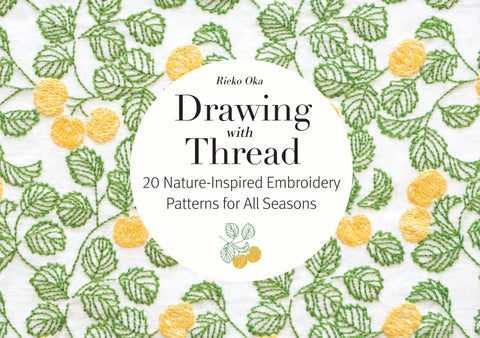
Rieko Oka
Drawing with Thread
20 Nature-Inspired Embroidery Patterns for All Seasons
Rieko Oka
Drawing with Thread
20 Nature-Inspired Embroidery Patterns for All Seasons Get Creative 6
New York
Preface
2
The flapping of a bird’s wings, a townscape where houses stand side-by-side, a cat’s playful behavior . . . the patterns presented in this book are all scenes we have witnessed. Fabrics here become sheets of drawing paper, embroidery flosses are paints, and adding the last stitch to your embroidery project marks the moment when it becomes a work of art. The patterns introduced in this book are presented in a way that allows the designs to be easily repeated. When transferring the pattern, simply slide it horizontally to repeat. Whether a single motif or repeated, the pattern will present expanded possibilities for how to showcase your embroidery work. As the area to embroider gets larger, it becomes more labor intensive. However, I hope you can always find the pattern you were searching for to create your dream fabric. All right—with threaded needle in hand, let’s begin!
ten to sen Moyou Seisaku jyo, Rieko Oka
3
Contents Preface………………………………………………………………………………… 2
16: Hydrangea………………………………………………………………………………… 72 17: Woods………………………………………………………………………………………… 76
Chapter 01
18: Outlined Plants………………………………………………………………………… 80
Embroidery Patterns
19: Little Flowers……………………………………………………………………………… 84 20: Squirrels in the Forest………………………………………………………………… 88
01: Bush………………………………………………………………………………………………… 8 02: Swallows…………………………………………………………………………………… 12
Chapter 02
03: Apples……………………………………………………………………………………………16
Ideas for Your Embroidery Projects
04: Birds’ Garden……………………………………………………………………………… 20 05: Cross-Shaped Flowers……………………………………………………………… 24
Idea 01 / Simply Display Your Embroidery………………………………………… 94
06: Rope…………………………………………………………………………………………… 28
Idea 02 / Embroider One Motif………………………………………………………… 96
07: Houses……………………………………………………………………………………… 32
How to Make a Brooch…………………………………………………………………… 97
08: Cats…………………………………………………………………………………………… 36
Idea 03 / Folding Lengthwise…………………………………………………………… 98
09: Above the Clouds……………………………………………………………………… 42
How to Make a Boxed-Corner Pouch…………………………………………… 100
10: Rain…………………………………………………………………………………………… 46
Idea 04 / Folding Widthwise………………………………………………………… 102
11: Round-Shaped Fish……………………………………………………………………… 50
How to Make a Pencil Case…………………………………………………………… 104
12: Flapping Wings………………………………………………………………………… 54
Idea 05 / Without Folding……………………………………………………………… 106
13: Lace Flowers……………………………………………………………………………… 60
How to Make a Mini Bag……………………………………………………………… 108
14: Grassland…………………………………………………………………………………… 64
Idea 06 / Use Lengthwise……………………………………………………………… 110
15: Tiles…………………………………………………………………………………………… 68
How to Make a Book Cover………………………………………………………… 112
Chapter 03
How to Use This Book
Embroidery Basics
How to Use the Patterns Each pattern includes descriptions for the embroidery floss and stitches used. For example: Straight S (3 strands). This means that you will use three strands of embroidery floss , listed in the materials section, to make Straight Stitches. S is the abbreviation for Stitch.
Transferring Patterns……………………………………………………………………… 114 Basic Tools and Materials……………………………………………………………… 116 Basic Stitches…………………………………………………………………………………117
•
Photographs of Completed Work and Pattern Sizes The completed work photographs in chapter 2, as well as the patterns (excluding Stitching Guides), are all actual size.
•
Appendix
Patterns for Your Original Projects 01: Swallows………………………………………………………………………………… 122 02: Birds’ Garden………………………………………………………………………… 123 03: Houses…………………………………………………………………………………… 124 04: Cats………………………………………………………………………………………… 125 05: Lace Flowers…………………………………………………………………………… 126 06: Squirrels in the Forest……………………………………………………………… 127
Fabric and Embroidery Floss In the Materials section, numbers and letters listed with each product represent the color number of listed products. Please
•
refer to the end of the book for product distributors. Measurements This book primarily uses inches, with conversions to centimeters
•
included in parentheses. Repeated Patterns Many of the embroidery patterns presented in this book consist of repeated pattern segments. When the pattern is enclosed in dotted lines, it is a single segment of the repeated pattern. Orderly connecting of segments, either vertically or horizontally, creates
•
embroidery that can cover large areas.
01 Embroidery Patterns Twenty Embroidery Patterns Based on the Kitano Moyocho Textile Collection
8
24
05: Cross-Shaped Flowers This pattern features rows of cross-shaped flower motifs. The inside of each flower is filled with French knot stitches to create volume and depth that can be seen on different fabrics. If you reduce the size of the motif to be smaller than seen here, the embroidery piece will remain just as pretty.
25
The petals and centers of the flowers are all stitched with the French knot stitch. Take a close look at these plump flowers. Don’t they appear to be woven, like a carpet?
32
07: Houses When viewing a town from above, the roofs look like little tiles and create a sort of townscape mosaic. There are black and red tiled roofs in Hokkaido, where I live, but we also see red and blue galvanized sheet roofing. In this pattern, there are no stitches that outline the shape of each house. So, you may add windows and alter the space between the stitches if you like. It is also possible to alter the height of the houses to create a tall tower, or the width can be altered to form a longer building, such as a school. Allocate white space as desired to embroider your own personalized townscape. 33
Stitch the houses with blue and yellow embroidery floss on white fabric, as if you were painting. By simply adding small windows below the roof-line, the white fabric turns into a white exterior wall.
36
37
Sources of Inspiration
58
Animals, plants, the scenery around you . . . inspiration for designing patterns can be hidden within even the most familiar sights.
59
60
13: Lace Flowers This design is based on a Damask fabric. To create a repeating pattern, arrange the patterns diagonally. Embroidering this on a cushion cover may be labor-intensive, but the result will be very elegant. The larger the surface to be embroidered, the more impressive the final result will be.
61
Use embroidery floss in lighter colors to bring out the full elegance of the pattern.
64
14: Grassland The Toyohira River runs near my house, and grass grows thickly by the riverbed. Lowering my gaze down to the height of the grass allows me to see layers of fine leaves extending into the distance. I can see things I normally don’t see, as if I were an insect. Since I started designing patterns, my heart swells whenever I find elements that overlap or align in a landscape. I think that there is a kind of inherent logic that applies to both landscapes and patterns. House roofs that are lined up close together, trees in a forest, the cobblestones of a street, stamps on a parcel, the waves . . . as soon as I see such scenery, I can imagine the patterns. 65
16: Hydrangea The hydrangea is my favorite flower, and it always lets me know that fall is approaching. I often unconsciously incorporate it into my designs. The pattern shown here is the repetition of a single hydrangea flower. Embroidering the flower on a bag or pouch will add a certain charm to your chosen project.
73
You can embroider flowers in any color you like, even if that color doesn’t occur in nature. That’s one of the joys of hand embroidery! This design is accentuated with red floss on beige fabric.
84
19: Little Flowers This pattern is created from a design I produced in 2016 for a kimono collar. This repetitive design with small flowers is coarsely embroidered to achieve a result that is both simple and elegant. The use of softtoned pastel threads will give a more youthful impression, while conversely, darker stitching as seen here offers a more sophisticated effect. Fabric with this motif would perfectly complement an evening bag.
85
This stitching mimics the texture of a roughly drawn sketch.
Transferring Patterns Cellophane
Trace your pattern on tracing paper Carbon paper
03 114
Embroidery Basics Basic Materials, Tools, and Stitches
Fabric (RS)
As seen above, place the cellophane, tracing paper with pattern, and carbon paper on your fabric. A stylus or pen
Add weights to hold the paper down and then trace the pattern onto the fabric.
115
About the Author Rieko Oka is a pattern designer from Hokkaido and graduate of Tokai University Graduate School of Integrated Design Studies. In 2008, she started to create textiles under the name “ten to sen Moyou Seisaku jyo” and now creates original textiles titled “Kita no moyocho.” Her pattern creations include
TEN TO SEN NO MOYOU SHISHU © 2017 Rieko Oka (ten to sen Moyou Seisaku jyo) © 2017 Graphic-sha Publishing Co., Ltd. This book was first designed and published in Japan in 2017 by Graphic-sha Publishing Co., Ltd. This English edition was published in 2026 by Get Creative 6, an imprint of Mixed Media Resources, LLC. English translation rights arranged with GRAPHIC-SHA PUBLISHING CO., LTD. through Japan UNI Agency, Inc., Tokyo and LibriSource Inc.
.......................................................................................
themes of scenery, animals, plants, seasonal
Original Edition Creative Staff
changes, and daily life. Rieko’s products are
Photos: Noriko Matsumoto
available for purchase at exhibitions, select
Production cooperation: Makiko Kumakura, Mihoko Yamashiro
stores, the “ten to sen Moyou Seisaku jyo”
Drawings: Wade Co., Ltd.
website, and her own store.
Editing: Ryoko Kasai
http://www.tentosen.info/
Material offered by OUTLET FABRICS, DMC [Dollfus-Mieg & Cie, S.A.] Photography cooperation: NORWEGIAN ICONS All rights reserved. No part of this publication may be reproduced or used in any form or by any means—graphic, electronic, or mechanical, including photocopying, recording, or information storage-and-retrieval systems—without permission of the publisher.
The written instructions, photographs, designs, projects, and patterns are intended for the personal, noncommercial use of the retail purchaser and are under federal copyright laws; they are not to be reproduced in any form for commercial use. Permission is granted to photocopy for the personal use of the retail purchaser. The EEA authorized representative is Authorised Rep Compliance Ltd., Ground Floor, 71 Baggot Street Lower, Dublin, D02 P593, Ireland (www.arccompliance.com). Library of Congress Cataloging-in-Publication Data Names: Oka, Rieko, 1981- author Title: Drawing with thread : 20 nature-inspired embroidery patterns for all seasons / Rieko Oka. Other titles: Ten To Sen Moyou Seisakujo. English Description: First english edition. | New York : Get Creative 6, 2026. | Previously published under title: Ten To Sen Moyou Seisakujo. | Text in English. Translation from Japanese. Identifiers: LCCN 2026018054 | ISBN 9781684621224 paperback Subjects: LCSH: Embroidery | LCGFT: Patterns (Instructional works) Classification: LCC TT771 .O53 2026 | DDC 746.44/041--dc23/eng/20260413 LC record available at https://lccn.loc. gov/2026018054 ISBN: 978-1-68462-122-4 Manufactured in China 1 3 5 7 9 10 8 6 4 2 First English Edition
CRAFTS & HOBBIES | NEEDLEWORK | EMBROIDERY
Discover the joy of embroidery in this charming collection of
20 stitching patterns inspired by nature and landscapes. With endless ways to customize motifs, plus six step-by-step projects putting your creations to use, you can make each pattern your own in no time. $16.99 US I S B N: 978-1-68462-122-4