Text-to-Design Models_ The Missing Link Between AI Images and Professional Graphic Design
Text-to-Design Models: The Missing Link Between AI Images
and Professional Graphic Design
Generative AI has dramatically changed the creative industry With only a short text prompt, modern AI can generate illustrations, product photography, marketing visuals, and social media graphics in seconds This breakthrough has reduced production time, lowered creative costs, and made visual content accessible to businesses of every size.
Yet despite these advances, one challenge remains
Most AI-generated visuals are still static images.
They may look polished, but they are difficult to edit Headlines are baked into pixels, logos cannot be replaced easily, layouts cannot be rearranged, and even a simple price update often requires regenerating the entire image For professional marketing teams that constantly revise campaigns, this creates unnecessary friction
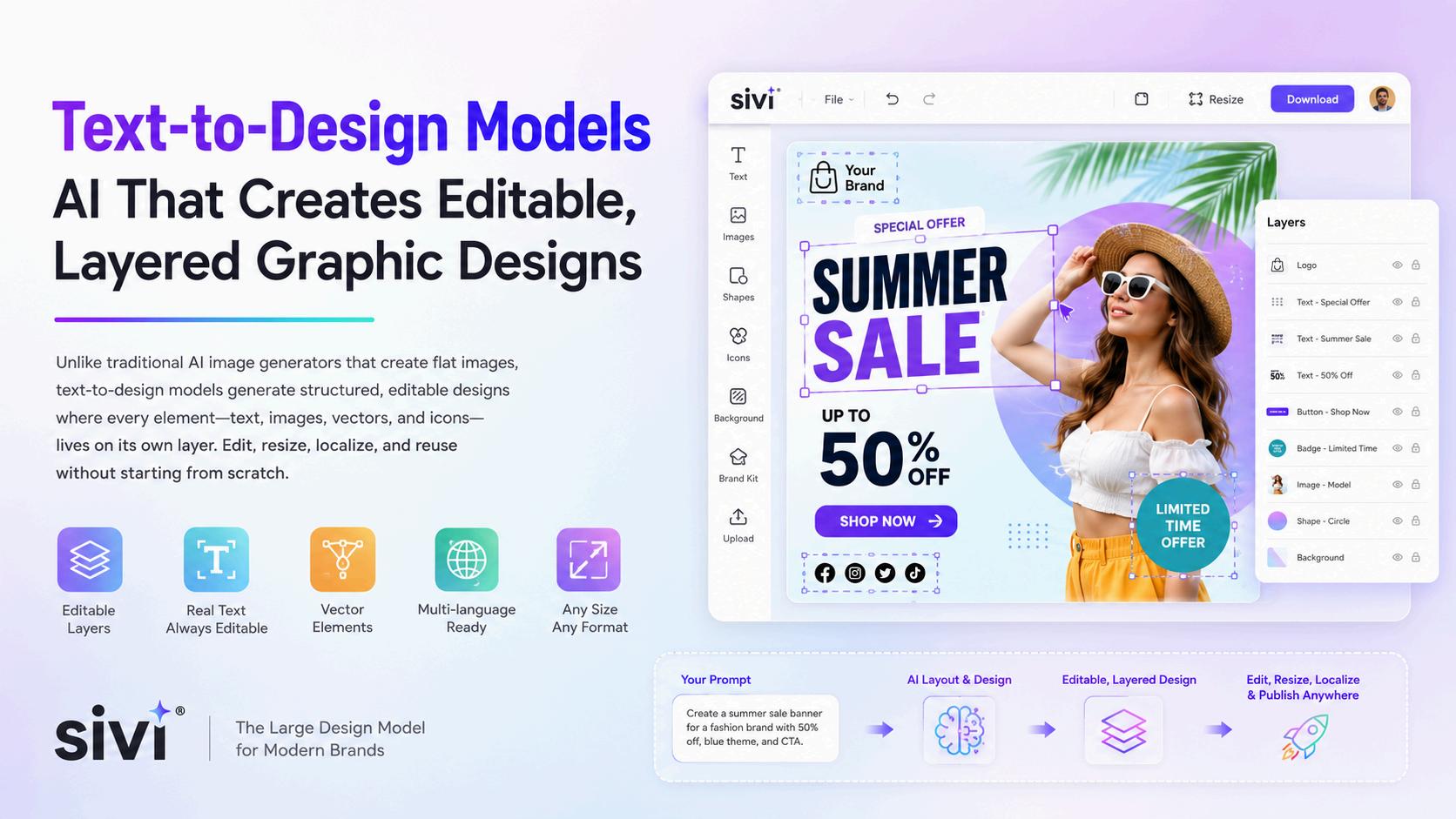
This limitation has led to the emergence of text to design models, a new generation of AI built specifically for graphic design instead of image generation Rather than producing a flattened JPEG or PNG, these models generate structured, layered designs where text, images, vectors, icons, and backgrounds remain separate and editable
The difference may seem technical, but it fundamentally changes how businesses create, manage, and scale visual content Instead of starting over every time something changes, teams can edit individual elements while preserving the rest of the design. That makes
text-to-design models far more practical for advertising, branding, ecommerce, and creative automation than traditional image generators.
What Are Text-to-Design Models?
A text-to-design model is an AI system that converts natural language into a complete, editable graphic design
Unlike text-to-image models that generate a single raster image, these systems understand a design as a structured collection of independent elements Every component is created separately, allowing users to continue editing the design after it has been generated.
A typical AI-generated design may include:
● Editable headlines
● Product images
● Brand logos
● Icons
● Background graphics
● Decorative shapes
● Call-to-action buttons
● Vector illustrations
● Supporting text
Each object exists as its own layer rather than becoming permanently merged into the background.
The result behaves more like a design created in Figma or Adobe Illustrator than a traditional AI-generated image Users can update text, replace graphics, adjust layouts, or resize elements without rebuilding the entire composition.
Why Traditional AI Image Generators Fall
Short
Image generation has reached an impressive level of realism. Models like Midjourney, FLUX, Stable Diffusion, and DALL·E are capable of producing stunning artwork and photorealistic visuals from simple prompts
However, marketing design is very different from artistic image creation. Businesses rarely create a graphic once and leave it unchanged
Campaigns evolve
Promotional offers change.
Products are replaced
Logos are updated
Seasonal messaging changes
Designs are translated into multiple languages
Every advertising platform requires different dimensions
Traditional image generators flatten every visual element into a single image, making these revisions unnecessarily difficult
For creative professionals, editability often matters more than initial visual quality.
That is precisely the problem text-to-design models are designed to solve
Why Layered Designs Matter
Professional designers have relied on layers for decades because they make creative work flexible and efficient AI-generated designs are now following the same principle
Faster Design Updates
Marketing teams regularly adjust headlines, promotional offers, and product information
With layered designs, these updates take minutes instead of requiring an entirely new design.
Better Localization
Global businesses often create campaigns in multiple languages
Because different languages occupy different amounts of space, editable typography makes localization significantly easier while preserving the original design structure
Consistent Branding
Strong branding depends on consistent use of logos, colors, fonts, and visual hierarchy.
When every branding element remains editable, organizations can maintain brand consistency across thousands of creative assets.
Efficient Multi-Platform Publishing
A single campaign may require graphics for:
● Instagram
● LinkedIn
● Facebook
● Display advertising
● Website banners
● Email marketing
● Ecommerce listings
● YouTube thumbnails
Layered designs make it easier to adapt layouts for different aspect ratios without recreating the artwork
How Text-to-Design Models Work
Although implementations differ, most text-to-design models follow a structured workflow that mirrors how professional designers think
1. Understanding the Prompt
The model interprets the user's request, identifying the campaign objective, audience, product information, branding, and preferred visual style
2. Planning the Layout
Rather than generating pixels immediately, the AI first determines how information should be organized
It plans:
● Visual hierarchy
● Typography placement
● Image positioning
● White space
● Alignment
● Composition
3. Creating Individual Elements
Different AI components generate typography, illustrations, images, icons, and backgrounds independently.
4. Building the Final Design
Instead of flattening everything together, the AI assembles each object into a layered composition where every component remains editable
This architecture makes text-to-design models fundamentally different from conventional AI image generators
Leading Text-to-Design Models
The field of AI-powered graphic design is still relatively new, but several notable projects have helped define it
Sivi Large Design Model (LDM)
Sivi introduced one of the earliest production-ready text-to-design models. Unlike image generators that create static visuals, its Large Design Model generates layered, editable marketing designs where text, vectors, images, and backgrounds remain separate It also supports brand kits, custom dimensions, multilingual design generation, REST APIs, and an embeddable UI SDK, making it suitable for production workflows
Microsoft's COLE
COLE introduced a hierarchical framework for editable graphic design generation Instead of producing a design in one step, it separates planning, image generation, typography, and quality refinement into multiple reasoning stages While the research demonstrated promising results, COLE remains a research project without a commercial API
ByteDance's CreatiPoster
CreatiPoster explored editable poster generation using structured layout descriptions. It converts prompts into a protocol that describes text, positioning, and assets before rendering the final design The project highlights the industry's growing interest in layered AI design, although it is still primarily research-focused.
OpenCOLE and Emerging Research
OpenCOLE and newer research projects such as DesignAsCode and Accordion continue advancing the field by exploring structured layouts, editable layers, and programmatic design generation. These projects demonstrate that AI design is evolving beyond pixel generation toward intelligent, editable creative systems
The biggest difference is not how the design looks It is how easily it can be edited after it has been created
Why Marketing Teams Are Adopting Text-to-Design Models
Modern marketing depends on speed, experimentation, and personalization
A single campaign may require dozens of variations across different platforms, audience segments, and languages.
Creating every version manually slows production and increases design costs
By generating editable layouts instead of flat images, text-to-design models allow marketers to:
● Launch campaigns faster
● Create multiple A/B test variations
● Maintain consistent branding
● Update campaigns without starting over
● Produce localized content more efficiently
Instead of replacing designers, these models eliminate repetitive production work so creative teams can focus on strategy and storytelling.
Benefits for Developers
Developers are also beginning to integrate text-to-design models into their own applications
For example:
● Ecommerce platforms can generate promotional banners directly from product catalogs
● CRM systems can create personalized marketing graphics
● Content management systems can automatically generate social media creatives
● Advertising platforms can produce campaign assets without requiring external design software
Production-ready APIs and SDKs make it possible to embed AI-powered design generation directly into software products, reducing manual effort and improving user experience.
Challenges and Future Opportunities
Although text-to-design models have advanced rapidly, the technology is still evolving
Current research continues to improve:
● Layout reasoning
● Typography generation
● Editable vector graphics
● Responsive designs
● Brand-aware generation
● Automatic layer decomposition
● Structured design representations
New research also explores converting existing raster graphics back into editable layered designs, helping organizations modernize legacy creative assets
As these capabilities mature, AI will move beyond generating isolated graphics toward creating complete design systems that can evolve throughout an entire marketing campaign.
Conclusion
The next generation of creative AI is no longer focused solely on producing impressive images Businesses need graphics that can be updated, localized, resized, and optimized long after they are first generated
Text-to-design models solve this challenge by generating layered, editable graphic designs instead of static images By keeping text, images, vectors, logos, and layouts as independent objects, they make creative production faster, more flexible, and better suited for real-world marketing workflows.
As research from organizations like Microsoft, ByteDance, and CyberAgent continues alongside production platforms such as Sivi, the industry is steadily moving toward a future where AI creates designs instead of pictures. For marketers, designers, and developers, that shift represents one of the most important advances in generative AI, enabling scalable content creation without sacrificing editability, brand consistency, or creative control