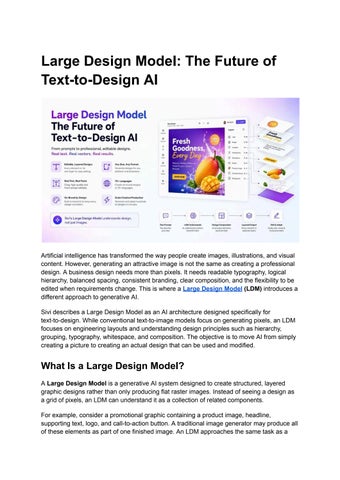
Large Design Model: The Future of Text-to-Design AI
Artificial intelligence has transformed the way people create images, illustrations, and visual content. However, generating an attractive image is not the same as creating a professional design. A business design needs more than pixels. It needs readable typography, logical hierarchy, balanced spacing, consistent branding, clear composition, and the flexibility to be edited when requirements change. This is where a Large Design Model (LDM) introduces a different approach to generative AI. Sivi describes a Large Design Model as an AI architecture designed specifically for text-to-design. While conventional text-to-image models focus on generating pixels, an LDM focuses on engineering layouts and understanding design principles such as hierarchy, grouping, typography, whitespace, and composition. The objective is to move AI from simply creating a picture to creating an actual design that can be used and modified.
What Is a Large Design Model? A Large Design Model is a generative AI system designed to create structured, layered graphic designs rather than only producing flat raster images. Instead of seeing a design as a grid of pixels, an LDM can understand it as a collection of related components. For example, consider a promotional graphic containing a product image, headline, supporting text, logo, and call-to-action button. A traditional image generator may produce all of these elements as part of one finished image. An LDM approaches the same task as a