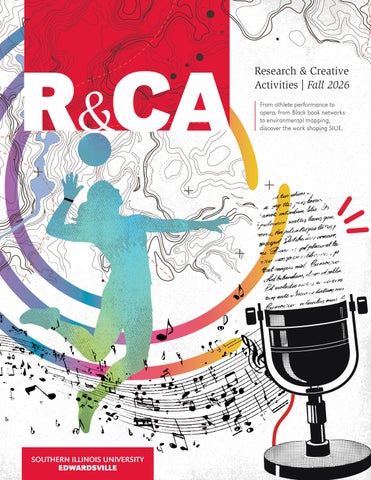
R&CA
Research & Creative Activities | Fall 2026 From athlete performance to opera, from Black book networks to environmental mapping, discover the work shaping SIUE.
R&CA
DEAN’S MESSAGE
TABLE OF CONTENTS
Research and creative activity are at the heart of SIUE’s mission to generate knowledge, foster innovation, and serve the public good. Across every discipline, our faculty, students, and community partners are tackling complex challenges, preserving important cultural stories, creating new opportunities for learning, and advancing ideas that make a meaningful difference in the world. The stories featured in this edition reflect both the breadth and impact of scholarship at SIUE. They include groundbreaking work to expand access to African American literature through the Black Lit Network, innovative approaches that are transforming STEM learning and nursing education, and research that is advancing geospatial technologies, athlete health, and the growing bioeconomy. They also highlight the power of creative activity through initiatives such as the Arch City Opera Project and preserve important historical and cultural legacies through the work of our faculty, alumni, and emeriti colleagues.
Featured Research: Research Engagement from Campus to Community
Equally important is the role our students play in discovery. From undergraduate researchers participating in URCA to graduate students applying emerging technologies such as artificial intelligence to healthcare education, SIUE students are contributing to research and creative activity that extends well beyond the classroom. Their work, guided by dedicated faculty mentors, represents the future of innovation and scholarly excellence. I am proud to share these accomplishments with you and grateful to the faculty, staff, students, alumni, and partners whose curiosity, creativity, and commitment make them possible. Together, they demonstrate how research and creative activity enrich our campus, strengthen our communities, and advance SIUE’s vision of shaping a better future through knowledge and discovery.
Featured Research: Highlighted Grant Awards
Christopher Slaten, PhD
Pages 3-4 The Black Lit Network
Associate Provost for Research and Dean of the Graduate School
Pages 5-6 Flipping STEM Learning
GIVING OPPORTUNITIES
Featured Research: Creative Activities Spotlight Pages 7-8 Inside the Arch City Opera Project: Training the Next Generation of Performers
Pages 9-10 GeoMARC Shapes Geospatial Innovation
Graduate School and University Research Happenings
Pages 11-12 The Data Beyond the Game
Page 15 PREP to Submit Faculty Fellowship
Page 13 Emeriti Faculty Association Faculty Spotlight
Page 16 Two SIUE Faculty Named Distinguished Research Professors
Page 14 The Legacy of Arthur Takeshi Towata
Pages 17-18 NCERC at SIUE
SIUE Student Research Page 19 Research Starts with URCA Page 20 Enhancing Nursing Education Through AI
Publications Page 21-22 Notable Faculty Publications Book Manuscript Publications
Scholarship and Research Endowment The SIUE Graduate School provides educational opportunities to nearly 2,500 students annually. Gifts to support student scholarship and research allow academically talented students with financial need the opportunity to pursue their educational goals.
GIVE TODAY!
Sponsored Projects FY26
Rosemarie Archangel, Ellen Sappington, and Stephen L. and Julia Y. Hansen Innovation and Excellence in Graduate Education Endowment Faculty scholarship and teaching determine the quality of the education students receive. Gifts to support this endowment will build on SIUE’s culture of scholarship and research by supporting innovative activities and progressive changes in existing and new graduate programs, as well as graduate faculty development related to the strengthening of graduate studies.
BY THE NUMBERS 260 PROPOSALS FOR $64.5 MILLION 129 AWARDS FOR $28.3 MILLION
connect.siue.edu/g/graduate-school
Details can be found in the Office of Research and Projects Annual Report. siue.edu/graduate/about
R&CA Featured Research: Highlighted Grant Awards
THE BLACK LIT NETWORK T
he idea began in a barbershop. For more than 20 years, Howard Rambsy II, PhD, distinguished research professor of African American literature, has visited the same barbershop in St. Louis every other week. Over time, regular conversations led to a familiar question from fellow patrons who learned he taught literature: “What should I read?” “At first, I would just give recommendations,” Rambsy said. “Then I started asking followup questions about people’s interests. What kind of stories did they like? Were they interested in history, memoir, novels, or poetry?” Those exchanges sparked a bigger idea: the Black Lit Network. The project aims to help readers discover books and expand access to African American literary studies. At the center of the initiative is the Literary Navigator Device, a discovery tool that recommends books, poems, short stories, essays, and comic books by Black writers based on a reader’s interests. The project has expanded thanks to a $1.6 million grant from the Mellon Foundation’s Public Knowledge program. “I’m thrilled to receive this grant,” Rambsy said. “It’s especially meaningful that the project is based at SIUE. It’s rare for an African American literary studies initiative at a regional university like ours to receive support at this scale.”
School. The podcast explores popular and critical responses to African American literary works. Another key element of the network, the Literary Data Gallery, features digital storytelling and visualizations that reveal patterns and trends in Black literary production. Together, these tools encourage reader discovery and invite educators, students, and the public to engage more deeply with African American literature.
Explore the Black Lit Network blacklitnetwork.org Listen to the Remarkable Receptions Podcast Available on Apple Podcasts, Spotify, and Buzzsprout Howard Rambsy II, PhD hrambsy@siue.edu
In addition to the Literary Navigator Device, the project includes “Remarkable Receptions,” a podcast created by Rambsy and Elizabeth Cali, PhD, associate professor of English and associate dean of the Graduate 3
4
R&CA Featured Research: Highlighted Grant Awards
FLIPPING STEM LEARNING
H
ow can educators move beyond the traditional teaching format and better prepare students for the demands of a career in STEM? That is the question SIUE faculty Chaya Gopalan, PhD, professor in the Departments of Exercise, Sport, and Nutrition Sciences, and Nurse Anesthesiology, and Sharon Locke, PhD, professor in the Department of Environmental Sciences and director of the STEM Center, are working to answer.
“In STEM disciplines, a significant gap exists between rote memorization and the high-level application required in professional practice,” said Gopalan. “By flipping the classroom, we aim to transform the learning environment into a dynamic laboratory for collective problem-solving. This framework ensures that in-class time with instructors is dedicated to higher levels of learning, such as evaluation and synthesis.” “Flipped” instruction is an approach that shifts traditional lectures outside the classroom, using in-class time for active, collaborative problem-solving. Expanding from a pilot study at SIUE and St. Louis Community College, the project has broadened its data collection across diverse academic cultures, now including eight partner institutions, four universities, and four community colleges. The project has three primary objectives: 1. Monitor the student-centered orientation of faculty, the implementation of flipped teaching, and variations based on institution type, academic discipline, and student demographics 2. Identify the enablers and obstacles that facilitate or impede the implementation of flipped teaching across diverse institutions and student populations, and their impact on student outcomes 3. Examine change leadership and the advocacy of flipped teaching as a foundational strategy for cultivating a community of transformation within and across campuses “The ultimate goal of this research is to establish a scalable framework for faculty development,” said Gopalan. “By demonstrating the efficacy of flipped strategies, the project seeks to influence institutional leadership and drive broader change management.”
The project is in the data collection phase through August 2028. Patterns emerging from the early stages of the project show flipped teaching increased both faculty confidence and student engagement, especially during the shift to online learning during the COVID-19 pandemic. It also showed a strong positive impact across diverse student groups and was particularly effective in two-year institutions, highlighting its value as an inclusive, adaptable approach to STEM education. “Our hope is that STEM departments will eventually recognize active learning as a research-supported standard for preparing students for modern scientific and healthcare professions,” said Locke.
Read the Full Grant Announcement siue.edu Sharon Locke, PhD slocke@siue.edu Chaya Gopalan, PhD cgopala@siue.edu
5
6
R&CA Featured Research: Creative Activities Spotlight
INSIDE THE ARCH CITY OPERA PROJECT
O
7
ne of the most performed American operas, “Susannah” explores the destructive effects of false accusations and the cruelty of mob mentality. At the end of the spring 2026 semester, SIUE became the site of a full-scale production of the opera, as students stepped into a demanding, professional-level work rarely experienced at the undergraduate level.
SIUE and Webster University alumni, along with regional partners, including Tessitura Music in Edwardsville.
The intensive program, the Arch City Opera Project, was a new initiative that gave students an immersive experience and an inside look at careers in vocal performance. The project brought together students, faculty, and
“Student learning and growth was our central goal,” said Schapman. “We wanted to create an opportunity to give our undergraduate students additional professional development and see what it really means to be involved in a production at a professional level.”
The idea has been years in the making, first discussed more than two decades ago by faculty collaborators Marc Schapman, DMA, professor of voice and director of SIUE Opera and Musical Theater, and Webster University faculty Jacob Lassiter, DMA and Karen Kanakis, DMA.
The first week focused on training. Students took part in masterclasses, private lessons, and workshops, including stage combat training, career panels with industry professionals, and professional headshot sessions. They also attended a dress rehearsal at Opera Theatre of St. Louis, offering a behind-the-scenes look at the professional opera world. “This is a much different environment than the typical workshop class. You really get to see professors teach by example,” said Sabrina Burd, junior vocal performance major. “It has been so valuable to get to interact in this new context where they are working as an artist themselves instead of teaching.”
“”
“This project will be greatly beneficial to my future career as I have gained so many new skills, ideas, concepts, and industry insights that will stick with me throughout my future. The connections are invaluable. Getting to work with and build relationships with industry professionals this early in my career is a great opportunity.” Collin Littlefield Senior, Vocal Performance Major
By the second week, the focus shifted fully to performance. Rehearsals led to a staged production of “Susannah,” which Schapman directed. Faculty performed principal roles, alumni filled supporting roles, and students made up the ensemble and selected featured parts. A full orchestra, conducted by SIUE alumnus and Blackburn College faculty member Joe Welch, added to the scale of the production. Faculty and alumni worked closely with students throughout the process, sharing insight into the profession while modeling the discipline and artistry required to succeed.
“This project showed what’s possible when people come together with a shared purpose,” Schapman said. “I hope this program can continue annually, and we can expand the opportunities for our students.” Discover the Arch City Opera Project archcityoperaproject.org Marc Schapman, DMA maschap@siue.edu
8
R&CA Featured Research: Research Engagement from Campus to Community
T
he SIUE Geospatial Mapping, Applications, and Research Center (GeoMARC) is redefining how geospatial technology shapes the world around us.
GEOMARC SHAPES GEOSPATIAL INNOVATION
GeoMARC is a geospatial “think tank” that specializes in advanced technologies, including Geographic Information Systems (GIS), remote sensing, geospatial imagery processing, automation, and machine learning. Founded in 1995 as the Laboratory for Applied Spatial Analysis (LASA) and reestablished in 2021, GeoMARC has built a reputation as a trusted partner across public and private sectors. The center has completed more than 160 projects for federal, state, and local agencies, Fortune 500 companies, and community organizations. “GeoMARC’s primary focus is to connect advanced geospatial technologies with real-world problem solving while providing students with experiential learning
GeoMARC has active mapping projects spanning a vast range of subjects. From bat habitats to global topographies, from milkweed sources for monarch butterflies to changing landscapes impacting environmental quality, the projects at the center of GeoMARC’s focus have local and global significance. GeoMARC is about developing solutions and people. The center has supported more than 100 graduate students and over 150 undergraduates since its start, preparing a highly skilled workforce ready to meet growing industry demands. As geospatial technology continues to evolve, GeoMARC remains focused on data quality, integrity, and innovation.
Explore GeoMARC siue.edu/geomarc
GeoMARC is located at 420 University Park Drive on the SIUE Edwardsville campus. 9
opportunities through projects that support industry, government, environmental research, and community needs,” said Randall Pearson, PhD, professor in the Department of Geography and GIS and director of GeoMARC.
Randall Pearson, PhD rapears@siue.edu
10
R&CA Featured Research: Research Engagement from Campus to Community
THE DATA BEYOND THE GAME T
here’s more to athletics than the physical side of the game. Performance is shaped by a range of factors, especially for student-athletes who are balancing academics and competition. Josh Wooten, PhD, professor and chair of the Department of Exercise, Sport, and Nutrition Sciences, has spent the past several years studying not only the physical demands of sport but also the psychological factors that influence performance, recovery, and overall well-being. Wooten created SIUE’s Performance Optimization for Women in Exercise Research (POWER) Lab. Its mission is to improve the performance and health of female athletes and to educate the next generation of women and their allies to become doctors and researchers who support female athletes throughout their lifespan. That work is already taking place on campus. Wooten began working with the SIUE women’s volleyball team in 2023. He developed a performance survey that tracks student-athletes’ mood, sleep, soreness, and training intensity throughout the season. This information gives coaches a clearer picture of how athletes are feeling day to day, helping them reduce injury risk and adjust training when needed. “When we evaluated the data to determine best predictors for recovery in volleyball athletes, we found that the team’s level of fatigue paired with their mood-energy level was the best indicator for recovery,” Wooten said. “Knowing this allows coaches and support staff to focus on the factors to gauge their team’s readiness for training and competition.” Since then, the work has expanded to include wearable technology, supported by an internal Seed grant for Transitional and Exploratory Projects (STEP). Starting at the beginning of the fall 2025 athletic season, women’s soccer and volleyball teams wore WHOOP fitness trackers 11
to monitor their physical and sleep health during the competitive seasons. When paired with the performance survey, Wooten and his team of students were able to capture both physiological and psychological data simultaneously. “What we have found is that the physiological response doesn’t always agree with the perceived psychological response,” said Wooten. “Integrating this information with advanced data analysis such as machine learning, I anticipate that we will have greater insight into how to help maintain the health and player-readiness of the female athlete.”
“”
“The goal is to give coaches real-time information so athletes can perform safely and effectively.” Josh Wooten, PhD Professor and Chair of the Department of Exercise, Sport, and Nutrition Sciences In addition to wearable technology, athletes routinely complete body composition and physical analyses, adding another layer to how athletes’ health and performance are monitored during their competitive season. Players receive reports that give them a better understanding of their progress and training. This work is helping address an area that has historically been under-researched. Looking ahead, Wooten hopes to expand the program so more SIUE athletics teams can benefit from the insights it provides. Learn More About Wooten’s Athlete Performance Research siue.edu/~jwooten Josh Wooten, PhD jwooten@siue.edu
12
R&CA Featured Research: Research Engagement from Campus to Community
EMERITI FACULTY ASSOCIATION FACULTY SPOTLIGHT
S
cholarship, teaching, and collaboration defined the SIUE legacy of Rowena McClinton, PhD, professor emerita of history. In this excerpt from her biography, McClinton reflects on her years in the classroom and on the archival work that has helped recover and preserve Cherokee voices in American history.
As the COVID-19 pandemic of 2020 shuttered traditional ways of teaching, I decided to bring my 20-year SIUE career to an end. For many years I had been uplifted by the practice of teaching in a shared space where knowledge flows freely between students and teachers. In honing the craft of teaching, I have also been indebted to my many colleagues at SIUE who have enriched my life as a scholar and teacher. Teaching is sacred; also sacred are the voices of American history who have not been widely heard. It has been my great honor to be a part of the generation of scholars who are dedicated to bringing these voices alive. In particular, my work has focused on the history of Native Americans, whose real voices have often been unheard in more traditional history courses. With numerous Native American (I interchange Native American, Indians, and Indigenous) colleagues throughout the Southeast and West, I have acted in concert to publish these voices from collections heretofore unpublished and unread.
The John Howard Payne papers were not only an exciting project from a historical perspective, but they also have been a wonderful source of cultural revitalization. The translation of never-before-published Cherokee documents from Cherokee into English has elucidated the work of Sequoyah, a man widely regarded as a linguistic genius. In 1821 Sequoyah introduced his syllabary, a phonemic system with eighty-six symbols. As mentioned previously, I worked with Cherokees across the country to bring these previously unknown documents to light; one Cherokee scholar fluent in the pre-removal syllabary had tears in his eyes as he uncovered little-known words and phrases in these documents, precious connections to his ancestors and history.
Read the Full Biography siue.edu/research/emeriti-faculty-spotlight Rowena McClinton, PhD rmcclin@siue.edu
THE LEGACY OF ARTHUR TAKESHI TOWATA
F
ollowing the attacks on Pearl Harbor in 1941, President Franklin Roosevelt issued Executive Order 9066, authorizing the forced removal of those deemed a threat to national security from the West Coast to inland relocation centers. The order led to the incarceration of more than 120,000 Japanese Americans. One of those individuals was Arthur Takeshi Towata (1933–2019), a two-time SIUE alumnus who earned a Bachelor of Arts in Art Education in 1962 and a Master of Fine Arts in Painting in 1971. Towata and his family were sent to an internment camp; his father was among the first incarcerated, just four days after Pearl Harbor. Months later, Towata, his mother, and his brother were taken to the Manzanar War Relocation Center in California, where their lives were permanently altered. His father ultimately died in the camps. Towata entered Manzanar at the age of nine. Guided by his mother, he was encouraged to explore rather than dwell on hardship. She shielded him from the emotional weight of their situation and urged him to learn from his surroundings. Years later, Towata returned to Manzanar and recognized how deeply the landscape had shaped his artistic sensibilities. Several of Towata’s works were recently displayed at the St. Louis Kaplan Feldman Holocaust Museum in the exhibit Resilience: A Sansei Sense of Legacy, presented in partnership with the Japanese American Citizens League. His pieces included works from the “Black Wall” series, referencing the tar-paper barracks at Manzanar, as well as his “Manzanar Barbed Wire Pot.”
13
14
R&CA Graduate School and University Research Happenings
GRANT PREPARATION FELLOWSHIP
DISTINGUISHED RESEARCH PROFESSORS
T
T
he Graduate School is prioritizing the interests of its faculty, responding to a survey showing that more than half of faculty members are seeking opportunities to strengthen their research and scholarship agendas. In response, the School launched the Propose your Research, Establish a Plan (PREP) to Submit fellowship, an 18-month peer grant development fellowship designed to support faculty research development and innovation. Through workshops, panel discussions, mentorship, and collaborative planning, the cohort is building a stronger vision for connecting grant writing to their long-term research agendas while gaining advanced knowledge of external proposal submission processes, both broadly and at SIUE. The program also helps fellows develop confidence in grant preparation, writing, and project design, while expanding internal and external mentor networks and fostering a built-in community of researchfocused peers. Participants receive professional development funding and support for consultations with external researchers in their respective fields.
Marie Childers, PhD, Assistant Professor, Department of Psychology, School of Education, Health and Human Behavior
Abbey Hepner, MFA, Area Head of Photography and Digital Media, Department of Art and Design, College of Arts and Sciences
Andres Davila, DMD, Assistant Professor, School of Dental Medicine
Tianyu Li, PhD, Assistant Professor, Department of Geography and GIS, College of Arts and Sciences
Andres Durantini, PhD, Assistant Professor, Department of Chemistry, College of Arts and Sciences
Latrice Marianno, PhD, Assistant Professor, Educational Leadership, School of Education, Health and Human Behavior
15
“We are proud to recognize their contributions, which advance knowledge, enrich the academic mission of SIUE, and demonstrate the powerful role that research plays in serving both scholarly communities and society at large,” said Associate Provost for Research and Dean of the Graduate School Christopher Slaten, PhD. Hildebrandt, professor of English, was honored for her extensive contributions to linguistics and language systems at SIUE. She has led major archival projects documenting four indigenous languages of Nepal and is widely recognized for her collaborative research in linguistics and the digital humanities. Hildebrandt is also the co-founder and co-director of SIUE’s Interdisciplinary Research and Informatics Scholarship (IRIS) Center, which supports faculty and students using digital tools in the study of literature, languages, art, history, and sociology. Liebl, professor of biological sciences, was recognized for achievements in the field and for securing external funding, including three NIH grants totaling more than $913,000. Her research examines how gene expression is regulated to promote the remodeling of neurons as a result of experience, advancing understanding of learning, memory, neurodevelopmental disorders, and neurodegenerative disease. Both professors received a $1,000 salary increase, additional research support, and were recognized at the Provost’s Celebration of Research Reception in March 2026.
Read the Full Promotion Announcement siue.edu/2025-distinguished-research-professors
The inaugural cohort consists of nine SIUE faculty members selected through a competitive process based on their demonstrated interest in and potential for securing external grant funding. Learn More About the PREP to Submit Fellowship siue.edu/prep
he Graduate School, in conjunction with the Office of the Provost, awarded Kristine Hildebrandt, PhD, and Faith Liebl, PhD, with the promotion to Distinguished Research Professor, recognizing their scholarly excellence, research, and broad impact in their respective fields.
Kristine Hildebrandt, PhD khildeb@siue.edu Faith Liebl, PhD fliebl@siue.edu Sanoar Rahman, PhD, Assistant Professor, Department of Geography and GIS, College of Arts and Sciences
Kevin Tucker, PhD, Associate Professor, Department of Chemistry, College of Arts and Sciences
Cinnamon VanPutte, PhD, Associate Professor, School of Dental Medicine
“”
“Drs. Hildebrandt and Liebl exemplify what the Distinguished Research Professor designation is intended to recognize: sustained scholarly excellence, intellectual leadership in their fields, and research that extends well beyond the boundaries of our campus.” Christopher Slaten, PhD Associate Provost for Research and Dean of the Graduate School 16
R&CA Graduate School and University Research Happenings
NCERC AT SIUE
NEW LEADERSHIP, EXPANDED VISION Now, with new leadership, NCERC is building on the foundation it has established for more than two decades. Praveen V. Vadlani, PhD, MBA, joined NCERC as executive director at the start of 2026. With Vadlani’s guidance, NCERC looks to expand its vision beyond technical validation to include innovation, intellectual property development, and new bio-based products. A major part of that vision is growth. NCERC continues to expand its research and pilot-scale capabilities, expanding the center’s ability to support a wider range of bioprocessing technologies. Plans are in the works for an expanded facility that would significantly increase fermentation capacity, allowing NCERC to take projects from small-scale experiments to industrial production. The goal is to create one of the region’s most robust biomanufacturing hubs and position NCERC as a national asset in generating biosolutions for a rapidly evolving economy.
T
he National Corn-to-Ethanol Research Center (NCERC) at SIUE is a nationally recognized research center dedicated to advancing the bioeconomy through research and innovation. It is the only fully integrated research facility of its kind globally. NCERC has capabilities that bridge the gap between laboratory research and commercial-scale deployment, enabling companies to test and scale up new processes in one place. The center has played an instrumental role in commercializing more than 80 products that are now used in the commercial marketplace — from adhesives like glue sticks to fibers used in everyday items such as clothing and shoelaces, as well as materials found in packaging, coatings, and other bio-based products.
As NCERC continues to grow, the center will continue to invest in people. Students work alongside scientists on active industry projects, gaining hands-on experience with real-world impact. Workforce training is embedded in the center, preparing the next generation of researchers, engineers, and industry leaders. As the center expands, these opportunities are expected to expand further, strengthening NCERC’s role in supporting both innovation and workforce development.
Explore NCERC at SIUE siue.edu/ncerc Praveen V. Vadlani, PhD, MBA pvadlan@siue.edu
Q&A WITH EXECUTIVE DIRECTOR PRAVEEN V. VADLANI What drew you to NCERC? When I saw this role, it was an incredible opportunity. I’d never seen a center focused entirely on one process. Being here, seeing the equipment and team, I realized it’s a truly unique place and a dream job for me. What is your vision for NCERC? NCERC has been strong in technical support and validation. I want it to be known for innovation and knowledge, too. We aim not just to assist industry, but also to innovate, develop intellectual property, and offer a full package. NCERC is currently a best-kept secret, and it can do much more.
ncerc.siue What excites you most about the future of NCERC? The potential growth. With expanded capacity, NCERC can become a national asset and a leader in biomanufacturing and fermentation technologies.
17
18
R&CA SIUE Student Research
ENHANCING NURSING EDUCATION THROUGH AI RESEARCH STARTS WITH URCA
R
esearch experience can begin even before graduate school at SIUE. Through the Undergraduate Research and Creative Activities (URCA) program, a select group of students step into the role of researchers, often for the first time. The URCA program offers two pathways: URCA Associates design and lead their own original research projects under the guidance of a faculty mentor, while URCA Assistants collaborate with faculty mentors across disciplines. Together, more than 100 students work alongside nearly 90 faculty members, gaining hands-on experience in labs, the field, and creative spaces.
“”
“URCA helps students develop a passion for research that can shape their careers and make a broader impact on society.” Amelia Pérez, PhD Professor and URCA Coordinator
Learn More About URCA siue.edu/urca
19
This year’s URCA Associates’ projects include: (pictured from left to right)
• Alexander Patrick, Biology: “Validation and Time Trial of Noninvasive T3 and T4 Fecal Sampling in Mice” • Janel Straub, Exercise Science: “A Comparison of the Apple SE and Garmin Forerunner 55 to Measure Steps in Free-living and Controlled Lab Conditions” • Adrian Davis, Biology: “Measuring the Effectiveness of Field Mice as a Vector for Seed Dispersal” • Grace Witsken, Biology: “Foraging Behavior of Field Mice in Disturbed Natural Habitats” • Dillyn Wood, Biology: “The Effects of Riparian Vegetation on Crawfish Distribution” • Yusra Amena, Biology: “Investigating the Synergistic Effects of Phage Therapy and Photodynamic Inactivation to Eliminate Pathogens” • Abigail Lewis, Biochemistry: “Exploration of Caffeic Acid as a Component in Ugi Reactions” • Syeda Zunehra Banu, Computer Science: “Curriculum-Driven Knowledge Graphs for Mapping Course and Topic Dependencies” • Viola Stangle, Biology: “Reactive Oxygen Species Generation via NOM Stabilized Nanomaterials” • Abdulsalam Olat Odofin Kamorudeen, Physics and Applied Mathematics: “Development of a Low Scaling Algorithm for Estimating Remaining Useful Life (RUL) of Batteries” (Not pictured)
I
ndustrial engineering graduate student Richmond Osei Bonsu understands that nursing students need high-quality instruction and realistic hands-on learning experiences before stepping into the realities of healthcare. His graduate research is focused on helping bridge the gap between simulated learning and real-world patient care, creating more authentic training experiences that improve preparation for students to meet the demands of patient care. His research, entitled “Integrating Real Clinical Data into Digital Patients for Dynamic Nursing Simulation,” addresses a challenge in nursing education. Scenario-based simulations are traditionally scripted by educators and follow a predetermined path, often failing to align with the rapidly evolving and unpredictable nature of real patient care. By combining real-world clinical data, probabilistic clinical knowledge graphs, and generative artificial intelligence, Bonsu is building a “digital living patient” that is an adaptive, AI-driven model capable of simulating realistic vital signs and physiological responses in real time. The digital patient will be able to respond directly to the nursing students’ decisions, mimicking the evolving nature of patient care. “This dynamic patient architecture will influence nursing education to shift from traditional training toward a framework that more closely mirrors the complex realities of professional clinical practice,” said Bonsu. Bonsu’s framework envisions transforming undergraduate nursing education while also contributing to a growing body of research exploring meaningful applications of AI in healthcare training.
Learn more about RGGS and the Spring 2026 awardees siue.edu/graduate-students/awards/research-grants
20
R&CA Publications
NOTABLE FACULTY PUBLICATIONS
BOOK MANUSCRIPT PUBLICATIONS
School of Education, Health and Human Behavior School Consultation Standards: D. S. Newman, E. L. W. McKenney, and C. Smeyne contributed a major chapter to the third edition of the Handbook of Research in School Consultation (Routledge), synthesizing the latest evidence on preparing and supervising the next generation of school consultants. Classroom Climate & Levity: R. E. Bradley and J. Hackathorn (Teaching of Psychology) introduced classroom levity into teaching scholarship, finding that fostering an uplifting, respectful environment drives student-teacher rapport and academic satisfaction more effectively than instructor humor alone. Classroom Anxiety Reduction: Research by M. Reinhardt, S. J. Conoyer, J. D. Jewell, and G. E. Everett (Journal of Applied School Psychology) established that a two-minute mindful deep breathing exercise significantly reduced math test anxiety in sixth graders during real classroom exams.
Megan Robb, Art & Design, College of Arts and Sciences. The Guide to Art Therapy Internships. St. Louis, Chaffey Press (2025).
Graham B. Slater, ed. Educational Leadership, School of Education, Health and Human Behavior. Science Fiction and the Cultural Politics of Education: Mapping the Pedagogical Terrain. Routledge (2026).
Kristine Hildebrandt, English Language and Literature, College of Arts and Sciences. A Grammar of Gurung. Berlin: Mouton de Gruyter (2025).
Howard Rambsy, II, English Language and Literature, College of Arts and Sciences. Writing Black Panther: Ta-Nehisi Coates and Representation Struggles. Bloomsbury (2026).
Howard Rambsy, II and Kenton Rambsy. English Language and Literature, College of Arts and Sciences. One Black Writer at a Time: How Literary Coverage Shapes Reception. Bloomsbury (2026).
Valerie Vogrin, English Language and Literature, College of Arts and Sciences. Expedition. Tampa: UP of Tampa (2025).
Jeffrey T. Manuel and T. D. Rogers. History, College of Arts and Sciences. Ethanol: A Hemispheric History for the Future of Biofuels. Oklahoma City: U of Oklahoma P (2025).
Jennifer A. Miller, ed. Women and Gender in Modern Europe: An Inclusive History. Bloomsbury (2026).
Charles Delgadillo and Jason E. Stacy, eds. History, College of Arts and Sciences. Heartland Utopia: William Allen White’s Midwestern Small Town. UP of Kansas (2026).
Ellie Bennett, Megan Cifarelli, Omar N’shea, and Allison K. Thomason, eds. History, College of Arts and Sciences. Exploring Gender Dynamics across the Ancient Near East. Munster: Zaphon (2026).
Nicholas P. Guehlstorf, ed. Political Science, College of Arts and Sciences. Environmental Policy Science’s Exploration for Innovative Data. Springer (2025).
Stephen D. A. Hupp and David F. Tolin, eds. Psychology, School of Education, Health and Human Behavior. Science-Based Therapy: Raising the Bar for Empirically Supported Treatments. Cambridge UP (2025).
College of Arts and Sciences Ancient Theater States & Regional History: J. Zimmermann published groundbreaking research in American Antiquity exploring the role of storytelling in shaping Cahokia as a Native American theater state. Civil Rights & Local History: R. Carr published an analysis of the 1942 lynching of James Edward Person in the Journal of African American History, providing vital historical context on racial violence and local history. Humanities in High-Impact Venues: J. Savoie published a poem titled “Hush” in JAMA: Journal of the American Medical Association, securing a placement in one of the world’s most prestigious scholarly journals.
School of Pharmacy Workforce Burnout & Patient Mental Health: K. N. Gable addressed systemic workplace drivers of pharmacy burnout (American Journal of Pharmaceutical Education) and published a personal account in the Journal of Patient Experience advocating for integrated behavioral health in oncology care. Addressing Medication Overuse: C. M. Herndon, alongside alumni authors N. N. Bailey and T. D. Cruz (Journal of Pain and Palliative Care Pharmacotherapy), surveyed medication overuse (rebound) headaches in the U.S., identifying pharmacists as the primary source of patient education on the condition. Equity and Inclusion in Academia: R. Devraj co-authored national survey studies examining faculty belonging, satisfaction, and institutional equity efforts in pharmacy education, a body of work recognized by the inaugural Therese Poirier Endowed Professorship.
21
153 AWARDS FOR $43,401,719
22
NonProfit U.S. Postage PAID Permit No. 4678
Graduate School Box 1046 Edwardsville, Illinois 62026-1046
St. Louis, MO
SET YOURSELF APART WITH GRADUATE EDUCATION AT SIUE Take your career to the next level with a graduate certificate or degree from SIUE. Affordable and accredited master’s and doctoral programs taught by experienced SIUE faculty will set you up for success.
Online Graduate Programs Accountancy Business Administration Criminal Justice Policy Curriculum and Instruction, Advanced Teaching Strategies Educational Administration Healthcare and Nursing Administration Healthcare and Nursing Administration/Healthcare Informatics Healthcare Informatics Higher Education and Student Affairs Instructional Technology Kinesiology Management Information Systems Marketing Analytics and Insights Master of Arts in Teaching Nurse Educator Doctor of Nursing Practice Public Administration Public Health
Take the next step! siue.edu/graduate 618-650-3705 graduateadmissions@siue.edu
Printed by authority of the State of Illinois, 9/26, 500, 27070047
Online Certificates Data Science Digital Media Literacy Emerging Technologies Instructional Design Online Teaching and Learning Principal Preparation Professional Leadership Strategies Superintendent Supply Chain Management Teacher Leader Total Quality Management