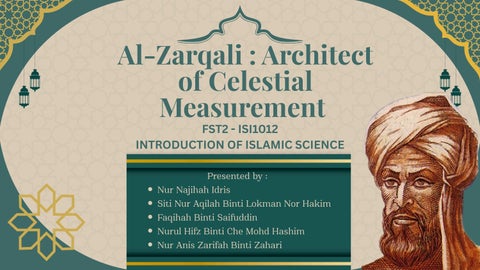
Al-Zarqali : Architect of Celestial Measurement FST2 - ISI1012 INTRODUCTION OF ISLAMIC SCIENCE Presented by : Nur Najihah Idris Siti Nur Aqilah Binti Lokman Nor Hakim Faqihah Binti Saifuddin Nurul Hifz Binti Che Mohd Hashim Nur Anis Zarifah Binti Zahari
Introduction During the Golden Age of Andalusian science (8th–15th centuries), Al-Andalus became one of the world’s greatest centres of learning. Cities such as Cordoba and Toledo were home to libraries, observatories, and scholars from different cultures. Muslim scholars preserved ancient Greek knowledge and expanded it through original research in astronomy, mathematics, medicine, and philosophy. One of the most important astronomers of this era was Al-Zarqali. His discoveries and inventions greatly improved astronomical accuracy and influenced both Islamic and European science for centuries. Astronomy was essential in Islamic civilisation for determining prayer times, the Islamic calendar, and the direction of the Qibla. Al-Zarqali’s work also supported navigation, trade, and scientific observation.
Why Al-Zarqali Renowned as the most famous Andalusian astronomer Influenced Europe for nearly 400 years Combined theory + practical instruments Highly skilled in astronomy and scientific observation Created accurate astronomical instruments and data Important figure in Islamic civilisation and ilm al-falaq His discoveries contributed to the development of modern astronomy “Islamic astronomers were not mere transmitters of knowledge, but active innovators.”
Life History of Al-Zarqali Al-Zarqali, whose full name was Abu Ishaq Ibrahim ibn Yahya al-Zarqali, was born in Toledo (modern Spain). He began his career as a metalworker and blacksmith. This background helped him develop exceptional skills in crafting precise scientific instruments. Later, he moved to Cordoba, a major centre of learning, where he worked with leading scholars in astronomy. His expertise earned him great respect across the Islamic world. When Toledo fell to Christian forces in 1085, scientific activities were disrupted. Despite this, Al-Zarqali’s works continued to spread throughout Europe. He passed away around the year 1100, leaving behind a lasting scientific legacy.
Major Scholarly Contributions Al-Zarqali made several groundbreaking contributions: His astronomical data became part of the Toledan Tables, which were used in Europe from the 12th to the 16th century. His works were translated into Latin and Hebrew, influencing Christian and Jewish scholars. He accurately calculated the movement of the Sun’s apogee, very close to modern values. He measured the tilt of the Earth’s orbit (about 23°) with great precision. These discoveries allowed more accurate calendars and planetary calculations.
Importance in Andalusian Era Al-Zarqali invented the Universal Astrolabe (al-Ṣafīḥa al-Zarqāliyya). Unlike earlier astrolabes, it could be used at any latitude. Why it mattered: Helped determine prayer times and Qibla direction anywhere Improved navigation for travellers and sailors Influenced navigation instruments used during the Age of Exploration
Relevance to Modern Science Al-Zarqali’s work remains important in modern science: His calculations of the solar year were extremely accurate His observational methods showed the value of long-term scientific study His instruments inspired modern navigation and measurement tools His achievements prove that Islamic scientists were original thinkers, not just translators of earlier knowledge.
Values & Reflection Al-Zarqali’s life teaches valuable lessons: Perseverance: He rose from a metalworker to a leading scientist Creativity: He combined practical skills with theoretical knowledge Precision: His careful observations set new scientific standards Curiosity: His desire to understand the universe drove innovation These values are relevant for students and scientists today.
Conclusion Al-Zarqali was a pioneer of astronomy whose work shaped scientific thought for centuries. His precise observations, innovative instruments, and influential tables bridged Islamic and European science. He stands as a powerful example of the intellectual brilliance of Islamic civilisation and its lasting contribution to global scientific progress.
References Heydari-Malayeri, M. (2007). The Persian–Toledan astronomical connection and the European Renaissance. arXiv. https://arxiv.org/abs/0709.1216 Samsó, J. (2015). Andalusian astronomy in the 11th century. University of Barcelona. https://inferencereview.com/assets/pdf/articles/andalusian-astronomy-inthe-eleventh-century.pdf Parihatuzahra, V., Maulidia, R. D., Nadia, S., Putri, A. R. J., Arief, A., & Nurdiansyah, N. M. (2025). Kontribusi ilmuwan Muslim Al‑Zarqali dalam perkembangan astronomi pada masa kejayaan peradaban Islam di Eropa. JIMU: Jurnal Ilmiah Multidisipliner, 3(04). https://ojs.smkmerahputih.com/index.php/jimu/article/vi ew/1055