SEOULITE CONTRIBUTORS 2019 Editors in Chief
Copy
Eric Hwang
Irene Nam, Kelly Sung, Lindsey Lim, Clair Kang, Kris Son, Grace Jiyoon Lee, Aimee Choi, Lauren Kim, Riwon Ahn, Jeffrey You, Jennifer You, Sarah Yim, Christine Yi, Hannah Yoo
Managing Editor Emily Oh, Wendy Kang Copy Editor Isabella Kim, Rosa Suh Layout Editor Edward Hahm, Justin Choi Photo Editor Rachel Lee, Katie Lee
2
Photo(s) by Rachel Lee & Katie Lee Layout by Eddie Hahm
Layout Claire Kim, Yuzine Yi, Eunice Rhee, Emma Im Photo Alice Lee , Ashley Kim, Christine Yu Advisor Ms. Wendy Grant
LETTER FROM THE EIC Honorable delegates, chairs, advisers, guests, and readers, These next 17 pages include the hard work of Seoulite, the official press publication of SEOMUN. We as a staff and I as an editor am honored to serve SEOMUN’s many esteemed delegates, chairs, secretariats, advisers, and other participants throughout the conference’s 23rd annual iteration. We hope that all delegates will engage in fruitful debates on global issues and draw new insights from their encounters with new perspectives. It is of my firm conviction that there has never been a more important volume of Seoulite than our present publication. In a virtual conference in which delegates are separated by miles of physical distance and the glow of computer screens, it has become more difficult for delegates to interact with students outside of their committees or hear about debates that they do not personally participate in. As such, SEOMUN is at risk of losing its diversity of interactions and tight-knit community of past years. Our staff hopes to use our publication to overcome this obstacle. This conference, we will strive to use our stories as a connective tissue for SEOMUN’s international coalition, as a common thread to unify delegates from Beijing to Busan. With this in mind, Seoulite would like to ask the delegates and chairs of SEOMUN for two things over the next three days: First, please take the time to flip through our daily issues on issuu.com. We promise to fill our pages with fresh and engaging content ranging from coverage of environmental sustainability debates to memes about resolution drafting. Second, if a press member approaches you for an interview, please spare a few minutes of your time. We welcome and look forward to your uncensored personal opinions! On that note, we wish all delegates the best of luck. Happy SEOMUN XXIII!
Eric Hwang Editor in Chief
3
Written by Eric Hwang Photo(s) by Rachel Lee & Katie Lee Layout by Eddie Hahm
99 COMPLIMENTS With the COVID-19 death toll increasing at unprecedented rates, it is easy to lose sight of the innovations that have emerged. One need look no further than SEOMUN XXIII: amidst the pandemic, Secretariats and advisors have managed to effectively convert the proceedings of an entire three day conference onto an online platform. Along with the unprecedented level of anticipation delegates, Secretariats, chairs and advisors all hold for this year’s new and improved SEOMUN, time should be taken to truly appreciate the positive aspects of this year’s conference. This year’s Secretariats have not only successfully maneuvered to maintain the conference but have also effectively utilized the broad range of technology to uphold an online conference. To overcome the challenges posed by China’s Firewall, our Secretariats swiftly adapted and adopted Microsoft 365, an exceptional alternative storage and synchronization service. The addition of new committees such as the World Health Organization (WHO) will give delegates a chance to directly resolve global issues resulting from COVID-19, further helping facilitate discussions on the most critical issues of our time. Whether it be note passing or frantically grabbing lunch at COEX, certain aspects of a physical SEOMUN conference cannot be preserved. However, this year’s
virtual venue will allow delegates to engage in the exciting yet stressful experience of MUN from the comfort of their own homes. More importantly to some delegates, an hour’s daily commute can now be spent getting some extra sleep in. Attending SEOMUN at home entails other subtle yet profound conveniences including the reduced pain of trekking around conference halls in uncomfortable dress shoes and speaking with delegates reeking of bad breath. Delegates could theoretically attend the conference wearing pajama bottoms, and no one would be to judge. Furthermore, this year’s altered dates of SEOMUN, from November 19th to the 21st, means participants and involved members will only be missing one day of school, as opposed to the usual two. This prevents students from falling behind in classes, not having to return to school the next week bombarded with makeup tests and assignments. Seniors can push through application season, not having to worry about catching up on school work. This year’s secretariats—Brian Ham, Christopher Shin, Joanne Yang, Katherine Suk, Seongyun Jeong, and Justin Choi—and advisors—Mr. James Kowalski, Mrs. Megan Lee, Mr. Jeff McEvoy-Hein and Mrs. Jesica De La O—have all proven themselves to be admirable guiding figures in the high school and middle school, setting up the path for their exceptional leadership in this year’s SEOMUN. Although SEOMUN XXIII is one like no other, it continues to serve as an invulnerable opportunity for students to engage in MUN, act as nation leaders, and battle pertinent issues that plague the world. We may be a thousand or two kilometers apart and connected through mere pixels, yet we remain closer than ever through our shared, unabashed passion for SEOMUN XXIII.
4
Written by Wendy Kang and Emily Oh Photo by Ashley Kim Layout by Yuzine Yi
STUFF DELEGATES SAY From Delegate to Me : (Privately)
From Delegate to Me : (Privately)
To:
(Privately)
5
Written by Isabella Kim & Rosa Suh Layout by Yuzine Yi
SEOMUN XXIII embraces timely theme: A Decade of Innovation Throughout history, multifarious adjustments have shaped the world into the way it is today. These adjustments were the products of innovation— taking new approaches and attempting numerous trials to solve the issues at hand. Some innovations came in response to unforeseen changes in society, but interestingly, some of them were intentionally made to induce preferable changes that guided us towards a better future. One way or another, innovations are an inescapable part of our lives as we continuously try to adapt and seek efficiency. This year, amidst a global pandemic, SEOMUN XXII starts under the theme, “A Decade of Innovation.” As we enter into a new decade, the world is already expecting unprecedented sets of challenges. In response, this year’s conference hopes to prepare students for the responsibilities and burdens that will be placed upon them by having them discuss a multitude of various aspects in order to devise a desirable future. “I am hoping that the SEOMUN conference can act as a stepping stone to finding innovative ways to manage problems with unclear solutions,” said Michelle Heo, delegate of United States in the Six Party Talks. “It is the responsibility of us, not only as delegates of the conference but as leaders of tomorrow, to contemplate ideas and cooperate for a better future.” As much as the past decade has seen a rapid increase in technological innovation, this year’s agenda will focus greatly on the complications involved in deploying such technology. Of the manifold issues at stake, the issue of data privacy is considered to be the most intricate for the upcoming decade. With the development of various online platforms for remote communication, people have started to question the extent to which their activities are being tracked or monitored. Consequently, data privacy and security concerns continue to be a persistent trend in the status quo. “Since we’ve been spending most of our time on computers due to the pandemic, I’ve realized the increased reliance we now have on technology,” said Emily Sung, deputy assistant president in the Human Rights Council. “Given its increased usage, we must find a novel solution to resolve the issue of privatization so that it does not hamper the beneficial impacts of the advancements.”
6
Written by Christine Yi Photo(s) by Ashley Kim Layout by Claire Kim
This year, under the unusual circumstances of a global pandemic, the virtual MUN conference will provide both a safe and fruitful means of communication for the multinational delegates who are concertedly willing to find measures to mitigate global challenges through their innovative mindsets. “A successful implementation of the first virtual SEOMUN conference will be extremely meaningful in itself,” Emily said. “However, I hope to achieve beyond that by having meaningful discourse that would bring relevant changes to our society, which is what I believe all the delegates are anticipating.”
Brian Ham culminates his MUN journey as SEOMUN XXIII Secretary General Finishing off strong as a fourth-year MUN participant in high school, Brian Ham, a senior at Seoul International School (SIS) took responsibility as Secretary General for the 2020 MUN Club. His fervent initiative to address government censorship, universal gender equality, and international tension led him to his position as a secretariat in SEOMUN XXIII: A Decade of Innovation. “My journey with SEOMUN started off three years ago in the COEX Convention Center,” said Brian Ham, Secretary General. “To be honest, my first year in SIS MUN Club really opened my pathway to Model United Nations. When I was in conferences with delegates from other schools, I realized that I needed to improve my skills as a delegate not only in official conferences but also in weekly MUN club meetings.” Brian dedicated his protracted hours to organize this year’s SEOMUN conference, especially under the new circumstances of the ongoing pandemic. Unlike his past experiences, this year’s SEOMUN XXIII is virtual, with all delegates in online conference rooms. With the pressure to provide the delegates with an authentic MUN experience while incorporating the technological aspect under maintenance, he had to check all elements of this November conference thoroughly. “There were many pros and cons to this year’s SEOMUN organization process,” Brian said. “Unlike the standard orientation to locate delegates in physical conference rooms, the student officers and I had to establish a method to form breakout rooms in Zoom calls and systematized ways for delegates to speak.” Brian’s high school SEOMUN career ends today. Yet his resolute goal and sense of justice to create a better world will carry on to his future destinations. The young innovator hopes to uphold his principles at college and beyond, to
reflect upon the past and innovate the future. Brian’s inmost hope is to help the next generation of impassioned debaters flourish after his term is over. “MUN is a unique experience that gives students a glimpse into how the real world works, and it pushed me to actively come up with creative solutions for global issues rather than simply watching world leaders make their decisions,” Brian said. “I hope MUN continues to be an environment where students can, with the help of their fellow delegates, learn how to responsibly handle multi-billiondollar budgets and navigate nuclear crises.” To an extent, MUN is very exhausting, with long hours of research into foreign countries, continuous updates of global policies and arguments, and extensive periods of preparation for a single conference. However, Brian felt blessed as he discovered the essence of the MUN community: the devotion to establish a better world. His in-depth exploration ultimately led to the pinnacle of MUN responsibility as a Secretary General. “As SEOMUN XXIII’s Secretary General, I made it my personal goal to make sure that all delegates, regardless of past experience, would be able to leave this conference a better debater and a knowledgeable global citizen,” Brian said. “For me, helping a shy freshman in the back of the classroom find the courage to make her first speech is as great an accomplishment as a savvy MUN veteran taking home an award, and every one of these small victories count toward making this conference a successful and memorable one.” With his experiences as a delegate, a student officer, and a chair in previous SEOMUN conferences, Brian faces high stakes to lead a momentous event during the three days of SEOMUN XXIII.
7
Written by Hannah Yoo Photo(s) by Justin Choi Layout by Emma Im
MUN veteran reflects and shares advice Being a new member of MUN can feel overwhelming and entirely foreign for many. Constantly having to write speeches, research new topics, face defeat in debates, and get along with other members can feel like an impossible task. Shawn Yoon, the president of the Commission on the Status of Women (CSW) and a current senior at Seoul International School (SIS), joined MUN as a young freshman and this year, and became a leader of the school’s MUN club. Along the way, he learned about responsibility, leadership, teamwork, confidence, and participation. When questioned about his experience, Shawn decided to share the most crucial elements of MUN that stood out to him over the course of four years. “I learned that it’s important to go out and get as much MUN experience as you can, whether you are a chair or a delegate,” Shawn said. “This way you can get a feel for different conferences and environments quickly.” While delegates already have a lot of tasks and responsibilities, higher positions have much more to keep in mind. While being the leader of a team and simultaneously writing college applications as a senior can be extremely challenging, Shawn takes on these hardships and pushes himself to become better every day. “As a leader, I have a lot of responsibilities overlooking my underclassmen and members,” Shawn said. “However, every day, I remind myself of the work I put into reaching this spot to confidently lead the team.” With four years of experience in MUN, Shawn clearly recognizes his own strengths and weaknesses as a delegate and strives to improve himself. Though it is his last year at MUN and SIS, he does not idly complete tasks but instead gives his all because he understands the importance that every delegate can make in a debate. Shawn focuses on setting an example of how a leader should act and becoming a chair underclassmen can look up to. Lastly, when asked to provide some advice for future underclassmen MUN members, Shawn found his answer from the four years he had been in MUN. He emphasized that experience and contribution were key to improvement and success in a debate.
8
Written by Lauren Kim Photo(s) by Ashley Kim Layout by Claire Kim
“I think my strengths are that I have a lot of experiences and qualifications to have this position as President of the team,” said Shawn. “I think proper chairing is crucial to having a good debate so that everyone is comfortable and can speak to their full potential. For underclassmen, I’d recommend participating in as many conferences as you can, regardless of the result. Once you find success there, it’s easy to get the ball rolling and find your place in the team as well.” For members of MUN who are in urgent need of advice and insight from an experienced MUN delegate, Shawn Yoon sets an example of a successful and hardworking member who has achieved his goals due to his diligence and skill. Delegates should not be afraid to take risks and make mistakes, because continuously trying to contribute and participate will eventually lead to a buildup of skill and experience.
Virtual SEOMUN conference brings hope for more comfortable dress code
Professionalism and formality are two key principles of any MUN conference; hence, delegates and chairs are required to dress appropriately, adhering to the strict rules of formal business attire. However, due to the pandemic that continues to limit crowd gatherings, SEOMUN this year will be held online. This has begged the question, “will delegates still comply with the formal dress code behind their cameras?” While there are various opinions regarding the dress code for SEOMUN this year, how to properly enforce formal dress codes remains a question. Some delegates believe that the change from an offline to an online conference may be an opportunity to feel more comfortable with attire through the three-day conference. Due to these new virtual circumstances, they will not have to worry about struggling through formal suits and shoes for three rigorous days. “I have to admit—last year, it was pretty rough staying in formal attire for three consecutive days,” said Hannah Kim, Assistant President of the Commission on Science and Technology for Development. “I would change into my pajamas as soon as I reached home from the conference each day. If it SEOMUN was completely virtual at home, then I would probably wear a formal top and something comfortable underneath.” Other delegates responded to the change in a similar manner but with much more boldness and enthusiasm. These delegates saw the new virtual
SEOMUN as a rare but cherishable occasion to get comfortable and cozy in their homes. “Of course I’m planning to wear sweatpants on the bottom,” said Yoonseo Kim, delegate of the United States of America in the Special Conference. “I just have to make sure my camera will only show my formal top. I’m looking forward to a very comfortable, in-bed style conference this year.” However, it seems like there will be some disappointment for these delegates. Some schools, such as Seoul International School, require students participating in SEOMUN to be at school during the days of the conference. Those attending the conference physically at school are expected to wear fully formal outfits, robbing the opportunity for delegates to wear comfortable pants at home. “For this year’s SEOMUN, we still have to follow the dress code of last year,” said Michelle Bok, delegate of Brazil in the Environmental Commission. “Last year, club members were expected to wear a formal shirt, pants, and shoes usually in black, although it did vary. I do think this year’s SEOMUN may be a bit more lax on the dress code since the conference itself is held on a virtual platform. Still, we have to dress somewhat formally since all SIS MUN members are going to be at school participating in the conference.”
9
Written by Sarah Yim Photo(s) by Alice Lee Layout by Claire Kim
Tips and tricks for
Microsoft 365 You are sitting at your desk, staring at the documents in front of you in a new, unfamiliar format. You are familiar with Google Drive, but what even is Microsoft 365? OneDrive? The interface looks similar, but not quite the same. Where is everything located? And why are you even using Microsoft Word instead of the normal Google Workspace? Launched on March 30, Microsoft 365 is the renamed and revamped version of Office 365. Much like Google Workspace, which contains Google Documents, Spreadsheets, and more, Microsoft 365 includes a variety of different applications including Word, Powerpoint, and Excel. In international MUN conferences, it is used to share and edit documents, the same way Google Drive is used. “I have heard before that for MUN, Microsoft 365 is used,” said Daniel Shin, delegate of Denmark in the Commission on the Status of Women (CSW). “Although I’m not entirely sure why, I am aiming to familiarize myself with Microsoft 365 so that when the real conference happens, I will be prepared to share, export, and save files.” The reason behind why Microsoft Word is being used for this year’s SEOMUN conference is simple: Google Workspace is blocked by China’s Great Firewall. Since May 27, 2014, Google’s various applications are blocked from access by China, meaning that apart from using a Virtual Private Network (VPN), Chinese citizens cannot use Google’s services. While resorting to Microsoft 365 is a viable solution, many delegates are facing difficulties with the unfamiliar user interface. “I’m not comfortable with the settings and tools,” said John Kim, delegate of Japan in the United Nations Development Programme. “I’ve never really used Microsoft 365 before, because for school and for MUN I’ve only used Google Drive. Although the settings and buttons are different for Microsoft 365 and less intuitive compared to Google Workspace, I think I’ll slowly get used to it.”
10
Written by Grace Lee Photo(s) by Christine Yu Layout by Emma Im
There are a few simple, useful tips to get accustomed to Microsoft 365. One trick is to change the Microsoft Word settings to Dark Mode, which reduces the strain of looking at a screen for extended periods of time. To do this, first, press “File” at the top left hand corner. Then, click on “Account.” Next, press on “Office Theme” and change it to black. This changes the settings and tools to black; however, it does not change the page itself to be a darker color. In order to do that, press “Design” and adjust the color to dark gray. This setting makes the document less bright, reducing eye strain, which is especially needed in a virtual setting where delegates are looking at computer screens for long periods of time. “This is really useful, since I enjoy using Dark Mode,” said Paul Moon, delegate of China in the Commission of Science and Technology for Development (CSTD). “I normally use Dark Mode for the rest of my apps, but I didn’t know it was possible for Microsoft Word. Since Light Mode strains my eyes, the choice to change my settings to Dark Mode reduces this problem.” Another tip is that there is no need to press “Save” every time you make new edits on Word and Powerpoint. A new feature included in Microsoft 365 is “AutoSave”, which saves a file automatically as the user edits. To enable this, simply move a document to a OneDrive folder (essentially just the cloud), and “Autosave” will be on. When you want to revert a document to an earlier version, simply press “File” and go to “Browse Version History.” Just like Google’s version history, this will allow you to select which version you wish your document to be reverted to. “I didn’t realize that these features existed in Microsoft 365,” Paul said. “Microsoft 365 has more features than I initially thought. Perhaps having an array of features similar to Google Workspace will help me transition to using Microsoft, and the MUN conference won’t be too difficult to become accustomed to.”
Missing Out On Offline MUN In the wake of a global pandemic, extracurricular activities in 2020 have been marred by a lack of bus rides back to school filled with laughter, face-to-face stand-offs with opponents, and loud cheers from supportive family and friends. Similarly, SEOMUN has fallen victim to pandemic restrictions, and this year, delegates will only have a chance to show off their speaking skills through a laptop screen. As an interscholastic event that invites delegates from all corners of the globe, SEOMUN serves as an important platform for fostering connections with students with shared interests. As such, several delegates have already begun to nostalgically languish for memories of past in-person SEOMUN conferences, citing the wide range of physics conference experiences that a virtual event simply cannot offer. “MUN is a great opportunity to interact with international delegates and meet new people,” said Katherine Suk, SEOMUN XXIII Administrative Director. “It is especially easier to build this bond in an offline conference, so I think delegates are going to miss that part.” An important aspect of MUN is cultivating public speaking techniques. Public speaking requires interacting with the audience through the use of active eye-contact, listening skills, and other nonverbal communication cues. As virtual conferences create great literal and figurative distances between delegates, interactions may seem impersonal, making persuading other delegates more challenging than ever. “What I think most delegates miss about in-person MUN conferences is the feeling of giving an actual speech at the podium,” said Paul Moon, delegate of China in the Commission on Science and Technology for Development. “Looking at the other delegates, trying to convince them in some way for resolutions or certain amendments, and getting to interact with opposing views and ideas face to face, rather than through the screen, are some of the things that help delegates feel like they are giving an actual speech.”
games together, and had fun after eating delicious lunches.” Another aspect of offline MUN conferences is passing notes. Passing notes, delegates can bond with delegates from other schools and countries. Notes are effective because they help delegates communicate with relative secrecy from the prying eyes of chairs, which triggers a certain communal sense of freedom that was often helpful in building bonds between delegates in physical conferences. Through notes, delegates can easily swap ideas and thoughts on the on-going conference, or even help their peers without disturbing the conference. Using notes wisely could easily make you one of the best delegates in the room, and the small notes of paper will be sorely missed in SEOMUN XXIII. “Last year in CIMUN, I had the chance to pass notes with a few other delegates,” said Anika Kurebayashi, delegate of Japan in the General Assembly ii. “It is a shame that we cannot pass notes this year because it really helped me to connect and share my ideas with other people, making it easier to understand the current situation of what people thought.” Even before Nov. 20, students have begun expressing nostalgia for the unique factors of offline MUN conferences. Delegates hope that safety precautions such as the online proceedings of SEOMUN XXIII can accelerate the global recovery and a return to the unique aspects of offline MUN conferences, from real podium speeches to note passing. Hopefully, sooner than later, delegates will be able to reclaim the perks of a standard MUN conference.
Many delegates also had fun, unforgettable memories from in-person MUN conferences. Even outside of the MUN conference room, students were given the chance to bond with both new and familiar faces. Taking into account that most major conferences last over several days, it is clear that these informal moments are what make MUN conferences worthwhile even during precious weekends. “I miss just making fun memories in in-person conferences with my friends,” said John Kim, delegate of Japan in the United Nations Development Program. “During CIMUN [...] we chilled on the sofas located in conference rooms, ran around the campus, played
#
Written by Sarah Yim Photo(s) by FIRST LAST Layout by Claire Kim
11
Written by Sungji Lindsey Lim Photo(s) by Alice Lee Layout by Claire Kim
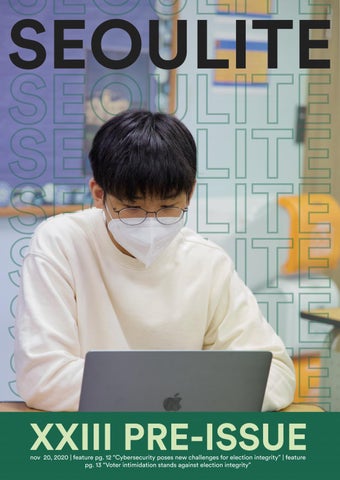
CYBERSECURITY POSES NEW CHALLENGES FOR ELECTION INTEGRITY While other forms of governance may depend on military strength or lineage, democracy is built on faith. This faith, squarely set upon the pedestal of fair elections, seems to have been neglected by many people of many nations in recent years. Part of the problem stems from the influence that contemporary digital technology has on electoral processes. Due to many instances in which experimental technologies have compromised the integrity of elections, many global citizens have lost faith in their democratic processes. One method through which technology poses a threat to election integrity is the harvesting and manipulation of personal information by foreign powers to influence the elections of other countries. For instance, data firm Cambridge Analytica enabled Russia to interfere with the 2016 US election. The firm took advantage of a loophole in Facebook’s data distribution policies and were able to collect the personal information of millions of Facebook users. Specifically, Cambridge Analytica assessed which people were most likely to have racist, sexist mindsets and believe in conspiracy theories. They then sorted users categorically to wage a disinformation campaign. By targeting the most vulnerable voters, many were swayed to vote for Donald Trump. Ultimately, such digital electoral manipulation enabled foreign nations like Russia to produce specific, biased results in American elections, undermining electoral processes through eroding their independence and fairness. Another technology-related concern regarding election integrity is the reliability of digital ballots and voting methods. During the Indonesian 2018 regional elections, cyberattacks on Indonesia’s election commission staff and disinformation attacks on user accounts compromised the final results, signifying a breach of sensitive electoral information. Such attacks have led to a surge in general uncertainty about the credibility of online voting. Some argue that paper voting is the only way to prevent glitches and maintain election integrity.
This is integral in overcoming the common misconception that malicious actors need to use electronic voting systems to sway voters toward a specific candidate to be effective, and that cybersecurity experts must focus on protecting the systems from specific attacks. The reality is that it is more than enough for hostile foreign powers to simply cause discord in their target country. Targeting constituents’ faith in electoral systems results in political divisiveness, which is enough to cause havoc in a democratic society. Aside from attacks on government protected electoral information, independent social media sites have also been shown to be popular vessels for election-related cyberattacks. In particular, social media platforms are often hijacked to spread false claims that can manipulate elections, such as in Latvia’s 2018 general election. Even when they are not hacked, companies such as Twitter, Facebook, and Google have often shown reluctance to censor users that propagate dangerous falsehoods or attempt to spread disinformation. This inaction has left serious concerns about the ability of social media to encroach upon electoral integrity around the world. Although the internet has presented many challenges for election integrity, in certain instances modern digital technology has been used to make elections more secure. Present day electoral voting technologies have proven themselves capable of both collecting and counting votes and maintaining voting integrity. Specifically, some modern governments provide virtual ballot scanners, data transmission websites, voter registration systems, and backup paper count procedures. These digital tools are also constantly monitored by experts to prevent cyberattacks. In this manner, the more logical approach to cybersecurity may be educating the masses on the safety and clear benefits of cybersecurity, while still maintaining a vigilant eye on bad actors and, perhaps more importantly, the firms or users that safeguard the systems themselves. In an era of unprecedented voting technological development, governments around the globe express the need for modifications in both computers and users interfering in elections. To do so, several governments are getting provisions from third parties and raising awareness about election cybersecurity. The level of security in elections must be continuously developed and improved to avoid repeating mistakes. However, it is more important for us to fully understand the intrinsic benefits and detriments of such technologies before passing judgement on them. Blind faith does not always serve a purpose, but faith built on understanding is the kind of faith upon which one can build a nation.
VOTER INTIMIDATION STANDS AGAINST ELECTION INTEGRITY As attempts for the widespread use of multiparty elections grew, countries seemed to be on their path to sustainable development. Although such endeavors were pursued to change countries for the better, many less-developed nations with low-income economies had continual struggles in establishing these electoral institutions. Unable to keep up with the extensive alterations that accompany the transition from autocratic rule to democratic systems, many African countries have been reluctant to shift their attention to the common people. As such, a peaceful transition of power has proved difficult for them. Inherent flaws in the electoral process were of primary concern in newly democratizing countries like Kenya. Due to the governments’ unethical and corrupt means of gaining power, many African elections have contradicted democratic ideals from the beginning. For instance, violence characterized the disputed 2007 Kenyan election: a bloodbath ensued due to allegations of vote-rigging between Raila Odinga and the incumbent president Mwai Kibaki, who won the election. Brutality peaked with 1,400 citizen deaths in two months as armed gangs aggressively shot citizens after viciously torturing and raping them. In addition, the police interfered by killing off unarmed protesters, escalating riots. Driving close to civil war, Kenya was in desperate need of international aid to remedy the chaos. With manipulation and unchecked violence increasingly characterizing the election system as a whole, concerns were raised about the credibility of holding elections. The repeated use of aggravated violence returned in 2017; Kenyan Information and Communication Technology (ICT) manager Chris Msando, who presumably refused to disclose a password used to rig the presidential election, was assassinated by the Independent Electoral and Boundaries Commission (IEBC). Kenya’s unsettling political climate reflected the nature of elections in Africa, one that was far from fairness and freedom. Furthermore, rising concerns about political systems led some African nations to initiate violent tactics to suppress and instill fear in citizens, perhaps legitimizing their power with voter intimidation. Election delays were often necessary to decrease the risk of violence in countries plagued with voter mobilization and ballot manipulation, such as Nigeria. Despite these delays, violent voter suppression continued to grow out of hand. Because election violence may be an infringement of human rights for individuals and often kill people as an outcome, people should be more aware of such violations. Moreover, it is important to note that such problems are not only present in Africa—they affect the world on an international scope. In Europe, this year’s
Belarusian elections also shocked the public through the overwhelming magnitude of conflict it generated. The mounting anger erupted when the government successfully shut down the internet as a means of censorship in response to political unrest and protest. In Asia, Singapore has used unconcealed voting through physical intimidation, which stood in direct contrast to voting in Australia with the secret ballot, effectively preempting blackmail or election fraud. The aftermath of voter fraud and election violence in democratic systems can be consequential as authority lies in the hands of entities that do not deserve power. This can also be displayed in the framework of the election itself because, in theory, the citizens are supposed to be determining the ones in power. Although many changes and improvements have been made in the twenty-first century, these developments have not been sufficient in aiding countries plagued with voter intimidation in developing their own sense of sovereignty. The international community often praises countries for attempting to transition into democracy, but they fail to recognize that such transitions do not happen overnight; there inevitably are underlying powers that develop resistance, ultimately leading to corruption. To conclude, in the context of election integrity, elections should be representative of votes that count for each individual’s opinions. Within each election that occurs, there are multiple aspects that may undermine election integrity through actions like manipulation, violence, and intimidation. An approach to marginally target and potentially combat these factors is encouragement and support through foreign aid. Currently, extensive work is being done in order to alleviate problems by external incentives from the United Nations Development Programme (UNDP) that have allowed for many successful interventions in times of conflict to further strengthen the notion of democracy and make it appealing for more countries. Moreover, guidelines have been set to strengthen electoral systems. For instance, funding for the installation of monitors designed for elections to issue coverage and raise awareness was one of the many proposed solutions. Now, society awaits new long-term solutions to practically resolve these pressing concerns for the betterment of democracy ahead.
13
Layout by Eunice Rhee
SEOMUN delegates prepare strategies to avoid Zoom burnout Whether it is waking up five minutes before first period or secretly looking at phones during online classes, the word Zoom probably evokes painful memories from the many SEOMUN delegates and chairs. Thankfully, delegates and chairs are equipped with their own survival kits to battle Zoom fatigue, best known as “Zoom burnout,” to help themselves avoid feeling lethargic and exhausted after multiple strenuous hours of debating digital screens. Many chairs and delegates plan on exchanging light banter with others in hopes of finding comforting stimulus in the midst of not being able to enjoy the conference in person. Actively seeking out interactions could be an effective way to stay awake by helping immerse delegates into the conference. “I avoid Zoom burnout by actively interacting with the delegates and chairs around me,” said Sarah Ju, deputy assistant president of the Special Conference. “Since we’re not in a physical setting, it’s difficult to have closer interpersonal connections with those attending the conference. A key part in maintaining a continuity between online and offline conferences is always trying to initiate conversations with other delegates so that invaluable connections are not lost.” Besides this method, other delegates have proposed avoiding Zoom screens during intermissions to prevent fatigue and burnout. It would be wise for all delegates to take their eyes off their computers and seek consistent water breaks. Delegates have emphasized the importance of being ocularly well-rested in order to focus more effectively and perform better in debates. “In order to prevent Zoom breakouts, I will try to have frequent water and screen breaks in between debate sessions,” said Katelyn Oh, delegate of the United States of America of the Commission on the Status of Women. “In other conferences such as SKYMUN, I learned how important it is to rest, as that way, I can make better speeches and engage more effectively.” Other delegates have claimed that simply avoiding looking at screens during downtime within the conference may not be sufficient to avoid fatigue. Some have raised concerns about the potential for daydreaming during long online speeches and debates. Not surprisingly, one other popular survival tip has been giving more intent concentration and paying more scrupulous attention to every happening of the conference. “I try to avoid experiencing Zoom burnouts by staying as focused as possible, such as by taking notes throughout the entirety of the conference,” said Emily Sung, deputy assistant president of Human Rights Council. “I do this so that I can not only give more quality feedback to the delegates, but also avoid feeling tired during the long hours.”
14
Written by Kelly Sung Photo(s) by Christine Yu Layout by Eddie Hahm
By conversing actively with other chairs and delegates, taking frequent screen and water breaks, and focusing intently during the conference itself, SEOMUN XXIII delegates hope to resiliently overcome the hurdles posed by the online setting they have been thrusted into.
Delegates accentuate specific benefits of virtual MUN conference Over the last several months, many public spaces have closed down due to the COVID-19 pandemic, including schools and other academic organizations. Schools unable to continue in-person classes were forced to adopt virtual ones, and along similar lines, MUN conferences have also been part of this change. As the pandemic progressed, most MUN conferences were done virtually rather than in-person. Zoom and Google Meets were often used, as these platforms do not require physical contact. Rather than going to the podium, the delegates would unmute their microphones to state their opening speeches, POIs, or amendments. “It feels more comfortable in a virtual conference,” said John Kim, the delegate of Japan in the United Nations Development Programme. “In virtual meetings, we can simply unmute our mics and present our speeches or POIs, which makes me less nervous and thus speak more eloquently. In addition, in virtual MUN conferences, I feel physically less exhausted because I won’t have to go to the location of the conference very early in the morning and come back to the home late at night.” Many delegates like the benefit of being able to unmute their microphone in relative comfort without feeling pressured. Others admire how with virtual meetings delegates are able to have a variety of discussions, regardless of the location of residence. “Implementing a virtual MUN conference allows me to discuss global issues with delegates who are unable to participate in in-person conferences, such as those residing abroad,” said Melissa Kim, the delegate of the United Kingdom in the Economic and
Social Council. “Virtual conferences, hence, enable us to explore solutions feasibly, as there is a more varied group of people.” Despite these benefits, technical difficulties frequently occur during virtual meetings. This, however, has encouraged many delegates to put forth even greater efforts than before, determined to overcome the hardships of communicating with other delegates and chairs during meetings. “The difficulties of communicating between delegates and chairs during a virtual MUN conference can incentivize students to try harder to make POIs, amendments, and so on,” said Andrew Cho, the Assistant President of United Nations Development Programme. “I believe that this will greatly increase the quality of debate because people are actually making insightful points that really matter.” However, the most prominent benefit of virtual conferences is social distancing. Due to the spread of the pandemic, many conferences and meetings were canceled. Virtual meetings allow the delegates to attend conferences, while maintaining social distancing. “One benefit of doing MUN conferences online is that it helped me keep social distance, but also experience new things online,” said Erica Lim, the delegate of the United States of America in the World Health Organization. “By doing the conference online, I was able to gain new types of experiences that we’re unable to earn during in-person conferences.”
15
Written by Kris Son Photo(s) by Alice Lee & Ashley Kim Layout by Eddie Hahm
D A I L Y S C H E D U L E With the new virtual system, delegates see minor yet noticeable changes made to their demanding schedules at SEOMUN. These changes are felt from the moment they get up from bed. Delegates wake up later than usual, with the reduced time constraint of having to travel to a venue. After having breakfast in the kitchen, they sit down and open their computers, checking if their internet connection is safe and sound. With excitement and nervousness, they then join the opening ceremony of SEOMUN at 9 a.m, officially starting the day. “I am already familiar with the procedure of an online MUN conference because I attended SKYMUN and NBMUN,” said Katie Kim, delegate of France of the Environmental Commission. “I will probably wake up around thirty minutes before the conference, brush my teeth, wash my face, and wear a collared shirt while keeping my pajama pants on. Even though having SEOMUN online is not ideal since MUN is much more fun in real life, I cannot deny that I love sleeping in.” Virtually attending the opening ceremony can be less of a moving experience than usual, and this may be where delegates feel the biggest difference from previous conferences. They join meetings for their corresponding committees and start their opening speeches by simply unmuting their mics to speak. Presenting their countries’ stances and considering others’ propositions, delegates officially transition into formal discussions. “Even though this new virtual system may detract from the unique atmosphere of MUN conferences, much of the experience remains,” said Jordan Kim, delegate of USA of General Assembly III. “We still have the components of public speaking, critiquing, compromising, and researching, so the content and schedule of this year’s MUN will not feel much different from past ones.” After having lunch at their home dining tables, delegates gradually start to feel a sense of solitude brought by the lack of bonding time with other delegates,
16
Written by Aimee Choi Photo by Alice Lee Layout by Yuzine Yi
Of Delegates At MUN lobbying sessions without physical proximity, and a new system of note passing. Some delegates lose motivation as the day goes, sitting down on their chairs for hours without social interaction and completing their usual tasks, while others feel more lively by conserving energy. “At the beginning of the day, I definitely prefer virtual conferences mainly because I get more alone time to focus on critiquing resolutions,” said Jasmine Jeong, delegate of Egypt of General Assembly III. “But as the day goes, my body grows stiffer than usual. It’s important to stand up from my chair and stretch in between sessions to make sure that I feel well enough to put consistent effort in debating and proposing amendments.” At 5 p.m, delegates wrap up the day’s debates and close their heated computers. Looking back at the day’s accomplishments and preparing for the next day, delegates continue to stay productive in the evening. This year’s SEOMUN conference will, overall, prove the delegates’ ability to adhere to the same expectations and schedules, even when placed in a much more lenient setting.
DELEGATES BRING OPTIMISM TO ONLINE CONFERENCES With the first day of SEOMUN inching closer and closer, delegates have been eagerly awaiting for the ultimate day—Nov. 20th—to arrive. For the first time in SEOMUN history, the conference will be held online to prevent the potential transmission of COVID-19. As a result, delegates have adjusted their expectations for the SEOMUN conference compared to previous years. In particular, the delegates brought to attention that it may be difficult and complicated to attend the SEOMUN online due to the possibility of technological issues. In spite of these concerns, other delegates have remained optimistic and accentuated the privileges that they are looking forward to in this upcoming online meeting. “I am looking forward to finding feasible solutions for global issues that have presented difficulties for us,” said Melissa Kim, delegate of the United Kingdom in The Economic and Social Council. “I think this year of SEOMUN will be a good experience for me just in case COVID-19 continues next year. Next year, I will know how to prepare and have more information on how SEOMUN will take place online.” While Melissa hopes that this year of SEOMUN will provide an opportunity for her to learn more about online MUN conferences for the future, others look forward to SEOMUN as the perfect platform to learn and refine their debating skills, especially since they will have opportunities to connect with veteran delegates. Honing these skills is a fundamental part of MUN as delegates must be able to effectively articulate their points, share opinions, and interact with other delegates.
enhance my speaking skills and my collaboration skills, and make me a better delegate. Also, I think SEOMUN is important because it also means that we get to see different perspectives about a diverse range of topics, ultimately giving us a more holistic and interesting understanding of the world. ” Although some delegates expect this year to be different, most delegates believe that there will be several similar aspects. For instance, Katelyn Oh, delegate of the United States of America in The Commission on the Status of Women, pointed out that the main purpose of SEOMUN, debating with other delegates, will remain unchanged. Similarly, delegates will still be provided with various opportunities to speak about their ideas and solutions. “Although there will be minor differences in this year’s SEOMUN compared to earlier years, I think that delegates will still be able to debate with other delegates, which is one of the things that I am most looking forward to,” Katelyn said. “Even though the meetings are held online, we will be able to turn on our mics and express our thoughts, just as we were able to do in previous, offline meetings.” While all delegates have different expectations and hopes for the first online SEOMUN conference, all delegates share an immeasurable excitement for the unique interactions and heated debate sessions that await them. Delegates hope to be well prepared to share their opinions and to shine on the podium.
“I think SEOMUN is going to be a great experience for a beginner like me,” said Ian Park, delegate of the Republic of Korea in General Assembly II. “I think meeting with a wide variety of delegates would
17
Written by Irene Nam Photo(s) by Alice Lee & Christine Yu Layout by Eunice Rhee
New MUN committee: New MUN committee: New MUN committee: SEOMUN XXIII introduces new WHO committee New MUN committee: New MUN committee: New MUN committee: New MUN committee: New MUN committee: New MUN committee: New MUN committee: New MUN committee: New MUN committee: New MUN committee: New MUN committee: New MUN committee: New MUN committee: New MUN committee: New MUN committee: New MUN committee: New MUN committee: New MUN committee: New MUN committee:
The world in the status quo is bristled with troubles, including climate change, global public health, and human rights crises. In response to misfortunes all around the globe, the theme for SEOMUN XXIII was introduced as, “A Decade of Innovation,” envisaging a hearty start to the 2020’s. SEOMUN XXIII aims to prepare students as strong and responsible leaders of tomorrow.
“COVID-19 had taught us how vital improvements in a nation’s health systems are in parallel to the development of its economy,” said Sunny Lee, the deputy assistant president of the Commission on the Status of Women. “Although I will not be participating in SEOMUN as a member of the committee, I await with pleasure to hear about meaningful discussions from them.”
“I believe that MUN is frankly the most valuable equipment for young adults to learn and train themselves for the future they want,” said Michelle Heo, the delegate of the United States of America in the Six Party Talks. “While we need to be concerned about politics, government, and other areas of society, global health security is the utmost important factor for us to debate upon.”
While WHO has always supplied continuous aid to the global community, 2020 has truly accentuated the significance of the agency after the breakout of the COVID-19 pandemic. Despite the upcoming challenges delegates will face with a new and awkward platform of debates, as always, they are willing to resolve urgent issues through cooperation.
Concerning the contemporary status of health standards in various nations, this year, SEOMUN XXIII will introduce a new committee, the World Health Organization (WHO). Focusing on the theme of good health and well-being influenced by WHO’s Sustainable Development Goals (SDGs), the committee will debate upon three agendas: implementing universal health coverage to improve healthcare standards, combatting COVID-19 pandemic as a global community, and ensuring accessibility and inclusion for individuals with physical disabilities.
18
Written by Riwon Ahn Photo(s) by Ashley Kim Layout by Emma Im
“I hope SEOMUN XXIII will be full of fruitful debates, and although it may be hard, I hope to interact with all these people coming from all over the globe,” said Jasmine Jeong, the deputy assistant president of General Assembly III, “I look forward to listening to fresh and unworn opinions of the delegates.”
UNDP paves road for brighter futures The United Nations Development Programme (UNDP) is a new committee added to SEOMUN this year. In the UNDP, students seek solutions to current economic and social challenges plaguing many countries. Since 1965, the real UNDP has helped millions by providing basic humanitarian aid for citizens in undeveloped countries, striving to eradicate poverty and inequity. In doing so, the UNDP focuses on all of the 17 sustainable development goals (SDG), which include achieving gender equality and reducing inequalities. Taking in these factors, the UNDP will discuss three agendas: promoting innovative development, designing sustainable solutions for food security, and ensuring sustainable integration of immigrants into communities and economies. Delegates especially passionate or interested in facilitating and initiating development for economically disadvantaged communities would harbor dedication alongside devotion for these agendas. These traits of the UNDP encourage many delegates to prefer this committee over others. “I personally enjoy being a delegate in the UNDP because we focus on agendas discussing the global future, such as addressing the impacts of climate change and developing sustainable and innovative cities and transportation,” said John Kim, delegate of Japan in the UNDP. “I am also interested in creating solutions for broader, global topics that deal with specific conflicts like the situation in Yemen.” For delegates like John, the UNDP is a way to peer into real world agendas created for a better future. In addition, delegates interested in the UNDP show commitment to achieve these agendas through their engagement in discourse regarding potential ways to support financially unstable countries. Attesting to this fact, other UNDP delegates seem to have similar interests and ideas.
“I think that the UNDP is great because it focuses on the development of other countries,” said Sahngwon Lee, delegate of the Russian Federation in the UNDP. “It also aims to focus on poverty and other inequalities. I look forward to finding comprehensive solutions with member nations to solve these frightening issues at hand, as many creative ideas need to be thought of to effectively resolve these problems.” With SEOMUN XXIII right around the corner, the UNDP members are excited to deal with problems involving the creation of sustainable communities, bearable designs to improve LEDCs, and incorporation of immigrants into better lives. Multiple changes have been made in this year’s SEOMUN and the most impactful difference is the online environment it is being held in. The aim of the committee still rests clearly: fighting for equality and better living conditions all over the world. “I’m looking forward to how delegates will create solutions, collaborate, and participate despite the hurdles of online communication,” said Andrew Cho, assistant president of UNDP. “In particular, I’m wondering how delegates will designate tasks when lobbying. It is evidently more difficult than being in person, so it would be great to see how people overcome new challenges.” Surmounting obstacles is a necessary step for success. The UNDP will manage to hopefully break the problems that come with a new environment and continue to thrive in seeking solutions to solve their agenda, helping lesser developed countries, and being a platform for young students to propose their own ideas. In hopes of the establishment of a better society as a whole, the new committee may bring fruitful results in the MUN conference starting this year and continuing on in the future.
19
Written by Jeffrey You Photo(s) by Christine Yu Layout by Emma Im