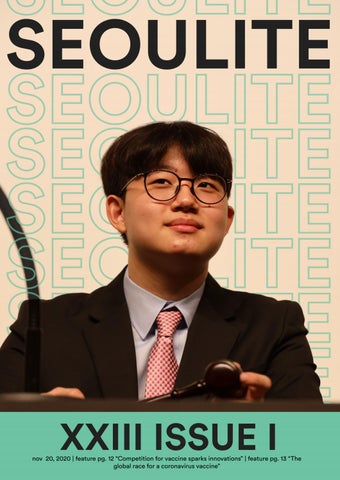
SEOULITE CONTRIBUTORS 2020 Editors in Chief
Copy
Eric Hwang
Irene Nam, Kelly Sung, Lindsey Lim, Clair Kang, Kris Son, Grace Jiyoon Lee, Aimee Choi, Lauren Kim, Riwon Ahn, Jeffrey You, Jennifer You, Sarah Yim, Christine Yi, Hannah Yoo
Managing Editor Emily Oh, Wendy Kang Copy Editor Isabella Kim, Rosa Suh Layout Editor Edward Hahm, Justin Choi Photo Editor Rachel Lee, Katie Lee
2
Photo(s) by Rachel Lee & Katie Lee Layout by Eddie Hahm
Layout Claire Kim, Yuzine Yi, Eunice Rhee, Emma Im Photo Alice Lee , Ashley Kim, Christine Yu Advisor Ms. Wendy Grant
LETTER FROM THE EIC Honorable delegates, chairs, advisers, guests, and readers, These next 19 pages include the hard work of Seoulite, the official press publication of SEOMUN. We as a staff and I as an editor am honored to serve SEOMUN’s many esteemed delegates, chairs, secretariats, advisers, and other participants throughout the conference’s 23rd annual iteration. We hope that all delegates will engage in fruitful debates on global issues and draw new insights from their encounters with new perspectives. It is of my firm conviction that there has never been a more important volume of Seoulite than our present publication. In a virtual conference in which delegates are separated by miles of physical distance and the glow of computer screens, it has become more difficult for delegates to interact with students outside of their committees or hear about debates that they do not personally participate in. As such, SEOMUN is at risk of losing its diversity of interactions and tight-knit community of past years. Our staff hopes to use our publication to overcome this obstacle. This conference, we will strive to use our stories as a connective tissue for SEOMUN’s international coalition, as a common thread to unify delegates from Beijing to Busan. With this in mind, Seoulite would like to ask the delegates and chairs of SEOMUN for two things over the next three days: First, please take the time to flip through our daily issues on issuu.com. We promise to fill our pages with fresh and engaging content ranging from coverage of environmental sustainability debates to memes about resolution drafting. Second, if a press member approaches you for an interview, please spare a few minutes of your time. We welcome and look forward to your uncensored personal opinions! On that note, we wish all delegates the best of luck. Happy SEOMUN XXIII!
Eric Hwang Editor in Chief
3
Written by Eric Hwang Photo(s) by Rachel Lee & Katie Lee Layout by Eddie Hahm
99 COMPLIMENTS Less than a week remains until Thanksgiving, a day most of us associate with family, giving thanks, and most importantly, stuffing our faces with roast turkey, mashed potatoes, and pumpkin pie. In these trying times, a positive and secular holiday that underscores the importance of expressing gratitude over mindless mind-giving is more needed than ever. With strict social distancing measures enforced in most corners of the world, the majority of us will not be able to enjoy large celebrations modeling the harmonious feast Pilgrims and Wampanoag peoples shared. However, the removal of physical gatherings allows us to reevaluate the symbolic values that have sustained from the 17th century rather than fixating on the inception of Thanksgiving itself. In particular, we now have an invaluable opportunity to examine just how essential family and gratitude are. Whether it is cooking and eating with family members on Zoom like Alexandria Ocasio-Cortez or queuing up a Thanksgiving movie marathon, there are several quarantine-friendly alternatives to traditional celebrations that are equally exciting. Further, there is a diverse range of activities that are far more simple— writing short yet thoughtful emails expressing your appreciation for others, starting a gratitude journal, or going on a solo, picturesque stroll through nature to reflect on the subtle yet profound quirks of life that bring you joy—that embody the values Thanksgiving was built on. Regardless of how you end up celebrating Thanksgiving this year, take at least five minutes to reflect on what you are thankful for. Wink wink, send a note to your chair or fellow delegate.
4
Written by Wendy Kang Photo by Ashley Kim Layout by Yuzine Yi
Although we may not be able to physically meet during this Thanksgiving or SEOMUN, we can still embrace the gratitude that we hold for one another. To our Seoulite family, whom we are grateful to for persevering through sleepless nights spent finalizing issues. Our advisor, for hosting meetings, supporting us, and reading through countless drafts. Our delegates, for seamlessly adapting new virtual platforms and engaging actively in lively debates and interviews. There is more to the world than the doom and gloom brought by a global pandemic—take time to truly embrace our appreciation for those around you this Thanksgiving.
STUFF DELEGATES SAY From Delegate to Me : (Privately)
From Delegate to Me : (Privately)
To:
(Privately)
5
Written by Isabella Kim & Rosa Suh Layout by Yuzine Yi
GA I condemns weapon development On the first day of SEOMUN XXIII, members of the General Assembly I (GA I) convened to discuss the regulation of arms and the establishment of global peace. Primarily tackling the issue of biological weaponry, Lethal Autonomous Weapon Systems (LAWS), and state-sponsored cyber-terrorism and warfare, delegates presented their stances through their passionate opening speeches. In general, delegates were in accord with one another, especially since the development of technological weapons has become a major source of concern among most nations. On the issue of biological weaponry, which have yet to be developed to their full potential, most delegates agreed on the need to discourage, restrict, and monitor biological weapon usage they become destructive. “Djibouti has not directly been affected by biological weapons yet, and this would be true for most nations,” said Aditya Dutta, delegate of Djibouti. “However, I believe that if biological weapons are not monitored by the United Nations, they will become the new nuclear weapons or the new threat to peace. This is because biological weapons can be used to target certain ethnicities with precision, allowing mass genocide and serious humanitarian problems to take place.” LAWS, which are versatile robotic weapons capable of attacking targets through engineered algorithms, have also been a rising threat to global security. Delegates were generally in agreeance for this issue as well, with many raising concerns about how weaponry can become unimaginably dangerous once put in the hands of robots. Wieroo Park, the delegate of France, added to this discussion by speaking on behalf of France, an international leader in technological development. “I’d say what makes France’s position unique in the issue of LAWS is how strongly the country is against it,” Wieroo said. “I believe LAWS are morally repugnant and politically unacceptable, and I will work forward to the complete ban of those weapons by collaborating with other delegates who feel the same way.”
6
Written by Aimee Choi Photo(s) by Christine Yu, Jeffery Daniel Aung Layout by Emma Im
The last agenda for GA I was regarding statesponsored cyber-terrorism and warfare. Many delegates representing nations directly affected by cyber terrorism were able to express specific stances. For instance, Carolyn Levy, the delegate of Somalia, emphasized the need to establish tactical units to resist terrorist organizations and set firm international restrictions because Somalia has frequently suffered from foreign terrorism. Hannah Eva Jacob, the delegate of Morocco, also strongly contended against this practice, noting how millions of Moroccans have been harmed by it in the past few years. Delegates also stressed how imperative it is for vulnerable citizens to have more protection from dangers like cyber warfare, especially with the rise of technological tools in trying to contain COVID-19. “Considering the persisting conflicts between Morocco and West Sahara, I have a distinct stance on this agenda,” Hannah said. “As technological advancements rise tremendously along with cyberattacks, it becomes especially important to protect the privacy and welfare of our population. To solve the issue at hand, promote peace, and construct sustainable ideas, I am highly looking forward to working with other delegates for the next few days.”
GA III proposes measures to reflect upon rising global concerns The General Assembly III (GA III) marked the start of the first day of SEOMUN XXIII with opening speeches, then transitioned into lobbying sessions. During lobbying sessions, delegates formed resolutions reflecting upon issues ranging from macroeconomic policy to countering arising threats of the internetdriven world. Of the proposed topics, addressing the increasing technological gap between less economically developed countries (LEDCs) and more economically developed countries (MEDCs) in industries emerged as a major focus among delegates. Considering the issue to be the leading concern in modern society, delegates collaborated to draft solid resolutions. “Today, the growing gap among LEDCs and MEDCs is once again being placed under the spotlight,” said Sehun Kim, the delegate of Poland. “Preparing ourselves to become the leaders of tomorrow, I have decided to debate upon the significance of balancing out the technological status of the global community.” The general consensus among delegates was to focus on countries with divided economic status. Hence, delegates divided themselves into two different stances. The first group prioritized addressing concerns posed by the stark contrast in educational status and quality of LEDC and MEDC countries, whereas the second group tasked themselves with tackling issues plaguing countries’ infrastructures and economies.
“As usual, the GA III had too many delegates participating in a single most popular agenda, thus we decided to split ourselves into two stances,” said Claire Ohk, the delegate of Mauritania. “The first group, agenda 1A will be mainly focusing on the significance of education, whereas the second group will be focusing on the impact infrastructure and economy has on the overall balancing in the technological status among member nations.” Besides focusing on the increasing technological gap between LEDCs and MEDCs in industries, delegates were busy assembling possible solutions regarding the rise of hate crimes against minorities through online platforms. In preparation for upcoming debates, delegates also worked on establishing a legal framework to counter the threats of artificial intelligence. “Overall, I was very impressed to see each member of the committee participating, and suggesting rich schemes upon the topics,” said Jasmine Jeong, the Deputy Assistant President of General Assembly III. “I could tell that each member was passionate about the conference, and I can not wait to chair such a fruitful event tomorrow!”
7
Written by Riwon Ahn Photo(s) by Alice Lee Layout by Claire Kim
ECOSOC searches for economic solutions in developing nations On the first day of SEOMUN XXIII, delegates of the Economic and Social Council (ECOSOC) debated on multiple agendas regarding the economy of the world, especially developing nations. Multiple solutions were proposed by each delegate regarding different agendas, taking different approaches to address the issue at hand. Many of these suggestions were deemed effective and gained the support of other delegates. Melissa Kim, delegate of the UK, encouraged other delegates to debate on agenda three: developing strategies for rebuilding the economies of less economically developed countries (LEDCs) following the COVID-19 pandemic. The delegate emphasized that the pandemic has increased the economic exclusion of developing nations and suggested other delegates to cooperate for the revival of a stable market. “This delegate encourages member states to cooperate in the continuous opening of trade without restrictions on external trade,” Melissa said. “Furthermore, this delegate believes that it is pivotal for NGOs and member states to provide innovative solutions to sustain individual markets, which are prevalent in LEDCs.” Delegates with similar opinions grouped together into different breakout rooms to discuss possible solutions while beginning to draft resolutions. Delegates who wanted to discuss strategies for rebuilding the economies of developing nations drafted resolutions that included clauses such as providing education and infrastructure which would help restabilize the economy, along with facilitating trade between countries.
8
Written by Irene Nam Photo(s) by Ashley Kim, Hyewon Lee Layout by Eddie Hahm
“Our group’s main focus is to work in phases to first set a foundation for
developing nations to become involved in the global economy,” said Minju Oh, the delegate of Brazil. “This means beginning with conflict resolution and disaster response to stabilize the socioeconomic status of nations such as Cambodia, Afghanistan, and Somalia. We then hope to improve education and infrastructure to educate individuals and reintegrate them into the economy. Then, we hope to encourage their involvement in the international economy through expanded foreign investment and inclusive trade agreements.” Other delegates addressed agenda one: the rise of economic exclusion in a global economy. Delegates suggested a hypothetical solution of providing short-term aid alongside building long-term infrastructure and job opportunities to foster economic growth. These solutions are essential in solving economic exclusion as it provides an opportunity to narrow the gap between LEDCs and more economically developed countries (MEDCs). “The overall stance of my group is that public investment in infrastructure will lay a strong foundation for economic development,” said Isabella Longhi, delegate of the Russian Federation. “Not only will it create jobs in the public sector and stimulate the economy, but it will also improve access to clean water and transportation in developing nations which will allow for heightened entrepreneurship and employment.” In ECOSOC, delegates were able to finalize multiple solutions to address each agenda. With these resolutions, they hope to solve the intensifying COVID-19 economic crisis poisoning the global economy. Delegates look forward to debating their proposed resolutions during the following days.
HRC evaluates importance of education in addressing racism
On the first day of SEOMUN, delegates of the Human Rights Council (HRC) fixated on a heated discussion on the first agenda, delving into the deep-rooted systemic racism in society. Other pertinent topics were covered while discussing the broad topic of racism, including society’s obliviousness toward racism and the lack of legislation against racial profiling and discrimination. “Systemic racism is a topic that has really been important recently,” said Brandon Choi, delegate of the United Kingdom. “Right now it is necessary to address this topic because many people continue to face systemic racism in their lives.” With the prevalence of the Black Lives Matter movement, racism provoked passionate discussion among all of the delegates during the lobbying session. Despite the occasional contentions on the necessity or redundancy of a clause, everyone concurred upon one issue: society’s lack of acknowledgement of systemic racism. The general consensus was that deficient education spurred further animosity against people of color.
“To tackle this issue, education is crucial, both for the police force and public citizens, especially for younger generations,” said Seungah Lee, delegate of Egypt. “Redress for already victimized people is also necessary, as well as international platforms to regularly discuss and assess each other’s progress with support from NGOs.” Supplying education for the entirety of the populace was one of the most accentuated clauses in the resolution, considering that for many, education is a prerequisite to being aware that racial differences should not play a role in determining social perceptions. “Management of communities’ racial environments will also play a major role in the progressive end to systemic racism, as the serious problems generated from it will be more easily spotted and addressed,” said Celine Bacily, delegate of the Republic of Korea. “When implementing seminars not in corporations, but in the education system as well, all generations are provided the knowledge needed to comprehend the authenticity and impact of this issue.”
The undermining of the value of education to combat racial inequality was considered the root cause of systemic racism by many. Delegates underscored that with insufficient education, individuals would cultivate ignorant mindsets, dictating themselves as inherently superior over people of color. Delegates also emphasized that for entire populations to realize the value of education, education would have to be implemented into the education system, and not be limited to the elites of affluent corporations. In sum, delegates were able to articulate their nations’ stances regarding the role of education in eradicating the root cause of racism:people’s ignorant mindsets. In discussing methodologies to contend such a ubiquitous and entrenched societal perception, delegates were able to finalize their resolution on the issue of systemic racism and look forward to the fruitful debates that await.
9
Written by Kelly Sung Photo(s) by Katie Lee, Seungah Lee Layout by Emma Im
UNDP discusses food security in LEDCS proposed resolutions that included research on genetically modified organisms (GMOs) and efforts to facilitate the movement of food. Additionally, some delegates decided to focus on aspects related to sustainability and its long-term effects on LEDCs. These delegates agreed on using methods such as integrating technology, agriculture, and food security networks in order to enhance sustainability, while also promoting the research of GMOs.
On the first day of SEOMUN XXIII, delegates of the United Nations Development Programme (UNDP) separated into breakout rooms during lobbying sessions and discussed the three agendas: promoting innovative development through sustainable cities and transportation, designing sustainable solutions for food security in less economically developed countries (LEDCs), and ensuring sustainable integration of immigrants or displaced persons into communities and economies. Many delegates underscored that food insecurity is a significant issue to focus on. Delegates agreed that the severity of food insecurity branches out to impact other issues in the world, emphasizing the need to ensure that food security is addressed with a well-managed resolution. “I chose this specific agenda because food insecurity is a prominent issue in our world, and every agenda somehow relates and affects this issue,” said Dharshwana Muralidharan, delegate of Egypt. “The agendas that are being talked and debated about in this conference are greatly being affected by food insecurity. For instance, food insecurity is a primary problem for immigrating refugees.” Delegates focusing on food security in LEDCs
10
Written by Lindsey Lim Photo(s) by Rachel Lee Layout by Eunice Rhee
“We plan on primarily focusing on sustainability when tackling food insecurity, so many of our solutions are long-term and elaborate,” said Brigette Kwan, delegate of Mexico. “Among the solutions are the use of technology such as GMOs, as well as utilizing sustainable funding sources.” However, there were still a number of clashes between delegates regarding clauses within the resolution. In particular, there were many disagreements on whether or not to include a certain clause about technology in the resolution. “I think we were disagreeing the most about whether a clause about technology should be included or not,” said Julia Park, delegate of the United Kingdom. “This was mostly because of their countries’ stances. For example, Syria isn’t comfortable with UN-appointed officials monitoring over their government situation, while Afghanistan is arguing that local authorities tend to be corrupt in countries like Afghanistan.” Over the course of this heated discussion on the second out of the UNDP’s three agendas, delegates of the UNDP spent the first day of SEOMUN debating and planning the resolution. They used first-hand experiences of their countries to find and correlate clauses that would be suitable for this agenda’s resolution. Though there were disagreements, eventually the delegates came to a consensus, having formed a well-written resolution.
CSTD discusses the dangers of COVID-19 contact tracing On the first day of the conference, delegates of the Commission on Science and Technology for Development (CSTD) began tackling climate change and contact tracing. The delegates who chose to focus primarily on contact tracing began detailing methods to make it more successful. As they drafted their resolution, delegates worked on declaring methods of improving data collection. In particular, delegates emphasized the need to address governments’ encroachment on essential privacy laws for the purpose of contact tracing, citing the dangers of uninformed tracking and tracing. Prioritizing the protection of citizens’ privacy, delegates made various suggestions and modifications such as [list examples]. “China has done exceptionally well with contract tracing, making use of existing, large-scale surveillance and case identification on a national level,” said Paul Moon, delegate of China. “Due to such efforts, China has successfully contained the pandemic and boasts a relatively low number of cases. Further, the Chinese government has assured its citizens and the international community that China has taken necessary precautions, such as terminating data after a set number of days and not collecting or storing unnecessary information, essentially making up for the lack of specificity in its contact tracing methods.”
information collected to what kind of data should remain confidential. Delegates proposed the types of information that should be kept private, including citizens’ gender, age, name. . It was made different to not revealing the gender of the infected, unless specifically agreed to by the infected individual, the exact age of the patient, only revealing the range of age of the infected in increments of 10, and the name of the infected patient, ensuring that it is never made public in any circumstance. “I am willing to change contact tracing by making it as more efficient through by increasing talks between the government and the public,” said Junmin Son, the delegate of the Republic of Estonia. “In doing so, I also hope to help also, the delegate wishes to create a universal standard for contact tracing in order to promise protection of private data.”
Some delegates expressed concern about the lack of clarity within the resolution. In particular, delegates pushed to define the period of time information can be stored. “I chose the agenda one because I think it is the most relevant to the biggest current issue right now in 2020,” said Mayvelee Bugh, the delegate of Pakistan. “There are a lot of issues to be addressed behind fighting against corona and protecting data privacy is important because there are rumors or news about private data being sold for purposes other than public health-related reasons.” Other delegates strove to improve other parts of the resolution, including determining the types of
11
Written by Clair Kang Photo(s) by Alice Lee Layout by Eunice Rhee
COMPETITION FOR VACCINE SPARKS INNOVATIONS By Sarah Yim
As COVID-19 cases continue to escalate around the world, more countries contend in the global race to develop the first usable vaccine. With its unprecedented significance and practicality, the COVID-19 vaccine development has been a vital issue, globally engrossing scientists and biologists months prior to the pandemic outbreak. As a result, competition for a vaccine continues to soar today, especially among world powers, namely China, France, the Russian Federation, the UK, and the USA. As competition continues to increase and intensify, new and valuable information on the progress of vaccine development is rapidly released to the public on a daily basis. Several other reasons account for the geopolitical competition of the COVID-19 vaccine development. Of course, the most obvious reason is to save lives, curb further economic damage, and restore the “normal” lives people once had. Another reason that may not be so straightforward originates from the idea of nationalism. Nationalism, the idea that countries should prioritize their citizens first, is a major factor that drives countries to race against both time and surpass other nations to develop feasible vaccines. Global power, title, and prestige also play a role in vaccine development competition among countries. The country that develops the first usable vaccine could become the clear, overwhelming leader in a world desperate for a solution to the uncontrollable pandemic. Although these motivators help facilitate healthy competition among countries, they raise pressing concerns that should also be considered. In particular, nationalism creates a tendency for countries to exclude certain countries (in the case that they develop the
12
first vaccine). Global health experts thus express their concern that ‘vaccine nationalism’ may lead to deviation from the ultimate goal of producing internationally-available vaccines to exterminate the chronic pandemic. In addition, mistrust may rise between both rival countries and their citizens. For instance, Wuhan officials previously censored their number of COVID-19 cases from the public, raising suspicion. In the case they develop the first usable vaccine in the world, Wuhan’s history of coverage may lead to further international doubts on whether they will openly share all safety cautions of their vaccine. As David Salisbury, an immunology policy expert at Chatham House, has underscored, the urgency of getting a vaccine trumps any other potential motivations such as jingoism and global honor. Furthermore, despite the potential drawbacks of vaccine nationalism, competition has helped fuel new discoveries and successes, helping the world take a giant step closer to a COVID-free world. Among competitors, China and the USA are evidently ahead of others in this geopolitical contest, having reported successful findings from multiple trials. According to Dr. Stephen Hoge, the president of the American drug company Moderna, their new vaccine under development is nearly 95% effective and expected to have 20 million doses available for the USA and five million doses available for the UK in the coming weeks. Yet, it is still important to recognize that current vaccines are not fully verified for everyday usage. Regardless, intense competition continues to pave way towards an optimistic and hopeful lookout to the future.
THE GLOBAL RACE FOR A CORONAVIRUS VACCINE By Christine Yi
The race is on to find a vaccine that can combat COVID-19, with scientists making concerted efforts to develop a safe and effective vaccine in a fraction of the time it normally takes. Funding for a vaccine has never been greater, with governments from leading nations and pharmaceutical giants pouring billions of dollars into research efforts. People around the globe have also turned their hopes and attention towards these science laboratories, as the vaccine is widely considered to be the only effective long-term solution that could counter the exponentially rising number of confirmed cases. While the coronavirus continues to accelerate unabated, there are currently more than 200 vaccine candidates under development, with a number of them in the third phase of clinical trials—the final step before a vaccine is approved. Coronaviruses (CoVs), a highly diverse family of positive-sense single-stranded RNA viruses, use highly specific mechanisms to penetrate host cells and cause infection. The spike (S) protein of the coronavirus, which gives the virus its distinctive spiked projections, plays the most crucial role in cell entry. Once the S protein recognizes and binds to its human target cell receptor, the viral envelope fuses with the human cell membrane, allowing the virus genome to enter the human cell and multiply. The viral infection will eventually cause impediments in normal body function especially in the respiratory tract, which is why infected victims often experience dry coughing, a sore throat, and shortness of breath after contracting COVID-19.
infections. The ChAdOx1 nCoV-19 vaccine from Oxford University, which is considered to be the most advanced among all vaccine prototypes, is made from a genetically modified virus that causes the common cold in chimpanzees. Researchers modified this vaccine to resemble the coronavirus by transferring the genetic instructions for the coronavirus’s S protein to the common cold virus. The end purpose of vaccinations is to induce a primary antibody response so that the immune system can create a rapid response against subsequent invasions of a similar pathogen. Having passed the second phase of clinical trials, the next step for Oxford would be to prepare its prototype for the last and final phase of clinical development in which the vaccine is given to thousands of people to be tested for safety and efficacy. However, even after a vaccine is approved and administered, government-sponsored administrations such as the Food and Drug Administration (FDA) will continue to examine reports on possible side effects of the vaccination, which is a necessary step of vaccine development as some side effects do not appear immediately. While the results of vaccine prototypes have been promising so far, there is still much work to be done, such as addressing rising concerns regarding the equitable distribution of vaccines. In the end, the only way to manage this unprecedented crisis will be through the cooperation and unified efforts of both nations and individual citizens.
Similarly, vaccinations trigger an immune response in the body by introducing genetically weakened pathogens but do not cause actual
13
Layout by Yuzine Yi
ENV collaborates on agriculture and environment With multiple agendas, the delegates of the Environmental Commission (ENV) debated the topic of sustainable agriculture. While supporting the spread of farming, the delegates opted to put forward an eco-friendly way to both improve the environment and agriculture. Many delegates brought up the issue of climate change, suggesting that the dilemma could be improved along with agriculturally-oriented solutions. Leah Gillette, the delegate of Singapore, was one delegate who emphasized the importance of climate change. While agriculture is an important element to national economies and societies, the delegate of Singapore prioritized the significance of climate change over agricultural development. As such, the delegate encouraged others to promote the growth of agriculture while also preserving the environment. “Our climate is in so much danger that a clock now counts down to the point that the damage is irreversible,” Leah said. “Our climate is the backbone of our community and lives. Each of these issues is extremely pressing. Unsustainable agriculture leads to further environmental degradation, and preserving biodiversity is crucial, as it has a strong impact on our food sources.” Delegates noted some minor details to add to the resolution. For instance, they expressed the need to specify the process of promoting education among farmers to provide a more comprehensive solution to the issue. While there were other areas that needed
14
Written by Kris Son Photo(s) by Christine Yu Layout by Eddie Hahm
to be further specified, such as the benefits that sustainable farming would give to farmers, delegates generally did not disagree with the resolution, rather providing broad support for the resolution’s content. “We try not to ask the delegates to change much in the resolution,” said Edward Lee, ENV President. “As a chair, it is a rare case to ask delegates to change their clauses. We try to be hands-off with what the delegates did, except for the formatting problems.” In addition to a resolution addressing the impact of agriculture on the environment, the ENV also addressed the resolution main submitted by Katie Kim, the delegate of France. The delegate of France and her supporters worked diligently to create many clauses that could specify how different international organizations could collaborate in the future to protect wildlife biodiversity. “I was on the third agenda which aims to prevent wildlife poaching and preserving biodiversity in the lesser developed region,” Katie said. “Within our block, I was the main submitter. I was able to tackle multiple areas and organizations, and make clauses that approach the future in collaboration with NGOs and the United Nations.” This committee collaborated on the issue of climate change and agriculture remarkably. Dividing the committee into three agendas improved the quality of discussion, as the focus of the delegates were all similar.
CSW addresses forced child marriages
On November 20th, delegates of the Commission of the Status of Women (CSW) began their discussion on the three main agendas. Starting with opening speeches, it was evident that a majority of delegates had focused on the second agenda, which revolved around eliminating forced child marriages in developing nations. Delegates agreed that child marriage needed to be eliminated immediately, considering its devastating consequences. “Forced child marriages are mentally, physically, and socially harmful to children, and they have a tendency to inflict irreparable harm upon the victims,” said Katelyn Oh, delegate of the USA. “This issue is especially prevalent in developing areas of the world, as more than half of the girls from these areas are married under the age of 18. With the issue in need of efficient and effective solutions, the delegate of the USA believes that there is a dire need for... enforcing appropriate legislation, raising awareness, increasing access to safe and quality schooling, and outlining the punishments for those found guilty.” Delegates also shared and combined resolutions from Nepal, Iraq, and Pakistan. Under the consensus that child marriages needed to be eradicated immediately, delegates drafted potential solutions to tackle the issue. For instance, Shwe Thone Diri, delegate of Iraq, staunchly supported raising social awareness of underage marriages occurring around the world. “It’s through social awareness that one can look at different topics from the aspect of the victims and understand their needs,” Shwe said. “Without raising social awareness I don’t think the world would be where it is today. The Black Lives Matter
(BLM) movement, for instance, used social media platforms, and with the help of social awareness bringing everyone together, we were able to take a step towards justice for the victims. The same applies for child marriages—the more we are able to make those around us socially aware, the closer we can be to eliminating child and forced marriages.” While delegates acknowledged the importance of raising awareness, many prioritized tangible legislative changes as a means to solve this issue. Nitya Arora, delegate of Pakistan, argued for CSW to focus more on governmental policies by creating policies to directly address the issue. “The key aspect that determines the efficiency of any tool used to protect an individual’s dignity is its ability to influence not only the targeted demographic but also influence other demographics,” Nitya said. “Social awareness comes about only when populations have incentive to work towards the needs of another demographic. Legislation provides not an incentive, but a restriction. As such, legislative change is more effective, and is hard to enact; it mandates that everyone be part of a movement at their own benefit, while social awareness allows for choice.” Ultimately, the resolution submitted by Nepal, Kazakhstan, Pakistan, and Iraq incorporated the ideas of initiating both legislative change and heightening social awareness in order to prevent and reduce forced child marriages. Despite slight disagreements, however, delegates were able to create a solid resolution regarding the issue.
15
Written by Grace Lee Photo(s) by Ashley Kim Layout by Claire Kim
SPT struggles with denuclearizing North Korea On the first day of SEOMUN, delegates of the Six Party Talks (SPT) discussed measures needed to be taken to achieve the complete and verifiable denuclearization of North Korea. Delegates of China, Republic of Korea (ROK), the USA, Japan, the Democratic People’s Republic of Korea (DPRK), and Russia avidly proposed and amended clauses to create a realistic solution regarding the denuclearization of the DPRK. During the lobbying session, delegates focused on settling matters in a peaceful manner that would be fair and practical.
“We feel like the discussion today was one of the best-case scenarios for the DPRK,” said Thet Noe, the delegate of DPRK.“Due to the agenda being about denuclearizing North Korea, the DPRK was naturally put in a difficult position. We believe that equal obligations for all signatories are important as it benefits everyone, bringing us towards a better world. We believe that it is important for the DPRK to denuclearize because if the country is unpredictable and more nuclear weapons are produced, the DPRK could pose a threat to international security. ”
In the beginning, delegates were skeptical in communicating with DPRK due to the country’s history of acting uncooperatively and independently after global agreements. Even China, one of DPRK’s allies, aimed to convince North Korea to remove its nuclear stockpile, due to the instability it brought upon the Korean Peninsula and the entire Northeast Asia region.
Although the clauses and proposals were thoroughly planned and confidently written down, other nations’ mistrust of the DPRK lingered. Most delegates could not disregard that the DPRK had repeatedly violated government resolutions in previous years. The history of distrust toward the DPRK impeded other nations from seeing North Korea as a transparent and trustworthy nation.
“I believe the delegation of China contributed to the question of denuclearizing North Korea by bringing in clauses that China believes are able to convince North Korea to denuclearize,” said Mathew Park, the delegate of China. “I made clauses that specifically addressed the diplomatic incentives and actions needed to be taken to convince North Korea to denuclearize. This includes reopening the original SPT, providing financial aid in exchange for gradual denuclearization, and allowing the International Atomic Energy Agency (IAEA) to confirm if each dismantlement is complete and verifiable.” Delegates of the DPRK actively participated in creating reasonable clauses that would both suffice North Korea and other nations. However, most delegates had trouble fully supporting and passing their proposals since they still clashed with other countries’ interests. Nonetheless, the delegates came to a conclusion of nine final clauses.
16
Written by Laure Kim Photo(s) by Christine Yu Layout by Claire Kim
“Although it is important that the DPRK gives up their nuclear weapons to negotiate with other nations and receive the UN’s assistance, I believe that it is extremely unlikely that this will happen,” said Bin Ma, the delegate of the United States. “As the DPRK is a self-sufficient nation that has an agricultural economy, its internal economy would remain unaffected, even if the UNSC enforced stronger sanctions.. As the nation has also gone through decades of isolation, this may actually have the effect of convincing them to continue to hold on to the nuclear weapons that were developed by the DPRK government.” As the lobbying session came to an end, delegates of China, the DPRK, the ROK, and the USA came to a conclusion with nine final clauses that would later be debated. The general consensus was that the denuclearization of the DPRK would be a difficult, almost impossible, task due to the nation’s insecurity and volatile decisions, such as the recent bombing of the liaison office.
SC urges for changes in Yemen On the first day of the conference, delegates of the Security Council (SC) discussed the crisis in Yemen. All of the delegates agreed upon the importance of humanitarian aid, including basic living necessities for Yemeni people who have been stripped of their most basic human rights throughout the Yemeni Civil War. Delegates proposed protecting Yemini ports that provide humanitarian aid and creating punishments as well as sanctions against any form of harassment against the ports. However, they also acknowledged that these penalties could worsen the plights of the Yemeni crisis. “Sanctions are the last resort for us, as placing sanctions is simply not beneficial and is considered an emergency action,” said Leo Byun, delegate of France. “Sanctions can sometimes cause even more damage, whether that might be the Houthi rebels becoming more aggravated or the further suffering of innocent Yemeni citizens.” Some delegates suggested the establishment of a new organization that specifically focused on the Yemeni crisis. However, it was overturned with the proposal of renewing an existing organization that already has a solid foundation regarding the issue. Delegates redirected their conversations to the effects of the coronavirus pandemic and discussed solutions for medical conflicts. Some argued that existing guidelines for other diseases could be modified for the coronavirus. Others rebutted, stating that specific guidelines just for the coronavirus should be created with the help of organizations such as the Red Cross and the World Health Organization. As the discussion regarding humanitarian aid came to a conclusion, delegates discussed the political stability of Yemen. At first, delegates appeared conflicted about the political state of Yemen as it was ambiguous who held power in the country, leading to disagreements upon solutions for peace between the Houthis and the Yemeni government.
“I just thought [the Houthis] could represent and sustain themselves, as a last resort if peace talks are not an option,” said Haotin Rex Yang, delegate of South Africa. “Whether or not they succeed or fail will reflect on the legacy of their standpoint, and other countries take no responsibility for such action taken at their own discretion.” Despite its reasoning, this proposition was met with much discord. The delegates against this statement claimed that instead of decreasing the division, more separation could occur within the country. In particular, Chris Jang, the delegate of Indonesia, had an especially strong argument against the proposal. “I strongly believe that this is unfeasible as doing so will only result in the division of the country and more conflicts,” said Chris. “Such cases can be evident in the division of South and North Korea, where the division of the country by the Demilitarized Zone has resulted in political and military conflicts. Not only that, although Chiang Kai Shek was able to separate Taiwan from China initially, this has only resulted in China and Taiwan coming to a conflict regarding the sovereignty of Taiwan. With such cases, it is evident that the division of Yemen will only result in another conflict plaguing the people of Yemen once more.”
17
Written by Jeffery Yoo Photo(s) by Alice Lee Layout by Claire Kim
SPC discusses upon the globalization of 5G network On the first day of SEOMUN, delegates of the Special Conference (SPC) exchanged perspectives on the proliferation of fifth generation (5G) technology within the international community. Fitting with the theme of the age of innovation, delegates strived to meet a consensus upon the efficient utilization of 5G technology. After its introduction to the USA in 2018, 5G technology brought about several benefits such as efficient communication between nations and easier distribution of information. In agreement with the benefits of 5G implementation, all delegates supported the globalization of 5G networks. As such, delegates spent time delineating steps that could help successfully establish 5G systems in all countries. Having expressed concern about the costs of implementing 5G systems in developing countries, Dagny Streit, the delegate of Somalia, proposed solutions which included government funding for LEDC. “Tax breaks and economic incentives will support the growth of 5G technology as it will allow developed countries to gain access to beneficial trade deals and corporations to have reduced taxes,” said Dagny. “In addition, this would allow developing countries to increase their GDP and be more active in the international economy which would bring benefits to both sides.” Other delegates shared Dagny’s stance on the increased transparency concerning the expansion of 5G networks. For instance, Kanon Suzuki, the delegate of Iraq, provided additional support for the potential constructive outcomes of the application
of advanced technology to developing nations. Acknowledging how all innovation—including the implementation of 5G technology—comes with disadvantages, Kanon expressed security concerns about individuals, terrorists, and cyber terrorists during the conference. “The implementation would entail advancements, including digital transformation across industries, providing a platform for internet connectivity, and even providing a most cost-effective platform for carriers” said Kanon. “However, due to the civil unrest in Iraq, I am concerned with the security issues that the implementation might entail.” Throughout the conference, clashing perspectives between LEDCs and developed nations emerged due to the varied stages of technological progression per country. Ideas to send IT professionals from companies like Samsung or Apple to less economically developed countries from technologically advanced countries were submitted by multiple nations. Although some nations agreed to send these professionals, delegates argued that telecommunication companies were likely to raise grievances about the potential theft of their technology. “As a country with significant technology contributions, I am willing to financially and technologically assist LEDCs to implement 5G networks,” said Eric Hu, the delegate of South Korea. “Yet, I am concerned with trusting governments of LEDCs because nations with low international credibility could potentially steal Korea’s 5G technology.”
18
Written by Hannah Yoo Photo(s) by Ashley Kim Layout by Eunice Rhee
WHO aims to promote well-being and healthcare On the first day of SEOMUN XXIII, the World Health Organization (WHO) gathered to discuss the issue of universal health coverage, promote equality by eliminating obstacles against people with physical disabilities, and encourage the development of health technology. Delegates mentioned the effects of the coronavirus pandemic, emphasizing the urgency for universal health coverage. Delegates agreed that public health spending should be focused to revolve around public health facilities to aid the well-being of global citizens. Although the delegates mentioned that free health services would be realistically impossible, feasible solutions— notably low medical costs—were made to alleviate the situation. The discussion also shifted towards the topic of disadvantaged minorities, specifically targeting people with physical disabilities. Delegates considered and evaluated resolutions aimed at preventing the social marginalization of these groups, who deserve equity in treatment.
“Millions of people around the world are being discriminated against and left out in their communities,” said Eddie Chu, delegate of the United States of America. “Many disabled people do not have the same opportunities as other citizens and they cannot access many aspects of life such as education, employment, and personal freedoms. I am attempting to solve this issue from many different perspectives, in order for all member nations to agree upon one collective resolution. Some of the specific attempts relating to this issue would be raising awareness, implementing specific education plans for the disabled, and making sure disabled people gain equality in the global community. So far, along with other fellow delegates, we are revising, removing, and forming one comprehensive resolution.”
Delegates reinforced the importance of raising awareness through the help of member nations while discussing the barriers caused by disability discrimination. They concurred that by addressing proper measures to counteract the judgemental mindset of communities and highlighting the unequal engagement in educational systems, these groups would have better access to key resources, leading to more opportunities for them to flourish. For instance, the delegates emphasized that many global citizens confined by institutions without educational support often have their plights exacerbated rather than alleviated. As such, delegates proposed offering minorities better access to working facilities and environments with the incorporation of the disabled and non-disabled people in order to improve their basic living standards and career choices. “The significance of this agenda is that it addresses an issue that is commonly undermined, which is aiding those with physical disabilities,” said Minji Kwon, delegate of Jordan. “We tend to commonly accept physical freedom as a given, but it’s really not, and it is imperative that we make efforts for inclusion not limited to gender or race but also on disabilities. Some attempts delegates can make include creating or enhancing education programs to raise awareness as well as educating the public on the inclusion of those with physical disabilities into society. They can also include the creation of infrastructure such as public aid systems to aid those with disabilities when needed, as well as reach out to those without the capability or willingness to ask for help.” For a more effective resolution, many delegates revised the operative clauses and sub-clauses within the resolution to develop a concise, yet distinct, claim with detailed objectives during lobbying time. Solutions were issued to solve general problems of minority inequality in educational and extracurricular activities, construction of infrastructure buildings for minority aid, and spreading awareness. “This specific agenda on preventing barriers against physical disabilities is unique because it provides a lot of doorways for our resolution,” said Jowon Layla Cyhnthe, delegate of Croatia. “The conference, currently, is going relatively well despite the difficulties faced as an online meeting because a lot of delegates are being very productive and attempting to keep it as close to the real conference as possible. The conference is leading to fruitful discussions, however, one unsuccessful aspect is that it is a little difficult to enter breakout rooms. Still, this doesn’t hinder our resolutions to a great extent.”
19
Written by Jennifer You Photo(s) by Alice Lee Layout by Eunice Rhee
Opening ceremony defines innovation
Launching the 23rd annual and first ever virtual SEOMUN conference, delegates and chairs attended the opening ceremony with mixed feelings of excitement and concern. Adhering to the theme “A Decade of Innovation,” multiple speeches were given to both inspire attendees to create novel solutions to pressing agendas and thank them for participating in a conference full of uncertainties. The importance and versatility of SEOMUN have been proven by its continuation even amidst a hectic, unpredictable year. A global pandemic, virtual schooling, and the rise of various social movements have presented an unprecedented challenge to students and citizens worldwide. However, as emphasized by the team of Secretariats, these factors are the exact reason why SEOMUN must continue to strive—to cultivate innovative solutions for the most acute issues of the decade. “We should all take a moment to realize just how crazy this year has been, and yet MUN still continues,” said Brian Ham, SEOMUN XXIII Secretary General. “To me, that’s the beauty and fundamental value of MUN. The world could literally be ending, but we will still be getting together and discussing plans of actions to take. MUN allows us, at a young age, to explore a part of human nature to collaborate and solve real-life problems.” Despite the positive outlook, the Secretariats did not overlook the difficulties resulting from the switch to a virtual conference. The opening ceremony served as an opportunity to reflect on the adaptability, resilience, and teamwork that this year’s system accentuated among attendees. After withstanding the
20
Written by Aimee Choi Photo(s) by Christine Yu Layout by Emma Im
ever-changing prospects of the conference, delegates and chairs were able to truly understand the reason why they were attending SEOMUN amidst such a confusing time. “Innovation is literally why we are here today,” said Jeffrey McEvoy-Hein, MUN advisor. “Innovation is solving problems that are larger than one of us, but requires all of us to solve. It is not limited to things that we make in the laboratory, cell phones, or cars. It is also coming together to discuss ideas and solve the world’s problems, because without enough communication among ourselves, there is no clear bridge to the future.” To end the opening ceremony, Jasmine Park, the guest speaker of the conference, took a step back from the stressful aspects of the conference to address the essence of building innovation as students and young adults. Reminiscing on her time at high school and college, she encouraged all participants to balance their ambitions and hectic schedules with consideration for their health, identity, and personal standards. Carrying such advice and inspiration, delegates and chairs took on determined attitudes to transition to committee meetings, where they would officially initiate the SEOMUN conference with novel and experimental debates. “All I wanted to do was share a couple of nuggets I learned from my years at high school, college, and beyond,” Jasmine said. “This is because innovation is only possible with real, personal reflection and wellness, which I believe is the ability to know where you are at in terms of the status of your body and mind.”
Delegates’ opinions on in-person and online SEOMUN I prefer an in-person MUN conference because it is much easier for delegates and chairs to interact with each other. There were definitely a lot of instances where I felt that we could have reduced a lot of conflicts if we were in person. I also think it would have been much more effective to edit the resolutions with the delegate if we were in person. However, I still think this online conference was proficient because all the delegates and chairs were able to fulfill their roles effectively and draft resolutions together.
Jasmine Jeong, Deputy Assistant Chair of GA
Brian Ham - Secretary General
I personally prefer in-person conferences because I feel like a big part of MUN is the actual process of going around meeting delegates from all over the world and having face-toface interactions about the issues at hand. The collaborative atmosphere that comes with in-person MUN conferences is what makes MUN so enjoyable and I really think those inperson conversations are the true delights of the conference.
Michelle Heo - delegate of USA in SPT
Paul Moon - delegate of China in CSTD END MEETING
I think both types of conferences have their merits and drawbacks. This year, we certainly are lacking some inperson interaction that is so valuable in forging relationships and facilitating communication; however, at the same time, some people may find more comfort behind a screen and courage to participate in debates. Either way, I am thankful that delegates have the opportunity to participate in MUN during these turbulent times.
I prefer in-person MUN conferences, as I get to meet new people from different parts of Asia in person, rather than on a screen. Also, I prefer speaking on a podium in front of a real audience, as simply doing so virtually feels like speaking to nobody.
21
Written by Lauren Kim Photo(s) by Christine Yu, Ashley Kim Layout by Emma Im