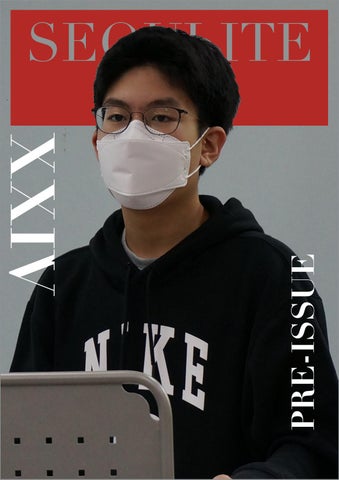
XXIV nov 5, 2021 | feature pg. 12 “Do the benefits of Artificial Intelligence outweigh its cons?” | feature pg. 13 “Importance of emerging AI Technologies”
PRE-ISSUE
SEOULITE
SEOULITE CONTRIBUTORS 2021 Editors-in-Chief
Copy
Katie Lee, Christine Yi
Aimee Choi, Rosa Suh
Charlotte Jun, Chelsea Kim, Clair Kang, Grace Lee, Jennifer You, Lauren Kim, Lin Chiang, Lindsey Lim, Shinheng Jason Lee, Sophie Choi, Yunseo (Irene) Nam, Rachel Yoon, Jenny Seo, Jiyu Hong, Sijeong Bang
Copy Editors
Layout
Isabella Kim, Riwon Ahn Layout Editors
Ellen Ryu, Emma Im, Eunice Rhee, Jasmine Cho, Kaylee (Minchae) Kim, Luna Moon, Seojin Park, Yujin Lee, Jennie Koo
Yuzine Yi, Claire Kim
Photo
Photo Editors
Alex Cho, Anna Lee, Ashley Kim, Celine Yang, Chloe Cho, Dana Chung, JK Kim, Kristina Kang, Seoyoon (Kris) Son, Teresa Chang, Yoon Choi
Managing Editors
Rachel Lee, Alice Lee
Advisor Ms. Wendy Grant
LETTER FROM THE EICs Dear readers, As editors of Seoulite, the official press publication of SEOMUN, we are honored to serve delegates, chairs, advisors, administrative staff members, directors, and other participants throughout the 24th SEOMUN conference. We hope that all delegates will have the opportunity to gain new insights and engage in fruitful debates on worldly matters. Over the next three days, our team of reporters, photographers, and layout artists will be covering various aspects of SEOMUN—ranging from debates on technological advancements to lighthearted anecdotes from delegates—in our upcoming issues. In the face of the pandemic last year, our Seoulite team managed to successfully publish all four issues amidst the virtual precariousness and physical distance that separated conference participants for the first time. This conference, we will strive to do the same; to collaborate internationally with all delegates, and to weave together the stories of those at SEOMUN once again. With that, we would like to ask the delegates and chairs for three things: First, please take the time to take a look through our daily issues on issuu.com. We promise to fill our pages with diverse and engaging content throughout the conference. Second, please feel free to offer your uncensored personal opinions if a press member approaches you for an interview. Lastly, if a photographer requests that you take a quick photo of yourself via Zoom or email, please spare a few minutes of your time to do so. We would like to include as many delegates as we can in our issues despite having an online conference, and our photographers would greatly appreciate your cooperation! We wish all delegates the best of luck. Happy SEOMUN XXIV! Katie Lee & Christine Yi Editors-in-Chief
COMPLIMENTS 99
Reeling from the wave of infection, the South Korean government is attempting to bring the country’s fourth and largest outbreak under control. Despite these efforts, the pandemic is yet to scale back. Secretariats and advisors have once again converted this year’s SEOMUN XXIV onto an online platform, in hopes of maneuvering another successful conference as they have in the past. In appreciation of the unprecedented level of effort, spotlight should be drawn to the Secretariat crew for this year’s new and improved conference. In the SEOMUN XXIII conference, Secretariats utilized Microsoft 365, an exceptional alternative synchronization and storage service, to overcome challenges posed by China’s Firewall. This was in attempts to make the most critical use of delegates’ time and facilitate constructive discussions. Unfortunately, due to the unfamiliarity with the program, delegates have faced technological barriers that hindered the flow of the conference. Taking into account the feedback from delegates across the globe, Secretariats worked towards proposing yet another alternative for online conferences. After experimenting in rehearsal conferences, Secretariats decided to bring back the standard Google Docs platform for online discussions of resolutions and amendments. This year’s Secretariats aim to take the conference a step further into perfection for a flawless convention. Nonetheless, it is impossible to ignore physical apects of the conference that cannot be recreated through online measures. Whether that be missing
out some chances to pass friendly notes around the conference room or make lunch plans with fellow delegates, delegates will be having a MUN experience unlike any other – in a good way. Not only will the conferences be carried out professionally in the technical aspect, but it also strives to provide maximum comfort for its delegates. MUN, having to devour your lunch in the short lunch period, or having to trek to meeting rooms three buildings away, is demanding and draining; but now, things take a turn. Theoretically, delegates could sit in bed with their pajama bottoms during conferences and get actual ‘rest’ during breaks. Lunch can be eaten in peace, and delegates won’t have to worry about constantly watching the clock while waiting for their food. It can’t be forgotten that MUN conferences are stressful, as much as they are exciting, so a virtual venue may actually come as a relief for those who are bombarded with the unfamiliar routines and regulations of MUN. Looking at past conferences, virtual venues were no issue, and with new and improved systems implemented, it can be anticipated that this year’s will be unmatched in quality. This year’s secretariats and advisors have all proven themselves to be admirable guiding figures, setting the ideal for leadership and eloquence in great manner. With these people in control, a couple thousand miles between delegates seems like no problem at all. A burning passion for MUN and desire to battle worldwide issues bring delegates closer than ever, and an invulnerable opportunity lies in front of everyone.
STUFF DELEGATES SAY
A RIPPLE OF HOPE:
EMBODYING THE SPIRIT OF CHANGE Taking a look around, what can be in sight? In this world struck with an ongoing pandemic, we all appear detached from the world. Masked and disconnected, the virus had shut down our society, causing hope to become intangible and far from reach. Worse, societal issues are aggravated with injustice prevailing over equity and conflict on the rise. Furthermore, nationwide, we face obstacles every day and seem to be descending further into an abyss of the unknown. During these difficult times, SEOMUN XXIV aspires to combat such issues permeating our nation. “SEOMUN’s theme for this year, “A Ripple of Hope,” speaks multitudes about what is necessary for moving forward with resolving these questions at hand,” said Sarah Ju, Deputy Assistant President of the Security Council. “By drafting clauses that advance the ideal of hope, I wish to address issues such as how to ensure security in chaos-ridden countries and how to settle international conflicts. And thereby, I hope to create a cycle of optimistic faith that we may progress, even through what seems to be the darkest circumstances.” During these difficult times, SEOMUN XXIV aspires to combat such issues permeating our nation. Though we may be teetering on the brink of despair, hope lingers in this ever-changing future ahead of us. This year, delegates unite under the overarching theme of hope. Hope is a word that is remarkably convoluted yet sought out. When Robert F. Kennedy delivered the Annual Day of Affirmation Speech at the University of Cape Town in front of thousands, his speech left a lasting impression that made a difference to this day. Consequently, his inspirational words act as the catalyst that shapes this conference. “As the future of the world, our generation must constantly seek ways to improve the conditions people live in, whether it be through technological advancements, protection of global health, or solutions to address human rights violations,” said Emily Sung, President of the Human Rights Council. “Although we are not ratifying any legally binding resolutions or representing the country we have on our placards, our role as delegates and chairs remain important all the same. Through simulations parallelling real-world concerns, Model United Nations serves as a means to learn more about advancement, which could leave a brighter future.”
6
Written by Jennifer You Photo(s) by Teresa Chang Layout by Seojin Park
Hope lies in this young generation. With shared determination and passion, delegates are striving to make a change through their unrelenting tenacity. Standing up for the disadvantaged, ignored minority, and underprivileged, the conference oversees agendas on a multifaceted array of problems in contemporary society. “I believe all three agendas of my committee are pressing issues concerning human rights violations occurring in the world,” Emily said. “Our committee covers global problems like the ostracized LGBTQ+ community, hasty decisions of the death penalty, and ongoing internal violence in Myanmar. We recognize that the past year marked a significant revolution in terms of human rights, as changes were imperative, and therefore the theme for this year’s conference relates to the improvements made in the previous year but also emphasizes the need to continue to make a difference.” Perhaps now, it is us who should heed to the words of Robert F. Kennedy. Though one ripple can be infinitesimal alone, disappearing into nothingness after a few seconds, its reflection creates an everlasting impact. This conceptualized idea allows for new approaches, new visions, and new paths towards a better tomorrow. And a meaninglessly small ripple changes its form when combined with dozens more that may gradually build up a ripple effect. The tiny, individual water droplets collectively accumulate to form a strong current that is both resilient and powerful. And soon, the cascading waters can bring new hope to the once calm, undisturbed waters.
HANNAH JO ABRIDGES HER MUN EXPERIENCE AS SEOMUN SECRETARY GENERAL Marking the fourth and final year of her high school MUN career, Hannah Jo, a senior at Korea International School, will be serving as the Secretary General of SEOMUN XXIV. As a veteran member, Hannah Jo was able to prove herself as a strong and robust debater throughout high school. Her acclaimed performance throughout these past years has finally led her to the esteemed position of a Secretary General in this year’s conference. “In a committee room of delegates, you’re part of this huge collective hastily attempting to change the world—within the span of three days. A resolution passes. Fails. POI after POI. You sometimes lose yourself in the blurring, fast-paced procedures of MUN,” Hannah said. “What moves you forward is knowing essentially why you raised that POI, why you wrote that operative clause, why you’re sitting in that committee.” Knowing that 2021 will be her final year as a MUN participant, Hannah has expressed a variety of mixed emotions. Many people perceive MUN as a very heavy and exhausting activity, but Hannah considers the fact that MUN has always been a part of her high school journey and admits that she is rather relieved and happy to finally conclude her long race called ‘MUN.’ “A hefty weight of nostalgia. A slew of ‘I should’ve’s and ‘I shouldn’t have’s. Nevertheless, I think relief triumphs over these sentiments. Relief because I’m beyond grateful for the fact that this year’s SEOMUN conference is the culmination of my high school MUN journey,” Hannah said. “Sure, my high school MUN experience consists of other conferences and competitions. But SEOMUN is both the first and last—a crystallized, comforting, complete circle.”
Hannah’s MUN career may end today, but her interest in leading groups of individuals will sustain her journey into future destinations. Influenced by people who forefront their decisions in front of people to show that they are in the lead, Hannah will be organizing and leading all of the events that will happen during this year’s conference. “Honestly, the MUN officers are who ran the club—which is why it’s so crucial to have consistent generations of proactive, prescient, and progressive role models and leaders,” Hannah said. “During the later years of high school, I realized the importance of fostering the next cohort of delegates, chairs, and Secretariats.” Hannah, as aforementioned, believes that mentorship and guidance are what attract and inspire others to participate in MUN. Other than this, she would like to help out newer members of MUN to feel more prepared and comfortable in this year’s conference. Emerging from highly stacked experience, Hannah offers several pieces of advice for younger members of the MUN community. “Don’t be afraid to raise your placard—or your hand on Zoom—even if you’re not sure of what’s going on, don’t let your resolutions sit cold on paper, and never lose sight of what MUN is truly about,” Hannah said. After Hannah’s final three days as a member of the MUN society during the SEOMUN XXIV, she reflects all her memories as a delegate, a chair, and a secretariat in previous SEOMUN conferences. However, the future holds many great things for Hannah, as she has already gained plenty of experience throughout the four years of being a studious high school student.
7
Written by Lindsey Lim Photo(s) by Teresa Chang Layout by Seojin Park
FEATURE OF AN EXPERIENCED MUN MEMBER Let’s face it: MUN is hard. Researching about foreign countries and topics, debating with strangers, writing speeches, and striving to receive awards, all while trying to maintain a healthy social life can seem like an impossible goal. Emily Sung, President of the Human Rights Council and a current senior at Seoul International School (SIS), began her MUN journey in middle school as a seventh grader. Throughout her six years in MUN, she has learned the significance of teamwork, responsibility, mental health, diligence, and so much more. When questioned about her experience, Emily recalled her most memorable moments in MUN, as well as what she learned over the years. “If I had to use a single word to describe my MUN journey, it would for sure be ‘hectic’,” Emily said. “For one, MUN is no doubt one of the most crucial parts of my high school journey as I met some of my closest friends through it and built the most fun memories both at domestic and international conferences. At the same time, however, MUN has dragged me to my lowest points at times—the few I can recall are the clash I had with my student officer in my sophomore year, the countless times I had to stress over getting the Best Delegate award, or the conflict with the entire club I had near the end of the last school year that I am still struggling with.”
8
Even though there were numerous moments when MUN had a detrimental effect on her mental health and her relationships with her peers, Emily did not give up. She continued to pursue her passion and enthusiasm for debate. As a veteran MUN member, Emily still looks back at the time when she was an amateur debater who felt crushing pressure to receive awards, deliver perfect speeches, and simultaneously become an amicable friend who knew how to reach out to others.
Written by Lauren Kim Photo(s) by JK Kim, Dana Chung Layout by Yujin Lee
“I would say everything is easier for me now in terms of the rules of procedure or simple MUN norms,” said Emily. “Compared to how clueless I was in 7th grade when I was a novice delegate, I have significantly grown and now find myself able to literally recite chair stock phrases off the top of my head. However, outside of MUN itself, due to my somewhat introverted personality, I still find it difficult to bond with the delegates in my committee. As a senior and president of the HRC this SEOMUN, I am working on making myself more fun for the members of my committee so they can enjoy themselves more!” Many delegates focus too much on minor details such as being perfect on paper by receiving the most awards and earning recognition from chairs, which may eventually cause them to lose their passion for MUN. Michelle Heo, Assistant President of the World Health Assembly and a current senior at SIS, shared her experiences as a novice MUN delegate and a warm piece of advice to new MUN members. “A cliched yet most important advice is to really trust yourself,” said Michelle. “It’s perfectly understandable that you might be intimidated by the daunting atmosphere of a MUN conference when you are up on the podium. But you just have to trust yourself that you’re going to deliver at least a decent speech with, hopefully, no POIs at the end!” Becoming accustomed to the MUN system and meeting new people from all over the world can be challenging, especially due to the current COVID-19 situation. However, veterans like Emily and Michelle can all agree on one thing; MUN is not about the awards, the recognition, or the competition to see who is best. It is about teamwork, risk-taking, responsibility, and mostly, enjoying the entire experience. Current MUN members, as well as newly joining ones, should never let go of their passion for debating and making the world a better place.
DELEGATES MAINTAIN PROFESSIONAL ATTIRE BEHIND THE CAMERA
MUN conferences value professionalism in a formal setting. Like last year, due to the current global situation, this year’s SEOMUN XXIV will be hosted online. Will this change what students wear? Being online can make outfits more casual and authentic. Within the professional guidelines of MUN-appropriate attire, the pandemic may have caused more diversity in the outfits of the delegates. In some cases, the dress codes have not changed much compared to in-person conferences. Some delegates still plan to wear the formal MUN attire that they would wear in usual circumstances. They do not believe that comfortable attire will get them through the conference helping them remain professional. “Although this conference is online, not a lot has changed in terms of attire. All attendees are expected to dress in formal clothing. Wearing casual clothing at a MUN conference may come across as unprofessional.” said Daniel Shin, the Deputy Assistant President of the Human Rights Commission. “I wear a tie, suit, and dress shoes whenever I attend a conference.”
Most of the delegates this year are wearing the simplest formal look possible since only their upper body will be seen on camera. They believe wearing the simplest attire will help them maintain a professional attitude while being able to stay comfortable during the conference. The delegates understand that wearing monotonous or simple clothing will best represent the professional manner of the conference. “For SEOMUN I will be wearing a black suit or jacket with a white undershirt along with black dress pants and a tie,” said Sahngwon Lee, the delegate of Portugal of the Economic and Social Council. “I chose this to wear because MUN is a conference where formal attire is needed and necessary since we are replicating an actual UN conference.” One delegate responded that attire affects not only the attitude of the delegates themselves but also others who are participating in the conference. Thus during the conference, the delegate will wear a dress even on online days to have the mentality the delegate is looking for. Hence, such minor movements of the delegates will hopefully help foster the conference to become as formal as the ordinary faceto-face conferences. “I am choosing to wear formal attire on the top where I am seen on the camera because I want to look presentable, and I noticed that people are more willing to support you at the conference if you are sharply dressed,” said Paul Moon, the delegate of the Russian Federation of the Economic and Social Council. “I am wearing the non-visible parts such as the shoes and pants because it sets a serious and formal atmosphere that helps me get in the MUN mindset.” Almost all delegates taking part in the SEOMUN conference this year are sure to dress professionally for a fruitful debate. They believe that what they wear reflects their attitude and that formal attire will lead to better focus and rightful choices during the upcoming SEOMUN XXIV conference.
9
Written by Clair Kang Photo(s) by Anna Lee Layout by Yujin Lee
SURVIVAL KIT FOR SEOMUN CONFERENCE THROUGH A SCREEN
The pandemic has yet again turned this year’s SEOMUN conference into a virtual one, a major transformation for many of the participants. Who would have thought about debating through a screen? Offline and online conferences share few similarities; because of this, some delegates are not familiar with the system. From last year, more experienced delegates and chairs have earned strategies and tips they regret not knowing earlier. After all, learning from mistakes is an important part of improvement. In a normal, face-to-face conference, participants would look at each other in the eyes and share their positions on the resolution. On the other hand, in a Zoom conference, all one could see are each others’ foreheads. Frankly, many participating in online Zoom meetings are either off-task or have “Wi-Fi problems.” Whatever reason one states, delegates are likely to experience burnouts and lose their attentive focus. This is why presiding speeches are so crucial in online conferences. “Speeches are very important because unlike in offline conferences, where you can dominate conversations by being physically there, a good speech style is critical for others to listen and pay attention to the speech without being distracted or bored,” said Jasmine Jeong, the delegate of United States in the Human Rights Council. “Passing notes through private messages can help too.” The importance of taking a break from screens cannot be stressed enough. It is one of the principal factors that determine one’s ability to focus
10
Written by Charlotte Jun Photo(s) by Celine Yang Layout by Jennie Koo
in a seat for many hours. Not only does it boost one’s concentration throughout the debate, but it also reduces the harm it does to their bodies. As an important note, it is crucial that one looks away from any blue light screens during breaks for the break to be a helpful one. “People learn that if you want to not burn out from staring at the screen for so long, you need to have breaks pretty often and even in breaks, refrain from laptop or phones,” said Katelyn Oh, the Deputy Assistant President of the Environmental Commission. “You have to remain focused during the times you are in the Zoom meeting so breaks would help to maximize your efficiency throughout the debate.” Since the conference is happening through the Internet, Wi-Fi and other technical factors cannot be ignored. Imagine if a delegate is in the middle of sharing their opening statements and the Wi-Fi suddenly cuts off. It is one of the worst situations possible for an ambitious delegate. Double-checking, or even triple-checking, the Internet connection and determining the optimal spot with the strongest WiFi connection prior to the online conference is not a bad idea. “Make sure the Wi-Fi is working. It can seem minor but bring Airpods in order to avoid echo or background noise,” said Sunny Lee, the Assistant President of the United Nations High Commissioner for Refugees. “Bring snacks and water, especially if you are a chair.”
VETERAN DELEGATES REFLECT ON PREVIOUS CONFERENCES
Since 2019, with the COVID-19 pandemic, visible changes are continuously being implemented in everyday life, even for the MUN conferences. Last year being the first online SEOMUN conference, the memorable yet odd conference evokes different memories for numerous veteran delegates and emerges as a brand new experience for the new delegates. The captivating components of the SEOMUN conferences are the lively discussions made through face-to-face interactions, with various opportunities to hone public speaking skills. It is also a setting to form new bonds and relationships throughout the conference days, such as lobbying sessions. However, with last year’s conference being held over a computer screen and severely limiting these opportunities, certain delegates reminisce about the previous years’ SEOMUN conferences. “I learned the importance of SEOMUN being held offline,” said Michelle Bok, the Assistant President of the Environmental Commission. “Offline conferences provide an opportunity for much more opentalking, and delegates were less reluctant to go to the podium. Being in the center of attention through a zoom meeting, on the other hand, led to more hesitancy among delegates. Also, being all alone and speaking through a laptop made all aspects of SEOMUN more challenging.” However, other delegates share opposing views, noting that online conferences during a pandemic can be just as coherent and orderly as traditional offline conferences. The level of coherence and functionality achieved in last year’s conference exceeded numerous delegates’ expectations and raised many unique and fruitful debates, even though delegates had to undergo the bummer of COVID-protocols.
“I feel like I learned that we are still able to hold an effective conference online,” said Jordan Kim, the Assistant President of the Human Rights Council. “Although I’m definitely looking forward to an offline conference in the near future, I learned we can still make valuable bonds and interactions.” Other delegates also recognized the positive aspects of online conferences, especially the chance to contribute to the discussion with much less pressure with a simple “unmute” button. Furthermore, as the conference took place in the delegates’ homes, the more comfortable environment and dismissal of the early morning schedule provided ease especially for inexperienced delegates, despite some recollecting the feeling of giving a speech on a podium. “Personally, I learned the benefits of an online conference, as many delegates were new, and new delegates were able to approach the podium more freely and openly,” said Yoonseo Kim, the delegate of the Republic of Korea in General Assembly III. “Also, since it’s online, more interactions were possible, especially with delegates across the room.” As delegates prepare for the upcoming online SEOMUN debate, all representative delegates hold remarkable excitement for the anticipated intense and fruitful debates where delegates will be able to present their ideas and opinions.
11
Written by Sijeong Bang Photo(s) by Kris Son Layout by Luna Moon
DO THE BENEFITS OF ARTIFICIAL INTELLIGENCE OUTWEIGH ITS CONS? Since it was coined in the 1950s by John McCarthy, artificial intelligence (AI) has permeated every single aspect of our lives. From TikTok’s highly personalized homepage feed to Tesla’s self-driving cars, AI’s development has spearheaded a new phase of the 21st century unlike any other. After all, AI is neither unresponsive nor robotic, unlike machines, but rather programs that can learn, grow, and adapt to situations based on their own database of knowledge. These characteristics are what makes them so controversial— for many, AI is a promising symbol of the future, while for others, the technology poses a multitude of problems hidden behind the facade of development. According to Forbes, 34% of employees believe that their jobs will be lost within the next three years to AI. Considering that more and more blue-collar jobs have become automated over time, this fear cannot be labeled as unfounded paranoia, especially because AI can often be much cheaper and more efficient compared to humans working menial jobs. Despite AI most likely closing certain job sectors in the future, however, like most other technologies, it is bound to create new job avenues. Machines still need to be repaired and cleaned, meaning new careers for blue-collar workers, and in the case of a mass job loss, governments would most likely take action to provide re-education for workers to transfer to different industries. The potential for job loss is not just one issue AI has, as it also has the possibility to include Written by Grace Lee
Layout by Ellen Ryu
human biases. Since its function depends entirely on inputted data, developers can unknowingly transfer biases into these machines. While this flaw sometimes manifests in relatively harmless forms, such as Microsoft’s chatbot that parroted what users commented on Twitter, it can also mean disastrous consequences for those whose lives directly depend on AI. For instance, courts in the United States relied on AI to impartially judge the percentage of recidivism, only to find out that the program was incorrectly biased against African Americans as the manmade database did not have a sufficient amount of black faces and therefore could not accurately distinguish between their faces. Critics claim, then, that because even programs developed by large, experienced corporations contain such flaws, the technology is far too dangerous to be integrated into society. Yet, the problem here is not AI itself, but rather the data it is fed into it— which means that as long as the program consumes more diverse material, the more objective it will become. After all, intelligent or not, it is still a piece of technology without its own individual prejudices. In sum, while many view AI with suspicion and wariness, the fact is that AI is potentially one of the biggest game-changing technologies currently being developed. And when easy solutions can be created for its current problems and necessary accommodations can be enacted for those potentially affected by AI, advancements that can revolutionize the world should not be sacrificed for the sake of retaining the status quo.
IMPORTANCE OF EMERGING AI TECHNOLOGIES As technology advances all around the world, more countries are focusing on developing innovations using Artificial Intelligence (AI). AI refers to the simulation of human intelligence processes by machines. It has a long history over the past years, slowly becoming a popular and important medium of technology. Since its founding in 1956, more and more people have taken interest in AI technology, and now, the scope of AI’s influence is continuously growing, seeping into everything ranging from our daily lives to medical systems. One of the many countries that have the strongest and most developed AI technology is the US. According to the Department of State, the US’ principal goal is to promote an international policy environment for building partnerships with other countries and furthering the capabilities of AI. Moreover, the department is currently working on improving the development, deployment, and usage of AI. With COVID-19 cases still on the rise, the World Health Organization asserted that AI could be of significant use in managing the pandemic. For instance, rapid developments of vaccines were partly due to AI models that helped researchers analyze vast amounts of COVID-19 data. Machine learning models have acquired the ability to sort huge quantities of data and predict patterns within seconds. Such effective use of AI technology epitomizes its potential to benefit the global community. Another emergence of AI technology is displayed through fully automated driving, often referred to as ‘robotaxis.’ Autonomous driving technology rose in popularity throughout 2020,
and from then on, huge developments have taken place. The purpose of a fully automated driving car is to enable rides without a human driver on board. As leading companies such as Tesla and Kia continuously test driverless cars, more people are showing interest in autonomous cars, promoting the development of public robotaxi systems. Considering the rising trend of driverless cars, researchers predict that by 2030, there will be more than 8 billion autonomous cars around the world. On the other hand, the benefits of emerging AI technologies come with negative consequences. The World Economic Forum stressed in a recent report that a new generation of machines and technologies developed by AI and robotics could replace a large proportion of human jobs, leading to a job crisis. For instance, there have been rapid developments in online teaching through the AI cloud feature. Some have praised this system as useful, taking into perspective that students can revisit the lectures and study materials without limitations. Contrarily, many others have criticized these new learning methods for lacking a ‘classroom environment.’ Regardless of its consequences, the taking over of human jobs is a major issue AI developers must address. Nevertheless, it is crucial for companies and organizations to constantly improve AI technologies. Although it is true that there may be some downfalls, benefits such as improvements in the quality of our daily lives and reduction of errors, which are inevitable to humans, are the reasons why organizations should continue to show support in developing artificial intelligence. Written by Irene Nam
SEOMUN:
TOLD BY A VETERAN VS A NEW KID ON THE BLOCK With the SEOMUN conference right around the corner, delegates, both seasoned veterans and starry-eyed novices are preparing themselves for what is to be a significant event. With that being the case, stress is running high for all parties involved. How do the delegates feel going into November? And do these feelings differ by age? “Since it’s the first time I’m participating as a delegate in such a prominent debate, I feel a sort of nervous excitement,” said Minji Kim, the delegate of Pakistan of the Human Rights Council. “It is a pity that we can’t have an in-person debate, but I’m still satisfied that we can even have the conference in the first place.” The freshmen delegates clearly seem ready to take on their first conference this year, even in the face of the harrowing situation at hand, and are excited to make an impact in the upcoming conference. This attitude is reflected in the progress of skill that has been made by the freshmen delegates. “The freshmen delegates have improved drastically from when I first met them,” said Sean Kim, the Assistant President of the Security Coun-
14
Written by Jason Lee Photo(s) by JK Kim, Celine Yang Layout by Kaylee Kim
cil. “Their hard work throughout the past couple of months has paid off marvelously, allowing them to have an increased level of confidence and prowess.” Just like freshmen delegates, senior delegates seem to be excited for the upcoming conference, especially in terms of how well they feel they can do in their performances at SEOMUN. However, as it is the last SEOMUN conference they will go to, they must also feel a bittersweet tinge along with their anticipation. “I feel excited to meet delegates and chairs from around the world,” Sean reflected. “MUN has always come across to me as a rendezvous point for a diversity of participants around the world, so I look forward to hearing the various opinions everyone holds.” All in all, despite their differences, the delegates seem wholly thrilled to be a part of the SEOMUN conference. Having more experience, seniors are sure to lead the way for the more nervous freshmen delegates and make sure that the conference is enjoyable for all.
DELEGATES INTERPRET “A RIPPLE OF HOPE” The theme of an MUN conference is often overlooked, but it is a very important factor that a delegate must consider. Prior to any preparation for an opening speech or resolution, careful thought and a detailed contemplation of the theme is essential for a successful debate. This year, the overarching theme of SEOMUN XXIV is “a ripple of hope.” How does this theme relate to our world and the issues we face today? The most obvious current crisis, of course, is the global COVID-19 pandemic. This pandemic has had a huge effect on all of our lives—after all, it’s the very reason this year’s conference is being held online. “With cases surpassing 130 million, dread had taken over the world since the outbreak in late 2019; there seemed to be no definitive solution to the crisis,” said Katelyn Oh, Deputy Assistant President of the Environmental Commission. “However, a year into the pandemic, we have gained extensive knowledge and experience, and the recent successful development and distribution of vaccines have caused a ‘ripple of hope’ in our society.” To some, “a ripple of hope” symbolizes the prospect for a future without masks and viruses, a prospect which has become feasible due to the introduction of COVID-19 vaccines. Vaccines have become a ray of hope in our world, a powerful tool that may finally bring an end to this pandemic and introduce new opportunities for everyone. Being able to celebrate birthdays with friends, attend the liveliest concerts, or shop freely in the busiest streets of Seoul—all of these now taboo, once normal activities are now within our reach. “With new vaccines being distributed,
more and more people are beginning to become optimistic about the future in which normalcy can return,” said Eddie Chu, the delegate of the United States of America in the United Nations High Commissioners for Refugees. “Ripples portray the small bits of hope that are currently spreading to everyone all around the world.” “A ripple of hope” also represents a sort of chain reaction of optimism and positivity— an effect that can be seen everywhere, even in the school community. Like a small droplet of water that causes a ripple and stimulates many more consecutive ripples, the introduction of vaccines in this pandemic has kindled hope in the hearts of many, which in turn has spread throughout the world. “With people starting to receive COVID-19 vaccinations, we are learning how to deal with the aftermath of COVID-19 and how to ease future pandemic pressures,” says John Kim, delegate of the Russian Federation in the World Health Assembly (WHA). “As a delegate in WHA this year, I believe that one of the most important keys to solving the issue at hand is for people to be hopeful for the future, showing the significance of this year’s theme.” Although the COVID-19 pandemic is usually regarded with apprehension, uncertainty, and concern, this year’s theme sheds a more positive light on this global issue. Instead of feeling disheartened by the current situation, delegates encourage people to see their daily lives in an optimistic lens, always maintaining a smile even if it is concealed by a mask. They seem to be looking forward to interacting and discussing with each other with this encouraging theme.
15
Written by Sophie Choi Photo(s) by Teresa Chang Layout by Kaylee Kim
WHAT DELEGATES ARE LOOKING FORWARD TO AT SEOMUN XXlV Delegates from varying backgrounds and countries are all looking forward to one event. The SEOMUN XXIV debate! All the delegates have been preparing diligently and put in hard work for the sake of the upcoming conference to flow smoothly and for everyone to have an unforgettable experience. While the participants all have different skill levels and varying experience amounts, all the delegates have one overarching goal: A successful conference. This year is the first year that freshmen will participate in the official SEOMUN debate. With more opportunities and chances provided from the school, this year will mark the start of their MUN experience as highschoolers. Whether it is to meet new friends during lobbying time or to gain knowledge about different country relations, delegates are marking off days until the start of SEOMUN. “A lot of the MUN members, especially the freshmen, are looking forward to SEOMUN because it is our first experience of a real MUN conference. Last year we only did JrO-MUN, a junior version, which in my opinion was oversimplified,” said Jay Choe, the delegate of Russian Federation in the GA1 Committee. “However, this year we get to actually participate and not only administer it.” If not looking forward to more of the academic side of the MUN, some other delegates are excited for the communication and interaction they will have at SEOMUN. Having the golden opportunity to build relations with students from upper grade levels is another new experience that the debate offers. Not only can one make friends, they can enjoy the conference even more. “I’m hoping to make amendments and debates on the resolutions because it is a chance to work and communicate with different upperclassmen,” said Eric Hyunseung Cho, the delegate of Germany in the ECOSOC Committee. “It would be a great opportunity to learn from the sophomores and juniors more about
16
Written by Charlotte Jun Photo(s) by Kristina Kang Layout by Jasmine Cho
MUN culture.” Lastly, in order for the SEOMUN debate to fulfill its rightful purpose, delegates have to have the MUN mindset. One other factor that delegates may be looking forward to would be solving the global issues they face. . Although the conference is not actually reflecting or affecting real situ ations, it is an important mindset to have while debating as it enhances the overall quality of the conference. “We are expecting to collaborate with each other to form resolutions that can actually be imple-
mented to solve the global issues that countries are currently facing,” says Rachel Cho, the delegate of Columbia in the GA3 Committee. “It is one of our main goals throughout the conference.”
WHAT DELEGATES LIKE MOST ABOUT THEIR COMMITTEE From coming up with profound solutions to debating upon crucial global concerns for the betterment of society, members of Model United Nations (MUN) spend lots of time learning about the United Nations (UN) conferences and practicing skills such as leadership and public speaking. Compared to the opportunities MUN members get to discuss serious issues, occasions where members express their personal thoughts on their committees are quite rare. Through interviewing two participants of this year’s SEOMUN XXIV, it was intriguing to hear the opinions members have on their committees. The Economic and Social Council (ECOSOC) is one of the 6 primary organs of the UN. It focuses on resolving humanitarian disputes and facilitating international economic, social, and health issues. As members deliberate on these topics, they not only come up with resolutions for current conflicts but also predict possible future complications. This year, ECOSOC will be debating upon the topics of: socio-economic effects of climate change on the economy, ways to decrease the use of narcotics and drugs, and states that are in urgent need of recovery from debts accumulated from health pandemics. “ECOSOC is a very interesting committee because delegates get to explore a range of economic and social issues that require sustainable solutions,” said Katie Kim, the Assistant President of ECOSOC. “What I like most about ECOSOC is that its resolutions often promote collective action.” Alongside ECOSOC, the General Assembly (GA) is another central organ that makes up MUN committees. What is special about the GA, the main policy-making organ, is that it is the only universal representative body of the UN. According to the Charter of the UN, the GA confers and argues about subjects regarding security and peace, such as development, disarmament, and human rights. In SEOMUN XXIV, the delegates of GA will be discussing the rise of societal issues from population aging in developed nations, the increase of inequality in global and domestic medical assistance, and the continued endan-
germent of languages in the world. “I think that my committee is very necessary when dealing with global issues regarding a range of social, humanitarian affairs, and human rights issues that affect people all over the world,” said Rachel Cho, the delegate of Colombia of GA III. “I like how the agendas are not limited to one topic, and I am able to debate on a variety of different topics that cover everything from youth rights to even criminal justice.” Last but definitely not least, Special Conference (SPC) is a singular committee that debates a wide array of topics, from both modern to historical eras. During this year’s SEOMUN, the SPC will conference the issues of the climate refugee crisis, refugee health care, and online education in Less Economically Developed Countries. “I am honored to serve as the Assistant President of SPC for this year’s SEOMUN conference. Under the theme of “A Ripple of Hope” this year, our committee has organized several agendas to solve pressing global issues,” said Wonju Lee, the Assistant President of SPC. “One thing that makes our committee stand out from other committees in SEOMUN will definitely be the unique topics we will be discussing. . At the Special Conference, the chairs were able to select a wide range of imperative issues without any limitations by the name and role of the committee. Through various and wide-ranging agendas, we give delegates opportunities to select agendas the delegates are most interested in, to bring out productive discussions and debates.” Although Rachel, Katie, and Wonju are from three undoubtedly contrasting committees, it is clear that all of their responses express appreciation for being granted the chance to advocate for an improved society. MUN members have a great passion for solving and fighting for justice, a crucial component of a well-rounded debate.
17
Written by Chelsea Kim Photo(s) by Anna Lee, Chloe Cho Layout by Jasmine Cho
WHAT DELEGATES MISS ABOUT IN-PERSON CONFERENCES
Ever since the outbreak of the COVID-19 pandemic, delegates have been unable to conduct any in-person conferences, as is the case for the upcoming SEOMUN conference. Virtual meetings have taken place instead, and while they are an effective solution with many unexpected benefits, they clearly have their setbacks. As a result, many delegates long for the exclusiveness of in-person meetings. A major benefit of offline meetings is that participants can stay more focused on the conference. When one speaks, others should listen carefully to understand not only the argument but also unspoken languages, such as gestures and facial expressions, which may carry important messages. Furthermore, all participants know that others are watching them during the conference, and so they cannot doodle, fall asleep, or going offtask as they do in a virtual setting. Watching and speaking to the monitor in different places creates room for distractions and wandering minds. However, what the interviewees miss most about the in-person conference is a chance to socialize. Many commented that going to the meeting locations felt like going on a field trip. Especially for past events like SEOMUN, when large meeting halls were rented for the conferences, or when MUN members travelled overseas for meetings, the excitement was doubled for attendees.
18
Written by Jiyu Hong Photo(s) by Yoon Choi, Kristina Kang Layout by Luna Moon
Socializing with other delegates and staff members have increased opportunities to spark new friendships for many, especially when people meet face-to-face. “I found it truly special to be able to meet in-person many students from different schools,” said John Kim, the delegate of the Russian Federation from the World Health Assembly. “Hanging out with them during short breaks between sessions and eating lunch together were just a few of the many ways to become friends with them.” “The thing I miss the most about the in-person MUN conferences is the opportunity to mingle with students from other schools from across the world during lobbying sessions,” said Sarah Ju, the Deputy Assistant President of the Security Council. “Making new friends and engaging in pleasurable conversation have always been the highlights of my in-person MUN experiences. Through Zoom, it’s a bit more difficult to actually bond with the other delegates. Not only that, I also miss being able to show off my full formal attire and enjoy the diplomatic energy of the atmosphere.” Despite some benefits of virtual meetings, all the delegates interviewed preferred in-person conferences and missed “real” interactions and the resulting excitement. They are hoping for a return to the “old days” of offline MUN.
SECRET TIPS FOR ONLINE CONFERENCES Sitting in a room alone in front of a computer may lead delegates to wander off and lose their focus during conferences. However, there is no other option: the pandemic has forced delegates to get used to online conferences. Attending conferences virtually is not ideal as there is more enthusiasm and excitement in real life meetings. Yet, online meetings may have certain advantages for the delegates as well. Delegates in most online conferences use the virtual communication platform Zoom to interact with one another. Zoom has a number of features including the ability to raise your hand, set a background, and chat privately with other participants. All delegates set their background to the flag of the nation they are representing. The conferences take on a more professional tone as a result of this. “I am familiar with the different member functions in Zoom and can use them to my advantage,” said Jay Choe, delegate of the Russian Federation in General Assembly 1 (GA1). “Most online conferences use the raising hand button to vote and volunteer, so it is important to keep it open at all times because MUN is all about speaking first.” Many of the delegates seemed to be quite familiar with Zoom’s features to use them to their advantage during the conference. Among them, the raising hand tool seemed to be most frequently cited by the delegates, as it is used in every single conference. Despite the fact that online meetings might pose difficulties during the conference due to connection problems, this tool improved online conference communication. The private chat was another beneficial feature for the delegates. “You need to take advantage of the chat because in some MUN conferences they leave chat
open so you can communicate with other delegates privately,”said Danny Han, delegate of Bangladesh in General Assembly 3 (GA3). “Communication is key in MUN conferences as you have to convince other delegates.” Some delegates have also mentioned a secret tip for the private chat tool. They have admitted that the private chat tool is not only used during conference times. During break time, delegates may ask for a cute boy or girl’s social media accounts. Not only can delegates benefit from Zoom’s features, but there are also additional advantages of holding conferences online. “I always have a Google Doc open so that I can write notes to keep myself focused on the conference,” said Eric Hyunseung Cho, delegate of Germany in Economy and Social Council (ECOSOC). “Since online meetings can be hard to focus on unlike real life meetings, I sometimes have a little snack next to me to keep me motivated and not lose concentration.” Regardless of the fact that online meetings aren’t perfect, they do offer a number of advantages, and delegates have discovered a variety of methods to benefit from them.
19
Written by Sijeong Bang Photo(s) by Kris Son Layout by Luna Moon
SEOULITE PRE-ISSUE
XXIV XXIV XXIV