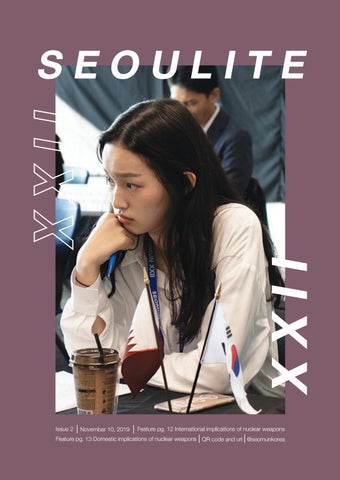
XXII
SEOULITE
Issue 2
November 10, 2019
Feature pg. 12 International implications of nuclear weapons
Feature pg. 13 Domestic implications of nuclear weapons QR code and url @seomunkorea
SEOULITE CONTRIBUTORS 2019 Editors-in-Chief
Copy
Sia Cho, Kate Lee Managing Editor
Jennifer You, Hannah Yoo, Isabella Kim, Wendy Kang, Rosa Suh, Emily Oh, Aimee Choi, Riwon Ahn, Christine Yi, Steven Chung
Fiona Cho
Layout
Copy Editor
Claire Kim, Eddie Hahm, Eunice Rhee, Justin Choi, Yuzine Yi, Myat Thet Chal, Youngjin Park
Lyme Cho, Eric Hwang Layout Editor Christine Lee, Seoyun Yoo
Alice Lee, Ashley Kim, Katie Lee, Rachel Lee, Seongyun Jeong, Angela Kyaw, Archie Phyo
Graphics Editor
Advisor
Jessie Park
Ms. Wendy Grant
Photo Editor Angela Ahn, Eileen Kwon
02
layout by Christine Lee photo by Eileen Kwon
Photo
LETTER FROM THE EICs Dear delegates, We are the editors of Seoulite, the official press publication of SEOMUN. We are honored to serve delegates, chairs, advisors, administrative staff members, directors, and other participants throughout the SEOMUN conference. We hope that all delegates will have the opportunity to engage in fruitful debates on global issues and gain new insights from this conference. Over the next three days, our team of reporters, photographers, and layout artists will be creating a total of three issues of the Seoulite magazine. We will not only document heated debates and potential remedies to global crises but also capture new friendships, personal insights, and reflections that will be formed throughout the days of the conference. We would like to ask the delegates and chairs for three things: First, please take the time to pick up our daily issues and look through--we promise to fill its pages with diverse and engaging content ranging from environmental sustainability to human rights. Second, please make sure to check out the QR codes available on the last page of the printed copies or the SEOMUN website to view our issues in full color! Finally, when a press member approaches you for an interview, please cooperate--we welcome your uncensored and personal opinions. We wish all delegates the best of luck--happy SEOMUN XXII!
Kate Lee & Sia Cho Editors-in-Chief
layout by Christine Lee copy by Sia Cho, Kate Lee photo by Eileen Kwon
03
99
COMPLAINTS FROM MUN DELEGATES
CHANGE? I know that MUN is a simulation of the actual United Nations, not at all reflective of the reality of international relations. If that’s the case, why are we even doing this? Will arguing about Internet security and environmental sustainability even change anything? Now, I wouldn’t describe myself as a cynic, but sometimes it’s difficult not to feel frustrated by how… meaningless MUN seems. On the second day of MUN, I found myself reflecting upon the entirety of my MUN career and whether it actually has much significance in the long run. Of course, we do engage in fruitful discussion with other delegates, pretending as if we have the ability to actually implement effective solutions to the world’s most pressing issues, yet that’s all it is—a game of pretend. I often wonder, as I look through my resolutions and listen to my fellow delegates, if what we’re doing is even making a difference. And yes, I am aware that we are encouraged by our parents, teachers, and other adult figures to use MUN to intiative change within the smaller community of ourselves and those around us. They speak of empowering our peers, channeling our creativity, and building on our values of morality and compassion. But I can tell you quite bluntly that I have never felt particularly empowered by any of my fellow delegates (in fact, I’ve always felt as though my ideas were superior). Nor have I felt especially creative when coming up with solutions to integrate within my resolution; most of these solutions were obtained through a quick Google search. Lastly, as for morality and compassion, well… Who has time for those? MUN
04
layout by Youngjin Park copy by Fiona Cho
for me has always been about presenting the best solutions as fast as possible and beating all of the competition. I have neither the time or patience to focus on accumulating moral values throughout the process. Websites like bestdelegate.com go even further to argue that there are 7 ways delegates can discover self-identity through participating in MUN. But we all know that’s rubbish—ultimately, our work contributes absolutely nothing to our self-worth. Of all the delegates in the conference, I know that only a handful of them will stand out and receive awards. The remaining delegates will, unfortunately, stay ignored and forgotten, void of any praise or attention from their peers and chairs. How does this blow to their ego help them find their sense of self-identity, I wonder? Unless constant rejection is considered to be a viable method of discovering oneself, I see no reason why participating in MUN can help facilitate this process. Furthermore, on a broader level, I don’t think sitting in a room full of highschoolers discussing the most important global issues of today will help accomplish anything. After all, these are problems that the world’s most capable and brilliant leaders have yet to resolve. How can highschoolers like ourselves even hope to contribute to a tiny fraction of their existing achievements? I’m sometimes tempted to tell my fellow delegates and chairs to just leave the MUN community for good and hand these problems over to more educated, experienced adults. Again, I’m not being cynical—I’m merely pointing out the facts. Maybe we should actually take my idea seriously and acknowledge the fact that MUN isn’t having a real impact on ourselves and the world.
STUFF DELEGATES SAY
layout by Myat Thet Chal copy by Lyme Cho, Eric Hwang
05
SEOMUN: THE INTERNATIONAL EXPERIENCE “The challenge that I faced was the new environment, so it took me a little time to adjust. On top of that, the format and procedures of the debates changed too, so adapting to that also stressed me out a little. But I think being an international student brings a lot more positives. I have a lot more perspective and experience so I think my ideas really contributed to the debates. Personally, I had a really new and interesting experience since I got to meet a lot of different people who I normally wouldn’t meet. Aman Mahendra, Delegate of the United States (SPT)
“One of the challenges that I had as an international student is the language. The language is quite difficult and even though the debates are all done in English, everyone speaks Korean around me and it’s quite confusing. Also, culturally, the behavior is very different from where I come from. People here act more politely and carefully, which was something I’m not very used to.” Franziska Roth, Delegate of ROK (ESOSOC 1)
“There were a lot of small challenges such as having to move around the place without knowing anyone. Although these small things by themselves seem negligible, taken together they’re a significant challenge. But everyone’s been helpful and friendly, showing me around and making conversation. Overall, it’s been a great conference.” Dhruv Vishwanath, Delegate of the United Kingdom (HRC)
“One of the challenges was obviously the language barrier and cultural differences, but apart from that I think I had a really unique and different experience in Korea. For example, I visited places like Itaewon and MyeongDong Shopping Mall, and it was something I’ve never seen before. There were so many cool Korean shops and the street food was amazing too!” Chit Su Lwin, Delegate of Mexico (HRC)
06
layout by Yuzine Yi copy by Isabella Kim photo by Ashley Kim
GA I SEEKS PEACEFUL SPACE ACTIVITIES On the second day of the conference, the General Assembly (GA) I continued its discussion regarding the use of space technology, the disarmament of nuclear weapons, and the weaponization of Artificial Intelligence (AI)— topics that are becoming important to tackle for the safety and peace of the future. The first resolution, submitted by Arsh Sinha, delegate of Jordan, generally aimed to solve the issue of space security through the dismantlement of weapons and the promotion of education. “Promoting international cooperation in outer space and ensuring its logistic safety is important because there are several member states that have more advanced space programs and funding. This would lead the nations that have more nuclear weapons to developing Weapons of Mass Destruction (WMDs).” Arsh said. “Our resolution deals with dismantling the weapons as an outline of an outer space treaty and spreading awareness on the issue, for the space industry is really growing. It’s important to educate people on this and penalize member states that continue to make WMDs.” Delegates also insisted that nations should prioritize collaborative work in order to facilitate efforts toward reaching outer space security, and some made amendments that focused more on further international cooperation. Andrew Cho, delegate of Sweden, proposed multiple amendments to this resolution, but one of them specifically aimed to set up a new research center through which nations can convene and work together to discuss long term goals for space projects. “One of the main problems with the resolution was that it lacked specific details of the solutions and rather had
more details on the status quo itself,” Andrew said. “A huge reason why people are not peacefully cooperating and initiating peaceful space activity is because of waste disposal, and that’s why by creating an organization or a research center, people can cooperate internationally on researching and developing technology in waste disposal and so on.” Since the resolution focused primarily on imposing penalties and sanctions on nations that do not comply with regulations on weapon production, other delegates took a different, more comprehensive approach to this issue. Sarah Baek, delegate of the Dominican Republic, proposed an amendment that emphasized facilitating international cooperation, like many others, but also upholding certain agreements on space activities. “A holistic approach is very necessary for a resolution that affects a diverse range of stakeholders,” Sarah said. “I think helping them with solutions as much as possible and thinking about how each operative clause is going to influence these stakeholders is very important, and therefore taking a holistic approach to an issue like this one is needed.” Despite the disagreements on finding specific solutions to help peaceful space activities, delegates seemed to come to a consensus that nations should attempt to cooperate with one another. After active debating, the first resolution was passed with 35 votes for and 16 against. Following this result, delegates are looking forward to participating in even more fruitful debates for the last day of the conference.
Amanda Shen (Delegate of Denmark) Hyewon Lee (Delegate of Morocco) Soyal Khedkar (Delegate of Chile)
layout by Claire Kim copy by Aimee Choi photo by Ashley Kim
07
ECONOMIC AND SOCIAL COUNCIL TAKES A STEP FOR EMPOWERMENT OF WOMEN IN BUSINESS On the second day of the conference, the Economic and Social Council (ECOSOC) opened their session with a resolution submitted by the delegate of the United Arab Emirates (UAE). Continuing the debate on the empowerment of women in business through economic and social reforms, the delegate of UAE presented a resolution that reached accord by the majority of the delegates, resulting in its passing at the end of the session.
wage due to parental leave is not acceptable, therefore this delegate believes that operative clause 12 should be added onto the resolution for further clarification. ”
During the debate, delegates submitted amendments to further improve the resolution, and proposed speeches to show their thoughts regarding this topic. The delegate of the United Kingdom (UK) marked the start of the debate by submitting an amendment, adding operative clause 12 that specified and emphasized the equal payment of women with parental leave and without parental leave.
“Almost all of the delegates were very impressed about the amendment,” said the delegate of Russian Federation. “Most of them agreed to the amendment because it is a known fact that equal payment among workers is a very sensitive issue, and an issue to be resolved.”
According to the delegate of Russian Federation, Will, this resolution received many positive reflections from the other delegates, because they agreed that fair and equal payment for all women with parental leave and without parental leave is essential.
“The delegate of UK believes that equal payment among women with parental leave and without parental leave is essential,” said Nini Pham, delegate of UK. “The amount of time the parent spends with the child is crucial to the child’s growth, and reducing the
Many agreed that the amendment submitted by the delegate of UK contained great detail and was also effective in proposing solutions to the issue on hand. Therefore, the majority of the delegates decided to vote for this amendment, addressing the flaws of the resolution.
Seoh
o Ahn
08
layout by Eunice Rhee copy by Riwon Ahn photo by Alice Lee
(Dele
“I think that the amendment submitted by the delegate of UK was perfect for this resolution,” said Seoho Ahn, the delegation of Syria. “It addressed the missing key points of this resolution, and by submission, the resolution was improved. Most of the delegates were very impressed with her submission.”
gate
of Sy
ria)
HRC I&II ACCUSED
Hannah Kim (Delegate of Brazil)
OF HUMAN RIGHTS
VIOLATIONS The debates today in both Human Rights Councils (HRCs) I and II contained an unexpected turn of events: accusations on the violation of human rights. HRC I opened session with a resolution aiming to achieve safer regulations for refugees as well as separate them from actual terrorists. The resolution, which was main submitted by the delegate of France, almost immediately received a plethora of amendments and second amendments—with some delegates accusing it of human rights violations.
A floor below, HRC II was facing a similar problem. The first resolution of the day, which proposed more secure measures to preserve personal privacy, was main submitted by the delegate of the Democratic People’s Republic of Korea (DPRK), a nation not unfamiliar to human rights violations. This was pointed out by multiple delegates including the delegations of Pakistan and the United Kingdom (UK), with even calls for the main submitter to leave the United Nations.
“There was a lot of talk about human rights violations today,” said David Lee, delegate of the United States in HRC I. “We discussed a lot about school shootings, bullying, and mistreatment of refugees and migrants by border patrol guards. Personally, I believe that this type of abuse shouldn’t happen—especially the abuse by the “I saw that it was ironic that the resolution proposed by border guards—as the receiving country should receive DPRK had more to do with national sovereignty than human rights or personal privacy. And since the whole the migrants as members of society.” purpose of our committee is to discuss human rights, the delegate was discussing something irrelevant to Ramon Makalinao (Delegate of DPRK) the topic,” said Josh Cha, delegate of Pakistan in HRC II. “Some people might argue that national sovereignty can go hand in hand with human rights, but since the delegate in question is the DPRK, their version of sovereignty can actually decrease rights.” The delegate of UK pointed out instances where the resolution failed to assure human rights, such as Clause 4. Clause 4, which gave the government permission to search for possible threats using mass data mining, wiretapping, and others. He emphasized how since the DPRK was notorious for multiple human rights violations, they shouldn’t be allowed to determine what was a possible threat or not. The DPRK fired back, in an accurate reflection of its real-life government, and said that the UK itself wasn’t innocent of violations of its own. “I think the DPRK’s resolution definitely broke some rules of procedure and violated many principles of human rights, which is probably why the resolution didn’t come to pass,” said Henry Moran, the delegate of the UK in HRC II. “But overall, I think the DPRK was a worthy opponent to be debated against. I really like the debate that’s going on right now in this committee—I think it’s really spirited and passionate—and even if we disagree, that’s what makes the debate fun, when people have different opinions.” layout by Justin Choi copy by Rosa Suh photo by Katie Lee
09
UNCCC TACKLES ANIMAL HUSBANDRY The United Nations Climate Change Commission (UNCCC) once again tackled measures to prevent the global climate catastrophe. The first to reach the podium was a resolution striving to mitigate the negative effects on the environment from animal husbandry. Animal husbandry, a branch of agriculture concerned with the domestication and harvesting of animals, reportedly devastates the wellbeing of the Earth in a myriad of ways such as contributing to air pollution and increasing greenhouse gas. “Generally, people tend to think about carbon or methane emissions when animal husbandry is mentioned,” said Lynn Lee, President of the UNCC. “But there’s a lot more going on behind the scenes. Not only are the animals themselves produce pollution, it actually encompasses a lot more. For example, it includes the production of feed for the animals, which requires almost deforestation to meet the growing needs.” The resolution was main-submitted by the delegate of General Electric Company (GEC), which is a multinational conglomerate that has started renewable energy initiatives in 2011. The delegation stated with vigor that the time has passed for individual action—the world needs radical collaboration and transition away from the livestock sector, which is responsible for much of the world’s rising temperatures.
Like all resolutions, this resolution faced opposition—most notably from the delegate of Australia. The aforementioned delegate raised his placard time and time again to question the various amendments and second amendments—such as the amendment giving rural farmers in Brazil training in geothermal agriculture—citing vagueness and harm to the environment as his reason for opposition. However, when the time came for voting procedures on the resolution as a whole, Australia chose to abstain. Thus, the UNCCC saw its first resolution pass with an overwhelming majority. “I chose to abstain because some of the clauses actually hurt the objective of the resolution, which was to aid the agricultural and beef industries,” said Stuart Sun, delegate of Australia. “But I didn’t oppose it either. Some amendments actually did have positive impacts on the environment, but there were some that hurt it as well, such as the vague amendment that wanted to tax farmers based on how much land they owned. I saw that vagueness as a threat to the stability of the resolution, so I couldn’t support it. ”
Yujin
Kim (
Gen
eral
Elec tric C
omp
any
)
“Out of all the many things I wanted to address with my resolution, we wanted to focus on public and private collaboration,” said Yujin Kim, delegate of GEC. “In this
age, where climate change is such a momentous issue, we can’t address the issue by utilizing one sector alone. Therefore private and public cooperation—how the private providing research and development and the public paying taxes and giving the funds for it—is much needed. This delegate is pleased that this idea was implemented into many clauses of the resolution.”
Qusai Alanoud (Delegate of ZAMBIA)
10
layout by Claire Kim copy by Rosa Suh photo by Rachel Lee
gate of Canada ) S
sa ya v a hr
k (Dele u s hi o K i
FAILED CARBON EMISSION REDUCTION INITIATIVE On the second day of the conference, the Advisory Panel Question (APQ) gathered to draft a resolution combating rising sea levels. While delegates unanimously supported a cap and trade system on nations’ carbon emissions, some delegates questioned the effectiveness of certain sub-clauses, citing their vague and indefinite nature. Attempting to address such ambiguity and help ensure reduced carbon emissions, Tae Yoon Kim, the delegate of Somalia proposed an amendment underscoring the shortcomings of a sub-clause concerning the way in which caps for emissions would be determined with donations. “Given the sub-clause’s current wording, wealthy nations, having more capital to spend, could indefinitely increase their cap through continuous payment.,”
said Tae Yoon. “In order for this sub-clause to be functional, it must include a means of ensuring that a clear reduction in emissions occurs. Allowing nations to produce directly at a cap level as opposed to pushing them to gradually reduce their overall emissions by improving production efficiency could also leave them unable to donate to green organizations. Having the resources to fund environmental programs is as essential as cutting down on emissions.” Other delegates, particularly Sean Kim, delegate of Kiribati and the main submitter of the clause, fervently opposed the amendment. Emphasizing the amendment’s contradictory nature and the importance of having an incentive to help procure funds for programs, other delegates also questioned the line of reasoning behind the amendment. Delegates ultimately established that the sub-clause was not only in direct conflict with the purpose of the clause, but also illogical in practice.
Ha
nyi Xie gate of Hungary) (Dele
“The sub-clause may be somewhat vague in addressing reducing emissions, an incredibly important matter the resolution essentially revolves around,” said Samuel Oh, delegate of the United Kingdom. “However, the original purpose of the sub-clause was to incentivize countries to donate money. The idea of demonstrating a clear reduction in carbon emissions would mean countries would not be able to use their enlarged cap for their own purpose, leaving them with no reason to donate in the first place.” With an overwhelming majority voting against, the amendment ultimately did not pass. However, with ten votes for and only two votes against, the clause itself passed. Tomorrow, delegates will continue to participate in fruitful debates and propose new amendments in hopes of coming up with a final, practical solution.
layout by Eunice Rhee copy by Emily Oh photo by Seongyun Jeong
11
INTERNATIONAL NUCLEAR WEAPONS DISMANTLEMENT Hiroshima. Nagasaki. Cherybonyl. Three mile island. Nuclear items, whether they be employed as weapons of war or parts of a reactor system, have claimed the lives of millions. Yet, nine nations still possess weapons of mass destruction, and an international convention that explicitly bans the possession, manufacture, and use of nuclear weapons has yet to be established. As tensions between the US and the Democratic People’s Republic of Korea (DPRK) continue to rise over the past decade, the debate regarding how to address the possession of nuclear weapons remains more pertinent than ever. “It is important to note that this topic is incredibly complex, especially given that Trump’s stances on the topic shifts quite a bit and that the US wants much more than just denuclearization,” said Viv Srinath and Aman Mahendra, delegates of the USA of the Six Party Talks (SPT). “In addition to focusing on ensuring positive dialogue with the DPRK, we believe in pragmatic solutions to lift sanctions or provide aid with certain preconditions regarding denuclearization at this point.” As of today, the USA, one of the five nuclear weapon states recognized by the Treaty on the Non-Proliferation of Nuclear Weapons (NPT), possesses over 5,000 nuclear weapons— compared to the mere hundreds owned by international counterparts—and has deployed over 6,000 nuclear warheads. Policy analysts have long attributed substantial existing nuclear weapons arsenals as the root cause of the several nuclear arms races that have taken place over the years.
12
layout by Eddie Hahm copy by Emily Oh
“It is critically important to eradicate nuclear weapons throughout every nation regardless of whether they are permitted in the Nuclear Non-proliferation treaty,” said YoonSung Kim, delegate of the United Kingdom of the Security Council (SC). “Having acquired great knowledge about various treaties and foreign policy while preparing for this year’s conference, I would suggest an economic crackdown on nations that refuse to partake in the non-proliferation treaty, then encourage a gradual reduction on nuclear stockpiles held by P-5 nations.” Despite the variety of approaches taken by the international community over more than half a decade to dismantle nuclear weapons programs, ranging from simple negotiation to embargos, the issue is far from being resolved. Nations have continued to improve their nuclear dismantlement programs, whether it be via humanitarian aid incentive packages or bimonthly international summits, in hopes of enhancing both their timeliness and practicality. “Besides learning the scope of P-5 nations’ power in regards to reducing nuclear stockpile over the past few days, I realized the complexity of removing all nuclear stockpiles worldwide,” said Katie Kim, delegate of the Russian Federation of SC. “Given the threat nuclear weapons pose, most individuals, stressing the gravity and immediacy of the issue, expect nations to eliminate nuclear weapons as a whole overnight. However, doing so is incredibly impractical and idealistic.”
THE PATH TOWARDS DENUCLEARIZATION IN THE KOREAN PENINSULA Since their development in the 1940s, nuclear weapons have become one of the most alarming global threats. Environmentally, nuclear weapons have raised concerns over the long-lasting implications of thermal radiation and radioactive fallout. Politically, nations have participated in nuclear arms races in the past in a competition for dominance over nuclear warfare in events like the Cold War. Domestically, the issue of nuclear weapons is pertinent to the Korean peninsula due to tensions between the Republic of Korea (ROK) and the Democratic People’s Republic of Korea’s (DPRK) adamant stance on regulating their nuclear arsenal supply. Efforts to withdraw the usage of nuclear weapons on a global front such as the Treaty on the Non-Proliferation of Nuclear Weapons in 2003, which the DPRK has withdrawn from, have been ineffective. Political tensions have risen between North and South Korea as well as among political allies such as the United States and China. “Throughout history, the ROK has always supported the denuclearization of the DPRK, and has tried to ensure that the DPRK take measures and comply with the international community,” said Hannah Jo, delegate of ROK of Six Party Talks (SPT). “The first solution I would suggest is to set a clear and mutually acceptable goal of denuclearization. Then, with this definition, the DPRK must work with the International Atomic Energy Agency (IAEA) and specifically focus on the limitations that must be set on the DPRK’s uranium enrichment supply. These measures should all be taken without the dismantlement of US troops located in the ROK, as the US is a beneficial political ally.” Although the DPRK has been historically reluctant to negotiate a cutback on arms, a political agreement of some sort has been called for in order to maintain global security, even if it involves a compromise between nations. An incentive, either economically or politically, has been historically necessary to ensure DPRK efforts to decrease their supply of nuclear weapons.
“From the perspective of North Korea, it is obviously beneficial for them to keep nuclear weapons, as they are a pivotal part of our nation’s military and security,” said Dongchae Shin, delegate of DPRK of Six Party Talks (SPT). “However, a realistic solution is for North Korea to be open to is a political agreement between nations. The removal of economic sanctions would be a strong incentive in ensuring the DPRK’s compliance. In exchange, the DPRK can freeze activities regarding their nuclear arsenal supply. This is the most realistic solution that can be implemented.” The issue at hand has also affected political allies of North and South Korea, especially the United States. The United States’ involvement in the militarization of South Korea is one of the driving forces for North Korea to develop their own nuclear supply. Therefore, the United States has inevitably played a significant role in negotiations with the DPRK. “The United States has the ROK under their umbrella protection, meaning that they have intentions to protect the ROK in the event of a war,” said Dongwook Kim, delegate of USA of Security Council. “The USA has had joint meetings with the DPRK, but have been met with no progress. Perhaps providing a larger umbrella protection guarantee for other nations would dissuade these nations such as the DPRK from further developing nuclear weapons. Safer regulations should be the priority especially with nations such as the DPRK.” Unfortunately, the looming threat of nuclear weapons in Korea is not a problem that can be easily solved. The international community has demanded the DPRK to cut back on their nuclear weapons supply, but has also recognized the need for the United States and ROK to provide some leeway for the DPRK to adhere to international policies. Perhaps paradoxically, global negotiations will be the key for future domestic safety in South Korea.
layout by Eddie Hahm copy by Wendy Kang
13
CSTD PROPOSES MEASURES TO INCORPORATE TECHNOLOGY IN FARMING
Hongmin Ahn (Delegate of Brazil) Kyungbin Min (Delegate of Saudi Arabia)
The Commission on Science and Technology for Development (CSTD) started its second day of SEOMUN by proposing more specific measures of ensuring security in food, farming methods, and AI systems. Moreover, they discussed the influence of the government and non-governmental organizations in regards to the issue. Delegates first discussed the resolution submitted by Angela Liu, delegate of the Republic of Korea (ROK). The resolution encouraged the incorporation and normalization of technology in agriculture, in particular, Genetically Modified Organisms (GMOs). “Our resolution mainly aims to lessen controversies on the implementation and utilization of GMOs since they are useful biological technology tools that can be used to reduce world hunger and food security as a whole,” Angela said. “Also, this resolution aims to help LEDCs with the funding of NGOs for the innovation of their agricultural technology that improves their food production.” Some delegates noticed the need to mention specific measures to make clear decisions on whether GMOs are beneficial or detrimental to the environment and address the negative controversies surrounding these products. Harry Shin, delegate of Ukraine, proposed an amendment that called for all member states to clarify the effect of GMOs on the environment and make progress in their utilization by
14
layout by Youngjin Park copy by Aimee Choi photo by Alice Lee
conducting scientific experiments. “Currently, we are not sure if GMOs are really safe or trustworthy even though they are products we consume every day,” Harry said. “Using scientific methods is the most reliable way to know if people are working with agriculture properly and to make progress in our consumption. For example, no-meat patties in burgers are allowed because scientific experimentation has proved their safety.” Despite the proliferation of new technological tools available for farmers to use in their work, some delegates noticed that not many of them were affordable for farmers. Ethan Kim, delegate of the Philippines, proposed an amendment that offered financial aid to small farm owners in order to help them integrate technologies within their harvests. This would be done through the help of finance or insurance services as well as government subsidies. “Our resolution offers to provide support for smallholder farmers so that they can integrate technology into their farming operations,” Ethan said. “I think this is important because the resolution as a whole is focused on larger-scale operations, so helping out smallholder farmers can make the resolution more complete and comprehensive.”
FRUITFUL DISCUSSIONS IN ENVI I AND II FACILITATE EFFECTIVE CONCLUSIONS
Jacob Mathias(Delegate of DPRK)
Jules Richalor (Delagate of Canada)
Over the course of the conference, intense discussions continued within both Environmental Commissions (ENV) I and II. Delegates demonstrated their opinions on the resolution, which focused on combating various environmental issues. ENV I delegates came up with solutions to combat the accumulation of marine litter, reduction of oil extractors, and fishing activities destructive toward the environment. For instance, they encouraged activities such as spreading awareness on protecting the environment to younger generations and researching the status of endangered species and their respective habitats. In addition, ENV II introduced solutions that ranged from enforcing stricter regulations against illegal trafficking of these animals to encouraging wildlife protection. “Although the resolution had a lot of success in terms of combating wildlife trafficking and illegal poaching, more focus should have been geared toward the financial aspects of illegal poaching,” said Philip Tan, delegate of Kenya of ENV II. “For instance, the resolution focused heavily on deterring poachers from continuing their illegal activities. However, it did not deal with people actually buying products such as weapons for hunting. Delegates are collaborating on including this as an amendment.” The delegates continued to speak about effective ways of amending the resolution in order to fix issues that were not addressed throughout the conference. Such discourse included drafting a resolution with pertaining restrictions and laws to avoid the long term consequences of the environmental problems. These proceeding activities consisted of marine microplastic pollution, poaching or trafficking animals, and other environmental problems. Both commissions wholeheartedly focused on the impor-
tance of establishing the urgency of the issue and taking action through multiple education programs. Furthermore, they emphasized consequences of oil based NGOs negatively affecting the oceans and suggested restricting for oil extractors, reducing carbon emissions, and funding conservation sites. “There was one specific clause in the resolution discussion that mentioned the need for local communities to have more events promoting biodiversity to raise awareness about this issue,” said Claire Williamson, delegate of DPRK. “This offended many delegates including myself, and being part of an LEDC, I strongly opposed the clause. It was not fair for LEDC countries because they needed to gear their attention towards improving their own economy. During the conference, I struck down on this clause for its flaws and because I believed that it was necessary to reestablish whole resolution.” With opinions voiced out, both resolutions were amended. There were many presented divisions within both the committees, but the delegates managed to conjure an agreement. In order to prevent redundancy and vagueness, clarifications were addressed by the delegates and were taken into account. “With all the different country stances, it has been very divided in terms of the resolution because each country believes about political sovereignty,” said Sydney Rako, delegate of the Republic of Korea. “For that reason, it was difficult to reach the most ideal resolution so far in the conference. However, all of the delegates recognized and agreed on the importance of education, and it acted as an integral part of the overall resolution.”
layout by Claire Kim copy by Jennifer You photo by Archie Phyo
15
Tae Kyeong Hong (Advocate of Palestine)
ICJ DISCUSSES US RELOCATION OF JERUSALEM AMERICAN EMBASSY
On Dec. 6, 2017, President Donald Trump declared Jerusalem as the capital of Israel and announced the relocation of the American Embassy from Tel Aviv to Jerusalem. This decision raised a number of issues, both obvious and subtle.
On the second day of the conference, the International Court of Justice focused on debating the United States’ recognition of Jerusalem as the capital of Israel. The advocates of Palestine and USA each presented strong arguments, followed by a cross-examination to determine which case was more legitimate. “ICJ has the jurisdiction to present a verdict upon this matter,” said TaeKyeong Hong, an advocate of Palestine. “The United States’ Jerusalem Embassy Act violates the Vienna Convention on diplomatic relations, not to mention the fact that Palestine followed proper measures to become a state. We have all the rights to claim Jerusalem as our territory.” On the other hand, YuGyeong Kang, an advocate of the US, claimed that the court does not have jurisdiction over this case. Although the Palestinian
government claims to be a “democracy,” they have not held an election since 2006. Therefore, the US did not consider Palestine as a state. The US also refuted claims that Jerusalem is currently Palestinian territory, reporting multiple incidents in which Palestine committed hostile actions against the United States. “The Court believes that it cannot give a verdict on disputes involving a third party because it is not asserted by either Palestine or the US whether Israel has given consent, explicitly or by implication,” said David Nguyen, an advocate of the US. “The defendant party is not under treaty relationships with the applicant party since Palestine is not a state. They are acting upon a long-planned, rational act regarding the Jerusalem Embassy Act of 1995.” Although all advocates and judges hope to uphold international laws, as well as moral values, because of their different political motivations, two completely contradictory arguments between the advocates of Palestine and the US emerged. Instead of immediately voicing support for one side, all judges thoroughly cross-examined both advocates in order to confirm the legitimacy and relevancy of the presented evidence.
Yu Gyeong Kang (Advocate of the USA)
16
layout by Eunice Rhee copy by Isabella Kim photo by Angela Kyaw
e
t ga ele (D K)
PR
D of
Delegates were quick to disagree with this clause, due to the fact that the ICJ will not rule on international laws if there is a veto from a third party. Considering the political tensions between the DPRK and ROK, it would be difficult to come to a consensus between the two parties, ruling the ICJ ineffective.
in
“This delegate believes that implementing the aid of the ICJ is the most efficient method in order to relieve political tension between nations,” said Mingunn Kim, delegate of Japan. “This is due to the political tension between the Republic of Korea and the DPRK regarding the emission of carbon dioxide and the yellow dust in the atmosphere. The ICJ can give advice on legal questions regarding the jurisdiction of many member nations.”
Sh
On the second day of the conference, delegates began their debate upon the resolution submitted by the Delegate of Japan regarding implementation of sustainable solutions to combat air pollution in North East Asia. Delegates began to question the feasibility of the resolution, focusing on the first operative clause that requested member nations to go to the International Court of Justice (ICJ) and settle disputes to relieve political tension caused by miscommunication and uncertain facts.
ae ch ng Do
SPT RECTIFIES RESOLUTION FOR SUSTAINABILITY
“This delegate would like to ask the delegate of Japan how he will assure that the DPRK will follow out rulings set by the ICJ,” said Aman Mahendra, delegate of USA. “Although the ICJ is the top most form of justice, Article 36 states that regarding treaties and international law, the ICJ does not have jurisdiction if any third party disagrees. Therefore, it will be impossible for countries to come upon a consensus on how to combat air pollution.” In order to address this problem, delegates immediately submitted an amendment, which called to modify the clause regarding the ICJ to conduct bilateral meetings under the supervision of the Economic and Social Council (ECOSOC). Through discussions and negotiations, disputes between nations could be more easily solved under this solution. “Not only is the ICJ ineffective because of Article 36, but the ICJ usually does not accept non-legal agreements as well,” said Dongchae Shin, delegate of DPRK. “This would mean negotiations and treaties would not be justified under the ICJ, ruling it completely ineffective. This delegate would therefore like to propose a new solution of bilateral meetings between nations instead. Negotiations and treaties would be validated under this policy, and countries can discuss any political differences, we will be more likely to come up with an effective solution.” The committee seemed to be in agreement with the amendment, convinced that more effective solutions were needed instead of the ICJ. Therefore, with an overwhelming majority, the amendment was passed.
Mingunn Kim (Delegate of Japan)
layout by Yuzine Yi copy by Wendy Kang photo by Katie Lee
17
SECURITY COUNCIL TACKLES THE CONCERN OF NUCLEAR STOCKPILES int W Ye Y ate
eleg in (D
The delegates of the Security Council began the second day of SEOMUN XXII by addressing the issue of reducing nuclear stockpiles worldwide. The conference focused on the use of nuclear energy of the P5 nations— the five permanent nations of the Security Council which includes the United States, Russia, the United Kingdom, France, and China—and aimed to reach an innovative conclusion that would be plausible for both P5 and non-P5 nations.
of S
On the first day, nine delegates drafted a resolution including a total of 12 clauses. Due to the controversial nature of nuclear weapons, the resolution included the most clauses and submitters among all the topics on the agenda. One of the most contentious clauses in the resolution was the fourth clause, which requested all nations to reduce medium-enriched uranium stockpiles by 98 percent over the next five years and to prohibit the use of low enriched uranium for military purposes. In opposition to this clause, the delegate of Germany proposed an amendment.
outh a)
Afric
“I understand and can relate to the burden that the clause might be forcing on the nations; therefore, reducing the number of reduction from 98 percent to 30 percent of the uranium stockpiles over the next five years will make the clause more feasible,” said Elaine Qu, delegate of Germany. “I urge the house to vote for the amendment as it will force more nations to agree with the overall clause.”
ung Kim gate K)
of U
The clause continued to fail to receive effective support as other delegates pointed out the direct harm that the invocation of the clause would cast to the citizens. Due to these civilian concerns, opposing delegates urged the house to vote against the clause.
(Dele
“Even a reduction of 30 percent will be too much of a burden for countries like the UK that derives 20 percent of its power from nuclear energy,” said Yoongsung Kim, delegate of the United Kingdom. “Also, sanctions simply have not worked for the past 20 years and led to the repelling of even stronger programs.”
s Yoon
However, the amendment, as well as the clause itself, accompanied great disagreement from the delegates in the council. The delegates pointed out the impracticality of the clause, especially for the P5 nations that relied heavily on uranium for their energy sources.
“As much as the safety and the well being of the citizens is a priority for this delegate, the clause comes to me as unaccommodating,” said Katie Kim, delegate of the Russian Federation. “The implication of this clause would mean that power sources of the citizens will be taken away, which is by no means ensuring any protection for the citizens of the country.” The clause, determined as largely infeasible for the majority of nations, eventually failed to pass, having two delegates voting for and 10 delegates against.
18
layout by Myat Thet Chal copy by Christine Yi photo by Seongyun Jeong
On the second day of the conference, the Special Conference (SPC) came together to determine the international community’s responsibilities regarding the Belt and Road Initiative (BRI). The BRI was a strategy developed by the Chinese government that involved the building of infrastructures with the help of multiple organizations worldwide. Although the initial purpose of the BRI was to improve economies through increased employment rates, a problem arose regarding the unfair advantages given to the Chinese government through this measure. The delegates addressed this concern of Chinese control on a global spectrum, presenting the perspectives of their respective countries. In particular, the delegates discussed implementing a general interest policy in an attempt to balance the economic measures of nations; however, a handful of delegates opposed this plan, stating that a standardized interest rate would be irrelevant to individual nations. “It is crucial to understand that even values of interest rates fluctuate depending on the country of choice and the inflation rates within that country at a given time,” said Hyejun Ahn, delegate of the Russian Federation. “Therefore, the lack of flexibility in these standards could potentially cause an overall lack of willingness to cooperate, which is a harm to the overall promotion of the BRI.” Moreover, many delegates from least economically developed countries (LEDC) believed that setting a fixed interest rate would be arbitrary and supported
ng
Qiya
ny) (Tiffa
Fu (D
ele
of gate
ria)
Nige
the decision to remove the clause from the amendment. To revise the interest rate, delegates also suggested that the International Monetary Fund (IMF) and the World Trade Organization (WTO) initiate a collaborative effort. “I think the four percent interest rate is unacceptable due to changing inflation rates across all these nations,” said Kevin Lee, delegate of Somalia. “Collaboration between the WTO, IMF and the respective local governments will be a more effective initiative regarding the BRI.”
Hyejun Ahn (Delegate of Russian Federation))
SPC TACKLES BELT & ROAD INITIATIVE
Though the joint effort between several organizations may account for a variety of economic perspectives, it was also pointed out that these discussions may lead to clashes between the diverse opinions between the IMF and WTO. “When determining interest rates regarding trade policies and loans, I think it is important to consider which government bodies are most responsible,” said Christopher Shin, delegate of the United States. “Many delegates agreed that the collaboration between different organizations will be effective. However, I believe it will be difficult for different organizations to reach a consensus.” The ongoing discussion about alternative ways to resolve economic conflicts eventually concluded with a sub-clause calling for a rigid interest rate that some criticized as leading to greater issues for individual countries. With 17 votes for and three votes against, the amendment was successfully passed.
layout by Eddie Hahm copy by Hannah Yoo photo by Rachel Lee
19
QUOTE BOX: HOW DO DELEGATES SPEND THEIR FREE TIME? “During breaks, I usually go bother Charles Park, the assistant president of ECOSOC II, and Jiyeon Kim, the president of HRC I. Together, we go to the student officer lounge and try to catch any delegates who are stealing food from the lounge. Other than that, I try to catch up with other MUNers that I have met in the past and just make small talk to catch up on everything.” Sujin Park, President of Special Conference Korea International School
“The Special Conference Committee is doing something called the gossip box, where delegates can submit random comments, often humorous, about MUN. Then, the chairs read the submissions out loud during breaks, and I think it is really fun and entertaining to see what other delegates think or joke about MUN.” Emma Lee, Assistant President of Special Conference Seoul International School
“I mostly hang out with the people from my school and the ones I meet in our committees in the hallways. Although I have met most of them yesterday, we have been able to bond by talking about school life, such as stress from APs and IBs, and compare how our different schools function differently because of their different locations across the world.” Lisa Mo, Judge of International Justice Committee American International School of Guangzhou
“Usually, I go to other members from my school in different committees to ask how their committees are doing and talk about how interesting the whole experience is. We also try to explore the campus and buy some drinks because SFS has a really nice campus, even better than the school I am from. Because it is my first time in Seoul, I am also trying to explore as much as I can within the city.” Viv Srinath, Delegate of the United States of Six-Party Talks Singapore American School
20
layout by Justin Choi copy by Steven Chung photo by Angela Kyaw
layout by Jessie Park photo by Seoulite
21
SEOULITE XXII issuu.com/sisseoulite