Smithsonian Scholarly Press
smithsonian contributions to paleobiology • number 110
The Pennsylvanian System in the Sandia Mountains, New Mexico, USA Stratigraphy, Petrography, Paleontology, Depositional Systems, Biostratigraphy, and Geologic History
Spencer G. Lucas, Karl Krainer, William A. DiMichele, Bruce D. Allen, James E. Barrick, Daniel Vachard, Cortland Eble, Arden R. Bashforth, Michael P. Donovan, Andrej Ernst, Hermann W. Pfefferkorn, and Paul T. May
SERIES PUBLICATIONS OF THE SMITHSONIAN INSTITUTION Emphasis on publication as a means of “diffusing knowledge” was expressed by the first Secretary of the Smithsonian. In a formal plan for the Institution, Joseph Henry outlined a program that included the following statement: “It is proposed to publish a series of reports, giving an account of the new discoveries in science, and of the changes made from year to year in all branches of knowledge.” The Smithsonian has adhered to this theme of basic research through the years in thousands of titles issued in series publications, first with Smithsonian Contributions to Knowledge in 1848 and continuing with the following active series: Smithsonian Contributions to Anthropology Smithsonian Contributions to Botany Smithsonian Contributions to History and Technology Smithsonian Contributions to the Marine Sciences
Smithsonian Contributions to Museum Conservation Smithsonian Contributions to Paleobiology Smithsonian Contributions to Zoology
Smithsonian Institution Scholarly Press (SISP) publishes small papers and full-scale monographs that report on research and collections of the Institution’s museums and research centers. Manuscripts intended for publication in the series undergo substantive peer review and editorial board evaluation, as well as evaluation by SISP for compliance with editorial requirements. Each Smithsonian Contributions Series volume is published online with a Creative Commons license consistent with the copyright status of its content. SISP prints limited quantities for official use.
SUMMARY OF REQUIREMENTS FOR SMITHSONIAN CONTRIBUTIONS SERIES Visit https://scholarlypress.si.edu for comprehensive guidelines, specifications, and other author resources. ABSTRACTS must not exceed 300 words. TEXT must be prepared in a recent version of Microsoft Word; use a Times font in 12 point for regular text; be double- spaced; and have 1″ margins. REQUIRED ELEMENTS are title page, abstract, table of contents, main text, and references. FIGURES must be numbered sequentially (1, 2, 3, etc.) in the order called out; have components lettered consistently (in size, font, and style) and described in captions; include a scale bar or scale description, if appropriate; include any legends in or on figures rather than in captions. Figures must be submitted as individual TIF or EPS files. FIGURE FILES must meet all required specifications in SISP’s Digital Art Preparation Guide. Color figures are permitted. TAXONOMIC KEYS in natural science manuscripts should use the aligned-couplet form for zoology. If cross-referencing is required between key and text, do not include page references within the key but number the keyed-out taxa, using the same numbers with their corresponding heads in the text. SYNONYMY IN ZOOLOGY must use the short form (taxon, author, year: page), with full reference at the end of the manuscript under “References.” REFERENCES should be in alphabetical order and in chronological order for same-author entries. Each reference should be cited at least once in the manuscript text. Complete bibliographic information must be included in all citations. Examples of the most common types of citations can be found in all reference system guidelines on SISP’s website, under Author Resources/Guidelines & Forms.
smithsonian contributions to paleobiology • number 110
The Pennsylvanian System in the Sandia Mountains, New Mexico, USA Stratigraphy, Petrography, Paleontology, Depositional Systems, Biostratigraphy, and Geologic History Spencer G. Lucas, Karl Krainer, William A. DiMichele, Bruce D. Allen, James E. Barrick, Daniel Vachard, Cortland Eble, Arden R. Bashforth, Michael P. Donovan, Andrej Ernst, Hermann W. Pfefferkorn, and Paul T. May
Smithsonian Scholarly Press
WASHINGTON, D.C.
2026
ABSTRACT Lucas, Spencer G., Karl Krainer, William A. DiMichele, Bruce D. Allen, James E. Barrick, Daniel Vachard†, Cortland Eble, Arden R. Bashforth, Michael P. Donovan, Andrej Ernst, Hermann W. Pfefferkorn, and Paul T. May. The Pennsylvanian System in the Sandia Mountains, New Mexico, USA: Stratigraphy, Petrography, Paleontology, Depositional Systems, Biostratigraphy, and Geologic History. Smithsonian Contributions to Paleobiology, number 110, xiv + 230 pages, 140 figures, 5 tables, 2026. —Pennsylvanian sedimentary rocks in the Sandia Mountains, New Mexico, compose an ~586 m thick stratigraphic section. The Atokan–Desmoinesian Sandia Formation at the base of this section is dominated by shallow marine deposits but also contains terrestrial beds, including thin coals; it was deposited in a fluviodeltaic to shallow marine environment. The overlying Desmoinesian Gray Mesa Formation records deposition of marine carbonate rocks. Above that, the Desmoinesian–Virgilian Atrasado Formation and Virgilian Bursum Formation are mixed siliciclastic-carbonate strata that represent shallow marine and nonmarine paleoenvironments. Fossilized remains of animals and plants occur throughout the section. Plant remains record a significant environmental change across the Middle–Late Pennsylvanian boundary from largely wetland taxa to mixed floras with xeromorphic elements, such as conifers, paralleling changes in the coal basins of central Pangea. Unit age determinations are primarily based on fusulinid and conodont faunas. Some plant remains exhibit evidence of arthropod feeding. Previous analyses identified late Paleozoic ice age glacioeustasy as the primary depositional driver of Pennsylvanian sedimentation. Although we recognize the relationship between climate and sedimentary dynamics and their linkage to glacioeustasy, from a total evidence perspective, we believe glacioeustasy alone is an inadequate driver given ample evidence of local tectonic and microclimatic changes, which must also be considered as important influences on sedimentation in this area. Three Pennsylvanian Ancestral Rocky Mountain orogeny tectonic pulses can be identified in the Sandia Mountains: Atokan, Missourian, and late Virgilian–Wolfcampian.
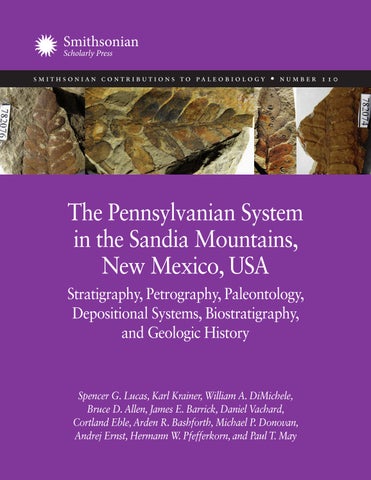
Cover images: Foliage of the seed fern Neuropteris flexuosa from the Middle Pennsylvanian Gray Mesa Formation at the southern end of the Sandia Mountains in Tijeras Canyon. See Figure 74 and the text for more details.
Published by SMITHSONIAN INSTITUTION SCHOLARLY PRESS P.O. Box 37012, MRC 957 Washington, D.C. 20013-7012 https://scholarlypress.si.edu Compilation copyright © 2026 Smithsonian Institution Text of “Calcareous Microfossils” and appendix © 2026 Daniel Vachard.
Excluding content credited to rightsholders and third parties, this work is licensed under a Creative Commons Attribution-NonCommercial 4.0 International (CC BY-NC 4.0) License. For permission to reproduce credited materials, users are responsible for contacting rightsholders directly. Library of Congress Control Number: 2026934477 ISSN: 1943-6688 (online); 0081-0266 (print) Publication date (online): 7 August 2026 Ó The paper used in this publication meets the minimum requirements of the American National Standard for Permanence of Paper for Printed Library Materials Z39.48–1992.
Contents
LIST OF FIGURES
ix
LIST OF TABLES
xiii
INTRODUCTION
1
MATERIALS AND METHODS
1
PREVIOUS STUDIES Early Work, 1858–1928 U.S. Geological Survey Stratigraphy, 1940s Kelley and Northrop, 1975 Recent Work, 1990s–Present
3
12
PRE–PENNSYLVANIAN ROCKS
12
PENNSYLVANIAN OUTCROPS
12
PENNSYLVANIAN LITHOSTRATIGRAPHIC NOMENCLATURE
16
SANDIA FORMATION Lithostratigraphy Sedimentary Petrography Paleontology and Age Depositional Systems
18
GRAY MESA FORMATION Lithostratigraphy Sedimentary Petrography Paleontology and Age Depositional Systems ATRASADO FORMATION Lithostratigraphy Sedimentary Petrography Paleontology and Age Depositional Systems
4 4 5
18 26 30 30 33 33 43 47 49 49 49 56 63 64
vi
•
S M I T H S O N I A N C O N T R I B U T I O N S TO PA L E O B I O L O G Y
BURSUM FORMATION Lithostratigraphy Sedimentary Petrography Paleontology and Age Depositional Systems
64
ABO FORMATION Lithostratigraphy Sedimentary Petrography
78
PLANT MACROFOSSILS USNM 44329, Doc Long I USNM 44331, Doc Long III USNM 44330, Doc Long II USNM 44056, North Sandia Mountains II USNM 44057, Agua Sarca Trail USNM 44055, North Sandia Mountains I USGS 8987, Lower Sandia Park USNM 44333, Tejano Canyon USNM 44334, Tijeras Canyon USNM 44332, Sandia Crest USGS 8946, Gallegos Ranch USGS 8988, Upper Sandia Park USNM 41881, Arroyo de San Francisco Two Notable Sandia Formation Fossil Plant Occurrences from Socorro County PLANT MICROFOSSILS Materials and Methods Results of Microfossil Analysis DISCUSSION OF PALEOBOTANICAL DATA Macroflora Microflora Paleobotanical Summary ARTHROPOD HERBIVORY USNM 44334, Tijeras Canyon (Middle Pennsylvanian, Moscovian) USGS 8988, Upper Sandia Park (Late Pennsylvanian, Kasimovian) USNM 41881, Bursum Formation, Placitas (Late Pennsylvanian, Gzhelian) Discussion of Arthropod Damage Patterns MARINE MICROFOSSILS Calcareous Microfossils Conodonts
65 66 75 75
78 78 78 80 81 88 89 90 95 97 107 109 112 115 120 127
134 138 140 143 143 143 144 145 145 145 145
145 147 148 148 165
MARINE MACROFOSSILS Overview Bryozoans
180
VERTEBRATE FOSSILS
185
DISCUSSION Paleogeography Feldspars Sandia Mountains Floras Age and Correlation
185
180 180
185 187 188 189
NUMBER 110
Depositional Cycles Geologic History
•
190 191
ACKNOWLEDGMENTS
194
APPENDIX: SYSTEMATIC PALEONTOLOGY OF CALCAREOUS MICROFOSSILS
195
REFERENCES
203
SUBJECT INDEX
221
INDEX OF SCIENTIFIC NAMES
227
vii
Figures
1. Location of the Sandia Mountains in New Mexico 2. Pennsylvanian outcrop area in Sandia Mountains and locations of measured sections 3. Generalized summary of Pennsylvanian lithostratigraphic units 4. Evolution of Pennsylvanian lithostratigraphic nomenclature 5. Legend for lithologic symbols 6. Sandia Formation stratigraphic sections in the northern Sandia Mountains 7. Sandia Formation stratigraphic sections along the Sandia Mountains crest line 8. Pennsylvanian stratigraphic sections at the Tejano A highway cut 9A. Pennsylvanian stratigraphic sections at the Tejano 4A highway cut 9B. Pennsylvanian stratigraphic sections at the Tejano 4B highway cut 10. Sandia Formation section at the Tejano C section 11. Atrasado–Bursum section at the Tejano Canyon section 12. Geologic map and structural cross section of Tejano sections 13. Tejano Highway A section outcrop 14. Tejano Highway section 4 outcrop 15. Palomas Peak section 16. Reference section (lectostratotype) of Sandia Formation 17. Great unconformity at Sandia Formation reference section 18. Carlitos Spring section 19. Sandstone of the Sandia Formation thin sections 20. Thin sections of limestone microfacies of the Sandia Formation 21. Tecolote B section 22. Tecolote C section 23. Sandia Crest section 24. Gray Mesa Formation at Crest of Montezuma 25. Gray Mesa Formation bioherm at Palomas Peak 26. Thin sections of limestone microfacies of the Gray Mesa Formation 27. Thin sections of microfacies of the Gray Mesa Formation at Tecolote 28. Thin sections of sandstone of the Garcia Member of the Gray Mesa Formation at Tecolote
2
3 4 5 6
7
8 9 10 11 13 14 15 16 17 19 20 21 22 27 31 34 35 36 37 38 39 40
44
x
•
S M I T H S O N I A N C O N T R I B U T I O N S TO PA L E O B I O L O G Y
29. Thin sections of limestone microfacies of the Gray Mesa Formation at Tejano Highway 30. Thin sections of limestone microfacies of the Gray Mesa Formation and Sandia Formation at Tejano Highway 31. Thin sections of sandstone of the Garcia Member of the Gray Mesa Formation and Atrasado Formation at Tecolote 32. Montezuma Fault section of the Atrasado Formation 33. Tecolote D Atrasado section 34. Atrasado Formation at Montezuma Fault section 35. Thin sections of characteristic limestone microfacies of the Atrasado Formation at the Montezuma Fault section 36. Thin sections of limestone microfacies, Atrasado Formation at Tecolote and Montezuma Fault 37. Thin sections of limestone microfacies of the Atrasado Formation at Tejano Canyon section 38. Thin sections of sandstone of the Atrasado Formation (Tinajas Member) 39. Placitas B Bursum Formation section 40. Montezuma B Bursum Formation section 41. Sandia Park and San Pedro Bursum Formation sections 42. Bursum Formation outcrop 43. Thin sections of conglomerate and limestone of the Bursum Formation at Placitas 44. Thin sections of sandstone of the Bursum Formation at the Montezuma B section 45. Thin sections of Bursum Formation sandstone, fine-grained conglomerate, and limestone at the Montezuma Fault section 46. Thin sections of lower part of the Abo Formation sandstone at the Montezuma Fault section 47. Stratigraphy of Pfefferkorn’s plant localities in the Sandia Mountains 48. Doc Long I, Linopteris neuropteroides 49. Doc Long I, pteridosperm and filicalean foliage 50. Doc Long I, cordaitaleans, calamitaleans 51. Doc Long III, Calamitales 52. Doc Long III, pteridophytes 53. Doc Long III, pteridosperms, roots 54. Doc Long III, pteridosperms 55. Doc Long III, indeterminate pinnules 56. Doc Long II, identifiable specimens 57. North Sandia Mountains II, cordaitaleans 58. North Sandia Mountains II, brackish-water animal remains 59. Agua Sarca Trail, calamitalean sphenopsids 60. Agua Sarca Trail, fernlike foliage, possible conifer 61. North Sandia Mountains I, sphenopsids and unidentified object 62. North Sandia Mountains I, pteridosperms 63. North Sandia Mountains I, Cordaites and seeds 64. North Sandia Mountains I, Lesleya sp. 65. Stratigraphic positions of Read’s Sandia Park collections 66. Lower Sandia Park, calamitalean sphenopsids 67. Lower Sandia Park, pteridosperms: neuroptids 68. Lower Sandia Park, pteridosperms, Linopteris cf. neuropteroides and Alethopteris 69. Lower Sandia Park, pteridosperms, remains of uncertain affinity 70. Lower Sandia Park, Taeniopteris and Lesleya 71. Lower Sandia Park, Lesleya sp.
46
48
50 51 52 53
57
58
60 62 66 67 68 69
70
72
74
76 80 82 83 84 85 86 87 88 89 90 91 92 93 94 96 97 98 99 100 101 102
103 104 105 106
NUMBER 110
72. Lower Sandia Park, Cordaites and Samaropsis 73. Tejano Canyon, all identifiable specimens 74. Tijeras Canyon, Neuropteris flexuosa 75. Tijeras Canyon, Neuropteris flexuosa 76. Tijeras Canyon, Odontopteris 77. Tijeras Canyon, miscellaneous 78. Sandia Crest, selected specimens 79. Gallegos Ranch section 80. Gallegos Ranch section, unit 54, Calamitales 81. Gallegos Ranch section, unit 54, Sphenophyllum 82. Gallegos Ranch section, unit 54, small ferns 83. Gallegos Ranch section, unit 54, pteridosperms 84. Gallegos Ranch section, unit 54, Cordaitales 85. Gallegos Ranch section, unit 54, seeds 86. Upper Sandia Park section, pteridophytes 87. Upper Sandia Park section, pteridosperms 88. Upper Sandia Park section, cf. noeggerathialeans 89. Upper Sandia Park section, conifers 90. Upper Sandia Park section, conifers and seeds 91. Bursum Formation, Placitas, roadcut 92. Bursum Formation, Placitas, Neurodontopteris auriculata 93. Bursum Formation, Placitas, Neurodontopteris auriculata and indeterminate neuropteroid 94. Bursum Formation, Placitas, Neurodontopteris auriculata and cf. Odontopteris species 95. Bursum Formation, Placitas, Lodevia oxydata 96. Bursum Formation, Placitas, Cyclopteris and cf. Poacordaites 97. Bursum Formation, Placitas, Cordaites 98. Bursum Formation, Placitas, conifers and seed 99. Bursum Formation, Placitas, roots 100. Basal Sandia Formation, Socorro County, and enclosed plant fossils 101. Sandia Formation, Socorro County, Herrick coal forest site 102. Palynomorphs from Pennsylvanian strata in the Sandia Mountains 103. Fossil plant sites in New Mexico and Arizona 104. Arthropod herbivory and pathogen damage 105. Smaller foraminifers from the Sandia Formation 106. Smaller foraminifers of the Sandia and Gray Mesa Formations 107. Smaller foraminifers of the Gray Mesa Formation 108. Smaller foraminifers of the Gray Mesa Formation 109. Smaller foraminifers of the Gray Mesa Formation 110. Smaller foraminifers and algae from the Gray Mesa Formation 111. Smaller foraminifers and algae from the Gray Mesa Formation 112. Smaller foraminifers from the Gray Mesa Formation 113. Smaller foraminifers of the Atrasado Formation 114. Fusulinids and calcareous algae of the Gray Mesa Formation 115. Fusulinids of the Gray Mesa Formation 116. Fusulinids of the Gray Mesa Formation 117. Smaller foraminifers of the Atrasado Formation 118. Smaller foraminifers of the Atrasado Formation 119. Fusulinids and calcareous algae of the Atrasado Formation 120. Fusulinids of the Atrasado Formation 121. Conodonts from the lower part of the lectotype section of the Sandia Formation
•
107 108 110 111 112 113 114 115 116 117 118 119 121 122 123 124 125 126 128 129 130
131
132 133 134 135 136 137 138 139 140 143 146 149 150 151 152 153 154 155 156 157 158 159 160 161 162 163 164
166
xi
xii
•
S M I T H S O N I A N C O N T R I B U T I O N S TO PA L E O B I O L O G Y
122. Conodonts from the middle part of the lectotype section of the Sandia Formation 123. Conodonts from the upper part of the lectotype section of the Sandia Formation and lower part of the Gray Mesa Formation 124. Conodonts from the Sandia Formation and lower part of the Gray Mesa Formation 125. Conodonts from the Sandia Formation at the Tejano Highway A section 1 126. Conodonts from the Sandia Formation at the Tejano Highway A sections 1 and 3 127. Conodonts from the Sandia Formation at the Tejano Highway sections 128. Conodonts from the Sandia Formation and Gray Mesa Formation at the Tejano Highway A section 129. Conodonts from the Gray Mesa Formation at the Tejano Highway A section 130. Conodonts from the Tinajas and other members of the Atrasado Formation at the Tejano Canyon B section 131. Conodonts from the upper Tinajas Member of the Atrasado Formation at the Tejano Canyon B section 132. Selected Pennsylvanian bryozoans from the Sandia Mountains 133. Selected Pennsylvanian bryozoans from the Sandia Mountains 134. Selected Pennsylvanian bryozoans from the Sandia Mountains 135. Paleogeographic map of Pennsylvanian New Mexico 136. Late Paleozoic Perro basin 137. Quartz-feldspar-lithic diagram of sandstones 138. Summary of ages of Pennsylvanian strata in the Sandia Mountains 139. Correlation of Pennsylvanian units 140. Geologic history summary
168
170
171
172
173
174
175
176
177
179 181 182 183 186 186 188 189 190 192
Tables
1. UTM map coordinates of the stratigraphic sections measured for this study 2. Point count values of selected Pennsylvanian sandstones 3. Stratigraphic and temporal distribution of 13 plant fossil collections from the Sandia Mountains 4. Spores and pollen of 12 fossil plant collections from the Sandia Mountains 5. Stratigraphic distribution of bryozoan taxa
3 28
79
141 184
The Pennsylvanian System in the Sandia Mountains, New Mexico, USA Stratigraphy, Petrography, Paleontology, Depositional Systems, Biostratigraphy, and Geologic History Spencer G. Lucas,1 Karl Krainer,2 William A. DiMichele,3* Bruce D. Allen,4 James E. Barrick,5 Daniel Vachard,6† Cortland Eble,7 Arden R. Bashforth,8 Michael P. Donovan,3,9 Andrej Ernst,10 Hermann W. Pfefferkorn,11 and Paul T. May1
1
New Mexico Museum of Natural History and Science, 1801 Mountain Road NW, Albuquerque, New Mexico 87104, USA. 2 Institute of Geology, Innsbruck University, Inn rain 52, Innsbruck, A-6020 Austria. 3 Department of Paleobiology, National Museum of Natural History, Smithsonian Institution, Washington, D.C. 20560, USA. 4 New Mexico Bureau of Geology and Mineral Resources, 801 Leroy Place, Socorro, New Mexico 87801, USA. 5 Department of Geosciences, Texas Tech University, Lubbock, Texas 79409, USA. 6 Université de Lille, Department Sciences Terre, UMR CNRS 8198 EvoEcoPaléo, Avenue Paul Langevin, F- 59655 Villeneuve d’Ascq Cedex, France. 7 Kentucky Geological Survey, University of Kentucky, 228 Mining and Minerals Resources Building, Lexington, Kentucky 40506-0107, USA. 8 Natural History Museum of Denmark, University of Copenhagen, Øster Farimagsgade 7, DK-1353 Copenhagen K, Denmark. 9 Geological Collections, Gantz Family Collections Center, Field Museum of Natural History, Chicago, Illinois 60605, USA. 10 Institut für Geologie, Universität Hamburg, Bundesstrasse 55, D-20146 Hamburg, Germany. 11 Department of Earth and Environmental Science, University of Pennsylvania, Philadelphia, Pennsylvania 19104, USA. * Correspondence: dimichel@si.edu † Deceased. Manuscript received 6 March 2025; accepted 13 August 2025
INTRODUCTION The Sandia Mountains are a late Cenozoic uplift of the Basin and Range physiographic province located immediately east of the city of Albuquerque (Figure 1). Extending north–south for ~27 km and east–west for ~13 km, the Sandias are a basement-cored, fault block mountain range. The core of the range is primarily upper Proterozoic Sandia Granite, overlain by upper Paleozoic strata that make up most of the eastern dip slope of the range. Although known since the 1850s, many of these upper Paleozoic strata have received relatively little detailed study. Pennsylvanian marine and nonmarine sediments were deposited across what is now the Sandia Mountains when that area was in the western part of the Pangean tropics in the Paleoequatorial Belt. We have collected diverse data on the Pennsylvanian strata exposed in the Sandia Mountains, much of which is presented here. These data include stratigraphic sections of parts of the Pennsylvanian succession from the southernmost end of the range, at Carlitos Spring, to a complete local Pennsylvanian stratigraphic section measured on fault blocks near Placitas at the northern end of the range (Figure 2, Table 1). The Pennsylvanian strata in these stratigraphic sections can be assigned to the (in ascending order) Sandia, Gray Mesa, Atrasado, and Bursum Formations. The Gray Mesa Formation can be locally divided into the (in ascending order) Elephant Butte, Whiskey Canyon, and Garcia Members. The Atrasado Formation can be divided into the (in ascending order) Bartolo, Amado, Tinajas, Council Spring, Burrego, Story, Del Cuerto, and Moya Members. We employ that lithostratigraphic nomenclature in our description of the Pennsylvanian strata in the sections we measured (Figure 3). Here, we present a detailed study of the Pennsylvanian strata in the Sandia Mountains. Our goals are to present new data on and to review and revise the Pennsylvanian lithostratigraphy of this area, to present new petrographic and paleontological data, and to interpret the biostratigraphy, depositional systems, and geological history of the Pennsylvanian strata.
MATERIALS AND METHODS The fieldwork for this study took place between 2013 and 2023. Nineteen stratigraphic sections were measured, and 17 previously published measured stratigraphic sections of other workers were included (Figures 2, 4, 5, Table 1). These are all of the well-exposed
FIGURE 1. Map showing the location of the Sandia Mountains in New Mexico.
sections of the Pennsylvanian strata in the Sandia Mountains that have been identified by us and previous workers. While measuring these sections, we collected samples to prepare numerous petrographic and carbonate thin sections for microfacies analysis and for micropaleontological analysis of calcareous microfossils. Microfacies were classified according to the schemes proposed
by Dunham (1962) and Embry and Klovan (1971; see also Flügel, 2004, 2010). The petrographic composition of sandstones was analyzed by point counting using the program JMicroVision; 500 points were counted per sample. The sandstones were classified using the classification scheme proposed by Pettijohn et al. (1987). Samples of limestone that weighed ~2.5 kg were
NUMBER 110
•
3
TABLE 1. Universal Transverse Mercator (UTM) map coordinates of the stratigraphic sections measured for this study. All coordinates are Zone 12, North American Datum of 1983 (NAD 83).
FIGURE 2. Map showing Pennsylvanian outcrop area in the Sandia Mountains. The locations of sections measured for this report are indicated in three numbered red circles: 1 = sections near Placitas (Tecolote sections, Montezuma sections, Placitas, and Tunnel Spring), 2 = sections along the Sandia crest line and dip slope to Doc Long (La Luz Trail, Palomas Peak, Sandia Crest, Sandia reference, Tejano Highway, and Tejano Canyon), and 3 = Carlitos Spring. For map coordinates of the measured sections see Table 1. Geology after New Mexico Bureau of Geology and Mineral Resources (2003). Abbreviations: Fm., formation; Paleoprot., Paleoproterozoic; Sst., sandstone.
Measured section
Base
Top
Carlitos Spring La Luz Trail Los Pinos Montezuma B Montezuma Fault Palomas Peak Placitas B Sandia Crest Sandia Park Sandia Reference Tecolote A Tecolote B Tecolote C Tecolote D Tejano Highway Tejano Canyon B Tejano Canyon C Tejano Highway Tunnel Spring
372031, 3883450 368316, 3896641 379236, 3886735 373064, 3909412 372851, 3909446 372080, 3899760 373656, 3912573 368159, 3897004 381422, 3900205 374655, 3893220 372388, 3908679 372444, 3908553 372623, 3908375 372623, 3908689 373557, 3894446 374196, 3893860 373445, 3894606 373557, 3894446 368971, 3905888
372049, 3883589 368316, 3896641 378987, 3886735 373558, 3909036 373089, 3909487 372343, 3899727 373777, 3912631 368126, 3897233 381540, 3960216 374755, 3892938 372450, 3908701 372746, 3908564 372826, 3908417 372830, 3908454 374303, 3893857 374425, 3893750 373598, 3894662 374303, 3893857 368998, 3905860
splitting the sediments with hand tools. Most of the fossil plants documented here are from legacy collections made by U.S. Geological Survey (USGS) geologist and paleobotanist Charles B. Read (1907–1979) in the early 1940s and by one of us (Pfefferkorn) in 1974. Macroscopic photography was carried out using a digital camera, and microscopic photography was performed using a standard transmitting light microscope or a scanning electron microscope. Line figures were created with standard graphics software. Macrofossils and microfossils reported here are in the collections of the National Museum of Natural History, Smithsonian Institution, Washington, D.C. (USNM or NMNH), and the New Mexico Museum of Natural History and Science, Albuquerque, New Mexico (NMMNH).
PREVIOUS STUDIES collected from selected rock units and processed in the laboratory using standard methods to dissolve the rock and extract conodonts. Fossil plants from localities located in green or black shale and fine-grained siltstone and sandstone beds were quarried by
Geologists and paleontologists have been studying the Pennsylvanian strata in the Sandia Mountains since the 1850s (Figure 4). We summarize this history, dividing it into four phases: (1) early work (1858–1928), (2) the USGS stratigraphy of the 1940s, (3) the monograph by Kelley and Northrop (1975), and (4) recent work from the 1990s to the present.
4
•
S M I T H S O N I A N C O N T R I B U T I O N S TO PA L E O B I O L O G Y
EARLY WORK, 1858–1928 Marcou (1858) described the section of Pennsylvanian rocks and some invertebrate fossils he collected in Tijeras Canyon, which separates the Sandia Mountains from the Manzano Mountains (Blake, 1856; Kues, 1985; Lucas, 2001; see Kelley and Northrop, 1975, for a detailed review of Marcou’s work). This work was based on Marcou’s 1853 examination of a Pennsylvanian section very close to the location of Seven Springs in Tijeras Canyon, where he also collected invertebrate fossils (mostly brachiopods). He called these strata “Mountain Limestone,” which, in modern terms, means they are of Mississippian age. He stated that the strata overlie Devonian limestones and “green serpentoid trap” and are overlain by “black schistose clay . . . belonging to the coal measures” (Blake, 1856:141). Marcou estimated that the total thickness of the Carboniferous strata in the vicinity of Tijeras Canyon is about 2,000 feet (610 m). Marcou also climbed the “Sierra de Sandia,” identifying Carboniferous strata at the crest of the range as “Mountain Limestone” (Marcou, 1858:20–21; see also Blake, 1856:143). He also listed brachiopods and a nautiloid he collected from these strata. Herrick (1900a, 1900b; Herrick and Bendrat, 1900; Herrick and Johnson, 1900) referred to the Carboniferous strata in the Sandia Mountains as “coal measures,” meaning they are Pennsylvanian in modern terms. He and the other pioneer geologists working in central New Mexico (Keyes, 1903, 1904, 1906; Gordon, 1907; Lee and Girty, 1909) created a lithostratigraphic nomenclature that assigned these Pennsylvanian strata to the Magdalena Group, divided into the Sandia Formation overlain by the Madera Limestone or Formation (Figure 4). This was the first use of Pennsylvanian stratigraphic nomenclature in central New Mexico, and that nomenclature remained unaltered for almost 40 years (e.g., Darton, 1922, 1928; Ellis, 1922; Bisbee, 1932; Wilmarth, 1938). Ellis (1922) presented the first monographic treatment of the geology of the Sandia Mountains, and his Pennsylvanian lithostratigraphy is characteristic of the then-current understanding of the local Pennsylvanian stratigraphy. Thus, Ellis presented five stratigraphic sections of part of what he called the Magdalena Group but did not assign the strata in these sections to either the Sandia or Madera Formation. His geologic map and structural cross sections show only the Magdalena Group undivided. However, his stratigraphic section “on Montezuma Mountains 1 mile east of Placitas” (p. 18) can be readily divided into a 45 m thick lower interval of sandstone, sandy shale, and limestone, which is the Sandia Formation, resting on Precambrian schist and overlain by 137 m of limestone, which is the Gray Mesa Formation of our usage. FIGURE 3. Generalized summary of Pennsylvanian lithostratigraphic units in Sandia Mountains. Abbreviation: Mb., member.
U.S. GEOLOGICAL SURVEY STRATIGRAPHY, 1940S In the 1940s, largely as a result of geological mapping during World War II, geologists at the USGS refined the Carboniferous lithostratigraphy of central New Mexico. Thus, Read et al. (1944; see also Wilpolt et al., 1946; Read and Wood, 1947) used
NUMBER 110
•
5
FIGURE 4. Evolution of Pennsylvanian lithostratigraphic nomenclature in the Sandia Mountains. Abbreviations: Fm., Formation; Ss., Sandstone.
Herrick’s (1900a) term “Sandia Formation” and Keyes’s (1903) term “Madera Limestone” to refer to the Pennsylvanian section throughout the Sandia Mountains (Figure 4). Read et al. (1944) divided the Sandia Formation into a lower limestone member (of uncertain age) and an upper clastic member. They also divided the Madera Limestone into a lower gray limestone member and an upper arkosic limestone member, and they brought the term “Bursum Formation” into use in central New Mexico (Figure 4). Thus, stratigraphic sections 21 and 22 of Read and Wood (1947) depicted Pennsylvanian sections in the Sandia Mountains assigned to these units. Read and Wood (1947: fig. 1) also made it clear that their informal divisions of the Madera Limestone were equivalent to
the Gray Mesa Member (=gray limestone member) and Atrasado Member (=arkosic limestone member) of the Madera Limestone, which were named by Kelley and Wood (1946) in the Lucero uplift of Valencia County, west of the Rio Grande and southwest of the Sandia Mountains. We concur with that correlation (see also Kues, 2001). In the early 1940s, Read collected Pennsylvanian fossil plants in the Sandia Mountains but never published those collections, which are published for the first time here. KELLEY AND NORTHROP, 1975 Prior to the present work, Kelley and Northrop (1975) presented the most detailed data from and analysis of the
6
•
S M I T H S O N I A N C O N T R I B U T I O N S TO PA L E O B I O L O G Y
FIGURE 5. Legend for lithologic symbols in graphical drawings of measured stratigraphic sections (Figures 6–11, 15, 16, 18, 22–24, 29, 30, 35–38). In those drawings, black dots with abbreviations (e.g., THE 30) are the stratigraphic levels at which samples were collected for petrographic and/or microfossil analysis. Colored boxes with abbreviations and numbers (e.g., USNM 44055) in some of the drawings indicate the stratigraphic levels of fossil localities.
FIGURE 6. Sandia Formation stratigraphic sections in the northern Sandia Mountains, from North Montezuma Mountain to La Prenza Canyon. For this and our other figures that graphically depict measured stratigraphic sections, values on the far left (y-axis) of each column denote thickness in 5-meter increments; designated numbers for stratigraphic units are in boxes of varying height to the immediate right of the thickness scale. See Figure 5 for the legend to lithologic symbols. Tecolote A and Tunnel Spring are sections we measured; the rest are from Toomey (1953), Reynolds (1954), and Catacosinos (1962); see also Kelley and Northrop (1975: fig. 26). Abbreviations: FORM., formation; packst., packstone; sil./carb., siliciclastic-carbonate; sst., sandstone.
NUMBER 110 • 7
FIGURE 7. Sandia Formation stratigraphic sections along the Sandia Mountains crest line. See Figure 5 for the legend to lithologic symbols. Sandia Crest and La Luz Trail are sections we measured; the rest are from Catacosinos (1962); see also Kelley and Northrop (1975: fig. 26).
NUMBER 110
Pennsylvanian strata in the Sandia Mountains. They used the USGS lithostratigraphy (Figure 4) and provided detailed lithostratigraphic data on the Sandia and Madera Formations, much of it based on thesis work completed by students at the University of New Mexico (Bisbee, 1932; Johnson, 1948; Harrison,
•
9
1949; Toomey, 1953; Reynolds, 1954; Perkins, 1959; Catacosinos, 1962; Phillips, 1964). As noted above, Kelley and Northrop (1975) provided a detailed review of Marcou’s work on the Pennsylvanian strata in the Sandia and Manzano Mountains. They also reviewed what was known about the paleontology of
FIGURE 8. Pennsylvanian stratigraphic sections at the Tejano A highway cut. See Figure 5 for the legend to lithologic symbols and Figure 2 and Table 1 for the locations of sections.
10
•
S M I T H S O N I A N C O N T R I B U T I O N S TO PA L E O B I O L O G Y
FIGURE 9A. Pennsylvanian stratigraphic sections at the Tejano 4A highway cut. See Figure 5 for the legend to lithologic symbols and Figure 2 and Table 1 for the locations of sections.
FIGURE 9B. Pennsylvanian stratigraphic sections at the Tejano 4B highway cut. See Figure 5 for the legend to lithologic symbols and Figure 2 and Table 1 for the locations of sections.
12
•
S M I T H S O N I A N C O N T R I B U T I O N S TO PA L E O B I O L O G Y
these strata, and their stratigraphy and age assignments have appeared in the published literature since their work (e.g., Ingersoll and Kelley, 1979; Picha, 1982). RECENT WORK, 1990S–PRESENT Prior to the 1990s, the most detailed geological mapping of the Sandia Mountains was by Kelley (1963) and Kelley and Northrop (1975). In the 1990s renewed interest in the Pennsylvanian strata exposed in the Sandia Mountains was driven in part by geological mapping for the U.S. StateMap Program. Thus, the five 7.5-minute topographic quadrangles that encompass the Sandia Mountains were geologically mapped: Placitas (Connell et al., 1995), Sandia Crest (Read et al., 1999), Sandia Park (Ferguson et al., 1999), Tijeras (Karlstrom et al., 1994), and Sedillo (Read et al., 1998). The state mappers used the 1940s Pennsylvanian lithostratigraphy of Read and coworkers at the USGS. Thus, they mapped the Sandia Formation overlain by the Madera Formation, the latter consisting of a lower gray limestone member and an upper arkosic limestone member. In the 1999 New Mexico Geological Society guidebook to the Sandia Mountains, Lucas et al. (1999a, 1999b) used Myers’s (1973, 1982, 1988a, 1988b) terms “Los Moyos Limestone” and “Wild Cow Formation” in the Sandia Mountains, but this usage found no followers. In a compilation of StateMap quadrangles at a scale of 1:50,000, Connell (2008) identified the Sandia Formation (including Mississippian strata) as 37–81 m thick overlain by the Madera Group undivided, noting that it consists of the Gray Mesa Formation overlain by the Atrasado Formation, with a total thickness of 385–402 m. Fieldwork for the present monograph began in the 1990s, but little of the research has been previously published. Thus, Lucas et al. (1999a) focused on the Bursum section at Placitas, Krainer et al. (2011) described the lectostratotype section of the Sandia Formation, Krainer and Lucas (2013a) described the Sandia Formation near Placitas, and Allen et al. (2020) briefly discussed the Pennsylvanian section along the Tejano Highway roadcut.
PRE–PENNSYLVANIAN ROCKS At most outcrops in the Sandia Mountains, the Pennsylvanian Sandia Formation (at the base of the Pennsylvanian section) rests nonconformably on upper Proterozoic basement, either Sandia Granite or phyllite schist. However, in the northern Sandia Mountains, from Placitas to Tunnel Spring (townships 12–13N, range 5E), a thin Mississippian section is present between the Sandia Formation and the basement (Armstrong, 1955, 1967; Armstrong and Holcomb, 1967; Armstrong and Mamet, 1974, 1979; Kelley and Northrop, 1975; Armstrong et al., 1979, 2004). These Mississippian rocks are carbonate-dominated strata assigned herein to the Arroyo Peñasco Formation (see Lucas et al., 2021b, for a reduction of the term “Arroyo Peñasco” from group
rank to formation rank). These rocks consist of three units, the basal, sandstone-dominated Del Padre Sandstone Member (or Bed) overlain by the dolomite-dominated Espiritu Santo Member and locally overlain by red beds of the Upper? Mississippian Log Springs Formation. Similar Mississippian strata intervene between the Sandia Formation and Proterozoic basement in the northern Manzano Mountains, from Tijeras Canyon to Bosque Peak (township 6N, range 5E; Szabo, 1953; Armstrong et al., 1979; Lucas et al., 2021b). South of Tunnel Spring, over the entire crest of the Sandia Mountains, diverse workers have generally found no Mississippian strata between the Sandia Formation and the basement (e.g., Catacosinos, 1962; Kelley and Northrop, 1975; Read et al., 1999). An exception may be small outcrops of quartzite that Kelley and Northrop (1975) regarded as Proterozoic but Read et al. (1999) suggested may be the Mississippian Del Padre Member of the Arroyo Peñasco Formation. They described such an outcrop at Balsam Glade (section 4, township 11N, range 5E) along Capulin Canyon in detail but concluded that assigning these quartzites to the Mississippian remains problematic. Nevertheless, Read et al. (1999) mapped this and nearby outcrops of quartzite between Tecolote and Capulin peaks east of the Sandia Crest as the Mississippian Arroyo Peñasco Group. In our sections, the only Mississippian strata identified are along the northwestern portion of the Sandia Mountains from the Tecolote A section near Placitas to Tunnel Spring (Figure 6). To the south along the Sandia Mountains crest line the Pennsylvanian Sandia Formation rests directly on Proterozoic basement (Figure 7). However, at the southern end of the Sandia Mountains (Carlitos Spring) and into the northern Manzano Mountains (called the Manzanita Mountains by some), Mississippian strata are present between the Sandia Formation and the basement rocks.
PENNSYLVANIAN OUTCROPS The Pennsylvanian outcrops in the Sandia Mountains are both extensively faulted and much covered by soil and vegetation. These issues present a challenge to the construction of a complete Pennsylvanian stratigraphic section for the range, unlike the nearby Manzano Mountains, where at least four complete or nearly complete local Pennsylvanian stratigraphic sections, little disrupted structurally, can be studied (Lucas et al., 2021b). Along New Mexico Highway 536 (built in 1960), which goes from San Antonio to Sandia Crest, one of the most extensive Pennsylvanian outcrops in the Sandia Mountains is exposed to the east of and where the highway crosses Tejano Canyon (Figures 8–14). However, this outcrop is faulted into multiple blocks that encompass only parts of the Sandia, Gray Mesa, and Atrasado Formations (Figure 12). Nevertheless, in Tejano Canyon just north of the highway (stratigraphic section Tejano Canyon C), a complete section of the Sandia Formation rests on Proterozoic granite and is overlain by the Gray Mesa Formation (Figure 10).
FIGURE 10. Sandia Formation section at the Tejano Canyon C section. See Figure 5 for the legend to lithologic symbols and Figure 2 and Table 1 for the location of the section.
FIGURE 11. Atrasado–Bursum section at the Tejano Canyon section. See Figure 5 for the legend to lithologic symbols and Figure 2 and Table 1 for the location of the section. Abbreviation: exp., exposure.
FIGURE 12. Bedrock geologic map and structural cross section of Tejano sections, showing generalized distribution of rock units in the vicinity of Doc Long Picnic Area, Sandia Mountains. Abbreviations: asl, above sea level; Fm., formation.
16
•
S M I T H S O N I A N C O N T R I B U T I O N S TO PA L E O B I O L O G Y
FIGURE 13. Tejano Highway A section outcrop photos. (A) Cross-bedded sandstones at the base of the Sandia Formation (unit 2) at Tejano Canyon C section. (B) Sandstones of Sandia Formation units 23–31 in Tejano Highway A section 1. (C) Units 1–12 and some overlying units of the Sandia Formation at Tejano Highway A section 2. (D) Units 8–23 at Tejano Highway A section 3; unit 8 is the top of the Sandia Formation, and the overlying units are the Gray Mesa Formation.
Topographically below the Tejano Canyon roadcuts on Highway 536, the old Forest Service unpaved road (constructed in 1927) exposes a substantial portion of the Atrasado Formation overlain by the lowermost Bursum Formation (Figure 11). Thus, we measured and documented three sections at Tejano Canyon: (1) Tejano Canyon A, the highway roadcut fault blocks, (2) Tejano Canyon B, the section along the topographically lower unpaved road, and (3) Tejano Canyon C, the unfaulted Sandia Formation section in Tejano Canyon just north of the highway (Figures 8–10). The other stratigraphic sections reported here either were measured by us or are from master’s theses from the University
of New Mexico, many of which were published by Kelley and Northrop (1975: fig. 26).
PENNSYLVANIAN LITHOSTRATIGRAPHIC NOMENCLATURE We use the same lithostratigraphic nomenclature for the Pennsylvanian strata in the Sandia Mountains that we applied in the Manzano Mountains to the south (Lucas et al., 2021b) and other mountain ranges and outcrops areas to the south of that in Socorro County. The lithostratigraphic units consist of (in
NUMBER 110
•
17
FIGURE 14. Tejano Highway section 4 outcrop photos. (A) Contact of Sandia and Gray Mesa Formations (unit 41 is the base of the Gray Mesa Formation). (B) Outcrops of much of the Gray Mesa Formation from near its base (units 44 and 45). (C) Outcrops of the upper part of the Tinajas Member (units 17–23) of the Atrasado Formation and overlying Council Spring Member (units 24–40). (D) Outcrops of the Burrego Member of the Atrasado Formation.
ascending order) the Sandia, Gray Mesa, Atrasado, and Bursum Formations (Figure 3). The Gray Mesa and Atrasado Formations also contain formally named members that can be recognized in the Sandia Mountains. We reject the terms “Magdalena” and “Madera” (Limestone, Formation, or Group) for all or part of the Pennsylvanian section. As Thompson (1942a) first noted, Gordon’s (1907) term “Magdalena Group” is synonymous with the Pennsylvanian System in New Mexico. For that reason, Thompson (1942a) and Kues (2001) recommended abandoning the term “Magdalena Group,” and we concur. Thompson (1942a:21–22) reviewed the differing and imprecisely defined uses by Keyes (1903, 1905, 1906, 1909, 1915) of
the term “Madera” in the Sandia Mountains. Given the lack of a precise definition, the absence of a type section, and diverse uses (Madera was even applied to Permian strata by Keyes, 1906), Thompson (1942a:22) concluded that “since the term Madera was so poorly defined originally by Keyes, and apparently has been used in so many different senses by Keyes and others, I propose that the term Madera be dropped from the Pennsylvanian nomenclature of New Mexico.” We concur. We also note that Madera encompasses two very different units, the limestone-dominated Gray Mesa Formation and the overlying mixed clastic-carbonate Atrasado Formation. The Sandia Formation is also mixed clastic-carbonate, but it has never been included in the Madera Group, and the Bursum Formation,
18
•
S M I T H S O N I A N C O N T R I B U T I O N S TO PA L E O B I O L O G Y
also mixed clastic- carbonate, has rarely been included in the Madera Group. “Madera” is not a useful lithostratigraphic term because it does not well reflect the stratigraphic architecture of the Pennsylvanian section in New Mexico (Krainer and Lucas, 2004). Kues (2001) presented a useful, primarily literature-based review of the Pennsylvanian lithostratigraphy in New Mexico. Important conclusions advocated by Kues (2001) included abandoning Magdalena Group (Limestone or Formation), reiterating the arguments of Thompson (1942a), and advocating the use of the names Gray Mesa and Atrasado for the lower gray limestone member and the arkosic limestone member, respectively, of the Madera Formation (reiterating a conclusion of Lucas and Estep, 2000). The Gray Mesa and Atrasado nomenclature is adopted herein (as done by Lucas et al., 2021b, in the Manzano Mountains), but we reject using the term “Madera” for the reasons just stated.
SANDIA FORMATION The Sandia Formation is a mixed clastic-carbonate unit that is at the base of the Pennsylvanian section across much of northern and central New Mexico (Krainer and Lucas, 2013a). The formation represents the oldest synorogenic deposits of the Ancestral Rocky Mountains (ARM) orogeny in this portion of the state (Krainer and Lucas, 2013a). In the Sandia Mountains, the Sandia Formation ranges in thickness from 15 to 124 m. It nonconformably overlies Proterozoic basement or disconformably overlies Mississippian strata. The Gray Mesa Formation conformably overlies the Sandia Formation. LITHOSTRATIGRAPHY We present here measured stratigraphic sections of the Sandia Formation across the entire north–south transect of the Sandia Mountains from Placitas to Carlitos Spring (Figures 2, 8–10, 15–18; Table 1). They include a reference section (lectostratotype) of the formation at the U.S. Forest Service Doc Long Picnic Area previously designated and described by Krainer et al. (2011; Figure 16). We also include in our analysis stratigraphic sections of the Sandia Formation from master’s theses, especially those of Toomey (1953) and Catacosinos (1962), that were published by Kelley and Northrop (1975; Figures 6, 7). In the Sandia Mountains, the Sandia Formation is dominantly siliciclastic and characterized by distinct lateral changes in thickness and facies (Krainer and Lucas, 2013a). The thinnest Sandia Formation section is exposed at Caballo Canyon, where it is only 15 m thick and rests on Proterozoic basement. The thickest section of the Sandia Formation in the Sandia Mountains is the reference section at Doc Long, with a thickness of 124 m. Placitas At the Tecolote A section near the northern end of the Sandia Mountains, the Sandia Formation is only 24 m thick
(Figure 6), is entirely siliciclastic, rests on Mississippian limestone, and is overlain by the Gray Mesa Formation (Krainer and Lucas, 2013a). Here, the Sandia Formation is composed of the following lithotypes: (1) conglomerate, (2) pebbly sandstone and sandstone with trough cross bedding, (3) fine-grained sandstone, massive to horizontally laminated, rarely with ripple lamination, and (4) dark gray to black shale. The basal conglomerate is composed of angular clasts of Mississippian limestone with diameters up to 5 cm and fills a paleorelief developed on the Mississippian limestone. The lithotypes are arranged to form several upward-fining cycles within the Sandia Formation (see Krainer and Lucas, 2013a). North of Sandia Peak The Sandia Formation thins north of Sandia Peak (Figures 6, 7), where it is dominantly or entirely siliciclastic, is less than 25 m thick, contains upward-fining sequences, and rests either on Proterozoic basement rocks (La Prenza Canyon, Caballo Canyon, Agua Sarca Canyon) or on Mississippian sedimentary rocks (Arroyo Peñasco Formation at Tunnel Spring and to the north). The thinnest Sandia sections are exposed at La Prenza Canyon (16.5 m), Caballo Canyon (15 m), and Agua Sarca Canyon (17 m). Slightly thicker sections are farther north, at Tunnel Spring (23 m), Pomecerro (22 m), and Tecolote A (24 m). The section at Tecolote A was published by Krainer and Lucas (2013a: fig. 8), the Tunnel Spring section was measured for this report, and the other sections are redrawn from Toomey (1953) and Catacosinos (1962). The Sandia Formation in the abovementioned sections is composed of the following lithofacies: 1. 2. 3.
4. 5.
Conglomerate, mostly quartzite clasts, massive Conglomeratic sandstone displaying trough cross bedding Sandstones exhibiting different types of bedforms (trough cross bedding, planar cross bedding, ripple lamination, horizontal lamination, and massive to indistinctly laminated sandstone) Shale/siltstone units, gray to dark gray, containing fossil plant fragments (including Cordaites and Neuropteris) Thin-to medium- bedded fossiliferous limestone intervals containing crinoid fragments, brachiopods and bryozoans
The Sandia Formation at Tecolote A, Caballo Canyon, and Tunnel Spring is entirely siliciclastic. At La Prenza Canyon and Agua Sarca Canyon a thin limestone interval is exposed near the top of the formation and is capped by a thin interval of mixed siliciclastic-carbonate sandstone that forms the top of the formation. At the Pomecerro section, a fossiliferous limestone unit containing brachiopods and bryozoans is developed on top of the basal sandstone succession, and a thin fossiliferous limestone unit near the top of the Sandia Formation is overlain by a covered (likely shale/siltstone) interval and a fine-grained sandstone interval that forms the top of the formation. At the North
FIGURE 15. Palomas Peak section. See Figure 5 for the legend to lithologic symbols and Figure 2 and Table 1 for the location of the section.
FIGURE 16. Reference section (lectostratotype) of the Sandia Formation. See Figure 5 for the legend to lithologic symbols and Figure 2 and Table 1 for the location of the section. Abbreviation: SB, Sequence Boundary.
NUMBER 110
•
21
FIGURE 17. The great unconformity (at level of the man’s right hand in the photograph) between the Proterozoic granite and overlying Middle Pennsylvanian Sandia Formation near the Doc Long Picnic Area (at the base of the lectostratotype section of the Sandia Formation of Krainer et al., 2011; Figure 16).
Montezuma Mountain section a thin crinoidal limestone unit is intercalated in the basal sandstone succession. At La Prenza Canyon the Sandia Formation starts with a thin shale/siltstone interval on top of the Proterozoic basement, overlain by a succession composed of conglomeratic sandstone and sandstone. At all sections the Sandia Formation base is either a conglomerate (Tunnel Spring), conglomeratic sandstone (Pomecerro, Tecolote A), or sandstone (Caballo Canyon, Agua Sarca, North Montezuma Mountain). These basal coarse-grained successions are overlain by a dark gray, 5–10 m thick shale/siltstone unit (La Prenza Canyon, Caballo Canyon, Agua Sarca Canyon, Pomecerro, Tecolote A). At Tunnel Spring the shale/siltstone interval is less than 2 m thick, and at North Montezuma Mountain three shale/siltstone intervals are exposed that are separated by
sandstone units. North of Sandia Peak the Gray Mesa Formation overlies the Sandia Formation (Figure 6). At the Tecolote A section the Sandia Formation is composed of fining-upward cycles. The lowermost cycle is 8 m thick (Figure 6, Tecolote A section, units 1–5) with a thin conglomerate at the base that fills up a paleorelief and contains angular clasts of Mississippian limestone. The conglomerate is overlain by trough-cross-bedded, coarse-grained, pebbly sandstone that grades into poorly exposed, finer-grained sandstone and, finally, into thin sandstone beds that contain marine fossils. The thin sandstone beds are overlain by shale containing plant fossils and fine-grained sandstone partly displaying ripple lamination. The next cycle is thin (1 m; Figure 6, Tecolote A section, units 7 and 8), starts with cross-bedded pebbly sandstone with an
FIGURE 18. Carlitos Spring section. See Figure 5 for the legend to lithologic symbols and Figure 2 and Table 1 for the location of the section.
NUMBER 110
erosive base, and grades upward into fine-grained sandstone and shale. The third cycle (Figure 6, Tecolote A section, units 9–14) begins with 6.2 m of cross-bedded, locally conglomeratic sandstone and with thin conglomerate beds containing clasts with diameters up to 2 cm. Overlying strata are dark gray to black laminated shale with siltstone beds. The upper part of this shale and siltstone contains plant fossils, brachiopods, and crinoid fragments. Coarse-grained, partly pebbly sandstone displaying trough cross bedding forms the top of the Sandia Formation. The base of the overlying Gray Mesa Formation is wavy-bedded, fossiliferous gray limestone containing abundant brachiopods (Krainer and Lucas, 2013a). The basal, coarse-grained succession is much thinner at La Prenza Canyon (approximately 7 m), where the Sandia Formation base is a thin shale/siltstone interval. At Sandia Peak the basal part of the Sandia Formation is mostly covered. The covered intervals most likely represent shale/siltstone. One thin sandstone and one thin conglomerate bed are exposed in the covered interval. At the La Prenza Canyon, Agua Sarca Canyon, Pomecerro and North Montezuma Mountain sections the basal limestone of the Gray Mesa Formation rests on fine-grained, partly mixed siliciclastic-carbonate sandstone at the top of the Sandia Formation. At Caballo Canyon and Tecolote the Gray Mesa Formation rests on shale/siltstone, and at Tunnel Spring it rests on a covered (most likely shale/siltstone) interval. South of Sandia Peak The Sandia Formation exposed along the southern part of the Sandia crest line rests on Proterozoic basement. Southward from Sandia Peak the Sandia Formation is considerably (several times) thicker than northward, measuring 53 m at Kiwanis Cabin to 91 m at Thumb Peak (Figure 7). At South Sandia Peak the exposed formation thickness is 50 m, and the contact with the overlying Gray Mesa Formation is not exposed. Compared to sections north of Sandia Peak, the Sandia Formation is not only much thicker but also less well exposed, with thick, covered, presumably shale/siltstone intervals, and has a higher portion of limestone and less coarse-grained siliciclastic lithologies. Coarse-grained siliciclastic sediments include conglomerate and sandstone. Conglomerate is exposed in the lower part of the Sandia Peak section (<1 m), near the base of the Thumb Peak section (~4.5 m) and in the upper part of the South Sandia Peak section (~1.5 m). Sandstone intervals are 1–5 m thick and rare. No sandstone is exposed at the Thumb Peak section. Limestone intervals are up to 10 m thick and include thin-to thick-bedded limestone and indistinctly bedded to massive limestone (rare). Cherty limestone is exposed in the middle and upper parts of the Sandia Crest section and in the upper part of the Tree Springs section. At La Luz Trail (Figure 7), which is located between Sandia Peak (to the south) and Sandia Crest (to the north), only the lower part (13.4 m) of the Sandia Formation is exposed. Here, the succession is composed of conglomeratic sandstone and sandstone forming three fining-upward cycles. Cycle 1 starts with
•
23
trough-cross-bedded conglomeratic sandstone overlying coarse- grained Proterozoic granite and overlain by hematitic sandstone. Cycle 2 starts with trough- cross-bedded sandstone with conglomeratic lenses, overlain by trough- cross- bedded sandstone and wavy (ripple laminated) sandstone. Cycle 3 starts with multistory trough-cross-bedded sandstone, followed by a covered (siltstone?) interval and horizontally laminated sandstone. Tejano Canyon A and C Smith (1999) described sections through the Sandia and “Madera” Formations that are exposed along New Mexico Highway 536 in and around Tejano Canyon. According to Smith (1999), the Sandia Formation is 55 m thick and of Atokan to earliest Desmoinesian age, although he had no biostratigraphic data from Tejano Canyon to support those age assignments. Revisiting Smith’s (1999) sections, we identify the Sandia Formation exposed along the highway (section 1 of Smith, 1999) as being 87.5 m thick (our sections A1, A2, and A3; Figure 8) and 104 m thick at section Tejano C (Figure 10). Section 1 of Smith (1999) probably correlates to units 9–46 of our section A1. Most of section 2 of Smith (1999), which he assigned to the gray limestone member (=Gray Mesa Formation), correlates to the upper part of the Sandia Formation (units 1–31 of our section A2). A complete, unfaulted section of the Sandia Formation is exposed at the Tejano Canyon C section (Figure 10). Here, the Sandia Formation rests on Proterozoic granite and is overlain by thick-bedded to massive, cherty limestone of the basal Gray Mesa Formation. The total thickness of the Sandia Formation is 104 m. The dominant lithologies are conglomerate, pebbly sandstone, and sandstone. This homoclinal section also has many covered intervals and a few limestone intervals. In the Tejano Canyon C section, siliciclastic sediments are represented by different lithotypes, including the following: 1.
2.
3. 4. 5.
6.
The first type is trough-cross-bedded conglomerate and conglomeratic sandstone. Conglomerate is rare (one unit, 0.4 m thick). Trough-cross-bedded, pebbly sandstone units are 1.2– 3.5 m thick and are present in the upper part of the Sandia Formation. Trough-cross-bedded, coarse-grained sandstone is the most abundant lithotype and crops out as coarse-grained, thicker units composed of multistory cross-bedded sets. Sandstone units are 1.2–5.2 m thick. Horizontally stratified sandstone is coarse grained and present in intervals that are 0.5–0.8 m thick. Massive sandstone beds are rare and crop out as thin beds intercalated in shale. A mixed siliciclastic-carbonate sandstone, tabular bedded to massive (containing both complete and fragmented shells) and massive to tabular, is present in the upper part of the section and is 0.9–1.3 m thick. Shale/siltstone is greenish and dark gray, is rarely exposed (0.2–1.5 m thick), and most likely is represented by covered intervals that are up to about 7 m thick.
24
1. 2. 3. 4. 5.
•
S M I T H S O N I A N C O N T R I B U T I O N S TO PA L E O B I O L O G Y
Limestone is present as the following lithotypes:
3.
Individual thin limestone beds (rare; 0.1 and 0.2 m thick) One thicker limestone bed (1.2 m thick) Thin-bedded limestone with even bedding planes (0.8–3.1 m thick) Medium-bedded limestone with even bedding planes (0.9– 1.7 m thick) Nodular limestone (rare; 0.4 and 1.5 m thick)
4. 5.
The limestone beds are chert-free except for one thin chert band intercalated in the bedded limestone of unit 23 (Figure 10). Fossils observed on outcrop are crinoidal fragments and brachiopods. In the Tejano Highway A section (Figure 8) three segments of exposed Sandia Formation were measured: section 1 is 39 m, section 2 is 37.2 m, and section 3 is 11.3 m (overlain by 13.2 m of basal Gray Mesa Formation). The total exposed thickness of the Sandia Formation at sections 1, 2, and 3 is 87.5 m. The base of the Sandia Formation is not exposed. There is no obvious overlap between the three sections, although they are likely part of a single section. The upper boundary with the overlying Gray Mesa Formation is well exposed at section A3. Note that Tejano A does correlate directly with Tejano C. Thus, section A1 unit 11 is the same unit as Tejano C unit 9. The Sandia Formation at the Tejano A sections is composed of alternating siliciclastic and carbonate sediments. Siliciclastic sediments are more abundant (making up about 70% of the total thickness) than carbonate sediments (30%). Covered intervals are absent. Siliciclastic sediments include the following: 1.
2.
3. 4.
Thin conglomerate beds (0.2–0.3 m thick) appear massive and are composed of quartz pebbles with diameters of mostly 1–2 cm, with a maximum of 3–4 cm. One fine-grained conglomerate (unit 21) is mixed siliciclastic-carbonate in composition (contains quartz and limestone pebbles and invertebrate fossil fragments). Thicker units are fine-grained conglomerate to pebbly sandstone, have an erosive base, and display trough cross bedding and fine upward into coarse-grained sandstone. Fine-grained sandstone is present as thin sandstone units (0.1–0.4 m) that are either horizontally laminated or massive and intercalated in siltstone/shale. Medium-to coarse- grained sandstone units are 1–4 m thick and display trough cross bedding and, rarely, grade into horizontally laminated sandstone at the top. Siltstone and shale units are 0.1–2.5 m thick (mostly <1 m) and are dark gray to black. One dark gray, 1.7 m thick marly shale is present (section A1, unit 10).
Limestone is represented by the following lithotypes, all of which lack chert: 1. 2.
Rare, individual limestone beds (0.2–0.5 m thick) Thin-to medium-bedded limestone with even bedding planes (0.5–3 m thick)
Indistinctly thick- bedded to massive limestone (0.7–3 m thick) Wavy-bedded limestone (1.0–2.8 m thick) Rare, nodular limestone (0.2–0.5 m thick)
In the Tejano Highway section, siliciclastic and limestone lithotypes partly form upward-fining (transgressive) cycles. An ideal cycle (units 23–31 of section A1, units 25–29 of section 4A, and units 16–19 of section 4B; Figure 9) starts with trough- cross-bedded pebbly sandstone above an erosive base, grading into trough- cross- bedded sandstone; horizontally laminated, fine-grained sandstone; and siltstone/shale. In a few cycles the top is formed by a limestone interval. Cycle thickness ranges from 2 to 12 m. The upper part (~24 m) of the formation is exposed in Tejano Highway section 4B (Figure 9B), overlain by the Gray Mesa Formation. Here, the Sandia Formation can be divided into four lithologic intervals (A–D; Figure 9B). Interval A is 8.3 m thick and composed of thin limestone beds, thin intervals of bedded limestone that partly contain crinoidal debris, one indistinctly bedded to massive limestone interval, and intercalated thin shale/ siltstone intervals. Interval B is 10.7 m thick and composed of fine-grained conglomerate, cross-bedded pebbly sandstone with conglomerate lenses, sandstone with horizontal lamination and ripple lamination, siltstone, and shale. The lithotypes are partly arranged in well-developed upward-fining cycles. Interval C is 2.5 m thick and is composed of a basal limestone bed containing solitary corals, overlain by nodular and wavy-bedded limestone and marly limestone on top. Interval D measures 2.9 m and is composed of shale/siltstone, overlain by a thin coal bed, horizontally laminated sandstone, and horizontally laminated siltstone. The upper part (37.8 m) of the Sandia Formation is exposed at the Tejano Canyon A1 section (Figure 8). The succession is composed of alternating fine- grained conglomerate, pebbly sandstone, sandstone, shale, and limestone. Conglomerate is fine grained, poorly sorted, and trough cross-bedded and composed of quartz clasts with diameters up to 5 cm. Conglomerate units are 0.1–1.1 m thick. Conglomeratic sandstone crops out as massive and trough- cross- bedded units that are 0.1–1 m thick. The composition is either mixed siliciclastic- carbonate or entirely siliciclastic (quartzose). Coarse-grained, locally conglomeratic sandstone is trough cross-bedded. Individual units display an upward-fining trend. Cross-bedded sandstone units are 0.8–3.8 m thick. Fine-grained sandstone is rare and crops out as thin sandstone beds (a few centimeters thick) intercalated with shale and as a thicker sandstone unit (1.3 m) that displays horizontal lamination and, subordinately, ripple lamination. Shale intervals are 0.1– 2.6 m thick and brownish, gray, and black and, rarely, yellowish in color. Limestone units intercalated with the shale are 0.2–2.1 m thick. Most common is medium-bedded, crinoidal limestone (grainstone, rudstone) with rare intercalated oolitic grainstone layers. Thin- bedded micritic limestone (bioclastic wackestone)
NUMBER 110
and wavy-bedded micritic limestone (bioclastic wackestone) with thin, dark gray shale interbeds are less common. Conodonts indicate that almost all of section 4B is of Desmoinesian age, which means it overlaps in age with much of the Gray Mesa Formation elsewhere (Nelson et al., 2013b). However, the succession varies lithologically from most of the Gray Mesa sections because it contains abundant intercalated sandstone and conglomerate. We thus assign it to the Sandia Formation, as did Krainer et al. (2017a) for a similar stratigraphic interval at Sepultura Canyon on the Sevilleta Grant in Socorro County. Palomas Peak In the Palomas Peak section, the uppermost 15 m of the Sandia Formation are exposed and composed of wavy-bedded sandstone and nodular, cherty limestone (Figure 15). Multistoried, cross- bedded, quartzose, pebbly sandstone with a maximum clast size of 1 cm is overlain by wavy-bedded, gray limestone with bed thicknesses of 10–20 cm, and minor chert is overlain by a covered interval and then wavy-bedded, cherty limestone and nodular cherty limestone. Coarse-grained, cross-bedded sandstone overlies the nodular limestone with a basal, erosional relief of 1–2 m. The channel- form sandstone thickens laterally to 2.5 m. This sandstone is overlain by a thin covered interval that conceals the formational contact. The dominant microfacies of Sandia Formation limestone in the Palomas Peak section is fine-grained, bioturbated, bioclastic wackestone that locally contains abundant sponge spicules. The most common fossils are crinoid fragments. The fossil assemblage is very similar to that of the Tejano Canyon Sandia Formation outcrops.
25
the section near Seven Springs in Tijeras Canyon, which is a section at the northernmost terminus of the Manzano Mountains (Lucas et al., 2021b). Nevertheless, the well-exposed, fossiliferous, and very accessible section of the Sandia Formation at Doc Long is an excellent reference section of the formation, although it is not likely a section that was known to Herrick. At the reference section, which is homoclinal (Figure 16), the Sandia Formation is 124 m thick (Krainer et al., 2011). Toward the south (Manzano-Manzanita Mountains) the Sandia Formation is 82 m thick at Carlitos Spring, 50–55 m thick at Tijeras Canyon (sections Szabo 6 and 7, overlying Mississippian strata; Lucas et al., 2021b), and thins to 8 m at Cedro Peak in the northern Manzano Mountains (resting on 6 m of Mississippian strata that were mistakenly assigned to the Sandia Formation by Lucas et al., 2014). Thickness then increases southward in the Manzano Mountains to 60 m at Sol se Mete, 70 m at Priest Canyon (Lucas et al., 2016b), and 161+ m at Cañada Montosa (Lucas et al., 2021b). These variations in thicknesses indicate paleorelief at the base of the Sandia Formation of about 100 m in the ~90 km transect between the Sandia Mountains and Cañada Montosa in the southern Manzano Mountains (Lucas et al., 2021b). The thickest Sandia Formation sections are exposed in the Los Pinos Mountains in Valencia County (172 m; Krainer et al., 2017a) and at the Arroyo de la Presilla in Socorro County (162 m; Lucas et al., 2009b; Krainer and Lucas, 2013a). At the reference section, the Sandia Formation is a succession of alternating shale, sandstone and pebbly sandstone, fossiliferous limestone, and a few covered intervals. The formation rests nonconformably on Proterozoic granite and is overlain by cherty limestone of the Middle Pennsylvanian Gray Mesa Formation. At the reference section (Figure 16), the Sandia Formation is divided into three parts: 1.
Reference (Lectostratotype) Section The Pennsylvanian outcrops just across the highway from the Doc Long Picnic Site are well known as some of the best exposed and easily accessible outcrops of the “great unconformity” in the Sandia Mountains (Figure 17). Here, the base of the Middle Pennsylvanian Sandia Formation rests nonconformably on the Proterozoic Sandia Granite. The Sandia Formation section exposed here was designated the “lectostratotype” (reference section; North American Commission on Stratigraphic Nomenclature, 2021) of the Sandia Formation by Krainer et al. (2011), who described this outcrop and its micropaleontology in some detail (Figures 16,17). Here, we refer to this section as the reference section of the Sandia Formation, and a brief summary follows. Research for this report, particularly a study of the field notes of Charles Read for 1939–1941, as well as Read et al. (1944), made it clear that this outcrop likely did not exist in the 1940s or earlier because of continued development in the Sandia Mountains. This means that Herrick’s (1900a) original concept of the Sandia Formation was based on another outcrop, likely
•
2. 3.
Part A, a lower heterolithic part that is 69 m thick and composed of alternating shale/siltstone, sandstone, pebbly sandstone, sandy (quartz sand) limestone, and limestone Part B, a middle limestone part that is 21 m thick and composed of bedded limestone Part C, an upper sandstone part that is 34 m thick and composed of coarse-grained, cross-bedded sandstone, rare limestone, and covered intervals (Krainer et al., 2011)
Such a subdivision is not recognizable at the other studied sections in the Sandia, Manzano, Manzanita, and Los Pinos Mountains and east of Socorro. Carlitos Spring At Carlitos Spring, a sedimentary succession is exposed that is 82 m thick and rests on Proterozoic basement of the Cibola gneiss (Figure 18). The exposed succession differs from sections to the north in being mostly composed of coarse-grained, siliciclastic sediments. The sedimentary succession includes (in ascending order) (1) a 0.5 m thick, thin quartz arenite that directly rests on the basement that is assigned to the Del Padre Bed of the
26
•
S M I T H S O N I A N C O N T R I B U T I O N S TO PA L E O B I O L O G Y
Arroyo Peñasco Formation (Mississippian), (2) the Sandia Formation, which is 65 m thick, and (3) the exposed portion of the lower Gray Mesa Formation, which is 16.5 m thick. The Sandia Formation at Carlitos Spring is 65 m thick and can be divided into three lithologic intervals (A–C). Interval A (Figure 18, units 3–12), the lowermost 6.4 m, is composed of limestone and covered intervals with one thin sandstone bed. These strata are (1) even, medium-bedded crinoidal limestone (wackestone to packstone), 0.7 and 0.8 m thick, (2) nodular, noncherty and cherty limestone, 0.7 and 0.8 m thick, (3) wavy-bedded limestone containing corals (0.3 m), (4) one thin quartzose sandstone bed (0.1 m), and (5) covered intervals (0.5–1.1 m thick). Interval B (Figure 18, units 13–33) is an almost entirely siliciclastic succession that is 29.6 m thick and composed of the following lithotypes: 1. 2.
3. 4. 5. 6. 7.
Conglomerate (1.4–4.6 m thick), erosive base, massive, composed of clast-supported quartz pebbles Sandstone, mixed siliciclastic- carbonate in composition, tabular beds with lenses of quartz–pebble conglomerate (1.0–1.1 m thick) Sandstone, trough cross-bedded, mostly mixed siliciclastic- carbonate in composition (0.4–0.7 m thick) Sandstone, massive (0.1–0.9 m thick) Gray silty shale (2.1 m thick) A mixed siliciclastic-carbonate sandstone bed, overlain by a bioclastic limestone bed on top (0.7 m thick) Covered intervals that we interpret to represent shale/ siltstone (0.7–4 m thick)
These lithologies form five, well-developed fining-upward cycles that are 4.6–9.1 m thick (Figure 18). Each cycle starts with a conglomerate that is overlain by sandstone, partly with thin lenses of quartz pebble conglomerate intercalated, and by shale-covered intervals with intercalated massive or trough- cross-bedded sandstone beds. The uppermost cycle has a mixed
siliciclastic-carbonate sandstone with a bioclastic limestone bed on top. Interval C (Figure 18, units 34–42) is 29 m thick and composed of (1) trough-cross-bedded sandstone, mixed siliciclastic- carbonate in composition (1.2 and 3.5 m thick), (2) tabular beds of mixed siliciclastic-carbonate sandstone (0.3 and 2.5 m thick), (3) nodular limestone composed of crinoidal wackestone to packstone containing quartz sand grains (2.6 m thick), and (4) covered intervals likely representing shale/siltstone (1.4–9 m thick). SEDIMENTARY PETROGRAPHY Three types of sandstone are recognized within the Sandia Formation (Figure 19). Most abundant is mixed siliciclastic- carbonate sandstone containing abundant fossil fragments and calcite cement. Less common are sandstones lacking fossils but containing small amounts of carbonate cement and sandstones that do not contain fossils and carbonate cement. Sandstones are dominant quartz arenite and subarkose and rare lithic arenite (see Krainer and Lucas, 2013a). In the Sandia Mountains, quartz arenite dominates in the lower part, and sublitharenite dominates in the upper part of the Tecolote section. At the reference section (Doc Long) sandstone in the lower part is classified as quartz arenite, whereas subarkose dominates in the middle and upper parts of the formation (Krainer and Lucas, 2013a). Sandstone of the studied sections at Tejano Canyon and Tejano Highway are dominantly classified as sublitharenite and rare lithic arenite (lithic fragments such as granitic rock fragments and sedimentary rock fragments [carbonate grains] are more abundant than detrital feldspars) and subordinately classified as subarkose (detrital feldspars more abundant than lithic fragments). Lithic arenite is rare, and arkosic sandstone is very rare (see later section on feldspars in the discussion). The amount of detrital feldspar is mostly below 10%. Some of the feldspars have been altered in situ to clay minerals (forming “pseudomatrix”), and in sandstones containing
FIGURE 19. (Opposite) Thin-section photographs of the sandstone of the Sandia Formation in the Tejano Highway sections (Figure 8, TEH samples). All photographs are shown under polarized light. (A) Poorly sorted sandstone composed of quartz grains, feldspar grains, and fossil fragments, including large bryozoans. The sandstone is cemented by calcite. Sample TEH 2. (B) Coarse-grained sandstone composed of quartz, a few rock fragments, many feldspar grains (including microcline), and a few fossils (fusulinid in the center). The sandstone is cemented by coarse poikilotopic calcite. Sample TEH 18. (C) Moderately to poorly sorted pebbly sandstone containing quartz and feldspar grains, many micritic sedimentary rock fragments and a few fossils, and calcite cement. Sample TEH 6. (D) Mixed siliciclastic-carbonate sandstone, moderately sorted, composed of quartz and feldspar grains, a few micas, a few granitic rock fragments, and many fossils, cemented by coarse blocky calcite. Sample TEH 28. (E) Coarse-grained arkosic sandstone composed of quartz and many feldspar grains (mostly potassium feldspars) and a few granitic rock fragments. The sandstone is cemented by quartz (authigenic overgrowths) and contains small amounts of matrix, probably pseudomatrix. Sample TEH 23. (F) Arkosic sandstone composed of quartz and feldspar grains, granitic rock fragments, rare micas (muscovite), and quartz cement in the form of authigenic overgrowths on detrital quartz grains. Sample TEH 40. (G) Coarse-grained, moderately sorted sandstone composed of quartz, feldspars (partly altered, partly replaced by calcite), a few granitic rock fragments and micas, quartz cement (overgrowths), and coarse blocky calcite cement. Sample TEH 12. (H) Moderately to well-sorted sandstone containing abundant quartz grains, many feldspar grains (partly altered), granitic rock fragments, quartz cement (overgrowths), and coarse blocky calcite cement. Sample TEH 17.
NUMBER 110
•
27
28
•
S M I T H S O N I A N C O N T R I B U T I O N S TO PA L E O B I O L O G Y
TABLE 2. Point count values (percentages of grains counted) of selected Pennsylvanian sandstones in the Sandia Mountains. Abbreviations: Qm, monocrystalline quartz; Qp, polycrystalline quartz; Fsp, feldspar; Lg, granitic rock fragment; Lm, metamorphic rock fragment; Ls, sedimentary rock fragment; Foss, fossils; Cqtz, quartz cement; Ccb, carbonate cement; M, matrix. Point count by sandstone type Formation and sample no.
Qm
Qp
Fsp
Lg
Lm
Ls
Mica
Foss
Cqtz
Ccb
M
Tejano Highway/Tejano Canyon Sandia Formation TEH 1 TEH 2 TEH 3 TEH 4 TEH 5 TEH 6 TEH 7 TEH 10 TEH 12 TEH 14 TEH 17 TEH 17a TEH 18 TEH 23 TEH 24 TEH 28 TEH 34 TEH 36 TEH 39 TEH 40 TEH 41 TEH 42 TEH 43 TEH 44 TEH 56 TEH 57 TEH 58 TEH 58a Gray Mesa Formation TEH 67 TEH 68 Atrasado Formation TEH 71 TEH 75
25.4 29.4 20.6 18.2 17.6 22.4 10.2 21.6 14.8 20.6 23.6 16.4 15.8 24.2 10.4 19.4 22.2 17 14.4 6.6 25.8 22.8 20.4 23.6 35.6 14.4 23.6 35.4
23.8 14.3 9.8 9.4 7.4 15.6 47.8 45.6 39.2 13.4 44.6 37.4 32.8 36.8 11.4 10.6 32.2 49.4 31.2 52 35.4 22 37 10.1 12.4 49.8 40 32.8
5.2 5.9 6.6 5.6 4.4 3.2 12.6 6.8 9.4 3 8.2 10 10.2 10.6 3.6 14.4 10.6 12.8 5 9 2.8 13.8 9 12.8 10.6 9 14.2 8.2
7.2 2 2.2 1.8 1.2 11.4 13.8 13.6 4.4 4.4 11.4 12 5.8 16.6 1.2 3.8 2 9.2 4.6 26.6 14.2 3.4 13 6.8 4.8 17.4 12.8 15.2
0 0.2 2 2 0.4 0 0 0 1.4 2.2 0.4 0 1.4 3.2 0 1.6 0.2 1.4 0 0.2 3.6 1.4 2 0 0 1.2 0 0
0 0 0 0 0 3.4 1 0 0 10.6 0 0 0 0 0 0.2 0 0 0 0 0 2.8 0 0 0.6 0 0 0
0.4 0.8 2 2 0.8 0.2 0 2.4 2 0.6 1.6 2 0 0.8 0 1.4 0 0 0 2 3.2 0.6 0.8 0.2 2 0.4 0 0
15.6 2.6 12.2 4 3.4 15 1.2 0 0 18.8 0 0 4.4 0 35.4 16.4 8.2 0 19 0 0 6 0 12.6 4.2 0 0 0
0 0 0 0 0 0 2.2 1.4 0 0 6 3.4 0 5 0 0 0 2.2 0 3.4 1.6 0.4 1 0 0.2 2.4 7.2 6.8
22.4 24.8 44.6 57 64.8 28.8 11.2 1 10.8 26.4 4.2 18.8 29.6 0.2 38 32.2 24.6 6.4 25.8 0 0 26.8 9 33.1 29.6 0 2.2 1.6
0 20 0 0 0 0 0 7.6 18 0 0 0 0 2.6 0 0 0 1.6 0 0.2 13.4 0 7.8 0.8 0 5.4 0 0
31.9 32.8
17 11.2
14.5 18.2
4.35 4.6
1.2 0.2
0 0
2.9 3.2
0 0
3.15 0.2
25.2 18
0 11.6
35.8 28.2
17.4 19.8
14.8 19.4
3 16.4
1.6 2
0 0.2
3.8 1.8
0 0
0 2.8
2.8 5.2
20.8 4.2
Tejano Canyon Sandia Formation THW 18-1 THW 31 THW 39 THW 42 THW 45 Atrasado Formation THW 64 THW 95
17.8 29.4 33.4 19.8 27
30 26.2 19.8 30.8 14.8
14.4 15.6 9.4 9.2 13
17.4 5.6 4.6 6.6 5.4
4.4 1.6 2 0.6 3.2
0 3 1.4 12.8 0
1.8 0 0.8 1 4.8
0 0 0 2 0
0.4 1.6 0.2 0.2 0
0 13.2 26.4 13.8 9.2
13.8 3.8 2 3.2 22.6
26.6 46
30.2 10.4
19.4 2.6
6.2 1
3.2 3
0 0
0.4 0.8
0 0
0.4 0
0 3.8
13.6 32.4 (continued)
NUMBER 110
•
29
TABLE 2. (continued) Point count by sandstone type Formation and sample no.
Qm
Qp
Fsp
Lg
Lm
Ls
Mica
Foss
Cqtz
Ccb
M
Montezuma Fault/Tecolote Bursum Formation MZF 5 MZF 6 MZF 9 MZF 11 MZF 14 MZF 16 MZF 18 MZF 24 MZF 32 Abo Formation MZF 36 MZF 38 MZF 40 Gray Mesa Formation TEC 74 TEC C 54 Atrasado Formation TEC D 39
41.5 37.3 32.6 41.2 43.1 35.4 32.5 28.4 23.4
18.5 23.3 27.4 31.7 19.2 18.8 28 28.2 31
23.9 15.9 21.8 13.5 18.4 21.4 14 22 8.2
8 14.7 15 5.73 1.87 12.1 6.1 8.5 3.4
1.44 5.33 0.6 1.47 0 2.5 1.5 1.3 0.6
0.6 0 0 0 0 0.9 0.8 0.1 0.6
3.31 0 0 0 0 0 0 0 0
1.33 3.47 2.6 3.33 5.73 5 3.3 3.4 0
0 0 0 0 7.2 0 1.1 1.2 26.2
0.78 0 0 1.47 4.53 2.9 10.7 6.2 6.6
0.64 0 0 1.6 0 1 2 0.7 0
31.1 37.7 22.7
19.6 25.6 28.3
13.2 10.8 12.7
12.8 15.2 7.33
0.53 1.8 0.13
0.4 0 0.4
0 0 0
2 5.6 1.07
18.5 0 19.1
1.87 3 8.4
0 0.3 0
20.6 30.3
41.8 17.6
6.6 15.6
4 4.27
0 0.13
0 1.2
0 1.2
1.6 0
23 29.7
2.4 0
0 0
30.5
28.9
15.5
7.07
0.53
1.2
0
4.67
6.27
5.33
0
carbonate cement many of the detrital feldspars have been partly replaced by calcite. In those sandstones of the Sandia Formation that are dominantly mixed siliciclastic-carbonate in composition (Figure 19, Table 2) grain size ranges from fine grained to pebbly, with pebbly sandstone being abundant. Sandstone lacking carbonate grains is rare. Most of the sandstones are moderately to poorly sorted (pebbly sandstones); fine-grained, well-sorted sandstones are rare. Grains are dominantly angular to subangular, and subrounded grains are rare. In all sandstones, siliciclastic grains include abundant mono- and polycrystalline quartz and many detrital feldspars (mostly alkali feldspars, including perthite and microcline) and rare plagioclase. Feldspars fall into three groups: fresh grains, grains altered to different degrees, and, rarely, grains altered to clay minerals, forming pseudomatrix. Coarse-grained, pebbly sandstones contain a small number of granitic rock fragments composed of large quartz and alkali feldspar crystals. Fine-grained metamorphic rock fragments and detrital micas (muscovite and rare biotite and chlorite) are very rare to absent. Individual samples may contain phosphatic grains (sedimentary rock fragments). Carbonate grains include carbonate sedimentary rock fragments that are recrystallized micritic grains or fragments of bioclastic mudstone and wackestone. Mixed siliciclastic-carbonate sandstone contains abundant fossils, particularly echinoderm (crinoid) fragments, bryozoans, fusulinids, and shell fragments of
brachiopods. Rarely, smaller foraminifers, ostracods, gastropods, and brachiopod spines are present. Mixed siliciclastic- carbonate sandstone is cemented by coarse blocky calcite that is partly poikilotopic and randomly replaces detrital feldspar and quartz grains. Rarely, detrital feldspars display authigenic quartz overgrowths. Individual samples may contain small amounts of matrix. Sandstone lacking carbonate grains (rock fragments, fossils) and calcite cement is rare. These sandstones commonly are cemented by authigenic quartz overgrowths and contain small amounts of matrix, whereas some may be cemented by calcite. Sandstones of the Sandia Formation at Tejano Highway section 4B (Figure 9) are similar to those of other sections with regard to texture and composition. Three sandstone types are distinguished, all containing moderate to relatively high amounts of detrital feldspar grains: 1.
2. 3.
Mixed siliciclastic- carbonate sandstone containing some sedimentary (carbonate) rock fragments and fossils (including fragments of echinoderms, brachiopods, and bryozoans) and cemented by calcite (Figure 19A–D) Well-sorted, calcite-cemented sandstone lacking fossils (Figure 19G,H) Sandstone cemented by quartz overgrowths and containing small amounts of matrix, in which calcite cement and fossils are absent (Figure 19E,F)
30
•
S M I T H S O N I A N C O N T R I B U T I O N S TO PA L E O B I O L O G Y
Typical microfacies of the Sandia Formation limestones (Figure 20) are bioclastic wackestone to floatstone (Figure 20A,B), phylloid algal wackestone to floatstone (Figure 20C), crinoidal wackestone, bioclastic grainstone (Figure 20D), oolitic grainstone and wackestone (Figure 20E,F), and rare crinoidal rudstone and brachiopod rudstone (Figure 20G,H). Bioclastic wackestone to floatstone is commonly bioturbated and contains small amounts of angular quartz grains and a few micas (muscovite). The fossil assemblage is diverse, and locally, abundant spicules are present. Crinoid-bryozoan rudstone is present at Tejano Highway (Figure 20G). Phylloid algal wackestone to floatstone contains abundant recrystallized skeletons that at least partly represent fragments of phylloid algae (Figure 20C). Rarely, Epimastopora is present. This microfacies contains few intraclasts. Fossils and intraclasts are embedded in partly peloidal micrite. In crinoidal wackestone, some of the skeletons are encrusted by Palaeonubecularia, Claracrusta, and cyanobacteria, forming oncoids. Bioclastic grainstone contains abundant fossils, intraclasts, ooids, small amounts of quartz grains, rare feldspar grains, and granitic rock fragments (Figure 20D). Oolitic grainstone and wackestone are moderately to well sorted and recrystallized. Ooids are mostly 0.3–0.9 mm, with a maximum diameter of 1.5 mm (Figure 20E,F). A few ooids still display tangential structure. Nuclei of ooids are formed by quartz grains, fossil fragments, and, rarely, feldspars and even granitic rock fragments. Larger fossil fragments between the ooids are rare. Oolitic grainstone is well washed and cemented by calcite. Oolitic wackestone contains micritic matrix and locally is present as thin layers within oolitic grainstone. Crinoidal rudstone is poorly washed and contains large crinoid fragments, many bryozoans, and a few other skeletal grains, including gastropods, ostracods, brachiopods, and rare trilobite fragments. Brachiopod rudstone contains large brachiopods (often with both valves preserved). Many brachiopod shells display thick rims with tangential structure (similar to ooids). A few smaller fossil fragments (bryozoans, echinoderms, gastropods,
ostracods), abundant peloids, micritic intraclasts, a few ooids, a few quartz grains, and rare feldspar grains (up to 4 mm in diameter) are present in the micritic matrix. Many brachiopods display geopetal structures. Their interiors are partly filled with grainstone containing ooids, peloids, a few fossil fragments, and quartz grains; the remaining pore space is filled with cement. PALEONTOLOGY AND AGE On outcrops, brachiopods and crinoid columnals are common macrofossils in the Sandia Formation (see Northrop [1961] and Kelley and Northrop [1975] for lists of taxa). All microfacies of the Sandia Formation contain a fossil assemblage of moderate to high diversity. The most abundant fossils are fragments of crinoids, bryozoans (see “Bryozoans” in the “Marine Micro fossils” section), and brachiopods. Less abundant are smaller foraminifers, fusulinids, ostracods, gastropods, bivalves, brachiopod spines, and rare trilobites. Locally, phylloid algae and sponge spicules are abundant. Macrofossil plants (foliage) are also locally abundant in Sandia strata and are detailed later in the “Plant Macrofossils” section. These plant fossils indicate a Middle Pennsylvanian age and consist mostly of taxa attributed to wetland habitats or soils with high moisture content. Microfossils— palynomorphs, algae, foraminiferans, and conodonts—from the Sandia Formation are documented in detail later in the “Plant Microfossils” and “Marine Microfossils” sections. They indicate that most of the Sandia Formation is of Atokan and Desmoinesian ages (see below). DEPOSITIONAL SYSTEMS At the reference section in the Sandia Mountains (Doc Long), the Sandia Formation is composed of alternating shale, sandstone, pebbly sandstone, fossiliferous limestone, and covered (probably shale) intervals that indicate deposition in mostly marine environments ranging from high- energy shoreface to low-energy deeper shelf (Krainer et al., 2011). Pebbly sandstone
FIGURE 20. (Opposite) Thin-section photographs of limestone microfacies of the Sandia Formation in the Tejano Highway sections (Figure 8, TEH samples). All photographs are shown under plane light. (A) Bioclastic wackestone containing a few detrital quartz and feldspar grains, many echinoderm (crinoid) fragments, and a few other fossils, embedded in micrite. Sample TEH 15. (B) Bioclastic wackestone to floatstone containing a diverse fossil assemblage and a few large oncoids composed of skeletons encrusted by cyanobacteria and Palaeonubecularia. Sample TEH 9. (C) Algal wackestone composed of abundant fragments of recrystallized phylloid algae and a few other fossils, embedded in micrite. Sample TEH 29. (D) Grainstone containing small amounts of detrital quartz grains, many intraclasts, many echinoderm (crinoid) fragments, other fossils, a few ooids, and calcite cement. Sample TEH 38. (E) Oolitic wackestone to grainstone. Detrital quartz grains, rare feldspar grains, and fossil fragments form the nuclei of the ooids. The ooids display tangential structure. The grainstone contains a few intraclasts and partly is well washed (grainstone) and partly contains micrite (wackestone). Sample TEH 20. (F) Well-sorted oolitic grainstone. Many ooids are recrystallized. A few fossils are present that commonly form the nuclei of the ooids. Sample TEH 33. (G) Rudstone containing abundant large echinoderm (crinoid) fragments, subordinate bryozoans, brachiopods, and other fossils. Sample TEH 27. (H) Brachiopod rudstone composed of abundant brachiopods, partly with both valves preserved, and a few other fossils. The interior of the brachiopods is filled partly with ooids, peloids, and a few fossils quartz grains and partly with calcite cement. Sample TEH 21.
NUMBER 110
•
31
32
•
S M I T H S O N I A N C O N T R I B U T I O N S TO PA L E O B I O L O G Y
and sandstone are interpreted as fluvial/delta plain (composed of fossil-free sandstone with little or no calcite cement) to upper shoreface deposits (fossiliferous and calcite-cemented sandstone). Muddy limestone units (wackestone, floatstone) were deposited in a deeper, open marine shelf environment below wave base; grainstone and rudstone indicate deposition in a shallow, high- energy, open marine environment. Note, however, that at Tejano Canyon we did not recognize the subaerial exposure surfaces reported by Smith (1999) on the tops of some limestone units. Several transgressive cycles are recognized in the Sandia Formation, most commonly starting with pebbly sandstone and sandstone with an erosional base upward fining and grading into siltstone/shale and limestone. Smith (1999) described three types of regression and three types of transgression. Although lithofacies types are very similar in all sections, thickness and facies stacking patterns display strong lateral variations. These observations suggest that the tectonics of the ARM orogeny as well as autocyclic processes such as changes in climate played a major role in sedimentation patterns, on which glacioeustatic sea level changes were imprinted. However, it is difficult to tease out the relative influences of these processes because of the complexity of lateral facies changes. The Sandia Formation north of Sandia Peak is entirely (Caballo Canyon, Tecolote) to dominantly siliciclastic with few limestone intervals. From Sandia Peak toward the south the Sandia Formation has many covered intervals (most likely representing shale/siltstone strata) and limestone, rare sandstone, and very rare conglomerate. In the southernmost section of the Sandia Mountains at Carlitos Spring siliciclastic sediments dominate, and conglomerate is much more abundant than in the sections farther north. At Tejano Canyon the Sandia Formation is composed of alternating sandstone and limestone, rare conglomerate, and shale/siltstone. At the reference section the Sandia Formation is a succession of alternating shale, sandstone and pebbly sandstone, fossiliferous limestone, and covered intervals (Krainer et al., 2011). Limestone of the Sandia Formation in the Sandia Mountains is composed of various types of mudstone, wackestone, floatstone, packstone, grainstone, and rudstone. Limestones with a muddy texture and a low-diversity fossil assemblage indicating deposition in a restricted, shallow marine shelf environment are rare. Most of the limestones are characterized by a diverse fossil assemblage dominated by crinoid, brachiopod, and bryozoan fragments, pointing to deposition in open, normal, low-to high- energy marine shelf settings (Krainer et al., 2012; Krainer and Lucas, 2013a; Lucas et al., 2016b, 2021b). Locally, upward-fining sequences are developed in the Sandia Formation, such as at the Tecolote A and Carlitos Spring sections. However, a correlation between sections of individual limestone horizons or depositional sequences is not possible. These lateral facies changes and variations in thickness indicate the strong influence on sedimentation patterns of the Sandia Formation of the tectonic activity related to the ARM. In addition, glacioeustatic sea level fluctuations may also have influenced
sedimentation, but their role is generally difficult to distinguish because of problems with lateral correlation of individual beds (see Krainer and Lucas, 2013a). Shale/siltstone of the Sandia Formation was deposited in a wide range of environments, ranging from nonmarine fluvial/ deltaic (commonly containing fossil plant fragments) to brackish (containing the inarticulate brachiopod Lingula) to shallow marine (containing brachiopods and crinoid fragments) and middle- to outer-shelf settings below wave base. The stratigraphic sections reported here and the field notes of Charles B. Read (USGS) record numerous beds with plant remains of varying preservational quality and occasional coal or organic shale beds, mostly less than 10 cm thick. These strata are terrestrial deposits within the largely marine strata of the Sandia Formation. Read collected plant remains from only a few of these beds because the remains presumably were too scrappy or the enclosing matrix was generally too coarse, obscuring critical details of the morphology of the plant fossils. Nonetheless, collections were made by the University of Pennsylvania and the National Museum of Natural History at later dates. Nine of 13 plant collections in the Sandia Mountains come from the Sandia Formation. In addition, two additional Sandia Formation plant-bearing beds from Socorro County to the south are described briefly in the final subsection of “Plant Macrofossils”: “Two Notable Sandia Formation Fossil Plant Occurrences from Socorro County.” The following observations relevant to depositional environments apply to some or all of the Sandia Formation plant collections studied here: 1.
2.
3.
All of the plant remains in the collections are allochthonous to some degree. Nevertheless, how much transport they were subject to is difficult to determine. The abundance of comminuted organic matter likely indicates a relatively local source (plant remains can be ground up in short order in streams carrying silt and sand). Although not part of the collections, field observations by Read and Pfefferkorn identified occasional in situ stems, such as calamitaleans. Coals, coaly shales, and rooted paleosols in the various study sections also formed in situ. The presence of coals and coaly shales and of some of the organic-rich shales or subfacies reported here indicates the occasional development of planar swamps, supplied by groundwater and rainfall, requiring areas of low sediment input (otherwise, the organics would be diluted out by sediment). These deposits likely indicate occasional periods of higher rainfall, which would be necessary to suppress sediment runoff from higher- elevation areas by encouraging rooting and soil armoring by bacteria and fungi in those areas surrounding the swamps (Cecil and Dulong, 2003; DiMichele et al., 2020). Plants typical of swamp habitats were reported from the Sandia Formation in Socorro County (Lucas et al., 2009a) above a paleosol, indicating sufficient rainfall over an extended enough period to produce a highly leached clay soil.
NUMBER 110
4.
5.
A sandstone deposit rich in large quartz pebbles is found at the base of the Sandia Formation in Socorro County in disconformable contact with underlying granitic basement rocks. A deposit of this type has not been identified in the Sandia Mountains. The Socorro County deposit contains a transported flora of large plant axes, primarily trunks of arboreous lycopsids, pteridosperms, and calamitaleans, a typical wetland flora. Quartz arenites, frequently containing abundant quartz pebbles, are common in the upper Morrowan to lower Atokan (below the Lower–Middle Pennsylvanian boundary) in eastern coal basins of the United States. The high quartz content of the sandstones and the presence of quartz pebbles suggest sediment formation under a high- rainfall regime. McKee and Crosby (1975) considered the Morrowan and the early Atokan to be the wettest, least seasonal times of the Pennsylvanian, after which there was a gradual trend to greater seasonality. This pattern is borne out in the Pennsylvanian geology of New Mexico just as much as in the coal basins to the east, even if the local climate was shifted overall to the drier, more seasonal end of the spectrum. The remains of animals considered to be tolerant of brackish to marine salinities are preserved among the plants in some of the collections (microconchids, mollusks, linguloid brachiopods, xenacanth sharks, crinoids). These animal remains indicate the proximity of some of the deposits to lagoonal or estuarine settings. In addition, a number of collections are dominated or codominated by cordaitaleans, which, during the Atokan and earliest Desmoinesian, were particularly abundant in wetlands and in other areas with high substrate moisture. In these instances, these plants likely occupied areas of coastal plains, perhaps close to or in marine-terrestrial transitional environments.
GRAY MESA FORMATION The Gray Mesa Formation is the most extensively exposed and lithologically consistent Pennsylvanian stratigraphic unit in the Sandia Mountains. The unit is essentially a succession of limestone beds that caps the crest line of the Sandia Mountains and is exposed at diverse outcrops from Placitas to Carlitos Spring. LITHOSTRATIGRAPHY In the Sandia Mountains, we measured complete or nearly complete sections of the Gray Mesa Formation near Placitas at the Tecolote B and C sections, at Sandia Crest, and at Palomas Peak (Figures 15, 21–25). Much less complete sections of the Gray Mesa Formation were measured at Tejano Canyon, at the Sandia Formation reference section, and at Carlitos Spring (Figures 8, 9, 16, 18). The thickest Gray Mesa Formation section in the Sandia Mountains is exposed at Tecolote B and C with a total thickness
•
33
of 233.2 m. In contrast, at the Tejano Highway A section the Gray Mesa Formation is only 51 m thick. At the Tecolote sections the Gray Mesa Formation can be divided into three members: Elephant Butte, Whiskey Canyon, and Garcia Members. At all other Gray Mesa sections we measured in the Sandia Mountains recognition of these members was not possible. Tecolote B Section At the Tecolote B section (Figure 21), the exposed thickness of the Gray Mesa Formation is 170 m. The contacts with the underlying Sandia Formation and the uppermost part of the Gray Mesa Formation, including the contact with the overlying Atrasado Formation, are not exposed. The Gray Mesa Formation at Tecolote B is mostly composed of limestone with some covered intervals, rare conglomerate, and thin sandstone beds. A lithologic subdivision into Elephant Butte, Whiskey Canyon, and Garcia Members is possible. Covered intervals (shale/siltstone units) are 0.3–5.1 m thick and are more abundant and thicker in the upper part.
Elephant Butte Member The Elephant Butte Member includes units 1–18 of the Tecolote B section and is 22.5 m thick. The Elephant Butte Member is composed of thin conglomerate beds, sandstone, different types of limestone (most with little or no chert), and covered intervals. Covered intervals are 0.9–4.3 m thick and probably represent shale/siltstone. At Tecolote B (Figure 21) the sandstone unit at the base of the Elephant Butte Member (0.7 m thick) is mixed siliciclastic- carbonate sandstone (packstone/rudstone; Figure 26A), and the sandstone unit near the top displays trough cross bedding and is a 1.1 m thick bioclastic packstone, as found at the base. In the lower part, a thin (0.3 m thick) carbonate conglomerate is present that contains brachiopods and crinoid fragments. The underlying Sandia Formation is capped by a conglomerate bed that is 0.2 m thick and contains quartz clasts with diameters up to 4 cm. Limestone lithotypes are in 0.2–3.9 m thick beds that are medium bedded (bed thickness mostly 20–40 cm) with even bedding planes. Limestone displays both muddy and grainstone/ packstone textures. One thin limestone bed (0.3 m) contains abundant brachiopods. Some of the limestone units contain chert nodules (units 8, 14), black chert bands, and silicified fossils (unit 11). Limestone in the lower part includes crinoidal wackestone (unit 2; 0.6 m) overlain by crinoidal grainstone to packstone (unit 3; 0.2 m) and bioclastic wackestone containing brachiopods (unit 4; 0.3 m). The limestone interval in the middle part of the Elephant Butte Member is medium bedded, contains minor chert (unit 8; 3.9 m), and is composed of crinoidal packstone (Figure 26C), overlain by bioclastic wackestone (Figure 26B; unit 9; 1 m). Above a covered interval medium-bedded limestone with black chert bands (unit 11; 1.6 m) and chert-free limestone (unit 12;
FIGURE 21. Tecolote B section. See Figure 5 for the legend to lithologic symbols and Figure 2 and Table 1 for the location of the section.
NUMBER 110
FIGURE 22. Tecolote C section. See Figure 5 for the legend to lithologic symbols and Figure 2 and Table 1 for the location of the section.
•
35
FIGURE 23. Sandia Crest section. See Figure 5 for the legend to lithologic symbols and Figure 2 and Table 1 for the location of the section.
NUMBER 110
•
37
FIGURE 24. The Gray Mesa Formation at the Crest of Montezuma.
0.7 m) are exposed and composed of bioclastic wackestone and bioclastic grainstone (unit 12; Figure 26D). The uppermost exposed limestone interval of the Elephant Butte Member (unit 14; 0.5 m) is bedded cherty limestone composed of wackestone. 2.
Whiskey Canyon Member 3. The Whiskey Canyon Member at Tecolote B includes units 19–53 and is 78.5 m thick (Figure 21). The Whiskey Canyon Member is composed mostly of cherty limestone with a few covered intervals that are 0.8–3.1 m thick and probably represent shale/siltstone. Limestone is represented by different lithotypes that are also known from other Gray Mesa sections. Many of the limestone intervals contain abundant chert. Individual limestone beds are 0.7–6.2 m thick and include the following lithotypes: 1.
The most common lithotype is muddy limestone (bioclastic wackestone, Figure 26E,F; spiculite, Figure 27A) that is thin to medium bedded with planar bedding. This lithotype is commonly cherty, containing chert nodules and rare chert
4. 5.
6.
bands. Chert- free limestone is rare. Individual intervals contain abundant fusulinids (fusulinid wackestone to floatstone, Figure 27C) and crinoid fragments (crinoidal wackestone to packstone). The second lithotype is rare, thick-bedded crinoidal limestone (grainstone to packstone). Another lithotype is rare, thin-bedded lime mudstone and muddy wackestone. Indistinctly bedded to massive muddy limestone (wackestone) contains chert nodules. Indistinctly bedded to massive algal limestone (phylloid algal wackestone to floatstone, Figure 27F) contains some chert nodules (present in the upper part of the succession). Wavy-bedded to nodular limestone mostly contains abundant chert nodules and is rarely chert-free; some beds contain phylloid algae, partly bioturbated.
Garcia Member The Garcia Member at Tecolote B includes units 54–81 and is 69 m thick. Limestone unit 53 of Tecolote B is unit 1 of
38
•
S M I T H S O N I A N C O N T R I B U T I O N S TO PA L E O B I O L O G Y
FIGURE 25. Two views of the bioherm in the Gray Mesa Formation at Palomas Peak. (A) Overview of the upper part of the Gray Mesa section, with the bioherm labeled. (B) Closeup of the bioherm.
FIGURE 26. (Opposite) Thin-section photographs of limestone microfacies of the Gray Mesa Formation at Tecolote B and C sections (Figures 21, 22, TEC samples): A–D from the Elephant Butte Member (Tecolote B); E, F from the Whiskey Canyon Member (Tecolote B); and G, H from the Garcia Member (section Tecolote C). All photos are shown under plane light. (A) Packstone/rudstone containing abundant crinoid fragments, subordinately bryozoans, brachiopods, trilobites, fusulinids, and smaller foraminifers. Sample TEC 1. (B) Packstone/rudstone composed of crinoid fragments, bryozoans, brachiopod fragments, trilobites, Komia, and few other fossils. Sample TEC 9. (C) Crinoidal packstone composed of abundant crinoid fragments, subordinately of bryozoans, brachiopods, and rare other fossils. Sample TEC 8. (D) Grainstone containing abundant bryozoan fragments, subordinately echinoderm fragments, brachiopods, ostracods, smaller foraminifers, trilobites, and intraclasts. Sample TEC 12. (E) Bioclastic wackestone containing a diverse fossil assemblage of echinoderm fragments, brachiopods, gastropods, ostracods, bryozoans, fusulinids, smaller foraminifers, trilobites, and rare other fossils. Sample TEC 25. (F) Bioclastic wackestone composed of a diverse fossil assemblage similar to E, embedded in micritic matrix. Sample TEC 48. (G) Bioclastic wackestone containing a diverse fossil assemblage including Komia. Sample TEC C22. (H) Bioclastic wackestone containing a large fragment of a sponge with abundant oriented sponge spicules. Sample TEC C13.
NUMBER 110
•
39
40
•
S M I T H S O N I A N C O N T R I B U T I O N S TO PA L E O B I O L O G Y
NUMBER 110
Tecolote C, where a complete section of the Garcia Member is exposed. At Tecolote B covered intervals in the Garcia Member are 0.3–5.1 m thick. Limestone intervals are 0.2–4.8 m thick and include the following lithotypes: 1.
2. 3.
4.
5.
Muddy limestone (wackestone) is thin to medium bedded with even bedding planes. Chert is rare and restricted to one unit. Individual units contain abundant fusulinids (fusulinid wackestone to packstone), phylloid algae (phylloid algal wackestone to floatstone), and crinoid fragments (crinoidal wackestone to packstone). Rarely bioclastic grainstone to packstone (Figure 27G) and poorly washed grainstone (Figure 27H) are present. Thick-bedded crinoidal limestone (grainstone to packstone; unit 72) is rare. Another lithotype is indistinctly bedded to massive lime mudstone and muddy wackestone containing a few chert nodules (unit 64). Indistinctly bedded to massive algal limestone (phylloid algal wackestone to floatstone, Figure 27E) partly contains some chert nodules (present in the upper part of the succession). Wavy- bedded limestone (bioclastic wackestone) containing chert nodules is rare (unit 55 at the base, composed of crinoid-fusulinid wackestone to floatstone, Figure 27B).
1.
2.
3.
4.
5.
The Tecolote B and Tecolote C sections (Figures 21, 22) overlap; unit 1 of Tecolote C is unit 53 of Tecolote B, resulting in an overlap of 69.4 m between sections B and C. At Tecolote C the total thickness of the exposed Gray Mesa Formation is
41
133.5 m. The total thickness of the Gray Mesa Formation of sections B and C, when taking into account the overlap of 69.4 m, is 233.2 m. This is the maximum thickness of the Gray Mesa Formation that we measured in the Sandia Mountains. The Tecolote C section represents a complete section of the Garcia Member and is mostly composed of limestone with some covered intervals and one thin sandstone bed. Covered intervals are 0.2–4.2 m thick. A sandstone bed intercalated in the upper part (unit 54) is arkosic, green, and 0.2 m thick. Limestone beds are very similar to those of the Tecolote B section and include the following lithotypes:
The sandstone that is intercalated in the upper part is greenish, micaceous, and 0.4 m thick. Tecolote C Section
•
Most common is thin-to medium-bedded micritic limestone with even bedding planes. Subtypes are micritic limestones composed of bioclastic wackestone (Figure 26G,H), algal limestone, crinoidal limestone, and rare fusulinid limestone (thin beds). Individual units are 0.5–6.6 m thick. Thick-bedded micritic limestone with even bedding planes is locally bioturbated and either composed of bioclastic wackestone or contains abundant phylloid algae (algal wackestone to floatstone). Thick-bedded limestone units are 0.5–6.6 m thick. Cross- bedded crinoidal limestone is rare (one unit) and composed of crinoidal grainstone to packstone. This unit is 1.1 m thick. Indistinctly thick- bedded to massive limestone contains abundant phylloid algae and brachiopods and crinoids locally. Thickness ranges from 1.8 to 5.3 m. Nodular limestone is micritic, partly bioturbated, and chert- free. The uppermost nodular limestone unit contains phylloid algae. Nodular limestone units are 1.4–4.5 m thick.
Most of the limestone units contain minor chert, which is present mostly as chert nodules and rarely as thin chert lenses and layers.
FIGURE 27. (Opposite) Thin-section photographs showing microfacies of the Gray Mesa Formation at the Tecolote sections (Figures 21, 22). Sample numbers here correspond to unit numbers in the Tecolote B and C sections. All photographs are shown under plane light. A, C, and F are from the Whiskey Canyon Member (Tecolote B), B, E, and G are from the Garcia Member (Tecolote B), and H is from the top of the Garcia Member (Tecolote D). (A) Spiculite, bioturbated, containing abundant sponge spicules that are mostly calcified. Some of the spicules are preserved as silicious spicules. Sample TEC 34. (B) Crinoid-fusulinid wackestone to floatstone. In addition to crinoids and fusulinids other fossils such as bryozoans, brachiopods, brachiopod spines, smaller foraminifers, and ostracods are present. Sample TEC 56. (C) Fusulinid wackestone to floatstone containing abraded and fragmented fusulinid tests and a few other fossils, including rare Komia. Sample TEC 49. (D) Crinoid- fusulinid packstone with a few other fossils such as bryozoans, brachiopods, ostracods and smaller foraminifers. Sample TEC 56. (E) Phylloid algal floatstone. Recrystallized fragments of phylloid algae and rare other fossils are embedded in peloidal micrite. Sample TEC 81. (F) Phylloid algal floatstone with abundant recrystallized phylloid algae that are partly oriented parallel to the bedding plane. Sample TEC 28. (G) Bioclastic grainstone to packstone containing many small quartz grains and a few feldspar grains. Fossils include bryozoans, echinoderms (crinoids), smaller foraminifers, brachiopods, and ostracods. A few intraclasts are present too. Sample TEC 70. (H) Poorly washed grainstone containing some larger bioclasts, abundant recrystallized skeletons, gastropods, bryozoans, echinoderms, smaller foraminifers, ostracods, brachiopods, and many micritic intraclasts. Sample TEC D1.
42
•
S M I T H S O N I A N C O N T R I B U T I O N S TO PA L E O B I O L O G Y
Palomas Peak The Palomas Peak section (Figure 15) is one of two complete sections of the Gray Mesa Formation that we measured in the Sandia Mountains. In his master’s thesis, Perkins (1959) described this section in detail with a focus on carbonate sedimentology. He identified cycles (“clastic-bioclastic rhythms”) in the section but did not propose a driver of these cycles, noting only that it could be tectonics, climate, or eustasy. At Palomas Peak, the Gray Mesa Formation is 121.7 m thick and composed of limestone intervals that are as much as ~23 m thick, forming prominent cliffs. The bedded facies of the Gray Mesa Formation are composed of lithotypes that are well known from other Gray Mesa sections: 1.
2.
3.
4.
5.
Even-bedded limestone is 0.3–2.3 m thick, mostly cherty and rarely free of chert, with bed thicknesses mostly between 10 and 20 cm. Wavy-bedded limestone is cherty to very cherty, containing black chert nodules (as much as ~30 cm in diameter) and irregular chert lenses. Wavy-bedded limestone units are up to 4.8 m thick, forming steep cliffs. Some of the even-bedded, rarely wavy-bedded limestone units contain abundant crinoid fragments (crinoidal wackestone). Nodular limestone is partly bedded, cherty to very cherty, and 0.2–3.5 m thick. Bedded limestone is typically muddy (bioclastic mudstone to wackestone); fossils visible on outcrop are rare and include crinoid debris, rare fusulinids (unit 20), brachiopods (units 22 and 57), and bryozoans (unit 57). Massive to indistinctly bedded limestones are present in the lower part, forming 1.7 and 0.8 m thick units (units 26 and 28). A prominent, cliff- forming algal mound facies (units 61 and 62) of indistinctly thick-bedded to massive limestone up to approximately 20 m thick is developed near the top of the Gray Mesa Formation (Figure 25). This prominent mound facies can be traced laterally over several hundred meters and varies in thickness. The massive mound facies is developed on top of indistinctly wavy- bedded cherty limestone with black chert nodules and lenses, followed by indistinctly medium-bedded limestone that grades into the massive mound facies. The massive mound facies is overlain by wavy-bedded cherty limestone (1.2 m), a thin covered interval (0.5 m), and bedded crinoidal limestone containing some chert (0.7 m). This crinoidal limestone unit forms the top of the Gray Mesa Formation. Sandia Crest
At Sandia Crest the exposed thickness of the Gray Mesa Formation is 110.9 m (Figure 23). The contacts with the underlying Sandia Formation and overlying Atrasado Formation are not exposed. The Gray Mesa Formation here consists mainly of different types of limestone, mudstone/shale, covered (shale) intervals, and five thin, intercalated sandstone intervals.
Limestone includes lithotypes that are well known from the other Gray Mesa sections of the Sandia Mountains: 1. 2. 3.
Thin-to medium- bedded limestone (wackestone), mostly chert-free, subordinately containing chert nodules Thick-bedded to massive limestone (wackestone, phylloid algal floatstone), cherty and noncherty Wavy-bedded and nodular limestone (dominantly wackestone), thin bedded, cherty and noncherty
Intercalated in the upper part (between 49 and 105 m) are purple and gray mudstone intervals (up to 7.2 m thick) and covered intervals that most likely also represent mudstone (up to 13.5 m thick). Highly fragmentary, allochthonous plant remains, mixed with abundant comminuted plant debris, were collected from one of these mudstone intervals (likely about the level of unit 47); the angular disposition of the plants in the matrix suggests rapid deposition. Also intercalated are five sandstone intervals composed of medium-to coarse- grained, quartzose sandstone, partly micaceous. Sandstone intervals are 0.5–2.1 m thick. Such sandstone intervals are absent at the Gray Mesa section of Palomas Peak but are present at the Tecolote B section. Tejano Canyon According to Smith (1999), at Tejano Canyon the “Madera Formation” is divided into a lower interval that is approximately 140 m thick (“gray limestone member”) and composed of predominantly limestone (corresponding to the Gray Mesa Formation) and an upper interval (“arkosic limestone member”) that is approximately 260 m thick and composed of alternating sandstone, limestone, and shale (corresponding to the Atrasado Formation). The exposed outcrop of the Gray Mesa Formation along the highway at the Tejano A section (Figure 8) is 54 m thick. Here, at section 1, the Sandia Formation (exposed thickness is 37.8 m) is overlain by strata of the Gray Mesa Formation with a thickness of 51 m. These Gray Mesa Formation strata are completely exposed and almost entirely composed of different limestone lithofacies, making up 94.3% of the formation, with a few intercalated shale intervals (0.1– 0.5 m thick) with a total thickness of 2.5 m and one 0.4 m thick covered (shale) interval. At Tejano Highway section 4B, we assign units 1–40 to the Sandia Formation (24.5 m) and units 41–90 (32.8 m) to the Gray Mesa Formation (Figure 9B). The Gray Mesa Formation can be divided into three lithologic intervals (A–C). Interval A is 24.6 m thick and composed of alternating limestone lithotypes and thin intercalated shale/siltstone intervals. Interval B is 4.2 m thick and composed of siltstone/shale and intercalated cross-bedded and massive sandstone. Interval C is 4.1 m thick and composed of thin limestone beds, wavy-bedded limestone, and intercalated shale/siltstone. At Tejano Highway section 4B, the Gray Mesa Formation contains one fine-grained conglomerate bed in the middle of interval B that is 0.4 m thick and composed of quartz clasts with diameters up to 2 cm. Thin lenses of conglomerate
NUMBER 110
are present in coarse-grained, cross-bedded pebbly sandstone in interval B with quartz clasts up to 5 cm in diameter. Limestone of the Gray Mesa Formation is represented by different lithotypes: 1.
2. 3. 4.
5.
6. 7.
Single limestone beds (0.1–0.5 m thick) display a muddy texture (bioclastic mudstone to wackestone) and even or wavy bedding. Individual limestone units contain abundant crinoid fragments, and one unit contains solitary corals. One limestone unit is composed of coarse-grained crinoid fragments (packstone to rudstone) and displays cross bedding. This bed is overlain by a thin intraclast conglomerate with clasts up to several centimeters in diameter. Thin, wavy- bedded limestone beds alternate with shale/ siltstone. Marly limestone, partly bioturbated, is rare (0.3 and 0.7 m thick). Thin-to medium-bedded limestone intervals have a muddy texture (bioclastic mudstone to wackestone) and even bedding planes (up to 0.9 m thick). Wavy- bedded limestone units (0.3–2.4 m thick) have a muddy texture and rarely contain solitary corals and chert nodules (unit 45). Fusulinids are present in a thin bed in the upper part of unit 88. Nodular limestone units are bioturbated (0.9 and 1.1 m thick). Indistinctly bedded to massive limestone has a muddy texture (bioclastic wackestone) and locally contains brachiopods (1.4–2.7 m thick).
Limestone is characterized by a muddy texture (bioclastic mudstone to wackestone) except for one unit, which is composed of coarse-grained crinoidal limestone (packstone to rudstone). Chert is rare and present as chert nodules in wavy-bedded limestone (units 44 and 45). The lower part (13.2 m) of the Gray Mesa Formation is exposed at Tejano Canyon section 3 (Figure 8). Here, the basal Gray Mesa Formation consists of the following: 1. 2. 3. 4.
Thin-to medium-bedded fossiliferous and crinoidal limestone with thicknesses of 5–50 cm and even bedding planes Wavy-bedded limestone Thin limestone beds with intercalated thin shale beds (the thickness of individual limestone and shale beds is 5–20 cm) Two thin shale intervals (0.1 and 0.8 m thick) Doc Long
Above the reference section of the Sandia Formation at Doc Long, we measured the lowermost strata of the Gray Mesa Formation (Figure 16). Here, we place the Gray Mesa base at the sharp contact between the highest quartz sandstone and a thick, cherty limestone. The basal limestone of the Gray Mesa Formation is a grainstone to rudstone containing the same bio-and lithoclasts as in underlying limestone strata of the Sandia Formation.
•
43
Carlitos Spring At Carlitos Spring (Figure 18), the exposed thickness of the lower part of the Gray Mesa Formation is 16.5 m. This succession is entirely composed of limestone, including the following lithotypes: 1. 2. 3. 4. 5. 6.
Crinoidal limestone bed (wackestone to packstone), 0.5 m Thinly laminated lime mudstone (bioclastic mudstone to wackestone), 7.5 m Thick-bedded cherty limestone (wackestone), 2 m Thin-and wavy-bedded muddy limestone (bioclastic mudstone to wackestone), 1.8 m Wavy-bedded crinoidal limestone (wackestone), 2.2 m Cherty crinoidal limestone (wackestone to packstone), 2.5 m
These limestone lithotypes are characteristic of the Gray Mesa Formation and have been described from many other sections, for example, in the Manzano Mountains to the south (Lucas et al., 2014, 2016a, 2021b). SEDIMENTARY PETROGRAPHY In general, in limestones of the Gray Mesa Formation, microfacies types with muddy textures (various types of wackestone to floatstone) are the most abundant, whereas poorly to well washed grainstone and rudstone are rare, as are sandstone beds (Figures 26–31). All limestone units of the Gray Mesa Formation at the Tecolote B section contain a diverse fossil assemblage as well as recrystallized skeletons that are unidentifiable. In the Elephant Butte Member we recognized various microfacies. The thick limestone in unit 8 is a crinoidal packstone that, in addition to abundant crinoid fragments, contains a diverse fossil assemblage of fusulinids, bryozoans, brachiopods, brachiopod spines, ostracods, smaller foraminifers, Komia, and many recrystallized skeletons. Units 2 and 3 have a similar composition. The overlying unit 9 is a packstone to rudstone composed of abundant echinoderm fragments (crinoids), Komia, bryozoans, and brachiopods. Subordinately, ostracods, fusulinids, trilobites, smaller foraminifers (Climacammina, Tetrataxis), brachiopod spines, and echinoid spines are present. Limestone in unit 12 is a grainstone to packstone, with bryozoan and crinoid fragments being the most abundant skeletons. The grainstone to packstone contains many intraclasts. Subordinately, other fossils, such as brachiopods, ostracods, fusulinids, echinoid spines, rare trilobite fragments, and smaller foraminifers (Polytaxis, Tuberitina), are present. Unit 1 is a packstone/rudstone that contains abundant crinoid fragments, bryozoans, and micritic intraclasts. In addition, brachiopods, trilobites, brachiopod spines, ostracods, rare fusulinids, smaller foraminifers, and gastropods are present. The packstone/rudstone contains many detrital quartz grains up to 3 mm in diameter that are mostly monocrystalline and rarely polycrystalline.
44
•
S M I T H S O N I A N C O N T R I B U T I O N S TO PA L E O B I O L O G Y
FIGURE 28. Thin-section photographs of sandstone of the Garcia Member of the Gray Mesa Formation at the Tecolote sections (Figures 21, 22). Sample numbers here correspond to unit numbers in the Tecolote B and C sections. A, C, E, and F are under polarized light, and B and D are under plane light. A–E are from the Tecolote B section, and F is from the Tecolote C section. (A) Sandstone composed of abundant quartz grains and many detrital feldspar grains that are mostly altered and partly replaced by calcite. The sandstone is cemented by quartz (authigenic overgrowths) and coarse blocky calcite. Sample TEC 74. (B) Detail of A, showing a phosphatic shell fragment (center). Sample TEC 74. (C, D) Detail of A showing a phosphatic grain in the center. Sample TEC 74. (E) Sandstone with feldspar grains that are almost completely replaced by calcite (center). Sample TEC 74. (F) Sandstone composed of abundant quartz grains and a few feldspar grains cemented by coarse, poikilotopic calcite. The large feldspar grain in the center is largely replaced by calcite. Sample TEC C54.
NUMBER 110
The cross-bedded sandstone in unit 16 is a coarse-grained, recrystallized bioclastic packstone that contains many detrital quartz grains and feldspar grains (commonly altered and/ or partly replaced by calcite) and rare rock fragments (mixed siliciclastic-carbonate sandstone). Fossils include many echinoderms (crinoids), bryozoans, brachiopods, a few ostracods, rare fusulinids, smaller foraminifers, and intraclasts. In the lower part, a 0.3 m thick, carbonate conglomerate (unit 6) is present that contains brachiopods and crinoid fragments. The conglomerate bed in unit 18 in the lower part is 0.2 m thick and contains quartz clasts with diameters up to 4 cm. Limestones of the Whiskey Canyon and Garcia Members of the Tecolote B section are composed of the following microfacies types: 1. 2. 3.
Bioclastic wackestone containing many micritic intraclasts Bioclastic wackestone with many spicules Spiculite with abundant sponge spicules (partly preserved as siliceous spicules, partly replaced by calcite) and a few echinoderm and bryozoan fragments 4. Bioclastic wackestone to floatstone 5. Bioclastic wackestone to packstone containing abundant smaller foraminifers 6. Fusulinid wackestone to floatstone 7. Crinoid- fusulinid wackestone to floatstone grading into packstone to rudstone 8. Crinoid-fusulinid floatstone to rudstone 9. Bioclastic limestone 10. Coarse-grained limestone: grainstone to packstone The thin sandstone bed (unit 74) in the upper part of the Garcia Member at the Tecolote B section is moderately sorted, and the grain size is dominantly in the range of 0.1–0.4 mm, rarely up to 1 mm (Figure 28A–E). This sandstone is composed of abundant monocrystalline quartz, many polycrystalline quartz grains, and abundant feldspar grains that are partly to almost completely replaced by calcite (Figure 28E). The sandstone contains many rounded phosphatic grains (Figure 28C,D), a few micas (muscovite), very rare phosphatic fossil fragments (Figure 28B), and echinoderm fragments. The sandstone is cemented by authigenic overgrowths that are poorly visible and by coarse blocky calcite cement that replaces feldspars and, rarely, quartz. At the Garcia Member of the Tecolote C section we observed the following microfacies types: 1. 2. 3.
4.
Bioturbated, bioclastic wackestone, partly with pelmicritic matrix, locally containing fecal pellets Bioclastic wackestone to floatstone with many fusulinids and echinoderms (crinoids) Bioclastic floatstone with larger fossils such as fragments of bryozoans, echinoderms (crinoids), brachiopods, and foraminifers Phylloid algal floatstone
•
45
The sandstone bed in the upper part of the Garcia Member of Tecolote C (unit 54) is similar in composition and texture. The sandstone is moderately to well sorted; the grains are dominantly subangular to subrounded with grain size diameters of mostly 0.1–0.6 mm. Most abundant are monocrystalline quartz grains; polycrystalline quartz grains are subordinate. Feldspars are abundant and dominantly potassium feldspars. The sandstone contains a few muscovite and rare chlorite grains and rare rock (granite) fragments composed of quartz and feldspar. The sandstone is cemented by coarse poikilotopic calcite cement that partly to completely replaces many feldspar grains. Sandstones of the Gray Mesa Formation are classified as subarkose (Figures 28F, 31A,B,D). At the Tecolote D section, the topmost limestone of the Gray Mesa Formation is composed of poorly washed grainstone (Figure 27H) containing abundant micritic intraclasts and a few ooids and detrital quartz grains and well-washed grainstone with abundant micritic intraclasts, recrystallized indeterminate skeletons, echinoderm (crinoid) fragments, and, subordinately, other fossils and a few ooids. All microfacies contain a diverse fossil assemblage. The most abundant fossils are echinoderm (crinoid) fragments, bryozoans, and brachiopods. In various limestone beds smaller foraminifers (foraminiferal wackestone to packstone), fusulinids (fusulinid wackestone to floatstone), spicules (spiculite), and phylloid algae (phylloid algal floatstone) are present. In phylloid algal floatstone, recrystallized fragments of phylloid algae are up to several centimeters in size and are oriented more or less parallel to the bedding, suggesting minor transport or toppling in situ. Some of the algal thalli are encrusted by Palaeonubecularia and, rarely, by Claracrusta. In addition, ostracods, gastropods, recrystallized bivalve shells, trilobites, echinoid spines, brachiopod spines, and Komia are present. The most common smaller foraminifers are Bradyina, calcivertellids, Climacammina, Earlandia, endothyrids, Globivalvulina, Pal aeonubecularia, Polytaxis, Syzrania, Tetrataxis, and Tuberitina. Indeterminate recrystallized and fragmented skeletons are present in all samples in various amounts. In many samples, micritic intraclasts are present. In most of the wackestone, floatstone, packstone, grainstone, and rudstone samples the fossils are fragmented, and fusulinid tests are partly fragmented and abraded, indicating transportation. The most common microfacies of the Gray Mesa Formation in the Tejano Highway section is bioclastic wackestone, partly bioturbated, locally grading into floatstone and containing a diverse fossil assemblage (Figures 29A–D, 30A–D). Subordinately, crinoid- bryozoan rudstone, crinoidal packstone to rudstone, foraminiferal grainstone, and fusulinid floatstone are present. In all microfacies fragments of echinoderms (crinoids), brachiopods, and bryozoans are the most abundant fossils. Subordinately, ostracods, smaller foraminifers (including species of Bradyina, Earlandia, Globivalvulina, Palaeonubecularia, Tetra taxis, and Tuberitina), fusulinids, brachiopod spines, phylloid algae, gastropods, sponge spicules, and trilobites are present. In a few samples, trilobite fragments are a common constituent. All
46
•
S M I T H S O N I A N C O N T R I B U T I O N S TO PA L E O B I O L O G Y
NUMBER 110
microfacies contain indeterminate, recrystallized skeletons. Some of the skeletons are encrusted by Palaeonubecularia and partly also by Claracrusta and cyanobacteria. Foraminiferal grainstone is composed of abundant tubular smaller foraminifers (calcivertellids) and a few other fossils such as echinoderm fragments, brachiopod shell and spine fragments, ostracods, and rare other foraminifers (Syzrania, Bradyina). Phylloid algal wackestone to floatstone (Figure 30E) contains abundant recrystallized fragments of phylloid algae, rare other algae (Epimastopora), and, subordinately, other fossils and a few micritic intraclasts. Bioclastic floatstone contains some large fossil fragments of echinoderms (crinoids), brachiopods, and bryozoans in addition to abundant small fossil fragments (Figure 29F). In bryozoan wackestone to floatstone (Figure 29E), bryozoan fragments are the dominant fossil fragments. Crinoidal grainstone, packstone, and rudstone (Figure 29G,H) contain abundant crinoid fragments in addition to other fossils. Crinoidal grainstone and packstone is well washed and cemented by calcite. In crinoidal packstone and rudstone and in bryozoan wackestone, fossils are partly to completely replaced by chert (chalcedony). Rarely, foraminiferal grainstone (Figure 30G) and fusulinid floatstone (Figure 30H) are present. The most common microfacies of the Gray Mesa Formation at Palomas Peak is bioturbated bioclastic wackestone that is fine grained and contains a diverse fossil assemblage. Wackestone locally contains abundant sponge spicules that remain partly siliceous. Other microfacies include the following: 1. 2.
3.
Crinoidal packstone contains strongly fragmented fossil fragments and small detrital quartz grains. Poorly washed and poorly sorted grainstone is composed of abundant coated grains (recrystallized fossil fragments that display micritic envelopes), some intraclasts, and fossil fragments. Floatstone to rudstone is composed of abundant larger fossil fragments, including gastropods, echinoderms (crinoids),
4.
•
47
bryozoans, and brachiopods; larger detrital quartz grains (partly >2 mm); micritic intraclasts; and a few oncoids. The typical microfacies of the mound facies is phylloid algal bafflestone to floatstone and partly cementstone composed of large, recrystallized thalli of phylloid algae that are partly in situ (in life position) and partly toppled and broken. Rarely, algal thalli are encrusted by Palaeonubecularia, cyanobacteria, and bryozoans. The phylloid algae are embedded in micritic, partly pelmicritic matrix that contains a few larger fossil fragments (brachiopods, echinoderms, and gastropods), small fossils (smaller foraminifers, ostracods, echinoderms, and recrystallized skeletons), and small intraclasts. Locally, the pore space between the algal thalli is filled with cement (“cementstone”).
PALEONTOLOGY AND AGE Fossils in the Gray Mesa Formation observed on outcrop include crinoid fragments, brachiopods, bryozoans, and calcareous algae. The macrofossil assemblage of the Gray Mesa Formation in the Sandia Mountains is thus mostly representatives of the typical late Paleozoic shelly benthos—brachiopods, crinoids, and bryozoans. The assemblage is very similar to that of the Gray Mesa Formation in the Manzano Mountains (Vachard et al., 2012, 2013; Lucas et al., 2014, 2016b, 2021b) and farther south in the Mud Springs Mountains (Lucas et al., 2016a), Caballo Mountains (Lucas et al., 2012b), the Little San Pascual Mountains (Lucas et al., 2017b), the San Mateo Mountains (Lucas et al., 2017a), the area east of Socorro (Lucas et al., 2009a; Krainer et al., 2017c), the Los Pinos Mountains (Krainer et al., 2017a), and the Lucero uplift (Krainer and Lucas, 2004). All microfacies display a diverse fossil assemblage, with echinoderm (crinoid), bryozoan, and brachiopod fragments being the most abundant. Fragments of recrystallized phylloid algae are locally abundant. Less abundant are smaller foraminifers,
FIGURE 29. (Opposite) Thin-section photographs of limestone microfacies of the Gray Mesa Formation at the Tejano Highway sections (Figure 8). All photographs are shown under plane light. (A) Bioclastic wackestone containing many recrystallized skeletons, probably phylloid algae, and other fossils such as smaller foraminifers, bryozoans, echinoderms, and brachiopod fragments. Sample TEH 29. (B) Bioclastic wackestone to floatstone containing abundant recrystallized skeletons (probably phylloid algae), fragments of brachiopods, bryozoans, ostracods, and smaller foraminifers. Sample TEH 30. (C) Floatstone containing large, recrystallized fossil fragments (probably phylloid algae) and many small recrystallized skeletons, ostracods, a few smaller foraminifers, and brachiopod fragments. Sample TEH 50. (D) Bioclastic floatstone composed of large echinoderm (crinoid) fragments, brachiopod shells, and bryozoans that float in micritic matrix. Locally, calcite cement is present. Sample TEH 48. (E) Bryozoan wackestone composed of abundant small fragments of bryozoans, a few echinoderm fragments, rare smaller foraminifers, ostracods, and other fossil fragments. Sample TEH 47. (F) Floatstone containing recrystallized skeletons that are partly encrusted by bryozoans (center) and many small recrystallized skeletons, a few ostracods, and smaller foraminifers. Sample TEH 50. (G) Crinoidal grainstone to packstone. Most abundant are echinoderm (crinoid) fragments, and subordinately, bryozoans, brachiopods, ostracods, fusulinids, smaller foraminifers, and rare trilobite fragments are present. Sample TEH 46. (H) Crinoidal packstone to rudstone composed of abundant echinoderm (crinoid) fragments and a few other fossils such as bryozoans, brachiopods, foraminifers, and trilobite fragments. Sample TEH 49.
48
•
S M I T H S O N I A N C O N T R I B U T I O N S TO PA L E O B I O L O G Y
NUMBER 110
fusulinids, ostracods, gastropods, bivalves, and trilobites. All microfacies contain abundant, undeterminable recrystallized skeletons. In general, the fossil assemblage is very similar to that of the underlying Sandia Formation. Biostratigraphic age determinations for the Gray Mesa Formation are based on fusulinids and conodonts and are discussed below. They indicate that the formation is primarily of early Desmoinesian age (see below). DEPOSITIONAL SYSTEMS The Gray Mesa Formation is relatively thin (54 m) at Tejano Highway and considerably thicker (233 m) at Tecolote B and C. The limestone facies are identical at both locations, with dominantly muddy textures (different types of wackestone and floatstone) and rare packstone, grainstone, and rudstone. A similar thin Gray Mesa section (45 m) is exposed in the Los Pinos Mountains, resting on a very thick (172 m) Sandia section (Krainer et al., 2017a). All Gray Mesa microfacies in the Sandia Mountains contain a diverse fossil assemblage identical to that of other Gray Mesa sections. The facies of the Gray Mesa Formation are thus very uniform over a transect of more than 300 km, extending from northern New Mexico (Nacimiento and Jemez Mountains, southern Sangre de Cristo Mountains) southward to the Mud Springs and Caballo Mountains in southern New Mexico (see overview by Nelson et al., 2013b). As in the Manzano Mountains and other Gray Mesa sections in New Mexico, grainstone, packstone, and rudstone are interpreted as high-energy deposits formed during storm events (Nelson et al., 2013b; Lucas et al., 2021b). As in other Gray Mesa sections of New Mexico, the most common grain association type of the Gray Mesa limestones is “bryonoderm extended” (Beauchamp, 1994), recognized by bryozoans, echinoderms (crinoids), and brachiopods and, additionally, corals and benthic smaller and larger foraminifers. In general, limestone of the Gray Mesa Formation was mostly formed in a low-energy, deeper-shelf environment below the wave base.
•
49
Sediments that formed in a high-energy setting (storm beds) are rare, as are subaerial exposure surfaces.
ATRASADO FORMATION Across much of northern New Mexico, the Atrasado Formation is the upper interval of the Pennsylvanian section (e.g., Lucas and Krainer, 2009; Nelson et al., 2013a; Lucas et al., 2016a, 2021b). The Sandia Mountains expose its northernmost outcrops. The southernmost outcrops of the unit are about 140 km to the south in the Oscura Mountains of Socorro County. Across this outcrop belt, the Atrasado Formation is a mixed siliciclastic and carbonate unit divisible into eight persistent members (in ascending order): Bartolo, Amado, Tinajas, Council Spring, Burrego, Story, Del Cuerto, and Moya Members (Lucas et al., 2009a, 2009b, 2016a, 2016b, 2017a, 2017c, 2021b, 2022, 2023; Nelson et al., 2013a). LITHOSTRATIGRAPHY No single, well-exposed, complete or even nearly complete stratigraphic section of the Atrasado Formation has yet been identified in the Sandia Mountains. However, in the Placitas area, on the very northern end of the range, a complete Atrasado section can be pieced together from two fault block sections, each containing substantial and overlapping portions of the formation (Figures 32–34). Thus, at the Montezuma Fault section the upper part of the Atrasado Formation (Council Spring–Moya Members) is exposed, with a thickness of 95 m. At the Tecolote D section the lower to middle part (Bartolo to the lower part of the Burrego Member) is exposed, also measuring 95 m thick. Thus, the total thickness of the Atrasado Formation is approximately 190 m in the Placitas area. The Tejano Highway A and B sections also expose portions of the middle to upper Atrasado Formation (Figures 9, 11). Some
FIGURE 30. (Opposite) Thin-section photographs of limestone microfacies of the Gray Mesa and Sandia Formations at the Tejano Highway sections (Figure 9). All photographs are shown under plane light. (A) Bioclastic wackestone containing a diverse fossil assemblage of echinoderms (crinoids), brachiopods, bryozoans, gastropods, smaller foraminifers, and spicules. Sample TEH 60. (B) Bioclastic wackestone to packstone containing a diverse fossil assemblage. Sample TEH 65. (C) Bioclastic wackestone containing many bryozoan fragments, recrystallized small skeletons, echinoderms (crinoids), smaller foraminifers, ostracods, and a few other fossils embedded in micrite. Sample TEH 54. (D) Bioclastic floatstone containing fragments of trilobites, brachiopods, echinoderms (crinoids), and bryozoans embedded in fine bioclastic matrix. Sample TEH 69. (E) Algal floatstone composed of recrystallized fragments of phylloid algae, a few echinoderm fragments, and other fossils embedded in fine-grained bioclastic matrix. Sample TEH 64. (F) Crinoid-bryozoan rudstone containing a few brachiopod fragments and other fossils and small intraclasts. The sediment is poorly washed, is cemented by calcite, and contains small amounts of micritic matrix. Sample TEH 55. (G) Foraminiferal grainstone containing abundant tubular foraminifers and subordinate echinoderms (crinoids), ostracods, brachiopod spines, and recrystallized skeletons. Sample TEH 72. (H) Fusulinid floatstone composed of abundant large fusulinid tests embedded in bioclastic matrix containing smaller fossil fragments such as echinoderms (crinoids), brachiopods, ostracods and smaller foraminifers. Sample TEH 70.
FIGURE 31. Thin-section photographs of sandstone of the Garcia Member (A, B, D) of the Gray Mesa Formation and Burrego Member (C, E, F) of the Atrasado Formation at the Tecolote C section (Figure 22). Sample numbers here correspond to unit numbers in the Tecolote C section. All photographs are shown under polarized light. (A) Sandstone composed of abundant quartz grains, many feldspar grains, and rare granitic rock fragments, cemented by coarse poikilotopic calcite. Most of the feldspar grains are partly replaced by calcite. Sample TEC C54, Garcia Member. (B) Detail of A showing three feldspar grains that are partly replaced by calcite. Sample TEC C54, Garcia Member. (C) Sandstone composed of detrital quartz grains, many feldspar grains, and rare muscovite. The grains are cemented by quartz in the form of authigenic overgrowths and by calcite. Sample TEC D38, Atrasado Formation, Burrego Member. (D) Detail of A showing a large feldspar grain (center) that is partly altered to clay minerals. Sample TEC C54, Garcia Member. (E) Sandstone composed of detrital quartz grains and a few feldspar grains. The quartz grains are cemented by authigenic quartz overgrowths on detrital quartz grains that are partly clearly visible. Sample TEC D38, Atrasado Formation, Burrego Member. (F) Sandstone containing a feldspar grain that is partly altered to clay minerals. Sample TEC D38, Atrasado Formation, Burrego Member.
NUMBER 110
•
51
FIGURE 32. Montezuma Fault section of the Atrasado Formation. See Figure 5 for the legend to lithologic symbols and Figure 2 and Table 1 for the location of the section. Abbreviation: Miss., Missourian.
52
•
S M I T H S O N I A N C O N T R I B U T I O N S TO PA L E O B I O L O G Y
FIGURE 33. Tecolote D Atrasado section. See Figure 5 for the legend to lithologic symbols and Figure 2 and Table 1 for the location of the section.
NUMBER 110
•
53
FIGURE 34. Overview of part of the Atrasado Formation at the Montezuma Fault section.
of the other sections we measured include the lowermost strata (above the Gray Mesa Formation) and the uppermost strata (below the Bursum Formation) of the Atrasado Formation. Elsewhere in the Sandia Mountains, the Atrasado Formation is largely covered by soil and vegetation. Montezuma Fault Section This section encompasses the upper part of the Atrasado Formation (Council Spring, Burrego, Story, Del Cuerto, and Moya Members) and the basal part of the Bursum Formation (Figure 32). The exposed thickness is 100.1 m (Atrasado Formation: 94.8 m, Bursum Formation: 5.3 m). The Council Spring Member at the base of the section (Figure 32, units 1–15) is 16.8 m thick and composed of limestone with two shale intercalations in the upper part. Limestone includes different lithotypes: 1.
2.
Micritic limestone (wackestone to floatstone) is thin to medium bedded with even bedding planes. Unit 3 contains bryozoans, brachiopods, rugose corals, and Missourian forms of the fusulinid Triticites. Another bed contains abundant fusulinids (fusulinid wackestone to floatstone), including Missourian Triticites. Individual units are 0.6–2.2 m thick. Crinoidal limestone is even bedded (wackestone to packstone) and rarely contains chert (0.8–2.2 m thick).
3. 4.
Cherty micritic limestone (wackestone) is even bedded, containing brachiopods (0.7 m). Nodular limestone (upper part) is micritic, partly strongly bioturbated (unit 10). Unit 11 contains brachiopods and fusulinids (Missourian Triticites). The uppermost nodular limestone (unit 15) contains brachiopods, crinoid fragments, gastropods, and Missourian Triticites. Nodular limestone units are 0.6–1.7 m thick.
In the upper part two shale units are intercalated. The lower shale, unit 11, contains limestone nodules and is 1.2 m thick. The upper shale interval (unit 14) is 0.2 m thick. The dominant lithology of the Burrego Member (42.8 m; Figure 32, units 16–32) is shale/siltstone that is partly covered. Thin sandstone and limestone beds are intercalated. Sandstone is represented by fine-grained, micaceous, massive, and horizontally laminated beds (0.1–0.3 m thick) and one interval that is 1.7 m thick and displays ripple lamination (climbing ripples). Limestone is composed of 0.2 and 0.6 m thick micritic beds (wackestone) and, more abundantly, thin, nodular limestone intervals (0.1–0.5 m thick) that are intercalated in shale/siltstone. The Story Member (18.6 m; Figure 32, units 33–39) is composed of thin-bedded (at the base), thick-bedded, and massive algal limestone (phylloid algal wackestone to floatstone). The algal limestone is overlain by a 7.5 m thick covered interval and is followed by a 6.3 m thick, thin-bedded micritic limestone
54
•
S M I T H S O N I A N C O N T R I B U T I O N S TO PA L E O B I O L O G Y
(bioclastic wackestone) that contains some chert. The limestone unit is overlain by cross-bedded sandstone of the Del Cuerto Member. The Del Cuerto Member (10.5 m; Figure 32, units 40–45) is partly covered (the covered intervals most likely represent shale/ siltstone). The member is composed of three trough-cross-bedded sandstone units (1.1–1.9 m thick) that are separated by covered intervals (1.3 and 1.6 m thick). The lowermost sandstone unit contains chert and is composed of bioclastic grainstone to packstone. The uppermost sandstone unit displays carbonaceous rhizolithic structures in the uppermost part and is overlain by mostly covered red mudstone/siltstone. The Moya Member (11.1 m; Figure 32, units 46–48) starts with thin-bedded crinoidal limestone (1.3 m) that rests on red mudstone/siltstone of the underlying Del Cuerto Member. The crinoidal limestone is overlain by thin-bedded, very cherty micritic limestone (wackestone) that contains Virgilian Triticites and by medium-bedded algal limestone that is 3.2 m thick (phylloid algal wackestone to floatstone). The base of the Bursum Formation is red mudstone overlain by trough-cross-bedded sandstone. Tecolote D Section The Tecolote D section is 95 m thick and encompasses the uppermost Gray Mesa Formation (3.4 m) and much of the overlying Atrasado Formation, including the Bartolo, Amado, Tinajas, and Council Spring Members, as well as part of the Burrego Member (Figure 33). The uppermost 3.4 m of the Gray Mesa Formation are composed of bedded, cherty crinoidal limestone (crinoidal wackestone), overlain by bedded muddy limestone (bioclastic wackestone) containing chert nodules. The Bartolo Member is 33.4 m thick (Figure 33, units 3–10). The base of the Bartolo Member is mixed siliciclastic-carbonate sandstone (grainstone) and limestone (bioclastic wackestone to packstone) that is 0.7 m thick, with an erosional base (Coyote Sandstone Bed). The Coyote Sandstone of Herrick (1900a) is the basal sandstone interval of the Atrasado Formation at many outcrops (Lucas et al., 2021b). This sandstone is overlain by a 9.4 m thick, covered interval that probably is shale/siltstone. Another covered interval with a few thin (0.2–0.3 m thick), tabular, coarse-grained sandstone beds (grainstone) follows above. This interval is 13.3 m thick and overlain by bedded crinoidal limestone (grainstone; 1.5 m thick) and massive, very coarse grained, mixed siliciclastic-carbonate sandstone (grainstone to rudstone) that is 1 m thick, followed by a covered interval with a thickness of 5.6 m. The uppermost Bartolo Member is composed of green, trough- cross- bedded sandstone (0.6 m) and a covered interval with thin lenses of nodular muddy limestone (wackestone; 1.3 m). The Amado Member is 11.7 m thick (Figure 33, units 11– 18). It is composed of different types of limestone and two covered intervals in the lower half that are 1.2 and 1.3 m thick. The member starts with very cherty muddy limestone (wackestone) containing brachiopods (0.8 m thick), overlain by algal limestone with poorly developed bedding and chert bands (1.5 m thick).
Two covered intervals that are separated by bedded muddy limestone (wackestone) that is 0.6 m thick and contains phylloid algae and gastropods follow above. Chert is absent. The upper half is composed of three massive algal limestone (phylloid algal wackestone to floatstone) units with a total thickness of 5.3 m. Some chert is present in the lowermost unit. The Tinajas Member (18.8 m thick, Figure 33, units 19–26) is a succession of covered intervals and different types of limestone. Covered intervals are 1.4–5.3 m thick and most likely represent shale/siltstone. Sandstone is not exposed. The following limestone lithotypes are observed: 1. 2.
3.
Bedded muddy limestone (wackestone) unit with even bedding (unit 22) is 1.5 m thick. Algal limestone (phylloid algal wackestone to floatstone) is massive and cherty, partly containing large chert nodules. Algal limestone units are 0.8–1.4 m thick. The crinoidal limestone bed (wackestone) is 0.4 m thick (unit 20).
The Council Spring Member (Figure 33: units 27–36, 17.2 m thick) base is bedded muddy limestone (wackestone) units with even bedding, partly cherty and partly containing brachiopods and bryozoans (unit 27) and fusulinids (unit 28). They are overlain by thin, nodular limestone (wackestone) intercalated in shale (2 m thick, unit 29) and by algal limestone (phylloid algal wackestone to floatstone) that is indistinctly bedded to massive and cherty, with silicified burrows on top (unit 30, 1.5 m thick). The upper part of the Council Spring Member starts with a bedded, cherty crinoidal limestone (wackestone) that is 1.2 m thick (unit 32) and is overlain by indistinctly bedded to massive algal limestone that contains some large chert nodules and thin lenses of fusulinid packstone (unit 33). The algal limestone is 2.1 m thick and overlain by a thin covered interval (0.5 m), a limestone bed containing abundant fusulinids (packstone; unit 35, 0.6 m), and an algal limestone bed (wackestone to floatstone) on top that is 0.5 m thick (unit 36). The Council Spring Member is overlain by the lower part of the Burrego Member (11.5 m, units 37 and 38), represented by a thick covered interval (10.3 m) that most likely represents siltstone/shale and a coarse-grained sandstone unit that displays trough cross bedding (1.2 m thick). Tejano Highway (Section 4B) At the Tejano Highway section 4B only part of the Atrasado Formation is exposed on the easternmost fault block (Figure 9B). These strata are assigned to the (in ascending order) Tinajas, Council Spring, and Burrego Members. The exposed thickness of the Atrasado Formation is 46.5 m. The exposed portion of the Tinajas Member is 12.8 m thick (Figure 9B, units 1–22). The lower part and contact with the underlying Amado Member are not exposed. The exposed parts of the Tinajas Member are composed of siltstone with different sandstone lithotypes intercalated: trough- cross- bedded,
NUMBER 110
horizontally laminated, and indistinctly laminated to massive sandstone. Sandstone intervals are 0.1–0.8 m thick. The sandstone of unit 11 is fine grained and composed of abundant monocrystalline quartz, subordinate polycrystalline quartz, many feldspar grains, many micas, and rare rock fragments. Fossils are absent. The sandstone contains some matrix and rare calcite cement. In the lower part, wavy-bedded limestone (0.4 m) is composed of wackestone; and, in the upper part, one thin limestone bed (foraminiferal grainstone) is intercalated. The Council Spring Member is 12.1 m thick (Figure 9B, units 23–40) and composed of different limestone lithologies and intercalated gray to black shale. Limestone lithotypes include single micritic limestone beds (0.1–0.6 m thick); thin, even- bedded limestone (1.1 m) composed of bioclastic wackestone to floatstone; thin, wavy-bedded to nodular limestone (bioclastic wackestone to floatstone; 1.2–1.7 m thick); and a 3.9 m thick interval of interbedded shale and 5–20 cm thick, wavy-nodular limestone beds (wackestone with brachiopods). The 21.6 m thick Burrego Member can be divided into a lower siliciclastic part and an upper part composed dominantly of limestone with thin shale intervals. The lower part is composed of different types of sandstone (trough-cross-bedded sandstone commonly with an erosive base and channel geometry, horizontally laminated sandstone, ripple-laminated sandstone, and indistinctly laminated to massive sandstone). Sandstone intervals are 0.1–1.3 m thick. Thin shale/siltstone intervals are intercalated. The basal sandstone is medium grained and well sorted and contains abundant quartz and feldspar grains, a few carbonate rock fragments, and rare granitic and metamorphic rock fragments. Some of the feldspar grains are completely altered to clay minerals, forming pseudomatrix, whereas others are partly replaced by calcite. The sandstone is cemented by quartz overgrowths (difficult to distinguish from the detrital grains) and by coarse blocky calcite cement. The upper part of the Burrego Member is composed of different types of limestone and intercalated thin shale intervals. The following limestone lithotypes are observed: 1. 2.
3. 4.
5.
Individual limestone beds with even bedding planes (0.1– 0.6 m thick) composed of bioclastic wackestone Thin-to medium- bedded, even- bedded limestone units (0.3–1.5 m thick) composed of bioclastic wackestone, partly containing abundant recrystallized phylloid algae (phylloid algal wackestone) Thick-bedded limestone (1.2 m thick) composed of bioclastic wackestone Thin, wavy-bedded to nodular limestone (1.2–1.8 m thick) composed of bioclastic wackestone with rare intercalated fusulinid wackestone Nodular limestone composed of limestone nodules (bioclastic wackestone) embedded in shaly matrix (0.2–2.3 m thick)
Red shale (1 m) that contains limestone nodules forms the top of the succession. The upper boundary is a fault contact.
•
55
Tejano Canyon B At the Tejano Canyon B section (Figure 11), much of the Atrasado Formation (114.8 m) and the basal Bursum Formation (8 m) are exposed. At the base of the section, the Amado Member (5.4 m; Figure 11, units 1–13) is composed of (in ascending order) bedded micritic algal wackestone (1.6 m), crinoidal limestone (0.8 m), micritic bioclastic wackestone beds (0.3 and 0.2 m), nodular cherty wackestone (0.7 m), and nodular wackestone without chert (0.5 and 0.7 m). The limestone units are separated by thin (0.1 m) shale intervals. The Tinajas Member (58.5 m; Figure 11, units 14–96) is composed of shale with intercalated sandstone and limestone. Sandstone is represented by the following lithotypes: 1. 2. 3. 4.
Trough-cross-bedded sandstone with an erosive base (0.3– 1.6 m thick) Horizontal laminated sandstone up to 2.1 m thick Ripple-laminated, fine-grained sandstone, rarely displaying climbing ripples (up to 1.5 m thick) Thin and massive, fine-grained sandstone beds intercalated in shale (0.1 m thick) Limestone includes the following lithotypes:
1. 2. 3. 4. 5.
Thin, rarely nodular individual limestone beds with even bedding planes Even-bedded limestone units, partly containing abundant crinoidal debris Wavy-bedded limestone Nodular limestone Marly, even-bedded limestone units
All limestone lithotypes display a muddy texture (different types of wackestone to floatstone). Chert nodules are very rare in the upper part of the member (units 89 and 90). Fossils include crinoidal debris, brachiopods, and fusulinids that are present in individual beds in units 28, 49, 90, and 92. Limestone units are 0.1–2 m thick and generally are less than 1 m thick. The Council Spring Member (3.6 m thick; Figure 11, units 97–105) is composed of several thin limestone units (0.3–0.5 m thick) and intercalated shale units (0.1–1.1 m thick). Most of the limestones display even to slightly wavy bedding planes. One nodular limestone is exposed at the top. All limestones are wackestone, and two limestone beds contain fusulinids (Missourian Triticites). The Burrego Member (24 m thick; Figure 11, units 106– 125) is composed of covered intervals that most likely represent shaly intervals. Thin limestone beds and two thin sandstone beds are intercalated. Limestone is represented by individual limestone beds that are 0.2–0.4 m thick and partly contain crinoidal debris and one bedded algal limestone unit that is 0.8 m thick. Sandstone includes a thin (0.1 m), ripple-laminated, fine-grained sandstone bed in the lower part and a thin (0.2 m), micaceous,
56
•
S M I T H S O N I A N C O N T R I B U T I O N S TO PA L E O B I O L O G Y
fine-grained sandstone bed in the upper part. Covered units are up to 3.9 m thick, and exposed green and red shale units are 0.7–2.2 m thick. The Story Member (10.9 m thick; Figure 11, units 126–131) is composed dominantly of limestone with minor intercalations of shale. The member starts with a thin (0.2 m) crinoidal limestone bed, overlain by even-bedded wackestone containing brachiopods and bryozoans, and a thicker-bedded unit of muddy algal limestone (6.4 m), overlain by a shale with a thin bed of intercalated nodular limestone containing bryozoans (1.6 m). The uppermost part is composed of even-bedded wackestone containing bryozoans (0.8 m) and bedded algal limestone (0.6 m). The Del Cuerto Member (Figure 11, units 132 and 133) is likely tectonically thinned and represented by red and dark green shale. The Moya Member (9.3 m; Figure 11, units 134–142) consists almost entirely of limestone, with one thin shale (0.1 m) interbed. Limestone includes a crinoidal limestone bed (0.5 m) at the base, followed by slightly wavy-bedded, cherty limestone containing crinoidal debris, a thin shale interval (0.1 m), wavy- bedded, cherty limestone (0.8 m), wavy-bedded crinoidal limestone (1 m), wavy-bedded muddy limestone containing fusulinids, and a massive limestone unit (2.8 m) containing phylloid algae, bioturbated near the top. This massive algal limestone is overlain by coarse crinoidal limestone (0.9 m) and a wavy-bedded muddy limestone unit (0.9 m) with a subaerial exposure surface near the top. SEDIMENTARY PETROGRAPHY In the sections of the Atrasado Formation in the Sandia Mountains to the north and in the Manzano Mountains (Cedro Peak, Tejano Canyon, Sol se Mete, Priest Canyon; Lucas et al., 2014, 2016b, 2021b), Los Pinos Mountains (Krainer et al., 2017a), Cerros de Amado (Lucas et al., 2009b, 2013; Krainer et al., 2017c), and Sierra Ladrones (Lucas et al., 2023) to the south
and even at the type section in the Lucero uplift (Krainer and Lucas, 2004), the limestone facies are very uniform and composed mainly of microfacies types with micritic texture. All microfacies, except bindstone, which is very rare, contain a diverse fossil assemblage that is similar to that of the limestone facies of the subjacent Gray Mesa Formation (Figures 35–37). In the Montezuma Fault section, the most common microfacies of the Council Spring Member are bioclastic wackestone to floatstone (Figures 35E, 36G), with subordinate fusulinid wackestone to floatstone (Figure 36H) and crinoidal wackestone to packstone and rare peloid-intraclast grainstone (Figure 35F). Bioclastic wackestone to floatstone contains a diverse fossil assemblage and is commonly bioturbated. The most common fossils are echinoderm (crinoid) fragments, bryozoans, and brachiopods. Locally, abundant spicules are present. Less abundant are ostracods, brachiopod spines, and smaller foraminifers. Very rare are Palaeonubecularia and Efluegelia. Indeterminate, recrystallized skeletons are common in all studied samples. Wackestone to floatstone of unit 1 is indistinctly laminated, unit 2 contains silty matrix, and unit 10 displays a nodular texture, suggesting subaerial exposure and overprinting. In the Montezuma Fault section, limestone of the Burrego Member is mostly composed of bioclastic wackestone with a diverse fossil assemblage (Figure 35B). Limestone of unit 23 is floatstone containing abundant larger shell fragments of brachiopods and gastropods and echinoderm fragments that float in micrite (Figure 35A). The floatstone contains many brachiopod spines, recrystallized shells probably derived from bivalves, rare bryozoans, very rare phosphatic fossil fragments, and phosphatic intraclasts. A few bioclasts are encrusted by Palaeonubecularia. Bioclastic mudstone (Figure 35H) and pedogenic mudstone (Figure 35G) are rare microfacies. The Del Cuerto Member at the Montezuma Fault section includes a cross-bedded interval (unit 40) composed of bioclastic grainstone to packstone containing abundant fragments of
FIGURE 35. (Opposite) Thin-section photographs showing characteristic Atrasado Formation limestone microfacies at the Montezuma Fault section (Figure 32). MZF sample numbers here correspond to unit numbers in the Montezuma Fault section. All photographs are shown under plane light. (A) Bioclastic floatstone containing abundant larger shell fragments of brachiopods and gastropods and echinoderm (crinoid) fragments floating in micritic matrix. Sample MZF 23, Atrasado Formation (Burrego Member). (B) Bioclastic wackestone containing a diverse fossil assemblage, including trilobite fragments. Sample MZF 26, Atrasado Formation (Burrego Member). (C) Bioclastic grainstone to packstone containing abundant fragments of bryozoans, echinoderms (crinoids), brachiopods, a few other fossils, and micritic intraclasts. Sample MZF 40, Atrasado Formation (Del Cuerto Member). (D) Phylloid algal floatstone with large recrystallized fragments of phylloid algae embedded in fine bioclastic wackestone matrix. Sample MZF 48, Atrasado Formation (Moya Member). (E) Bioclastic wackestone, bioturbated, containing a diverse fossil assemblage, including echinoderms, brachiopods, bryozoans, smaller foraminifers, and ostracods. Sample MZF 6, Atrasado Formation (Council Spring Member). (F) Peloid-intraclast grainstone, poorly washed, composed of abundant peloids, a few larger micritic intraclasts, and a few fossils, including echinoderms, ostracods, and smaller foraminifers. Sample MZF 9, Atrasado Formation (Council Spring Member). (G) Pedogenic mudstone displaying nodular texture and fissure cracks, including circumgranular fissures. The mudstone contains small quartz grains. Sample MZF 9, Atrasado Formation (Burrego Member). (H) Bioclastic mudstone containing silt-sized quartz grains, a few smaller foraminifers, ostracods, and many small fossil plant fragments. Sample MZF 29, Atrasado Formation (Burrego Member).
NUMBER 110
•
57
58
•
S M I T H S O N I A N C O N T R I B U T I O N S TO PA L E O B I O L O G Y
NUMBER 110
echinoderms (crinoids), bryozoans, and brachiopods; many micritic intraclasts; and a few other fossils, such as ostracods, rare smaller foraminifers (Globivalvulina), brachiopod spines, fusulinids, and trilobite fragments (Figure 35C). In the Montezuma Fault section, the characteristic Moya Member limestone microfacies are bioclastic wackestone to packstone, crinoidal wackestone to packstone, and phylloid algal floatstone (Figure 35D), all containing a diverse fossil assemblage, as in the limestones of the underlying Atrasado members. Phylloid algal floatstone contains large, recrystallized fragments of phylloid algae that are embedded in fine bioclastic matrix containing ostracods, bryozoans, smaller foraminifers (including Globivalvulina, Tetrataxis, Tuberitina), and Tubiphytes. A few algal thalli are encrusted by Palaeonubecularia. At Tecolote D, the Bartolo Member has a basal bioclastic wackestone to packstone and grainstone that contain a diverse fossil assemblage, with echinoderms (crinoids), bryozoans, and intraclasts being the most abundant constituents (Figure 36A,B). The grainstone (mixed siliciclastic-carbonate sandstone) of unit 5 is well washed and well sorted. The grainstone contains abundant mono-and polycrystalline quartz grains, feldspar grains (mostly altered to various degrees), a few granitic rock fragments, many intraclasts (reworked bioclastic mudstone to wackestone), and abundant fossils, particularly echinoderms (crinoids) and bryozoans and recrystallized indeterminate skeletons. Most of the fossils are highly fragmented. Unit 6 is a well-washed, well-sorted, crinoidal grainstone with a few quartz and feldspar grains, abundant micritic intraclasts and echinoderms, common bryozoans, and various fossil fragments. The overlying well-washed grainstone to rudstone has a diverse fossil assemblage dominated by echinoderms (crinoids) and bryozoans. Nonskeletal grains include micritic intraclasts, quartz, and feldspar grains. The thin lenses of nodular limestone are composed of bioturbated bioclastic wackestone to floatstone (unit 10) with many bryozoans and echinoderm (crinoid) fragments, among other fossils. A few fossil fragments are encrusted
•
59
by Palaeonubecularia. The thin limestone bed of the basal Bartolo Member at the Tecolote C section (unit 67) is a bioturbated fusulinid wackestone with a diverse fossil assemblage. All of the limestones of the Bartolo Member are characterized by a diverse fossil assemblage that is very similar to that of the underlying Gray Mesa Formation and other Atrasado sections. Smaller foraminifers include species of Bradyina, Climacammina, Globival vulina, Palaeonubecularia, Syzrania, Tetrataxis, and Tuberitina. At the Tecolote D section, limestones of the Amado Member are mainly composed of bioturbated bioclastic wackestone and phylloid algal wackestone to floatstone. The fossil assemblage is diverse and dominated by echinoderms (crinoids), bryozoans, brachiopods, and recrystallized phylloid algae. Less abundant are smaller foraminifers, gastropods, ostracods, trilobites, Komia, and Tubiphytes. Limestones of the Tinajas Member at the Tecolote D section display a muddy texture and are composed of bioturbated bioclastic wackestone, phylloid algal wackestone to floatstone, and, rarely, crinoidal wackestone and fusulinid wackestone to floatstone (Figure 36C–F). All microfacies are characterized by a diverse fossil assemblage. Characteristic smaller foraminifers include species of Bradyina, Climacammina, Globivalvulina, Syzrania, Tetrataxis, and Tuberitina and endothyrid species. Individual beds of wackestone contain abundant sponge spicules. At the Tecolote D section, the Council Spring Member is composed of different types of wackestone (locally grading to floatstone and packstone), including bioclastic wackestone, phylloid algal wackestone to floatstone, crinoidal wackestone to packstone, and beds of fusulinid wackestone to floatstone. The fossil assemblage is diverse and similar to that of the other members of the Atrasado Formation. Smaller foraminifers are represented by species of Bradyina, Climacammina, Globivalvulina, Syzrania, and Tuberitina and endothyrid forms. The dominant limestone microfacies of all members of the Atrasado Formation at Tejano Canyon is bioclastic wackestone that locally grades into floatstone. Bioclastic wackestone with a
FIGURE 36. (Opposite) Thin-section photographs documenting microfacies of limestone of the Atrasado Formation at (A–F) the Tecolote C section and (G, H) the Montezuma Fault section. Sample numbers here correspond to unit numbers in the Tecolote C (TEC) and Montezuma Fault (MZF) sections (Figures 22, 32). All photographs are shown under plane light. (A) Grainstone composed of echinoderm (crinoid) fragments, bryozoans, smaller foraminifers, recrystallized skeletons, intraclasts, quartz grains, and a few feldspar grains. Sample TEC D5, Atrasado Formation (Bartolo Member). (B) Grainstone, well washed, containing echinoderm (crinoid) fragments, bryozoans, recrystallized skeletons, intraclasts, and a few quartz grains. Sample TEC D6, Atrasado Formation (Bartolo Member). (C) Bioclastic wackestone containing a diverse fossil assemblage, including echinoderms, bryozoans, brachiopods, smaller foraminifers, a few other fossils, and recrystallized skeletons embedded in micritic matrix. Sample TEC D11, Atrasado Formation (Tinajas Member). (D) Bioclastic wackestone, bioturbated, containing a diverse fossil assemblage. Sample TEC D22, Atrasado Formation (Tinajas Member). (E) Bioclastic wackestone, bioturbated, containing a diverse fossil assemblage. Sample TEC D27, Atrasado Formation (Tinajas Member). (F) Bioclastic wackestone containing a diverse fossil assemblage, including smaller foraminifers and fusulinids. Sample TEC D28, Atrasado Formation (Tinajas Member). (G) Bioclastic wackestone containing a diverse fossil assemblage. Sample MZF 1, Atrasado Formation (Council Spring Member). (H) Fusulinid wackestone containing a diverse fossil assemblage. Sample MZF 15, Atrasado Formation (Council Spring Member).
60
•
S M I T H S O N I A N C O N T R I B U T I O N S TO PA L E O B I O L O G Y
NUMBER 110
diverse fossil assemblage is the most abundant (Figure 37A–C). Individual beds contain abundant phylloid algae (phylloid algal wackestone to floatstone; Figure 37E), crinoid fragments (crinoidal wackestone to packstone; Figure 37D), and fusulinids (fusulinid wackestone to floatstone; Figure 37F). Rarely, bryozoans are the dominant fossils, forming bryozoan floatstone (Figure 37G). Bioclastic grainstone and rudstone are rare (Figure 37H). In most samples echinoderm (crinoid), brachiopod, and bryozoan fragments are the most abundant fossils. Present in smaller amounts are smaller foraminifers, fusulinids (locally abundant), calcareous algae (locally abundant, particularly phylloid algae), ostracods, brachiopod spines, gastropods, echinoid spines, sponge spicules, trilobite fragments, bivalves, Tubiphytes?, and rare solitary corals. All microfacies contain completely recrystallized, indeterminate skeletal fragments. Rarely, large cyanobacteria colonies up to several millimeters in size form bindstone in the Amado Member. Nonskeletal grains include peloids (“peloidal micrite”) and a few intraclasts. Grainstone of the Amado Member contains mono-and polycrystalline quartz grains (up to 1 mm in diameter), feldspar grains, rare rock fragments composed of quartz and feldspar, and many intraclasts. Grainstone and rudstone of the Burrego Member contain many clastic particles, particularly quartz and feldspar grains (mostly 0.1–0.3 mm in diameter) and a few micas (muscovite). Rarely, skeletons are encrusted by Palaeonubecularia, cyanobacteria, and Tuberitina. Smaller foraminifers are represented by species of the following genera: Bradyina, Calcivertella, Clima cammina, Earlandia, Globivalvulina, Palaeonubecularia, Polytaxis, Spireitlina, Syzrania, Tetrataxis, Tuberitina, and a few others. In general, microfacies and fossil assemblages of the Atrasado Formation are very similar to those of the underlying Gray Mesa Formation. At Tejano Highway section 4B the intercalated lower limestone bed is bioclastic wackestone to floatstone, and the upper bed is composed of foraminiferal grainstone containing abundant calcivertellids. Other common foraminifers are Bradyina and Syzrania.
•
61
Limestone of the Council Spring Member is mainly bioclastic wackestone, locally grading to floatstone. Smaller foraminifers include Bradyina, calcivertellids, Earlandia, Syzrania, Tetrataxis, and Tuberitina. Limestone of the Burrego Member is dominant bioclastic wackestone, rare phylloid algal wackestone, and fusulinid wackestone. Common smaller foraminifers are species of Brady ina, Climacammina, Earlandia, Globivalvulina, Palaeonubecu laria, Syzrania, Tetrataxis, and Tuberitina. We also studied the petrography of selected sandstones of the Atrasado Formation (Figure 38). Sandstone of the Tinajas Member is mostly fine to medium grained and well to moderately sorted and composed of grains that are dominantly subangular to subrounded. Coarse-grained sandstone is moderately sorted. Three types of sandstone can be distinguished: 1.
2.
3.
Most common is sandstone that contains high amounts of matrix (including pseudomatrix that formed by the alteration of detrital feldspars and unstable rock fragments) and in which calcite cement is absent or present in small to moderate amounts. Fossils are absent in this sandstone type (Figure 38A,H). Less common is sandstone that contains high amounts of calcite cement. Matrix is rare, and fossils are absent (Figure 38B,C,G). Rarely, sandstone is present that contains moderate amounts of matrix, calcite cement, and small amounts of fossil fragments (Figure 38D–F).
In all three sandstone types, mono-and polycrystalline quartz grains are the most abundant detrital grains. Detrital feldspars are present in all samples in moderate amounts (up to 20.8%). Potassium feldspars (including microcline, microperthite) dominate, and plagioclase grains are less abundant. Most feldspar grains are altered to clay minerals to various degrees, and a few feldspar grains are completely altered, forming
FIGURE 37. (Opposite) Thin-section photographs of limestone microfacies of the Atrasado Formation at the Tejano Canyon section (Figure 11). Sample numbers here correspond to unit numbers in that section. All photographs are shown under plane light. (A) Bioclastic wackestone, bioturbated, containing a diverse fossil assemblage. Sample THW 28, Tinajas Member. (B) Bioturbated bioclastic wackestone, fine-grained, containing many recrystallized skeletons, echinoderm (crinoid) fragments, bryozoans, brachiopods, and other fossils. Sample THW 22, Tinajas Member. (C) Bioclastic wackestone to packstone containing a diverse fossil assemblage, including echinoderms (crinoids), brachiopods, bryozoans, ostracods, smaller foraminifers, and trilobites. Sample THW 9, Amado Member. (D) Crinoidal wackestone to packstone composed of abundant echinoderm (crinoid) fragments and a few other fossils. Sample THW 5, Amado Member. (E) Algal floatstone composed of recrystallized skeletons of phylloid algae that are embedded in micrite containing very small skeletons. Sample THW 1, Amado Member. (F) Fusulinid wackestone to floatstone containing abundant fusulinid tests that are partly abraded, recrystallized skeletons, brachiopods, and a few smaller foraminifers. Sample THW 28, Tinajas Member. (G) Bryozoan wackestone to floatstone with abundant and partly large bryozoan fragments that are aligned parallel to the bedding and subordinate other fossils, embedded in micritic matrix. Sample THW 129, Story Member. (H) Grainstone composed of small quartz grains, intraclasts, recrystallized skeletons, echinoderm fragments, foraminifers, ostracods, brachiopods, and other fossils. Sample THW 108, Tinajas Member.
62
•
S M I T H S O N I A N C O N T R I B U T I O N S TO PA L E O B I O L O G Y
NUMBER 110
pseudomatrix. In individual sandstone beds many feldspar grains are partly replaced by calcite. Rock fragments are present in small to moderate amounts and include fragments composed of quartz and feldspar (“granitic”), fine-grained metamorphic fragments composed of micas, and some quartz with well-developed schistosity (“phyllitic”). In individual sandstone beds sedimentary rock fragments represented by recrystallized micritic carbonate grains and, rarely, by reworked wackestone are present. Micas (biotite and muscovite) are present in small amounts in all studied samples. Fossils are rare and include fragments of echinoderms (crinoids), recrystallized shell debris, and very rare fusulinid tests. In some of the sandstone beds detrital quartz grains display authigenic overgrowths (Figure 38B). Individual sandstone beds contain high amounts of matrix (including pseudomatrix), and some contain high amounts of coarse, blocky, partly poikilotopic calcite cement, partly replacing feldspar grains and, rarely, quartz grains (Figure 38B,D). The basal sandstone of the Burrego Member at Tejano Highway section 4B is medium grained and well sorted and contains abundant quartz grains, abundant feldspar grains, a few sedimentary rock fragments (carbonate grains), and rare granitic and metamorphic rock fragments. Some of the feldspar grains are completely altered to clay minerals (pseudomatrix) or partly replaced by calcite. The sandstone is cemented by quartz overgrowths (difficult to distinguish from the detrital grains) and by coarse blocky calcite cement. At the Tecolote D section, sandstone of the Burrego Member (unit 39) is well sorted and composed of grains mostly measuring 0.1–0.6 mm in diameter. The most common grains are monocrystalline quartz, polycrystalline quartz, and feldspars, including many polysynthetic plagioclase grains. Many of the feldspar grains are slightly, and a few are strongly, altered to clay minerals. Rarely, feldspar grains are partly replaced by
•
63
calcite. The sandstone contains a few muscovite grains, a few rock fragments composed of quartz and feldspar (granitic), and rare fine-grained schistose metamorphic rock fragments composed of quartz and micas. The sandstone is cemented by authigenic quartz overgrowths, by fine-grained calcite cement, and by brownish dolomite rhombs that replace calcite cement, quartz, and feldspar. Most sandstones of the Atrasado Formation are classified as subarkose and sublitharenite; very rare quartz arenite and lithic arenite are present (see “Feldspars” in the “Discussion” section). PALEONTOLOGY AND AGE Atrasado Formation strata in the Sandia Mountains yield diverse and abundant fossils. Most of these fossils are typical late Paleozoic shelly benthos— brachiopods, bryozoans, and crinoids—that have been relatively little studied and have not been interpreted for their biostratigraphic significance. The nonmarine fossils (i.e., macro and micro plant remains) are of only general use because of their sparseness and preservational problems, in part reflective of the coarseness of enclosing sediment. Although of limited biostratigraphic significance, both macro and micro plant remains show a distinct floristic change within the Atrasado Formation, particularly the appearance in greater abundance of xeromorphic plants (e.g., conifers) among the macrofloral elements and the concurrent disappearance of lycospores and rise of marattialean tree fern spores between the Bartolo and Tinajas Members, across the Amado Member, which separates them. The ages of the Atrasado Formation strata in the Sandia Mountains are based on two groups of microfossils, the foraminifers (especially the fusulinids) and the conodonts. These fossils indicate that the Atrasado Formation in the Sandia Mountains ranges in age from Desmoinesian through Virgilian (see below).
FIGURE 38. (Opposite) Thin-section photographs of sandstone of the Atrasado Formation (Tinajas Member) at the Tejano Canyon section (Figure 11). Sample numbers here correspond to unit numbers in that section. All photographs are shown under polarized light. (A) Fine- grained, moderately sorted sandstone containing quartz and many feldspar grains (mostly potassium feldspars, a few plagioclase grains), rare rock fragments, matrix, and small amounts of quartz cement (overgrowths). Sample THW 18. (B) Well-sorted sandstone composed of quartz and feldspar grains cemented by a few quartz overgrowths and coarse blocky calcite. Many feldspar grains are partly altered to clay minerals or replaced by calcite. Sample THW 31. (C) Fine-grained, moderately to well-sorted sandstone containing quartz and many feldspar grains (mostly potassium feldspars, partly altered), a few rock fragments, and rare micas, cemented by coarse calcite. Sample THW 37. (D) Moderately sorted sandstone composed of abundant quartz and many feldspar grains (mostly potassium feldspars, including microcline and perthitic feldspars; partly altered or replaced by calcite), rare micas, and fossil fragments. The sandstone is cemented by coarse, poikilotopic calcite. Sample THW 39. (E) Sandstone composed of quartz and many feldspar grains, many sedimentary (micritic) rock fragments, and a few fossils (echinoderms, fusulinids; center of photo), cemented by calcite. Sample THW 42. (F) Moderately sorted sandstone composed of quartz and potassium feldspar grains, some granitic rock fragments, a few fossils (echinoderm fragments, fusulinids), and sedimentary rock fragments (micritic), cemented by coarse blocky calcite. Sample THW 42. (G) Fine-grained, well-sorted sandstone composed of quartz and feldspar grains (mostly potassium feldspars), micas (biotite, muscovite), matrix, and calcite cement. Sample THW 45. (H) Well-sorted sandstone composed of quartz and many feldspar grains (partly altered), a few granitic rock fragments, matrix, and small amounts of quartz cement (authigenic overgrowths). Sample THW 64.
64
•
S M I T H S O N I A N C O N T R I B U T I O N S TO PA L E O B I O L O G Y
DEPOSITIONAL SYSTEMS The Atrasado Formation was mainly deposited in marine environments, although some nonmarine strata are present. As in other Atrasado sections, the limestone-dominated members (Amado, Council Spring, Story, and Moya Members) are thinner (3.6–18.6 m) than the siliciclastic-dominated members (Bartolo, Tinajas, Burrego, and Del Cuerto Members), which are more than 20 m thick (except the Del Cuerto Member, which is 10.5 m thick at the Montezuma Fault section). As in other Atrasado sections the Tinajas Member is by far the thickest member (up to 58.5 m). The siliciclastic-dominated members show distinct lateral variations in thickness and facies: 1.
2.
3.
4.
5.
The Tinajas Member is thicker at the Tejano Canyon B section (58.5 m), where it contains abundant sandstone intervals, and much thinner (30.9 m) at the Tecolote D section, where the succession is dominated by limestone and covered (shale) intervals; sandstone is absent. The Burrego Member is twice as thick (42.8 m) at the Montezuma Fault section than at the Tejano Canyon B section, although both sections display a similar facies with a few thin sandstone beds intercalated. In contrast, in the Tejano Highway A section the lower 10 m of the Burrego Member are composed mostly of sandstone with thin shale interbeds. Microfacies and fossil assemblages of the limestones in the limestone-dominated members of the Atrasado Formation are very similar to those of other Atrasado sections, indicating deposition in a similar shallow marine shelf environment. Siliciclastic- dominated members are mainly composed of shale/ siltstone and sandstone with mostly thin limestone intercalations. Sandstone is partly nonmarine (e.g., in the lower 10 m of the Burrego Member at Tejano Highway 4B and thicker sandstone units in the Tinajas Member of Tejano Canyon A) and shallow marine, as indicated by marine fossils. Intercalated limestone units with a diverse fossil assemblage accumulated during short periods lacking siliciclastic influx in a shallow, normal marine setting of mostly low to moderate turbulence. Locally, limestone beds are intercalated and contain a low-diversity fossil assemblage pointing to deposition in a restricted, shallow marine environment.
Distinct lateral variations in thickness and facies indicate that the spatial distribution and lateral variability of the siliciclastic-dominated members was mainly controlled by tectonically created accommodation space. Siliciclastic sediment transport and deposition likely occurred under the more subhumid to semiarid climatic intervals of glacial-interglacial cycles (Cecil and Dulong, 2003). Because of their texture and fossil assemblages, we infer that limestones of the Atrasado Formation were deposited dominantly under low-energy conditions and rarely under high-energy
conditions in a shallow, open to very rarely restricted normal marine depositional environment. Pedogenic limestone indicating subaerial exposure is very rare. Little lateral variation in the thickness and facies of the limestone-dominated members indicates deposition during periods when sea level rise swamped the lowland areas, permitting a wider, spatially continuous area for carbonate formation on a wide shelf with more uniform topography, swamping the effects of tectonic activity, which is more apparent during intervals of siliciclastic deposition. The Atrasado Formation at the northern end of the Sandia Mountains near Placitas is thinner (190 m) than at the sections farther south, where the formation measures 200–272 m in the Manzano Mountains (Lucas et al., 2021b), 261 m in the Sierra Ladrones (Lucas et al., 2022), 206 m in the Los Pinos Mountains (Krainer et al., 2017a), and up to 348 m in the Cerros de Amado (Lucas et al., 2022). In the northern Oscura Mountains the Atrasado Formation is even thinner (125 m) than near Placitas (Lucas et al., 2022). The outcrops near Placitas are the northernmost Atrasado outcrops. In the Sierra Nacimiento–Jemez–San Pedro Mountains to the northwest, the Pennsylvanian succession overlying the Gray Mesa Formation is characterized by different facies compared to the Atrasado Formation and was termed “Guadalupe Box Formation” by Krainer et al. (2005; see also Lucas and Krainer, 2024). North of the Sandia Mountains, in the Sangre de Cristo Mountains, the Pennsylvanian succession represents deposits of the Taos trough. These strata comprise the Sandia and Flechado Formations, the Porvenir Formation (a synonym of the Gray Mesa Formation) and Alamitos Formation, and the lower part of the Sangre de Cristo Formation (a synonym of the Abo Formation). The Alamitos strata differ in facies compared to the Pennsylvanian strata in the Sandia Mountains and farther south (Lucas and Krainer, 2024).
BURSUM FORMATION Across much of New Mexico, the Bursum Formation is mostly less than 100 m thick and composed of alternating nonmarine red beds and shallow marine shale, sandstone, conglomerate, and limestone. This unit is characterized by distinct lateral variations in thickness and facies, which led to the definition of four members of the formation: (1) Oso Ridge Member, (2) Red Tanks Member, (3) Bruton Member, and (4) Laborcita Member (Lucas et al., 2000a, 2000b, 2002, 2021a; Krainer et al., 2003; Krainer and Lucas, 2004, 2009, 2013b; Lucas and Krainer, 2004). The Bursum Formation in the Sandia Mountains is composed of alternating nonmarine red beds and marine sediments, including red mudstone/siltstone and intercalated sandstone, limestone, and rare conglomerate. The Bursum Formation of the Sandia Mountains is assigned to the Red Tanks Member, which, in general, is mostly composed of alternating nonmarine red beds (shale, sandstone, conglomerate), with a lesser component of
NUMBER 110
shallow marine shale, sandstone, conglomerate, marl, and limestone, which locally form well-developed cycles (Krainer and Lucas, 2004, 2009, 2013b). We measured four complete sections of the Bursum Formation in the Sandia Mountains and their vicinity, two near Placitas, one just east of the range near Sandia Park, and another in Tijeras Canyon near San Pedro (Figures 39–42). Lucas et al. (1999b) already published some data on one of the sections near Placitas, and Lucas et al. (2014) presented some data on the San Pedro section. Very striking is the great variation in thickness and facies displayed by the four Bursum sections. At the northern end of the Sandia Mountains the differences in the thickness of the Bursum Formation are striking. At the Montezuma B section, the Bursum Formation measures 139 m, which is the thickest known Red Tanks Member, whereas at Placitas, just a few kilometers away, the Bursum Formation is 12 m thick, which is the thinnest Red Tanks Member section. In the southeastern part of the Sandia Mountains, at Sandia Park the Bursum Formation (Red Tanks Member) is 125 m thick, and at Los Pinos the Bursum Formation (Red Tanks Member) measures 90 m thick. LITHOSTRATIGRAPHY Placitas At the Placitas section (Figure 39) the Bursum Formation (Red Tanks Member) is approximately 12 m thick, rests on nodular limestone of the Atrasado Formation, and is overlain by nonmarine red beds of the Abo Formation (Lucas et al., 1999b). The uppermost nodular limestone of the Atrasado Formation is composed of bioclastic mudstone to wackestone that is pedogenically modified (indicated by characteristic shrinkage fissures). Limestone nodules of the Bursum Formation contain a few bioclasts, including ostracods, smaller foraminifers (mostly calcivertellids), spicules, rare larger fossil fragments (gastropods), and recrystallized skeletons. Brownish siltstone is present between the nodules, which are up to several centimeters in diameter. The Bursum Formation is mostly composed of reddish- brownish and greenish mudstone to siltstone that, near the base, contains limestone clasts that float in siltstone (unit 2) and abundant calcrete nodules in the lower 5 m (units 3, 5, and 6). Rhizoliths are present at the top of unit 6. Conglomerate and limestone units are intercalated in mudstone to siltstone units. The two conglomerate units (7 and 9) are thin (0.1–0.2 m), fine grained, and trough cross bedded and display a channel geometry (thinning laterally). Limestone units are thin (0.1–0.3 m thick). The lowermost limestone unit (unit 4) contains brachiopods and bryozoans. The overlying limestone unit (within unit 10) is a coquina bed containing abundant brachiopods. The next limestone unit (within unit 10) is a pedogenic muddy limestone that is 0.2 m thick. The uppermost limestone (unit 11) is 0.3 m thick and fossiliferous. The overlying Abo Formation is composed of
•
65
red mudstone to siltstone with intercalated, trough-cross-bedded sandstone units up to 2 m thick. Montezuma B Section At the Montezuma B section (Figure 40), the Moya Member of the Atrasado Formation is overlain by mostly covered grayish- red shale/siltstone (4.3 m) and grayish-red, trough-cross-bedded sandstone (1 m), assigned to the Bursum Formation. Here, the Bursum Formation is 139.2 m thick. We draw the boundary with the overlying Abo Formation on top of the highest marine limestone interval of the Bursum Formation (unit 34). The Bursum Formation rests on nodular micritic wackestone of the Atrasado Formation (Moya Member) that contains chert. The limestone is bioturbated bioclastic wackestone containing a diverse fossil assemblage. Most abundant are fragments of bryozoans and echinoderms (crinoids) and indeterminate recrystallized skeletons. Brachiopods, ostracods, smaller foraminifers, spicules, rare fusulinids, and trilobite fragments are present in small amounts. The main lithology of the Bursum Formation is red mudstone–shale/siltstone that is mostly covered. Intercalated are conglomerate, sandstone, and limestone units. The dominantly nonmarine succession is assigned to the Red Tanks Member. Mudstone–shale/siltstone is purplish red with some green bands or mottling. Shale of unit 31 in the upper part contains calcrete nodules. Covered (shale) intervals are 0.8–26.5 m thick. Conglomerate is present as a 1.2 m thick interval near the base (unit 3). This unit is a limestone-pebble conglomerate with tabular beds that are 0.2–0.3 m thick. Sandstone is as follows: 1. 2. 3. 4.
Trough-cross-bedded units (0.8–4.5 m thick), with sandstone of unit 24 being bioturbated (Skolithos) Horizontally laminated sandstone (0.5–1.1 m thick) Thin sandstone beds and lenses intercalated in red mudstone (1.4 m thick) Ripple-laminated, fine-grained sandstone in the uppermost part, partly displaying climbing ripples (unit 32, 1.1 m) and partly presenting as thin, ripple- laminated, fine- grained sandstone beds intercalated in red mudstone
Limestone is rare and restricted to the upper 60 m of the Bursum Formation. We observed the following lithotypes: 1. 2. 3.
Thin, nodular wackestone units, 0.5 m thick Thin, nodular limestone units (calcrete), 0.2 and 0.5 m thick Thin, nodular bioclastic wackestone beds interbedded with shale (2.1 m thick) Sandia Park and Los Pinos
The Bursum Formation is approximately 125 m thick at the Sandia Park section (Figure 41) and 90 m thick at the Los Pinos section (Figure 41). At both locations the Bursum Formation
66
•
S M I T H S O N I A N C O N T R I B U T I O N S TO PA L E O B I O L O G Y
rests on shallow marine limestone of the Atrasado Formation (Moya Member) and is overlain by nonmarine red beds of the Abo Formation. The facies of the Bursum Formation are very similar at both locations. The Bursum Formation is mostly composed of nonmarine red beds, with a few intercalated marine limestone beds, which is characteristic of the Red Tanks Member of this formation elsewhere (Lucas and Krainer, 2004; Krainer and Lucas, 2013b; Lucas et al., 2014). The dominant lithofacies at both locations is mudstone–siltstone, which is mostly red and subordinately greenish gray. Thin conglomerate beds, sandstone units, and a few thin limestone beds and units are intercalated in the mudstone–siltstone. Many mudstone–siltstone intervals are <5 m thick, but some are up to 19.5 m thick at Sandia Park and up to 13.2 m thick at Los Pinos. Thicker mudstone–siltstone units are poorly exposed. At the Sandia Park section, carbonate conglomerate is 0.1– 1.2 m thick. The thicker conglomerate unit is poorly sorted and trough cross bedded and is composed of carbonate clasts with diameters up to 3 cm. At Los Pinos, two thin, fine-grained conglomerate beds (0.3 m thick in the lower part and 0.1 m thick in the upper part) are intercalated in mudstone–siltstone. The conglomerate beds are composed of pedogenic carbonate clasts. Sandstone is present as different lithotypes. Most common is trough-cross-bedded sandstone, and less common are sandstones displaying planar cross bedding, horizontal lamination, and ripple lamination. Thicker sandstone units (up to 7 m) commonly display an upward- fining trend, starting with coarse- grained, partly pebbly sandstone above an erosional base and displaying large-scale trough cross bedding grading into sandstone with small-scale trough cross bedding or planar cross bedding, horizontally laminated sandstone, and ripple- laminated fine-grained sandstone. Locally, fine-grained sandstone displays synsedimentary deformation structures. Thinner, fine- grained sandstone units and thin sandstone beds are commonly horizontally laminated and subordinately display ripple lamination or appear massive. At Sandia Park thin individual limestone units (a few centimeters up to 0.9 m thick) and thin, bedded limestone units (0.25–1.2 m thick) are intercalated in mudstone–siltstone. Limestone is micritic and displays even to wavy bedding planes. At Los Pinos individual limestone beds are 0.1 m or more thick, and thin-bedded limestone units are 0.7–1.1 m thick, with even to wavy bedding. SEDIMENTARY PETROGRAPHY
FIGURE 39. Placitas B Bursum section, originally published by Lucas et al. (1999b). See Figure 5 for the legend to lithologic symbols and Figure 2 and Table 1 for the location of the section.
We undertook a petrographic study of diverse samples of limestone and sandstone from the Bursum Formation (Figures 43–45). At the Placitas B Bursum section, fine-grained sandy conglomerates (units 7 and 9) are clast supported, moderately sorted, and well washed and composed of subangular to subrounded grains (Figure 43A,B). Detrital grains include various types of mostly gray carbonate rocks with partly recrystallized yellowish to reddish-brownish mudstone. Some of the carbonate
FIGURE 40. Montezuma B Bursum section. See Figure 5 for the legend to lithologic symbols and Figure 2 and Table 1 for the location of the section. Abbreviation: FM, formation.
68
•
S M I T H S O N I A N C O N T R I B U T I O N S TO PA L E O B I O L O G Y
FIGURE 41. Sandia Park and Los Pinos Bursum Formation sections (originally published by Lucas et al., 2014). See Figure 5 for legend to lithologic symbols and Figure 2 and Table 1 for location of section.
NUMBER 110
•
69
FIGURE 42. Outcrops of the Bursum Formation. (A) Overview of the middle to upper part of the Sandia Park section. (B) Strata in the upper part of the Los Pinos section.
70
•
S M I T H S O N I A N C O N T R I B U T I O N S TO PA L E O B I O L O G Y
NUMBER 110
clasts contain bioclasts (bioclastic mudstone) that are mostly ostracods, rare bryozoans, and echinoderms. The sandy matrix between the carbonate grains contains a few bioclasts (bryozoans, echinoderms, unidentifiable shell fragments), angular quartz grains, rare granitic rock fragments, and detrital feldspar grains. Lithoclasts and bioclasts are cemented by coarse blocky calcite. At Placitas, limestone of unit 4 is a coquina bed composed of bioclastic wackestone, grainstone, and rudstone (Figure 43C). The coquina bed contains abundant, large, recrystallized shell fragments (mostly brachiopods) with thin micritic envelopes, abundant bryozoans, and, subordinately, gastropods, echinoderms, brachiopod spines, trilobite fragments, fusulinids, smaller foraminifers, ostracods, and a few recrystallized carbonate lithoclasts that are encrusted by Claracrusta and Girvanella. Rarely, bioclasts such as echinoderms and bryozoans are encrusted by Claracrusta. The coquina bed is moderately well washed and cemented by blocky calcite (grainstone, rudstone) and partly contains micritic matrix that contains a few silt-sized, angular detrital quartz grains. It is poorly sorted and contains bioclasts that are up to 2 cm in size. Limestone nodules embedded in the mudstone– siltstone of unit 5 are composed of gray micritic sediment that contains abundant silt-sized detrital quartz grains and a few ostracod shells. The limestone nodules display shrinkage fissures. Limestone nodules of unit 6 are composed of inhomogeneous gray, dark brownish, reddish, yellowish micrite that contains ostracods, a few echinoderms, smaller foraminifers, rare shell fragments (brachiopods?, mollusks), and silt-sized detrital quartz grains. Shrinkage fissures indicate that the limestone nodules were pedogenically modified after deposition. The nodules are embedded in siltstone composed of abundant angular detrital quartz grains. The lower thin limestone bed intercalated in the mudstone– siltstone of unit 10 is a coquina bed composed of bioclastic wackestone to floatstone and rudstone that contains abundant, mostly recrystallized shell fragments (derived from brachiopods, bivalves, and gastropods) that are partly oriented parallel to the
•
71
bedding and bryozoans, as well as echinoderms, brachiopod spines, ostracods, rare smaller foraminifers, and trilobite fragments. The coquina bed is poorly sorted, contains micritic matrix, and locally has some calcite cement (Figure 43F–H). The muddy limestone bed is partly nodular and contains abundant smaller foraminifers (almost entirely calcivertellids, rarely Diplosphaerina), many ostracods, and rare Efluegelia embedded in micrite (Figure 43D). The limestone nodules are embedded in siltstone. The nodular limestone is overlain by siltstone that is composed of angular detrital quartz grains and lacks fossils. The topmost wackestone to packstone bed (unit 11) is inhomogeneous and bioturbated (Figure 43E). Bioclastic wackestone contains smaller foraminifers (mostly calcivertellids), ostracods, echinoderms, brachiopod spines, a few recrystallized shell fragments (brachiopods, mollusks), and abundant silt- sized detrital quartz grains. The wackestone contains calcite- cemented, bird’s-eye structures. Bioclastic packstone is slightly washed and contains abundant recrystallized shell fragments (brachiopods, mollusks) with micritic envelopes, brachiopod spines, ostracods, echinoderms, smaller foraminifers, and rare detrital quartz grains. At Montezuma B the carbonate conglomerate of unit 3 is composed of centimeter-size carbonate clasts (mostly bioclastic mudstone and wackestone) and sandy matrix (grain size, mostly 0.3–1 mm). The matrix contains abundant mono-and polycrystalline quartz grains, a few feldspar grains, a few granitic rock fragments, rare metamorphic rock fragments, and abundant micritic intraclasts. Fossils are a common constituent and include echinoderms (crinoids), fusulinids, brachiopods, bryozoans, ostracods, brachiopod spines, smaller foraminifers, and recrystallized shell fragments. The grains are cemented by calcite (Figure 45G). The carbonate conglomerate of units 7 and 9 is composed of centimeter-size carbonate clasts (mostly mudstone and bioclastic mudstone) and calcite cement. The fine-grained conglomerate of unit 9 contains a few bioclasts, detrital quartz grains, and rare detrital feldspar grains.
FIGURE 43. (Opposite) Thin-section photographs of conglomerate and limestone of the Bursum Formation at the Placitas B section (Figure 39). Sample numbers here correspond to unit numbers in that section. All photographs are shown under plane light. (A) Fine-grained sandy conglomerate composed of different types of carbonate grains (mostly mudstone and bioclastic mudstone) and calcite cement. Sample PL 6. (B) Fine-grained sandy conglomerate composed of abundant carbonate grains (mostly mudstone and bioclastic mudstone), a few bioclasts (echinoderms, recrystallized skeletons), detrital quartz grains, and rare detrital feldspar grains. Sample PL 7. (C) Bioclastic wackestone to rudstone composed of recrystallized shell fragments, brachiopods, bryozoans, echinoderms, ostracods, smaller foraminifers, and micritic matrix. Sample PL 3. (D) Nodular limestone composed of foraminiferal wackestone. Abundant calcivertellid foraminifers, rare ostracods, and recrystallized skeletons are embedded in micrite. Sample PL 7a. (E) Bioturbated, bioclastic packstone, composed of abundant recrystallized skeletons (partly with micritic envelopes), echinoderms, ostracods, brachiopod spines, rare trilobites, and smaller foraminifers. Sample PL 9. (F, G) Bioclastic floatstone to rudstone (coquina bed) containing abundant recrystallized mollusk shell fragments, echinoderms, bryozoans, brachiopods, gastropods, a few trilobites, rare smaller foraminifers, and micritic matrix. Sample PL 10. (H) Bioclastic floatstone to rudstone containing a large bryozoan fragment. Sample PL 10.
72
•
S M I T H S O N I A N C O N T R I B U T I O N S TO PA L E O B I O L O G Y
NUMBER 110
The cross-bedded sandstone to fine-grained conglomerate of unit 20 is poorly sorted and clast supported and composed of subrounded to rounded grains mostly 0.5–1.0 mm in diameter (Figure 45C,D). The pebbly sandstone is composed of various types of brownish carbonate clasts (reworked calcrete), including the following: 1. 2. 3.
Micritic clasts, partly with a nodular texture and shrinkage cracks Micritic clasts containing a few silt-sized quartz grains, rare micas, and feldspars Mixed siliciclastic- carbonate siltstone clasts containing abundant detrital quartz grains and subordinate micas and feldspar grains embedded in fine-grained carbonate matrix, with the carbonate clasts cemented by coarse blocky calcite cement
Sandstone is mostly fine grained (0.1–0.6 mm) and rarely coarser grained, with grain sizes up to 1 mm. Fine-grained sandstone is well sorted, and coarser-grained sandstone is moderately to poorly sorted. The grains are mostly subangular to subrounded (Figures 44, 45A,B,F). The dominant grain types in all sandstones are monocrystalline quartz, polycrystalline quartz, and feldspars. Feldspar grains are commonly slightly to moderately altered, and a few feldspar grains are strongly altered to clay minerals (Figures 44E, 45B). Most of the feldspar grains are untwinned (orthoclase), and many feldspar grains display polysynthetic twins (plagioclase). Rarely, perthitic feldspars are present. Microcline is absent. Other grain types are rare and include micas (muscovite), metamorphic and granitic rock fragments, opaque grains, and very rare tourmaline and zircon. A few muscovite grains are deformed in situ because of compaction (Figure 44D). Metamorphic rock fragments are fine grained and schistose (phyllitic) and composed of quartz and micas (Figure 44B,F). Granitic rock fragments are composed of quartz and feldspar. Most of the sandstones are cemented by quartz in the form of authigenic overgrowths (Figure 44A,C) and, locally, by dark
•
73
brown to black cement, most likely Fe hydroxides. Locally, small amounts of matrix are present. Most of the sandstones lack calcite cement. A few sandstones (units 14, 24, and 32) are cemented by quartz overgrowths and rare feldspar overgrowths and by calcite cement that randomly replaces some of the feldspar grains. Sandstone of the Bursum Formation is mostly classified as subarkose, rarely as sublitharenite. In the Montezuma B section, the nodular limestones of units 22 and 26 are composed of bioclastic wackestone containing echinoderms (crinoids), bryozoans, brachiopods, trilobites, ostracods, smaller foraminifers, brachiopod spines, and many recrystallized indeterminate skeletons (Figure 45H). The thin, nodular carbonate of unit 28 is reddish brown and silty in composition (Figure 45E). It is composed of microcrystalline carbonate displaying nodular texture and small shrinkage cracks and contains abundant silt-sized (wind-blown?), angular quartz grains, a few micas, and grains that were replaced by calcite (probably feldspars). Under the microscope the uppermost limestone bed (unit 34) appears to be bioturbated, mixed siliciclastic-carbonate siltstone composed of abundant small quartz grains (~0.1 mm) and recrystallized carbonate matrix. Bursum Formation sandstone at the Los Pinos section is composed of abundant monocrystalline quartz, subordinate polycrystalline quartz, abundant detrital feldspars, some granitic rock fragments, and a few micas. Sandstone is cemented by authigenic quartz overgrowths on detrital quartz grains or by coarse blocky calcite cement or by both quartz and calcite cement. Sandstone is classified as arkose (Lucas et al., 2014). Bursum sandstone at the Sandia Park section shows a composition very similar to that at the Los Pinos section, so it is classified as arkose. Conglomerate is composed mainly of micritic carbonate clasts, and some fossil fragments are locally present. At Sandia Park the microfacies of limestone of the Bursum Formation is dominantly bioclastic wackestone to packstone and subordinately packstone to rudstone, all containing a diverse fossil assemblage (Krainer and Lucas, 2013b). At Los Pinos bioclastic wackestone with a diverse fossil assemblage is the most abundant microfacies. Locally, wackestone grades into packstone
FIGURE 44. (Opposite) Thin-section photographs of sandstone of the Bursum Formation at the Montezuma B section (Figure 40). Sample numbers here correspond to unit numbers in that section. All photographs are shown under polarized light. (A) Sandstone, well sorted, composed of abundant quartz grains, many feldspar grains, and a few granitic rock fragments. The sandstone is cemented by quartz (authigenic overgrowths). Sample MZF B6, Bursum Formation. (B) Detail of A showing large, fine-grained metamorphic rock fragment (center). (C) Well- sorted sandstone composed of abundant monocrystalline quartz, subordinate polycrystalline quartz, abundant feldspar grains that are slightly altered, a few rock fragments, and rare muscovite. The sandstone is cemented by authigenic quartz overgrowths. Sample MZF B5, Bursum Formation. (D) Detail of G showing a large, deformed muscovite grain. Deformation occurred during compaction. Sample MZF B9, Bursum Formation. (E) Detail of G showing a large feldspar grain in the center that is strongly altered to clay minerals. Sample MZF B9, Bursum Formation. (F) Detail of G showing a large, fine-grained schistose metamorphic rock fragment (center). (G, H) Moderately sorted sandstone composed of abundant quartz grains, many feldspar grains that are mostly slightly altered, and a few granitic rock fragments. The detrital grains are cemented by quartz (authigenic overgrowths).
74
•
S M I T H S O N I A N C O N T R I B U T I O N S TO PA L E O B I O L O G Y
NUMBER 110
and, rarely, into rudstone. Two thin limestone beds in the uppermost part of the Los Pinos section are composed of ostracodal wackestone and wackestone to floatstone containing abundant gastropods and bivalves embedded in micritic to pelmicritic matrix. Fossil diversity is low in both beds (Lucas et al., 2014). PALEONTOLOGY AND AGE Given its mixed marine-nonmarine origin, Bursum Formation strata in the Sandia Mountains yield diverse and abundant fossils. Most of these fossils are typical late Paleozoic shelly benthos— brachiopods, bryozoans, and crinoids— that have been relatively little studied and have not been interpreted for their biostratigraphic significance. Similarly, plant fossils are not common. The most significant biostratigraphic determination is based on palynology (see Plant Microfossils section below) that indicates samples from strata at the northern end of the Sandias that belong to the Bursum Formation indeed contain a Virgilian flora, consistent with previous interpretation. The macroflora collected nearby is also consistent with this interpretation but is not diagnostic of a Virgilian age; it also bears a strong environmental overprint. Some vertebrate fossils were reported from the Bursum Formation at Placitas (see Vertebrate Fossils section below). Thin sections of Bursum limestone reveal abundant algae and smaller foraminifers, and locally, ostracods and fusulinids are abundant. The Bursum Formation is generally considered to be of Wolfcampian age. However, as noted earlier by Lucas and Krainer (2004), north of about the latitude of Belen, New Mexico, the Bursum is partly or wholly of Virgilian age. This is borne out by fusulinid data from the Bursum Formation in the Sandia Mountains. The late Garner Wilde identified fusulinids from both our Sandia Park and Los Pinos Bursum sections as being of Virgilian age (Lucas et al., 2014). Palynological analyses are consistent with this interpretation.
•
75
Myers and McKay (1976) considered the stratigraphically highest rocks beneath the Abo Formation in the northern Manzano Mountains and southern Sandia Mountains to belong to the La Casa Member of the Wild Cow Formation, largely because they contain Virgilian fusulinids. However, as Lucas et al. (2014) noted, these “La Casa” strata can be correlated to more complete sections nearby that indicate they are the mixed siliciclastic- carbonate strata of the Bursum Formation. In the southern Manzano Mountains, the Bursum Formation yields fusulinids of early Wolfcampian age, as it does to the south in Socorro and Sierra counties (e.g., Myers 1988b; Lucas et al., 2000b, 2009b, 2012a; Lucas and Krainer 2004). However, at Cedro Peak and in other sections in the northern Manzano Mountains and the Sandia Mountains, the Bursum Formation yields Virgilian fusulinids (this apparent north–south Bursum diachroneity was discussed by Lucas and Krainer, 2004). Myers (1988b; also Myers and McKay, 1976) recognized the Virgilian fusulinids in the northern Manzano Mountains and the Sandia Mountains as the stratigraphically highest fusulinids in the section, occurring just below the nonmarine siliciclastic red beds of the Abo Formation. Clearly, Myers used biostratigraphy, not lithostratigraphy, to assign the strata to his La Casa Member of the Wild Cow Formation, which is of Virgilian age but does not lithologically resemble the strata in the Manzano and Sandia Mountains that yielded this stratigraphically highest fusulinid assemblage (Lucas et al., 2016b). Instead, we assign these Virgilian strata to the Bursum Formation because of their lithology and stratigraphic position, not because of their age. Myers evidently was not aware that the Bursum Formation is time transgressive from north to south. DEPOSITIONAL SYSTEMS The Bursum Formation represents the transitional facies between the dominantly shallow marine strata below (Atrasado)
FIGURE 45. (Opposite) Thin-section photographs of sandstone, fine-grained conglomerate, and limestone of the Bursum Formation at the Montezuma B section (Figure 40). Sample numbers here correspond to unit numbers in that section. A, B, and F are under polarized light; C, D, E, G, and H are under plane light. (A) Well-sorted sandstone composed of abundant monocrystalline quartz, abundant feldspar grains, and a few polycrystalline quartz grains. The detrital grains are cemented by authigenic quartz overgrowths that are clearly visible on the right. Sample MZF B14, Bursum Formation. (B) Fine-grained sandstone composed of abundant quartz grains, slightly altered feldspar grains, and a few rock fragments. The sandstone is cemented by authigenic quartz overgrowths. Sample MZF B18, Bursum Formation. (C, D) Fine-grained carbonate conglomerate composed of different types of reworked, reddish-brown pedogenic carbonate clasts, cemented by coarse blocky calcite. Sample MZF B20, Bursum Formation. (E) Reddish-brown silty pedogenic carbonate with calcite-filled cracks. Sample MZF B28, Bursum Formation. (F) Sandstone, well sorted, containing abundant monocrystalline quartz and feldspar grains, a few polycrystalline quartz grains, and a few rock fragments. The sandstone is cemented by authigenic quartz overgrowths. Sample MZF B24, Bursum Formation. (G) Pebbly sandstone to fine-grained conglomerate, mixed siliciclastic-carbonate, composed of different types of carbonate clasts, abundant quartz grains, a few feldspar grains and granitic rock fragments, and fossils, including echinoderms, brachiopods, bryozoans, and trilobites. Sample MZF B3, Bursum Formation. (H) Bioclastic wackestone containing a diverse fossil assemblage, including echinoderms, brachiopods, bryozoans, ostracods, and smaller foraminifers. Sample MZF B26, Bursum Formation.
76
•
S M I T H S O N I A N C O N T R I B U T I O N S TO PA L E O B I O L O G Y
NUMBER 110
and nonmarine red beds (Abo Formation) above. The distinct lateral variations in thickness and facies, particularly at the northern end of the Sandia Mountains, are the result of regional synsedimentary tectonic movements of the ARM orogeny (see Krainer and Lucas, 2009, 2013b). At Placitas, mudstone–siltstone intervals of the Bursum Formation are difficult to interpret because of the absence of diagnostic fossils. Limestone nodules contain a few fossils, indicating a very shallow, restricted marine setting, but the nodules are pedogenically overprinted. Rhizoliths on top of unit 6 indicate a nonmarine environment. Fine-grained conglomerates are channel-fill deposits likely deposited as fluvial channels on a coastal plain; the few invertebrate fossil fragments present are probably reworked from older carbonate rocks. The two coquina beds represent storm layers that accumulated during two short marine flooding events under open, shallow, normal marine conditions. The muddy limestone bed contains a low-diversity invertebrate fossil assemblage, indicating deposition in a shallow, restricted, low- energy environment. The topmost limestone bed is composed of bioclastic wackestone to packstone with a moderately diverse fossil assemblage, indicating deposition in a shallow, normal marine environment of low to moderate water turbulence. Thus, the Bursum Formation at Placitas is mostly of nonmarine origin, with short marine episodes during which thin coquina beds were deposited as storm layers. The muddy limestone bed accumulated in a restricted shallow marine setting, and the limestone bed on top of the succession was deposited in a shallow, normal marine environment. The Red Tanks Member of the Bursum Formation is 98 m thick at the type section (Krainer and Lucas, 2004), 120.5 m thick at Coyote Draw (Lucas and Krainer, 2004), 10–120 m thick east of Socorro (Krainer and Lucas, 2009), and 0–45 m thick in the Caballo Mountains (Krainer and Lucas, 2013b). The Bursum Formation measures 139 m at Montezuma B, which is the thickest Red Tanks Member identified to date. At Sandia Park the thickness is 90 m, and at Los Pinos the Bursum Formation is 125 m thick,
•
77
which is similar to the type section and Coyote Draw section. The Bursum Formation is considerably thinner (12 m) at Placitas, just a few kilometers from the Montezuma B section (139 m). An unconformity, locally angular, developed at the base of the Bursum Formation, resulting from a tectonic pulse of the ARM orogeny. Carbonate conglomerates of the Bursum Formation at Placitas and Montezuma B contain clasts of reworked bioclastic mudstone and wackestone, indicating that older carbonate sedimentary rocks have been reworked, either from the underlying Atrasado Formation or from the Bursum Formation (intra-Bursum tectonics). The Bursum Formation is unconformably overlain by the nonmarine Abo Formation. Locally, parts of the Bursum Formation were eroded prior to deposition of the Abo Formation (Krainer and Lucas, 2009). The Bursum Formation at Placitas and Montezuma B is dominantly nonmarine, with only a few thin marine limestone intercalations that, according to microfacies and fossils, were deposited in a normal, shallow marine environment. Locally, like at the Bursum type section and Bursum sections east of Socorro, upward-fining depositional sequences are well developed, often with marine limestone on top representing marine flooding events (Krainer and Lucas, 2004, 2009, 2013b). Such depositional sequences are absent at Placitas and Montezuma B and locally present at Sandia Park and Los Pinos. The significant difference in thickness between the Bursum Formation at Placitas (12 m) and Montezuma B (139 m), just a few kilometers apart, indicates that the locus of sedimentation was strongly influenced by tectonic movements and that at Placitas considerable parts of the Bursum Formation have been eroded. Tectonic influence during sedimentation is also documented by the lateral facies variations between the Montezuma B, Sandia Park, and Los Pinos sections (Lucas et al., 2014). There is much evidence that Bursum Formation sedimentation was strongly influenced by tectonic movements related to ARM orogeny that affected large parts of New Mexico. Locally, glacioeustatic sea level fluctuations likely were responsible for
FIGURE 46. (Opposite) Thin-section photographs of sandstone from the lower part of the Abo Formation at the Montezuma B section (Figure 40). Sample numbers here correspond to unit numbers in that section. All photographs are shown under polarized light. (A) Well-sorted sandstone composed of abundant monocrystalline quartz grains, abundant feldspar grains, subordinate polycrystalline quartz grains, and rare granitic rock fragments. The sandstone is cemented by calcite. Sample MZF B36, Abo Formation. (B) Detail of A showing quartz grains with clearly visible authigenic overgrowths, feldspar grains, and one fine-grained schistose metamorphic rock fragment (lower center). (C) Detail of A showing quartz grains and many feldspar grains, some of them strongly altered to clay minerals (left). (D) Detail of A showing quartz and feldspar grains and coarse blocky calcite/dolomite cement that randomly replaces quartz and feldspar. (E) Well-sorted sandstone composed of mono-and polycrystalline quartz grains and many feldspar grains that are slightly altered. Quartz grains and, rarely, feldspar grains (upper right) display authigenic overgrowths. Sample MZF B38, Abo Formation. (F) Well-sorted sandstone composed mainly of monocrystalline quartz grains and feldspar grains. Some of the quartz grains display clearly visible authigenic quartz overgrowths. Sample MZF B38, Abo Formation. (G, H) Fine-grained sandstone composed of mono-and polycrystalline quartz grains and abundant feldspar grains that are slightly altered and partly replaced by calcite. The sandstone is cemented by coarse blocky calcite. Sample MZF B40, Abo Formation.
78
•
S M I T H S O N I A N C O N T R I B U T I O N S TO PA L E O B I O L O G Y
the formation of fining-upward (transgressive) depositional sequences. Processes such as local climate changes and differential local subsidence were also drivers of Bursum sedimentation. In general, the pronounced lateral variations in thickness and facies of the Bursum Formation are mainly the result of ARM tectonics.
ABO FORMATION The Abo Formation is a very distinctive, red- bed siliciclastic unit of nonmarine origin. It is of early Permian age (Lucas et al., 2013) and overlies the Bursum Formation in the Sandia Mountains. Therefore, we briefly describe here the lowermost Abo Formation strata present in some of our stratigraphic sections. LITHOSTRATIGRAPHY At the Montezuma B section (Figure 40) the exposed thickness of the lower Abo Formation is approximately 19 m. The basal Abo Formation is composed of purplish-red and reddish-brown mudstone–shale/siltstone with intercalated, medium-to coarse- grained, trough- cross- bedded sandstone units (0.8 and 1.6 m thick) and fine-grained, ripple-laminated sandstone (0.5 m). At Placitas, Abo Formation red beds rest on bioclastic nodular limestone that forms the top of the Bursum Formation. The basal 15 m of the Abo Formation are composed of red mudstone–siltstone (4.3 m), overlain by red mudstone– siltstone with thin lenses of sandstone, trough-cross-bedded conglomerate (0.8 m), mudstone– siltstone containing calcrete nodules (3.4 m), and trough- cross- bedded sandstone with thin conglomerate lenses (3 m). At Sandia Park, the Bursum Formation is overlain by fine- grained sandstone of the Abo Formation displaying ripple lamination (5.4 m thick). Trough-cross-bedded sandstone with thin, fine-grained conglomerate at the base follows above. The base of the conglomerate is undulose (erosive). At Los Pinos, the uppermost marine limestone bed of the Bursum Formation is overlain by basal Abo Formation red mudstone–siltstone (1.4 m) and fine-grained sandstone. The sandstone displays small-scale trough cross bedding (1.1 m thick). SEDIMENTARY PETROGRAPHY Sandstone of the lower Abo Formation (Figure 46) is medium to coarse grained and moderately to poorly sorted and composed of angular to subangular detrital grains that are cemented by poikilotopic calcite. The detrital grains are abundant monocrystalline and subordinate polycrystalline quartz grains, large amounts of detrital feldspar grains that are altered to various degrees (mostly untwinned feldspars, rare perthitic grains, and plagioclase with polysynthetic twins), rare micas (muscovite), and a few rock fragments composed of quartz and feldspar. Locally, calcite cement partly replaces detrital feldspar grains. Other Abo sandstones are fine grained and display texture and composition similar to the sandstones of the underlying Bursum Formation (Figure 46). Sandstones are well sorted and
composed of subangular to subrounded grains (Figure 46A,E,F). Most abundant are mono-and polycrystalline quartz grains and feldspars. Most of the feldspar grains are slightly to moderately altered, and some are strongly altered to clay minerals (Figure 46C). Many feldspar grains are partly to almost completely replaced by calcite (Figure 46D,G,H). Untwinned potassium feldspars (orthoclase) dominate, and plagioclase grains displaying polysynthetic twins are subordinate. Rarely, perthitic feldspars are present. Microcline is absent. Muscovite, fine-grained metamorphic (Figure 46B) and granitic rock fragments, and opaque grains are rare. The sandstones are cemented by authigenic quartz overgrowths (Figure 46B,E) and by coarse blocky calcite cement. Rarely, authigenic quartz overgrowths developed on feldspar grains (Figure 46E). Locally, the pore space is filled by opaque cement, most likely Fe hydroxides. The studied sandstone samples plot into the field of subarkose and sublitharenite (see below).
PLANT MACROFOSSILS The plant fossils reported here were collected in the Sandia Mountains by the USGS, the NMNH, and the University of Pennsylvania between 1940 and 2022. The 13 collections described and illustrated are held in the Paleobotanical Collections of the USNM, Washington, D.C. The USNM catalog numbers assigned to individual specimens are shown on each photograph and are repeated in the figure caption. The collections are reported in stratigraphic order, as shown in Table 3. Consequently, the names and locality numbers do not follow sequentially but, rather, reflect their order of collection or the order in which they were cataloged by the USGS or the NMNH. Eight of the collections are from the Sandia Formation and are of Atokan age, which ranges from the lower to upper part of the Middle Pennsylvanian. Two collections are from the Gray Mesa Formation, a largely limestone- dominated interval of early Desmoinesian age in the upper part of the Middle Pennsylvanian. One collection each is from the Bartolo Member of the Atrasado Formation (late Desmoinesian, upper Middle Pennsylvanian), the Tinajas Member of the Atrasado Formation (Missourian, early Late Pennsylvanian age), and the Bursum Formation (Virgilian or possibly even Wolfcampian, close to the Pennsylvanian–Permian boundary). Aside from the collections made by the authors, reported here, some were made by Charles B. Read of the USGS, who carried out geological investigations in New Mexico, Colorado, and Arizona during the early 1940s. In addition to his geological skills, Read was a paleobotanist and so also made note of and often collected plant fossils during his mapping activities. Based on Read’s 1940 field notes, there are many more plant-bearing beds in the Sandia Mountains than he and his field assistants decided to collect. As can be seen from the various collections made by the three groups, the preservational state of the plant remains is highly variable and is more often poor than excellent. This state
Atokan
Bolsovian
Early Moscovian
U.S. age
European age
International age
Early Moscovian
Bolsovian
Atokan
—
Sandia
Doc Long III
L-13169
NM44331
a
Early Moscovian
Bolsovian
Atokan
—
Sandia
Doc Long II
L-13170
NM44330
a
Early Moscovian
Bolsovian
Atokan
Tecolote A-12botc
Sandia
N Sandias II
—
NM44056
Early Moscovian
Bolsovian
Atokan
—
Sandia
Agua Sarca Trail
—
NM44057
Early Moscovian
Bolsovian
Atokan
Tecolote A-12topc
Sandia
N Sandias I
—
NM44056
Early Moscovian
Bolsovian
Atokan
L Sandia Park
Sandia
L Sandia Park
L-13164
GS8987
Early Moscovian
Bolsovian
Atokan
—
Sandia
Tejano Canyon
L-13166
NM44333a
Collection
Late Moscovian
Asturian
Desmoinesian
—
Gray Mesa
Tijeras Canyon*
L-13171
NM44334a
Late Moscovian
Asturian
Desmoinesian
—
Gray Mesa
Sandia Crest
L-13165
NM44332a
Late Moscovian
Asturian*
Desmoinesian
b
Kasimovian
Early Stephanian
Missourian
U Sandia Park-39
Tinajasb
Bartolob Gallegos Ranch-54
U Sandia Park
L-13167
GS8988
Gallegos Ranch
—
GS8946
Fossils were originally collected by the University of Pennsylvania. Bartolo and Tinajas are members of the Atrasado Formation. c 12bot and 12top are from the bottom and top, respectively, of designated bed 12 in the Tecolote measured stratigraphic section (see Figure 6: second column from left).
a
—
Section
Sandia
Doc Long I
Locality name
Formation
L-13168
NM44329
a
NMMNHS locality no.
Locality and age
Late Gzhelian
Late Stephanian
Virgilian
—
Bursum?
Arroyo SanF
—
NM41881
TABLE 3. Stratigraphic and temporal distribution of 13 plant fossil collections from the Sandia Mountains. Abbreviations: NM = National Museum of Natural History; GS = U.S. Geological Survey; NMMNHS = New Mexico Museum of Natural History and Science; N Sandias = North Sandia Mountains; L Sandia Park = Lower Sandia Park; U Sandia Park = Upper Sandia Park; Arroyo SanF = Arroyo de San Francisco; a dash (—) indicates not applicable; an asterisk (*) indicates we have chosen not to use the Cantabrian as a European stratigraphic term because it is disputed as a legitimate stage/age unit and considered to be of dubious utility outside of its type area (see Nelson and Lucas, 2021; Nelson et al., 2023).
80
•
S M I T H S O N I A N C O N T R I B U T I O N S TO PA L E O B I O L O G Y
in large part reflects the proximity of the area to contemporaneous highlands from which large amounts of coarse sediment were derived periodically. Fragmentary preservation and the coarseness of the preserving matrix have made identification of many of the specimens uncertain. Nonetheless, given the dearth of far western North American collections, we feel it is worth illustrating these remains. The composition of the flora during the Middle Pennsylvanian is typical of wet soils and reflective of a seasonal moisture regime, probably subhumid (meaning that for 6–8 months of the year rainfall exceeds evapotranspiration, as defined by Cecil, 2003). At times, the regional climate was humid enough for a long enough period to permit standing water for sufficient time for organic matter to accumulate, represented today by thin coal beds or, in some cases, by organic-rich shales, mostly 4–5 cm in thickness, the lateral continuity of which is not known. These occurrences are reported from the Sandia Mountains in the field notes of Read, Pfefferkorn, and DiMichele and in the geological sections in this report. Arborescent lycopsids, a plant group strongly tied to environments with some period of flooding or persistently high water tables (e.g., Phillips, 1979), are rare to absent from most of the collections reported here, but they are found in equivalent-age strata from elsewhere in New Mexico (e.g., from the Sandia Formation in Socorro County in central New Mexico; Lucas et al., 2009a). Identifications and descriptive aspects of the illustrated plant and animal remains are included in the figure descriptions and captions. The text that follows is organized mainly around the figures. Specific figure captions are redacted to only the specimen numbers. The collections were quantified using the technique of Pfefferkorn et al. (1975) in which each hand specimen surface is treated as a sampling quadrat (see Bashforth and Nelson, 2015, for further discussion and modifications). The occurrence of an object category (fossil plant taxon, plant organs such as seeds and axes, animal fossils, charcoal) is counted only once per quadrat, regardless of the number of individual specimens. Parts and counterparts are treated as a single surface. Reference to the proportion of quadrats lacking plant remains is an indicator of the abundance or sparseness of plant remains within the collection. The highest this number can be is 67%, reflecting the fact that specimens entirely lacking some object category of interest to the collector would not have been taken. Of course, the actual number of specimens lacking remains may have been much higher in the original excavation, with those specimens entirely lacking remains having been left on the outcrop. Nonetheless, the proportion of surfaces lacking remains is the best indicator possible of sparseness that can be obtained from museum collections (aside from details in accompanying field notes, if any notes were made that address this matter); this number at its maximum will fall between 50% and 67% (the lower bound occurs when all specimens are unique, there are no part-counterpart surfaces, and all opposite sides lack remains; the upper bound occurs when every specimen has a part-counterpart surface, which would be quantified only once, and the two opposite faces lack fossil remains).
USNM 44329, DOC LONG I The collection from USNM locality 44329, Doc Long I, was made by the University of Pennsylvania (Figures 16, 47) in the vicinity of the Doc Long Picnic Area in the area of Sandia Park in the Sandia Mountains. The specimens occur in a dark gray, nearly black, irregularly laminated silty shale, with abundant small mica flakes. The plant remains are allochthonous, fragmentary, and small. Comminuted plant debris is present, as is a
FIGURE 47. Stratigraphy of Pfefferkorn’s plant localities in the Sandia Mountains based on an unpublished diagram. (A) The Tijeras Canyon section was partly destroyed and mostly covered by concrete during construction and widening of Interstate Highway 40. It is at least in part the Gray Mesa Formation. (B) The Doc Long section is the Sandia Formation and can be compared to our stratigraphic section at the same location (Figure 16). (C) The Tejano Canyon section is part of our Tejano Highway section A3 (Figure 8). However, the presence of Proterozoic basement at the base of the section, as shown in this diagram, is unlikely.
NUMBER 110
•
81
fragment of a possible crinoid columnal, suggesting proximity to marine conditions. The Doc Long I collection is the largest of the plant collections from the Sandia Mountains, consisting of 206 total hand sample surfaces. Sixty-three (30%) of these surfaces lack plant fossil remains, which is a high proportion. The dominant element of this assemblage is Linopteris cf. neuropteroides, occurring on 75 quadrats, a frequency of 52% of the 143 informative quadrats. With the additional 22 quadrats on which other neuropterids were identified, pteridosperms occur on 68% of the informative quadrats. All other elements occur in much lower frequencies and include calamitalean stems, the calamitalean foliage Annularia cf. sphenophylloides, cordaitalean foliage, marattialean foliage, and, possibly, Sphenophyllum and small fern foliage, all represented by one or two specimens.
be the same morphotype. They have high-angle, arching veins that meet the margin at a narrow angle (except at the base on the basiscopic side), a weakly developed midvein present only in the basal ¼ of the pinnule, and, as seen in Figure 49B2, a basal auricle. Their specific identity is uncertain. The arrow in Figure 49A points to a pinnule that has reticulate venation. Figure 49C (USNM 781968) is a pinnule of uncertain affinity with slightly lobed margins (possibly a taphonomic effect), a lack of a clear midvein, and dense, steep venation. The shape may suggest Paripteris linguaefolia. The specimens in Figure 49D,E (both present on USNM 781966) are most likely pinnules of different species of ferns. Given their small size, sphenopterid filicaleans are suspected, although Figure 49D could be a marattialean fern, given its strong midrib and the nearly orthogonal disposition of its lateral veins.
Linopteris neuropteroides
Cordaitaleans and Calamitaleans
FIGURE 48
FIGURE 50
The selection of specimens in Figure 48 illustrates variability in size, shape, development of the midvein, and degree and nature of lateral vein reticulations found in the reticulate-veined pinnules in this collection. This identification is based on the subfalcate shape of the pinnules, their truncated bases, and the long spaces between vein reticulations (cf. Bashforth, 2005:61). These specimens are likely not Linopteris obliqua, which is squatter and has rounded pinnules with more equidimensional spaces between veins. Linopteris subbrongniartii also is unlikely because it tends to have more tongue-shaped pinnules that are not subfalcate. Wagner also named a species Linopteris palentina (see Wagner, 1983), which has reticulation intermediate between L. neurop teroides and L. obliqua (see Bashforth et al., 2011: table 5). See Laveine and DiMichele (2001) for a discussion of Linopteris and comparison with Reticulopteris, another reticulate-veined form with considerable morphological variation (Josten, 1962). The following description enhances the information provided in the caption of Figure 48: (A) USNM 781952. (B) USNM 781959, is a small pinnule, likely a basal pinnule from below a larger, more elongate lamina, as found in several kinds of neuropteroids. (C) USNM 781953. (D) USNM 781955. (E) USNM 781956. (F) USNM 781957. (G) USNM 781958. (H) USNM 781960. (I) USNM 781961 illustrates a pair of disconnected pinnules, marked by arrows. (J) USNM 781967 is a small fragment that shows the elongate and irregular nature of the reticulate vein meshes characteristic of this species. (K) USNM 781970 shows a pinnule of typical shape, but with venation that is asymmetrical and dense and neuropteroid on the presumed acroscopic side.
The following description enhances the information provided in the caption of Figure 50: (A) Cordaitalean leaf with a concave basal edge, on the left, which is consistent with the base of such leaves. The longitudinal striations do not anastomose and, although visible only with enlargement, are largely quite fine. Rare dichotomies appear to occur in only the inferred acropetal direction. USNM 781973. (B) This indeterminate axis is possibly a pteridosperm rachis or cordaitalean leaf. The marks (arrow) across the surface in the lower part may be branch scars, as might be seen on a calamitalean stem, but the longitudinal striations appear to be too fine for that plant. USNM 781962. (C) This is a calamitalean stem fragment with well-marked ribs and appendage attachment scars at a node. USNM 781963. (D) This specimen is likely Annularia sp., possibly A. asteris or A. sphenophylloides, given the small size of the leaves and their spathulate shape. The foliage appears to have been encrusted with an iron or manganese oxide. USNM 781964.
Pteridosperm and filicalean foliage FIGURE 49
Specimens illustrated in Figure 49A (USNM 781972) and Figure 49B (part and counterpart, USNM 781954) appear to
USNM 44331, DOC LONG III The collection from USNM 44331, Doc Long III, was made by the University of Pennsylvania in the vicinity of the Doc Long Picnic Area in the Sandia Mountains. Plant remains are preserved in two lithologies. One is a gray, micaceous siltstone that is poorly bedded. The other, in which the plants are more highly concentrated, is also micaceous siltstone but is much darker in color and thinly laminated, with the laminae possibly created by the concentrations of organic matter. Plant remains in these lithologies are small and fragmentary and appear to be decayed more than broken up during transport. The collection consists of 114 hand sample surfaces (quadrats), 10 of which had no identifiable plant remains. The most frequently occurring element of the flora is the pteridosperm Linopteris cf. neuropteroides, present on 49 of the quadrats. Other kinds of neuropteroid pteridosperms occur
82
•
S M I T H S O N I A N C O N T R I B U T I O N S TO PA L E O B I O L O G Y
FIGURE 48. Doc Long I, USNM locality 44329. Linopteris neuropteroides. (A) USNM 781952. (B) USNM 781959. (C) USNM 781953. (D) USNM 781955. (E) USNM 781956. (F) USNM 781957. (G) USNM 781958. (H) USNM 781960. (I) USNM 781961. (J) USNM 781967. (K) USNM 781970. Scale bars = 1 cm.
NUMBER 110
•
83
FIGURE 49. Doc Long I, USNM locality 44329. Pteridosperm and filicalean foliage. (A) USNM 781972. (B) Part and counterpart, USNM 781954. (C) USNM 781968. (D) USNM 781966. (E) USNM 781966. Scale bars = 1 cm.
on 12 quadrats, including Neuropteris heterophylla, Macro neuropteris scheuchzeri, and Laveineopteris sp. or a related form. Minor elements include calamitalean sphenopsids and, possibly, Annularia sphenophylloides foliage on 9 quadrats. All other elements are present on only one or two specimens, including marattialean fern foliage (2 quadrats), lycopsids of questionable affinity (3 quadrats), small ferns (2 quadrats), possibly a specimen of Sphenophyllum sp., and Pseudomari opteris occidentalis. Twenty-one quadrats had longitudinally striate axes, likely pteridosperm rachises. Thirty-five quadrats contained comminuted plant debris. Charcoal was identified on a single surface. Calamitales FIGURE 51
The following description enhances the information provided in the caption of Figure 51: (A) Calamites stem with a
possible branch scar is visible below the node where the ribs converge (arrow). USNM 782058. (B) Illustration of a Calamites stem with well marked branch scar below the node (arrow). USNM 782056. (C) A partial calamitalean leaf whorl, possibly attributable to Annularia cf. sphenophylloides (arrow). USNM 782044. Pteridophytes FIGURE 52
The following description enhances the information provided in the caption of Figure 52: (A) Small fern foliage of indeterminate affinity consists of three elongate, lobed pinnules that also have characteristic aphleboid pinnules. USNM 782046. (B) Small fern foliage that has increasing pinnule lobation basipetally, resulting in separate, rounded pinnules. USNM 782042. (C) A mass of trilete megaspores is shown in this image. USNM 782043.
84
•
S M I T H S O N I A N C O N T R I B U T I O N S TO PA L E O B I O L O G Y
FIGURE 50. Doc Long I, USNM locality 44329. Cordaitaleans and calamitaleans. (A) USNM 781973. (B) USNM 781962. (C) USNM 781963. (D) USNM 781964. Scale bars = 1 cm. The scale bar in B also applies to C.
FIGURE 51. Doc Long III, USNM locality 44331. Calamitales. (A) USNM 782058. (B) USNM 782056. (C) USNM 782044. Scale bars = 1 cm.
86
•
S M I T H S O N I A N C O N T R I B U T I O N S TO PA L E O B I O L O G Y
FIGURE 52. Doc Long III, USNM locality 44331. Pteridophytes. (A) USNM 782046. (B) USNM 782042. (C) USNM 782043. Scale bars = 1 cm.
Pteridosperms and Roots FIGURE 53
The following description enhances the information provided in the caption of Figure 53: (A) Macroneuropteris scheuchzeri is represented by pinnule fragments, including a small basal pinnule. Surfaces have “hairs” (subepidermal resin
ducts; see Laveine and Oudoire, 2015), which is typical of this species. USNM 782038. (B) Macroneuropteris scheuchzeri, pinnule and fragments that are part of a leaf mat. Surfaces have hairs (subepidermal resin ducts), which is typical of this species. USNM 782039. (C) Axis, likely of pteridosperm origin, that has the characteristic irregularly disposed longitudinal strands interpreted as sclerenchyma bundles. USNM 782035. (D) Roots, probably either pteridosperm or calamitalean, determined on
NUMBER 110
•
87
FIGURE 53. Doc Long III, USNM locality 44331. Pteridosperms and roots. (A) USNM 782038. (B) USNM 782039. (C) USNM 782035. (D) USNM 782048. Scale bars = 1 cm.
the lack of regular symmetry, which is typical of these organs. USNM 782048. Pteridosperms FIGURE 54
The following description enhances the information provided in the caption of Figure 54: (A) Foliage fragment similar in pinnule shape and, to the extent it can be detected, venation
to several kinds of medullosan foliage, including species of Hav lenaea (see Šimůnek and Cleal, 2011) and Laveineopteris, including L. morinii and L. tenuifolia. Well-rounded auricles (especially in Figure 54B) and tongue-shaped pinnules point to a laveineopterid affinity. Lacking terminal pinna areas and cuticular anatomy, further determination is unwarranted. USNM 782036. (B) This specimen is a further example of the morphotype illustrated in Figure 54A. USNM 782043. (C) Cf. Neuropteris het erophylla, a determination that is based on pinnule shape that is moderately longer than wide, with straight lateral margins,
88
•
S M I T H S O N I A N C O N T R I B U T I O N S TO PA L E O B I O L O G Y
FIGURE 54. Doc Long III, USNM locality 44331. Pteridosperms. (A) USNM 782036. (B) USNM 782043. (C) USNM 782040. (D) USNM 782050. (E) USNM 782047. Scale bars = 1 cm.
rounded apex, and nonauriculate base. USNM 782040. (D) Cf. Neuropteris heterophylla. This identification is based on general pinnule shape and lateral venation such as can be observed, most of which is obscured by the coarseness of the sediment. USNM 782050. (E) Isolated pinnule. This is possibly Neuropteris het erophylla, with well-marked midvein and lateral venation consistent with that species. USNM 782047. Indeterminate Pinnules FIGURE 55
All specimens in Figure 55 are poorly preserved, in large part because of the coarseness of the sediment. Identifications are tentative and based on pinnule shape and those aspects of lateral veins that can be observed. Figure 55B–D may be of laveineopterid affinity, given their rounded auricles, strong midvein, and a hint of a thin compression margin. In addition to comments below, possible identifications of these specimens, including species with slightly flexuous veins and of Atokan equivalent age, include Neuropteris parvifolia (Laveine, 1967), Laveineopteris
polymorpha (Wagner, 2008), and Laveineopteris hollandica (cf. Bashforth et al., 2014). The following description enhances the information provided in the caption of Figure 55: (A) Coarse- veined pinnule that has possible lateral vein anastomoses below the margins. A well-marked midvein extends to near the pinnule apex. Identity cannot be determined. USNM 782057. (B) Pinnule venation is mostly obscured by the granularity of the sediment matrix. Veins, where visible, appear to be widely spaced. USNM 782045. (C) Pinnule with well-developed midvein running ¾ of the pinnule length. Lateral venation, where visible, is relatively coarse and widely spaced. USNM 782051. (D) Elongate pinnule in which the venation is obscure, but lateral veins appear to be widely spaced, and some may anastomose below the lateral margins. USNM 782032. USNM 44330, DOC LONG II USNM locality 44330, Doc Long II, was collected by the University of Pennsylvania in the vicinity of the Doc Long Picnic Area in the Sandia Mountains. The plant collection was made from a relatively coarse gray siltstone lacking lamination. The
NUMBER 110
•
89
FIGURE 55. Doc Long III, USNM locality 44331. Indeterminate pinnules. (A) USNM 782057. (B) USNM 782045. (C) USNM 782051. (D) USNM 782032. Scale bars = 1 cm.
coarseness of the sediment obscures many of the fine details of the sparse plant remains, all of which appear to be allochthonous. The collection is small, consisting of 19 total quadrats, 8 of which have no identifiable plant remains. The high proportion of surfaces lacking plant fossil remains indicates the sparseness of the plant remains in the matrix. All Identifiable Floral Elements FIGURE 56
The following description enhances the information provided in the caption of Figure 56: (A) Cordaites leaf fragment, that has parallel, nonanastomosing venation. USNM 781974. (B) Platyspermic seed that has notable discoloration of the surrounding matrix, which, given its shape, may be the remains of a thin wing. USNM 781975. (C) Radiospermic seed that is characterized by longitudinal ribs and grooves characteristic of medullosan seeds. The integument may overarch the micropylar area. USNM 781978p. (D) Pteridosperm pinnule fragment that has sparse venation. The rounded shape of this pinnule suggests that it was a basal pinnule of a larger pinnule with a lobed base. USNM 781976. (E) Pteridosperm pinnule fragment in which there is some suggestion of vein reticulation. Although venation is difficult to see, the pinnule shape appears to be falcate, and the pinnule base appears to be truncated, which would be consistent with Linopteris cf. neuropteroides found at other Sandia Mountains sites. USNM 781977.
USNM 44056, NORTH SANDIA MOUNTAINS II The collection from USNM locality 44056, North Sandia Mountains II, Montezuma Ridge, was made by the Smithsonian Institution. This collection is from the top of the Sandia Formation, 50 cm above the bottom of bed 12 in Krainer and Lucas’s (2013a) Tecolote A section (Figure 6). USNM 44055 was collected from the top of this same coarsening-upward bed. In the Sandia Formation, this plant fossil–bearing unit is 6 m thick and is separated from the overlying Gray Mesa Formation by a thin bed of sandstone. The plants are in a 50 cm thick, dark gray to nearly black micaceous mudstone, nonfissile with an irregular, clayey fracture. The plants are intermixed with a fauna that is likely from brackish water, including inarticulate brachiopods, high-spired snails, estherid bivalves, xenacanth sharks, and fish coprolites. The depositional environment was probably a coastal lagoon or estuary. The collection consists of 60 surfaces, 22 of which lack identifiable plant remains; thus, 38 are informative. Cordaites leaves are the only identifiable foliar remains in the collection. They are present on 24 (63%) of the informative quadrats. Four quadrats contain seeds of different kinds, and five quadrats have unidentified striate axes. Cordaitaleans FIGURE 57
The following description enhances the information provided in the caption of Figure 57: (A) Narrow cordaitalean leaf
90
•
S M I T H S O N I A N C O N T R I B U T I O N S TO PA L E O B I O L O G Y
FIGURE 56. Doc Long II, USNM locality 44330. (A) USNM 781974. (B) USNM 781975. (C) USNM 781978p. (D) USNM 781976. (E) USNM 781977. Scale bars = 1 cm. Scale bar in E also applies to B–D.
of the “Poacordaites” form. Note the leaf tip (arrow). An unidentified object, possibly a burrow, is present below the leaf. USNM 775961. (B) Narrow cordaitalean leaf. The leaf base is noted by the arrow. USNM 775880. (C) Cordaitalean leaf of medium width. The parallel aspect of the longitudinal striations indicates that they are veins and clearly not anastomosing sclerenchyma strands. USNM 775961p. (D) Cordaitalean leaf of medium width. The specimen is possibly from close to the base, given the tapering of width. The longitudinal striations do not anastomose, which is consistent with veins rather than sclerenchyma strands. USNM 775962. (E) Cordaitalean leaf of medium width. The base is preserved (on right). Longitudinal striation in this specimen is less uniform in width than in the others of this size, suggesting, perhaps, the presence of sclerenchyma interspersed with veins. USNM 775963. (F) Enlargement of preserved base in Figure 57E. (G) Platyspermic seed; nucule surrounded by a broad asymmetrical wing. Most likely of cordaitalean affinity. USNM 775884.
Brackish-Water Animal Remains Co-o ccurring with Plant Remains FIGURE 58
The following animal remains were identified in the collection, and the description here enhances information provided in the caption of Figure 58: (A) Bivalve mollusk. USNM 775981p. (B) Linguloid brachiopods. USNM 775887. (C) Individual linguloid brachiopod. USNM 775885. (D) High-spired gastropod. USNM 775882. (E) Unidentified object, possibly of animal origin. USNM 775888. (F) Xenacanth shark tooth. USNM 775883. USNM 44057, AGUA SARCA TRAIL USNM locality 44057 was collected 90 m above the Agua Sarca Trail by the Smithsonian Institution. The plant-bearing
NUMBER 110
•
91
FIGURE 57. North Sandia Mountains II, USNM locality 44056. Cordaitaleans. (A) USNM 775961. (B) USNM 775880. (C) USNM 775961p. (D) USNM 775962. (E) USNM 775963. (F) USNM 775963. (G) USNM 775884. Scale bars = 1 cm.
92
•
S M I T H S O N I A N C O N T R I B U T I O N S TO PA L E O B I O L O G Y
FIGURE 58. North Sandia Mountains II, USNM locality 44056. Brackish-water animal remains co-occurring with plant remains in the collection. (A) USNM 775981p. (B) USNM 775887. (C) USNM 775885. (D) USNM 775882. (E) USNM 775888. (F) USNM 775883. Scale bars = 1 cm. Scale bar crossing E and F also applies to C and D.
beds are in the Sandia Formation. The collection consists of several different lithofacies, including brown clay shale, black paper shale, sandy iron-rich shale, and calcareous shale. These different lithologies are found in place within and above a sandstone at least 10 m thick that is partly covered at the base, including conglomeratic layers, but dominantly finer grained. The plants come from more finely laminated beds at different levels between sandstone benches and also from a brown clay shale immediately above the sandstone beds. The collection consists of 42 hand specimen surfaces with plant fossils and one surface without plant remains. Preservation was highly variable, with many scrappy plant remains; comminuted plant debris occurred on 32 of the sample surfaces, suggesting transport of the organic remains. All lithofacies were dominated (in terms of frequency of occurrence) by calamitalean stems, which occur on 24 of the sample surfaces. Other calamitalean specimens include a single specimen of very small foliage, possibly attributable to Annularia spicata, and a strobilus-like fossil similar to Palaeostachya. Cordaites foliage is present on 12 sample surfaces. Indeterminate striate axes are present on nine surfaces. Other rare elements include isolated pinnules that could be ferns or pteridosperms and a neuropteroid with ultimate vein anastomoses in the submarginal regions, which, in other collections of this age from New Mexico, have been attributed
to Reticulopteris (e.g., DiMichele et al., 2017) but possibly are Linopteris. A single specimen was identified as a possible fragment of a walchian conifer. This is mentioned only because the presence of conifers would be significant in a collection of Atokan age, although the specimen is too fragmentary to support a positive identification. Calamitalean Sphenopsids FIGURE 59
The following description enhances the information provided in the caption of Figure 59: (A) Calamites sp. stem. The regularity of the ribs and their spacing indicate a calamitalean affinity, even though no nodes are visible. USNM 775912. (B) The circled 1 indicates a possible Cordaites leaf or pteridosperm rachis; this specimen illustrates the difficulty of distinguishing these two different kinds of organs in the absence of cuticle. Note that the longitudinal striations are fine and do not have obvious anastomoses, suggesting that they are leaf veins and not rachial sclerenchyma strands. On the other hand, the thickness of the specimen suggests a compressed organ thicker than a leaf. USNM 775910. The circled 2 indicates a calamitalean nodal
NUMBER 110
•
93
FIGURE 59. Agua Sarca Trail, USNM locality 44057. Calamitalean sphenopsids. (A) USNM 775912. (B) 1: USNM 775910; 2: USNM 775911. (C) USNM 775922. (D) USNM 775917. (E) USNM 775918. (F) USNM 775921. (G) USNM 775920. (H) USNM 775923. (I) USNM 775913. Scale bars = 1 cm.
94
•
S M I T H S O N I A N C O N T R I B U T I O N S TO PA L E O B I O L O G Y
plate flattened into the horizontal plane. USNM 775911. (C) Calamites cf. suckowii. This species is characterized by straight ribs that terminate in a point and alternate at the node, which is not contracted or swollen. Beneath the node, each rib terminates in a small oval scar. USNM 775922. (D) Calamites cf. suckowii. Given the position of scars at the node, the top of the stem is to the left. USNM 775917. (E) Calamites cf. suckowii. This specimen has traits as described above for the species. USNM 775918. (F) Calamites cf. suckowii. The characteristics of the node (at arrow) are consistent with this species. USNM 775921. (G) Cala mites sp. stem that has been broken at a node, which is partially compressed longitudinally. This specimen illustrates two points. The first is how it is possible to produce a flattened nodal plate, as illustrated above. The second is the fact that as discussed by DiMichele and Falcon-Lang (2012), specimens such as this are stem adpressions, probably with the thin outer cortical tissues decayed, not casts of the pith of hollow calamitalean stems. Note the thinness of the specimen and the implicit question of how “pith casts” might be transported in flowing water, in which they would behave as a large clast, and then be preserved with such fidelity, without being fragmented. USNM 775920. (H) Cala mites sp. stem. As above, in the absence of a node, the widely spaced, consistently straight ribs indicate a calamitalean affinity. USNM 775923. (I) Cf. Palaeostachya sp. The poor preservation of this specimen and the partial obstruction of its features by fine modern roots (which could not be removed without damaging
the specimen) preclude observation of definitive features, such as sporangiophores. The identification is suggested by the delicate construction of the specimen, the fine, strongly curved, short nature of what are interpreted as nodal bracts, and vague hints of sporangiophores located in bract axils (arrow). USNM 775913. Fernlike Foliage and Possible Conifer FIGURE 60
The following description enhances the information provided in the caption of Figure 60: (A) Sphenopteris sp., foliage of an indeterminate filicalean fern. USNM 775916. (B) Alethopteris sp. or marattialean fern foliage. The fragmentary preservation of this specimen renders confident identification impossible. The strong midvein is common to both lineages. The arcing lateral venation that becomes nearly orthogonal to the margin is more like that of alethopterids, as is the somewhat fusiform shape of the pinnule. The wide dichotomies and somewhat flexuous nature of veins are consistent with A. grandini, an “upland” species (meaning likely tolerant of periodic moisture stress) in European basins at about this time (see Cleal and Cascales-Miñana, 2019). Similar vein patterns, dichotomies beginning close to the midrib, and sparseness of the lateral veins are also typical of marattialean species, perhaps Crenulopteris acadica (Wittry et al., 2015). USNM 775924. (C) Indeterminate pinnule, likely pteridospermous
FIGURE 60. Agua Sarca Trail, USNM locality 44057. Fernlike foliage and possible conifer. (A) USNM 775916. (B) USNM 775924 (also illustrated in E). (C) USNM 775925. (D) USNM 775925. (E) USNM 775926. Scale bars = 1 cm. Scale bar in C also applies to D.
NUMBER 110
based on shape, a midrib that extends through ⅔ of the pinnule length, and what can be discerned of the lateral veins, which are widely spaced and dichotomize. USNM 775925. (D) Pinnule fragment with some lateral veins that approximate anastomoses near the margin. This could be a fragment of Linopteris cf. neu ropteroides or, given the sparseness of the reticulations, Reticu lopteris muensteri. USNM 775925. (E) Indeterminate specimen, possibly a conifer fragment, with closely spaced, concave lateral appendages, which may be leaves, marked by a bracket. USNM 775926. The arrow marks the indeterminate specimen illustrated in Figure 60B (USNM 775924). USNM 44055, NORTH SANDIA MOUNTAINS I USNM locality 44055, North Sandia Mountains I, Montezuma Ridge, was collected by the Smithsonian Institution. It is from the top of bed 12 in Krainer and Lucas’s (2013a: fig. 8) Tecolote section, which is our Tecolote A section (Figure 6). USNM 44056 was collected from the bottom of this same bed. In the Sandia Formation, the unit is 6 m thick and lies below the Gray Mesa Formation, separated from it by a thin bed of sandstone. The host matrix is a medium to dark brown micaceous, clay-rich, silty shale with some lamination. One specimen consists of fine gravel with clayey matrix on one side. The flora is allochthonous, with abundant, comminuted plant debris. The shale fractures horizontally along bedding planes on which plant debris is most abundant, suggesting multiple events during which plant debris was introduced into the depositional environment. Preservation of plant remains at this locality is poor because of the coarseness of the matrix and the fragmentary nature of the allochthonous plant material. The collection consists of 69 hand sample surfaces, none of which lack some kind of identifiable plant remains. The most frequently encountered remains are those of Linopteris cf. neu ropteroides, present on 18 sample surfaces, 26% of the quadrats. Nearly as abundant are cordaitalean leaves, present on 17 quadrats, 25% frequency. Lesser elements include calamitalean stems, possibly Sphenophyllum, and, of greatest interest, Lesleya, an unusual, likely seed plant known from environments in central Pangea that are interpreted as being seasonally dry (Leary, 1975; Bashforth et al., 2016b; Correia et al., 2016). Sphenopsids and Unidentified Object FIGURE 61
The following description enhances the information provided in the caption of Figure 61: (A) Calamitalean stem fragment preserved at the node. Small oval scars below the node indicate affinity with Calamites suckowii. USNM 775889. (B) Suspected Sphenophyllum leaf. Rounded lobes on the terminal margin and straight lateral margins are consistent with S. emar ginatum. USNM 775896. (C) Probable sphenopsid axis with closely spaced, swollen nodes (black arrows). A possible narrow,
•
95
curved leaf or bract (in the event this is a strobilus) is indicated by the white arrow. USNM 775899cp. (D1, D2) Unidentified, three-dimensional object shown in part (impression) and counterpart (three-dimensional object). It is possibly a fragment of a ribbed cephalopod, bivalve, or gastropod. USNM 775900. Pteridosperms FIGURE 62
The following description enhances the information provided in the caption of Figure 62: (A) Fragmentary and decayed remains of what appears to be a mixoneurid-type Odontopteris, possibly a terminal pinnule. The lateral venation is dense, follows a steep, arcing trajectory, and turns about halfway through the lamina to a nearly orthogonal path. USNM 775890. (B) Fragmentary pinnule. Midvein is angular, up to the right. Venation is similar to that of Figure 62A. USNM 775904. (C) Pinna, nearly indistinguishable from the matrix. The triangular-shaped, broadly attached pinnules suggest an odontopterid affinity. Further identification is not possible. USNM 775905. (D–G) Linop teris cf. neuropteroides pinnules of various shapes and sizes demonstrating the considerable variation in venation patterns. The well-\developed midvein in Figure 62D contrasts with the less well marked one in Figure 62E; both have a falcate shape characteristic of this species. All specimens have lateral veins that anastomose to form radially long, broad, irregularly shaped but angular polygonal, straight-edged meshes concentrated in the outer one-half to one-third of the pinnule lamina. In contrast, the venation in Reticulopteris is more flexuous, and that reticulation results in very irregularly shaped spaces with curved edges. (D) USNM 775907. (E) USNM 775909. (F) USNM 775908. (G) USNM 775906. Cordaites and Seeds FIGURE 63
The following description enhances the information provided in the caption of Figure 63: (A) Elongate, striate, flat leaf or flattened pteridosperm rachis. This specimen illustrates the difficulty of differentiating cordaitalean leaves with parallel, dichotomously branched venation from pteridosperm or other axes with longitudinal sclerenchyma strands that anastomose. In this specimen the longitudinal striations are of different thicknesses but show neither dichotomies nor anastomoses. USNM 775895. (B) Cordaites leaf base. Note the narrowing of the lamina toward the base, parallel venation, and convergence of marginal veins toward the base. USNM 775894. (C) Probable narrow Cordaites leaf or basal portion of a wider leaf, with fine, parallel venation. USNM 775898. (D) Probable Cordaites leaf with fine, parallel venation. USNM 775903. (E) Seed fragment of platyspermic shape, with thin wing, faintly visible because of the coarseness of the matrix. USNM 775891. (F) Seed of platyspermic shape,
96
•
S M I T H S O N I A N C O N T R I B U T I O N S TO PA L E O B I O L O G Y
FIGURE 61. North Sandia Mountains I, USNM locality 44055. Sphenopsids and unidentified object. (A) USNM 775889. (B) USNM 775896. (C) USNM 775899cp. (D1, D2) USNM 775900. Scale bars = 1 cm.
with faintly visible, narrow, asymmetrical wing around most of the seed nucule, enlarging at the micropylar end into two lobes on either side of the micropyle, the latter visible as a fine line. USNM 775893. Lesleya sp. FIGURE 64
Figure 64 (USNM 775897) shows the part (Figure 64A) and counterpart (Figure 64B) of a fragmentary specimen most likely
attributable to Lesleya. This identification is supported by the thin midvein and the acute, high-angle insertion of the lateral veins that then gently turn upward, becoming subparallel to the margin, and meet at a high angle, imparting an S shape to the path. This specimen compares favorably to the specimens identified as Lesleya in a flora from the Atokan–Desmoinesian boundary interval in the Illinois Basin by Bashforth et al. (2016b:798–800). In that paper the authors differentiate co-occurring Lesleya and Taeniopteris multinervis, the latter of which has thick midveins and lateral veins that arise acutely but then immediately turn to be positioned orthogonally to the margin. Bashforth et al.
NUMBER 110
•
97
FIGURE 62. North Sandia Mountains I, USNM locality 44055. Pteridosperms. (A) USNM 775890. (B) USNM 775904. (C) USNM 775905. (D) USNM 775907. (E) USNM 775909. (F) USNM 775908. (G) USNM 775906. Scale bars in B and C = 1 cm and apply to all other images.
(2016b) also discussed, in general, the separation of Lesleya and Taeniopteris. USGS 8987, LOWER SANDIA PARK USGS locality 8987, Lower Sandia Park, is from the Sandia Formation, of late Atokan age. Nonetheless, floristic elements of the flora have similarities to younger, Desmoinesian assemblages. This locality was collected by Charles B. Read and colleagues from the USGS in the summer of 1940 from the lower part of Read’s Sandia Park stratigraphic section. The plant-bearing bed is described as 100 feet (30.5 m) of gray shale, “calcareous above” (presumably meaning in the upper part), carrying fossil plants. The plant-bearing bed is overlain by 1 inch (2.54 cm) of coaly gray shale and underlain by 5 feet (1.5 m) of gray, coarse, cross-bedded sandstone. Beneath this sandstone is 1 foot (30 cm) of gray carbonaceous shale “carrying plant fossils.” This sequence of strata is bounded above and below by limestones. In his sketch of the
section (Figure 65) Read does not specifically identify the level from which the plant collection was made. However, the word “collection” can be seen beneath an arrow in the upper part of the interval labeled “55′ covered” (~17 m of covered surface). This is presumably the location of the plant collection, which is consistent with the rocks becoming increasingly calcareous at the top. The collection consists of 89 hand sample surfaces, 6 of which lack plant remains, for a total of 83 informative quadrats. The most frequently occurring element (42 quadrats) in the collection is unidentified striate axes, presumably of a pteridosperm origin. This category is followed by comminuted plant debris (34 quadrats). The most frequently recognized taxonomic group is cordaitalean leaves, occurring on 17 quadrats, but as noted elsewhere, separating cordaitalean foliage from striate axes can be challenging. Calamitalean remains are the second most commonly occurring group, consisting of stem remains (eight quadrats) and species of Annularia (15 quadrats). Beyond these remains are several kinds of medullosan pteridosperms, including
98
•
S M I T H S O N I A N C O N T R I B U T I O N S TO PA L E O B I O L O G Y
FIGURE 63. North Sandia Mountains I, USNM locality 44055. Cordaites and seeds. (A) USNM 775895. (B) USNM 775894. (C) USNM 775898. (D) USNM 775903. (E) USNM 775891. (F) USNM 775893. Scale bars = 1 cm.
Macroneuropteris scheuchzeri, Neuropteris ovata, Linopteris cf. neuropteroides, and possibly several species of Alethopteris. None of these occur on more than five quadrats. As in the stratigraphically proximate collection from USNM locality 44055, the USGS 8987 collection also contains specimens morphologically consistent with the genus Lesleya and with Taeniopteris. Both of these genera were identified in approximately similarly aged strata in the Illinois Basin, from a locality identified as seasonally dry, based on the sedimentological architecture and the features of the plant-bearing sediments (Bashforth et al., 2016b). Calamitalean Sphenopsids FIGURE 66
The following description enhances the information provided in the caption of Figure 66: (A) Calamites sp. stem. A node
is indicated at the arrow. USNM 776052. (B) Fragment of a leaf whorl, possibly Annularia inflata. See discussion of this taxonomic name, as opposed to A. longifolia, in Wagner and Álvarez- Vázquez (2016). The fragmentary nature of these remains and the absence of leaf apices make a reliable species determination impossible. USNM 776056. (C, D) Annularia sp., perhaps main axis whorls of A. sphenophylloides, given the large central area around which the leaves are arrayed. Both whorls appear to have 12–16 relatively short, anisophyllous leaves per whorl, with the shortest leaves clustered in one portion of the whorl. These specimens differ from A. sphenophylloides in that the leaves are straight sided from base to apex and, although they are widest at the apex, are not distinctly spathulate as expected for that species. (C) USNM 775989 and (D) USNM 776049. (E) Annularia sphenophylloides specimen with approximately 12 relatively short, spathulate leaves in an anisophyllous whorl. Leaf tips are obscured by the sediment; thus, the presence of mucronate tips cannot be determined. USNM 776066. (F) Cf. Annularia
NUMBER 110
•
99
FIGURE 64. North Sandia Mountains I, USNM locality 44055. Lesleya sp. (A) Part and (B) counterpart. USNM 775897. Scale bar = 1 cm and applies to both images.
sphenophylloides. This specimen appears to have been distorted to some degree. A partial whorl of eight leaves that are intermediate in shape between those of Figure 66C,D and Figure 66E. They are more or less spathulate, but the base of the leaves is not as narrow as is typical of this species. USNM 776059. Pteridosperms: Neuropteroids FIGURE 67
The following description enhances the information provided in the caption of Figure 67: (A) Macroneuropteris scheuchzeri, fragmentary large pinnule. Prominent midvein with arching, fine, dense lateral veins. USNM 776045. (B) Higher magnification of Figure 67A, revealing scattered subepidermal resin canals (long thought to be surficial hairs until examined in greater detail by
Laveine and Oudoire, 2015). (C) Neuropteris sp. This pinna fragment is not like those neuropteroids found in other western Pangean plant assemblages with which we are familiar. Pinnules vary in shape but tend toward being triangular, are slightly basally auriculate, and are variably fused to the supporting rachis. The midvein is variably developed. Lateral veins are widely spaced, arise from the midvein or central area of the pinnule at a steep angle, and arc to the margin, bifurcating three to four times before terminating. A possible identity is Neuropteris obtusa (Wagner and Castro, 1998), a rare species with characteristics similar to the illustrated specimen. Neuropteris obtusa was first reported in strata that are slightly younger than the late Atokan. A more confident identification would be possible were pinna apices preserved. USNM 775993. (D) Neuropteris sp. An isolated pinnule, nearly 2 cm in length and less than ¾ of a centimeter in width. The base is not well preserved but appears to be rounded and constricted both
100
•
S M I T H S O N I A N C O N T R I B U T I O N S TO PA L E O B I O L O G Y
FIGURE 65. Stratigraphic positions of Charles B. Read’s Sandia Park collections: (A) USGS 8987 and (B) USGS 8988. The stratigraphy is redrawn from Read’s 1940–1941 field notebook covering his work in eastern Arizona and northern and central New Mexico. Read did not number the beds in his lower Sandia Park section (column A). He did number them in the section he measured, according to his notes, “along highway to Placitas in Sandia Park on backslope of Sandia Mts.”
acropetally and basipetally. The lateral margins are roughly parallel until near to the pinnule apex, which is asymmetrical, bluntly rounded, and slightly truncated on the basipetal side. The midvein is well developed and extends ⅔ of the length of the pinnule. Lateral veins rise steeply to the middle of the lamina and then bend through an arc and run straight to the margin, which they meet at an angle. There are several possibilities for the identity of this pinnule; among others are Neuropteris ovata var. simonii (Cleal
and Zodrow, 1989) and Macroneuropteris macrophylla (Cleal et al., 1996) based on elongate pinnules, moderately dense venation, and a well-developed midvein. USNM 776061. (E) Cf. Neurop teris ovata. Fragmentary pinna with several pinnules. Preservation is too poor for a confident identification, affected particularly by the coarseness of the enclosing sediment. Venation of the pinnules is obscure, but in general shape they resemble N. ovata. The basiscopic margin is truncated to some degree in the near-apical area,
NUMBER 110
•
101
FIGURE 66. Lower Sandia Park, USGS locality 8987. Calamitalean sphenopsids. (A) USNM 776052. (B) USNM 776056. (C) USNM 775989. (D) USNM 776049. (E) USNM 776066. (F) USNM 776059. Scale bars = 1 cm.
and the base is basiscopically auriculate. USNM 776046. (F) Enlargement of Figure 67E. Pteridosperms: Linopteris cf. neuropteroides and Alethopteris FIGURE 68
Figure 68A (USNM 775994) and Figure 68B (USNM 776062) are attributed to Linopteris cf. neuropteroides. Each
has poorly developed midveins that extend at most through only the lower portion of the pinnule. The lateral veins arise at a steep angle, which they maintain through most of the pinnule lamina, turning slightly more basipetally in the outer portions. Lateral venation is marked by irregularly placed anastomoses forming elongate, straight-sided polygons produced by reticulation. Figure 68B shows the truncate, flat pinnule base typical of this species. The lateral margins are straight. Images in Figure 68C–H are assigned to several species of the genus Alethopteris. The specimens illustrated in Figure 68C
102
•
S M I T H S O N I A N C O N T R I B U T I O N S TO PA L E O B I O L O G Y
FIGURE 67. Lower Sandia Park, USGS locality 8987. Pteridosperms: neuropterids. (A) USNM 776045. (B) USNM 776045. (C) USNM 775993. (D) USNM 776061. (E) USNM 776046. (F) USNM 776046. Scale bars = 1 cm.
NUMBER 110
•
FIGURE 68. Lower Sandia Park, USGS locality 8987. Pteridosperms: Linopteris cf. neuropteroides and Alethopteris. (A) USNM 775994. (B) USNM 776062. (C) USNM 776051. (D) USNM 776064. (E) USNM 776067. (F) USNM 776062. (G) USNM 776062. (H) USNM 776068. Scale bars = 1 cm.
103
104
•
S M I T H S O N I A N C O N T R I B U T I O N S TO PA L E O B I O L O G Y
and D have the basic characteristics of Alethopteris ambigua (Figure 68C: A. ambigua, USNM 776051; Figure 68D: A. cf. am bigua, USNM 776064). They include narrow pinnules that are weakly confluent, only slightly acropetally inclined, and elongate- triangular in shape, tapering gradually to a bluntly acuminate apex. The midvein is prominent. Lateral venation is well marked (thick), sparsely forked, and relatively sparse. Raymond et al. (2014) examined the anatomy of this species and concluded that it and several other morphologically similar Alethopteris species were adapted to conditions of bright sunlight. Wagner and Álvarez-Vázquez (2010) discussed several species similar to A. leonensis, including A. ambigua. The specimen in Figure 68E (USNM 776067) has characteristics similar to Alethopteris missouriensis originally described by White (1899) as a variety of A. serlii. Although the specimen consists of only two pinnules, the shape of the upper pinnule (the specimen is illustrated at an angle) is clear. It has a broad, decurrent base; parallel, nearly straight sides; and an elongate, tapering, acuminate apex. The well-marked midvein is depressed, indicating a vaulted pinnule, and persists through most of the pinnule length. The lateral veins are not as numerous or as orthogonal to the pinnule margin as expected for this species but may be within the range of variation. Bashforth et al. (2016a:613–615) provided a long write-up and statistical
analysis comparing A. missouriensis with A. densinervosa and A. serlii; their table 4, visualized in their figure 14, provides the data for comparisons. Alethopteris missouriensis is also a common element in the upper Middle Pennsylvanian. Figure 68F (USNM 776062) and Figure 68H (USNM 776068) have shape characteristics consistent with the species Alethopteris sullivantii, a Desmoinesian species. The pinnules are short, with weakly convex lateral margins and rounded apices. They are basally confluent and acroscopically slightly constricted. They become more confluent below a small apical pinnule. Pinnule midveins extend through about half of the pinnule lamina. Lateral venation is mostly obscure because of the coarseness of the matrix; there is one pinnule, shown by the arrow in Figure 68H, in which faint lateral veins can be seen to be relatively high angle, which, again, is a characteristic of this species. A description and images can be found in Wagner (1968). Figure 68G shows an enlargement of Figure 68F. Pteridosperms: Remains of Uncertain Affinity FIGURE 69
The specimen illustrated in Figure 69A (USNM 776053) is a pinna fragment with broadly attached pinnules that are
FIGURE 69. Lower Sandia Park, USGS locality 8987. Pteridosperms: remains of uncertain affinity. (A) USNM 776053. (B) USNM 776058. (C) USNM 776065. Scale bars = 1 cm.
NUMBER 110
notably narrower than wide and have straight lateral margins and a bluntly acuminate apex. A pinnule midvein is obscure but may be present in the lower half of the pinnule and decurrent. Ultimate venation cannot be determined with certainty, but there are suggestions of multiple parallel or rarely branched fine veins originating from the rachis. The specimen can be compared with several small-pinnuled species of Odontopteris described and illustrated by Šimůnek and Cleal (2004), although preservation prevents further determination. Figure 69B (USNM 776058) is a pinna fragment bearing small pinnules of neuropterid aspect, slightly longer than wide, with narrow points of attachment and asymmetrical, rounded apices (see the pinnule marked by an arrow). A midvein appears to be present in the lower half of the pinnule laminae. Ultimate venation is obscure. This specimen is likely assignable to Neu ropteris, although further delimitation is not possible. The fragmentary pinna illustrated in Figure 69C (USNM 776065) has the characteristics of Sphenopteridium germani cum. In this species, when the laminate portions of the leaf are considered, the question of whether these are pinnae or pinnules
•
105
arises (DiMichele et al., 2022). This particular fragmentary specimen consists of a lobed lamina, with the lobes fusing acropetally to a narrow, elongate, terminal pinnule. The lateral lobes are themselves further lobed, generally with a maximum of three sublobes. Venation, visible in only a few of the lobes, is sparse, dichotomous, and strongly ascendent. Sphenopteridium german icum is a wide-ranging species throughout western Pangea in the Late Pennsylvanian and Permian (Pfefferkorn and Resnik, 1980; Mamay, 1992; Bashforth et al., 2021). Taeniopteris and Lesleya FIGURE 70
The genera Taeniopteris and Lesleya are differentiated on the basis of gross morphology mainly by their secondary, ultimate venation (see comparison in Bashforth et al., 2016b). Both encompass elongate, linguiform leaves, and many species are assigned to both genera (Remy and Remy, 1975; Correia et al., 2023).
FIGURE 70. Lower Sandia Park, USGS locality 8987. Taeniopteris and Lesleya. (A) USNM 776056. (B) USNM 776057. Scale bars = 1 cm.
106
•
S M I T H S O N I A N C O N T R I B U T I O N S TO PA L E O B I O L O G Y
In Taeniopteris sp. (Figure 70A, USNM 776056), the midvein is relatively wide. The lateral veins, to the extent they are visible, leave the midvein at a steep angle and bend basipetally within 20% of their path, then proceed with a shallow arc to the margin. The preserved margin is straight, which is typical of most species of the genus, and is unlike the more curved, spathulate margin of Lesleya. Based on the slight angle to the midvein of the left margin, this specimen is in the upper part of a Taeni opteris leaf. Nonetheless, the lateral veins are orthogonal to the margin. There is a change in vein angle through the length of Taeniopteris, steepening in the area immediately below the apex, which can create difficulty in separating fragmentary remains from those of Lesleya. Figure 70B (USNM 776057) shows a fragmentary specimen of Lesleya sp. that, side by side with Taeniopteris, illustrates
the higher angle of the lateral veins in this genus. Lesleya has been identified in Lower and Middle Pennsylvanian strata from coal basins in the eastern U.S. portions of west central Pangea (Leary and Pfefferkorn, 1977; Bashforth et al., 2016b) and was recently recognized in both the lower Permian of western Pangea (Texas; Schachat et al., 2014) and the Upper Pennsylvanian of central Pangea (Portugal; Correia et al., 2016, 2023; Börjesson et al., 2025). Lesleya sp. FIGURE 71
The two specimens in Figure 71 are fragments. The nonparallel sides (indicating that the leaf is likely of spathulate shape)
FIGURE 71. Lower Sandia Park, USGS locality 8987. Lesleya sp. (A) USNM 776048. (B) USNM 776050. Scale bars = 1 cm.
NUMBER 110
illustrated in Figure 71A in particular suggests Lesleya, compared with more parallel-sided leaves in Taeniopteris. Figure 71A (USNM 776048), the larger of the two, appears to be from the lower part of a leaf based on the taper in the lower portion. Figure 71B (USNM 776050), although a small fragment without preserved margin, shows the same venation pattern as the other specimen, with steeply rising lateral veins that arch gradually toward the margin, never becoming orthogonal thereto. Cordaites and Samaropsis FIGURE 72
As noted above, distinguishing cordaitalean foliage from pteridosperm or some fern rachises can be difficult. In cordaitalean leaves, the longitudinal striations, most of which are veins (vascular tissue), do not anastomose. In contrast, the longitudinal striations of pteridosperm or fern rachises are sclerenchyma strands, resulting in irregularity in thickness and variable numbers of anastomoses. Figure 72A (USNM 776044) shows
•
107
a Cordaites sp. specimen. Longitudinal strands are thick but clearly separated and do not anastomose, suggesting that the specimen is a leaf rather than a rachial axis. In the fragmentary cf. Cordaites sp. specimen in Figure 72B (USNM 776053), the suspected veins are relatively thin, widely spaced and show no evidence of anastomosis. Only three poorly preserved seeds were found in the USGS 8987 collection. All appear to be platyspermic, with cordate- shaped nucules and wings that fully surround the nucule. The specimens in Figure 72C (USNM 775990) and Figure 72D (USNM 775991) are probably the same morphotype, with a broad nucule that has a small beak. The wing possibly opens at the chalazal end. The specimen in Figure 72E (USNM 775992) has a nucule that is ovoid and longer than wide but also has a small peaked apical beak. It appears to have a circumferential wing. USNM 44333, TEJANO CANYON USNM locality 44333, Tejano Canyon, was collected by the University of Pennsylvania (Figure 8). This is a small collection of
FIGURE 72. Lower Sandia Park, USGS locality 8987. Cordaites and Samaropsis. (A) USNM 776044. (B) USNM 776053. (C) USNM 775990. (D) USNM 775991. (E) USNM 775992. Scale bars = 1 cm.
108
•
S M I T H S O N I A N C O N T R I B U T I O N S TO PA L E O B I O L O G Y
relatively well preserved plant remains in a blocky, buff siltstone to sandy siltstone with poor bedding, even conchoidal fracture. The deposit was overprinted by rooting. Because of the small size of the collection, no dominant element can be identified. The plant remains include cordaitalean leaves, Alethopteris cf. am bigua, and possible calamitalean remains. Overprinting by stigmarian rootlets suggests that pedogenesis of the deposit occurred under high soil moisture to flooded conditions. These roots also indicate the presence of arborescent lycopsids, even though macrofossil remains of those plants were not found.
All Identifiable Specimens from the Excavation FIGURE 73
The following description enhances the information provided in the caption of Figure 73: (A) Cordaites leaf fragment. Note fine, parallel veins. The specimen also demonstrates the siltstone matrix. USNM 787573. (B) Alethopteris cf. ambigua. Pinnules have characteristic elongate shape, a decurrent base fully attached to the rachis, a midrib extending through ¾ of the
FIGURE 73. Tejano Canyon, USNM locality 44333. All identifiable specimens from the excavation. (A) USNM 787573. (B) USNM 787575. (C) USNM 787577. (D) USNM 787574. (E) USNM 787572. (F) USNM 787579. Scale bars = 1 cm.
NUMBER 110
pinnule length, and nearly orthogonal lateral venation. USNM 787575. (C) Alethopteris cf. ambigua. Characteristics are as for the specimen in Figure 73B. USNM 787577. (D) Likely Cala mites small axis, nodes are marked by arrows. USNM 787574. (E) Massive, conchoidally fractured claystone, a wet paleosol horizon, with stigmarian (lycopsid) rootlets (arrow) angularly disposed in the matrix. USNM 787572. (F) Striate axis, possibly of pteridosperm origin, disposed in a poorly bedded sandy siltstone. USNM 787579. USNM 44334, TIJERAS CANYON USNM locality 44334, Tijeras Canyon, was collected by the University of Pennsylvania (Figure 47). Specimens from this area were included in a report by Ash and Tidwell (1982) that presented a few illustrated examples; they are attributed in that publication to the Madera Formation, from beds presently assigned to the Gray Mesa Formation. This collection is the oldest plant assemblage of Desmoinesian age. It is preserved in a massive gray siltstone lacking clear lamination, fracturing irregularly. The matrix contains highly dispersed, comminuted organic matter. Plant remains are of various sizes, and although allochthonous, they are not highly fragmented and may be disposed angularly within the lithologic matrix. Many of the surfaces lack identifiable plant remains. The angular disposition of some remains, the sparse distribution of plant remains in the matrix, and the relatively good preservation suggest rapid deposition of the organic remains in a flood. The Tijeras Canyon collection is one of the larger collections from the Sandia Mountains. It consists of 98 hand samples and 195 hand sample surfaces, of which 73 (37.4%) lack identifiable plant remains. The numerous surfaces lacking plant fossil remains indicate that plant remains were relatively sparse in the original excavation. As noted in the introductory remarks to the Plant Macrofossils section above, the proportion of “empty” quadrats is always an underestimate of the sparseness of plant or animal remains in the source deposit, given that excavated specimens entirely lacking fossiliferous remains would not have been collected. Nonetheless, it does serve as a useful point of comparison among various collections, particularly if the collections were not made selectively (say, for only well-preserved specimens). Overwhelmingly, the most common taxon in this collection is Neuropteris flexuosa, occurring on 95 (78%) of the 122 informative (nonempty) quadrats. All other elements were present in low frequencies, most prominently odontopterids, either having a mixoneurid form or attributable to a small pinnuled form, such as Odontopteris brardii, or both. As can be seen on some of the figures, a variety of plant remains had attached microconchids, suggesting that the plant remains were carried in suspension for some period of time. These animal remains point to a body of standing water of fresh to brackish salinity, possibly a lagoon or lake with low currents and little mixing.
•
109
Neuropteris flexuosa FIGURES 74, 75
The following description enhances the information provided in the caption of Figure 74: (A) Neuropteris flexuosa: The specimen has a large, inflated apical pinnule. The lateral pinnules are long, relatively narrow, weakly auriculate, mostly free, with a few adherent to the rachis near the apex. The midvein is well developed through ~½ of the pinnule length, lateral venation relatively coarse. USNM 782076. (B) Likely N. flexuosa: Pinnules are roughly rectangular and weakly auriculate. The midvein extends through >½ of the pinnule length. Pinnule lateral venation is somewhat coarser than in typical N. ovata. USNM 782074. (C) Neuropteris flexuosa: The specimen has an inflated apical pinnule, few subapical pinnules broadly adherent to rachis, midveins that extend through < ½ of the pinnule length (more like N. ovata), and coarse lateral veins. Note abundant microconchids. USNM 782078. (D) Cf. N. flexuosa characterized by elongate, coarse- veined, auriculate pinnules. The apical pinnule is only partially preserved but appears to have been inflated. Few “odontopteroid” pinnules are immediately below the apical pinnule or fused with it. Although the pinnule midvein extends ¾ of the length of the pinnule, this penultimate pinna is from a place on the frond where long pinnules (=“preultimate pinnae”) are starting to develop. Long midveins are expected on these long pinnules from such an unusual position on the frond. USNM 782072p. Note that specimens in Figure 75A,B have slightly higher venation densities than other N. flexuosa in the Tijeras Canyon assemblage and thus bear similarities to Neuropteris ovata. However, they are very similar to the specimens that Bashforth and Nelson (2015) identified as N. flexuosa in strata of early Desmoinesian age from the Illinois Basin. The following description enhances the information provided in the caption of Figure 75: (A) Neuropteris flexuosa: This is a frond segment with subopposite insertion of ultimate rachises on a penultimate rachis. Pinnules are rectangular, only slightly auriculate, with coarse lateral venation and a midvein that extends through < ½ of the pinnule length. USNM 782077. (B) Neuropteris flexuosa: The specimen has a forked rachis; equal thickness of the penultimate rachises suggests possible terminal location in a frond. Pinnules are elongate with a midrib that extends < ½ the pinnule length, with course lateral venation. Arrow points to attached microconchid. USNM 782073. (C) Medullosan axis, possibly N. flexuosa. Note major fork of the frond rachis. Arrows point to attached microconchids. USNM 782061. Odontopteris FIGURE 76
Microconchids are present on many of these specimens and are prominent on the specimen illustrated in Figure 76B–D,F. The following description enhances the information provided in the
110
•
S M I T H S O N I A N C O N T R I B U T I O N S TO PA L E O B I O L O G Y
FIGURE 74. Tijeras Canyon, USNM locality 44334. Neuropteris flexuosa. (A) USNM 782076. (B) USNM 782074. (C) USNM 782078. (D) USNM 782072p. Scale bars = 1 cm.
NUMBER 110
•
111
FIGURE 75. Tijeras Canyon, USNM locality 44334. Neuropteris flexuosa. (A) USNM 782077. (B) USNM 782073. (C) USNM 782061. Scale bars = 1 cm.
caption of Figure 76: (A) A large cyclopterid pinnule, possibly of odontopterid affinity. USNM 782059. (B) A likely terminal pinnule of an indeterminate Odontopteris. Note the change in lateral vein trajectory angle, which is steep from the vein insertion point to mid-lamina, then bending sharply to make nearly orthogonal contact with the lateral margin. USNM 782066. (C) Terminal pinnule of an indeterminate Odontopteris or, possibly, of Neuropteris flexuosa. The latter identification is suggested by the gradual, smooth arc of the veins. USNM 782068. (D) Mixoneurid Odontopteris terminal pinnule with characteristic mid-lamina change in the angle of the lateral vein trajectory. USNM 782067. (E) Odontopteris pinnule, possibly of a mixoneurid type. The elongate nature of this pinnule suggests that it was possibly laterally rather than terminally positioned. Venation is somewhat finer than in other odontopterid pinnules
illustrated. USNM 782070. (F) Upper portion of a mixoneurid Odontopteris lateral pinnule; the lateral rather than terminal insertion of this pinnule is indicated by the presence of a fragment of a pinnule seen to its right, part of the same pinna. USNM 782065. (G) Small-pinnuled Odontopteris similar to O. reichi ana or O. brardii (see Šimůnek and Cleal, 2004). USNM 782071. Miscellaneous FIGURE 77
The following description enhances the information provided in the caption of Figure 77: (A) Large axis, likely part of a medullosan frond (Neuropteris or Odontopteris). USNM 782060. (B) Calamitalean stem fragment. Decay somewhat obscures the
112
•
S M I T H S O N I A N C O N T R I B U T I O N S TO PA L E O B I O L O G Y
FIGURE 76. Tijeras Canyon, USNM locality 44334. Odontopteris. Microconchids. (A) USNM 782059. (B) USNM 782066. (C) USNM 782068. (D) USNM 782067. (E) USNM 782070. (F) USNM 782065. (G) USNM 782071. Scale bars = 1 cm.
ribs. Nodes are marked by arrows. USNM 782062. (C) Roots, probably of pteridosperm or calamitalean origin. USNM 782063. USNM 44332, SANDIA CREST USNM locality 44332, Sandia Crest, was collected by the University of Pennsylvania. It is of Desmoinesian age. The fossiliferous matrix is a dense, gray, coarse siltstone without clear
lamination. Hand specimens have undulatory surfaces that cleave irregularly, suggesting that the parent lithology was thinly and irregularly bedded. Comminuted plant debris was present on nearly every surface. Overall, the deposit appears to have been a mud slurry containing fragmentary plant remains and comminuted organic matter. Poor preservation and fragmentation of the plant remains characterize this small collection, consisting of only 18 surfaces, 2
NUMBER 110
•
113
FIGURE 77. Tijeras Canyon, USNM locality 44334. Miscellaneous. (A) USNM 782060. (B) USNM 782062. (C) USNM 782063. Scale bars = 1 cm.
of which lacked identifiable plant remains. In such a small sample, there were no dominant elements. Calamitalean stems were identified on three quadrats, with a possible specimen of Annularia on one additional quadrat. Specimens similar to cf. Neuralethop teris lindahlii (see Wilson et al., 2025) occurred on two quadrats. A single specimen questionably attributable to Taeniopteris was also identified, as was a single, winged, platyspermic seed. Selected Specimens FIGURE 78
The following description enhances the information provided in the caption of Figure 78: (A) Wood fragment. USNM 781980. (B) Probable Calamites stem. Arrows point to nodes.
USNM 781983. (C) Striate axis or possibly a cordaitalean leaf fragment. USNM 781981. (D) Fragment of pinna with tiny laminae, likely a filicalean (sphenopterid) fern; this specimen is shown to illustrate the presence of such remains but the near impossibility of identifying them. USNM 781982. (E) Pinnule fragment suggestive of Neuralethopteris lindahlii. Note the swollen base that appears almost clasping, rapid narrowing of lamina possibly indicating inrolling, and strongly divergent lateral venation. USNM 781985. (F) Cf. N. lindahlii pinnule fragment with characteristic base, pinnule shape characteristics, and venation, as in Figure 78E. USNM 781984. (G) Fragmentary leaf or pinnule with a broad midrib and apparently thick lamina. Possibly Taeniopteris. USNM 781979. (H) Samaropsis-type platyspermic seed with a narrow wing surrounding an elongate nucule, tapering to a narrow micropylar region. USNM 781986.
114
•
S M I T H S O N I A N C O N T R I B U T I O N S TO PA L E O B I O L O G Y
FIGURE 78. Sandia Crest, USNM locality 44332. Selected specimens. (A) USNM 781980. (B) USNM 781983. (C) USNM 781981. (D) USNM 781982. (E) USNM 781985. (F) USNM 781984. (G) USNM 781979. (H) USNM 781986. Scale bars = 1 cm. Scale bar in G also applies to H.
NUMBER 110
•
115
USGS 8946, GALLEGOS RANCH USGS locality 8946 is part of C.B. Read’s Gallegos Ranch section, unit 54 (Figure 79). The collecting location is from the Bartolo Member of the Atrasado Formation, of late Desmoinesian (late Middle Pennsylvanian) age (Figure 33). It was collected by Charles B. Read and USGS colleagues in the summer of 1940. Read described the Gallegos Ranch section as being directly east of Gallegos Ranch Valley, 2+ miles (3.2+ km) east of Placitas. Plant remains were collected from the top of a nearly 100-foot (~30 m) interval of interbedded shale, sandstone, and covered intervals (likely shale) with limestone beds above and below. Four plant-bearing shale beds were identified in this interval, but the plant collection was made ~70 feet (21 m) above the lower limestone from a clayey bed 5 feet (1.5 m) thick (Read’s bed 54). The collection itself confirms that the lithology was light gray in color, lacking in obvious bedding or lamination, and tending toward massive. The plant remains are all small fragments, mostly occurring on both surfaces of hand specimens and appearing to be allochthonous and water transported. The Gallegos Ranch collection consists of 33 hand sample surfaces, three of which had no identifiable plant remains. Comminuted plant remains occurred on 11 of the informative surfaces. Undeterminable axes were present on another eight surfaces. The flora of this relatively small collection is diverse, in keeping with its transported nature, the fragmentary character of which suggests that it may have been drawn from a wide area of the landscape. Microconchids were found attached to some of the plant remains, suggesting long flotation times for some of the material and fresh to brackish salinities. The most commonly encountered elements of the fossil assemblage are the remains of calamitalean sphenopsids, including stem remains (14 quadrats) and both Annularia and As terophyllites foliage (7 combined quadrats). Other pteridophyte remains include several different kinds of small fern remains, some of which are relatively identifiable (considering how difficult it can be to identify small, scrappy bits of foliage of these plants), in toto occurring on 16 quadrats (see Scheihing, 1980, for a discussion of the rarity of such remains in the fossil record and why a diversity or abundance is unusual); other ground cover includes Sphenophyllum (six quadrats). Lycopsid remains are rare and confined to a single leaf and a questionable stem of a small form. Unexpectedly, seed plant foliage is rare, particularly that of pteridosperms, which are confined to single occurrences of Laveineopteris, Eusphenopteris, and an unusual form we identify as Sphenopteris dimorpha. Cordaitalean leaf remains were identified on five quadrats. Given the rarity of seed plant foliage, the seed remains found in the assemblage are diverse, represented by five morphotypes occurring on seven quadrats. Two of these morphotypes, both quite small, are represented by numerous specimens on the bedding plane surfaces, suggesting seasonal production of seeds. Sims and Cassara (2009), in a taphonomic study comparing seeds in standing vegetation to those found in
FIGURE 79. Gallegos Ranch section. Taken from Charles B. Read’s 1940–1941 field notebook covering his work in eastern Arizona and northern and central New Mexico. Unit 54 is not identified in this section; the entire section consists of 69 measured beds.
adjacent sediments, discussed the often significant divergence between a seed assemblage and the local standing vegetation. Calamitales FIGURE 80
The following description enhances the information provided in the caption of Figure 80: Calamitalean remains suggest a diversity of species in the USGS 8946 collection. The taxonomy of adpressed calamitalean stem remains is artificial (e.g., Barthel,
116
•
S M I T H S O N I A N C O N T R I B U T I O N S TO PA L E O B I O L O G Y
FIGURE 80. Gallegos Ranch section, unit 54, USGS locality 8946. Calamitales. (A) USNM 775964cp. (B) USNM 775981. (C) USNM 775970. (D) USNM 775969. (E) USNM 776039. (F) USNM 775972cp. Scale bars = 1 cm.
2004) and may not reflect phylogeny. The stem remains illustrated in Figure 80A–D broadly conform to Calamites suckowii, in which small, oval-shaped scars are present at the tops of ribs beneath the superjacent node. The nodes are not contracted. The small scars may be difficult to discern but are present in all the illustrated specimens. (A) Calamites suckowii. USNM 775964cp. (B) Calamites suckowii. USNM 775981. (C) Calamites suckowii. USNM 775970. (D) Calamites suckowii and Asterophyllites equisetiformis, USNM 775969. Two, possibly three, calamitalean foliage types were found in the collections, the taxonomy of which may not be reflective of natural species relationships. (E) Fragmentary specimen, either Asterophyllites sp. or Annularia sp. The partial whorl is flattened oddly and, although upswept, a characteristic of Asterophyllites; this may be a preservational artifact. However, the upward bending of the base of the leaves is consistent with Aterophyllites. In contrast, the width and broadly
spathulate shape of the leaves suggest possible Annularia affinities. USNM 776039. (F) Annularia sphenophylloides. Whorls of small, cuneate to spathulate leaves that appear to terminate in mucronate tips (arrows), most of which are buried in the sediment. Although each is incomplete, as far as is visible, the whorls appear to be largely symmetrical. USNM 775972cp. Sphenophyllum FIGURE 81
Identifying species of Sphenophyllum is made challenging by the complex heterophylly characteristic of the genus. This is particularly true when remains are not preserved as typical whorls from the lateral branches, but as stem segments with highly divided, often laciniate foliage. The few specimens preserved from
NUMBER 110
•
117
FIGURE 81. Gallegos Ranch section, unit 54, USGS locality 8946. Sphenophyllum. (A) USNM 775964p. (B) 775964cp. (C) USNM 775967cp. Scale bars = 1 cm.
USGS 8846 present an interesting array of foliage forms that do not, however, permit a definitive determination of species identity. Possibilities for species described from Westphalian D include S. emarginatum and S. zwickaviense, both described in detail by Batenburg (1977) from Germany, including aspects of heterophylly, S. costae, as described by Bashforth and Zodrow (2007), and others, several of which were described by Batenburg (1977). Figure 81A (USNM 775964p) and Figure 81B (775964cp), part and counterpart, illustrate specimens in three separate preservational perspectives. Specimen 1 is longitudinally oriented, bearing whorls of relatively broad leaves that remain positioned closely to the stem. The leaves have broad laminae that terminate in teeth, but whether they are rounded or acuminate is unclear. Specimen 2 shows a clearly marked stem, especially in Figure 81B, with a swollen node, to which are attached highly and deeply divided leaves that terminate in acuminate apices. Specimen 3 is a stem upon which are borne whorls of leaves in plan view. The appearance of these leaves varies between the part (Figure 81A) and counterpart (Figure 81B), the former suggesting a largely broad leaf lamina with indistinct apical teeth, whereas leaves of the latter appear deeply divided, with the lobes ending in narrow, acuminate tips.
Note that the arrows in Figure 81A designate small microconchids. These animal remains are borne on a striate axis or perhaps a cordaitalean leaf. The specimen in Figure 81C (USNM 775967cp) is similar to those in Figure 81A,B. The stem in the upper left bears leaves at two nodes, each with a narrow basal region entered by a single vein; the vein bifurcations conform to bifurcations in the leaf lamina, terminating in a narrow, acuminate tip (arrow). At the bottom of the image is a plan view of a small leaf whorl, with each leaf deeply divided, the single-veined lobes ending in bluntly pointed apices. Small Ferns FIGURE 82
Identifications of the small scraps of plant remains in Figure 82 are based on descriptions and illustrations in Brousmiche (1983). Other than Sphenopteris coemansii, the identification is a guess at best. Their principal value is to indicate that ground cover was present in the local plant community surrounding the depositional environment. As noted in the taphonomic study of Scheihing (1980), ground cover plants are likely to be greatly
118
•
S M I T H S O N I A N C O N T R I B U T I O N S TO PA L E O B I O L O G Y
FIGURE 82. Gallegos Ranch section, unit 54, USGS locality 8946. Small ferns. (A) USNM 776982. (B) USNM 775984. (C) USNM 775985. (D) USNM 775983. (E) USNM 775987. (F) USNM 775986. (G) USNM 775988. Scale bars = 1 cm.
underrepresented in most assemblages because they are sheltered from wind shear and tend not to be deciduous. The following description enhances the information provided in the caption of Figure 82: (A) Cf. Corynepteris similis, which is known from the Bolsovian (Atokan) and early Westphalian D (early Desmoinesian). USNM 776982. (B) Cf. Renaultia sp. USNM 775984.
(C) Cf. Oligocarpia gutbieri. This specimen is somewhat small to be assigned to this species. The venation is not flexuous enough, but it is sparse and divides in a manner characteristic of the species. USNM 775985. (D) Indeterminate small-fern foliage. Venation is not clearly visible. Many taxa can be excluded as possibilities, but too many remain for a guess. USNM 775983. (E–G) Cf.
NUMBER 110
Sphenopteris coemansii. Foliage is distinctive. Ultimate laminate organs (pinnules?) are divided into two symmetrical portions, each of which consists of several narrow, elongate lobes that arise from a succession of closely spaced dichotomies. This species is common in the later Bolsovian (Atokan) and early Westphalian D (early Desmoinesian), also called Asturian, although the limits of that unit need clearer circumscription, given its dependence on the Cantabrian, a clearly invalid unit (Nelson et al., 2023). (E) USNM 775987, (F) USNM 775986, and (G) USNM 775988.
•
119
Pteridosperms FIGURE 83
The following description enhances the information provided in the caption of Figure 83: (A) Pinna with small attached pinnules borne suboppositely. Pinnules have slightly curved margins and a broadly rounded apex. The midveins are well developed and slightly sunken and extend through most of the pinnule, resulting
FIGURE 83. Gallegos Ranch section, unit 54, USGS locality 8946. Pteridosperms. (A) USNM 775968. (B) USNM 775978. (C) USNM 776042cp. (D) USNM 776042p. (E) USNM 776043. Scale bars = 1 cm.
120
•
S M I T H S O N I A N C O N T R I B U T I O N S TO PA L E O B I O L O G Y
in slight vaulting of the lamina. Lateral veins are widely spaced and dichotomized at least once in the middle of the lamina. Given the pinnule size and sparse venation, this specimen may be assignable to Laveineopteris rarinervis. USNM 775968. (B) Laveine opteris rarinervis. Pinna fragment with elongate pinnules with slightly lobed margins, especially near the pinnule base, tapering to bluntly pointed apices, with a solid midvein and sparse, steeply inclined lateral veins and hints of a compression margin. USNM 775978. Note that another fragmentary specimen of this species appears in Figure 84A (labeled “Pt”). (C, D) Counterpart and part of cf. Sphenopteris dimorpha. Small, rounded pinnules with flexuous rachis, typical of this species. The pinnule margins are not toothed (thus, this is not the similar form Blanzyopteris). In their description of Blanzyopteris, Krings and Kerp (1999) reviewed the taxonomic history of S. dimorpha but did not resolve its generic affinities, leaving open the possibility that it is pteridosperm foliage. We treat it here as a pteridosperm. This specimen also should be compared with the specimens attributed to this species in Laveine (1989). (C) USNM 776042cp and (D) USNM 776042p. (E) Eusphenopteris of Van Amerom’s (1975) Striata Group. This lineage of eusphenopterids is characterized by rounded to lobed pinnules that are well spaced on the supporting rachis. Because the specimen is fragmentary and venation is obscure, this taxonomic assignment is based entirely on the basic architecture and pinnule form of the specimen. USNM 776043.
or both (arrows). The presence of such a large number of seeds on one bedding surface suggests seasonal production and mass release. USNM 775974. (B) Morphotype 1. A single seed exhibiting the same characteristics as described above. USNM 775976. (C) Morphotype 2. Small, platyspermic seeds, slightly wider than high in plan view. The oval nucule, laterally wider than high, is surrounded by a wing that is of uniform width throughout but becomes notched at the chalazal end. The best-preserved specimen is marked by an arrow. The presence of several of these seeds on the same bedding plane suggests seasonal production and release. USNM 775975. (D) Morphotype 3. Likely radiospermic seed, elongate with a central rib and beak-like micropylar end. Other ribs probably were present. The margin of the seed is marked by a narrow compression border. USNM 776035. (E) Morphotype 4. Seed broadly similar in form to morphotype 3 but overall larger and wider relative to length. USNM 776032. (F) Morphotype 5. A pair of round seeds that appear to be thick but still platyspermic. The large nucule is surrounded by a narrow, circumferential wing. The micropylar and chalazal ends are not clearly differentiable. USNM 776033 and 776034. (G) Morphotype 5. One complete seed and one highly fragmentary seed of distinctive form. The vertically elongate nucule is circumferentially surrounded by a wing that divides broadly at the micropylar end into two triangular lobes that end in acute tips; a micropylar canal is faintly visible between the two lobes. A thick stalk is visible at the chalazal end of the seed. USNM 776036.
Cordaitales USGS 8988, UPPER SANDIA PARK FIGURE 84
The following description enhances the information provided in the caption of Figure 84: (A) Cordaites leaf fragment; the parallel margins suggest it is from the center portion of the leaf. Note the prominent, parallel, longitudinal striations that do not anastomose, indicating that they are veins and not sclerenchyma strands. Abbreviations: Pt, pteridosperm foliage (arrow), as illustrated in Figure 83B; R, fine roots (arrow). USNM 775979. (B) Cordaites leaf fragment; the taper and seemingly bluntly pointed apex suggest the terminal portion of a leaf. The object designated by the arrow is a sphenopsid axis fragment, possibly Asterophyl lites, bearing free, single-veined leaves, inserted in whorls. A node is marked by the carat; note the small, oval scars subtending the node. USNM 775980. Seeds FIGURE 85
The following description enhances the information provided in the caption of Figure 85: (A) Morphotype 1. Small seeds, round in plan view, that are likely platyspermic given their degree of flattening. There appears to be a narrow circumferential wing, widest on the flanks, narrowing at each end. There is a central thickened area running from apex to base that is probably the nucule. The seeds may be stalked or have a micropylar beak,
USGS locality 8988, Upper Sandia Park, is from the Tinajas Member of the Atrasado Formation, of Missourian (early Late Pennsylvanian) age, and, as such, is the first collection above the Middle–Late Pennsylvanian boundary. It was collected by Charles B. Read and colleagues at the USGS in the summer of 1940 from Read’s Sandia to Placitas Road, Sandia Park stratigraphic section, taken along the road (at that time) on what Read described as the backslope of the Sandia Mountains. Read did not mark the exact bed from which his collection was derived, but we believe it to be unit 39 based on his description of the unit, which is consistent with the collection held by the NMNH. The fully described section consists of intercalated marine and terrestrial strata. The plant-bearing bed lies 42 feet (~13 m) above a marine limestone with fusulinids. The subsequent terrestrial succession of strata has a quartz pebble conglomerate at its base, followed by two shale beds and sandstone immediately below 13 feet (4 m) of olive to gray shale, coarsening upward to interbedded shale and thin sandstone. The plant fossils were collected from the upper 3 feet (0.9 m) of the deposit. The interbedding of sandstone and shale continues above the plant-bearing unit. The collection consists of 98 hand sample surfaces, 31 of which were uninformative, lacking plant fossil remains, for a total of 67 informative quadrats. The specimens are preserved in a gray-brown micaceous siltstone with rare coarser laminae and, overall, dense composition with irregular fracture. Comminuted
NUMBER 110
•
121
FIGURE 84. Gallegos Ranch section, unit 54, USGS locality 8946. Cordaitales. (A) USNM 775979. (B) USNM 775980. Scale bars = 1 cm.
122
•
S M I T H S O N I A N C O N T R I B U T I O N S TO PA L E O B I O L O G Y
FIGURE 85. Gallegos Ranch section, unit 54, USGS locality 8946. Seeds. (A) USNM 775974. (B) USNM 775976. (C) USNM 775975. (D) USNM 776035. (E) USNM 776032. (F) USNM 776033 and 776034. (G) USNM 776036. Scale bars in A and C = 1 cm. Either scale bar applies to all other images.
plant debris was present on 24 of the sample quadrats. The macro plant debris appears to have been transported and is mostly partially decayed and fragmentary. Some of the remains are angular in the matrix, suggesting rapid deposition. However, in contrast, microconchids are present on several specimens, which suggests floatation prior to burial.
Seed plants dominate the assemblage. Conifers of several types are the most frequently occurring element, on 27 quadrats (40% of the informative quadrats). They are followed by mixoneurid Odontopteris (O. schlotheimii and perhaps some specimens of O. subcrenulata; 11 quadrats) and cordaitalean foliage (5 quadrats). The lyginopterid pteridosperm, Sphenopteridium
NUMBER 110
•
123
germanicum (DiMichele et al., 2022), was identified on 4 quadrats. In addition, there were a number of unidentifiable fragmentary remains of neuropteroid pteridosperms (6 quadrats). Among pteridophytes the most common elements are the remains of calamitaleans, primarily stems and rare foliage (An nularia; 6 quadrats). Two clusters of megaspores were found, possibly representing coprolites but indicative of the presence of heterosporous pteridophytes. The most unusual plant remains in this assemblage are long, narrow leaves with widely spaced, parallel veins and possibly truncated leaf apices. These are characteristics of noeggerathialeans, including known Pennsylvanian genera such as Charliea (Tidwell and Ash, 2003) and Plagiozamites (Bassler, 1916). They most closely resemble Yuania taeniata (Wang and Chaney, 2010), but that genus has not been reported in pre-Permian strata in North America. The Noeggerathiales have long been suspected of pteridophyte affinities, and recent anatomical evidence supports that interpretation (Wang et al., 2017, 2021).
Figure 86: (A) Possible Calamites stem. Determination based on the coarseness of the longitudinal ribs; no nodes are present. Note attached microconchids (arrow). USNM 776007. (B) Possible Calamites stem fragment with widely spaced ribs and nodal scars. The faintness of the ribs suggests that the thin outer-cortical tissues are still present. USNM 776019. (C) Annularia cf. spinu losa whorl fragment. The elongate, fusiform shape of the leaves is consistent with this species, as discussed by Barthel (2004). USNM 776017. (D) Fern pinnule fragment. Detailed identification is not possible. The specimen appears to be of marattialean affinity. The lateral veins dichotomize first very close to their insertion point on the midvein, and each divides again, at a narrow angle, approximately ⅓ of the distance between the midvein and margin. These features are consistent with Polymorphopteris. USNM 776004. (E) Mass of trilete megaspores. The clustering of these spores suggests that they were present within a megasporangium, now decayed. USNM 776027. (F) Enlargement (2× magnification) of Figure 86E.
Pteridophytes
Pteridosperms
FIGURE 86
FIGURE 87
The collection from USGS locality 8988 contains only a few fragmentary remains of nonseed plants. The following description enhances the information provided in the caption of
Several different groups of pteridosperms are illustrated in Figure 87: lyginopterids, neuropteroid medullosans, and odontopterid medullosans. Because this material is so fragmentary,
FIGURE 86. Upper Sandia Park section, USGS 8988. Pteridophytes. (A) USNM 776007. (B) USNM 776019. (C) USNM 776017. (D) USNM 776004. (E) USNM 776027. (F) USNM 776027. Scale bars = 1 cm.
124
•
S M I T H S O N I A N C O N T R I B U T I O N S TO PA L E O B I O L O G Y
FIGURE 87. Upper Sandia Park section, USGS 8988. Pteridosperms. (A) USNM 775997. (B) USNM 776001. (C) USNM 775996. (D) USNM 776011. (E) 776021. (F) USNM 777999. (G) USNM 776005. (H) USNM 776020. (I) USNM 776025. (J) USNM 776016. Scale bars = 1 cm; scale bar in H applies to J.
the separation of these major groups is based mostly on pinnule shape and the nature of the pinnule venation. The lyginopterid is overall quite distinct from the other two. Separation of the neuropteroids from the odontopterids can be based on pinnule attachment patterns and the number of veins entering the pinnule base. But, again, because of fragmentation, the main basis is the trajectory of the lateral veins. In the neuropteroids, the midvein extends about ⅓ to ½ of the distance through the pinnule length, and the ultimate veins tend to be fine and arch toward the lateral margin, meeting it at a broad angle. In the odontopterids, a midvein may be absent, and several ultimate veins extend to the lateral and ultimate margins. However, a midvein may be present, but so are additional veins originating at the base. If there is a central vein, such as in a terminal pinnule, the lateral veins tend to turn in the middle of the lamina and recurve strongly toward the margin. The following description enhances the information
provided in the caption of Figure 87: (A) Sphenopteridium ger manicum. This specimen, although somewhat folded into the sediment, has the typically lobed pinnule shape, which on larger specimens qualifies more as a pinna where the lobes are more fully developed. The venation lacks a clear midvein and is sparse. The plant is likely a lyginopterid pteridosperm (DiMichele et al., 2022). USNM 775997. (B) Medium-sized neuropteroid fragment of uncertain affinity. The midvein is poorly developed. Lateral veins arc smoothly to the margin. USNM 776001. (C) Medullosan pinnule of uncertain affinity. A midvein is present, but there also are veins attached directly to the rachis on the basipetal side. Lateral veins fork several times and come close to anastomosing at the margin (but no clear anastomoses are identifiable). Margins are slightly lobed. This specimen could belong to one of several different medullosan genera. USNM 775996. (D–H) Odontopterid pinna terminal pinnules with sparse venation, multiple
NUMBER 110
veins entering the base of pinnules or marginal lobes, and well- developed midveins in what appear to be terminal pinnules. These may be examples of Odontopteris schlotheimii (Barthel and Amelang, 2011; Zodrow et al., 2020; D’Angelo and Zodrow, 2022; D’Angelo et al., 2025). (D) USNM 776011, (E) 776021, (F) USNM 777999, (G) USNM 776005, and (H) USNM 776020. (I) Odontopteris schlotheimii. The foliage in this species is variable, and some of it has a rounded shape, as shown here (see Barthel and Amelang, 2011). Midveins are weakly developed, if present at all. Numerous veins enter the broadly attached bases and extend to the ultimate and lateral margins. Ultimate venation
•
125
is widely spaced. USNM 776025. (J) Small pinnules of this kind often are found at the base of larger pinnules of various species. The venation is too coarse and repeatedly divided to be typical of an odontopterid. USNM 776016. Cf. Noeggerathialeans FIGURE 88
Two specimens were found in the Upper Sandia collection that were narrow and elongate, with parallel venation. The veins
FIGURE 88. Upper Sandia Park section, USGS 8988. Cf. Noeggerathialeans. (A) USNM 775995. (B) USNM 776014. Scale bars = 1 cm.
126
•
S M I T H S O N I A N C O N T R I B U T I O N S TO PA L E O B I O L O G Y
are relatively widely spaced and rarely dichotomized. Although they could be cordaitalean leaves, it also is possible, even likely, that they are the leaves of noeggerathialeans. Plagiozamites has been reported from lower Upper Pennsylvanian strata in the Appalachian Basin (Bassler, 1916), but its venation terminates along the margin of the leaf, which is not the case in these specimens. Charliea is another genus of noeggerathialean known from Pennsylvanian strata, particularly in western Pangea (e.g., Tidwell and Ash, 2003). Without preservation of the distinctive leaf apices, divided into threeor four segments, attribution to Charliea is not possible. The long, straight nature of the leaves is also much like that found in Yuania taeniata, which is known, thus far, only from lower Permian strata, again in western Pangea (Wang and Chaney, 2010). Nonetheless, Y. taeniata may be the most likely identification. The following description enhances the information provided in the caption of Figure 88: (A) Three parallel
leaves with apices possibly exposed on the two rightmost specimens. These ends are considered to be apical areas because of the parallel nature of the leaves; were they bases, a stem should be present, given their configuration. Leaves taper toward the apex and may be either truncated or scooped, similar to the leaf apices found in Yuania taeniata. Venation is obscure but can be seen, in places, to be faintly parallel. USNM 775995. (B) Single leaf with well-marked parallel venation; neither the base nor the apex is preserved. USNM 776014. Conifers FIGURE 89
Conifers make their first significant appearance in the USGS 8988 collection from the Sandia Mountains. In this collection
FIGURE 89. Upper Sandia Park section, USGS 8988. Conifers. (A) USNM 776024. (B) USNM 776009. (C) USNM 776006. (D) USNM 776003. (E) USNM 776022. (F) USNM 776031. Scale bars = 1 cm.
NUMBER 110
they are common and have diverse morphologies. The following description enhances the information provided in the caption of Figure 89: (A) Major branch axis that bears simple, triangular- shaped, closely adpressed leaves (bracts). Taxonomic affinity is uncertain. USNM 776024. (B) Ultimate conifer branches that bear triangular leaves, broadly attached. Leaves are straight with an inward curve at the apex, not notably sinusoidal in shape. Possible affinity is with Walchia americana, originally described by Florin (1939) from western North American specimens. USNM 776009. (C) Ultimate conifer branch with broadly attached, triangular-shaped leaves that turn inward near the tip, possibly the same form as in Figure 89B, cf. Walchia ameri cana. USNM 776006. (D) Fragment of a conifer branch axis bearing Gomphostrobus-type leaves or bracts characterized by an ovoid basal portion tapering up to an apical fork (arrow). Several kinds of walchian conifers have various conformations of this leaf form. USNM 776003. (E) Conifer ultimate branch that bears small, cupped leaves recurved at the tip. Forms of this kind were found in association with evaporitic deposits in strata of the same early Missourian age from Socorro County, New Mexico, to the south (DiMichele et al., 2017: fig. 64). USNM 776022. (F) Fragment of a planar leaf or axis with an attached microconchid (arrow), suggesting a nonmarine to brackish salinity. USNM 776031. Conifers and Seeds FIGURE 90
The specimens illustrated in Figure 90A–C are conifers with broad, triangular, relatively long leaves that are inserted in tight, intermittent helices that almost form whorls at slightly swollen nodal areas. Those in Figure 90A,B have long leaves that are straight, not inflected at the tips. They bear a close resemblance to the coniferophytes described by Looy et al. (2017) as a cordaitalean–coniferalean intermediate form, illustrated as such in Lucas et al. (2021b: figs. 85, 88) or incorrectly as Dicranophyl lum (Lucas et al., 2021b: fig. 91); these specimens may be the same taxon. The following description enhances the information provided in the caption of Figure 90: (A) USNM 776026. (B) USNM 776023. (C) The leaves of the specimens illustrated here are shorter than those of Figure 90A,B but are similarly not sigmoidal and inserted in pseudowhorls. These features suggest taxonomic identity with the specimens illustrated in Figure 90A,B. USNM 776002. (D) The specimen illustrated in this image has broad, triangular, sigmoidal leaves with clasping leaf bases. It is similar to specimens described as Culmitzschia speciosa by DiMichele et al. (2013a: fig. 23.2) from the Kinney Quarry in central New Mexico and by Lucas et al. (2021b: fig. 86G) from southern New Mexico in similar Missourian-aged strata. USNM 776012. (E) Platyspermic seed with bilateral wings and longitudinally elongate nucule. USNM 776010. (F, G) Platyspermic seeds of similar form with oval nucule and bilateral wings, separated at both the apex and base. USNM 776013 and 776030.
•
127
(H) Platyspermic seed with small, nearly circular nucule flanked by elongate wings that appear to be separated at the apex and base. At the apical/micropylar end, the wings extend well beyond the micropyle and terminate in distinct, triangularly pointed ends, presenting a distinctive morphology. USNM 776016. (I) Platyspermic, fragmentary seed with a flask-shaped nucule, broad and rounded at the base, tapering apically, with a central ridge. The nucule may be surrounded by a narrow wing that is continuous across the chalazal end, which is poorly preserved. Seeds of this form have been found at many other western Pangean sites. USNM 776028. USNM 41881, ARROYO DE SAN FRANCISCO USNM locality 41881 was collected on the east cutbank of Arroyo de San Francisco in the vicinity of Placitas, at the northern end of the Sandia Mountains. The site was collected by NMNH personnel on 21 August 2001. Lithology, the location at the northern end of the mountain range at the approximate top of the local Pennsylvanian section, and a palynological assessment of lithological samples collected in 2024 from a nearby roadcut (Figure 91) suggest a Virgilian (late Late Pennsylvanian) age for these strata, which are assigned by us to the Bursum Formation. The exposed beds were 2.5 m thick and faulted on the southeastern end of the outcrop. A fault separates two distinct lithological sequences. One is a 1.2 m thick interval of shale beds overlain, in erosive contact, by a cross-bedded sandstone, 1.4– 1.8 m thick. The other is an equally thick sequence consisting of a thin sandstone visible at stream level, overlain by a 0.9 m thick, poorly bedded mudstone in which plant fossils were present. Above this mudstone was 1.4 m of mudstone in which there were multiple erosion surfaces lacking plant fossil remains. The plant-bearing unit consists of multiple thick, massive beds with blocky fracture, within which the plant fossils were disposed at various angles, some rolled up in the sediment. This disposition of the plants and the fracture of the rock suggest rapid deposition from flood waters. The massive beds were separated by thin, more clay-rich layers, in which plant remains were horizontally disposed, likely capturing slack water sedimentation. Comminuted plant material was largely absent. The alternation of thick, massive beds and thin, finer-grained, laminated sediments likely suggests intermittent, high-volume, flash flooding. As a consequence of this kind of preservation, collection of the plant material in large pieces proved difficult. The total collection consists of 121 hand sample surfaces, 53 of which lacked identifiable organic remains, leaving 68 informative surfaces, indicating that plant remains were relatively sparse in the sediment. Two taxa were most frequent in the assemblage, cordaitalean leaves (27 quadrats, a frequency of 40%) and foliage of the pteridosperm Neurodontopteris auriculata (25 quadrats, 37% frequency). Another pteridosperm genus present, Odontopteris of the mixoneurid form, may be attributable to O. subcrenulata or O. schlotheimii or both (five quadrats). All of these plants can be characterized as “mesomorphic”
128
•
S M I T H S O N I A N C O N T R I B U T I O N S TO PA L E O B I O L O G Y
FIGURE 90. Upper Sandia Park section, USGS 8988. Conifers and seeds. (A) USNM 776026. (B) USNM 776023. (C) USNM 776002. (D) USNM 776012. (E) USNM 776010. (F) USNM 776013. (G) 776030. (H) USNM 776016. (I) USNM 776028. Scale bars = 1 cm.
NUMBER 110
•
129
FIGURE 91. Bursum Formation, Placitas, roadcut proximate to USNM locality 41881. Roadcut alongside Arroyo de San Francisco; note the location of the organic shale bed from which a palynological sample was taken, producing a Virgilian (latest Pennsylvanian) flora.
and typical of environments with periodic moisture limitation. There also were five quadrats with various kinds of fragmentary pteridosperm pinnules, some of which might be neuropteroids. Rare, but significant, elements of the flora include conifers, possibly Culmitzschia, and a conifer short shoot organized like those of the family Majonicaceae, known mainly from younger strata. Also present was a single specimen of callipterid peltasperm, which is attributed here to Lodevia oxydata (compare with DiMichele et al., 2013a). Two quadrats had fragmentary remains, questionably comparable to Taeniopteris. As above, all of these taxa, which are more xeromorphic than the other elements of this flora, are most commonly encountered in environments interpreted to have had periodic moisture stress. The sole pteridophyte in the collections is foliage identified as Annularia cf. spicata, foliage of calamitalean sphenopsids. No stem remains of this group were encountered, however.
of pinnae, becoming progressively more broadly attached and laterally fused to one another and the apical pinnule of the pinna. The venation in the pinnules consists of a multistranded midvein that extends through approximately ¾ of the length of the pinnule and coarse lateral venation that arcs gradually and branches multiple times before reaching the pinnule margin; some veins, in areas where the pinnules are more broadly attached, originate from the basiscopic portion of the pinnule. The following description enhances the information provided in the caption of Figure 92: (A) Pinna shows progressive fusion of pinnules approaching the apical region; the apical pinnule is not fully preserved. USNM 775939. (B) Two successive pinna fragments, likely attached to the same unseen penultimate rachis, with typically shaped pinnules and clearly marked venation. USNM 775941p.
Neurodontopteris auriculata
Neurodontopteris auriculata and Indeterminate Neuropteroid
FIGURE 92
FIGURE 93
Specimens with neuropterid pinnules are irregularly shaped, basally auriculate, and narrowly attached in the basiscopic parts
The following description enhances the information provided in the caption of Figure 93: (A) Neurodontopteris auriculata, apical
130
•
S M I T H S O N I A N C O N T R I B U T I O N S TO PA L E O B I O L O G Y
FIGURE 92. Bursum Formation, Placitas, USNM locality 41881. Neurodontopteris auriculata. (A) USNM 775939. (B) USNM 775941p. Scale bars = 1 cm.
NUMBER 110
•
131
FIGURE 93. Bursum Formation, Placitas, USNM locality 41881. Neurodontopteris auriculata and indeterminate neuropteroid. (A) USNM 775940p. (B) USNM 775957. (C) USNM 775958. (D) USNM 775954. Scale bars = 1 cm.
region of a pinna showing broad attachment of lateral pinnules to the supporting pinna rachis. The pinnules have a poorly developed midrib or lack a midrib entirely. The venation is coarse and the apical pinnule is irregularly shaped. USNM 775940p. (B) Neurodontopteris auriculata pinna fragment showing varia-
tion in pinnule shape. USNM 775957. (C) Indeterminate neuropteroid, mostly likely Neurodontopteris auriculata given the coarseness of the venation, the basiscopic auricle, and progressive basal fusion of the pinnules to the rachis. USNM 775958. (D) Indeterminate neuropteroid pinnule fragment. The size
132
•
S M I T H S O N I A N C O N T R I B U T I O N S TO PA L E O B I O L O G Y
(>1 cm), lack of a clear midvein, fine venation, and strong deflection of the more basal lateral venation toward the margin suggest a possible Odontopteris affinity, possibly O. subcrenulata. USNM 775954. Neurodontopteris auriculata and cf. Odontopteris spp. FIGURE 94
Specimens illustrated in Figure 94B–D are poorly preserved but suspected of being odontopterids; when viewed at higher
magnification, these images reveal the venation and pinnule architecture of the specimens. The following description enhances the information provided in the caption of Figure 94: (A) Cf. Neurodontopteris auriculata, pinna fragment, likely from near a pinna apex, with pinnules that are irregularly shaped, broadly attached, and basally auriculate, with coarse venation, basal rachial veins, and lateral veins multiply divided and gradually arcing to the pinnule margins. USNM 775945. (B) Odontopteris cf. schlotheimii. Note ovoid to elongate shape of the pinnules, which are broadly attached. A midvein is lacking, and numerous, decurrent veins enter the pinnule base. The venation is sparse
FIGURE 94. Bursum Formation, Placitas, USNM locality 41881. Neurodontopteris auriculata and cf. Odontopteris spp. (A) USNM 775945. (B) USNM 775944. (C) USNM 775959p. (D) USNM 775956. (E) USNM 775946. Scale bars = 1 cm.
NUMBER 110
(note pinnule at arrow), as is typical of this species. The seemingly flexuous aspect of the rachis is likely a taphonomic happenstance. USNM 775944. (C) Cf. Odontopteris subcrenulata. Poorly preserved ultimate rachis fragment attached to a larger- diameter penultimate rachis. Pinnules are large and have a very short midvein bundle region with multiple fine veins entering the pinnule base. Fine lateral veins originate from the midvein bundle. USNM 775959p. (D) Cf. Odontopteris subcrenulata. Pinna fragment with a few rounded pinnules, the basal attachment of which is not visible. The fine, arching venation and a multistranded midvein region are consistent with this species. USNM 775956. (E) Cf. Odontopteris subcrenulata specimen, side view of the hand specimen, demonstrating angular disposition in the matrix, indicative of the rapid deposition of the plant material in the matrix. USNM 775946. Lodevia oxydata
•
133
pinnules. A clear midvein is present, and lateral veins bisect the pinnule lobes. (A) Counterpart. (B) Part. USNM 775949. Cyclopteris and Narrow Cordaitalean Leaf Segments, cf. Poacordaites FIGURE 96
The following description enhances the information provided in the caption of Figure 96: (A) Cyclopterid pinnule. Large, oval shaped pinnule that lacks a clear midrib and has fine, arching lateral veins. The association of this pinnule with more typical foliage is uncertain. USNM 775943. (B) Narrow Cordaites leaf base, gradually widening from a slightly expanded base. Veins are obscure but, where visible, are dense and parallel. USNM 775936. (C) Narrow Cordaites leaf apex. Parallel venation begins to diverge just below the apex and terminates in the subapical sides and the rounded apex itself. USNM 775934.
FIGURE 95
Cordaites The following description enhances the information provided in the caption of Figure 95: Part and counterpart of a single pinnule fragment showing the plicate pinnule surface and irregular, slightly incised margin. In larger pinnules these incisions are deeper and divide the lamina into lobes or even separate
FIGURE 97
The following description enhances the information provided in the caption of Figure 97: Large cordaitalean leaves
FIGURE 95. Bursum Formation, Placitas, USNM locality 41881. Lodevia oxydata. (A) Counterpart. (B) Part. USNM 775949. Scale bars = 1 cm.
134
•
S M I T H S O N I A N C O N T R I B U T I O N S TO PA L E O B I O L O G Y
FIGURE 96. Bursum Formation, Placitas, USNM locality 41881. Cyclopteris and narrow cordaitalean leaf segments, cf. Poacordaites. (A) USNM 775943. (B) USNM 775936. (C) USNM 775934. Scale bars = 1 cm.
characterized by broad laminae with numerous, dense, parallel veins. (A) Apical region of a leaf fragment, demonstrating tapering. Parallel veins progressively terminate at the leaf margin as the apex is approached. USNM 775935. (B) Possible cordaitalean leaf base, broadly rounded; numerous veins terminate along the lower boundary. USNM 775947. (C) Mid portion of a Cor daites leaf showing parallel venation. USNM 775938.
of cone scales is less than what is found in dwarf shoots of the Walchiaceae. USNM 775960. (C) Platyspermic seed, small, with a circumferential narrow wing that is peaked at the micropylar end. USNM 775953. Roots and Retted Axis FIGURE 99
Conifers and a Seed FIGURE 98
The following description enhances the information provided in the caption of Figure 98: (A) Walchian conifer ultimate branches. The relatively broad sigmoidally shaped leaves with a recurved acute tip and a 45° position relative to the axis are similar to those of species of Culmitzschia. USNM 775955cp. (B) Coniferalean dwarf shoot with an inflated central scale on which a seed attachment scar appears to be present. Flanking this central scale are three more linear scales on either side. This type of scale is similar to those illustrated by Looy (2007) as characteristic of the conifer family Majonicaceae, although it does not align with any of the morphotypes illustrated in that study. The number
The following description enhances the information provided in the caption of Figure 99: USNM 775951: Fine roots of pteridosperms or coniferophytes. The morphology of these axes, particularly the lack of symmetry in branching and the fine aspect of the lateral structures relative to the main axes, identifies them as roots. The laterals are nonappendicular. USNM 775952: Retted axis in which sclerotic bundles have separated following decay of softer tissues. TWO NOTABLE SANDIA FORMATION FOSSIL PLANT OCCURRENCES FROM SOCORRO COUNTY We describe here two additional collections from the lower part of the Sandia Formation, of early Atokan age, from Socorro
NUMBER 110
•
135
FIGURE 97. Bursum Formation, Placitas, USNM locality 41881. Cordaites. (A) USNM 775935. (B) USNM 775947. (C) USNM 775938. Scale bars = 1 cm.
136
•
S M I T H S O N I A N C O N T R I B U T I O N S TO PA L E O B I O L O G Y
FIGURE 98. Bursum Formation, Placitas, USNM locality 41881. Conifers and a seed. (A) USNM 775955cp. (B) USNM 775960. (C) USNM 775953. Scale bars = 1 cm.
County, approximately 125 km to the south of the Sandia Mountains. These are the oldest floras reported from the Sandia Formation and are more distinctly associated with wetland habitats than some of the younger floras reported above. They conform to interpretations of the early part of the Atokan as having had both higher and lower seasonal rainfall than later in the Atokan. This pattern of widespread Early and early Middle Pennsylvanian humid climates (sensu Cecil, 2003) across most of equatorial Pangea, west of the Appalachian Mountains, is described in the synthesis of McKee and Crosby (1975; although the basic depositional models outlined in the subsections of that paper have since proven to be incorrect) and Cecil (1990). The first of these assemblages is a quartz arenite (Figure 100A) composed of several distinct beds, some of which are gravels containing large quartz pebbles (Figure 100B). This sandstone sits directly on
Precambrian granite in erosional contact (Figure 100A). Quartz pebble conglomerates characterize sandstones of the Morrowan– Atokan boundary at other locations in the Midwestern (e.g., Atherton et al., 1960; Nelson et al., 2016) and Eastern regions of the United States. Such a widespread lithological signal across the central and western parts of Euramerican Pangea calls for a driver of great scope, with the most likely possibility being climate but including interaction with local to regional tectonics. An initial nearly aseasonally wet climatic interval could have resulted in the development of widespread tropical podzolic soils. If followed by a change to a more strongly seasonal climate, a result would be the release of large volumes of such sediment previously stabilized by rooting and the associated development of bacterial and fungal soil components. Such quartz–pebble–rich arenites would develop, however, only in areas with nearby tectonically created
NUMBER 110
•
137
FIGURE 99. Bursum Formation, Placitas, USNM locality 41881. Roots. USNM 775951 and USNM 775952, as labeled on the specimen. Scale bar = 1 cm.
erosional source areas, which is the case in central New Mexico. The angularity of the quartz pebbles supports the presence of a relatively nearby source. The flora of this sandstone was drawn entirely from a wetland species pool. The assemblage includes only the remains of stems and, more rarely, rachises (Figure 100C). They include arborescent lycopsids, primarily Lepidodendron (Figure 100D), calamitaleans, cordaitaleans (Figure 100E), and suspected pteridosperms. The absence of foliage can be explained by the
depositional setting, one of active flow in coarse sediment, which likely would have pulverized the more delicate plant remains. The presence of cordaitaleans is instructive. This group becomes a dominant to subdominant component of wetlands, including peat-forming swamps, in the Atokan (Phillips and Peppers, 1984), persisting, with various changes in species and genera, through the early Desmoinesian. The second Socorro County flora comes from laminated gray shale, possibly a tidalite, above a refractory clay bed, likely a
138
•
S M I T H S O N I A N C O N T R I B U T I O N S TO PA L E O B I O L O G Y
FIGURE 100. Basal Sandia Formation, Socorro County, and enclosed plant fossils. (A) Basal Sandia Formation sandstone (SS) in erosional contact with underlying granite. (B) Angular quartz pebbles in sandstone, surrounding plant fossil fragment. (C) Various axes, most likely stem remains given their size, on a bedding surface in the sandstone. (D) Lepidodendron sp. branch fragment disposed angularly to bedding. (E) Artisia, pith cast of a cordaitalean stem.
paleosol formed under humid conditions (Figure 101A). No coal bed was found at the site. These strata are slightly younger than the quartz pebble sandstone deposit. This site was first reported by Herrick and Johnson (1900) and was reviewed by Lucas et al. (2009a). As noted by Herrick (1904), this is a “coal-measures forest”—a plant fossil assemblage drawn from a wetland species pool, with no hint of the more xeromorphic elements that occur in some of the Sandia Mountains floras, which are from later in the Pennsylvanian. The flora is dominated by the remains of arboreous lycopsids, including their rooting systems, Stigmaria (Figure 101B), and bark impressions, particularly Lepidodendron of several different morphotypes (Figure 101C), in layers somewhat above the base of the fossiliferous shale. The flora also contains fragmentary
remains of pteridosperms, mostly rachis segments but also occasional laminate remains (Figure 101D), and cordaitalean remains that include foliage and Artisia pith casts.
PLANT MICROFOSSILS Twelve samples of shale from the Sandia Mountains plant collections, plus two additional samples from a location near the youngest Bursum Formation collection, were analyzed for palynomorph composition. All samples yielded sparse palynofloras that were generally poorly preserved. The recovered assemblages include palynomorphs produced by lycopsids (Lyco spora, Densosporites, Endosporites), tree ferns (Punctatisporites
NUMBER 110
•
139
FIGURE 101. Sandia Formation, Socorro County, Herrick coal forest site. (A) Outcrop from which refractory clay was mined. (B) Two Lepido dendron stems (overlapping) of two distinct leaf-cushion morphologies. (C) Stigmaria, the main rooting axis of arboreous lycopsids. (D) Pinnule of indeterminate pteridosperm.
minutus, Apiculatisporites saetiger, Laevigatosporites minimus, and others), small ferns (Granulatisporites, Lophotriletes, Del toidospora, and others), seed ferns (Vesicaspora), calamitaleans (Calamospora, Laevigatosporites minor), and cordaitaleans (Florinites; Figure 102). The sparse recovery and poor preservation prohibit a quantitative ecological assessment of the assemblages. Biostratigraphically, all the samples, except for USGS
8988, USNM 41881, and the two samples taken in proximity to USNM 41881, contain Lycospora and tree fern palynotaxa, suggesting a Middle (Bolsovian, late Atokan) to late Middle (Asturian, Desmoinesian) Pennsylvanian age assignment. Samples USGS 8988 and USNM 41881 did not contain any lycopsid palynomorphs, the lack of which is consistent with a Late Pennsylvanian age.
140
•
S M I T H S O N I A N C O N T R I B U T I O N S TO PA L E O B I O L O G Y
FIGURE 102. Selected palynomorphs from Pennsylvanian strata in the Sandia Mountains. All images were acquired in white, transmitted light with Nomarski interference contrast (differential interference contrast) illumination. (A) Florinites visendus. (B–D) Punctatisporites minutus. (E, F) Laevigatosporites minimus. (G) Granulatisporites adnatoides. (H) Gillespieisporites venustus. (I) Cyclogranisporites multigranus. (J) Vesi caspora sp. (K) Punctatisporites glaber. (L) Punctatisporites pseudolevatus. (M) Pityosporites westphalensis. (N) Granulatisporites verrucosus. (O) Punctatisporites punctatus. (P) Alisporites sp. (Q) Verrucosisporites microtuberosus.
MATERIALS AND METHODS Samples were hand crushed using a mortar and pestle to approximately 60 mesh (particles <250 μm). Five grams of crushed sample material were transferred into plastic sample containers and covered with a mixture of concentrated hydrofluoric acid, hydrochloric acid, and nitric acid to dissolve silicate, carbonate, and sulfide minerals. Samples were allowed to react for four to five days with frequent stirring. Following this step, sample residues were transferred to centrifuge tubes and washed with distilled water several times to remove the acid mixture. Organic matter in the samples was separated from remaining inorganic
residue with a saturated solution of zinc chloride (specific gravity 1.8) and centrifugation. Organic residues were treated with Butyl Cellosolve (ethylene glycol monobutyl ether, also known as 2-ethoxybutanol) and ultrasonics to remove amorphous organic matter (Eble, 2017). Strew slides were prepared by mixing a small portion of the organic concentrate with polyvinyl acetate onto cover slips and allowing it to dry. Cover slips then were adhered to microscope slides with Acrytol, a synthetic acrylic resin. Several slides of each maceration were scanned to identify the palynotaxa shown in Table 4. Statistical counts to determine the abundance of spores and pollen were not possible because of the very low palynomorph contents. Palynomorph affinities are
NM44331 — X X X — — X — X — — — X — X — — — — — — X — — X — X — —
NM44329 — X X — — — X — — — X — X — X — X X X — — — X X — — X — X
Lycospora pellucida L. pusilla L. granulata L. micropapillata L. orbicula L. torquifer Lycospora spp. Densosporites annulatus D. sphaerotriangularis D. triangularis Densporites spp. Endosporites globiformis
Punctatisporites minutus Punctatosporites minutus Apiculatisporites saetiger Spinosporites exiguus Latosporites minutus Laevigatosporite minimus L. globosus Cyclogranisporites minutus C. multigranus
Granulatisporites piroformis G. parvus Lophotriletes microsaetosus L. commissuralis L. pseudaculeatus Deltoidospora subadnatoides Acanthotriletes aculeolatus Punctatisporites punctatus
Taxon
— —
— — X — — X
X — X — — — X — —
X X X — X X X X X X — X
NM44330
— —
— — — — — —
X — — — — — — — —
— — — — — — X — — — X —
NM40056
— —
— —
— — X — — X
X — — — — X — — —
— X — X X — X — — — X X
NM44055
Lycopsid spores — X X — — — X — — — — — Tree fern spores X — X — — — — X — Small fern spores — X — — — —
NM44057
X —
— — — — — X
X X — — — — — — —
— — — — — — X — — — X —
GS8987
Collection
— —
X — — — — X
X — X — — X — — X
— X — — — — X — — — — —
NM44334
X —
— X — X — —
X — X — — X — — —
— X X — — X X — — — — X
NM44332
X —
X — — X — X
X — X — — — — — —
— X — — — — X — — — — —
GS8946
— —
— X — — X X
X X — — — — — — —
— — — — — — — — — — — —
GS8988
•
(continued)
— X
— — X — — —
X — X — — X — X —
— — — — — — — — — — — —
NM41881
TABLE 4. Presence of spores and pollen in 12 fossil plant collections from the Sandia Mountains. The order of the collections and collection numbers correspond to those of Table 3. Abbreviations: NM = National Museum of Natural History; GS = U.S. Geological Survey; a dash (—) indicates a particular taxon is not present in a particular collection, and an X indicates it is present.
NUMBER 110 141
NM44331 — — — X — — —
NM44329 — — X — — X —
Calamospora breviradiata C. straminea Laevigatosporites minor
Florinites florini F. mediapudens Florinites spp.
Vesicaspora wilsonii
Taxon
X
X — X
— — X
NM44330
—
— — X
X X —
NM40056 Calamite spores — — X Cordaite pollen — — — Seed fern pollen X
NM44057
—
— — X
X — —
NM44055
—
— — —
— — —
GS8987
Collection
X
X — X
— X X
NM44334
—
— — X
— X X
NM44332
—
— — —
X X —
GS8946
—
— — X
— X —
GS8988
X
— — X
— — X
NM41881
•
TABLE 4. (continued)
142 S M I T H S O N I A N C O N T R I B U T I O N S TO PA L E O B I O L O G Y
NUMBER 110
drawn from summaries by Ravn (1986), Traverse (1988), and Balme (1995). RESULTS OF MICROFOSSIL ANALYSIS Lycopsid spores, represented by species of Lycospora, Den sosporites, and Endosporites, occur in all but the youngest samples in the analysis, two of those reported in Table 4 (USGS 8988 and USNM 41881) and the two samples collected specifically for palynological analysis proximate to USNM 41881. Tree fern spores, represented by species of Punctatisporites, Punctatosporites, Apiculatisporites, Latosporites, Laevigatos porites, and Cyclogranisporites, and small fern spores, represented by species of Granulatisporites, Lophotriletes, Del toidospora, Acanthotriletes, and Punctatisporites, were identified in all samples. Occurring less frequently were calamitalean spores, represented by species of Calamospora and Laevigatosporites minor, and Florinites, the pollen of cordaitaleans. Only a few grains of seed fern pollen, represented by Vesicaspora, were observed (Table 4).
DISCUSSION OF PALEOBOTANICAL DATA MACROFLORA There are now several floral sequences described from New Mexico (Figure 103), including one that covers the same interval as described in this work and one that describes part of that interval, both including the transition from the Middle to the Late Pennsylvanian. The southernmost of these sequences, from the area of Alamogordo (Lucas et al., 2021a), contains only macrofossils. It is primarily Late Pennsylvanian, particularly Missourian, with a single small collection from the late Middle Pennsylvanian (Desmoinesian) and one from the late Late
FIGURE 103. Location map of Pennsylvanian fossil plant sites in New Mexico and Arizona.
•
143
Pennsylvanian (Virgilian). A study of macrofloras from Socorro County in central New Mexico (DiMichele et al., 2017) consists of more collections, although many are small in terms of specimen numbers and cover an interval of late Middle Pennsylvanian (Desmoinesian) into the Late Pennsylvanian (primarily Missourian). This latter floral sequence was also investigated in greater statistical detail (Schachat et al., 2023). There are separate studies of key collections from central New Mexico relevant to this work as points of comparison. One, noted above, is a lower Sandia Formation flora from Socorro County. This assemblage preserves a wetland flora similar to swamp floras from central Pangean coal basins (Lucas et al., 2009a). The other is from the Kinney Quarry, immediately south of the Sandia Mountains; it is of Missourian age and large in terms of macrofossil specimen numbers and has been thoroughly studied (Mamay and Mapes, 1992; DiMichele et al., 2013b, 2021; Donovan et al., 2021; Schneider et al., 2021). The locality was also examined palynologically (Willard, 1992). Farther to the west, a floral sequence with both macroflora and microflora has been described from the area of Promontory Butte, Arizona, which is of Late Pennsylvanian age, near the Missourian–Virgilian boundary (DiMichele et al., 2024). Kelley and Northrop (1975: table 3, note 14) summarized the then-current, sparse knowledge of the macroflora in the Sandia Mountains. The patterns they reported are consistent with our findings. For example, wetland flora elements are common in the older beds, mainly Atokan in age, including Lepidoden dron, neuropteroid pteridosperms, and cordaitaleans, which lack the xeromorphic plants typical of seasonally dry habitats. Plants considered to be tolerant of moisture limitation, such as conifers, callipterids, and Sigillaria, occur only in the Late Pennsylvanian. Their report is weighted heavily to Kinney Quarry, south of the Sandia Mountains, which was a focus of study and underlies the large floral list they provided for Virgilian age strata; Kinney has been reexamined stratigraphically and is now considered to be late Missourian (early Late Pennsylvanian; Lucas et al., 2011). Figure 103 shows the locations of these various described floras in the southwestern United States. The present suite of plant fossil collections from the Sandia Mountains is the northernmost floral sequence of this group and reaches down more deeply into the Middle Pennsylvanian than the other western Pangean sections. It bridges the stratigraphic interval between the older Sandia Formation floras from Socorro County in central New Mexico and the Atrasado Formation present across the area. Of all these floras, those from the Sandia Mountains appear to be closest to highland areas from which coarse sediment was shed. Given the large number of limestones in the measured sections throughout the Sandias, climatic and sea level fluctuations clearly occurred in the region. Although they are overprinted by the tectonism of the region, these fluctuations certainly were tied to the same glacial-interglacial cycles that produced the classic Middle and Late Pennsylvanian cyclothems of the Pangean tropical midcontinent (e.g., Cecil et al., 2014). From the perspective of the fossil floras, these dynamics
144
•
S M I T H S O N I A N C O N T R I B U T I O N S TO PA L E O B I O L O G Y
are important because of the linkage of Southern Hemisphere ice volume to correlated changes in global sea level and climate (e.g., Cecil et al., 2003). As part of glacial- interglacial cycles, the Pennsylvanian age Sandia Mountains floras are almost certainly linked to the wettest phases and thus contemporaneous with the peat-and coal-forming parts of cycles in the middle of Pangea, forming at times of lower sea level when coastal plains were broadly exposed (Cecil et al., 2003). In contrast to the coal basin areas of central Pangea, however, even the wettest climates of western Pangea were seasonally dry, likely subhumid in Cecil’s (2003) terms, rather than the humid, even occasionally perhumid, conditions that existed contemporaneously in central Pangea. This hypothesis is supported by the character of sediments (gravels, sandstones, and siltstones, with abundant mica), the sedimentary dynamics (channels with evidence of flash flooding) to the extent they can be determined, and the composition of the flora (containing many species uncommon or rarely encountered in wetland associations of central Pangea). Floristically, the most important aspect of this temporal series of Sandia Mountains plant fossil assemblages is the marked difference between the many Middle and few Late Pennsylvanian collections. The Middle Pennsylvanian assemblages contained no conifers, in particular. Nor were callipterids or noeggerathialeans encountered in the Middle Pennsylvanian assemblages. These plants appear only in the Late Pennsylvanian assemblages. The conifers are well preserved even if not abundant. These floristic differences between the Middle and Late Pennsylvanian seen in numerous areas of western Pangea are consistent with the floristic changes at the boundary between the Middle and Late Pennsylvanian across the Pangean equatorial region (Phillips et al., 1974; Pfefferkorn and Thomson, 1982; Opluštil et al., 2022; DiMichele et al., 2023). Conifers, however, appear in the Middle Pennsylvanian farther to the south in the Desmoinesian floras (Bartolo Formation) of Socorro County. These specimens are rare, but they indicate that conifers were present on the landscape. Quantitative analysis of the central New Mexico floras (Schachat et al., 2023) also illustrates a sharp change toward drought-tolerant composition across the Middle–Late Pennsylvanian boundary, despite the small numbers of coniferophytes in these floras. The Missourian age Kinney Quarry flora, discussed above, contains an abundance of conifers mixed with wetland elements such as marattialean tree ferns. Interestingly, however, no positively identifiable tree fern remains were recovered from the two Late Pennsylvanian floras from the Sandia Mountains not far from the site of the Kinney assemblage. Marattialean foliage occurs in Late Pennsylvanian floras from Socorro County but is extremely rare in Middle Pennsylvanian floras there. Tree ferns are similarly uncommon in the Late Pennsylvanian floras from southern New Mexico. This general rarity may reflect the presence of a regional background climate hostile to these tree ferns, which, even though they are broadly distributed across Euramerica in the Pennsylvanian and early Permian, are still generally associated with other taxa and depositional environments
reflective of high levels of relatively continuous moisture availability in the soil. The Middle Pennsylvanian Sandia Mountains floras also are of interest because even though they are composed mostly of taxa widely recognized throughout the Pangean wetland tropics, many are not common in typical central Pangean coal bed roof shale floras. Included are such species as Linopteris neu ropteroides, Neuralethopteris lindahlii, and Sphenopteridium germanicum, an earlier occurrence than generally expected for the latter species. Also found in the Atokan assemblages are occurrences of Lesleya and Taeniopteris at about the same level as found in the Midcontinent of the United States (Bashforth et al., 2016b), another indicator of a widespread climatic event with influence over a large area of equatorial Pangea, at least in the western and central regions. Where these plants have been found in U.S. areas in both the Early and Middle Pennsylvanian, they are typically associated with environments indicating strong climatic and moisture seasonality, possibly with thin soils (Leary and Pfefferkorn, 1977). MICROFLORA The very sparse nature of the palynomorph recovery prohibits a detailed analysis of the assemblages in terms of paleoecology. Biostratigraphically, the presence of Lycospora and Denso sporites in all but the two youngest samples (USGS 8988 and USNM 41881), along with frequent and diverse tree fern spores, points toward a Middle (late Atokan, Bolsovian) to late Middle (Desmoinesian, Asturian—we do not accept the Cantabrian as a valid, correlatable time-stratigraphic unit) Pennsylvanian age assignment. In the Eastern Interior (Illinois) Basin, Lycospora becomes extinct at the Middle–Late Pennsylvanian boundary. Densosporites is last seen in the Colchester coal, located near the base of the mid-Desmoinesian Carbondale Formation (Peppers, 1985, 1996), although it extends up to the Middle–Late Pennsylvanian boundary in non-coal (rock) lithologies. Tree fern spores become more abundant and diverse in late Atokan coal beds, become even more prevalent in Desmoinesian coal beds, and dominate most Late Pennsylvanian (Missourian and Virgilian/Stephanian) coal palynofloras in basins of the Western Interior (e.g., Peppers, 1997), Eastern Interior (Phillips et al., 1974; Peppers, 1996), and Appalachians (Kosanke and Cecil, 1996). It follows that samples USGS 8988 and USNM 41881, which were devoid of Lycospora and Densosporites, are interpreted to be Late Pennsylvanian in age. Locality USNM 41881 deserves special mention as the youngest of the samples collected. The palynological analysis reported in Table 4 is based on matrix samples taken from the plant fossil collection. In March 2024, the area of the original collection was revisited again, and two additional collections were made specifically for palynological analysis, one from an organic shale and one from the siliciclastic strata overlying the organic shale; no macroflora was collected. The macerations from the samples were all “light” in terms of palynomorph recovery, and
NUMBER 110
a variety of extraction methods were attempted. Consequently, multiple slides were required to find and identify sufficient palynomorphs to make an interpretation. Based on their composition, the two samples appear to be of Virgilian age (late Late Pennsylvanian). The palynofloras from these samples consist of tree fern spores (mostly Punctatisporites minutus and Apicu latisporites saetiger), calamitalean spores (Laevigatosporites minor), and pteridosperm pollen (Vesicaspora). Cordaitalean pollen (Florinites) is also present, although the grains are usually broken. This age is consistent with the assignment of these strata, based on marine fossils, to the Bursum Formation. Unfortunately, further biostratigraphic refinement is not possible given the sparse nature and poor preservation of the palynomorphs recovered in the analyses reported here. A palynological study of two Sandia Formation coal beds was carried out by Kosanke and Myers (1986). These coals were exposed in Santa Fe County, about 80 km to the north of the northern end of the Sandia Mountains. Detailed stratigraphic analysis of the Sandia Formation in this area (Lucas et al., 2023), including conodonts, indicates that these strata are of Atokan age. This age is congruent with the results of the Kosanke and Myers (1986) palynological study. The Atokan is considered to be a period of generally humid climates at the wettest points in glacial–interglacial cycles. It is terminated by an abrupt change to more strongly seasonal climates at all glacial-interglacial cycle stages in the Desmoinesian; this is based on studies of coal basins in central Pangea, including those of Europe (van Hoof et al., 2013), the Appalachians (Cecil et al., 1985), the Illinois Basin, and the Midcontinent (DiMichele et al., 2023). A similar pattern can be detected in western Pangea, although the significantly lower abundance of coal beds in the Atokan and their absence in the Desmoinesian, like other climatic markers, suggest that western Pangea was more seasonally dry than in the central parts of the supercontinent at all glacial–interglacial cycle phases. Palynomorphs also were examined by Willard (1992) from the Missourian age Kinney Quarry to the south of the Sandia Mountains. As with the Late Pennsylvanian macrofloras and palynofloras from the Sandias, the Kinney flora is of a mixed composition, suggesting a background vegetation of conifers and cordaitaleans, with pteridophytes localized to substrates with high water tables, likely along the banks of streams or the shoreline. This palynoflora is also consistent with those from central Pangean coal basins that record a floristic change to more xeromorphic, drought-tolerant taxa from the Desmoinesian/Middle Pennsylvanian to the Missourian/Late Pennsylvanian (e.g., Phillips et al., 1974; Kosanke and Cecil, 1996).
•
145
middle and western parts of the continent or in areas west of the Appalachian Mountains. With these patterns, the Sandia Mountains floras are a significant addition to our growing understanding of the similarities and differences of Pennsylvanian floras in the western parts of Pangea compared to those of the better- known regions of the central part of the paleocontinent.
ARTHROPOD HERBIVORY Given how little documentation there is of arthropod herbivory in the Pennsylvanian macroplant fossil record (cf. Lucas et al., 2021a), we document evidence of arthropod herbivory in the plant fossils from the Pennsylvanian strata of the Sandia Mountains. All 13 fossil floras from the Sandia Mountains were examined for arthropod feeding damage and assigned damage types (DTs) using the standard reference (Labandeira et al., 2007). Arthropod herbivory was identified on plant remains from one Middle Pennsylvanian locality (USNM 44334) and two Late Pennsylvanian localities (USGS 8988 and USNM 41881). USNM 44334, TIJERAS CANYON (MIDDLE PENNSYLVANIAN, MOSCOVIAN) Margin feeding damage caused by arthropods with mandibulate chewing mouthparts occurs on three Neuropteris flex uosa specimens (Figure 104A–D). The zones of excised tissue, assigned to DT12, are U shaped, are wider than they are deep, and measure 0.6–2.1 mm across and 1.0–1.3 mm deep (Figure 104A–C). The damaged areas are surrounded by reaction tissue (0.1–0.3 mm wide). A single Neuropteris flexuosa pinnule is associated with pathogen damage (Figure 104D), possibly of fungal origin, characterized by a U-shaped zone of probable necrotic tissue (DT97; 2.2 mm wide by 3.3 mm deep) surrounded by a thin reaction rim (0.1 mm wide). The damaged area is abraded, obscuring some features. USGS 8988, UPPER SANDIA PARK (LATE PENNSYLVANIAN, KASIMOVIAN) Margin feeding damage (DT12) is associated with a single Odontopteris sp. pinnule fragment. Two adjacent excisions (left: 2.7 mm wide by 0.9 mm deep, right: 2.2 mm wide by 1.2 mm deep) are surrounded by a 0.3–0.4 mm wide reaction rim (Figure 104E).
PALEOBOTANICAL SUMMARY
USNM 41881, BURSUM FORMATION, PLACITAS (LATE PENNSYLVANIAN, GZHELIAN)
In summary, the Middle and Late Pennsylvanian age macro- and microfloras from the Sandia Mountains are consistent with patterns found in other areas of western Pangea. They also record widespread, significant floristic changes found elsewhere across the Pennsylvanian paleoequatorial region, either throughout the
A Neurodontopteris auriculata pinnule is associated with two instances of DT12 (Figure 104F). The larger excision is 10.5 mm wide by 2.7 mm deep, with a 0.5–0.6 mm wide reaction rim. The smaller excision is 3.5 mm wide by 2.6 mm deep, with a 0.2–0.3 mm reaction rim.
146
•
S M I T H S O N I A N C O N T R I B U T I O N S TO PA L E O B I O L O G Y
FIGURE 104. Arthropod herbivory and pathogen damage from (A–D) Tijeras Canyon (USNM 44334), (E) Upper Sandia Park (USGS 8988), and (F) Bursum Formation, Placitas (USNM 41881). (A) cf. Neuropteris flexuosa with shallow margin feeding damage (DT12; USNM 775549). (B) Neuropteris flexuosa with U-shaped margin feeding excision (DT12; USNM 775548). (C) Neuropteris flexuosa with two small excisions along the leaf margin (DT12; USNM 782073). (D) Neuropteris flexuosa with U-shaped zone of damaged tissue caused by a pathogen, possibly a fungus (DT97; USNM 782078). (E) Odontopteris sp. pinnule fragment with two adjacent excisions along the margin (DT12; USNM 775547). (F) Neurodontopteris auriculata pinnule associated with margin feeding damage with prominent reaction rims (DT12; USNM 775546). Scale bars = 0.5 cm.
NUMBER 110
DISCUSSION OF ARTHROPOD DAMAGE PATTERNS The only unequivocal arthropod damage occurring on any of the Sandia floras is typical U-shaped margin feeding excisions assigned to DT12, one of the most common forms of damage from the Middle–Late Pennsylvanian. The damage occurs exclusively on medullosan foliage, including Neuropteris flexuosa at Tijeras Canyon (USNM 44334; Figure 104A–C), an Odontop teris sp. pinnule fragment from Upper Sandia Park (USGS 8988; Figure 104E), and Neurodontopteris auriculata from the Bursum Formation, Placitas (USNM 41881; Figure 104F). Medullosan foliage was targeted by herbivorous arthropods during the Middle–Late Pennsylvanian subperiod (Van Amerom, 1966; Van Amerom and Boersma, 1971; Scott and Taylor, 1983; Labandeira and Beall, 1990; Castro, 1997; Labandeira, 2006; Xu et al., 2018; Donovan and Lucas, 2021; Donovan et al., 2023) despite the abundance of foliage available from other plant groups. The reason for this preference is not well understood but may be related to the ubiquity of the group and its typically broad leaves and/or nutritional value. Some medullosans feature probable antiherbivore defenses, including resin canals and touch-sensitive trichomes (Laveine and Oudoire, 2015; Xu et al., 2018; Krings et al., 2002, 2003). Arthropod damage has not previously been noted on Neuropteris flexuosa to our knowledge. Another Neuropteris species, N. ovata, however, is associated with similar margin feeding damage (Donovan and Lucas, 2021). Margin feeding on Neurodontopteris auriculata is known from the Late Pennsylvanian of New Mexico (Kasimovian; Donovan and Lucas, 2021) and Germany (Gzhelian; Laaß and Hauschke, 2019), as well as the Permian (Cisuralian, Asselian) of Texas (Dos Santos et al., 2024). Odontopteris species are associated with margin feeding from the Late Pennsylvanian of New Mexico (Donovan and Lucas, 2021) and Morocco (Belahmira et al., 2015) and from the early Permian (Asselian and Sakmarian) of Texas (Labandeira and Allen, 2007; Dos Santos et al., 2024). One specimen of Neuropteris flexuosa is associated with DT97 pathogen damage (Figure 104D), which commonly occurs on Pennsylvanian medullosan foliage. Macroneuropteris scheuchzeri is the most commonly affected species (Labandeira et al., 2007; Stull et al., 2013; Xu et al., 2018; Donovan and Labandeira, 2018), but other documented occurrences on medullosans include N. ovata and Mixoneura lingulata (reported by Donovan and Lucas, 2021) and Neurodontopteris auriculata (reported by Lucas et al., 2021b). Although DT97 has been interpreted as surface feeding (Schachat et al., 2014; Xu et al., 2018; Liu et al., 2020; Lucas et al., 2021b), galling (Stull et al., 2013), and leaf mining (Müller, 1982; Labandeira and Beall, 1990), recent studies have interpreted it as pathogen damage, possibly caused by fungi, based on the presence of necrotic tissue bound by an extensive reaction front on some specimens (Donovan and Lucas, 2021; Dos Santos et al., 2024). Although limited quantitative arthropod herbivory data from the Late Pennsylvanian suggests that DT diversity was lower compared to most analyzed Permian localities (Donovan
•
147
and Lucas, 2021; Schachat et al., 2022), the presence of only two DTs in two functional feeding groups (external foliage feeding and pathogen damage) across all Sandia sites was unexpected. Poor preservation may be responsible for the lack of discernable damage at some localities. For example, coarse sediment obscures fine details at USNM localities 44331, 44332, 44333, and 44330, limiting the likelihood of detecting small DTs such as piercing and sucking. Fragmentary specimens (USNM 44332) and low sample sizes (USNM 44333) may also have reduced the likelihood of preserving, recognizing, or finding arthropod damage. Because of the small sample sizes and lack of arthropod damage at most localities, we did not statistically analyze arthropod damage diversity. However, sample size and floral composition probably had an effect on the likelihood of finding damage. For example, the Tijeras Canyon (USNM 44334) collection, one of the largest in the study with 122 informative quadrats, included three Neuropteris flexuosa specimens with margin feeding and one with pathogen damage. The majority of the quadrats are associated with medullosans (N. flexuosa and Odontopteris). Given the rarity of damage and small samples sizes, we currently cannot make robust conclusions about the effects of floral changes across the Middle–Late Pennsylvanian boundary on arthropod herbivores in Western Pangea. The introduction of walchian conifers, as well as callipterids and noeggerathialeans, above the Middle–Late Pennsylvanian boundary marked a noteworthy change in the flora; however, we did not find evidence of herbivory on any of these groups. Instead, we observed similar arthropod damage on medullosan pinnules both above and below the boundary, which broadly suggests that disruption of external foliage feeding behavior was limited. Similar margin feeding damage (DT12) occurred on medullosans during the Moscovian (Figure 104A–C), Kasimovian (Figure 104E), and Gzhelian (Figure 104F). Although we found only one example of DT97 pathogen damage associated with Neuropteris flexuosa from the Middle Pennsylvanian (Figure 104D), DT97 also occurs on medullosans at other Late Pennsylvanian localities in New Mexico (Donovan et al., 2021; Lucas et al., 2021b). For comparison, the Middle–Late Pennsylvanian boundary was marked by a major plant turnover in equatorial wetland environments of central Pangea. Most species of arborescent lycopsids were extirpated regionally, and tree ferns and pteridosperms became dominant elements, leading to a shift from open-to closed-canopy forests (Phillips et al., 1974, 1985; Phillips and Peppers, 1984; DiMichele and Phillips, 1996; DiMichele et al., 2023). In contrast, preliminary analyses of insect body fossil and arthropod damage data suggest that despite rapid environmental change, a major extinction of terrestrial arthropods did not occur across this interval (Donovan et al., 2023). Instead, similar forms of arthropod damage occur on related hosts across the Middle– Late Pennsylvanian boundary, with the addition of new damage on more diverse hosts in the Late Pennsylvanian (Labandeira and Phillips 1996a, 1996b, 2002; Labandeira et al., 1997; Donovan et al., 2023). Studies of Pennsylvanian arthropod damage on well sampled compression floras are limited, although there has been
148
•
S M I T H S O N I A N C O N T R I B U T I O N S TO PA L E O B I O L O G Y
a recent increase in studies focused on this topic (e.g., Xu et al., 2018; Dernov, 2021, 2022; Donovan and Lucas, 2021; Lucas et al., 2021b; Santos et al., 2022; Laaß et al., 2023). Increased sampling of arthropod damage on Pennsylvanian floras from across Pangea is necessary to illuminate arthropod responses to climate and floral change during this interval. 4.
MARINE MICROFOSSILS We collected two kinds of microfossils from Pennsylvanian marine limestones in the Sandia Mountains: calcareous microfossils (Figures 105–120) and conodonts (Figures 121–131). They provide the primary basis for age assignments of the Pennsylvanian strata.
Syzrania, Asselodiscus, Hemigordius, and Globivalvulina. A problem exists for discriminating some Eoturrispiroides and Monotaxinoides. Attached Miliolata are relatively diversified: Calcivertellidae indet., Glomospiroides? sp. (apparently homeomorphous of the Jurassic genus Orthella), and Palaeo nubecularia? sp.; the first stages of the evolutionary trend to tubiphytids are encountered here. According to the biostratigraphic criteria used in North America (Wilde, 1990, 2006; Wahlman, 2013, 2019), the fusulinids of the Atrasado Formation in the Sandia Mountains are Desmoinesian, Missourian, and/or Virgilian. In particular, our collections include various fusulinids and Dasycladales of Missourian age: Triticites acutuloides and Epimastopora ex gr. alpina, Triticites cf. celebroides and Par aepimastopora kansasensis (Johnson, 1946), and Epimasto pora sp.
CALCAREOUS MICROFOSSILS Fusulinids The calcareous microfossils we studied in thin section are calcareous algae, smaller foraminifers, and fusulinids (Figures 105– 120). Their taxonomy and broader distribution are detailed in the Appendix. Based on these microfossils, we offer the following brief summary. 1.
2.
3.
Algae, endothyrids, bradyinids, and tetrataxids did not provide new data of biostratigraphic significance. They include the Lasiodiscoidea, Fusulinida, Ozawainelloidea, and Miliolata. The Sandia Formation is of Atokan and Desmoinesian age. Characteristic representatives are Tuberitina, Endothyra, Planoendothyra, Bradyina, Tetrataxis, and Hemigordiellina. A problem exists for discriminating Eoturrispiroides and Monotaxinoides. Attached Miliolata are Planiinvoluta and Calcivertella. The Gray Mesa Formation in the Sandia Mountains is mostly early Desmoinesian. Characteristic foraminiferans are Tu beritina, Endothyra, Planoendothyra, Bradyina, Tetrataxis, Hemigordiellina, and Eoturrispiroides. More temporally restricted are Iriclinella, Polytaxis, Palaeotextularia, Spireitlina,
The first report of fusulinids from Pennsylvanian strata in the Sandia Mountains may have been made by Needham (1937). He reported Desmoinesian fusulinids from localities “along Tijeras and Cedro Canyon, 13 to 16 miles [21 to 26 km] east of Albuquerque” (p. 12). Those from Tijeras Canyon may be from the southern end of the Sandia Mountains, or they could have come from the northern end of the Manzano Mountains. Needham (p. 12) stated that “a short distance above the pre-Cambrian complex in Tijeras Canyon are found Wedekindellina euthysepta (Henbest), W. eccenrtica (Roth and Skinner), Fusulina [= Bee deina] eurytenes Thompson and F. [=B.] socorroensis Needham n. sp.” These Desmoinesian fusulinids likely came from an outcrop of the Gray Mesa Formation. Peltier (1958), in his master’s thesis, presented stratigraphic sections measured by M. L. Thompson as well as fusulinids collected by Thompson in the Placitas area and in Tijeras Canyon. The stratigraphically lowest fusulinids documented by Peltier (1958) are Desmoinesian taxa (“Fusulina” [=Beedeina], Fu sulinella, and Wedekindellina) from strata of the Gray Mesa Formation. He regarded them as being of early Desmoinesian
FIGURE 105. (Opposite) Smaller foraminifers from the Sandia Formation. Scale bars = 0.1 mm in A–AB and 0.5 mm in AC, AD. (A) Tet rataxis sp. Sample TEH 26. (B, C) Endothyra ex gr. similis Rauzer-Chernousova and Reitlinger in Rauzer-Chernousova et al., 1936. (B) Sample TEH 15. (C) Sample TEH 11. (D) Hemigordiellina sp. Sample TEH 9. (E) Syzrania sp. Sample TEH 26. (F, G) Climacammina sp. (F) Sample TEH 15. (G) Sample TEH 20. (H) Earlandia ex gr. elegans (Rauzer-Chernousova and Reitlinger in Rauzer-Chernousova and Fursenko, 1937). Sample TEH 8. (I, J) Tuberitina bulbacea Galloway and Harlton, 1928. (I) Sample TEH 15. (J) Sample TEH 8. (K, L, N–Q, R?) Eoturrispi roides compactus (Brazhnikova and Potievskaya in Manukalova-Grebenyuk et al., 1969). (K, L, N–P) Sample TEH 8. (Q, R) Sample TEH 9. (M) Planoendothyra sp. 3. Sample TEH 14. (S) Eoturrispiroides sp. Sample TEH 8. (T) Monotaxinoides priscus Brazhnikova and Yartseva, 1956 or Eoturrispiroides sp. Sample TEH 26. (U) Orthovertella protea Cushman and Waters encrusted by Calcivertella sp. Sample TEH 11. (V–AB) Calcivertella spp. (V) Sample TEH 11. (W, X) Sample TEH 8. (Y–AA) Sample TEH 9. (AB) Sample TEH 26. (AC, AD) Oncoids with cyanobacteria and Palaeonubecularia? sp. (AC) Sample TEH 9. (AD) Sample TEH 11.
150
•
S M I T H S O N I A N C O N T R I B U T I O N S TO PA L E O B I O L O G Y
FIGURE 106. Smaller foraminifers of the Sandia Formation from the Tecolote B section (samples TEC) and of the Gray Mesa Formation from the Tecolote C section (sample TEC C). Scale bars = 0.1 mm. (A) Iriclinella ex gr. evoluta (Reitlinger, 1950). Axial section. Sample TEC 8. (B, C) Endothyra ex gr. similis Rauzer-Chernousova and Reitlinger in Rauzer-Chernousova et al., 1936. (B) Axial section. Sample TEC 16. (C) Subaxial section. Sample TEC 1. (D, E, G) Tetrataxis spp. (D) Axial section. Sample TEC 1. (E) Axial section. Sample TEC 8. (G) Axial section. Sample TEC 12. (F) Eotuberitina reitlingerae Miklukho-Maklay, 1958. Axial section. Sample TEC 12. (H) Calcivertella sp. Subaxial section. Sample TEC 1. (I) Syzrania bella Reitlinger, 1950. Axial section. Sample TEC C 17.
FIGURE 107. (Opposite) Smaller foraminifers of the Gray Mesa Formation. Scale bars = 0.1 mm in A–M, P–AB, AE–AG and 0.5 mm in N, O, AC, AD, AH. (A, C) Endothyra sp. (A) Sample TEH 53a. (C) Sample TEH 56. (B) Millerellinae? indet. Sample TEH 53a. (D, G, I, K) Plano endothyra spp. Sample TEH 53. (E) Endothyra sp., axial section. Sample TEH 63. (F) Endothyra ex. gr. similis (Rauser-Chernousova and Reitlinger in Rauser-Chernousova et al., 1936), subaxial section. Sample TEH 63. (H) Iriclinella mameti (Igo and Adachi, 1981). Sample TEH 63. (J) Polytaxis sp. Sample TEH 60. (L) Spireitlina conspecta (Reitlinger, 1950). Sample TEH 63. (M) Endothyranella sp. 1. Sample TEH 65. (N) Palaeotextularia sp. Sample TEH 56. (O) Climacammina sp. Sample TEH 63. (P) Endothyranella sp. 2. Sample TEH 60. (Q) Syzrania bulbosa Groves, 2000. Sample TEH 60. (R) Tuberitina bulbacea Galloway and Harlton, 1928. Sample TEH 61. (S) Asselodiscus sp. Sample TEH 53. (T) Hemigordius harltoni Cushman and Waters, 1928b. Sample TEH 62. (U) Eoturrispiroides sp. Sample TEH 64. (V) Globivalvulina ex gr. bulloides (Brady, 1876). Sample TEH 51. (W) Globivalvulina cf. kantharensis Reichel, 1946. Sample TEH 51. (X, AB?, AC, AD) Tubiphytid n. gen.? (X) Sample TEH 64. (AB) Sample TEH 53. (AC) Sample TEH 63. (AD) Sample TEH 55. (Y) Syzrania bella Reitlinger, 1950. Sample TEH 56b. (Z, AA) Calcivertellidae indet. Sample TEH 53. (AE) Glomospiroides? sp. (apparently homeomorph of the Jurassic genus Orthella). Sample TEH 60. (AF–AH) Palaeonubecularia? sp. (AF) Sample TEH 60. (AG) Sample TEH 54. (AH) Sample TEH 61.
FIGURE 108. Smaller foraminifers of the Gray Mesa Formation from the sections Tecolote B (samples TEC), Tecolote C (samples TEC C), and Tecolote D (samples TEC D). Scale bars = 0.1 mm in H–J, L–AE and 0.5 mm in A–G, K. (A–D) Bradyina magna Roth and Skinner, 1930. (A) Axial section. Sample TEC 25. (B) Subtransverse section. Sample TEC 48. (C) Subaxial section. Sample TEC 56b. (D) Transverse section. Sample TEC C 11. (E–I) Climacammina cylindrica Cushman and Waters, 1928b. (E) Subaxial section. Sample TEC 25. (F) Subaxial section in the biseriate part. Sample TEC 25. (G) Oblique axial section. Sample TEC 25. (H) Oblique axial section. Sample TEC 25. (I) Subaxial section. Sample TEC 48. (J) Palaeotextularia grahamensis (Cushman and Waters, 1927). Axial section. Sample TEC 48. (K) Climacammina sp. 2. Oblique subaxial section. Sample TEC C 11. (L, M) Earlandia sp. (L). Axial section. Sample TEC 28. (M) Axial section. Sample TEC C 39. (N, P) Endothyra sp. 1. (N) Subtransverse section. Sample TEC 56c. (P) Axial section. Sample TEC 56c. (O, X) Plectostaffella (Varvariella) sp. (O) Axial section. Sample TEC 25. (X) Axial section. Sample TEC C 11. (Q, R, AC) Planoendothyra sp. (Q) Axial section. Sample TEC 39. (R) Axial section. Sample TEC 39. (AC) Axial section. Sample TEC 56c. (S–W, Y–AB, AD, AE) Endothyra spp. Various axial sections. (S) Sample TEC D2. (T, W, AE) Sample TEC C 11. (U, V, Z, AA) Sample TEC 56c. (Y) Sample TEC 39. (AB) Sample TEC 25. (AD) Sample TEC 70.
NUMBER 110
•
153
FIGURE 109. Smaller foraminifers of the Gray Mesa Formation from sections Tecolote B (samples TEC), Tecolote C (samples TEC C), and Tecolote D (samples TEC D). Scale bars = 0.1 mm. (A–J) Globivalvulina bulloides (Brady, 1876). Nine transverse sections and one axial section. (A, B, F) Sample TEC 25. (C, D) Sample TEC 39. (E) Sample TEC C 11. (G–J) Sample TEC C 22. (K) Eolasiodiscus cf. donbassicus Reitlinger, 1956. Subaxial section. Sample TEC 56a. (L–P) Calcivertella heathi Cushman and Waters, 1928a. Five axial and subaxial sections. (L) Sample TEC 28. (M, N, P) Sample TEC 70. (O) Sample TEC 81. (Q) Novellopsis cf. digitalis (Manukalova, 1950a), n. gen. Axial section. Sample TEC 25. (R, W) Pseudoacutella cf. mutabilis (Rauzer-Chernousova in Rauzer-Chernousova et al., 1951). Two axial sections. (R) Sample TEC 25. (W) Sample TEC 56c. (S–U) Millerella sp. Three axial sections. (S) Sample TEC 25. (T) Sample TEC 48. (U) Sample TEC 56a. (V) Plectostaffella? sp. Axial section. Sample TEC 25. (X, Y) Paramillerella sp. Two axial sections. (X) Sample TEC 56c. (Y) Sample TEC D1. (Z, AA) Novellopsis cf. pulchra (Potievskaya, 1964), n. gen. Two subaxial sections. (Z) Sample TEC C 67. (AA) Sample TEC 56c.
FIGURE 110. Smaller foraminifers and algae from the Gray Mesa Formation from sections Tecolote B (samples TEC), Tecolote C (samples TEC C), and Tecolote D (samples TEC D). Scale bars = 0.1 mm in A–J, L, M, R–AC and 0.5 mm in K, N–Q. (A–C) Calcivertella sp. One axial and two transverse sections. (A) Sample TEC D 1. (B, C) Sample TEC D 2. (D) Palaeonubecularia sp. Subaxial section. Sample TEC 70. (E–G) Calcivertella sp. Three axial sections. (E, G) Sample TEC D 1. (F) Sample TEC D 2. (H, I) Calcivertella? sp. Two subaxial sections. (H) Sample TEC D 1. (I) Sample TEC 70. (J) Komia? sp. (encrusting a Calcivertella). Oblique subaxial section. Sample TEC 56c. (K–S) Tet rataxis spp. Nine subaxial sections. (K) Sample TEC 48. (L–N) Sample TEC 56. (O) Sample TEC D 1. (P, Q, S) Sample TEC 70. (R) Sample TEC C 17. (T–X) Eotuberitina reitlingerae Miklukho-Maklay, 1958. Five axial sections. (T) Sample TEC 28. (U, X) Sample TEC C 17. (V) Sample TEC 25. (W) Sample TEC 48. (Y–AA) Tuberitina bulbacea Galloway and Harlton, 1928. Three axial sections. (Y, AA) Sample TEC 81. (Z) Sample TEC C 6. (AB, AC) Endothyranella ex gr. recta (Brady, 1876). Two subaxial sections. Sample TEC 25.
NUMBER 110
•
155
FIGURE 111. Smaller foraminifers and algae from the Gray Mesa Formation from sections Tecolote B (samples TEC) and Tecolote C (samples TEC C). Scale bars = 0.1 mm in K, N, O, Q, R; 0.5 mm in A, B, D, F–J; and 1 mm in C, E, P, S. (A, B) Dasyclad indet. Two transverse sections. Sample TEC 25. (C, E) Komia eganensis Wilson, Waines and Coogan, 1963. Two oblique sections. (C) Sample TEC 49. (E) Sample TEC 48. (D) Eotuberina sp. Two axial sections. Sample TEC 28. (F–H) Insolentitheca horrida (Brazhnikova in Brazhnikova et al., 1967). Three oblique sections. (F, G) Sample TEC 25. (H) Sample TEC C 11. (I, J) Palaeonubecularia? sp. Two longitudinal sections Sample TEC 81. (K, Q) Calci vertella? sp. (K) Axial section. Sample TEC C 11. (Q) Axial section. Sample TEC 81. (L–N) Latitubiphytes? sp. Three axial sections. (L) Sample TEC 81. (M) Sample TEC 70. (N) Sample TEC 28. (O) Calcitornella sp. Oblique section. Sample TEC C 41. (P) Polytaxis sp. in life position. Axial section. Sample TEC C 6. (R) Eotuberitina sp. Axial section. Sample TEC 28. (S) Claracrusta? sp. Axial section. Sample TEC 81.
156
•
S M I T H S O N I A N C O N T R I B U T I O N S TO PA L E O B I O L O G Y
FIGURE 112. Smaller foraminifers from the Gray Mesa Formation from sections Tecolote B (samples TEC) and Tecolote C (samples TEC C). Scale bars = 0.1 mm in A–N, P–W and 1 mm in O. (A) Pseudospira? sp. 1. Oblique axial section. Sample TEC 25. (B, D) Eoglomospiroides vulgaris (Lipina, 1949). Random sections. Sample TEC 81. (C) Orthovertella sp. Axial section. Sample TEC 70. (E) Calcitornella sp. Oblique transverse section. Sample TEC 81. (F) Trepeilopsis sp. Axial section. Sample TEC C 6. (G) Palaeonubecularia sp. Oblique section. Sample TEC C 41. (H) Calcitornella sp. Oblique axial section. Sample TEC C 41. (I) Glomospirita sp. Oblique subtransverse section. Sample TEC 28. (J) Endothyrid? indet. gen. 1. Transverse section. Sample TEC 25. (K) Endothyrid indet. gen. 2. Transverse section. Sample TEC 28. (L) Calcitor nella sp. Subaxial section. Sample TEC C 28. (M) Calcivertella sp. Subaxial section. Sample TEC C 41. (N) Insolentitheca horrida (Brazhnikova in Brazhnikova et al., 1967). Sample TEC C 11. (O) Triticites cf. borregoensis Wilde, 2006. Axial section. Sample MFZ 6. (P) Syzranella higginsi Pinard and Mamet, 1998. Axial section. Sample MFZ 6. (Q) Syzranella ozadetzi Pinard and Mamet, 1998. Subaxial section. Sample MFZ 39. (R) Cornuspira sp. Transverse section. Sample MFZ 6. (S) Eolasiodiscus? sp. Subaxial section. Sample MFZ 6. (T) Earlandia sp. Axial section. Sample MFZ 6. (U, V) Eolasiodiscus? cf. lucidus (Lipina, 1949). Two axial sections. Sample MFZ 6. (W) Timanella sp. Axial section. Sample MFZ 9.
FIGURE 113. Smaller foraminifers of the Atrasado Formation. Scale bars = 0.1 mm in A–C, F–I, L–Z, AB–AF, AJ and 0.5 mm in D, E, J, K, AA, AG–AI, AK–AM. (A, B) Endothyra sp. (A) Axial section. Sample THW 82a. (B) Axial section. Sample THW 63. (C) Eoturrispiroides sp. Subaxial section. Sample THW 26. (D, E) Bradyina ex gr. cribrostomata Rauzer-Chernousova and Reitlinger, in Rauser-Chernousova and Fursenko, 1937. (D) Axial section. Sample THW 82a. (E) Subtransverse section. Sample THW 50. (F) Bradyina sp. Transverse section. Sample THW 3. (G, H) Endothyra ex gr. similis Rauzer-Chernousova and Reitlinger in Rauzer-Chernousova et al. (1936). (G) Subaxial section. Sample THW 100. (H) Subaxial section. Sample THW 26. (I) Tuberitina bulbacea Galloway and Harlton, 1928. Axial section. Sample THW 63. (J, K) Polytaxis? maxima (Schellwien, 1898). (J) Subaxial section. Sample THW 85. (K) Subaxial section. Sample THW 60. (L) Syzrania confusa Reitlinger, 1950. Axial section. Sample THW 100. (M) Syzrania bella Reitlinger, 1950. Axial section. Sample THW 129. (N) Syzrania bul bosa Groves, 2000. Axial section. Sample THW 60. (O–Q) Globivalvulina cf. kantharensis Reichel, 1946. (O) Sample THW 60. (P) Sample THW 13. (Q) Sample THW 129. (R, S) Globivalvulina ex gr. bulloides (Brady, 1876). (R) Sample THW 129. (S) Sample THW 63. (T) Pla niinvoluta heathi (Cushman and Waters, 1928?). Sample THW 108. (U) Planiinvoluta sp. 2. Sample THW 1. (V) Monotaxinoides priscus Brazhnikova and Yartseva, 1956 or Eoturrispiroides sp. Sample THW 26. (W) Earlandia ex gr. elegans (Rauzer-Chernousova and Reitlinger in Rauzer-Chernousova and Fursenko, 1937). Sample THW 22. (X–Z) Endothyranella spp. (X) Sample THW 82. (Y) Sample THW 3. (Z) Sample THW 9. (AA) Climacammina sp. Sample THW 60. (AB) Spireitlina conspecta (Reitlinger, 1950). Sample THW 82. (AC, AD) Hemigordius sp. (AC) Sample THW 3. (AD) Sample THW 26. (AE) Planiinvoluta sp. 3. Sample THW 100. (AF) Brunsiella? sp. Sample THW 3. (AG, AH) Pal aeonubecularia? sp. (AG) Sample THW 52. (AH) Sample THW 3. (AI, AJ) Palaeonubecularia sp. (AI) Sample THW 63. (AJ) Sample THW 26. (AK, AL, AM) Tubiphytid n. gen.? (AK) Sample THW 81. (AL) Sample THW 63. (AM) Sample THW 60.
158
•
S M I T H S O N I A N C O N T R I B U T I O N S TO PA L E O B I O L O G Y
FIGURE 114. Fusulinids and calcareous algae of the Gray Mesa Formation. Scale bars = 0.1 mm in A and 1 mm in B–R. (A–J) Triticites (Schwageriniformis) acutuloides Ross, 1965. All from sample TEH 70. (K–R) Epimastopora ex gr. alpina (Kochansky and Herak, 1960). (K) Sample TEH 60. (L) Sample TEH 61. (M) Sample TEH 56. (N) Sample TEH 60. (O) Sample TEH 56. (P) Sample TEH 61. (Q) Sample TEH 60. (R) Sample TEH 56a.
NUMBER 110
•
159
FIGURE 115. Fusulinids of the Gray Mesa Formation from the Tecolote B section. Scale bars = 1 mm. (A–C) Beedeina hayensis (Ross and Sabins, 1965). Three axial and subaxial sections. All from sample TEC 39. (D) Beedeina erugata (Waddell, 1966). Axial section. Sample TEC 39. (E, H) Beedeina leei (Skinner, 1931). Two subaxial sections. (E) Sample TEC 39. (H) Sample TEC 49. (F) Beedeina insolita (Thompson, 1948). Oblique axial section. Sample TEC 49. (G) Beedeina euryteines (Thompson, 1934). Subaxial section. Sample TEC 49. (I, J) Beedeina aff. insolita (Thompson, 1948). Two axial sections. Both from sample TEC 49.
160
•
S M I T H S O N I A N C O N T R I B U T I O N S TO PA L E O B I O L O G Y
FIGURE 116. Fusulinids of the Gray Mesa Formation from sections Tecolote B (samples TEC) and Tecolote C (samples TEC C). Scale bar = 1 mm. (A–E) Beedeina hayensis (Ross and Sabins, 1965). Five axial and subaxial sections. All from sample TEC 56a. (F) Beedeina sp. Oblique axial section. Sample TEC 56a. (G) Wedekindellina sp. Subaxial section. Sample TEC C 11. (H, K) Beedeina sp. Two axial sections. Sample TEC 56c. (I, J) Beedeina leei (Skinner, 1931). Two subaxial sections. (I) Sample TEC C 23. (J) Sample TEC C 22.
FIGURE 117. Smaller foraminifers of the Atrasado Formation from sections Tecolote C (samples TEC C), Tecolote D (samples TEC D), and Montezuma Fault (samples MZF). Scale bar = 0.1 mm. (A) Hedraites? sp. Axial section. Sample MZF 23. (B, C) Palaeonubecularia sp. Two axial sections. Sample MZF 48. (D) Calcitornella elongata Cushman and Waters, 1928a. Axial section. Sample MZF 48. (E) Latitubiphytes sp. Axial section. Sample TEC D 11. (F) Tubiphytes? sp. Subaxial section. Sample MZF 48. (G) Tubiphytes obscurus Maslov, 1956. Oblique section. Sample MZF 48. (H) Latitubiphytes sp. Oblique section. Sample TEC D 11. (I) Calcitornella? sp. Oblique axial section. Sample TEC D 28. (J–M) Baryshnikovia sp. Three subaxial sections. (J–L) Sample TEC C 67. (M) Sample MZF 12. (N) Cornuspira? cf. turbulenta (Reitlinger, 1950). Oblique axial section. Sample TEC C 67. (O) Eoglomospiroides? sp. Oblique section. Sample MZF 12. (P) Glomospirita? sp. Oblique section. Sample MZF 15. (Q) Millerellid indet. Subaxial section. Sample TEC D 27. (R) Calcivertella? sp. Oblique axial section. Sample MZF 15. (S) Glomospirita? sp. Oblique axial section. Sample MZF 12. (T) Eoglomospiroides sp. 1. Oblique section. Sample MZF 12. (U) Eoglomospiroides sp. 2. Oblique section. Sample MZF 12. (V–Y) Cornuspira sp. Four subaxial sections. Sample TEC C 67.
FIGURE 118. Smaller foraminifers of the Atrasado Formation from sections Tecolote B (samples TEC), Tecolote C (samples TEC C), Tecolote D (samples TEC D), and Montezuma Fault (samples MZF). Scale bars = 0.5 mm in A, B, F–H, J, O, P and 0.1 mm in C–E, I, K–N, Q– AD. (A) Bradyina cribrostomata Rauzer-Chernousova and Reitlinger in Rauzer-Chernousova and Fursenko, 1937. Transverse section. Sample TEC C 67. (B, C) Tetrataxis sp. 1. (B) Subaxial section. Sample TEC D 5. (C) Subaxial section. (D) Syzrania pulchra Kireeva, 1958. Subaxial section. Sample TEC C 67. (E) Syzrania confusa Reitlinger, 1950. Axial section. Sample TEC C 67. (F) Tetrataxis sp. 2. Axial section. Sample TEC D 11. (G) Climacammina sp. Subaxial section. Sample MZF 15. (H) Palaeotextularia sp. Subaxial section. Sample TEC D 27. (I–P) Palaeotextulariidae indet. Subaxial and oblique sections. (I, M) Sample MZF 15. (J, O, P) Sample TEC D 27. (K) Sample TEC C 67. (L) Sample TEC D 6. (N) Sample TEC D 28. (Q–T) Globivalvulina ex gr. bulloides (Brady, 1876). Transverse and subtransverse sections. (Q) Sample TEC C 67. (R, S) Sample MZF 12. (T) Sample MZF 48. (U) Pseudoacutella sp. Axial section. Sample MZF 12. (V) Novellopsis sp. Subaxial section. Sample TEC C 67. (W) Eolasiodiscus? sp. Axial section. Sample TEC D 14. (X) Calcivertella? sp. 1. Axial section. Sample MZF 12. (Y) Endothyra ex gr. similis Rauzer-Chernousova and Reitlinger in Rauzer-Chernousova et al., 1936. Sample TEC D 22. (Z, AA) Eotuberitina sp. (Z) Sample TEC D 11. (AA) Sample TEC D 14. (AB–AD) Calcivertella? sp. 2. Three subaxial sections. Sample TEC 70.
NUMBER 110
•
163
FIGURE 119. Fusulinids and calcareous algae of the Atrasado Formation. (A) Eowaeringella? sp. Sample THW 3. (B–L) Triticites (Schwageri niformis) cf. celebroides Ross, 1965. (B, E) Sample THW 28. (C, D, G, K) Sample THW 50. (F, I, J) Sample THW 86. (H) Sample THW 85. (L) Sample THW 100. (M, N, Q, R) Paraepimastopora kansasensis (Johnson, 1946). Sample THW 50. (O, P) Epimastopora sp. (O) Sample THW 50a. (P) Sample THW 82.
164
•
S M I T H S O N I A N C O N T R I B U T I O N S TO PA L E O B I O L O G Y
FIGURE 120. Fusulinids of the Atrasado Formation from sections Montezuma Fault (samples MZF), Tecolote C (samples TEC C), and Tecolote D (sample TEC D). Scale bars = 1 mm. (A) Schwageriniformis? sp. Oblique transverse section. Sample MZF 12. (B) Triticites newelli Burma, 1942. Axial section. Sample MZF 12. (C) Triticites cf. kawensis Thompson, 1957. Oblique axial section. Sample MZF 15. (D) Triticites sp. Oblique axial section. Sample TEC C 67. (E) Eowaeringella cf. ultimata Stewart, 1968. Axial section. Sample TEC C 67. (F–H) Eowaeringella cf. aaroni Wilde, 2006. (F) Subaxial section. (G) Oblique subaxial section. (H) Two subaxial oblique sections. All from sample TEC C67. (I) Eowaeringella ultimata Stewart, 1968. Axial section. Sample TEC D 27.
(Cherokee Group of the U.S. Midcontinent) age. Peltier regarded stratigraphically higher fusulinids in the Gray Mesa Formation (mostly “Fusulina” = Beedeina) as being of late Desmoinesian (Marmaton Group of the U.S. Midcontinent) age. His stratigraphic sections lack detail, rendering it impossible to recognize the members of the Atrasado Formation from his data. Nevertheless, Wedekindellina stratigraphically low in the Atrasado
Formation (Bartolo Member?) indicates a Desmoinesian age. Stratigraphically higher fusulinids in the Atrasado Formation documented by Peltier (1958) are species of Triticites that he regarded as being of Missourian and Virgilian ages. Werrell (1961), in his master’s thesis, documented fusulinids from four localities in Tijeras Canyon. They were from roadcuts of U.S. Highway 66 that have been destroyed, covered, or
NUMBER 110
otherwise altered by subsequent construction, particularly of Interstate Highway 40 through the canyon. Werrell’s localities T2, T3, and T4 are at the southern end of the Sandia Mountains and yielded specimens of Triticites that he regarded as being of Missourian and Virgilian ages, likely from outcrops of the Atrasado Formation. Stewart (1968:7, figs. 2, 3) documented fusulinids from his locality NM-1064, which is part of the stratigraphic section exposed on the west face of the Crest of Montezuma near Placitas. The lower part of his section is limestone-dominated strata of the Gray Mesa Formation (with Desmoinesian Beedeina), and the upper part is the Atrasado Formation. In strata we assign to the Tinajas Member, Stewart (1968) documented the Missourian index fusulinid Eowaeringella. Kelley and Northrop (1975: table 1) listed various fusulinid taxa from Pennsylvanian strata in the Sandia Mountains. Unfortunately, they provided no precise stratigraphic or location data, nor did they document through descriptions and illustrations any of the fusulinid taxa listed. Their list includes what are clearly fusulinids of Atokan (Fusulinella), Desmoinesian (Bee deina, Wedekindellina), and Missourian–Virgilian (many Trit icites species) ages. Only one of these records has any location or stratigraphic data, given in a footnote (Kelley and Northrop, 1975:42) as Triticites aff. whetstonensis from the upper Atrasado Formation along San Pedro Creek, a record they judged to be of late Virgilian age. Krainer et al. (2011) documented fusulinids from the Sandia Formation at the reference section at Doc Long: (1) Eostaf fella pinguis in the lowermost Sandia Formation and (2) various Profusulinella species in the lower Sandia Formation through the basal Gray Mesa Formation. These are Atokan records and indicate at least a local Desmoinesian base above the Sandia– Gray Mesa contact, although this may be questionable (see below). CONODONTS Conodont samples were collected in conjunction with the measurement and description of stratigraphic sections. Carbonate samples (2 to 3 kg) were processed in buffered 10% formic acid and residue size reduced as needed using heavy liquids. Illustrated species (Figures 121–131) and complete collections are reposited at NMMNH. Tecolote B Section Samples from the Gray Mesa Formation at the Tecolote B section (Figure 21, units 21 and 24) produced an abundant latest Atokan–earliest Desmoinesian association of species: Idiog nathodus saelensae, I. treati, I. obstipus, and Neognathodus colombiensis. About 15 m higher, in unit 33, a smaller early Desmoinesian fauna is characterized by I. amplificus and late forms of N. colombiensis in which one margin is reduced in size. Only a few small Idiognathodus elements were recovered from unit 41.
•
165
Tejano Highway A Section The oldest conodont fauna from Tejano Highway A was obtained from unit 19 in section A1 (Figure 8). It is dominated by Idiognathodus P1 elements, most of which are I. obstipus (Figure 125M,O–R,U–Y) and some are I. saelensae (Figure 121S,T,Z). A few Neognathodus bothrops transitional to N. intrala (Figure 125E,F) were recovered. These species are diagnostic of early Desmoinesian strata, appearing with Beedeina species elsewhere in New Mexico (e.g., Lucas et al., 2016a). Neognathodus asym metricus (Figure 125G,H) appears in unit 36 in association with I. amplificus (Figure 125A–D,J–L,N) and related forms and possibly I. obliquus (Figure 125I). These species represent the second early Desmoinesian Neognathodus zone (Barrick et al., 2013a). Neognathodus asymmetricus occurs in unit 42, but with a variety of more nodose forms of Idiognathodus, such as those present in the lower part of the Porvenir Formation in the southern Sangre de Cristo Mountains (Barrick et al., 2023). In Tejano Highway A, section A2 (Figure 8), Neognatho dus asymmetricus occurs with a small Idiognathodus fauna in units 12 and 18. In unit 30, near the top of section A2, representatives of the I. iowaensis group, which have coarse transverse ridges, occur with late forms of N. colombiensis with P1 elements in which the caudal margin has retreated from the long, straight carina. These species indicate the early Desmoinesian Idiogna thodus rectus–I. iowaensis Zone (Barrick et al., 2013a, 2021). The lower part of Tejano Highway A, section 3 (unit 2), produced only a few conodonts. In unit 12 the first crenulated Gondolella, G. wardlawi (Figure 126T), appears. In the Midcontinent region, the oldest crenulated Gondolella species occur in the Excello cyclothem, at the base of the upper Desmoinesian (Marmaton Group; Nestell et al., 2016; Roy, 2017). Stamm and Wardlaw (2003) suggested that in the Paradox Basin, Utah, crenulated Gondolella species may appear one cyclothem lower, in strata equivalent to the uppermost lower Desmoinesian (Cherokee Group). The Neognathodus morphotypes are dominated by P1 elements in which the margins are incomplete and have a variety of coarse nodes on both sides (Figure 126S,U). These forms have commonly been referred to N. roundyi (e.g., Stamm and Wardlaw, 2003). A larger, more diverse conodont fauna was recovered from unit 23. The Idiognathodus morphotypes include many examples of I. acutus (Figure 126C–G,J,L,N–Q), which characterizes the Excello Shale (Nestell et al., 2016; Roy, 2017). The few Neognathodus morphotypes are like those in unit 12 (Figure 126M,R). The lowest conodont sample from Tejano Highway A, section 4, unit 1, is early Desmoinesian in age based on the presence of Idiognathodus amplificus (Figure 127W,X,AA–EE) and Ne ognathodus asymmetricus (Figure 127R–V). Slightly higher in section 4, unit 16, specimens of the I. rectus–I. iowaensis group (Figure 124Y,Z) were recovered with N. asymmetricus (Figure 127Q) and possible I. obliquus (Figure 127P). This is an early Desmoinesian faunal association identical to those obtained from sections 1 and 2. Near the top of the sandstone-dominated
NUMBER 110
section, a thin limestone bed, unit 35, yielded a large, diverse conodont fauna. As is the case with unit 23 in section 3, the Idiog nathodus P1 elements are dominated by I. acutus morphotypes (Figure 128H–L,O–Y). Three groups of Neognathodus species are present. The most common forms are of the N. roundyi type, in which the carina is straight, the caudal margin is reduced to a short ridge, and the rostral margin is mostly complete (Figure 127A–D,H,I,K,L,N). A few specimens have a reduced platform and caudally deflected dorsal carina, features characteristic of late forms of the N. asymmetricus group (Figure 127E–G,J,M). Stamm and Wardlaw (2003: pl. 5, figs. 11–18) illustrated identical forms from the Verdigris cyclothem at the top of the early Desmoinesian Cherokee Group. The P1 elements of the third Ne ognathodus group have complete margins, a triangular shape, a carina that does not reach the dorsal tip, and reduced ornamentation (Figure 128A–G,M,N). Stamm and Wardlaw (2003) gave this group the name N. intrala based on material from the Verdigris cyclothem, and similar forms are common in the overlying Excello cyclothem (Roy, 2017). Unit 35 lies approximately at the Cherokee–Marmaton group boundary, which is the lower–upper Desmoinesian boundary. Faunas from units 40 and 41 near the base of the Gray Mesa Formation appear to be comparable in age. The highest conodont fauna from the Gray Mesa Formation in section 4, unit 62, is late Desmoinesian in age. The Neogna thodus specimens include N. roundyi (Figure 129B–E) as well as N. dilatus (Figure 129A). The dominant Idiognathodus morphotype has a short triangular platform and modest rostral and caudal lobes (Figure 129F,H,K–Q,S). This morphotype conforms well with the topotype material of I. delicatus, which comes from the Coal City cyclothem of the Pawnee Limestone (Heckel et al., 2003). The conodont faunas of the Pawnee Limestone and adjacent Marmaton units are poorly known, and more precise comparisons are not possible.
•
167
Tejano Highway B Section No diagnostic conodonts were recovered from the lower part of the Tinajas Member of the Atrasado Formation in the Tejano Highway A section. More informative faunas were obtained from the Atrasado Formation in the nearby Tejano Highway B section. The lowest 5 m of carbonates (units 3, 5) yielded a poorly preserved but diverse early Missourian Idiognathodus fauna including I. swadei, I. turbatus, and likely I. cancellosus (Figure 130T–W). These species correlate with the I. turbatus to I. can cellosus zones of the Midcontinent region (Rosscoe and Barrick, 2009, 2013, 2021) and occur in the Amado Limestone elsewhere in New Mexico (Lucas et al., 2009b; Barrick et al., 2013b). A few specimens of Streptognathodus species, S. gracilis and S. excelsus, were recovered from units 50 and 55, which indicate an age no older than the base of the Midcontinent S. gracilis Zone. An abundant and diverse Idiognathodus–Streptognathodus fauna was obtained slightly higher in the section, from unit 75. Morphotypes of the large-lobed species Idiognathodus magnifi cus (Figure 130E,F,L–P,R,S), like those described from the Sacramento Mountains by Hogancamp et al. (2017), are common. A variety of robust Streptognathodus morphotypes are present, the most common form of which is S. excelsus (Figure 131B,D H–K). The dominance of I. magnificus morphotypes suggest a correlation with the I. magnificus acme of the Dewey cyclothem of the Midcontinent region within the S. gracilis Zone. Members of the S. gracilis group range higher to near the top of the Tinajas Member, up to bed 92 (Figure 131V,W,Z). In unit 92, a fragment of I. centralis (C11Y) was also recovered, indicating the overlying I. eudoraensis Zone (Hogancamp and Barrick, 2018). Unit 114 in the Burrego Member produced an unusual fauna dominated by Idiognathodus morphotypes with reduced caudal lobes and moderately long rostral lobes (Figure 131H,M,N,Q–U). These forms most closely resemble I. sweeti, a species better
FIGURE 121. (Opposite) Conodonts from the lower part of the lectotype section of the Sandia Formation. Upper views of P1 elements. Magnification: 50×. Abbreviation: NMMNH, New Mexico Museum of Natural History. (A) Declinognathodus marginodosus (Grayson, 1984). Type Sandia bed 10. NMMNH P-99708. (B) Neognathodus species A. Type Sandia bed 10. NMMNH P-99709. (C) Neognathodus colombiensis (Stibane, 1967)? Type Sandia bed 10. NMMNH P-99710. (D–K, M–O) Idiognathodus species Q. Type Sandia bed 10. NMMNH (D) P-99711, (E) P-99712, (F) P-99713, (G) P-99714, (H) P-99715, (I) P-99716, (J) P-99717, (K) P-99718, (M) P-99719, (N) P-99720, (O) P-99721. (L) Ne ognathodus uralicus Nemirovskaya and Alekseev, 1994. Type Sandia bed 10. NMMNH P-99722. (P–R) Idiognathodus incurvus Dunn, 1966? Type Sandia bed 10. NMMNH (P) P-99723, (Q) P-99724, (R) P-99725. (S, EE) Neognathodus uralicus Nemirovskaya and Alekseev, 1994. Type Sandia bed 8. NMMNH (S) P-99726, (EE) P-99727. (T, U) Neognathodus nataliae Alekseev and Gerelzezeg, 2001. Type Sandia bed 8. NMMNH (T) P-99728, (U) P-99729. (V) Idiognathodus klapperi Lane and Straka, 1974? Type Sandia bed 8. NMMNH P-99730. (W, Y, CC) Neognathodus species B? Type Sandia bed 8. NMMNH (W) P-99731, (Y) P-99732, (CC) P-99733. (X, BB) Neognathodus atokaensis Grayson, 1984. Type Sandia bed 8. NMMNH (X) P-99734, (BB) P-99735. (Z) Idiognathodus incurvus Dunn, 1966? Type Sandia bed 8. NMMNH P-99736. (AA) Neognathodus species A. Type Sandia bed 8. NMMNH P-99737. (DD) Neognathodus species C. Type Sandia bed 8. NMMNH P-00738.
NUMBER 110
known from below the I. eudoraensis Zone (Hogancamp and Barrick, 2018). A few specimens of Streptognathodus with a long carina are present in units 114 and 119 and appear to be odd forms of S. firmus (Figure 131K,O). Faunas from units 127 and 128 (Story Member) and unit 135 (Moya Member) are characterized by common specimens of Streptognathodus pawhuskaensis, typical of uppermost Missourian and Virgilian forms (Figure 131A–F,L). A single specimen of Streptognathodus with a long carina that may be an example of S. vitali (Figure 131G), a form that appears in the Virgilian Lecompton cyclothem in the Midcontinent region (Barrick et al., 2013a), was recovered from unit 135. Sandia Formation Reference (Lectostratotype) Section The lectostratotype section of the Sandia Formation spans several conodont zones ranging in age from middle Atokan to early Desmoinesian. Only unidentifiable scraps of conodonts were obtained from the lowest limestone, unit 4. Abundant and diverse faunas from the basal and middle samples of unit 8 are dominated by two Idiognathodus P1 element morphotypes. One morphotype has a short, bluntly rounded platform with a small caudal lobe (Figure 121V). Forms like this were placed in an expanded concept of I. klapperi by Grayson et al. (1990). The second morphotype has a slender platform, the dorsal end of which is curved, and caudal and rostral lobes (Figure 121Z). It conforms to specimens that have been assigned to I. incurvus. A large variety of Neognathodus P1 elements were recovered, some of which do not conveniently fit into existing species concepts. The one characteristic form is N. nataliae (Figure 121T,U), which has a high restricted rostral lobe and low caudal lobe that reaches the dorsal tip (Thompson and Lambert, 2017). Some specimens are transitional to N. atokaensis (N. species C; Figure 121DD), and a few typical specimens of N. atokaensis are present (Figure 121X,BB). Neognathodus atokaensis resembles the older species N. nataliae in outline, but in N. atokaensis both platform
•
169
margins are more equally high (Thompson and Lambert, 2017). A few examples of N. uralicus, a species in which the dorsal tip is ornamented by spikelike nodes, also occur (Figure 121S,EE). Other Neognathodus P1 elements have entire margins, a high carina, and a wide biconvex to triangular outline (N. species B; Figure 121W,Y,CC), and others are narrow P1 elements with high carina (N. species A; Figure 121AA). A Diplognathodus species with a fused carina on the P1 element is also present (Figure 124A,D,E), and sparse Hindeodus and Adetognathodus P1 elements occur. The occurrences of N. atokaensis and N. uralicus indicate an age no older than the N. atokaensis Zone, which is middle Atokan in age (Barrick et al., 2013a, 2021). A different younger Atokan conodont fauna was obtained from unit 10. The dominant form of Idiognathodus has a P1 element that is elongate and curves gently except for the more sharply incurved pointed dorsal tip. The platform is narrow ventrally, widens dorsally of the adcarinal ridges, and then narrows. The rostral margin is high and is composed of the adcarinal ridge ventrally and a series of high nodes dorsally. The caudal side bears a small lobe of a few nodes, and a few nodes may lie outside of the rostral margin (Figure 121D–K,M–O). Moore (2017) called this unnamed species Idiognathodus species Q and reported that it also occurs in the Sandia Formation in the Presilla A section (A27) in the Cerros de Amado region. Other Idiog nathodus P1 elements have a shorter platform, better developed lobes, and an incurved dorsal tip (Figure 121P–R) and are likely a late variety of I. incurvus. At least four Neognathodus species occur. Neognathodus uralicus and N. atokaensis are present. Another common morphotype possesses the triangular shape of the younger species N. colombiensis, but the rostral platform margin does not quite reach the dorsal tip. The dorsal end of the element is often flanked by nodes, rather than a continuous margin (Figure 121C). This form could be assigned to N. atokaensis but might better be considered to be a transitional form from N. ato kaensis to N. colombiensis, the “pre-colombiensis” morphotype of Moore (2017). The fourth form has a narrow platform, more
FIGURE 122. (Opposite) Conodonts from the middle part of the lectotype section of the Sandia Formation. Abbreviation: NMMNH, New Mexico Museum of Natural History. Upper views of P1 elements. Magnification: 50×. (A) Neognathodus colombiensis (Stibane, 1967). Type Sandia bed 57. NMMNH P-99739. (B) Neognathodus bothrops Merrill, 1972. Type Sandia bed 43. NMMNH P-99740. (C) Idiognathodus treati Barrick et al., 2023. Type Sandia bed 43. NMMNH specimen P-99741. (D, M) Idiognathodus saelensae Barrick, 2023. Type Sandia bed 43. NMMNH (D) P-99742, (M) P-99743. (E) Idiognathodus obstipus Barrick, 2023. Type Sandia bed 49B. NMMNH P-99744. (F) Ne ognathodus asymmetricus Stibane, 1967. Type Sandia bed 71A. NMMNH P-99745. (G, H, J, K, O, P) Idiognathodus obstipus Barrick, 2023. Type Sandia bed 43. NMMNH (G) P-99746, (H) P-99747, (J) P-99748, (K) P-99749, (O) P-99750, (P) P-99751. (I) Neognathodus colom biensis (Stibane, 1967). Type Sandia bed 43. NMMNH P-99752. (L) Neognathodus darcyae Barrick, 2023. Type Sandia bed 23. NMMNH P-99753. (N) Neognathodus species C. Type Sandia bed 12. NMMNH P-99754. (Q) Adetognathus lautus (Gunnell, 1933). Type Sandia bed 43. NMMNH P-99755. (R–T) Idiognathodus species Q2 of Moore (2017). Type Sandia bed 12. NMMNH (R) P-99756, (S) P-99757, (T) P-99758. (U) Idiognathodus treati Barrick, 2023. Type Sandia bed 12. NMMNH P-99759. (V) Neognathodus darcyae Barrick, 2023? Type Sandia bed 12. NMMNH P-99760.
170
•
S M I T H S O N I A N C O N T R I B U T I O N S TO PA L E O B I O L O G Y
FIGURE 123. Conodonts from the upper part of the lectotype section of the Sandia Formation and lower part of the Gray Mesa Formation. Upper views of P1 elements. Magnification: 50×. Abbreviation: NMMNH, New Mexico Museum of Natural History. (A) Neognathodus bothrops Merrill, 1972. Type Sandia bed 87. NMMNH P-99761. (B) Neognathodus species transitional to N. intrala Stamm and Wardlaw, 2003. Type Sandia bed 87. NMMNH P-99762. (C–G) Neognathodus colombiensis (Stibane, 1967), late form. Type Sandia bed 87. NMMNH (C) P-99763, (D) P-99764, (E) P-99765, (F) P-99766, (G) P-99767. (H, I) Idiognathodus rectus Youngquist and Downs, 1949–I. iowaensis Youngquist and Heezen, 1948 group. Type Sandia bed 87. NMMNH (H) P-99768, (I) P-99769. (J–M, S) Idiognathodus rectus Youngquist and Downs, 1949–I. iowaensis Youngquist and Heezen, 1948 group. Type Sandia bed 85. NMMNH (J) P-99770, (K) P-99771, (L) P-99772, (M) P-99773, (S) P-99774. (N) Idiognathodus rectus Youngquist and Downs, 1949–I. iowaensis Youngquist and Heezen, 1948 group. Type Sandia bed 93. NMMNH P-99775. (O, P, R) Idiognathodus robustus Kozitskaya and Kossenko in Kozitskaya et al. (1978). Type Sandia bed 85. NMMNH (O) P-99776, (P) P-99777, (R) P-99778. (Q) Idiognathodus robustus Kozitskaya and Kossenko in Kozitskaya et al. (1978). Type Sandia bed 87. NMMNH P-99779.
FIGURE 124. Conodonts from the Sandia Formation and lower part of the Gray Mesa Formation. Magnification: 75× in A–F and 50× in G–Z. Abbreviation: NMMNH, New Mexico Museum of Natural History. (A–H) Diplognathodus and Hindeodus from the Sandia Formation at the lectotype section. Lateral views of P1 elements. (A, D, E) Diplognathodus species. Type Sandia bed 8. NMMNH (A) P-99780, (D) P-99781, (E) P-99782. (B) Diplognathodus species. Type Sandia bed 10. NMMNH P-99783. (C, F) Diplognathodus benderi Hu et al., 2020. Type Sandia bed 12. NMMNH (C) P-99784, (F) P-99785. (G) Hindeodus species. Type Sandia bed 49. NMMNH P-99786. (H) Hindeodus species. Type Sandia bed 10. NMMNH P-99787. (I–Z) Idiognathodus and Neognathodus from the Carlito Spring section (CSA). Upper views of P1 elements. (I–K) Idiognathodus amplificus Lambert, 1992 group. CSA bed 47. NMMNH (I) P-101112, (J) P-101112A, (K) P-101113. (L, M) Neognathodus asymmetricus. CSA bed 47. NMMNH (L) P-101113A, (M) P-1011113B. (N–P, X–Z) Idiognathodus amplificus Lambert, 1992 group. CSA bed 43. NMMNH (N) P-101114, (O) P-101115, (P) P-101116, (X) P-101117, (Y) P-101118, (Z) P-101119. (Q) Idiognathodus species. CSA bed 43. NMMNH P-101120. (R, S) Neognathodus species. CSA bed 24A. NMMNH (R) P-101121, (S) P-101122. (T) Idiogna thodus saelensae Barrick, 2023. CSA bed 4. NMMNH P-101123. (U) Idiognathodus saelensae Barrick, 2023. CSA bed 8. NMMNH P-101124. (V) Neognathodus colombiensis (Stibane, 1967). CSA bed 4. NMMNH P-101125. (W) Idiognathodus gibbus Lambert, 1992. CSA bed 4. NMMNH P-101126.
FIGURE 125. Conodonts from the Sandia Formation at Tejano Highway A section 1. Upper views of P1 elements. Magnification: 50×. Abbreviation: NMMNH, New Mexico Museum of Natural History. (A–D, J–L, N) Idiognathodus amplificus Lambert, 1992. Unit 36. NMMNH (A) P-101127, (B) P-101128, (C) P-101129, (D) P-101130, (J) P-101131, (K) P-101132, (L) P-101133, (N) P-101134. (E, F) Neognathodus bothrops Merrill, 1972 transitional to N. intrala Stamm and Wardlaw, 1993. Unit 19. NMMNH (E) P-101135, (F) P-101136. (G, H) Neog nathodus asymmetricus (Stibane, 1967). Unit 36. NMMNH (G) P-101137, (H) P-1101138. (I) Idiognathodus obliquus Kozitskaya and Kossenkoin Kozitskaya et al. (1978). Unit 36. NMMNH P-101139. (M, O–R, U–Y) Idiognathodus obstipus Barrick, 2023. Tejano Highway A, bed 19. NMMNH (M) P-101140, (O) P-101141, (P) P-101142, (Q) P-101143, (R) P-101144, (U) P-101145, (V) P-101146, (W) P-101147, (X) P-101148, (Y) P-101149. (S, T, Z) Idiognathodus saelensae Barrick, 2023. Unit 19. NMMNH (S) P-101150, (T) P-101151, (Z) P-101152.
NUMBER 110
•
173
FIGURE 126. Conodonts from the Sandia Formation at Tejano Highway A sections (A–S, U) 1 and (T, V–AA) 3. Magnification: 50×. Abbreviation: NMMNH, New Mexico Museum of Natural History. Upper views of P1 elements. (A, B, H, K) Idiognathodus sp. Unit 23. NMMNH (A) P-101153, (B) P-101154, (H) P-101155, (K) P-101156. (C–G, I, J, L, N–Q) Idiognathodus acutus Ellison, 1941. Unit 23. NMMNH (C) P-101157, (D) P-101158, (E) P-101159, (F) P-101160, (G) P-101161, (I) P-101162, (J) P-101163, (L) P-101164, (N) P-101165, (O) P-101166 (P) P-101167, (Q) P-101168. (M, R) Neognathodus roundyi (Gunnell, 1931). Unit 23. NMMNH (M) P-101169, (R) P-101170. (S, U) Neognathodus roundyi (Gunnell, 1931). Tejano Highway A, bed 12. NMMNH (S) P-101171, (U) P-101172. (T) Gondolella ward lawi Nestell and Pope, 2016 ex Nestell et al. (2016). Unit 12. NMMNH P-101173. (V, X–Z) Idiognathodus species. Unit 12. NMMNH (V) P-101174, (X) P-101175, (Y) P-101176, (Z) P-101177. (W) Swadelina sp. Unit 12. NMMNH P-101178. (AA) Neognathodus species. Unit 12. NMMNH P-101179.
FIGURE 127. Conodonts from the Sandia Formation at the Tejano Highway sections. Upper views of P1 elements. Magnification: 50×. Abbreviation: NMMNH, New Mexico Museum of Natural History. (A–D, H, I, K, L, N) Neognathodus roundyi (Gunnell, 1931)? Tejano Highway 4, unit 35. NMMNH (A) P-101180, (B) P-101181, (C) P-101182, (D) P-101183, (H) P-101184, (I) P-101185, (K) P-101186, (L) P-101187, (N) P-101188. (E–G, J, M) Neognathodus asymmetricus (Stibane, 1967)? Tejano Highway A, bed 35. NMMNH (E) P-101189, (F) P-101190, (G) P-101191, (J) P-101192, (M) P-101193. (O) Neognathodus sp. Tejano Highway A, bed 18. NMMNH P-101194. (P) Id iognathodus obliquus Kozitskaya et al., 1978? Tejano Highway A, bed 18. NMMNH P-101195. (Q) Neognathodus asymmetricus (Stibane, 1967). Tejano Highway A, bed 18. NMMNH P-101196. (R–V) Neognathodus asymmetricus (Stibane, 1967). Tejano Highway A, bed 18. NMMNH (R) P-101197, (S) P-101198, (T) P-101199, (U) P-101200, (V) P-101201. (W, X, AA–EE) Idiognathodus amplificus Lambert, 1992. Tejano Highway A, bed 1. NMMNH (W) P-101202, (X) P-101203, (AA) P-101204, (BB) P-101205, (CC) P-101206, (DD) P-101207, (EE) P-101208. (Y, Z) Idiognathodus rectus Youngquist and Downs, 1949–I. iowaensis Youngquist and Heezen, 1948 group. Tejano Highway A, bed 18. NMMNH (Y) P-101209, (Z) P-101210.
NUMBER 110
•
175
FIGURE 128. Conodonts from the Sandia Formation and Gray Mesa Formation at the Tejano Highway A section A section. Upper views of P1 elements. Magnification: 50×. Abbreviation: NMMNH, New Mexico Museum of Natural History. (A–G, M, N) Neognathodus intrala Stamm and Wardlaw, 2003. Bed 35. NMMNH (A) P-101211, (B) P-101212, (C) P-101213, (D) P-101214, (E) P-101215, (F) P-101216, (G) P-101217, (M) P-101218, (N) P-101219. (H–L, O–Y) Idiognathodus acutus Ellison, 1941. Bed 35. NMMNH (H) P-101220, (I) P- 101221, (J) P-101222, (K) P-101223, (L) P-101224, (O) P-101225, (P) P-101226, (Q) P-101227, (R) P-101228, (S) P-101229, (T) P-101230, (U) P-101231, (V) P-101232, (W) P-101233, (X) P-101234, (Y) P-101235.
176
•
S M I T H S O N I A N C O N T R I B U T I O N S TO PA L E O B I O L O G Y
FIGURE 129. Conodonts from the Gray Mesa Formation at the Tejano Highway A section. Upper views of P1 elements. Magnification: 50×. Abbreviation: NMMNH, New Mexico Museum of Natural History. (A) Neognathodus dilatus Stauffer and Plummer, 1932. Bed 62. NMMNH P-101236. (B–E) Neognathodus roundyi (Gunnell, 1931). Bed 62. NMMNH (B) P-101237, (C) P-101238, (D) P-101239, (E) P-101240. (F, H, K–Q, S) Idiognathodus delicatus Gunnell, 1931. Bed 62. NMMNH (F) P-101241, (H) P-101242, (K) P-101243, (L) P-101244, (M) P-101245, (N) P-101246, (O) P-101247, (P) P-101248, (Q) P-101249, (S) P-101250. (G, I, J, R, T–V) Idiognathodus species. Bed 179. NMMNH (G) P-X101251, (I) P-101252, (J) P-101253, (R) P-101254, (T) P-101255, (U) P-101256, (V) P-101257.
FIGURE 130. Conodonts from the Tinajas Member of the Atrasado Formation at the Tejano Canyon B section. Upper views of P1 elements. Magnification: 50×. Abbreviation: NMMNH, New Mexico Museum of Natural History. (A, C) Streptognathodus sulcatus Gunnell, 1933. Bed 75. NMMNH (A) P-101258, (C) P-101259. (B, D, H–K) Streptognathodus excelsus Stauffer and Plummer, 1932. Bed 75. NMMNH (B) P-101260, (D) P-101261, (H) P-101262, (I) P-101263, (J) P-101264, (K) P-101265. (E–G, L–P, R, S) Idiognathodus magnificus Stauffer and Plummer, 1932. Bed 75. NMMNH (E) P-101266, (F) P-101267, (G) P-101268, (L) P-101269, (M) P-101270, (N) P-101271, (O) P-101272, (P) P-101273, (R) P-101274, (S) P-101275. (Q) Idiognathodus species. Bed 75. NMMNH P-101276. (T, W) Idiognathodus turbatus Rosscoe and Barrick, 2009. Bed 5. NMMNH (T) P-101277, (W) P-101278. (U) Idiognathodus gemmiformis Gunnell, 1933. Bed 5. NMMNH P-101279. (V) Idiognathodus cancellosus (Gunnell, 1933). Bed 5. NMMNH P-101280.
178
•
S M I T H S O N I A N C O N T R I B U T I O N S TO PA L E O B I O L O G Y
oval outline, and pronounced high carina that reaches the dorsal end of the platform, included in N. species A (Figure 121B). The association of Neognathodus species indicates the N. atokaensis Zone, which spans the middle part of the Atokan (Barrick et al., 2013a). A Diplognathodus species with a fused carina like those in bed 8 occurs (Figure 124B), and a few Hindeodus elements (C4H) are present. Declinognathodus marginodosus, a typical Atokan species (Figure 121A), is also present. Relatively few conodonts were obtained from thin limestone beds through the next 25 m of the Sandia Formation (units 12, 28, 37). Idiognathodus specimens are uncommon, and a greater number of Adetognathus elements occur. Idiognathodus P1 elements like I. species Q, but with better developed lobes (I. species Q2 of Moore, 2017), occur in unit 12 (C2R-T), and I. treati appears (Figure 122U). Two specimens of Diplognathodus benderi (C4F) were recovered from unit 12; this species is considered to occur high in the Bashkirian elsewhere (Hu et al., 2020). Neog nathodus darcyae is present in bed 12 (Figure 122V), along with N. species C (Figure 122N). A single specimen of a P1 element similar to N. darcyae but with an extremely short carina was recovered from bed 28 (Figure 122L). The thicker carbonates of units 43–49 produced a series of Idiognathodus species that have been reported elsewhere in New Mexico, I. treati (Figure 122C), I. saelensae (Figure 122D,M), and I. obstipus (Figure 122G,H,J,K,O,P). These forms have slightly asymmetrical P1 element pairs, a curved dorsal platform, and closely spaced transverse ridges. A few P1 elements of Neog nathodus colombiensis (Figure 122I) and N. bothrops (Figure 122B) are also present. This association of species characterizes the latest Atokan–early Desmoinesian interval relative to fusulinid faunas. This species associationcan be seen, for example, in the base of the Porvenir Limestone in the southern Sangre de Cristos (Barrick et al., 2023) and in Whiskey Canyon in the Mud Springs Mountains (Lucas et al., 2016a). Adetognathus (Figure 122Q), Hindeodus (Figure 124G), and Diplognathodus elements also occur. Neognathodus colombiensis also occurs in bed 87 (Figure 123C–G).
Conodont faunas were sparse from the limestone section of the “middle Sandia,” units 71–73. Idiognathodus and Adeto gnathus elements are most common. The presence of a single specimen of Neognathodus asymmetricus (Figure 122F) near of the top of unit 71 indicates the N. asymmetricus Zone, which is middle early Desmoinesian in age (Barrick et al., 2013a, 2021). The thin limestone unit 85 in the upper part of the Sandia Formation produced a large fauna of the middle early Desmoinesian Idiognathodus iowaensis–I. rectus Zone (Barrick et al., 2013a). This fauna persists into the base of the overlying Gray Mesa Formation (unit 87). The Idiognathodus morphotypes are dominated by P1 element relatively straight platforms, widely spaced transverse ridges, and small lobes (Figure 124H–N,S). This group needs further study and revision to better define species. One characteristic form (Figure 124O–R) has a triangular platform with well-developed caudal and rostral lobes and has been called I. robustus (e.g., Stamm and Wardlaw, 2003). It is unclear whether it is conspecific with I. robustus, which was described from the Donets Basin. The Neognathodus P1 elements do not fit easily into previously named species. The overall shape and features are like those of the older species N. colombiensis, but the narrow rostral margin has retreated a short distance from the dorsal tip, often appearing as series of nodes (Figure 124C– G), unlike the complete margins of N. colombiensis. The rostral margin is more complete than the late early to late Desmoinesian species N. roundyi, in which the dorsal rostral margin has largely disappeared. Neognathodus bothrops (Figure 124A) is present, as are forms transitional to N. intrala (Figure 124B). Diplogna thodus coloradoensis and Hindeodus and Adetognathus elements occur in this fauna. Only a few conodont elements, mostly Adetognathus elements, were recovered from higher in the lower part of the Gray Mesa Formation. Carlitos Spring Section The two lowest limestones in the Sandia Formation at the Carlitos Spring section, units 4 and 8, yielded a small fauna of
FIGURE 131. (Opposite) Conodonts from the upper Tinajas Member and the Burrego, Story, and Moya Members of the Atrasado Formation at the Tejano Canyon B section. Upper views of P1 elements. Magnification: 50×. Abbreviation: NMMNH, New Mexico Museum of Natural History. (A–D) Streptognathodus pawhuskaensis Harris and Hollingsworth, 1933. Bed 135. NMMNH (A) P-101281, (B) P-101282, (C) P-101283, (D) P-101284. (E, F, L) Streptognathodus pawhuskaensis Harris and Hollingsworth, 1932. Bed 127. NMMNH (E) P-101285, (F) P-101286, (L) P-101287. (G) Streptognathodus vitali Chernykh, 2002? Bed 135. NMMNH P-101288. (H, M, N, Q–U) Idiognathodus sweeti Hogancamp and Barrick, 2018? Bed 114. NMMNH (H) P-101289, (M) P-101290, (N) P-101291, (Q) P-101292, (R) P-101293, (S) P-101294, (T) P-101295, (U) P-101296. (I) Idiognathodus sweeti Hogancamp and Barrick, 2018? Bed 119. NMMNH P-101297. (J, K) Streptognatho dus firmus Kozitskayain Kozitskaya et al. (1978). Bed 119. NMMNH (J) P-101298, (K) P-101299. (O) Streptognathodus firmus Kozitskaya, 1978 in Kozitskaya et al. (1978). Bed 114. NMMNH P-101300. (P) Idiognathodus sp. Bed 114. NMMNH P-101301. (V) Streptognathodus sulcatus Gunnell, 1933. Bed 88. NMMNH P-101302. (W, Z) Streptognathodus sulcatus Gunnell, 1933. Bed 92. NMMNH (W) P-101303, (Z) P-101304. (X) Idiognathodus sweeti Hogancamp and Barrick, 2018? Bed 92. NMMNH P-101305. (Y) Idiognathodus centralis Hogancamp and Barrick, 2018. Bed 92. NMMNH P-101306.
NUMBER 110
•
179
180
•
S M I T H S O N I A N C O N T R I B U T I O N S TO PA L E O B I O L O G Y
poorly preserved, late Atokan Idiognathodus and Neognathodus elements. Specimens of Idiognathodus saelensae (Figure 124T,U) and I. gibbus (Figure 124W) occur with N. colombiensis (Figure 124V). Higher beds in the next 14 m of the Sandia Formation, units 12 and 24, produced small, poorly preserved Idiognatho dus and Neognathodus (Figure 124R,S) elements, and N. colom biensis is also present in unit 12. The faunas from the uppermost Sandia Formation limestone sampled, unit 41, were also small, with a few examples of the Idiognathodus obstipus–I. amplificus group, an early Desmoinesian association (Barrick et al., 2023). The two samples from the lower part of the Gray Mesa Formation, units 43 and 47, produced I. amplificus and related forms (Figure 124I–K,N– P,X–Z) and Neognathodus asymmetricus (Figure 124L,M). This fauna represents the early Desmoinesian N. asymmetricus Zone. The Carlitos Spring section lies just north of the Szabo 6 and 7 sections described by Lucas et al. (2021b). In the two Szabo sections, the lowest limestones in the Sandia Formation are middle to late Atokan in age, but they lie 12 to 25 m above the base of the unit, unlike at Carlitos Spring, where this fauna lies at the base of the Sandia Formation. None of these three Sandia Formation sections contain the early to middle Atokan beds found at the base of the Sandia Formation at the reference section. Early Desmoinesian conodonts appear about 9 m below the top of the Sandia Formation at the Carlitos Spring section.
MARINE MACROFOSSILS OVERVIEW Relatively little has been published on the Pennsylvanian invertebrate macrofossils from the Sandia Mountains. A few early reports by Herrick and Bendrat (1900), Herrick and Johnson (1900), Lee and Girty (1909), and Toomey (1953) were summarized and expanded by Kelley and Northrop (1975: tables 2, 3; see also Northrop, 1961), who provided lists of Pennsylvanian brachiopod, bryozoan, coral, bivalve, scaphopod, gastropod, cephalopod, and trilobite taxa found in the Sandia Mountains. However, these taxa are identified only as coming from either the Sandia Formation or the Madera Formation at two general localities, Placitas and Sandia Crest. Many taxa are identified, for example, 36 brachiopod genera, and many more species are also identified, but almost none of these reports have been documented in print with descriptions or illustrations, and the taxonomy they are based on is dated. What is needed is an extensive and well-documented study of the invertebrate macrofossils from Pennsylvanian strata in the Sandia Mountains. That is a long-term and large project well beyond the scope of our research. Lucas et al. (1999b) is one instance where macroinvertebrate fossils were documented from the Moya Member of the Atrasado Formation and the overlying Bursum Formation at Placitas. They are mostly brachiopods and bivalves, as well as
gastropod, trilobite, and conulariid taxa. These fossils, nevertheless, proved to be of little biostratigraphic value. BRYOZOANS Bryozoans are diverse and locally abundant in the Pennsylvanian deposits of the Sandia Mountains and have been documented more than other macrofossils of marine invertebrates (Ernst et al., 2022b). They are the only group of invertebrate macrofossils in the Sandia Mountains Pennsylvanian strata that we have studied in detail. The following associations of bryozoans were found in the subdivisions of the Pennsylvanian of the Sandia Mountains at Tejano Canyon and in the Placitas area (Figures 132–134). Bryozoans from the Sandia, Gray Mesa, and Atrasado Formations were studied and are similar at both localities, whereas bryozoan material from the Bursum Formation was studied only from the Placitas area (Table 5). Sandia Formation The deposits of the Sandia Formation contain abundant and diverse bryozoans: the cystoporates Eridopora beilensis Perkins and Perry in Perkins et al., 1962, Prismopora triangulata (White, 1878), Sulcoretepora sp., and Fistulamina sp.; the trepostomes Dyscritella felixi Ernst et al., 2022a and Mishulgella vachardi Ernst et al., 2022b; the cryptostomes Pseudorhabdome son kansasense (Sayre, 1930), Rhombopora lepidodendroides Meek, 1872, and Streblotrypa (Streblotrypa) multipora Warthin, 1930; and the fenestrates Rhombocladia delicata Rogers, 1900, Rectifenestella bifurcata (Fischer von Waldheim, 1837), Spinofenestella ellesmerensis (Fritz, 1970), Spinofenestella sp., Laxifenestella texana Ernst et al., 2022a, and Penniretepora cur vula Richards, 1959. The species Dyscritella felixi and Laxifenestella texana were previously found in the Late Pennsylvanian (Virgilian) of Texas (Ernst et al., 2022a). Spinofenestella ellesmerensis is known from the Pennsylvanian (Moscovian) of Canada. Gray Mesa Formation The Gray Mesa Formation in the Sandia Mountains contains the following bryozoan species: the cystoporates Fistuli pora nodulifera Meek, 1872, F. vaccula (Moore, 1929), F. mariae Schulga-Nesterenko, 1955, Eridopora beilensis Perkins and Perry in Perkins et al., 1962, Prismopora triangulata (White, 1878); the trepostome Tabulipora heteropora (Condra, 1902); the cryptostomes Pseudorhabdomeson kansasense (Sayre, 1930), P. minus (Moore, 1929), Rhombopora lepidodendroides Meek, 1872, and Streblotrypa (Streblotrypa) multipora Warthin, 1930; and the fenestrates Rhombocladia delicata Rogers, 1900, Recti fenestella bifurcata (Fischer von Waldheim, 1837), Fabifenestella aff. praevirgosa (Schulga-Nesterenko, 1951), Laxifenestella sp., Polypora sp., and Penniretepora aff. bellula (Ulrich, 1890; see also Ernst et al., 2022b).
NUMBER 110
FIGURE 132. Selected bryozoans from the Pennsylvanian of the Sandia Mountains. (A) Prismopora triangulata (White, 1878), Sandia Formation, cross section of the colony. (B) Fistulipora vaccula Moore, 1929, Story Member, Atrasado Formation. (C, D) Eridopora beilensis Perkins and Perry in Perkins et al., 1962, Sandia Formation: (C) longitudinal section and (D) tangential section. (E) Dyscritella felixi Ernst et al., 2022a, Sandia Formation, tubular colony. (F) Mishul gella vachardi Ernst et al., 2022b, Gray Mesa Formation, branched colony. (G) Rhombopora lepidodendroides Meek, 1872, Tinajas Member, Atrasado Formation, branched colony.
•
181
182
•
S M I T H S O N I A N C O N T R I B U T I O N S TO PA L E O B I O L O G Y
FIGURE 133. Selected bryozoans from the Pennsylvanian of the Sandia Mountains. (A–C) Pseudorhabdomeson kansasense (Sayre, 1930), Gray Mesa Formation, branched colony: (A) longitudinal section, (B) tangential section, and (C) transverse section. (D, E) Streblotrypa (Streblotrypa) multipora Warthin, 1930, Story Member, Atrasado Formation: (D) transverse section and (E) longitudinal section. (F–H) Rhombocladia delicata Rogers, 1900, Gray Mesa Formation: (F) tangential section, (G) longitudinal section, and (H) transverse section.
FIGURE 134. Selected bryozoans from the Pennsylvanian of the Sandia Mountains. (A) Rectifenestella bifurcata (Fischer von Waldheim, 1837), Story Member, Atrasado Formation. (B) Spinofenestella ellesmerensis (Fritz, 1970), Gray Mesa Formation. (C) Fabifenestella compactilis (Condra, 1902), Story Member, Atrasado Formation. (D) Laxifenestella texana Ernst et al., 2022a, Sandia Formation. (E, F) Acupipora mexicana Ernst and Vachard, 2017b, Story Member, Atrasado Formation: (E) mid tangential section showing autozooecial chambers and (F) tangential section showing autozooecial apertures. (G, H) Penniretepora kansasensis (Richards, 1959), Story Member, Atrasado Formation: (G) reverse surface of the branch and (H) obverse surface of the branch. (I–K) Penniretepora curvula Richards, 1959, Story Member, Atrasado Formation: (I) mid tangential section of the branch, (J) shallow tangential section showing autozooecial apertures, and (K) mid tangential section showing autozooecial chambers.
184
•
S M I T H S O N I A N C O N T R I B U T I O N S TO PA L E O B I O L O G Y
TABLE 5. Stratigraphic distribution of bryozoan taxa in the Pennsylvanian of the Sandia Mountains. A dash (—) indicates a particular taxon is not present at a particular location, and an X indicates it is present. Tejano Canyon
Placitas area
Atrasado Formation Taxon Fistulipora nodulifera Fistulipora mariae Fistulipora vaccula Fistulipora sp. Eridopora beilensis Prismopora triangulata Fistulamina sp. Cystodictya sp. Cystodictya formosa Dyscritella felixi Tabulipora heteropora Mishulgella vachardi Trepostomata sp. indet. Pseudorhabdomeson kansasense Pseudorhabdomeson minus Rhombopora lepidodendroides Streblotrypa (Streblotrypa) multipora Rhombocladia delicata Rectifenestella bifurcate Spinofenestella ellesmerensis Spinofenestella sp. Fabifenestella aff. praevirgosa Fabifenestella compactilis Laxifenestella sp. Laxifenestella texana Acupipora mexicana Penniretepora aff. bellula Penniretepora kansasensis Penniretepora curvula
Sandia Formation
Gray Mesa Formation
Tinajas Member
Story Member
Sandia Formation
Gray Mesa Formation
Atrasado Formation
Bursum Formation
— — — — X X
X X — — — X
— — — X — —
— — X — X —
— — — — X X
— — X — X X
— — — — — —
— — — — — —
X — — X —
— — — — X
— — — — —
— X — — —
X — — X —
— — — — X
— — — — —
— — X — —
X X
X —
— —
— —
— —
— —
X —
— —
X
X
—
X
—
—
—
—
—
—
—
—
—
X
—
—
X
X
X
—
—
X
X
X
X
X
—
X
X
—
X
—
X
X
—
—
—
X
—
—
X
X
—
X
—
—
—
X
X
—
—
—
—
—
—
—
X —
— X
— —
— —
— —
— —
— —
— —
—
—
—
X
—
—
—
—
— X — —
X — — X
— — — —
X — X X
— — — —
— — — —
— — X —
— — X —
—
—
—
X
—
—
—
—
X
—
—
X
—
—
—
—
NUMBER 110
Fistulipora nodulifera Meek, 1872 is known from the Virgilian of Texas, as well as from the Desmoinesian Gray Mesa Formation of the Sandia Mountains and Fra Cristobal Mountains in New Mexico (Ernst et al., 2021a). The species Fistulipora mariae is known from the Pennsylvanian (Moscovian) of Russia. Prismopora triangulata was previously found in the Pennsylvanian (Desmoinesian) of the United States (Illinois and New Mexico), as well as in the Sandia Formation (Atokan) in New Mexico. Pseudorhabdomeson minus is known from the Virgilian of Texas. Rhombocladia delicata is widely distributed in the Pennsylvanian of North America and Europe (Italy and Spain). This species is also known from the Atokan Sandia Formation of the Sandia Mountains and Fra Cristobal Range in New Mexico (Ernst et al., 2021a).
•
185
lepidodendroides Meek, 1872, and the fenestrates Acupipora mexicana Ernst and Vachard, 2017a and Rectifenestella bifurcata Fischer von Waldheim, 1837 were found. Cystodictya formosa is originally known from the Pennsylvanian (Virgilian) of Texas. Rhombopora lepidodendroides is a ubiquitous species recorded from numerous localities of Pennsylvanian to early Permian age in North and South America, as well as in Europe. Acupipora mexicana was originally described from the Horquilla Formation, Pennsylvanian (Desmoinesian) of Mexico (Sonora). It is also known from the Story Member of the Atrasado Formation (Ernst et al., 2022b). Rectifenestella bifurcata was previously found in the Pennsylvanian (Moscovian) of Russia and Mexico as well as in the Pennsylvanian of China. This species is also present in the Gray Mesa and Sandia Formations (Ernst et al., 2022b).
Atrasado Formation The Atrasado Formation contains an abundant bryozoan association. The majority of species come from the Story Member: the cystoporates Fistulipora vaccula Moore, 1929, Erido pora beilensis Perkins and Perry in Perkins et al., 1962, and Cystodictya sp.; the trepostome Mishulgella vachardi Ernst et al., 2022b; the cryptostomes Pseudorhabdomeson kansasense (Sayre, 1930) and Streblotrypa (Streblotrypa) multipora Warthin, 1930; and the fenestrates Rectifenestella bifurcata (Fischer von Waldheim, 1837), Fabifenestella compactilis (Condra, 1902), Laxifenestella sp., Acupipora mexicana Ernst and Vachard, 2017a, Penniretepora aff. bellula (Ulrich, 1890), P. kansasensis (Richards, 1959), and P. curvula Richards, 1959. Additionally, two species were found in the Tinajas Member: Fistulipora sp. and Rhombopora lepidodendroides Meek, 1872 (see also Ernst et al., 2022b). These species show diverse connections. Fistulipora vaccula is known from the Virgilian of Texas as well as from the Gray Mesa Formation. Eridopora beilensis occurs in the Pennsylvanian (Virgilian) of Kansas and Texas. It was also found in the Gray Mesa Formation. Pseudorhabdomeson kansasense was recorded from the Pennsylvanian (Missourian) of the United States (Oklahoma) and from the Pennsylvanian (Desmoinesian) of Mexico, as well as from the Gray Mesa and Sandia Formations. Streblotrypa (Streblotrypa) multipora was recorded from the Pennsylvanian (Desmoinesian) of Oklahoma and Mexico and from the Pennsylvanian (Virgilian) of Texas. This species also occurs in the Gray Mesa Formation. Fabifenestella compactilis was recorded from the Pennsylvanian (Virgilian) of Nebraska and Texas. Penniretepora kansasensis and P. curvula are known from the Pennsylvanian (Virgilian) of the United States (Kansas). The species Mishulgella vachardi Ernst et al., 2022b was also found in the Gray Mesa and Sandia Formations. Bursum Formation In the Bursum Formation (Placitas area) the cystoporate Cys todictya formosa Moore, 1929, the cryptostome Rhombopora
VERTEBRATE FOSSILS To our knowledge, no vertebrate fossils have been reported from the Sandia, Gray Mesa, and Atrasado Formations in the Sandia Mountains, although there are vertebrate fossils in the Atrasado Formation in the northern Manzano Mountains, particularly in the Tinajas Member at the Kinney Quarry (see references in Lucas et al., 2021b). In the Sandia Mountains, only the Bursum Formation has a record of vertebrate fossils, which was documented by Lucas et al. (1999a, 1999b). These are fossils of chondrichthyans, a dipnoan, temnospondyl amphibians, an anthracosaur, diadectomorphs, and eupelycosaurs. The tetrapod taxa are characteristic of the Coyotean chronofauna of Lucas (2006, 2018), which encompasses vertebrate fossil assemblages of latest Pennsylvanian–earliest Permian (Virgilian–Wolfcampian) age.
DISCUSSION PALEOGEOGRAPHY Paleogeographic maps of Pennsylvanian New Mexico show the location of the Sandia Mountains as just west of a westward- projecting portion of the Pedernal uplift of the ARM (e.g., Ross and Ross, 1985; Kues and Giles, 2004; Nelson and Lucas, 2011; Figure 135). Given its proximity, the Pedernal uplift was likely the principal source of clastic sediments that were transported to and deposited in the area of the Sandia Mountains during the Pennsylvanian. However, paleocurrent and more petrographic data are needed to establish this with certainty. Some workers place the area of the Sandia Mountains during the Pennsylvanian in the northwestern part of a late Paleozoic Estancia basin that would have been west of the Pedernal uplift (Armstrong et al., 1979; Wiberg and Smith, 1994; Baltz and Myers, 1999; Brotherton et al., 2019). Broadhead (1997) developed the concept of a late Paleozoic Estancia basin, but his data only identify a small (~10 km wide east–west and ~40 km
186
•
S M I T H S O N I A N C O N T R I B U T I O N S TO PA L E O B I O L O G Y
FIGURE 135. Paleogeographic map of Pennsylvanian New Mexico. Abbreviation: MTS., mountains. Modified from Ross and Ross (1985).
long north–south), deep, and narrow north–south-trending graben during the Pennsylvanian, his “Perro sub-basin” (Figure 136). The term “Estancia basin” is also applied to a much more extensive late Cenozoic (Quaternary) basin that was the site of a large Pleistocene–Holocene lake (e.g., Allen, 2005). Two basins with the same name, one Quaternary and the other late Paleozoic, strikes us as confusing, so we call the late Paleozoic basin the Laguna del Perro basin (or Perro basin for short; Figure 136). West of this basin are the Pennsylvanian strata exposed in part of the Manzano Mountains (Lucas et al., 2021b), which are very similar in stratigraphic architecture and overall thickness to those of the Sandia Mountains described here. These strata were deposited on what was a broad northern shelf of the Orogrande basin (McKee and Crosby, 1975; Nelson and Lucas, 2011). Their genetic and stratigraphic relationships to Pennsylvanian strata in the Perro basin are not clear (few data are available on the Pennsylvanian fill of the Perro basin; Broadhead, 1997). Furthermore, the Perro basin is well south and east of the Sandia Mountains. Thus, we do not posit that the Pennsylvanian strata in the Sandia Mountains were deposited in a late Paleozoic Estancia basin. Instead, they were deposited on the northeastern end of a broad shelf of the Orogrande basin (Figure 135). Nevertheless, the Pennsylvanian strata of the Sandia Mountains reveal some differential subsidence on that shelf. Thus,
FIGURE 136. Map of the late Paleozoic Perro basin (modified from Broadhead, 1997). The cross section A–B is in Broadhead (1997: fig. 8). The 20% and 50% lines indicate percentages of limestone in the Pennsylvanian strata from Broadhead (1997).
north of Sandia Peak (from La Prenza Canyon to North Montezuma Mountain) the thin (15–25 m thick), dominantly to entirely siliciclastic succession of the Sandia Formation suggests the likely presence of a structural high (“Placitas high”) during the Atokan. On this structural high, thin, mainly siliciclastic fluviodeltaic sediments were deposited, which were derived from the Pedernal uplift located to the east. South of this structural high, from Sandia Peak to South Sandia Peak, the Sandia Formation is considerably thicker (up to approximately 90 m). Coarse-grained siliciclastic sediments (conglomerate, sandstone) mainly occur near the base, and the bulk of the succession is composed of thick (up to somewhat more than 10 m), shallow marine limestone and thick covered intervals probably representing marine shale/siltstone intervals. These thicker Sandia successions indicate deposition in a structural depression (“Sandia basin”) that subsided during the Atokan. Thicker Sandia successions are also present farther east, at Tejano Canyon (104 m thick) and along Tejano Highway (124 m
NUMBER 110
thick at Doc Long), indicating that the “Sandia basin” continued to the east. The Sandia sections at Tejano Canyon and Doc Long (see Figure 2 for location) contain abundant coarse-grained siliciclastic sediments (sandstone, subordinately conglomerate), indicating that the siliciclastic material was derived from the Pedernal uplift area to the southeast. Toward the southeast (Cedro Peak), the Sandia Formation thins to 65 m at Carlitos Spring, to 50–55 m southwest of Tijeras (Szabo sections; Lucas et al., 2021b), and to 8 m at Cedro Peak (Lucas et al., 2021). This very thin section at Cedro Peak suggests that in the Cedro Peak area and eastward from Cedro Peak another structural high was present (“Cedro Peak high”) from which coarse-grained siliciclastic material was transported toward the northwest (Carlitos Spring), west (Szabo sections), and southwest (Sol se Mete). The thickness of the Sandia Formation increases from Sol se Mete toward the south (70 m at Priest Canyon, >100 m in the Los Pinos Mountains). Thus, during the Atokan, an approximately east–west- trending, small “Sandia basin” developed that subsided, likely along normal faults that bounded the basin to the north (“Placitas high”) and south- southeast (“Cedro Peak high”). FELDSPARS The Precambrian crystalline basement of New Mexico is composed of metamorphic and magmatic rocks of the Matzatzal and Yavapai Provinces that range in age from 1.8 to 1.0 Ga and record two main orogenic periods (1.80–1.65 and 1.45–1.35 Ga; Karlstrom et al., 2004). Metamorphic rocks include quartzite and different types of gneiss, schist, and greenstone. Magmatic rocks are represented by different types of granitoid rocks (mainly granite, granodiorite, diorite, monzonite, tonalite) and volcanic rocks, particularly rhyolitic rocks. Most of the Precambrian basement rocks contain high amounts of quartz and feldspar. In gneisses and granitoid rocks, feldspars are the most abundant rock-forming minerals, followed by quartz, biotite, and muscovite. Among feldspars, plagioclase is more abundant than potassium feldspars in most of the granitoid rocks. In many granitoid rocks microcline is the dominant potassium feldspar; microperthite is common. In granitoid rocks, feldspar content is mostly between 50% and 60%. Condie and Budding (1979) reported the average mineralogical composition of 24 granitic plutons (granite-quartz monzonite-granodiorite) from central and south-central New Mexico. Common rock- forming minerals in the greenstone are hornblende, actinolite, biotite, plagioclase, and epidote. The average mode of common metamorphic and magmatic rocks is listed in Condie and Budding (1979: table 5). In the Sandia Mountains, the Proterozoic basement is composed mainly of the Sandia Granite, a porphyritic biotite granite that contains 20% potassium feldspars, 35% plagioclase, 35% quartz, and 10% biotite on average (Kelley and Northrop, 1975). Condie and Budding (1979) distinguished a North Sandia Pluton containing 25% potassium feldspars and 36% plagioclase
•
187
on average and a South Sandia Pluton containing 20% potassium feldspars and 39% plagioclase on average. Generally, the feldspar content of granitoid rocks in central and south central New Mexico is 50%–60% (Condie and Budding, 1979: table 5). Similar amounts of feldspars are present in granitic gneisses that are common in some of the Proterozoic uplifts such as in the Sierra Nacimiento (Woodward et al., 1974) and in the Pedernal Hills (Gonzalez and Woodward, 1972). Feldspar content is much lower in the Pennsylvanian sandstones directly overlying the Proterozoic basement (Figure 137). The lowest feldspar contents are recorded in sandstones of the Sandia Formation, which are partly classified as quartz arenite and commonly classified as subarkose and sublitharenite. Feldspar content in general increases upward, with the highest amounts recorded in sandstones of the Atrasado and, particularly, of the Bursum and Abo Formations, which are commonly subarkose to arkose and lithic arenites according to the classification of Pettijohn et al. (1987; see also Lucas and Krainer, 2005a, 2005b; Krainer and Lucas, 2010, 2013b; Lucas et al., 2012a, 2013). In all studied Pennsylvanian–lower Permian sandstones potassium feldspars (microcline, microperthite, orthoclase) are much more abundant than plagioclases. The considerably lower content of feldspars in sandstones of the Pennsylvanian succession relative to the Permian strata resulted from the mechanical and chemical instability of feldspars. The detrital feldspar grains in sandstones were modified during weathering, transport, and sedimentation by mechanical abrasion, dissolution (hydrolysis), and diagenetic processes such as in situ alteration to clay minerals by replacement and albitization processes (see Helmold, 1985). The more frequent occurrence of potassium feldspars compared to plagioclases can be explained by the fact that potassium feldspars are chemically more stable than plagioclases. This differential stability indicates that during the Pennsylvanian to lower Permian most of the plagioclases and some of the potassium feldspars were altered to clay minerals by hydrolysis. According to Blatt et al. (1980), in sandstones of the United States potassium feldspar is generally more abundant than plagioclase. The formation of arkosic sandstones requires high relief, rapid erosion and transportation, burial before decomposition, and little diagenetic alteration after burial. Sandstones of the Sandia Formation may contain some reworked quartz grains from Mississippian sandstones (Del Padre Member/Bed of the Arroyo Peñasco Formation and Log Springs Formation), which are classified mainly as quartz arenites (Krainer and Lucas, 2024). These Mississippian sandstone successions are very thin, so reworking of them likely had only a limited effect on the composition of the Sandia Formation sandstones. The main source rocks for the sandstones of the Pennsylvanian to lower Permian succession were granitoid rocks (including granitic gneisses) of the Proterozoic basement in the Pedernal uplift, which is documented by the detrital feldspar grains dominated by microcline, microperthite, and orthoclase and by granitic rock fragments. The main drivers for increasing feldspar content in sandstones of the Pennsylvanian to lower Permian succession were
188
•
S M I T H S O N I A N C O N T R I B U T I O N S TO PA L E O B I O L O G Y
FIGURE 137. Quartz-feldspar-lithic (QFL) diagram of selected Pennsylvanian sandstones in the Sandia Mountains.
climate and tectonics: increasing aridity and increasing tectonic activity. We conclude that the shift from a seasonally wet, humid climate during the Atokan to more extreme wet–dry seasonality (subhumid/semiarid climatic conditions) with increasing aridity from the Desmoinesian to the early Permian (DiMichele et al., 2020) caused a decrease in the intensity of chemical weathering and decomposition of feldspars, particularly during the early Permian. In addition, increased tectonic activity—rapid tectonic uplift of basement blocks resulting in rapid erosion, transportation, and sedimentation during deposition of the Atrasado, Bursum, and Abo Formations—caused a decrease in the intensity of chemical weathering. Modification of feldspar content after deposition by diagenetic processes was low. Rarely, feldspar grains were altered in situ to clay minerals, and in calcite-cemented sandstones, some of the feldspar grains were partly or, in rare cases, completely replaced by calcite. These processes are observed in sandstones throughout the Pennsylvanian to lower Permian succession (from the Sandia Formation up to the Abo Formation; see discussion by Lucas et al., 2023). SANDIA MOUNTAINS FLORAS The floras collected from the Sandia Mountains were summarized by Read (1947:276) in his first attempt to establish a
Pennsylvanian plant fossil biostratigraphy: “In northern New Mexico the Sandia formation and the lower part of the superjacent Madera limestone contain fairly typical Coal Measures floras in which fernlike plants and Cordaites sp. are dominant. In the upper part of the Madera limestone floras containing Wal chia spp. and other conifers occur.” This summary is as relevant now as it was in 1947. It must be remembered that Read mapped extensively in New Mexico in the early 1940s and measured and described many stratigraphic sections in detail. He encountered many plant-bearing beds, as indicated by his field notes, even though he made collections from only a small number. Consequently, he likely saw more of the flora than most other researchers who have worked in the area. At the time Read was working, the later delimited Gray Mesa, Atrasado, and Bursum Formations were encompassed by the “Madera Formation.” Nonetheless, Read was able to identify the floristic change in the upper part of the Madera, characterized by the appearance of conifers, a group of plants that is morphologically highly recognizable as distinct from the typical suite of Pennsylvanian wetland plants. In the central and west central Pangean coal basins, this floristic change is clearly recognizable and has been identified in both the wetland macroflora (e.g., Montañez, 2016; DiMichele et al., 2023) and microflora (e.g., Phillips et al., 1974; Kosanke and Cecil, 1996; Peppers, 1997). At this level marattialean tree ferns and medullosan pteridosperms
NUMBER 110
•
189
became dominant elements, replacing a more diverse flora dominated by arboreous lycopsids, tree ferns, and pteridosperms, among which there was a very high species turnover and the loss of some entire higher taxonomic lineages. This pattern is somewhat different in western Pangea, where not only is there floral turnover (e.g., DiMichele et al., 2017; Schachat et al., 2023) but there is a distinct rise in floras of a “mixed” character, those that contain xeromorphic taxa typical of moisture-stressed habitats (e.g., Bashforth et al., 2021). The western Pangean floras demonstrate not only that there was a floristic change across the Middle–Late Pennsylvanian boundary but also that the change involved a directional climatic change to one of greatly increased seasonality that had been trending for millions of years, presaging a Late Pennsylvanian that overall was more strongly seasonal than the Middle Pennsylvanian. This change was part of a continuing, long drying trend that began in the Middle Pennsylvanian, one recorded in the Sandia Mountains collections and those from farther south in the state, as described here. AGE AND CORRELATION Biostratigraphic data based primarily on fusulinids and conodonts, supported by some other fossils, yield a fairly consistent set of age assignments for the Pennsylvanian strata in the Sandia Mountains (Figure 138). These data demonstrate that the Sandia Formation is of Atokan–early Desmoinesian age. This age is most evident in the conodont data, which indicate mid to late Atokan ages for much of the Sandia Formation and an early Desmoinesian age for the upper part of the formation. However, at the Sandia Formation reference section, Krainer et al. (2011) reported the fusulinid Profusulinella from the lowermost Gray Mesa Formation, indicative of an Atokan age. This finding suggests that at that section the Desmoinesian base is in the lower Gray Mesa Formation. Nevertheless, the Profusulinella specimen they illustrated is poorly preserved, so the identification may be questionable, or the fossil may have been reworked. Fusulinids and conodonts indicate the Gray Mesa Formation ranges in age from early to late Desmoinesian. Fusulinids indicate a late Desmoinesian age for the overlying Bartolo Member of the Atrasado Formation, although more data are needed for a more precise placement of the Desmoinesian– Missourian boundary. That boundary is likely close to the base of the Amado Member of the Atrasado Formation, which yields early Missourian conodonts at most locations and through most of its thickness; late Desmoinesian conodonts have been reported from exposures farther to the south. The overlying Tinajas Member contains Missourian fusulinids and conodonts, but the Missourian–Virgilian boundary cannot be precisely located with existing data—it is close to the base of the Story Member. The Story and Moya Members contain likely middle Virgilian conodonts, and the Bursum Formation yields Virgilian fusulinids. Plant fossils, particularly palynomorphs, also indicate that the Sandia, Gray Mesa, and lower part of the Atrasado (Bartolo
FIGURE 138. Summary of ages of Pennsylvanian strata in the Sandia Mountains. Abbreviation: Ss., sandstone.
Member) Formations are of Middle Pennsylvanian age. The Bursum Formation plant fossils indicate a Virgilian age. Thus, age assignments for the Pennsylvanian strata in the Sandia Mountains are well established at the stage level, although some stage boundaries cannot be precisely located in the section with currently available data. The age assignments are consistent with the ages of the same lithostratigraphic units to the south and provide a clear basis for regional correlation along an ~250 km long transect to the Sacramento Mountains in southern New Mexico (Figure 139).
190
•
S M I T H S O N I A N C O N T R I B U T I O N S TO PA L E O B I O L O G Y
FIGURE 139. Correlation of Pennsylvanian units in the Sandia Mountains with Pennsylvanian strata to the south. The Amado event (Lucas et al., 2021a) is a substantial glacioeustatic event essentially equivalent to the Swope cyclothem of the Midcontinent that marks the onset of a major global environmental event during the Kasimovian/Missourian interval, possibly a large-scale deglaciation in Gondwana. Abbreviations: Fm, formation; Mo, Morrowan; Mtns, mountains; Wc, Wolfcampian.
DEPOSITIONAL CYCLES Several publications identify glacioeustatic cycles in Pennsylvanian strata across New Mexico in the Lucero uplift of Valencia County (Scott and Elrick, 2004; Elrick and Scott, 2010), the Sandia uplift of Bernalillo County (Wiberg, 1993; Wiberg and Smith, 1994; Smith, 1999), the mountain ranges of much of south central New Mexico (Soreghan, 1992, 1994), and the northern Sacramento Mountains of Otero County (e.g., Wilson, 1967, 1972; Van Wagoner, 1977a, 1977b; Algeo et al., 1991, 1992; Raatz et al., 1994; Raatz, 1996, 2002; Raatz and Simo, 1998). We have restudied all of these sections, and the published work suffers from either inaccurate and/or insufficiently detailed lithologic description, a failure to recognize the prevalence of
disorganized facies stacking patterns, and/or a failure to demonstrate lateral continuity of the strata that supposedly represent glacioeustatic cycles (e.g., Lucas et al., 2012a, 2016a, 2016b, 2021a, 2021b; Lucas and Krainer, 2015). Furthermore, most of these studies lack adequate age control, so assigning durations to the strata in question, which is done by identifying cycles supposedly driven by long (400 ka) or short (100 ka) eccentricity cycles, is highly conjectural. We have concluded that the identification of glacioeustatic cycles in the New Mexico Pennsylvanian strata by various workers is questionable. This does not mean glacioeustasy and its covariant climatic conditions were not present in this region of western Pangea. Rather, their presence is obscured by the tectonic and various sedimentological patterns, which overprint the geological record.
NUMBER 110
The only direct analysis of sedimentation of the Pennsylvanian strata in the Sandia Mountains that focused on identifying cycles supposedly forced by glacioeustasy is the work of Wiberg (1993), Wiberg and Smith (1994), and Smith (1999). Of these studies, Wiberg and Smith (1994) examined what they called the Madera Limestone (corresponding approximately to the Gray Mesa Formation) at five localities in the Sandia Mountains (Montezuma Ridge, Tunnel Spring, Sandia Crest, Kiwanis Cabin, and Tijeras Canyon) indicating that the Madera Limestone is up to 90 m thick (Kiwanis Cabin). Within the Madera Limestone, Wiberg and Smith (1994) recognized 15 Transgressive-Regressive cycles. They correlated the Madera Limestone of the Sandia Mountains with the Cedro Peak section of Myers (1973) in the Manzanita Mountains and inferred that the Madera Limestone ranges between the Beedeina arizonensis and Beedeina girtyi fusulinid zones within the Desmoinesian. Based on this age, Wiberg and Smith (1994) estimated a cycle duration of 200,000 to 473,000 years for the 15 Transgressive-Regressive cycles (fourth- order cycles). They concluded that these cycles are mainly caused by eustatic sea level changes and that ARM tectonism was a lesser factor driving deposition. The work of Wiberg and Smith (1994) suffers from the problems listed above. Their sections lack detail, and at least some seem to be stylized representations. For example, their stratigraphic sections of the Gray Mesa Formation at the Crest of Montezuma (Montezuma Ridge) are depicted as 13 cycles of limestone capped by sandstone/conglomerate (shallowing upward; Wiberg and Smith, 1994: fig. 11) but bear little resemblance to our stratigraphic sections of the Gray Mesa Formation at that location. Wiberg and Smith had very few age data and based their age assignments on an untenable correlation to the Cedro Peak section in the northern Manzano Mountains (see discussion by Lucas et al., 2014). Wiberg and Smith assumed deposition took place on a west-dipping ramp in an epicontinental sea. This assumption supposedly explains facies changes laterally across the sections, particularly the sandstone-dominated section at Tejano Canyon, their easternmost stratigraphic section, assumed to have been deposited in an up-ramp setting. However, the east–west distances between their stratigraphic sections are about 10 km, and no evidence for the existence of a ramp was presented. Where, for example, are the inner, middle, and outer ramp facies? Most significant is that Wiberg and Smith’s correlation of their Gray Mesa Formation stratigraphic sections to each other cannot be verified. Their correlation cannot have been lithostratigraphic because in it sandstone beds are correlated to limestone beds and no marker beds were used to correlate the sections with one another. Instead, the inferred cycles are correlated with one another, even though the thickness and lithologic composition of beds in the cycles differ from section to section. Because there are no lithological matches between the sections, we regard their correlation as speculative at best. The use of their problematic correlation of the sections to argue that the cycles are widespread and thus had an allocyclic driver (glacioeustasy) is thus questionable.
•
191
Clearly, there are cycles of deposition in parts of the Pennsylvanian stratigraphic sections we measured in the Sandia Mountains. Generally, our sections show disorganized facies stacking, and correlations between the sections are not detailed because of a lack of continuity of marker beds and do not establish a widespread distribution of beds. Thus, we see little evidence for glacioeustatically driven cycles in the Sandias Pennsylvanian sections, although surely such cycles are present but masked by the complexities of tectonics, erosion, and sedimentation. GEOLOGIC HISTORY Deposition of the Pennsylvanian strata in the Sandia Mountains took place in the equatorial tropics of western Pangea and encompassed major climatic and tectonic events (Figure 140). The area of the Sandia uplift was then at the northern end of the Orogrande basin on what Lucas et al. (2022) called the Bernalillo-Placitas shelf of that basin (Figure 135). To the east, the Pedernal uplift was the nearest sediment source. That uplift extended north–south from a northern end that was very close to the northern terminus of the present Sandia uplift to a southern terminus south of Alamogordo in Otero County, southern New Mexico (Figure 135). Strata of Pennsylvanian age west of the Pedernal uplift have a very similar lithostratigraphic architecture over an ~270 km transect (Figure 139). These include Pennsylvanian strata in the Sacramento Mountains (Lucas et al., 2021a), Oscura Mountains (Lucas et al., 2023), Cerros de Amado (Lucas et al., 2009b, 2022; Barrick et al., 2013b), Sierra Ladrones (Lucas et al., 2023), Los Pinos Mountains (Krainer et al., 2017a), Manzano Mountains (Lucas et al., 2016b, 2021b), and Sandia Mountains (described here). That similarity indicates a continuity of major events across the transect. Atokan The Sandia Formation at many locations in New Mexico rests on Proterozoic basement, which in the Sandia Mountains is mainly composed of the Sandia Granite, a porphyritic biotite granite (Kelley and Northrop, 1975). At a few locations at the northern end of the range near Placitas (Tecolote A, North Montezuma Mountain), the Sandia Formation rests on a thin succession of Mississippian/Lower Pennsylvanian sedimentary rocks. Mississippian (Arroyo Peñasco Formation, Log Springs Formation) and Lower Pennsylvanian sedimentary rocks (Osha Canyon Formation) overlie the Proterozoic basement rocks at many locations in north central New Mexico (Sierra Nacimiento, Jemez Mountains, San Pedro Mountains, Sangre de Cristo Mountains; Armstrong et al., 2004; Krainer and Lucas, 2024). These Mississippian/Lower Pennsylvanian sedimentary rocks were partly eroded prior to the deposition of the Sandia Formation as a result of a tectonic pulse that marks the beginning of the ARM orogeny. In the Sandia and Manzano Mountains, Mississippian sedimentary rocks are locally exposed and assigned to the Arroyo Peñasco Formation. Near Placitas smaller foraminifers indicate
192
•
S M I T H S O N I A N C O N T R I B U T I O N S TO PA L E O B I O L O G Y
FIGURE 140. Summary of main Pennsylvanian geologic events in the Sandia Mountains. Abbreviation: ARM, Ancestral Rocky Mountains. Blue shading indicates periods of ice age.
an Early Mississippian (late Osagean = latest Tournaisian) age for these strata (Armstrong and Mamet, 1974, 1979; Kelley and Northrop, 1975; Lucas et al., 2021b). The presence of considerable amounts of carbonate sedimentary rock fragments in many sandstones of the Sandia Formation indicates that in addition to Proterozoic basement rocks (mostly granite), carbonate rocks of pre-Sandia age (Mississippian/Lower Pennsylvanian Arroyo Peñasco Formation, Log Springs Formation, Osha Canyon Formation) have been reworked. These Mississippian/Lower Pennsylvanian sedimentary rocks thus were originally more widespread in the Sandia and Manzano Mountains before the deposition of the Sandia Formation. In the Sandia Mountains the Sandia Formation is characterized by pronounced lateral variations in thickness and facies. North of Sandia Peak, formation thickness is less than 25 m, and the facies are dominantly to entirely siliciclastic. Southward from Sandia Peak the formation is much thicker (53–91 m) and
contains a higher portion of limestone and less sandstone and conglomerate. The southernmost section near Carlitos Spring is also quite thick (65 m) and rests on a thin sandstone bed that is assigned to the Del Padre Bed of the Arroyo Peñasco Formation. The Sandia Formation near Carlitos Spring is dominantly siliciclastic, including many conglomerate beds. Carbonate sedimentary rocks are rare and restricted to the basal and middle part of the succession. Different from the sections exposed along the Sandia Crest are the sections exposed along Tejano Highway/Canyon and near the Doc Long Picnic Area. There the Sandia Formation is 87.5, 104, and 125 m thick and composed of alternating siliciclastic rocks (siltstone, sandstone, conglomerate) and carbonate rocks. These distinct lateral variations in thickness and facies over relatively short distances suggest that the locus of deposition of Sandia Formation sediments was mainly controlled by accommodation space created by tectonic factors. However,
NUMBER 110
deposition on an irregular Proterozoic bedrock surface and the gradational and possibly intertonguing nature of the Sandia– Gray Mesa contact may also, in part, be responsible for these variations in thickness. The Sandia and correlative Gobbler Formations have long been regarded as the oldest synorogenic sediments of the ARM orogeny across much of New Mexico (Figure 139). There are local outcrops of Morrowan strata— at the base of the Red House Formation in the Derry Hills of Sierra County and the Osha Canyon Formation in the Jemez Mountains of Sandoval County. However, these are relatively thin units of shallow marine strata that likely accumulated on the eroded landscape at the very onset of the ARM orogeny. The Sandia and Gobbler Formations consist mainly of coarse clastics deposited by rivers, deltas, and submarine channels amid a mosaic of shallow marine and nonmarine paleoenvironments under a relatively wet climate. Sandia Formation sandstones are quartz rich and mostly feldspar poor, whereas upper Gray Mesa and Atrasado sandstones are mostly feldspar rich. Baars and Stevenson (1984) attributed this petrography to the shedding of sediments from a quartzite-cored San Luis uplift followed by a pulse in the ARM that uplifted granitic basement, most extensively in the Uncompahgre uplift of northern New Mexico. However, we question this explanation because other than the San Luis uplift there is no evidence in New Mexico of quartzite-cored ARM uplifts that preceded the granite-cored uplifts. Indeed, if we examine the basement of the Pedernal uplift, it is granitic. Indeed, the petrography of Sandia and Gobbler sandstones is consistent with at least some granite in the source area, given that some of these sandstones are subarkose. A more likely explanation of the dominance of quartz and relative rarity of feldspars is found in the wet climate, which would have promoted rapid weathering of feldspars to clay. Thus, Sandia and Gobbler sandstones likely included more feldspar than is preserved, but the wet Atokan climate weathered most of the feldspars to clay. This change in feldspar abundance is consistent with an inferred drying trend through the Pennsylvanian that can be identified across the Euramerican portion of the Pangean tropics, resulting in much greater weathering (and chemical reduction of feldspars) in the Sandia Formation than in the younger, post-Atokan units. Thus, both tectonism and climate were important drivers of Sandia Formation deposition. The extent to which glacioeustasy drove Sandia deposition is more difficult to evaluate, although it must be remembered that polar glaciation would have concurrently affected both sea level and climate, the latter differently at different latitudes and modified by the topography of the local to regional terrestrial environment. Desmoinesian Most of the Gray Mesa Formation is of early Desmoinesian age, and it represents a major change in the depositional regime to platform- carbonate- dominated deposits. The most striking
•
193
feature of the Gray Mesa Formation in the Sandia Mountains is the distinct variation in thickness, ranging from 54 m at Tejano Highway section 4A to 111+ m at Sandia Crest, 122 m at Palomas Peak, and 233 m at Tecolote at the northern end of the Sandia Mountains. All Gray Mesa sections are composed mostly of limestone. Coarse siliciclastic sediments are absent at Tejano Highway and Palomas Peak but are present at Sandia Crest and Tecolote. In general, the thickness of the Gray Mesa Formation varies considerably from less than 50 m to more than 500 m (see Nelson et al., 2013a; Krainer et al., 2017c). The Gray Mesa Formation in the Sandia Mountains (233 m) has a thickness similar to that in the Sierra Ladrones (234 m; Lucas et al., 2023) but greater than that at most studied locations (158 m at Bell Hill [Lucas et al., 2017a], 168 m in the Little San Pascual Mountains [Lucas et al., 2017b], 45 m in the Los Pinos Mountains [Krainer et al., 2017a], 67–192 m in the Manzano Mountains [Lucas et al., 2016b, 2021b]). These thickness variations probably reflect local differences in the amount of crustal subsidence. At Palomas Peak and Tejano Highway the Gray Mesa Formation is mostly composed of limestone with thin intercalated shale intervals. Coarse clastic sediments (sandstone, conglomerate) are absent. At the Sandia Crest section several thin sandstone beds are intercalated in the lower 65 m of the Gray Mesa Formation. At the Tecolote B section, two thin conglomerate beds and two thin sandstone beds are intercalated in the lower 23 m of the Gray Mesa Formation, and one thin sandstone bed is intercalated in the upper part. At the Tecolote C section one thin sandstone bed is intercalated in the upper part of the Gray Mesa succession. Microfacies types and biotas of the limestones of the Gray Mesa Formation do not differ from those of other Gray Mesa sections in New Mexico, indicating that the depositional setting was very similar over a broad area. Microfacies, as well as the high diversity and composition of the fossil assemblage, indicate deposition of the limestones of the Gray Mesa Formation in an open marine shelf environment with normal salinity under mostly low- energy conditions below wave base. One exception is the phylloid algal mound near the top of the Gray Mesa Formation at Palomas Peak that is approximately 20 m thick and laterally extends over several hundred meters. We did not observe such a mound complex in other Gray Mesa sections in New Mexico, although similar mounds are present in parts of the Atrasado and Bursum Formations. The thickness variations and presence of thin intercalated sandstone and conglomerate beds in some of the Gray Mesa sections in the Sandia Mountains indicate that sedimentation was influenced by tectonic processes causing spatial differences in the rate and extent of subsidence. These differences, in combination with climatic conditions, also affected the location and abundance of coarse-grained siliciclastic influx. Deposition of the Atrasado Formation began during late Desmoinesian time with a shift from dominantly carbonate deposition (Gray Mesa Formation) to mixed clastic-carbonate
194
•
S M I T H S O N I A N C O N T R I B U T I O N S TO PA L E O B I O L O G Y
deposition of the Bartolo Member of the Atrasado Formation. Particularly striking is the Gray Mesa–Bartolo contact, often marked by a sandstone (Coyote Sandstone Bed) and evidently a sequence boundary that possibly reflects a tectonic event. Identification of a Missourian pulse of the ARM orogeny (Lucas et al., 2021a) may need to be modified to recognize that the pulse began in late Desmoinesian time. Missourian–Virgilian The Amado Member of the Atrasado Formation is of earliest Missourian age in the Sandia Mountains. It appears to be the sedimentary signal of a substantial eustatic event across the Middle–Late Pennsylvanian (Desmoinesian–Missourian) boundary and was termed the “Amado event” by Lucas et al. (2021a), a substantial glacioeustatic event essentially equivalent to the Swope cyclothem of the Midcontinent. It marks the onset of a major global environmental event during the Kasimovian/Missourian interval (Heckel, 2008; Rygel et al., 2008), possibly a large-scale deglaciation in Gondwana, a huge event that would have affected sea level and climate across the Pangean tropics, including where the Sandia Mountains Pennsylvanian strata were deposited. Subsequent deposition of the Tinajas Member of the Atrasado Formation during the Missourian encompassed nonmarine fluvial, deltaic, shallow marine, and marginal marine (estuarine) deposits. These strata likely reflect relatively wet, subhumid climates in
combination with differential tectonic uplift and subsidence along the western flank of part of the Pedernal uplift. This tectonic pulse is seen elsewhere across central New Mexico in Missourian clastic strata (Lucas et al., 2009b, 2014, 2016, 2021a). The upper part of the Atrasado Formation across the Missourian–Virgilian boundary is dominantly shallow marine shelfal deposits. We suspect further research may document a dominantly local control of sedimentation, including linkages between tectonically created accommodation space and climate, some of which may have been ultimately driven by the deus ex machina, glacioeustasy. A third pulse of the ARM orogeny is marked by the Bursum Formation and took place across the Virgilian– Wolfcampian boundary. This is the Marathon orogeny of Ross (1986) and was the local/regional peak of ARM tectonic deformation (Dickinson and Lawton, 2003).
ACKNOWLEDGMENTS For assistance in the field, we thank Dan Chaney, Sebastian Dalman, Susan Harris, Jess Hunley, Larry Rinehart, and John Rogers. This study was supported by a Paleontological Society Norman Newell Early Career Grant to MPD. WD was supported, in part, by the Roland Brown Fund of the National Museum of Natural History. We thank Mitch Blake and John Nelson for reviews that improved the content and clarity of the manuscript.
Appendix: Systematic Paleontology of Calcareous Microfossils
SUPERFAMILY LASIODISCOIDEA REITLINGER, 1956 FAMILY LASIODISCIDAE REITLINGER, 1956 Eolasiodiscus Reitlinger, 1956 FIGURES 109K, 112S,U,V
Our material from Placitas contains unquestionable lasiodiscoids. As we indicated (Lucas et al., 2021b), this superfamily is rarely present in the United States (see Armstrong and Mamet, 1977; Groves, 1983). Hemidiscus Schellwien, 1898
North American forms are potentially either Eoturrispiroides Kobayashi and Vachard, 2022 or Hemidiscus. Our present material is similar to Hemidiscus or Eolasio discus because of the low biconcave test, numerous chambers, no evidence of characteristically preserved milioloid wall, and very faint sutural secondary apertures. PHYLUM FORAMINIFERA D’ORBIGNY, 1826 CLASS FUSULINATA GAILLOT AND VACHARD, 2007 SUBCLASS FUSULINANA MASLAKOVA, 1990 SUPERFAMILY OZAWAINELLOIDEA THOMPSON AND FOSTER, 1937 EMEND. HEREIN
We modify here the systematics of the Carboniferous Ozawainelloidea. We reinterpret their genera as follows: 1.
Early to middle Visean taxa, which are atypical, are renamed here “Eostaffella?” because of a unilayered, microgranular wall. In the late Visean, the true Eostaffella
196
2.
3.
4.
•
S M I T H S O N I A N C O N T R I B U T I O N S TO PA L E O B I O L O G Y
appeared, for which the abusive name Ikensieformis Orlova, 1997 was proposed. This first lineage of eostaffellids derived either from Mediocris Rozovskaya, 1961 via the intermediary of Chomatomediocris Vdovenko in Brazhnikova and Vdovenko, 1973 emend. Hance et al., 2011 or from Eopara staffella Vdovenko, 1954 (e.g., Hance et al., 2011). This oldest lineage is unknown in the Americas. Inversely, a second lineage is well developed in the Americas. This second lineage probably again derives from Mediocris via “Eostaffella” prisca Rauzer-Chernousova, 1948 (see Ernst et al., 2021b: fig. 7C?,G,I,J) and “E.” ex gr. pseudostruvei (Rauzer-Chernousova and Belyaev in Rauzer-Chernousova et al., 1936), rapidly passing to Paramillerella, Seminovella, and Millerella. The genera Paramillerella and then Millerella migrated rapidly in the United States, but Seminovella remained absent there. Many authors (e.g., Groves, 1983, 1984) consider that the first appearance datum (i.e., the oldest of all the local appearances) of Millerella is located at the base of the Morrowan (equivalent of the early Bashkirian); nevertheless, a “primitive Millerella sp. 1” was discovered below the Chesterian/ Morrowan (i.e., Mississippian/Pennsylvanian) boundary by Skipp et al. (1985). In addition to the very discriminant evolute character, the millerellins can also be identified by the falciform and not straight septa. Usually, they also have more narrowly spaced septa. Maslo and Vachard (1997) admitted that the Ozawainellidae derived from the Eostaffellidae. Moreover, they most likely derive from the Millerellinae because they also possess falciform septa (e.g., Putrya, 1956: pl. 3, fig. 18; van Ginkel, 1965: pl. 16, figs. 19–21, 1992: fig. 10. 15; Igo, 1972: pl. 9, fig. 19; Bozorgnia, 1973: pl. 31, fig. 3; Han, 1980: pl. 1, fig. 3; Vachard, 1980: pl. 31, fig. 4; Zhao et al., 1984: pl. 14, fig. 20; Ozawa and Kobayashi, 1990: pl. 2, fig. 5; Leven, 1998: pl. 1, fig. 12).
Group Eostaffella pseudostruvei
Definition. Lenticular, involute to semievolute, subrounded to subcarinate periphery and with weak chomata. Composition. Eostaffella pseudostruvei Rauzer- Chernousova and Belyaev in Rauzer-Chernousova et al., 1936; E. pseudostruvei angusta Kireeva in Rauzer-Chernousova et al., 1951; E. amabilis Grozdilova and Lebedeva, 1954; E. klautzanae Grozdilova and Lebedeva, 1960; E. prisca Rauzer-Chernousova, 1948; Staffella (Eostaffella) kazakhstanica Rauzer-Chernousova, 1948; E. paraprisca Durkina, 1959; E. instabilis Ektova, 1976; E. anhuiana Chang, 1962; E. ozawainelliformis Chang, 1962; ?E. akiyoshiensis Sada, 1975. Occurrence. Serpukhovian–Bashkirian–early Moscovian. Group Eostaffella postmosquensis
Definition. More or less inflated lenticular, subcarinate periphery with very weak chomata. Composition. Eostaffella postmosquensis Kireeva in Rauzer- Chernousova et al., 1951; E. postmosquensis acu tiformis Kireeva in Rauzer-Chernousova et al., 1951; Staffella (Eostaffella) prisca var. ovoidea Rauzer-Chernousova, 1948; Eostaffella korobcheevii Rauzer- Chernousova in Rauzer- Chernousova et al., 1951; E. ljudmilae Rauzer-Chernousova in Rauzer-Chernousova et al., 1951; E. prisca var. settella Ganelina, 1951; E. accepta Ganelina, 1956; E. ovoidea Brazhnikova and Potievskaya in Brazhnikova, 1956; E. ovoidea var. posterior Reitlinger in Popova and Reitlinger, 1973; E. rotunda Durkina, 1959; E. ovesa Ganelina, 1956; E.? ovoideaformis Reitlinger in Popova and Reitlinger, 1973; E. pseudoovoidea Reitlinger, 1980. Occurrence. Serpukhovian– Bashkirian, early Mos covian. Millerella Thompson, 1942b
Paramillerella Thompson, 1951 emend. herein FIGURE 109S–U FIGURE 109X,Y
Type Species. Millerella? advena Thompson, 1944 by original designation. Diagnosis. Test small, planispiral, lenticular to discoid. The first or the first and half of the second whorls are slightly deviated; the coiling is involute to evolute in the last whorls. Proloculus small, septa planar; perpendicular to falciform. Tunnel narrow. Chomata high, massive, and symmetrical. Wall microgranular, unilayered. Aperture terminal, simple, and basal. Occurrence. Paramillerella emend. herein is latest Visean–early Permian and cosmopolitan. Other Species. For the species included in this emended genus, see Hayward et al. (2021b, 2023c). There are two groups.
Type Species. Millerella marblensis Thompson, 1942b, by original designation. Diagnosis. Test small, planispiral, lenticular to discoid. The coiling is involute to evolute in the last whorls. Septa planar, majoritarily falciform. Tunnel narrow. Chomata or pseudochomata poorly developed. Wall microgranular, unilayered. Aperture terminal, simple, and basal. Other Species. See Maslo and Vachard (1997), van Ginkel (2010), and Hayward et al. (2023e). Remarks. A complete revision of this genus seems to be necessary, especially with regard to the species Millerella exca vata Conil and Lys, 1964; Millerella fourmarieri Conil and Lys, 1964; Millerella pressula Ganelina, 1951; Millerella rossica Rozovskaya, 1963; Millerella toriyamai Ota, 1971; and Millerella tortula Zeller, 1953.
NUMBER 110
Occurrence. Late Steshevian of Submoscovite Basin (Gibshman, 2003). Morrowan of Kansas (Thompson, 1944) and New Mexico (Lucas et al., 2021b). Morrowan–early Atokan of Idaho, Alaska, and Yukon Territory (Ross, 1967; Armstrong and Mamet, 1977; Groves, 1984; Skipp et al., 1985); Donbas (Manukalova- Grebenyuk et al., 1969); Russia (Malakhova, 1956; Reitlinger, 1961); and south China (Liu, Dong and Xiao in Liu et al., 1978; Wang, 1981; Lin, 1981). Late Bashkirian–early Moscovian of Iran (Leven et al., 2006; Leven and Gorgij, 2011). Voznesenian and Akavasian of Akiyoshi area, Japan (Kobayashi and Vachard, 2022). Plectostaffella Reitlinger, 1971 FIGURES 108O,X, 109V?
Type Species. Eostaffella (Plectostaffella) jakhensis Reitlinger, 1971, by original designation. Diagnosis. For a complete analysis of this genus, see Orlova-Labkovsky and Bensh (2015) and Kobayashi and Vachard (2022). The primitive forms with a surrounded periphery and weak deviations of the axis are called Varvariella Orlova, 1997; the advanced forms are typical Plectostaffella with a carinate periphery and strong deviations of the axis. Other Species. See Hayward et al. (2023h). Remarks. Vdovenko (2001) newly described Plecto staffella? eovarvariensis from the late Visean (Limestone B suite). This species shows deviation of the coiling axis during growth, like that of late Serpukhovian–early Bashkirian Plectostaffella, but according to Vdovenko (2001), it has a slightly lower degree of deviation than true Plectostaffella. Thus, the generic assignment of this species is somewhat questionable (Ueno, 2022). The earliest representative of the subgenus Plectostaffella (Varvariella) was found in the uppermost Chesterian in the type sections in southern Illinois (Kulagina et al., 2008; Davydov, 2014); typical Plectostaffella (Plectostaffella) were recently discovered in the Morrowan of New Mexico (Vachard, Krainer, and Lucas, unpublished data). Occurrence. Plectostaffella is present in the Protvian–earliest Bashkirian of central Asia (Orlov-Labkovsky and Bensh, 2015). Protvian of northern Spain (Cózar et al., 2016). Late Serpukhovian of northern England (Cózar and Somerville, 2020). Serpukhovian–Bashkirian of Tien Shan (Rumyantseva, 1970; Kulagina et al., 1992; Rumyantseva in Einor, 1996). Bashkirian of Iran (Leven et al., 2006; Leven, 2009; Leven and Gorgij, 2011). Bashkirian of Bosnia and Herzegovina (Milošević et al., 2021). Early Bashkirian of the Donets Basin (Brazhnikova and Potievska, 1948) and one specimen illustrated by Kulagina et al. (2001) from the Akavasian of the South Urals. Bashkirian of central Asia (Rumyantseva, 1974; Orlova and Bensh, 2004; Orlov- Labkovsky and Bensh, 2015) and Canadian Arctic (Groves et al., 1994; Rui et al., 1996). Early Bashkirian of Iran (Leven and Gorgij, 2011). Bashkirian of Akiyoshi area, Japan (Kobayashi and Vachard, 2022).
•
197
Pseudonovella Kireeva, 1949 emend. Maslo and Vachard, 1997
Type Species. Novella (Pseudonovella) irregularis Kireeva, 1949. Diagnosis. Millerellinae small, biumbilicate with a wide proloculus followed by evolute inner volutions and semievolute to involute last volutions. Faint pseudochomata. Horseshoe profile of whorls. Wall unilayered microgranular. Aperture terminal, simple, basal. Other Species. Eostaffella aff. acuta nana (sensu King, 1973); E. (Millerella) carbonica Grozdilova and Lebedeva, 1960; E. aff. carbonica (sensu King, 1973); Millerella (Miller ella) carbonifera Rozovskaya, 1975; M. chomatica Van Liem, 1967; Eostaffella aff. compressa (sensu King, 1973); Millerella (Seminovella) donetziana Potievskaya, 1964; Millerella? elegan tula Hoare and Sturgeon, 1994; Millerella elevata Han and Zhao in Zhao et al., 1984; Eostaffella aff. exilis (sensu King, 1973); Millerella (Seminovella) fragilis Vakarchuk in Brazhnikova et al., 1967; Eostaffella (Seminovella) keltmensis Rauzer-Chernousova in Rauzer-Chernousova et al., 1951; Pseudonovella marshalli Vachard, Krainer and Lucas, 2013; Millerella megasphaerica Chen and Wang, 1983; Pseudonovella monstrosa Kireeva, 1949; Millerella symmetrica Manukalova- Grebenyuk et al., 1969; Pseudonovella venusta Ryazanov, 1958; Millerella vivax Solovieva in Pavlova et al., 1991; M. cf. bigemmicula (sensu Brenckle, 1973:73–74, pl. 10, figs. 22, 26–28; non Igo, 1957); M. cf. pseu dostruvei angusta forma A (sensu van Ginkel, 1986:221–224, figs. 22–24), M. cf. pseudostruvei angusta forma B (sensu van Ginkel, 1986: fig. 25 only); Novella pulchra (sensu Leven, 1998: pl. 1, fig. 5); Millerella? sp. (sensu Ishii, 1962: pl. 6, fig. 7-1); Eostaffella? sp. A (sensu Groves, 1984: pl. 5, figs. 22–28). Remarks. The emendation of Maslo and Vachard (1997) is preferred here because the subsequent emendation of van Ginkel (2002) is less consistent with the generotype characters. Pseudonovella differs from Novella by less evolute terminal whorls; consequently, Novella pulchra (sensu Leven, 1998: pl. 1, fig. 5) is a Pseudonovella and not a Novella. Pseudonovella differs from Millerella and Seminovella by the coiling concomitantly evolute and enveloping, smaller pseudochomata and the periphery rounded-carinate (rounded in Millerella and Seminovella). It differs from Pseudoacutella by the periphery rounded- carinate (carinate in Pseudoacutella), pseudochomata less developed, and the type of coiling (Pseudoacutella is truly planispiral involute). Pseudonovella is suggested here as the ancestor of Pseudoacutella. Occurrence. Late Bashkirian (since the FR2RP1P limestones: Manukalova-Grebenyuk et al., 1969)–Moscovian (CR2RP5P, CR2RP6P, and CR2RP7P)–early Kasimovian in Ukraine; Pre-Urals of Molotov, Russian Platform, southern Pre- Timan, Siberia (Russia; Grozdilova and Lebedeva, 1950); Alaska (Armstrong and Mamet, 1977); southern Mongolia (Solovieva in Pavlova et al., 1991); south China (Chen and Wang, 1983;
198
•
S M I T H S O N I A N C O N T R I B U T I O N S TO PA L E O B I O L O G Y
Zhao et al., 1984; Chen et al., 1991); Japan (Ishii, 1962); Franco- Belgian Basin (Laloux, 1988); northern Spain (van Ginkel, 1987); Algeria (van Ginkel, 2002); Kazakhstan (Marfenkova, 1991); Iran (Leven, 1998; Leven et al., 2006; Gaetani et al., 2009). Morrowan? of Idaho (Groves, 1984). Atokan of Texas (King, 1973). Early Desmoinesian in Ohio (Hoare and Sturgeon, 1994). Latest Atokan?–early Desmoinesian in New Mexico (Vachard et al., 2013). Pseudoacutella Vachard, Krainer and Lucas, 2013 FIGURE 109R,W
Type Species. Eostaffella grozdilovae Maslo and Vachard, 1997 (=E. acuta Grozdilova and Lebedeva, 1950, preoccupied). Diagnosis. Millerellinae with a wide proloculus, a planispiral internal coiling, and a last whorl involute to semi- involute. Periphery carinate. Relatively deep umbilici and faint pseudochomata. Other Species. Eostaffella acuta lata Kireeva, 1949; E. acuta nana Kireeva, 1949; E. acutissima Kireeva, 1949; E. acutissima umbonata Potievskaya, 1964; E. bella Kireeva, 1949; E. cf. bigemmicula (sensu Ishii, 1962: pl. 6, figs. 1–3, 5); E. compressa Brazhnikova, 1951; E. sp. ex gr. compressa (sensu Rui et al., 1994:39, pl. 1, figs. 17, 18); E. depressa Putrya, 1956; E. dogbendensis Stewart, 1958; E. donbassica Kireeva, 1949; E. etoi Ota, 1971; E. etoi (sensu Igo and Adachi, 1981; non Ota, 1971); E. exilis Grozdilova and Lebedeva, 1950; Millerella ex tensa (sensu Ivanova, 1999: pl. 3, fig. 1, 2008: pl. 5, fig. 1); Pseu doacutella hoarei Vachard et al., 2013 (=Eostaffella acuta (sensu Hoare and Sturgeon, 1994)); Eostaffella korobcheevi Rauzer- Chernousova in Rauzer-Chernousova et al., 1951; E. lepidae formis Kireeva, 1949; E. lepidaeformis minima Kireeva, 1949; E. mutabilis Rauzer-Chernousova in Rauzer-Chernousova et al., 1951; E. mutabilis postera Kireeva, 1949; E. mutabilis rjasanen sis Rauzer- Chernousova in Rauzer- Chernousova et al., 1951; Millerella paracuta Niko and Watanabe, 1987; M. sp. (sensu Ross, 1969: pl. 170, figs. 12–15); M. sp. (sensu Myers, 1988a: pl. 1, figs. 6, 12, 16, 17); M.? sp. (sensu Myers, 1988b: pl. 4, fig. 17, pl. 10, fig. 3); M. sp. (sensu Toomey, 1983: pl. 27, figs. 4–7); Eostaffella sp. (sensu Stewart, 1970: pl. 1, figs. 1–4); E? sp. (sensu Groves, 1984: pl. 5, figs. 22–28); E.? grandis Kireeva, 1949; E.? infirma Kireeva, 1949; Ozawainella? inflata Thompson, 1954; Eostaffella? paracuta Brazhnikova in Potievskaya quoted in Manukalova-Grebenyuk et al., 1969 (nom. nud.: no description); and E.? paracarbonica Manukalova-Grebenyuk et al., 1969 (nom. nud.: no description). Remarks. The initial mutation of Pseudonovella into Pseudoacutella seems to take place in Donbas (Ukraine) during the late Bashkirian (exactly in the I limestone). Nevertheless, migrating Pseudoacutella are most likely good biomarkers for the early Desmoinesian and/or the Atokan–Desmoinesian boundary interval in North America.
Occurrence. Late Bashkirian (since the FR 2RP 2P limestones; Manukalova-Grebenyuk et al., 1969)–early Moscovian. Rare in the late Moscovian of the Pre- Urals, Russian Platform, Urals, Siberia (Russia), Ukraine (F, G, I, K, L, and M limestones of Donbas; Manukalova- Grebenyuk et al., 1969; Vachard and Maslo, 1996; Fohrer et al., 2007; Ivanova, 2008; Davydov, 2009; Kulagina et al., 2009), Tadzhikistan, Uzbekistan, Kazakhstan, Iran, Japan, Chile, northern Spain, Serbia, Thailand, Libya, Turkey, northern and southern China, Canadian Arctic. Early Desmoinesian of Ohio, Texas, Arizona, Oklahoma, Idaho?, and New Mexico. Virgilian of New Mexico. Late Pennsylvanian? of the Carnic Alps. Earliest? Permian (Wolfcampian) of Texas and Arizona (Lucas et al. 2023). Novellopsis Vachard n. gen. FIGURE 109Q,Z,AA
Type Species. Novella pulchra Potievskaya, 1964, by original designation herein. Diagnosis. Millerellinae with a medium-sized proloculus, a planispiral internal coiling, and a last whorl evolute. Periphery very acute. Relatively deep umbilici and faint chomata very low and poorly developed laterally. Aperture simple. Other Species. Eostaffella digitalis Manukalova, 1950a; E. digitalis var. longa Manukalova, 1950b; E. dolixa Manukalova, 1950a; E. dolixa forma minima Potievskaya, 1964; E. levenconica Manukalova-Grebenyuk et al., 1969; Millerella pulchella Chen et al., 1991. Remarks. Novellopsis n. gen. may have given rise to Ozawainella (sensu stricto, i.e., to the forms of the group O. an gulata (Colani, 1924)) by the intermediary of Pseudoacutella bella (Kireeva, 1949), P. mutabilis (Rauzer-Chernousova in Rauzer-Chernousova et al., 1951), Ozawainella plana Potievskaya, 1958, and O. hidensis Igo and Adachi, 1981. This evolutionary plexus existed during the late Bashkirian (F limestone) of Donbas. A vicariant lineage might exist in North America with Eostaffella inusitata Hoare and Sturgeon, 1994 during the early Moscovian. Normally, Ozawainella does not belong to the North American microfauna. Nevertheless, some references need a revision: (1) The very old citations of Orobias (sensu Galloway and Harlton, 1928) in North America, especially Orobias cis coensis (Harlton, 1928) = Ozawainella ciscoensis (sensu St. Jean, 1957), need to be revised; (2) Ozawainella huecoensis Dunbar and Skinner, 1937 seems to be an atypically preserved staffelloid; (3) Ozawainella delawarensis Dunbar and Skinner, 1937 seems similar to Reichelina lamarensis Skinner and Wilde, 1955; and (4) Ozawainella sp. (sensu Myers, 1988b: pl. 7, fig. 7?, pl. 12, fig. 8) can be compared to the late Bashkirian primitive forms of the Donbas. Occurrence. Donbas (CR 2 RP 1 P-C R 2 RP 6 P suite; FR21P0, KR1, KR7, LR1, LR6; Manukalova, 1950a, 1950b); Lower Permian of Yunnan (Chen et al., 1991). Bashkirian of Spain
NUMBER 110
(Vachard and Beckary, 1991). Lower Moscovian of New Mexico (Lucas et al., 2021b: fig. 33.24; this study). CLASS MILIOLATA DELAGE AND HÉROUARD, 1896
Test of porcelaneous high-magnesium calcite, of fine randomly oriented rodlike crystals, 1.5 to 2.0 µm in length and 0.24 µm in diameter, seen only with the electron microscope, the random crystal orientation refracting light in all directions, resulting in milky opacity or porcelaneous appearance in reflected light, wall appears brown and glassy in transmitted light, may have surface layer of variously arranged tabular rhombohedral crystals, commonly with organic lining, and may have added adventitious material; true pores may occur in protoconch of some, generally imperforate in postembryonic stage, but may have pseudopores; may have flexostyle or spiral passage between proloculus and later chambers; sexual reproduction in some known to involve many unequally biflagellate gametes with characteristically long blepharoplast and axostyle that are freed in the water column. Carboniferous to Holocene (Loeblich and Tappan, 1987).
•
199
Occurrence. Serpukhovian–Late Pennsylvanian of Russia. Early Permian; probably cosmopolitan. Middle–late Permian of Paleotethys and Neotethys (Tunisia, Croatia, Serbia, Hungary, Greece, Italy, Turkey, Iran, Himalaya, South China, Sumatra, and Malaysia). Baryshnikovia Reitlinger in Vdovenko et al., 1993 FIGURE 117J–M
Type Species. Tolypammina tschikalensis Baryshnikov in Baryshnikov et al., 1982, by original designation. Diagnosis. See Rauzer-Chernousova et al. (1996). Other Species. Two species according to Rauzer- Chernousova et al. (1996). Occurrence. Serpukhovian–early Permian, according to Rauzer-Chernousova et al. (1996). Probably cosmopolitan but detailed distribution poorly known. Glomospirita Reitlinger in Vdovenko et al., 1993 FIGURE 112I
ORDER CORNUSPIRIDA MIKHALEVICH, 1980 SUBORDER NUBECULARIINA JONES IN GRIFFITH AND HENFREY, 1875 FAMILY GLOMOSPIROIDIDAE REITLINGER IN VDOVENKO ET AL., 1993 EMEND. VACHARD AND KRAINER, 2022
Diagnosis. Test attached or semiattached, generally initially streptospirally coiled and then uncoiled. Proloculus spherical, followed by a tubular undivided chamber. Pseudosepta can exist in advanced forms. Wall porcelaneous, brownish, with a carbonate agglutinate of clear calcitic particles, eventually passing to porcelaneous walls. Remarks. Glomospiroididae are considered the most primitive porcelaneous foraminifers, directly derived from the microgranular Pseudolituolidae (see Vachard et al., 2018). They are also the ancestors of the tubiphytids via the genera Glomo spiroides and Glomospirita. The lineage is probably initially located in North America (Vachard et al., unpublished data) and has migrated secondarily to the Urals and Paleotethys. Pseudospira Reitlinger in Vdovenko et al., 1993 FIGURE 112A
Type Species. Glomospira mikhailovi Reitlinger, 1950, by original designation. Diagnosis. See Rauzer-Chernousova et al. (1996). Other Species. Two (in Rauzer-Chernousova et al., 1996) or three species (in Hayward et al., 2023i).
Type Species. Glomospirella borealis Reitlinger, 1950, by original designation. Diagnosis. See Rauzer-Chernousova et al. (1996). Other Species. Two species according to Rauzer- Chernousova et al. (1996). Occurrence. Moscovian (Kashirian–Myachkovian); Russia (Rauzer-Chernousova et al., 1996) and New Mexico (this study). FAMILY CALCIVERTELLIDAE LOEBLICH AND TAPPAN, 1964
Diagnosis. See Vachard in Krainer et al. (2019). Occurrence. Late Mississippian (Early Serpukhovian; Cózar et al., 2009, 2017; Vachard et al., 2010, 2018) to latest Permian, cosmopolitan. Calcivertella Cushman and Waters, 1928a FIGURES 105V–AB, 106H, 109L–P, 110A–C,E–G,H?,I?, 111K?,Q?, 112M, 117R?, 118X?,AB?–AD?
Type Species. Calcivertella adherens Cushman and Waters, 1928a, by original designation. Diagnosis. Test attached with the earlier stages irregularly coiled, later in a definite zigzag series, the tubular second chamber bending back and forth but with the sides of the resulting test very slightly tapering, the last portion largely losing the coiled portion and becoming somewhat straight; aperture rounded, formed by the open end of the tubular chamber. This genus is homeomorphous of the so- called agglutinated Ammovertella Cushman, 1928 (Plummer, 1930).
200
•
S M I T H S O N I A N C O N T R I B U T I O N S TO PA L E O B I O L O G Y
Other Species. See Hayward et al. (2023b). Remarks. As indicated by Lucas et al. (2021b), Planiin voluta Leischner, 1961 is probably synonymous with Calcivertella, but the latter is the priority name. Hence, we reuse Calcivertella in this paper and not Planiinvoluta as in Lucas et al. (2021b). Occurrence. Late Mississippian (early Serpukhovian; Cózar et al., 2009, 2017; Vachard et al., 2010, 2018). Latest Permian, cosmopolitan. “Planiinvoluta” is Late Pennsylvanian of Texas to Late Triassic (Rhaetian) of Austria (Vachard and Krainer, 2022). Calcitornella Cushman and Waters, 1928a FIGURES 111O, 112E,H,L, 117D,I?
Type Species. Calcitornella elongata Cushman and Waters, 1928a, by original designation. Diagnosis. Test free or semiattached. Proloculus spherical, relatively large, followed by an initial stage, streptospirally to planispirally coiled, followed by a terminal stage, uncoiled and straight to serpentiform. Wall porcelaneous. Aperture terminal, simple, formed by the open end of the tubular second chamber. Other Species. See Hayward et al. (2023a). Occurrence. Serpukhovian–Lopingian, probably cosmopolitan; Changhsingian of the Dolomites (Italy; Vachard and Krainer, 2022); Triassic?: Illyrian of the West Carpathians of Slovakia; Carnian of Hungary and Norian in Bulgaria; Rhaetian in the western Carpathians of Slovakia and Spathian; lower to middle part of Anisian of Bulgaria; Spathian–Ladinian of northeast Bulgaria (Trifonova, 1993). Lower part of Anisian in Turkey (Dağer, 1978). Orthovertella Cushman and Waters, 1928a FIGURE 112C
Type Species. Orthovertella protea Cushman and Waters, 1928a, by original designation. Diagnosis. Test consisting of a proloculus and tubular undivided second chamber with the early coils in constantly changing planes but closely coiled, the later portion becoming uncoiled and more or less straight; aperture formed by the open end of the tubular second chamber. Other Species. See Hayward et al. (2023f). Occurrence. See Vdovenko et al. (1993) and Krainer et al. (2019).
Other Species. See Hayward et al. (2023j). Occurrence. See Vdovenko et al. (1993). FAMILY PSEUDOVERMIPORELLIDAE VACHARD IN KRAINER, VACHARD AND SCHAFFHAUSER, 2019 Palaeonubecularia Reitlinger, 1950 FIGURES 110D, 112G, 113AG?,AH?,AI,AJ, 117B,C
Type Species. Palaeonubecularia fluxa Reitlinger, 1950, by original designation. Diagnosis. See Vachard in Krainer et al. (2019:96). Other Species. See Hayward et al. (2023g). Remarks. “Tolypammina” of the Russian and Chinese authors, tolypamminid Palaeonubecularia of Groves (1983: pl. 1, figs 5, 6), and Pseudoglomospira spp. and Calcitornella spp. of Groves (1983: pl. 1, figs. 7, 8 and 9, 10, respectively) are probably primitive Calcivertellidae (see Krainer et al., 2019:96). Occurrence. Serpukhovian of Kazakhstan (Brenckle and Milkina 2003); Morrowan of Arkansas, United States (Groves, 1983); Middle Pennsylvanian–late Permian (Vachard et al., 2005), probably cosmopolitan. Triassic? of Europe and Taurus (Turkey). Hedraites Henbest, 1963 FIGURE 117A?
Type Species. Hedraites plummeri Henbest, 1963, by original designation. Diagnosis. Pseudovermiporellid with proloculus spherical to reniform and juvenarium glomospiroid, both rarely preserved. Adult stages composed of zigzagging, encrusting, undivided tubular chamber. Adult wall with shallow, perpendicular pits, communicating only with the external surface and not with the chamber. Aperture terminal simple at the extremity of the chamber. Other Species. See Hayward et al. (2023d). Occurrence. Early Permian of Texas and New Mexico (Krainer et al., 2017b:19, 39, pl. 19, fig. 2, pl. 23, fig. 10); the specimen from the Guadalupian of Guerrero State (Mexico; Vachard et al., 1993b: pl. 8, fig. 10) is more likely a Pseudovermiporella. FAMILY TUBIPHY TIDAE VACHARD, KRAINER AND LUCAS, 2012
Trepeilopsis Cushman and Waters, 1928a Latitubiphytes Vachard, Krainer and Lucas, 2012 FIGURE 112F FIGURES 111L–N, 117E,H
Type Species. Turritella grandis Cushman and Waters, 1927, by original designation. Diagnosis. Test consisting of a proloculus and a long tubular second chamber, the early portion close coiled, the last portion bending back and making a nearly straight tube over the exterior of the early coils; aperture at the end of the tubular chamber.
Type Species. Latitubiphytes rauzerae Vachard and Moix, 2011, by original designation. Diagnosis. Tubiphytid thick walled and with a large, undivided chamber. Wall dark, microgranular or porcelaneous. Aperture inconspicuous.
NUMBER 110
Other Species. Tubiphytes sp. sensu Krainer et al., 2003 (pl. 6, fig. 7); Latitubiphytes sp. 1 sensu Krainer et al., 2017b; L. sp. 2 sensu Krainer et al., 2017b; L. homanni Vachard in Krainer et al., 2019; ?Palaeonubecularia sp. sensu Forke (2014: pl. 4, figs. 1, 2). Occurrence. Late Pennsylvanian–early Permian of Turkey, Urals (Russia), Spain, and Carnic Alps (Vachard et al., 2012). Missourian–Wolfcampian of New Mexico (Krainer et al., 2017b). Sakmarian of Greece (Vachard et al., 1993a). Tubiphytes Maslov, 1956 FIGURE 117F?,G
Type Species. Tubiphytes obscurus Maslov, 1956, by original designation. Diagnosis. Test and/or thallus constituted by a hemispherical to elongate pear-shaped mass of dark micrite with a microsparite-filled, excentered, ellipsoidal to rounded cavity. Remarks. Many authors have highlighted the similarities between Tubiphytes and tubular miliolid foraminifers (Flügel, 1981, 2004; Senowbari-Daryan and Flügel, 1993; Pratt, 1995; Vachard et al., 2001). Furthermore, Vachard and Krainer (2001) speculated that Tubiphytes derives from Palaeonubecularia, as a consequence of a close association of the foraminiferal tube with a cyanobacterial symbiotic element. Often suggested in the literature (Pratt, 1995; Vachard et al., 2001, 2003; Vachard and Moix, 2011), this symbiosis was possibly secondarily integrated at the genetic message level, or in contrast, it remained of lichen type. In either case, a progressive genetic transformation occurred during which the foraminifer ultimately adopted a complete cyanobacterial aspect (Vachard et al., 2001). Even in the most completely transformed foraminifer– cyanobacteria symbiosis, the ancestral foraminiferal presence may be detected by the arrow- shaped cavities (Vachard and Miconnet, 1990: pl. 1, fig. 12; Flügel et al., 1991: pl. 48, fig. 4; Insalaco et al., 2006: pl. 1, fig. 7). This symbiosis is probably very closely associated, maybe at the genetic message level, and may constitute something unique in paleobiology. Other Species. See Krainer et al. (2019). Occurrence. First Appearance Datum: latest Moscovian (Chuvashov et al., 1993; Krainer et al., 2019). Last Appearance Datum: Jurassic (Crescenti, 1969), cosmopolitan.
•
201
Synonymy. Glomospira (pars); Pseudoglomospira (pars); Hemigordiellina Marie in Deleau and Marie, 1961 (pars). Emended Diagnosis. Test small, thinly tubular and irregularly tangled. Proloculus followed by a single undivided chamber, coiled in meandering S-shaped curves. Coiling streptospiral with very short terminal uncoiling. Wall porcelaneous. Aperture terminal and simple. Other Species. Glomospira subquadrata Potievskaya and Vakarchuk in Brazhnikova et al., 1967; Pseudoglomospira karzhantavica sensu Reitlinger, 1980 and sensu Reitlinger in Einor, 1996, non Rumyantseva, 1970; Glomospira dublicata sensu Reitlinger, 1950, non Lipina, 1949, and sensu Rumyantseva, 1970 (pars; pl. 1, figs. 18, 21 only); Glomospiroides borealis donica Brazhnikova in Aizenverg et al., 1983; Pseudoglomospira dublicata sensu Ivanova, 1988; P. diblicata [sic] sensu Marfenkova, 1991; P. elegans sensu Adachi, 1985 (pl. 8, figs. 16–19); ?P. subquadrata evoluta Reitlinger, 1980; Eoglomospiroides carnica Vachard et al., 2018. Remarks. Small glomospiroid porcelaneous tests are here assigned to Hemigordiellina (as in Vachard and Beckary, 1991) because “Glomospira” is agglutinated and Pseudoglomo spira of the authors is microgranular. Many micropaleontologists do not admit this interpretation, and therefore, a new name might be introduced in the nomenclature for the false Glomo spira/Pseudoglomospira. We consider that among the Cornuspiridae, the most primitive genus, Hemigordiellina, gave rise to two lineages, either Midiella Pronina, 1988 (which does not attain the planispiral terminal stage) or Hemigordius (the terminal stage of which is planispiral). Occurrence. Pennsylvanian–Permian, cosmopolitan. Early Serpukhovian (Steshevian)–early Bashkirian; late Moscovian (Podolskian). Donbas (Aizenverg et al., 1983), Carnic Alps (Vachard et al., 2018), Bashkorotostan (Reitlinger, 1980), southern pre- Timan (Reitlinger, 1950), Uzbekistan (Rumyantseva, 1970), southern and central Urals (Ivanova, 1988; Kulagina, 1988), southern Turkey (Atakul-Özdemir et al., 2011), Kazakhstan (Marfenkova, 1991), Japan (Adachi, 1985; Mizuno and Ueno, 1997), Spain (Vachard and Beckary, 1991), Steshevian of Montagne Noire (Vachard et al., 2016), Protvian of the Pyrenees (Perret, 1973, 1993; reinterpreted age by Vachard in Delvolvé et al., 1996), and Tarusian of south China (Hance et al., 2011).
SUBORDER CORNUSPIRINA JIROVEC, 1953 EMEND. GAILLOT AND VACHARD, 2007 FREE CORNUSPIRIDA
Cornuspira Schultze, 1854 FIGURES 112R, 117N?,V–Y
SUPERFAMILY CORNUSPIROIDEA SCHULTZE, 1854 NOM. TRANSL. BOGDANOVICH IN SUBBOTINA ET AL., 1981 FAMILY CORNUSPIRIDAE SCHULTZE, 1854 SUBFAMILY CORNUSPIRINAE SCHULTZE, 1854 Eoglomospiroides Reitlinger in Vdovenko et al., 1993 emend. herein FIGURES 112B,D, 117O?,T,U
Type Species.
Glomospiroides minutus Reitlinger, 1980.
Type Species. Orbis foliaceus Philippi, 1844; by subsequent designation by Brady, 1884; see Loeblich and Tappan, 1987). Diagnosis. Test entirely planispirally coiled, evolute, bilocular, undivided, porcelaneous with a single aperture at the end of the tubular chamber. Other Species. See Hayward et al. (2021a). Occurrence. Serpukhovian?–Bashkirian–late Permian; probably cosmopolitan from Moscovian to late Permian.
202
•
S M I T H S O N I A N C O N T R I B U T I O N S TO PA L E O B I O L O G Y
Epimastopora sp. FIGURE 119O,P
Occurrence. Atrasado Formation, Tejano Canyon section; Figure 119O (sample THW 50a); Figure 119P (sample THW 82). Epimastopora ex gr. alpina (Kochansky and Herak, 1960)
Occurrence. Gray Mesa Formation, Tejano Highway; Figure 114K (sample TEH 60); Figure 114L (sample TEH 61); Figure 114M (sample TEH 56); Figure 114N (sample TEH 61); Figure 114O (sample THE 56); Figure 114P (sample TEH 61).
Remarks. According to Estes (1968), Triticites cel ebroides Ross is small, has a large proloculus, and has a thin spirotheca in the adult volutions. Triticites plicatulus Merchant and Keroher has a larger, more subcylindrical shell and more septal fluting. Triticites kawensis Thompson is more thickly fusiform. Triticites primarius Merchant and Keroher is ellipsoidal in shape with bluntly rounded poles and less massive chomata. Occurrence. Upper Missourian and lower Virgilian of Gaptank Formation, Glass Mountains, West Texas (Ross, 1965) and in Gunnison Hills, Arizona (Estes, 1968). All from sample TEH 70. Triticites (Schwageriniformis) cf. celebroides Ross, 1965 FIGURE 119B–L
Eowaeringella? sp. FIGURE 119A
Occurrence.
Sample THW 3.
1965 Triticites celebroides Ross, p. 1167, pl. 141, figs. 22–31. 1968 Triticites acutuloides – Estes, p. 122–124, figs. 19.4–19.6. 1988b Triticites cf. T. celebroides Ross, 1965 – Myers, pl. 2, figs. 10, 12. 2018 Triticites celebroides – Wahlman and Barrick, p. 85, figs. 2.5–2.11. 2019 Triticites celebroides – Wahlman, fig. 12p.
Triticites (Schwageriniformis) acutuloides Ross, 1965 FIGURE 114A–J
1965 Triticites acutuloides Ross, p. 1166, pl. 141, figs. 1–10. 1968 Triticites acutuloides – Estes, pp. 121–122, fig. 19.1–19.3. 1969 Triticites actuloides [sic] – Ross, fig. 8 on text p. 306. 1971 Triticites acutuloides – Ross, p. 1434 (non figure 6). 1975 Triticites acutuloides – Rozovskaya, p. 154 (non figure 6). 1982 Triticites acutuloides – Bensh, p. 166, table 5, p. 167 (non figure 6). 1988b Triticites aff. T. asperoides – Myers, pl. 3, figs. 4–6. 1988b Triticites aff. T. acutuloides – Myers, pl. 5, figs. 18–20. 1990? Triticites celebroides/acutuloides – Wilde, fig. 4, p. 9 (non figure 6). 1998 Triticites sp. – Flores de Dios et al., fig. 10 on text p. 12. 1998 Triticites acutuloides – Vachard et al., p. 157 (non figure 6). 2000 Triticites acutuloides – Vachard et al., p. 12–13, figs. 7.3–9; 8.1–8, 9.2?, 4, 5, 6?, 8?
Description. The shell is large and elongate fusiform with straight to slightly convex, tapered lateral slopes, sharply to bluntly pointed poles, and a straight axis of coiling. The first one to three volutions are ellipsoidal. The remaining volutions increase in height and length and become elongate to slightly inflated fusiform. Septal fluting is moderate to weak in the central portion of the shell and strong and irregular along the axis of coiling. The chomata are massive and asymmetrical in the early volutions but decrease in size and become symmetrical in the outer volutions in most specimens.
Description. The large fusiform shell has straight to slightly convex and concave lateral slopes, bluntly pointed poles, and a straight axis of coiling. The inner volutions are low and short, the remaining are volutions elongate, and the shell becomes fusiform by the fourth or fifth volution. The tunnel is of medium height and straight and gradually widens toward the outer volution. The chomata are medium to high and flowing in the early volutions and are high and tabular to narrowly symmetrical in the outer volutions. Remarks. Triticites acutuloides Ross is slightly larger, has less septal fluting, and has less massive chomata. Triticites collus Burma is larger, is more elongate, and has more intense septal fluting. Triticites burgessae Burma is smaller and has less septal fluting. Triticites irregularis (Schellwien and Staff) is similar but is smaller, with tapered lateral slopes, pointed poles, and less septal fluting. Occurrence. The type specimens of Triticites cel ebroides are from the Gaptank Formation in the Glass Mountains, West Texas (Ross, 1965:1167). Also present in Gunnison Hills, Arizona (Estes, 1968), and in New Mexico (this study). Atrasado Formation, Tejano Canyon section. Figure 119B,E (sample THW 28); Figure 119C,D,G,K (sample THW 50); Figure 119F,I,J (sample THW 86); Figure 119H (sample THW 85); Figure 119L (sample THW 100).
References
Adachi, S. 1985. Smaller foraminifers of the Ichinotani Formation (Carboniferous-Permian), Hida Massif, central Japan. Science Reports of the Institute of Geoscience, University of Tsukuba, Section B, Geological Sciences, 6:59–139. Aizenverg, D. E., T. V Astakhova, O. I. Berchenko, N. E. Brazhnikova, M. V. Vdovenko, N. N. Dunaeva, N. V. Zernetskaya, V. I. Poletaev, and M. T. Sergeeva. 1983. Verkhneserpukhovskii podyarus Donetskogo basseina [Late Serpukhovian substage in the Donets Basin]. Akademiya Nauk Ukrainskoi SSR, Institut Geologicheskii Nauk, 1983:1–164. Alekseev, A. S., and N. V. Gerelzezeg. 2001. Conodonta. In Middle Carboniferous of Moscow Syn eclise (Southern Part), ed. M. Kh. Makhlina, A. S. Alekseev, N. V. Goreva, R. V. Goryunova, T. N. Isakova, O. L. Kossovaya, S. S. Lazarev, O. A. Lebedev, and A. A. Shkolin. Biostratigraphy, 2:113–140. Algeo, T. J., B. H. Wilkinson, and K. C. Lohmann. 1992. Meteoric-burial diagenesis of Middle Pennsylvanian limestones in the Orogrande Basin, New Mexico; water/rock interactions and basin geothermics. Journal of Sedimentary Research, 62:652–670. https://doi.org/10.1306 /D426797E-2B26-11D7-8648000102C1865D Algeo, T. J., J. L. Wilson, and K. C. Lohmann. 1991. Eustatic and tectonic controls on cyclic sediment accumulation patterns in Lower-Middle Pennsylvanian strata of the Orogrande basin, New Mexico. New Mexico Geological Society Guidebook, 42:203–212. https://doi.org/10.56577 /FFC-42.203 Allen, B. D. 2005. Ice age lakes in New Mexico. New Mexico Museum of Natural History and Sci ence Bulletin, 28:107–114. Allen, B. D., S. G. Lucas, K. Krainer, F. Gomez, M. Torres, and C. Hurrin. 2020. Distribution and stratigraphy of Upper Pennsylvanian rocks in the Tijeras Canyon area, central New Mexico. New Mexico Geology, 42:39. https://doi.org/10.56577/SM-2019.1470 Armstrong, A. K. 1955. Preliminary observations on the Mississippian System of northern New Mexico. New Mexico Bureau of Mines and Mineral Resources Circular, 39:1–42. https://doi .org/10.58799/C-39 Armstrong, A. K. 1967. Biostratigraphy and carbonate facies of the Mississippian Arroyo Peñasco Formation, north-central New Mexico. New Mexico Bureau of Mines and Mineral Resources Memoir, 20:1–80. https://doi.org/10.58799/M-20 Armstrong, A. K., and L. D. Holcomb. 1967. Interim report on Mississippian Arroyo Penasco Formation of north-central New Mexico. AAPG Bulletin, 51:417–424. https://doi.org/10.1306 /5D25B7EF-16C1-11D7-8645000102C1865D Armstrong, A. K., F. E. Kottlowski, W. J. Stewart, B. L. Mamet, E. H. Baltz Jr., W. T. Siemers, and S. Thompson III. 1979. The Mississippian and Pennsylvanian (Carboniferous) systems in the United States—New Mexico. U.S. Geological Survey Professional Paper, 1110-W:W1–W27. Armstrong, A. K., and B. L. Mamet. 1974. Biostratigraphy of the Arroyo Penasco Group, lower Carboniferous (Mississippian), north-central New Mexico. New Mexico Geological Society Guidebook, 25:145–158. https://doi.org/10.56577/FFC-25.145
204
•
S M I T H S O N I A N C O N T R I B U T I O N S TO PA L E O B I O L O G Y
Armstrong, A. K., and B. L. Mamet. 1977. Carboniferous microfacies, microfossils, and corals, Lisburne Group, Arctic Alaska. U.S. Geo logical Survey Professional Paper, 849:1–144. Armstrong, A. K., and B. L. Mamet. 1979. The Mississippian System of north-central New Mexico. New Mexico Geological Society Guide book, 30:201–210. https://doi.org/10.56577/FFC-30.201 Armstrong, A. K., B. L. Mamet, J. E. Repetski, G. H. Mack, and K. A. Giles. 2004. Mississippian system of New Mexico and adjacent areas. In The Geology of New Mexico: A Geologic History, ed. G. H. Mack and K. A. Giles. New Mexico Geological Society Special Pub lication, 11:77–93. Ash, S., and W. D. Tidwell. 1982. Notes on the upper Paleozoic plants of central New Mexico. New Mexico Geological Society Guidebook, 33:245–248. https://doi.org/10.56577/FFC-33.245 Atakul-Özdemir, A., D. Altıner, S. Özkan-Altıner, and I. Ö. Yılmaz. 2011. Foraminiferal biostratigraphy and sequence stratigraphy across the mid-Carboniferous boundary in the Central Taurides, Turkey. Facies, 57:705–730. https://doi.org/10.1007/s10347-010-0260-y Atherton, E., G. H. Emrich, H. D. Glass, P. E. Potter, and D. H. Swann. 1960. Differentiation of Caseyville (Pennsylvanian) and Chester (Mississippian) sediments in the Illinois basin. Illinois State Geo logical Survey Circular, 306:1–36. Baars, D. L. and G. M. Stevenson. 1984. The San Luis uplift, Colorado and New Mexico—an enigma of the ancestral Rockies. Mountain Geologist, 21:57–67. https://doi.org/10.31582/rmag.mg.21.2.57 Balme, B. E. 1995. Fossil in situ spores and pollen grains: An annotated catalogue. Review of Palaeobotany and Palynology, 87:81–323. https://doi.org/10.1016/0034-6667(95)93235-X Baltz, E. H., and D. A. Myers. 1999. Stratigraphic framework of upper Paleozoic rocks, southeastern Sangre de Cristo Mountains, New Mexico, with a section on speculations and implications for regional interpretation of Ancestral Rocky Mountain paleotectonics. New Mexico Bureau of Mines and Mineral Resources Memoir, 48:1–269. https://doi.org/10.58799/M-48 Barrick, J. E., A. S. Alekseev, S. Blanco-Ferrera, N. V. Goreva, K. Hu, L. L. Lambert, T. I. Nemyrovska, Y. Qi, S. M. Ritter, and J. Sanz-López. 2021. Carboniferous conodont biostratigraphy. In The Carbon iferous Timescale, ed. S. G. Lucas, J. W. Schneider, X. Wang, and S. Nikolaeva. Geological Society, London, Special Publications, 512:695–768. https://doi.org/10.1144/SP512-2020-38 Barrick, J. E., L. L. Lambert, P. H. Heckel, S. J. Rosscoe, and D. R. Boardman. 2013a. Midcontinent Pennsylvanian conodont zonation. Stra tigraphy, 10:55–72. https://doi.org/10.29041/strat.10.1.04 Barrick, J. E., S. G. Lucas, and K. Krainer. 2013b. Conodonts of the Atrasado Formation (uppermost Middle to Upper Pennsylvanian), Cerros de Amado region, central New Mexico, U. S. A. New Mex ico Museum of Natural History and Science Bulletin, 59:239–252. Barrick, J. E., M. K. Nestell, and G. P. Wahlman. 2023. Conodont and fusulinid faunas across the Atokan–Desmoinesian boundary (Middle Pennsylvanian), upper part of the Sandia Formation and lower part of the Porvenir Formation, southern Sangre de Cristo Mountains, northern New Mexico, U.S.A. New Mexico Museum of Natural History and Science Bulletin, 94:1–47. Barthel, M. 2004. Die Rotliegendflora des Thüringer Waldes. Teil 2: Calamiten und Lepidophyten. Veröffentlichungen des Naturhisto rischen Museum Schleusingen, 19:19–48. Barthel, M., and A. Amelang. 2011. Der Farnsamer Odontopteris schlotheimii Brongniart aus der Manebach-Formation des Thüringer Wald-Beckens. Semana, 26:13−24. Baryshnikov, V. V., V. P. Zolotova, and V. F. Kosheleva. 1982. Novye vidy foraminifer artinskogo yarusa Permskogo Priuaralia (New species of foraminifers from Artinskian stage of the Pre-Urals), Akademiya Nauk SSSR, Uralskii Nauchnyi Tsentr, Institut Geologii i Geokhi mii, Sverdlovsk, 1982:1–54.
Bashforth, A. R. 2005. Late Carboniferous (Bolsovian) macroflora from the Barachois Group, Bay St. George Basin, southwestern Newfoundland, Canada. Palaeontographica Canadiana, 24:1–123. Bashforth, A. R., C. J. Cleal, M. R. Gibling, H. J. Falcon-Lang, and R. F. Miller. 2014. Paleoecology of early Pennsylvanian vegetation on a seasonally dry tropical landscape (Tynemouth Creek Formation, New Brunswick, Canada). Review of Palaeobotany and Palynology, 200:229–263. https://doi.org/10.1016/j.revpalbo.2013.09.006 Bashforth, A. R., W. A. DiMichele, C. F. Eble, H. J. Falcon-Lang, C. V. Looy, and S. G. Lucas. 2021.The environmental implications of upper Paleozoic plant-fossil assemblages with mixtures of wet land and drought-tolerant taxa in tropical Pangea. Geobios, 68:1–45. https://doi.org/10.1016/j.geobios.2021.04.002 Bashforth, A. R., W. A. DiMichele, C. F. Eble, and W. J. Nelson. 2016a. A Middle Pennsylvanian macrofloral assemblage from wet land deposits in Indiana (Illinois Basin): A taxonomic contribution with biostratigraphic, paleobiogeographic, and paleoecologic implications. Journal of Paleontology, 90:589–631. https://doi.org/10.1017 /jpa.2015.69 Bashforth, A. R., W. A. DiMichele, C. F. Eble, and W. J. Nelson. 2016b. Dryland vegetation from the Middle Pennsylvanian of Indiana (Illinois Basin): The dryland biome in glacioeustatic, paleobiogeographic, and paleoecologic context. Journal of Paleontology, 90:785–814. https://doi.org/10.1017/jpa.2016.25 Bashforth, A. R., J. Drábková, S. Opluštil, M. R. Gibling, and H. J. Falcon-Lang. 2011. Landscape gradients and patchiness in riparian vegetation on a Middle Pennsylvanian braided- river plain prone to flood disturbance (Nýřany Member, Central and Western Bohemian Basin, Czech Republic). Review of Palaeobotany and Palynology, 163:153–189. https://doi.org/10.1016/j.revpalbo .2010.10.001 Bashforth, A. R., and W. J. Nelson. 2015. A Middle Pennsylvanian macrofloral assemblage from below the Rock Island (no. 1) coal member, Illinois: Resolving the Bolsovian–Asturian boundary in the Illinois Basin. Review of Palaeobotany and Palynology, 222:67–83. https://doi.org/10.1016/j.revpalbo.2015.07.003 Bashforth, A. R., and E. L. Zodrow. 2007. Partial reconstruction and palaeoecology of Sphenophyllum costae (Middle Pennsylvanian, Nova Scotia, Canada). Bulletin of Geosciences, 82:365–382. https://doi .org/10.3140/bull.geosci.2007.04.365 Bassler, H. 1916. A cycadophyte from the North American coal measures. American Journal of Science, 42:21–26. https://doi.org/10 .2475/ajs.s4-42.247.21 Batenburg, L. H. 1977. The Sphenophyllum species in the Carboniferous flora of Holz (Westphalian D, Saar Basin, Germany). Review of Palaeobotany and Palynology, 24:69–99. https://doi.org/10.1016 /0034-6667(77)90005-7 Beauchamp, B. 1994. Permian climatic cooling in the Canadian Arctic. In Pangea: Paleoclimate, Tectonics and Sedimentation during Ac cretion, Zenith and Break-up of a Super-continent, ed. G. D. Klein. Geological Society of America Special Paper, 288:229–246. https:// doi.org/10.1130/SPE288-p229 Belahmira, A., D. Hmich, J. Schneider, H. Saber, A. Lagnaoui, and A. Hminna. 2015. Evidence of insect-plant interaction in the Late Carboniferous Oued Issene Formation, Souss basin (Western High Atlas Mountains, Morocco). In ICCI-2015, ed. H. Saber, A. Lagnaoui, and A. Belahmira. Special issue, Arabian Journal of Earth Sciences, 2:16–17. Bensh, F. R. 1982. Fusulinids Zones and Subdivisions of the Upper Car boniferous and Lower Permian of the Middle Tien-Shan [in Russian]. Tashkent, Uzbekistan: Izdatelstvo FAN. Bisbee, W. A. 1932. The paleontology and stratigraphy of the Magdalena Group of northern and central New Mexico. M.A. thesis, University of New Mexico, Albuquerque.
NUMBER 110
Blake, W. P. 1856. Report of geology of the route, No. 1—General report upon the geological collections. In Report of Explorations and Sur veys to Ascertain the Most Practicable and Economical Route for a Railroad from the Mississippi River to the Pacific Ocean. Volume 3, Part 4. Senate Executive Document No. 33-78:121–164. Blatt, H., G. Middleton, and R. Murray. 1980. Origin of Sedimentary Rocks. Englewood Cliffs, N.J.: Prentice-Hall. Börjesson, L., S. Pereira, and P. Correia. 2025. Discovery of the rare drought-tolerant plant Lesleya (Spermatopsida) from the Buçaco Carboniferous Basin (Stephanian C, western Iberia) and its palaeogeographic, palaeoenvironmental and palaeoclimatic implications. Historical Biology, 37:2208–2213. https://doi.org/10.1080 /08912963.2024.2433654 Bozorgnia, F. 1973. Paleozoic foraminiferal biostratigraphy of central and east Alborz Mountains, Iran. National Iranian Oil Company Geological Laboratories Publication, 4:1–185. https://doi.org/10 .1163/9789004631212 Brady, H. B. 1876. A monograph of Carboniferous and Permian foraminifera (the genus Fusulina excepted), Palaeontographical Society of London, Monograph, 30:1–166. https://doi.org/10.1080/02693445 .1876.12113268 Brady, H. B. 1884. Report on the Foraminifera dredged by H.M.S. Challenger during the years 1873–1876. In Report on the Scientific Re sults of the Voyage of H.M.S. Challenger during the Years 1873–76. Zoology, Volume 9, Part 22. London: Her Majesty’s Stationary Office. Brazhnikova, N. E. 1951. Materialy k izucheniyu fauny foraminifer zapadnoi okrainy Donbassa [Materials for the study of the foraminiferal fauna along the western margins of the Donbas]. Akademiya Nauk Ukrainskoi SSR, Trudy Instituta Geologicheskikh Nauk, Seriya Stratigrafii i Paleontologii, 5:73–107. Brazhnikova, N. E. 1956. Foraminifery (Foraminifera). In Fauny i flory kamennougolnykh otlozhenii Galitsiisko-Volynskoi vpadiny [Fauna and flora from the Carboniferous deposits of the Galitzin-Volinsky Basin], ed. N. E. Brazhnikova, M. Ishchenko, T. A. Ishchenko, E. O. Novik, and P. L. Schulga. Akademiya Nauk Ukrainskoi SSR, Trudy Instituta Geologicheskikh Nauk, Seriya Stratigrafiya i Paleontologii, 10:16–103. Brazhnikova, N. E., and P. D. Potievska. 1948. Naslidki vivchennya foraminifer za materialami sverdlovin zakhidnoi okraini Donbasu [Foraminifers as material of study of Donbas]. Zbir. prapts’ z pale ontologii ta stratigrafii, 1:76–104. Brazhnikova, N. E., G. I. Vakarchuk, M. V. Vdovenko, L. V. Vinnichenko, M. A. Karpova, Y. I. Kolomiets, P. D. Potievskaya, L. F. Rostovtseva, and G. D. Shevchenko. 1967. Mikrofaunisticheskie markiruyushchie gorizonty kamennougolnykh i permskikh otlozhenii Dneprovsko-Donetskoi vpadiny [Microfaunal marker-horizons from the Carboniferous and Permian deposits of the Dniepr-Donets Depression]. Akademiya Nauk Ukrainskoi SSR, Trudy Instituta Geologicheskii Nauk, Izdatelstvo, Naukova Dumka, 1967:1–224. Brazhnikova, N. E., and M. V. Vdovenko. 1973. Rannovizeiski foraminiferi Ukraïn [Lower Visean foraminifers from Ukraine]. Vida vintsvo Naukova Dumka, 1973:1–296. Brazhnikova, N., and M. V. Yartseva. 1956. To the question of evolution of the genus Monotaxis. Academy of Sciences USSR Questions of Micro paleontology, 1:62–68. www.ginras.ru/library/pdf/01_1956_voprosy _mikropaleontologii.pdf (In Russian; accessed 11 March 2026). Brenckle, P. L. 1973. Smaller Mississippian and Lower Pennsylvanian calcareous foraminifers from Nevada. Cushman Foundation for Foraminiferal Research, Special Publication, 11:1–82. Brenckle, P. L., and N. V. Milkina. 2003. Foraminiferal timing of carbonate deposition on the Late Devonian (Famennian)-Middle Pennsylvanian, Kazakhstan. Rivista Italiana di Paleontologia e Stratigrafia, 109:131–158.
•
205
Broadhead, R. F. 1997. Subsurface geology and oil and gas potential of Estancia Basin, New Mexico. New Mexico Bureau of Mines and Min eral Resources Bulletin, 157:1–54. https://doi.org/10.58799/B-157 Brotherton, J. L., N. U. M. K. Chowdhury, and D. E. Sweet. 2019. A synthesis of late Paleozoic sedimentation in central and eastern New Mexico: Implications for timing of Ancestral Rocky Mountains deformation. SEPM Special Publication, 19:1–21. Brousmiche, C. 1983. Les Fougères sphénoptéridiennes du Bassin Houiller Sarro-Lorrain (Systématique -Stratigraphie). Société Géologique du Nord Publication, 10:1–480. Burma, B. H. 1942. Missourian Triticites of the northern Mid-continent. Journal of Paleontology, 16:739–755. Castro, M. P. 1997. Huellas de actividad biológica sobre plantas del Estefaniense superior de La Magdalena (León, España). Revista Española de Paleontología, 12:52–66. Catacosinos, A. 1962. Stratigraphy and paleontology of the Pennsylvanian rocks of the rim of the Sandia Mountains. Sandoval and Bernalillo Counties, New Mexico. M.S. thesis, University of New Mexico, Albuquerque. Cecil, C. B. 1990. Paleoclimate controls on stratigraphic repetition of chemical and siliciclastic rocks. Geology, 18:533–536. https://doi .org/10.1130/0091-7613(1990)018<0533:PCOSRO>2.3.CO;2 Cecil, C. B. 2003. The concept of autocyclic and allocyclic controls on sedimentation and stratigraphy, emphasizing the climatic variable. SEPM Special Publication, 77:13–20. https://doi.org/10.2110/pec .03.77.0013 Cecil, C. B., W. A. DiMichele, and S. D. Elrick. 2014. Middle and Late Pennsylvanian cyclothems, American Midcontinent: Ice-age environmental changes and terrestrial biotic dynamics. Comptes Ren dus Géoscience, 346:159–168. https://doi.org/10.1016/j.crte.2014 .03.008 Cecil, C. B., and F. T. Dulong. 2003. Precipitation models for sediment supply in warm climates. In Climate Controls on Stratigraphy, ed. C. B. Cecil and N. T. Edgar. SEPM Special Publication, 77:21–28. https://doi.org/10.2110/pec.03.77.0021 Cecil, C. B., F. T. Dulong, R. R. West, R. Stamm, B. Wardlaw, and N. T. Edgar. 2003. Climate controls on the stratigraphy of a Middle Pennsylvanian cyclothem in North America. In Climate Controls on Stratigraphy, ed. C. B. Cecil and N. T. Edgar. SEPM Special Publica tion, 77:151–180. https://doi.org/10.2110/pec.03.77.0151 Cecil, C. B., R. W. Stanton, S. G. Neuzil, F. T. Dulong, L. F. Ruppert, and B. S. Pierce. 1985. Paleoclimate controls on late Paleozoic sedimentation and peat formation in the central Appalachian Basin (USA). International Journal of Coal Geology, 5:195–230. https://doi.org /10.1016/0166-5162(85)90014-X Chang, L.-H. 1962. Fusulinids from the Hochow Limestone, Hohsien, Anhui. Acta Palaeontologica Sinica, 10:433–441. Chen, G., C. Yang, X. Wang, and L. Zhang. 1991. On the Boundary be tween Carboniferous and Permian and the Fusulinids of the Bound ary Stratigraphy in Yunnan, Kunming. Location unknown: Yunnan Science and Technology Press. http://ir.nigpas.ac.cn/handle/332004 /6128 (In Chinese.) Chen, X., and J. H. Wang. 1983. The fusulinids of the Maping Limestone of the upper Carboniferous from Yishan, Guangxi. Palaeontologica Sinica, 164B:1–133. Chernykh, V. V. 2002. Zonal scale of the Gzhelian and Kasimovian stages based on conodonts of the genus Streptognathodus. In Stratigraphy and Paleogeography of Carboniferous of Eurasia, ed. B. L. Chuvashov and E. A. Amon, pp. 302–306. Ekaterinburg: Russian Academy of Sciences, Institute of Geology and Geochemistry, Uralian Section. Chuvashov, B. I., V. P. Shuysky, and R. M. Ivanova.1993. Stratigraphical and facies complexes of the Paleozoic calcareous algae of the Urals. In Studies on Fossil Benthic Algae, ed. F. Barattolo, P. De Castro,
206
•
S M I T H S O N I A N C O N T R I B U T I O N S TO PA L E O B I O L O G Y
and M. Parente. Bolletino della Societa Paleontologica Italiana, Spe cial Volume, 1:93–119. Cleal, C. J., and B. Cascales-Miñana. 2019. The floristic relationship between the upland and lowland Carboniferous wet lands of Variscan Euramerica – Evidence from some medullosalean pteridosperm fronds. Journal of Palaeogeography, 8:14. https://doi.org/10.1186 /s42501-019-0029-3 Cleal, C. J., J.-P. Laveine, and C. H. Shute. 1996. Architecture of the Upper Carboniferous pteridosperm frond Macroneuropteris macro phylla. Palaeontology, 39:561–582. Cleal, C. J., and E. L. Zodrow. 1989. Epidermal structure of some medullosan Neuropteris foliage from the Middle and Upper Carboniferous of Canada and Germany. Palaeontology, 32:837–882. Colani, M. 1924. Nouvelle contribution à l’étude des fusulinidés de l’Extrême-Orient. Mémoires du Service géologique de l’Indochine, 11:9–199. Condie, K. C., and A. J. Budding. 1979. Geology and geochemistry of Precambrian rocks, central and south-central New Mexico. New Mexico Bureau of Mines and Mineral Resources, 35:1–58. https:// doi.org/10.58799/M-35 Condra, G. E. 1902. New Bryozoa from the Coal Measures of Nebraska. American Geologist, 30:337–358. Conil, R., and M. Lys. 1964. Matériaux pour l’étude micropaléontologique du Dinantien de la Belgique et de la France (Avesnois). Pt. 1, Algues et foraminifères; Pt. 2, Foraminifères (suite). Mémoires de l’Institut de Géologie de l’Université de Louvain, 23:1–372. Connell, S. D. 2008. Geologic map of the Albuquerque–Rio Rancho metro politan area and vicinity, Bernalillo and Sandoval counties, New Mexico. New Mexico Bureau of Geology and Mineral Resources Geologic Map, 78, scale 1:50,000. https://doi.org/10.58799/GM-78 Connell, S. D., S. M. Cather, K. Karlstrom, B. Menne, M. Picha, C. Andronicus, A. Read, B. Ilg, P. Bauer, and P. Johnson. 1995. Geology of the Placitas 7.5-minute quadrangle. New Mexico Bureau of Mines and Mineral Resources Open-File Geologic Map, 2, scale 1:12,000 and 1:24,000. Correia, P., C. Barbosa, Z. Šimůnek, J. Muchagata, and A. A. Sá. 2023. A new species of Lesleya (Spermatopsida) from the Carboniferous of Iberia and its palaeoecological and evolutionary significance. Historical Biology, 35:185–196. https://doi.org/10.1080/08912963 .2021.2025364 Correia, P., A. A. Sá, J. B. Murphy, Z. Šimůnek, and D. Flores. 2016. Lesleya Lesquereux from the Pennsylvanian of the Iberian Massif: Part of a dryland megaflora from the Variscan orogen, northwestern Portugal. Canadian Journal of Earth Sciences, 53:883–895. https:// doi.org/10.1139/cjes-2015-0213 Cózar, P., A. Izart, D. Vachard, and I. Coronado. 2017. A mid Tournaisian- late Viséan carbonate ramp reconstructed from nappes and olistolites in the southern Montagne Noire (France). Sedimentary Geol ogy, 358:148–175. https://doi.org/10.1016/j.sedgeo.2017.07.007 Cózar, P., and I. D. Somerville. 2020. Foraminiferal biostratigraphy of Brigantian-Arnsbergian limestones from eastern Scotland and Northumberland (northeast England). Earth and Environmental Sci ence Transactions of the Royal Society of Edinburgh, 111:193–207. https://doi.org/10.1017/S1755691020000092 Cózar, P., I. D. Somerville, and I. Burgess. 2009. Foraminiferal, calcareous algal and Problematica assemblages from the Mississippian Lower Limestone Formation in the Midland Valley, Scotland. Earth and Environmental Science Transactions of the Royal Society of Edin burgh, 100:297–309. https://doi.org/10.1017/S1755691010008029 Cózar, P., I. D. Somerville, J. Sanz-López, and S. Blanco-Ferrera. 2016. Foraminiferal biostratigraphy across the Visean/Serpukhovian boundary in the Vegas de Sotres section (Cantabrian Mountains, Spain). Journal of Foraminiferal Research, 46:71–192. https://doi.org/10 .2113/gsjfr.46.2.171
Crescenti, U. 1969. Biostratigrafia delle facies mesozoiche dell’Appennino centrale. Geologica Romana, 8:15–40. Cushman, J. A. 1928. Additional genera of foraminifera. Contributions from the Cushman Laboratory for Foraminiferal Research, 4:1–8. Cushman, J. A., and J. A. Waters. 1927. Arenaceous Paleozoic Foraminifera from Texas. Contributions from the Cushman Laboratory for Foraminiferal Research, 3:146–155. Cushman, J. A., and J. A. Waters. 1928a. Some Foraminifera from the Pennsylvanian and Permian of Texas. Contributions from the Cush man Laboratory for Foraminiferal Research, 4:31–55. Cushman, J. A., and J. A. Waters. 1928b. The development of Clima cammina and its allies in the Pennsylvanian of Texas. Journal of Paleontology, 2:119–130. Dağer, Z. 1978. Les Foraminifères du Trias de la Péninsule de Kocaeli- Turquie. Notes du Laboratoire de Paléontologie de l’Université de Genève, 3:22–69. D’Angelo, J. A., J. C. Hower, G. Camí, and M. A. L. Diaz. 2025. Biomechanics and physiology of Odontopteris cantabrica and Odont opteris schlotheimii (Medullosales, Pennsylvanian, Canada). Inter national Journal of Coal Geology, 106:104804. https://doi.org/10 .1016/j.coal.2025.104804 D’Angelo, J. A., and E. L. Zodrow. 2022. Chemotaxonomic comparison of the seed ferns Odontopteris cantabrica and Odontopteris schlotheimii, Middle Pennsylvanian Sydney Coalfield, Canada. Le thaia, 55:1–8. https://doi.org/10.18261/let.55.2.8 Darton, N. H. 1922. Geologic structure of parts of New Mexico. U.S. Geological Survey Bulletin, 726-E:173–275. Darton, N. H. 1928. “Redbeds” and associated formations in New Mexico. U.S. Geological Survey Bulletin, 794:1–356. Davydov, V. I. 2009. Bashkirian–Moscovian transition in Donets Basin: The key for Tethyan Boreal correlation. In Carboniferous Type Sec tions in Russia, Potential Global Stratotypes: Proceedings of the International Conference “The Historical Type Sections, Proposed and Potential GSSP of the Carboniferous in Russia,” ed. V. N. Puchkov, pp. 188–192. Ufa, Bashkortostan, Russia: DesignPolygraphService. [In Russian.] Davydov, V. I. 2014. Warm water benthic foraminifera document the Pennsylvanian–Permian warming and cooling events —The record from the Western Pangea tropical shelves. Palaeogeography, Palaeo climatology, Palaeoecology, 414:284–295. https://doi.org/10.1016/j .palaeo.2014.09.013 Delage, Y., and E. Hérouard. 1896. Traité de Z\oologie Concrète. Volume 1: La Cellule et les Protozoaires, Paris: Schleicher. https://doi .org/10.5962/bhl.title.11672 Deleau, P., and P. Marie 1961. Les Fusulinidés du Westphalien C du bassin d’Abadla et quelques autres foraminifères du Carbonifère algérien. Publications du Service de la Carte Géologique d’Algérie, 25:43–160. Delvolvé, J. J., C. Babin, J. Gandl, J. Kullmann, J. P. Laveine, M. Legrand- Blain, F. K. MacKinney, M. L. Martínez- Chacón, M. F. Perret, P. Semenoff-Tian-Chansky, G. Sevastopulo, and D. Vachard. 1996. Carbonifère à faciès Culm. In Synthèse géologique de la chaîne des Pyrénées et de ses avant-pays aquitain-languedocien et ibérique, Volume 1, pp. 303–338. Paris: Bureau de Recherches Géologiques et Minières. Dernov, V. 2021. The earliest insect endophytic oviposition (Early Pennsylvanian, eastern Ukraine). Visnyk of Taras Shevchenko National University of Kyiv, 95:16–24. https://doi.org/10.17721/1728-2713 .95.02 Dernov, V. S. 2022. Fossil plant biodamages from the Belaya Kalitva Formation (upper Bashkirian, Carboniferous) of the Donets Basin, Ukraine. Ukrainian Botanical Journal, 79:314–328. https://doi.org /10.15407/ukrbotj79.05.314 Dickinson, W. R., and T. F. Lawton. 2003. Sequential intercontinental suturing as the ultimate control of Pennsylvanian ancestral Rocky
NUMBER 110
Mountains deformation. Geology, 31:609–612. https://doi.org/10 .1130/0091-7613(2003)031<0609:SISATU>2.0.CO;2 DiMichele, W. A., A. R. Bashforth, H. J. Falcon-Lang, and S. G. Lucas. 2020. Uplands, lowlands, and climate: Taphonomic megabiases and the apparent rise of a xeromorphic, drought-tolerant flora during the Pennsylvanian-Permian transition. Palaeogeography, Palaeoclimatol ogy, Palaeoecology, 559:109965. https://doi.org/10.1016/j.palaeo .2020.109965 DiMichele, W. A., D. S. Chaney, S. G. Lucas, W. J. Nelson, S. D. Elrick, H. J. Falcon-Lang, and H. Kerp. 2017. Middle and Late Pennsylvanian fossil floras from Socorro County, New Mexico, U.S.A. New Mexico Museum of Natural History and Science Bulletin, 77:25–99. DiMichele, W. A., M. P. Donovan, S. R. Schachat, J. W. Schneider, and S. G. Lucas. 2021. Plant–fossil taphonomy, Late Pennsylvanian Kinney Quarry, New Mexico, USA. New Mexico Museum of Natural History and Science Bulletin, 84:125–151. DiMichele, W. A., C. F. Eble, H. W. Pfefferkorn, S. D. Elrick, W. J. Nelson, and S. G. Lucas. 2023. Kasimovian floristic change in tropical wetlands and the Middle–Late Pennsylvanian Boundary Event. Geo logical Society, London, Special Publications, 535:293–335. https:// doi.org/10.1144/SP535-2022-228 DiMichele, W. A., and H. J. Falcon-Lang. 2012. Calamitalean “pith casts” reconsidered. Review of Palaeobotany and Palynology, 173:1–14. https://doi.org/10.1016/j.revpalbo.2012.01.011 DiMichele, W. A., H. Kerp, S. G. Lucas, and D. S. Chaney. 2022. A taxonomic revision of the late Paleozoic lyginopterid Sphenopteridium germanicum and description of its globose-stem growth habit. Re view of Palaeobotany and Palynology, 298:104591. https://doi.org /10.1016/j.revpalbo.2021.104591 DiMichele, W. A., H. Kerp, R. Sirmons, N. Fedorko, V. Skema, B. M. Blake Jr., and C. B. Cecil. 2013a. Callipterid peltasperms of the Dunkard Group, Central Appalachian Basin. International Journal of Coal Geology, 119:56–78. https://doi.org/10.1016/j.coal.2013 .07.025 DiMichele, W. A., S. G. Lucas, C. F. Eble, H. Kerp, S. J. Reynolds, P. May, and K. B. Pigg. 2024. A detailed stratigraphic and taphonomic reassessment of the late Paleozoic fossil flora from Promontory Butte, Arizona. Review of Palaeobotany and Palynology, 320:105004. https://doi.org/10.1016/j.revpalbo.2023.105004 DiMichele, W. A., and T. L. Phillips. 1996. Climate change, plant extinctions and vegetational recovery during the Middle–Late Pennsylvanian Transition: The case of tropical peat-forming environments in North America. Geological Society, London, Special Publications, 102:201–221. https://doi.org/10.1144/GSL.SP.1996.001.01.14 DiMichele, W. A., R. H. Wagner, A. R. Bashforth, and C. Álvarez-Vázquez. 2013b. An update on the flora of the Kinney Quarry of central New Mexico (Upper Pennsylvanian), its preservational and environmental significance. New Mexico Museum of Natural History and Sci ence Bulletin, 59:289–325. Donovan, M. P., W. A. DiMichele, S. G. Lucas, and J. W. Schneider. 2021. Atlas of selected Kinney Quarry plant fossils, Late Pennsylvanian, central New Mexico. New Mexico Museum of Natural History and Science Bulletin, 84:153–183. Donovan, M. P., and C. C. Labandeira. 2018. Ecological responses of arthropod and fungal associations of the medullosan pteridosperm, Macroneuropteris scheuchzeri, to late Paleozoic climate change. Geological Society of America Abstracts with Programs, 50:323306. https://doi.org/10.1130/abs/2018AM-323306 Donovan, M. P., and S. G. Lucas. 2021. Insect herbivory on the Late Pennsylvanian Kinney Brick Quarry flora, New Mexico, USA. Kinney Brick Quarry Lagerstätte. New Mexico Museum of Natural History and Science Bulletin, 84:193–207. Donovan, M. P., S. R. Schachat, and P. M. Monarrez. 2023. Ecological and evolutionary responses of terrestrial arthropods to Middle–Late
•
207
Pennsylvanian environmental change. Geological Society, London, Special Publications, 535:439–480. https://doi.org/10.1144/SP535 -2022-209 d’Orbigny, A. 1826. Tableau méthodique de la classe des Céphalopodes. Annales des Sciences Naturelles, 7(2):245–314. Dos Santos, T. B., C. C. Labandeira, E. R. S. Pinheiro, and R. Iannuzzi. 2024. Plant interactions with arthropods and pathogens at Sanzenbacher Ranch, early Permian of Texas, and implications for herbivory evolution in southwestern Euramerica. Frontiers in Ecology and Evolution, 12:1368174. https://doi.org/10.3389/fevo.2024 .1368174 Dunbar, C. O., and J. W. Skinner. 1937. Permian Fusulinidae of Texas. In The Geology of Texas. University of Texas Bulletin, 3701:518–825. Dunham, R. J. 1962. Classification of carbonate rocks according to their depositional texture. In Classification of Carbonate Rocks – a Sym posium, ed. W. E. Ham. American Association of Petroleum Geolo gists Memoir, 1:108–122. https://doi.org/10.1306/M1357 Dunn, D. L. 1966. New Pennsylvanian platform conodonts from southwestern United States. Journal of Paleontology, 40:1294–303. Durkina, A. V. 1959. Foraminifery nizhnekamennougolnykh otlozhenii Timano- Pechorskoi provintsii [Foraminifers from Early Carboniferous of Timan-Pechora province]. Trudy VNIGRI, Mikrofauna SSSR, 10:132–335. Eble, C. F. 2017. The use of glycol ethers to help reduce amorphous organic matter (AOM) in palynological preparations. Palynology, 41:180–182. https://doi.org/10.1080/01916122.2016.1149524 Einor, O. L. 1996. The former USSR. In The Carboniferous of the World, ed. R. W. Wagner, C. F. Winkler Prins, and L. F. Granados, Volume 3, pp. 13–407. Madrid: Instituto Tecnológico GeoMinero de España. Ektova, L. A. 1976. Materials and arguments for the age division of the Middle Carboniferous. In Proceedings of the All-Union Sci entific Research Geological Institute (VSEGEI), no. 247: Stratig raphy and Paleontology of the Carboniferous, pp. 70–111. Leningrad: Ministersvo Geologii SSSR, Vsesoyuznyi Ordena Lenina Nauchnoissledovatel'skii Geologicheskii Institut [Ministry of Geology of the USSR, VSEGEI]. Ellis, R. W. 1922. Geology of the Sandia Mountains. Bulletin of the State University of New Mexico, Geology Series, 3(4):1–42. Ellison, S. P. 1941. Revision of the Pennsylvanian conodonts. Journal of Paleontology, 15:107–143. Elrick, M., and L. A. Scott. 2010. Carbon and oxygen isotope evidence for high-frequency (104-105 yr) and My-scale glacio-eustasy in Middle Pennsylvanian cyclic carbonates (Gray Mesa Formation), central New Mexico. Palaeogeography, Palaeoclimatology, Palaeoecology, 285:307–320. https://doi.org/10.1016/j.palaeo.2009.11.023 Embry, A. F., and J. E. Klovan. 1971. A late Devonian reef tract on northeastern Banks Island, NWT. Bulletin of Canadian Petroleum Geol ogy, 19:730–781. Ernst, A., A. L. Claussen, B. Seuss, and P. N. Wyse Jackson. 2022a. Stenolaemate bryozoans from the Graham Formation, Pennsylvanian (Virgilian) at Lost Creek Lake, Texas, USA. Palaeontologia Electronica, 25:25.2.a15. https://doi.org/10.26879/1174 Ernst, A., K. Krainer, and S. G. Lucas. 2021a. Stenolaemate bryozoans from the Gray Mesa Formation (Pennsylvanian) of the Fra Cristobal Mountains, New Mexico, USA. Neues Jahrbuch für Geologie und Paläontologie, Abhandlungen, 300:215–233. https://doi.org/10 .1127/njgpa/2021/0986 Ernst, A., K. Krainer, and S. G. Lucas. 2022b. Bryozoan fauna from the Pennsylvanian of the Sandia Mountains, New Mexico, USA. Neues Jahrbuch für Geologie und Paläontologie, Abhandlungen, 306:97– 160. https://doi.org/10.1127/njgpa/2022/1100 Ernst, A., K. Krainer, H.-P. Schönlaub, and D. Vachard. 2021b. Bryozoans, foraminifers, algae, and sedimentological characteristics of an exotic limestone block of the late Viséan Kirchbach Formation,
208
•
S M I T H S O N I A N C O N T R I B U T I O N S TO PA L E O B I O L O G Y
Carnic Alps, Austria. Bulletin of Geosciences, 96:181–194. https:// doi.org/10.3140/bull.geosci.1820 Ernst, A., and D. Vachard. 2017a. Middle Pennsylvanian bryozoans of Cerros de Tule, Sonora, Mexico. Neues Jahrbuch für Geologie und Paläontologie, Abhandlungen, 285:11–38. https://doi.org/10.1127 /njgpa/2017/0660 Ernst, A., and D. Vachard. 2017b. The cystoporate bryozoan Glyptopora michelinia (Prout, 1860) in the Viséan–Serpukhovian boundary interval of the Montagne Noire (southern France). PalZ, 91:207–216. https://doi.org/10.1007/s12542-017-0336-x Estes, W. 1968. Fusulinid fauna of the Horquilla Limestone in the Gunnison Hills, Cochise County, Arizona. M.S. thesis, University of Arizona, Tucson. Ferguson, C. A., J. M. Timmons, F. J. Pazzaglia, K. E. Karlstrom, G. R. Osburn, and P. W. Bauer. 1999. Geology of Sandia Park quadrangle, Bernalillo and Sandoval counties, New Mexico. New Mexico Bu reau of Geology and Mineral Resources, Open-File Geologic Map, OF-GM 1, scale: 1:24,000. Fischer von Waldheim, G. 1837. Les Céphalopodes fossiles de Moscou et de ses environs, en montrant ces objets en nature. Bulletin de la Société Impériale des Naturalistes de Moscou, 1:300–362. Flores de Dios, A., D. Vachard, M. Grajales, and E. Cedillo. 1998. Facies y ambientes sedimentarios de la Formación Patlanoaya del Paleo zoico superior: cambio permanente de escenario en un espectáculo geológico de más de 100 Ma. Mexico City: Asociación Mexicana de Geológos Petroleros, Delegación México. Florin, R. 1939. Die Gattung Lebachia n. gen. (Schluß) (Lebachia mu cronata n. sp., Lebachia intermedia n. sp., Lebachia frondosa (Renault) n. comb., Lebachia hirmeri n. sp., Lebachia americana n. sp., Lebachia hypnoides. Palaeontographica Abteilung B, 85:123–173. Flügel, E. 1981. Lower Permian Tubiphytes/Archaeolithoporella buildups in the southern Alps (Austria and Italy). In European Fossil Reef Models, ed. D. F. Toomey. SEPM Special Publication, 30:143– 160. https://doi.org/10.2110/pec.81.30 Flügel, E. 2004. Microfacies of Carbonate Rocks: Analysis, Interpreta tion and Application. Berlin: Springer-Verlag. Flügel, E. 2010. Microfacies of Carbonate Rocks: Analysis, Interpreta tion and Application. 2nd ed. Berlin: Springer-Verlag. https://doi .org/10.1007/978-3-642-03796-2 Flügel, E., P. Di Stefano, and B. Senowbari-Daryan. 1991. Microfacies and depositional structure of allochthonous carbonate base of- slope deposits: The Late Permian Pietra di Salomone megablock, Sosio Valley (western Sicily). Facies, 25:147–186. https://doi.org/10 .1007/BF02536758 Fohrer, B., T. I. Nemirovska, E. Samankassou, and K. Ueno.2007. The Pennsylvanian (Moscovian) Izvarino section, Donets Basin, Ukraine: A multidisciplinary study on microfacies, biostratigraphy (conodonts, foraminifers, and ostracodes), and paleoecology. Journal of Paleontology, 81(S69):11–85. https://doi.org/10.1666/06-121.1 Forke, H. C. 2014. Biostratigraphy and biofacies of Khuff time equivalent strata in the Al Jabal Al-Akhdar area (Hajar Mountains), northern Oman. In Permo-Triassic Sequence of the Arabian Plate, ed. M. Poppelreiter, pp. 75–123. Utrecht: European Association of Geoscientists and Engineers. Fritz, M. A. 1970. Pennsylvanian Bryozoa (Ectoprocta) from the Tellevak Limestone, northwestern Ellesmere Island, Arctic Canada. Geologi cal Survey of Canada Bulletin, 187:67–77. https://doi.org/10.4095 /102333 Gaetani, M., L. Angiolini, K. Ueno, A. Nicora, M. Stephenson, D. Sciun nach, R. Rettori, G. Price, and J. Sabouri. 2009. Pennsylvanian- Early Triassic stratigraphy in the Alborz Mountains (Iran). Geo logical Society, London, Special Publications, 312:79–128. https:// doi.org/10.1144/SP312.5 Gaillot, J., and D. Vachard. 2007. The Khuff Formation (Middle East) and time-equivalents in Turkey and South China: Biostratigraphy
from Capitanian to Changhsingian times (Permian), new foraminiferal taxa, and palaeogeographical implications. Coloquios de Paleontología, 57:37–223. https://hal.archives-ouvertes.fr/hal -00310245 (accessed 9 March 2026). Galloway, J., and B. H. Harlton. 1928. Some Pennsylvanian Foraminifera of Oklahoma, with special reference to the genus Orobias. Journal of Paleontology, 2:338–357. Ganelina, R. A. 1951. Eoshtaffelly i millerelly vizeyskogo i namyurskogo yarusov nizhnego karbona zapadnogo kryla podmoskovnoy kotloviny [Eostaffella and Millerella from the stages Visean and Namurian of Early Carboniferous in northwestern areas of Moscow Depression]. In Stratigraphy and microfauna of the Lower Car boniferous of the Western Part of the Moscow Depression. Trudy VNIGRI, n.s., 56, Mikrofauna SSSR, 4:179–207. Ganelina, R. A. 1956. Foraminifery vizeiskikh otlozhenii severo- zapadnykh raionov Podmoskovnoi kotloviny [Visean foraminifers from the northwestern areas of the Moscow Depression]. Trudy VNIGRI, n.s., 98, Mikrofauna SSSR, 8:61–159. Gibshman, N. B. 2003. Foraminifers from the Serpukhovian stage stratotype, the Zabor’e Quarry site (Moscow region). Stratigraphy and Geological Correlation, 11:36–60. Gonzalez, R. A., and L. A. Woodward. 1972. Petrology and structure of Precambrian rocks of the Pedernal Hills, New Mexico. In East- Central New Mexico, ed. V. C. Kelley and F. D. Trauger. New Mexico Geological Society Fall Field Conference Guidebook, 23:144–147. https://doi.org/10.56577/FFC-23 Gordon, C. H. 1907. Notes on the Pennsylvanian formations in the Rio Grande Valley, New Mexico. Journal of Geology, 15:805–816. https://doi.org/10.1086/621476 Grayson, R. C. 1984. Morrowan and Atokan (Pennsylvanian) conodonts from the eastern margin of the Arbuckle Mountains, southern Oklahoma. Oklahoma Geological Survey Bulletin, 136:41–61. Grayson, R. C., Jr., G. K. Merrill, and L. L. Lambert. 1990. Carboniferous gnathodontid conodont apparatuses: Evidence of a dual origin for Pennsylvanian taxa. In First International Senckenberg Conference and Fifth European Conodont Symposium (ECOSV) Contributions IV: Papers on Conodonts and Ordovician to Triassic Conodont Stratigraphy, ed. W. Ziegler. Courier Forschungsinstitut Senckenberg, 118:353–396. Griffith, J. W., and A. Henfrey. 1875. The Micrographic Dictionary. 3rd ed. London: Van Voorst. Groves, J. R. 1983. Calcareous foraminifers and algae from the type Morrowan (Lower Pennsylvanian) region of northeastern Oklahoma and northwestern Arkansas. Oklahoma Geological Survey Bulletin, 133:1–39. Groves J. R. 1984. Foraminifers and biostratigraphy of the Arco Hills, Bluebird Mountain, and lower Snaky Canyon formations (Mid- Carboniferous) of east-central Idaho. Journal of Foraminiferal Re search, 14:282–302. https://doi.org/10.2113/gsjfr.14.4.282 Groves, J. R. 2000. Suborder Lagenina and other smaller foraminifers from uppermost Pennsylvanian-lower Permian rocks of Kansas and Oklahoma. Micropaleontology, 46:285–326. Groves, J. R., W. W. Nassichuk, L. Rui, and S. Pinard. 1994. Middle Carboniferous fusulinacean biostratigraphy, Northern Ellesmere Island (Sverdrup Basin, Canadian Arctic Archipelago). Bulletin of the Geo logical Survey of Canada, 469:1–55. https://doi.org/10.4095/194030 Grozdilova, L. P., and N. S. Lebedeva. 1950. Nekotorye vidy staffellas srednekamennougolnykh otlozhenii zapadnogo sklona Urala [Some species of Staffella of Middle Carboniferous deposits of the western slope of the Urals]. Trudy VNIGRI, 50:5–45. Grozdilova, L. P., and N. S. Lebedeva. 1954. Foraminifery nizhnego karbona i bashkirskogo yarusa srednego karbona Kolvo-Visherskogo kraya [Foraminifers of the Early Carboniferous and Bashkirian stage of the Middle Carboniferous of the Kolvo-Vishera Basin]. Trudy VNIGRI, n.s. 81, Mikrofauna SSSR, 7:4–203.
NUMBER 110
Grozdilova, L. P., and N. S. Lebedeva. 1960. Foraminifery kamennougolnykh otlozhenii zapadnogo sklona Urala i Timana [Foraminifers of the Carboniferous deposits of western slope of Urals and Timan]. Trudy VNIGRI, 150:1–264. Gunnell, F. H. 1931. Conodonts from the Fort Scott Limestone of Missouri. Journal of Paleontology, 5:244–252. Gunnell, F. H. 1933. Conodont and fish remains from the Cherokee, Kansas City, and Wabaunsee groups of Missouri and Kansas. Jour nal of Paleontology, 7:261–297. Han, J. X. 1980. Fusulinida. In Paleontologic Atlas of Northeast China. Volume 1: Paleozoic, pp. 18–95. Beijing: Geological Publishing House. Hance, L., H. F. Hou, and D. Vachard. 2011. Upper Famennian to Visean For aminifers and Some Carbonate Microproblematica from South China, Hunan, Guangxi and Guizhou. Beijing: Geological Publishing House. Harlton, B. H. 1928. Pennsylvanian Foraminifera of Oklahoma and Texas. Journal of Paleontology, 1:205–310. Harris, R. W., and R. V. Hollingsworth. 1933. New Pennsylvanian conodonts from Oklahoma. American Journal of Science, ser. 5, 147:93–204. https://doi.org/10.2475/ajs.s5-25.147.193 Harrison, E. P. 1949. Geology of the Hagan coal basin. M.S. thesis, University of New Mexico, Albuquerque. Hayward, B. W., F. Le Coze, D. Vachard, and O. Gross. 2021a. Cornuspira Schultze, 1854. World Foraminifera Database. http://www.marine species.org/foraminifera/aphia.php?p=taxdetails&id=112006 (accessed 2 January 2024). Hayward, B. W., F. Le Coze, D. Vachard, and O. Gross. 2021b. Para millerella Thompson, 1951. World Foraminifera Database. http:// www.marinespecies.org/foraminifera/aphia.php?p=taxdetails&id= 817047 (accessed 25 December 2023). Hayward, B. W., F. Le Coze, D. Vachard, and O. Gross. 2023a. Calci tornella Cushman & Waters, 1928. World Foraminifera Database. https://www.marinespecies.org/foraminifera/aphia.php?p= taxdetails&id=721934 (accessed 2 January 2024) Hayward, B. W., F. Le Coze, D. Vachard, and O. Gross. 2023b. Calci vertella Cushman & Waters, 1928. World Foraminifera Database. https:// w ww . marinespecies . org / foraminifera / aphia . php ? p = t ax details&id=721935 (accessed 2 January 2024). Hayward, B. W., F. Le Coze, D. Vachard, and O. Gross. 2023c. Eostaffella Rauzer-Chernousova, 1948. World Foraminifera Database. https:// www.marinespecies.org/foraminifera/aphia.php?p=taxdetails&id= 721751 (accessed 25 December 2023). Hayward, B. W., F. Le Coze, D. Vachard, and O. Gross. 2023d. Hed raites Henbest, 1963. World Foraminifera Database. https://www .marinespecies . org / foraminifera / aphia . php ? p = t axdetails & i d = 721937 (accessed 2 January 2024). Hayward, B. W., F. Le Coze, D. Vachard, and O. Gross. 2023e. Miller ella Thompson, 1942. World Foraminifera Database. https://www .marinespecies . org / foraminifera / aphia . php ? p = t axdetails & i d = 528002 (accessed 25 December 2023). Hayward, B. W., F. Le Coze, D. Vachard, and O. Gross. 2023f. Ortho vertella Cushman & Waters, 1928. World Foraminifera Database. https:// w ww . marinespecies . org / foraminifera / aphia . php ? p = t ax details&id=721946 (accessed 2 January 2024). Hayward, B. W., F. Le Coze, D. Vachard, and O. Gross. 2023g. Palaeo nubecularia Reitlinger, 1950. World Foraminifera Database. https:// marinespecies . org / foraminifera / aphia . php ? p = t axdetails & i d = 890827 (accessed 2 January 2024). Hayward, B. W., F. Le Coze, D. Vachard, and O. Gross. 2023h. Plec tostaffella Reitlinger, 1971. World Foraminifera Database. https:// www.marinespecies.org/foraminifera/aphia.php?p=taxdetails&id= 1060995 (accessed 25 December 2023). Hayward, B. W., F. Le Coze, D. Vachard, and O. Gross. 2023i. Pseudo spira Reitlinger in Vdovenko et al., 1993. World Foraminifera Database. https://www.marinespecies.org/foraminifera/aphia.php?p= taxdetails&id=1056576 (accessed 2 January 2024).
•
209
Hayward, B. W., F. Le Coze, D. Vachard, and O. Gross. 2023j. Trepeilopsis Cushman & Waters, 1928. World Foraminifera Database. https:// www.marinespecies.org/foraminifera/aphia.php?p=taxdetails&id= 721941 (accessed 2 January 2024). Heckel, P. H. 2008. Pennsylvanian cyclothems in Midcontinent North America as far-field effects of waxing and waning of Gondwana ice sheets. In Re solving the Late Paleozoic Ice Age in Time and Space, ed. C. R. Fielding, T. D. Frank, and J. L. Isbell. Geological Society of America Special Paper, 441:275–289. https://doi.org/10.1130/2008.2441(19) Heckel, P. H., L. L. Lambert, J. P. Pope, and J. E. Barrick. 2003. Comments on localities and stratigraphic units from which Gunnell (1931, 1933) and Ellison (1941) named new Pennsylvanian conodonts in the Kansas City region. In Field Trip 3: Conodont-Rich Pennsylvanian Dark Shales of the Kansas City Region, ed. P. H. Heckel, L. L. Lambert, J. E. Barrick, and J. P. Pope. Missouri Depart ment of Natural Resources Geological Survey and Resource Assess ment Division, Special Publication, 11:99–111. Helmold, K. P. 1985. Provenance of feldspathic sandstones—The effect of diagenesis on provenance interpretations: A review. In Prov enance of Arenites, ed. G. G. Zuffa, pp. 139–163. NATO ASI Series, No. 148. Dordrecht, Netherlands: Springer. https://doi.org/10.1007 /978-94-017-2809-6_7 Henbest, L. G. 1963. Biology, mineralogy, and diagenesis of some typical late Paleozoic sedentary Foraminifera and algal-foraminiferal colonies. Cushman Foundation for Foraminiferal Research, Special Publication, 6:1–44. Herrick, C. L. 1900a. The geology of the White Sands of New Mexico. Journal of Geology, 8:112–128. [Also published in New Mexico University Bulletin, 2:1–17, 1900.] https://doi.org/10.1086/620780 Herrick, C. L. 1900b. Report of a geological reconnaissance in western Socorro and Valencia Counties, New Mexico. American Geologist, 25:331–346. Herrick, C. L. 1904. A coal-measure forest near Socorro, New Mexico. Journal of Geology, 12:237–251. https://doi.org/10.1086/621147 Herrick, C. L., and T. A. Bendrat. 1900. Identification of an Ohio Coal Measures horizon in New Mexico. American Geologist, 25:234–242. Herrick, C. L., and D. W. Johnson. 1900. The geology of the Albuquerque sheet. Bulletin of the University of New Mexico, 2:1–67. Hoare, R. D., and M. T. Sturgeon. 1994. Small fusulinids from the Pennsylvanian of Ohio. Journal of Paleontology, 68(S38):1–21. https:// doi.org/10.1017/S002233600006234X Hogancamp, N. J., and J. E. Barrick. 2018. Morphometric analysis and taxonomic revision of North American species of the Idiognatho dus eudoraensis Barrick, Heckel & Boardman, 2008 group (Missourian, Upper Pennsylvanian) conodonts. Bulletins of American Paleontology, 395–396:35–69. Hogancamp N. J., S. J. Rosscoe, and J. E. Barrick. 2017. Geometric morphometric analysis of P1 element asymmetry in the Late Pennsylvanian conodont Idiognathodus magnificus Stauffer and Plummer 1932. Stratigraphy, 14:179–196. https://doi.org/10.29041/strat.14 .1-4.179-196 Hu, K., N. J. Hogancamp, L. L. Lambert, Y. Qi, and J. Chen. 2020. Evolution of the conodont Diplognathodus ellesmerensis from D. benderi sp. nov. at the Bashkirian–Moscovian (Lower–Middle Pennsylvanian) boundary in south China. Papers in Palaeontology, 6:627– 649. https://doi.org/10.1002/spp2.1309 Igo, H. 1957. Fusulinids of Fukuji, southern part of the Hida Massif, central Japan. Science Reports Tokyo Kyoiku Daigaku, Section C, 5(47):153–246. Igo, H. 1972. Fusulinacean fossils from Thailand, Part VI. Fusulinacean fossils from north Thailand. Geology and Palaeontology of South east Asia, 10:63–116. Igo, H., and S. Adachi. 1981. Foraminiferal biostratigraphy of the Ichinotani Formation (Carboniferous and Permian), Hida Massif, central Japan, Part 1: Some foraminifers from the upper part of the Lower
210
•
S M I T H S O N I A N C O N T R I B U T I O N S TO PA L E O B I O L O G Y
Member of the Ichinotani Formation. Science Reports of the Insti tute of Geosciences, University of Tsukuba, Section B, Geological Science, 2:101–118. Ingersoll, R. V., and V. C. Kelley. 1979. Stratigraphy and paleoenvironments of the Hagan basin, north-central New Mexico. New Mexico Geological Society Guidebook, 30:197–200. https://doi.org/10 .56577/FFC-30.197 Insalaco, E., A. Virgone, B. Courme, J. Gaillot, M. Kamali, A. Moallemi, M. Loftpour, and S. Monibi. 2006. Upper Dalan Member and Kangan Formation between the Zagros Mountains and Offshore Fars, Iran: Depositional system, biostratigraphy and stratigraphic architecture. GeoArabia, 11:75–176. https://doi.org/10.2113/geoarabia110275 Ishii, K. 1962. Fusulinids from the Middle-Upper Carboniferous Itadorigawa Group in western Shikoku, Japan; Part II. Genus Fusulinella and other fusulinids. Journal of Geosciences, Osaka City Univer sity, 6:1–59. Ivanova, R. M. 1988. Pozdneserpukhovskie foraminifery vostochnogo slona srednego i yuzhnogo Urala [Early Serpukhovian foraminifers from the eastern slope of Middle and Southern Urals]. Ezherodnik Vsesoyuznogo Paleontologicheskogo Obshchestva, 31:5–19. Ivanova, R. M. 1999. Razrez “Sokol” gipostratotip bashkirskogo yarusa srednego karbona na Urale [“Sokol” section, a hypostratotype of the Bashkirian stage in the Middle Carboniferous of the Urals]. Materialy po stratigrafii i paleontologii Urala, 2:21–37. Ivanova, R. M. 2008. Fuzulinidy i vodorosli sverdnego karbona Urala: zonalnaya stratigrafiya, paleobiogeografiya, paleontologiya [Middle Carboniferous fusulinids and algae from the Urals: Biozones, paleogeography, paleontology]. Rossiiskaya Akademiya Nauk, Uralskoe Otdelenie, Institut Geologii i Geokimii, Ekater inburg, 2008:1–203. Jírovec, O. 1953. Protozoologie. Prague: Nakladatelství Československé Akademie Věd. Johnson, H. J. 1946. Lime- secreting algae from the Pennsylvanian and Permian of Kansas. Geological Society of America Bulletin, 57:1087–1120. https://doi.org/10.1130/0016-7606(1946)57[1087: LAFTPA]2.0.CO;2 Johnson, R. B. 1948. A petrographic study of the Lower Madera Limestone in central New Mexico. Ph.D. thesis, University of New Mexico, Albuquerque. https://digitalrepository.unm.edu/eps_etds/175 (accessed 10 March 2026). Josten, K. H. 1962. Neuropteris semireticulata, eine neue Art als bindeglied zwischen den Gattungen Neuropteris und Reticulopteris. Paläontologische Zeitschrift, 36:33–45. https://doi.org/10.1007/BF 02989627 Kahler, F., and G. Kahler. 1966. Fusulinida (Foraminiferida). In Fossilium Catalogus, I: Animalia, Parts 111–113, pp. 1–870. s’Gravenhage, Netherlands: W. Junk. Karlstrom, K. E., J. M. Amato, M. L. Williams, M. Heizler, C. A. Shaw, A. S. Read, and P. Bauer. 2004. Proterozoic tectonic evolution of the New Mexico region: A synthesis. In The Geology of New Mexico: A Geologic History, ed. G. H. Mack, and K. A. Giles. New Mexico Geological Society Special Publication, 11:1–34. Karlstrom, K. E., S. D. Connell, C. A. Ferguson, A. S. Read, G. R. Osburn, E. Kirby, J. Abbott, C. Hitchcock, K. Kelson, J. Noller, T. Sawyer, S. Ralser, D. W. Love, M. Nyman, and P. W. Bauer. 1994. Geology of the Tijeras Quadrangle, Bernalillo County, New Mexico. New Mex ico Bureau of Geology and Mineral Resources Open-File Geologic Map, OF-GM4, scale 1:24,000. https://doi.org/10.58799/OF-GM-4 Kelley, V. C. 1963. Geologic map of the Sandia Mountains and vicinity New Mexico. New Mexico Bureau of Mines and Mineral Resources Geologic Map, 18, scale 1:50,000. https://doi.org/10.58799/GM-18 Kelley, V. C., and S. A. Northrop. 1975. Geology of Sandia Mountains and vicinity, New Mexico. New Mexico Bureau of Mines and Min eral Resources Memoir, 29:1–136. https://doi.org/10.58799/M-29
Kelley, V. C., and G. H. Wood Jr. 1946. Lucero uplift, Valencia, Socorro and Bernalillo Counties, New Mexico. U.S. Geological Survey Oil and Gas Investigations Preliminary Map, 47, scale 1:63,360. Keyes, C. R. 1903. Geological sketch of New Mexico. Ores and Metals, 12:48. Keyes, C. R. 1904. Unconformity of the Cretaceous on older rocks in central New Mexico. American Journal of Science, 18:360–362. https://doi.org/10.2475/ajs.s4-18.107.360 Keyes, C. R. 1905. Geology and underground water conditions of the Jornada del Muerto, New Mexico. U.S. Geological Survey Water- Supply Paper, 123:1–42. Keyes, C. R. 1906. Carboniferous formations of New Mexico. Journal of Geology, 14:147–154. https://doi.org/10.1086/621289 Keyes, C. R. 1909. Carbonic column of Rio Grande region. Iowa Acad emy of Science Proceedings, 16:159–163. Keyes, C. R. 1915. Conspectus of the Geologic Formations of New Mex ico. Des Moines, Iowa: R. Henderson. King, W. E. 1973. Fusulinids Millerella and Eostaffella from the Pennsylvanian of New Mexico and Texas. New Mexico Bureau of Mines and Mineral Resources Memoir, 26:1–34. https://doi.org/10.58799 /M-26 Kireeva, G. D. 1949. Nekotorye novye vidy fuzulinid iz kamennougolnykh izvestnyakov tsentralnykh raïonov Donbassa [Some new species of fusulinids from the Carboniferous limestones of the central regions of Donbass]. Ministerstvo Ugol’noy Promyshlennosti SSSR, Glavnoe Upravlenie po Razvedokam Uglya, Trudy Geologo- Issledovatel’skogo Byuro Glavuglerazvedki, 6:25–54. Kireeva, G. D. 1958. O vozraste suity medistykh peschanichanikov Donbassa i o vstrechayushikhsya v ney foraminiferakh [On the age of the Copper Sandstone Formation of the Donbass and the foraminifera occurring in it]. Trudy VNIGNI, Paleontologicheskii Sbornik, 9:157–175. Kobayashi, F., and D. Vachard. 2022. Carboniferous foraminifers and biostratigraphy of lower Akiyoshi Limestone (Japan). Revue de Paléobiologie, Genève, 41:99–239. Kochansky, V., and M. Herak. 1960. On the Carboniferous and Permian Dasycladaceae of Yugoslavia: Geološki vjesnik, 8:65–96. Kosanke, R. M., and C. B. Cecil. 1996. Late Pennsylvanian climate changes and palynomorph extinctions. Review of Palaeobotany and Palynology, 90:113–140. https://doi.org/10.1016/0034-6667 (95)00027-5 Kosanke, R. M., and D. A. Myers. 1986. Palynological analyses of several Pennsylvanian coal beds from Santa Fe County, New Mexico. New Mexico Geology, 8:54–56. https://doi.org/10.58799/NMG-v8n3.54 Kozitskaya, R. I., Z. A. Kossenko, O. M. Lipnyagov, and T. I. Nemyrovskaya. 1978. Konodonty karbona Donetshogo basseyna [Conodonts from the Carboniferous of the Donets Basin]. Akademiya Nauk Ukrainskoy SSR, Kiev, Trudy Institut Geologicheskikh Nauk, Izdatel’stuo Naukoya Dumka, 1978:1–136. Krainer, K., and S. G. Lucas. 2004. Type sections of the Pennsylvanian Gray Mesa and Atrasado Formations, Lucero uplift, central New Mexico. New Mexico Museum of Natural History and Science Bul letin, 25:7–30. Krainer, K., and S. G. Lucas. 2009. Cyclic sedimentation of the Upper Pennsylvanian (lower Wolfcampian) Bursum Formation, central New Mexico. Tectonics versus glacioeustasy. New Mexico Geologi cal Society Guidebook, 60:167–182. https://doi.org/10.56577/FFC -60.167 Krainer, K., and S. G. Lucas. 2010. Sedimentology of the Pennsylvanian- Permian Cutler Group and Lower Permian Abo Formation, northern New Mexico. New Mexico Museum of Natural History and Science Bulletin, 49:25–36. Krainer, K., and S. G. Lucas. 2013a. The Pennsylvanian Sandia Formation in northern and central New Mexico. New Mexico Museum of
NUMBER 110
Natural History and Science Bulletin, 59:77–100. https://doi.org/10 .56577/SM-2013.32 Krainer, K., and S. G. Lucas. 2013b. The Pennsylvanian-Permian Bursum Formation in central New Mexico. New Mexico Museum of Natural History and Science Bulletin, 59:143–160. https://doi.org /10.56577/SM-2013.32 Krainer, K., and S. G. Lucas. 2024. New observations and tectonic inferences in Mississippian-Lower Pennsylvanian strata in the Sierra Nacimiento – San Pedro Mountains – Jemez Mountains, north-central New Mexico. New Mexico Geological Society Fall Field Conference Guidebook, 74:157–170. https://doi.org/10.56577/FFC-74.177 Krainer, K., S. G. Lucas, B. D. Allen, J. E. Barrick, B. Black, and P. A. Moore. 2017a. The Pennsylvanian section in the Los Pinos Mountains, Socorro County, New Mexico. New Mexico Museum of Natural History and Science Bulletin, 77:199–224. Krainer, K., S. G. Lucas, and R. J. Brose. 2012. Reference section of the Lower Permian San Andres Formation, Sierra County. New Mexico. New Mexico Geological Society Field Conference Guidebook, 63:395–406. https://doi.org/10.56577/FFC-63.395 Krainer, K., S. G. Lucas, and D. Vachard. 2011. Lectostratotype section of the Pennsylvanian Sandia Formation, Bernalillo County, New Mexico. New Mexico Museum of Natural History and Science Bul letin, 53:71–85. Krainer, K., D. Vachard, and S. G. Lucas. 2003. Microfacies and microfossil assemblages (smaller foraminifers, algae, pseudoalgae) of the Hueco Group and Laborcita Formation (Upper Pennsylvanian- Lower Permian), south-central New Mexico, USA. Rivista Italiana di Paleontologia e Stratigrafia, 109:3–36. Krainer, K., D. Vachard, D., and S. G. Lucas. 2005. Lithostratigraphy and biostratigraphy of the Pennsylvanian–Permian transition in the Jemez Mountains, north-central New Mexico. New Mexico Museum of Natural History and Science Bulletin, 31:74–89. Krainer, K., D. Vachard, and S. G. Lucas. 2017b. Microfacies, microfossils, and biostratigraphy of the Pennsylvanian-Permian Horquilla Formation, New Well Peak, Big Hatchet Mountains (Hidalgo County, southern New Mexico, USA). New Mexico Museum of Natural History and Science Bulletin, 75:1–163. Krainer, K., D. Vachard, S. G. Lucas, and A. Ernst. 2017c. Microfacies and sedimentary petrography of Pennsylvanian limestones and sandstones of the Cerros de Amado Area, east of Socorro (New Mexico, USA). New Mexico Museum of Natural History and Sci ence Bulletin, 77:159–198. Krainer, K., D. Vachard, and M. Schaffhauser. 2019. Early Permian (Yakhtashian; Artinskian-Kungurian) foraminifers and microproblematica from the Carnic Alps (Austria/Italy). Abhandlungen der Geologischen Bundesanstalt, 73:1–247. Krings, M., D. W. Kellogg, H. Kerp, and T. N. Taylor. 2003. Trichomes of the seed fern Blanzyopteris praedentata: Implications for plant– insect interactions in the Late Carboniferous. Botanical Journal of the Linnean Society, 141:133–149. https://doi.org/10.1046/j.1095 -8339.2003.00135.x Krings, M., and H. Kerp. 1999. Morphology, growth habit, and ecology of Blanzyopteris praedentata (Gothan) nov. comb., a climbing neuropteroid seed fern from the Stephanian of central France. In ternational Journal of Plant Sciences, 160:603–619. https://doi.org /10.1086/314154 Krings, M., T. N. Taylor, and D. W. Kellogg. 2002. Touch-sensitive glandular trichomes: A mode of defence against herbivorous arthropods in the Carboniferous. Evolutionary Ecology Research, 4:779–786. Kues, B. S. 1985. Early geological explorations in northeastern and east- central New Mexico. New Mexico Geological Society Guidebook, 36:103–118. https://doi.org/10.56577/FFC-36.103 Kues, B. S. 2001. The Pennsylvanian System in New Mexico—Overview with suggestions for revision of stratigraphic nomenclature. New
•
211
Mexico Geology, 23:103–122. https://d oi. org/ 10. 58799/ NMG -v23n4.103 Kues, B. S., and K. A. Giles. 2004. The late Paleozoic Ancestral Rocky Mountains system in New Mexico. New Mexico Geological Society Special Publication, 11:95–136. Kulagina, E. I. 1988. Zonal’nye kompleksy foraminifer iz serpukhovskikh otlozheniy Sakmaro- Ikskogo rayona yuzhnogo Urala [Foraminiferal zonal complexes in the Serpukhovian deposits from the Sakmar-Ik region of the southern Urals]. In Biostratig raphy and Lithology of the Late Palaeozoic from Urals, ed. B. I. Chuvashov, pp. 24–35. Komi: Akademiya Nauk SSSR, Uralskoe Otdelenie. Kulagina, E. I., N. B. Gibshman, and S. V. Nikolaeva. 2008. Foraminifer- based correlation of the Chesterian stage in the Mississippian type region, Illinois, USA with the Serpukhovian stage of Russia. News letter on Carboniferous Stratigraphy, 26:14–18. Kulagina, E. I., V. N. Pazukhin, N. M. Kochetkova, Z. A. Sinitsyna, and N. N. Kochetova. 2001. Stratotipicheskie i opornye razrezy Bash kirskogo yarusa Karbona Yuzhnogo Urala [Stratotypes and key sections of the Bashkirian stage, Carboniferous of southern Urals]. Moscow: Nauka. Kulagina, E. I., V. N. Pazukhin, S. V. Nikolaeva, N. N. Kochetova, G. F. Zainakaeva, N. B Gibshman, and V. A. Konovalova. 2009. Biogermnye fatsii serpukhovskikh i bashkirskikh otlozheniy kizil’skoy suity na Yuzhnom Urale [Serpukhovian and Bashkirian bioherms of the Kizil Formation in the southern Urals]. In Tipovye razrezy karbona Rossii i potentsial’nyeglobal’nye (Yuzhnoualskaya sessia) [Carboniferous type sections in Russia and potential global stratotypes (southern Urals session). Proceedings of the International Field Meeting “The historical type sections, proposed and potential GSSP of the Carboniferous in Russia,” Ufa-Sibai], ed. V. N. Puchkov, pp. 78–96. Ufa, Russia: DesignPolygraphService. Kulagina, E. I., Z. C. Rumyantseva, V. N. Pazukhin, and N. N. Kochetova. 1992. Granitsa nizhnego-srednego Karbona na Yuzhnom Urale i Srednem Tyan-Shane [Boundary Early-Middle Carboniferous in southern Urals and central Tian-Shan]. Moscow: Nauka. Laaß, M., and N. Hauschke. 2019. First evidence of borings in calamitean stems and other plant-arthropod interactions from the Late Pennsylvanian of the Saale Basin. Hallesches Jahrbuch für Geowis senschaften, 46:29–31. https://doi.org/10.14241/asgp.2020.14 Laaß, M., A. Leipner, N. Hauschke, and R. Rößler. 2023. Oviposition abundance and diversity in the Middle Pennsylvanian: The exceptional fossil lagerstätte Piesberg, northwest Germany. Palaeonto graphica, Abteilung B, 305:1–91. https://doi.org/10.1127/palb /2023/0081 Labandeira, C. C. 2006. Silurian to Triassic plant and hexapod clades and their associations: New data, a review, and interpretations. Ar thropod Systematics and Phylogeny, 64:53–94. https://doi.org/10 .3897/asp.64.e31644 Labandeira, C. C., and E. G. Allen. 2007. Minimal insect herbivory for the Lower Permian Coprolite Bone Bed site of north-central Texas, USA, and comparison to other Late Paleozoic floras. Palaeogeog raphy, Palaeoclimatology, Palaeoecology, 247:197–219. https://doi .org/10.1016/j.palaeo.2006.10.015 Labandeira, C. C., and B. S. Beall. 1990. Arthropod terrestriality. Short Courses in Paleontology, 3:214–256. https://doi.org/10.1017/S247 5263000001811 Labandeira, C. C., and T. L. Phillips.1996a. A Carboniferous insect gall: Insight into early ecologic history of the Holometabola. Proceed ings of the National Academy of Sciences of the United States of America, 93:8470–8474. https://doi.org/10.1073/pnas.93.16.8470 Labandeira, C. C., and T. L. Phillips. 1996b. Insect fluid-feeding on Upper Pennsylvanian tree ferns (Palaeodictyoptera, Marattiales) and the early history of the piercing-and-sucking functional feeding group.
212
•
S M I T H S O N I A N C O N T R I B U T I O N S TO PA L E O B I O L O G Y
Annals of the Entomological Society of America, 89:157–183. https://doi.org/10.1093/aesa/89.2.157 Labandeira, C. C., and T. L. Phillips. 2002. Stem borings and petiole galls from Pennsylvanian tree ferns of Illinois, USA: Implications for the origin of the borer and galler functional-feeding-groups and holometabolous insects. Palaeontographica, Abteilung A, 264:1–84. https://doi.org/10.1127/pala/264/2002/1 Labandeira, C. C., T. L. Phillips, and R. A. Norton. 1997. Oribatid mites and the decomposition of plant tissues in Paleozoic coal-swamp forests. PALAIOS, 12:319–353. https://doi.org/10.2307/3515334 Labandeira, C. C., P. Wilf, K. R. Johnson, and F. Marsh. 2007. Guide to Insect (and Other) Damage Types on Compressed Plant Fossils. Version 3.0. Washington, D.C.: Smithsonian Institution. https://d1wqtxts 1xzle7 . cloud f ront . net / 43892844 / Guide _ to _ Insect _ and _ Other _Damage_Types20160319-28579-p75gr5-libre.pdf?1458403705 =&response-content-disposition=inline%3B+filename%3DGuide _to_insect_and_other_damage_types_o.pdf&Expires=1771280951 &Signature=XuIq18xFLhnFyx9TGgV2m6JwecvctV0WBVDyg4gt FQczJ4HHqIljbUNCSbVYAPLZqp7qJa-OIQzW5ZhRfBJZBYiS ~1WWOMg E Sgi9hAe C KY4 M fk Y RTUL 5 8YGAY r d6n0T d ubl 1UZIey I mv 7 wDjy U n69 w laG J nkh Q iGWQYi ~ F3waqhq E YO7r NCZH3v1GMLdwNpT7lVIO566rJWqIPTaR5jGUjbaTWTm3r Q04RVTR5lVD0bHPxNgZ8UAKHUpQV7x1Qf~yZMoqRbKwp 2B7MnXCxp- 3IJfk- Bx2ns 9 xPqa 2 e7r0ue 9 3nQHBalK o 8UEWD DUTF 8 QIz 5 1Upi C jN 9 coG ~ eqJ ~ N ~ g _ _&Key - Pair - Id = APKA JLOHF5GGSLRBV4ZA (accessed 11 March 2026). Laloux, M. 1988. Foraminifères du Viséen supérieur et du Namurien du bassin franco-belge. Bulletin de la Société belge de Géologie, 96:205–220. Lambert, L. L. 1992. Atokan and basal Desmoinesian conodonts from central Iowa, reference region for the Desmoinesian Stage. Okla homa Geological Survey Circular, 94:111–123. Lane, H. R., and I. J. Straka. 1974. Late Mississippian and Early Pennsylvanian conodonts, Arkansas and Oklahoma. Geological Society of America Special Paper, 152:1–144. https://doi.org/10.1130/SPE152-p1 Laveine, J.-P. 1967. Contribution a l’étude de la flore du terrain houiller: Les Neuroptéridées du Nord de la France. Études Géologiques pour l’Atlas de Topographie Souterraine, I, Flore fossile, No. 5. Lille, France: Impr. centrale du Nord. Laveine, J.-P. 1989. Guide paléobotanique dans le terrain houiller Sarro- Lorrain. Volume 1: Texte. Freyming-Merlebach, France: Impr. des houillères du bassin de Lorraine. Laveine, J.- P., and W. A. DiMichele. 2001. The qualitative approach for Carboniferous plant taxonomic analyses: Implications of the Linopteris-Reticulopteris distinction. Revue Paléobiologie, Genève, 20:415–433. Laveine, J.-P., and T. Oudoire. 2015. Partial alopecia for the Permo- Pennsylvanian seed-fern Macroneuropteris scheuchzeri. Review of Palaeobotany and Palynology, 216:132–142. https://doi.org/10 .1016/j.revpalbo.2015.01.007 Leary, R. L. 1975. Early Pennsylvanian paleogeography of an upland area, western Illinois, USA. Bulletin de la Societe Geologique de Belgique, 84:19–31. Leary, R. L., and H. W. Pfefferkorn. 1977. An Early Pennsylvanian flora with Megalopteris and Noeggerathiales from west-central Illinois. Illinois State Geological Survey Circular, 500:1–46. https://doi.org /10.5962/bhl.title.61520 Lee, W. T., and G. W. Girty. 1909. The Manzano group of the Rio Grande Valley, New Mexico. Stratigraphy of the Manzano group. U.S. Geo logical Survey Bulletin, 389:1–141. Leischner, W. 1961. Zur Kenntniss der Mikrofauna und -flora der Salzburger Kalkalpen. Neues Jahrbuch für Geologie und Paläontologie Abhandlungen, 112:1–47. Leven, E. Y. 1998. Stratigraphy and fusulinids of the Moscovian Stage (Middle Carboniferous) in the southwestern Darvaz (Pamir). Rivista
Italiana di Paleontologia e Stratigrafia, 104:3–42. https://doi.org/10 .13130/2039-4942/6108 Leven, E. Y. 2009. Verkhnii karbon i perm zapadnogo Tetisa: fuzulinidy, stratigrafiya, paleogeografiya [The Upper Carboniferous (Pennsylvanian) and Permian of the Western Tethys: Fusulinids, stratigraphy, biogeography]. Transactions of Geological Institute of Russian Academy of Sciences, 590:1–237. Leven, E. Y., V. I. Davydov, and M. N. Gorgij. 2006. Pennsylvanian stratigraphy and fusulinids of central and eastern Iran. Palaeontologia Electronica, 9(1):1–36. https://palaeoelectronica.org/2006_1/iran /iran.pdf (accessed 25 February 2026). Leven, E. Y., and M. N. Gorgij. 2011. Fusulinids and stratigraphy of the Carboniferous and Permian in Iran. Stratigraphy and Geological Cor relation, 19:687–776. https://doi.org/10.1134/S0869593811070021 Lin, J. X. 1981. The Early Carboniferous foraminifera in Guangdong and Hunan and their stratigraphic significance. In Stratigraphy and Paleontology, special issue, Bulletin of the Yichang Institute of Ge ology and Mineral Resources of the Chinese Academy of Geological Sciences, , 1:1–41. Lipina, O. A. 1949. Melkie foraminifery pogrebennykh massivov Bashkirii. Akademiya Nauk SSSR, Trudy Instituta Geologicheskikh Nauk, n.s. 105, Seriya Geologicheskaya, 35:198–235. Liu, C., X. Xiao, and W. Dong. 1978. Protozoa. In Paleontological Atlas of Southeast Area, Guizhou Province (2) Carboniferous-Quaternary, pp. 12–98. Beijing: Geological Publishing House. Liu, H.-Y., H. B. Wei, J. Chen, Y. Guo, Y. Zhou, X. D. Gou, S.-L. Yang, C. Labandeira, and Z. Feng. 2020. A latitudinal gradient of plant- insect interactions during the late Permian (Lopingian) in terrestrial ecosystems? New evidence from southwestern China. Global Planetary Change, 192:103248. https://doi.org/10.1016/j.gloplacha .2020.103248 Loeblich A. R., and H. Tappan. 1964. Sarcodina, chiefly “Thecamoebians” and Foraminiferida. In Treatise of Invertebrate Paleontology. Part C, Protista 2, ed. R. C. Moore. Boulder, Colo.: Geological Society of America. Loeblich, A. R., and H. Tappan. 1987. Foraminiferal Genera and Their Classification. 2 vols. New York: Van Nostrand Reinhold. Looy, C. V. 2007. Extending the range of derived Late Paleozoic conifers: Lebowskia gen. nov. (Majonicaceae). International Journal of Plant Sciences, 168:957–972. https://doi.org/10.1086/518256 Looy, C. V., I. A. P. Duijnstee, D. S. Chaney, S. G. Lucas, and W. A. Di Michele. 2017. A new clue for the origin of conifers from the Beeman Formation (Kasimovian, New Mexico). Geological Society of America Abstracts with Programs, 48: Session 123, Abstract 12. Lucas, S. G. 2001. The first geologic map of New Mexico. New Mexico Geology, 23:84–88. https://doi.org/10.58799/NMG-v23n3.84 Lucas, S. G. 2006. Global Permian tetrapod biostratigraphy and biochronology. Geological Society, London, Special Publications, 265:65– 93. https://doi.org/10.1144/GSL.SP.2006.265.01.04 Lucas, S. G. 2018. Permian tetrapod biochronology, correlation and evolutionary events. Geological Society, London, Special Publications, 450:405–444. https://doi.org/10.1144/SP450.12 Lucas, S. G., B. D. Allen, and J. E. Barrick. 2017a. The Paleozoic section at Bell Hill, Socorro County, New Mexico. New Mexico Museum of Natural History and Science Bulletin, 77:263–286. https://doi.org /10.56577/SM-2017.490 Lucas, S. G., B. D. Allen, K. Krainer, J. E. Barrick, D. Vachard, J. W. Schneider, W. A. DiMichele, and A. R. Bashforth. 2011. Precise age and biostratigraphic significance of the Kinney Brick Quarry Lagerstätte, Pennsylvanian of New Mexico, USA. Stratigraphy, 8:7–27. https://doi.org/10.29041/strat.08.1.02 Lucas, S. G., W. A. DiMichele, K. Krainer, J. E. Barrick, D. Vachard, M. P. Donovan, C. Looy, H. Kerp, and D. S. Chaney. 2021a. The Pennsyl vanian System in the Sacramento Mountains, New Mexico, USA: Stratigraphy, Petrography, Depositional Systems, Paleontology,
NUMBER 110
Biostratigraphy, and Geologic History. Smithsonian Contributions to Paleobiology, No. 104. Washington, D.C.: Smithsonian Institution Scholarly Press. https://doi.org/10.5479/si.14079809.v1 Lucas, S. G., W. A. DiMichele, K. Krainer, D. S. Chaney, and J. A. Spielmann. 2009a. A coal measure forest near Socorro, New Mexico. New Mexico Geological Society Field Conference Guidebook, 60:235–242. https://doi.org/10.56577/FFC-60.235 Lucas, S. G., and J. W. Estep. 2000. Pennsylvanian selachians from the Cerros de Amado, central New Mexico. New Mexico Museum of Natural History and Science Bulletin, 16:21–27. Lucas, S. G., and K. Krainer. 2004. The Red Tanks Member of the Bursum Formation in the Lucero uplift and regional stratigraphy of the Bursum Formation in New Mexico. New Mexico Museum of Natural History and Science Bulletin, 25:43–52. Lucas, S. G., and K. Krainer. 2005a. Cutler Group (Permo-Carboniferous) stratigraphy, Chama Basin, New Mexico. New Mexico Museum of Natural History and Science Bulletin, 31:90–100. Lucas, S. G., and K. Krainer. 2005b. Stratigraphy and correlation of the Permo-Carboniferous Cutler Group, Chama Basin, New Mexico. New Mexico Geological Society Guidebook, 56:145–159. https:// doi.org/10.56577/FFC-56.145 Lucas, S. G., and K. Krainer. 2009. Pennsylvanian stratigraphy in the northern Oscura Mountains, Socorro County, New Mexico. New Mexico Geological Society Guidebook, 60:153–165. https://doi.org /10.56577/FFC-60.153 Lucas, S. G., and K. Krainer. 2015. Global ice ages, regional tectonism and late Paleozoic sedimentation in New Mexico. In New Mexico Geological Society, 2015 Annual Spring Meeting Proceedings, p. 37. Socorro: New Mexico Geological Society. https://doi.org/10.56577 /SM-2015.326 Lucas, S. G., and K. Krainer. 2024. Upper Paleozoic stratigraphy around the Sierra Nacimiento, San Pedro Mountains, and Jemez Mountains, northern New Mexico. In Geology of the Nacimiento Moun tains and Rio Puerco Valley, ed. K. E. Karlstrom, D. J. Koning, S. G. Lucas, N. A. Iverson, L. S. Crumpler, J. C. Aubele, J. M. Blake, F. Goff, and S. A. Kelley. New Mexico Geological Society Guide book, 74:141–156. https://doi.org/10.56577/FFC-74.141 Lucas, S. G., K. Krainer, B. D. Allen, and J. E. Barrick. 2017b. The Pennsylvanian section in the Little San Pascual Mountains, Socorro County, New Mexico. New Mexico Museum of Natural History and Science Bulletin, 77:287–308. Lucas, S. G., K. Krainer, B. D. Allen, J. E. Barrick, and D. Vachard. 2021b. The Carboniferous System in the Manzano Mountains, New Mexico. New Mexico Museum of Natural History and Science Bulletin, 84:18–87. Lucas, S. G., K. Krainer, B. D. Allen, and D. Vachard. 2014. The Pennsylvanian section at Cedro Peak: A reference section in the Manzanita Mountains, central New Mexico. New Mexico Geology, 36:3–24. https://doi.org/10.58799/NMG-v36n1.3 Lucas, S. G., K. Krainer, B. D. Allen, D. Vachard, and A. Ernst. 2023. The Pennsylvanian System in the Sierra Ladrones, Socorro County, New Mexico. New Mexico Museum of Natural History and Science Bul letin, 94:337–398. https://doi.org/10.56577/FFC-72.171 Lucas, S. G., K. Krainer, and J. E. Barrick. 2009b. Pennsylvanian stratigraphy and conodont biostratigraphy in the Cerros de Amado, Socorro County, New Mexico. New Mexico Geological Society Guidebook, 60:183–212. https://doi.org/10.56577/SM-2009.837 Lucas, S. G., K. Krainer, J. E. Barrick, B. D. Allen, W. A. DiMichele, and D. Vachard. 2021c. The Amado event – a glacio- eustatic signal across the Middle- Late Pennsylvanian boundary in central and southern New Mexico. In 2021 New Mexico Geological Society Annual Spring Meeting, pp. 37–38. Socorro: New Mexico Geological Society. https://doi.org/10.56577/SM-2021.2718 Lucas, S. G., K. Krainer, J. E. Barrick, and D. Vachard. 2016a. The Pennsylvanian System in the Mud Springs Mountains, Sierra County,
•
213
New Mexico, USA. New Mexico Museum of Natural History and Science Bulletin, 69:1–58. Lucas, S. G., K. Krainer, D. S. Chaney, W. A. DiMichele, S. Voigt, D. S. Berman, and A. C. Henrici. 2012a. The Lower Permian Abo Formation in the Fra Cristobal and Caballo Mountains, Sierra County, New Mexico. New Mexico Geological Society Field Conference Guide book, 63:345–376. https://doi.org/10.56577/FFC-63.345 Lucas, S. G., K. Krainer, D. S. Chaney, W. A. DiMichele, S. Voigt, D. S. Berman, and A. C. Henrici. 2013. The Lower Permian Abo Formation in central New Mexico. New Mexico Museum of Natural History and Science Bulletin, 59:161–179. Lucas, S. G., K. Krainer, and B. S. Kues. 2002. Type section of the Upper Carboniferous Bursum Formation, south-central New Mexico, and the Bursumian Stage. New Mexico Geological Society Field Confer ence Guidebook, 53:179–192. https://doi.org/10.56577/FFC-53.179 Lucas, S. G., K. Krainer, and J. A. Spielmann. 2012b. Pennsylvanian stratigraphy in the Fra Cristobal and Caballo Mountains, Sierra County, New Mexico. New Mexico Geological Society Guidebook, 63:327–344. https://doi.org/10.56577/FFC-63.327 Lucas, S. G., K. Krainer, and D. Vachard. 2016b. The Pennsylvanian section at Priest Canyon, southern Manzano Mountains, New Mexico. New Mexico Geological Society Guidebook, 67:275–301. https:// doi.org/10.56577/FFC-. 275 Lucas, S. G., K. Krainer, D. Vachard, J. E. Barrick, and B. D. Allen. 2022. The Middle-Upper Pennsylvanian section in the northern Oscura Mountains, Socorro County, New Mexico: A basis for regional Pennsylvanian Stratigraphy. New Mexico Museum of Natural His tory and Science Bulletin, 90:231–274. Lucas, S. G., B. S. Kues, G. L. Wilde, and K. Krainer. 2000a. Type sections of the Upper Pennsylvanian Bruton and Bursum Formations, Socorro County, New Mexico. New Mexico Geology, 22:40. Lucas, S. G., A. Read, K. E. Karlstrom, J. W. Estep, B. S. Kues, O. J. Anderson, G. A. Smith, and F. J. Pazzaglia. 1999a. Second-day trip 1 road log, from Albuquerque to Tijeras, Cedar Crest and Sandia Crest. New Mexico Geological Society Guidebook, 50:27–46. https://doi .org/10.56577/FFC-50.27 Lucas, S. G., J. M. Rowland, B. S. Kues, J. W. Estep, and G. L. Wilde. 1999b. Uppermost Pennsylvanian and Permian stratigraphy and biostratigraphy at Placitas, New Mexico. Albuquerque geology. New Mexico Geological Society Guidebook, 50:281–292. https:// doi.org/10.56577/FFC-50.281 Lucas, S. G., G. L. Wilde, S. Robbins, and J. W. Estep. 2000b. Lithostratigraphy and fusulinaceans of the type section of the Bursum Formation, Upper Carboniferous of south- central New Mexico. New Mexico Museum of Natural History and Science Bulletin, 16:1–13. Malakhova, N. P. 1956. Foraminifery izvestnyakov r. Shartymki na Yuzhnom Urale [Foraminifers from Shartym river limestones in southern Urals]. Akademiya Nauk SSSR, Uralskii Filial, Trudy Gorno- Geologicheskogo Instituta, 24:26–71. Mamay, S. H. 1992. Sphenopteridium and Telangiopsis in a Diplopteridium-like association from the Virgilian (Upper Pennsylvanian) of New Mexico. American Journal of Botany, 79:1092– 1101. https://doi.org/10.1002/j.1537-2197.1992.tb13703.x Mamay, S. H., and G. Mapes. 1992. Early Virgilian plant megafossils from the Kinney Brick Company Quarry, Manzanita Mountains, New Mexico. New Mexico Bureau of Mines and Mineral Resources Bulletin, 138:61–85. Manukalova, M. F. 1950a. Opisanie nekotorykh novykh vidov fuzulinid iz srednego karbona Donetskogo basseina [Description of some new fusulinids from the Middle Carboniferous of the Donetsk basin]. In Geological and Research Work of the Main Directorate for Coal Exploration. Materials on Stratigraphy and Paleontology of the Donetsk Basin, pp. 175–192. Moscow: Geologo-issledovatel’skie Raboty, Ministerstvo Ugol’noy Promyshlennosti SSSR, Glavnoe Upravlenie po Razvedkam Uglya, Ugletekhizdat.
214
•
S M I T H S O N I A N C O N T R I B U T I O N S TO PA L E O B I O L O G Y
Manukalova, M. F. 1950b. Novye vidy fuzulinid iz izvestnyakov srednego karbona Donbassa [New species of fusulinids in the Middle Carboniferous limestones of Donbas]. In Geological and Research Work of the Main Directorate for Coal Exploration. Materials on Stratigraphy and Paleontology of the Donetsk Basin, pp. 219–237. Moscow: Geologo-issledovatel’skie Raboty, Ministerstvo Ugol’noy Promyshlennosti SSSR, Glavnoe Upravlenie po Razvedkam Uglya, Ugletekhizdat. Manukalova- Grebenyuk, M. F., M. T. Ilina, and T. D. Serezhnikova. 1969. Atlas foraminifer srednego karbona Dnieprovsko-Donetskoi vpadiny [Atlas of foraminifers from the Middle Carboniferous of the Dniepr-Donetz Basin]. Trudy Ukrainskiy Nauchno-Issledovatel’skiy Geologo-Razvedochnyy Institut (UkrNIGRI), 20:1–287. Marcou, J. 1858. Geology of North America, with Two Reports on the Prairies of Arkansas and Texas, the Rocky Mountains of New Mex ico, and the Sierra Nevada of California, Originally Made for the United States Government. Zürich: Zürcher and Furrer. https://doi .org/10.5962/bhl.title.129806 Marfenkova, M. M. 1991. Morskoi Karbon Kazakhstana [Marine Carboniferous from Kazakhstan]. Alma-Ata, Kazakhstan: “Zylym.” Maslakova, N. I. 1990. Kriterii vudeleniya vusshukh taksonov foraminifer [Criteria for establishing the higher taxa of Foraminifera]. In Systematics and Phylogeny of Invertebrata: The Criteria for Estab lishing Higher Taxa, ed. V. V. Menner, pp. 22–27. Moscow: Nauka. Maslo, A., and D. Vachard. 1997. Inventaire critique des Eostaffellinae (foraminifères) du Carbonifère. Revue de Micropaléontologie, 40:39–69. https://doi.org/10.1016/S0035-1598(97)90094-5 Maslov, V. P. 1956. Iskopaemye izvestkovye vodorosli SSSR [Fossil calcareous algae from USSR]. Akademiya Nauk SSSR, Trudy Instituta Geologicheskikh Nauk, 160:1–301. McKee, E. D., and E. J. Crosby. 1975. Paleotectonic investigations of the Pennsylvanian system in the United States, Part II: Interpretive summary and special features of the Pennsylvanian system. U.S. Geological Survey Professional Paper, 853-2:1–192. https://doi.org /10.3133/pp853 Meek, F. B. 1872. Report on the paleontology of eastern Nebraska. In Final Report on the United States Geological Survey of Nebraska and Portions of Adjacent Territories, ed. F. V. Hayden, pp. 81–239. Washington, D.C.: U.S. Government Printing Office. Merrill, G. K. 1972. Taxonomy, phylogeny, and biostratigraphy of Neog nathodus in Appalachian Pennsylvanian rocks. Journal of Paleon tology, 46:817–829. Mikhalevich, V. I. 1980. Sistematika i evolyutsiya foraminifer v svete novykh dannykh po iz tsitoplazme i ultrastrukture [Systematics and evolution of foraminifera in the light of new data on their cytology and ultrastructure]. Trudy Zoologicheskogo Instituta, Akademiya Nauk SSSR, 94:42–61. Miklukho-Maklay, A. D. 1958. Novoe semeistvo foraminifer —Tuberitinidae M.-Maclay fam. nov. (New foraminiferal family Tuberitinidae M.- Maclay fam. nov). Voprosy Micropaleontology, 2:130–135. http://www.ginras.ru/library/pdf/02_1958_voprosy _mikropaleontologii.pdf (In Russian; accessed 11 March 2026.) Milošević, A., A. S. Alekseev, E. Zaytseva, M. Novak, T. Kolar-Jurkovšek, and B. Jurkovšek. 2021. Late Carboniferous biota from the Ljubija iron mine area, Bosnia and Herzegovina [Poznokarbonska biota z območja rudnika železa Ljubija v Bosni in Hercegovini]. Geologija, 64:65–80. https://doi.org/10.5474/geologija.2021.004 Mizuno, Y., and K. Ueno. 1997. Conodont and foraminiferal changes across the Mid-Carboniferous boundary in the Hina Limestone Group, southwest Japan. In Proceedings of the XIII International Congress on the Carboniferous and Permian, Volume 3, pp. 189– 200. Warsaw: Polish Geological Institute. Montañez, I. P. 2016. A Late Paleozoic climate window of opportunity. Pro ceedings of the National Academy of Science of the United States of America, 113:2334–2336. https://doi.org/10.1073/pnas.1600236113
Moore, P. A. 2017. Conodont biostratigraphy of the Middle Pennsylvanian Sandia Formation and Lower Gray Mesa Formation in north- central New Mexico. M.S. thesis, Texas Tech University, Lubbock. Moore, R. C. 1929. A bryozoan faunule from the Upper Graham Formation, Pennsylvanian of north central Texas. Journal of Paleontology, 3:1–27, 121–156. Müller, A. H. 1982. Über hyponome fossiler und rezenter insekten, erster beitrag. Freiberger Forschungsheft C, 366:7–27. Myers, D. A. 1973. The upper Paleozoic Madera Group in the Manzano Mountains, New Mexico. U.S. Geological Survey Bulletin, 1372-F:1–13. Myers, D. A. 1982. Stratigraphic summary of Pennsylvanian and Lower Permian rocks, Manzano Mountains, New Mexico. New Mexico Geological Society Guidebook, 33:233–237. https://doi.org/10 .56577/FFC-33.233 Myers, D. A. 1988a. Stratigraphic distribution of some Pennsylvanian fusulinids from the Sandia Formation and the Los Moyos Limestone, Manzano Mountains, New Mexico. U.S. Geological Survey Profes sional Paper, 1446-A:1–21. Myers, D. A. 1988b. Stratigraphic distribution of some Pennsylvanian fusulinids from the Wild Cow and Bursum Formations, Manzano Mountains, New Mexico. U.S. Geological Survey Professional Pa per, 1446-B:1–42. Myers, D. A., and E. J. McKay. 1976. Geologic map of the north end of the Manzano Mountains, Tijeras and Sedillo Quadrangles, Bernalillo County, New Mexico. U.S. Geological Survey Miscellaneous Investigation Series Map, I-968, scale 1:24,000. Needham, C. E. 1937. Some New Mexico Fusulinidae. New Mexico School of Mines Bulletin, 14:1–88. https://doi.org/10.58799/B-14 Nelson, W. J., J. A. Devera, and F. B. Denny. 2016. Bedrock Geology of Pope County, Illinois. StateMap, Pope County-BG. Champaign: Illinois State Geological Survey. Nelson, W. J., and S. G. Lucas. 2011. Carboniferous geologic history of the Rocky Mountain region. New Mexico Museum of Natural His tory and Science Bulletin, 53:115–142. Nelson, W. J., and S. G. Lucas. 2021. The Cantabrian and Barruelian substages (Stephanian Stage, Carboniferous) were never properly defined and should be dropped from formal usage. New Mexico Museum of Natural History and Science Bulletin, 82:285–296. Nelson, W. J., S. G. Lucas, and S. D. Elrick. 2023. The Cantabrian Substage should be abandoned: Revised chronostratigraphy of the Middle– Late Pennsylvanian boundary. Geological Society, London, Special Publications, 535:73–89. https://doi.org/10.1144/SP535-2022-252 Nelson, W. J., S. G. Lucas, and K. Krainer. 2013a. The Atrasado and Bar B formations (Middle-Upper Pennsylvanian) in central and southern New Mexico. New Mexico Museum of Natural History and Science Bulletin, 59:123–142. Nelson, W. J., S. G. Lucas, K. Krainer, and S. Elrick. 2013b. The Gray Mesa Formation (Middle Pennsylvanian) in New Mexico. New Mexico Museum of Natural History and Science Bulletin, 59:101–122. Nemirovskaya, T. I., and A. S. Alekseev. 1994. The Bashkirian conodonts of the Askyn section, Bashkirian Mountains, Russia. Bulletin de la Société belge de Géologie, 103:109–133. Nestell, M. K., B. R. Wardlaw, and J. P. Pope. 2016. A well-preserved conodont fauna from the Pennsylvanian Excello Shale of Iowa USA. Mi cropaleontology, 62:93–114. https://doi.org/10.47894/mpal.62.2.01 New Mexico Bureau of Geology and Mineral Resources [NMBGMR]. 2003. Geologic map of New Mexico. 2 sheets, scale 1:500,000. https://doi.org/10.58799/116894 Niko, S., and A. Watanabe. 1987. Late Carboniferous and Early Permian fusulinids from Kuzuryu Lake District, Fukui Prefecture (part I, Ozawainellidae; Schubertellidae; Fusulinidae). Scientific Papers of the College of Arts and Sciences, University of Tokyo, 37:37–57. North American Commission on Stratigraphic Nomenclature. 2021. North American stratigraphic code. Stratigraphy, 18:153–204. https://doi.org /10.29041/strat.18.3.01
NUMBER 110
Northrop, S. A. 1961. Mississippian and Pennsylvanian fossils of the Albuquerque country. New Mexico Geological Society Field Conference Guidebook, 12:105–112. https://doi.org/10.56577/FFC-12.105 Opluštil, S., C. J. Cleal, J. Wang, and M. Wan. 2022. Carboniferous macrofloral biostratigraphy: an overview. Geological Society, London, Special Publications, 512:813–863. https://doi.org/10.1144/SP512 -2020-97 Orlova, O. B. 1997. Korrelyatsiya i foraminifery pogranichnykh otlozhenii nizhnego i srednego karbona sredinnogo Tian-Shanya [Correlation and foraminifers of the Lower/Middle Carboniferous boundary deposits in Middle Tien-Shan]. In Biostratigrafiya i mikroorganizmy fanerozoya Evrazii [Biostratigraphy and microorganisms of the Phanerozoic of Eurasia]. Geologicheskiy Institut Rossiyskaya Aka demiya Nauk, GEOS, Trudy 12, Vserossiyskogo mikropaleonto logicheskogo soveshchaniya, posvyashchennogo 100-letiyu so dnya rozhdeniya D. M. Rauzer-Chernousovoy, 12:29–34. Orlova, O. B., and F. R. Bensh. 2004. Novye taksony foraminifer iz pogranichnykh nizhne-srednekammenogolnykh otlozhenii Tyan- Shanya [New foraminifera taxa from the marginal Lower-and Mid-Carboniferous deposits of the Tien Shan]. Geologiya va Min eral Resurslar, 5:7–17. Orlov-Labkovsky, O., and F. R. Bensh. 2015. Atlas of Foraminifera of the Carboniferous and Permian (Cisuralian) of Uzbekistan and Adja cent Regions, Tien Shan. Sofia: Pensoft. Ota, M. 1971. Faunas and correlation of the “Uzura” quarry limestone of Akiyoshi, southwest Japan. Bulletin of the Akiyoshi-dai Science Museum, 7:65–74. Ozawa, T., and F. Kobayashi. 1990. Carboniferous to Permian Akiyoshi Limestone Group. In Fossils and Recent Benthic Foraminifera in Some Selected Regions in Japan, Guidebook for Field Trips, 4th International Symposium on Benthic Foraminifera, Sendai, pp. E1– E31. Sendai, Japan: Organization Committee Benthos ’90. Pavlova, E. E., I. N. Manankov, I. P. Morozova, M. N. Solovieva, O. D. Suetenko, and M. F. Bogoslovskaya, eds. 1991. Permian Inverte brates of Southern Mongolia. The Joint Soviet-Mongolian Paleontological Expedition, No. 40. Moscow: Nauka. Peltier, E. J. 1958. Pennsylvanian Fusulinids from the Sandia Mountains, New Mexico. M.A. thesis, University of Kansas, Lawrence. Peppers, R. A. 1985. Comparison of miospore assemblages in the Pennsylvanian System of the Illinois Basin with those in the Upper Carboniferous of western Europe. Proceedings of the 9th International Congress of Carboniferous Stratigraphy and Geology, 2:483–502. Carbondale, Ill.: Southern Illinois University Press. Peppers, R. A. 1996. Palynological correlation of major Pennsylvanian (Middle and Upper Carboniferous) chronostratigraphic boundaries in the Illinois and other coal basins. Geological Society of America Memoir, 188:1–112. https://doi.org/10.1130/0-8137-1188-6.1 Peppers, R. A. 1997. Palynology of the Lost Branch Formation of Kansas—New insights on the major floral transition at the Middle- Upper Pennsylvanian boundary. Review of Palaeobotany and Palynology, 98:223–246. https://doi.org/10.1016/S0034-6667(97 )00013-4 Perkins, R. D. 1959. Lithogenesis of the Pennsylvanian Madera Formation of Palomas Peak Sandia Mountains. M.S. thesis, University New Mexico, Albuquerque. Perkins, R. D., T. G. Perry, and D. E. Hattin. 1962. Some bryozoans from the Bell Limestone Member of the Lecompton Limestone (Virgilian) of Kansas. State Geological Survey of Kansas Bulletin, 157:1–25. https://doi.org/10.17161/kgsbulletin.no.i157.22171 Perret, M. F. 1973. Foraminifères du Viséen et du Namurien des Pyrénées Centrales. Bulletin de la Société d’Histoire naturelle de Toulouse, 109:291–333. Perret, M.-F. 1993. Recherches micropaléontologiques et biostratigraphi ques (conodontes foraminifères) dans le Carbonifère pyrénéen, Strata, Série 2, Mémoires, 21:1–597.
•
215
Pettijohn, F. J., P. E. Potter, and R. Siever. 1987. Petrography of common sands and sandstones. In Sand and Sandstone, 2nd ed., ed. F. J. Petti john, P. E. Potter, and R. Siever, pp. 139–213. New York: Springer- Verlag. https://doi.org/10.1007/978-1-4612-1066-5_5 Pfefferkorn, H. W., H. Mustafa, and H. Hass. 1975. Quantitative Charakterisierung oberkarboner Abdruckfloren. Neues Jahrbuch für Geologie und Paläontologie Abhandlungen, 150:253–269. https:// doi.org/10.1127/njgpa/150/1975/253 Pfefferkorn, H. W., and D. A. Resnik. 1980. The occurrence of Sphenop teris germanica (pteridosperm, Autunian, Lower Permian) in North America. Journal of Paleontology, 54:81–84. Pfefferkorn, H. W., and M. C. Thomson. 1982. Changes in dominance patterns in Upper Carboniferous plant-fossil assemblages. Geology, 10:641–644. https://doi.org/10.1130/0091-7613(1982)10<641:CI DPIU>2.0.CO;2 Philippi, R. A. 1844. Enumeratio molluscorum Siciliae cum viventium tum in tellure tertiaria fossilium, quae in itinere suo observavit. Volume 2. Halis Saxorum [Halle, Germany]: Eduard Anton. https:// www.biodiversitylibrary.org/page/46936062 Phillips, C. H. 1964. Geology of the La Madera area, Sandia Mountains, New Mexico. M.S. thesis, University New Mexico, Albuquerque. Phillips, T. L. 1979. Reproduction of heterosporous arborescent lycopods in the Mississippian–Pennsylvanian of Euramerica. Review of Palaeobotany and Palynology, 27:239–289. https://doi.org/10.1016 /0034-6667(79)90014-9 Phillips, T. L., and R. A. Peppers. 1984. Changing patterns of Pennsylvanian coal-swamp vegetation and implications of climatic control on coal occurrence. International Journal of Coal Geology, 3:205–255. https://doi.org/10.1016/0166-5162(84)90019-3 Phillips, T. L., R. A. Peppers, M. J. Avcin, and P. F. Laughnan. 1974. Fossil plants and coal: Patterns of change in Pennsylvanian coal swamps of the Illinois Basin. Science, 184:1367–1369. https://doi.org/10 .1126/science.184.4144.1367 Phillips, T. L., R. A. Peppers, and W. A. DiMichele. 1985. Stratigraphic and interregional changes in Pennsylvanian coal-swamp vegetation: Environmental inferences. International Journal of Coal Geology, 5:43–109. https://doi.org/10.1016/0166-5162(85)90010-2 Picha, M. G. 1982. Structure and stratigraphy of the Montezuma salient- Hagan basin area, Sandoval County, New Mexico. M.S. thesis, University New Mexico, Albuquerque. Pinard, S., and B. Mamet. 1998. Taxonomie des petits foraminifères du Carbonifère supérieur- Permien inférieur du bassin de Sverdrup, Arctique canadien. Paleontographica Canadiana, 15:1–253. Plummer, H. J. 1930. Calcareous foraminifera in the Brownwood shale near Bridgeport, Texas. University of Texas Bulletin, 3019:5–21. Popova, Z. G., and R. A. Reitlinger. 1973. Foraminifera. In Stratigrafiya i fauna kamennougolnykh otlozhenii reki Shartym [Stratigraphy and fauna from the Carboniferous of the Shartym River], ed. O. L. Einor, pp. 48–76. L’vov: Izdatel’stkoe Ob’edinenie “Vishcha Shkola.” Potievskaya, P. D. 1958. Foraminiferi verkhnobashkirskikh vidkladiv zakhidnoï chastini Donetskogo baseinu [Foraminifera of the upper Bashkirian deposits of the western part of the Donetz Basin]. Vi davnitstvo Akademii Nauk Ukrainskoi RSR, Trudy Instituta Geo logichnikh Nauk, Seriya Stratigrafii i Paleontologii, 31:1–91. Potievskaya, P. D. 1964. Nekotorye fuzulinidy i melkie foraminifery bashkirskikh otlozhenii bolshogo Donbassa [Some fusulinids and small foraminifera from the Bashkirian sediments of the Greater Donbass]. Trudy IGN AN UkrSSR, seriva, Stratigrafi i Paleontologii, 48:31–59. Pratt, B. R. 1995. The origin, biota and evolution of deep-water mud-mounds. Special Publication of the International Association of Sedimentolo gists, 23:49–123. https://doi.org/10.1002/9781444304114.ch3 Pronina, G. P. 1988. Poznepermskie Miliolyaty Zakavkazya [Lower Permian miliolates of Transcaucasia]. Trudy Zoologicheskogo In stituta Akademii Nauk S.S.S.R., 184:49–63.
216
•
S M I T H S O N I A N C O N T R I B U T I O N S TO PA L E O B I O L O G Y
Putrya, F. S. 1956. Stratigrafiya i foraminifery srednekamennougolnykh otlozhenii vostochnogo Donbassa [Stratigraphy and foraminifers of the Middle Carboniferous deposits of eastern Donbass]. Trudy VNIGRI, n. s. 98, Mikrofauna SSSR, 8:333–485. Raatz, W. D. 1996. Sequence stratigraphy of the Beeman Formation: Interaction of eustasy, tectonics, and climate on the mixed terrigenous clastic/carbonate shelf and basin, Upper Pennsylvanian, Sacramento Mountains, New Mexico. Ph.D. diss., University of Wisconsin– Madison, Madison. Raatz, W. D. 2002. A stratigraphic history of the Tularosa Basin area, south-central New Mexico. New Mexico Geological Society Guide book, 53:141–157. https://doi.org/10.56577/FFC-53.141 Raatz, W. D., and J. A. Simo. 1998. The Beeman Formation (Upper Pennsylvanian) of the Sacramento Mountains, New Mexico: Guide to the Dry Canyon area with discussion on shelf and basin responses to eustasy, tectonics, and climate. New Mexico Geological Society Guidebook, 49:161–176. https://doi.org/10.56577/FFC-49.161 Raatz, W. D., S. R. Schutter, and J. L. Wilson. 1994. Missourian strata of the northern Sacramento Mountains and Orogrande basin, New Mexico. In Field Guide to the Paleozoic Section of the San Andres Mountains, ed. R. A. Garber and D. R. Keller. Annual Field Trip Guidebook, SEPM (Society for Sedimentary Geology) Permian Ba sin Section, 94-35:61–69. Rauzer-Chernousova, D. M. 1948. Materialy k faune foraminifer kamennougolnykh otlozhenii Tsentralnogo Kazakhstana [Materials for foraminiferal fauna from the Carboniferous deposits from central Kazakhstan]. Akademiya Nauk SSSR, Trudy Instituta Geologiches kikh Nauk, n.s. 66, Geologicheskaya Seriya, 21:1–66. Rauzer-Chernousova, D. M., G. M. Belyaev, and E. A. Reitlinger. 1936. Die oberpaleozoischen Foraminiferen aus dem Petschora- Lande (der Westabhang des Nord-Urals). Trudy Polyarnoi Komissii Aka demii Nauk SSSR, 28:159–232. Rauzer-Chernousova, D. M., F. R. Bensh, M. V. Vdovenko, N. B. Gibshman, E. Y. Leven, E. Ya., O. A. Lipina, E. A. Reitlinger, M. N. Solovieva, and I. O. Chediya. 1996. Spravochnik posistematike foraminifer Paleozoya; Endothyroidy, Fuzulinoidy [Handbook on taxonomy of Paleozoic foraminifera (endotyroids, fusulinoids]. Moscow: Nauka. Rauzer-Chernousova, D. M., and A. V. Fursenko. 1937. Opredelitel fora minifer neftenosnykh raïonov SSSR [Determination of foraminifera in the oil-bearing regions of the USSR], Part 1. Leningrad, Russia: United Scientific and Technical Press (ONTI). Rauzer-Chernousova, D. M., N. D. Gryzlova, G. D. Kireeva, G. E. Leontovich, T. P. Safonova, and E. I. Chernova. 1951. Srednekamen nougolnye fuzulinidy Russkoi Platformyi sopredelnykh oblastey [Middle Carboniferous fusulinids from Russian Platform and adjacent areas]. Moscow: Akademiya Nauk SSR, Institut Geologicheskikh Nauk, Ministerstvo Neftyanoy Promishlennosti SSSR. Ravn, R. L. 1986. Palynostratigraphy of the Lower and Middle Pennsylvanian coals of Iowa. Iowa Geological Survey Technical Paper, 7:1–245. https://doi.org/10.17077/rep.006578 Raymond, A., M. Wehner, and S. H. Costanza. 2014. Permineralized Al ethopteris ambigua (Lesquereux) White: A medullosan with relatively long-lived leaves, adapted for sunny habitats in mires and floodplains. Review of Palaeobotany and Palynology, 200:82–96. https://doi.org/10.1016/j.revpalbo.2013.07.001 Read, A. S., B. Allen, G. R. Osburn, C. Ferguson, R. Chamberlain. 1998. Geology of the Sedillo 7.5-min quadrangle, Bernalillo County, New Mexico, New Mexico Bureau of Mines and Mineral Resources Open- File Digital Geologic Map, OF- GM 20, scale 1:24,000. https://doi.org/10.58799/OF-GM-20 Read, A. S., K. E. Karlstrom, and B. Ilg. 1999. Mississippian Del Padre Sandstone or Proterozoic quartzite? New Mexico Geological Society Guidebook, 50:41–45.
Read, C. B. 1947. Pennsylvanian floral zones and floral provinces. Jour nal of Geology, 55:271–279. Read, C. B., and G. H. Wood. 1947. Distribution and correlation of Pennsylvanian rocks in late Paleozoic sedimentary basins of northern New Mexico. Journal of Geology, 55:220–236. https://doi.org /10.1086/625414 Read, C. B., R. H. Wilpolt, D. A. Andrews, C. H. Summerson, and G. H. Wood. 1944. Geologic map and stratigraphic sections of Permian and Pennsylvanian rocks of parts of San Miguel, Santa Fe, Sandoval, Bernalillo, Torrance, and Valencia counties, north central New Mexico. U.S. Geological Survey Oil and Gas Investigations Prelimi nary Map, 21, scale 1:190,080. Reichel, M. 1946. Sur quelques foraminiferes nouveaux du Permien mediterraneen. Eclogae Geologicae Helvetiae, 38:524–560. Reitlinger, E. A. 1950. Foraminifery srednekamennougolnykh otlozhenii tsentralnoi chasti Russkoi platformy (isklyuchaya semeistvo Fusulinidae) [Foraminifera from Middle Carboniferous deposits of the central part of the Russian Platform (excepting the family Fusulinidae)]. Akademiya Nauk SSSR, Trudy Instituta Geologicheskikh Nauk, Geologichevskaya Seriya, 126(47):1–126. http://www.ginras .ru/library/pdf/ign126_1950_reitlinger_carboniferous_forams.pdf (In Russian; accessed 11 March 2026). Reitlinger, E. A. 1956. Novoe semeistvo Lasiodiscidae [New family Lasiodiscidae]. Voprosy Mikropaleontologii, 1:69–78. http://www .ginras.ru/library/pdf/01_1956_voprosy_mikropaleontologii.pdf (In Russian; accessed 11 March 2026). Reitlinger, E. A. 1961. Nekotorye voprosy sistematiki kvaziendotir [On some questions of the systematics of the Quasiendothyridae]. Vo prosy Mikropaleontologii, 5:31–68. Reitlinger, E. A. 1971. Nekotorye voprosy sistematiki b svete etapnosti razvitiya verkhnepaleozoiskikh foraminifer [Some problems of systematics in the light of the evolutionary steps of the Late Palaeozoic foraminifers]. Voprosy Mikropaleontologii, 14:3–16. Reitlinger, E. A. 1980. K voprosii o granitse Bogdanovskogo i Krasnopolyanskogo gorizontov (foraminifery zony Homoceras) [On the problem of the boundary between the Bogdanovsky and Krasnopolyansky horizons and on the foraminifera of the Homoceras Zone]. Voprosy Mikropaleontologii, 23:23–38. Remy, W., and R. Remy. 1975. Beiträge zur Kenntnis des Morpho-Genus Taeniopteris Brongniart. Argumenta Palaeobotanica, 4:31–37. Reynolds, C. B. 1954. Geology of the Hagan-La Madera area, Sandoval County, New Mexico. M.S. thesis, University of New Mexico, Albuquerque. Richards, H. G. 1959. New Virgilian and Wolfcampian fenestrate bryozoans from Kansas. Journal of Paleontology, 33:1115–1119. Rogers, A. F. 1900. A new genus and species of Bryozoa from the Coal Measures of Kansas and Missouri. Kansas University Quarterly, A9:1–12. Ross, C. A. 1965. Late Paleozoic Fusulinidae from the Gaptank Formation, West Texas. Journal of Paleontology, 39:1151–1176. Ross, C. A. 1967. Development of fusulinid (Foraminiferida) faunal realms. Journal of Paleontology, 41:1341–1354. Ross, C. A. 1969. Middle and Upper Pennsylvanian fusulinaceans, Gila Mountains, Arizona. Journal of Paleontology, 43:1405–1422. Ross, C. A. 1971. Paleoecology of Late Pennsylvanian fusulinids (Foraminiferida), Texas. Compte Rendu 6e Congrès International Strati graphie et Géologie du Carbonifère, 4:1429–1440. Ross, C. A. 1986. Paleozoic evolution of southern margin of Permian Basin. Geological Society of America Bulletin, 97:536–554. Ross, C. A., and J. R. P. Ross. 1985. Paleozoic tectonics and sedimentation in West Texas, southern New Mexico, and southern Arizona. West Texas Geological Society Publication, 85–81:221–230. Ross, C. A., and F. F. Sabins Jr. 1965. Early and Middle Pennsylvanian fusulinids from southeast Arizona. Journal of Paleontology, 39:173–209.
NUMBER 110
Rosscoe, S. J., and J. E. Barrick. 2009. Revision of Idiognathodus species from the Desmoinesian– Missourian (~Moscovian– Kasimovian) boundary interval in the Midcontinent Basin, North America. Pa laeontographica Americana, 62:115–147. Rosscoe, S. J., and J. E. Barrick. 2013. North American species of the conodont genus Idiognathodus from the Moscovian-Kasimovian Boundary Composite Sequence and correlation of the Moscovian- Kasimovian Stage Boundary. New Mexico Museum of Natural His tory and Science Bulletin, 60:354–371. Rosscoe, S. J., and J. E. Barrick. 2021. Conodont faunas from the lower part of the Tinajas member of the Atrasado Formation (Upper Pennsylvanian~Missourian), Manzanita Mountains, New Mexico. New Mexico Museum of Natural History and Science Bulletin, 84:241–253. Roth, R., and J. Skinner. 1930. The fauna of the McCoy Formation, Pennsylvanian of Colorado. Journal of Paleontology, 4:332–352. Roy, T. 2017. Conodont fauna of the Excello Shale (Middle Pennsylvanian), Midcontinent North America. M.S. thesis, Texas Tech University, Lubbock. Rozovskaya, S. E. 1961. K sistematike semeistv Endothyridae i Ozawainellidae [On taxonomy of the families Endothyridae and Ozawainellidae]. Paleontologicheskii Zhurnal, 3:19–21. Rozovskaya, S. E. 1963. Drevneishie predstaviteli fuzulinid i ikh predki [Ancient representatives of the fusulinids and their ancestors]. Aka demiya Nauk SSSR, Trudy Paleontologicheskogo Instituta, 97:1–128. Rozovskaya, S. E. 1975. Sostav, sistema i filogeniya otryada fuzulinida [Composition, systematics, and phylogeny of the order Fusulinida], Akademiya Nauk SSSR, Trudy Paleontologicheskogo Instituta, 149:1–267. Rui, L., W. W. Nassichuk, and R. Thorsteinsson. 1994. The Lower Permian fusulinacean Sphaeroschwagerina in the Sverdrup Basin, Canadian Arctic Archipelago. In Pangea: Global Environments and Re sources, ed. A. F. Embry, B. Beauchamp, and D. J. Glass. Canadian Society of Petroleum Geologists Memoir, 17:891–905. Rui, L., W. W. Nassichuk, and R. Thornsteinsson. 1996. Middle Carboniferous Fusulinaceans from the Canyon Fiord Formation, northwestern Melville Island (Sverdrup Basin, Canadian Arctic Archipelago). Journal of Foraminiferal Research, 26:27–52. https://doi.org /10.2113/gsjfr.26.1.27 Rumyantseva, Z. S. 1970. Stratigrafiya i foraminifery namyurskikh i nizhnebashkirskikh otlozhenii sistemy Chatkalskikh Gor [Stratigraphy and foraminifers from the Namurian and early Bashkirian deposits of the Chatkal Mountains]. In Biostratigrafiya osadoch nykh obrazovanii Uzbekistana [Biostratigraphy of the Uzbekistan sedimentary formations], ed. Y. M. Kuzichkina. Tashkentskii Ge ologorazvedochnyi Trest, “Tashkentgeologiya,” Komplesknaya Ge ologosbemochnaya Poiskovaya Ekspeditsiya, Izdatelstvo “Nedra,” Leningrad, 9:138–184. Rumyantseva, Z. S. 1974. Stratigrafiya i foraminifery srednego karbona Tsentralnykh Kyzylkumov [Stratigraphy and foraminifers of the Middle Carboniferous of the Central Kyzylkum]. Tashkent, Uzbekistan: Izdatelstvo “Fan” Uzbekskoi SSR. Ryazanov, G. F. 1958. Nekotorye novye vidy fuzulinid iz pogranichnykh gorizontov srednego i verkhnego karbona severo-vostochnoi okrainy Bolshogo Donbassa [Some new fusulinid species from the boundary horizons of the Middle and Upper Carboniferous of the northeastern marginal area of the Great Donets]. Scientific Memoirs Rostov on Don. Transactions Geology and Paleontology, 53(9):71–84. Rygel, M. C., C. R. Fielding, T. D. Frank, and L. P. Birgenheier. 2008. The magnitude of Late Paleozoic glacioeustatic fluctuations: A synthesis. Journal of Sedimentary Research, 78:500–511. https://doi.org /10.2110/jsr.2008.058 Sada, K. 1975. Early and middle Pennsylvanian Fusulinacea from Akiyoshi. Studies in Environmental Sciences, Memoirs of the Faculty of Integrated Arts and Sciences, n.s. 4, Hiroshima University, 1:1–29.
•
217
Santos, A., A. Hernández-Orúe, T. Wappler, and J. B. Diez. 2022. Plant– insect interactions from the Late Pennsylvanian of the Iberian Peninsula (León, northern Spain). Review of Palaeobotany and Palynol ogy, 305:104658. https://doi.org/10.1016/j.revpalbo.2022.104658 Sayre, A. N. 1930. The fauna of the Drum Limestone of Kansas and western Missouri. Kansas Geological Survey Bulletin, 31:75–203. https://doi.org/10.5962/bhl.part.10872 Schachat, S., A. Baresch, T. Bui, H. J. Falcon-Lang, D. S. Chaney, W. J. Nelson, S. D. Elrick, H. Kerp, S. G. Lucas, and W. A. DiMichele. 2023. Vegetational change during the Middle–Late Pennsylvanian transition in western Pangaea. Geological Society, London, Special Publications, 535:337–359. https://doi.org/10.1144/SP535-2022 -281 Schachat, S. R., C. C. Labandeira, J. Gordon, D. Chaney, S. Levi, M. N. Halthore, and J. Alvarez. 2014. Plant–insect interactions from early Permian (Kungurian) Colwell Creek Pond, north-central Texas: The early spread of herbivory in riparian environments. International Journal of Plant Sciences, 175:855–890. https://doi.org/10.1086 /677679 Schachat, S. R., J. L. Payne, C. K. Boyce, and C. C. Labandeira. 2022. Generating and testing hypotheses about the fossil record of insect herbivory with a theoretical ecospace. Review of Palaeobotany and Palynology, 297:104564. https://doi.org/10.1016/j.revpalbo.2021 .104564 Scheihing, M. H. 1980. Reduction of wind velocity by the forest canopy and the rarity of non-arborescent plants in the Upper Carboniferous fossil record. Argumenta Palaeobotanica, 6:133–138. Schellwien, E. 1898. Die Fauna des karnischen Fusulinenkalks. Teil II, Palaeontographica, Abteilung A, 44:237–282. Schneider, J. W., B. Legler, A. Brosig, K. Krainer, and S. G. Lucas. 2021. Sedimentology and depositional environment of the Kinney Brick Quarry Fossil Lagerstätte (Missourian, Late Pennsylvanian), central New Mexico. New Mexico Museum of Natural History and Science Bulletin, 84:93–123. Schulga-Nesterenko, M. I. 1951. Carboniferous fenestellids of the Russian Platform. Trudy Paleontologicheskogo Instituta Akademii Nauk SSSR, 32:1–157. Schulga- Nesterenko, M. I. 1955. Kamennougolnye mshanki Russkoi Platformy [Carboniferous Bryozoa of the Russian Platform]. Trudy Paleontologicheskogo Instituta Akademii Nauk SSSR, 57:1–207. Schultze, M. S. 1854. Uber den Organismus Polythalamien (Foramini fera). Leipzig, Germany: Verlag Von Wilhelm Engelman. Scott, A. C., and T. N. Taylor. 1983. Plant/animal interactions during the Upper Carboniferous. Botanical Review, 49:259–307. https://doi .org/10.1007/BF02861089 Scott, L. A., and M. B. Elrick. 2004. Cycle and sequence stratigraphy of Middle Pennsylvanian (Desmoinesian) strata of the Lucero basin, central New Mexico. New Mexico Museum of Natural History and Science Bulletin, 25:31–42. Senowbari-Daryan, B., and E. Flügel. 1993. Tubiphytes Maslov, an enigmatic fossil: Classification, fossil record and significance through time, Part I: Discussion of Late Paleozoic material. In Studies on Fossil Benthic Algae, ed. F. Barattolo, P. De Castro, and M. Parente. Special volume, Bolletino della Societa Paleontologica Italiana, 1:353–382. Sims, H. J., and J. A. Cassara. 2009. The taphonomic fidelity of seed size in fossil assemblages: A live-dead case study. Palaios, 24:387–393. https://doi.org/10.2110/palo.2007.p07-065r Šimůnek, Z., and C. J. Cleal. 2004. Small-pinnuled odontopterid medul losaleans from the middle and upper Stephanian of Bohemia and Saar-Lorraine. Review of Palaeobotany and Palynology, 129:21–38. https://doi.org/10.1016/j.revpalbo.2003.11.001 Šimůnek, Z., and C. J. Cleal. 2011. Imparipinnate neuropteroid foliage (Medullosales) from the middle Westphalian of the west and Central Bohemia Coal Basin, Czech Republic. Review of Palaeobotany and
218
•
S M I T H S O N I A N C O N T R I B U T I O N S TO PA L E O B I O L O G Y
Palynology, 166:163–201. https://doi.org/10.1016/j.revpalbo.2011 .05.005 Skinner, J. W. 1931. Primitive fusulinids of the Mid-Continent region. Journal of Paleontology, 5:253–259. Skinner, J. W., and G. L. Wilde. 1955. New fusulinids from the Permian of West Texas. Journal of Paleontology, 29:927–940. Skipp, B., J. F. Baesemann, and P. L. Brenckle. 1985. A reference area for the Mississippian–Pennsylvanian (Mid-Carboniferous) boundary in east-central Idaho, U.S.A. In Dixième Congrès International de Stra tigraphie et de Géologie du Carbonifère, Comptes Rendus, Volume 4, pp. 403–428. Madrid: Instituto Geologico y Mineiro España. Smith, G. A. 1999. The nature of limestone-siliciclastic “cycles” in Middle and Upper Pennsylvanian strata, Tejano Canyon, Sandia Mountains, New Mexico. New Mexico Geological Society Guidebook, 50:269–280. https://doi.org/10.56577/FFC-50.269 Soreghan, G. L. 1992. Sedimentology and process stratigraphy of the upper Pennsylvanian, Pedregosa (Arizona) and Orogrande (New Mexico) basins. Ph.D. diss., University of Arizona, Tucson. Soreghan, G. L. 1994. Stratigraphic responses to geologic processes: Late Pennsylvanian eustasy and tectonics in the Pedregosa and Orogrande basins, Ancestral Rocky Mountains. Geological Society of America Bulletin, 106:1195–1211. https://doi.org/10.1130/0016 -7606(1994)106<1195:SRTGPL>2.3.CO;2 Stamm, R. G., and B. R. Wardlaw. 2003. Conodont faunas of the late Middle Pennsylvanian (Desmoinesian) lower Kittanning cyclothem, USA. SEPM Special Publication, 77:95–121. https://doi.org/10.2110 /pec.03.77.0095 Stauffer, C. R., and H. J. Plummer. 1932. Texas Pennsylvanian conodonts and their stratigraphic relations. University of Texas Bureau of Eco nomic Geology Bulletin, 3201:13–50. Stewart, W. J. 1958. Some fusulinids from the upper Strawn, Pennsylvanian of Texas. Journal of Paleontology, 32:1051–1070. Stewart, W. J. 1968. The stratigraphic and phylogenetic significance of the fusulinid genus Eowaeringella, with several new species. Cushman Foundation for Foraminiferal Research Special Publication, 10:1–29. Stewart, W. J. 1970. Fusulinids of the Joyita Hills, Socorro County, central New Mexico. New Mexico Institute of Mining and Technology Memoir, 23(2):33–82. Stibane, F. R. 1967. Conodonten des Karbons aus den nordlichen Anden Sudamerikas. Neues Jahrbuch für Geologie und Paläeontologie, 128:329–340. St. Jean, J., Jr. 1957. A Middle Pennsylvanian foraminiferal fauna from Dubois County, Indiana. Indiana Geological Survey Bulletin, 10:1–66. Stull, G. W., C. C. Labandeira, W. A. DiMichele, and D. S. Chaney. 2013. The ‘seeds’ on Padgettia readi are insect galls: Reassignment of the plant to Odontopteris, the gall to Ovofoligallites n. gen., and the evolutionary implications thereof. Journal of Paleontology, 87:217– 231. https://doi.org/10.1666/12-063R.1 Subbotina, N. N., N. A. Voloshinova, and A. Y. Azbel. 1981. Vvedenie v izuchenie foraminifer (klassifikatsiya melkikh foraminifer Mezo- Kainozoya) [Introduction to the study of foraminifera (classification of calcareous foraminifera of the Meso-Cenozoic)]. Leningrad, Russia: Nedra. Szabo, E. 1953. Stratigraphy and paleontology of the Carboniferous rocks of the Cedro Canyon area, Manzanita Mountains, Bernalillo County, New Mexico. M.S. thesis, University of New Mexico, Albuquerque. Thompson, M. L. 1934. The fusulinids of the Des Moines Series of Iowa. University of Iowa Studies in Natural History, 16:273–332. Thompson, M. L. 1942a. Pennsylvanian System in New Mexico. New Mexico Bureau of Mines and Mineral Resources Bulletin, 17:1–92. https://doi.org/10.58799/B-17 Thompson, M. L. 1942b. New genera of Pennsylvanian fusulinids. American Journal of Sciences, 5th ser., 240:409–431. https://doi.org /10.2475/ajs.240.6.403
Thompson, M. L. 1944. Pennsylvanian Morrowan rocks and fusulinids of Kansas. Geological Survey of Kansas Bulletin, 52:409–431. https://doi.org/10.17161/kgsbulletin.no.52.21948 Thompson, M. L. 1948. Studies of American Fusulinids. University of Kansas Paleontological Contributions, Protozoa, Article 1(4). Lawrence: University of Kansas. Thompson, M. L. 1951. New genera of fusulinid Foraminifera. Contri butions from the Cushman Foundation for Foraminiferal Research, 2:115–119. Thompson, M. L. 1954. American Wolfcampian Fusulinids. University of Kansas Paleontological Contributions, Protozoa, Article 5. Lawrence: University of Kansas. Thompson, M. L. 1957. Northern midcontinent Missourian fusulinids. Journal of Paleontology, 31:289–328. Thompson, M. L., and C. L. Foster. 1937. Middle Permian fusulinids from Szechuan, China. Journal of Paleontology, 11:126–144. Thompson, T. L., and L. L. Lambert. 2017. Atokan (Middle Pennsylvanian) conodonts from laterally restricted pre-Cherokee units of southwestern Missouri. Stratigraphy, 14:377–389. https://doi.org /10.29041/strat.14.1-4.377-389 Tidwell, W. D., and S. R. Ash. 2003. Revision and description of two new species of Charliea Mamay from Pennsylvanian strata in New Mexico and Utah, USA. Review of Palaeobotany and Palynology, 124:297–306. https://doi.org/10.1016/S0034-6667(02)00253-1 Toomey, D. F. 1953. Paleontology and stratigraphy of the Carboniferous rocks of the Placitas region, northern Sandia Mountains, Sandoval County, New Mexico. M.S. thesis, University of New Mexico, Albuquerque. Toomey, D. F. 1983. The paleoecology of a “Middle Limestone Member” (Leavenworth) of an Upper Carboniferous (Stephanian) cyclothem Midcontinent, USA. Facies, 8:113–190. https://doi.org/10.1007 /BF02536741 Traverse, A. 1988. Paleopalynology. Boston: Unwin Hyman. Trifonova, E. 1993. Taxonomy of Bulgarian Triassic foraminifera. II. Families Endothyridae to Ophthalmidiidae. Geologica Balcanica, 23:19–66. https://doi.org/10.52321/GeolBalc.23.2.19 Ueno, K. 2022. Carboniferous fusuline Foraminifera: Taxonomy, regional biostratigraphy, and palaeobiogeographic faunal development. In The Carboniferous Timescale, ed. S. G. Lucas, J. W. Schneider, X. Wang, and S. Nikolaeva. Geological Society, London, Special Pub lications, 512:327–496. https://doi.org/10.1144/SP512-2021-107 Ulrich, E. O. 1890. Palaeozoic Bryozoa, III: Report of the Geological Survey of Illinois, 8:283–688. Vachard, D. 1980. Téthys et Gondwana au Paléozoïque supérieur; les données afghanes: biostratigraphie, micropaléontologie, paléogéographie. Documents et Travaux , Institut Géologique Albert de Lap parent, 2(1,2):1–463. Vachard, D., and S. Beckary. 1991. Algues et foraminiferes bachkiriens des coal balls de la Mine Rosario (Truebano, Leon, Espagne). Revue de Paleobiologie, 10:315−357. Vachard, D., P. Clift, and D. Decrouez. 1993a. Une association à Pseudo dunbarul (Fusulinoïde) du Permien supérieur (Djoulfien) remaniée dans le Jurassique d’Argolide (Grèce). Revue de Paléobiologie, 12:217–242. Vachard, D., P. Cózar, M. Aretz, and A. Izart. 2016. Late Viséan-early Serpukhovian Cyanobacteria and algae in the Montagne Noire (France); taxonomy and biostratigraphy. Bulletin of Geosciences, 91:433–466. https://doi.org/10.3140/bull.geosci.1613 Vachard, D., A. Flores de Dios, A., B. E. Buitrón, and M. Grajales. 2000. Biostratigraphie par fusulines des calcaires carbonifères et permiens de San Salvador Patlanoaya (Puebla, Mexique). Geobios, 33:5–33. https://doi.org/10.1016/S0016-6995(00)80145-X Vachard, D., A. Flores de Dios, M. Grajales, and B. E. Buitrón. 1998. Stratigraphie révisée la Formation Patlanoaya (Carbonifère- Permien) de l’Etat de Puebla, Mexique. Résumés Deuxième Congrès
NUMBER 110
Français de Stratigraphie: 157. Paris, International Commission on Stratigraphy. Vachard, D., J. Gaillot, D. Vaslet, and Y. M. Le Nindre. 2005. Foraminifers and algae from the Khuff Formation (late Middle Permian- Early Triassic) of central Saudi Arabia. GeoArabia, 10:137–186. https://doi.org/10.2113/geoarabia1004137 Vachard, D., M. Hauser, A. Matter, T. Peters, R. Martini, and L. Zaninetti. 2001. New algae and problematica of algal affinity from the Permian of the Aseelah Unit of the Batain Plain, (East Oman). Geobios, 34:375–404. https://doi.org/10.1016/S0016-6995(01)80003-6 Vachard, D., and K. Krainer. 2001. Smaller foraminifers, characteristic algae and pseudo-algae of the latest Carboniferous/early Permian Rattendorf Group, Carnic Alps (Austria/Italy). Rivista Italiana di Paleontologia e Stratigrafia, 107:169–195. Vachard, D., and K. Krainer. 2022. Calcareous algae and foraminifers across the Permian-Triassic boundary interval (uppermost Bellerophon Formation and basal Werfen Formation) in the Dolomites (South Tyrol-Trentino, Italy). Palaeontographica, Abteilung A, 324(1–6):1–173. https://doi.org/10.1127/pala/2022/0128 Vachard, D., K. Krainer, and S. G. Lucas. 2012. Pennsylvanian (Late Carboniferous) calcareous microfossils from Cedro Peak (New Mexico, USA). Part 1: Algae and microproblematica. Annales de Paléontolo gie, 98:225–252. https://doi.org/10.1016/j.annpal.2012.06.003 Vachard, D., K. Krainer, and S. G. Lucas. 2013.. Pennsylvanian (Late Carboniferous) calcareous microfossils from Cedro Peak (New Mexico, USA). Part 2: Smaller foraminifers and fusulinids. Annales de Paléontologie, 99:1–42. https://doi.org/10.1016/j.annpal.2012 .08.002 Vachard, D., K. Krainer, and H. P. Schönlaub. 2018. Lower Serpukhovian (Steshevian) foraminifers and algae from exotic limestone clasts of Nötsch (Eastern Alps, Austria). Geobios, 51:75–100. https://doi.org /10.1016/j.geobios.2017.12.005 Vachard, D., and A. Maslo. 1996. Précisions biostratigraphiques et micropaléontologiques su le Bashkirien d’Ukraine (Carbonifère moyen). Revue de Paléobiologie, 15:357–383. Vachard, D., and P. Miconnet. 1990. Une association à Fusulinoïdes du Murghabien supérieur au Monte Facito (Appennin méridional, Italie). Revue de Micropaléontologie, 32:297–318. Vachard, D., and P. Moix. 2011. Late Pennsylvanian to Middle Permian revised algal and foraminiferan biostratigraphy and palaeobiogeography of the Lycian Nappes (SW Turkey): Palaeogeographic implications. Revue de Micropaleontologie, 54:141–174. https://doi.org /10.1016/j.revmic.2011.02.002 Vachard, D., A. Oviedo, A. Flores de Dios, R. Malpica, P. Brunner, M. Guerrero, and B. E, Buitrón. 1993b. Barranca d’Olinalá: une coupe de référence pour le Permien du Mexique central; étude préliminaire. Annales de la Société Géologique du Nord, ser. 2, 2:153–160. Vachard, D., L. Pille, and J. Gaillot. 2010. Palaeozoic Foraminifera: Systematics, palaeoecology and responses to the global changes. Re vue de Micropaléontologie, 53:209–254. https://doi.org/10.1016/j .revmic.2010.10.001 Vachard, D., A. Zambetakis-Lekkas, E. Skourtsos, R. Martini, and L. Zaninetti. 2003. Foraminifera, algae and carbonate microproblematica from the late Wuchiapingian/Dzhulfian (Late Permian) of Peloponnesus (Greece). Rivista Italiana di Paleontologia e Stratigrafia, 109:339–358. Van Amerom, H. W. J. 1966. Phagophytichnus ekowskii nov. ichnogen. & nov. ichnosp., eine Missbildung infolge von Insektenfrass, aus dem Spanischen Stephanien (Provinz Leon). Leidse Geologische Mededelingen, 38:181–184. Van Amerom, H. W. J. 1975. Die eusphenopteridischen Pteridophyllen aus der Sammlung des Geologischen Bureaus in Heerlen, unter besonderer Berücksichtigung ihrer Stratigraphie brzüglich ded südlimberger Kohlenreviers. Mededelingen Rijks Geologische Dienst, Serie C, III-1-No.7:1–208.
•
219
Van Amerom, H. W. J., and M. Boersma. 1971. A new find of the ichnofossil Phagophytichnus ekowskii van Amerom. Geologie en Mijn bouw, 50:667–670. van Ginkel, A. C. 1965. Carboniferous fusulinids from the Cantabrian Mountains (Spain). Leidse Geologische Mededelingen, 34:1–225. van Ginkel, A. C. 1986. Carboniferous fusulinids of the Oued el Hamar Formation (Colomb-Béchar, Algeria). Proceedings of the Koninklijke Nederlandse Akademie van Wetenschappen, Series B, 89:201–241. van Ginkel, A. C. 1987. Systematics and biostratigraphy of fusulinids of the Lena Formation (Carboniferous) near Puebla de Lillo (León, NW Spain). Proceedings of the Koninklijke Nederlandse Akademie van Wetenschappen, Series B, 90:189. van Ginkel, A. C. 1992. Carboniferous fusulinids from the lower part of the Oued el Hamar Formation (Colomb-Béchar, Algeria). Proceed ings of the Koninklijke Nederlandse Akademie van Wetenschappen, Series B, 95:207–266. van Ginkel, A. C. 2002. Lower Bashkirian fusulinoideans from the upper part of the Tagnana Formation (Carboniferous, NW Algeria). Re vista Española de Paleontología, 17:37–72. https://doi.org/10.7203 /sjp.17.1.21556 van Ginkel, A. C. 2010. Systematics of the Eostaffellidae (late Paleozoic foraminifera). Cushman Foundation for Foraminiferal Research, 42:1–130. van Hoof, T. B., H. J. Falcon-Lang, C. Hartkopf-Fröder, and H. Kerp. 2013. Conifer-dominated palynofloras in the Middle Pennsylvanian strata of the De Lutte-6 borehole, The Netherlands: Implications for evolution, palaeoecology and biostratigraphy. Review of Pal aeobotany and Palynology, 188:18–37. https://doi.org/10.1016/j .revpalbo.2012.09.003 Van Liem, N. 1967. Fusulinids of central Vietnam, Carboniferous fusulinids from Quy Dat. Acta Scientiarum Vietnamicarum sectio Geo graphicarum et Geologicarium, 2:1–51. Van Wagoner, J. C. 1977a. Lower and Middle Pennsylvanian rocks of the northern Sacramento Mountains: A study of contemporaneous carbonate and siliciclastic deposition in an active tectonic setting (New Mexico). Ph.D. diss., Rice University, Houston, Tex. Van Wagoner, J. C. 1977b. Carbonate and siliciclastic facies of the Gobbler Formation. In Geology of the Sacramento Mountains, Otero County, New Mexico, ed. J. H. Butler. West Texas Geological So ciety Publication, 77-68:57–72. Vdovenko, M. V. 1954. Deyaki novi vidi foraminifer iz nizhnovizeiskii vidkadiv Donetskovogo baseinu [Some new species of foraminifers from the Lower Visean of the Donets Basin]. Visnikh Kiivskogo Universitetu, Seriya Geologii ta Geografii, 5:63–76. Vdovenko, M. V. 2001. Atlas of Foraminifera from the upper Visean and lower Serpukhovian (Lower Carboniferous) of the Donets Basin (Ukraine). Abhandlungen und Berichte für Naturkunde, 23:93–178. Vdovenko, M. V., D. M. Rauzer-Chernousova, E. A. Reitlinger, and A. A. Sabirov. 1993. Spravochnik po sistematike melkikh foraminifer paleozoya [Guide for the systematics of Paleozoic smaller foraminifers]. Moscow: Nauka. Waddell, D. E. 1966. Pennsylvanian fusulinids in the Ardmore basin, Love and Carter Counties, Oklahoma. Oklahoma Geological Sur vey Bulletin, 113:1–128. Wagner, R. H. 1968. Upper Westphalian and Stephanian species of Ale thopteris from Europe, Asia Minor and North America. Mededelin gen van de Rijks Geologische Dienst, Serie C, III-1-No.6:1–319. Wagner, R. H. 1983. Late Westphalian D and early Cantabrian floras of the Guardo Coalfield. In Geology and Palaeontology of the Guardo Coalfield (NE Leon -NW Palencia), Cantabrian Mts., ed. R. H. Wagner, L. G. Fernández Garcia, and R. M. C. Eagar, pp. 57–91. Madrid: Instituto Geológico y Minero de España. Wagner, R. H. 2008. Laveineopteris polymorpha from the lower Westphalian (Langsettian) “fern ledges” at Saint John, New Brunswick,
220
•
S M I T H S O N I A N C O N T R I B U T I O N S TO PA L E O B I O L O G Y
Canada, and comparison with Laveineopteris hollandica from Europe. Spanish Journal of Palaeontology, 23:139–156. https://doi.org /10.7203/sjp.23.2.20402 Wagner, R. H., and C. Álvarez-Vázquez. 2010. A redescription of the Stephanian species Callipteridium virginianum (Fontaine & White, 1880) comb. nov. and Alethopteris leonensis Wagner, 1964. Special issue, Scripta Geologica, 7:93–139. Wagner, R. H., and C. Álvarez-Vázquez. 2016. A revision of Annularia and Asterophyllites species from the lower Westphalian (Middle Pennsylvanian) of the Maritime Provinces of Canada. Atlantic Ge ology, 53:17–62. https://doi.org/10.4138/atlgeol.2017.002 Wagner, R. H., and M. P. Castro. 1998. Neuropteris obtusa, a rare but widespread Late Carboniferous pteridosperm. Palaeontology, 41:1–22. Wahlman, G. P. 2013. Pennsylvanian to Lower Permian (Desmoinesian– Wolfcampian) Fusulinid biostratigraphy of Midcontinent North America. In Pennsylvanian Genetic Stratigraphy and Biostratigra phy of Midcontinent North America, ed. P. H. Heckel. Stratigraphy, 10:73–104. https://doi.org/10.29041/strat.10.1.05 Wahlman, G. P. 2019. Pennsylvanian and lower Permian Fusulinid biostratigraphy of the Permian Basin region, southwestern USA. In Anatomy of a Paleozoic Basin: The Permian Basin, USA, ed. S. C. Ruppel, Volume 1. AAPG Memoir, 118:167–227. Wahlman, G. P., and J. E. Barrick. 2018. Fusulinid and Conodont Biostratigraphy of the Beeman Formation (Pennsylvanian), Sacramento Mountains, New Mexico. New Mexico Geological Society Guide book, 69:83–91. https://doi.org/10.56577/FFC-69.83 Wang, J., and D. Chaney. 2010. A re–examination of the type specimens of Yuania HC Sze 1953 and its junior synonym Russellites Mamay 1968 (Noeggerathiales). Taxon, 59:517–524. https://doi.org/10.1002 /tax.592017 Wang, L. 1981. Some new species of fusulinids from the Carboniferous- Permian of Anhui, China. Acta Palaeontologica Sinica, 20:127–137. Wang, S. J., R. M. Bateman, A. R. Spencer, J. Wang, L. Shao, and J. Hilton. 2017. Anatomically preserved “strobili” and leaves from the Permian of China (Dorsalistachyaceae, fam. nov.) broaden knowledge of Noeggerathiales and constrain their possible taxonomic affinities. American Journal of Botany, 104:127–149. https://doi.org/10.3732 /ajb.1600371 Wang, W. Q., J. A. Katchinoff, C. Garbelli, A. Immenhauser, Q. F. Zheng, Y. C. Zhang, D. X. Yuan, Y. K. Shi, J. Wang, N. Planavsky, and S. Z. Shen. 2021. Revisiting the Permian seawater 87Sr/86Sr record: New perspectives from brachiopod proxy data and stochastic oceanic box models. Earth-Science Reviews, 218:103679. https://doi.org/10 .1016/j.earscirev.2021.103679 Warthin, A. S., Jr. 1930. Micropaleontology of the Wewoka and Holdenville Formations. Bryozoa. Oklahoma Geological Survey Bulletin, 53:35–43. Werrell, W. L., II. 1961. Pennsylvanian ostracods and fusulinids of Tijeras and Cedro canyons, Bernalillo County, New Mexico. M.S. thesis, University of New Mexico, Albuquerque. White, C. A. 1878. Descriptions of new species of invertebrate fossils from the Carboniferous and Upper Silurian rocks of Illinois and Indiana. Proceedings of the Academy of Natural Sciences of Phila delphia, 30:29–37. White, D. 1899. Fossil flora of the lower coal measures of Missouri. Monographs of the U.S. Geological Survey, 37:1–467. https://doi .org/10.5962/bhl.title.38916 Wiberg, T. L. 1993. Parasequence stratigraphy and transgressive- regressive cyclicity of the Pennsylvanian lower Madera Limestone, Sandia Mountains, New Mexico. M.S. thesis, University of New Mexico, Albuquerque. Wiberg, T. L., and G. A. Smith. 1994. Pennsylvanian glacioeustasy recorded in a carbonate ramp succession, ancestral Rocky Mountains,
New Mexico. Canadian Society of Petroleum Geologists Memoir, 17:545–556. Wilde, G. L. 1990. Practical fusulinid zonation: The species concept, with Permian Basin emphasis. West Texas Geological Society Bulletin, 29:28–34. Wilde, G. L. 2006. Pennsylvanian- Permian fusulinaceans of the Big Hatchet Mountains, New Mexico. New Mexico Museum of Natu ral History and Science Bulletin, 38:1–311. Willard, D. L. 1992. Early Virgilian palynofloras from the Kinney Quarry, Manzanita Mountains, New Mexico. New Mexico Bureau of Mines and Mineral Resources Bulletin, 138:49–60. Wilmarth, M. G. 1938. Lexicon of geologic names of the United States. U.S. Geological Survey Bulletin, 896:1–2396. Wilpolt, R. H., A. J. Macalpin, R. L. Bates, and G. Vorbe. 1946. Geologic map and stratigraphic sections of Paleozoic rocks of the Joyita Hills, Los Pinos Mountains, and northern Chupadera Mesa, Valencia, Torrance, and Socorro Counties, New Mexico. U.S. Geologi cal Survey Oil and Gas Investigations Preliminary Map, 61, scale 1:63,360. Wilson, E., C. Burch, M. Schorr, and N. A. Jud. 2025. Revision of Neu ralethopteris lindahlii White, an unusual medullosan foliage fossil from the Upper Pennsylvanian in Missouri. International Journal of Plant Sciences, 186:167–177. https://doi.org/10.1086/734306 Wilson, E. C., R. H. Waines, and A. H. Coogan. 1963. A new species of Komia Korde and the systematic position of the genus. Palaeontol ogy, 6:246–253. Wilson, J. L. 1967. Cyclic and reciprocal sedimentation in Virgilian strata of southern New Mexico. Geological Society of America Bulletin, 78:805–818. https://doi.org/10.1130/0016-7606(1967)78[805: CARSIV]2.0.CO;2 Wilson, J. L. 1972. Cyclic and reciprocal sedimentation in Virgilian strata of southern New Mexico. In Cyclic Sedimentation in the Permian Basin, 2nd ed., ed. J. G. Elam and S. Chuber, pp. 82–99. West Texas Geological Society Publication, 72-60:82–99. Wittry, J., I. J. Glasspool, O. Béthoux, R. Koll, and C. J. Cleal. 2015. A revision of the Pennsylvanian marattialean fern Lobatopteris ves tita auct. and related species. Journal of Systematic Palaeontology, 13:615–643. https://doi.org/10.1080/14772019.2014.936915 Woodward, L. A., R. Martinez, H. R. DuChene, O. L. Schumacher, and R. K. Reed. 1974. Precambrian rocks of the southern Sierra Nacimiento, New Mexico. New Mexico Geological Society Field Conference Guidebook, 25:95–99. https://doi.org/10.56577/FFC-25.95 Xu, Q., J. Jin, and C. C. Labandeira. 2018. Williamson Drive: Herbivory from a north-central Texas flora of latest Pennsylvanian age shows discrete component community structure, expansion of piercing and sucking, and plant counter defenses. Review of Palaeobotany and Palynology, 251:28–72. https://d oi. org/ 10. 1016/ j. revpalbo .2018.01.002 Youngquist, W., and R. H. Downs. 1949. Additional conodonts from the Pennsylvanian of Iowa. Journal of Paleontology, 23:161–171. Youngquist, W., and B. C. Heezen. 1948. Some Pennsylvanian conodonts from Iowa. Journal of Paleontology, 22:767–773. Zeller, D. E. N. 1953. Endothyroid Foraminifera and ancestral Fusulinids from the type Chesteran (Upper Mississippian). Journal of Paleon tology, 27:183–199. Zhao, Z. X., J. X. Han, and Z. Wang. 1984. The Carboniferous Strata and Its Fauna from Southwestern Margin of Tarim Basin in Xinji ang. Beijing: Geological Publishing House. Zodrow, E. L., A. Amelang, S. H. Costanza, and J. A. D’Angelo. 2020. Complex trichomes associated with foliar Odontopteris schlotheimii Brongniart, Manebach type locality, Germany: Implication for taxonomy. International Journal of Coal Geology, 219:103340. https://doi.org/10.1016/j.coal.2019.103340
Subject Index
Abo Formation, 5, 64, 66, 68, 75, 76–77, 78, 188, 189; feldspars in, 187, 188; lithostratigraphy of, 3, 4, 5, 78; location of, 3, 15, 65; Los Pinos, 68, 78; Montezuma B section, 29, 65, 67, 76–77, 78; overlying the Placitas B section, 65, 66, 78; Sandia Park section B, 68, 78; sandstone point count values in, 29; sections, 68; sedimentary petrography of, 78; Tecolote/Montezuma, 188 Agua Sarca Canyon, 7, 18, 21, 23 Agua Sarca Trail, 79, 90–92, 93, 94 Alamitos Formation, 64 algae, 30, 47, 75, 148, 154, 155; calcareous, 47, 61, 148, 158, 163; phylloid, 19, 30–31, 37, 38, 39, 40–41, 45, 46–47, 48–49, 54, 55, 56–57, 59, 61 Amado event, 190, 194 Amado Limestone, 167 Amado Member, 1, 4, 5, 14, 49, 52, 54, 55, 59, 60–61, 63, 64, 115, 189, 194 Ancestral Rocky Mountains (ARM), 18, 32, 78, 185, 191, 192, 193 anthracosaur, 185 arenites: arkose, 187; lithic, 26, 63, 187, 188; quartz, 25, 26, 33, 63, 136, 187, 188; subarkose, 26, 187, 188; sublitharenite, 26, 63, 73, 78, 187, 188 ARM orogeny, 18, 32, 77, 191–192, 193, 194 ARM uplift, 193, 194 Arroyo de la Presilla, 25 Arroyo de San Francisco locality, 79, 127–134 Arroyo Peñasco Formation, 7, 12, 18, 25–26, 187, 191, 192; Del Padre Sandstone Member (or Bed), 12, 25–26, 187, 192 Arroyo Peñasco Group, 12 arthropod herbivory, 145–148 Asturian age, 79, 119, 139, 144 Atokan age, 23, 30, 33, 78, 97, 100, 134, 137, 139, 143, 145, 148, 165, 187, 188, 189, 190, 191–193 Atrasado Formation: age and correlation of, 148, 189, 190; Amado Member, 1, 4, 5, 49, 52, 54, 55, 59, 60–61, 63, 64, 189, 194; Bartolo Member, 1, 4, 5, 35, 49, 52, 54,
58–59, 63, 64, 78, 115–120, 164, 189; in bedrock geologic map, 15; bryozoans in, 181, 185; Burrego Member, 1, 4, 5, 17, 49, 50–51, 52, 53, 54, 55–57, 61, 63, 64, 167, 178–179, 189; Council Spring Member, 1, 4, 5, 17, 49, 51, 52, 53, 54, 55, 56–57, 58–59, 61, 64, 189; Coyote Sandstone, 5, 52; Del Cuerto Member, 1, 4, 5, 14, 49, 51, 53, 54, 56–57, 64, 189; depositional systems of, 64, 193–194; divisions of, 1; exposure of, 16; feldspars in, 187, 188; lithostratigraphy of, 4, 5, 49–53, 192; members of, 17; Missourian, 100; Montezuma Fault, 51, 53–54, 56–59, 64, 161, 162, 164; Moya Member, 1, 4, 5, 49, 51, 53, 54, 56–57, 59, 64, 65, 169, 178–179, 180, 189; near Placitas, 64; overview of, 49; paleontology and age of, 63; Palomas Peak, 19; photo of, 17, 53; S andia Crest, 42; sandstone point count values in, 28, 29; sedimentary petrography, 56–63; Story Member, 1, 4, 5, 49, 51, 53–54, 56, 60–61, 64, 169, 178–179, 182, 183, 184, 185, 189; stratigraphic sections of, 10–11, 14, 19; Tecolote B section, 3, 162; Tecolote C section, 3, 35, 50, 58–59, 161, 162, 164; Tecolote D section, 3, 49, 52, 54, 59, 63, 64, 161, 162, 164; Tecolote/ Montezuma, 188; Tejano Canyon, 14, 56, 59, 60–61, 62–63, 202; Tejano Canyon A section, 64; Tejano Canyon B section, 55–56, 64, 177, 178–179; Tejano Canyon/ Highway, 188; Tejano Highway 4A section, 10; Tejano Highway 4B section, 11, 54–55, 61, 63, 64; Tejano Highway A section, 49, 64; Tejano Highway B section, 49, 167–169; Tinajas Member, 1, 4, 5, 17, 49, 52, 54–55, 58–59, 60–61, 62–63, 64, 78, 120–127, 167, 177, 178–179, 181, 184, 189, 194; vertebrate fossils in, 185
bafflestone, 47 Balsam Glade, 7 Bar B Formation, 190
222
•
S M I T H S O N I A N C O N T R I B U T I O N S TO PA L E O B I O L O G Y
Bartolo Member, 1, 4, 5, 35, 49, 52, 54, 58–59, 63, 64, 78, 79, 115, 120, 121, 122, 164, 189 Basal Sandia Formation, 138 Bashkirian age (Early–Middle Pennsylvanian), 178, 192, 196, 197, 198, 201 Beeman Formation, 190 Bernalillo County, 186, 190 Bernalillo-Placitas shelf, 191 bioclasts, 41, 56, 65, 70–71 biotite, 29, 63, 187, 191 bivalves, 30, 45, 49, 56, 61, 71, 75, 89, 90, 95, 180 Bolsovian age, 79, 118, 119, 139 brachiopods, 4, 18, 23, 24, 29, 30–31, 32, 33, 38–39, 40–41, 42, 43, 45, 46–47, 48–49, 53, 54, 55, 56–57, 58–59, 60–61, 63, 65, 70–71, 73, 74–75, 89, 90, 180; linguloid, 33, 90 brackish-water animal remains, 90 bryozoans, 18, 26–27, 29, 30–31, 32, 38–39, 40–41, 42, 43, 45, 46–47, 48–49, 53, 54, 56–57, 58–59, 60–61, 63, 65, 70–71, 73, 74–75, 180, 181, 182, 183, 184, 185 Burrego Member, 1, 4, 5, 11, 14, 49, 51, 52, 53, 54, 55–57, 61, 63, 64, 167, 178–179, 189 Bursum Formation: age and correlation of, 189, 190, 194; Atrasado Formation and, 16, 53, 66, 68; base of, 54; in bedrock geologic map, 15; bryozoans in, 184, 185; feldspars in, 187, 188; lithostratigraphy of, 4, 5, 65, 192; Los Pinos section, 65–66, 68, 69, 73, 75, 77, 78; Madera Group and, 17–18; Montezuma B section, 65, 67–68, 72–73, 76–77; Montezuma Fault, 51; overview of, 64–65; paleontology and age of, 75; photo of, 53, 69; at Placitas, 12, 65, 66, 71, 75, 77, 129, 130, 131, 133, 135, 136, 137, 145, 146, 147, 180, 185; Placitas B section, 65, 66, 70–71; Red Tanks Member, 64–65, 66, 68, 77; Sandia Park sections, 64–66, 68, 69, 73, 75, 77, 78; sandstone point count values in, 29; sedimentary petrography, 66–75; stratigraphic sections of, 14; Tecolote/Montezuma, 188; Tejano Canyon, 14; Tejano Canyon B section, 55; vertebrate fossils in, 185
Caballo Canyon, 7, 18, 21, 23, 32 Caballo Mountains, 77, 190 calamitaleans, 32, 33, 81, 83, 84, 85, 86–87, 92, 93, 94, 97, 108, 111, 112, 113, 115– 116, 123, 137, 139, 143, 145; sphenopsids, 83, 92–94, 95, 98–99, 101, 115, 129 calcareous microfossils, 148–165, 195–202 calcite, 29, 44, 45, 50, 55, 63, 75, 188, 199; blocky, 26–27, 29, 44, 45, 55, 62–63, 71, 73, 74–75, 76–77, 78; cement, 26–27, 29, 30, 32, 44, 45, 47, 49, 50, 55, 61, 63, 71, 73, 75, 77, 78, 188; coarse, 26–27, 29, 44, 45, 50, 55, 62–63, 71, 73, 74–75, 76–77, 78; magnesium, 199; poikilotopic, 26–27, 29, 44, 45, 50, 62–63, 78
calcivertellids, 45, 47, 61, 65, 71, 148, 150, 199, 200 callipterid/callipterids, 129, 143, 144, 147 Cañada Montosa, 25 Capulin Canyon, 12 Carboniferous lithostratigraphy, 4–5 Carboniferous strata, 4 Carlitos Spring, 1, 3, 22, 25–33, 43, 178–180, 187, 192 Cedro Peak, 75, 187, 191 Cenozoic (Quaternary) basin, 186 cephalopods, 95, 180 Cerros de Amado, 56, 64, 169, 190, 191 charcoal, 80, 83 Cherokee–Marmaton group, 167 chlorite, 29, 45 chomata, 196, 198, 202. See also pseudo chomata chondrichthyans, 185 claystone, 109 coal or coal beds, 24, 32, 80, 97, 139, 144, 145 coal basins, 33, 106, 143, 144, 145, 188 coal measures, 4, 5, 138, 188 Coal City cyclothem, 167 coniferalean, 127, 134 coniferophytes, 127, 134, 144 conifers, 63, 92, 94–95, 122, 126–129, 134, 136, 143, 144, 145, 147, 188 conodonts, 2–3, 25, 30, 49, 63, 145, 148, 165–180, 189 conulariid taxa, 180 coral/corals, 24, 26, 43, 49, 53, 61, 180 cordaitalean/cordaitaleans, 33, 81, 84, 89–90, 91, 95, 97, 107, 108, 113, 115, 117, 120, 121, 122, 126, 127, 133–134, 137, 138, 139, 142, 143, 145 Council Spring Member, 1, 4, 5, 11, 14, 17, 49, 51, 52, 53, 54, 55, 56–57, 58–59, 61, 64, 189 Coyotean chronofauna, 185 Coyote Draw, 77 Coyote Sandstone Bed, 5, 52, 54, 189, 194 Crest of Montezuma, 37, 165, 191 crinoids, 18, 23, 24, 25, 29, 30–31, 32, 33, 37, 38–39, 40–41, 42, 43, 45, 46–47, 48–49, 53, 56–57, 58–59, 60–61, 63, 65, 71, 73, 75; crinoid columnals, 30, 81; crinoidal debris, 24, 42, 55, 56; crinoid floatstone, 45; crinoidal grainstone, 33, 38–39, 41, 42, 46–47, 59; crinoidal limestone, 18, 21, 24, 26, 32, 37, 41, 42, 43, 45, 49, 53, 54, 55, 56, 59, 73; crinoidal packstone, 33, 38–39, 41, 43, 45, 46–47; crinoidal rudstone, 30, 45, 46–47, 48–49, 51; crinoidal wackestone, 26, 30, 33, 37, 41, 42, 45, 54, 56, 59, 60–61 cryptostomes, 180, 185 cyanobacteria, 30–31, 47, 61, 148–149, 201 cystoporates, 180, 185
Del Cuerto Member, 1, 4, 5, 14, 49, 51, 53, 54, 56–57, 64, 189 Del Padre Sandstone Member (or Bed), 12, 25–26, 187, 192
depositional cycles, 190–191 Derry Hills, 193 Desmoinesian age, 23, 25, 30, 33, 49, 63, 78, 109, 112, 115, 137, 139, 143, 144, 145, 148, 164, 165, 185, 188, 189, 190, 191, 192, 193–194 Devonian limestone, 4 diadectomorphs, 185 dipnoan, 185 Doc Long, 43, 79, 80, 165, 187 Doc Long I collection, 80–81, 82–83, 84 Doc Long II collection, 88–89 Doc Long III collection, 81–88 Doc Long Picnic Area, 15, 18, 21, 23, 80, 192 dolomite, 12, 63, 76–77 Dolomites (Italy), 200
Early Pennsylvanian age, 136, 144, 192 echinoderms, 29, 30–31, 38–39, 40–41, 45, 46–47, 48–49, 56–57, 58–59, 60–61, 62–63, 68, 70–71, 73, 74–75 echinoids (spines), 43, 45, 61 Elephant Butte Member, 1, 4, 5, 33–34, 37, 38–39, 43, 189 endothyrids, 45, 59, 148, 156 Espiritu Santo Member, 12, 22 eupelycosaurs, 185 Excello cyclothem, 165, 167
feldspar/feldspars, 26–27, 28, 29, 30–31, 40–41, 44–45, 50, 55, 58–59, 61, 62–63, 70–71, 72–73, 74–75, 76–77, 78, 187–188, 193 fenestrates, 180, 185 filicalean/filicaleans, 81, 83, 94, 113 Flechado Formation, 64 floatstone, 30, 32, 37, 40–41, 42, 43, 45, 46–47, 48–49, 53, 54, 55, 56–57, 59–61, 70–71, 75 foraminifers, 29, 30, 38–39, 40–41, 43, 45, 46–47, 48–49, 56–57, 58–59, 60–61, 65, 70–71, 73, 74–75, 148–157, 161, 162 Fra Cristobal–Caballo Mountains, 190 fusulinids, 26–27, 29, 30, 37, 38–39, 40–41, 42, 43, 45, 46–47, 48–49, 53, 54, 55, 56, 58–59, 60–61, 62–63, 65, 71, 75, 120, 148, 158, 159, 160, 163–165, 178, 189, 191; Atokan, 165; Desmoinesian, 148, 189; fusulinid floatstone, 45, 47, 48–49; fusulinid limestone, 41; fusulinid packstone, 40–41, 54; fusulinid tests, 41, 45, 48–49, 60–61, 63; fusulinid wackestone, 37, 40–41, 53, 55, 56, 58–59, 60–61; Missourian, 165, 189; Pennsylvanian, 165; Virgilian, 75, 189
Gallegos Ranch, 79, 115–120, 121, 122 Garcia Member, 1, 4, 5, 33, 34, 35, 37–41, 45, 50, 189 gastropods, 29, 30, 40–41, 43, 47, 48–49, 53, 54, 56–57, 59, 61, 65, 70–71, 75, 90, 95, 180 geologic history, 191
NUMBER 110
Gobbler Formation, 190, 193 Gondwana, 190, 194 grainstone, 24, 30–33, 37, 38–39, 40–41, 43, 45–47, 48–49, 54, 55, 56–61, 71; oolitic, 26, 32–33 granite, 12, 21, 23, 25, 28, 45, 100, 136, 138, 187, 191, 192, 193 Gray Mesa Formation: age and correlation of, 148, 189, 190, 193; and Bartolo contact, 115; base of, 20, 23; bedrock geologic map, 15; bryozoans in, 180, 181, 182, 183, 184; Caballo Canyon, 23; Carlitos Spring, 22, 43; collections from, 78, 109; depositional cycles of, 191; depositional systems, 49; divisions of, 1; Doc Long, 43; Elephant Butte Member, 4, 5, 33, 34, 37, 43; feldspars in, 188; Garcia Member, 4, 5, 34, 35, 37–41, 45, 50; limestone of, 23, 25; lithostratigraphy of, 5, 33, 192; lithotypes of limestone in, 37, 41, 42, 43; Madera Group and, 12; Madera Limestone and, 5, 12; Madera and, 17; members of, 17; overview of, 78; Palomas Peak, 19, 42, 193; Pennsylvanian geologic events and, 192; Pennsylvanian sandstones in, 188; photo of, 16, 17, 37, 38; Sandia Crest, 36, 42, 79, 193; sandstone point count values in, 28, 29; sedimentary petrography, 43–47; stratigraphic sections of, 9–11, 12, 13, 19; Tecolote, 23, 40, 44, 193; Tecolote B section, 33, 34, 37–41, 42, 43, 44, 45, 49, 152, 153, 154, 155, 156, 159, 160, 165, 193; Tecolote C section, 33, 35, 38–39, 41, 44, 45, 49, 50, 150, 152, 153, 154, 155, 156, 160, 193; Tecolote D section, 40–41, 45, 49, 52, 54, 152, 153, 154; Tejano Canyon, 33, 42–43; Tejano Canyon A section, 23; Tejano Canyon C section, 13; Tejano Highway 4A section, 10; Tejano Highway 4B section, 11; Tejano Highway A section, 9, 165–167, 175, 176; Tejano Highway section, 45, 46–47, 48–49, 193; Tijeras Canyon, 79; Whiskey Canyon Member, 4, 5, 34, 37, 40–41, 45 greenstone, 187 Guadalupe Box Formation, 64 Gzhelian age (Late Pennsylvanian), 79, 145, 147, 189, 192
Holder Formation, 190 hornblende, 187 Horquilla Formation, 185
intraclasts, 30–31, 40–41, 43, 45, 47, 48–49, 56–57, 58–59, 60–61, 71
Jemez Mountains, 49, 64, 191, 193 JMicroVision, 2
Kasimovian age (Late Pennsylvanian), 79, 145, 147, 189, 190, 192, 194, 197
Kinney Quarry, 143, 144, 145, 185 Kiwanis Cabin, 8, 23, 191
La Casa Member, 75 La Luz Trail, 3, 8, 23 La Prenza Canyon, 7, 18, 21, 23 Laguna del Perro basin, 186 Late Pennsylvanian age, 78, 105, 120, 127, 139, 143, 144, 145, 147, 180, 189, 192 laveineopterid affinity, 87, 88 limestone, 2–3, 4–5, 12, 17–26, 30–32, 33–43, 45, 46–47, 48–49, 53–61, 64–66, 70–71, 73, 74–75, 77, 78, 80, 97, 100, 115, 120, 143, 165, 167, 169. 178, 180, 186, 191, 192, 193, 197, 198; algal, 37, 41, 43, 53, 54, 55, 56; arkosic, 5, 8, 18, 42; bedded, 24, 25, 37, 42, 43, 54, 55, 56, 66; bioclastic, 26, 43, 78; cherty, 23, 24, 25, 26, 37, 42, 43, 53, 54, 56; coarse or coarse- grained, 43, 44, 56; crinoidal, 18, 21, 24, 26, 32, 37, 41, 42, 43, 45, 49, 53, 54, 55, 56, 59, 73; cross-bedded, 41; even-bedded, 42, 53, 55; fossiliferous, 18, 23, 25, 30, 32, 43, 65; gray, 5, 18, 23, 25, 42; indistinctly bedded, 41, 42, 43, 54; intercalated, 21, 23, 53, 54, 55, 56, 61, 64, 65, 66, 71; Madera, 4, 5, 9, 12, 17, 109, 180, 188, 191; marine, 65, 66, 77, 78, 120, 148, 186; marly, 24, 43, 55; massive, 23, 24, 37, 41, 42, 43, 53, 54, 56; medium-bedded, 18, 24, 26, 33, 37, 41, 42, 43, 53, 54, 55; micritic, 24, 41, 53, 54, 55, 66; microfacies, 31, 39, 46, 48, 57, 60, 61, 73; Mississippian, 18, 21; “Mountain,” 4; muddy, 32, 33, 37, 41, 42, 43, 49, 54, 55, 56, 59, 65, 71, 77; nodular, 24, 25, 26, 37, 41, 42, 43, 53, 54, 55, 56, 59, 65, 70–71, 73, 78; pedogenic, 64, 65; thick- bedded, 23, 24, 37, 41, 42, 43, 53, 55, 56; thin-bedded, 24, 37, 41, 43, 53, 54, 55, 66; wavy-bedded, 23, 24, 25, 26, 37, 41, 42, 43, 55, 56. See also grainstone; packstone; rudstone; wackestone linguloid brachiopods, 33, 90 lithoclasts, 43, 71 lithologic symbols, 6 Little San Pascual Mountains, 47, 190, 193 Log Springs Formation, 187, 191, 192 Los Moyos Limestone, 12 Los Pinos Mountains, 25, 47, 49, 56, 64, 187, 190, 191, 193 Los Pinos section, 3, 65–66, 68, 69, 73, 75, 77 Lower Sandia Park, 79, 97–107 Lucero uplift, 5, 47, 56, 190 lycopsids, 33, 80, 83, 108, 109, 115, 137, 138, 139, 141, 143, 147, 189 lyginopterids, 122, 123, 124
macroflora, discussion of, 143–144 Madera Formation, 4–5, 9, 12, 17, 18, 23, 42, 109, 180, 188 Madera Group, 12, 17–18 Madera Limestone, 4, 5, 17, 188, 191 Magdalena Group, 4, 5, 17–18
•
223
Manzano Mountains, 12, 25, 56, 64, 75, 186, 191, 193 marattialeans ferns, 81, 123, 144, 188; foliage, 81, 83, 94, 144; spores, 63 marine macrofossils, overview of, 180 Marmaton group, 164, 165, 167 Matzatzal Province, 187 medullosan/medullosans, 89, 109, 111, 123, 124, 147; foliage, 37, 147; pinnules, 124, 147; pteridosperms, 97–98, 188 micas, 26–27, 28–29, 30, 41, 42, 45, 53, 55, 61, 62–63, 73, 78, 80, 81, 89, 95, 120, 144 microconchids, 33, 109, 112, 115, 117, 122, 123, 127 microfacies, classification of, 2 microflora, discussion of, 144–145 Middle Pennsylvanian age, 21, 30, 78, 104, 106, 115, 136, 139, 143, 144, 145, 147, 189, 192 Middle Pennsylvanian Sandia Formation, 25, 80 Middle–Late Pennsylvanian (Desmoinesian– Missourian) age, 120, 144, 147, 189, 194 millerellid, 161 millerellins, 150–151, 196, 197, 198 Mississippian: age, 4, 12, 26, 187, 192, 196, 199, 200; sedementary rocks, 191–192; Arroyo Peñasco Formation, 7, 12, 18, 25–26, 187, 191, 192; Arroyo Peñasco Group, 12; Del Padre Sandstone Member (or Bed), 12, 25–26, 187; Espiritu Santo Member, 12; Log Springs Formation, 12, 187, 192; strata or section, 12, 18, 25–26 Missourian (Late Pennsylvanian) age, 78, 100, 120, 127, 143, 144, 145, 148, 164, 165, 185, 189, 190, 192 Missourian–Virgilian age or boundary, 143, 165, 189, 194 mollusks, 33, 70–71, 90 Montezuma B section, 3, 65, 67, 71, 72–73, 74–75, 76–77, 78 Montezuma Fault section, 3, 29, 49, 51, 53–54, 56–59, 64, 161, 162, 164, 188 Montezuma Mountains, 4. See also Crest of Montezuma; North Montezuma Mountain Montezuma Ridge, 89–90, 95–97, 191 Morrowan age, 33, 190, 192; outcrops, 193; species found in, 196, 197, 198, 200 Morrowan–Atokan boundary, 136, 197 Moscovian age (Middle Pennsylvanian), 79, 145, 147, 180, 185, 189, 192, 196, 197, 198, 199, 201 Mountain Limestone, 4, 5 Moya Member, 1, 4, 5, 14, 49, 51, 53, 54, 56– 57, 59, 64, 65, 66, 169, 178–179, 180, 189 Mud Springs Mountains, 178 mudstone, 29, 32, 37, 41, 42, 43, 54, 56–57, 59, 64, 65, 66, 70–71, 77, 78, 89, 127 muscovite, 26–27, 29, 30, 45, 50, 61, 62–63, 72–73, 78, 187
neuropterids, 81, 102, 105, 129 neuropteroids, 81, 92, 99–101, 123–124, 129, 131, 143
224
•
S M I T H S O N I A N C O N T R I B U T I O N S TO PA L E O B I O L O G Y
New Mexico Geological Society, 12 noeggerathialeans, 123, 125–126, 144, 147 North Montezuma Mountain, 7, 18–21, 23,186, 191 North Sandia Mountains I collection, 79, 95–97, 98, 99 North Sandia Mountains II collection, 79, 89–90, 92 North Sandia Pluton, 187
odontopterids, 95, 109, 111, 123, 124, 125, 132 oncoids, 30–31, 47, 148–149 ooids, 30–31, 45 Orogrande basin, 186, 191 Oscura Mountains, 49, 64, 190, 191 Osha Canyon Formation, 191, 192, 193 ostracods, 29, 30, 38, 40–41, 43, 45, 46–47, 48–49, 56–57, 59, 60–61, 65, 70–71, 73, 74–75 Otero County, 190, 191
packstone, 7, 26, 32, 33, 37, 38–39, 40–41, 43, 45, 46–47, 48–49, 53, 54, 56–57, 59, 60–61, 70–71, 73, 77 paleogeography, 185–187 Paleozoic Estancia basin, 185–186 Paleozoic Perro basin, 186 Palomas Peak, 3, 19, 25, 38, 42, 193 palynofloras, 138, 144, 145 palynomorphs, 30, 138, 139, 140, 144, 145, 189 Pangea, 143, 144, 145, 189, 190, 191 Panther Seep Formation, 190 Paradox Basin, New Mexico and Utah, 165, 186 Pawnee Limestone, 167 Pedernal Hills, 187 Pedernal uplift, 185, 186, 187, 191, 194 peloids, 30–31, 40–41, 56–57, 61 Pennsylvanian age, 144, 185 Pennsylvanian New Mexico, 186 Pennsylvanian outcrops, 12, 16, 25, 30 Pennsylvanian Sandia Formation, 3, 5, 9, 10, 11, 12, 18, 21, 25, 28, 49, 64; flora of, 144, 145, 148 Pennsylvanian strata, 3, 4, 9–11, 12, 18, 33, 64, 108, 126–127, 145, 148, 165; litho stratigraphic nomenclature of, 4, 5, 16–18 Permian age, 17, 78, 105, 122, 126, 147, 187; early Permian, 78, 144, 147, 185, 188, 189, 196, 198, 199, 200, 201; Lower Permian, 198; lower Permian, 106, 126, 187, 188; middle–late, 199; late/latest Permian, 199, 200, 201; Pennsylvanian–Permian boundary, 78, 185, 201; pre-Permian, 123 Perro basin or sub-basin, 186 phylloid algae. See algae, phylloid Placitas B Bursum section/Placitas B section/ Placitas section, 3, 65, 66, 70–71, 73, 77 “Placitas high,” 186, 187 Placitas, Sandia Mountains, New Mexico, locality and sections near, 1, 2, 3, 4, 12, 18,
33, 49, 64, 65, 71, 75, 77, 78, 100, 115, 120, 127, 129, 130, 131, 133, 134, 135, 136, 137, 145, 146, 147, 148, 165,180, 184, 185, 191, 195 plagioclases, 187 plant-bearing beds, 32, 78, 90–92, 97, 98, 115, 120, 127, 188 plant debris or fragments, 42, 80, 83, 92, 95, 97, 100, 112, 122 plant microfossils, 138–139, 140–143 Pomecerro, 7, 18, 21, 23 Porvenir Formation, 64 Porvenir Limestone, 178 Precambrian basement, 20 Precambrian granite, 13 pre-Pennsylvanian rocks, 12 Promontory Butte, 143 Proterozoic: basement, 4, 7, 8, 12, 18, 21, 80, 187, 191, 192; bedrock, 193; granite, 1, 12, 21, 23, 25 pseudochomata, 196, 197, 198 pteridophytes, 83, 86, 115, 123, 145 pteridosperms, 33, 81, 83, 86–88, 89, 92, 95, 97, 99–105, 107, 109, 112, 115, 119–120, 122, 123–125, 127, 129, 134, 137, 138, 139, 143, 135, 147, 188, 189
quartz, 24, 25, 26–31, 33, 40–41, 42, 43–45, 47, 50, 55, 56–57, 58–59, 60–61, 62–63, 70–71, 72–73, 74–75, 76–77, 78, 120, 136, 137, 138, 187, 188, 193 quartzite, 12, 18, 187, 193
Read, Charles B., 3, 25, 32, 78, 97, 100, 115, 120, 188 Red House Formation, 190, 193 Red Tanks Member, 64–65, 66, 68, 77 Reference (Lectostratotype) Section, 25 rhizoliths/rhizolithic structures, 54, 65, 77 rudstone, 24, 30–31, 32, 33, 38–39, 43, 45, 46–47, 48–49, 54, 59, 61, 70–71, 73, 75
Sacramento Mountains, 143, 189, 190, 191 San Andres Mountains, 190 San Luis uplift, 193 San Pedro Creek, 165 San Pedro Mountains, 191 Sandia Crest, 3, 8, 12, 23, 33, 36, 42, 79, 112–114, 180, 191, 192, 193 Sandia Formation: age and correlation of, 148, 189, 190, 193; Agua Sarca Canyon, 23; Agua Sarca Trail, 79; Atokan, 100; in bedrock geologic map, 15; bryozoans in, 180, 181, 183, 184; Caballo Canyon, 32; Carlitos Spring, 22, 23, 25–33, 178–180; characteristics of, 192–193; as clastic- carbonate, 17; depositional systems of, 30–33; divisions of, 5; Doc Long, 79, 165; Doc Long Picnic Area, 80; feldspars in, 187, 188; La Prenza Canyon, 23; lectostratotype of, 20, 25; lithofacies of, 18; lithostratigraphy of, 4, 5, 9, 12, 18,
192; Lower Sandia Park, 79, 97–107; North Montezuma Mountain, 23; north of Sandia Peak, 18–23; North Sandias, 79; paleontology and age in, 30; Palomas Peak, 19, 25; photo of, 16, 17; at Placitas, 18; Pomecerro, 23; Reference (Lectostratotype) section, 20, 25, 169–178; regression in, 32; sandstone point count values in, 28; sedimentary petrography of, 26–30; south of Sandia Peak, 23; stratigraphic sections of, 1, 3, 4, 5–11, 12, 19; Tecolote A section, 3, 7, 12, 18, 21, 23, 32, 79, 89, 95, 191; Tecolote B section, 150; Tejano A section, 24; Tejano Canyon, 23, 26, 32, 33, 187; Tejano Canyon A, 23, 24, 25; Tejano Canyon C section, 13, 16, 23–24; Tejano Highway, 24, 26, 48–49, 174; Tejano Highway 4A section, 10; Tejano Highway 4B section, 11; Tejano Highway A section, 9, 172, 173, 174, 175; thinning of, 187; transgressive cycles in, 32; Tunnel Spring, 21 Sandia Granite, 1, 12, 15, 187, 191 Sandia Mountains: characteristics of, 75, 191–192; floras in, 188–189; geologic history of, 191–192; introduction to, 1; lithostratigraphic units of, 4, 16, 189, 190; location of, 143, 185; mapping of, 12; paleogeography, 186 Sandia Park, 3, 65–66, 68, 69, 73, 75, 77, 78, 100 Sandia Peak, 8, 18–21, 23, 32, 186, 192 Sandia uplift, 190, 191 Sandoval County, 193 sandstone, 2–3, 5, 7, 12, 16, 18, 21, 23, 24, 25, 26–27, 28, 29, 30, 33, 41, 42, 43, 44, 45, 50, 53, 54, 55, 59, 61, 62–63, 64, 65, 66, 72–73, 74–75, 76–77, 78, 80, 89, 92, 95, 97, 100, 115, 120, 127, 136, 137, 138, 144, 165, 186, 187, 188, 189, 191, 192, 193; arkosic, 26–27, 41, 45, 73, 187; calcite-cemented, 26–27, 29, 32, 44, 45, 50, 55, 61, 62–63, 73, 76–77, 78, 188; conglomeratic, 18, 21, 23, 24; course- grained, 21, 23, 24, 25, 26–27, 43, 54, 61, 73, 97; cross-bedded, 16, 21, 23, 24, 25, 42, 43, 45, 54, 73, 97, 127; fine-grained or finer-grained, 18, 21, 23, 24, 29, 55, 56, 65, 66, 73, 74–75, 76–77, 78; horizontally laminated, 18, 23, 24, 53, 55, 65, 66; indistinctly laminated, 18, 55, 56; intercalated, 23, 24, 25, 26, 41, 42, 54, 55, 64, 65, 78, 193; massive, 18, 23, 24, 26, 42, 53, 54, 55, 66; pebbly, 21, 23, 24, 25, 26–27, 29, 30, 32, 43, 66, 73, 74–75, 138; quartzose, 25, 26, 42, 43, 138; ripple-laminated, 18, 23, 55, 65, 66, 78; siliclastic-carbonate, 18, 23, 26–27, 29, 33, 45, 54, 59; trough-cross- bedded, 18, 21, 23, 24, 26, 54, 55, 65, 66, 78; wavy-bedded, 25; well-sorted, 26–27, 29, 62–63, 72–73, 74–75, 76–77, 78 Sangre de Cristo Mountains, 64, 178, 191 shale, 3, 4, 18, 21, 23, 24, 25, 26, 30, 32, 42, 43, 53, 54, 55, 56, 64, 65, 80, 92, 95, 100, 115, 120, 127, 138, 144, 165; black, 3, 18, 23, 55; black paper, 92; brown clay,
NUMBER 110
92; brown micaceous, 95; calcareous, 92; carbonaceous, 97; coaly, 32, 97; fossiliferous, 138; gray, 18, 23, 25, 26, 55, 65, 97, 120, 137; green, 3, 23, 56; interbedded, 55, 64, 65, 115, 120; intercalated, 24, 42, 43, 53, 55, 56, 193; iron-rich, 92; laminated, 23, 137; marine, 64, 65, 78, 186; marly, 24; with mudstone, 42; olive, 120; organic/ organic-rich, 32, 78, 100, 115, 129, 144; red, 55, 56, 65, 78; sandy, 4, 92; with siltstone, 18, 21, 23, 24, 25, 26, 32, 33, 37, 42, 43, 53, 54, 55, 64, 65, 78, 186; silty, 26, 78, 95; yellowish, 24 Sierra County, 193 Sierra Ladrones, 56, 64, 191, 193 Sierra Nacimiento–Jemez–San Pedro Mountains, 64, 187, 191 siltstone, 3, 18, 21, 23, 24, 25, 26, 32, 33, 37, 42, 43, 53, 54, 55, 64, 65, 66, 71, 73, 77, 78, 81, 108, 109, 112, 120, 144, 186, 192 Socorro County, 33, 77, 134–138, 139, 143, 186 Sol se Mete, 187 South Sandia Peak, 8 South Sandia Pluton, 187 sphenopsids, 83, 95, 96, 120; calamitalean, 83, 92–94, 98–99, 101, 115, 129 spicules, 30, 45, 48–49, 56, 65; sponge, 25, 30, 40–41, 45, 47, 59, 61 Story Member, 1, 4, 5, 14, 49, 51, 53–54, 56, 60–61, 64, 169, 178–179, 182, 183, 184, 185, 189
Taos trough, 64, 186 Tecolote, 18, 23, 32, 33, 79, 95, 188, 193 Tecolote A section, 3, 7, 18, 21, 23, 32, 89, 95, 191 Tecolote B section, 3, 33, 34, 37, 43, 44, 45, 49, 150, 152, 153, 154, 155, 156, 159, 160, 162, 165, 193
Tecolote C section, 3, 35, 41, 44, 45, 49, 50, 58–59, 150, 152, 153, 154, 155, 156, 160, 161, 162, 164, 193 Tecolote D section, 3, 45, 49, 52, 54, 59, 63, 64, 152, 153, 154, 161, 162, 164 Tejano A section, 24, 42 Tejano B section, 14, 60–61, 62–63 Tejano Canyon, 3, 12, 14, 16, 23–25, 26, 28, 32, 33, 42–43, 56, 59, 79, 80, 107–109, 180, 184, 186, 187, 188, 191, 202 Tejano Canyon A section, 16, 23–25, 64 Tejano Canyon B section, 3, 16, 55–56, 64, 177, 178–179 Tejano Canyon C section, 3, 12, 13, 16, 23–25 Tejano Highway, 3, 9, 11, 12, 16, 17, 24, 26– 27, 28, 30–31, 33, 42, 45, 46–47, 48–49, 80, 174, 186–187, 188, 192, 193, 202 Tejano Highway 4A section, 10, 193 Tejano Highway 4B section, 11, 24, 29, 42, 54–55, 61, 63, 64 Tejano Highway A section, 9, 16, 24, 33, 49, 64, 80, 165–167, 172, 173, 174, 175, 176 Tejano Highway B section, 49, 167–169 temnospondyl amphibians, 185 Thumb Peak, 8, 23 Tijeras Canyon, 4, 12, 25, 65, 79, 80, 109– 112, 113, 145, 146, 147, 148, 164–165, 187, 191 Tinajas Member, 1, 4, 5, 11, 14, 17, 49, 52, 54–55, 58–59, 60–61, 62–63, 64, 78, 79, 120, 165, 167, 177, 178–179, 181, 184, 185, 189, 194 Tree Springs, 8 trepostomes, 180, 185 trilobites, 30, 38–39, 43, 45, 46–47, 48–49, 56–57, 59, 60–61, 65, 70–71, 73, 74–75, 180 tubiphytids, 148, 150–151, 157, 199, 200–201 Tunnel Spring, 3, 7, 12, 18, 21, 23, 191
•
225
U.S. StateMap Program, 12 Uncompahgre uplift, 186, 193 Universal Transverse Mercator (UTM), 3 Upper Sandia Park, 79, 120–127, 128, 145, 146, 147
Valencia County, 186, 190 Verdigris cyclothem, 167 vertebrate fossils, 185 Virgilian (late Late Pennsylvanian) age, 63, 75, 78, 79, 127, 129, 143, 145, 148, 164, 165, 169, 180, 185, 189, 190, 192
wackestone, 26, 29, 30–31, 32, 37, 41, 42, 43, 45, 47, 49, 53, 54, 55, 56, 59, 63, 65, 71, 73, 75, 77; algal, 30–31, 41, 55; bioclastic, 24, 25, 30–31, 33, 37, 38–39, 41, 43, 45, 46–47, 48–49, 54, 55, 56–57, 58–59, 60–61, 65, 70–71, 73, 74–75, 77; bryozoan, 46–47, 60–61; cherty, 55; crinoidal, 26, 30, 33, 37, 40–41, 42, 45, 54, 59, 60–61; even-bedded, 56; foraminiferal, 45, 70–71; fusulinid, 37, 40–41, 45, 53, 55, 56, 58–59, 60–61; micritic, 55, 65; muddy, 37, 41; nodular, 55, 65; oolitic, 30–31, 32–33; ostracodal, 75; phylloid algal, 30, 37, 41, 47, 53, 55, 59, 61 Whiskey Canyon Member, 1, 4, 5, 33, 34, 37, 38–39, 40–41, 45, 178, 189 Wild Cow Formation, 12, 75 Wilde, Garner, 75 Wolfcampian age, 75, 78, 185, 189, 190
xenacanth sharks, 33, 89, 90
Yavapai Province, 187
Index of Scientific Names
Acanthotriletes, 143 aculeolatus, 141 Acupipora mexicana, 183, 184, 185 Adetognathodus, 169–178 Adetognathus lautus, 168–169 Alethopteris, 98, 101, 103 ambigua, 104 cf. ambigua, 104, 108, 109 densinervosa, 104 leonensis, 104 missouriensis, 104 serlii, 104 sp., 94 sullivantii, 104 Alisporites sp., 140 Ammovertella, 199 Annularia, 97, 113, 115, 123 asteris, 81 cf. sphenophylloides, 81, 83 cf. spicata, 129 cf. spinulosa, 123 grandini, 94 inflata, 98 longifolia, 98 sp., 81, 98, 116 sphenophylloides, 81, 83, 98–99, 116 spicata, 92 Apiculatisporites, 143 saetiger, 139, 141, 145 Artisia, 138 Asselodiscus, 148 sp., 150 Asterophyllites, 115, 120 equisetiformis, 116 sp., 116
Baryshnikovia, 199 sp., 161 Beedeina, 164, 165 aff. insolita, 159 arizonensis, 191 erugata, 159 euryteines, 159
girtyi, 191 hayensis, 159, 160 insolita, 159 leei, 159, 160 sp., 160 Blanzyopteris, 120 Bradyina, 45, 47, 59, 61, 148 cribrostomata, 162 ex gr. cribrostomata, 157 magna, 152 sp., 157 Brunsiella? sp., 157
Calamitales, 83, 85, 115–116 Calamites, 83, 109, 113, 123 cf. suckowii, 94 sp., 92, 94, 98 suckowii, 95, 116 Calamospora, 139, 143 breviradiata, 142 straminea, 142 Calcitornella, 200 elongata, 161, 200 sp., 155, 156 Calcitornella? sp., 161 Calcivertella, 61, 148, 154, 199, 200 adherens, 199 heathi, 153 sp., 148–149, 150, 154, 156 spp., 148–149 Calcivertella? sp., 154, 155, 161 sp. 1, 162 sp. 2, 162 Calcivertellidae, 199, 200 indet., 148, 150–151 Charliea, 123, 126 Claracrusta, 30, 45, 47, 71 Claracrusta? sp., 155 Climacammina, 43, 45, 59, 61 cylindrica, 152 sp., 148–149, 150, 152, 157, 162 Cordaitales, 120, 121
228
•
S M I T H S O N I A N C O N T R I B U T I O N S TO PA L E O B I O L O G Y
Cordaites, 18, 89, 92, 95–96, 98, 107, 108, 120, 133–134, 135 sp., 107, 188 Cornuspira, 201 sp., 156, 161 Cornuspira? cf. turbulenta, 161 Cornuspirida, 199, 201 Cornuspiridae, 201 Cornuspirina, 201 Cornuspirinae, 201 Cornuspiroidea, 201 Corynepteris similis, 118 Crenulopteris acadica, 94 Culmitzschia, 129, 134 Culmitzschia speciosa, 127 Cyclogranisporites, 143 minutus, 141 multigranus, 140, 141 Cyclopteris, 133, 134 Cystodictya formosa, 184, 185 sp., 184, 185
Dasycladales, 148 Declinognathodus marginodosus, 166–167, 178 Deltoidospora, 139, 143 subadnatoides, 141 Densosporites, 138, 143, 144 annulatus, 141 sphaerotriangularis, 141 triangularis, 141 Densporites spp., 141 Dicranophyllum, 127 Diplognathodus, 169, 171, 178 benderi, 171, 178 coloradoensis, 178 sp., 169, 171, 178 Diplosphaerina, 71 Dyscritella felixi, 180, 181, 184
Earlandia, 45, 61 ex gr. elegans, 148–149, 157 sp., 152, 156 Efluegelia, 56, 71 Endosporites, 138, 143 globiformis, 141 Endothyra, 148 ex gr. similis, 148–149, 150, 157, 162 sp., 150, 152, 157 spp., 152 Endothyranella ex gr. recta, 154 sp., 150 spp., 157 Eoglomospiroides, 201 carnica, 201 sp. 1, 161 sp. 2, 161 vulgaris, 156 Eoglomospiroides? sp., 161 Eolasiodiscus cf. donbassicus, 153
Eolasiodiscus? cf. lucidus, 156 sp., 156, 162 Eostafella acuta, 198 acuta lata, 198 acuta nana, 198 acutissima, 198 acutissima umbonata, 198 bella, 198 cf. bigemmicula, 198 compressa, 198 depressa, 198 digitalis, 198 digitalis var. longa, 198 dolixa forma minima, 198 donbassica, 198 etoi, 198 exilis, 198 grozdilovae, 198 inusitata, 198 korobcheevi, 198 lepidaeformis, 198 lepidaeformis minima, 198 levenconica, 198 mutabilis, 198 mutabilis postera, 198 mutabilis rjasanensis, 198 pinguis, 165 sp., 198 Eostafella? grandis, 198 infirma, 198 paracarbonica, 198 paracuta, 198 sp., 198 sp. A, 197 Eotuberina sp., 155 Eotuberitina reitlingerae, 150, 154 sp., 155, 162 Eoturrispiroides, 148 compactus, 148–149 sp., 148–149, 150, 157 Eowaeringella, 165 cf. aaroni, 164 cf. ultimata, 164 ultimata, 164 Eowaeringella? sp., 163 Epimastopora, 30, 47 ex gr. alpina, 148, 158, 202 sp., 148, 163, 202 Eridopora beilensis, 180, 181, 184, 185 Eusphenopteris, 115, 120
Fabifenestella aff. praevirgosa, 180, 184 compactilis, 183, 184, 185 Fistulamina sp., 180, 184, 185 Fistulipora mariae, 180, 184, 185 nodulifera, 180, 184, 185
sp., 184 vaccula, 180, 181, 184, 185 Florinites, 139, 143, 145 florini, 142 mediaprudens, 142 spp., 142 visendus, 140 Fusulina, 148, 164 Fusulinella, 165 Fusulinida, 148
Gillespieisporites venustus, 140 Girvanella, 71 Globivalvulina, 45, 59, 61, 148 bulloides, 153 cf. kantharensis, 150, 157 ex gr. bulloides, 150, 157, 162 Glomospira, 201 borealis, 201 mikhailovi, 199 subquadrata, 201 Glomospirella borealis, 199 Glomospirita, 199 sp., 156 Glomospirita? sp., 161 Glomospiroides, 199 minutus, 201 Glomospiroides? sp., 148, 150 Glomospiroididae, 199 Gomphostrubus, 127 Gondolella, 165 wardlawi, 165, 173 Granulatisporites, 139, 143 adnatoides, 140 parvus, 141 piroformis, 141 verrucosus, 140
Havlenaea, 87 Hedraites, 200 plummeri, 200 Hedraites? sp., 161 Hemigordiellina, 148, 201 sp., 148–149 Hemigordius, 148, 201 harltoni, 150 sp., 157 Hindeodus, 169, 171, 178 sp., 171
Idiognathodus, 165, 167, 169, 171, 178, 180 acutus, 165, 167, 173, 175 amplificus, 165, 171, 172, 174, 180 cancellosus, 167, 177 centralis, 178–179 delicatus, 167, 176 eudoraensis, 169 gemmiformis, 177 gibbus, 171, 180 incurvus, 166–167, 169 iowaensis, 165, 170, 174, 178
NUMBER 110
klapperi, 166–167, 169 magnificus, 167, 177 obliquus, 165, 172, 174 obstipus, 165, 168–169, 172, 178, 180 rectus, 165, 170, 174, 178 robustus, 170, 178 saelensae, 165, 168–169, 171, 172, 180 sp., 171, 173, 176, 177, 178–179 species Q, 166–167, 168–169, 178 species Q2, 168–169, 178 swadei, 167 sweeti, 167, 169, 178–179 treati, 165, 168–169, 178 turbatus, 167, 177 Insolentitheca horrida, 155, 156 Iriclinella, 148 ex gr. evoluta, 150
Komia, 40–41, 43, 45, 59 eganesis, 155 sp., 154
Ladevia oxydata, 133 Laevigatosporites, 143 globosus, 141 minimus, 139, 140, 141 minor, 139, 142, 143, 145 Lasiodiscoidea, 148, 195 Latitubiphytes, 200 homanni, 201 rauzerae, 200 sp., 155, 161, 201 Latosporites, 143 minutus, 141 Laveineopteris, 87, 115 hollandica, 88 morinii, 87 polymorpha, 88 rarinervis, 120 sp., 83 tenuifolia, 87 Laxifenestella sp., 180, 184, 185 texana, 180, 183, 184 Lepidodendron, 137, 139, 143 sp., 138 Lesleya, 95, 98, 99, 105–106, 107, 144 sp., 96–97, 106–107 Linopteris, 92 cf. neuropteroides, 81, 82, 83, 89, 95, 98, 101, 103 neuropteroides, 144 Linopteris obliqua, 81 Linopteris palentina, 81 Linopteris subbrongniartii, 81 Lodevia oxydata, 129 Lophotriletes, 139, 143 commissuralis, 141 microsaetosus, 141 pseudaculeatus, 141 Lycospora, 138, 143 granulata, 141
micropapillata, 141 orbicula, 141 pellucida, 141 pusilla, 141 spp., 141 torquifer, 141
Macroneuropteris macrophylla, 100 scheuchzeri, 83, 86, 98, 99, 147 Majonicaceae, 129, 134 Midiella, 201 Miliolata, 148, 199 Millerella extensa, 198 paracuta, 198 pulchella, 198 sp., 153, 198, 199 Millerella? sp., 198 Millerellinae, 196, 197, 198 Millerellinae? indet., 150–151 Mishulgella vachardi, 180, 181, 184, 185 Mixoneura lingulata, 147 Monotaxinoides, 148 priscus, 148–149, 157
Neognathodus, 165, 166–167, 169, 170, 171, 173, 178, 180 asymmetricus, 165, 167, 168–169, 171, 172, 174, 178, 180 atokaensis, 166–167, 169, 178 bothrops, 165, 168–169, 170, 172, 178 colombiensis, 165, 166–167, 168–169, 170, 171, 178, 180 darcyae, 168–169, 178 dilatus, 167, 176 intrala, 165, 167, 170, 172, 175, 178 nataliae, 166–167, 169 roundyi, 165, 167, 173, 174, 176, 178 sp., 171, 173, 174 species A, 166–167 species B, 166–167 species C, 166–167, 168–169 uralicus, 166–167, 169 Neuralethopteris lindahlii, 113, 144 Neurodontopteris auriculata, 127, 129–133, 145, 146, 147 Neuropteris, 18 flexuosa, 109, 110, 111, 145, 146, 147 heterophylla, 83, 87–88 obtusa, 99 ovata, 98, 109, 147 ovata var. simonii, 100 parvifolia, 88 sp., 99 Noeggerathiales, 123 Novella pulchra, 198 Novellopsis, 198 cf. digitalis, 153 cf. pulchra, 153 sp., 162 Nubeculariina, 199
•
229
Odontopteris, 95, 105, 109, 111, 112, 122, 127, 132, 147 brardii, 109, 111 cf. schlotheimii, 132 reichiana, 111 schlotheimii, 122, 125, 127 sp., 145, 146, 147 spp., 132–133 subcrenulata, 122, 127, 132, 133 Oligocarpia gutbieri, 118 Orbis foliaceus, 201 Orobias, 198 ciscoensis, 198 Orthella, 148, 150 Orthovertella, 200 protea, 148–149, 200 sp., 156 Ozawainella, 198 angulata, 198 ciscoensis, 198 delawarensis, 198 hidensis, 198 huecoensis, 198 plana, 198 sp., 198 Ozawainella? inflata, 198 Ozawainelloidea, 148, 195
Palaeonubecularia, 30–31, 45, 47, 56, 59, 61, 200, 201 fluxa, 200 sp., 154, 156, 157, 161 Palaeonubecularia? sp., 148–149, 150–151, 155, 157, 201 Palaeostachya, 92 sp., 94 Palaeotextularia, 148 grahamensis, 152 sp., 150, 162 Palaeotextulariidae indet., 162 Paraepimastopora kansasensis, 148, 163 Paramillerella sp., 153 Paripteris linguaefolia, 81 Penniretepora aff. bellula, 180, 184, 185 curvula, 180, 183, 184, 185 kansasensis, 183, 184, 185 Pityosporites westphalensis, 140 Plagiozamites, 123, 126 Planiinvoluta, 148, 200 heathi, 157 sp. 2, 157 sp. 3, 157 Planoendothyra, 148 sp., 148–149, 152 spp., 150 Plectostaffela (Varvariella) sp., 152 Plectostaffella? sp., 153 Poacordaites, 90, 133, 134 Polymorphopteris, 123 Polypora sp., 180 Polytaxis, 43, 45, 61, 148 sp., 150, 155
230
•
S M I T H S O N I A N C O N T R I B U T I O N S TO PA L E O B I O L O G Y
Polytaxis? maxima, 157 Prismopora triangulata, 180, 181, 184, 185 Profusulinella, 165, 189 Pseudoacutella, 198 bella, 198 cf. mutabilis, 153 hoarei, 198 mutabilis, 198 sp., 162 Pseudoglomospira, 200, 201 diblicata [sic], 201 elegans, 201 karzhantavica, 201 ?Pseudoglomospira subquadrata evoluta, 201 Pseudomariopteris occidentalis, 83 Pseudonovella, 198 Pseudorhabdomeson kansasense, 180, 182, 184, 185 minus, 180, 184, 185 Pseudospira, 199 Pseudospira? sp., 156 Pseudovermiporella, 200 Pseudovermiporellidae, 200 Pteriodphytes, 83, 86 Punctatisporites, 143 glaber, 140 minutus, 138–139, 140, 141, 145 pseudolevatus, 140 punctatus, 140, 141
Rectifenestella bifurcata, 180, 183, 184, 185 Reichelina lamarensis, 198 Renaultia sp., 118 Reticulopteris, 81, 92, 95 muensteri, 95 Rhombocladia delicata, 180, 182, 184, 185 Rhombopora lepidodendroides, 180, 181, 184, 185
Samaropsis, 107, 113 Schwageriniformis? sp., 164 Sigillaria, 143 Sphenophyllum, 81, 95, 115, 116–117 costae, 117 emarginatum, 95, 117 sp., 83 zwickaviense, 117
Sphenopteridium germanicum, 105, 122–123, 124, 144 Sphenopteris coemansii, 117, 119 dimorpha, 115, 120 sp., 94 Spinofenestella ellesmerensis, 180, 183, 184 sp., 180, 184 Spinosporites exiguus, 141 Spireitlina, 61, 148 conspecta, 150, 157 Stigmaria, 138, 139 Streblotrypa (Streblotrypa) multipora, 180, 182, 184, 185 Streptognathodus, 167, 169 excelsus, 167, 177 firmus, 169, 178–179 gracilis, 167 pawhuskaensis, 169, 178–179 sulcatus, 177, 178–179 vitali, 169, 178–179 Sulcoretepora sp., 180 Swadelina sp., 173 Syzranella higginsi, 156 ozadetzi, 156 Syzrania, 45, 47, 59, 61, 148 bella, 150, 157 bulbosa, 150, 157 confusa, 157, 162 pulchra, 162 sp., 148–149
Tabulipora heteropora, 180, 184 Taeniopteris, 98, 105–106, 107, 113, 129, 144 sp., 106 Taeniopteris multinervis, 96 Tetrataxis, 43, 45, 59, 61, 148 sp., 148–149 sp. 1, 162 sp. 2, 162 spp., 150, 154 Timanella sp., 156 Tolypammina, 200 tschikalensis, 199 Trepeilopsis, 200 sp., 156
Trepostomata sp. indet., 184 Triticites, 53, 54, 164, 165 (Schwageriniformis) acutuloides, 158, 202 (Schwageriniformis) cf. celebroides, 163, 202 actuloides [sic], 202 acutuloides, 148, 202 aff. T. acutuloides, 202 aff. T. asperoides, 202 aff. whetstonensis, 165 burgessae, 202 celebroides, 202 cf. borregoensis, 156 cf. celebroides, 148 cf. kawensis, 164 cf. T. celebroides, 202 collus, 202 irregularis, 202 kawensis, 202 newelli, 164 plicatulus, 202 primarius, 202 sp., 164, 202 Tuberitina, 43, 45, 59, 61, 148 bulbacea, 148–149, 150, 154, 157 Tubiphytes, 59, 201 obscurus, 161, 201 sp., 201 Tubiphytes?, 61 sp., 161 Tubiphytidae, 200–201 Turritella grandis, 200
Verrucosisporites microtuberosus, 140 Vesicaspora, 139, 143, 145 sp., 140 wilsonii, 142
Walchia americana, 127 spp., 188 Walchiaceae, 134 Wedekindellina, 164, 165 sp., 160
Yuania taeniata, 123, 126