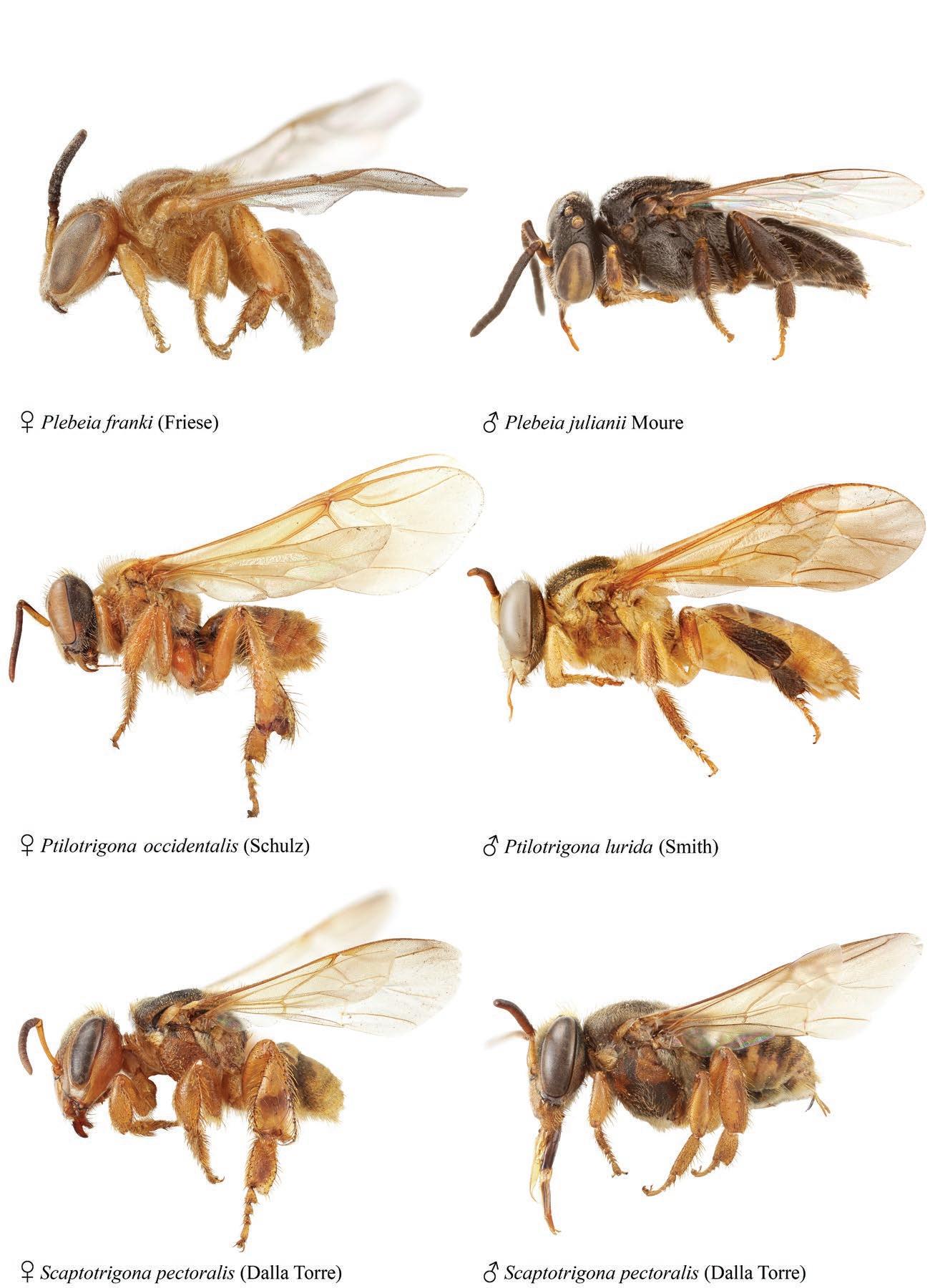
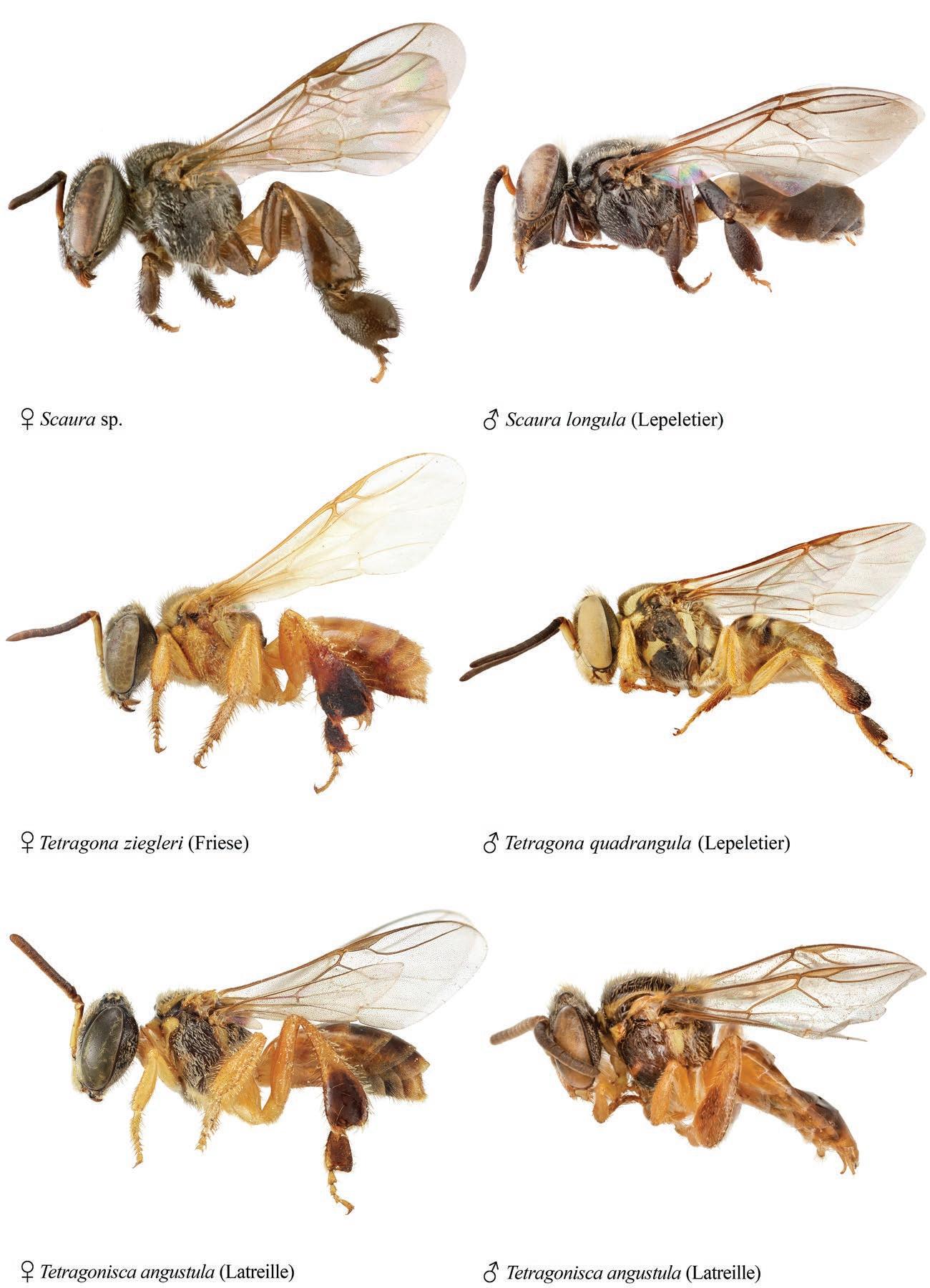
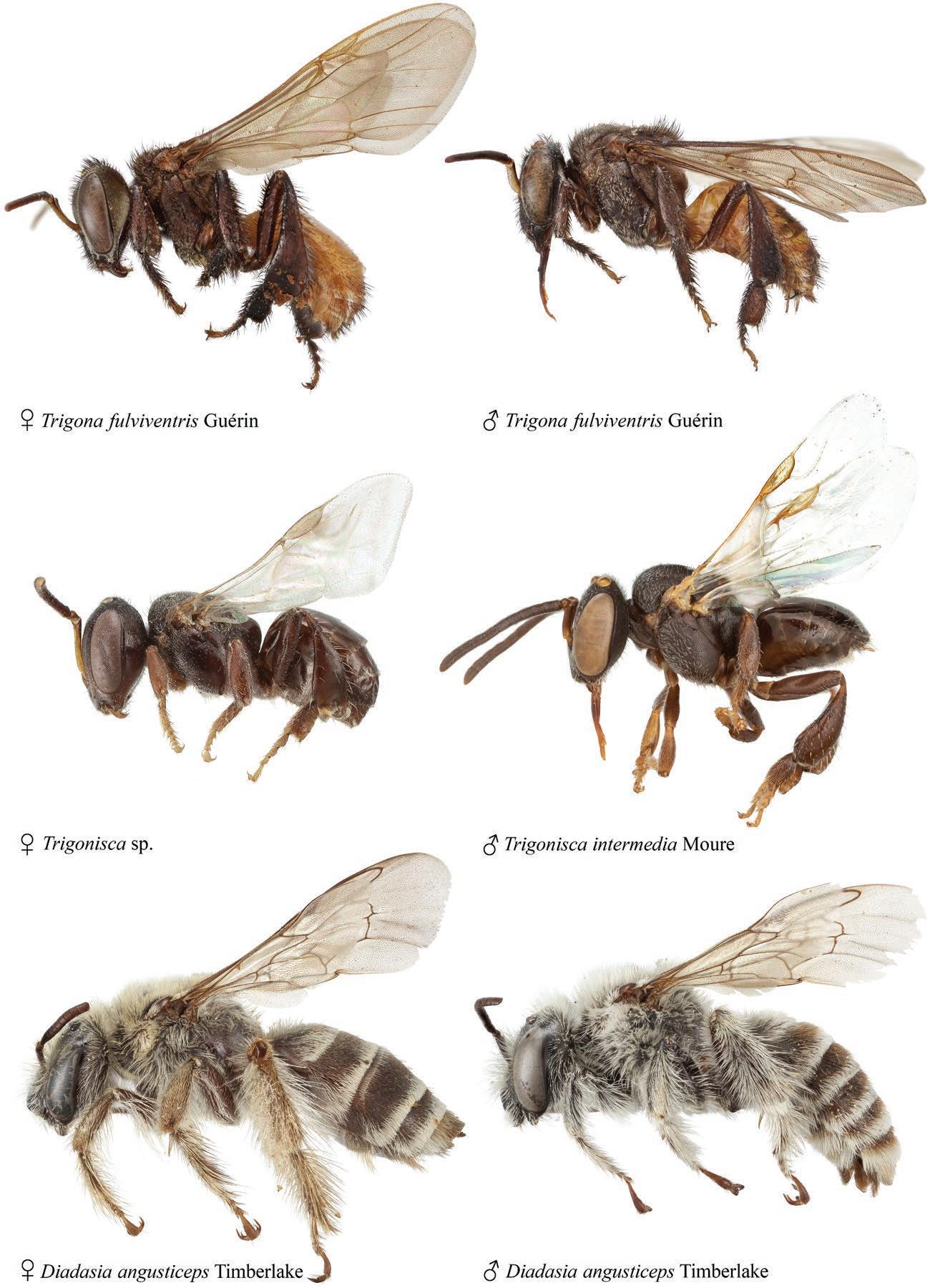
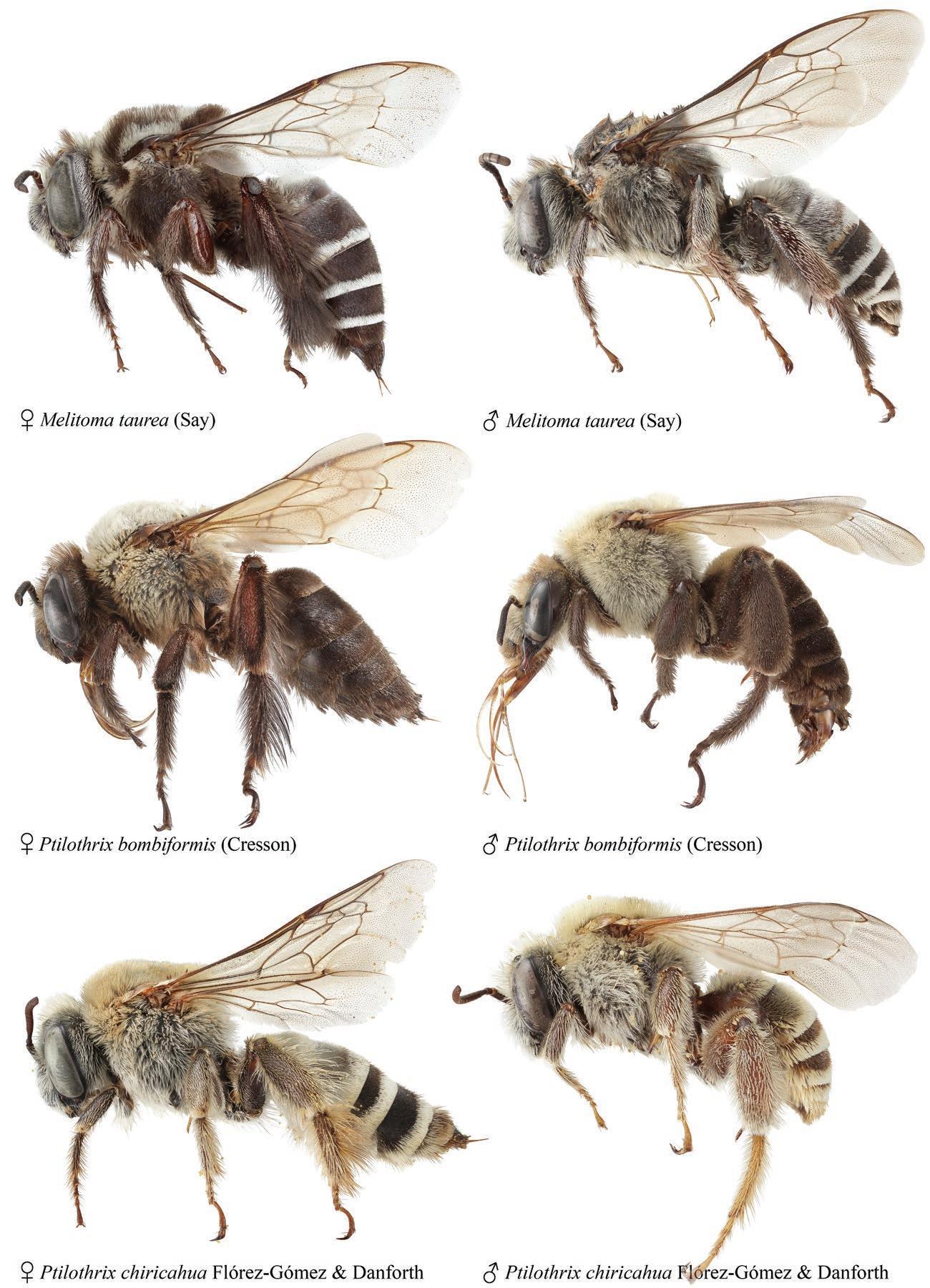
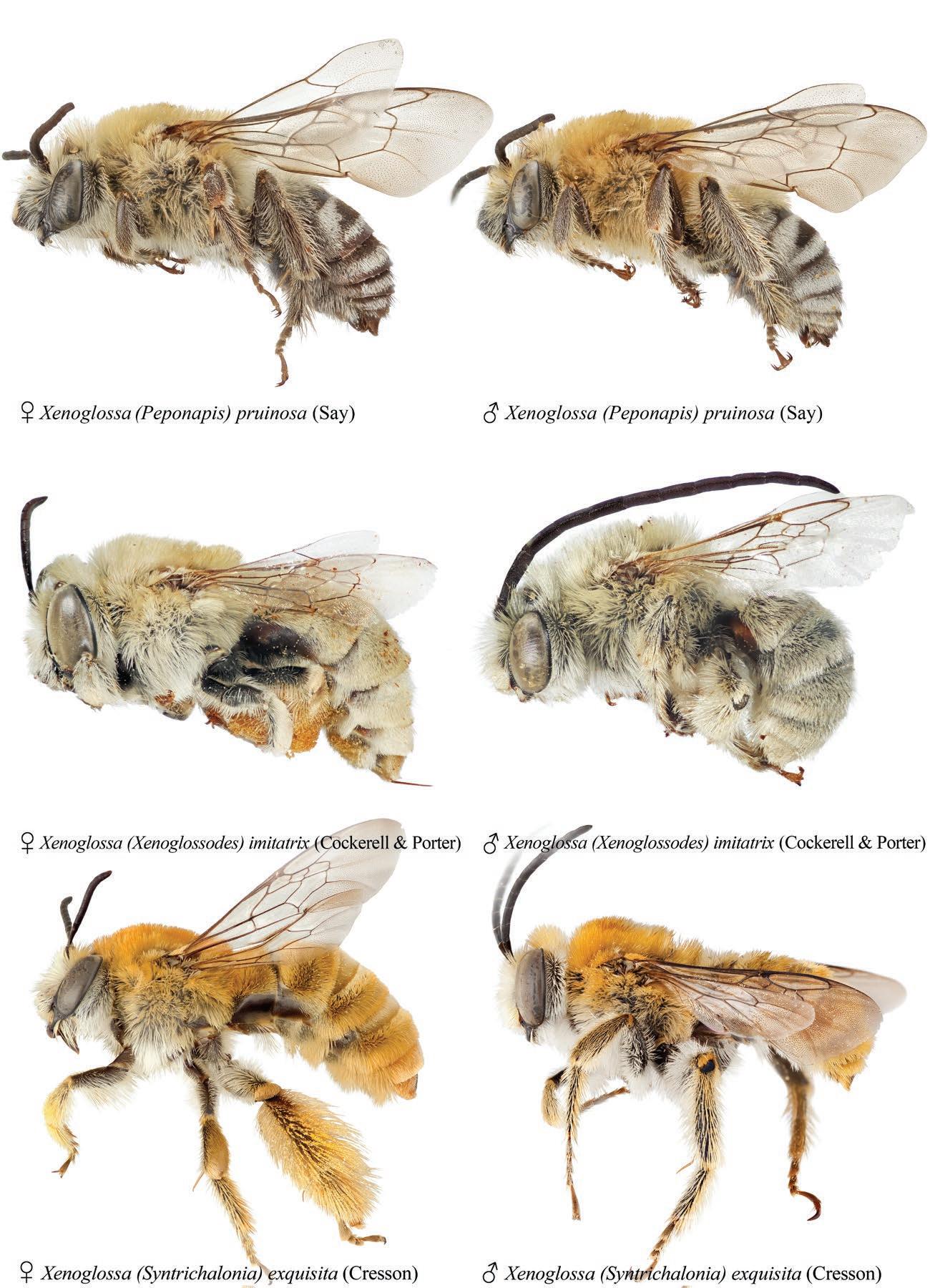
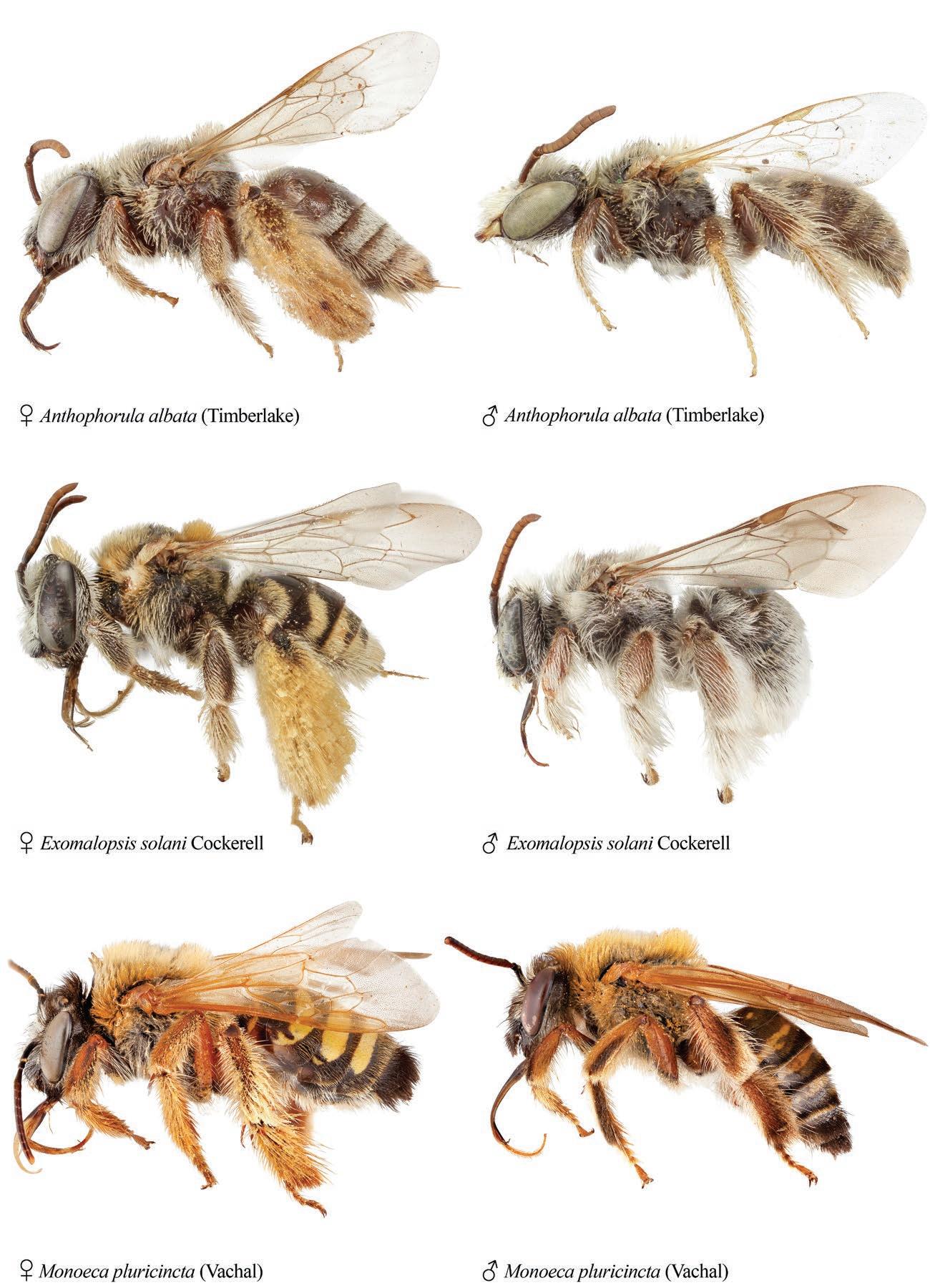
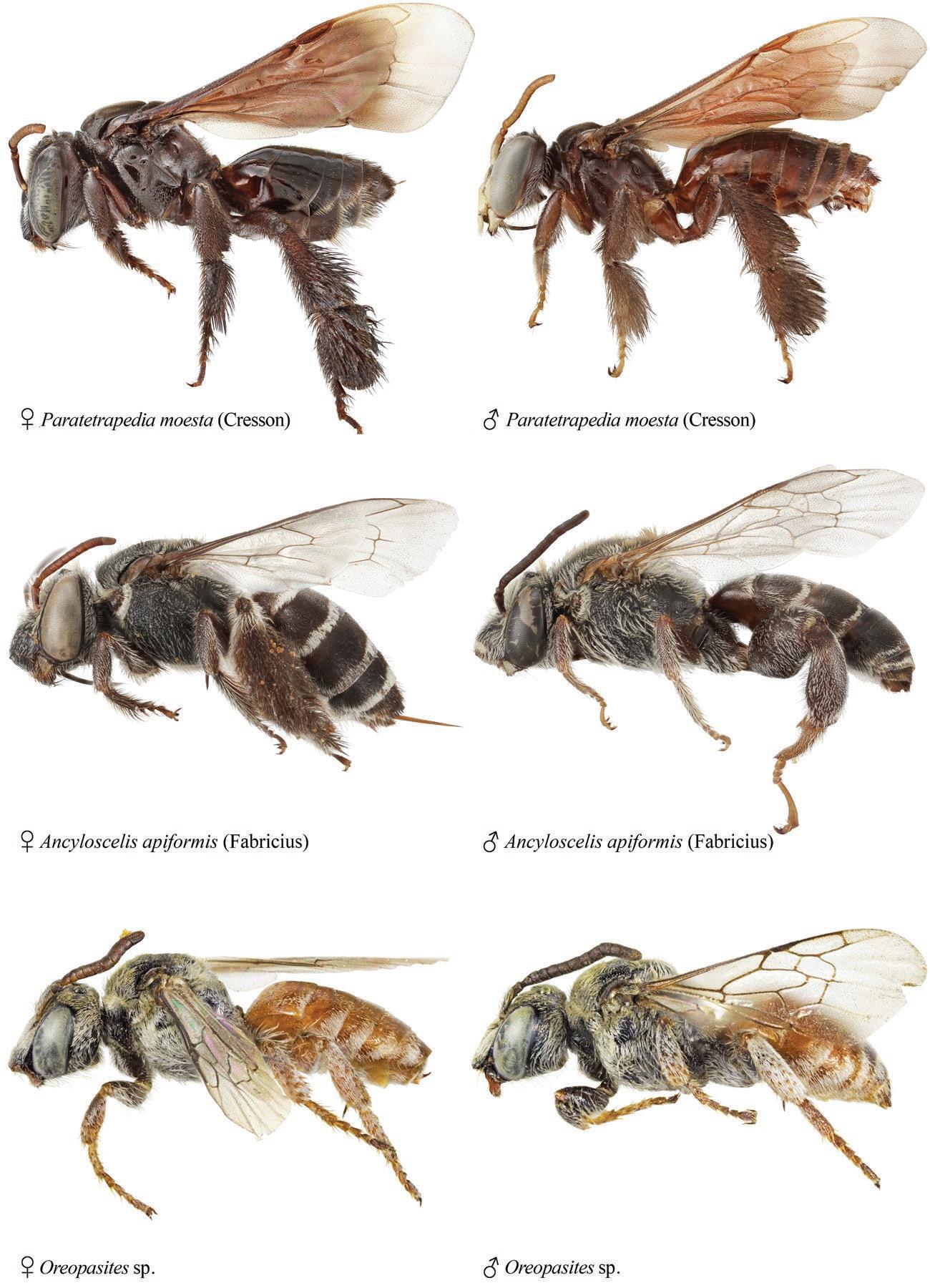
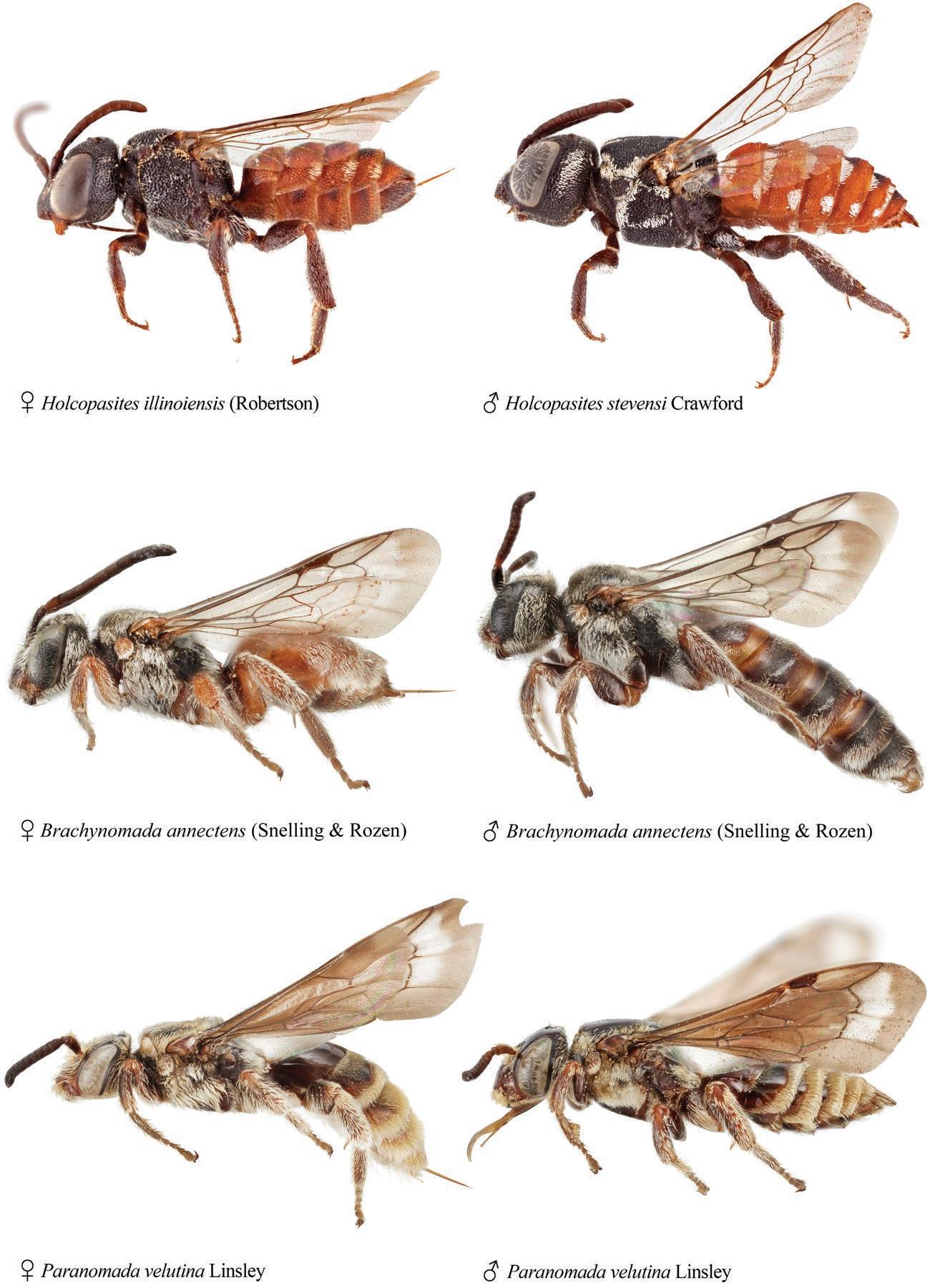
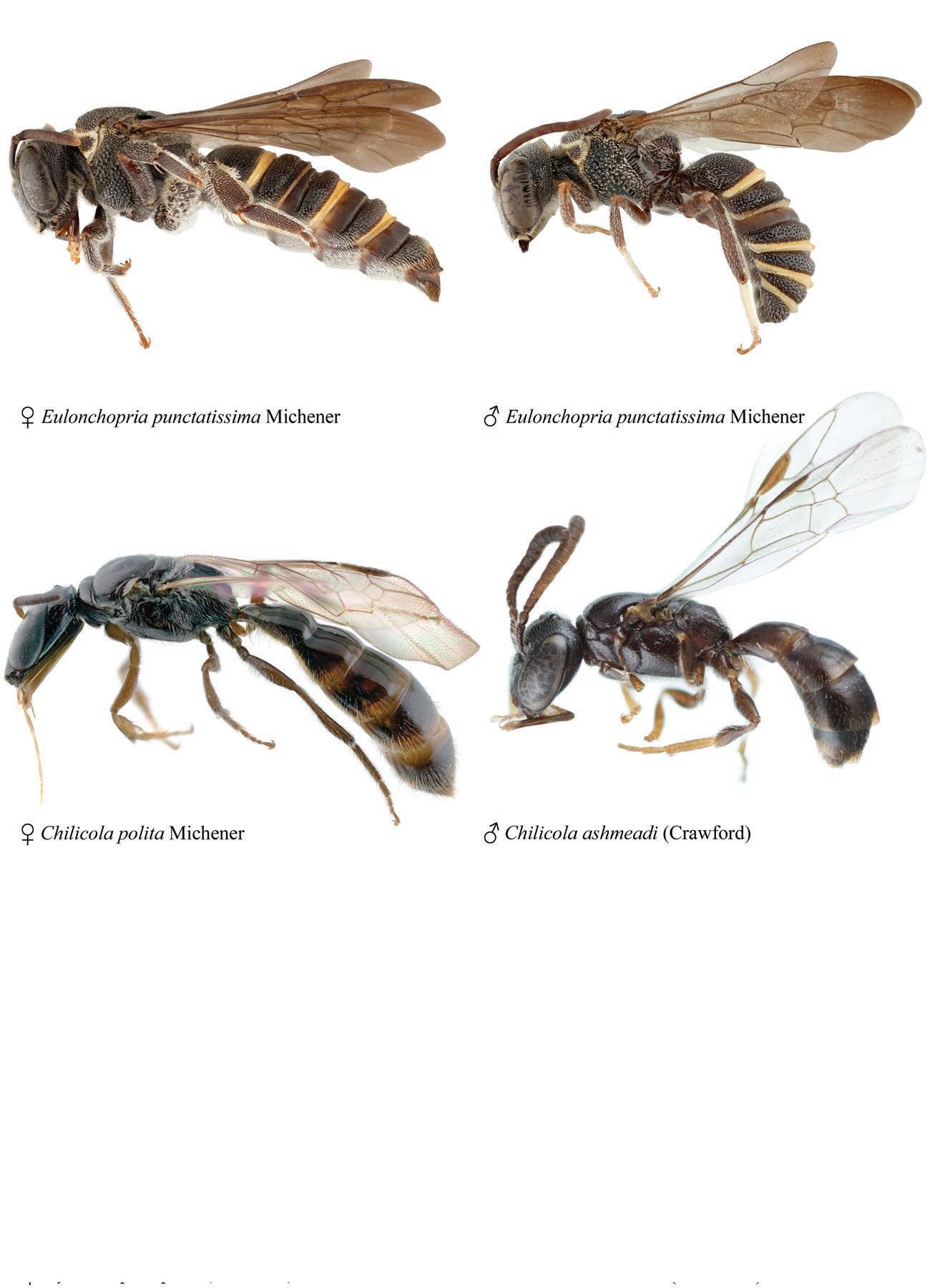
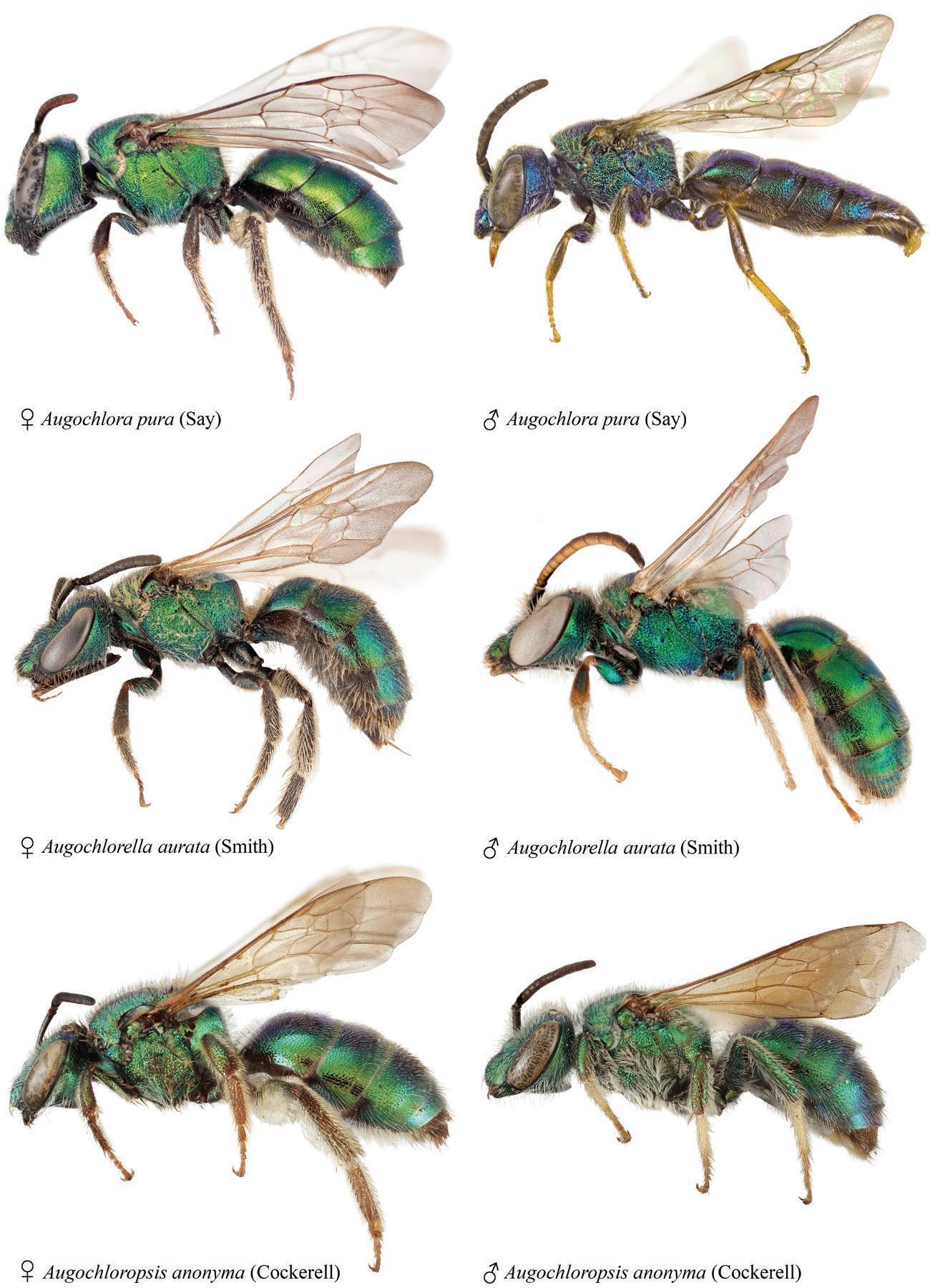
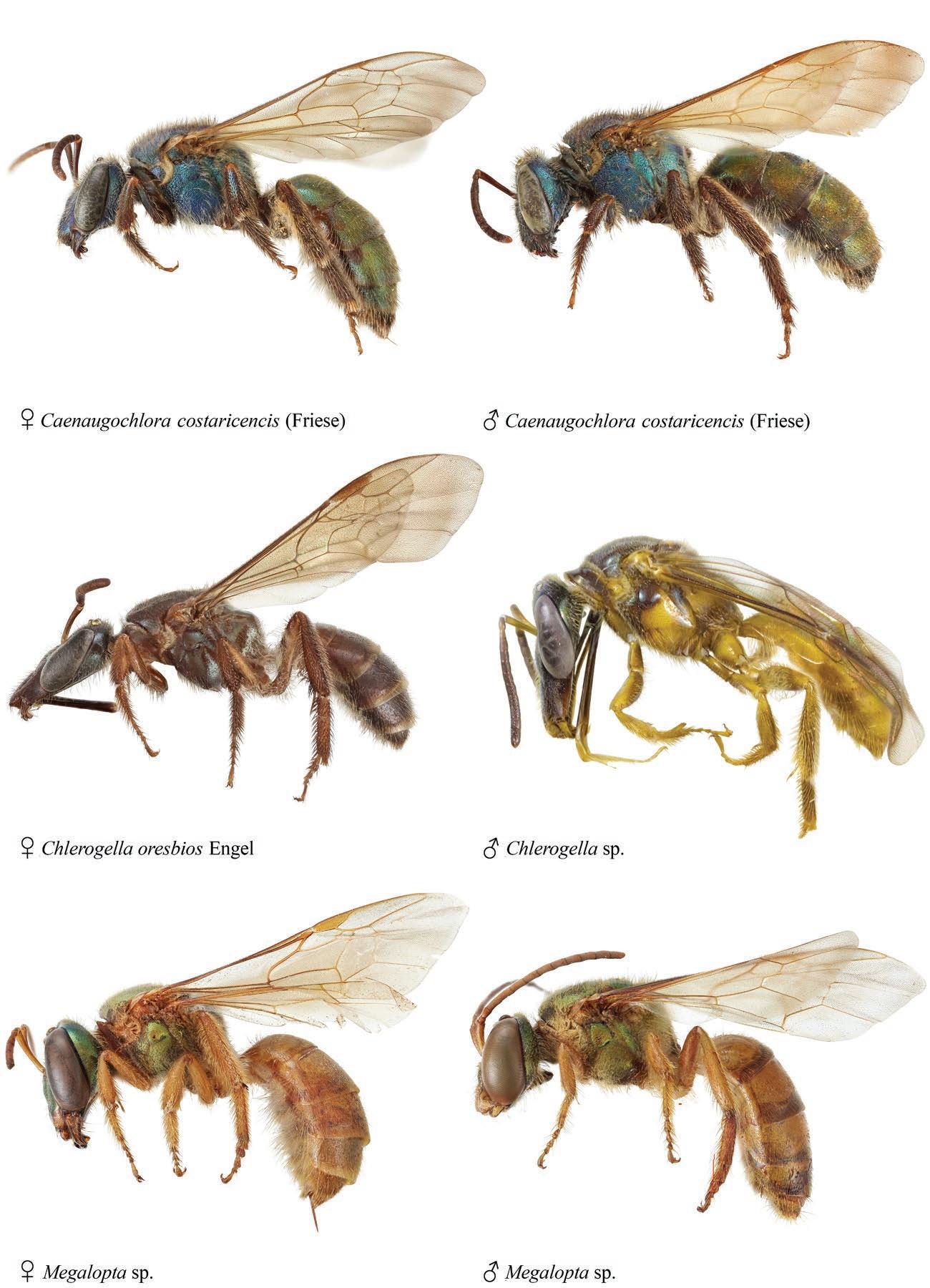
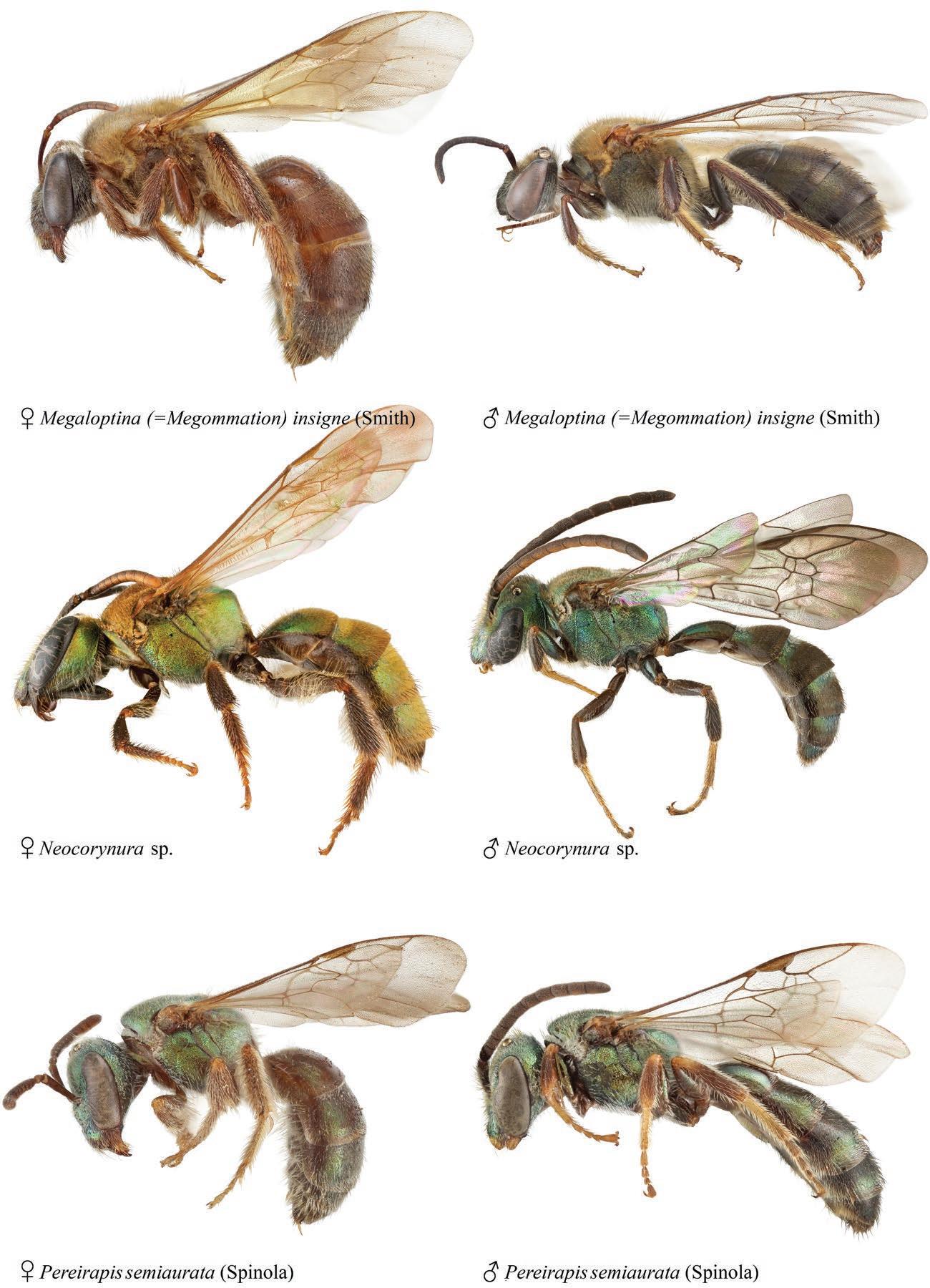
The Bee Genera of North and Central America (Hymenoptera: Apoidea): Second Edition
The Bee Genera of North and Central America
(Hymenoptera: Apoidea)
BRYAN DANFORTH
SE Á N G. BRADY
KAROLYN DARROW
SILAS BOSSERT
EDUARDO A. B. ALMEIDA
JASON GIBBS
JOHN L. NEFF
TERRY GRISWOLD
LAURENCE PACKER
RONALD J. MCGINLEY
CHARLES D. MICHENER
SECOND EDITION
The Bee Genera of North and Central America
(Hymenoptera: Apoidea)
SECOND EDITION
The Bee Genera of North and Central America
(Hymenoptera: Apoidea)
SECOND EDITION
BRYAN N. DANFORTH, SEÁN G. BRADY, KAROLYN DARROW, SILAS BOSSERT, EDUARDO A. B. ALMEIDA, JASON GIBBS, JOHN L. NEFF, TERRY GRISWOLD, LAURENCE PACKER, RONALD J. MCGINLEY, AND CHARLES D. MICHE NER
A Smithsonian Contribution to Knowledge
WASHINGTON, D.C. 2026
Recommended citation: Danforth, B. N., S. G. Brady, K. Darrow, S. Bossert, E. A. B. Almeida, J. Gibbs, J. L. Neff, T. Griswold, L. Packer, R. J. McGinley, and C. D. Michener. 2026. The Bee Genera of North and Central America (Hymenoptera: Apoidea): Second Edition. Smithsonian Institution Scholarly Press.
Excluding content credited to rightsholders and third parties, this work is licensed under a Creative Commons Attribution-NonCommercial-NoDerivatives 4.0 International (CC BY-NC-ND 4.0) License. For permission to reproduce credited materials, users are responsible for contacting rightsholders directly.
The paper used in this publication meets the minimum requirements of the American National Standard for Permanence of Paper for Printed Library Materials Z39.48–1992.
This book is dedicated to the people who built the foundation of our understanding of bee systematics and biology:
CHARLES D. MICHE NER, RONALD J. MCGINLEY, AND JEROME G. ROZEN, JR.
ix Acknowledgments
1 Chapter 1 The Importance of Bees
3 Chapter 2 The Scope and Use of This Book
13 Chapter 3 The Changing View of Bee Phylogeny and Classification
19 Chapter 4 A Primer on Bee Morphology
29 Chapter 5 Locators for the Keys to the Genera
41 Chapter 6 Key to the Genera (Main Key)
87 Chapter 7 Key to Genera of Meliponini (Workers Only)
93 Chapter 8 Key to Genera of Halictinae
107 Chapter 9 Key to Genera of Eucerini
123 Chapter 10 Key to Genera of Anthidiini
131 Chapter 11 Key to the Families
133 Chapter 12 Notes on the Genera
183 Appendix A Figure Captions for Morphology and Keys (Chapters 4–11)
201 Appendix B Family and Genus Body Size Data
209 Literature Cited
233 Color Plates
293 Index
ACKNOWLEDGMENTS
WE ARE EXTREMELY GRATEFUL to Elaine Hodges (Smithsonian Institution) for preparing the artwork in the first edition of this book. Rachel Fordyce (Cornell University) helped immensely with editing and formatting of keys and other materials early in the process. Jerome G. Rozen, Jr., Michael Orr, Achik Dorchin, Felipe Freitas, Sandra Shanks, Tom Zavortink, Rodrigo Gonçalves, Diego A. Guevara, Matheus M. Carvalho, and Maurizio Fernandez generously provided taxonomic expertise on certain groups. Bryan Danforth would like to thank the curators and staff who hosted his visit to the American Museum of Natural History (AMNH) in Spring 2023: James Carpenter, David Grimaldi, Cheryl Hayashi, Jessica Ware, Corey Smith, Sarah Kornbluth, and Jerome G. Rozen, Jr. We are very grateful to John Ascher and John Pickering for making data on bee species richness available on Discover Life (https://www discoverlife org/ ). Accurate estimates of generic, tribal, subfamily, and family-level bee species richness greatly facilitated the preparation of the tables and figures. For help in preparing some color habitus photos (Plates 1–60), we thank Jakob Musafia, Claudia Ratti, Liam Graham (York University), Steve Thurston (AMNH), Skyler Burrows, Jeremy Jensen, Bailey Basinger, Jenny Gan, and Michael Branstetter (Logan Bee Lab). The work at York University was financially supported by Cecily and Robert Bradshaw, to whom we are extremely grateful. Cassidy Dobler (Cornell University) kindly provided help formatting and assembling the literature cited. Alice Hughes (University of Hong Kong) kindly provided Figure 2-1, and Mark Buckner (Cornell University) kindly provided Figure 2-2. We are grateful to the instructors and students at the Bee Course, a ten- day workshop on bee systematics, biology, and ecology that has been offered at the Southwestern Research Station since 1999, for their ongoing contributions to this work. We are exceptionally grateful to Charles D. Michener and Ronald J. McGinley for developing the concept, framework, original keys, and associated background material for this book, and for their immense contributions to the field of bee systematics, evolution, and taxonomy.
THE IMPORTANCE OF BEES
APPROXIMATELY 125 MILLION YEARS AGO, in Western Gondwana – a fused landmass that included South America and Africa – an obscure group of solitary predatory wasps (probably similar to modern thrips-hunting Ammoplanidae) gave rise to a group of highly specialized pollen- and nectar-feeding insects that we now call bees. Unlike any other lineage of hunting wasps, bees feed their offspring a diet of angiosperm pollen, nectar, and sometimes floral oils. At the same time, the eudicots, a group that now comprises greater than 75% of flowering plant species, formed a particularly tight partnership with bees. The eudicots evolved attractive floral rewards – sugary nectar, protein-rich pollen, and floral oils – to lure bees (and other visitors) to flowers; in parallel, bees evolved more effective ways of accessing and transporting these floral rewards. Bees evolved elongate mouthparts for accessing hidden nectar, finely branched hairs and specialized combs and brushes for gathering and transporting pollen, and specialized mops and sponges for gathering nutritious floral oils. As a result, many bee species became highly effective vectors of angiosperm pollen – they became efficient pollinators. Seventy-four percent of angiosperm species now rely on animal-mediated pollination, and the vast majority of pollinators are bees. The partnership of bees and flowering plants transformed terrestrial habitats through rapid diversification of both the eudicots (now encompassing more than 350,000 described species) and bees (estimated to include about 21,000 described species). One could argue that the bee–angiosperm partnership is one of Earth’s most important symbiotic relationships.
From a human perspective, bees have become exceptionally important because of their role in crop pollination. Of the 124 major crops produced by humans around the world, 87 (70%) benefit from animal (mostly bee) pollination. Our highest value crops, from both a monetary and nutritional perspective, are bee pollinated. In addition, bees are important pollinators of native wildflowers and, in some cases, rare and endangered plants. Given the dominance of flowering plants in terrestrial habitats and their heavy reliance on bees, one could argue that bees are crucial to supporting terrestrial ecosystems as we know them.
Understanding and documenting bee diversity, whether it is in the context of agriculture and pollination, land management, or conservation biology, requires that people have the tools and expertise to identify bees to the generic and species levels. This has become increasingly clear in the past 20 years, as we have come to the realization that reliance on commercially managed, non-native honey bees is ecologically and even economically unwise. Since the winter of 2007/2008, when honey bee colonies suffered massive winter die offs in North America, there has been growing interest in understanding the contribution of wild bees to agricultural production and increasing awareness that we need to understand and protect
these fascinating creatures. Innumerable faunal surveys are now being conducted to characterize bee diversity in agricultural habitats, forests, nature preserves, cities and city parks, and national parks and monuments. A growing number of states in the United States are attempting comprehensive statewide surveys to characterize their local bee fauna and to assess the conservation status of vulnerable species. At a national level, the United States, Canada, Costa Rica, and Mexico have all initiated projects to better understand and preserve these important pollinators.
This book, when originally published in 1994, was meant to provide a single comprehensive guide to identification of bee genera in North and Central America. It was a prescient goal because, at that time, there was not the same urgency to document bee diversity from an agricultural and conservation perspective as there is today. But much has changed since 1994. Our understanding of bee phylogeny has been transformed by molecular data and new analytical methods for analyzing that data. Our understanding of the geographic distribution of bee genera, tribes, and subfamilies has been improved through large-scale biodiversity inventories and data aggregators, such as Discover Life (https://www discoverlife org), the Global Biodiversity Information Facility (GBIF, https://www gbif org), and the Symbiota Collections of Arthropods Network (SCAN, https://scan-all-bugs org/ ). And our knowledge of bee life history, nesting biology, and ecology has also advanced considerably through field studies throughout North and Central America. We have also gained an increasing appreciation of the role that wild bees play in crop pollination, especially in high-value specialty crops such as apple, blueberry, squash, coffee, and many others. It seems appropriate, therefore, to provide an updated, fully revised set of keys, illustrations, and taxonomic information to support the renewed interest in the ecology, evolution, and conservation of bees.
THE SCOPE AND USE OF THIS BOOK
THIS BOOK provides a comprehensive guide to the bee genera across North and Central America, including keys to the 173 genera as well as background information on the geographic distribution, taxonomy, and life history of each genus. Our geographic scope includes Canada, the United States, Mexico, Central American countries from Guatemala to Panama, and the Caribbean islands. This area encompasses more than 5,200 bee species in 6 families and 20 subfamilies (Table 2-1).
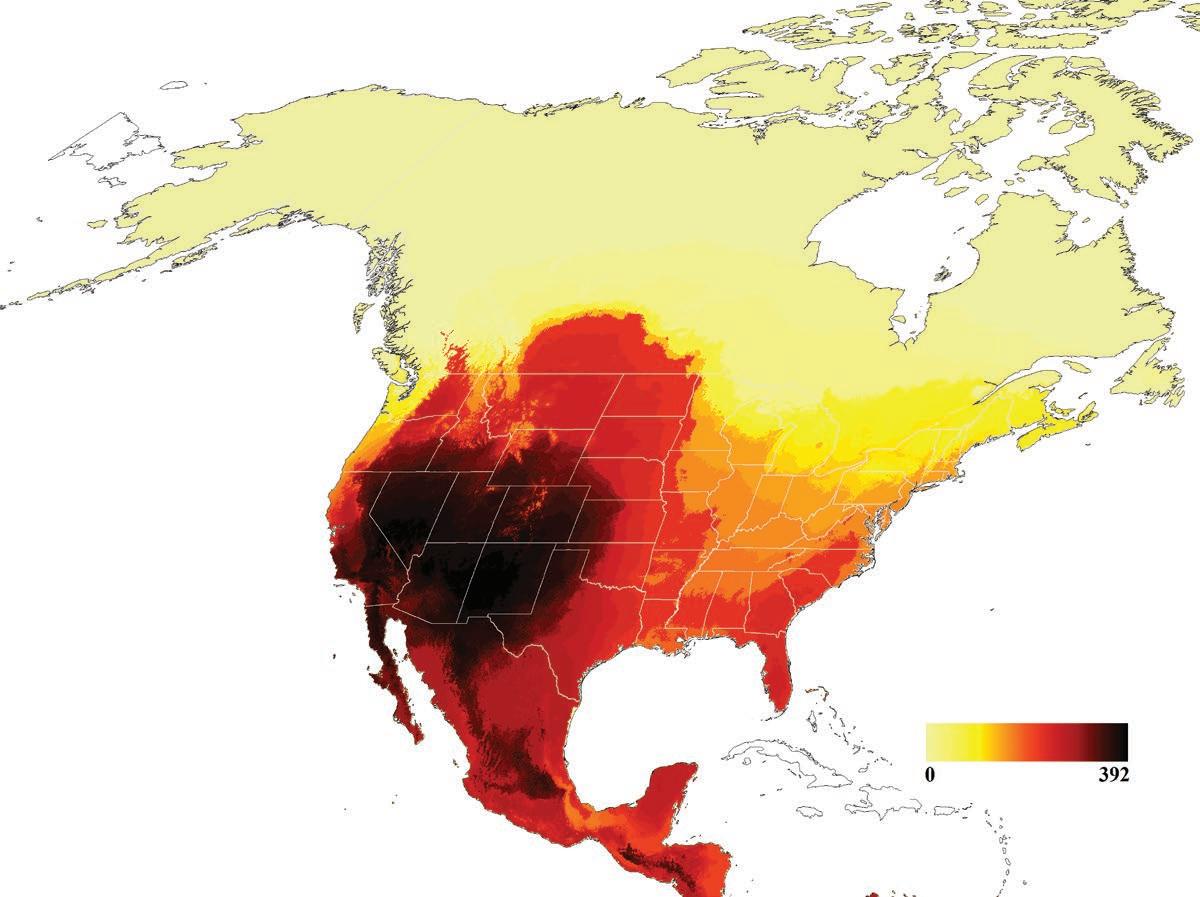
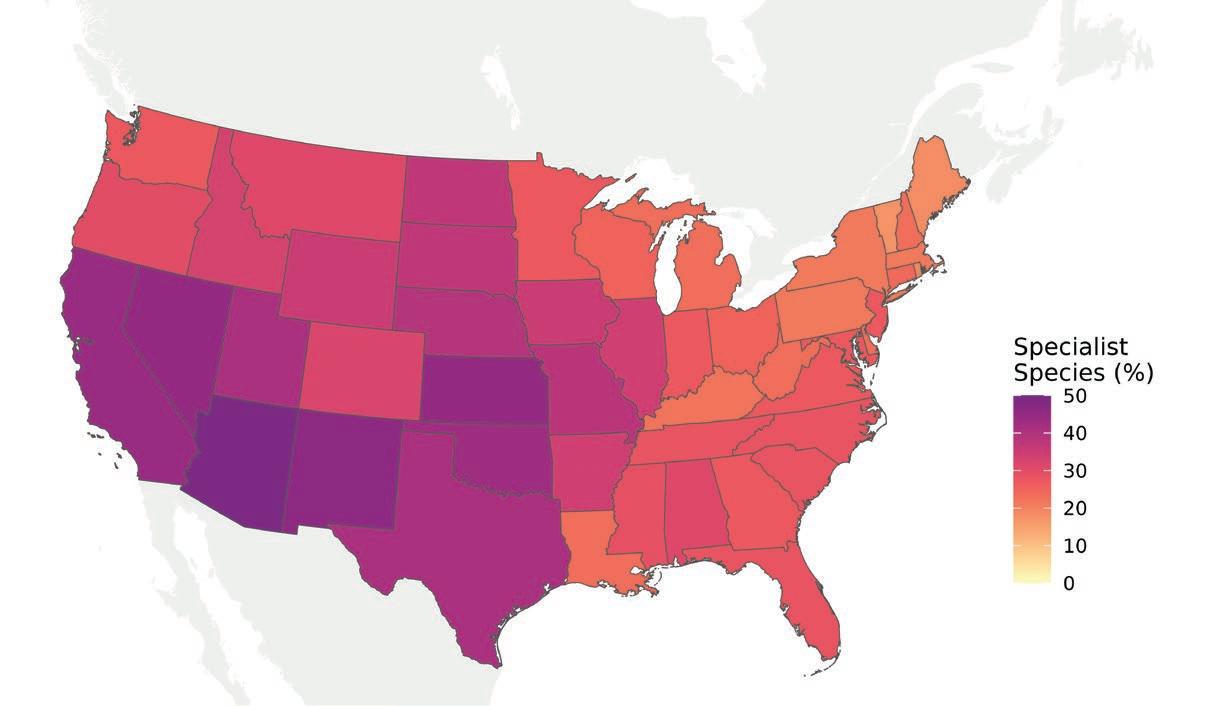
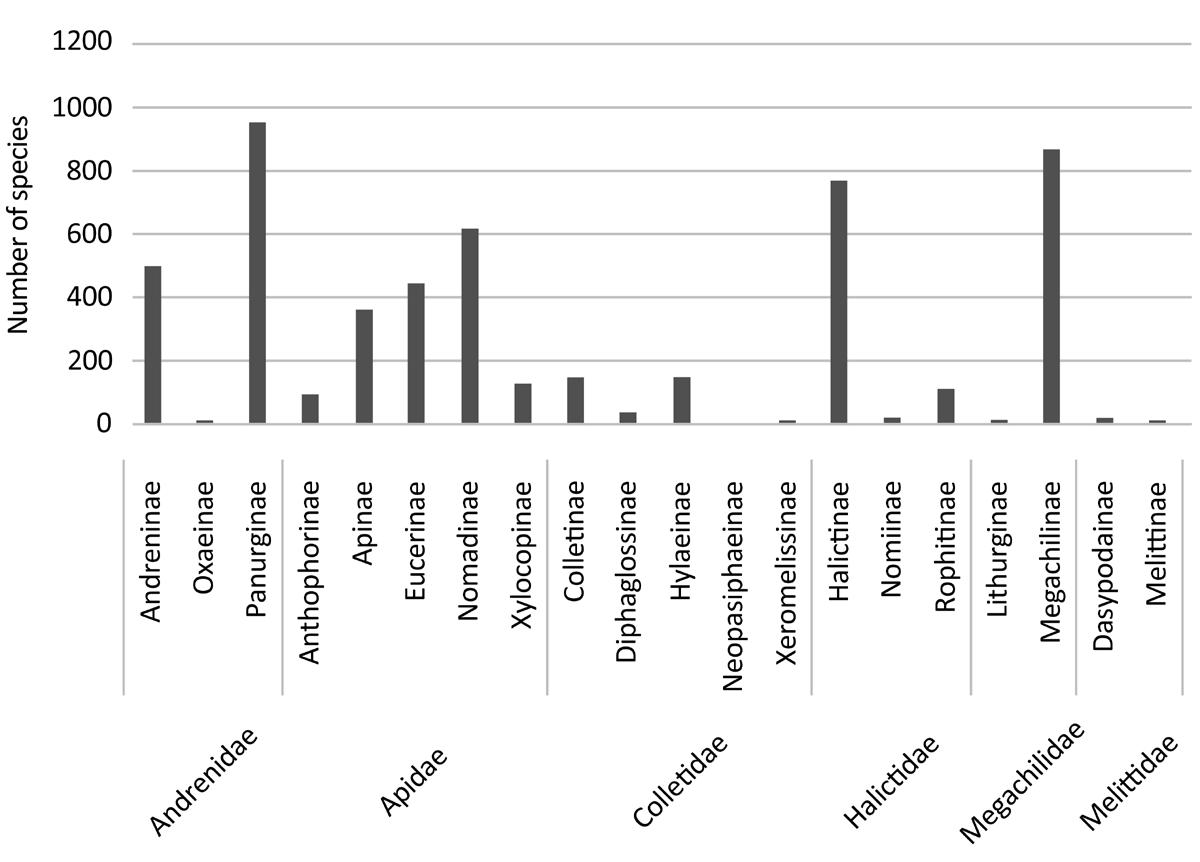
The bee fauna of North and Central America is extraordinarily diverse in terms of life history, sociality, nesting biology, and host-plant associations. Species richness is greatest in the western United States and northern Mexico, especially in arid, highly seasonal habitats (Fig. 2-1). In eastern North America, the fauna is dominated by species-rich solitary and social genera, such as Andrena, Osmia, Megachile, Lasioglossum, and Bombus. In western North America and northern Mexico, we find an incredible abundance of solitary species, such as minute Perdita and diverse solitary and brood-parasitic Apidae. A single 16 × 16 km area of the San Bernardino Valley in southern Arizona hosts at least 497 bee species, or 14% of all bee species in North America (Minckley and Radke 2021). As one moves toward the tropics, one begins to see lineages of bees with connections to South America (Augochlorini, Caenohalictini, Emphorini, Centridini), and increasing diversity of social taxa, such as Meliponini. Like species richness, the proportion of oligolectic (specialist) bees also increases as one moves to the Chihuahuan, Sonoran, Mohave, and Great Basin deserts of Texas, Arizona, New Mexico, Nevada, Utah, and California (Fig. 2-2). Looking at the distribution of species richness across the 20 subfamilies in our area, the largest groups include Halictinae, Andreninae, Megachilinae, Panurginae, and Nomadinae (Fig. 2-3).
The target audience for this book is broad, including academics, policymakers, and land managers with an interest in bee diversity, pollination biology, faunistics, and conservation biology. We assume users range from people with little prior experience with bee identification to more experienced users who need a guide to the current state of bee taxonomy and classification.
The keys can be used in a variety of ways. We recommend that first-time users start with the main key in Chapter 6, “Key to the Genera (Main Key).” For certain groups, this key will direct users to sub-keys for, more or less, easily recognizable groups, including Meliponini (Chapter 7), Halictinae (Chapter 8), Eucerini (Chapter 9), and Anthidiini (Chapter 10). Experienced users can jump directly to the sub-keys when they are confident that they have a specimen that belongs to one of these groups. Experienced users may also prefer to use Chapter 5, “Locators for the Keys to Genera,” which can greatly accelerate the identification process. For users
Figure 2-1. Map of North American bee species richness (modified from Orr et al. 2021). Generated at 10 × 10 km resolution. Colors indicate relative species richness from low (yellow) to high (dark red).
Figure 2-2. Species richness and oligolecty in non-parasitic bees of the United States by state; data from Pollen Specialist Bees of the Eastern, Central, and Western United States (Fowler and Droege 2020).
unfamiliar with bee morphology (or for anyone who needs a refresher course), we recommend reading Chapter 4, “A Primer on Bee Morphology.”
In some cases, morphological structures used in the keys may be hidden in pinned specimens. Important structures, such as mandibles, elements of the proboscis (the shape and structure of the glossa, the number and structure of the maxillary and labial palpi, the length of the galea), and the male genital capsule may be hidden if specimens are not properly prepared. When users are working with freshly collected specimens (i.e., specimens that are still flexible and malleable), we recommend that they prepare a few specimens of each species in order to reveal these important features. Pulling the mouthparts, spreading the mandibles, and extending the male genitalia of specimens will greatly facilitate generic and species-level identification later on.
For interested users, Chapter 11, “Key to the Families,” is provided, but we do not recommend users start with this key unless they are already quite familiar with the details of bee mouthpart morphology. One might think that family-level identification would be easier than generic-level identification. Unfortunately, in bees, this is not necessarily the case. The structures that define and characterize bee families are often hidden mouthpart structures that are invisible unless the mouthparts are fully extended and, in some cases, cleared in a dilute (~10%) solution of sodium hydroxide (NaOH; see Porto et al. [2016] for detailed protocols).
Once a specimen is identified to genus, Chapter 12, “Notes on the Genera” provides a brief morphological description as well as information on the geographic range, nesting biology, host-plant associations, and, for brood parasites, host associations for each genus. It also lists
Figure 2-3. Histogram of species richness across the subfamilies in North America (from Table 2-1).
relevant publications and revisions that provide keys to the species level for each group and to the subgenera for the larger groups.
Online, interactive keys are available for many groups. Discover Life (https://www .discoverlife.org) provides many online keys, especially for bees of the eastern United States and Canada. Other online resources include Terry Griswold’s key to the megachilid genera of the world (https://idtools .org/exotic_bee/index .cfm?pageID=2942).
Additional resources for bee identification include three popular, beautifully illustrated books: The Bees in Your Backyard, by Wilson and Carril (2015), Common Bees of Eastern North America, by Carril and Wilson (2021), and Common Bees of Western North America, by Carril and Wilson (2023). For information on collecting, pinning, and processing bee specimens, we recommend Sam Droege’s The Very Handy Manual: How to Catch and Identify Bees and Manage a Collection (https://doi org/10 5281 /zenodo 12812755) and Packer and Darla-West (2020). For information on the biology of bees, we recommend Danforth et al. (2019) and Packer (2023), and for a broad overview of social behavior in bees, we recommend Michener (1974).
Note that the classification used in this book is based on our current understanding of the phylogenetic relationships at the family, subfamily, tribal, and generic levels. Phylogenies are built on substantial morphological and molecular data, but our understanding of phylogeny is constantly changing as new data and new methods become available. For certain groups, phylogenetic relationships seem to be fairly stable (e.g., Melittidae, Megachilidae), whereas others are very much in flux (e.g., Eucerini, Halictinae).
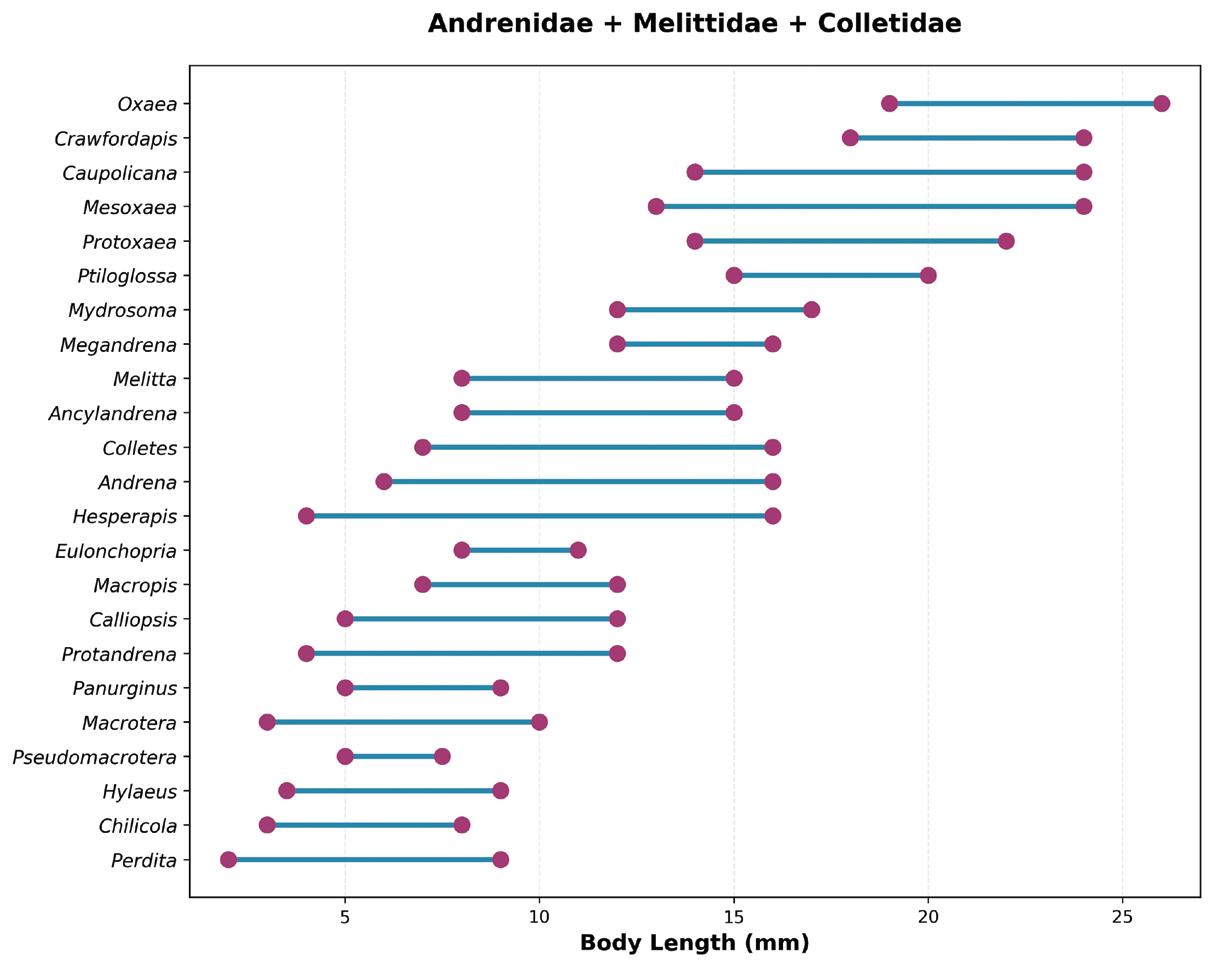
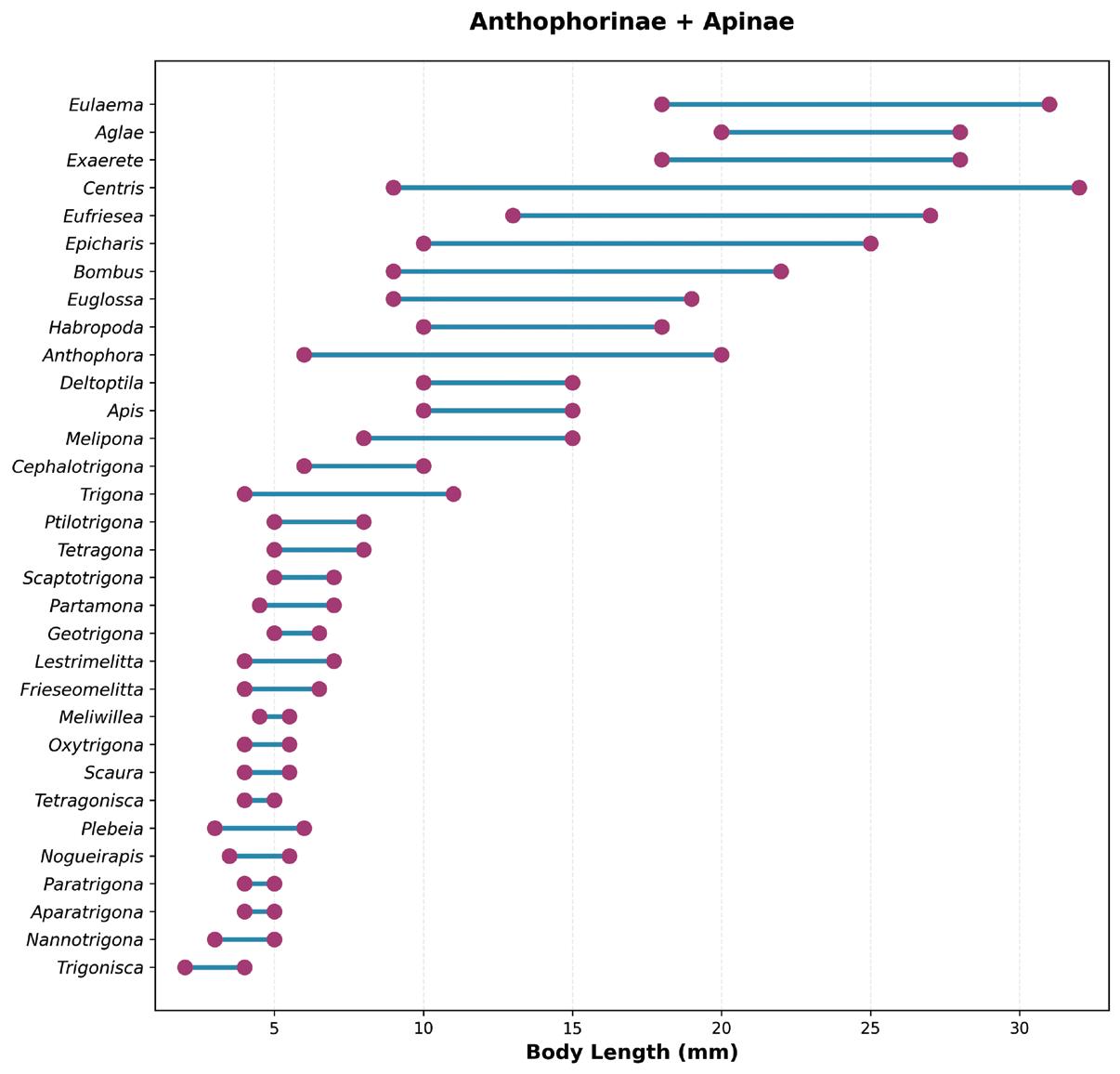
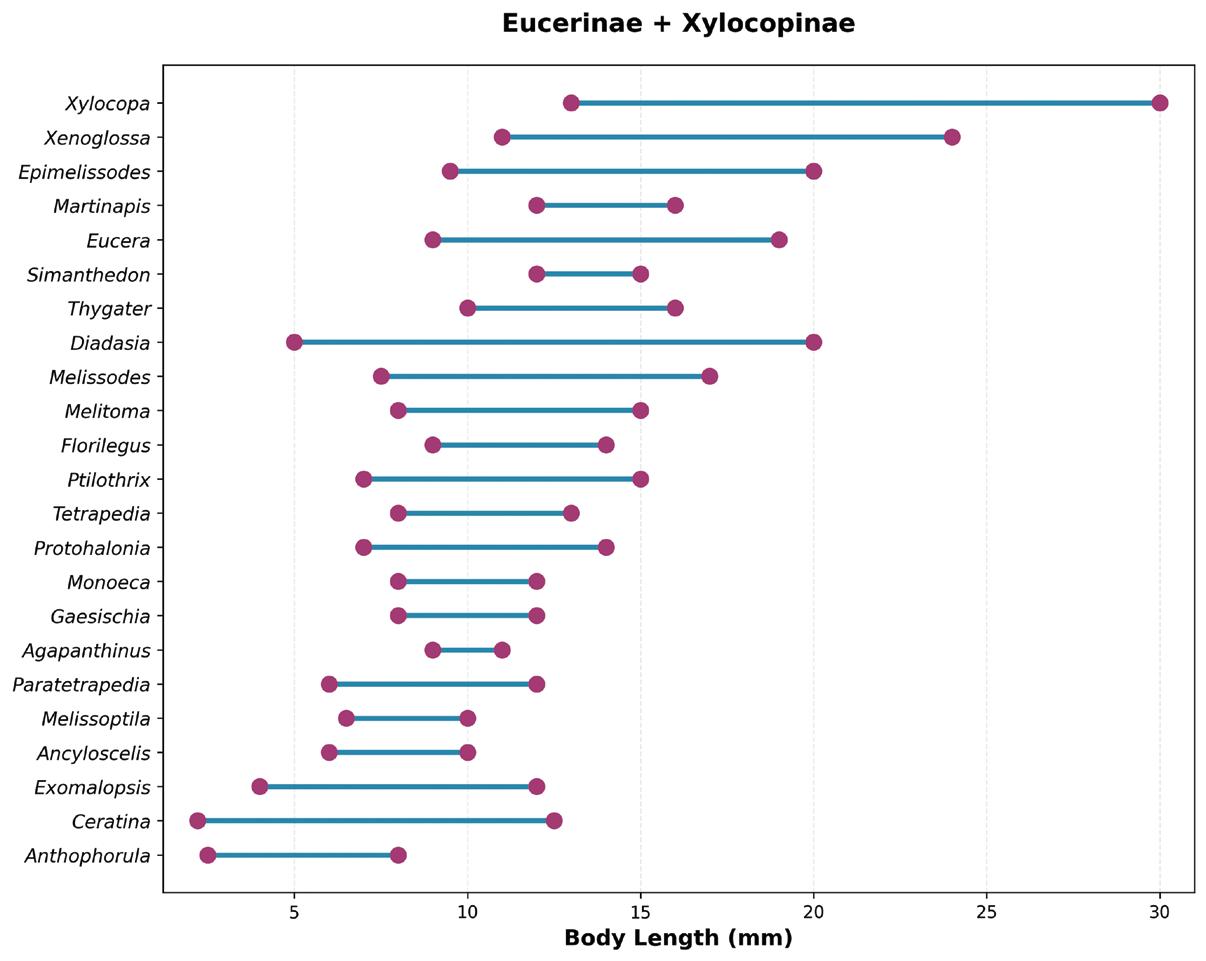
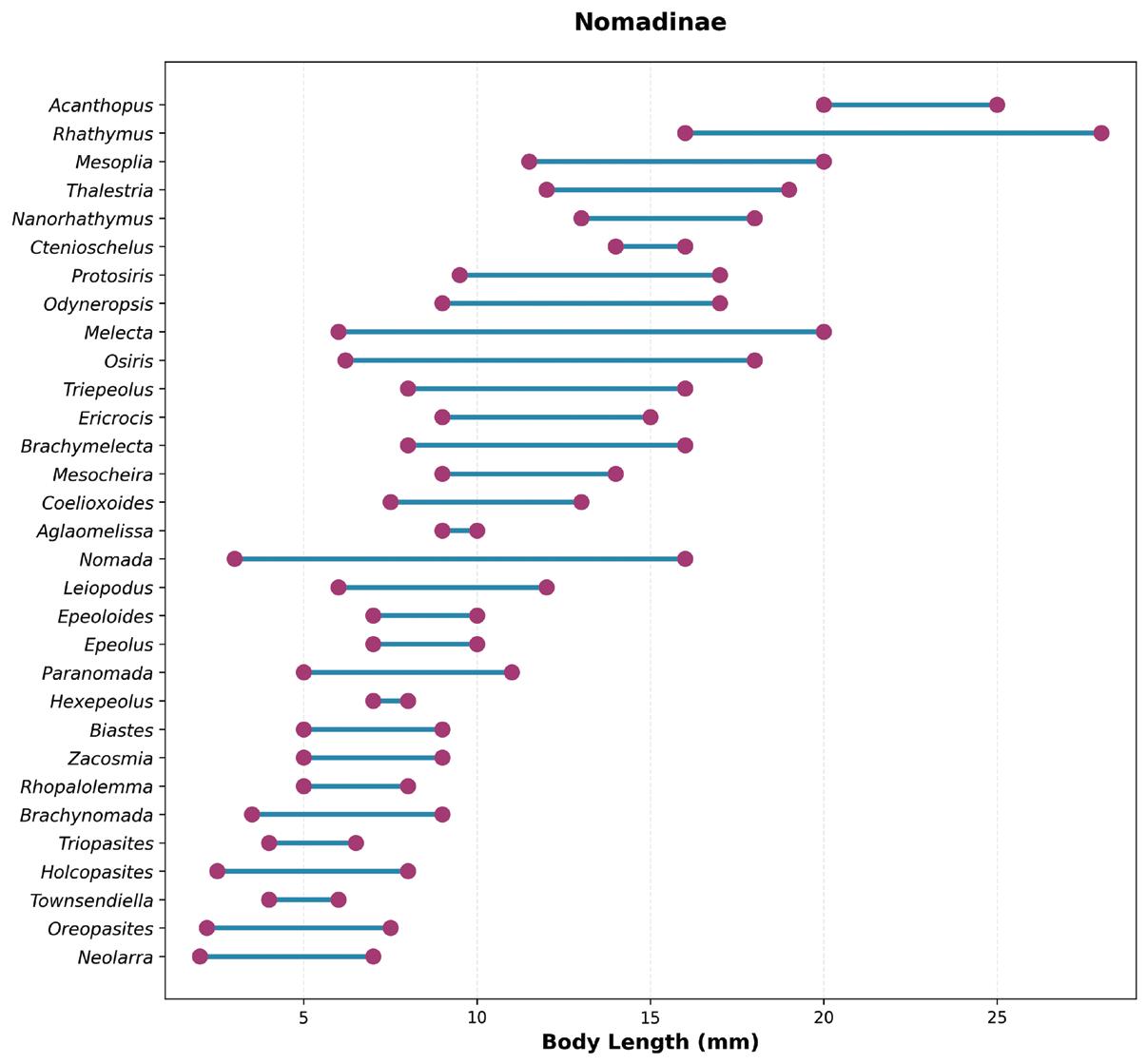
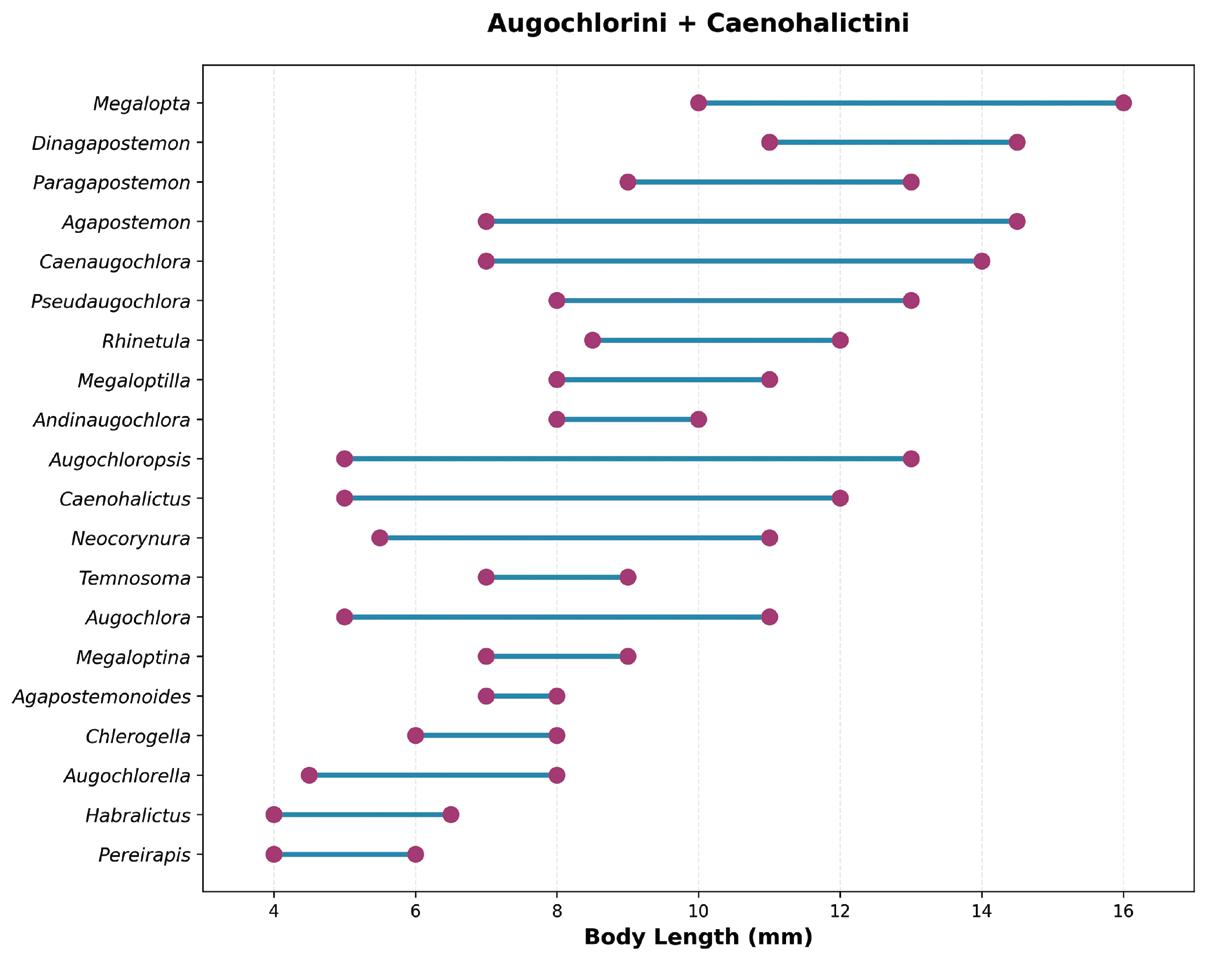
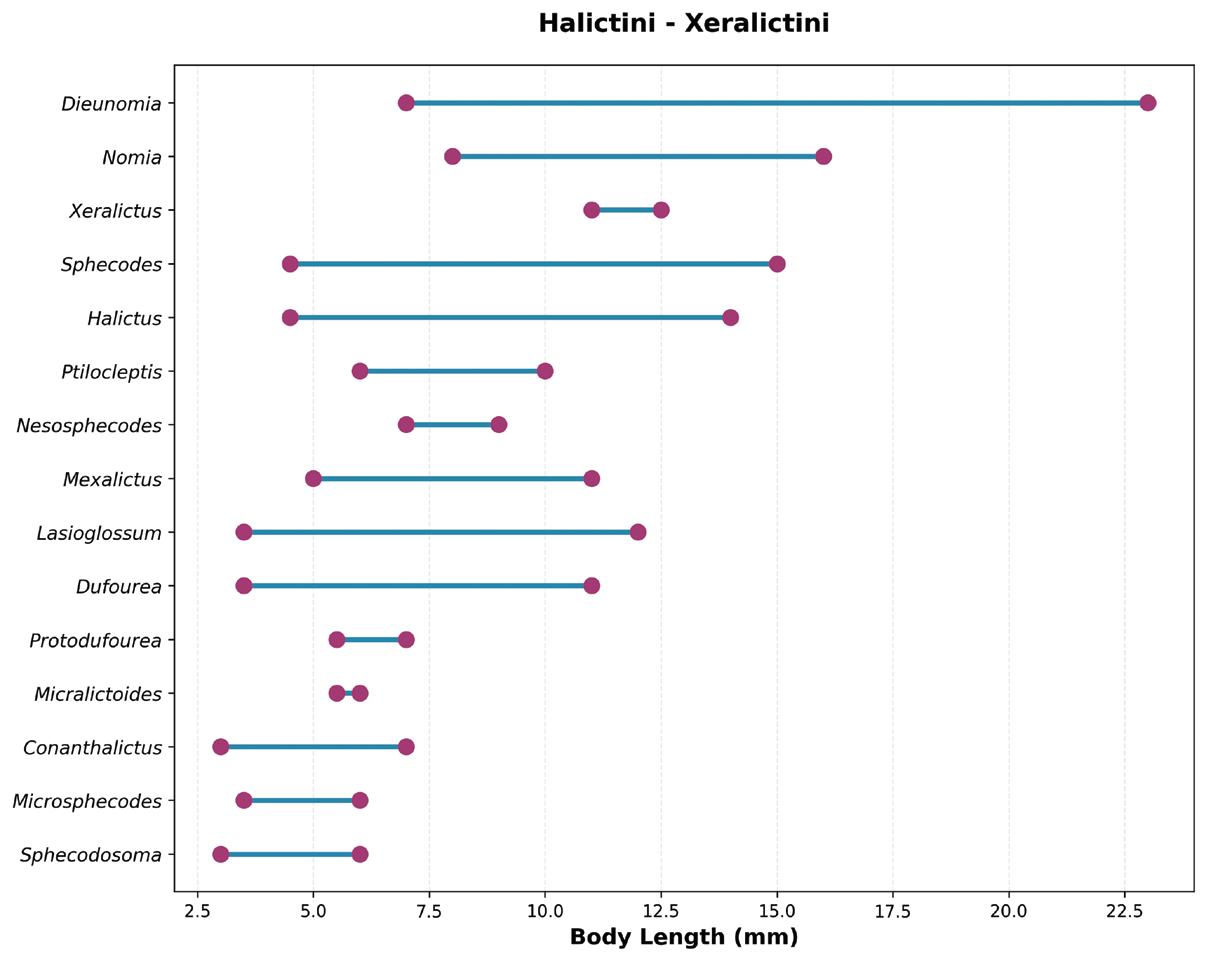
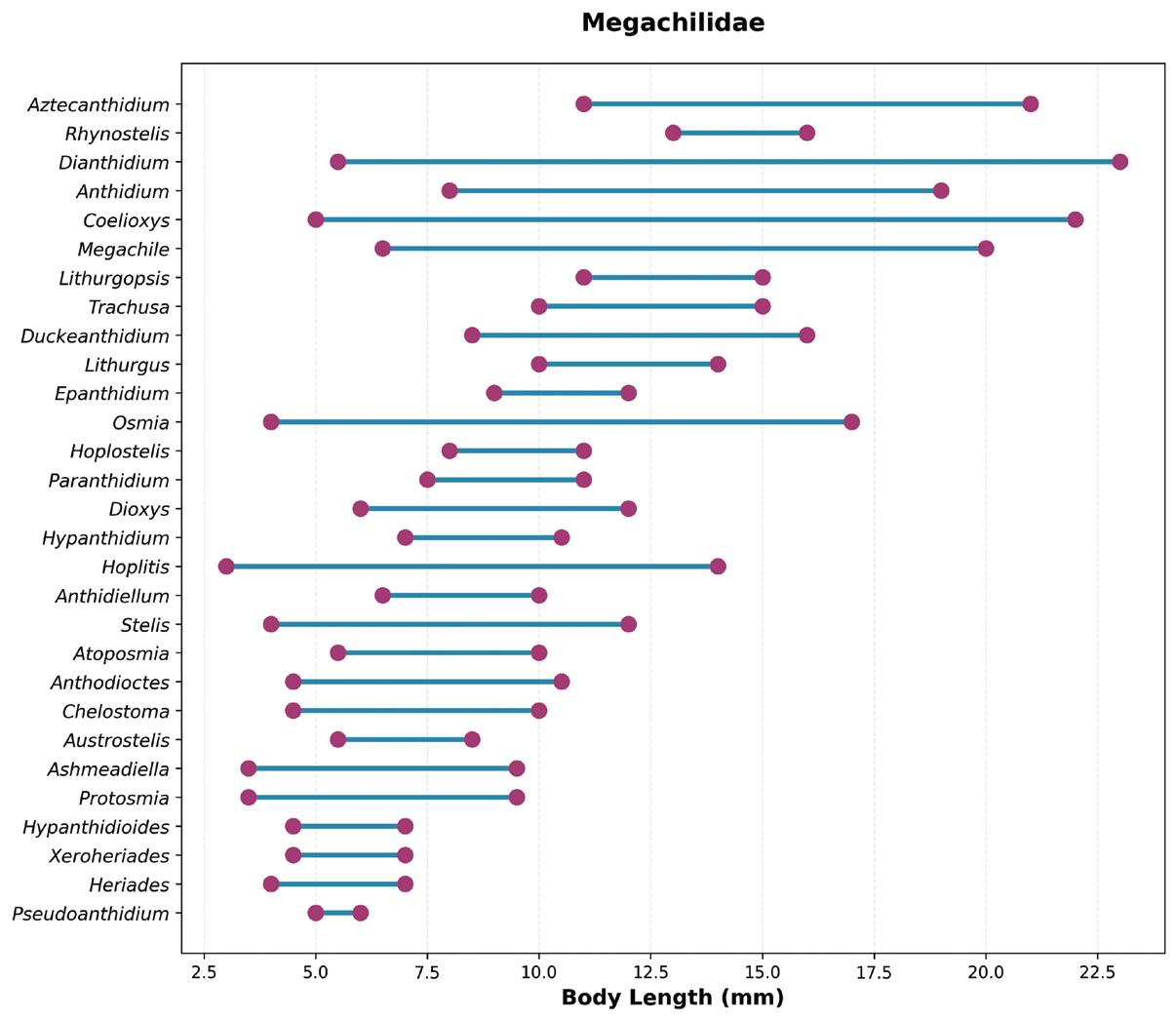
Appendix A provides a complete list of captions and sources for the figures used for morphology (Chapter 4) and in the keys (Chapters 5–11). Appendix B provides a series of graphs showing the upper and lower bounds on body size for each family and genus.
In Chapter 3, “The Changing View of Bee Phylogeny and Classification,” we provide an overview of how our understanding of bee phylogeny and the classification system that derives from it has changed over time.
Table 2-1. Current classification of bee genera in North and Central America with number of species for each genus.
141. Xeralictus Xeralictini Rophitinae 2 Table 2-1, continued
Megachilidae
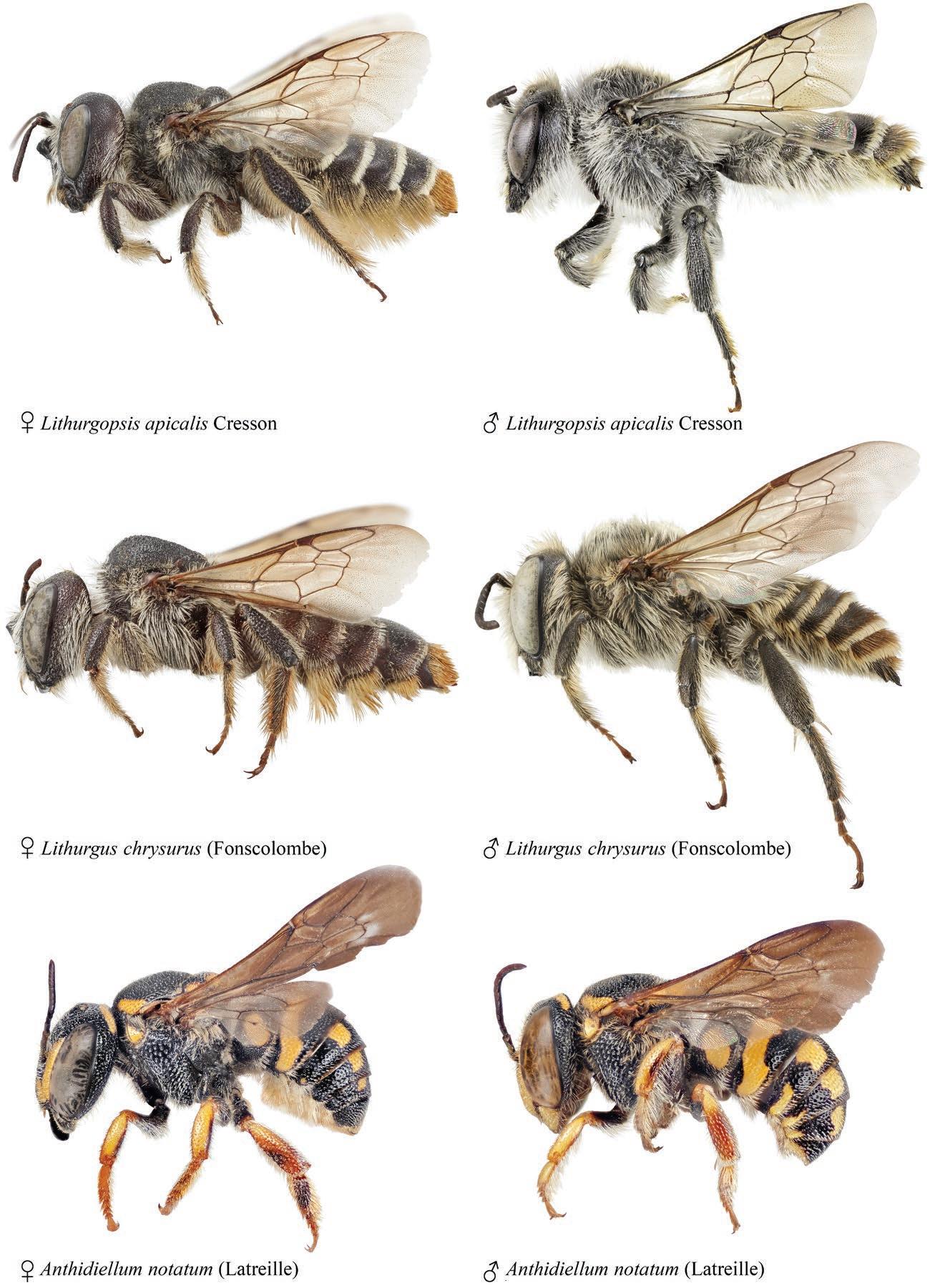
142. Lithurgopsis Lithurgini Lithurginae 8
143. Lithurgus Lithurgini Lithurginae 1
144. Anthidiellum Anthidiini Megachilinae 14
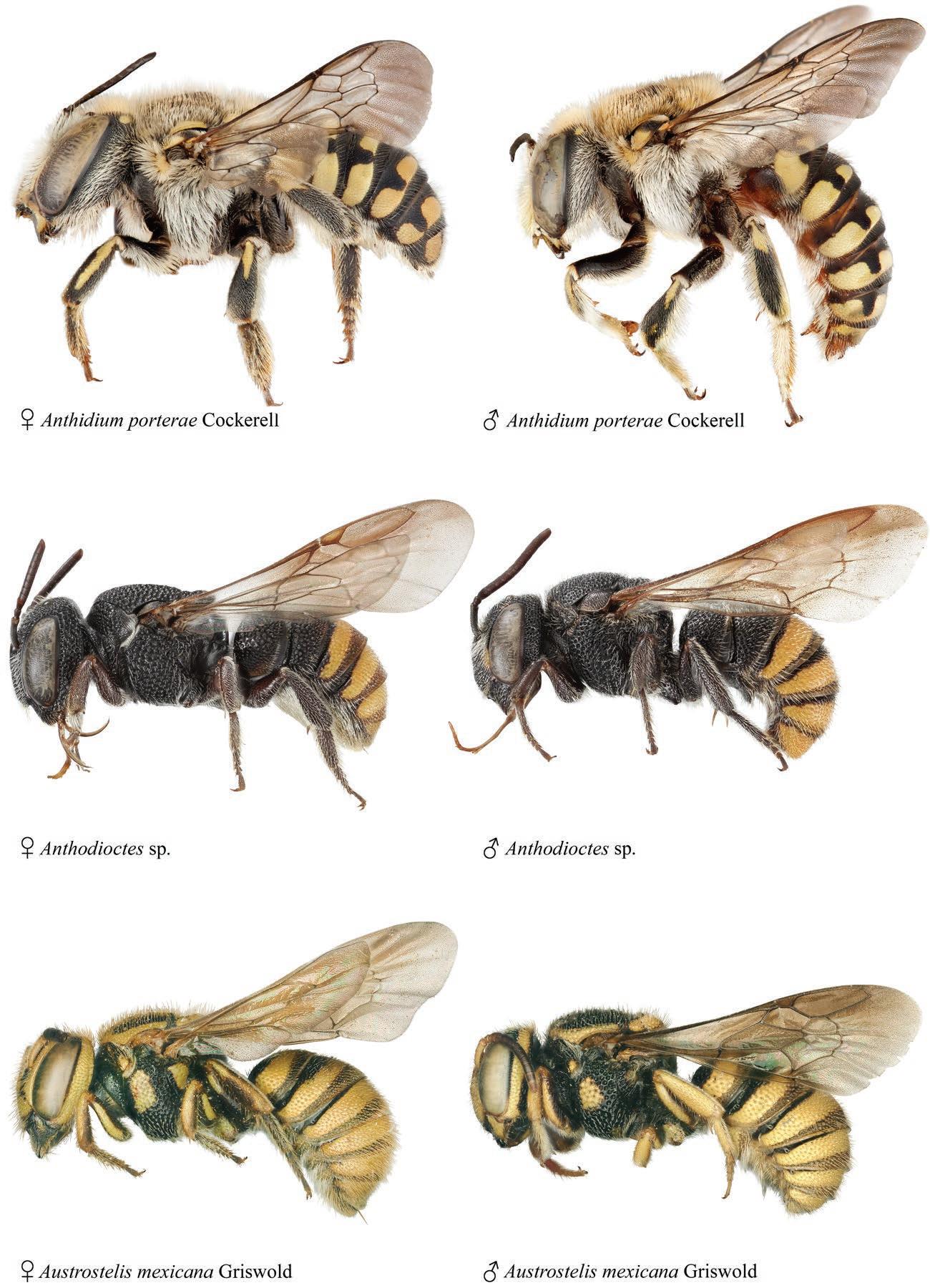
145. Anthidium Anthidiini Megachilinae 44
146. Anthodioctes Anthidiini Megachilinae 11
147. Austrostelis Anthidiini Megachilinae 1
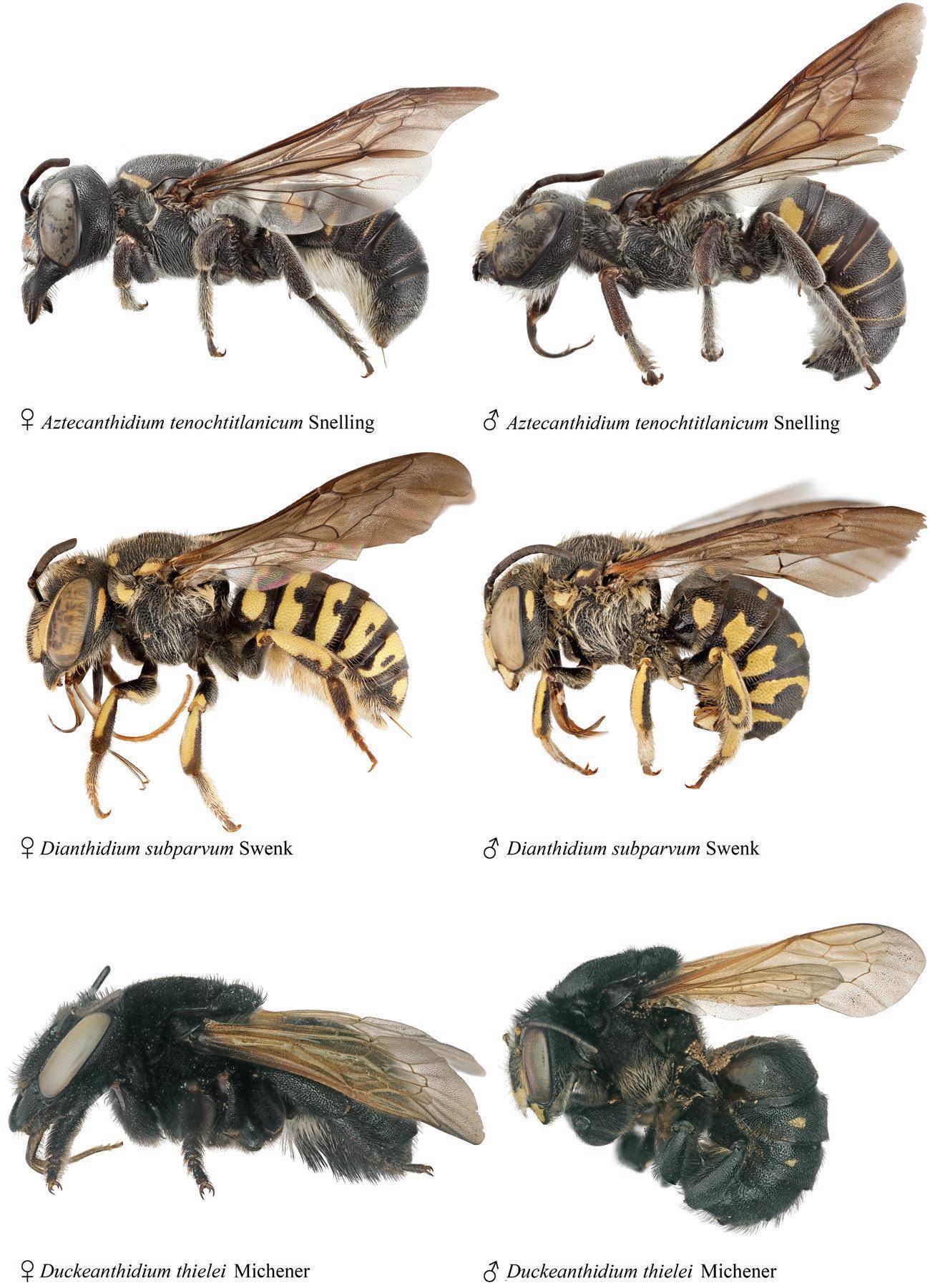
148. Aztecanthidium Anthidiini Megachilinae 3
149. Dianthidium Anthidiini Megachilinae 30
150. Duckeanthidium Anthidiini Megachilinae 1
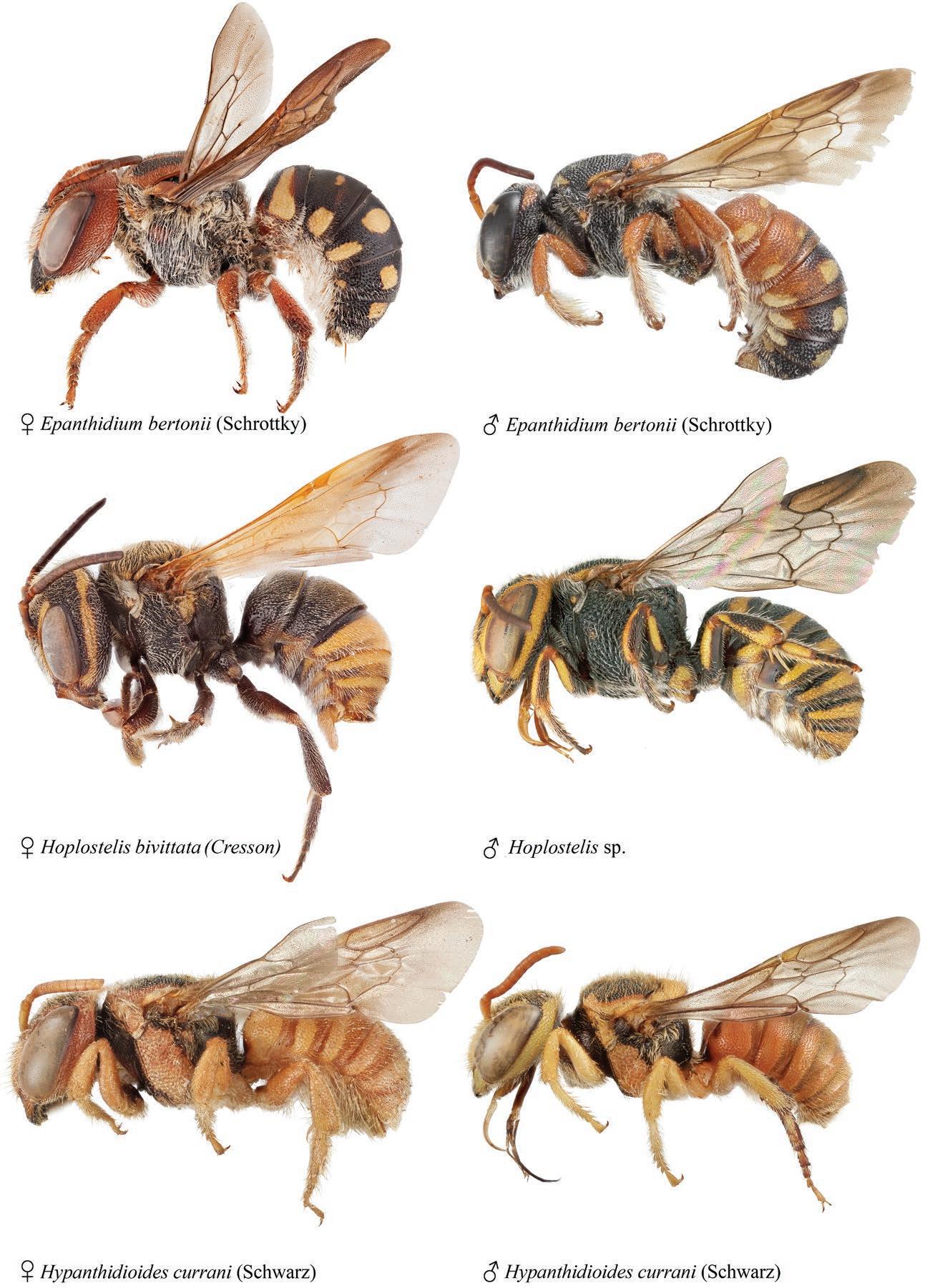
151. Epanthidium Anthidiini Megachilinae 1
152. Hoplostelis Anthidiini Megachilinae 2
153. Hypanthidioides Anthidiini Megachilinae 1
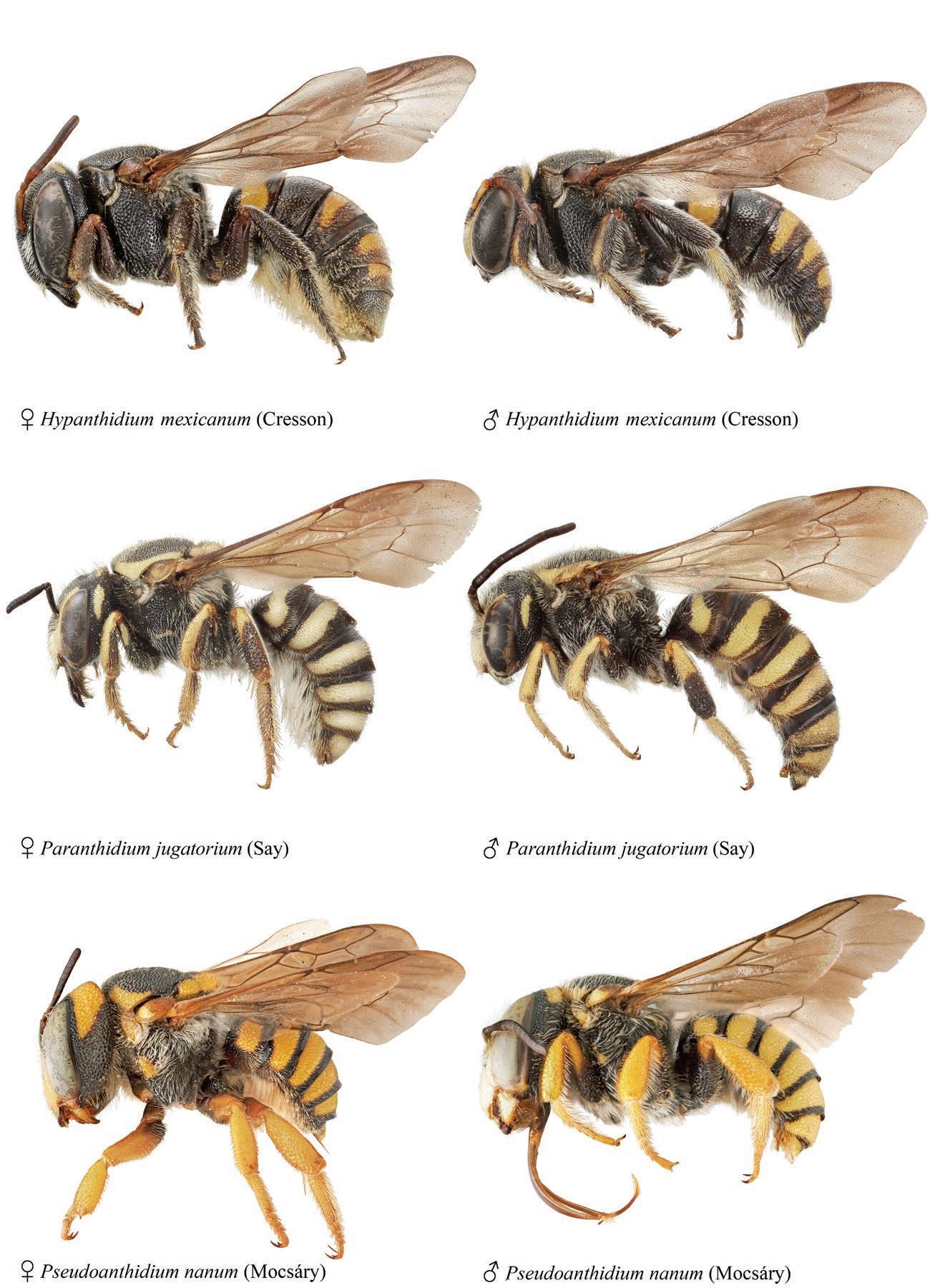
154. Hypanthidium Anthidiini Megachilinae 5
155. Paranthidium Anthidiini Megachilinae 6
156. Pseudoanthidium Anthidiini Megachilinae 1
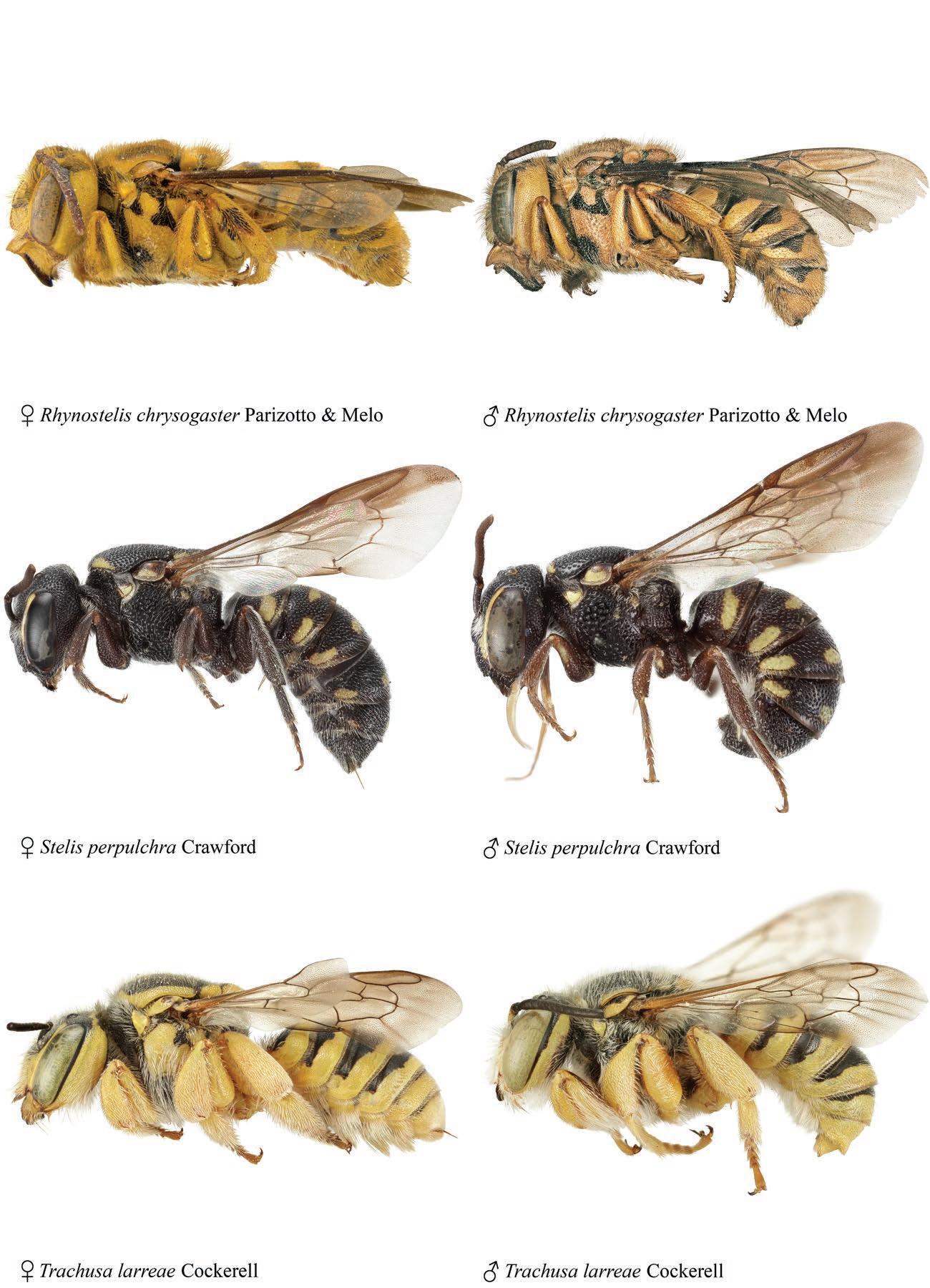
157. Rhynostelis Anthidiini Megachilinae 1
158. Stelis Anthidiini Megachilinae 61
159. Trachusa Anthidiini Megachilinae 24
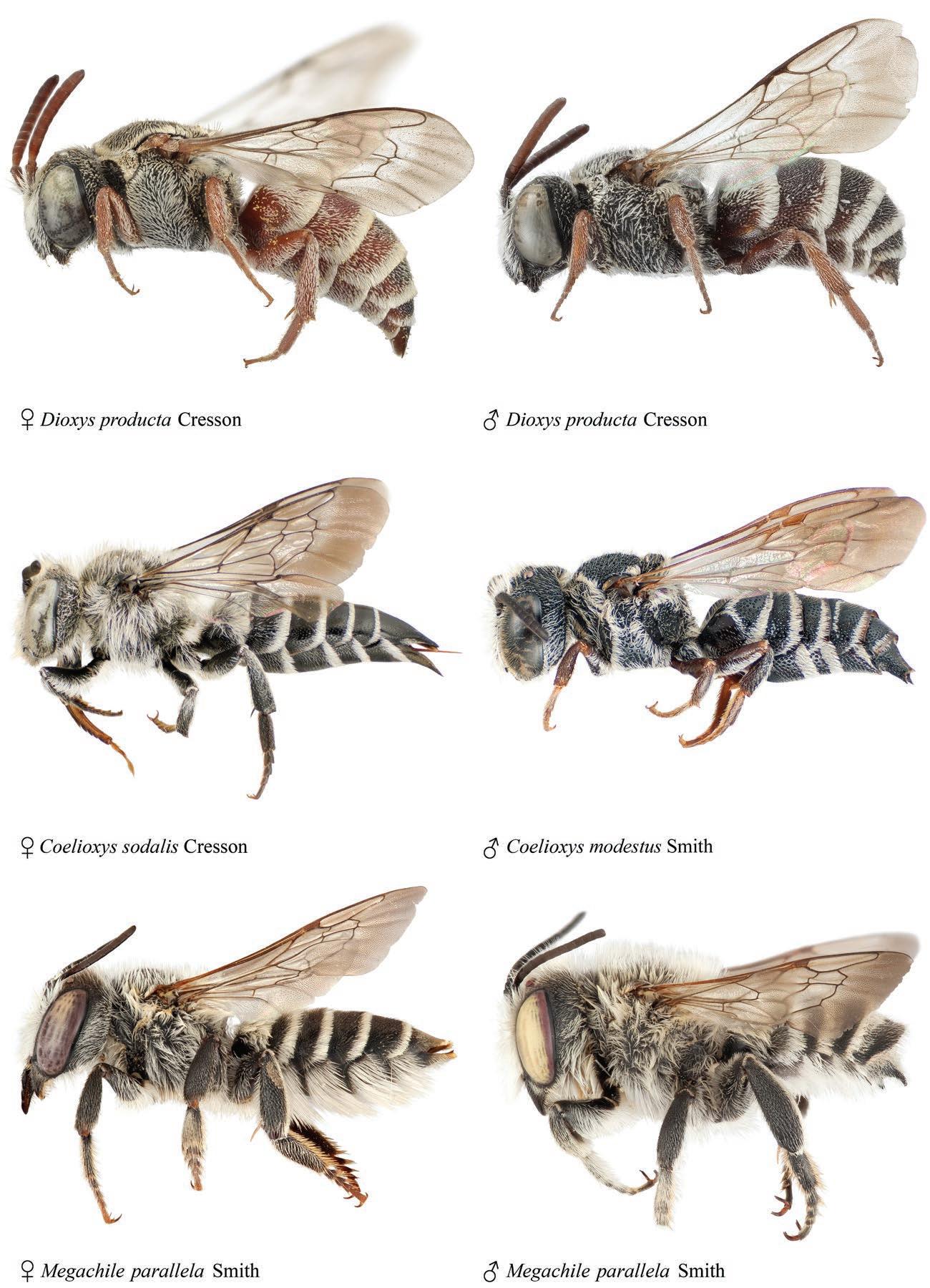
160. Dioxys Dioxyini Megachilinae 5
161. Coelioxys Megachilini Megachilinae 94
162. Megachile Megachilini Megachilinae 239
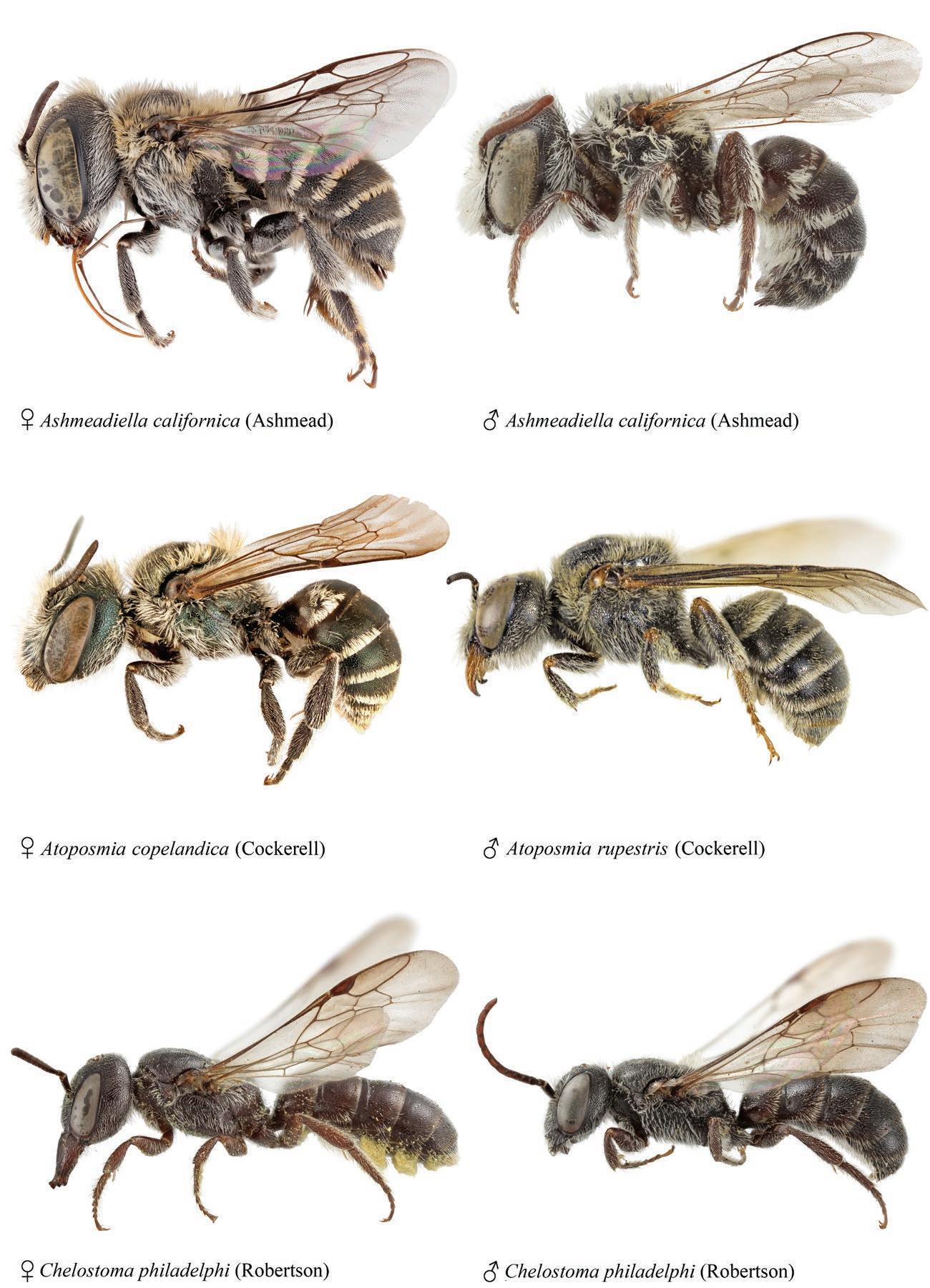
163. Ashmeadiella Osmiini Megachilinae 60
164. Atoposmia Osmiini Megachilinae 27
165. Chelostoma Osmiini Megachilinae 11
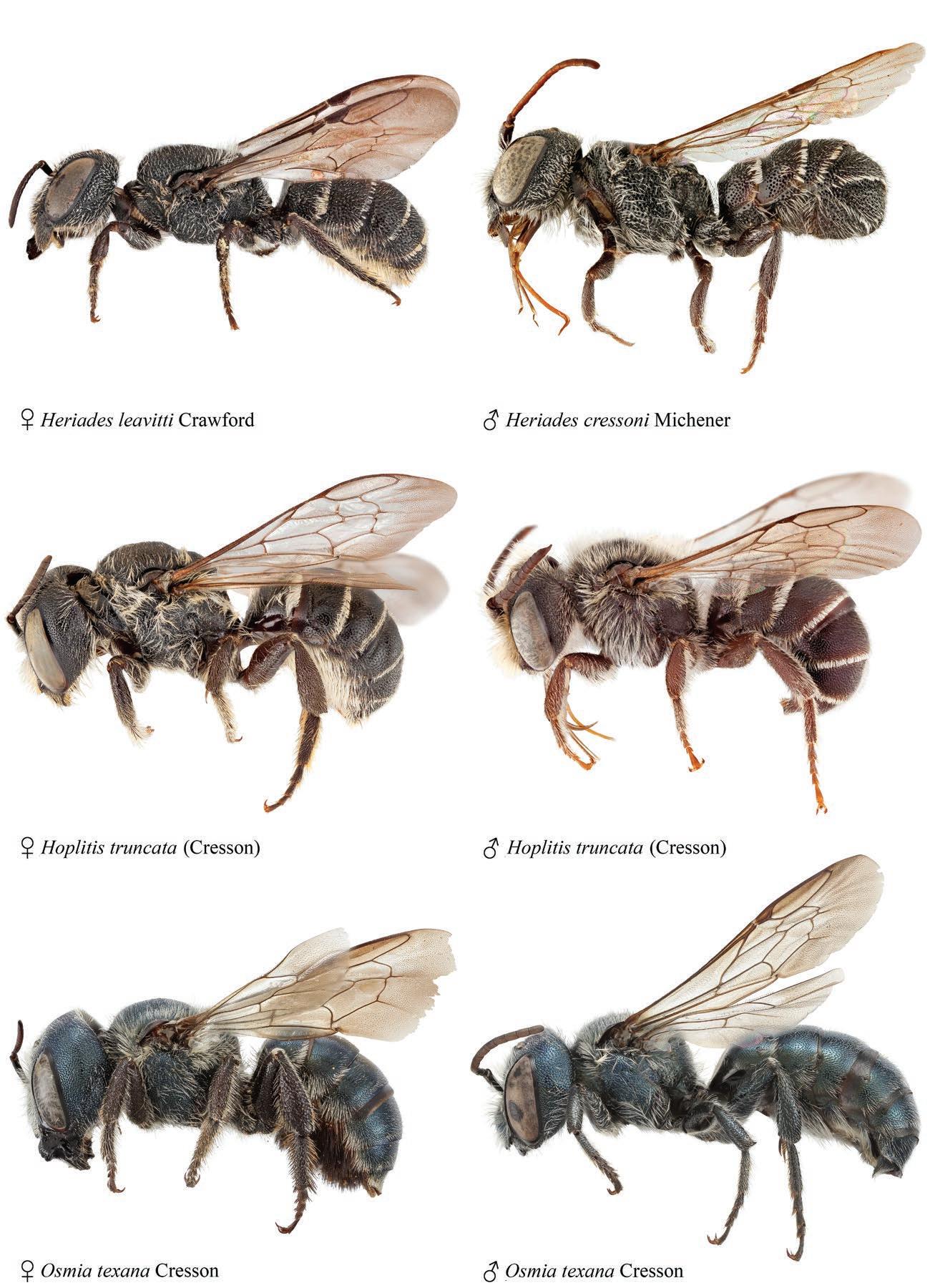
166. Heriades Osmiini Megachilinae 13
167. Hoplitis Osmiini Megachilinae 57
168. Osmia Osmiini Megachilinae 155
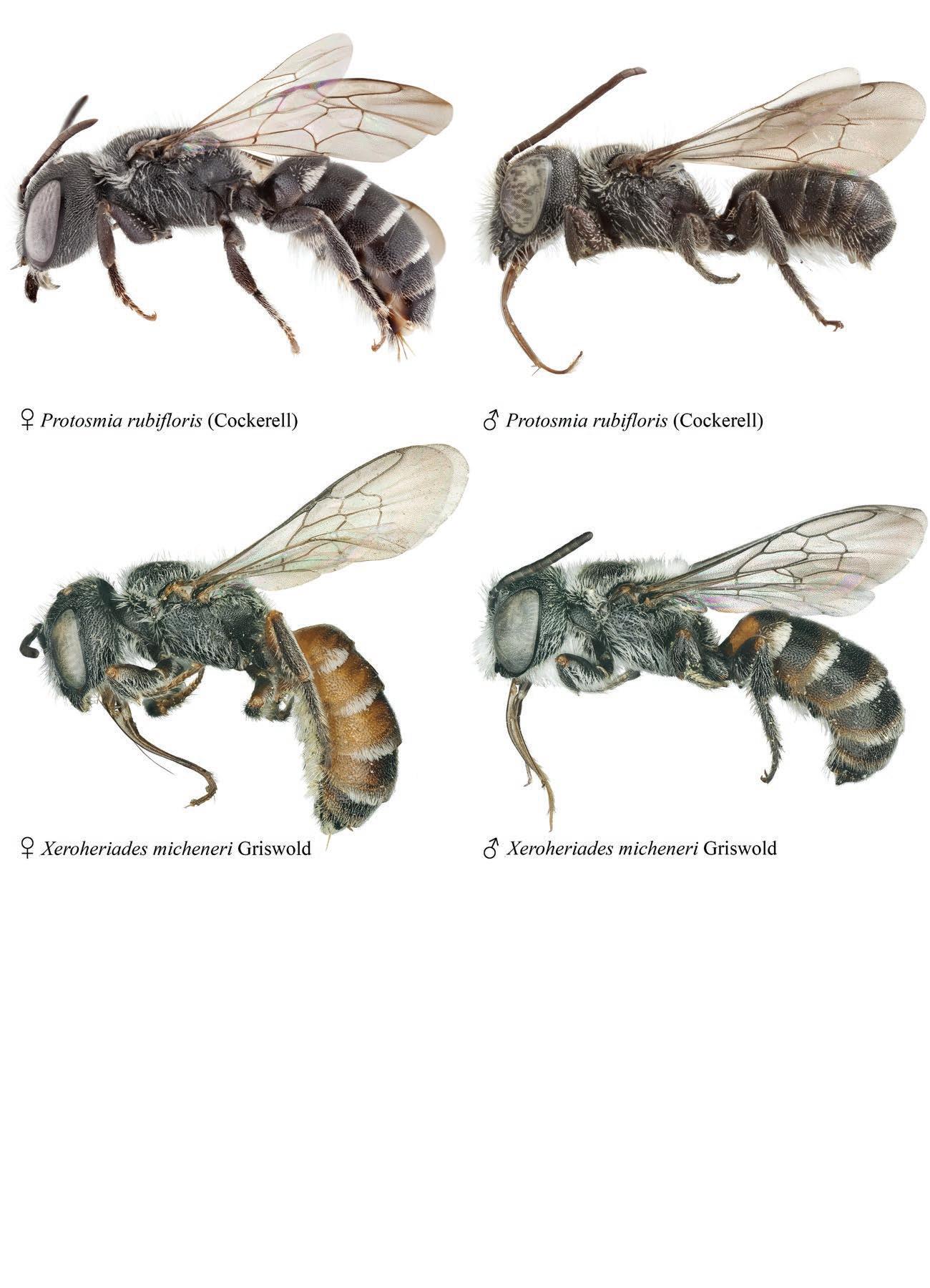
169. Protosmia Osmiini Megachilinae 1
170. Xeroheriades Osmiini Megachilinae 1
Melittidae
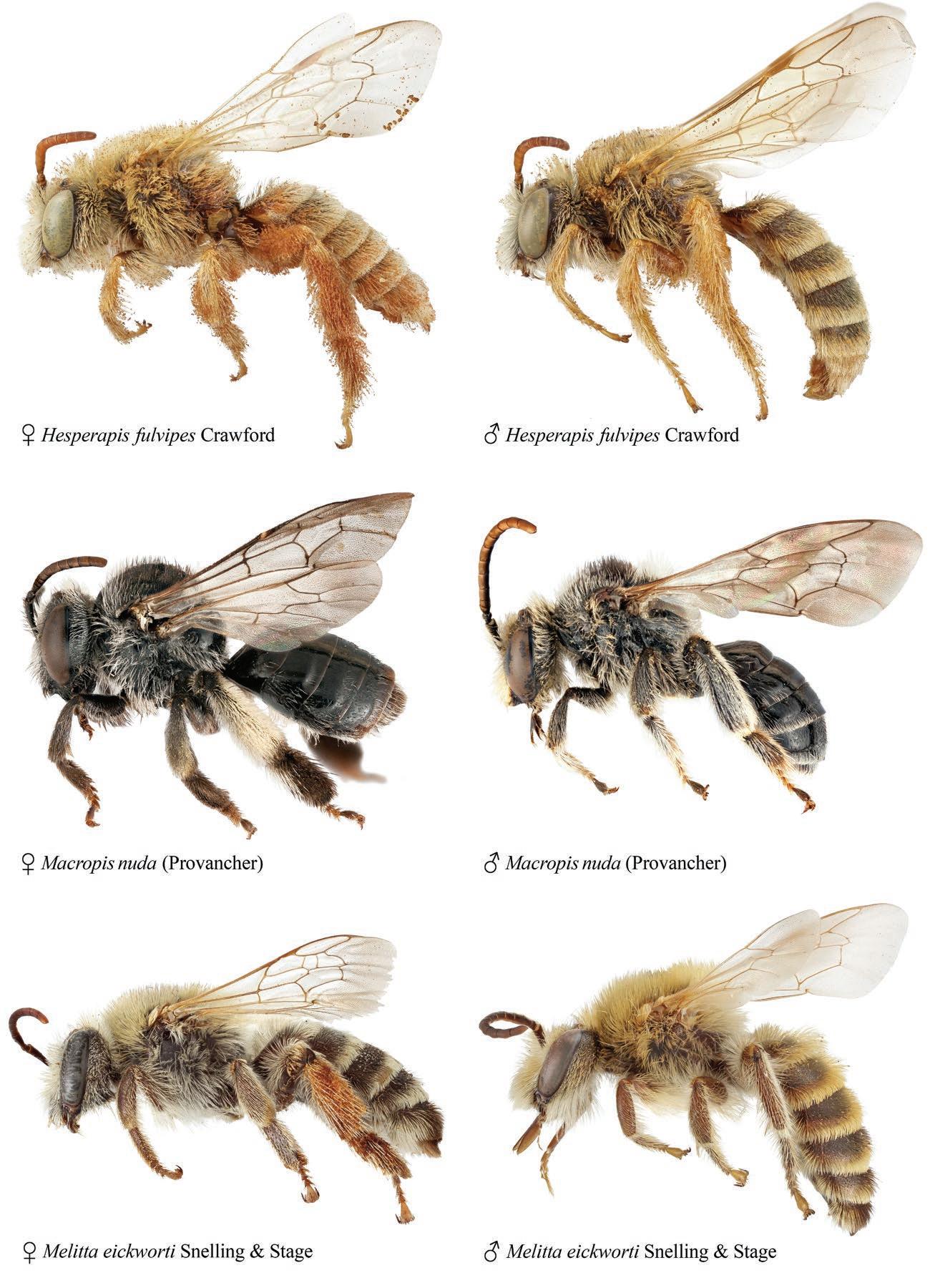
171. Hesperapis Hesperapini Dasypodainae 21
172. Macropis Macropidini Melittinae 4
173. Melitta Melittini Melittinae 5
THE CHANGING VIEW OF BEE PHYLOGENY AND CLASSIFICATION
THE ORIGIN OF BEES
In the 1970s, the relationship of bees to their hunting wasp relatives (the families Heterogynaidae, Ampulicidae, Sphecidae, and Crabronidae) was considered to be quite straightforward: bees (Apoidea) were sister to a monophyletic group including all four hunting wasp families (Sphecoidea) (Brothers, 1975). This view was called into question in the 1990s, when detailed morphological studies revealed that bees were actually more closely related to the family Crabronidae than to any of the other families (Melo 1999, Prentice 1998). The placement of bees (Apoidea) within “Sphecoidea” created a nomenclatural problem. Systematists do not like paraphyletic groups – groups that include part, but not all, of the descendants of a single common ancestor. The placement of Apoidea within “Sphecoidea” rendered “Sphecoidea” paraphyletic. This was resolved by eliminating “Sphecoidea” and considering all hunting wasp families plus bees as part of a larger Apoidea. The wasp families then became “apoid wasps,” and over time, bees have been referred to as “Apiformes” or “Anthophila,” which are rank-less names and therefore acceptable.
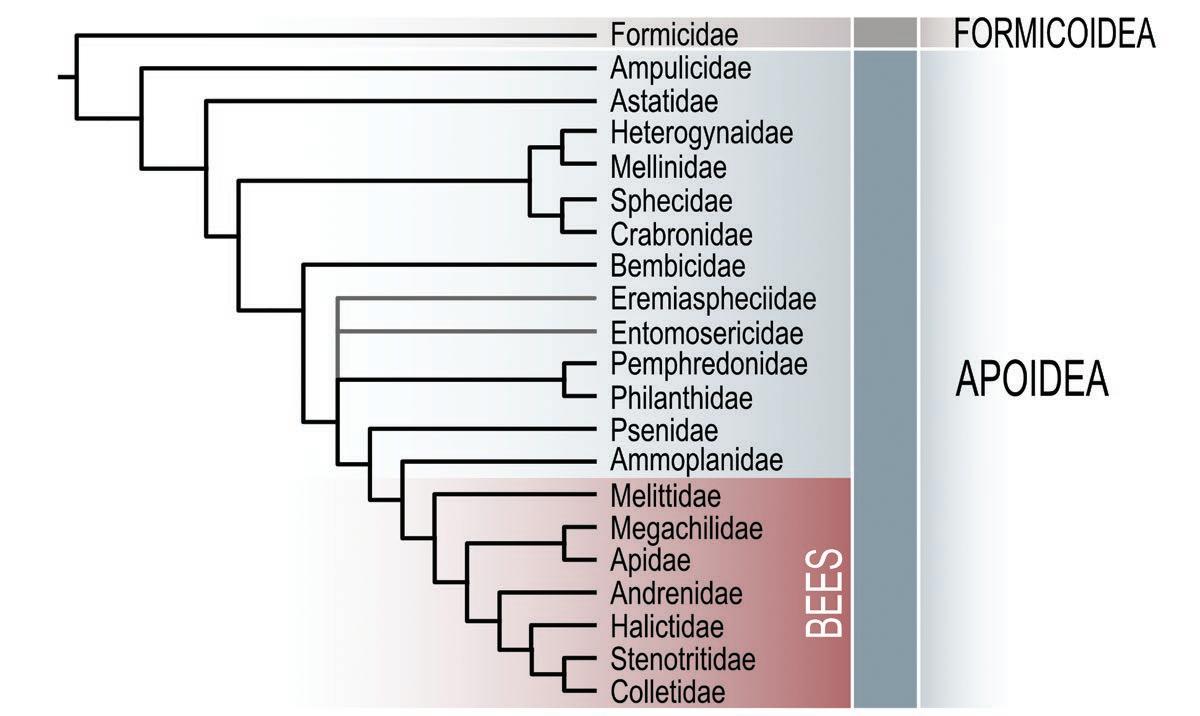
But things continued to change. With the addition of molecular datasets, we realized that, in fact, bees seemed to come out within Crabronidae (Ohl and Bleidorn 2006, Pilgrim et al. 2008, Debevec et al. 2012). These early molecular studies provided a slightly murky picture, but bees were consistently found to be closely related to two subfamilies of crabronid wasps, the Pemphredoninae and the Philanthinae. Philanthinae are a group of about 1,100 species of hunting wasps, which provision the brood cells of their young with arthropod prey items like beetles, ants, and even bees. Pemphredoninae are also a relatively small group of approximately 1,000 species of mostly minute wasps that hunt plant-feeding Hemiptera (aphids, scales, membracids), Thysanoptera (thrips), and Collembola (springtails). This, of course, was not the end of the story. More detailed studies, using many more species of hunting wasps and more extensive molecular data sets revealed something remarkable – bees were nested within Pemphredoninae, sister to a group of just 134 species of thrips-hunters in the subtribe Ammoplanina (now Ammoplanidae; Sann et al. 2018, 2021) (Fig. 3-1).
Bees are therefore highly derived pemphredonine wasps – a remarkable departure from what we thought to be true in the 1970s. This has huge implications for our understanding of bee origins and diversification (Murray et al. 2018). For a thorough discussion of this topic, see Danforth et al. (2019, ch. 12).
Figure 3-1. Phylogeny of the Apoidea at the family level following Sann et al. (2021). The phylogenetic placements of the recently erected families Entomosericidae and Eremiaspheciidae, as well as Heterogynaidae, remain to be clarified.
RELATIONSHIPS AMONG FAMILIES
Our understanding of bee family-level relationships has also changed dramatically over the past 30 years. Detailed studies of bee morphology published in the 1990s (Roig-Alsina and Michener 1993, Alexander and Michener 1995) suggested that the family Colletidae was the sister group to all other bees. At that time, we recognized additional families as well: Fideliidae, Oxaeidae, and Ctenoplectridae were all considered unique family-level groupings. (They have all now been subsumed into existing families.) The view that colletids were “primitive” bees was based primarily on the similarity between the bifid glossa of Colletidae and that of crabronid wasps. This similarity suggested that Colletidae were “primitive” bees. We now know that the bifid glossa of Colletidae and the bifid glossa of crabronid wasps are similar due to convergence and not shared common ancestry. (For a more detailed discussion of this topic, see Danforth et al. 2019, ch. 7).
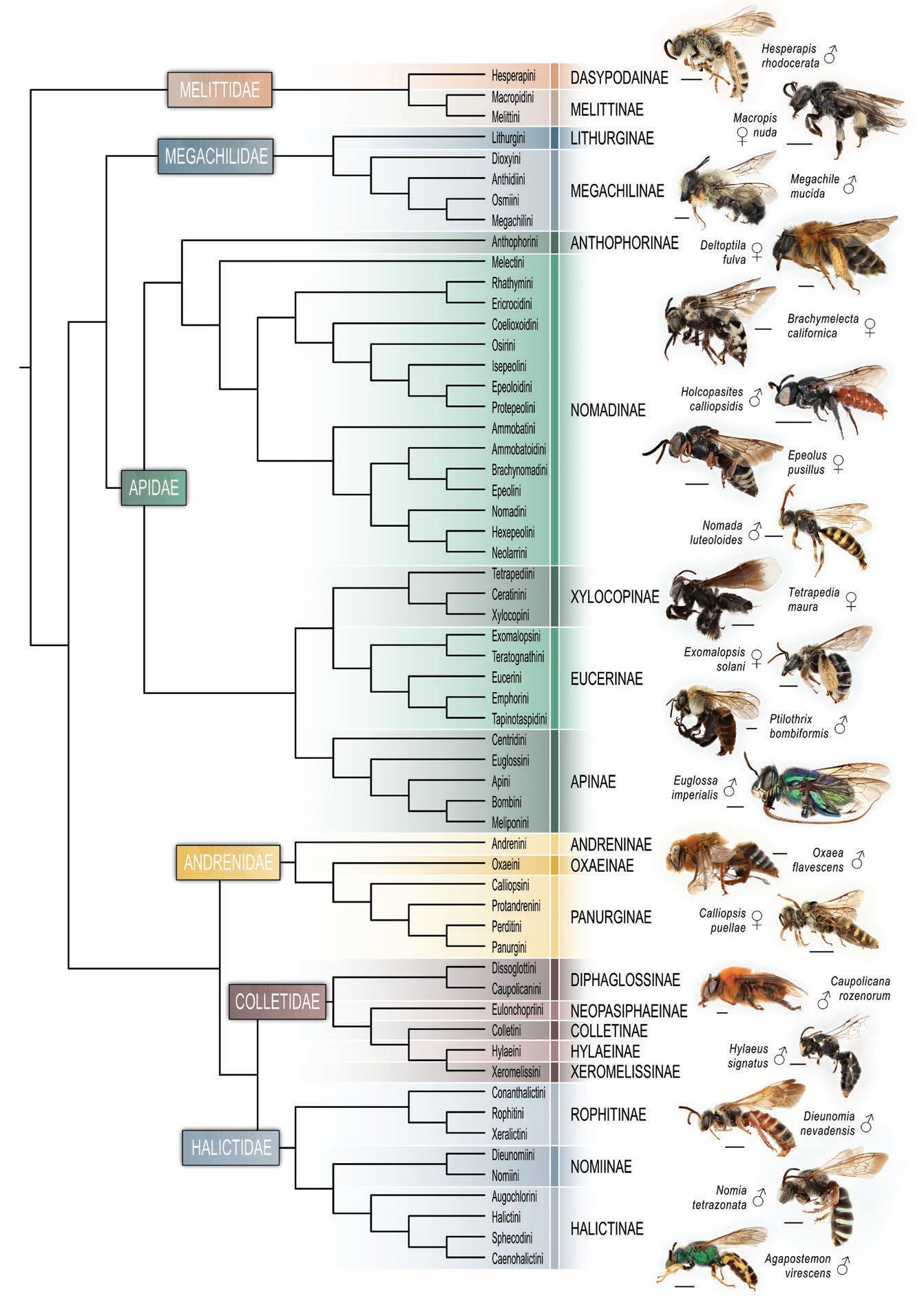
Figure 3-2 illustrates our current understanding of bee phylogeny at the family, subfamily, and tribal levels for groups in North and Central America. Melittidae are the sister to all the other bee families combined. Apidae and Megachilidae form a clade of “long-tongued” bees, with highly modified labial palpi (see Chapter 4). Another monophyletic group includes Andrenidae, Halictidae, and Colletidae (as well as Stenotritidae, the smallest bee family, with just 21 described species, from Australia, meaning that they are outside the scope of this book).
Figure 3-2. Phylogeny of bee families, subfamilies, and tribes in North and Central America. Phylogeny based on Almeida et al. (2023). Scale bars = 2 mm.
RELATIONSHIPS WITHIN FAMILIES
Andrenidae
Andrenid phylogeny and classification has been challenging. In the first edition, Michener et al. (1994), Andrenidae consisted of just two subfamilies: Andreninae and Panurginae. Oxaeinae (now considered a third subfamily) was treated as the family Oxaeidae. Molecular as well as morphological data support the view that Oxaeinae is sister to Panurginae and, therefore, part of Andrenidae (reviewed in Bossert et al. 2021). Panurgine classification has been particularly challenging, but a recent phylogenetic study (Bossert et al. 2022) provides a clearer picture of panurgine generic and tribal relationships. We follow their classification here. All three subfamilies occur in the region covered by this book.
The genus Andrena is a particularly challenging group. Andrena consists of more than 1,600 described species and 104 currently recognized subgenera (Pisanty et al. 2021). Phylogenetic analysis of 235 species representing 98 genera (based on genomic ultraconserved elements) showed that many subgenera are paraphyletic or polyphyletic (Pisanty et al. 2021). Much work is needed to resolve the classification of this group.
Apidae
No other family of bees has undergone as much change in the classification as the family Apidae (as currently construed). In the first edition of this book, we recognized two families: Apidae (including the four corbiculate bees: Euglossini, Bombini, Meliponini, and Apini) and “Anthophoridae,” which included all the remaining groups. In the 1990s, morphological studies by Roig-Alsina and Michener (1993) revealed that the corbiculate bees arise from within the group referred to as “Anthophoridae.” This rendered the “Anthophoridae” a paraphyletic group. Roig-Alsina and Michener (1993) chose to expand Apidae to include all the subfamilies, tribes, and genera previously placed in “Anthophoridae” plus corbiculates, and they recognized three subfamilies: Apinae (expanded to include the four corbiculate tribes as well as many others formerly in “Anthophoridae”), Nomadinae (an exclusively brood-parasitic group, which included most, but not all, brood-parasitic Apidae), and Xylocopinae (the allodapine and carpenter bees). But the story does not end there. Subsequent molecular and morphological studies (Cardinal et al. 2010, Bossert et al. 2019, Sless et al. 2022) revealed that many tribes of brood parasites that were considered part of Michener’s Apinae (Melectini, Ericrocidini, Coelioxoidini, Osirini, Protepeolini, Isepeolini, and the genera Parepeolus [now Parepeolini] and Epeoloides [now Epeoloidini]) were, in fact, closely related to the brood parasites in the subfamily Nomadinae. Furthermore, both Nomadinae and Xylocopinae rendered Apinae paraphyletic. Bossert et al. (2019) provided what is now the current classification, recognizing five monophyletic subfamilies of Apidae (Anthophorinae, Nomadinae, Eucerinae, Apinae, and Xylocopinae), all of which are present in North and Central America.
Colletidae
Phylogenetic studies in the past 20 years revolutionized our understanding of colletid higherlevel relationships and provided an unprecedented look at the historical biogeography of this group (Almeida and Danforth 2009; Almeida et al. 2012, 2019). Colletids are a mostly southern hemisphere group with greatest generic diversity in South America and Australia. Most of the higher-level changes in the classification have had limited impact on the fauna of North
and Central America. One exception is that the subfamily Colletinae has been subdivided into Colletinae (Colletes and relatives in South America) and Neopasiphaeinae (a large group of mostly southern hemisphere bee genera; Eulonchopria is our sole representative). Subfamilies present in our area include Diphaglossinae, Colletinae, Hylaeinae, Xeromelissinae, and Neopasiphaeinae.
Halictidae
Halictidae, which includes four subfamilies, is a challenging group from a phylogenetic perspective largely because of the largest subfamily, Halictinae. Halictinae includes several very species-rich genera, such as Lasioglossum and Halictus, that have been described as “morphologically monotonous” by Charles Michener (2007:354). Halictinae, in the earlier version of this book, included just two tribes: Halictini and Augochlorini. We now recognize five tribes of Halictinae based on molecular and morphological studies over the past 20 years (Danforth et al. 2004, 2008; Gibbs et al. 2012): Augochlorini, Caenohalictini, Sphecodini, Thrinchostomini, and Halictini. Only Thrinchostomini occurs outside of the geographic scope of this book. Phylogenetic relationships within tribes have been recently analyzed by Gonçalves (2016; Augochlorini), Gonçalves and Melo (2010; Caenohalictini), Gibbs et al. (2012: Halictini), and Gonçalves (2021; Sphecodini). Two smaller subfamilies occur in our area: Rophitinae and Nomiinae. The fourth, Nomioidinae, is exclusively Old World.
Megachilidae
The subfamily and tribal classifications used in the original version of the book have not changed dramatically. We follow Gonzalez et al. (2012) for subfamily and tribal classification. For generic classification within tribes, we follow Praz et al. (2008; Osmiini), Litman et al. (2016; Anthidiini), and Trunz et al. (2016; Megachilini). While five subfamilies are recognized worldwide (Fideliinae, Neofideliinae, Pararhophitinae, Lithurginae, and Megachilinae), we only have two subfamilies in the region covered herein: Lithurginae and Megachilinae. The vast majority of our species are in the Megachilinae.
Megachile is the largest genus of megachilid bees, with more than 1,400 described species and 50 currently recognized subgenera. Some recent studies (e.g., Gonzalez et al. 2019) have proposed dividing the genus Megachile into more than 20 genera, many of which are difficult to diagnose morphologically. We retain the broader definition of Megachile, following Michener (2007) and Trunz et al. (2016).
Melittidae
Melittids are an enigmatic group. The family includes just over 200 species of ground-nesting, solitary bees; most species have narrow host-plant preferences. They are most common in xeric regions of the Nearctic and Old World, with a center of diversity in Africa. Melittids are a difficult group to diagnose; there is no single morphological trait that unites all three subfamilies (Melittinae, Dasypodainae, and Meganomiinae). Melittids have not always been recovered as a monophyletic group (e.g., Danforth et al. 2006). However, recent studies based on large and comprehensive molecular data sets have demonstrated melittid monophyly (Branstetter et al. 2017, Almeida et al. 2023). Two of the three subfamilies are represented in our area: Melittinae and Dasypodainae (Fig. 3-2).
A PRIMER ON BEE MORPHOLOGY
IN ORDER TO USE THE KEYS in this book effectively, it is important to become familiar with the morphology of bees and the terms used to describe morphological features. With that goal in mind, we present below an overview of bee morphology and an introduction to the terms that are used throughout the keys. We follow the terminology used in Michener (2007), which is based on morphological studies of bees that date back to Michener’s PhD thesis (Michener 1944). Additional key papers on bee morphology include Urban (1967), Camargo et al. (1967), Eickwort (1969), Stephen et al. (1969), and Brooks (1987). The illustrations in this chapter include redrawn figures from Michener et al. (1944), Michener (1965), and Danforth (1996) as well as original illustrations. For a detailed look at the internal and external anatomy of the honey bee ( Apis mellifera Linnaeus), see Snodgrass (1956). For a comprehensive and modern overview of general insect morphology, see Beutel et al. (2014).
BODY REGIONS
Before diving into the details, let’s consider a basic question. What do we call the three body regions in bees? For most insects, the body is divided into three distinct regions: head, thorax, and abdomen. The abdomen houses the reproductive, digestive, and excretory organs. The thorax houses the leg and flight muscles, and the head bears the sensory organs and mouthparts. However, in most Hymenoptera (bees included), the thorax and abdomen have been reconfigured to such an extent that we cannot use these same terms. In Apocrita (= Hymenoptera with a narrow waist), the first abdominal segment has become attached to the posterior region of the thorax, and the narrow “waist” is actually a constriction between abdominal segments 1 and 2. Therefore, in Apocrita, we need to use slightly different terms.
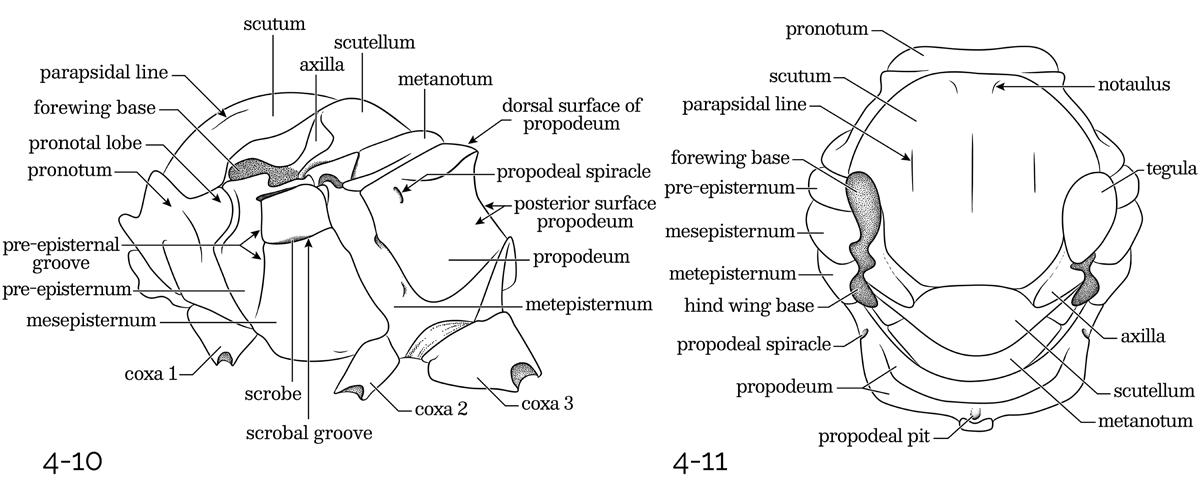
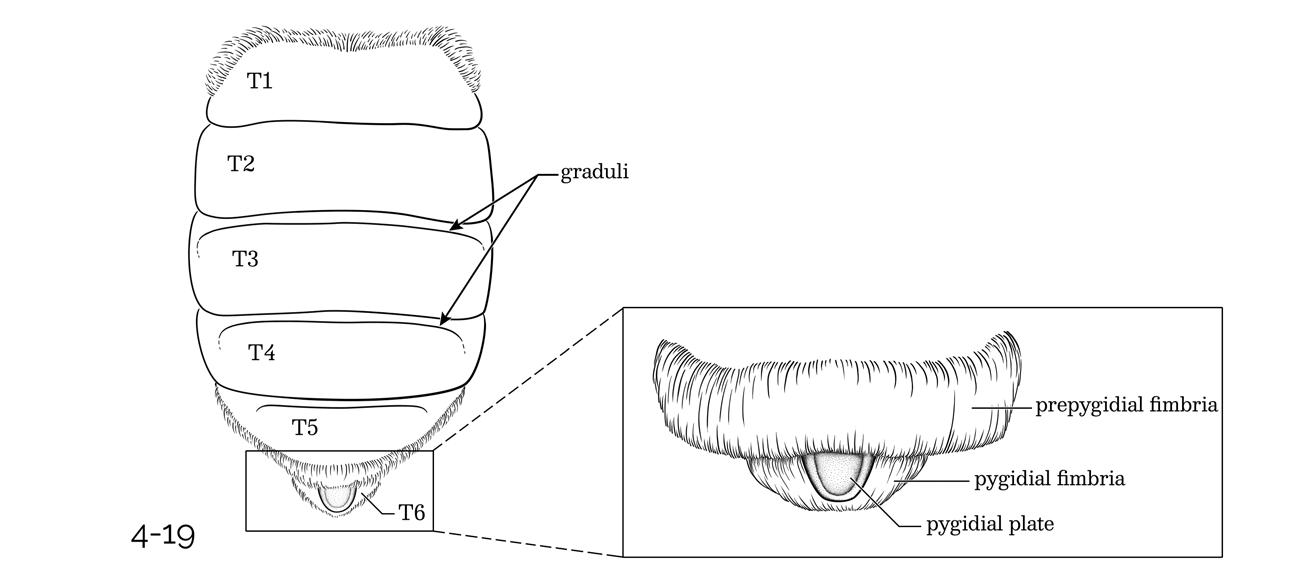
In Apocrita, we refer to the mesosoma (= thorax plus first abdominal segment, or propodeum) [Fig. 4-10] and metasoma (= remaining abdominal segments). Thus, in bees, we refer to the three body regions as head, mesosoma, and metasoma. The head and mesosoma are complex structures, and we will cover those below. The metasoma, by contrast, is fairly simple. It consists of dorsal sclerites (terga; singular: tergum) paired with ventral sclerites ( sterna; singular: sternum) to form a tube enclosing the internal organs plus genitalia. For use of the keys, it will be important to identify specific metasomal terga or sterna. To do so, we number terga and sterna of the metasoma starting with metasomal segment 1. Therefore, the first metasomal tergum is T1, the second T2, and so forth. The same is true for sterna: the first metasomal sternum is S1, the second S2, and so forth [Fig. 4-19]. Make sure that you are comfortable with identifying specific metasomal terga and sterna before you start using the keys.
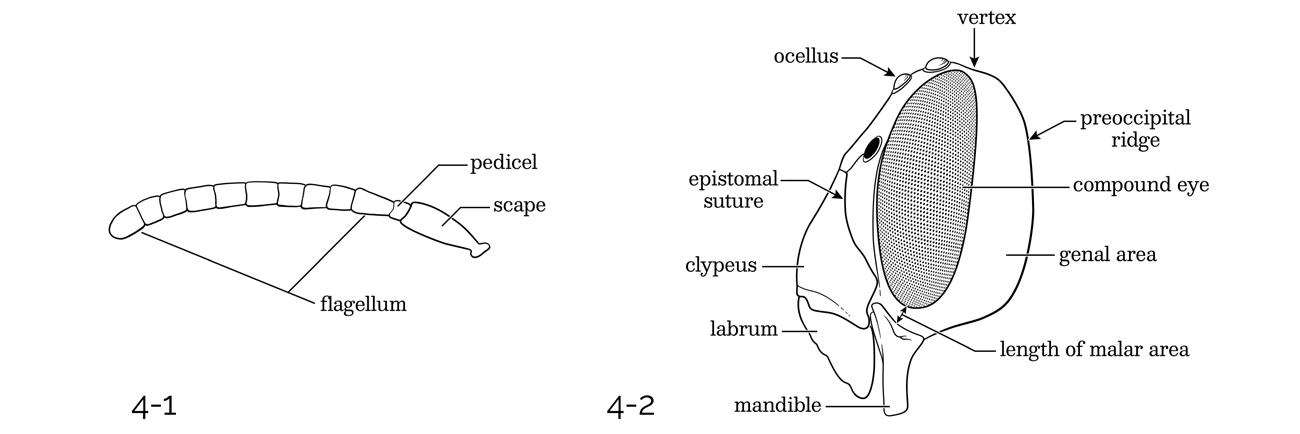
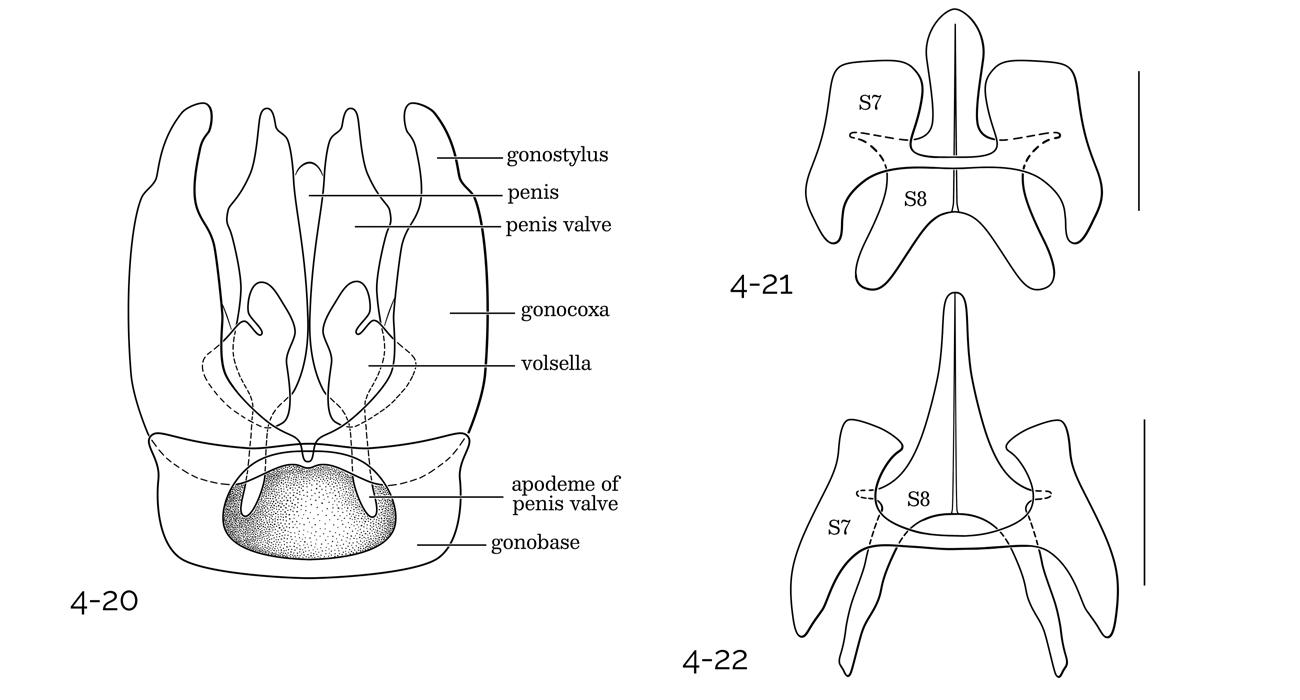
The sexes in bees are often quite different from one another, and in parts of the keys, the sexes are treated separately. To people familiar with bees, males and females can be distinguished most rapidly based on the overall shape of the body – males are typically more slender than females, and they often have longer antennae. The presence of a distinct scopa (pollen- collecting structure) will distinguish females from males in many groups (excluding brood parasites, bees that carry pollen internally, and queens of advanced eusocial species). Finally, females have stings, and males have male genitalia [Fig. 4-20], but both are commonly retracted, and in some females, the sting is rudimentary. Other features may need to be examined to verify the sex of an individual, including the number of antennal segments and the number of visible metasomal segments. Males have 13 antennal segments (12 in Biastes [subgenus Neopasites] and Holcopasites); females have 12 [Fig. 4-1].
In addition, males and females typically differ in the number of visible metasomal segments. In males, we can usually count 7 visible metasomal terga, whereas in females we can usually count only 6 [Fig. 4-19]. But keep in mind that the last segment, which often bears a pygidial plate, can be hidden. In female Halictinae, for example, T6 is often hidden beneath T5, so females appear to have just 5 visible terga. Likewise, in some male bees, it is difficult to see T7 because it is largely, or rarely, wholly hidden beneath T6. In addition, in males of some groups (e.g., Osmiini), the segments are greatly telescoped and retracted so that the visible terga and sterna can be reduced to as few as 4.
Head Capsule [Figs. 4-1 – 4-4]
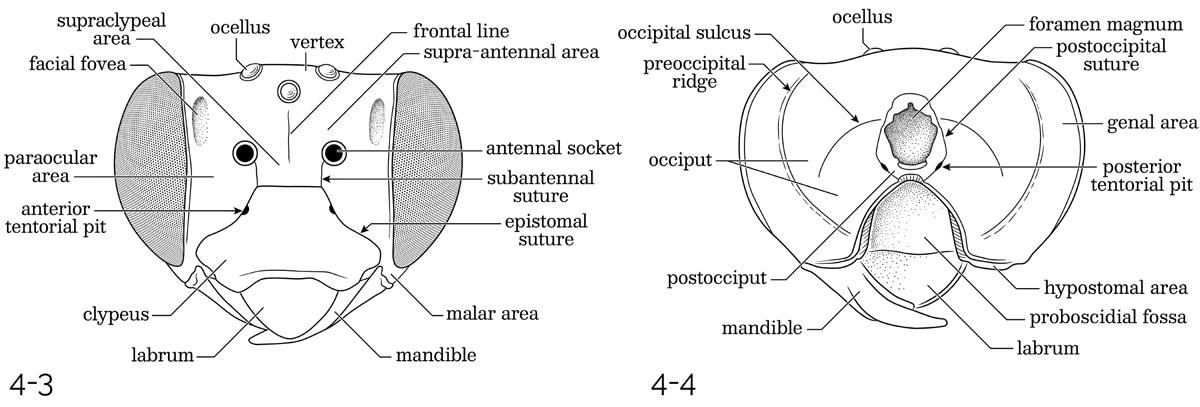
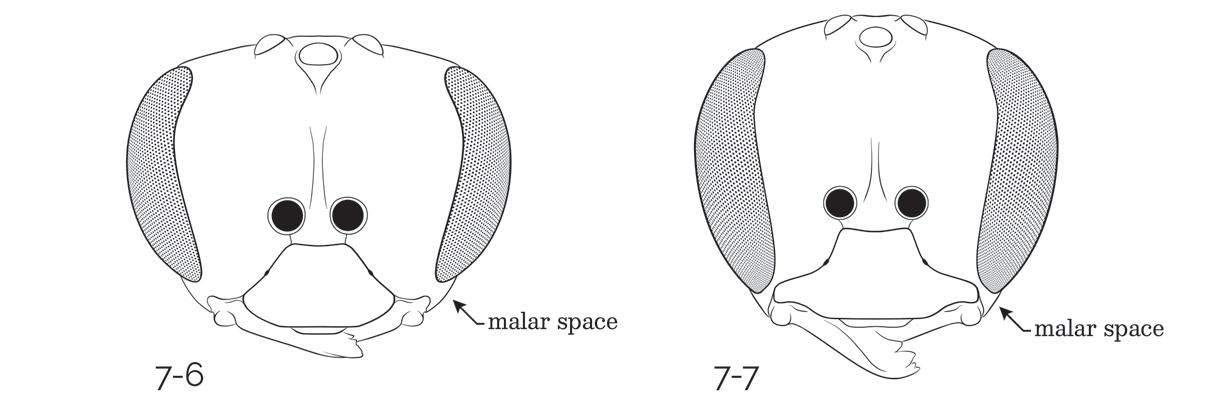
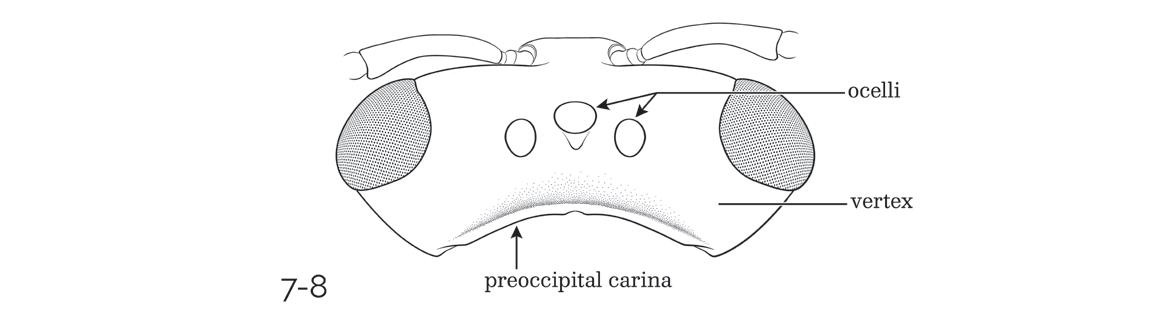
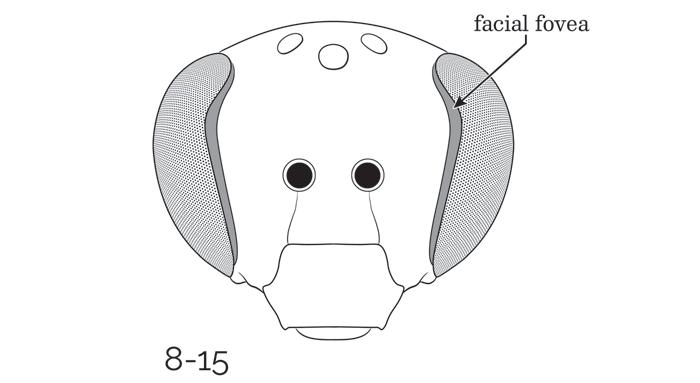
The malar area [Fig. 4-2] is the space between the eye and the mandible; its length is the shortest distance from the eye to the mandible; the width of this area is the width of the base of the mandible. The foveae (singular: fovea) of the face [Fig. 4-3] and of the sides of the second metasomal tergum (T2) are shallow depressions, usually black in color, with a texture distinct from the surrounding cuticle and variable in shape. The term orbit is often used for the eye margin, inner orbit for the frontal or facial margin, and outer orbit for the genal margin. The genal area, or gena, is the region behind the eye and in front of the preoccipital ridge, the ridge surrounding the concave posterior surface of the head above and laterally [Figs. 4-3 and 4-4]. A carina sometimes found on this ridge is the preoccipital carina. The proboscidial fossa is the large, deep groove on the underside of the head into which the proboscis folds [Fig. 4-4].
Mouthparts [Figs. 4-5 – 4-9]
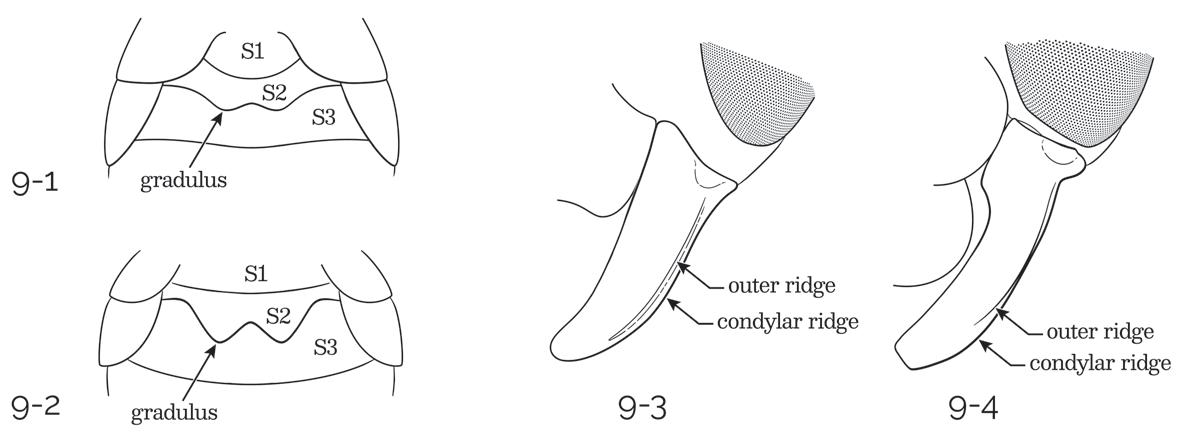
Bee mouthparts consist of paired mandibles for chewing and a proboscis that can fold and unfold for lapping and sucking nectar. For the names of mandibular structures [Fig. 4-5], we usually follow Michener and Fraser (1978). For simplicity, we often refer to preapical teeth on the upper margin instead of teeth of the pollex. Other terms used herein are the condylar ridge, which arises near the mandibular condyle and extends toward the apex of the mandible, and the outer ridge, which is the next ridge above the condylar ridge on the outer surface of the mandible.
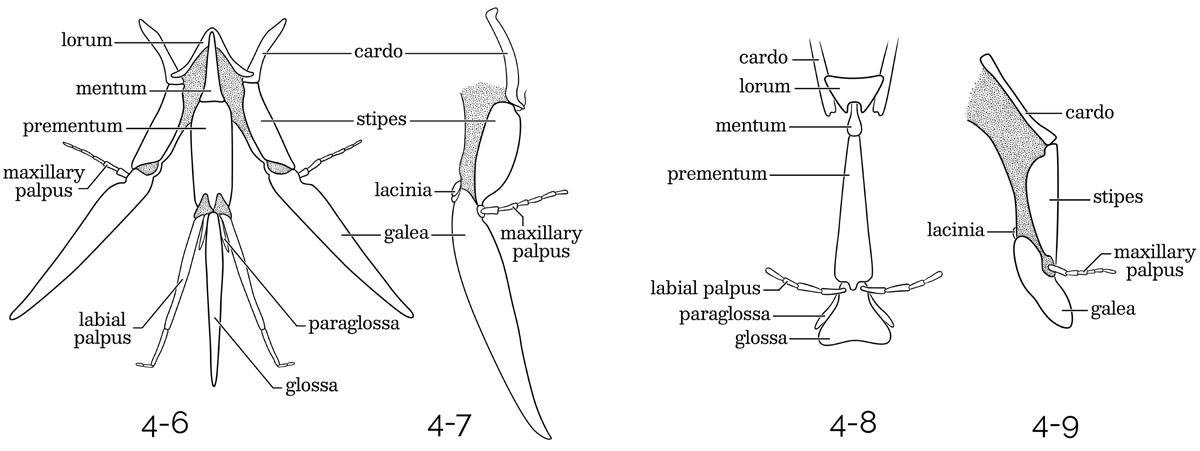
The bee proboscis is a complex structure formed from a fusion of the maxilla and labium, which together make up the labiomaxillary complex. The maxilla consists of paired cardines (singular: cardo) that suspend the labiomaxillary complex from beneath the head capsule, the stipes, blade-like galea (plural: galeae), and the maxillary palpus (plural: palpi ) with up to six segments [Figs. 4- 6, 4-7]. Attached at the apex of the cardines is the labium, which consists of the lorum, mentum, prementum, tongue-like glossa, and (typically) four-segmented labial palpus [Fig. 4-6]. In Colletidae the glossa is quite different from that of other bees [Figs. 4- 8, 4- 9]. Rather than being slender and elongate, as in most other bee families, the colletid glossa is short and bilobed (sometimes referred to as “bifid”). This modification of the glossa is related to the application of the thick, cellophane brood cell lining that characterizes colletid bees (Batra 1980; McGinley 1980).
Bees can be divided into two broad categories based on mouthpart morphology: shorttongued bees (Andrenidae, Halictidae, Colletidae, Stenotritidae, and Melittidae), in which the labial palpal segments are usually all similar in morphology [Fig. 4-8], and long-tongued bees (Apidae and Megachilidae), in which the first two labial palpal segments are slender and blade-like [Fig. 4-6]. Danforth et al. (2019) provide a more detailed description of the proboscis and how it functions.
The proboscis is typically folded beneath the head capsule, making it very difficult to distinguish among the complex and interconnected elements. However, if the mouthparts are pulled before pinning, while the specimen is still flexible, the individual elements can be easily recognized. In some cases, it is necessary to examine the maxillary and labial palpi and to count the number of palpal segments (e.g., in certain Eucerini and Perditini). It can also be useful to be able to identify the blade-like first two labial palpal segments in long-tongued bees as a tool for knowing whether you are examining a short-tongued or long-tongued bee. But this is by no means essential for using the keys to the genera. Chapter 11 (“Key to the Families”), however, makes heavy use of mouthpart characters, because they are defining features of the bee families.
Mesosoma [Figs. 4-10 – 4-18]
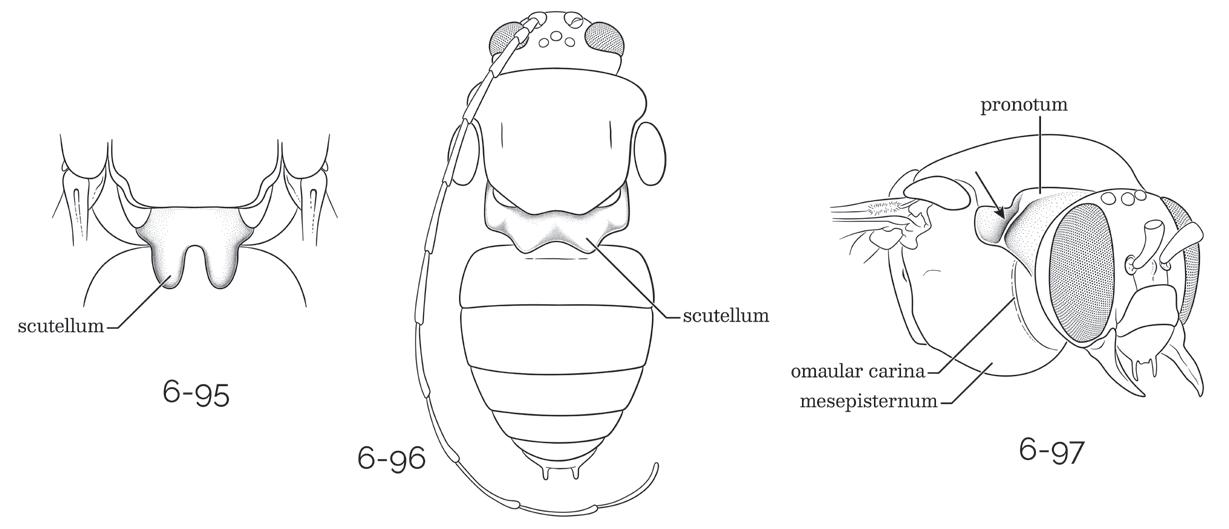
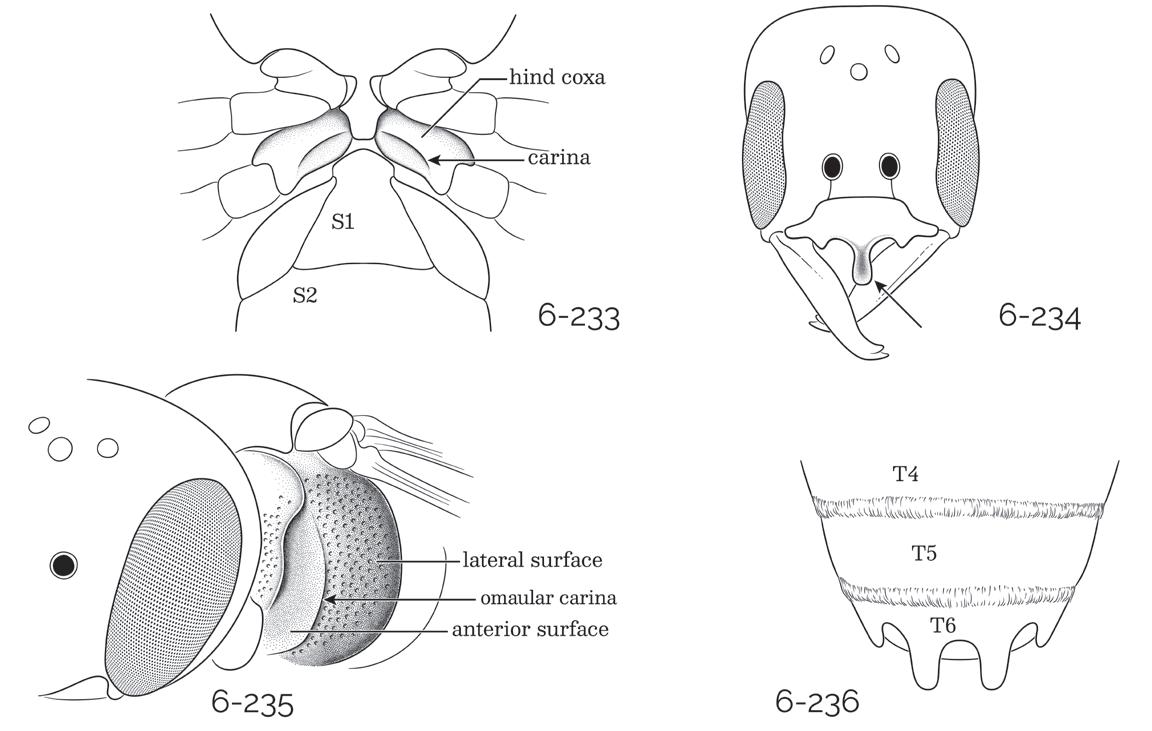
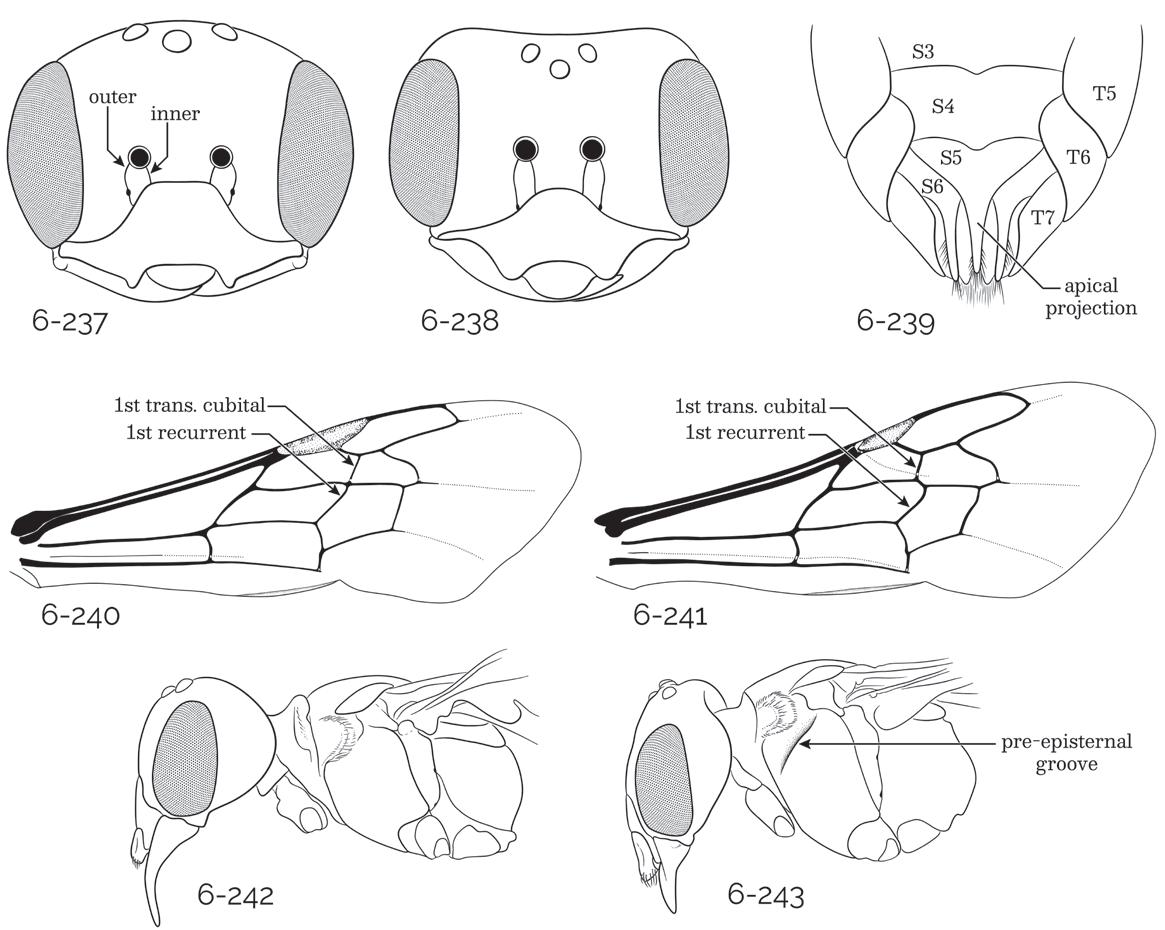
The mesosoma is a compact structure consisting of sclerites of the pro-, meso- and metathoracic segments, which bear the legs and wings, and the first true abdominal segment, termed the propodeum [Figs. 4-10 and 4-11]. The prothorax in bees is represented primarily by the large pronotum, which extends laterally and meets ventrally behind the forecoxae, forming a tubelike structure. The pronotal lobe is a useful landmark, and its shape and location may be used in generic identification. The mesothorax and metathorax bear the wings and the second and third pairs of legs. In dorsal view [Fig. 4-11], the mesothorax can be divided into distinct sclerites: the scutum, the scutellum, and paired axillae (singular: axilla). Dorsally, the metathorax consists of a single sclerite, the metanotum. Laterally [Fig. 4-10], the mesothorax is represented by the mesepisternum, sometimes referred to as the mesopleuron. The mesepisternum is sometimes divided by the pre- episternal groove into the pre- episternum (or pre- episternal area) and the rest of the mesepisternum. The shape and location of the pre- episternal groove, the scrobal groove, and the scrobe are often important in generic identification. In some genera (such as Ashmeadiella, Rhynostelis, Hoplostelis [Megachilidae], and some Protandrena [Andrenidae]), the mesepisternum is divided by a sharp, vertical carina (the omaular carina) into an anterior surface, which is smooth and shiny, and a lateral surface, which is punctate [Fig. 6-235].
The metepisternum (or metapleuron) forms the lateral surface of the metathorax. The wing bases are located above the upper margins of the mesepisternum and the metepisternum.
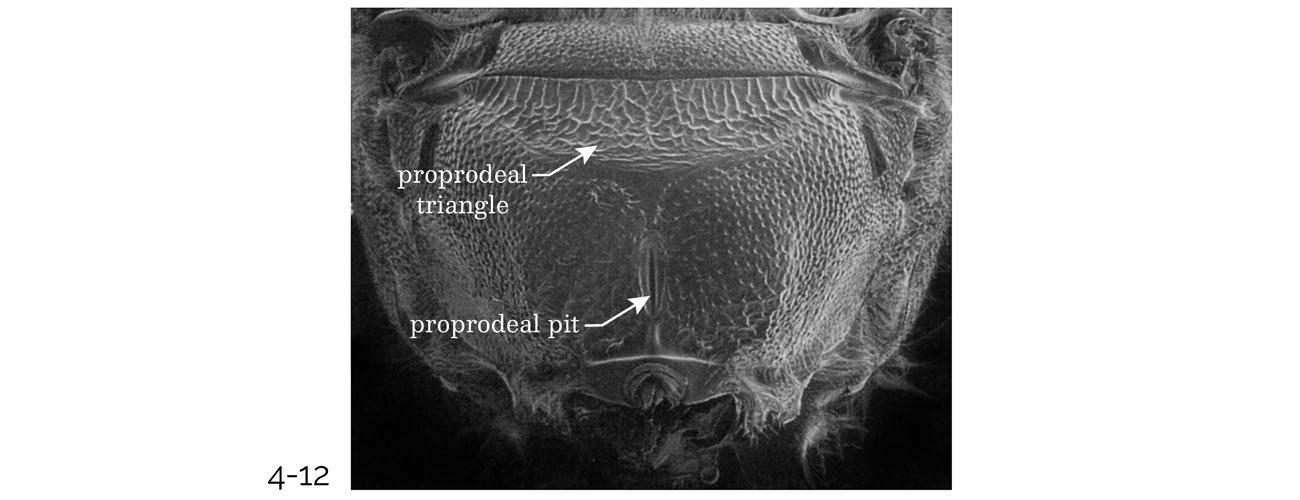
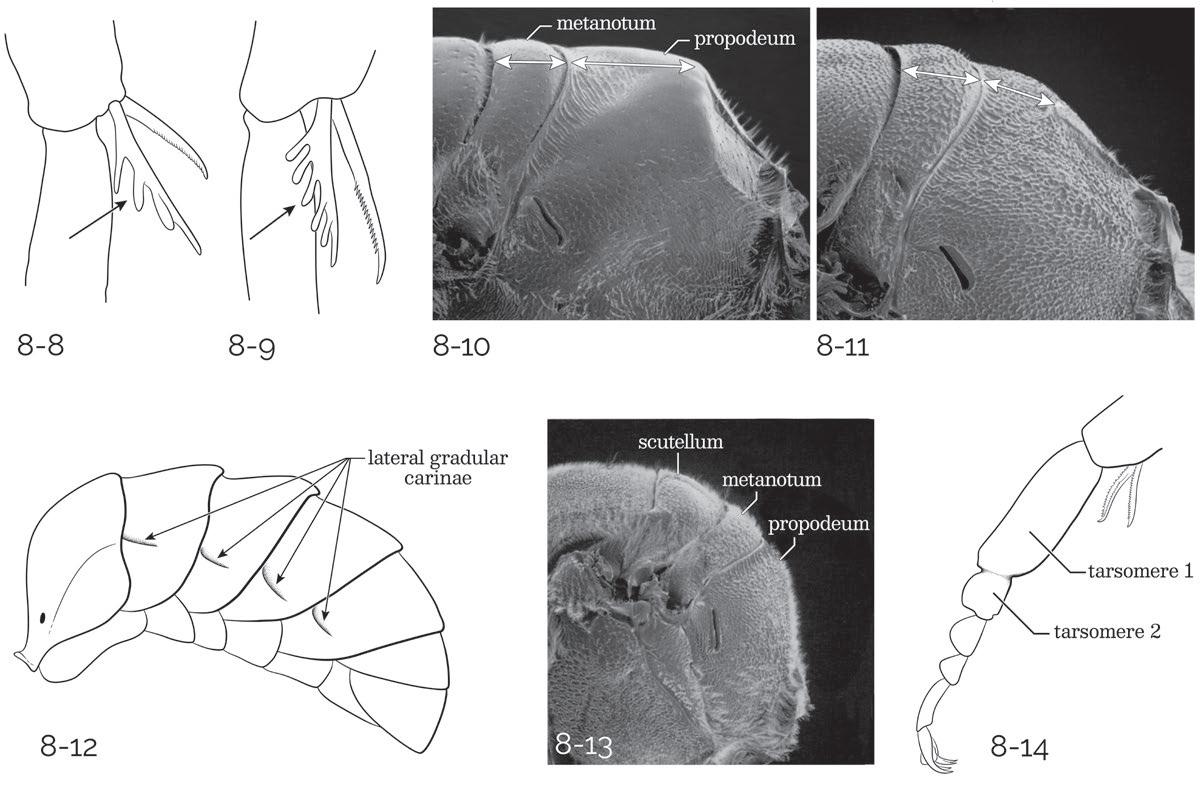
The form and subdivisions of the propodeum are not easy to illustrate but are exceedingly important for identification. Many bees have a pair of lines impressed on the propodeum, beginning near the anterior dorsolateral parts of the propodeum and extending downward and posteromesially and nearly meeting in the propodeal pit [Fig. 4-12], a median depression of the lower posterior surface. These lines, together with the anterior dorsal margin of the propodeum, enclose a triangular area, referred to as the propodeal triangle [Fig. 4-12]. Morphologically, this region is the metapostnotum (Brothers 1976). The shape of the propodeum as seen in profile is quite independent of the triangle. The whole propodeum may be vertical or nearly so, dropping from the posterior margin of the metanotum. In this case, it is termed declivous. However, as in Figure 4-10, there may be a more or less horizontal, dorsal region. In Figure 4-10, the dorsal surface of the propodeum is separated by a sharp line, or carina, from the declivous posterior surface. When such is the case, the horizontal, dorsal part is called the dorsal surface of the propodeum [Fig. 4-10]. It is part of the propodeal triangle. In some bees, the two surfaces are continuously rounded, one onto the other, in a broad curving surface. In that case, the dorsal surface is not definable unless there is distinctive surface sculpturing.
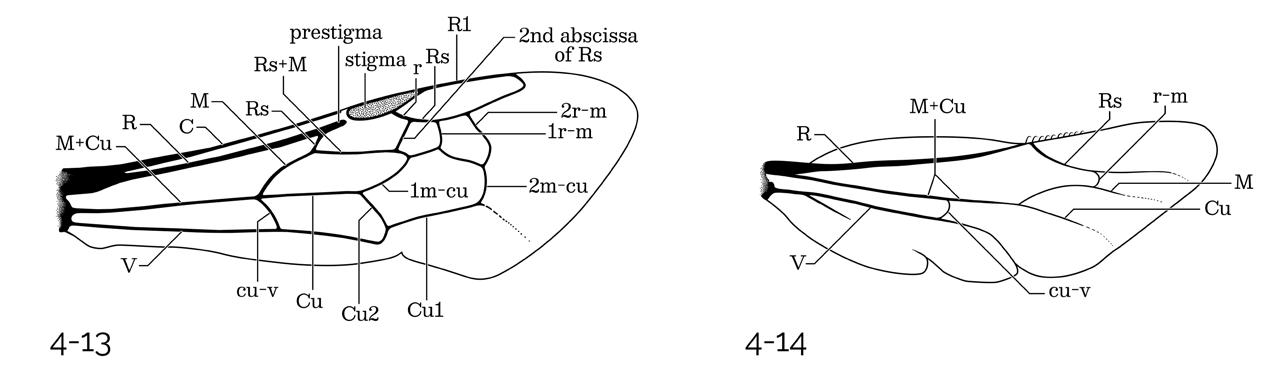
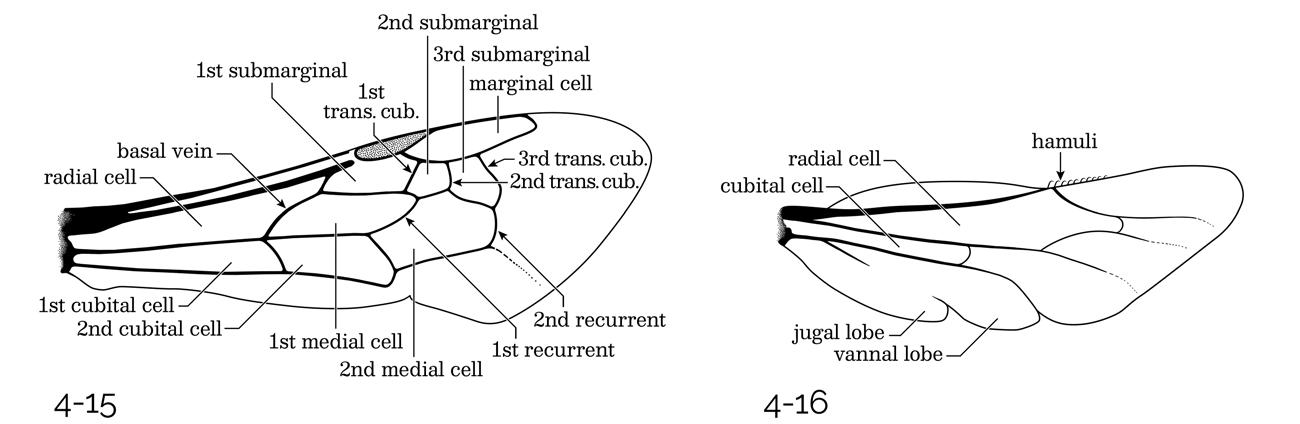
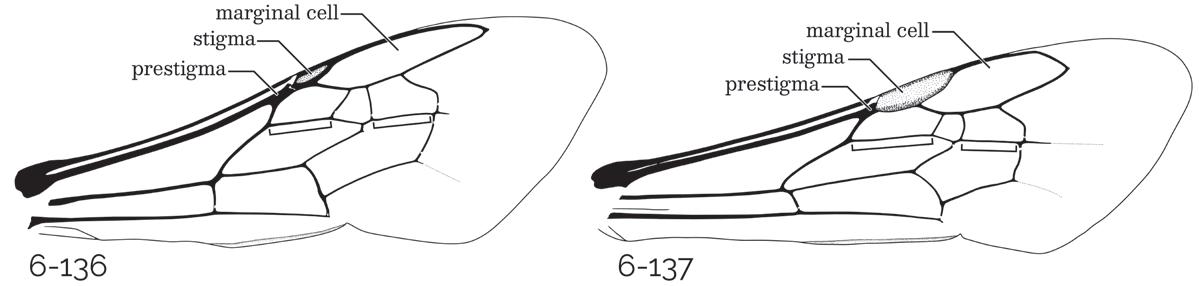
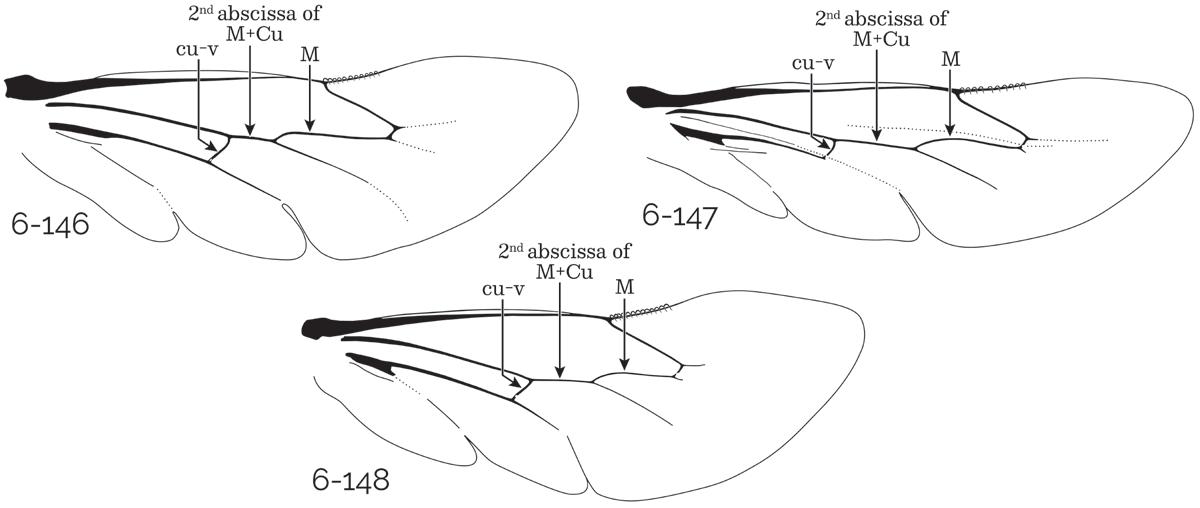
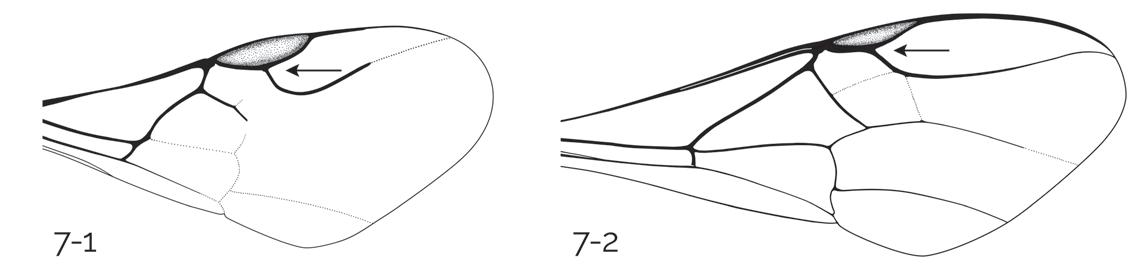
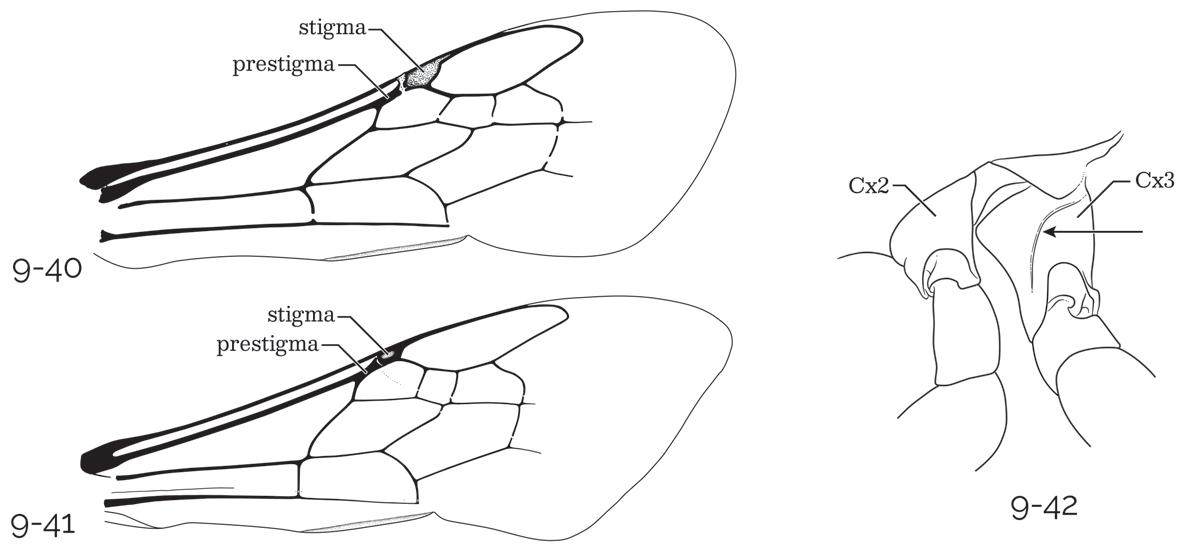
Wings are illustrated, and the veins labeled, in Figures 4-13 and 4-14, using a modified Comstock and Needham system. Because the homologies of the veins are not very certain, as well as because some comparable-looking veins have very different morphological names, it has seemed best to continue the use of some terms that are morphologically noncommittal for certain cells and veins heavily used in taxonomy. The names of cells and certain noncommittal names for veins are shown in Figures 4-15 and 4-16.
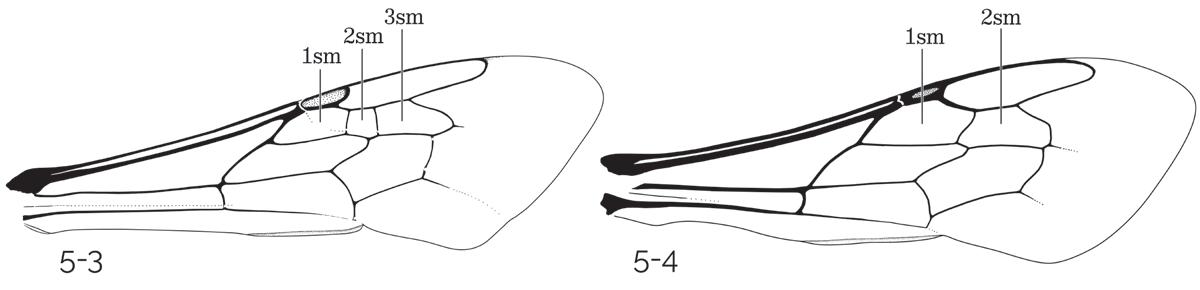
Of special importance are three veins that all look like crossveins: the second abscissa of Rs (or first transverse cubital ), first r-m (or second transverse cubital ), and second r-m (or third transverse cubital ), to use the Comstock and Needham system. These veins help to define the submarginal cells, which are usually either three or two in number. It is important to note that submarginal cells can be variable within species. While the vast majority of individuals within a species exhibit the “typical” wing venation pattern for that species, there are developmental anomalies that can result in non-typical patterns of wing venation. Scarpulla (2018) identified a number of such wing vein anomalies in species of Colletidae, Andrenidae, Halictidae, and Apidae. These wing vein anomalies are commonly expressed as a loss of the second transverse cubital vein in which a bee species that typically has three submarginal cells instead has two. In some cases, individuals can have normal wing venation on one side of the body and nontypical wing venation on the other. If you suspect you have a specimen with such a wing vein anomaly, the best solution is to compare it to other individuals of the same species to verify what is the “normal” pattern.
Wings are described as though spread, so the direction toward the costal margin (where the stigma is in the forewing) is called anterior; toward the wing apex, distal. To save space, the word stigma is used in place of pterostigma [Fig. 4-13].
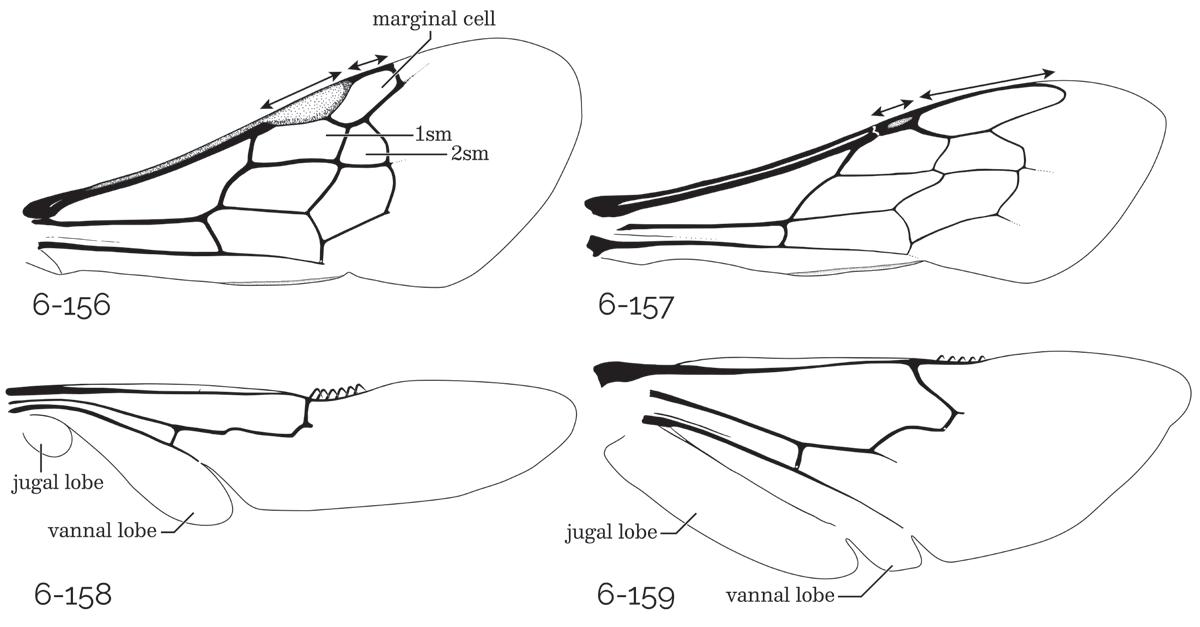
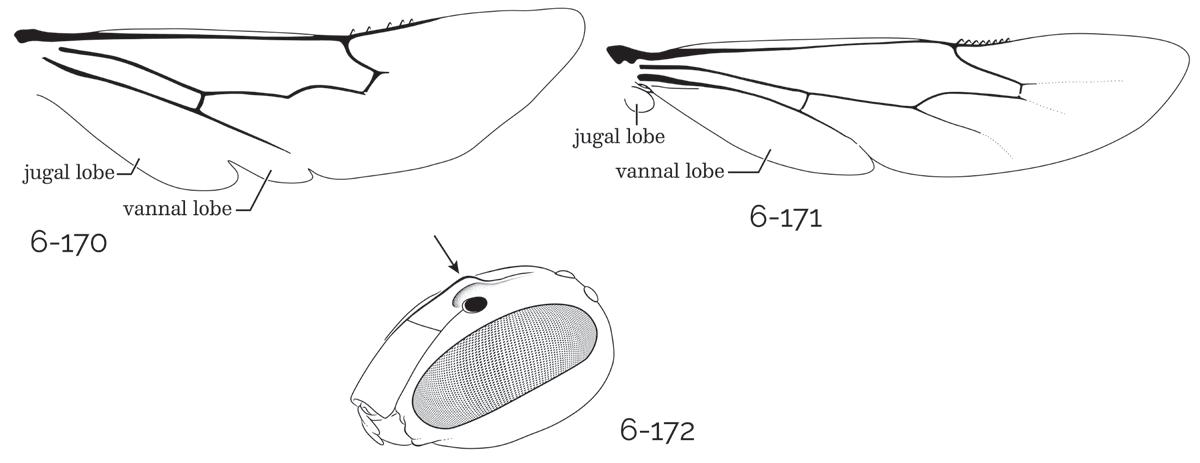
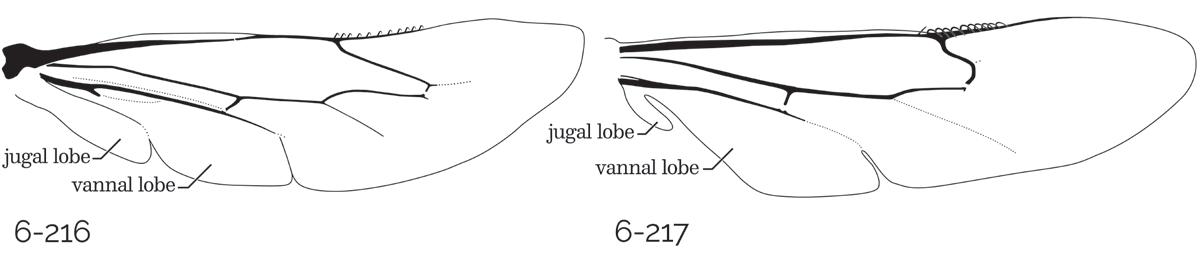
The jugal and vannal lobes of the hind wing are both measured from the wing base to the apices of the lobes. Thus, on Figure 4-16, one might say that the jugal lobe is about two-thirds as long as the vannal lobe.
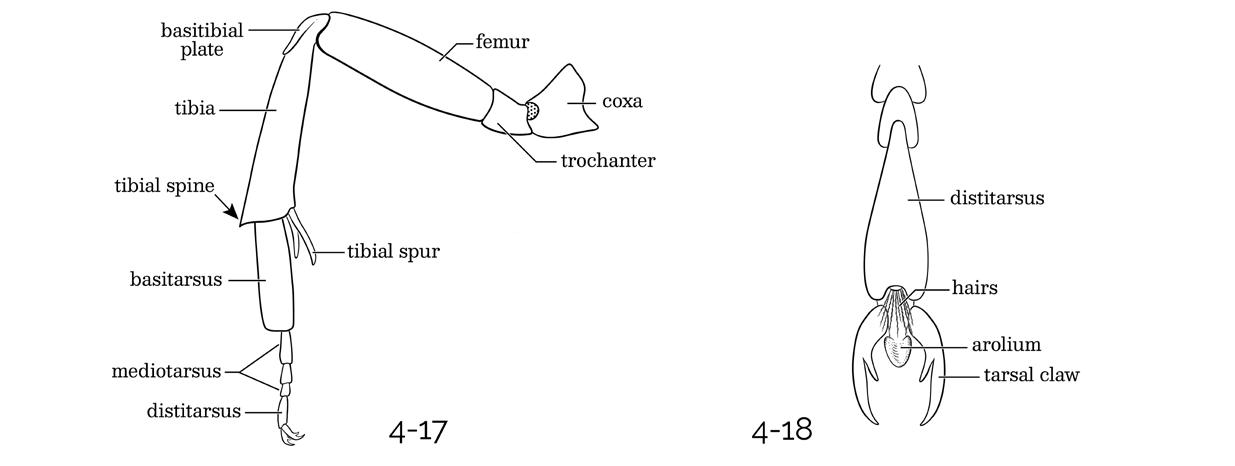
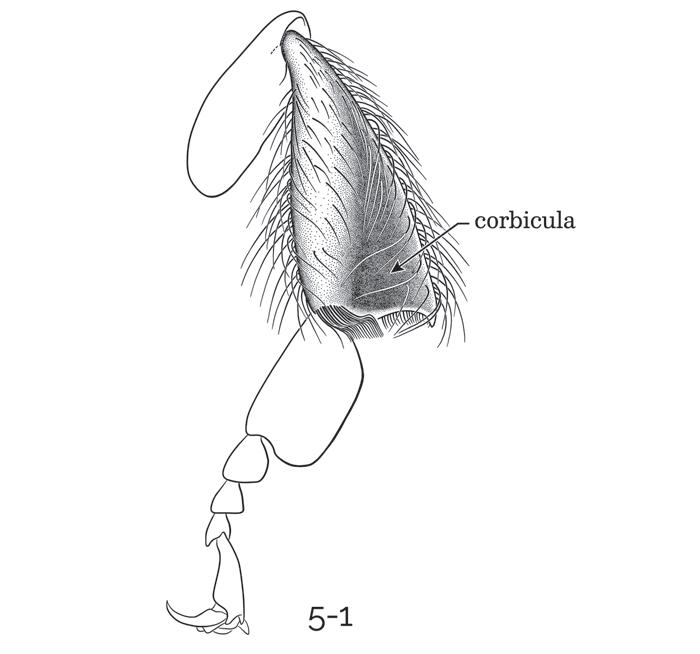
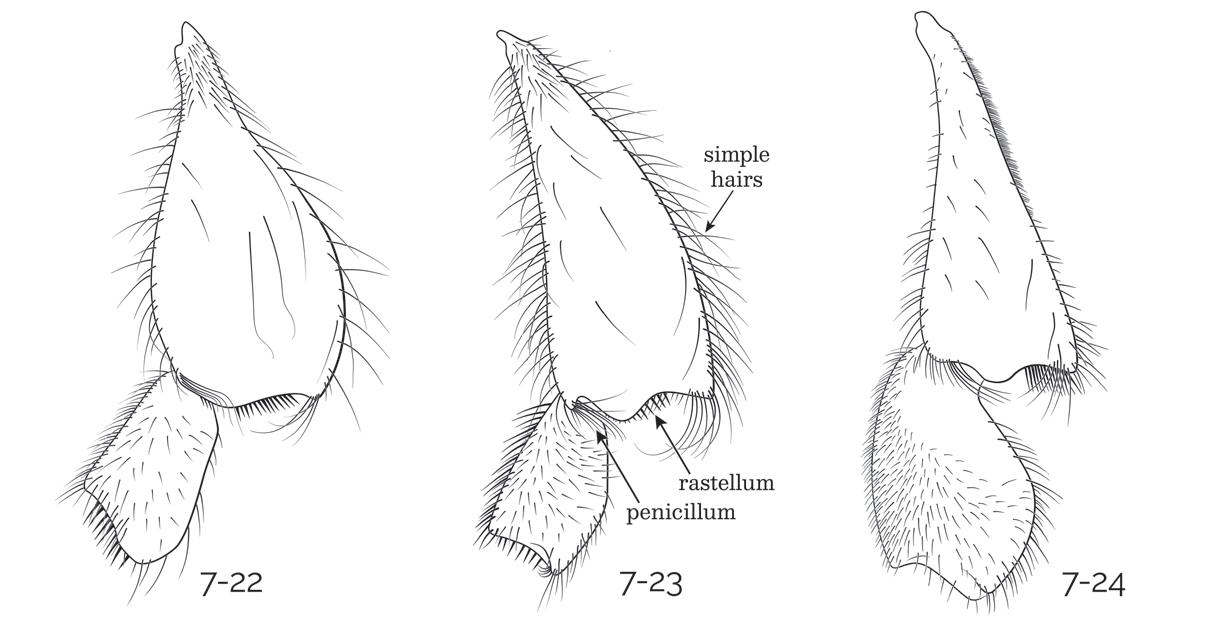
Some authorities advocate a system for identifying parts of legs that assumes that all legs are pulled out laterally at right angles to the long axis of the body. Although we appreciate the logic of that system, we follow the more traditional system in which the legs are considered to be in their normal positions. Thus, we consider the corbicula of Apidae [Fig. 5-1] to be on the outer, not the anterior or dorsal, surface of the hind tibia, and we consider the two hind tibial spurs to be outer and inner, not anterior and posterior. Some corbiculate bees (Apidae) have unique traits in their hind legs associated with moving and carrying pollen: the penicillum is a small, brush-like tuft of strong, sinuate setae arising near the front of the apical margin of the hind tibia, usually directed posteriorly; the rastellum is a comb of strong, usually blunt-tipped bristles across the inner surface of the apex of the hind tibia, and the auricle is a posterior expansion of the base of the hind basitarsus for pushing pollen up into the corbicula (Michener 1990).
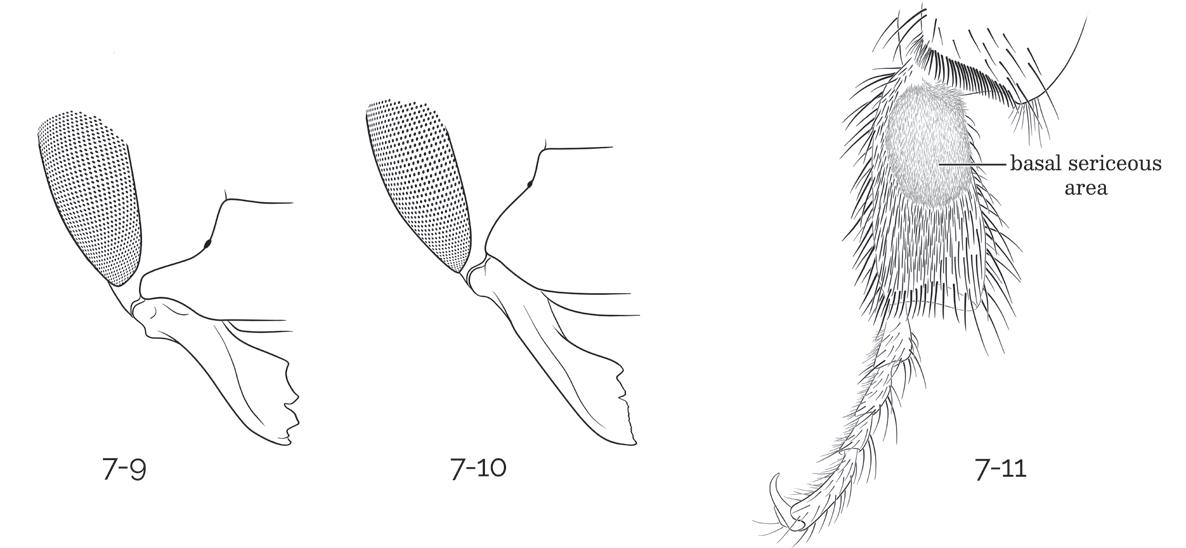
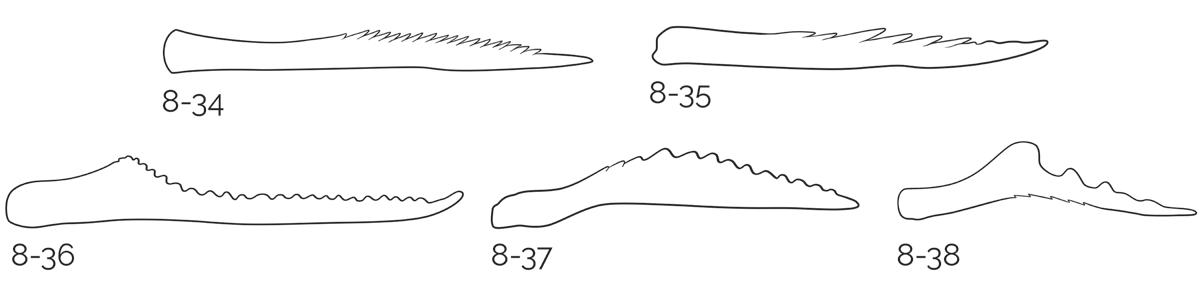
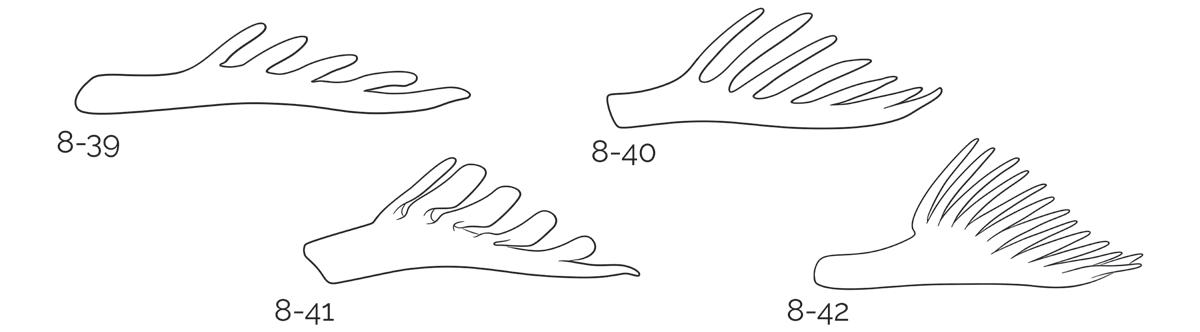
The tibial spurs are the movable inferior apical spurs on the tibiae; the tibial spines are immovable, sharp, superior, apical projections, usually small in size, found in some bees (see Fig. 4-17 and Michener 1944). Description of the tibial spurs is important in many bees; this is especially so of the inner hind tibial spur. This spur usually has two toothed margins. It is the inner one that is commonly elaborated in various ways. It may be finely or coarsely serrate. Following custom, we have described this margin as ciliate if it has slender, almost hairlike projections (usually numerous), although in many cases, the appearance is like that of a fine comb. Also following custom, we have described a spur as pectinate if its inner margin is produced into a few long, coarse, often blunt projections [Fig. 8-9], even though the number of such projections is, in some cases, reduced to only two or three.
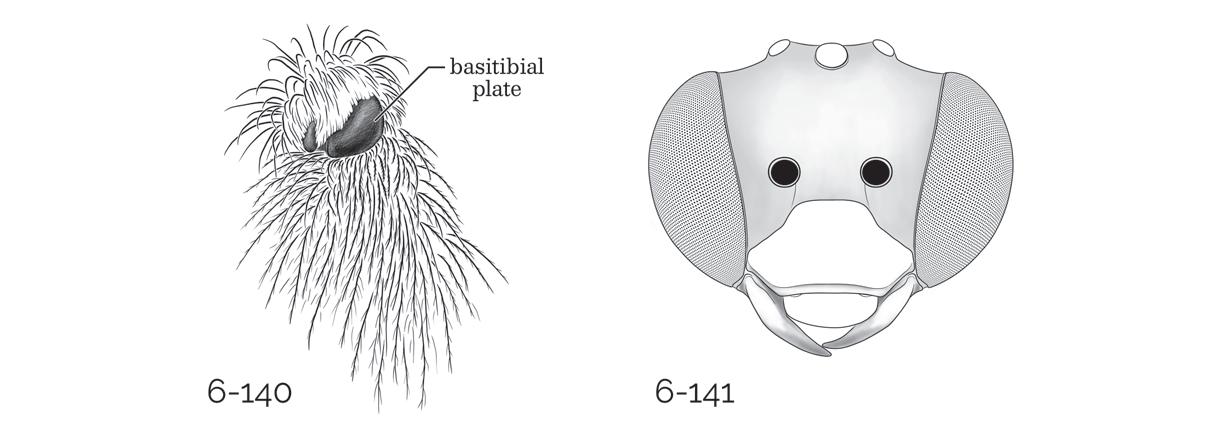
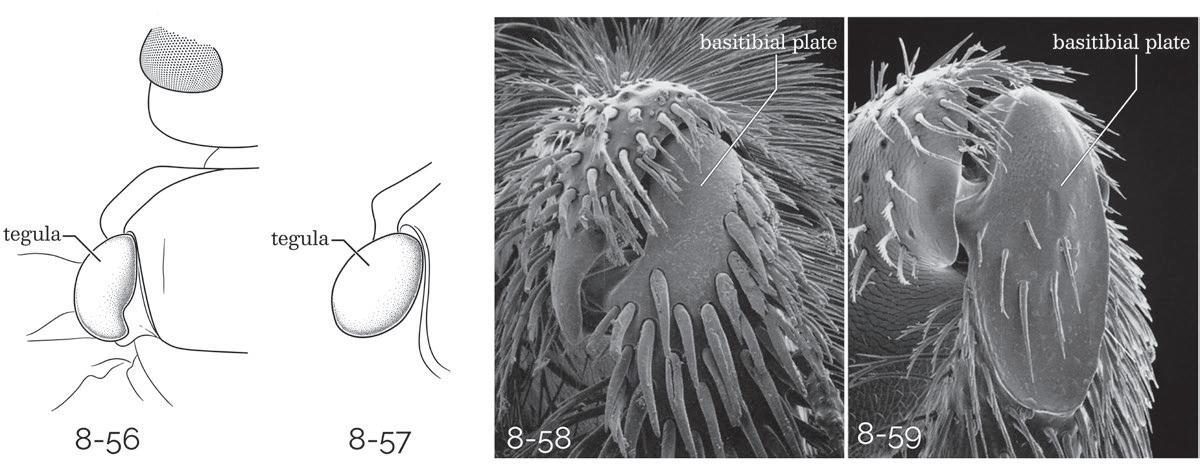
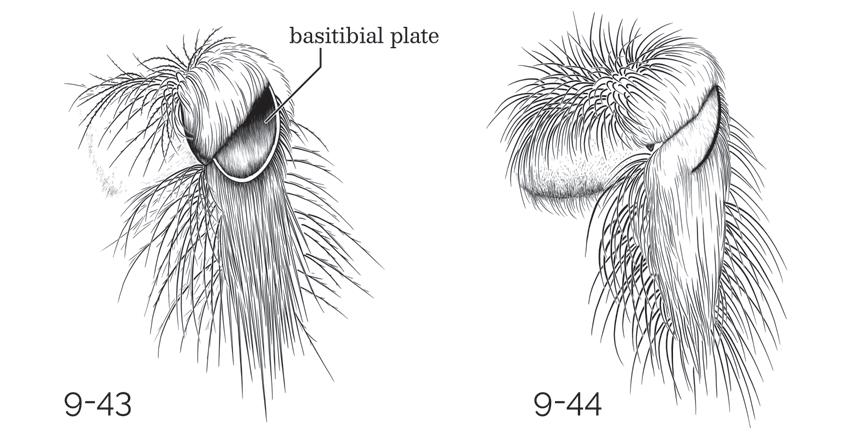
The basitibial plate is a plate on the outer side of the base of the hind tibia of many bees [Figs. 4-17, 8- 58, 8- 59], presumably important for support as bees move up or down their burrows in the soil. Commonly it is surrounded by a carina or a sharp line of some sort and has vestiture (if any) different from that of adjacent regions, but it may be indicated only by a series of tubercles or even by a single tubercle, and in some cases (as in Xylocopa), its apex is represented by a structure near the middle of the tibia.
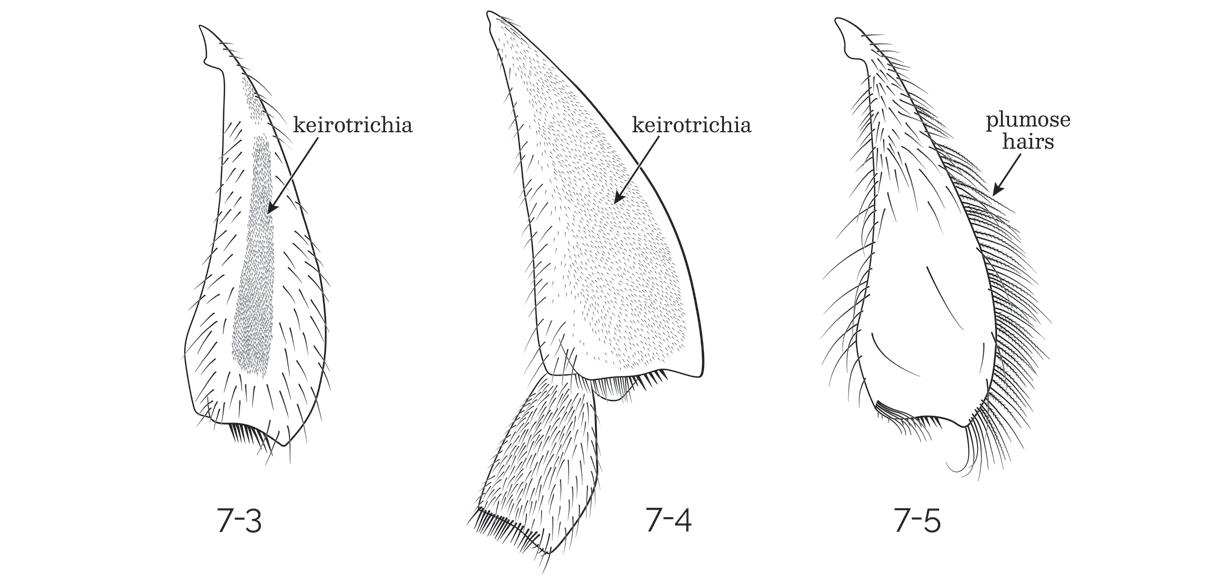
On the inner surface of the hind tibia of most bees is an area of variable size covered with hairs of uniform length, usually blunt or briefly bifid. These are called keirotrichia
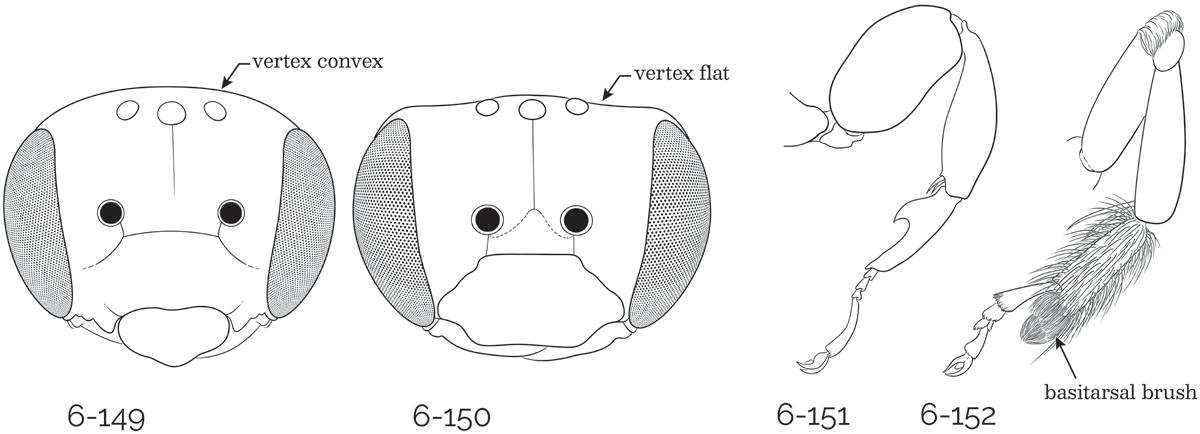
At the apex of the basitarsus in some bee groups (Eucerini, for example), there is a welldeveloped basitarsal brush [Fig. 6-152], also called a penicillum.
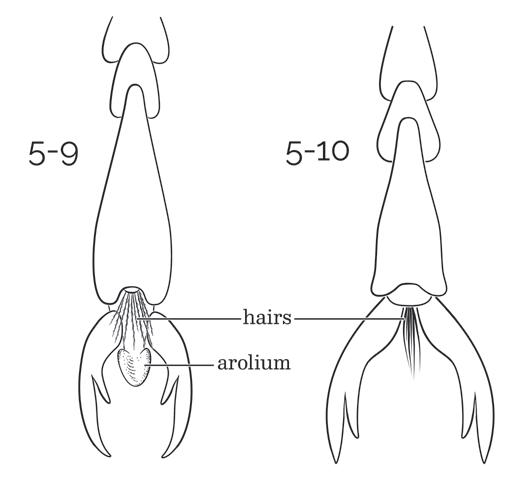
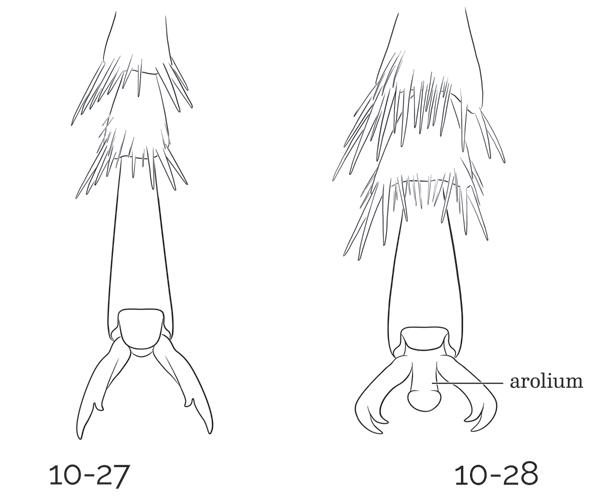
Between the tarsal claws, there is often a protruding pad-like arolium (plural: arolia) [Fig. 4-18]. The arolium can be lacking in some taxa, such as Megachile, Ptilothrix, Anthidium, Euglossini, and Centridini.
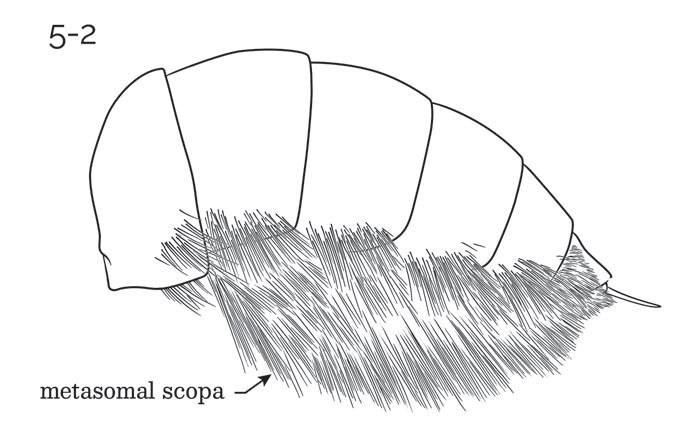
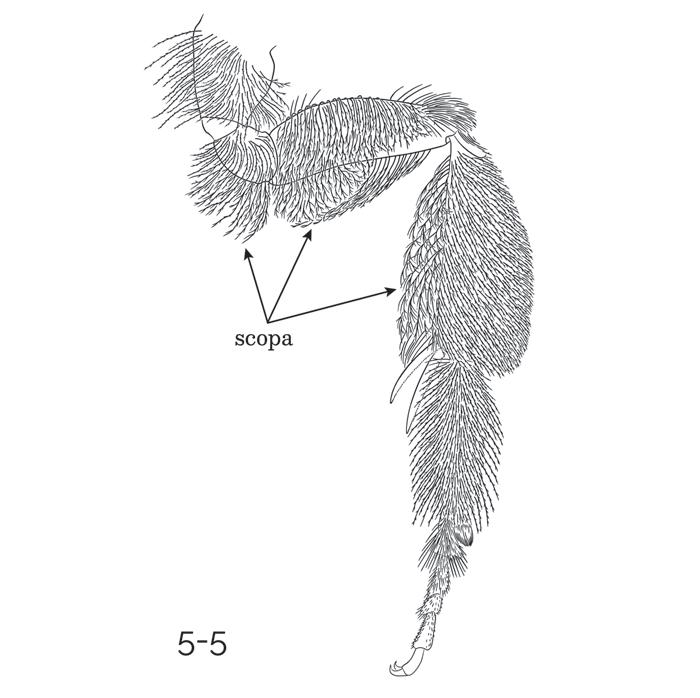
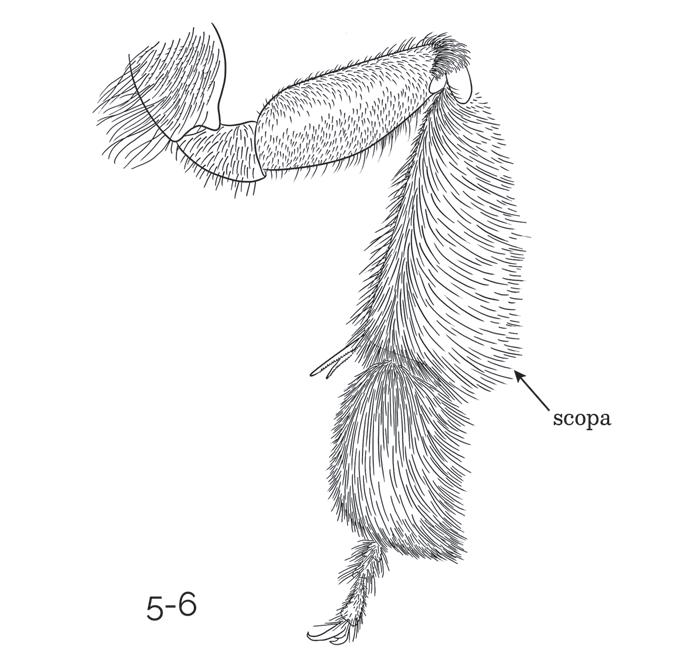
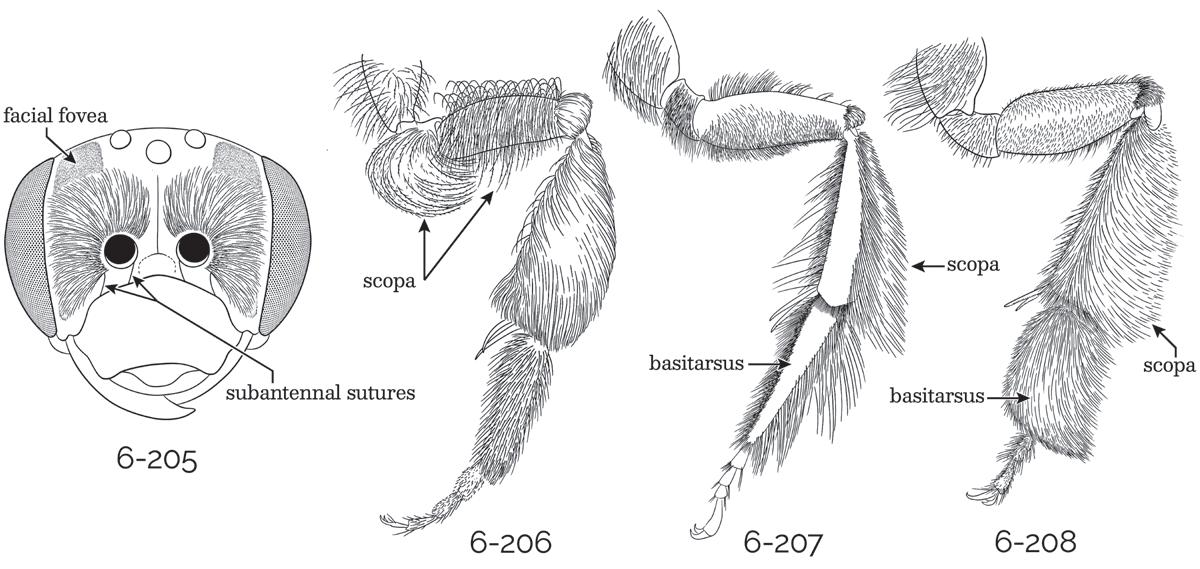
The scopa (plural: scopae) is the pollen- carrying brush of hairs. If such hairs surround a space in which pollen is carried, they are said to form a corbicula. The best known corbicula is on the outer side of the hind tibia of Apidae, but other corbiculae are on the underside of the hind femur of Andrenidae, Halictidae, Colletidae, and others, and on the side of the propodeum of many species of Andrena. In most bees, the scopa is on the hind legs, but in Megachilidae and some others, it is on the underside of the metasoma. Scopae are, of course, found only on nonparasitic females; in the keys, we do not state this fact in every case. Scopae are absent in parasitic bees, in all male bees, in queens of highly social bees, and in Hylaeus, which carry pollen internally.
Metasoma [Figs. 4-19 – 4-22]
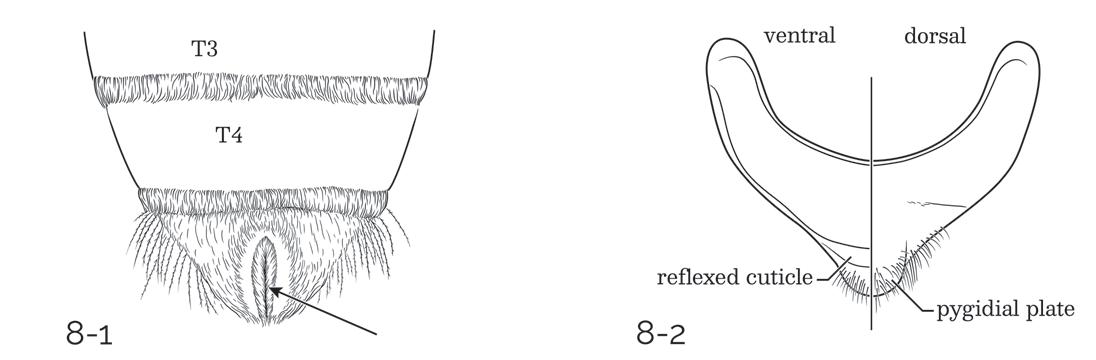
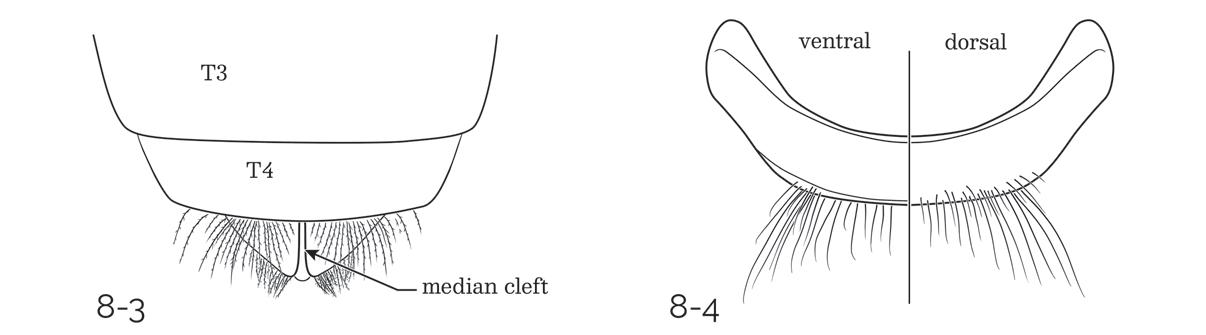
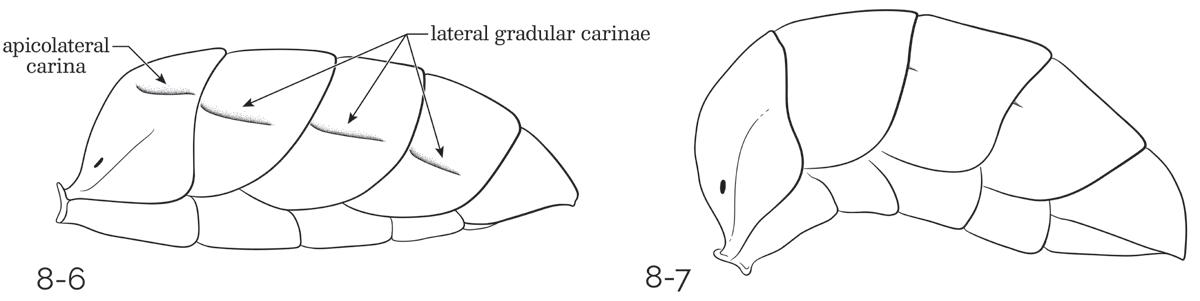
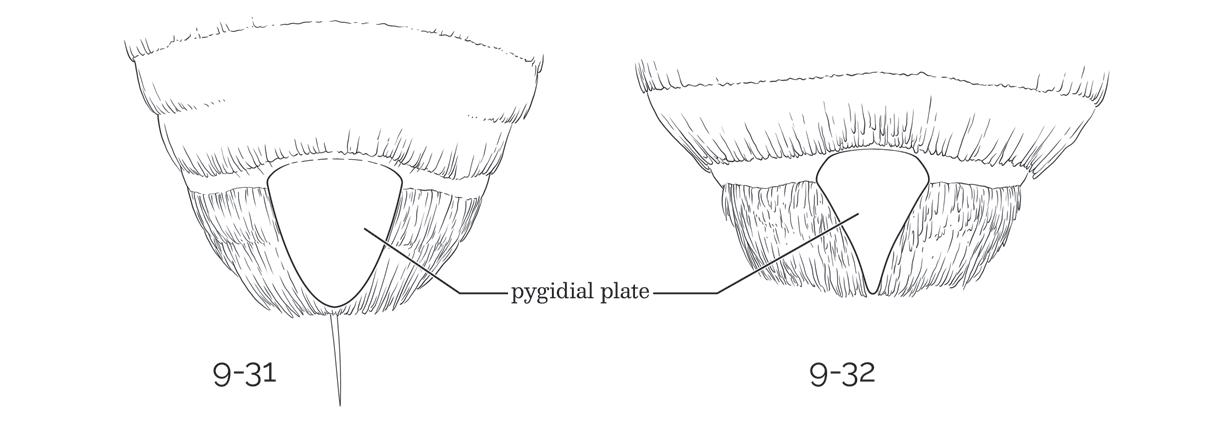
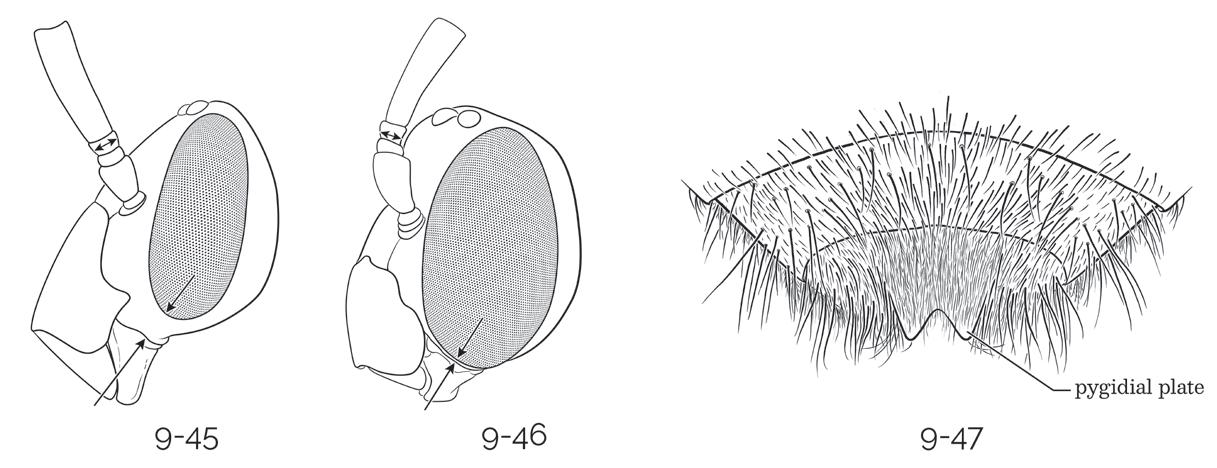
Each metasomal tergum or sternum (except for the anteriormost and the reduced apical ones) consists of a plate commonly marked by some transverse lines, as follows. (1) Across the anterior margin, always completely hidden in the intact metasoma, is the antecosta. (2) Basal to the middle of each plate is another transverse line, the gradulus (plural: graduli ) [Fig. 4-19]. The ends of the tergal graduli, unless bent strongly to the rear, are usually near the spiracles. If bent strongly to the rear, the resultant longitudinal lines are called lateral parts or lateral arms of the graduli or, if carinate, lateral gradular carinae. The area anterior to the gradulus is usually at a slightly higher level than that posterior to it, so that the gradulus is like a minute step. The elevated, pre- gradular area provides a smooth surface for the anterior tergum or sternum to move across as the metasoma moves and changes shape. The graduli are often concealed on the intact metasoma but, especially on the second tergum and sternum, are sometimes exposed. (3) Near the posterior margin of each tergum and sternum is usually another transverse line, the premarginal line, separating the posterior marginal area from the rest of the sclerite. This area is often depressed but, in other cases, differs only in sculpturing from the area basal to it. The pygidial plate [Fig. 4-19], located on T6 of females or T7 of males, is a usually flat plate, commonly surrounded by a carina or a line and in some cases produced as an apical projection. The prepygidial fimbria is a dense band of hairs across the apex of T5 of females. It is conspicuously different from, usually denser than, the apical hair bands or fasciae of preceding terga. Dense hairs on T6 of females, on each side of the pygidial plate, constitute the pygidial fimbria [Fig. 4-19].
The genital capsule [Fig. 4-20] as well as S7 and S8 [Figs. 4-21, 4-22] of male bees exhibit many diagnostic characters and may be dissected out for study – in fact, for some groups, species-level identifications may require examination of male S7, S8, or the genital capsule. In some groups the sixth, fifth, and even the fourth sterna are also hidden and modified. On a freshly relaxed specimen it is usually possible to reach between the apical exposed tergum and sternum and, with a hooked needle, pull out the genitalia and hidden sterna. In most cases, such dissection is not difficult, but in the Megachilidae, the numerous hidden sterna are firmly connected to one another and to the terga laterally and are often delicate medially, so that successful dissection may be difficult. Beginners should start with other groups.
For gross observations, sterna and genitalia may be preserved dry, glued to a card on the pin with the specimen. For more detailed study, they should be immersed in a solution of 10% sodium or potassium hydroxide to remove the muscle tissue then washed in water and placed for study in glycerin, and transferred for preservation to microvials, kept with the specimen by running the pin through the stopper. For more information on clearing and visualizing internal skeletal morphology in bees, see Porto et al. (2016). Preservation on slides has the disadvantage of making side views impossible as well as crushing the genitalia, which are often quite thick.
LOCATORS FOR THE KEYS TO THE GENERA
FOR PEOPLE NEW TO BEE IDENTIFICATION, Chapter 6, “Key to the Genera (Main Key),” may appear forbiddingly long. Therefore, we provide eight locators to help bypass portions of the main key and thus facilitate identifications. Not all bees agree with any of the initial locator statements; those that do not agree should be run from the beginning of the main key in Chapter 6.
Each numbered locator begins with a statement. A bee agreeing with that statement can be run through the locator key (with lettered couplets) following that statement. The locator key leads to numbered couplets of the main key or to the sub-keys to specific taxonomic groups (Chapters 7–10). Thus, specimens that agree with the initial statement of any of the locators can be identified relatively quickly. Locators 1–5 function only for females, while locators 6–8 work for both sexes.
1. Outer surface of female hind tibia with a usually flat or concave, shining, and largely hairless area surrounded by fringes to form a corbicula [Fig. 5-1].
2. Ventral surface of female metasoma with scopa of pollen-carrying hairs [Fig. 5-2]; hind leg without scopa; two submarginal cells [Fig. 5-4].
3. Scopa of pollen-carrying hairs extensively developed on hind femur [Fig. 5-5], frequently on tibia and trochanter as well, and forming a corbicula on underside of femur.
4. Scopa of pollen-carrying hairs well developed on hind tibia (but not forming a corbicula), reduced or absent on hind femur and trochanter [Fig. 5-6].
5. Scopa absent in females (on both hind legs and metasomal sterna) [ mostly brood parasitic bees].
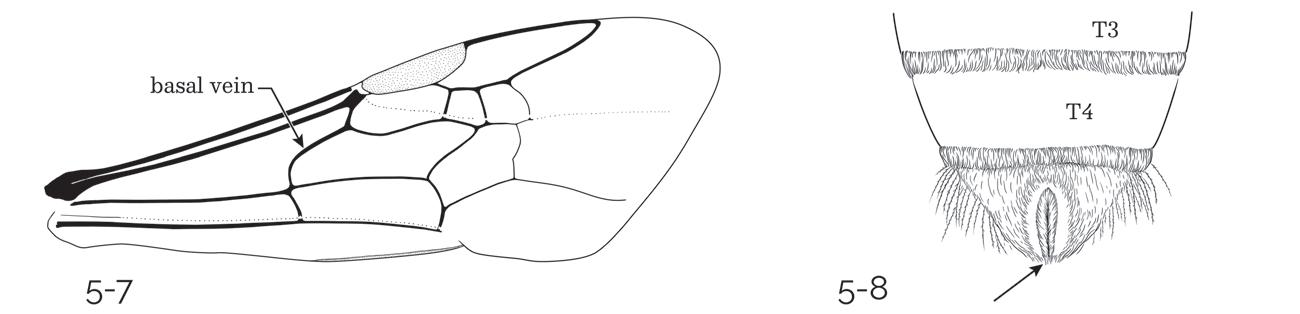
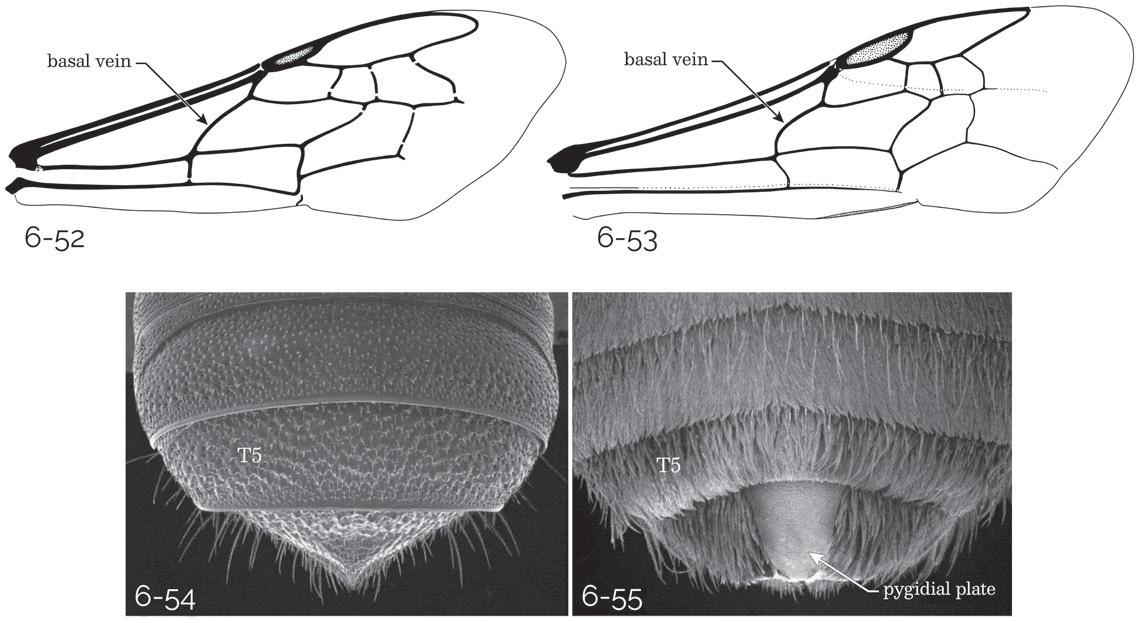
6. Basal vein of forewing strongly arcuate or subangulate near base [Fig. 5-7]; T5 of females (except in parasitic genera) with longitudinal median zone or triangular area of short, dense hairs or minute, dense punctation (and sometimes with a slit) dividing the prepygidial fimbria [Fig. 5-8]; T6 of females ordinarily completely hidden by T5.
7. Arolia absent [compare Figs. 5- 9 and 5-10].
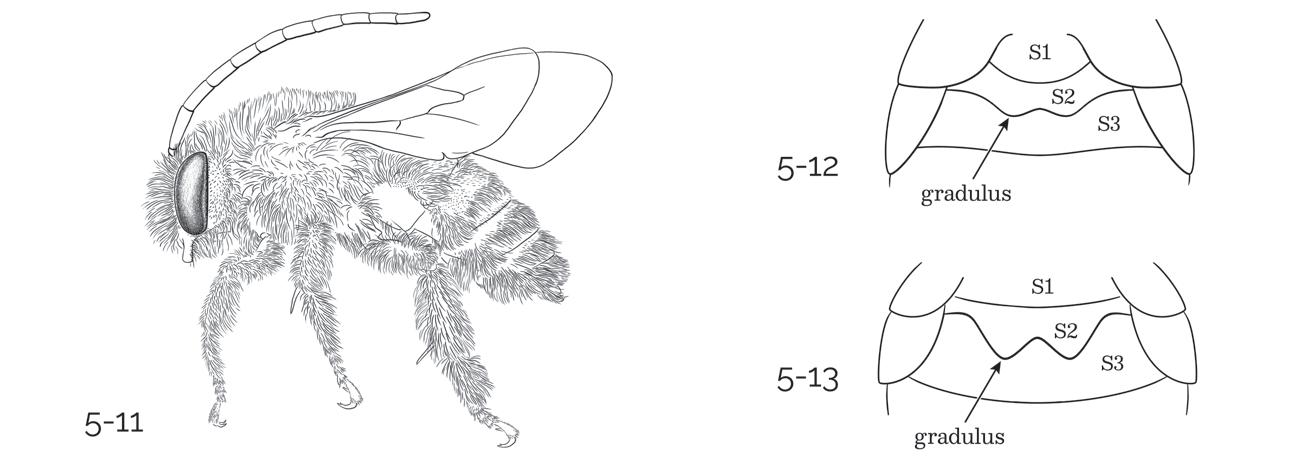
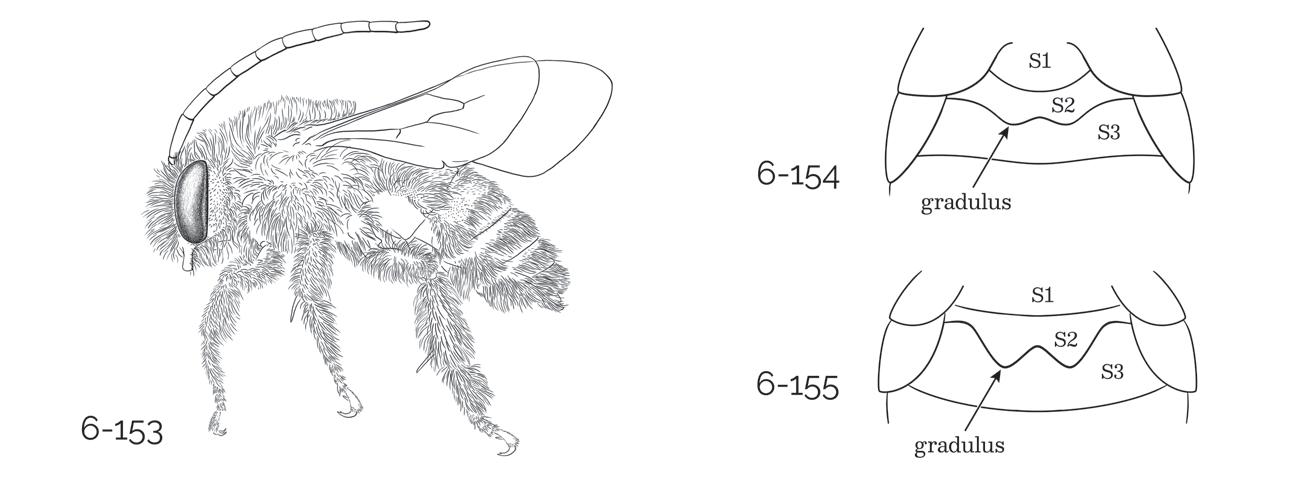
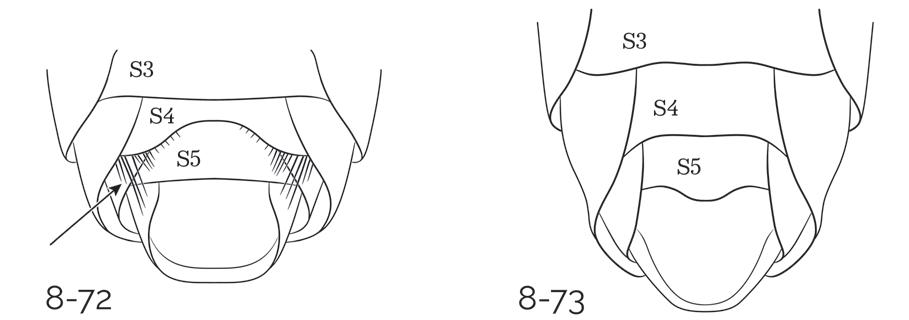
8. Males with elongate antennae (antennal length exceeding tegula in repose and often reaching stigma or marginal cell) [Fig. 5-11]; females with a W-shaped gradulus on S2 [Figs. 5-12 and 5-13]; large, relatively robust, hairy bees (tribe Eucerini)
LOCATOR 1
Outer surface of female hind tibia with a usually flat or concave, shining, and largely hairless area surrounded by fringes to form a corbicula [Fig. 5-1] (most female corbiculate Apidae) a
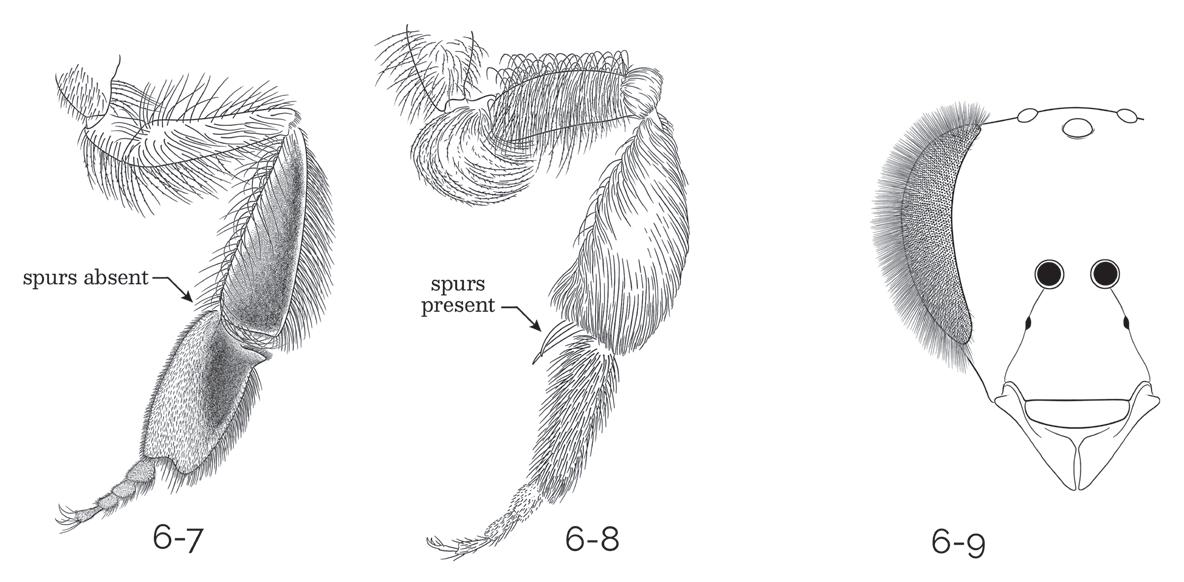
a. Hind tibial spurs absent [Fig. 6-7] b — Hind tibial spurs present and conspicuous [Fig. 6-8] c
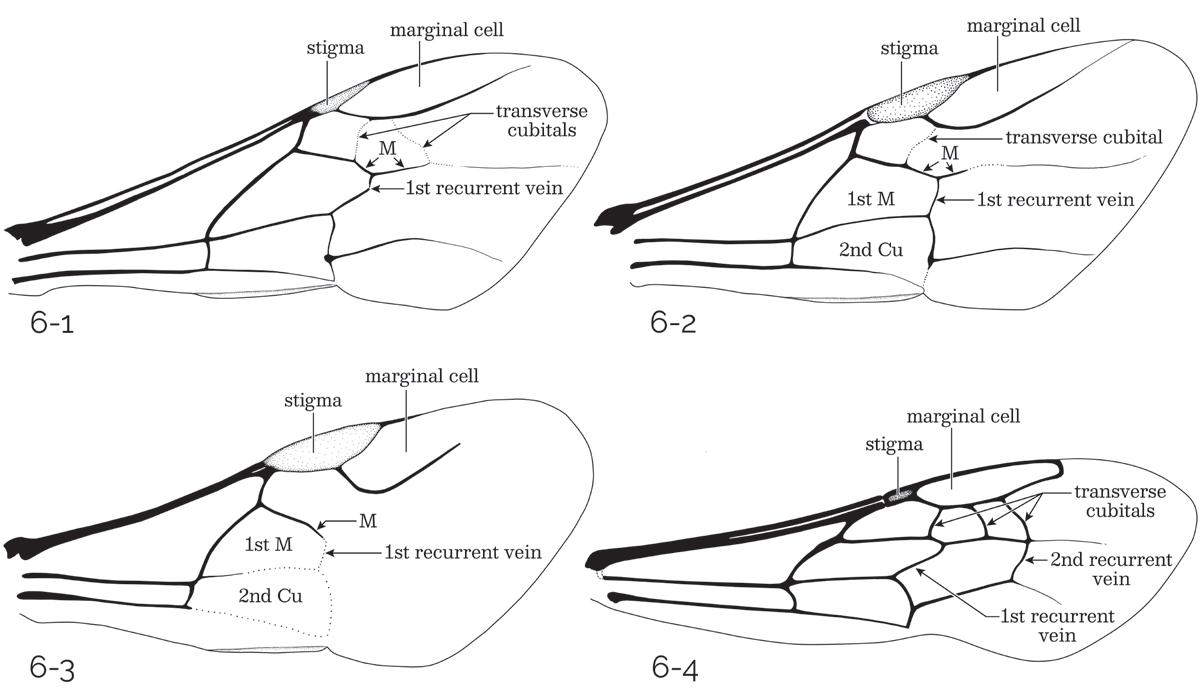
— Eyes bare; transverse cubital veins, second recurrent vein and apex of marginal cell weak or absent [Figs. 6-1 to 6-3] (Apidae, Meliponini) (tropical)
Go to Chapter 7, Key to Genera of Meliponini
c(a). Proboscis in repose not reaching metasoma; body nonmetallic; comb of bristles on base of hind wing absent (Apidae, Bombini) Bombus [17]
— Proboscis in repose reaching beyond base of metasoma; body usually at least partly metallic; comb of bristles in position of jugal lobe of hind wing present [Fig. 6-19] (Apidae, Euglossini) (tropical) Go to couplet 12
LOCATOR 2
Ventral surface of female metasoma with scopa of pollen-carrying hairs [Fig. 5-2]; hind leg without scopa; two submarginal cells [Fig. 5-4] (most female Megachilidae) a
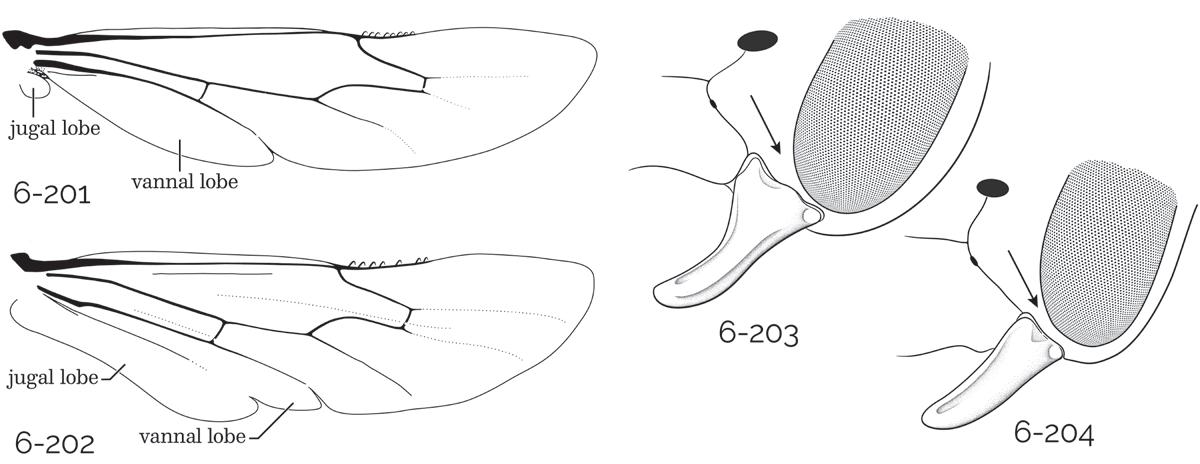
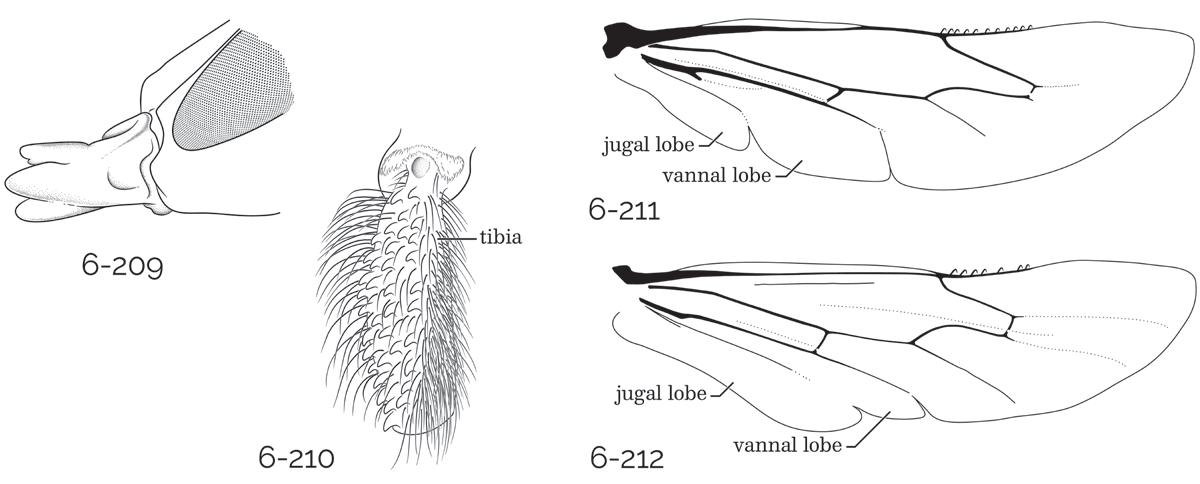
a. Mandible tridentate, middle tooth longer than others [Fig. 6-209]; outer surfaces of tibiae with numerous coarse spicules not ending in hairs or bristles [Fig. 6-210] (Megachilidae, Lithurginae)
Go to couplet 105
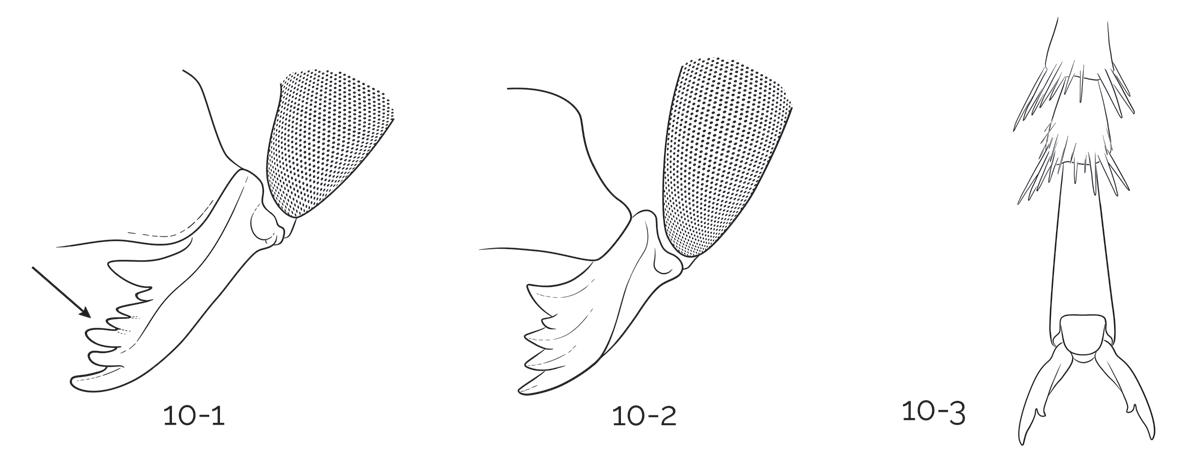
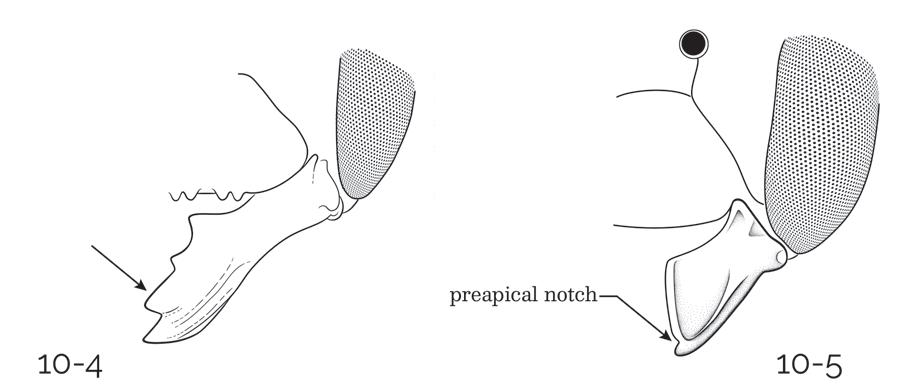
— Mandible bidentate to multidentate with apical (lower) tooth longest [Figs. 10-1 and 10-3]; outer surfaces of tibiae without coarse spicules or, if spiculate, usually with hair arising from apex of each (Megachilidae, Megachilinae) b
b(a). Thorax and/or metasoma with yellow, white, or red integumental markings or rarely body largely red; metasomal terga ordinarily without apical bands of pale hair
Go to Chapter 10, Key to Genera of Anthidiini — Thorax and metasoma without integumental markings, black or metallic; metasoma above sometimes largely red; metasomal terga often with apical bands of pale hair
Go to couplet 115
LOCATOR 3
Scopa of pollen-carrying hairs extensively developed on hind femur [Fig. 5-5], frequently on tibia and trochanter as well, and forming a corbicula on underside of femur (females) a
a. With three submarginal cells [as in Fig. 5-3] b — With two submarginal cells [as in Fig. 5-4] h
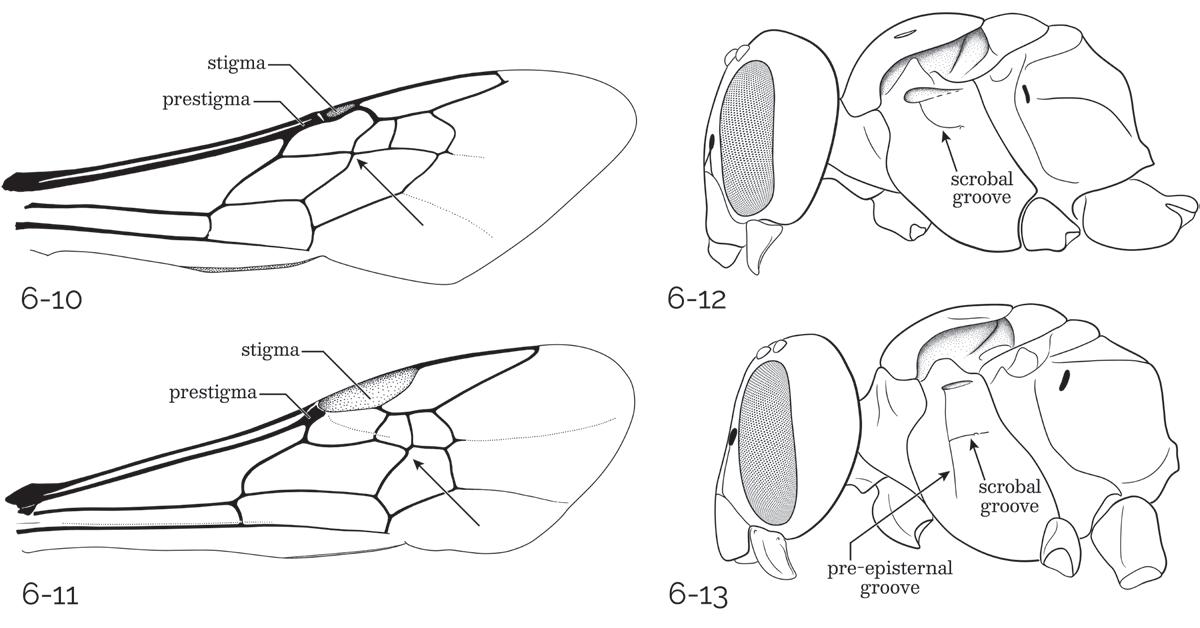
b(a). First recurrent vein meeting first transverse cubital or within one or two vein widths of it [Fig. 6-10]; stigma no wider than prestigma measured to wing margin [Fig. 6-10] (Colletidae, Diphaglossinae, part) Go to couplet 5
— First recurrent vein far beyond first transverse cubital, often near or beyond second transverse cubital [Fig. 6-11]; stigma often wider than prestigma [Fig. 6-11] (If first recurrent vein near first transverse cubital, as in some Mydrosoma, wing length under 12 mm.) c
c(b). Second recurrent vein distinctly arcuate outward in its posterior portion [Fig. 6-29] (Colletidae, Colletinae, part) Colletes [99]
— Posterior portion of second recurrent vein not arcuate outward [Fig. 6-30] d
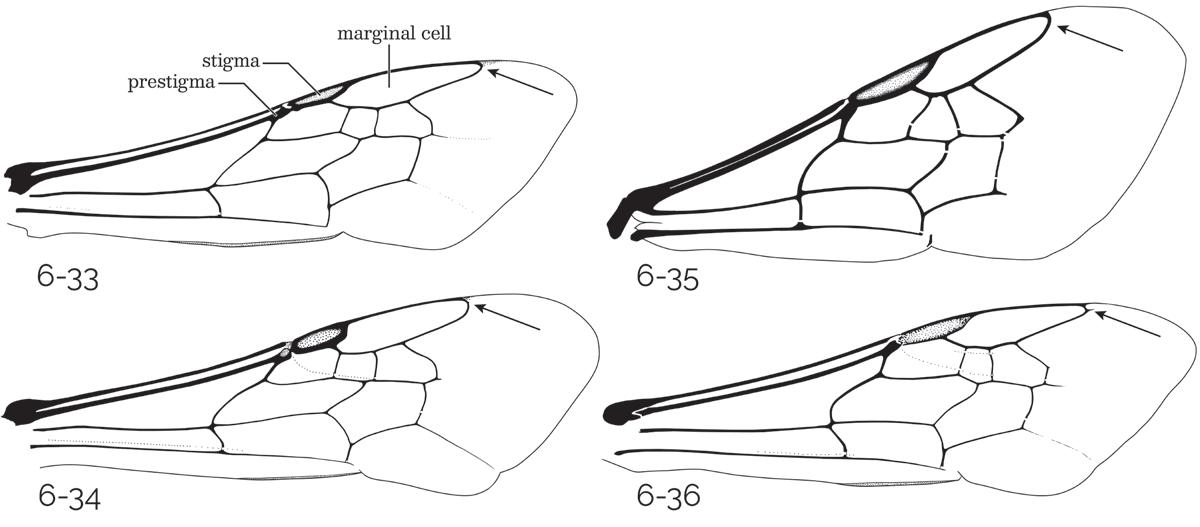
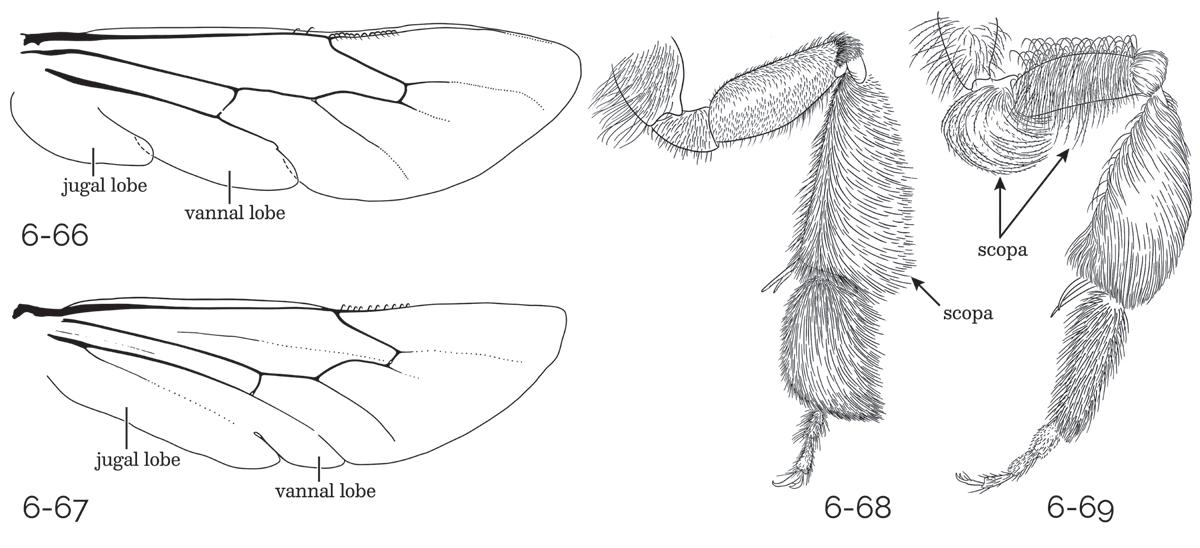
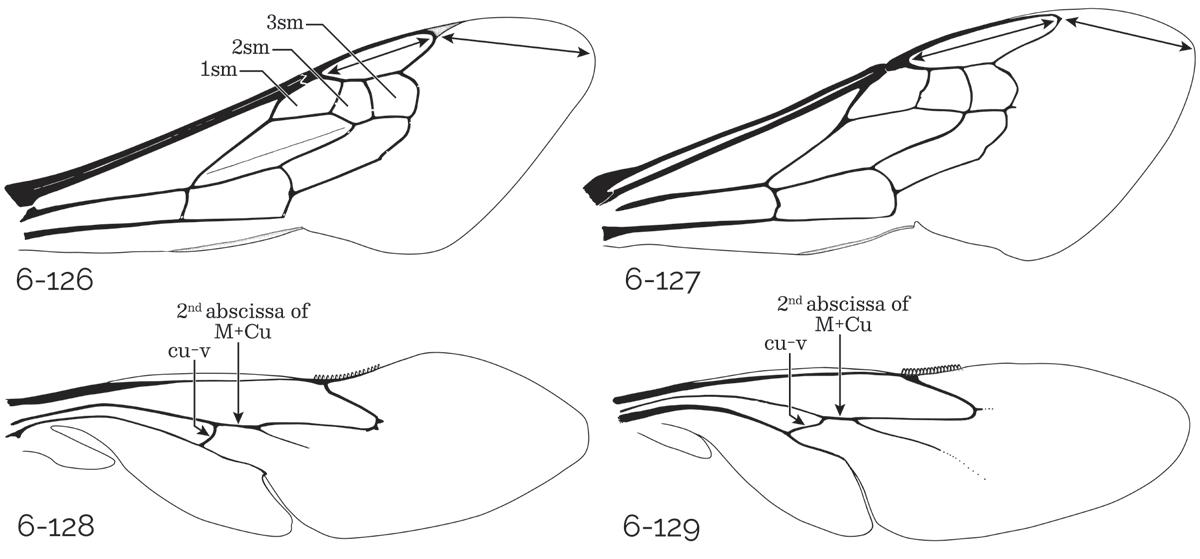
d(c). Marginal cell rounded at apex, which is on or almost on wing margin [Fig. 6-34]; first and third submarginal cells subequal in length of posterior margins, ordinarily much longer than second, which is quadrate [Fig. 6-34]; jugal lobe of hind wing much over three-fourths as long as vannal lobe [Fig. 6-67] (Halictidae, Nomiinae) Go to couplet 25
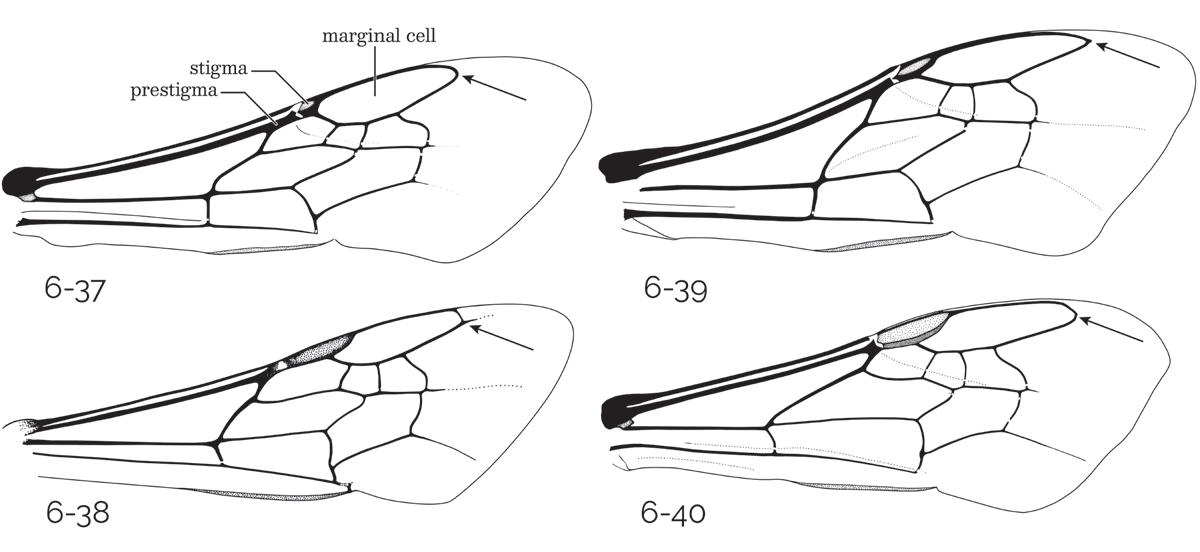
— Marginal cell with apex pointed [Fig. 6-33], minutely truncate [Fig. 6-36], or bent well away from wing margin [Fig. 6-39]; submarginal cells not as above; jugal lobe of hind wing threefourths as long as vannal lobe or usually much less [Fig. 6-66] e
e(d). Body extraordinarily coarsely punctate; certain metasomal terga with yellow to white integumental bands; preoccipital ridge formed as strong lamella (Colletidae, Colletinae, part) (tropical to Arizona) Eulonchopria [105]
— Body not especially coarsely punctate; metasoma without integumental bands; preoccipital ridge not lamellate f
f(e). Third submarginal cell shorter than second [Fig. 6-4] (Colletidae, Diphaglossinae, part) (rare, tropical) Mydrosoma (part) [103]
— Third submarginal cell as long as or longer than second [as in Fig. 5-3] g
g(f). Stigma absent or nearly so [Fig. 6-84] (Oxaeinae)
Go to couplet 40
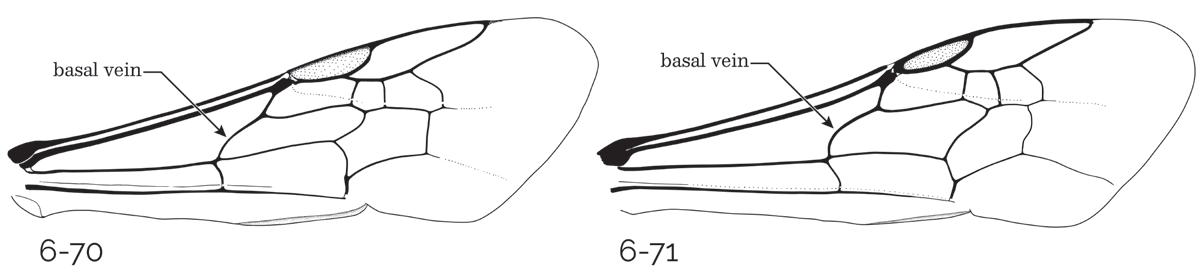
— Stigma present, rather large [Figs. 6-70 and 6-71] (The few parasitic genera in this part of the key lack a well-developed scopa, and Melitta lacks a strong femoral scopa.)
Go to couplet 26
h(a). Basal vein strongly arcuate near base [as in Fig. 6-53] (Subgroups, sometimes recognized as genera, are characterized in Chapter 12.) (Halictidae, Halictinae, Halictini)
Lasioglossum (part) [128]
— Basal vein gently and rather uniformly arcuate or straight [as in Fig. 6-52] i
i(h). Antennal bases near middle of face [Fig. 6-205]; clypeus with upper margin arched up into face so that it is not short and transverse [Fig. 6-205] (Andrenidae, Andreninae)
Andrena (part) [2]
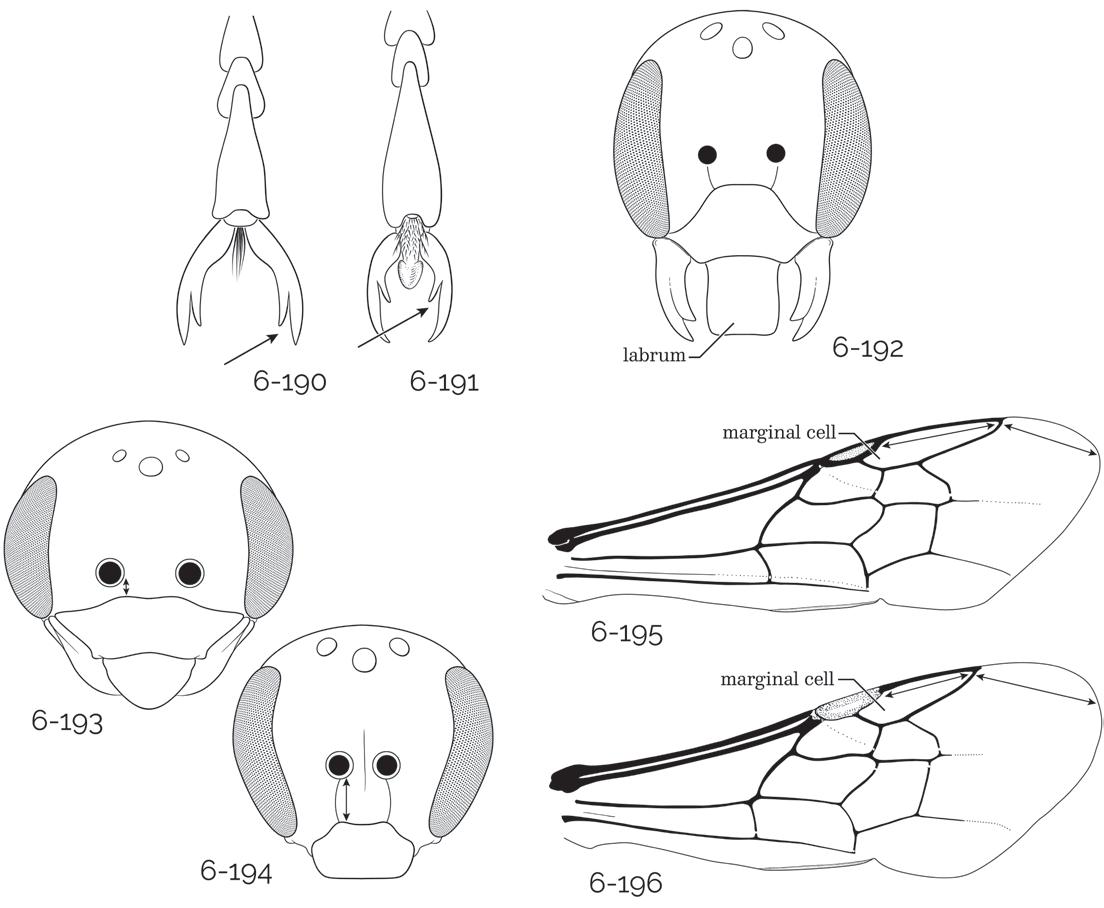
— Antennal bases well below middle of face [Fig. 6-193]; clypeus short, transverse, its upper margin not much arched up into face [Fig. 6-193] (Halictidae, Rophitinae) Go to couplet 97
LOCATOR 4
Scopa of pollen-carrying hairs well developed on hind tibia (but not forming a corbicula), reduced or absent on hind femur and trochanter [Fig. 5-6] (females) (The halictid subfamily Rophitinae is included in this locator as well as in locator 3, because the femoral scopa is sometimes rather weak and smaller than the tibial scopa.) a
a. With three submarginal cells [as in Fig. 5-3] b
— With two submarginal cells [as in Fig. 5-4] i
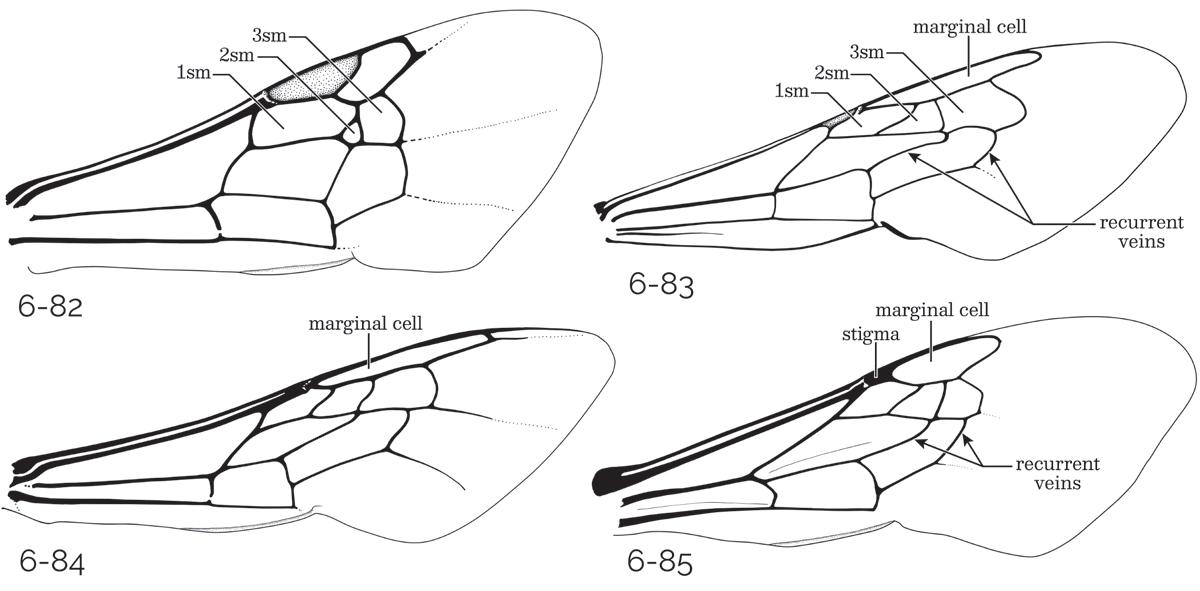
b(a). Marginal cell slender, seven times as long as broad and only a little over half as wide as widest submarginal cell [Fig. 6-83]; stigma absent [Fig. 6-83] (large, robust bees) (Apidae, Xylocopinae, Xylocopini) Xylocopa [98]
— Marginal cell six times as long as broad or less, much more than half as wide as widest submarginal cell [Fig. 6-104]; stigma usually distinct c
— Pygidial plate present [Fig. 6-55]; slender to robust, usually hairy, often with metasomal hair bands e
e(d). Apex of marginal cell pointed on or very near wing margin [as in Figs. 6-70 and 6-71] (Halictidae, Rophitinae, part) Go to couplet 26, stop with couplet 30
— Apex of marginal cell strongly truncate, or rounded or pointed and bent well away from wing margin [Figs. 6-37 to 6-40] f
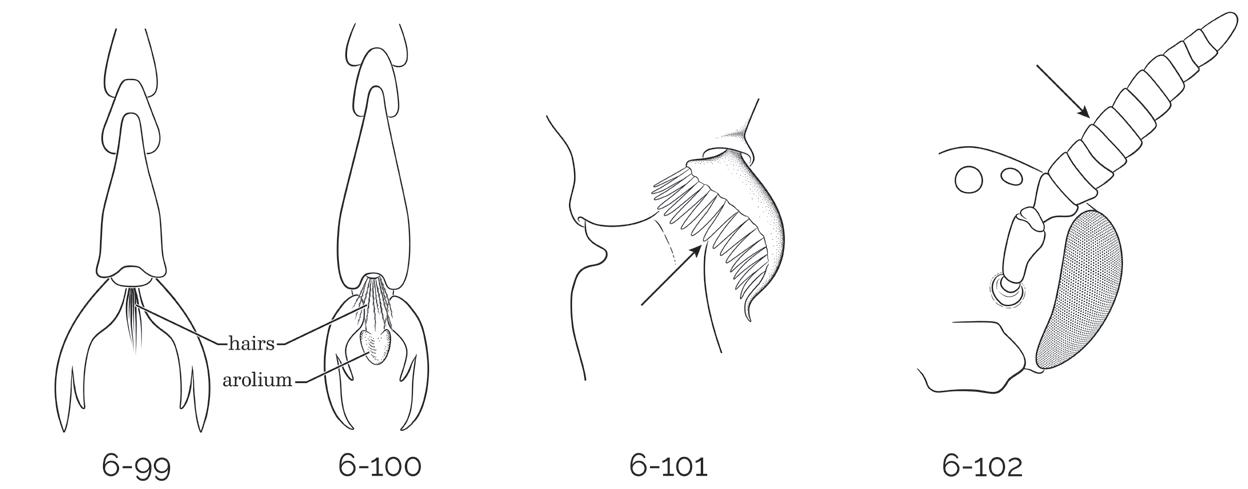
f(e). Arolia absent [Fig. 6-99] Go to couplet 52 — Arolia present [Fig. 6-100] g
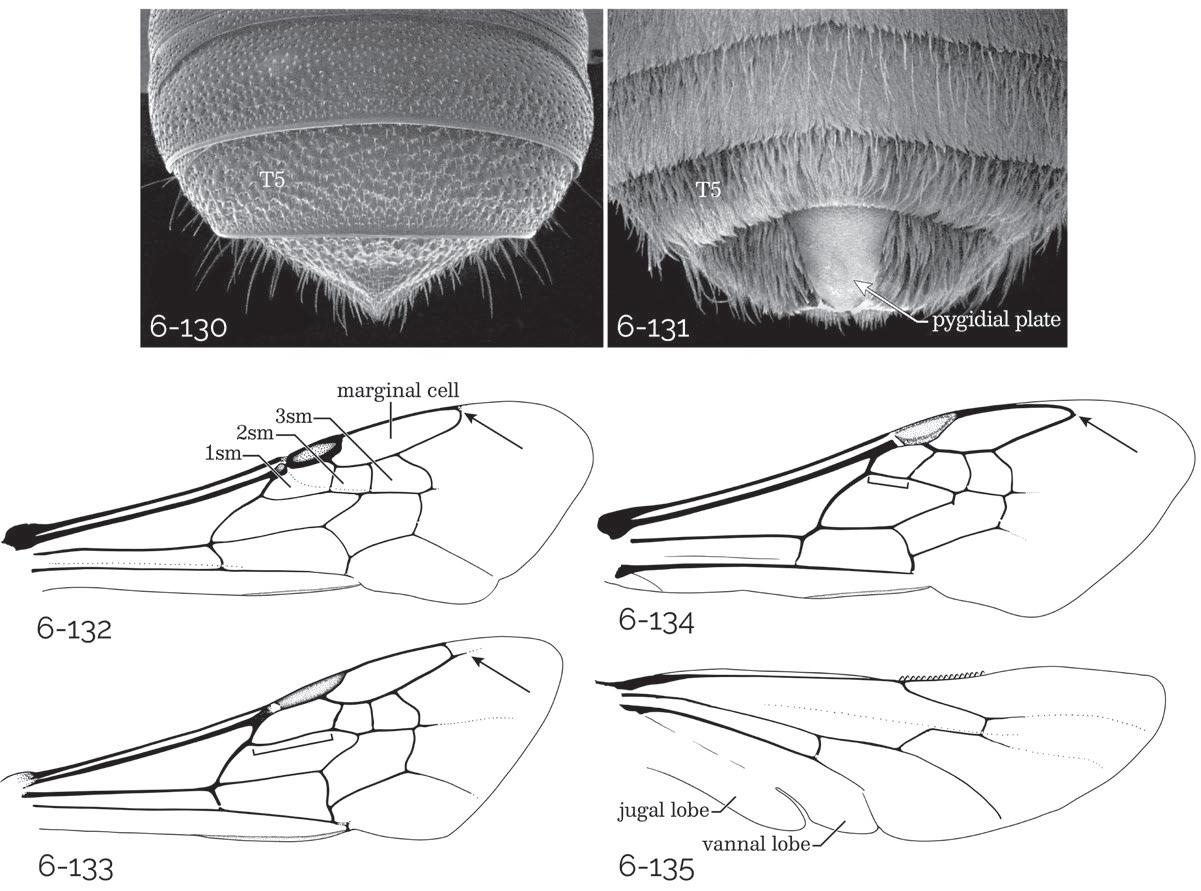
g(f). Posterior margin of first submarginal cell at least 1.3 times as long as third [Fig. 6-133]; body elongate (like Andrena or Halictus); proboscis short, segments of labial palpus similar [as in Fig. 4-8] or only first elongate (Andrenidae, Panurginae, part) Protandrena [12]
— Posterior margin of first submarginal cell little if any longer than third [Fig. 6-134] (intermediate in Ancyloscelis, Exomalopsis, and others, which have unusually short, robust bodies); body commonly robust; proboscis long, first two segments of labial palpus elongate, flattened, entirely different from segments 3 and 4 [Fig. 4-6] (Apidae, Eucerinae, part) h
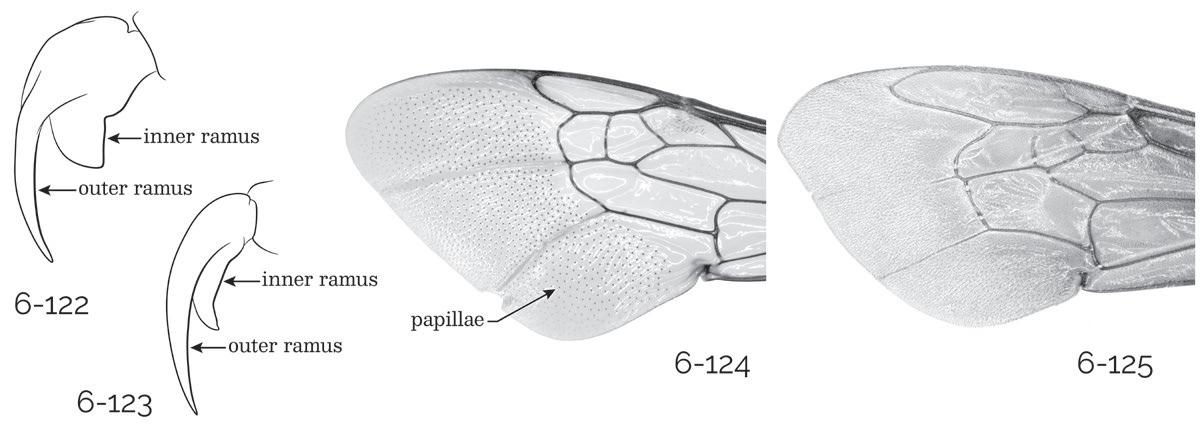
h(g). Closed cells of forewing largely hairless [as in Fig. 6-124]; wing surface beyond veins coarsely papillate and hairless Go to couplet 65
— Entire forewing with numerous minute hairs [Fig. 6-125]; wing surface beyond veins not papillate or if so, many papillae ending in hairs Go to couplet 73
i(a). Marginal cell beyond stigma on costa little if any longer than stigma and second submarginal cell less than two-thirds as long as first [Fig. 6-156] (see footnote to couplet 80) (Andrenidae, Panurginae, part) Perdita (part) [10] — Marginal cell beyond stigma on costa longer than stigma or, if not, then second submarginal cell two-thirds as long as first or longer [Fig. 6-182] (see footnote to couplet 80) j
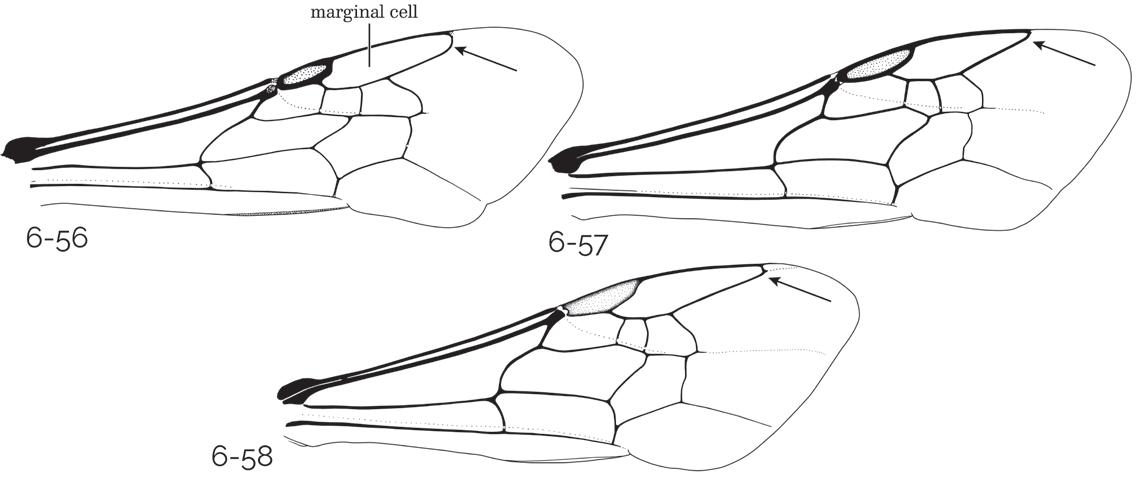
j(i). Apex of marginal cell pointed on costa or separated from costa by only one or two vein widths [Figs. 6-33 to 6-36]; stigma large (see couplet 15 for details) k — Apex of marginal cell rounded, truncate, or pointed and separated from costa by distance equal to several vein widths [as in Figs. 6-37 to 6-40]; stigma usually small (see couplet 15 for details) l
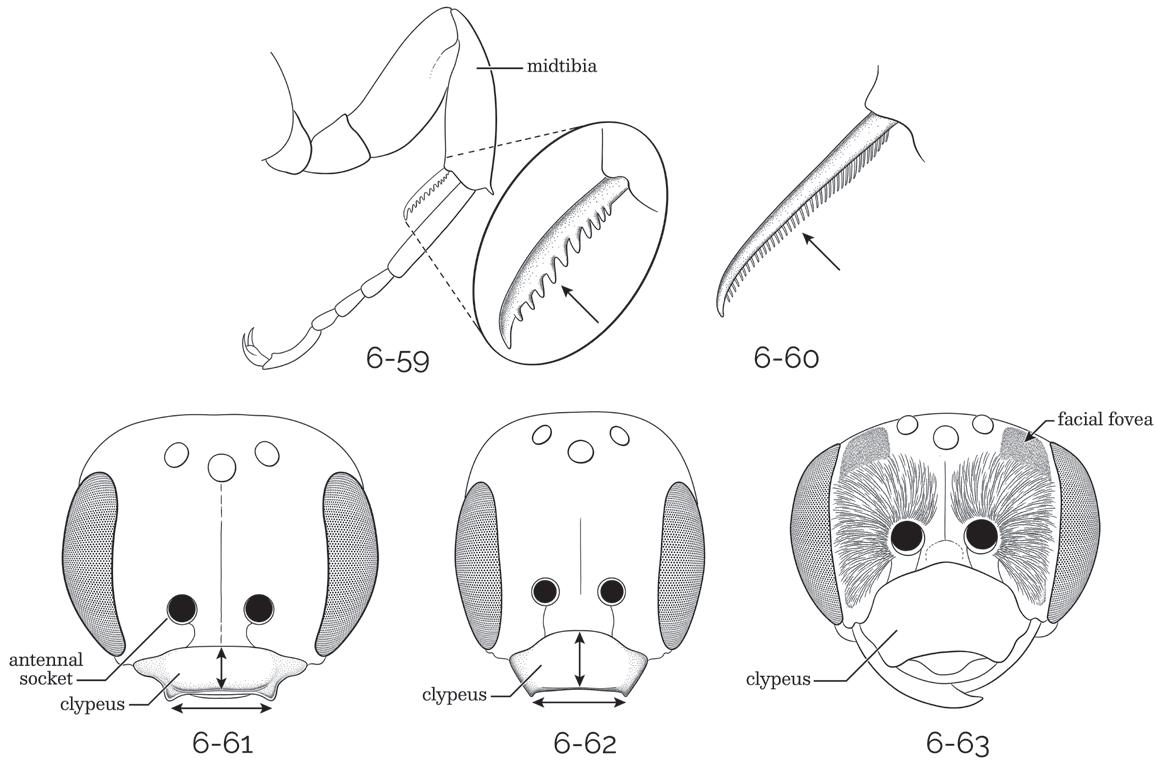
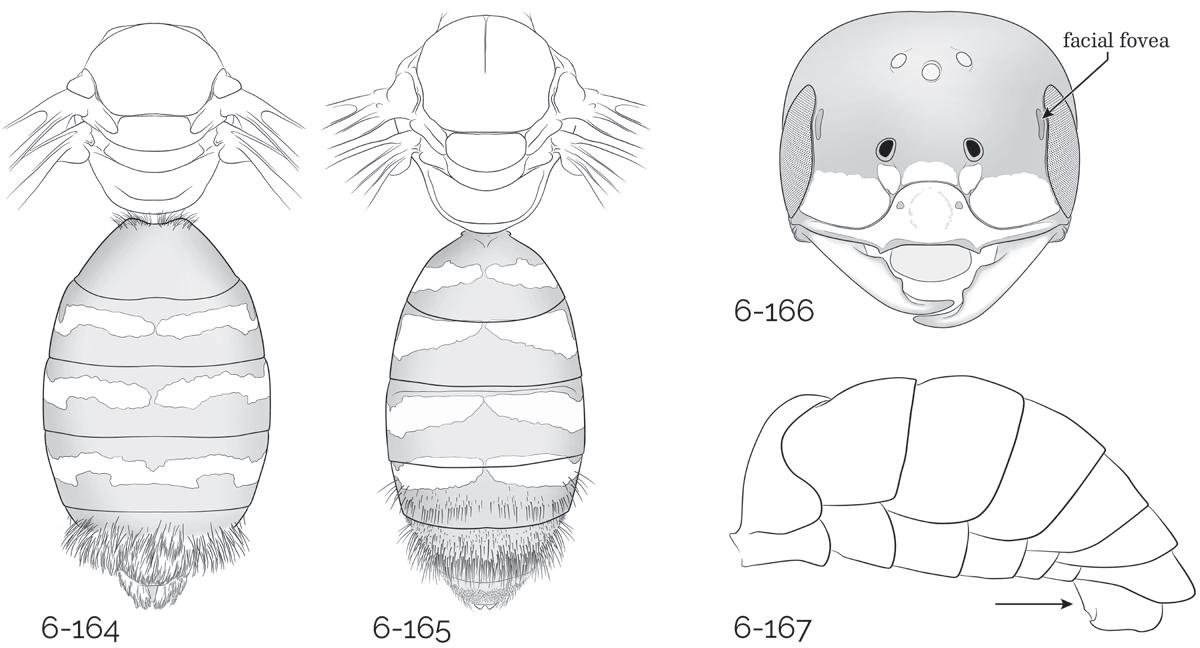
k(j). Antennal bases well below middle of face and separated from clypeus by little if any more than diameter of antennal socket [Figs. 6- 61 and 6- 62]; clypeus short, transverse, its upper margin not much arched up into face; pre-episternal groove present [Fig. 6-13] (Halictidae, Rophitinae, part) Go to couplet 97 — Antennal bases near middle of face [Fig. 6-63] or, if below, separated from clypeus by much more than diameter of antennal socket; clypeus strongly arched up into face, so that it is not short and transverse [Fig. 6-63]; pre-episternal groove absent (Melittidae, part) Go to couplet 103
l(j). Jugal lobe of hind wing less, usually much less, than two-thirds as long as vannal lobe [Fig. 6-211]; first two segments of labial palpus long, sheathlike, unlike segments 3 and 4 [as in Fig. 4-6] (Apidae, Eucerini, Exomalopsini, part) Anthophorula (part) [60] — Jugal lobe of hind wing at least nearly three-fourths as long as vannal lobe [Fig. 6-212]; first two segments of labial palpus not long and sheathlike, either all four segments similar or only first segment elongate [as in Fig. 4-8] (Andrenidae, Panurginae) Go to couplet 124
LOCATOR 5
Scopa absent in females (on both hind legs and metasomal sterna) [mostly brood parasitic bees] a
a. Hind tibial spurs absent [as in Fig. 6-7]; venation reduced [as in Figs. 6-1 and 6-2; see couplet 1 of Chapter 6, Key to the Genera] (Apidae, Meliponini, part) (tropical) Lestrimelitta [29]
— Hind tibial spurs present [as in Fig. 6-8]; venation not reduced [as in Fig. 6-4; see couplet 1 of Chapter 6, Key to the Genera] b
b(a). Three submarginal cells [as in Fig. 5-3] c
— Two submarginal cells (rarely only one) [as in Fig. 5-4] j
c(b). Large; brilliantly metallic green, blue, or purple; with proboscis in repose extending beyond base of metasoma; comb of bristles in position of jugal lobe of hind wing [Fig. 6-19] (Apidae, Euglossini, part) (tropical) Go to couplet 11
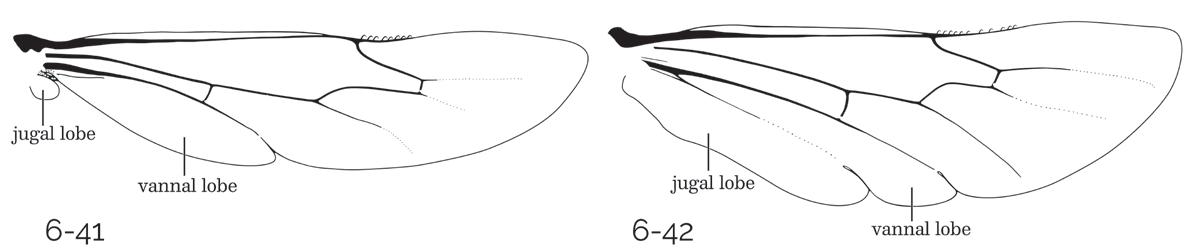
— Usually smaller; usually not brilliantly metallic; proboscis in repose not reaching metasoma; jugal lobe of hind wing usually present [Figs. 6-41 and 6-42], never replaced by comb of bristles d
d(c). Jugal lobe of hind wing absent; large, Bombus-like bees (Apidae, Apinae, Bombini, part) Bombus (subgenus Psithyrus) [17]
— Jugal lobe of hind wing present [Figs. 6-41 and 6-42]; usually smaller, not Bombus-like e
e(d). Marginal cell pointed on costal margin of wing or nearly so [Figs. 6-33 and 6-36] (see couplet 15 for details) f
— Marginal cell with apex rounded, truncate, or, if pointed, with apex bent well away from costa [Figs. 6-37 to 6-40] (see couplet 15 for details) g
f(e). Basal vein arcuate or subangulate near base [Fig. 6-71] (Halictidae, Halictinae, part)
Go to Chapter 8, Key to Genera of Halictinae
— Basal vein straight or gently curved [as in Fig. 6-70]
Go to couplet 17
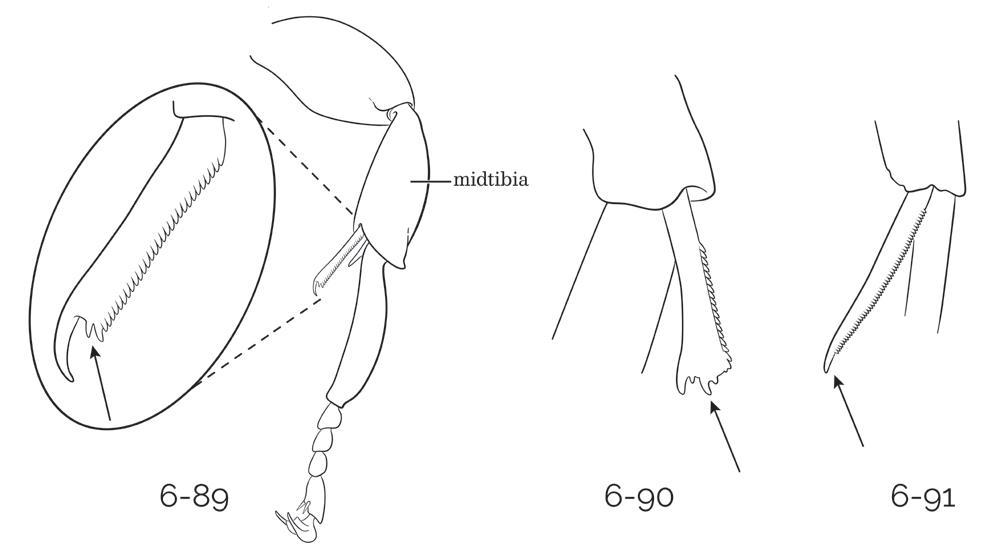
g(e). Middle tibial spur notched, bifid, or multidentate at apex [Figs. 6-89 and 6- 90] (Apidae, Nomadinae, Ericrocidini)
Go to couplet 43
— Middle tibial spur ending in a simple, sharp point [Fig. 6-91] h
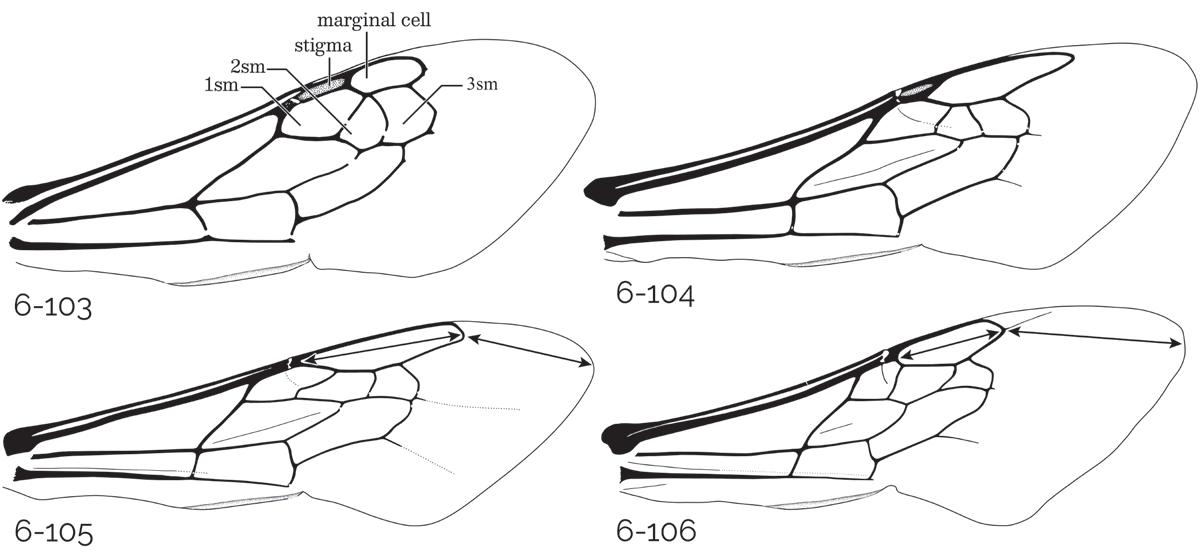
h(g). Arolia absent [as in Fig. 6-99]; marginal cell less than twice as long as stigma and not exceeding third submarginal cell [Fig. 6-103] (Apidae, Nomadinae, Melectini, part)
Zacosmia [85]
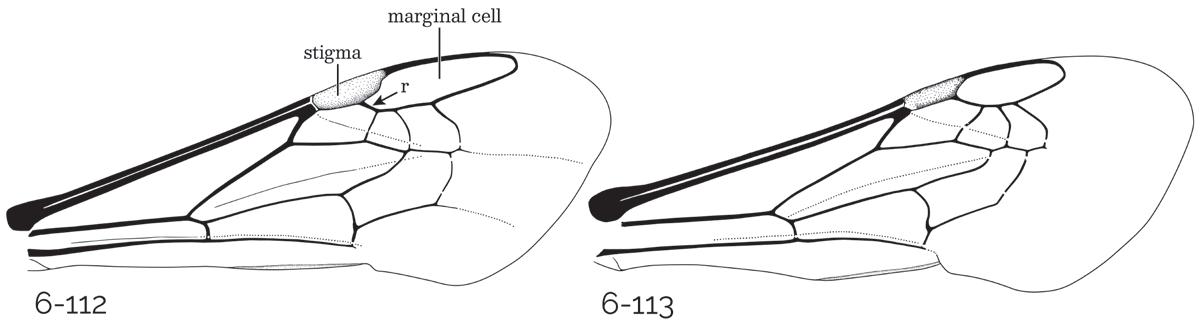
— Arolia present [as in Fig. 6-100]; marginal cell longer, extending beyond third submarginal cell [Fig. 6-113] i
i(h). Pygidial plate distinct [as in Fig. 6-131]
Go to couplet 55
— Pygidial plate unrecognizable (Apidae, Nomadinae, Protepeolini) (rare, southwestern United States and Mexico) Leiopodus [93]
j(b). Marginal cell beyond stigma little if any longer than stigma and second submarginal cell less than two-thirds as long as first [as in Fig. 6-156] (sometimes second submarginal cell absent) (Apidae, Nomadinae, Neolarrini) Neolarra [87]
— Marginal cell beyond stigma longer than stigma or, if not, second submarginal cell twothirds as long as first or longer [as in Fig. 6-157] k
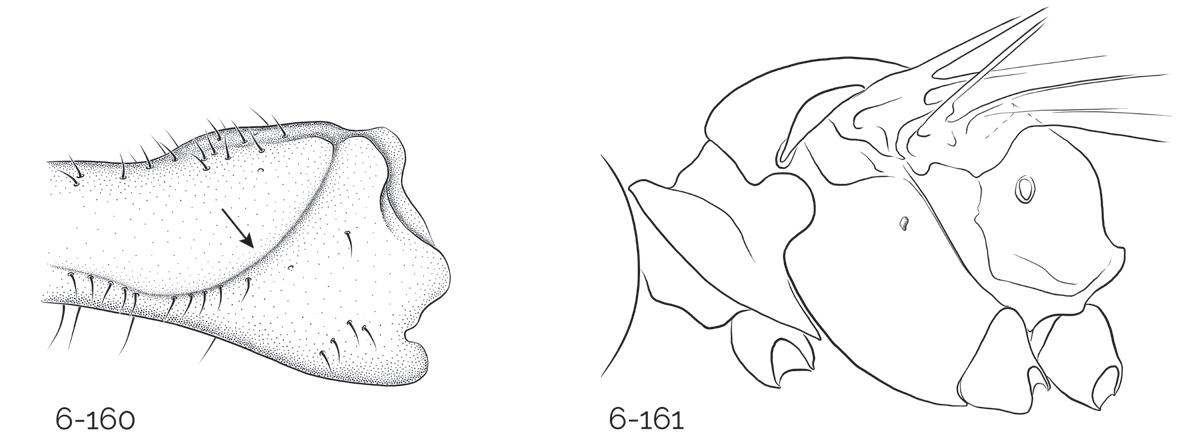
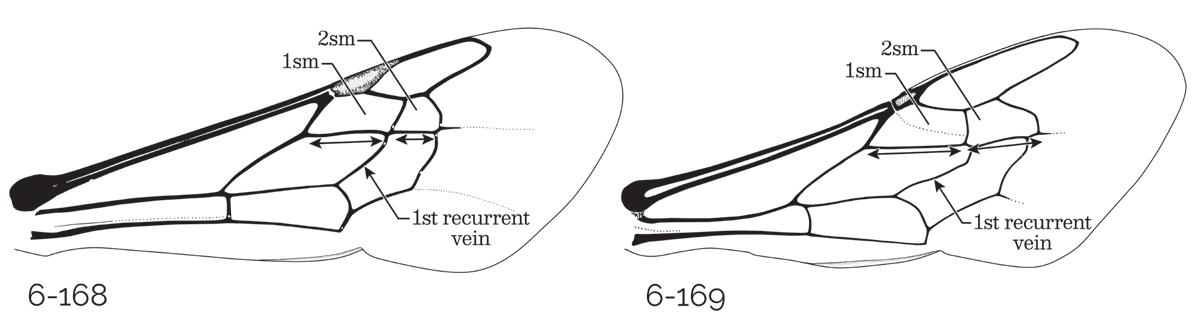
k(j). Second submarginal cell little, if any, more than half as long as first or rarely three-fifths as long [Fig. 6-168]; first recurrent vein received by first submarginal cell or meeting first transverse cubital [Fig. 6-168], rarely beyond it
Go to couplet 85
— Second submarginal cell at least two-thirds as long as first and receiving first recurrent vein [Fig. 6-169] 1
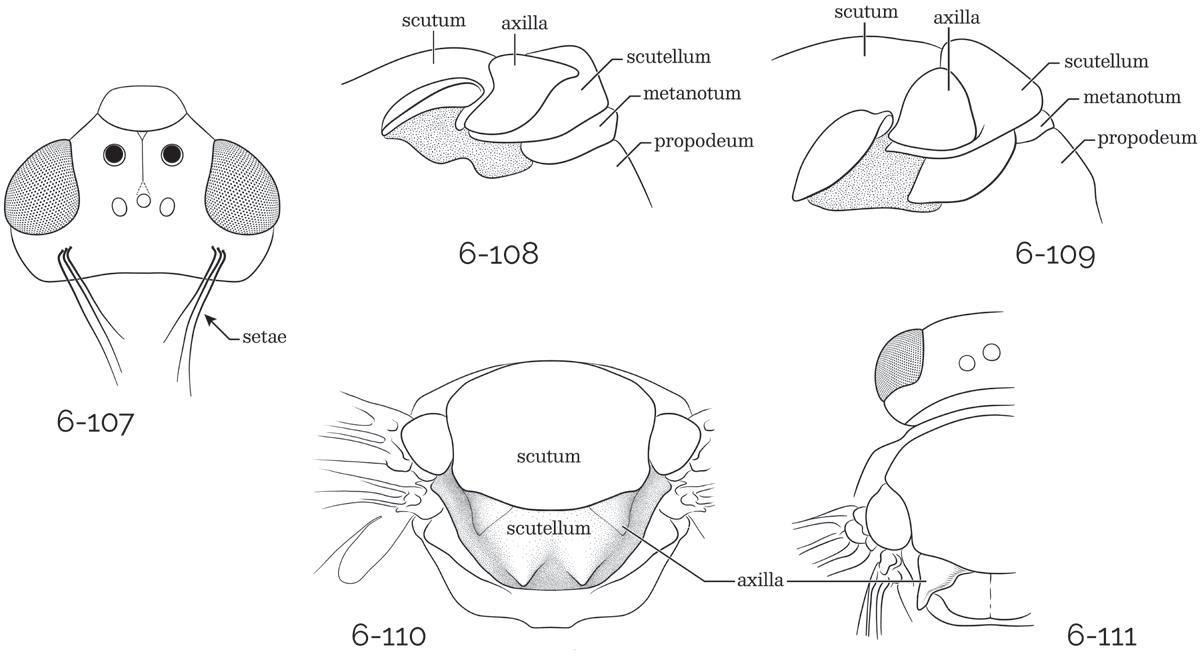
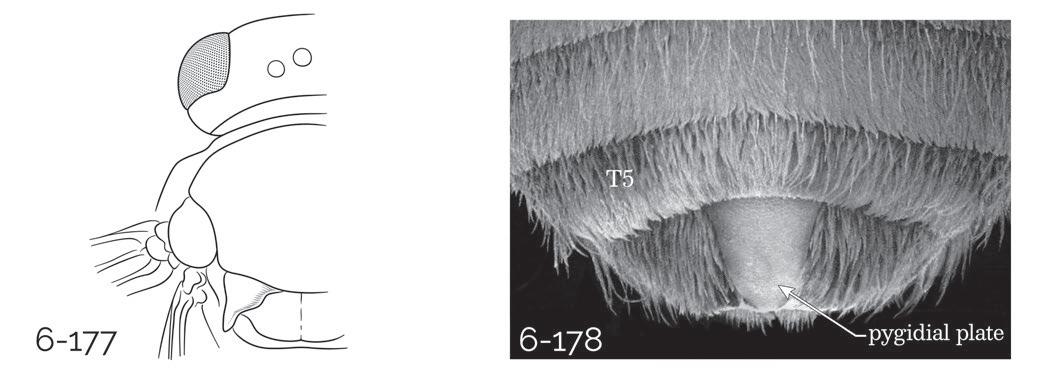
l(k). Axilla produced posteriorly to a lobe, angle, or blunt spine lateral to scutellum [Fig. 6-177]
Go to couplet 90
— Axilla not produced, or produced as a rounded lobe m
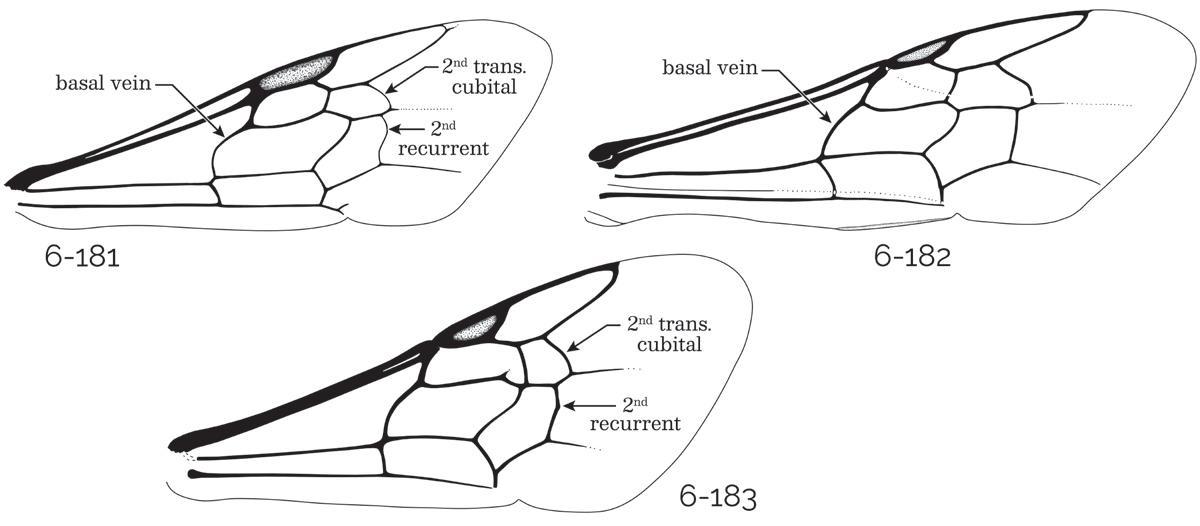
m(l). Basal vein strongly arcuate near base [as in Fig. 6-181] (Halictidae, Halictinae, Halictini, part) Sphecodes (part) [133]
— Basal vein gently and rather uniformly arcuate or straight [Fig. 6-182] n
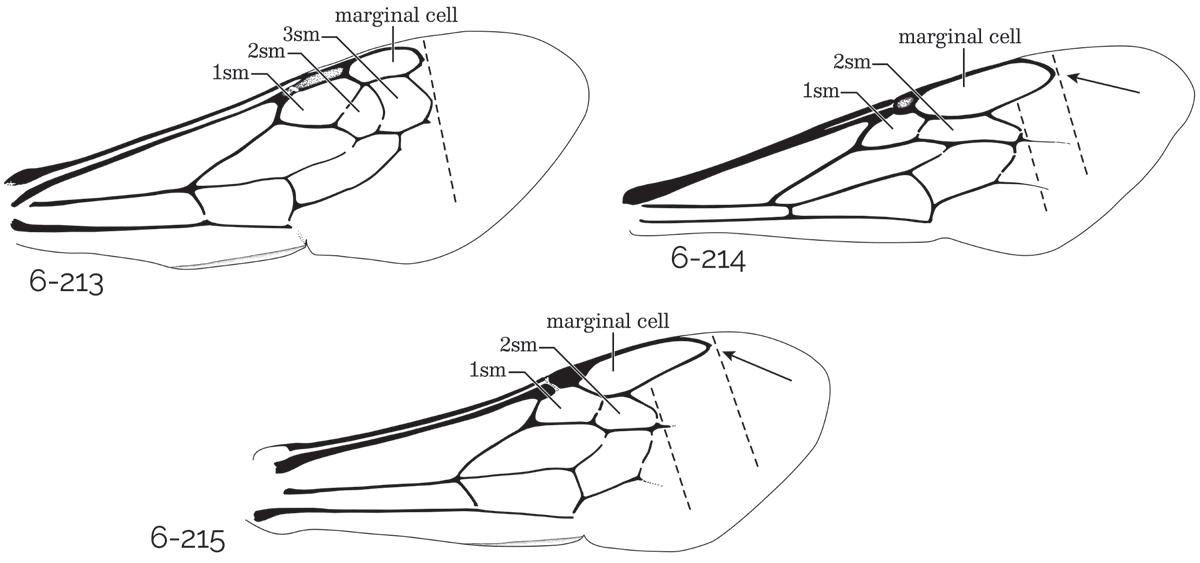
n(m). Marginal cell not exceeding or scarcely exceeding submarginal cells [as in Fig. 6-213] (Apidae, Nomadinae, Melectini) Brachymelecta (part) [83]
— Marginal cell extending beyond submarginal cells [Figs. 6-214 and 6-215] o
o(n). Apex of marginal cell obliquely truncate, i.e., bent sharply away from wing margin [as in Fig. 6-214] (Apidae, Nomadinae, Ammobatini) Oreopasites [65]
— Apex of marginal cell on wing margin or gradually bent from wing margin, pointed or narrowly rounded [as in Fig. 6-215] p
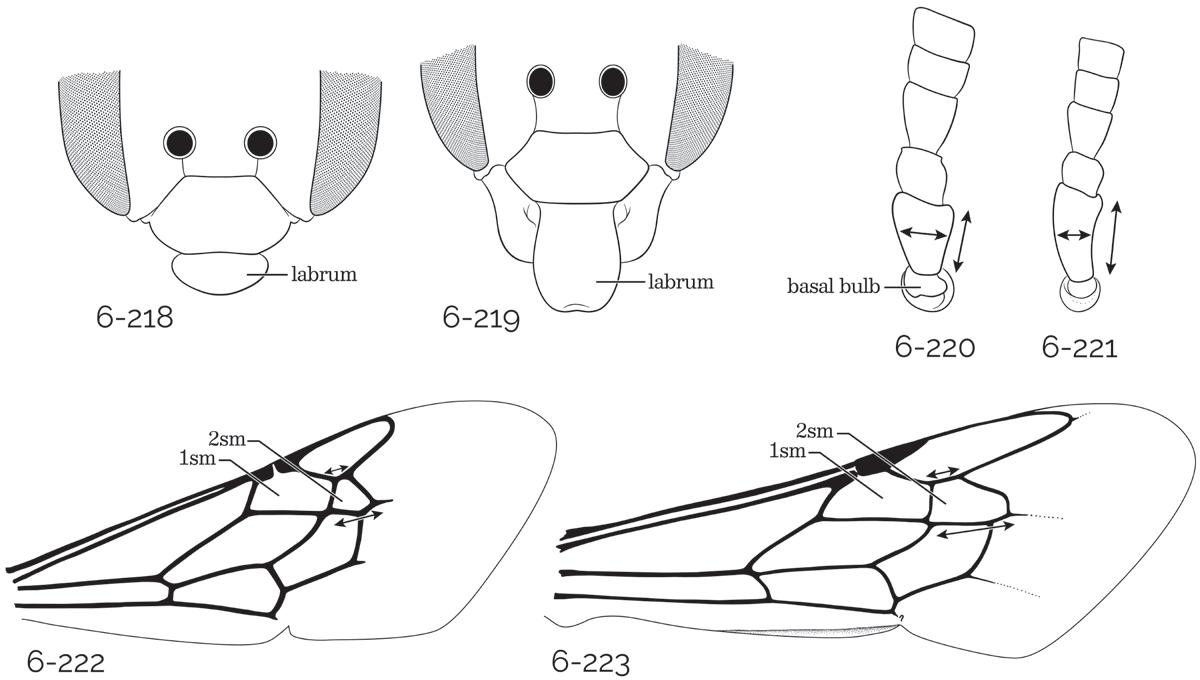
p(o). Labrum much broader than long [Fig. 6-218] (Apidae, Nomadinae) q
— Labrum longer than broad [Fig. 6-219] (Megachilidae, Megachilinae, Anthidiini)
Go to Chapter 10, Key to Genera of Anthidiini
q(p). Apex of marginal cell pointed on or almost on wing margin [as in Figs. 6-33 and 6-36]
Go to couplet 100
— Apex of marginal cell somewhat rounded, separated from wing margin [Fig. 6-40]
Go to couplet 111
LOCATOR 6
Basal vein of forewing strongly arcuate or subangulate near base [Fig. 5-7]; T5 of females (except in parasitic genera) with longitudinal median zone or triangular area of short, dense hairs or minute, dense punctation (and sometimes with a slit) dividing the prepygidial fimbria [Fig. 5-8]; T6 of females ordinarily completely hidden by T5 (Halictidae, Halictinae) a
a. Three submarginal cells [as in Fig. 5-3] Go to Chapter 8, Key to Genera of Halictinae — Two submarginal cells [as in Fig. 5-4] Go to couplet 94
LOCATOR 7
Arolia absent [compare Figs. 5- 9 and 5-10] a
a. Three submarginal cells [as in Fig. 5-3] b — Two submarginal cells [as in Fig. 5-4] (Megachilidae, part) d
b(a). Jugal lobe of hind wing absent, sometimes replaced by bristles [Fig. 6-19] (Apidae, Bombini and Euglossini) Go to couplet 9
— Jugal lobe of hind wing present [as in Figs. 6-20 and 6-41] c
c(b). Middle tibial spur notched, bifid, or multidentate at apex [Figs. 6- 89 and 6- 90] (Apidae, Nomadinae, Ericrocidini) (arolia present in Ctenioschelus) Go to couplet 43
— Middle tibial spur ending in a simple, sharp point [Fig. 6-91] g
e(d). Mandible tridentate, middle tooth longer and more elevated than others [Fig. 6-209]; outer surfaces of tibiae with numerous coarse spicules not bearing hairs or bristles [Fig. 6-210] (Lithurginae) Go to couplet 105
— Mandible simple or with lower tooth longest [Figs. 10-1 and 10-3], number of teeth variable; outer surfaces of tibiae not spiculate or, if so, with bristle arising from apex of each (Megachilinae) f
f(e). Thorax and/or metasoma with yellow or white (rarely red) integumental markings or rarely entire body red with black or yellowish markings (Anthidiini)
Go to Chapter 10, Key to Genera of Anthidiini
— Thorax and metasoma without integumental markings, black or metallic or metasoma alone red (rarely terga with narrow apical cream-colored margins) h
g(c). Marginal cell slender, seven times as long as broad and only a little over half as wide as widest submarginal cell [Fig. 6-84]; stigma absent [Fig. 6-84] (large, robust bees) (Oxaeinae) Go to couplet 40
— Marginal cell six times as long as broad or less, much more than half as wide as widest submarginal cell [Fig. 6-104]; stigma usually distinct [Fig. 6-104] (Apidae, part) Go to couplet 50
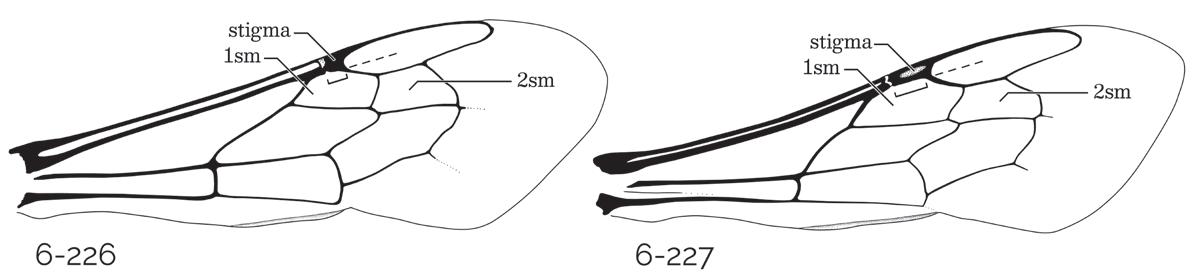
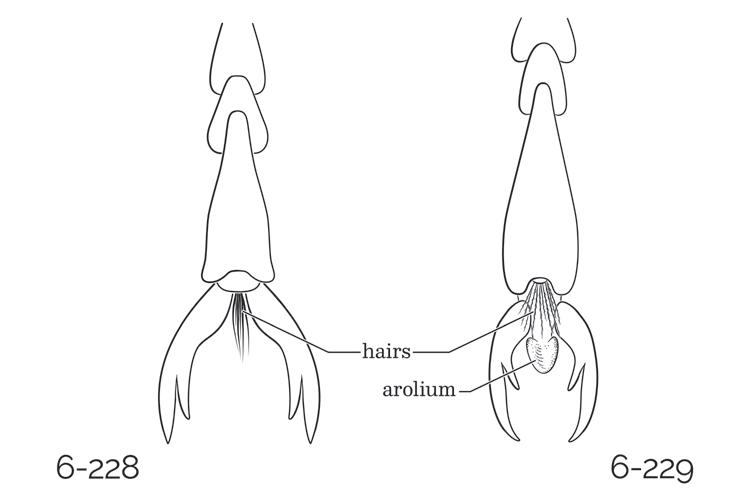
h(f). Margin of stigma in first submarginal cell shorter than or about as long as width of stigma [Fig. 6-226]; claws of female cleft or with inner preapical tooth [as in Figs. 6-228 and 6-229]; clypeus and paraocular area of male usually yellow or cream-colored (Subgroups, sometimes recognized as genera, are characterized in Chapter 12) (Anthidiini) Trachusa (part) [159]
— Margin of stigma in first submarginal cell longer than width of stigma [Fig. 6-227]; claws of female simple or with basal tooth; clypeus and paraocular areas not yellow or cream-colored (Megachilini) Megachile [162]
LOCATOR 8
Males with elongate antennae (antennal length exceeding tegula in repose and often reaching stigma or marginal cell) [Fig. 5-11]; females with a W-shaped gradulus on S2 [Figs. 5-12 and 5-13]; large, relatively robust, hairy bees Go to Chapter 9, Key to Genera of Eucerini
KEY TO THE GENERA (MAIN
START HERE
1. Transverse cubital veins and second recurrent vein weak compared with other veins, commonly absent [Figs. 6-1 to 6-3]; marginal cell open [Figs. 6-1 , 6-3] or closed by weakened vein [Fig. 6-2]; hind tibial spurs absent [Fig. 6-7] G o to Chapter 7, Key to Genera of Meliponini — Veins well developed, conspicuous; marginal cell closed by strong vein [Fig. 6-4]; hind tibial spurs present [Fig. 6-8], except in Apis [Fig. 6-7] and males of Eulonchopria and Coelioxoides 2
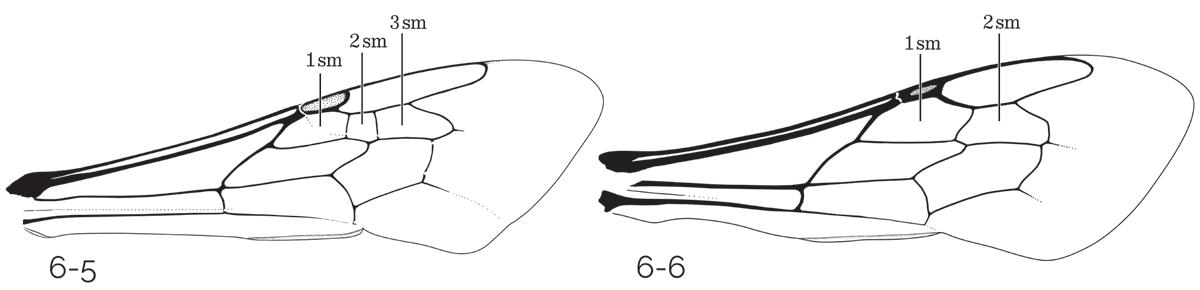
2(1). With three submarginal cells [Fig. 6-5]; rarely second transverse cubital incomplete, so that second and third submarginal cells are partly united 3 — With two submarginal cells [Fig. 6-6], rarely only one 80
3(2). Hind tibial spurs absent [Fig. 6-7]; eyes hairy [Fig. 6-9] (Apidae, Apini) Apis [16] — Hind tibial spurs present [Fig. 6-8] except in males of Eulonchopria and Coelioxoides, which have bare eyes 4
4(3). First recurrent vein meeting first transverse cubital [Fig. 6-10] or within one or two vein widths of it; stigma no wider than prestigma measured to wing margin [Fig. 6-10] (Colletidae, Diphaglossinae, part) 5
— First recurrent vein far beyond first transverse cubital [Fig. 6-11], often near or distal to second transverse cubital; stigma often wider than prestigma [Fig. 6-11] but highly variable (if first recurrent vein near first transverse cubital, as in some Mydrosoma, wing length under 12 mm)
8
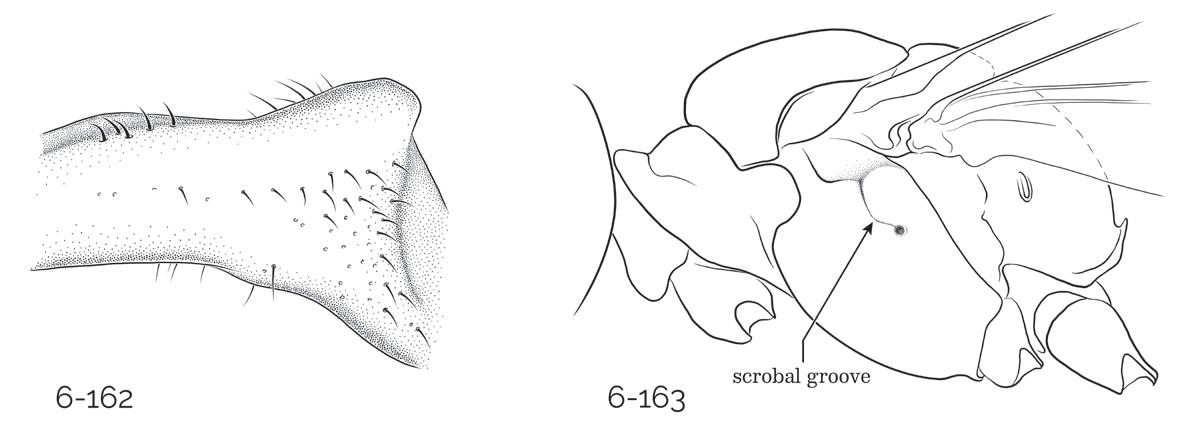
5(4). Pre-episternal groove absent below scrobal groove [as in Fig. 6-12]; forewing length under 12 mm (Dissoglottini, part) (rare, tropical) Mydrosoma (part) [103]
6
— Pre-episternal groove extending far below scrobal groove [as in Fig. 6-13]; forewing length usually >13 mm (Caupolicanini)
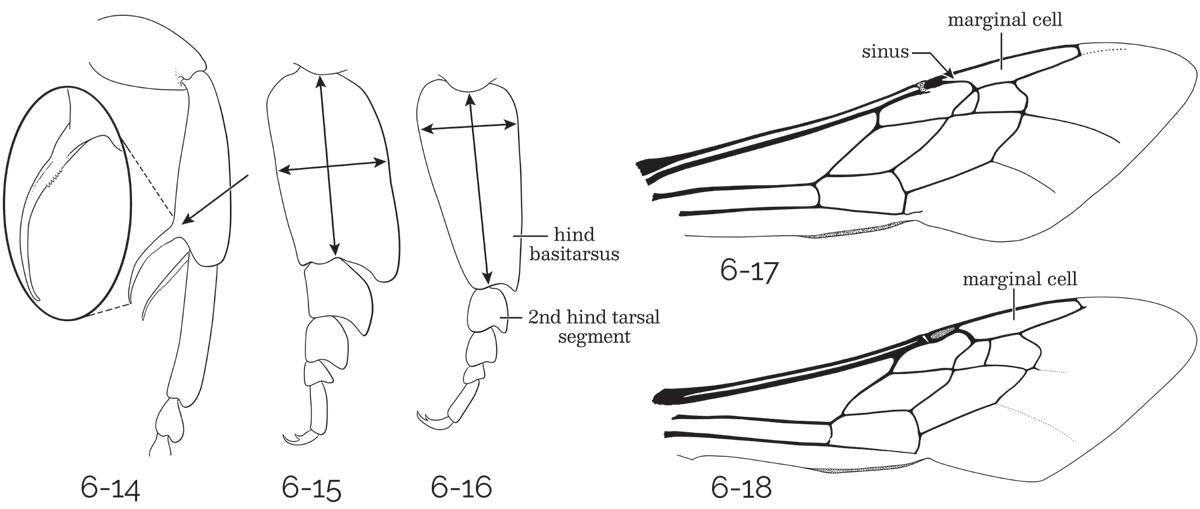
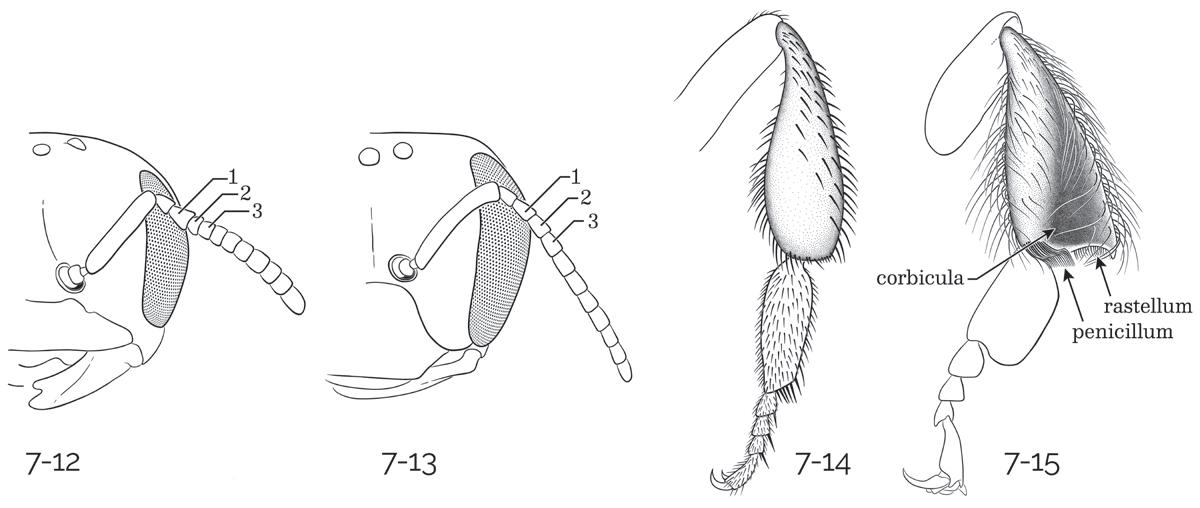
6(5). Outer hind tibial spur of male immovably fused to tibia [Fig. 6-14]; hind basitarsus of female about twice as long as broad [Fig. 6-15], second hind tarsal segment broader than main longitudinal axis [Fig. 6-15]; metasomal terga usually weakly metallic greenish or bluish (uncommon, tropical to Arizona) Ptiloglossa [102]
— Outer hind tibial spur of male articulated at base like inner spur; hind basitarsus of female more than twice as long as broad [Fig. 6-16], second hind tarsal segment longer than broad [Fig. 6-16]; metasomal terga nonmetallic
7
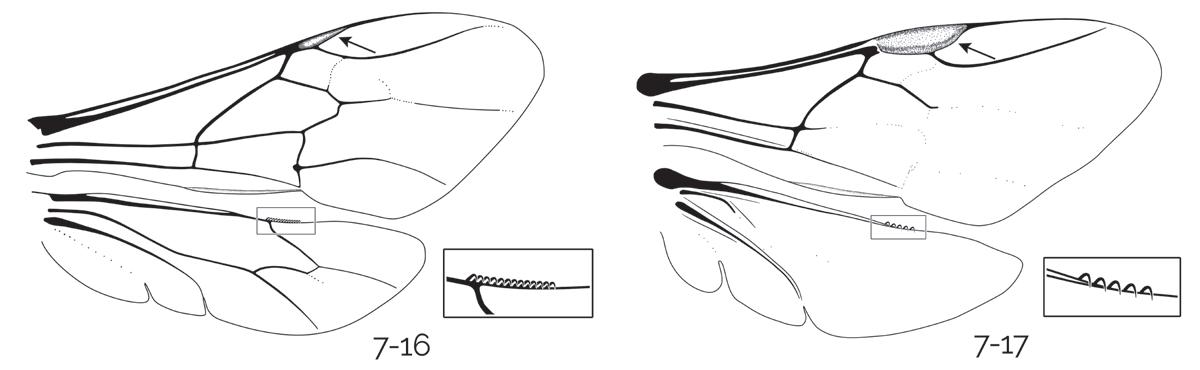
7(6). Base of marginal cell prolonged as narrow sinus to apex of stigma [Fig. 6-17]; S7 of male without paired apical lobes (rare, Mesoamerica) Crawfordapis [101]
— Base of marginal cell not sinus-like [Fig. 6-18]; S7 of male with paired apical lobes Caupolicana [100]
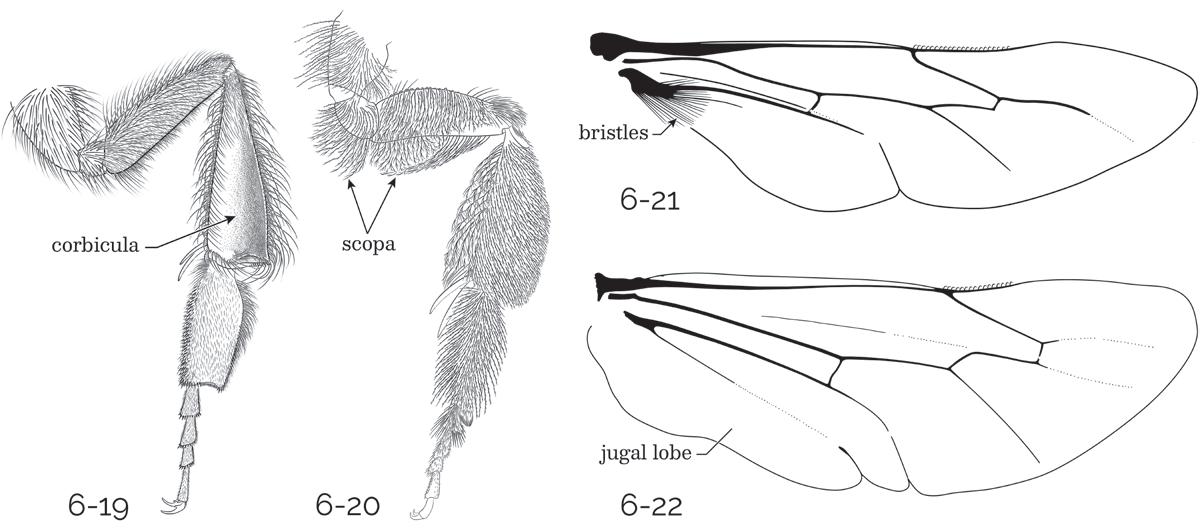
8(4). Scopa of female, when present, forming a corbicula on posterior tibia [Fig. 6-19]; inner apical margin of posterior tibia of nonparasitic females (except in queens of Apini) with row of stiff bristles (the rastellum); pygidial and basitibial plates absent; eyes hairy or jugal lobe of hind wing absent and sometimes replaced by bristles [Fig. 6-21] (corbiculate bees) 9
— Scopa of female not forming a tibial corbicula [Fig. 6-20] or sometimes absent; inner apical margins of posterior tibiae bare or hairy, without comb; pygidial and basitibial plates frequently present; eyes very rarely hairy and jugal lobe of hind wing almost always present [Fig. 6-22] ( Xylocopa should go here.) 14
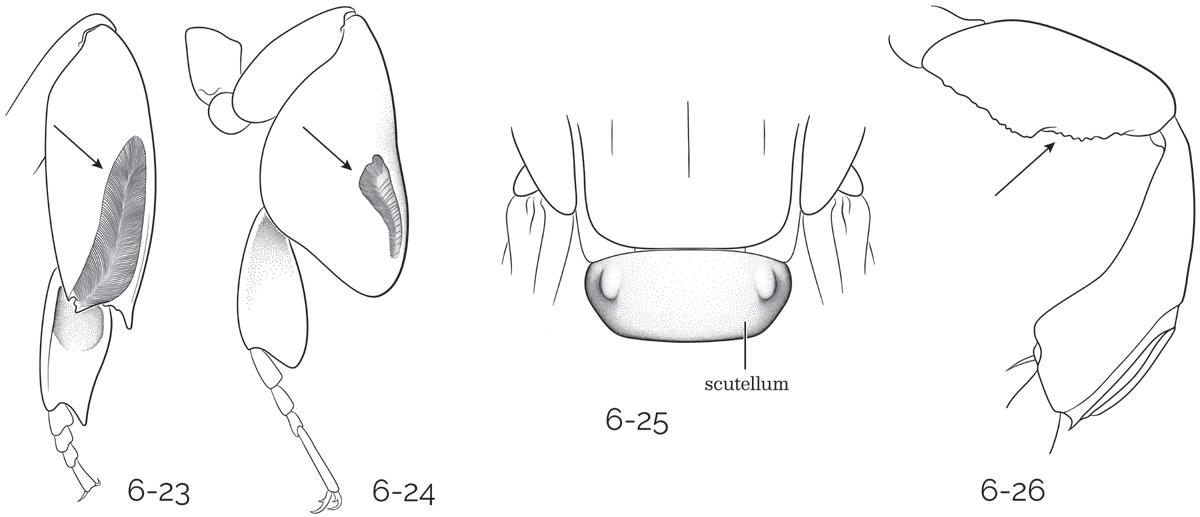
9(8). Proboscis in repose reaching beyond base of metasoma; body usually at least partially metallic; deep, hairy groove on outer surface of hind tibia of male [Figs. 6-23, 6-24, 6-26]; a comb of bristles in position of jugal lobe of hind wing [Fig. 6-21] (Apidae, Euglossini) (tropical) 10
— Proboscis in repose not reaching base of metasoma; body not metallic; posterior tibia of male not deeply grooved on outer surface; no comb of bristles on base of hind wing (Apidae, Bombini) Bombus [17]
10(9). Hind tibia of both sexes at most 1.5 times as broad as femur [Fig. 6-26], that of female without corbicula 11
— Hind tibia of both sexes more than twice as broad as femur [Figs. 6-23 and 6-24], that of female with corbicula 12
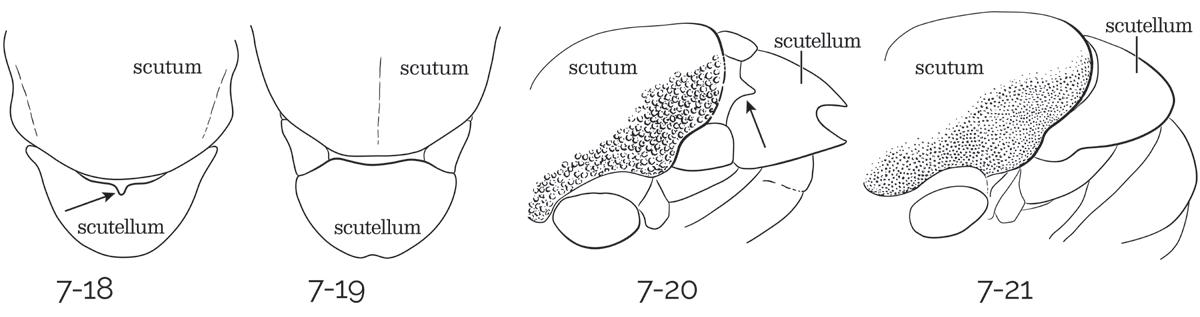
11(10). Scutellum with a tubercle on each side [Fig. 6-25]; hind femur usually denticulate beneath [Fig. 6-26]; metasomal terga and sterna without longitudinal median carina (rare)
Exaerete [24]
— Scutellum flat, not tuberculate; hind femur not denticulate; metasomal terga (especially T3 to T6) and sterna (S2 to S4; also S5 in female) with longitudinal median carina (very rare)
Aglae [20]
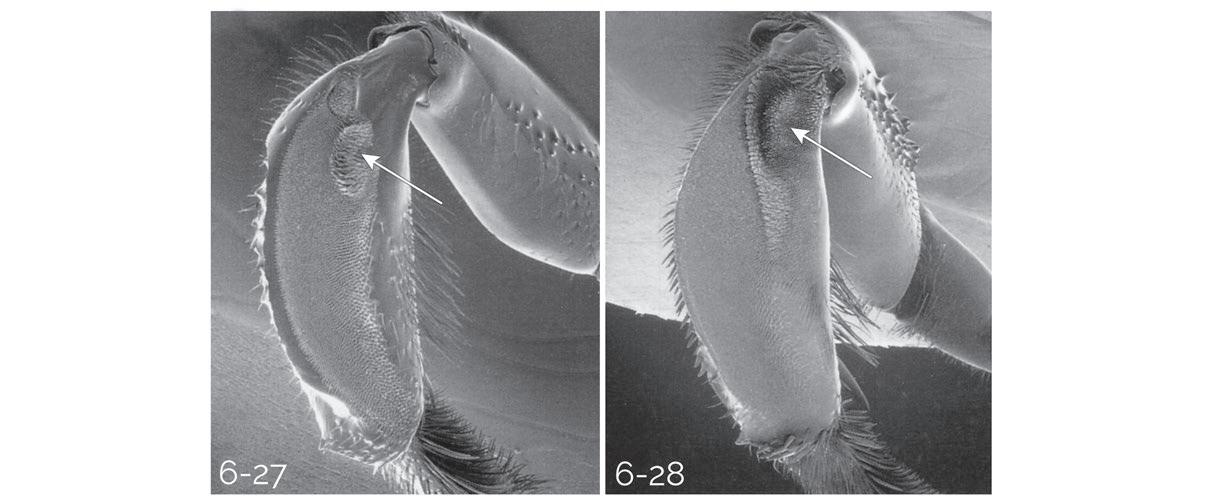
12(10). Labrum, mandible, and lower lateral portion of clypeus whitish; body usually brilliantly metallic; posterior tibia of male with hairy groove not reaching rounded apex of tibia [Fig. 6-24]; middle tibia of male with one to three small velvety patches at the proximal end of the large patch [Fig. 6-27] Euglossa [22]
— Labrum, mandible, and lower lateral portion of clypeus dark; body usually black or slightly metallic, sometimes brilliantly so; posterior tibia of male with hairy groove reaching apex of tibia between two strong teeth or spines [Fig. 6-23]; middle tibia of male with one elongate velvety patch adjacent to or within proximal part of larger patch [Fig. 6-28] 13
13(12). Labial palpus two-segmented; face nonmetallic, commonly with white marks on clypeus (uncommon) Eulaema [23]
— Labial palpus four-segmented; face metallic (sometimes only faintly so); clypeus without white marks (uncommon) Eufriesea [21]
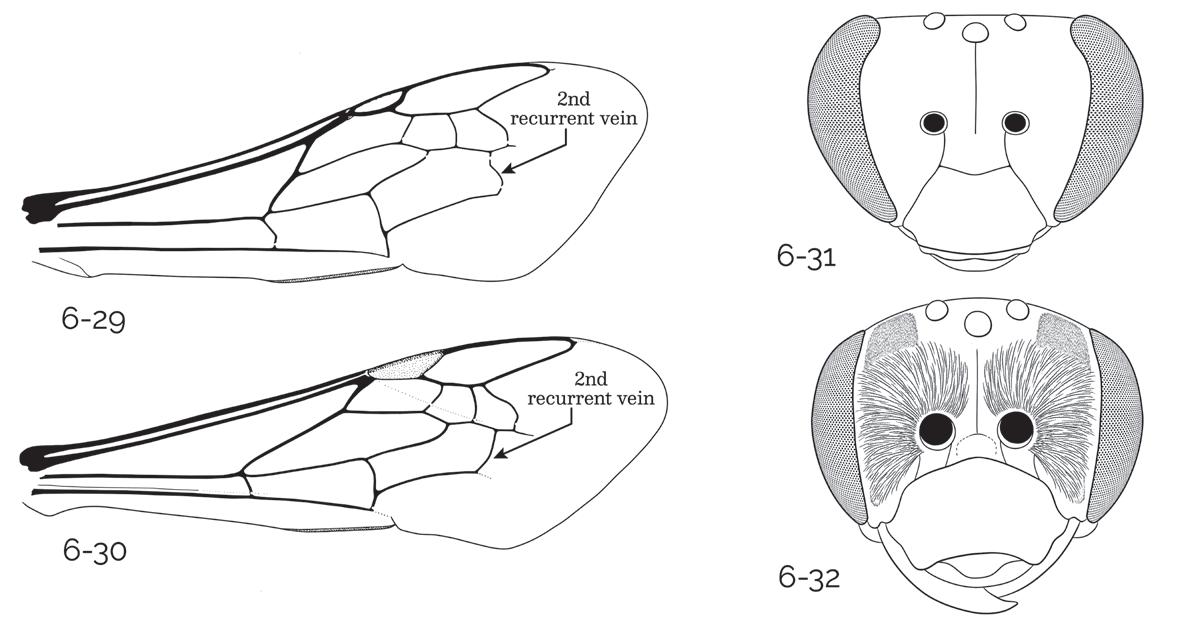
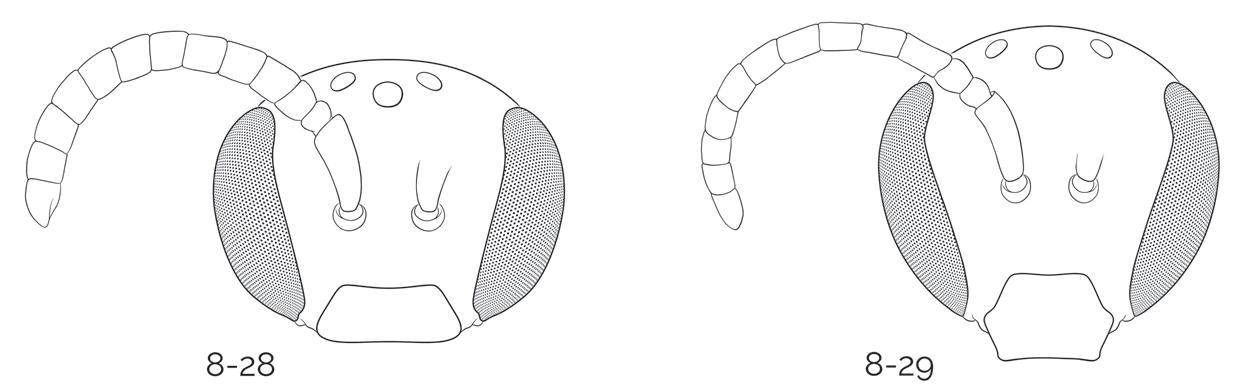
14(8). Posterior portion of second recurrent vein distinctly arcuate distad [Fig. 6-29]; eyes usually strongly convergent below [Fig. 6-31] (Colletidae, Colletinae) Colletes [99]
— Posterior portion of second recurrent vein not arcuate distad [as in Fig. 6-30]; eyes variable, often subparallel [as in Fig. 6-32] 15
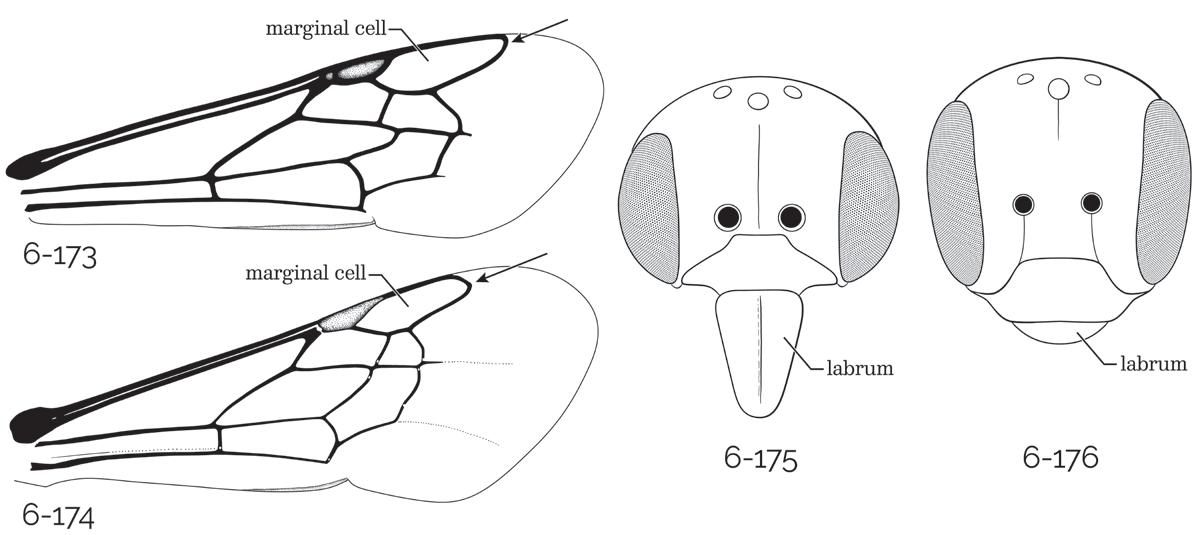
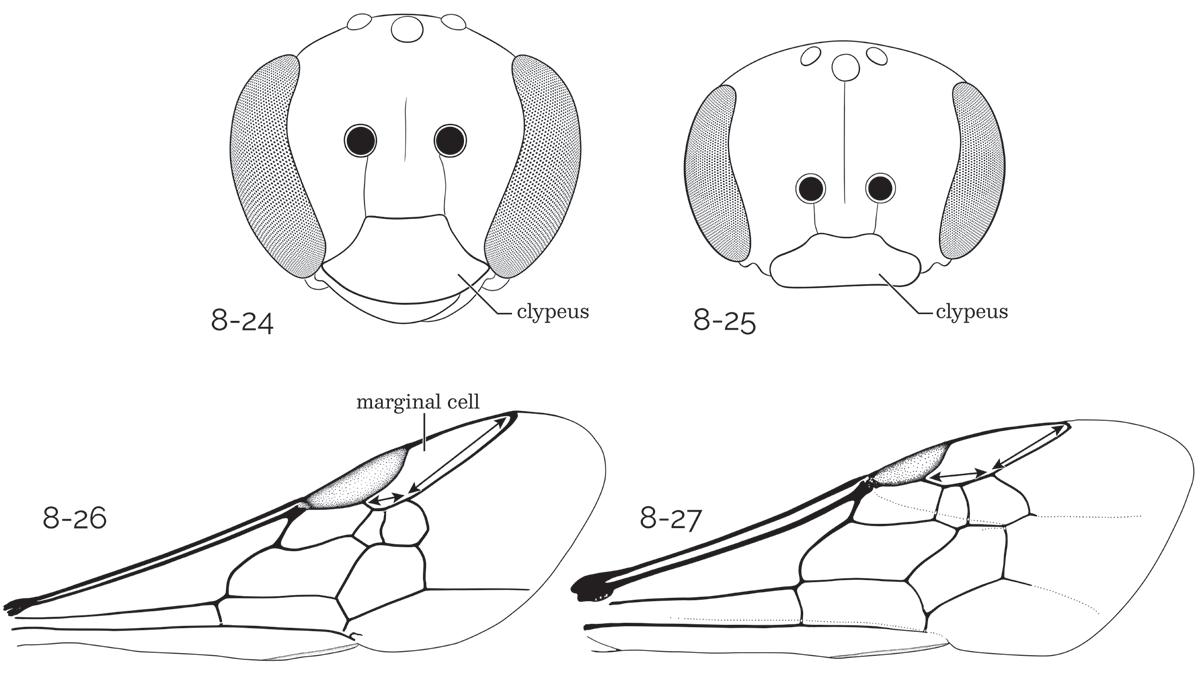
15(14). Marginal cell pointed [Fig. 6-33] (or sometimes rounded as in Nomiinae [Fig. 6-34], in Chelostoma, and often in Ceratina [Fig. 6-35]1 ), apex on costal margin of wing or, if bent away from margin or truncated, apex less than about three vein widths (of vein Rs on posterior side of cell) from costal margin [Fig. 6-33]; stigma usually large, usually broader and much longer than prestigma, edge of stigma within marginal cell usually convex. (Some halictids have marginal cell minutely truncate at apex, but stigma is large and basal vein is strongly arcuate [Fig. 6-36].) 16
— Marginal cell with apex rounded [Fig. 6-37], truncate [Fig. 6-38], or, if pointed, apex bent well away from costal margin, so that it is three or more vein widths from costal margin [Fig. 6-39]; stigma commonly small, rarely broader than prestigma, usually little if any longer than prestigma, edge of stigma within marginal cell usually straight or concave (Exomalopsines [Fig. 6-40], epeolines, and others go here in spite of large stigmata because of the apex of the marginal cell.) 37 1. Couplet 15: These taxa can be run to either couplet 16 or 37.
16(15). Jugal lobe of hind wing very small, less than one-third as long as vannal lobe measured from wing base [Fig. 6-41]; scopa absent; first two segments of labial palpus elongate, flat, unlike last two segments [Fig. 4-6] 17
— Jugal lobe of hind wing at least one-third as long as vannal lobe [Fig. 6-42]; scopa of female usually present; labial palpal segments similar, more or less cylindrical [as in Fig. 4-8], except in Ceratina 23
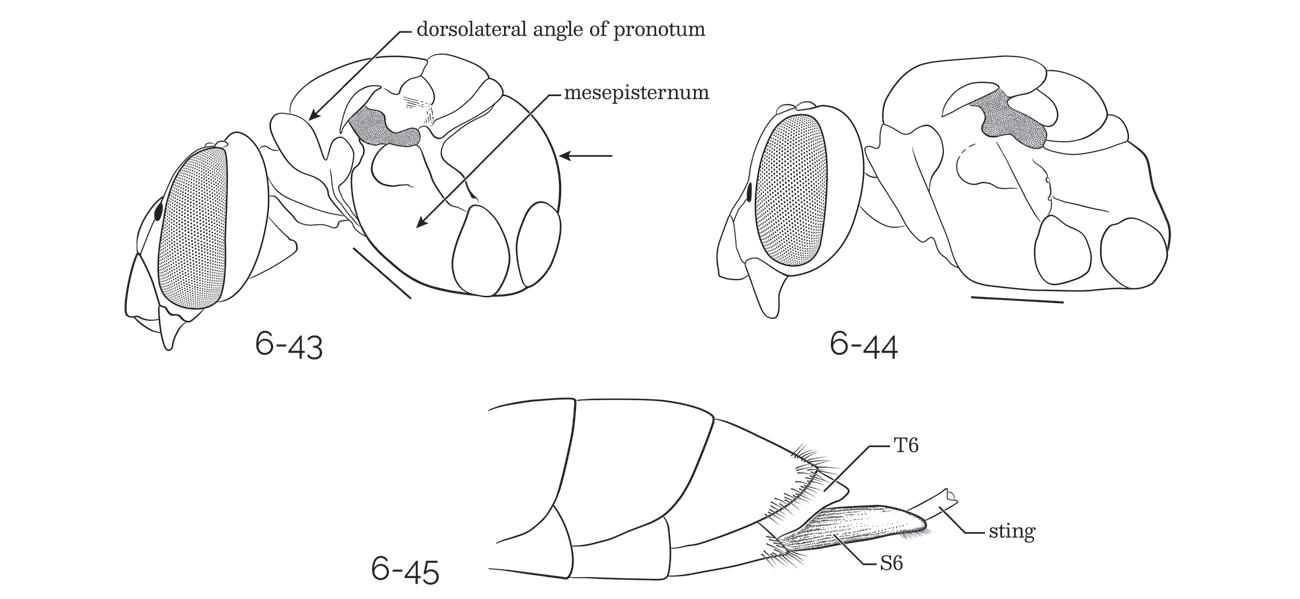
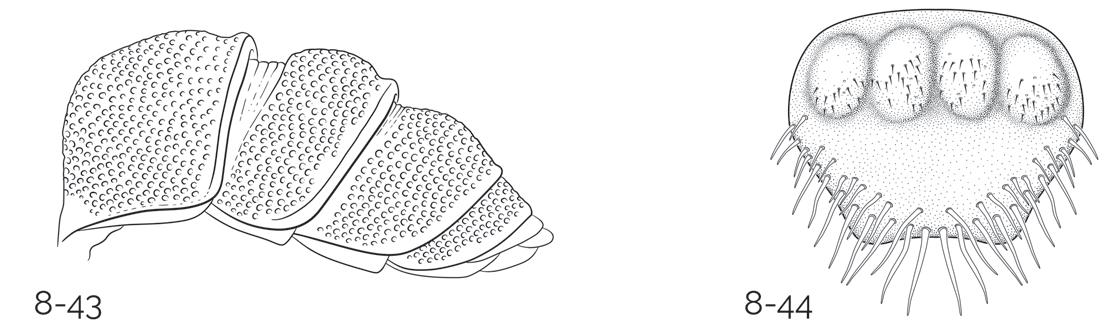
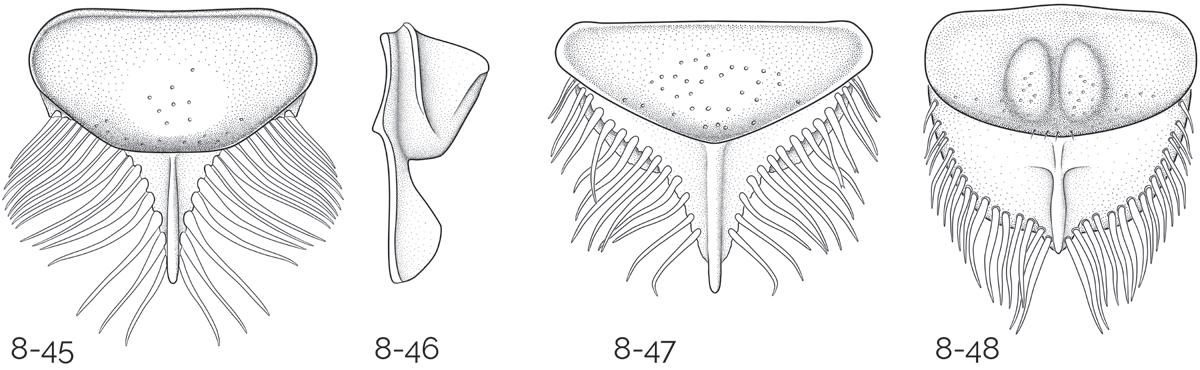
17(16). Mesepisternum seen from side with ventral portion slanting and approximately parallel to profile of propodeum [Fig. 6-43]; S6 of female exposed, without processes, lobes, or spinelike setae [Fig. 6-45]; integument smooth, largely impunctate, without areas of dense pubescence (Apidae, Nomadinae, Osirini) (rare, tropical) 18
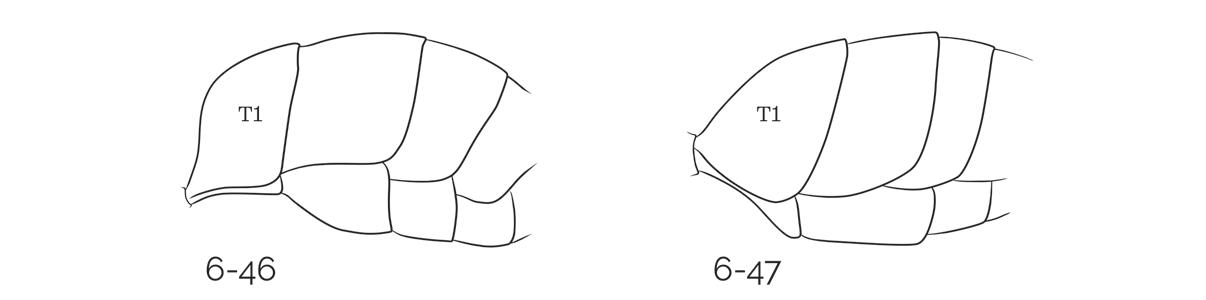
— Mesepisternum with posterior ventral portion horizontal [Fig. 6-44], at an angle to propodeal profile; S6 of female retracted, with only apical processes or lobes bearing coarse, spinelike setae exposed; integument punctate or, if largely smooth, with areas of dense pubescence (Apidae, Nomadinae, Brachynomadini and Nomadini) 19
18(17). Dorsolateral angle of pronotum a bulging convexity [Fig. 6-43] with anteroposterior dimension greater than or equal to genal width; mandible with two preapical teeth; S6 of female long and tubular [Fig. 6-45], much exceeding T6 Osiris [91]
— Dorsolateral angle of pronotum much smaller, anteroposterior dimension about half of genal width; mandible simple or with one preapical tooth; S6 of female only slightly exceeding T6 Protosiris [92]
19(17). Integument almost entirely polished and impunctate; mesosoma flattened, greatest width nearly twice height (rare, southwestern United States and Mexico) Paranomada [68]
— Integument at least largely punctate; mesosoma not unusually flattened 20
20(19). Apical portion of marginal cell bent slightly away from wing margin [as in Fig. 6-29]; profile of T1 with anterior surface curving gradually onto dorsal surface [Fig. 6-46] (rare, southwestern United States and Mexico) 21
— Apical portion of marginal cell on wing margin or nearly so [as in Fig. 6-30]; profile of T1 a single, gentle curve, so that anterior and dorsal surfaces are not recognizable [Fig. 6-47] 22
21(20). Greater than 8 mm in length; metasomal terga with unbroken apical pubescent fasciae [Fig. 6-48] Hexepeolus (part) [82]
— Under 6 mm in length; metasomal terga with pubescent fasciae broken medially [Fig. 6-49] Triopasites [69]
22(20). Vertex and mesoscutum shiny and largely impunctate; middle coxa as long as distance from summit to hind wing base [Fig. 6-50] (rare, western United States and Mexico) Brachynomada (part) [67]
— Vertex and mesoscutum ordinarily punctate; middle coxa shorter than distance from summit to hind wing base [Fig. 6-51] Nomada (part) [90]
23(16). Shiny, hairs short and sparse, not forming metasomal bands; clypeus of female usually with short, longitudinal median white or yellow bar; basal vein gently and uniformly curved [Fig. 6-52]; pygidial plate absent but apex of T6 of female pointed [Fig. 6-54]; long-tongued bees with first two segments of labial palpus elongate and flattened, unlike last two [as in Fig. 4-6] (Apidae, Xylocopinae, Ceratinini, part) Ceratina (part) [96]
— Usually hairier forms, often with metasomal bands of hair; clypeus of female without longitudinal median pale bar; if body shiny and without bands, basal part of basal vein strongly curved [Fig. 6-53]; pygidial plate of female and many males present [Fig. 6-55], that of female often hidden under T5; labial palpal segments, or at least last three of them, similar, not long and flattened [as in Fig. 4-8] 24
24(23). Apex of marginal cell rounded [Fig. 6-56]; posterior basitarsus of male usually as long as or longer than tibia (Halictidae, Nomiinae) 25
— Apex of marginal cell pointed [Fig. 6-57] or minutely truncate [Fig. 6-58]; posterior basitarsus of male shorter than tibia 26
25(24, 68). Posterior marginal areas of terga not strongly colored, with hairs often forming apical hair bands Dieunomia [134]
— Posterior marginal areas of terga bare, smooth, and hairless, forming green, blue, or yellowgreen, enamel-like bands Nomia [135]
26(24). Middle tibial spur coarsely serrate with 8 to 10 large teeth [Fig. 6-59] (Halictidae, Rophitinae, part) (rare, southwestern United States and Mexico) Xeralictus [141] — Middle tibial spur finely pectinate or ciliate, appearing simple under low magnifications [Fig. 6-60] 27
27(26). Antennal bases well below middle of face and usually separated from clypeus by little if any more than diameter of antennal socket [Figs. 6- 61 and 6- 62]; clypeus short, transverse, its upper margin not much arched upward [Figs. 6- 61 and 6- 62]; labrum nearly as long as clypeus (Halictidae, Rophitinae, part) 28
— Antennal bases near middle of face [Fig. 6-63]; if below, then either separated from clypeus by much more than diameter of antennal socket (as in some Halictus) or mesosoma coarsely punctate and dorsal surface of propodeum coarsely striate or rugose (as in some Sphecodes); clypeus with upper margin strongly arched upward, so that it is not short and transverse [Fig. 6-63]; labrum (excluding apical process if present) much shorter than clypeus 30
28(27). Dorsal surface of propodeum about as long as metanotum [Fig. 6-64] (rare, California, Arizona) Protodufourea [139]
— Dorsal surface of propodeum longer than metanotum, about as long as scutellum [Fig. 6-65] (uncommon to rare) 29
29(28). Body minutely roughened and more or less dull; apical, truncate margin of clypeus more than twice length of clypeus [Fig. 6-61] (uncommon) Conanthalictus [136]
— Body largely shiny although with punctures, not minutely roughened; apical, truncate margin of clypeus less than or equal to twice length of clypeus [Fig. 6-62] (rare) Sphecodosoma [140]
30(27). Jugal lobe of hind wing about half as long as vannal lobe measured from wing base [Fig. 6-66]; scopa of female on hind tibia, not on basal segments of leg [as in Fig. 6-68] (Melittidae, Melittinae, part) (rare) Melitta [173]
— Jugal lobe of hind wing long, much more than half as long as vannal lobe [Fig. 6-67]; scopa of female (except in parasitic genera that lack the scopa) well developed on hind femur and sometimes trochanter [Fig. 6-69] 31
31(30). Basal vein straight or feebly arcuate [Fig. 6-70]; facial foveae present in female and covered with short velvety hairs [Fig. 6-63] (Andrenidae, Andreninae, part)
— Basal vein strongly arcuate or subangulate near base [Fig. 6-71]; facial foveae absent (Halictidae, Halictinae, part) Go to Chapter 8, Key to Genera of Halictinae
33(32). Hairs of hind trochanter rather dense, short, the longer ones simple, not much curved; anterior surface of T1 broadly concave [Fig. 6-72], much longer than dorsal surface [Fig. 6-74] (rare, southwestern United States and Mexico) Ancylandrena [1]
— Some hairs of hind trochanter long, curved distally, plumose, forming a floccus closing basal end of femoral scopa [Fig. 6-69]; anterior surface of T1 with smaller concavity or groove [Fig. 6-73], shorter than to slightly longer than dorsal surface [Fig. 6-75]
34(33). Hind basitarsus more than half as long as hind tibia [Fig. 6-69]; stigma often broader than prestigma (measured to wing margin), margins of stigma diverging from base of stigma to vein r [Fig. 6-76]; length of stigma usually more than half distance from its apex to apex of marginal cell Andrena (part) [2]
— Hind basitarsus about half as long as hind tibia; stigma about as wide as prestigma (measured to wing margin), margins parallel or nearly so from base of stigma to vein r [Fig. 6-77]; length of stigma less than half distance from its apex to apex of marginal cell [Fig. 6-77] (rare, southwestern United States and Mexico) Megandrena [3]
35(32). Gonobase a narrow ring or essentially absent [Fig. 6-78]; mandible simple or with weak preapical shoulder representing apex of pollex on upper margin [Fig. 6-80] (rare, southwestern United States and Mexico) Megandrena [3]
— Gonobase, with broad dorsal surface [Fig. 6-79]; mandible with preapical tooth (apex of pollex) on upper margin [Fig. 6-81] 36
36(35). Anterior surface of T1 largely convex, concavity a median longitudinal groove or depression shorter than to slightly longer than distance from its apex to apex of T1 [as in Figs. 6-73 and 6-75]; hind basitarsus five or more times as long as wide Andrena (part) [2] — Anterior surface of T1 concave with median longitudinal line or groove, this surface usually longer than distance from its apex to apex of T1 [Figs. 6-72 and 6-74]; hind basitarsus less than five times as long as wide (rare, southwestern United States and Mexico) Ancylandrena [1]
— Second submarginal cell not unusually small, usually quadrate [as in Fig. 6-84], if triangular not or scarcely petiolate [as in Fig. 6-83] 38
38(37). Marginal cell slender, seven times as long as broad and only a little more than half as wide as widest submarginal cell [Figs. 6- 83 and 6- 84]; stigma absent [Figs. 6- 83 and 6- 84] (large, robust bees) ( Acanthopus approaches these characters but should be run to couplet 42; the enlarged, multidentate apex of middle tibial spur distinguishes it from genera that should go to couplet 39) 39
— Marginal cell broader, six times or less as long as broad, much more than half as wide as widest submarginal cell [Fig. 6-85]; stigma usually distinct [Fig. 6-85], sometimes large 42
39(38). Posterior basitarsus longer than tibia; second submarginal cell greatly narrowed toward marginal cell [Fig. 6-83]; scopa largely on hind tibia [as in Fig. 6-68] (Apidae, Xylocopinae, Xylocopini, part) Xylocopa [98]
— Posterior basitarsus shorter than tibia; second submarginal cell at least half as broad on anterior as on posterior side [Fig. 6-84]; scopa well developed on hind trochanter and femur [as in Fig. 6-69] (Andrenidae, Oxaeinae) 40
40(39). Metasomal terga or bands on them metallic green; maxillary palpus absent (rare, tropical) Oxaea [5]
— Metasomal terga black, sometimes with weak iridescent metallic tints; maxillary palpus sixsegmented 41
41(40). Metasomal T6 of male and T5 of female with lateral tufts of long white setae [Fig. 6-86]; apical margin of male S8 emarginate medially [Fig. 6-87] Mesoxaea [4]
— Metasomal T6 of male and T5 of female lacking conspicuous lateral tufts of white setae; apical margin of male S8 convex, not emarginated [Fig. 6-88] (United States and Mexico) Protoxaea [6]
42(38). Middle tibial spur notched [Fig. 6-89], bifid, or multidentate [Fig. 6-90] at apex; scopa absent; metasomal vestiture including metallic green or blue scales or forming striking pale brownish to white and black patches of scales (Apidae, Nomadinae, Ericrocidini) 43 — Middle tibial spur pointed [Fig. 6-91], not notched or bifid (although with a preapical shoulder in Epicharis); scopa present or absent; metasomal vestiture variable in color but not metallic green or blue, usually not scalelike 48
43(42). Metasomal vestiture forming black and white (to tawny) broken bands (mostly southwestern United States and Mexico) Ericrocis [79]
— Metasomal vestiture including green or blue metallic scales or, if not, then integument green or blue (tropical) 44
44(43). Third submarginal cell receiving both recurrent veins [as in Fig. 6-83]; hind basitarsus very long, with dense brush of long, dark, plumose hairs (rare) Acanthopus [76]
— Second and third submarginal cells of forewing each receiving a recurrent vein [Fig. 6-85]; hind basitarsus without dense brush of long, dark, plumose hairs 45
45(44). Juncture of basal and discal surfaces of T1 rounded, never appearing angulate [Fig. 6-92]; mesobasitarsus with distal, flattened process on posterior margin, often continued basad as a cariniform ridge [Fig. 6-94]; mandible usually with preapical tooth (uncommon) Mesoplia [81]
— Juncture of basal and discal surfaces of T1 angulate [Fig. 6-93]; mesobasitarsus without distal, flattened, spinelike projection on posterior margin; mandible simple 46
46(45). Scutellum with two flat, platelike lobes directed caudad over metanotum and propodeum [Fig. 6-95] (forewing dusky, with an apical cloud in marginal cell in addition to that at wing apex) (uncommon) Mesocheira [80]
— Scutellum bituberculate, with stout, subconical, and suberect projections [Fig. 6-96] 47
47(46). Pronotum carinate between collar and lobe [Fig. 6-97]; mesepisternum with lamelliform ridge between anterior and lateral surfaces, forming an omaular carina [Fig. 6-97]; male antenna normal, not extending much beyond tegula (rare) Aglaomelissa [77]
— Pronotum not carinate between collar and lobe, end of collar clearly defined; mesepisternum abruptly rounded between anterior and lateral surfaces but lacking a lamelliform ridge; male flagellar segments greatly elongate, flagellum extending well beyond apex of metasoma [Fig. 6-96] (rare) Ctenioschelus [78]
48(42). Metasoma of female tapering (as in Coelioxys) [Fig. 6-98]; S6 elongate, tapering to acute point beyond apex of T6, forming tube containing sting; T6 of female twice as long as basal width; male without hind tibial spurs; male metasoma tapering as in female but ending in dense brush on T7 (Apidae, Nomadinae, Coelioxoidini) (rare, tropical) Coelioxoides [70]
— Metasoma not tapering as in Coelioxys; S6 not so elongate, usually not acutely pointed; T6 of female as long as its basal width or shorter; hind tibial spurs present; male metasoma not ending in brush 49
50(49). Outer hind tibial spur absent, inner spur and middle tibial spur coarsely pectinate [Fig. 6-101] (Apidae, Xylocopinae, Tetrapediini, part) (tropical) Tetrapedia [97] — Hind tibia with the usual two spurs; tibial spurs simple, minutely serrate or ciliate along margins [as in Fig. 8-53] 51
51(50). Scopa absent; flagellum of male greatly thickened, middle segments several times as wide as long [Fig. 6-102]; marginal cell less than twice as long as stigma and not extending beyond third submarginal cell [Fig. 6-103] (Apidae, Nomadinae, Melectini, part) (western North America) Zacosmia [85]
— Scopa conspicuous on hind tibia of female; flagellum of male not thickened, middle segments at most twice as wide as long; marginal cell much more than twice as long as stigma and extending beyond third submarginal cell [Figs. 6-104 to 6-106] 52
52(51). Second submarginal cell much shorter than first and smaller than first and third [Fig. 6-104]; stigma distinct, longer than broad [Fig. 6-104] (Apidae, Eucerinae, Emphorini, part) Ptilothrix [47]
— Second submarginal cell equal to or longer than first on posterior margin [Figs. 6-105 and 6106]; third submarginal cell smaller than others; stigma small and transverse [Figs. 6-105 and 6-106] (Apidae, Apinae, Centridini, part) 53
53(52). Marginal cell longer than distance from apex to wing tip [Fig. 6-105]; a few extraordinarily long, whiplike setae arising from preoccipital ridge behind summit of eye and usually reaching as far as anterior margin of tegula [Fig. 6-107] (tropical) Epicharis [19]
— Marginal cell shorter than distance from apex to wing tip [Fig. 6-106]; extraordinarily long setae arising from preoccipital ridge present or absent Centris [18]
54(49). Scutellum strongly convex in profile, posterior margin (at least behind spines or tubercles when these are present) at nearly right angles to anterior part [Fig. 6-108]; scutellar surface sometimes bilobed, bituberculate, or bispinose [Fig. 6-110]; metanotum declivous, as is profile of propodeum [Fig. 6-108] 55
— Scutellum less strongly convex, posterior third at angle of 110° or more to anterior part [Fig. 6-109]; scutellar surface not bituberculate; metanotum often more nearly horizontal as is frequently base of propodeum 64
55(54). Axilla produced posteriorly to angle or spine lateral to scutellum, rarely rounded but protruding as lobe not continuing contour of scutellum [Figs. 6-108 and 6-111] (Apidae, Nomadinae, Epeolini, part) 56
— Axilla simple, not produced [Fig. 6-110], usually continuing contour of scutellar margin 59
56(55). Body largely covered with brilliant metallic blue-green scalelike hairs (rare, tropical) Thalestria [73]
— Body without metallic hairs 57
57(56). Vein r arising near middle of stigma or three-fifths of stigmal length from base [Fig. 6-112]; margin of stigma in marginal cell convex [Fig. 6-112]; greatest length of marginal cell subequal to greatest total length of the three submarginal cells; T5 of female with small, basal, longitudinal, oval area depressed or surrounded by carinae (rare, tropical) Odyneropsis [72]
— Vein r arising near apex of stigma [Fig. 6-113]; margin of stigma in marginal cell straight or concave [Fig. 6-113]; greatest length of marginal cell usually distinctly less than length of the three submarginal cells; no defined oval area on T5 of female 58
58(57, 90). T5 of female with pseudopgygidial area of short dark pubescence (often appearing silvery in lateral view), usually at least half as long as broad [Fig. 6-114]; female S6 with disc reduced to a transverse bar connecting a pair of slender lateral processes armed apically with coarse, spinelike setae [Fig. 6-116]; pygidial plate of male usually more or less parallelsided posteriorly, widened anteriorly, so that lateral margins are sinuate; maxillary palpi usually three-segmented Triepeolus [74]
— T5 with short pseudopygidial area of silvery pubescence, usually much less than half as long as broad [Fig. 6-115]; S6 of female with large disc and a pair of apical, spatulate, spiculate processes [Fig. 6-117]; pygidial plate of male with lateral margins convergent, not sinuate; maxillary palpi usually two-segmented Epeolus [71]
59(55). Marginal cell longer than distance from its apex to wing tip [Fig. 6-118]; body without areas of appressed pale pubescence (or most of T1 and T2 covered with such pubescence); wings hairy throughout, not or scarcely papillate [Fig. 6-125] 60
— Marginal cell much shorter than distance from its apex to wing tip [Fig. 6-119]; body with patches (sometimes very small) of appressed pale pubescence; wings with large bare areas and apically with coarse papillae [Fig. 6-124] (Apidae, Nomadinae, Melectini, part) 63
60(59). Hind tibia and basitarsus of both sexes with abundant hair at least as long as diameter of leg, in female forming scopa (Apidae, Eucerinae, Tapinotaspidini) (tropical) Paratetrapedia (part) [63]
— Hind tibia and basitarsus without long hair; scopa absent 61
61(60). Body length >15 mm; T7 of male bidentate, without pygidial plate (Apidae, Nomadinae, Rhathymini) (rare, tropical) 62
— Body length under 11 mm; T7 of male not bidentate, with small elevated pygidial plate (Apidae, Nomadinae, Epeoloidini) (very rare, central and eastern North America) Epeoloides [75]
62(61). Mesepisternum with large submedian tubercle [Fig. 6-120]; vein cu-v of hind wing strongly oblique and distinctly longer than second abscissa of M+Cu; supraclypeal area strongly elevated, crested medially, not continuing convexity of clypeus [Fig. 6-121] Rhathymus [95]
— Mesepisternum without tubercle; vein cu-v of hind wing less strongly oblique and shorter than or subequal to second abscissa of M+Cu; supraclypeal area with surface, in general, a continuation of convexity of clypeus although with small frontal tubercle at lower end of frontal line Nanorhathymus [94]
63(59). Inner rami of claws of middle and posterior legs broad, vertically expanded, lobelike although subtruncate or pointed, not shaped like outer rami [Fig. 6-122]; T1 without or almost without long hair similar to that of mesosoma Brachymelecta (part) [83]
— Inner rami of claws of middle and posterior legs pointed more or less like outer rami, not wider than outer rami [Fig. 6-123]; T1 with long hair like that of mesosoma Melecta [84]
— Entire forewing with numerous minute hairs [Fig. 6-125]; wing surface beyond veins not papillate or, if so, with many papillae ending in hairs or with hairs intermixed with papillae 67
65(64). Marginal cell shorter than distance from its apex to wing tip, submarginal cells subtending more than half of its length [Fig. 6-126]; anterior and posterior margins of third submarginal cell subequal; first recurrent vein ending near middle of second submarginal cell Anthophora [13]
— Marginal cell about as long as distance from its apex to wing tip, submarginal cells subtending about half of its length [Fig. 6-127]; anterior margin of third submarginal cell shorter than posterior margin; first recurrent vein ending near apex of second submarginal cell 66
66(65). Vein cu-v of hind wing approximately transverse and much shorter than second abscissa of M+Cu [Fig. 6-128]; proboscis in repose reaching hind coxae or nearly so (Mesoamerica) Deltoptila [14]
— Vein cu-v of hind wing slanting and about as long as second abscissa of M+Cu [Fig. 6-129]; proboscis in repose not reaching beyond forecoxae Habropoda [15]
67(64). Body shiny, no areas covered by dense hairs, often metallic; clypeus of female usually with short longitudinal median white or yellow bar; hairs short and sparse, not forming metasomal bands; body slender; pygidial plate absent but T6 of female pointed [Fig. 6-130] (Apidae, Xylocopinae, Ceratinini, part) Ceratina (part) [96]
— Body not shiny or else with areas covered by hairs, not metallic; clypeus of female without longitudinal median pale bar; hairs dense and often obscuring surface in some areas, often forming metasomal bands; body usually robust; pygidial plate usually present [as in Fig. 6-131] 68
68(67). Marginal cell with apex rounded but on or almost on wing margin [Fig. 6-132]; first and third submarginal cells subequal in length on posterior margins, ordinarily much longer than second, which is quadrate; jugal lobe of hind wing about three-fourths as long as vannal lobe [Fig. 6-135] (Halictidae, Nomiinae) back to 25
— Marginal cell with apex truncate or bent well away from wing margin [Figs. 6-133 and 6-134]; submarginal cells not as above; jugal lobe of hind wing usually much less than three-fourths as long as vannal lobe
69
69(68). Posterior margin of first submarginal cell at least 1.3 times as long as third [Fig. 6-133]; body elongate (like Andrena or Halictus); proboscis short; segments of labial palpus similar or only first elongate [as in Fig. 4-8]
70
— Posterior margin of first submarginal cell shorter than to scarcely longer than third [Figs. 6-134 and 6-136] or nearly 1.3 times as long as third in Ancyloscelis, Exomalopsis, and others [Fig. 6-137], which have short, robust bodies; body commonly robust; proboscis long; first two segments of labial palpus elongate, flattened, entirely different from segments 3 and 4 [as in Fig. 4-6]
72
70(69). Body extraordinarily coarsely punctate; certain metasomal terga with yellow to white integumental bands; preoccipital ridge formed as strong lamella (Colletidae, Neopasiphaeinae) (uncommon, tropical to Arizona) Eulonchopria [105]
— Body not especially coarsely punctate; metasoma without integumental bands; preoccipital ridge not lamellate 71
71(70). Third submarginal cell longer than second [Fig. 6-133]; clypeus in most males and some females with yellow maculations; scopa primarily on tibia of female [as in Fig. 6-207] (Andrenidae, Panurginae, part; see Chapter 12 for a key to subgenera) Protandrena (part) [12]
— Third submarginal cell shorter than second [as in Fig. 6-134]; face without yellow markings (except when much of head is yellow); scopa primarily on femur of female [as in Fig. 6-206] (Colletidae, Diphaglossinae, Dissoglottini, part) (rare, tropical) Mydrosoma (part) [103]
72(69). Pygidial plate absent or so modified as to be unrecognizable in both sexes; basitibial plate absent; scopa absent; metasomal vestiture includes patches of appressed plumose hairs (Apidae, Nomadinae, Protepeolini) (rare, southwestern United States and Mexico) Leiopodus [93]
— Pygidial plate distinct in females and most males [Fig. 6-131]; basitibial plate distinct in females and most males; scopa present on hind tibia and basitarsus; patches of appressed pubescence absent on metasomal terga although hair bands commonly present
73
73(72). Stigma three or more times as long as prestigma [Fig. 6-137], except in some Exomalopsis and Anthophorula in which apical part of marginal cell is bent abruptly away from wing margin [Fig. 6-137]
74
— Stigma less than three times as long as prestigma [Fig. 6-136]; apical part of marginal cell gradually bent away from wing margin [Fig. 6-136]
77
74(73). Mandible simple [Fig. 6-138]; body with abundant pale pubescence, often forming metasomal bands or covering much of metasoma (Apidae, Eucerinae, Exomalopsini, part)
75
— Mandible with preapical tooth on upper margin [Fig. 6-139]; body without areas or bands of pale pubescence (Apidae, Eucerinae, Tapinotaspidini)
76
75(74). Stigma less than one-half as long as marginal cell on wing margin; basitibial plate of female small, with surface planar [Fig. 6-140], or, if margins of plate raised and central area with velvety pilosity, then transverse carina of T1 of female absent; labrum and clypeus of male yellow or white [Fig. 6-141] [except dark in A. ( Anthophorisca) levigata and A. ( Anthophorisca) linsleyi ]; outer side of penis valve without or with small lateral process; dorsal flange of male gonocoxa absent Anthophorula (part) [60]
— Stigma more than one-half as long as marginal cell on wing margin; basitibial plate of female large, central area with velvety pilosity separated from raised margin by groove [Fig. 6-142], transverse carina of T1 of female present [Fig. 6-143]; labrum and clypeus of male entirely dark; outer side of penis valve with strong lateral process; dorsal flange of male gonocoxa present Exomalopsis [61]
76(74). Fore basitarsus with comb on inner margin (next to strigilis) [Fig. 6-144]; female with thoracic venter and leg bases covered with hooked bristles (rare, tropical) Monoeca [62] — Fore basitarsus with comb on outer margin (opposite side from strigilis) [Fig. 6-145]; thoracic venter and leg bases without hooked bristles (tropical) Paratetrapedia (part) [63]
77(73). Second abscissa of vein M+Cu of hind wing less than two-thirds (often only half) as long as M and less than 1.6 times as long as cu-v (often little longer than cu-v) [Fig. 6-146]; vertex of head convex seen from front [Fig. 6-149] (Apidae, Eucerinae, Emphorini, part) 78
— Second abscissa of M+Cu of hind wing more than two-thirds as long as M and more than 1.6 times as long as cu-v [Figs. 6-147 and 6-148]; vertex not continuously convex seen from front or, if generally convex, then flat or slightly concave between summit of eye and lateral ocellus [Fig. 6-150] 79
78(77). Proboscis in repose reaching base of metasoma Melitoma [46] — Proboscis in repose usually not reaching behind anterior coxae, not reaching base of metasoma (mostly western North America) Diadasia [45]
79(77). Hind wing with second abscissa of M+Cu three times as long as cu-v [Fig. 6-147]; hind leg of male greatly enlarged [Fig. 6-151]; hind basitarsus of female without apical brush; antenna of male similar to that of female; gradulus of S2 straight (Apidae, Eucerinae, Teratognathini) (uncommon) Ancyloscelis [64]
— Hind wing with second abscissa of M+Cu usually not more than twice (rarely about three times) as long as cu-v [Fig. 6-148]; hind leg of male not enlarged; hind basitarsus of female with broad, dense brush extending beyond base of second tarsal segment [Fig. 6-152]; antenna of male usually greatly elongated [Fig. 6-153]; gradulus of S2 weakly to strongly biconvex [Figs. 6-154 and 6-155]
Go to Chapter 9, Key to Genera of Eucerini
80(2). Marginal cell distal to stigma on costa little if any longer than stigma and second submarginal cell less than two-thirds as long as first 2 [Fig. 6-156] (second submarginal cell rarely absent) 81
— Marginal cell distal to stigma on costa longer than stigma [Fig. 6-157] or, if not, then second submarginal cell two-thirds as long as first or longer 84
81(80). Jugal lobe of posterior wing less than one-fourth as long as vannal lobe [Fig. 6-158]; body partly covered with appressed scalelike hairs; scopa absent (second submarginal cell sometimes absent) (Apidae, Nomadinae, Neolarrini, part) (uncommon, mostly western North America) Neolarra [87]
— Jugal lobe of posterior wing nearly three-fourths as long as vannal lobe or more [Fig. 6-159]; body without dense appressed pubescence; scopa on hind tibia of female (Andrenidae, Panurginae, Perditini, part) 82
82(81). Mandible with deep groove running diagonally across outer surface of mandibular base to acetabulum [Fig. 6-160]; pre- episternal groove absent or short, not curving posteriorly to scrobe [Fig. 6-161] Macrotera [9]
2. Couplet 80: Rarely (e.g., in some specimens of Macrotera subgenus Macrotera from Mexico), the marginal cell on the costal margin is only slightly longer than the stigma, and the second submarginal cell is twothirds as long as the first. Such a specimen will run to couplet 84 and on to couplet 124, where the facial characters but not the others would agree with Calliopsis. Moreover, some specimens of Panurginus will run to couplet 174 and to Perdita. Most Perdita species are metallic, and in those with the second submarginal cell relatively long, that cell receives both recurrent veins. Panurginus is nonmetallic black, and the first recurrent vein is near or basal to the first transverse cubital vein.
— Mandible lacking deep groove running diagonally across outer surface of mandibular base [Fig. 6-162]; pre- episternal groove usually curving posteriorly to scrobe [Fig. 6-163] 83
83(82). Metasoma broader than mesosoma [Fig. 6-164] and especially broad and depressed in male; hair of hind tibia and basitarsus of male unusually abundant, fine and appressed; basitibial plate developed in both sexes; head of male often greatly enlarged, facial fovea about three times as long as wide but weakly impressed [Fig. 6-166]; mandible of male with a broad biangulate or bidentate expansion on inner margin; S6 of male bulbous and protuberant below [Fig. 6-167] Pseudomacrotera [11]
— Metasoma not broadened in female, and at most only moderately depressed [Fig. 6-165] and broadened in male; hair of hind tibia and basitarsus of male more or less long, curved, erect, and not much thickened by short, densely set branches; basitibial plate little developed in female; head of male usually not greatly enlarged; mandible of male simple or weakly bidentate; S6 of male not bulbous and protuberant Perdita (part) [10]
84(80). Second submarginal cell usually little, if any, more than half as long as first or rarely three-fifths as long [Fig. 6-168] and first recurrent vein received by first submarginal cell or meeting first transverse cubital, rarely beyond it (if second submarginal cell is two-thirds as long as first, then first recurrent vein clearly received by first submarginal cell); scopa absent (or in Chilicola limited to S1 to S3 and sparse hairs on hind leg)
85
— Second submarginal cell usually at least two-thirds as long as first and, except in Hoplitis ( Formicapis) and Panurginus and rarely others, receiving first recurrent vein [Fig. 6-169]; scopa usually present (except in parasitic forms)
89
85(84). Jugal lobe of posterior wing about three-fourths as long as vannal lobe [Fig. 6-170]; glossa truncate or bilobed [as in Fig. 4-8] 86 — Jugal lobe of posterior wing less than one-fourth as long as vannal lobe [Fig. 6-171]; glossa pointed (Apidae, Nomadinae, part) 87
86(85). Supraclypeal area between antennae abruptly and strongly elevated above antennal bases [Fig. 6-172]; both proboscidial fossa and prementum not longer than clypeus; scopa absent; face usually with yellow, at least on paraocular areas (Colletidae, Hylaeinae)
Hylaeus [104]
— Supraclypeal area between antennae convex but not abruptly elevated above antennal bases; proboscidial fossa and prementum much longer than clypeus; S1 to S3 with scopa; face black or with yellow on clypeus only (Colletidae, Xeromelissinae) (uncommon, tropical)
Chilicola [106]
87(85). Apical portion of marginal cell on wing margin [Fig. 6-173] (Nomadini) Nomada (part) [90] — Apical portion of
88(87). Labrum much longer than broad [Fig. 6-175]; body coarsely punctate (Ammobatoidini) (uncommon) Holcopasites [66]
— Labrum broader than long [Fig. 6-176]; body finely punctate (Neolarrini, part) (rare, southwestern United States and Mexico) Townsendiella (part) [89]
89(84). Axilla produced posteriorly as sharp angle or acute spine lateral to scutellum [Fig. 6-177] 90
— Axilla not produced (rounded lateroposteriorly with no projection, usually continuing contour of scutellar margin) or produced as a rounded lobe (in Rhynostelis) 92
90(89). Pygidial plate absent; labrum longer than broad; mandible with at least one preapical tooth 91
— Pygidial plate present in both sexes [as in Fig. 6-178], although often hidden by T5 in females; labrum broader than long; mandible simple (Apidae, Nomadinae, Epeolini, part) back to 58
91(90). Eyes hairy [Fig. 6-179] (except in female Coelioxys bisoncornua Hill from central United States); metanotum without median tooth or spine (Megachilidae, Megachilinae, Megachilini, part) Coelioxys [161]
— Eyes bare; metanotum with median tooth or spine [Fig. 6-180] (Megachilidae, Megachilinae, Dioxyini) (rare, western United States and Mexico) Dioxys [160]
92(89). Apex of marginal cell pointed on costa or separated from costa by only one or two vein widths [as in Figs. 6-33 and 6-36]; stigma large (see couplet 15 for illustrations and more detail) 93
— Apex of marginal cell rounded, truncate, or, if pointed, separated from costa by distance equal to several vein widths [as in Figs. 6-37 to 6-40]; stigma usually small (see couplet 15 for illustrations and more detail) 104
93(92). Basal vein strongly arcuate near base [Fig. 6-181] (Halictidae, Halictinae, part) 94 — Basal vein gently and rather uniformly arcuate or straight [Fig. 6-182] 95
94(93). Second transverse cubital and second recurrent veins weaker than nearby veins, at least in females [Fig. 6-181]; femoral scopa distinct; body not especially coarsely sculptured [as in Figs. 6-184 and 6-185]; head narrow to moderately broad in frontal view [Fig. 6-186] (see Chapter 12 for a key to subgenera) Lasioglossum (part) [128]
— Distal venation of forewing uniformly strong [Fig. 6-183]; scopa absent; body and especially base of propodeum coarsely sculptured [as in Figs. 6-187 and 6-188]; head conspicuously broad in frontal view [Fig. 6-189] Sphecodes (part) [133]
95(93). Labrum broader than long; scopa, if present, on hind legs [Figs. 6-206 to 6-208]; claws cleft or with inner preapical tooth [Figs. 6-190 and 6-191] 96 — Labrum rectangular, longer than broad [Fig. 6-192]; scopa of female on metasomal sterna [Fig. 5-2]; claws of female simple (Megachilidae, Megachilinae, Osmiini, part) Chelostoma (part) [165]
96(95). Antennal bases well below middle of face and separated from clypeus by not much more than diameter of antennal socket [Fig. 6-193]; clypeus short, transverse, its upper margin not much arched up into face; labrum nearly as long as clypeus [Fig. 6-193]; pre-episternal groove present [Fig. 6-13] (Halictidae, Rophitinae, part) 97
— Antennal bases near middle of face or, if below, separated from clypeus by much more than diameter of antennal socket [Fig. 6-194]; clypeus with upper margin strongly arched up into face so that it is not short and transverse; labrum, excluding apical process if any, much shorter than clypeus; pre-episternal groove absent below scrobal groove [Fig. 6-12] 99
97(96). Distance from apex of stigma to apex of marginal cell almost always at least as great as distance from apex of cell to wing tip [Fig. 6-195]; S8 of male without spiculum, with a pair of basal lobes Dufourea [137]
— Distance from apex of stigma to apex of marginal cell less than or equal to distance from apex of cell to wing tip [Fig. 6-196]; S8 of male with blunt median basal angle (spiculum) and without basal lobes (uncommon to rare)
98
98(97). Dorsal surface of propodeum more than twice as long as metanotum [as in Fig. 6-198]; clypeal margin of female truncate or scarcely rounded between lateral tubercles [as in Fig. 6-199] Micralictoides [138]
— Dorsal surface of propodeum less than twice as long as metanotum [as in Fig. 6-197]; clypeal margin of female strongly rounded between lateral tubercles [Fig. 6-200] (rare)
Sphecodosoma [140]
100
99(96). Jugal lobe of hind wing small, one-sixth as long as vannal lobe or less [Fig. 6-201]; scopa absent; proboscis long, first two segments of labial palpus long and sheathlike, unlike last two segments [Fig. 4-6] (Apidae, Nomadinae, Nomadini, part)
— Jugal lobe of hind wing one-fourth to more than three-fourths as long as vannal lobe [Fig. 6-202]; scopa present on hind legs of female; proboscis short, the four labial palpal segments similar, not long and sheathlike [Fig. 4-8]
102
100(99). Metasomal terga with bands of appressed, pale pubescence [Fig. 6-48]; body black or metasoma red (rare, southwestern United States and Mexico) Hexepeolus (part) [82]
— Metasomal terga without pubescent bands; body often red or black with yellow areas 101
101(100). Mandible with anterior (acetabular) articulation more distant from eye than posterior (condylar) articulation [Fig. 6-203] Nomada (part) [90]
— Mandible with articulations equidistant from eye [Fig. 6-204] (rare, western United States and Mexico) Brachynomada (part) [67]
102(99). Female with distinct facial foveae covered with dense, short hairs [Fig. 6-205]; scopa well developed on hind femur and trochanter [Fig. 6-206]; two subantennal sutures under each antenna [Fig. 6-205] (Andrenidae, Andreninae, part) Andrena (part) [2]
— Facial foveae absent; scopa principally on hind tibia [Figs. 6-207 and 6-208]; one subantennal suture under each antenna (Melittidae, part) 103
103(102). Posterior basitarsus of both sexes more slender than, and nearly as long as, posterior tibia [Fig. 6-207] (Dasypodainae) Hesperapis [171]
— Posterior basitarsus of male less than half as long as tibia, of female conspicuously shorter than and as broad as tibia [Fig. 6-208] (Melittinae, part) (uncommon, eastern and northern North America) Macropis [172]
104(92). Mandible tridentate, middle tooth longer and more elevated than the others [Fig. 6-209]; outer surfaces of tibiae, at least in female, with numerous coarse spicules not bearing hairs or bristles [Fig. 6-210]; labrum longer than broad (Megachilidae, Lithurginae) (mostly western North America) 105
— Mandible simple or with lower tooth longest, number of teeth variable; outer surfaces of tibiae, if spiculate, with a bristle arising from apex of each, except in some parasitic forms that lack scopa and have labrum broader than long 106
105(104). Arolia absent or rudimentary in both sexes; facial prominence of female involving upper part of clypeus and usually also part of supraclypeal area; first flagellar segment about twice as long as broad, more than twice as long as second, which is much broader than long Lithurgus [143]
— Arolia present in males, absent in females; facial prominence of female entirely supraclypeal (absent in one species); first flagellar segment not or little longer than broad, slightly longer than to shorter than second, which is nearly as long as broad to longer than broad
Lithurgopsis [142]
106(104). Jugal lobe of hind wing less, usually much less, than two-thirds as long as vannal lobe [Fig. 6-211]; proboscis long; first two segments of labial palpus long, sheathlike, unlike segments 3 and 4 [Fig. 4-6] 107
— Jugal lobe of hind wing at least nearly three-fourths as long as vannal lobe [Fig. 6-212]; first two segments of labial palpus not long and sheathlike, either all four segments similar or only first segment elongate [Fig. 4-8] (Andrenidae, Panurginae, part) 124
107(106). Marginal cell not or scarcely extending beyond submarginal cells [as in Fig. 6-213] (Apidae, Nomadinae, Melectini, part) Brachymelecta (part) [83]
— Marginal cell extending well beyond second submarginal cell [Figs. 6-214 and 6-215] 108
108(107). Apex of marginal cell bent sharply away from wing margin, so that it is obliquely truncate [Fig. 6-214]; mandible simple; scopa, when present, on hind tibia and basitarsus 109
— Apex of marginal cell gradually bent away from wing margin [Fig. 6-215], pointed or narrowly rounded; mandible usually with one or more teeth above the long lower tooth (rutellum); scopa, when present, on metasomal sterna 110
109(108). Jugal lobe of hind wing at least one-third as long as vannal lobe [Fig. 6-216]; scopa well developed on hind tibia and basitarsus; labrum much broader than long (Apidae, Eucerinae, Exomalopsini, part) Anthophorula (part) [60]
— Jugal lobe of hind wing less than one-third as long as vannal lobe [Fig. 6-217]; scopa absent; labrum much longer than broad (Anthophoridae, Nomadinae, Ammobatini) (rare, western United States and Mexico) Oreopasites [65]
110(108). Labrum much broader than long [Fig. 6-218]; mandible simple or with a single preapical tooth on upper margin; scopa absent (Apidae, Nomadinae, Neolarrini, part) (rare, southwestern United States and Mexico) 111
— Labrum longer than broad [Fig. 6-219]; mandible with one to several teeth or a long apical margin above lower tooth (which is mandibular apex) [Figs. 10-1 and 10-3] (Megachilidae, Megachilinae) 113
111(110). Scape, excluding basal bulb, less than twice as long as broad [Fig. 6-220]; T6 of female without pygidial plate, apical margin broadly concave; mandible with preapical tooth Biastes (subgenus Neopasites) [86]
— Scape, excluding basal bulb, more than twice as long as broad [Fig. 6-221]; T6 of female with pygidial plate (incompletely defined in Rhopalolemma), apical margin not concave; mandible simple 112
112(111). Anterior margin of second submarginal cell less than one-third of posterior length [Fig. 6-222]; T5 of female without pseudopygidial area; T6 of female with well-defined pygidial plate and no pygidial fimbria Townsendiella (part) [89]
— Anterior margin of second submarginal cell nearly half length of posterior margin [Fig. 6-223]; T5 of female with pseudopygidial area about three times as wide as long; T6 of female with pygidial plate indicated laterally by carinae, but apex with a pygidial fimbria of short hairs and no sharply defined apex of the plate Rhopalolemma [88]
113(110). Mesosoma and/or metasoma with yellow or white (rarely red) integumental markings or rarely entire body red with black or yellowish markings; metasomal terga ordinarily without apical bands of pale hair (Megachilidae, Megachilinae, Anthidiini, part)
Go to Chapter 10, Key to Genera of Anthidiini
— Mesosoma and metasoma without integumental markings, entire body black or metallic or metasoma alone red; metasomal terga often with apical bands of pale hair (rarely terga with narrow apical cream- colored margins) 114
114(113). Middle tibia with two spines at apex on outer side [Fig. 6-224] (for small specimens, examine in distal view); scopa of female absent (Megachilidae, Megachilinae, Anthidiini, part) (uncommon) Stelis (part) [158]
— Middle tibia with one apical spine [Fig. 6-225]; scopa of female present 115
115(114). Margin of stigma in first submarginal cell shorter than or about as long as width of stigma [Fig. 6-226]; claws of female cleft or with inner preapical tooth [as in Figs. 6-228 and 6-229]; clypeus and paraocular area of male usually yellow or cream-colored (Megachilidae, Megachilinae, Anthidiini, part; see Chapter 12 for a key to subgenera) Trachusa (part) [159]
— Margin of stigma in first submarginal cell longer than width of stigma [Fig. 6-227]; claws of female simple or with basal tooth; clypeus and paraocular area not yellow or cream-colored 116
117(116). Base of propodeum with narrow horizontal zone, set off by a carina from posterior surface and traversed by carinae breaking it into a series of large pits [Fig. 6-230]; anterior surface of T1 broadly concave and delimited by strong carina Heriades [166]
— Base of propodeum not separated by a carina from posterior surface and without a series of strong pits (if carina and pits evident, basal zone usually sloping and anterior surface of T1 not concave and delimited by strong carina) 118
118(117). Parapsidal lines punctiform or at most three times as long as broad [Fig. 6-231]; body usually metallic Osmia [168]
— Parapsidal lines linear [Fig. 6-232]; body rarely metallic (although sometimes strongly so) 119
119(118). Hind coxa with longitudinal carina (often weak) ventrally near mesal margin [Fig. 6-233] 120
— Hind coxa not carinate ventrally 121
120(119). Male with seven exposed metasomal terga; clypeus of female without median horn; metasoma of female red (rare, California) Xeroheriades [170]
— Male with six exposed metasomal terga, T7 retracted and weakly sclerotized; clypeus of female with median apical spatulate horn [Fig. 6-234]; metasoma black (western North America) Protosmia [169]
121(119). Mesepisternum with anterior surface separated from lateral surface, at least below, by weak omaular carina [Fig. 6-235], anterior surface smooth and shining, lateral surface punctate; T6 of male four-toothed [Fig. 6-236] (mostly western North America)
Ashmeadiella [163]
— Mesepisternum with lateral surface rounding onto anterior surface with no sharp boundary or sharp change in sculpturing; T6 of male not four-toothed 122
122(121). Body very slender, shortest distance between tegulae less than or equal to length of scutum Chelostoma (part) [165]
— Body less slender, shortest distance between tegulae greater than length of scutum 123
123(122). Anterior surface of T1 not broadly concave or flat, not margined above by sharp line except sometimes medially, profile of T1 convex, not angulate; parapsidal lines often more than half as long as tegula [Fig. 6-232]; S6 of male with basal, hairless translucent flaps (sometimes joined together) arising at gradulus and extending posteriorly, lying against ventral surface of sternum (see Chapter 12 for a key to subgenera) Hoplitis [167]
— Anterior surface of T1 a broad, concave or flat area margined above by a sharp line usually as long as one-half width of T1 although much less in some [e.g., A. ( Atoposmia) elongata (Michener)], profile of T1 thus angulate at summit of anterior surface; parapsidal lines usually less than half as long as tegula; S6 of male without basal flaps (western North America, Mexico) Atoposmia [164]
124(106). Inner subantennal suture little if any longer than diameter of antennal socket [Fig. 6-237]; anterior tentorial pit in lower end of outer subantennal suture;3 S5 of female with distal margin convex; margin of S5 of male usually with well-developed median apical projection and of S4 usually with median apical convexity or projection [Fig. 6-239] Calliopsis [7]
— Inner subantennal suture usually much longer than diameter of antennal socket [Fig. 6-238]; anterior tentorial pit at junction of outer subantennal suture and epistomal suture or in latter suture below junction (outer subantennal suture absent in some Heterosarus and Pseudopanurgus); S5 of female with distal margin straight or concave; S4 and S5 of male without apical projections 125
125(124). First recurrent vein meeting first transverse cubital or nearly so [Fig. 6-240]; pre-episternal groove completely absent [Fig. 6-242]; S6 of male with thickened median apical truncate or emarginate projection (not tropical) Panurginus (= Greeleyella) [8]
— First recurrent vein usually considerably distal to first transverse cubital [Fig. 6-241]; pre-episternal groove present [Fig. 6-243] (sometimes very weak), directed anteroventrally from upper end, in some minute species visible only at upper end (and hair must be removed to see it); S6 of male without thickened apical projection, margin thin and emarginate or cleft (see Chapter 12 for a key to subgenera) Protandrena (part) [12]
3. Couplet 124: This is a difficult character, because the pit sometimes invades the junction of the epistomal and outer subantennal sutures. However, the distinction is usually evident.
KEY TO GENERA OF MELIPONINI (WORKERS ONLY)
Key modified from Michener 2007, with additional information from Moure 1951 and Silveira et al. 2002.
1. Base of marginal cell broad, basal angle (between stigmal margin and vein r, within marginal cell) slightly acute (not under 68° ) to right-angular; marginal cell, at apex of stigma, broader than submarginal cell area [Fig. 7-1]; forewing less, usually much less, than 4 mm long Trigonisca [44]
— Base of marginal cell of usual shape, basal angle strongly acute (not more than 50° ); marginal cell, at apex of stigma, little if any broader than submarginal cell area [Fig. 7-2]; forewing usually >4 mm long 2
2(1). Inner surface of hind tibia with strongly depressed, shining, upper marginal zone, which at least apically is usually about as broad as longitudinal median keirotrichiate ridge (at least half of width of keirotrichiate ridge), and midway of tibial length is at least half as wide as keirotrichiate ridge [Fig. 7-3] 3
— Inner surface of hind tibia with depressed upper marginal zone narrower (much less than half as wide as area with keirotrichia [Fig. 7-4]) or absent, keirotrichia extending to or close to margin 10
3(2). Face short and broad, minimum distance between eyes greater than length of eye; clypeus less than twice as broad as long; malar space almost twice as long as fl agellar diameter [Fig. 7-6]; keirotrichiate zone on inner surface of hind tibia nearly twice as wide as depressed upper marginal zone at midlength of tibia Oxytrigona [34]
— Face of ordinary shape, minimum distance between eyes little more than to less than length of eye; clypeus usually more than twice as broad as long; malar space little more than 1.5 times as long as fl agellar diameter and usually much less [Fig. 7-7]; keirotrichiate zone on inner surface of hind tibia usually narrower, rarely more than 1.5 times as wide as depressed upper marginal zone at mid length of tibia 4
4(3). Preoccipital carina strong and shining across full width behind vertex [Fig. 7-8]; lower face and genal area shining and coarsely punctate in contrast to dull, densely, minutely punctate upper face, genal area and scutum Cephalotrigona [26]
— Preoccipital carina absent; lower face and genal area finely sculptured like upper part of head and scutum 5
5(4). Mandible with four or five teeth along distal margin [Fig. 7-9]; inner surface of hind basitarsus with basal sericeous area [Fig.7-11] Trigona [43]
— Mandible with lower half or two-thirds of distal margin edentate, upper part of margin with one or usually two teeth [Fig. 7-10]; inner surface of hind basitarsus variable: with or without basal sericeous area 6
6(5). Metasoma short, about as wide as thorax, dorsoventrally fl attened; upper margin of hind tibia usually with few plumose hairs, most of them with only two to six scattered branches not concentrated toward apices; yellow markings absent; vein M of forewing dark almost to wing margin Geotrigona [28]
— Metasoma usually narrower than thorax, often noticeably elongate; upper margin of hind tibia with numerous strongly plumose hairs, usually with abundant branches toward apices [Fig. 7-3]; yellowish or reddish markings present on face of some species; vein M of forewing usually fading away near widest part of wing 7
7(6). Inner surface of hind basitarsus with basal sericeous area covered with minute setae [Fig.7-11] or sometimes lacking setae Tetragonisca [42]
— Inner surface of hind basitarsus without basal sericeous area, rather uniformly setose 8
8(7). Labial palpi with large, sinuous setae on first two palpomeres; mesotibial spur absent Frieseomelitta [27]
— Labial palpi with setae no longer than palpal width and straight or nearly so; mesotibial spur present 9
9(8). Propodeal triangle bare Tetragona [41]
— Propodeal triangle covered with plumose pubescence (at least laterally) Ptilotrigona [38]
10(2). First fl agellomere nearly as long as second plus third taken together [Fig. 7-12] nearly as long as second; outer surface of hind tibia convex, without corbicula, lower margin convex like upper margin [Fig. 7-14]; penicillum absent; rastellum consisting of tapering hairs
Lestrimelitta [29]
— First fl agellomere shorter than second plus third taken together [Fig. 7-13]; outer surface of hind tibia fl at or concave at least distally, forming corbicula, lower margin gently convex to concave, unlike largely or wholly convex upper margin [Fig. 7-15]; penicillum present; rastellum variable 11
11(10). Hamuli 9–14 (rarely 8); wings extending little if any beyond apex of metasoma; stigma with margin within marginal cell straight or weakly concave [Fig. 7-16] (body apiform; propodeal triangle dull, hairy) Melipona [30]
— Hamuli 5–7, rarely up to 9 or even 10; wings long, extending well beyond apex of metasoma; stigma with margin within marginal cell slightly convex [Fig. 7-17] 12
12(11). Anterior part of scutellum with shining, longitudinal V- or U-shaped median depression opening anteriorly into scutoscutellar fossa [Figs. 7-18, 7-20]; preoccipital carina present, extending far down on each side of head 13
— Anterior part of scutellum without such a shining, median depression [Fig. 7-19]; preoccipital carina absent or with transverse part only, behind vertex and weakly indicated 14
13(12). Head and thorax, or at least scutellum, with extremely coarse, cribriform punctation; posterior margin of scutellum notched or emarginate medially as seen from above [Fig. 7-20]; anterior margin of pronotal lobe with strong, transverse carina Nannotrigona [32]
— Head and thorax with fine punctation; posterior margin of scutellum entire [Figs. 7-18, 7-21]; anterior margin of pronotal lobe rounded Scaptotrigona [39]
14(12). Mandible with four apical teeth (lower two sometimes united by translucent septum but teeth still recognizable); scutellum, as seen in lateral view projecting posteriorly as thin shelf over median part of metanotum 15
— Mandible with (rarely without) one or two denticles at upper end of apical margin, otherwise without teeth; scutellum, as seen in lateral view, rather thick and rounded, not projecting as thin shelf over metanotum 16
15(14). Surface of metasomal terga dull, as most of the body; pubescence very short and almost imperceptible in the head, mesosoma and metasoma (erect setae rarely noticeable) Paratrigona [35]
— Surface of metasomal terga shiny and distinct from the dull integument of other body parts; pubescence generally conspicuous Aparatrigona [25]
16(14). Hind tibia greatly broadened, spoon-shaped, about three times as wide as femur, outer surface largely occupied by corbicula, lower margin of tibia with distal one-half convex [Fig. 7-22]; propodeal triangle densely hairy Partamona [36]
— Hind tibia not greatly broadened [Figs. 7- 5, 7-23], less than three times as wide as femur, corbicula extending but little if at all basad of middle of tibia, lower margin of tibia convex only in distal one-fourth or less; propodeal triangle usually hairless 17
17(16). Malar space about one-fifth as long as eye; upper margin of hind basitarsus strongly convex medially; yellow markings absent Meliwillea [31]
— Malar space much less than one-fifth as long as eye; upper margin of hind basitarsus gently convex; yellow markings almost always present, at least on face (if absent, hind basitarsus thickened, nearly as broad as or broader than tibia [Fig. 7-24])
18
18(17). Upper margin of inner surface of hind tibia not depressed, although shiny and in contrast to keirotrichiate area; concave surface of corbicula occupying full width of distal half of hind tibia Nogueirapis [33]
— Upper margin of inner surface of hind tibia strongly depressed, shiny, in sharp contrast to keirotrichiate area; concave surface of corbicula usually not occupying whole distal half of hind tibia 19
19(18). Hind basitarsus thickened, nearly as broad as or broader than tibia [Fig. 7-24]; face without yellow markings Scaura [40]
— Hind basitarsus fl at, much narrower than tibia [Fig. 7-23]; face with whitish or yellow markings Plebeia [37]
KEY TO GENERA OF HALICTINAE
Key modified from various sources, including Michener 2007, Gonçalves 2021, and Michener et al. (1994; for Halictini, Caenohalictini).
1. Longitudinal median specialized area of T5 of female of nonparasitic forms not divided by a notch or cleft [Fig. 8-1]; parasitic forms (recognized by loss or reduction of scopa and other pollen- carrying and manipulating structures) nonmetallic or with dull greenish coloration; T7 of male with pygidial plate, or at least a transverse carinate ridge forming a false apex beneath which the tergum is strongly reflexed to the morphological apical margin [Fig. 8-2], surface above the transverse ridge usually with a recognizable hairless pygidial plate 2
— Longitudinal median specialized area of T5 of female of nonparasitic forms divided by a notch or cleft in tergal margin [Fig. 8-3]; parasitic forms mostly brilliant metallic green; T7 of male without pygidial plate and without transverse premarginal ridge or carina forming a false apex [Fig. 8-4] (Augochlorini) 25
2(1). Eyes pilose [Fig. 8-5], with erect hairs at least half as long as diameter of median ocellus (Caenohalictini, part) 3
— Eyes glabrous or with minute hairs much less than half as long as diameter of median ocellus 12
— T1 without apicolateral carina [Fig. 8-7]; T2–T4 without lateral gradular carinae [Fig. 8-7] or, if carinae present, then metasoma brilliant metallic blue to green 5
5(4). Hairs on eye subequal to ocellar radius; T2–T4 lacking metallic coloration and with distinct basal yellow bands (sometimes hidden by preceding terga) (rare, tropical) Agapostemonoides [121]
— Hairs on eye subequal to ocellar diameter; metasomal terga usually with metallic coloration basally and lacking yellow bands 6
6(5). Inner hind tibial spur with 3 or 4 teeth [Fig. 8-8]; propodeum with dorsal surface about twice as long as metanotum in dorsal view [Fig. 8-10] (rare, tropical) Caenohalictus [122]
— Inner hind tibial spur with 5–11 teeth [as in Fig. 8-9]; propodeum with dorsal surface less than 1.5 times length of metanotum in dorsal view [Fig. 8-11] (rare, mostly Mesoamerican) 7
7(6). Metasomal terga brilliant metallic blue or green; T2–T4 with distinct lateral gradular carinae [Fig. 8-12] (rare, Mexico) Paragapostemon [125]
— Metasomal terga with metallic tints absent or reduced to inconspicuous basal bands; terga without lateral gradular carinae [Fig. 8-7] Dinagapostemon [123]
8(3). T2–T4 with lateral gradular carinae [Fig. 8-12] 9
— Metasomal terga without lateral gradular carinae [Fig. 8-7] 10
9(8). Metasoma brilliant metallic green or blue dorsally; propodeum in side view angulate with distinct dorsal and posterior surfaces [Fig. 8-11] (rare, Mexico) Paragapostemon [125]
— Metasoma without metallic coloration; propodeum in side view declivous, without distinct dorsal surface [Fig. 8-13] (rare, tropical) Rhinetula [126]
10(9). Hind tarsomeres 1 and 2 fused [Fig. 8-14]; propodeum less than 1.5 times as long as metanotum viewed from above [as in Fig. 8-11]; clypeus yellow on lower three-fourths 11 — Hind tarsomeres 1 and 2 articulated, free; propodeum nearly twice as long as metanotum viewed from above [Fig. 8-10]; clypeus with yellow restricted to lower margin (rare, tropical) Caenohalictus [122]
11(10). T2, T3, and/or T4 with basal or basilateral yellow maculae; hind femur not swollen and lacking ventral tooth (rare, tropical) Agapostemonoides [121]
— Metasomal terga without yellow maculae; hind femur swollen and with ventral tooth [Fig. 8-16] (rare, Mesoamerica to the Andes) Dinagapostemon [123]
12(2). Body at least partly bright green or blue in both males and females; males with bright yellow or cream areas on clypeus, legs (including bases) and usually elsewhere; inner hind tibial spur in female pectinate with a few large teeth, facial foveae present in females (as a slender, shiny, often black, area along inner margin of compound eye [Fig. 8-15]) (Caenohalictini, part) 13
— Body typically non-metallic; if metallic, usually weakly so (occasionally bright green in Antillean species); inner hind tibial spur in female variable (serrate to weakly pectinate with a few small teeth), facial foveae absent in females (Halictini, Sphecodini) 14
13(12). Posterior surface of propodeum enclosed by distinct carina [Fig. 8-17]; metasomal terga of female metallic green or blue or black to amber, of male black to amber with conspicuous yellow bands (if bands absent, then hind femur swollen); metasoma not slender and petiolate [Fig. 8-17] Agapostemon [120]
— Posterior surface of propodeum without distinct marginal carina [as in Fig. 8-18]; metasoma nonmetallic black to brown, commonly with distinct yellow maculae or bands in female, usually with little or no yellow in male; metasoma of male slender, petiolate [as in Fig. 8-18] (rare, tropical) Habralictus [124]
16(15). Distal veins of forewing (third and often second transverse cubital and second recurrent) weaker than other veins (e.g., first transverse cubital) [Figs. 8-19 and 8-20]; not brilliantly metallic except in a few, mostly Antillean species; metasomal terga without apical hair bands, basal hair bands present [Fig. 8-22] or absent (see Chapter 12 for a key to subgenera)
Lasioglossum (part) [128]
— Distal veins of forewing strong [Fig. 8-21]; coloration and hair bands variable 17 17(16). Metasomal terga with apical hair bands [Fig. 8-23]; non-metallic to weakly metallic
Halictus [127]
— Metasomal terga without apical hair bands; often weakly metallic (rare, largely restricted to high elevation cloud forests [>1,600 m]) Mexalictus [129]
18(15). Distal veins of forewing (third and often second transverse cubital and second recurrent) weaker than other veins (e.g., first transverse cubital) [Figs. 8-19 and 8-20]; propodeum dorsal surface smooth or weakly striate [Fig. 6-185]
19(18). Inner orbits of eyes strongly converging below [Fig. 8-24]; head little wider than long [Fig. 8-24]; clypeus about twice as broad as long; carina across pronotum, between dorsolateral angles, continuous; surface of S2 conspicuously convex in profile, its base strongly depressed, suggesting strong constriction between S1 and S2; body tomentum yellowish, usually dense and covering terga Ptilocleptis [132]
— Inner orbits of eyes usually not strongly converging [Fig. 8-25]; head distinctly wider than long, as seen in frontal view [Fig. 8-25]; clypeus three or more times as wide as long, rarely only twice as broad as long; carina between dorsolateral pronotal angles incomplete; surface of S2 usually not strongly convex in profile, apparent constriction between S1 and S2 being weak; body tomentum, when present, whitish, not dense nor covering terga 20
20(19). Free part of marginal cell at least three times as long as part subtended by submarginal cells [Fig. 8-26]; T1 slightly longer than broad; T5 with apical margin bare, like that of preceding terga Microsphecodes [130]
— Free part of marginal cell at most twice as long as part subtended by submarginal cells [Fig. 8-27]; T1 usually broader than long; T5 with margin hairier than that of preceding terga 21
21(20). Anterior margin of mesoscutum in profile gently convex, not sharply differentiated from dorsal surface; head and thorax finely punctate; mandibles elongate; free part of marginal cell about twice as long as part subtended by submarginal cells (restricted to Greater Antilles) Nesosphecodes [131]
— Anterior margin of mesoscutum abruptly declivous, well differentiated from dorsal surface; head and thorax usually coarsely pitted, except in small species (<6 mm); mandibles not elongate; free part of marginal cell less than twice as long as part subtended by submarginal cells Sphecodes [133]
22(14). Mesosoma, especially dorsal and lateral surfaces of propodeum, coarsely areolate; non-metallic (often black with red metasoma); lower margin of clypeus black; head quadrate in frontal view, clypeus extending just slightly below lower margin of compound eye, antennae often thickened [Fig. 8-28] back to 19 (key to Sphecodini)
— Mesosoma not coarsely areolate; some weakly metallic forms; lower margin of clypeus often with yellow spot; head more elongate in frontal view, clypeus extending well below lower margin of compound eye, antennae slender [Fig. 8-29]; legs often with yellow maculation on tibia and tarsus 23
23(22). Terga with apical hair bands; non-metallic to weakly metallic Halictus [127] — Terga without apical hair bands; some weakly metallic 24
24(23). Second flagellar segment shorter than or as long as first [Fig. 8-30]; S7 with two apodemes on each side, without apical projection (rare, largely restricted to high elevation cloud forests [>1,600m]) Mexalictus [129]
— Second flagellar segment longer than first [Fig. 8-31]; S7 with one apodeme on each side, with median apical projection (common, widespread) Lasioglossum (part) [128]
25(1). Females
26(25). Proboscis extraordinarily slender, prementum 10 to more than 20 times as long as broad [Fig. 8-32]; proboscidial fossa more narrow than mandibular base (Central America, Trinidad) Megaloptina [115]
— Proboscis not so slender, prementum four to eight times as long as broad [Fig. 8-33]; proboscidial fossa about equal in width to mandibular base 27
27(26). Inner hind tibial spur serrate, teeth shorter than wide, pointed or rounded, or margin of spur undulate or ciliate [Figs. 8-34 to 8-38] 28
— Inner hind tibial spur pectinate, teeth longer than wide [Figs. 8-39 to 8-42] 32
28(27). Scopa absent; integument coarsely punctate [Fig. 8-43]; labral process truncate, without keel [Fig. 8-44] Temnosoma [119]
— Scopa present; integument rarely so coarsely punctate; labral process with strong median keel, usually pointed [Figs. 8-45 to 8-48] 29
29(28). Inner hind tibial spur ciliate, with slender sharp teeth, as on outer spur, or with short, narrow teeth [Figs. 8-34, 8-35]; preoccipital ridge sharply angled or rounded; epistomal suture forming obtuse paraocular lobe [Fig. 8-60]) (Panama) Megaloptilla [114]
— Inner hind tibial spur with rounded serrations [Figs. 8-36, 8-37, 8-38]; preoccipital ridge sharply angled or carinate; epistomal suture variable 30
30(29). Epistomal suture forming acute paraocular lobe protruding into clypeus [Fig. 8-49]; clypeus relatively flat, green almost to apex; anterior angle of hypostomal carina usually a sharp right angle or produced into spine; apex of marginal cell narrowly truncate and usually appendiculate [Fig. 8-51] Augochlora [108]
— Epistomal suture forming obtuse or right angle laterally [Fig. 8-50]; clypeus beveled, area below angle not green; anterior angle of hypostomal carina rounded; apex of marginal cell acute or very narrowly truncate 31
31(30). Inner hind tibial spur with few short, rounded teeth, basal tooth largest, forming broadest part of spur [Fig. 8-52]; dorsal surface of propodeum strongly granular, striate basally; body length about 5 mm Pereirapis [117]
— Inner hind tibial spur with rounded serrations, basal part broadened and serrate (i.e., not formed from a single tooth) [Fig. 8-53]; dorsal surface of propodeum not strongly granular; body length usually >5 mm Augochlorella [109]
32(27). Inner hind tibial spur closely pectinate with about ten teeth [Fig. 8-42] (basitibial plate defined posteriorly but anterior margin evanescent) Caenaugochlora (Ctenaugochlora) [111]
— Inner hind tibial spur with not more than six teeth, well separated
33
33(32). Malar area as long as wide or longer; head greatly elongate [Fig. 8-54] (Central America) Chlerogella (Chlerogella) [112]
— Malar area much shorter than wide; head not greatly elongate [as in Fig. 8-69]
34
34(33). Eyes and ocelli enlarged, ocellocular distance thus equal to or less than ocellar diameter [Fig. 8-55]; epistomal suture acutely angled laterally, forming strong paraocular lobe into clypeus [Figs. 8- 55, 8- 63]; mandible with preapical teeth on inner surface [Fig. 8-55] except in brood parasitic forms with reduced scopa Megalopta [113]
— Eyes and ocelli not enlarged; epistomal suture variously angled, not forming strong lobe [Fig. 8-50]; mandible without teeth on inner surface
35
35(34). Tegula with inner posterior angle produced mesally, forming an emargination in the posterior part of the mesal tegular margin [Fig. 8-56]; basitibial plate very short, poorly defined, extending barely past apex of femur [Fig. 8-58]; T1 and T2 usually each with an apical marginal series of simple bristles Augochloropsis [110]
— Tegula normal, with posterior end rounded [Fig. 8-57]; basitibial plate longer than wide [Figs. 8- 59, 8- 64, 8- 65]; lacking simple bristles on apical margins of T1 and T2 36
36(35). Epistomal suture forming right-angular or slightly acute paraocular lobe laterally [as in Fig. 8-62], sometimes, as in Andinaugochlora, obtuse (about 100° ) in laterofrontal view but not or scarcely obtuse in direct frontal view 37
37(36). Basitibial plate well defined posteriorly, obsolescent anteriorly [Fig. 8-64]; pronotal dorsolateral angle not produced, obtuse; eye hairs short (rare, Costa Rica and Panama) Andinaugochlora ( Andinaugochlora) [107]
— Basitibial plate well defined on all edges [Fig. 8-65]; pronotal dorsolateral angle frequently produced, sometimes obtuse; eye hairs frequently long 38
38(37). Vertex with transverse ridge behind ocelli [Fig. 8-66]; preoccipital ridge rounded; galea of maxilla with apex pointed, well sclerotized; basal elevation of labrum with apical surface flattened, rimmed [Fig. 8-46] Pseudaugochlora [118]
— Vertex lacking transverse ridge behind ocelli; preoccipital ridge usually sharply angled or carinate; galea normal, with apical lobe; basal elevation of labrum without flattened distal surface Caenaugochlora (Caenaugochlora) [111]
39(25). Proboscis extraordinarily slender, prementum 10 to more than 20 times as long as broad [Fig. 8-32]; proboscidial fossa narrow, more slender than mandibular base (Central America) Megaloptina [115]
— Proboscis not so slender, prementum four to eight times as long as broad [Fig. 8-33]; proboscidial fossa about as wide as mandibular base
40
40(39). Malar area as long as wide or longer; head greatly elongate [Fig. 8-54] (Central America) Chlerogella (Chlerogella) [112]
— Malar area much shorter than wide; head not greatly elongate
41
41(40). Tegula with inner posterior angle produced mesally [Fig. 8-56]; posterior margins of T1 and T2 frequently each with a row of strong simple setae; pronotal dorsal ridge lamellate, forming flange from lateral angle to lobe Augochloropsis [110]
— Tegula normal, with posterior end rounded [Fig. 8-57]; posterior margins of T1 and T2 without rows of strong setae
42
43
42(41). S4 with conspicuous apical or median tufts of specialized setae [Fig. 8-67] or strong cuticular ridges and depressions
— S4 usually not modified, apical margin at most emarginate or with usually hidden posterior lateral projections 45
43(42). Eyes and ocelli enlarged, ocellocular distance usually less than ocellar diameter [Fig. 8-55]; S3 bilobed; S4 with posterior margin notched laterally, bilobed medially, and with median flap; pronotal dorsal ridge rounded and narrow, anterior edge of dorsolateral angle and vertical ridge below dorsolateral angle both carinate Megalopta [113]
— Eyes and ocelli not enlarged; S3 not strongly bilobed, sometimes medially emarginate; S4 not as above; pronotal dorsal ridge carinate or lamellate between dorsolateral angle and lobe, dorsolateral angle not strongly carinate on anterior margin, vertical ridge below dorsolateral angle variable 44
45(42). Body very coarsely punctate; T1 to T3 strongly depressed basally [Fig. 8-43]; T7 prolonged apically and bilobed Temnosoma [119]
— Body not very coarsely punctate; T1 to T3 not strongly depressed basally; T7 not prolonged or bilobed
46
46(45). Pronotal dorsal ridge lamellate, forming flange from dorsolateral angle to pronotal lobe (scutum strongly produced over pronotum, usually forming carinate or lamellate flange) (Panama) Megaloptilla [114]
— Epistomal suture forming acute or right-angular paraocular lobe laterally [Figs. 8- 62, 8- 63], the lobe sometimes, as in Andinaugochlora, obtuse (about 100° ) in laterofrontal view but nearly right-angular in direct frontal view
48
48(47). Antenna very long, surpassing propodeum; scape twice length of second flagellar segment or less; flagellum with plate areas containing only sensory plate- organs, these areas without setae; S6 strongly notched with deep concavities on either side of median notch (rare, Costa Rica) Andinaugochlora ( Andinaugochlora) [107]
— Antenna of moderate length, usually not surpassing propodeum; scape more than three times length of second flagellar segment; flagellum without specialized plate areas (rarely long and with plate areas in Augochlora); S6 without deep concavities on either side of median notch
49
49(48). Epistomal suture forming acute lateral angle or paraocular lobe protruding into clypeus [Fig. 8-69]; marginal cell truncate, usually appendiculate [Fig. 8-71] Augochlora [108] — Epistomal suture forming right angle laterally [Fig. 8-70]; marginal cell acute, rarely very narrowly truncate 50
50(49). S4 broadly emarginate posteriorly, laterally bearing long, modified setae that are usually hidden [Fig. 8-72]; body length about 5 mm; inner lobe of ventral gonostylus without row of coarse setae Pereirapis [117]
— S4 not broadly emarginate, without long lateral setae [Fig. 8-73]; body length usually >5 mm; inner lobe of ventral gonostylus bearing marginal row of coarse, flattened setae Augochlorella [109]
KEY TO GENERA OF EUCERINI
Key modified from LaBerge 1957, with additional changes based on Michener 2007 and Dorchin et al. 2018a.
1. Females 2 — Males 23
2(1). Gradulus of S2 weakly biconvex [Fig. 9-1]; mandible with condylar ridge expanded forward, at least as salient as and usually more distinct than outer ridge [Fig. 9-3]; labrum twothirds as long as broad or longer (tropical) Thygater [58]
— Gradulus of S2 strongly biconvex, forming angle of 140° or less between two convexities [Fig. 9-2]; mandible normal, with condylar ridge less distinct than outer ridge [Fig. 9-4]; labrum usually less than two-thirds as long as broad 3
3(2). Apical clypeal margin trilobed, with median lobe short, broad, and often slightly emarginate [Fig. 9-5] (rare, eastern and central United States) Xenoglossa (Cemolobus) [59] — Apical clypeal margin truncate [Figs. 9- 6 and 9-7] 4
4(3). Inner margin of mandible with tooth near base [Fig. 9-6] Xenoglossa ( Xenoglossa) [59]
— Inner margin of mandible without basal tooth [Fig. 9-7] 5
5(4). Hind basitarsus with hairs of inner surface sparse except for narrow band of dense hairs near lower margin [Fig. 9-8] Xenoglossa ( Peponapis) [59]
— Hind basitarsus with inner surface uniformly densely hairy [Fig. 9-9] 6
6(5). Tegula narrowed anteriorly, lateral margin slightly concave or straight in anterior half or less 4 [Fig. 9-10]; maxillary palpus usually four-segmented, rarely three- or five-segmented 7
— Tegula not narrowed anteriorly, lateral margin convex [Fig. 9-11]; maxillary palpus three- to six-segmented 8
7(6). Mandible simple or scarcely notched at apex, widest preapical part less than threefourths as wide as base [Fig. 9-12]; last antennal segment much less than twice as long as wide [as in Fig. 9-14] Melissodes [54]
4. Couplet 6: Often hairs must be removed to see this character. In Melissodes stearnsi Cockerell, although the tegula is shaped much as in other Melissodes, the relevant tegular margin is feebly convex. M. stearnsi is a small, distinctive West Coast (California to Washington) species with hooked hairs on the female galea. This species runs to couplet 22 and fails to agree with either alternative.
— Mandible strongly notched and therefore bilobed at apex (but often worn, so that this structure is lost), expanded apically so that preapical part is nearly as wide as base [Fig. 9-13]; last antennal segment about twice as long as broad [Fig. 9-15] (rare, southwestern United States and Mexico) Martinapis [53]
8(6). Basal pubescent bands of T2 (and sometimes also T3 and T4) and/or scuto-scutellar junction with at least some hairs that are apically spatulate (these hairs are only visible under high magnification) [Fig. 9-16] (genus Epimelissodes)
9 — Spatulate hairs lacking on terga and scuto-scutellar junction 11
10(9). Middle tibial spur hooked near tip [Fig. 9-17]; lateral arms of gradulus of T6 short, cariniform; maxillary palpus four-segmented (rare,southwestern United States and Mexico) Epimelissodes ( Idiomelissodes) [49]
— Middle tibial spur straight or slightly curved; lateral arms of gradulus of T6 variable; maxillary palpus four- to six-segmented Epimelissodes ( Epimelissodes [49]
11(8). Scopal hairs simple [Figs. 9-18 and 9-19] 12
— Scopal hairs with distinct branches [Figs. 9-20 and 9-21] 18
12(11). Clypeus strongly and irregularly rugose [Figs. 9-22 and 9-23] and pygidial plate narrowly cuneate (wedge-shaped) and elevated along midline [Fig. 9-24] (rare; primarily southwestern United States and Mexico, but one species ranges northward to Oregon) Protohalonia [56]
— Clypeus lacking irregular rugose punctation; pygidial plate variable, from broadly rounded [Fig. 9-31] to triangular [Fig. 9-32], but usually not elevated along midline 13 13(12). Clypeus with hairs short, erect, robust especially basally, bristle-like, and apically hooked or wavy [Fig. 9-25] (rare, Texas and Mexico)
Xenoglossa ( Xenoglossodes, part 5: Pectinapis) [59]
— Clypeal hairs slender, not hooked, not bristle-like 14
5. Couplets 13, 14, 17, 22, 41 and 42: Xenoglossodes is a paraphyletic group that includes subgroups previously referred to as Pectinapis, Loxoptilus, and Tetraloniella. “Tetraloniella” now refers to an exclusively Old World group.
14(13). Minimum oculoclypeal distance much greater than minimum width of first flagellar segment [Fig. 9-26]; clypeus strongly protuberant [Fig. 9-26]; stipes with robust, erect, apically hooked or wavy hairs (Mexico) (see footnote 5)
— Minimum oculoclypeal distance not greater than minimum width of first flagellar segment [Fig. 9-27]; clypeus variable; stipes without area of robust, hooked hairs 15
15(14). Postpalpal part of galea longer than eye [Fig. 9-28]; clypeus strongly protuberant [Fig. 9-29] 16
— Postpalpal part of galea not longer than eye; clypeus flat to slightly protuberant [Fig. 9-30] 17
16(15). Middle ocellus not as broad as flagellar width; maxillary palpus six-segmented; pygidial plate rather broad, rounded apically, apicolateral margin convex [Fig. 9-31] Eucera (Synhalonia) [50]
— Middle ocellus broader than flagellum; maxillary palpus five-segmented; pygidial plate tapering and pointed apically, apicolateral margin concave [Fig. 9-32] (rare, southwestern United States and Mexico) Simanthedon [57]
17(15). Hind tibia short, broad (length less than 4 times width); clypeus elevated above paraocular area, with a carina separating elevated and declivous regions; margin of clypeus indented at anterior tentorial pit to form almost right angular notch [Fig. 9-33] (tropical to Arizona)
Gaesischia (part; G. (Gaesischiana) exul ) [52]
— Hind tibia longer, thinner (length more than 4x width); clypeus not protruding or noticeably elevated relative to paraocular areas; margin of clypeus at level of anterior tentorial pits straight or slightly concave [Fig. 9-34] (see footnote 5) Xenoglossa ( Xenoglossodes, part) [59]
18(11). Forecoxa with inner apical hairy spine [Fig. 9-35] (tropical to Arizona)
Gaesischia (part; G. ( Prodasyhalonia) mexicana) [52]
— Forecoxa without spine 19
19(18). Vertex strongly elevated, median ocellus below summit in facial view [Fig. 9-36]; gradulus of T6 with lateral parts cariniform; hairs of upper and outer parts of scopa with abundant, uniform, short branches, mostly with 10 or more branches on each side of rachis and often with as many as 15; apical part of rachis extending beyond last branch usually shorter than average length of branches [Fig. 9-37] (southwestern United States and Mexico)
Xenoglossa (Syntrichalonia) [59]
— Vertex weakly elevated if at all, median ocellus near or on summit in facial view [Fig. 9-38]; gradulus of T6 with lateral parts cariniform or lamellate; scopal hairs mostly with 6–8 branches on each side of rachis, rarely with as many as 10; apical part of rachis long, extending beyond last branch by at least average length of branches [Fig. 9-39] 20
20(19). Tibial spurs weak, on middle leg less than half as long as tibia measured from base of spur to anterior tibiofemoral articulation; lateral arm of hypostomal carina prominent, sublamelliform; T2 and T3 with short, dense, white pubescence in broad basal bands, with short, relatively simple, dark, appressed hairs from basal bands almost to apices of terga (very rare, Baja California, California) Agapanthinus [48]
— Tibial spurs strong, middle spur more than half as long as tibia; lateral arm of hypostomal carina weak, cariniform; T3 and usually T2 without basal pale pubescent bands or with distal pale band in addition, or entirely covered by pale pubescence 21
21(20). Prestigma shorter than stigma [Fig. 9-40]; lateral hind coxal carina sharp, bent strongly posteriad basally to form a rounded angle of almost 90° [Fig. 9-42]; maxillary palpus two- or three-segmented (tropical to Texas) Melissoptila [55]
— Prestigma as long as or longer than stigma [Fig. 9-41]; lateral hind coxal carina absent or reduced to short apical portion, straight or only slightly curved toward rear; maxillary palpus four- to six-segmented 22
22(21). Basitibial plate with margin entirely exposed, surface often bare [Fig. 9-43]; metasoma with weak iridescent reflections; T6 with lateral parts of gradulus lamelliform and ending in strong tooth (hairs of maxilla and mentum hooked except in the Central American Florilegus isthmicus Michener) Florilegus [51]
— Basitibial plate with anterior and apical part of margin hidden, surface usually hairy [Fig. 9-44]; metasoma lacking iridescent reflections; T6 with lateral parts of gradulus cariniform, never toothed if sublamelliform (see footnote 5) Xenoglossa ( Xenoglossodes, part) [59]
23(1). Minimum length of malar area greater than minimum width of first flagellar segment [Fig. 9-45]; pygidial plate unrecognizable or indicated by weak lateral carinae, mostly covered by long, appressed hairs, T7 bidentate apically [Fig. 9-47]; lower part of paraocular carina absent; labrum at least three-fourths as long as broad (tropical) Thygater [58]
— Minimum length of malar area equal to or less than minimum width of first flagellar segment [Fig. 9-46]; pygidial plate prominent, exposed, with short hairs or bare, truncate or rounded apically, often notched laterally near apex; lower part of paraocular carina present; labrum variable but usually less than three-fourths as long as broad 24
24(23). Clypeal margin trilobed, median lobe broad and often shallowly emarginate medially [Fig. 9-48]; first flagellar segment as long as second segment; S6 with large, laterally directed, lateral tooth (rare, eastern and central United States) Xenoglossa (Cemolobus) [59]
— Clypeal margin truncate; first flagellar segment usually shorter than second segment; S6 usually without lateral teeth 25
25(24). Clypeus strongly protuberant, abruptly beveled and snout-like apically, profile forming distinct preapical angle and concave above angle [Fig. 9-49] (rare, southwestern United States and Mexico) Simanthedon [57]
— Clypeus uniformly convex or straight in profile [Figs. 9-46 and 9- 50] 26
26(25). T7 with lateral gradular tooth or strong angle on each side of pygidial plate [Fig. 9-51] (sometimes hidden in dense hair or by T6; best viewed from below) 27
— T7 without lateral teeth (occasionally S6 with lateral teeth that can be seen from above and may be confused with tergal teeth) 30
27(26). Stigma large, slightly longer than prestigma [Fig. 9-52]; maxillary palpus two- or threesegmented; lateral hind coxal carina prominent, curved [Fig. 9-42] (tropical to Texas)
Melissoptila [55]
— Stigma small, usually as short as or shorter than prestigma [Fig. 9-53]; maxillary palpus usually four- or five-segmented, rarely three-segmented; lateral hind coxal carina reduced or absent 28
28(27). S6 with a prominent median convexity [Fig. 9-51]; fore femur broadest about one-fourth or one-third of its length from apex; maxillary palpus five-segmented Florilegus [51]
— S6 flat or with an exceedingly shallow, longitudinal median depression; fore femur broadest basal to middle; maxillary palpus usually three- or four-segmented, rarely five-segmented 29
29(28). Tegula narrowed anteriorly, lateral margin slightly concave or straight in anterior half or third (often hidden by hairs) [Fig. 9-54]; clypeus little or moderately protruding (extending in front of eye by eye width or less in lateral view) Melissodes [54]
— Tegula not narrowed anteriorly, with lateral margin convex [Fig. 9-55]; clypeus strongly protuberant (extending in front of eye by more than eye width in lateral view [Fig. 9-56])
Xenoglossa ( Peponapis, part6) [59]
6.
Couplets 29 and 39: Males of Xenoglossa ( Peponapis) come out twice in the key to Eucerini, because although most lack teeth on T7, some males do possess such teeth.
30(26). Basal pubescent bands of T2 (and sometimes also T3 and T4) and/or scuto-scutellar junction with at least some hairs that are apically spatulate (these hairs are only visible under high magnification) [Fig. 9-16] (genus Epimelissodes)
— Spatulate hairs lacking on terga and scuto-scutellar junction
31
33
31(30). First flagellar segment as long as second, last segment tapering, attenuate (rare) Epimelissodes ( Anthedonia) [49]
— First flagellar segment much shorter than second, last segment cylindrical with rounded apex
32
32(31). Fore tibial spur as long as basitarsus or slightly longer; posterior margin of S5 with shallow lateral emarginations bordered by long, posteriorly directed, hooked hairs overlying shallow, rounded, bare depressions of S6 [Fig. 9-57] (rare, southwestern United States and Mexico) Epimelissodes ( Idiomelissodes) [49]
— Fore tibial spur shorter than basitarsus; S5 not emarginate laterally and without long, hooked hairs laterally Epimelissodes ( Epimelissodes) [49]
33(30). Hind basitarsus flattened, shining, largely hairless on outer surface [Fig. 9-58]; hind femur enlarged; distal one or two flagellar segments slightly compressed (tropical to Arizona) Gaesischia [52]
— Hind basitarsus normal, hairy; hind femur not enlarged, distal two flagellar segments not compressed 34
34(33). Pygidial plate narrow and apically truncate [Figs. 9- 59 and 9- 60] (rare; primarily southwestern United States and Mexico, but one species ranges northward to Oregon)
Protohalonia [56]
— Pygidial plate broader, apically rounded or truncate [e.g., Figs. 9- 61 through 9- 64] 35
35(34). Last flagellar segment tapering to apex [Fig. 9-65]; flagellum bright yellow (rare, southwestern United States and Mexico) Martinapis [53]
— Last flagellar segment not tapering [Fig. 9-66]; flagellum tan to black 36
36(35). S1 with prominent median convexity directed posteriorly and with a small, deep impression on either side near apex [Fig. 9-67] (uncommon, southwestern United States and Mexico) Xenoglossa (Syntrichalonia) [59]
— S1 relatively flat without a prominent median eminence
— Last flagellar segment with a rounded apex [Fig. 9-66]
38
38(37). First flagellar segment more than 1.5 times as long as second [Fig. 9-69]; inner margin of mandible with tooth near base [Fig. 9-6]; antennae very short (not reaching tegula in repose) Xenoglossa ( Xenoglossa) [59]
— First flagellar segment no longer than second segment [Fig. 9-70] and often much shorter [Fig. 9-66]; inner margin of mandible without a tooth near base [Fig. 9-7]; antennae moderate to long (extending beyond tegula in repose and sometimes exceeding pterostigma) 39
39(38). Antennae moderate in length (extending beyond tegula, but well short of stigma, in repose) (see footnote 6) Xenoglossa ( Peponapis, part) [59]
— Antennae long (extending to or beyond stigma in repose) 40
40(39). Clypeus strongly protuberant, extending in front of eye by approximately one eye width as seen in lateral view [Fig. 9-71]; postpalpal part of galea greater than eye length 41
— Clypeus less protuberant, extending in front of the eye by less than two-thirds width of the compound eye as seen in lateral view [Fig. 9-72]; postpalpal part of galea less than or equal to eye length 42
41(40). Postpalpal part of galea twice as long as eye or longer [Fig. 9-28]; hind basitarsus broader (usually less than 5 times longer than broad); maxillary palpi five-segmented; antennae brownish (Mexico) (see footnote 5) Xenoglossa ( Xenoglossodes, part: Loxoptilus) [59]
— Postpalpal part of galea 1.5 times as long as eye or shorter; hind basitarsus slender (usually five to six times longer than broad); maxillary palpi six-segmented; antennae all black Eucera (Synhalonia) [50]
42(40). Galea distinctly broadened, flattened, rounded apically with dull imbricate surface [Fig 9-73] (rare, Texas and Mexico) (see footnote 5) Xenoglossa ( Xenoglossodes, part: Pectinapis) [59]
— Galea slender, not distinctly flattened, acutely pointed apically, surface usually shiny Xenoglossa ( Xenoglossodes, part) [59]
KEY TO GENERA OF ANTHIDIINI
Key modified from Michener 2007:495–497.
1. Mandible of female with five or more teeth separated by acute notches [Fig. 10-1 and 10-2]; with the following combination of other characters: arolia absent [Fig. 10-3]; basal vein of forewing several vein widths basal to cu-v; base of propodeal triangle minutely roughened, punctate, hairy, without series of pits; postspiracular fovea of propodeum absent; juxtantennal carina absent (wool- carder bees)
2
— Mandible of female with three or four (rarely five) teeth, at least some of them separated by obtuse or rounded emarginations [Fig. 10-4], rarely distal margin edentate except for small tooth near lower margin [Fig. 10-5]; without the combination of other characters listed above 3
2(1). Pronotal lobe with anterior lamellate ridge; male with projecting lateral combs on S5 and patch of long, wavy setae on S3; mandible of female with five teeth [Fig. 10-2] and femur of foreleg with conical base Pseudoanthidium nanum [156]
— Pronotal lobe without anterior lamellate ridge; if with lamellate ridge (only in Anthidium oblongatum), then male without projecting lateral combs on S5 and female mandible with at least nine teeth Anthidium [145]
3(1). Middle tibia with two apical, distinctly produced spines [Fig. 10-6] (for small specimens with abundant hairs, examine in distal view); scopa absent Stelis [158] — Middle tibia with one apical spine,7 or spine reduced to a sharp angle or rounded margin [Figs. 10-7 to 10- 9]; scopa present (except in Hoplostelis) 4
4(3). Propodeum with fovea delimited posteriorly by a carina behind spiracle [Fig. 10-10]; omaular carina present; base of propodeum frequently with row of pits across upper margin connecting postspiracular foveae [Figs. 10-12 and 10-13], but sometimes row present only laterally 5
— Propodeum without fovea behind spiracle [Fig. 10-11]; omaular carina absent or weak (or, in Rhynostelis, lamellate); row of pits across upper margin of propodeum absent, weak, or present only laterally 14
7. Couplet 3: Spines should not be confused with rounded, apical tubercles or with the mid-tibial spur.
5(4). Apex of middle tibia without tibial spine or angular vestige of spine, but with convex carina (with dense short hairs beneath) across tibial apex, curving basad anteriorly, forming edge of broad, scoop-shaped concavity on apical tibial surface [Fig. 10-8]; apical margin of mandible of female strongly oblique, about half as long as mandible Paranthidium (in part) [155] — Apex of middle tibia with angle or short spine on outer side, without preapical concavity [Fig. 10-9]; apical margin of mandible of female usually less oblique and often less than half as long as mandible 6
6(5). Subantennal suture long and distinctly arcuate outward [Fig. 10-14]; preoccipital ridge behind vertex strongly carinate and produced posteriad, covering pronotum; scutellum ending as sharply margined truncation (with small median emargination) overhanging metanotum and propodeum [Figs. 10-15 and 10-16] Anthidiellum [144]
— Subantennal suture more or less straight (or, in some Hypanthidioides, arcuate although rather short); preoccipital ridge behind vertex not or moderately carinate, not produced posteriad; scutellum not truncate [Figs. 10-18 and 10-19], or, if so, then sharply margined only laterally 7
7(6). Juxtantennal carina present, sometimes a low and elongate, curved ridge rather than a sharp carina, always extending downward as well as upward from level of middle of antennal socket [Fig. 10-17; indicated by arrow] (a welt immediately mesal to antennal base, as in Dianthidium ( D.) marshi Grigarick and Stange and some species of D. ( Adanthidium), is not considered a juxtantennal carina) (neotropical and Central America) 8
— Juxtantennal carina absent or, if present (as in Epanthidium), then arising abruptly at innermost margin of antennal socket and extending only upward 12
8(7). Preoccipital carina strong laterally, behind eye, and extending down to join posterior end of hypostomal carina; scutoscutellar suture open to form two strong foveae with smooth bottoms, each five times as long as broad or less [Fig. 10-20] (arolia present in both sexes) (neotropical) Anthodioctes [146]
— Preoccipital carina absent, or, if present, then not approaching hypostomal carina; scutoscutellar suture usually narrower, but if with two foveae then each usually more than five times as long as broad [Fig. 10-21] 9
9(8). Body length >1.5 cm; mesosoma and metasoma all black (except for small light spots laterally on some terga in males); S5 and S6 of male both without lateral tooth or lobe; T6 of male produced posteriorly to large, rounded lobe at each side, with broad emargination and sometimes median spine between lobes [Fig. 10-22]; preoccipital carina sometimes present behind upper two thirds of eye Duckeanthidium [150]
— Body length <1.0 cm; mesosoma and metasoma with distinctive light markings; S5 and S6 of male each with lateral tooth or small lobe [Fig. 10-23]; T6 of male without widely separated lateral lobes; preoccipital carina absent 10
10(9). Scopa absent; T7 of male small, not or scarcely bilobed (arolia present in both sexes) (neotropical) 11
— Scopa present; T7 of male distinctly bilobed or with two apicolateral projections separated by straight or concave margin [Fig. 10-23] (neotropical; see Chapter 12 for a key to subgenera) Hypanthidioides [153]
11(10). Base of female mandible without protuberance; mandible of female unmodified, fourtoothed like that of Hypanthidioides; body somewhat elongate, as in Hypanthidioides Austrostelis [147]
— Female mandible with strong protuberance near anterior articulation [Fig. 10-24]; mandible of female with fourth (uppermost) tooth shifted basad, nearer to base of mandible than to apex, or absent; body robust, metasoma sometimes almost globose Hoplostelis [152]
12(7). Anterior margin of scutum abruptly declivous, steeply sloping or vertical, in contrast to dorsal surface [Fig. 10-25]; posterior margin of metanotum, lateral to metanotal pit, with area or strip of short, white hairs (rarely absent); mandible of female three-toothed, sometimes modified by fusion of upper two teeth to form long, nearly straight, untoothed margin [Fig. 10-5] (nearctic, Mexico; see Chapter 12 for a key to subgenera) Dianthidium [149]
— Anterior margin of scutum with surface a continuation of curvature of dorsal surface or at least not deviating from that curvature by more than 45° [Fig. 10-26]; metanotum without area or strip of distinctive short hairs; mandible of female four-toothed (teeth sometimes low or badly worn; mandibles often must be open to evaluate this character) 13
13(12). Arolia absent [Fig. 10-27]; pronotal lobe with strong carina or rarely with short lamella; juxtantennal carina absent (neotropical) Hypanthidium [154]
— Arolia present in males and most females [Fig. 10-28]; pronotal lobe with high lamella [as in Figs. 10-18 and 10-19]; juxtantennal carina present, arising on inner margin of antennal socket and extending upward, not at all downward, or, if virtually absent, then often showing origin on inner margin of antennal socket (neotropical) Epanthidium [151]
14(4). Omaular carina lamellate, anterior surface smooth and shining, lateral surface punctate; juxtantennal carina present [as in Fig. 10-17]; base of mandible of female with protuberance near anterior articulation; clypeus of female with basal median projection; scopa absent Rhynostelis [157]
— Omaular carina rounded or weakly carinate; base of mandible and of clypeus of female unmodified; scopa present 15
15(14). Apex of middle tibia without angular tibial spine, but with strongly convex carina across posterior part of tibial apex, the carina (beneath which are dense, short hairs) curving basad anteriorly, forming apex of gentle concavity in tibial surface, at least in females [Fig. 10-8]; apical margin of female mandible strongly oblique, about half as long as mandible (North and Central America) Paranthidium (in part) [155]
— Apex of middle tibia with angle or short spine on outer side, without preapical concavity; apical margin of female mandible less oblique, usually less than half as long as mandible 16
16(15). T6 of female [Fig. 10-29] and T5–T6 of male [Fig. 10-31] with strong lateral teeth; T7 of male strongly bilobed [Fig. 10-30] (Mexico) Aztecanthidium [148]
— T6 of female and T5–T6 of male without lateral teeth; T7 of male not strongly bilobed (see Chapter 12 for a key to subgenera) Trachusa (part) [159]
KEY TO THE FAMILIES
a. First two segments of labial palpus long, flattened, and sheathlike [Figs. 4- 6 and 11-4]; remaining two segments small, short, often directed laterad, not sheathlike, rarely absent or third flat and not directed laterad; volsella absent or greatly reduced, rarely distinct b — First two segments of labial palpus not flattened and sheathlike, similar in form to third and fourth segments, or sometimes first segment much elongated and somewhat sheathlike [Figs. 4-8 and 11- 6]; volsella usually well developed [Fig. 4-20] c
b(a). Labrum longer than broad, at base widened to broad articulation with clypeus [Fig. 6-219]; scopa, when present, on metasomal sterna [Fig. 5-2]; two submarginal cells, usually about equal in length [Fig. 6-6] Megachilidae — Labrum broader than long [Fig. 6-218] or, if longer than broad, then narrowed basally to short articulation with clypeus [Fig. 6-175]; scopa, when present, on hind legs (principally the tibia); usually three submarginal cells [Fig. 6-5]; if two submarginal cells, often with first much longer than second or veins weakened; sometimes only one submarginal cell Apidae
c(a). Glossa broadly subtruncate, emarginate, or bilobed [Fig. 4-8] Colletidae
— Glossa pointed [Figs. 4- 6 and 11- 6] d
d(c). Lacinia a scalelike lobe with hairs, near base of galea [Fig. 11-1]; mentum and lorum together forming a lobe projecting behind labiomaxillary tube (= basal part of proboscis) [Fig. 114]; lorum at least partly sclerotized and having shape other than mere sclerotization of nearly flat membrane [Figs. 4-8 and 11- 5] e
— Lacinia inconspicuous or displaced, not easily identifiable [Figs. 11-2 and 11-3]; mentum and lorum not forming a lobe projecting behind labiomaxillary tube [Fig. 11-6]; mentum membranous or membrane partly sclerotized; lorum largely membranous or membrane largely sclerotized but flat, occupying space between cardines f
e(d). Facial fovea present in females and some males [Fig. 6-32]; almost always two subantennal sutures on each side [Figs. 6-32, 6-237, and 6-238]; lorum more or less platelike but produced posteriorly in middle for reception of mentum [Fig. 4-8]
Andrenidae (Andreninae, Panurginae)
— Facial fovea absent [Fig. 6-31]; one subantennal suture [Fig. 6-31]; lorum slender, V-shaped or Y-shaped [Fig. 11-5] Melittidae
f(d). Lacinia small hairless sclerite near base of galea but hidden between expanded stipites [Fig. 11-3]; stigma virtually absent [Fig. 6-84]; first flagellar segment as long as scape; two subantennal sutures on each side [Figs. 6- 63, 6-237, and 6-238] Andrenidae (Oxaeinae)
— Lacinia disassociated from rest of maxilla, represented by small hairy lobe on anterior face of labiomaxillary tube [Fig. 11-2]; stigma well developed [Fig. 8-71]; first flagellar segment much shorter than scape; one subantennal suture on each side [Figs. 8-15 and 8-24] Halictidae
NOTES ON THE GENERA
THE NOTES BELOW are intended to supplement the keys in that they should help the user decide whether they have successfully identified a specimen to genus. The notes are organized according to the classification of bee genera presented in Table 2-1. The brief family characterizations – as well as Chapter 11, “Key to the Families” – are probably accurate for our area but not necessarily worldwide. For a worldwide treatment of genera, see Michener (2007).
Descriptive Terms
For each genus, there are comments on appearance and sometimes on distinguishing features other than those noted in the keys. General body shape is described in terms (listed below) such that, with a single word, a person who knows a few common bee genera can get an idea of what an unknown genus looks like. Body forms are best appreciated in dorsal view. Additional comments on color and pilosity are added to the descriptions below, where useful.
andreniform – Body form of Andrena (Plate 1), Halictus (Plate 45), or Colletes (Plate 36). Male often more slender, with more parallel-sided metasoma, than female.
anthophoriform – Body form of Anthophora (Plate 6). Robust, with head and mesosoma hairy, enhancing the aspect of robustness; metasoma beyond first segment usually with little erect hair.
apiform – Body form of workers of Apis mellifera (Plate 7). That is, more robust than andreniform and more slender than euceriform.
bombiform – Body form of Bombus (Plate 7). Like anthophoriform but metasoma with much erect hair, like mesosoma.
epeoliform – Body form of Epeolus (Plate 26) or Triepeolus (Plate 27). Somewhat more robust than Nomada but nonetheless wasplike, parasitic bees; scopa absent; body often with areas of short, pale pubescence forming a conspicuous pattern.
euceriform – Body form of Melissodes (Plate 20). Similar to anthophoriform but somewhat less robust.
heriadiform – Body form of Hoplitis (Plate 58), Heriades (Plate 58), or Megachile (Chelostomoides). Similar to megachiliform but more slender, metasoma parallel sided. hylaeiform – Body form of Hylaeus (Plate 37). Slender, hairs inconspicuous without magnification, scopa inconspicuous or absent.
megachiliform – Body form of Megachile ( Megachile) (Plate 56), Osmia (Plate 58), or Dianthidium (Plate 52). Heavy body, thick head, metasoma rather wide, not parallel sided.
nomadiform – Body form of Nomada (Plate 32). Slender, wasplike, not noticeably hairy, often with yellow or red markings or entirely red or yellow; scopa absent.
trigoniform – Body form of Trigona and relatives (Plates 10–16). Metasoma small or slender; body not conspicuously hairy, that is, hairs short and metasoma usually shiny.
Many bees do not fall unequivocally into one of the above categories. A specimen’s appearance can depend on many factors, including how full the crop was when the specimen was killed, how much the metasoma has telescoped in drying, and so forth. Nonetheless, we think that these terms may be useful to give an idea of the characteristic aspect of a genus. For each genus, we also provide a range of body sizes. We created 5 mm “windows” to describe body size from minute (<5 mm) to small (5–10 mm) to moderate or medium (approximately the size of a worker honey bee, 10–15 mm) to large (15–20 mm) and very large (>20 mm). Body size data for many taxa were taken from Michener (2007) with adjustments for the narrower geographic scope of this book and differing taxonomic limits. Appendix B provides a series of graphs showing the upper and lower bounds on body size for each genus.
Content of the Notes
The notes and keys below give characteristics of species within our area, America north of the Colombia–Panama border, including the Antilles (i.e., North America). Extralimital species may not agree with all characters listed. Under each family, taxa are arranged according to Table 2-1, which provides a complete classification at the family, subfamily, tribal, and generic levels. For more detailed information on each genus as well as additional taxonomic notes on subgenera and treatment of extralimital taxa, see Michener (2007).
Notes begin by detailing morphological characteristics. In most bees, the integument is black. If it is extensively colored otherwise (e.g., red, yellow, or metallic blue or green), it is noted. Hairiness, when mentioned, refers to long hairs that give a more robust and fuzzy aspect, unless otherwise indicated.
After morphology, for each genus, the notes give a subjective idea of abundance based on collecting experience and museum records. In Table 2-1, we provide an estimate of the number of species in each country or territory within our area (Canada, United States, Mexico, Guatemala, Belize, El Salvador, Honduras, Nicaragua, Costa Rica, Panama, and the Greater and Lesser Antilles) based on information provided in Ascher and Pickering (2026).
Next, the notes indicate the range (and sometimes habitat) of the genus within our area, including a rough indication of the more extensive neotropical range, if applicable, followed by a parenthetical notation if the range is more extensive – for example, Holarctic or cosmopolitan. The word Mesoamerica, as used here, means Mexico and Central America including Panama. The word tropical is frequently used and refers to lowland areas, usually moist or mesic, in Mesoamerica. Additional details on the biogeography of each genus can be found in Michener (2007).
Most bees are solitary, that is, with one female per nest, and the nests are burrows in the ground made by the bees (Danforth et al. 2019). Sometimes nests occur in large and dense aggregations, but the bees are nonetheless considered solitary. Notation is made of genera that include some species or populations that are social, either cooperatively breeding or eusocial (as defined in Danforth et al. 2019) or that nest in different sites or substrates. Nests
are unknown for certain genera. A review of known immature stages was made by McGinley (1989), but larval bees from additional genera have since been described by Rozen and others.
Many groups of solitary bees are host-plant specialists (also referred to as “oligolectic” bees), meaning they visit a small group of closely related host-plants for pollen. For these specialist groups, we list the likely host-plant genera and families upon which they specialize. For “oil bees,” – bees that collect floral oils for brood cell lining and provisions – we also list the floral hosts that serve as sources for the oils as well as morphological modifications associated with oil collecting.
Brood parasites, also called “cuckoo bees” or “cleptoparasites,” have no pollen-harvesting or pollen- carrying structures. Brood parasites enter nests of their hosts, lay eggs in the host cells, and leave (Danforth et al. 2019). In most cases, brood parasitic females oviposit in open cells, but in some genera, females open previously closed cells. Adults or early-instar larvae of the brood parasite kill the host egg or larva, and the brood parasitic larva consumes the pollen-nectar provisions collected by the host bee. Approximately 13% of currently described bee species are brood parasites (Danforth et al. 2019). Nearly all brood parasitic genera have a narrow, well- defined host range. We indicate in the notes below the presumed host range of each of the brood parasitic genera. In social parasites, females remain in the nests of their social hosts and become, in effect, members of the colony. Social parasites are known within the genera Bombus (subgenus Psithyrus) and Lasioglossum (some species of the subgenus Dialictus; parasitic species were formerly placed in the subgenus Paralictus).
Interested readers should refer to Michener (2007) for the subgeneric classification of each genus and relevant keys to subgenera, often organized by geographic region. Keep in mind that subgeneric classifications are generally less stable than the generic classification we have used here and that changes may have been made to the subgeneric classification of certain genera following the publication of Michener (2007). For example, Lasioglossum (Gibbs et al. 2013) and Hoplitis (Sedivy et al. 2013) have both undergone taxonomic revisions that impact the subgeneric groupings currently recognized. In such cases, we have indicated this in the entries below. For genera whose subgenera are often given generic status, such as Lasioglossum, we give keys to subgenera, or when there are only two such subgenera in our area, we give distinguishing characters.
Under “Revision(s),” we list reviews, keys, and so forth, as well as full revisions; sometimes we give a reference to a relevant work even if it lacks keys to species. To avoid repetition, the major faunal works (Mitchell 1960, 1962), which include keys to species as well as descriptions of the species found east of the Mississippi River (i.e., eastern United States and Canada), are not cited under each genus; however, those works contain a “revision” of each genus for that area. For many genera in the eastern United States, Discover Life (https://www.discoverlife .org) has online keys to species that we highly recommend. However, for some genera (e.g., Lasioglossum), these keys may be incomplete, especially for areas west of the Mississippi River or south of the United States–Mexico border. Additional keys for groups that include nonnative species can be found at Exotic Bee ID (https://idtools .org/id/bees/exotic/index .php). Finally, in parentheses, we show the couplet or couplets to which the genus runs in the keys.
Synonymous names exist for many genera. We list those names that have been in recent use and that might cause confusion.
Unless a sub-key is indicated, couplets are in the main key (Chapter 6).
FAMILY ANDRENIDAE
(PLATES 1–5)
Glossa short to long, pointed, with or without flabellum. Labial palpus with segments usually similar, but some species with elongate mouthparts may have greatly elongated labial and maxillary palpi (for example, Andrena micheneriana LaBerge, Calliopsis zonalis Cresson, and Perdita hurdi Timberlake). Mentum membranous or sclerotized; lorum scoop or Y-shaped with arms not as slender as in long-tongued bees; mentum and lorum forming a lobe that projects behind proboscis when proboscis is folded. Usually with paired subantennal sulci but single in males of some species of Protandrena and sometimes difficult to see in strongly sculptured species. Facial fovea present in Andreninae (females and a few males) and Panurginae (females and many males) but absent in Oxaeinae, conspicuously hairy in Andreninae but appearing smooth and shiny in Panurginae.
NOTES ON BIOLOGY, PHYLOGENY, AND CLASSIFICATION. All andrenids are solitary (or communal), ground-nesting bees. None are brood parasites. Many species are univoltine with a narrow window of adult activity. Nearly all panurgines, many andrenines, but probably no oxaeines are oligolectic. All andrenines and oxaeines transport pollen dry but all panurgines are agglutinators, either initially loading pollen dry onto the hind tibia then adding an outer layer moistened with nectar (most species) or using nectar to glue all pollen to the sparsely hairy hind tibia (e.g. many Perdita; see Portman et al. [2019b] for a review of pollen transport in bees). Vibratile pollen collection is rare in the Andreninae and Panurginae but apparently universal among the Oxaeinae. The largest genera are Andrena and Perdita. A recent phylogenetic study by Bossert et al. (2022) provides a stable subfamilial and tribal classification for this family, which we have followed here.
Andreninae
1. Ancylandrena Cockerell (Plate 1): Medium to large (8–15 mm), similar to large, hairy, robust, nonmetallic Andrena; flocculus of female hind trochanter entirely absent. Rare. Xeric parts of southern California to New Mexico, Baja California, and Sonora. Most Ancylandrena species are specialists on legumes (Fabaceae). Ancylandrena larreae (Timberlake) is a specialist on Larrea (Zygophyllaceae). Revision: Zavortink (1974). (couplets 33 [♀] and 36 [♂])
2. Andrena Fabricius (Plate 1): Mostly medium-sized but ranging from small to large (6–16 mm), andreniform, black, reddish, dull metallic blue or green or some combination thereof, moderately hairy, females with distinctive velvety facial foveae; terga frequently with apical hair bands; propodeal scopa often well developed; flocculus of female hind trochanter often well developed; face sometimes with yellow marks, especially clypeus and paraoccular area of males. Common; more than 500 species in our area, many locally abundant. Many species are oligolectic. Common host-plant families in North America include Asteraceae, Brassicaceae, Cornaceae, Cucurbitaceae, Ericaceae, Fabaceae, Hydrophyllaceae, Malvaceae, Onagraceae, Portulacaceae, Salicaceae, and Solanaceae (Larkin et al. 2008). Primarily Holarctic plus northern Africa. In North America, common in temperate regions south to the Mexican plateau and beyond; rare in tropics south to Panama. Keys to the subgenera: LaBerge (1964, 1986) and Michener (2007). Revisions by subgenus: Bouseman and LaBerge (1978); Donovan (1977);
LaBerge (1967, 1969, 1971a, 1971b, 1973, 1977, 1980, 1985, 1986, 1989b); LaBerge and Bouseman (1970); LaBerge and Ribble (1972, 1975); LaBerge and Thorp (2005); Linsley et al. (1973); Ribble (1967, 1968a, 1968b, 1974); Thorp (1969); Thorp and LaBerge (2005). Dubitzky et al. (2010) provides a phylogenetic analysis of Andrena based on morphology. A recent phylogenetic study by Pisanty et al. (2021) indicates that many of the currently recognized subgenera are paraphyletic, however the keys and revisions mentioned above are still useful for species identifications. (couplets 34 [♀], 36 [♂], and 102)
The great majority of species have three submarginal cells (couplets 34 and 36), but two subgenera ( Parandrena and Diandrena) and scattered species in other subgenera have only two submarginal cells (couplet 102).
3. Megandrena Cockerell (Plate 2): Moderate to large (12–16 mm), similar to large nonmetallic Andrena with apical metasomal hair bands, metasoma sometimes red. Rare; deserts of Nevada, Arizona, southern California, and probably northwestern Mexico. One species, M. mentzeliae Zavortink, is a specialist on Mentzelia (Loasaceae) (Zavortink 1972) and the other, M. enceliae (Cockerell), is thought to be a specialist on Larrea (Zygophyllaceae) (Michener 2007). See Zavortink (1972) for additional notes on the biology. (couplets 34 [♀] and 35 [♂])
Oxaeinae
Oxaeines are large, fast-flying bees. Common features include a greatly reduced stigma, elongate, slender marginal cell, elongate first flagellomere, and strongly protuberant clypeus; males have holoptic eyes that converge strongly above. Due to their distinctive morphology and biology, in the past, oxaeines were considered a separate family (Oxaeidae). For a recent generic and subgeneric revision of Oxaeinae, see Engel (2015). For a revision of North American species, see Hurd and Linsley (1976).
4. Mesoxaea Hurd & Linsley (Plate 2): Large to very large (13–24 mm), hairy, apiform or euceriform, head and mesosoma black, terga sometimes feebly metallic without colored bands. Uncommon. Ranges from Chiapas, Mexico, to Louisiana, Texas, and southern Arizona, but largely absent from the Mexican plateau. Distinguished from Protoxaea by the deeply emarginate apex of S8 (in males) and the conspicuous lateral tufts of long white hair on T5 (female) or T6 (male). Revision: Hurd and Linsley (1976). (couplet 41)
5. Oxaea Klug (Plate 2): Large to very large (19–26 mm), hairy, apiform or euceriform, with metasomal terga or bands on terga bright green. The only other large bees with green bands are some species of Nomia; the bands in Nomia are not brilliant metallic but rather pearly, and Nomia has a distinct stigma. Rare. Lowland tropics from southern Brazil to Veracruz, Mexico. Revision: None but see Hurd and Linsley (1976). (couplet 40)
6. Protoxaea Cockerell & Porter (Plate 3): Large to very large (14–22 mm), hairy, apiform or euceriform head and mesosoma black, terga weakly metallic, without colored bands. Uncommon but sometimes locally abundant; occurs from Puebla, Morelos, and Guerrero, Mexico, north to Arizona, New Mexico, and Texas. Distinguished from Mesoxaea based on the shape of the male S8 (entire, not emarginate) and the less developed lateral tufts of hair on T5 (in females) or T6 (in males), which are rather brown-yellow and not white. Revision: Hurd and Linsley (1976). (couplet 41)
Panurginae: Calliopsini
7. Calliopsis Smith (Plate 3): Mainly small (5–12 mm), andreniform, usually with either yellow integumental tergal bands or hair bands; mesosoma and metasoma dorso-ventrally flattened, metasoma occasionally red; face usually with yellow or white markings; male genitalia with greatly enlarged penis valves and with gonostyli absent or essentially so. (No other bees in our area have genitalia of this style.) Moderately common, especially in western United States, southern Canada, throughout, and Mexico to Central and South America. Widespread in temperate areas but most common in warm, xeric areas. Nearly all species are oligolectic, most commonly on Asteraceae, Euphorbiaceae, or Fabaceae but also on Boraginaceae, Brassicaceae, Capparidaceae, Lamiaceae, Malvaceae, Papaveraceae, Rosaceae, Solanaceae, Verbenaceae, or Zygophyllaceae. Our species are divided into three subgenera: Calliopsis (now including Calliopsima, Perissander, and Verbenapis), Nomadopsis (including Micronomadopsis), and Hypomacrotera. Michener (2007:309) provides a key to the subgenera. Revisions: Rozen (1958) for the subgenus Nomadopsis Ashmead; Shinn (1967) for the subgenus Calliopsis Smith; Danforth (1994) for the subgenus Hypomacrotera Cockerell and Porter. (couplet 124)
Panurginae: Panurgini
8. Panurginus Nylander [= Greeleyella Cockerell] (Plate 3): Small, slender, black, andreniform, sparsely hairy, the male almost hylaeiform and often with yellow clypeus. Easily recognized among North American panurgines by first recurrent vein meeting first transverse cubital. Uncommon in western North America, rare in east (with just three species east of the Mississippi); southern Canada, United States, and northern Mexico. Floral host preferences poorly known. Some species are polylectic but others oligolectic on Limnanthaceae, Malvaceae, Ranunculaceae, Rhamnaceae, or Rosaceae. Recent phylogenetic studies suggest the New World Panurginus may be generically distinct from the Old World species, in which case the genus for the New World species will become Greeleyella Cockerell. Revisions: Crawford (1926); Michener (1935), one group of species. (couplet 125)
Panurginae: Perditini
A short, truncate marginal cell is characteristic of most Perditini (see couplet 80 and Fig. 6-156) and is unique among nonparasitic bees (but note that in some Macrotera, the marginal cell resembles that of some Protandrena [ Heterosarus]). Macrotera and Pseudomacrotera were previously included in Perdita.
9. Macrotera Smith (Plate 4): Minute to small (3–10 mm), andreniform, black with reddish metasoma in most species, nonmetallic. Locally common; distributed from North Dakota, southward and westward through Utah, Colorado, Arizona, New Mexico, Texas, and southern California to Puebla, Mexico. Males in Macrotera show extreme head allometry such that larger males have massively expanded, quadrate heads. Some species exhibit male dimorphism: small, flight- capable males can be collected on flowers, but flightless, large-headed males are only found within the nest (Danforth 1991). Macrotera was originally treated as part of Perdita, but phylogenetic studies based on morphology (Danforth 1996) suggested that they constitute a distinct group sister to Perdita sensu stricto. Macrotera (including the subgenera Cockerellula, Macrotera, Macroteropsis, and Macroterella) was elevated to generic level by Michener (2007). Many species are oligolectic on either Malvaceae or Cactaceae. Revisions: Snelling and
Danforth (1992) for species of Macrotera sensu stricto; Danforth (1996) for other subgenera. (couplet 82).
10. Perdita Smith (Plate 4): Minute to small (2–9 mm) but mainly small, andreniform, black to metallic blue or green, commonly with extensive yellow or white markings; metasoma or whole body sometimes entirely yellow, red, or white. Widespread in temperate region, particularly in plains and deserts, uncommon in humid regions. An enormous group of more than 630 described species. Southern Canada to Costa Rica. Most abundant and diverse in southwestern United States and northern Mexico, absent in Caribbean except one species from Hispaniola (Ascher and Engel 2012). Nearly all species are oligolectic, involving many different plant families including (in rank order of importance) Asteraceae, Fabaceae, Polygonaceae, Euphorbiaceae, Boraginaceae, Loasaceae, Hydrophyllaceae, Solanaceae, Zygophyllaceae, and Brassicaceae. Revisions: Timberlake (1954, 1956, 1958, 1960, 1962, 1964, 1968, 1971, 1980b); Griswold and Miller (2010), subgenus Xerophasma; Portman et al. (2016), Heteroperdita; Portman and Griswold (2017), Procockerellia; Griswold and Parker (1988), Mentzelia specialists. (couplets 37 and 83)
The vast majority of species have two submarginal cells and therefore run to couplet 83 in the key, but some species of subgenus Procockerellia and all species of subgenus Xerophasma have a small intercalary cell and thus three submarginal cells. The latter come out at couplet 37.
11. Pseudomacrotera Timberlake (Plate 4): Small (6–8 mm), andreniform, dark thorax and dark reddish abdomen similar to the larger members of the genus Macrotera (length 5–7.5 mm). Head and thorax tinged with subtle dark metallic blue or green, unlike those of Macrotera. S6 of the male is inflated and protruding. Males exhibit enormous variation in head size, as in Macrotera. The single species [ Pseudomacrotera turgiceps (Timberlake)] occurs in the deserts of the southwestern United States (Arizona, California, Nevada and Utah) and Baja California, Mexico. Specimens have been collected on diverse plant families in southern California. This group was originally included in Perdita, but recent phylogenetic studies (Bossert et al. 2022) indicate that Pseudomacrotera is a distinct lineage. (couplet 83)
Panurginae: Protandrenini
12. Protandrena Cockerell (Plate 5): Minute to medium (4–12 mm), andreniform, usually black but sometimes red, metallic blue or mesosoma or metasoma maculate; females usually and males sometimes with extensive facial maculae. Most with two submarginal cells but three in Protandrena sensu stricto. Some males in subgenera Heterosarus and Pterosarus lack the usual andrenid outer subantennal sulcus. Widespread in temperate areas, occurring from southern Canada to Panama, most abundant and diverse in arid regions of southwestern United States and northern Mexico, but rare in humid tropics. As currently defined, Protandrena is a strictly North American group. Currently absent from the Caribbean but represented by a Miocene fossil from the Dominican Republic (Rozen 1996). Many species are oligolectic with all species of Pterosarus and Pseudopanurgus sensu stricto oligolectic on Asteraceae, and the lone species of Anthemurgus and Metapsaenythia oligolectic on Passifloraceae and Lamiaceae, respectively. Some Heterosarus are oligolectic on Asteraceae, Euphorbiaceae, Rhamnaceae, or Rubiaceae, but floral hosts are unknown for most species. Similarly, some Protandrena sensu stricto are polylectic, while a few are oligolectic on Amaranthaceae, Asteraceae,
Euphorbiaceae, or Lamiaceae, but floral hosts are unknown for most species. Some of the polylectic species are vibratile pollen collectors.
Previously usually treated either as two genera, with Protandrena for the North American protandrenines with three submarginals (plus Metapsaenythia) and with Pseudopanurgus for the remaining North American protandrenines with two submarginal cells (Mitchell 1960), or alternatively as an expanded Protandrena including all the North American protandrenines except Anthemurgus and Pseudopanurgus sensu stricto (Michener 2007). Revisions: Michener (1952), Ruz (1990), Timberlake (1967, 1969b, 1973, 1975, 1976). (couplets 71 and 125)
KEY TO THE SUBGENERA OF PROTANDRENA
a. Three submarginal cells Protandrena sensu stricto — Two submarginal cells b
b(a). Base of propodeal triangle (metapostnotum) hairy, at least laterally c — Base of propodeal triangle (metapostnotum) glabrous d
c(b). Glossa short, about half as long as prementum; length of first segment of labial palpus less than half sum of segments 2–4; metasoma black Anthemurgus
— Glossa about as long as prementum; length first segment of labial palpus about as long as sum of segments 2–4; metasoma red or red-marked Metapsaenythia
d(b). 13 antennal segments (males) e
— 12 antennal segments (females) g
e(d). Omaular carina sharp, at least dorsally; hind tibia with strong, untoothed carina Pseudopanurgus
— Omaular carina absent, area smoothly curved; hind tibia with upper margin with toothed or serrate carina, at least at base f
f(e). Scutum with punctures well marked, many of them separated by spaces greater than their diameters; mid-apical emargination of S6 narrow, deep Pterosarus
— Scutum with punctures very small, homogeneous, usually dense; mid-apical emargination of S6 broader, V-shaped Heterosarus
g(d). Tibial scopal hairs simple Heterosarus
— Tibial scopal hairs branched h
h(g). Fore- coxae with well- developed hairy apical spine, punctation usually coarse Pseudopanurgus
— Fore- coxae without hairy apical spine, punctation finer Pterosarus
FAMILY APIDAE (PLATES 6–35)
Glossa long, with flabellum (Michener and Brooks 1984). Labial palpus with first two segments long, flattened, sheathlike, in striking contrast to last two segments, which are small and directed laterally (rarely third segment also flattened). Mentum elongate, sclerotized, tapering basally; lorum Y-shaped or V-shaped, basal arms slender; mentum and lorum forming long lobe projecting behind proboscis when proboscis is folded. One subantennal suture. Facial foveae absent or weakly developed. Labrum usually broader than long; if not, narrowed basally to short articulation with clypeus. Usually three submarginal cells, uncommonly two or even one; if two, second usually much shorter than first. Scopa, except when absent, on hind tibia; forming a corbicula in certain tribes. Pygidial plate usually present at least in female.
NOTES ON BIOLOGY, PHYLOGENY, AND CLASSIFICATION. Apidae is the largest family of bees and includes enormously diverse taxa in terms of morphology, life history, host-plant associations, and sociality. Like most bee families, Apidae is composed primarily of solitary, groundnesting bees but also includes a large proportion of brood parasites – in fact, the largest of any bee family [around 25%] – many cooperatively breeding bees (in the subfamily Xylocopinae), and many primitively and advanced eusocial groups (including bumble bees [Bombini], stingless bees [Meliponini] and honey bees [Apini]). There are stem and cavity nesters, woodnesters, above- ground builders, and ground-nesting bees (Danforth et al. 2019). They range from broadly polylectic (e.g., honey bees) to narrow host-plants specialists (e.g., members of the tribe Emphorini). A large proportion of the “oil bees” are in this family. Higher-level classification was revised recently by Bossert et al. (2019). Sless et al. (2022) analyzed phylogenetic relationships among tribes and genera in Nomadinae, Freitas et al. (2021, 2022, 2023) analyzed phylogenetic relationships among the tribes and genera of Eucerinae, and Rehan et al. (2013) analyzed phylogenetic relationship among tribes of Xylocopinae. We follow these studies in our classification of North and Central American bees (Table 2-1). Taxonomic treatments at the tribal and subfamily levels include Brooks (1987) for Anthophorini; Snelling (1984) for Centridini; Snelling and Brooks (1985) for Ericrocidini; Moure and Michener (1955) for neotropical Eucerini; LaBerge (1957) for Eucerini; Linsley (1939) for Melectini; Roig-Alsina (1989) for Osirini; Rightmyer (2004) for Epeolini; Linsley and Michener (1939), and Roig-Alsina (1991) for Nomadinae.
Anthophorinae: Anthophorini
See Dubitzky (2007) for an analysis of anthophorine phylogeny and historical biogeography based on adult morphology and Orr et al. (2022) for a more recent analysis of anthophorine phylogeny based on molecular data.
13. Anthophora Latreille (Plate 6): Small to large, anthophoriform, robust, hairy, with or without tergal hair bands and sometimes with white or yellowish tergal integumental bands, whole metasoma sometimes covered with pale hair. Often with yellow or pale maculation on clypeus, scape and/or paraocular area. Most species polylectic but some oligolectic on Asteraceae; some with modified clypeal hairs with preference for Lamiaceae. Nests excavated in soil, some with turreted entrances. Common in western United States, rare elsewhere. Boreal, southward throughout United States, Antilles, and Mexico to Honduras; rare or absent in
tropics (cosmopolitan except Australia). Revision: Brooks (1983), subgenus Melea as the bomboides group; Orr et al. (2018), subgenus Micranthophora. (couplet 65)
14. Deltoptila LaBerge & Michener (Plate 6): Moderate-sized, anthophoriform, hairy, resembling Anthophora but with unusually protuberant clypeus and long proboscis. Uncommon. Moderate to high altitudes, Nuevo Leon and Durango south to Costa Rica. Revision: LaBerge and Michener (1963). (couplet 66)
15. Habropoda Smith (Plate 6): Moderate-sized to large, anthophoriform, resembling Anthophora species in general aspect. Not uncommon in western North America, rare elsewhere. One species, H. laboriosa (Fabricius), is an important pollinator of blueberries (Vaccinium) in the southeastern United States and can be locally common. Nests excavated in soil. United States from Rocky Mountain states to Pacific states and Baja California, south in Mexico to Oaxaca; also Illinois to New England, south to Texas and Florida. Revision: None. (couplet 66)
North and Central American species of this genus have usually been placed in Emphoropsis Ashmead; Brooks (1987) has shown that Emphoropsis is a synonym of Habropoda
Apinae: Apini
16. Apis Linnaeus (Plate 7): Moderate-sized, apiform, black, usually with amber or yellowish areas on metasoma. Apis can be distinguished from all other genera in our area based on the combination of hairy eyes and absence of hind tibial spurs [Fig. 6-7]. Abundant; one species in our area, the introduced honey bee, A. mellifera Linnaeus. Ubiquitous, tropics north far into Canada. Formerly rare in lowland moist tropical America, but introduction of the African subspecies A. mellifera scutellata Lepeletier has resulted in abundance of Apis mellifera in both tropical and temperate regions (now cosmopolitan; originally Palearctic, Oriental, and African). Advanced eusocial; nests in cavities in trees, in soil, in man-made hives, and so forth; occasionally combs of cells hang in the open. (couplet 3)
Apinae: Bombini
17. Bombus Latreille (Plate 7): Moderate-sized to very large (queens), bombiform, vestiture black, mostly yellow, or usually black with areas of yellow, red, or white. In temperate America, none are all black. Common in mesic temperate and especially cool temperate habitats, uncommon or rare in deserts and tropics. Arctic, south throughout Canada, United States, Mexico, and on to South America (Holarctic and neotropical). Most species are eusocial, nesting in colonies of hundreds of workers inhabiting hollows in soil, rodent or bird nests, and so forth. One group (subgenus Psithyrus) are social parasites of free-living Bombus, and a single species of the subgenus Alpinobombus is parasitic as well (Milliron and Oliver 1966, Brasero et al. 2018). Revisions: Labougle (1990), Mexican species; Labougle et al. (1985), species of Chiapas and Guatemala; Williams et al. (2014), illustrated identification keys to the subgenera and species of North America north of Mexico. (couplet 9)
Apinae: Centridini
Martins and Melo (2016) provided a phylogenetic analysis of Centridini.
18. Centris Fabricius (Plate 7): Moderate-sized to very large (10–30 mm), anthophoriform, hind legs of both sexes with longer and denser hairs than in Anthophora; metasoma sometimes red,
sometimes weakly metallic bluish or greenish, and sometimes with yellow tergal bands or lateral spots. Males in some species are metandric, showing strong allometry with large males differing greatly in appearance from smaller males of the same species. Common in tropics and southwestern deserts, elsewhere uncommon or rare. Neotropics north through Mexico and as far as central California and Kansas; also present in Antilles and Florida. Most species in our area are oil collectors associated with Krameria and species of Malpighiaceae. Oil-collecting females have combs of specialized setae on the fore- and mid-basitarsi used to harvest the oils, which are transported in the scopal hairs of the legs. Oils are used to line the brood cells and in some cases are mixed with pollen to form the larval provisions but other oil- collectors add only nectar to the provisions. Most species excavate nests in the soil, but some use preexisting holes in wood or in old Sceliphron nests; others nest in termite nests (subgenus Ptilotopus). Revisions: Snelling (1966b, 1974, 1984); Ayala (1999b). Michener (2007) provides a key to subgenera. The generic name Hemisia Klug has been used in place of Centris. (couplet 53)
19. Epicharis Klug (Plate 8): Large to very large, euceriform or anthophoriform, hairy, similar in appearance to Centris; metasoma sometimes reddish, sometimes with yellow integumental bands. Uncommon. Neotropical, ranging through tropical parts of Mexico north to Tamaulipas and Nayarit. All species excavate nests in the ground. All female Epicharis are floral oil collectors and have tarsal arrays of modified setae similar to those in Centris. Pollen preferences poorly known for most species but some with high proportion of Malpighiaceae pollen in diet. Revision: Snelling (1984). Michener (2007) provides a key to subgenera. (couplet 53)
Apinae: Euglossini
Euglossine bees are a strictly New World group of solitary ( Eulaema and Eufriesea), weakly social ( Euglossa), and brood parasitic ( Aglae and Exaerete) species. Males collect volatile compounds, often from orchids, for use in mate attraction. Males have a variety of specializations of the fore-, mid-, and hindlegs for the collection, manipulation, storage, and dispersal of these compounds. Mouthparts, especially glossa, typically greatly elongate. Males can be easily collected using odor baits, but females are much harder to collect. Recent phylogenetic studies include Ramirez et al. (2010) and Bossert et al. (2019). Roubik and Hanson (2004) provide an illustrated field guide with keys to the genera and species of Mexico and Central America. A single species, Euglossa viridissima Friese, was accidentally introduced into southern Florida in 2003 and is now established there in the absence of its orchid hosts (Hinojosa-Diaz et al. 2009).
20. Aglae Lepeletier & Serville (Plate 8): Very large, metallic blue, more elongate than other Euglossini; hind tibia of female slender, straight, without corbicula; scutellum flat, posteriorly truncate. Brood parasites in nests of Eulaema (Bossert et al. 2019). Very rare; one species, A. caerulea Lepeletier & Serville. South America north to Panama. (couplet 11)
21. Eufriesea Cockerell (Plate 8): Large to very large, anthophoriform, hairy, at least face slightly metallic; one Mexican species has whole body bright green or blue. Rare or uncommon. Widespread in American tropics including tropical and subtropical Mexico, north to Chihuahua and San Luis Potosí. Reported from western Texas and adjacent New Mexico but perhaps only a vagrant (Griswold et al. 2015). Nests of bark and resin in large cavities in trees or rocks. Revision: Kimsey (1982). (couplet 13)
A well-known synonym is Euplusia Moure.
22. Euglossa Latreille (Plate 9): Moderate-sized to large, anthophoriform, brilliant metallic green or, less commonly, blue, purple, or coppery; proboscis in repose reaching to or beyond metasoma. Not uncommon. Widespread in American tropics, including tropics of Mexico to Tamaulipas and Sonora; also Jamaica. One species, E. dilemma Bembé & Eltz, was introduced to Florida and seems locally common (Pascarella 2017). Resin nests constructed in large cavities in banks or trees or on leaves or twigs. Revisions: Moure (1969, 1970); Dressler (1978). (couplet 12)
23. Eulaema Lepeletier (Plate 9): Large to very large, bombiform, nonmetallic or metasoma weakly metallic, hairy. Uncommon. Widespread in American tropics, north through tropical Mexico to Tamaulipas and Sonora; one old record for southernmost Texas. Nests in large cavities in banks or trees. Revisions: Moure (1963); Dressler (1979). (couplet 13)
24. Exaerete Hoffmannsegg (Plate 9): Large to very large, nearly hairless, uniformly brilliant green or purple with pointed metasoma; females lack corbicula. Rare. Widespread in American tropics, in Mexico north to Hidalgo and Nayarit. Brood parasites in nests of Eufriesea and Eulaema. Revisions: Moure (1964); Kimsey (1979). (couplet 11)
Apinae: Meliponini
The tribe Meliponini includes advanced eusocial bees that are most abundant and diverse in the tropical regions of the world. Most members of the tribe Meliponini would be described as “trigoniform,” but Melipona are larger and could be considered “apiform.” Phylogenetic relationships were most recently analyzed by Lepeco et al. (2024). Grüter (2020) provides an excellent overview of stingless bee diversity, behavior, biology, and evolution as well as an updated list of valid genera and species (keys not provided).
25. Aparatrigona Moure (Plate 10): Small (4.5–5 mm), black with conspicuous yellow to white markings on face. Rare; tropical. Form small colonies with as many as a few hundred workers; nests are built exclusively in active termite nests (Roubik 1983). Revision: Camargo and Moure (1994) recognized two species; Aparatrigona refers to a single species in our area [ A. isopterophila (Schwarz)], which occurs in Panama. (couplet 15 in the Key to Genera of Meliponini)
26. Cephalotrigona Schwarz (Plate 10): Small (6–10 mm), black or with metasoma red. Uncommon. Tropical, ranging north to Jalisco and Tamaulipas. Form colonies of hundreds or a few thousand workers; nest in cavities in tree trunks. Revisions: Schwarz (1948, 1949); Ayala (1999a). (couplet 4 in the Key to Genera of Meliponini)
27. Frieseomelitta Ihering (Plate 10): Treated as a subgenus of Trigona in Michener (2007). Minute to small (4.0–6.5 mm), slender, delicate-looking species; labial palpus of the worker possesses many large, sinuous setae (illustrated in Michener 2007, fig. 120-12e). A unique feature of this group (relative to other North and Central American genera) is the arrangement of brood cells into clusters rather than combs (Michener 2007). Ranges as far north as Sinaloa and Veracruz, Mexico, and extends southward into Brazil. Revision: None. (couplet 8 in the Key to Genera of Meliponini)
28. Geotrigona Moure (Plate 11): Treated as a subgenus of Trigona in Michener (2007). Small (5.0–6.5 mm), robust, short-legged, typically black or dark brown species with a broad metasoma; superficially resemble some of the black species of Partamona, Scaptotrigona, and
Trigona sensu stricto. Most species nest in cavities in the ground. Uncommon. Ranges northward to Michoacán, Mexico, and extends southward into Argentina. Revision: Camargo and Moure (1996). (couplet 6 in the Key to Genera of Meliponini)
29. Lestrimelitta Friese (Plate 11): Minute to small, shiny black, workers (as well as queens) without corbiculae. Uncommon. Widespread in neotropics, including tropical Mexico north to Nayarit and San Luis Potosí. Form large colonies in tree trunk cavities; for food and nest materials workers rob nests of other Meliponini (especially species of the genera Plebeia and Nannotrigona) and occasionally Apis; they do not visit flowers. Revisions: Schwarz (1948, 1949); Ayala (1999a); Oliveira and Marchi (2005); Marchi and Melo (2006) provide keys to species. (couplet 10 in the Key to Genera of Meliponini)
30. Melipona Illiger (Plate 11): Small to moderate-sized (8–15 mm), apiform, coloration similar to that of Apis or with yellow integumental bands on metasomal terga, sometimes all black. Uncommon. Widespread in neotropics north to Sinaloa and San Luis Potosí, sometimes attaining high altitudes (e.g., in Morelos), sometimes “domesticated” for honey and wax production; probably introduced to Antilles by pre-Columbian humans. Advanced eusocial; nests in cavities, usually in trees. Revisions: Schwarz (1932, 1949); Ayala (1999a). (couplet 11 in the Key to Genera of Meliponini)
31. Meliwillea Roubik, Lobo Segura & Camargo (Plate 12): Minute to small (4.5–5.5 mm), shiny, entirely black, with the robust body form of Scaptotrigona, to which it is presumably related. Meliwillea is found in the mountains of Costa Rica and western Panama. The only species is M. bivea Roubik, Segura, and Camargo. Revision: Roubik et al. (1997). (couplet 17 in the Key to Genera of Meliponini)
32. Nannotrigona Cockerell (Plate 12): Minute (3–5 mm), blackish, with whitish facial marks; looks like a deeply punctate, pitted Plebeia. Common. Tropical, ranging north to San Luis Potosí and Sonora. Colonies consist of a few hundred workers; nest in cavities in logs or branches, or in walls. Revisions: Schwarz (1948, 1949); Rasmussen and Gonzalez (2017) provide a key to species. (couplet 13 in the Key to Genera of Meliponini)
33. Nogueirapis Moure (Plate 12): Previously treated as a subgenus of Partamona or Plebeia. Minute to small (3.5–5.5 mm) with abundant yellow markings; labial palpi with few and mostly curved, large setae (as in various species of Plebeia sensu stricto); base of metapostnotum shining and hairless. Ranges as far north as Costa Rica. So far as is known, Nogueirapis species nest in the ground. Revision: Nogueira et al. (2020) provide a key to species. (couplet 18 in the Key to Genera of Meliponini)
34. Oxytrigona Cockerell (Plate 13): Minute to small, partly reddish or yellowish, with unusually large genal areas. Rare. Tropical, ranging north to Chiapas. Colonies consist of a few hundred workers; nest in cavities in trunks; defense includes biting and releasing extremely irritating glandular secretions into the skin, hence the name “fire bee.” Revisions: Schwarz (1948, 1949); Gonzalez and Roubik (2008) provide a key to species. (couplet 3 in the Key to Genera of Meliponini)
35. Paratrigona Schwarz (Plate 13): Minute (4–5 mm), black with conspicuous yellow to white markings on face. Rare. Tropical, ranging north to Veracruz. Colonies consist of a few hundred
workers; nests exposed or in aerial Camponotus nests or in other cavities. Revisions: Schwarz (1948); Camargo and Moure (1994) provide keys to species. Gonzalez and Griswold (2011) provide a description of the male of P. ornaticeps (Schwarz) as well as a key to certain species groups. (couplet 15 in the Key to Genera of Meliponini)
36. Partamona Schwarz (Plate 13): Minute to small (4.5–7 mm), black or testaceous with dull yellow marks along inner orbits. Common. Tropical, ranging north to Sonora, Chihuahua, and San Luis Potosí, Mexico. Colonies consist of several thousand workers; nests sometimes in cavities, usually partly exposed on banks, tree trunks, or buildings. Revisions: Schwarz (1949); Ayala (1999a); Camargo and Pedro (2003) provide keys to species. (couplet 16 in the Key to Genera of Meliponini)
37. Plebeia Schwarz (Plate 14): Minute to small (3–6 mm), mostly with whitish or yellow markings on the face and thorax; unlike Scaura, which commonly has a more slender metasoma, that of Plebeia is as broad as the thorax. Common. Tropical, ranging north to Sinaloa and Tamaulipas. Colonies consist of hundreds to thousands of workers; nest in cavities in trees or on the ground, or in artificial containers. Revisions: Schwarz (1949); Ayala (1999a). (couplet 19 in the Key to Genera of Meliponini)
38. Ptilotrigona Moure (Plate 14): The name Ptilotrigona refers to a single species in our area ( P. occidentalis (Schulz)). Michener (2007) treated Ptilotrigona as a part of Tetragona. It differs from Tetragona in its larger size (8–9 mm), large mandibular teeth (two, on the upper part of the apical margin), and hairy propodeal triangle. Colonies of Ptilotrigona are remarkable in that they can store large quantities of pollen (up to 3 kg) in association with yeasts and store little honey. Ptilotrigona occidentalis (Schulz) ranges northward to Panama and Costa Rica. Revision: Camargo and Pedro (2004) provide a key to species. (couplet 9 in the Key to Genera of Meliponini)
39. Scaptotrigona Moure (Plate 14): Small, robust, blackish to partly testaceous. Common. Tropical, ranging north to Sinaloa, Durango, and Tamaulipas, Mexico. Colonies consist of several thousand workers; nest in cavities in tree trunks. Revision: Ayala (1999a). (couplet 13 in the Key to Genera of Meliponini)
40. Scaura Schwarz (Plate 15): Treated by Michener (2007) as a subgenus of Plebeia. Minute to small (4.0–5.5 mm), all black; differ from other Meliponini in the form of the hind basitarsi, which are nearly as broad as to broader than the tibia and convex on the outer surfaces, at least apically [Fig. 7-16]. These large hind basitarsi are used to glean pollen that falls onto plant surfaces from the activities of other bees (Laroca and Lauer 1973). Ranges northward to Veracruz, Mexico; only one species, S. argyrea (Cockerell), in our area. Form nests inside of the arboreal nests of Nasutitermes termites. Revision: Nogueira et al. (2019) provide a key to species. (couplet 19 in the Key to Genera of Meliponini)
41. Tetragona Lepeletier & Serville (Plate 15): Treated by Michener (2007) as a subgenus of Trigona. Small (5–8 mm), long-legged bees similar in form to Tetragonisca and Frieseomelitta but somewhat less delicate. Range northward to Tabasco, Mexico. Revision: None. (couplet 9 in the Key to Genera of Meliponini)
42. Tetragonisca Moure (Plate 15): Treated by Michener (2007) as a subgenus of Trigona. Minute to small (4–5 mm), slender bees with extensive yellow coloration; corbicula reduced, concavity
limited to the apical one-fifth of the tibia and not occupying the full tibial width. Range northward to Veracruz, Mexico. Revision: None. (couplet 7 in the Key to Genera of Meliponini)
43. Trigona Jurine (Plate 16): Minute to small (4–11 mm), slender, black to largely yellowish or with metasoma red. Common. Tropical, ranging north to Nayarit and Veracruz, Mexico. Colonies consist of hundreds to thousands of workers; nest in cavities in the soil or in hollow trunks or branches, sometimes in stone walls, in termite nests, or exposed on branches of trees. Revisions: Schwarz (1948, 1949); Ayala (1999a); Camargo and Roubik (1991) for a revision of the necrophagous species (T. hypogea group). (couplet 5 in the Key to Genera of Meliponini)
44. Trigonisca Moure (Plate 16): Minute (often <3 mm). Generally uncommon. Tropical, ranging north to the states of Veracruz and Jalisco. Advanced eusocial in colonies of hundreds in small cavities, such as old cerambycid beetle burrows in stems or branches. These bees are attracted to perspiration and can be irritating because of their tendency to fly into eyes, ears, and the noses of humans (Michener 2007). Revisions: Schwarz (1949), as subgenus of Trigona; Ayala (1999a); Albuquerque and Camargo (2007) provide a key to species. (couplet 1 in the Key to Genera of Meliponini)
Eucerinae: Emphorini (Synonym: Melitomini)
45. Diadasia Patton (Plate 16): Small to large, anthophoriform or euceriform, hairy; metasoma commonly with pale hair bands or general coverage of pale hair; T7 of male with two small apical lobes or points. Common, or rare in tropics. Southwestern Canada; western half of the United States east to Mississippi; Mexico and on to temperate South America. Phylogenetic relationships among species were analyzed by Sipes and Wolf (2001), and host-plant evolution was analyzed by Sipes and Tepedino (2005). Narrow host-plant specialists on plants in the families Malvaceae, Cactaceae, Convolvulaceae, Asteraceae, and Onagraceae (Sipes and Tepedino 2005). Gregarious nesting common. Nests excavated in the soil, entrances turreted. Revisions: Timberlake (1941); Adlakha (1969) for species north of Mexico. (couplet 78)
46. Melitoma Lepeletier & Serville (Plate 17): Moderate-sized, anthophoriform, with distinctive pattern of hairs of different colors on dorsum of thorax and narrow metasomal pale hair bands. Not uncommon. Nests excavated in the soil, usually on vertical surfaces including adobe walls, entrances turreted. Known to gather water for nest construction. Widespread neotropical, north through Mexico to central and eastern United States, north to North Dakota and New Jersey. Oligolectic on flowers of Ipomoea (Convolvulaceae) Revision: None. (couplet 78)
47. Ptilothrix Smith (Plate 17): Small to large, euceriform. Uncommon. Shallow nests with one to two brood cells are excavated in hard soil and nest entrances have a low turret. Some species known to land on puddles, ponds, cattle tanks to gather water used during nest excavation. Our described species are oligolectic on Hibiscus (Malvaceae), Ipomoea (Convolvulaceae), and Kallstroemia (Zygophyllaceae). Oaxaca to Arizona; Texas to Florida north to Kansas and Ontario, Canada (Sharkey et al. 2020); also temperate South America. Revision: Flórez- Gómez and Danforth (2023). (couplet 52)
Eucerinae: Eucerini
The tribe Eucerini (“long-horned” bees) is a distinctive group. Males of most genera have elongate antennae that extend well beyond the tegula in repose [Fig. 6-153], and females have a characteristic W-shaped gradulus on S2 [Figs. 6-154 and 6-155]. When one is familiar with recognizing these features, it becomes easy to distinguish Eucerini from other large, hairy, apid bees. The taxonomy of this group has been a challenge, to put it mildly (see Table 12-1). The generic and subgeneric boundaries are difficult to define and, while recent phylogenetic studies have significantly improved our understanding of relationships and historical biogeography (Dorchin et al. 2018a, 2018b; Freitas et al. 2021, 2022, 2023), the morphological features that allow generic or subgeneric identification remain extremely subtle. For this reason, we have separated Eucerini out from the main key; in Chapter 9, to facilitate revisions to the key as the taxonomy changes. The key in Chapter 9 is based on the original key used in the first edition of this book (Michener et al. 1994), with additional characters from LaBerge (1957) and Dorchin et al. (2018a).
Table 12-1. Summary of changes to the classification of Eucerini. We follow Freitas et al. (2023).
48. Agapanthinus LaBerge (Plate 18): Moderate-sized, euceriform, with pale tergal hair bands; aspect of Melissodes. Floral hosts unknown but compound eyes and ocelli enlarged, suggesting matinal or crepuscular foraging. Rare; one species, A. callophilus (Cockerell). Baja California and California deserts. See LaBerge (1957). (couplets 20 [♀] and 37 [♂] in the Key to Genera of Eucerini)
49. Epimelissodes Ashmead (Plate 18): Moderate-sized to large, euceriform, commonly with tergal hair bands or terga suffused with pale hair; aspect is that of large Melissodes. All members have minutely spatulate hairs, usually located in basal pubescent band of T2 (or T3 and T4), but also present (in some groups) at the scuto-scutellar junction (although these hairs can be hard to see in a worn specimen). Common. Throughout southernmost Canada, United States, and Mexico south to Argentina and Chile, rare in tropics. Some species have communal nests, with several individuals sharing a nest with a common entrance. Many species are oligolectic on Asteraceae. Anthedonia (oligolectic on Oenothera) and Idiomelissodes (oligolectic on Ferocactus), were treated as genera in the first edition of this book but are now considered subgenera of Epimelissodes. The species in Epimelissodes were previously treated as the genus Svastra, but a recent molecular study (Freitas et al. 2023) indicates the North American species previously placed in Svastra are not closely related to the South American Svastra sensu stricto. Epimelissodes is currently divided into three subgenera: Epimelissodes sensu stricto, Anthedonia Michener, and Idiomelissodes LaBerge (Freitas et al. 2023). Revisions: LaBerge (1955), subgenus Anthedonia; LaBerge (1956a, 1958b), remaining subgenera, as part of Melissodes. (couplets 8 [♀] and 30 [♂] in the Key to Genera of Eucerini)
50. Eucera Scopoli (Plate 18): The genus Eucera consists of Palearctic, Oriental, and North American taxa. All North American Eucera belong to the subgenus Synhalonia Patton and are treated as the genus Synhalonia in the first edition of this book (Michener et al. 1994). Eucera ( Synhalonia) are moderate-sized to large, euceriform, often with weak but rather broad pale tergal hair bands and strongly protuberant clypeus; male antennae long and black, usually not brown beneath as in most other temperate climate Eucerini. Spring bees except in Mexico; most other temperate Eucerini are summer or autumnal forms. Moderately common; Southern Canada, United States, south to Oaxaca (Holarctic). Common floral hosts include the families Ranunculaceae, Fabaceae, Hydrophylaceae, Boraginaceae, Ericaceae, and Saxifragaceae; females rarely visit Asteraceae (Timberlake 1969a). Revision: Timberlake (1969a), as Synhalonia (couplets 16 [♀] and 40 [♂] in the Key to Genera of Eucerini).
The name Tetralonia Spinola has often been used for this genus.
51. Florilegus Robertson (Plate 19): Moderate-sized, euceriform, commonly with tergal hair bands; aspect of Melissodes but tergal surface usually feebly bluish or greenish. Uncommon. Widespread in neotropics, ranging from humid to mesic areas through Antilles and Mesoamerica to central and eastern United States, north to Colorado, Nebraska, and New Jersey. Some species with hooked hairs on mouthparts associated with Pontederiaceae. Revision: Urban (1970). (couplets 22 [♀] and 29 [♂] in the Key to Genera of Eucerini)
52. Gaesischia Michener, LaBerge & Moure (Plate 19): Small to moderate-sized, euceriform, with weak tergal hair bands. Uncommon. Neotropical, mostly in dry areas, through Mexico to southern Arizona. There are two species in our area: G. (Gaesischiana) exul (southern Arizona, Mexico, and Guatemala) and G. ( Prodasyhalonia) mexicana LaBerge (Chiapas, Oaxaca,
and Veracruz, Mexico) Females come out at two places in the key because these two species differ in a number of morphological characters. The subgeneric boundaries are not firmly established. Revisions: Urban (1968a); LaBerge (1958a). (couplets 17/18 [♀] and 33 [♂] in the Key to Genera of Eucerini)
53. Martinapis Cockerell (Plate 19): Moderate to large, euceriform or anthophoriform, males with elongate, bright yellow antennae. Rare. Kansas and Texas to California, south to Puebla. Matinal, commonly associated with Psorothamnus and related Fabaceae. Our species belong to the subgenus Martinapis sensu stricto. Revision: Zavortink and LaBerge (1976). (couplets 7 [♀] and 35 [♂] in the Key to Genera of Eucerini)
54. Melissodes Latreille (Plate 20): Small to large, euceriform, with or less commonly without bands of pale hair on terga. The most common eucerine genus in most of North America. Canada and the Antilles to Argentina but rare in tropics. Some species nest communally with several individuals sharing a burrow entrance. Most species in the large subgenus Eumelissodes are oligolectic on Asteraceae, while members of Melissodes sensu stricto are all polylectic. Other species are oligoletic on Malvaceae, Pontederiaceae, Onagraceae. Revision: LaBerge (1956a, 1956b, 1961); note that Epimelissodes (=“Svastra”) was included in Melissodes in LaBerge’s three-volume revision. A phylogeny by Wright et al. (2020) suggests that some subgeneric boundaries need revision. The anteriorly narrowed tegulae are diagnostic but are a subtle character that may require removal of hair to see. See figures 31–38 in LaBerge (1956a) for variation in the tegular shape within Melissodes. (couplets 7 [♀] and 29 [♂] in the Key to Genera of Eucerini)
55. Melissoptila Holmberg (Plate 20): Small, euceriform, metasomal terga commonly covered with short tawny hairs or at least with broad apical zones of such hairs; aspect suggestive of small Melissodes. Males in some species have highly modified mid and hind-legs, apparently associated with mating. Moderately common, rare in Antilles and Texas. Neotropical, ranging north in tropical and subtropical areas to Antilles and through Mexico to central Texas. Revision: Urban (1968b). (couplets 21 [♀] and 27 [♂] in the Key to Genera of Eucerini)
56. Protohalonia Dorchin (Plate 20): Originally referred to as the “venusta- group” of Synhalonia, this genus was recently recognized based on a molecular phylogeny of the Eucera complex (Dorchin et al. 2018a). Moderate-sized to large, euceriform, metasoma with pale white apical hairbands ( P. venusta (Timberlake) and P. amoena (Zavortink)) or entirely dark ( P. carinata); pygidial plate strongly elevated along midline and clypeus coarsely rugose in females. Rare; primarily distributed in the southwestern United States (including Mojave, Sonoran, Chihuahuan, and Great Basin deserts) and Baja California, Mexico; P. venusta occurs as far north as Oregon. The three species of Protohalonia are spring-active and all are reported to be matinal and vespertine. While species of Protohalonia are considered to be host-plant specialists on Onagraceae (Clarkia and Camissonia), they are frequently collected on Larrea (Zygophyllaceae) and may be more generalized in their host-plant preferences (Dorchin et al. 2018a). (couplets 12 [♀] and 34 [♂] in the Key to Genera of Eucerini)
57. Simanthedon Zavortink (Plate 21): Moderate-sized, euceriform, mesosoma covered in thick, golden hairs, metasoma black with white apical hairbands. Snoutlike clypeal profile of male is particularly distinctive. Rare; one species, S. linsleyi Zavortink. Texas to Arizona deserts south
to Durango. Matinal bees; originally collected on Menodora scabra (Oleaceae), but possibly polylectic (see Zavortink [1975] for additional details). Simanthedon is the sister group to Protohalonia (Freitas et al. 2023), and together they form the sister group to the remaining Eucerina (sensu Freitas et al. 2023). These two genera share the thick, dense mesosomal pubescence that completely obscures the underlying cuticle. (couplets 16 [♀] and 25 [♂] in the Key to Genera of Eucerini)
58. Thygater Holmberg (Plate 21): Moderate-sized to rather large, euceriform, hairy, with strongly protuberant clypeus, long mouthparts; very long black antennae in males, and without metasomal hair bands. Uncommon to common. Like some Epimelissodes, vibratile pollen collectors. Neotropical (including mountains), extending northward in Mexico to Sonora and Chihuahua. Revision: Urban (1967). (couplets 2 [♀] and 23 [♂] in the Key to Genera of Eucerini)
59. Xenoglossa Smith (Plate 21 and Plate 22): Small to large, anthophoriform or euceriform, hairy, fast-flying bees. North American subgenera include Peponapis, Xenoglossa, Cemolobus, Syntrichalonia, and Xenoglossodes (including groups previously referred to as Pectinapis, Loxoptilus, and Tetraloniella). This is a mainly Holarctic group, ranging across our area from Canada to Central America, with few species in South America, most diverse in temperate areas. Many subgroups are narrowly oligolectic, including Cemolobus (oligolectic on Ipomoea) and Peponapis and Xenoglossa (oligolectic on Cucurbita). This is a challenging group, and there is currently no key to the subgenera of North America. Xenoglossa ( Xenoglossodes), as defined here, is likely a paraphyletic group that will need to be divided further into additional subgenera. We list revisions below by subgenus, but keep in mind that some subgeneric names are no longer valid (e.g., Loxoptilus, Pectinapis), and “Tetraloniella” now refers to an exclusively Old World group. (couplets 3, 4, 5, 13, 14, 17, 19, 22 [♀] and 24, 29, 36, 38, 39, 41, 42 [♂] in the Key to Genera of Eucerini)
Revisions
Xenoglossa ( Peponapis): Hurd and Linsley 1964 (species in the United States), 1966 (species in Mexico), 1970
Xenoglossa (Syntrichalonia): LaBerge 1957
Xenoglossa ( Xenoglossa): Hurd and Linsley 1964 (species in the United States,) 1967, 1970
Xenoglossa ( Xenoglossodes): LaBerge 1957, 1970, 1989a, 2001; revised the species previously classified as Loxoptilus, Pectinapis, and Tetraloniella
Eucerinae: Exomalopsini
Silveira (1993, 1995) treated relationships among the genera and subgenera of Exomalopsini based on morphological data. Freitas et al. (2021) analyzed molecular data for the Eucerinae and further refined our understanding of phylogenetic relationships in Exomalopsini.
60. Anthophorula Cockerell (Plate 23): This group was historically included in Exomalopsis until Silveira (1995) recognized it as a distinct genus. Minute to small (2.5–8 mm), compact, rotund, hairy, anthophoriform bees with two or three submarginal cells (hence, this genus comes out in two places in the Key to the Genera); a few species have a red metasoma. Distributed across the western United States as far north as Oregon and eastward to Indiana and south to Veracruz and Oaxaca, Mexico. As in Exomalopsis, nests of Anthophorula are usually communally
occupied burrows, each being inhabited by several females (Rozen 1984). Floral associations poorly known for most species, some polylectic but others oligolectic on Amaranthaceae, Asteraceae, Euphorbiaceae, or Scrophulariaceae. Michener (2007) provides a key to subgenera. Revision (as Exomalopsis): Timberlake (1980a). (couplets 75 and 109)
61. Exomalopsis Spinola (Plate 23): Small to moderate-sized (4–12 mm), chubby, hairy, anthophoriform bees. Common in tropics north to southwestern United States, uncommon elsewhere, moist tropics to desert. Present from Baja California and Sonora, Mexico to Arizona, New Mexico, southern Texas, and southern Florida, United States; and the Bahamas south through Mesoamerica, the Antilles, and into South America. Nests are communal with multiple females sharing a burrow (Rozen 1984). All species appear to be polylectic. We currently recognize three subgenera of Exomalopsis: Exomalopsis sensu stricto, E. ( Phanomalopsis), and E. (Stilbomalopsis). Revisions: Timberlake (1947), United States only; Timberlake (1980a). Michener (2007) provides a key to subgenera. (couplets 75)
Eucerinae: Tapinotaspidini
Almost all members of the Tapinotaspidini, like most Centridini, are oil- collecting bees. In our area, females of Monoeca have combs of specialized hair on their fore- and mid-basitarsi, while both males and females of Paratetrapedia have combs only on their fore-basitarsi. Female Monoeca are known to collect oils of Malpighiaceae, and most floral oil records for female Paratetrapedia are for Malpighiaceae as well. Oils are used to line the brood cells and are mixed with pollen as larval food.
62. Monoeca Lepeletier & Serville (Plate 23): Moderate-sized, anthophoriform, like a large Exomalopsis without metasomal hair bands; head and thorax hairy; metasoma sometimes red. Rare. Nests excavated in soil. Tropical America, north in tropical Mexico to Jalisco. Revision: None. (couplet 76)
The synonymous name Fiorentinia Dalla Torre has sometimes been used for this genus.
63. Paratetrapedia Moure (Plate 24): Small to moderate-sized (6–12 mm), somewhat shiny, nonhairy, trigoniform. Strikingly mimetic of various species of Trigona – black, largely or wholly yellow or testaceous, black with red metasoma, and so forth; face of male with yellow or white areas. Moderately common. Widespread in neotropics, extending into tropical Mexico at least to San Luis Potosí and Jalisco; also Jamaica. Females of the subgenus Xanthopedia nest in earth banks; females of other subgenera probably nest in preformed holes in wood. Revision: Aguiar and Melo (2011). (couplets 60 and 76)
Variation and intermediacy in the shape of the posterior thoracic profile (couplet 54) leads to the appearance of Paratetrapedia twice in the Key to the Genera.
Eucerinae: Teratognathini
Teratognathini Silveira 1995 is a synonym of Ancyloscelidini Roig-Alsina & Michener, 1993, and includes the genera Ancyloscelis, Chilimalopsis, Eremapis, and Teratognatha (sensu Freitas et al. 2021). We follow the interpretation of Sheffield and Yanega (2024), who argue for the priority of Teratognathini, even though this is not the senior synonym for the tribal name, for reasons outlined in Sheffield and Yanega (2024).
64. Ancyloscelis Latreille (Plate 24): Small, robust (especially in females), anthophoriform, moderately hairy with metasomal hair bands. Males easily recognized by enormously swollen hind legs; females superficially resemble Exomalopsis but with a protuberant clypeus. Uncommon, rare in United States. Widespread in neotropics, north through Mexico to Arizona, Colorado, and Texas. Nests excavated in soil, often on vertical surfaces. Our species are oligolectic on Ipomoea (Convolvulaceae). Revision: Michener (1942), species in the United States. (couplet 79)
Nomadinae: Ammobatini
65. Oreopasites Cockerell (Plate 24): Minute to small (2.2–7.5 mm), epeoliform, usually with red metasoma and without well-defined areas of short, pale hair. Rare. Colorado to California, south to Durango, Mexico. Brood parasites of Calliopsis (subgenera Hypomacrotera, Micronomadopsis, Nomadopsis) and Perdita (subgenera Epimacrotera, Hexaperdita, and Perdita sensu stricto). Revisions: Linsley (1940); Rozen (1992b). (couplet 109)
Nomadinae: Ammobatoidini
66. Holcopasites Ashmead (Plate 25): Minute to small (2.5–8 mm), coarsely sculptured, epeoliform; metasoma usually red, terga with small spots or bands of short white pubescence. Uncommon. Southern Canada, United States except Pacific Coast, northern Mexico, Mexican plateau south to Puebla. Brood parasites of Calliopsis (subgenera Calliopsima, Calliopsis sensu stricto, Hypomacrotera, and Verbenapis), Protandrena (subgenera Heterosarus, Metapsaenythia, and Pseudopanurgus), and Panurginus. Revisions: Linsley (1943b); Hurd and Linsley (1972). (couplet 88)
Nomadinae:
Brachynomadini
Michener (1996) reviewed the genera of the tribe and provides a genus key for the Western Hemisphere.
67. Brachynomada Cockerell (Plate 25): Minute to moderate-sized (3.5–9 mm), nomadiform, black, commonly with red metasoma, superficially resembling some of the smallest species of Nomada. Rare. Great Plains (Montana to Texas) to southern California south to Morelos. Brood parasite of Anthophorula (Exomalopsini). Revision: Snelling and Rozen (1987). (couplets 22 and 101)
Hesperonomada Linsley is a synonym of the subgenus Melanomada, differing in having two instead of three submarginal cells. Brachynomada therefore appears twice in the Key to the Genera.
68. Paranomada Linsley & Michener (Plate 25): Small to moderate-sized (5–11 mm), smooth and shiny, black or red, nomadiform, with some areas of dense pubescence. Thorax dorsoventrally flattened, unlike any other bee, presumably to allow it to spend extended periods in the communal nests of its hosts. Rare. Deserts of southwestern United States and northern Mexico. Brood parasites of Exomalopsis. Revisions: Linsley (1943c, 1945). (couplet 19)
69. Triopasites Linsley (Plate 26): Minute to small (4–6.5 mm), nomadiform or epeoliform, usually with metasoma red. Rare. Texas to California, Baja California, United States, south to Tamaulipas, Morelos, and Guerrero to Baja California, Mexico. Brood parasitic on Anthophorula Revisions: Linsley (1943c); Rozen 1997. (couplet 21)
Nomadinae: Coelioxoidini
70. Coelioxoides Cresson (Plate 26): Small to moderate-sized (7.5–13 mm), head and thorax very coarsely pitted; metasoma tapering to point suggestive of Coelioxys, terga with narrow hair bands, wings darkened with distinct pattern of light and dark areas; extremely long sting. Rare; one species in our area, C. punctipennis Cresson. Widespread in American tropics, north into tropical Mexico as far as San Luis Potosí. Brood parasite of Tetrapedia (Alves- dos-Santos et al. 2002). Revision: Roig-Alsina (1990). (couplet 48)
Nomadinae: Epeolini
Rightmyer (2004) provides a thorough, well-illustrated review and phylogenetic analysis of the genera of the tribe Epeolini.
71. Epeolus Latreille (Plate 26): Small to moderate-sized, epeoliform, some species resemble Triepeolus, but others can be nearly all black and some have a red metasoma. One species ( Epeolus odyneroides Onuferko) in Mexico resembles honey wasps in the genus Brachygastra (Latreille) (Onuferko et al. 2019). Moderately common. Southern Canada through United States, Antilles, Mesoamerica, and South America (Holarctic, neotropical, and African). Brood parasites of Colletes. Revisions: Onuferko (2017) for Canada; Onuferko (2018) for the Nearctic region (north of Mexico); Onuferko (2019) for the Caribbean, Central America, and Mexico. Epeolus has, in the past, been divided into two subgenera: Epeolus sensu stricto and Trophocleptria (sometimes also treated as a genus). Onuferko et al. (2026) provides a revised subgeneric classification for Epeolus, with a key to the seven New World subgenera. (couplet 58)
Most species have three submarginal cells and run directly to couplet 58, but a few have only two and run to couplet 58 via couplet 90.
72. Odyneropsis Schrottky (Plate 27): Moderate-sized to rather large (9–17 mm), slender epeoliform or nomadiform, nonhairy, wasplike, largely black or brown. Rare. Widespread in neotropics, ranging north through Mexico to southern Arizona (Griswold and Parker 1999). Brood parasites of Ptiloglossa. Revision: None. (couplet 57)
The moderate-sized species, known north only to Panama, have been placed in the genus Parammobates Friese, but this group does not seem to differ at the generic level from the larger, typical Odyneropsis.
73. Thalestria Smith (Plate 27): Rather large (12–19 mm), epeoliform, brilliantly metallic bluegreen because of colored scalelike hairs; scutellar as well as axillar spines sharp; S6 of female much as in Triepeolus; pseudopygidial area of T5 small, dark, about three times as wide as long. Rare; one species, T. smaragdina Smith. South America northward to Costa Rica. Brood parasites of Oxaea. (couplet 56)
74. Triepeolus Robertson (Plate 27): Moderate-sized to large, epeoliform, with striking pattern of bands and spots produced by areas of short, pale pubescence; males almost indistinguishable from those of Epeolus. Common in Nearctic region, rare in tropics. Largest genus of Epeolini in our area with more than 130 species. Southern Canada, United States, Antilles, and Mexico, south to Central and South America (few species also in Palearctic region). Brood parasites of diverse hosts including Dieunomia (Halictidae), Protoxaea (Andrenidae), Ptiloglossa (Colletidae) but mostly of Eucerini (Apidae), Revisions: Rightmyer (2008) provides keys to all
female Triepeolus (excluding the verbesinae and simplex species groups) for western North and Central America; Onuferko and Rightmyer (2024) provide keys to the 18 recognized species of the simplex group. A recent phylogenetic study by Onuferko et al. (2026) provides a revised subgeneric classification for Triepeolus, and a key to the six subgenera. (couplet 58)
The great majority of species have three submarginal cells and run directly to couplet 58, but a few have two submarginal cells and run to couplet 58 via couplet 90.
Nomadinae: Epeoloidini
75. Epeoloides Giraud (Plate 28): Rather small (7–10 mm), dark, nonhairy, epeoliform; body all black. Extremely rare; only one species in our area, E. pilosulus (Cresson). Northeastern and central United States and across southern Canada from Alberta to Nova Scotia (Holarctic). Brood parasite of Macropis. (couplet 61)
Epeoloides pilosulus is one of the rarest bees in North America. It was, in fact, thought to be extinct because specimens had not been collected since the 1960s. However, a number of reports from Alberta to Connecticut between 2002 and 2021 have documented that E. pilosulus is still present but remains extremely rare (Sheffield et al. 2004, Sheffield and Heron 2018, Wood et al. 2019, Wagner and Ascher 2008, Gibbs et al. 2021). The biology of the European E. coecutiens (Fabricius) was described by Bogusch (2005) and Straka and Bogusch (2007). Its presumed host, Macropis, remains widespread but localized to patches of its required hostplant, Lysimachia (Primulaceae).
Nomadinae: Ericrocidini (Synonym: Ctenioschelini)
All Ericrocidini are brood parasites of Centridini. The majority of genera parasitize Centris, but Mesoplia attacks both Centris and Epicharis. Host-associations are highly specific (Rocha Filho et al. 2009).
76. Acanthopus Klug (Plate 28): Very large (20–25 mm), dark blue (resulting from appressed blue pubescence), anthophoriform but without scopa; hind legs extremely long, with conspicuous black fringes on basitarsi. Rare; one species, A. palmatus (Olivier). South America to Panama. Brood parasitic on the Centris subgenus Ptilotopus. See Snelling and Brooks (1985). (couplet 44)
77. Aglaomelissa Snelling & Brooks (Plate n/a): Moderate-sized (9–10 mm), anthophoriform but without scopa; superficially resembles Mesoplia but metallic color of metasomal terga integumental rather than due to scalelike hairs. Rare; one species, A. duckei (Friese). South America to Costa Rica. Brood parasite of Centris (Rocha Filho et al. 2009) See Snelling and Brooks (1985). (couplet 47)
78. Ctenioschelus Romand (Plate 28): Large (~15 mm), anthophoriform but without scopa; female similar in appearance to Mesoplia and Mesocheira, but metasomal scalelike hairs green or orange; male remarkable for extremely long antennae, suggesting those of a cerambycid beetle; arolia present, unlike other genera of this tribe. Rare. Neotropics north through tropical Mexico to Jalisco. Brood parasitic, probably on Centris. See Snelling and Brooks (1985). (couplet 47)
79. Ericrocis Cresson (Plate 29): Moderate-sized (9–15 mm), robust, anthophoriform but without scopa, black with conspicuous white to tawny spots and bands of short, dense pubescence.
Uncommon to locally common. Southern California deserts to Texas, also Florida, south through Mexican desert and plateau to Oaxaca. Brood parasite of Centris. Revision: Snelling and Zavortink (1984). (couplet 43)
80. Mesocheira Lepeletier & Serville (Plate 29): Moderate-sized, anthophoriform, without scopa; metasoma metallic because of blue or greenish metallic scales. Uncommon; one species, M. bicolor (Fabricius). Neotropical region north to Guerrero and Veracruz; also Antilles. Brood parasite of Centris. See Snelling and Brooks (1985). (couplet 46)
81. Mesoplia Lepeletier (Plate 29): Moderate-sized to large, anthophoriform but without scopa, resembling Ctenioschelus and Mesocheira; metasomal scalelike hairs blue or blue-green. Rare or locally common. Neotropics, north through tropical Mexico to Tamaulipas and southern Arizona; also Antilles. Brood parasites of Centris and Epicharis (Rozen et al. 2011). See Snelling and Brooks (1985). (couplet 45)
Nomadinae: Hexepeolini
82. Hexepeolus Linsley & Michener (Plate 30): Small (7–8 mm), epeoliform, with apical tergal hair bands on sometimes red metasoma. Rare; one species, H. rhodogyne Linsley & Michener. Deserts of southern California, Arizona, and Sonora. Brood parasite of Ancylandrena (Rozen 1992a, 1994). Revisions: Linsley and Michener (1937); Shanks Gingras (1983). (couplets 21 and 100) This genus appears twice in the Key to the Genera because of intraspecific variation in the number of submarginal cells; nearly all specimens have three.
Nomadinae: Melectini
All Melectini are brood parasites of Anthophorini.
83. Brachymelecta Linsley (Plate 30): Small to large (8–16 mm), euceriform but without scopa, with somewhat hairy head and thorax and usually with patches or broken bands of short white hair on metasoma; mostly with three submarginal cells, rarely with two, thus the genus comes out in two different locations in the Key to Genera. Common in western United States, rare elsewhere. From central Alberta to Oaxaca, Cuba, Hispaniola, Puerto Rico, and U.S. Virgin Islands. Revised by Onuferko et al. (2021), who recently synonymized Xeromelecta under Brachymelecta. Brood parasites of Anthophora. Revision: Onuferko et al. (2021). (couplets 63 and 107)
This genus appears twice in the Key to the Genera because of intraspecific variation in the number of submarginal cells; nearly all specimens have three.
84. Melecta Latreille (Plate 30): Large (10–18 mm), hairy, anthophoriform without scopa; head, thorax, and base of metasoma hairy; metasoma with or without limited patches of short white hair. Uncommon in western United States, rare elsewhere. Southwestern Canada, United States except northeast, Baja California, perhaps other parts of northern Mexico (Holarctic). Brood parasites of Anthophora and Habropoda. Revisions: Linsley (1939); Hurd and Linsley (1951), California species – nearly all U.S. species occur in that state excluding M. alexanderi Griswold & Parker, which occurs in the San Rafael Desert of Utah (Griswold and Parker 1999). (couplet 63)
85. Zacosmia Ashmead (Plate 31): Small (5–9 mm), anthophoriform but without scopa; metasoma partly to wholly variegated with pale gray or brown because of short, appressed hair;
flagellum of male greatly thickened wings patterned with areas of light and dark. Uncommon; one species, Z. maculata (Cresson). Southern Alberta, United States from Rocky Mountains to Pacific Coast, Texas, Chihuahua (unsubstantiated record for Durango). Brood parasite of Anthophora, subgenus Heliophila (= Micranthophora sensu Orr 2018) (Torchio and Youssef 1968). See Hurd and Linsley (1951). (couplet 51)
Nomadinae: Neolarrini
See Bossert et al. (2020) for a comprehensive treatment of the phylogeny and classification of the genera now included in the tribe Neolarrini. These genera were previously placed in three tribes (Neolarrini, Townsendiellini, and Biastini), which have now been consolidated into a more broadly defined Neolarrini.
86. Biastes Panzer (Plate 31): North American forms previously treated as genus Neopasites Ashmead. Minute to small (3.5–8 mm), epeoliform, sometimes with red metasoma and without discrete patches of short, pale hairs. Rare. California, Arizona, and Baja California Norte. Brood parasites of Dufourea. Revision: Linsley (1943a), as Gnathopasites. (couplet 111)
87. Neolarra Ashmead (Plate 31): Minute to small (2–7 mm), epeoliform, often largely covered with short, pale hair; marginal cell very short, truncate, even more reduced than in Perdita. Uncommon. Prairie Provinces (Alberta to Manitoba), western half of United States; Sonora, Chihuahua Durango and Veracruz, Mexico; east to Georgia, United States. Brood parasitic on Perdita. Revisions: Michener (1939b); Shanks (1978). (couplet 81)
88. Rhopalolemma Roig-Alsina (Plate 32): Small (5–8 mm), epeoliform, metasoma red with strong bands of short, pale pubescence; apices of third valvulae (sting sheaths) swollen. Rare. Southern California, Arizona. Rhopalolemma is a brood parasite of Protodufourea (Rozen et al. 1997). Revision: the two species are distinguished in Rozen et al. (1997). (couplet 112)
89. Townsendiella Crawford (Plate 32): Minute to small (4–6 mm), epeoliform, metasoma sometimes red, commonly with bands or areas of short, white pubescence. Rare. Southwestern United States and Baja California, in xeric areas. Brood parasites of Hesperapis and probably of Conanthalictus. Revisions: Linsley (1943c); Orr and Griswold (2015). (couplets 88 and 112) Because of variation in the relative lengths of the submarginal cells and in the position of the first recurrent vein (couplet 84), Townsendiella appears twice in the Key to the Genera.
Nomadinae: Nomadini
90. Nomada Scopoli (Plate 32): Minute to large, wasplike, slender nomadiform, without conspicuous pubescence; black or red, commonly with yellow or white markings, sometimes largely black with metasoma red or largely yellow. Common in temperate regions, rare in tropics; Nomada is the largest genus of brood parasitic bees in our area, with nearly 300 total described species (Table 2-1). Boreal regions of Canada throughout United States, Mexico, Antilles, and on to South America (cosmopolitan, scarce in sub-Saharan Africa and Australia). Brood parasites of Agapostemon, Andrena, Halictus, Nomia, Exomalopsis, Synhalonia, and, in the Palearctic region, Lasioglossum, Melitta, and Panurgus; most temperate climate species attack Andrena. Revisions: Evans (1972), subgenus Holonomada; Rodeck (1949), subgenus Nomadita under the name Callinomada Rodeck; Swenk (1912), species of Nebraska; Broemeling
(1988), subgenus Nomadita; Broemeling and Moalif (1988), subgenus Pachynomada. Snelling’s (1986a) subdivision of the genus is not followed here, but the keys to subgenera provide access to the subgeneric revisions listed above. The largest subgenera have never been revised. See Droege et al. (2010) for new synonymies based on DNA barcoding. Odanaka et al. (2022) provide a phylogeny and analysis of historical biogeography. (couplets 22, 87, and 101)
A stable subgeneric classification has not yet been developed (Michener 2007). Because of variation in the number and relative sizes of the submarginal cells, Nomada comes out three times in the Key to the Genera; most species run to couplet 22.
Nomadinae: Osirini
Based on the phylogenetic analysis of Sless et al. (2022), the group of genera formerly treated as the tribe Osirini has been reclassified into three tribes: Osirini sensu stricto, Parepeolini, and Epeoloidini. Only Osirini sensu stricto and Epeoloidini (above) occur in our area.
91. Osiris Smith (Plate 33): Small to large (6–18 mm), smooth and shiny, nomadiform, superficially almost hairless, yellowish brown or rarely blackish, extremely long sting, as in Coelioxoides. Rare. Widespread in American tropics, north to San Luis Potosí and Nayarit. Brood parasitic on Paratetrapedia (Michener 2007). Revisions: Shanks (1986); Shanks (1987), Mexican species. (couplet 18)
92. Protosiris Roig-Alsina (Plate n/a): Moderate-sized to large (9.5–17 mm); superficially like Osiris; see characters in the Key to the Genera. Rare. American tropics north to Puebla, Mexico. Only one described species in our area ( P. obtusus (Michener)). Brood parasitic on Monoeca (Tapinotaspidini) in South America (Rocha Filho and Melo 2011), potentially others. Revisions: Shanks (1986); Roig-Alsina (1989). (couplet 18)
Nomadinae:
Protepeolini
93. Leiopodus Smith (Plate 33): Small to moderate-sized, epeoliform, not hairy but with striking pattern of areas of short, pale pubescence; arolia are extraordinarily large, often longer than the claws, and swollen apically. Rare. Texas to California south to Panama, in xeric regions (other species, Venezuela to Argentina). Brood parasites of emphorine genera Diadasia, Melitoma, and Ptilothrix (Rozen et al. 1978, Roig-Alsina and Rozen 1994). Revision: Eickwort and Linsley (1978). (couplet 72)
In North America, this genus has been called Protepeolus Linsley & Michener, which is a junior synonym of the South American Leiopodus. The tribal name Protepeolini remains valid.
Nomadinae: Rhathymini
94. Nanorhathymus [= Rhathymodes] Engel, Michener & Rightmyer (Plate 33): Moderate-sized to large (13–18 mm), elongate epeoliform or nomadiform; superficially resemble large Osirinus (tribe Osirini); mesepisternum lacking large submedian tubercle present in Rhathymus (below). Rare; only one species known in our area, N. acutiventris (Friese). Neotropical, ranging northward into central Mexico. Brood parasites, but hosts are unknown; perhaps brood parasites of small Centris. Revision: Engel et al. (2004a, 2004b). (couplet 62)
95. Rhathymus Lepeletier & Serville (Plate 34): Large to very large (16–28 mm), elongate epeoliform or nomadiform; species vary from black, the metasoma frequently red, to largely yellow;
mesepisternum with large submedian tubercle [Fig. 6-120]. Rare. Neotropical, ranging into tropical Mexico as far as San Luis Potosí. Brood parasites of Epicharis (Michener 2007). Revision: Engel et al. (2004a, 2004b). (couplet 62)
Xylocopinae: Ceratinini
96. Ceratina Latreille (Plate 34): Minute to moderate-sized, sparsely haired, shiny, slender hylaeiform or nomadiform but with tibial scopa; black to weakly blue or green or in tropics varying to brilliant green, some with metasoma coppery or red. Such size and coloration suggests augochlorine halictids, from which Ceratina differs as follows: glossa and labial palpi long, basal vein only gently curved, clypeus shaped like thick inverted T and commonly with a yellow or white mark in female and extensively pale in male; femoral scopa absent. Common. Neotropics including Antilles, north throughout Mexico and United States (rare in deserts) to Canada (cosmopolitan). Nests in burrows, usually made by the bees, in pith of dead stems. Polylectic. Revision: Daly (1973), species north of Mexico; Rehan and Sheffield (2011) for a key and taxonomic review of species in the eastern United States. (couplets 23 and 67)
Because of variation and especially intermediacy in the apex of the marginal cell (couplet 15), Ceratina appears twice in the Key to the Genera.
Xylocopinae: Tetrapediini
97. Tetrapedia Klug (Plate 34): Small to medium-sized (8–13 mm), shining, trigoniform, resembling a rather elongate, unusually hairy (in ours) black Trigona; appearance similar to that of black Paratetrapedia but more hairy, face of male black. Moderately common. Widespread in tropical America, north to Tamaulipas and Jalisco, absent from Caribbean Islands. Tetrapedia, like member of the Tapinotaspidini and Centridini, are “oil bees.” Both males and females have unusually modified fore-basitarsi for oil collection and modified scopal hairs for transporting floral oils. Unlike other oil- collecting bees, female Tetrapedia forage from beneath the flower when harvesting oils of Malpighiaceae. Oils are used to line the brood cells and are mixed with pollen as larval food. Apparently polylectic. Nests in preformed burrows in wood (Alves- dosSantos et al. 2002, Camillo 2005). Revision: None. (couplet 50)
Xylocopinae: Xylocopini
98. Xylocopa Latreille (Plate 35): Large to very large, anthophoriform or bombiform, black to metallic blue or green, males of some species with integument and hairs yellow or testaceous. Wing venation (long, slender marginal cell, second submarginal cell greatly narrowed costad) distinguishes this genus from all others. Common or moderately common in tropics. Tropical America, north throughout Antilles, Mexico, and United States to southern Canada (cosmopolitan). Nests in burrows, usually made by the bees, in wood or stems. All species are polylectic. Spearlike galeae are commonly used to pierce tubular corollas facilitating nectar robbing. Revisions: Hurd (1955), species north of Mexico; Hurd (1961), Xylocopoides; Hurd (1978b), Stenoxylocopa; O’Brien and Hurd (1965), Notoxylocopa. See list of species in Hurd (1978a). (couplet 39)
FAMILY COLLETIDAE
(PLATES 36–38)
Glossa short, broadly truncate to bifid. Labial palpus with segments similar, none of them elongate and sheathlike.
NOTES ON BIOLOGY, PHYLOGENY, AND CLASSIFICATION. This family is most abundant and diverse in Australia and South America. In Australia, 50% of native bee species are in the family Colletidae (Houston 2018). Colletid diversity in North and Central America is, by comparison, limited. Two genera (Colletes and Hylaeus) comprise the bulk of colletid diversity in our area. In addition to Colletinae and Hylaeinae, three additional subfamilies are represented in North and Central America: Diphaglossinae (Caupolicana, Crawfordapis, Ptiloglossa, and Mydrosoma), Neopasiphaeinae ( Eulonchopria), and Xeromelissinae (Chilicola). Phylogenetic studies of the family include Almeida and Danforth (2009) and Almeida et al. (2012, 2019). For a review of nesting biology, see Almeida (2008). Colletids are unique among bees in lining their brood cells with a “cellophane” coating derived from the Dufour’s gland. Females provision their brood cells with a liquid mix of nectar and pollen that is likely rich in fermentative yeasts (Almeida 2008, Danforth et al. 2019). Among the colletid bees distributed in the region, there are no social nor brood parasite species, although several colletids are hosts of Nomadinae (Apidae).
Colletinae
99. Colletes Latreille (Plate 36): Small to moderate-sized, a few rather large; moderately hairy, andreniform to apiform, usually with pale tergal hair bands; superficially similar to Halictus and Andrena but with head in facial view more tapering below, inner orbits of eyes converging strongly below; glossa short and shallowly bilobed and metasoma more strongly tapering posteriorly. Common in our area with more than 140 described species; boreal to deserts to moist tropics (cosmopolitan except Australia). Nests excavated in soil. The majority of species are polylectic, but many oligolectic on wide range of families including Asteraceae, Solanaceae, Fabaceae, Ericaceae, Campanulaceae, Sapotaceae, and Malvaceae. Revisions: Stephen (1954), U.S. and Canadian species; Balboa et al. (2017), part of the Mexican and Central American fauna. (couplet 14)
This is the only genus of bees with the second recurrent vein arcuate distad in its posterior half [Fig. 6-26]. See Ferrari et al. (2020) and Ferrari and Packer (2021) for recent phylogenetic studies of Colletes
Diphaglossinae: Caupolicanini
100. Caupolicana Spinola (Plate 36): Large or very large, apiform or euceriform, with bifid glossa, hairy, sometimes with strong white hair bands on terga. Uncommon in southwestern United States, otherwise rare. Drier parts of neotropical region; Greater Antilles, Puebla north to Arizona, Kansas, and North Carolina; absent in moist tropics except for Costa Rica (Hanson et al. 2021). These are large, fast-flying, crepuscular, and sometimes nocturnal (e.g., the subgenus Alayoapis in Cuba) bees. Nests excavated in soil. Floral hosts poorly known, but most seem to be polylectic. We recognize Caupolicana in the broader sense of Michener (2007), which includes Zikanapis as a subgenus. Revision: Michener (1966). (couplet 7)
101. Crawfordapis Moure (Plate 36): Similar to Ptiloglossa but not metallic; entirely black. Rare. Two species are present at high altitudes from Panama to Mexico. Nests excavated in soil. (couplet 7)
102. Ptiloglossa Smith (Plate 37): Large, robust, hairy, apiform or euceriform, with bifid glossa; metasoma with weak bluish or greenish metallic tints. Uncommon. Widespread in American tropics north through Mexico to southern Arizona. Crepuscular; flight mostly at dawn. Nests excavated in soil. Revision: None. (couplet 6)
103. Mydrosoma Smith (Plate 37): Moderate size, moderately hairy, andreniform, glossa bifid; metasoma usually with faint bluish or greenish tint. Rare. Nests unknown. Widespread in American tropics, north in Mexico to Sinaloa. Revision: Michener (1986). (couplets 5 and 71)
At least one species flies principally in late afternoon. Because of variation among species in wing venation, this genus appears twice in the Key to the Genera; see couplet 4.
Hylaeinae
104. Hylaeus Fabricius (Plate 37): Minute to small, slender, nonhairy, hylaeiform; black or rarely partly red, usually with limited yellow or white areas on face, thorax, and legs, rarely on metasoma; aspect that of small black wasp; glossa broadly truncate; scopa of female entirely absent (pollen transported in crop). Common in temperate areas, uncommon to rare in tropics. Boreal Canada to Panama and Antilles (cosmopolitan). Nests in hollow twigs or stems, occasionally in preformed burrows in banks. Nearly all North American species appear to be polylectic, with the exception of H. sparsus (Cresson) (specialists on Apiaceae) and H. basalis (Smith) (specialists on Rosaceae). Some Hawaiian species inferred to be brood parasites, as they lack the usual pollen collecting hairs on their fore-tarsi. (Daly and Magnacca 2003). Revisions: Snelling (1966c, 1968, 1970); Daly (1973); none of these papers covers Mesoamerican species adequately; Daly and Magnacca (2003), Hawaiian species. (couplet 86)
The subfamily Hylaeinae, and the genus Hylaeus, are most diverse in Australia, their likely place of origin (Almeida et al. 2012, Kayaalp et al. 2013). Hylaeus is estimated to have dispersed from Australia approximately 22 million years ago (Kayaalp et al. 2013) and is now one of the few cosmopolitan bee genera.
Neopasiphaeinae (formerly referred to as “Paracolletinae”)
105. Eulonchopria Brèthes (Plate 38): Moderate-sized, coarsely sculptured, sparsely hairy, robust andreniform or apiform, with yellow integumental tergal bands; forewings often folded longitudinally like those of vespid wasps (Danforth and Michener 1988). Uncommon. Xeric neotropical regions, South America, Nicaragua to western Mexico (Oaxaca to Nayarit), north to southern Arizona. Nests unknown but presumably excavated in soil. Usually associated with mimosoid legumes. Revisions: Michener (1963, 1985b). (couplet 70)
Xeromelissinae (Synonym: Chilicolinae)
106. Chilicola Spinola (Plate 38): Minute to small, slender, nonhairy, hylaeiform, brown to black, without yellow marks except on clypeus of some males; glossa broadly truncate; scopa
limited, sparse on hind femora and perhaps tibiae, better developed on S1–S3 (especially S2). Uncommon in our area. Neotropical, in xeric or montane regions, north to states of Hidalgo and Jalisco; also Lesser Antilles. Nests in stems and holes in wood. Revisions: Michener (1995); Toro and Michener (1975). See Packer (2008) and Almeida et al. (2008) for phylogenetic analyses of Xeromelissinae. Packer (2008) provides a revised subgeneric classification and a key to the subgenera of Chilicola. (couplet 86)
The following key should separate the two subgenera in our area, Anoediscelis and Hylaeosoma
a . Frontal area above antennal sockets depressed; anterior tentorial pit in an elongate depression (see Michener 2007, fig. 46-3d); second submarginal cell usually not extending beyond apex of stigma (see Michener 2007, fig. 46-2b) Hylaeosoma
— Frontal area above antennal sockets not depressed; anterior tentorial pit punctiform, not in an elongate depression (see Michener 2007, fig. 46-3a); second submarginal cell ending distal to apex of stigma (see Michener 2007, fig. 46-2a) Anoediscelis
FAMILY HALICTIDAE (PLATES 39–49)
Glossa short to rather long, pointed, without flabellum. Labial palpus with segments similar, none of them elongate and sheathlike, or first sometimes elongate. Mentum membranous; lorum weakly sclerotized or sclerotized only laterally; mentum and lorum not forming lobe projecting behind proboscis (Michener 1985a). Lacinia a small lobe on base of proboscis, well separated from rest of maxilla (Michener and Greenberg 1985). One subantennal suture. Facial fovea absent. See Moure and Hurd (1987) for a catalog of species of the Western Hemisphere and Moure (2007) for a catalog of Neotropical species.
NOTES ON BIOLOGY, PHYLOGENY, AND CLASSIFICATION. The family Halictidae includes a diverse array of solitary, communal, semisocial, primitively eusocial, brood parasitic, and socially parasitic species. The largest genus, Lasioglossum, includes more than 400 species in North America and is a model for understanding the evolution of social behavior in bees (Gibbs et al. 2012). Molecular phylogenetic studies have provided a powerful tool for understanding relationships among subfamilies, tribes, and genera in this difficult group (Danforth et al. 2004, 2008; Patiny et al. 2008; Gibbs et al. 2012).
Halictinae: Augochlorini
The tribe Augochlorini was originally revised by Eickwort (1969) and, later, Engel (2000). The phylogeny of Augochlorini was analyzed most recently by Gonçalves (2016) based on molecular and morphological data. Gonçalves et al. (2022) analyzed historical biogeography. We follow the Gonçalves (2016) generic classification below.
107. Andinaugochlora Eickwort (Plate n/a): Small to moderate-sized (8–10 mm), andreniform, bright metallic green or red; rather hairy bees, often with brassy or blue reflections or a metallic red metasoma. They are similar to Neocorynura – and may prove to be derived from it – but differ in the lack of any pronotal or anterior scutal modifications and in the nonpetiolate metasoma
of males. The paraocular lobe is less obtuse than Neocorynura. A single species, A. centralpina Engel & Smith-Pardo, reported from Costa Rica and known only from the male, occurs in our area (Engel and Smith-Pardo 2004). (couplets 37 [♀] and 48 [♂] in the Key to Genera of Halictinae)
108. Augochlora Smith (Plate 39): Small to moderate-sized, andreniform, bright green or blue, in some tropical species with brassy or red, or almost entirely purple or black. Common; many neotropical species. Tropical America north through the Antilles and tropical Mexico to eastern and central United States and southern Canada; less common in desertic areas and western United States. This is the largest genus of Augochlorini in our area. The subgenus Augochlora Smith sensu stricto consists of solitary and primitively eusocial bees that nest in rotting wood. The subgenus Oxystoglossella Eickwort consists of ground-nesting, primitively eusocial species. Lepeco and Gonçalves (2022) provide a phylogenetic analysis of the species with an examination of nesting and sociality. Revision: None. For species in the United States, see Sandhouse (1937), Mitchell (1960); for species in Panama, see Michener (1954). (couplets 30 [♀] and 49 [♂] in the Key to Genera of Halictinae)
109. Augochlorella Sandhouse (Plate 39): Small, andreniform, bright metallic green, bluish, or brassy; often smaller than Augochlora but larger than Pereirapis. Uncommon in deserts but common elsewhere. Widespread in neotropics; uncommon in Central America, north through Mexico, United States, southern Canada, absent from Antilles. Eusocial in small colonies. Gonçalves (2019) provides a phylogenetic hypothesis for the species. Revisions: Ordway (1966), species in the United States; Coelho (2004). (couplets 31 [♀] and 50 [♂] in the Key to Genera of Halictinae)
110. Augochloropsis Cockerell (Plate 39): Small to moderate-sized or even large, apiform, bright green or some tropical species with red metasoma or body black; more robust than Augochlorella and Augochlora. Distinct from other augochlorine genera based on shape of tegula (inner edge emerginate with posterior angle produced [Fig. 8-56]) and presence of stiff, simple bristles on the apical margins of T1 and T2. Common; many species in tropics. Tropical America north throughout eastern and central United States to southern Canada, west to Arizona, absent from Antilles. Most species are believed to be solitary, but Coelho (2002) reported that Augochloropsis iris (Schrottky) is primitively eusocial and Gibbs (2017) reported evidence for division of labor in an A. viridula (Smith) nest. Revision: None. For species in the United States, see Mitchell (1960); for species in the midwestern United States, see Portman et al. (2022). (couplets 35 [♀] and 41 [♂] in the Key to Genera of Halictinae)
111. Caenaugochlora Michener (Plate 40): Small to moderate-sized, andreniform, bright metallic green or brassy. Long hairs on eyes of most species suggest hairy-eyed Caenohalictini, such as Caenohalictus, from which it differs in tribal characters (couplet 1 in the Key to Genera of Halictinae). Uncommon. Tropical America, north into Mexico as far as San Luis Potosí and Sinaloa. Numerous species remain to be described from Mexico (Gerardo Quintos-Andrade; pers. comm.). Revision: Engel and Gonçalves (2010), subgenus Ctenaugochlora. (couplets 32, 38 [♀], and 44 [♂] in the Key to Genera of Halictinae)
112. Chlerogella Michener (Plate 40): Small, slender andreniform, varying from largely testaceous with greenish tints to dark blue- green; metasoma sometimes black; head often elongate and narrow; marginal cell pointed at apex. Very rare; most often collected in traps. Andean
region, mountainous areas of Panama, Costa Rica. Revision: Engel (2009). (couplets 33 [♀] and 40 [♂] in the Key to Genera of Halictinae)
113. Megalopta Smith (Plate 40): Moderate-sized to rather large, andreniform, usually more or less testaceous with bright metallic green reflections. Not uncommon but nocturnal and rarely collected; some species are facultatively eusocial (Wcislo et al. 2004). Tropical America, north through Mexican tropics at least to Nayarit. Excavates nests in rotting wood and vines. A single brood parasitic species, M. ( Noctoraptor) byroni Engel, Brooks & Yanega (1997) is known from Panama (Biani and Wcislo 2007). Revision: Gonzalez et al. (2010). (couplets 34 [♀] and 43 [♂] in the Key to Genera of Halictinae)
114. Megaloptilla Hurd & Moure (Plate n/a): Moderate-sized, andreniform, brown with metasoma and parts of mesosoma yellow- orange or with metallic reflections. Pronotum dorsolateral angle carinate and strongly produced but without carina below angle. Inner metatibial spur ciliate. Part of the Neocorynura group, most closely related to the South American Paroxystoglossa Moure. Only one species, M. byronella Engel & Brooks, occurs in our area (Panama). Revision: Engel and Brooks (1999). (couplets 29 [♀] and 46 [♂] in the Key to Genera of Halictinae)
115. Megaloptina Eickwort (Plate 41): Small, andreniform; superficially like Augochlora or Augochlorella Megaloptina shares an elongate, slender proboscis (see Michener 2007, fig. 674b) that fits into an unusually narrow proboscidial fossa [Fig. 8-32], as in several other, mostly South American genera ( Megaloptidia group). Treated as a subgenus of Megommation Moure by Michener but applied at the generic level by Moure (2007) and Gonçalves (2016). Two subgenera, Cleptommation and Megaloptina sensu stricto, occur in Costa Rica and Panama, each with a single species ( M. [Cleptommation] chibchani, M. [ M.] ogilviei ). Megaloptina is a pollencollecting bee, whereas Cleptommation lacks a scopa and is presumed to be a brood parasite (Michener 2007). Cleptommation has been considered a distinct genus (Engel 2013), but it likely renders Megaloptina paraphyletic (Gonçalves 2016). Revision: Engel (2013) for Cleptommation (couplets 26 [♀] and 39 [♂] in the Key to Genera of Halictinae)
116. Neocorynura Schrottky (Plate 41): Small to moderate-sized; females andreniform, males with metasoma attenuate basally (petiolate) as in Habralictus, which consists of much smaller species; bright green to largely black, often with wings darkened. Sometimes common. Widespread in tropical America north to Trinidad and Tobago and through tropical Mexico to San Luis Potosí. Species in our area belong to the subgenus Neocorynura sensu stricto. Certain species nest in wood (Brosi et al. 2006), but the majority nest in soil. Revision: None. (couplets 36 [♀] and 47 [♂] in the Key to Genera of Halictinae)
117. Pereirapis Moure (Plate 41): Minute to small, andreniform, bright metallic green, commonly with blackish metasoma. Common; there is disagreement if Pereirapis is a single variable species, P. semiaurata (Spinola), or as many as eight (Michener 2007, Moure 2007). Tropical America northward through tropical Mexico to Jalisco and Veracruz; records from Hispaniola. Michener (2007) treats Pereirapis as a subgenus of Augochlorella, but recent phylogenetic studies (Gonçalves 2016) indicate that it is a distinct genus. Eusocial in small colonies. Revision: None. (couplets 31 [♀] and 50 [♂] in the Key to Genera of Halictinae)
118. Pseudaugochlora Michener (Plate 42): Small to moderate-sized (8–13 mm), andreniform, bright metallic green or bluish with posterior margins of terga black or body entirely black. Widespread in tropical America, north to Lesser Antilles and through tropical Mexico to Sinaloa and southernmost Texas. Revision: None. (couplets 38 [♀] and 44 [♂] in the Key to Genera of Halictinae)
The name Pseudaugochloropsis Michener has also been applied to this group.
119. Temnosoma Smith (Plate 42): Small to moderate-sized, andreniform, brilliant green to blue, coarsely punctate; bases of metasomal terga depressed (constricted, as seen in profile). Rare, with just one known species in our area, T. smaragdinum Smith. Widespread in American tropics, north to San Luis Potosí and southern Arizona; also Antilles. Brood parasitic, with Augochlora a likely host (Lepeco and Gonçalves 2022). Revision: None. (couplets 28 [♀] and 45 [♂] in the Key to Genera of Halictinae)
Halictinae: Caenohalictini
Phylogeny of Caenohalictini was most recently analyzed by Gonçalves and Melo (2010).
120. Agapostemon Guerin- Meneville (Plate 42): Moderate-sized to large, andreniform; eyes bare or nearly so; head and thorax bright green, rarely blue or blackish; metasoma of female green, testaceous, or black, of male almost always with strong, transverse, yellow integumental bands. Common in temperate region, uncommon in tropics. This is the largest and most common genus of Caenohalictini in our area. Polylectic, nests excavated in soil. Roberts (1969) provides a review of biology, known to be solitary or communal. Southern Canada through Mexico and Antilles to South America. Revisions: Roberts (1972); Janjic and Packer (2003) conducted a phylogenetic analysis of the genus. (couplet 13 in the Key to Genera of Halictinae)
121. Agapostemonoides Roberts & Brooks (Plate 43): Small, andreniform, head and thorax bright green; metasoma black to reddish-brown with basal yellow tergal bands in both sexes, often largely hidden by preceding terga; posterior surface of propodeum enclosed by carina as in Agapostemon, dorsal surface more than 1.5 times as long as metanotum. Rare; one species in our area, A. hurdi Roberts & Brooks. South America to Costa Rica. See Roberts and Brooks (1987). While sometimes treated as a subgenus of Agapostemon (e.g., Michener 2007), the phylogeny of Janjic and Packer (2003) indicates that Agapostemonoides is a distinct genus. (couplets 5 [♀] and 11 [♂] in the Key to Genera of Halictinae)
122. Caenohalictus Cameron (Plate 43): Small to moderate, andreniform, strongly metallic bronze, green, or blue; superficially resembling small Augochlorini. Caenohalictus differs from Augochlorini in the tribal characters (couplet 54) and from most Augochlorini in having conspicuously hairy eyes. Rare; only one known species in our area, C. elachion (Vachal). Neotropical, abundant in temperate South America and the Andes, ranging north to San Luis Potosí and Nayarit. Revision: None. (couplets 6 [♀] and 10 [♂] in the Key to Genera of Halictinae)
123. Dinagapostemon Moure & Hurd (Plate 43): Rather large, andreniform with hairy eyes; females not brilliantly metallic, sometimes with pale metasomal markings; male flagellar segments each arched, so that flagellum appears strongly crenulate. Rare; six species. Highlands, Colombia, Central America, and Mexico north to Tamaulipas. Revision: Roberts and Brooks (1987). (couplets 7 [♀] and 11 [♂] in the Key to Genera of Halictinae)
124. Habralictus Moure (Plate 44): Minute to small, females andreniform; males with basal metasomal segments long and slender, so that metasoma is petiolate as in Neocorynura; head and thorax minutely sculptured, rather dull, brassy or strongly metallic green; metasoma nonmetallic, in female flattened, usually with yellow integumental bands or lateral spots. Rare in our area (common in some South American countries); few species. Neotropical, ranging north in tropics to Jalisco and the Lesser Antilles. Revision: None for the entire area, but Gibbs (2012) provides a key to some Antillean species. (couplet 13 in the Key to Genera of Halictinae)
125. Paragapostemon Vachal (Plate 44): Rather large, andreniform, brilliantly metallic green, blue to purple with hairy eyes and, in the male, enlarged hind legs. Differs from large green Augochlorini not only in tribal characters (couplet 1 in the Key to the Genera of Halictinae) but in long hairs of eyes. Rare; one species, P. coelestinus (Westwood). Highlands, Oaxaca to Nuevo Leon. Revision: Roberts and Brooks (1987). (couplets 7 [♀] and 9 [♂] in the Key to Genera of Halictinae)
126. Rhinetula Friese (Plate 44): Moderate size, andreniform, scarcely metallic with hairy eyes; related to Paragapostemon. Propodeum wholly declivous. Rare; one species in our area, R. denticrus Friese. Occurs as far north as Honduras in lowland forests; crepuscular. See Roberts and Brooks (1987). (couplets 4 [♀] and 9 [♂] in the Key to Genera of Halictinae)
Halictinae: Halictini
Phylogeny of the tribe Halictini was most recently analyzed by Gibbs et al. (2012).
127. Halictus Latreille (Plate 45): Small to rather large, andreniform, weakly metallic greenish or nonmetallic. Differs from Lasioglossum females and some males in strong distal venation of forewing; unlike Lasioglossum, both sexes have pale apical tergal hair bands. One introduced species, H. tectus Radoszkowski, has the terga entirely covered in hairs in the female. Common. Canada through continental United States and Mexico to Central America and Antilles, continuing into South America (Holarctic and African). Most nests are primitively eusocial, with some reversions to solitary nesting at high elevations (e.g., H. rubicundus [Christ]: Eickwort et al. 1996, Soucy 2002, Soucy and Danforth 2002). Revisions: Sandhouse (1941); Wille and Michener (1971), tropical species; see also Janjic and Packer (2001). (couplets 17 [♀] and 23 [♂] in the Key to Genera of Halictinae)
128. Lasioglossum Curtis (Plate 45): Minute to moderate-sized, andreniform, males often slender; black or dull green or blue, in Antilles rarely bright green; metasoma sometimes yellow to red but usually brown or occasionally dull metallic. Weakened distal veins of forewing [Figs. 8-19 and 8-20] characteristic only of this genus. Weakening of veins often not or scarcely perceptible in males. Basal tergal bands or basal lateral patches of pale hair (tomentum) commonly present, and pale hair may spread over much of tergal surface; apical bands, such as occur in Halictus, are not found in American Lasioglossum. Abundant, the most common genus of bees in most north temperate localities; there are more than 400 species in our area. Boreal to tropical (cosmopolitan). The great majority of species have three submarginal cells, but a few species (in subgenera Dialictus, Habralictellus, and Hemihalictus) have two submarginal cells. (couplet 94 in the Key to the Genera; couplets 16, 18 [♀], and 24 [♂] in the Key to Genera of Halictinae)
The subgeneric classification of Lasioglossum has been extraordinarily difficult to resolve and highly unstable. Gibbs et al. (2012, 2013) recently developed a classification based on a robust phylogeny for the genus that recognizes eight subgenera in North America: Lasioglossum sensu stricto, Leuchalictus, Dialictus, Eickwortia, Evylaeus, Hemihalictus, Sphecodogastra, and Habralictellus. The latter is likely a deriviative of Hemihalictus sensu lato. Socially parasitic species previously placed in Paralictus are polyphletic and now included within Dialictus. In general, the subgenera Dialictus, Evylaeus, and Sphecodogastra include many primitively eusocial species, whereas the other subgenera include mostly solitary species. Females in the vast majority of Lasioglossum species nest in the soil, but a few species of Dialictus have switched to nesting in soft, pulpy, rotting wood (e.g., L. ( Dialictus) coeruleum (Robertson)). For keys to the species within our area, see McGinley (1986) for Lasioglossum sensu stricto and Leuchalictus; Gibbs (2010, 2011) for Dialictus in Canada and eastern North America; Gardner and Gibbs (2020) for Dialictus in western North America with pale metasoma; Gardner and Gibbs (2023) for Dialictus with enlarged tegula; Gibbs et al. (2013) for Evylaeus, Hemihalictus, and Sphecodogastra (sensu lato) in eastern North America; McGinley (2003) for nocturnal, crepuscular, and matinal Sphecodogastra (sensu stricto); Gibbs and Dumesh (2013) for species of Eickwortia sensu stricto. Caribbean species have been treated by island in several papers by Gibbs, Genaro, and Engel.
KEY TO THE SUBGENERA OF LASIOGLOSSUM
Key modified from Michener 2007, McGinley 1986, Gibbs et al. 2013, and Hettiarachchi and Gibbs 2024.
a. Second submarginal crossvein (1rs-m) as strong as first (second abscissa of Rs), difficult to see in male; head and mesosoma black (except L. pavonotus (Cockerell), from coastal western United States); male clypeus often flat or depressed ventrally; flagellomere 2 subequal to pedicel and flagellomere 1 combined; body length usually greater (7–12 mm) b
— Second submarginal crossvein (1rs-m) weaker than first (second abscissa of Rs), at least in female; head and mesosoma variable in colour; male clypeus often rounded; flagellomere variable, if black and moderately large (>6 mm), then flagellomere 2 longer than pedicel and flagellomere 1 combined c
b(a). Propodeum with lateral carina well developed, reaching dorsal surface with the following combination dorsal surface coarsely sculptured, shorter than scutellum; T1 without basal hair band; head long (length:width ratio = 0.88–1.0); male gonostylus without retrorse lobe; S6 of males with well-formed distinctive hair patterns Leuchalictus — Propodeum with lateral carina usually poorly developed, not reaching dorsal surface, but if strong then without combination above, i.e. dorsal surface longer than scutellum or weakly sculptured or if strongly sculptured then T1 with basal hair band or head short (length:width ratio = 0.77–0.89); male gonostylus with retrorse lobe; S6 of males lacking distinctive hair patterns Lasioglossum sensu stricto
c(a). Head and mesosoma metallic (green, blue or golden), at least in part d
— Head and mesosoma black-brown, at most with weak oily reflections on the scutum f
d(c). Head and mesosoma brilliant metallic, usually finely sculptured, granular or polished; male inner metatibial spur typically pectinate; male gonostylus without retrorse lobe absent or weakly developed (Antillean, Florida) Habralictellus
— Head and mesosoma dull metallic, a single Antillean species ( L. [ Dialictus] havanense) is bright green, but coarsely sculptured; male inner metatibial spur ciliate; male gonostylus with retrorse lobe usually well formed e
e(d). Body size usually small (3.5–6 mm); female T1 usually with appressed hairs at least laterally, typically lacking erect hairs medially; female mandible almost always with small preapical tooth; propodeum usually with weak lateral carina; female hind tibia with two small denticles on outer apical margin Dialictus
— Body size usually larger (6–8 mm); female T1 without appressed hairs, medially with distinct erect hairs; female mandible often strongly bidentate (primarily Mesoamerica except L. aquilae), if preapical tooth small, then propodeum with strong lateral carina; female hind tibia with one small denticle on outer apical margin Eickwortia sensu lato
f(c). Head wide; female inner metatibial spur with fine oblique teeth, not as tall as width of main rachis; male gonostylus without retrorse lobe; metasomal sterna with erect pubescence Evylaeus
— Head usually longer; female inner metatibial spur usually with longer, narrow or expanded teeth, often taller than width of main rachis basally; male gonostylus with retrorse lobe; metasomal sterna with variable pubescence g
g(f). Female mandible strongly bidentate, subapical tooth nearly equal to apical one; male gonobase at middorsum less than one-fourth length of gonocoxite; male sterna often pale orange, contrasting with terga (Mesoamerica) Eickwortia sensu stricto
— Female mandible with small preapical tooth dorsally; male gonobase at middorsum usually more than one-third length of gonocoxite; male sterna usually dark or concolorous with terga h
h(g). Either propodeum with weak lateral carina and fully developed scopa or mesosoma coarsely sculptured on pleuron and carina appearing to reach dorsal surface, lateral carina appearing divergent dorsally; male metasomal sterna with erect pubecence; male antennae relatively short, appearing female-like (except the L. nitidiusculum group); male heads sometimes enlarged with long mandibles Hemihalictus
— Either propodeum with weak lateral carina and highly modified reduced scopa or mesosoma weakly rugose at most and propodeum with complete carina, lateral carina subparallel; male antennae relatively long, distinct from females; male heads not enlarged Sphecodogastra
129. Mexalictus Eickwort (Plate 45): Small to moderate-sized (6–12 mm), slender andreniform, usually weakly metallic green, blue to purple, but some extensively pale brown; integument dull, finely roughened; wings elongate. Resembles rather large, slender species of Lasioglossum ( Dialictus) but differs in strong wing venation and serrate rather than pectinate inner hind tibial spur of female. A single unusual female specimen with pectinate spurs, presumably
derived from Mexalictus or perhaps a sister group, was given the name Meliamelitta vulcanus Engel 2024 but is included in Mexalictus herein until its phylogenetic placement can be considered. Rare. Panama to southern Arizona in high- elevation humid forests ranging from 1,600–3,500 m in altitude (Eickwort 1978, Dumesh 2013). Floral associations are available for a few species (Dumesh 2013) but suggest that both polylecty and oligolecty may be possible in this genus. Revision: Dumesh 2013. (couplets 17 [♀] and 24 [♂] in the Key to Genera of Halictinae)
Halictinae: Sphecodini
All members of the tribe Sphecodini are brood or social parasites of solitary, communal, and primitively social bees (Danforth et al. 2019). Gonçalves (2021) provides a revised generic classification of the tribe Sphecodini with a key to genera recognized in his classification. Engel (2024) made additional classificatory changes. Our classification differs from both, as noted below.
130. Microsphecodes Eickwort & Stage (Plate 46): Similar to minute Sphecodes in appearance but often paler in color; sculpturing often weaker than usual in Sphecodes; free part of marginal cell three times as long as part subtended by submarginal cells. Rare. Widespread in neotropical region, as far north as Guatemala (Graham and Packer 2024). Brood parasites or social parasites in nests of other small Halictini, namely Lasioglossum ( Dialictus) and Habralictus
A phylogeny by Habermannová et al. (2013) suggests that Microsphecodes arose from within Austrosphecodes, a Neotropical lineage of Sphecodes sensu lato. Due to its current usage and distinctive form, we recognize Microsphecodes here at the generic level until a more robust classification is available. Revision: Graham and Packer (2024). (couplet 20 in the Key to Genera of Halictinae)
131. Nesosphecodes Engel (Plate n/a): Small, andreniform, similar to Microsphecodes but generally larger without yellow markings, and free part of marginal cell two times as long as part subtended by submarginal cells. Rare; size and distribution suggest they may attack hosts in the Lasioglossum subgenus Habralictellus. Three described species from the Greater Antilles. Revision: Engel (2006). (couplet 21 in the Key to Genera of Halictinae)
132. Ptilocleptis Michener (Plate 46): Small, andreniform, body black and extensively covered with pale plumose hair; surface is less coarsely sculptured than usual in Sphecodes. Very rare; only two described species in our area, P. tomentosa Michener and P. mictlan Quintos-Andrade. Widespread in neotropics, north to Nuevo Leon. Brood parasitic. Host-associations are poorly known but likely hosts include Pseudaugochlora and Augochloropsis (Quintos-Andrade and Valenzuela- González 2026). Revisions: Michener (1978) and, more recently, Quintos-Andrade and Valenzuela- González (2026). The latter paper provides a key to the species, new distributional records for P. tomentosa in Mexico, and a discussion of likely host associations. (couplet 19 in the Key to Genera of Halictinae)
133. Sphecodes Latreille (Plate 46): Minute to moderate-sized, andreniform, black with metasoma partly or wholly red in females and many males; sparsely haired, terga shiny, without hair bands; punctation of most species very coarse, as is pitting at base of propodeum. Extremely broad head is distinctive. Common in temperate regions, uncommon in tropics. Boreal to tropical, Canada to Panama and Antilles (cosmopolitan). Sphecodes sensu lato is rendered paraphyletic by Microsphecodes and Eupetersia (Habermannová et al. 2013) and likely other
taxa in the tribe. Austrosphecodes and Melissocleptis Gonçalves (new synonymy) are included within our Sphecodes sensu lato for convenience. Engel (2024) treated Melissocleptis as subgenus of Austrosphecodes, but the latter could possibly be a junior synonym of Microsphecodes based on Habermannová et al. (2013). Most characters used to define Melissocleptis and Austrosphecodes also can occur in other Sphecodes. Brood parasites in nests of other Halictinae, less commonly in nests of Andrena and Perdita. Revision: None. Mitchell (1960) can be used for eastern U.S. species. (couplet 94 in the Key to Genera; couplet 21 in the Key to Genera of Halictinae)
Most species have three submarginal cells, but a few have only two. (Specimens with two submarginal cells will come out in the Key to Genera; specimens with two or three will come out in the Key to Genera of Halictinae.) Several groups appear to be subgenerically distinct, and a subgeneric classification was proposed (Engel 2024), but these have not been adequately tested.
Nomiinae
The subfamily Nomiinae includes solitary or communal, ground-nesting bees (Wcislo and Engel 1996). They are most diverse in the Old World tropics with many genera in tropical Africa and Asia (Michener 2007). In our area, we have only two genera: Dieunomia (tribe Dieunomiini) and Nomia (tribe Nomiini). Bossert et al. (2021) published a phylogeny of Nomiinae that supports the two tribes.
134. Dieunomia Cockerell (Plate 47): Small to large, andreniform, usually with apical tergal hair bands, without colored integumental bands; metasoma sometimes partly or wholly red. Common in central and southwestern United States, uncommon elsewhere. Nests excavated in soil, all oligolectic on Asteraceae. Southern Canada, United States except northeast, south to Jalisco. Two subgenera: Epinomia, red metasomal markings, and Dieunomia sensu stricto, which lack such markings. Revisions: Blair and Cockerell (1935) for Dieunomia sensu stricto; Cross (1958) for subgenus Epinomia. (couplet 25)
135. Nomia Latreille (Plate 47): Small to moderate-sized, apiform or andreniform, somewhat hairy; terga without hair bands, with apical, hairless, blue, green, or yellowish integumental bands. Nests excavated in soil. Nearly all North American species appear to be polylectic, with the exception of N. universitatis Cockerell, which is a specialist on Psoralea sensu lato and secondarily other papilionoid legumes. Nomia melanderi Cockerell is managed for alfalfa pollination. Common, western United States, uncommon elsewhere in our area. United States south to Veracruz and Guerrero, not in tropics, or scarcely; Antilles (cosmopolitan except South America). Revision: Ribble (1965). (couplet 25)
Nomia and Dieunomia can be run through either couplets 24 or 68 in the Key to the Genera, because it is difficult to decide on the proper course at couplet 15.
Rophitinae
Members of the subfamily Rophitinae are distinct from other halictid bees in the placement of the antennae low on the face (Michener 2007). They are all ground-nesting, solitary or communal bees. Most species are narrow host-plant specialists on a variety of plant families. We follow the tribal classification of Patiny et al. (2008) below.
Rophitinae: Conanthalictini
136. Conanthalictus Cockerell (Plate 47): Minute to small, andreniform, blackish or greenish, with dull, minutely roughened, scarcely punctate integument. Rather uncommon. Texas, Utah to California and Baja California Norte, principally on flowers of Hydrophyllaceae. Revision: Timberlake (1961). (couplet 29)
Rophitinae:
Rophitini
137. Dufourea Lepeletier (Plate 48): Minute to moderate-sized, andreniform to slender andreniform, black to metallic bluish or greenish, rarely with red metasoma, sometimes with pale tergal hair bands. Not uncommon in western and central United States, rare elsewhere. Canada, United States, Mexican desert and plateau south to Oaxaca (Holarctic). North American species of Dufourea are oligolectic on a wide variety of plant families including Asteraceae, Boraginaceae, Campanulaceae, Caprifoliaceae, Hydrophyllaceae, Lamiaceae, Liliaceae, Malvaceae, Phrymaceae, Polemoniaceae, Pontederiaceae, and Rosaceae. Revision: Dumesh and Sheffield (2012), Canadian species. Gibbs et al. 2014 provide a key to Dufourea of the eastern United States. (couplet 97)
138. Micralictoides Timberlake (Plate 48): Minute to small, andreniform, sometimes with red metasoma, without tergal hair bands. Uncommon. Nevada, Arizona, Southern California and no doubt northern Baja California. Species are oligolectic on diverse host-plants, including Chaenactis (Asteraceae), Allium (Amaryllidaceae), Gilia and Navarretia (Polemoniaceae), and Eschscholtzia (Papaveraceae) (Bohart and Griswold 1987). Revisions: Bohart (1942); Bohart and Griswold (1987). (couplet 98)
Rophitinae: Xeralictini
139. Protodufourea Timberlake (Plate 48): Small, andreniform. Rare. California and Arizona, may occur in Baja California. Females are oligolectic on flowers of Phacelia and Emmenanthe (Hydrophyllaceae). Revisions: Timberlake (1955) and Bohart and Griswold (1996). (couplet 28)
140. Sphecodosoma Crawford (Plate 49): Minute to small, andreniform, commonly with red metasoma in females. Rare. Southeastern Kansas, Oklahoma, and western Texas to southern California, United States, and south to the state of Oaxaca, Mexico. Females are oligolectic on Nama (Hydrophyllaceae). Revision: Timberlake (1961), as subgenus of Conanthalictus. (couplet 98)
141. Xeralictus Cockerell (Plate 49): Moderate-sized (11–12.5 mm), andreniform, blackish or partly reddish. Rare. Deserts of California, Nevada, and Baja California. Females are oligolectic on Mentzelia and Eucnide (Loasaceae). Revision: Snelling and Stage (1995b). (couplet 26)
FAMILY MEGACHILIDAE (PLATES 50–59)
Proboscis as in Apidae. One subantennal suture. Facial fovea absent. Labrum longer than broad and widened to broad articulation with clypeus. Two submarginal cells in forewing, usually about equal in length. Pygidial plate usually absent.
NOTES ON BIOLOGY, PHYLOGENY, AND CLASSIFICATION. Megachilidae includes both solitary and brood parasitic groups. Among the solitary species there is an extraordinary diversity of nesting habits, including wood-nesters, stem and cavity nesters that use leaves, flower petals, plant fibers, and resins to build their nests, and even above- ground builders that use resins, sand, and stones. (Danforth et al. 2019 provides an overview of the varied nesting habits in this family.) Floral preferences range from broadly polylectic species to narrow host-plant specialists. The phylogeny and classification of Megachilidae has undergone significant revisions due to analyses of morphological and molecular data. Higher level classification was revised by Litman et al. (2011) and Gonzalez et al. (2012). Generic relationships in Osmiini were reanalyzed by Praz et al. (2008), in Anthidiini by Litman et al. (2016), and in Megachilini by Trunz et al. (2016). We follow these studies in our classification of North and Central American bees (Table 2-1).
Lithurginae
142. Lithurgopsis Fox (Plate 50): Moderate-sized to large, megachiliform, females usually and males sometimes with facial prominence at level of upper margin of clypeus; hind tibia of female spiculate. Uncommon; usually in xeric areas; South Dakota to Costa Rica, Antilles, continuing south in temperate regions to Argentina. Nests excavated in pithy stems or soft wood. Oligolectic on Opuntia and similar cacti. Nests in burrows in wood. Revisions: Snelling (1983, 1986b). (couplet 105)
143. Lithurgus Latreille (Plate 50): Similar to Lithurgopsis Lithurgus chrysurus Fonscolombe is introduced from Europe and now present in the eastern United States. Female L. chrysurus are specialists on Centaurea (Asteraceae). Nesting biology and behavior of North American populations of L. chrysurus have been described by Rozen and colleagues (Rust et al. 2004, Rozen 2013, Rozen and Wyman 2014). (couplet 105)
Megachilinae: Anthidiini
144. Anthidiellum Cockerell (Plate 50): Small, very robust megachiliform, black or sometimes red with yellow markings. Differs from all other North American anthidiines by short, robust body. Uncommon in western United States, otherwise rare. Southern Canada, all parts of United States and Mesoamerica, including the tropics (cosmopolitan except Australia, depending on generic limits). Nests of resin constructed in the open. Our species are in the subgenus Loyolanthidium Urban. Revisions: Schwarz (1926), U.S. and Canadian species; Grigarick and Stange (1968), species in California; Urban (2001) as Loyolanthidium. (couplet 6 in the Key to Genera of Anthidiini)
145. Anthidium Fabricius (Plate 51): Moderate-sized to large, broad-bodied, rather squarish megachiliform, with yellow markings, usually extensive. The multiple, close-set mandibular teeth of the female distinguish this genus from all others in our area except the adventive Pseudoanthidium. Widely distributed from Canada, Alaska, southward through western and central United States (adventive A. manicatum (L.) and A. oblongatum (Illiger) extend the range to the East Coast) and Mesoamerica; also present in South America (cosmopolitan except Australia). Nest cells of plant hairs in small cavities in wood, in stems, in or between stones, in soil or, rarely, excavated in soil. All native species are in Anthidium sensu stricto. Revisions: Grigarick
and Stange (1968), species in California; Gonzalez and Griswold (2013), Western Hemisphere species. (couplet 2 in the Key to Genera of Anthidiini)
146. Anthodioctes Holmberg (Plate 51): Small (4.5–10.5 mm), heriadiform to slender megachiliform bees, coarsely punctate with strongly developed carinae and foveae, dark species, usually with rather limited yellow markings. Uncommon. Neotropics, ranging into arid subtropics of Mexico, north to Tamaulipas, Chihuahua, and Sinaloa. Resin nests in small pre- existing cavities in wood, stones, and so forth. Species in our area are all in the subgenus Anthodioctes sensu stricto. Revisions: Urban (1998, 1999). (couplet 8 in the Key to Genera of Anthidiini)
147. Austrostelis Michener & Griswold (Plate 51): Small, heriadiform; flat projection at the apex of the hind tibia of the female is a unique feature of this genus. Rare. This mostly South American group ranges northward to central Mexico (San Luis Postosí). Austrostelis was originally treated as a subgenus of Hoplostelis (Michener and Griswold 1994) but has since been elevated to generic status by Michener (2007). Like other brood parasitic anthidiines ( Hoplostelis, Rhynostelis, and Stelis), female Austrostelis lack a scopa. Hosts are largely unknown, except for one confirmed record of A. catamarcensis (Schrottky) emerging from nests of Epanthidium tigrinum (Schrottke) (Zanella and Ferreira 2005). Revision: Parizotto et al. (2018); Griswold (2025), Mesoamerica and northern South America, including a key to species; see also Michener and Griswold (1994). (couplet 11 in the Key to Genera of Anthidiini)
148. Aztecanthidium Michener & Ordway (Plate 52): Large, rather elongate megachiliform, black or red with limited yellow or whitish markings. Rare. Oaxaca to Puebla and Nayarit. Revisions: Michener and Ordway (1964); Snelling (1987). (couplet 16 in the Key to Genera of Anthidiini)
149. Dianthidium Cockerell (Plate 52): Small to moderate-sized, rarely large (subgenus Mecanthidium), megachiliform, yellow to white and black or, in Mecanthidium, often red. T7 of male curled under, usually with small, short, blunt or truncate median lobe and broad lateral lobes, but in some members of subgenus Adanthidium, tergal margin scarcely lobate or median lobe longest, and in subgenus Mecanthidium, median lobe enormously elongate and lateral lobes almost absent. Common in western United States, elsewhere uncommon. Southern Canada to Oaxaca. Nests constructed of pebbles and resin on stones or tree branches or in cavities in soil. Revisions: Primarily species of Dianthidium sensu stricto found north of Mexico, Schwarz (1926), Timberlake (1943), Grigarick and Stange (1968); Mecanthidium, Tanner et al. (2009). (couplet 12 in the Key to Genera of Anthidiini)
KEY TO THE SUBGENERA OF DIANTHIDIUM
a. Hind coxa with elongate ventral apical spine in male, with short tooth (best seen in lateral view) in female; hypostomal area dulled by fine, dense punctation Dianthidium sensu stricto — Hind coxa without tooth or spine; hypostomal area shiny between punctures b
b(a). Arolia present; mouthparts in repose considerably exceeding proboscidial fossa c — Arolia absent; mouthparts in repose scarcely exceeding proboscidial fossa (male S5 without apical sclerotized comb) Deranchanthidium
c(b). Male S5 with apical sclerotized comb; female mandible short, length considerably less than maximum clypeal width Adanthidium — Male S5 without apical sclerotized comb; female mandible long, length equal to maximum clypeal width Mecanthidium
150. Duckeanthidium Moure & Hurd (Plate 52): Moderate to large (8.5–16.0 mm), robust, megachiliform, vary from wholly black to forms with extensive yellow markings and the ground color of the metasoma brown; juxtantennal carinae [Fig. 10-17] are distinct, unlike those of other large and robust North and Central American anthidiines; arolia well developed in males, absent or nearly so in females; fovea with distinct margin behind propodeal spiracle. Rare. This mostly South American group ranges northward to Costa Rica. The one species known from our area, D. thielei Michener, occupies cavity nests in the forest canopy, and females are oligolectic on Bauhinia (Fabaceae) (Thiele 2002). Revision: Michener (2002). (couplet 9 in the Key to Genera of Anthidiini)
151. Epanthidium Moure (Plate 53): Moderate-sized, rather elongate megachiliform, black with yellow or whitish markings, aspect of an Aztecanthidium. Rare; only one species, E. boharti Stange, in our area. Nuevo Leon to San Luis Potosí, Jalisco; other species in southern South America. Epanthidium are cavity-nesting bees that line their brood cells with leaves, petals, and plant fibers mixed with resin (Muniz et al. 2023). Revision: Stange (1983). (couplet 13 in the Key to Genera of Anthidiini)
Our species, along with two from South America, belongs to the subgenus Carloticola Moure & Urban.
152. Hoplostelis Dominique (Plate 53): Moderate-sized, robust megachiliform, with extensive yellow markings. Females can be distinguished from other anthidiine genera by the strong protuberance near the anterior articulation of the mandible. Rare. American tropics, including Mexico as far north as Jalisco. Brood parasites of Euglossa (Parizotto and Melo 2020). Revision: None. (couplet 11 in the Key to Genera of Anthidiini)
Formerly called Odontostelis Cockerell (see Griswold and Michener 1988).
153. Hypanthidioides Moure (Plate 53): Small, megachiliform or heriadiform, yellow and black, resembling small Dianthidium, Hypanthidium, and Anthodioctes. Rare. American tropics, north to Chiapas. Revisions: Saranthidium, Urban (1998); Anthidulum, Urban (1992). (couplet 10 in the Key to Genera of Anthidiini)
Of the nine subgenera (Michener 2007), only Anthidulum and Saranthidium are found in our area. Because our subgenera are sometimes regarded as generically distinct, we provide a key to the subgenera below.
KEY TO THE SUBGENERA OF HYPANTHIDIOIDES
a. Arolia absent in both sexes; subantennal suture straight; S2 of male not enlarged; S5 of male with apical sclerotized comb Saranthidium — Arolia absent in female, present in male; subantennal suture arcuate; S2 of male enlarged, following sterna largely hidden; S5 of male without apical comb Anthidulum
154. Hypanthidium Cockerell (Plate 54): Small to moderate-sized; megachiliform, yellow and black, similar in aspect to Anthodioctes but less coarsely sculptured. Uncommon. Neotropical, including tropical Mexico north to Tamaulipas and Sonora. Nests unknown. Hypanthidium sensu stricto is the only subgenus in our area. Revision: Urban (1998). (couplet 13 in the Key to Genera of Anthidiini)
155. Paranthidium Cockerell & Cockerell (Plate 54): Small to moderate-sized, megachiliform, yellow to white and black, resembling Dianthidium, apex of male abdomen often strongly curled under. Rare. Widespread in United States and Mexico south to Panama. Evans (1993) described nests of Paranthidium ( P.) jugatorium perpictum (Cockerell). Females construct burrows in sandy soil, with cells, each made of a thin layer of resin or gum, in series in the burrows. The subgenera Paranthidium and Rapanthidium occur in our area . Revision: Schwarz (1926), species in the United States only. (couplet 5 and 15 in the Key to Genera of Anthidiini)
156. Pseudoanthidium Friese (Plate 54): Small, yellow to white and black, resembling Dianthidium, apex of male abdomen often strongly curled under. Female with multiple, close-set mandibular teeth as in Anthidium. A single species, P. nanum Mocsáry, introduced to the East Coast of United States from Eurasia and apparently expanding westward; recorded from Illinois and Minnesota (Portman et al. 2019a). Uncommon. Cavity nester with cells constructed of plant fibers. Portman et al. (2019a) provide information on how to identify P. nanum and images of the general habitus, diagnostic features, and male genitalia, and also discuss potential impacts on native anthidiines. (couplet 2 in the Key to Genera of Anthidiini)
157. Rhynostelis Moure & Urban (Plate 55): Large (13–16 mm), robust, striking black and yellow, similar in appearance to Hoplostelis. Like other brood parasitic anthidiines, females lack a scopa. Of the three described species, only R. chrysogaster Parizotto & Melo ranges beyond Brazil and French Guiana as far north as Costa Rica (Hanson et al. 2021). Brood parasites of Eulaema (Parizotto and Melo 2020). Revision and key to species: Parrizotto and Melo (2020). (couplet 14 in the Key to Genera of Anthidiini)
158. Stelis Panzer (Plate 55): Minute to moderate-sized, megachiliform, black or metallic blue or green, with or without yellow or white metasomal markings; sometimes (but rarely) mostly yellow. Rare or, in western United States, uncommon. Canada and throughout United States, south to the Mexican states of Michoacan and Oaxaca (Holarctic). Brood parasites of anthidiine, osmiine, and megachiline bees. See Michener (2007:531) for a key to the three subgenera of Stelis. Revisions: Dolichostelis, Parker and Bohart (1979); Heterostelis, Thorp (1966). (couplet 114 in the Key to the Genera; couplet 3 in the Key to Genera of Anthidiini) This genus appears twice in the keys because of the presence or absence of pale metasomal maculations.
159. Trachusa Panzer (Plate 55): Moderate-sized to rather large, megachiliform, strong carinae absent except pronotal lobe sometimes with carina, propodeal foveae and basal pits absent. Resin cells in burrows excavated in soil. Floral hosts poorly known for most species but some oligolectic on Fabaceae, Asteraeae, or Larrea (Zygophyllaceae). Uncommon in southwestern United States but sometimes locally abundant (e.g., T. larreae (Cockerell)), rare elsewhere. Central and southern United States, north to New Jersey, Michigan, and South Dakota, south to Jalisco, Puebla, and Veracruz; not found in wet tropics (Eastern Hemisphere except Australia).
Revisions: Heteranthidium, Snelling (1966a) and Brooks and Griswold (1988); Trachusomimus, Grigarick and Stange (1968). (couplet 115 in the Key to the Genera; couplet 16 in the Key to Genera of Anthidiini)
Because one subgenus is marked with abundant yellow markings that are reduced or lacking in the others, this genus appears twice in the keys. Some of the subgenera have previously been given generic status (Griswold and Michener 1988).
KEY TO THE SUBGENERA OF TRACHUSA
a. Head, thorax, and metasoma richly marked with cream color or yellow; colored bands on terga pre-apical; tergal hair bands absent (arolia usually present but often extremely small, sometimes absent) Heteranthidium
— Yellow or cream markings absent except on face of male and sometimes narrow apical tergal bands; metasoma hairy or with apical tergal hair bands, at least laterally b
b(a). Arolia absent Ulanthidium
— Arolia present c
c(b). Metasoma without pale integumental bands, with pale apical hair bands; S8 of male with broad disc, ending in trilobed, hairy apex Trachusomimus
— Metasomal terga with narrow, pale apical borders, sometimes faint or absent; hair bands present only laterally; S8 of male with disc a transverse and almost hairless band, apex concave Legnanthidium
Megachilinae: Dioxyini
160. Dioxys Lepeletier & Servile (Plate 56): Small to moderate-sized, megachiliform; metasoma tapering to blunt apex, often red, terga with narrow apical bands of pale or golden hair; prominent metanotal process. Rare. Western half of United States, Baja California, and presumably elsewhere in northern Mexico (Holarctic). Brood parasites of Osmia in our area. Revision: Hurd (1958). (couplet 91)
Megachilinae: Megachilini
161. Coelioxys Latreille (Plate 56): Small to large, megachiliform, with metasoma tapering apically, in female to sharp point, in male to several teeth; metasomal terga rarely red, usually with transverse basal grooves and narrow white hair bands. Not uncommon. Boreal to tropical regions (cosmopolitan). Brood parasites primarily of Megachile, but some on Centris and Euglossa; in other continents reported also on Anthophora. See Rocha Filho and Packer (2017) for phylogenetic analysis, subgeneric classification, and key to the subgenera. Revisions: Baker (1975), most subgenera, United States and Canada; Rocha Filho and Packer (2015), subgenus Rhinocoelioxys; see also Mitchell (1973). (couplet 91)
162. Megachile Latreille (Plate 56): Small to large, megachiliform or sometimes heriadiform, usually with pale tergal hair bands. Common, with more than 200 described species in our area. Canada through United States, Mesoamerica, Antilles, and throughout South America;
present in all climatic zones (cosmopolitan). Megachile is an enormously diverse group in terms of nesting biology and host-plant associations. The genus can be divided into “leaf- cutters” that use leaf discs to line their brood cells in pre- existing, above- ground cavities or in excavated or pre- existing holes in the ground and “daubers” that build their brood cells with resin or mud mixed with salivary secretions in pre- existing cavities, holes in the ground, or sometimes exposed on the surface of stones or wood (Trunz et al. 2016). Phylogenetic studies based on molecular (Trunz et al. 2016) and morphological (Gonzalez et al. 2019) data indicated that leaf- cutters arose from a basal grade of daubers. Species of Megachile range from generalists to specialists, with host-plant specialists often associated with Asteraceae, Onagraceae, Fabaceae, and Cactaceae. Some recent studies (e.g., Gonzalez et al. 2019) have proposed dividing the genus Megachile into more than 20 genera, many of which are difficult to diagnose morphologically. We retain the broader definition of Megachile, following Michener (2007) and Trunz et al. (2016). Revisions: Mitchell (1933, 1935a, 1935b, 1936a, 1936b, 1937a, 1937b, 1937c), species north of Mexico; Mitchell (1956) and Snelling (1990) for subgenus Chelostomoides; Gonzalez and Griswold (2007) for Argyropile; Bzdyk (2012) for Litomegachile; for Mesoamerica, none except for Chelostomoides, Argyropile, and Litomegachile, but see Mitchell (1930, 1943). Michener (2007) provides keys to the subgenera of Megachile in the Western Hemisphere. Sheffield et al. (2011) provide a key to and thorough taxonomic treatment of the 38 species present in Canada and Alaska. (couplet 116)
Megachilinae: Osmiini
163. Ashmeadiella Cockerell (Plate 57): Minute to small, robust heriadiform or megachiliform, black or with a red metasoma, tergal bands of pale hairs present; anterior surface of T1 concave, delimited by carina almost as in Heriades. Males readily recognized by four teeth on T6 except subgenus Isosmia. Common in southwestern United States, especially Mojave and adjoining deserts (Murray et al. 2021), elsewhere uncommon or rare. Western North America from southern Canada to Oaxaca and Quintana Roo. Nests in pre-formed burrows in stems or probably in other small spaces, also in snail shells. Murray et al. (2021) provide a molecular phylogeny, analysis of phenology and host-plant associations, and a revised subgeneric classification for the genus. Revisions: Michener (1939a); Hurd and Michener (1955) for California but covers most species. (couplet 121)
164. Atoposmia Cockerell (Plate 57): Small to moderately sized (5–10 mm), megachiliform, often black (subgenera Atoposmia and Eremosmia) but sometimes weakly metallic green (subgenus Hexosmia). Distributed in western North America from British Columbia eastward to Montana, Colorado, and Wyoming, southward through Arizona, Texas, Baja California to central Mexico (Puebla and Morelos) (Nearctic). Uncommon in the montane areas, rare elsewhere. Members of the subgenus Atoposmia are specialists on Penstemon and Keckiella (Plantaginaceae) Nests are built above or below ground from masticated plant material, soil, or a mixture of the two (Michener 2007). The first edition of this book (Michener et al. 1994) treated Atoposmia as a subgenus of Hoplitis. Michener (2007) elevated Atoposmia to generic level; a result that was confirmed by Sedivy et al. (2013) based on a molecular phylogeny of Hoplitis and relatives. Revisions: Michener (1943); Hurd and Michener (1955) for western Atoposmia and Hexosmia, and California Eremosmia. (couplet 123)
165. Chelostoma Latreille (Plate 57): Minute to small, unusually slender heriadiform, with or without very weak tergal hair bands; apex of metasoma of male only slightly curled under, six exposed sterna; sculpturing fine, no series of pits across base of propodeum. Not uncommon in Pacific Coast states, rare in central and eastern states. Southern Canada to Baja California, east to Atlantic Coast. In North America, Chelostoma consists of both native and non-native species. In the eastern United States, there is one native species (C. [ Prochelostoma] philadelphi (Robertson), oligolectic on Philadelphus [Saxifragaceae]), and two non-natives (C. [ Foveosmia] campanularum (Kirby) and C. [Gyrodromella] rapunculi (Lepeletier), both introduced from Europe and both oligolectic on Campanula [Campanulaceae]). The western fauna consists exclusively of members of the subgenus Neochelostoma, all of which are oligolectic on Phacelia (Hydrophyllaceae) and Eriodictyon (Namaceae) (Michener 2007). Engel and Griswold (2019) provide a key to the subgenera. Because of difficulty of decision at couplet 92, Chelostoma comes out at two places in the Key to the Genera. Revisions: Michener (1938a); Hurd and Michener (1955). (couplets 95 and 122)
166. Heriades Spinola (Plate 58): Minute to small, heriadiform, black with narrow apical white hair bands on terga; anterior surface of T1 concave and delimited by distinct carina; apex of metasoma of male tightly curled under, T7 not visible and only one to three sterna are exposed; sculpturing conspicuously coarse. Common in United States, less common elsewhere. Canada through United States, Antilles, and Mesoamerica; rare in the tropics as far south as northern Colombia (Eastern Hemisphere, except Australia, including western Pacific islands). Resin nests in preformed burrows in wood. Our species all belong in the subgenus Neotrypetes. Revisions: Michener (1938b, 1954); Hurd and Michener (1955) for California and adjacent states; Rojas-Arias et al. (2025), neotropics. (couplet 117)
167. Hoplitis Klug (Plate 58): Minute to moderate-sized, heriadiform or megachiliform, often black but sometimes brilliant green or blue-green (some species in the subgenus Alcidamea, sensu Sedivy et al. 2013); metasoma sometimes red, frequently with tergal pale hair bands. Common in spring in much of western United States; uncommon elsewhere. Boreal (northern Canada and Alaska), throughout United States south to Puebla in Mexico (Holarctic and African). Females nest in pre- existing cavities in wood or stone cracks, or in excavated burrows in the ground or pithy stems. Some species build exposed nests constructed of pebbles and mud. Sedivy et al. (2013) provide a robust molecular phylogeny for the genus Hoplitis, a revised classification of the subgenera, and a thorough review of diversity in nesting biology. Based on their classification, the valid New World subgenera are Alcidamea, Formicapis (both also present in Palearctic region), Robertsonella, and Proteriades. Revisions: Michener (1947) for Alcidamea sensu Sedivy et al. (2013); Neff (2009) for Robertsonella; Timberlake and Michener (1950) for Proteriades sensu Sedivy et al. (2013). See also Hurd and Michener (1955) for California. (couplet 123)
KEY TO THE SUBGENERA OF HOPLITIS
Males
a. S6 with longitudinal median hairy ridge, sometimes extending as median process beyond rest of sternum or consisting primarily of a midapical hairy process; T7 bilobed, sometimes only weakly so [except tridentate with lateral spines longer than median spine in H. xerophila (Cockerell)]; metasoma commonly partly or wholly red, never metallic Proteriades
— S6 without longitudinal median hairy ridge or midapical process (but with a tuft of hairs in some species); T7 ending in a truncation, convexity, or point; metasoma black or brownish black, sometimes metallic b
b(a). Metanotum approximately on same level as scutellum, a line tangential to scutum and scutellum in profile thus nearly touching metanotum; stigma distinctly broader than prestigma, as measured to wing margin c
— Metanotum depressed below level of scutellum, which curves down posteriorly to meet metanotum, a line tangential to scutum and scutellum in profile thus well above metanotum; stigma smaller, about as broad as prestigma, as measured to wing margin Alcidamea
c(b). First recurrent vein nearly meeting first submarginal crossvein; T7 four-lobed (northern Holarctic) Formicapis
— First recurrent vein considerably distal to first submarginal crossvein; T7 rounded (eastern Nearctic) Robertsonella
Females
a. Proboscis short, in repose scarcely extending out of proboscidial fossa; galeal blade and first two segments of labial palpus frequently with numerous strong hairs, these hooked or wavy apically (T6 not strongly concave in profile; hind coxa with longitudinal carina on inner ventral angle; metasoma usually partly or wholly red) Proteriades (part)
— Proboscis longer, in repose extending well beyond limit of proboscidial fossa; galeal blade and labial palpus without hooked or wavy hairs b
b(a). Metanotum approximately on same level as scutellum, a line tangential to scutum and scutellum in profile thus nearly touching metanotum; stigma distinctly broader than prestigma, as measured to wing margin c
— Metanotum depressed below level of scutellum, which curves down posteriorly to meet metanotum, a line tangential to scutum and scutellum in profile thus well above metanotum; stigma smaller, about as broad as prestigma, as measured to wing margin d
c(b). Mandibular apical width nearly half of mandibular length; mandible tridentate; lower margin of clypeus entire; first recurrent vein considerably distal to first submarginal crossvein (eastern Nearctic) Robertsonella
— Mandibular apical margin more than half of mandibular length; mandible with two lower apical teeth followed by long undulate margin; lower margin of clypeus with median snoutlike projection; first recurrent vein nearly meeting first submarginal crossvein (northern Holarctic) Formicapis
d(b). T6 nearly straight in profile; metasoma partly red (western Nearctic) Proteriades (part) — T6 distinctly concave in profile; metasoma without red Alcidamea
168. Osmia Panzer (Plate 58): Small to moderate-sized, rarely large, megachiliform, usually metallic (sometimes brilliantly so like chrysidids or Augochlora), rarely black in boreal and montane environments, usually without appreciable tergal hair bands. Common in western North America (rare in deserts), moderately common in east, uncommon in Mexico. This is the largest osmiine genus in our area with more than 148 species. Alaska, Canadian northern territories, south through most of Canada, entire continental United States, and mountains of Mexico to Costa Rica; some desert species in northwestern Mexico and southwestern United States; absent in tropics (Holarctic). Females exhibit diverse nesting habitats. Nests can be constructed in pre- existing cavities, old nests created by other bees and wasps, abandoned snail shells, and crevices in stone. Some species dig nests de novo in sand, soil, or even dung pats; others construct exposed nests. Females construct brood cells using a pulp of finely masticated leaf tissue, mud, or a combination of leaf masticate and soil. Several species are managed as pollinators of fruit crops. Reviews of nesting biology in Bosch et al. (2001) and Cane et al. (2007). Rightmyer et al. (2013) provide a key to the currently recognized subgenera of Osmia in the Western Hemisphere. Revisions: Rust (1974) for subgenera Osmia sensu stricto, Helicosmia (as Chalcosmia), and Cephalosmia; Sandhouse (1939), excluding Diceratosmia and Mexican species; Sinha and Michener (1958), “Centrosmia” (largely nigrifrons group of Rightmyer et al, 2010); White (1952), “Acanthosmioides” (odontogaster group of Rightmyer et al. 2013); Rightmyer et al. (2010) for nonmetallic species; Griswold and Rightmyer (2017) for subgenus Diceratosmia. (couplet 118)
169. Protosmia Ducke (Plate 59): Minute to small, heriadiform, almost without pale tergal hair bands. Not uncommon; one species, P. rubifloris (Cockerell). Pacific Coast states of United States and mountains of northwestern Arizona and southwestern Utah; probably occurs in northern Baja California (Holarctic). Resin nests in above ground cavities; recorded from closed pine cones and wood nesting blocks (Griswold 1986b). Only the subgenus Chelostomopsis occurs in our area. Revisions: Michener (1938c); Hurd and Michener (1955). (couplet 120)
The U.S. species, formerly put in its own genus, Chelostomopsis Cockerell, is now considered a subgenus of the otherwise Palearctic Protosmia. This relationship was suggested by Popov (1961), and the classification was changed by Griswold (1986b).
170. Xeroheriades Griswold (Plate 59): Minute to small, heriadiform, black with largely reddish metasoma and apical bands of white hair on metasomal terga; anterior surface of T1 convex except for longitudinal depression, not margined by carina; apical margins of terga concave. Rare; one species, X. micheneri Griswold, which is a specialist on Phacelia (Hydrophyllaceae). Nests unknown. Desert mountains of southern California (Griswold 1986a). (couplet 120)
FAMILY MELITTIDAE
(PLATE 60)
Glossa short, pointed, without flabellum. Labial palpus with segments similar, none of them elongate and sheathlike. Mentum elongate, sclerotized, tapering basally; lorum Y-shaped, basal arms slender as in long-tongued bees; mentum and lorum forming long lobe projecting behind proboscis when proboscis is folded. One subantennal suture. Facial fovea absent.
NOTES ON BIOLOGY, PHYLOGENY, AND CLASSIFICATION. Melittid bees are all groundnesting, solitary, and with narrow host-plant preferences. They are most diverse in Africa, where all three subfamilies occur. This family is absent from South America and Australia. Phylogeny of Melittidae was most recently analyzed by Michez et al. (2009) and we follow the classification used therein.
Dasypodainae: Hesperapini
171. Hesperapis Cockerell (Plate 60): Minute to large, andreniform, usually with tergal hair bands; metasoma, especially of female, dorso-ventrally flattened and integument soft, rarely red. Differs from superficially similar and more common genera, such as Andrena, Halictus, Lasioglossum, and Colletes, by the presence of the tibial (rather than trochanteral/femoral) scopa. Not uncommon. Western and central United States, north to North Dakota (but absent from northeastern and northwestern states), east to Florida, south to Baja California, Morelos and Puebla. Nests with unlined cells excavated in sandy soils. The majority of species are host-plant specialists on Asteraceae, Malvaceae, Fabaceae, Onagraceae, Boraginaceae, and Zygophyllaceae (Stage 1966). Revisions: Stage (1966); Snelling and Stage (1995a) for subgenus Xeralictoides. (couplet 171)
Melittinae: Macropidini
172. Macropis Panzer (Plate 60): Small to moderate-sized, robust andreniform, with shiny black metasoma and limited pale hair bands. Uncommon. Eastern and central United States and southern Canada, west to British Colombia and Washington state (Holarctic). Macropis are highly specialized “oil bees” that collect floral oils from plants in the genus Lysimachia (Primulaceae). Females have densely packed, spongelike brushes on the fore- and mid-tarsi for sponging up floral oils. The oils are used to line the brood cell and are mixed into the pollen provisions as food for developing larvae (Cane et al. 1983). Excavate shallow nests in moist soils. Oligolectic on Lysimachia. Our species are in the subgenus Macropis sensu stricto Revision: Michez and Patiny (2005), worldwide. (couplet 103)
Melittinae: Melittini
173. Melitta Kirby (Plate 60): Moderate-sized, andreniform, with tergal hair bands. Appearance like that of moderate-sized, nonmetallic Andrena; females differing by lack of trochanteral and femoral scopa and absence of facial foveae. Rare. Quebec, Canada, eastern United States, and deserts of Arizona, California, and Baja California (Holarctic and African). Dellicour et al. (2014) provide a phylogeny of the genus and an analysis of historical biogeography and host-plant evolution. Melitta eickworti Snelling & Stage, M. melittoides (Viereck), and M. americana (Smith) are specialists on Ericaceae. The host-plant range of M. californica Viereck is broader, including Asteraceae and Malvaceae (Michez and Eardley 2007). Revision: Michez and Eardley (2007), worldwide. (couplet 30)
FIGURE CAPTIONS FOR MORPHOLOGY AND KEYS (CHAPTERS 4–11)
Sources: “MMD 1994” = figures redrawn by Karolyn Darrow from the first edition of The Bee Genera of North and Central America (Michener et al. 1994); for figures redrawn from Michener (1965) and Danforth (1996) and for figures or scanning electron micrographs new to this edition, “K. Darrow” = Karolyn Darrow, “B. Danforth” = Bryan N. Danforth.
4-1 Diagram of antenna of a female bee.
4-2 Lateral view of head of a bee.
4-3 Frontal view of head of a bee, showing major features used in identification.
4-4 Posterior view of head of a bee.
4- 5
4- 6
Outer view of bee mandible, showing major features (see also Michener and Fraser [1978] for comparative mandibular morphology).
Diagram of proboscis of an apid bee, seen in ventral or posterior view.
4-7 Lateral view of maxilla of an apid bee.
4-8 Diagram of labium and associated maxillary cardines of a colletid bee, seen in ventral or posterior view.
4- 9 Lateral view of maxilla of a colletid bee.
4-10 Lateral view of bee thorax; tegula omitted.
4-11
Dorsal view of bee thorax; tegula omitted on left side.
4-12 Halictus rubicundus (Christ), male propodeum (SEM).
4-13 Diagram of bee forewing, showing veins (terminology of Michener 1944, modified from Ross, using the Comstock and Needham system).
4-14 Diagram of bee hind wing, showing veins (terminology as in Fig. 4-15).
MMD 1994
MMD 1994
MMD 1994
MMD 1994
MMD 1994
MMD 1994
MMD 1994
MMD 1994
MMD 1994
MMD 1994
MMD 1994
MMD 1994
MMD 1994
MMD 1994
4-15 Diagram of bee forewing, showing terminology of cells (areas enclosed by wing veins) and morphologically noncommittal terms for certain veins (e.g., basal vein, second recurrent vein). These terms are used extensively in taxonomic works, partially because of the questionable homologies implied in the Comstock and Needham system.
4-16 Diagram of bee hind wing (terminology as in Fig. 4-17). The names of the radial cell are sometimes abbreviated (e.g., R = radial cell, 2nd M = second medial cell).
4-17 Diagram of hind leg of a bee.
4-18 Diagram of apex of bee leg, showing details of the distal tarsal segments.
4-19 Dorsal view of female metasoma, showing numbering of segments (T1 = tergum 1, etc.) and details of the apex of the metasoma.
4-20 Diagram of male genitalia of a colletid bee, ventral view. The gonostylus in this case is somewhat recognizable in form. In some bees it is indistinguishably incorporated into the gonocoxite, in others it is probably lost, and in still others it is distinct and articulated to the gonocoxite. When the gonostylus and gonocoxite are fused, the entire structure is referred to as the gonoforceps. Even in such cases, the gonostylar part is often suggested by the presence of hairs, whereas the gonocoxite usually has only a few minute hairs.
4-21 Diagram of S7 and S8 of a male bee, Perdita (Cockerellia) coreopsidis; posterior to the top, anterior to the bottom (scale bar = 0.5 mm).
4-22 Diagram of S7 and S8 of a male bee, Perdita ( Procockerellia) albonotata; posterior to the top, anterior to the bottom (scale bar = 0.5 mm).
5-1
Melipona interrupta Latreille, worker hind tibia.
5-2 Osmia texana Cresson, female metasoma.
5-3 Nomia melanderi Cockerell, forewing.
5-4 Megachile chrysopyga Smith, forewing.
5- 5 Lasioglossum malachurum (Kirby), female hind leg.
Figure B-1. Range in body size for genera in families Andrenidae, Melittidae, Colletidae.
Figure B-2. Range in body size for genera in subfamilies Anthophorinae and Apinae.
B-3. Range in body size for genera in subfamilies Eucerinae and Xylocopinae.
Figure
Figure B-4. Range in body size for genera in subfamily Nomadinae.
Figure B- 5. Range in body size for genera in tribes Augochlorini and Caenohalictini.
Figure B- 6. Range in body size for genera in tribes Halictini to Xeralictini.
Figure B-7. Range in body size for genera in family Megachilidae.
Adlakha, R. L. 1969. A Systematic Revision of the Bee Genus Diadasia Patton in America North of Mexico (Hymenoptera: Anthophoridae). PhD thesis. University of California, Berkeley.
Aguiar, A. J. C., and G. A. R. Melo. 2011. Revision and Phylogeny of the Bee Genus Paratetrapedia Moure, with Description of a New Genus from the Andean Cordillera (Hymenoptera, Apidae, Tapinotaspidini). Zoological Journal of the Linnean Society, 162(2):351–442. https://doi.org/10.1111/j.1096-3642 .2010.00678.x
Albuquerque, P. M. C. de, and J. M. F. Camargo. 2007. Espécies Novas de Trigonisca Moure (Hymenoptera, Apidae, Apinae). Revista Brasileira de Entomologia, 51:160–175.
Alexander, B. A., and C. D. Michener. 1995. Phylogenetic Studies on the Families of Short-Tongued Bees (Hymenoptera: Apoidea). University of Kansas Science Bulletin, 55:377–424.
Almeida, E. A. B. 2008. Colletidae Nesting Biology (Hymenoptera: Apoidea). Apidologie, 39(1):16–29.
Almeida, E. A. B., S. Bossert, B. N. Danforth, D. S. Porto, F. V. Freitas, F.V., C. C. Davis, E. A. Murray, B. B. Blaimer, T. Spasojevic, P. R. Ströher, M. C. Orr, L. Packer, S. G. Brady, M. Kuhlmann, M. G. Branstetter, and M. R. Pie. 2023. The Evolutionary History of Bees in Time and Space. Current Biology, 33(16):3409–3422. https://doi org/10 1016/j cub 2023 07 005
Almeida, E. A. B., and B. N. Danforth. 2009. Phylogeny of Colletid Bees (Hymenoptera: Colletidae) Inferred from Four Nuclear Genes. Molecular Phylogenetics and Evolution, 50(2):290–309. https:// doi.org/10.1016/j.ympev.2008.09.028
Almeida, E. A. B., L. Packer, and B. N. Danforth. 2008. Phylogeny of the Xeromelissinae (Hymenoptera: Colletidae) Based upon Morphology and Molecules. Apidologie, 39(1):75–85.
Almeida, E. A. B., L. Packer, G. A. R. Melo, B. N. Danforth, S. C. Cardinal, F. B. Quinteiro, and M. R. Pie. 2019. The Diversification of Neopasiphaeine Bees during the Cenozoic (Hymenoptera: Colletidae). Zoologica Scripta, 48(2):226–242. https://doi org/10 1111 /zsc 12333
Almeida, E. A. B., M. R. Pie, S. G. Brady, and B. N. Danforth. 2012. Biogeography and Diversification of Colletid Bees (Hymenoptera: Colletidae): Emerging Patterns from the Southern End of the World. Journal of Biogeography, 39(3):526–544. https://doi org/10 1111 /j 1365-2699 2011 02624 x
Alves- dos-Santos, I., G. A. R. Melo, and J. G. Rozen, Jr. 2002. Biology and Immature Stages of the Bee Tribe Tetrapediini (Hymenoptera: Apidae). American Museum Novitates, 3377:1–45.
Ascher, J. S., and M. S. Engel. 2012. Discovery of the Bee Genus Perdita in the West Indies (Hymenoptera: Andrenidae): A New Species from Isla Cabritos in the Dominican Republic. Acta Entomologica Musei Nationalis Pragae, 52(2):595–602. https://doi org/10 5281 /zenodo 5332749
Ascher, J. S., and J. Pickering. 2026. “Discover Life.” Bee Species Guide and World Checklist (Hymenoptera: Apoidea: Anthophila). http://www discoverlife org/mp/20q?guide=Apoidea_species (accessed 1 April 2026).
Ayala, R. 1999a. Revisión de Las Abejas Sin Aguijón de México (Hymenoptera: Apidae: Meliponini). Folia Entomologica Mexicana, 106:1–123.
Ayala, R. 1999b. Sistematica de los taxa supraespecificos de las abejas de la tribu Centridini. PhD thesis. Universidad Nacional Autónoma de México.
Baker, J. R. 1975. Taxonomy of Five Nearctic Subgenera of Coelioxys (Hymenoptera: Megachilidae). University of Kansas Science Bulletin, 50(12):649–730.
Balboa, C., I. Hinojosa- Diaz, and R. Ayala. 2017. New Dark Species of the Bee Genus Colletes (Hymenoptera, Colletidae) from Mexico and Guatemala. Zootaxa, 4320(3):401–425. https://doi org/10 11646 /zootaxa 4320 3.1
Batra, S. W. 1980. Ecology, Behavior, Pheromones, Parasites and Management of the Sympatric Vernal Bees Colletes inaequalis, C. thoracicus and C. validus Journal of the Kansas Entomological Society, 53(3):509–538.
Beutel, R. G., F. Friedrich, X.- K. Yang, and S.- Q. Ge. 2014. Insect Morphology and Phylogeny: A Textbook for Students of Entomology. Walter de Gruyter.
Biani, N. B., and W. T. Wcislo. 2007. Notes on the Reproductive Morphology of the Parasitic Bee Megalopta byroni (Hymenoptera: Halictidae), and a Tentative New Host Record. Journal of the Kansas Entomological Society, 80(4):392–394.
Blair, B. H., and T. D. A. Cockerell. 1935. The Bees of the Group Dieunomia Journal of the New York Entomological Society, 43(2):201–215.
Bogusch, P. 2005. Biology of the Cleptoparasitic Bee Epeoloides coecutiens (Hymenoptera: Apidae: Osirini). Journal of the Kansas Entomological Society, 78(1):1–12.
Bohart, G. E. 1942. A Synopsis of the Genus Micralictoides (Hymenoptera, Apoidea). Pan- Pacific Entomologist, 18(3):119–123.
Bohart, G. E., and T. L. Griswold. 1987. A Revision of the Dufoureine Genus Micralictoides Timberlake (Hymenoptera: Halictidae). Pan- Pacific Entomologist, 63(2):178–193.
Bohart, G. E., and T. Griswold. 1996. A Revision of the Rophitine Genus Protodufourea (Hymenoptera: Halictidae). Journal of the Kansas Entomological Society, 69(4):177–184.
Bosch, J., Y. Maeta, and R. Rust. 2001. A Phylogenetic Analysis of Nesting Behavior in the Genus Osmia (Hymenoptera: Megachilidae). Annals of the Entomological Society of America, 94(4):617–627.
Bossert, S., R. S. Copeland, T. J. L. Sless, M. G. Branstetter, J. P. Gillung, S. G. Brady, B. N. Danforth, J. Policarová, and J. Straka. 2020. Phylogenomic and Morphological Reevaluation of the Bee Tribes Biastini, Neolarrini, and Townsendiellini (Hymenoptera: Apidae) with Description of Three New Species of Schwarzia Insect Systematics and Diversity, 4(6):1–29. https://doi org/10 1093 /isd /ixaa013
Bossert, S., E. A. Murray, E. A. B. Almeida, S. G. Brady, B. B. Blaimer, and B. N. Danforth. 2019. Combining Transcriptomes and Ultraconserved Elements to Illuminate the Phylogeny of Apidae. Molecular Phylogenetics and Evolution, 130:121–131. https://doi org/10 1016/j ympev 2018 10 012
Bossert, S., E. A. Murray, A. Pauly, K. Chernyshov, S. G. Brady, and B. N. Danforth. 2021. Gene Tree Estimation Error with Ultraconserved Elements: An Empirical Study on Pseudapis Bees. Systematic Biology, 70(4):803–821. https://doi org/10 1093 /sysbio/syaa097
Bossert, S., T. J. Wood, S. Patiny, D. Michez, E. A. B. Almeida, R. L. Minckley, L. Packer, J. L. Neff, R. S. Copeland, and J. Straka. 2022. Phylogeny, Biogeography and Diversification of the Mining Bee Family Andrenidae. Systematic Entomology, 2021:1–20. https://doi org/10 1111 /syen 12530
Bouseman, J. K., and W. E. LaBerge. 1978. A Revision of the Bees of the Genus Andrena of the Western Hemisphere. Part IX. Subgenus Melandrena Transactions of the American Entomological Society, 104(3/4):275–389.
Branstetter, M. G., B. N. Danforth, J. P. Pitts, B. C. Faircloth, P. S. Ward, M. L. Buffington, M. W. Gates, R. R. Kula, and S. G. Brady. 2017. Phylogenomic Insights into the Evolution of Stinging Wasps and the Origins of Ants and Bees. Current Biology, 27(7):1019–1025. https://doi org/10 1016/j cub 2017 03 027
Brasero, N., B. Martinet, T. Lecocq, P. Lhomme, P. Biella, I. Valterová, K. Urbanová, M. Cornalba, H. Hines, and P. Rasmont. 2018. The Cephalic Labial Gland Secretions of Two Socially Parasitic Bumblebees Bombus hyperboreus ( Alpinobombus) and Bombus inexspectatus (Thoracobombus) Question Their Inquiline Strategy. Insect Science, 25(1):75–86. https://doi.org/10.1111 /1744-7917.12408
Broemeling, D. K. 1988. A Revision of the Nomada Subgenus Nomadita of North America (Hymenoptera: Anthophoridae). Pan- Pacific Entomologist, 64(4):321–344.
Broemeling, D. K., and A. S. Moalif. 1988. A Revision of the Nomada Subgenus Pachynomada (Hymenoptera: Anthophoridae). Pan- Pacific Entomologist, 64(3):201–227.
Brooks, R. W. 1983. Systematics and Bionomics of Anthophora: The Bomboides Group and Species Groups of the New World (Hymenoptera, Apoidea, Anthophoridae). University of California Publications in Entomology, 98:1–86
Brooks, R. W. 1987. Classification of the Anthophorine Bees (Hymenoptera: Anthophorini). University of Kansas Science Bulletin, 53:436–575.
Brooks, R. W., and T. L. Griswold. 1988. A Key to the Species of Trachusa Subgenus Heteranthidium with Descriptions of New Species from México (Hymenoptera: Megachilidae; Anthidiini). Journal of the Kansas Entomological Society, 61(3):332–346.
Brosi, B. J., A. H. Smith- Pardo, and V. H. Gonzalez. 2006. A New Wood- Nesting Neocorynura (Hymenoptera: Halictidae: Augochlorini) from Costa Rica, with Notes on Its Biology. Zootaxa, 1189(1):55–68.
Brothers, D. J. 1975. Phylogeny and Classification of the Aculeate Hymenoptera, with Special Reference to Mutillidae. University of Kansas Science Bulletin, 50(11):483–648.
Brothers, D. J. 1976. Modifications of the Metapostnotum and Origin of the ‘Propodeal Triangle’ in Hymenoptera Aculeata. Systematic Entomology, 1(3):177–182. https://doi org/10 1111 /j 1365-3113
1976 tb00036 x
Bzdyk, E. L. 2012. A Revision of the Megachile Subgenus Litomegachile Mitchell with an Illustrated Key and Description of a New Species (Hymenoptera, Megachilidae, Megachilini). ZooKeys, 221:31–61. https://doi.org/10.3897/zookeys.221.3234
Camargo, J. M. F., W. E. Kerr, and C. R. Lopes. 1967. Morfologia Externa de Melipona (Melipona) Marginata Lepeletier (Hymenoptera). Papéis Avulsos Zoologia São Paulo, 20:229–258.
Camargo, J. M. F., and J. S. Moure. 1994. Meliponinae Neotropicais: Os Gêneros Paratrigona Schwarz, 1938 e Aparatrigona Moure, 1951 (Hymenoptera, Apidae). Arquivos de Zoologia, 32(2):33–109.
Camargo, J. M. F., and J. S. Moure. 1996. Meliponini Neotropicais: O Gênero Geotrigona Moure, 1943 (Apinae, Apidae, Hymenoptera), Com Especial Referência à Filogenia e Biogeografia. Arquivos de Zoologia, 33(2–3):95–161.
Camargo, J. M. F., and S. R. Pedro. 2003. Meliponini Neotropicais: O Gênero Partamona Schwarz, 1939 (Hymenoptera, Apidae, Apinae), Bionomia e Biogeografia. Revista Brasileira de Entomologia, 47(3):311–372.
Camargo, J. M. F., and S. R. Pedro. 2004. Meliponini Neotropicais: O Gênero Ptilotrigona Moure (Hymenoptera, Apidae, Apinae). Revista Brasileira de Entomologia, 48(3):353–377.
Camargo, J. M. F., and S. R. Pedro. 2005. Neotropical Meliponini: The Genus Dolichotrigona Moure (Hymenoptera, Apidae, Apinae). Revista Brasileira de Entomologia, 49(1):69–92.
Camargo, J. M. F., and D. W. Roubik. 1991. Systematics and Bionomics of the Apoid Obligate Necrophages: The Trigona hypogea Group (Hymenoptera: Apidae; Meliponinae). Biological Journal of the Linnean Society, 44(1):13–39.
Camillo, E. 2005. Nesting Biology of Four Tetrapedia Species in Trap- Nests (Hymenoptera: Apidae: Tetrapediini). Revista de Biología Tropical, 53(1–2):175–186.
Cane, J. H., G. C. Eickwort, F. R. Wesley, and J. Spielholz. 1983. Foraging, Grooming and Mate-Seeking Behaviors of Macropis nuda (Hymenoptera, Melittidae) and Use of Lysimachia ciliata (Primulaceae) Oils in Larval Provisions and Cell Linings. American Midland Naturalist, 110(2):257–264.
Cane, J. H., T. Griswold, and F. D. Parker. 2007. Substrates and Materials Used for Nesting by North American Osmia Bees (Hymenoptera: Apiformes: Megachilidae). Annals of the Entomological Society of America, 100(3):350–358.
Cardinal, S., J. Straka, and B. N. Danforth. 2010. Comprehensive Phylogeny of Apid Bees Reveals the Evolutionary Origins and Antiquity of Cleptoparasitism. Proceedings of the National Academy of Sciences, 107(37):16207–16211. https://doi org/10 1073 /pnas 1006299107
Carril, O. M., and J. S. Wilson. 2021. Common Bees of Eastern North America. Princeton University Press. Carril, O. M., and J. S. Wilson. 2023. Common Bees of Western North America. Princeton University Press. Coelho, B. W. T. 2002. The Biology of the Primitively Eusocial Augochloropsis iris (Schrottky, 1902) (Hymenoptera, Halictidae). Insectes Sociaux, 49(2):181–190.
Coelho, B. W. T. 2004. A Review of the Bee Genus Augochlorella (Hymenoptera: Halictidae: Augochlorini). Systematic Entomology, 29(3):282–323.
Crawford, J. 1926. North American Bees of the Genus Panurginus. Proceedings of the Entomological Society of Washington, 28(9):207–214.
Cross, E. 1958. A Revision of the Bees of the Subgenus Epinomia in the New World (Hymenoptera: Halictidae). University of Kansas Science Bulletin, 38(16):1261–1301.
Daly, H. V. 1973. Bees of the Genus Ceratina in America North of Mexico (Hymenoptera: Apoidea). University of California Publications in Entomology, 74:1–114.
Daly, H. V., and K. N. Magnacca. 2003. Insects of Hawaii, Volume 17: Hawaiian Hylaeus ( Nesoprosopis ) Bees (Hymenoptera, Apoidea). University of Hawaii Press.
Danforth, B. N. 1991. The Morphology and Behavior of Dimorphic Males in Perdita portalis (Hymenoptera: Andrenidae). Behavioral Ecology and Sociobiology, 29(4):235–247.
Danforth, B. N. 1994. Taxonomic Review of Calliopsis Subgenus Hypomacrotera (Hymenoptera: Andrenidae), with Special Emphasis on the Distributions and Host Plant Associations. Pan- Pacific Entomologist, 70:283–300.
Danforth, B. N. 1996. Phylogenetic Analysis and Taxonomic Revision of the Perdita Subgenera Macrotera, Macroteropsis, Macroterella and Cockerellula (Hymenoptera: Andrenidae). University of Kansas Science Bulletin, 55(16):635–692.
Danforth, B. N., S. G. Brady, S. D. Sipes, and A. Pearson. 2004. Single- Copy Nuclear Genes Recover Cretaceous-Age Divergences in Bees. Systematic Biology, 53(2):309–326.
Danforth, B. N., C. Eardley, L. Packer, K. Walker, A. Pauly, and F. J. Randrianambinintsoa. 2008. Phylogeny of Halictidae with an Emphasis on Endemic African Halictinae. Apidologie, 39(1):86–101.
Danforth, B. N., and C. D. Michener. 1988. Wing Folding in the Hymenoptera. Annals of the Entomological Society of America, 81(2):342–349.
Danforth, B. N., R. L. Minckley, and J. L. Neff. 2019. The Solitary Bees: Biology, Evolution, Conservation Princeton University Press.
Danforth, B. N., S. Sipes, J. Fang, and S. G. Brady. 2006. The History of Early Bee Diversification Based on Five Genes plus Morphology. Proceedings of the National Academy of Sciences, U.S.A., 103(41):15118–15123. https://doi org/10 1073 /pnas 0604033103
Debevec, A. H., S. Cardinal, and B. N. Danforth. 2012. Identifying the Sister Group to the Bees: A Molecular Phylogeny of Aculeata with an Emphasis on the Superfamily Apoidea. Zoologica Scripta, 41(5):527–535. https://doi.org/10.1111/j.1463-6409.2012.00549.x
Dellicour, S., T. Lecocq, M. Kuhlmann, P. Mardulyn, and D. Michez. 2014. Molecular Phylogeny, Biogeography, and Host Plant Shifts in the Bee Genus Melitta (Hymenoptera: Anthophila). Molecular Phylogenetics and Evolution, 70:412–419. https://doi org/10 1016/j ympev 2013 08 013
Donovan, B. J. 1977. A Revision of North American Bees of the Subgenus Cnemiandrena (Hymenoptera: Andrenidae). University of California Publications in Entomology, 81:1–107
Dorchin, A., B. N. Danforth, and T. Griswold. 2018a. A New Genus of Eucerine Bees Endemic to Southwestern North America Revealed in Phylogenetic Analyses of the Eucera Complex (Hymenoptera: Apidae: Eucerini). Arthropod Systematics and Phylogeny, 76(2):215–234. https://doi.org/10.3897/asp .76.e31927
Dorchin, A., M. M. López- Uribe, C. J. Praz, T. Griswold, and B. N. Danforth. 2018b. Phylogeny, New Generic- Level Classification, and Historical Biogeography of the Eucera Complex (Hymenoptera: Apidae). Molecular Phylogenetics and Evolution, 119:81–92. https://doi org/10 1016/j ympev 2017 10 007
Dressler, R. L. 1978. An Infrageneric Classification of Euglossa, with Notes on Some Features of Special Taxonomic Importance (Hymenoptera; Apidae). Revista de Biología Tropical, 26:187–198.
Dressler, R. L. 1979. Eulaema bombiformis, E. meriana, and Müllerian Mimicry in Related Species (Hymenoptera: Apidea). Biotropica, 11(2):144–151. https://doi.org/10. 2307/2387794
Droege, S., M. G. Rightmyer, C. S. Sheffield, and S. G. Brady. 2010. New Synonymies in the Bee Genus Nomada from North America (Hymenoptera: Apidae). Zootaxa, 2661(3):1–32. https://doi.org /10.11646/zootaxa.2661.1.1
Dubitzky, A. 2007. Phylogeny of the World Anthophorini (Hymenoptera: Apoidea: Apidae). Systematic Entomology, 32(4):585–600.
Dubitzky, A., J. Plant, and K. Schönitzer. 2010. Phylogeny of the Bee Genus Andrena Fabricius Based on Morphology. Mitteilungen der Münchner Entomologischen Gesellschaft, 100:137–202.
Dumesh, S. 2013. Revision of the Rare Mesoamerican Bee Genus Mexalictus (Hymenoptera: Halictidae) with the Description of 21 New Species. Zootaxa, 3708(1):1–80. https://doi.org/10.11646/zootaxa .3708.1.1
Dumesh, S., and C. S. Sheffield. 2012. Bees of the Genus Dufourea Lepeletier (Hymenoptera: Halictidae: Rophitinae) of Canada. Canadian Journal of Arthropod Identification, 20:1–36. https://doi.org/10.3752 /cjai.2012.20
Eickwort, G. C. 1969. A Comparative Morphological Study and Generic Revision of the Augochlorine Bees (Hymenoptera: Halictidae). University of Kansas Science Bulletin, 48(13):325–524.
Eickwort, G. C. 1978. Mexalictus, a New Genus of Sweat Bees from North America (Hymenoptera: Halictidae, Halictinae). Journal of the Kansas Entomological Society, 51:567–580.
Eickwort, G. C., J. M. Eickwort, J. Gordon, M. A. Eickwort, and W. T. Wcislo. 1996. Solitary Behavior in a High-Altitude Population of the Social Sweat Bee Halictus rubicundus (Hymenoptera: Halictidae). Behavioral Ecology and Sociobiology, 38(4):227–233.
Eickwort, G. C., and E. G. Linsley. 1978. The Species of the Parasitic Bee Genus Protepeolus (Hymenoptera: Anthophoridae). Journal of the Kansas Entomological Society, 51:14–21.
Engel, M. S. 2000. Classification of the Bee Tribe Augochlorini (Hymenoptera: Halictidae). Bulletin of the American Museum of Natural History, 2000(250):1–89.
Engel, M. S. 2006. A New Genus of Cleptoparasitic Bees from the West Indies (Hymenoptera: Halictidae). Acta Zoologica Cracoviensia-Series B: Invertebrata, 49(1–2):1–8.
Engel, M. S. 2009. Revision of the Bee Genus Chlerogella (Hymenoptera, Halictidae), Part I: Central American Species. ZooKeys, 23:47–75. https://doi.org/10.17161 /jom .v0i9 . 4507
Engel, M. S. 2013. Revision of the Cleptoparasitic Bee Genus Cleptommation (Hymenoptera: Halictidae). Journal of Melittology, 22:1–26. https://doi.org/10.17161/jom.v0i22.4608
Engel, M. S. 2015. A Review of the Genera and Subgenera of Oxaeinae (Hymenoptera: Andrenidae). Journal of Melittology, 52:1–18. http://dx doi org/10 17161 /jom v0i52 4902
Engel, M. S. 2024. A New Genus of Halictine Bees from Central America (Hymenoptera: Halictidae). Entomologist’s Monthly Magazine, 160(2):119–130.
Engel, M. S., and R. W. Brooks. 1999. The Augochlorine Bee Genus Megaloptilla (Hymenoptera: Halictidae). In Entomological Contributions in Memory of Byron A. Alexander, University of Kansas Natural History Museum Special Publication No. 24, ed. G. W. Byers, R. Hagen, and R. W. Brooks, pp. 9–15. Kansas Natural History Museum.
Engel, M. S., R. W. Brooks, and D. Yanega. 1997. New Genera and Subgenera of Augochlorine Bees (Hymenoptera: Halictidae). Scientific Papers of the Natural History Museum of the University of Kansas, 5:1–21.
Engel, M. S., and R. B. Gonçalves. 2010. A Revised Key to the Species of Caenaugochlora (Ctenaugochlora), with the Description of a New Species from Costa Rica (Hymenoptera: Apoidea: Augochlorini). Genus, 21(1):101–110.
Engel, M. S., and T. Griswold. 2019. On the Classification of North American Chelostoma (Hymenoptera: Megachilidae). Journal of Melittology, 90:1–6. https://doi.org/10.17161/jom.v0i22.4608
Engel, M. S., C. D. Michener, and M. D. Rightmyer. 2004a. A Replacement Name for the Cleptoparasitic Bee Genus Rhathymodes (Hymenoptera: Apidae). Journal of Hymenoptera Research, 13:316.
Engel, M. S., C. D. Michener, and M. D. Rightmyer. 2004b. The Cleptoparasitic Bee Tribe Rhathymini (Hymenoptera: Apidae): Description of a New Genus and a Tribal Review. Journal of Hymenoptera Research, 13(1):1–12.
Engel, M. S., and A. H. Smith- Pardo. 2004. The Bee Genus Andinaugochlora in Central America (Hymenoptera: Halictidae). Journal of the Kansas Entomological Society, 77(2):116–120.
Evans, D. L. 1972. A Revision of the Subgenus Holonomada of the Genus Nomada Wasmann Journal of Biology, 30:1–34.
Evans, H. E. 1993. Observations on the Nests of Paranthidium jugatorium perpictum (Cockerell) (Hymenoptera: Megachilidae: Anthidiini). Pan- Pacific Entomologist, 69:319–322.
Ferrari, R. R., T. M. Onuferko, S. K. Monckton, and L. Packer. 2020. The Evolutionary History of the Cellophane Bee Genus Colletes Latreille (Hymenoptera: Colletidae): Molecular Phylogeny, Biogeography and Implications for a Global Infrageneric Classification. Molecular Phylogenetics and Evolution, 146:106750. https://doi org/10 1016/j ympev 2020 106750
Ferrari, R. R., and L. Packer. 2021. Morphological Phylogeny and Review of the Generic Classification of Colletinae (Hymenoptera: Colletidae). Zoological Journal of the Linnean Society, 193(1):199–216. https://doi org/10 1093 /zoolinnean/zlaa128
Flórez- Gómez, N., and B. Danforth. 2023. The North American Bees of the Genus Ptilothrix Cresson, 1878 (Hymenoptera, Apidae, Emphorini), with the Description of Two New Species. Journal of Hymenoptera Research, 95:275–293. https://doi.org/10.3897/jhr.95.96025
Fowler, J., and S. Droege. 2020. Pollen Specialist Bees of the Eastern, Central, and Western United States. https://jarrodfowler com/specialist_bees html
Freitas, F. V., M. G. Branstetter, D. M. Casali, A. J. C. Aguiar, T. Griswold, and E. A. B. Almeida. 2022. Phylogenomic Dating and Bayesian Biogeography Illuminate an Antitropical Pattern for Eucerine Bees. Journal of Biogeography, 49(6):1034–1047. https://doi org/10 1111 /jbi 14359
Freitas, F. V., M. G. Branstetter, V. H. Franceschini-Santos, A. Dorchin, K. W. Wright, M. M. López- Uribe, T. Griswold, F. A. Silveira, E. A. V. Almeida. 2023. UCE Phylogenomics, Biogeography, and Classification of Long- Horned Bees (Hymenoptera: Apidae: Eucerini), with Insights on Using Specimens with Extremely Degraded DNA. Insect Systematics and Diversity, 7(4):3. https://doi org/10 1093 /isd /ixad012
Freitas, F. V., M. G. Branstetter, T. Griswold, and E. A. B. Almeida. 2021. Partitioned Gene-Tree Analyses and Gene- Based Topology Testing Help Resolve Incongruence in a Phylogenomic Study of HostSpecialist Bees (Apidae: Eucerinae). Molecular Biology and Evolution, 38(3):1090–1100. https://doi .org/10.1093/molbev/msaa277
Gardner, J., and J. Gibbs. 2020. The ‘Red-Tailed’ Lasioglossum ( Dialictus) (Hymenoptera: Halictidae) of the Western Nearctic. European Journal of Taxonomy, 725:1–242. https://doi org/10 5852 /ejt 2020 725 1167
Gardner, J., and J. Gibbs. 2023. Revision of the Nearctic Species of the Lasioglossum ( Dialictus) gemmatum Species Complex (Hymenoptera: Halictidae). European Journal of Taxonomy, 858:1–222.
Gibbs, J. 2010. Revision of the Metallic Species of Lasioglossum ( Dialictus) in Canada (Hymenoptera, Halictidae, Halictini). Zootaxa, 2591(1):1–382. https://doi org/10 11646/zootaxa 2591 1.1
Gibbs, J. 2011. Revision of the Metallic Lasioglossum ( Dialictus) of Eastern North America (Hymenoptera: Halictidae: Halictini). Zootaxa, 3073(1):1–216. https://doi.org/10.11646/zootaxa.3073.1.1
Gibbs, J. 2012. A New Species of Habralictus Moure from Dominica, Lesser Antilles (Hymenoptera, Halictidae). ZooKeys, 168:1–12. https://doi.org/10.3897/zookeys.168.2524
Gibbs, J. 2017. Notes on the Nests of Augochloropsis metallica fulgida and Megachile mucida in Central Michigan (Hymenoptera: Halictidae, Megachilidae). The Great Lakes Entomologist, 50(1):17–24. https://doi.org/10.22543/0090-0222.1001
Gibbs, J., S. G. Brady, K. Kanda, and B. N. Danforth. 2012. Phylogeny of Halictine Bees Supports a Shared Origin of Eusociality for Halictus and Lasioglossum (Apoidea: Anthophila: Halictidae). Molecular Phylogenetics and Evolution, 65(3):926–939. https://doi org/10 1016/j ympev 2012 08 013
Gibbs, J., and S. Dumesh. 2013. A New Species, Lasioglossum ( Eickwortia) hienae, from Mexico (Apoidea: Halictidae). Journal of Melittology, 13:1–11. https://doi.org/10.17161/jom.v0i13.4518
Gibbs, J., S. Dumesh, and T. L. Griswold. 2014. Bees of the Genera Dufourea and Dieunomia of Michigan (Hymenoptera: Apoidea: Halictidae), with a Key to the Dufourea of the Eastern United States. Journal of Melittology, 29:1–15. https://doi org/10 17161 /jom v0i29 4652
Gibbs, J., E. J. Hanuschuk, and S. Shukla- Bergen. 2021. Rediscovery of the Rare Bee Epeoloides pilosulus in Manitoba (Hymenoptera: Apidae). Journal of the Kansas Entomological Society, 93(2):176–182. https://doi org/10 2317/0022-8567-93 2.176
Gibbs, J., L. Packer, S. Dumesh, and B. N. Danforth. 2013. Revision and Reclassification of Lasioglossum
( Evylaeus), L. ( Hemihalictus) and L. ( Sphecodogastra) in Eastern North America (Hymenoptera: Apoidea: Halictidae). Zootaxa, 3672(1):1–117. https://doi.org/10.11646/zootaxa.3672.1.1
Gonçalves, R. B. 2016. A Molecular and Morphological Phylogeny of the Extant Augochlorini (Hymenoptera, Apoidea) with Comments on Implications for Biogeography. Systematic Entomology, 41(2):430–440. https://doi org/10 1111 /syen 12166
Gonçalves, R. B. 2019. Phylogeny of the Augochlora Clade with the Description of Four New Species (Hymenoptera, Apoidea). Revista Brasileira de Entomologia, 63:91–100. https://doi org/10 1016/j rbe . 2018 .12.003
Gonçalves, R. B. 2021. A Revised Genus- Level Classification for the Neotropical Groups of the Cleptoparasitic Bee Tribe Sphecodini Schenck (Hymenoptera, Apidae, Halictinae). Revista Brasileira de Entomologia, 65(1):e20200094. https://doi org/10 1590/1806-9665-RBENT-2020-0094
Gonçalves, R. B., O. M. De Meira, and B. Rosa. 2022. Total- Evidence Dating and Morphological Partitioning: A Novel Approach to Understand the Phylogeny and Biogeography of Augochlorine Bees (Hymenoptera: Apoidea). Zoological Journal of the Linnean Society, 195(4):1390–1406. https://doi org/10 1093 /zoolinnean/zlab098
Gonçalves, R. B., and G.A.R Melo. 2010. Phylogeny of the Bee Subtribe Caenohalictina Michener (Hymenoptera, Apidae sl, Halictinae sl). Zoologica Scripta, 39(2):187–197. https://doi.org/10.1111 /j.1463-6409.2009.00414.x
Gonzalez, V. H., and T. L. Griswold. 2007. A Review of the North and Central American Megachile Subgenus Argyropile Mitchell (Hymenoptera: Megachilidae). Zootaxa., 1461:1–14.
Gonzalez, V. H., and T. L. Griswold. 2011. Two New Species of Paratrigona and the Male of Paratrigona ornaticeps (Hymenoptera, Apidae). ZooKeys, 120:9–25. https://doi.org/10.3897/zookeys.120.1732
Gonzalez, V. H., and T. L. Griswold. 2013. Wool Carder Bees of the Genus Anthidium in the Western Hemisphere (Hymenoptera: Megachilidae): Diversity, Host Plant Associations, Phylogeny, and Biogeography. Zoological Journal of the Linnean Society, 168(2):221–425. https://doi.org/10.1111/zoj .12017
Gonzalez, V. H., T. L. Griswold, and R. Ayala. 2010. Two New Species of Nocturnal Bees of the Genus Megalopta (Hymenoptera: Halictidae) with Keys to Species. Revista de Biología Tropical, 58(1):255–263. https://doi.org/10.15517/rbt.v58i1.5207
Gonzalez, V. H., T. Griswold, C. J. Praz, and B. N. Danforth. 2012. Phylogeny of the Bee Family Megachilidae (Hymenoptera: Apoidea) Based on Adult Morphology. Systematic Entomology, 37(2):261–286. https://doi.org/10.1111 /j.1365-3113 . 2012.00620. x
Gonzalez, V. H., G. T. Gustafson, and M. S. Engel. 2019. Morphological Phylogeny of Megachilini and the Evolution of Leaf- Cutter Behavior in Bees (Hymenoptera: Megachilidae). Journal of Melittology, 85:1–123. https://doi.org/10.17161/jom.v0i85.11541
Gonzalez, V. H., and D. W. Roubik. 2008. Especies Nuevas y Filogenia de Las Abejas de Fuego, Oxytrigona (Hymenoptera: Apidae, Meliponini). Acta Zoológica Mexicana, 24(1):43–71.
Graham, L., and L. Packer. 2024. Three New Species of Microsphecodes s.str. (Hymenoptera: Halictidae) with an Updated Key to Species of the Subgenus. Zootaxa, 5404(1):189–205. https://doi org/10 11646/zootaxa 5404 1.12
Grigarick, A. A., and L. A. Stange. 1968. The Pollen- Collecting Bees of the Anthidiini of California (Hymenoptera: Megachilidae). Bulletin of the California Insect Survey, 9:1–113.
Griswold, T. L. 1986a. A New Heriadine Bee from the Mojave Desert. Southwestern Entomologist, 11:165–169.
Griswold, T. L. 1986b. Notes on the Nesting Biology of Protosmia (Chelostomopsis) rubifloris (Cockerell) (Hymenoptera: Megachilidae). Pan- Pacific Entomologist, 62(1):84–87.
Griswold, T., 2025. New Neotropical Cleptoparasites in the Genus Austrostelis (Hymenoptera: Megachilidae: Anthidiini). Journal of Melittology, 126:1–11. https://doi org/10 17161 /jom vi126 22851
Griswold, T., J. D. Herndon, and B. H. Gonzalez. 2015. First Record of the Orchid Bee Genus Eufriesea Cockerell (Hymenoptera: Apidae: Euglossini) in the United States. Zootaxa, 3957(3):342–346. http:// dx doi org/10 11646/zootaxa 3957 3.7
Griswold, T., and W. Miller. 2010. A Revision of Perdita ( Xerophasma) Timberlake (Hymenoptera: Andrenidae). Zootaxa, 2517(1):1–14. https://doi.org/10.11646/zootaxa.2517.1.1
Griswold, T., and F. D. Parker. 1999. Odyneropsis, a Genus New to the United States, with Descriptions of Other New Cleptoparasitic Apidae (Hymenoptera: Apoidea). In Entomological Contributions in Memory of Byron A. Alexander, University of Kansas Natural History Museum Special Publication No. 24, ed. G. W. Byers, R. Hagen, and R. W. Brooks, pp. 217–219. Kansas Natural History Museum.
Griswold, T., and M. G. Rightmyer. 2017. A Revision of the Subgenus Osmia ( Diceratosmia), with Descriptions of Four New Species (Hymenoptera, Megachilidae). Zootaxa, 4337(1):1–37. https:// doi.org/10.11646/zootaxa.4337.1.1
Griswold, T. L., and C. D. Michener. 1988. Taxonomic Observations on Anthidiini of the Western Hemisphere (Hymenoptera: Megachilidae). Journal of the Kansas Entomological Society, 61:22–45.
Griswold, T. L., and F. D. Parker. 1988. New Perdita ( Perdita) Oligoleges of Mentzelia, with Notes on Related Species of the Ventralis Group (Hymenoptera: Andrenidae). Pan- Pacific Entomologist, 64:43–52.
Grüter, C. 2020. Stingless Bees: Their Behaviour, Ecology and Evolution. Springer Nature. Habermannová, J., P. Bogusch, and J. Straka. 2013. Flexible Host Choice and Common Host Switches in the Evolution of Generalist and Specialist Cuckoo Bees (Anthophila: Sphecodes). PLoS One, 8(5):e64537. https://doi org/10 1371 /journal pone 0064537
Hanson, P. E., M. F. Otárola, J. L. Segura, G. Frankie, R. Coville, I. Aguilar Monge, M. Acuña Cordero, and E. H. González. 2021. Abejas de Costa Rica. Editorial UCR.
Hettiarachchi, T., and J. Gibbs. 2024. A Problematic Species Complex of Lasioglossum Subgeneric Diagnostics in North America (Hymenoptera: Halictidae). Zootaxa, 5404(1):206–235. https://doi org/10 11646/zootaxa 5404 1.13
Hinojosa- Díaz, I. A., T. P. Feria-Arroyo, and M. S. Engel. 2009. Potential Distribution of Orchid Bees Outside Their Native Range: The Cases of Eulaema polychroma (Mocsáry) and Euglossa viridissima Friese in the USA (Hymenoptera: Apidae). Diversity and Distributions, 15(3):421–428.
Houston, T. 2018. A Guide to Native Bees of Australia. CSIRO Publishing.
Hurd, P. D., Jr. 1955. The Carpenter Bees of California (Hymenoptera: Apoidea). Bulletin of the California Insect Survey, 4:35–72.
Hurd, P. D., Jr. 1958. American Bees of the Genus Dioxys Lepeletier and Serville (Hymenoptera: Megachilidae). University of California Publications in Entomology, 14:275–302.
Hurd, P. D., Jr. 1961. A Synopsis of the Carpenter Bees Belonging to the Subgenus Xylocopoides Michener (Hymenoptera: Apoidea). Transactions of the American Entomological Society, 87(4):247–257.
Hurd, P. D., Jr. 1978a. An Annotated Catalog of the Carpenter Bees (Genus Xylocopa Latreille) of the Western Hemisphere (Hymenoptera: Anthophoridae). Smithsonian Institution Press.
Hurd, P. D., Jr. 1978b. Bamboo- Nesting Carpenter Bees (Genus Xylocopa Latreille) of the Subgenus Stenoxylocopa Hurd and Moure (Hymenoptera: Anthophoridae). Journal of the Kansas Entomological Society, 51:746–764.
Hurd, P. D., Jr., and E. G. Linsley. 1951. The Melectine Bees of California. Bulletin of the California Insect Survey, 1(5):119–140.
Hurd, P. D., Jr., and E. G. Linsley. 1964. The Squash and Gourd Bees—Genera Peponapis Robertson and Xenoglossa Smith—Inhabiting America North of Mexico. Hilgardia, 35(15):375–477.
Hurd, P. D., Jr., and E. G. Linsley. 1966. The Mexican Squash and Gourd Bees of the Genus Peponapis (Hymenoptera: Apoidea). Annals of the Entomological Society of America, 59(4):835–851.
Hurd, P. D., Jr., and E. G. Linsley. 1967. Squash and Gourd Bees of the Genus Xenoglossa Annals of the Entomological Society of America, 60(5):988–1007.
Hurd, P. D., Jr., and E. G. Linsley. 1970. A Classification of the Squash and Gourd Bees Peponapis and Xenoglossa University of California Publications in Entomology, 62:1–39.
Hurd, P. D., Jr., and E. G. Linsley. 1972. Parasitic Bees of the Genus Holcopasites Ashmead. Smithsonian Contributions to Zoology, 114:1–41.
Hurd, P. D., Jr., and E. G. Linsley. 1976. The Bee Family Oxaeidae with a Revision of the North American Species (Hymenoptera, Apoidea). Smithsonian Contributions to Zoology, 220:1–75.
Hurd, P. D., Jr., and C. D. Michener. 1955. The Megachiline Bees of California (Hymenoptera: Megachilidae). Bulletin of the California Insect Survey, 3:1–248.
Janjic, J., and L. Packer. 2001. New Descriptions of Halictus ( Seladonia) from the New World (Hymenoptera: Halictidae). Journal of Hymenoptera Research, 10(1):55–75.
Janjic, J., and L. Packer. 2003. Phylogeny of the Bee Genus Agapostemon (Hymenoptera: Halictidae). Systematic Entomology, 28(1):101–124.
Kayaalp, P., M. P. Schwarz, and M. I. Stevens. 2013. Rapid Diversification in Australia and Two Dispersals out of Australia in the Globally Distributed Bee Genus, Hylaeus (Colletidae: Hylaeinae). Molecular Phylogenetics and Evolution, 66(3):668–678. https://doi org/10 1016/j ympev 2012 10 018
Kimsey, L. S. 1979. An Illustrated Key to the Genus Exaerete with Descriptions of Male Genitalia and Biology (Hymenoptera: Euglossini, Apidae). Journal of the Kansas Entomological Society, 52:735–746.
Kimsey, L. S. 1982. Systematics of Bees of the Genus Eufriesea (Hymenoptera, Apidae). University of California Publications in Entomology, 95:1–125.
LaBerge, W. E. 1955. Bees of the Genus Anthedonia Michener in North America (Hymenoptera, Apidae). Journal of the Kansas Entomological Society, 28(4):132–135.
LaBerge, W. E. 1956a. A Revision of the Bees of the Genus Melissodes in North and Central America. Part I (Hymenoptera, Apidae). University of Kansas Science Bulletin, 37(18):911–1194.
LaBerge, W. E. 1956b. A Revision of the Bees of the Genus Melissodes in North and Central America. Part II (Hymenoptera, Apidae). University of Kansas Science Bulletin, 38(8):533–578.
LaBerge, W. E. 1957. The Genera of Bees of the Tribe Eucerini in North and Central America (Hymenoptera, Apoidea). American Museum Novitates, 1837:1–44.
LaBerge, W. E. 1958a. Notes on the Genus Gaesischia Michener, LaBerge and Moure, with Descriptions of a New Species and Subgenus from México (Hymenoptera: Apoidea). Pan- Pacific Entomologist, 34(4):195–201.
LaBerge, W. E. 1958b. Notes on the North and Central American Bees of the Genus Svastra Holmberg (Hymenoptera: Apidae). Journal of the Kansas Entomological Society, 31(4):266–273.
LaBerge, W. E. 1961. A Revision of the Bees of the Genus Melissodes in North and Central America. Part III (Hymenoptera, Apidae). University of Kansas Science Bulletin, 42(5):283–663
LaBerge, W. E. 1964. Prodromus of American Bees of the Genus Andrena (Hymenoptera, Apoidea). Bulletin of the University of Nebraska State Museum, 4:279–316.
LaBerge, W. E. 1967. A Revision of the Bees of the Genus Andrena of the Western Hemisphere. Part I. Callandrena. (Hymenoptera: Andrenidae). Bulletin of the University of Nebraska State Museum, 7:1–31.
LaBerge, W. E. 1969. A Revision of the Bees of the Genus Andrena of the Western Hemisphere. Part II. Plastandrena, Aporandrena, Charitandrena Transactions of the American Entomological Society, 95(1):1–47.
LaBerge, W. E. 1970. A New Genus with Three New Species of Eucerine Bees from Mexico (Hymenoptera: Anthophoridae). Journal of the Kansas Entomological Society, 43(3):321–328.
LaBerge, W. E. 1971a. A New Subgenus of Andrena Found in California and Oregon. Pan- Pacific Entomologist, 47:47–57.
LaBerge, W. E. 1971b. A Revision of the Bees of the Genus Andrena of the Western Hemisphere. Part IV. Scrapteropsis, Xiphandrena, and Rhaphandrena Transactions of the American Entomological Society, 97(3):441–520.
LaBerge, W. E. 1973. A Revision of the Bees of the Genus Andrena of the Western Hemisphere. Part VI. Subgenus Trachandrena Transactions of the American Entomological Society, 99(3):235–371.
LaBerge, W. E. 1977. A Revision of the Bees of the Genus Andrena of the Western Hemisphere. Part VIII. Subgenera Thysandrena, Dasyandrena, Psammandrena, Rhacandrena, Euandrena, Oxyandrena Transactions of the American Entomological Society, 103(1):1–143.
LaBerge, W. E. 1980. A Revision of the Bees of the Genus Andrena of the Western Hemisphere. Part X. Subgenus Andrena Transactions of the American Entomological Society, 106(4):395–525.
LaBerge, W. E. 1985. A Revision of the Bees of the Genus Andrena of the Western Hemisphere. Part XI.
Minor Subgenera and Subgeneric Key. Transactions of the American Entomological Society, 111(4):441–567.
LaBerge, W. E. 1986. A Revision of the Bees of the Genus Andrena of the Western Hemisphere. Part XII. Subgenera Leucandrena, Ptilandrena, Scoliandrena, and Melandrena Transactions of the American Entomological Society, 112(3):191–248.
LaBerge, W. E. 1989a. A Review of the Bees of the Genus Pectinapis (Hymenoptera: Anthophoridae). Journal of the Kansas Entomological Society, 62(4):524–527.
LaBerge, W. E. 1989b. A Revision of the Bees of the Genus Andrena of the Western Hemisphere. Part XIII. Subgenera Simandrena and Taeniandrena Transactions of the American Entomological Society, 115(1):1–56.
LaBerge, W. E. 2001. Revision of the Bees of the Genus Tetraloniella in the New World (Hymenoptera: Apidae). Illinois Natural History Survey Bulletin, 36(3):67–162.
LaBerge, W. E., and J. K. Bouseman. 1970. A Revision of the Bees of the Genus Andrena of the Western Hemisphere. Part III. Tylandrena Transactions of the American Entomological Society, 96(4):543–605.
LaBerge, W. E., and C. Michener. 1963. Deltoptila, a Middle American Genus of Anthophorine Bees (Hymenoptera, Apoidea). Bulletin of the University of Nebraska State Museum, 4:211–226.
LaBerge, W. E., and D. W. Ribble. 1972. A Revision of the Bees of the Genus Andrena of the Western Hemisphere. Part V. Gonandrena, Geissandrena, Parandrena, Pelicandrena Transactions of the American Entomological Society, 98(3):271–358.
LaBerge, W. E., and D. W. Ribble. 1975. A Revision of the Bees of the Genus Andrena of the Western Hemisphere. Part VII. Subgenus Euandrena Transactions of the American Entomological Society, 101(3):371–446.
LaBerge, W. E., and R. W. Thorp. 2005. A Revision of the Bees of the Genus Andrena of the Western Hemisphere. Part XIV—Subgenus Onagrandrena Illinois Natural History Survey Bulletin, 37(1):1–64.
Labougle, J. M. 1990. Bombus of Mexico and Central America. University of Kansas Science Bulletin, 54:35–73.
Labougle, J. M., M. Ito, and T. Okazawa. 1985. The Species of the Genus Bombus (Hymenoptera: Apidae) of Chiapas, México and Guatemala; with a Morphometric and Altitudinal Analysis. Folia Entomológica Mexicana, 64:55–72.
Larkin, L. L., J. L. Neff, and B. B. Simpson. 2008. The Evolution of a Pollen Diet: Host Choice and Diet Breadth of Andrena Bees (Hymenoptera: Andrenidae). Apidologie, 39(1):133–145.
Laroca, S., and S. Lauer. 1973. Adaptação Comportamental de Scaura latitarsis Para Coleta de Pólen. Acta Biológica Paranaense, 2:147–152.
Lepeco, A., M. G. Branstetter, G. A. R. Melo, F. V. Freitas, K. B. Tobin, J. Gan, J. Jensen, and E. A. B. Almeida. 2024. Phylogenomic Insights into the Worldwide Evolutionary Relationships of the Stingless Bees (Apidae, Meliponini). Molecular Phylogenetics and Evolution, 201:108219. https://doi org /10.1016/j.ympev. 2024 .108219
Lepeco, A., and R. B. Gonçalves. 2022. Bayesian and Parsimony Phylogeny of Augochlora Bees (Hymenoptera: Apoidea) Based on Morphology: Insights for Their Biogeography and Natural History. Arthropod Systematics & Phylogeny, 80:99–115. https://doi.org/10.3897/asp.80.e71943
Linsley, E. G. 1939. A Revision of the Nearctic Melectinae (Hymenoptera, Anthophoridae). Annals of the Entomological Society of America, 32(2):429–468. https://doi org/10 1093 /aesa /32 2.429
Linsley, E. G. 1940. A Revision of the Genus Oreopasites (Hymenoptera: Nomadidae). Transactions of the American Entomological Society, 66(4):307–318.
Linsley, E. G. 1943a. A Revision of the Genus Neopasites (Hymenoptera: Nomadidae). Transactions of the American Entomological Society, 69(2/3):119–140.
Linsley, E. G. 1943b. A Revision of the Genus Gnathopasites (Hymenoptera: Nomadidae). Transactions of the American Entomological Society, 69:141–149.
Linsley, E. G. 1943c. Revisions of the Genera Townsendiella, Triopasites and Paranomada (Hymenoptera: Nomadidae). Transactions of the American Entomological Society, 69(2/3):93–106.
Linsley, E. G. 1945. A New Species of Paranomada with Notes on Melecta thoracica Cresson. Entomological News, 56:149–153.
Linsley, E. G., J. W. MacSwain, P. H. Raven, and R. W. Thorp. 1973. Comparative Behavior of Bees and Onagraceae, V: Camissonia and Oenothera Bees of Cismontane California and Baja California. University of California Publications in Entomology, 71:1–68.
Linsley, E. G., and C. D. Michener. 1937. Some New Genera and Species of North American Parasitic Bees (Hymenoptera). Pan- Pacific Entomologist, 13:75–84.
Linsley, E. G., and C. D. Michener. 1939. A Generic Revision of the North American Nomadidae (Hymenoptera). Transactions of the American Entomological Society, 65(3):265–305.
Litman, J. R., B. N. Danforth, C. D. Eardley, and C. J. Praz. 2011. Why Do Leafcutter Bees Cut Leaves? New Insights into the Early Evolution of Bees. Proceedings of the Royal Society B: Biological Sciences, 278(1724):3593–3600. https://doi.org/10.1098/rspb.2011.0365
Litman, J. R., T. Griswold, and B. N. Danforth. 2016. Phylogenetic Systematics and a Revised Generic Classification of Anthidiine Bees (Hymenoptera: Megachilidae). Molecular Phylogenetics and Evolution, 100:183–198. http://dx doi org/10 1016/j ympev 2016 03 018
Marchi, P., and G. A. R. Melo. 2006. Revisão Taxonômica Das Espécies Brasileiras de Abelhas Do Gênero Lestrimelitta Friese (Hymenoptera, Apidae, Meliponina). Revista Brasileira de Entomologia, 50:6–30. Martins, A. C., and G. A. R. Melo. 2016. The New World Oil- Collecting Bees Centris and Epicharis (Hymenoptera, Apidae): Molecular Phylogeny and Biogeographic History. Zoologica Scripta, 45(1):22–33. https://doi org/10 1111 /zsc 12133
McGinley, R. J. 1980. Glossal Morphology of the Colletidae and Recognition of the Stenotritidae at the Family Level (Hymenoptera: Apoidea). Journal of the Kansas Entomological Society, 53(3):539–52.
McGinley, R. J. 1986. Studies of Halictinae, I: Revision of New World Lasioglossum Smithsonian Contributions to Zoology, 429:1–294.
McGinley, R. J. 1989. A Catalog and Review of Immature Apoidea. Smithsonian Contributions to Zoology, 494:1–24.
McGinley, R. J. 2003. Studies of Halictinae (Apoidea: Halictidae) II: Revision of Sphecodogastra, Floral Specialists of Onagraceae Smithsonian Contributions to Zoology, 168(2):221–425.
Melo, G. A. R. 1999. Phylogenetic Relationships and Classification of the Major Lineages of Apoidea (Hymenoptera): With Emphasis on the Crabronid Wasps. Scientific Papers of the Natural History Museum of the University of Kansas, 14:1–55.
Michener, C. D. 1935. Some Pacific Coast Panurginus Canadian Entomologist, 67(12):275–278. https://doi org/10 4039/Ent67275-12
Michener, C. D. 1938a. American Bees of the Genus Chelostoma. Pan- Pacific Entomologist, 14:36–45.
Michener, C. D. 1938b. American Bees of the Genus Heriades Annals of the Entomological Society of America, 31:514–531.
Michener, C. D. 1938c. The Bees of the Genera Chelostomopsis, Formicapis, Robertsonella and Prochelostoma (Hymenoptera: Megachilidae). Entomological News, 49:127–132.
Michener, C. D. 1939a. A Revision of the Genus Ashmeadiella (Hymen., Megachilidae). American Midland Naturalist, 22(1):1–84. https://doi org/10 2307/2420397
Michener, C. D. 1939b. A Revision of the Genus Neolarra (Hymenoptera: Nomadidae). Transactions of the American Entomological Society, 65(4):347–362.
Michener, C. D. 1942. North American Bees of the Genus Ancyloscelis (Hymenoptera, Anthophoridae). Pan- Pacific Entomologist, 18:108–114.
Michener, C. D. 1943. American Bees of the Genus Anthocopa with Notes on Old World Subgenera (Hymenoptera, Megachilidae). Annals of the Entomological Society of America, 36:49–86.
Michener, C. D. 1944. Comparative External Morphology, Phylogeny, and a Classification of the Bees. Bulletin of the American Museum of Natural History, 82:151–326.
Michener, C. D. 1947. A Revision of the American Species of Hoplitis (Hymenoptera, Megachilidae). Revision of American Hoplitis, 89:261–317.
Michener, C. D. 1952. A New Genus of Panurgine Bees from Arizona (Hymenoptera, Andrenidae). Journal of the Kansas Entomological Society, 25(1):24–28.
Michener, C. D. 1954. Records and Descriptions of North American Megachilid Bees. Journal of the Kansas Entomological Society, 27:65–78.
Michener, C. D. 1963. The Bee Genus Eulonchopria (Hymenoptera: Colletidae). Annals of the Entomological Society of America, 56(6):844–849. https://doi org/10 1093 /aesa /56 6.844
Michener, C. D. 1965 A Classification of the Bees of the Australian and South Pacific Regions. Bulletin of the American Museum of Natural History, 130:1–362.
Michener, C. D. 1966. The Classification of the Diphaglossinae and North American Species of the Genus Caupolicana University of Kansas Science Bulletin, 46:717–751.
Michener C. D. 1974. The Social Behavior of the Bees: A Comparative Study. Belknap Press of Harvard University Press.
Michener, C. D. 1978. The Parasitic Groups of Halictidae. University of Kansas Science Bulletin, 51:291–339.
Michener, C. D. 1985a. A Comparative Study of the Mentum and Lorum of Bees (Hymenoptera: Apoidea). Journal of the Kansas Entomological Society, 57(4):705–714.
Michener, C. D. 1985b. A Fourth Species of Eulonchopria and a Key to the Species (Hymenoptera: Colletidae). Journal of the Kansas Entomological Society, 58(2):236–239.
Michener, C. D. 1986. A Review of the Tribes Diphaglossini and Dissoglottini (Hymenoptera, Colletidae). University of Kansas Science Bulletin, 53(4):183–214.
Michener, C. D. 1990. Classification of the Apidae (Hymenoptera). University of Kansas Science Bulletin, 54(4):75–164.
Michener, C. D. 1995. A Classification of the Bees of the Subfamily Xeromelissinae (Hymenoptera: Colletidae). Journal of the Kansas Entomological Society, 68(3):332–345.
Michener, C. D. 1996. A Review of the Genera of Brachynomadini and a New South American Genus (Hymenoptera, Apidae, Nomadinae). Journal of the Kansas Entomological Society, 69(1):87–96.
Michener, C. D. 2002. Duckeanthidium, a Genus New to Central America, with Generic Synonymy and a New Species (Hymenoptera: Megachilidae). Journal of the Kansas Entomological Society, 75(4):233–240.
Michener, C. D. 2007. The Bees of the World. 2nd ed. Johns Hopkins University Press.
Michener, C. D., and R. W. Brooks. 1984. A Comparative Study of the Glossae of Bees. Contributions of the American Entomological Institute, 22(1):1–73.
Michener, C. D., and A. Fraser. 1978. A Comparative Anatomical Study of Mandibular Structure in Bees. University of Kansas Science Bulletin, 51(14):463–482.
Michener, C. D., and L. Greenberg. 1985. The Fate of the Lacinia in the Halictidae and Oxaeidae (Hymenoptera-Apoidea). Journal of the Kansas Entomological Society, 58:137–141.
Michener, C. D., and T. L. Griswold. 1994. The Neotropical Stelis-like Cleptoparasitic Bees (Hymenoptera: Megachilidae). Entomological Society of Washington, 96:674–678.
Michener, C. D., R. J. McGinley, and B. N. Danforth. 1994. The Bee Genera of North and Central America (Hymenoptera: Apoidea). Smithsonian Institution Press.
Michener, C. D., and E. Ordway. 1964. Some Anthidiine Bees from Mexico (Hymenoptera: Megachilidae). Journal of the New York Entomological Society, 72:70–78.
Michez, D., and C. Eardley. 2007. Monographic Revision of the Bee Genus Melitta Kirby 1802 (Hymenoptera: Apoidea: Melittidae). Annales de la Société Entomologique de France, 43(4):379–440.
Michez, D., and S. Patiny. 2005. World Revision of the Oil- Collecting Bee Genus Macropis Panzer 1809 (Hymenoptera: Apoidea: Melittidae) with a Description of a New Species from Laos. Annales de la Société Entomologique de France, 41(1):15–28.
Michez, D., and S. Patiny, and B. N. Danforth. 2009. Phylogeny of the Bee Family Melittidae (Hymenoptera: Anthophila) Based on Combined Molecular and Morphological Data. Systematic Entomology, 34(3):574–597.
Milliron, H. E., and D. R. Oliver. 1966. Bumblebees from Northern Ellesmere Island, with Observations on Usurpation by Megabombus hyperboreus (Schönh.) (Hymenoptera: Apidae). Canadian Entomologist, 98(2):207–213.
Minckley, R. L., and W. R. Radke. 2021. Extreme Species Density of Bees (Apiformes, Hymenoptera) in the Warm Deserts of North America. Journal of Hymenoptera Research, 82:317–345. https://doi org /10 3897/jhr 82 60895
Mitchell, T. B. 1930. A Contribution to the Knowledge of Neotropical Megachile with Descriptions of New Species (Hymenoptera: Megachilidae). Transactions of the American Entomological Society, 56(3):155–306.
Mitchell, T. B. 1933. A Revision of the Genus Megachile in the Nearctic Region. Part I. Classification and Descriptions of New Species (Hymenoptera: Megachilidae). Transactions of the American Entomological Society, 59(4):295–361.
Mitchell, T. B. 1935a. A Revision of the Genus Megachile in the Nearctic Region. Part II. Morphology of the Male Sternites and Genital Armature and the Taxonomy of the Subgenera Litomegachile, Neomegachile and Cressoniella (Hymenoptera: Megachilidae). Transactions of the American Entomological Society, 61(1):1–44.
Mitchell, T. B. 1935b. A Revision of the Genus Megachile in the Nearctic Region. Part III. Taxonomy of Subgenera Anthemois and Delomegachile (Hymenoptera: Megachilidae). Transactions of the American Entomological Society, 61(3):155–205.
Mitchell, T. B. 1936a. A Revision of the Genus Megachile in the Nearctic Region. Part IV. Taxonomy of Subgenera Xanthosarus, Phaenosarus, Megachiloides and Derotropis (Hymenoptera: Megachilidae). Transactions of the American Entomological Society, 62(2):117–166.
Mitchell, T. B. 1936b. A Revision of the Genus Megachile in the Nearctic Region. Part V. Taxonomy of Subgenus Xeromegachile (Hymenoptera: Megachilidae). Transactions of the American Entomological Society, 62(4):323–382.
Mitchell, T. B. 1937a. A Revision of the Genus Megachile in the Nearctic Region. Part VI. Taxonomy of Subgenera Argyropile, Leptorachis, Pseudocentron, Acentron and Melanosarus (Hymenoptera: Megachilidae). Transactions of the American Entomological Society, 63(1):45–83.
Mitchell, T. B. 1937b. A Revision of the Genus Megachile in the Nearctic Region. Part VII. Taxonomy of the Subgenus Sayapis (Hymenoptera: Megachilidae). Transactions of the American Entomological Society, 63(2):175–206.
Mitchell, T. B. 1937c. A Revision of the Genus Megachile in the Nearctic Region. Part VIII. Taxonomy of the Subgenus Chelostomoides, Addenda and Index (Hymenoptera: Megachilidae). Transactions of the American Entomological Society, 63(4):381–421.
Mitchell, T. B. 1943. On the Classification of Neotropical Megachile (Hymenoptera: Megachilidae). Annals of the Entomological Society of America, 36(4):656–971.
Mitchell, T. B. 1956. Notes and Descriptions in the Megachilid Subgenus Chelostomoides (Hymenoptera: Apoidea). Pan- Pacific Entomologist, 32:129–138.
Mitchell, T. B. 1960. Bees of the Eastern United States, Vol. 1. North Carolina Agricultural Experiment Station Technical Bulletin, 141:1–538.
Mitchell, T. B. 1962. Bees of the Eastern United States, Vol. 2. North Carolina Agricultural Experiment Station Technical Bulletin, 152:1–557.
Mitchell, T. B. 1973. A Subgeneric Revision of the Bees of the Genus Coelioxys of the Western Hemisphere. Department of Entomology, North Carolina State University, Raleigh.
Moure, J. S. 1951. Notas sôbre Meliponinae (Hymenopt. - Apoidea). Dusenia, 2(1):25–70.
Moure, J. S. 1963. Una Nueva Especie de Eulaema de Costa Rica (Hymenoptera, Apoidea). Revista de Biología Tropical, 11(2):211–216.
Moure, J. S. 1964. A Key to the Parasitic Euglossine Bees and a New Species of Exaerete from Mexico (Hymenoptera-Apoidea). Revista de Biología Tropical, 12(1):15–18.
Moure, J. S. 1969. The Central American Species of Euglossa Subgenus Glossura Cockerell, 1917 (Hymenoptera, Apidae). Revista de Biología Tropical, 15(2):227–247.
Moure, J. S. 1970. The Species of Euglossine Bees of Central America Belonging to the Subgenus Euglossella (Hymenoptera, Apidae). Anais da Academia Brasileira de Ciências, 42:147–157.
Moure, J. S., and P. D. Hurd, Jr. 1987. An Annotated Catalog of the Halictid Bees of the Western Hemisphere (Hymenoptera: Halictidae). Smithsonian Institution Press.
Moure, J. S., and C. D. Michener. 1955. A Contribution toward the Classification of Neotropical Eucerini (Hymenoptera, Apoidea. Dusenia, 6:239–331.
Moure, J. S., D. Urban, and G. A. R. Melo, eds. 2007. Catalogue of Bees (Hymenoptera, Apoidea) in the Neotropical Region. Sociedade Brasileira de Entomologia. [online version: https://moure cria org br /catalogue]
Muniz, V. I. M. de S., L. F. dos Santos, P. de Assis de Oliveira, D. R. da Silveira, and B. M. Freitas. 2023. Nesting and Foraging Behaviour of the Solitary Bee Epanthidium Tigrinum (Schrottky, 1905) Bred in Trap Nests. Revista Ciência Agronômica, 54:e20228348. https://doi org/10 5935 /1806-6690 20230031
Murray, E. A., S. Bossert, and B. N. Danforth. 2018. Pollinivory and the Diversification Dynamics of Bees. Biology Letters, 14(11):20180530. http://dx doi org/10 1098/rsbl 2018 0530
Murray, E. A., L. Evanhoe, S. Bossert, M. A. Geber, T. Griswold, and S. M. McCoshum. 2021. Phylogeny, Phenology, and Foraging Breadth of Ashmeadiella (Hymenoptera: Megachilidae). Insect Systematics and Diversity, 5(3):1–12. https://doi org/10 1093 /isd/ixab010
Neff, J. L. 2009. The Biology of Hoplitis ( Robertsonella) simplex (Cresson), with a Synopsis of the Subgenus Robertsonella Titus. Journal of Hymenoptera Research, 18:151–166.
Nogueira, D. S., J. E. dos Santos Júnior, F. Freitas de Oliveira, and M. L. de Oliveira. 2019. Review of Scaura Schwarz, 1938 (Hymenoptera: Apidae: Meliponini). Zootaxa, 4712(4):451–496. https://doi.org /10.11646/zootaxa.4712.4.1
Nogueira, D. S., C. F. Ribeiro, and M. L. de Oliveira. 2020. Redescription of Nogueirapis Moure, 1953 with Two New Species from the Amazon Forest (Hymenoptera: Apidae: Meliponini). Zootaxa, 4859(1):138–150. https://doi.org/10.11646/zootaxa.4859.1.6
O’Brien, L. B., and P. D. Hurd, Jr. 1965. Carpenter Bees of the Subgenus Notoxylocopa Annals of the Entomological Society of America, 58:177–196.
Odanaka, K. A., M. G. Branstetter, K. B. Tobin, and S. M. Rehan. 2022. Phylogenomics and Historical Biogeography of the Cleptoparasitic Bee Genus Nomada (Hymenoptera: Apidae) Using Ultraconserved Elements. Molecular Phylogenetics and Evolution, 170:107453. https://doi.org/10.1016/j ympev 2022 107453
Ohl, M., and C. Bleidorn. 2006. The Phylogenetic Position of the Enigmatic Wasp Family Heterogynaidae Based on Molecular Data, with Description of a New, Nocturnal Species (Hymenoptera: Apoidea). Systematic Entomology, 31(2):321–337.
Oliveira, F. F. de, and P. Marchi. 2005. Três Espécies Novas de Lestrimelitta Friese (Hymenoptera, Apidae) Da Costa Rica, Panamá e Guiana Francesa. Revista Brasileira de Entomologia, 49(1):1–6.
Onuferko, T. M. 2017. Cleptoparasitic Bees of the Genus Epeolus Latreille (Hymenoptera: Apidae) in Canada. Canadian Journal of Arthropod Identification, 30:1–62.
Onuferko, T. M. 2018. A Revision of the Cleptoparasitic Bee Genus Epeolus Latreille for Nearctic Species, North of Mexico (Hymenoptera, Apidae). ZooKeys, 755:1–185. https://doi.org/10.3897/zookeys .755.23939
Onuferko, T. M. 2019. A Review of the Cleptoparasitic Bee Genus Epeolus Latreille, 1802 (Hymenoptera: Apidae) in the Caribbean, Central America and Mexico. European Journal of Taxonomy, 563:1–69. https://doi org/10 5852 /ejt 2019 563
Onuferko, T. M., P. Bogusch, R. R. Ferrari, and L. Packer. 2019. Phylogeny and Biogeography of the Cleptoparasitic Bee Genus Epeolus (Hymenoptera: Apidae) and Cophylogenetic Analysis with Its Host Bee Genus Colletes (Hymenoptera: Colletidae). Molecular Phylogenetics and Evolution, 141:106603. https://doi org/10 1016/j ympev 2019 106603
Onuferko T. M., S. Cardinal, and L. Packer. 2026. Phylogenomics and Biogeography of the Cleptoparasitic Bee Genus Triepeolus Robertson (Hymenoptera: Apidae), with a Revised Subgeneric Classification of Triepeolus and Its Sister Genus, Epeolus Latreille. Systematic Entomology, 51(1):e70023. https://doi org/10 1111 /syen 70023
Onuferko, T. M., L. Packer, and J. A. Genaro. 2021. Brachymelecta Linsley, 1939, Previously the Rarest North American Bee Genus, Was Described from an Aberrant Specimen and Is the Senior Synonym for Xeromelecta Linsley, 1939. European Journal of Taxonomy, 754:1–51. https://doi org/10 5852 /ejt 2021 754 1393
Onuferko, T. M., and M. G. Rightmyer. 2024. A Revision of the Simplex Species Group of the Cleptoparasitic Bee Genus Triepeolus Robertson, 1901 (Hymenoptera: Apidae). European Journal of Taxonomy, 950:1–106. https://doi.org/10. 5852 /ejt . 2024 .950. 2643
Ordway, E. 1966. Systematics of the Genus Augochlorella (Hymenoptera, Halictidae) North of Mexico. University of Kansas Science Bulletin, 46:509–624.
Orr, M. C., M. G. Branstetter, J. Straka, F. Yuan, R. Leijs, D. Zhang, Q. Zhou, C.-D. Zhu. 2022. Phylogenomic Interrogation Revives an Overlooked Hypothesis for the Early Evolution of the Bee Family Apidae (Hymenoptera: Apoidea), with a Focus on the Subfamily Anthophorinae. Insect Systematics and Diversity, 6(4):ixac022. https://doi org/10 1093 /isd/ixac022
Orr, M. C., and T. L. Griswold. 2015. A Review of the Cleptoparasitic Bee Genus Townsendiella (Apidae, Nomadinae, Townsendiellini), with the Description of a New Species from Pinnacles National Park. ZooKeys, 546:87–104. https://doi org/10 3897/zookeys 546 6443
Orr, M. C., A. C. Hughes, D. Chesters, J. Pickering, C.-D. Zhu, and J. S. Ascher. 2021. Global Patterns and Drivers of Bee Distribution. Current Biology, 31(3):451–458. https://doi org/10 1016/j cub 2020 10 053
Orr, M. C., J. P. Pitts, and T. Griswold. 2018. Revision of the Bee Group Anthophora ( Micranthophora) (Hymenoptera: Apidae), with Notes on Potential Conservation Concerns and a Molecular Phylogeny of the Genus. Zootaxa, 4511(1):1–193. https://dx doi org/10 4236/ae 2016 41004
Packer, L. 2008. Phylogeny and Classification of the Xeromelissinae (Hymenoptera: Apoidea, Colletidae) with Special Emphasis on the Genus Chilicola Systematic Entomology, 33(1):72–96
Packer, L. 2023. Bees of the World: A Guide to Every Family. Princeton University Press: Princeton, NJ Packer, L., and G. Darla-West. 2021. Bees: How and Why to Sample Them. In Measuring Arthropod Bio diversity: A Handbook of Sampling Methods, ed. J. C. Santos and G. W. Fernandes, pp. 55–83. Springer.
Parizotto, D. R., and G. A. R. Melo. 2020. Revision of the Rare Anthidiine Bee Genus Rhynostelis Moure & Urban (Hymenoptera, Apidae). Revista Brasileira de Entomologia, 64(2):e20190029. https://doi.org /10 1590/1806-9665-rbent-2019-0029
Parizotto, D. R., D. Urban, and G. A. R. Melo. 2018. Revision of the Cleptoparasitic Bee Genus Austrostelis Michener and Griswold (Hymenoptera: Apidae: Megachilinae). Journal of Natural History, 52(1–2):53–71. https://doi org/10 1080/00222933 2017 1406167
Parker, F. D., and G. E. Bohart. 1979. Dolichostelis, a New Genus of Parasitic Bees (Hymenoptera: Megachilidae). Journal of the Kansas Entomological Society, 52(1):138–153.
Pascarella, J. 2017. Range Extension of the Introduced Bee Species Euglossa dilemma (Hymenoptera: Apidae) in Monroe County, Florida, with Notes of Additional Range Extensions in Southern Florida. Florida Entomologist, 100(1):209–210. https://doi org/10 1653 /024 100 0137
Patiny, S., D. Michez, and B. Danforth. 2008. Phylogenetic Relationships and Host-Plant Evolution within the Basal Clade of Halictidae (Hymenoptera, Apoidea). Cladistics, 24(3):255–269.
Pilgrim, E. M., C. D. Von Dohlen, and J. P. Pitts. 2008. Molecular Phylogenetics of Vespoidea Indicate Paraphyly of the Superfamily and Novel Relationships of Its Component Families and Subfamilies. Zoologica Scripta, 37(5):539–560. https://doi org/10 1111 /j 1463-6409 2008 00340 x
Pisanty, G., R. Richter, T. Martin, J. Dettman, and S. Cardinal. 2021. Molecular Phylogeny, Historical Biogeography and Revised Classification of Andrenine Bees (Hymenoptera: Andrenidae). Molecular Phylogenetics and Evolution, 170:107151. https://doi org/10 1016/j ympev 2021 107151
Popov, V. V. 1961. On the Evolution of Bee Genera Protosmia Ducke and Chelostomopsis Ckll. [in Russian]. Zoologicheskii Zhurnal, 40:359–371.
Portman, Z. M., M. Arduser, I. G. Lane, and D. P. Cariveau. 2022. A Review of the Augochloropsis (Hymenoptera, Halictidae) and Keys to the Shiny Green Halictinae of the Midwestern United States. ZooKeys, 1130:103–152. https://doi org/10 3897/zookeys 1130 86413
Portman, Z. M., S. J. Burrows, T. Griswold, M. Arduser, A. J. Irber, R. K. Tonietto, and D. P. Cariveau. 2019a. First Records of the Adventive Pseudoanthidium nanum (Mocsáry) (Hymenoptera: Megachilidae) in Illinois and Minnesota, with Notes on Its Identification and Taxonomy. Great Lakes Entomologist, 52(1–2):12–20. https://doi org/10 22543 /0090-0222 2336
Portman, Z. M., and T. Griswold. 2017. Review of Perdita Subgenus Procockerellia Timberlake
(Hymenoptera, Andrenidae) and the First Perdita Gynandromorph. ZooKeys, 712:87–111. https://doi .org/10.3897/zookeys.712.14736
Portman, Z. M., J. L. Neff, and T. Griswold. 2016. Taxonomic Revision of Perdita Subgenus Heteroperdita Timberlake (Hymenoptera: Andrenidae), with Descriptions of Two Ant-like Males. Zootaxa, 4214:1–97. https://doi.org/10.11646/zootaxa.4214.1.1
Portman, Z. M., M. C. Orr, and T. Griswold. 2019b. A Review and Updated Classification of Pollen Gathering Behavior in Bees (Hymenoptera, Apoidea). Journal of Hymenoptera Research, 71:171–208. https://doi.org/10.3897/jhr.71.32671
Porto, D. S., G. A. R. Melo, and E. A. B. Almeida. 2016. Clearing and Dissecting Insects for Internal Skeletal Morphological Research with Particular Reference to Bees. Revista Brasileira de Entomologia, 60(1):109–113.
Praz, C .J., A. Müller, B. N. Danforth, T. L. Griswold, A. Widmer, and S. Dorn. 2008. Phylogeny and Biogeography of Bees of the Tribe Osmiini (Hymenoptera: Megachilidae). Molecular Phylogenetics and Evolution, 49(1):185–197.
Prentice, M. A. 1998. The Comparative Morphology and Phylogeny of Apoid Wasps (Hymenoptera: Apoidea). PhD thesis. University of California, Berkeley.
Quintos-Andrade, G., and J. E. Valenzuela- González. 2026. A New Species of the Rare Cleptoparasitic Bee Genus Ptilocleptis (Hymenoptera: Halictidae) from Mexico. Zootaxa, 5785(1):173–179. https://doi org/10 11646/zootaxa 5785 1.8
Ramirez, S. R., D. W. Roubik, C. Skov, and N. E. Pierce. 2010. Phylogeny, Diversification Patterns and Historical Biogeography of Euglossine Orchid Bees (Hymenoptera: Apidae). Biological Journal of the Linnean Society, 100(3):552–572. https://doi org/10 1111 /j 1095-8312 2010 01440 x Rasmussen, C., and V. H. Gonzalez. 2017. The Neotropical Stingless Bee Genus Nannotrigona Cockerell (Hymenoptera: Apidae: Meliponini): An Illustrated Key, Notes on the Types, and Designation of Lectotypes. Zootaxa, 4299(2):191–220. https://doi.org/10.11646/zootaxa . 4299 . 2.2
Rehan, S. M., R. Leys, and M. P. Schwarz. 2013. First Evidence for a Massive Extinction Event Affecting Bees Close to the KT Boundary. PLoS One, 8(10):e76683. https://doi org/10 1371 /journal pone 0076683
Rehan, S. M., and C. S. Sheffield. 2011. Morphological and Molecular Delineation of a New Species in the Ceratina dupla Species- Group (Hymenoptera: Apidae: Xylocopinae) of Eastern North America. Zootaxa, 2873(1):35–50. https://doi.org/10.11646/zootaxa.2873.1.3
Ribble, D. W. 1965. A Revision of the Banded Subgenera of Nomia in America (Hymenoptera: Halictidae). University of Kansas Science Bulletin, 65:277–359.
Ribble, D. W. 1967. The Monotypic North American Subgenus Larandrena of Andrena (Hymenoptera: Apoidea). Bulletin of the University of Nebraska State Museum, 6:27–42.
Ribble, D. W. 1968a. A New Subgenus, Belandrena, of the Genus Andrena (Hymenoptera: Apoidea). Journal of the Kansas Entomological Society, 41:220–236.
Ribble, D. W. 1968b. Revisions of Two Subgenera of Andrena: Micandrena Ashmead and Derandrena, New Subgenus. Bulletin of the University of Nebraska State Museum, 8:237–394.
Ribble, D. W. 1974. A Revision of the Bees of the Genus Andrena of the Western Hemisphere: Subgenus Scaphandrena Transactions of the American Entomological Society, 100(2):101–189.
Rightmyer, M. G. 2004. Phylogeny and Classification of the Parasitic Bee Tribe Epeolini (Hymenoptera: Apidae, Nomadinae). Scientific Papers of the Natural History Museum of the University of Kansas, 33:1–51.
Rightmyer, M. G. 2008. A Review of the Cleptoparasitic Bee Genus Triepeolus (Hymenoptera: Apidae). Part I. Zootaxa, 1710(1):1–170.
Rightmyer, M. G., T. Griswold, and M. S. Arduser. 2010. A Review of the Non-Metallic Osmia ( Melanosmia) Found in North America, with Additional Notes on Palearctic Melanosmia (Hymenoptera, Megachilidae). ZooKeys, 60:37–77. https://doi.org/10.3897/zookeys.60.484
Rightmyer, M. G., T. Griswold, and S. G. Brady. 2013. Phylogeny and Systematics of the Bee Genus Osmia (Hymenoptera: Megachilidae) with Emphasis on North American Melanosmia: Subgenera,
Roberts, R. B. 1969. Biology of the Bee Genus Agapostemon (Hymenoptera: Halictidae). University of Kansas Science Bulletin, 48(16):698–719.
Roberts, R. B. 1972. Revision of the Bee Genus Agapostemon (Hymenoptera: Halictidae). University of Kansas Science Bulletin, 49(9):437–590.
Roberts, R. B., and R. W. Brooks. 1987. Agapostemonine Bees of Mesoamerica (Hymenoptera: Halictidae). University of Kansas Science Bulletin, 53:357–392.
Rocha Filho, L.C. da, and G. A. R. Melo. 2011. Nesting Biology and Behavioural Ecology of the Solitary Bee Monoeca haemorrhoidalis (Smith) and Its Cleptoparasite Protosiris gigas Melo (Hymenoptera: Apidae: Tapinotaspidini; Osirini). Journal of Natural History, 45(45–46):2815–2840. https://doi org/10 1080/00222933 2011 616271
Rocha Filho, L. C., É. F. Morato, and G. A. R. Melo. 2009. New Host Records of Aglaomelissa duckei and a Compilation of Host Associations of Ericrocidini Bees (Hymenoptera: Apidae). Zoologia (Curitiba), 26:299–304. https://doi org/10 1590/S1984-46702009000200012
Rocha Filho, L. C., and L. Packer. 2015. Revision of the Neotropical Subgenera Coelioxys ( Platycoelioxys) Mitchell and C. ( Rhinocoelioxys) Mitchell (Hymenoptera; Megachilidae) with the Description of One New Species. Zootaxa, 3941(2): 151–203. http://dx doi org/10 11646/zootaxa 3941 2.1
Rocha Filho, L. C., and L. Packer. 2017. Phylogeny of the Cleptoparasitic Megachilini Genera Coelioxys and Radoszkowskiana, with the Description of Six New Subgenera in Coelioxys (Hymenoptera: Megachilidae). Zoological Journal of the Linnean Society, 180(2):354–413. https://doi org/10 1111 /zoj 12484
Rodeck, H. G. 1949. North American Bees of the Genus Nomada, Subgenus Callinomada (Hymenoptera: Apoidea). Annals of the Entomological Society of America, 42(2):174–186. https://doi org/10 .1093 /aesa /42. 2.174
Roig-Alsina, A. 1989. The Tribe Osirini, Its Scope, Classification, and Revisions of the Genera Parepeolus and Osirinus (Hymenoptera, Apoidea, Anthophoridae). University of Kansas Science Bulletin, 54:1–23.
Roig-Alsina, A. 1990. Coelioxoides Cresson, a Parasitic Genus of Tetrapediini (Hymenoptera: Apoidea). Journal of the Kansas Entomological Society, 63(2):279–287.
Roig-Alsina, A. 1991. Cladistic Analysis of the Nomadinae s. str. with Description of a New Genus (Hymenoptera: Anthophoridae). Journal of the Kansas Entomological Society, 64:23–37.
Roig-Alsina, A., and C. D. Michener. 1993. Studies of the Phylogeny and Classification of Long-Tongued Bees (Hymenoptera: Apoidea). University of Kansas Science Bulletin, 55(4):123–162.
Roig-Alsina, A., and J. G. Rozen, Jr. 1994. Revision of the Cleptoparasitic Bee Tribe Protepeolini: Including Biologies and Immature Stages (Hymenoptera, Apoidea, Apidae). American Museum Novitates, 3099:1–27.
Rojas-Arias, L., T. Griswold, I. Hinojosa- Díaz, J. J. Morrone, and R. A. Barajas, 2025. Neotropical Bees of the Genus Heriades Spinola, 1808 (Hymenoptera: Megachilidae: Osmiini) with Description of Nine New Species. Zootaxa, 5570(2): 201–259. https://doi org/10 11646/zootaxa 5570 2
Roubik, D., J. A. Lobo Segura, and J. M. F. Camargo. 1997. New Stingless Bee Genus Endemic to Central American Cloudforests: Phylogenetic and Biogeographic Implications (Hymenoptera: Apidae: Meliponini). Systematic Entomology, 22(1):67–80.
Roubik, D. W. 1983. Nest and Colony Characteristics of Stingless Bees from Panama (Hymenoptera: Apidae). Journal of the Kansas Entomological Society, 56(3):327–355.
Roubik, D. W., and P. E. Hanson. 2004. Orchid Bees of Tropical America: Biology and Field Guide. Instituto Nacional de Biodiversidad (INBio).
Rozen, J. G., Jr. 1958. Monographic Study of the Genus Nomadopsis Ashmead. University of California Publications in Entomology, 15:1–202.
Rozen, J. G., Jr. 1984. Comparative Nesting Biology of the Bee Tribe Exomalopsini (Apoidea, Anthophoridae). American Museum Novitates, 2798:1–37.
Rozen, J. G., Jr. 1992a. Biology of the Bee Ancylandrena larreae (Andrenidae, Andreninae) and Its
Cleptoparasite Hexepeolus rhodogyne (Anthophoridae, Nomadinae): With a Review of Egg Deposition in the Nomadinae (Hymenoptera, Apoidea). American Museum Novitates, 3038:1–15.
Rozen, J. G., Jr. 1992b. Systematics and Host Relationships of the Cuckoo Bee Genus Oreopasites. American Museum Novitates, 3046:1–56.
Rozen, J. G., Jr. 1994. Biologies of the Bee Genera Ancylandrena (Andrenidae, Andreninae) and Hexepeolus (Apidae, Nomadinae): And Phylogenetic Relationships of Ancylandrena Based on Its Mature Larva (Hymenoptera, Apoidea). American Museum Novitates, 3108:1–19.
Rozen, J. G., Jr. 1996. A New Species of the Bee Heterosarus from Dominican Amber (Hymenoptera: Andrenidae; Panurginae). Journal of the Kansas Entomological Society, 69:346–352.
Rozen, J. G., Jr. 1997. New Taxa of Brachynomadine Bees (Apidae, Nomadinae). American Museum Novitates, 3200:1–26.
Rozen, J. G., Jr. 2013. Larval Development and Nesting Biology of the Adventive Wood- Nesting Bee Lithurgus ( L.) chrysurus Fonscolombe (Hymenoptera: Megachilidae: Lithurgini). American Museum Novitates, 3774:20–40. https://doi org/10 1206/3774 2
Rozen, J. G., Jr., K. R. Eickwort, and G. C. Eickwort. 1978. The Bionomics and Immature Stages of the Cleptoparasitic Bee Genus Protepeolus (Anthophoridae, Nomadinae). American Museum Novitates, 2640:1–24.
Rozen, J. G., Jr., A. Roig-Alsina, and B. A. Alexander. 1997. The Cleptoparasitic Bee Genus Rhopalolemma: With Reference to Other Nomadinae (Apidae), and Biology of Its Host Protodufourea (Halictidae, Rophitinae). American Museum Novitates, 3194:1–11.
Rozen, J. G., Jr., S. B. Vinson, R. Coville, and G. Frankie. 2011. Biology of the Cleptoparasitic Bee Mesoplia sapphirina (Ericrocidini) and Its Host Centris flavofasciata (Centridini) (Apidae: Apinae). American Museum Novitates, 3723:1–36. https://doi org/10 1206/3723 2
Rozen, J. G., Jr., and E. S. Wyman. 2014. Early Nesting Biology of the Wood- Nesting Adventive Bee, Lithurgus chrysurus Fonscolombe (Apoidea: Megachilidae: Lithurginae). American Museum Novitates, 3804:1–12. https://doi org/10 1206/3804 1
Rust, R. W. 1974. The Systematics and Biology of the Genus Osmia, Subgenera Osmia, Chalcosmia, and Cephalosmia Wasmann Journal of Biology, 32:1–93.
Rust, R. W., G. Cambon, J.- P. T. Grossa, and B. E. Vaissière. 2004. Nesting Biology and Foraging Ecology of the Wood- Boring Bee Lithurgus chrysurus (Hymenoptera: Megachilidae). Journal of the Kansas Entomological Society, 77(3):269–279.
Ruz, L. 1990. Redefinicion Del Genero Xenopanurgus (Hymenoptera: Andrenidae) y Descripcion de Una Nueva Especie de Mexico. Folia Entomológica Mexicana, 79:151–161.
Sandhouse, G. A. 1937. The Bees of the Genera Augochlora, Augochloropsis, and Augochlorella (Hymenoptera; Apoidea) Occurring in the United States. Journal of the Washington Academy of Sciences, 27(2):65–79.
Sandhouse, G. A. 1939. North American Bees of the Genus Osmia (Hymenoptera: Apoidea). Memoirs of the Entomological Society of Washington, 1:1–167.
Sandhouse, G. A. 1941. The American Bees of the Subgenus Halictus Entomologica Americana, 21:23–39.
Sann, M., K. Meusemann, O. Niehuis, H. E. Escalona, M. Mokrousov, M. Ohl, T. Pauli, and C. SchmidEgger. 2021. Reanalysis of the Apoid Wasp Phylogeny with Additional Taxa and Sequence Data Confirms the Placement of Ammoplanidae as Sister to Bees. Systematic Entomology, 46(3):558–569. https://doi.org/10.1111/syen.12475
Sann, M., O. Niehuis, R. S. Peters, C. Mayer, A. Kozlov, L. Podsiadlowski, S. Bank, K. Meusemann, B. Misof, C. Bleidorn, and M. Ohl. 2018. Phylogenomic Analysis of Apoidea Sheds New Light on the Sister Group of Bees. BMC Evolutionary Biology, 18:71. https://doi org/10 1186/s12862-018-1155-8
Scarpulla, E. J. 2018. Four Submarginal Cells on a Forewing of Melitoma taurea (Say) (Hymenoptera: Apidae), and a Summary of Known Records of Atypical and Variable Numbers of Submarginal Cells. Insecta Mundi, 0667:1–28.
Schwarz, H. F. 1926. North American Dianthidium, Anthidiellum, and Paranthidium American Museum Novitates, 226:1–25.
Schwarz, H. F. 1932. The Genus Melipona: The Type Genus of the Meliponidae or Stingless Bees. Bulletin of the American Museum of Natural History, 63(4):231–460.
Schwarz, H. F. 1948. Stingless Bees of the Western Hemisphere. Bulletin of the American Museum of Natural History, 90:1–546.
Schwarz, H. F. 1949. The Stingless Bees (Meliponidae) of Mexico. Anales del Instituto de Biología, México, 20:357–370.
Sedivy, C., S. Dorn, and A. Müller. 2013. Molecular Phylogeny of the Bee Genus Hoplitis (Megachilidae: Osmiini) – How Does Nesting Biology Affect Biogeography? Zoological Journal of the Linnean Society, 167(1):28–42. https://doi org/10 1111 /j 1096-3642 2012 00876 x
Shanks Gingras, S. 1983. Taxonomic Notes on the Bee Genus Hexepeolus Wasmann Journal of Biology, 41:50–52.
Shanks, S. S. 1978. A Revision of the Cleptoparasitic Bee Genus Neolarra (Hymenoptera: Anthophoridae). Wasmann Journal of Biology, 35:212–246.
Shanks, S. S. 1986. A Revision of the Neotropical Bee Genus Osiris Wasmann Journal of Biology, 44:1–56.
Shanks, S. S. 1987. Two New Species of Osiris, with a Key to the Species from Mexico (Hymenoptera: Amthophoridae). Wasmann Journal of Biology, 45(1–2):1–5.
Sharkey, J. K., A. Pindar, and N. E. Raine. 2020. First Canadian Record of the Specialist Hibiscus Bee, Ptilothrix bombiformis (Cresson) (Hymenoptera: Apidae). Journal of the Entomological Society of Ontario, 151:41–48. https://doi.org/10.5886/rw80rv
Sheffield, C. S., and J. Heron. 2018. A New Western Canadian Record of Epeoloides pilosulus (Cresson), with Discussion of Ecological Associations, Distribution and Conservation Status in Canada. Biodiversity Data Journal, 2018(6):e22837. https://doi.org/10.3897/BDJ.6.e22837
Sheffield, C. S., C. Ratti, L. Packer, and T. Griswold. 2011. Leafcutter and Mason Bees of the Genus Megachile Latreille (Hymenoptera: Megachilidae) in Canada and Alaska. Canadian Journal of Arthropod Identification, 18:1–107. https://dx.doi.org/10.3752/cjai.2011.18
Sheffield, C. S., S. M. Rigby, R. F. Smith, and P. G. Kevan. 2004. The Rare Cleptoparasitic Bee Epeoloides pilosula (Hymenoptera: Apoidea: Apidae) Discovered in Nova Scotia, Canada, with Distributional Notes. Journal of the Kansas Entomological Society, 77(3):161–164.
Sheffield, C. S., and D. Yanega. 2024. Teratognathini Silveira, the Priority Family- Group Name for Ancyloscelidini Engel and Michener (Hymenoptera: Apoidea: Apidae: Eucerinae). Zootaxa, 5404(1):73–75.
Shinn, A. F. 1967. A Revision of the Bee Genus Calliopsis and the Biology of C. andreniformis. University of Kansas Science Bulletin, 46:753–936.
Silveira, F. A. 1993. Phylogenetic Relationships of the Exomalopsini and Ancylini (Hymenoptera: Apidae). University of Kansas Science Bulletin, 55(5):163–173.
Silveira, F. A. 1995. Phylogenetic Relationships and Classification of Exomalopsini with a New Tribe Teratognathini (Hymenoptera: Apoidea). University of Kansas Science Bulletin, 55(5):425–454.
Silveira, F. A., G. A. R. Melo, and E. A. B Almeida. 2002. Abelhas Brasileiras: Sistemática e Identificação. Published by the authors.
Sinha, R. N., and C. D. Michener. 1958. A Revision of the Genus Osmia, Subgenus Centrosmia University of Kansas Science Bulletin, 39:275–303.
Sipes, S. D., and V. J. Tepedino. 2005. Pollen- Host Specificity and Evolutionary Patterns of Host Switching in a Clade of Specialist Bees (Apoidea: Diadasia). Biological Journal of the Linnean Society, 86(4):487–505.
Sipes, S. D., and P. G. Wolf. 2001. Phylogenetic Relationships within Diadasia, a Group of Specialist Bees. Molecular Phylogenetics and Evolution, 19(1):144–156.
Sless, T. J. L., M. G. Branstetter, J. P. Gillung, E. A. Krichilsky, K. B. Tobin, J. Straka, J. G. Rozen, Jr., F. V. Freitas, A. C. Martins, S. Bossert, J. B. Searle, and B. N. Danforth. 2022. Phylogenetic Relationships and the Evolution of Host Preferences in the Largest Clade of Brood Parasitic Bees (Apidae: Nomadinae). Molecular Phylogenetics and Evolution, 166:107326. https://doi org/10 1016/j ympev 2021 107326
Snelling, R. R. 1966a. A New Species of Heteranthidium from California (Hymenoptera: Megachilidae). Contributions in Science, Los Angeles County Museum of Natural History, 97:1–8.
Snelling, R. R. 1966b. Studies on North American Bees of the Genus Hylaeus. 3. The Nearctic Subgenera (Hymenoptera: Colletidae). Bulletin of the Southern California Academy of Sciences, 65(3):164–175.
Snelling, R. R. 1966c. The Taxonomy and Nomenclature of Some North American Bees of the Genus Centris, with Descriptions of New Species (Hymenoptera: Anthophoridae). Contributions in Science, Los Angeles County Museum of Natural History, 112:1–33.
Snelling, R. R. 1968. Studies on North American Bees of the Genus Hylaeus, 4: The Subgenera Cephalylaeus, Metziella and Hylaeana (Hymenoptera: Colletidae). Contributions in Science, Los Angeles County Museum of Natural History, 144:1–6.
Snelling, R. R. 1970. Studies of North American Bees of the Genus Hylaeus, 5: The Subgenera Hylaeus s.str. and Paraprosopis Contributions in Science, Los Angeles County Museum of Natural History, 180:1–59.
Snelling, R. R. 1974. Notes on the Distribution and Taxonomy of Some North American Centris (Hymenoptera: Anthophoridae). Contributions in Science, Los Angeles County Museum of Natural History, 259:1–41.
Snelling, R. R. 1983. The North American Species of the Bee Genus Lithurge Contributions in Science, Los Angeles County Museum of Natural History, 343:1–11.
Snelling, R. R. 1984. Studies on the Taxonomy and Distribution of American Centridine Bees (Hymenoptera: Anthophoridae). Contributions in Science, Los Angeles County Museum of Natural History, 347:1–69.
Snelling, R. R. 1986a. Contributions toward a Revision of the New World Nomadine Bees: A Partitioning of the Genus Nomada (Hymenoptera, Anthophoridae). Contributions in Science, Los Angeles County Museum of Natural History, 376:1–32.
Snelling, R. R. 1986b. The Taxonomic Status of Two North American Lithurge (Hymenoptera: Megachilidae). Bulletin of the Southern California Academy of Sciences, 85(1):29–34.
Snelling, R. R. 1987. A Revision of the Bee Genus Aztecanthidium (Hymenoptera: Megachilidae). PanPacific Entomologist, 63:165–171.
Snelling, R. R. 1990. A Review of the Native North American Bees of the Genus Chalicodoma (Hymenoptera: Megachilidae). Contributions in Science, Los Angeles County Museum of Natural History, 421:1–39.
Snelling, R. R., and R. W. Brooks. 1985. A Review of the Genera of Cleptoparasitic Bees of the Tribe Ericrocini (Hymenoptera: Anthophoridae). Contributions in Science, Los Angeles County Museum of Natural History, 369:1–34
Snelling, R. R., and B. N. Danforth. 1992. A Review of Perdita, Subgenus Macrotera (Hymenoptera: Andrenidae). Contributions in Science, Los Angeles County Museum of Natural History, 436:1–12.
Snelling, R. R., and J. G. Rozen, Jr. 1987. Contributions toward a Revision of the New World Nomadine Bees, 2: The Genus Melanomada Contributions in Science, Los Angeles County Museum of Natural History, 384:1–12.
Snelling, R. R., and G. I. Stage. 1995a. A Revision of the Nearctic Melittidae: The Subfamily Melittinae (Hymenoptera: Apoidea). Contributions in Science- Natural History Museum of Los Angeles County, 451:19–31.
Snelling, R. R., and G. I. Stage. 1995b. Systematics and Biology of the Bee Genus Xeralictus (Hymenoptera: Halictidae: Rophitinae). Contributions in Science, Los Angeles County Museum of Natural History, 451:1–17.
Snelling, R. R., and T. J. Zavortink. 1984. A Revision of the Cleptoparasitic Bee Genus Ericrocis (Hymenoptera: Anthophoridae). Wasmann Journal of Biology, 42(1–2):1–26.
Snodgrass, R. E. 1956. Anatomy of the Honey Bee. Cornell University Press.
Soucy, S. L. 2002. Nesting Biology and Socially Polymorphic Behavior of the Sweat Bee Halictus rubicundus (Hymenoptera: Halictidae). Annals of the Entomological Society of America, 95(1):57–65.
Soucy, S. L., and B. N. Danforth. 2002. Phylogeography of the Socially Polymorphic Sweat Bee Halictus rubicundus (Hymenoptera: Halictidae). Evolution, 56(2):330–341.
Stage, G. I. 1966. Biology and systematics of the American species of the genus Hesperapis , Cockerell. PhD thesis. University of California, Berkeley.
Stange, L. A. 1983. A Synopsis of the Genus Epanthidium Moure with the Description of a New Species from Northeastern Mexico (Hymenoptera: Megachilidae). Pan- Pacific Entomologist, 59:281–297.
Stephen, W. P. 1954. A Revision of the Genus Colletes in America North of Mexico (Hymenoptera, Colletidae). University of Kansas Science Bulletin, 36:149–527.
Stephen, W. P., G. E. Bohart, and P. F. Torchio. 1969. The Biology and External Morphology of Bees with a Synopsis of the Genera of North-Western America. Agricultural Experiment Station, Oregon State University, Corvallis.
Straka, J., and P. Bogusch. 2007. Description of Immature Stages of Cleptoparasitic Bees Epeoloides coecutiens and Leiopodus trochantericus (Hymenoptera: Apidae: Osirini, Protepeolini) with Remarks to Their Unusual Biology. Entomologica Fennica, 18(4):242–254.
Swenk, M. H. 1912. Studies of North American Bees, 1: Family Nomadidae. University Studies, University of Nebraska, Lincoln, 12(1):1–113.
Tanner, D. A., T. Griswold, and J. P. Pitts. 2009. A Revision of Dianthidium Subgenus Mecanthidium Michener (Hymenoptera: Megachilidae). Journal of Hymenoptera Research, 18(2):183–191.
Thiele, R. 2002. Nesting Biology and Seasonality of Duckeanthidium thielei Michener (Hymenoptera: Megachilidae), an Oligolectic Rainforest Bee. Journal of the Kansas Entomological Society, 75(4):274–282.
Thorp, R. W. 1966. Synopsis of the Genus Heterostelis Timberlake (Hymenoptera: Megachilidae). Journal of the Kansas Entomological Society, 39:131–146.
Thorp, R. W. 1969. Systematics and Ecology of Bees of the Subgenus Diandrena (Hymenoptera: Andrenidae). University of California Publications in Entomology, 52:1–146.
Thorp, R. W., and W. E. LaBerge. 2005. A Revision of the Bees of the Genus Andrena of the Western Hemisphere. Part XV – Subgenus Hesperandrena Illinois Natural History Survey Bulletin, 37(2):65–94.
Timberlake, P. H. 1941. Synoptic Table of North American Species of Diadasia (Hymenoptera, Apoidea). Bulletin of the Brooklyn Entomological Society, 36(1):2–11.
Timberlake, P. H. 1943. Racial Differentiation in Nearctic Species of Dianthidium (Hymenoptera, Apoidea). Journal of the New York Entomological Society, 51(2):71–109.
Timberlake, P. H. 1947. A Revision of the Species of Exomalopsis Inhabiting the United States (Hymenoptera, Apoidea). Journal of the New York Entomological Society, 55(2):85–106.
Timberlake, P. H. 1954. A Revisional Study of the Bees of the Genus Perdita F. Smith, with Special Reference to the Fauna of the Pacific Coast (Hymenoptera, Apoidea) Part I. University of California Publications in Entomology, 9(6):345–432.
Timberlake, P. H. 1955. A New Genus for Two Species of Dufoureine Bees from California. Pan- Pacific Entomologist, 31(3):105–108.
Timberlake, P. H. 1956. A Revisional Study of the Bees of the Genus Perdita F. Smith, with Special Reference to the Fauna of the Pacific Coast (Hymenoptera, Apoidea) Part II. University of California Publications in Entomology, 11(5):247–350.
Timberlake, P. H. 1958. A Revisional Study of the Bees of the Genus Perdita F. Smith, with Special Reference to the Fauna of the Pacific Coast (Hymenoptera, Apoidea) Part III. University of California Publications in Entomology, 14(5):303–410.
Timberlake, P. H. 1960. A Revisional Study of the Bees of the Genus Perdita F. Smith, with Special Reference to the Fauna of the Pacific Coast (Hymenoptera, Apoidea) Part IV. University of California Publications in Entomology, 17(1):1–156.
Timberlake, P. H. 1961. A Review of the Genus Conanthalictus (Apoidea: Halictidae). Pan- Pacific Entomologist, 37(3):145–160.
Timberlake, P. H. 1962. A Revisional Study of the Bees of the Genus Perdita F. Smith, with Special
Reference to the Fauna of the Pacific Coast (Hymenoptera, Apoidea) Part V. University of California Publications in Entomology, 28(1):1–124.
Timberlake, P. H. 1964. A Revisional Study of the Bees of the Genus Perdita F. Smith, with Special Reference to the Fauna of the Pacific Coast (Hymenoptera, Apoidea) Part VI. University of California Publications in Entomology, 28(2):125–388.
Timberlake, P. H. 1967. New Species of Pseudopanurgus from Arizona (Hymenoptera, Apoidea). American Museum Novitates, 2298:1–23.
Timberlake, P. H. 1968. A Revisional Study of the Bees of the Genus Perdita F. Smith, with Special Reference to the Fauna of the Pacific Coast (Hymenoptera, Apoidea) Part VII. University of California Publications in Entomology, 49:1–196.
Timberlake, P. H. 1969a. A Contribution to the Systematics of North American Species of Synhalonia (Hymenoptera, Apoidea). University of California Publications in Entomology, 57:1–76.
Timberlake, P. H. 1969b. Metapsaenythia, a New Panurgine Bee Genus (Hymenoptera, Andrenidae). Entomological News, 80:89–92.
Timberlake, P. H. 1971. Supplementary Studies on the Systematics of the Genus Perdita (Hymenoptera, Andrenidae). University of California Publications in Entomology, 66:1–63.
Timberlake, P. H. 1973. Revision of the Genus Pseudopanurgus of North America (Hymenoptera, Apoidea). University of California Publications in Entomology, 72:1–58.
Timberlake, P. H. 1975. The North American Species of Heterosarus Robertson (Hymenoptera, Apoidea). University of California Publications in Entomology, 77:1–64.
Timberlake, P. H. 1976. Revision of the North American Bees of the Genus Protandrena Cockerell (Hymenoptera: Apoidea). Transactions of the American Entomological Society, 102(2):133–227.
Timberlake, P. H. 1980a. Review of North American Exomalopsis (Hymenoptera, Anthophoridae). University of California Publications in Entomology, 86:1–158.
Timberlake, P. H. 1980b. Supplementary Studies on the Systematics of the Genus Perdita (Hymenoptera: Andrenidae), Part II. University of California Publications in Entomology, 85:1–65.
Timberlake, P. H., and C. D. Michener. 1950. The Bees of the Genus Proteriades University of Kansas Science Bulletin, 33:387–440.
Torchio, P. F., and N. N. Youssef. 1968. The Biology of Anthophora ( Micranthophora) flexipes and Its Cleptoparasite, Zacosmia maculata, Including a Description of the Immature Stages of the Parasite (Hymenoptera: Apoidea, Anthophoridae). Journal of the Kansas Entomological Society, 41:289–302.
Toro, H., and C. D. Michener. 1975. The Subfamily Xeromelissinae and Its Occurrence in Mexico (Hymenoptera: Colletidae). Journal of the Kansas Entomological Society, 48(3):351–357.
Trunz, V., L. Packer, J. Vieu, N. Arrigo, and C. J. Praz. 2016. Comprehensive Phylogeny, Biogeography and New Classification of the Diverse Bee Tribe Megachilini: Can We Use DNA Barcodes in Phylogenies of Large Genera? Molecular Phylogenetics and Evolution, 103:245–259. https://doi.org /10.1016/j.ympev.2016.07.004
Urban, D. 1967. As Espécies Do Gênero Thygater Holmberg, 1884. Boletim da Universidade Federal do Paraná (Zoologia), 2(12):177–307.
Urban, D. 1968a. As Espécies de Gaesischia Michener, LaBerge e Moure, 1955. Boletim da Universidade Federal do Paraná (Zoologia), 3(4):79–129.
Urban, D. 1968b. As Espécies Do Gênero Melissoptila Holmberg, 1884. Revista Brasileira de Entomologia, 13:1–94.
Urban, D. 1970. As Espécies Do Gênero Florilegus Robertson, 1900. Boletim da Universidade Federal do Paraná (Zoologia), 3(12):245–280.
Urban, D. 1992. Considerações Sobre Anthidulum Michener, stat. n. e Dichranthidium Moure & Urban, stat. n. e Descrições de Espécies Novas (Hymenoptera: Megachilidae). Revista Brasileira de Zoologia, 9:11–28.
Urban, D. 1998. Duas Espécies Novas de Saranthidium Moure & Hurd e Notas Descritivas. Acta Biológica Paranaense, 27:1–14.
Urban, D. 1999. Espécies Novas e Notas Sobre Anthodioctes Holmberg (Hymenoptera, Apoidea, Megachilidae). Revista Brasileira de Zoologia, 16:135–169.
Urban, D. 2001. Loyolanthidium Gen. n. and Three New Neotropical Species (Hymenoptera, Megachilidae). Revista Brasileira de Zoologia, 18:63–70.
Wagner, D. L., and J. S. Ascher. 2008. Rediscovery of Epeoloides pilosula (Cresson) (Hymenoptera: Apidae) in New England. Journal of the Kansas Entomological Society, 81(2):81–83.
Wcislo, W. T., L. Arneson, K. Roesch, V. Gonzalez, A. Smith, and H. Fernández. 2004. The Evolution of Nocturnal Behaviour in Sweat Bees, Megalopta genalis and M. ecuadoria (Hymenoptera: Halictidae): An Escape from Competitors and Enemies? Biological Journal of the Linnean Society, 83(3):377–387.
Wcislo, W. T., and M. S. Engel. 1996. Social Behavior and Nest Architecture of Nomiine Bees (Hymenoptera: Halictidae; Nomiinae). Journal of the Kansas Entomological Society, 69(4):158–167.
White, J. R. 1952. A Revision of the Genus Osmia, Subgenus Acanthosmiodes University of Kansas Science Bulletin, 35:219–307.
Wille, A., and C. D. Michener. 1971. Observations on the Nests of Costa Rican Halictus with Taxonomic Notes on Neotropical Species (Hymenoptera: Halictidae). Revista de Biología Tropical, 18(1–2):17–31.
Williams, P. H., R. W. Thorp, L. L. Richardson, and S. R. Colla. 2014. Bumble Bees of North America: An Identification Guide. Princeton University Press.
Wilson, J. S., and O. M. Carril. 2015. The Bees in Your Backyard. Princeton University Press.
Wood, T. J., M. F. Killewald, K. K. Graham, J. Gibbs, and R. Isaacs. 2019. Epeoloides pilosulus (Cresson) Rediscovered in Michigan, with Notes on the Distribution and Status of Its Macropis Hosts. Great Lakes Entomologist, 52(1–2):1–5. https://doi.org/10. 22543 /0090-0222. 2330
Wright, K. W., K. B. Miller, and H. Song. 2020. A Molecular Phylogeny of the Long- Horned Bees in the Genus Melissodes Latreille (Hymenoptera: Apidae: Eucerinae). Insect Systematics & Evolution, 52(4):428–443. https://doi org/10 1163 /1876312X-bja10015
Zanella, F. C., and A. G. Ferreira. 2005. Registro de Hospedeiro de Austrostelis Michener & Griswold (Hymenoptera: Megachilidae) e de Sua Ocorrência Na Caatinga. Neotropical Entomology, 34:857–858.
Zavortink, T. J. 1972. A New Subgenus and Species of Megandrena from Nevada, with Notes on Its Foraging and Mating Behavior (Hymenoptera: Andrenidae. Proceedings of the Entomological Society of Washington, 74:61–75.
Zavortink, T. J. 1974. A Revision of the Genus Ancylandrena Occasional Papers of the California Academy of Sciences, 109:1–36.
Zavortink, T. J. 1975. A New Genus and Species of Eucerine Bee from North America. Proceedings of the California Academy of Sciences (ser. 4), 40:231–242.
Zavortink, T. J., and W. E. LaBerge. 1976. Bees of the Genus Martinapis Cockerell in North America. Wasmann Journal of Biology, 34:119–145.
P late 1 – a ndrenidae
P
P late 3 – a ndrenidae
P
P
Bold page numbers indicate occurrence in figures or tables; “pl.” indicates occurrence on the specified plate number.