Smithsonian Scholarly Press
smithsonian contributions to zoology • number 659
Palyadini (Lepidoptera: Geometridae, Ennominae) of North America and the Caribbean A Continental Review Tanner A. Matson, Daniel H. Janzen, Winifred Hallwachs, J. Bolling Sullivan, Flávia R. Joele, and Ivonne J. Garzón-Orduña
SERIES PUBLICATIONS OF THE SMITHSONIAN INSTITUTION Emphasis on publication as a means of “diffusing knowledge” was expressed by the first Secretary of the Smithsonian. In a formal plan for the Institution, Joseph Henry outlined a program that included the following statement: “It is proposed to publish a series of reports, giving an account of the new discoveries in science, and of the changes made from year to year in all branches of knowledge.” The Smithsonian has adhered to this theme of basic research through the years in thousands of titles issued in series publications, first with Smithsonian Contributions to Knowledge in 1848 and continuing with the following active series: Smithsonian Contributions to Anthropology Smithsonian Contributions to Botany Smithsonian Contributions to History and Technology Smithsonian Contributions to the Marine Sciences
Smithsonian Contributions to Museum Conservation Smithsonian Contributions to Paleobiology Smithsonian Contributions to Zoology
Smithsonian Institution Scholarly Press (SISP) publishes small papers and full-scale monographs that report on research and collections of the Institution’s museums and research centers. Manuscripts intended for publication in the series undergo substantive peer review and editorial board evaluation, as well as evaluation by SISP for compliance with editorial requirements. Each Smithsonian Contributions Series volume is published online with a Creative Commons license consistent with the copyright status of its content. SISP prints limited quantities for official use.
SUMMARY OF REQUIREMENTS FOR SMITHSONIAN CONTRIBUTIONS SERIES Visit https://scholarlypress.si.edu for comprehensive guidelines, specifications, and other author resources. ABSTRACTS must not exceed 300 words. TEXT must be prepared in a recent version of Microsoft Word; use a Times font in 12 point for regular text; be double- spaced; and have 1″ margins. REQUIRED ELEMENTS are title page, abstract, table of contents, main text, and references. FIGURES must be numbered sequentially (1, 2, 3, etc.) in the order called out; have components lettered consistently (in size, font, and style) and described in captions; include a scale bar or scale description, if appropriate; include any legends in or on figures rather than in captions. Figures must be submitted as individual TIF or EPS files. FIGURE FILES must meet all required specifications in the Digital Art Preparation Guide. Color figures are permitted. TAXONOMIC KEYS in natural science manuscripts should use the aligned-couplet form for zoology. If cross-referencing is required between key and text, do not include page references within the key but number the keyed-out taxa, using the same numbers with their corresponding heads in the text. SYNONYMY IN ZOOLOGY must use the short form (taxon, author, year: page), with full reference at the end of the manuscript under “References.” REFERENCES should be in alphabetical order and in chronological order for same-author entries. Each reference should be cited at least once in the manuscript text. Complete bibliographic information must be included in all citations. Examples of the most common types of citations can be found in all reference system guidelines on SISP’s website, under Author Resources/Guidelines & Forms.
s m i t h s o n i a n c o n t r i b u t i o n s to z o o l o g y • n u m be r 659
Palyadini (Lepidoptera: Geometridae, Ennominae) of North America and the Caribbean A Continental Review Tanner A. Matson, Daniel H. Janzen, Winifred Hallwachs, J. Bolling Sullivan, Flávia R. Joele, and Ivonne J. Garzón-Orduña
Smithsonian Scholarly Press
WASHINGTON, D.C. 2026
ABSTRACT Matson, Tanner A., Daniel H. Janzen, Winifred Hallwachs, J. Bolling Sullivan, Flávia R. Joele, and Ivonne J. Garzón-Orduña. Palyadini (Lepidoptera: Geometridae, Ennominae) of North America and the Caribbean: A Continental Review. Smithsonian Contributions to Zoology, number 659, vi + 108 pages, 225 figures, 2026. —The Palyadini of continental North America and the Caribbean are reviewed, with 72 species treated. All six previously recognized genera occur in the region, and a seventh genus, Corrosia gen. nov., is described here, with the following new combinations transferred from Palyas: Corrosia pallicosta (Felder & Rogenhofer, 1875), Corrosia maculicosta (Dognin, 1923), Corrosia leprosa (Herbulot, 1988), and Corrosia micacearia (Guenée, [1858]). Twenty-nine new species, authored by Matson, are described: Argyrotome maria, Argyrotome midas, Argyrotome murina, Argyrotome noctigoldia, Argyrotome pacifica, Argyrotome parva, Argyrotome ponderosa, Corrosia ruda, Ophthalmoblysis indie, Ophthalmoblysis opalina, Opisthoxia amalgamata, Opisthoxia complicata, Opisthoxia dendritica, Opisthoxia feralina, Opisthoxia garzonae, Opisthoxia ignivulpa, Opisthoxia lucentia, Opisthoxia maya, Opisthoxia micans, Opisthoxia microcula, Opisthoxia mocha, Opisthoxia noctiflora, Opisthoxia rexrothorum, Opisthoxia terradraca, Opisthoxia thesauraria, Palyas splaya, Phrygionis tanama, Pityeja carbonacea, and Pityeja radisola. Four new species synonymies are proposed: Argyrotome subinquinata Dognin, 1914, synonymized with Argyrotome interrupta (Schaus, 1911), comb. nov. (previously in Opisthoxia Hübner, [1825]); Opisthoxia salubaea Dyar, 1912, synonymized with Opisthoxia aspledon (Druce, 1892); Opisthoxia cassandra Dyar, 1912, synonymized with Opisthoxia limboguttata (Felder & Rogenhofer, 1875); and Opisthoxia vitenaria Schaus, 1923, synonymized with Opisthoxia casta Warren, 1904. Seven species are reinstated from synonymy: Phrygionis argentistriata Strecker, 1876, Phrygionis fratercula Warren, 1906, Phrygionis sororcula Warren, 1906, Phrygionis gemmea Prout, 1933, Phrygionis dominica Prout, 1933, Pityeja bellaria Walker, 1861, and Pityeja plusia (Prout, 1933). Five taxa are elevated to species rank from subspecies rank: Opisthoxia compta (Bastelberger, 1911), Phrygionis steeleorum Brown, Donahue, & Miller, 1991, Phrygionis naevia (Druce, 1892), Phrygionis citrina (Warren, 1897), and Phrygionis incolorata Prout, 1910. Two synonyms of Phrygionis polita (Cramer) are reinstated as subspecies: P. polita appropriata (Walker, 1861), with P. metaxantha (Walker, 1861) returned to synonymy, and P. polita sestertiana Prout, 1933, with P. stenotaenia isthmia Prout, 1933 and P. stenotaenia miura Prout, 1933 as its new synonyms. Adult external phenotypes, as well as male and female genitalia are illustrated. When available, DNA (cytochrome c oxidase subunit 1 [COI]) barcode data and larval biology are provided. We report the first food plant records for Argyrotome Warren, 1894, Opisthoxia, and Corrosia, along with the first illustrated caterpillars for Argyrotome, Opisthoxia, and Phrygionis Hübner, [1825]. KEYWORDS: Lepidoptera, Palyadini, Área de Conservación Guanacaste (ACG), Bignoniaceae, Connaraceae, DNA barcoding, Neotropical, Primulaceae
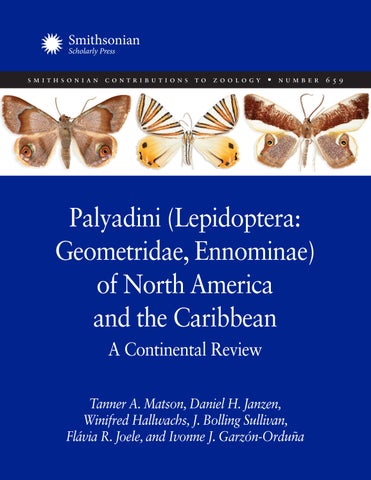
Cover images, from left to right: Ophthalmoblysis indie, Pityeja radisola, and Opisthoxia rexrothorum. See Figures 5, 47, and 58, respectively, for details.
Published by SMITHSONIAN INSTITUTION SCHOLARLY PRESS P.O. Box 37012, MRC 957, Washington, D.C. 20013-7012 https://scholarlypress.si.edu Copyright © 2026 Smithsonian Institution The rights to all text and images in this publication, including cover and interior designs, are owned either by the Smithsonian Institution, by contributing authors, or by third parties.
Excluding content credited to rightsholders and third parties, this work is licensed under a Creative Commons Attribution-NonCommercial 4.0 International (CC BY-NC 4.0) License. For permission to reproduce credited materials, users are responsible for contacting rightsholders directly. Library of Congress Control Number: 2026939142 ISSNs: 1943-6696 (online); 0081-0282 (print) ZooBank registration: 30 June 2026 (LSID: urn:lsid:zoobank.org:pub:366BC42F-5F23-4914-9543-59C4FFBDABA5) Publication date (online): 6 August 2026 Ó The paper used in this publication meets the minimum requirements of the American National Standard for Permanence of Paper for Printed Library Materials Z39.48–1992.
Contents INTRODUCTION
1
MATERIALS AND METHODS
2
SYSTEMATICS Genus Corrosia Matson, gen. nov. Corrosia ruda Matson, sp. nov. Corrosia pallicosta (Felder & Rogenhofer), comb. nov. Genus Palyas Guenée Palyas splaya Matson, sp. nov. Genus Ophthalmoblysis Scoble Ophthalmoblysis ibarrai Garzón-Orduña Ophthalmoblysis indie Matson, sp. nov. Ophthalmoblysis opalina Matson, sp. nov. Genus Argyrotome Warren Argyrotome mexicaria Schaus Argyrotome pacifica Matson, sp. nov. Argyrotome parva Matson, sp. nov. Argyrotome ponderosa Matson, sp. nov. Argyrotome alba (Druce) Argyrotome maria Matson, sp. nov. Argyrotome midas Matson, sp. nov. Argyrotome melae (Druce) Argyrotome murina Matson, sp. nov. Argyrotome interrupta (Schaus), comb. nov. Argyrotome noctigoldia Matson, sp. nov. Argyrotome prattaria Schaus Genus Phrygionis Hübner Phrygionis citrina (Warren), stat. rev. Phrygionis naevia (Druce), stat. rev. Phrygionis ferreus Scoble Phrygionis auriferaria Hulst Phrygionis rawlinsi Scoble Phrygionis tanama Matson, sp. nov. Phrygionis polita (Cramer) Phrygionis polita appropriata (Walker), stat. rev. Phrygionis polita sestertiana Prout, stat. rev.
3 3 4 5 5 6 6 7 7 8 8 9 10 10 14 15 15 16 16 17 18 19 20 20 21 21 22 22 23 23 24 25 25
vi
•
SMITHSONIAN CONTRIBUTIONS TO ZOOLOGY
Phrygionis sumptuosaria (Möschler) Phrygionis privignaria (Guenée) Phrygionis argentistriata Strecker, stat. rev. Phrygionis fratercula Warren, stat. rev. Phrygionis gemmea Prout, stat. rev. Phrygionis steeleorum Brown, Donahue, & Miller, stat. rev. Phrygionis paradoxata (Guenée) Phrygionis sororcula Warren, stat. rev. Phrygionis dominica Prout, stat. rev. Phrygionis cruorata Warren Phrygionis moeschleri Prout Phrygionis argentata (Drury) Phrygionis bicornis Scoble Genus Pityeja Walker Pityeja bellaria Walker, stat. rev. Pityeja radisola Matson, sp. nov. Pityeja carbonacea Matson, sp. nov. Pityeja nazada (Druce) Pityeja plusia (Prout), stat. rev. Genus Opisthoxia Hübner Opisthoxia amalgamata Matson, sp. nov. Opisthoxia miletia (Druce) Opisthoxia metargyria (Walker) Opisthoxia compta (Bastelberger), stat. rev. Opisthoxia casta Warren Opisthoxia cluana (Druce) Opisthoxia lucentia Matson, sp. nov. Opisthoxia rexrothorum Matson, sp. nov. Opisthoxia mocha Matson, sp. nov. Opisthoxia bella (Butler) Opisthoxia microcula Matson, sp. nov. Opisthoxia phrynearia (Schaus) Opisthoxia molpadia (Druce) Opisthoxia uncinata (Schaus) Opisthoxia maya Matson, sp. nov. Opisthoxia garzonae Matson, sp. nov. Opisthoxia cabima (Schaus) Opisthoxia micans Matson, sp. nov. Opisthoxia thesauraria Matson, sp. nov. Opisthoxia aspledon (Druce) Opisthoxia feralina Matson, sp. nov. Opisthoxia saturaria Schaus Opisthoxia terradraca Matson, sp. nov. Opisthoxia noctiflora Matson, sp. nov. Opisthoxia ignivulpa Matson, sp. nov. Opisthoxia asopis (Druce) Opisthoxia dendritica Matson, sp. nov. Opisthoxia limboguttata (Felder & Rogenhofer) Opisthoxia complicata Matson, sp. nov.
26 26 27 28 28 29 29 30 30 30 31 31 32 32 33 33 34 35 36 36 37 37 38 38 39 39 40 40 43 45 45 46 46 47 47 48 49 49 50 51 51 52 52 53 54 54 55 56 57
DISCUSSION
59
FIGURES 1–225
60
ACKNOWLEDGMENTS
105
REFERENCES
107
Palyadini (Lepidoptera: Geometridae, Ennominae) of North America and the Caribbean: A Continental Review Tanner A. Matson,1* Daniel H. Janzen,2 Winifred Hallwachs,2 J. Bolling Sullivan,3 Flávia R. Joele,4 and Ivonne J. Garzón-Orduña4
INTRODUCTION
P 1
Department of Entomology, National Museum of Natural History, Smithsonian Institution, 10th Street and Constitution Avenue NW, Washington, D.C. 20560, USA. 2 Department of Biology, University of Pennsylvania, 319 University Avenue, Philadelphia, Pennsylvania, 19104, USA. 3 †Independent researcher; Beaufort, North Carolina 28516, USA. 4 Laboratorio de Sistemática de Polillas, Colección Nacional de Insectos, Universidad Nacional Autónoma de México, Ciudad Universitaria, Copilco, Coyoacán, A.P. 70-153, Mexico City, Mexico. * Correspondence: matsont@si.edu Matson, https://orcid.org/0000-0001-7560-7294 Janzen, https://orcid.org/0000-0002-7335-5107 Hallwachs, https://orcid.org/0000-0002-5166 -809X Garzón-Orduña, https://orcid.org/0000-0003 -3914-4952 Manuscript received 2 April 2025; accepted 9 October 2025.
alyadini Guenée, [1858] is a New World ennomine tribe closely related to the Old World Plutodini Warren, 1894 (Brehm et al., 2019; Joele et al., 2024) and is primarily associated with tropical forests. The tribe currently comprises six genera: Argyrotome Warren, 1894, Opisthoxia Hübner, [1825], Ophthalmoblysis Scoble, 1995, Palyas Guenée, [1858], Phrygionis Hübner, [1825], and Pityeja Walker, 1861. However, phylogenetic analyses by Joele et al. (2024) demonstrated the paraphyly of Palyas relative to Ophthalmoblysis, supporting recognition of a previously undescribed seventh genus. Presently, Palyadini includes 131 described species (Rajaei et al., 2022), the majority of which—86 species—belong to Opisthoxia. Given the discovery of numerous new species in North America and even greater diversity in South America, the true richness of the tribe likely exceeds 200 species. Palyadini has received limited taxonomic attention. Prout (1933) revised Phrygionis and described several new taxa, whereas Scoble (1994) revised both Phrygionis and Palyas, taking a conservative species delimitation approach that resulted in the synonymization of more than two dozen taxa. The following year, Scoble (1995) reviewed all Palyadini genera, defining their morphological traits, listing species for each genus, and describing Ophthalmoblysis. Most recently, Joele et al. (2024) employed ultraconserved elements to infer a robust phylogenetic hypothesis used to explore the evolution of wing color and pattern in Palyadini. Notably, this study provided a phylogenetic framework that largely confirmed Scoble’s (1995) morphology-based generic classification. Members of Palyadini are primarily nocturnal, although individuals of some Opisthoxia species have been collected while flying during the day, suggesting at least semidiurnality in some taxa. Adults are often slender bodied with highly ornate wing patterns and lack a frenulum-retinaculum wing coupling, a defining characteristic of the tribe. Additionally, many Palyadini are distinguished by metallic speckling, stripes, spots, or patches, as well as the presence of a distinct eyespot on the forewing (e.g., Argyrotome) or one (e.g., Ophthalmoblysis) to multiple (e.g., Opisthoxia, which may also bear a single eyespot) eyespots on the hindwing.
2
•
SMITHSONIAN CONTRIBUTIONS TO ZOOLOGY
Prior to this study, the only known food plant records were for Phrygionis, which was reported from Ardisia Swartz (Primulaceae) (Grossbeck, 1917) and Myrsine L. (Primulaceae) (Matthews et al., 2014), and Ophthalmoblysis, which was recorded from Rourea Aublet (formerly Connarus L. in Brehm (2002) (Connaraceae)). The latter record was taken from food plant data generated by the caterpillar-rearing team in Área de Conservación Guanacaste (ACG), Costa Rica (Janzen, 2004). In 2024, the U.S. National Museum of Natural History (USNM) acquired a collection of more than 30,000 adult geometrid specimens from the Lepidoptera inventory of ACG. Comprising both reared and light-trapped adults, the majority of these specimens were DNA barcoded and represented data accumulated over four decades by Daniel H. Janzen, Winnie Hallwachs, and ACG parataxonomists. Additionally, a smaller, but valuable, donation of Palyadini moths was provided by J. Bolling “Bo” Sullivan (JBS), who had previously dissected several specimens. During the examination of these specimens and their barcode data, Tanner A. Matson (TAM) identified several undescribed Palyadini species, and in the process, it became evident that species in the genera Phrygionis and Pityeja had been overly synonymized. Concurrently, Flávia R. Joele and Ivonne J. Garzón-Orduña (IJGO) completed the aforementioned phylogenomic study of the tribe (Joele et al., 2024), providing a robust phylogenetic framework. With the acquisition of critical Central American material housed at the USNM and the availability of a well-resolved phylogenetic backbone, conditions were ideal for conducting a modern revision of the tribe in continental North America and the Caribbean.
MATERIALS AND METHODS Institutional acronyms used throughout the text are defined as follows. ACG Área de Conservación Guanacaste, Costa Rica. AMNH American Museum of Natural History, New York, New York, USA. BOLD Barcodes of Life Data Systems, Guelph, Ontario, Canada. CBG Centre for Biodiversity Genomics, Guelph, Ontario, Canada. CEUJ Colección de Entomología de la Universidad Javeriana, Bogotá, Colombia. CMNH Carnegie Museum of Natural History, Pittsburgh, Pennsylvania, USA. CNIN Colección Nacional de Insectos de México / Instituto de Biología, Universidad Nacional Autónoma de México, Mexico City, Mexico. DLW Collection of David L. Wagner, Storrs, Connecticut, USA. ECOSUR-SC Colección de Entomología de Chiapas, San Cristóbal de las Casas, Chiapas, Mexico.
FMNH Field Museum of Natural History, Chicago, Illinois, USA. JKA Collection of James K. Adams, Calhoun, Georgia, USA. LACM Natural History Museum of Los Angeles County, Los Angeles, California, USA. MGCL McGuire Center for Lepidoptera and Biodiversity, Gainesville, Florida, USA. MNHN Muséum national d’Histoire naturelle, Paris, France. MNHS Museum of Natural History and Science, Cincinnati, Ohio, USA. MNHU Museum für Naturkunde der Humboldt, Berlin, Germany. NBCL Nationaal Natuurhistorisch Museum, Leiden, Netherlands. NHMUK Natural History Museum, London, UK. OUMNH Oxford University Museum of Natural History, Oxford, UK. SMF Naturmuseum Senckenberg, Frankfurt, Germany. USNM U.S. National Museum of Natural History, Smithsonian Institution, Washington, D.C., USA. ZSM Zoologische Staatssammlung München, München, Germany. Our study area, continental North America and the Caribbean, is defined geographically to include Canada, the USA, Mexico, Central America through Panama, and the Caribbean archipelagoes. Within this region, however, the northern limit of Palyadini does not extend beyond the southern USA. One or more primary types (holotype, lectotype, or syntypes) were examined for all species by at least one author, unless otherwise noted in the treatment of a given species for which types were not examined or are lost. A total of 170 genitalic preparations were made by TAM for this study, most of which are stored at USNM, with others deposited in institutions to which material had been loaned for this study (e.g., CMNH, AMNH, CNIN, etc.). In addition, several dozen genitalia from dissections previously performed by JBS were examined; they are stored in capsules beneath the corresponding adults (all at USNM). Additional dissections, including type material, were examined at NHMUK. Preparations made by TAM were stained with Chlorazol Black and slide mounted in Euparal. Images were taken using a Visionary Digital imaging system and were manipulated (background removed) with Adobe Photoshop (Adobe Systems). The ACG specimen vouchers are given in the format of ##-SRNP-###### (e.g., 19-SRNP-105561). The larvae of several species are illustrated, but diagnostic characters and written descriptions are not provided. For most species, only one or two larval individuals were photographed, limiting the ability to account for intraspecific variation. Further, a broader sampling would be necessary for informative diagnoses. Therefore, we
NUMBER 659
provide only illustrations, as available data are limited. All illustrated larvae are ultimate instars unless stated otherwise. Some GPS coordinates provided in the type material sections for JBS collections appear to be questionable based on the corresponding descriptions, and others are in nonstandard formats. Rather than make assumptions about the correct localities, we have transcribed the label data verbatim. Similarly, inconsistencies in abbreviation, spelling, and punctuation within the type material sections and type localities reflect the verbatim reproduction of specimen label text or original description text. “DNA barcode” refers to a fragment of cytochrome c oxidase subunit 1 (COI; Hebert et al. 2003). A brief section titled “Molecular Data” draws from information available in the “Barcode Index Number (BIN) Details” of BOLD’s public data portal BIN pages (Ratnasingham and Hebert, 2013; BOLD Systems, 2025). These statistics are based only on DNA barcodes with a minimum length of 500 base pairs (bp) and <1% ambiguous bases. The BIN assignments are dynamic and may change as new sequence data are added. All genetic distances reported are calculated as uncorrected pairwise distances. Although some DNA barcodes were unavailable to us (i.e., private records that may appear as nearest neighbors on a BIN details page), the majority of records used in this study are publicly accessible in the BOLD dataset DS-PALYA: Global Palyadini (https://doi.org/10.5883/DS-PALYA), which currently includes 2,174 records, 2,046 of which have sequence data, representing 156 BINs.
SYSTEMATICS Genus Corrosia Matson, gen. nov. FIGURES 1, 2, 83, 84, 152, 153
urn:lsid:zoobank.org:act:69C4917F-C6AA-484D-BA83-91D67 B3CB33B Type Species. Sphacelodes micacearia Guenée, 1857 [1858]: 117; designated here. Taxonomic Account. Corrosia gen. nov. is established to accommodate a group of large brown Palyadini species previously assigned to Palyas, referred to by Scoble (1995) as the pallicosta group. Phenotypically, Corrosia and Palyas are markedly distinct (see “Diagnosis”), and phylogenomic analyses by Joele et al. (2024) strongly support Corrosia as sister to a clade comprising Palyas sensu stricto and Ophthalmoblysis. The following species are transferred from Palyas to Corrosia as new combinations: Corrosia leprosa (Herbulot, 1988), comb. nov., Corrosia maculicosta (Dognin, 1923), comb. nov., Corrosia micacearia (Guenée, [1858]), comb. nov., and Corrosia pallicosta (Felder & Rogenhofer, 1875), comb. nov. Remarks. The species-level taxonomy of Corrosia remains one of the most challenging issues in Central American
•
3
Palyadini. DNA barcode data support the presence of two distinct entities in this region, one attributed here to a new species, C. ruda (previously regarded as C. micacearia), and the other attributed to C. pallicosta. However, the female holotype of C. pallicosta could not be located or examined, and only a crude illustration is available (Felder and Rogenhofer, 1875: pl. 127, fig. 31). Given this limitation, the name cannot be confidently assigned, and we follow precedent with caution. Although some subtle external differences may exist, male genitalia provide reliable diagnostic characters, and DNA barcodes strongly differentiate the two North American entities. Diagnosis. Members of Corrosia are rust colored to brown, with pale yellowish-white costal areas on the forewings and, often, pale fringe. The forewings typically exhibit costal and subcostal silver spots and streaks, a silver discal spot, and a subterminal punctuated silver stripe. The hindwings are typically marked by two parallel silver transverse stripes in the subterminal area, punctuated by small burgundy dots or dashes between them. Species of Palyas, where members of Corrosia were most recently placed, are smaller, are orange in coloration, and possess extremely long antennae, nearly equal in length to the forewing. In addition, Palyas has more rounded wing margins and apices, with wings that are more elongate longitudinally. Adult. Figures 1, 2. Forewing length: male: 18–22 mm; female: 20–24 mm. Head: Antenna filiform in both sexes; fuscous scales above. Labial palpus slightly exceeding diameter of eye in length. Thorax: Wings dark brown to tannish. Forewing costal area yellowish white to yellow, often sparingly speckled with silver scales. In C. leprosa and C. maculicosta, yellow medial patches along costa and center of wing. Small silver discal spot. Sometimes with silver scales in basal half. Silver broken subterminal pinstripe sometimes present. Fringe yellow. Underside unmarked, but distally often darker. Hindwing with two metallic subterminal pinstripes (sometimes broken) running parallel, with small punctuated burgundy spots in series between. Fringe yellow in upper third, brown in lower two-thirds. Underside unmarked, but distally often darker. Abdomen: Brown above, pale below. Male genitalia: Figures 83, 84. Uncus long and slender, tapering slightly toward apex, densely sclerotized, ending in small hook. Socii large and setose. Juxta platelike. Valva large, setae dense, inner margin with basal acuminate process. Phallus with small sclerotized patch (e.g., C. ruda, C. pallicosta) or patch of large filamentous cornuti (e.g., C. leprosa). Female genitalia: Figures 152, 153. Posterior apophysis slightly longer than anterior. Ductus bursae with well-developed, elongated colliculum. Corpus bursae lightly sclerotized posteriorly before widening; large appendix bursae between colliculum and sclerotized area (torn off in Figure 152). Signum stellate. Distribution. Corrosia inhabits tropical forests from Veracruz, Mexico, south to at least southern Brazil. Biology. The first food plant records for the genus are reported. In ACG, Corrosia ruda has been reared six times
4
•
SMITHSONIAN CONTRIBUTIONS TO ZOOLOGY
from Tanaecium tetragonolobum (Jacq.) L. G. Lohmann (Bignoniaceae), representing the first documented use of Bignoniaceae as a food plant for Palyadini. Etymology. The genus name is derived from the Latin corrosio (corrosion), referencing the rusty ground coloration and metallic speckles and stripes characteristic of this genus. The name is feminine in gender. Molecular Data. In the analysis of Joele et al. (2024), Corrosia (as Palyas) was recovered as sister to a clade comprising Palyas sensu stricto and Ophthalmoblysis.
Corrosia ruda Matson, sp. nov. FIGURES 1, 83, 152
urn:lsid:zoobank.org:act:DCFCD43C-20E8-4BCC-A627-9D3D 28D96FAF Diagnosis. Diagnosing Corrosia species is challenging, and the following diagnosis remains preliminary. Corrosia ruda (Figure 1) differs from the holotype of C. micacearia (type locality: Brazil) by the presence of a distinct, punctuated subterminal stripe on the forewing, which is absent in C. micacearia. On the hindwing, the holotype of C. micacearia has small burgundy spots that touch the outer subterminal transverse silver pinstripe, whereas in C. ruda, examined specimens exhibit burgundy spots positioned near the pinstripe but without making contact. Although C. ruda is readily distinguished from C. pallicosta (Figure 2) by DNA barcodes and male genitalia, external morphological differences are more subtle. In available series, a distinguishing feature is that the subcostal apical silver streak in C. ruda terminates in a perpendicular subterminal dash, whereas in C. pallicosta it either fades out or ends in a small subterminal spot. This character is subtle and not always reliable. Additionally, C. ruda tends to be darker brown than C. pallicosta, although this difference is also variable. The most reliable morphological character is the absence of spinate cornuti in C. ruda (Figure 83b), which instead has only a sclerotized patch, whereas C. pallicosta (Figure 84b) possesses a dense linear patch of spinate cornuti. Adult. Figure 1. Forewing length: male: 18–21 mm; female: 22–24 mm. Head: Antenna filiform in both sexes; fuscous scales above. Vertex and frons light gray. Labial palpus light gray, slightly exceeding diameter of eye in length. Thorax: Predominantly brown above; patagium and tegula white at base, forming white band near head. Underside white to whitish gray. Legs mostly tan. Forewing dark brown, costal area yellowish white, sporadically scattered with silver metallic scales, especially basally. Subcostal area marked by silver streaks and spots bordering yellowish-white costal area. Variably sized silver discal spot. Medial area with arcing, ill- defined darker brown streaks. Subterminal area with broken
silver pinstripe. Fringe yellow. Underside brownish orange, with browner distal quarter. Hindwing dark brown, paler in distal third. Two silver subterminal pinstripes running parallel, with small punctuated burgundy spots in series between, spots oriented closer to outer pinstripe. Fringe yellow in upper third, brown in lower two-thirds. Underside brownish orange, with browner subterminal area. Abdomen: Brown above, pale below. Male genitalia: Figure 83. Uncus long and slender, tapering slightly toward apex, which is more densely sclerotized and ends in small hook. Socii large and setose. Juxta platelike. Valva large, densely setose; inner margin with bifurcate basal process bearing upper acuminate and outer rounded subprocesses. Phallus without cornuti; surface of vesica with small, sclerotized patch (without spinate cornuti). Female genitalia: Figure 152. Posterior apophysis slightly longer than anterior. Ductus bursae with well-developed, elongated colliculum. Corpus bursae lightly sclerotized posteriorly before widening; large appendix bursae between colliculum and sclerotized area (torn off in Figure 152). Signum stellate. Larva. Not illustrated; no photographs from ACG rearings. Holotype. ♂, COSTA RICA: Guanacaste, ACG, Del Oro, Manta Matudaea, (10.99689°, −85.45679°), el. 610 m, 28-X-2019, @ light trap, R. Franco and H. Cambronero, 19- SRNP-105561, USNMENT 01947133, [USNM]. Paratypes. 10♂, 5♀. 1♂, COSTA RICA: Guanacaste, ACG, Del Oro, Manta Matudaea, (10.99689°, −85.45679°), el. 610 m, 13-VI-2018, @ light trap, R. Franco and H. Cambronero, 18-SRNP-103860, USNMENT 01947120, [USNM] • 1♀, COSTA RICA: Guanacaste, ACG, Del Oro, Meteorológico, (11.00199°, −85.46166°), el. 590 m, on Tanaecium tetragonolobum, 19- IV- 2018, ecl. 07- V- 2018, Roster Moraga, 18-SRNP-20174, USNMENT 01947121, [USNM] • 1♀, COSTA RICA: Guanacaste, ACG, Del Oro, Meteorológico, (11.00199°, −85.46166°), el. 590 m, on Tanaecium tetragonolobum, 19- IV-2018, ecl. 08-V-2018, Roster Moraga, 18-SRNP-20177, USNMENT 01947122, [USNM] • 1♂, COSTA RICA: Guanacaste, ACG, Del Oro, Meteorológico, (11.00199°, −85.46166°), el. 590 m, on Tanaecium tetragonolobum, 19-IV-2018, ecl. 12-V- 2018, Roster Moraga, 18-SRNP-20178, USNMENT 01947123, [USNM] • 1♂, COSTA RICA: Guanacaste, ACG, Del Oro, Meteorológico, (11.00199°, −85.46166°), el. 590 m, on Tanaecium tetragonolobum, 19-IV-2018, ecl. 07-V-2018, Roster Moraga, 18- SRNP- 20180, USNMENT 01947124, [USNM] • 1♀, COSTA RICA: Guanacaste, ACG, Del Oro, Meteorológico, (11.00199°, −85.46166°), el. 590 m, on Tanaecium tetragonolobum, 19-IV-2018, ecl. 07-V-2018, Roster Moraga, 18-SRNP- 20176, USNMENT 01947125, [USNM] • 1♂, COSTA RICA: Guanacaste, ACG, Pitilla, Pasmompa, (11.02666°, −85.41026°), el. 400 m, 18-II-2007, @ light trap, F. Quesada and S. Rios, 07- SRNP-101556, USNMENT 01947126, [USNM] • 1♀, COSTA RICA: Guanacaste, ACG, Santa María, Mirador Santa María, (10.76631°, −85.30099°), el. 920 m, 25-V-2012, @ light trap,
NUMBER 659
S. Rios and R. Franco, genitalia slide by TAM-2025-582 / USNM 157176, 12- SRNP- 102941, USNMENT 01947127, [USNM] • 1♂, COSTA RICA: Guanacaste, ACG, Pitilla, Estación P itilla, (10.98931°, −85.42581°), el. 675 m, 17-III-2007, @ light trap, R. Franco and F. Quesada, 07- SRNP- 101852, USNMENT 01947128, [USNM] • 1♂, COSTA RICA: Guanacaste, ACG, Del Oro, Manta Matudaea, (10.99689°, −85.45679°), el. 610 m, 12- VI-2018, @ light trap, R. Franco and H. Cambronero, 18-SRNP- 103679, USNMENT 01947129, [USNM] • 1♀, COSTA RICA: Guanacaste, ACG, Santa María, Cráter Bosque, Sendero Adentro, (10.80348°, −85.32729°), el. 1,594 m, 17-V-2018, @ light trap, S. Rios and H. Ramírez, 18-SRNP-103043, USNMENT 01947130, [USNM] • 1♂, COSTA RICA: Guanacaste, ACG, Pitilla, Sendero Memo, (10.98518°, −85.42811°), el. 774 m, 03- IV-2011, @ light trap, H. Cambronero and F. Quesada, genitalia slide by TAM-2025-581 / USNM 157175, 11-SRNP-102408, USNMENT 01947131, [USNM] • 1♂, COSTA RICA: Guanacaste, ACG, Pitilla, Estación Pitilla, (10.98931°, −85.42581°), el. 675 m, 03-III-2006, @ light trap, H. Cambronero and F. Quesada, 06-SRNP-102942, USNMENT 01947132, [USNM] • 1♂, COSTA RICA: Guanacaste, ACG, Rincón Rain Forest, Tamarindo, (10.93424°, −85.30425°), el. 435 m, 23-II-2020, @ light trap, S. Rios and G. Pereira, 20- SRNP- 100552, USNMENT 01947134, [USNM] • 1♂, COSTA RICA: Guanacaste, ACG, Rincón Rain Forest, Tamarindo, (10.93424°, −85.30425°), el. 435 m, 24-II-2020, @ light trap, S. Rios and G. Pereira, 20- SRNP-101184, USNMENT 01947135, [USNM]. Distribution. DNA barcoding separates Corrosia ruda into two molecular haplogroups (BINs): One population occurring in the tropical forests of Veracruz, Mexico, extending south to at least northern Costa Rica, and another occurring in northern South America. The precise ranges of these populations remain unclear and are further complicated by their similarity to C. pallicosta. Biology. In ACG, Corrosia ruda has been reared six times from Tanaecium tetragonolobum (Bignoniaceae). Etymology. The specific name is derived from the Latin ruda (crude ore or unrefined metal). It is a noun in apposition. Molecular Data. Corrosia ruda encompasses two BINs: BOLD:AAD6672 (n = 24, Costa Rica) and BOLD:AAU7864 (n = 7, French Guiana), although the type series is restricted to BOLD:AAD6672. The maximum pairwise distance within BOLD:AAD6672 is approximately 1%, and within BOLD:AAU7864 it is around 1.5%. The genetic distance between these two BINs is approximately 2.2%. Remarks. Historically, Corrosia ruda has been referred to as C. micacearia (BOLD Systems, 2025).
•
5
Notes: Felder and Rogenhofer illustrated pallicosta from a female holotype. A historic specimen (NHMUK0102933299) in NHMUK, from Cayene [Cayenne], French Guiana, bears a note from an unknown author stating that it “can hardly be the figured [type] . . . a [female] in Mus. Wien [Naturhistorisches Museum Wien, Vienna] is probably the true type.” Despite inquiries with museum curators and, in some cases, personal visits, the holotype could not be located or confirmed in Naturhistorisches Museum Wien, NHMUK, or NBCL, the most likely repositories for this specimen.
Diagnosis. This species is adequately diagnosed in the treatment of C. ruda and need not be repeated here. Genitalia. Male genitalia: Figure 84. Uncus long and slender, tapering slightly toward apex, which is more densely sclerotized and ends in small hook. Socii large and setose. Juxta platelike. Valva large, densely setose; inner margin with bifurcate basal process bearing upper acuminate and outer rounded subprocesses. Phallus with dense linear patch of spinate cornuti. Female genitalia: Figure 153. Posterior apophysis slightly longer than anterior. Ductus bursae with well-developed, elongated colliculum. Corpus bursae lightly sclerotized posteriorly before widening; large appendix bursae between colliculum and sclerotized area. Signum stellate. Distribution. Although the taxonomic concept of C. pallicosta requires further study, in its current concept it extends from the lowland tropical forests of Panama south to at least coastal northern Ecuador, across the Amazon basin, and reaching eastward to French Guiana. Biology. The immature stages of this species are unknown. Molecular Data. Like C. ruda, the concept of C. pallicosta is broad in a genetic sense, encompassing two BINs. DNA barcodes are assigned to BINs BOLD:AAL6532 (n = 10, Panama, coastal Ecuador) and BOLD:ADZ3806 (n = 1, French Guiana). The maximum pairwise distance within BOLD:AAL6532 is approximately 1.4%, and the genetic distance between these two BINs is approximately 2.6%. Remarks. The name C. pallicosta is poorly anchored, as the female type from French Guiana remains unlocated. Although precedent is followed, misapplication of this name remains possible. Panamanian specimens from Barro Colorado Island (BOLD:AAL6532) were primarily studied, illustrated, and used for comparative diagnoses in this work.
Genus Palyas Guenée FIGURES 3, 85
Corrosia pallicosta (Felder & Rogenhofer), comb. nov. FIGURES 2, 84, 153
Phrygionis pallicosta Felder & Rogenhofer, 1875: pl. 127, fig. 31. Type locality: French Guiana [unknown repository].
Palyas Guenée, 1857 [1858]: 395 [type species: Phalaena aura Cramer, 1779 [1775]: 85, 152 (index), pl. 53, fig. F].
Remarks. Historically, Palyas included two distinct groups (Scoble, 1995): (1) the aura group, characterized by
6
•
SMITHSONIAN CONTRIBUTIONS TO ZOOLOGY
orange bodies, metallic golden wing markings, and long antennae subequal to the forewing length, comprising P. aura (Cramer, [1775]), P. divitaria Oberthür, 1916, and P. locuples Oberthür, 1916, and (2) the pallicosta group, with rusty-brown bodies, broad brown wings, and silver metallic markings. All members of the latter group have been transferred to the newly described genus Corrosia (see Corrosia treatment). With this refined taxonomic concept of Palyas, P. splaya Matson, sp. nov. is the only known representative of the genus in continental North America, leaving three described species in South America. A review of museum holdings, however, reveals that Palyas is far more diverse in South America than currently recognized. The future description of new species is expected to at least double, if not triple, the known diversity. Palyas is relatively rare in collections, typically represented by small series. Scoble (1995) noted that one specimen was collected during the day in the forest canopy in Venezuela, whereas all other known records come from light traps. To date, nothing is known about the immature stages of Palyas.
Palyas splaya Matson, sp. nov. FIGURES 3, 85
urn:lsid:zoobank.org:act:56C335AE-DB5E-49B0-8B11-EEC01 C3883CA
sclerotized band. Juxta ill- defined. Valva narrow. Vesica with long, narrow cornutus, posterior end verrucose. Female genitalia: Unknown. Larva. Unknown. Holotype. ♂, COSTA RICA: San Jose, Puriscal, Chires, Mastatal, (9.4110N, −84.2204W), [el.] 400 m, 16-18- X-2011, J. Bolling Sullivan, genitalia slide by TAM-2024-497 / USNM 157112, USNMENT 02001354, [USNM]. Paratypes. 2♂. 1♂, GUATEMALA: Cayuga, April, Schaus and Barnes coll., genitalia slide by TAM- 2024- 491 / USNM 157106, USNMENT 01920667, [USNM] • 1♂, GUATEMALA: Cayuga, Sept., Schaus and Barnes coll., USNMENT 01920668, [USNM]. Distribution. Palyas splaya ranges from Guatemala to central Panama, though its distribution remains poorly understood because of the limited number of available specimens. Etymology. The specific name is an anagram of Palyas. Biology. The immature stages of this species are unknown. Molecular Data. No molecular data are available. An attempt to obtain the barcode of paratype USNMENT 01920667 via next-generation sequencing was unsuccessful.
Genus Ophthalmoblysis Scoble FIGURES 4–6, 86–88, 154, 155
Diagnosis. Palyas splaya (Figure 3) is the only known species of Palyas from Central America. It can be distinguished from its South American congeners, P. aura and P. divitaria, by the absence of spots along the outer margin of the forewing. Although P. locuples also lacks these terminal spots, it differs from P. splaya in that its subterminal band of spots extends into the subapical area. In P. splaya, however, the subterminal band of spots transitions into a golden metallic, inward-directed arc in the subapical area. Adult. Figure 3. Forewing length: male: 14–16 mm; female: 16–17 mm. Head: Antenna long, subequal to forewing in length, thin, and filiform in both sexes. Vertex and frons light orange. Labial palpus light orange, strongly upcurved along eye. Thorax: Light orange above, creamy white below. Legs pale orange to tan, long and thin. Both wings orange above with metallic markings, pale orange below and unmarked. Forewing with basal, costal, scattering of silver scales; circular discal silver spot; distal subcostal golden streak; two apical silver spots; and subterminal punctuated silver band transitioning into inward-directed golden metallic arc in subapical region. Hindwing with seven silver subterminal spots forming punctuated transverse band. Abdomen: Thin, pale orange to tan. Male genitalia: Figure 85. Uncus long and narrow, ending in acuminate spine. Socii unapparent. Gnathos with narrow
Ophthalmoblysis Scoble, 1995: 52 [type species: Opisthoxia cinerea Warren, 1909: 99].
Remarks. To date, three Ophthalmoblysis species are known from Central America, all recently described: O. ibarrai Garzón-Orduña and two newly described here, O. indie Matson, sp. nov., and O. opalina Matson, sp. nov. The genus now comprises 11 recognized species, although several South American species likely remain undescribed and a few may be synonyms. Scoble (1995) originally characterized this genus by the apomorphy of a prominent hindwing eyespot positioned between the M1 and M3 veins, distinguishing it from Opisthoxia, in which the common eyespot occurs between the Rs and M1 veins. Ophthalmoblysis indie has been reared twice in ACG, Costa Rica, with both records from Rourea schippii Standley (Connaraceae). Brehm (2002) mentions this species feeding on Connarus sp., likely based on the same records, with the food plant taxonomy having since been updated. Otherwise, no other food plant data are known for this genus. There are two identifiable subgroups within Ophthalmoblysis. One consists of larger, more richly brown individuals, so far confined to Central America and lacking membranous sacs covering the valvae of the male genitalia. This subgroup includes O. ibarrai and O. indie. The second subgroup is a primarily South American clade that includes the rest of the described
NUMBER 659
species, as well as the newly described O. opalina from Panama. These species are smaller, with tan to gray bodies, and possess membranous sacs covering the valvae of the male genitalia.
Ophthalmoblysis ibarrai Garzón-Orduña FIGURES 4, 86, 154
Ophthalmoblysis ibarrai Garzón-Orduña, 2019: 470–473. Type locality: Mexico: Veracruz, Estación de Biología Tropical Los Tuxtlas, (18°35’14”N, 95°4’26”W), 170 m [CNIN]. Note: Garzón-Orduña described ibarrai from a holotype male and nine paratypes.
Diagnosis. Ophthalmoblysis ibarrai (Figure 4) is thoroughly diagnosed in Garzón-Orduña (2019), as well as in the diagnosis of O. indie (Figure 5) provided below. Genitalia. Described and illustrated in Garzón- Orduña (2019). Male (Figure 86) and female (Figure 154) also illustrated here. Distribution. Ophthalmoblysis ibarrai is known from the mid-to low-elevation tropical forests of southern Mexico (examined records from Oaxaca and Veracruz), extending south to the montane forests of Guatemala and Honduras. Its full distribution remains unclarified. Biology. The immature stages of this species are unknown. Molecular Data. A single specimen (Sample ID: BIOUG01333- F12), possibly representative of O. ibarrai, has been DNA barcoded from Honduras, although its identity remains uncertain because the specimen and its broader population have not been closely examined. This entity is currently assigned to BIN BOLD:ABY1794, with a genetic distance of approximately 2.9% from its nearest interspecific neighbor, O. indie (BOLD:AAN5628). This individual was collected at an elevation of around 1,500 m, higher than other known specimens of the species, if confirmed as O. ibarrai.
Ophthalmoblysis indie Matson, sp. nov. FIGURES 5, 87, 155
urn:lsid:zoobank.org:act:73AF7919-5982-4BCA-8B2A-BCFC 36DF3EFC Diagnosis. Ophthalmoblysis indie appears to be closely related to O. ibarrai, with both species previously diagnosed by Garzón-Orduña (2019). Several distinguishing characters from that work are reiterated here. The ground color of O. indie is darker brown than that of O. ibarrai. The black area of the hindwing eyespot in O. indie is subtly more rounded and less ovate. Garzón-Orduña (2019) also noted that O. indie occurs at higher elevations, with O. ibarrai recorded at 140–160 m,
•
7
whereas all known records of O. indie are from elevations above 1,300 m. Additionally, in the male vesica, the apex of the cornutus is more uniformly bisected in O. ibarrai, whereas in O. indie, it features a more pronounced digitate process. Notably, both O. indie and O. ibarrai lack the numerous small bubble-like membranous sacs on the valvae, which appear to be present in all other studied Ophthalmoblysis species. Adult. Figure 5. Forewing length: male: 14–15 mm; female: 15–16 mm. Head: Antenna modestly serrate in male, filiform in female; fuscous scales above. Vertex and frons brownish gray. Labial palpus gray, subequal to diameter of eye. Thorax: Predominantly gray above, tannish white below. Legs mostly tan. Forewing ground color brown, flecked with opalescent scales in basal half. Strongly opalescent transverse postmedial line, bordered inwardly by band of orangish-brown scales. Distal third of wing speckled with light brown scales. Apical area marked by two adjacent opalescent spots. Underside light brown to tan, mostly unremarkable, with some darkening in the distal third. Fringe brown. Hindwing concolorous with forewing, with opalescent scales concentrated in basal area and especially around and below M1–M3 eyespot. Metallic crescent- shaped bands present immediately basal and distal to eyespot. Eyespot with circular jet- black interior within concentric orange and then black rings, surrounded by broad dusky-orange subovate patch. Underside similar to forewing underside. Fringe tannish. Abdomen: Grayish brown above, tannish below. Male genitalia: Figure 87. Uncus gradually tapering toward apex. Juxta ill-defined. Valva narrow, with unsclerotized, apical, lateral saclike extension. Small tuft of coremata on exterior basal surface of valva and significantly larger secondary tuft of coremata basolateral to valva. Vesica with large, flattened cornutus; apex of cornutus terminating in small digitate process. Female genitalia: Figure 155. Anterior apophysis slightly shorter than posterior apophysis. Colliculum modestly developed. Corpus bursae elongated, with posterolateral swelling; anterior area bearing stellate signum. Larva. Not illustrated; no photographs from ACG rearings. Holotype. ♂, COSTA RICA: Guanacaste, ACG, Cacao, Cima, (10.93259, −85.45889), el. 1,450 m, 12- VII- 2010, @ light trap, F. Quesada and S. Rios, 10-SRNP-111489, USNMENT 01946610, [USNM]. Paratypes. 6♂, 2♀. 1♂, COSTA RICA: Guanacaste, ACG, Cacao, Cima, (10.93259, −85.45889), el. 1,450 m, 12-VII-2010, @ light trap, F. Quesada and S. Rios, 10-SRNP- 111488, USNMENT 01946609, [USNM] • 1♂, COSTA RICA: Guanacaste, ACG, Cacao, Derrumbe, (10.93110, −85.46194), el. 1,310 m, 10-VII-2010, @ light trap, S. Rios and H. Cambronero, genitalia slide by TAM-2024-457 / USNM 157084, 10-SRNP- 110525, USNMENT 01946611, [USNM] • 1♂, COSTA RICA: Guanacaste, ACG, Cacao, Derrumbe, (10.93110, −85.46194), el.
8
•
SMITHSONIAN CONTRIBUTIONS TO ZOOLOGY
1,310 m, 10-VII-2010, @ light trap, S. Rios and H. Cambronero, 10-SRNP-110526, USNMENT 01946612, [USNM] • 1♂, COSTA RICA: Guanacaste, ACG, Santa Maria, Crater Bosque (10.80348, −85.32729), el. 1,594 m, 22-VII-2017, @ light trap, S. Rios, 17- SRNP- 105055, USNMENT 01946613, [USNM] • 1♀, COSTA RICA: Guanacaste, ACG, Santa Maria, Crater Bosque (10.80348, −85.32729), el. 1,594 m, 17-V-2018, @ light trap, S. Rios and H. Ramirrez, 18-SRNP-102932, USNMENT 01946614, [USNM] • 1♀, COSTA RICA: Guanacaste, ACG, Cacao, Sendero Cima (10.93328, −85.45729), el. 1,460 m, on Rourea schippii, 02-XI-1999, ecl. 28-XI-1999, Mariano Pereira, genitalia slide by TAM-2024-456 / USNM 157083, 99- SRNP- 1996, USNMENT 01947082, [USNM] • 1♂, COSTA RICA: Guanacaste, ACG, Cacao, Sendero Cima (10.93328, −85.45729), el. 1,460 m, on Rourea schippii, 06-VII-1999, ecl. 03-VIII-1999, Mariano Pereira, 99-SRNP-1070, USNMENT 01947083, [USNM] • 1♂, COSTA RICA: Puntarenas, Est. Biologica Monte Verde, (10: 19.3 N; 84: 48.32 W), [el.] 1,540 m, 23- 27- VIII- 2003, J. Bolling Sullivan, genitalia slide number 9220, USNMENT 01920637, [USNM]. Distribution. Ophthalmoblysis indie is currently known from the montane forests of Costa Rica, where it inhabits elevations above 1,300 m (approximately 4,260 ft). Biology. In ACG, Ophthalmoblysis indie has been reared twice from Rourea schippii (Connaraceae). Brehm (2002) mentions this species feeding on Connarus sp., likely based on the same ACG records, with the food plant taxonomy having since been updated. Etymology. The specific name honors author TAM’s daughter, Indie June, who brought the joy of fatherhood and embodies the beauty and sparkle of the moth that now bears her name. The name is treated as a noun in apposition. Molecular Data. DNA barcodes of O. indie are assigned to BIN BOLD:AAN5628 (n = 10, Costa Rica). Sequences are thus far identical in this BIN, whereas the distance to the nearest interspecific neighbor, putatively O. ibarrai (BOLD:ABY1794; n =1, Honduras), is approximately 2.9%.
Ophthalmoblysis opalina Matson, sp. nov. FIGURES 6, 88
urn:lsid:zoobank.org:act:85F9AC2A-9D2A-446C-9992-B7A38 F05EA5F Diagnosis. With its large medial tan to orange area on the upper side of the hindwing, O. opalina (Figure 6) most closely resembles O. plutus (Oberthür) (type locality: Mato Grosso, Brazil) and O. fulvistrota (Dognin) (type locality: Saint- Laurent-du-Maroni, French Guiana). However, O. opalina is thought to be allopatric with these species. Whereas O. plutus and O. fulvistrota are more heavily speckled and adorned with opalescent metallic scales, O. opalina has significantly less of this scaling. This difference is particularly noticeable in the
forewing subterminal area along the lower outer margin, where the other two species have a distinct opalescent patch, whereas O. opalina typically has only a few scattered opalescent scales. Additionally, the medial opalescent transverse patch in the forewing of O. opalina is often edged with a thin orange border, a feature that may be faded in older specimens but is clearly visible in fresh ones. This orange border seems to be absent in the other two species. In Central America, this species cannot be confused with other described congeners. Adult. Figure 6. Forewing length: male: 12 mm. Head: Antenna filiform, ciliate. Vertex and frons ochreous. Labial palpus ochreous, slightly longer than diameter of eye. Thorax: Ochreous to tan. Forewing with scattered opalescent scales at base and opalescent transverse postmedial patch, inwardly bordered by band of orangish scales. Distal third speckled with dark brown scales. Apical area with two adjacent opalescent spots. Light opalescent speckling in lower subterminal area. Underside tan, darkening in distal third. Fringe mostly brown. Hindwing concolorous with forewing, scattered opalescent scales in basal area and along inner margin; concentrated crescent-shaped patch basad to M1–M3 eyespot. Eyespot with circular jet-black center within yellow-orange ring; silver metallic spot distad. Underside similar to forewing. Fringe pale yellow, darkened at tornus. Abdomen: Tan to ochreous. Male genitalia: Figure 88. Uncus gradually tapering toward apex. Socii small. Juxta ill-defined, platelike. Valva surface covered with numerous membranous sacs; apex with long hair tuft; base with long hair tuft, subequal in length to valva. Vesica without cornuti. Female genitalia: Unknown. Larva. Unknown. Holotype. ♂, PANAMA: Cabima, 20-V-1911, August Busck, USNMENT 01920522, [USNM]. Paratype. ♂, PANAMA: Cabima, 23-V-1911, August Busck, genitalia slide by TAM-2024-458 / USNM 157085, USNMENT 01920523, [USNM]. Distribution. Thus far, O. opalina is known only from the type series collected in the lowland tropical forests of Panama. Biology. The immature stages of this species are unknown. Etymology. The specific name is derived from the Latin opalus (opal), referencing the iridescent, opalescent sheen observed on the wings. Molecular Data. No molecular data are available.
Genus Argyrotome Warren FIGURES 7–21, 89–98, 156–166, 213, 214
Argyrotome Warren, 1894: 403 [type species: Ephyra mira Oberthür, 1883: 33, pl. 2, fig. 12].
NUMBER 659
Parargyrotome Debauche, 1937: 10 [type species: Ophthalmophora melae Druce, 1892: vol. 2: 96, vol. 3: pl. 50, figs. 16, 17].
Remarks. Argyrotome has proven to be much more species rich in continental North America than previously recognized. The diversity has more than doubled with the description of seven new species described herein, bringing the total species count in North America to a dozen. This number is expected to increase over time. In South America, significant confusion surrounds existing names and their synonyms. During the review of the genus for this study, it became apparent that the synonyms of A. mira (Oberthür, 1883) require closer examination; A. tenebrosa extrema Prout, 1910 is likely a valid species, and several species are likely undescribed in undersampled regions or obscured by cryptic species complexes. Resolving the species- level taxonomy of South American Argyrotome will likely prove challenging. The adult phenotype of Argyrotome is easily discernible, with the defining feature being the discal “eyespot” or a similar mark on the forewing. The genitalia (Figures 89–98, 156–166) are diagnostic at the genus level but are not particularly informative for closely related species, although subtle differences sometimes exist. Genitalia and adult phenotypes, further supported by DNA barcodes, suggest two distinct lineages in North America. The first subclade includes the North American species A. mexicaria Schaus, 1901, A. pacifica Matson, sp. nov., A. parva Matson, sp. nov., and A. ponderosa Matson, sp. nov., as well as the South American species A. prospectata (Snellen, 1874) and A. paraguayaria Schaus, 1927. These species are characterized by a reniform to ovate discal patch on the forewing, which is not particularly eyelike. The male genitalia in this group are large, with centrally appressed valvae and a dense hairbrush tucked inside a depression that covers the entirety of the valva’s exterior surface. The vesica also contains a dense patch of spinate cornuti. The second subclade encompasses the North American species A. alba (Druce, 1892), A. maria Matson, sp. nov., A. midas Matson, sp. nov., A. melae (Druce, 1892), A. murina Matson, sp. nov., A. interrupta (Schaus, 1911), comb. nov., A. noctigoldia Matson, sp. nov., and A. prattaria Schaus, 1927, as well as the South American species A. arcuata Debauche, 1937, A. cyclopea Debauche, 1937, A. metallicata Warren, 1907, A. mira, and A. muricolor Warren, 1905. These species possess a well- developed eyespot on the forewing, less appressed valvae without the enlarged hairbrush on the external surface, and a phallus lacking a dense patch of spinate cornuti. Argyrotome tenebrosa tenebrosa Warren, 1897, and A. tenebrosa extrema, the latter of which is likely a distinct species, appear intermediate between both groups. They exhibit genitalia more similar to the first subclade but have an adult phenotype that more closely resembles the second subclade. These clades are further supported by the molecular results of Joele et al. (2024). Previously, no food plant data were recorded for Argyrotome. Our data strongly support that Argyrotome are food plant specialists on myrsinoid Primulaceae.
•
9
Although no island endemics have been found in Palyadini outside the notable island endemism of Phrygionis and Pityeja plusia (Prout, 1933), stat. rev. from Cuba, Argyrotome includes at least one Jamaican endemic, A. midas, and potentially a second endemic, A. maria, from the Mexican Islas Marías archipelago.
Argyrotome mexicaria Schaus FIGURES 7, 8, 89, 156
Argyrotome mexicaria Schaus, 1901: 166. Type locality: Mexico: Jalapa [USNM]. Note: Schaus described mexicaria from a holotype male.
Diagnosis. Argyrotome mexicaria (Figures 7, 8) is primarily found in the tropical and submontane forests of the Atlantic coast and adjacent mountains of Mexico, whereas the visually similar A. pacifica (Figure 9) occurs mainly along the Pacific coast. The most distinctive external feature is the thick postmedial band of the forewing: In A. pacifica, the gold scales extend both distally and basally to the punctuated silver metallic scales, whereas in A. mexicaria, the golden scales extend primarily basally. In A. parva (Figure 10) and A. ponderosa (Figure 11), two visually similar species primarily found in Costa Rica, the postmedial band on the forewing is more noticeably curved inward medially. By contrast, A. mexicaria shows a mostly straight postmedial band, with only an ever so slight medial curve. Genitalia. Male genitalia: Figure 89. Uncus slender. Socii unapparent. Gnathos thin. Juxta with narrow, greatly extended posterior process. Valva broad, centrally appressed; hairscales on outer face. Phallus with apical, rounded sclerotized process; vesica bearing extensive field of spinate cornuti at base, gradually diminishing in size toward middle of vesica. Female genitalia: Figure 156. Apophysis subequal in length. Ductus bursae short; colliculum well-developed. Corpus bursae elongate, with anterior field of denticles that nearly encircle entire structure. Distribution. Argyrotome mexicaria ranges from the montane and submontane forests of the southern Sierra Madre Oriental in Mexico, extending southward through the Oaxacan Highlands into Honduras. Its southern range limits, however, remain unclear. Biology. The immature stages of this species are unknown. Molecular Data. DNA barcodes of A. mexicaria are assigned to BIN BOLD:ACU2299 (n = 2 [+1], Honduras, [Mexico]). The maximum pairwise distance within this BIN is negligible, whereas the distance to the nearest interspecific neighbor, Argyrotome nr. prospectata (BOLD:AAE6222; n = 12, Peru, Ecuador, Colombia), is approximately 3%. A syntype specimen was successfully barcoded and matched the other members of this BIN. However, it is not included in the formal BIN analysis,
10
•
SMITHSONIAN CONTRIBUTIONS TO ZOOLOGY
as 200 bp failed to sequence, rendering the barcode incomplete for BIN assignment. The brackets used above in the BIN details acknowledge this partial barcode. Remarks. In the northern extent of this species’ range within the Sierra Madre Oriental, individuals are frequently observed to be notably paler, with some bordering on white. In contrast, collections made in the Oaxaca Highlands in 2024 by TAM and IJGO revealed that most specimens were predominantly gray, although paler individuals, albeit uncommon, were occasionally encountered.
Argyrotome pacifica Matson, sp. nov. FIGURES 9, 90
urn:lsid:zoobank.org:act:D9764E8A-8EEC-4E99-BCCF-82911 839557E Diagnosis. Argyrotome pacifica (Figure 9) appears to be endemic to Mexico and is closely related to the visually similar A. mexicaria (Figures 7, 8). Although limited material is available for A. pacifica, it seems to be found in tropical and submontane forests along the Pacific coast, whereas A. mexicaria is primarily located along the Atlantic coast and adjacent mountains. The most distinguishing external characteristic is the thick postmedial band in A. pacifica, where the gold scales extend both distally and basally to the punctuated metallic scales. In A. mexicaria, however, the golden scales extend only basally to the metallic scales. In A. parva (Figure 10) and A. ponderosa (Figure 11), two visually similar species primarily found in Costa Rica, the postmedial band on the forewing is often noticeably curved in places. By contrast, A. pacifica shows a mostly straight postmedial band, with only a slight apical bend toward the base. Adult. Figure 9. Forewing length: male: 14 mm. Head: Antenna filiform; white to light gray scales above. Vertex white, frons brown. Labial palpus slightly porrect, white and brown, subequal to diameter of eye. Thorax: Pale gray to white. Legs ochreous to white. Forewing ground color light gray to white, sparsely peppered with silver metallic scales in basal half. Gold reniform discal spot with silver metallic scales within and surrounding it. Thick postmedial transverse band with gold scales extending both distally and basally to punctuated metallic scales. Forewing underside cream-colored, unpatterned. Hindwing concolorous with forewing, sparsely peppered with silver metallic scales in inner half. Subtle, ill- defined darkened patch in discal area. Subterminal and terminal golden transverse bands; subterminal band with broken distal line of metallic scales, terminal band with punctuated metallic dashes. Area surrounding these bands shows subtle darkened transverse lines. Hindwing underside cream-colored, unpatterned. Fringe concolorous with rest of wing. Abdomen: Pale gray to white. Male genitalia: Figure 90. Uncus slender. Socii unapparent. Gnathos thin. Juxta with narrow, greatly extended posterior
process. Valva broad, centrally appressed; modest hairscales on outer face. Phallus with apical, rounded sclerotized process; vesica bearing extensive field of spinate cornuti at base, gradually diminishing in size toward middle of vesica. Female genitalia: Unknown. Larva. Unknown. Holotype. ♂, [MEXICO]: Nayarit, Compostela, 21-X-1982, A. Ibarra, genitalia slide by TAM-2024-521, [CNIN]. Paratype. ♂, MEXICO: Guerrero, El Paraiso, leg. R. Turrent, [CNIN]. Distribution. To date, A. pacifica is known only from the type specimens, and its range remains poorly defined. It has been collected in tropical and submontane forests along the Pacific coast of Mexico. Biology. The immature stages of this species are unknown. Etymology. The specific name reflects this species’ distribution along the Pacific coast of Mexico, in contrast to the visually similar A. mexicaria, which is primarily found along the Atlantic coast. Molecular Data. No molecular data are available. Remarks. The male holotype is significantly paler than the gray male paratype of this species. However, similar color differences are also observed in A. mexicaria.
Argyrotome parva Matson, sp. nov. FIGURES 10, 91, 157
urn:lsid:zoobank.org:act:21C7030B-BFD9-4E7C-9829-9040A 33D4D9F Diagnosis. Argyrotome parva (Figure 10) is smaller than A. ponderosa (Figure 11), with a typical wing length of 13–15 mm compared to 16–18 mm in A. ponderosa. The wing color pattern is very similar between the two, although A. ponderosa is slightly darker overall. The postmedial band on the forewing of A. parva has a subtle inward bend at the center, whereas in A. ponderosa this bend is more pronounced. In males, the vesica of A. parva has approximately two-thirds the number of spinate cornuti found in A. ponderosa. Morphologically, A. parva is extremely difficult to distinguish from the South American A. prospectata (type locality: Colombia?). Although A. parva is slightly smaller on average, with a wing length on average a couple of millimeters less than that of A. prospectata, discrete and reliable morphological differences between the two species have not been identified. However, the two species can be separated by geography, with A. parva being restricted to North America, and by clear segregation of their DNA barcodes. Adult. Figure 10. Forewing length: male: 12–14 mm; female: 13–15 mm. Head: Antennae filiform in both sexes. Vertex gray, frons brown. Labial palpus slightly porrect, white at base transitioning to brown at apex, subequal to diameter of eye.
NUMBER 659
Thorax: Gray. Legs ochreous to white. Forewing ground color gray. Basal area subtly scattered with metallic silver scales. Large, black-and-gold reniform discal spot with sparse metallic silver scales. Distinct, wavy, gold postmedial band edged with dark scales; shadowy, ill-defined band or patch parallel and basad to postmedial band. Forewing underside cream-colored with tan wash in postmedial area. Hindwing subtly scattered with metallic silver scales in basal area, bearing faint ovate discal patch. Gold postmedial band edged basally with dark scales; gold terminal area punctuated with silver metallic and black spots. Hindwing underside like forewing underside: cream-colored with tan wash in postmedial area. Fringe concolorous with wing ground color. Abdomen: Gray above, paler below. Male genitalia: Figure 91. Uncus slender. Socii unapparent. Gnathos thin. Juxta with narrow, greatly extended posterior process. Valva broad, centrally appressed; modest hairscales on outer face. Phallus with apical, rounded sclerotized process; vesica bearing extensive field of spinate cornuti at base, gradually diminishing in size toward middle of vesica. Female genitalia: Figure 157. Posterior apophysis slightly longer than anterior apophysis. Ductus bursae short; colliculum well-developed. Corpus bursae elongate, with anterior field of denticles that nearly encircle entire structure. Larva. Not illustrated; no photographs from ACG rearings. Holotype. ♂, COSTA RICA: Guanacaste, ACG, Cacao, Estacion Cacao, (10.92691°, −85.46822°), el. 1,150 m, on Myrsine coriacea, 21-VII-2009, ecl. 14-VIII-2009, Freddy Quesada, 09-SRNP-36625, USNMENT 01946549, [USNM]. Paratypes. 80♂, 38♀, 10 unknown sex. 1♀, COSTA RICA: Guanacaste, ACG, Cacao, Toma de Agua, (10.92956°, −85.46512°), el. 1,160 m, 13-IX-2018, @ light trap, S. Rios and H. Ramirez, 18-SRNP-105886, USNMENT 01946526, [USNM] • 1♀, COSTA RICA: Guanacaste, ACG, Cacao, Estacion Cacao, (10.92802°, −85.71980°), el. 1,038 m, 16-X-2020, @ light trap, S. Rios and H. Ramirez, 20- SRNP- 103995, USNMENT 01946527, [USNM] • 1♀, COSTA RICA: Guanacaste, ACG, Cacao, Estacion Cacao, (10.92802°, −85.71980°), el. 1,038 m, 15- X- 1996 @ light trap, S. Rios and H. Ramirez, 20-SRNP- 103305, USNMENT 01946528, [USNM] • 1♀, COSTA RICA: Guanacaste, ACG, Cacao, Estacion Cacao, (10.92802°, −85.71980°), el. 1,038 m, 16-X-2020, @ light trap, S. Rios and H. Ramirez, 20-SRNP-103999, USNMENT 01946529, [USNM] • 1♀, COSTA RICA: Guanacaste, ACG, Cacao, Estacion Cacao, (10.92802°, −85.71980°), el. 1,038 m, 16-X-2020, @ light trap, S. Rios and H. Ramirez, 20- SRNP- 103998, USNMENT 01946530, [USNM] • 1♂, COSTA RICA: Guanacaste, ACG, Cacao, Estacion Cacao, (10.92802°, −85.71980°), el. 1,038 m, 21-IX-2020, @ light trap, S. Rios and H. Ramirez, 20-SRNP- 102908, USNMENT 01946531, [USNM] • 1♂, COSTA RICA: Guanacaste, ACG, Cacao, Estacion Cacao, (10.92802°, −85.47198°), el. 1,038 m, 05-VII-2019, @ light trap, S. Rios and H. Ramirez, 19-SRNP-103007, USNMENT 01946532, [USNM] • 1♀, COSTA RICA: Guanacaste, ACG, Cacao, Estacion Cacao,
•
11
(10.92802°, −85.47198°), el. 1,038 m, 05-VII-2019, @ light trap, S. Rios and H. Ramirez, 19- SRNP- 103006, USNMENT 01946533, [USNM] • 1♂, COSTA RICA: Guanacaste, ACG, Cacao, Estacion Cacao, (10.92802°, −85.47198°), el. 1,038 m, 04-VI-2019, @ light trap, S. Rios and H. Ramirez, 19-SRNP- 101801, USNMENT 01946534, [USNM] • 1♀, COSTA RICA: Guanacaste, ACG, Cacao, Laboratorio, (10.92691°, −85.46822°), el. 1,150 m, 11-X-2018, @ light trap, S. Rios and G. Pereira, 18- SRNP-107078, USNMENT 01946535, [USNM] • 1♂, COSTA RICA: Guanacaste, ACG, Cacao, Estacion Cacao, (10.92691°, −85.46822°), el. 1,150 m, 10-X-2018, @ light trap, S. Rios and H. Ramirez, 18-SRNP-106626, USNMENT 01946536, [USNM] • 1♂, COSTA RICA: Guanacaste, ACG, Cacao, Estacion Cacao, (10.92691°, −85.46822°), el. 1,150 m, 10-X-2018, @ light trap, S. Rios and H. Ramirez, 18- SRNP- 106625, USNMENT 01946537, [USNM] • 1♀, COSTA RICA: Guanacaste, ACG, Cacao, Estacion Cacao, (10.92691°, −85.46822°), el. 1,150 m, 10-X-2018, @ light trap, S. Rios and H. Ramirez, 18-SRNP- 106624, USNMENT 01946538, [USNM] • 1♂, COSTA RICA: Guanacaste, ACG, Cacao, Toma de Agua, (10.92956°, −85.46512°), el. 1,160 m, 13-IX-2018, @ light trap, S. Rios and H. Ramirez, 18-SRNP-105887, USNMENT 01946539, [USNM] • 1♂, COSTA RICA: Guanacaste, ACG, Cacao, Toma de Agua, (10.92956°, −85.46512°), el. 1,160 m, 13-IX-2018, @ light trap, S. Rios and H. Ramirez, 18- SRNP- 105885, USNMENT 01946540, [USNM] • unknown sex, COSTA RICA: Guanacaste, ACG, Cacao, Toma de Agua, (10.92956°, −85.46512°), el. 1,160 m, 13-IX-2018, @ light trap, S. Rios and H. Ramirez, 18- SRNP-105884, USNMENT 01946541, [USNM] • 1♀, COSTA RICA: Guanacaste, ACG, Santa Maria, Crater Bosque, Sendero Adentro, (10.80348°, −85.32729°), el. 1,594 m, 15- VI- 2018, @ light trap, S. Rios and H. Ramirez, 18- SRNP- 104357, USNMENT 01946542, [USNM] • unknown sex, COSTA RICA: Guanacaste, ACG, Santa Maria, Mirador Santa Maria, (10.76631°, −85.30099°), el. 920 m, 17-VIII-2012, @ light trap, H. Cambronero and S. Rios, 12- SRNP- 104872, USNMENT 01946543, [USNM] • 1♂, COSTA RICA: Guanacaste, ACG, Cacao, Estacion Cacao, (10.92691°, −85.46822°), el. 1,150 m, 23-VII-2009, @ light trap, R. Franco and S. Rios, 09-SRNP- 106713, USNMENT 01946544, [USNM] • 1♂, COSTA RICA: Guanacaste, ACG, Cacao, Estacion Cacao, (10.92691°, −85.46822°), el. 1,150 m, on Myrsine coriacea, 21-VII-2009, ecl. 14-VIII-2009, Freddy Quesada, 09-SRNP-36623, USNMENT 01946545, [USNM] • 1♀, COSTA RICA: Guanacaste, ACG, Cacao, Estacion Cacao, (10.92691°, −85.46822°), el. 1,150 m, on Myrsine coriacea, 21-VII-2009, ecl. 17-VIII-2009, Harry Ramirez, 09- SRNP- 36628, USNMENT 01946546, [USNM] • 1♂, COSTA RICA: Guanacaste, ACG, Cacao, Estacion Cacao, (10.92691°, −85.46822°), el. 1,150 m, on Myrsine coriacea, 21- VII-2009, ecl. 17-VIII-2009, Freddy Quesada, 09-SRNP-36622, USNMENT 01946547, [USNM] • 1♂, COSTA RICA: Guanacaste, ACG, Cacao, Estacion Cacao, (10.92691°, −85.46822°), el. 1,150 m, on Myrsine coriacea, 21-VII-2009, ecl. 10-VIII-2009, Harry Ramirez, 09- SRNP- 36626, USNMENT 01946548,
12
•
SMITHSONIAN CONTRIBUTIONS TO ZOOLOGY
[USNM] • 1♂, COSTA RICA: Guanacaste, ACG, Cacao, Derrumbe, (10.93110°, −85.46194°), el. 1,310 m, 11- VII- 2010, @ light trap, R. Franco and F. Quesada, 10- SRNP- 110787, USNMENT 01946550, [USNM] • 1♂, COSTA RICA: Guanacaste, ACG, Cacao, Roca Verde, (10.88875°, −85.43483°), el. 760 m, on Myrsine coriacea, 14-VIII-2008, ecl. 01-IX-2008, Manuel Pereira, 07- SRNP- 45752, USNMENT 01946551, [USNM] • 1♂, COSTA RICA: Guanacaste, ACG, Cacao, Estacion Cacao, (10.92802°, −85.71980°), el. 1,038 m, 12-XII-2020, @ light trap, S. Rios and H. Ramirez, 20-SRNP-104583, USNMENT 01946552, [USNM] • 1♀, COSTA RICA: Guanacaste, ACG, Cacao, Estacion Cacao, (10.92802°, −85.71980°), el. 1,038 m, 15-X-1996, @ light trap, S. Rios and H. Ramirez, 20- SRNP-103308, USNMENT 01946553, [USNM] • 1♂, COSTA RICA: Guanacaste, ACG, Cacao, Estacion Cacao, (10.92802°, −85.47198°), el. 1,038 m, 19-IX-2020, @ light trap, S. Rios and H. Ramirez, 20-SRNP-102120, USNMENT 01946554, [USNM] • 1♂, COSTA RICA: Guanacaste, ACG, Cacao, Estacion Cacao, (10.92802°, −85.47198°), el. 1,038 m, 19-IX-2020, @ light trap, S. Rios and H. Ramirez, 20- SRNP- 102119, USNMENT 01946555, [USNM] • 1♂, COSTA RICA: Guanacaste, ACG, Cacao, Estacion Cacao, (10.92802°, −85.47198°), el. 1,038 m, 19-IX-2020, @ light trap, S. Rios and H. Ramirez, 20-SRNP- 102117, USNMENT 01946556, [USNM] • 1♂, COSTA RICA: Guanacaste, ACG, Cacao, Estacion Cacao, (10.92802°, −85.47198°), el. 1,038 m, 19-IX-2020, @ light trap, S. Rios and H. Ramirez, 20-SRNP-102114, USNMENT 01946557, [USNM] • 1♀, COSTA RICA: Guanacaste, ACG, Cacao, Estacion Cacao, (10.92802°, −85.47198°), el. 1,038 m, 19-IX-2020, @ light trap, S. Rios and H. Ramirez, 20- SRNP- 102113, USNMENT 01946558, [USNM] • unknown sex, COSTA RICA: Guanacaste, ACG, Cacao, Estacion Cacao, (10.92802°, −85.47198°), el. 1,038 m, 19-IX-2020, @ light trap, S. Rios and H. Ramirez, 20- SRNP-102112, USNMENT 01946559, [USNM] • 1♂, COSTA RICA: Guanacaste, ACG, Cacao, Estacion Cacao, (10.92802°, −85.47198°), el. 1,038 m, 19-IX-2020, @ light trap, S. Rios and H. Ramirez, 20-SRNP-102106, USNMENT 01946560, [USNM] • 1♂, COSTA RICA: Guanacaste, ACG, Cacao, Estacion Cacao, (10.92802°, −85.47198°), el. 1,038 m, 19-IX-2020, @ light trap, S. Rios and H. Ramirez, 20- SRNP- 102105, USNMENT 01946561, [USNM] • 1♀, COSTA RICA: Guanacaste, ACG, Cacao, Estacion Cacao, (10.92691°, −85.46822°), el. 1,150 m, on Myrsine coriacea, 07-V-2019, ecl. 27-V-2019, Harry Ramirez, 19-SRNP-35321, USNMENT 01946562, [USNM] • 1♂, COSTA RICA: Guanacaste, ACG, Santa Maria, Crater Bosque, Sendero Adentro, (10.80348°, −85.32729°), el. 1,594 m, 15-VI-2018, @ light trap, S. Rios and H. Ramirez, 18-SRNP-104356, USNMENT 01946563, [USNM] • 1♀, COSTA RICA: Guanacaste, ACG, Cacao, Estacion Cacao, (10.92802°, −85.47198°), el. 1,038 m, 07-V-2019, @ light trap, S. Rios and H. Ramirez, 19-SRNP- 101728, USNMENT 01946564, [USNM] • 1♂, COSTA RICA: Guanacaste, ACG, Cacao, Estacion Cacao, (10.92802°, −85.47198°), el. 1,038 m, 04-VII-2019, @ light trap, S. Rios and H. Ramirez, 19-SRNP-102863, USNMENT 01946565, [USNM]
• unknown sex, COSTA RICA: Guanacaste, ACG, Cacao, Estacion Cacao, (10.92802°, −85.47198°), el. 1,038 m, 05-VII-2019, @ light trap, S. Rios and H. Ramirez, 19- SRNP- 103004, USNMENT 01946566, [USNM] • 1♂, COSTA RICA: Guanacaste, ACG, Cacao, Estacion Cacao, (10.92802°, −85.71980°), el. 1,038 m, 21-IX-2020, @ light trap, S. Rios and H. Ramirez, 20- SRNP- 102905, USNMENT 01946567, [USNM] • 1♀, COSTA RICA: Guanacaste, ACG, Cacao, Estacion Cacao, (10.92802°, −85.71980°), el. 1,038 m, 16-X-2020, @ light trap, S. Rios and H. Ramirez, 20- SRNP- 103997, USNMENT 01946568, [USNM] • 1♂, COSTA RICA: Guanacaste, ACG, Cacao, Estacion Cacao, (10.92802°, −85.71980°), el. 1,038 m, 12-XII-2020, @ light trap, S. Rios and H. Ramirez, 20-SRNP- 104585, USNMENT 01946569, [USNM] • 1♂, COSTA RICA: Guanacaste, ACG, Cacao, Estacion Cacao, (10.92802°, −85.71980°), el. 1,038 m, 13-XII-2020, @ light trap, S. Rios and H. Ramirez, 20-SRNP-104853, USNMENT 01946570, [USNM] • 1♂, COSTA RICA: Guanacaste, ACG, Cacao, Estacion Cacao, (10.92802°, −85.47198°), el. 1,038 m, 04-VII-2019, @ light trap, S. Rios and H. Ramirez, 19- SRNP- 102864, USNMENT 01946571, [USNM] • 1♂, COSTA RICA: Guanacaste, ACG, Cacao, Estacion Cacao, (10.92802°, −85.47198°), el. 1,038 m, 05-VII-2019, @ light trap, S. Rios and H. Ramirez, 19-SRNP- 103005, USNMENT 01946572, [USNM] • unknown sex, COSTA RICA: Guanacaste, ACG, Cacao, Estacion Cacao, (10.92802°, −85.47198°), el. 1,038 m, 04-VI-2019, @ light trap, S. Rios and H. Ramirez, 19- SRNP- 101802, USNMENT 01946573, [USNM] • unknown sex, COSTA RICA: Guanacaste, ACG, Cacao, Estacion Cacao, (10.92802°, −85.47198°), el. 1,038 m, 04-VII-2019, @ light trap, S. Rios and H. Ramirez, 19- SRNP-102862, USNMENT 01946574, [USNM] • 1♂, COSTA RICA: Guanacaste, ACG, Cacao, Estacion Cacao, (10.92691°, −85.46822°), el. 1,150 m, on Myrsine coriacea, 24-VI-2009, ecl. 12-VII-2009, Dunia Garcia, 09-SRNP-36441, USNMENT 01946575, [USNM] • 1♀COSTA RICA: Guanacaste, ACG, Santa Maria, Crater Bosque, Sendero Adentro, (10.80348°, −85.32729°), el. 1,594 m, 05-IX-2016, @ light trap, Sergio Rios, 16- SRNP- 105315, USNMENT 01946576, [USNM] • 1♀, COSTA RICA: Guanacaste, ACG, Santa Maria, Crater Bosque, Sendero Adentro, (10.80348°, −85.32729°), el. 1,594 m, 22-VII- 2017, @ light trap, S. Rios, 17- SRNP- 105054, USNMENT 01946577, [USNM] • 1♂, COSTA RICA: Guanacaste, ACG, Cacao, Toma de Agua, (10.92956°, −85.46512°), el. 1,160 m, 13-IX-2018, @ light trap, S. Rios and H. Ramirez, 18-SRNP- 105883, USNMENT 01946578, [USNM] • 1♂, COSTA RICA: Guanacaste, ACG, Cacao, Estacion Cacao, (10.92691°, −85.46822°), el. 1,150 m, 10-X-2018, @ light trap, S. Rios and H. Ramirez, 18-SRNP-106619, USNMENT 01946579, [USNM] • 1♂, COSTA RICA: Guanacaste, ACG, Cacao, Estacion Cacao, (10.92691°, −85.46822°), el. 1,150 m, 10-X-2018, @ light trap, S. Rios and H. Ramirez, 18- SRNP- 106620, USNMENT 01946580, [USNM] • 1♀, COSTA RICA: Guanacaste, ACG, Cacao, Estacion Cacao, (10.92691°, −85.46822°), el. 1,150 m, 10-X-2018, @ light trap, S. Rios and H. Ramirez, 18-SRNP-106621,
NUMBER 659
USNMENT 01946581, [USNM] • unknown sex, COSTA RICA: Guanacaste, ACG, Cacao, Estacion Cacao, (10.92691°, −85.46822°), el. 1,150 m, 10-X-2018, @ light trap, S. Rios and H. Ramirez, 18-SRNP-106622, USNMENT 01946582, [USNM] • 1♂, COSTA RICA: Guanacaste, ACG, Cacao, Laboratorio, (10.92691°, −85.46822°), el. 1,150 m, 11-X-2018, @ light trap, S. Rios and G. Pereira, 18-SRNP-107077, USNMENT 01946583, [USNM] • 1♂, COSTA RICA: Guanacaste, ACG, Cacao, Toma de Agua, (10.92956°, −85.46512°), el. 1,160 m, 04- VI- 2019, @ light trap, S. Rios and H. Ramirez, 19- SRNP- 101759, USNMENT 01946584, [USNM] • unknown sex, COSTA RICA: Guanacaste, ACG, Cacao, Estacion Cacao, (10.92691°, −85.46822°), el. 1,150 m, on Myrsine coriacea, 07-V-2019, ecl. 05-VI-2019, Harry Ramirez, 19-SRNP-35322, USNMENT 01946585, [USNM] • 1♂, COSTA RICA: Guanacaste, ACG, Cacao, Estacion Cacao, (10.92802°, −85.71980°), el. 1,038 m, 21-IX-2020, @ light trap, S. Rios and H. Ramirez, 20-SRNP- 102907, USNMENT 01946586, [USNM] • 1♀, COSTA RICA: Guanacaste, ACG, Cacao, Estacion Cacao, (10.92691°, −85.46822°), el. 1,150 m, on Myrsine coriacea, 21-VII-2009, ecl. 17-VIII-2009, Harry Ramirez, 09-SRNP-36611, USNMENT 01946587, [USNM] • 1♂, COSTA RICA: Guanacaste, ACG, Cacao, Estacion Cacao, (10.92691°, −85.46822°), el. 1,150 m, on Myrsine coriacea, 21-VII-2009, ecl. 17-VIII-2009, Harry Ramirez, 09- SRNP- 36624, USNMENT 01946588, [USNM] • 1♂, COSTA RICA: Guanacaste, ACG, Cacao, Estacion Cacao, (10.92802°, −85.71980°), el. 1,038 m, 16-X-2020, @ light trap, S. Rios and H. Ramirez, 20- SRNP- 103996, USNMENT 01946589, [USNM] • 1♀, COSTA RICA: Alajuela, ACG, Rincon Rain Forest, Albergue Oscar, Casa, (10.86627°, −85.32605°), el. 725 m, 13- I- 2010, @ light trap, H. Cambronero, 10- SRNP- 101877, USNMENT 01946590, [USNM] • 1♂, COSTA RICA: Guanacaste, ACG, Cacao, Derrumbe, (10.93110°, −85.46194°), el. 1,310 m, 10-VII-2010, @ light trap, S. Rios and H. Cambronero, 10-SRNP-110363, USNMENT 01946591, [USNM] • 1♂, COSTA RICA: Guanacaste, ACG, Cacao, Derrumbe, (10.93110°, −85.46194°), el. 1,310 m, 11-VII-2010, @ light trap, R. Franco and F. Quesada, 10- SRNP- 110788, USNMENT 01946592, [USNM] • 1♀, COSTA RICA: Guanacaste, ACG, Cacao, Cima, (10.93259°, −85.45889°), el. 1,450 m, 12-VII-2010, @ light trap, F. Quesada and S. Rios, 10- SRNP- 111100, USNMENT 01946593, [USNM] • 1♂, COSTA RICA: Guanacaste, ACG, Cacao, Cima, (10.93259°, −85.45889°), el. 1,450 m, 12- VII- 2010, @ light trap, F. Quesada and S. Rios, 10-SRNP-111099, USNMENT 01946594, [USNM] • 1♂, COSTA RICA: Guanacaste, ACG, Cacao, Estacion Cacao, (10.92802°, −85.47198°), el. 1,038 m, 05-VII-2019, @ light trap, S. Rios and H. Ramirez, 19-SRNP-103008, USNMENT 01946595, [USNM] • 1♂, COSTA RICA: Guanacaste, ACG, Cacao, Estacion Cacao, (10.92691°, −85.46822°), el. 1,150 m, 21-VII-2009, @ light trap, R. Franco and S. Rios, 09-SRNP-106511, USNMENT 01946596, [USNM] • unknown sex, COSTA RICA: Guanacaste, ACG, Cacao, Estacion Cacao, (10.92691°, −85.46822°), el. 1,150 m, 10-X-2018, @ light trap, S. Rios and H. Ramirez, 18- SRNP- 106623,
•
13
USNMENT 01946597, [USNM] • 1♂, COSTA RICA: Guanacaste, ACG, Cacao, Estacion Cacao, (10.92802°, −85.47198°), el. 1,038 m, 19-IX-2020, @ light trap, S. Rios and H. Ramirez, 20-SRNP-102110, USNMENT 01946598, [USNM] • 1♀, COSTA RICA: Guanacaste, ACG, Cacao, Estacion Cacao, (10.92802°, −85.47198°), el. 1,038 m, 19-IX-2020, @ light trap, S. Rios and H. Ramirez, 20-SRNP-102111, USNMENT 01946599, [USNM] • 1♂, COSTA RICA: Guanacaste, ACG, Cacao, Estacion Cacao, (10.92802°, −85.47198°), el. 1,038 m, 19-IX-2020, @ light trap, S. Rios and H. Ramirez, 20- SRNP- 102115, USNMENT 01946600, [USNM] • 1♂, COSTA RICA: Guanacaste, ACG, Cacao, Estacion Cacao, (10.92802°, −85.47198°), el. 1,038 m, 19-IX-2020, @ light trap, S. Rios and H. Ramirez, 20-SRNP- 102116, USNMENT 01946601, [USNM] • 1♂, COSTA RICA: Guanacaste, ACG, Cacao, Estacion Cacao, (10.92802°, −85.47198°), el. 1,038 m, 19-IX-2020, @ light trap, S. Rios and H. Ramirez, 20- SRNP- 102118, USNMENT 01946602, [USNM] • 1♂, COSTA RICA: Guanacaste, ACG, Cacao, Estacion Cacao, (10.92802°, −85.71980°), el. 1,038 m, 15-X-1996, @ light trap, S. Rios and H. Ramirez, 20- SRNP- 103306, USNMENT 01946603, [USNM] • 1♂, COSTA RICA: Guanacaste, ACG, Cacao, Estacion Cacao, (10.92802°, −85.71980°), el. 1,038 m, 12-XII-2020, @ light trap, S. Rios and H. Ramirez, 20- SRNP- 104584, USNMENT 01946604, [USNM] • 1♂, COSTA RICA: Guanacaste, ACG, Cacao, Estacion Cacao, (10.92802°, −85.71980°), el. 1,038 m, 13-XII-2020, @ light trap, S. Rios and H. Ramirez, 20- SRNP- 104854, USNMENT 01946605, [USNM] • 1♂, COSTA RICA: Guanacaste, ACG, Cacao, Estacion Cacao, (10.92802°, −85.71980°), el. 1,038 m, 13-XII-2020, @ light trap, S. Rios and H. Ramirez, 20-SRNP- 104855, USNMENT 01946606, [USNM] • 1♂, COSTA RICA: Guanacaste, ACG, Cacao, Sendero Nayo, (10.92446°, −85.46953°), el. 1,090 m, on Myrsine coriacea, 20-IX-2020, ecl. 16-X-2020, Manuel Pereira, 20-SRNP-37266, USNMENT 01946607, [USNM] • 1♀, COSTA RICA: Guanacaste, ACG, Cacao, Sendero Nayo, (10.92446°, −85.46953°), el. 1,090 m, on Myrsine coriacea, 20-IX-2020, ecl. 21-X-2020, Manuel Pereira, 20-SRNP-37265, USNMENT 01946608, [USNM] • 1♂, COSTA RICA: Guanacaste, ACG, Cacao, Estacion Cacao, (10.92802°, −85.71980°), el. 1,038 m, 21-IX-2020, @ light trap, S. Rios and H. Ramirez, 20-SRNP-102905, U SNMENT 01947081, [USNM] • 6♂, 2♀, COSTA RICA: Heredia, Santa Barbara, La Kandela, (10.0446°N, −84.0932°W), [el.] 1,400–1,600 m, 19-22-X-2011, UV traps, J. Bolling Sullivan, [USNM] • 14♂, 7♀, COSTA RICA: Heredia, Calle Zurqui, 1.5 Km E. Porton Municipal, San Isidro, St. Elena, LN- 534800- 224750, [el.] 1,500 m, 31- VII- 2006, J. Bolling Sullivan, genitalia slide by TAM-2024-402 / USNM 157029, genitalia slide by TAM- 2024- 404 / USNM 157031, [USNM] • 3♀, COSTA RICA: Alajuela, Vera Blanca, Montana Azul La Paz Waterfall Garden, (10.12.15 N, 84.09.52 W), [el.] 1,480 m, 5-6-VIII-2007, UV trap, J. Bolling Sullivan, [USNM] • 1♂, 1♀, COSTA RICA: Cartago, Orosi Estacion Tapanti Parque, (9.456°N, −83.471°W), [el.] 1,275 m, 7-9-VII-2008, J. Bolling Sullivan, [USNM] • 8♂, 2♀, COSTA RICA:
14
•
SMITHSONIAN CONTRIBUTIONS TO ZOOLOGY
Puntarenas, Est. Biologica Monte Verde, (10°19.3’N, 84°48.32’W), [el.] 1,540 m, 23-27-VIII-2003, J. Bolling Sullivan, genitalia slide by TAM- 2024- 403 / USNM 157030, genitalia slide by TAM- 2024- 405 / USNM 157032, genitalia slide by TAM-2024-406 / USNM 157033, [USNM]. Distribution. Argyrotome parva is currently known only from the montane forests of Costa Rica, where it inhabits elevations typically above 1,000 m (approximately 3,280 ft). Biology. In ACG, A. parva has been reared 12 times from Myrsine coriacea (Sw.) R. Br. ex Roem. and Schult. (Primulaceae). Etymology. The specific name is derived from the Latin parvus (small) in reference to the diminutive size of this species relative to visually similar congeners. Molecular Data. DNA barcodes of A. parva are assigned to BIN BOLD:AAA0847 (n = 116, Costa Rica). The maximum pairwise distance within this BIN is approximately 0.5%, whereas the distance to the nearest interspecific neighbor, Argyrotome nr. prospectata (BOLD:AAE6222; n = 12, Peru, Ecuador, Colombia), is approximately 3.4%.
Argyrotome ponderosa Matson, sp. nov. FIGURES 11, 92, 158
urn:lsid:zoobank.org:act:945C9753-0C7C-4E94-9AE0-3300B 8524601 Diagnosis. In Central America, Argyrotome ponderosa (Figure 11) may be confused with A. parva (Figure 10). However, A. ponderosa is notably larger, with a typical wing length of 16–18 mm compared to 13–15 mm in A. parva. Although the wing pattern of both species is very similar, A. ponderosa appears slightly darker overall. The forewing postmedial band in A. ponderosa has a distinctly pronounced inward bend at the center, whereas in A. parva, this bend is more subtle. Additionally, males of A. ponderosa have a vesica containing approximately one-third more spinate cornuti than found in A. parva. Adult. Figure 11. Forewing length: male: 16–17 mm; female: 18 mm. Head: Antennae filiform in both sexes. Vertex gray, frons brown. Labial palpus slightly porrect, white at base transitioning to brown at apex, subequal to diameter of eye. Thorax: Gray. Legs ochreous to white. Forewing ground color gray. Basal area subtly scattered with metallic silver scales. Large, black-and-gold reniform discal spot with sparse metallic silver scales. Distinct, wavy, gold postmedial band edged with dark scales; shadowy, ill-defined band or patch parallel and basad to postmedial band. Forewing underside cream-colored with tan wash in postmedial area. Hindwing subtly scattered with metallic silver scales in basal area, bearing faint ovate discal patch. Gold postmedial band edged basally with dark scales; gold terminal area punctuated with silver metallic and black spots. Hindwing
underside like forewing underside: cream-colored with tan wash in postmedial area. Fringe concolorous with wing ground color. Abdomen: Gray above, paler below. Male genitalia: Figure 92. Uncus slender. Socii unapparent. Gnathos thin. Juxta with narrow, greatly extended posterior process. Valva broad, centrally appressed; modest hairscales on outer face. Phallus with apical, rounded sclerotized process; vesica bearing extensive field of spinate cornuti at base, gradually diminishing in size toward middle of vesica. Female genitalia: Figure 158. Apophyses subequal in length. Ductus bursae short; colliculum well-developed. Corpus bursae elongate, with anterior field of denticles that nearly encircle entire structure. Larva. Unknown. Holotype. ♂, COSTA RICA: San Jose, R. F. Los Santos, Sendero Los Robles, (09°33’25”, 83°47’55”), [el.] 2,400 m, 19-27-III-2004, 15 st UV trap, J. B. Sullivan, J. D. Lafontaine, USNMENT 01771330, [USNM]. Paratypes. 4♂, 3♀, 1 unknown sex. 3♂, 3♀, same data as holotype, except genitalia slide by TAM-2024-407 / USNM 157034, genitalia slide by TAM- 2024- 409 / USNM 157036, USNMENT 01771330–USNMENT 01771336, [USNM] • 1♂, 2♀, COSTA RICA: Cartago, Orosi Tunnel Rd., Tapanti Parque, LN-560250-187600, [el.] 1,475 m, 13-17-II-2005, J. Bolling Sullivan, USNMENT 01771337–USNMENT 01771339, [USNM] • 1♂, COSTA RICA: Cartago, Orosi Estacion, Tapanti Parque, LN- 559900- 194000, [el.] 1,275 m, 12- 17- II- 2005, J. Bolling Sullivan, genitalia slide by TAM- 2024- 408 / USNM 157035, USNMENT 01771340, [USNM] • 1♂, COSTA RICA: Alajuela, Vera Blanca, Montana Azul La Paz Waterfall Garden, (10.12.15 N, 84.09.52 W), [el.] 1,480 m, 5-6, 9-VIII-2007, UV trap, 07- CRBS- 793, USNMENT 01771341, [USNM] • 1♂, COSTA RICA: Heredia, 9 km NE Vara Blanca, Finca Marillo, (10°13’11”N, 84°07’04”W), [el.] 1,450–1,550 m, 15/L/00/028, D. R. and M. Davis, INBio- OET- ALAS transect, USNMENT 01771342, [USNM] • 1♀, COSTA RICA: Alajuela, San Ramon, Reserva Biol. Alberto MI. Brenes, Alrededores Estacion Biol., LN 470400-244400, [el.] 850 m, 7-11-II-2005, J. Bolling Sullivan, USNMENT 01771343, [USNM]. Distribution. Argyrotome ponderosa is currently known only from the type series, which includes specimens from the Costa Rican provinces of San José, Heredia, Alajuela, and Cartago. This species is primarily found in montane habitats of the Cordillera Central and Cordillera de Talamanca at elevations ranging from 850 to 2,400 m (~2,790 to 7,870 ft). Biology. The immature stages of this species are unknown. Etymology. The specific name is derived from the Latin ponderosus (heavy or substantial) in reference to this species’ sturdy build and relatively large size compared to the visually similar sympatric species Argyrotome parva. Molecular Data. DNA barcodes of A. ponderosa are assigned to BIN BOLD:AAJ8095 (n = 1, Costa Rica). The distance
NUMBER 659
to the nearest interspecific neighbor, A. nr. prospectata (BOLD: AAN2084; n = 6, Colombia, Ecuador), is approximately 3.2%.
Argyrotome alba (Druce)
•
15
coloration (Figure 13). The barcode gap between populations is minimal, and the genitalia do not present distinguishing characteristics.
Argyrotome maria Matson, sp. nov.
FIGURES 12–14, 93, 159, 213 FIGURES 15, 94, 160
Ophthalmophora alba Druce, 1892: vol. 2: 96, vol. 3: pl. 50, fig. 21. Type locality: Mexico: Yucatán, Valladolid [NHMUK]. Note: Druce described alba from a male syntype and female syntype.
urn:lsid:zoobank.org:act:139CCF73-FCF1-4108-8D6C-BC59 E1C97BDC
Diagnosis. Argyrotome alba (Figures 12–14), with its white ground color, is most visually similar to A. maria (Figure 15). However, the two can be distinguished by their geographic ranges: A. alba is found from the Sierra Madre Oriental in Mexico southward to at least central Costa Rica, whereas A. maria is thus far known only from the Islas Marías archipelago off the west coast of Mexico. The forewing discal spot provides a key diagnostic feature; A. alba has a large spot prominently bordered by golden metallic scales, whereas in A. maria, the spot is smaller and only faintly surrounded by golden scales. Additionally, A. alba possesses a prominent metallic transverse postmedial line on the forewing, a feature that is subtle to nearly absent in A. maria. On the hindwing, A. alba further differs by having a conspicuous metallic gold postmedial line, which is nearly imperceptible in A. maria. Genitalia. Male genitalia: Figure 93. Uncus slender. Socii unapparent. Gnathos thin. Juxta with narrow, greatly extended posterior process. Valva broad, centrally appressed; minimal hairscales on outer face. Phallus with apical, rounded sclerotized process; vesica without cornuti. Female genitalia: Figure 159. Posterior apophysis slightly longer than anterior apophysis. Ductus bursae short; colliculum well-developed. Corpus bursae elongate, with large field of denticles that nearly encircle entire structure in anterior two-thirds. Distribution. Argyrotome alba is widespread, ranging from the subtropical montane and tropical lowland forests of Tamaulipas, Mexico, through the Yucatán and extending south to the montane forests of at least Costa Rica. Biology. In the ACG, A. alba has been reared 15 times, all from Ardisia revoluta Kunth. A larva is illustrated in Figure 213. Molecular Data. DNA barcodes of A. alba presently belong to two BINs: BOLD:AFU8068 (n = 6, Mexico) and BOLD:AAA9986 (n = 83, Honduras, Costa Rica). The maximum pairwise distance within BOLD:AFU8068 is approximately 1.3%, the maximum pairwise distance within BOLD:AAA9986 is approximately 1%, and the distance between these BINs is approximately 1.2%. Remarks. At the northern extent of this species’ range in the Sierra Madre Oriental of Mexico, individuals tend to be slightly smaller and exhibit a whiter, less creamy
Diagnosis. Argyrotome maria (Figure 15) appears most visually similar to A. alba (Figures 12–14). Argyrotome maria is currently known only from the Islas Marías archipelago in the Pacific Ocean off the west coast of Mexico, whereas A. alba ranges from the Sierra Madre Oriental in Mexico south to central Costa Rica. A key difference lies in the forewing discal spot: In A. maria, this spot is small and only faintly surrounded by golden metallic scales, whereas in A. alba, the spot is much larger and prominently bordered by golden scales. Additionally, A. maria has a very subtle to nearly absent silver transverse postmedial line, in contrast to the prominent metallic transverse postmedial line in A. alba. On the hindwing, A. alba displays a similarly conspicuous metallic gold postmedial line, whereas in A. maria, this line is so faint as to be nearly imperceptible. Adult. Figure 15. Forewing length: male: 14 mm; female: 15 mm. Head: Antenna filiform; white to light gray scales above. Vertex white, frons brown. Labial palpus slightly porrect, white to ochreous, subequal to diameter of eye. Thorax: White. Legs ochreous to white. Forewing ground color white, costa ochreous. Small black discal spot with adjacent silver metallic spot, joined above, surrounded by yellow ring and halo of silver scales. Extremely faint silvery metallic transverse postmedial band. Underside white. Hindwing with faint silvery metallic transverse postmedial band and two small metallic terminal spots. Underside white. Fringe whitish. Abdomen: White. Male genitalia: Figure 94. Uncus slender. Socii unapparent. Gnathos thin. Juxta with narrow, greatly extended posterior process. Valva broad. Phallus long and slender; cornuti absent. Female genitalia: Figure 160. Posterior apophysis slightly longer than anterior apophysis. Ductus bursae short. Corpus bursae elongate, with anterior field of denticles that nearly encircle entire structure. Larva. Unknown. Holotype. ♂, MEXICO: [Nayarit], Isla Maria Madre, 1-XII-1986, R. Barba, [CNIN]. Paratypes. 4♂, 3♀, 1 unknown sex. 3♂, 1♀, same data as holotype, except genitalia slide TAM-2024-503, 21-07 disectado por Flavia R. Joele, [CNIN] • 2♀, 1 unknown sex, MEXICO: [Nayarit], Isla Maria Madre, 1- XII- 1986, V. Meléndez, genitalia slide: TAM-2024-504, [1 specimen missing abdomen;
16
•
SMITHSONIAN CONTRIBUTIONS TO ZOOLOGY
1 specimen missing head and also with abdominal dermestid damage], [CNIN] • 1♂, MEXICO: [Nayarit], Isla Maria Madre, 1-XII-1986, L. Cervantes, [CNIN]. Distribution. Argyrotome maria is currently known only from the type locality on Isla María Madre within the Islas Marías archipelago. Biology. The immature stages of this species are unknown. Etymology. The specific name refers to the Islas Marías archipelago off the Pacific coast of Mexico, where all type specimens were collected. It is treated as a noun in apposition. Molecular Data. No molecular data are available.
Argyrotome midas Matson, sp. nov. FIGURES 16, 95, 161
urn:lsid:zoobank.org:act:D29364CC-4143-43A6-A0FC-08E2 AE6971E6 Diagnosis. Argyrotome midas (Figure 16) appears to be endemic to Jamaica, with no other Argyrotome species currently known from the island. Its diagnostic features include a white ground color and a prominent forewing eyespot encircled by a broad golden halo. Adult. Figure 16. Forewing length: male: 12 mm; female: 14 mm. Head: Antennae filiform in both sexes. Vertex and frons gray. Labial palpus ochreous, slightly porrect, subequal to diameter of eye. Thorax: White. Legs ochreous to white. Forewing white, sparsely flecked with opalescent scales in upper basal area. Discal eyespot with large golden halo and crescent-shaped basal silvery-gray patch. Eyespot black centered, edged above with silver circular patch, enclosed by yellow ring. Curved tan postmedial band, distally thinly edged with silver scales. Light speckling of brown scales in lower distal half of wing. Underside white. Hindwing white with faint tan discal patch and postmedial band. Postmedial area lightly speckled with brown scales. Tornus slightly darker with scattering of opalescent scales. Two silver spots along outer margin. Underside white. Abdomen: White. Male genitalia: Figure 95. Uncus slender. Socii unapparent. Gnathos thin. Juxta with narrow, greatly extended posterior process. Valva broad, centrally appressed; minimal hairscales on outer face. Phallus with apical, rounded sclerotized process; vesica without cornuti. Female genitalia: Figure 161. Posterior apophysis slightly longer than anterior apophysis. Ductus bursae short; colliculum well-developed. Corpus bursae elongate, with large field of denticles that nearly encircle entire structure in anterior two-thirds. Larva. Unknown.
Holotype. ♀, JAMAICA: St. Ann Parish, nr. Runaway Bay Cave, 50 ft [15 m], 1-2-V-1973, Don and Mignon Davis, Sample ID: 47560-E10, genitalia slide by TAM-2024-524 / USNM 157123, USNMENT 02001371, [USNM]. Paratypes. 1♂, 5♀. 1♂, same collection data as holotype, genitalia slide by TAM-2024-523 / USNM 157122, USNMENT 01920525, [USNM] • 1♀, JAMAICA: Oracabessa, sea level, IV- 1962, G. C. Newman, B.M. 1962- 344, BMNH 1377721, [NHMUK] • 1♀, JAMAICA: Oracabessa, VI-VII-1963, G. C. Newman, B.M. 1963-594, BMNH 1377722 [missing abdomen], [NHMUK] • 2♀, JAMAICA: North Coast, at sea level, III-IV-1966, G. C. Newman, B.M. 1966-354, BMNH 1377720, BMNH 1377723 [missing abdomen], [NHMUK]. Distribution. Argyrotome midas is considered endemic to the moist forests of Jamaica. Biology. The immature stages of this species are unknown. Etymology. The specific name is in reference to the mythical King Midas, alluding to this species’ striking golden suffusion around the prominent forewing eyespot reminiscent of the legendary golden touch. It is treated as a noun in apposition. Molecular Data. DNA barcodes of A. midas are assigned to BIN BOLD:ACU6496 (n = 2, Jamaica). The distance to the nearest interspecific neighbor, A. alba (BOLD:AFU8068; n = 6, Mexico), is approximately 2.9%.
Argyrotome melae (Druce) FIGURES 17, 96, 162
Ophthalmophora melae Druce, 1892: vol. 2: 96, vol. 3: pl. 50, figs. 16, 17. Type locality: Guatemala; Panama: Volcan de Chiriqui, 2,000–3,000 ft [610–914 m]; Panama: Bugaba; Ecuador [NHMUK]. Note: Druce described melae from multiple syntypes.
Diagnosis. Argyrotome melae (Figure 17) is the smallest North American species in its species group characterized by a circular (not reniform) forewing eyespot, with a wing length of 11–15 mm. It closely resembles the South American A. paraguayaria but can be distinguished by its gray ground color, contrasting with the much whiter ground color of A. paraguayaria. Furthermore, the forewing postmedial band in A. melae is smoothly arcing and lacks an inward notch, a trait that differentiates it from some other species in the genus, such as A. interrupta (Figure 19). Genitalia. Male genitalia: Figure 96. Uncus slender, slight swelling in apical third. Socii unapparent. Gnathos thin. Juxta with narrow, greatly extended posterior process. Valva broad, centrally appressed; hairscales on outer face. Phallus long, vesica modestly papillated, cornuti absent. Female genitalia: Figure 162. Posterior apophysis slightly longer than anterior apophysis. Ductus bursae short. Corpus
NUMBER 659
bursae ovate, with dense coverage of small denticles on one side and larger, more sparsely distributed denticles on the other side. Distribution. Argyrotome melae is widespread, extending from the moist forests of Costa Rica southward to the Ecuadorian and Peruvian Andes and eastward to at least Bahia, Brazil. Biology. In ACG, A. melae has been reared 17 times from myrsinoid Primulaceae, including 15 instances from Myrsine coriacea and 2 from Parathesis trichogyne Hemsley. Molecular Data. DNA barcodes of A. melae are assigned to BIN BOLD:AAB2441 (n = 117, Honduras, Costa Rica, Colombia, Ecuador, Brazil). The maximum pairwise distance within this BIN is approximately 3.2%, whereas the distance to the nearest interspecific neighbor, A. paraguayaria (BOLD:ACB9503; n = 6, Argentina, Peru, Brazil, Paraguay), is approximately 4.2%. Remarks. Argyrotome melae is considered one of the most widespread species in the genus. Although all populations currently fall within a single DNA barcode BIN, notable geographic structure is evident in the barcode data. However, the species is treated as a single, widespread entity because of the absence of consistent morphological differences that would support recognizing separate taxa.
Argyrotome murina Matson, sp. nov. FIGURES 18, 97, 163, 214
urn:lsid:zoobank.org:act:48675D89-F620-427C-A003-038107 EF58B6 Diagnosis. Argyrotome murina (Figure 18) has a much lighter tan ground color compared to the dark gray ground color of the visually similar A. noctigoldia (Figure 20). On the forewing of A. murina, the area distal to the postmedial line is noticeably darker, creating a sharp contrast with the lighter tan color nearer to the base, whereas in A. noctigoldia, this contrast is less distinct. Additionally, the hindwing of A. murina displays a subtle, wavy medial band that is incomplete and does not reach the costa, whereas in A. noctigoldia this transverse band is continuous and straight. Argyrotome noctigoldia also features a large central patch of golden scales on the hindwing, which is absent in A. murina. Although A. prattaria (Figure 21) and A. interrupta (Figure 19) may also have lighter ground colors similar to A. murina, their forewing postmedial bands are diagnostically distinct. In these species, the postmedial band notches slightly inward at the upper medial area, whereas in both A. noctigoldia and A. murina, this band forms a smooth arc across the same region. Adult. Figure 18. Forewing length: male: 12–14 mm; female: 13–15 mm. Head: Antennae filiform in both sexes. Vertex gray, frons dark gray. Labial palpus ochreous, slightly porrect, subequal to diameter of eye.
•
17
Thorax: Gray. Legs ochreous to white. Forewing tan, sparsely flecked with golden scales around discal eyespot. Eyespot black centered, edged above with golden patch, enclosed by yellow ring. Forewing with curved golden postmedial band; area distal to band gray. Forewing underside mostly tan except for brownish-black distal third. Hindwing densely flecked with golden scales basal to postmedial area. Slightly undulating darker patches in basal and medial areas. Two distinct golden spots on lower outer margin. Subterminal area darker gray, especially at apex and tornus. Underside mostly tan, with brownish- black apex. Abdomen: Gray above, tan below. Male genitalia: Figure 97. Uncus slender. Socii unapparent. Gnathos thin. Juxta with narrow, greatly extended posterior process. Valva broad, centrally appressed; minimal hairscales on outer face; costa prominently swollen. Vesica with field of filamentous cornuti in basal area and roughened sclerotized patch distal to cornuti. Female genitalia: Figure 163. Posterior apophysis slightly longer than anterior apophysis. Ductus bursae short; colliculum well-developed. Corpus bursae elongate, with dense field of denticles that nearly encircle entire structure in anterior half. Larva. See illustration in Figure 214. Holotype. ♂, COSTA RICA: Alajuela, ACG, San Cristobal, Sendero Corredor, (10.87868°, −85.38963°), el. 620 m, on Ardisia standleyana, 14-VI-2006, ecl. 03-VII-2006, Anabelle Cordoba, 06-SRNP-4587, USNMENT 01946466, [USNM]. Paratypes. 11♂, 10♀, 1 unknown sex. 1♀, COSTA RICA: Guanacaste, ACG, Pitilla, Sendero Memo, (10.98518°, −85.42811°), el. 774 m, 02-IV-2011, @ light trap, R. Franco and F. Quesada, 11-SRNP-101856, USNMENT 01946456, [USNM] • 1♂, COSTA RICA: Guanacaste, ACG, Pitilla, Sendero Memos, (10.98171°, −85.42785°), el. 740 m, on Parathesis trichogyne, 11-VI-2018, ecl. 30-VI-2018, Manuel Rios, 18-SRNP-31179, USNMENT 01946457, [USNM] • 1♀, COSTA RICA: Alajuela, ACG, San Cristobal, Sendero Carmona, (10.87621°, −85.38632°), el. 670 m, on Ardisia standleyana, 15-IV-2019, ecl. 07-V-2019, Adrian Cuesta, 19-SRNP-1019, USNMENT 01946458, [USNM] • 1♂, COSTA RICA: Guanacaste, ACG, Pitilla, Sendero Evangelista, (10.98680°, −85.42083°), el. 660 m, on Parathesis trichogyne, 07-VII-2010, ecl. 03-VIII-2010, Lucia Ríos, 10-SRNP-31667, USNMENT 01946459, [USNM] • 1♀, COSTA RICA: Guanacaste, ACG, Santa Maria, Sendero Canal, (10.76544°, −85.28539°), el. 799 m, on Ardisia standleyana, 01-VII-2009, ecl. 26-VII-2009, Manuel Pereira, 09-SRNP- 56697, USNMENT 01946460, [USNM] • 1♂, COSTA RICA: Guanacaste, ACG, Santa Maria, Sendero Canal, (10.76544°, −85.28539°), el. 799 m, on Ardisia standleyana, 01-VII-2009, ecl. 21-VII-2009, Manuel Pereira, 09-SRNP-56694, USNMENT 01946461, [USNM] • sex unknown, COSTA RICA: Alajuela, ACG, San Cristobal, Estacion San Gerardo, (10.88009°, −85.38887°), el. 575 m, 21-XII-2006, @ light trap, R. Franco and H. Cambronero, 06-SRNP-109812, USNMENT 01946462, [abdomen missing], [USNM] • 1♂, COSTA RICA: Alajuela, ACG,
18
•
SMITHSONIAN CONTRIBUTIONS TO ZOOLOGY
San Cristobal, Sendero Corredor, (10.87868°, −85.38963°), el. 620 m, on Ardisia standleyana, 18-VII-2017, ecl. 04-VIII- 2017, Elda Araya, 17- SRNP- 1722, USNMENT 01946463, [USNM] • 1♀, COSTA RICA: Guanacaste, ACG, Pailas, Cumbre Borinquen, (10.81960°, −85.40260°), el. 800 m, 25- IV- 2017, @ light trap, H. Cambronero and R. Franco, genitalia slide by TAM-2024-516 / USNM 157121, 17-SRNP-102330, USNMENT 01946464, [USNM] • 1♂, COSTA RICA: Guanacaste, ACG, San Cristobal, Bosque Transicion, (10.86472°, −85.41531°), el. 540 m, on Ardisia opegrapha, 05-VII-2012, ecl. 21-VII-2012, Carolina Cano, 12-SRNP-2821, USNMENT 01946465, [USNM] • 1♂, COSTA RICA: Guanacaste, ACG, Pitilla, Estacion Pitilla, (10.98931°, −85.42581°), el. 675 m, 30- V-2008, @ light trap, H. Cambronero and F. Quesada, 08-SRNP- 101664, USNMENT 01946467, [USNM] • 1♀, COSTA RICA: Guanacaste, ACG, Santa Maria, Sendero Canal, (10.76544°, −85.28539°), el. 799 m, on Ardisia standleyana, 01-VII-2009, ecl. 23-VII-2009, Manuel Pereira, 09-SRNP-56696, USNMENT 01946468, [USNM] • 1♂, COSTA RICA: Guanacaste, ACG, Pitilla, Sendero Laguna, (10.98880°, −85.42336°), el. 680 m, on Parathesis trichogyne, 12-VIII-2004, ecl. 01-IX-2004, Calixto Moraga, genitalia slide by TAM-2024-515 / USNM 157117, 04- SRNP-34446, USNMENT 01946469, [USNM] • 1♂, COSTA RICA: Guanacaste, ACG, Pitilla, Sendero Memo, (10.98518°, −85.42811°), el. 774 m, 02-IV-2011, @ light trap, R. Franco and F. Quesada, 11-SRNP-101857, USNMENT 01946470, [USNM] • 1♀, COSTA RICA: Guanacaste, ACG, Pitilla, Estacion P itilla, (10.98931°, −85.42581°), el. 675 m, 16- V- 2007, @ light trap, F. Quesada and S. Rios, 07- SRNP- 103371, USNMENT 01946471, [USNM] • 1♂, COSTA RICA: Guanacaste, ACG, Del Oro, Serrano, (11.00023°, −85.45621°), el. 585 m, 20-XI-2006, @ light trap, H. Cambronero and S. Rios, 06-SRNP-108946, USNMENT 01946472, [USNM] • 1♀, COSTA RICA: Alajuela, ACG, San Cristobal, Finca San Gabriel, (10.87766°, −85.39343°), el. 645 m, on Ardisia standleyana, 23-VI-2019, ecl. 19-VII- 2019, Carolina Cano, 19-SRNP-1537, USNMENT 01946473, [USNM] • 1♀, COSTA RICA: Guanacaste, ACG, Pitilla, Sendero Laguna, (10.98880°, −85.42336°), el. 680 m, on Parathesis trichogyne, 21- IV- 2020, ecl. 13- V- 2020, Calixto Moraga, 20- SRNP-30853, USNMENT 01946474, [USNM] • 1♀, COSTA RICA: Guanacaste, ACG, Pitilla, Sendero Laguna, (10.98880°, −85.42336°), el. 680 m, on Parathesis trichogyne, 21-IV-2020, ecl. 13-V-2020, Calixto Moraga, 20-SRNP-30852, USNMENT 01946475, [USNM] • 1♀, COSTA RICA: Guanacaste, ACG, San Cristobal, Sendero Perdido, (10.87940°, −85.38607°), el. 620 m, on Ardisia standleyana, 03-VI-2018, ecl. 18-VI-2018, Carolina Cano, 18-SRNP-1034, USNMENT 01947073, [USNM] • 1♂, COSTA RICA: Alajuela, Upata, Estacion San Geroada (LN- 384374-317994), el. 550 m, 17-21-VII-2006, UV trap and sheet, J. Bolling Sullivan and B. Espinosa, genitalia slide by TAM- 2024-413 / USNM 157040, Sample ID: 47560-E08, USNMENT 02001369, [USNM] • 1♂, COSTA RICA: Alajuela, San Ramon Reserva Biol. Alberto MI. Brenes, Alrededores Estacion Biol., (LN 470400-244400), [el.] 850 m, 7-11-II-2005, J. Bolling Sullivan,
genitalia slide by TAM-2024-414 / USNM 157041, Sample ID: 47560-E09, USNMENT 02001370, [USNM]. Distribution. Argyrotome murina is known primarily from the type series, collected in the moist forests of Costa Rica at elevations of approximately 540–850 m (~1,770– 2,790 ft). However, its range likely extends northward through Central America, potentially reaching Chiapas, Mexico (see “Remarks”). Biology. In the ACG, A. murina has been reared 14 times from myrsinoid Primulaceae. This includes five instances from Parathesis trichogyne, one from Ardisia opegrapha Oersted, and eight from Ardisia standleyana Allen. A larva is illustrated in Figure 214. Etymology. The specific name is derived from the Latin murina (mouse-colored) referencing this species’ grayish- tan hue, reminiscent of a mouse’s fur. Molecular Data. DNA barcodes of A. murina are assigned to BIN BOLD:AAC5635 (n = 28, Guatemala, Costa Rica). The maximum pairwise distance within this BIN is approximately 1.1%, whereas the distance to the nearest interspecific neighbor is approximately 5%. Remarks. A single specimen from Chiapas, Mexico (CNIN), is tentatively placed with A. murina from Guatemala and Costa Rica. It differs in having a medial transverse hindwing band that extends farther and more linearly toward the costa but is not treated as distinct given known variation observed in Costa Rican specimens and the lack of additional material from Chiapas.
Argyrotome interrupta (Schaus), comb. nov. FIGURES 19, 164
Opisthoxia interrupta Schaus, 1911: 578. Type locality: Costa Rica: Juan Viñas [USNM]. Notes: Assessing the type status of specimens of this species in the USNM is difficult. Based on Schaus’s original description, the most likely interpretation is that he designated a single specimen from Juan Viñas, Costa Rica (now labeled “type”), as the holotype. Three additional specimens in the USNM include two females from Juan Viñas and a possible male from Tuis, Costa Rica (abdomen missing). These specimens correspond to localities cited in the description but lack type labels and are not regarded here as types. A specimen from Sitio, Costa Rica, also mentioned in the original description was not located. Druce (1892: pl. 50, fig. 17) illustrated a female of this species but misidentified it as A. melae. Argyrotome subinquinata Dognin, 1913 [1914]: 399, syn. nov. Type locality: Panama: Lino, 800 m [USNM]. Notes: Dognin described subinquinata based on three individuals: one male and one female labeled as “Type” and an additional male labeled as “Cotype.” The male labeled as “Type” bears an additional red USNM type label, “Type No. 31134.” This male is hereby designated as the lectotype, with the remaining male and female specimens designated as paralectotypes.
NUMBER 659
Taxonomy. Argyrotome interrupta comb. nov. was overlooked as a member of Argyrotome in Scoble (1995) and remained assigned to Opisthoxia. Argyrotome subinquinata syn. nov. is here synonymized with A. interrupta following a review of type material, which reveals no distinguishing features. Diagnosis. Argyrotome interrupta (Figure 19) can be distinguished from A. murina (Figure 18) and A. noctigoldia (Figure 20) by its forewing postmedial band, which notches slightly inward at the upper medial area. In contrast, the postmedial band in both A. murina and A. noctigoldia forms a smooth arc across this region. Argyrotome interrupta closely resembles A. prattaria (Figure 21) but differs by having only subtle or absent golden scaling at the center of the hindwing, whereas A. prattaria features a large, prominent patch of diffuse golden scales in this area. Genitalia. Male genitalia: No material available for dissection. Female genitalia: Figure 164. Posterior apophysis slightly longer than anterior apophysis. Ductus bursae short; colliculum well-developed. Corpus bursae elongate, with large field of denticles that nearly encircle entire structure in anterior two-thirds. Distribution. The range of Argyrotome interrupta remains poorly defined. Currently, it is known from low- to mid-elevation moist forests extending from Chiapas, Mexico, to Panama. Biology. The immature stages of this species are unknown. Molecular Data. The holotype is the only barcoded specimen, assigned to BIN BOLD:AFQ7062. Its nearest interspecific neighbor, Argyrotome tenebrosa (BOLD:ABX1938; n = 3, Ecuador), differs by approximately 6.2%.
Argyrotome noctigoldia Matson, sp. nov. FIGURES 20, 165
urn:lsid:zoobank.org:act:1BFA8208-AE13-40A0-9923-D2D3E 7513BD6 Diagnosis. Argyrotome noctigoldia (Figure 20) has a dark gray ground color that distinguishes it from the visually similar A. murina (Figure 18), which has a much lighter tan ground color. In A. noctigoldia, the forewing area distal to the postmedial line shows only a subtle contrast with the ground color near the base, whereas in A. murina, this region is significantly darker, creating a stark contrast with the lighter tan base. Additionally, A. noctigoldia displays a continuous, straight medial band on the hindwing, in contrast to the subtle, wavy, and incomplete band seen in A. murina. A key distinguishing feature of A. noctigoldia is the prominent central patch of golden scales on the hindwing, which is absent in A. murina. Although A. prattaria (Figure 21) and A. interrupta (Figure 19) may also have lighter ground colors similar to A. murina, their forewing postmedial bands are diagnostically distinct,
•
19
notching slightly inward at the upper medial area, whereas in both A. noctigoldia and A. murina, this band forms a smooth arc across this region. Adult. Figure 20. Forewing length: female: 15–18 mm. Head: Antennae filiform in female. Vertex gray, frons brownish black. Labial palpus ochreous, porrect, subequal to diameter of eye. Thorax: Gray. Legs light gray to cream. Forewing gray, sparsely flecked with silver scales inside postmedial area. Large halo of golden scales around discal eyespot. Eyespot black centered, edged above with golden patch, enclosed by yellow ring. Curved dark brown postmedial band, distally edged with silver scales. Underside mostly pale gray, with dark gray broadly in postmedial area. Hindwing sparsely flecked with silver scales inside postmedial area. Medial area with large golden subovate patch. Transverse silver postmedial band. Subterminal outer margin with small silver spots and two larger circular silver spots. Underside predominantly light gray, with dark gray postmedial band Abdomen: Gray above, pale gray below. Male genitalia: Unknown. Female genitalia: Figure 165. Posterior apophysis slightly longer than anterior apophysis. Ductus bursae short; colliculum well-developed. Corpus bursae elongate, with dense field of denticles that nearly encircle entire structure in anterior half. Larva. Not illustrated; no photographs from ACG rearings. Holotype. ♀, COSTA RICA: Heredia, Est. Biol. La Selva, (10.26°N, 84.01°W), [el.] 50–150 m, 21-30-VI-2003, MV light, Monty Volovski coll., genitalia slide by TAM-2024-411 / USNM 157038, USNMENT 01920532, [USNM]. Paratypes. 3♀, 3 unknown sex. Unknown sex, COSTA RICA: Guanacaste, ACG, Pitilla, Sendero Mismo, (10.98758°, −85.41967°), el. 680 m, on Parathesis glabra, 25- VI-2018, ecl. 10-VII-2018, Freddy Quesada, 18-SRNP-31253, USNMENT 01946386, [abdomen missing], [USNM] • unknown sex, COSTA RICA: Guanacaste, ACG, Pitilla, Sendero Mismo, 10.98758°, −85.41967°, el. 680 m, on Parathesis glabra, 25-VI-2018, ecl. 17-VII-2018, Freddy Quesada, 18-SRNP- 31256, USNMENT 01946387, [abdomen missing], [USNM] • 1♀, COSTA RICA: Guanacaste, ACG, Pitilla, Sendero Mismo, (10.98758°, −85.41967°), el. 680 m, on Parathesis glabra, 09- VII-2018, ecl. 28-VII-2018, Petrona Rios, 18-SRNP-31344, USNMENT 01946388, [USNM] • 1♀, COSTA RICA: Guanacaste, ACG, Pitilla, Sendero Mismo, (10.98758°, −85.41967°), el. 680 m, on Parathesis glabra, 20-VI-2014, ecl. 14-VII-2014, Manuel Rios, 14-SRNP-30817, USNMENT 01946389, [USNM] • unknown sex, COSTA RICA: Guanacaste, ACG, Pitilla, Sendero Mismo, (10.98758°, −85.41967°), el. 680 m, on Parathesis glabra, 08-X-2018, ecl. 28-X-2018, Manuel Rios, 18-SRNP- 31961, U SNMENT 01946390, [abdomen missing], [USNM] • 1♀, COSTA RICA: Alajuela, San Ramon, Reserva Biol. Alberto MI. Brenes, Alrededores Estacion Biol., (LN 470400-244400), [el.] 850 m, 7-11-II-2005, J. Bolling Sullivan, genitalia slide
20
•
SMITHSONIAN CONTRIBUTIONS TO ZOOLOGY
by TAM-2024-412 / USNM 157039, USNMENT 01920665, [USNM]. Distribution. Argyrotome noctigoldia is known exclusively from the type series, found in the Isthmian-Atlantic moist forests of Costa Rica at elevations ranging from approximately 50 to 850 meters (~160 to 2,790 feet). Biology. Argyrotome noctigoldia has been reared five times in the ACG. In each instance, the larvae were collected from and fed exclusively on Parathesis glabra Smith (Primulaceae). Etymology. The specific name is an artificial word combination derived from the Latin noctis (night) and “gold,” referring to the moth’s golden metallic scales that stand out against its dark ground color. Molecular Data. DNA barcodes of A. noctigoldia are assigned to BIN BOLD:AAJ8093 (n = 7, Costa Rica). Maximum pairwise distance within this BIN is negligible. The nearest interspecific neighbor, Argyrotome nr. tenebrosa (BOLD:AEF9620; n = 1, Peru), differs by approximately 5.9%. Remarks. No confirmed males were available for study. Three of the six paratypes were missing their abdomens at the time of examination. Although some of these could be males, the genitalia could not be dissected for confirmation.
Argyrotome prattaria Schaus FIGURES 21, 98, 166
Argyrotome prattaria Schaus, 1927: 107. Type locality: Guatemala: Cayuga [USNM]. Note: Schaus described prattaria from a holotype male.
Diagnosis. Argyrotome prattaria (Figure 21) can be distinguished from A. murina (Figure 18) and A. noctigoldia (Figure 20) by its forewing postmedial band, which notches slightly inward at the upper medial area. In contrast, the postmedial band in both A. murina and A. noctigoldia forms a smooth arc across this region. Argyrotome prattaria closely resembles A. interrupta (Figure 19) but differs in having a large, prominent patch of diffuse golden scales at the center of the hindwing, whereas A. interrupta displays only subtle or absent golden scaling in this area. Genitalia. Male genitalia: Figure 98. Uncus slender. Socii unapparent. Gnathos thin. Juxta with narrow, greatly extended posterior process. Valva broad, centrally appressed; minimal hairscales on outer face. Phallus with apical, rounded sclerotized process; vesica with medial patch of several hundred dentate cornuti. Female genitalia: Figure 166. Posterior apophysis slightly longer than anterior apophysis. Ductus bursae short; colliculum well-developed. Corpus bursae elongate, with large field of denticles that nearly encircle entire structure in anterior half. Distribution. The range of Argyrotome prattaria is not well-defined. Currently, it is known from low-to
mid-elevation moist forests, extending from western Honduras to at least central Costa Rica. Specimens have been collected at elevations ranging from 100 to 800 m (330 to 2,625 ft). Biology. The immature stages of this species are unknown. Molecular Data. DNA barcodes of A. prattaria are assigned to BIN BOLD:AAJ1755 (n = 7, Honduras, Costa Rica). Maximum pairwise distance within this BIN is approximately 0.3%. The nearest interspecific neighbor, Argyrotome sp. (BOLD:AAW1466; n = 1, Costa Rica: Limón), differs by approximately 2.2%. Remarks. DNA barcodes place A. prattaria in close relationship to a single individual from Limón, Costa Rica (BOLD:AAW1466). With only one specimen available, this putative new species is not described pending additional material.
Genus Phrygionis Hübner FIGURES 22–45, 99–119, 167–185, 215, 216
Phrygionis Hübner, 1816 [1825]: 307 [type species: Phrygionis cultaria Hübner, 1816 [1825]: 307 (synonym of Phrygionis argentata Drury, 1773: index, 25, pl. 14, fig. 2)]. Byssodes Guenée, 1857 [1858]: 399 [type species: Phrygionis argentata Drury, 1773: index, 25, pl. 14, fig. 2]. Chrysotaenia Herrich- Schäffer, 1855: 112, 129 [type species: Phrygionis cultaria Hübner, 1816 [1825]: 307 (synonym of Phrygionis argentata Drury, 1773: index, 25, pl. 14, fig. 2)]. Ratiaria Walker, 1861: 814, 827 [type species: Ratiaria argentilinea Walker, 1861: 827 (synonym of Urapteryx platinata Guenée, 1857 [1858]: 33)].
Remarks. Following Scoble’s (1994) revision of Phrygionis and Pityeja, the genus Phrygionis was recognized to comprise 13 species, with 19 species group names placed into new synonymy. DNA barcode data and a detailed assessment of morphological characters suggest that what Scoble regarded to be extreme phenotypic variation within several putative species is, instead, a rich complex of visually similar valid species. In the present study, which focuses on the North American representatives of the genus, five species are reinstated from synonymy as full species, two are reinstated as subspecies, three subspecies are elevated to species rank, and one new species, Phrygionis tanama Matson, sp. nov., is described. Although several novel taxonomic changes are introduced, much of the classification reverts to Prout’s (1933) revision. A key development in clarifying the species-level taxonomy of North American Phrygionis is the recognition of P. paradoxata as a Hispaniolan endemic. The original type locality, given as “Bresil?,” appears to be erroneous, as first suggested by Prout (1933), who noted that the holotype’s phenotype was absent from South America but closely matched populations from the Dominican Republic. Additional material from Hispaniola confirms that the holotype of P. paradoxata originates from this island. Resolving the placement of this species has significant
NUMBER 659
taxonomic implications, affecting six junior synonyms and two additional subspecies recognized by Scoble (1994, 1995, 1999). All of these are now reinstated as full species, except P. cerussaria, which, following Prout (1933), is returned to synonymy with P. argentistriata. The status of the junior synonyms of P. polita (Cramer) remains one of the most challenging unresolved issues in Palyadini taxonomy (see P. polita species treatment below). However, the name can now be more confidently anchored following the discovery of what appear to be two Cramer syntypes in NBCL previously considered lost. Given the extreme morphological variation within this species, which has resulted in numerous synonyms, this finding is crucial. Although DNA barcode divergence within P. polita is modest and confined to a single BIN, distinct haplogroups correspond to recognizable phenotypes. In Central America, this pattern supports the reinstatement of two synonyms as subspecific taxa: P. polita appropriata and P. polita sestertiana. In South America, more study is needed to disentangle the morphological and genetic complexity of P. polita and the taxonomic status of its current synonyms. Phrygionis exhibits an unusually high number of island- endemic taxa, particularly in the Caribbean. In continental North America, this study recognizes 21 species group names, 15 of which are endemic to islands or archipelagoes, including 14 confined to the Caribbean. Additionally, P. argentistriata and P. auriferaria appear to be restricted to Florida and the Bahamas, further underscoring the pronounced insular endemism of Phrygionis. Interestingly, this pattern contrasts sharply with the vast mainland distributions of congeners P. privignaria and P. polita. Island endemism is rare elsewhere in Palyadini, with the only other examples being the newly described Argyrotome midas sp. nov. from Jamaica, Argyrotome maria sp. nov. from the Tres Marías Islands off Mexico’s Pacific coast, and Pityeja plusia stat. rev. from Cuba. Notably, the highly diverse genus Opisthoxia is entirely absent from the Caribbean and, so far as known, has no island endemics. Although other Palyadini genera appear to be more diverse in South America, with many undescribed species likely to expand their ranks, Phrygionis stands out as the only genus with apparent greater diversity in continental North America, largely because of the Caribbean fauna. Grossbeck (1917) provided the first food plant record for the genus Phrygionis, noting Ardisia pickeringia (Torrey & A. Gray ex A. DC.) Kuntze (now synonymized with Ardisia escallonioides Schlechtendal & Chamisso) (Primulaceae) as the larval host of P. argentistriata in Florida. Subsequent checklists and catalogues misattributed this record to other taxa: P. argentata (a Jamaican endemic) in Kimball (1965), Scoble (1999), Heppner (2003), and Robinson et al. (2023) and P. paradoxata incolorata in Scoble (1994). Matthews et al. (2014) reported the first confirmed food plant record for P. auriferaria as Myrsine floridana DC. (now synonymized with M. cubana DC.) (Primulaceae) based on rearings in Florida by Dale Habeck. Building on these earlier records, the present study documents hundreds of additional food plant records for Phrygionis from ACG rearings.
•
21
These data strongly support that species of Phrygionis are specialists on myrsinoid Primulaceae.
Phrygionis citrina (Warren), stat. rev. FIGURES 22, 99, 167
Ratiaria citrina Warren, 1897: 459, fig. 25. Type locality: Jamaica: Newcastle [NHMUK]. Note: Scoble (1994) designated a male lectotype. Bassodes aemonia Druce, 1900: 524. Type locality: Jamaica: Newcastle [NHMUK]. Note: Scoble (1994) designated a male lectotype.
Taxonomy. Phrygionis citrina stat. rev. is elevated to species status from its previous subspecific placement under P. platinata (Guenée) following a review of genital morphology, which corroborates its distinct external phenotype and distribution. Diagnosis. Phrygionis citrina (Figure 22) is unmistakable, identified by its yellow color and restricted Jamaican range. Genitalia. Male genitalia: Figure 99. Uncus slender, heavily curved, tapering slightly toward apex, which is more densely sclerotized and ends in hook. Socii large and setose. Juxta heavily sclerotized, with asymmetric posterior extension; one side forming large, curved spine, with other side featuring truncate knob with small acuminate process between. Valva narrow; sacculus with tuft of hairscales. Phallus long and slender with blunt posterior process; vesica with large spinose cornutus. Female genitalia: Figure 167. Posterior apophysis slightly longer than anterior apophysis. Ductus bursae broad and posteriorly sclerotized. Corpus bursae with comparatively small spinate signum; spines of signum more erect than in most congeners. Distribution. Phrygionis citrina is endemic to Jamaica’s moist forests. Biology. The immature stages of this species are unknown. Molecular Data. A single specimen (USNMENT 02001204) has been successfully barcoded; however, with only ~450 bp, it has not been assigned a BIN.
Phrygionis naevia (Druce), stat. rev. FIGURES 23, 100, 168
Byssodes naevia Druce, 1892, vol. 2: 99, vol. 3: pl. 50, fig. 26. Type locality: Panama: Volcan de Chiriqui, 2,000–3,000 ft [610–914 m; NHMUK]. Note: Scoble (1994) designated a male lectotype from the syntype series.
Taxonomy. Scoble (1994) treated Phrygionis naevia as a subspecies of P. platinata (Guenée), but morphological,
22
•
SMITHSONIAN CONTRIBUTIONS TO ZOOLOGY
molecular, and geographic differences support its elevation to full species status; therefore, Phrygionis naevia stat. rev. is reinstated as a full species in this work. Diagnosis. The Central American distribution of Phrygionis naevia (Figure 23) helps distinguish it from the South American P. platinata, which has similar pattern elements but differs in having diffuse gray shading between the dark gray transverse bands on the wings, a feature absent in P. naevia. Genitalia. Male genitalia: Figure 100. Uncus slender, heavily curved, tapering slightly toward apex, which is more densely sclerotized and ends in hook. Socii large and setose. Juxta heavily sclerotized, with asymmetric posterior extension; one side forming large, curved spine, with other side featuring small digitate knob. Valva narrow; sacculus with modest tuft of hairscales. Phallus long and slender with blunt posterior process; vesica with large spinose cornutus. Female genitalia: Figure 168. Posterior apophysis slightly longer than anterior apophysis. Ductus bursae broad and posteriorly sclerotized. Corpus bursae with spinate signum; spines of signum erect and directed inward. Distribution. Phrygionis naevia is found in the moist montane forests of central Mexico south through western Panama. Biology. The immature stages of this species are unknown. Molecular Data. DNA barcodes of P. naevia are assigned to BIN BOLD:AAP9222 (n = 4, Costa Rica, Honduras). The maximum pairwise distance within this BIN is approximately 0.3%, whereas the distance to the nearest interspecific neighbor, P. platinata (BOLD:AAE6466; n = 12, Ecuador, Peru, Argentina, Bolivia, Brazil), is approximately 2.7%.
Phrygionis ferreus Scoble FIGURES 24, 101, 169
Phrygionis ferreus Scoble, 1994: 130, figs. 12, 52, 68. Type locality: Dominican Republic: [La Estrellata] Elias Pina, Sierra de Neiba, at crest, 5.5 km NNW Angel Feliz, (18°41’N, 71°47’W), 1,800 m [CMNH]. Note: Scoble described ferreus from a holotype male and 258 paratypes.
Diagnosis. Phrygionis ferreus (Figure 24) is endemic to Hispaniola and cannot be confused with other Phrygionis species on the island. Although its wing pattern is similar to that of P. platinata and related species, such as P. citrina (Figure 22) and P. naevia (Figure 23), P. ferreus has a brownish-gray ground color, whereas P. platinata and P. naevia tend toward white and P. citrina is yellow. Genitalia. Male genitalia: Figure 101. Uncus slender, heavily curved, tapering slightly toward apex, which is more densely sclerotized and ends in hook. Socii large and setose. Juxta heavily sclerotized,
with asymmetric posterior extension; one side forming large, curved spine, with other side featuring triangulate knob with tiny serrations along posterior margin. Valva narrow; sacculus with modest tuft of hairscales. Phallus long and slender with blunt posterior process; vesica with large spinose cornutus. Female genitalia: Figure 169. Posterior apophysis slightly longer than anterior apophysis. Ductus bursae broad and posteriorly sclerotized. Corpus bursae with spinate signum; spines of signum more erect than in most congeners. Distribution. Phrygionis ferreus is endemic to Hispaniolan moist forests. Biology. The immature stages of this species are unknown. Molecular Data. The single DNA barcode of P. ferreus is assigned to BIN BOLD:ACT2795 (n = 1, Dominican Republic). Its nearest interspecific neighbor, P. nr. platinata (BOLD:AEF1224; n = 3, Colombia), differs by approximately 3.9%.
Phrygionis auriferaria Hulst FIGURES 25, 26, 102, 170
Phrygionis auriferaria Hulst, 1887: 188. Type locality: [USA]: Florida [MNHS]. Note: Strecker described auriferaria from a holotype male. Phrygionis argyrosticta Hampson, 1904: 176. Type locality: Bahamas: Abaco [Abaco Island] [NHMUK]. Note: Hampson described argyrosticta from a holotype male.
Diagnosis. In its native range across Florida and the Bahamas, Phrygionis auriferaria cannot be easily confused with congeners. Phrygionis auriferaria (Figures 25, 26) appears to be most closely related to P. rawlinsi (Figures 27, 28), considered endemic to Hispaniola, and P. tanama (Figure 29), endemic to Puerto Rico and possibly the Virgin Islands. The predominantly yellow ground color of P. auriferaria sets it apart from the tannish to olive green ground color of P. tanama and P. rawlinsi. Male genitalia of P. auriferaria (Figure 102) also differ considerably, with a much smaller cornutus and a juxta with large truncate processes, in contrast to the extended acuminate conical juxtal processes seen in P. tanama (Figure 104) and P. rawlinsi (Figure 103). Genitalia. Male genitalia: Figure 102. Uncus slender and strongly curved. Socii smaller than in most congeners. Juxta with two large processes that are sometimes appressed, each with an inward knob and a laterodistal hooklike digitate subprocess. Valva broader and shorter than in most congeners; sacculus without tuft of hairscales. Phallus broad and short, bearing large, slightly curved cornutus. Female genitalia: Figure 170. Posterior apophysis longer than anterior apophysis. Pronounced pocket around ostium bursae. Ductus bursae short. Corpus bursae ovate with large spinate signum; signum less densely spined than in most congeners.
NUMBER 659
Distribution. Phrygionis auriferaria is found across coastal strands, hammocks, and pine rocklands throughout central and south Florida, as well as the Bahamas. Biology. The food plant of this species is reported in Matthews et al. (2014) based on material reared in Florida by Dale Habeck and donated to MGCL. Habeck reared larvae from Myrsine floridana, now considered a synonym of Myrsine cubana (Primulaceae). Molecular Data. DNA barcodes of P. auriferaria are assigned to BIN BOLD:ACJ6786 (n = 5, USA, Bahamas). The maximum pairwise distance within this BIN is approximately 0.4%, whereas the distance to the nearest interspecific neighbor, P. rawlinsi (BOLD:AGT5322; n = 1, Dominican Republic), is approximately 4.8%. Remarks. Kimball (1965) and Ferguson (1983) listed this species in the genus Palyas. This combination was corrected by Scoble (1994), who transferred it to Phrygionis, a placement that was followed by Scoble (1995, 1999), Rajaei et al. (2022), and Schmidt and McGuinness (2023). However, Heppner (2003) overlooked Scoble’s revision and retained the generic placement as Palyas. External and genitalic morphology suggests that Phrygionis auriferaria is sister to a clade formed by P. rawlinsi and P. tanama.
Phrygionis rawlinsi Scoble FIGURES 27, 28, 103, 171
Phrygionis rawlinsi Scoble, 1994: 136, figs. 18, 55, 72, 73. Type locality: Dominican Republic: Pedernales, 5 km NE Los Arroyos, (18°15’N, 71°45’W), 1,680 m [CMNH]. Note: Scoble described rawlinsi from a holotype male and 34 paratypes.
Diagnosis. Phrygionis rawlinsi (Figures 27, 28) is endemic to Hispaniola and is easily distinguished from other Phrygionis species on the island. It appears to be closely related to P. tanama (Figure 29), considered endemic to Puerto Rico and possibly the Virgin Islands, and P. auriferaria (Figures 25, 26), endemic to Florida and the Bahamas. The predominantly yellow ground color of P. auriferaria sets it apart from the tannish to olive green ground color of P. rawlinsi. Male genitalia of P. auriferaria (Figure 102) also vary considerably, with a much smaller cornutus and a juxta with large truncate processes, in contrast to the extended acuminate conical processes seen in P. rawlinsi (Figure 103). In diagnosing P. rawlinsi and P. tanama, P. rawlinsi is slightly larger, with a forewing length of 16–19 mm, compared to 13–15 mm in P. tanama. The hindwing silver postmedial line in P. tanama arcs slightly around the subterminal medial silver and red-orange spot, whereas in P. rawlinsi the same line continues more or less straight. Additionally, in the upper terminal area of the outer margin, P. tanama has a silver streak within a broader orangish patch that bends or arcs, whereas in P. rawlinsi the silver streak remains mostly straight, following the outer margin’s
•
23
contour. The genitalia of these species are quite similar, although males of P. rawlinsi may have a slightly more knob-like or truncated apex on the large cornutus. Genitalia. Male genitalia: Figure 103. Uncus slender and strongly curved. Socii smaller than in most congeners. Juxta with two large appressed acuminate conical processes that curve outward. Valva broader and shorter than in most congeners; sacculus without tuft of hairscales. Phallus broad and short, bearing large, slightly curved cornutus. Cornutus with small knob-like apex. Female genitalia: Figure 171. Apophyses subequal in length. Pronounced pocket around ostium bursae. Ductus bursae short. Corpus bursae ovate with small, conjoined pocket-like diverticulum and modestly serrate signum. Distribution. Phrygionis rawlinsi is endemic to Hispaniolan moist forests. Biology. The immature stages of this species are unknown. However, Scoble (1994) reported observations by collector John Rawlins (CMNH), noting that all specimens examined for the species description of P. rawlinsi were collected in mesic montane habitats rich in Myrsine coriacea, a likely but unconfirmed food plant. Molecular Data. The single DNA barcode is assigned to BIN BOLD:AGT5322 (n = 1, Dominican Republic). Its nearest interspecific neighbor, P. auriferaria (BOLD:ACJ6786; n = 5, USA, Bahamas), differs by approximately 4.8%. However, P. tanama, which has not been DNA barcoded, is likely more closely related based on genitalic study.
Phrygionis tanama Matson, sp. nov. FIGURES 29, 104, 172
urn:lsid:zoobank.org:act:2E10B63B-4159-42AE-91F4-1C27F1 CBB634 Diagnosis. In its native range across Puerto Rico and possibly the U.S. Virgin Islands, Phrygionis tanama (Figure 29) is easily distinguishable from its congeners. It appears to be closely related to P. rawlinsi (Figures 27, 28), considered endemic to Hispaniola, and P. auriferaria (Figures 25, 26), endemic to Florida and the Bahamas. The predominantly yellow ground color of P. auriferaria sets it apart from the tannish to olive-green ground color of P. tanama. Male genitalia of P. auriferaria (Figure 102) also vary considerably, with a much smaller cornutus and a juxta with large truncate processes, in contrast to the extended acuminate conical processes seen in P. tanama (Figure 104). In diagnosing P. tanama and P. rawlinsi, P. rawlinsi is slightly larger, with a forewing length of 16–19 mm, compared to 13–15 mm in P. tanama. The hindwing silver postmedial line in P. tanama arcs slightly around the subterminal medial silver and red-orange spot, whereas in P. rawlinsi the same line continues more or less straight. Additionally, in the upper terminal area of
24
•
SMITHSONIAN CONTRIBUTIONS TO ZOOLOGY
the outer margin, P. tanama has a silver streak within a broader orangish patch that bends or arcs, whereas in P. rawlinsi the silver streak remains mostly straight, following the outer margin’s contour. The genitalia of these species are quite similar, although males of P. rawlinsi may have a slightly more knob-like or truncated apex on the large cornutus. Adult. Figure 29. Forewing length: male: 13–15 mm; female: 13–15 mm. Head: Antenna bipectinate with long rami, which taper to simple at apex in males, filiform in females; fuscous scales above. Vertex and frons tannish to olive green. Labial palpus subequal to diameter of eye. Thorax: Tannish to olive green above, paler below. Legs ochreous. Forewing tannish to olive green, featuring pale yellow antemedial and medial bands bordered on each side by metallic gold scales—additionally, metallic gold spots present at base of wing. Distal third of wing with varying degrees of brown scaling or striations. Underside pale gray, unmarked. Hindwing tannish to olive green with some medial darker brown speckling. Postmedial band dull yellow, bordered basally by punctuated golden metallic scaling and distally by silver metallic line within subtle band of orangish scales. Upper terminal area of outer margin with silver streak within broader orangish patch; medial terminal area with red-orange and silver metallic spot; and lower terminal area with two to three very small dashes. Fringe of both wings shiny tan. Abdomen: Tannish to olive green above, paler below. Male genitalia: Figure 104. Uncus slender and strongly curved. Socii smaller than in most congeners. Juxta with two large appressed acuminate conical processes that curve outward. Valva broader and shorter than in most congeners; sacculus without tuft of hairscales. Phallus broad and short, bearing large, slightly curved cornutus. Female genitalia: Figure 172. Posterior apophysis slightly longer than anterior apophysis. Pronounced pocket around ostium bursae. Ductus bursae short. Corpus bursae ovate with conjoined pocket-like diverticulum and large, modestly spinate signum; signum less densely spined than in most congeners. Larva. Unknown. Holotype. ♂, PUERTO RICO: Juyaya, Bosque Estatal del Toro Negro, 0.7 km SE Cerro de Punta, Cordillera Central, (18-10-09N, 66-35-16W), [el.] 1,195 m, 9-VI-1996, J. Rawlins, C. Young, R. Davidson, W. Zanol, S. Thompson, M. Klinger, CMNH- 67541, genitalia slide TAM- 2024- 481, [CMNH]. Paratypes. 8♂, 6♀. 3♂, 5♀, same label data as holotype, CMNH-67844, CMNH-67660, CMNH-67903, CMNH-67770, CMNH-67473, CMNH-67735, CMNH-67602, CMNH-67,613, genitalia slide TAM-2024-480, [CMNH] • 3♂, PUERTO RICO: Utuado, Bosque Estatal de Rio Abajo, 4.9 km W Dos Bocas, (18-19-59N, 66-43-00W), [el.] 380 m, 17-VI- 1996, C. Young, J. Rawlins, R. Davidson, W. Zanol, S. Thompson, M. Klinger, CMNH-63391, CMNH-63462, CMNH-63770, genitalia slide TAM- 2024- 479, [CMNH] • 1♂, PUERTO
RICO: Maricao, Bosque Estatal de Maricao, 4.3 km S Maricao, (18-08-39N, 66-58-46W), at summit, 890 m, 10-11-VI-1996, J. Rawlins, C. Young, R. Davidson, W. Zanol, S. Thompson, M. Klinger, CMNH-62709, [CMNH] • 1♂, 1♀, PUERTO RICO: Orocovis, Bosque Estatal del Toro Negro, 1.2 km W Cerro Dona Juana, Cordillera Central, (18-10-30N, 66-29-33W), [el.] 600 m, 8-VI-1996, R. Davidson, J. Rawlins, C. Young, S. Thompson, R. Klinger, W. Zanol, CMNH-66469, CMNH-66706, [CMNH]. Distribution. Phrygionis tanama is endemic to the moist forests of Puerto Rico and, although unconfirmed, may also be found in the Virgin Islands. Etymology. The specific name is derived from the Taíno word for butterfly, symbolizing Puerto Rico’s rich cultural heritage. The name is a noun in apposition. Biology. The immature stages of this species are unknown. Molecular Data. No molecular data are available. Remarks. This species has previously been misidentified as Phrygionis auriferaria from Florida and the Bahamas and as P. rawlinsi from Hispaniola (John Rawlins, CMNH). Genitalic similarities suggest a sister relationship between P. tanama and P. rawlinsi, with P. auriferaria as their sister taxon.
Phrygionis polita (Cramer) FIGURES 30, 31, 105, 106, 173, 174, 215
Phal[aena] Geomet[ra] polita Cramer, 1779 [1780]: 152, 176 (index as polyta), pl. 276, fig. F. Type locality: Surinam[e] [NBCL]. Notes: The types of P. polita, previously considered lost (Scoble, 1994), were rediscovered at NBCL in Leiden, Netherlands, with the help of curator Rob de Vos. A male and female specimen, both bearing Cramer’s labels and originating from Suriname, were found among the historic Cramer material. Although these specimens lack explicit type labels, their labels align with those of other recognized types from the same collection. Notably, de Vos has also successfully identified several other “lost” geometrid type specimens from Cramer’s material. Phrygionis modesta Warren, 1904a: 91. Type locality: [Brazil]: Minas Geraës [sic: Gerais] [NHMUK]. Note: Warren described modesta from a holotype male. Phrygionis stenotaenia Prout, 1933: 5. Type locality: Peru (“south-east”): Carabaya, [Rio Inambari], La Oroya, 3,100 ft [945 m] [NHMUK]. Note: Prout described stenotaenia from a holotype male. Phrygionis modesta marta Prout, 1933: 6. Type locality: Colombia: Onaca, St Marta [NHMUK]. Note: Scoble (1994) designated a lectotype male. Phrygionis amblopa Prout, 1933: 6. Type locality: Brazil (south): Santa Catarina, Jaragua do Sul [NHMUK]. Note: Prout described amblopa from a holotype male.
Taxonomy. Phrygionis polita and the status of its synonyms (Scoble, 1994, 1995, 1999) present one of the most
NUMBER 659
challenging taxonomic conundrums within Palyadini. Many species were described to account for phenotypic variability among these closely related entities, yet differences in genitalia and DNA barcodes are often minimal or absent. Because of modest genitalic variation, Scoble (1994) synonymized many previously described species with P. polita. DNA barcode data largely support Scoble’s decision, as the disparate external phenotypes fall within a single BIN. However, within this genetic cluster, certain recognizable phenotypes consistently group into distinct haplogroups. For example, in Costa Rica, large series of two sympatric recognizable forms segregate into separate haplogroups without overlap. This pattern suggests that some previously synonymized taxa should be recognized as distinct entities, as they are diagnosable based on external morphology, geography, and barcode structure. To balance the recognition of discrete phenotypic variation with modest barcode divergence and the absence of genitalic differentiation, certain junior synonyms of P. polita are elevated to subspecific status. In North America, two junior synonyms are reinstated as subspecies: P. polita appropriata (Walker), stat. rev. and P. polita sestertiana Prout, stat. rev. They are treated separately below. Similarly, several junior synonyms of P. polita in South America may warrant reinstatement at the subspecies level. However, because of limited genetic sampling and small series available for study, they are not addressed here. Future research may clarify their status.
Phrygionis polita appropriata (Walker), stat. rev. FIGURES 30, 105, 173
Byssodes appropriata Walker, 1861: 619. Type locality: Mexico [NHMUK]. Note: Walker described appropriata from a male holotype. Ratiaria metaxantha Walker, 1861: 828, stat. rev. Type locality: [Colombia]: Bogota [OUMNH]. Note: Walker described metaxantha from a male holotype.
Taxonomy. Given its distinct phenotype, which differs from the type material of P. polita, Phrygionis polita appropriata stat. rev. is reinstated from synonymy and recognized as a subspecies. Additionally, P. metaxantha (Walker), stat. rev. is returned to synonymy with P. appropriata, as originally proposed by Prout (1933), reversing Scoble’s (1994) treatment, which synonymized both taxa with P. polita. Although P. metaxantha is treated here as a synonym of P. polita appropriata based on the nearly identical phenotypes of their respective holotypes, this assignment is made with caution because of the geographic separation of their type localities and the often- distinct faunas of these regions. Future genetic sampling of Colombian populations could reveal a distinct genetic signal separate from those in Central America. However, based on the available data, this currently represents the most reasonable approach.
•
25
Diagnosis. Phrygionis polita appropriata (Figure 30) is distinguished by the orange distal area of the hindwing, which features a large spot and a pronounced angle. It also lacks the two prominent silver dashes over the veins in the apical area of the forewing. In sympatric P. polita sestertiana (Figure 31), the hindwing is only modestly angled, less suffused with orange, and bears a smaller, more silvery spot. Additionally, P. polita sestertiana displays two prominent silver dashes over the veins in the apical area of the forewing. Genitalia. Male genitalia: Figure 105. Uncus slender, heavily curved, tapering slightly toward apex, which is more densely sclerotized and ends in hook. Socii large and setose. Juxta with bifurcate posterior process. Valva narrow; sacculus with subtle tuft of hairscales. Phallus short and stout, bearing clawlike spinose cornutus. Female genitalia: Figure 173. Posterior apophysis slightly longer than anterior apophysis. Ductus bursae short; colliculum small. Corpus bursae ovate, with large, densely stellate, circular signum. Distribution. Phrygionis polita appropriata ranges from the tropical forests of Tamaulipas, Mexico, south to Bolivia; however, South American populations of this phenotype have not been rigorously examined. Biology. In ACG, P. polita appropriata has been reared 14 times from Myrsine coriacea (Primulaceae). Larvae were not photographed. Molecular Data. DNA barcodes of P. polita appropriata are assigned to BIN BOLD:AAA8421 (n = 168), alongside other populations of P. polita from Argentina, Brazil, French Guiana, Peru, Ecuador, Colombia, Costa Rica, Honduras, and Mexico. The maximum pairwise distance within this BIN is approximately 2.9%, whereas the nearest interspecific neighbor is about 4.8% divergent. Within this BIN, P. polita appropriata forms a distinct genetic cluster, separate from P. polita sestertiana and other P. polita populations.
Phrygionis polita sestertiana Prout, stat. rev. FIGURES 31, 106, 174, 215
Phrygionis sestertiana Prout, 1933: 5. Type locality: British Honduras [Honduras]: Orange Walk [NHMUK]. Note: Prout described sestertiana from a holotype male. Phrygionis stenotaenia isthmia Prout, 1933: 5, syn. nov. Type locality: Panama: Volcan de Chiriqui, 2,000–3,000 ft [610–914 m; NHMUK]. Note: Prout described isthmia from a holotype male. Phrygionis stenotaenia miura Prout, 1933: 6, syn. nov. Type locality: Guatemala: Tamahu, Vera Paz [NHMUK]. Note: Prout described miura from a holotype female.
Taxonomy. Phrygionis polita sestertiana stat. rev. is elevated to subspecies status and reinstated from its previous
26
•
SMITHSONIAN CONTRIBUTIONS TO ZOOLOGY
synonymy with P. polita. Although this subspecies resembles P. polita polita, consistent and distinct phenotypic and geographic differences support its separation. With the reinstatement of P. polita sestertiana, the synonymies of Phrygionis stenotaenia isthmia syn. nov. and Phrygionis stenotaenia miura syn. nov. are also transferred to this subspecies. Diagnosis. The above diagnosis of Phrygionis polita appropriata (Figure 30) in relation to P. polita sestertiana (Figure 31) effectively distinguishes this subspecies and need not be repeated. Phrygionis polita sestertiana is visually similar to P. polita polita, but P. polita sestertiana exhibits a duller and less vibrant coloration, particularly regarding the yellow wing bands. Furthermore, as far as is known, these species are allopatric, with P. polita sestertiana occurring in Central America and P. polita polita found in South America. Genitalia. Male genitalia: Figure 106. Uncus slender, heavily curved, tapering slightly toward apex, which is more densely sclerotized and ends in hook. Socii large and setose. Juxta with bifurcate posterior process. Valva narrow; sacculus with subtle tuft of hairscales. Phallus short and stout, bearing clawlike spinose cornutus. Female genitalia: Figure 174. Posterior apophysis slightly longer than anterior apophysis. Ductus bursae short; colliculum not well-developed. Corpus bursae ovate; with large, densely stellate, circular signum. Distribution. Phrygionis polita sestertiana ranges from the tropical forests of northern Honduras south to at least western Panama. The circumscription of this subspecies in South America, if it occurs there, remains undefined. Biology. In ACG, P. polita sestertiana has been reared 82 times from primulaceous food plants: once from Ardisia compressa Kunth and 81 times from Myrsine coriacea. The larva is illustrated in Figure 215. Molecular Data. DNA barcodes of P. polita sestertiana are assigned to BIN BOLD:AAA8421 (n = 168), alongside other populations of P. polita from Argentina, Brazil, French Guiana, Peru, Ecuador, Colombia, Costa Rica, Honduras, and Mexico. The maximum pairwise distance within this BIN is approximately 2.9%, whereas the nearest interspecific neighbor is about 4.3% divergent. Within this BIN, P. polita sestertiana forms a distinct genetic cluster, separate from P. polita appropriata and other P. polita populations.
Phrygionis sumptuosaria (Möschler) FIGURES 32, 107, 175
Byssodes sumptuosaria Möschler, 1886: 69, fig. 25. Type locality: Jamaica [MNHU]. Note: Möschler described sumptuosaria from a holotype male.
Diagnosis. Phrygionis sumptuosaria (Figure 32) is endemic to Jamaica and is readily distinguished from other
Jamaican congeners. Its most distinctive feature is the sharply angled hindwing with a prominent circular spot. The wing bands are notably dull in color, and the hindwing’s yellow band lacks the metallic dashes present in other species. In the male genitalia (Figure 107), the absence of a tuft of hairscales on the sacculus, the relatively broad and short valva, and the poorly sclerotized juxta, along with a strongly curved cornutus, provide clear diagnostic features. Additionally, in females (Figure 175), the presence of a large spinate signum further aids in differentiating this species from some congeners. Genitalia. Male genitalia: Figure 107. Uncus slender, heavily curved, tapering slightly toward apex, which is more densely sclerotized and ends in hook. Socii large and setose. Juxta ill- defined. Valva shorter than many congeners; sacculus without tuft of hairscales. Phallus short and broad; vesica with large, strongly hooked, spinose cornutus. Female genitalia: Figure 175. Anterior apophysis two- thirds length of posterior apophysis. Ductus bursae funnel shaped; colliculum small. Corpus bursae ovate with large spinate signum. Distribution. Phrygionis sumptuosaria is endemic to Jamaica’s moist forests. Biology. The immature stages of this species are unknown. Molecular Data. Only one specimen of P. sumptuosaria has been successfully DNA barcoded, assigned to BIN BOLD:AGT5323. Its nearest neighbor is P. polita (BOLD:AAA8421; n = 168), from which it differs by approximately 4.3%.
Phrygionis privignaria (Guenée) FIGURES 33, 108, 176, 216
Byssodes privignaria Guenée, 1857 [1858]: 401. Type locality: Martinique [type lost; see below]. Notes: Guenée described privignaria from a male holotype. The type could not be found in MNHN. Phrygionis incolorata restituta Prout, 1933: 4. Type locality: Venezuela: San Esteban [NHMUK]. Note: Prout described incolorata restituta from a male holotype.
Taxonomy. The male holotype of P. privignaria appears to be lost (Prout, 1933; Scoble, 1994). Despite extensive searches in NHMUK, MNHN, and other European collections, all attempts to locate it have been unsuccessful. Recovering the holotype is critically important, as no additional records of this species have been found from the Antilles apart from Trinidad, despite Martinique in the Lesser Antilles being the designated type locality. Guenée’s work contains precedents for erroneous type localities, as in the case of P. paradoxata (see treatment below). Nevertheless, the original description of P. privignaria closely matches that of a widespread species found in Central
NUMBER 659
and South America but largely absent from the Caribbean. Given the lost holotype and historical precedent, the name is here continued in use for the widespread Central and South American species. If the holotype is eventually found and proves to be distinct from the widespread Central and South American species, an available name exists. Prout (1933) described Phrygionis incolorata restituta as a subspecies to accommodate this widespread taxon based on his belief that P. privignaria would be a species restricted to the Lesser Antilles. Diagnosis. Phrygionis privignaria (Figure 33) is primarily distributed across mainland Central and South America and is notably absent from the Caribbean, except for its occurrence on Trinidad and a historical record from the Lesser Antilles (see the “Taxonomy” section for details on this species’ unusual type locality). This distribution distinguishes P. privignaria from many visually similar Caribbean taxa. Phrygionis privignaria can be further recognized by a yellow transverse postmedial band on the hindwing, punctuated with metallic dashes; these dashes are absent from congeneric Central American taxa such as P. polita appropriata (Figure 30) and P. polita sestertiana (Figure 31). Genitalia. Male genitalia: Figure 108. Uncus slender, tapering slightly toward apex, which is more densely sclerotized and ends in small hook. Socii large and setose. Juxta posteriorly subquadrangular and truncate. Valva narrow; sacculus with tuft of hairscales. Phallus long and slender, without cornuti. Female genitalia: Figure 176. Posterior apophysis slightly longer than anterior apophysis. Ductus bursae short; colliculum small. Corpus bursae ovate, entirely membranous, and without signum. Distribution. Phrygionis privignaria is widely distributed throughout lowland tropical forests, ranging from northeastern Mexico to northeastern Argentina. Although this species is commonly encountered in Trinidad, it is notably absent from the remainder of the Caribbean, suggesting it is primarily a mainland taxon. Records from Texas and the U.S. coastal Gulf of America likely represent vagrants from Mexico rather than established breeding populations. Biology. In ACG, P. privignaria has been reared 421 times from primulaceous food plants: 25 times from Ardisia auriculata, 7 times from Ardisia compressa, twice from Ardisia nigropunctata, 171 times from Ardisia revoluta, 23 times from Ardisia standleyana, 150 times from Myrsine coriacea, 30 times from Parathesis glabra, and 13 times from Parathesis trichogyne. The larva is illustrated in Figure 216. Molecular Data. DNA barcodes of P. privignaria are assigned to BIN BOLD:AAA8420 (n = 172, Mexico, Guatemala, Honduras, Panama, Ecuador, Peru, French Guiana, Argentina). The maximum pairwise distance within this BIN is approximately 0.9%, and the nearest interspecific neighbor is P. argentistriata (BOLD:ABA1144; n = 8, USA, Bahamas), differing by approximately 3.9%.
•
27
Phrygionis argentistriata Strecker, stat. rev. FIGURES 34, 35, 109, 177
Phrygionis argentistriata Strecker, 1876: 152. Type locality: [USA]: Florida. [FMNH] Note: Strecker described argentistriata from a holotype female. Byssodes cerussaria Grote, 1882a: 101. Type locality: [USA]: Florida, Indian River [repository unknown]. Notes: Grote described cerussaria from an unknown number of syntype specimens. Heppner (2003) continued to list “obrussata (Grote, 1882)” as a junior synonym; however, this name was never published and likely refers to a misspelling/confusion of cerussaria in Grote (1882b). Hepp ner (2003) did not provide a citation for this reference, only for Grote (1882a), where cerussaria was described. Both Prout (1933) and Scoble (1994) recognized obrussata as a misspelling.
Taxonomy. Phrygionis argentistriata stat. rev. is reinstated from synonymy with P. paradoxata. The type locality of P. paradoxata is considered misrecorded, and that species is here recognized as endemic to Hispaniola. In addition to their geographic separation, the two species differ in both wing pattern and genital morphology. Diagnosis. In its native range across Florida and the Bahamas, Phrygionis argentistriata (Figures 34, 35) cannot be easily confused with congeners. Genitalia indicate a close affinity with P. fratercula (Figure 36), a Cuban endemic. These two species appear to be allopatric, and subtle external wing characters aid in their separation. All examined specimens of P. fratercula (n = 4) show a small, darkened patch along the forewing inner margin, just distal to the antemedial band, which is absent in P. argentistriata. In addition, P. fratercula generally has more extensive red scaling on the hindwing spots. Genitalia. Male genitalia: Figure 109. Uncus slender, tapering slightly toward apex, which is more densely sclerotized and ends in small hook. Socii large and setose. Juxta deeply bisected posteriorly, appearing two-pronged. Valva narrow; sacculus with tuft of hairscales. Phallus long and slender, without cornuti. Female genitalia: Figure 177. Posterior apophysis slightly longer than anterior apophysis. Ductus bursae short with small colliculum. Corpus bursae ovate, entirely membranous, and without signum. Distribution. Phrygionis argentistriata is found across coastal strands, hammocks, and pine rocklands throughout central and south Florida, as well as the Bahamas. Biology. Grossbeck (1917) recorded P. argentistriata from Ardisia pickeringia (now synonymized with Ardisia escallonioides) (Primulaceae) in Florida. In later checklists and catalogs, this record was erroneously attributed to other Phrygionis taxa: P. argentata (a Jamaican endemic) in Kimball (1965), Scoble (1999), Heppner (2003), and Robinson et al. (2023) and P. paradoxata incolorata in Scoble (1994).
28
•
SMITHSONIAN CONTRIBUTIONS TO ZOOLOGY
Molecular Data. DNA barcodes of P. argentistriata are assigned to BIN BOLD:ABA1144 (n = 8, USA, Bahamas). The maximum pairwise distance within this BIN is approximately 0.8%, and the nearest interspecific neighbor is P. steeleorum (BOLD:ACQ5942; n = 2, Cocos Island, Costa Rica), differing by approximately 2.7%. Remarks. Kimball (1965), Ferguson (1983), and Heppner (2003) list this species as Phrygionis argentata (Drury). However, Scoble (1994, 1995, 1999), along with subsequent authors (Rajaei et al., 2022; Schmidt and McGuinness, 2023), considered this species to be P. paradoxata.
posteriorly, appearing two pronged. Valva narrow; sacculus with tuft of hairscales. Phallus long and slender, without cornuti. Female genitalia: Figure 178. Posterior apophysis slightly longer than anterior apophysis. Ductus bursae short with small colliculum. Corpus bursae ovate, entirely membranous, and without signum. Distribution. Phrygionis fratercula appears to be endemic to Cuba’s moist forests. Biology. The immature stages of this species are unknown. Molecular Data. No molecular data are available.
Phrygionis fratercula Warren, stat. rev.
Phrygionis gemmea Prout, stat. rev.
FIGURES 36, 110, 178
FIGURES 37, 111, 179
Phrygionis fratercula Warren, 1906: 499. Type locality: Cuba: Santiago [USNM]. Notes: Warren described fratercula from a male syntype and female syntype. Scoble (1994) designated the male as a lectotype.
Taxonomy. Phrygionis fratercula stat. rev. is reinstated from synonymy with P. paradoxata. The type locality of P. paradoxata is considered misrecorded, and that species is here recognized as endemic to Hispaniola. In addition to geographic separation, distinct differences in wing pattern and genital morphology were identified between the two species. Diagnosis. Phrygionis fratercula (Figure 36) is a Cuban endemic that may be confused with another Cuban endemic, P. sororcula (Figure 40). The forewing medial band of P. fratercula is relatively uniform in width, whereas in P. sororcula it broadens significantly in the upper third. On the hindwing, P. fratercula shows an orangish suffusion beyond the silver postmedial stripe and along the outer margin of the upper half of the wing. In contrast, P. sororcula displays a similar orangish suffusion along the postmedial stripe in the upper half but lacks it along the outer margin. Additionally, the second, smaller silver and red spot adjacent to the larger one is subtriangular in P. fratercula and crescent shaped in P. sororcula. In males, the juxta of P. fratercula (Figure 110) is deeply bisected posteriorly, forming a two-pronged structure, whereas in P. sororcula (Figure 114), the juxta is more sclerotized and less deeply bisected and features prominent acuminate processes. The genitalia of Phrygionis fratercula (Figures 110, 178) are nearly indistinguishable from those of P. argentistriata (Figures 109, 177). These two species appear to be allopatric, and subtle external wing characteristics may aid in their differentiation. All examined specimens of P. fratercula (n = 4) show a small, darkened patch along the forewing inner margin, just distal to the antemedial band, a feature absent in both P. argentistriata (Figures 34, 35) and P. sororcula. In addition, P. fratercula generally exhibits more extensive red scaling on the hindwing spots compared to P. argentistriata. Genitalia. Male genitalia: Figure 110. Uncus slender, tapering slightly toward apex, which is more densely sclerotized and ends in small hook. Socii large and setose. Juxta deeply bisected
Phrygionis gemmea Prout, 1933: 4. Type locality: Jamaica [NHMUK]. Note: Prout described gemmea from a holotype male.
Taxonomy. Phrygionis gemmea stat. rev. is reinstated from previous synonymy with P. paradoxata. The type locality of P. paradoxata is considered misrecorded, and that species is here recognized as endemic to Hispaniola. In addition to geographic separation, distinct differences in wing pattern and genital morphology were identified between the two species. Diagnosis. Phrygionis gemmea (Figure 37) is endemic to Jamaica. In this species, the postmedial black dashes within the yellow postmedial area of the hindwing are restricted to the lower third, whereas in other Jamaican endemics, they extend across the entire wing (P. argentata; Figure 44) or are absent (P. sumptuosaria; Figure 32). The hindwing also bears a medial silver spot with streaking red scales basal to it, along with a second red spot, accented by silver scales, positioned adjacent and below. In P. argentata, this smaller red spot is replaced by a distinct streak. Genitalia. Male genitalia: Figure 111. Uncus slender, tapering slightly toward apex, which is more densely sclerotized and ends in hook. Socii large and setose. Juxta lightly sclerotized and ill-defined; more sclerotized along lateral arms and bifurcated posteriorly. Valva narrow; sacculus with tuft of hairscales. Phallus long and slender, without cornuti. Female genitalia: Figure 179. Posterior apophysis slightly longer than anterior apophysis. Ductus bursae short with small colliculum. Corpus bursae ovate, entirely membranous, and without signum. Distribution. Phrygionis gemmea is endemic to Jamaica’s moist forests. Biology. The immature stages of this species are unknown. Molecular Data. Only a single specimen (USNMENT 02001203) has been DNA barcoded to date, with just over 500 bp successfully sequenced. Because of the high number of ambiguous bases, it has not been assigned to a BIN.
NUMBER 659
In a neighbor-joining analysis in the BOLD database, P. argentistriata appears to be the most closely related species.
Phrygionis steeleorum Brown, Donahue, & Miller, stat. rev. FIGURES 38, 112, 180
Phrygionis steeleorum Brown, Donahue, & Miller, 1991: 15, figs. 5, 10, 11. Type locality: Costa Rica: Isla del Coco, Cerro Iglesias [LACM]. Note: Brown, Donahue, and Miller described steeleorum from a holotype male, three paratype males, and 12 paratype females.
Taxonomy. Scoble (1994) relegated P. steeleorum to subspecific status under P. incolorata Prout. Subsequently, Scoble (1995) reclassified P. incolorata as a subspecies of P. paradoxata, having previously given it erroneous priority over P. paradoxata, which was described earlier. As a result, P. steeleorum was most recently considered a subspecies of P. paradoxata (Scoble, 1999). Based on clear distinctions in external morphology and genitalic characters, P. steeleorum stat. rev. is reinstated as a full species. This status is further supported by DNA barcode data, which corroborate its species-level differentiation. Diagnosis. The restricted range of P. steeleorum, currently known only from Cocos Island, Costa Rica, is diagnostic. Additionally, as noted by Brown et al. (1991), this species can be distinguished by the absence of metallic silver edging on the forewing’s medial band and the lack of metallic scaling in the hindwing eyespot (Figure 38). Genitalia. Male genitalia: Figure 112. Uncus slender, heavily curved, tapering slightly toward apex, which is more densely sclerotized and ends in hook. Socii large and setose. Juxta deeply bisected posteriorly, appearing two pronged. Valva narrow; sacculus with tuft of hairscales. Phallus long and slender, without cornuti. Female genitalia: Figure 180. Posterior apophysis slightly longer than anterior apophysis. Ductus bursae short; colliculum small. Corpus bursae entirely membranous, without signum. Distribution. Since no records of this species have been found outside of Cocos Island, Costa Rica, it is currently presumed to be endemic to the island. Biology. The immature stages of this species are unknown. Molecular Data. DNA barcodes of P. steeleorum are assigned to BIN BOLD:ACQ5942 (n = 2, Costa Rica). The maximum pairwise distance within this BIN is approximately 0.8%, and the nearest interspecific neighbor is P. argentistriata (BOLD:ABA1144; n = 8, USA, Bahamas), differing by approximately 2.7%.
Phrygionis paradoxata (Guenée) FIGURES 39, 113, 181
Phrygionis paradoxata Guenée, 1857 [1858]: 400.
•
29
Type locality: Bresil [Brazil]? [likely Hispaniola] [NHMUK]. Notes: Guenée described paradoxata from a male holotype. The specimen and original description have “Bresil?” as the type locality; however, the holotype appears to be from Hispaniola (see “Remarks”).
Taxonomy. Phrygionis paradoxata is now recognized as an endemic species of Hispaniola. As a result, the subspecies P. incolorata stat. rev. (type locality: Temperley, Buenos Aires, Argentina), which lies outside the geographic scope of this revision, is elevated to full species status. Although P. incolorata was not studied rigorously, its phenotype is clearly distinct from that of P. paradoxata. Diagnosis. In Hispaniola, Phrygionis paradoxata (Figure 39) is not easily confused with congeners. Genitalia suggest a close affinity to P. sororcula (Figure 40), a Cuban endemic. On the hindwing of P. sororcula, the black scales distad to the dashed metallic silver patches are more pronounced, with a smaller distance to the adjacent distal parallel dashed black band of scales. In contrast, in P. paradoxata, these black scales are less apparent, and the distance to the parallel dashed black band is larger. Genitalia. Male genitalia: Figure 113. Uncus slender, heavily curved, tapering slightly toward apex, which is more densely sclerotized and ends in hook. Socii large and setose. Juxta with well- sclerotized bifurcate process. Valva narrow; sacculus with tuft of hairscales. Phallus long and slender, without cornuti. Female genitalia: Figure 181. Posterior apophysis slightly longer than anterior apophysis. Ductus bursae short; colliculum well-developed. Corpus bursae ovate, entirely membranous, and without signum. Distribution. Phrygionis paradoxata is endemic to Hispaniolan moist forests. Biology. The immature stages of this species are unknown. Molecular Data. No molecular data are available. Remarks. Scoble (1994) erroneously listed this taxon as a subspecies of Phrygionis incolorata, a mistake that was corrected in Scoble (1995), where P. paradoxata was recognized as having date priority over P. incolorata. Prior to the effort herein, Scoble (1999) and Rajaei et al. (2022) listed six junior synonyms and two subspecies following the revisionary work of Scoble (1994). However, in this revision, both subspecies and five of the six synonyms are elevated or reinstated to full species status. Only Byssodes cerussaria Grote remains a junior synonym, but now transferred to the reinstated P. argentistriata Strecker. The holotype of this species has long been recognized as likely Caribbean rather than South American (Prout, 1933; Scoble, 1994). Prout (1933: 3, footnote 1) reviewed two female specimens from Santo Domingo, Dominican Republic, that perfectly matched Guenée’s holotype of P. paradoxata. Examination of additional material from Hispaniola confirms that this material corresponds closely with the phenotype of the P. paradoxata holotype. Thus, the type locality “Bresil?” is considered erroneous, and P. paradoxata is treated here as a taxon endemic to Hispaniola.
30
•
SMITHSONIAN CONTRIBUTIONS TO ZOOLOGY
Phrygionis sororcula Warren, stat. rev.
Phrygionis dominica Prout, stat. rev.
FIGURES 40, 114, 182
FIGURES 41, 115, 183
Phrygionis sororcula Warren, 1906: 500. Type locality: Cuba: Baracoa [USNM]. Notes: Warren described sororcula from a male syntype and two female syntypes. Scoble (1994) designated the male as a lectotype.
Taxonomy. Phrygionis sororcula stat. rev. is reinstated from synonymy with P. paradoxata. The type locality of P. paradoxata is considered misrecorded, and that species is here recognized as endemic to Hispaniola. In addition to geographic separation, distinct differences in wing pattern were identified between the two species. Diagnosis. In Cuba, Phrygionis sororcula (Figure 40) may be confused with P. fratercula (Figure 36). The forewing medial band of P. fratercula is relatively uniform in width, whereas in P. sororcula it broadens significantly in the upper third. On the hindwing, P. fratercula shows an orangish suffusion beyond the silver postmedial stripe and along the outer margin of the upper half of the wing. In contrast, P. sororcula displays a similar orangish suffusion along the postmedial stripe in the upper half but lacks it along the outer margin. Additionally, the second, smaller silver and red spot adjacent to the larger one is subtriangular in P. fratercula and crescent shaped in P. sororcula. In males, the juxta of P. fratercula (Figure 110a) is deeply bisected posteriorly, forming a two-pronged structure, whereas in P. sororcula (Figure 114a), the juxta is more sclerotized, less deeply bisected, and features prominent acuminate processes. Genitalia suggest a very close affinity to P. paradoxata (Figure 39), a Hispaniolan endemic. On the hindwing of P. sororcula, the black scales distad to the dashed metallic silver patches are more pronounced, with a smaller distance to the adjacent distal parallel dashed black band of scales. In contrast, in P. paradoxata, these black scales are less apparent, and the distance to the parallel dashed black band is larger. Genitalia. Male genitalia: Figure 114. Uncus slender, heavily curved, tapering slightly toward apex, which is more densely sclerotized and ends in hook. Socii large and setose. Juxta with well-sclerotized bifurcate process. Valva narrow; sacculus with tuft of hairscales. Phallus long and slender, without cornuti. Female genitalia: Figure 182. Posterior apophysis slightly longer than anterior apophysis. Ductus bursae short; colliculum well-developed. Corpus bursae ovate, entirely membranous, and without signum. Distribution. Phrygionis sororcula appears to be endemic to Cuba’s moist forests. Biology. The immature stages of this species are unknown. Molecular Data. The single DNA barcode record is assigned to BIN BOLD:ADK9377. The nearest interspecific neighbor is P. moeschleri (BOLD:ACQ5941; n = 5, Puerto Rico, U.S. Virgin Islands), differing by approximately 4.2%.
Phrygionis dominica Prout, 1933: 5. Type locality: Dominica [NHMUK]. Note: Prout described dominica from a holotype female.
Taxonomy. Phrygionis dominica stat. rev. is reinstated from synonymy with P. paradoxata. The type locality of P. paradoxata is considered misrecorded, and that species is here recognized as endemic to Hispaniola. In addition to geographic separation, distinct differences in wing pattern and genital morphology were identified between the two species. Diagnosis. As an endemic to parts of the Lesser Antilles, P. dominica (Figure 41) is not easily confused with congeners. It can be readily distinguished from sympatric P. cruorata (Figure 42) by its brighter yellow wing bands, orange suffusion extending beyond the silver postmedial stripe on the upper hindwing, and larger hindwing medial spots, among other subtle differences. In male genitalia, P. dominica (Figure 115a) has a juxta that is much more strongly bisected, appearing as adjacent posterior lobes, whereas P. cruorata (Figure 116a) features a slightly cleft juxta. Genitalia. Male genitalia: Figure 115. Uncus slender, tapering slightly toward apex, which is more densely sclerotized and ends in hook. Socii large and setose. Juxta highly sclerotized with paired posterior lobes. Valva narrow; sacculus with tuft of hairscales. Phallus long and slender, without cornuti. Female genitalia: Figure 183. Posterior apophysis slightly longer than anterior apophysis. Ductus bursae short; colliculum well-developed. Corpus bursae ovate, entirely membranous, and without signum. Distribution. Phrygionis dominica is endemic to the moist forests of parts of the Lesser Antilles, with confirmed records from Dominica and Guadeloupe. Biology. The immature stages of this species are unknown. Molecular Data. DNA barcodes of P. dominica are assigned to BIN BOLD:ABA1144 (n = 2, Domica). The maximum pairwise distance within this BIN is approximately 0.4%, and the nearest interspecific neighbor is P. steeleorum (BOLD:ACQ5942; n = 2, Cocos Island, Costa Rica), differing by approximately 3.5%.
Phrygionis cruorata Warren FIGURES 42, 116, 184
Phrygionis cruorata Warren, 1905: 345. Type locality: Dominica [NHMUK]. Note: Scoble (1994) designated a male lectotype.
Diagnosis. As an endemic to parts of the Lesser Antilles, P. cruorata (Figure 42) is not easily confused with
NUMBER 659
congeners. It can be readily separated from the sympatric P. dominica (Figure 41) by its duller yellow wing bands, a dull orange patch on the upper outer margin of the hindwing, and smaller hindwing medial spots, among other subtle differences. In male genitalia, P. cruorata (Figure 116a) has a slightly cleft juxta, whereas P. dominica (Figure 115a) features a juxta that is much more strongly bisected, appearing as adjacent posterior lobes. Genitalia. Male genitalia: Figure 116. Uncus slender, tapering slightly toward apex, which is more densely sclerotized and ends in hook. Socii large and setose. Juxta posteriorly cleft; less lobed than P. dominica. Valva narrow; sacculus with tuft of hairscales. Phallus long and slender, without cornuti. Female genitalia: Figure 184. Posterior apophysis slightly longer than anterior apophysis. Ductus bursae short; colliculum well-developed. Corpus bursae ovate, entirely membranous, and without signum. Distribution. Phrygionis cruorata is endemic to the moist forests of parts of the Lesser Antilles, with confirmed records from Dominica and Guadeloupe. Biology. The immature stages of this species are unknown. Molecular Data. The single DNA barcode record is assigned to BIN BOLD:AGT5327 (Dominica). The nearest interspecific neighbor is P. moeschleri (BOLD:ACQ5941; n = 5, Puerto Rico, U.S. Virgin Islands), differing by approximately 2.3%.
Phrygionis moeschleri Prout FIGURES 43, 117, 185
Phrygionis moeschleri Prout, 1933: 4. Type locality: Puerto Rico [NHMUK]. Note: Prout described moeschleri from a holotype female.
Diagnosis. The distribution of P. moeschleri in Puerto Rico and the U.S. Virgin Islands may be diagnostic, although records are scarce, and its presence elsewhere remains uncertain. Phrygionis moeschleri (Figure 43) closely resembles P. cruorata (Figure 42) from the Lesser Antilles but can be distinguished by the hindwing’s orange-red upper outer margin. In P. moeschleri, this area is lightly bisected and extends deeper into the wing, whereas in P. cruorata, the margin is smoother and shallower. Genitalia. Male genitalia: Figure 117. Uncus slender, tapering slightly toward apex, which is more densely sclerotized and ends in hook. Socii large and setose. Juxta with posterior lobe that is slightly cleft. Valva narrow; sacculus with tuft of hairscales. Phallus long and slender, without cornuti. Female genitalia: Figure 185. Posterior apophysis slightly longer than anterior apophysis. Ductus bursae short; colliculum well-developed. Corpus bursae ovate, entirely membranous, and without signum.
•
31
Distribution. Phrygionis moeschleri appears to be endemic to the moist forests of Puerto Rico and the U.S. Virgin Islands. Biology. The immature stages of this species are unknown. Molecular Data. DNA barcodes of P. moeschleri are assigned to BIN BOLD:ACQ5941 (n = 4, Puerto Rico, U.S. Virgin Islands). The maximum pairwise distance within this BIN is approximately 0.6%, and the nearest interspecific neighbor is P. cruorata (BOLD:AGT5327; n = 1, Dominica), differing by approximately 2.3%. Remarks. Scoble (1994) initially synonymized this species with P. argentata but later reinstated it as a full species in Scoble (1995) without providing justification for either decision. Scoble (1999) and all subsequent taxonomic treatments have continued to recognize it as a full species.
Phrygionis argentata (Drury) FIGURES 44, 118
Phal[aena] Geom[etra] argentata Drury, 1773: index, 25, pl. 14, fig. 2. Type locality: Jamaica [repository unknown]. Notes: Drury’s type material has not been located. Scoble (1994) designated the specimen depicted in Drury’s illustration as the lectotype, given that the number of specimens on which Drury based his description is unknown. Phrygionis cultaria Hübner, 1816 [1825]: 307. Type locality: Surinam[e] from Stoll (1790) [but probably Jamaica; replacement name]. Notes: Hübner introduced P. cultaria as a replacement name for politata Stoll, 1790, which was both a misidentification and a misspelling of P. polita (Cramer, [1780]). It appears that Stoll’s illustrated specimen of “politata,” from which Hübner derived P. cultaria, was of uncertain origin, and the phrase “inhabits Surinam” was added because of its assumed conspecificity with P. polita, whose type locality is Suriname. However, Stoll’s illustrated specimen is now presumed to have been from Jamaica. Phalaena decorata Fabricius, 1781: 256. Type locality: Jamaica [repository unknown]. Notes: Fabricius’s original material has not been located. This species has been regarded as a synonym of P. argentata by previous authors (Prout, 1933; Scoble, 1994, 1995).
Diagnosis. Phrygionis argentata (Figure 44) is endemic to Jamaica and may be confused with another Jamaican endemic, P. gemmea (Figure 37). Phrygionis argentata is larger and has a narrower yellow postmedial band on the forewing compared to P. gemmea. On the hindwing of P. argentata, the postmedial black dashes in the yellow postmedial area extend across the entire wing, whereas in P. gemmea, these dashes are confined to the lower third of the wing, and in P. sumptuosaria (Figure 32; also a Jamaican endemic), they are absent. Additionally, the hindwing of P. argentata features a medial silver spot with streaking red scales basal to it, and a second red streak, highlighted with some silver
32
•
SMITHSONIAN CONTRIBUTIONS TO ZOOLOGY
scales, located adjacent and below. In P. gemmea, this secondary smaller red streak is replaced by a more uniform spot. The male juxta of P. argentata (Figure 118a) is heavily sclerotized and shaped like a fishtail, whereas the juxta of P. gemmea (Figure 111a) is lightly sclerotized, with more sclerotization at the lateral arms, and bifurcated posteriorly. Genitalia. Male genitalia: Figure 118. Uncus slender, tapering slightly toward apex, which is more densely sclerotized and ends in small hook. Socii large and setose. Juxta heavily sclerotized; fishtail shaped and posteriorly serrate. Valva narrow; sacculus with tuft of hairscales. Phallus long and slender, without cornuti. Female genitalia: Not illustrated; preparation poor. Posterior apophysis slightly longer than anterior apophysis. Lamella antevaginalis with undulating posterior margin. Ductus bursae short. Corpus bursae ovate, entirely membranous, and without signum. Distribution. Phrygionis argentata is endemic to Jamaica’s moist forests. Biology. The immature stages of this species are unknown. Molecular Data. Only one specimen of P. argentata has been successfully barcoded, assigned to BIN BOLD:AGT5328. Its nearest neighbor is P. steeleorum (BOLD:ACQ5942; n = 2, Cocos Island, Costa Rica), from which it differs by approximately 3.3%. Remarks. The taxonomic identity of Phrygionis argentata is based solely on an illustration from the original description, as no physical type specimens have been found. The illustration is stylized and ambiguous, representing one of two Jamaican entities: the species treated here as P. argentata or P. gemmea. Although Drury’s illustration appears to more closely resemble P. gemmea, precedent is followed here to avoid introducing subjective interpretation and to maintain taxonomic stability.
Phrygionis bicornis Scoble FIGURES 45, 119
Phrygionis bicornis Scoble, 1994: 126, figs. 8, 34, 38. Type locality: Dominican Republic: East side of crest, Sierra Martin Garcia, 7 km WNW Barrero, (18°21’N, 70°58’W), 860 m [CMNH]. Note: Scoble described bicornis from a holotype male and a paratype male.
Diagnosis. Phrygionis bicornis is endemic to Hispaniola, where it is easily distinguishable from other Phrygionis species on the island. The undulating red subterminal line on the hindwing is diagnostic, along with numerous other distinctive wing characteristics (Figure 45). Additionally, the paired, posterolateral, large acuminate processes of the juxta are unique (Figure 119). Genitalia. Male genitalia: Figure 119. Uncus slender, tapering slightly toward apex, which is more densely sclerotized and ends in hook. Socii large and setose. Juxta with paired, posterolateral,
large acuminate processes. Valva narrow; sacculus with tuft of hairscales. Phallus long and slender, without cornuti. Female genitalia: Unknown. Distribution. Phrygionis bicornis is endemic to Hispaniolan moist forests. Biology. The immature stages of this species are unknown. Molecular Data. Only one specimen of P. bicornis has been successfully DNA barcoded and is assigned to BIN BOLD:AGT5324. Its nearest neighbor in sequence distance is the noncongeneric Parapheromia falsata (BOLD:AAH5397; n = 10, USA), from which it differs by approximately 5.1%. However, a neighbor-joining tree generated within the BOLD system places its nearest branch neighbors within Phrygionis.
Genus Pityeja Walker FIGURES 46–50, 120–123, 186–189
Pityeja Walker, 1861: 814, 828 [type species: Pityeja bellaria Walker, 1861: 829]. Aplorama Warren, 1904a: 91 [type species: Byssodes nazada Druce, 1892: vol. 2: 100, vol. 3: pl. 50, fig. 28].
Remarks. Following Scoble’s (1994) revision of the genera Phrygionis and Pityeja, Pityeja was restricted to just two species: P. histrionaria (Herrich-Schäffer) and P. nazada (Druce). Scoble synonymized four South American taxa with P. histrionaria and synonymized P. plusia (Prout) from Cuba with P. nazada. Pityeja histrionaria, as currently defined, exhibits considerable external color and pattern variation, which Scoble deemed insufficient for the formal recognition of taxa. However, with the advent of DNA barcoding, these variants can now be assessed genetically. Notably, discrete variation within this species group aligns with distinct DNA barcode haplogroups, although distinguishing between them can sometimes be challenging. In continental North America, there are currently no established names for the entities within this group, necessitating the description of new species to represent the discrete external phenotypes supported by DNA barcodes. Consequently, P. carbonacea Matson, sp. nov. and P. radisola Matson, sp. nov. are described. The situation within the P. histrionaria complex remains unresolved, with the potential for additional species concealed within the existing variation in Central America and almost certainly in South America. It is likely that all current synonyms of P. histrionaria should be reinstated; however, because of the complexity of the P. histrionaria complex and the extralimital distribution of these names relative to this study, further taxonomic changes have been deferred, anticipating that a more focused study will eventually clarify its complexity. Regarding P. nazada, the unique external phenotype and Cuban distribution of P. plusia stat. rev. clearly warrant its reinstatement from synonymy.
NUMBER 659
Given what appears to be recent and rapid speciation within Pityeja, particularly in the P. histrionaria complex, morphological differences in the genitalia are often lacking. Instead, external pattern elements, distribution, and DNA barcodes serve as the most reliable means to diagnose the independent species entities within this group.
Pityeja bellaria Walker, stat. rev. FIGURES 46, 120, 186
Pityeja bellaria Walker, 1861: 829. Type locality: Venezuela [NHMUK]. Notes: It appears Walker described bellaria from two male syntypes. Scoble (1994) designated a lectotype.
Taxonomy. Pityeja bellaria stat. rev. is reinstated from synonymy with P. histrionaria after DNA barcoding contradicted Scoble’s (1994) interpretation that the various extreme phenotypes of the P. histrionaria group represented extreme intraspecific variation. Instead, the data support the recognition of multiple closely related species. Diagnosis. Pityeja bellaria (Figure 46) closely resembles P. radisola (Figure 47), and although the two species appear to be allopatric, further research is needed to confirm their distributions. Current evidence suggests that P. bellaria occurs from central Costa Rica into northern South America, whereas P. radisola ranges from southern Mexico to northern Nicaragua. Subtle morphological differences distinguish the two: P. bellaria is slightly larger, its forewing stripes have thicker dark margins, and the basal half of the hindwing is darker orange. In the female genitalia, the signum of P. bellaria (Figure 186) is approximately 1.5 times the size of that in P. radisola (Figure 187). DNA barcodes also differentiate the two, although the available data are limited. Pityeja bellaria is more easily diagnosed in relation to sympatric P. carbonacea (Figure 48). In P. carbonacea, the basal half of the hindwing is white, with a large black circular patch in the subapical area. In contrast, P. bellaria has a basal half suffused with light orange, and the subapical area contains a much smaller black patch or none at all. Genitalia. Male genitalia: Figure 120. Uncus slender and strongly curved. Socii short and knob- like. Juxta ill- defined, platelike, lacking sclerotized posterior extension. Valva broad. Phallus short, bearing distinctive sclerotized hump-shaped process. Female genitalia: Figure 186. Anterior apophysis two- thirds length of posterior apophysis. Ostium bursae large. Ductus bursae short with small colliculum. Corpus bursae long, bearing asymmetric rugose patch at posterior end, and large subcircular spinate signum at anterior end. Distribution. Pityeja bellaria inhabits moist montane forests from central Costa Rica southeastward to at least Colombia and Venezuela, although its range is not well circumscribed.
•
33
Biology. The immature stages of this species are unknown. Molecular Data. The single known DNA barcode of Pityeja bellaria is assigned to BIN BOLD:AAL5879 (Costa Rica). The nearest interspecific neighbor is a member of the Pityeja histrionaria complex (BOLD:AAL4059; n = 12, Ecuador, Bolivia, Peru, Venezuela), differing by approximately 2.6%. Remarks. No consistent morphological differences were observed between Costa Rican and northern South American populations of P. bellaria, and only a single DNA barcode from Cartago, Costa Rica, is currently available. Based on the limited data and absence of discernible differences, these populations are treated as conspecific, although some caution is warranted given the high levels of endemism typically observed in Costa Rica.
Pityeja radisola Matson, sp. nov. FIGURES 47, 121, 187
urn:lsid:zoobank.org:act:E4CD87DD-5D34-4F3F-9670-04E41 B199905 Diagnosis. Pityeja radisola (Figure 47) closely resembles P. bellaria (Figure 46), and although the two species appear to be allopatric, further study is needed to confirm their distributions. Current evidence suggests that P. radisola ranges from southern Mexico to northern Nicaragua, whereas P. bellaria occurs from central Costa Rica into northern South America. Subtle morphological differences distinguish the two: P. radisola is slightly smaller, the forewing stripes have slightly thinner dark margins, and the basal area of its hindwing is more pale orange. In the female genitalia, the signum of P. bellaria (Figure 186) is approximately 1.5 times the size of that in P. radisola (Figure 187). DNA barcodes also differentiate the two, although the available data are limited. Pityeja radisola is more easily distinguished from the sympatric P. carbonacea (Figure 48). In P. carbonacea, the basal half of the hindwing is white, with a large black circular patch in the subapical area. In contrast, P. radisola has a basal half suffused with light orange, and the subapical area contains a much smaller black patch or none at all. Adult. Figure 47. Forewing length: male: 21 mm; female: 21–23 mm. Head: Antenna filiform in both sexes. Vertex and frons mostly white with light gray in areas near eye. Labial palpus white and gray, subequal to diameter of eye. Thorax: Patagium striped with black, white, and orange scales. Tegula orange and white. Thoracic dorsum white, with blackish gray addorsal stripes. Legs mostly grayish white. Forewing white, crossed by six oblique orange bands. Bands whiter near the costa, outlined with heavier black scaling both here and along other margins. Inner margin thinly edged with orange. Underside variable: either light orangish white and unmarked or
34
•
SMITHSONIAN CONTRIBUTIONS TO ZOOLOGY
marked with irregular blackish patches along the costa area and outer margin subterminal area. Fringe white to grayish white. Hindwing predominantly pale orange, richer in distal half. Basal half sometimes approaching white. Usually with small black subapical circular spot, but not always. L-shaped black patch in subtornal area. Outer margin with slight medial extension, irregular linear black patch along upper part of extension. Subovate black patch in lower quarter of outer margin. Two white dashes between these patches along outer margin. Underside light orangish white, sometimes with blackish small subapical circular spot. Fringe orange. Abdomen: Predominantly white, suffused with some orange posteriorly, with blackish gray addorsal stripes. Male genitalia: Figure 121. Uncus slender and strongly curved. Socii short and knob- like. Juxta ill- defined, platelike, lacking sclerotized posterior extension. Valva broad. Phallus short, bearing distinctive sclerotized hump-shaped process. Female genitalia: Figure 187. Anterior apophysis two- thirds length of posterior apophysis. Ostium bursae wide. Ductus bursae short; colliculum small. Corpus bursae long, bearing asymmetric rugose patch at posterior end and large subovate spinate signum at anterior end. Larva. Unknown. Holotype. ♀, MEXICO: Oaxaca, Centro Rec. Eco. San Pedro, (17.551°, −96.575°), [el.] 2,015 m, 26-29-X- 2024, T. A. Matson, I. J. Garzón-Orduña, A. Murillo-Vázquez, M. Vázquez-Huerta coll., [CNIN]. Paratypes. 7♂, 4♀. 1♂, EL SALVADOR: Hac. Montecristo, Cero Miramundo, 2,300 m, 24- II- 1968, genitalia slide by TAM- 2024- 494 / USNM 157109, USNMENT 01920565, [USNM] • 1♂, HONDURAS, genitalia slide: 17 Oct. 1939 H.W.C. #370, USNM 131137, USNMENT 01920568, [USNM] • 1♂, HONDURAS, USNMENT 01920566, [USNM] • 1♀, GUATEMALA: Volcan Sta. Maria, Oct., Schaus and Barnes coll., genitalia slide by TAM-2024-495 / USNM 157110, USNMENT 01920567, [USNM] • 1♀, GUATEMALA: Zacapa, Sierras de las Minas, 12 km N of San Lorenzo, (N15°06.86’, W89°40.89’), elev. 5,435 ft [1,656 m], 4-6-V-2008, Peter J. Landolt collector, USNMENT 01920569, [USNM] • 1♀, MEXICO: Orizaba, collection Wm [William] Schaus, USNMENT 01920666, [USNM] • 1♀, MEXICO: Chiapas, San Cristóbal, 23-V-1979, C. Beutalspacher B., [CNIN] • 1♂, MEXICO: Chiapas, San Cristóbal de Las Casas, Parque Montetik, (16.687°, −92.599°), elev. 2,400 m, 20-21-VIII-2022, coll. I. J. Garzón, T. A. Matson, F. R. Joele, and J. J. Dombroskie, [CNIN] • 1♂, MEXICO: Oaxaca, Km 96 Tuxtepec-Oaxaca, 20-VIII-1984, 21-06 Disectado por Flavia R. Joele, [CNIN] • 1♂, MEXICO: Oaxaca, San Juan Cuatzospan, (18°32’27.13”N, 96°44’46.68”W), [el.] 1,700 msnm [m asl], 10-VII-2010, Col. A. Ibarra V., 21-05 Disectado por Flavia R. Joele, FLAJ88, [CNIN] • 1♂, MEXICO: Oaxaca, Sierra Juarez Gulf slope, 7,200 ft [2,195 m], at UV light, 1-IV-1992, John Kemner, [CNIN]. Distribution. Pityeja radisola inhabits the moist montane forests spanning southern Mexico to northern Nicaragua. Biology. The immature stages of this species are unknown.
Etymology. The specific name is derived from the Latin radius (ray) and sol (sun). This name reflects the species’ sunraylike forewing pattern. Molecular Data. DNA barcodes of Pityeja radisola are assigned to BIN BOLD:ABY2735 (n = 5, Guatemala, Honduras). The maximum pairwise distance within this BIN is approximately 0.3%, and the nearest interspecific neighbor is P. carbonacea (BOLD:AAD3604; n = 14, Costa Rica), differing by approximately 2.1%.
Pityeja carbonacea Matson, sp. nov. FIGURES 48, 122, 188
urn:lsid:zoobank.org:act:1CA63CAD-C020-4A71-B0A5-8C920 F207A18 Diagnosis. Pityeja carbonacea (Figure 48) appears to be restricted to continental North America, where it may be confused with only P. bellaria (Figure 46) and P. radisola (Figure 47). In P. carbonacea, the orange scales within the transverse bands on the forewing extend to the costa, whereas in P. bellaria and P. radisola, the orange scales transition to white in the costal area. The hindwing provides a more definitive distinction: In P. carbonacea, the basal half of the wing is white, and the subapical area features a large black circular patch. In contrast, P. bellaria and P. radisola exhibit a basal half that is suffused with light orange, and the subapical area has a much smaller black patch or is absent. Adult. Figure 48. Forewing length: male: 19–22 mm; female: 21–25 mm. Head: Antenna filiform in both sexes. Vertex and frons mostly white with light gray in areas near eye. Labial palpus white and gray, subequal to diameter of eye. Thorax: Patagium striped with black, white, and orange scales. Tegula orange and white. Thoracic dorsum white, with blackish gray addorsal stripes. Legs mostly grayish white. Forewing white, crossed by six oblique orange bands. Bands outlined with heavier black scaling in submarginal areas. Inner margin thinly edged with orange. Underside with variable, irregularly shaped blackish patches, concentrated mostly in upper distal part of wing. Fringe mostly gray. Hindwing orange in distal quarter, otherwise white. Large subapical black circular spot of varying size present. L-shaped black patch in subtornal area. Outer margin with slight medial extension, irregular linear black patch along upper part of extension, and subovate black patch in lower quarter of outer margin. Two white dashes between these patches along outer margin. Underside predominantly white with distal orangish-white suffusion, bearing black subapical circular spot. Fringe orange. Abdomen: Predominantly white, suffused with some orange posteriorly, with blackish-gray addorsal stripes. Male genitalia: Figure 122. Uncus slender and strongly curved. Socii short and knob- like. Juxta ill- defined, platelike,
NUMBER 659
lacking sclerotized posterior extension. Valva broad. Phallus short, bearing distinctive sclerotized hump shaped process. Female genitalia: Figure 188. Anterior apophysis two- thirds length of posterior apophysis. Ostium bursae wide. Ductus bursae short; colliculum small. Corpus bursae long, bearing asymmetric rugose patch at posterior end, and large subcircular spinate signum at anterior end. Larva. Unknown. Holotype. ♀, COSTA RICA: Guanacaste, ACG, Santa Maria, Manta Sendero Perdido, (10.80639°, −85.32158°), el. 1,762 m, 02-II-2011, @ light trap, H. Cambronero and F. Quesada, 11-SRNP-100556, USNMENT 01946148, [USNM]. Paratypes. 28♂, 12♀. 1♂, COSTA RICA: Guanacaste, ACG, Santa Maria, Manta Sendero Perdido, (10.80639°, −85.32158°), el. 1,762 m, 03-III-2011, @ light trap, S. Rios and R. Franco, 11-SRNP-101284, USNMENT 01946146, [USNM] • 1♂, COSTA RICA: Guanacaste, ACG, Santa Maria, Manta Sendero Perdido, (10.80639°, −85.32158°), el. 1,762 m, 02-II- 2011, @ light trap, H. Cambronero and F. Quesada, 11-SRNP- 100557, USNMENT 01946147, [USNM] • 13♂, 2♀, COSTA RICA: San Jose, R. F. Los Santos, 15 st UV trap, Sendero Los Robles, (09°33’25”, 83°47’55”), [el.] 2,400 m, 19-27-III-2004, J. B. Sullivan, J. D. Lafontaine, USNMENT 01920570–USNMENT 01920584, [USNM] • 4♂, 1♀, COSTA RICA: San Jose, San Gerardo de Dota, QERC, (09°33’07.00”, 83°48’30.00”), [el.] 2,230 m, 16-27-III-2004, J. B. Sullivan, J. D. Lafontaine, genitalia slide by TAM- 2024- 492 / USNM 157107, USNMENT 01920585–USNMENT 01920589, [USNM] • 1♂, 1♀, COSTA RICA: San Jose, Estacion Biologica Cerro de Muerte, (09°33’42.30”, 83°44’27.2”), [el.] 3,150 m, 20- 21- III- 2004, J. B. Sullivan, J. D. Lafontaine, USNMENT 01920590–USNMENT 01920591, [USNM] • 2♀, COSTA RICA: San Jose, Estacion Los Nimbolos, Cerro de La Muerte, (9°[33’]42.30”N, 83°44’27.2”W), [el.] 3,150 m, UV traps, 24- 27- VII- 2006, J. Bolling Sullivan, B. Espinosa, 06- CRBC- 0178, USNMENT 01921385, USNMENT 01920592, [USNM] • 5♂, 2♀, COSTA RICA: Alajeula, Parque National Volcan Poas, [el.] 2,500 m, UV trap, 7-8-VIII-2007, J. Bolling Sullivan, 07-CRBS-352, USNMENT 01920593– USNMENT 01920599, [USNM] • 1♂, 1♀, COSTA RICA: Cartago, Perez Zeledon, Res. Forestal Rio Macho, Est. Biol. Villa Mills, [el.] [2],841 m, 19-21-III-2010, UV trap, J. Bolling Sullivan, 10-CRBS-416, 10-CRBS-417, USNMENT 01920600–USNMENT 01920601, [USNM] • 1♀, COSTA RICA: Cartago, Perez Zeledon, Res. Forestal Rio Macho, Est. Biol. Villa Mills, (9.33436°, −83.42293°), [el.] 2,841 m, 24- 25-X-2011, UV trap, J. Bolling Sullivan, genitalia slide by TAM- 2024-493 / USNM 157108, USNMENT 01920602, [USNM] • 1♂, 1♀, COSTA RICA: Cartago, El Guarco, P.N. Tapanti, Macizo de la Muerte, Est. Biologica La Esperanza, (9.4128°N, −83.5236°W), [el.] 2,600–2,700 m, 26- 28- X- 2011, J. Bolling Sullivan, USNMENT 01920603–USNMENT 01920604, [USNM] • 1♂, COSTA RICA: Heredia, Refugio Vara Blanca, 6 km ENE Vara Blanca, [el.] 1,900 m, (10°11’N, 84°07’W), 13- IV- 2002, mercury vapor light @ sheet, D. and M. Davis,
•
35
USNMENT 01920605, [USNM] • 1♀, COSTA RICA: Heredia, Refugio Vara Blanca, 6 km ENE Vara Blanca, [el.] 1,900 m, (10°11’N, 84°07’W), 14-IV-2002, 20/L/02/057, D. and M. Davis, USNMENT 01920606, [USNM]. Distribution. The range of Pityeja carbonacea is insufficiently known. Currently, this species is known to inhabit the moist montane forests of Costa Rica and western Panama. Etymology. The specific name is derived from the Latin carbon (charcoal, from the genitive carbonis) combined with the feminine suffix -acea. This name highlights the prominent dark patch on the hindwing, which serves as a distinguishing feature to differentiate this species from P. radisola. Biology. The immature stages of this species are unknown. Molecular Data. DNA barcodes of Pityeja carbonacea are assigned to BIN BOLD:AAD3604 (n = 14, Costa Rica). The maximum pairwise distance within this BIN is approximately 0.3%, and the nearest interspecific neighbor is P. radisola (BOLD:ABY2735; n = 5, Guatemala, Honduras), differing by approximately 2.1%.
Pityeja nazada (Druce) FIGURES 49, 123, 189
Byssodes nazada Druce, 1892: vol. 2: 100, vol. 3: pl. 50, fig. 28. Type locality: Mexico: Las Vigas [USNM]. Note: Druce described nazada from a holotype female.
Diagnosis. Pityeja nazada (Figure 49) cannot be easily confused with any other mainland Central American taxon. At a glance, its white body and forewing stripes may resemble those of Phrygionis naevia (Figure 23); however, the scooped medial hindwing tails of P. nazada clearly set it apart. A related species, P. plusia (Figure 50), occurs in Cuba. The Cuban distribution of Pityeja plusia distinctly separates it from the mainland Neotropical range of P. nazada. In P. plusia, the terminal area of the outer margin of the hindwing is extensively suffused with orange scales along its entire length, whereas in P. nazada, the orange suffusion is primarily confined to the tornal area. Genitalia. Male genitalia: Figure 123. Uncus slender, tapering slightly toward apex, which is more densely sclerotized and ends in hook. Socii short. Juxta ill-defined, platelike. Valva broad, with dense patch of setae in basal costal area. Tuft of hairscales arising centrally at base of valva. Phallus broad; vesica with single large recurved cornutus and two smaller spinate cornuti arising separately from independent sclerotized processes. Female genitalia: Figure 189. Posterior apophysis slightly longer than anterior apophysis. Ductus bursae short and funnel shaped. Corpus bursae ovate with posterior longitudinal striations; signum absent. Distribution. Pityeja nazada inhabits moist montane forests from south central Mexico to at least Peru. However,
36
•
SMITHSONIAN CONTRIBUTIONS TO ZOOLOGY
it is possible that the concept of this species is overly broad, with P. nazada proper primarily representing a Central American taxon. See “Remarks” below. Biology. The immature stages of this species are unknown. Molecular Data. The holotype has been DNA barcoded, but only 133 bp were successfully obtained, which is insufficient to assign a BIN or draw conclusions about related taxa. Additionally, a specimen from Venezuela (BIN BOLD:AGT5316) has been successfully barcoded with a full complement of base pairs; however, it remains unclear whether this specimen is conspecific with the true P. nazada. Remarks. Scoble (1994: fig. 57) illustrated differences in the male phallus between Mexican and Andean individuals of this species. Such pronounced differences in genital anatomy are not observed within other Palyadini species, suggesting that one or more cryptic species may exist in South America currently treated under the name P. nazada.
Pityeja plusia (Prout), stat. rev. FIGURE 50
Aplorama plusia Prout, 1933: 98. Type locality: Cuba: Sierra Maestra, Loma del Gato, 2,500 ft [762 m] [NHMUK]. Note: Prout described plusia from a holotype male.
Taxonomy. Pityeja plusia stat. rev. is reinstated to full species status following its synonymization with P. nazada by Scoble (1994). Scoble provided no justification for this taxonomic decision, appearing to rely solely on the examination of a single specimen—the holotype—which was not dissected. The external phenotype of P. plusia is distinct from any known specimen of P. nazada from mainland Central or South America, and its distribution, restricted to Cuba, is particularly noteworthy. Given the high levels of endemism in Caribbean Palyadini, such as that seen in Phrygionis, this distinct distribution and phenotype warrant careful consideration. Although genitalia were not examined in this study because of limited material, it is important to note that in closely related Pityeja species, significant species-level differences are often not reflected in genitalic morphology, which appears to evolve more slowly than DNA barcodes or external traits. Diagnosis. The Cuban distribution of Pityeja plusia clearly distinguishes it from the mainland Neotropical range of the visually similar P. nazada. In P. plusia (Figure 50), the terminal area of the outer margin of the hindwing is extensively suffused with orange scales across its entire length, whereas in P. nazada (Figure 49), the orange suffusion is restricted to the tornal area. Genitalia. No material was available for genitalic study. Distribution. Pityeja plusia appears to be endemic to Cuba’s moist forests.
Biology. The immature stages of this species are unknown. Molecular Data. No molecular data are available.
Genus Opisthoxia Hübner FIGURES 51–82, 124–151, 190–212, 217–225
Opisthoxia Hübner, 1816 [1825]: 308 [type species: Phalaena amabilis Cramer, 1779 [1777]: 24, 147 (index), pl. 112, fig. G]. Argyroplutodes Warren, 1894: 403 [type species: Chrysocestis limboguttata Felder & Rogenhofer, 1875: pl. 127, fig. 21]. Callurapteryx Warren, 1894: 399 [type species: Urapteryx saturniaria Herrich-Schäffer, 1855: wrapper, pl. 72, fig. 414]. Ophthalmophora Guenée, 1857 [1858]: 397 [type species: Ophthalmophora alectaria Guenée, 1857 [1858]: 397].
Remarks. Opisthoxia is the most species-rich genus of Palyadini, with 86 recognized species (Scoble, 1999; Rajaei et al., 2022), a number that is expected to increase significantly with future research. Sixteen species (prior to this study) had type localities in Central America, and several undescribed Central American taxa have historically been misidentified under South American names. Focusing on the continental North American taxa, this study describes 15 new species, elevates one subspecies to full species rank, and synonymizes three species, effectively doubling the previously recognized diversity of the region. A similar pattern is anticipated in South America, where the approximately 70 described species will likely double with a modern, comprehensive revision. Museum collections contain a staggering number of undescribed species, although many are known only from singletons or small series. The external phenotypes of Opisthoxia species are astoundingly diverse, including some species with seemingly convergent phenotypes shared with other Palyadini (e.g., Opisthoxia metargyria, Phrygionis platinata, and Pityeja nazada). Recently, the monophyly of Opisthoxia, as defined by Scoble (1995), was corroborated by phylogenomic analysis (Joele et al., 2024). Scoble (1995) distinguished Opisthoxia from other Palyadini by the presence of a hindwing eyespot between veins Rs and M1. Some species possess additional eyespots, whereas two species, O. miletia (Figure 52) and O. virginalis, lack hindwing eyespots altogether. In contrast, the eyespot of Ophthalmoblysis is positioned between veins M1 and M3, whereas in Argyrotome, when present, it appears on the forewing. One of the most challenging groups within Opisthoxia is the asopis group (Figures 76–82). Species exhibit only subtle external and genitalic differences, with wing patterns showing sexual dimorphism, and some series are frustratingly small. Consequently, diagnostic information for females of these species is limited, and male diagnoses should be treated with caution. However, these species are highly distinguishable based on DNA barcode haplogroups (BINs). It is likely that more taxa will be discovered in this group over time.
NUMBER 659
Despite the species richness of Opisthoxia, no food plant data for Opisthoxia had been recorded prior to this study. Our findings strongly suggest that Opisthoxia species are food plant specialists on myrsinoid Primulaceae. Specific food plant species for these taxa are detailed in the “Biology” sections of the species treatments below.
Opisthoxia amalgamata Matson, sp. nov. FIGURES 51, 124
urn:lsid:zoobank.org:act:90FD0D33-3157-4CCE-AAEC-7581 AE6B7F2E Diagnosis. Opisthoxia amalgamata (Figure 51) is distinct from any other species in continental North America. It closely resembles O. hybridata (Warren) (type locality: Yungas de la Paz, Bolivia), but these species are allopatric. The hindwing of O. amalgamata features subterminal darkened spots or patches between M1 and M3 and M3 and Cu1, whereas O. hybridata has only a single patch between M1 and M3. A third, potentially undescribed species in this group from Ecuador exhibits more diffused black scales in the same subterminal area of the hindwing. Adult. Figure 51. Forewing length: male: 21 mm. Head: Antenna bipectinate in male; gray scales above. Vertex and frons gray. Labial palpus mostly gray, subequal to diameter of eye. Thorax: Gray above, paler gray below. Legs pale gray. Forewing predominantly gray with thin yellow antemedial transverse band and broad medial yellow band inwardly bordered with white; yellow band of scales also along outer margin, especially near tornus. Basal half of hindwing gray with white transverse medial band extending from the costa to subtornal area. Distal to band, orange and yellow areas bearing golden metallic Rs–M1 eyespot within, eyespot encircled by subtle silver line. Subterminal dark patches or spots between M1 and M3 and M3 and Cu1. Terminal area yellow with orange pinstripe and distinct, large black medial patch. Fringe basally orange, distally yellow. Underside with large transverse black postmedial patch and small black tornal patch. Abdomen: Gray above, slightly paler gray below. Male genitalia: Figure 124. Uncus long, slender, tapering toward acuminate apex. Socii large and setose. Juxta platelike. Vesica without cornuti. Female genitalia: Unknown. Larva. Unknown. Holotype. ♂, COSTA RICA: Cartago, Orosi Tunnel Rd., Tapanti Parque, (LN-560250-187600), [el.] 1,475 m, 13- 17- II- 2005, J. Bolling Sullivan, Sample ID: 47560- H05, genitalia slide by TAM-2024-522 / USNM 157121, USNMENT 02001402 [USNM]. Distribution. Opisthoxia amalgamata is known only from the holotype and a couple individuals reviewed from
•
37
photographs. It has been recorded in the moist montane forests of Cordillera Central and Cordillera de Talamanca of Costa Rica at elevations of approximately 1,000–1,475 m (3,280–4,840 ft). Biology. The immature stages of this species are unknown. Etymology. The specific name is derived from the Latin amalgamatus (merged or blended), reflecting this species’ external adult phenotype, which incorporates superficial elements of both Opisthoxia and Phrygionis. The name aligns in theme with presumed closely related species, O. hybridata. Molecular Data. The holotype has been DNA barcoded, but only 307 bp were successfully sequenced, insufficient for BIN assignment. An individual of this species (voucher FLAJ79) was included in the phylogenomic analyses by Joele et al. (2024), where it was misidentified as O. hybridata. This specimen (LEP190302PUJ), from Alajuela, Costa Rica, is housed in CEUJ.
Opisthoxia miletia (Druce) FIGURES 52, 125, 190, 217
Ophthalmophora miletia Druce, 1892: vol. 2: 99, vol. 3: pl. 50, fig. 27. Type locality: Mexico: Jalapa [NHMUK]. Notes: Druce described miletia from one female and four male syntypes. At NHMUK, a male lectotype has been designated (Scoble, 1999) and is the same specimen illustrated in Druce (1892); however, no published designation formally selecting this lectotype from the syntype series could be located.
Diagnosis. Opisthoxia miletia (Figure 52) is one of only two species in the genus Opisthoxia known to lack an Rs–M1 eyespot on the hindwing. This species exhibits an idiosyncratic phenotype within the genus, although it loosely resembles some Phrygionis species, particularly P. platinata. Although numerous subtle wing characteristics and other morphological traits distinguish these species, the most easily recognizable difference lies in the hindwing shape: O. miletia has uniformly rounded hindwings, whereas P. platinata and related species feature a medial projection or lobe along the outer margin. Genitalia. Male genitalia: Figure 125. Uncus long, slender, tapering toward acuminate apex. Socii large and setose. Juxta platelike. Valva narrow. Vesica without cornuti. Female genitalia: Figure 190. Anterior apophysis two- thirds length of posterior apophysis. Ductus bursae heavily sclerotized. Corpus bursae with centrally positioned, dendritic circular signum. Distribution. Opisthoxia miletia is widely distributed throughout the montane forests of Central America, ranging from east central Mexico to western Panama. It inhabits elevations typically between sea level and 1,800 m (5,900 ft), although it is more commonly found at higher elevations within this range.
38
•
SMITHSONIAN CONTRIBUTIONS TO ZOOLOGY
Biology. In ACG, O. miletia has been reared nine times from primulaceous food plants: four times from Ardisia compressa, twice from Ardisia nigropunctata, once from Ardisia standleyana, once from Parathesis glabra, and once from Myrsine coriacea. The larva is illustrated in Figure 217. Molecular Data. DNA barcodes of O. miletia are assigned to two BINs: BOLD:AAK5748 (n = 31, Mexico, Costa Rica) and BOLD:ABY8222 (n = 4, Honduras). The distance between these two BINs is approximately 1.9%. No morphological differences could be found.
Opisthoxia metargyria (Walker) FIGURES 53, 126, 191
Micronia metargyria Walker, 1867: 198. Type locality: [Colombia]: Bogota [NHMUK]. Note: Walker described metargyria from a holotype male. Urapteryx quadrifilata Felder & Rogenhofer, 1875: pl. 122, fig. 7. Type locality: Brasilia [Brazil] [NHMUK]. Note: Felder and Rogenhofer described quadrifilata from a holotype male.
Diagnosis. In North America, Opisthoxia metargyria (Figure 53) is not easily confused with other Opisthoxia species but may be mistaken for Phrygionis naevia (Figure 23), which was previously treated as a subspecies of P. platinata and is now elevated to full species status in this work. The most straightforward way to distinguish these species is by the number of transverse gray bands on the forewing: O. metargyria has five bands, whereas P. naevia has six (including the gray outer margin in both species). Additionally, the basal two bands of P. naevia are outwardly highlighted with yellow scales and possess metallic scales, which are absent in O. metargyria. Other subtle differences include variations in the hindwings, particularly in the arrangement of the medial black spots or patches. In O. metargyria, there is a black patch within the medial projection of the wing and a second patch basal to it in the subterminal area. In contrast, P. naevia similarly has a black spot within the medial projection, but the second spot is situated dorsally and adjacent to it along the outer margin. Genitalia. Male genitalia: Figure 126. Uncus large, tapering toward apex. Socii large and setose. Juxta platelike. Valva narrow. Vesica without cornuti. Female genitalia: Figure 191. Posterior apophysis approximately one half length of anterior apophysis. Ductus bursae with well-developed colliculum. Corpus bursae with large stellate signum; spines long and slender. Distribution. Opisthoxia metargyria, likely a complex of related species that require further study, ranges from the montane forests of Costa Rica southward through the northern and central Andes to the Atlantic forests of southern Brazil.
Biology. The immature stages of this species are unknown. Molecular Data. DNA barcodes of the O. metargyria species complex are assigned to six BINs: BOLD:AAR6436 (n = 4, Ecuador), BOLD:AGT4041 (n = 1, Colombia), BOLD:AGT4043 (n = 2, Brazil), BOLD:AAW1086 (n = 6, Brazil, Colombia, Ecuador), BOLD:AAZ8340 (n = 3, Peru), and BOLD:ADF2167 (n = 4, Peru). The distance between the these BINS is approximately 1.3%–3.1%. So far as known, no molecular data are available from Central America. Remarks. Opisthoxia metargyria appears to represent a complex of visually similar species throughout Central and South America. Currently, there is insufficient material to thoroughly delineate this variation and its taxonomic implications. It is possible that O. metargyria in Central America differs from South American entities; however, genitalic data do not show significant differentiation, and so far as known, no molecular data are available for this species from Central America.
Opisthoxia compta (Bastelberger), stat. rev. FIGURES 54, 127, 192, 218
Ratiaria compta Bastelberger, 1911: 149. Type locality: Costa Rica [SMF]. Note: Bastelberger described compta from a holotype male. Ratiaria griseolimitata Dognin, 1913 [1914]: 398. Type locality: Panama, Lino, 800 m [USNM]. Note: Dognin described griseolimitata from a syntype male and syntype female.
Taxonomy. Opisthoxia compta stat. rev. is elevated to species rank from its previous subspecific rank under O. saturniaria (Herrich-Schäffer). Molecular data unequivocally support the distinct geographic range and external phenotype of this species, which exhibits clear differences from O. saturniaria. It may be that O. compta was previously synonymized because of only subtle genitalic differences found within the saturniaria species group. Additionally, it is probable that the extralimital species O. paularia (Jones) (type locality: São Paulo, Brazil), currently considered a synonym of O. saturniaria, will also warrant species rank upon further study. Diagnosis. Opisthoxia compta (Figure 54) is distinct from all other North American species in the genus. It is particularly set apart from its South American relative, O. saturniaria, by having only four transverse gray bands on the forewing, including the darkened terminal area, whereas O. saturniaria has five. Additionally, the hindwing of O. compta lacks the characteristic black spot or patch commonly found lateroventral to the Rs–M1 eyespot in O. saturniaria. It should be noted that the current concept of O. saturniaria is almost certainly overbroad and likely includes a complex of several South American species. Nevertheless, the distinctive
NUMBER 659
features mentioned, particularly the presence of only four transverse bands on the forewing, will aid in differentiating O. compta from other species in the saturniaria complex. Genitalia. Male genitalia: Figure 127. Uncus slender. Socii moderately sized, setose. Juxta platelike. Valva narrow with small tuft of hairscales at base of sacculus. Phallus without cornuti. Female genitalia: Figure 192. Anterior apophysis two- thirds length of posterior apophysis. Ductus bursae with small, heavily sclerotized antrum and lightly sclerotized medial area. Colliculum well-developed. Corpus bursae with posteriorly positioned, stellate circular signum. Distribution. Opisthoxia compta is known from the montane forests of Costa Rica and western Panama, inhabiting elevations typically between 500 and 1,600 m (1,640 and 5,250 ft). Biology. In ACG, O. compta has been reared 11 times from primulaceous food plants: 4 times from Ardisia compressa, twice from Ardisia nigropunctata, 3 times from Ardisia auriculata, and twice from Parathesis glabra. The larva is illustrated in Figure 218. Molecular Data. DNA barcodes of O. compta are assigned to BIN BOLD:AAC7265 (n = 32, Costa Rica). The maximum pairwise distance within this BIN is approximately 0.8%, whereas the distance to the nearest interspecific neighbor, O. saturniaria group (BOLD:AEF8844; n =3, Peru), is 3.7%.
Opisthoxia casta Warren FIGURES 55, 128, 193
Opisthoxia casta Warren, 1904b: 542. Type locality: [Mexico]: Veracruz, Huatuxco [NHMUK]. Notes: Warren described casta from a female holotype. This specimen was not located at NHMUK prior to this study; however, it was found within a unit tray of Opisthoxia cluana, with a tiny type label that had been concealed beneath the locality label. Opisthoxia vitenaria Schaus, 1923: 150, syn. nov. Type locality: Mexico: Orizaba [USNM]. Note: Schaus described vitenaria from a holotype male.
Taxonomy. The holotype of O. casta was only recently located in NHMUK. It closely matches the holotype of O. vitenaria, with the latter differing only in having slightly less bold hindwing markings and a thinner metallic area above the hindwing eyespot. Similar variation is observed in other visually comparable species, such as O. cluana. Since no consistent morphological differences can be identified and both were described from Veracruz, Mexico, where a single entity appears to represent this phenotype, O. vitenaria syn. nov. is synonymized with O. casta. Diagnosis. In North America, O. casta (Figure 55) is readily confused with O. cluana (Figure 56). Although O. casta has a more northerly distribution in the tropical forests of Mexico,
•
39
its southern range limits remain unclear. Opisthoxia cluana is known from Costa Rica and Panama, but its full range is also uncertain. Discrete diagnostic characters are still lacking, but a combination of the following traits is generally useful: O. casta is slightly larger, its Rs–M1 hindwing eyespot is smaller and has a less orange surrounding area, the metallic band above that connects to the costa is thinner, and burgundy speckling in the center of the hindwing is slightly less dense. These species are extremely difficult to distinguish, and in many cases, DNA barcoding may be required for confident identification. Genitalia. Male genitalia: Figure 128. Uncus tapering to acuminate apex. Socii moderately sized, lightly setose. Juxta posteriorly sclerotized with paired lobes. Valva large. Vesica with dense extended patch of small imbricate cornuti. Female genitalia: Figure 193. Posterior apophysis longer than anterior. Ductus bursae short. Corpus bursae with narrow posterior sclerotization; signum circular, hollow, with moderately spined margin. Distribution. The range of O. casta remains largely unclarified because of the difficulty in distinguishing it from visually similar congeners, particularly O. cluana. Currently, it is known from the tropical lowland forests of Veracruz, Mexico, south to at least Honduras. Biology. The immature stages of this species are unknown. Molecular Data. The holotype of O. vitenaria, here treated as a new synonym, has been DNA barcoded, yielding approximately 250 bp, insufficient for BIN assignment. A second specimen from Córdoba, Mexico, has been successfully DNA barcoded for a full complement of DNA. This individual is assigned to BIN BOLD:AAB8693, one of the three BINs recognized for O. cluana. Its approximately 2% difference from all other members of this BIN supports sustained recognition of this entity.
Opisthoxia cluana (Druce) FIGURES 56, 129, 194, 219
Ophthalmophora cluana Druce, 1900: 524. Type locality: Mexico; Panama: Chiriqui [NHMUK]. Notes: Druce described cluana based on an unknown number of syntypes. A male specimen labeled as “type” from Chiriquí, Panama, was examined at NHMUK. Specimens from Mexico are likely O. casta.
Diagnosis. This species is adequately diagnosed in the treatment of O. casta. Genitalia. Male genitalia: Figure 129. Uncus tapering to acuminate apex. Socii moderately sized, lightly setose. Juxta posteriorly sclerotized with paired lobes, each bearing a spinule. Valva large. Vesica with dense extended patch of small imbricate cornuti. Female genitalia: Figure 194. Posterior apophysis longer than anterior. Ductus bursae short. Corpus bursae with narrow
40
•
SMITHSONIAN CONTRIBUTIONS TO ZOOLOGY
posterior sclerotization; signum circular, hollow, with dendritic margin. Distribution. The range of O. cluana remains largely unclarified because of the difficulty in distinguishing it from visually similar congeners, particularly O. casta. Currently, it is known from the tropical forests of Costa Rica and Panama. Biology. In ACG, O. cluana has been reared 152 times from primulaceous food plants: 31 times from Ardisia auriculata, 31 times from Ardisia compressa, once from Ardisia nigropunctata, 3 times from Ardisia opegrapha, 4 times from Ardisia revoluta, 10 times from Ardisia standleyana, 8 times from Hymenandra sordida (Lundell) Pipoly and Ricketson, once from Myrsine coriacea, 46 times from Parathesis glabra, and 17 times from Parathesis trichogyne. The larva is illustrated in Figure 219. Molecular Data. DNA barcodes of O. cluana are assigned three BINs: BOLD:AEN7170 (n = 3, Costa Rica), BOLD:AAB8693 (n = 96, Costa Rica), and BOLD:AAA0827 (n = 114, Costa Rica). These BINs are separated from each other by a pairwise distance of approximately 2.5%. See “Remarks.” Remarks. There is considerable haplogroup (BIN) divergence within this species, which often suggests that multiple entities might be involved. Although the three individuals of BIN BOLD:AEN7170 were unavailable for study, large series of individuals from the other two BINs of this species were thoroughly examined. These populations are both sympatric and synchronic, and no differences were observed in external morphology, the genitalia of either sex, or food plant use. Since no other character systems corroborated the divergent DNA barcodes, these populations are treated as a single entity.
Opisthoxia lucentia Matson, sp. nov. FIGURES 57, 130
urn:lsid:zoobank.org:act:EBE6FDFD-BEC9-4C22-8174-7D71 DC83EB6A Diagnosis. Opisthoxia lucentia (Figure 57) is unique among visually similar species in that the white crescent- shaped streak on the hindwing, located basal to the Rs–M1 eyespot, directly abuts the eyespot without metallic scales in between. In all other visually similar taxa, metallic scales broadly encircle the eyespot, with a white streak or highlight area positioned basal to the metallic arc. The filiform male antennae are also diagnostic with respect to several visually similar species. Adult. Figure 57. Forewing length: male: 14–16 mm. Head: Antenna filiform in male. Vertex and frons dirty white to light gray. Labial palpus light gray, subequal to diameter of eye. Thorax: Brownish gray above, creamy white below. Legs pale tannish gray to white. Forewing broadly brown, densely frosted with white. Arcing, ill-defined, darkened transverse band across postmedian brown area. Costal area mostly white, transitioning to brown below. Inner margin and tornus
stark white. Underside light gray basally and darker gray in apical area. Hindwing with dark brown triangular base, bordered by oblique white stripe; costal area beyond stripe slightly yellowed. Rs–M1 eyespot with crescent-shaped metallic silver spot, surrounded by black scales and thin yellow band. Area around eyespot suffused with rusty orange scales, white patch basad. Metallic patches basad to white patch, above eyespot along costa, distad to eyespot, and punctuating subterminal area of lower outer margin. Apical area white with slight yellow diffusion. Rest of wing broadly speckled with reddish-brown scales. Underside white. Fringe concolorous with adjacent wing color. Abdomen: Brownish gray at basalmost area above, followed by white band, with lighter brownish gray beyond; creamy white below. Male genitalia: Figure 130. Uncus tapering to acuminate apex. Socii moderately sized, lightly setose. Juxta ill-defined, somewhat platelike. Valva narrow. Phallus with several small spinose cornuti in linear sequence (cornuti not easily counted without vesica everted). Female genitalia: Unknown. Larva. Unknown. Holotype. ♂, COSTA RICA: Alajuela, Vera Blanca, Montana Azul La Paz Waterfall Garden, (10.12.15 N, 84.09.52 W), [el.] 1,480 m, 5-6, 9-VIII-2007, UV trap, J. Bolling Sullivan, 07-CRBS-690, USNMENT 01920608, [USNM]. Paratypes. 2♂. 1♂, COSTA RICA: Cartago, Orosí Tunnel Rd., Tapanti Parque, (9.432°, −83.466°), [el.] 1,475 m, 7- 9- VII- 2008, J. Bolling Sullivan, genitalia slide by TAM- 2024-455 / USNM 157082, USNMENT 01920609, [USNM] • 1♂, COSTA RICA: Heredia, 9 km NE Vara Blanca, Finca Marillo, (10°13’11”N, −84°07’04”W), 15/L/00/030, [el.] 1,450– 1,550 m, 13-III-2005, INBIO-ALAS transect, D. R. and M. Davis, USNMENT 01920610, [USNM]. Distribution. Opisthoxia lucentia is currently known only from type specimens collected in the Alajuela, Cartago, and Heredia Provinces of Costa Rica, at elevations ranging from 1,450 to 1,550 m (~4,760 to 5,090 ft). Biology. The immature stages of this species are unknown. Etymology. The specific name is derived from the Latin lucentia (shining or radiant). Molecular Data. Only the holotype of O. lucentia has been DNA barcoded and is assigned to BIN BOLD:AAF0803. The nearest interspecific neighbor is O. molpadia (BOLD:AAA9054; n = 204, Costa Rica), differing by approximately 7%.
Opisthoxia rexrothorum Matson, sp. nov. FIGURES 58, 131, 195
urn:lsid:zoobank.org:act:4CE4BDF6-DBF2-42CB-A9E4-08BC1 E8AE382
NUMBER 659
Diagnosis. In North America, Opisthoxia rexrothorum (Figure 58) closely resembles O. mocha (Figure 59) and O. bella (Figure 60). Males of O. rexrothorum are easily distinguished by their bipectinate antennae, whereas O. mocha and O. bella have filiform antennae. These species can also be differentiated by the forewing’s tornal and distal inner margin coloration. Opisthoxia rexrothorum has a tornal area entirely yellow or white, lacking brown scaling, whereas O. mocha and, to some extent, O. bella exhibit brown scaling in this region. Additionally, the hindwing eyespot area in O. mocha and O. rexrothorum differs markedly from that of O. bella. In O. mocha and O. rexrothorum, the metallic area basal to the eyespot follows its rounded contour and is outwardly accented by a crescent-shaped white patch. In O. bella, this metallic area extends straight to slightly concave relative to the eyespot and lacks the distinctive crescent-shaped white patch. Adult. Figure 58. Forewing length: male: 20–22 mm; female: 22–23 mm. Head: Antenna bipectinate in males, filiform in females; fuscous scales above. Vertex and frons brownish gray. Labial palpus brownish gray, subequal to diameter of eye. Thorax: Brownish gray above, creamy white below. Legs pale gray to white. Forewing broadly brown, densely frosted with white. Two amorphous, arcing, darkened transverse bands— medial and postmedial— traversing brown area. Costal area predominantly white, transitioning to brown below. Inner margin and tornus stark white with subtle yellowing along fringe. Underside broadly dark gray basally and in apical area. Hindwing with dark brown triangular base, bordered by oblique white stripe; costal area beyond stripe yellowed. Rs–M1 eyespot with metallic silver-blue spot, surrounded by black scales and thin yellow band. Area around eyespot broadly brown with metallic perimeter line extending in a fishhook shape from medial silver terminal spot. Yellow terminal line from apex to medial outer margin; continues brown with thin band of subterminal metallic scales to tornus. Inner half of wing broadly speckled with brown scales. Underside with large distal oblique dark gray stripe. Fringe concolorous with adjacent wing color. Abdomen: Brownish gray at basalmost area above, followed by white band, with lighter brownish gray beyond; creamy white below. Male genitalia: Figure 131. Uncus long, slender, tapering toward acuminate apex. Socii large and setose. Juxta platelike. Valva narrow. Vesica without cornuti. Female genitalia: Figure 195. Anterior apophysis two- thirds length of posterior apophysis. Ductus bursae with small sclerotized antrum and lightly sclerotized medial area. Corpus bursae with posteriorly positioned, stellate subovate signum. Larva. Not illustrated; no photographs from ACG rearings. Holotype. ♂, COSTA RICA: Cartago, Estacion Tapanti Parque, LN-559900-194000, [el.] 1,275 m, 12-17-II-2005, J. Bolling Sullivan, USNMENT 01920611, [USNM]. Paratypes. 30♂, 29♀. 4♂, 2♀, same label data as holotype, USNMENT 01920612–USNMENT 01920617,
•
41
[USNM] • 8♂, 4♀, COSTA RICA: Cartago, Orosi Tunnel Rd., Tapanti Parque, LN-560250-187600, [el.] 1,475 m, 13-17-II-2005, J. Bolling Sullivan, USNMENT 01920618–USNMENT 01920629, [USNM] • 1♂, COSTA RICA: Alajuela, San Ramon, Reserva Biol. Alberto MI. Brenes, Alrededores Estacion Biol., LN 470400- 244400, [el.] 850 m, 7-11-II-2005, J. Bolling Sullivan, USNMENT 01920630, [USNM] • 2♂, 1♀, COSTA RICA: Alajuela, Vara Blanca, Montana Azul La Paz Waterfall Garden, (10.12.15 N, 84.09.52 W), 5-6, 9-VIII-2007, UV trap, J. Bolling Sullivan, 07- CRBS- 577, USNMENT 01920631–USNMENT 01920633, [USNM] • 3♂, COSTA RICA: Cartago, Orosi Tunnel Rd., Tapanti Parque, LN-559950-188250, [el.] 1,600 m, 17-II-2005, J. Bolling Sullivan, USNMENT 01920634–USNMENT 01920636, [USNM] • 1♂, COSTA RICA: Guanacaste, ACG, Cacao, Sendero Nayo, (10.92446°, −85.46953°), el. 1,090 m, on Parathesis glabra, 06- XII-2018 , ecl. 19-I-2019, Guillermo Pereira, 18-SRNP-35973, USNMENT 01945612, [USNM] • 1♂, COSTA RICA: Guanacaste, ACG, Cacao, Sendero Nayo, (10.92446°, −85.46953°), el. 1,090 m, on Parathesis glabra, 06-XII-2018, ecl. 19-I-2019, Guillermo Pereira, 18-SRNP-35968, USNMENT 01945613, [USNM] • 1♂, COSTA RICA: Guanacaste, ACG, Cacao, Sendero Nayo, (10.92446°, −85.46953°), el. 1,090 m, on Parathesis glabra, 06- XII-2018, ecl. 22-I-2019, Guillermo Pereira, 18-SRNP-35965, USNMENT 01945614, [USNM] • 1♀, COSTA RICA: Guanacaste, ACG, Cacao, Sendero Nayo, (10.92446°, −85.46953°), el. 1,090 m, on Parathesis glabra, 06-XII-2018, Guillermo Pereira, 18-SRNP-35963, USNMENT 01945615, [USNM] • 1♂, COSTA RICA: Guanacaste, ACG, Cacao, Sendero Nayo, (10.92446°, −85.46953°), el. 1,090 m, on Parathesis glabra, 06-XII-2018 , ecl. 21-I-2019, Guillermo Pereira, 18-SRNP-35972, USNMENT 01945616, [USNM] • 1♀, COSTA RICA: Guanacaste, ACG, Santa Maria, Crater Bosque, Sendero Adentro, (10.80348°, −85.32729°), el. 1,594 m, 17-V-2018, @ light trap, S. Rios and H. Ramirrez, 18-SRNP-102723, USNMENT 01945617, [USNM] • 1♂, COSTA RICA: Guanacaste, ACG, Santa Maria, Crater Bosque, Sendero Adentro, (10.80348°, −85.32729°), el. 1,594 m, 21-VII-2017, @ light trap, S. Rios, 17-SRNP-104666, USNMENT 01945618, [USNM] • 1♀, COSTA RICA: Guanacaste, ACG, Pailas, Manta Copelares, (10.81692°, −85.34679°), el. 1,478 m, 07- IX- 2010, @ light trap, S. Rios and R. Franco, 10- SRNP- 113431, USNMENT 01945619, [USNM] • 1♂, COSTA RICA: Guanacaste, ACG, Santa Maria, Crater Bosque, Sendero Adentro, (10.80348°, −85.32729°), el. 1,594 m, 23-VII-2017, @ light trap, S. Rios, 17-SRNP-105314, USNMENT 01945620, [USNM] • 1♀, COSTA RICA: Guanacaste, ACG, Santa Maria, Crater Bosque, Sendero Adentro, (10.80348°, −85.32729°), el. 1,594 m, 22-VII- 2017, @ light trap, S. Rios, 17- SRNP- 105057, USNMENT 01945621, [USNM] • 1♀, COSTA RICA: Guanacaste, ACG, Santa Maria, Crater Bosque, Sendero Adentro, (10.80348°, −85.32729°), el. 1,594 m, 22-VII-2017, @ light trap, S. Rios, 17- SRNP-105056, USNMENT 01945622, [USNM] • 1♀, COSTA RICA: Guanacaste, ACG, Santa Maria, Crater Bosque, Sendero Adentro, (10.80348°, −85.32729°), el. 1,594 m, 24- VI- 2017 @ light trap, S. Rios, 17-SRNP-104430, USNMENT 01945623,
42
•
SMITHSONIAN CONTRIBUTIONS TO ZOOLOGY
[USNM] • 1♀, COSTA RICA: Guanacaste, ACG, Santa Maria, Crater Bosque, Sendero Adentro, (10.80348°, −85.32729°), el. 1,594 m, 24-VI-2017, @ light trap, S. Rios, 17-SRNP-104429, USNMENT 01945624, [USNM] • 1♂, COSTA RICA: Guanacaste, ACG, Santa Maria, Crater Bosque, Sendero Adentro, (10.80348°, −85.32729°), el. 1,594 m, 30-IX-2016, @ light trap, Sergio Rios, 16-SRNP-105902, USNMENT 01945625, [USNM] • 1♀, COSTA RICA: Guanacaste, ACG, Santa Maria, Crater Bosque, Sendero Adentro, (10.80348°, −85.32729°), el. 1,594 m, 30-IX-2016, @ light trap, Sergio Rios, 16- SRNP- 105901, USNMENT 01945626, [USNM] • 1♂, COSTA RICA: Guanacaste, ACG, Santa Maria, Crater Bosque, Sendero Adentro, (10.80348°, −85.32729°), el. 1,594 m, 05-IX-2016, @ light trap, Sergio Rios, 16-SRNP-105318, USNMENT 01945627, [USNM] • 1♀, COSTA RICA: Guanacaste, ACG, Santa Maria, Crater Bosque, Sendero Adentro, (10.80348°, −85.32729°), el. 1,594 m, 05-IX-2016, @ light trap, Sergio Rios, 16-SRNP-105316, USNMENT 01945628, [USNM] • 1♀, COSTA RICA: Guanacaste, ACG, Santa Maria, Crater Bosque, Sendero Adentro, (10.80348°, −85.32729°), el. 1,594 m, 03-IX-2016, @ light trap, Sergio Rios, genitalia slide by TAM-2024-438 / USNM 157065, 16-SRNP-104882, USNMENT 01945629, [USNM] • 1♂, COSTA RICA: Guanacaste, ACG, Santa Maria, Manta Claro, (10.80345°, −85.32621°), el. 1,610 m, 04- VI- 2016, @ light trap, H. Cambronero and R. Franco, 16- SRNP-102778, USNMENT 01945630, [USNM] • 1♂, COSTA RICA: Guanacaste, ACG, Santa Maria, Manta Claro, (10.80345°, −85.32621°), el. 1,610 m, 04-VI-2016, @ light trap, H. Cambronero and R. Franco, 16-SRNP-102777, USNMENT 01945631, [USNM] • 1♂, COSTA RICA: Guanacaste, ACG, Cacao, Cima, (10.93259°, −85.45889°), el. 1,450 m, 12-VII-2010, @ light trap, F. Quesada and S. Rios, genitalia slide by TAM-2024-437 / USNM 157064, 10- SRNP- 111491, USNMENT 01945632, [USNM] • 1♀, COSTA RICA: Guanacaste, ACG, Pailas, Palmeras, (10.81067°, −85.34700°), el. 1,368 m, 07-X-2010, @ light trap, S. Rios and R. Franco, 10-SRNP-114602, USNMENT 01945633, [USNM] • 1♀, COSTA RICA: Guanacaste, ACG, Cacao, Sendero Nayo, (10.92446°, −85.46953°), el. 1,090 m, on Parathesis glabra, 06-XII-2018, ecl. 22-I-2019, Guillermo Pereira, 18-SRNP-35969, USNMENT 01945634, [USNM] • 1♀, COSTA RICA: Guanacaste, ACG, Cacao, Sendero Nayo, (10.92446°, −85.46953°), el. 1,090 m, on Parathesis glabra, 06-XII-2018, ecl. 19-I-2019, Guillermo Pereira, 18-SRNP-35971, USNMENT 01945635, [USNM] • 1♀, COSTA RICA: Guanacaste, ACG, Cacao, Sendero Nayo, (10.92446°, −85.46953°), el. 1,090 m, on Parathesis glabra, 18- VII-1999, ecl. 13-VIII-1999, Mariano Pereira, 99-SRNP-1182, USNMENT 01945636, [USNM] • 1♀, COSTA RICA: Guanacaste, ACG, Cacao, Sendero Nayo, (10.92446°, −85.46953°), el. 1,090 m, on Crossopetalum parviflorum, 19-IX-2019, ecl. 16-X- 2019, Jose Cortez, 19- SRNP- 35878, USNMENT 01945637, [USNM] • 1♀, COSTA RICA: Guanacaste, ACG, Cacao, Sendero Nayo, (10.92446°, −85.46953°), el. 1,090 m, on Parathesis glabra, 06-XII-2018, ecl. 19-I-2019, Guillermo Pereira, 18-SRNP-35964, USNMENT 01945638, [USNM] • 1♂, COSTA RICA: Guanacaste, ACG, Santa Maria, Crater Bosque, Sendero Adentro,
(10.80348°, −85.32729°), el. 1,594 m, 30-IX-2019, @ light trap, S. Rios and H. Ramirez, 19- SRNP- 104620, USNMENT 01945639, [USNM] • 1♀, COSTA RICA: Guanacaste, ACG, Santa Maria, Sendero Fosa, (10.81005°, −85.31834°), el. 1,859 m, on Ternstroemia 23051, 23-VI-2017, ecl. 20-VII-2017, Minor Carmona, 17- SRNP- 35380, USNMENT 01945640, [USNM] • 1♀, COSTA RICA: Guanacaste, ACG, Santa Maria, Crater Bosque, Sendero Adentro, (10.80348°, −85.32729°), el. 1,594 m, 15-VI-2018, @ light trap, S. Rios and H. Ramirez, 18-SRNP- 104362, USNMENT 01947056, [USNM] • 1♀, COSTA RICA: Guanacaste, ACG, Cacao, Sendero Nayo, (10.92446°, −85.46953°), el. 1,090 m, on Parathesis glabra, 06-XII-2018, ecl. 19-I-2019, Guillermo Pereira, 18-SRNP-35967, USNMENT 01947057, [USNM] • 1♀, COSTA RICA: Guanacaste, ACG, Cacao, Sendero Nayo, (10.92446°, −85.46953°), el. 1,090 m, on Parathesis glabra, 06-XII-2018, ecl. 22-I-2019, Guillermo Pereira, 18-SRNP-35966, USNMENT 01947058, [USNM] • 1♂, COSTA RICA: Guanacaste, ACG, Santa Maria, Crater Bosque, Sendero Adentro, (10.80348°, −85.32729°), el. 1,594 m, 15-VI-2018, @ light trap, S. Rios and H. Ramirez, 18- SRNP- 104360, USNMENT 01947059, [USNM] • 1♂, COSTA RICA: Guanacaste, ACG, Santa Maria, Crater Bosque, Sendero Adentro, (10.80348°, −85.32729°), el. 1,594 m, 15-VI-2018, @ light trap, S. Rios and H. Ramirez, 18- SRNP- 104361, USNMENT 01947060, [USNM] • 1♂, COSTA RICA: Guanacaste, ACG, Santa Maria, Crater Bosque, Sendero Adentro, (10.80348°, −85.32729°), el. 1,594 m, 05-IX-2016, @ light trap, Sergio Rios, 16- SRNP- 105317, USNMENT 01947061, [USNM] • 1♀, COSTA RICA: Guanacaste, ACG, Santa Maria, Sendero Fosa, (10.81005°, −85.31834°), el. 1,859 m, on Ardisia crassiramea, 23-VI-2017, ecl. 24-VII-2017, Keyner Aragón, 17-SRNP-35384, USNMENT 01947062, [USNM] • 1♀, COSTA RICA: Puntarenas, 35 km NE San Vito nr. Las Alturas, Rio Bella Vista and Tajo Rd., [el.] 4,300 ft [~1,311 m], at light, 22-III-1991, coll. J. S. Miller, AMNH_IZC 00353003, [AMNH] • 1♂, COSTA RICA: Puntarenas, Monteverde, [el.] 4,600 ft [1,402 m], 06- I- 1962, C. W. Palmer, AMNH_IZC 00353004, [AMNH]. Distribution. Opisthoxia rexrothorum is known from the rainforests of the Cordilleran mountains in Costa Rica, with a presumed distribution extending into western Panama based on common zoogeographical patterns. Examined records indicate its presence at elevations ranging from 850 to 1,610 m (2,790 to 5,280 ft). Biology. In ACG, O. rexrothorum has been reared 12 times from Parathesis glabra (Primulaceae). The larvae were not photographed. Etymology. The specific name honors the Rexroth family— Phil, Erin, Haley, Harper, and Finley Cate— for their boundless generosity, support of author TAM’s scientific career, and enduring friendship. Molecular Data. DNA barcodes of O. rexrothorum are assigned to BIN BOLD:AAI1360 (n = 36, Costa Rica). The maximum pairwise distance within this BIN is approximately 0.9%, whereas the nearest interspecific neighbor,
NUMBER 659
O. nr. rexrothorum (undescribed?) (BOLD:AGG2877; n = 3, Ecuador), differs by approximately 1.9%.
Opisthoxia mocha Matson, sp. nov. FIGURES 59, 132, 196
urn:lsid:zoobank.org:act:DE702295-6AF5-4E5A-B6A8-8DF 762541CDB Diagnosis. In North America, O. mocha (Figure 59) may be confused with several visually similar species but is typically distinguished by its richer dark brown coloration compared to its congeners. Notably, O. mocha has light brown scales extending from the inner margin around the tornus of the forewing, a unique trait among similar species. In contrast, O. rexrothorum (Figure 58) features yellow and white on the distal inner margin and tornal area of the forewing, without the brown scales. Although O. bella (Figure 60) may have some brown scales in the tornal area, it generally displays a subtle crescent-shaped projection or bump into the medial area, which is absent in O. mocha. Furthermore, the hindwing eyespot area of O. mocha and O. rexrothorum differs significantly from that of O. bella. In O. mocha and O. rexrothorum, the metallic area directly basal to the eyespot follows its rounded contour and is highlighted outwardly by a crescent-shaped white patch. In O. bella, this metallic area has a straight to slightly concave bend relative to the eyespot, and it lacks a distinct crescent-shaped highlight. Additionally, males of O. mocha and O. bella have filiform antennae, whereas males of O. rexrothorum have bipectinate antennae. Adult. Figure 59. Forewing length: male: 17–20 mm; female: 20–21 mm. Head: Antenna filiform in both sexes; fuscous scales above. Vertex and frons light brownish gray. Labial palpus light brownish gray, subequal to diameter of eye. Thorax: Brownish gray above, creamy white below. Legs pale gray to white. Forewing broadly brown, densely frosted with white. Two amorphous, arcing, darkened transverse bands— medial and postmedial— traversing brown area. Costal area predominantly white, transitioning to brown below. White band extending from antemedial inner margin to subterminal lower third of outer margin; area below white band light brown. Underside broadly dark gray basally and in apical area. Hindwing with dark brown triangular base, bordered by oblique white stripe; costal area beyond stripe yellowed. Rs–M1 eyespot with metallic silver-blue C-shaped spot, surrounded by black scales and thin yellow band. Area around eyespot broadly brown with metallic perimeter line extending in a fishhook shape from medial silver terminal spot. Yellow terminal line from apex to medial outer margin; continues brown with thin band of subterminal metallic scales to tornus. Inner half of wing broadly speckled with light brown scales. Underside with distal oblique dark gray stripe. Fringe concolorous with adjacent wing color.
•
43
Abdomen: Brownish gray at basalmost area above, followed by white band, with lighter brownish gray beyond; creamy white below. Male genitalia: Figure 132. Uncus long, slender, tapering toward apex. Socii large and setose. Juxta platelike, with small posterior sclerotized digitate process. Valva narrow, with subapical acuminate costal process. Phallus narrow; vesica with dense patch of curved spinose cornuti on lateral vestibule. Female genitalia: Figure 196. Anterior apophysis two- thirds length of posterior apophysis. Ductus bursae short; colliculum large, more flattened than in most congeners. Corpus bursae with posteriorly positioned, platelike signum featuring dentate perimeter. Larva. Not illustrated. Holotype. ♂, COSTA RICA: Guanacaste, ACG, Santa Maria, Crater Bosque, Sendero Adentro, (10.80348°, −85.32729°), el. 1,594 m, 18-XI-2017, @ light trap, S. Rios and H. Ramirez, 17-SRNP-107051, USNMENT 01945968, [USNM]. Paratypes. 23♂, 21♀, 1 sex unknown. 3♂, 1♀, COSTA RICA: Puntarenas, Est. Biologica Monte Verde, (10: 19.3 N, 84: 48.32 W), 23-27-VIII-2003, [el.] 1,540 m, J. Bolling Sullivan, genitalia slide by TAM- 2024- 441 / USNM 157068, [USNM] • 1♀, COSTA RICA: Cartago, Orosí, Estacion Tapanti Parque, (LN-559900-194000), [el.] 1,275 m, 12-17-II-2005, J. Bolling Sullivan, [USNM] • 1♂, 1♀, COSTA RICA: Alajuela, San Ramon, Reserva Biol. Alberto MI. Brenes, Alrededores Estacion Biol., LN 470400-244400, [el.] 850 m, 7-11-II-2005, J. Bolling Sullivan, [USNM] • 1♀, COSTA RICA: Alajuela, Upata, Estacion San Gerardo, LN 384374- 317994, [el.] 550 m, 17-21-VII-2006, UV trap and sheet, J. Bolling Sullivan and B. Espinosa, 07-CRBS-1212, [USNM] • 1♀, COSTA RICA: Puntarenas, Monteverde area, [el.] 1,400–1,700 m, 06- 14- VII- 1973, Erwin and Nevel Central American Expedition 1973, [USNM] • 1♂, COSTA RICA: Guanacaste, ACG, Pailas Dos, PDL#1, (10.75661°, −85.34313°), el. 728 m, 04-XI-2013, @ light trap, S. Rios and H. Cambronero, 13- SRNP- 104154, USNMENT 01945962, [USNM] • 1♀, COSTA RICA: Guanacaste, ACG, Cacao, Sendero Cima, (10.93328°, −85.45729°), el. 1,460 m, on Ardisia compressa, 12-IX-2018, ecl. 11-X-2018, Guillermo Pereira, 18-SRNP-35549, USNMENT 01945963, [USNM] • 1♀, COSTA RICA: Guanacaste, ACG, Cacao, Sendero Nayo, (10.92446°, −85.46953°), el. 1,090 m, on Ardisia compressa, 04- VI-2019, ecl. 16-VII-2019, Manuel Pereira, 19-SRNP-35423, USNMENT 01945964, [USNM] • 1♀, COSTA RICA: Guanacaste, ACG, Pitilla, Estacion Pitilla, (10.98931°, −85.42581°), el. 675 m, 02-III-2006, @ light trap, R. Franco and F. Quesada, 06- SRNP-102489, USNMENT 01945965, [USNM] • 1♂, COSTA RICA: Guanacaste, ACG, Pitilla, Estacion Pitilla, (10.98931°, −85.42581°), el. 675 m, 17-III-2007, @ light trap, R. Franco and F. Quesada, 07-SRNP-101869, USNMENT 01945966, [USNM] • 1♂, COSTA RICA: Guanacaste, ACG, Cacao, Sendero Circular, (10.92714°, −85.46683°), el. 1,185 m, on Parathesis glabra, 06-V-2019, ecl. 26-VI-2019, Harry Ramirez, 19-SRNP-35326, USNMENT 01945967, [USNM] • 1♂, COSTA RICA:
44
•
SMITHSONIAN CONTRIBUTIONS TO ZOOLOGY
Guanacaste, ACG, Borinquen, Catarata Borinquen, (10.81772°, −85.39047°), el. 945 m, 30-I-2017, @ light trap, A. Guadamuz and G. Pereira, genitalia slide by TAM- 2024- 439 / USNM 157066, 17- SRNP- 100572, USNMENT 01945969, [USNM] • 1♂, COSTA RICA: Alajuela, ACG, Rincon Rain Forest, Albergue Oscar, Tunel, (10.86835°, −85.32711°), el. 708 m, 13-I- 2010, @ light trap, F. Quesada, 10-SRNP-101545, USNMENT 01945970, [USNM] • 1♀, COSTA RICA: Guanacaste, ACG, Cacao, Estacion Cacao, (10.92802°, −85.47198°), el. 1,038 m, 05-VII-2019, @ light trap, S. Rios and H. Ramirez, 19-SRNP- 103048, USNMENT 01945971, [USNM] • 1♂, COSTA RICA: Guanacaste, ACG, Santa Maria, Crater Bosque, Sendero Adentro, (10.80348°, −85.32729°), el. 1,594 m, 30-IX-2019, @ light trap, S. Rios and H. Ramirez, 19-SRNP-104619, USNMENT 01945972, [USNM] • 1♀, COSTA RICA: Guanacaste, ACG, Pailas, Manta Copelares, (10.81692°, −85.34679°), el. 1,478 m, 07- IX- 2010, @ light trap, S. Rios and R. Franco, 10- SRNP- 113430, USNMENT 01945973, [USNM] • 1♂, COSTA RICA: Guanacaste, ACG, Pailas, Manta Copelares, (10.81692°, −85.34679°), el. 1,478 m, 08-IX-2010, @ light trap, S. Rios and R. Franco, 10-SRNP-113652, USNMENT 01945974, [USNM] • 1♀, COSTA RICA: Guanacaste, ACG, Pailas, Manta Copelares, (10.81692°, −85.34679°), el. 1,478 m, 07-IX-2010, @ light trap, S. Rios and R. Franco, 10- SRNP- 113428, USNMENT 01945975, [USNM] • 1♀, COSTA RICA: Guanacaste, ACG, Pailas, Manta Copelares, (10.81692°, −85.34679°), el. 1,478 m, 07- IX- 2010, @ light trap, S. Rios and R. Franco, 10- SRNP- 113429, USNMENT 01945976, [USNM] • 1♂, COSTA RICA: Guanacaste, ACG, Pailas, Manta Copelares, (10.81692°, −85.34679°), el. 1,478 m, 07-IX-2010, @ light trap, S. Rios and R. Franco, 10-SRNP-113426, USNMENT 01945977, [USNM] • 1♀, COSTA RICA: Guanacaste, ACG, Pailas, Manta Copelares, (10.81692°, −85.34679°), el. 1,478 m, 07-IX-2010, @ light trap, S. Rios and R. Franco, 10- SRNP- 113427, USNMENT 01945978, [USNM] • 1♂, COSTA RICA: Alajuela, ACG, Rincon Rain Forest, Albergue Oscar, Termales, (10.86390°, −85.32429°), el. 694 m, 13-I-2010, @ light trap, F. Quesada, 10-SRNP-102257, USNMENT 01945979, [USNM] • 1♀, COSTA RICA: Guanacaste, ACG, Santa Maria, Crater Bosque, Sendero Adentro, (10.80348°, −85.32729°), el. 1,594 m, 18-XI-2017, @ light trap, S. Rios and H. Ramirez, 17- SRNP- 107052, USNMENT 01945980, [USNM] • 1♂, COSTA RICA: Guanacaste, ACG, Santa Maria, Crater Bosque, Sendero Adentro, (10.80348°, −85.32729°), el. 1,594 m, 04-IX-2016, @ light trap, Sergio Rios, 16- SRNP- 105109, USNMENT 01945981, [USNM] • 1♀, COSTA RICA: Alajuela, ACG, Rincon Rain Forest, Sendero Albergue, Crater, (10.84886°, −85.32810°), el. 980 m, on Ardisia compressa, 13-VI-2006, ecl. 10-VII-2006, Yessenia Mendoza, 06-SRNP-4563, USNMENT 01945982, [USNM] • 1♂, COSTA RICA: Guanacaste, ACG, Pitilla, Estacion Pitilla, (10.98931°, −85.42581°), el. 675 m, 28-II-2006, @ light trap, S. Rios and H. Cambronero, 06- SRNP- 101877, USNMENT 01945983, [USNM] • 1♂, COSTA RICA: Guanacaste, ACG, Pitilla, Sendero Memos, (10.98171°, −85.42785°), el. 740 m, on Parathesis
glabra, 21-IX-2004, ecl. 15-X-2004, Calixto Moraga, 04-SRNP- 55420, USNMENT 01945984, [USNM] • 1♂, COSTA RICA: Guanacaste, ACG, Cacao, Sendero Abajo, (10.92547°, −85.47158°), el. 1,020 m, on Ardisia compressa, 17-VI-2003, ecl. 12-VII-2003, Freddy Quesada, 03-SRNP-4620, USNMENT 01945985, [USNM] • 1♂, COSTA RICA: Guanacaste, ACG, Cacao, Sendero Nayo, (10.92446°, −85.46953°), el. 1,090 m, on Ardisia compressa, 25-VI-1997, ecl. 21-VII-1997, Roster Moraga, 97- SRNP- 1425, USNMENT 01945986, [USNM] • 1♀, COSTA RICA: Guanacaste, ACG, Cacao, Sendero Nayo, (10.92446°, −85.46953°), el. 1,090 m, on Parathesis glabra, 09- IX- 2000, ecl. 04- X- 2000, Harry Ramirez, genitalia slide by TAM-2024-440 / USNM 157067, 00-SRNP-10631, USNMENT 01945987, [USNM] • 1♀, COSTA RICA: Guanacaste, ACG, Pitilla, Sendero Mismo, (10.98758°, −85.41967°), el. 680 m, on Parathesis glabra, 04-III-2019, ecl. 23-III-2019, Manuel Rios, 19- SRNP-30375, USNMENT 01945988, [USNM] • 1♀, COSTA RICA: Guanacaste, ACG, Pitilla, Sendero Laguna, (10.98880°, −85.42336°), el. 680 m, on Parathesis trichogyne, 04-IV-2019, ecl. 04-V-2019, Calixto Moraga, 19-SRNP-30534, USNMENT 01945989, [USNM] • 1♀, COSTA RICA: Guanacaste, ACG, Cacao, Sendero Arenales, (10.92471°, −85.46738°), el. 1,080 m, on Parathesis glabra, 14-VI-2019, ecl. 20-VII-2019, Harry Ramirez, 19- SRNP- 35452, USNMENT 01945990, [USNM] • 1♂, COSTA RICA: Guanacaste, ACG, Cacao, Estacion Cacao, (10.92802°, −85.71980°), el. 1,038 m, 12-XII-2020, @ light trap, S. Rios and H. Ramirez, 20- SRNP- 104621, USNMENT 01945991, [USNM] • 1♀, COSTA RICA: Guanacaste, ACG, Cacao, Sendero Nayo, (10.92446°, −85.46953°), el. 1,090 m, on Parathesis glabra, 04-VI-2019, ecl. 02-VII-2019, Manuel Pereira, 19- SRNP- 35418, USNMENT 01947039, [USNM] • sex unknown, COSTA RICA: Guanacaste, ACG, Cacao, Sendero Nayo, (10.92446°, −85.46953°), el. 1,090 m, on Parathesis glabra, 26- VI-2002, ecl. 19-VII-2002, Freddy Quesada, 02-SRNP-9785, USNMENT 01947040, [abdomen missing], [USNM] • 1♂, COSTA RICA: Guanacaste, ACG, Santa Maria, Crater Bosque, Sendero Adentro, (10.80348°, −85.32729°), el. 1,594 m, 28-IV- 2017, @ light trap, S. Rios, 17- SRNP- 102771, USNMENT 01947066, [USNM] • 1♂, COSTA RICA: Guanacaste, ACG, Cacao, Estacion Cacao, (10.92691°, −85.46822°), el. 1,150 m, 10-X-2018, @ light trap, S. Rios and H. Ramirez, 18-SRNP- 106679, USNMENT 01947063, [USNM] • 1♂, COSTA RICA: Guanacaste, ACG, Santa Maria, Crater Bosque, Sendero Adentro, (10.80348°, −85.32729°), el. 1,594 m, 15-VI-2018, @ light trap, S. Rios and H. Ramirez, 18-SRNP-104359, USNMENT 01947064, [USNM] • 1♂, COSTA RICA: Guanacaste, ACG, Cacao, Estacion Cacao, (10.92691°, −85.46822°), el. 1,150 m, 10-X-2018, @ light trap, S. Rios and H. Ramirez, 18-SRNP- 106680, USNMENT 01947065, [USNM] • 1♂, COSTA RICA: Guanacaste, ACG, Santa Maria, Mirador Santa Maria, (10.76631°, −85.30099°), el. 920 m, 19-III-2018, @ light trap, S. Rios, 18- SRNP- 101644, USNMENT 02051060, [USNM] • 1♀, COSTA RICA: Puntarenas, 35 km NE San Vito nr. Las Alturas, Tajo Bella Vista, [el.] 4,700 ft [~1,433 m], at light,
NUMBER 659
23-III-1991, coll. J. S. Miller, AMNH_IZC 00353001, [AMNH] • 1♂, COSTA RICA: Puntarenas, Monteverde, [el.] 4,600 ft [1,402 m], 11-XII-1961, C. W. Palmer, AMNH_IZC 00353002, [AMNH]. Distribution. Opisthoxia mocha is known from the rainforests of the Cordilleran mountains in Costa Rica, with a presumed distribution extending into western Panama based on common zoogeographical patterns. Examined records indicate its presence at elevations ranging from 550 to 1,600 m (1,800 to 5,250 ft). Biology. In ACG, O. mocha has been reared 16 times from primulaceous food plants: 5 times from Ardisia compressa, once from Ardisia standleyana, 9 times from Parathesis glabra, and once from Parathesis trichogyne. Etymology. The specific name is derived from “mocha,” a type of coffee, reflecting its coffee-colored appearance. The name is a noun in apposition. Molecular Data. DNA barcodes of O. mocha are assigned to BIN BOLD:AAA0830 (n = 46, Costa Rica, Honduras, Guatemala). The maximum pairwise distance within this BIN is approximately 1.2%, whereas the distance to the nearest interspecific neighbor, O. cluana (BOLD:AEN7170; n = 3, Costa Rica), differs by approximately 4.3%. Remarks. The sex assigned to individuals in the type series should be treated with caution. Palyadini lack furculae to differentiate sex, the genitalia in most specimens are retracted into the abdomen, and in this species, the antennae do not exhibit sexual dimorphism. Consequently, it is possible that one or more specimens may have been incorrectly sexed.
Opisthoxia bella (Butler)
•
45
to slightly concave bend relative to the eyespot and lacks the distinct crescent-shaped highlight. Additionally, males of O. bella and O. mocha have filiform antennae, whereas males of O. rexrothorum have bipectinate antennae. Genitalia. Male genitalia: Figure 133. Uncus small and slender. Socii large, setose. Juxta ill-defined, platelike. Valva large and narrow. Phallus without cornuti, but medial surface of vesica slightly more sclerotized. Female genitalia: Figure 197. Apophyses relatively short. Ductus bursae short, colliculum well-developed. Corpus bursae with large stellate signum; spines of signum of variable size. Distribution. The range of O. bella is not well- known. Examined records indicate its presence in tropical forests from at least Honduras to coastal Ecuador. Biology. In ACG, O. bella has been reared 48 times from primulaceous food plants: 8 times from Ardisia auriculata, 15 times from Ardisia compressa, once from Ardisia opegrapha, 5 times from Ardisia revoluta, 5 times from Ardisia standleyana, twice from Myrsine coriacea, 4 times from Parathesis glabra, and 8 times from Parathesis trichogyne. The larva is illustrated in Figure 220. Molecular Data. DNA barcodes of O. bella are assigned to BIN BOLD:AAC5762 (n = 40, Costa Rica, Ecuador). The maximum pairwise distance within this BIN is approximately 1.8%, whereas the nearest interspecific neighbor, O. mocha (BOLD:AAA0830; n = 56, Costa Rica), differs by approximately 4.7%.
Opisthoxia microcula Matson, sp. nov. FIGURES 61, 134, 198
FIGURES 60, 133, 197, 220
Ophthalmophora bella Butler, 1881: 60. Type locality: [Honduras]: Limas [NHMUK]. Notes: Butler described bella based on what appears to be a male holotype. However, the specimen is missing its abdomen, and since Palyadini lack furculae, its sex could not be definitively determined.
Diagnosis. In North America, Opisthoxia bella (Figure 60) can be mistaken for O. rexrothorum (Figure 58) and O. mocha (Figure 59). Opisthoxia bella can be recognized by a small crescent-shaped extension of the white inner margin into the brown medial area of the forewing, which is mostly absent in O. mocha and altogether absent in O. rexrothorum. Although O. bella may have some brown scales in the tornal area, they are less noticeable than in O. mocha. In contrast, O. rexrothorum shows yellow and white scales in the same area. The hindwing eyespot area of O. bella differs from that of O. mocha and O. rexrothorum. In O. mocha and O. rexrothorum, the metallic area directly basal to the eyespot follows its rounded contour and is highlighted outwardly by a crescent- shaped white patch. In O. bella, this metallic area has a straight
urn:lsid:zoobank.org:act:3A145B1C-4067-4826-8442-68DBF1 E285D6 Diagnosis. Opisthoxia microcula (Figure 61) and O. phrynearia (Figure 62) are visually similar and presumably closely related, but geography, DNA barcodes, and subtle morphological differences typically distinguish them. Opisthoxia microcula occurs in southern Mexico, including extensively through the Yucatán Peninsula, and extends into Guatemala, whereas O. phrynearia is primarily known from Honduras south to western Panama. Morphologically, O. microcula consistently has a smaller, more circular hindwing eyespot, whereas in O. phrynearia, the eyespot is larger and often slightly ovate. Opisthoxia microcula is also slightly smaller on average, with a forewing length about 1 mm shorter than that of O. phrynearia. Adult. Figure 61. Forewing length: male: 12–13 mm; female: 13–14 mm. Head: Antenna filiform in both sexes; male with thicker flagellum. Vertex and frons light brownish gray. Labial palpus light brownish gray, subequal to diameter of eye.
46
•
SMITHSONIAN CONTRIBUTIONS TO ZOOLOGY
Thorax: Grayish brown above, creamy brown below. Legs tan to cream. Forewing broadly brown, densely frosted with white in costal area. Some individuals with faint darker brown discal patch and postmedial transverse patch. Inner margin yellow to cream, with slight postmedial protrusion into brown area. Underside pale, with slightly darker grayish hue around apical area and outer margin. Hindwing with brown triangular base bordered by oblique white stripe; costal area beyond stripe yellow brown. Rs–M1 eyespot circular, with metallic bluish-silver ring surrounding black-scaled center, encircled by thin yellow band. Metallic patches: one above eyespot along costa, one directly distal to Rs–M1 eyespot, one circular patch in central terminal area of outer margin. Inner half of wing densely speckled with brown scales over cream ground color. Underside pale. Fringe concolorous with adjacent wing scales. Abdomen: Brownish gray at basalmost area above, followed by white band, with lighter brownish gray beyond; creamy white below. Male genitalia: Figure 134. Uncus long, slender, tapering to acuminate apex. Socii large, setose. Juxta platelike. Valva narrow. Vesica with approximately 10 large spinose cornuti (vesica not easily everted and cornuti difficult to count). Female genitalia: Figure 198. Apophyses subequal in length. Ductus bursae with well-developed colliculum. Corpus bursae lightly papillated and sclerotized posteriorly; signum large, with three large spinate processes extending from inward- directed heel. Larva. Unknown. Holotype. ♀, GUATEMALA: Cayuga, May, Schaus and Barnes coll., USNMENT 01920650, [USNM]. Paratypes. 1♂, 11♀. 1♂, 11♀, same data as holotype, except: Apr–June, genitalia slide by TAM-2025-568 / USNM 157163, genitalia slide by TAM- 2025- 569 / USNM 157164, USNMENT 01920651–USNMENT 01920662, [USNM]. Distribution. Opisthoxia microcula inhabits the tropical lowland forests of the Veracruz Gulf coast of Mexico, south through the Yucatán Peninsula, and into the lowland forests along the Caribbean coast of Guatemala. The southern distribution is poorly known. Biology. The immature stages of this species are unknown. Etymology. The specific name is contrived from the Latin micro (small) and oculus (eye). This name highlights the smaller hindwing eyespot found in this species compared to visually similar O. phrynearia. Molecular Data. DNA barcodes of O. microcula are assigned to BIN BOLD:AAF0804 (n = 2, Mexico). The maximum pairwise distance within this BIN is approximately 0.2%, whereas the distance to the nearest interspecific neighbor, O. phrynearia (BOLD:AAA0835; n =105, Costa Rica, Honduras), is approximately 3.5%. Remarks. Five males and one female from the type locality at the USNM were not designated as paratypes because of their poor condition, with missing parts and significant damage.
Opisthoxia phrynearia (Schaus) FIGURES 62, 135, 199, 221
Ophthalmophora phrynearia Schaus, 1912: 423. Type locality: Costa Rica: Tuis; Carillo [USNM]. Note: Schaus described phrynearia from a holotype female.
Diagnosis. Opisthoxia phrynearia (Figure 62) is effectively diagnosed in the diagnosis of O. microcula (Figure 61), which need not be repeated. Genitalia. Male genitalia: Figure 135. Uncus long, slender, tapering toward acuminate apex. Socii large and setose. Juxta platelike. Valva narrow. Vesica with approximately 10 large spinose cornuti (vesica not easily everted and cornuti difficult to count). Female genitalia: Figure 199. Apophyses subequal in length. Ductus bursae with well-developed colliculum. Corpus bursae lightly papillated posteriorly; signum large and bowl-like with marginal spinate processes. Distribution. The distribution of Opisthoxia phrynearia is poorly known, particularly in its northern range. Records extend from the lowland tropical forests along the Caribbean coast of Honduras, south to western Panama. Biology. In ACG, O. phrynearia has been reared 72 times from primulaceous food plants: twice from Ardisia auriculata, 4 times from Ardisia compressa, twice from Ardisia opegrapha, 32 times from Ardisia standleyana, twice from Parathesis glabra, and 30 times from Parathesis trichogyne. The larva is illustrated in Figure 221. Molecular Data. DNA barcodes of O. phrynearia are assigned to BIN BOLD:AAA0835 (n = 105, Costa Rica, Honduras). The maximum pairwise distance within this BIN is approximately 1.4%, whereas the distance to the nearest interspecific neighbor, O. microcula (BOLD:AAF0804; n = 2, Mexico), is approximately 3.5%.
Opisthoxia molpadia (Druce) FIGURES 63, 136, 200, 222
Ophthalmophora molpadia Druce, 1892: vol. 2: 98, vol. 3: pl. 50, fig. 24. Type locality: Panama: Chiriqui [NHMUK]. Note: Druce described molpadia from a holotype female.
Diagnosis. The knob-like extension of the yellow inner marginal area of the forewing into the medial area is diagnostic for Opisthoxia molpadia (Figure 63). Although other visually similar Opisthoxia species may also exhibit a white to yellow extension from the inner margin into the medial area of the forewing, in those species, this extension tends to be crescent shaped rather than knob-like. Genitalia. Male genitalia: Figure 136. Uncus long, slender, tapering toward acuminate apex. Socii large and setose. Juxta platelike.
NUMBER 659
Valva narrow. Vesica with approximately six recumbent spinate cornuti of varying size. Female genitalia: Figure 200. Apophyses subequal in length. Ductus bursae with well-developed colliculum. Corpus bursae lightly papillated posteriorly; signum large and platelike with marginal spinate processes. Distribution. Opisthoxia molpadia is widely distributed across Central America’s montane forests and lowland rainforests, ranging from Guatemala to Panama, at elevations from 1,700 m (5,570 ft) down to sea level. Biology. In ACG, O. molpadia has been reared 391 times from primulaceous food plants: 11 times from Ardisia auriculata, 103 times from Ardisia compressa, 8 times from Ardisia nigropunctata, once from Ardisia opegrapha, 25 times from Ardisia revoluta, 83 times from Ardisia standleyana, once from Myrsine coriacea, 141 times from Parathesis glabra, and 18 times from Parathesis trichogyne. The larva is illustrated in Figure 222. Molecular Data. DNA barcodes of O. molpadia are assigned to BIN BOLD:AAA9054 (n = 204, Costa Rica). The maximum pairwise distance within this BIN is approximately 0.7%, whereas the nearest interspecific neighbor, O. aspledon (BOLD:ACG1954; n = 6, Mexico, Guatemala), differs by 4.1%.
Opisthoxia uncinata (Schaus) FIGURES 64, 137, 201, 223
Ophthalmophora uncinata Schaus, 1912: 424. Type locality: Costa Rica: Tuis [USNM]. Note: Schaus described uncinata from a holotype female.
Diagnosis. The enlarged crescent-shaped extension of the yellowish-white inner marginal area of the forewing into the brown medial area is primarily diagnostic for this species (Figure 64), with the exception of O. maya (Figure 65). Although other visually similar Opisthoxia species may also exhibit a yellowish-white extension from the inner margin into the brown medial area of the forewing, in those species, the extension is either less pronounced (e.g., O. phrynearia [Figure 62], O. microcula [Figure 61]) or knob-like (e.g., O. molpadia [Figure 63]). Opisthoxia maya, newly described in this work, closely resembles O. uncinata. However, O. maya is predominantly found in the Yucatán Peninsula, whereas O. uncinata has a broader distribution throughout lower Central America. Additionally, the eyespot on the hindwing of O. uncinata is generally larger than that of O. maya, and the gray speckling on the lower part of the forewing is more densely populated in O. uncinata. Genitalia. Male genitalia: Figure 137. Uncus long, slender, tapering toward acuminate apex. Socii large and setose. Juxta platelike. Valva narrow. Vesica with approximately 10 large spinose cornuti (vesica not easily everted and cornuti difficult to count). Female genitalia: Figure 201. Posterior apophyses slightly longer than anterior. Ductus bursae with well-developed colliculum. Corpus bursae densely papillate posteriorly. Signum large,
•
47
with approximately five fingerlike processes on inward-directed heel. Distribution. Opisthoxia uncinata is widely distributed across Central America’s montane forests and lowland rainforests, ranging from Guatemala to Panama, at elevations from 1,400 m (4,470 ft) down to sea level. Biology. In ACG, O. uncinata has been reared 182 times from primulaceous food plants: 36 times from Ardisia auriculata, 4 times from Ardisia compressa, twice from Ardisia opegrapha, 136 times from Ardisia revoluta, once from Ardisia standleyana, and 3 times from Parathesis glabra. The larva is illustrated in Figure 223. Molecular Data. DNA barcodes of O. uncinata are assigned to BIN BOLD:AAA8387 (n = 143, Costa Rica). Maximum pairwise distance within this BIN is approximately 0.8%, whereas the distance to the nearest interspecific neighbor, O. maya (BOLD:AAA8388; n = 19, Mexico), is 2.6%.
Opisthoxia maya Matson, sp. nov. FIGURES 65, 138, 202
urn:lsid:zoobank.org:act:15DB1F7C-E85F-4FB0-A13A-3B13 ED2727A0 Diagnosis. Opisthoxia maya (Figure 65) closely resembles its presumed sister species O. uncinata (Figure 64). Whereas O. maya is found primarily in the Yucatán Peninsula and likely adjacent lowland tropical forests, O. uncinata ranges from Guatemala to Panama. A notable size difference exists between these species; the wing length of O. maya is 11–13 mm (averaging 12 mm), which is noticeably smaller than that of O. uncinata, which has a wing length of 12–16 mm (averaging 14 mm). Additionally, although the difference can be subtle, O. maya consistently exhibits a less dense speckling of brown scales in the cream area of the hindwing compared to O. uncinata. Caution is warranted because of limited dissections, but preliminary observations suggest that females of O. maya possess a greater number of fingerlike processes on the signum (approximately nine) compared to O. uncinata (approximately five). Adult. Figure 65. Forewing length: male: 11–12 mm; female: 11–13 mm. Head: Antenna filiform in females; slightly thicker and minutely serrate in males. Vertex and frons light brownish gray. Labial palpus light brownish gray, subequal to diameter of eye. Thorax: Grayish brown above, creamy brown below. Legs whitish. Forewing broadly brown, densely frosted with white in costal area. White band extending from antemedial inner margin area to central postmedial area, where it curves abruptly upward; area below white band light yellow. Underside pale, with slightly darker grayish hue broadly around apical area and outer margin. Hindwing with brown triangular base, bordered by oblique white stripe; costal area beyond stripe yellowed. Rs–M1 eyespot with fully circular metallic silver spot surrounding black-scaled central area; eyespot surrounded by
48
•
SMITHSONIAN CONTRIBUTIONS TO ZOOLOGY
thin yellow band. Area around eyespot broadly brown, featuring three metallic patches: one at postmedial area of costa, one directly distal to Rs–M1 eyespot, and one in central terminal area of outer margin. Inner half of wing speckled with brown scales over cream ground color. Underside pale. Fringe concolorous with adjacent wing color. Abdomen: Grayish brown at basalmost area above, followed by white band, with lighter brownish gray beyond; cream to white below. Male genitalia: Figure 138. Uncus long, slender, tapering toward acuminate apex. Socii large and setose. Juxta platelike. Valva narrow. Vesica with approximately seven to eight large spinose cornuti (vesica not easily everted and cornuti difficult to count). Female genitalia: Figure 202. Posterior apophyses longer than anterior. Ductus bursae with well-developed colliculum. Corpus bursae densely papillate posteriorly. Signum large, with approximately nine fingerlike processes on inward-directed heel. Larva. Unknown. Holotype. ♀, MEXICO: Yucatán, Chichen- itza, 16-20-X-1954, E. C. Welling M., [CMNH]. Paratypes. 6♂, 32♀. 2♂, 4♀, same label data as holotype, except: genitalia slide by TAM-2024-490, genitalia slide by TAM-2024-488, [CMNH] • 3♀, MEXICO: Yucatán, Chichen-itza, 11-20-IX-1954, E. C. Welling M., [CMNH] • 2♀, MEXICO: Yucatán, Chichen-itza, 11-20-VI-1954, E. C. Welling M., [CMNH] • 5♀, MEXICO: Yucatán, Chichen-itza, 21- 30- VI- 1954, E. C. Welling M., genitalia slide by TAM- 2024-487, [CMNH] • 1♂, 2♀, MEXICO: Yucatán, Chichen-itza, 21-31-V-1954, E. C. Welling M., [CMNH] • 5♀, MEXICO: Yucatán, Chichen-itza, 21-31-VIII-1954, E. C. Welling M., [CMNH] • 1♀, MEXICO: Yucatán, Chichen-itza, 21-25-VII-1954, E. C. Welling M., [CMNH] • 1♀, MEXICO: Yucatán, Chichen-itza, 1-10-VII-1954, E. C. Welling M., [CMNH] • 1♀, MEXICO: Yucatán, Chichen-itza, 1-10-VI-1954, E. C. Welling M., [CMNH] • 5♀, MEXICO: Quintana Roo, Puerto Morelos, 10-VIII-1982, V. Hernandez, 22-09 disectado por Flavia R. Joele, [CNIN] • 1♂, 1♀, MEXICO: Quintana Roo, Puerto Morelos, 10-VIII-1982, M. Garcia, [CNIN] • 1♀, MEXICO: Quintana Roo, Puerto Morelos, 10-VIII-1982, H. Delfin, [CNIN] • 1♂, 1♀, MEXICO: Chiapas, campamento Trepatroncos San Martin, Berriozábal, (16.8723°N, −93.3257°W), 10- 12- X- 2021, Leg. I. J. Garzón- Orduña, F. R. Joele, C. Martinez, and G. Moreno, FLAJ55, [CNIN] • 1♂, BELIZE: Orangewalk, Dist. Hill Bank, Hill Bank Field Station (air strip), BL [black light], elevation SL [sea level], 26-II-1998, Valerie Giles, AMNH_IZC 00353005, [AMNH]. Distribution. Opisthoxia maya is found in the tropical lowland forests of the Yucatán Peninsula. Its range to the west and south remains unclear. Etymology. The specific name is derived from the Maya civilization, indigenous to much of this moth’s distribution. The name is a noun in apposition. Biology. The immature stages of this species are unknown.
Molecular Data. DNA barcodes of O. maya are assigned to BIN BOLD:AAA8388 (n = 19, Mexico). The maximum pairwise distance within this BIN is approximately 0.8%, whereas the distance to the nearest interspecific neighbor, O. uncinate (BOLD:AAA8387; n = 143, Costa Rica), is 2.6%.
Opisthoxia garzonae Matson, sp. nov. FIGURES 66, 139
urn:lsid:zoobank.org:act:A5B9961B-F5CF-4500-A8A6-C4BE 69189193 Diagnosis. Opisthoxia garzonae (Figure 66) is a distinctive species that stands apart from other North American taxa. The diagnostic, white, pointed patch extending from the forewing’s inner margin is both uniquely positioned and shaped. Furthermore, the hindwing’s ruddy-orange ground color, flecked with dark brown speckles, serves as a distinctive feature when compared to other Opisthoxia species with similar patterns. Adult. Figure 66. Forewing length: male: 15 mm. Head: Antenna filiform in male. Vertex and frons admixture of cream and light brown scales. Labial palpus light brown, subequal to diameter of eye. Thorax: Light brown above, creamy white below. Legs light gray to creamy white. Forewing broadly brown with creamy white costal area; subcostal area subtly frosted with white scales. Large acuminate, subtriangular white patch extending vertically from median of inner margin toward wing center. Tornal area with small cream-colored patch. Underside tan, unremarkable. Hindwing with dark brown triangular base, bordered by oblique white stripe; costal area beyond stripe ruddy orange. Rs–M1 eyespot with crescent-shaped metallic silver spot, encircled by black scales and thin yellow band; rusty orange suffusion around eyespot. Metallic patches above eyespot along apex, directly distad, and a rounded spot at center of outer margin. Apical margin area white with slight yellow diffusion. Rest of wing broadly speckled with dark brown scales. Underside tan, unremarkable. Fringe concolorous with adjacent wing color. Abdomen: Brownish gray at basalmost area above, followed by white band, with lighter brownish gray beyond; creamy white below. Male genitalia: Figure 139. Uncus tapering to acuminate apex. Socii moderately sized, lightly setose. Juxta ill-defined, somewhat platelike, appearing bilobed posteriorly. Valva narrow. Phallus slender; vesica with four spinose cornuti in linear sequence, decreasing consecutively in size. Female genitalia: Unknown. Larva. Unknown. Holotype. ♂, MEXICO: Chiapas, Berriozábal, Reserva “La Pera,” Trepatroncos campamentos, (16.871°, −93.327°), elev. 1,100 m, 23-26-VIII-2022, coll. I. J. Garzón, T. A. Matson, F. R. Joele, and J. J. Dombroskie, FLAJ146, genitalia slide TAM-2024-514, [CNIN].
NUMBER 659
Distribution. Thus far, this species is known only from its type locality in the moist forests of Chiapas, Mexico. Etymology. The specific name is a matronym honoring Ivonne J. Garzón-Orduña, junior author of this revision, dear friend, fellow geometridologist, and field companion, who helped collect the holotype. Biology. The immature stages of this species are unknown. Molecular Data. This species has not been DNA barcoded. However, the holotype (voucher: FLAJ146) was included in the phylogenomic analyses conducted by Joele et al. (2024).
Opisthoxia cabima (Schaus) FIGURES 67, 140
Ophthalmophora cabima Schaus, 1923: 151. Type locality: Panama: Cabima [USNM]. Note: Schaus described cabima from a female holotype.
Diagnosis. In North America, Opisthoxia cabima (Figure 67) closely resembles O. micans (Figure 68). Males are easily distinguished by their ciliate antennae, which are bipectinate in O. micans. Additionally, the upper subterminal area of the hindwing in O. cabima features a continuous metallic streak extending almost to the medial metallic spot, unlike O. micans, which has only a subtriangular metallic patch near the costa in this area. Male genitalia provide definitive identification. In O. cabima (Figure 140), the flagellate process arising from the juxta is thin, about two-thirds the length of the valva, and crimped roughly one-third of the way from its base. The vesica bears a single patch of small cornuti. In contrast, O. micans (Figure 141) has a thicker, uncrimped flagellate process that is subequal in length to the valva. Its vesica possesses a large spinose cornutus on a basal tubercle, along with a distal patch containing several dozen smaller cornuti. Genitalia. Male genitalia: Figure 140. Uncus slender, tapering toward acuminate apex. Socii large and setose. Juxta shield-like; thin flagellate process arising near base, crimped about one-third above origin, about two-thirds length of valva. Valva narrow. Vesica with patch of small spinose cornuti. Female genitalia: No material available for dissection. Distribution. Opisthoxia cabima is known from the lowland tropical forests near the Canal Zone in Panama. Its distribution remains unclarified beyond this area. Biology. The immature stages of this species are unknown. Molecular Data. DNA barcodes of O. cabima are assigned to BIN BOLD:AAL5986 (n = 12, Panama). The maximum pairwise distance within this BIN is approximately 0.6%, whereas the distance to the nearest interspecific neighbor
•
49
(BOLD:ABY6734; single specimen, French Guiana) is approximately 1.7%. Sequencing of a syntype specimen from the USNM confirmed a match of this species to this BIN.
Opisthoxia micans Matson, sp. nov. FIGURES 68, 141, 203, 224
urn:lsid:zoobank.org:act:AA373D78-D323-425A-ADAF-0A03 5C7DF516 Diagnosis. In North America, Opisthoxia micans (Figure 68) is most visually similar to O. cabima (Figure 67). These species are adequately diagnosed in the treatment of O. cabima and need not be repeated here. Adult. Figure 68. Forewing length: male: 12–15 mm; female: 15 mm. Head: Antenna filiform in females; bipectinate in males. Vertex and frons light brownish gray. Labial palpus light brownish gray, slightly longer than diameter of eye. Thorax: Grayish brown above, creamy brown below. Legs whitish. Forewing broadly brown with subtle pale arcing antemedial and postmedial transverse lines, small discal spot. Inner margin white to pale yellow. Underside slightly paler, less strongly marked. Hindwing with brown triangular base, bordered by oblique white stripe; costal area beyond stripe yellowish tan. Rs–M1 eyespot ovate, distal metallic area and black basal area enclosed by thin yellow band. Area around eyespot broadly brown with three metallic patches: one at postmedial costa, one basad to Rs–M1 eyespot, one in central terminal area of outer margin. Metallic scales along inner margin and lower outer margin. Medial area speckled with burgundy scales. Underside pale. Fringe concolorous with adjacent wing color. Abdomen: Grayish brown at basalmost area above, followed by white band, with lighter brownish gray beyond; cream to white below. Male genitalia: Figure 141. Uncus slender, tapering toward acuminate apex. Socii large and setose. Juxta shield-like; flagellate process arising near base of juxta, subequal to valva in length. Valva narrow. Vesica with larger spinose cornutus on basal tubercle and distal patch of several dozen minute cornuti. Female genitalia: Figure 203. Anterior apophysis two- thirds length of posterior apophysis. Corpus bursae elongated, posteriorly sclerotized with minute papillae; anterior area bearing dendritic bowl-like signum. Larva. See illustration in Figure 224. Holotype. ♀, COSTA RICA: Alajuela, ACG, San Cristobal, Sendero Vivero, (10.86739°, −85.38744°), el. 730 m, on Ardisia opegrapha, 17-VII-1998, ecl. 06-VIII-1998, Osvaldo Espinoza, 98-SRNP-6965, USNMENT 01945611, [USNM]. Paratypes. 13♂, 5♀. 1♂, COSTA RICA: Alajuela, ACG, Rincon R.F., Estacion Caribe, (10.90082°, −85.27640°), el. 391 m, 14-VII-2007, @ light trap, S. Rios and H. Combronero, 07-SRNP-106265, USNMENT 01945597, [USNM] • 1♂,
50
•
SMITHSONIAN CONTRIBUTIONS TO ZOOLOGY
COSTA RICA: Alajuela, ACG, Rincon R.F., Manta Hugo, (10.88110°, −85.26770°), el. 491 m, 14-III-2009, @ light trap, H. Combronero and R. Franco, 10-SRNP-107043, USNMENT 01945598, [USNM] • 1♂, COSTA RICA: Alajuela, ACG, Rincon R.F., Manta Hugo, (10.88110°, −85.26770°), el. 491 m, 14-III- 2009, @ light trap, H. Combronero and R. Franco, 10-SRNP- 107042, USNMENT 01945599, [USNM] • 1♂, COSTA RICA: Guanacaste, ACG, Pitilla, Colocho, (11.02560°, −85.41224°), el. 390 m, 19-III-2007, @ light trap, H. Combronero and F. Quesada, 07- SRNP- 102613, USNMENT 01945600, [USNM] • 1♂, COSTA RICA: Guanacaste, ACG, Del Oro, Quebrada Raiz, (11.02865°, −85.48669°), el. 280 m, 22- X- 2006, ecl. 29-X-2006, Elieth Cantillano, 06-SRNP-22988, USNMENT 01945601, [USNM] • 1♂, COSTA RICA: Alajuela, ACG, Rincon R.F., Manta Hugo, (10.88110°, −85.26770°), el. 491 m, 15-III-2009, @ light trap, H. Combronero and R. Franco, genitalia slide by TAM-2024-453 / USNM 157080, 10-SRNP- 107173, USNMENT 01945602, [USNM] • 1♂, COSTA RICA: Guanacaste, ACG, Pitilla, Pasmompa (11.02666°, −85.41026°), el. 400 m, 31-VII-2008, @ light trap, R. Franco and S. Rios, 08- SRNP- 104779, USNMENT 01945603, [USNM] • 1♀, COSTA RICA: Guanacaste, ACG, Del Oro, Quebrada Trigal, (11.02681°, −85.49547°), el. 290 m, 07-X-2005, ecl. 16-X-2005, Lucia Rios, 05-SRNP-24387, USNMENT 01945604, [USNM] • 1♂, COSTA RICA: Alajuela, ACG, Estacion Botarrama, Manta Loma (10.95897°, −85.28527°), el. 200 m, 27-IX-2008, @ light trap, R. Franco and S. Rios, 08- SRNP- 106530, USNMENT 01945605, [USNM] • 1♀, COSTA RICA: Guanacaste, ACG, Del Oro, Quebrada Salazar, (11.00217°, −85.46337°), el. 560 m, on Ardisia standleyana, 18-VII-2014, ecl. 01-VIII-2014, Lucia Rios, genitalia slide by TAM-2024-454 / USNM 157081, 14- SRNP-20721, USNMENT 01945606, [USNM] • 1♀, COSTA RICA: Alajuela, ACG, San Cristobal, Puente Palma, (10.91630°, −85.37869°), el. 460 m, on Hymenandra calycosa, 11-X-2005, ecl. 27- X- 2005, Carolina Cano, 05- SRNP- 6369, USNMENT 01945607, [USNM] • 1♂, COSTA RICA: Guanacaste, ACG, Del Oro, Rio Chon, (11.04118°, −85.44170°), el. 320 m, on Ardisia standleyana, 26-VIII-2010, ecl. 13-IX-2010, Lucia Rios, 10-SRNP-21967, USNMENT 01945608, [USNM] • 1♂, COSTA RICA: Alajuela, ACG, San Cristobal, Sendero Carmona, (10.87621°, −85.38632°), el. 670 m, on Hymenandra calycosa, 16-IX-2003, ecl. 05-X-2003, Carolina Cano, 03-SRNP-8528, USNMENT 01945609, [USNM] • ♀, COSTA RICA: Alajuela, ACG, San Cristobal, Sendero Vivero, (10.86739°, −85.38744°), el. 730 m, on Ardisia opegrapha, 17-VII-1998, ecl. 06-VIII-1998, Osvaldo Espinoza, 98- SRNP- 6964, USNMENT 01945610, [missing abdomen], [USNM] • 1♀, COSTA RICA: Guanacaste, ACG, Del Oro, Quebrada Salazar, (11.00217°, −85.46337°), el. 560 m, on Ardisia revoluta, 21-VI-2019, ecl. 06-VII-2019, Lucia Rios, 19-SRNP-20445, USNMENT 01946983, [USNM] • 1♂, COSTA RICA: Alajuela, ACG, Rincon R.F., Wege Palmeras, (10.96869°, −85.31965°), el. 369 m, 25-IX-2019, H. Combronero and R. Franco, 19-SRNP-104337, USNMENT 01946979, [USNM] • 1♂, COSTA RICA: Alajuela, ACG, Rincon R.F., Wege Palmeras, (10.96869°, −85.31965°), el. 369 m, 25- IX- 2019,
H. Combronero and R. Franco, 19-SRNP-104336, USNMENT 01946984, [USNM] • 1♂, COSTA RICA: Guanacaste, ACG, Pitilla, Estacion Quica, (10.99679°, −85.39695°), el. 487 m, 29- VIII-2008, @ light trap, S. Rios and R. Franco, 08-SRNP-105284, USNMENT 01947038, [USNM]. Distribution. Opisthoxia micans is found throughout the tropical forests of Oaxaca and Veracruz, Mexico, extending south through Central America to at least coastal Ecuador. This species is broadly defined; genetic data suggest it is likely a species complex (see “Remarks”). Biology. In ACG, O. micans has been reared 13 times from primulaceous food plants: once from Ardisia auriculata, 4 times from Ardisia opegrapha, once from Ardisia revoluta, 3 times from Ardisia standleyana, twice from Hymenandra calycosa, and twice from Myrsine coriacea. The larva is illustrated in Figure 224. Etymology. The specific name is derived from the Latin micare (to sparkle or to shine). Molecular Data. DNA barcodes of O. micans belong to three BINs: BOLD:AAE1807 (n = 27, Costa Rica), BOLD:ACG2698 (n = 8, Costa Rica, Panama), and BOLD:AEO9670 (n = 2, Ecuador: Esmeraldas). The distance between these BINs ranges from 3.2% to 3.7%. See “Remarks.” Remarks. Despite significant barcode variation within this taxon, no consistent morphological differences were detected among barcode haplogroups. Male and female genitalia appeared identical between higher-elevation Costa Rican specimens and lower-elevation Panamanian and Pacific coast Costa Rican specimens. These populations are therefore treated as a single species with notable barcode divergence. However, because of this structure, the type series is limited to a single barcode haplogroup (BIN). Because ACG populations have been reared, are mostly barcoded, and are in the best condition, the type series was designated from these populations (BOLD:AAE1807).
Opisthoxia thesauraria Matson, sp. nov. FIGURES 69, 142, 204
urn:lsid:zoobank.org:act:1F02531F-2430-4AC4-BA29-6DDCC 9B1F13D Diagnosis. So far as known, Opisthoxia thesauraria (Figure 69) cannot be easily confused with other North American Palyadini. It closely resembles O. eusiraria Oberthür (type locality: Huambo, Chanchamayo, Peru), but there are notable differences. Opisthoxia thesauraria features subtle, arcing, pale transverse lines, both basal and postmedial, within its brown forewing ground color. In contrast, O. eusiraria exhibits only a faint, dark, transverse postmedial line on the forewing. Additionally, the distal area of the forewing underside in O. eusiraria shows a darkened patch, whereas in O. thesauraria, this area is only slightly darker and entirely diffuse, with no discernible patch. Adult. Figure 69. Forewing length: male: 12–14 mm; female: 14 mm.
NUMBER 659
Head: Antenna filiform in both sexes; fuscous scales above. Vertex and frons tan. Labial palpus tan, subequal to diameter of eye. Thorax: Light brown above, creamy white below. Legs pale gray to white. Forewing mostly brown with subtle pale basal and postmedial arcing transverse lines and subcostal medial pale dash; costal and inner margin areas faint yellow to off-white. Underside pale tan, darkening slightly toward outer margin. Hindwing with dark brown triangulate base, bordered by white oblique stripe; scales beyond stripe slightly orangish; Rs–M1 eyespot filled predominantly with metallic silver-blue scales; eyespot circumscribed by thin yellow band of scales; inner margin mostly white; continuous metallic band of scales along terminal area of outer margin, ending before medial metallic spot, then punctuated band continuing to tornus. Broad metallic transverse band through wing center. Hindwing underside pale and unremarkable. Fringe brown in forewing, yellowish orange in hindwing. Abdomen: Brown at basalmost area above, brownish gray distally; creamy white below. Male genitalia: Figure 142. Uncus slender, tapering toward acuminate apex. Socii large and setose. Juxta shield-like; flagellate process arising near base of juxta, about half length of valva. Valva narrow. Vesica without cornuti. Female genitalia: Figure 204. Anterior apophysis three- quarters length of posterior apophysis. Ductus bursae thin with well-developed colliculum. Corpus bursae with circular signum with highly spinate perimeter. Larva. Unknown. Holotype. ♀, PANAMA: Barro Colorado Isl., C.Z., 12-IX-1941, J. Zetek, USNMENT 01920638, [USNM]. Paratypes. 8♂, 3♀. 1♀, PANAMA: Barro Colorado Isl., C.Z., 08-VIII-1941, J. Zetek, genitalia slide by TAM- 2024-475 / USNM 157002, USNMENT 01920639, [USNM] • 1♂, PANAMA: Barro Colorado Isl., 10-17-V-1964, W. D. and S. S. Duckworth, genitalia slide by TAM- 2024- 474 / USNM 157001, USNMENT 01920640, [USNM] • 1♀, PANAMA: Barro Colorado Isl., 10- 17- V- 1964, W. D. and S. S. Duckworth, USNMENT 01920641, [USNM] • 1♂, PANAMA: Barro Colo[rado] Isl., C.Z., 14-III-1941, J. Zetek, Z. No. 4724, LotNo 41- 4653, USNMENT 01920642, [USNM] • 4♂, PANAMA: Rio Trinidad, III-1912, A. Busck coll., USNMENT 01920643– USNMENT 01920646, [USNM] • 1♀, PANAMA: Trinidad Riv., 10-VI-1912, August Busck, USNMENT 01920647, [right forewing missing], [USNM] • 1♂, PANAMA: Rio Trinidad, 15-31-III-1912, A. Busck coll., USNMENT 01920648, [USNM] • 1♂, PANAMA: Barro Colorado Isl., Canal Zone R. P., 15-20-IV-1962, H. Ruckes, AMNH_IZC 00353014, [AMNH]. Distribution. Thus far, this species is known only from the type series collected in lowland tropical forests near the Canal Zone in Panama. Biology. The immature stages of this species are unknown. Etymology. The specific name is derived from the Latin thesaurus (treasure or treasury) and illustrates the lustrous metallic scales of the hindwing. Molecular Data. No molecular data are available.
•
51
Opisthoxia aspledon (Druce) FIGURES 70, 143, 205
Ophthalmophora aspledon Druce, 1892: vol. 2: 97, vol. 3: pl. 50, fig. 22. Type locality: Mexico: Tobasco, Teapa [NHMUK]. Note: Druce described aspledon from a holotype male. Opisthoxia salubaea Dyar, 1912: 86, syn. nov. Type locality: Mexico: Misantla [USNM]. Note: Dyar described salubaea from a holotype female.
Taxonomy. Opisthoxia salubaea syn. nov. is newly synonymized with O. aspledon, as their holotypes match in fine detail, with no evidence supporting the presence of a second, visually similar species in Central America. DNA barcodes from across the distribution of their type localities fall within a single BIN, reinforcing their conspecificity. Notably, the holotype of O. salubaea also falls within this BIN, although the holotype of O. aspledon has not been sequenced. Diagnosis. The phenotype of O. aspledon (Figure 70) is unmistakable. It most closely resembles O. feralina (Figure 71) but is significantly smaller and lacks the dark brown suffusion around the hindwing eyespot, along with numerous other phenotypic differences. Genitalia. Male genitalia: Figure 143. Uncus large and thickened medially. Socii small. Juxta ill- defined, more heavily sclerotized laterally. Valva large; less narrow than in most congeners. Vesica with estimated two dozen or more large spinose cornuti, although exact count is uncertain because of difficulty in eversion. Female genitalia: Figure 205. Posterior apophysis slightly longer than anterior apophysis. Ductus bursae short, colliculum developed. Corpus bursae with thick lateral sclerotization (as observed in two females) and large, bowl-like signum with modestly spinate perimeter. Distribution. Opisthoxia aspledon ranges across the lowland tropical forests of Mexico’s Gulf coast, extending through the Yucatán Peninsula and southward into Guatemala. Biology. The immature stages of this species are unknown. Molecular Data. DNA barcodes of O. aspledon are assigned to BIN BOLD:ACG1954 (n = 6, Mexico, Guatemala). The maximum pairwise distance within this BIN is approximately 0.7%, whereas the distance to the nearest interspecific neighbor, O. cluana (BOLD:AEN7170; n = 3, Costa Rica), is approximately 4.1%. The holotype of the newly synonymized O. salubaea also falls within this BIN.
Opisthoxia feralina Matson, sp. nov. FIGURES 71, 144, 206
urn:lsid:zoobank.org:act:B01610DB-62AD-42C7-B3C4-72DFB 164DEDF
52
•
SMITHSONIAN CONTRIBUTIONS TO ZOOLOGY
Diagnosis. Opisthoxia feralina (Figure 71) is most visually similar to and appears to be most closely related to O. saturaria (Figure 72). In O. feralina the tornal area of the forewing is predominantly pale yellow, whereas in O. saturaria it is predominantly brown. The hindwing of O. feralina is densely striated with brown scales on a pale yellow ground color, and the upper antemedial area is pale yellow. In contrast, the hindwing in O. saturaria is more densely speckled with brown, with a light brown upper antemedial area. Adult. Figure 71. Forewing length: male: 14–16 mm; female: 16–17 mm. Head: Antenna filiform in both sexes. Vertex and frons brownish gray. Labial palpus subequal to diameter of eye, brownish gray. Thorax: Brownish gray above, creamy white below. Legs pale gray to white. Forewing mostly grayish brown with creamy yellow medial triangulate costal patch; inner margin around tornus predominantly creamy yellow with subtle brown patching. Underside not strongly marked, broadly gray in apical area. Fringe concolorous with adjacent wing scales. Hindwing with brown triangular base, bordered by ill-defined oblique yellowish-white stripe; costal area beyond stripe yellowed. Rs–M1 eyespot with crescent-shaped metallic spot within larger black spot; encircled by thin yellow band. Area around eyespot broadly brown. Metallic patches proximal, distal, and above eyespot and punctuated through the terminal area of lower outer margin. Apical area creamy yellow. Speckled brown scales scattered broadly throughout inner medial area of wing. Underside unremarkable. Fringe creamy yellow. Abdomen: Brownish gray at basalmost area above, followed by subtle white band, with lighter brownish gray beyond; creamy white below. Male genitalia: Figure 144. Uncus thick, ending in acuminate apex. Socii moderately sized, lightly setose. Juxta ill- defined, platelike. Valva narrow. Phallus with approximately 10–15 spinose cornuti in linear array (cornuti not easily counted within noneverted vesica). Female genitalia: Figure 206. Posterior apophysis longer than anterior apophysis. Ductus bursae short with well- developed colliculum. Corpus bursae sclerotized and rugose posteriorly, bearing small stellate signum. Larva. Unknown. Holotype. ♂, MEXICO: Chiapas, Ochuc, E. of San Cristobal las Casas, 3-X-1971, R. Wind, Collection of Fred H. Rindge, AMNH_IZC 00353011, [AMNH]. Paratypes. 2♂, 2♀. 1♂, MEXICO: Chiapas, Ochuc, E. of San Cristobal las Casas, 20-IX-1971, R. Wind, Collection of Fred H. Rindge, AMNH_IZC 00353016, [AMNH] • 1♀, MEXICO: Chiapas, Km. 23 Montebello a Sta. Elena, 8-IV-1979, C. Beutelspacher B., 22-10 disectado por Flavia R. Joele, genitalia slide TAM-2024-502, [CNIN] • 1♂, MEXICO: Chiapas, Mpio. Angel Albino Gorzo Reserva de la Biosfera El Triunfo, Campamento El Triunfo, 05-X-2008, col. U. Caballero-P., Trampa de Luz, FLAJ147, ECO-SC-E 9525, genitalia slide TAM-2024-536, [ECOSUR- SC] • 1♀, GUATEMALA: Chimaltenango, Mpio.
Acatenango, Quisaché, 1,650 m, 29-VI-1987, E. C. Welling, Collection of Fred H. Rindge, AMNH_IZC 00353006, [AMNH]. Distribution. Opisthoxia feralina is currently known from the Central American pine- oak forests, ranging from Chiapas, Mexico, southward to at least Honduras. However, its range remains poorly known. Biology. The immature stages of this species are unknown. Etymology. The specific name is derived from the Latin feralis (of the wild). Molecular Data. DNA barcodes of O. feralina are assigned to BIN BOLD:ACU1999 (n = 2, Honduras), with a maximum pairwise distance of approximately 0.6%. The nearest interspecific neighbor is about 5.3% divergent. However, the holotype of O. saturaria, which did not meet BIN compliance standards, differs by approximately 2.5%–3% as measured by branch length in a neighbor-joining tree.
Opisthoxia saturaria Schaus FIGURES 72, 207
Opisthoxia saturaria Schaus, 1923: 151. Type locality: Guatemala: Volcan Santa Maria [USNM]. Note: Schaus described saturaria from a holotype female.
Diagnosis. Opisthoxia saturaria (Figure 72) is most visually similar to and appears to be closely related to O. feralina (Figure 71). These species are adequately diagnosed in the treatment of O. feralina, which need not be repeated here. Genitalia. Male genitalia: No material available for study. Female genitalia: Figure 207. Anterior apophysis two- thirds length of posterior apophysis. Ductus bursae short, with extended colliculum. Corpus bursae papillated medially, with bowl-like signum with spinate perimeter. Distribution. The distribution of Opisthoxia saturaria is not well-known. Examined records include the type locality in montane Guatemala and a high-elevation site in Cerro Miramundo, El Salvador (2,300 m). Biology. The immature stages of this species are unknown. Molecular Data. The holotype of O. saturaria has been sequenced but, because of ambiguous bases, did not meet the requirements for BIN assignment. In a neighbor-joining tree analysis, this individual differs from O. feralina by approximately 2.5%–3%.
Opisthoxia terradraca Matson, sp. nov. FIGURES 73, 145, 208
urn:lsid:zoobank.org:act:D6EFB73C-7B96-45ED-B36F-0C1A8 D5DA25A
NUMBER 659
Diagnosis. Opisthoxia terradraca (Figure 73) is not easily confused with other species. Although it may superficially resemble O. feralina (Figure 71), the latter differs in several wing characteristics, the most notable being the absence of a continuous metallic line encircling the eyespot area, which is present in O. terradraca. Adult. Figure 73. Forewing length: male: 14–16 mm; female: 16–17 mm. Head: Antenna filiform in both sexes; fuscous scales above. Vertex and frons brownish gray. Labial palpus subequal to diameter of eye, brownish gray. Thorax: Brownish gray above, creamy white below. Legs pale gray to white. Forewing mostly grayish brown. Arcing, transverse, brown antemedial band. Yellow orbicular spot and triangular costomedial patch; additional yellow along distal half of inner margin around tornus. Strongly arcing, nearly semicircular medial band opening toward base, connected distally to large subovate brown patch in distal third of wing above yellow tornal area. Underside not strongly marked, gray in areas where brown above. Hindwing with brown triangular base, bordered by ill-defined oblique yellowish-white stripe; costal area beyond stripe yellowed. Rs–M1 eyespot with metallic spot, encircled by black scales and thin yellow band. Area around eyespot broadly brown, extending across most of rest of wing. Metallic line forming fishhooklike shape around eyespot, interrupted in medial area, then resuming in basal subterminal area near outer margin. Mostly yellow beyond metallic line to fringe. Striated brown scales scattered broadly throughout medial area of wing. Underside unremarkable. Fringe brown to tan in both wings. Abdomen: Brownish gray at basalmost area above, followed by subtle white band, with lighter brownish gray beyond; creamy white below. Male genitalia: Figure 145. Uncus thick, ending in acuminate apex. Socii moderately sized, lightly setose. Juxta ill-defined, platelike. Valva narrow. Phallus with 8–9 spinose cornuti. Female genitalia: Figure 208. Posterior apophysis longer than anterior apophysis. Ductus bursae short with well- developed colliculum. Corpus bursae with stellate signum; spines of signum less dissected than in most congeners. Larva. Unknown. Holotype. ♂, COSTA RICA: San Jose, San Gerardo de Dota, [9.552°, −83.808°], [el.] 2,230 m, 16-27-III-2004, J. B. Sullivan and J. D. Lafontaine, USNMENT 01920533, [USNM]. Paratypes. 21♂, 4♀. 5♂, 1♀, same label data as holotype, except: genitalia slide by TAM- 2024- 432 / USNM 157059, USNMENT 01920534–01920539, [USNM] • 2♂, COSTA RICA: San Jose, R.F. Los Santos, Sendero Los Robles, [9.557°, −83.799°], [el.] 2,400 m, 15 st UV trap, 19-27-III-2004, J. B. Sullivan and J. D. Lafontaine, USNMENT 01920540– 01920541, [USNM] • 8♂, 2♀, COSTA RICA: Cartago, El Guarco, P.N. Tapanti Macizo de la Muerte, Est. Biologica La Esperanza, (9.4128°, −83.5236°), [el.] 2,600–2,700 m, 26-28- X-2011, J. Bolling Sullivan, genitalia slide by TAM-2024-433 /
•
53
USNM 157060, USNMENT 01920542–01920551, [USNM] • 6♂, 1♀, COSTA RICA: Cartago, Perez Zeledon, Res. Forestal Rio Macho, Est. Biol. Villa Mills, (9.33436°, −83.42293°), [el.] 2,841 m, 19-21-III-2010, UV Trap, J. Bolling Sullivan, USNMENT 01920552–01920558, [USNM]. Distribution. Opisthoxia terradraca is known from the type series and a couple live photographs from iNaturalist. It has been recorded in the montane forests of Cordillera de Talamanca of Costa Rica at elevations of approximately 1,000–1,400 m (~3,470–4,500 ft). Biology. The immature stages of this species are unknown. Etymology. The specific name is contrived from the Latin terra (earth) and draca (dragon). The name is a noun in apposition. Molecular Data. DNA barcodes of O. terradraca are assigned to BIN BOLD:AAP5821 (n = 3, Costa Rica). The maximum pairwise distance within this BIN is approximately 0.9%, whereas the distance to the nearest interspecific neighbor, O. aspledon (BOLD:ACG1954; n = 6, Mexico, Guatemala), is approximately 6.2%.
Opisthoxia noctiflora Matson, sp. nov. FIGURES 74, 146
urn:lsid:zoobank.org:act:094E2A75-61A1-400B-89BF-551BB FFAF0DE Diagnosis. Opisthoxia noctiflora (Figure 74) is unique among known moths and is not easily confused with other species. Its diagnostic features include the large, broad yellow medial band on the forewing and the metallic patches around the hindwing eyespot and terminal and subterminal areas. Although O. noctiflora may superficially resemble male members of the Opisthoxia asopis group (Figures 76, 78, 80, 82), it can be distinguished by the brown basal area on the forewing, which extends across the basal half of the inner margin, and on the hindwing, which extends across the basal half of the costal margin. In contrast, males of the asopis group exhibit yellow in these basal marginal areas. Adult. Figure 74. Forewing length: male: 16 mm. Head: Antenna filiform; fuscous scales above. Vertex and frons grayish brown. Labial palpus subequal to diameter of eye, grayish brown. Thorax: Grayish brown above, white below. Legs cream to pale white. Forewing brown in basal third, with large brown circular patch about apex and along most of upper outer margin; yellow between. Underside pale, except for brown area where circular apical patch is above. Hindwing predominantly brown. Rs–M1 eyespot mostly black with metallic bluish-silver patch, circumscribed by thin band of yellow scales. Yellow broadly along outer margin. About eight total metallic bluish- silver patches of varying sizes around terminal to subterminal
54
•
SMITHSONIAN CONTRIBUTIONS TO ZOOLOGY
perimeter and above and basal to eyespot. Underside pale. Fringe matching color of adjacent terminal wing area. Abdomen: Grayish brown above, creamy white below. Male genitalia: Figure 146. Uncus slender, tapering toward apex. Socii large and setose. Juxta weakly developed. Valva narrow. Phallus long and slender; vesica with small patch of approximately six to eight small cornuti. Cornuti not easily counted because vesica was not everted successfully in prepared specimen. Female genitalia: Unknown. Larva. Unknown. Holotype. ♂, COSTA RICA: Cartago Province, Orosí, Estacion Tapanti Parque, (9.456°, −83.471°), [el.] 4,062 ft [1,238 m], 7-9-VII-2008, J. Bolling Sullivan, genitalia slide by TAM- 2024- 436 / USNM 157063, USNMENT 02001357, [USNM]. Distribution. Opisthoxia noctiflora is known only from the holotype and a single live photograph on iNaturalist from Boquete, Chiriqui Prov, Panama, leaving its distribution largely unclear. It has been recorded in the montane forests of Cordillera de Talamanca and in the Isthmian-Pacific moist forests of western Panama. Biology. The immature stages of this species are unknown. Etymology. The specific name is contrived from the Latin noctis (night) and flora (flower) and is chosen to creatively reflect this species’ external adult phenotype. The name is a noun in apposition. Molecular Data. No molecular data are available; an attempt to barcode the holotype was unsuccessful.
Opisthoxia ignivulpa Matson, sp. nov. FIGURES 75, 147, 209
urn:lsid:zoobank.org:act:D0F0CD82-8EF7-4E14-B5D9-4B8B0 46CCDBD Diagnosis. In its native Central American range, Opisthoxia ignivulpa may initially resemble Opisthoxia aspledon. However, O. ignivulpa can be distinguished by the absence of the distinct lineated basal brown area on the hindwing that is present in O. aspledon. Additionally, the hindwing of O. ignivulpa is more striated and suffused with orange and brownish- orange scales, whereas O. aspledon is predominantly speckled with gray spots. Numerous other smaller wing differences are also observable. Adult. Figure 75. Forewing length: male: 14 mm; female: 15 mm. Head: Antenna filiform in both sexes; fuscous scales above. Vertex and frons tannish orange. Labial palpus subequal to diameter of eye, tannish orange. Thorax: Tannish orange above, creamy white below. Legs pale gray to white. Forewing mostly brownish orange with
mottled patches of more vibrant orange around costa, outer margin, and medial inner margin. Underside predominantly pale with some darkening along outer margin and apex. Hindwing patterned similar to forewing. Rs–M1 eyespot with C-shaped patch of metallic gold scales around black scales within; circumscribed with thin band of yellow scales. Approximately six metallic patches of varying sizes around inner perimeter of terminal area. Terminal area vibrant orange. Underside pale. Fringe orange. Abdomen: Tannish orange above, creamy white below. Male genitalia: Figure 147. Uncus large, wider than in most congeners, apically somewhat spatulate. Juxta with two lightly sclerotized fingerlike processes; ill-defined and attached to phallus. Valva narrow. Phallus long and slender, apically bearing pinnate pattern; vesica with approximately 10 long spinose cornuti. Cornuti not easily counted because vesica was not everted successfully in prepared specimens. Female genitalia: Figure 209. Anterior apophysis two- thirds length of posterior apophysis. Ductus long, opening into subspherical corpus bursae bearing large bowl-like signum with dentate perimeter. Larva. Unknown. Holotype. ♂, COSTA RICA: Cartago, Orosí, Estacion Tapanti Parque, (LN- 559900- 194000), [el.] 1,275 m, 12-17-II-2005, J. Bolling Sullivan, Sample ID: 47560-E05, USNMENT 02001366, [USNM]. Paratypes. 1♂, 1♀. 1♀, same label data as holotype except: genitalia slide by TAM-2024-435 / USNM 157062, USNMENT 01920559, [USNM] • 1♂, COSTA RICA: Puntarenas, Est. Biologica Monte Verde, [10.322°, −84.805°], 23-27-VIII-2003, [el.] 1,540 m, J. Bolling Sullivan, genitalia slide by TAM- 2024- 434 / USNM 157061, USNMENT 01920560, [USNM]. Distribution. Opisthoxia ignivulpa is known from the three type specimens and a single live photograph on iNaturalist, leaving its distribution largely unresolved. It has been recorded in the Talamancan montane forests and the Isthmian- Pacific moist forests of Costa Rica, at elevations between approximately 1,100 and 1,550 m (~3,600 and 5,080 ft). Biology. The immature stages of this species are unknown. Etymology. The specific name is contrived from the Latin ignis (fire) and vulpes (fox) and alludes to this species’ orange coloring. The name is a noun in apposition. Molecular Data. No molecular data are available; an attempt to barcode the holotype was unsuccessful.
Opisthoxia asopis (Druce) FIGURES 76, 148
Ophthalmophora asopis Druce, 1892: vol. 2: 97, vol. 3: pl. 50, figs. 19–20. Type locality: Panama: Chiriqui, Volcan de Chiriqui, 2,000–3,000 ft [~610–914 m; NHMUK, USNM].
NUMBER 659
Notes: Druce described asopis from a syntype series. Two individuals were examined from USNM, and five individuals were examined from NHMUK.
Diagnosis. Opisthoxia asopis (Figure 76) is most similar to O. dendritica (Figure 78). Although there is insufficient material to diagnose females, males seem to bear a broader yellow medial area on the forewing, although available specimens are limited. Geography may also provide some separation, with O. asopis currently known from the Isthmian-Pacific moist forests on the western slope of the Cordillera de Talamanca in Costa Rica and Panama, whereas O. dendritica occurs in mid-to high- elevation montane forests (740–1,460 m [~2,430–4,790 ft]) of the Cordillera de Guanacaste, Costa Rica. However, these distributions are not well-defined. DNA barcodes readily distinguish these taxa. Genitalia. Male genitalia: Figure 148. Uncus tapering toward acuminate apex. Socii large and setose. Juxta with posterior keel-like process bearing distal acuminate subprocesses. Valva narrow. Vesica without cornuti. Female genitalia: Not studied. Distribution. The range of Opisthoxia asopis is not well-known. Examined records are from the Isthmian-Pacific moist forests on the western slope of the Cordillera de Talamanca in Costa Rica and Panama. Biology. The immature stages of this species are unknown. Molecular Data. DNA barcodes of O. asopis are assigned to BIN BOLD:AEN0108 (n = 8, Panama, Costa Rica). The maximum pairwise distance within this BIN is approximately 0.3%, whereas the distance to the nearest interspecific neighbor, O. dendritica (BOLD:AAF0786; n = 19, Costa Rica), is approximately 3.8%. A syntype male from Volcan de Chiriqui, Panama, was DNA barcoded and confirmed to belong to this BIN.
Opisthoxia dendritica Matson, sp. nov. FIGURES 77, 78, 149, 210, 225
urn:lsid:zoobank.org:act:74D6E350-EA29-4813-8D69-A056C CB12F3D Diagnosis. Females of Opisthoxia dendritica (Figure 77) could not be reliably diagnosed because of overlapping interspecific variation within the asopis group and the limited number of closely examined specimens from related species. Males of O. dendritica (Figure 78) can be distinguished from O. complicata (Figure 82) by the more lobed margins of the brown wing patches and the broad burgundy highlight of scales along these margins. The silver subterminal area along the outer margin is more fragmented, and the medial subcostal area has a smaller, less continuous silver patch extending toward the wing
•
55
center. In the male genitalia (Figure 149), the posterior keel-like process of the uncus is highly branched (dendritic), especially in comparison to O. complicata (Figure 151) and other dissected members of the asopis group. Access to Opisthoxia asopis (Figure 76) specimens has been insufficient to identify reliable external diagnostic characters separating this species from O. dendritica. The medial yellow band of the forewing may be wider in O. asopis, but this varies. Geography may also aid in distinguishing these species, although distributions remain incompletely resolved. DNA barcodes readily separate these species, however. The diagnosis of O. limboguttata (Figures 79, 80) establishes how this species can be distinguished from O. dendritica. Adult. Figures 77, 78. Forewing length: male: 11–12 mm; female: 12–13 mm. Head: Antenna filiform in both sexes. Vertex and frons light brown. Labial palpus light brown, slightly longer than diameter of eye. Thorax: Brown above, cream below. Legs ochreous to cream. Forewing with dark brown subovate patch in distal third, perimeter flecked with metallic scales between veins, especially along inner border. Males with brown basal patch, bearing distal speckling of metallic scales. Brown patches bordered by burgundy highlight. Yellow to orange along costa and rest of wing where brown patches absent, forming wide yellow medial band. Females similar but lack yellow medial band; brown basal area extends to abut large distal patch. Underside paler, brown patches above silhouetted. Fringe mostly light brown. Hindwing with brown triangular base, broadly suffused brown to rust through center; yellow along costa, terminal, and outer marginal areas. Brown to rust medial area speckled with darker brown scales, perimeter with silver metallic patches in subterminal area between veins and in antemedial area, border lobed and highlighted with more burgundy scales. Rs–M1 eyespot with crescent-shaped metallic patch in jet-black interior, surrounded by yellow ring. Medial subterminal area with small black patch basally edged with yellow. Underside pale, unremarkable. Fringe yellow. Abdomen: Brown above, cream below. Male genitalia: Figure 149. Uncus tapering toward acuminate apex. Socii large and setose. Juxta with posterior keel-like process bearing numerous distal spinate subprocesses. Valva narrow. Vesica without cornuti. Female genitalia: Figure 210. Posterior apophysis approximately twice as long as anterior. Colliculum well-developed, splayed anteriorly. Corpus bursae with circular spinate signum. Larva. See illustration in Figure 225. Holotype. ♂, COSTA RICA: Guanacaste, ACG, Cacao, Sendero Derrumbe, (10.92918°, −85.46426°), el. 1,220 m, on Ardisia crassiramaea, 27-V-2003, ecl. 17-VI-2003, Freddy Quesada, 03-SRNP-4346, USNMENT 01945717, [USNM]. Paratypes. 4♂, 4♀. 1♂, COSTA RICA: Guanacaste, ACG, Pailas, Palmeras, (10.81067°, −85.34700°), el. 1,368 m, 06-X-2010, @ light trap, S. Rios and R. Franco, genitalia slide by
56
•
SMITHSONIAN CONTRIBUTIONS TO ZOOLOGY
TAM-2024-446 / USNM 157073, 10-SRNP-114390, USNMENT 01945714, [USNM] • 1♀, COSTA RICA: Guanacaste, ACG, Cacao, Sendero Cima, (10.93328°, −85.45729°), el. 1,460 m, on Ardisia nigropunctata, 19-VI-2006, ecl. 09-VII-2006, Dunia Garcia, 06-SRNP-35543, USNMENT 01945715, [USNM] • 1♂, COSTA RICA: Guanacaste, ACG, Santa Maria, Estacion Santa Maria, (10.76461°, −85.30321°), el. 832 m, 05-XI-2010, @ light trap, F. Quesada and S. Rios, genitalia slide by TAM-2025-550 / USNM 157144, 10- SRNP- 115583, USNMENT 01945716, [USNM] • 1♀, COSTA RICA: Guanacaste, ACG, P itilla, Sendero Orosilito, (10.98332°, −85.43623°), el. 900 m, on Ardisia auriculata, 16- III- 2016, ecl. 01- IV- 2016, Dinia Martinez, genitalia slide by TAM-2025-551 / USNM 157145, 16-SRNP- 30524, USNMENT 01945718, [USNM] • 1♀, COSTA RICA: Guanacaste, ACG, Cacao, Derrumbe, (10.93110°, −85.46194°), el. 1,310 m, 13-V-2010, @ light trap, F. Quesada and S. Rios, 10- SRNP- 108341, USNMENT 01945719, [USNM] • 1♂, COSTA RICA: Guanacaste, ACG, Pailas, Palmeras, (10.81067°, −85.34700°), el. 1,368 m, 06-X-2010, @ light trap, S. Rios and R. Franco, 10-SRNP-114389, USNMENT 01945720, [USNM] • 1♀, COSTA RICA: Guanacaste, ACG, Pitilla, Sendero Memos, (10.98171°, −85.42785°), el. 740 m, on Parathesis trichogyne, 13-II-2018, ecl. 07-III-2018, Freddy Quesada, genitalia slide by TAM-2024-447 / USNM 157074, 18-SRNP-30168, USNMENT 01945721, [USNM] • 1♂, COSTA RICA: Guanacaste, ACG, Borinquen, Catarata Borinquen, (10.81772°, −85.39047°), el. 945 m, 30-I-2017, @ light trap, A. Guadamuz and G. Pereira, 17-SRNP-100569, USNMENT 01946986, [USNM]. Distribution. The range of Opisthoxia dendritica is not well-known. Examined DNA-confirmed records are exclusively from the mid-to high-elevation montane forests (740– 1,460 m [~2,430–4,790 ft]) of the Cordillera de Guanacaste, Costa Rica. However, visually similar individuals, presumably conspecific, are found at comparable elevations in the Cordillera Central, Costa Rica (see “Remarks”). Biology. In ACG, O. dendritica has been reared six times from primulaceous food plants: once from Ardisia auriculata, twice from Ardisia compressa, once from Ardisia crassiramea, once from Ardisia nigropunctata, and once from Parathesis trichogyne. The larva is illustrated in Figure 225. Etymology. The specific name is derived from the Latin dendriticus (pertaining to a tree or branching structure) in reference to the treelike branching pattern of the posterior process of the male juxta. Molecular Data. DNA barcodes of O. dendritica are assigned to BIN BOLD:AAF0786 (n = 19, Costa Rica). The maximum pairwise distance within this BIN is approximately 0.7%, whereas the distance to the nearest interspecific neighbor, O. asopis (BOLD:AEN0108; n = 8, Panama, Costa Rica), is approximately 3.8%. Remarks. Visually similar individuals, presumably conspecific, are found at higher elevations in the Cordillera Central, Costa Rica. These individuals are intentionally excluded from the type series because their conspecificity remains
uncertain. The asopis group has precedent for large DNA barcode divergences (see O. complicata treatment), despite the absence of clear (to me) morphological differences.
Opisthoxia limboguttata (Felder & Rogenhofer) FIGURES 79, 80, 150, 211
Chrysocestis limboguttata Felder & Rogenhofer, 1875: pl. 127, fig. 21. Type locality: Mexico: Potrero [repository unknown]. Note: A holotype female of Opisthoxia limboguttata is illustrated in the original description but has not been located in NHMUK or any other collection. Opisthoxia cassandra Dyar, 1912: 85, syn. nov. Type locality: Mexico: Misantla [USNM]. Note: Dyar described salubaea from a holotype female.
Taxonomy. Opisthoxia cassandra syn. nov. is synonymized with O. limboguttata following a review of type material and illustrations from the original descriptions. Both species were described from similar habitats in the tropical forests of eastern Mexico’s Gulf coast, where there are few biogeographic barriers. In this region, only a single species of the asopis group has been identified, with no evidence of a second entity. Both species were described from female holotypes. For O. limboguttata, only the original illustration is available, which shows some artistic liberties. However, it generally aligns with the female holotype of O. cassandra. Molecular data and genitalic dissection further support the presence of just one asopis group species in eastern Mexico. Diagnosis. The predominantly Mexican and northern Central American distribution of O. limboguttata (Figures 79, 80) is somewhat diagnostic, although its full range remains unclear. Its most distinguishing feature, present in both sexes but significantly more subtle in females, is a small yellow basal medial spot on the hindwing, encircled by dark burgundy scales. This spot is absent or less apparent in all other members of the asopis group. Additionally, the large brown patches on the wings tend to be more prominently lobed compared to most other asopis group members. In males, the medial area of the forewing features a slightly thinner yellow band. This species is also smaller on average than visually similar congeners. Genitalia. Male genitalia: Figure 150. Uncus tapering toward acuminate apex. Socii large and setose. Juxta with posterior keel-like process bearing few small distal spinate subprocesses. Valva narrow. Vesica without cornuti. Female genitalia: Figure 211. Posterior apophysis approximately twice as long as anterior. Colliculum well-developed, splayed anteriorly. Corpus bursae with small, circular, modestly spinate signum. Distribution. Opisthoxia limboguttata ranges from the tropical forests of east central Mexico, through the Yucatán, and southward to at least Guatemala and Honduras.
NUMBER 659
Biology. The immature stages of this species are unknown. Molecular Data. DNA barcodes of O. limboguttata are assigned to BIN BOLD:AAF0805 (n = 3, Mexico, Honduras). The maximum pairwise distance within this BIN is approximately 0.6%, whereas the distance to the nearest interspecific neighbor, O. asopis (BOLD:AEN0108; n = 8, Panama, Costa Rica), is approximately 4.3%.
Opisthoxia complicata Matson, sp. nov. FIGURES 81, 82, 151, 212
urn:lsid:zoobank.org:act:970C822D-1B4D-4F84-A205-3B7A4 BD1F0FB Diagnosis. Females of Opisthoxia complicata (Figure 81) could not be reliably diagnosed because of overlapping interspecific variation with other members of the asopis group and the limited number of specimens available for close examination in related species. Male O. complicata (Figure 82) can be distinguished from O. asopis (Figure 76), O. dendritica (Figure 78), and O. limboguttata (Figure 80) by the less lobed margins of the brown wing patches and the absence of a broad burgundy highlight of scales along these margins. The silver subterminal area of the outer margin is less broken, and the medial subcostal area features a larger, more continuous silver patch that extends toward the center of the wing. In the male genitalia (Figure 151), the posterior keel-like process of the uncus is much less branched, especially when compared to O. dendritica (Figure 149). Adult. Figures 81, 82. Forewing length: male: 10–11 mm; female: 12–13 mm. Head: Antenna filiform in both sexes. Vertex and frons light brown. Labial palpus light brown, slightly longer than diameter of eye. Thorax: Brown above, cream below. Legs ochreous to cream. Forewing with dark brown subovate patch in distal third, perimeter flecked with metallic scales between veins, especially along inner border. Males with brown basal patch, bearing distal speckling of metallic scales. Brown patches bordered by burgundy highlight. Yellow where brown patches absent, forming wide yellow medial band. Females similar but lack yellow medial band; brown basal area extends to meet large distal patch. Underside paler, brown patches above silhouetted. Fringe mostly light brown. Hindwing with brown triangular base, broadly suffused brown to rust through center; yellow along costa, terminal, and outer marginal areas. Brown to rust medial area speckled with darker brown scales, perimeter with silver metallic patches in subterminal area between veins and in antemedial area, border modestly highlighted with burgundy scales. Rs–M1 eyespot with crescent-shaped metallic patch in jet-black interior, surrounded by yellow ring. Medial subterminal area with small black patch basally edged with yellow. Underside pale, unremarkable. Fringe yellow.
•
57
Abdomen: Brown above, cream below. Male genitalia: Figure 151. Uncus tapering toward acuminate apex. Socii large and setose. Juxta with posterior keel-like process bearing numerous distal spinate subprocesses. Valva narrow. Vesica without cornuti. Female genitalia: Figure 212. Posterior apophysis approximately twice as long as anterior. Colliculum well-developed, splayed anteriorly. Corpus bursae with circular spinate signum. Larva. Unknown. Holotype. ♂, COSTA RICA: Alajuela, ACG, Rincón Rain Forest, Flecha, (10.94741°, −85.31501°), el. 491 m, 06-X-2018, on Ardisia auriculata, Anabelle Córdoba, 18-SRNP- 80840, USNMENT 01945697, [USNM]. Paratypes. 8♂, 21♀. 1♀, COSTA RICA: Alajuela, ACG, San Cristóbal, Sendero Palo Alto, (10.88186°, −85.38221°), el. 570 m, on Ardisia auriculata, 23-III-2006, ecl. 10-IV-2006, Carolina Cano, 06- SRNP- 2424, USNMENT 01945685, [USNM] • 1♀, COSTA RICA: Alajuela, ACG, San Cristóbal, Finca San Gabriel, (10.87766°, −85.39343°), el. 645 m, on Ardisia auriculata, 25-X-2004, ecl. 12-XI-2004, Yessenia Mendoza, 04-SRNP-60451, USNMENT 01945686, [USNM] • 1♀, COSTA RICA: Alajuela, ACG, San Cristóbal, Quebrada San Francisco, (10.87247°, −85.37933°), el. 690 m, on Ardisia compressa, 20-X-2004, ecl. 12-XI-2004, Gloria Sihezar, 04-SRNP- 60416, U SNMENT 01945687, [USNM] • 1♀, COSTA RICA: Alajuela, ACG, San Cristóbal, Río Blanco Abajo, (10.90037°, −85.37254°), el. 500 m, on Ardisia compressa, 01-IX-2008, ecl. 26- IX- 2008, Gloria Sihezar, 08- SRNP- 5041, USNMENT 01945688, [USNM] • 1♀, COSTA RICA: Alajuela, ACG, Rincón Rain Forest, Albergue Oscar, Túnel, (10.86835°, −85.32711°), el. 708 m, 12-I-2010, @ light trap, Sergio Rios, 10-SRNP-103714, USNMENT 01945689, [USNM] • 1♀, COSTA RICA: Alajuela, ACG, San Cristóbal, Sendero Huerta, (10.93050°, −85.37223°), el. 527 m, on Ardisia auriculata, 10-VIII-2005, ecl. 03-IX-2005, Yessenia Mendoza, 05- SRNP- 4696, USNMENT 01945690, [USNM] • 1♀, COSTA RICA: Alajuela, ACG, Rincón Rain Forest, Sendero Anonas, (10.90528°, −85.27882°), el. 405 m, on Ardisia opegrapha, 16-X-2017, ecl. 09-XI-2017, Pablo Umaña Calderón, 17- SRNP- 41129, U SNMENT 01945691, [USNM] • 1♀, COSTA RICA: Alajuela, ACG, Rincón Rain Forest, Sendero Anonas, (10.90528°, −85.27882°), el. 405 m, on Ardisia opegrapha, 16-X-2017, ecl. 09-XI-2017, Pablo Umaña Calderón, 17-SRNP-41128, USNMENT 01945692, [USNM] • 1♀, COSTA RICA: Alajuela, ACG, San Cristóbal, Sendero Perdido, (10.87940°, −85.38607°), el. 620 m, on Ardisia auriculata, 14-VII-2004, ecl. 01-VIII-2004, Anabelle Córdoba, 04-SRNP- 3457, USNMENT 01945693, [USNM] • 1♂, COSTA RICA: Alajuela, ACG, San Cristóbal, Sendero Perdido, (10.87940°, −85.38607°), el. 620 m, on Ardisia auriculata, 14-VII-2004, ecl. 01-VIII-2004, Anabelle Córdoba, 04-SRNP-3458, USNMENT 01945694, [USNM] • 1♀, COSTA RICA: Alajuela, ACG, Rincón Rain Forest, Jacobo, (10.94076°, −85.31770°), el. 461 m, on Hymenandra sordida, 19-X-2011, ecl. 17-XI-2011, Edwin Apu, 11-SRNP-81560, USNMENT 01945695, [USNM]
58
•
SMITHSONIAN CONTRIBUTIONS TO ZOOLOGY
• 1♀, COSTA RICA: Alajuela, ACG, Rincón Rain Forest, Jacobo, (10.94076°, −85.31770°), el. 461 m, on Hymenandra sordida, 19-X-2011, ecl. 12-XI-2011, Edwin Apu, 11-SRNP- 81562, USNMENT 01945696, [USNM] • 1♀, COSTA RICA: Alajuela, ACG, San Cristóbal, Río Blanco Abajo, (10.90037°, −85.37254°), el. 500 m, on Ardisia auriculata, 13-IX-2003, ecl. 03-X-2003, Osvaldo Espinoza, 03-SRNP-8450, USNMENT 01945698, [USNM] • 1♀, COSTA RICA: Alajuela, ACG, San Cristóbal, Sendero Perdido, (10.87940°, −85.38607°), el. 620 m, on Ardisia auriculata, 04-X-2004, ecl. 24-X-2004, Gloria Sihezar, 04- SRNP- 60029, U SNMENT 01945699, [USNM] • 1♂, COSTA RICA: Alajuela, ACG, San Cristóbal, Sendero Carmona, (10.87621°, −85.38632°), el. 670 m, on Ardisia auriculata, 11-IX-2006, ecl. 27-IX-2006, Gloria Sihezar, 06-SRNP-7419, USNMENT 01945700, [USNM] • 1♀, COSTA RICA: Alajuela, ACG, Rincón Rain Forest, Jacobo, (10.94076°, −85.31770°), el. 461 m, on Hymenandra calycosa, 22-II-2012, ecl. 18-III-2012, Edwin Apu, 12-SRNP-69389, USNMENT 01945701, [USNM] • 1♀, COSTA RICA: Guanacaste, ACG, Pitilla, Sendero Evangelista, (10.98680°, −85.42083°), el. 660 m, on Parathesis glabra, 25-XI-2009, ecl. 14-XII-2009, Manuel Rios, 09-SRNP-33368, USNMENT 01945702, [USNM] • 1♀, COSTA RICA: Guanacaste, ACG, Pitilla, Charia, (10.99339°, −85.40271°), el. 530 m, on Hymenandra calycosa, 31-V-2009, ecl. 21-VI-2009, Ricardo Calero, 09- SRNP- 70667, USNMENT 01945703, [USNM] • 1♀, COSTA RICA: Alajuela, ACG, San Cristóbal, Río Blanco Abajo, (10.90037°, −85.37254°), el. 500 m, on Ardisia auriculata, 07- IX- 2006, ecl. 03- X- 2006, Gloria Sihezar, 06- SRNP- 7376, USNMENT 01945704, [USNM] • 1♂, COSTA RICA: Alajuela, ACG, San Cristóbal, Río Blanco Abajo, (10.90037°, −85.37254°), el. 500 m, on Ardisia revoluta, 05-II-2005, ecl. 25- II-2005, Gloria Sihezar, 05-SRNP-491, USNMENT 01945705, [USNM] • 1♂, COSTA RICA: Alajuela, ACG, San Cristóbal, Sendero Huerta, (10.93050°, −85.37223°), el. 527 m, on Ardisia auriculata, 05-VI-2019, ecl. 26-VI-2019, Elda Araya, 19- SRNP- 1410, U SNMENT 01945706, [USNM] • 1♀, COSTA RICA: Guanacaste, ACG, Pitilla, Sendero Memos, (10.98171°, −85.42785°), el. 740 m, on Parathesis glabra, 28-XI-2017, ecl. 24-XII-2017, Freddy Quesada, 17-SRNP-32565, USNMENT 01945707, [USNM] • 1♀, COSTA RICA: Guanacaste, ACG, Pitilla, Sendero Memos, (10.98171°, −85.42785°), el. 740 m, on Parathesis glabra, 28-XI-2017, ecl. 22-XII-2017, Freddy Quesada, 17- SRNP- 32563, USNMENT 01945708, [USNM] • 1♂, COSTA RICA: Guanacaste, ACG, Pitilla, Sendero Memos, (10.98171°, −85.42785°), el. 740 m, on Parathesis glabra, 28- XI-2017, ecl. 24-XII-2017, Freddy Quesada, 17-SRNP-32564, USNMENT 01945709, [USNM] • 1♂, COSTA RICA: Guanacaste, ACG, Pitilla, Sendero Memos, (10.98171°, −85.42785°), el. 740 m, on Parathesis glabra, 28-XI-2017, ecl. 23-XII-2017, Freddy Quesada, 17- SRNP- 32537, USNMENT 01945710, [USNM] • 1♀, COSTA RICA: Guanacaste, ACG, Pitilla, Sendero Cuestona, (10.99455°, −85.41461°), el. 640 m, on Myrsine coriacea, 21-VI-2016, ecl. 13-VII-2016, Freddy Quesada, genitalia
slide by TAM- 2024- 445 / USNM 157072, 16- SRNP- 30842, USNMENT 01945711, [USNM] • 1♂, COSTA RICA: Guanacaste, ACG, Pitilla, Leonel, (10.99637°, −85.40195°), el. 510 m, on Parathesis trichogyne, 17-X-2009, ecl. 08-XI-2009, Petrona Rios, genitalia slide by TAM-2025-549 / USNM 157143, 09- SRNP-73198, USNMENT 01945712, [USNM] • 1♀, COSTA RICA: Alajuela, ACG, Rincón Rain Forest, Quebrada Bambu, (10.93010°, −85.25205°), el. 109 m, on Ardisia opegrapha, 17- VIII-2019, ecl. 29-VIII-2019, Cirilo Umaña, 19-SRNP-75853, USNMENT 01945713, [USNM] • 1♂, COSTA RICA: Alajuela, ACG, Rincón Rain Forest, Jacobo, (10.94076°, −85.31770°), el. 461 m, on Hymenandra sordida, 19-X-2011, ecl. 08-XI-2011, Edwin Apu, genitalia slide by TAM-2024-444 / USNM 157071, 11-SRNP-81561, USNMENT 01946988, [USNM]. Distribution. The range of Opisthoxia complicata is not well-known. Examined records extend from 740 m to sea level in the lowland moist forests of Costa Rica. However, the type series is restricted to the Isthmian-Atlantic moist forests in Alajuela and Guanacaste Provinces. Biology. In ACG, O. complicata has been reared 36 times from primulaceous food plants: 15 times from Ardisia auriculata, twice from Ardisia compressa, 3 times from Ardisia opegrapha, twice from Ardisia revoluta, once from Ardisia standleyana, 3 times from Hymenandra calycosa, twice from Hymenandra sordida, once from Myrsine coriacea, 6 times from Parathesis glabra, and once from Parathesis trichogyne. Larvae were not photographed. Etymology. The specific name is derived from the Latin complicatus (entangled or complex), reflecting the divergent molecular relationships within this species complex. Molecular Data. DNA barcodes of O. complicata are assigned to three highly diverged BINs: BOLD:AAB7272 (n = 44, Costa Rica, Isthmian-Atlantic moist forests in Alajuela and Guanacaste Provinces), BOLD:AAW9195 (n = 1, Costa Rica, Isthmian-Atlantic moist forests in Limón Province), and BOLD:AEO9926 (n = 3, Costa Rica, Isthmian-Pacific moist forests in Puntarenas Province). The pairwise distance between these entities ranges from 3% to 4.2%. Type material has been restricted to individuals in BIN: BOLD:AAB7272 (see “Remarks”). Remarks. Molecular data suggest that Opisthoxia complicata may be a part of a species complex. No consistent morphological differences were detected among genetically distinct populations, and they are therefore treated here as a single entity, with the type series restricted to a single BIN (BOLD:AAB7272). A population from the Isthmian- Atlantic moist forests of Limón Province, Costa Rica (BOLD:AAW9195), differs from the type series by approximately 4.2%. Another population from the Isthmian-Pacific moist forests of Puntarenas Province (BOLD:AEO9926) comprises three Malaise-trapped individuals, all apparently female. These specimens are highly tattered and were imaged only from their ventral surfaces. This population is approximately 4.2% divergent from the type series and approximately 3% divergent from the Isthmian-Atlantic population.
NUMBER 659
DISCUSSION We recognize 72 species, describing 29 as new, elevating 5 (1 extralimital) from subspecies to species rank, reinstating 7 from synonymy, and synonymizing 4, resulting in a net gain of 36 Palyadini species for North America. Although more species will undoubtedly be discovered in the region, particularly within Argyrotome and Opisthoxia, the taxonomy of Palyadini in North America now more closely reflects its true species richness. The same cannot be said for South America, where we estimate that more than 100 species of Palyadini remain undescribed, pending more comprehensive geographic and molecular sampling. Phrygionis now has the most well-resolved species-level taxonomy, with its core diversity centered in the Caribbean and Central America. In contrast, Opisthoxia, which has its greatest diversity in South America, remains the least understood at the species level. This effort primarily addresses alpha taxonomy, with limited discussion of phylogenetic relationships, as they were covered in the phylogenomic study by Joele et al. (2024). Palyadini genera appear to be well-defined, largely corroborating Scoble’s (1995) work based on morphology, with the exception of the paraphyly of Palyas, which prompted the description of Corrosia in this study, adding a seventh genus to the tribe. Although the species relationships presented by Joele et al. (2024) provide valuable context within Palyadini genera, we here correct certain misidentifications in that study. The supplemental files of Joele et al. (2024) offer a transparent way to evaluate the taxonomy post hoc, as the vouchers are clearly illustrated alongside the types of each species sampled. We report the first food plant records for Argyrotome, Opisthoxia, and Corrosia while also significantly expanding the
•
59
known food plant data for Phrygionis. To date, no published rearing records exist for Palyas or Pityeja. Based on hundreds of ACG rearings, we consider Argyrotome, Opisthoxia, and Phrygionis to be dietary specialists on myrsinoid Primulaceae (Ericales), with all three genera utilizing Ardisia, Myrsine, and Parathesis and Opisthoxia also feeding on Hymenandra. Notably, these palyadine genera, along with Pityeja, are closely related (Joele et al. 2024), supporting a prediction that Pityeja is likewise specialized on myrsinoid Primulaceae. Additionally, we report Corrosia utilizing Tanaecium (Lamiales, Bignoniaceae, Lamiales) for the first time and reaffirm Ophthalmoblysis feeding on Rourea (formerly identified as Connarus; Oxalidales, Connaraceae). Palyadini seem to preferentially feed on young, flushing foliage. Although ACG records include a few instances of Opisthoxia and Phrygionis collected from non-Primulaceae plant families, they are generally considered to represent caterpillars resting off their primary food plant. In most cases, these instances likely involve wandering prepupae seeking a suitable pupation site. This revision clarifies the taxonomy of North American Palyadini, refining species limits, revealing unexpected diversity, and describing the new genus Corrosia. By integrating morphological, molecular, and ecological data, we provide a foundation for further systematic and phylogenetic studies. However, gaps remain, particularly in South America, where much of the Palyadini diversity is still undocumented. Future efforts should prioritize comprehensive sampling in these regions, especially for Opisthoxia, whose species-level taxonomy remains the least understood. Expanding food plant records will also be crucial for understanding the group’s ecological diversification. As new material and phylogenetic data become available, continued refinements to Palyadini taxonomy will further illuminate the evolutionary history of this handsome lineage.
60
•
SMITHSONIAN CONTRIBUTIONS TO ZOOLOGY
FIGURES 1–225
FIGURES 1–6. Adult Corrosia, Palyas, and Ophthalmoblysis. 1, Corrosia ruda Matson, sp. nov., holotype, (Costa Rica: Guanacaste), 19-SRNP- 105561, USNMENT 01947133, [USNM]. 2, C. pallicosta, (Panama: Barro Colorado Island), USNMENT 01920530, [USNM]. 3, Palyas splaya Matson, sp. nov., holotype, (Costa Rica: San José), USNMENT 02001354, [USNM]. 4, Ophthalmoblysis ibarrai, (Mexico: Veracruz), [CNIN]. 5, O. indie Matson, sp. nov., holotype, (Costa Rica: Guanacaste), 10-SRNP-111489, USNMENT 01946610, [USNM]. 6, O. opalina, holotype, (Panama: [Panamá]), USNMENT 01920522, [USNM]. Scale bar = 2 cm.
NUMBER 659
•
61
FIGURES 7–14. Adult Argyrotome. 7, A. mexicaria (gray form), (Mexico: Oaxaca), [CNIN]. 8, A. mexicaria (pale form), (Mexico: Oaxaca), [CNIN]. 9, A. pacifica Matson, sp. nov., holotype, (Mexico: Nayarit), [CNIN]. 10, A. parva Matson, sp. nov., holotype, (Costa Rica: Guanacaste), 09-SRNP-36625, USNMENT 01946549, [USNM]. 11, A. ponderosa Matson, sp. nov., holotype, (Costa Rica: San José), USNMENT 01771330, [USNM]. 12, A. alba, (Costa Rica: Guanacaste), 14-SRNP-58691, USNMENT 01946414, [USNM]. 13, A. alba, (Mexico: Veracruz), USNMENT 01920524, [USNM]. 14, A. alba, (Mexico: Tamaulipas), aberrant phenotype, USNMENT 02001372. Scale bar = 2 cm.
62
•
SMITHSONIAN CONTRIBUTIONS TO ZOOLOGY
FIGURES 15–21. Adult Argyrotome. 15, A. maria Matson, sp. nov., holotype, (Mexico: [Nayarit], Isla Maria Madre), [CNIN]. 16, A. midas Matson, sp. nov., holotype, (Jamaica: St. Ann Parish), USNMENT 02001371, [USNM]. 17, A. melae, (Costa Rica: Guanacaste), 21-SRNP- 101512, USNMENT 01947070, [USNM]. 18, A. murina Matson, sp. nov., holotype, (Costa Rica: Alajuela), 06-SRNP-4587, USNMENT 01946466, [USNM]. 19, A. interrupta, holotype, (Costa Rica: [Cartago]), USNMENT 01920378, [USNM]. 20, A. noctigoldia Matson, sp. nov., holotype, (Costa Rica: Heredia), USNMENT 01920532, [USNM]. 21, A. prattaria, (Costa Rica: San Jose), USNMENT 01920531, [USNM]. Scale bar = 2 cm.
NUMBER 659
•
63
FIGURES 22–29. Adult Phrygionis. 22, P. citrina, (Jamaica), CMNH-326009, [CMNH]. 23, P. naevia, (Guatemala: Alta Verapaz), AMNH_ IZC 00353015, [AMNH]. 24, P. ferreus, (Dominican Republic: San Juan), Sample 33315, [CMNH]. 25, P. auriferaria, (USA: Florida), USNMENT 00905654, [USNM]. 26, P. auriferaria, (USA: Florida), USNMENT 01920561. 27, P. rawlinsi, (Dominican Republic: Puerta Plata), CMNH-316691, [CMNH]. 28, P. rawlinsi, (Dominican Republic: Independencia), Sample 41213, [CMNH]. 29, P. tanama Matson, sp. nov., holotype, (Puerto Rico: Jayuya), CMNH-67541, [CMNH]. Scale bar = 2 cm.
64
•
SMITHSONIAN CONTRIBUTIONS TO ZOOLOGY
FIGURES 30–37. Adult Phrygionis. 30, P. polita appropriata, (Costa Rica: Guanacaste), 09-SRNP-36630, USNMENT 01946367, [USNM]. 31, P. polita sestertiana, (Costa Rica: Guanacaste), 17-SRNP-73015, USNMENT 01946304, [USNM]. 32, P. sumptuosaria, (Jamaica: Portland), CMNH-325322, [CMNH]. 33, P. privignaria, (Costa Rica: Guanacaste), 90-SRNP-1218, USNMENT 01947100. 34, P. argentistriata, (Bahamas: Grand Bahama), USMENT 00808683, [USNM]. 35, P. argentistriata, (USA: Florida), USNMENT 00905659, [USNM]. 36, P. fratercula, (Cuba: Santiago), USNMENT 01920528, [USNM]. 37, P. gemmea, (Jamaica), USNMENT 01920562, [USNM]. Scale bar = 2 cm.
NUMBER 659
•
65
FIGURES 38–45. Adult Phrygionis. 38, P. steeleorum, (Costa Rica: Cocos Island), USNMENT 00808680, [USNM]. 39, P. paradoxata, (Dominican Republic: Baoruco), CMNH-333897, [CMNH]. 40, P. sororcula, (Cuba: Pinar del Río), USNMENT 01920529, [USNM]. 41, P. dominica, (Dominica), USNMENT 01920527, [USNM]. 42, P. cruorata, (Dominica), USNMENT 01920526, [USNM]. 43, P. moeschleri, (U.S. Virgin Islands: St. Thomas), USNMENT 00907832, [USNM]. 44, P. argentata, (Jamaica), CMNH-289031, [CMNH]. 45, P. bicornis, (Dominican Republic: Barahona), USNMENT 02001378, [USNM]. Scale bar = 2 cm.
66
•
SMITHSONIAN CONTRIBUTIONS TO ZOOLOGY
FIGURES 46–50. Adult Pityeja. 46, P. bellaria, (Costa Rica: Cartago), 10-CRBS-301, USNMENT 01920564, [USNM]. 47, P. radisola Matson, sp. nov., holotype, (Mexico: Oaxaca), [CNIN]. 48, P. carbonacea Matson, sp. nov., holotype, (Costa Rica: Guanacaste), 11-SRNP-100556, USNMENT 01946148, [USNM]. 49, P. nazada, (Mexico: [Veracruz]), USNMENT 01920607, [USNM]. 50, P. plusia, holotype, (Cuba: [Santiago de Cuba]), NHMUK 1377611, [NHMUK]. Scale bar = 2 cm.
NUMBER 659
FIGURES 51–54. Adult Opisthoxia. 51, O. amalgamata, (Costa Rica: Cartago), USNMENT 2001402, [USNM]. 52, O. miletia, (Costa Rica: Guanacaste), 15-SRNP-102717, USNMENT 01945672, [USNM]. 53, O. metargyria, (Bolivia: Cochabamba), AMNH-IZC 00353010, [AMNH]. 54, O. compta, (Costa Rica: Guanacaste), 20-SRNP-37281, USNMENT 01945663, [USNM]. Scale bar = 2 cm.
•
67
68
•
SMITHSONIAN CONTRIBUTIONS TO ZOOLOGY
FIGURES 55–60. Adult Opisthoxia. 55, O. casta, (Guatemala: Alta Verapaz), AMNH-IZC 00353013, [AMNH]. 56, O. cluana, (Costa Rica: Guanacaste), 13-SRNP-30416, USNMENT 01946142, [USNM]. 57, O. lucentia Matson, sp. nov., holotype, (Costa Rica: Alajuela), 07-CRBS- 690, USNMENT 01920608, [USNM]. 58, O. rexrothorum Matson, sp. nov., holotype, (Costa Rica: Cartago), USNMENT 01920611, [USNM]. 59, O. mocha Matson, sp. nov., holotype, (Costa Rica: Guanacaste), 17-SRNP-107051, USNMENT 01945968, [USNM]. 60, O. bella, (Costa Rica: Alajuela), 99-SRNP-5357, USNMENT 01945954. Scale bar = 2 cm.
FIGURES 61–70. Adult Opisthoxia. 61, O. microcula Matson, sp. nov., holotype, (Guatemala: [Izabel]), USNMENT 01920650, [USNM]. 62, O. phrynearia, (Costa Rica: Alajuela), 04-SRNP-2466, USNMENT 01945772, [USNM]. 63, O. molpadia, (Costa Rica: Guanacaste), 09- SRNP-36017, USNMENT 01945892, [USNM]. 64, O. uncinata, (Costa Rica: Guanacaste), 11-SRNP-23648, USNMENT 01945541, [USNM]. 65, O. maya Matson, sp. nov., holotype, (Mexico: Yucatán), [CMNH]. 66, O. garzonae Matson, sp. nov., (Mexico: Chiapas), FLAJ146, [CNIN]. 67, O. cabima, (Panama: Barro Colorado Island), USNMENT 01920664, [USNM]. 68, O. micans Matson, sp. nov., holotype, (Costa Rica: Alajuela), 98-SRNP-6965, USNMENT 01945611, [USNM]. 69, O. thesauraria Matson, sp. nov., holotype, (Panama: Barro Colorado Island), USNMENT 01920638, [USNM]. 70, O. aspledon, (Mexico: San Luis Potosi), USNMENT 01739828, [USNM]. Scale bar = 2 cm.
FIGURES 71–82. Adult Opisthoxia. 71, O. feralina Matson, sp. nov., holotype, (Mexico: Chiapas), AMNH-IZC 00353011, [AMNH]. 72, O. saturaria, holotype, (Guatemala), USNMENT 01920380, [USNM]. 73, O. terradraca Matson, sp. nov., holotype, (Costa Rica: San Jose), USNMENT 01920533, [USNM]. 74, O. noctiflora Matson, sp. nov., holotype, (Costa Rica: Cartago), USNMENT 02001357, [USNM]. 75, O. ignivulpa Matson, sp. nov., holotype, (Costa Rica: Cartago), USNMENT 02001366, [USNM]. 76, male O. asopis, syntype, (Panama: [Chiriquí]), USNMENT 01920649, [USNM]. 77, female O. dendritica Matson, sp. nov., paratype, (Costa Rica: Guanacaste), 16-SRNP-30524, USNMENT 01945718 [USNM]. 78, male O. dendritica Matson, sp. nov., holotype, (Costa Rica: Guanacaste), 03-SRNP-4346, USNMENT 01945717, [USNM]. 79, female O. limboguttata, (Guatemala: Alta Verapaz), AMNH-IZC 00353012, [AMNH]. 80, male O. limboguttata, (Mexico: [Veracruz]), USNMENT 01771349, [USNM]. 81, female O. complicata Matson, sp. nov., paratype, (Costa Rica: Alajuela), 11- SRNP-81560, USNMENT 01945695, [USNM]. 82, male O. complicata Matson, sp. nov., holotype, (Costa Rica: Alajuela), 05-SRNP-491, USNMENT 01945705, [USNM]. Scale bar = 2 cm.
NUMBER 659
•
71
FIGURES 83–88. Corrosia, Palyas, and Ophthalmoblysis male genitalia: a, genital capsule, b, phallus. 83, Corrosia ruda, paratype, (Costa Rica: Guanacaste), TAM-2025-581 / USNM 157175. 84, C. pallicosta, (Panama: Barro Colorado Island), TAM-2025-586 / USNM 157180. 85, Palyas splaya, paratype, (Guatemala: [Izabal]), TAM-2024-491 / USNM 157106. 86, Ophthalmoblysis ibarrai, (Mexico: Veracruz), TAM- 2024-500, [CNIN]. 87, O. indie, paratype, (Costa Rica: Guanacaste), TAM-2024-457 / USNM 157084. 88, O. opalina, paratype, (Panama: [Panamá]) TAM-2024-458 / USNM 157085. Scale bar = 2 mm.
72
•
SMITHSONIAN CONTRIBUTIONS TO ZOOLOGY
FIGURES 89–92. Argyrotome male genitalia: a, genital capsule, b, phallus. 89, A. mexicaria, (Mexico: Tamaulipas), TAM-2024-529, [CNIN]. 90, A. pacifica, holotype, (Mexico: Nayarit), TAM-2024-521, [CNIN]. 91, A. parva, paratype, (Costa Rica: Heredia), TAM-2024-404 / USNM 157031. 92, A. ponderosa, paratype, (Costa Rica: Cartago), TAM-2024-408 / USNM 157035. Scale bar = 2 mm.
NUMBER 659
FIGURES 93–98. Argyrotome male genitalia: a, genital capsule, b, phallus. 93, A. alba, (Costa Rica: Alajuela), TAM-2024-525 / USNM 157124. 94, A. maria, paratype, (Mexico: [Nayarit], Isla Maria Madre), TAM-2024-503, [CNIN]. 95, A. midas, paratype, (Jamaica: St. Ann Parish), TAM-2024-523 / USNM 157122. 96, A. melae, (Colombia: Valle [del Cauca]), TAM-2024-425 / USNM 157052. 97, A. murina, paratype, (Costa Rica: Alajuela), TAM-2024-414 / USNM 157041. 98, A. prattaria, (Costa Rica: San Jose), TAM-2024-519 / USNM 157119, (uncus missing). Scale bar = 2 mm.
•
73
74
•
SMITHSONIAN CONTRIBUTIONS TO ZOOLOGY
FIGURES 99–101. Phrygionis male genitalia: a, genital capsule, b, phallus. 99, P. citrina, (Jamaica: Portland Parish), TAM-2024-387 / USNM 157014. 100, P. naevia, (Costa Rica: Guanacaste), TAM-2024-386 / USNM 157013. 101, P. ferreus, paratype, (Dominican Republic: Independencia), TAM-2024-483, [CMNH]. Scale bar = 2 mm.
NUMBER 659
FIGURES 102–106. Phrygionis male genitalia: a, genital capsule, b, phallus. 102, P. auriferaria, (USA: Florida), TAM-2024-465 / USNM 157092. 103, P. rawlinsi, (Dominican Republic: Barahona), TAM- 2024-484, [CMNH]. 104, P. tanama, holotype, (Puerto Rico: Juyaya), TAM-2024-481, [CMNH]. 105, P. polita appropriata, (Costa Rica: Guanacaste), TAM-2024-376 / USNM 157003. 106, P. polita sestertiana, (Costa Rica: Guanacaste), TAM-2024-374 / USNM 157101. Scale bar = 2 mm.
•
75
76
•
SMITHSONIAN CONTRIBUTIONS TO ZOOLOGY
FIGURES 107–110. Phrygionis male genitalia: a, genital capsule, b, phallus. 107, P. sumptuosaria, (Jamaica: Portland Parish), TAM-2024-463 / USNM 157090. 108, P. privignaria, (Brazil: Amazonas), TAM-2025-565 / USNM 157160. 109, P. argentistriata, (USA: Florida), TAM-2024-467 / USNM 157094. 110, P. fratercula, (Cuba: Santiago), TAM-2024-469 / USNM 157096. Scale bar = 2 mm.
NUMBER 659
FIGURES 111–113. Phrygionis male genitalia: a, genital capsule, b, phallus. 111, P. gemmea, (Jamaica), TAM- 2024-379 / USNM 157006. 112, P. steeleorum, (Costa Rica: Cocos Island), TAM-2024-459 / USNM 157086. 113, P. paradoxata, (Dominican Republic: Pedernales), TAM-2024-485, [CMNH]. Scale bar = 2 mm.
•
77
78
•
SMITHSONIAN CONTRIBUTIONS TO ZOOLOGY
FIGURES 114–116. Phrygionis male genitalia: a, genital capsule, b, phallus. 114, P. sororcula, (Cuba: Pinar del Rio), TAM-2024-461 / USNM 157088. 115, P. dominica, (Dominica), TAM-2024-378 / USNM 157005. 116, P. cruorata, (Dominica), TAM-2024-381 / USNM 157008. Scale bar = 2 mm.
NUMBER 659
FIGURES 117–119. Phrygionis male genitalia: a, genital capsule, b, phallus. 117, P. moeschleri, (Puerto Rico), TAM-2024-380 / USNM 157007. 118, P. argentata, (Jamaica: Portland Parish), TAM-2024-383 / USNM 157010. 119, P. bicornis, (Dominican Republic: Barahona), TAM-2024-476 / USNM 157103. Scale bar = 2 mm.
•
79
80
•
SMITHSONIAN CONTRIBUTIONS TO ZOOLOGY
FIGURES 120–123. Pityeja male genitalia: a, genital capsule, b, phallus. 120, P. bellaria, (Costa Rica: Heredia), TAM-2024-373, [DLW]. 121, P. radisola, paratype, (El Salvador), TAM-2024-494 / USNM 157109. 122, P. carbonacea, paratype, (Costa Rica: San Jose), TAM-2024-492 / USNM 157107. 123, P. nazada, (Mexico: [Veracruz]), TAM-2024-498 / USNM 157113. Scale bar = 2 mm.
NUMBER 659
FIGURES 124–129. Opisthoxia male genitalia: a, genital capsule, b, phallus. 124, O. amalgamata, holotype, (Costa Rica: Cartago), TAM-2024-522 / USNM 157121. 125, O. miletia, (Costa Rica: Guanacaste), TAM-2024-512 / USNM 157115. 126, O. metargyria, (Costa Rica: [Cartago]), TAM-2024-533 / USNM 157130. 127, O. compta, (Costa Rica: Guanacaste), TAM-2024-421 / USNM 157048. 128, O. casta, (Mexico: [Veracruz]), TAM-2025-566 / USNM 157161. 129, O. cluana, (Costa Rica: Guanacaste), TAM- 2024-449 / USNM 157076. Scale bar = 2 mm.
•
81
82
•
SMITHSONIAN CONTRIBUTIONS TO ZOOLOGY
FIGURES 130–135. Opisthoxia male genitalia: a, genital capsule, b, phallus. 130, O. lucentia, paratype, (Costa Rica: Cartago) TAM-2024-455 / USNM 157082. 131, O. rexrothorum, paratype, (Costa Rica: Guanacaste), TAM-2024-437 / USNM 157064. 132, O. mocha, paratype, (Costa Rica: Guanacaste), TAM-2024-439 / USNM 157066. 133, O. bella, (Costa Rica: Guanacaste), TAM-2024-442 / USNM 157069. 134, O. microcula, paratype, (Guatemala: [Izabel]), TAM-2025-568 / USNM 157163. 135, O. phrynearia, (Costa Rica: Guanacaste), TAM- 2024-396 / USNM 157023. Scale bar = 2 mm.
NUMBER 659
•
83
FIGURES 136–141. Opisthoxia male genitalia: a, genital capsule, b, phallus. 136, O. molpadia, (Costa Rica: Alajuela), TAM-2024-430 / USNM 157057. 137, O. uncinata, (Costa Rica: Guanacaste), TAM-2024-398 / USNM 157025. 138, O. maya, paratype, (Mexico: Yucatán), TAM-2024-490, [CMNH]. 139, O. garzonae, holotype, (Mexico: Chiapas), TAM-2024-514, [CNIN]. 140, O. cabima, (Panama: Barro Colorado Island), TAM-2025-576 / USNM 157170. 141, O. micans, paratype, (Costa Rica: Alajuela), TAM-2024-453 / USNM 157080. Scale bar = 2 mm.
FIGURES 142–151. Opisthoxia male genitalia: a, genital capsule, b, phallus. 142, O. thesauraria, paratype, (Panama: Barro Colorado Island), TAM-2024-474 / USNM 157001. 143, O. aspledon, (Mexico: San Luis Potosi), TAM-2024-537, [JKA]. 144, O. feralina, paratype, (Mexico: Chiapas), TAM-2024-536, [CNIN]. 145, O. terradraca, paratype, (Costa Rica: Cartago), TAM-2024-433 / USNM 157060. 146, O. noctiflora, holotype, (Costa Rica: Cartago), TAM-2024-436 / USNM 157063. 147, O. ignivulpa, paratype, (Costa Rica: Puntarenas), TAM-2024-434 / USNM 157061. 148, O. asopis, syntype, (Panama: [Chiriqui]), TAM-2025-587 / USNM 157181. 149, O. dendritica, paratype, (Costa Rica: Guanacaste), TAM-2024-446 / USNM 157073. 150, O. limboguttata, (Mexico: Tobasco), TAM-2025-585 / USNM 157179. 151, O. complicata, paratype, (Costa Rica: Alajuela), TAM-2024-444 / USNM 157071. Scale bar = 2 mm.
NUMBER 659
FIGURES 152–155. Corrosia and Ophthalmoblysis female genitalia. 152, C. ruda, paratype, (Costa Rica: Guanacaste), TAM-2025-582 / USNM 157176. 153, C. pallicosta, (Panama: Barro Colorado Island), TAM- 2025-584 / USNM 157178. 154, O. ibarrai, (Mexico: Veracruz), TAM-2024-501, [CNIN]. 155, O. indie, paratype, (Costa Rica: Guanacaste), TAM-2024-456 / USNM 157083. Scale bar = 2 mm.
•
85
86
•
SMITHSONIAN CONTRIBUTIONS TO ZOOLOGY
FIGURES 156–158. Argyrotome female genitalia. 156, A. mexicaria, (Mexico: Tamaulipas), TAM-2024-429 / USNM 157056. 157, A. parva, paratype, (Costa Rica: Heredia), TAM-2024-402 / USNM 157029. 158, A. ponderosa, paratype, (Costa Rica: San Jose), TAM-2024-409 / USNM 157036. Scale bar = 2 mm.
NUMBER 659
FIGURES 159–162. Argyrotome female genitalia. 159, A. alba, (Costa Rica: Alajuela), TAM-2024-410 / USNM 157037. 160, A. maria, paratype, (Mexico: [Nayarit], Isla Maria Madre), TAM-2024-504, [CNIN]. 161, A. midas, holotype, (Jamaica: St. Ann Parish), TAM-2024-524 / USNM 157123. 162, A. melae, (Colombia: Valle [del Cauca]), TAM-2024-424 / USNM 157051. Scale bar = 2 mm.
•
87
88
•
SMITHSONIAN CONTRIBUTIONS TO ZOOLOGY
FIGURES 163–166. Argyrotome female genitalia. 163, A. murina, paratype, (Costa Rica: Guanacaste), TAM- 2024-516 / USNM 157118. 164, A. interrupta, cotype of syn. subinquinata, (Panama), TAM-2025-575 / USNM 157169. 165, A. noctigoldia, holotype, (Costa Rica: Heredia), TAM-2024-411 / USNM 157038. 166, A. prattaria, (Costa Rica: Heredia), TAM-2024-520 / USNM 157120. Scale bar = 2 mm.
NUMBER 659
FIGURES 167–169. Phrygionis female genitalia. 167, P. citrina, (Jamaica: Portland Parish), TAM-2024-388 / USNM 157015. 168, P. naevia, (Guatemala: Huehuetenango), TAM-2024-473 / USNM 157100. 169, P. ferreus, paratype, (Dominican Republic: Independencia), TAM-2024-482, [CMNH]. Scale bar = 2 mm.
•
89
90
•
SMITHSONIAN CONTRIBUTIONS TO ZOOLOGY
FIGURES 170–172. Phrygionis female genitalia. 170, P. auriferaria, (USA: Florida), TAM- 2024- 466 / USNM 157093. 171, P. rawlinsi, (Dominican Republic: Barahona), TAM-2024-478 / USNM 157105. 172, P. tanama, paratype, (Puerto Rico: Juyaya), TAM-2024-480, [CMNH]. Scale bar = 2 mm.
NUMBER 659
FIGURES 173–175. Phrygionis female genitalia. 173, P. polita appropriata, (Costa Rica: Guanacaste), TAM-2024-377 / USNM 157004. 174, P. polita sestertiana, (Costa Rica: Guanacaste), TAM-2024-375 / USNM 157102. 175, P. sumptuosaria, (Jamaica: St. Catherine Parish), TAM-2024-464 / USNM 157091. Scale bar = 2 mm.
•
91
92
•
SMITHSONIAN CONTRIBUTIONS TO ZOOLOGY
FIGURES 176–180. Phrygionis female genitalia. 176, P. privignaria, (Costa Rica: Alajuela), TAM-2024-418 / USNM 157045. 177, P. argentistriata, (USA: Florida), TAM-2024-468 / USNM 157095. 178, P. fratercula, (Cuba: Santiago), TAM-2024-385 / USNM 157012. 179, P. gemmea, (Jamaica), TAM-2024-489, [CMNH]. 180, P. steeleorum, (Costa Rica: Cocos Island), TAM-2024-460 / USNM 157087. Scale bar = 2 mm.
NUMBER 659
FIGURES 181–185. Phrygionis female genitalia. 181, P. paradoxata, (Dominican Republic: Barahona), TAM-2024-486, [CMNH]. 182, P. sororcula, (Cuba: [Guantánamo]), TAM-2024-462 / USNM 157089. 183, P. dominica, (Dominica), TAM-2024-477 / USNM 157104. 184, P. cruorata, (Dominica), TAM-2024-471 / USNM 157098. 185, P. moeschleri, (U.S. Virgin Islands: St. Thomas), TAM-2024-470 / USNM 157097. Scale bar = 2 mm.
•
93
94
•
SMITHSONIAN CONTRIBUTIONS TO ZOOLOGY
FIGURES 186, 187. Pityeja female genitalia. 186, P. bellaria, (Costa Rica: Puntarenas), TAM-2024-496 / USNM 157111. 187, P. radisola, paratype, (Guatemala), TAM-2024-495 / USNM 157110. Scale bar = 2 mm.
NUMBER 659
FIGURES 188, 189. Pityeja female genitalia. 188, P. carbonacea, paratype, (Costa Rica: Cartago), TAM-2024-493 / USNM 157108. 189, P. nazada, (Mexico: [Veracruz]), TAM-2024-499 / USNM 157114. Scale bar = 2 mm.
•
95
96
•
SMITHSONIAN CONTRIBUTIONS TO ZOOLOGY
FIGURES 190–192. Opisthoxia female genitalia. 190, O. miletia, (Costa Rica: Guanacaste), TAM-2024-513 / USNM 157116. 191, O. metargyria, (Colombia), TAM-2024-534 / USNM 157131. 192, O. compta, (Costa Rica: Alajuela), TAM-2024-526 / USNM 157125. Scale bar = 2 mm.
NUMBER 659
FIGURES 193–196. Opisthoxia female genitalia. 193, O. casta, (Mexico: Veracruz), TAM-2024-505, [CNIN]. 194, O. cluana, (Costa Rica: Guanacaste), TAM-2024-450 / USNM 157077. 195, O. rexrothorum, paratype, (Costa Rica: Guanacaste), TAM-2024-438 / USNM 157065. 196, O. mocha, paratype, (Costa Rica: Guanacaste), TAM-2024-440 / USNM 157067. Scale bar = 2 mm.
•
97
98
•
SMITHSONIAN CONTRIBUTIONS TO ZOOLOGY
FIGURES 197–202. Opisthoxia female genitalia. 197, O. bella, (Costa Rica: Alajuela), TAM-2024-443 / USNM 157070. 198, O. microcula, (Guatemala: [Izabel]), TAM-2025-569 / USNM 157164. 199, O. phrynearia, (Costa Rica: Alajuela), TAM-2024-397 / USNM 157024. 200, O. molpadia, (Costa Rica: Guanacaste), TAM-2024-431 / USNM 157058. 201, O. uncinata, (Costa Rica: Guanacaste), TAM-2024-399 / USNM 157026. 202, O. maya, paratype, (Mexico: Yucatán), TAM-2024-488, [CMNH]. Scale bar = 2 mm.
NUMBER 659
FIGURES 203–207. Opisthoxia female genitalia. 203, O. micans, paratype, (Costa Rica: Guanacaste), TAM- 2024- 454 / USNM 157081. 204, O. thesauraria, paratype, (Panama: Barro Colorado Island), TAM-2024-475 / USNM 157002. 205, O. aspledon, (Mexico: San Luis Potosi), TAM-2024-531 / USNM 157128. 206, O. feralina, paratype, (Mexico: Chiapas), TAM-2024-502, [CNIN]. 207, O. saturaria, (El Salvador), TAM-2024-532 / USNM 157129. Scale bar = 2 mm.
•
99
10 0
•
SMITHSONIAN CONTRIBUTIONS TO ZOOLOGY
FIGURES 208–212. Opisthoxia female genitalia. 208, O. terradraca, paratype, (Costa Rica: San Jose), TAM- 2024-432 / USNM 157059. 209, O. ignivulpa, paratype, (Costa Rica: Cartago), TAM-2024-435 / USNM 157062. 210, O. dendritica, paratype, (Costa Rica: Guanacaste), TAM-2024-447 / USNM 157074. 211, O. limboguttata, (Mexico: Chiapas), TAM-2025-588, [CNIN]. 212, O. complicata, paratype, (Costa Rica: Guanacaste), TAM- 2024-445 / USNM 157072. Scale bar = 2 mm.
NUMBER 659
FIGURES 213–216. Argyrotome and Phrygionis reared in Área de Conservación Guanacaste, Costa Rica: a, lateral, b, dorsal. 213, Argyrotome alba feeding on Ardisia revoluta, 06-SRNP-46298. 214, Argyrotome murina feeding on Parathesis trichogyne, 10-SRNP-30812. 215, Phrygionis polita sestertiana feeding on Myrsine coriacea, 08-SRNP- 65053. 216, Phrygionis privignaria (penultimate) feeding on Ardisia auriculata, 11-SRNP-43823.
•
101
10 2
•
SMITHSONIAN CONTRIBUTIONS TO ZOOLOGY
FIGURES 217–220. Opisthoxia larvae reared in Área de Conservación Guanacaste, Costa Rica: a, lateral, b, dorsal. 217, Opisthoxia miletia (penultimate) feeding on Ardisia compressa, 13-SRNP-35849. 218, Opisthoxia compta feeding on Ardisia nigropunctata, 07-SRNP-45893. 219, Opisthoxia cluana feeding on Ardisia auriculata, 06-SRNP- 5215. 220, Opisthoxia bella feeding on Parathesis trichogyne, 15-SRNP-30441.
NUMBER 659
FIGURES 221–225. Opisthoxia larvae reared in Área de Conservación Guanacaste, Costa Rica: a, lateral, b, dorsal. 221, Opisthoxia phrynearia feeding on Parathesis trichogyne, 05-SRNP-31887. 222, Opisthoxia molpadia feeding on Parathesis glabra, 18-SRNP-31372. 223, Opisthoxia uncinata feeding on Ardisia revoluta, 90-SRNP- 1911. 224, Opisthoxia micans feeding on Ardisia opegrapha, 98-SRNP-6964. 225, Opisthoxia dendritica feeding on Ardisia auriculata, 16-SRNP-30524.
•
10 3
Acknowledgments
A
uthor TAM extends heartfelt thanks to the USNM and the Smithsonian Entomology Department for their institutional and office support, with special thanks to Scott Miller for his encouragement and facilitation of funding and material. We are deeply grateful to the Smithsonian Institution Barcode Network for providing funds, which made the sequencing of historic USNM material possible. Additionally, we acknowledge generous financial support from the Guanacaste Dry Forest Conservation Fund (https://www.gdfcf.org) and the private donors and governments whose contributions sustain that organization. Finally, TAM includes this personal note regarding the etymology of Ophthalmoblysis indie Matson, sp. nov.: “I long sought a taxon deserving of my daughter’s name (Indie June), one that embodies her beauty, sparkle, and kind nature. With love forever, Dad.” Author IJGO thanks Dirección General de Asuntos del Personal Académico de la Universidad Nacional Autónoma de México for funding Programa de Apoyo a Proyectos de Investigación e Innovación Tecnológica project IA206024. This study was possible only because of awards from the New Frontiers in Research Fund (NFRFT-2020-00073) and Canada Foundation for Innovation’s Major Science Infrastructure program (MSI 42450). These awards sustained the analytical capacity and informatics platforms at the Centre for Biodiversity Genomics at Guelph, Canada, needed to advance the overall BIOSCAN research program and its key initiatives, including BioAlfa and BOLD; we extend special thanks to the Walder Foundation of Chicago and the government of Costa Rica. We thank Kevin Keegan (CMNH), David Grimaldi (AMNH), and Agnieszka “Aga” Pierwola (AMNH) for facilitating specimen loans. Curator Rob de Vos (NBCL) is thanked for his assistance in locating the “lost” syntypes of Phrygionis paradoxata. We also thank Axel Hausmann (ZSM) for his encouragement to the senior author and for providing many publicly available DNA barcodes from the ZSM collection, which helped anchor several species. All vouchered specimens labeled as “##-SRNP-#####” were collected, exported, and DNA barcoded under Costa Rican government permits issued to BioAlfa (DHJ and WH, 2019; R-054-2022-OT-CONAGEBIO; R-019-2019-CONAGEBIO; National Published Decree 41767), to Japan International Cooperation Agency, Special Assistance for Project Implementation (0328497, 2014), and to authors DHJ and WH (ACGPI-036-2013; R-SINAC-ACG-PI-061-2021; Resolution no. 001-2004 SINAC; PI-028-2021). Finally, we acknowledge the contributions of our colleague and coauthor J. Bolling Sullivan, who died 17 October 2024.
References
Bastelberger, M. J. 1911. Neue Geometriden aus meiner Sammlung. Internationale entomologische Zeitschrift, 5(21):148–150. BOLD Systems. 2025. Barcode of Life Data Systems V4. https://www.boldsystems.org/ [accessed 19 September 2025]. https://doi.org/10.5883/DS-PALYA Brehm, G. 2002. Diversity of geometrid moths in a montane rainforest in Ecuador. Ph.D. diss., University of Bayreuth, Bayreuth, Germany. Brehm, G., L. Murillo-Ramos, P. Sihvonen, A. Hausmann, B. C. Schmidt, E. Õunap, A. Moser, R. Mörtter, D. Bolt, F. Bodner, and A. Lindt. 2019. New World geometrid moths (Lepidoptera: Geometridae): Molecular phylogeny, biogeography, taxonomic updates and description of 11 new tribes. Arthropod Systematics and Phylogeny, 77(3):457–486. https://doi.org/10.26049/ASP77-3-2019-5 Brown, J. W., J. P. Donahue, and S. E. Miller. 1991. Two new species of Geometridae (Lepidoptera: Geometridae: Ennominae) from Cocos Island, Costa Rica. Contributions in Science, 423:11–18. https://doi.org/10.5962 /p.208151 Butler, A. G. 1881. Notes on the species of Ophthalmophora, a genus of geometrid moths. Entomologist’s Monthly Magazine, 18:59–61. Cramer, P. 1779 [1775–1780]. De Uitlandsche Kapellen voorkomende in de drie Waerelddeelen Asia, Africa en America. Volumes 1–4. Amsterdam: S. J. Baalde. Debauche, H. 1937. Geometridae nouveaux ou peu connus d’Amérique du Sud. Bulletin du Musée Royal d’Histoire Naturelle de Belgique, 13(14):1–27. Dognin, P. 1913 [1914]. Hétérocères nouveaux de l’Amérique du Sud. Annales de la Société entomologique de Belgique, 57(12):380–417. https://doi.org/10.5962/bhl.part.4599 Dognin, P. 1923. Hétérocères nouveaux de l’Amérique du Sud. Volume 23. Rennes, France: Imprimerie Oberthür. Druce, H. 1892. Fam. Geometridae. In Biologia Centrali-Americana. Insecta. Lepidoptera-Heterocera, ed. F. D. C. Godman and O. Salvin, Volumes 2 and 3, pp. 9–184, pl. 1–101. London: Dulau. Druce, H. 1900. LXVIII.—Descriptions of some new genera and species of Heterocera from tropical South America. Annals and Magazine of Natural History; Zoology, Botany, and Geology, 5:507–527. https://doi .org/10.1080/00222930008678325 Drury, D. 1773. Illustrations of Natural History. Wherein Are Exhibited Upwards of Two Hundred and Forty Figures of Exotic Insects, According to Their Different Genera . . . with a Particular Description of Each Insect: Interspersed with Remarks and Reflections on the Nature and Properties of Many of Them. Volume 2. London: Printed for the author and sold by B. White. Dyar, H. G. 1912. Descriptions of new species and genera of Lepidoptera, chiefly from Mexico. Proceedings of the United States National Museum, 42:39–106. https://doi.org/10.5479/si.00963801.42-1885.39 Fabricius, J. C. 1781. Species insectorum, exhibentes eorum differentias specificas, synonyma auctorum, loca natalia, metamorphosin, adjectis observationibus, descriptionibus. Volume 2. Hamburg: C. E. Bohnii. https:// doi.org/10.5962/bhl.title.36509 Felder, C., and A. F. Rogenhofer. 1875. Reise der österreichischen Fregatte Novara um die Erde (Zoologischer Theil). Band 2 (Abtheilung 2). Vienna: K. K. Hof-und Staatsdruckerei. Ferguson, D. C. 1983. Geometridae (except Sterrhinae). In Checklist of the Lepidoptera of America North of Mexico, ed. R. W. Hodges, T. Dominick, D. R. Davis, D. C. Ferguson, J. G. Franclemont, E. G. Munroe, and J. A. Powell, pp. 88–99, 101–107. London: E. W. Classey. Garzón-Orduña, I. J. 2019. A new species of Ophthalmoblysis Scoble, 1995 (Geometridae: Ennominae) from Mexico with ‘sleepy’ eyespots. Zootaxa, 4706(3):469–476. https://doi.org/10.11646/zootaxa.4706.3.7 Grossbeck, J. A. 1917. Insects of Florida: IV Lepidoptera. Bulletin of the American Museum of Natural History, 37:1–148. Grote, A. R. 1882a. Notes on certain Geometridae, with a new Byssodes from Florida. Papilio, 2(6):100–101.
10 8
•
SMITHSONIAN CONTRIBUTIONS TO ZOOLOGY
Grote, A. R. 1882b. North American Geometridae. Canadian Entomologist, 14:106– 111. https://doi.org/10.4039/Ent14106-6 Guenée, A. 1857 [1858]. Uranides et Phalénites, I. Volume 9 of Histoire Naturelle des Insectes: Species Général des Lépidoptères, ed. J. A. Boisduval and A. Guenée. Paris: Librairie Encyclopédique de Roret. Hampson, G. F. 1904. XXVI.—The Lepidoptera-Phalanae of the Bahamas. Annals and Magazine of Natural History; Zoology, Botany, and Geology, 14(7):165– 188. https://doi.org/10.1080/03745480409442991 Hebert, P. D., A. Cywinska, S. L. Ball, and J. R. DeWaard. 2003. Biological identifications through DNA barcodes. Proceedings of the Royal Society of London, Series B, Biological Sciences, 270(1512):313–321. https://doi.org/10.1098 /rspb.2002.2218 Herbulot, C. 1988. Nouveaux Geometridae de l’Ecuador, du Pérou et de la Bolivie (Lepidoptera). Miscellanea Entomologica, 51(4):121–127. Herrich-Schäffer, G. A. W. 1855. Systematisches Bearbeitung der Schmetterlinge von Europa, zugleich als Text, Revision und Supplement zu Jacob Hübner’s Sammulung europäischer Schmetterlinge. Regensburg: G. J. Manz. Heppner, J. B. 2003. Lepidoptera of Florida. Part 1: Introduction and Catalog. Arthropods of Florida and Neighboring Land Areas, No. 17. Gainesville: Florida Department of Agriculture and Consumer Services. https://doi.org/10 .64338/fsca.af.17.q8t22 Hübner, J. 1816 [1825]. Verzeichniss bekannter Schmettlinge. Augsburg, Germany: bey dem Verfasser zu Finden. https://doi.org/10.5962/bhl.title.48607 Hulst, G. D. 1887. New species of Geometridae, No. 3. Entomologica Americana, 2(10):185–192. Janzen, D. H. 2004. Setting up tropical biodiversity for conservation through non- damaging use: Participation by parataxonomists. Journal of Applied Ecology, 41:181–187. https://doi.org/10.1111/j.1365-2664.2004.00879.x Joele, F. R., M. M. Dias Filho, J. M. Jasso‐Martínez, and I. J. Garzón‐Orduña. 2024. Phylogenomics of the geometrid tribe Palyadini (Lepidoptera: Geometridae) reveals contrasting patterns of phylogenetic signal in wing colour characters. Cladistics, 40(4):374–390. https://doi.org/10.1111/cla.12574 Kimball, C. P. 1965. Lepidoptera of Florida. Arthropods of Florida and Neighboring Land Areas, No. 1. Gainesville: Florida Department of Agriculture and Consumer Services. https://doi.org/10.64338/fsca.af.1.4fnk1 Matthews, D. L., C. V. Covell, K. M. Lane, and J. Y. Miller. 2014. Larval hostplants of Geometridae (Lepidoptera) collected by Dale H. Habeck in Florida. Proceedings of the Entomological Society of Washington, 116(1):36–68. https:// doi.org/10.4289/0013-8797.116.1.36 Möschler, H. B. 1886. Beiträge zur Schmetterlings-Fauna von Jamaica. Abhandlungen der Senckenbergischen Naturforschenden Gesellschaft, 14(3):25–84. https://doi.org/10.5962/bhl.title.9474 Oberthür, C. 1883. Études d’entomologie: Faunes entomologiques; descriptions d’insectes nouveaux ou peu connus. Volume 7. Rennes, France: Imprimerie Oberthür. https://doi.org/10.5962/bhl.title.9398 Oberthür, C. 1916. Révision iconographique des espèces de Phalénites (Geometra, Linné). Études de Lépidoptérologie compare, 12:67–176. Prout, L. B. 1910. XLVIII.—New Neotropical Geometridae. The Annals and Magazine of Natural History, series 8, 6:432–440. Prout, L. B. 1933. On the geometrid genus Phrygionis Hb. Novitates Zoologicae: A Journal of Zoology in Connection with the Tring Museum, 39:1–9. Rajaei, H., A. Hausmann, M. Scoble, D. Wanke, D. Plotkin, G. Brehm, L. Murillo- Ramos, and P. Sihvonen. 2022. An online taxonomic facility of Geometridae (Lepidoptera), with an overview of global species richness and systematics. Integrative Systematics: Stuttgart Contributions to Natural History, 5(2):145–192. https://doi.org/10.18476/2022.577933 Ratnasingham, S., and P. D. N. Hebert. 2013. A DNA-based registry for all animal species: The Barcode Index Number (BIN) system. PLoS ONE, 8: e66213. https://doi.org/10.1371/journal.pone.0066213 Robinson, G. S., P. R. Ackery, I. Kitching, G. W. Beccaloni, and L. M. Hernández. 2023. HOSTS—A database of the world’s lepidopteran hostplants. Natural History Museum. https://doi.org/10.5519/havt50xw Schaus, W. 1901. New species of Geometridae from tropical America, Part I. Transactions of the American Entomological Society, 27(2):165–194.
Schaus, W. 1911. LXVI.—New species of Heterocera from Costa Rica.—XI. Annals and Magazine of Natural History; Zoology, Botany, and Geology, 8:577– 602. https://doi.org/10.1080/00222931108693068 Schaus, W. 1912. XLIII.—New species of Heterocera from Costa Rica.—XV. Annals and Magazine of Natural History; Zoology, Botany, and Geology, 9:423–433. https://doi.org/10.1080/00222931208693151 Schaus, W. 1923. New species of American Geometridae in the United States National Museum. Insecutor Inscitiae Menstruus, 11(10–12):149–167. Schaus, W. 1927. New Species of Heterocera (Lepidoptera) from Central and South America. Proceedings of the Entomological Society of Washington, 29(5):101–111. Schmidt, B. C., and H. D. McGuinness. 2023. Family Geometridae. In Annotated Taxonomic Checklist of the Lepidoptera of North America, North of Mexico, ed. G. R. Pohl and S. R. Nanz, pp. 295–330. Bakersfield, Calif.: Wedge Entomological Research Foundation. https://doi.org/10.57065/shilap.916 Scoble, M. J. 1994. A taxonomic revision of the genera Phrygionis Hübner and Pityeja Walker (Geometridae: Ennominae, Palyadini). Zoological Journal of the Linnean Society, 111(2):99–160. https://doi.org/10.1006/zjls.1994.1019 Scoble, M. J. 1995. A review of the moth tribe Palyadini with the description of a new genus (Geometridae: Ennominae). Systematic Entomology, 20(1):35–58. https://doi.org/10.1111/j.1365-3113.1995.tb00082.x Scoble, M. J. 1999. Geometrid Moths of the World: A Catalogue. Collingwood, Vic., Australia: CSIRO Publishing. https://doi.org/10.1071/9780643101050 Snellen, P. C. T. 1874. Opgave der Geometrina en Pyalidina in Nieuw-Granada en op St. Thomas en Jamaica verzameld door W. Baron von Nolcken, met beschrijving en afbeelding der nieuwe soorten. Tijdschrift voor Entomologie, 17(1/2):1–108. Stoll, C. 1790. Aanhangsel van het Werk, de Uitlandische Kapellen, voorkomende in de drei Waereld-Deelen Asia, Africa en America, door den Heere Pieter Cramer, vervattende naauwkeurige afbeeldingen van surinamsche rupsen en poppen; als mede van veele zeldzaame enieuwe ontdekte uitlandische dag-en nagt-kapellen. Amsterdam: J. C. Sepp en Zoon. Strecker, H. 1876. Description of a new species of Aegiale and notes on some other species of North American Lepidoptera. Proceedings of the Academy of Natural Sciences of Philadelphia, 28:148–153. Walker, F. 1861. List of the Specimens of Lepidopterous Insects in the Collection of the British Museum. Part 22: Geometrites (Continued). London: Trustees of the British Museum. Walker, F. 1867. Characters of some undescribed heterocerous Lepidoptera. Journal of the Linnean Society of London. Zoology, 9(36):181–199. https://doi.org /10.1111/j.1096-3642.1867.tb00191.x Warren, W. 1894. New genera and species of Geometridae. Novitates Zoologicae: A Journal of Zoology in Connection with the Tring Museum, 1:366–466. https://doi.org/10.5962/bhl.part.24566 Warren, W. 1897. New genera and species of Thyrididae, Epiplemidae, and Geometridae from South and Central America and the West Indies, in the Tring Museum. Novitates Zoologicae: A Journal of Zoology in Connection with the Tring Museum, 4:408–507. https://doi.org/10.5962/bhl.part.21182 Warren, W. 1904a. New American Thyrididae, Uraniidae, and Geometridae. Novitates Zoologicae: A Journal of Zoology in Connection with the Tring Museum, 11:1–173. Warren, W. 1904b. New American Thyrididae, Uraniidae, and Geometridae. Novitates Zoologicae: A Journal of Zoology in Connection with the Tring Museum, 11:493–582. Warren, W. 1905. New American Thyrididae, Uraniidae and Geometridae. Novitates Zoologicae: A Journal of Zoology in Connection with the Tring Museum, 12:307–379. https://doi.org/10.5962/bhl.part.24274 Warren, W. 1906. Descriptions of new genera and species of South American geometrid moths. Proceedings of the United States National Museum, 30:399– 557. https://doi.org/10.5479/si.00963801.1456.399 Warren, W. 1907. American Thyrididae, Uraniidae and Geometridae in the Tring Museum. Novitates Zoologicae: A Journal of Zoology in Connection with the Tring Museum, 14:187–323. https://doi.org/10.5962/bhl.part.25381 Warren, W. 1909. New American Uraniidae and Geometridae in the Tring Museum. Novitates Zoologicae: A Journal of Zoology in Connection with the Tring Museum, 16:69–109.