SEPTEMBER 2021
DEVONPORT W H E R E
Y O U
L I V E
M A T T E R S
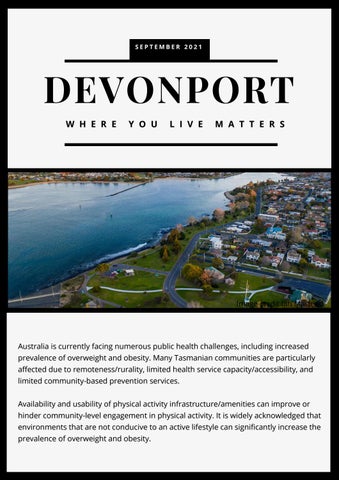
Image credit Ian Macleod
Australia is currently facing numerous public health challenges, including increased prevalence of overweight and obesity. Many Tasmanian communities are particularly affected due to remoteness/rurality, limited health service capacity/accessibility, and limited community-based prevention services. Availability and usability of physical activity infrastructure/amenities can improve or hinder community-level engagement in physical activity. It is widely acknowledged that environments that are not conducive to an active lifestyle can significantly increase the prevalence of overweight and obesity.
The Physical Activity Environment in Devonport Online and paper-based survey
Using a modified version of a validated survey (International Physical Activity Questionnaire - Environmental Survey, IPAQ-E), we collected information regarding the physical activity environment in Devonport between October 2020 - June 2021. The survey included questions spanning several topics. Existing knowledge about the availability of physical activity infrastructure; Usage of physical activity infrastructure; Perceptions of accessibility, safety and attraction of existing physical activity infrastructure; Gaps and outstanding needs. Initially, the survey was made available online through our web page https://www.utas.edu.au/health/community-programs/capitol. Subsequently, we delivered paper-based surveys to a selected sample of Devonport residences. One hundred and eighty Devonport residents responded to our survey. We received extensive support from the Devonport City Council in promoting the online version of the survey through the council web page and their social media site. The Advocate newspaper was also very useful in promoting our survey. Overall, the survey enabled us to gather valuable information about perceptions regarding availability/usability of physical activity infrastructure, public transport, safety and traffic in the Devonport area.
Perceptions about the Physical Activity Environment The majority of survey respondents indicated that there is easy access to shops and other important services (including transit stops) and plenty of free-to-access physical activity options in Devonport. The majority of respondents did not have any safety concerns during day light hours but some were apprehensive about safety at night. Most residents surveyed did not view traffic (whilst walking and driving) as an impediment to being active. Some reported that traffic can be a hindrance when cycling. Overall, most respondents were satisfied with the maintenance and general upkeep of their neighbourhoods.
Barriers to Physical Activity Are there any barriers to your physical activity participation? Interestingly, almost half of the 180 survey respondents indicated that there was no major barrier to their physical activity. Approximately 20% highlighted various health issues including osteoarthritis impacting their ability to be sufficiently active.
"Nothing. There are a lot of options in Devonport." About 5% of the respondents cited lack of motivation and being time poor due to family commiments as significant impediments to being physically active. A very small proportion of the community members raised concerns regarding the safety and bad weather as challenges to their activity.
A selection of comments regarding services, health issues and motivation are highlighted below "Lack of safe lighting at night along walking tracks." "I have to actually drive at least 15 mins to be able to do any activity." "Damaged and missing footpaths." "I enjoy walking the Don reserve track loop but there are no public toilets. " "I have OA and spinal issues and am very overweight... " "Business of life and work and poor excuses."
COVID-19 How has COVID-19 & government restrictions affected your activity levels? Contrary to expectations, one in two survey respondents believe that COVID-19 and government restrictions had no impact on their physical activity patterns.
"Made me more active. Zoom workouts every day now." However, about 25 community members reported that lockdowns were challenging with a further 10% being impacted temporarily as facilities were unavailable for use due to closures. It was interesting to note that a small proportion of community members found alternate modes to sustain their pre-pandemic physical activity levels.
Negative effects
Positive effects
"Made me fearful to go outside
"It actually made me go out for
for a while".
more walks during lock-down so felt reasonably satisfied that I was
"It was difficult not being able
keeping active".
to swim with our children during COVID-19".
"Minimally, we were still able to exercise close to home". "Improved my activity level. Working from home I made sure I walked 1/2 hr during the lunch break".
Other concerns Are there any other barriers? About 10% of the survey respondents indicated that they used the physical activity infrastructure located in the Devonport LGA infrequently and on a casual basis equating to less than once a week. A similar proportion suggested infrastructure improvements and the addition of new facilities for the community to access. Devonport City Council was positively recognised by some participants for their physical activity programs and excellent facilities. Almost half of participants did not identify any issues.
"Bicycle infrastructure for active transport is pretty good here only because it's legal for adults to ride on the pavement." Is more infrastructure needed? "We need more bike paths/tracks in the area, to repair/replace footpaths and fill in missing sections, and increase lighting to walking tracks especially for the winter months in areas such as Don Track and Back Beach walking track connecting through to Coles Beach."
CONTACT US
CAPITOL H E L P I N G C O M M U N I T I E S T O M O R E E F F E C T I V E L Y P R E V E N T O B E S I T Y
The main aim of the CAPITOL (Critical Age Periods Impacting the Trajectory of Obesogenic Lifestyles) project is to prevent overweight and obesity through community capacity building in NW Tasmania. The successful implementation of the CAPITOL project will assist in the promotion of healthy lifestyles and reduce avoidable presentations to hospitals.
Professor Andrew Hills Project Lead andrew.hills@utas.edu.au
Professor Roger Hughes Investigator roger.hughes@utas.edu.au
Mr Robert Soward Project Officer robert.soward@utas.edu.au