SEPTEMBER 2021
BURNIE W H E R E
Y O U
L I V E
M A T T E R S
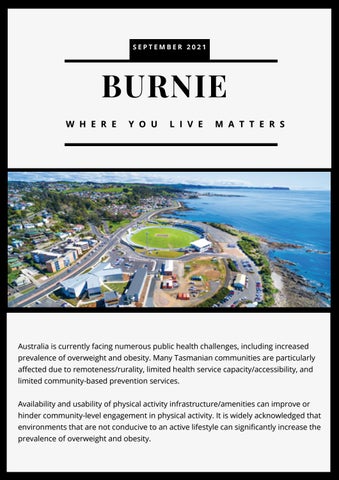
Australia is currently facing numerous public health challenges, including increased prevalence of overweight and obesity. Many Tasmanian communities are particularly affected due to remoteness/rurality, limited health service capacity/accessibility, and limited community-based prevention services. Availability and usability of physical activity infrastructure/amenities can improve or hinder community-level engagement in physical activity. It is widely acknowledged that environments that are not conducive to an active lifestyle can significantly increase the prevalence of overweight and obesity.
The Physical Activity Environment in Burnie Online and paper-based survey
Using a modified version of a validated survey (International Physical Activity Questionnaire - Environmental Survey, IPAQ-E), we collected information regarding the physical activity environment in Burnie between October 2020 - June 2021. The survey included questions spanning several topics. Existing knowledge about the availability of physical activity infrastructure; Usage of physical activity infrastructure; Perceptions of accessibility, safety and attraction of existing physical activity infrastructure; Gaps and outstanding needs. Initially, the survey was made available online through our web page https://www.utas.edu.au/health/community-programs/capitol. Subsequently, we delivered paper-based surveys to a selected sample of Burnie residences. Ninety nine Burnie residents responded to our survey. We received extensive support from the Burnie Council in promoting the online version of the survey. The Advocate newspaper was also very useful in promoting our survey. Overall, the survey enabled us to gather valuable information about perceptions regarding availability/usability of physical activity infrastructure, public transport, safety and traffic in the Burnie area.
Perceptions about the Physical Activity Environment The majority of survey respondents indicated that there is easy access to shops and other important services (including transit stops), and there are plenty of free-to-access physical activity options in Burnie. The majority of respondents did not have any safety concerns during day light hours but some were apprehensive about safety at night. Most residents surveyed did not view traffic (whilst walking and driving) as a barrier to being active. Some reported that traffic can be a hindrance when cycling. Overall, most respondents were satisfied with the maintenance and general upkeep of their neighbourhoods.
Barriers to Physical Activity Are there any barriers to your physical activity participation? Almost half of the Burnie survey participants (46%) indicated that there is no barrier to them being physically active and using the facilities available for physical activity. Approximately 16% indicated that they do have a physical or health issue that impacts their ability to be physically active and use the physical activity infrastructure in the Burnie community.
"My walking is limited to about 30 minutes a day and can only be done in a flat area. Flat areas that allow for 30 minutes of walking for a longer distance of more than a few hundred metres before a decline/incline occurs, do not exist in my neighbourhood." A selection of comments regarding services, health issues and motivation are highlighted below "Safer walking areas away from trucks." "Only laziness and sometimes I am late home from work." "One hourly bus service is too infrequent." "Only self imposed barriers." "I don't walk to the bus stop very often and instead take the car."
COVID-19 How has COVID-19 & government restrictions affected your activity levels? Contrary to expectations, approximately 60% of Burnie survey participants indicated that COVID-19 and government restrictions had no impact on their physical activity patterns
"During COVID lockdown 2020, I was more physically active due to being home and walking each day any time of the day." However, 14% of participants noted that they had experienced a negative affect with a further 6% being impacted temporarily as facilities were unavailable for use due to government closure. It was interesting to note that a small proportion of community members found alternate modes to sustain their pre-pandemic physical activity levels.
Negative effects
Positive effects
"..... some anxiety about
"Definitely not. Home gym, cycle,
crossing paths with other
treadmill, internet access,
people outdoors in the weeks
YouTube, fitness videos, Its what
before & after."
you make it."
"Lockdown stopped access to
"I have been 10 times more active
my physical therapists for
as life has given me the time and
months, which put my mobility
space to be so"
backwards many years and undid all the years of hard
"I took up cycling for the first
work my therapists and I had
time in years"
undergone..."
Other concerns Are there any other barriers? About 5 % of the survey respondents suggested infrastructure improvements and addition of new facilities for the community to access and use. Only 10% of the survey respondents indicated that they used the physical activity infrastructure located in the Burnie LGA infrequently and on a casual basis equating to less than once a week. Burnie City Council was positively recognised by some participants for their positive council physical activity programs or excellent facilities. Just over half of the participants did not identify any issues.
"Burnie City Council has done a lot to provide for physical activity e.g. View Road Reserve- dogs, bikes, walks, disc golf."
Is more infrastructure needed? "Needs to be more access to physical activities in suburbs like Shorewell and Montello. An adventure playground is a must. The boat park in Montello would be perfect." "There needs to be more access to warm water hydrotherapy in the Burnie area. There are very few publicly available pools heated to a sufficient temperature....."
CONTACT US
CAPITOL H E L P I N G C O M M U N I T I E S T O M O R E E F F E C T I V E L Y P R E V E N T O B E S I T Y
The main aim of the CAPITOL (Critical Age Periods Impacting the Trajectory of Obesogenic Lifestyles) project is to prevent overweight and obesity through community capacity building in NW Tasmania. The successful implementation of the CAPITOL project will assist in the promotion of healthy lifestyles and reduce avoidable presentations to hospitals.
Professor Andrew Hills Project Lead andrew.hills@utas.edu.au
Professor Roger Hughes Investigator roger.hughes@utas.edu.au
Mr Timothy Holloway Project Officer timothy.holloway@utas.edu.au